New Dawn – World's Most Unusual Magazine

Category: New Science/Consciousness

  • Lighten Up: It’s Time for a Great Awakening

    Lighten Up: It’s Time for a Great Awakening

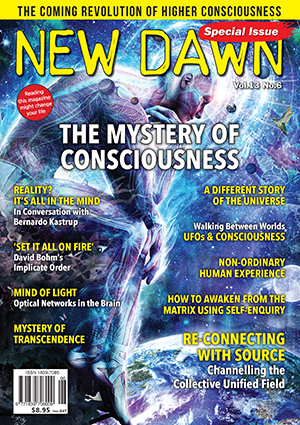
    From New Dawn Special Issue Vol 17 No 5 (Oct 2023)

    No problem can be solved from the same level of consciousness that created it.
    – Albert Einstein

    A radical inner transformation and rise to a new level of consciousness might be the only real hope we have in the current global crisis brought on by the dominance of the Western mechanistic paradigm.
    – Stanislav Grof

    Darkness cannot drive out darkness: only light can do that. Hate cannot drive out hate: only love can do that.
    – Martin Luther King Jr

    We are a world at war. This is the first time in history that the war has not been fought on battlefields, or in the air, or on the water, for territories or principalities or rights to land and resources, for conquering other cultures and peoples, but for the mind, the heart, the soul, and the collective consciousness of humanity.

    This war is an insidious and invisible all-out assault on individual freedom, thought, choice, and self-expression. What happens to the individual spreads like a pebble in a pond to everyone with whom the individual comes in contact. Humanity’s future is at stake, but no number of guns or tanks or nuclear weapons can win this war.

    The outcome of this war will be determined by our ability, alone and together, to open our eyes, awaken to truth, and move from dark to light on a whole different battlefield – human consciousness.

    We have been through this before – revolutions of consciousness that catapulted humanity out of quagmire. We have experienced cultural, political, and societal revolutions that propelled history forward. We have fallen prey to totalitarianism, fascism, and communism, but never on the scale we now face. It’s like we are battling a cult of massive proportions, one that may include those we love and care for.

    Whether it’s the World Economic Forum’s Great Reset, the United Nations’ Agenda 2030, or the government push for digital wallets and enforced medical procedures, it’s all about control and the puppet masters are wealthier, more powerful, and more determined than ever to take control over every aspect of our lives: from what we eat to what we drive to where we live and what we spend our money on.

    One thing that eludes their control is consciousness. Consciousness is the great mystery of existence. We know what it means – to be internally and externally aware of one’s existence. But we know little about its source and how it operates with the human brain to manifest perceptions and levels of awareness. Is consciousness outside the brain? Does it reside within the brain? Are our brains acting as transceivers of consciousness, taking in signals and sending them out?

    Do we have an individual consciousness that is part of a larger collective consciousness and how much influence over that collective do our thoughts, actions, and behaviours have? While philosophers, religious leaders, and scientists debate these questions, we all agree that we perceive our world according to our own perspectives and from a greater perspective that is true for us all. We might all look at a horse and react to it differently based on our individual past experiences with horses, but we all agree it’s a horse.

    Psychic Epidemics – The Fall Before the Rise

    Indeed it is becoming more obvious that it is not famine, not earthquakes, not microbes, not cancer but man himself who is man’s greatest danger to man, for the simple reason that there is no adequate protection against psychic epidemics, which are infinitely more devastating than the worst of natural catastrophes.
    – Carl Jung, The Symbolic Life

    Revolutions in higher consciousness are always predicated by periods of darkness and despair. The collective psyche must become so damaged it feels compelled to take action, break out of chains and through boundaries often imposed by external forces, and decide unequivocally to heal from an epidemic that, if not healed from, will destroy the host.

    Belgian clinical psychologist Mattias Desmet is recognised as the world’s leading expert on the theory of mass formation psychosis as it applied to the COVID-19 pandemic. In his book The Psychology of Totalitarianism, he deconstructs the societal conditions that allow this collective psychosis to take hold.

    During the recent COVID lockdowns, the work of Belgian clinical psychologist Mattias Desmet on ‘mass formation’ psychosis took centre stage as a way to explain the global insanity of the last few years. Desmet presented his theories about how free-floating fear and discontent serve to breed the kind of fear-based environment where common sense and cognitive functioning fly right out the window, replaced by a desperate need to find a common enemy upon which people could project that fear.

    The article, “Mass Psychosis – How an Entire Population Becomes Mentally Ill,” which appears on the Academy of Ideas website, describes this condition as “an epidemic of madness and it occurs when a large portion of a society loses touch with reality and descends into delusions. Such a phenomenon is not a thing of fiction.”

    The article puts forth two historical examples: the American and European witch hunts of the 16th and 17th centuries and the rise of totalitarianism in the 20th century. “When a mass psychosis occurs, the results are devastating.” Many have seen this unfold in their personal lives and on the global stage, when common sense and logic no longer exist, and you are either in the cult or you are the enemy.

    Killing of the Mind

    This psychological warfare has what are called psychogenic triggers, the most common being a flood of negative emotions such as fear, anger, or anxiety that “drives an individual into a state of panic.” Sometimes this leads to a psychotic break and a literal “re-ordering of one’s experiential world which blends fact and fiction, delusion and reality, in a way that helps end the feelings of panic,” notes the Academy of Ideas. In other words, those afflicted by this epidemic adapt by becoming delusional, and no amount of fact or logic will wake them from their trance-like condition.
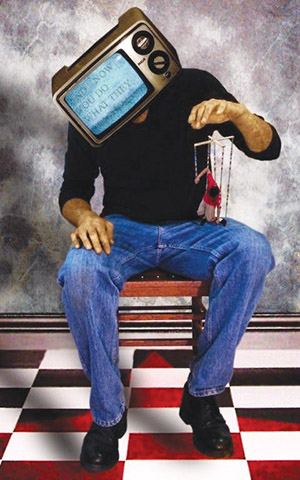
    This non-stop attack on the individual psyche also infects society as a whole, and totalitarianism becomes the next easy step for those seeking ultimate power and control. With much of the populace operating in disempowered states of consciousness, controlling and manipulating them is easy.

    Arthur Versluis in The New Inquisitions says: “Totalitarianism is the modern phenomenon of total centralised state power coupled with the obliteration of human rights; in the totalised state, there are those in power, and there are the objectified masses, the victims.”

    This objectification leads to menticide, a “killing of the mind,” notes psychoanalyst Joost Meerloo in his book, The Rape of the Mind, an analysis of brainwashing techniques and thought control in totalitarian states.

    “Menticide is an old crime against the human mind and spirit but systemised anew. It is an organised system of psychological intervention and judicial perversion through which [a ruling class] can imprint [their] own opportunistic thoughts upon the minds of those [they] plan to use and destroy,” writes Meerloo.

    Meerloo expounds on the presence, at this point in time, of effective means to manipulate society: cell phones, social media, the Internet, propaganda-spreading bots, and censorship algorithms.

    The addictive nature of these technologies means that many people voluntarily subject themselves to propaganda with remarkable frequency. Think Stockholm Syndrome and capture-bonding of the masses. Add to this social isolation, as we saw with COVID lockdowns (we now possibly face ‘climate change’ lockdowns & blackouts), and the human being becomes a remote-controlled robot.

    Clearing Muddy Waters

    The collective consciousness is coloured by the energy we each and all put into the world around us when faced with increasing chaos, disorder, crises, and challenges. The Chinese word for ‘crisis’ comprises two Chinese characters meaning ‘danger’ and ‘opportunity’. There’s an opportunity to create a new order in times of chaos. But, of course, the puppet masters want to keep their power in any “new order.”

    A Great Awakening and new consciousness revolution is pushing things forward in an accelerated manner. Its ultimate aim is to seek the light, but first, the shadows and darkness propel it from a point of stasis to the light at the end of a tunnel. That tunnel might be a long way off and involve a lot of suffering and pain, but the light is the key attractor point.

    Our awareness as individuals in the body of humanity is rapidly changing and – though many members of that body grasp onto the ways of old – enough of us are tipping the scales in the other direction. We seek that light by our very nature because we know it lifts us. But only when we courageously break free of the capture-bonding to embrace our shadow selves can we truly become whole to advance the larger positive agenda of the consciousness revolution.
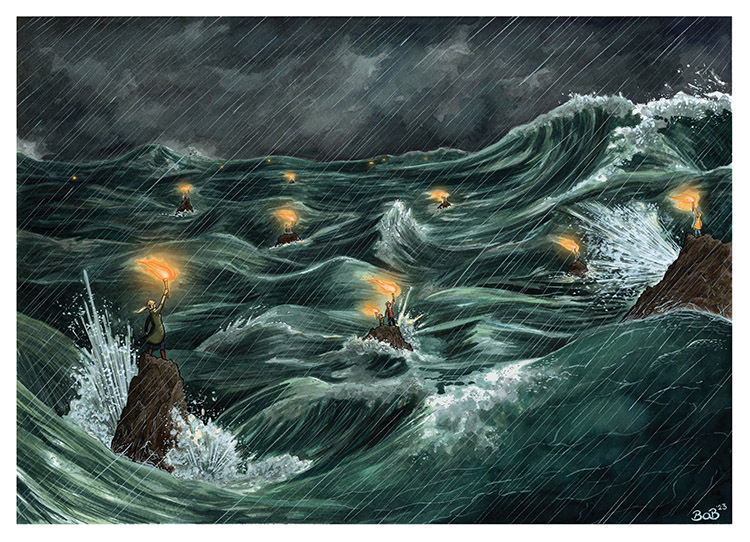
    Credit:  Beacons by Bob Moran. bobmoran.co.uk

    Shadow To Light

    According to Jungian psychology, the shadow self is an archetype of the darker side of the unconscious mind composed of repressed ideas, weaknesses, desires, instincts, and shortcomings. When we ignore, deny, or avoid our shadow self, we project it onto others. That projection becomes the reality we exist within, made up of all the personality traits and emotions we find hard to accept because they don’t fit our egoic self-conception. It’s like each of us throwing poison into a pool we will all drink from, then each denying we threw in our share.

    When we work with and embrace the shadow we can transform it into something beneficial for wisdom and growth – but only if we are courageous enough to undergo the alchemical process of intense self-examination. In today’s social media world, attention spans have diminished to the point of five-second video clips. Yet the idea of conscious evolution suggests that we all have the ability to become willing participants in the growth and expansion of culture, of society, of life itself.

    We must become aware of the patterns of belief and behaviour that shape our internal and external worlds. These keep us from evolving out of our current state, one we might describe as a comfort zone of conscious awareness because we feel safe there, we know its stink and circumstance. We must do a lot of hard excavating work, like excising a cancerous tumour.

    Moscow-born musician and writer Tessa Lena writes: “We, modern people, are very much like cells that are born into a body overtaken with metastatic cancer. We only know how to be a part of a sick body and, based on our immediate practical experience, we ascribe our starved state to ‘just how things are.’ But no. This is only how things are for a cell that exists in a body overtaken by metastatic cancer. This is not how things are by default. This is how they are now. And we are in a journey. We are swimming through sewage collectively, and we’ll get to our destination faster if we keep swimming forward…”

    When we open our eyes and see the way things really are, including the dirt and muck we are currently swimming in, we can consciously choose to make effective and revolutionary change.

    Levels of Consciousness

    Dr. David R. Hawkins, author of the seminal Power Vs. Force: The Hidden Determinants of Human Behavior, writes of the 17 levels of human consciousness we experience throughout our lives.

    From lowest to highest, these levels of consciousness are shame, guilt, apathy, grief, fear, desire, anger, pride, courage, neutrality, willingness, acceptance, reason, love, joy, peace, enlightenment. Few ever achieve the top level. We are told that one person operating at the highest level can offset the damage done by millions operating below. But we don’t have to all be Buddhas to change the world to that degree. Small ripples have big results, too.

    Sadly, too many people operate in the realms of shame, guilt, and other lower-level vibrations, not realising they affect other people and energy fields around them and thus, the collective.

    Those who seek to keep us down in the dirt will never shine any light on this truth. Once we learn and see, we cannot unlearn or unsee. That alone is the biggest threat to totalitarians poised to imprison us in fifteen-minute cities, control our behaviour through trackable digital currencies, or new insidious schemes to depopulate the planet of “useless eaters.”

    Lessons from the Quantum Field

    Max Planck, the father of quantum physics, stated: “All matter originates and exists only by virtue of a force. We must assume behind this force the existence of a conscious and intelligent Mind. This Mind is the matrix of all matter.”

    The bizarre world of quantum physics indicates that we are part of this intelligent Mind that creates the matrix of matter. An act of observation affects a particle’s trajectory and behaviour.

    Quantum entanglement posits that two particles that come in contact with one another will continue to affect each other’s ‘spin’ even across vast distances. Could this be applied to life on a grander, cosmic scale? If we, too, are entangled, then we are all a part of the web of connectivity, and this does not exclude our enemies. Our individual level of consciousness influences everyone around us, as theirs does everyone around them, and so on and so on. Raise enough individuals up the scale to higher consciousness and we offset the damage of many who vibrate lower.

    We cannot rely only on the high-vibers to save us. We must find our inner light and let it shine brightly right where we are. Two powerful flashlights can light up a dark room. A million or more can light up the entire world.
    Get the issue this article appears in

    The Great Awakening: Higher Self, Higher World

    Writer, artist, and journalist Martin Geddes writes succinctly of the times at hand and what is required to rise to their challenges in his book, Open Your Mind to Change: A Guidebook to the Great Awakening.

    Geddes unravels the forces behind the emergence of the ‘Great Reset’ – a plan offered up by the technocratic elite to maintain power – and the concurrent Great Awakening.

    “The unacknowledged reality is that there is a spiritual war raging around us, and it can be seen in classical terms of light versus dark. The good news is that the light is winning, as it always eventually must. For however you describe and define it, the universe fundamentally is interconnected and seeks unity. Evil always collapses under its conceit that it can maintain separateness. It is like a physics of morality: it takes non-linear energy to compartmentalise us and resist the unifying power of love.”
    Geddes refers to his own experiences during modern crises such as COVID, the 2020 US election, vaccine mandates, and the Ukraine conflict. A personal revolution of consciousness led him to a more illumined perspective on the ongoing spiritual war, and he is both hopeful and realistic:

    “It took us 6,000 years to get into this mess, so fixing it won’t be quick or painless. However, just as there is a negative ‘occult’ power in the world that enslaves us, there are also unseen positive forces for good.”

    Perhaps we cannot fight against what we don’t want. The “fighting against” creates resistance to the expansion of consciousness. It is negative energy, tight and constricted. It adds low-level vibratory energies into the collective quantum field, which is then shaped to become external reality.

    Now is the time to awaken and choose a higher path that does not involve “warring against” but “welcoming into.”

    Imagine duelling lighthouses so engrossed in trying to outshine each other in a “battle of the beams” that they forget to shine their lights outward to the sea and end up causing untold ships to crash against the rocky shores. Both are at fault because their focus was on trying to control the other, to suppress or oppress, rather than to combine energies and save a lot of lost souls.

    We should strive to attain a higher state of consciousness, to grow and become and seek and speak truth, and to emit light and counter shadow. We don’t become the darkness we dissipate. Instead, we become the light that – when shined into the darkness – dissipates it.

    If enough of us do this, there will be little darkness left to fight and dissipate. The Great Awakening is at hand. 

    [alert type=”general” dismiss=”no”]This article was published in New Dawn Special Issue Vol 17 No 5.[/alert]

    [alert type=”success” dismiss=”no”]If you appreciate this article, please consider subscribing to help maintain this website.[/alert]

    Sources

    academyofideas.com/2021/08/mass-psychosis-how-an-entire-population-becomes-mentally-ill/
    Martin Geddes, Open Your Mind to Change: A Guidebook to the Great Awakening.
    David Hawking, Power vs. Force: The Hidden Determinants of Human Behavior, Hay House, 2014.
    tessa.substack.com/p/swimming-with-zombies-how-to-protect
    verywellmind.com/what-are-jungs-4-major-archetypes-2795439

    © New Dawn Magazine and the respective author.
    For our reproduction notice, click here.

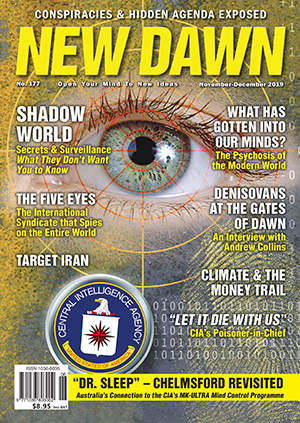
  • What has Gotten into Our Minds? The Psychosis of the Modern World & the Search for the Self

    What has Gotten into Our Minds? The Psychosis of the Modern World & the Search for the Self

    From New Dawn 177 (Nov-Dec 2019)

    …in the darkness charlatans are easily mistaken for sages.
    – Chantal Delsol

    There’s something fundamentally wrong with how the world is right now. Don’t you see it – feel it? We are a species with noble character, with a great spirit, and with a sacred soul. In our hearts we wish only for the betterment of all people; for love and justice and communion. And yet what we see going on in the world is nothing less than complete madness. We have to say it exactly as it is – there is a sickness going on, and this pathogen is spreading on a vast scale.

    We live in a world where economic greed overrides all other factors. Nations, corporations, and individuals commit horrendous acts that include impoverishment, deprivation, psychological and physical torture, and even murder, just for financial gain. We behave horrendously toward each other; there is constant bullying and harassment upon all social and cultural levels. Violence is endemic across the globe, and pharmaceutical corporations would rather turn a profit than support health and well-being. Governmental bodies and agents participate in drug trafficking on a huge scale in order to both make money as well as promote addiction amongst the masses. Rich individuals and corporations hide their money through illegal offshore schemes rather than contribute to the welfare of their communities. People in high office consistently abuse, harass, and violate people within their power as a sign of their high status. The health of the planet and its natural environment is constantly mistreated and polluted; again, mostly for the sake of economic gain. And the list goes on.

    We have entered the third millennium, and we pride ourselves on being an inventive and intelligent species. We have probed off-planet and have allegedly placed people on the moon. We are now planning trips further afield into the solar system and of having people live on the planet Mars. We are an incredibly creative and compassionate species. So, what is wrong? Why do so many people so much of the time adhere to thinking and ways of behaviour that is nothing short of insanity? Why is everything so seemingly upside-down?

    The reason, I propose, is that we are not living within our right minds. That is, we have ‘lost’ our minds to a collective psychosis that seeks to imbue us with a traumatic mind. This is no flight of fantasy. There are indeed indigenous and wisdom teachings that tell of a mental force that exists in the collective consciousness field that came to usurp our minds. Various traditions refer to these nefarious mindsets as wetiko, predators, archons, Ahriman, the flyers, and more. They speak of how an ‘alien mind’ has entrapped and traumatised the human collective mind.

    Another side of this story is that as a global species, we are also projecting the wounds of our collective unconscious out into the world. This is both a traumatic as well as cathartic process. Perhaps it is necessary – a collective cleansing of our unconscious traumas and of the shadows that lurk in the dark recesses of our minds – to prepare our species for the next phase of our evolution? What we can be sure about, without a doubt, is that we are amidst a great, historical transition. At this time, two major issues confront us: the seeming madness of the modern world, and the need to find meaning within it.

    What’s Going On?

    The question we are confronted with is a collective one, and it concerns us all. Why are so many of us, our fellow humans, behaving so badly? And not only badly, but in a way that is detrimental to our own well-being. It would seem more than strange, verging on the insane, that any creature would wish to deliberately harm its own environment and support systems. Yet for us humans, we have the significant added factor of being conscious of our actions, and self-conscious in our reflective understanding. So, again, we ask – what has gotten into our minds?

    Modernity (and post-modernity) has given us the perspective that anything that is important lays external to us. The attitude of this ‘modern mindset’ to the external world has largely been one of hostility – we have been conquering the external world for the greater part of recent history, instead of mastering our own inner nature. Whatever we project externally eventually becomes our sense of reality; therefore, if we have inherited a corrupted collective mind, then we are projecting a tarnished collective reality. Modern life has attempted to reinterpret the human condition, and this has resulted in a separation from our need to seek essential inner meaning in our lives. Progress may alleviate some of our suffering and pains, yet it shall never compensate for the lack of fulfilment we feel inside, for this requires metaphysical or transcendental nourishment.

    Any notion of the spiritual, or the metaphysical, is often considered not essential to our daily life, and we are taught to dismiss it. Modernity’s task was thus seen as freeing us from the illusions of transcendence. And in its place, we have been conditioned (a.k.a. programmed) with a form of thinking opposing a genuine path of human psychic development. In this regard, I now consider the hypothesis that a mental infection (a psychosis) has entered the collective human mindset.

    I examine this proposition from four different cultural contexts: indigenous Native American, western psychology, Central American shamanism, and European theosophy. And I have given it my own name – the Wounded Mind. First, I turn to the indigenous Native American tradition.

    The Wetiko Virus

    Jack Forbes, Native American scholar and activist, studied this disease of the mind, concluding it “is the greatest epidemic sickness known to man.”

    Jack Forbes (1934–2011), a Native American scholar and activist, long considered this question of what has gotten into the human mind – and came up with an answer for it. After long study, he came to the conclusion that humanity is suffering from a specific disease, a psychosis:

    For several thousands of years human beings have suffered from a plague, a disease worse than leprosy, a sickness worse than malaria, a malady much more terrible than smallpox… whatever we call it, this disease, this wetiko (cannibal) psychosis, is the greatest epidemic sickness known to man.1

    Wetiko is a Cree term (windigo in Ojibway, wintiko in Powhatan) that refers to an evil person or spirit which terrorises other creatures by means of terrible acts. And in Forbes’ view, the great tragedy of humankind is that our history for the past two thousand years has largely been a tale of the psychosis of the “wetiko disease” as he calls it. He goes as far back as to include the Egyptians, Babylonians, and Assyrians as cultures that helped to spread the wetiko disease throughout the Middle East. Afterwards, it was the Macedonians and Greeks under Alexander who spread it still further until it finally landed in the lap of the Roman Empire who, according to Forbes, really expanded the wetiko infection.

    What he is saying here is that this psychosis is a particular mindset that took form as certain hierarchical cultures and civilisations began to grow. And in order to maintain control, power, and to further bloody expansion, this mindset was deliberately cultivated, encouraged, and then developed as the dominant perspective and narrative. In fact, it was a crucial perspective that had to be propagated in order to maintain all status quo power structures within a developing culture. To not adhere to this specific mindset almost certainly meant annihilation and eradication in the face of other competing cultures (as was the case with Forbes’ inherited Native American ancestral cultures).

    Forbes’ view is that the wetiko disease has so corrupted European thinking that wetiko behaviour is now regarded as the very fabric of European culture and the pursuit of progress. And in order for the ruling few to maintain stable power and order, they must convince, persuade, or condition the masses within their society/civilisation to either believe and support the same, or at the very least not to rebel against it. The functioning of our modern societies has been derived from this operation of providing a dominant mindset – or social narrative – and manipulating its collective consent through coercion or, as is now more the case, persuasive propaganda.

    Forbes comes to the conclusion that a developed society takes the wetiko desire for power and channels it into creating highly disciplined and rigid structures that over the years have managed to conceal their controlling mechanisms through institutionalised conditioning. These institutions then go on to create an established ‘pecking order,’ or hierarchical status, between people. This ranking social status system continues to exploit the general population through more socially ‘normalised’ means. Innocent or non-conscious wetikos can also be co-opted into this system of behaviour through allurements such as grants, support, employment, etc., which entices them into the illusion of individual freedom and personal power. Like any other pathogen, the wetiko virus tries to infect and feed upon others by reinforcing its own corruption of the human mind.

    The predatory nature of wetiko can lurk under almost any guise and is most prevalent in such slogans as ‘patriotism’, ‘profit-seeking’, and ‘protecting our way of life’. We could say that we have seen recent examples in ‘you’re either with us or against us’. The wetiko mindset assimilates itself through intensive propaganda programs designed to perpetuate its own self-serving values. In the end, many of our national cultures have become pervaded by myths, narratives, and entrained thinking patterns that perpetuate a wetiko society. Yet what if such a mindset is not only preserved within particular cultures but is available to be assimilated through a species collective mindset? This is the question posed by the psychoanalyst and psychologist Carl Gustav Jung.

    Jung’s Collective Unconscious

    According to Carl Gustav Jung, Hell represents, among every culture, the disturbing aspect of the collective unconscious. The wetiko pathogen may have infected the field of humanity’s collective unconscious.

    Jung was perhaps the first psychologist to fully realise that what we see playing out upon the global stage is largely a projection, or symptom, of the unconscious psyche of humanity. Jung considered that this collective unconscious does not develop individually but is inherited. That is, we inherit a ‘psychic life’ that is filled with ‘occurrences’ that stretch back to earliest beginnings. What if a psychosis, such as the wetiko pathogen, has already invaded this psychic stratum and now manifests as a disturbance in the field of humanity’s collective unconscious? We could very well be dealing with a psycho-pathogen – that is, a mind virus – that infects our individual minds from the underlying collective realm.

    This collective psychosis functions as a field phenomenon, and as such it underlies the entire collective field of nonlocal consciousness. The danger here is that each person can potentially be infected by the psychosis simply by not being mindful of their thoughts. Before we know it, we are having malicious or angry wetiko-like thoughts, which then could easily manifest into actual behaviour. Who at one time or another hasn’t had a mean or nasty thought? The question is – did this thought originate within us, or did it enter from without? Since the mind virus pathogen – which I refer to as the Wounded Mind – is a nonlocal phenomenon, then it is possible we all are infected with it to varying degrees. Or, it may be more accurate to say that this mind has us. And the worst of it is that most people will be unconscious and unwitting carriers of this pathogen. As Jung said, “Wars, dynasties, social upheavals, conquests, and religions are but the superficial symptoms of a secret psychic attitude unknown even to the individual himself.”2

    If we take the modern analogy of computing, then it is similar to how a virus would enter our computers and install malware or change the coding. Such a mental pathogen would act in the same way by installing its own malware program in our minds. For most of the time we are unaware of it, as it acts alongside our own ‘normal’ mind until a time when it takes over almost completely. Over time our own mental make-up – our psychological state – would adapt the foreign ‘invader’ and assimilate it into its own functioning as a way of normalisation. In other words, we would eventually come to consider it as our mind.

    Don Juan’s Alien Mind

    Carlos Castaneda (1925–1998)

    There are wide-ranging accounts throughout shamanic and anthropological literature about how people are vulnerable to psychic invasion and predatory ‘energy forces’. In recent times, perhaps no-one has been as openly explicit as the teachings given by don Juan through the books of Carlos Castaneda. Later in the series of books, when Castaneda is more experienced and matured into the shamanic path, don Juan reveals some ‘truths’ to him regarding the nature of the predators. Don Juan explains that there are “outside forces” that impose control upon us. These ‘predators’ imprison human beings and make us docile. When Castaneda protests against this, don Juan explains that:

    In order to keep us obedient, meek and weak, the predators engaged themselves in a stupendous maneuver – stupendous, of course, from the point of view of a fighting strategist. A horrendous maneuver from the point of view of those who suffer it. They gave us their mind! Do you hear me? The predators give us their mind which becomes our mind. The predators’ mind is baroque, contradictory, morose, and filled with the fear of being discovered any minute now… Through the mind, which after all, is their mind, the predators inject into the lives of human beings whatever is convenient for them.3

    According to don Juan, an ‘alien’ presence, or energy, has infiltrated the human mind. That is, when ‘we’ are thinking, or ‘having’ thoughts, we are in effect manifesting – or being influenced by – a corrupted mind that is “baroque, contradictory, morose” and filled with fear. When we connect and engage with the collective unconscious, or the collective mindset, are we, in fact, tapping into a psyche that, in the words of Jung, stretches “right back to the earliest beginnings”? Yet those beginnings may also include the ‘alien mind’ of the predator.

    As a species, humanity accesses a collective unconscious mind that forms the basis of our thinking patterns and our behavioural traits. If an element of psychosis, trauma, a dominating narrative – i.e., wetiko, predator – has infiltrated this collective mental field then it is a very real possibility that we too have inherited what I call the Wounded Mind. It also raises the question of what type of civilisation or society would such a parasite-predator psychotic ‘mind’ wish to create?

    The answer to this may lie with a form of twentieth-century theosophy that was put forward by the Austrian philosopher and mystic Rudolf Steiner.

    The Coming of Ahriman

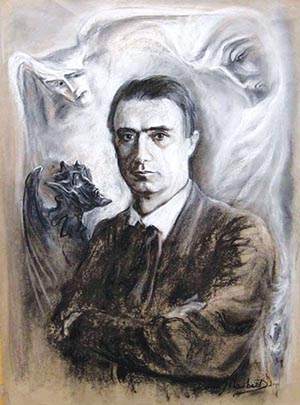
    Painting of Rudolf Steiner (1861–1925) displays the spiritual forces at work on humanity including that of the Ahrimanic presence which seeks to bind us to matter.

    In the writings of Rudolf Steiner in the early part of the twentieth century, he makes mention of an entity he calls Ahriman. For Steiner, this Ahriman is a supersensible being that wishes to distract humanity from aligning with its evolutionary potential. In order to accomplish this, it seeks to influence the minds of humanity in order to develop along a specific path; one that aligns with its own needs rather than that of humanity’s.

    The conditions that the Ahrimanic presence wishes to create includes the following: a materialistic, mechanical conception of the universe; a rational-materialistic based scientific dogma; an economic view of social dynamics and systems; a strong feature of nationalism and national identities; the popularity of separatist party politics; the prevalence of fundamentalism in religious dogma; and the dominance of an arid, dry intellectual culture.4 It would appear that this Ahrimanic presence has been quite successful so far!

    Steiner was also explicit in stating that the most dangerous aspect of Ahriman is for this presence to go unrecognised for it seeks to be hidden (similar to the predators). Steiner, in one of his lectures, stated: “…think of everything that presses us down upon the earth, that makes us dull and philistine, leading us to develop materialistic attitudes, penetrating us with a dry intellect, and so on: there you have a picture of Ahrimanic powers.”5

    The Ahrimanic powers, we are told, have a firm intention to get the human domain, as well as the earth, into their sphere of power, and to make human beings dependent upon their control. Again, it sounds eerily familiar. Steiner tells us that Ahriman intends to conceal from us that modern intellectual, rationalistic science, is a great illusion, a deception. The idea, apparently, is to keep us all so dulled with our materialistic paradigms that we have no inclination or urge to go seeking for knowledge concerning “soul and spirit in the cosmos.”

    The Ahrimanic powers use everything at their disposal to seed discontent, disarray, and conflict. They manipulate notions of heredity – family, race, tribe, peoples – to create confusion and division. Through these class structures, they enforce the dominant cultural paradigm of economic and material needs. Steiner warns his listeners that the “Ahrimanic incarnation” will be greatly advanced if people fail to develop an independent life of the spirit.

    Get the issue this article appears in

    A Few Words of Recognition

    In all the examples described here – indigenous Native American, western psychology, Central American shamanism, and European theosophy – we have had a glimpse of the proposition of what I term the Wounded Mind. The source of this trauma, however, is still unclear and open for debate. It may be either a collective psychosis of civilisation, a predatory invasion, a devolutionary impulse/presence, or a combination of these. Or else it may be something other but with similar aspects. Yet whatever may be the root cause, it is still quite clear that a traumatic presence lingers within the collective psyche of humanity, and it needs to be recognised for what it is – and expelled.

    Perhaps the traumas we are seeing inflicted upon the world today are part of this expulsion – a sort of public exorcism. In the end, we will need to curtail these ‘foreign impulses’ in order to evolve toward a better future for us as a human species upon this planet.

    Kingsley’s book Healing the Wounded Mind: The Psychosis of the Modern World and the Search for the Self (Clairview Books), is available from here and all good bookstores.

    [alert type=”general” dismiss=”no”]This article was published in New Dawn 177.[/alert]

    [alert type=”success” dismiss=”no”]If you appreciate this article, please consider subscribing to help maintain this website.[/alert]

    Footnotes

    1. Jack D. Forbes, 2008 (rev). Columbus and other Cannibals, Seven Stories Press, xvi
    2. Cited in Meredith Sabini (ed), ed. 2008. C.G. JUNG on Nature, Technology & Modern Life, North Atlantic Books, 188
    3. Carlos Castaneda, 1999, The Active Side of Infinity. Thorsons, 220
    4. R. Steiner, 2009, The Incarnation of Ahriman: The Embodiment of Evil on Earth, Rudolf Steiner Press
    5. Ibid, 1

    © New Dawn Magazine and the respective author.
    For our reproduction notice, click here.

  • Is There a Connection Between Quantum Physics & Positive Thinking?

    Is There a Connection Between Quantum Physics & Positive Thinking?

    From New Dawn Special Issue Vol 13 No 6 (Dec 2019)

    For the last several years a thickening stream of New Age books and documentaries have, to the chagrin of critics, attempted to use quantum theory to “prove” that the mind possesses causative powers. Enthusiasts say that quantum experiments demonstrate that an observer’s presence or perspective determines the nature of objects on a subatomic scale.

    Recently Robert Lanza, adjunct professor at the Institute for Regenerative Medicine at Wake Forest University, argued that death itself is ultimately a mental phenomenon – we “die” because the mind perceives demise.1

    Researchers are rightly vexed when concepts in quantum theory are picked over in slipshod or sensationalistic ways. Most scientists want to slam shut the door on this (admittedly dim) connection between quantum physics and the vaunted reality-shaping properties of the mind. But ongoing findings in quantum physics – when considered without half-baked understanding – keep pushing the door back open.

    There is place for a conversation between physicists and serious people in the metaphysical culture – including those who are interested in the widely maligned practice of “positive thinking,” which holds that thoughts influence reality. Scientific authorities quickly shoot down the starting proposition that quantum theory raises a viable question about the causative influence of the mind, at least in a world of subatomic particles and waves. Many scientists object that such notions arise from a misunderstanding of quantum data.

    Yet, if approached with care, this discussion – of whether observation evinces causal properties in a world of waves and particles – deserves the ear of reasonable people.

    First the basics: Physics journals today routinely discuss what is called the “quantum measurement problem.” Many people have heard of some version of it. In essence, more than eighty years of laboratory experiments show that atomic-scale particles appear in a given place only when a measurement is made. Astonishing as it sounds – and physicists themselves have debated the data for generations – quantum theory holds that no measurement means no precise and localised object on the atomic level.

    Put differently, a subatomic particle literally occupies an infinite number of places (a state called “superposition”) until observation manifests it in one place. In quantum mechanics, a decision to look or not look actually determines what will be there. In this sense, an observer’s consciousness determines objective reality in the subatomic field.

    Some physicists would dispute that characterisation. Critics sometimes argue that certain particles are too small to measure; hence any attempt at measurement inevitably affects what is seen. But there exists a whole class of “interaction-free measurement” quantum experiments that don’t involve detectors at all. Such experiments have repeatedly shown that a subatomic object literally exists in more than one place at once until a measurement determines its final resting place.

    How is this actually provable? In the parlance of quantum physics, an atomic-scale particle is said to exist in a wave-state, which means that the location of the particle in space-time is known only probabilistically; it has no properties in this state, just potentialities. When particles or waves – typically in the form of a beam of photons or electrons – are directed or aimed at a target system, such as a double-slit, scientists have found that their pattern or path will actually change, or “collapse,” depending upon the presence or measurement choices of an observer. Hence, a wave pattern will shift, or collapse, into a particle pattern. Contrary to all reason, quantum theory holds that opposing outcomes simultaneously exist.

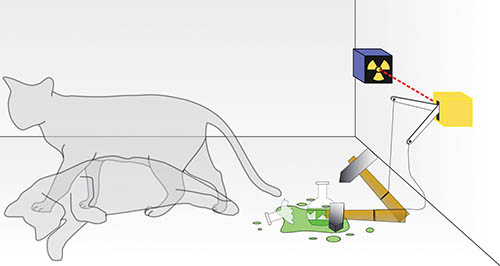
    The situation gets even stranger when dealing with the thought experiment known as “Schrodinger’s Cat.” The twentieth-century physicist Erwin Schrodinger was frustrated with the evident absurdity of quantum theory which showed objects simultaneously appearing in more than one place at a time. Such an outlook, he felt, violated all commonly observed physical laws. In 1935, Schrodinger sought to highlight this predicament through a purposely absurdist thought experiment, which he intended to force quantum physicists to follow their data to its ultimate degree.

    Schrodinger reasoned that quantum data dictates that a sentient being, such as a cat, can be simultaneously alive and dead. A variant of the Schrodinger’s Cat experiment could be put this way: Let’s say a cat is placed into one of a pair of boxes. Along with the cat is what Schrodinger called a “diabolical device.” The device, if exposed to an atom, releases a deadly poison. An observer then fires an atom at the boxes. The observer subsequently uses some form of measurement to check on which box the atom is in: the empty one, or the one with the cat and the poisoning device. When the observer goes to check, the wave function of the atom – i.e., the state in which it exists in both boxes – collapses into a particle function – i.e., the state in which it is localised to one box. Once the observer takes his measurement, convention says that the cat will be discovered to be dead or alive. But Schrodinger reasoned that quantum physics describes an outcome in which the cat is both dead andalive. This is because the atom, in its wave function, was, at one time, in either box, and either outcome is real.


    Schrödinger’s cat thought experiment: a cat, a flask of poison, and a radioactive source are placed in a sealed box. If an internal monitor (e.g. Geiger counter) detects radioactivity (i.e. a single atom decaying), the flask is shattered, releasing the poison, which kills the cat. The Copenhagen interpretation of quantum mechanics implies that after a while, the cat is simultaneously alive and dead. Yet, when one looks in the box, one sees the cat either alive or dead, not both alive and dead. This poses the question of when exactly quantum superposition ends and reality collapses into one possibility or the other.

    Of course, all lived experience tells us that if the atom went into the empty box, the cat is alive; and if it went into the box with the cat and the poisoning device, the cat is dead. But Schrodinger, aiming to highlight the frustrations of quantum theory, argued that if the observations of quantum-mechanics experiments are right you would have to allow for each outcome.

    To take it even further, a cohort of quantum physicists in the 1950s theorised that if an observer waited some significant length of time, say, eight hours, before checking on the dead-alive cat, he would discover one cat that was dead for eight hours and another that was alive for eight hours (and now hungry). In this line of reasoning, conscious observation effectively manifested the localised atom, the dead cat, the living cat – and also manifested the past, i.e., created a history for both a dead cat and a living one. Both outcomes are true.

    Absurd? Impossible? Yes to that, say quantum physicists – but decades of quantum experiments make this model – in which a creature can be dead/alive – into an impossible reality: an unbelievable yet entirely tenable, even necessary, state of nature. Schrodinger’s thought experiment forced a consideration of the meaning of quantum mechanics (though not many physicists pay attention to the radical implications).

    Why is there an apparent divide in our view of reality, in which one set of rules governs the events of the micro world and another set governs the macro world? It may be due to the limits of our observation in the macro world. Some twenty-first-century quantum physicists call this phenomenon “information leakage.”

    The theory of “information leakage” holds that the apparent impossibilities of quantum activity exist all around us. They govern reality. However, when we step away from whatever instrument we are using to measure micro particles and begin looking at things in larger frames and forms, we see less and less of what is really going on. We experience a “leakage” of data. William James alluded to a similar dynamic in his 1902 Gifford Lectures: “We learn most about a thing when we view it under a microscope, as it were, or in its most exaggerated form. This is as true of religious phenomena as of any other kind of fact.”

    Only future experiments will determine the broader implications of sub-natural phenomena in the mechanical one in which we live. For now, however, decades of quantum data make it defensible to conclude that observation done on the subatomic scale: (1) shapes the nature of outcomes, (2) determines the presence or absence of a localised object, and (3) possibly devises multiple pasts and presents. This last point is sometimes called the “many-worlds interpretation,” in the words of physicist Hugh Everett. This theory of “many worlds” raises the prospect of an infinite number of realities and states of being, each depending upon our choices. And here we encounter the frustrating but persistent thesis of positive thinking, which holds, in some greater or lesser measure, that our thoughts influence – concretely – our experience.

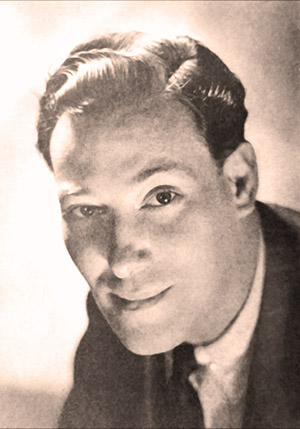
    Neville Goddard (1905–1972)

    Everett’s concept of multiple worlds and outcomes based on the vantage point of the observer finds its closest metaphysical analogue in the ideas of Neville Goddard,2 a mid-twentieth century mystical writer and lecturer who reasoned that our thoughts create an infinitude of realities and outcomes. Neville (who went by his first name) argued that everything we see and experience, including one another, is the product of what happens in our own individual dream of reality. Through a combination of emotional conviction and mental images, Neville believed, each person imagines his own world into being – all people and events are rooted in us, as we are ultimately rooted in God. When a person awakens to his true self, Neville argued, he will, in fact, discover himself to be a slumbering branch of the Creator clothed in human form, and at the helm of infinite possibilities.

    Most quantum physicists wouldn’t be caught dead/alive as Schrodinger’s cat reading an occult philosopher such as Neville. Indeed, many physicists reject the notion of interpreting the larger implications of quantum data at all. “Shut up and calculate!” is the battle cry popularised by physicist N. David Mermin. The role of physics, critics insist, is to measure things – not, in Einstein’s phrase, to lift “the veil that shrouds the Old One.” Leave that to gurus and philosophers, but, for heaven’s sake, critics argue, keep it out of the physics lab. Others adopt the opposite position: If physics isn’t for explaining reality, then what is it for?

    Get the issue this article appears in

    The latter principle may carry the day. A rising generation of physicists, educated in the sixties and seventies and open to questions of consciousness, is currently reaching positions of leadership in physics departments (and gaining authority in areas of grant-making and funding). This cohort was educated in a world populated by Zen and motorcycle maintenance, psychedelic experimentation, and Star Trek; they tend to be open to philosophical questions and meta-analysis. As scientists they are every bit as rigorous as the past generation of classical empiricists. Hence, we could be on the brink of a renaissance of inquiry into the most remarkable scientific issue since Newton codified classical mechanics. As more data is known, purveyors of quantum physics and metaphysics may be headed for a new and serious conversation.

    But the pitfalls are too important not to consider before waltzing off into the world of “both/and” realities. To the frustration of scientists, spiritual seekers often prove overeager to seize upon the implications of quantum data, declaring that we now have proof that the universe is the result of our minds. The correlation between the events of the micro world and those of the daily life that we see and feel is far from clear. Spiritual seekers should resist the temptation to cherry-pick from data that seems to confirm their most deeply cherished ideas. Likewise, physicists should be patient with lay seekers who want to ponder the possibilities of quantum physics. If the right balance can be struck, serious and thoughtful people from both worlds, science and spirituality, have something to talk over. Such a discussion may, ultimately, revolutionise how we see ourselves in the twenty-first century as much as Darwinism did in the Victorian age.

    [alert type=”general” dismiss=”no”]This article was published in New Dawn Special Issue Vol 13 No 6.[/alert]

    [alert type=”success” dismiss=”no”]If you appreciate this article, please consider subscribing to help maintain this website.[/alert]

    Footnotes

    1. Does Death Exist? New Theory Says ‘No’ by Robert Lanza, M.D., www.huffpost.com/entry/does-death-exist-new-theo_b_384515
    2. The Greatest Philosopher You’ve Never Heard Of by Mitch Horowitz, https://
    medium.com/universal-quest/the-greatest-philosopher-youve-never-heard-of-336231e26885

    © New Dawn Magazine and the respective author.
    For our reproduction notice, click here.
  • The Outsider in the Twenty-First Century

    The Outsider in the Twenty-First Century

    From New Dawn 189 (Nov-Dec 2021)

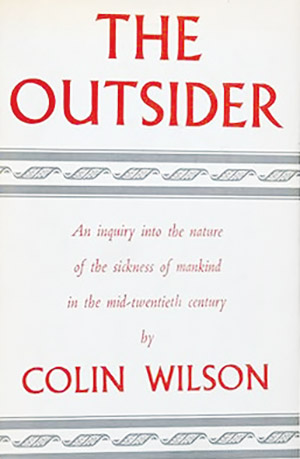
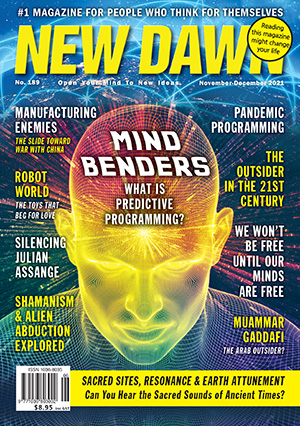
    In his debut book, The Outsider, the twenty-four-year-old British existentialist Colin Wilson (1931–2013) made his first attempt at analysing a character he felt was peculiar to our age, or at least to that of the mid-twentieth century, when the book appeared. 

    In the midst of the buttoned-down, conforming 1950s, published in the same year as Allen Ginsberg’s Howl (1956)and a year before Kerouac’s On the Road (1957), Wilson’s “inquiry into the nature of the sickness of mankind in the mid-twentieth century” was the surprise bestseller of the season. Prestigious reviewers like Philip Toynbee, Cyril Connolly, J. B. Priestley, Edith Sitwell and others tripped over themselves, heaping praise upon the duffle-coated, polo-necked young Midlands genius, who had “walked into literature as a man walks into his own house.” 

    True, his investigation into the tortured lives of Nietzsche, Nijinsky, T.E. Lawrence (“of Arabia”), Van Gogh, and other creative individuals, straining against the banality of the modern world and their own psychological barriers, made for some heady holiday reading. But it was the summer of the Angry Young Men, and for a time, Wilson’s Outsider was in the news as much as Elvis Presley and James Dean, two rebels of a different sort.

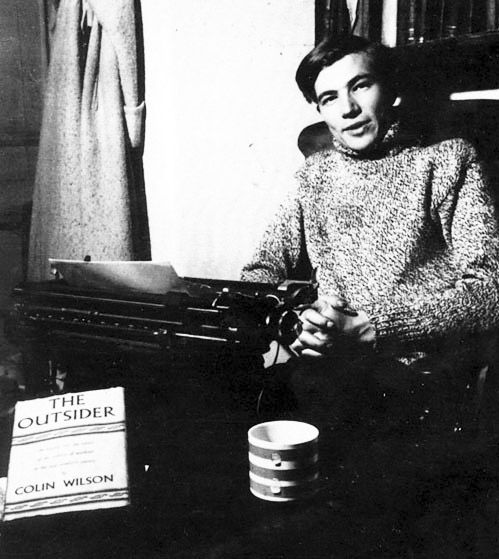
    The twenty-four-year-old British existentialist Colin Wilson basks in the glory of his debut bestselling book, The Outsider. He was later discarded by the intelligentsia of the day – which only proved his point and made him the quintessential voice for Outsiders. 

    As Wilson described him, his Outsider was someone with a pressing hunger for meaning and purpose in a world that was seemingly bent on denying him these.1 In the Middle Ages these individuals may have found a place in the church, which at that time still took such hunger seriously. 

    But in our modern – now post-modern – society, geared toward comfort, security, and conformity – what Wilson diagnosed in a later book as “other directedness” – there was no place for these individuals. They could find no home for their creative energies, and because of this, many of them came to a bad end. Nietzsche went insane, as did Nijinsky. Van Gogh killed himself. Lawrence committed a kind of “mental suicide,” retreating into anonymity as a private in the RAF, after the hollow celebrity following his Arab campaign. Many other Outsiders succumbed to drugs or alcohol or depression; only the strongest among them were able to break through the “fallacy of insignificance” and reach the source of “power, meaning, and purpose” within them. As one of Wilson’s Outsiders, the poet William Blake, put it in his Proverbs of Hell: “When thought is closed in caves, then love will show its roots in deepest Hell.” As Wilson’s many studies of “criminal Outsiders” show, when creative energy is frustrated, it turns upon the world before turning upon itself.

    Hardcover first edition of Wilson’s The Outsider.

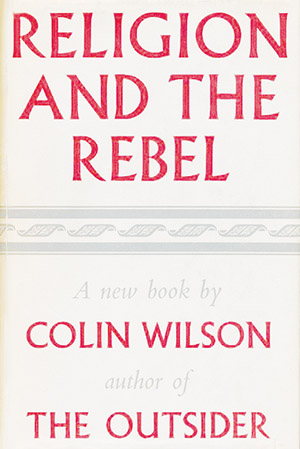
    Outsiders, Wilson wrote in Religion and the Rebel, his follow-up to The Outsider, “appear like pimples on a dying civilisation.” In his most savage attack on the “lack of spiritual tension in a materially prosperous civilisation,” Wilson said that “the heroic figure of our time” was “the man who, for any reason at all, felt himself lonely in the crowd of the second-rate.” Ours was a time of “cheapness and futility, the degrading of all intellectual standards.” In response, the Outsider could be “a maniac carrying a knife in a black bag, taking pride in appearing harmless and normal to other people,” as the sex-murderer Austin Nunne in Wilson’s first novel, Ritual in the Dark, does. Or he “could be a saint or visionary, caring for nothing but one moment in which he seemed to understand the world, and see into the heart of nature and of God.”

    Hardcover first edition of Wilson’s Religion and the Rebel.

    The Wilson of The Outsider and Religion and the Rebel was convinced that western civilisation was in decline, and indeed, one of the thinkers whose work he looks at in Religion and the Rebel is Oswald Spengler, author of the monumental The Decline of the West. Yet even here, Wilson’s pessimism is more emotional than intellectual and may have been fuelled by the critical volte-face he received when the initial celebrity of The Outsider faded, and the intelligentsia decided that they were wrong about the “messiah of the milk bars.” 

    By the time he had finished writing Religion and the Rebel, whatever anger Wilson had felt, had been expressed. He later came to feel that his “world-rejection” and attack on a “sick civilisation” was a bit much, although he understood them to be necessary steps in the Outsider’s attempts to know himself, to become, in Nietzsche’s phrase, “who he is.” The later books in Wilson’s “Outsider Cycle” offer a patient, detailed, wide-ranging analysis of contemporary culture, philosophy, science, and psychology from the point of view of the Outsider’s peculiar challenge: to find a means of triggering the “visionary faculty,” the moments of “yea-saying” and “affirmation” that free him from his paralysis, and show him his true place, as one of civilisation’s creators, not its misfits.

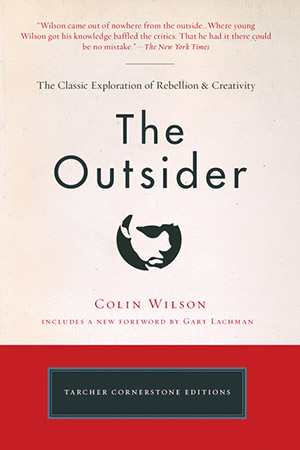
    The 2016 edition of The Outsider (TarcherPerigee)

    Wilson died in 2013, at the age of eighty-two. In the years following his debut, he produced an enormous number of books on a wide range of subjects and an equal number of essays, articles, reviews, lectures, and introductions to the work of others, myself included. He remained upbeat and positive, even during the difficult years following a stroke that left him practically paralysed and unable to read or speak. He is one of the most optimistic voices in the literature and thought of the past two centuries, although his optimism isn’t based on ignoring the reality of a world shot through with pain and suffering, the “chaos” of which the Outsider sees “too deep and too much,” as much of our “mind, body, and spirit” “positivity” is. He saw the world without a blindfold and took it neat, if I can mix my metaphors, maintaining the “bird’s eye view” that looked out on distant horizons of meaning, to the end.

    Wilson died just on the cusp of the world getting, well, strange – or at least stranger than it had been. He passed away before Brexit, before Trump, before Covid-19, before Conspirituality, before the climate crisis became impossible to deny, and before the general ontological and epistemological crises that I talk about in some of my books set in, although these were indeed on their way. 

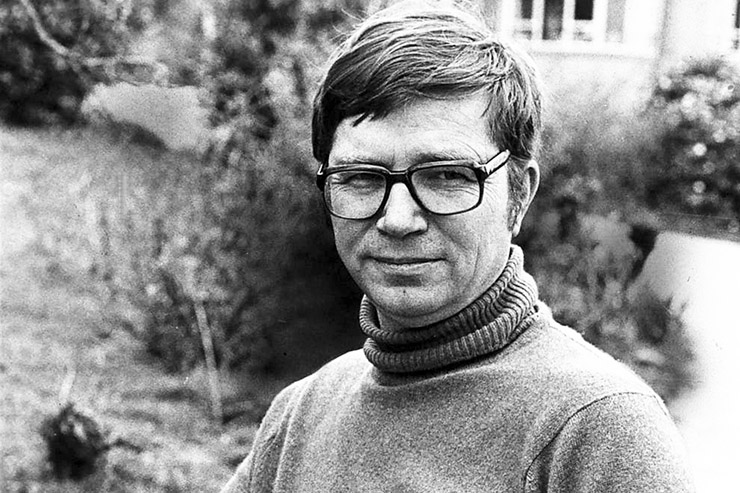
    A middle-aged Colin Wilson.

    A few years after his passing, my book about Wilson, Beyond the Robot: The Life and Work of Colin Wilson, appeared. As it turned out, my publisher had the rights to The Outsider and thought the time was right for a new edition, to which I contributed a new foreword. So the two books appeared at the same time. I was, of course, happy about this. But I admit I wondered if The Outsider would appeal to contemporary, younger readers, to whom names like Sartre, Camus, Hesse, and Dostoyevsky may not ring the same bells as they did for my generation and that of Wilson’s earliest readers. 

    Do Outsiders Still Exist?

    Is existentialism anything more than a topic on someone’s philosophy exam these days? In our post-everything world, do Outsiders still exist, and do their challenges mean anything? If there are Outsiders out there, what are they doing?

    Wilson’s answer to this, I believe, would be yes, Outsiders are still around. And I think he would add that they have never had it so good.

    The Outsider’s problem is freedom. Not political or social or economic or sexual freedom – all of which are, of course, important. The kind of freedom that obsesses the Outsider is an inner freedom, a kind of inner expansiveness and deepening, that lifts him out of the confines of the present, and the limitations of his own personality, and makes him aware of the potentialities of life of which he is usually unaware. It is essentially a widening of consciousness and a strengthening of its grip on reality. Freedom, for the Outsider, is equivalent to reality. His moments of freedom are moments when he is more in touch with reality, and not the pasteboard substitute which he usually takes for that elusive commodity. 

    Yet, although these moments reveal to him a world of overwhelming meaning and complexity, of infinite interest, they are fleeting and no sooner is “reality” glimpsed, and he loses sight of it. This is why in The Occult, Wilson defined the central obsession of his work as “the paradoxical nature of freedom.” 

    Why is freedom paradoxical? Because when our freedom is threatened, its value becomes indubitable, and we will fight tooth and nail to preserve it. Yet, imperceptibly and involuntarily, once our freedom is secured, we begin to “de-value” it. It becomes subject to what Wilson calls “the indifference threshold,” a kind of automatic loosening of our grip on the reality of our freedom or any of our real values. We “take it for granted” and may even come to feel our freedom is a burden, something to endure until something distracts us from it, like the latest pablum on NetFlix. Hence Erich Fromm’s once-influential book Escape From Freedom and Sartre’s dour one-liner telling us that “man is condemned to be free.” 

    Dominant .005% & Self-Actualisers

    Wilson’s subsequent body of work can be seen as an attempt to arrive at a method of inducing these moments of inner freedom, what the psychologist Abraham Maslow, on whose ideas Wilson draws, called “peak experiences,” moments of sudden, “absurd” joy and well-being. And we can also see Wilson’s work as a characterological study of the kind of people Maslow called “self-actualisers,” who are prone to peak experiences, and who share many traits with Wilson’s Outsiders, and with another demographic type, individuals whom Wilson calls the “dominant .005%.” All three have a need for this inner freedom in a way that most of their contemporaries do not, although in one way or another, we all have an appetite for this inner expansiveness, even if we satisfy it with the simple expedient of a glass of wine and a film. 

    But for these peculiar individuals it is a need as absolute as the need for food and other basic necessities. In fact, it is often greater than the need for these; more than one Outsider has faced starvation and poverty in his quest for the widening of inner space, just as more than one has succumbed to alcoholism or drug addiction in his pursuit of it. 

    Wilson tells us that the need for this inner freedom is an expression of what he calls the “evolutionary appetite,” the urge to grow, absorb experience and develop, and use our freedom, however clumsily, to gain more freedom. Wilson’s Outsiders and “dominant .005%,” and Maslow’s “self-actualisers,” are people driven by a compulsion to evolve, to gain deeper insight into and control over the mechanism of their own consciousness. And Wilson believed that since the nineteenth century, when Romantics first opened the gates to “inner worlds,” the number of people feeling this compulsion has grown.

    Nevertheless, when The Outsider first appeared, the number of people interested in inner freedom was still relatively few. As Wilson soon discovered, because of his focus on existential questions – questions, that is, about meaning – and disregard for political and social ones, he was quickly branded a “fascist” by his left-oriented, “socially conscious” contemporaries. Yet it was with The Outsider and books like Kerouac’s The Dharma Bums and other Beat productions that the widespread popularity of a kind of grassroots “spirituality” began, with the importation of Zen and other forms of “Eastern wisdom” into the west. By the mid-1960s, the taste for lux ex orient had fused with the burgeoning psychedelic movement and “counterculture” to form a generation of “seekers,” dissatisfied with the increasingly materialistic character of modern life. The Outsider was in no small part responsible for the Hermann Hesse craze of the late 60s and early 70s, which numbered an adolescent me among its many adherents. By the end of the mystic decade, the beatniks who had been vaguely “on the road,” were now moving in a more purposeful direction, on a “journey to the East,” the title of a short novel by Hesse.

    By now, the strange, threatening, “revolutionary” character of the “mystic Sixties” has become thoroughly domesticated, with yoga centres, “mind, body, spirit” emporiums, meditation classes, New Age bookshops, online Tarot readings, and any number of other “mystical” enterprises available at a click on the internet. Needless to say, not all of this is of equal value; a great deal is rubbish. Wilson’s generous view would be that yes, much of what is available today on the internet is junk and one must discriminate, but on the whole it is a good thing. Better a glut than a famine. And in any case, what differentiates the Outsider from his fellows is that he is “capable of a seriousness, a mental intensity, that is completely foreign to the average human animal.” Such a seriousness will have no problem separating the wheat from the chaff. The Outsider’s challenge requires him to ignore 99% of the chatter around him, to dismiss the noise and focus on the signal. 

    Obstacles & the “Indifference Threshold”

    Wilson came to see that ultimately the greatest obstacle to the Outsider “becoming who he is,” to finding a means of expressing the creative energies within him, is himself. Not society, not the government, not the bosses, or his friends, but his own tendency to self-pity and laziness. He needs to overcome his own neurotic self-division, to arrive at a discipline that focuses the mind so that his grip on reality remains firm. He needs to find a way to avoid the “indifference threshold” that allows him to take his freedom for granted. 

    Wilson came from a working-class background and before his debut worked at dozens of menial and manual labour jobs. More than once he pointed out that compared to how things were for many of his Outsiders, people today have secure, comfortable lives. The welfare state, nationalised medicine, and other safety nets are in place. They may not catch everyone, but compared to earlier times, the general standard of living today means that most of us live practically like royalty of old – better, with the internet and other tech at our fingertips. 

    He points out that optimists, like himself, and two of his literary heroes, Bernard Shaw and H.G. Wells – socialists both, I might point out – tend to come from difficult backgrounds. They are forced to “pull their cart out of the mud” from an early age and so are less inclined to give way to despair. Pessimists tend to come from comfortable backgrounds and are spoiled and lazy. Wilson’s bête noire, Samuel Beckett, famously spent most of his time in bed because it struck him that there was no reason to get out of it. No wonder many of the characters are paralysed or in other ways unable to move. That his nihilist, absurdist plays were awarded the Nobel prize for literature is a sign, Wilson believed, that we have come to accept his pessimistic conclusions – “there is nothing to be done” – as given. 

    Maslow also pointed out that adverse conditions are often more favourable to “self-actualising” than comfortable ones. We are at our best when we are “up against it” when meeting a challenge. Calls for government support for the arts may be the sociological equivalent of giving fertilizer to weeds. 

    Wilson’s most important discovery in his analysis of the “indifference threshold” is that crisis or inconvenience seems to stimulate the mind out of its lethargy when even “positive” inducements fail to do the trick. We all know how difficult it is to cheer someone up if they are in a bad mood; even the most pleasant things won’t do it. Yet, more often than not, if suddenly faced with some difficulty they can overcome, the bad mood vanishes and the grumpy individual is now happy. The inconvenience has awakened his will, with the paradoxical outcome that a real problem cheers him up. 

    Wilson’s Outsiders instinctively know that “the comfortable life causes spiritual decay just as soft sweet food causes tooth decay.” That is why so many of them followed Nietzsche’s advice and “lived dangerously.” Wittgenstein gave away a fortune to live as a schoolteacher in some Austrian backwater. Sartre never felt as free as when he was working for the resistance and could be arrested by the Gestapo. Another example that Wilson often gives is of the writer Graham Greene, another pessimist. 

    Waking Up with Russian Roulette

    As a teenager, Greene was so bored that he took to playing Russian Roulette to relieve his ennui. A minute before almost blowing his brains out, the world seemed so uninteresting that the only thing Greene could think of doing was killing himself. Yet, when he heard the hammer fall on an empty chamber, suddenly the world was positively exploding with meaning and interest, so much that the idea of killing himself seemed an absurd joke. Wilson points out that we have created civilisation to overcome inconvenience and eliminate crisis. Must we point a gun to our heads to enjoy it?

    What had happened? According to Wilson, the prospect of blowing his brains out caused Greene to involuntarily concentrate, to, as it were, make a fist with his mind and thereby strengthen his grip on reality. When he heard the hammer hit the empty chamber, he relaxed and was suddenly overwhelmed by the reality that in his boredom he was ignoring. The meaning and interest of which he suddenly became aware were always there, but Greene was on the wrong side of the “indifference threshold” and so could not see them, just as a colour-blind person is oblivious to a blazing sunset, or a deaf person to the birdsong accompanying it. The process ran like this: sudden total concentration, then – completely relaxation. (As Doctor Johnson pointed out, the thought of one’s imminent hanging concentrates the mind wonderfully, an insight shared by the philosopher Heidegger and the esoteric teacher Gurdjieff.) 

    Wilson points out that the poet Wordsworth explained to his friend Thomas De Quincey how he wrote his poetry. One evening Wordsworth had his ear to the road, listening for the mail cart, when he suddenly caught sight of a star, which struck him as extraordinarily beautiful. He then told De Quincey the secret of his poetry. It was that whenever he concentrated on something that had nothing to do with poetry – like listening for a mail cart – then suddenly relaxed, the first thing he saw always struck him as beautiful.

      Wilson realised that not only had Wordsworth revealed the secret of his poetry, he also hit on a means of inducing peak experiences. Readers of Wilson will know that all his work is essentially aimed at spelling out the significance of Wordsworth’s observation, and of developing methods of putting it into practice.

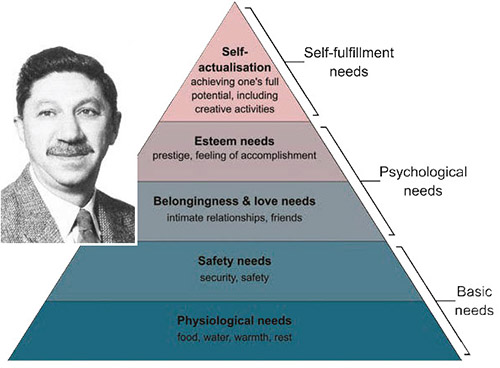
    Maslow’s Hierarchy of Needs

    Colin Wilson drew on psychologist Abraham Maslow’s (1908–1970) “hierarchy of needs” theory.

    What of the characterological types, Maslow’s self-actualisers, Wilson’s Outsider and his “dominant .005%”? Maslow believed that our need to grow, to develop – what Wilson calls our “evolutionary appetite” – is as basic as our need for food or sex. He developed what he called a “hierarchy of needs” to help understand human motivation. At the bottom is the need for food. Once this is satisfied, our need for shelter, a home of some sort, kicks in. When we have achieved this, we feel a need to share it with someone, that is, for love – and sex. The next need to awaken is what Maslow calls the need for “self-esteem,” the good opinion of others. These first four needs Maslow called deficiency needs; they are for things we lack. At the top of his hierarchy, Maslow put the need to “self-actualise,” to “become who we are,” to make real our potentials, to use our creativity and intelligence. This is a need to use what we have.

    Maslow believed that we all have these needs. But toward the end of his life, he was troubled by the observation that not everyone reaches the top of the hierarchy. That is, not everyone self-actualises. Many people seem happy to remain at the self-esteem level and do not feel the need to be creative. In Wilson’s terms, they do not feel the pangs of the “evolutionary appetite” so painfully as his Outsiders do. Nevertheless, a substantial percentage of the population do feel them and work toward “actualising” themselves.

    Wilson’s “dominant .005%” share some characteristics with Maslow’s “self-actualisers.” Wilson learned from the writer Robert Ardrey, author of The Territorial Imperative, that “dominant” individuals make up 5% of all animal groups. This is also true of humans. The human dominant 5% comprises politicians, pop singers, sports figures, film stars, television personalities, high profile academics, successful businessmen, internet influencers – just about everyone who displays “natural” leadership qualities and has “push” and “drive” and perhaps a bit of talent; it also includes not a few criminal types. 

    Wilson discovered an interesting thing. This dominant 5% does not include the most dominant characters. They make up only a minute fraction of the population, .005% perhaps. These individuals share something with Maslow’s self-actualisers, just as the dominant 5% share something with his “self-esteemers.” Both the self-esteem oriented individual and the dominant 5% need other people; the one for his good opinion of himself, the other to express his dominance. Without others, they are lost. The ruthless businessman is not so impressive without his anxious underlings, just as a pop star without ogling crowds seems absurd. Without those around him patting his back, the self-esteemer is at a loss. Yet both the self-actualiser and the .005% are free of this liability. In fact, for both, other people are often a problem.

    The .005% and “self-actualisers” pursue creative activities for their own sake, for the sheer challenge and joy of it, for the inner expansion that accompanies creative work of any kind. Yes, the artist wants his paintings seen, the writer his books read, and the musician his music played and appreciated. But they do not paint, write, or compose for that reason, at least the real artist, writer, or composer doesn’t. They are less influenced by their personal needs than they are by impersonal ones, i.e., the urge to grow beyond their personalities, into the realms of objective meaning and reality. Into, that is, that reality that the Outsider glimpses in his moments of power and strength.

    In his study of crime, Wilson makes some interesting use of Maslow’s hierarchy of needs, seeing it as a way of understanding the changing character of murder over the centuries. I can’t go into detail about this here, but the basic idea is that in the twenty-first century we have entered a strange era in which the self-esteem murder – the murder in which the killer “becomes somebody,” with his name in the news – common to the late twentieth century, has shifted into murder as a warped form of creativity, the strange seemingly “motive-less murder.” This, indeed, seems a rather dark way of recognising a society’s psychological growth. But I think we can apply the same idea in a perhaps less gruesome area, that of social media. 

    Get the issue this article appears in

    An Evolutionary Leap?

    I submit that, at least in the developed world, society as a whole has entered the self-esteem rung on Maslow’s hierarchy and that the evidence for this is social media. Here we compete for “likes” and “friends,” and draw attention to ourselves in any way possible, hoping to stand out for a few moments in the “stream” of everyone else doing exactly the same thing. Otherwise mediocre personalities become “influencers” and Instagram stars at the tap of a phone. Yet this may be a good sign. Because if Maslow is right, it means that there are quite a few self-actualisers out there who are too busy satisfying their evolutionary appetites to bother tweeting about it or to ask for their friend’s approval. Along with the .005%, they are quietly working away at “becoming who they are” and aren’t concerned if anyone knows about it. They are Outsiders whether they have ever read Wilson or not.

    I also believe that just as elementary particles no longer in contact with each other continue to behave as if they were – through the miracle of quantum entanglement – and just as neurons in the brain involved in the same operations fire at the same time, although they are not contiguous, the people making up Maslow’s self-actualisers, Wilson’s .005% and Outsiders, spread out all over the planet, act, in someone unknown to them, in a similar manner. They may not know each other – most likely they are too busy to get acquainted – but their individual actions may add up to something that transcends their individual situation. And that may be the evolutionary leap that Wilson firmly believed was on its way.

    [alert type=”general” dismiss=”no”]This article was published in New Dawn 189.[/alert]

    [alert type=”success” dismiss=”no”]If you appreciate this article, please consider subscribing to help maintain this website.[/alert]

    References (books by Colin Wilson):

    The Occult (London: Watkins Books, 2015)
    The Outsider (New York: TarcherPerigee, 2016)
    Religion and the Rebel (London: Aristeia Press, 2017)
    The Age of Defeat (London: Aristeia Press, 2018)

    Footnote

    1. I should point out that Wilson had originally sketched a chapter of the book dealing with female Outsiders, but this had to be scrapped. It does exist in pamphlet form, Outline of The Female Outsider (Abraxas Collector’s Series 1), although its availability is uncertain. Feminists would do well to read it, as in it they will discover an unexpected ally.

    © New Dawn Magazine and the respective author.
    For our reproduction notice, click here.
  • Reality Tunnels: How to Control & Re-Program Your Mind

    Reality Tunnels: How to Control & Re-Program Your Mind

    From New Dawn 187 (Jul-Aug 2021)

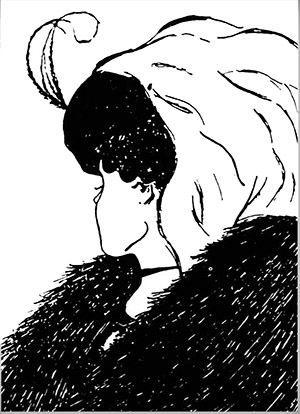
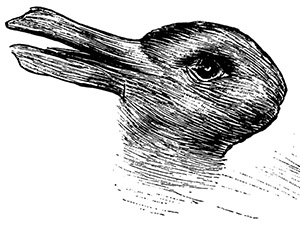
    When I was in secondary school, a teacher showed me an animated optical illusion in which a dancer appears to be spinning in one direction. I was adamant that the dancer was spinning clockwise, while my teacher insisted it was spinning counterclockwise. She then told me that you could change the direction of the dancer by focusing on the feet. I gazed with meditative fixation, and suddenly, to my amazement, the dancer started spinning counterclockwise! My teacher explained that since there are no visual cues for three-dimensional depth, your mind can determine what direction the dancer spins. 

    At that moment, I realised that reality is a construct of the mind, and we all potentially see the same world differently. I may have put it in less eloquent terms than that (considering I was only a teenager), but there was a fundamental shift in my understanding. The illusion made me realise that the notion of ‘objective truth’ was essentially arbitrary since our subjective beliefs mediate sensory experience. 

    My teacher and I could have argued for hours, days or weeks as to which direction the dancer was spinning; science couldn’t have proven either of us correct since it was a matter of perception rather than ‘truth’. In ‘reality’, the dancer was spinning in both directions, but since the brain has a natural tendency to classify, categorise and catalogue information in binary terms (up/down, left/right, black/white, clockwise/counterclockwise), the animated optical illusion appears monodirectional. 

    There are numerous examples of this in our day-to-day lives, like when we fail to appreciate other people’s viewpoints because we perceive the world differently. We believe we are right despite the multiple (if not infinite) interpretations about the nature of reality. 

    What are Reality Tunnels?

    Robert Anton Wilson (1932–2007) with Timothy Leary (1920–1996)

    The countercultural guru Timothy Leary coined the term ‘reality-tunnel’ to describe our filtered perceptions of the world. Robert Anton Wilson later developed the concept to describe “pre-composed patterns of thinking which limit and distort the perception of reality by reducing complexity and options.”1 According to Wilson, reality-tunnels shape our phenomenological sense of self, editing out experiences that do not support our beliefs while focusing on those which do.2 

    An advocate for capitalism, for example, will gather facts to support the view that capitalism is the most effective socioeconomic model, discarding any information that runs contrary to this viewpoint. Similarly, a Marxist will construct arguments based on select information to support the view that communism is the best system, often neglecting evidence that contradicts their position. 

    As the psychedelic scholar Ido Hartogsohn states, “all of us harbour established ideas about minorities, religions, nationalities, the sexes, the right ways to think, act, feel govern, eat, drink, and what not. Reality tunnels act to help us fortify these ideas against challenging information.”3 In this sense, there is a crossover between the concept of reality-tunnels and confirmation bias, the latter described as the “human tendency to notice and assign significance to observations that confirm existing beliefs while filtering out or rationalising away observations that do not fit with prior beliefs and expectations.”4 The phenomenon of confirmation bias helps explain why people who ascribe to a reality-tunnel are oblivious. Most people believe their worldview corresponds to the “one true objective reality,” however, Wilson emphasises that many reality tunnels are artistic creations, a culmination of biological, cultural and environmental inputs.5 

    The notion that reality is shaped by the conditions of the human mind is not new. The 18th-century German philosopher Immanuel Kant proposed in his Critique of Pure Reason that experience is based “on the perception of external objects and a priori knowledge.”6 We receive information about the external world through our five senses, which is then processed by the brain, allowing us to conceptualise its contents. When I look at an object, such as a chair or a table, I have no understanding of its external nature. The qualities that enable me to denote the meaning of the object, such as shape, colour, size etc., have no objective existence; they are merely by-products of the brain. 

    The French psychoanalyst and psychiatrist Jacques Lacan proposed his theory distinguishing between ‘The Real’ and the ‘Symbolic’. Lacan argued that ‘The Real’ is the “imminent unified reality which is mediated through symbols that allow it to be parsed into intelligible and differentiated segments.”7 However, the ‘Symbolic’, which is primarily subconscious, is “further abstracted into the imaginary (our actual beliefs and understandings of reality). These two orders ultimately shape how we come to understand reality.”8 

    For the left image, do you see a duck or a rabbit? For the image on the right, do you see a young woman or an old lady? These famous optical illusions help demonstrate how our sense of the world is mediated through ‘reality-tunnels’.

    The Harvard sociologist, Talcott Parsons, uses the word gloss to describe how our minds come to perceive reality. According to Parsons, we are taught how to “put the world” together by others who subscribe to a consensus reality based on shared beliefs, norms and associations.9 A gloss constitutes a total system of language and/or perception. For example, the word ‘house’ is a gloss since we lump together a series of isolated phenomena – floor, ceiling, window, lights, rugs, etc. – and turn it into a totality of meaning. 

    The author and anthropologist Carlos Castaneda commented on this notion, stating, “we have to be taught to put the world together in this way. A child reconnoitres the world with few preconceptions until he is taught to see things in a way that corresponds to the descriptions everybody agrees on. The world is an agreement. The system of glossing seems to be somewhat like walking… we learn we are subject to the syntax of language and the mode of perception it contains.”10 

    The French philosopher Jacques Derrida stated that our understanding of objects (and the words which denote them) are only understood in relation to how they are contextually related to other objects (and denotive words).11 

    We can break free from prescribed reality-tunnels by using objects and language in unusual or disjointed ways, thereby creating new discursive meanings, associations and connotations. This was the aim and outcome of certain art movements such as Dadaism and Surrealism, as well as Brion Gysin and William Burroughs’ cut-up method.12

    The famous ethnobotanist and psychonaut, Terence McKenna, argued that ideology and culture are tools “which give other people control over one’s experience and identity since they lead individuals to shape their identity according to pre-conceived forms. If a person identifies with commercial brands or with popular ideas of what is beautiful, true or important, they give away their power to other people.”13 McKenna once said that you should not see “culture and ideology as your friends,” implying that you should understand reality on your own terms rather than buying into “pre-packaged ideological and cultural ideals” such as communism, capitalism, democracy or some form of totalitarianism.14 Belief in itself, argued McKenna, was “limiting to the individual, because every time you believe in something you are automatically precluded from believing its opposite. By believing something, you are virtually shutting yourself from all contradictory information, thus once again performing the sin of imposing a rigid simplified structure upon an infinitely complex reality.”15

    Much like McKenna, Wilson recommends that a “fully functioning human ought to be aware of their reality tunnel and be able to keep it flexible enough to accommodate and, to some degree, empathise with different ‘game rules’, different cultures.”16 According to Wilson, constructivist thinking, which considers how social and cultural processes determine our perception of the world, constitutes an exercise in metacognition, enabling us to become aware of how reality tunnels are never truly objective, thereby decreasing the “chance that we will confuse our map of the world with the actual world.”17 

    How Your Reality Tunnel Is Formed

    The constraints of human biology partially limit our models of reality. As Wilson states, our DNA “evolved from standard primate DNA and still has a 98% similarity to chimpanzee (and 85% similarity to the DNA of the South American Spider Monkey). We have the same gross anatomy as other primates, the same nervous system and the same sense organs. While our highly developed pre-frontal cortex enables us to perform ‘higher’, more complex mental tasks than other primates, our perceptions remain largely within the primate norm.”18 

    The neural apparatus produced by our genetic coding helps create what ethologists call the umwelt, or “world-field.” Birds, reptiles and insects occupy a separate umwelt or reality-tunnel to primates (ourselves, included). For example, bees are able to perceive floral patterns in ultraviolet light, which we cannot (unless certain technologies are utilised). Canine, feline and primate reality-tunnels remain similar enough that friendship and communication can occur between these different species, however, a snake (for example) occupies such a different reality tunnel that their behaviour appears entirely alien. 

    As Wilson argues, the belief that human umwelt reveals “reality” or “deep-reality” is as “naïve as the notion that a yardstick shows more reality than a voltmeter or that ‘my religion is better than your religion’. Neurogenetic chauvinism has no more scientific justification than national or sexual chauvinisms.”19 He goes so far as to suggest that “no animal, including the domesticated primate, can smugly assume the world created by its senses and brain equal in all respects the ‘real world’ or the ‘only real world’.”20 

    Reality-tunnels are also influenced by “imprint vulnerability,” periods in our lives when early childhood/adolescent experiences “bond neurons into reflex networks which remain for life.”21 The psychological researchers, Lorenz and Tinbergen, won a Nobel Prize in 1973 for their research into imprinting, which demonstrated that “the statistically normal snow-goose imprints its mother, as distinct from any other goose, shortly after birth. This imprint creates a ‘bond’ and the gosling attaches itself to the mother in every possible way.”22 These imprints can be imposed onto literally anything. Lorenz observed a case in which a gosling, in the absence of its mother, imprinted a ping-pong ball. It followed the ping-pong ball around and, on reaching adulthood, “attempted to mount the ball sexually.”23 

    Wilson estimates that the age at which we are imprinted with language determines lifelong programs of “cleverness” (verbal intelligence) and “dumbness” (verbal unintelligence), since linguistic models enable us to articulate mental processing, evaluate complex ideas and communicate with those around us.24 Furthermore, how and when our first sexual experiences are imprinted can “determine lifelong programs of heterosexuality, brash promiscuity or monogamy etc.”25 In more obscure imprints, such as celibacy, foot-fetishism and sadomasochism, the “bounded brain circuitry seems quite as mechanical as the imprint which bounded the gosling to the ping-pong ball.”26 

    These examples suggest that experiences during childhood, when the brain exhibits optimal ‘neuroplasticity’ (a term used to refer to malleability of neural networks in the brain), can shape our reality tunnels far into adulthood. As Sigmund Freud proposed, many “rational” thoughts and behaviours are typically the result of “repressed” memories, impulses and desires, which dwell in the murky depths of the unconscious mind.27 

    Furthermore, reality-tunnels are shaped by social conditioning, the “sociological process of training in a society to respond in a manner generally approved by the society in general and peer groups within society.”28 Manifestations of social conditioning are multifarious but include nationalism, education, employment, entertainment, popular culture, spirituality and family life. Unlike imprinting, which usually requires only one powerful experience to set permanently into the neural networks of the brain, conditioning requires “many repetitions of the same experience and does not set permanently.”29 

    The processes of social conditioning vary greatly, depending on the cultural environment to which one is exposed. For example, an individual born in a Muslim country (such as Saudi Arabia) will likely believe in the teachings of the Quran and adhere to certain religious norms, customs and traditions. However, individuals born in a Western capitalist/consumerist country, or an Eastern country with Hindu or Buddhist traditions, will adhere to different cultural and behavioural codes. 

    Reality-tunnels are also formed through the process of learning. Much like conditioning, learning requires repetition, but it also requires motivation. Therefore, it plays “less of a role in human perception and belief than genetics and imprinting and even less than conditioning does.”30 Learning marks a major difference between how mammals, reptiles, insects and birds perceive the world. For example, snakes share the same reality tunnel since they merely act on biologically determined reflexes, with only minor imprinted differences. Mammals show “more conditioned and learned differences in their reality tunnels.”31 

    Humans demonstrate a higher aptitude for learning due to our highly developed cortex and frontal lobes as well as our prolonged infancy. This variability functions as “the greatest evolutionary strength of the human race” since it enables us to pass down knowledge from one generation to the next. But it also means that we can become brainwashed and label other people who do not share our beliefs as “mad,” “anti-social,” or “blasphemous.” In fact, it could be said that the majority of all wars are the result of two (or more) opposing reality tunnels fighting for supremacy. This is particularly evident in the case of religious conflict, where people kill each other in the name of “God.” 

    Tunnel Vision: The Politicisation of Reality

    The rise of “identity politics” in the 21st century perfectly demonstrates how reality-tunnels prevent us from considering alternative perspectives and viewpoints. During the last decade, the political domain has become increasingly polarised as the left and right engage in a battle for cultural supremacy. Such polarisation was apparent in the Brexit referendum of 2016, in which 51.9% of the British public voted to leave the European Union while 48.1% voted to remain.32 The marginal success of the ‘leave’ campaign highlighted the strong division between both sides of the political spectrum. The former stressed the importance of the Union in promoting social and economic stability, while the latter emphasised the importance of national identity, sovereignty and independence. 

    The rhetoric employed by both the ‘leave’ and ‘remain’ campaign was so binary in its articulation that neither side engaged in meaningful dialogue; instead, the referendum became a series of baseless slogans, mottos and catchphrases – an advertising campaign designed to appeal to target demographics. The referendum was more about two separate reality-tunnels competing for ideological supremacy than a balanced analysis of benefits and risks. 

    The US presidential election of 2016 was a similar drama of competing reality-tunnels, shaped by masterful spin doctors and hidden persuaders who exploited modern advertising techniques to capture specific demographics based on class, age, sex, religion, geographical location and other criteria. 

    Donald Trump was well-known for his campaign slogan ‘Make America Great Again’ and other catchphrases that employed a lexicon of patriotism, populism and protectionism to appeal to those on the right. On the other hand, Hillary Clinton used the slogan ‘Stronger Together’ to evoke feelings of unity, compassion, and solidarity. The election became a battle between two contrasting reality-tunnels, grounded in meaningless rhetoric and hyperbole. 

    Another example of politicisation is the Covid-19 crisis, with the public divided into two camps – those who supported measures such as lockdowns versus the other side that rejected many of these same measures. Political polarisation demolished a sane balanced approach to the crisis, exacerbated and intensified by the ongoing political divide across the media landscape. 

    ‘Echo Chambers’ & Identity Politics 

    Social media has fuelled identity politics by enabling groups and movements to generate an online presence and have real-world impacts. According to independent scholar and author Ilaria Bifarini, this results in the emergence of ‘echo chambers’ in which internet users “find information that validates their pre-existing opinions and activates confirmation bias.”33 This mechanism, says Bifarini, “strengthens one’s beliefs and radicalises them, without adding anything to information and knowledge. The result is the ideological extremism that we are observing today and in which we are taking part, where political debates have been replaced by supporters and verbal violence.”34 

    Another way this happens, for example, is how Google’s online video sharing and social media platform YouTube utilises algorithmic data to show users similar content to their prior engagements – content they are likely to engage with in the future, thus creating a feedback loop in which they are exposed to media reinforcing their political preferences.35 As media scholars Brooke E. Auxier and Jessica Vitak state, “many social media platforms structure their content-feeds based on what an algorithm determines to be the ‘top’ or most ‘relevant’ stories. While these tools may help users control their information and news environments – making consumption more manageable and mitigating information overload – it is possible that these tailoring tools will expose users to redundant information and singular viewpoints.”36

    Both sides of the political spectrum fail to engage in meaningful discussion when they are entrapped in a single reality-tunnel, the stability of which is threatened by competing narratives. Instead, political dialogue becomes characterised by inflammatory insults, name-calling and defamation. 

    Loaded language – such as ‘virtue signallers’, ‘snowflakes’, ‘racist’, ‘transphobic’, ‘Islamophobic’, ‘hetero-normative’, ‘privileged’ – enables identity groups to protect the integrity of their reality-tunnel by excluding those who hold a different opinion. In the same way that religious cult leaders isolate their members from the outside world, so too do identity groups orientate themselves around a closed belief system, which is immune to criticism, contention or challenge. 

    In order to facilitate a more meaningful discussion, it is important that both sides learn to break free from the constraints of their reality-tunnel. 

    Rising Above the Fray

    In his book Prometheus Rising, Robert Anton Wilson provides various techniques for challenging dominant reality tunnels. Writing in the early 1980s, Wilson suggested that “if you are a liberal, subscribe to the [conservative magazine] National Review… Each month try to enter their reality-tunnel for a few hours while reading their articles. If you are a conservative, subscribe to New York Review of Books for a year and try to get into their headspace for a few hours a month. If you are a rationalist, subscribe to Fate Magazine for a year. If you are an occultist, join the Committee for the Scientific Investigation of Claims of the Paranormal and read their journal, The Sceptical Inquirer, for a year.”37 

    To put a modern ‘spin’ on this exercise, if you follow conservative thinkers online such as Jordan Peterson or Ben Shapiro, expose yourself to leftist thinkers such as Slavoj Zizek or Noam Chomsky, and do the opposite if you are on the left. Subscribe to internet channels that do not align with your reality-tunnel. By performing this exercise, you will find that you can think about political issues in a more balanced, neutral and multidimensional way, free from the constraints of ideological dogma. 

    You can use the same technique with religion. In one exercise, Wilson says, “become a pious Roman Catholic. Explain in three pages why the Church is still infallible and holy despite Popes like Alexander VI (the Borgia Pope), Pious XII (ally of Hitler), etc.”38 Then explain why the Church is an immoral and outdated institution; also write three pages detailing why you believe this to be the case. If you have the time, you can perform the same exercise with other religions such as Hinduism, Buddhism, and even Satanism. Explain why these religions hold the key to the ‘true’ nature of ‘reality’ and then refute yourself by providing a counterargument.

    You can use the same technique to become more conspiratorial in your thinking. In one exercise, Wilson says, “start collecting evidence that your phone is bugged. Everyone gets a letter occasionally that is slightly damaged. Assume that somebody is opening your mail and clumsily revealing it. Look around for evidence that your co-workers or neighbours think you’re a bit queer and are planning to have you committed to a mental hospital.”39 Observe how these assumptions influence your perception of other people and their behaviour – it won’t be long before you find evidence to support your paranoid thinking! 

    Once you have sufficiently experimented with this reality-tunnel, “try living a whole week with the program, ‘Everybody likes me and tries to help me achieve all of my goals’.”40 Then try living a whole month with the program, “I have chosen to be aware of this particular reality.”41 Then try living a day with the program, “I am God playing at being a human being. I created every reality I notice.”42 Then try living forever with the metaprogram, “Everything works out more perfectly than I plan it.”43 By adopting these different reality-tunnels, you will notice how malleable your perceptual faculties really are – the world can become a place of conspiracy and collusion or a place of benevolence and positivity, depending on how you view it. 

    Get the issue this article appears in

    Wilson provides another interesting exercise to expand the boundaries of consciousness, in which you “list at least 15 similarities between New York (or any large city) and an insect colony, such as a bee-hive or termite hill. Contemplate the information in the DNA loop, which created both of these enclaves of high coherence and organisation, in primate and insect societies.”44 Then, “Read the Upanishads and every time you see the word ‘Atman’ or ‘World Soul’, translate it as DNA blueprint. See if it makes sense to you that way.”45 According to Wilson, “Contemplating these issues usually triggers Jungian synchronicities. See how long after reading this chapter you encounter an amazing coincidence – e.g., seeing DNA on a license plate, having a copy of the Upanishads given to you unexpectedly…”46

    Experimenting with different reality tunnels is a necessary practice if one wishes to challenge dominant narratives, perspectives and viewpoints and expand the boundaries of human consciousness. As we find ourselves in a post-modern ‘information age’, where an increasing number of political factions compete for informational authority, we are exposed to the hidden forces of propaganda more than ever before. 

    Every time we log into Facebook, Twitter, Instagram and YouTube, we allow ourselves to be manipulated by a complex system of algorithms that generates content based on our likes, dislikes, and even our differences. In order to escape the trappings of ideological dogma, we must become conscious of our biological, social and environmental conditioning and adopt a more multidimensional way of thinking. 

    Understanding about ‘reality-tunnels’ becomes instrumental in achieving true inner liberation since it enables us to think about the mind as a form of technological software that can be continually updated and reorganised. We achieve a state of metacognition, an awareness of one’s thought processes and an understanding of the patterns behind them. It is what the pioneering mind explorer John Lilly called our capacity for “metaprogramming,” the creation, revision, and reorganisation of mental programs.47

    Although we are constrained by the limitations of biological programming (to a certain extent), the creativity of human consciousness is infinite, a maze of endless possibilities and potentialities waiting to be explored. As the Buddha said, “All that we are is the result of all that we have thought. It is founded on thought. It is based on thought.”48 

    [alert type=”general” dismiss=”no”]This article was published in New Dawn 187.[/alert]

    [alert type=”success” dismiss=”no”]If you appreciate this article, please consider subscribing to help maintain this website.[/alert]

    Footnotes

    1. Hartogsohn, I. (2015). The Psychedelic Society Revisited: On Reducing Valves, Reality Tunnels and the Question of Psychedelic Culture, Psychedelic Press, 3 
    2. http://ultrafeel.tv/reality-tunnel-how-beliefs-and-expectations-create-what-you-experience-in-life
    3. Op cit., Hartogsohn, I. (2015), 4
    4. https://en.wikipedia.org/wiki/Confirmation_bias 
    5. Anton Wilson, R. (1983). Prometheus Rising, Tempe, Arizona: New Falcon
    6. https://en.wikipedia.org/wiki/Immanuel_Kant
    7. https://en.wikipedia.org/wiki/Reality_tunnel
    8. Ibid 
    9. Parsons, T. (1951). The Social System, Glencoe, Illinois: The Free Press, 1951
    10. Sam Keen, Castaneda interview, Psychology Today, December 1972
    11. Derrida, J. (1978). ‘Genesis’ and ‘Structure’ and Phenomenology, in Writing and Difference, Routledge. 
    12. https://en.wikipedia.org/wiki/Dada
    13. Op cit., Hartogsohn, I. (2015), 1
    14. Ibid, 2
    15. Anton Wilson, R. (1990). Quantum Psychology: How Brain Software Programs You & Your World, New Falcon Publications
    16. https://en.wikipedia.org/wiki/Reality_tunnel 
    17. Quantum Psychology, 74
    18. Ibid, 74
    19. Ibid, 75
    20-24. Ibid, 76
    25-26. Ibid, 76-77
    27. Wollheim, R. (1971). Freud, Fontana Press
    28. https://en.wikipedia.org/wiki/Social_conditioning 
    29. Quantum Psychology, 77
    30. Ibid
    32. Ibid
    33. Bifarini, I. Cognitive bias and echo chambers: The social media trap, www.academia.edu/40650380/Cognitive_bias_and_echo_chambers_The_social_media_trap
    34. Ibid
    35. Nguyen, C. Echo Chamber and Epistemic Bubbles, www.academia.edu/36634677/Echo_Chambers_and_Epistemic_Bubbles 
    36. Auxier, B. and Vitak (2019). Factors Motivating Customization and Echo Chamber Creation Within Digital News Environments. Social Media and Society, April-June 2019
    37. Prometheus Rising, 83
    38. Ibid, 159
    39. Ibid, 241
    40-43. Ibid, 242
    44-46. Ibid, 190
    47. Lilly, John C. Programming & Metaprogramming in the Human Biocomputer, New York: The Julian Press, Inc., 1967
    48. The Dhammapada

    © New Dawn Magazine and the respective author.
    For our reproduction notice, click here.