New Dawn – World's Most Unusual Magazine

Category: Articles

  • The Evidence for Time Travel

    The Evidence for Time Travel

    This article was published in New Dawn 98 (Sept-Oct 2006)

    My first non-fiction book on time travel came about wholly by accident. I was interested in trying to discover whether or not there was much hard evidence for the sort of Ice Age civilisation mentioned by Plato in his account of Atlantis and also what level of technology such a civilisation might have achieved. I thought if there was something positive in this, it might make an interesting book.

    Since the postulate of an Ice Age civilisation is obviously linked to the evolutionary pattern of humanity, I began my research there – specifically attempting to find evidence of civilised activity prior to the establishment of the Sumarian state widely accepted as the starting point of modern culture. As civilisations take time to develop, I was also searching for evidence that humanity’s appearance on the planet might have been earlier than generally supposed.

    While conducting this research, I did indeed find archaeological evidence which suggested that Homo sapiens evolved earlier than the orthodox text books claim. At first these finds were manageable – they pushed back the appearance of humanity some tens of thousands of years. But then came the shock. There was a record of a find that suggested humanity was on the planet not thousands, but millions of years earlier than the time established by the orthodox scientific consensus.

    At first I thought this find might be a fake, or a misinterpretation. But as my research continued, it became clear the find was not unique. There were many, many archaeological discoveries that pointed to an early evolution of humanity. Individually, these seem to have been dismissed as oddities, or simply ignored, by the scientific establishment, but the sheer weight of evidence seemed to me to suggest the finds needed an explanation.

    At this point, I still thought I was looking at evidence for the early emergence of humanity. Then I came across records of discoveries that pointed to the appearance of humans at a ridiculously early period – contemporary with and even earlier than the dinosaurs. Since this was manifestly impossible (the mammalian line itself hadn’t evolved at this time) I suddenly realised the evidence had to point somewhere else. I considered the alternatives and the only half sensible explanation I could come up with was that the finds were litter left by time travellers.

    On the face of it, this seemed highly unlikely, but I was curious enough to want to know what modern physics said about the theoretical possibility of time travel. So I started research there and discovered that while Newtonian physics neither supported nor denied the possibility of time travel, both Relativity Theory and Quantum Mechanics seemed to say it was possible. One respected physicist had actually published plans for a (theoretical) time machine!

    At that point, I (temporarily) abandoned my book on the Ice Age civilisation and started seriously to move in a wholly different direction. Time Travel: A New Perspective was the result, a thorough study of the theme, published by Llewellyn in the United States. I returned to the theme in a second book aimed at a young adult audience and entitled simply Time Travel which has now been published in the UK by Faber and Faber as part of my Herbie Brennan’s Forbidden Truths series.

    So what was the evidence that started all this?

    The find that originally sparked my interest was the Transvaal spheres. Several hundred metal balls – some of them spookily like cricket balls – have been found by miners in the Western Transvaal, near the town of Ottosdal. They look manufactured and the metal seems to be toughened steel. But they’re still being unearthed from a Pre-Cambrian sediment, which means they have to be 2,800 million years old.

    Who dropped them? Not contemporary humans, that’s for sure. The earliest dinosaur hadn’t even appeared at that time. Manufactured objects in the Pre-Cambrian era are a glaring anachronism. And not the only one I came across.

    There was a polished concrete block wall found in the depths of an Oklahoma coal mine and estimated to be 286 million years old, a delicate gold chain of similar vintage found in Illinois, a carved stone found in Iowa that was dropped some 260 million years before humanity evolved on the planet, and many more, including a decorated metal vase from Massachusetts more than 600 million years old.

    There are very few possible explanations for finds of this type. One is that they are simply misdated – the dismissive ‘explanation’ put forward by orthodox archaeologists. But it’s difficult to see how you can misdate something like the Massachusetts vase that was actually discovered encased in solid rock.

    Another possibility is that the artifacts were dropped by visitors from space. The Ancient Astronauts Theory is no longer as popular as it once was, killed off by sensationalist claims and some blatant tweaking of the ‘evidence.’ All the same, most scientists are agreed that life must exist elsewhere in the universe and some of it may be intelligent. Which means that, long shot though it might be, the transport of some alien civilisation might have docked on Earth at the dawn of time and discharged metallic ballast in an area that eventually became the Transvaal.

    But even if the South African spheres turn out to be of alien manufacture (or some sort of weird natural phenomena, for that matter) several other anachronistic artifacts are undoubted human in origin. The carved stone from Iowa, for example, features multiple representations of an old man’s face. There was a fossilised human shoe print found in Utah shale some 500 million years old. A human footprint was discovered in Turkmenistan in Central Asia, next to that of a three-toed dinosaur.

    The dinosaurs disappeared from our planet, quite suddenly, some 65 million years ago. Until that happened, the most advanced mammal on the face of the globe was a little tree-dweller the size of a mouse. Humanity is supposed to have evolved in Africa some 100,000 years ago – and while there may be a case for adjusting this date backwards, nobody suggests we could have walked the Earth in the days of the dinosaurs.

    Finds like these got me thinking along the lines of time travel, but failed to convince me. At the time, I assumed modern scientific thought dismissed the possibility as nonsense. This assumption, however, turned out to be wrong.

    Surprisingly, Newtonian physics – the practical stuff that underlies almost every example of modern technology – doesn’t deny the possibility of time travel. Newton’s Second Law of motion states that ‘the time rate of change of the velocity or acceleration of a body is directly proportional to the force applied and inversely proportional to the mass of the body.’ In the mathematical expression of this Law, the value for time is squared. As you learned at school, if you multiply a negative number by another negative number, the result is always positive. This means that should you change ordinary time to negative time in Newton’s Second Law, it makes no difference to the outcome. In other words, time can flow backwards or forwards without influencing the outcome of the equations.

    Of course this only shows that, theoretically speaking, time travel does not contradict Newtonian physics. It gives no real clue as to whether time travel might actually happen. But Einstein’s Relativity Theory, on the other hand, clearly shows there are circumstances in which time travel can – indeed must – occur. Einstein spelled it out in his famous Twins Paradox.

    You begin with identical twins, one of whom joins the crew of a spaceship travelling close to the speed of light. The other twin stays home.

    Assume both twins were thirty years of age when they separated. Imagine the space voyage lasted five years. On the ship, the astronaut twin ages five years according to every measure he can apply.

    But if the spaceship is travelling at 99% the speed of light, Einstein’s Theory of Relativity shows that time is moving seven times slower on board than it is on the ground. That means the twin who stayed home has aged thirty-five years – he is now sixty-five years old.

    In other words, just because the astronaut raced at breakneck speed around the galaxy, he’s now thirty years younger than his twin brother. Or put another way, when he lands again, he discovers he has voyaged thirty years into the future so far as life on Earth is concerned. And that, by any reasonable criterion, is time travel.

    But it’s strictly a one-way trip.

    That was about as far as Einstein went with time travel, but the maverick American physicist Frank Tipler showed in 1974 that Relativity Theory allowed two-way time travel, back to the past and forward to the future. In fact he even published plans for a (theoretical) time machine in the prestigious Physical Review. They were contained in an article entitled ‘Rotating Cylinders and the Possibility of Global Causality Violation.’ Global causality violation was a weird a piece of geometry: a path that winds through space and turns around in time – something called a closed timelike line.

    Nobody is entirely sure whether closed timelike lines actually exist in nature, but Dr. Tipler’s basic idea was to create one by building a machine that would distort space and time. All that was needed, according to Relativity Theory, was a big enough rotating cylinder.

    But by big he meant really big– something far too large to build on Earth. It would also have to be very heavy, far more heavy than lead, for example, or any other substance used in current technology.

    What was needed was a super-dense material, the sort that has enormous mass, but takes up very little room. But this sort of matter actually exists – in neutron stars.

    Neutron stars are stars that collapse under their own weight, but don’t go all the way to becoming a Black Hole. The electrons inside their atoms are plunged into the nucleus where they fuse with protons to become neutrons (hence the name). The atoms themselves are fused together so that the whole star becomes one great atomic nucleus. It’s the densest substance in the universe. If you could extract enough to fill a teaspoon, it would weigh more than 1,000,000,000 tons.

    But even at that weight, a teaspoonful would be nothing like enough to create a Tipler cylinder. Physicist Fred Alan Wolf has estimated that such a cylinder would have to be about 40 kilometres across and more than 4,000 kilometres long. To make something that size, you would need about a hundred neutron stars.

    It’s clear that building a Tipler cylinder would be far beyond our present technology. But most scientists agree that if something is theoretically possible – which a Tipler Cylinder certainly is – technology will learn how to do it sooner or later.

    In the case of the Tipler Cylinder, we have only to imagine that some form of advanced technology will eventually be found, in a thousand years or ten thousand years, that will allow us to push a hundred neutron stars together. To work as planned, the cylinder needs to spin at about 10,000 revs per second. Fortunately most neutron stars are revolving in that range anyway. Put them together and you have a cylinder that, on its surface, is spinning at about three quarters the speed of light.

    Once the stars are in place, space and time will distort around them, in clearly defined zones. Immediately surrounding the cylinder would be a 20 kilometre wide zone where the fabric of space-time is changed in an almost unimaginable way. Physicists call this the ‘Deadly Zone’. There’s no way you could exist in such a zone. In fact, you probably couldn’t get into it in the first place – you would be repelled by the very nature of spacetime at its outer boundary.

    Surrounding the Deadly Zone is the Zone Of Time Reversal. This is the area of space in which time runs backwards. Get yourself into that zone and you’re a time traveller.

    The time travel zone is surrounded by a Null Time Zone where time stands still. This zone is surrounded by a Positive Time Zone – one, that is, where time runs in the familiar past-to-future direction. Get yourself a nice little space ship, head it for the zone of your choice, and you’re on your way through time.

    This sort of scientific speculation is fascinating, but it still falls short of hard evidence for time travel. Far more immediately exciting were the case studies that suggested time travel has actually happened, is actually happening now and might, potentially actually happen to you. I came across several cases of this type, of which the Kersey incident is a striking example.

    Kersey is a charming little English village, nestling in the Suffolk countryside. You can see the church tower for miles and the church itself – first built in Saxon times – is visible from just about everywhere in the village.

    When I visited the place, I found a well-made tarmacadam road running through the village and admired its picturesque stream – locals call it the Water-Splash – spanned by an ornamental footbridge (see photo on previous page). Several of the houses have been painted pink and, like so many English villages, many have well-kept gardens. There is a scattering of thatched cottages, a couple of pleasant pubs – the Bell and the White Horse – a pottery, a restaurant, a general store and a post office. It’s one of those places that changes very slowly and the way it looks today isn’t all that different to the way it looked in 1957 when three teenage cadets with HMS Ganges, a Royal Navy shore training establishment at Shotley, were sent off to survey it as part of an orienteering exercise.

    Kersey, an English village nestling in the Suffolk countryside, is the site of what was possibly a time-slip incident in 1957. In the photo’s foreground is the Water-Splash, and in the background the Church can be seen.

    But what I saw in Kersey was a far cry from what the boys experienced.

    The survival exercise was carried out over a cold weekend in October. The boys, Cadets William Lang, Michael Crowley and Ray Baker (all 15 years old) were assigned to find the village and report back on everything they saw.

    They followed a road for a time, then cut across some fields. Shortly afterwards, they came across a grey stone cottage surrounded by large oak trees. A farm labourer pointed them in the direction of Kersey. Ten minutes later, they came in sight of the village. From their vantage point, they could see the roofs of the houses and the high tower of Kersey Church. They also clearly heard the sound of church bells as they left the fields to take the laneway down into the village. But as they approached within a hundred yards of the church itself, the bells abruptly stopped.

    The church, which had been visible from the fields above the village, was now hidden behind trees growing on the mound on which the building stands. The boys walked in an eerie silence until, turning a corner of their laneway, they had their first sight of the village itself. What they saw was quite different to the Kersey of modern times.

    The stream was still there, running down the centre of the village, but the tarmacadam road was gone, as were most of the houses. In their place was a dirt track with two or three miserable-looking dwellings widely scattered on its left hand side. There were no houses or cottages at all on the right, just tall forest trees.

    The track ran down to the stream, then rose beyond it to the northern end of the village where there were a few more houses, all of them dirty, small and old. The stream was crossed by a bridge, but nothing like the bridge that’s there today: it was no more than two wooden planks with four posts and a handrail. The only living things in the place were some motionless ducks on the waters of the stream. There were no parked cars, no telephone lines, no radio aerials – nothing at all, in fact, to suggest a modern lifestyle.

    The boys felt uneasy and curiously depressed. The whole place had a horribly unpleasant feel about it, without wind, sounds or even shadows. But the flat and lifeless look wasn’t the only problem. The boys grew increasingly uneasy when they examined the trees. They were green with spring buds. Yet this was October – well into autumn.

    Both village pubs and all but one of Kersey’s shops had disappeared. The boys jumped the stream and went to examine the one shop remaining, a butcher’s in which skinned ox carcases were hanging. But the meat was green with age and the whole place covered in filthy cobwebs as if it had been left derelict for months. Other buildings were equally strange. Not one seemed to have furniture, or even curtains.

    The boys had the eerie feeling of being watched, although there was not so much as a dog on the street, and their unease increased. Their slow progress up the village street got faster and faster until suddenly they were running for their lives. They turned a corner at the top of the street and stopped, breathless, to look back. Suddenly the church bells chimed, the church itself was clearly visible, the village was repopulated. Normality had returned.

    The boys’ story was thoroughly investigated by the Vice President of the Society for Psychical Research, London, Andrew MacKenzie. He concluded that the three boys had somehow travelled back to medieval times when Kersey was hurriedly abandoned after an outbreak of the Black Death.

    Strange though it might seem, this was no isolated incident. There is sound evidence to suggest that many more people, including one scientist and a world-famous historian, have experienced time-slips of this type that took them physically into a distant past.

    [alert type=”success” dismiss=”no”]If you appreciate this article, please consider subscribing to help maintain this website.[/alert]

    © New Dawn Magazine and the respective author.
    For our reproduction notice, click here.

  • Lemuria in Australia & the Pacific

    Lemuria in Australia & the Pacific

    From New Dawn 95 (Mar-Apr 2006)

    The most important questions we can ask are about ourselves, not only as individuals, but as a species. Where did we come from? How did we get here? A question that has bedevilled us for as long as we can remember is: Where and when did we take the step from savagery to civilisation?

    Mainstream historians, who write our textbooks, insist they know: in Mesopotamia, about 5500 years ago. But they are contradicted by places like Chatal Hueyuek, a 13-hectare condominium village that flourished as part of a much broader urban centre in central Turkey, 15 centuries earlier. More ancient still, archaeologists excavated a nine-metre-high, stone castle in the Near East, at Jerico, that is a 1000 years older. The sophisticated level of construction at Chatal Hueyuek, Jerico, and similar, pre-fourth millennium BCE sites proves they were not the first of their kind, but must have developed from much older precursors. Just who were these precursors, and how far back into prehistory did they lay the foundation for all subsequent civilisations, including our own?

    This was the question that sparked more than ten years of concerted research and world travel. I found clues left behind by the long-dead ‘Cliff-Dwellers’ of the American Southwest; among the living oral traditions of Polynesia, Micronesia, Melanesia, Australia, and New Zealand; and in the pre-Buddhist temples of Japan and Southeast Asia.

    The accumulated evidence compelled me to conclude that mankind’s first civilisation gradually arose in the Pacific around 50,000 years. This period coincided with the Upper Paleolithic, or Late Stone Age, famous for its cave-art in southwestern France, and lowered sea-levels, allowing for occupation of Australia by exposed land-bridges. For the next 38,000 years of relative peace and isolation, the Pacific islanders developed the scientific and spiritual arts to high degrees of sophistication through close observance of natural law.

    Their country was known as Mu, the “Motherland,” less a specific geographical territory, than a people and culture spread out over many lands from what is now west-coastal America, throughout Oceania, to Japan. The inhabitants were “Lemurians,” or the residents of sea-girt Mu. Although they venerated numerous deities, the Sun personified the literal and spiritual Enlightenment of a Compassionate Intelligence that ordered the Universe, and attached the eternity of the human soul to recurring patterns evidenced in the cycles of nature.

    The Motherland itself was mostly a low-lying, tropical country, much of it close to the equator, and therefore beset by a hot climate. Her population lived in small fishing villages or on farms. Cities were not unknown, but more ceremonial than urban centres. Step-pyramids, temples, plazas and other examples of sacred architecture, many oriented to various positions of the Sun, adorned the verdant landscape. Lemuria’s prolonged civilised idyll lasted until 12,000 years ago, when the last Ice Age came to an end, causing dynamic increases in sea-level. Much, but not all, of Mu was inundated, and large numbers of its inhabitants fled to the Americas and Asia, where the Jomon Culture arose in Japan.

    Lemurian refugees and their descendants migrated across China and the then-fertile Gobi Desert region. But Mu recovered from the Late Pleistocene devastation, and her people spent the next 69 centuries elevating their scientific spirituality to levels of achievement still unsurpassed, particularly in monumental construction and what would today be referred to as the development of “psychic powers,” still known throughout Polynesia as mana.

    In 3100 BCE, however, an aberrant comet passed near the Earth, provoking a global catastrophe. The lands of Mu were severely effected, and some slipped beneath the sea. Many immigrants escaped to South America, superseding a previous Lemurian colonisation of Pacific coastal Peru. The troublesome comet returned less than a thousand years later to unleash a bombardment of meteoritic material. Mu suffered, but endured, then revived yet again. Her agricultural engineers transformed the high hills of the Philippines into mountainous rice terraces, making Luzon the breadbasket of the Pacific.

    Then, in 1628 BCE, major volcanism and violent seismicity spawned by a final, cometary pass, afflicted the South Central Pacific. Most of the lands of Mu dropped beneath the sea, or were depopulated by hundred-foot-high tsunamis. With her ceremonial centres toppled, and infrastructure shattered beyond repair, the survivors abandoned what was left of their broken Motherland. Their arrival in other parts of the world acted as powerful stimuli for the beginning of new societies, forming the basis of new civilisations in Asia and America. The lost Motherland was subsequently remembered by numerous names – Rutas, Haiviki, Baralku, etc. – by the various peoples who shared in the Lemurian experience.

    During the eighth century BCE, early or proto-Romans began celebrating the annual Lemuria festival to mollify the restless spirits (lemures) of their ancestors. Four hundred years later, the Lemurian domination of Japan ended with the collapse of the Jomon Culture and the arrival of a Mongoloid people from Korea. They found the islands already inhabited by Caucasian indigenes, the degenerated descendants of once-civilised Lemurians. As recently as the early 19th century, the last Lemurians were exterminated by Polynesians in the Poike Ditch Massacre at Easter Island.

    Later that same century, English scientist, Philip Lutley Sclater, postulated the former existence of Lemuria to explain the occurrence of early primates on either side of the Indian Ocean. His contemporary, the German biologist, Ernst Haeckel, concluded that mankind first evolved in Lemuria. But the first popular discussion of the Pacific Motherland was not published until 1926, by British Army Colonel James M. Churchward. His Lost Continent of Mu, based on a translation of ancient tablets purporting to describe the drowned civilisation, ignited a controversy that persists to this day.

    Dismissed by most readers as a fantasy at best or a fabrication at worst, it found credibility 60 years later, when Kihachiro Aratake found a monumental building under water near Yonaguni, southernmost of the Japanese Ryukyu Islands. Its discovery was followed by at least a dozen other sunken structures observed off the shores of Japan, Taiwan, Pompei, Fiji, Peru and North America. This story, as incredible as it may appear to mainstream scholars, was not invented, but emerged entirely from an immense body of evidence, including related folk traditions, archaeological remains and artefacts, geology, and genetics.

    If Mu really existed and the natural catastrophe that destroyed her actually took place, we should expect at least something of this drama to have left its mark in Australia and New Zealand. Indeed, a people who never knew the written word, yet preserved a vivid knowledge of the Lemurian disaster, are the Australian Aboriginals. They tell of Mu-Mu-Na, the flaming rainbow serpent, also known as Mu-It, that fell from heaven to cause a world flood. When recounting the story, even today, Aboriginals swing a bull-roarer named after their mythic rendering of the deluge-inducing comet, because it imitates the fearsome sound produced by the falling “rainbow-serpent.” Their narrations often include descriptions of an ancestral paradise before it sank beneath the sea, remembered as Baralku.

    New Zealand’s Maori tell of a priest who prayed for salvation from a great celestial flame that threatened to incinerate the world when it was still new. His prayers were answered with a colossal flood that quenched all the fires, but wiped out a once splendid kingdom, killing most of its inhabitants. Australian Aborigines believe the tenets of their “Dream-time” cult arrived from the “land of Perfection” before it was engulfed by the sea. In Mangaian myth, Ru was the god of Avaiki, the undersea palace of the dead, and creator of an island at the centre of the world, Rangi-motia, yet another name for the sunken civilisation.

    The noted 19th century anthropologist Abraham Fornander researched a “Polynesian legend from Raiatea Society group, which states that the Deluge was occasioned by the wrath of Rua-Haku (‘Rua, the Lord’), the great ocean-god of that group.” The Deluge itself was known as Te tai o Rua-tapu after its flood-hero, Rua-tapa, in pre-Christian New Zealand. He was a legendary craftsman from Avaiki, who taught the Maori ancestors the art of woodcarving. Churchward’s statement that “the word tau (ta-oo) is one of the few of the Motherland that has been handed down” appears borne out in Hora-nui-a-Tau, “the Great Out-Stretched Land of Tau,” and Hau-papa-nui-a-Tau, “the Hilly Land of Tau.” In Maori folk tradition, these were the homelands from which the Tangata-Whenua, the original inhabitants of New Zealand, arrived in the ancient past.

    The Lemuria glyph symbolising their homeland was configured into a “T,” and pronounced ta-oo, identical to tau in the Greek alphabet. The same T-glyph is repeated in Aboriginal bark painting. It encloses seven sparkling figures corresponding to the Pleiades. Aboriginal myth recalls that the constellation belonged to a group of spirits, the Muramura, which combines the names of the sunken Motherland with that of the sun-god, Ra. They created human beings by smoothing out the limbs of unformed beasts, then gave them the first rites of initiation into sacred mysteries. The Muramura were said to have travelled over the world before being drawn up into the night sky by a long hair cord. Their name (a contraction of Mu, the Motherland, and the ‘Egyptian’ sun-god, Ra), function as creators of human life, and world-travellers, emphasising their Lemurian identity.

    The Hawaiians referred to the same constellation by the provocative name of Humu. Their tau-shaped “Cross of God” was known as the ta-ha-oo. Nearly 3000 miles from Hawaii, a colossal pyramidal platform, the Tauhala, stands in Mu’a, an ancient port-city on the Polynesian island of Tonga. These self-evidently Lemurian names spread across the vast ocean from Australia to Hawaii are invariably connected to enduring traditions of a lost homeland destroyed by an awesome act of nature.

    The Maoris believed that Te-Tumu was the ‘source’ which gave birth to mankind in the land of Mataaho, known in the Marquesas’ Deluge-chant, Tai-Toko, as Matahou. Sometime thereafter, it was overwhelmed by a killer-wave which some ancestral survivors escaped by sailing a great “canoe” called the Takitumu, “in remembrance of the original home they came from,” according to the ‘Travels of Tamatea’, an indigenous New Zealand chant transcribed in the late 19th century. It also mentions a place called Muri-wai-hou, a submarine realm reigned over by Limu, the god and guardian of the dead, from his vast palace in the depths of the sea. The chant describes the lost country of Irihia:

    “It was a great home of the Maori people, and in it was situated the whare-kura (or temple of learning) of Rongo-marae-roa. It was from this land that men and tribes dispersed to the islands of the great ocean.”

    Numerous oral traditions such as these have been confirmed by regional geologic evidence, which defines the three natural catastrophes that decimated Lemuria before 3000 BCE, around 2100 BCE, and in 1628 BCE. A submerged forest near Wellington in Hutt Valley, New Zealand, dated to circa 3100 BCE, shows a good correspondence with the similar submerged forest deposits of this age in western Europe. Along the west coast of Australia, a prominent ‘fresh’ submerged beach platform has been noted by divers at a depth of three to four meters below sea-level, which has also been tentatively dated to about 5000 years ago.

    American investigator Kenneth Caroli states that “the last known mega-tsunami in the Indian Ocean hit western Australia around 2000 B.C.” William Jett, a US anthropologist, says there was “severe climate change in Asia about 2100 B.C.”

    Get the issue this article appears in

    The outstanding volcanic event of 1628 BCE, the final destruction of Mu, was a blast produced by New Zealand’s Taupo Valley centre. Says Caroli, “the Taupo volcanic zone is quite large, about two hundred fifty kilometres long by forty to fifty kilometres wide, encompassing more than just New Zealand’s north island. It is also broken down into sub-regions. Via carbon-14 dating, it could be exactly contemporary with Akiachak, in Alaska.” It generated a 200-foot high wall of water travelling several hundred miles per hour like an all-encompassing shock-wave throughout the entire Pacific Ocean. Islands standing in its way were overwhelmed and utterly swept clean of every obstruction. Whole archipelagos vanished or were depopulated. Others abruptly sank beneath the surface of the ocean in accompanying earthquakes.

    Section of the Kaimanawa ‘Wall’

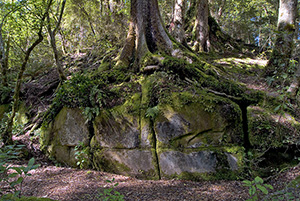
    Despite the trans-Pacific devastation of these natural catastrophes, the physical remains of Lemurian civilisation in New Zealand still exist. Immediately south of Lake Taupo, the Kaimanawa ‘Wall’ is more probably a step-pyramid or terraced, ceremonial marae of immense proportions. The American maverick archaeologist, David Hatcher Childress, who investigated the site in 1996, observed that “the blocks seem to be a standard 1.8 meters long by 1.5 meters high. The bottom block runs straight down to 1.7 meters and beyond. The blocks run for twenty five meters in a straight line from east to west and the wall faces due north. The wall consists of approximately ten regular blocks that are seemingly cut and fitted together without mortar.”

    The Lemurian impact on New Zealand and Australia was profound. And as more evidence emerges to confirm the ancient oral traditions of its native inhabitants, mankind gradually realises that our civilised origins are far more profound, technologically and spiritually greater than we have been led to believe.

    [alert type=”general” dismiss=”no”]This article was published in New Dawn 95.[/alert]

    [alert type=”success” dismiss=”no”]If you appreciate this article, please consider subscribing to help maintain this website.[/alert]

    © New Dawn Magazine and the respective author.
    For our reproduction notice, click here.
  • Alien Abductions and Star Kids: An Interview With Mary Rodwell

    Alien Abductions and Star Kids: An Interview With Mary Rodwell

    The following interview with Mary Rodwell appeared in New Dawn 97. Mary has contributed an article to New Dawn Special Issue Vol 11 No 2 in which she provides information on recent cases and breakthroughs in the area of alien abduction and the Star Kids.

    Mary Rodwell, is the Principal of ACERN (Australian Close Encounter Resource Network). She is a counselor, hypnotherapist, metaphysician, former nurse and midwife. Mary has lectured in the USA, UK and Australia. She is the author of Awakening: How Extraterrestrial Contact Can Transform Your Life (2002) and the producer of the EBE award winning documentaries Expressions of ET Contact: A Visual Blueprint? (2000) and Expressions of ET Contact: A Communication and Healing Blueprint? (2004).

    ACERN is a professional counseling resource that explores all anomalous experiences as well as speaking to professional traditional agencies about contact reality. Mary’s research explores both the physical and metaphysical implications of contact. This research has demonstrated that for most individuals contact can be a transformative/spiritual experience, where individuals, such as those termed Star Children, become more aware of their multi-dimensional nature.

    The interviewer, Tony Mierzwicki is the author of Graeco-Egyptian Magick: Everyday Empowerment and Alien Magick: Exploring the UFO Phenomenon as well as numerous magazine articles and anthology contributions.

    Tony Mierzwicki: How real are UFOs? There have been many deliberate frauds over the years that act as a smokescreen over something apparently real. UFOs provide a very easy field to sow with disinformation, as they’re very much on the fringes and inspire numerous B-grade sci-fi movies.

    Mary Rodwell: Thomas Kuhn author of The Structure of Scientific Revolutions advises to observe, drop all your preconceived categories as best you can, and just collect raw information. He is correct I believe, because this is the only way we will be open to what we don’t know. Of course, open-mindedness does not equate to gullibility. No-one can be truly objective of course, but the less personal “limits” we have in collating the data the more chance we have of getting at the truth.

    Fraudulent information occurs in most subjects we explore, although UFO material has more than its fair share. With all of it I believe it’s about “listening” to our own personal resonance to “truth.”

    I believe that there has been a deliberate attempt to instill fear of the ET reality and what it may mean. So that ET means an “invasion” kind of message and we are all going to be exterminated or taken over. What people don’t understand, because they are given an edited version of our history, is that we have been visited for thousands of years and that our DNA has been tampered with many times already by “them.” If they wanted to exterminate or take us over, they have the technology to do it in a nanosecond. So why haven’t they done this? Because they have no desire to, and because we are part of “them,” and their program to help in our evolution.

    We attack their spaceships and they don’t retaliate. It’s we who are the aggressors.

    As an example of the reality of UFOs, Dr Stephen Greer’s Disclosure DVD put out by the CSETI organisation, has a testimony from a high ranking military man who said a missile which had been sent into space was circled by a UFO and then exploded with an energy beam. The whole event was videotaped, but witnesses were instructed to say that they saw nothing. The DVD has two hours of interviews with high ranking military personnel, pilots, etc who have seen UFOs visually and through radar, crashed craft and the beings themselves. They admit to the cover up and many corroborate each other’s statements.

    Tony: Your research appears to indicate that many alien encounters are positive and of a beneficial nature. While this is certainly the case in some reference material I have perused, there are numerous researchers who believe that abductions are very traumatic to the “experiencers.” How would you resolve such a contradiction?

    Mary: I think a contradiction is only present if you see this as either or. I think it’s hard to say there is any black and white to this question. The contact phenomenon is extremely complex and no one person/researcher, no matter how well informed, has the mandate on this. All I can do is report what I have found with my clients and honour their understanding and experience. But I have found though that often what they have believed was a negative experience has not always proved to be so when we have explored it more deeply via hypnosis.

    I like to quote from Albert Einstein in my presentations, “Whoever sets himself up as judge in the field of truth and knowledge is shipwrecked by the laughter of the Gods.” I am afraid that many researchers find it hard to have a neutral perspective, as ultimately they will try and head their research to the hypothesis that suits their own judgements. I try to keep to the data I receive and it has often surprised me. I have learnt that the truth is often multifaceted in nature, not so black and white as we would like it to be. I look for patterns.

    If the hypnotherapists are only covering the barest outline of the experience, time/date, how many beings were present, and what procedures were being done, then the individual may be very fearful because they do not know what was happening or why such things were being done to them. Hence, this would impart negativity to the experience.

    In limited exploration, the individual is re-exposed to the trauma without the understanding that should come with this. It is only when the individual understands more fully what’s going on, that they can then come to terms with it and integrate it. Consider for example a three year old boy taken to the doctor for an injection. You tell him that the doctor will make him better, but he just experiences pain. It’s only when he is older that he finally understands what went on.

    I ask the client to dialogue with “them,” i.e. the ET’s, and ask “them” what, and why, the procedure was being performed. The answers would amaze you.

    Tony: So your clients can dialogue retrospectively? This is very interesting if true, as it would tie in with quantum theory’s ideas of the non-linearity of time.

    Mary: For sure. I was very surprised when my first client was able to do this, as it seemed that the information came from either a “deep inner awareness,” or as you say a way of tapping into quantum. I am still trying to unravel how this may happen in terms of science. All I know is that they seem to tap into answers for their questions when working in the altered state, whether this comes from a higher consciousness which some call the higher self, or the ET beings have left the information to be tapped into when needed.

    For me the most important thing is that it is always profound and helpful to the individual, in that their psyche or higher senses translate this information in a way that makes sense to them.

    I believe that linear time is a human construct, and many “experiencers” say the same thing. For example, Tracey Taylor states, “Time for them is irrelevant in the linear format that the average human understands.” I certainly believe that we bypass the linear format of time when in an altered state, and that is possibly why the individual can access dialogue with the beings even though I have regressed them to what is perceived as a future event.

    Tony: This is confusing. You say that abductions are often for the experiencer’s benefit? But what about all the cases of rape, endoscopes, and taking scoops of human tissue?

    Mary: Certainly some ET procedures are for the collection of genetic material, and for scanning/examining tissue for planetary pollution held in the human tissues etc. We have polluted our planet and everything we eat or drink carries with it the poisons from our environment into our physical body. These cumulative toxins are picked up and analysed by our ET visitors. Experiencers are told this.

    To quote Tracey Taylor again, “As far as my Contact experiences, I became very compassionate towards the ET beings, as there is so much humans can learn and benefit from interacting with them. I was ‘fearful’ of my experiences only when I didn’t know what was happening and why. But there has always been an equal exchange. I helped them achieve their genetic goals and in return I received my healing and psychic ability, plus my understanding of Earth has been enhanced. Basically at the start I misunderstood the ‘grays’. The knowing ET part of me initially made a decision to assist them and the understanding of this can be overshadowed with the fear which stems from our limited human perceptions and reactions to these experiences.”

    I believe many of the ET races have a very strong interest in us as a species and our evolution and they are part of it as we share a genetic heritage with them. I have found that with different species of ETs, the more strange or confronting looking ones are not necessarily evil or negative. This includes the reptilians/lizard ones for example, because some people have experienced very loving exchanges with them.

    Tony: But what about the rape issue? Would anyone consent in advance to rape?

    Mary: I believe this is a complex issue that depends on what level you choose to understand it. From soul level, before birth we choose our challenges and experiences for our coming life. (I have come to believe this through regressing people into past lives.) This includes all our experiences, obviously traumatic and otherwise. The soul through this gains greater understanding. So although through life we may perceive some experiences like this as hurtful or negative, it’s through such a process we have the opportunity to understand ourselves better. This is true for all experience. So on this level you may well consent to this experience (i.e. rape) if it offered you insights you would not gain otherwise.

    As I said, from soul level I believe we are co-creators of our reality, and that life is a school for growth and understanding. Some may well choose the ET experience as a way of helping them to grow.

    But for those who cannot go to a “bigger picture” with their experience, I will help them work through the trauma to a more healing perspective.

    When I have hypnotically taken an individual to the death sequence and they pass over, they speak about their lessons and learning from that life. And when contemplating a new life they take this into consideration.

    Michael Newton in his books Journey of Souls and Destiny of Souls discusses soul groups and how they choose to interact with each other for learning, even to being the perpetrator in one life to the victim in another, as a growth exercise. Newton was initially skeptical about the material he collated. He has regressed hundreds of people to their “in between lives” state as souls, and they describe what happens to them as souls. The fact is despite what belief system they have, they all come up with strikingly similar material.

    Tony: What about endoscope examinations?

    Mary: Endoscopes are used as a medical exam just as in human hospitals. So this information changes what people feel about the experience. It seems to make a lot of sense to them.

    Tony: I suppose it depends on how painful the whole thing is. People tend to not mind painless tests.

    Mary: I agree but maybe on some level they want the memory of the pain to be a reminder that this is a reality so that it’s not dismissed. It could be another way of waking people up.

    Tony: That’s very gnostic. One of the central teachings of the gnostics was that humanity is asleep and needs to be awakened so that their return to the transmundane deity might commence. Gnostic myths would often include some sort of saviour figure to awaken sleepers.

    Mary: Yes. I believe this experience acts like a “trigger” to an awakening of consciousness. I think the “saviour” is our self. People realise this when they are ready to take on that truth.

    Kenneth Ring in his book Beyond Omega states that the UFO phenomenon is a evolutionary shamanic experience to “wake us up.”

    There is some evidence (see Dr Stephen Greer’s Disclosure Project) that some of the more negative interactions are not necessarily of ET origin, but a human manipulated ET experience to give us a negative view of ETs.

    This is one of the hidden human agendas concerning a cabal to discredit the whole ET phenomenon and lead us into fear of them so that we will accept the “Star Wars” program. It’s a very complex phenomenon. Whether we like this or not, it’s part of the human/ET phenomenon and the cover up.

    There is no doubt some individuals have experienced trauma from their encounters. But in my research, perhaps as many as 60-70 %, have the more positive encounter experiences. And even with those who are traumatised, often when they understand their encounter experiences they can change their mind into a positive framework. They discover a consentient, even pre-life, agreement to the encounters and the gain of greater awareness that follows such interaction, which often negates their previous fears. They may discover they have had a healing on the craft or that they are being “taught things,” and that the experience is for their ultimate growth and awakening.

    Tony: I’ve heard of pre-life agreements in New Age circles, but have never heard of them applied to abduction scenarios.

    Mary: This is because many Ufological researchers, just don’t go there or ask such questions. Their focus is information to fit their third dimensional and scientific research. They are not therapists and do not have this person-centred focus. My mandate has always been to help the individual make sense of their “journey” first. Research comes second to that.

    I help clients to trust and honour the wisdom of the super-conscious self and what it reveals to them for their personal growth and understanding. In regression I ask if on any level the individual has “consented” to such an experience and it’s fascinating to discover that often they have consented, as I said often it’s a pre-birth agreement. This is a most important question for their personal growth as you must realise it takes them from “victimhood” to being aware of their own multidimensional life/soul journey. I ask my clients to go with their personal feelings rather than what others tell them, and to trust that inner resonance.

    [alert type=”info” dismiss=”no”]If you appreciate this article, please consider a subscription to New Dawn magazine.[/alert]

    Tony: Skeptics believe that the whole abduction phenomenon can be explained through a combination of sleep paralysis and hallucination, with hypnotists implanting false memories by imposing their belief system on experiencers.

    Mary: Yes, I know about the false memory syndrome and obviously one has to be careful with the technique and not lead the client. But having said that I have tried an exercise where I have deliberately tried to lead the client, but they would have none of it and corrected me. So I don’t think it’s as easy to mislead or implant as it’s made out to be.

    There are many misconceptions related to hypnosis. For many, the alpha state is no more trance-like than watching an absorbing program on TV. It is firmly believed too, that no hypnotist can get any individual to act against his or her will.

    In truth, I ask the client what they see, I don’t tell them what to see. This process helps them to re-visit the experience. Often both I and the client have been amazed at the information that we have obtained.

    Dr. John Mack (former Professor of Psychiatry at Harvard University) said he believed that information gained by hypnosis was even more accurate than conscious memory as the conscious memory can edit out what it doesn’t want to acknowledge. I agree with him.

    Tony: Skeptics will criticise anything received in an altered state, claiming it to be dream-like.

    Mary: Skeptics can say what they like, and why does “dream like” make the data incorrect? Many of them haven’t worked in this field and so it’s like a soldier telling a surgeon how to operate! All I know is the material makes sense to the individual and often I have other individuals who will confirm this data in their altered state. As I said before, I look for patterns of data.

    None of the hypotheses of skeptics explain:

    • metallic implants in the body (for example those removed by surgeon Dr. Roger Leir in The Aliens and the Scalpel);
    • marks on the body that fluoresce under ultraviolet light;
    • 18 month old children who remember being taken, who are clearly not Star Trek fanatics or having sleep paralysis;
    • many people “taken” are not asleep, as it can happen in broad daylight when driving a car;
    • “missing time” episodes;
    • whole families are sometimes involved.

    There is a story of one 18 month old child going to a bookcase, taking out a book on Alien Abductions, and telling her mum “this is the man who comes and gets me.” At eighteen months of age, they don’t listen to talk shows! The kid’s testimony is profound. I speak about this more during my presentations and in my book in the chapter on Star Kids.

    Regarding missing time, some people may feel disorientated and be aware on some level something happened but that’s all. It’s fascinating and many times through regression you find out what happened to them. Sometimes they find themselves in the same spot and sometimes many kilometres away. Some of these people have flashbacks to the events which can happen when “buttons” are pressed in everyday life such as being in a lift, or faced with an injection, or at the dentist’s. These traumas can take them back to the images of an alien craft (there is a detailed questionnaire in my book). Phobias such as arachnophobia or agoraphobia can sometimes be related to this experience. Hypnosis is the most useful tool, although many do have conscious memories on the craft.

    Tony: I have come across multiple references to Dr. Leir’s book. It’s funny that some people say there are implants whereas the skeptics say there are none.

    Mary: Exactly, they haven’t done their research. Leir’s work is fully documented. I actually know Roger very well and had him come over from the USA to speak at Perth’s first Hidden Truths conference two years ago.

    Tony: Once you have physical implants, then all the psychological theories go out the window – to explain all cases that is. You then have to admit the reality of the abduction phenomenon for at least some people.

    Mary: Exactly, that’s it. But it’s amazing how even this fails to convince some people. It’s because of fear! Fear of change, and of having to re-appraise reality perspectives. But all experiencers have to do that to survive.

    Tony: Have you been abducted? Is this perhaps what got you onto your path of helping others?

    Mary: This is a question I have been asked many times. The truth is I have not been “consciously” aware of being taken. I do not have the classic indicators but that does not mean I have not. Some individuals I know have told me they have seen me on an alien craft and two of my children certainly have “indicators,” so it’s more than possible. I do know that I have absolutely no fear of “them” or this phenomenon at all.

    Tony: The thing that strikes me about the whole UFO abduction phenomenon is that so much of it is dream-like.

    Mary: I believe that ETs use this altered dream-like state to access people. If they were fully conscious they may well resist and many say that the “grays” particularly are very physically vulnerable. But those who have the experience say it’s not like a normal dream, and so they know the difference.

    Tony: Much has been written about alien breeding programmes aimed at producing a hybrid race. The “Star Kids” are supposed to be one result of these programmes.

    Mary: Certainly I believe many ET races are interested in our genetic make up because many of them have been involved in it right from the beginning. See Zecharia Sitchin’s work The Earth Chronicles.

    We have a reptilian part to our brain, and so many believe they have a genetic mix with the reptilian/lizard species of ETs.

    Many experiencers who have interacted with ETs say they have felt love and emotion from some of them. I believe we have reached a critical time in our evolution and the sense is that if we don’t get it right we could destroy ourselves before we become part of the galactic community. I don’t fear that “they” will wipe us out, but that we will do it to ourselves. We have so much growing up to do, I just hope we get it before it’s too late.

    When I talk at conferences I find people very interested in the New Human Star Child hypothesis. The main interest is from older individuals who are seeing that the children being born now are different, so it fits with their experience.

    The Star Kids are aware that they are a mix of human and ET genes. They are here to help mankind to make an evolutionary leap though “interaction” with them. They are bringing the frequencies for this to happen. Many of these Star Kids know their mission, although they find it difficult being in the density of their physical body.

    Dr. Leir believes that changes in humans with respect to higher psychological functioning (i.e. walking, talking, etc) from 40 years ago are accelerated up to 60-80%, and this is occurring from birth. He believes that this is due to alien intervention in our body and minds (not better pre-natal care or exposure to complex machinery). Logically the pollutants in our atmosphere and food would see a diminishing of this, but it seems despite these handicaps we are still evolving.

    We are all seeking, at some level, a raising of consciousness, we are all helping each other until we all get there (i.e. the hundredth monkey syndrome). I believe the Star Kids are here to help on that consciousness level.

    My DVDs feature scripts, languages and artwork produced by Star Kids, as they act as a conduit for it. This material is of a holographic multidimensional nature and many people feel different after viewing it.

    Mary Rodwell is a contributor to New Dawn Special Issue Vol 11 No 2 which examines theories about alien interference in human affairs and the UFO mystery. Click here for more information and to purchase your copy.

    Mary’s new book The New Human: Awakening to Our Cosmic Heritage is available from Amazon.com.

    [alert type=”general” dismiss=”no”]This article was published in New Dawn 97.[/alert]

    [alert type=”success” dismiss=”no”]If you appreciate this article, please consider subscribing to help maintain this website.[/alert]

    MARY RODWELL is founder and principal of the Australian Close Encounter Resource Network (ACERN). She is also a co-founder and director of The Dr. Edgar Mitchell Foundation for Research Into Extraterrestrial Encounters (FREE). Former nurse, midwife, counsellor, hypnotherapist, Reiki Master, international speaker, researcher, Mary Rodwell is author of the book Awakening: How Extraterrestrial Contact can Transform Your Life (2002) and The New Human: Awakening to Our Cosmic Heritage (2016). Mary’s research has involved over 3,000 cases of Encounters with Non Human Intelligences (NHI), research qualified by the in-depth surveys conducted by FREE. For further information, visit www.acern.com.au; www.maryrodwell.com.au; www.Experiencer.org. Email: starline@iinet.net.au.

    © New Dawn Magazine and the respective author.
    For our reproduction notice, click here.

  • Mind Control in Australia

    Mind Control in Australia

    This article was published in New Dawn 153 (Nov-Dec 2015)

    Philosophers and pundits have long discussed the nature of ‘reality’ itself. For convenience and simplicity we might consider two parallel ‘realities’: one a ‘physical reality’ (the limitations of the body, the physical environment, the mechanical activities and necessities of day-to-day survival) and another ‘mental’ or ‘psychic reality’: the lens through which your mind organises, filters and constructs both an internal and external landscape – a worldview (or supposition of ‘how things are’) both tactile and emotional.

    It seems reasonable to suggest that while ‘physical reality’ (the acquisition of food, shelter, relationships, physical movement etc.) is doubtlessly of primal immediacy, the role of ‘psychic reality’ cannot be overstated in the human experience. We act (alone or in concert with others) according to our interpretation of events, information and stimuli: we move or react in concordance with a framework subtly (or overtly) instilled (or reinforced) by peers, family, media, social mores and the fabric of ‘history’ (as transmitted to us) – a collection of instincts, prejudices, short-cuts and assumptions navigating the approximation of a world our senses deliver to us each waking moment.

    Though somewhat falsely lionised as ‘individuals’ (through a century of aggressive marketing and social engineering), we are actually in essence herd animals – guided by the pack, we take verbal, non-verbal and visual cues from those around us – tribalised into class, socio-economic and other strata through myriad signals, feedback loops and pervasive (yet somehow ostensibly invisible) patterns.

    The herd instinct (in humans as in other creatures) is an invaluable tool for the study and organisation of large populations.

    Positioned in distant southern climes, far from the perceived centres of human civilisation – the thin coastal belt, broad plains and scorched deserts of Australia offer an enticing laboratory for the sciences of experimentation and herd manipulation.

    Wrenched from the hands of its native population through a bloody series of wars and oppression, the modern nation of Australia was established as a British penal colony in 1788. Doubtlessly much has changed and developed since then, but still it’s difficult to shake the image of Australia as contiguous and eternal penal colony.

    Since federation in 1901, examples of Australia as anything but felicitous imperial servant are few and far between. The nation cheerfully delivered its young to be blood sacrifices in the imperial territorial jousts of the twentieth century and various Anglo-American imperial intrigues throughout the latter twentieth century and early twenty-first.

    Beginning in the 1950s, Australia had the dubious pleasure of being Great Britain’s nuclear sandpit. All manner of outrageous and unforgivable atomic ‘experiments’ were conducted across West and South Australia, as unrelenting clouds of nuclear fallout drifted over the largest populations centres on the eastern Australian seaboard (the effects of which were covertly studied by the ‘mother country’ for decades thereafter). Like a serially abused child, this nation of ‘Larrikins’ and ‘Eureka Rebels’ barely raised a mute whimper.

    Among a mere handful of momentary blips (on an otherwise placid radar), one may have been the 1972 Whitlam government’s tepid resistance to the enormous, malevolent and largely secret US military base network that speckles the Australian landscape (like the first signs of approaching disease). Whitlam and his unruly gang were swiftly dispatched in a bloodless coup, and no Australian politician of note has dared rock the boat since.

    Another lonely blip may have been the 1985 ‘Australia Card’ – a national identity card that would have linked and collated personal information and mandatory identifying biometrics. A brazen totalitarian gesture (with a patriotic ‘green and gold’ branding and dazzling press launch), the confused populace felt a bovine unease around the proposal and, lest it spook the cattle, the card stumbled onto a slow oblivion two years later. Interestingly, every salient objective of the ‘Australia Card’ has since come to pass through one gladly received ‘initiative/convenience’ or another (many subsumed by the Medicare Card and Centrelink).

    While certainly queasily deferential to authority, perhaps the most instructional recent historical trait in the Australian experience has been that half-hearted rejection of the ‘Australia Card’ – a proposal so clumsily introduced as to resemble a deliberate provocation, designed to test the waters (and ultimately perhaps to fail – so as to set a line in the sand, demarcating exactly how far the gullible can ultimately be stretched).

    Australia is also a popular testing ground for corporate and consumer technologies. Politely referred to in marketing literature as “early adopters,” most Australians are guileless and enthusiastic proponents of convenient (but potentially sinister) technological innovations. From ATMs, EFTPOS payment systems and microchipped credit cards to mobile phones and wireless networks, Australia has reliably led the world in trialling and adopting these peerless developments in consumer profiling and data capture. Mastercard, Visa, Vodaphone and numerous other corporate behemoths consistently utilise Australia to trial new technologies and techniques.

    Unsurprisingly, Australia was an early and enthusiastic member of the Five-Eyes-Network, a globe-straddling post-WWII domestic and international surveillance co-operative that deployed nascent technologies (like ‘Echelon’) to monitor all electronic communications while ostensibly outsourcing the bulk of domestic spying to international partners (thus lending a [largely unnecessary] air of plausible deniability lest accidental public or journalistic exposure occur).

    Unmistakably fashioned around the twin primary aims of curbing domestic dissent and international commercial espionage, the Five-Eyes-Network would haughtily justify its existence – on the exceedingly rare occasion it had to – with a casual application of Bogey-Man-Of-The-Week™ lotion (Communism®, Terrorism® or whatnot).

    As befits a ‘former’ penal colony, Australia is over-governed and over-regulated (ironically, even a recent government audit decried the overwhelming saturation of legislation and registration). Australian adults are infantilised to the point where they are apparently untrustworthy enough to drink in public places, are sanctioned for riding pushbikes through public parks and must be locked into nightclubs during prescribed ‘volatile’ hours. Supposed private property is regulated behind a wall of incomprehensible bureaucracy, and membership of perfectly legal (but government proscribed) organisations becomes instantly and unquestionably illegal. Physical space in Australia is entirely over-regulated and captured, a timid populace cowered by an unrestrained police force (now empowered to force random fingerprinting), an unchallenged legislature (the Northern Territory has begun ‘paperless’ and therefore incontestable arrests), invincible intelligence agencies (endowed with gargantuan budgets and unaccountable powers) and unassailable rampant corporations.

    When it comes to the mental, political, philosophical and psychic landscape – things are even worse.

    Public discourse in Australia is incredibly narrow, bewilderingly staid, tediously predictable and heavily media-sedated. It’s essentially impossible to hear a publicly expressed homegrown opinion outside of the stultifying confines of mainstream ‘debate’. Some cleave to the ersatz alternatives of the ABC and SBS (both government funded) where a rigidly controlled and astoundingly toothless ‘opposition’ simply refines the mainstream dialogue through the lens of bourgeois political correctness.

    Examples are innumerable, but developments in recent memory will suffice.

    Tabloid flagship of the Police State, Melbourne’s Herald Sun, has for many years been a hysterical advocate for the Western imperial adventure branded as the ‘War On Terror’. Megaphoning a procession of serially unsubstantiated jingoisms (probably directly minted from Australia’s historically sinister intelligence agencies), headlines like “Beheading Plot Smashed,” “Evil Within,” “Thirty Jihadis Return Home” and “Lessons In How To Spot A Jihadi” are loud on volume, long on anonymous ‘official sources’ and forever short on facts.

    A massive police and security agency ‘anti-terror’ operation on 17 September 2014 (involving over 800 police officers, helicopters, bomb sniffing dogs etc. etc.) produced exactly two charges (both of tenuous value) and a firestorm of unquestioning, fevered media coverage (all photos, video and information helpfully supplied by the Australian Federal Police Media Liaison Unit). In Australia, ‘reporters’ no longer ‘report’, they simply cut and paste official media releases.

    With a handful of further ‘terrorist threats’, ‘incidents’ and ‘sieges’ successfully completed, and the herd now appropriately fearful, the then Abbott government introduced a raft of outrageous ‘national security’ laws – each a mortal assault on the limited range of ‘freedoms’ Australians already ‘enjoyed’. Perhaps the most onerous of the morbid bunch was a series of laws known as the ‘mandatory data retention laws’. These provisions stealthily legalised and normalised mass surveillance of the entire (and entirely) clueless Australian population. Not one officially sanctioned pundit bothered to mention that the laws are possibly in breach of at least three articles of the Universal Declaration Of Human Rights and commit Australia to being an official Police State.

    So Machiavellian is the sunburnt landscape, that droves of Australians casually promulgate and disseminate unhinged anti-Islamic diatribes and disinformation – fearful of a chimeric yet apparently approaching ‘Sharia Law’ and ‘Halal’ dictatorship. Egged on by shock-jocks and other media Svengali, the herd quiver at the sight of Mosques, hoax pederastic ‘mass-weddings’ and ‘alien’ attire.

    It would be laughable were it not so ugly.

    Manipulated, like so many head of cattle, by their media, corporate and government masters, Australians have allowed Islam to become the lightning rod for all their fears, prejudices and hatreds – a hoary old trick of tyrants – but forever a successful one to legitimise wars and domestic control.

    Philosophically and psychically manipulated against all their own best interests, Australians are simply unable to think, express themselves or even comprehend outside of the narrow officially designated allowable thought corridor.

    Recently returned from the US, tech entrepreneur Nick Holmes à Court derided Australians as gullible and apathetic, noting that “we as the people, have sat back and snoozed whilst the government passed Orwellian internet censorship laws.” Holmes à Court continued that “no one in Australia gives a f*ck. The lucky country? More like the lazy country.”

    If ever Australians needed a reminder that they labour under government by goon squad, they surely received it on 28 August 2015 when the ‘Australian Border Force’ warned they would be randomly checking people’s papers on the streets of Melbourne. The action was eventually cancelled in a snowstorm of farce, but the fact that it was even considered (and announced) speaks troubling volumes to the decayed corpse of Australian ‘freedom’.

    Docile, compliant and forever fawningly agreeable to its imperial and domestic ‘betters’, the Australian population is often incapable of even the most feeble acts of mental self-defence. Unconscious to the point of comatose, the ‘body politic’ knows nothing, couldn’t care less and drives blind – headlong into an unforgiving future. A slave-nation of idiot infants bewitched by shock-jock tirades and pop-culture baubles, unable to discern the psychic plantation walls that dwarf and surround it.

    Twenty-four million lost souls trapped in the penal mind, prisoners of push-polling, perfidious punditry and permanent war-footing propaganda.

    [alert type=”general” dismiss=”no”]This article was published in New Dawn 153.[/alert]

    [alert type=”success” dismiss=”no”]If you appreciate this article, please consider subscribing to help maintain this website.[/alert]

    © New Dawn Magazine and the respective author.
    For our reproduction notice, click here.
  • From Witchcraft & Satanic Rites to Demon Possession

    From Witchcraft & Satanic Rites to Demon Possession

    The supernatural: the images that come to mind when that word is uttered often are ones that arouse anxiety or dread. Why?

    To begin with, you can only be afraid of something that you believe is real. A child has a nightmare and wakes up; the parent consoles by saying “it was all just a dream” or “it was all imaginary.” What is imaginary cannot hurt you, and there is no reason to fear it. Only what is real can hurt you.

    But, then, what exactly is real? This is a long and difficult question to answer, but as a partial answer we can say that in order for something to be accounted as real or true, it must accord with our preconceptions of what is possible and what is not. As it turns out, these preconceptions vary wildly from place to place and from age to age.

    For example, over the centuries the views of Western civilisation has swung back and forth about witchcraft. It is a widespread but incorrect belief that the persecution of witchcraft started with Christianity. The Jewish Mosaic Law was quite specific in its condemnation: “Thou shalt not suffer a witch to live” (Exod. 22:18). The pagan world was no more tolerant: the Code of Hammurabi, dating to the early second millennium BCE, discusses a procedure regarding charges of witchcraft, and the Twelve Tables, the founding legal documents of the Roman republic, dating to the fifth century BCE, assumed its existence; later edicts in the time of the empire entailed prosecution for witches.

    By contrast, in Christianity during its first 1,400 years, charges of witchcraft were comparatively scarce, and belief in witchcraft was condemned at least as often as witchcraft itself.

    The witch scare of the early modern era – which has persisted, off and on, to the present – began in earnest in 1484, with the propagation of a bull by Pope Innocent VIII authorising two inquisitors, Jacobus Sprenger and Heinrich Kramer, to deal with witches in certain parts of northern Germany. Sprenger and Kramer followed up by publishing a lurid but highly influential work called the Malleus maleficarum (“The Hammer of Witchcraft”) in 1486, spelling out methods for detecting and punishing witches.

    Although the Catholic Inquisition spearheaded the witch craze, over the decades the inquisitors themselves became increasingly sceptical of witchcraft charges. The largest numbers of condemnations of supposed witches took place in countries like Germany, which were battlegrounds of contending denominations, rather than in Spain and Italy, where the Inquisition was strongest.

    Why should the law, Jewish, pagan, or Catholic, occupy itself with witchcraft at all? Today the preoccupation with such a thing seems exceedingly odd. But it is not at all odd if we consider that the worldview of those eras assumed not only the existence, but also the efficacy, of witchcraft.

    It would be hard to deny that witchcraft, benign or malevolent, is practiced. People cast spells; this is not in doubt. On this point we would agree with the ordinary European of the year 1500. However, we might disagree about whether the spells work. In the Europe of the early modern era, it was generally assumed, by the learned as well as the ignorant, that witches could do good or harm with their spells. A society that believes that something can do harm is likely to try to forbid that thing: hence witchcraft laws.

    The belief in witchcraft did not persist. The history of the early modern era is a history of disillusionment, first in the Catholic hierarchy – whose corruption, assailed for centuries, finally led it to lose its monopoly on the faith of Europeans – and then in its worldview. The witch hunt craze, which peaked in the late sixteenth and early seventeenth centuries, was a major part of this disillusionment. Witchcraft charges became so numerous, so problematic, and in the end so ridiculous that by 1700 European society had ceased to believe them.

    Consequently, witchcraft laws and persecutions faded into oblivion during the eighteenth century. In Britain, for example, the Witchcraft Act was passed in 1735. Replacing earlier laws that entailed penalties for witchcraft, it went in the opposite direction, making it illegal to claim to be a witch. Since witchcraft was impossible, claiming to be one, or alleging that someone else was, was held to be fraudulent in and of itself.

    The 1735 act, which sat on the books for over two centuries, was overturned for extremely peculiar reasons. In 1944 a medium named Helen Duncan claimed to have contacted the spirit of a sailor who had drowned on the HMS Barham. She was jailed for this announcement, allegedly on the ground of being a false medium (under the Witchcraft Act) but in fact because she had been a genuine one: she made her statement before the sinking of the Barham had been made public. Duncan’s case led to the repeal of the Witchcraft Act in 1951, leading to another curious reversal.

    Once the act was repealed, many people came forward claiming to be witches. They also claimed to be part of an ancient tradition – the Old Religion – that had flourished in the British Isles long before the coming of Christianity. The most famous of these individuals was Gerald Gardner, a retired customs official who said he belonged to a coven that met in the New Forest in southern England. Gardner’s works, including High Magic’s Aid, Witchcraft Today, and The Meaning of Witchcraft, launched the contemporary movement known as Wicca. While membership figures for this movement are hard to come by (many Wiccans practice alone, and many others conceal their practices for fear of scorn), one estimate holds there were some 362,000 in the US in 2008. In the UK census of 2011, over 56,000 identified themselves as Pagans, nearly 12,000 as Wiccans, and another 1,300 said their religion was “Witchcraft.”

    Satanism, Exorcism and the Movies

    In the twenty-first century, attitudes toward witchcraft have come full circle. In the medieval era, its existence was denied; in the early modern era, it was believed to exist but was persecuted; in the eighteenth century, its existence was again denied, and today, free from fear of legal penalties (at least in the US and the UK), many individuals are stepping forward and identifying themselves as witches. But since the law in these countries and other lands does not acknowledge the reality of witchcraft, witches can cast spells white and black with impunity.

    Satanism, that great bugbear of fundamentalist Christians, has also come forward in recent centuries. Although rumours of Satanic rites go back at least to medieval times (a Satanic cult is said to have thrived at Louis XIV’s Versailles in the seventeenth century), Satanism first came to widespread attention with the novel Là-bas (“Down There”) by the French author J.-K. Huysmans. Published in 1891, the book included a vivid description of a Black Mass that Huysmans had supposedly witnessed. The current fascination with the Satanic dates from the 1960s. Anton LaVey launched the notorious Church of Satan in San Francisco in 1966. One year later, Ira Levin published Rosemary’s Baby, which became the best-selling horror novel of the decade and inspired Roman Polanski’s even more popular film of the same name, which appeared in 1968.

    Levin no doubt wanted his book to succeed, but later on he was dismayed by its long-term effects, since it led to a genre of horror films lending perhaps undue credibility to the existence of the Evil One. “I feel guilty that Rosemary’s Baby led to The Exorcist, The Omen,” he said in 2002. “A whole generation has been exposed, has more belief in Satan. I don’t believe in Satan. And I feel that the strong fundamentalism we have would not be as strong if there hadn’t been so many of these books… Of course, I didn’t send back any of the royalty checks.”

    As Levin noted, Rosemary’s Baby set the stage for The Exorcist, a 1971 novel by William Peter Blatty that was made into a movie two years later; it is probably the most disturbing film in the Satanic genre. It was released in Germany in 1974. Two years later, a twenty-three-year-old woman, Anneliese Michel, died of dehydration and malnourishment after having sixty-seven exorcisms performed on her over the course of ten months. Her knee ligaments had ruptured from the six hundred genuflections she had performed during each of the ceremonies. Her death led to manslaughter convictions for the four priests who had exorcised her (evidently without success). The story, heavily altered, inspired another Satanic horror movie, The Exorcism of Emily Rose, which appeared in 2005.

    Strangely, recordings of Anneliese’s voice made during her periods of possession strikingly resembled those of Linda Blair, who played the possessed young girl in The Exorcist. (A recording has been uploaded onto YouTube for your listening pleasure.) Was Anneliese’s possession – if that is what it was – a sign that Satan is abroad in the world, or was it a copycat performance of something she had seen in a film? Without question, Anneliese was disturbed – she had had seizures even before The Exorcist was released – but it would seem that art in this case inspired life rather than imitating it.

    Today exorcism is becoming increasingly fashionable. In 1997 the Catholic archbishop of Calcutta ordered an exorcism to be performed on the dying Mother Teresa on the premise that her illness may have been due to demonic attack. The Catholic Church has increased the number of exorcists it is training in Spain and Italy. According to a January 2014 article in the British newspaper The Telegraph, the church claims that “the rise in demonic cases is a result of more people dabbling in practices such as black magic, paganism, Satanic rites and Ouija boards, often exploring the dark arts with the help of information readily found on the internet.”

    Like the inquisitors of the sixteenth century, the Catholic authorities today are comparatively sceptical about demonic possession and attack, insisting these phenomena are extremely rare. In fact, Michael Cuneo, a sociologist at Fordham University in New York and author of American Exorcism, points out that the vast majority of exorcisms, at least in the US, are being carried out by fundamentalist Protestants, sometimes with disastrous results. In 1995, Pentecostal ministers in San Francisco pummelled a woman to death in order to drive out her demons. In 1998, a seventeen-year-old girl in Sayville, New York, was suffocated to death by her mother in an effort to destroy a demon inside her.

    Powerful (Uncontrolled) Thoughts

    Perhaps it is all due to dark rites. Perhaps the priests of the twenty-first century are hearing sinister, scratchy voices out of girls’ mouths because misguided youth are fiddling with Ouija boards. Or perhaps the epidemic of demonic attacks are due to one of the oldest afflictions mankind has suffered – mass belief.

    The power of the mind is now taken as a given not only in alternative spirituality but in mass culture as well. Practically all of the literature on mind power, positive thinking, and similar beliefs focuses on the individual’s use of mind power to, say, materialise the perfect lover or a cheque for a million dollars. As most people who have tried it have discovered, this only works so well – if only because controlling the mind, as has long been recognised, is the hardest thing of all to do.

    If thoughts have power, what kind of power do collective thoughts have? We have already seen that belief in things like witchcraft has come and gone several times over the past few centuries. If there is any truth at all to the idea of mind power, it would follow that collective belief would create a kind of mind-space that all the members of a given culture inhabit, whether they like it or not, or know it or not. As the spiritual teacher J. Krishnamurti once observed in a conversation: “Suppose one is brought up as a Catholic, hmm? You have all the paraphernalia of rituals; accepting authority; accepting Jesus as the only saviour, son of God; and the Virgin Mary; and ascending to heaven, physically. These are all dogmas, asserted by the church and accepted through two millennia, two thousand years, as an actuality… In India, there is the same old thing in a different form, which is not only a belief but, to the believer, it is an actuality.”

    It is an actuality to the culture as well. That is why, for example, we can read a court transcript from five hundred years ago and see a man confessing to changing himself into a toad – as well as a jury that takes him at his word.

    In the Western world the situation is ambiguous. While religious allegiance continues to decline, we cannot necessarily say the same about belief in the occult in general. People continue to see dead relatives, experience miraculous rescues at the hands of angels, and – on the negative side – experience what feel very much like demonic attacks. The explosion of occult horror movies has fed the collective imagination with vivid pictures of evil – particularly over the last forty years. This in turn has fed into the claims of fundamentalist religion, which finds it extremely useful to use these sources of terror to attract new victims. Against this background, it is easy to understand why cases of alleged demonic possession are on the rise.

    The Real and Imagined

    To what extent are these phenomena real, and to what extent are they figments of the imagination? The boundary between the two categories is not easy to draw. A whole fabric of preconception underlies our collective experience of what is real. We have only the most limited degree of control over these preconceptions, in part because we are so oblivious to them. Nor do we have any clear idea, at a deep level, of how and why these collective beliefs change. Of course we are convinced that we today have the truth and that everyone who lived centuries before was ignorant and credulous. But is this belief itself a sign of our own collective delusion?

    In any case, we not only continue to have the supernatural with us, but we have the fear of the supernatural with us too. The best approach may be a middle path between denial and credulity. The esoteric traditions have long recognised the reality of occult phenomena, but have also stressed that they not be given too much importance. One Buddhist tale tells of a young monk who goes to his master and says, “I had a vision of the Buddha during my meditation!” The master replied, “Just keep meditating and it will go away.”

    In the mid-twentieth century the English author Christopher Isherwood found a spiritual home in the Hindu tradition known as Vedanta. At one point he approached his teacher and said that he was experiencing certain supernatural visions. The swami responded that as Isherwood progressed on the spiritual path, he could expect more of these visions. He also told him that he “must take no particular notice of them, and not regard them as a matter of self-congratulation. They have no special significance. The psychic world is all around us, full of sub-creatures, earth bound spirits, etc. To be able to see them is just a knack, a minor talent. Dogs see spooks all the time, it is dangerous to let them interest you too much. At best, they are a distraction from the real objectives of the spiritual life. At worst, they may gain power over you and do you harm.”

    In any event, whether dealing with the supernatural or with anything, the last thing you need is fear.

    [alert type=”general” dismiss=”no”]This article was published in New Dawn Special Issue Vol 8 No 2.[/alert]

    [alert type=”success” dismiss=”no”]If you appreciate this article, please consider subscribing to help maintain this website.[/alert]

    Sources

    “Ira Levin.” Wikipedia: http://en.wikipedia.org/wiki/Ira_Levin; accessed Feb. 24, 2014.

    Christopher Isherwood, My Guru and His Disciple, Vintage Classics, 2013.

    Oliver Libaw, “Exorcism Thriving in U.S., Say Experts”, ABC News, Sept. 11, 2013, http://abcnews.go.com/US/story?id=92541; accessed Feb. 24, 2014.

    David Edmund Moody, The Unconditioned Mind: J. Krishnamurti and the Oak Grove School, Quest, 2011.

    Jacobus Sprenger and Heinrich Kramer, Malleus Maleficarum: The Hammer of Witchcraft, Translated by Montague Summers. Folio Society, 1968.

    Nick Squires, “Rise of the Exorcists in the Catholic Church,” The Telegraph, Jan. 4., 2014, www.telegraph.co.uk/news/worldnews/europe/vaticancityandholysee/10550800/Rise-of-the-exorcists-in-Catholic-Church.html; accessed Feb. 24, 2014.

    “Really Scary! The Real Exorcism of Emily Rose”; www.youtube.com/watch?v=PZfg57LZ34g; accessed Feb. 24, 2014.

    © New Dawn Magazine and the respective author.
    For our reproduction notice, click here.