New Dawn – World's Most Unusual Magazine

Category: Articles

  • Awakening Your Psychic Powers: An Interview with Kurt Leland

    Awakening Your Psychic Powers: An Interview with Kurt Leland

    This article was published in New Dawn Special Issue Vol 10 No 3 (October 2016)

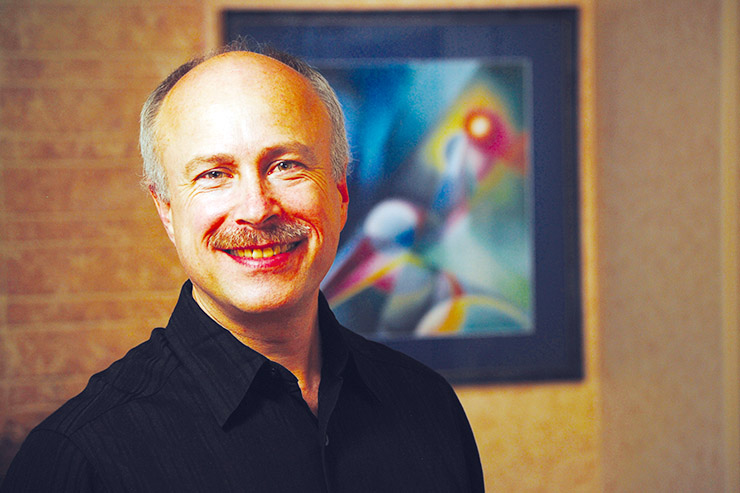
    Kurt Leland is one of today’s most intrepid explorers of the inner planes. A musician and author as well as a visionary, he has written books including Otherwhere: A Field Guide to Nonphysical Reality for the Out-of-Body Traveler and The Multidimensional Human. His latest work is Invisible Worlds: Annie Besant on Psychic and Spiritual Development (Quest Books, 2013). It is an anthology of writings by the Theosophist Annie Besant (1847–1933). Kurt’s website is www.KurtLeland.com.

    I met Kurt during his visit to the Theosophical Society’s American headquarters in Wheaton, Illinois, in the fall of 2011. I was immediately impressed with the depth of his knowledge of, and experience in, the astral and mental realms, which are for most people little more than vaguely understood concepts. He is one of the most lucid and intelligent writers on the inner planes working today. The following conversation was conducted by e-mail in April 2016.

    RICHARD SMOLEY (RS): A lot of people these days are interested in developing their psychic powers. What advice would you give them?

    KURT LELAND (KL): The mind tends to conceptualise a term such as psychic powers, thinking of them as something other than normal, from an unknown realm or level of being – something to be afraid of or acquired by force of will or perpetual practice. Typically such powers come under headings such as telepathy, precognition, clairvoyance (seeing auras), second sight (perceiving ghosts), remote viewing, astral travel, even magical influence over people and events. Some people want to prove to themselves and others that such things are possible and they can do them, not once only (spontaneously or by accident) but regularly (at will or on demand).

    However, I think of psychic powers as the natural concomitant of living within and evolving our subtle bodies:

    An etheric body, having to do with life force and health and offering us the ability to perceive such things as nature spirits, fairies, the recently dead, even angels, as well as to sense events hours or days before they occur;

    An astral body, having to do with desire and emotion, and allowing us to experience our dreams and visit the dead in the afterlife;

    A mental body, having to do with our thoughts and beliefs and allowing us to perceive and travel within a world of ideas and sometimes to contact and learn from them; worldviews of famous dead people;

    A causal or soul body, allowing us to know our past lives, meld minds with others, and perceive and alter the forces in play that create the events of our present life;

    And other bodies whose abilities are less easy to describe.

    My advice to people who want to develop so-called psychic powers is not to target specific name-brand abilities, but rather to develop the subtle bodies and see what shows up. The will- and proof-based approach often leads to frustration and feelings of failure. The approach of developing the special senses of subtle bodies can unfold naturally and organically and enrich our lives with a multitude of adventures in consciousness we may never have heard of before.

    For example, one of my first psychic experiences was sensing the fear of a tree in a wooded area in my neighbourhood after I’d climbed it. At seventeen, I didn’t know trees could feel fear, and I didn’t know this was a psychic experience – until I went back to climb the tree a few days later and it was no longer there, having been bulldozed down to clear the land for a new house. That was an etheric-body experience, not one that could be easily sought after or named or conceptualised. It just showed up, indicating a possible avenue to explore, and gradually developed into a more or less constant, wonderfully enriching awareness of the beingness and inner life of trees.

    RS: How did you develop your own abilities?

    KL: My grandfather on my mother’s side introduced me to the writings of the famous American psychic Edgar Cayce when I was ten or eleven years old. My grandfather knew how to read palms and had some predictive ability, but renounced palm reading when he accurately predicted the age of onset of a serious illness in one of my aunts. Though he taught me the mechanics of palm reading, I can’t say I had any notable psychic experiences when I was a child – yet, after reading about Cayce, I desperately wished for such experiences.

    It wasn’t until I met a woman in college who was a natural psychic from birth that I began regularly having experiences of my own. She had recurring dreams that came true, including dreams about meeting me before we both arrived on campus in the fall of 1976. She knew when people close to her had died, scolding her mother for withholding the information so as not to bother her at school. We developed a telepathic rapport that climaxed with my inventing a place in my imagination that she could see and describe back to me. Whenever I added anything to it, she could tell me what it was. Somehow in the process of hanging out with her, my own abilities began to develop. She had nothing to teach me, she knew nothing about how her abilities worked. Yet somehow my being near her opened up new possibilities for me. Now I understand she was awake and aware within, and could use the senses of a subtle body I had little or no access to – perhaps the etheric body – and that her being awake in that body somehow stimulated mine.

    Otherwise, I’ve never had a formal teacher. I learned much from books, especially the Seth material channelled by the American medium Jane Roberts. When I began to experiment with the Ouija board and automatic writing in the fall of 1980, there was no evidence that I had any talent for such things. Yet I was persistent. It was as if I never stopped knocking on the door, and finally someone let me in. I met my inner teacher by means of these experiments about six months later.

    It certainly seems that my college friend represented nature and I represented nurture. But using the Theosophical framework of subtle bodies, there may be another explanation that encompasses both the notion of being born psychic and that of developing psychic abilities. If we’ve developed any of our subtle bodies in a past life to the point of being able to use their inner senses for clairvoyant (seeing) or projective (travelling) abilities, then we can carry those capacities with us into a subsequent life. The real issue is how soon we recall and realise them – a process I call self-remembering. By this light, my friend self-remembered her use of the etheric body very early and therefore seemed to be a born psychic, whereas I self-remembered my use of this body much later and seemed to develop psychic abilities.

    To extrapolate from this, any spontaneous psychic experience may indicate the possibility of self-remembering the use of a particular body, as in my case with the fearful tree. The challenge is not so much developing psychic powers as finding a way to recall the proper use of one or more of our subtle bodies. Even so, there may be a leading edge of our growth – a body we haven’t mastered yet, which challenges us to develop new inner-sense abilities and the powers of awareness and action within that body.

    RS: Why would you say people today feel so distant from the unseen, subtle levels?

    KL: They’re locked in their mental bodies, a result of family and social conditioning along the lines of scientific materialism, rationality, scepticism, and agnosticism. An overdeveloped mental body is like an overdeveloped physical body – it’s muscle-bound; the focus on increasing size and strength (mathematical, linguistic, and reasoning abilities) has reduced its flexibility or receptivity. The result is alienation from the physical and emotional bodies on one side and from the soul or causal body on the other. The mental body becomes like a fearful teenager hiding in his or her bedroom, with thoughts speeded up through overstimulation by social media, electronic devices, and computer games, and dominated by what one spiritual teacher calls “the tyranny of likes and dislikes.” This results in anxiety, indecisiveness, and black-and-white thinking. To the mental body isolated in this way, the physical body seems bent on betraying us, there’s no soul to guide us, and the whole purpose of life seems to be managing our anxiety.

    The physical body needs quality sense experience – exercise, healthy food, beautiful surroundings, bare feet on the grass or beach, a tempered yet satisfying sex life. The emotional body needs authentic heart-to-heart connection with others. The mental body needs the experience of a community of others who share our beliefs and values. The causal body needs a sense of usefulness and purpose, usually along the line of service to humanity. When the subtle bodies are nurtured in these ways, the boundaries between them soften and we start using them for more than we normally do (acting, feeling, thinking, and serving). That’s when our spiritual powers begin to unfold. We start seeing with the eyes of each body, its inner senses, providing new ways of looking at the world we normally experience and glimpses of the invisible worlds beyond. Eventually we learn to travel in those worlds.

    [alert type=”info” dismiss=”no”]If you appreciate this article, please consider a subscription to New Dawn magazine.[/alert]

    RS: One major issue with psychic powers is self-delusion. You see something uncanny, either visually or with the mind. It seems real. But sometimes it isn’t. How does a person develop discrimination with such things?

    KL: There are many tests and challenges in developing accurate perception from the perspective of each subtle body. I’ve experienced them as a graded course set up by inner teachers and guides, unfolding in projections from the dream state over decades. One example would be learning to identify the same guide under different appearances. Another would be learning the difference in inner-sense impressions associated with a dream character, a deceased individual, a guide, a nonhuman entity, and so on.

    In Invisible Worlds, my anthology of Annie Besant’s Theosophical writings on psychic and spiritual development, she says that the more excited you are about what you’ve perceived, the less likely it is to be real – for example, seeming to receive a mission from some high being. A real experience of receiving such a mission would come with a sobering sense of responsibility and self-examination about what might be required and how to achieve it, not an orgy of self-congratulation over one’s putative spiritual status. 

    RS: Another area of interest is astral travel – the ability to go out of the body in a trance state. Could you start by telling us a bit about this?

    KL: I’m interested in your use of the phrase trance state. Some people may project in that way. My adventures along these lines generally begin from a dream.

    In its simplest form, astral projection is an out-of-body experience in which the etheric body separates from the physical body in a twilight state between waking and sleeping, often accompanied by so-called sleep paralysis (indicating that one’s consciousness is no longer primarily focused in the physical body and so can’t control its movements), a loud vibration during separation, and the ability to view the physical body from a vantage point several inches or feet away. Such experiences are often spontaneous rather than intentionally produced, as a trance state would be.

    Some people report that they can free up a higher body, such as the astral, mental, or causal body, through meditative states, and go travelling on the physical plane or some higher plane. I suppose an intentionally produced trance state, as by self-hypnosis, would be just as effective. But it seems to me that the actual mechanism of so-called astral travel is that we shift the focus of our consciousness from one layer of our energy field (aura) to another. Each layer is actually one of our subtle bodies. When such a shift is successful, we can perceive the plane associated with that body and perhaps travel on that plane. Thus the word astral in the term astral travel is used in a general way to describe any experience in a nonphysical body.

    For most people, the hope or aim is to travel in the astral body on the physical plane to distant places or people. A related ability is remote viewing, which places you on location without the sense of travel. I suppose the only difference between projection and travel is that the first term emphasises the act of leaving the location of the physical body and the other only the experience away from the physical body. Not everyone recalls the actual exit from or return to the physical body. In the case of shifting the focus of consciousness to a different layer of the energy field, there may be no sense of exit or travel from one plane or location to another. You’re just there, wherever it is. 

    RS: Is it a good idea to learn to do astral travel?

    KL: I believe astral travel to be an inevitable outcome of the process of developing our subtle bodies. First, we have what Besant calls a sheath. It allows us to act at the physical, feel in the emotional, think in the mental, and serve in the causal levels of being. Then we develop a body, which begins to perceive on the physical, astral, or mental planes. We all have a well-developed physical body in that sense. Our dreams indicate that we have an astral body capable of perceiving on the astral plane. Mental and causal body dreams are less common. Finally, we develop a vehicle of consciousness, capable not only of perceiving, but also of moving through every level of the physical, astral, mental, or some higher plane. Lucid dreamers and people who can project on the astral plane, knowing the difference between dream characters and locations and the actual scenes, dwellers, and phenomena of the astral plane, are developing the astral body as a vehicle of consciousness.

    My first projections took place when I was fourteen. They terrified me and I avoided them for several years. Subsequently, I learned to develop my etheric, astral, and mental bodies under the guidance of teachers encountered in such projections. Forty-five years later, I think it safe to say that I have fully functional vehicles of consciousness on the physical, astral, and mental planes.

    RS: Whom would you advise not to undergo psychic development?

    KL: Anyone who is anxious, depressed, or prone to exaggerated states of enthusiasm or elation or to obsessive or addictive behaviour. These indicate strains in the relationship between the bodies and the occupying consciousness that we call ourselves. Such strains need to be overcome (along the lines recommended in connection with what our bodies need) before psychic development can be pursued safely.

    The problem with anxieties and fears is that they attract what we’re afraid of, resulting in interactions with undesirable scenes, dwellers, and phenomena of the astral plane. Undesirable interactions may also occur with depression. The problem with enthusiasm or elation is that it makes everything we experience seem more glamorous than it really is, resulting in self-deception or deception by prankish or malevolent astral entities. Obsessive or addictive behaviour can result in our coming under the control of negative entities, as in possession.

    In the end, each of these situations is nothing more than a challenge to be overcome in the development of the bodies. We need to learn how to maintain a balanced, clear-headed perspective as we investigate the possibilities of these bodies. The real shame is when we do so prematurely and frighten ourselves off from further exploration because some passing mood has distorted our perception or attracted unpleasant experiences or made us seem foolish to ourselves or others.

    RS: Is there a connection between the astral level and the post-mortem state?

    KL: I like to think of the astral plane as comprising a number of realms or zones. One such realm is the astral Dream Zone, where our dreams ordinarily take place. Another is the astral Afterdeath Zone, where the initial stages of our journey through the afterlife take place. I’ve explored both realms for many years in projections from the dream state. They’re similar in that their primary function is dealing with emotions and desires. Dreams frequently allow us to satisfy our unfulfilled desires and experience our unexpressed emotions, such as fear, lust or anger. We purge such things through our dreams so we don’t have to act them out on the physical plane. In the astral stage of the afterlife, we perform similar purges of a lifelong accumulation of unfulfilled desires and unexpressed emotions, thus rising from darker to lighter experiences of this realm, as in the Catholic notion of purgatory.

    On the mental plane, there is also a Dream Zone and an Afterdeath Zone. These realms involve exploring our lives in terms of learning and growth – what we have or haven’t learned among the lessons our soul may have intended for us. They’re full of exciting opportunities for exposure to the world’s great minds and cultural achievements. For example, I once visited an area in which it was possible to experience any opera from the vantage point of each of its characters. In the mental Afterdeath Zone, we review our life on earth and fulfil the plans for learning and growth that we were blocked from implementing there, because of lack of courage or extenuating circumstances. This can be a joyful, even heavenly experience.

    RS: Can you contact dead people through psychic means?

    KL: I believe this is possible and I’ve experienced it, though not in the way most people expect. I don’t ordinarily perceive people who have passed on in the auras of others or as ghostly presences hanging about with a desire to give messages. Nor do I go into a trance state so that others can communicate through me with people who have died. When I channel, the being who works through me is almost exclusively the inner teacher I call Charles. I suppose he could be described as a dead person, since as far as I know he’s not currently embodied on the physical plane.

    But I think you mean dead relatives and friends. My interactions with the latter take place in astral projections, usually from the dream state. I visit them in situ, wherever they may be in their progression through the afterlife, from the death of the current body to their preparation for reincarnation. Usually these are people I have a close association with.

    For example, I tracked the afterlife progress of one of my uncles through several stages over a course of eight years – his orientation to the afterlife, the beginning and completion of his long and detailed life review, and his being informed of certain lessons to be learned in his next life just prior to rebirth. Though I observed my uncle without communicating with him, others among the dead have shared with me their thoughts and feelings about their earth life and post-mortem existence. One was a counselling client who died of a reaction between prescription and recreational drugs and was passing through a rehabilitation program on the Other Side because his death had been classified as an unpremeditated suicide.

    I’ve rarely gone looking for people whom I’ve never met at someone else’s request – though Charles has sometimes commented on the progress of a client’s deceased loved one through the afterlife. This is not my favourite kind of work, since some elements of the afterlife can seem distressing to people who think only in terms of happiness in heaven

    RS: Why is so much of society today dead set against believing in the existence of the psychic realms? 

    KL: Religious teachings in many cultures indicate that such things are at best distractions on the spiritual path and at worst the product of malevolent beings such as the Christian devil. Scientific materialism has persuaded us that psychic realms, spiritual paths, malevolent beings, and the devil are nothing but superstitions. Yet I believe such things are what the Buddha called views. The point isn’t to dismiss one view in favour of another, but to try each on for size, to meditate on it, and investigate and explore where it takes us, what it does for us.

    The scientific view that the physical body is a machine that gradually wears out and needs to be ‘fixed’ by an ever-expanding medicine chest of only partially effective remedies isn’t terribly hopeful or inspiring, though it provides the opportunity to explore the function and dysfunction of body parts in relation to each other, time, and illness. The metaphysical view that the body is a conscious entity that needs care, that it could be our friend, that we might have ways of learning from and dialoguing with it, is unprovable in scientific terms, but can yield favourable results when explored as a provisional belief or object of meditation, to be lived as if it were true to see where it takes us. Notions of an etheric, astral, mental, or causal body could be treated in the same way.

    RS: One of your books is called The Multidimensional Human. In what ways are we multidimensional?

    KL: I believe reality consists in as many descriptions of it (views) as we have tolerance for. Each view opens up new possibilities for exploration – new dimensions – and none absolutely excludes another. I’ve gotten the best results in my personal exploration of psychic and spiritual development by adopting the Theosophical view of multiple bodies, each fitted to a particular plane of existence by a specialised set of inner senses that carry us from sheath to body to vehicle of consciousness. The planes themselves are ranged along a continuum of human potential from lowest physical to highest spiritual, and each body and its corresponding level of being is an adventuresome dimension to be explored as we develop our multidimensional humanity – our ability to respond appropriately to each other and to other realms and beings for the mutual benefit of all.

    Kurt Leland’s Spiritual Orienteering website is www.KurtLeland.com, which lists his books and services.

    [alert type=”success” dismiss=”no”]If you appreciate this article, please consider subscribing to help maintain this website.[/alert]

    © New Dawn Magazine and the respective author.
    For our reproduction notice, click here.

  • The Untold Story of China’s Rise

    The Untold Story of China’s Rise

    This article was published in New Dawn Special Issue Vol 9 No 1 (Feb 2015)

    There are many untold stories about China’s rise. Initially, this story will begin almost four decades ago, but it will ultimately reach back as far as four millennia. It will close with the conclusion that we have today only witnessed the beginning of China’s rise.

    We begin in 1976 when the Australian Ambassador in Beijing completed a Dispatch exploring the implications for Australia were China to emulate Japan at that time and grow its economy by 10 percent each year. In Mao Zedong’s last year and at the end of the Cultural Revolution, this seemed improbable to most foreign policy officers, but Prime Minister Malcolm Fraser liked the Dispatch and used it to shape Australia’s China policy.

    The case for such rapid Chinese economic growth was based on a simple perception. After following Japan closely in the 1960s and as an Embassy officer who had studied economics at university, I was convinced that Japan’s unprecedented economic growth had little to do with the simple application of Western economic principles. Rather, it needed to be explained by distinctive cultural qualities.

    Considering much of Japan’s sense of civilisation, including the characters used in its language and the nature of its administrative class, derived from China, it was hard to see why the vast home of East Asian civilisation, China, would settle for second best, behind its off-shore, smaller neighbour. Moreover, by this time other Asian communities with a strong sense of Chinese tradition and civilisation were beginning to show the potential for economic growth similar to Japan.

    This line of thought poses many problems for the Western mind and for Western leaders. The implied irrelevance of ideologies like Capitalism and Communism has major implications not only for economic thought but also for political rhetoric and strategy.

    Consequently, although there was an emerging interest in the relationship between ‘Asian values’ and economic performance in the 1980s and 1990s, this was effectively killed off by the 1997 Asian Financial Crisis (AFC). A torrent of triumphalism about the failure of ‘Asian values’, Asian ‘crony capitalism’ and an associated unhealthy relationship between government and business seemed to discredit forever everything associated with the phrase ‘Asian values’. As a consequence, there has been little real follow up on the thought that inspired the 1976 Beijing Dispatch, although a public R G Neale Lecture in the Australian Department of Foreign Affairs and Trade in 2007, 31 years later, commended the foresight of the Dispatch.

    Even that lecture neglected to mention three books informed by the same insight that had used experience in Japan to predict China’s future rise. The Confucian Renaissance (1989), The Tyranny of Fortune: Australia’s Asian Destiny (1997), and A Confucian Daoist Millennium? (2007) were easily ignored as curiosities of no concern to men entrusted with practical commercial and political responsibilities.

    A decade after the 1997 AFC and a year after the 2007 R G Neale Lecture, the 2008 Global Financial Crisis revealed Western ‘crony capitalism’ to be far worse than the Asian version. Moreover, by this time Asia had again grown stronger. China had deftly managed Western attempts to exploit the AFC and was becoming the flag bearer of an Asian economic miracle that was transforming the global order. With typical discretion, however, this was branded ‘China’s peaceful rise’ and even used the 2008 Beijing Olympic Games to distract the attention of the West from its own rapidly declining economic power.

    In retrospect, global order has been discreetly reshaped since the American defeat and occupation of Japan in 1945 by the astute utilisation of China’s ancient cultural wisdom. This wisdom involved a form of ‘conquest through service’. It was first executed by Japan, then by other Asian communities and finally, and most critically and definitively, by China. Most remarkably, this strategy has continued, unrecognised by Western communities and their leaders for almost three quarters of a century.

    To a significant degree, this failure has been the unintended product of a political/intellectual strategy of ‘intellectual apartheid’ that marginalised and ridiculed in the Western mind all cultures but those shaped by the European Enlightenment and its ‘universal values’. By closing its own minds to the possibility of an alternative, more politically, administratively and strategically advanced culture, the West effectively ensured its own decline.

    While it might be suggested Australia used the 1976 Beijing Ambassador’s Dispatch to fully capitalise on the Asian economic miracle, this would be an exaggeration. Despite much rhetoric over more than half a century about being part of Asia, Australian leaders remain totally uneducated in terms of the Chinese classics that define Asian wisdom and success, and have done nothing to introduce such education for younger Australians. In addition, they have mirrored the folly of other Western nations in allowing themselves to be ‘conquered by service’, that is, for Australia, by the service of easily accessible and lucrative export markets.

    This may have been less insidious than in America and Europe, which have largely been stripped of their industry, technology and labour skills and left bankrupt and dependent on fiat currencies (printed paper serving as money) with less and less asset backing. Like Western communities in general, however, Australians have shown themselves to be incapable of understanding the irrelevance of their ideologies and, most importantly, their thought cultures in comprehending the transformation of the 21st century global community.

    The Source of Asian & Chinese Wisdom & Strategy

    It is critical to understand the sense in which Asia’s rise has been China’s rise. Everywhere in East and South East Asia, administrative and commercial elites are shaped and informed by Chinese tradition, classical wisdom and historical experience. This may be directly as in Japan, Korea, Vietnam and Singapore. Or it may be through elite minorities in the rest of the region, where Chinese traditions of education and thought set standards of excellence that other ethnicities must match to be competitive. Moreover, none of these peoples have been influenced in any comparable manner by their brief exposure to Western corporate and commercial intrusion and assertion.

    Today, there is a robust revival of traditional Chinese classical education in China and these other regions of Asia. In academies defined by ancient practices, children from the age of three learn the classics by rote and can recite whole chapters word perfect by the age of five.

    The best learning years of three to six are devoted to mastering texts in their original language from more than two thousand years ago. These texts are then effectively left in charge of shaping and guiding thought and life experience from a very early age. Early familiarity with classical Chinese language ensures ready access to China’s long, rich and continuously recorded historical experience.

    When one reflects on the content of the Confucian Analects, the Daodejing and the Book of Changes, it becomes obvious that this thought has many qualities not found in the Western tradition. Moreover, it is also evident the habit and discipline of learning that is nurtured at such an early age can be easily focused on mastering Western thought and tradition, but as an alternative and mostly less profound option. Consequently there are many educated Asians who are truly bicultural and capable of thinking and acting alternatively in competing thought cultures. For several reasons, there are very few, if any, comparably skilled Westerners.

    This poses a daunting challenge for most Western peoples. First, China has a thought culture that guides more than two billion people in East and South East Asia but that is little, if at all, understood in the West. Second, it also has deftly placed itself at the strategic and financial centre of new, potentially global initiatives like the BRICS Bank, an expanding Shanghai Cooperation Organisation and a transformative Eurasian trade zone. Third, it is becoming indisputably the world’s largest economy with the strongest financial reserves and almost certainly the global leader in educational depth and excellence as well as technological productivity. None of this fits comfortably with the mythologies that have guided the Anglo American powers over recent centuries in working towards a New World Order.

    All this is the contemporary manifestation of the renaissance of the world’s most remarkable continuous civilisation. Despite almost unanimous denial in Western communities, and, it must be recognised, much of the rest of the world, it is already impossible to think about the future in an informed and positive manner without basing one’s thought on the central and authoritative role that will be played by cities like Beijing and Shanghai.

    Even more important, wherever one goes in China, most parts of Asia and many parts of the world, it will be most advantageous to understand the pervasive and definitive role being played in contemporary affairs by the Chinese classics, Chinese history and Chinese political and commercial culture. Yet this will be made difficult by a common modesty, humility and discretion that characterises the behaviour of the classically educated Chinese gentleman or ‘junzi’.

    The Character of China’s Modern Rise

    In a major sense, it is a mistake to speak of China’s rise. It is more appropriate to speak of China’s renaissance. Until the Opium Wars in the middle of the 19th century, China had led the world in technology and economic production for much of human history. By the middle of the 20th century Mao Zedong’s revolution had begun to lay the foundations of China’s renaissance. This renaissance became apparent a little over a quarter of a century later when Deng Xiaoping took charge.

    The major new feature of contemporary China is the fact that the Anglo American powers have constructed a nascent global order and that China’s renaissance must take place at the centre of this global interconnectedness. This is the truly unique character of China’s contemporary rise, or renaissance. It is something which other powers have made unavoidable and not something that China’s leaders have taken the initiative in bringing about.

    Consequently, there is much in the rise of contemporary China that can only be understood by examining the interaction of modern Western influence with the renaissance of traditional Chinese culture. Until now, the impact of Western influence seems to have been dominant. Yet China’s success is only truly explicable in terms of the way in which its traditional culture has equipped it to out-strategise and out-compete the West.

    Equally, much Chinese activity has been dictated by imperatives imposed by the West’s modernity. Yet, as China becomes stronger, more independent and more Chinese in its choices, it is likely to expose many Western initiatives to profound re-evaluation.

    One needs only to look at the harm done to the environment, water, air, food and medicine by Western corporate imperatives to see possible benefits in this development. Of course, China today is a poor advertisement, having embraced many of these corporate imperatives in its rush to build its economy, re-establish its own cultural autonomy and gain some control over its future. It has, however, now largely achieved that and has the capacity to address such issues.

    China’s own traditions of law and government would seem much better designed to correct harmful corporate imperatives than common practices in Western democracies. Large corporations have increasingly demonstrated the capacity to write the policies and laws of elected governments through lobbyists, media influence, industry expertise and political funding, often with little regard to harm inflicted on the well-being of communities.

    In fact, exposure to the Chinese classics, history and political culture highlights the reality that many features of contemporary Anglo American civilisation have derived first from the imperial adventures of British corporations like the East India Company and more recently from the related initiatives of American corporations within a global institutional order constructed after victory in World War II.

    The rise of China and its Asian and other allies suggests that many Anglo American practices, values and priorities are likely to be reassessed from perspectives that have the capacity to surprise and marginalise today’s certainties. The failure of Anglo American strategists to understand vulnerabilities in their own culture and to explore the strengths of a culture with the world’s most outstanding historical record has led to both Western decline and Eastern rise. It is hard to see this situation now being reversed.

    Western peoples now have a diminishing period of time in which to educate and prepare themselves for a predictable future where past certainties and comforts will be subject to re-evaluation. The existing global order has been constructed on assertions of the superiority of Western values but these have proven vulnerable before an Asian challenge. It is still too early to outline the likely outcome of this competitive interaction of competing cultures but an understanding of traditional Chinese culture will be essential if Chinese approaches to the West are to be evaluated with any hope of strategic insight, accuracy and success.

    Classical Chinese Values

    China’s 21st century rise can only be appreciated in the context of the teachings of its classics. As already remarked, these are undergoing a revival of popularity as the foundation for shaping life and thought from a very early age. It must also be understood in the context of learnings from the use of those classics across several millennia, copiously recorded as a continuous account of the achievements and failings of the Chinese people. It is also critical to recognise that the fundamentals of traditional Chinese social, legal, economic and political behaviour are often very different from those of the modern West. Moreover, Western values are unlikely to have gained in authority from their failure to defend and preserve a position that seemed beyond challenge only several decades ago.

    It is also essential to appreciate that Chinese words and ideas rarely translate accurately into English or other European languages. The reverse also applies, as the respective cultures and histories are too different to allow simple verbal equivalences. Yet, even if one begins the examination of Chinese classics in translation, it is immediately apparent that the Western mind is entering unfamiliar territory. For instance, the first three lines of the Confucian Analects read in English translation:

    Is it not a pleasure, having learnt something, to try it out at due intervals?

    Is it not a joy to have like-minded friends come from afar?

    It is not gentlemanly not to take offence when others fail to appreciate your abilities?

    It is hard to deny that this seems immediately to be a strange way to commence perhaps China’s greatest classic text. A number of comments may be made. First, the Analects illustrate clearly the difficulty of translating Chinese, particularly classical Chinese, into contemporary English. Second, the Analects are best rote learned in the original language at an early age and then used as needed as a remarkable collection of guiding wisdom throughout life. Third, the Analects exude a type of practical, searching humility that contrasts starkly with the sense of intellectual or philosophical pride and superiority evident in key Greek classics.

    Nevertheless, having recognised those stumbling blocks for the Western reader in a foreign language, it is clear the text places the highest authority in life on a lifetime of practical education, on the cultivation of diverse and far-reaching friendships or networks and on the ultimate virtue in human life of humility. These qualities are readily identifiable in Asian elites and, as will be explained further, are fundamental to Asian strategic wisdom.

    It should also be remarked that the Analects and the Book of Changes constantly use the family and its continuity over time as a central organising theme that illustrates intuitively the importance of the group over the individual. This echoes the distinctive character of China’s flood story four thousand years ago. This does not show God’s preservation of a virtuous man but rather the virtuous man’s preservation of his community, through the practical construction of canals and embankments.

    This family and group focus serves to highlight something strange, even corrupting, about the contemporary West’s prioritising of the individual, freedom and equality. It is possible to see this fragmenting both family and society and working to reduce much of life to a quantitative calculation among contending individuals. Certainly, the group coherence of Asian economies seems to have played a central role in their success.

    The first two lines of the Daodejing also reward reflection, reading:

    The Dao which one can explain is not the unchanging Dao.

    The Name which one can name is not the unchanging Name.

    From personal experience, I know that it is possible to struggle with these words for twenty years and still be bemused by their meaning. Yet, then, in a flash they can assume a meaning that changes the whole character of one’s thought. For me, this was to conclude that while words, ideas, concepts, rational structures and theoretical frameworks can be critical in organising the thoughts of the human brain and in communicating between human beings, they do not capture the full organic complexity and dynamism of the natural world. In my experience, the Western tradition with its central role of belief, whether in Plato’s transcendent forms, the Church’s God, the Enlightenment’s ‘universal values’ or the economist’s marketplace, nurtures a type of rigid attachment to abstract ideas and theories which impose limits on practical opportunities if they do not fit established thought patterns.

    The Six Secret Teachings of Jiang Taigong, a strategist and general who helped King Wen establish the Zhou Dynasty three thousand years ago, needs to be mentioned here even if it is not one of the more commonly referenced classical or strategic texts. It contains Twelve Civil Offensives that detail how a weaker party can overcome a more powerful adversary, simply through disciplined humility. This explains the provision of a service that conquers, first through cultivating dependency and later vulnerability.

    Once familiar with East Asia and with the contents of this text, it becomes almost impossible not to conclude that it has been this strategic thought that made Asia rich and the West bankrupt since 1945. In particular, Japan’s behaviour in the face of defeat and occupation seems to have followed meticulously the prescriptions of this work as it built the foundations of its economic rise. Other Asian communities familiar with the work, and ‘conquest through service’, did not find it hard to follow Japan’s example.

    A comment on the importance of historical literacy and awareness also directs attention to an area where China has a strength that is little understood in the West, where end of empire talk often refers back almost two thousand years to the Roman Empire. The more recent Austro-Hungarian or Ottoman ends of empire are rendered irrelevant because of the fragmented character of Western experience and consciousness. In China, however, the sense of history embraces at least six major and a number of smaller end of empire experiences over the past two thousand years.

    A television series on the mid 19th century Han General Ceng Guofeng, who saved the Qing Dynasty and its Manchu aristocrats from the Taiping rebels, can be revealing. It shows Manchu aristocrats whose sense of privilege and certainty does not allow them to address the mounting challenges to their world in any coherent or strategic manner. It is remarkable how this invites comparison with contemporary Wall Street bankers and their neglect of the mounting challenges to their political certainties, all defined by the incestuous preoccupations of New York and Washington.

    It should also be noted that Chinese language and history are enriched with thousands of words and expressions that simply do not translate into English. One example is the opposing expressions ‘junzi’ (gentleman) and ‘xiaoren’ (small or petty man). Neither bracketed translation is adequate. ‘Junzi’ might be said to refer to those humbled and refined by classical knowledge and suitable for administrative responsibility. ‘Xiaoren’ refers to those with an eye to a quick, and possible nasty, profit. It is not difficult to raise a laugh with a Chinese friend by saying that an American MBA qualifies one to be a ‘xiaoren’, making an easy target for a ‘junzi’ aware of Jiang Taigong’s civil offensives.

    Any outline of Chinese classics, history and culture can hardly scratch the surface of this world. Many Chinese today understand it poorly, but all of China’s leaders since 1949, including Mao Zedong [see ‘Mao’s Communism’ on page 58], were deeply educated in it and this is unlikely to be any different with future leaders.

    The Challenges Inherent in the Untold Story of China’s Rise

    A recent American response to the challenge of civilisation posed by China’s rise has been remarkably misguided. It involves ramping up a campaign of misleading allegations against the Chinese attempt to share their understanding of civilisation through the expert and financial support of Confucius Institutes. This suggests that a continuing denial of obvious realities will characterise much of the Western response to China’s economic and cultural renaissance.

    In some ways, the challenge that confronts the West is comparable with that which confronted distant peoples colonised by the European people’s use of corporate organisation and aggressive technology to enhance their wealth several centuries ago. It is less violent but it is just as incomprehensible in terms of the familiar mythologies that shape Western certainties.

    History suggests that the Chinese custom of tributary states is much more benign and enriching than the West’s colonising or ‘civilising mission’. Yet this is dependent on an acceptance of reality in a peaceful and constructive way. Despite a widespread continuing assumption of Western pre-eminence, there is already much evidence there is little prospect of reversing established trends of growing Chinese strength and declining Western capacity. This seems true, whether in terms of political, military, technological or economic influence. Moreover, there is growing evidence that we have only seen the beginning of China’s rise, or renaissance.

    Any realistic assessment of the challenges ahead now needs to address questions related to the movement from the certainties of an Anglo American global order to the probabilities of a reborn Chinese civilisation that influences events in all parts of an interconnected global community. Policies that are already publicly understood, although minimally reported in mainstream Western media, make it clear that China is taking the lead in the construction of major infrastructure like very-fast trains, in the transformation of Siberia and Eurasia through unprecedented initiatives, in investing globally in previously undeveloped natural resources, and in acting independently of institutional forms long established and reinforced by Anglo American authority.

    The continued denial or distortion of such realities will only compound mistakes and misjudgments that have already damaged Western interests. Despite major failings in Australia’s response to China’s rise, its experience and that of other Western peoples offers evidence there can be as many opportunities as challenges in this rapidly changing environment. Political, commercial, educational and other leaders need to take the initiative. After all, Anglo American corporate and commercial culture has proven uncompetitive in a world where it made the rules. It is unlikely to do better in a world where it no longer makes the rules.

    An expectation and insistence that China conform with the often self-serving Anglo American norms of recent history can only prove increasingly counter-productive. In contrast, rewards will be won by those who display humility and initiative and commit to the arduous toil of mastering, if only in a limited way, the untold story of China’s remarkable economic and cultural rise, or renaissance.

    [alert type=”success” dismiss=”no”]If you appreciate this article, please consider subscribing to help maintain this website.[/alert]

    © New Dawn Magazine and the respective author.
    For our reproduction notice, click here.
  • A Secret History of Money Power

    A Secret History of Money Power

    From New Dawn Special Issue Vol 10 No 2 (May 2016)

    The most hated sort [of moneymaking], and with the greatest reason, is usury, which makes a gain out of money itself, and not from the natural use of it. For money was intended to be used in exchange, but not to increase at interest. And this term usury which means the birth of money from money, is applied to the breeding of money, because the offspring resembles the parent. Wherefore of all modes of making money this is the most unnatural.
    – Aristotle (384-322 BCE)1

    Aristotle’s definition of usury is perhaps the most cogent ever made. Usury, as originally defined, is any money made from a loan. The Christian and particularly Catholic opposition to usury was founded on the dictum in the Gospel of Luke about giving without expecting anything in return, and on the Old Testament precepts against charging interest.

    Opposition to usury seems to have been instinctive in many diverse civilisations and cultures, with an intuition it is something unnatural, parasitic and outright sinful. When a civilisation accepts usury as normal business practice, as does Western civilisation, it is symptomatic of an advanced cycle of decay.

    The Vedic scripts of ancient India (2000-1400 BCE) call the “usurer” kusidin, a lender charging interest. Brâhmanas (priests) and Kshatriyas (warriors) were prohibited from practicing usury. The Sacred Laws of the Aryas states:

    God weighed in the scales the crime of killing a learned Brâhmana against the crime of charging interest; the slayer of the Brâhmana remained at the top, the charger of interest sank downwards.2

    As in the Western and Classical civilisations, the definition of usury was compromised over time. By the second century CE the Laws of Manu defined usury as beyond a “legal” interest rate, after which the interest cannot be recovered. The fact there is now a legal rate of interest, rather than an outright prohibition, indicates compromise of the type that arose in Western Christendom and Classical Greece and Rome. Additionally, like the exemption of the Jews from laws on usury under Mediaeval Christendom, the Hindu merchant caste were permitted trade in usury:

    To invest money on interest, to be a jeweller, to tend cattle, tillage and trade – these are declared as occupations for the Vaisya caste.3

    Siddharta Gautama Buddha offered a more unequivocal stance:

    One discerns wrong livelihood as wrong livelihood, and right livelihood as right livelihood. And what is wrong livelihood? Scheming, persuading, hinting, belittling, and charging interest. This is wrong livelihood.4

    Plutarch (46–127 CE), in his essay “Against Running In Debt, Or Taking Up Money Upon Usury,” described usurers as “wretched,” “vulture-like,” and “barbarous.” Cato the Elder (234–149 BCE) compared usury to murder. Cicero (106–43 BCE) stated, “these profits are despicable which incur the hatred of men, such as those of… lenders of money on usury.”

    Contemporary financial analysts Sidney Homer, who worked for Salomon Bros., and Professor Richard Sylla, in their historical study of interest rates, state that the first known law on the issue was that of Hammurabi, 1800 BCE, during first dynasty Babylonia, who set the maximum rate of interest at 33⅓% per annum “for loans of grain, repayable in kind, and at 20% per annum for loans of silver by weight.”5 Sumerian documents, circa 3000 BCE, “show the systematic use of credit based on loans of grain by volume and loans of metal by weight. Often these loans carried interest.”

    As early as 5000 BCE in the Middle East, dates, olives, figs, nuts, or seeds of grain were probably lent to serfs, poor farmers, or dependants, and an increased portion of the harvest was expected to be returned in kind…. Earliest historic rates were reported in the range of 20–50% per annum for loans of grain and metal.6

    In Greece, 600 BCE, Solon established laws on interest when excessive debt caused economic crisis. Likewise, in Rome the “Twelve Tables” of 450 BCE, establishing the foundations of Roman law, after pervasive debt was causing servitude and crisis, established a maximum interest rate of 8⅓% per annum. When Brutus tried to charge the City of Salmais 48% for a loan, Cicero reminded him that the legal maximum was 12%. The interest rate was often 4%. Some Greek “loan sharks” charged 25% per annum, and even 25% per day.7

    In the Old Testament, Jews were prohibited from usury: “Thou shalt not lend upon usury to thy brother; usury of money; usury of victuals; usury of anything that is lent upon usury” (Deut. 23:19). Critically, for history, the Jews were allowed to charge usury to non-Jews: “Unto a stranger thou mayest lend upon usury; but unto thy brother thou shalt not lend upon usury, that the Lord thy God may bless thee in all that thou settest thine hand to in the land whither thou goest to possess it” (Deut. 23:20).

    Those prohibitions, as well as the general ethical character of the New Testament, and the Classical heritage including the Aristotlean, inherited by the Catholic Church, established the basis for Catholic social doctrine in which opposition to usury was a key element. In 325 CE the Council of Nicaea banned usury among clerics. Under Emperor Charlemagne (768–814 CE) the prohibition was extended to laymen. Here usury simply meant the extraction of more than what was lent. This is in accord with what Jesus in the Gospel of Luke (6:35) stated, that one should not expect back more than one gives. In 1139, the Second Lateran Council in Rome declared usury theft, and usurers would have to give restitution. In the 12th and 13th centuries, strategies that concealed usury were also condemned. In 1311 the Council of Vienne declared that anyone claiming usury not a sin was a heretic and should be excommunicated.8

    Dante (1265–1321) placed usurers in the seventh rung of Hell, where the usurer would spend eternity with a heavy bag of money around his neck. Dante wrote:

    From each neck there hung an enormous purse, each marked with its own beast and its own colours like a coat of arms. On these their streaming eyes appeared to feast.9

    But the Church often allowed the Jews to practice usury. Moreover, when laws against usury slackened the pretext was an adaptation of Deut. 23:20, allowing Christian lenders to charge usury on loans to non-Christians, such as Muslims, who for their part were also forbidden usury, which the Qur’an calls the sin of riba (Al-Baqarah, 2:275). Likewise, the loophole for the Muslim lender has been that of being able to charge a “fee” for a loan, rather than interest.

    The Church attitude from Medieval times was inconsistent – in some places usury remained prohibited while in other places what was instead called “interest” was permitted and justified for the recovery of “losses” by the lender, such as late payment. Hence the Lombards who, like the Jews, also became identified with money-lending, did not charge “usury” but “interest” as high as 100%. Genoa became a centre of merchant banking where usury was pursued and the Church felt powerless to act.

    In Medieval England personal loans could range from 52-120% a year, depending on collateral. Frederick the Fair of Austria was borrowing at 80%, while merchants in Italy could borrow at 5-10%. The Crown of Spain was paying 40% for short-term loans, while Dutch merchants could borrow at 1¼%.10

    Usury Triumphant

    The Reformation ushered in a revolt against the traditional order of Europe. The Protestant attitude towards usury was in flux but soon clarified with Zwingli, Luther and Calvin stating there are circumstances in which usury is acceptable. Under the division of Church and State, economic theorists began to write in defence of usury as a “progressive” form of commerce, laying the basis for the amoral merchant outlook that now grips most of the world. Money-lending was defended as a “service,” a concept that is, of course, now taken for granted by almost everyone, as argued by the French jurist Molinaeus in his 16th century Treatise on Contracts and Usury. The Church banned Molinaeus’ book and forced him into exile, but his ideas spread. It is significant that England was the first to establish a legal rate of interest, at 10%, in 1545 under Henry VIII, after he embraced the Reformation. According to Homer and Sylla:

    During the Reformation many Protestant leaders defended interest and credit. As a result, the usury doctrine, which had held a firm grip on Jews and Christians for 2,000 years, was weakened and finally deserted.11

    A century later the focus on economic thinking shifted to Holland where usury was defended as productive and essential by economic theorists such as Claudius Salmasius (1588–1653). Holland became the centre of banking, and the model for the Bank of England. English utilitarian philosophers such as Adam Smith and Jeremy Bentham who wrote A Defence of Usury, justified the social utility of usury. Other fathers of English economics, David Ricardo, Jean Baptiste Say and John Stuart Mill, went further in stating there should be no restraints on contracting parties in money-lending.

    In the 17th century the Bank of England was founded as a private institution lending to the state. The Napoleonic war plunged Europe into colossal debt with its subsequent social, moral and political devastation. It set the pattern for the “modern age.” This era of revolutionary upheaval throughout Europe, reaching to its far off colonies, and ending with Napoleon’s defeat in 1815, saw the rise of the Rothschilds and other money-lenders to become the real masters of Europe. While Metternich of Austria tried to establish a new social order for Europe based around Throne and Altar, the real rulers would henceforth be the bankers. Historian Adam Zamoyski writes:

    Every government in Europe taxed whatever it could to pay off war time borrowing. Britain had spent more in real terms than it would on the First World War, and its national debt was astronomical. Russia’s had multiplied by twenty times between 1801 and 1809, and would more than double again by 1822. Austria was technically bankrupt: over the next three decades an average of 30 per cent of state revenue would be siphoned off to service this debt.12

    Zamoyski states that the five Rothschild brothers (who had been placed strategically throughout the capitals of Europe by their father Mayer Amschel Rothschild):

    and particularly James in Paris and Salomon in Vienna, had lent most of the governments of Europe, and particularly those of Austria and France, large sums of money in return for government bonds… Metternich had close links with Rothschild, who had resolved many difficulties for him in the past and who had now arranged for his mother-in-law’s 400,000-franc debt to be written off.13

    As for the Church’s traditional bulwark against usury:

    The Papal states were bankrupt by 1832, and Metternich saved the pope by persuading the Viennese banking house of Rothschild to provide him with a loan.14

    The Great Depression & Social Credit

    Moving forward in history to the Great Depression of 1929-1939. This spurred a widespread awakening among all sectors of society as to the character of the banking system. Proponents of a “new” yet traditional economics began appearing in many lands across the world around the same time. During the 1930s Major C.H. Douglas’ lectures on Social Credit impacted on nations such as Britain, Canada, New Zealand, Japan, Norway and Australia (see ‘What is Social Credit?’ on page 53). The famous New Zealand Labour politician John A. Lee remarked that the problems of credit and banking were discussed widely everywhere, in pubs, on buses, in the home. The First Labour Government in New Zealand was largely elected on the issue of banking.

    Who now, in this era of universal communications and education, gives five minutes to such questions, especially in pondering how to exercise one’s futile vote? Our grandparents and great grandparents, although they might not have gone to school beyond the primary level, knew immensely more about such matters than subsequent generations. They saw the effects of “poverty amongst plenty.”

    As the Hermetic dictum goes: “As above so below.” What occurs in the mundane, earthly realm is a manifestation of a spiritual dichotomy. As discussed at the start of this article, the great philosophers, the primary religions, and most civilisations during those eras in which they remained attuned to their original divine origins, knew that money was a source of “evil” if it was permitted to be used beyond its original purpose and assume a power of its own. The Bible succinctly references the “love of money” as “a root of all kinds of evils”:

    But those who desire to be rich fall into temptation, into a snare, into many senseless and harmful desires that plunge people into ruin and destruction. For the love of money is a root of all kinds of evils. (I Tim. 6:9-10).

    Paul stated this fight is against more than terrestrial powers, but those emanating from another realm:

    For we wrestle not against flesh and blood, but against principalities, against powers, against the rulers of the darkness of this world, against spiritual wickedness in high places. (Eph. 6: 12)

    Like the great religious codes that formed the spiritual foundations of civilisations over millennia and across the Earth, those who have sought a return to traditional values cannot but see the role of usury and money as a commodity in the demise of our spiritual, moral and cultural being.

    The influential English occultist Aleister Crowley, founder of the religion and philosophy of Thelema, was fully awake to the character of money, writing:

    What is money? A means of exchange devised to facilitate the transition of business. Oil in the engine. Very good then: if instead of letting it flow as smoothly and freely as possible, you baulk its very nature; you prevent it from doing its True Will. So every restriction on the exchange of wealth is a direct violation of the Laws of Thelema.15

    Apparently Social Credit is Thelemic. This might be more than coincidence. While it is reasonable to suppose that Crowley was aware of the strictures on usury by traditional religions, Crowley knew of A.R. Orage’s literary and political journal The New Age. Orage was a guild-socialist, and a prominent Fabian. He was also a follower of Russian mystic G.I. Gurdjieff, and had been a theosophist to the point of being called “The Mystic of Fleet Street.”16

    Orage was the most avid and earliest promoter of Major C.H. Douglas’ Social Credit theory, and had a primary influence on the doctrine. Ezra Pound and New Zealand poet Rex Fairburn were familiarised with Major Douglas’ ideas through Orage. They would both become lifelong champions of Social Credit as the means by which the rule of Mammon could be dethroned and culture again allowed to bloom. For Orage the economic question had to be dealt with for spiritual rebirth to succeed. Hence, his commitment to both Gurdjieff and Social Credit were part of the same process. T.S. Eliot, who also adopted Social Credit, stated of Orage, whom he met in 1922:

    [A]ny real change for the better meant a spiritual revolution; and he [Orage] said that no spiritual revolution was of any use unless you had a practical economic scheme.17

    Get the issue this article appears in

    Kibbo Kift & the Green Shirts

    In Britain, John Hargrave’s Kibbo Kift woodcraft movement was a particularly unusual development into what became one of the most militant Social Credit movements of the Depression era: the Green Shirts. Among those who publicly supported the Green Shirts was the “father of tank warfare,” Gen. J. F. C. Fuller, who had previously been one of Crowley’s most avid supporters, but who later turned to Sir Oswald Mosley and the British Union of Fascists while retaining his interest in mysticism and the esoteric. Fuller is quoted on a Hargrave leaflet as stating:

    The science of credit is the secret of the limitation of wars. Therefore I welcome Social Credit, because in the clearest terms it reveals this secret to all.18

    Hargrave, or White Fox, his nom de plume in Scouting journals, was a 26 year old war veteran and Commissioner for Woodcraft and Camping in Baden Powell’s movement when he and other Scout masters formed the Kindred of the Kibbo Kift. The term derives from archaic Kentish meaning “a proof of great strength.” The movement was inspired by Medievalism, Saxon heritage, Indian totemism, and other archaic influences. Folkmoots and Althings were organised in heathen tradition, with initiates wearing green, home-made Saxon-like tunics. Training included woodcraft, the forming of craft guilds, cultural development and the use of Norse and Saxon type rituals. Kinsmen were organised into Clans and Tribes.

    Hargrave’s experiences as a sergeant with the stretcher-bearers in the world war (he was at the time a pacifist from a Quaker family) led to his belief that civilisation had failed and that only a few individuals could recreate themselves by withdrawing from corrupt industrial society. One can see the raison d’etre of Kibbo Kift with its harking back to pre-industrial and pre-capitalist English society to reinstate values that were beyond materialism and aligned with nature and the folk. The moral, social, political, and economic crises of the world had evoked a similar movement across Germany in the Wandervogel of young people who hiked through the country, singing as they went and forging a new camaraderie. Indeed, there were contacts between the two. Hargrave’s woodcraft books had been translated into German, and Kinsmen attended Wandervogel camps.

    Employed as a draughtsman for an advertising agency, in 1923 Hargrave was introduced by the agency to Major C.H. Douglas. While Kibbo Kift enabled its members to devote themselves to a life as individuals cleansed of the corruption of industrial civilisation by harking back to a pre-capitalist ethos, Hargrave saw that Social Credit could free the whole of society.

    Hargrave wrote:

    Half our problem is psychological and the other half is economic. The psychological complex of industrial mankind can only be released by solving the economic impasse.

    The conclusion is similar to Orage’s concerns. By 1927 most Kibbo Kift leaders had converted to Social Credit.

    In 1930 the Legion of the Unemployed was established in Coventry. In 1931 the legion adopted a military style green shirt and beret. Soon the Legion was affiliated to Hargrave’s movement as the Green Shirts of Kibbo Kift. At the annual Kindfest of January 1931 Hargrave stated it was the duty of Kibbo Kift to break the power of the “money mongers.” This could not be done by party politics but by a movement to show the people “that absolute, that religious, that military devotion to duty without which no great cause was ever brought to a successful issue.” In 1932 Kibbo Kift adopted the green shirt uniform, and the name was changed to the Green Shirt Movement for Social Credit.

    Hargrave advocated a new strategy. Social Credit until then had been quietly discussed in study groups and written of in journals of limited circulation. A militant campaign would break the silent treatment of the press, and take the issue to the streets, with marches, street corner meetings, banners and drums, publicity stunts and tabloid newspapers. Major Douglas gave the movement his approval.

    With opposition from both the news media and the Communists, the Green Shirts were noted for their discipline and order in the face of provocation. They joined or organised hunger marches and demonstrations by the unemployed workers’ movement. On 9 June 1932 the first open air meeting of the Green Shirts was held in Lewisham High Street. From then until October 1934, numerous meetings and demonstrations were held, and hundreds of thousands of newspapers sold and leaflets distributed.

    With the end of the war, the Social Credit Party was reactivated, and a Social Credit Envangel formed. Despite the constant activism, mass apathy reigned in the post-war world. After a poor showing of votes in April 1951 for Hargrave, the Social Credit Party was dissolved.

    One of the enduring Social Credit movements founded during the Depression era is the Pilgrims of St. Michael based in Quebec, Canada. The Pilgrims are among the few movements to maintain the original crusading zeal of the Social Crediters and other opponents of usury, perhaps due to the religious basis and character of their crusade.

    Ignorance of the dire effects of usury is all pervasive in this era where Mammon stands victorious over most of the Earth, where everyone from the individual credit-card holder to entire states groan under compounding mountains of debt as never before. Burdened by debt is, we are assured by politicians, bankers and economists, actually regarded as normal, until an individual or entire nation defaults. Then the bailiffs arrive, or there is an embargo or even a war.

    The Austrian philosopher and social reformer Rudolf Steiner referred to the present worldly dispensation as the “Ahrimanic” power, the aim being to enchain humanity to matter. One cannot break Mammon without breaking the system that upholds its power: usury.

    [alert type=”general” dismiss=”no”]This article was published in New Dawn Special Issue Vol 10 No 2.[/alert]

    [alert type=”success” dismiss=”no”]If you appreciate this article, please consider subscribing to help maintain this website.[/alert]

    Footnotes

    1. Aristotle, Politics (Book I: 10: 5)
    2. The Sacred Laws of the Aryas, Part II, Ch. 2: 40-42
    3. Parasara smrti 1.63
    4. Sermon on the Eightfold Path, Majjhima Nikaya Suttra, 117:5
    5. Sidney Homer & Richard Sylla, A History of Interest Rates, Wiley, 2005
    6. Ibid.
    7. Ibid.
    8. www.papalencyclicals.net/Councils/ecum15.htm#can29
    9. Inferno, Canto XVII
    10. Homer & Sylla, Op. cit.
    11. Ibid., 77
    12. Adam Zamoyski, Phantom Terror, Harper Collins, 2014, 97
    13. Ibid., 384-385
    14. Ibid., 473
    15. Aleister Crowley, Magick Without Tears, Falcon Press, 1983, 346
    16. Paul Beekman Taylor, Gurdjieff and Orage: Brothers in Elysium, Weiser Books, 2001, 14
    17. Ibid., 19
    18. “These Names Make Social Credit News,” Hargrave, Green Shirts/Social Credit Party of Great Britain.

    © New Dawn Magazine and the respective author.
    For our reproduction notice, click here.
  • The Next Big Bang: Human Consciousness & the Universe’s Ultimate Secret

    The Next Big Bang: Human Consciousness & the Universe’s Ultimate Secret

    This article was published in New Dawn 160 (Jan-Feb 2017)

    The stream of human knowledge is heading toward a non-physical reality. The universe begins to look more like a great thought than a great machine.
    – Sir James Jeans

    For at least two hundred years science has been telling us that any ideas of spirituality we might hold dear are little more than ignorant leftovers of a superstitious past – foolish relics. But the truth is, physics itself, that most foundational of all sciences, has now progressed far beyond that initial, dismissive assessment, to a conceptual worldview far more accepting of spirituality than ever before. To grasp the nuts and bolts of this new science, then, is to understand the nuts and bolts that support a new, evolving and far more sophisticated grasp of spirit than has ever before been available to us.

    This new conceptual framework is absolutely critical to our grasp of spirit, and, frankly, for those previously unfamiliar with the discoveries of modern physics, this new framework may at first seem nothing short of “other worldly” itself – as the old saying goes, the truth can at times be far stranger than fiction. So let’s start by taking a close look at what the new physics has to tell us.

    In 1964 the scientific world was literally turned on its head by a new theorem, but very few at the time understood just what had taken place. Indeed, so astounding were the material, philosophical, and spiritual implications of this assertion that it would soon be referred to as “the most profound discovery in science.”1 Yet even today, few beyond a small community of physicists have come to grips with its meaning. The conceptual implications for particle physics were so extreme that for decades after its announcement many within the scientific community resisted its implications, as do some resist them to this day.

    The theoretical contentions offered in 1964 have been confirmed and replicated in laboratories across the globe on numerous occasions, and today there is no question that the original assertion was correct. This monumental insight is called Bell’s theorem, and the sea change it caused in physics is still being digested as I write. So central is Bell’s theorem to our understanding of the physical universe, how it functions, and what that means for us as human beings, that to grasp its implications is crucial for anyone interested in the science that today enables us to envision universal processes as far more than simply material phenomena. Yet, simultaneously, to truly grasp the new reality Bell’s theorem implies, it is essential that we first understand the old reality it so violently overturned.

    Today many within the scientific community believe that our modern science – that is, the science of observation and testing, of the scientific method – was inaugurated in the seventeenth century when Galileo Galilei first pointed his homemade telescope toward the heavens and started poking around. How did this new science differ from previous approaches to the study of physical phenomena? Dr. Dean Radin, Laboratory Director at the Institute of Noetic Sciences in Petaluma, California explains:

    “Classical physics began in the seventeenth century when pioneers such as Italian mathematician Galileo Galilei, French philosopher Rene Decartes, German astronomer Johannes Kepler, and English mathematician (and alchemist) Isaac Newton advanced a new idea. The idea was that through experiments one could learn about Nature, and with mathematics, describe and predict it. Thus rational empiricism was born. Classical physics was extended and substantially refined in the nineteenth and twentieth centuries by luminaries like James Clerk Maxwell, Albert Einstein, and hundreds of other scientists.”2

    This physics – called classical, or Newtonian, or material physics – has made an enormous contribution to our understanding of the universe we inhabit, and as a result has had a profoundly positive effect upon the overall human condition. Food production, health services, economics, education, transportation, etc., etc., have all been vastly improved as a result of scientific applications made available through analysis and testing. No doubt, material science has been a boon to human kind.

    Initially, this new science looked outward as had Galileo toward the planets and stars for answers regarding how the universe worked and the matter by which it was constructed. Larger and better telescopes were developed in order to augment this process, and today, of course, spacecraft have been constructed that fly to points distant enough to inspect and photograph distant terrestrial bodies. As a result, a great deal has been learned.

    In the eighteenth and nineteenth centuries enormous strides were made in terms of our understanding, not only of the greater cosmos, but also of the physics by which it functions. Most of the planets, their orbits, and their relationship with the sun were established early on. The mathematical calculations for all of this fit nicely within the prevailing understanding, or model, of the universe, and all of these findings both confirmed and augmented our grasp of Newtonian physics.

    The Emergence of Quantum Physics

    Still, despite all the advances, there were some oddities that did not quite fit. In 1801, for instance, British physicist Thomas Young conducted a “double-slit” experiment in an attempt to deduce the true nature of light. Prior to that, it was assumed that light was composed of small particles of matter, but the result of Young’s experiment seemed clearly to indicate that light was in fact a wave. It was presumed, as a consequence, that light waves would require some sort of medium in order to propagate (conceptualised as a luminiferous ether or ether “wind”), and the search for this medium was promptly initiated. Physics soldiered on essentially unruffled by all of this, however, still confident in its overall grasp of the universe. But this subtle medium, despite numerous attempts at detection, remained elusive.

    As a result, light continued to be a thorn in the side of Newtonian physics, thus it was naturally toward the study of light that much attention became focused. In 1900, for instance, American physicist Max Planck developed a mathematical model that demonstrated that light appeared to exist as distinct bursts or “packets” of matter. Planck named these packets “quanta” after the Latin quantus, which translates as essentially “how much.” Planck’s discovery proved the birth of what we today call quantum physics – that is, the study of that group of infinitely small particles that ultimately comprise all matter. Then, in 1905, Albert Einstein, an unknown physicist at the time working as a patent clerk in Switzerland, clearly demonstrated the validity of Plank’s quanta, but it was a proof that also allowed that light had to have both wave and particle characteristics – a perplexing side issue.

    Quantum understanding snowballed rapidly. Dean Radin tells us that, “Danish physicist Niels Bohr showed how the quantum concept could explain the structure of the atom (1922 Nobel Prize). In 1924, Louis de Broglie proposed that matter also has wavelike properties (1929 Nobel Prize). In 1926, Erwin Schrodinger developed a wave-equation formulation of quantum theory (1933 Nobel Prize).”3 Our insight into quantum mechanics was accelerating rapidly, but, despite all the progress, the seemingly dual nature of light remained a vexing problem. Was light comprised of particles or waves? No one could say.
    [alert type=”info” dismiss=”no”]If you appreciate this article, please consider a subscription to New Dawn magazine.[/alert]

    The Big Bang Theory

    Meanwhile, additional progress was being made at the observatory by looking in the opposite direction – far out into the depths of the universe. In 1929, as an example, by carefully analysing the red shifts (observed light frequencies) of distant galaxies, American astronomer Edwin Hubble demonstrated that the universe was expanding. An expanding universe was evidence contrary to the Steady State theory of the universe, or a universe that was essentially constant and eternal. Hubble’s finding also suggested that our universe, since it was now seen to be expanding, may naturally have had a beginning; that is, a moment when all that matter had been consolidated in a single point before it started to expand.

    Over time this “beginning” became conceptualised as what we today call the Big Bang theory of the universe, or a moment when the material universe emerged from a background of utter nothingness in an enormous burst of heat, light, and matter. The name actually came from British astronomer Fred Hoyle, who quipped one day on British radio that the theory sounded like little more than a “Big Bang,” and while this was stated in jest, the term stuck, nevertheless. The Big Bang theory postulates that the universe emerged from a “singularity” (a point of infinite density, which remains, frankly, beyond our current physics to explain or, as humourist Terry Pratchett once quipped, “In the beginning there was nothing, which exploded”) some 13.8 billion years ago as an incredibly small and incredibly hot point of matter. According to the theory, this material then inflated, expanded then cooled over time allowing for the formation of light elements like hydrogen and helium. Due to a slightly uneven distribution of matter throughout the universe, gravitational attraction then began to consolidate these elements into clouds which over eons formed the stars, planets and galaxies that comprise the celestial panorama we observe today in our night time sky.

    Evidence supporting the Big Bang theory of creation then began to accumulate. This evidence included the original “red shift” Hubble discovered, the discovery of cosmic microwave background radiation (which had been predicted as a residual product from the heat of the initial inflation), and more recent red shift observations of distant supernovae indicating that the expansion of the universe is actually accelerating (and which suggest the existence of dark matter in substantial quantities as the driving force behind this acceleration).

    This explanation of the Big Bang is, to say the least, a very brief and general summary of a vast and complex event, but it serves our purposes by bringing us forward conceptually to the year 1964, and the model of the universe that was prevalent at the time Bell’s Theorem made its shocking appearance (minus the dark matter, which was theorised later).

    The truth of the matter is, however, while the Big Bang theory provided the universe with both a beginning and a direction, it did not alter the assumption that the universe was fundamentally a material phenomena; a belief central to modern science ever since Galileo had peered through his telescope. History tells us, as an example, that when asked by Napoleon Bonaparte in the early years of the nineteenth century as to why his most recent treatise did not mention the existence of God, the great French scientist Pierre-Simon Laplace was said to have remarked, “I had no need of that hypothesis.” Later, and likewise, Laplace explained to an admiring audience that, “We may regard the present state of the universe as the affect of its past, and the cause of the future.” In other words, Laplace, along with almost all other scientists at the time, believed that the universe was little more than a vast, material machine, driven by physical forces, and nothing more. If, for instance, you could determine the position and direction of every particle in the universe at any given point in time, it would be possible, at least theoretically, to crank that picture forward or backward, observing as you did every event that had taken place in the past while accurately predicting every event that would take place in the future. This view therefore supported the notion of a deterministic universe, and a universe that was devoid of either free will or human consciousness as a result.

    Importantly, this understanding, or model, of the universe rested on certain suppositions that were accepted as true and universal by material physics down through the years simply because the universe appeared to function in accordance with them. The Big Bang was conceptualised as the beginning of an entirely material process that had evolved over eons in accordance with the known parameters of Newtonian (or classical, reductionist, or material) physics. In that sense, the universe was still perceived essentially as a vast, physical mechanism, a machine that was now understood to be a bit more complex than it had been conceived during the earlier days of, say, Pierre-Simon Laplace one hundred and fifty years before, but differing now only in terms of its sophistication, not its fundamental nature. Thus Laplace’s statements regarding the absence of God and the predictive power of the original conditions still held true as far as modern physics was concerned.

    The universe was also considered to be a true, functioning reality, and a reality that, having been put in motion by a natural (although inexplicable) occurrence, remained utterly deterministic, events formed and driven forward in time, no longer by the unseen hand of God, but by random particle collisions alone. All events occurred due only to the action of physical forces in contact or proximity with one another, and no force, field, or matter could – according to Einstein’s calculations – ever travel faster than the speed of light. But the wave/particle nature of light still remained an intellectual conundrum that, much like one rotten apple, threatened to subvert the entire structure of physics if not sensibly accounted for.

    ‘Uncertainty Principle’ Neuters Newtonian Physics

    Still, as far as the quantum theory was concerned, great new strides were being made. Physicist Nick Herbert tells us, for instance, that, “By the late [nineteen] twenties physicists had constructed a quantum theory adequate to their needs: they possessed, thanks to the work of Heisenberg, Schrodinger, and Dirac, rough mathematical tools that organised their quantum facts to a remarkably accurate degree. At this point Hungarian-born world-class mathematician John von Neumann entered the picture. Von Neumann put physicists’ crude theory into more rigorous form, settling quantum theory into an elegant mathematical home called ‘Hilbert space’, where it resides to this day, and awarded the mathematician’s seal of approval to the physicists brand-new theory of matter.”4

    But the enigma of light continued to plague quantum theory, and it is precisely here where the old physics of determinism and cause and effect began to unravel. In 1927, for instance, German physicist Werner Heisenberg authored his now famous uncertainty principle, the intellectual consequences of which did great mischief to Newtonian physics. Heisenberg was at the time attempting to measure the precise speed and position of a particle in order to predict its future position – a process that should have been entirely within the accepted parameters of Newtonian physics. But Heisenberg discovered that this could not be done. British physicist Stephen Hawking tells us that Heisenberg’s uncertainty principle indicated unequivocally that “the more accurately you try to measure the position of the particle, the less accurately you can measure its speed, and vice versa.” This finding sent shock waves rippling through physics. “Moreover,” Hawking tells us, “this limit does not depend on the way in which one tries to measure the position or velocity of the particle, or on the type of particle: Heisenberg’s uncertainty principle is a fundamental, inescapable property of the world.”5

    In a very real sense, Heisenberg’s principle delivered a body blow to Newtonian physics. Because, if the precise state of the universe was impossible to measure at any given moment, then any state either before or after was also impossible to calculate. It was as simple as that. Laplace had been wrong. Determinism, material cause and effect, even the forward moving arrow of time surely appeared to be “on the ropes.” Suddenly, many of the underlying presumptions upon which classical physics rested had seemingly evaporated into thin air due to Heisenberg’s principle. What was going to replace them? Moreover, what did Heisenberg’s findings actually mean? How could it be that aspects of the material universe were, had always been, and would always be, utterly beyond our ability to measure?

    And there was still more damage as a result of Heisenberg’s new principle. Because, if particles could not be clearly defined in terms of their position and movement, then particles could no longer be clearly defined as material objects anymore. If, after all, the position and movement of a particle could not be described with precision, then in a sense a particle could only be described with imprecision – a mathematical approximation. A photon, for instance, could no longer be considered a discrete particle, but rather a combination – part particle, part wave – or a mathematical description now called a wave function. Even more importantly, if the manner by which a particle was measured (or observed) altered the resultant observation (a fact Heisenberg had demonstrated), then it followed logically that observation itself had to be a fundamental aspect of reality. Physics had been thrown for a loop.

    A World of Pure Possibility… Magic

    Indeed, some physicists, Heisenberg included, began to interpret the wave part of the particle/wave aspect of light as meaning that particles became particles only when observed, and remained waves (that is, in a state of material potential) when not observed. This, of course, was an extraordinary claim, something that many physicists thought sounded disturbingly akin to ancient superstition, like magic or voodoo. What Heisenberg and his colleagues were suggesting, in essence, was that the unseen world of quantum mechanics was not a material realm at all, but a realm rather of pure potential. That’s right: quantum researchers like Heisenberg argued that the fountainhead of the physical universe appeared to be utterly immaterial. And as damaging as all of this was to classical physics, even more shocking news was on the way. Because if the foundation of our physical reality arose from a source of pure potential (was not material at all), then what, exactly, was this non-physical stuff? Could it even be called stuff? At this point in time many scientists became dizzy just trying to get a handle on the facts, and who could blame them?

    Nick Herbert explains the next leap in logic that took place. “If we take quantum theory seriously, it seems to demand that the world before an observation is made up of pure possibility. But if everything around us is only possible not actual, then out of what solid stuff do we construct the device that will make our first observation? Either there are some physical systems whose operations unaccountably evade the quantum rules or there are nonphysical systems not made of multivalued possibility, but of single-valued actuality – systems that exist in definite states capable of interacting in an observational capacity on indefinite quantum-style matter.” Yet it was clear that all material systems consisted of particles, and that these particles always obeyed the rules of quantum mechanics (not individually, but in statistical aggregates), because these rules had been tested and verified throughout countless experiments. “On the other hand,” Herbert continues, “we are aware of at least one nonphysical system that not only can make observations but actually does so as part of its function in the world – the psychological system we call human consciousness.”6

    This assertion, while sound mathematically and entirely logical, was so startling that it literally turned classical physics on its head. A science that had accepted as utterly valid a universe constructed of, and driven by, material particle movement was told suddenly that it had had it all wrong from the very beginning. And make no mistake about it, that’s exactly what was being said. “The general idea of von Neumann and his followers,” Herbert explains, “is that the material world by itself is hardly material, consisting of nothing but relentlessly unrealised vibratory possibilities. From outside this purely possible world, mind steps in to render some of these possibilities actual and to confer on the resultant phenomenal world those properties of solidity, single-valuedness, and dependability traditionally associated with matter. This kind of general explanation may be enough for philosophers, but physicists want more. They want to know exactly how it all works, in every detail.”7

    Indeed, the notion that our material reality was not real after all was simply too much for many physicists, and their response at the time was entirely reasonable. No determinism, cause and effect, or arrow of time? What was happening to the foundational principles of classical physics? Many physicists tossed up their hands in dismay, others in disgust. One of those physicists was the extraordinary Albert Einstein himself, the very father of relativity theory, and the most respected physicist in the world. All of this sounded crazy to Einstein. As to the notion that the universe was the construct of little more than the capricious whims of human observation, he supposedly responded with the now famous quote that, “God does not play dice with the universe.” Obviously, he did not agree with the newest speculations of quantum physics.

    Einstein bristled at these new interpretations of quantum theory to the point that in 1935 he along with Boris Podolsky and Nathan Rosen issued a thought provoking analysis now known as the EPR (Einstein, Podolsky, Rosen) paper. This analysis was meant to be a clear-headed challenge to the wave function description of matter that had been adopted by many quantum physicists, and described above. The EPR paper insisted that the position and momentum of any given particle had to be able to be measured far more accurately than Heisenberg’s principle allowed for, or else information between certain “entangled” particles (Erwin Schrodinger had previously demonstrated that when quantum systems interact their wave functions become entangled, and they will remain entangled even when no longer interacting) would be theoretically transferred faster than the speed of light, instantaneously in fact, which was a fundamental violation of Einstein’s theory of relativity. According to the EPR paper, hybrid particles like wave functions, and instantaneous transmissions (what Einstein called “spooky action at a distance”) were inelegant solutions clearly out of line with relativity theory, which was the accepted gospel of physics at the time. In that sense, then, the EPR paper was issued as a direct challenge to quantum theory as it was currently being developed.

    Bell’s Theorem & a Nonlocal Universe

    This was more or less the state of affairs in 1964 when John Stewart Bell entered the picture. Without going into great detail, suffice it to say that Bell demonstrated in his theorem that the EPR analysis was right, but that its conclusions were wrong, and that superluminal (faster than light) entanglements were not only possible, but required if quantum theory was to make sense. Prior to this, physics had always assumed the universe to be local in nature, that is, interactions between physical systems had of necessity to involve a signal transferred by force at a rate below the speed of light. Bell’s theorem, on the other hand, demonstrated that the universe was in fact nonlocal (“a nonlocal effect is an interaction that does not involve force, nor does it involve the transfer of signals, and it happens instantaneously regardless of the distance between objects”8), and as a consequence the “spooky action at a distance” Einstein had argued against, was, in fact, a foundational aspect of the universe. Not only that, but within a few years, and repeatedly, Bell’s theorem was tested in the laboratory, and found to be accurate. The science was now clear: we live in a universe that is nonlocal. As Columbia University physicist, Brian Greene, noted, “This is an earth-shattering result. This is the kind of result that should take your breath away.”9 The fact is, this finding has taken a good many people’s breath away.

    And if all of this is not weird enough for you, Philippe Eberhard, then working at Berkeley, soon demonstrated that “no quantum calculation will ever result in an observable superluminal connection between the patterns of individual quantum events.”10 Nonlocal interactions are thus built into the fabric of the universe, but in such a way that we can never actually observe them. But that does not mean we cannot observe their effects. For as Herbert explains, “The present situation seems to be as follows: quantum theory is superluminal [faster than the speed of light], quantum reality is superluminal, but quantum appearances are not… Since quantum theories of consciousness assume that the cause of individual quantum events lies in the mental world and Bell’s theorem proves that the causes of some quantum events must be superluminally connected, then we should expect to find some mental events that behave like the Bell connection, that is, human experiences that are unmediated, unmitigated, et cetera.”11

    In the span of approximately seventy-five years the world of particle physics had been turned upside down, and the philosophical and spiritual implications of this have yet to be fully digested by either science or the public in general. Indeed, the implications are mind-boggling. Our conceptual understanding of the universe (of which we are all material manifestations) changed from one that might be characterised as a vast, relentless, grinding particle machine, to one that seems almost, well… magical. What other word will do? As physicist Richard Feynman noted, “What I am going to tell you about is what we teach our physics students in the third or fourth year of graduate school… It is my task to convince you not to turn away because you don’t understand it. You see my physics students don’t understand it… That is because I don’t understand it. Nobody does.”12

    Yet to this day many scientists continue to scoff at any understanding of physics beyond the material boundaries of the classical interpretation, as if all the advancements in quantum theory had never really taken place. We are often lectured that any sort of spiritual or religious belief we may hold are the products of faith alone, discredited convictions rooted in either medieval dogma or rank superstition; that they are simply not scientific. But today the truth of the matter is actually the polar opposite, for it has been clearly demonstrated that those individuals making these charges are the ones trafficking in faith, in fact clinging to material dogmas that physics has left behind in the dust. Laplace’s material cosmos is now an intellectual relic of the past, overturned, not by faith, but by science.

    All is One in the Entangled Universe

    It seems to me, for a moment, then, that the seemingly limitless world of the observatory and the minute world of quantum mechanics are far more than even light years apart; that this universe of colossal, spinning galaxies, numbered now to be in the hundreds of billions, and the world of the particle wave function are so intellectually incompatible that today they seem almost alien to one another. Then again, maybe they are not. For if the Big Bang began with a singularity, as we are told, and a singularity that was infinitely dense, then every particle that has ever emerged was initially contained within this extraordinary particle of infinite density, merged or forged or crushed in some magical way into this one tiny something. The seeds of our entire universe were fused into that one, and if all were once one then is it not reasonable to speculate that all were entangled at that moment – if indeed it can even be described as a “moment” – and thus quite possibly remain entangled to this day. Suddenly, then, from this perspective, the universe no longer appears to be an alien landscape of far distant, whirling bodies at all, but rather a vast masterpiece of infinite and instantaneous communication – of instant knowing.

    As Feynman suggests, what, precisely, the world of quantum mechanics might ultimately be determined to be remains a mystery, and may well remain a mystery some time to come, but what has already been established is surely enough to reformulate our ideas about what the universe is and how it functions. For, while quantum interactions cannot be observed, their effects can nonetheless be experienced, and those experiences can be demonstrated scientifically.

    But for now the most important concept for us all to hold onto is that of a vast and connected universe of instantaneous communication and knowing, of a universe that begins to look far more like a conscious organism than it does a grinding material mechanism, and this is far more than mere layman’s interpretation.

    Indeed, it was the great British physicist Sir James Jeans who penned the quote heading this article: “The stream of human knowledge is heading toward a non-physical reality. The universe begins to look more like a great thought than a great machine.” This a view of reality shared today by many physicists. In all probability we will not have all the answers to the true nature of the universe in our lifetimes, but one thing does seem abundantly clear – the old dogmas of material science have been proven relics of the past, and a new concept of a foundationally conscious universe appears clearly to be arising to take its place. And there, in simple terms, rests the case for human consciousness, for our compassion, and the spirit that binds us all.

    [alert type=”general” dismiss=”no”]This article was published in New Dawn 160.[/alert]

    [alert type=”success” dismiss=”no”]If you appreciate this article, please consider subscribing to help maintain this website.[/alert]

    Footnotes

    1. Dean Radin, Entangled Minds, Simon & Schuster, 2006, statement from Henry Stapp as quoted, 226
    2. Ibid, 209–210
    3. Ibid., 213
    4. Nick Herbert, Elemental Mind, Plume Books, 1993, 248
    5. Stephen Hawking, A Brief History Of Time: From The Big Bang To Black Holes, Bantam Books, 1988, 55
    6. Herbert, 249–250
    7. Ibid., 250
    8. Dean Radin, Supernormal: Science, Yoga, and the Evidence for Extraordinary Psychic Abilities, Deepak Chopra Books, 2013, 209
    9. Radin, Entangled Minds, as quoted, 231
    10. Herbert, 238
    11. Herbert, 238–239
    12. Radin, Elemental Mind, as quoted, 215

    © New Dawn Magazine and the respective author.
    For our reproduction notice, click here.

  • From Atlantis to Angels & the Afterlife: The Adventurous Life of Writer Ptolemy Tompkins

    From Atlantis to Angels & the Afterlife: The Adventurous Life of Writer Ptolemy Tompkins

    From New Dawn 155 (Mar-Apr 2016)

    The spiritual, the occult, the paranormal – these things have never sat well with the mainstream press. If they pay attention to such things, it is usually only briefly and with an eye to ridicule. Not surprisingly, the majority of writers on these topics are arrogant ignoramuses.

    This situation may be changing. A small cohort of writers has been developing who are willing to look intelligently, objectively, and engagingly at levels of reality that consensus opinion would rather ignore or condemn.

    One of these writers is Ptolemy Tompkins. The son of Peter Tompkins, best-known for his 1970s bestseller The Secret Life of Plants, Ptolemy (named after an ancient Gnostic philosopher, not the proponent of the geocentric theory) grew up in a world of the marvellous in the ’60s and ’70s, the heyday of the New Age. His stepbrother, Nicholas Vreeland, is a prominent Tibetan Buddhist abbot and was the subject of the 2014 film Monk with a Camera, which also features interviews with Ptolemy.

    As a writer, Ptolemy has staked out his own ground in these areas. His first book, Paradise Fever: Growing Up in the Shadow of the New Age, was a chronicle of his life and times as a child of the human potential movement. His other works include The Beaten Path: Field Notes on Getting Wise in a Wisdom-Crazy World; This Tree Grows out of Hell: Mesoamerica and the Search for the Magical Body; The Modern Book of the Dead: A Revolutionary Perspective on Death, the Soul, and What Really Happens in the Life to Come; and The Divine Life of Animals: One Man’s Quest to Discover Whether the Souls of Animals Live On.

    Ptolemy has also collaborated with Eben Alexander, M.D., on his bestselling books Proof of Heaven: A Neurosurgeon’s Journey into the Afterlife and The Map of Heaven: How Science, Religion, and Ordinary People Are Proving the Afterlife. For a number of years Ptolemy worked as a staff editor for the inspirational American magazines Guideposts and Angels on Earth. His latest book Proof of Angels: The Definitive Book on the Role of Angels and the Surprising Role They Play in Our Lives was published in February 2016. No matter what subject he covers, his prose is always fresh, lively, and candid.

    Ptolemy and I have been friends for several years, linked both by common interests and a number of mutual acquaintances. I conducted this e-mail interview with him in October 2015.

    RICHARD SMOLEY(RS): You had quite an upbringing. Your father, Peter Tompkins, was the author of The Secret Life of Plants and a well-known explorer of the metaphysical. What was it like to grow up in that environment?

    PTOLEMY TOMPKINS (PT): He was the coauthor, actually. His coauthor, Chris Bird, and his wife, Lois, were over at the Barn, the converted cow barn I grew up in, all the time. Chris was a great guy – bearish and jolly, and given to histrionics almost as much as my dad was. For the author photo for The Secret Life of Plants, it was decided that the two would look good posed among plants, so they had a shoot at the botanical gardens in DC. The two of them were arguing five minutes into the shoot.

    RS: What were some of the most interesting (and/or famous) personalities that you met when you were young?

    PT: I missed the night Liv Ullman came by for dinner. My dad was very taken with her. Ali McGraw was around a little bit, for reasons I don’t remember. In ’78 my father and my stepmother, Betty Vreeland, brought me along for a trip to Morocco during my spring break. I was in tenth grade at the time, and while in Tangier we went over to an old writer friend of Betty’s, a guy named Paul Bowles, who I’d never heard of. Bowles, astonishingly, had hash, and everyone had some social hits of it after dinner, as was the standard back then. I hardly ever opened my mouth at that age, or smiled either. But the hash was so strong, I’d never had anything like it. I retired to a corner of the living room and sort of dropped through a floor into a world of stoned-ness I’d not had any idea existed. My tendency at the time was to regard all the famous and fancy people my dad met with withering teenage disdain, but there was something about Bowles that I liked. He seemed oddly unphony. I rediscovered him in my early twenties as a reader. I think he’s one of the great prose stylists. As an adult, thinking back on that visit one day, I asked my dad what he’d thought of Bowles. “A bit potty,” my dad said. A typical response.

    Peter Tompkins, author of best selling titles in the fields of metaphysics and ancient mysteries, and co-author of The Secret Life of Plants. This photo, taken in 1971, is of Peter at the ‘Barn’, where Ptolemy grew up. Image courtesy of Ptolemy Tompkins

    RS: Your father had an amazing life in his own right. Wasn’t he an American spy behind the lines in Rome during World War II?

    PT: Yes, my dad was behind the lines. He wrote a book on it, A Spy in Rome. He posed as a Roman Fascist, and once had the SS officer in charge of finding him (they knew there was a spy somewhere about) over for dinner. He made him an omelette, an obvious luxury at the time, and the officer detailed the tortures they had in store for the American spy once they found him. Of course the rest of life pales a bit after something like that.

    RS: Your father at one point was vigorously engaged in the search for Atlantis. Could you talk a little about what it was like to take part in it? 

    PT: “Taking part” is probably an exaggeration. I was around. My dad was convinced that the Edgar Cayce readings about the rising of Atlantis were correct. He spent thousands and thousands of dollars photographing the limestone formations off Bimini – the so-called “Bimini Road.” My father loved the idea of Atlantis returning because he wanted the world to become a kind of new Eden. He was a true father of the New Age in this sense – he had the core New Age belief that the world once was, and would be again, a better place. But not better in some mundane sense, but in the sense of being elevated back into a spiritualised condition that it had fallen away from. That’s what the Bimini stuff was all about. Generally speaking, one had to be naked during the filming. There were often times when I was the only one aboard the various boats he hired with a bathing suit on. It drove my dad nuts.

    RS: With all of your exposure to the New Age counterculture, what things would you say are the most valuable that you learned?

    PT: My father taught me the fathomlessly valuable lesson that the mundane world we see around us isn’t all there is, and that if we’re impatient with the limitations of existence as it presents itself now, we are so with good reason. Deep within, we know there’s more. My dad was a pain in the neck to a lot of people. He was far from a perfect person, and he was, I’d say, genuinely a touch mad. But he had a certain nobility of character. He was, in his misguided and often destructive way, truly a great man. Many people think that about their fathers, of course. I think one of the reasons I’ve always been comfortable criticising and making fun of him is because I’m so convinced he had that core of greatness.

    RS: You’ve worked intensively with Eben Alexander in writing his two books, Proof of Heaven and Map of Heaven. Eben is best known for a long and powerful near-death experience he had when he was in a coma in 2008. Could you say a little bit about how you see his experience and how you regard him personally?

    PT: One belief about the world I hold very strongly is that, as the New Age adage has it, everything is significant. The problem, or rather the challenge, it seems to me, lies in celebrating that fact even when the significance one encounters is problematic. It’s great when you find a parking space just when you need one, but that doesn’t mean the world is some giant pinball machine rigged in your favour. Sometimes the odd synchronicities and resonances of life are much more challenging. In the case of Eben, my biggest struggle was just how similar my relationship to him was to my relationship to my dad. I was eleven when The Secret Life of Plants transformed my life overnight, and I got to see the effects of that kind of instant celebrity very close up. Yet at the same time I myself was completely invisible.

    The same thing happened with Proof of Heaven. I worked like a demon to get that book in shape for publication. It took me about four months, and by the time it was done, it was, experientially speaking, my book, not Eben’s. A great portion of the writing in it is by me, not Eben. At the same time, the book describes Eben’s life and his experience. I did not make anything up, and I had full faith in Eben’s honesty. When the book came out and went right to the top of the bestseller lists, and Eben was praised for his fine writing style, etc., I found myself in a situation that really did feel somewhat choreographed. Another person was being praised through the roof beams for a book that I had in large part written. I had, I realised, a couple of options, the only sensible one of which was to be completely unfazed by it. Who wants to be the kind of person who raises their hand at the back of class and says, “Hey, that was my idea, not his!” It began to seem quite clear to me, as the success of the book continued, that I should view the whole thing as a kind of lesson in humility. T.S. Eliot, in the Quartets, says that humility is endless. If T.S. Eliot says that, who am I to argue? So I just made a point of trying to celebrate the success of the book, the good that it was doing, and not get caught up in picayune gripes about not getting the attention myself.

    Eben Alexander and Ptolemy at the Marion Institute in 2014. A great portion of the writing in Alexander‘s Proof of Heaven is by Ptolemy. Image courtesy of Ptolemy Tompkins

    It worked pretty well until that article came out in Esquire magazine which purported to rip the veil away and expose Eben as the calculating phony he really was. The article was full of errors, and made a very brief mention of me, three or four lines, most of them incorrect. I thought: Jesus, here this guy wants to discredit Eben, and he won’t even do me the service of using me as a tool to do so? Somehow I found this really irritating. Eben – again, like my dad – is a great guy, but he’s also frustrating.

    In the end, I came away feeling that his experience was true. There was something about the way he described it in our phone interviews that just made something in me click. It resonated. More than anything else, it reminded me of the visionary journeys made by a number of Persian mystics. One of my favourite books is Spiritual Body and Celestial Earth, an anthology of these experiences compiled and edited by the great French scholar of Islam, Henry Corbin. There were details in Eben’s narrative that brought that book to mind in a truly extraordinary way. Every detail of his journey, from his beginning in the subterranean murk to his meeting with the sister/angel figure to his journey beyond that meeting into the “dazzling darkness” where he encounters God… All of this was just so wildly resonant, and I somehow just knew he couldn’t have been making it up.

    RS: Could you talk about your own beliefs on the afterlife, for example as you discuss them in The Modern Book of the Dead?

    PT: For most of my adult and semiadult life, I have been obsessed with the idea of personal survival. That the you that is really you, and the me that is really me, does not fade away or fall apart with the death of the body, but continues on. Most importantly, I have been taken up with the idea that survival is above all else personal and individual. Nicholas Berdyaev, the Russian writer and philosopher, wrote a three-word sentence that sums all this up: “Personality is indestructible.”

    I was around in the ’70s when my stepbrother Nicholas Vreeland, the Buddhist abbot, first became interested in Buddhism. I looked up to Nicky a great deal, and as he wandered into Buddhist practice, I wandered into one Buddhist book after another. At first I was hugely taken with what I read. But gradually, something began to bother me. I realised the Buddhist focus on the unreality of self at all levels was something I could not accept. The key feature of life, for me, was that it was personal. People are personal, but so are animals and, for that matter trees and plants, just like my father said. Corbin said that in the world above this one, the primary question we ask about what we see there is not “what” but “who,” because up there, everything is a “who.” This is the root of why children love cartoons and fairy tales where everything is personalised, animated – that is, given an anima. The Buddhist suggestion that the self is actually not individual and eternal but aggregate and passing… well, by the time I was in my early twenties I found myself in open rebellion against this idea. I didn’t dislike Buddhism, and I continued to read Buddhist books. At the highest level, I do believe all faiths converge. But I believe that the level where this happens is, quite simply, so high that talking about it from our present vantage point is essentially impossible. I’ll tell you this: if there’s one belief I know I will absolutely never abandon, it is the value of personality – of the individual being. The fact that we, each of us, are both eternal and personal strikes me as the most interesting fact there is.

    RS: Another book of yours is The Divine Life of Animals. Many people are convinced that animals (especially their pets) do have a kind of afterlife. What did you discover in looking into this topic, and what do you think the truth is?

    PT: The Divine Life of Animals arose out of an article I wrote for a magazine called Guideposts where I worked for many years. The article was called “Will My Pet Go to Heaven?”, and it is not exactly a masterpiece of metaphysical speculation. What I discovered working at Guideposts is that there are a lot of wonderful people out there in America, and the world at large, who love their pets deeply and suffer intensely when they lose them. Imagine a woman living in, say, Iowa. Her husband served in World War II, and they live a long, happy, and traditional American middle-class life. Then, as so often happens, the husband dies first, and the wife, alone and heartbroken, begins to rely more and more on the company of her pet – a dog, let’s say. Then the dog dies. Suffering deeply, this woman turns to her clergyperson for reassurance that, just as her husband did not simply blip into nonexistence but exists still, in a world beyond this one, so too does her pet. Alas, her clergyperson, following a long (but far from unanimous) tradition among Christians, tells her that no, there are no dogs in heaven. This has the predictable result of devastating the woman. After all, she relies on her clergyperson for answers to the big questions, and what he or she says, she believes.

    I determined to marshal some evidence that the Christian faith (the faith of the vast majority of Guideposts readers) is far from unanimous on this point. The article received a mind-boggling number of letters in response. Some of these were from cranky by-the-book types assuring me I was wrong, but the vast majority were from people who had suffered the loss of a pet and were vastly grateful to hear, from a source they trusted, that there was more to the picture – that the essence of their pets had indeed survived. There’s a very popular poem called “The Rainbow Bridge” that describes how when a person dies, they will cross the Rainbow Bridge and be greeted by all the animals they have ever loved. This poem is saccharine to the point where it actually does hurt my teeth to read it. And yet, hidden beneath all the maple syrup, there is a core truth: there is a bridge between this world and the worlds above this one, and when we depart from this world, we do not vanish into an impersonal mush, but into a world that is specific and personal just as this world is, only more so. So that’s what I ended up enlarging into The Divine Life of Animals.

    Unfortunately – or perhaps just unavoidably – once I secured a contract for the book, I made it the kind of book I like. That is to say, a more complex one than most of those nice ladies who read Guideposts wanted. This has always been my problem as a writer. I’m too fancy for the people who like simple books, and too simple for the people who like fancy ones. So it goes!

    RS: Your latest book is called Proof of Angels, and you’ve spent a lot of time thinking and writing about people’s encounters with angels. What do you think about angels?

    PT: I think angels are real, and I wish I knew more about them. During my decade at Guideposts, I wrote regularly for Guideposts’ sister magazine, Angels on Earth. Once again, it has a readership largely composed of what you might call conventional, old-fashioned Christians. The original meaning of “angel” is, of course, “messenger,” and what chiefly interests me about angels is the way in which the appearance of one can instantly transform a person’s view of reality. You can’t really use the word “angel” anymore and have it convey any kind of genuine charge. It’s been too much doused in the maple syrup of market-driven spiritual writing (a problem that I know I myself contributed to). But originally, angels were beings characterised by their numinousness, their power, and what you might call their awfulness, taking the root of that word in its original sense, as something inducing awe.

    A crucial key to believing in angels today is to believe in demons too. This is much easier to do, or at least much easier for me to do, because while I bog down when I try to read Augustine or Aquinas on angels, I am riveted when a contemporary writer like Louis Proud or Joe Fisher describe their interactions with demonic beings. The whole succubus/incubus business, with people engaging in what, to hear them talk, is entirely satisfactory sexual congress with nonphysical beings, I find fascinating. There is much literature on this subject, and so much is just so believable. So belief in demons is a great sort of gateway drug to belief in angels.

    One of the single most momentous events in my adult life came when a friend demonstrated to me beyond all doubt that Ouija boards work. With patience and the right circumstances, the planchette really does move, and decidedly individual personalities, or subpersonalities, come through. Who or what are these entities? I don’t know. Is it a good idea to get involved with such entities? I would say no. But is there something real going on here? Absolutely. I’ve had it proved to me, and no one could de-convince me of what I experienced. So I’m very grateful to the demonic world. It had a hand in breaking down my culturally engrained positivist/materialist tendencies that were hardwired into me as a member of modern culture. I see a little more of the real world – the world that is partially material but in much larger part spiritual – as a result of that brief flirtation with the murkier levels of the spiritual world.

    RS: In this whole field, how do you personally separate fact from imagination?

    PT: I think one of the absolutely central keys to accepting the reality of the spiritual world is understanding that all perception is a collaborative event. We are co-builders of everything we see and experience. Ordinary, mundane reality is a creation that takes a fantastically complex amount of work on the part of our brains and unconscious minds to put together. The notion that anything we encounter in our world is just “there” and that we are seeing it objectively, with no help from our imaginative faculty, is, as Coleridge tried so hard to tell us, absurd. The world is a labyrinth, and separating the real from the unreal is a task that greets us anew each day when we wake up (and, if we listen to the traditions, one which will continue to challenge us after we die, only more intensely).

    What to hang on to in this carnival of mirrors? I think the Hungarian Anthroposophist Georg Kühlewind was on to something very important when he said that if we experienced the reality of ourselves – the inner “I” that is our true identity – with the concreteness that we experience an object that we can touch and feel in the material world, most of our problems would vanish. In line with that, I think I’d say that the first thing to do to stay oriented in the maze of existence – both incarnate and disincarnate – is to come to an unshakable belief in the reality of ourselves. Before we can believe anything “out there” can be real, we have to believe – to know – that we ourselves are real. The whole initiatory tradition, from Greece on back to Egypt and who knows where, seems to have that as its primary argument. I’d say that’s what my dad believed, so in that and many another respect, I’m very much his son.

    Ptolemy’s books – including his latest Proof of Angels – are available from all good bookstores and online retailers. His website is www.ptolemytompkins.com.

    Photos of Peter Tompkins/Ptolemy Tompkins courtesy of Ptolemy Tompkins.

    [alert type=”general” dismiss=”no”]This article was published in New Dawn 155.[/alert]

    [alert type=”success” dismiss=”no”]If you appreciate this article, please consider subscribing to help maintain this website.[/alert]

    © New Dawn Magazine and the respective author.
    For our reproduction notice, click here.