New Dawn – World's Most Unusual Magazine

Category: Paranormal

  • Madame Blavatsky & the Spirit World

    Madame Blavatsky & the Spirit World

    From New Dawn Special Issue Vol 6 No 2 (Apr 2012)

    Séances. Mediums. Apparitions. And fraud. These are a few of the things that come to mind when the subject of Spiritualism comes up. Like so many things in the world of the occult, Spiritualism presents a dual face of mystery and deception. The minute one begins to believe, one comes across evidence suggesting that the whole thing may be a hoax. The minute one starts to think it’s a hoax, evidence appears to suggest there might be something to it after all.

    So also it must have seemed during Spiritualism’s heyday during the mid-nineteenth century. The craze began in the US, when in March 1848 two sisters, Margaret and Kate Fox, began to experience strange rappings in their house that, they claimed, had been generated by spirits. Soon they were able to work out a kind of Morse code with the raps so they could exchange questions and answers with the visitors from the other world.

    Although the sisters’ evidence was eventually called into question – Margaret Fox later admitted the whole thing was a hoax, only to retract her confession afterward – Spiritualism became one of the great fads of the era, to the point where even Abraham Lincoln attended a séance at the White House in April 1863.

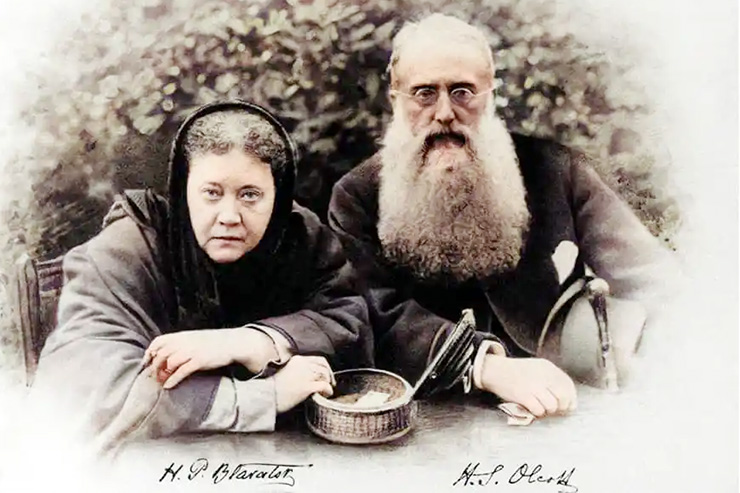
    Another figure associated with Spiritualism had a rather ambiguous connection with the movement. Helena Petrovna Blavatsky, a Russian noblewoman turned spiritual adventurer, initially associated herself with Spiritualism, only to decry it later.

    Blavatsky’s own story is surrounded by its own amount of shadows and haze. By her own account, in 1849, at the age of eighteen, she left her elderly husband (to whom she had been married for a mere three weeks) and began a worldwide search for spiritual truth that took her as far afield as England, Italy, Egypt, India, and possibly Tibet. Around 1851, she claimed, she met a master from India who agreed to give her training in occultism if she would take part in a larger mission to disseminate the teachings of universal brotherhood throughout the world.

    Much of the next twenty years of Blavatsky’s life is hard to document. Both in her own account and in those of her followers, fact and legend are inextricably mixed. But one of the earliest places for which there is proof of her appearance is Cairo in 1871, where she found herself stranded after a shipwreck. Here she started a “Société Spirite [“Spiritualist Society”] “for the investigation of mediums and phenomena.” The ill-fated organisation foundered within two weeks, as the mediums drank and cheated; once a madman broke in to interrupt the proceedings. While there is evidence that the society did regroup and continue at least into the following year, Blavatsky was not part of it: she had gone further afield, first to Odessa in her native Russia, then to Paris, finally sailing to New York, where she arrived in July 1873 and where she made her first impact on a spiritually hungry public.

    Indeed one of the most significant encounters of Blavatsky’s life took place through Spiritualism. In the improbable setting of a remote farmhouse in Vermont, a spirit medium named William Eddy allegedly materialised a range of ghostly beings, who appeared in period costume. Eddy would sit in a narrow closet in his farmhouse, and a blanket would be hung across the doorway. Shortly after Eddy entered the closet, the blanket would be pulled aside, and the ephemeral image of a dead person would appear, only to disappear soon afterward, sometimes in the full gaze of the spectators.

    At Eddy’s farmhouse in the autumn of 1874, the visiting Blavatsky met Henry Steel Olcott, a correspondent from a New York newspaper who had come to report on the phenomenon. Olcott later recounted that on the night of Blavatsky’s arrival, the Eddys’ closet produced the shades of “a Georgian servant boy from the Caucasus; a Mussulman merchant from Tiflis; a Russian peasant girl; and others… The advent of such figures in the séance room of those poor, almost illiterate Vermont farmers, who had neither the money to buy theatrical properties, the experience to employ such if they had had them, nor the room where they could have availed of them, was to every eye-witness a convincing proof that the apparitions were genuine.”

    What did Blavatsky believe about these phenomena? Her equivocal attitude toward Spiritualism is best illustrated by a clipping in her scrapbook. It is a copy of an article she wrote in 1875 entitled “The Science of Magic.” In the printed version of the article she states, “I am a Spiritualist,” but on the clipping she corrects the statement to “I am not a Spiritualist.”

    These contradictions are not necessarily the result of either schizophrenia or dishonesty. Blavatsky believed that the Eddy apparitions were real occult phenomena – but they were not the spirits of the dead. According to Olcott, she told him that if the Eddy phenomena were genuine, “they must be the [etheric] double of the medium escaping from his body and clothing itself with other appearances.”

    In an 1872 letter, Blavatsky explains her views: “[The Spiritualists’] spirits are no spirits but spooks – rags, the cast off second skins of their personalities that the dead shed in the astral light as serpents shed theirs on earth, leaving no connection between the reptile and his previous garment.” In the case of William Eddy, these astral shells would presumably have been using Eddy’s etheric body as a kind of subtle matter in order to manifest. In the Theosophical view, the astral body is discarded at a certain point after death. Usually it simply disintegrates as the physical body does, but under certain conditions, it can be inhabited by vortices of subtle energy that can make it appear to physical sight in the guise of the deceased.

    A similar, but not identical, phenomenon was displayed by Blavatsky herself. In November 1874 Olcott visited her in New York, “where,” he reported, “she gave me some séances of table-tipping and rapping, spelling out messages of sorts, principally from an intelligence called ‘John King’.” Supposedly the shade of the celebrated buccaneer Henry Morgan, “it had a quaint handwriting, and used queer old English expressions.”

    But Olcott eventually became convinced that “John King” was not the ghost of the long-dead Morgan. He later wrote, “After seeing what H.P.B. could do in the way of producing mayavic (i.e., hypnotic) illusions and in the control of elementals, I am persuaded that ‘John King’ was a humbugging elemental, worked by her like a marionette and used as a help toward my education. Understand me, the phenomena were real, but they were done by no disincarnate human spirit” (emphasis in the original).

    Elementals are, in the Theosophical view, nature spirits who live on the astral and mental planes. These entities are centres of force; they do not have any form in their own right. Hence they can be shaped and controlled by human thought, responding to the preconceptions of the perceivers, individual or collective. The so-called spirit of “John King” would have been an elemental that Blavatsky shaped with the force of her own will and concentration – as perhaps she had done in the Eddy farmhouse.

    The subtleties of these ideas are considerable, and it would be hard to disentangle them all in an article of this length. But the theory seems to go something like this: sometimes, as in Eddy’s case, a wandering astral shell can temporarily inhabit the etheric body of a medium and so make its presence known to the physical senses. In other instances, such as with Blavatsky’s phenomena, the will of an occultist can mould the subtle matter of the “astral light” into the shape desired.

    To dismiss these ideas out of hand would, in my view, be foolish. On the other hand, to verify them would require an intense training in esoteric practices that is difficult to come by. For our purposes, though, the essential point is clear. There is a middle ground between the allegations of the skeptics – that all spiritualistic phenomena are simply fraudulent – and the beliefs of the credulous, who take everything at face value. While there have been fraudulent mediums, it would be overhasty to dismiss every spiritualistic experience as a fraud. At least some of the phenomena associated with Spiritualism seem to be the play of forces in the astral realm, that domain of thoughts and images that is as plastic as the figments of our imaginations – and indeed contains them.

    [alert type=”general” dismiss=”no”]This article was published in New Dawn Special Issue Vol 6 No 2.[/alert]

    [alert type=”success” dismiss=”no”]If you appreciate this article, please consider a contribution to help maintain this website.[/alert]

    SOURCES

    H.P. Blavatsky, Collected Writings, vol. 1: 1874-78, Edited by Boris de Zirkoff, Adyar, India: Theosophical Publishing House, 1966.
    H.P. Blavatsky, The Letters of H.P. Blavatsky, vol. 1: 1861–79, John Algeo, ed, Wheaton, Ill.: Quest, 2003.
    Vicente Hao Chin, Jr., Theosophical Encyclopedia, Manila: Theosophical Publishing House, 2006.
    Joscelyn Godwin, The Theosophical Enlightenment, Albany, N.Y.: State University of New York Press, 1994.
    Mitch Horowitz, Occult America: The Secret History of How Mysticism Shaped Our Nation, New York: Bantam, 2009.
    Henry Steel Olcott, Old Diary Leaves, vol. 1, Adyar, India: Theosophical Publishing House, 1974.

    © New Dawn Magazine and the respective author.
    For our reproduction notice, click here.
  • Interview with a Time Traveller

    Interview with a Time Traveller

    As someone who has personally known the author of Seven Secrets of Time Travel: Mystic Voyages of the Energy Body for more than twenty years, I can vouch for Von Braschler’s really profound comprehension of practical spirituality. Nowhere is this more apparent than in his latest book, which is not some New Age, airy-fairy attempt at wish-fulfilment.

    Rather, from his grasp of classical philosophy and science, he has developed a convincing methodology for transcending time, not via a device or machine, but through the agency of human consciousness. It is not some futuristic technology, but present-day technique, Von Braschler demonstrates, that allows us to cross the time barrier.

    His conclusions are drawn from a lifetime of complimentary research, beginning as a faculty member at New York’s Omega Institute for Holistic Studies, where he led workshops throughout North America and Britain. A lifetime member of the Theosophical Society, he is today its regional head in the Upper Midwest of the US, and the author of Chakra Reading & Color Healing (2005), A Magical Journal: A Personal Journey Through the Seasons (2003), Conversations with the Dream Mentor (2003), and Perfect Timing: Mastering Time Perception for Personal Excellence (2002).

    A former newspaper and magazine editor, Von Braschler hosted his own weekly radio program, “Healing with Your Pet: Our Psychic, Spiritual Connection.” But it is his present effort that readers may find the most immediately engaging of all his singular achievements.

    I began by asking him an obvious question…

    Frank Joseph (FJ): What is time? Or, more to the point, what is your definition of time?

    Von Braschler (VB): Time is always now. As light intersects us each in turn, we experience an instant. This is our now. It energises you and fills you with opportunity of the moment. You are experiencing a different now than I am – miles away, as the sunlight strikes us at a different instant. Electromagnetic radiation that descends upon the earth from the heavens above in the form of light rays defines time. In truth, then, we only experience solar time on this physical earth plane in our mundane existence.

    While most people think of time as linear and progressing like a never-ending movie that unfolds in front of us, what we experience is an instant or a series of individual snapshots. The 17th-century rational philosopher Leibniz said that time doesn’t really exist, but is a conceptional order that our minds place on existence. Furthermore, there are two levels of creation – God above and our physical world of illusion below. Time and space as we conceive them are illusion. With guides such as Leibniz, Kant, Einstein and Barbour, we might say today that we live in the manifest or material realm that is fixed, frozen, and limited by laws of physics that allow little change or progress.

    On the other hand, the unmanifest realm of creation above us is unlimited in potential as filled with spirit and energy. The only way I know to leave the restrictions of the manifest level of creation and rise to the unmanifest level is by leaving our physical body in a consciousness body that can transcend time and space as we ordinarily experience things.

    FJ: How and why did you become interested in time travel?

    VB: I’ve always been fascinated by time, timelessness and time travel. It always occurred to me that each one of us experiences time differently and that most people have a funny idea how to control time or stretch time. We try to cheat time by burning the candle at both ends, getting less sleep, or better managing our time. Sadly, we are two-dimensional thinkers who live in a little box and cannot see outside our little compartment to a level of existence where multiple dimensions and multiple realities exist just beyond us.

    Personally, I have on occasion experienced timelessness where time seems to stand still or stretch at will in crisis situations where I had to get outside myself. For most people, these glimpses into expanded reality occur during an accident. These sorts of experiences piqued my interest in time and space and our potential to overcome our normal human condition. My first book was simply about the power in the present moment.

    Other books explored expanded human consciousness and ways to overcome the limits of our manifest world. Now I’m fully engaged in exploring the limits of time and space. Most people are introduced to this sort of exploration in their dreams. I’m interested in doing it with my eyes wide open.

    FJ: Since the publication of H.G. Wells’ The Time Machine in 1895, people interested in the subject have generally assumed that some kind of advanced technology will perhaps make time travel possible. How is your approach different?

    VB: Einstein pretty well convinced most of us that the universal speed limit was the speed of light and that matter such as our physical form would turn into pure energy if we were to reach the speed of light in attempts to time travel. And that’s how fast you would need to travel to move backward or forward in time.

    Time travel, therefore, remains the realm of energy (spirit). My approach to time travel accepts Einstein’s Special Theory of Relativity and focuses on leaving the limitations of the physical body in a consciousness body. This is your higher consciousness, that part of you that cannot be measured physically, but can exist and experience a broader reality outside your physical encasement. It is your spirit body or energy body. So my approach follows the reliable example of Native American dream walkers and Hindu Samadhi mystics who enter a state of higher consciousness and leave the body. In this way, they prove that a person’s higher self can transcend time and space.

    There are other shamanic and mystic traditions that transcend time and space in the same way, entering a very deep and active meditation with the focused intent to leave the body and go somewhere far away. Many other people have demonstrated prophetic dreams that prove an ability to transcend time and space out of body in higher consciousness, as well. This is a practical approach to time travel that is available to all us, without the amazing contraption of H.G. Wells.

    FJ: You write about the human “energy body.” What is it?

    VB: I believe in the Hindu and Theosophical model of the subtle energy bodies that surround and complete our dense, physical body of the material plane. Our subtle energy bodies include our astral plane or etheric double, our mental body, our causal body, our Buddha plane of individualised consciousness, our spiritual plane of energised conscious awareness, and our divine plane. So in order to move beyond the material plane at our physical core, we need to move with these subtle energy bodies that correspond to planes above the material plane.

    We commonly refer to these subtle bodies that surround our dense core as our energy body. It allows us to enter the planes of existence outside the physical restraints of our material world in a world of pure energy and spirit where change is more readily possible and can be realised in a flash. Now these planes are not normally visible to the physical eye, but can be seen by clairvoyants and anyone trained in aura reading. They have soft, pastel colouring that relate to the light energy vibrational rate of the various planes they represent. Another way to appreciate their very real existence is to put your hands out from the physical body at different intervals to feel their vibrational warmth and tingle.

    FJ: You mention “timelessness,” but how can anything be outside or without time?

    VB: I consider timelessness my fourth secret of time. Timelessness is just beyond time, as we commonly know it. We experience timelessness during deep meditation when time, as we commonly experience it, seems to stand still. We also experience it to a degree in profound, lucid dreams where you seem to live an entire lifetime in a flash with seemingly no time elapsing. This is where most people stop. It is like the eternal present moment that is pregnant with potential. It exists outside time and outside space as we normally experience life in our mundane, earthbound plane of manifest creation.

    We travel outside ordinary space and time of this world in a state of heightened consciousness as our higher self – a spirit body of pure energy. Most meditation ends with timelessness. Here you can listen to universal intelligence with your heightened awareness. It also can be a departure point for time travel, if you focus your higher consciousness on leaving the body and going somewhere else in time and space outside the room where you are meditating or dreaming.

    FJ: Indian mystics and Friedrich Nietzsche have written about the Eternal Now. How does it figure into your own research?

    VB: Ah, yes – the Eternal Now. My research has included the mystic East, as well as the West, both of which acknowledge it. The Eternal Now is the power of the present moment. We can embrace it by focusing our attention on the present moment and the potential that it holds for us. In truth, earthbound creatures only have the present moment or the now. Everything else is conjecture inside our little pocket calculator brains that attempt to run our lives by analysing and projecting everything in ways that make us feel comfortable about ourselves and where we think we are going. So our little brains are clogged, generally speaking, with worries about yesterday and concerns about tomorrow – moments that are not available to us, but only idle reflections on moments past and worries about an uncertain future beyond our immediate grasp.

    The Eternal Now is the universal truth of the power in the present moment. Everything is happening now, and potential change agents like us need to gain traction in the present moment to become heroes in our own lives.

    FJ: Many people today have a sense that time is speeding up. Are they somehow deluded, or experiencing a real phenomenon? If so, why is time speeding up?

    VB: It would seem so. Aside from the trajectory of the earth clipping a second or so off our annual clocks each year, there is a common human perception today that things are speeding up. Just about every philosopher and scientist who has ever seriously considered the meaning of time, however, has noted the importance of personal perception. There was Kant who said time and space are forms that the human mind projects on external things. Einstein said that the time interval between two events depends on the observer’s reference frame and that very reference body has its own particular time.

    Always remember, though, that time is measured in change. When change occurs, time has elapsed. We are living in an age of much change. As energised agents of change, we are fully aware of this. As energised agents of change, we find our own place on the wheel of life and make time spin with our attention. Fully engaged, we perceive time moving rapidly with changes that involve us.

    FJ: You state that travelling into the future is possible, but how can we move into a state or condition that does not yet exist?

    VB: Time is not really a linear progression, with us standing fixed at one point. This is the illusion of physical existence on this mud ball world of ours. In truth, time outside our inflexible, manifest world is fluid and looped. The unmanifested world of spirit and energy above us is fluid and flush with potential to move forward and backward at will. The trick is simply having enough conscious awareness to move forward and backward in time.

    With the right focused intent, a person in a state of heightened consciousness can leave the physical constraints of this manifest world and travel freely backward or forward in time. That involves your higher mind that can exist and function outside the physical body and independent of the brain or lower mind. Mystics and shamans have demonstrated this amazing potential to transcend time and space.

    FJ: Are there any real benefits to time travel, other than satisfying one’s curiosity?

    VB: Goodness, yes! Shamans experience reality outside normal time to bring back helpful insights to their people about dangers ahead or examination of past events that produced current situations. Eastern mystics visit worlds beyond worlds to understand the nature of cosmology and the potential of the human condition. On a personal level, one can go back into the past to better understand how you got to the point where you are today.

    There we more easily heal. There we can deal with buried recovery issues. We can gain better understanding. We suffer because we do not understand. But whether we go forward or backward in time for personal or broader reasons, we always go in an invisible conscious body or energy body without arms, legs, or vocal chords. We go as witnesses to bring back insight, much like the shaman.

    FJ: If we are able to move into the past or future, can we change history or alter what would otherwise occur? Is this what you mean by “an energised change agent”?

    VB: This is always a tricky question and probably one of the reasons why esoteric exercises have often been withheld from the masses. Are you ready to go forward or backward in time as a perfect witness for your own spiritual evolution and the betterment of your people? It’s an ethical concern. Fortunately, we do not time travel with the physical form necessary for us to interact outside our normal time. We travel in spirit body. The information that we retrieve, if we are able to fully comprehend it and recapitulate it upon return to normal consciousness represents tendencies of how things will turn out. There is not total certainty.

    In the case of personal information when you time travel for personal reasons, you become a witness to your own life. That life is totally yours to perfect. The greater concern would be for insights gathered outside personal observation and how it might affect the free will of others to determine their own destiny. I’m not totally concerned about that either, however, since free will of other people took them to the future you might have glimpsed. The future has already happened. We are just peeking into it.

    FJ: How does the ancient concept of karma appear into your work?

    VB: Quite a lot. Karma is a key component of my third secret of time, timelessness and time travel. I say that time=energy=karma=opportunity. Remember the story of the hero in The Bhagavad-Gita? Like Job in the Bible, he argues with a manifestation of God that his actions in a battle might have unforeseen, dire consequences and incur karma. His battle represents the life struggle that all of us live. The Lord tells him to get in the battle and take action, choosing the right action as best he can without concern for how things might turn out. It’s really about opportunity.

    People can be energised agents of change, but need to seize the opportunity. The moment at hand, the instant when light strikes you and energises you, is your opportunity to make a difference. We should not fear karma to the point we are reluctant to act, but recognise it as nature’s huge balancing act. It is nature’s unerring balancing act to measure cause and effect. Karma, as it affects all living things in orderly universe, acts as a moral law to restore order, balance, harmony, and opportunity for right action.

    FJ: Have you personally experienced any time travels you’re able to share with us?

    VB: Yes, I have. In a state of heightened consciousness, I have gone back and reviewed past lives pretty vividly. I know that all of it was very real, because I have been able to find people from past lives as a result of going back. This has helped me understand who I am in terms of my overall mission in life and what I’m all about. I have gone out of body and experienced timelessness, which has been great in “stretching” time when needed. I drove all across Montana one early morning in a blizzard on an empty tank of gas. (It does seem that during life-threatening situations our spirit evacuates the physical body and begins to function on its own, as others in emergency situations will attest.)

    I also remember an incident when I was wounded and trying to walk miles to my home without any concrete sense of direction and instantly found myself standing in front of my front door. All of that seemed pretty amazing then, but makes a little more sense to me now.

    FJ: What is the most important point you would like our readers to come away with after acquainting themselves with the Seven Secrets of Time Travel?

    VB: You can affect real change as an energised being who absorbs and processes electromagnetic radiation in the form of light rays that descend on us as waves. This energising process and the instant when light intersects you gives you a divine gift and the opportunity to make meaningful changes.

    We are part of the greater electromagnetic field and dynamic in that we can transform this light energy. We are light beings encased in physical forms that can be transcended in higher consciousness as pure energy that is unrestricted outside the laws of physics once outside the physical body.

    We can realise dimensions and realities beyond the mundane world of the flesh as pure energy travelling at the speed of light beyond ordinary time and space. Eastern mystics and shamans have demonstrated this is possible; and exercises in Seven Secrets of Time Travel explain how to practice this on your own.

    Seven Secrets of Time Travel: Mystic Voyages of the Energy Body (Destiny Books, 2012) is available from all good bookstores & online retailers.

    [alert type=”general” dismiss=”no”]This article was published in New Dawn 132.[/alert]

    [alert type=”success” dismiss=”no”]If you appreciate this article, please consider subscribing to help maintain this website.[/alert]

    © New Dawn Magazine and the respective author.
    For our reproduction notice, click here.
  • Beyond the Five Senses: The Powers Latent in Humankind

    Beyond the Five Senses: The Powers Latent in Humankind

    From New Dawn 129 (Nov-Dec 2011)

    The traditional five senses – sight, hearing, smell, taste, and touch – are these the only ways to perceive the world, to gain information, to experience reality? In fact there are more than five senses, taking different forms, in various types of organisms, including humans. For instance, humans can also sense balance and acceleration, temperature, and pain due to nerve damage. There are other types of physiological receptors as well, some found in humans, some found in other organisms. To cite just a few examples, directional awareness based on Earth’s magnetic field occurs in birds and bacteria, various species of fishes as well as dolphins can detect electric fields, and for many types of fishes water pressure detection used to maintain buoyancy is critical.

    But is there something more than the sorts of physiological-based senses described in the last paragraph? The answer to this question is of profound importance, as it fundamentally divides the world into two philosophical and metaphysical camps.

    On the one hand we have the “physicalists-materialists” who believe there is nothing more to reality beyond matter and energy as construed by classical physics and western science more generally. This position devolves to a dogmatic scientism (sometimes referred to as naturalism1) that posits the so-called scientific method, involving empiricism, observations, and laboratory experiments (generally with a heavy emphasis on measurements), as the only way to gain knowledge.

    On the other hand, in sharp contrast to extreme scientism, are found a wide array of “ways of knowing.” These include a diverse range of experiences with equally diverse labels: religious insight, ecstasy, spiritual knowledge, meditative contemplation, divine illumination, aesthetic and symbolic revelation, visionary trances, out-of-body experiences, soul travelling, channelling of supernormal entities, and so forth.

    In sum, scientism is often contrasted with spirituality, religiosity, and the preternatural, supernatural, or supersensitive in all of their disparate forms. Another way of putting this is that scientism denies any inner or beyond this material world aspects, such as the concept of consciousness, that are divorced from or in addition to physical matter and energy as perceived either directly or indirectly (using appropriate instrumentation) via the five senses. Those following the dogmatism of scientism often make a sharp distinction between the objective and the subjective; based on my research, this is a false dichotomy that often blurs under close scrutiny.

    In terms of the mind-body problem, scientism essentially denies that consciousness is anything more than an epiphenomenon arising from physical-chemical processes taking place in the brain. The alternative extreme view is that consciousness exists outside of and beyond matter, and it is consciousness that in fact infuses the universe and makes matter manifest. Based on his understanding of modern physics, Amit Goswami (author of a standard textbook on quantum mechanics2) has written:

    “I propose that the universe exists as formless potentia in myriad possible branches in the transcendent domain and becomes manifest only when observed by conscious beings.”3

    It is not only from a quantum mechanical point of view that one can reach the conclusion that consciousness may be prior to matter. Erik Verlinde (Institute for Theoretical Physics, University of Amsterdam) developed a new theory of gravity based on the concept that the universe is essentially a holograph where the structure of space-time emerges from information.4 Elaborating on Verlinde’s work, I came to the following conclusion:

    “The most fundamental aspect of the universe… is information. Information can be equated with thought or mind or mental constructs independent of any material everyday conception…. The universe of mass and energy and forces, as we experience it on an everyday practical level, may have had its origin in a thought that inserted information into an otherwise blank (data free) holographic system…. Inserting more thoughts, more information, expands and changes the system…”5

    For me the bottom line is that not only can consciousness exist independent of matter, but consciousness – thought, information – is prior to matter in a most fundamental sense. This position is diametrically opposed to dogmatic scientism and opens, even demands, the acknowledgment that not only is there more to reality than can be perceived by the “five senses,” but in order to gain a complete picture and understanding of reality we must gain knowledge in ways that go well beyond the five senses, beyond the simplistic so-called scientific method. We need philosophical, religious, transcendent experiences and the genuine knowledge such experiences bring. Those who limit themselves to their material physiology can never aspire to understand the ultimate nature and meaning of the universe.

    This assertion that consciousness is beyond matter is not just an empty statement for me. We have latent powers to exercise, and such powers have been expressed in a variety of contexts through the ages. Various forms of paranormal and parapsychological experiences elicit and highlight these latent powers, most often expressed as telepathic interactions (direct mind-to-mind, direct consciousness-to-consciousness, connections) or psychokinetic interactions (consciousness directly affecting matter and energy).6

    Make no mistake; telepathy and psychokinesis are genuine.7 Remote viewing, which is essentially telepathy and clairvoyance8 dressed in modern terminology, has been successfully demonstrated over and over again under controlled laboratory conditions.9

    Indeed, telepathy may be the most fundamental way to connect directly with the universal consciousness, with the numinous, with the divine. What is silent prayer but telepathy put to action to communicate with one’s god?

    Numerous techniques can be used to cultivate and elicit paranormal experiences, experiences that scientism either dismisses or fails to take seriously, and these have been developed within many different religious and cultural contexts, from the rituals of tribal African societies to the yogis of the Indian subcontinent to Zen practitioners to classic shamanism to séances in all their diverse forms to western occult and esoteric studies.10 All, at their core, elicit different but complementary ways of gaining access to legitimate knowledge that is beyond the five senses.

    [alert type=”general” dismiss=”no”]This article was published in New Dawn 129.[/alert]

    [alert type=”success” dismiss=”no”]If you appreciate this article, please consider subscribing to help maintain this website.[/alert]

    Footnotes

    1. Alex Rosenberg, “Why I Am a Naturalist”, 17 September 2011, article posted at: http://opinionator.blogs.nytimes.com/2011/09/17/why-i-am-a-naturalist/?ref=opinion (Accessed 26 September 2011); Timothy Williamson, “What Is Naturalism?”, 4 September 2011, article posted at: http://opinionator.blogs.nytimes.com/2011/09/04/what-is-naturalism/ (Accessed 26 September 2011).

    2. Amit Goswami, Quantum Mechanics (second edition), New York: McGraw-Hill, 1997.

    3. Amit Goswami (with Richard E. Reed and Maggie Goswami), The Self-Aware Universe: How Consciousness Creates the Material World, New York: Jeremy P. Tarcher/Putnam, 1993 [paper trade edition, 1995], 141, italics in the original.

    4. Erik Verlinde, “On the Origin of Gravity and the Laws of Newton”, paper dated 6 January 2010, 29 pages, available from http://arxiv.org/PS_cache/arxiv/pdf/1001/1001.0785v1.pdf (Accessed 28 July 2010).

    5. Robert M. Schoch, “Moving the Moai: Easter Island as a possible psychokinetic laboratory”, Darklore, vol. 5 (2010), pp. 134-155, 268-270 [endnotes]; quotation from page 145.

    6. It has not escaped my notice that some forms of paranormal and parapsychological phenomena may ultimately be explainable, or at least partially elucidated, by “conventional” physical and energetic systems, such as if for instance cases of telepathy (or some forms of telepathy) are electromagnetic phenomena in the extremely low frequency range. However, I am not convinced that all paranormal and parapsychological phenomena can be explained using a purely physicalist/materialist paradigm.

    7. The reality of these phenomena has been established despite the numerous charlatans who make fraudulent claims; as the saying goes, just because counterfeit money exists, that does not mean genuine currency does not exist. For evidence supporting the reality of paranormal and parapsychological phenomena, see: Robert M. Schoch, “Thoughts Have Wings”, New Dawn, January-February 2011, page 11; Robert M. Schoch and Logan Yonavjak, compilers and commentators, The Parapsychology Revolution: A Concise Anthology of Paranormal and Psychical Research, New York: Jeremy P. Tarcher/Penguin, 2008; and references cited therein.

    8. “Clear vision,” or the reception of information about objects, persons, or events, whether in the past, present, or future, by other than normal sensory means.

    9. Paul H. Smith, “Remote Viewing: State of the Field”, Edgescience, Number 8, July-September 2011, 13-16.

    10. See for instance: P. G. Bowen, The Occult Way, London: Rider and Company, circa 1936; Ernesto de Martino, Primitive Magic: The Psychic Powers of Shamans and Sorcerers, Bridport, Dorset: Prism, 1972/1988/1999; Caesar de Vesme, A History of Experimental Spiritualism (two volumes), Volume I, Primitive Man, Volume II, Peoples of Antiquity, London: Rider and Company, 1931; S. M. Shirokogoroff, Psychomental Complex of the Tungus, London: Kegan Paul, Trench, Trubner, 1935 [Reprinted: Berlin: Reinhold Schletzer Verlag, 1999.].

    © New Dawn Magazine and the respective author.
    For our reproduction notice, click here.
  • Colin Wilson & the War Against Sleep

    Colin Wilson & the War Against Sleep

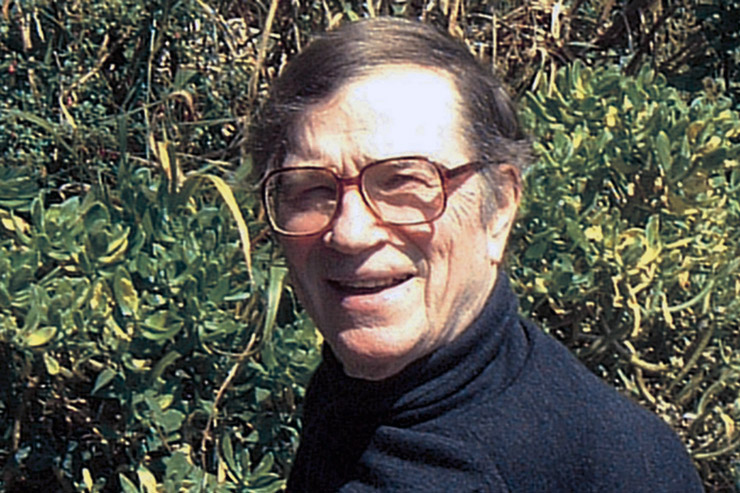
    Colin Wilson passed away on 5 December 2013. A tribute to his life and examination of his work written by Colin Stanley appears in New Dawn 143 (March-April 2014). New Dawn Special Issue Vol 8 No 2, published in April 2014, contains an interview with Colin conducted by Australian writer Louis Proud. The following article was published in New Dawn on the occasion of Colin Wilson’s 80th birthday in 2011. 

    Whether we agree with him or not, Colin Wilson has to be one of the most challenging and stimulating writers of the last half century.
    – Gary Lachman, American writer & musician

    I have heard Colin Wilson speak in person only once. It was in 1987 or 1988, when he gave a lecture at the First Unitarian Church in San Francisco. The event was well-attended, with at least a couple of hundred people present. But what struck me most about the talk was the strange state of consciousness it inspired in me.

    I had come in no special mood, and I remember nothing of the evening before or after. But I remember observing myself as Wilson spoke and finding myself possessed of a completely clear and attentive concentration. A great deal of the noise of the usual mental chatter was simply absent. At the same time I was alert and aware – I was not merely absorbed in the talk, as one can be in a particularly gripping movie thriller.

    Because the state disappeared soon after the lecture ended, I can only believe that this peculiarly focused and alert attention was a reaction to something that Wilson himself was generating. I mention it here because this kind of concentrated attention is one of the central themes of Wilson’s work and thought.

    Born in Leicester, England, in 1931, Wilson came from a middle-class background and as a teenager pursued a conventional education in the sciences. But at some point he discovered literature and philosophy, and he became so engrossed in these that he neglected his studies, dropping out of school at the age of sixteen. In the 1950s, he spent time among the political and intellectual circles of London, and for a while spoke at London’s famed Hyde Park Corner – the world’s capital for soapbox orators – on anarchical syndicalism. This was not, as he later admitted, because of any real sympathies for syndicalism but “because I was bored, frustrated, and had a vague feeling that something ought to be done about something. I also wanted to practise speaking in public, and would have been equally happy to discourse on Communism, Mormonism, or Nudism.” He also engrossed himself in an intense program of reading, which bore fruit in his first book, The Outsider, published in 1956.

    The Outsider was a tremendous success, and won accolades from mainstream critics such as Cyril Connolly, who in the Sunday Times of London called it “one of the most remarkable first books I have read for a long time.” As its title suggests, this insightful and gracefully erudite book deals with what Wilson contends is one of the central themes of twentieth-century literature: the individual who is isolated, set apart, alienated from the crowd. He is typified by Meursault, the central character in Albert Camus’s The Stranger, who starts the novel by stating, “Mama died today. Or maybe yesterday, I don’t know.” Meursault’s affectless response to his mother’s death is followed by an equally impassive love affair and the killing of an Arab (the novel is set in Algeria). Although Meursault has committed the act in self-defence, his utter apathy during the course of the trial leads to his conviction.

    Twentieth-century literature (and nineteenth-century literature to a certain degree) is teeming with Meursaults: Fyodor Dostoevsky’s Underground Man; Joseph K. in Franz Kafka’s The Trial, who is arrested, tried, and executed without even knowing what he has done; and the bored and alienated scholar Antoine Roquentin, hero of Jean-Paul Sartre’s Nausea – all of whom Wilson discusses in The Outsider.

    As this brief list suggests, The Outsider reflects Wilson’s interest in existentialism. To most people today, existentialism is more of a mood than a philosophical system. One thinks of gloomy French intellectuals in smoky cafés, immersed in opaque but inevitably pessimistic discussions. But existentialism means something quite specific in philosophical terms. Unlike Thomas Aquinas and other Aristotelian philosophers who came to dominate Roman Catholic philosophy, the existentialists argued that man has no essence – that is to say, there is nothing he is at his core that God has created (most forms of existentialism are radically atheistic). Or rather, man’s essence is derived from existence, from his actions in the world. Because God has not made man in any particular way, man is free. If he feels he is not free, this is only because he has failed to acknowledge his own freedom.

    The notorious pessimism of the existentialists comes from the idea that man’s freedom is the result of his existence in an alien and indifferent world. There is no intrinsic meaning in the universe, because there is no God who created it. It is up to man to make his own meaning.

    Unfortunately, as Wilson recognised, this stance creates problems. You can take up carpentry to while away the time, but can you create meaning and purpose for your own life as you might make a workbench? Some of the existentialists – particularly Sartre – may have thought so, but Wilson argues that this creation of meaning, while necessary, cannot be accomplished just by taking up a cause at random.

    Wilson also displays a deep affinity with another, less well-known twentieth-century philosophical school: phenomenology. While phenomenology is a vast and intricate system none of whose primary exponents completely agree, it contends that all consciousness is intentional; it is toward something. Explaining the thought of Edmund Husserl, the founder of the school of phenomenology, Wilson writes, “All mental activities are essentially acts, analogous to reaching out one’s hand or shooting an arrow at a target.” Indeed, he adds, “the mind has no equivalent of the non-intentional act – even becoming unconscious under anaesthetic” (emphasis here and in other quotes Wilson’s).

    Existentialism and phenomenology set the stage for Wilson’s mature thought, but it is perhaps with the great twentieth-century sage G.I. Gurdjieff with whom he has the deepest affinity. Wilson discusses Gurdjieff in The Outsider, in his 1970 book The Occult: A History, and in other works, including Gurdjieff: The War against Sleep. Indeed, Wilson contends, “Gurdjieff’s system can be regarded as the complete, ideal Existenzphilosophie [existentialist philosophy].” Why? Because it shows a genuine and realistic way to rise up from the sleep of ordinary, habitual life – the boredom and alienation that are the marks of the existentialist antihero – and awaken into a higher dimension of experience.

    As Wilson points out, one of the central disciplines in Gurdjieff’s teaching is “self-remembering” – which Wilson describes as follows: “Normally, when you are looking at some physical object, the attention points outwards, as it were, from you to the object. When you become absorbed in some thought or memory, the attention points inwards. Now sometimes, very occasionally, the attention points both outwards and inwards at the same time, and you find yourself saying, ‘What I, really here?’: an intense consciousness of yourself and your surroundings.” It may have been Wilson’s own self-remembering that stimulated a similar response in me during that lecture over twenty years ago.

    It is this self-remembering, this awakening, deliberate or inadvertent, that Wilson discovers in many account of mystical experience. Gurdjieff might have agreed. When asked once what higher consciousness was like, he replied, “Everything more vivid.” For Wilson, this awakening is the gateway to what he calls Faculty X, which he calls “the power to grasp reality,” and which “unites the two halves of man’s mind, conscious and unconscious.”

    Wilson argues that “Faculty X is the key to all poetic and mystical experience; when it awakens, life suddenly takes on a new, poignant quality. Faust is about to commit suicide in weariness and despair when he hears the Easter Bells; they bring back his childhood, and suddenly Faculty X is awake, and he knows that suicide is the ultimate laughable absurdity.”

    It is Faculty X, and Wilson’s exploration of it, that provides the key to much of his writing, which over the years has ventured further and further into the waters of the paranormal. For Wilson, Faculty X does not lie in some distant evolutionary future, when the human race will have evolved capacities that now seem preternatural; it is something we possess in latent form now, and which in fact our remote ancestors may have possessed in the past, when the human mastery of the physical world was far less complete and when people had to rely on inner resources for tasks that we now entrust to machines.

    But Faculty X has more than merely pragmatic value. When it is awakened, it provides an intensity of experience, a lived reality that not only makes “everything more vivid” but provides the added dimension of meaning for which the existentialists pined so acutely – and which forms what may be the point of focus for Wilson’s voluminous writings. If there is a thread that holds together a body of work that comprises over one hundred published books, it is, I suspect, Faculty X and the strange sense of vivid concentration of which I had a glimpse over twenty years ago.

    How do Wilson’s insights look today? We live in a time of change, which continues to accelerate to the point of destabilising not only nations and societies but the individual soul. There is a fascination with new technologies – with iPads and Facebook – that seems to take us away from the issues of meaning and presence that Wilson emphasises so strongly. But if these novelties distract us from the existential questions that face us, they neither answer these questions nor remove them. At best they are diversions, like a film or a game of chess, which might take our minds off our problems for an hour or two but which leave the problems waiting for us when they are done. Even politics and world affairs, I suspect, serve as this kind of entertainment for many.

    I believe that Wilson is right. If we are to win the war against the sleep of everyday life, it will not come out of technology nor even from political or social reform, as much as this may be needed. It will come from the liberation of individuals who awaken from the dreams that pass across their televisions and computer screens – and their minds – and are able to say, “I here now.”
    [alert type=”general” dismiss=”no”]This article was published in New Dawn 126.[/alert]

    [alert type=”success” dismiss=”no”]If you appreciate this article, please consider subscribing to help maintain this website.[/alert]

    © New Dawn Magazine and the respective author.
    For our reproduction notice, click here.
  • Onside with The Outsider: Colin Wilson at 80

    Onside with The Outsider: Colin Wilson at 80

    Colin Wilson passed away on 5 December 2013. A tribute to his life and examination of his work written by Colin Stanley appears in New Dawn 143 (March-April 2014). New Dawn Special Issue Vol 8 No 2, published in April 2014, contains an interview with Colin conducted by Australian writer Louis Proud. The following article was published in New Dawn on the occasion of Colin Wilson’s 80th birthday in 2011. 

    You know individuals have become icons when they are referred to simply by their first names: Marilyn and Diana being perhaps the two most obvious. But in New Age, occult and esoteric circles there is only one Colin (while Wilsons may be thick on the ground). And as the last of the Angry Young Men has reached the age of 80, if ever there was a time to celebrate Colin (Wilson’s) contribution to the world of the mind and spirit, this is it.

    This is something of a personal paean, as he has touched both of our own lives in his typically exhilarating way. Back in the 1980s, when Lynn was Deputy Editor of the landmark weekly publication The Unexplained, he was one of its consultants. Thank the gods for Colin! Always polite and affable, he was also the consummate professional, being particularly noted for delivering an article on any subject at a moment’s notice that was word-perfect and guaranteed to be a hot topic for discussion, not only among the readership but even among the cynical editorial team. He was never grand, although with his fame, he could well have been. And of course he has added to the list of his remarkable achievements in the quarter century after the last edition of The Unexplained saw the light of day.

    His main achievement has always been to shake his readers up. Through his books on philosophy, psychology, criminology, parapsychology and the weirder aspects of the paranormal – even his novels – he has challenged consensus reality head on. Few authors have done this so consistently, bravely and anarchically, although many have tried. And in our view, no author has done so quite so successfully, if success is measured in kick-starting a mass awakening from spiritual and mental zombie-hood.

    This intellectual dynamism – more akin to actual dynamite – has been there right from Colin’s first work on existential philosophy, The Outsider (1956), through to more recent books dealing with weird phenomena such as his study of alleged ET encounters and alien abductions, Alien Dawn (1998).

    It all stemmed from a profound dissatisfaction with the way most people experience the world – the feeling that we’re all missing something important. Or “the vague, brainless, cow-like drifting of the people around me” Colin was aware of from adolescence.1

    The occasional individual – usually an artist, poet or mystic – may experience “certain moments when he feels curiously immortal, god-like, as if hovering above the world, untouched by its dullness.”2 But is this just an illusion? Which is the ‘real’ world: the mundane everyday reality or the mystics’ and artists’ glimpse of something bigger, brighter and considerably more joyful?

    Pursuing such questions led the young Colin to existential philosophy, resulting in his first book, The Outsider, published in 1956 when he was 24. It was an immediate sensation. The term ‘angry young men’ was originally coined by The Times to describe both himself and John Osborne (whose Look Back in Anger premiered the same week as The Outsider was published).

    Over the next decade Colin pursued his search for meaning through a mainly philosophical and literary approach. His ‘Outsider cycle’ of six books, plus a final summary volume in 1966 – covering religious experience, human sexuality and discoveries in psychology – developed his ‘new existentialism’, basically existentialism minus the customary pessimism. While Colin regards the flashes of meaning experienced by poets/mystics – or by many ordinary folk as a ‘peak experience’ – as evidence of a state of consciousness towards which humans are evolving, existentialists see them as the mind’s trick to convince us that life’s worth living. Colin has no truck with turgid pessimism – one of his most endearing and encouraging traits, which also, incidentally, makes his talks so life-enhancing.

    All his work has continued to develop the original themes of The Outsider, right through to his 2009 Super Consciousness: essentially an update of The Outsider but incorporating all the other major fields of interest he has accrued throughout his long career.

    But back in the early 1970s it was The Occult, his great landmark book that set the world alight. Ironically, as a sceptic, he only accepted the commission for the money, intending to write a noncommittal survey of the subject, but it was to turn his worldview upside down. His research not only persuaded him that psychic abilities are real, but it also transformed and enhanced his vision of human beings. (And the vision of many of its readers too, such as Clive, whose own life changed dramatically because of The Occult and its sequel, laying the foundations for his career as a writer of books on the esoteric and alternative history.)

    It is hard not to gush about The Occult. In retrospect, it is probably not much of an exaggeration to say that this mammoth work, published in October 1971, worked the same blinding epiphany on many of its readers as did say, Darwin’s Origin of Species in its day. And it had a happy spin-off: not only was The Occult a seminal book for a popular audience but it also revived Colin’s career, which had languished since the heady days of angry young manhood.

    Discovering that “the mind possesses hidden powers that can influence the external world”3 finally answered his question about whether the mystics’ and poets’ insights of a purposeful universe were real or illusory – and about whether or not the pessimist-philosophers are right. To Colin not only are they wrong, but their state of mind is actively dangerous, since it inhibits the human ability to tune in to and even order the world: “…there is something in our minds that can alter our lives – the ‘something’ that causes synchronicities, for example.”4

    Perhaps with all the gloom and doom centred on 2012 hysteria, the New Age community in particular needs to receive an injection of Colin’s inspired optimism. Like the Hermeticists of old, he actively celebrates what it means to be human. O what a miracle is Man!

    Mysteries (August 1978), his sequel to The Occult, explored in greater depth the relationship between the hidden powers of the mind and the outside world, covering subjects such as dowsing and Earth mysteries.

    Another major development in Colin’s thinking came in 1980. Until then he had understood paranormal phenomena purely in terms of the interaction between the hidden depths of human consciousness and the physical world. But through his research into poltergeists (which he originally thought were projections of the subconscious) he came to accept the reality of spirits, the afterlife and also the existence of non-human entities. As he wrote in 1992:

    More than twenty years of psychical research have led me to the conclusion that there is a ‘psychic reality’ which runs parallel to our physical reality. Ghosts, demons, poltergeists, fairies, even ‘vampires’, are incursions from this ‘other reality’ into our own.5

    These, too, found a place in his all-encompassing philosophy:

    …their effect is to remind human beings that their material world is not the only reality. We are surrounded by mystery that cannot be understood in terms of scientific materialism. If psychic phenomena have a purpose, it is to wake us up from our ‘dogmatic slumber’, and galvanise us to evolve a higher form of consciousness.6

    In Alien Dawn (1998) Colin came to agree with researchers such as Jacques Vallée and John A. Keel that encounters with apparent extraterrestrial entities, including alien abductions, belonged to that parallel, psychic reality – essentially as an updating of the ancient fairies and demons tradition. Discussing the work of abduction researcher John Mack he noted:

    Since The Outsider was about people who feel that there is something deeply wrong with ‘consensus reality’, and that we need to broaden our views about what is real or possible, I experienced an instant rapport with his conclusions. I ended by coming to believe that although UFO phenomena seem to contradict consensus reality, they do not contradict the reality described by quantum physicists. Or, for that matter, mystics.7

    Colin has, over an astonishing six decades, built a grand, all-encompassing and consistent vision of the universe and humanity’s place in it. He started out with the basic question: why are we here? This is his bold and heartening answer (from his 2004 autobiography Dreaming to Some Purpose): “The purpose is to colonise this difficult and inhospitable realm of matter and to imbue it with the force of life.”8

    This gels astonishingly with the latest (if weirdest) scientific thinking, such as physicist John Archibald Wheeler’s idea that we live in a ‘participatory universe’ that is being created by human observation.

    That’s perhaps the most enviable of Colin’s talents as an author – he is always relevant. From the days of the angry youth to the spiritually bereft and scared 21st century he has always understood the underlying mood. But instead of feeding off our angst like other authors he always has taken us by the scruff of the neck, shaken us and made us glad to be alive. With Colin’s words in our heads we face the future with confidence and courage.

    It also helps that he writes and speaks like a dream – always with utter sincerity and deep knowledge – and that he’s a really, really nice guy.

    Happy birthday, Colin!
    [alert type=”general” dismiss=”no”]This article was published in New Dawn 126.[/alert]

    [alert type=”success” dismiss=”no”]If you appreciate this article, please consider subscribing to help maintain this website.[/alert]

    Footnotes

    1. The Outsider (Picador, London, 1978 edition), 296.

    2. Ibid., 300.

    3. Super Consciousness: The Quest for the Peak Experience (Watkins, London, 2009), 141.

    4. Dreaming To Some Purpose (Century, London, 2004), 386.

    5. Alien Dawn: An Investigation Into the Contact Experience (Virgin, London, 1998), 295, quoting from a 1992 article.

    6. Ibid.

    7. Dreaming To Some Purpose, 372.

    8. Ibid., 386.

    © New Dawn Magazine and the respective author.
    For our reproduction notice, click here.