New Dawn – World's Most Unusual Magazine

Category: Paranormal

  • Twin Telepathy: Is there a ‘Special Connection’?

    Twin Telepathy: Is there a ‘Special Connection’?

    From New Dawn Special Issue Vol 7 No 2 (May 2013)

    Is there a special bond between twins? Can they read each other’s minds? Are they telepathic? If you have been hearing questions like these being asked regularly but have never found an answer, look no further. The short answer is – yes, and no. Let me explain.

    As Orwell famously observed in Animal Farm, “All animals are equal, but some animals are more equal than others.” So it is with twins – some them are indeed more identical than others. In fact, the term ‘identical’ is misleading. The medical word is ‘monozygotic’ (MZ) for twins originating from a single zygote or fertilised egg which then splits into two (or more), those originating from separate zygotes being termed dizygotic (DZ) or fraternal (non-identical). Yet although MZ twins are commonly referred to as identical, there can be wide differences among them. Probably the most important one has to do with just when that original egg divides. Usually this takes place a day or two after fertilisation, but division can take place up to twelve days later, or in the rare case of conjoined (‘Siamese’) twins, not at all.

    Although the study of twin telepathy must be one of the most under-researched subjects in the whole of science, it now seems likely that the later the division, the closer the bond. Researchers at the University of Indiana have studied thousands of twins and have noticed that the later they divided, the closer they become after birth. So it seems likely that this is the group most likely to experience telepathy.

    There are twins who have never had any experience of it, as described by ‘Alex’ on the multiples.about.com web site: “As an identical twin who knows many other twins I can tell you for a fact that twins don’t have telepathy. Any that say they do are either pulling your leg or attention seeking. I’d appreciate it as a twin and a human being if you stopped spreading lies.” As many other messages on this interesting site show, not all twins would agree with that and might well accuse him of spreading lies.

    True, I have met twins who are not particularly close, and are not at all telepathy-prone. One told me that he sends his brother a Christmas card, but that’s about the only communication they ever have. Another admits that she is not even on speaking terms with her sister and has no contact with her, telepathic or otherwise. Yet I have also met the father of twenty-something-year-old daughters who, he assured me, had never been apart for more than two hours throughout their lives. And an item in a London newspaper not so long ago described the lives of a pair of twins in their forties who still sleep in the same bed. Clearly we have a very broad spectrum here.

    Interviewed in 2002, one of the Californian supermodel Barbi twins commented: “We have that twin thing going on. Wherever we are in the world, we kind of know what the other one’s doing.”

    “That’s right,” her sister chimed in. “It’s instinctive. It’s a twin thing.”1

    I have not yet been able to interview the Barbis, alas, but I have met and interviewed dozens of twins of all ages, also mothers of twins as young as three days, and the evidence that there is indeed a twin thing is voluminous, although I seem to have been the first to produce a volume devoted to it, first published in 2002 and now reissued in a much enlarged and updated third edition.2 How this came about is quite a story in itself.

    When Telepathy was Taboo

    It began in 1975 when Ross McWhirter, editor of The Guinness Book of Records, political activist and one of the highest-profile twins in Britain, was shot dead on his doorstep by IRA terrorists. When I heard the news on the radio I immediately thought that if twins really were telepathic, Ross’s brother Norris should have reacted in some way to this tragic event. I knew that telepathy seemed to work best when the message was some kind of bad news – pain, depression, sickness, death – and what could be worse for a twin than the murder of his brother?

    A few years later I met a man who worked for Norris and knew him well enough to ask if he had reacted. The answer was no – he hadn’t. So that seemed to be that. However, I kept noticing items in the press about what looked very much like twin telepathy in action, and luckily I kept them in what soon became quite a thick file. This prompted me to give a short talk at the 1998 conference of the Society for Psychical Research in which I appealed to members to do some research into this long neglected subject. Later, one member – and only one – said he would be glad to do some experiments with twins if he could raise the funds. That was Adrian Parker, now professor of psychology at the University of Gothenburg, Sweden. More about him later.

    The previous year I had been hired as consultant for a TV series hosted by hypnotist Paul McKenna and asked to come up with suggestions for material to be included in it. My first suggestion was for a live demonstration of twin telepathy in the studio. I had no idea how this could be done, but luckily Paul liked the idea and just said “Yes, we’ll do it.” Thanks to his producer Mike Johnstone, an Oxford science graduate who wanted things done properly, we did it and were able to show what I believe is the first live demonstration of telepathy of any kind as it happened, and with a polygraph chart to prove it.3

    At about the same time, I happened to meet Norris McWhirter’s son Alasdair, and was very intrigued to hear that he had been with his father at the moment Ross was killed, and yes, Norris had indeed reacted, and quite dramatically, but had wiped the incident from his mind and genuinely could no longer remember it. I immediately wrote down his account and asked him to approve it, which he kindly did, and I duly published it with his consent. It was then that I decided that this subject needed thorough investigation. Nobody seemed to have done it before.

    I began in the draughty basement of the Royal Society of Medicine beneath their library, where they have a whole shelf of books about twins, at least a hundred of them. I spent the best part of a day looking at all of them and finding that almost none of them even mentioned telepathy, while those that did either dismissed it out of hand or pointed out, quite reasonably, that while anecdotal reports of seemingly telepathic experiences were quite common, there had never been any proper research into the subject, so it was too early to draw any conclusions. None of the authors concerned seemed interested in actually doing any research themselves. It soon became clear to me that telepathy was taboo, something you just don’t talk about in scientific circles. Sadly, it still is.

    To give just one recent example, in 2000 the Nobel prizewinner (physics, 1973) Brian Josephson attracted a storm of protest from his fellow scientists when he declared that there might be a connection between quantum theory and telepathy. Then in 2010 he was invited to speak at a workshop in Italy on ‘Foundations of Physics’. At least he thought he was, until he got a message from organiser Anthony Valentini informing him that: “It has come to my attention that one of your principal research interests is the paranormal. In my view it would not be appropriate for someone with such research interests to attend a scientific conference.”

    What can one say?

    Experiments and Studies Involving Twins

    In 1979, a major twin research programme got under way at the University of Minnesota, aimed at studying twins who had been separated at birth and reunited later – sometimes much later. This made it possible to assess the differences between genetics and upbringing, or ‘nature and nurture’ as it is often known. What the researchers found was that there were often remarkable similarities between the twins’ personalities, likes and dislikes, skills, hobbies, etc. – indications of what is known as concordance. They never found any evidence of telepathy, however.

    There were two reasons for this. One is that they never asked for it. I have interviewed a British twin who spent a couple of weeks at the university being questioned by a battery of psychologists and studied from head to toenail. The only thing they never asked her about, she told me, was telepathy. One member of the original Minnesota team, Dr. Nancy Segal, has repeatedly and publicly proclaimed that there just isn’t any convincing scientific evidence for it, which may have been true in 1979 but as we shall see is no longer true today.

    The other reason is that her opinion was of course based on her study of separated twins, whom I would not expect to have much experience of it, if any, because telepathy seems closely related to strength of bond, as between mothers and babies or dogs and their owners. You can hardly develop a bond with your twin if you are separated at birth, and sometimes do not even know that you have one.

    The Minnesota programme received wide publicity, and somehow Dr. Segal’s repeated denials of the existence of telepathy have given the general public the impression that it doesn’t exist. I had a taste of this taboo response myself when I went along to King’s College, London, to visit their twin research unit, one of the largest in the world with about 10,000 twins on their register. I wondered if I could get access to their mailing list and send out a questionnaire?

    “What about?,” the lady at the desk wanted to know. I muttered something about “biological correlates of empathy,” knowing what to expect if I mentioned the taboo T word.

    “What’s that, then?” she asked. I explained that it was what some people call telepathy, to which she immediately replied that the unit was not interested in “spooky stuff.”

    Luckily, she was wrong. A couple of years later, in 2004, the unit polled all its twins in its annual newsletter and asked them if they had ever felt “the ability to know what was happening to your twin?”

    The results were surprising. Nine thousand twins were polled, and the unit received 5,513 replies. Of these, a minority of 45 percent said no, but 15 percent said yes, and a further 39 percent thought it was at least a possibility. This was probably the largest survey of its kind ever, and it was encouraging, although clearly a more detailed questionnaire was needed. I only heard about it five years later, and in 2009 suddenly everything seemed to happen all at once.

    It began with a story in the Manchester Evening News on 23 March which described how a fifteen-year old twin was having a bath when her sister, downstairs listening to music, suddenly had the feeling that, as she put it, “it was like a voice telling me that your sister needs you.” She did indeed, because she was having an epileptic attack and was in the process of drowning. According to the paramedic who arrived just in time to save her, if her sister had not rushed upstairs to her aid, she would have died.

    The story was picked up a couple of days later by The Times, which included a quote from Dr. Lynn Cherkas from the King’s College unit, who had been responsible for the survey mentioned above. She proved to be quite open to the idea of ‘spooky stuff’ and had already come across instances of apparent telepathy. I managed to get her in touch with Adrian Parker, who was promptly granted visiting scientist status and given access to the unit’s material. He was also invited to its annual garden party, where he was able to do some informal testing and undertake a more detailed questionnaire with many of the 200 or so twins who attended. Suddenly, twin telepathy research had become academically acceptable. Yet sympathetic as they were, the King’s people didn’t have any spare funds. Parker was welcome to use their premises and their twins, but he would have find his own financing.

    More good luck just when it was needed – Parker was able to find it from a Danish TV company and arrange a controlled experiment at the University of Copenhagen, again using a polygraph to record the reactions, if any, of a twin in another room who was subjected to various surprises such as an electric shock, a pile of plates being dropped behind their chairs, or best of all, being asked to plunge an arm into a bucket of ice-cold water. The polygrapher, who had no idea what was going on in the other room was then asked to mark his chart at the times when there was what looked like an unusual fluctuation. A second polygrapher, who was not present at the time and had no idea what the experiment was all about, was asked to do the same. Both picked the right spots twice as often as they could have been expected to do by chance or guesswork.

    The experiment was repeated, this time in London at the King’s unit, funded by the ABC News Nightline programme, and results were similar. Parker and his Danish colleague Christian Jensen duly wrote up their two experiments and submitted them to the journal Explore, which published them in 2012 and 2013. They were the first of their kind ever to appear in a peer-reviewed scientific journal.4

    Twin Telepathy: The Evidence Mounts

    This was more than 230 years after the publication of the first reference that I have been able to find to twin telepathy, when John Wesley, the founder of Methodism, wrote in his Journal for 2 April 1781 about a woman who had a twin sister “between whom and her there is so strange a sympathy that if either of them is ill, or particularly affected at any time, the other is so likewise.” Yet although there were occasional references to this strange sympathy over the following century, most notably in Alexandre Dumas’ novel The Corsican Brothers (1844) and by scientist Francis Galton, who made a rather half-hearted attempt to study twins in the 1870s, it was not until the publication in 1886 of Phantasms of the Living, a massive tome by three founder members of the Society for Psychical Research, Edmund Gurney, Frederic Myers and Frank Podmore, that any case histories were written up in detail and checked for accuracy.

    Even so, it was to be several more decades before any psychologist found the subject of twin telepathy worthy of attention, with the exception of Chicago zoologist (and twin) Horatio H. Newman, who included a chapter on it, believed to be based on his own experience, in his Twins and Super-Twins (1942). From that day to this I have only been to track down sixteen papers on twin telepathy from peer-reviewed journals, nearly half of which were by Adrian Parker and his colleagues. Of the rest, only three were of any lasting value.

    The first (1961) by three psychologists based in Toronto was useful although for various personal reasons they never actually got down to doing any experiments. They did however do some original research, questioning a total of 35 twins on their experience of telepathy and finding that twelve had had some.5 This figure of around 30-35 percent has shown up in all surveys of this kind to date, including those done recently at King’s College by Parker.

    The second (1963), by a pair of ophthalmologists from Philadelphia was very short, but attracted some attention since it appeared in Science, one of the world’s leading scientific journals. They claimed that when alpha brain rhythm was artificially induced in one twin, the brainwave chart (EEG) of the other one showed the same rhythm at exactly the same time.6 Despite their plea for further research in this area, the only people who seemed to hear it were a team from Rockland State Hospital in Orangeburg, NY who reported successful results in 1967 using a plethysmograph to measure blood volume, and were able to conclude that “in a physically isolated subject, we have observed physiological reactions at the precise moment at which another [twin] was stimulated.”7

    Both of these teams published print-outs of their chart recordings that, as one of them put it, “show how obvious the reactions are,” yet once again research ground to a halt, and more than forty years later we find the serial psi-debunker Professor Richard Wiseman declaring glibly that “twin telepathy is due to the highly similar ways in which they think and behave, and not to extra-sensory perception.”8He was confusing, perhaps deliberately, telepathy with concordance.

    An example of this was given me by a mother who noted that her twins’ baby teeth both fell out at the same time, which she thought was amazing proof of telepathy. I assured her it wasn’t. They were both eating the same food at the time, and since they were genetically identical, it was quite natural and predictable that this would happen.

    Get the issue this article appears in

    A very different incident that was not predictable was described to me by another twin-mother in which one of her girls was bouncing around on a trampoline when another child landed on top of her and bashed her in the eye, raising a large dark bruise. At the same time her sister, who was not on the trampoline, suddenly developed a bruise in exactly the same place. It was slightly smaller and lighter, but it was unmistakably there. The mother had the presence of mind to take photos of the two together right after the incident, which she kindly sent me. They were later shown on ABC’s Nightline programme, on which the second twin clearly stated that she hadn’t felt anything at the time of her sister’s accident. I could give many more examples of incidents like this for which concordance is no explanation. This is the kind of evidence that critics such as Nancy Segal and Richard Wiseman simply ignore.

    It is also a particularly well witnessed and recorded example of what makes twin telepathy different from ordinary telepathy, which is sometimes referred to as ‘mental’ telepathy, since it only involves impressions, images or perhaps words in the ear. Twins go further – they receive physical sensations such as pain, which can even leave visible marks on the body, as in the case mentioned above.

    It can get even more mysterious, as when one twin has the pain but it is the other one who has the medical problem or has had the accident. A mother has told me how one of her boys complained of a severe pain in his kidney, yet after an x-ray doctors could see no sign of anything wrong with it. Fortunately she took his brother along although he had not mentioned having any pain, and it was found that he did have quite a serious kidney problem that needed immediate treatment. It was, she told me, not the first time something like this had happened.

    Clearly, we have a lot to learn from twins. I have collected quite enough evidence, much of it at first hand, to show that communication at a distance can take place and can be seen to take place under controlled laboratory conditions. Yet, as I said earlier, this remains one of the most under-researched subjects in all of science. The reason I usually hear is that telepathy is obviously impossible since there is no known mechanism that could explain it.

    There was a time when the idea of the earth orbiting the sun was out of the question, as were claims that meteorites fell from the sky or continents drifted apart. Such attitudes are still with us – it is barely twenty years since the heroic Australian doctor Barry Marshall disproved the dogma that stomach ulcers were caused by ‘stress’ and showed, after infecting himself with Helicobacter pylori germs, that this is what caused most of them, and that they could be cured with a week or so of antibiotics. No Nobel prize has ever been better deserved.

    “The concept of a germ causing ulcers was like saying the earth is flat,” Marshall recalled later. So, to some, is the idea of thoughts, let alone actual physical symptoms, travelling across space. And with attitudes such as were shown in Brian Josephson’s notorious ‘disinvitation’ still prevalent in the world of scientific research funding, it may take some time to prove that they do, and to force us to rethink what we know of biology, psychology and physics. Whoever manages to do that, as now seems quite possible, will also deserve a Nobel prize.

    Are you a twin that has a telepathic connection to your twin sister or brother? Then author Guy L. Playfair would like to hear from you. He can be contacted via email at guylyonplayfair@o2.co.uk.

    Guy L. Playfair’s classic book Twin Telepathy was first published in 2002. It was enlarged and updated into a 3rd edition in 2012, and can be purchased in paperback or ebook via www.amazon.com or www.amazon.co.uk.

    [alert type=”general” dismiss=”no”]This article was published in New Dawn Special Issue Vol 7 No 2.[/alert]

    [alert type=”success” dismiss=”no”]If you appreciate this article, please consider subscribing to help maintain this website.[/alert]

    Footnotes

    1. Sunday Telegraph Magazine, 9 June 2002, 25

    2. G.L. Playfair, Twin Telepathy, 3rd ed. White Crow Books, 2012

    3. The Paranormal World of Paul McKenna, Carlton TV, 24 June 1997

    4. Explore 8 (6) 2012, 339-47; 9 (1) 2013, 26-31

    5. International Journal of Parapsychology 3 (4) 1961, 55-73

    6. Science, 15 October 1965, 367

    7. International Journal of Parapsychology 9 (1) 1967, 53-6

    8. R. Wiseman, Paranormality, Macmillan, 2011, 84

    © New Dawn Magazine and the respective author.
    For our reproduction notice, click here.

  • Developing Your Unseen Powers: A Practical Guide

    Developing Your Unseen Powers: A Practical Guide

    Repeated ignorant or stubborn denial of the existence of certain powers does not keep them from existing – except for us! 
    – Harold M. Sherman, psychic

    Everyone has some level of innate intuitive capability, as has been demonstrated repeatedly over several decades of experiments by the parapsychological community through tens of thousands of trials utilising thousands of regular people with no known or presupposed psychic gifts. (That is to say nothing, of course, of those many successful experiments carried out with people having well established reputations for performing “paranormal” feats.)

    While some people are born with obvious psychic talents, most of us have to invest time and effort over the long-term in order to develop them from their latent state. In this article we will look at some guidelines and relevant principles for unblocking and developing your innate intuitive abilities.

    Open Your Mind & Eliminate Closed Ones

    Have you ever noticed how closed-minded sceptics (CMS) rarely if ever have any experiences with the siddhis (psychic faculties) or “the paranormal” in general? Soviet research into psychokinesis involving Nina Kulagina demonstrated qualitatively that a sceptic’s mere presence has an effect on a psychic’s ability to function properly. Hence, with a CMS (or several) in the room or otherwise involved in the experiment, a psychic is more likely to “fail,” thus “proving” the CMS right (at least in his own narrow reality tunnel). It is merely a case of self-fulfilling prophecy. Thus, regarding your own psi abilities what you believe is true, to a large extent – and unfortunately the presence of non-believers nearby or within the experimental setup can be detrimental.

    Dr. Valerie Hunt’s research in Infinite Mind showed a correlation between electromagnetic auric frequencies and the “level” of consciousness occupied by the individual. Healers, mediums and mystics show higher frequencies in their electromagnetic fields than others not of those categories, illustrating that those possessed of “higher” consciousness are, in some sense, literally “on a higher frequency.” Those fixated on or believing solely in “material reality” exhibited lower dominant frequencies and were bereft of the higher.

    In fact, gamma frequencies in the brain of 40-100 Hertz – the highest of the better known bands of brainwave frequencies (the higher band being Lambda, reaching up to about 200 Hz1) – have been linked to the ability to manifest intention in the world. Gamma states represent the brain in hyperdrive, working at its most intensity. “This oscillation is conducive to creating links across many parts of the brain,”2 facilitating an integrated whole-brain state. Paradoxically, the extreme high and low ends of the brainwave spectrum have the same states of consciousness associated with them, and different oscillations can be present at once in different parts of the same brain.3

    To illustrate, Russian psychokinetic (PK) psi star Nina Kulagina (1926–1990) – who, under controlled experimental conditions, could (among other things) separate an egg yoke from the white from a distance of 6 feet while it floated in a saline solution using only her intention – exhibited low frequency theta brainwaves of 4 Hz – normally associated with a deeply relaxed trance – whilst simultaneously showing extreme physiological agitation/arousal, including a pulse rate of 240 bpm. These strenuous efforts left her absolutely exhausted, and temporarily blind on that particular occasion.4

    Perhaps all of the above explains why Kulagina’s PK abilities “worked better in an atmosphere of friendly mutual trust and belief” – PK, as we know, generally requires intense states of physiological arousal and higher frequency brainwave activity, all of which drains large reserves of bioenergy. PK is a higher brain function. Kulagina experienced less stress when working alone and it was said that her PK ability was mood-dependent (both her own mood and that of the observers) and expended more energy in a hostile or sceptical atmosphere5 (where the local consciousness fields would have been less coherent). Hostile sceptics have something of an innate psi- or consciousness-damping effect; they literally operate at a lower frequency, their mind fields interfering with those of the test subject (and even the target). The fact that separate minds interact via measurable electromagnetic fields (and some not-so-measurable fields) has been proven by Hunt and others, and I detail much of this research in The Grand Illusion (TGI).

    Negativity causes chaos and/or entropy in the personal and local ambient energy fields, whereas positivity, gratitude, or love – heart-based emotions – cause coherence, beauty and order – just look at the instances of saints and yogis whose dead bodies have remained impervious to decay for weeks, months, and even years!6 This is worth considering before any psi endeavour where you intend to act as a receiver of information. Firstly, open-mindedness is a bare minimum requirement (confidence and trust in the process is even better). Additionally, being in a state of peaceful heart-based coherence is likely to enhance receptive abilities. In combination with deliberate intention, this has been shown to also be enough to wind and unwind DNA samples at will in laboratory conditions, with powerful implications for self-healing possibilities (see TGI).

    In 1942 psychologist and parapsychologist Gertrude Schmeidler initiated her infamous “sheep-goat” experiments, designed to test whether belief and open-mindedness would enhance psi function in contrast to scepticism. Two groups, “sheep” who believed in or were simply open to psi, and “goats” who did not believe it could happen for them under test conditions (but were not hostile to the possibility of it happening to or for other people), were put through identical standard controlled Extrasensory Perception (ESP) tests. The outcome indicated that believers in the possibility of ESP scored better than those who did not: the disbelievers scored lower, ergo belief is a legitimate variable mediating psi functions.7 “A meta-analysis by [psychologist Tony Lawrence], covering 73 experiments by 37 different researchers, clearly confirms that subjects who believe in psi obtain, on the average, higher results than those who do not believe in it.”8

    American psychic and author Harold Sherman (1898–1987) had noted in the early 1940s that while it is possible to receive thought impressions from a sceptic, it is extremely difficult for someone of that mindset to act as receiver.9 Sherman, who was ahead of his time, explained that telling yourself with certitude there is no such thing as psi is tantamount to instructing your subconscious mind to shut down the psi faculties so they do not operate for you.10 In a dream-like reality such as ours, it pays to be open-minded – especially if you want to be more intuitive.

    Meaning, Emotion, Need, Novelty & Other Factors in Psi

    Need, novelty, and emotion have long been known to play a part in psi phenomena. Carl Jung (1875–1961) – the originator of the theory of psychological archetypes – noted with interest that the English medium Eileen Garrett fared poorly in parapsychologist J.B. Rhine’s card-guessing experiments because she was unable to conjure any feelings for Rhine’s “soulless” test-cards.11 Much experimentation has also shown that psi effects have a tendency to start out higher in the initial stages of testing and then drop off as the participants lose interest and boredom sets in (the “decline effect”).

    Charles Tart actually went so far as stating that card-guessing experiments are, ironically, “a technique for extinguishing [psi] in the laboratory,” that is, they bore the subjects into a decline effect.12 Rhetorically, Sherman asked how he could possibly be expected to get excited over five abstract symbols that had nothing to do with his emotional system or that of the sender (they lacked meaning/personal significance or relevance).13

    Biologist and author Lyall Watson notes in Supernature that the most effective telepathic messages generally are bound up in trauma and crisis – and we see plenty of evidence to that effect in The Grand Illusion Vol. 1. He continues to explain that it makes sense biologically, since states of well-being and pleasure produce no sense of urgency – such information can be leisurely conveyed by the “normal” channels. However, for alarm signals to be of real use, they have to travel the fastest way possible.14 That “way” is superluminally/nonlocally. Much as Cleve Backster’s plants could detect the death of bacteria and brine shrimp nearby, our human telepathic connections must – even if only subliminally – serve a biological imperative, helping us survive and propagate as a species by sensing and avoiding danger.

    The limbic system, which includes the amygdala and hippocampus, is considered today to be the emotional centre in the brain, as well as the seat of our survival instinct. We might therefore suppose that life-threatening events, usually being highly emotionally charged, might ignite the temporal lobe and related structures in the brain into downloading nonlocal psi information from the vacuum/aether. Dr. Melvin Morse believes humans have a sixth sensory ability located “within” the right temporal lobe, hippocampus, and related limbic structures. According to him, this region “interprets information obtained through communication with an interactive universe,” and allows for telepathic communication with other people through their right temporal lobes. “It involves perception of other realities.” He states that we perceive the operation of the right temporal lobe as “intuition.”15

    In 1889 a committee of psychical researchers began a five-year project of compiling what they named a Report on the Census of Hallucinations – the first major research effort of the English Society for Psychical Research, featuring 410 data collectors. The committee included Henry and Eleanor Sidgwick, Alice Johnson, arch-sceptic Frank Podmore, and the esteemed Frederick Myers. Out of the 17,000 responses, 2,273 people reported having had “hallucinations” (psi experiences). Tellingly, most occurred in a crisis, usually a death crisis, signifying the importance of emotion, need, and above all, meaning in paranormal events.16 These were some of the earliest scientific results illustrating nonlocal correlations between well-acquainted (meaningfully connected) people.

    Aside from raw emotion, biological threats to loved ones (or oneself), and so on, another factor conducive to psi is simply novelty. Russell Targ and Harold Puthoff in their scientific remote viewing research in the 1970s found that the more difficult and challenging a remote viewing (RV) task they devised for test subjects, the more likely the results were to be good. They, too, observed a need-serving theme in their RV research at Stanford (see Chapter 12 of TGI). As a result of consistently challenging and interesting tests and protocols (with the added benefits of feedback and encouragement), they found that their subjects actually improved their psi performance over time, in contrast to Rhine’s and others’ results with card-guessing and other repetitious and dull forms of testing, where decline effects were often observed.

    In Sherman’s view, the absence of a strong or even an ordinary emotional factor is the greatest handicap in any psychic endeavour. Since his pioneering long-distance telepathy experiment with Sir Hubert Wilkins decades ago (detailed in New Dawn 136 and Chapter 11 of TGI), much data has accumulated indicating there is a great deal of truth in this. The stronger the emotional charge, the greater the likelihood that psi data will penetrate from the “subconscious” to the conscious mind.

    It is well known by occultists that emotionally charged events are more likely to impress themselves, inadvertently or otherwise, on the mind of another than are events with little emotional content. In occult terms, this interaction beyond the standard space-time realm is occurring via the astral plane/octave – the home of emotion. The more strongly the plasma-like astral body/field (or mind-field) can be made to vibrate in response to emotional content, the more likely the relevant data penetrates through from the subconscious to the conscious level of awareness. When sleep is involved, the conditions seem to be even more conducive to accidental telepathic contact, as it is an altered state of consciousness (theta and delta brainwave states) that opens us up to the frequencies of the astral or even mental planes while simultaneously eliminating most data/noise from the physical senses.

    Undoubtedly, much “paranormal phenomena” (including poltergeist phenomena, PK, and telepathy) can be linked to strong emotional content. There are indications that what we experience as presentiment or precognition may be, in some sense, the strong emotional content of a probable “future” event (which is actually occurring in a parallel universe in present time, along with all our “past” and “future” lives) then filtering “back” through time into our subconscious or even conscious awareness. (See Chapter 12 of TGI.)

    Hypnosis

    Hypnosis can aid our ability to peer into these “future” events and timelines. The young actress Irene Muza was in a hypnotic trance when she was asked if she could see what awaited her in her future. She wrote that her career would be short and her death would be “terrible,” though she dared not specify how she would die. The experimenters erased what Muza had written before bringing her out of the trance so she would not see it. She therefore had no conscious knowledge of what she had written. Some months later, however, in 1909, her prediction of a short career and terrible death was unexpectedly fulfilled when her hairdresser allowed some drops of an antiseptic lotion made of mineral essences to fall on a lighted stove, instantly enveloping Muza in flames. Her hair and clothing set alight, she was severely burned and tragically died in hospital a few hours later.17

    Hypnosis has been successfully employed for psychokinetic purposes as well. Take American Ted Serios, the “thoughtographer” born in 1918 who could create colour pictures on unexposed film simply through sheer will and intention while he stared into the lens of a Polaroid camera. His talent grew out of a DIY hypnosis experiment with a friend (a fellow bellhop at the Chicago Conrad Hilton Hotel) who instructed Serios under hypnosis that he could take photos of the contents of his mind. And thereafter, so he could – somewhat erratically, mind you. (Serios was tested extensively under controlled conditions.)

    Interestingly, Serios had to work himself virtually into a state of rage to be effective during these experiments. Notably, Israeli “paranormalist” Uri Geller has been able to achieve similar feats, taking photos of himself on high-speed black and white film through a solid black lens cap. Dr. Chris Humphrey explains this is due to quantum tunnelling: if the quantum de Broglie probability wave exists on both sides of a barrier, then its particle (photons in this case) can sometimes be on one side, and sometimes on the other, without ever passing through the barrier.18

    PK: Set Your Intent, Let Go & “Let God”

    During his first stay at the Stanford Research Institute (SRI – now Stanford Research Institute International), Ingo Swann worked on experiments with physicist Hal Puthoff, who was making forays into researching psi ability. This example demonstrates that we can and do interact with matter via our minds, whether we intend to consciously or not (and even under pressure and in the presence of sceptics in this case).

    On the evening of the 6th of June 1972, Swann was asked to try to influence a magnetometer located in the basement, which he was duly escorted down to, with one catch: the magnetometer – inside a quark detector, in actual fact – was buried under five feet of concrete underneath his feet, and thus invisible to him. What was visible to the extremely chagrined Swann (who was not forewarned by Puthoff of the nature of the experiment) was a chart recorder with its pen slowly tracing out a graceful wavy line. It was “monitoring the magnetic stability of the magnetometer and had been doing so for some weeks without any change in the rhythmic fluctuations,” Swann recalls. “The whole of this contraption was encased in an aluminium container and insulating copper canister. As well, it was in a supercooled, hence superconducting shield.” The Josephson junction inside the detector would detect any variation of magnetic flux in the supercooled equipment and the effect would show up as a change in the steady sine wave recording on the chart which they could all see.

    Swann started “probing” mentally to see if he could identify the expensive underground device, and when he sensed some “metallic differences” he tried to affect them, stating so as he went along. With all eyes glued on the sine wave, Swann attempted several times to perturb the well-shielded system, but to no avail. Insisting that he could see something, Swann proposed that sketching it out might assist the process. When no paper could be found to draw on, Puthoff suggested he draw directly onto the chart paper. “So I sketched a this, and then a that: ‘Is this the Josephson junction?’ I asked. ‘If so, I think I can see it quite well’.”

    With that comment, the ink pen gave a tiny jerk, and then stopped momentarily. Then it lifted up above its previous pattern, and “somewhat above this it wobbled along for no less than about TEN SECONDS – long enough for two wavy line intervals to have occurred.”19

    The point here is that when the distortion in the sine wave took place Swann was not trying to affect the equipment – he was simply trying to sketch what he could see with his mind’s eye. In those moments where his volitional mind was distracted and his goal momentarily suspended, the desired outcome occurred effortlessly. In laboratory tests with PK in ordinary people (Swann is known to be a gifted psychic, though more in the realm of remote viewing than PK), effects often fail to appear until the subject has their attention diverted.20 This is something that astral traveller Sylvan Muldoon wrote of some 80 years ago, explaining that charging the mind with desire or intent creates “stress” for which the mind seeks an outlet or release via a part of the subconscious he called the cryptoconscious Will: “Then [it] gets a chance to work on the ‘stress,’ and that which you had given up trying to attain ‘materialises’!”21

    Tips for Development

    • Open your mind to the possibility that psi can work for you
    • Believe in yourself
    • Operate in a peaceful state of heart-based coherence for receptive psi (such as receiving a telepathic signal)
    • Remove yourself from distractions and hostile or sceptical parties whose chaotic energy fields may negatively influence your own
    • Meditate for psi development (the more the better). If you can participate in a group of people with a mutual interest in their perceptual development, then all the better. I used to attend a trance mediumship group – not necessarily because I wanted to “channel,” but it did accelerate my clairvoyant development. The coherent group energy will heighten and refine your own through a “quantum additive” effect, accelerating your development. When I stopped attending the group my nascent clairvoyant faculties unfortunately regressed back to square one.
    • For PK, a less passive, more aroused state of heightened emotion may be desirable. If you want to bend spoons or change the weather it might help to get fired up!
    • Eliminate psi-negative beliefs at the conscious level by being well informed on the reality of the psi faculties (reading my book TGI 1 will definitely achieve that goal).
    • Eliminate subconscious negative (psi-blocking) beliefs through techniques such as Psyche-K and perhaps also EFT.
    • Try letting go and “getting out of the way.” Sometimes your intention has a way of manifesting when you direct your attention on to something else, or, as some have put it, when you “let go and let God.” Try setting your intention, letting the thought go, and trusting that the deed will be done.
    • A slightly different tactic: be grateful in advance that your attempt has already been successful. “All great masters know in advance that the deed has been done.” The aether/vacuum doesn’t “do” linear time. It only “knows” the present moment. Thus, what is true for you in the present is what will continually present itself to you until that truth changes.
    • If you want to design experiments or tests for receptive/perceptual psi, find ways to make it novel, interesting, and meaningful to you personally. Avoid boredom at all costs!
    • Practise some form of pranayama (yogic breathing) on a daily basis for maximal development of your health and psychic faculties.

    You can read more about this subject matter in Brendan Murphy’s book The Grand Illusion: A Synthesis Of Science And Spirituality – Book 1, available for purchase at www.brendandmurphy.net.
    [alert type=”general” dismiss=”no”]This article was published in New Dawn Special Issue Vol 7 No 2.[/alert]

    [alert type=”success” dismiss=”no”]If you appreciate this article, please consider a contribution to help maintain this website.[/alert]

    Footnotes

    1. Extraordinary States, www.bethcoleman.net/gamma.html.

    2. D. Church, The Genie in Your Genes, Energy Psychology Press, 2009, 99.

    3. Extraordinary States.

    4. L. Watson, Supernature, Coronet Books, Hodder Paperbacks Ltd, 1974, 139-40.

    5. J.D. LaMoth & L.F. Maire III (Defence Intelligence Agency), Soviet and Czechoslovakian Parapsychology Research, 1975.

    6. See B.D. Murphy, The Grand Illusion: A Synthesis of Science & Spirituality Vol. 1, Balboa Press, 2013.

    7. I. Swann, Dr. Gertrude Schmeidler, www.biomindsuperpowers.com/Pages/RealStoryCh9.html

    8. Who is Mario Varvoglis?, www.parapsych.org/members/m_varvoglis.html.

    9. H. Wilkins & Harold Sherman, Thoughts Through Space, Hampton Roads, 2004, xx.

    10. Thoughts Through Space, xxi.

    11. C.G. Jung, Synchronicity, First Princeton/Bollingen Paperback Edition, 1973, 18.

    12. Russell Targ & Harold Puthoff, Mind-Reach, Hampton Roads, 2005, 11.

    13. Thoughts Through Space, 129.

    14. Supernature, 260.

    15. P.M.H. Atwater, The Big Book of Near-Death Experiences, Hampton Roads, 2007, 340.

    16. M. Grosso, Experiencing the Next World Now, Paraview Pocket Books, 2004, 27-8.

    17. C. Wilson, The Occult, Watkins Publishing, 2004, 127-8.

    18. C. Humphrey, UFOs, Psi and Spiritual Evolution, Adventures Unlimited Press, 2004.

    19. I. Swann, The Varian Hall of Physics, www.biomindsuperpowers.com/Pages/RealStoryCh37.html.

    20. Supernature, op. cit., 151-2.

    21. S. Muldoon & Hereward Carrington, The Projection of the Astral Body, Rider Books, 1992.

    © New Dawn Magazine and the respective author.
    For our reproduction notice, click here.

  • Remote Viewing, Astral Travel, the Bardo & Hemi-Sync: An Interview With Skip Atwater

    Remote Viewing, Astral Travel, the Bardo & Hemi-Sync: An Interview With Skip Atwater

    From New Dawn 74 (Sept-Oct 2002)

    In the midst of the Cold War both the Soviets and the Americans employed psychics to spy on each other’s activities. These were the so-called remote viewers.

    Both the CIA and the US Army conducted remote viewing intelligence programs. The US Army’s program, known by the code name Star Gate, was initiated in the late 1970’s by the gifted natural psychic, Skip Atwater. For ten years Skip was the Operations and Training Officer during which time he recruited and trained an elite group of professional remote viewers, through whom he conducted thousands of intelligence-collection missions.

    Skip inevitably came into contact with Robert Monroe, the founder of The Monroe Institute. The Monroe Institute dedicates itself to the transformation of human consciousness. A major constituent of this transformation process is in part accomplished through the application of Hemi-Sync technology. The Hemi-Sync is perhaps best known for its capacity to induce an OOBE (Out Of Body Experience), otherwise known as astral projection. More information on the Monroe Institute can be found at www.monroeinstitute.org.

    Upon retiring from the Army, Skip became Research Director at The Monroe Institute and then President of the Institute. He has continued with the pioneering work of Robert Monroe, but is now retired from the presidency of the Institute. He has authored the inspiring Captain of My Ship, Master of My Soul which in many ways continues on from Robert Monroe’s books. His website is http://www.skipatwater.com.

    Skip also lectures extensively around the world. It was during Skip’s Sydney lectures in late May 2002 that the following interview took place with Tony Mierzwicki.

    Tony: Skip, for the sake of this interview, we might start defining our terms. Would you be able to define the term OOBE, or Astral Projection as it’s known in classical occult literature?

    Skip: I think we need to have a reference point to describe the experience that people have called the OOBE. In starting with the reference point of what are we as human beings right now. We might think of ourselves as separate personalities. We seemingly are bodies walking around on this Earth, trying to accomplish things, have families, jobs, make a living, survive. And yet there is more to us than just our physical bodies, so we try to get an idea about this Earth life situation that we’re involved in. We can think about it in a much larger perspective, thinking that we are partly physical, partly emotional mental beings, and partly spiritual beings. All those things coming together when we are in our awake state, like you and I are now, talking to each other, we perceive ourselves to be in the physical body as it were.

    As a matter of fact we usually only perceive ourselves to be only our physical body. And yet at night, in unconscious sleep, we separate from our physical bodies and travel to, and around, this world in a different manner in what’s called an Astral Body. Many people don’t recall those trips away from the body because their sense organs are not awake, their astral sense organs are not awake, where there isn’t enough impression left on memory to remember those things. Beyond the astral body is a spiritual realm. So if you think about it in those big three chunks, then you asked me to define what is an OOBE. It could be a spiritual experience which is beyond the astral, or astral travel limiting to that emotional mental body we know as our astral body, and visiting the realm in that way.

    Tony: You mentioned before that people tend to not remember their astral experiences because their senses aren’t optimally sensitised. Are there any techniques that you could recommend for sensitising the senses?

    Skip: Experience. There’s a psychological theory involving our senses called Sensory Integration, meaning that I know who I am, what I am doing, and I how I feel about myself based on the concept of integrating my senses. And yet when I sleep at night, or am in deep meditation, my physical senses are shut off. And if the theory of Sensory Integration is correct, then we have an unconscious experience. We have nothing to tell us who am I, what am I doing, how do I feel about myself, because our senses are shut down. Ahh, but those are only the physical senses. For in our astral bodies we have equivalent senses, which we don’t necessarily pay attention to, because we only think that we are physical bodies. But through practise, and through exercises, you can learn to pay attention to these realms so that in the natural process of drifting out of your body every night you then become aware of these. We call it turning on our internal perceptual processes but what we’re really saying is turning on our astral senses.

    Tony: OK, so what are these astral senses?

    Skip: Well let’s define first, in order to understand what the astral senses are, the worlds in which we’re exploring, one being the physical world, one being not the physical world, and think about what constitutes those worlds and how our senses work. First of all in the physical world, as we look around the physical world, we’re not actually getting an accurate view or understanding of what the physical world is. It’s as though we were in a shopping centre in the security office and we’re just watching the monitor. Maybe this monitor is only a black and white monitor, and maybe it’s only pointed in the one direction. And when there’s poor lighting, you don’t see very much, when there’s good lighting there is some. We aren’t actually seeing the shopping centre, we’re seeing our monitor with a pictorial display of the shopping centre. And that’s actually what’s happening to us, we are living behind our eyes and our senses looking at monitors.

    What our eyes tell us is a very narrow narrow spectrum of reality. If an animal, a bat, were to come in this room and fly around they would perceive a different world than we’re perceiving. If a dog were to come in here with its hyper sense of smell, this would be an entirely different reality than what we sense. So what’s the real reality? Well, that’s my point – we never really know what the real reality is, because we’re just monitoring our little sense organs out there. In the same way, in the astral realm we have equivalent sense organs, the idea of sight, smell, touch, sound, taste, and we also have additional senses, that of telepathy and of intuition.

    In the realm of the physical however, our perceptions are governed by what we know as a common set of realities. We agree that we’re sitting in these things called chairs, and there are plants behind us. We strive then to interpret our physical senses based on an agreement that we’ve grown up learning. Our parents taught us what all these things were called, and we’ve agreed to it so we have a basis of memory, and our sense organs go out and say, “OK, this is a signal coming in, what does it look like?” Well it goes up to our forebrain and our forebrain says, “have we ever seen anything like this before?” If the answer’s yes, then it goes into the Limbic System of the brain, and the Limbic System of the brain says, “how do we feel about this?” And if it says, “this is OK, this isn’t dangerous,” then it comes through the executive consciousness and says, “I see a tree.” But if it goes up to the forebrain and we don’t know what a tree is, and the answer is, “no, we don’t know what this is,” you never get to experience consciously perceiving that tree. The same kind of process is happening in an equivalent way to all our senses. We can only experience and weigh that which we have some experience with and that which is comfortable for us psychologically, emotionally, and makes sense to our egos. If something goes floating through the air, our ego might say, “this makes no sense, let’s not tell him about it.” So you actually don’t have that experience because it’s an uncomfortable thing to become aware of. That’s the rules then of the physical world and how our five physical senses work.

    Understand that in the astral world, the rules of the astral world are different. There is not a consensus reality, there’s no striving to have common realities, and there are no personalities as we know them. So it’s simply the mental and emotional realms, our subtle bodies in a mental and emotional world, and our realities there are very compartmented. Your belief systems and emotional feelings create your own unique reality, and I have my own unique reality. So the senses pertain to our own beliefs and are controlled not by Sensory Integration as we know physical senses work, but by our beliefs, our emotional feelings about things and our thinking processes.

    To think something is to create something in the astral world. Here although it’s working in God’s eye in the same way, we seemingly did not create this chair; we discovered the chair as we walked in the room and decided to sit in it. In the astral realm, you perceive a chair and it becomes real. So the exercising of these physical senses and the awareness of how the rules work within the astral realm is an important thing to understand.

    You’re asking how can I exercise these senses so that I might learn to do this. You need to have a progressive learning process to attempt to experience visualisation in the astral world, attempt to experience intuition in the astral world, and attempt to experience telepathy in the astral world. Much like if someone were to teach you how to swim for the first time. In a swimming pool for our physical bodies it’s a strange and unusual environment, and the first time you’re in the water it’s like, “I don’t know how to move from this place to next, I don’t know how to keep from sinking and drowning.” So you gradually introduce yourself to this and walk in a little bit, and then walk back out, and walk in further and then maybe hold onto the side of the pool and maybe stick your head in the water. And now as adults, we can just go right in and it’s an atmosphere, an entirely strange world, that we now know how to swim. We know how to behave, how to manoeuver, and to define ourselves as swimmers. It’s the same way in learning how to wake up your astral senses, a gradual introduction to this until you become aware of what’s going on and become comfortable in that realm.

    Tony: You mentioned before that it’s possible to make things manifest in the astral plane. Once something is manifested in the astral plane, could it then be possible to make it manifest in the physical?

    Skip: Yes, and understand that it’s only people who are very savvy who know that they are manifesting in the astral plane. The astral plane emerges out of our subconscious and so it appears to us as though things are real, but they have emerged from our subconscious. As you become more aware, you understand how you might create things. A very interesting illustration of this is in the recent movie, “The Matrix,” where they learn that inside the matrix you could actually change the rules of reality and create things that you wanted to be there. Normally it emerged from the old patterns of the culture that just kept getting reinforced. But the people that understood the matrix were able to then change the reality of their own free will.

    Now, you’re asking whether or not we could manifest things in what we think is the physical world. And the answer is yes, because those two worlds that we’re talking about, the physical and the astral, are actually the same world. The Tibetans call it the Bardo. It’s actually the same world, it’s just that we perceive it with our physical senses versus perceiving with our astral senses, and the experience is that it’s two different worlds, but it’s actually the same world.

    Tony: How important are environmental considerations to experiencing astral projection? For example, would it be easier to astral project out in a woodland setting rather than a city setting?

    Skip: That’s a really good question. In any experience involving expanded states of consciousness and the personal experience one has, there is not an action agent, LSD, Ahayuasca, Ecstasy, DMT. People say, here try this medication and have a wonderful experience. And the initial thought is that drug gives me the experience. But that’s not really what’s happening, and the scientists that have studied that, they saying that the drug is freeing you, chemically freeing you, from locked in perceptions. But what creates the experience are simple terms called , “Set” and “Setting.” And the Set refers to your itinerary that you bring with you to the experience, your background, your own personal exploration experience, and what your intent is. The Setting, is exactly what you’re talking about, the environmental setting. So many people who have explored Ecstasy or LSD, for example, will choose a very calm, peaceful, or country-like setting so that they’re not bombarded with extra input to process.

    Tony: You mentioned that those particular drugs can facilitate astral projection. Are we talking about a one-off facilitation in which case the person becomes dependent on those drugs in order to experience astral projection, or do they have long reaching effects?

    Skip: Well let’s kind of level the playing field first. For thousands of years, mankind has been trying to figure out how to generate altered state experiences, and they’re often referred to as the 4 D’s: Drugs, Dreaming, Dance and Drumming. Well those 4 D’s are chasing after altered states of consciousness; you don’t become dependent upon on those to experience the astral realm or the Bardo as seen through your astral senses. What they do is open the door to perception.

    In our physical waking state, we are occupying so much of our awareness on the seeming physical world that we pay little attention to the other senses. Although occasionally we do have glimpses of telepathy, we have glimpses of intuition. “Gee whizz, I knew they were calling me on the phone, I knew that’s who it was.” Those are little glimpses of our astral selves, our souls speaking to us, as opposed to the physical world senses. The use of the 4 D’s is a use of what we call in America, training wheels on a bicycle, as though it’s teaching you how to balance a little bit, but then it can become very limiting once you know what these areas are like, once you awakened this part of you, once you’ve become aware that you are more than your physical body, then you are free to explore beyond those steps that you take at first.

    Tony: You mentioned Ahayuasca a couple of minutes ago. I can’t help noticing that many people claim very similar experiences after having taken Ahayuasca, which seems to indicate an objective kernel to their experiences. How do you feel about that?

    Skip: Well, it’s an interesting word objective. Because we tend to run after, “Oh that’s physical world,” it’s real, it’s objective, we could put some instruments on it and measure it, as it were. And the weight of the word objective has all that power. And yet all of our experiences are objective if you accept the fact that what we’re all involved in the Bardo, and different realms of the Bardo. So what you’re looking at with Ahayuasca is people visiting a common neighbourhood in the Bardo. And that same analysis could be applied to near-death experiences. Regardless of any cultural or religious background there are a set of commonalities that people experience with a near-death experience. Does that make it objective? Well maybe it does. In the same way with Ahayuasca people seem to have the same style or type of experience. And yet it’s commonly said even here in the physical world, the problem with eyewitness testimony, you could have seven people who witness a car accident, you’ll have eight versions of what happened. And so what’s the objective answer there? And so I think the Ahayuasca commonality is a very interesting one, much like the near-death experience one is very interesting. It makes us believe more firmly that there probably is a very common experience. UFO abductions the same thing. Regardless of cultural bias or religious upbringing, or ever even thought of UFO’s before, you get abductee experiences that have similar components to them, which makes us tend to believe there might be something to this if they’re all telling us the same story.

    Tony: Near-death experiences seem to be accompanied by increased secretion of DMT by the Pineal Gland, and I’ve also read accounts that indicate that alien abduction scenarios have been experienced by people upon administration of DMT. Would you care to comment on that?

    Skip: DMT is a very interesting chemical substance, and the fact that it’s associated with the Pineal Gland I think is going to lead to a lot of interesting research. I’d like to see some real time brain scan kind of research watching these things happen, which we haven’t got yet, we had a very small amount of data relating to that. But the idea that this chemical is in some way related to freeing up our locking into the physical realm and allowing us to become aware of these other worlds simultaneously while we’re in our body, it’s much like what we teach in remote viewing, the idea while you’re in your physical body, start describing these other things to me using your astral senses and not your physical senses.

    Tony: You were actually involved in Remote Viewing as part of the Stargate Program prior to joining the Monroe Institute.

    Skip: That’s correct, and in my book I kind of explain the idea that I seem to have been guided through life and to several different paths. And one of those paths some 25 years ago was to get involved in the military Stargate Program and using the psychic ability of remote viewing for military intelligence and surveillance techniques. And then went from there to the Monroe Institute where I’ve been for the past 15 years or so.

    Tony: Skip, you mentioned that remote viewing was used by the US military. Could you briefly explain what remote viewing is, and perhaps give us an example?

    Skip: Yeah sure. Remote viewing seems to be the ability of a person (this is a sort of an official description) to psychically or mentally describe locations, activities that are somehow distant from them, or remote from them, like in the next room, or across the world, or even distant in time. Our five physical senses can’t see things in the past or things in the future, or things in the next room, or on the other side of the world. But with the psychic ability, and I don’t mean psychic being spooky or strange, I mean just the mental ability to do that, is the process of remote viewing.

    And it usually involves someone getting into a relaxed receptive state and then an interviewer working with that person asking them to describe a location designated in a sealed envelope, describe the location of the sealed envelope, or there is a series of letters or numbers assigned to a target, Target ABC123. And so then your interviewer would say to you ABC123. When you first get a remote viewer relaxed, and then ask him to describe the target in the envelope, they might take a while to describe it, they might not instantly come back and talk in a loud voice like I’m doing now, they might say, “well I don’t know, I seem to be perceiving something very strange, I can’t explain it.” “Well just describe the best you can.” They come back and say, “I see these boxes, underground storage of some kind, some of them are vertical and some of them are horizontal. Doesn’t make any sense to me, this a green area with rolling hills and these boxes that are underground. I don’t know what that could be.” And after this sort of interview in this meditative kind of phase, then you might say, “well OK, sit up now and draw for me what you’re trying to describe.” And so here is a drawing that might be provided here.

    You see that he has a symbol here and thinks that’s some sort of a religious target involved here, a flat area with some trees in the area, green rolling hills, and he feels like it’s a kind of place that people might come to visit, and these boxes or crates made of heavy wood, some of them horizontal and some of them vertical, and yet in looking at that we can’t really tell what that is or what that means. And so you might ask him to concentrate again, “try concentrating again, and see if you can’t put the elements (what we call gestalt, major gestalts), put these elements together in a recognisable form.”

    And so on a second drawing he might come back and say, “well there is an area over here where these boxes are underground, and then there’s trees, and some sort of religious symbol over here, maybe a church in the distance, mountains in the background”, and he comes and says, “this is actually underground storage of some kind.” Interestingly, in remote viewing they don’t have the same overprint of physical world descriptions that we have, so they don’t try to label the things that we label. They wouldn’t say that this chair is a chair. They would say, “well there’s a flat surface with four legs on it and I see people sitting in it,” rather than saying, “oh, I see a chair.” So we’re seeing the same kind of thing here without the physical world overlay. What is the astral information available here?

    It turns out this site is actually a graveyard. And so we have rolling hills in the background, underground storage of boxes, and trees, a place that people come to visit. But notice the remote viewer didn’t have the description. He did not come back and say, “oh, this is a graveyard.” If you and I were to drive by a graveyard in our cars we would turn and look and say, “oh, look it’s a graveyard.” In a remote viewing sense though, he doesn’t have that same kind of physical world labelling that we do. However, this technique proved very useful in military surveillance.

    Tony: I can just imagine the frustration of the commanding officer after that exercise!

    Skip: Yes, and the question too in many of these things, if you were looking for, in a police instance, where did the bank robber hide the money? And you ask a remote viewer to describe where did the bank robber hide the money. If you gave the descriptions of, “I see lots of boxes stored underground in an open park like area”, they might say, “well that doesn’t mean anything, how are we supposed to find that?” But if you take those sketches to all the policemen, to the firemen, to the building inspectors, the county supervisors, somebody’s going to look at those drawings and say, “you know what that is, that’s the graveyard.” So you need to use this tool of remote viewing in conjunction with normal investigative aids. It doesn’t give you all of the answers instantly, because it’s a different form of perception. It’s a perception of the Bardo reality, the astral reality of it, and not necessarily equipped with our physical labels.

    Tony: Could astral projection be used to enhance the abilities of remote viewers?

    Skip: Ah, excellent question. As it turns out, the best remote viewers first acquire the target while their souls are in their body, sitting here just like you and I are, monitoring the input from our physical senses. And they close their eyes or they simply turn their attention to those inner senses, those astral senses, and begin to acquire the target. And as they begin to get information and we know that they are locked on to describing the right thing, they are not always right on, some of the best, best, best remote viewers only get locked onto the right target maybe 50, 60, 70% of the time, they aren’t always locked on good. When they begin to get locked on good, then you can say to them, “OK, seems like you’re doing well. I want you to relax now and get really deep, and I want you to visit the target and describe it to me.” And then they rest back and they actually do perceive themselves first stepping aside from their body and then waking up at the site. So the idea of surveillance, non-physical surveillance, in its most ideal application is the expansion first of what we might call classical remote viewing and then extending that into an OOBE. If you don’t do the classical remote viewing first, however, many out of body travellers escape the physical world and are off in other dimensions of the Bardo. It’s much more attractive with a lot of other places to go.

    Tony: I just wanted to ask you a controversial question. Apparently the Monroe Institute has accepted a number of military contracts.

    Skip: It’s an interesting word you use, “apparently.” Lots of people can write anything, freedom of speech and the Internet. I have intimate knowledge of all of that, I mean I’ve worked there and I’ve been associated with the Institute since 1977. There was one classified government contract with Mr Monroe, not the Monroe Institute, and that was to train their famous remote viewer, Joe McMoneagle. There was also training done by the military when they came down in groups of staff members to go through the Gateway Voyage. But there wasn’t anything classified or military or secret about that, it was just three classes they did where there were members of the military staff who came down as though they were doing some sort of advanced seminar, a communications seminar. Those are the only governmental connections. There’s another rumour that Mr Monroe’s father was a CIA operative, which is totally false. I’m sure somewhere there is some guy named Monroe, who was in the CIA at one time, but it didn’t have anything to do with Mr Monroe at all. It makes an interesting rumour.

    Tony: In your extensive experience, what do you feel is the best way of inducing astral projection or an OOBE?

    Skip: Well first of all, understand that every night when you go into slow wave sleep, slow wave unconscious sleep, you are in fact out of the body. The very definition of being unconscious means that you’re not conscious here, because you are elsewhere as it were. And with that in mind, what you’re really asking me is what is the best way I can become aware of being out of body? I think that’s what your real question is, because everyone gets out of body, it’s a perfectly natural thing to do.

    How does one become aware of their OOBE, and we talked about that earlier on [see part one]. It has to do with practise and there are probably five general rules that I talk about in this. First is physical relaxation, just relax, calm down physically and mentally. And then get connected, have a specific target or specific topic. Connect to with that, and then listen. Quietly listen. What you’re trying to do is tune into your astral senses, away from the physical into the astral senses. And you’ll find that there will be a moment of dissociation like you lose your sense of who you are. And that’s the first stage of becoming aware.

    So you’ve got to relax, you’re going to get connected, and you’re going to listen. And then you’re going to become aware. And then there’s objectify, or bring the memory of that experience back into the physical world. Journaling is a wonderful way to do that, immediately after an experience, to journal and to write down or to say into a tape recorder or else it will just escape and go away quickly into memory. So how do you do this? There are many meditative practices available that allow this, but more than that you need an institutionalised structure that will support those steps. That’s one of the things that Robert Monroe the famous “out of body guy” left with the Monroe Institute. He left an institutionalised structure designed to support and facilitate the exploration of consciousness. And left a technology called “Hemi-Sync,” a sound technology that can alter your brainwave state and open the door, just like the 4 D’s we talked about.

    You might say that Hemi-Sync is the technical form of drumming, of rhythmic stimulation to alter the brainwave state. More than that there are the exercises that are pre-recorded on the audiotapes and CD’s, and it’s these exercises that give you the swimming pool practice. The immersion and the backing out, the immersion deeper and the backing out, and exercises to wake up your astral senses, so that you become consciously aware of what’s going on. And at the senior courses, in for example the Lifelines Course, you are out performing mission in the realm where people go when they die. And so you might not have an awareness of drifting out of your body, and drifting up, and floating away, but later on when you examine the information you recorded, and you ask “well, how did you get that?” “Oh, I must have been out of my body to get that information.”

    Tony: So how exactly does the Hemi-Sync work?

    Skip: The short answer to that is it works very well! It is a consciousness altering technology using sound. Now consciousness itself is a component of first of all the brainwaves arousal state in conjunction with our own personal experience and mental agility. The Hemi-Sync patterns themselves have to do with altering the arousal side, of calming down the brainwave state, getting it down to a Theta and Delta state that is the normal state of brainwave arousal for the OOBE. They do this by changing the neuro-chemistry of the brain through the reticular activating system.

    When we listen to these Hemi-Sync sounds a slightly out of phase signal from one ear to the other establishes a rhythmic pattern that alters the neuro-transmitters on the brain. The arousal level of our brain is based on the balance of neuro-chemistry. The 3 principle regulating neuro-transmitters are acetylcholine, serotonin and noradrenaline. When we listen to the Hemi-Sync sounds it changes the levels of acetylcholine at the cortex and thereby changes the arousal level of the brain. We can use Hemi-Sync to stimulate the brain, for kids studying their books or wanting to learn more from their books, or we can calm the brain down for deep meditative states, conducive to the OOBE and deep meditative exploration.

    Now consciousness itself is a balance between this arousal state and your own personal upbringing and agenda, your personal emotions, fears and worries. So even though I could get you into a conducive state of consciousness, that doesn’t guarantee that you’ll have a conscious OOBE. Now remember we talked that the OOBE is perfectly natural and it happens to everybody in their unconscious sleep, the situation you asked about is how can you become aware of that time. Now there are lots of defensive mechanisms that might keep you from being aware. If you have a horrible fear of dying, the minute you begin to drift out of your body, the light switch goes out and says “we’re not going to tell him about this, he’s too afraid of dying, we’re not going to tell him about that.” But you can overcome that by gently trying, just like the swimming pool exercise. Gently trying again and again, to desensitise you.

    Tony: Given that you’re playing around with the chemistry of the brain with the Hemi-Sync, how safe is the Hemi-Sync for long term use?

    Skip: Well again, like we talked about with the 4 D’s, it isn’t the Hemi-Sync itself that creates the experience, it makes a conducive environment. Bob Monroe explained it to me in the simplest of terms it was very easy, he said it’s just like music. Imagine yourself going out for dinner and drinks to a night club, and suddenly the band strikes up a tune and you’re there with your date. You don’t suddenly robotically get up and start to dance as though the music had some power over you. You might tap your foot, or you might hum to the music, but if you do decide to get up and dance of your own free will, if they’re playing a cha-cha, you’ll probably dance the cha-cha. If they’re doing a waltz, you’ll probably wind up doing the waltz.

    And Hemi-Sync is the same way, it’s depending upon you willingly participating with it. And it is not something on which you become dependent. It is only getting back to the training wheels, a way of showing you a way of waking up your astral senses through personal experience. This is a personal exploration, an experiential learning. But you don’t need to use the Hemi-Sync once you know how these things work.

    Tony: So you’re saying that once you’ve mastered the art of astral projection, you can then put the Hemi-Sync aside.

    Skip: That’s correct, absolutely.

    Tony: Recent studies have shown that Ecstasy use over the long term, increases the production of serotonin. However, once Ecstasy is withdrawn, the subjects find that their brain no longer produces as much serotonin as it did prior to the administration of Ecstasy leading to depression. Could the Hemi-Sync possibly lead to similar problems in the brain, given that it does alter brain chemistry?

    Skip: Interesting question and we need to understand what’s going on here and the difference. You’re talking about raising the body’s production of serotonin with Ecstasy. And so the body like a fly wheel says “we’ve got it, we’ve got it, we’ve got it” and then you take the Ecstasy away, and there’s this crash of no serotonin. But with Hemi-Sync we aren’t regulating the quantities of neuro-chemistry, we don’t in any way boost the quantity. What we’re doing is changing the permeability of the cells within the reticular activating system and simply allowing the change of flow of not serotonin, but acetylcholine.

    So we don’t tell the body to produce more acetylcholine, we’re just changing the cell wall permeability, which is the natural way that our reticular activating system regulates the arousal. When you’re walking along the street and you’re wondering about crossing the street, you step off the curb, and here comes the truck! Well immediately it kicks in, changes the balance of noradrenaline, serotonin and you jump back from the curb. That’s a perfectly natural reaction to that. It’s not changing the amount of production in the body, but the ratio by changing cell wall permeability.

    It’s a very good question. People sometimes ask about other kinds of drugs, that are psychedelic producing drugs, and they have to do with changing things at the cortical level, changing the absorption neuro-chemistry and the cortical level. And the effect of regulating the reticular is not the same as that. So there is no dependency factor, and there is no harmful effect because it’s the perfectly natural way we react.

    Tony: A number of shamans are able to alter their brainwaves at will, for instance dropping to Theta state. Would the Hemi-Sync device affect their ability to modify their brainwaves?

    Skip: OK, that’s a really good question. It would not modify, it would actually be a reinforcement or a confirmation of what they’re already doing. We’ve had trained Buddhist monks come in and say “this is great, it took me ten years to learn how to do this.” But in further answer to your question, I’d like you to think about Hemi-Sync not as a gunshot or a hammer hitting you. But think about the Hemi-Sync and Monroe world, and the seminars that we have as being a total package, a Hemi-Sync process. Because it isn’t just the sound patterns, but the exercises that you do, and the gathering together in a group of twenty like-minded people in a specialised setting for the exploration of consciousness. Remember you asked me if set and setting were appropriate. So think of the Hemi-Sync not as just a sound but as this whole process of set and setting creating your experience.

    Tony: Apparently Ed Wilson, a research scientist at the Monroe Institute discovered that Phi Fibonnacci earphone cascades were particularly effective at inducing astral projection, and yet he wasn’t permitted to continue on with that research. Why was that the case?

    Skip: Well that’s an interesting statement mixed with lots of different facts. But Ed Wilson and I were good friends, he’s dead now, been dead for a number of years. Ed came as a consultant to us to help us with our brain-mapping machine and learning to use the brain-mapping machine and actually helped write a sleep study for us. And we experimented with different combinations of sound, ways to put sound together, and especially the Fibonnacci situation. And so the question of “Oh, this was specifically effective,” and “why wasn’t he allowed to continue with it” is a falsehood. I mean we thoroughly investigated that. We actually brain-mapped people using the different frequency combinations and it wasn’t effective, and we didn’t incorporate it.

    There was no ill will between Ed and me, as research director there, or any parts of the Institute. The idea of using Fibonnacci as a natural ascension in sound was something we explored and we didn’t find particularly effective. Remember that what the bottom line is here is it isn’t the Hemi-Sync that does it to you, just like it isn’t the DMT that does it to you, the LSD or the Ecstasy that does it to you. It simply opens and facilitates, but the experience is in you, not in the Hemi-Sync, not in the DMT, not in the Ecstasy, not in the LSD, the experience is in you.

    Tony: You mentioned brain-mapping. Would you be able to briefly outline in layman’s terms what brain-mapping is and how you go about it?

    Skip: Certainly. We’ve been monitoring on the scalp changing electrical potentials for nearly 50 years now. We call it the EEG, or Electroencephalogram, and it’s simply the electrical residue of the neuro-chemical interactions happening in our brain. And throughout time we have been trying to understand whether or not this can be used as a diagnostic tool, or in some way of explaining how the brain works. But remember the electrical activity measured at the scalp is simply sort of left-over residue.

    In the mid-1980’s computers came on line and where we used to look at just squiggly lines on a polygraph chart in monitoring brainwaves, now we can put these signals into a computer, make the computer organise these in a way so it would look like the oval, or look like the top of your head. And the name brain-mapping came about as that. And so there’s different colour schemes and different patterns that come about to be able to analyse the flowing activity, the electrical activity of the brain, in a map style form. Makes it easier to recognise, easier to look at, than a bunch of squiggly lines going across a page.

    Tony: A number of authors have stated that astral projection is dangerous because the consciousness leaves the physical body, and hence the physical body could then be vulnerable to oppression or possession by various spirit entities. What do you say to that?

    Skip: I’ve read similar accounts myself, and I have to say that in my 10 years experience in the Stargate Program working with dozens of remote viewers and literally thousands of remote viewings, working 15 years for the Monroe Institute and assisting many thousands with OOBE’s that it has never happened in my experience. We have never had that as being a problem.

    Now, I’d understand why people might be fearful of that, but there is a concept that when you are projecting in the evening when you are asleep, or you have a deliberate OOBE, that you are always tied back to physical. Now some people think of that as being this silver cord, others have never seen a silver cord, but there is certainly a link.

    People have a fear of “how can I find my body again, what if I can’t find my body again?” And that’s an interesting ego fear coming up. My answer is thousands upon thousands of people have had these experiences and that has never happened. Now there are people that have interesting experiences, where they are approached by unfriendly or frisky beings, and yet there are others who don’t have that as part of their experience at all. Apparently there is a protective energy involved here. Something from the spiritual realm which is above the astral that protects, unless there is some lesson to be learned, unless there is some advantage to you to stubbing your toe that you might learn from the experience, that you are protected from these peculiar experiences by the beings of light from the spiritual realm. So I can, although in my own experiential world I cannot say I’ve had personal experience with that, phenomenologically I can understand how that phenomena may occur. And yet, it’s driven, it’s self driven by people’s own fears. Remember when we said thoughts are things? So you move out into the astral, and you think “monster,” you can create a monster right there, and it’s a living real being to you.

    Tony: You spoke about us being protected when we go out to the astral plane. Can that protection perhaps be enhanced by either projecting within a sacred space which we create for ourselves through some sort of protection ritual, or through prayer?

    Skip: Yes, and I think the ideal word for that is invocation, to evoke the power of spiritual protection. Now in my experience, I grew up in a metaphysical family and I’ve done all these things over these years, and in my book I actually have a CD in the back of my book with my OOBE’s where I’m narrating while they’re ongoing. I have never had a problem of protection, but that’s because I believe in my heart I have always been and always will be protected. But invoking that power, using an affirmation to state that power, that I realise and affirm and invoke the protection of spirit in this adventure is a very powerful thing, for thoughts are things in the astral realm.

    Tony: You mentioned seemingly unfriendly entities. Robert Monroe wrote about advanced entities milking human beings for a substance that he called “Loosh.” Loosh appears to be human emotional energy. This seems to tie in quite well with Gnostic writings where humans are milked for Dew, and Sanskrit writings which depict humans feeding Devas or god forms. How literally should writings like that be taken?

    Skip: Well I think that literally speaking there are such entities. Astral beings can be created out of our own thought forms. We are in fact creators as is God a creator, and in the astral world we create these beings, self-sustaining beings that want to maintain their vitality. The subtle matter, the stuff out of which they’re made, is emotional and mental matter. We actually create them ourselves, and if we deify them, or if we worship them, they become stronger and stronger. But in order to sustain their existence, which they want to do, just like you and I want to protect our bodies and not get damaged and sustain our existence, they too want to sustain their existence. And they seem to be doing that by milking, or farming, the emotional energy generated by us in the earth Bardo. And some of them purportedly are creating this. When the supply of this energy, when supply of these emotions get down they attempt to stir things up, create wars, create conflicts in order that they might be able to reap more benefit from this. But it’s all part of the bigger spiritual plan, it’s nothing to be afraid of.

    Tony: What are the advantages of having regular astral projection experiences?

    Skip: Oh, that’s good. And again, I’m going to turn your words a little bit, we all have regular astral projection experiences. But the advantage to becoming aware of those experiences, have to do with learning to navigate the Bardo. In this process of making heaven on earth, the thing that we’re about here is creating heaven on earth. When we move past the death window, the physical body, we move into our soul, our temporary residence in the Bardo, and move from there to rejoin spirit. The advantage learning OOBE’s and learning that awareness teaches you to navigate and be aware of the Bardo. So that after death is the natural process, you are not entrapped in belief systems and spiraling again and again to earth, but can move directly into Spirit.

    Tony: Is there one message you’d like to get out?

    Skip: Well I think that we should realise that our purposes here in life, what we’re doing as human beings here is creating heaven on earth. That’s what it’s all about. And so each day, in every way, we should concern ourselves about that activity. Are we treating our fellow man as we would expect him to treat us? Are we part of the process of creating heaven on earth? So I’d advise everybody to put a smile on your face, carry love in your heart, and let everybody know who you really are.

    [alert type=”general” dismiss=”no”]This article was published in New Dawn 74.[/alert]

    [alert type=”success” dismiss=”no”]If you appreciate this article, please consider subscribing to help maintain this website.[/alert]

    © New Dawn Magazine and the respective author.
    For our reproduction notice, click here.

  • 11:11 Is it Happening to You?

    11:11 Is it Happening to You?

    From New Dawn 112 (Jan-Feb 2009)

    Imagine waking up at exactly the same moment night after night for years and seeing the same time appear on the alarm clock beside your bed. For those who experience this strange occurrence, their first thoughts might be that it was random chance, or simply the product of an overactive imagination. But is it? Is there perhaps a hidden message that is encoded within these mysterious events?

    It is most assuredly not their imagination causing them to awaken at exactly 11:11pm each night, or to see “11:11” appear on digital readouts, watch faces, billboards, signs, and even calculators. The time prompt phenomenon is real and it is happening to people all over the world.

    The significance of “11:11” may be linked to the coming enigmatic year of 2012, when some scholars believe that the exact moment of transformation predicted in the Mayan Calendar, and prophesied by the Hopi, the Hindu and even the Bible itself, will occur at 11:11am GMT. This theory further suggests that our “junk DNA,” the approximately 97% of our non-coding DNA, will somehow be responsible for triggering this spiritually awakened state of consciousness.

    Regardless of one’s belief in the numerous theories surrounding 2012, those who find this mysterious number sequence appearing over and over again, often for years at a time, the significance seems elusive.

    Some believe the time prompts, which do not always have to occur at 11:11, may be a type of “wake up call” from a source of higher intelligence. Perhaps these entities are eager to alert our attention to both personal and collective changes we are soon to deal with. Others report experiencing paranormal or spiritual events during these time prompts. Some have even claimed to see their guardian angels, or encounter aliens and ghosts! Others still report nothing but an annoyance that a particular series of numbers seems to haunt and taunt them as they go about their daily lives.

    “I wake up every night at the same time, sometimes 11:11pm, sometimes 1:11am, 2:22am, 3:33am,” a geophysicist told us. When asked if anything unusual occurred, he said no, but that the very circumstances intrigued him. Was the brain triggering this nightly occurrence, or was there an outside, external source causing the influence?

    Others report the exact same circumstances, even down to looking at clocks throughout the day and noticing the time to be 11:11a.m., 1:11p.m., and on and on. Each time they looked, they became “aware” of the synchronistic pattern, but did not really understand what was behind it. Is it sheer coincidence? Is the brain itself acting as an inner alarm clock, or prompt?

    One woman told us: “I have this problem and it really IS becoming a problem… I don’t even wear a watch anymore, I’m always looking at the clock at 11:11am/pm and 1:11am/pm. I’ll even wake up just to look at the clock at 1:11am… It’s getting worse, too. Last night I woke up at 1:11am, 2:22am, and 3:33am!”

    Another individual named Cinde, had much to say about these prompts.

    First of all, I try very hard NOT to follow man’s time.  To me, clocks and the structure of time were created by man to control man, and I simply do not want to be controlled by anyone.  I do have to follow it for work, however.  The rest of the time, I try to simply go by natural time.  No clock required.

    I work 2nd shift.  So I’m up pretty late.  And because of this stupid phenomenon, I don’t sleep well at night.  I tend to wake up at 11:11pm (on my night’s off), followed by 1:11am.  Sometimes, but not always, it will continue with 2:22, 3:33, etc.  But that is rare.

    As a result of not sleeping well, I tend to snooze in the mornings, relaxing, cat napping, and watching TV until I FEEL it’s time to get up.  When do I get this “feeling”?  11:11am.  I’ll get up, do what I have to do, and hang around until it’s time to get ready for work.  I have an alarm set for 1:30, since I have to leave by 2.  But it never fails, I will look at the clock early, and it’s usually 1:11.

    On one online message board, one person reported: “Everyday of my life it seems I see, 1:11, 2:11, 3:11, 4:11, 5:11, 6:11, 7:11, 8:11, 9:11, 10:11, 11:11, 12:11, I was born on 4/11/89, I’ve been seeing 11:11 for quite sum time now and I know there is no way it can be a coincidence (sic), I have so many unusual 11:11 stories…”

    One of the more intriguing reports: “One of my sightings that really stands out is walking past 2 boys wearing bright red football shirts as I turned round to look back at them (don’t know why I did) they both had number 11 on their backs!”

    11  11

    Over at AngelScribe.com, readers post their stories of encounters with invisible angels at such times as 11:11, 2:22, and on.

    “Last night as I pulled into my driveway, I looked down at my mileage and it read 11,111.1! Weird! Than (sic) I woke up this morning at 2:22am! This is just getting too weird! Those Angels are working their magic!”

    “In the summer of 1978 I began seeing 1111. I also see 111, 222, 333, etc. Sometimes I’ll wake in the middle of the night at exactly 1:11. These numbers have appeared on boxes, license plates, house numbers, friends addresses, phone numbers, totals at the grocery store.”

    “I woke up at 11:11 last night! I had only been asleep a short time! This morning I was outside with my granddaughter and she said she wanted to go in! Weird, she never wants to go in! LOL… so we went in and sat in the rocking chair and turned a video on… I noticed that the time on the VCR and cable box was 11:11! I love the little reminders… makes my day go so much better!”

    It seems that the more people we had an opportunity to speak with while writing our book, the more we came to realise that these stories all seem to share common, recurring traits. Is there a scientifically objective reason why the time prompt phenomenon seems so incredibly common? From a statistical standpoint, it would seem patently obvious that there was some type of connective correlation. But what? And equally as important, why?

    Perhaps, the truth combines elements of all these explanations.

    But it’s not just the number 11 that is showing up in people’s lives – often accompanied by unusual events or profound insights. Sometimes it’s 2:22, 3:33, 4:44 or any combination of digits that sparks a pattern and shakes us out of our complacent view of the world as random and chaotic.

    Throughout the history of human experience, mysterious numbers and strange sequences appear. Even in nature we find numbers, often grouped into sequences and patterns that seem to form an underlying structure to all of reality – both the seen and unseen.

    Two of the most stunning examples are the Golden Ratio and the Fibonacci Spiral, both of which imply a higher order of measurement behind what many of us take for granted, like the proportion of our own bodies, or the layout of petals on a flower.

    The Golden Ratio, also known as the Divine Ratio, the Golden Ration and Golden Mean, is an irrational number of approximately 1.618033988749. This ratio is found throughout the natural, scientific and man-made worlds as the highest expression of balance, symmetry and aesthetics. This fundamental formula can be described as “the ratio whereby the ratio of the whole to the larger section equals the ratio of the larger section to the smaller section.”

    Referred to as “phi,” this ratio is present in many sacred icons such as the measurements of the Great Pyramid of Giza, the structure of a five-pointed star, a Pentagram (a sacred object to followers of Plato and Pythagoras) and even in the outline of the Acropolis near Athens, Greece (which takes the shape of a Golden Rectangle.) Most notably, as represented by Leonardo Da Vinci’s famous Vitruvian Man, the golden ratio is present in the structure of the human body, with outstretched arms and legs showing the Golden Ratio at work.

    Sacred geometry is the realm of the divine nature of numbers, suggesting that the great churches, temples and megalithic structures and monuments that mark the earth follow a pattern based upon heavenly properties and resonances.

    Harmonics and music actually form the foundation of many of the accepted mathematical laws. Even within the field of sacred geometry, the basics of musical theory provide a structure from which the divine and the human find common ground. One such example is the famous Rosslyn Chapel with its remarkable display of sacred geometry and the use of symbol, harmonics and numbers to convey a sense of otherworldliness, and a divine connection.

    [alert type=”info” dismiss=”no”]If you appreciate this article, please consider a subscription to New Dawn magazine.[/alert]

    Rosslyn Chapel is a 15th century chapel designed by William Sinclair of the St. Clair family of Scottish nobles descended from the Norman knights, and some claim, linked to the Knights Templar. Originally known as the Collegiate Chapel of St. Matthew, Rosslyn has gained notoriety from the recent best-selling book and movie The Da Vinci Code by Dan Brown, which served to further inextricably link it to the legend of the Holy Grail. Many historians and esotericists even insist the Grail legend itself ends at Rosslyn, where ensconced deep within its walls may lie a secret that only music itself can unlock.

    Father Richard Augustine Hay was the principle authority of the Chapel and St. Clair Family. He wrote that Rosslyn was unlike any other house of God’s service, and that it was a “most curious work, that which it might be done with greater glory and splendour.” Sir William is said to have engaged the services of the best masons and workmen available in Europe at the time to build this magnificent structure. Hay and other Rosslyn researchers suggest that the west wall of the Chapel was intended by design to be a model of Jerusalem’s Wailing Wall. In addition, in 2005, mystical symbols carved into the stone ceiling were reportedly discovered which appear to be a musical score hidden in 213 cubes in the ceiling. The cubes, when combined, formed a series of patterns that resulted in a one-hour musical accompaniment for 13 medieval prayers!

    Many scholars insist that these musical tones and corresponding patterns on the ceiling cubes are far more than mere coincidence, and that one day we may be able to unlock a medieval secret by repeatedly playing the proper frequencies. While some have attempted, so far the musical mystery remains just that.

    Even the Universe itself can be described in both harmonic and mathematical terms. In fact, some scientists and mathematicians believe that our Universe is comprised of six discrete numbers, and that these numbers are so precisely tuned as to suggest the presence of a higher intelligence at work. Call it the “Universal Symphony” if you will.

    In his book Just Six Numbers, Sir Martin Rees, the Royal Society Research Professor at Cambridge University and Astronomer Royal, makes a bold case for explaining how these six fundamental numbers can explain the entirety of the physical cosmos. These numbers, “constant values that describe and define everything from the way atoms are held together to the amount of matter in our universe,” were somehow imprinted during the Big Bang itself and began a process of cosmic evolution that allowed for the creation of stars and galaxies, as well as all of the necessary energy states that govern matter and force as we know it.

    The six fundamental numbers that shape the Universe, and helped make it in the first place, are:

    Nu – “N” a critically huge number with the value of

    1,000,000,000,000,000,000,000,000,000,000,000,000. This is a ratio of the strength of electrical forces holding atoms together, divided by the force of gravity (which is 10 to the 37th power) between them. If this number were smaller, even by a few zeros, it has been posited that the Universe’s lifespan would be too short for biological evolution to occur. As Rees states, a short-lived universe would mean that no creatures could ever grow larger than insects, with no time for biological evolution to unfold. Thus, a buggy world indeed.

    Epsilon – 0.007 – Another ratio, this time the proportion of energy released when hydrogen fuses into helium. This number defines how firmly atomic nuclei bind together and how all of the atoms on Earth were made. The value of epsilon controls the power from the Sun and how stars transmute hydrogen into all the atoms of the periodic table. Carbon and oxygen are common, and gold and uranium are rare, because of what happens in the stars. Were this number 0.006, or 0.008, Rees states that we could not possibly exist, again suggesting that the minutest tweaks would have resulted in a universe far different than this one.

    Omega – The cosmic number 1 or omega measures the amount of material in our Universe – galaxies, diffuse gas, and ‘dark matter’. Omega refers to the relative importance of gravity and expansion energy in the Universe. According to Rees, a universe with too high of an Omega level would have collapsed long ago; too low, no galaxies would have formed. The inflationary theory of the Big Bang says omega should be one, but astronomers have yet to measure its exact value. Some scientists point to the finely-tuned initial speed of expansion as a hint of Creative Intelligence.

    Lambda – the force of cosmic antigravity that was discovered in 1998. This is an extremely small number and appears to control the expansion of the Universe; however, it has no effect on scales of less than a billion light years. If Lambda were any larger, its effect would have stopped galaxies and stars from forming and cosmic evolution would have been “stifled before it could even begin.”

    Q = 1/100,000 – The basic seeds for all cosmic structures such as stars, galaxies and clusters of galaxies, all of which were imprinted in the Big Bang itself. The fabric – or texture – of our Universe depends on a number that represents the ratio of two fundamental energies. If Q were smaller, the Universe would be inert and without structure; if Q were much larger, the Universe would be a violent place where no stars or suns could exist, dominated by giant black holes.

    Delta – 3 – the number of spatial dimensions in our world. Rees argues that life can only exist in three dimensions, not two or four. At least in our Universe, but not necessarily in others. This number it seems has been known for hundreds of years, but is now being viewed in a whole new way, especially in light of superstring theory, which posits that the most fundamental underlying structure are vibrating superstrings that operate in a potentially 10-dimensional “arena.”

    “Mathematical laws underpin the fabric of our universe – not just atoms, but galaxies, stars and people,” Rees writes. The goal of theorists, Rees continues, is to one day “encapsulate the essence of the physical laws in a unified set of equations.”

    These six numbers allow for the absolute “rightness” of the universe that we live in, a rightness that in turn allowed for all the perfect chemical and physical combinations, events and interactions to lead to the creation of stars, galaxies and planets.

    English astronomer James Jeans said, “The universe appears to have been designed by a pure mathematician.” The laws that govern motion, gravitation, force and matter are all, at their foundation, mathematical laws that give order to nature and form the bedrock of all physical reality. The word “astronomy” itself means “law of the stars,” and those laws have their basis in mathematics.

    While many consider the mix of science and spirituality to be tantamount to oil and water combining, there are some spiritually leaning scientists who look to this fine-tuning of our Universe as an indication of an intelligent force behind all of creation. Is it beyond the realm of possibility that God may be a number? Though no scholar has yet come up with the perfect divine equation, it is still quite evident that the mark of a master Mathematician with deep respect for numbers is behind what we perceive as our reality.

    The “God numeral,” according to physicist Scott Funkhouser, could be an unimaginably big number, say 10^122, or 10 times itself 122 times. This number seems to show up in some very critical cosmic instances, appearing first in the late 1990s when scientists began researching the presence of dark energy. This energy is believed to be behind the accelerating rate of expansion we see in our universe. This same number, albeit with a give or take of a factor of ten, appears in other important ratios, such as the ratio of mass of the observable Universe to that of the smallest “quantum” of mass, which is 6×10^121. In the current Universe, one of the measurements of entropy that determines the many ways in which particles can be spatially arranged is 2.5×10^122.

    On a more microcosmic level, our personal lives mirror this same fundamental truth. We live according to numbers. Whether we ascribe to the beliefs of astrology, which tells us about our character traits through the positioning of stars at the times of our births, or we are the result of DNA and its own numeric structural forms, numbers own us. Regardless, we seek to find meaning and understanding in them when they appear over and over again in our lives. There are those who even believe that numbers have the power to shape our lives, our relationships, and our destinies.

    Numerology consists of a number of systems, traditions or beliefs that posit a mystical or esoteric relationship between numbers and physical objects. Numerology and numerological divination were popular among early mathematicians such as Pythagoras, but are now regarded as pseudo mathematics by most modern scientists.

    According to accepted scientific tenets, it would not be entirely accurate to call numerology a science. Rather, it can best be described as a belief system founded on the concept that the “number behind a name” can literally dictate a person’s destiny, future, and fortune. Like astrology, numerology is based upon the idea that everything, even the names we were given by our parents at birth, has a profound meaning and purpose in the realisation and unfoldment of our individual paths. From the jobs we choose to the places we live, to the mates we give our hearts to, people throughout the centuries have studied their astrological and numerological charts and signs in hopes of gleaning prescient information and patterns which might enable them to make better informed life choices.

    The human brain is hard-wired to seek and find patterns wherever it can, in order to understand a complex situation or arrangement. This phenomenon, known as “matrixing,” or more commonly “pareidolia,” is a universal human response. The term pareidolia, according to Wikipedia, describes a “psychological phenomenon involving a vague and random stimulus (often an image or sound) being perceived as significant. Common examples include images of animals or faces in clouds, the man in the moon, and hidden messages on records played in reverse.”

    Get the issue this article appears in

    Many studies support the brain’s ability to not only construct patterns based upon evident information, but additionally, to assign a time upon them. To wake up once at “11:11” would mean little… but if the brain makes a neural connection after waking up twice at that specific time, that connection would then become an embedded time code that will continue to manifest, becoming a learned response.

    If indeed the brain can tell time, and if the brain engages in the matrixing of meaning in an attempt to discern a pattern, how can we then know whether a time prompt is just a time prompt, a sheer coincidental event dictated by the Law of Truly Large Numbers or something more miraculous? Remember, according to that law, when there is a large enough sample of people or subjects, pretty much anything can happen.

    Perhaps we will find out on a numerologically significant date, when our collective “junk DNA” may be triggered, sending us to a new level of conscious awareness. Maybe we will find out individually, as the meaning behind the math sinks in through our experience as we find ourselves guided by a higher source along our path.

    Either way, one thing is certain – we will know what the sages and scholars knew before us.

    It all comes down to numbers.

    The laws of nature are but the mathematical thoughts of God.
    – Euclid

    [alert type=”general” dismiss=”no”]This article was published in New Dawn 112.[/alert]

    [alert type=”success” dismiss=”no”]If you appreciate this article, please consider subscribing to help maintain this website.[/alert]

    © New Dawn Magazine and the respective author.
    For our reproduction notice, click here.
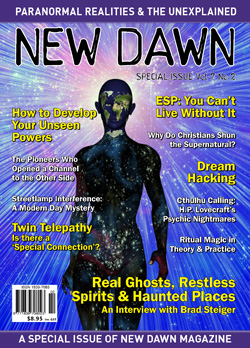
  • Reality Shifts: What Happens to Those Who Slip Between the Cracks of Time and Space?

    Reality Shifts: What Happens to Those Who Slip Between the Cracks of Time and Space?

    From New Dawn Special Issue 12 (June 2010)

    Perception determines “truth.” We invent our own reality through our own perceptions and others’, and by accepting what appears to be real as real. History is filled with stories of people who, in “slipping between the cracks” of their own consciousness (thus altering how they perceived the world around them) uncovered different ways to experience reality. What they accomplished in doing this made an impact on society. You and I, all of us, have profited again and again because this happened.

    Chester F. Carlson, for example, inventor of the Xerox duplication process and founder of the Xerox Corporation, was a devotee of a certain trance medium who channelled spirit beings. While attending a series of sessions with the woman, he eventually “received” the photocopy process from the spirit beings she contacted. After experimenting with the technique and making a few adjustments, the Xerox process was born, along with a multi-billion-dollar company.

    George Washington Carver took the peanut, until then used as hog food, and the exotic and neglected sweet potato, and turned them into hundreds of products, including cosmetics, grease, printer’s ink, coffee, and peanut butter. Carver said he got his answers by walking in the woods at four in the morning. “Nature is the greatest teacher and I learn from her best when others are asleep,” he said. “In the still hours before sunrise, God tells me of the plans I am to fulfil.” How did George Washington Carver communicate with God during the wee hours of morning? He said it himself – through the assistance of angels and fairies. And he isn’t the only one to make such a claim.

    Peter and Eileen Caddy and their colleague Dorothy Maclean give the same credits in describing the work they accomplished. This troupe, along with Caddy’s three sons, took up residence near an inlet to the North Sea at Findhorn, Scotland, for the purpose of setting up a co-creative link between themselves and nature intelligences – that is to say, angels (what they later called “devas”) and fairies (“nature spirits”). They became willing workers with nature’s own in an attempt to co-create a garden the likes of which would defy every known rule of convention and climate. That was 1962. Today, the Findhorn Gardens regularly draw people from across the globe to tour the premises and take classes at Cluny Hill College, classes on how to communicate with angelic forces and helper spirits while at the same time enhancing one’s own sense of spirituality.

    The people I have mentioned came to perceive reality from a vantage point other than the norm; then they used what they gained from that experience to benefit others. Different ways of experiencing reality happen when individuals expand their consciousness. Whether accidental or on purpose, that shift in perception also alters the meaning and the importance of time and space.

    Native Runners Expand Reality

    Documented cases of native runners, especially those in North and South America, illustrate this. In Peter Nabokov’s book Indian Running, an anthropologist by the name of George Laird described what happened to one runner who lived in the southwestern part of the United States:

    “One morning he left his friends at Cotton Wood Island in Nevada and said he was going to the mouth of the Gila River in southern Arizona. He didn’t want anyone else along, but when he was out of sight, the others began tracking him. Beyond the nearby dunes his stride changed. The tracks looked as if he had just been staggering along, taking giant steps, his feet touching the ground at long irregular intervals, leaving prints that became further and further apart and lighter and lighter in the sand. When they got to Fort Yuma they learned that he had arrived at sunrise of the same day he had left them,” thus arriving before he departed. The runner’s altered perception enabled him to accomplish this feat; he did not allow himself to be bound by normal perceptions of time and space.

    Let’s not forget the Australian aborigines. Theirs is the oldest continually existing culture on Earth (around for at least 50,000 years), and they maintain an understanding of time and space – of reality – that deserves our attention.

    What they call “dreaming” has little to do with sleep or dreams which occur during sleep. Dreaming for them is actually more akin to a type of “flow” where one becomes whatever is focused on and suddenly knows whatever needs to be known at the moment. Aborigines sometimes use drugs to achieve this state but, more often than not, drumming, chanting, rhythmic movements, and certain other sounds and rituals suffice. In this state of consciousness participants seem to “merge with” or “enter into” soil, rocks, animals, sky, or whatever else they focus on – including the “Inbetween” (what appears to exist between time and space, as if through a crack in creation).

    These people believe reality consists of two space/time continua, not one – that which can be experienced during wake time and that during dream time, with dream time slightly ahead of its counterpart, yet capable of merging into all time, of what Pulitzer Prize-winning poet Gary Snyder calls “everywhen.”

    To Australian aborigines, wake time is where learning is acted out and utilised, but dream time is where learning is first acquired. For them, dream time is the place where all possibilities and all memory reside. Stories are told of aborigines who physically appear and disappear as they slip back and forth from one continuum to the other, from the here and now to the alternate universes they believe exist and the everywhen they know awaits them. Wise ones, be they monks or shamans or healers or mystics, are like this. They know life extends beyond the boundaries of perception. Yet perception itself can be flawed.

    Yes, it is a fact that individuals and societies have always organised the cosmos to fit their own preferred beliefs. This is what defines the relationship between heresy (independent thinking) and orthodoxy (mutually accepted bias). But it is also a fact that the bizarre can intrude upon one’s life so dramatically that one is forced to shift one’s awareness of real versus unreal.

    Fiction Can Foretell Reality

    Reality shifts (sometimes called coincidences) take on many guises. Fiction, for example, sometimes foretells reality. Were the authors of prophetic works inspired by altered perceptions of reality?

    The popular movie China Syndrome, starring Jane Fonda, depicted a nuclear facility meltdown. Three weeks after the movie opened, the same kind of disaster actually happened at Three Mile Island near Harrisburg, Pennsylvania.

    The 1961 novel Strangers in a Strange Land, written by Robert A. Heinlein, told the story of a global chief executive who made decisions based on his wife’s advice, advice she obtained from regular consultations with a San Francisco astrologer. In 1988, media headlines carried the story that Nancy Reagan frequently consulted a San Francisco astrologer, and that the advice she passed along to her husband Ronald Reagan, then President of the United States, was based on those consultations.

    The novel Futility, an 1898 creation of Morgan Robertson, detailed the sinking of an unsinkable ship, the largest vessel afloat. This imaginary ship, named Titan, collided with an iceberg during April, resulting in a high loss of life because the ship carried too few lifeboats. Fourteen years later, with uncanny similarities, the real ship Titanic re-created what happened in the novel: The two ships had almost identical names; both ships were designated unsinkable; both were touted as the largest ships at sea; both collided with icebergs in April; both resulted in many deaths due to a shortage of lifeboats. Plus, both had strikingly similar floor plans and technical descriptions.

    Radio broadcaster Paul Harvey aired a grim tale of three shipwrecked sailors and one cabin boy, adrift and facing starvation, who drew lots to see who would forfeit his life so the others could survive. The contest was rigged to make certain the cabin boy, Richard Parker, would lose. Evidence used at the subsequent court trial that convicted all three of murder and cannibalism included a story written by Edgar Allen Poe. Titled ‘The Narrative of Arthur Gordon Pym of Nantucket’, Poe’s tale described three shipwrecked sailors who rigged a drawing of lots, then killed and ate their cabin boy companion, Richard Parker. Poe’s story, which so accurately described the drama, every detail as it actually happened – including the victim’s correct name – was written and published 46 years before the event happened, even before the participants were born.

    The astonishing ability of fiction to accurately foreshadow what physically occurs happens more often than you might think. It’s almost as if on some level, knowingly or unknowingly, consistently or occasionally, individuals can tap into or stumble across other dimensions of reality, as well as knowledge of a predestined or potential future.

    Remarkable reality shifts also occur that cannot be correlated with any sort of imaginings:

    Brad Steiger, in his book The Reality Game and How to Win It, tells about Charles W. Ingersoll of Cloquet, Minnesota, who appeared in a travelogue made and copyrighted by Castle Films in 1948. Ingersoll could be seen leaning over the rim of the Grand Canyon taking pictures with his 35mm camera. Yet Ingersoll did not go to the Grand Canyon in 1948. He had planned to do so, but his plans changed and his first trip there was made in 1955, when he took with him a newly purchased camera manufactured the same year of his trip. A week after his return, he chanced upon the old travelogue in a store and bought it, discovering to his utter amazement that the film clearly showed him there in 1948 – holding a camera that did not exist until 1955. An investigation verified the incident and the dates, but no explanation was ever offered as to how Ingersoll could have appeared in a film showing him at a site seven years before he got there.

    On October 21, 1987, Claude and Ellen Thorlin were sitting at breakfast. Ellen heard a disembodied voice ask her to tune in Channel 4 on their television set. Even though that channel did not receive broadcast transmissions in their area, Ellen turned the set on. There she saw the face of their dear friend and colleague, Friedrich Jergenson, a well-known Swedish documentary filmmaker and the father of EVP (electronic voice communication with spirits). Ellen was shocked; Claude snapped a photo that recorded the image and the time – 1:22 p.m. That time was 22 minutes into Jergenson’s funeral service that was occurring 420 miles away, a funeral service the Thorlins had been unable to attend.

    When T.L. of Fort Worth, Texas, was 21 years old, he borrowed his parents’ car for a drive from Darby, Montana, to Missoula, to visit friends. Staying later than expected, he found himself speeding back to Darby between one and two in the morning. At a place where the road wound around hills paralleling the river channel, the car headlights suddenly picked up a herd of 20 to 30 horses sauntering across the highway. With no time to hit his brakes and no place to pull off the road, TL hoped to avoid a collision by driving between the animals. Two large horses stopped directly in front of his path. The inevitable seemed his fate until, in the flash of an instant, TL found himself well beyond the herd, driving as if nothing unusual had happened. To this day he cannot explain how he missed hitting the horses. “It was as if I and my car were ‘transported’ to the other side of the herd,” he said.

    Each of these “coincidences” involved people as real as you and me, on days that began as ordinary days.

    Changing Our Awareness

    Are these events merely coincidences? Too much evidence from too many sources contradicts this idea. Something else is going on here.

    The events described in this article underscored moments when subjective reality overlaid objective reality to determine experience. And when that happened, the future easily surfaced. This peculiarity occurred automatically, without provocation, and regardless of logic. What we call time – past, present, future – ceased to be sequential for these people and took on the aspect of simultaneity.

    All of the cases – whether involving aboriginal or present-day societies, fictional or nonfictional themes – centred on men and women who encountered alternate versions of time and space. What occurred changed their perception of the world.

    Adapted from Future Memory: How Those Who See the Future Shed New Light on the Working of the Human Mind By P.M.H. Atwater (Birch Lane Press, New York, 1996).

    [alert type=”general” dismiss=”no”]This article was published in New Dawn Special Issue 12.[/alert]

    [alert type=”success” dismiss=”no”]If you appreciate this article, please consider subscribing to help maintain this website.[/alert]

    © New Dawn Magazine and the respective author.
    For our reproduction notice, click here.