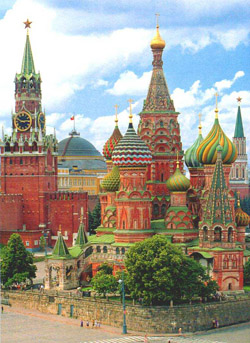
Known in certain new age circles as the focus of the Aquarian age, Russia is currently undergoing a massive ‘occult revival’. Interest in paranormal phenomena, occultism and parapsychology has never been more prevalent. With the end of the communist system, which brought with it the elimination of censorship, the Russian people were no longer forced to repress their interests in spiritual and religious matters. This led to a ‘spiritual renaissance’ of sorts – which is very much in full force today.
According to the British paranormal expert Colin Wilson, “occult powers seem to be a matter of temperament.” When it comes to second sight and telepathy, he says, the Irish are by far the most gifted. The Germans seem to produce the world’s best astrologers, while a significant number of talented clairvoyants are of Dutch origin – Croiset and Hurkos being two examples.
Russia, claims Wilson, “tends to produce mages – men or women who impress by their spiritual authority; no other nation has produced a spiritual equivalent of Tolstoy and Dostoyevsky, or even of Rozanov, Merezhkovsky, Soloviev, Fedorov, Berdaev, Shestov. Certainly no other nation has come near to producing anyone like Madame Blavatsky, Gregory Rasputin or George Gurdjieff. Each is completely unique.”
To find further evidence of Russia’s deep involvement in matters of a spiritual nature, one needn’t look very far. Simply by visiting bookshops and street vendors in Moscow, St. Petersburg, Kazan, Novosibirsk and other Russian cities, one will notice an abundance of titles on occult topics. Birgit Menzel, a professor of Russian Culture and Literature, says “it is almost impossible to understand contemporary Russian literature without being equipped with an encyclopaedia of the occult.” In the 1990s, around 39 percent of all non-fiction publications in the humanities dealt with topics of an occult-esoteric nature.
Not surprisingly, television programs on paranormal phenomena are also very popular in Russia. One such show is called ‘Inexplicable, But True’, which first aired on Russian television in early-2005. “The show’s creators are betting that the Russian audience’s readiness to believe in psychic powers and UFOs will guarantee good ratings,” says Brian Droitcour, a Moscow Times journalist. In the first episode of the program, its host, Sergei Druzhko, an actor and singer with a passionate interest in the paranormal, spoke about his near-death experience. While skiing near Mount Elbrus, Druzkho had a serious accident, and was buried in a snowy ravine for several hours, before being found by rescue workers. Were it not for the help of “supernatural forces,” believes Druzko, he would not have survived the incident.
In a nationwide survey conducted in 2005, involving 1500 respondents in 100 residencies in 44 regions, Russian interviewees were asked the following question: “Are you interested in publications and television programs dedicated to various paranormal phenomena (UFOs, telepathy, ESP, magic, astrology, etc.)?” An astonishing 48 percent of respondents answered yes. Forty-eight percent said no, and four percent were unsure.
One of the most popular television shows in Russia during the late-1980s and early-1990s was called ‘120 Minutes’, featuring the faith healer Allan Chumak. While working as a reporter and TV journalist, Chumak set out to expose faith healers, researching the subject extensively. He soon discovered, however, that he himself had healing powers and “an extremely strong aura” – or so he claimed. David Remnick, a Washington Post journalist, describes his own experience of watching the show: “Sitting behind a desk, the owlish middle-aged man with a mane of white hair stares at the camera and flings his hands about, as if he were petting an irritable cat. Five minutes of silent thrashing, and he is done.”
The thousands of fans who watched the show early each morning were firmly convinced that Chumak had genuine healing powers. People would place water and jars of cold cream in front of their television screens, waiting for them to be ‘charged’ with Chumak’s healing ‘energy’. Since Chumak made very little money from his ‘gift’, the possibility that he was a charlatan seems unlikely.
In a fascinating book called The Occult in Russian and Soviet Culture, one of the authors, Holly DiNio Stephens, provides great insight into the numerous occult beliefs and practices that form an intrinsic part of contemporary Russian culture. One of the most popular spiritual practices in Russian today is yoga, says Stephens, which is commonly regarded as a means of psychic development, and an effective way of enhancing one’s psychic energies. Iury M. Inanov, a prolific Russian author and ‘extrasensitive’ (psychic), believes the practice of yoga enables one to develop the psychic abilities that are needed to become a successful healer, such as the capacity to perceive and interpret ‘biofields’ (auras).
Another widespread occult belief is that of energy vampirism. “Discussion about energy vampirism,” explains Stephens, “may be heard in Russia on city streets, in cafes, in institutes and universities, and in private residences.” As the name suggests, an energy vampire is someone who steals the ‘life force’ (or prana) from the auras of others. These individuals are believed to be deeply egocentric, yet ostensibly altruistic and benevolent.
Because they have ‘locked energy fields’, energy vampires are unable to absorb ‘cosmic energy’ like most people, which is why they are driven to take energy from others.
In 1992, the St. Petersburg School of Spiritual Development of the Personality, published what is now an extremely popular pamphlet, entitled, ‘How to Avoid Energy Vampirism and How Not to Become a Vampire Yourself’. Says Stephens, “the average Russian does believe in the existence of auras and energy vampires, and in the havoc such people can wreak on a person’s biofield and health.”
As well as having an influence on popular culture and the humanities, the Russian occult revival has also left its mark on science and politics. In recent years, numerous cosmism-based organisations have sprung into existence, such as the Association for a Complex Survey of the Russian Nation, which collaborates closely with the Mir Station as well as the Slavic International Union of Aviation and Aeronautics. Based on the work of a number of great Russian thinkers, including the philosopher Nikolai Fyodorov, the geochemist Vladimir Vernadsky, the space scientist Konstantin Tsiolkovsky and the cosmobiologist Alexander Chizhevsky, cosmism was developed in the 1920s, and is now gaining wide popularity.
Defined as a broad theory of natural philosophy concerning the origin, evolution and future existence of the universe and humankind, cosmism is a combination of scientific, parapsychological and theosophical ideas. “The impact of cosmism on science in Russia today can be seen in the growing number of conferences, projects and college textbooks on topics ranging from bioenergy and the so-called ‘torsionic fields’ to UFOs and extrasensory psychic phenomena,” explains Menzel.
Also gaining popularity in Russia today are Transpersonal Psychology and shamanism, the latter of which is being practised as a form of alternative medicine, and has now entered the realm of scientific discourse, not just in Russia, but also in the West. In July 2005 the International Congress of Transpersonal Psychology was held for the first time in Moscow. The event attracted a large number of Russian psychologists and psychiatrists.
But not everyone in Russia has greeted the occult revival with open arms. In 1998, a commission within the Russian Academy of Sciences was established to combat the spread of what it called ‘pseudoscientific’ ideas within Russian society, the scientific community in particular. A report written by the commission begins as follows: “At the present time in our country parascience and paranormal beliefs are widely proliferated and propagandised: astrology, charlatanism, occultism, etc.
“Attempts to carry out various senseless projects at state expense, like the creation of torsion generators. The Russian population is being duped by TV and radio programs, articles and books with openly anti-scientific content.” The report continues: “These irrational and basically amoral trends doubtless present a serious threat to the normal intellectual development of the nation.”
Given the fact that spirituality and religion are an intrinsic part of the Russian soul and always have been, it’s fair to assume that these “irrational” trends won’t be going away any time soon.
An interview with Louis Proud about his new book The Secret Influence of the Moon appears in New Dawn 143 (March-April 2014).
[alert type=”general” dismiss=”no”]This article was published in New Dawn 104.[/alert]
[alert type=”success” dismiss=”no”]If you appreciate this article, please consider a contribution to help maintain this website.[/alert] References:
FOM: Public Opinion Foundation, Paranormal Phenomena and Occultism, 2005 (http://bd.english.fom.ru/report/cat/man/mistika/etb054412)
Brian Droitcour, ‘Freak Show’, The Moscow Times, 2005 (http://context.themoscowtimes.com/story/140333/)
Birgit Menzel, ‘The Occult Revival in Russia Today and Its Impact on Literature’ (The Harriman Review, vol. 17, no. 1, Trustees of Columbia University, 2007)
Sheila Ostrander and Lynn Schroeder, Psychic Discoveries (Marlowe and Company, 1970)
Bernice Glatzer Rosenthal, The Occult In Russian and Soviet Culture (Cornell University Press, 1997)
Colin Wilson, The Occult (Grafton Books, UK, 1979)
Even with recourse to the best scholarship and offering the best proofs for events of Jesus’ life and linked issues across history, it is not enough to claim to have found Jesus’ horoscope as I do in my book Signs for a Messiah. The findings are only a beginning. There is much to discover and the findings must be interpreted and placed in a meaningful framework if they are to be any use in helping us understand more about Jesus.
Modern theology, much of it rationalistic and unmystical, is not necessarily the best tool with which to assess remarkable features of the emerging data. Nor can it help us deal with rarely treated questions like the sexuality of Jesus which Signs for a Messiah controversially examines with some surprising conclusions. The new perspectives and mysteries opened up by the astrological chart of Jesus need a more esoteric understanding of sex than theologians currently deal in.
Although the Jewish Kabbalah as presently known is of only medieval and later origin, it does have roots in trends within Jewish thought already current in Jesus’ time and associated with the Essenes whom many kabbalists regarded as their forebears. Jewish and Christian theologians have suspected links between St. Paul’s theology of Christ and proto-kabbalistic concepts, thus we certainly need to perceive Jesus and his self understanding in more specifically Jewish mystical terms.
And of course, all the trends one looks at are coloured in the broad sense by the astrology of the ages and eras affecting everything and everyone. As reflected in its symbols, the emergence of Christianity from Judaism is deeply involved with the transition from the Arien to Piscean era. All Christian theology and mysticism are in a sense an astro-theology and esoteric system which fails to recognise itself as such, though perhaps and hopefully the Magian wisdom can draw them back to their roots and into greater self awareness at this time of another era transition (between Pisces and Aquarius). – Dr. Rollan McCleary
Most scholars are now agreed that Morton Smith – an American historian and classicist with an almost morbid aversion to Christianity – has discovered a genuine letter of the Early Church Father, Bishop Clement of Alexandria, in a Greek monastery by the Dead Sea. In this letter, its author quotes from a gospel that scholars are less sure is, as Clement believed, from the hands of Mark.
Clement alleges that Mark wrote a second, more spiritual gospel kept by the Alexandrian church for the exclusive use of advanced believers. But this precious Secret Gospel had been stolen and altered by a member of an extremist Gnostic sect, the Carpocratians, who taught the necessity of salvation through indulgence in every kind of experience.
The story, which Clement quotes verbatim from The Secret Gospel is an account of resurrection, part of which may or may not duplicate an early form of the story of the raising of Lazarus given in John 11. When the young man emerges from the tomb it is said he looks upon Jesus and loves him and does not want to be separated from him. Jesus then spends some days with the man, instructing him in the teachings of the kingdom and also spends one night with him dressed only in a linen wrap. Clement acknowledges all this but says that what follows about “the naked man and the naked man” (which from delicacy he does not choose to quote) is pure fabrication.
Smith’s thesis is that Jesus was primarily a magician of a type quite familiar to the ancient world. His speciality came to be mind dissociation techniques in especially a baptismal context; these helped people to make shaman-like, hallucinatory ascents to the heavens, while on earth he could bend them to his will. Smith does not sensationalise the sexual dimensions of The Secret Gospel and insist that Jesus was a homosexual magician, though the thesis tends to imply as much. But he does propose that along with the techniques Jesus employed, he is to be suspected of purveying a libertarian gospel which lay at the root of all subsequent law versus grace arguments in the churches. Smith feels that even if Jesus did not preach such a gospel his personal behaviour was such as to invite suspicions about his real beliefs. He evidently behaved secretly, met people secretly and, he assumes, initiated people secretly.
The question of Jesus’ integrity has already been touched on and while admitting he could be secretive about his intentions, it was affirmed there was nothing to suggest he was the sort of person prone to involvement in secret societies or clandestine affairs. In the circumstances, then, there is nothing remarkable in the fact he should meet a leading public figure like Nicodemus at night and in private as per John 3. It is the sole recorded instance of Jesus giving anyone teaching in this fashion. A meeting at night gave cover in the face of hostile authorities and would, besides, make for clear-headedness in a hot climate. Apart from this, since the Essenes baptised daily, it is not impossible that, as The Secret Gospel has it, Jesus should take someone aside to baptise them for some particular purpose rather than the more generalised one of John.
The young man’s wrap in The Secret Gospel story appears consistent with Essene practice since the sect did not, like fifth century Christians, baptise completely nude but might even immerse candidates completely swathed. They did this in demonstrative reaction against the sort of foreign influence that in the days before their reforming Teacher appeared had brought Israel to engage in the Greek games, a compromise they could only regard as symbolic of deeper corruptions in their society.
Mars and Neptune, especially Neptune, are the two planets chiefly associated with nudity and nudism. With these in the modest sixth of the Joshua [horoscope] chart, the house of health and healing, if the barriers of Essene custom were ever crossed by Jesus, they would most likely serve the interests not of libertarian doctrines but matters more like yoga and health. As even Smith’s study admits in promoting its magian theory, an ancient Libyan prescription for curing snake bites has the healer lying naked with the naked patient in order to apply friction of the skin to the wound. And, more generally, ancient world efforts at reviving the dead involved a specifically naked healer applying resuscitation techniques. So as usual, the Gnostic theories are culture-blind, failing to have sufficient regard to the person and their situation.
This said, in harmony with the principle “no smoke without fire”, to be plausible and accepted, even the falsehoods told about a person must link to some power point within their chart. Such a power point is involved in this case. It was shown how the natal Neptune could further myths of the Magdalene; in similar fashion The Secret Gospel controversy (whose core is baptismal custom and hence immediately referable to Neptune) relates to the condition and placement of that planet in Joshua’s horoscope.
On the physical plane there are two characteristics especially associated with Neptune. The first is the long flowing locks worn by so many Neptunian people, artists, musicians, and antipodean surfers, and which Christian iconography supplied Jesus from the first. In unconscious attunement to Neptune’s rulership in this area we speak of long hair as “flowing”, “waving”, even “cascading”. It is almost certain that Jesus did wear his hair long to express Nazarene style, dedication to his cause and/or more subtly to convey his affinity with the cosmic waters. But even if he did not do so, because the whole Piscean/Neptunian principle was so strong in him, his image would eventually have acquired the long locks of the sea god by sheer archetypal attunement on the part of artists portraying him.
But there is another characteristic of Neptune and it is sea god’s nudity, expressive of his identity with primordial Nature which, as is known, evolved from the waters. Especially in axial eras and when Neptune enters Scorpio (the sign of sex and the genitals), nudity becomes artistically, and to some extent more socially, acceptable. Modern introduction of nudity to magazine and film (Neptune, as planet of dreams, by association rules photography and film) corresponded precisely to Neptune’s slow transit through Scorpio in the 1960s.
Jesus was not only born with Neptune in Scorpio but was himself if anything the very essence of Neptune. It would seem he was therefore fated, regardless of existing custom, to appear before the public naked on at least one occasion, and there is no question that he did so – on the cross.
It is more open to speculation whether readers are intended to understand that, after the manner of Michelangelo’s sculpture of the resurrected Christ, Jesus was also unclothed in the garden on Easter morning. The graves clothes are described as left behind in the tomb. Pious supernaturalism can easily supply a robe, but virtual if not actual nudity is arguably implied, not only by the omission of any reference to some striking and colourful attire, but by the fact that the distraught Magdalene initially mistakes Jesus for the gardener – perhaps for the good reason gardeners commonly worked in a state of “nakedness”. Indeed it is possible that along with the abandoned graves clothes, nudity functioned in the disciples’ memory as proof of an absolute and very recent resurrection. And one of those proofs would need to be that the flesh was free of the very heavy anointings the corpse had received.
While later appearances of Jesus must unquestionably invoke supernaturalism as regards attire – and noticeably, unlike those in the garden, the pair on the Emmaus road are not surprised by Jesus’ appearance – it is possible the Easter scene enacts a unique and rarely considered symbolism, one in which the garden of the tomb is briefly the new Eden of the second Adam. The Jesus of Easter morning is self-revealed in the radiance of his (Neptunian) essence as one totally identified with the nature of which he is the source. Whatever the truth of this matter, Luke 6:29 implies that the Jesus the disciples had known before the first Easter was never merely prudish regarding attire. Translations with “cloaks” and “shirts” are misleading.
In the context of a two garment society the truer rendering of the verse would be, as in The Amplified Bible: “…from him who takes away your outer garment do not withhold your undergarment as well.” This, if not a form of pacifist protest, is presumably witty hyperbole to make a point; but, undeniably, subversive sages like the Cynics were sometimes prepared to go about naked to demonstrate total independence or affinity with nature. And to have said this, Jesus was speaking like a Cynic, aiming to shock because, by contrast, for Essenes to have accidentally exposed one’s nakedness merited thirty days’ penance, and six months if it was done deliberately.
So at least as against the Essenes we may know Jesus held relaxed views that dissociate him from those criticisms of his gospel that make it the historical source of the crazed asceticisms that gave medieval society a surplus of dirt and skin diseases because it was deemed sin to expose the body in the interests of hygiene. Even so, the question raised by speculations around The Secret Gospel remains, namely whether there were ever occasions nudity featured in Jesus’ work in relation to healing, ritual or whatever.
This seems unlikely as it was not in the interests of Jesus’ controversy-ridden mission to supply unnecessary grounds for scandal. But, however unlikely, it is conceivable The Secret Gospel is distorting something. Essene extremism apart, it is only modern, non-tribal society that automatically equates nudity with licence. Nudism can be a quite puritanical, health minded affair – Greek doctors recommended it for the health and notable Virgos, like Goethe, have practised it for that reason. A well-known religious authority, the Benedictine Fr. Dechanet, recommends that, ideally, yoga exercises be performed nude and he would surely be indignant if people like Morton Smith insinuated such opinions were a front for libertarian behaviour. To make a point, even St. Francis reportedly preached a sermon stark naked, and though his contemporaries thought he had gone mad, nobody judged him licentious.
The proper question would seem to be whether nudity serves spirituality in any way. If it does, the reason is of an “occult” order – as mentioned, some ancient healing practices incorporated nudity and we can more or less know why. The supposed etheric current in the powerful lower chakras of the subtle body (in effect those of the Nephesh, or animal soul in Jewish Kabbalism), is said to be less impeded when a person is naked, thus allowing certain spiritual/psychic energies to flow more freely and be “recharged”. This was probably the original reason the witches’ coven was nude and why, apparently, even some members of the early Jewish prophetic schools might go about naked under trance, as appears to be case according to 1 Sam 19:24.
Such esoteric perspectives might just be relevant if Jesus’ miracles were to be seen in terms of anything like yoga. It is doubtful they should be; in Jesus’ case the comparison is surely more with the so-called “divine healer” who is recharged through the act of healing rather than depleted of energies they need to recharge by techniques like most practitioners of psychism and yoga. Even so, there seems little question that, in yogic terms, Jesus’ powers would normally have manifested through the Manipura chakra associated bodily with the solar plexus region and esoterically with the processes of alchemy, the production of apports (such as in the reported multiplication of the loaves and fishes) and the main forms of healing. Moreover, the solar plexus is associated in medical astrology specifically with Virgo and the sixth house, both important to the natus of Jesus as we are aware. If, improbably, there were any secrets or nudity in Jesus’ mission along the lines of The Secret Gospel we can be confident they had to do with health and healing.
We have still not sorted out the young man. A colleague of Smith’s, Cyril Richardson, proposed a theory satisfactory to even the ever sceptical Smith to account for the mysterious gospel. Among the writings of Clement is a tract, What Rich Man Can Be Saved?, composed to allay the concerns of wealthy Christians in Alexandria to whom the story of the rich young ruler was not the happiest in the gospels. It can be imagined The Secret Gospel touched on Clement’s further thoughts about riches and discipleship and so was read at the Easter Liturgy of baptism where it followed upon recitation of the synoptic gospels’ account of the young ruler. Whether or not the original inspiration of The Secret Gospel story had been Lazarus, the subject was now understood to be the young ruler who, though he had rejected Jesus, subsequently fell ill and died but was then raised and given a second chance at discipleship.
Long before Smith’s discovery, on the more maverick side of exegesis there was speculation that Lazarus was the young ruler; and though the theory is particularly untenable, the sexual origins of the idea are obvious enough. When Lazarus is taken ill, a messenger comes to Jesus reporting that “the one you love” is dying and then, when belatedly Jesus arrives, outside the tomb, in the words of the famous shortest verse in the Bible, we are told “Jesus wept”. The response of the crowd to this is: “see how he loved him”. It should be obvious that the messenger’s words are simply a courtesy, rather like someone saying, “Your beloved uncle is in danger of his life”.
Jesus was a regular visitor at the house of Mary of Bethany, Lazarus’ sister, hence doubtless on very friendly terms with her brother. Had Mary and Lazarus been of the ruling elite of Israel like the rich young man this would surely have been indicated. As to Jesus’ emotion at the tomb – which is in a sense inexplicable if he believed he could shortly restore Lazarus – the crowd’s reaction to it is superficial and uncomprehending. It is very likely that the emotion is reserved for the human condition, the tragedy of death as it strikes people in every age and clime and which Mary and Martha in their distress are so vividly enacting.
Even now we are not yet finished with this confusion of identity. The authors of Holy Blood Holy Grail, in pursuit of the thesis Jesus was married to the Magdalene, take a cue from Blessed James of Vorigaine (1230-1298) in his notorious hagiography The Golden Legend and combine Mary of Bethany with Mary of Magdala. This done, they are free to say that the “beloved disciple” was necessarily Lazarus as Jesus’ brother-in-law and not John the disciple. In The Golden Legend the Magdalene was going to marry John before Jesus’ call to discipleship intervened dooming the jilted woman to wild fits of promiscuity in her frustration. This piece of identification is quite novel and fits no scholarly or psychological probabilities.
To rival such wonderful speculations but in keeping with logic within our frame of reference, for what it is worth I shall suggest why the rich young ruler attracted Jesus’ special attention. Consider what the account tells the reader of his character. He rushes up to Jesus full of an enthusiasm Jesus feels bound to check; he is a shameless self advertiser where his good qualities are concerned. He is the kind of person willing to make on the spot decisions in areas others might demand more time to reflect; he is emotional and openly so; his moods show on his face and he goes away mourning; and of course financial considerations rule his life. This amounts to something and what it amounts to is a sort of very public, “American” character and the sign of cardinal, decision-making Cancer, sign so often of advertising, materialism and the attitude of attachment.
Since the Joshua chart is so strong in water from Pisces and Scorpio it will often favourably trine the planets of anyone in Cancer, the sign in which both the Part of Marriage and the Part of Love fall. The latter Part (at 23 of Cancer), besides, trines the era conjunction, thus perhaps merging itself with the conjunction’s universalising effects; but obviously there would still be lot of relationship potential towards the Cancerian individual. These Parts are nonetheless positioned in the second house of worldly goods and personal values, meaning that these subjects would tend to be at issue in contact with any Cancerian person. Indeed it is rather interesting to compare the very Cancerian chart of America with the Joshua chart, and perceive the many ties which help explain that country’s special relation to Christianity, the determination of so many Americans to media-sell Jesus. Nevertheless, it is to be doubted that who or what is being promoted is fully understood and would be altogether approved by the one preached about since there is a lot of faux amis to this relation as there surely was to the young man who faces Jesus.
The story of the Rich Young Ruler is often cited by sceptics as proof positive that Jesus did not believe he was divine: “Why do you call me good? No one is good but God alone” (Mark 10:18). On the contrary, this should be taken as one of those subtle hints to people that Jesus did regard himself as divine. Noticeably he does not, by way of example, confess to any imperfections in his examination of this youth with his ready-made catalogue of virtues. Jesus’ question is a rhetorical one designed to check the effusive flow and make the person truly conscious of just who and what he has chosen to confront. That divinity and a more human level of attraction can both be at stake in the encounter only confirms what has been proposed here (and in many mystical traditions), that however great the distance between them, the sexuality and the spirituality are inextricably linked.
The above is slightly abridged from Dr. Rollan McCleary’s book, Signs for a Messiah: The First and Last Evidence for Jesus.
[alert type=”general” dismiss=”no”]This article was published in New Dawn 82[/alert]
[alert type=”success” dismiss=”no”]If you appreciate this article, please consider subscribing to help maintain this website.[/alert]
The “Cathar heresy” that struck Southern France in the 13th century, and was viciously persecuted by the Roman Catholic Church, remains a pool of interest and intrigue. What really happened, and what did the Cathars actually believe?
Wars between nations or faiths are commonplace. Sometimes, the leaders of nations turn against a minority resident within their own borders. But the Albigensian Crusade is unique in history, as the Pope on March 10, 1208 proclaimed a crusade against a ‘heresy’ that was present inside Catholic Europe itself. “These heretics are worse than the Saracens!” he proclaimed.
In retrospect, the crusade was one of the bloodiest episodes in European history. Indeed, the decades-long persecution of simple folk has often been seen as the event that prepared the way for the birth of Protestantism, as it awakened ordinary Europeans to the realisation that something was not ‘quite’ right within the papal corridors.
Today, the ‘heretics’ are most commonly known as Cathars, but historically they went under a number of guises for, in fact, they were not a uniform organisation at all.
The main focus, however, has always been on the Cathars (from the Greek word meaning ‘pure’), a name that is normally reserved for the dissident Christians who lived in Southern France and Northern Spain.
Catharism arrived in southern France and northern Italy in the 11th century. It was present in Orléans as early as 1022, when thirteen Parfaits – the name for the ascetic Cathar elders – were condemned to the stake. At the time, the south of France (the Languedoc) was not yet under the political control of Northern France. In the Languedoc, Catharism, endorsed by the local nobility, became a popular alternative to the Catholic Church. The likes of the Count of Toulouse – one of the most important rulers of Southern France – supported Catharism.
Cathar Beginnings
The first Cathar Synod was held between 1167 and 1176 at St. Felix-de-Caraman, near Toulouse. The event, attended by many local notables, was presided over by the Bogomil papa Nicetas of the Balkan dualist church (see ‘The Bogomils: Europe’s Forgotten Gnostics’ by Paul Tice, New Dawn No. 106, January-February 2008), assisted by the Cathar bishop of (Northern) France and a leader of the Cathars of Lombardy.
The Synod marked the start of the real struggle between the Catholic Church and Catharism, as the Church now had an organised body to fight. Of course, it meant ‘the enemy’ now had a name, and could thus be more easily fought.
As early as 1178, Louis VII of France asked for a forceful intervention to stamp out the New Church. In 1208, Pope Innocent III repeatedly tried to use diplomacy to stop the spread of Catharism, but in that year his papal legate Pierre de Castelnau was murdered (allegedly by an agent serving the Count of Toulouse). The event pushed him from diplomacy into military action. Some now consider the death of de Castelnau a false flag operation, engineered so that the crusade would be declared.
Whichever scenario is true, the end remains the same: an estimated 200,000 to one million people died during the twenty year campaign, which began in earnest in Béziers in July 1209. Papal troops marched to Béziers where they ordered that 222 people, suspected of being Cathars, be handed over to them by the town’s citizens. When this was refused, the papal troops decided to attack. One of the crusaders asked their leader, the Papal Legate Arnaud-Amaury, how to distinguish between the 222 heretics and the thousands of faithful Catholics that lived in the city. “Kill them all,” was the abbot’s alleged reply. “God will recognise his own!” The number of dead that day was between 7,000 and 20,000, the latter figure being the one quoted when Arnaud-Amaury reported back to the Pope.
With such carnage, the other towns (e.g. Narbonne and Carcassonne) offered no resistance and soon the Southern counts had lost their territories and powers to the King of France and his allies. For these Northern lords, attaining the lands of the Languedoc had always been paramount; their mission had been accomplished.
Though the crusade was over, only the powerbrokers who supported the spread of Catharism had been removed from power, their lands confiscated. What about the people? It is a known fact that the more one hunts down a group, the more convinced it becomes in its ways. Hence, at the end of the Albigensian Crusade, Catharism wasn’t by any means eradicated.
For this purpose, the Inquisition was established in Toulouse in 1229 to guarantee that any future resurgence of this ‘heresy’ was nipped in the bud – literally – but also that a new phase of the campaign could commence: individual manhunts to track down Parfaits (the Cathars elders) who were still hiding and preaching within the general population.
From 1233 onwards, hunting down Catharism was no longer done via wide-sweeping crusades, but on an individual basis. This meant any Cathars caught were ferociously interrogated about the secret network they were part of, their hideouts, their clandestine financiers and supporters, etc.
Faced with the incredible pains subjected to their bodies, and the Cathar oath not to lie, the Inquisition learned important secrets about the underground network. Despite this, René Weis, author of The Yellow Cross, states: “The Cathar movement in the late-thirteenth-century Sabartès was an underground organisation, and the Inquisition of Geoffroy d’Ablis never penetrated to its core in spite of the fact that it executed most of their leaders.”
Many Cathar elders realised the lethal dangers they faced and began to take refuge in the fortresses at Fenouillèdes and Montségur, while others were able to incite uprisings, which forced the Inquisition out of Albi, Narbonne and Toulouse. Count Raymond-Roger de Trencavel even led a military campaign in 1240, but was defeated at Carcassonne, surrendered and was exiled to Aragon.
The Church felt victory was near and only those Cathars hiding in the castles remained to be eradicated. A siege began of the castle of Montségur, where 300 soldiers and 200 Parfaits stood off an army of 10,000. Among the Cathars inside Montségur were the Cathar bishop of Toulouse and the Cathar bishop of the Razès, Raymond Aguilher, leading members of the ‘heresy’.
After a ten month siege, in March 1244, the castle surrendered. Though their life would be spared if they recanted, the Cathars preferred to be burnt, rather than reject their faith – a true sign of their conviction, which is one of the key reasons why Catharism today has such a wide appeal with the local people of Southern France.
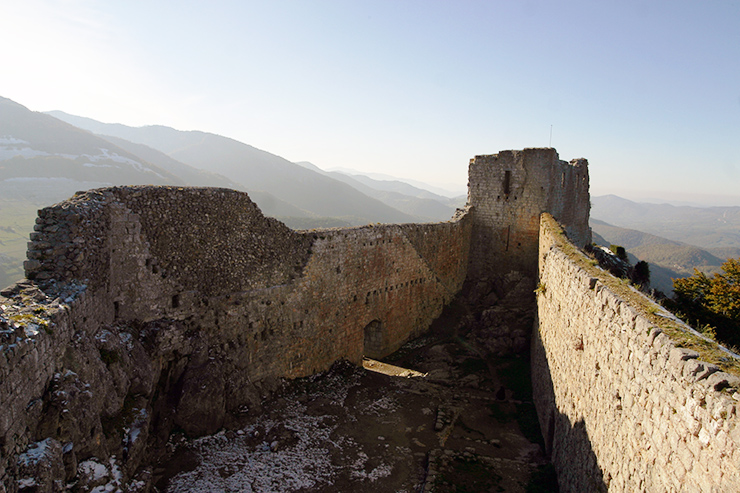
Montségur. Photo courtesy of Andrew Gough, www.andrewgough.co.uk
The fall of a small, isolated but very idyllic fort, that of Quéribus, in August 1255, is often seen as the final demise of Catharism, but that is not true. In fact, in the following decades, there was something of a Cathar revival. The much hunted Cathar Parfait Pierre Authié even consoled the Count of Foix, Roger-Bernard III, in March 1302 in the hall of Tarascon castle, even though he was later buried by the Bishop of Carcassonne. It shows how many local lords still remained loyal to the Cathar cause.
The underground survival of Catharism has become symbolised by the events that occurred in and to the small village of Montaillou, near Montségur, as it was the subject of Emmanuel Le Roy Ladurie’s pioneering book of the same name. From 1294 to 1324, the daily routines of Montaillou’s 250 inhabitants are known, as they survived in the records of Jacques Fournier, later to be Pope Benedict XII. It was Fournier, then the local Catholic bishop, who unleashed the Inquisition at Pamiers against the villagers, even resulting in the arrest of the entire village in 1308. One should, perhaps, be happy they weren’t all killed…
Fournier also captured the last Cathar Parfait to be burnt at the stake: Guillaume Bélibaste, in 1321. Bélibaste’s bailiwick was the area between Rennes-le-Château – known for the mysterious 19th century priest Bérenger Saunière, who is at the core of the mystery of the so-called Priory of Sion and Dan Brown’s bestselling The Da Vinci Code – and the coastal city of Perpignan.
Bélibaste was the son of a rich farmer from Cubières. He became a shepherd and a Parfait, the pupil of the Parfaits Pierre and Jacques Authié, whom had stayed with Bélibaste’s family in Cubières. As the Inquisition’s stranglehold tightened, Bélibaste settled across the border, in Catalonia, where the political regime did not persecute Cathars, and he was able to make baskets and carding combs, as well as become the mentor to a local Cathar community. He nevertheless decided to return to his homeland, but was caught, tried, and burnt at Villerouge-Termenès.
Bélibaste’s death signalled the end of the official Occitan Cathar Church, which blossomed in the 11th century, organised in 1167, and perished in 1321. But though officially defeated in France, elsewhere, e.g. in Bosnia, Catharism continued to exist into the 15th century, when its adherents converted to Islam. Some, however, argue that Catharism in France may have disappeared as an organised Church in 1321, but that as a religion… it remains alive until today.
Though it was the Inquisition – the accusers – that wrote down the life of Authié and Bélibaste, there is general consensus the insights the accounts provide into their lives and beliefs are credible. Indeed, what precisely the Cathars believed, remains somewhat of an enigma. Some have even used it as a blank canvas, to paint their own thoughts or convictions on. Hence, a lot of myths and falsehoods now exist about Catharism.
The Cathar Revival
At the core of the Cathar faith was the rejection of the material world, which was seen as a trap imprisoning the soul. All things material were seen as evil and to be opposed and rejected. Hence, they built no churches, were largely vegetarian and shared both common possessions and ate common meals. Though it is true that their doctrine had room for Jesus and the Bible, especially the Gospel of John, and that they proclaimed Christ had no real body (if he was the Son of God, how could he have a body of flesh, which was evil?) and hence also died no real death, all of these accommodations should be seen as educational tools so that they could explain to those that had been raised as Christians where both teachings differed.
But in the end, their doctrine was appealing not so much for its core beliefs, but because the Catholic clergy were corrupt and as materialistic as one could be.
Today, Catharism is largely seen as a dualist religion, like most Gnostic and oriental teachings. The man largely responsible for identifying Catharism as such was Déodat Roche (1877-1978), often referred to both as ‘the Cathar Bishop’, if not ‘the Cathar Pope’. However, outside of France, his name is relatively unknown, as is that of his friend and Professor of Sociology René Nelli of the University of Toulouse (and often referred to as ‘the vicar of Catharism’), who lectured on the subject all over France.
Their fame has largely been eclipsed by the likes of Otto Rahn and Antonin Gadal, who saw the caves of the valley south of Foix as secret initiation centres for the Cathars – a theory that is now often widely accepted, but which has very little academic support.
Gadal continued the work started by the local historian Adolphe Garrigou. From the 1930s onwards, circles were formed around Gadal and the already mentioned Roche and Nelli. Together, they formed “La Société du souvenir de Montségur et du Graal,” to promote the forgotten history of Catharism – but specifically tying it to the Holy Grail – and the promotion of Montségur, and the region as a whole. It is here that what is now known as ‘neo-Catharism’ was born, and it has little to do with the original belief.
A second circle of Cathar enthusiasts had the countess Pujol-Murat as a key figure; she was one of Otto Rahn’s patrons. Rahn was a young German academic, whose books greatly advanced interest in Montségur and Catharism, both in the 1930s and now (see my article ‘The Strange Life of Otto Rahn: Author, Poet, Grail Seeker, SS Officer’, in New Dawn No. 109, July-August 2008). The countess claimed to be a descendent of Esclarmonde de Foix, who was seen (though historically inaccurately so) as one of the most esteemed Cathar Parfaits of the early 13th century and in some accounts held to be responsible for the rise of Montségur as the ‘Vatican’ of Catharism. It should be pointed out that these hilltop castles (like Montségur) were never ‘Cathar cathedrals’, as some would have it, but merely refuges for the Parfaits escaping the Inquisition.
The Countess hoped to discover the lost treasure of the Cathars – and the Templars – which she believed was the Grail itself, supposedly hidden at Montségur by Esclarmonde, just before she threw herself off the mountain to escape from the papal troops. Some therefore believed the Grail was hidden there, whereas others felt the Grail had been secreted out of Montségur, days before its fall. It is said four Cathars descended down the steep slopes, carrying with them a ‘treasure’. Though the story of this escape is true, whether they carried anything is a matter of debate. Furthermore, as the descent was steep and arduous, whatever they carried must have been small.
Amidst the wild speculation as to what they might have secured, some believe it was a holy book, containing the wisdom of the Cathar religion. It is indeed unlikely the Cathars secured a physical treasure, if only because it would have been too heavy, and in their eyes, unimportant: Catharism saw everything on this plane of existence as evil and despicable; money and wealth were chief amongst Earth’s – and Satan’s – vices.
Authors such as Walter Birks and R.A. Gilbert, as well as Elizabeth van Buren, have suggested the Cathars guarded a manuscript, knowledge – a spiritual treasure. This manuscript is often said to be the ‘Book of Love’ and is linked with the Gospel of John, and is claimed to contain “sublime teachings, marvellous revelations, the most secret words confided by our Lord Jesus Christ to the beloved disciple [John the Evangelist]. Their power would be such that all hatred, all anger, all jealousy would vanish from the hearts of men. The Divine Love, like a new flood, would submerge all souls and never again would blood be shed on this earth.”
It is known that books were very important to the Cathars, and some, such as “Stella,” by the Cathars of Desenzano, talk about the wars between God and Lucifer – underlining their dualist doctrine. But as Saint Dominic, founder of the Inquisition, is often depicted committing these books to the fire, it should come as little surprise that few have survived his ‘intervention’.
However beautiful Montségur is, the ‘real’ Cathar heartland are somewhat gentler slopes where now desolate villages once thrived. One such village, Arques, near Rennes-le-Château, is where the hunted Parfait Pierre Authié preached and found refuge, and the modern Cathar researcher Déodat Roche was born and lived. Today there is a museum dedicated to him.
Though Roche was part of the modern Cathar Revival, he never focused too much on the promotion of Montségur or the ‘initiation caves’, which for him were distractions – tourist attractions. Roche focused on the true Cathar belief. But the question needs to be asked whether he discovered this, or whether he knew so all along.
For those who have studied and known Roche, there are hints that somehow Roche’s interest in Catharism was very fundamental – that he may have been one himself. He is known to have made solitary early morning walks to a hill just outside of Arques, where he was taken as a young child by his father. The site holds a statue of the Virgin Mary, and though this might appear typically Christian, the Cathars of the 14th century are known to have made similar pilgrimages to the nearby basilica of Notre-Dame-de-Marceille, which held a Black Madonna. As in Notre-Dame-de-Marceille, did the Virgin Mary in Arques have a secondary – dualist – meaning for Cathars – and Roche?
As mentioned, his home town of Arques also had a strong connection with Authié. Roche once unearthed an image of Pierre Authié and both he and others who saw this noted how remarkably similar the two men looked. Roche was not only mayor of Arques; he had also held important positions within the French judicial system. He was also a very private individual. He never spoke about whether or not he felt that he was indeed the possible reincarnation of Authié. Roche must have understood that what he was doing was uncovering what had been buried with Authié. If he did feel that he was the incarnation of Authié, then it was clear that upon this Parfait’s death, he had after all not entered Heaven.
So, what was Catharism? A dualist religion is primarily seen as a religion that believes in two competing forces, good versus evil, but it is much more than that. An insight into the Cathar cosmography comes from Authié himself. He preached that the Devil had sneaked into Paradise, after waiting 1,000 years at it doors. Once inside, he seduced the spirits, who all fell from a hole in Paradise for nine days and nine nights. After this Fall, they ended up on Earth. When Heaven had largely become depleted, God immediately plugged the hole. But the souls on Earth soon were saddened by their loss and the Devil offered them as comfort such overcoats that would make them forget the bliss of Heaven: the human body, which began a series of incarnations. It thus became Mankind’s mission to ascend back to Heaven, i.e. break the cycle of incarnations. By accepting this cosmography and performing the Consolamentum, one’s next death would end the soul’s odyssey and return it to Heaven.
The two most important Cathar rituals were the Consolamentum and the Endura (see side bar on adjacent page).
In conclusion, neo-Catharism had little to do with Catharism as such. The notion of Jesus as a man of flesh and blood was rejected by the Cathars, yet neo-Cathars underline how the Cathars believed that Mary Magdalene was the wife of Christ. Yuri Stoyanov has indeed confirmed that the Cathars claimed as such and that this belief had no counterpart in Bogomil doctrines, meaning that the Cathars were unique amongst the dualists to have this belief. Their religion was not at all based on the knowledge that Jesus and Mary Magdalene created a dynasty but that, instead, Cathars in Southern France, where Mary Magdalene was a popular saint, used her in their cosmography, to illustrate the feminine aspect of the divine duality.
Cathars underlined the 1,000 years the Devil had to wait at the gates of Paradise before he entered it. Cathars saw it as their mission to have the soul repent for the sin of being seduced by the Devil, and once accomplished, it would return to Heaven. The Church, however, saw it differently, using especially Revelation 20:7, where it is said that after 1,000 years, Satan would be released from his prison. Seeing Catharism rose approximately one millennium after the death of Christ, chronicler Ralph the Bard and St Hildegard of Bingen – the latter who stated she had a vision in which she saw Satan released from his chains – said Catharism was in fact the return of Satan, there to destroy the Church. It was the very reason why it had to be destroyed; for many Christians, conquering Catharism meant slaying Satan. Thus, not only Catharism, but the Cathar Crusade itself, had an innate dualism to it too.
[alert type=”general” dismiss=”no”]This article was published in New Dawn 110.[/alert]
[alert type=”success” dismiss=”no”]If you appreciate this article, please consider subscribing to help maintain this website.[/alert]
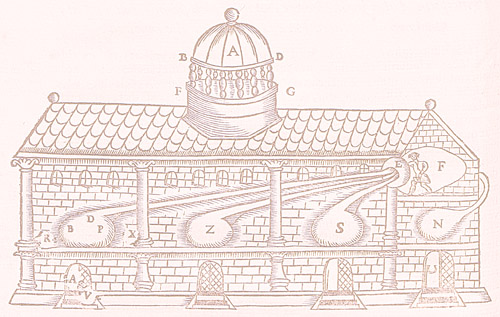
The museum of Athanasius Kircher (1602 – 1680) in the Jesuit College of Rome was an obligatory stop for high-class tourists, from John Evelyn the diarist to Queen Christina of Sweden, but they never knew what to expect. The college porter would report their arrival via an acoustic intercom (see illustration 1), and Kircher or some young assistant would set the machines going.
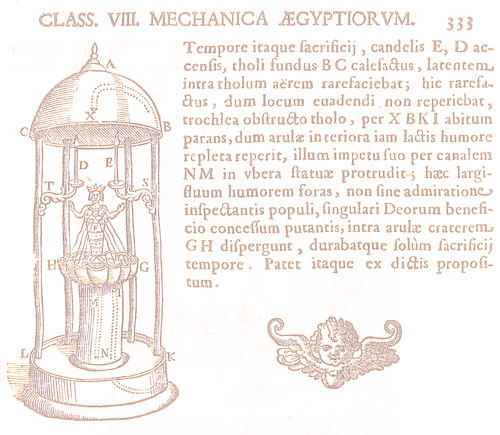
As the visitors entered the museum, everything was abuzz. A statue of the Goddess Isis might greet them by spraying water from her multiple breasts (see illustration 2). A mechanical lobster might vomit up various liquids for their refreshment. Clocks played hymns and told the time in every country of the world. A statue called the ‘Delphic Oracle’ would answer any questions one put to it, probably in suitably gnomic terms, for to tell the truth it was connected by a tube to another room where a stooge was placed. Alternatively soft chamber music might issue from its mouth. A miniature of the Colossus of Memnon, the famous sounding statue of Egyptian Thebes, would greet the sun with the music of plucked strings.
Once some visitors, coming inside on a cloudless day, were promised rain, and as they scoffed, Kircher turned on a hidden tap and drenched them with an artificial shower. Other devices simulated perpetual motion, or presented edifying religious themes, like the resurrection of Christ in a glass sphere. Much was done with mirrors and magnets, and of course there was the famous magic lantern, projecting a frightful image of a soul in Hell.
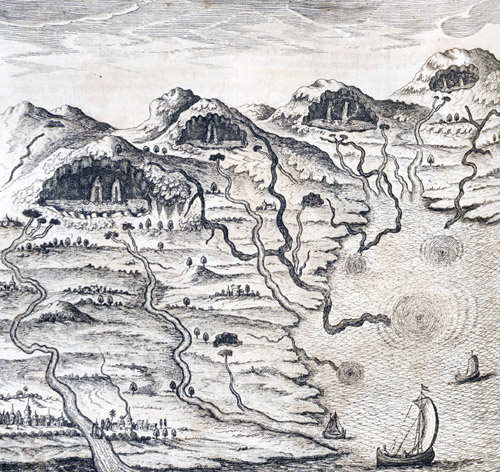
While Father Kircher certainly had a sense of humour, every one of these contraptions had a serious side. One would have to plunge into his books, some of them a thousand pages long and all in Latin, to understand how magnets manifest the cosmic quality of attraction, which is in turn an image of Divine Love; how the ancients used machines just like Kircher’s to fake the miracles of their idolatrous and demonic religions; how water can be forced to defy gravity, as it does in Nature when the winds drive it into the vast caverns concealed beneath every mountain range (see illustration 3).
Kircher explains how music enters the ear and stirs up the subtle spirits that permeate the body, causing delight; how the heavenly bodies mark time, which can be measured by sundials, moondials, and even a sunflower; how the metaphysical principles of light and darkness govern the visible world.
1. Bugging a Building. The man in the upper room (F) is able to eavesdrop on conversations in all the other rooms of the building, as their sound is gathered in their domed ceilings (D, Z, S, N) and funnelled to point E. (Musurgia Universalis, 1650, II, 296)
2. The Great Mother Goddess. When the candles (D, E) heat the upper dome, expanding air goes down the columns and forces the milk in the lower cylinder up (as in a coffee percolator), to issue from the statue’s breasts. (Oedipus Aegyptiacus, 1652, II, ii, 333)
3. Where Rivers Come From. The action of the wind causes the sea to form whirlpools, driving the water inland through underground channels. These disgorge in huge caverns beneath the mountains, whence the water issues as rivers and returns to the sea. (Mundus Subterraneus, 1665, I, 254)
If the visitor was not merely a tourist but a fellow scholar, Kircher could produce manuscripts in every known language – and he seemed to know them all. He had, after all, deciphered the most enigmatic of writings, the Egyptian hieroglyphs. There was a large collection of artefacts from non-European cultures, for the Jesuits were busy as missionaries in every known land. They had special instructions to send reports and anything portable back to the museum in Rome (and a few of them are still there).
Kircher explained that idols from China and India, Mexico and Peru were nothing but degraded images of Egyptian gods, and these in turn were the personifications of the forces of nature, mistakenly worshiped. He could show how the human race had all descended from the four couples saved in Noah’s Ark, and how the universal language had split into today’s multiple tongues. That was the fault of Nimrod, the presumptuous builder of the Tower of Babel, which was supposed to reach the Moon but now lies in a heap of ruins. Kircher could pass around a brick salvaged by an explorer from that very tower.
Along the centre of the museum stood a series of model obelisks, copies of the ones that had been shipped from Egypt and erected by various Roman emperors. With irresistible conviction, Kircher read their hieroglyphic inscriptions, not as the dull records of pharaohs but as sonorous prose-poems treating the origin of the cosmos, the workings of the elements, and the wonders of Egypt’s life-giving river.
In Kircher’s mind, everything was connected to everything else. “All things are at rest, bound by secret knots,” he wrote in his book on magnetism. The past was an open book: given sufficient erudition, it would be possible to trace all languages, migrations and religions to their source, as surely as the River Nile sprang from a cavern beneath the ‘Mountains of the Moon.’
He held to the Hermetic doctrine that the human body, a microcosm, reflected the macrocosm, so that every organ was ruled by a planet, every part by a sign of the Zodiac from Aries at the head to Pisces at the feet. Every beast, bird, tree, plant, and rock had its place in the same scheme of universal correspondences. To understand these, and to put them to work for healing and other purposes, was the task of the natural magician.
He also knew how to exploit the invisible powers of nature such as the magnet. But Kircher’s magic was strictly natural, for he was a faithful son of the Catholic Church, and a member of its most zealous monastic order, the Society of Jesus. Any other type of magic, such as the invocation of the planetary spirits or the juggling of kabbalistic formulae, he considered as extremely dangerous, and more than likely to invite demons in disguise.
By the time of his death Kircher’s world view was already under demolition by the Scientific Revolution. For much of his life he had passed as the man who knew everything, but now his reputation for universal knowledge crumbled, his open mind dismissed as credulity. Some critics suggested that his decipherment of the hieroglyphs, once the admiration of popes and emperors, was sheer fantasy, and when Champollion finally found the key to them in the 1830s, this was confirmed.
But consider his list of ‘firsts.’ The books that Kircher dedicated to the Coptic language, Egyptology, geology, acoustics, and China were the first works in their field. His successors might disagree with his conclusions, but nowhere else could they find such a rich collection of material on which to base their own theories. Kircher published the first map explaining how ocean currents work; the first map showing how the continental shelves were once dry land; the first map of the source of the Nile, and the first of the mythical island of Atlantis.
In the oriental field, his book on China contained the first Western picture of a Dalai Lama and of the Potala monastery-palace in Lhasa. It was the first to show the letters of Sanskrit and images of the Ten Incarnations of Vishnu. It reproduced an inscription of over 1,000 Chinese characters that proved there had been Nestorian Christians in China.
Kircher was the first to compile a Coptic dictionary, to make a scientific study of volcanoes (descending into the crater of Vesuvius as it was erupting); the first to build a machine for composing music and another for sending messages in code. He was the first to propose that diseases were caused by germs, rather than by an imbalance of humors, pestilential vapours, or the wrath of God. If he did not actually invent the magic lantern, ancestor of the cinema, he first illustrated and explained it.
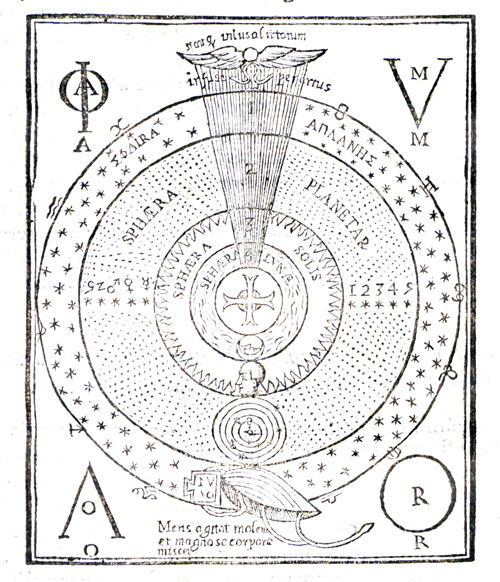
But in other respects, Kircher came last. He was a late relic of the medieval frame of mind, obedient to the Bible as a source of scientific as well as salvific knowledge. In another respect he was the last Renaissance man, proudly mastering all human knowledge while this still seemed possible. More accurately, he was the last of the Renaissance Hermeticists in the line of Ficino and Pico della Mirandola, faithful to their idea that not just the Jews but the pagans had received a revelation of divine wisdom. He was one of the last scientists to insist that the earth was the centre of the universe (see illustration 4), though it is never clear whether he was just following the party line, as Jesuits were obliged to do until the nineteenth century. He did not believe in unicorns (he knew that their “horns” came from the narwhal) but was sure that Adam and Eve spoke Hebrew, and that dragons still lived in the Swiss Alps.
4. The Sphere of Love. Kircher invented this hieroglyphic diagram to show how the World Mind (represented by the scarab beetle) infuses the entire universe with love. The concentric spheres represent the fixed stars, the five planets, the sun, moon, and earth. The letters in the corners spell “love” in Coptic letters (PHILO) and in Latin (AMOR). Kircher believed he had discovered them on the Isiac Table, a pseudo-Egyptian artefact from Rome, and made them the basis of his decipherment of the Egyptian hieroglyphs. (Oedipus Aegyptiacus, 1652, II, ii, 112)
These facts aside, Kircher had an exuberance and a theatrical flair typical of his own, Baroque era. It is this flair that led him to have his books copiously illustrated, first by local artists in woodcuts, then, as his reputation grew, with the more expensive medium of engraving. After he switched publishers from Rome to Antwerp, his books became more splendid still. The illustrated volumes on the Subterranean World, China, Latium, Noah’s Ark, and the Tower of Babel have always been treasured by book collectors, whether or not they read them.
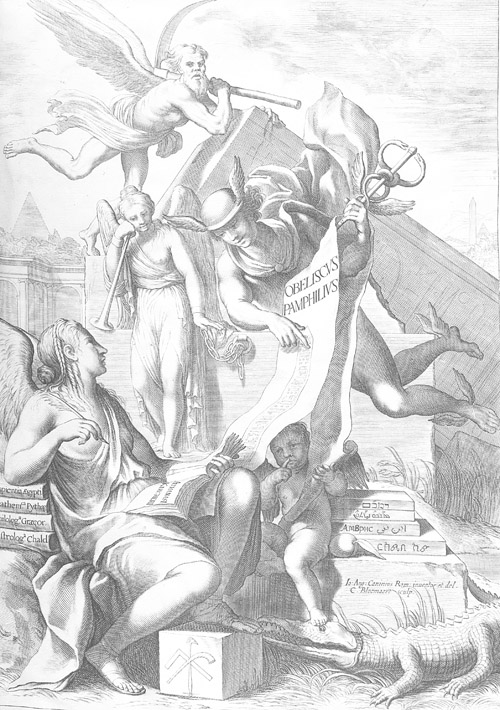
The illustrations of Kircher’s works range over tarantulas and snake stones, machines of past and present, suggestions for future machines, mummies, obelisks, oriental scenes, giants, pictures in rocks, pagan divinities, diagrams of the earth’s interior and of Noah’s Ark, wonders of the ancient world, musical instruments, magnetic devices, and much more. They are a delight in themselves (especially, I find, to precocious children), but many also contain enigmas and meanings that need to be teased out, if their full import is to be appreciated. This is especially true of the frontispieces that summarise the whole message of a book in visual form (see illustration 5).
5. Hermetic Inspiration. Old Father Time has toppled the Pamphilian Obelisk. It lies among the undergrowth, its Fame sadly chained to it. But there is hope! Hermes has come to interpret the hieroglyphs to Kircher’s Muse, who sits backed by ancient texts and ready to write. Harpocrates, infant god of silence, subdues the evil crocodile and indicates that only part of the mysteries are revealed here: we must wait for Kircher’s masterwork Oedipus Aegyptiacus to learn the rest. (Obeliscus Pamphilius, 1650, frontispiece designed by Giovanni Angelo Canini, engraved by Cornelis Bloemaert)
I like to imagine how Kircher wrote out his thousands of pages by hand, with their multiple languages and scripts, sketched the hundreds of illustrations, submitted his work to the church censors, and then sent it to the Low Countries by wagon, hopefully avoiding war zones. Joannes Jansson, the publisher, organised a small army of engravers who cut every sketch into blocks of boxwood. He or Kircher hired more prestigious artists to draw the frontispieces and the major illustrations, which were then copied onto copper plates, in mirror image, and had to be printed by a special process. Some of them are folding plates two feet tall. Then the whole thing was assembled, indexed, proofed, printed, bound, and shipped around the world with no more delay than a modern publisher takes from manuscript to finished book. And all this without the communications systems that facilitate and bedevil our lives.
No one today can rival Kircher in knowledge and industry, but that is no reason to give up on understanding what his work was about, and what it has to offer us. He could not be otherwise than Catholic in his core beliefs, any more than people today can abandon their ingrained faith in scientific and political principles. But he gives access to something beyond religion, science, and politics. These come and go, but the nature of things does not change, and exceptional humans have periodically gained some insight into it. This is the meaning of the Renaissance concepts of the prisca theologia (ancient theology) and the philosophia perennis (perennial philosophy), handed down in the writings attributed to Hermes Trismegistus, the Chaldaean Oracles of Zoroaster, the Hymns of Orpheus, the Golden Verses of Pythagoras, the dialogues of Plato, and the treatises of Neoplatonists such as Plotinus, Iamblichus, and Proclus.
The Hermetic writings seem to sum it up with their teaching of the intelligent design and harmony of the universe, the essential goodness of the world, the invisible web linking all things together, the place of the human microcosm in the cosmic hierarchy, and the destiny of the soul as it descends into the body and leaves it again. This is the heart of the Western Esoteric Tradition. It does not threaten eternal damnation, despise nature, or condemn the material world as evil. To embrace it is a gai savoir, a joyful learning, and Kircher’s example, with all his earnestness, oddity, curiosity, and humour, is an inspiration to do so.
Illustrations 1-5 courtesy of Cornell University Library.
Athanasius Kircher’s Theatre of the World is published by Thames & Hudson, London, 2009 (hardcover, 320 pages, 431 illustrations, ISBN 9780500258606). The book is also published in the USA by Inner Traditions, www.innertraditions.com, ISBN 9781594773297.
[alert type=”general” dismiss=”no”]This article was published in New Dawn Special Issue 9.[/alert]
[alert type=”success” dismiss=”no”]If you appreciate this article, please consider subscribing to help maintain this website.[/alert]
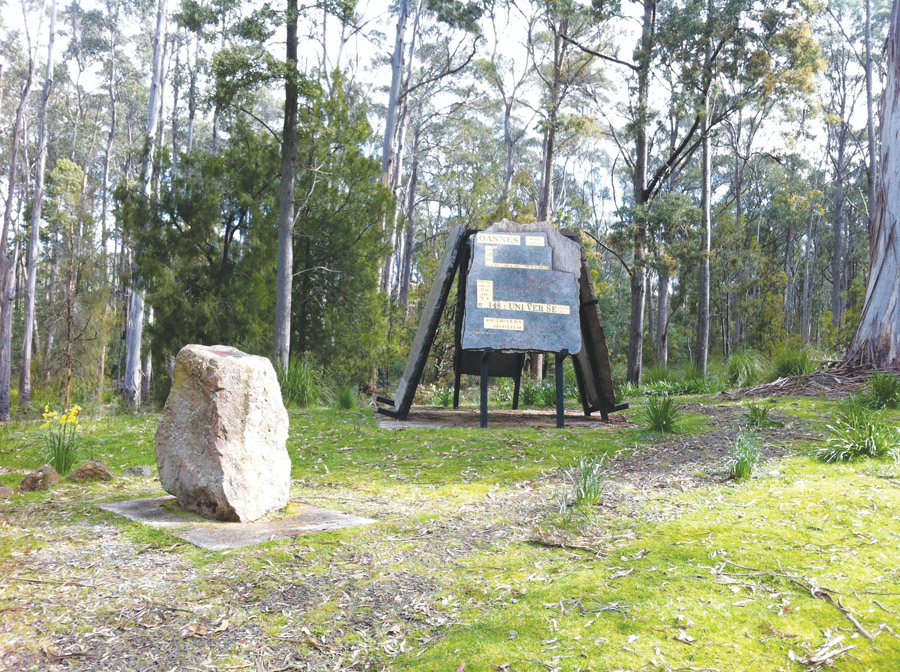
Earlier this year [2013] a New Dawn reader came across a mysterious set of strange monuments in a rural recreation area called Sanctuary Park, situated in Railton, Tasmania – just 20km south of the city of Devonport. What he found was a set-up of four horizontal stone plates. Inscribed on them are writings, grids and mathematical equations – the kind that you can tell aren’t taught in school. These plates have puzzled the locals, as it turns out, ever since they were placed there, one by one, between 2002 and 2003.
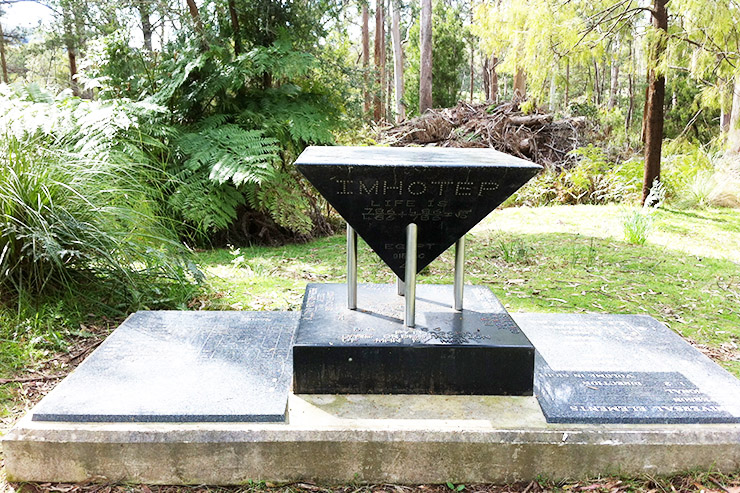
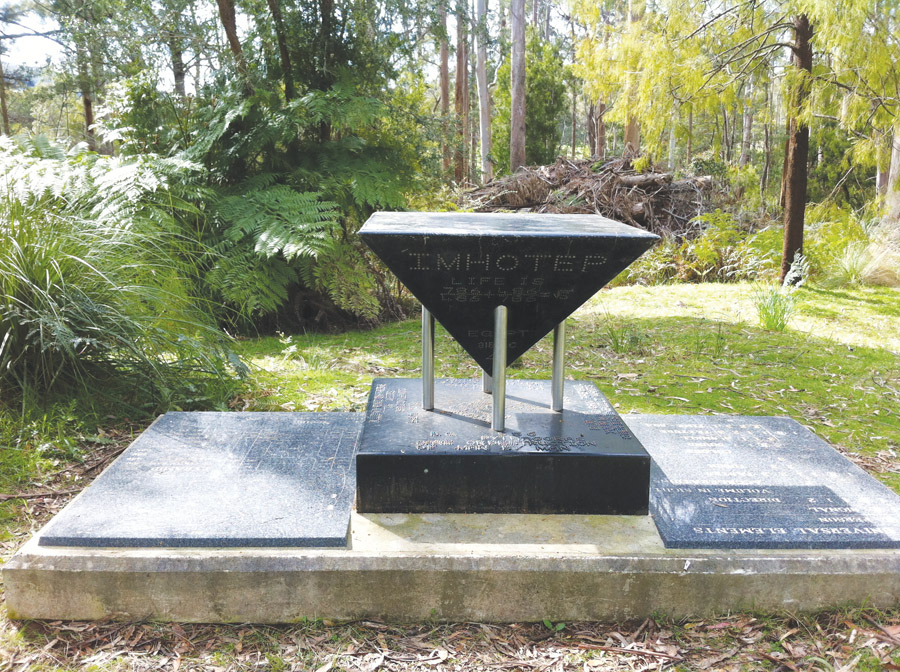
And these are just the newest additions. In September 1990, another enigmatic upside down pyramid shaped object with attached plates was erected. A slab of concrete keeps the whole thing off the grass and atop it sits a black rectangular prism. Four shafts extend from the prism to support an upside-down pyramid. To the left and right of this rectangular prism are two plates with inscribed mathematics – apparently dealing with the design and purpose of ancient Egyptian pyramids. Under the upside down pyramid is this eulogy – Norman Sykes: 1896–1981.
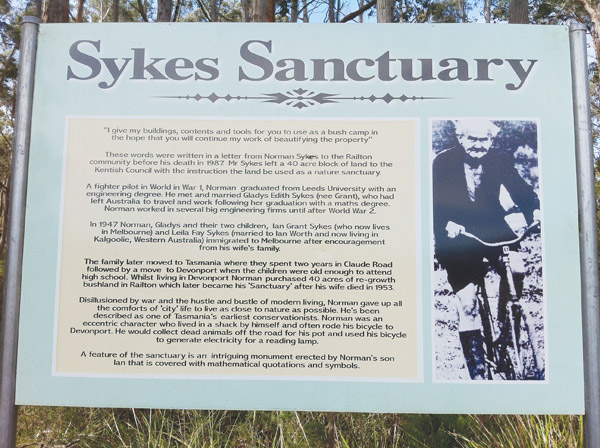
Sanctuary Park is 40 acres in size, and was donated by Mr Norman Sykes to the town of Railton to be used as a sanctuary for the local wildlife. Norman was World War One fighter pilot and engineer who, after the war, moved to Railton with his wife and two children. Norman lived in a shack on the sanctuary land.
Sykes was known locally for his eccentric ‘bushman’ lifestyle, and is described as one of Tasmania’s earliest conservationists. At Sanctuary Park a sign shows an old newspaper photo of Norman, his wife and son riding in his home-made, completely pollution-free, built-from-scrap pedal car. Norman remained a local activist all his life who wrote letters to the editor of newspapers explaining his ‘eccentric’ ideas that today might be regarded as far-sighted.
A sign at the entry to Sanctuary Park, Railton, Tasmania. It contains a short history (and photo) of the man who donated the land for the sanctuary, Mr Norman Sykes.
A brochure made by students from a local primary school identifies the builder of the mysterious monuments to be Ian Sykes, Norman’s son.
Sourcing Ancient Wisdom
The pyramid and its underlying slabs reference a variety of ‘ancient wisdom’ figures (see below for photo of this structure). The architect of these monuments clearly went about his complicated mathematical business by building upon information from the past (these images and descriptions are available in the magazine).
The most important of these figures is Oannes, an ancient Sumerian ‘god’ credited with the invention of writing (his name appears a few times on the monuments). Oannes supposedly taught humans how to create symbols – the idea that some thing can be used to represent another thing. This concept is important to understand because the purpose of these monuments – as we will learn – is to analyse the nature of symbols, or more specifically words. The monuments are unlocking a code to the real hidden meaning of words and letters.
A Hidden Numerical Matrix
Since erecting the monument I have “advanced” some of its ideas, but as it remains a proper symbolism to the central idea that word and number are one and the sole, all embracing unity of diversity it seems to perhaps be in line to qualify as the world’s second monument to what word and number are. (Text from one of the explanatory panels at Sanctuary Park)
The theory advanced here is that every word, phrase and audible sound runs off a hidden numerical source/matrix. All the mathematical equations at Sanctuary Park are designed to prove this theory.
One of the first mysteries I resolved in my investigation of this site is that Norman Sykes did not create the monuments. In fact, Norman apparently had nothing to do with the monuments or their theories at all. This I learn from speaking to Norman’s son, Ian. Ian made it clear he’s still working on the very same project he began the moment he retired decades ago – the enumeration of our language.
The Sanctuary Park monuments were created and erected by Ian. Since then his work has advanced even further. He devotes 4-5 hours a day, basically ‘decoding’ words in our English dictionary, finding in these words (plus their meanings) numbers and patterns that connect the words and meanings to each other – a hidden code.
Section of Sanctuary Park, Railton, Tasmania. Between 2002 & 2003, Ian Sykes erected these four massive stone plates etched with a range of enigmatic inscriptions.
What Ian has uncovered is more-or-less a mathematical blueprint that underlines our entire language. This blueprint maps out and defines, in single fact-form, how every single word/symbol specifically relates to one another. It is a number-based dictionary system that has not changed since it was supposedly introduced by Oannes.
Below are good examples of Ian’s system in action, and he promises these examples will make people “scratch their heads in wonder.” But first, it is necessary to explain some of the complex (yet coherent) methods/theory used by Ian to build this numerical system. Ian’s work is so mind-boggingly complex that it cannot be explained it in its entirety, so my aim here is to communicate Ian’s central premises.
Sound Bites
It is crucial to understand that Ian doesn’t decode words in their written textual form. He doesn’t look at the letters and how they behave/interact specifically on the page. Rather, Ian analyses the sounds of words. Our language is sound. Letters and words on a page are simply the codes for making certain sounds, whether to be read aloud or thought out in our minds. On a page, letters express different sounds depending on context. The letter “C,” for example, is used to make a whole range of sounds, e.g. car, chicken and cereal.
Some letters are silent, forming and indicating no sound at all. To avoid confusion and inconsistency, Ian’s approach to analysing and decoding language is through breaking words down into sound bites. If Ian wishes to decode the word “SAVE,” he will set it out as “S/AY/V.” Or, the word “CHINESE” as “CH/AY N/ IES.” By doing this, Ian can properly examine our language so it can be analysed consistently through sounds. Ian says there around 150 sounds (or what I call “sound bites”) that make up our language.
Each syllable/sound bite has an inherent number (which can be a ‘positive’ or ‘negative’ number). See below.
Sh/ ell/ ter 9/ 4/ -2
Each number is tied to a respective sound bite. “Sh” always yields the number 9, “ell” will always be number 4, “ter” is the negative number -2, and so on. The sound bites are the physical vibrations of certain laws rediscovered by Ian. How did he do this? When crunching individual numbers for individual sound bites, Ian used trial-and-error. He crosschecks a new word with other words and meanings that he’s uncovered previously, finding patterns, consistency, etc. He tells me the process of decoding a word or two takes a full day or more.
Ian has rules which help him anchor this otherwise chaotic-seeming work. These derive from ancient knowledge. Two significant texts are the ancient Chinese I Ching and the somewhat less-known ancient “Oannesian” Sumerian artefact known as WB444 of the Weld Blundell collection, Oxford University Expedition (1928). Ian says these texts contain the founding principles of his work.
The upside down pyramid monument on the same site. It acknowledges a range of notable figures from humanity’s ancient past. It also contains two marble etched plates outlining numerical and word codes of an original language and the Great Pyramid.
WB444 & the I Ching
The official description for WB444 is that it contains a timeline of Sumerian Kings prior to the Great Flood. The graphic at the bottom of page 70 contains the official translation of this object (WB64 has an alternative timeline that is also important to Ian’s research). (You can see this graphic in the PDF version of this magazine.)
The first two numbers in WB444 are 28,800 and 36,000. They appear in other sections of the timeline and add to form the number 64,800. Ian says the numbers here are not intended to simply be read as years. On one of the explanatory panels in Sanctuary Park, Ian claims that on monument WB444, “Oannes, the inventor of writing, set out the values of words [and… numbers] of the three common elements in the DNA and RNA viruses.” Here Ian appears to refer to the concept of language as a virus in the same way that a biological agent reproduces inside the cells of living hosts. Oannes allegedly set the original ‘rules’ of the code that manifested into language.
The I Ching is also important in Ian’s system and is recognised on one of the monuments at Sanctuary Park. It defines the concept of Yin/Yang, or the idea that from one half of a thing you can see what is needed to make that half whole. Words are connected to each other through meaning. From one word, another can arise. This is not unlike pulling a new meaning from one word by using a thesaurus. These two words are connected in a mathematical Yin/Yang kind of way.
Take a look at the word “Malice” which Ian deconstructs as:
M/AL/I/-CE 3/ 11/ 5 /-8
They combine to make the number 11 (3 + 11 + 5 – 8 = 11). Malice = 11.
A closely related word (from the dictionary) is “Spite.”
SP/I/TE 4/5/2 Spite = 11
These two words share in common the same meaning. Both words can be traced (via dictionary) to the meaning “Ill will.” According to what Ian has discovered, the number pulled from “Ill will” happens to be -22. Put it through his process and we get 11 (the process is too difficult to explain here, but Ian is convinced what he’s found is correct due to its consistency across our entire language).
The phrase “get back” (i.e “get back at someone,” a term attached to “revenge” or other ill-will related words) also equates to -22. What about the other meaning of “get back” – the literal meaning which equates to “recover”? Ian has that correlated too.
All of this coincides from what is essentially a larger 4th dimension (or higher) range of numbers. After laying out his system to me, Ian said: “I can’t be wrong. There are too many correlations.” He has amassed a notebook comprising hundreds of words and interconnected numbers that all fit together just like this.
The Perfect Language
Ian is upset by the way we use too many words that don’t match with the original code. He plans to publish a dictionary containing all of the correct numerical meanings and connections of our language. Any meanings not supported by the math are simply that – errors in language, nothing that actually has a grasp on reality, or rather, the Oannesian-imbedded “true meaning” as defined by the DNA and RNA fabric of our worded reality.
Ian hopes that once humanity finds the true meanings in words, they will find true knowledge. According to his system, truth will concretely be found through math and logic. We can know the true meaning behind the words “universe,” “perception,” “life,” “logic,” etc. He further says his laws will leave no room for people to “deny” or “blur the lines” of reality.
The almost forgotten mysterious monuments laying in an isolated park in northern Tasmania may yet contain a set of keys that unlock hidden truths about our Universe.
You can visit Sanctuary Park (also known as Sykes Sanctuary) at Railton, Tasmania (see www.sheffieldcradleinfo.com.au/pages/sykes-sanctuary). For more information, contact the Kentish Visitor Information Centre on 61(03) 64911036.
[alert type=”general” dismiss=”no”]This article was published in New Dawn 139.[/alert]
[alert type=”success” dismiss=”no”]If you appreciate this article, please consider subscribing to help maintain this website.[/alert]