New Dawn – World's Most Unusual Magazine

Category: Secret History

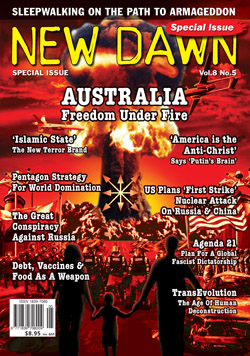
  • The Great Conspiracy Against Russia: What is Really Behind the Campaign Against Putin?

    The Great Conspiracy Against Russia: What is Really Behind the Campaign Against Putin?

    From New Dawn Special Issue Vol 8 No 5 (Oct 2014)

    When the war-drums start beating in Washington against a state or statesman, one is entitled to wonder what transgression might have been made against the ‘New World Order’. Over the past few decades we have seen one nation after another succumb to either financial blandishments, or when those fail, long-planned, well-funded ‘spontaneous’ colour revolutions, and as a last resort bombs. The states of the ex-Soviet bloc largely succumbed to ‘colour revolutions’ orchestrated by the Soros network, aligned with the National Endowment for Democracy (NED), USAID and a host of other funds and NGOs.

    Milosevic’s Serbia, Qadhafi’s Libya and Saddam’s Iraq were bombed into submission, with ground support for jihadists. The globalists have no objection to jihadists when they serve to keep the world in a state of ‘constant conflict’, in accordance with globalist aims. The USA will use ‘Islamists’ where they can, both as dupes and bogeymen.

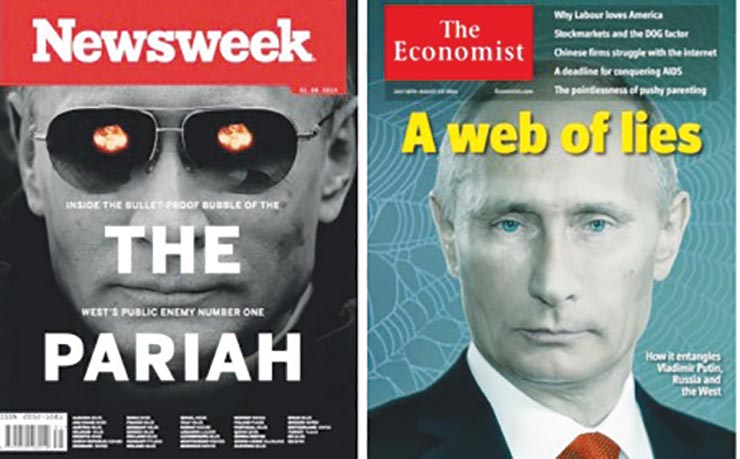
    There is one major spanner in the world: Russia – again. Russian President Vladimir Putin has been vilified relentlessly from the start of his leadership of Russia. A second ‘Cold War’ followed so soon in the aftermath of the first that the two can be regarded as one.

    Russia Stymied World State

    There was a fleeting interregnum when it looked as though Russia would finally succumb to globalisation. This encompassed the Yeltsin years, however it was prepared while the Communist Party still held power, during the Gorbachev era. The sudden implosion of the mighty Soviet edifice, seemingly overnight, was long prepared by a combination of US-based subversion, backing ‘dissidents’ such as Solidarity in Poland, coupled with a planned scuttle by Gorbachev, who envisioned himself as an internationally-feted globalist celebrity.

    Russia had succumbed to the nexus of money and revolution in 1917. The revolutionary movement had been well funded since 1905 when the anti-Tsarist journalist George Kennan was sent over to Japan to propagandise Russian POWs, with funds from Jacob Schiff of Kuhn, Loeb & Co., Wall Street. Kennan remarked that 50,000 revolutionary cadres were sent back to Tsarist Russia. Schiff’s contribution to the overthrow of the Tsar was lauded in New York in March 1917.1 There quickly followed the Bolshevik coup led by Lenin and Trotsky. Lenin was backed by the Germans to get Russia out of the war, and Trotsky was backed by the Americans and British to keep Russia in the war. Trotsky was in close association with R. H. Bruce Lockhart, British War Cabinet special agent in Russia, to such an extent that Lockhart’s wife commented that many of his colleagues quipped he was turning Bolshevik. The lines were drawn when Trotsky resigned as minister of foreign affairs because of Lenin’s insistence that Russia sign an armistice with Germany.2

    After the war, there was a scramble by international finance to get concessions from the Soviets, at a time when their existence was very precarious at best, and the American ‘intervention’ under General Graves was doing its best to backstab the White Armies in favour of the Reds.3 H. Wickham Steed, editor of The London Times, observed at the Paris Peace Conference that it was the international financiers such as Schiff who were pushing for worldwide recognition of the Bolsheviks.4 Matters proceeded well for international capitalism under the regime of Lenin and Trotsky. Russia opened up to foreign capital and technology. With Lenin’s death and the resulting power struggle, Stalin eliminated the influence of Trotsky and his coterie in 1928.

    The common fight against the Axis in the Second World War opened up a further opportunity for the USSR to be brought into a world order. The USA proposed such a world state via the United Nations General Assembly as a world parliament. The USSR recognised that the USA would control any such parliamentary vote, and insisted that authority be vested in the Security Council with the right of veto for permanent members. The second premise for a post-war new world order rested with the US proposal to ‘internationalise’ atomic energy under United Nations aegis, outlined in the ‘Baruch Plan’, named after Bernard M. Baruch, so-called ‘elder statesman’ of the USA. Again, the USSR said no.5

    The USSR alone prevented the creation of a world state. The conservative Right remains confused about Russia till today, and much of it continues the old Cold War anti-Russia line against Putin who, to them, is the new Stalin.

    How the Soviet Bloc Imploded

    While the globalists opportunity to erect a world state in the name of ‘world peace’ after the defeat of the Axis was scuttled by the USSR, the implosion of the Soviet bloc provided another opportunity. The oligarchs in the West are so conceited that they assume the whole world yearns for the ‘freedom’ of their ‘Brave New World’, in a narcosis of production and consumption. They assumed that with the demise of the Soviet Union they would be linking with their counterparts in Russia to form an international exploitative regime. Mikhail Gorbachev was their man, as Lenin and Trotsky had been.

    Gorbachev has indeed become part of the globalist elite, as indicated by the 2011 celebration of his 80th birthday at the Royal Albert Hall, London, where “movie stars, singers and politicians showed up, underlining the celebrity status Mr Gorbachev enjoys in the West where he is widely perceived as the man who freed Eastern European from Soviet rule and ended the Cold War.”6 Guests included Lech Walesa, father of post-Soviet Poland, whose Solidarity movement received largesse from the National Endowment for Democracy (NED), CNN founders Ted Turner, Israeli President Shimon Peres, and unnamed “oligarchs.”

    On his birthday, Gorbachev warned Putin not to seek a third presidential term and menacingly referred to the revolts in the Arab world.

    Back in 1988 Gorbachev openly invited revolt in the Soviet states by declaring before the United Nations that the USSR would not defend their Eastern bloc colleagues. This was the year that the Soviets pulled out of Afghanistan, ‘Russia’s Vietnam’. He also announced there would be a massive reduction of Soviet armed forces from the Eastern bloc states.7 Gorbachev stated to his advisors his commitment to a “new world” under the auspices of the United Nations Organisation.8 The groundwork had been laid previously, with the sponsoring of Solidarity in Poland, which Carl Gershman, head of the National Endowment for Democracy (NED), stated set in motion the “velvet revolutions” that toppled the Warsaw Pact bloc.9 The NED contrived Polish-Czech-Slovak Solidarity Foundation supported dissident publishing in the Czech Republic, Slovakia, the Ukraine, Belarus, Russia, Moldova, the Caucasus and Central Asia. The Foundation for Education for Democracy, an outgrowth of the Solidarity Teachers Union, trained teachers and NGO leaders throughout the former Soviet Union, and the East European Democratic Center created dissident media in the Ukraine and Central Asia.10 The destruction of the Soviet bloc was orchestrated by a combination of Gorbachev’s treachery, globalist funded subversion, and the US sponsored Afghanistan imbroglio.

    In 1991 Gorbachev established the International Foundation for Socio-Economic and Political Studies to add his input to the dazzling array of interconnected globalist NGOs, foundations and think tanks. The North American branch founded in 1997 states the purpose is to spread “economic liberalisation.”11
    “Wrong Direction”

    Throughout the 1990s things seemed to be going well for the globalists. Russia had at last been deconstructed, and was ready for bringing into the ‘New World Order’. Gorbachev gave the green light for the dismantling of the Eastern bloc, and paved the way for idiot democracies of the Westminster style. Appropriately a drunken buffoon, Boris Yeltsin, who started his climb to power under Gorbachev in 1985 as a member of the Politburo, Mayor of Moscow and other senior posts, was offered up to usher in the new democratic Russia that could take her place in the world as another colony of finance-capitalism. He had earned his credentials as a liberal when criticising the lack of haste in reform in 1987. The first democratically elected president of Russia, he lasted from 1991-1999. Under Yeltsin Russian assets were sold off at knock down prices to oligarchs in the name of economic liberalisation. From the start of his presidency Yeltsin brought in advisors from the IMF, World Bank and US Treasury. His 1996 presidential campaign was funded by the oligarchy and promoted by their controlled media. Boris Berezovsky was described by a Council on Foreign Relations (CFR) analyst, Daniel Treisman (who served in a 1997 US team in Russia on tax reform), as the “godfather of godfathers,” the oligarch who sat at the top of the dung-heap.12

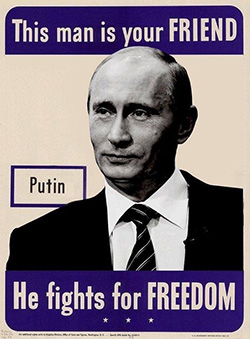
    Having devastated Russia, Yeltsin resigned, begging Russians for forgiveness for the ruin he had brought. The presidency was assumed by Prime Minister Vladimir Putin in December 1999. It was anticipated that Putin would continue to allow Russia to be vampirised, but he took what the globalists have ever since been calling a “wrong direction,” the title of a Council on Foreign Relations position paper “Russia’s wrong direction.” Written in 2006, the CFR paper recommended increased funding for the Freedom Support Act, in this instance referring specifically to the 2007-2008 presidential elections. Authors of the CFR report included Jack Kemp, Republican Party politico; Mark F. Brzezinski, who served on the National Security Council as an advisor on Russian and Eurasian affairs under President Clinton, as his father Zbigniew had served in the Carter Administration; Antonia W. Bouis, founding executive director of the Soros Foundations; James A. Harmon, senior advisor to the Rothschild Group, et al.13
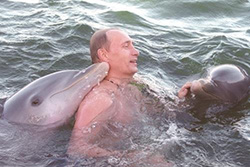
    President Putin relaxing
    President Putin relaxing

    While Putin has been criticised for associating with a coterie of oligarchs of his own, these businessmen have been incorporated into the strengthening of the Russian state, not its undermining for globalist interests. Those who acted otherwise have been purged, and are celebrated as ‘dissidents’ and champions of ‘human rights’ by anti-Russia interests. These include the ‘godfather of oligarchy’ Berezovsky, who was living in exile in England where he was found hung,14 and Mikhail Khodorkovsky (hailed as a hero in the West), onetime owner of Yukos, jailed for ten years, while his oil empire was taken back for Russia. His son Pavel heads the Institute of Modern Russia to continue the work of his father’s Open Russia Foundation to promote “Russia’s integration into the community of democracies,”15 which is to say, Russia’s subordination to international finance.

    In particular, Putin has challenged the notion of “the New American Century” as one prominent think tank optimistically termed the 21st century. Putin has moved to limit the influence of the same subversive networks that undermined the Eastern bloc via ‘velvet revolutions’ by obliging employees of NGOs to register as ‘foreign agents’, and the state started an investigation of these subversives in March 2013. In that year NED provided $8,226,487 to NGOs, programmes and seminars in Russia for the undermining of the state in the name of “human rights.”16 NED receives funding from US Congress. Imagine the outrage of ‘world opinion’ if Russia funded groups to undermine the US government. Added to this are the millions that have poured in to undermine Russia by the George Soros network, USAID, and a host of others. In 2012 Putin expelled USAID, a governmental agency, stating that it was undermining Russia’s sovereignty.
    IMG_1047

    Geopolitically, the globalists aim to encircle Russia. The alliances created by Putin in central Asia and further afield have meant this has not entirely succeeded, with the Shanghai Cooperation Organisation including China, Kazakhstan, Kyrgyzstan, Tajikistan and Uzbekistan; and with India, Iran, Mongolia and Pakistan having observer status. Belarus and Sri Lanka are dialogue partners, and Turkmenistan has guest attendance.

    However, states such as Georgia and the Ukraine are targeted for takeover as important elements in this strategy. NED avidly sponsored young cadres in various sectors of Ukrainian society, including ‘educating’ electorates on how to vote in the October 2012 elections. The 2012 NED financial report lists the NGOs in the Ukraine that received $3,380,834 during that year.17 The amount represents the upper end of funds sent by NED throughout the world.

    Pro-Moscow separatists in eastern Ukraine who would in other circumstances be lauded by the world media and politicians as ‘freedom fighters’, have been characterised as ‘terrorists’. The enemies of Russia have through the most illogical of rhetoric charged the Russian president with being personally responsible for the downing of a Malaysian airliner. The only thing known for sure as this is written is that Russian interests were in no way served by the targeting of the airliner, but it serves as grist for the anti-Russian agenda. Russia in turn is being pushed further from Europe, and into the embrace of China.

    The Russians remain one of the few residues of a tough people still relatively uncorrupted by the moral, cultural and spiritual rot of a West in its epoch of death. With Russia there are still at least possibilities. “The Russian people are the people of the future,” wrote the philosopher Nikolai Berdyaev. “They will decide questions which the people of the West has not yet the strength to decide, which it does not even pose in their full depth.”18 

    Gain a deeper understanding of the conflict between Putin’s Russia and the West. Check out all the articles in New Dawn Special Issue Vol 8 No 5.

    [alert type=”general” dismiss=”no”]This article was published in New Dawn Special Issue Vol 8 No 5.[/alert]

    [alert type=”success” dismiss=”no”]If you appreciate this article, please consider subscribing to help maintain this website.[/alert]

    FOOTNOTES

    1. K. R. Bolton, Revolution from Above, Arktos Media Ltd., 2011, 57-58

    2, K. R. Bolton, Stalin: The Enduring Legacy, Black House Publishing, 2012, 104-106

    3. K. R. Bolton, Revolution from Above, op. cit., 66-97

    4. Ibid., 61-62

    5. K. R. Bolton, Stalin, op. cit., 125-134

    6. Reuters, ABC News, ‘Stars honour Gorbachev at gala birthday bash’, 31 March 2011, www.abc.net.au/news/stories/2011/03/31/3178823.htm

    7. Dr. Svetlana Savranskaya and Thomas Blanton (ed.), ‘Previously Secret Documents from Soviet and U.S. Files n the 1988 Summit in New York, 20 Years Later’, National Security Archive Electronic Briefing Book No. 261, 8 December 2008

    8. M. Gorbachev, ‘What are we going to take to the United Nations?’, Conference with advisors, 31 October 1988, Attended: Shevardnadze, Yakovlev, Dobrynin, Falin, Chernyaev, Archive of the Gorbachev Foundation. Fond 2. Notes of A.S. Chernyaev. On file at the National Security Archive. Translated by Svetlana Savranskaya. www.gwu.edu/~nsarchiv/NSAEBB/NSAEBB261/sov03.pdf

    9. C. Gershman, ‘Giving Solidarity to the world’, Georgetown University, 19 May 2009, www.ned.org/about/board/meet-our-president/archived-remarks-and-presentations/051909

    10. C. Gershman, ‘Giving Solidarity to the world’, Ibid

    11. The Gorbachev Foundation of North America, ‘Mission’, www.gfna.net/staff.php

    12. Daniel Treisman, ‘Blaming Russia First’, Foreign Affairs, Council on Foreign Relations, November/December 2000, www.foreignaffairs.com/articles/56649/daniel-treisman/blaming-russia-first

    13. Jack Kemp, et al, ‘Russia’s Wrong Direction: What the United States Can and Should Do’, Independent Task Force Report no. 57, Council on Foreign Relations, 2006, xi. The entire publication can be downloaded at: www.cfr.org/publication/9997/

    14. Ian Cobain, ‘Boris Berezovsky inquest returns open verdict on death’, The Guardian, 27 March 2014, www.theguardian.com/world/2014/mar/27/boris-berezovsky-inquest-open-verdict-death

    15. ‘Russia : A Postmodern Dictatorship?’, NED forum, 2013, www.ned.org/events/russia-a-postmodern-dictatorship

    16. ‘Russia’, 2013 NED Annual Report, www.ned.org/where-we-work/eurasia/russia

    17. National Endowment for Democracy, NED 2012 Annual report, www.ned.org/where-we-work/eurasia/ukraine

    18. Nikolai Berdyaev, The Russian Idea, Macmillan, 1948, 70

    © New Dawn Magazine and the respective author.
    For our reproduction notice, click here.
  • V. V. Putin & Eastern Wisdom

    V. V. Putin & Eastern Wisdom

    From New Dawn Special Issue Vol 7 No 6 (Dec 2013)

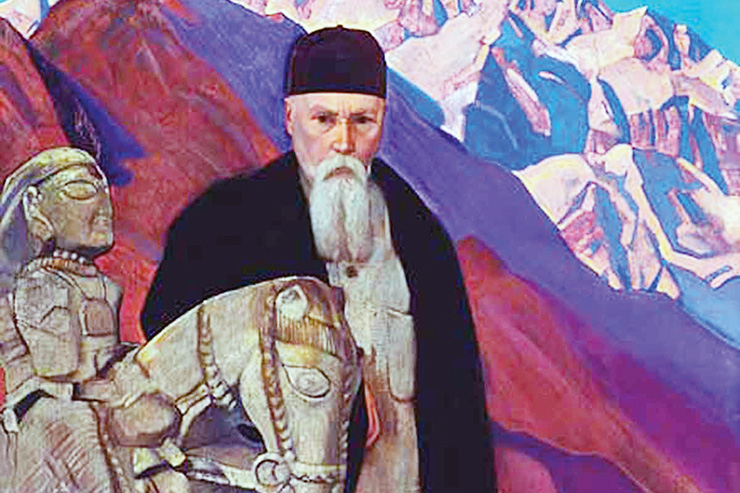
    Back in October 2000, the newly elected President of the Russian Federation, Vladimir V. Putin, granted a revealing interview to the editors of India Today and The Russian Journal. President Putin paid special tribute to Nicholas Roerich, the Russian artist, explorer and mystic, stating:

    “Roerich’s life was an amazing life, a marvel of creativity and astonishing example of spiritual closeness that, perhaps doesn’t lie on the surface, but is nevertheless the spiritual closeness that binds all peoples.”

    In December 2002, President Putin’s wife Lyudmila opened an exhibition of Nicholas Roerich’s work at the National Museum of India in Delhi.

    Nicholas Roerich (1874-1947) is remembered today as a celebrated Russian painter and occultist, whose intrepid journeys through Central Asia captured the attention of the Western public in the 1920s and 1930s. But Nicholas Roerich was also a master of ‘spiritual geopolitics’ who sought to establish a pan-Buddhist, transnational ‘New Country’ stretching from Tibet to southern Siberia, including territory that was governed by China, Mongolia, Tibet, and the Soviet Union. This ‘New Country’ was conceived by Roerich as the manifest, earthly expression of the invisible Kingdom of Shambhala, “the Holy Place, where the earthly world links with the highest states of consciousness.”1 This Shambhala Project was to establish the Sacred Union of the East.

    The American scholar John McCannon, who is writing a biography of Roerich, points out that in today’s Russia Roerich’s ideas are discussed at the highest echelons:

    Roerich’s name has appeared with surprising frequency in civic and academic discussion of international relations and new directions in foreign policy. Mainly, he has been cited by political scientists and strategic thinkers in Russia looking for models of ‘multipolarity’ and ‘global pluralism’ to counter U.S. hegemony and seemingly triumphalist or confrontational political theories from the West…2

    Since the earliest days of his first presidency, Vladimir Putin has worked tirelessly to lay the foundations of a Eurasian alliance. Just weeks after paying tribute to Nicholas Roerich, Putin told an international forum that “Russia has always perceived of itself as a Eurasian country.” Then in 2001, Russia and China, along with the states of Central Asia, founded the Eurasian political, economic and military organisation known today as the Shanghai Cooperation Organisation. Mongolia, Pakistan, Iran and India, have all expressed interest in joining the group.

    In the lead up to his election for a third term as Russian president, Putin set out his grand Eurasian vision in a series of widely published articles.

    Nicholas Roerich was introduced to the Buddhist legend of Shambhala while working on the first Buddhist temple ever constructed in Europe, in St. Petersburg the imperial capital of the vast Russian Empire. The Russian Tsar Nicholas II, although a devout Orthodox Christian and head of the Russian Church, had a deep interest in mysticism and Eastern wisdom. On several occasions the Tsar received the Buddhist monk Dorzhiev, assuring him that, “Buddhists in Russia may feel as if under the wing of a mighty eagle.” Construction of the St Petersburg Buddhist temple commenced in 1913 to coincide with the 300th anniversary of the Romanov dynasty. That same year Lama Dorzhiev, a friend of Nicholas Roerich and George Gurdjieff, wrote that Russia was about to fulfil the old Buddhist messianic myth of Shambhala by founding a great Buddhist empire in the East.

    One hundred years later in 2013, President Putin, himself a native of St. Petersburg, promised “100-percent support” for Russia’s Buddhists. Speaking during a visit to Russia’s Buryatia republic, Putin said he was proud that Russia is the only country in Europe where Buddhism is officially recognised as a traditional religion. The Russian President emphasised that “Buddhism plays a significant role in Russia… It has always been that way. It is well known that the Buddhists helped during both world wars.” Putin described Buddhism as a “kind, humanist learning based on love for others and love for one’s country,” and said he, the federal government and regional authorities were “always at [the Buddhists’] disposal and ready to support them.”3

    Like Tsar Nicholas II, President Vladimir Putin is known to be a devout Russian Orthodox believer with a strong interest in Eastern wisdom. A master of both sambo and judo, Putin has often spoken of how the martial arts – imbued with Asian philosophy – are intended to train the body and the mind. Though an Orthodox Christian, he is conscious of the spiritual authenticity of other traditional religions. And like Nicholas Roerich, who was born Orthodox Christian but later became steeped in Buddhism, Vladimir Putin may well sympathise with the view that the highest forms of all the world’s religions point to the same ultimate reality.

    For more about Russian President Putin, check out New Dawn Special Issue Vol 8 No 5. 

    [alert type=”general” dismiss=”no”]This article was published in New Dawn Special Issue Vol 7 No 6.[/alert]

    [alert type=”success” dismiss=”no”]If you appreciate this article, please consider subscribing to help maintain this website.[/alert]

    Footnotes

    1. See ‘From Synarchy to Shambhala, The Role of Political Occultism and Social Messianism in the Activities of Nicholas Roerich’ by Markus Osterrieder, www.scribd.com/doc/119329670/From-Synarchy-to-Shambhala

    2. ‘By the shores of white waters: the Altai and its place in the spiritual geopolitics of Nicholas Roerich’ by John McCannon, www.roerichmongolia.org/files/sibirica%20full%20text%20article.pdf

    3. ‘Putin Promises 100% Support for Buddhists’, RIA Novosti, 11 April 2013, http://en.ria.ru/russia/20130411/180578136.html

    © New Dawn Magazine and the respective author.
    For our reproduction notice, click here.
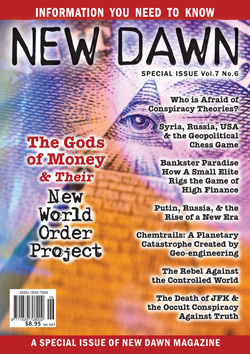
  • Putin, Russia, & the Rise of a New Era

    Putin, Russia, & the Rise of a New Era

    From New Dawn Special Issue Vol 7 No 6 (Dec 2013)

    The Asia-Pacific region has become the focus for the USA, China and Russia. Australia and New Zealand have sought to create an alignment with both the USA and China, while recently there have been trade overtures between Russia and New Zealand. Antipodeans might find themselves caught between super-power rivalries while our political and business elite cannot see beyond trade and economic relations, which are always secondary forces in the playing out of history.

    Perceptive Australians and New Zealanders are fortunate they have New Dawn magazine, a medium that looks at history with breadth and depth. Hence, New Dawn has long viewed Russia as the place where great historical forces will unfold.

    Despite the misgivings of some Russian patriots, Vladimir Putin has emerged as a new Russian strong-man. New Dawn saw the possibilities for Russia under Putin at the earliest days of his political ascent. For one New Dawn commentator, the rise of Putin had mystical implications that could impact on the world in an epochal way: Putin’s inauguration as Prime Minister on 9 August 1999 occurred during the week of the solar eclipse and the planetary alignment of the Grand Cross, “a highly auspicious astrological event… traditionally held to be the end of an epoch.”1

    Multipolar vs. Unipolar World

    In 2001 a story in New Dawn entitled ‘Russia vs. the New World Order’ reported Venezuelan President Hugo Chavez predicting the 21st century would give rise to a multipolar world. What some important elements in US governing circles call the “new American century”2 would be nothing of the kind, despite their increasingly aggressive efforts. Chavez, a leader of rare statesmanship, believed this would be a century of power blocs.3 Vladimir Putin’s Russia has pursued the building of a ‘multipolar’ world.

    Multipolarity is a doctrine that permeates much of the academic and ruling elite of Russia. Its most well-known proponent is Dr. Alexander Dugin, who heads the Centre for Conservative Studies, Sociology Department, at Moscow State University.4 What Chavez was referring to as unified continental power blocs, Dugin refers to as “vectors.”5

    As for Dugin’s influence in Russia, two antagonistic academics lament of him: “The growing interest among political scientists and other observers in Dugin and his activities is the result of his recent evolution from a little-known marginal radical right-winger to a notable and seemingly influential figure within Russia’s mainstream.”6

    Dugin calls his geopolitical concept “Eurasianism,” writing of this:

    In the broad sense the Eurasian Idea and even the Eurasian concept do not strictly correspond to the geopolitical boundaries of the Eurasian continent. The Eurasian Idea is a global-scale strategy that acknowledges the objectivity of globalisation and the termination of nation-states, but at the same time offers a different scenario of globalisation, which entails no unipolar world or united global government. Instead it offers several global zones (poles). The Eurasian Idea is an alternative or multipolar version of globalisation, but globalisation is the currently fundamental world process that is deciding the main vector of modern history.7

    Hence, Dugin agrees that the days of petty states are numbered and were a manifestation of a phase of history. Dugin postulates therefore something beyond petty-statism, imperialism or globalism, power blocs based on organic geopolitical realties, although details should remain open to question. Such geopolitical thinking is very much to the fore in Russia, among the highest echelons of academia and politics.

    Vladimir V. Putin

    One of the numerous globalist NGOs directed at Russia, The Jamestown Foundation,8 offered several opinions in regard to the direction of Russia with Putin’s re-election in 2012. A major concern is whether Putin’s anti-American expressions during the elections were based on electoral rhetoric in drumming up Russians against an external enemy, or a genuinely held perception of the USA as intrinsically inimical to Russia. Certainly Putin would be naïve if he regards the USA as anything other than being committed to the subordination of Russia to economic predation and cultural decay. The USA has been the home-base for the destruction of Russia as a world power since Stalin’s rejection of the USA’s vision of the post-war world in 1945,9 inaugurating the ‘Cold War’.

    Citing a report from Chatham House by James Nixey, entitled “Russia’s Geopolitical Compass,” Nixey points to four “geostrategic axes for Russia: the West, Russia’s many ‘souths’ – the Black Sea region and the Islamic world – Russia’s Far East and the Arctic North.” Nixey states that Russia no longer views the “West”10 as all-powerful, and that Obama’s post-Bush so-called “Reset” policy for rapprochement with Russia is “losing direction.” What is particularly interesting is that Nixey agrees with Sinologist Bobo Lo, Senior Research Fellow at the Centre for European Reform in London, who states “that Russia’s relations with China are nothing more than an ‘alliance of convenience’ by which Russia seeks to leverage influence with the West to gain acceptance. In this context, China is only a ‘geopolitical counterweight to the West’.”11

    There are those both on the ‘fringes’ of politics and in influential positions who see Russia as an ally rather than as a threat to Europe, a united Europe. France having more than the usual number of geopolitical realists, has a strong Russophile element that looks to Russia, including during its Soviet days, as a counterweight to US hegemony contrary to the propaganda of the Soviet bogeyman poised to ravish the Occident. It reminds one of President Charles de Gaulle’s call for a united Europe “from the Atlantic to the Urals.” The Jamestown Foundation’s article cites a view offered by Marc Rousset, a French historian and political analyst and author of La nouvelle Europe: Paris-Berlin-Moscou [The New Europe: Paris-Berlin-Moscow] (2009):

    According to Rousset, Putin would bring “bravery, foresight and pragmatism” to Russian policy in the interest of creating a geopolitical order from the Atlantic to Vladivostok. Rousset emphasised that Putin is a European from St. Petersburg working toward closer ties among Russia, Ukraine and Belarus. His conception of a Eurasian union had the possibility of creating an imperial order to rival that of the American empire and the emerging new orders in China and India12 (Rossiiskaia Gazeta, 6 March). Rousset was quoted in November of last year as seeing the emergence of an axis of Paris, Berlin and Moscow being the answer to the present crisis in the Eurozone and the means to restore Europe’s position as a major player in the international system (Rossiiskaia Gazeta, 17 November 2011). Sergei Karganov answered that line of thought in December of last year by calling on Russia to turn away from Europe and make its future with a dynamic Asia-Pacific region led by China (Rossiiskaia Gazeta, 18 December 2011).13

    Rousset’s ideal is in my opinion the preferred. While Sergei Karganov14 is in accord with the Dugin conception of “Eurasianism” vis-à-vis Russia’s place with China in Asia, Dugin also sees Russia in alliance with united Europe, and her historical relationship with “Hindustan.”15

    Dugin’s Analysis

    Indicating the seriousness with which Alexander Dugin is taken by Russia’s friends and enemies alike, Jacob W. Kipp of the Jamestown Foundation comments on Dugin’s reaction to the re-election of Putin:

    In the aftermath of Putin’s election, Aleksandr Dugin, the chief ideologue of anti-Western Eurasianism, stated that Putin stood at a moment of strategic choice: embrace the liberalism and Westernism of Russia’s bourgeois elite or the nationalism of the Russian common folk – historically the victims of the corruption of Russia’s liberal elite, which champions Russia’s subservience to the West. Dugin wrote that by promoting a Eurasian Union, Putin had already spoken the word that defined his choice. This was the path to national revival and to an economy based upon the reconstruction of Russia’s defence sector. Dugin states: “Both sides want reforms from Putin but they desire direct opposites. The elites want democratisation, modernisation, liberalisation and growing closer to the West. The people want the national idea, a firm hand, a strengthening of sovereignty, a great power state, paternalism and social justice.” This choice for Putin comes at a particularly critical moment, according to Dugin. The hegemony of the US and its allies is being tested in an emerging multipolar world. The immediate challengers are Syria and Iran. But once those two states have been defeated by military intervention, Russia itself will have to face the threat of such intervention. “…after the prepared attacks on Syria and Iran, the logical next target will be Russia. Of course, Russia will not survive such a confrontation with the West alone.”16

    However, China remains the thorny question among those who seek a revived Russia, with Dugin and his movement seeing China as a crucial ally,17 while others see China as a future rival.18

    US actions against Putin’s Russia remain as determined as those against the USSR during the Cold War. Dr. Paul Craig Roberts, US Assistant Secretary of the Treasury under the Reagan Administration, has written of the subversion of Russia:

    The Russian government has finally caught on that its political opposition is being financed by the US taxpayer-funded National Endowment for Democracy and other CIA/State Department fronts in an attempt to subvert the Russian government and install an American puppet state in the geographically largest country on earth, the one country with a nuclear arsenal sufficient to deter Washington’s aggression.19

    Roberts was referring to an Act passed by the Russian Duma (parliament) requiring the registration of NGOs receiving foreign funds, similar to the requirements of US laws that have long been in place. Roberts continued:

    The Washington-funded Russian political opposition masquerades behind “human rights” and says it works to “open Russia.” What the disloyal and treasonous Washington-funded Russian “political opposition” means by “open Russia” is to open Russia for brainwashing by Western propaganda, to open Russia to economic plunder by the West, and to open Russia to having its domestic and foreign policies determined by Washington.20

    Globalists are aiming to deconstruct Russia as they did the USSR. Fortunately, Putin is no Gorbachev. His ambition seems to be that of leading a strong Russia, as distinct from Mikhail Gorbachev’s ambition to become a globalist celebrity posturing on the world stage. When on his 80th birthday in 2011 Hollywood stars hosted a ‘gala celebration’ at the Royal Albert Hall, London, ABC News commented that the “movie stars, singers and politicians” who turned out for the show, “underlined the celebrity status Mr Gorbachev enjoys in the West, where he is widely perceived as the man who freed Eastern Europe from Soviet rule and ended the Cold War.”21 On the occasion of his birthday Gorbachev delivered what might be construed as an ultimatum to Putin on behalf of the globalist elite, “advising” him “against running for a third term as president and warning about the dangers of Arab-style social revolt.”22 As is now clear, those “Arab social revolts,” like the “colour revolutions” in the former Soviet states, were stage-managed by the globalist NGOs.

    The globalist think tanks are blatant in their intentions. The Council on Foreign Relations (CFR) opines that “Russia is heading in the wrong direction.”23 One of the CFR recommendations is to interfere with the Russian political process, urging US Congress to fund opposition movements by increased funding for the Freedom Support Act, in this instance referring specifically to the 2007-2008 presidential elections.24 Authors of the CFR report include Mark F Brzezinski, who served on the National Security Council as an adviser on Russian and Eurasian affairs under Clinton, as his father Zbigniew served in the Carter Administration; Antonia W Bouis, founding executive director of the Soros Foundations; James A Harmon, senior advisor to the Rothschild Group, et al.

    US ruling circles have a messianic mission to create a world revolution, and it is no surprise that the ideological foundations of the US ‘world revolution’ were developed by Russophobic Trotskyites during the Cold War.25 The task of publicly announcing the post-Soviet world revolution was allotted to President George W. Bush. Speaking before the National Endowment for Democracy in 2003, Bush stated that the war on Iraq was a continuation of a “world democratic revolution” that started in the Soviet bloc: “The revolution under former president Ronald Reagan freed the people of Soviet-dominated Europe, he declared, and is destined now to liberate the Middle East as well.”26

    Russia and the New World Order

    Putin has embraced “Eurasianism” as the alternative to a “new world order” based around US hegemony. In a major foreign policy article in 2012, Putin outlined the main premises. He stated that Russian would be guided by her own interests first, based on Russia’s strength, and would not be dictated to by outsiders. While Putin uses the term “new world order,” it is one that is antithetical to the globalist version. He questions the US missiles being placed on Russia’s borders, and the continuing belligerence of NATO, stating that, “The Americans have become obsessed with the idea of becoming absolutely invulnerable.”27 Importantly, Putin is fully aware that globalist agendas are being imposed behind the facade of “human rights,” and criticises the selectivity by which this morality is applied:

    The recent series of armed conflicts started under the pretext of humanitarian aims is undermining the time-honoured principle of state sovereignty, creating a moral and legal void in the practice of international relations.28

    Putin refers to the “Arab Spring,” noting outside interference in a “domestic conflict.” “The revolting slaughter of Muammar Gaddafi… was primeval,” Putin states, and the Libyan scenario should not be permitted in Syria. He adds of the “regime changes,”

    It appears that with the Arab Spring countries, as with Iraq, Russian companies are losing their decades-long positions in local commercial markets and are being deprived of large commercial contracts. The niches thus vacated are being filled by the economic operatives of the states that had a hand in the change of the ruling regime. One could reasonably conclude that tragic events have been encouraged to a certain extent by someone’s interest in a re-division of the commercial market rather than a concern for human rights.29

    Putin sees Russia developing her historic relations with the Arab states, despite the “regime changes.” He also points out the political uses that are being made of social media which played such a significant role in mobilising and agitating masses during the “Arab Spring,” and indeed in the “colour revolutions” on Russia’s doorstep.30 Putin also acknowledges the subversive role of the NGOs not least of whose actions are being directed against Russia, stating, “…the activities of ‘pseudo-NGOs’ and other agencies that try to destabilise other countries with outside support are unacceptable.” He remarks on the failure of US and NATO intervention in Afghanistan and mentions Russia’s historic relationship with that country.31

    While Russia is seen as having an important role in the Asia-Pacific region, and Putin puts stress on alignment with a strong China, he also declares:

    Russia is an inalienable and organic part of Greater Europe and European civilisation. Our citizens think of themselves as Europeans. We are by no means indifferent to developments in united Europe. That is why Russia proposes moving toward the creation of a common economic and human space from the Atlantic to the Pacific Ocean – a community referred by Russian experts to as ‘the Union of Europe’, which will strengthen Russia’s potential and position in its economic pivot toward the ‘new Asia’.32

    Putin refers to an exciting new vision of a bloc expanding from “Lisbon to Vladivostok.” He sees Russia’s acceptance to membership of the World Trade Organisation as “symbolic,” while having defended Russian’s interests. With Russia looking at the Asia-Pacific region, will she be a nexus between this region and Europe, or will she enter the region as a junior partner with China? Some geopolitical analysts are referring to a new geopolitical bloc, challenging both the USA and China, as Eurosiberia33 rather than Eurasia.

    In an act of statesmanship, Putin pre-empted President Obama’s determination to bomb Syria by suggesting Syria place its chemical weapons stockpiles for disposal with the United Nations – a plan Syria accepted.

    Putin sees the offensive against Syria in world historical terms in determining what type of world is being moulded. While Russian ships face US and some French and British ships, he has rebuked Obama’s statements – like those of US presidents before him – that the USA has “an exceptional role.” In his appeal to the American people published in the New York Times, Putin questions the USA’s strategy stating that, “It is alarming that military intervention in internal conflicts in foreign countries has become commonplace for the United States.” Condemning the basis of the “new world order” that is being imposed with US weaponry, Putin writes that having studied Obama’s recent address:

    …I would rather disagree with a case he made on American exceptionalism, stating that the United States’ policy is ‘what makes America different. It’s what makes us exceptional’. It is extremely dangerous to encourage people to see themselves as exceptional, whatever the motivation. There are big countries and small countries, rich and poor, those with long democratic traditions and those still finding their way to democracy. Their policies differ, too. We are all different, but when we ask for the Lord’s blessings, we must not forget that God created us equal.34

    Gain a deeper understanding of the conflict between Putin’s Russia and the West. Check out New Dawn Special Issue Vol 8 No 5, with an article by KR Bolton entitled “The Great Conspiracy Against Russia: What is Really Behind the Campaign Against Putin”. 

    [alert type=”general” dismiss=”no”]This article was published in New Dawn Special Issue Vol 7 No 6.[/alert]

    [alert type=”success” dismiss=”no”]If you appreciate this article, please consider subscribing to help maintain this website.[/alert]

    Footnotes

    1. Viacheslav N Lutsenko, ‘Who are you Mr Putin?’, New Dawn, September-October 2001, 86.

    2. For example, as in the name of the neocon globalist think-tank, ‘Project for a New American Century’, www.newamericancentury.org

    3. Susan Bryce, ‘Russia vs. the New World Order’, New Dawn, January-February 2001, 25.

    4. www.konservatizm.org

    5. K R Bolton, ‘An ANZAC-Indo-Russian Alliance? Geopolitical Alternatives for New Zealand and Australian’, India Quarterly, Vol. 66, No. 2 (2010), 183-201. Also: K R Bolton, Geopolitics of the Indo-Pacific: Emerging Conflicts, New Alliances (London: Black House Publishing, 2013). I do not see why Australia (and presumably New Zealand) should come under a ‘vector’ that is focused either on the USA or China, and believe that Dugin is being overly generous towards those two hegemonistic powers.

    6. Anton Shekhovtsov, and Andreas Umland, ‘Is Aleksandr Dugin a Traditionalist? ‘Neo-Eurasianism’ and Perennial Philosophy’, The Russian Review, October, 2009, 662–78.

    7. A Dugin, The Eurasian Idea, 2009.

    8. The Jamestown Foundation, ‘Mission’, www.jamestown.org/aboutus/

    9. K R Bolton, ‘Origins of the Cold War: How Stalin Foiled a New World Order’, 31 May 2010, www.foreignpolicyjournal.com/2010/05/31/origins-of-the-cold-war-how-stalin-foild-a-new-world-order Also see: K R Bolton, Stalin: the Enduring Legacy (London: Black House Publishing, 2012), 125-139.

    10. ‘The West’ is a misnomer, more accurately termed the ‘post-West’ under plutocratic control, as any notion of Western Culture has long since been smothered by Mammon.

    11. Jacob W Kipp, ‘The Elections are over and Putin won: whither Russia?’, 30 March 2012, www.jamestown.org/programs/edm/single/?tx_ttnews[tt_news]=39215&cHash=5bc45dc36c8f713aa6f5e393e5eae5b4

    12. There need be no rivalry between Russia and India, but rather the continuation of the historical alignment between them.

    13. Jacob W Kipp. op. cit.

    14. Interestingly, Sergei Karganov, founder of think tank Council for Foreign and Defense Policy, has been a member of the Rockefeller-founded globalist think tank The Trilateral Commission since 1998, and a member of the International Advisory Board of the Council on Foreign Relations, 1995-2005; http://karaganov.ru/en/pages/biography

    15. K R Bolton, ‘An ANZAC-Indo-Russian Alliance’, op. cit.

    16. Jacob W Kipp, op. cit.

    17. Aleksandr Dugin, Argumenty i Fakty, March 14, 2012, cited by Kipp. Ibid.

    18. See: K R Bolton, ‘Russia and China: an approaching conflict?’, op. cit.

    19. Paul Craig Roberts, ‘War on all fronts’, Foreign Policy Journal, 19 July 2012, www.foreignpolicyjournal.com/2012/07/19/war-on-all-fronts/

    20. Ibid.

    21. Reuters, ABC News, ‘Stars honour Gorbachev at gala birthday bash’, 31 March 2011, www.abc.net.au/news/stories/2011/03/31/3178823.htm).

    22. H Klaiman, “Peres attends Gorbachev’s birthday bash in London,” 31 March 2011, www.ynetnews.com/articles/0,7340,L-4050192,00.html

    23. Jack Kemp, et al, Russia’s Wrong Direction: What the United States Can and Should Do, Independent Task Force Report no. 57 (New York: Council on Foreign Relations, 2006) xi. The publication can be downloaded at www.cfr.org/publication/9997/

    24. Ibid.

    25. K R Bolton, ‘America’s “World Revolution”: Neo-Trotskyist Foundations of US foreign policy’, Foreign Policy Journal, 3 May 2010, www.foreignpolicyjournal.com/2010/05/03/americas-world-revolution-neo-trotskyist-foundations-of-u-s-foreign-policy/

    26. Fred Barbash, ‘Bush: Iraq Part of “Global Democratic Revolution”: Liberation of Middle East Portrayed as Continuation of Reagan’s Policies’, Washington Post, 6 November 2003.

    27. Vladimir Putin, ‘Russia and the changing world’, RiaNovosti, 27 February 2012, http://en.rian.ru/world/20120227/171547818.html

    28. Ibid.

    29. Ibid.

    30. K R Bolton, ‘Twitters of the World Revolution: The Digital New-New Left’, Foreign Policy Journal, 28 February 2011, www.foreignpolicyjournal.com/2011/02/28/twitterers-of-the-world-revolution-the-digital-new-new-left/ Also: K R Bolton, Revolution from Above, op. cit., 235-240.

    31. V Putin, op. cit.

    32. Ibid.

    33. Guillaume Faye, ‘The New Concept of “Eurosiberia”’, Counter-Currents Publishing, www.counter-currents.com/2010/08/faye-on-eurosiberia/

    34. Vladimir V Putin, ‘A Plea for Caution from Russia’, New York Times, 11 September 2013, www.nytimes.com/2013/09/12/opinion/putin-plea-for-caution-from-russia-on-syria.html?_r=0

    © New Dawn Magazine and the respective author.
    For our reproduction notice, click here.
  • For Nobody’s Eyes Only: The Truth About Missing Govt. Files & the Most Enduring Conspiracy Theories

    For Nobody’s Eyes Only: The Truth About Missing Govt. Files & the Most Enduring Conspiracy Theories

    From New Dawn 141 (Nov-Dec 2013)

    Government agencies have, under duress, declassified millions of pages of documents in recent years. But we also know more unreleased files are suspiciously “missing” or inaccessible, as are mountains of Top- Secret papers that various agencies admit do exist but are kept hidden from public view.

    Government secrecy over famous cases like Roswell, JFK, the CIA’s MKUltra, and the death of Princess Diana, add weight to ‘conspiracy’ theories. In fact, many of us suspect the official version of events is a lie, a smokescreen hiding some terrible truth that threatens the carefully constructed narrative of the powers-that-be.

    To help get to the bottom of all this, we spoke to one of the world’s most sought -after speakers and media spokespersons on the subject of government conspiracies, hidden files and classified information.

    Nick Redfern is a full time journalist, researcher and author of numerous books about unsolved mysteries and government conspiracies. In the following interview he discusses some of the fascinating material covered in his recent book For Nobody’s Eyes Only: Missing Government Files and Hidden Archives That Document the Truth Behind the Most Enduring Conspiracy Theories.

    NEW DAWN (ND): What is the Freedom of Information Act? How does it operate in the US and UK?

    NICK REDFERN (NR): It was on Independence Day, 1966 that US President Lyndon B. Johnson signed a historic piece of documentation that brought into being the Freedom of Information Act (FOIA). The FOIA permits members of the general public and the media the right to file a request with government agencies to (a) obtain copies of files that may already be declassified; or (b) request that files which are currently withheld either in whole or in part be declassified into the public arena. The FOIA is not a tool that is guaranteed to open all doors, however.

    There are many clauses within the Act that permit government, military, and intelligence-based bodies to withhold their files, if they deem it appropriate to do so. The grounds for denial of access to files via the FOIA include national security concerns, matters having a bearing on the defence of the nation, privacy issues, data relative to legal and criminal subjects, and the internal operations of the relevant agency or agencies.

    In the same precise way that official documentation in the United States is subject to varying levels of secrecy, such is the situation in the UK, too. At the turn of the 21st century the Labor Government of the day passed the Freedom of Information Act 2000, which followed broadly similar guidelines to those present in the United States’ FOIA.

    A glance at the rest of the world shows that many developed nations have followed in the tracks of both the US and the UK. Freedom of Information laws apply in numerous nations, including Australia, Brazil, Canada, Denmark, France, Mexico, Norway, Sweden and Turkey.

    Like Britain and the United States, all of the above countries have laws that permit agencies to keep files under lock and key as they pretty much see fit, providing that justification is seen as being firmly warranted.

    ND: What are Special Access Programs and how do they help secrets to be kept?

    NR: Contrary to what is often assumed or claimed by alleged whistleblowers of distinctly dubious credibility, there are absolutely no levels of secrecy that extend beyond Top Secret. Not a single one. That does not mean, however, that having a Top Secret clearance provides a person with carte blanche access to every secret, every conspiracy, and every cover-up under the face of the sun. In fact, quite the opposite is the general rule of thumb.

    Here we come to something termed “need to know.” Person “A” might have the same level of clearance, let’s say Top Secret as person “B.” But, here’s the important thing: to protect the security and secrecy of the project on which “A” is working, he or she is given a classified piece of data that acts as a key to open the door to that same project. That key might be in the form of a piece of documentation, such as a sternly-worded, non-disclosure agreement.

    Alternately, it might be a classified code word that, without which, access to the program would be denied at all times. So, we have a situation where “A” and “B” possess the exact same clearance level of Top Secret, but only “A” knows what is afoot in the classified world of “Project X.” Such Project X-type operations are termed SAPs: Special Access Programs.

    In the United States, where SAPs are far more prevalent than anywhere else, they primarily relate to (a) the “research, development, testing, modification and evaluation or procurement” of new and sophisticated technologies; (b) the “planning and execution of especially sensitive intelligence” operations; and (c) the “execution and support” of classified military programs. It is within the arena of SAPs that some of the most guarded of all secrets remain deeply buried.

    ND: Will you tell us the story of the missing files on the Roswell UFO crash of 1947?

    NR: In early 1993, United States Congressman Steven Schiff began probing into the many complexities of the Roswell affair. His first port of call, as he sought out the files on the controversial saga, was the Department of Defense (DoD). In a March 11, 1993 letter to Secretary of Defense, Les Aspin, Schiff explained that during the previous fall he “became aware of a strange series of events beginning in New Mexico over 45 years ago and involving personnel of what was then the Army Air Force.”

    It was specifically on the matter of this “strange series of events” that Schiff wanted definitive answers. And he wanted them soon. Thus began an inquiry that ultimately led to major, official revelations concerning missing and unaccounted for, files on the Roswell controversy. During the course of their search for records to try and understand what had really taken place in New Mexico in early July 1947, the Government Accountability Office (GAO) learned that a massive amount of official documentation generated from within the confines of the Roswell Army Air Force, between March 1945 and December 1949, had vanished.

    Moreover, that same documentation had disappeared under very questionable circumstances. When GAO investigators asked for an explanation, they were told by the Chief Archivist for the National Personnel Records Center that its staff had been unable to ascertain how, why, and under whose jurisdiction, the files had vanished.

    ND: What is the truth about the vanished files on England’s famous alien landing at Rendlesham Forest in 1980?

    NR: Between the nights of 26 and 29 December 1980, multiple, extraordinary UFO events occurred within Rendlesham Forest, Suffolk, England that involved military personnel from the nearby Royal Air Force stations of Bentwaters and Woodbridge. Since that now long gone period, countless US Air Force personnel, who were stationed in the area at the time, have spoken out regarding their knowledge of a small, triangular-shaped object that was seen manoeuvring in the forest.

    Others described seeing in the dark woods almost ghostly, extraterrestrial-type beings of short size and with eerie, feline-like eyes. Strange and unknown lights were seen dancing around the night skies, circling both the forest and the twin military facilities. There were stories that the amazing movements of the UFOs were caught on radar. And there was even hushed talk of those military personnel involved in the incident being silenced by ominous Men in Black-style characters.

    In May 2011, as the UK’s Freedom of Information Act revealed, 11 years earlier the British Ministry of Defense received a request, from a member of the public, for copies of its own records on the Rendlesham Forest incident. In dealing with the request, government officials discovered what they termed a “huge” gaping hole where there should have been stacks of papers of a specifically defence-intelligence nature.

    The hunt was soon on to find out where those papers had gone. It was a quest that led one official to speculate that perhaps someone with access to the Rendlesham files had “taken them home.” A far more intriguing document notes that the disappearance of certain files on Rendlesham, the specific contents of which remain unknown to this very day, might be interpreted to mean that “a deliberate attempt had been made to eradicate the records covering this incident.”

    ND: Do you have any stories in the book about missing official files in Australia?

    NR: Yes, I do. In one of those surreal situations where truth really is stranger than the strangest of all fictions, in early June 2011, the Australian Department of Defence revealed to the world that it had “lost” its collection of UFO files. The revelation surfaced in the immediate wake of a two-month-long quest to find the records. The search itself had been prompted by a Freedom of Information Act request, submitted by the Sydney Morning Herald newspaper, for Australia’s UFO papers to be declassified.

    Only when senior military intelligence staff went looking to decide what could, and what could not, be declassified did they find that it didn’t really matter after all, since there was nothing to declassify. At least, that is, aside from one solitary file titled, Report on UFOs/Strange Occurrences and Phenomena in Woomera.

    Staff at Australia’s Freedom of Information office said that searches were undertaken at a variety of official establishments, including the Headquarters Air Command RAAF Base Glenbrook; the Canberra-based National Archives and the Defence Record Management System. It was all to no avail: “…the files could not be located and Headquarters Air Command formally advised that this file is deemed lost.” [Source: ‘Alien abduction? Defence’s X-Files are lost in space’ by Linton Besser, Sydney Morning Herald, 7 June 2011]

    Since, officially, at least, the Australian Government had been out of the UFO game since 1996, it was seen as nothing but normal administrative procedure to destroy the files, the FOI office added. Curiously, however, it wasn’t just the files that were missing: the surrounding documentation that gave the order for the files to be destroyed was gone, too.

    ND: How many documents on the JFK assassination of 1963 remain classified?

    NR: The problem with the JFK case is not so much what remains classified, but what was shredded and destroyed decades ago and which, if it had survived, might have shed further light on the matter. As one perfect example, when, in the 1970s, the House Select Committee on Assassinations (HSCA) was busily trying to determine who shot and killed JFK, it discovered that nothing less than Lee Harvey Oswald’s Army Intelligence file had been destroyed.

    Suspecting there was far more than just mere bureaucracy at the heart of the destruction of the Oswald records, the HSCA demanded that the Department of Defense provide it with a full explanation of the circumstances that led to the irreversible loss of the Oswald file. The DoD replied that while the file was noted for shredding on 1 March 1973, it was “not possible” to ascertain, precisely, the date on which the “physical destruction was accomplished.” The DoD assured the HSCA that the destruction had been a purely routine matter, and not in any way suspicious.

    There was, however, a lot that could not be ascertained: “It is not possible to determine who accomplished the actual physical destruction of the dossier,” said the DoD, adding: “The individual ordering the destruction or deletion cannot be determined.” And, perhaps, most significant of all, on the matter of the actual contents of the file, the DoD told the HSCA: “The exact material contained in the dossier cannot be determined.”

    In light of the above, it’s worth noting the HSCA’s conclusions on this particular matter: “The committee found this ‘routine’ destruction of the Oswald file extremely troublesome, especially when viewed in light of the Department of Defense’s failure to make this file available to the Warren Commission.”

    ND: Is the British Government withholding files concerning its secret surveillance of the late Diana, Princess of Wales?

    NR: In the final weeks of 1998, the US National Security Agency (NSA) confirmed that it possessed more than 1,000 pages of classified documents on Princess Diana. That statement prompted a lot of debate about what, precisely, those NSA files contained. The NSA chose not to provide much by way of an answer. That didn’t stop Britain’s popular, mainstream newspapers from having their say, however.

    The Daily Mirror suggested the material was being withheld because its release would confirm Diana’s secret affairs during her marriage to Prince Charles. The Daily Record offered the theory that the files, if declassified, might show the full and shocking extent to which the NSA had spied on Diana, possibly right up until the time of her death in 1997.

    The Washington Post took a less sensational view of the matter. It opined that the truth of the NSA’s surveillance was most likely far less lurid than suggested by the British press. The Post added some useful data, which outlined at least some of the facts relative to what was being withheld from public view. As the newspaper noted, although the NSA refused to release its files on Diana, it did confirm that one such file amounted to 1,056 pages, and that 39 additional files, totalling 124 pages, also existed. Those particular records, the NSA was at least willing to admit, were deemed non-releasable for national security reasons relative to how the agency undertakes its surveillance operations.

    The National Security Agency is not the only US Government agency that has admitted to possessing files relative to Princess Diana that it flatly refuses to declassify. The CIA has an undisclosed number of records on file, which might, therefore, mean ten or ten thousand, we just don’t know. The Defense Intelligence Agency confirms it has what it describes as “product” on Diana.

    Rather notably, in 1999, Britain’s Guardian newspaper, which had been digging into the matter of the NSA’s papers on Diana, uncovered something very interesting. A number of the files that the National Security Agency possessed on Diana had been forwarded to the American eavesdropping agency by Britain’s MI5 and MI6. Not only that, they were classified Top Secret. The Guardian noted, of the discoveries its reporters had made, that the files were not focused so much on Diana herself, but on certain company that she kept.

    ND: Why were numerous documents on the CIA’s “mind control” program, MKUltra, destroyed in the 1970s?

    NR: In late 1972, Richard Helms, who held the position of CIA director from June 1966 to February 1973, learned to his complete and utter consternation, that certain people within the US media had been given snippets of data on the ins and outs of MKUltra. The source of the leaks was never identified or proved, but Helms considered it very possible that the leaks came from right within the heart of the agency itself.

    Realising quickly and astutely that any mainstream media exposure of the story pertaining to the work of MKUltra could prove disastrous, Helms knew there was no alternative but to ensure that as many of the MKUltra documents as possible never, ever saw the light of day. To many people, this might seem very strange. After all, Helms was ordering the obliteration of – literally – tens of thousands of pages of historical material on a project of undeniably ground-breaking proportions. But, there’s an important reason why Helms’ decision made complete sense to both him, and to those within the CIA working in the mind control arena.

    By 1972, the decades-old files in question were certainly of historical significance, as they told and revealed the scope of the program, as well as some of the controversial things that had been done in the name of national security back in the early to mid 1950s. Their continued existence in 1972, however, wasn’t seen as necessarily being crucial to the CIA. By the early 1970s, the research and development work was long over, the programs were all up and running in stealth, and there was no need to commit anything to paper anymore.

    So, destroying the original research material spawned way back in the 1950s bothered Helms not a single bit. In fact, trashing the whole lot serve a very good purpose, from Helms’ position – it would help prevent the secrets surrounding the extent to which mind control programs were part and parcel of everyday life at the CIA from falling into what Helms saw as being the wrong hands.

    ND: What prompted the destruction of the late J. Edgar Hoover’s “Secret Files” after his death in 1972?

    NR: J. Edgar Hoover was noted for his dedication to the compilation of files on just about anyone and everyone that he saw as being ripe and relevant for covert surveillance. But, as well as the regular files that the FBI created and updated on a daily basis, Hoover had at his disposal another collection of documentation, a very different and unique collection.

    It was one deemed for his eyes only. That collection was highly sensitive and filled with all sorts of gossip, scandal, national security data and deep secrets on a lot of high-profile individuals. The voluminous document collection in question has become infamously known as the Secret Files.

    Unfortunately for historians, after Hoover’s death, from heart disease, on 2 May 1972, those same files were quickly destroyed. The secrets those voluminous papers told went, just like Hoover, himself, to the grave. It was all the work of an old lady, a septuagenarian, who was fiercely loyal to her boss, J. Edgar Hoover. Her name was Helen Gandy and she pretty much outwitted everyone as she sought to ensure Hoover’s secrets didn’t become open knowledge.

    ND: What is the story of the missing evidence in the 2003 death of United Nations weapons inspector David Kelly?

    NR: Dr. David Kelly was a man with a great deal of fingers in many secret and sensitive pies. Back in 1984, Kelly accepted the prestigious position of Head of Microbiology at Porton Down, near Wiltshire, England. Kelly also served as the British Ministry of Defence’s Chief Scientific Officer and Senior Adviser to the Proliferation and Arms Control Secretariat, and to the Foreign Office’s non-proliferation department. And, on top of that, he was Senior Adviser on Biological Weapons to the United Nations.

    On the afternoon of 17 July 2003, Kelly took a stroll to an area of picturesque English woods known as Harrowdown Hill. He was not seen alive again. The official story is that Kelly swallowed a considerable number of strong painkillers, 29 in total, and sliced into his left wrist with an old knife which he had had in his possession since boyhood (a blunt knife, as an examination of it by police showed). Death soon followed. Kelly’s body was found, after his wife reported him missing, the following morning.

    In October 2007, thanks to documentation that surfaced under the terms of the Freedom of Information Act, a baffling and disturbing revelation was made: the knife that was used to slice into Kelly’s artery was totally lacking in fingerprints. But that’s not all.

    Kelly’s glasses, his cellphone, a water bottle and the packet that contained the co-proxamol pills which Kelly swallowed (or that he was forced to swallow), were also completely clean of prints. Why Kelly would have wanted to carefully wipe every single print off of every one of the above items is a mystery that still lingers on to this very day. Unless, of course, Kelly wasn’t the person who carefully wiped them all clean.

    Some might say, well, perhaps Kelly was wearing gloves at the time. Then, having wiped the items clean, he left no further prints on them. That would be fine, except for one glaring issue: Kelly was not wearing gloves when he left the house the day before his body was found, and no gloves were found on his hands, near his body or anywhere at the scene.

    If the absent blood and fingerprints weren’t enough to convince people that Kelly had been murdered, the next revelation most certainly changed the minds of many. Kelly’s glasses, which he routinely wore, lacked any and all signs of tell-tale DNA. Glasses, which fit snuggly against the skin of the wearer, should be teeming with minute DNA. Not with Kelly’s glasses, though. The cleaning of the glasses had been achieved to such an incredible extent that not even one microscopic DNA cell could be found anywhere on what was, without doubt, an item that Kelly used every day of his life.

    Clearly, the scene had been cleaned up by sources unknown, and any evidence suggesting suicide wasn’t the cause, was destroyed.

    Get the issue this article appears in

    ND: Considering what has come to light about the US invasion of Iraq and non-existence of Saddam’s WMDs, can we expect that in the near future more documents will come to light on 9/11, the Iraq War, etc. and will this rewrite the currently accepted version of events?

    NR: I think it’s very hard to say as I’ve found it usually takes decades for the full picture (or, as close as we can get to the full picture) to come out. Take, for example the Roswell story. The mass of missing files from the old base to where the Roswell debris was taken, back in 1947, could, in theory, have vanished back in the 1940s or 1950s. But the fact they were missing remained totally unknown until the 1990s. Plus, we should not forget there are a number of pieces of legislation that allow the continued withholding of official files for significant periods of time.

    ND: How did your research into this classified material reinforce or change your view of government cover-ups and the official version of history?

    NR: For me, at least, when files go missing and on a massive scale, it points to one thing and one thing only. It’s very simple: history as we perceive it is not as it should be perceived.

    For Nobody’s Eyes Only: Missing Government Files and Hidden Archives That Document the Truth Behind the Most Enduring Conspiracy Theories (New Page Books, 2013) is available from all good bookstores and online retailers.

    [alert type=”general” dismiss=”no”]This article was published in New Dawn 141.[/alert]

    [alert type=”success” dismiss=”no”]If you appreciate this article, please consider subscribing to help maintain this website.[/alert]

    © New Dawn Magazine and the respective author.
    For our reproduction notice, click here.

  • The Templars and the Assassins: Angels and Demons?

    The Templars and the Assassins: Angels and Demons?

    From New Dawn 93 (Nov-Dec 2005)

    Following the success of The Da Vinci Code, Dan Brown’s earlier work Angels and Demons has been discovered by fans who are now fascinated by references to the medieval secret society known as the Order of Assassins. This group triggered exceptional public interest in the last few years, particularly after the September 11 attacks when the media was rife with accounts of the Assassin-like Al-Qaeda group. Public curiosity in the actual Assassins was at an all-time high and interest has not yet abated.

    While there have always been people fascinated by secret societies, James Wasserman, author of The Templars and the Assassins: The Militia of Heaven,1 believes contemporary interest in this area has peaked under the effect of two main social factors. The first is the breakdown of traditional religion prompting people to look for alternative theology, or in Dan Brown’s case, alternative re-readings of traditional religion. This is certainly a more popular option for the majority of thinkers who would rather not step too far away from their comfort zone. The second factor put forward by Wasserman is the increasing power of separatist groups within the socio-political life of world affairs. Political protocols are now limiting the actions of large governments who move too slowly to compete with smaller, more dynamic groups. As these smaller groups gain more ground, they trigger public interest and in some cases, public fear.

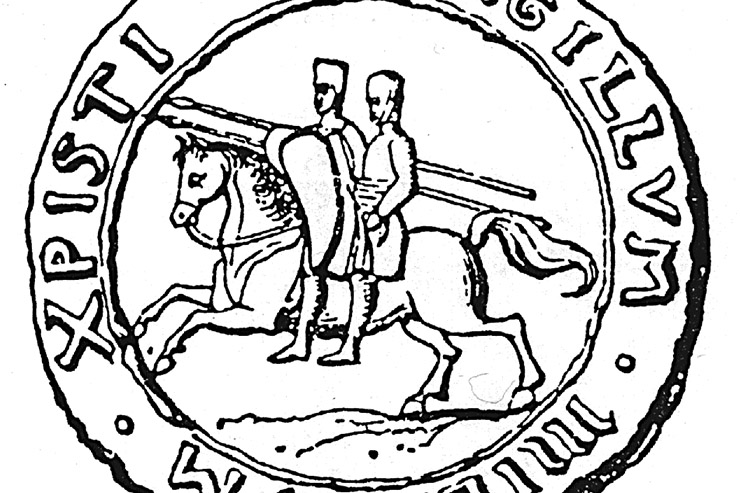
    Many influential groups started in a similar fashion. The famous Templar Knights were at first a small group of nine French knights who kept every action hidden under the radar of the established authorities. Within the conditions of secrecy they built the basis of a network that later extended across Europe. Wasserman believes the Assassin Order was created through the same process and had a great deal in common with the more well known Templars. Many scholars actually point to the Assassins as a seminal forefather of the secret society model, and as more evidence comes to light researchers are beginning to realise the Assassins were more influential and innovative than they were ever given credit for.

    The Assassins are infamous for their political murders. They created the concept of the ‘sleeper agent’ and pioneered the practice of training and placing operatives who would lay dormant within their environment, later spurred to action by a distant commander.

    The Old Man of the Mountain

    When the Prophet Muhammad died in 632 without having designated a successor to lead the community he founded, many Muslims believed his son-in-law and cousin Ali to be his legitimate successor. Over time this group, known as the Shi’atu ‘Ali, or party of Ali, divided from the majority Sunnis who followed Caliphs chosen by the consensus of the community. Centuries later a breakaway from the Shias, the Ismailis, founded the Fatimid dynasty in Egypt. A schism arose when the rightful Fatimid leader Nizar was imprisoned and supplanted by his younger brother. Hence, the followers of this subsect were called the Nizari Ismailis.

    The Nizari Ismailis are believed to have adopted elements of the Sufi tradition and its mystical symbolism, best known through the Rubaiyat of Omar Khayyam. Part of the Nizari sect took on a proactive military function with the aim of ensuring the survival of the Nizari as a whole and also working toward shifting the political scales in their favour.

    The founder of this militant group was a Persian called Hasan-i-Sabbah, born of lower middle class parents at Rayy, an old city a few kilometres to the south of modern Tehran in approximately 1060. A dedicated Ismaili, in 1090 he united the entire movement and took possession of a stronghold in Khorassan which became headquarters for the Order and known as Alamut, ‘the eagle’s nest’. Once established in a secure and permanent base, Hasan sent his agents out from Alamut in all directions, while at the same time pursuing a policy of territorial expansion, taking surrounding camps by force.

    Marco Polo claimed he passed Alamut in 1271 and described the splendour in his travel diary:

    In a beautiful valley, enclosed between two lofty mountains, had formed a luxurious garden stored with every delicious fruit and every fragrant shrub that could be procured. Palaces of various sizes and forms were erected in different parts of the grounds, ornamented with works of gold, with paintings and with furniture of rich silks. By means of small conduits contained in these buildings, streams of wine, milk, honey and some of pure water were seen to flow in every direction. The inhabitants of these places were elegant and beautiful damsels, accomplished in the arts of singing, playing upon all sorts of musical instruments, dancing, and especially those of dalliance and amorous allurement. Clothed in rich dresses, they were seen continually sporting and amusing themselves in the garden and pavilions, their female guardians being confined within doors and never allowed to appear.2

    Polo also put forward his explanation for the purpose behind such an impressive display.

    The object which the chief had in view in forming a garden of this fascinating kind was this: that Mahomet having promised to those who should obey his will the enjoyments of Paradise, where every species of sensual gratification should be found, in the society of beautiful nymphs, he was desirous of it being understood by his followers that he also was a prophet and a compeer of Mahomet, and had the power of admitting to Paradise such as he should choose to favour.

    Hasan had an excellent knowledge of theology, and the energy and allure needed to influence the minds of his contemporaries. He patiently prodded a potential candidate’s religious doubts until they were weak enough to admit the possibility of an alternative. Over time he managed to create a vast group and a powerful sectarian sense of community based on secrecy and conspiracy.

    According to the legend popularised by Marco Polo, the fortress court held boys as young as twelve years old who Hasan thought destined to become courageous men. When he sent them into the garden in groups of four, ten or twenty, he gave them hashish to drink where they slept for three days. It is thought they were carried sleeping into the garden where he had them awakened.

    Marco Polo, based on what he had heard about the Assassins, wrote:

    When these young men woke, and found themselves in the garden with all these marvelous things, they truly believed themselves to be in paradise. And these damsels were always with them in songs and great entertainments; they received everything they asked for, so that they would never have left that garden of their own will.

    And when the Old Man wished to kill someone, he would take him and say: ‘Go and do this thing. I do this because I want to make you return to paradise’. And the assassins go and perform the deed willingly.

    The strongest source of information on the Assassins came long after the Order fell from influence. Following the eventual demise of their headquarter stronghold in Alamut, volumes from their amazingly extensive library were examined by the Persian scholar Jawani, who later wrote a careful book in which he detailed the organisation of the Order. Their name has been attributed to the Arabic hashshashin meaning “consumer of hashish,” which they were said to use in the Initiation ritual. This is one of numerous explanations for the name of the sect, none of which can be confirmed. Assasseen in Arabic signifies ‘guardians’, and some scholars have considered this to be the true origin of the word: ‘guardians of the secrets’. There is no mention of hashish in connection with the Assassins in the library of Alamut. Even the most hostile Islamic writers of the time, both Sunni and Shia, nowhere accused the Assassins of drug use.

    Jawani’s account of the library of Alamut became the main reference for study of the Assassin Order. The only other sources are the few sparse accounts of the day, one of which came from a visit by Count Henry of Champagne to the stronghold of the Assassins in 1194. Following the murder of the Latin King of Jerusalem at the hands of the Assassins in 1192, Henry was appointed his successor and as a result was eager to negotiate a truce with the Assassins to avoid a similar fate. At a palace in the Nosairi Mountains Henry met the Assassin Master. Also popularly known as the Sheikh or ‘Old Man’ of the Mountain, he claimed that he did not believe Christians were as loyal to their leaders as his disciples were to him. He demonstrated his point by signalling to two young men standing high above on the palace towers. Immediately they leapt to their deaths on the mountain rocks below. It was written that Henry arrived from his visit “visibly shaken” by the ordeal of this contact.

    Influence on the Templars

    Dr. F.W. Bussel in Religious Thought and Heresy in the Middle Ages writes that it cannot be disputed the Templars had “long and important dealings” with the Assassins “and were therefore suspected (not unfairly) of imbibing their precepts and following their principles.”3

    Islamic culture of the day was a great deal more refined than that of Europe during the Dark Ages. The Templars along with all Europeans in the area were greatly affected by their contact with the Muslim East. They learnt the daily customs, the languages and business practices, discussed philosophy, and lived amongst what must have seemed an almost alien culture. In time, Templar ranks contained people who had spent more time in the Middle East than in Europe, and some who had little or no memory of European life, custom and philosophy.

    Under these conditions, the initial contact between the Templars and the Assassins occurred. “As the systematic overturning of Muslim Shariah took place among the Syrian Nizaris, some sense of the subtlety of their beliefs may have been communicated to their new acquaintances,” observes James Wasserman.4

    By this time, the Assassins had already rejected Islamic dogma and acquired the heretic tag. Later the Templars would also find themselves denounced as ‘vile heretics’. Assassins became known to the Muslim world as Ta’limiyyah or “people of the secret teaching.” The idea that they were the guardians of a secret or inner doctrine had always been promoted by Hasan, and they were feared and revered for this very reason.

    Branded as heretics, the Templars met their end in the 14th century. One of the charges levelled against the Templars was they kept “secret liaisons with Muslims,” and were accused of “being closer to the Islamic faith than to the Christian.” In reality, the Templars had found a mirror image of themselves in the mysterious Order of Assassins, and held the Western face of the same esoteric doctrine. It was even written that a number of Templar Knights were initiated by the Assassin Master, while others were given standing rank, so close was their secret teaching considered.

    The Organisational Model

    The Christian Order of the Knights of Templars, who came into contact with some of Ben Sabbah’s commanders during the Crusades… were reputed to have adopted Ben Sabbah’s system of military organisation.5

    The organisation of the Assassin Order called for missionaries and teachers known as da’is, the disciples and spiritual followers known as the rafiqs, and the fidais or devotees who in practice were the trained killers. The fidais were not part of the original Ismaili model, but were later added by Hasan. The Templar hierarchy is said to be derived from this model and can be easily compared, where the Assassin offices of da’is, rafiqs, and fidais correspond to the Templar degrees of Novice, Professed, and Knight.

    The Templars assimilated the system but adjusted the core symbolism to their own purposes. Where the levels used in the Assassin model denoted particular functions and duties, the Templar levels further developed the concept of progressive learning and acquired skill, similar to the modern military ideas of private, corporal, and general. Every Templar Knight was, at one point, a novice, and a professed member, but not every Assassin was a da’is or a rafiq. In fact it was said that Hasan would never let a candidate become a fidais who had sufficient intellect to become a missionary. The spiritual man stood above all others in the Order.

    The Assassins believed they held the secret or inner Islam, a completely esoteric component unavailable to those uninitiated in their philosophies. Their system of organisation was developed to both guard the secret doctrine and strictly control the continuance of the teaching. A number of schools were established practicing this organisational model, including secret rites and rituals. Members were enrolled on the understanding they were to receive hidden power and timeless wisdom that would enable them to become as important in life as some of the great teachers.

    Hasan enlisted young men between the ages of twelve and twenty from the surrounding countryside. Each day he held court where he spoke of the delights of Paradise. It was said that Hasan would often buy unwanted children from their parents, and train them in line with his purposes. The Order was an organisation of the common people of the land, far removed from the typical aristocratic blueblood that petitioned for the Knights Templar mantle.

    Another regular activity of the Assassins was the kidnapping of useful, rare and distinguished personages who could be of value to them in educational, military or other spheres and holding them captive in Alamut. These prisoners were respected physicians, astronomers, mathematicians and painters. Assassins coveted knowledge the way the Templars seemed to covet spirituality, although they were separated by the Assassin’s willingness to take knowledge indiscriminate of context, at any cost and by whatever means.

    It is true that both the Templars and the Assassins shared a policy of secrecy. Their teachings were kept for the eyes and ears of initiates only. Comparisons with the Essenes, Cathars, and Sufis spring to mind as similar attempts to release the esoteric heritage of the soul. In the past, these enlightened groups existed without knowledge of each other, but the Crusades caused two of these groups to meet, comparing doctrines and making alliances.

    The Legacy

    Following the destruction of Alamut by Hulegu in 1256, members of the Order are thought to have fled to Afghanistan and the Himalayas. Many of them journeyed to India where the Nizari Ismaili community flourished under the leadership of the Aga Khans. Other groups have been put forward as possible candidates for the legacy of the Assassins, but the true legacy of Hasan-i-Sabbah is his seamless creation, both religious and political. In this wider sense the thought and doctrines of the inventor of the Assassins may be said to have an enduring influence in the religious and political life of the Middle East.

    The Templar Order is believed to have refined their approaches under the direct influence of Eastern philosophy, and in confronting another group on the opposite side which existed to safeguard the same ancient teachings. According to Julius Evola, the Crusades, in many respects, created a “supratraditional bridge between West and East” where the Templars were the “Christian equivalent of the Arab Order of the Ishmaelites (Ismailis).”6

    Unfortunately, the Templars and the Assassins did not write the history books, and thus they have fallen to the state of Demons rather than Angels, while the authorities of the day are remembered in glowing terms. Yet, despite this, as James Wasserman concludes:

    The legends of the Templars and the Assassins are indeed very much alive to this day. The long-term survival of the memory of these two rather obscure groups points to various archetypal levels at which they affect the psyche. Meditation on certain concepts may help us better to understand this. Despite the best efforts and tenacity of the modern secular campaign to disparage traditional beliefs and ideals as either outdated or based on erroneous assumptions like God – traditional values somehow survive. The “innate knowledge of the Gods” described by Iamblichus demands of us that we aspire to honor, chivalry, self-sacrifice, redemption, patriotism, courage, and integrity. What better words could be used to describe the ideology shared by the Templars and Assassins of yore?7

    [alert type=”general” dismiss=”no”]This article was published in New Dawn 93.[/alert]

    [alert type=”success” dismiss=”no”]If you appreciate this article, please consider subscribing to help maintain this website.[/alert]

    Footnotes

    1. Wasserman, James, The Templars and the Assassins, 2001, Destiny Books, USA.

    2. Polo, Marco, Travels in Asia, 1938, G. Routledge, London.

    3. Bussel, F.W., Religious Thought and Heresy in the Middle Ages, 1918, R. Scott, London.

    4. Wasserman, James, The Templars and the Assassins, 2001, Destiny Books, USA.

    5. O’Ballance E, Language of Violence: The Blood Politics of Terrorism, 1979, San Rafael, CA: Presidio Press, p. 4.

    6. Evola, Julius, The Mystery of the Grail: Initiation and Magic in the Quest for the Spirit, 1996, Inner Traditions, USA.

    7. Wasserman, James, The Templars and the Assassins, 2001, Destiny Books, USA.

    © New Dawn Magazine and the respective author. For our reproduction notice, click here.