New Dawn – World's Most Unusual Magazine

Category: Secret History

  • The Gospel of Judas Revealed

    The Gospel of Judas Revealed

    From New Dawn 96 (May-June 2006)

    The secret account of the revelation that Jesus spoke in conversation with Judas Iscariot during a week three days before he celebrated Passover. …Jesus said to him, “Step away from the others and I shall tell you the mysteries of the kingdom. It is possible for you to reach it, but you will grieve a great deal.”
    – The Gospel of Judas1

    From an historical point of view this find is as important as the Nag Hammadi writings discovered half a century ago. Everything tells us that we are dealing with the Gospel of Judas referred to by Irenaeus in the second century AD. It is fantastic that something like that re-appears after 1800 years.
    – Dr. Stephen Emmel2

    The story of how the Gospel of Judas arrived in the Western world is a fascinating tale. Like many of the so-called Gnostic Gospels, it somehow travelled out of Egypt and arrived in the US with a large price tag. Unlike many manuscripts which vanish sight unseen, luck or providence if you like brought this manuscript not only to light but finally to restoration and publication. In the words of Professor Elaine Pagels, “the discovery of the Gospel of Judas is astonishing.”

    Originally unearthed by a farmer in 1978 near El Minya, Egypt, from where it had been hidden in a “tomb-like box” for some 1,600 years, the leather-bound papyrus codex was in superb condition. The farmer secretly sold the codex to an antiquities dealer in Cairo, without advising Egyptian Antiquities. In a clandestine meeting in 1983, the antiquities dealer offered the codex for sale to various scholars in Geneva, however with an asking price of over $3,000,000 and a dubious provenance, the price was considered extraordinary.

    Ironically, while the Gospel survived well in Egypt, it seriously deteriorated when stored for some 16 years in a safety deposit box in Hicksville, New York. Finally purchased by antiquities dealer Frieda Nussberger-Tchacos in 2000, the following year the codex was acquired by the Maecenas Foundation for Ancient Art in Switzerland. With the help of National Geographic and an agreement reached with the Egyptian government, restoration work soon began.

    Known as the Codex Tchacos (named after Dimaratos Tchacos, father of Frieda Nussberger-Tchacos), it is a 26-page document written on 13 sheets of papyrus leaf in ancient Egyptian, or Coptic. The codex contains not only the Gospel of Judas, but the First Apocalypse of James, the Letter of Peter to Philip, and a small fragment of text that scholars have called the Book of Allogene.

    If we focus on the Gospel of Judas, the document is a 3rd century Coptic translation of a now lost Greek text, thought to have been written by a group of early Gnostic Christians before 180 CE. While its significance is much debated, there is no question about its authenticity. There is universal agreement it is the genuine article. “All you had to do was look at this thing once,” said Bart Ehrman, a scholar of early Christianity. “I’ve seen a lot of ancient manuscripts, and there was no question.”3 According to James M. Robinson, America’s leading expert on ancient religious texts from Egypt, “I don’t know of any scholar who thinks this is fake.”4

    Heresy Hunting

    Back in the 2nd century of the Christian era, the Christian Bishop Irenaeus mentioned a Gospel of Judas was in use among the Kainites, an early Gnostic Christian sect. In part I of his Against Heresy, paragraph 31.1, he wrote:

    (Some) stated that Cain owes his existence to the highest power, while Esau, Korak, the Sodomites and all other men are dependants of each other. (…) They believe that Judas the Betrayer was fully informed of these things and that only he understanding the truth like no one else fulfilled the secret of betrayal that confused all things, both in heaven and on earth. They invented their own history called the Gospel of Judas.

    The Gospel had been known to exist for some time when discussed by Irenaeus around 180 CE, with his primary source being Justin Martyr. This moves the date back to around 140 CE, and most scholars therefore date the Gospel itself to around 120 CE or even earlier. This is significant because it places the Gospel of Judas within the same timeframe as the Biblical gospels of Matthew, Mark, Luke and John.

    The publication of the Gospel of Judas undertaken by National Geographic is unlikely to disturb the mainstream Christian church. In a recent interview, Monsignor Walter Brandmuller, president of the Vatican’s Committee for Historical Science, called it “a product of religious fantasy,” and went on to say, “There is no campaign, no movement for the rehabilitation of (Judas) the traitor of Jesus.”5

    From past experience with the Dead Sea Scrolls discovered in 1947 and the Nag Hammadi Library unearthed two years earlier, whatever the merits of a document it does not bring about a religious revolution. There is an entrenched power structure within Christendom and regardless of the strength of evidence presented, the Church will use spin, distortion and, if necessary, violence (remember the first crusades were against the Cathars) to preserve its dominion.

    The significance of the Gospel of Judas needs to be seen in the context of the larger picture provided by Gnosticism and current scholarship regarding Christian origins. Too often modern Christians live in a sort of self imposed ghetto. They read Christian books, subscribe to Christian magazines, and generally are not exposed to scholarship except through the lens of their chosen leaders or churches. In many cases even when a Christian leader tries to inject scholarship and critical thinking, it is still filtered through a very antiquated religious lens. There does seem to be a surprisingly large gap between modern research into Christian origins, even that generally available, and the information the average Christian receives within his or her community.

    Over the last 100 years the academic model that has arisen in regards to Christian origins is radically different from the traditional Christian worldview. It would be fair to say Christianity is sometimes even seen as a Gnostic heresy and not vice versa. While this is an inflammatory way of describing Christian origins, it does seem quite clear that within the early Christian “spectrum” there was an exceptionally wide range of traditions and practices. This diversity was not only tolerated but encouraged and embraced. Christianity was not a single, monolithic tradition handed down from one leader to another in succession; it was diverse and multi-faceted with many dispersed centres of power.

    Elaine Pagels, a professor of religion at Princeton who specialises in studies of the Gnostics, recently said in a statement, “These discoveries are exploding the myth of a monolithic religion, and demonstrating how diverse – and fascinating – the early Christian movement really was.”6

    Gnostic Christianity

    Although later denounced by certain leaders as ‘heretics’, many of these Christians saw themselves as not so much believers as seekers, people who ‘seek for God.’7
    – Elaine Pagels

    Early Christianity seems to have included many differing viewpoints from the rather staid Judaic Christian mix of James the Brother of Jesus to the esoteric Gnosticism of the followers of Mary Magdalene and Simon Magus. Variations in approach were such that within one movement there were libertine sects that used sex and mind altering substances, and others which were strictly ascetic and celibate. There were groups which were strictly Judaic in focus even to the point of keeping the old laws and festivals of Israel, while others were clearly influenced by the Greek Mysteries and even Buddhist traditions.

    Each of these communities had their own sacred texts and interpretations of the teachings of Jesus; the majority would now be considered Gnostic, i.e. they emphasised personal and direct experience of the divine. Accordingly, each of these groups acted like a “Mystery Cult” and had their own specialised practices, mythologies and rites. Many had distinct Gospels which included unique revelations from Jesus to their founders. For example, in the Pistis Sophia, we read of the secret teachings of Jesus to Mary Magdalene and the Gospel of Thomas begins… “These are the secret words which the living Jesus spoke, and Didymus Judas Thomas wrote them down.”8

    These secret writings and communities flourished for hundreds of years. It was only in the early 4th century that Bishop Athanasius of Alexandria wrote a letter to some Christians in Egypt ordering them to reject what he called “secret, illegitimate books.”9 In 363 CE the first synod (of Laodicea) was held to decide the official contents of the Bible.

    Certainly by the middle of the 4th century, Christianity had become a political force and dissenting views were not tolerated. Under threat and violent persecution, Gnostic communities withdrew from public view, to survive as an ‘underground’ movement. This continued right through to such groups as the Templars and Rosicrucians, and even to the present day.

    Clearly, early Christianity offered a wide spectrum of beliefs and practices catering to the unique needs of people with differing levels of spiritual development. This helps us understand the Gospel of Judas. While Christendom has attempted to downplay the significance of this Gospel, its message, like that of Gnosticism in general, is actually quite confronting and challenging.

    Secret Teachings

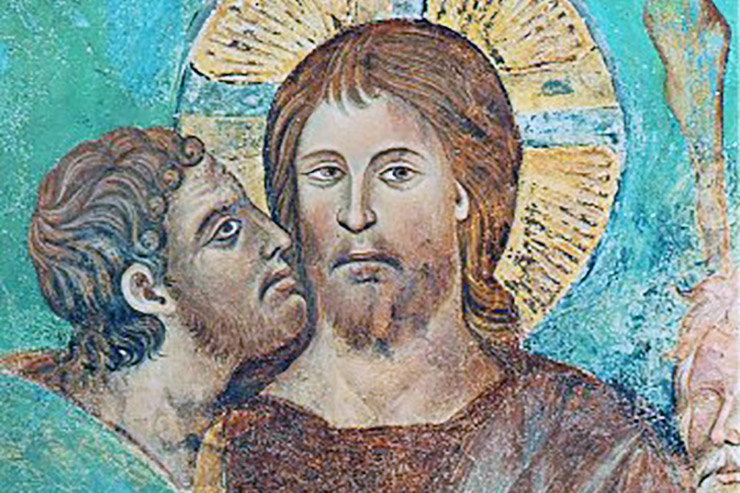
    The Gospel of Judas is a secret account of the revelation that Jesus spoke to Judas Iscariot. It portrays Judas as one of the initiates, a specially loved and favoured disciple who undertook one of the most painful missions asked by his teacher, to betray the saviour as part of a greater plan of spiritual import.

    The Gospel outlines a specifically Gnostic worldview, offering a cosmology which is fairly consistent with the radical Gnostic sects of the period. Cosmology in Gnosticism is a complex idea with many Aeons, worlds, dimensions and forms. It is impossible to appreciate the cosmology of the Gospel of Judas without these, however, I cannot give them comprehensive coverage here, but I will try to give a general outline.

    There is a world of light which is beyond all created forms. This spiritual realm contains various dynamic intelligences or energies, of which one, Barbelo, is discussed in the Gospel of Judas.

    For there exists a great and boundless realm, whose extent no generation of angels has seen.
    – Gospel of Judas

    There are many dimensions or worlds which exist between this higher reality and the physical world, and all are populated with forms of varying potencies.

    The physical world is depicted as flawed, even evil, and is beyond the boundary of these worlds. It is the product of a bloodthirsty and ignorant creator deity. His name is given as Nebro, which means ‘rebel’; while others Gnostics call him Yaldabaoth. There are many myths and stories about how he came to exist and create the physical world.

    Judas said to Jesus, “[What] is the long duration of time that the human being will live?”

    Jesus said, “Why are you wondering about this, that Adam, with his generation, has lived his span of life in the place where he has received his kingdom, with longevity with his ruler?”

    Judas said to Jesus, “Does the human spirit die?”

    Jesus said, “This is why God ordered Michael to give the spirits of people to them as a loan, so that they might offer service, but the Great One ordered Gabriel to grant spirits to the great generation with no ruler over it – that is, the spirit and the soul…
    – Gospel of Judas

    While the Gospel of Judas does not present a full account of the creation process, when interpreted in conjunction with other Gnostic texts it certainly presents a mythos which is very much at odds with the standard Judeo-Christian legend. Saklas, a demi-god under Yaldabaoth, creates the body of man while the angels Michael and Gabriel, emissaries of the world of light, allow spirits from the world of light to incarnate within these shells.

    This is very similar to Mandaean myths of creation where the physical bodies created by lesser spirits cannot even move off the ground, writhing and screaming in the dirt. In sympathy, emissaries of the light world allow spirits to enter them. But becoming trapped, fascinated by the allure of the flesh, these spirits now believe they are physical rather than spiritual beings.

    There is a suggestion, also found in other Gnostic literature, of various degrees of spiritual awakening. Some beings only have one soul, some have two, some have none. In the Gospel of Judas, those with one soul receive it from Michael, while those with both a soul and spirit have received them from Gabriel. Each of these classes are under varying degrees of control by the rulers (principalities and dominions) that manipulate our world.

    This model is found within the Gnostic schools where there are three levels of initiation:

    1. Hylic – most of sleeping humanity, under full control of rulers.

    2. Psychic partially awakened, under partial control of the rulers.

    3. Pneumatics – awakened.

    There is an essential dualism within the Gospel of Judas which helps explain the significance of Jesus’s death and the role of Judas. Since man’s origin is within the spiritual dimensions and the flesh is a cage, then death is not to be feared but a form of liberation. Accordingly, Judas helps Jesus escape his prison of flesh and liberate the essential true nature within him.

    You will exceed all of them. For you will sacrifice the man that clothes me.
    – Gospel of Judas

    The Gnostics taught that in some way or another we must each overcome the body and its demands and liberate the true Christ nature within. While individual praxis may vary from asceticism to libertinism, the goal is the same. In addition, these Gnostics also identify the creator of the physical world as our enemy, and hence see Yaldabaoth as the primary force holding us back from achieving true liberation.
    Indeed, in the Sethian tradition, Yaldabaoth is identified with Jehovah and the serpent of Genesis is actually seen as the liberator. This relates back to Irenaeus’ claim the followers of the Gospel of Judas were “Kainites” since in this interpretation, Cain is the saviour, not Abel, and the Sodomites are the people of God, not the slaughtering puritans and so on.

    We also find within the Gospel of Judas reference to both Seth and Adamas which is significant as they tie elements of the Gospel to the Naassene or Serpent Gnostic traditions. This has strong resonance with the Greek Orphic Tradition which is superbly covered in The Gnostic Secrets of the Naassenes by Mark Gaffney.

    There is a distinct absence of the saving power of the blood of Christ or the vicarious nature of the crucifixion in the Gnostic texts. Indeed the crucifixion and Resurrection are not even mentioned in the Gospel of Judas. The role of Judas shows the path to liberation is in awakening the Christ within and overcoming the restrictions created by both the physical body and the forces of the lower spiritual/physical worlds. These are sometimes represented as the planets, powers and dominions or rulers.

    The multitude of those immortals is called the cosmos –  that is, perdition – by the Father and the seventy-two luminaries who are with the Self-Generated and his seventy-two aeons. In him the first human appeared with his incorruptible powers. And the aeon that appeared with his generation, the aeon in whom are the cloud of knowledge and the angel, is called [51] El. […] aeon […] after that […] said, ‘Let twelve angels come into being [to] rule over chaos and the [underworld].’ And look, from the cloud there appeared an [angel] whose face flashed with fire and whose appearance was defiled with blood. His name was Nebro, which means ‘rebel’; others call him Yaldabaoth. Another angel, Saklas, also came from the cloud. So Nebro created six angels – as well as Saklas – to be assistants, and these produced twelve angels in the heavens, with each one receiving a portion in the heavens.
    – Gospel of Judas

    Judas works with Jesus to help liberate him from the power of the body; he plays an important role within the initiatory process of the crucifixion and Resurrection, which some suggest was actually an initiatory drama rather than a real historical event, but that is outside our discussion here.

    This Gospel needs to be interpreted within the larger framework of the dualist Gnostic tradition. The motif of Judas as special disciple and the negative interpretation of both the body and the world resonate through the vast majority of the Gnostic sects. In addition, the emphasis on Jesus as a giver of light, a transmitter of the message from the higher dimensions rather than as a sacrifice, is central to a Gnostic view of salvation.

    Jesus was seen as a way-shower, an emissary, a being whom we should emulate, not worship. This approach is central to the Gnostic vision; liberation comes through individual effort inspired perhaps by the life of Jesus, but ultimately through our own perseverance. In this way we move towards achieving our own state of divinity, our own theosis.

    The Gospel of Judas is certainly a fascinating revelation, though it does not necessarily add greatly to what we already know about the Gnostic vision. What it does do, however, is bring home the significance of this message for today’s world. If the Gospel of Judas had been taken seriously by the early Church and the Gnostics not suppressed, anti-Semitism and all its related violence may not have had such a disastrous effect within Western history. If Judas was only doing his job as a “special” disciple of Jesus, then the whole myth of “Judas the Christ Killer” dissolves and is replaced by Judas, the holder of the Mysteries.

    In 2006 with continued violence instigated by self-proclaimed religious fundamentalists, it is perhaps time we rehabilitate the Gnostic tradition. Gnosticism brings a spirit of openness, diversity, individual responsibility and freedom. With the publicity brought about by The Da Vinci Code and now the publication of the Gospel of Judas, it is time we let go of old prejudices, superstitions and narrowly held opinions and allow a different light to shine from beyond the confines of matter.

    [alert type=”general” dismiss=”no”]This article was published in New Dawn 96.[/alert]

    [alert type=”success” dismiss=”no”]If you appreciate this article, please consider subscribing to help maintain this website.[/alert]

    Recommended Reading

    Adam, Eve and the Serpent by Elaine Pagels
    Gnosis: The Nature and History of Gnosticism by Kurt Rudolph
    The Gnostic Bible: Gnostic Texts of Mystical Wisdom form the Ancient and Medieval Worlds by Willis Barnstone
    The Gnostic Gospels by Elaine Pagels
    Gnostic Philosophy: From Ancient Persia to Modern Times by Tobias Churton
    The Gnostic Religion by Hans Jonas
    The Gospel of Judas by Bart D. Ehrman, Rodolphe Kasser, Marvin Meyer, and Gregor Wurst
    Jesus and the Lost Goddess: The Secret Teachings of the Original Christians by Timothy Freke and Peter Gandy
    The Jesus Mysteries: Was the “Original Jesus” a Pagan God? by Timothy Freke & Peter Gandy
    The Other God: Dualist Religions from Antiquity to the Cathar Heresy by Yuri Stoyanov
    The Secrets of Judas: The Story of the Misunderstood Disciple and His Lost Gospel by James M. Robinson

    Footnotes

    1. The Gospel of Judas, as translated by a team led by Rodolphe Kasser and provided by the National Geographic Society.
    2. www.michelvanrijn.nl
    3. “Scholars have ‘no question’ on authenticity”, by Tom Avril, The Philadelphia Inquirer, 7 April, www.philly.com
    4. “Another Take on Gospel Truth About Judas, Manuscript Could Add to Understanding of Gnostic Sect”, by Stacy Meichtry, 25 February, Washington Post, www.washingtonpost.com
    5. Ibid.
    6. “In Ancient Document, Judas, Minus the Betrayal”, by John Noble Wilford & Laurie Goodstein, 7 April, New York Times, www.nytimes.com
    7. “The ongoing evolution of Christianity”, by Jane Lampman, May 15, 2003, Christian Science Monitor, www.csmonitor.com
    8. “The Gospel Truth”, by Elaine Pagels, April 8, New York Times, www.nytimes.com
    9. Ibid.

    © New Dawn Magazine and the respective author.
    For our reproduction notice, click here.
  • Otto Rahn & the Quest for the Holy Grail

    Otto Rahn & the Quest for the Holy Grail

    This article was published in New Dawn 43 (Jul-Aug 1997)

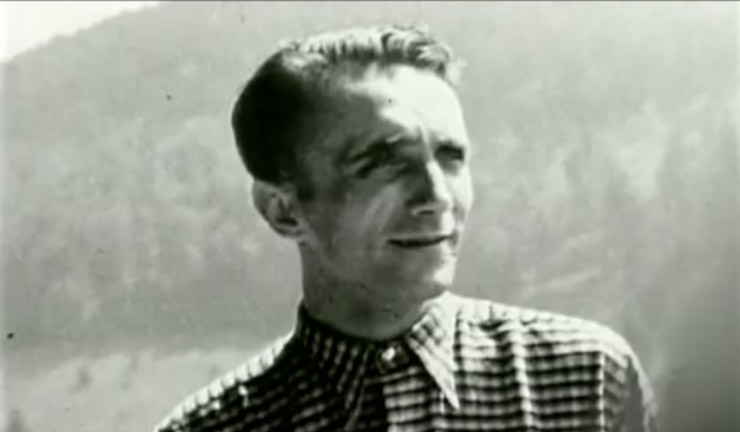
    Otto Rahn (1904-1939), described as a gifted young author and historian, was one of this century’s truly fascinating figures. Prior to his mysterious death, at age 35, he wrote two books about the Cathars of southern France: Kreuzzug gegen den Gral (“Crusade Against the Grail”) and Luzifers Hofgesind (“Lucifer’s Court”). Myth and legend continue to shroud both his life and tragic death. His books influenced such authors as Trevor Ravenscroft and Jean-Michel Angebert. In the 1982 best selling book Holy Blood, Holy Grail, Otto Rahn’s name appears in a small but intriguing footnote.

    Otto Rahn believed that he had found the location of the Holy Grail Mountain, the Montsalvat of legend, in the Cathar mountain fortress of Montsegur in the French Pyrenees. He was, says  Prof. Joscelyn Godwin, “largely responsible for the mythological complex that associated the Cathars and Montsegur with the Holy Grail and its Castle.”

    Norma Lorre Goodrich in her own highly acclaimed work The Holy Grail pays tribute to Otto Rahn’s Kreuzzug gegen den Gral (“Crusade Against the Grail”) describing it as “a wonderful book, a monument to this German idealist author, who died mysteriously during a descent in the Alps.”

    According to his French translator, Otto Rahn believed with absolute conviction that (1) the Cathars were the last owners of the Holy Grail, and (2) the Holy Grail “perished” when they died at the hands of the “pope and the King of France” at the beginning of the thirteenth century.

    Otto Rahn maintained that hidden within the Grail Romances was the essence of Catharism. The Quest for the Holy Grail was a symbolic presentation of Cathar initiation and the Grail itself (which in Wolfram von Eschenbach’s Parzival is a sacred stone) symbolised the Secret Tradition of the Cathars.

    The war of the Roman Catholic Church against the Cathars is variously described as a war where Roma and Amor stood opposite each other, in which the catholic (‘common’) idea triumphed with flame and sword over the catharic (‘pure’) idea.

    The Cathars or Cathari were members of a Gnostic Christian community which appeared in Western Europe in about 1050. They were also known as the Albigensians or men of Albi. This name derives from the city of Albi in southern France which was one of the Cathars’ chief centres. Perhaps as many as two million people belonged to the movement by the twelfth century and Catharism was beginning to become a serious rival of the Church of Rome.

    The Cathar claim to be the true church of Jesus Christ was a real threat to the authority of the Roman Church as Zoe Oldenbourg explains in Massacre at Montsegur:

    “The Cathars declared themselves the heirs of a tradition that was older than that held by the Church of Rome — and, by implication, both less contaminated and near in spirit to the Apostolic tradition. They claimed to be the only persons who had kept and cherished the Holy Spirit which Christ had bestowed upon His Church; and it looks as though this claim was at least partially justified….

    “Today we are better informed than they were concerning the practices of the Early Church, and have to admit that the Cathars merely followed a tradition somewhat more ancient than that of the [Roman] Church herself. It was with some appearance of reason that they claimed Rome as the party guilty of ‘heresy’ through her falling-out from the original purity which had characterized the Church of the Apostles.”

    The medieval Cathars believed in a cosmic battle between the principles of Light and Darkness on whose meetings and encounters everything in the universe was based. Darkness was for them dark matter, the unperfected, the transient. They identified all clerical and secular rulers, principally the Catholic Church as the personification of the Darkness. In their mythology the sun symbolised the primordial Light from which all life emerged. Miguel Serrano coined their doctrine: Solar Kristianity. For Otto Rahn, Montsegur was the “Lighthouse of Catharism.”

    Rahn’s Grail Quest

    Otto Rahn was born on 18 February, 1904 in Michelstadt in southern Germany. In secondary school he developed a fascination with the history of the medieval Cathars, their faith and revolt against king and pope. From 1922 to 1926 he studied jurisprudence, German philosophy and history. Rahn intended to write a dissertation on Guyot, the Provencal Troubadour on whose lost Grail poem Wolfram von Eschenbach claimed to have based his Parzival.

    The medieval Germanic tale of Parzival, revived in the 1800s by Wagnar’s popular mystical music dramas, fired Otto Rahn’s latter day quest for the Holy Grail. He soon pieced together a series of clues gleaned from a study of the history of the Cathars and the poem of Wolfram von Eschenbach, a Knight Templar of the thirteenth century.

    Driven by his deep interest in the Cathars and Grail legends, from 1928 to 1932 Rahn researched and travelled widely in France, Spain, Italy and Switzerland.

    Early in the summer of 1929 Otto Rahn made his first appearance in the Languedoc region of southern France. He quickly settled in the village of Lavelanet and over the next three months systematically explored the ruined Cathar temple-fortress on Montsegur as well as the surrounding mountain grottoes.

    It was in Languedoc that the city of Carcassonne, the holy mountain of the Cathars (Montsegur) and the mysterious church of Rennes-le-Chateau were located. All of these places were steeped in Cathar lore and it was here that all legends of the Holy Grail seemed to converge.

    At Montsegur, writes Nigel Pennick, “in 1244 the heretical Cathars had made their last heroic stand against a Catholic crusade which finally triumphed in their destruction. Here, tradition affirms that on the night before the final assault, three Cathars carrying the sacred relics of the faith slipped unnoticed over the wall. They carried away the magical regalia of the Merovingian King Dagobert II and a cup reputed to be the Holy Grail.

    “Possession of the Grail has always been the dream of chivalric orders. The Knights of King Arthur’s Round Table, the Templars, even the Teutonic Knights have sought the mystic vessel. But Otto Rahn believed that he could triumph where centuries of questing had failed. He had studied the sacred geometry of Montsegur, its sunrise orientations and its relationship with other sacred places, and had discovered secret underground passages, where he felt the treasure must be concealed.” (Hitler’s Secret Sciences)

    Nigel Pennick traces Otto Rahn’s knowledge of ‘sacred geography’ back to the Druids and Templars. The Cathars were also said to be familiar with this esoteric science.

    In many meetings with the local people (he spoke the local Provencal language fluently) Otto Rahn gathered everything concerning the Cathars and the Grail.

    In 1931 Rahn made an extensive exploration of the grottoes of the Sabarthes area south of Montsegur, notably Ornolac and the massive cavern of Lombrives. Here he explored a huge chamber called “the Cathedral” by the local people. Rahn later described this magnificent cavern as follows:

    “In time out of mind, in an epoch whose remoteness has been barely touched by modern historical science, it was used as a temple consecrated to the Iberian God Illhomber, God of the Sun. Between two monoliths one which had crumbled, the steep path leads into the giant vestibule of the cathedral of Lombrives. Between the stalagmites of white limestone, between walls of a deep brown colour and the brilliant rock crystal, the path leads down into the bowels of the mountain. A hall 260 feet in height served as a cathedral for the heretics.”

    Rahn tells how, “Deeply stirred I walked through the crystal halls and marble crypts. My hands put aside the bones of fallen pure ones and knights…”

    The local people called him a “seducer doubled with believer, an eternal adolescent with a superhuman passion for the Grail and the Hermetic Tradition”.

    Both Kreuzzug gegen den Gral (“Crusade Against the Grail”) and Luzifers Hofgesind (“Lucifer’s Court”) are full of remarkable insights and revelations of important historical links.

    Deep within the grottoes of Sabarthes Otto Rahn found chambers in which the walls were covered with symbols characteristic of the Knights Templar, side by side with emblems of the Cathars. This finding confirmed the notion, fostered by esoteric historians, that the Knights Templar and the Cathars were at one time closely associated. One intriguing image carved into the stone wall of a grotto was clearly a drawing of a lance. This depiction immediately suggests the bleeding lance that appears over and over again in the Arthurian legends.

    The legend of the Grail, explains the Chilean mystic Miguel Serrano, “reappears forcibly Christianised in the Middle Ages. The Templars disseminated it. It is centred on the legend of the court of King Arthur (who is the King of the Grail and is also called Amfortas). It is interesting to point out that Arthur is Arthos, Bear, that is to say Arctic. By which the exact geographical position of the lost continent of the first Solar Age is pinpointed: Hyperborea, seat of the Grail. In the Middle Ages, it became a cup, when the myth was Christianised, the one from which Christ was said to have drunk at the Last Supper, or else the one in which Joseph of Arimathea received the blood of Christ as it spurted from his side as he hung on the cross.”

    Otto Rahn believed it was possible to trace the Cathars, who guarded the Holy Grail in their castle at Montsegur, back to Druids who converted to Gnostic Manichaeism. The Druids in Britain were forerunners of the Celtic Christian Church. He saw in the culture of the medieval Cathar stronghold of Languedoc strong resemblances to the Druids. Their priests akin to the Cathar Parfaits. The Cathar secret wisdom being preserved by the later Troubadours, the travelling poets and singers of the medieval courts of France.

    Most Troubadours, according to Rahn, were secret Cathars. Their apparent yearning and longing songs only seldom dedicated to a special woman, their feminine symbolism referred to the Cathar community, the Sophia, the Wisdom of the Gnostics. Julius Evola explains in The Mystery of the Grail: “To make this doctrine inaccessible to the profane, it is hidden in an erotic symbolism, similar to the Grail cycle where it is represented by a heroic symbolism.”

    When Otto Rahn first studied Wolfram von Eschenbach’s Parzival he noticed remarkable similarities with names and places in southern France, and he suspected that Parzival’s Grail castle Munsalvaesche (Richard Wagnar called it Montsalvat) was none-other than the Cathar solar-fortress Montsegur. In Eschenbach’s work he discerned the influence of Cathar poetry. Otto Rahn adopted from the research of Cathar enthusiast Antonin Gadal the probably incorrect assumption that the persecuted Cathars had retreated under the earth and celebrated their mysteries in subterranean churches. Gadal gave Rahn the freedom of his library and private museum. In letters Rahn called him his “Trevrizent” (the uncle of Parsifal in Eschenbach’s work) and developed the propositions laid out in Gadal’s Au Chemin du Saint Graal.

    Antonin Gadal believed that the Cathars or ‘Good Christians’ derived from the original ‘Johannite’ form of Gnostic Christianity. ‘Johannite Christianity’ was based on the teachings of St John the Evangelist, the disciple whom Jesus loved and personally instructed in the Mysteries. The Cathars were said to possess the original version of John’s Gospel.

    The tale that Otto Rahn actually found the Grail and kept it until the end of World War II in the Wewelsburg, the SS castle near Paderborn, is easily disproved. There was a Grail in Wewelsburg but it was just a huge rock crystal. Rene Nelli, an important scholar of Catharism, maintains that existing Cathar texts do not mention the Grail, while Julius Evola did not think much of the Cathar Grail thesis.

    Return to Germany

    Otto Rahn left France in September 1932 and returned to Germany to devote himself to further studies of the Grail. In 1934, following on from his library research and his various expeditions, Rahn completed Kreuzzug gegen Gral (“Crusade Against the Grail”).

    Rahn showed that the heroes of Wolfram von Eschenbach’s Grail romances were modelled after real personalities. The pure knight Parzifal was a Carcassone Cathar, one of the foremost and heroic victims of the Crusade. The hermit Trevrizent was the Cathar Bishop Guilhabert de Castres; the King Anfortas, Raimon-Roger de Foix; and Montsegur was Montsalvage. Moreover, Montsalvage is protected by a Fountain “Salvage” in which Rahn believed he recognised the intermittent fountain of Fontestorbes, a few kilometres from the Pog, Montsegur’s promontory. Also, the forest around Montsalvage is called the “Briciljan” and close by Montsegur is Priscilien Wood. Rahn firmly concluded that the Fortress Castle of Montsegur was the Temple of the Grail.

    Rahn associates the Cathar Church with the Church of the Grail, with the mystical group Fideles d’Amour of Dante. He believed that the Templars after their enforced dissolution found refuge in the Pyrenean caverns. Rahn wrote of the many indications that the white tunic with octagonal red cross of the Templars was to be found with the black cassocks and yellow cross of the Cathars in the dark grottos of Sabarthes.

    Rahn believed that the Grail consisted of several tablets of stone engraved with runic or even pre-runic inscription. He believed that it was either one perfect emerald with 144 facets or 144 tablets of stone engraved in emerald. This emerald would have graced the Crown of Lucifer, symbolising his third eye, and which fell to earth, precisely on the Montsegur.

    Soon after its publication Kreuzzug gegen den Gral came to the attention of Nazi SS leader Heinrich Himmler. The SS hierarchy were eager for Otto Rahn’s collaboration in SS-sponsored research. After first joining the SS heritage bureau, the Ahnenerbe, as a civilian, his superiors quickly recognised his talents. Persuaded to formally join the SS in 1936, Otto Rahn became member 276 208 of the Allgemeine-SS.

    Paul Ladame, a friend of Rahn’s, insists that Otto joined the SS because there was no option. Ladame says Otto was no Nazi or racist. Himmler offered him a salary and the freedom to conduct his own academic research. To refuse may have resulted in Rahn’s eventual imprisonment anyway.

    In September 1935 Rahn was writing excitedly to the chief of the Ahnenerbe about the places he visited in his hunt for Grail traditions in Germany, requesting complete confidence in the matter with the exception of Himmler.

    Otto Rahn is even rumoured to have founded a neo-Catharist circle within the SS. In the summer of 1936 he undertook, by order of the SS, an expedition to Iceland. Intriguingly, the ship that sailed for Iceland flew a flag with a blue swastika on white background (in sharp contrast to the official standard of the Third Reich). Highlights of this journey formed part of some chapters in his second and final book Luzifers Hofgesind (“Lucifer’s Courtiers”), published in 1937.

    Rahn’s second book reads quite differently from his first. Arnaud d’Apremont writes in the preface to Luzifers Hofgesind that its style is more ideological, to all appearances ‘national-socialist’. However, more perceptive critics see Rahn in a quandary, having to toe the nationalist party line, negotiate the censor, and be able to write the full objective text he would have liked. He may even have indicated the irony of his position in the book’s title.

    But it is clear from Luzifers Hofgesind that Otto Rahn did not see Lucifer as synonymous with Satan, the Adversary, or the Devil. To Rahn, Lucifer was the Pyrenean Abellio, the Celtic Belenos, the Nordic Balder, the Greek Apollo. These are the Light-Bearers, an attribute Rahn, himself, wanted recognition for: a Lucifer.

    For Rahn the primordial Light came not from the East but from the North. He travelled around the ancient sacred places of Europe: Externsteine, the site of Irminsul, sacred symbol of the Saxons; Thingveillir, place of assembly of the ancient Icelanders, and Reykholt, birthplace of Sturlusson, the Nordic Homer and author of the Edda.

    One reviewer describes Luzifers Hofgesind as “an expedition through the ‘garden of roses,’ Rahn’s affectionate term for the Kingdom of the Asgardian Elfin, and a realm closed to non-believers or the uninitiated. Rahn dreams of a return to Thule, the primordial centre of the European Hyperboreans. He pines for a return to the Golden Age.”

    For Rahn the Holy Grail was an emblem set up in opposition to the Catholic Church — indeed it was a truly Luciferian [Light-Bearer] symbol. Lucifer stood in opposition to the god of Darkness, the god of the Church of Rome. Thus Otto Rahn wrote in his final book:

    “There is much more [Light] than in the houses of god — cathedrals and churches — where Lucifer neither is able nor wishes to enter due to all the sombre, stained glass windows whereon are painted the Jewish prophets and apostles, the Roman gods and saints. The forest, that, that was free!”

    During his time with the SS Rahn noticed that his telephone was tapped and that he was being spied upon.

    We know that Otto Rahn fell into disgrace with the Nazi hierarchy in late 1937 and for disciplinary reasons was assigned a tour of duty at the SS run Dachau concentration camp. In the winter of 1938/39 he wrote to the SS Reichsfuhrer requesting immediate dismissal from the SS. A few months later he was dead.

    Rumours abound concerning Otto Rahn’s departure from the Nazi SS. Some claim that he was a homosexual or of Jewish ancestry, but evidence is lacking. In a conversation Rahn claimed that he had been betrayed and that his life was in danger. In a letter to a friend he openly expressed his concern about the Third Reich:

    “I have much sorrow in my country. Fourteen days ago I was in Munich. Two days later I preferred to go into my mountains. Impossible for a tolerant, liberal man like me to live in the nation that my native country has become.”

    Col. Howard Buechner, the author of the Emerald Cup, says that Rahn “let it be known that he opposed the war for which Germany was obviously preparing in 1938. In place of war, he believed that Germany and then Europe, should be transformed into a community of ‘Pure Ones’ or Cathars. In other words, Rahn’s long association with the history of the Cathars and their unjust persecution by the church and the throne of France, had led to his conversion to the Cathar faith. He was also proposing a ‘New Order’ in which the states of Europe, and perhaps all other nations, would adopt the Cathar beliefs in the interest of world peace.”

    Otto Rahn gave his last public lecture — based on Luzifers Hofgesind — in January 1938. A local newspaper reported on his talk:

    “The Albigensians [Cathars] were exterminated. 205 leading followers of the Light-Bearer were burnt on a huge pyre by Dominicans in the South of France after a large-scale priestly Crusade in the name of Christian clemency. With fire and sword, the Lucifer doctrine of the Light-Bearer was persecuted along with its followers. The Albigensians are dead, but their spirit lives on and has an effect today through new devotion and rejuvenated enthusiasm. The Vicar of Christ could truly burn men; but he was mistaken if he believed that he burned along with them their spirit, devotion and longing. This spirit became alive again before many men yesterday, powerfully and visibly, in Otto Rahn, a descendant of the old Troubadours.”

    A little over one year later, on 13 March 1939 — almost on the anniversary of the fall of Montsegur — Otto Rahn died in the snow on the Tyrolean mountains. “In the manner of the Cathar heretics,” says Nigel Pennick, “Rahn voluntarily left a world he saw disintegrating.” A few years earlier Otto Rahn had written in Kreuzzug gegen den Gral (“Crusade Against the Grail”):

    “Their doctrine allowed suicide but demanded that one did not put an end to his life because of disgust, fear or pain, but in a perfect dissolution from matter. This kind of Endura was allowed when it took place in a moment of mystical sight of divine beauty and kindness…It is only one step from fasting to suicide. To fast requires courage but the final act of definitive ascesis requires heroism. The consequence is not as cruel as it may look.”

    The story of the enigmatic life and work of Otto Rahn, symbolising as it does a greater mystery, will always fascinate both students of the Holy Grail and seekers of the Cathar tradition. This mystery can be discerned in the following quote from Miguel Serrano’s Nos: Book of the Resurrection:

    “When we talk about the religion of love of the troubadours, of the initiated knights of the Grail, of the true Rosicrucians, we must try to discover what lies behind their language. In those days, love did not mean the same thing as it does in our day. The word Amor (Love) was a cipher, it was a code word. Amor spelt backwards is Roma. That is, the word indicated, in the way in which it was written, the opposite to Roma, to all that Rome represented. Also Amor broke down into ‘a’ and ‘mor’, meaning Without-Death. That is, to become immortal, eternal, thanks to the way of initiation of A-Mor. A way of initiation totally opposed to the way of Rome. An esoteric, solar Kristianity. The Gnostic Kristianity of Meister Eckhart. And mine. Because I have tried to teach western man to resurrect Kristos in his soul. Because Kristos is the Self for western man.

    “This is why Roma destroyed Amor, the Cathars, the Templars, the Lords of the Grail, the Minnesanger, everything which may have originated in the ‘Hyperborean Blood Memory’ and which may have had a polar, solar origin.

    “The love talked and written about so much in novels, poetry and magazines, the love of one’s neighbour, the universal love of the churches, love of humanity, has nothing whatsoever to do with ‘loveless love’ (A-Mor, Without-Death), which is a harsh discipline, as cold as ice, as cutting as a sword, and which aspires to overcome the human condition in order to reach the Kingdom of the Immortals, Ultima Thule.”

    This remains a fitting tribute to Otto Rahn.
    [alert type=”general” dismiss=”no”]This article was published in New Dawn 43.[/alert]

    [alert type=”success” dismiss=”no”]If you appreciate this article, please consider subscribing to help maintain this website.[/alert]

    © New Dawn Magazine and the respective author.
    For our reproduction notice, click here.

  • Who Was Moses?

    Who Was Moses?

    From New Dawn Special Issue 8 (June 2009)

    When people are spoken of constantly, we feel we know them. Christians and Jews have been talking about Moses for thousands of years, so they assume they know who he was. But is this an illusion? Is it possible that no one really knows who Moses was? That the evidence about him is contradictory and enigmatic? Is it even possible that he never existed except in fable?

    Even religious fundamentalists have an immediate problem with Moses, and the accounts of him in the biblical Book of Exodus. People who fanatically believe that every word written in the Bible or the Torah is somehow ‘the word of God’, ‘written by God’, or ‘inspired by God’ (these claims vary and are rarely defined with any degree of precision), are faced with serious contradictions in the biblical text itself.

    Near the beginning of Exodus, God speaks to Moses from a burning bush at Mount Horeb in Sinai and tells him to go back to Egypt. So Moses, not wishing to be impolite to an unknown entity who has spoken to him from a burning bush in no uncertain terms, duly begins to travel to Egypt as instructed. But what happens next? Suddenly we are told in Exodus, Chapter 4, 24-27:

    During the journey, while they were encamped for the night, the Lord met Moses, meaning to kill him, but Zipporah [the wife of Moses] picked up a sharp flint, cut off her son’s foreskin, and touched him with it, saying, “You are my blood-bridegroom.” So the Lord let Moses alone. Then she said, “Blood-bridegroom by circumcision.”

    Can anybody explain what is going on? Here the supposed ‘Word of God’, i.e., the Bible, says the entity calling himself God instructs Moses to drop everything and rush off to Egypt, and then the same entity meets him on the way with the intention of killing him. This homicidal impulse is however appeased by Moses’s wife grabbing a sharp flint and circumcising her son and claiming that he is her bridegroom. This all sounds more like an incident from a really bad Hollywood horror movie. And as for the actions of Zipporah, it is more like the kind of thing one might expect at a voodoo rite in Haiti than what one would expect from the wife of such a reputedly sober character as Moses, who is on a mission to Pharaoh to persuade him to “let My people go.”

    As for “the Lord” so-called, he seems capricious at best and a homicidal maniac at worst. There is no need for us to assume, as so many have uncritically done for millennia, that “the Lord” of Moses had anything whatever to do with God. The world is full of paranoid schizophrenics who hear voices and believe that ‘God has spoken’ to them. If all of these people were to be believed, there would be tens or hundreds of thousands of ‘Gods’.

    In order to try to figure out more about this puzzling episode from the Bible, I turned to a volume I have in my library which is a commentary on Exodus published by a biblical scholar named A.H. McNeile. He says:

    The narrative in these three verses appears, from its contents, to be one of the oldest portions of the Bible. Its antiquity is shewn [sic] by the use of the flint knife, and by the part circumcision plays according to the belief of the actors.1

    McNeile then goes on to add that the text really says of the foreskin that she “made it touch his feet,” but he says that is a conventional euphemism of the time which really means touching her “pudenda,” i.e. her genitals.

    If we are to believe this remarkable bit of information, we are faced with the undignified magical scene of the superstitious wife of Moses circumcising her son and pressing his bloody foreskin to her vagina and pronouncing him her bridegroom, or as McNeile translates her words: “A bridegroom of blood art thou, because of the circumcision.”

    For some reason not explained at all, Yahweh is appeased by this and decides not to murder Moses after all. I ask any rational person: is such a Yahweh to be identified with ‘God’? Do all the people who attend church and synagogues seriously believe that ‘God’ wanted to murder Moses on his way to Egypt but was appeased by this tawdry bit of superstitious magic?

    The confusion over the true nature of Moses probably reached its most extreme form at Petra. Many tourists have now visited the amazing enclosed city of Petra in modern Jordan, which is reached by passing through a narrow crevasse in a cliff face. It is one of the surviving archaeological wonders of the world. Epiphanius of Salamis (who lived circa 310/320 CE – 403 CE) recorded in his book The Panarion, sometimes known as his book Against Heresies:

    The profundities and glories of the sacred scripture, which are beyond human understanding, have confused many. The natives of Petra in Arabia [modern Jordan], which is called Rokom and Edom, were in awe of Moses because of his miracles, and at one time they made an image of him, and mistakenly undertook to worship it. They had no true cause for this, but in their ignorance their error drew an imaginary inference from something real.2

    I wonder how many tourists going to Petra realise that they are going to the only place in the world where Moses was worshipped as a god. That’s not something you would be told by your tourist guide!

    In the second century BCE, a Jewish playwright named Ezekiel lived at Alexandria in Egypt, and he wrote a drama in the Greek style called ‘The Exodus’, in which Moses was the leading character. This play survives only in extended fragments preserved by Eusebius (circa 263 CE – 339 CE) in his book The Preparation for the Gospel, which he took from an earlier historian named Alexander Polyhistor. The text of the play is largely lifted from the Bible, with flowery language and interpolations, as shown by this monologue by Moses:

    Ha! See! What sign is this from yonder bush?

    A marvel such as no man might believe.

    A sudden mighty fire flames round the bush,

    And yet its growth remains all green and fresh.

    What then? I will go forward, and behold

    This wondrous sign, that passes man’s belief.3

    From this, we can see that Ezekiel was no Shakespeare, and his task was a simple one, to dramatise the story of the Book of Exodus in a straightforward and rather unsubtle manner for the stage, so that the Gentiles of Alexandria could have the Jewish legends presented for them in an outdoor theatre. It was a bit like producing a soap opera for mass television, but it was two thousand years ago. One does not read anything about this play in the histories of the theatre, but it deserves a mention. It was probably much less corny than Cecil B. DeMille’s film about Jesus, ‘King of Kings’, which I had to sit through several times at the Roman Catholic school I attended as a child (an experience which helped put the finishing touches to my lack of affection for the Catholic Church).

    The Staff into Snake into Staff Trick

    Children who read the Bible always remember the vivid incident where Moses throws his staff on the ground before Pharaoh and it becomes a snake, and then he picks the snake up and it becomes a staff again. Actually, this is how we remember the tale but in fact the Bible says that Aaron, not Moses, does this before Pharaoh. In Exodus 4, “the Lord” and Moses have this dialogue:

    Moses answered, “But they will never believe me or listen to me; they will say, ‘The Lord did not appear to you.’” The Lord said, “What have you there in your hand?” “A staff,” Moses answered. The Lord said, “Throw it on the ground.” Moses threw it down and it turned into a snake. He ran away from it, but the Lord said, “Put your hand out and seize it by the tail.” He did so and gripped it firmly, and it turned back into a staff in his hand. “This is to convince the people that the Lord the God of their forefathers, the God of Abraham, the God of Isaac, the God of Jacob, has appeared to you.” (4:1-6)

    Later, the story of the snake continues in Book 7:

    The Lord said to Moses and Aaron, “If Pharaoh demands some portent from you, then you, Moses, must say to Aaron, ‘Take your staff and throw it down in front of Pharaoh, and it will turn into a serpent.’” When Moses and Aaron came to Pharaoh, they did as the Lord had told them. Aaron threw down his staff in front of Pharaoh and his courtiers, and it turned into a serpent. At this, Pharaoh summoned the wise men and the sorcerers, and the Egyptian magicians too did the same thing by their spells. Every man threw his staff down, and each staff turned into a serpent; but Aaron’s staff swallowed up theirs. (7:8-13)

    Even though this seems one of the most unbelievable stories in the Bible, it is curiously enough one of the most convincing (and hence, a source of encouragement regarding the veracity of some of Exodus), because this was a genuine trick of Egyptian magicians which was recreated in the twentieth century.

    The way this trick is done is by means of ‘animal hypnosis’, or animal catalepsy. I described the use of the trick by Moses in my book Open to Suggestion, which was published in 1989. However, the book was only published in Britain, and readers in the USA never saw it. My book was an extremely long survey of worldwide hypnosis research, compiled by me over a period of 15 years. It also contained a survey of 150 years of documented case histories of the criminal abuses of hypnosis. My book so alarmed the hypnosis community and various security agencies (especially my sections on mind control and mass hypnosis), that every effort was made to suppress the book.

    Eight American publishers to whom the book was submitted sent my agent identical letters from two referees (always the same two men in each case, whom I knew personally and strongly disliked) warning them that the book would be a public danger, and they must not publish it. The two referees were not distinguished clinicians or experimentalists, they were functionaries whose job it was to liaise between the security services and the hypnosis community.

    They succeeded admirably in their task, which was to prevent the American public from ever reading such things as this revelation which I made: more than fifty percent of the hypnosis experiments carried out in the United States have been carried out by the government and are classified as top secret. You can understand why my book was considered seriously ‘uncool’ by various grim persons.

    Dr. Franz Völgyesi & Animal Hypnotism

    The man who perfected the ‘snake-into staff-into snake’ trick in the 1930s was one of the most extraordinary characters of his time, a Hungarian psychologist named Dr. Franz Völgyesi. I discussed him in my book, and that was especially unpopular, for reasons which will be clear in a moment.

    In the 1930s, Völgyesi published a book in Hungarian entitled Ember és állat Hypnosis. I’m sorry I can’t translate that, for my Hungarian is rusty. This book appeared in a German translation in 1938, as Menschen- und Tierhypnose (Human and Animal Hypnosis).4 The book was so shocking and astounding that it inevitably came to the attention of the Nazis. I have a copy of this rare book, an item that various interested parties would not like any members of the public to have.

    Völgyesi became the hypnotist-in-chief to the Nazi regime, and considering that Hitler went into spontaneous auto-hypnotic trances nearly every day, it is more than likely that Völgyesi became Hitler’s personal, as well as official, hypnotist. (I have no evidence of that, and I am merely speculating, though I believe, soundly.)

    Völgyesi was given carte blanche by the Nazis to carry out experiments on human beings. During the years between 1938 and 1945, he hypnotised no less than sixty thousand individuals, most of them Jews, Slavs, Gypsies, and leftists who were interned in the concentration camps. He could perform any experiments he liked, without reference to anyone. Considering the detailed evidence which we have of his experiments with dozens of animals, it takes little imagination to visualise what he would have done with sixty thousand human beings to play with.

    There is no doubt whatsoever that Franz Völgyesi was the most experienced hypnosis researcher in the entire history of the world. His research notes on these 60,000 cases ‘vanished’. But he himself did not vanish. He was one of those Germans snatched by the Americans, like Werner von Braun, and taken off to the United States, as a consultant to the security services. His research files probably exist somewhere in a high security archive of the American security services, ‘snatched’ at the end of the war. Someone should make an attempt to have them released through the Freedom of Information Act. I have ceased to pursue this subject, so I leave this task to others.

    In 1963, Völgyesi was allowed to bring out a sanitised second edition of Menschen- und Tierhypnose, and in 1966 this appeared in London in an English translation as Hypnosis of Man and Animals.5 This time, the book appeared with his Hungarian first name of Ferenc rather than his German first name of Franz. (In America he was sometimes called Francis or Frank.) It is possible to purchase occasional copies of this book without too much difficulty.

    In both books, Völgyesi published photos of cataleptic snakes which are stretched straight as rods, and have gone stiff. In the 1938 book, one is seen in Figure 8 on page 16. In the 1966 book, another one (an adder) is seen in Figure 18 in the first plates section. Völgyesi hypnotised just about every kind of animal, bird, or reptile you can possibly imagine. He would enter zoo cages and put bears and lions and crocodiles into trances with the greatest of ease. Many photos of these cataleptic animals are reproduced in his books. I cannot go into this fascinating subject further, and must return to Moses.

    The fact is that any skilled animal cataleptist can turn a snake into a staff and a staff into a snake very easily. Such tricks were standard in ancient times. They were ways of calling attention to oneself as a wise man. And, frankly, if you couldn’t turn a snake into a staff no one would listen to you. So you might say Moses had little choice. And that is why I say that this incident is convincing evidence that there is genuine ancient material in Exodus, since later writers would not have been able to invent such a thing.

    Moses’ Sacred Mountain

    Moses is generally associated with Mount Sinai in the Sinai Peninsula. However, that is the wrong mountain. Although Mount Sinai was also important, it was Mount Horeb where Moses did most of his communing with his ‘Lord’, and where he saw the burning bush. But if you ask any biblical scholar where Mount Horeb is, they cannot tell you. It is officially unknown.

    I am certain that it was the great mountain at Serabit in southwest Sinai. There is specific evidence to support this idea in the writings of Philo Judaeus (20 BCE – 50 CE), also known as Philo the Jew or Philo of Alexandria, where he lived and wrote. He wrote in Greek a lengthy ‘Life of Moses’, which survives in its entirety. Near the beginning of the third book of this treatise, Philo tells us:

    For, having gone up into the loftiest and most sacred mountain in that district in accordance with the divine commands, a mountain which was very difficult of access and very hard to ascend, he is said to have remained there all that time without eating any of that food even which is necessary for life; and, as I said before, he descended again forty days afterwards, being much more beautiful in his face than when he went up, so that those who saw him wondered and were amazed, and could no longer endure to look upon him with their eyes, inasmuch as his countenance shone like the light of the sun.6

    Tourists often comment about how easy it is to ascend Mount Sinai, which goes completely against this evidence. On the other hand, the sacred mountain at Serabit in Sinai, much further south, which I believe to be the biblical Mount Horeb, is notoriously difficult to ascend. There is a great deal of crucial archaeological evidence about Serabit to support this hypothesis, but it is too lengthy and detailed to give here.

    A magnificent ruined Temple of Hathor survives at the top, which dates from the Middle Kingdom period. It is known that the site was shared between the Jews and the Egyptians. Excavations have uncovered beneath the floor of the temple extremely thick layers of ash from offerings made on the mount before the temple was built, and it was admitted by Sir Flinders Petrie and other Egyptologists that this was clearly the famous ‘High Place of Burning’ of the early Jews before the time of the ‘Lord’ of Moses, who came to be known as Yahweh, and when the Jews still worshipped the deity or deities whom they called El, Elyon (the Canaanite form of the name), or Elohim (Elohim being a plural form of the name).

    Apparently, during the period when Sinai was under Israeli occupation, General Moshe Dayan was so interested in Serabit that he had an entire Hathor column lifted out by helicopter and flown back to Israel, where he placed it in his private garden. That is not the correct way to behave! I hope that, since his death, it has at least gone to a museum somewhere.

    I have elsewhere written about the associations of Moses and the early Jews with Serabit, and cannot repeat all of that here. I also have suggested that Jesus spent his forty days in ‘the wilderness’ at this same spot, in emulation of Moses, who spent forty days on this very mountain.

    I think I should explain once again one other detail of the account in Exodus, which is the so-called ‘golden calf’. The explanation for this is that it was a Hathor-face, a wild cow’s face, and which to someone unfamiliar with Hathor traditions looks like the face of a calf. Philo specifically tells us that the misbehaving Jews who made the golden calf did so for this reason:

    …they made a golden calf in imitation of the Egyptian worship and folly and established dances and prepared an altar…7

    The only ‘calf’ worshipped by the Egyptians was the Hathor face, which looks like a calf to the uninitiated. Public dances were an integral part of Hathor worship at festival time, and were common at the Temple of Hathor at Denderah, so would have been common at Serabit as well. There were altars of Hathor at Serabit, and of course her huge temple, much of which remains, though it is never visited by tourists, and there is no road to it.

    As for the gold used to cast the golden calf (the Temple of Hathor must have been full of these), it is explained by the fact that Serabit was from Old Kingdom times a famous mining and metallurgical centre, where carvings of Pharaohs Cheops and Sneferu were engraved on the rocks. It was the main source of Egyptian copper for millennia. Gold was also processed and cast there, and the metallurgical workers were traditionally the Jews, who had a permanent settlement at the foot of the mountain. These Jews would have been respectful to Hathor because they were thoroughly Egyptianised. This was intolerable to the purist Moses, and with the aid of the Levites, he massacred 3,000 of them in the name of his ‘Lord’, Yahweh.8

    At other times he massacred other people, and so he was not a peaceful sort of fellow by any means. We don’t really know who he was, although he clearly was born in Egypt and grew up there. It is all very mysterious. But I, for one, am glad not to have met him, as he was not someone to mess with, and I would probably have said something sarcastic and been ‘massacred’. After all, Moses was into commandments. And some of us don’t like authority.

    [alert type=”general” dismiss=”no”]This article was published in New Dawn Special Issue 8.[/alert]

    [alert type=”success” dismiss=”no”]If you appreciate this article, please consider subscribing to help maintain this website.[/alert]

    Footnotes:

    1. A. H. McNeile, The Book of Exodus with Introduction and Notes, Westminster Commentaries, Methuen, London, 1908, p. 27 notes.

    2. Frank Williams, translator and introduction, The Panarion of Epiphanius of Salamis, Brill, Leiden, Netherlands, 1994, p. 78 (IV, 1, 9).

    3. Eusebius, Praeparatio Evangelica (Preparation for the Gospel), translated by Edward Hamilton Gifford, 2 vols., Oxford, 1903, Baker Book House, Grand Rapids, Michigan, USA, reprint of 1981; Vol. I, p. 470 (IX, 29, 440).

    4. Franz Völgyesi, Menschen- und Tierhypnose (Human and Animal Hypnosis), translated by L. Ofner, Orell Füssli Verlag, Zurich and Leipzig, 1938.

    5. Ferenc András Völgyesi, Hypnosis of Man and Animals, second edition revised in collaboration with the author by Gerhard Klumbies, Ballière, Tindall & Cassell, London, 1966.

    6. Philo, ‘On the Life of Moses’, in The Works of Philo Judaeus, translated from the Greek by C. D. Yonge, 4 vols., Henry G. Bohn, London, 1855; Vol. III, p. 89 (III, 2).

    7. Ibid., p. 132 (III, 37).

    8. Ibid., pp. 109-110 (III, 20).

    © New Dawn Magazine and the respective author.
    For our reproduction notice, click here.
  • Political Secret Societies: The Hidden Paths of Power

    Political Secret Societies: The Hidden Paths of Power

    Did Zanoni belong to this mystical Fraternity, who, in an earlier age, boasted of secrets of which the Philosopher’s Stone was but the least; who considered themselves the heirs of all that the Chaldeans, the Magi, the Gymnosophists, and the Platonists had taught; and who differed from all the darker Sons of Magic in the virtue of their lives, the purity of their doctrines, and their insist­ing, as the foundation of all wisdom, on the subjugation of the senses, and the intensity of Religious Faith?
    – Zanoni, Sir Edward Bulwer Lytton

    The governments of the present day have to deal not merely with other govern­ments, with emperors, kings and ministers, but also with the secret societies which have everywhere their unscrupulous agents, and can at the last moment upset all the governments’ plans.
    – British Prime Minister Benjamin Disraeli, 1876

    Two very different views of secret societies are revealed in the quotations above. The first describes a spiritual brotherhood pledged to Wisdom and guiding humanity toward the realm of the Infinite; the second seeks to expose the machinations of power-seekers who cloak their manipulative agendas in darkness. In addition to spiritual and political secret societies, one could add criminal secret societies such as the Mafia, or even clandestine elite military units – neither of which will be discussed here.

    All secret societies share certain fundamental themes. Membership is restricted to those who have an abiding interest in the subject. Thus, a spiritual group will attract people seeking more knowledge of a particular teacher or type of practice. The student is aware of the subject matter in advance and will approach the group for further instruction. More rarely, an individual may be “tapped” by the group because of a perceived affinity to its purpose.

    In a political secret society, membership is restricted to those who share an ideological affinity with the goals the group represents. At the furthest end of the political spectrum, the mission will be revolution. Such a society will go to great lengths to defend itself. Generally there will be small semiautonomous cells working in overall concert but with cut-outs introduced at all levels to pro­tect other members from exposure or betrayal. This type of society is represented by a contemporary group such as al-Qaeda. The infamous Weathermen of the 1960s and 1970s had a sim­ilar structure. The clandestine revolutionary model was developed and perfected by Hasan-i-Sabah, leader of the Nizari Ismaili Order of Assassins between the late 11th and early 12th centuries.

    On another political plane are ideological groups such as the Council on Foreign Relations, or participants in the World Economic Forum. Here we find leaders in politics, business, finance, education, and the media who may share a belief in the value of global solutions; are in high positions of authority and influence; and represent different levels of involvement with the inner circle of the group. Most members simply welcome the opportu­nity to associate with other well-known luminaries and are honoured by being offered membership or attendance privileges. Yet, the ideology at the highest levels of such groups supports a world government – to be adminis­tered by a class of experts and planners, entrusted with running centrally organised social and political institu­tions. Although members may be persuaded to add their considerable voices to certain transnational political and economic policies, they may not be as supportive (or even aware) of the long-range ambitions of the inner circle. While these groups quite often hold their meetings in secret, their membership lists are a matter of public record. It is the central agenda that is disguised.

    Adam Weishaupt founded the Bavarian Illuminati in 1776. The Illuminati are perceived by many as spanning the chasm between the spiritual and the political secret society. Often credited (or blamed) for influencing the French Revolution in 1787, the Illuminati taught a doctrine of social and political liberation that hinged on the equal­ity of man, the embrace of rationalism, and the denial of crown and church as the legitimate institutions for the regulation of social and moral values. The bitterness of life in Europe at this time – when church and state monopolised resources and often acted in an irresponsi­ble manner toward the citizenry – created widespread resentment among all classes. While the views of the Illuminati may sound quite advanced for the time, the European revolutions they are believed to have encour­aged degenerated into brutal bloodbaths whose singular lack of moral compass was appalling.

    Reprinted with permission from The Mystery Traditions: Secret Symbols and Sacred Art by James Wasserman (Destiny Books, 2005).
    [alert type=”general” dismiss=”no”]This article was published in New Dawn Special Issue Vol 6 No 6.[/alert]

    [alert type=”success” dismiss=”no”]If you appreciate this article, please consider a contribution to help maintain this website.[/alert]

    © New Dawn Magazine and the respective author.
    For our reproduction notice, click here.
  • The New World Order Vs. The New Age: Separating Truth from Falsehood

    The New World Order Vs. The New Age: Separating Truth from Falsehood

    From New Dawn Special Issue Vol 6 No 6 (Dec 2012)

    There are numerous difficulties in trying to discern what among the proliferation of new or revived faiths might be regarded as working to usher forth a New Age based on eternal values, and those that work to establish the rule of malignant, matter-bound forces. The problem is that there are often superficial resemblances that occur between them. Even within the same occult orders, such as Freemasonry, there are a range of views that might be in opposition but are mistaken as being part of a single, all-embracing conspiracy. There is a tangle of terminology, groups, personalities, ‘Hidden Masters’, accusations and counter-accusations of black magic, and so forth. This article considers ways in which the positive and negative currents within the ‘New Age’ might be identified.

    The Cycles of Rise and Fall

    The school of Perennial Tradition regards traditional cultures, religions and spiritualities as sharing core beliefs, values of an eternal nature, on which are founded Civilisations and societies in their cycles of health. Hence, in the analogous cycles of cultures as far removed geographically and ethnically as the Japanese, Hindu, Norse, and Arabian, all will possess analogous beliefs in regard to social hierarchy, chivalric ethos, and a nexus that exists between the Divine and the temporal. In such a society one’s highest calling, whether as peasant or prince, is to work in accord with one’s cosmic duty, or what the Hindus call dharma. In such a society castes reflect the Divine order on earth: ‘as above, so below’, and degenerate into contending economic classes in the cycle of decline.1

    This cyclical view of history2 is another shared featured of various Traditional cultures, expressed in the Norse,3 Hindu,4 Hopi oral lore,5 and many others. In our own era the German historian-philosopher Oswald Spengler provided empirical evidence for the cyclicity of cultures.6 The two primary Traditionalist exponents of cultural cyclicity in our era are Rene Guenon7 and Julius Evola.8 Esoterically, it is the cycle of life expressed in ‘The Wheel’ of the ‘Major Arcana’ of the Tarot, which is derived from the Medieval ‘Wheel of Fortune’ or Rota Fortuna depicted in Gothic Churches.9 

    Tradition, Anti-Tradition & Counter-Tradition

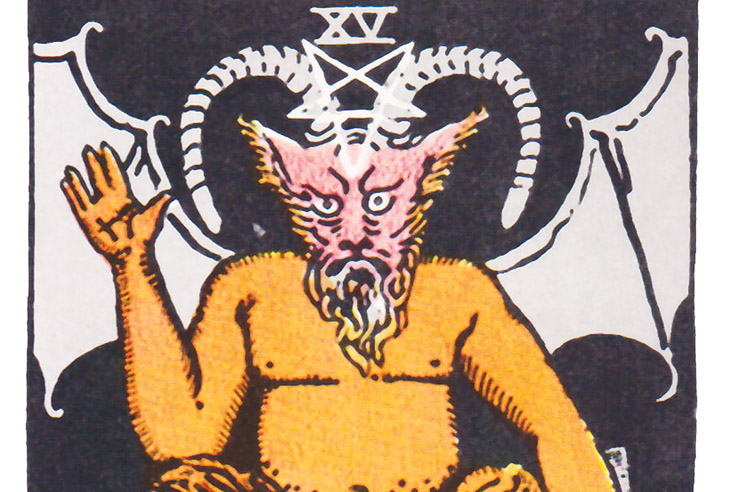
    A glance at cultural cycles is necessary to identify the occult forces that work in the context of Tradition for a return to eternal values based on a reconnection with the Divine, and those that want to enslave humanity to matter. Again, recourse to Tarot symbolism is instructive. Here we see that the Counter-Tradition that stands behind Anti-Tradition, is in the esoteric sense, literally satanic. Paul Foster Case10 provides a meaning for ‘The Devil’ trump that is particularly relevant:

    In its most general meanings, it signifies Mammon and thus big business, the conventions of society, the injustice and cruelty of a social order in which money takes the place of God, in which humanity is bestialised, in which war is engineered by greed masquerading as patriotism, in which fear is dominant. Students of astrology will have no difficulty in seeing how this corresponds to Capricorn, the sign of big business, and the sign of world fame.11

    In this one paragraph Case says much. He cogently differentiates the Traditionalist from the Anti-Traditionalist in what is an occult war. Case identifies the Counter-Tradition that controls Anti-Tradition as ‘Mammon’. Mammon infers something more than simply plutocracy; it is the spirit behind plutocracy. Plutocracy controls the present era. Oswald Spengler pointed out that Money rules in the epoch of decline of a Civilisation. It is not merely the temporal influence of Money which Spengler is referring to, but the spirit behind Money, or what Case calls Mammon. “The dictature of money marches on, tending to its material peak in the Faustian [Western] Civilisation as in every other.”12 

    The other significant point raised by Case is the ‘bestialisation’ of humanity. In this trump ‘The Devil’ is depicted enchaining the human pair to matter. Like the ‘Devil’, the human pair is depicted with tail and horns. This is suggestive of the esoteric belief in cyclic regression rather than lineal progression, when humanity regresses from a higher state of Being, of a spiritual mode, descending ever more into a baser, material existence. Anti-Tradition is the agency for this decline and enslavement. The modern world is therefore, according to the Traditionalist perspective, not ascending upward toward the Godhead, nor toward manifesting the God within; but is in a downward spiral towards – metaphorically – ‘The Devil’ – the master of our base drives.

    A problem of identifying who belongs to what arises because forces work behind the guise of Tradition, while they are in reality the initiates of Anti-Tradition and Counter Tradition, or what Aleister Crowley called the ‘Black Magick School’. The purpose of Anti-Tradition is that of subversion and the sowing of confusion to pave the way for Counter-Tradition. ‘Anti-Tradition’ was stated by Perennial Traditionalist scholar and initiate Rene Guenon to be “pure negation and nothing more.”13 In regard to Counter-Tradition there is a “counter-initiation,”14 representing a satanic current of those who seek the severing of the nexus between the terrestrial and the divine. Guenon wrote of this:

    After having worked always in the shadows, to inspire and to direct invisibly all modern movements, it will in the end contrive to ‘exteriorise’, if that is the right word, something that will be as it were, the counterpart of a true tradition, at least as completely and as exactly as it can be so within the limitations necessarily inherent in all possible counterfeits as such.15

    To Guenon the Counter-Traditionalist movements are void of spiritual content. This can be seen in the many movements and ‘orders’ professing a ‘tradition’ and having a mystical or spiritual façade, yet who expound a materialistic universal republic. This is why various esoteric orders can be seen to be promoting materialistic doctrines such as Marxism, and such Anti-Traditional dogmas as those expressed in slogans like “liberty, equality, fraternity,” to usher in the “reign of quantity.”16 Anti-Traditionalist movements and ideologies are only a means, and not the end. Guenon aptly uses the term “satanic”17 to describe these currents.

    Of these Counter-Traditions, Guenon states that they can never be anything other that a “parody,” an “inverted spirituality” involving organisations of “counter-initiation.”18 Guenon regarded these movements as being of supernatural origin, as satanic and believed that a figure analogous to the “The Anti-Christ” will manifest at the head of a world order.19

    Guenon described the order which Counter-Tradition tries to impose by at first using the doctrine of “egalitarianism” as a means of overthrowing the remnants of Tradition and spirituality, after which will be erected in place of the divine hierarchies a “counter-hierarchy,” atop which sits an individual that seems analogous to “The Anti-Christ,” Guenon describing him as “nearest to the very bottom of the ‘pit of hell’.”20

    Of the numerous orders that were emerging, especially in France during the 19th century, Guenon referred to them, regardless of their pretensions, as “anti-tradition.” One might say that they reflect the zeitgeist21 of the present epoch of Western decline. Guenon refers to the numerous orders that claimed to be “Rosicrucian.”22 Of these, the primary order is that of Freemasonry, from which much of the current “occult revival” derives, including cults purporting to represent a “New Age.” They are, in Guenon’s term, “counterfeits,” and as counterfeits are intended to be, often difficult to detect.

    Profanation of Tradition

    Eliphas Levi23 was one of the primary theoreticians of the modern occult revival. Among Levi’s books, The History of Magic provides insights into the history, nature and influence of Anti-Traditional, Counter-Traditional and counter-initiatory currents. Levi was well-placed to offer informed opinion. He had been a prominent socialist propagandist, having been jailed for his views24 and seems to have been a highly initiated Freemason.25 However, Levi rejected socialism in favour of a conservative, monarchical position, and came to see Freemasonry as having had a noble tradition that had been “profaned” by Anti-Tradition. Having defended what he regarded as the genuine traditional and spiritual legacy of Masonry, Levi then posed and answered the question:

    Now if Masonry is thus holy and thus sublime, we may be asked how it came to be proscribed and condemned so often by the Church?… Masonry is the Gnosis and the false Gnostics caused the condemnation of the true.26

    Levi contends that the Traditionalists were driven underground for fear of being associated with the “sacrilege” of the “false interpreters… the enemies of all belief and all morality”:

    Masonry has not merely been profaned but has served as the veil and pretext of anarchic conspiracies descending from the secret influence of the vindicators of Jacques de Molay,27 and of those who continued the schismatic work of the Temple. In place of avenging the death of Hiram28 they have that of his assassins. The anarchists have resumed the rule, square and mallet, writing upon them the words Liberty, Equality, Fraternity – Liberty, that is to say, for all the lusts, Equality in degradation and Fraternity in the work of destruction. Such are the men whom the Church has condemned justly and will condemn forever.29

    Levi states that during the 18th century,

    A schism took place in illuminism:30 on the one hand, the wardens of the traditions concerning Nature and science wished to restore the hierarchy; there were others, on the contrary, who desired to level all things by disclosing the Great Arcanum, thus rendering the royalty and priesthood alike impossible in the world. Among the latter, some were ambitious and unscrupulous, seeking to erect a throne for themselves over the ruins of the world. Others were dupes and zanies. The true initiates held with dismay the launching of society toward the abyss, and they foresaw all the terrors of anarchy.31

    Levi is here referring to the Order of the Illuminati, founded in Bavaria in 1776 by Adam Weishaupt, with the purpose of inaugurating a communistic universal republic; and similar cabals generally emanating from Freemasonry, including the French revolutionary Jacobin Club and Lodges that formed after the French revolutionary tumult from whence came the subversive creeds, including that of Karl Marx.

    The revolutionary atheists, rationalists and humanists flocked to the Lodges during the 18th and 19th centuries, where they “worked the degrees” of the ancient Mysteries for their own counter-initiatory purposes. Of the type of profanation Levi referred to, we can state the following.

    Philippe Buonarroti, the Italian exponent of the French Revolution, was initiated into Masonry in 1786. In 1808 he formed Les Sublimes Maîtres Parfaits. Buonarroti had a major influence on revolutionist Auguste Blanqui, and through his book Conspiration pour l’Egalité dite de Babeuf, suivie du procès auquel elle donna lieu he was also a seminal influence on the revolutions that erupted throughout Europe in 1848. Buonarroti also advised Mazzini and other revolutionaries in Italy.32

    Buonarroti had co-founded with Francois Babeuf, another significant revolutionist, the Society of the Pantheon, one of the first of the revolutionary secret societies to emerge from the French Revolution, believing the Revolution had failed; and he organised a group of ‘Philadelphe’ Masonry within the Lodge ‘Amis Sincères’. Dr. J M Roberts states:

    What may be termed the first international political secret society, the Sublimes Maîtres Parfaits, was founded by Buonarroti, perhaps in 1808. Only freemasons were admitted to it. The Elect were aware that they were to work for a republican form of government; only the Areopagites knew that the final aim of the society was social egalitarianism, and the means to it the abolition of private property.33

    Marxism was the 19th century culmination of this Anti-Traditional current of a long line of secret societies. Although numerous conspiratologists have written of the alleged role of the Illuminati in ‘hiring’ Marx to write the Communist Manifesto, via the League of the Just, reliable documentation is infrequent. However, there is scholarly evidence that Marx was part of the Anti-Traditionalist current. Blanqui organised the League of the Just, which was called the League of Outlaws by German exiles in Paris. This became the Communist League, and in 1847 this cabal asked Marx to write the Communist Manifesto. It is from Blanqui that the dictum now credited to Marx, the “dictatorship of the proletariat,” originated.34 Marx was initiated into the Mysteries of Memphis-Mizraim Masonry. Prof. Mark Lause, a scholar of labour history,35 writes:

    …Certainly, the tangled history of freemasonry has largely mirrored the political and social views of those drawn to the craft, and some of those drawn to the more peculiar pseudo-Egyptian forms of the order reflected views that were accordingly distinctive.36

    The 18th century Cabalistic mystic Cagliostro founded the Rite of Memphis in 1779. He insinuated himself into the French Court, like Philippe de Lyon insinuated his way into the Court of the ill-fated Czar Nicholas II.37

    Lause cites I Nicolaevsky38 as an authoritative source in stating “that the nineteenth century Order of Memphis actually did mask the ongoing revolutionary activism of French radicals both at home and abroad, strikingly so in the case of émigré circles at London.”39 This confirms the statement by occult historian Lewis Spence, who in a laudatory entry on Cagliostro writes that the Mizraim Rite included the communistic doctrines of the Illuminati.

    In 1785 Cagliostro was implicated in a scandal in the French Royal Court and exiled himself to England where he wrote revolutionary propaganda against the monarchy and declared that the French Throne would be overthrown. His 1786 ‘Letter to the French People’ declared prophetically that the Bastille would be stormed and the governor killed.40 

    Spence states that Mizraim had been set up to subvert the traditional society of Europe and, significantly, received large financial backing:

    There is a small question that the various Masonic lodges which he [Cagliostro] founded and which were patronised by persons of ample means, provided him with extensive funds, and it is a known fact that he was subsidised by several extremely wealthy men, who, themselves dissatisfied with the state of affairs in Europe, did not hesitate to place their riches at his disposal for the purpose of undermining the tyrannic powers which then wielded sway.41

    London was the centre of revolutionary intrigue where political refugees from throughout Europe sought refuge and, with the help of English Masons, founded the Internationale.42 Masonry provided acceptance for diverse and radical views, and a model for a secret revolutionary structure. Lause writes of this:

    In any event, if your declared purpose was something as radical as that of the Philalethes, the perfection of the human race, it helped legitimise the goal by describing oneself as an “Ancient and Primitive Rite of Masonry.”43

    Lodges were established in England and elsewhere, the most important being La Grand Loge des Philadelphes at London in 1851. Lause states that the Order of Memphis “fostered what became the International Association in March 1855 [and] provided almost all of the French members of the General Council of the later International Workingmen’s Association.”44 Another prominent socialist historian, Dr. Bob James, identifies as Masons Garibaldi, Mazzini,45 Charles Bradlaugh46 and Karl Marx, stating this was “neither an accident nor an aberration.”47

    Crowley on the Schools of Black and White Magick

    Aleister Crowley is perhaps the best example of how unclear can be the identification of Traditional, Anti-Traditional and Counter-Traditional currents.48 Crowley claimed Adam Weishaupt, the founder of the Illuminati, among the “saints” of his religion, Thelema.49 However, the doctrines of Thelema and the Illuminati are polar opposites. Crowley, in contrast to the communistic doctrines of Illuminism, sought the establishment of a neo-aristocratic society: the revival of hierarchy.50 It is notable that the German philosopher Friedrich Nietzsche, the antithesis of communistic and liberalistic doctrines, is also a “Saint” of Thelema.51

    Evola acknowledged Crowley as a genuine initiate of Tradition. Evola also regarded the Hermetic Order of the Golden Dawn, under which Crowley served his magickal apprenticeship and which was a seminal influence on the modern occult revival as, “to some extent,” a successor “to those of an initiatic character.”52 Evola granted that Crowley’s system of Magick was drawn from Traditional initiatic practices: “It is certain that in Crowleyism the inoculation of magico-initiatic applications is precise, and the references or orientations of ancient traditions are evident.”53

    Why then did Crowley identify with Adam Weishaupt and the Illuminati, whose doctrines are antithetical to Thelema? Perhaps the reason is that Crowley took on a certain role when assuming the mantle of leadership of the Ordo Templi Orientis (OTO) founded by Theodor Reuss, who was in the employ of the German secret service. Reuss is said to have revived the Order of the Illuminati by virtue of what he claimed to be family connections with the 18th century cabal.54 He was an initiate of Martinist and Mizraim Masonry headed by ‘Papus’.55 He was also in contact in 1902 with Dr. William Wynn Westcott, a high initiate of Grand Lodge Masonry, head of the Societas Rosicrucia in Anglia and founder of the Golden Dawn.56 Reuss had influential international connections.57 As Dr. Richard Spence of the University of Idaho has shown, Crowley was involved with the British secret service at least from 1913, when he was acting for British interests in Moscow,58 and was called on during both World Wars.59 Reuss was obviously a valuable asset to the Germans, and Crowley was ideally placed to track him.60 

    At any rate, Crowley’s identification of the White, Yellow and Black Schools of Magick show that the Illuminati and Freemasonry can be identified with the Black School or what Guenon called the Counter-Tradition and Anti-Tradition. Crowley explained that each School has its own “Hidden Masters.” While the Yellow School “stands aloof,” “the Black School and the White are always more or less in active conflict.”61 The Yellow School regards the universe as “neutral.” The Black regards it as a curse and a sorrow.62 Hence we might summarise the three Schools of Magick in regard to their philosophy of life as being: Yellow: Neutral, Black: Negative, White: Positive.

    Crowley, like Eliphas Levi and Guenon, saw Masonry as having been subverted by the ‘Black School’ and referred to English Masons as being “in official relationship with certain masonic bodies whose sole raison d’etre is anti-clericalism, political intrigue and trade benefit,” despite English Masonry supposedly eschewing such motives.63 These critical sentiments towards the subversion of English Masonry are not consistent with anyone who would be an adherent of Weishaupt and Illuminism, whose raison d’etre was anti-clericalism and political intrigue.

    Crowley saw anarchism sweeping the world of the type that had been initiated by the Illuminati and other forms of Masonry during the 18th and 19th centuries. Again, it can be seen that Crowley’s attitude was anything but Illuminist. “The last quarter of a century had swamped”64 the monarchies, and for Crowley the world was poorer for it:

    The world is seething from the dissatisfaction that springs from insecurity. Men can adapt themselves to pretty well any conditions, but when they do not know from one day to another where some fundamental principle may not be abolished in the interests of progress, they no longer know where they are. They tend to adopt the principles of the man who flits from one place to another… Civilisation has become a hysterical scramble for momentary material advantage…65

    Syncretic Religion and the Perennial Tradition

    The centuries of subversion of Tradition by Black adepts and their dupes has caused a confusion of cults, religions, and spiritualities, most of which claim to offer humanity the path to peace and happiness, and even to Godhood. As has been indicated throughout this article, it is not an easy matter to determine the real motives of many claiming the mantle of the Ageless Wisdom.

    There is an abysmic gulf between adherents of the Perennial Tradition and the Anti- and Counter-Traditions, yet they will often appear similar, because of the ‘counterfeit’ nature of the latter. The Perennial Traditionalist sees a commonality between faiths over expanses of time and space, the assumption generally being that they all derived from a primordial source and differ in so far as they reflect differences of ethnos, geography and historical circumstances. The Perennial Traditionalist will seek to maintain the distinctiveness of these faiths.

    The Black adept, while masquerading as a Traditionalist, aims to amalgamate the world’s faiths into one new syncretic faith, the altar to which all humanity will be chained under the guise of ‘universal brotherhood’, preludes of which were the bloody Reigns of Terror in Jacobin France and Bolshevik Russia. Therefore, when a State’s secular politicians, who also happen to be adherents of the aim of a ‘new world order’, start talking about ‘inter-faith dialogue’, under the guise of ‘representing all religions’, and of ‘tolerance’, one should be suspicious.

    Those who adhere to the Ageless Wisdom of many faiths eschew materialistic agendas. The World Forum of Spiritual Culture, formed on the initiative of the President of Kazakhstan, Nursultan Nazarbayev, brings together those who seek a new civilisation, in the aftermath of what they regard as a technical civilisation that is “anti-cultural.”66 Significantly, Nazarbayev is also a champion of a Eurasian geopolitical bloc67 that would challenge the very possibility of a ‘New World Order’. Such a bloc could serve as the axis for a New Age founded on spiritual and cultural principles, and freed from the bonds of matter.

    [alert type=”general” dismiss=”no”]This article was published in New Dawn Special Issue Vol 6 No 6.[/alert]

    [alert type=”success” dismiss=”no”]If you appreciate this article, please consider subscribing to help maintain this website.[/alert]

    Footnotes

    1. J Evola, Revolt Against the Modern World, Inner Traditions International, 1995.

    2. In contrast to the progressive-lineal, darwinistic view of history as a straight line running from primitive to modern.

    3. Voluspa, reprinted in The Masks of Odin: Wisdom of the Ancient Norse, Elsa-Brita Titchenell, Theosophical University Press, 1985.

    4. Bhagavad-Gita, Ch.9:8.

    5. G Hancock, Fingerprints of the Gods: A Quest for the Beginning and the End, Mandarin, 1996, 532-533.

    6. Oswald Spengler, The Decline of The West, George Allen & Unwin, 1971.

    7. Rene Guenon, The Reign of Quantity and the Signs of the Times, Sophia Perennis, 2001.

    8. J Evola, Revolt Against the Modern World, op. cit.

    9. D Phillips, ‘Wheel’, Man, Myth & Magic, Purnell, 1970, Vol. 7, 3014-3015.

    10. Case can be regarded as an adept of Tradition. He was initiated into the Golden Dawn, Crowley’s OTO, and in 1926 into 3º Masonry, and founded the Builders of the Adytum. His adherence was to the ‘Ageless Wisdom’. Lee Moffitt, Case Timeline, 26 September 1997, http://kcbventures.com/pfc/documents/timeline.pdf

    11. John Foster Case, Oracle of The Tarot: A Course on Tarot Divination, Chapter 6, ‘The Major Trumps: 15. Le Diable’, http://tarotinstitute.com/free/Oracle2.pdf

    12. However, Spengler also points out that at the cycle of decline – Kali Yuga, etc. – Money exhausts its possibilities and is met by a Traditional resurgence which he called “blood”: “the conflict between money and blood.” Oswald Spengler, op. cit., Vol. II, 506.

    13. Rene Guenon, The Reign of Quantity and the Signs of the Times, Sophia Perennis, 2001, 260.

    14. Ibid., 261.

    15. Ibid., 261.

    16. Ibid., 271.

    17. Ibid., 261.

    18. Ibid., 267.

    19. Ibid., 271-273. Guenon draws on both Islamic and Christian traditions here.

    20. Ibid., 271.

    21. ‘Spirit of the Age’ which, as Spengler, Evola and Guenon showed is, in the epoch of Western decline, materialism and the rule of money. This ‘spirit’ will be reflected even in movements intended to be in opposition to it. Hence as Oswald Spengler pointed out, Marxism is the mirror image of capitalism, both being doctrines of the materialistic zeitgeist. Oswald Spengler, op. cit. Vol. 2, 402, 464.

    22. Rene Guenon, op. cit., 251.

    23. The pseudonym of Alphonse Louis Constant (1810-1875).

    24. J W Revak, ‘Eliphas Levi: Clergyman, Radical, Magus’, www.villarevak.org/bio/levi_1.html

    25. Levi’s Masonic initiation can be construed from a comment he makes in The History of Magic (1860), indicating that he was an initiate of the 18º of Knight of the Pelican & Eagle & Sovereign Prince Rose Croix of Heredom. Levi writing: “Having attained by our efforts to a grade of knowledge which imposes silence, we regard ourselves as pledged by our convictions even more than by an oath… and we shall in no wise fail to deserve the princely crown of the Rosy Cross….” The History of Magic, Rider, 1982, 286.

    26. Eliphas Levi, Ibid., 286.

    27. Last Grand Master of the Knights Templar, executed for heresy.

    28. Hiram Abif, one of mythical architects of the Temple of Solomon whose murder Masons are sworn to avenge; a central motif of Masonic ritual.

    29. Eliphas Levi, op. cit., 286.

    30. By which Levi here means adepts of Gnosis; not the Order of Illuminati, the ‘schism’ among the adepts resulting in the formation of the Illuminati by “the ambitious and unscrupulous.”

    31. Eliphas Levi, op. cit., 305.

    32. Dr. John M Roberts, The Mythology of the Secret Societies, Secker & Warburg, 1972, 230.

    33. Ibid., 266.

    34. D Conway, A Farewell to Marx, Penguin Books, 1987, 146.

    35. Lause specialises in the history of the labour movement. An associate professor of history at McMicken College of Arts & Sciences, University of Cincinnati, his faculty biography states that he “teaches specialised courses in American Labor History, Comparative Labor History, and the Age of Jackson… For years, he has presented his work or participated in panels at the Annual North American Labor History Conference at Detroit… and the centennial conferences on Eugene V. Debs and Henry George.”

    36. M A Lause, ‘Walking Like an Egyptian: The American Destinies of a Revolutionary French Secret Society’; http://archives.econ.utah.edu/archives/marxism/2004w23/msg00109.html

    37. Philippe de Lyon was the protégé of Gerard Encausse, alias Papus, 33º Mason, who became Grand Master of Memphis-Mizraim, and the Grand Master of the Supreme Council of Martinist Masonry. Martinism had been founded in 1754 by Martinez de Pasquales who was, according to Bernard Lazare, an Illuminist who established Lodges of the Order in France. B Lazare (1894) Antisemitism: Its History & Causes, Britons, 1967, 153. Hence, there is a line of descent from the Illuminati to Memphis-Mizraim and Martinist Masonry. It is from this milieu, incidentally, that the Protocols of Zion might have emerged, rather than either as ‘Zionist’ records or a Czarist forgery.

    38. According to Lause, I Nicolaevsky based his work on the origins of the Internationale on the records of the organisation: “Clearly, when Nicolaevsky found the manuscript records on this society a century later, he opened a window into a genuine revolutionary conspiracy with far-reaching influences.”

    39. I Nicolaevsky, Secret Societies and the First International, The Revolutionary Internationals, 1864-1943, ed. Milorad M. Drachkovitch, Stanford University Press for the Hoover Institution on War, Revolution, and Peace, 1966, 37.

    40. L Spence (1920), An Encyclopaedia of Occultism, Citadel Press, 1960, ‘Cagliostro’, 90.

    41. Ibid., 92.

    42. International Workingmen’s Association, which included the rival followers of Karl Marx and of the anarchist Bakunin.

    43. M A Lause, op. cit.

    44. Ibid.

    45. The Italian revolutionaries.

    46. With Charles Braudlaugh there is another intriguing example of England’s leading atheist professing the arcane Mysteries as a Freemason. Annie Besant, who assumed the presidency of the Theosophical Society and leadership of Co-Masonry, was a close colleague. J J Lewis, ‘Annie Besant – Heretic’, http://womenshistory.about.com/od/freethought/a/annie_besant.htm

    47. Dr. Bob James is the Convenor and Co-ordinator of the Australian Centre for Fraternal Studies. He states of himself: “I make these claims on the basis of 25 years of research, of ten years or so as Secretary of the Hunter Labor History Society, and as organiser of a National Labor History Conference.”

    48. Nicholas Roerich, the Russian mystic, is another significant example of a Traditionalist initiate with anti-Traditionalist connections, which included US President F D Roosevelt and Vice President Henry Wallace and Soviet luminaries Maxim Gorky, Education Minister Lunarchsky, and Foreign Minister Chicherin. Roerich aimed to create a pan-Buddhist geopolitical and spiritual bloc that would embrace parts of the USSR. He seems to have been a genuine initiate of the Perennial Tradition trying to resist those of the Counter-Tradition through his own high level diplomacy. See: M Pashkovsky, ‘Nicholas Roerich: Secret Agent of Hidden Masters’, New Dawn Special Issue No. 3, Winter 2007, 9-14.

    49. A Crowley (1911), ‘Liber XV OTO Ecclesiae Gnosticae Catholicae Canon Missae’, Magick, Samuel Weiser, 1984, 430. Appendix VI, ‘The Saints’.

    50. K R Bolton, ‘Aleister Crowley as Political Theorist’, Crowley: Thoughts & Perspectives Vol. II, ed. T Southgate, Black Front Press, 2011, 5-28. Also: K Preston, ‘The Whole of the Law: The Political Dimensions of Crowley’s Thought’, ibid., 68-85.

    51. A Crowley (1911), op. cit.

    52. J Evola, ‘Aleister Crowley’, Crowley: Thoughts & Perspectives Volume 2, op. cit., 208.

    53. Ibid., 212.

    54. Reuss claimed in 1914 in his magazine Oriflamme to have ‘revived’ the Illuminati in 1880. It had been founded in Munich and called the Ludwig Lodge. It was from these origins that the OTO emerged.

    55. Lady Queenborough, Edith Starr Miller (1933), Occult Theocracy, California: 1980, Appendix IV, 42-43.

    56. Letters between Reuss and Westcott reproduced in: Lady Queenborough, ibid., Appendix IV, 8-35.

    57. According to testimonials for Reuss reproduced by Lady Queenborough, he was commended by the Military attaché to the US Embassy in Germany, and in 1896 was recommend by the First Secretary of the Embassy in Berlin to be Berlin correspondent for the NY Herald. Central News Ltd. (London), United Press and many others accredited him as a journalist. Lady Queenborough, ibid., Appendix IV, 2-5.

    58. Dr. R Spence, ‘The Magus Was A Spy: Aleister Crowley & the Curious Connections Between Intelligence and the Occult’, New Dawn 105, November-December 2007, 26.

    59. Crowley, masquerading as an Irish republican, served British Intelligence during World War I by infiltrating a German propaganda coterie in the USA. That the OTO under Crowley’s leadership served as a means of keeping tabs on esoterically inclined German agents is indicated by the involvement of Hanns Heinz Ewers, a German agent in New York. R Spence, ibid., 27. As for Reuss, Spence states that this association may have enhanced Crowley’s credibility among German agents. Reuss had worked for the German secret service since the 1880s, when he infiltrated the Socialist League in London. Crowley maintained contact with Ruess during World War I. Interestingly Reuss went to Switzerland where he attempted to recruit exiled radicals via another occult order, the Anational Lodge and Mystic Temple, where Crowley’s Gnostic Mass was among the ceremonies (Spence, ibid., 28). Again we see an example of a crypto-Masonic order being used for political purposes. Crowley meanwhile denounced Reuss to New York authorities as a German agent.

    60. Dr. Spence replies in this regard: “Basically, yes, I think your supposition about Crowley and Reuss is correct though the spying went both ways. The nagging question to me is Reuss’s exact connection to German Intelligence. He fits the profile of a spotter/recruiter and Crowley, with his connections… would have been a useful asset. From that vantage, Crowley could then funnel information back to his British handlers. The man who likely held the strings in all this was the eminence grise of pre-war British Intelligence, William Melville. In the 1880s and 90s, Melville had led Scotland Yard’s efforts against the anarchists, many of whom were German. He had informants among the German anarchists and it’s not inconceivable that Reuss was one of them. German and British Intelligence were generally very cooperative prior to 1900.” R Spence to K R Bolton, e-mail 10 September 2011. It could therefore be that both Reuss and Crowley were working against the anti-Traditional current, and that the crypto-masonic societies founded by Reuss were a means of subverting the subverters.

    61. A Crowley, Magic Without Tears, Falcon Press, 1983, 66.

    62. Ibid., 72-73.

    63. A Crowley, The Confessions of Aleister Crowley, Routledge and Kegan Paul, 1986, 697.

    64. Ibid., 284

    65. Ibid.

    66. ‘World Forum of Spiritual Cultures’, New Dawn 126, May-June 2011, 7-8.

    67. Régis Genté, ‘Kazakhstan or Eurasian geopolitics’, Le Monde Diplomatique, 18 November 2010, http://mondediplo.com/2010/11/18osce

    © New Dawn Magazine and the respective author.
    For our reproduction notice, click here.