New Dawn – World's Most Unusual Magazine

Category: Secret History

  • The British Occult Secret Service, The Untold Story

    The British Occult Secret Service, The Untold Story

    From New Dawn 107 (Mar-Apr 2008)

    Since the time of Elizabeth I, British secret services have worked according to the principle of ‘the end justifies the means’. Money, bribery, blackmail – these are their recruitment methods…
    – Nikolai Patrushev, head of the Russian Federal Security Service (FSB), October 2007

    It is not really surprising that historically occultism and espionage have often been strange bedfellows. The black art of espionage is about obtaining secret information and witches, psychics and astrologers have always claimed to be able to predict the future and know about things hidden from ordinary people.

    Gathering intelligence is carried out under a cloak of secrecy and occultists are adept at keeping their activities concealed from sight. Like secret agents they also use codes, symbols and cryptograms to hide information from outsiders. Occultists and intelligence officers are similar in many ways, as both inhabit a shadowy underworld of secrets, deception and disinformation. It is therefore not unusual that often these two professions have shared the same members.

    The ‘father of the British Secret Service’ was the Elizabethan lawyer, politician, diplomat and spymaster Sir Francis Walsingham. He was a Protestant and as a young man during the bloody reign of the Catholic Queen Mary was forced to flee abroad to escape persecution. While in exile, Walsingham learnt Italian and French and became acquainted with the work of the famous Venetian Secret Service that used its spying skills for trade and commerce under the cloak of diplomacy.

    When Queen Elizabeth I was crowned Francis Walsingham returned to England. He was appointed as a secretary to the English ambassador to the French court in Paris and also worked as a secret agent reporting back the intelligence he gleaned to Queen Elizabeth’s Secretary of State, Sir William Cecil, later Lord Burghley. Between 1568 and 1570 Walsingham, who had become a Member of Parliament, worked in England in domestic counter-espionage exposing Catholic plots against the monarchy.

    In 1570 Walsingham was appointed as the new ambassador to France. He proceeded to set up his own network of undercover agents in France, Italy, Spain and the Low Countries. The late Cecil Williamson, who worked for British Intelligence during World War II and later ran a witchcraft museum, told this writer that Walsingham often used witches as spies.

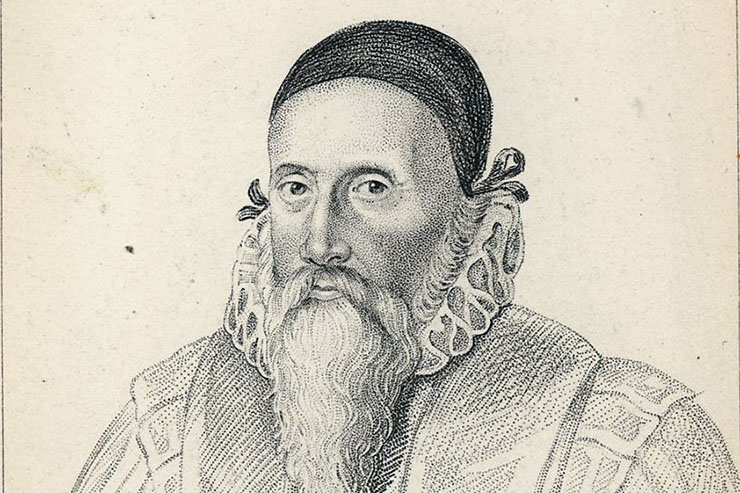
    The Mysterious Dr Dee

    One of the famous occultists he is known to have recruited was Queen Elizabeth’s court astrologer and the magical architect of the British Empire, the Welsh magician Dr John Dee. Walsingham was involved in the machinations for the proposed marriage of the Duc d’Anjou and Elizabeth. At the spy master’s personal recommendation, the queen dispatched Dee to France with orders to report back on the progress of the marriage negotiations. The magus travelled to the Duchy of Lorraine and drew up the birth charts of both the Duc and his brother, who was also regarded as a possible husband for the English monarch. Dr Dee, probably influenced by Walsingham, diplomatically reported back to London that the stars suggested a political alliance would be far wiser than matrimony and the queen took his advice.

    In 1573 Sir Francis returned to London and became a privy councillor. This placed him at the heart of government and he proceeded to set up what amounted to the first organised foreign espionage service to operate from England. In 1566 he had put in place a pan-European network of spies extending as far to the east as Turkey and Russia, where Dr Dee reported on the goings-on at the Tsar’s court. This network mostly gathered intelligence on the military activities of the Spanish, who were England’s primary enemies at this time. Walsingham was also responsible for foiling the Catholic plot whose exposure led to the execution of Mary, Queen of Scots. Using Dr Dee’s psychic powers, he was apparently able to discover that the plotters were passing secret messages to the imprisoned Scottish queen hidden in bottles of wine.

    While travelling in Europe in 1562, Dr Dee had come across a book written by Abbot Trimethus of Spanhiem (1462-1516). This was a guide to writing ciphers and secret codes for magical purposes and Dee informed Sir William Cecil about his discovery. On his return to England Dr Dee adapted the abbot’s cryptography and gave it to Sir Francis Walsingham for use by his secret agents. He also passed on the political and military intelligence he had acquired during his travels across Europe. It has been alleged that Dee used the famous Enochian magical alphabet as a code to disguise this information. If he had been arrested his captors would not have understood it and dismissed it as nonsense.

    In 1587 Dee even claimed he had received a spirit message from one of his angelic contacts concerning a threat to the English Fleet. The message said that a group of disguised Frenchmen working for the Spaniards was secretly visiting the Forest of Dean. The forest was the centre for English ship-building and the French agents planned to bribe disloyal foresters to burn it down. Dr Dee sent his supernatural intelligence to Walsingham and the saboteurs, who were masquerading as squatters, were arrested.

    Information supplied to Sir Francis Walsingham from his European spy network convinced him that a Spanish armada would be launched against England in 1588. He asked Dee to use his knowledge of astrology to calculate the weather prospects for an invasion. The magus told him there would an impending disaster in Europe caused by a devastating storm. When news of this prophecy was leaked and reached Spain, naval recruitment fell and there were desertions of sailors from the Spanish Fleet. In Lisbon an astrologer who repeated the prediction was charged with spreading false information. In an act of psychological warfare, Dr Dee also informed Emperor Rudolf of Bohemia (the modern Czech Republic) and King Stephen of Poland that the predicted storm would “cause the fall of a mighty empire.” Rudolf, who was an occultist and Dee’s patron when he stayed in Bohemia, passed on the warning to the Spanish ambassador.

    It is a fact that in 1588 a great storm did scatter the ships of the Spanish Armada in the English Channel and aided the English victory. This metrological event was popularly credited to a magical ritual performed by the buccaneer Sir Francis Drake on the cliffs at Plymouth. Superstitious people believed Drake was a wizard and sold his soul to the Devil in exchange for success over the Spanish. It is claimed that he also organised several covens of witches to work magically to raise the storm and prevent the invasion. Meanwhile, as a result of scrying in his shewstone or crystal, Dr Dee saw a symbolic vision of a castle with its drawbridge drawn up (England) and the image of the elemental king of fire. As a result he urged the Navy to employ fire-ships against the Armada and they did so with good results.

    After Sir Francis Walsingham’s death in 1590, and the ascension to the English throne of the Scottish king James, Dr John Dee fell into royal disfavour. The new king had an unhealthy obsession with witchcraft and his early reign was dominated by this preoccupation. It led him to employ the Secret Service in his own personal vendetta against suspected witches. James I ordered its agents to hunt down alleged practitioners of witchcraft and expose their alleged plots against the monarchy. One of those involved was the Earl of Bothwell, accused of high treason for organising a coven of Scottish witches to work magic against the king in an attempt to seize the throne. To assist his secret agents in their new witch-hunting activities, King James persuaded Parliament in 1604 to pass a new and stronger Witchcraft Act to deal with the problem. The Bill was rushed through and it was made law within three months.
    Dashwood & the Hellfire Club

    In the 18th century the Secret Service became concerned at the activities of the so-called ‘Hellfire Club’ founded by Sir Francis Dashwood, later the Chancellor of the Exchequer and a close friend and political adviser of King George III. As a young man Dashwood went on the Grand Tour of Europe that was compulsory for aristocrats and he was initiated into a Masonic lodge in France. While visiting Italy he developed anti-Catholic views, violently broke up a celebration of the Mass and insulted the Pope. Even though he was an aristocrat, Dashwood was disgusted at the vast wealth of the Roman Church compared with the poverty of its devoted worshippers. He also became fascinated by classical mythology and decorated his country house at West Wycombe in Buckinghamshire with murals, paintings and statues of Greek and Roman gods and goddesses.

    Sir Francis Dashwood founded a secret society called the Order of the Friars of St Francis of Medmenham (more popularly known as the Hellfire Club) named after the abbey he had purchased on the banks of the River Thames where its meetings were held. Rumours circulated in the coffee houses of London that the Friars practised sexual orgies featuring aristocratic ladies and prostitutes dressed up as nuns. There were also satanic rites such as Black Masses where the naked body of a noblewoman acted as an altar. However, according to one senior member of the Hellfire Club, this occult mummery was just an amusing diversion for the dandies. The inner circle of the Order was actually dedicated to the serious revival of the pagan Eleusian Mysteries and the worship of the Bona Dea or Great Mother Goddess. Dashwood’s present-day descendant, also called Sir Francis, confirmed this fact in a BBC radio interview some years ago,

    It has been claimed secret agents infiltrated the Hellfire Club because of its many famous members. They included the Earl of Sandwich, John Montagu, who was the First Lord of the Admiralty, the Paymaster General Thomas Potter, several members of Parliament, the Lord Mayor of London, a son of the Archbishop of Canterbury, the Earl of Bute, who was the prime minister, and it has been claimed even the Prince of Wales. At least four members of the group were known to be actively involved in espionage. They was a radical MP called John Wilkes, a transvestite French diplomat, Chevalier D’Eon de Beaumont, the American statesman and philosopher Benjamin Franklin, and Sir Francis Dashwood himself. Wilkes had allegedly recruited the chevalier into the British Secret Service.

    During his stay in Russia on the Grand Tour Dashwood had spied on the court of the Tsar through his close friendship with the Grand Duchess Catherine. In Italy he gathered intelligence on the exiled Stuart dynasty and their supporters, although the head of the British Secret Service in Rome believed Dashwood was a Jacobite agent. In fact he was only pretending to support the Stuart cause and was passing on information about their activities directly back to London. In later years Sir Francis and Benjamin Franklin were involved in a clandestine plan to reconcile the American colonists and the British government to prevent the War of Independence.

    Rudolf Hess & the British Occult Connection

    During World War II British Intelligence invited many occultists into its ranks because it needed their specialist knowledge and skills. The assistant director of Naval Intelligence during the war was Lt. Commander Ian Fleming RN, best known later as a thriller writer and the creator of the famous fictional spy James Bond 007. Fleming was also interested in astrology and numerology and he was a friend of the notorious magician Aleister Crowley, who had worked for MI6 (the Secret Intelligence Service) during World War I and in the 1920s and 1930s spying on Germans with occult interests (see ‘The Magus Was A Spy’ by Dr Richard Spence in New Dawn No. 105, November-December 2007).

    Ian Fleming conceived an audacious plan to lure a high-ranking member of the German government into defecting to Britain so as to provide a morale-boosting propaganda coup. This idea had been inspired by a novel written by Fleming’s brother, Peter, called Flying Visit (Jonathan Cape 1940). Peter Fleming was a journalist and also worked for both MI5 (the Security Service) and the propaganda section of the clandestine Special Operations Executive (SOE). The novel imagined that Hitler’s plane crash-landed in England and he was captured. The Reichminister and deputy fuehrer himself, Rudolf Hess, was chosen as a suitable candidate for the actual plot. This was because he was a supporter of peace with Britain and was also under the influence of astrologers and occultists. It was believed this could be used against him.

    Commander Fleming recreated The Link, a defunct Anglo-German friendship society of the 1930s that had a wealthy membership of Nazi sympathisers drawn from the British Establishment. Ironically, or perhaps coincidentally, The Link had been founded by Admiral Sir Barry Domville, an ex-director of the Naval Intelligence Department (NID), after he retired in 1930. Domville was arrested and interned in May 1940 because MI5 believed he was plotting a fascist coup d’etat supported by aristocratic peacemongers. The admiral was a friend of Major-General J.F.C. ‘Boney’ Fuller CBE, a famous military analyst who designed the tactics for the first tank battle in World War I. Fuller also invented the concept of blitzkrieg used so successfully in World War II by the German Panzers. Fuller was an open admirer of Hitler (he attended the fuehrer’s 50th birthday party in 1939), a leading member of Sir Oswald Moseley’s British Union of Fascists (BUF), a friend of Ian Fleming and a leading disciple of Aleister Crowley. In the 1930s Fuller formed the extreme-right wing Nordic League (aka the White Knights of Britain), allegedly established by Nazi agents. However in the 1950s he was a member of a MI6 supported group of Russian émigrés engaged in anti-communist propaganda. It has been suggested that Fuller was not interned during the war with other leading fascists such as Mosley and Domville because he was a MI6 double-agent.

    Ian Fleming’s idea was to persuade the German High Command in Berlin, and especially Rudolf Hess, that when war broke out The Link had not disbanded but had gone underground. It had allegedly regrouped and recruited even more prominent pro-Nazi members in the British Establishment including aristocrats and royalty. These were represented by the NID as influential people with the political muscle to overthrow prime minister Winston Churchill’s national wartime government, call a ceasefire and agree to a peace treaty with Germany. Under its terms Britain would keep control of its Empire and Germany would have free reign in occupied Europe. The Nazis also hoped that British troops would be sent to fight alongside the German Wehrmacht and the SS against the Soviet Union in a joint anti-communist crusade.

    Hitler did not want to invade and occupy Britain. Instead he would have preferred to negotiate a treaty with a sympathetic new government in London. It has been suggested that the only reason the fuehrer abandoned Operation Sea Lion – the proposed invasion of Southern England – and instead invaded the Soviet Union was to force Churchill to accept peace terms. If the Red Army had been defeated Britain would truly have been standing alone, as Hitler did not believe the Americans had the political will to enter the war. Unfortunately he underestimated the ability and resolve of the Soviets to defend their motherland and also the clandestine support that the US was already offering Great Britain.

    The NID plot to ensnare Rudolf Hess used bogus astrological predictions combined with political intelligence. Hess was persuaded that a Scottish aristocrat, the Duke of Hamilton, was willing to negotiate peace terms on behalf of the influential people at the top of British society who wanted to end the war. The duke had met Hess at the Berlin Olympics in 1936 and the deputy fuehrer for some reason thought he was a member of the surviving Hermetic Order of the Golden Dawn. Ian Fleming commissioned an astrologer to produce a faked astrological forecast indicating that 10 May 1941 would be a propitious date for Rudolf Hess to fly to Scotland and meet secretly with the Duke of Hamilton and other members of the so-called British ‘peace party’. Hess’ occult advisors had also told him there would be an unusual planetary conjunction on 10 May. On that day six planets would be aligned in the zodiac sign of Taurus and conjoined to the full moon. At the same time Hitler’s chart showed ‘malefic’ astrological aspects. Hess saw himself in the role of a messianic hero saving Germany from possible future defeat by making peace with the British. All the (false) reports reaching the deputy fuehrer about the political situation in England and the astrological aspects convinced him that his mission would be a success.

    Rudolf Hess flew to Scotland on 10 May 1941 in the firm belief that on landing he would be met by the Duke of Hamilton and the Duke of Kent and whisked off to London for a private audience with King George VI. He had been convinced by the misinformation fed to him by British Intelligence that these three men represented a genuine peace movement capable of removing the warmonger Churchill and agreeing to German terms. Hess had also previously met the Duke of Windsor when he had visited Berlin before the war. As a result Hess was persuaded that some members of the German-descended royal family were sympathetic to Nazism. Certainly the Duke of Saxo-Coburg, formerly Prince Charles Edward, a grandson of Queen Victoria and a close friend of the Duke of Windsor, had willingly embraced Nazism. In fact Hitler had appointed him as the head of the German branch of the Red Cross that was responsible for exterminating the mentally sick and physically disabled.

    Unfortunately instead of meeting pro-Nazi aristocrats and royals when he landed, Hess was captured by a local farmer and a Home Guard unit. They handed him over to the police and he was transferred to London to be interrogated by MI5. Unfortunately the British government completely mishandled the capture of Hess. It has been suggested that Churchill believed the subterfuge by the NID and SIS suggesting leading members of the British Establishment might be pro-German may have been based on fact. For that reason the government did not capitalise on Hess’ ‘peace mission’. The German High Command had also disowned him and said that his flight had been unauthorised. They also suggested that Hess might be insane so his value for propaganda purposes was undermined and diminished.

    Rudolf Hess’ apparent defection caused widespread panic in Berlin concerning the influence of occultism on the Nazi Party. The Gestapo immediately launched Operation Aktion Hess. On the direct orders of Hitler, they rounded up hundreds of occultists, psychics and astrologers, including Hess’s leading occult advisor Ernst Schulte-Strathaus. In June 1941 a decree was issued banning all public performances of clairvoyance, astrology, fortune-telling or telepathy. Anybody associated with Hess and his esoteric interests was thrown into concentration camps and occult secret societies were closed down. Because of staff shortages in the Gestapo, officers from the Naval Intelligence Service were drafted in to interrogate some of the arrested psychics. It has been claimed that they recruited some of them for secret operations using dowsing on maps with pendulums to hunt down British submarines.

    It has also been claimed that Ian Fleming and the NID was involved in a plot to silence the Spiritualist medium Helen Duncan, the penultimate person to be charged under the old Witchcraft Act of 1736. She was arrested in 1944 after holding a séance during which allegedly the spirit of a dead sailor from the sinking of the HMS Bolham physically manifested. As the news of the loss had not been publicly released, and the Admiralty was keeping it secret for morale purposes, Duncan became a target for the security services. She and other psychics were regarded as a serious threat to national security and they became the object of a MI5/NID dirty tricks operation to silence leaks. This suggests that the Intelligence Services actually believed these mediums had genuine powers. Duncan’s arrest and subsequent trial, which in fact was condemned by Winston Churchill as a waste of public funds, was allegedly meant to deter other mediums. The War Office was paranoid that military secrets about the forthcoming D-Day landings in Normandy would be revealed at séances and become public knowledge or passed to the Germans.

    [alert type=”general” dismiss=”no”]This article was published in New Dawn 107.[/alert]

    [alert type=”success” dismiss=”no”]If you appreciate this article, please consider subscribing to help maintain this website.[/alert]

    Bibliography:

    Derek Wilson, Sir Francis Walsingham (Constable 2007)
    Richard Deacon, John Dee (Muller 1968)
    Donald McCormack, The Hellfire Club (Jarrolds 1958)
    P. Mannix, The Hellfire Club (Four Square 1961)
    M.R.D. Foot, SOE: The Special Operations Executive 1940-46 (BBC publications 1984)
    J.M. McKenzie The Secret History of the SOE 1940-1945 (St Ermins Press 2000)
    Nigel West, The Secret War: The Story of SOE (Hodder & Stoughton 1992)
    Richard Deacon, The History of British Secret Service (Frederick Muller 1979)
    Donald McCormick, The Life of Ian Fleming (Peter Owen 1993)

    © New Dawn Magazine and the respective author.
    For our reproduction notice, click here.
  • The “Bloody” Baron von Ungern-Sternberg: Madman or Mystic?

    The “Bloody” Baron von Ungern-Sternberg: Madman or Mystic?

    From New Dawn 108 (May-June 2008)

    My name is surrounded with such hate and fear that no one can judge what is true and what is false, what is history, and what is myth.1
    – Baron Roman Fedorovich von Ungern-Sternberg, 1921

    In Mongolia, there was a legend of the warrior prince, Beltis-Van. Noted for his ferocity and cruelty, he spilled “floods of human blood before he found his death in the mountains of Uliasutay.”2 His slayers interred the corpses of the Prince and his followers deep in earth, covered the graves with heavy stones, and added “incantations and exorcism lest their spirits again break out, carrying death and destruction.” These measures, it was prophesied, would bind the terrible spirits until human blood once more fell upon the site.

    In early 1921, so the story goes, “Russians came and committed murders nearby the dreadful tombs, staining them with blood.”3 To some, this explained what followed.

    At almost the same instant, a new warlord appeared on the scene, and for the next six months he spread death and terror across the steppes and mountains of Mongolia and even into adjoining regions of Siberia. Among the Mongols he became known as the Tsagan Burkhan, the incarnate “God of War.”4

    Later, the Dalai Lama XIII proclaimed him a manifestation of the “wrathful deity” Mahakala, defender of the Buddhist faith.5 Historically, the same individual is best known as the “Mad Baron” or the “Bloody Baron.” His detractors are not shy about calling him a murderous bandit or an outright psychopath.

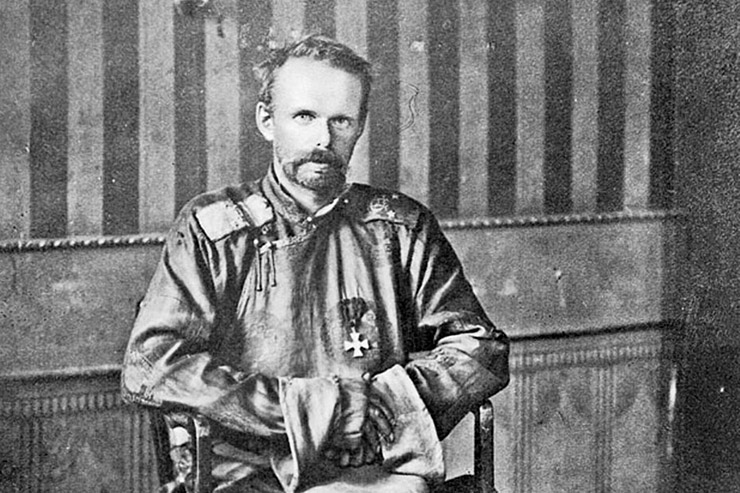
    The man in question is the Baron Roman Fedorovich von Ungern-Sternberg. His exploits can be only briefly sketched here. In the wake of the Russian Revolution, Baron Ungern found himself in eastern Siberia where he aligned himself with the anti-Bolshevik “White” movement. However, his extreme monarchist sentiments and independent ways made him a loose cannon in that camp.

    In 1920, he led his “Asiatic Mounted Division,” a rag-tag collection of Russian, Mongol, Tatar and other troops, into the wilds of Mongolia, a land seething with unrest against Chinese occupation. Rallying Mongols to his banner, in early February 1921 Ungern scored a seemingly miraculous victory by wresting control of the Mongol capital, Urga (today Ulan Bator), from a large Chinese garrison. He then restored the Mongols’ spiritual and temporal leader, the “Living Buddha” Jebtsundamba Khutukhtu Bogdo Gegen, or, more simply, Bodgo Khan and established himself as warlord over Outer Mongolia and the scattered White Russian detachments that had taken refuge there.

    Surrounding himself with an inner circle of murderous sycophants and fortune-tellers, he instituted a reign of terror that claimed as victims Jews, real or suspected Reds, and hundreds of others who somehow aroused the Baron’s wrath or suspicion.6 In June of the same year, he launched an ill-fated invasion of Soviet Siberia which ended with his capture by the Red Army and his subsequent trial and execution on 17 September.

    This article focuses on Baron Ungern’s real and alleged mysticism and its influence on his actions. A key question is whether his perceived “madness,” in whole or in part, was a misreading of his devotion to esoteric Buddhist, and other, beliefs.

    Background and Early Years

    While the Baron spent most of his life in the service of the Romanovs, he was almost entirely German by blood. He entered the world as Robert Nicholaus Maximilian von Ungern-Sternberg on 10 January 1886 (new style) in Graz, Austria. In Russian-ruled Estonia, his father, Teodor Leonard Rudolf von Ungern-Sternberg, enrolled his son in the Tsar’s nobility as Roman Fedorovich. The Ungern-Sternbergs were an old and illustrious family. The Baron dated his line back at least a thousand years and boasted to his Bolshevik captors that seventy-two of his ancestors had given their lives in Russia’s many wars.7

    There is a suggestion of mental instability, even madness, in his immediate line. For instance, one late 18th century ancestor, Freiherr Otto Reinhold Ludwig von Ungern-Sternberg, earned infamy as a ship-wrecker and murderer who died in Siberian exile.8 Roman’s own father had a reputation as a “bad man” whose violence and cruelty led to divorce and a ban on him having any “influence” on his children.9

    As regards Roman von Ungern-Sternberg’s mental state, obviously a diagnosis of insanity can be made only after examination by a psychiatrist, something impossible in this case.10 However, Dmitry Pershin, an eye-witness who took a somewhat positive view of the Baron, still felt that Ungern suffered from a “psychotic abnormality” which made him lose his temper at the “least provocation,” often with terrifying result.11

    Later stories claimed that Roman’s aberrant behaviour was the result of a sabre cut to his head, but he manifested rebellious, violent tendencies much earlier. His school days were marked by constant problems; at the elite Naval Cadet Corps, he racked-up no less than twenty-five disciplinary charges before withdrawing in the face of certain expulsion.12 His education left him with a life-long aversion to “thinking” which he equated with “cowardice.”13

    As a junior officer before and during World War I, he established a reputation as a violent troublemaker with a penchant for hard-drinking. However, he also earned medals for wounds and reckless bravery. In the words of one superior, the young Baron was a “warrior by temperament,” who “lived for war” and adhered to his own set of “elemental laws.”14 The latter were influenced by an interest in mysticism and the occult, especially of the Eastern variety.

    The Baron as Mystic Warrior

    Just when and where this interest began is uncertain. Ungern’s personal brand of faith, if it was Buddhism at all, adhered to the mystical Tibetan Vajrayana or Tantric sect. Young Roman got his first taste of the East as an infantryman during the Russo-Japanese War, and he spent 1908 to 1914 as a Cossack officer in Siberia and Mongolia. It was then, he later claimed, that he formed an “Order of Military Buddhists” to serve the Tsar and fight against the evils of revolution. The rules of his Order included celibacy and the “limitless use of alcohol, hashish and opium.”15 The latter was to help initiates overcome their “physical nature” through excess, but as the Baron confessed, it did not work quite as he had planned. Later, in Mongolia, he enforced a strict ban on drink. Still, he asserted, he gathered “three hundred men, bold and ferocious,” and some who did not perish in the fighting against Germany and the Bolsheviks were still with him in 1921.

    Ungern resigned his regular commission at the end of 1913. Alone, he headed into the vastness of Outer Mongolia which had proclaimed independence from China. By one account, he rose to command the cavalry forces of the fledgling Mongolian Army, while another holds that he joined the marauding band of the bloodthirsty anti-Chinese rebel, Ja Lama. At some point, Ungern ended up in the western Mongolian town of Kobdo (Khovd) as a member of the guard of the local Russian consulate.

    One of his comrades recollected that “when one observed Ungern, one felt himself carried back to the Middle Ages…; [he was] a throwback to his crusader ancestors, with the same thirst for war and the same belief in the supernatural.”16 Another recalled that he displayed “a great interest in Buddhism,” learned Mongolian and took to frequenting lama fortune-tellers.17 According to Dmitri Aloishin, a later, unwilling member of the Baron’s army, Ungern’s “Buddhist teachers taught him about reincarnation, and he firmly believed that in killing feeble people he only did them good, as they would be stronger beings in the next life.”18

    The parallels between aforementioned Ja Lama and the Baron seem too close to be mere coincidence. Also known as the “Lama with a Mauser,” Ja Lama briefly made himself master of western Mongolia. Another “militant Buddhist,” he earned a fearsome reputation for ripping out the hearts of unfortunate captives and offering them up in skull-shaped bowls as bali (sacrifice) to the “Tibetan terror gods.”19 One such “Tantric” ritual slaughter occurred in Kobdo in the summer of 1912, just before Ungern arrived on the scene. In February 1914, the Russian consul in Kobdo arrested Ja Lama and Cossack troops, possibly including Ungern, and escorted the captive to exile in Russia. Did Ja Lama become a role model for the Baron, or even a religious inspiration?

    A Tibetan angle figures prominently in Ungern’s subsequent Mongolian escapade. The Living Buddha was himself a son of the Land of Eternal Snows, and a small Tibetan community dwelled in Urga. A hundred or so of these men formed a special sotnia (squadron) in the Baron’s forces and played a critical part in the assault on Urga by snatching the Bogdo from under the noses of his Chinese guards. The Chinese and Mongols were convinced that the feat had been accomplished through sorcery. These Tibetans maintained a distance from the rest of the Baron’s army; apparently others were put off by their habit of dining out of bowls made from gilded human skulls, perhaps the same sort of vessels used in Ja Lama’s sacrificial rites.

    The Tibetan nexus also provided the Baron with a link to Lhasa and the Dalai Lama, to whom he addressed personal letters. After his power in Mongolia collapsed, Ungern dreamed of leading the remnants of his division to far-off Tibet and putting himself at the service of the Buddhist holy man.20 The prospect of this gruelling, and potentially suicidal, trek was the final straw in provoking mutiny against the Baron.

    Also serving under Ungern in his Mongolian adventure were fifty or so Japanese soldiers. This has fuelled accusations that he was a cat’s paw of Japanese imperialism. While it is clear that the Japanese military monitored the Baron’s activities and thought he might be useful, it is equally evident that they had no real control over him. Still, his tiny Japanese contingent received better rations and the unique privilege of consuming alcohol.21 Japanese military records suggest that the men were “mostly petty adventurers” acting on their own accord, but that is far from clear.22 Their commander, a Major or Captain Suzuki, had met the Baron in 1919 at a “Pan-Mongol Congress” and the pair maintained a special and secretive friendship.

    An intriguing possibility is that Suzuki was not an emissary of the Mikado’s Army but of one of the secret societies that permeated it, such as the Black Dragon Society or the even more secretive Green Dragon Society. The latter was based in a sect of esoteric Buddhism, and its Pan-Asiatic, Pan-Buddhist agenda meshed with Ungern’s own beliefs.23 The Baron felt that the West had lost its spiritual moorings and had entered a stage of moral and cultural disintegration. The Russian Revolution was but a manifestation of this advanced corruption. Only in the East, specifically in Buddhism, did he see a force capable of resisting this decay and restoring spiritual order in the West.

    The Baron’s Lamas and Fortune-Tellers

    Ungern was fascinated by all forms of divination. He allegedly carried a deck of Tarot cards with him, even in the heat of battle. As noted, in Kobdo he consorted with lama soothsayers and in Urga he surrounded himself with a small army of fortune-tellers (tsurukhaichi), sorcerers and shamans.24 Aloishin recalls that the Baron’s diviners were forever consulting the roasted shoulder blades of sheep, pouring over the cracks “to determine where the troops must be stationed, and how to advance against the enemy.”25 On other occasions, Ungern ordered his troops to stop “at various places in accordance with old Mongolian prophecies.”26

    The Baron’s staff physician, Dr. N. M. Riabukhin, damned the fortune-tellers as “brazen, filthy, ignorant and bow-legged” and decried the fact that Ungern “never took any important step” without consulting them. The soothsayers convinced him that he was the incarnation of Tsagan Burkhan, the God of War. To White officer Boris Volkov, the Baron’s dependency on these types seemed proof of the “moronic mentality of the degenerate who imagined himself the saviour of Russia.”27

    Prior to his advance in Red Siberia, Ungern spent 20,000 precious Mexican dollars to hire thousands of lamas to “perform for him elaborate services in the temples and to call to his assistance all their mystic powers.”28 One drugged shamaness’s prediction of the Baron’s approaching doom proved eerily accurate, and helped convince him to undertake the disastrous invasion.29 The fortune-telling lamas failed him when they counselled a two day delay in the attack on Troitskosavsk, a key border town.30 This gave the Reds opportunity to bring up reinforcements and repel the assault. Later, officers bribed a Buriat fortune-teller to change his predictions, which led Ungern to call-off further advance and order retreat to Mongolia.31

    But if Ungern was influenced – and mislead – by the supernatural, he also knew how to use it to his advantage. Prior to his final attack on Urga, he dispatched fortune-tellers into the city where they “filled the Chinese soldiery with superstitious fear” by predicting his imminent arrival and spreading rumours that the White Baron was immune to bullets and could appear and disappear at will.32 He also ordered nightly bonfires set on the surrounding hills. His Mongol agents told the credulous Chinese that the fires were Ungern offering sacrifices to the spirits who would take their vengeance on the sons of China.33

    One person struck early by the Baron’s peculiar nature was mystical philosopher Count Hermann Keyserling who knew Roman and his brother Constantin from childhood. Keyserling later regarded the Baron as “the most remarkable person I have ever had the good fortune to meet,” but also a mass of contradictions.34 He saw Ungern as one whose “nature was suspended… in the void between heaven and hell,” someone “capable of highest intuition and loving kindness” alongside “the most profound aptitude for the metaphysics of cruelty.”35 The Baron’s metaphysical ideas, Keyserling believed, were “closely related to those of the Tibetans and Hindus.”36 Keyserling was convinced that Roman possessed the occult power of “second sight” and “the faculty of prophecy.”

    Keyserling was not the only one to come to such conclusions. Years later, fascist and occult philosopher Julius Evola opined that Baron Ungern possessed “supernormal faculties” including clairvoyance and the ability to “look into the souls” of others.37 Ferdynand Ossendowski claimed that he did exactly that at their initial meeting. “I have been in your soul and know all,” the Baron proclaimed, and Ossendowski’s life was secure.38

    Much the same is repeated in the testimony of others who knew Ungern. Aloishin thought the Baron patently insane but also felt that he “possessed a dangerous power of reading people’s thoughts.”39 He recounts how Ungern would inspect recruits by staring into each man’s face, “hold that gaze for a few moments, and then bark: ‘To the army’; ‘Back to the cattle’; ‘Liquidate’.”40 Riabukhin mentions that on their first meeting “it was as though the Baron wanted to leap into my soul.”41 Another anonymous officer recounts that “Ungern looked at everyone with the eyes of a beast of prey,” and this instilled fear in all who met him.42 A Polish soldier in Mongol service, Alexander Alexandrowicz, accepted the Baron’s “second sight,” but believed that it was his “superior” intellect that helped him “size up any man in a few minutes.”43

    The Mysterious Ferdynand Ossendowski

    Arguably, no one did more to create the prevailing image of Baron Ungern than the above noted Polish writer Ferdynand Ossendowski. However, he is a far from an impeccable source. Prior to his encounter with the Baron, Ossendowski had a long history as spy, intriguer and purveyor of fraudulent documents. He almost certainly was an agent of the Tsarist secret police, the Okhrana. In 1917-18 he was mixed-up with the infamous Sisson Documents, a fake (if fundamentally accurate) dossier on German-Bolshevik intrigues.44 Later, in Siberia, Ossendowski served White “Supreme Ruler” Admiral Kolchak as an economic adviser and, probably, a spy. Ossendowski arrived in Mongolia as a refugee from the Red tide. In his widely-read 1922 book Beasts, Men and Gods, the Pole describes his meeting with the “Bloody Baron” in vivid detail, and not without some sympathy for the subject. Nevertheless, Ossendowski knew that “standing before me was a dangerous man,” and that “I felt some tragedy, some horror in every movement of Baron Ungern.”45 Nor did Ossendowski mince words about the climate of fear that gripped Urga under the Baron. He describes Ungern’s brace of murderous underlings such as the psychotic “strangler” Leonid Sipailov, the equally repellent Evgeny Burdukovsky and the sadistic Dr. Klingenberg. What Ossendowski conveniently side-steps is the mystery of his own survival in that precarious environment.

    In the views of others who witnessed the Baron’s rule, Ossendowski was not just lucky and no innocent observer. Konstantin Noskov notes that from the moment of his arrival in Mongolia, “Professor” Ossendowski played “a strange role understood by no one.”46 “He interfered in everything,” adds Noskov, “quarrelled very skilfully [and] wove complicated political intrigue….” Pershin charges that Ossendowski was another who exploited Ungern’s obsession with the supernatural, a view echoed by one of the Baron’s officers, K.I. Lavrent’ev.47 By encouraging “the Baron’s faith in occultism and other things of the beyond,” Ossendowski became an “adviser” to the Baron, which may explain a later claim that the Pole became Ungern’s “chief of intelligence.”48

    Ossendowski, according to Pershin, “wormed his way into a position close to the Baron” and so “extracted all the advantages he wanted.”49 Those included money and safe passage to Manchuria “in comfort and, perhaps, with something more than that.” Dr. Riabukhin and Noskov both recall that Ossendowski was inexplicably the sole survivor among a group of refugees whose other members were murdered on Ungern’s orders.50 Boris Volkov adds that Ossendowski played a key role in formulating the Baron’s infamous and “mystical” Order #15, and so secured his life and a large sum of money.51 Noskov flatly declares that Ossendowski was the author of the Order.52

    “Order #15,” the closest Ungern ever came to outlining a philosophy or mission, deserves closer examination. Since the Baron was not in the habit of issuing numbered orders, the #15 is meaningless in that context. According to Aloishin, that number and the date of its issue were more work of the “learned lamas” who picked them as lucky numerals.53 Basically, the Order outlines a grandiose scheme to initiate an ever-expanding wave of counter-revolution that would cleanse Russia of its radical contagion and restore the Romanov throne under the late Tsar Nicholas’s brother, Mikhail Alexandrovich. The Baron, as many others, was not aware that Mikhail had been dead since June 1918. The Order proclaimed that “the evil which has come to Earth in order to destroy the divine principle of the human soul must be destroyed at the root,” and that “the punishment may be only one: the death penalty, in various degrees.”54

    The most notorious article, though, was #9 which declared that “Commissars, Communists and Jews, together with their families, shall be destroyed.” The Baron had a pathological hatred of Jews, and wherever his power held sway there was a ruthless extermination of that community. Even Pershin, who felt that “stories concerning [Ungern’s] mercilessness have been much exaggerated,” admitted that the mass killing of Jews was regrettably true and that the Baron was implacable on the matter.55 Volkov felt that Ungern used pogroms as a tool to exploit anti-Semitism among the émigrés and troops, but there was an almost religious zeal to his hatred. In a letter to a White Russian associate in Peking, the Baron warned against “international Judaism” and even the insidious influence of “Jewish capitalists” who were an “omnipresent, though very often undetected, enemy.”56 At his trial, the Baron assured his Jewish, Bolshevik prosecutor, Emelian Yaroslavsky, that “the Communist International was organised 3,000 years ago at Babylon.”57 In his feelings towards Jews, Ungern certainly prefigures the Nazi mentality, and much the same could be said for his whole weird mixture of mystical anti-modernism.

    In August 1921, the Baron’s despotic reign came to an end when desperate officers of the Asiatic Mounted Division staged a coup against him and his dwindling cadre of loyalists. Almost miraculously, Ungern escaped the general slaughter and found a brief, final refuge among his Mongol soldiers. They too soon abandoned him to the approaching Reds, but without harming a hair on his head; they were still convinced that he was the Tsagan Burkhan and could not be killed.58

    The Soviets suffered from no such delusions. At his trial in Novo-Nikolaevsk, he was a calm, even dignified, prisoner. He had foreseen his fate and accepted it. The prosecution was most interested in portraying him as an agent of the Japanese, which he denied. However, the Baron readily admitted to mass killings and other atrocities. So far as his brutal discipline was concerned, he proclaimed himself a believer in a system that had existed “since Frederick the Great.”59 He went before the firing squad quite convinced that someday he would be back.

    A final point brings us back to Ossendowski, who claimed that the Baron sought contact with the mythical subterranean kingdom of Agarthi and its mysterious ruler, the “King of the World.”60 Agarthi, of course, is identical with Agarttha or Shambhala, a mystical land enshrined in Hindu and Buddhist mythology. In the early twentieth century, the story was picked-up and elaborated by Western esoteric writers such as Alexandre Saint-Yves d’Alveydre and Nikolai Roerich who believed that it described an actual realm hidden somewhere in northern Tibet or a nearby Central Asia. By an interesting coincidence, another officer in Ungern’s Division was Vladimir Konstantinovich Roerich, Nikolai’s younger brother. Then again, perhaps it was no coincidence at all. But that brings us to a story that is best saved for a following article: “Red Star over Shambhala: Soviet, British and American Intelligence and the Search for Lost Civilisation in Asia.”

    [alert type=”general” dismiss=”no”]This article was published in New Dawn 108.[/alert]

    [alert type=”success” dismiss=”no”]If you appreciate this article, please consider subscribing to help maintain this website.[/alert]

    Footnotes:

    1. Ferdinand Ossendowski, Beasts, Men and Gods [BMG] (New York: Dutton, 1922), 238.
    2. Konstantin Noskov, The Black Year: The White Russians in Mongolia in the Year 1921 (Harbin, 1930), 75.
    3. Ibid.
    4. Tsagan Burkhan roughly translates as “White God” but can also be used to mean “White Buddha.” The use of the term for Ungern seems to have started among his Buriat troops and spread to other Mongols.
    5. Markus Osterrieder, “From Synarchy to Shambhala: The Role of Political Occultism and Social Messianism in the Activities of Nicholas Roerich,” presented at “The Occult in 20th Century Russia: Metaphysical Roots of Soviet Civilization,” Munich, March 2007, 10, n. 51.
    6. Boris Volkov, About Ungern (trans. Elena Varneck), 6 , Hoover Institution Archives [HIA], Stanford, CA,.
    7. Izvestiya (23 Sept. 1921). Standard genealogy puts the beginning of the line in the mid-13th century with one Hanss von Ungern or Johannes de Ungaria who took service under the Bishop of Riga: Genealogisches Handbuch des Adels (Glueksburg: C.A. Starke, 1952), 467.
    8. Marquis de Custine, Empire of the Czar: A Journey through Eternal Russia (New York: Anchor, 1989), 61-65.
    9. Vladimir Pozner, The Bloody Baron: the Story of Ungern-Sternberg (New York: Random House, 1938), 50-51.
    10. I. V. Ladygin, “Chetyre mifa o barone Ungerne,” http//army.armor.kiev.ua/hist/ungern.shtml.
    11. D. Pershin, “Baron Ungern, Urga, i Altan Bulak,” 113, HIA, Stanford.
    12. Paul du Quenoy, “Warlordism a la russe: Baron von Ungern-Sternberg’s Anti-Bolshevik Crusade, 1917-21,” Revolutionary Russia, Vol. 16, #2 (December 2003), 4. This article provides an excellent overview of Ungern’s career.
    13. Pozner, 81-82.
    14. Baron Petr N. Vrangel’ (Wrangel), “Yuzhnyi front,” Beloe delo, Vol. V (1927), 12-13.
    15. Ossendowski, “With Baron Ungern in Mongolia,” Asia, Vol. 22, #8 (1922), 618.
    16. Pershin, 53c.
    17. Boris Volkov, “On Ungern,” 45, trans. by Elena Varneck, HIA, Stanford.
    18. Dmitri Aloishin, Asian Odyssey (New York: Henry Holt, 1940), 230.
    19. Charles R Bawden, The Modern History of Mongolia (New York; Praeger, 1969), 198.
    20. N. M. Riabukhin, “The Story of Baron Ungern Sternberg As Told by His Staff Physician,” 30, trans. by Elena Varneck, HIA, Stanford.
    21. Volkov, 47.
    22. Fujiko Isono, “The Mongolian Revolution of 1921,” Modern Asia Studies, Vol. 10, #3 (1976), 388.
    23. My thanks to the late Charles Rice for this information.
    24. Pershin, 53c.
    25. Aloishin, 228. See also Ossendowski, BMG, 218.
    26. Aloishin, 231.
    27. Volkov, 5.
    28. Aloishin, 258.
    29. Osssendowski, “Baron,” 661-662.
    30. Riabukhin, 23, and Volkov, 42.
    31. Riabukhin., 28.
    32. Pershin, 45.
    33. Ibid., 49.
    34. Pozner, 81.
    35. Hermann Keyseling, Creative Understanding (New York: Harper, 1929), 276 and Pozner, 81-82.
    36. Ibid.
    37. Julius Evola, “Ungern-Sternberg, el Baron Sanguinario,” trans. from Roma (9 Feb. 1973).
    38. Ossendowski, “Baron,” 615.
    39. Aloishin, 229.
    40. Ibid.
    41. Riabukhin, 2.
    42. Ungernovets, “Memories of Ungern-Sternberg: Memories of a Participant” (c. 1933), 11, trans. by Elena Varneck, Varneck Collection, HIA.
    43. Rene Guenon. Theosophy: History of a Pseudo-Religion (Hillsdale, NY: Sophia Perennis, 2001), 311.
    44. George Kennan, “The Sisson Documents,” The Journal of Modern History, Vol. 28, #2 (June 1956), 130-154.
    45. Ossendowsky, BMG, 226.
    46. Noskov, 14.
    47. Pershin, 53c.
    48. Osterrieder, 11, n. 70.
    49. Pershin, 53c.
    50. Noskov, 16.
    51. Volkov, 6.
    52. Noskov, 26
    53. Aloishin, 258.
    54. “Order No. 15 issued by Baron Ungern Sternberg,” trans. by Elena Varneck, Varneck Papers, Hoover Institution Archives, 5.
    55. Pershin, 59, 59c, 66, 75. See also Volkov, 15, 20, 26, 50.
    56. Ungern to “Grigorii,” (20 May 1921), 7-8, “Letters Captured from Baron Ungern in Mongolia,” HIA, Stanford.
    57. “Trial of Ungern,” from Izvestiya (23 Sept. 1921), trans. by Elena Varneck, Varneck Collection, HIA, Stanford.
    58. Aloishin, 267-268.
    59. “Trial,” Ibid.
    60. Ossendowski, BMG, 301-312.

    © New Dawn Magazine and the respective author.
    For our reproduction notice, click here.
  • John Perkins: From Economic Hitman to Shaman

    John Perkins: From Economic Hitman to Shaman

    I remember John Perkins. He was a real jerk. A gold-plated, super-slick lying little butthole shill for corporate gangsters; a snake-oil salesman with a movie-star grin, shiny loafers, a crooked calculator and a tooled leather briefcase full of high-blown bullshit.
    – Greg Palast (www.gregpalast.com)

    Despite Greg Palast’s spleenish dismissal from an earlier time, John Perkins has emerged as a spiritual, intellectual and political authority. He is an important leader of contemporary neo-shamanism, one of today’s most effective critics of American corporate culture, and a story teller capable of overshadowing the legendary Ian Fleming, who created James Bond, when it comes a tales of imperial adventure and conquest.

    He is working to offer a vision, or a ‘dream change’ as he calls it, designed to rescue America, and the world it dominates, from the destruction of rampant corporate energy. He works to achieve these ends by recounting in a disarmingly honest and sensitive way the personal adventures and dilemmas he has experienced in diverse and exotic parts of the world.

    Perkins first gained a reputation in the 1990s for a series of books on shamanic cultures amongst remote tribes and peoples. Around a decade later and prompted by the events of 9/11, he published Confessions of an Economic Hit Man in 2005. This describes life as part of an elite group trained to “utilise international financial organisations to foment conditions that make other nations subservient to the corporatocracy running our biggest corporations, our government, and our banks.”

    After twenty-seven publishers turned it down, the book came out of nowhere to be an international best seller, and is about to be made into a Hollywood movie. It went to number four on Amazon during its first week and was quickly on all best-seller lists. This was achieved without receiving any mainstream media attention.

    Most importantly, Confessions of an Economic Hit Man has provided credibility, authority and celebrity in opening up new areas of thought. These range across corporate power, American empire, shaman spirituality and environmental consciousness.

    Perkins has become a rallying figure for critics of the American ‘corporatocracy’. The harm it inflicts with casual neglect on the environment and local tradition is identified wherever there is the potential to seize cheap resources or some other commercial windfall. A second book has now been published in this genre. The Secret History of the American Empire again recounts wild, troubling conspiracies to grab resources from vulnerable third world leaders through the peddling of unserviceable loans. This is what makes it tempting, even if it is an injustice, to say that its author is becoming America’s Ian Fleming, with conscience.

    Intriguingly, the American hit man is a much more sophisticated and reflective operator than the British secret agent. He never dirties his own hands with an actual act of execution or termination. That is left to the jackal, a scavenger that cleans up after others and a figure much closer to the persona of James Bond. Yet both Fleming and Perkins leave the feeling that they have witnessed a time of transition, as the challenges of empire begin to outweigh its rewards. Each captures his readers through the exposure of perversely heroic excesses.

    John Perkins both writes and plays the story of the economic hit man, as he reveals an institutionalised imperial strategy of which few had previously been aware. This exposure may well make a contribution to constraining the role of laissez faire corporate plundering in maintaining empire. It may also help construct a vision for an American future more in tune with the values of its founding fathers and its constitution.

    It is a comment on the paradoxical character of the contemporary world that the legacy from time as an economic hit man is now committed to opposing and constraining such activity. Rarely have the costs and destruction that go with exercising power over vast areas of the world and the enormous demands of imperial authority on energy, talent and resources been rendered more transparent.

    Perkins sketches a highly complex world, both at the personal and imperial level. His own heroic personality reflects a messy, if robust, form of schizophrenia. Simultaneously, he confesses to ghastly deeds as an economic hit man, articulates a rare sensitivity to diverse indigenous forms of spirituality, uses his experience of malevolent deeds to awaken readers to the destructive power of corporations and comments on the complex feelings and questionings that accompany his actions and reflections.

    A simple, powerful and authoritative style makes it easy to follow these stories of endless exotic adventure. It is also easy to follow the author’s feelings as he learns and grows through personal involvement in a world of calculated intrigue and exploitation that no one had ever explained to him.

    The experience of many bright, inexperienced young men is captured with rare honesty. These innocents are recruited to maintain and extend the reach of empire by means that it would be politically unacceptable to explain in an academic text or a university course. Such stories are a powerful means of mocking much of the economic doctrine taught at Western universities and wielded like a weapon by the minions of the IMF and World Bank as self-serving theoretical nonsense.

    Greg Palast, in a piece titled John Perkins: Jerk, Conman, Shill posted on his website www.gregpalast.com, captures the profound ambiguity in the author’s character in the following colourful language:

    To steal millions, you need a top team of armed robbers. But to steal billions, you need PhD’s with colour charts and economic projections made of fairy dust and eye of newt. Perkins had it all – including a magical thing called a computer-generated spreadsheet (this was well before Excel)…..

    But, as in every moral tale, Perkins, the modern Dr. Faust, found redemption in confession…..

    And in his writings today, Perkins’ heart goes out to the Third World targets of this new empire ruled by shock troops and spread sheets. His empathy extends to those in the occupied territory known as the USA. Because, says Perkins, when the wretchedly ripped-off of the Earth rise in rebellion, the lash of the backlash is felt by the children of the lobstermen of New Hampshire, shivering under Humvees in Falluja, and never the EHM’s clients’ fortunate sons, frolicking in their Ferraris.

    While Perkins is best known today for his Confessions of an Economic Hit Man, he is best understood in the context of his earlier writing. This explores the wisdom and understanding of shamans in contrasting parts of the world. These revelations can be even more startling than his hit man stories. They raise serious questions about most readers’ perceptions of reality and can leave an elated sense of new possibilities and enhanced insight into the nature of life. It is even possible to read in an exchange with an Amazonian shaman an early contribution to the idea of carbon trading.

    Stories of the profound practical wisdom mobilised by forms of shamanic spirituality make this unfamiliar world surprisingly accessible. The struggle for survival in a world threatened with destruction by economic hit men adds further credibility.

    Stories of spiritual discovery amongst native shamans are built around a deep but shifting sensitivity. Initial days as a wide-eyed Peace Corps volunteer are followed by subsequent hit man travels surrounded by privilege, sycophantic attendants and murky conspiracies, and then by a role as guide and leader of small groups of spiritual explorers venturing into the Amazon and other threatened environments. A capacity to recognise the mundane daily imperatives of human life in many contrasting environments is a basic strength of these stories. Readers are introduced in a most convincing manner to the surprisingly practical uses to which native spiritual powers are put. These range from the power to track down and destroy a rogue tiger in the jungle to the capacity to navigate vast distances at sea without charts or other recorded knowledge.

    Pychonavigation: Techniques for Travel Beyond Time in 1990 displayed a writer and activist deeply concerned with the preservation of native traditions, the understanding of shamanic spirituality and the protection of the environment. It also highlighted the manner in which the contemporary world offers unprecedented opportunities to those with wealth, interest, understanding and accidental opportunity. Such individuals are able to explore and identify with diverse forms of spirituality amongst peoples from many different traditions of belief and behaviour.

    The world of shamans may be under threat, but there is also a sense in which the advanced and scientific West needs to turn increasingly to these influences. Christian and scientific dogmas have destroyed essential human qualities in the rush of spread sheets and bottom line calculations.

    These discoveries have been followed up and explored further in other books, such as Shapeshifting: Techniques for Global and Personal Transformation. This 1997 book gives readers an almost tactile sense of experience in uncovering new wonders. This powerfully encourages an opening of the mind and spirit to new possibilities. Not only is the reader’s preparedness to explore the seemingly unbelievable tested, but penetrating reflections on the contemporary world challenge many familiar certainties.

    The assertion of a sympathetic mentor, a Norwegian engineer and corporate power-broker, that capitalism is here to stay provides the basis for reflections on the future. It is essential to understand as deeply as possible the nature of the corporation, which need not necessarily be predatory and destructive. This gives context and balance to devastating comments about corporate fostering of consumerism and emasculation of education. These products of the European Enlightenment, and the way they have diminished the spiritual qualities and understanding of people in the developed world, are rarely exposed so aptly.

    Concern with corporate realities leads to discussion with a Mayan shaman about the need to distinguish dreams from fantasy. While dreams can nourish fulfilment in life and a deep sense of spiritual reality, fantasies only encourage illusion and can be very harmful. This distinction has great practical usefulness because we all vacillate between dreams and fantasies. Yet we rarely pause to recognise the need to distinguish between them, nourish our dreams and discipline our fantasies.

    Explorations with the Mayan shaman suggest that critical to realising the potential of dreams is an understanding at the most fundamental level that energy is everything, that spirit is energy and that the sighting of spirits is synonymous with the sighting of energy. From this it follows that the aura that surrounds organic life and that some healers can use to restore well-being is an emanation of spirit and energy. In bold reflections such as these, Perkins offers himself with a genuine sense of humility – attributing his insights to ‘primitive’ shamans – as a serious and profound commentator on the ills of Western progress and development.

    Books such as Pychonavigation and Shapeshifting in the 1990s reveal the depth of Perkins experience, reflection and spirituality. While they won him a substantial readership and group of followers, it was the political and corporate expose of Confessions of an Economic Hit Man that catapulted him into the ranks of bestsellers and made him a celebrity leader with a potential to transform many of the spiritual ailments that trouble the contemporary American imperial character.

    John Perkins was born in New Hampshire in 1945. He attended Tilton Boys High School, and later Middlebury College and Boston University, before joining the Peace Corps and working in Ecuador in the Amazon. He claims he was vetted by the National Security Agency before being recruited by the Boston strategic consulting firm, Chas T Main, where he rose to the position of chief economist. Not surprisingly, his claims have been disputed by the US State Department.

    Then followed some years of internal struggle over the role of persuading third world governments to accept large, unserviceable loans for infrastructure projects contracted to major US corporations. This anguish deepened as understanding grew about subsequent joint US government and international aid agency action, designed to control these governments and dispose of their oil and other resources to serve US interests. Being a witness to such activities all over the world – in Africa, Asia, Europe, Latin America and the Middle East – led to a decision to quit. Little doubt is left, however, that those who desired silence about earlier work assisted in the success of a subsequent independent energy company.

    After the sale of the energy company in the late 1980s Perkins became involved with non-profit work around the world. In addition to his writing, he became active in shifting consciousness and promoting sustainable lifestyles for the individual and global community.

    It is possible to question the veracity of accounts of American skulduggery. But there is much evidence to support them and they are rarely subjected to serious critical cross-examination. To the contrary, Confessions of an Economic Hit Man has been followed by books like A Game as Old as Empire: The Secret World of Economic Hit Men and the Web of Global Corruption, a collection of chapters by a variety of writers, edited by Steven Hiatt, which explores the range of such activity.

    Even more important, perhaps, unrelated writers such as the German-American William Engdahl have shown in books like A Century of War: Anglo-American Oil Politics and the New World Order that Anglo-American power-brokers have long made devastating use of discreet partnerships between corporate and governmental interests. When the record of the English East India Company is put together with the work of contemporary writers, it is difficult to avoid the conclusion that Anglo-American empire has largely been the product of the corporation.

    These organisations have been effective fronts for imperial expansion. They have been characterised by a remarkable capacity to mobilise adventurous, risk-taking individuals, by skilful, discreet control and manipulation of financial and commodity resources and by the ability to shroud their activities in high-sounding rhetoric about progress and universal values.

    The impact of Perkins in exposing this reality has been enhanced by several factors. First, he tells a great story from the perspective of personal involvement and personal anguish. Second, his earlier writings on indigenous spirituality in scattered parts of the world provided him with an established reputation amongst informed and reflective readers in the decade before the appearance of Confessions of an Economic Hit Man. Third, there is apparent coherence linking his stories of spiritual adventure and discovery and his stories of political adventure and discovery. Finally, 9/11 has created a world, with its enhanced electronic communications and troubled questioning of what has gone wrong, that is disposed to explore the issues raised by corporate excess and economic hit men.

    In one sense, the linkage of spiritual and financial adventure and discovery has created a 21st century everyman or icon. Educated and reflective members of economically advanced communities will find it increasingly difficult to avoid the type of issues and questions that are central to these themes.

    The fact that Perkins does not claim great erudition but simply recounts a story and a succession of dilemmas enhances the accessibility of the work. The sense of surprised discovery of hidden realities is one that is shared by increasing numbers in a world where even advanced levels of education tend to be narrow and excessively functional. It is easy for even the best intentioned and most responsible of workers to become jerk, con-man, and shill as they toil to fit in, accommodate peer group pressure, win the favour of superiors and build the reputation and wealth needed to support a family.

    The modern corporation (or government) demands a certain ignorance and naïvetè of its employees if they are to serve its purpose of maximising profit (or voter support). Only a few are privileged to have the opportunity to see through illusions, opt out and warn others. It is a role where success is improbable.

    The title chosen for Perkins’ second book on American financial strategies, The Secret History of the American Empire, invites the reader to revisit and reconsider events like the 1997 Asian Financial Crisis and ponder on it as the product of a team of economic hit men. It also raises daunting questions about the longer-term viability of major global institutions like the World Bank and IMF.

    There is one story of carrying a book by Joseph Stiglitz during travels to Tibet and of reflections about closely related concerns. Globalization and Its Discontents explains spreading discontent and criticism about the international financial institutions. It does this from the perspective of one who served on President Clinton’s Council of Economic Advisors, was Chief Economist and Senior Vice President of the World Bank and was the winner of the 2001 Nobel Prize for Economics. Yet, it is important to understand why it is John Perkins and not Joseph Stiglitz who will have the greater impact on the popular American consciousness.

    However much the authority of the American State Department may dispute them, Perkins’ stories take the reader directly into the action and personalities of events that have shaped the latter half of the 20th century. They involve the reader in the excitement, the fulfilments and the angst of such action and make the most implausible of conspiracies seem commonplace and mundane, even as they unfold in exotic and alien environments. Ultimately, they intensify many dilemmas by focusing on discoveries of the shamanic spirituality and wisdom of peoples whose cultural survival in the contemporary world seems condemned – limited to decades.

    Unfortunately, there is little about Japan and China, two large nations that have preserved ancient forms of spirituality while building robust and vibrant modern economies. A chapter on geishas in Secret History hints at great subtlety in Japanese traditions. It recounts a platonic, hungering and fleeting relationship with two geishas who are revealed to be mixed blood daughters of Taiwanese mothers abandoned by American fathers and rescued and raised by a shrewd but kindly Japanese businessman. These, in a single forthright conversation, educate a still naïve American in the way their charms are used to advance Japanese corporate interests. One suspects these are rarely matched by American finesse. Sadly, apart from this early chapter in the latest book nothing more is said about Japan.

    Another chapter, The Quiet Giant, reflects in passing, and not unsympathetically, on China in the context of a visit to Tibet. There are no insights of particular interest, however, and China is not addressed again.

    Both Japan and China have sheltered and preserved shamanic traditions, generally in the form of Shintoism and Daoism, but also in Zen and Chan Buddhism and other forms. Despite the fact that both Japan and China have been remarkably successful in exporting products of this shamanism in the form of martial arts, physical therapy and spiritual disciplines, it is not popular to recognise such successes in the West.

    While this issue is not explored directly by Perkins, exploration of less imposing shamanic traditions invites the thoughtful reader to reflect further on the costs inherent in the West’s ‘intellectual apartheid’. Deployed as a means of advancing the West’s civilising mission and imperial ambitions, ‘intellectual apartheid’ blinded most observers to the power of Japanese and Chinese shamanic spirituality. East Asian nations have shown that educated, disciplined and organised communities can defend themselves against Anglo-American economic hit men, whether it is through the use of geishas or other aspects of traditional practice.

    Ultimately, one may question whether Perkins offers serious readers any realistic way forward. He cannot be faulted for his criticism of economic hit men and their plundering corporations and one cannot but applaud his revelations about endangered shamanic cultures. But does he address these issues strategically?

    The 21st century world of rapid global communications is ruthless in exposing the vulnerability of communities that are not organised to advance their own interests. Perkins’ Anglo-American world is one that has used the corporation to great effect as an empire-building tool but is one that has neither the disciplined subtlety of the Japanese geisha nor the strategic wisdom inherent in Chinese tradition. These are the areas where Asian shamans have displayed their power but they are not areas where Perkins is well equipped to comment.

    It would be misguided to criticise Perkins on these grounds. He is modest in his claims to expertise. Yet his writing covers such a broad spectrum and is so authoritative in speaking of hope derived from tribal shaman traditions that it becomes necessary to probe broader issues. It is a reflection of his value that he gives grounds to address weighty matters and encourages recognition of the growing frailties in aggressive contemporary corporate culture.

    Unquestionably, John Perkins is a figure with convincing and disarming talent, with spiritual and moral depth and with political and economic discernment. Men with these qualities who are prepared to speak clearly are rare in America.

    Should the continuation of economic hit man stories lead to a series of adventure films that recall James Bond, this is only likely to increase Perkins’ influence and importance. It will be hard for such films not to be educational in terms of the way the world works and sobering in terms of exposing the strategies that have constructed Anglo-American Empire. They may also begin to open the popular imagination to long neglected spiritual realities that challenge false certainties. Perhaps no greater service could be rendered in these days of imperial strain and insecurity.
    [alert type=”general” dismiss=”no”]This article was published in New Dawn 104.[/alert]

    [alert type=”success” dismiss=”no”]If you appreciate this article, please consider subscribing to help maintain this website.[/alert]

    © New Dawn Magazine and the respective author.
    For our reproduction notice, click here.

  • Kuan Yin: The Compassionate Rebel

    Kuan Yin: The Compassionate Rebel

    From New Dawn 99 (Nov-Dec 2006)

    It is unfortunate that Buddhism’s most enduring (and universal) contribution to the world has been insufficiently translated as compassion. The original Sanskrit word is karuna, which holds within itself traces of the fragment ‘ru’, meaning to weep. While the Oxford dictionary describes compassion as pity bordering on the merciful, karuna is actually our ability to relate to another in so intense a measure that the plight of the other affects us as much as if it had been our own.

    The term karuna is central to the entire Buddhist tradition. It is frequently described as a love for all beings, equal in intensity to a mother’s affection for her child. However, it is quite unlike conventional love (Sanskrit: priya, kama or trishna), which is rooted in dualistic thinking and is egoistic, possessive and exclusive, in contrast to the all-encompassing nature of compassion. The root meaning of karuna is said to be the anguished cry of deep sorrow and understanding that can only come from an unblemished sense of oneness with others.

    In fact, the evolution of Buddhism in Asia and its spread throughout the world is, from a spiritual point of view, none other than the unfolding of karuna in history. Nowhere is this more explicitly exemplified than in the Chinese assimilation of Buddhism. Few would deny that the defining symbol of this integration is the goddess, who with her sweet and merciful disposition, has won the hearts of not only the Chinese, but also profoundly affected even those who, belonging to a foreign tradition, have only had a fleeting interaction with her. This divine female is none other than Kuan Yin, beloved goddess of over a billion people the world over. Her name too signifies her compassionate nature, literally meaning ‘One who hears the cries of the world.’

    It remains a historical fact that Kuan Yin is the Chinese version of the male god Avalokiteshvara, whom the ancient texts eulogise as the patron deity of compassion. It is fascinating, however, to observe that nowhere in India (where he originated) or Tibet (where he remains the most popular deity) is the latter ever deified as a female figure. In China too, his worship began as a male god, but over time, changed into a goddess and by the ninth century her popularity had prevailed over that of Avalokiteshvara’s.

    There are many reasons why this gender transformation took place. As Avalokiteshvara evolved into the supreme personality of the Buddhist pantheon, with this heightened pedestal came the inevitable elitism. Karuna, however, cannot be and is not (as it has become today under the pseudonym of compassion), the exclusive preserve of a charmed circle, but rather a symphonic identification with the masses, sharing their suffering and pleasure alike. No wonder then that Avalokiteshvara shed streams of tears observing the plight of his people. Now, any emanation from a divine form is bound to hold a dynamic potential within itself and indeed Indian mythology is replete with examples where fluids emerging from deities have led to enormous consequences. Tears similarly are a spontaneous emotional response to external stimuli and represent the outward flow of Avalokiteshvara’s infinite karuna.

    From these pearls emanated a beautiful female as attractive as she was compassionate. The goddess Tara, thus born, has continued her upward spiral of popularity and remains one of the most loved and widely recognised deities of the Buddhist pantheon today. Truly, even though Avalokiteshvara retains his foremost status in the gallery of Tibetan gods, in the popular imagination it is Tara, who with her supple charm, has come to symbolise the tenderness of karuna.

    It is relevant here to observe that Kuan Yin is often depicted in art holding a leafy twig, derived from the ‘weeping willow’ tree, known so due to its trailing leafy branches that droop to the ground and along which raindrops trickle down like tears. One of its distinctive characteristics is remaining green throughout the year, pointing perhaps to the goddess’ fertility aspect, which is further echoed in images showing her with an infant.

    The willow also has a deeper and direct connection with Chinese culture and it is believed that Lao Tzu, the author of Tao-te Ching, loved to meditate under its shade (6th century BCE). It was under the same tree that the younger Confucius had his famous interview with Lao Tzu, telling his disciples afterwards:

    I know how birds fly, fishes swim and animals run. But there is the dragon – I cannot tell how he mounts on the winds through the clouds, and rises to heaven. Today, having seen Lao Tzu, I can only compare him to the dragon.

    Over centuries, Kuan Yin’s visual depictions have highlighted her lithe, flowing form, much like the willow tree itself, which has the ability to bend during the most ferocious winds and then spring back into shape again. Indeed, who wants to stand rigid like the tall oak that cracks and collapses in a storm? Instead, one needs to be flexible like the willow, which survives the tempest.

    Or perhaps, Kuan Yin merely uses the willow branch to sprinkle the divine nectar of life on her devotees, which is stored in the vase she holds in her other hand.

    The Chinese (ever disposed to envisage friendly divinities in idealised human forms) seem to have been initially perplexed by Avalokiteshvara’s complex iconography. Not for them his thousand hands or even the seven eyes of Tara. Exposed for eons to the essentially humanistic philosophy of Confucianism, such images were alien and felt to be unsuitable for portraying the ‘soft’ emotion of karuna, the yearning passion a mother feels for her child.

    The Tibetan mind solved the craving for a down to earth, visual embodiment of karuna by envisioning the goddess Tara; the Chinese genius did the same by enclosing this virtue in the graceful and beautiful Kuan Yin, who was eminently human in appearance and approachable by all. Indeed, she gradually became the favoured goddess of the peasants and fishermen of China, retaining her place in their hearts to the present day.

    Additionally in China, not only had popular gods always been real people who had once lived in specific times and places, even mythical figures were turned into historical cultural heroes who were then venerated as the founding fathers of Chinese civilisation. Unlike Greece, where human heroes were transformed into Olympian gods, in China the reverse held true and if a god or goddess was not perhaps originally a human being, there was often an effort to turn her or him into one.

    Kuan Yin thus again had to change from a goddess into a living woman, so that she could be worshipped as a Chinese goddess. Truly, the human character of Chinese deities is one of the most distinctive features of their religion, and like ordinary mortals they too have birthdays, ancestries, careers and titles. Therefore, even though Kuan Yin is not given a date of birth in any of the Buddhist sutras, her birthday is widely celebrated on the nineteenth day of the second month of the lunar calendar.

    The legend describing how Kuan Yin was once a woman gives a fascinating insight into the working of the Chinese genius and the process by which she was given a distinctively local flavour and absorbed into their pantheon:

    It is said that in the past, there once lived a king under whose rule the people led a peaceful existence governed by Confucian ethics. He had three daughters; the eldest two having already married the grooms of their father’s choice. The youngest offspring however, was unlike any other normal child. Firstly, when she was born, her body glowed with an almost unearthly light so much so that the palace seemed on fire. She was thus befittingly named Miao Shan (Wonderful Goodness).

    Secondly, as she grew up, she wore only dirty clothes and never did display any urge to adorn herself. Further, she would subsist on only a single meal every day. In her conversations she would talk about the impermanence of material things and how human beings suffer because of their attachment to such objects. Naturally worried about their daughter’s detached inclinations, her parents proposed that (as per the Confucian ideals of filial piety) she too marry a husband of their choice. To this she replied:

    “I would never, for the sake of one lifetime of enjoyment, plunge into aeons of misery. I have pondered on this matter and deeply detest this earthly union (marriage).” Nevertheless, when her parents insisted, she agreed to comply with their wishes if only her future mate would save her from the following three misfortunes:

    1) When people are young, their face is as fair as the jade-like moon, but when they grow old, the hair turns white and faces become wrinkled; whether walking, resting, sitting, or lying down, they are in every way worse off than when they were young.

    2) Similarly, when our limbs are strong and vigorous one may walk as if flying through air, but when we suddenly becomes sick, we are confined to the bed.

    3) A person may have a large group of relatives and be surrounded by his flesh and blood, but when death comes, even such close kin as father and son cannot take the person’s place.

    Finally she concluded: “If indeed my future husband can ensure my deliverance against these misfortunes, I will gladly marry him. Otherwise, I vow to remain a spinster all my life. People all over the world are mired in these kinds of suffering. If one desires to be free of them, the only option is to leave the secular world and enter the gate of Buddhism.”

    This narrative of course, is parallel to one of the most significant episodes from the life of the Buddha when he encountered the three maladies of physical existence: sickness, old age and death.

    Exasperated to no end, the king summoned an old and experienced nun of his kingdom. He asked her to take the princess under tutelage and expose her to as much hardship as possible in the nunnery, so that she realise the futility of her desired path. The instruction was tinged with a threat of annihilation if after seven days Miao Shan was not ‘reformed’.

    Needless to say, all the travails she had to undergo at the monastery, including hard manual labor, were insufficient to deter her from the path of Dharma. However, Miao Shan did realise that she was being thus subjected because the inhabitants of the nunnery were under the threat of death. She addressed them, saying:

    “Don’t you know the stories about the ancient prince Mahasattva, who plunged off the cliff in order to feed the hungry lions, or King Sivi’s cutting off his flesh to save a dove? Since you have already left the life of a householder, you should regard this material body as illusory and impermanent. Why do you fear death and love life? Don’t you know that attachment to this dirty and smelly leather bag (body) is an obstacle?”

    At the end of the stipulated period, the monarch, in a mad and frenzied reaction, ordered that Miao Shan be beheaded. As her executioners approached the monastery gates, Miao Shan rushed out of the building, eager to embrace her impending death. No sooner had she kneeled at the stake and the deadly sword been raised, than a blinding thunder rose. Before the assailants could regain their composure, a tiger darted out of the darkness and carried away the swooning girl into the nearby hills. The king, now beyond the bounds of reason, ordered the hermitage to be burnt down with all its inhabitants.

    It was not long before his karma caught up with him and he fell sick with kaamla (jaundice). He was restless for days on end, finding no rest even in sleep. The disease spread all over his body and the best doctors throughout the land were unable to cure him. One day, a holy mendicant came to his door and predicted: “If some person would willingly consent to give his or her arms or eyes without the slightest anger or resentment, the elixir made of these potent ingredients will surely relieve you from your suffering.”

    “Where alas will I find such a compassionate being?” lamented the king. “In this very land,” said the monk. “Go southwest in your dominion, on top of the mountain there is a hermit who possesses all the characteristics which are necessary for your healing.”

    No sooner had he heard this than the king ordered his envoys to hurry to the abode of the recluse. On being informed of his plight and its prescribed remedy, the hermit readily agreed to undergo the supreme sacrifice, requesting them to ask the suffering king to direct his mind to the three treasures of Buddhism and then very calmly proceeded to gauge out both the eyes and asked one of the men to sever the two arms. The three worlds shook under the impact of this terrible sacrifice.

    When he had fully recovered, the king made haste with his wife to pay homage to the one who had so miraculously saved his life. After bowing low before the mutilated form, as soon as they raised their heads they let out a shriek of astonished horror; the hermit’s true identity lay bare before them. She was none other than their youngest daughter Miao Shan. Realising what she had done for him, despite all that he had done to her, the king fell prostrate upon the floor and asked for forgiveness. Overcome with emotion, the parents embraced her and the father said: “I am so evil that I have caused my own daughter terrible suffering.”

    Miao Shan replied, “Father, I have suffered no pain. Having given up these human eyes, I shall see with diamond eyes. Having yielded the mortal arms, I shall receive golden arms. If my calling is true all this will follow.”

    Much sobered by this intense experience, the king returned to his palace and ordered a statue to be made of her, which, emphasising her sacrifice was to be without eyes and hands. Now, in Chinese, the sound for ‘bereft’ or ‘deficient’ are virtually identical with ‘thousand.’ At some stage in the transmission of this message, the two words were confused and the sculptor toiled away, desperately seeking some way to capture the essence of the king’s wishes. He very imaginatively (or perhaps following Indian or Tibetan models) placed one eye on each palm, making the number of eyes equal to the arms, giving rise in the process to an awesome and complex image of breathtaking splendour.

    Unable to relate to the thousand-armed Avalokiteshvara, the above legend provided a rational explanation to the bewildered viewer and helped integrate the goddess into the Chinese ethos.

    The story of Miao Shan represents the fusion of the Buddhist theme of the gift of the body and the Confucian concept of filial piety. In the former tradition, giving is one of the six perfections performed by a bodhisattva (would be Buddha). Amongst the different forms of gifts, that of one’s own body is the best. The only difference is that while the bodhisattvas give up their bodies in order to feed or save sentient beings regardless of any formal relationship with them, the fact that Miao Shan does so for her father is where the Confucian model comes in.

    In the former context, a tale is narrated of the Buddha, who in one of his previous births was a pigeon. He saw a man lose his way during a snowstorm, driven to the point of starvation. The pigeon gathered twigs and leaves, made a fire and threw himself wholeheartedly into it, to become food for the distressed soul. It is this lofty ideal that Kuan Yin was following, a self-sacrifice par excellence, motivated by pure (selfless) and indiscriminate compassion (karuna).

    On the other hand, Kuan Yin as Miao Shan gives a bold and provocative message, challenging Confucian value systems as delineated in the ‘Classic of Filial Piety’ (published by the emperor Xuan in CE 722). Her life glorifies austerity, celibacy and renunciation, which, as per Buddhism, are highly valued (against the householder, who is necessary in Confucianism for creating offspring to perpetuate the lineage). In times of the Ming for example, one could achieve religious sanctification by performing one’s domestic obligations to the fullest degree. Eventually, Chinese of all social strata and both sexes came to know Kuan Yin as the strong-willed yet filial girl, who refused to get married and rebelled against stifling authority.

    The goddess Kuan Yin is a symbol, not only of the Chinese assimilation of Buddhism, but also of the many hued flavour of karuna, expressed through the softer wisdom of a woman. She is a pointer to the re-emergence of the goddess and the gender transformation of Avalokiteshvara in China represents perhaps a universal imperative, which is similarly reflected in the emanation of the goddess Tara from the compassionate tears of the same bodhisattva. Though often images are encountered which show her sporting a moustache, emphasising masculinity, this is negated by the softness of her demeanour.

    Can anything be more subtly female than her graceful poise – modest and inward looking, yet potent enough to generate and compassionately nourish the whole outside world? In the words of Martin Palmer: “The divine feminine cannot be suppressed for long. In China, it emerged by the transformation of the male into the female,” only god (or the goddess) knows how it will transpire in other cultures.

    [alert type=”general” dismiss=”no”]This article was published in New Dawn 99.[/alert]

    [alert type=”success” dismiss=”no”]If you appreciate this article, please consider subscribing to help maintain this website.[/alert]

    References and Further Reading

    Blofeld, John, Bodhisattva of Compassion The Mystical Tradition of Kuan Yin, 1988.

    Boucher, Sandy, Discovering Kwan Yin, Buddhist Goddess of Compassion, 1999.

    Cabezon, Jose Ignacio, Buddhism, Sexuality, and Gender, 1992.

    Colin, Didier, Dictionary of Symbols, Myths and Legends, 2000.

    Farrer-Halls, Gill, The Feminine Face of Buddhism, 2002.

    Jones, Lindsay (ed), Encyclopedia of Religion (Previously Edited by Mircea Eliade) 15 volumes, 2005.

    Keown, Damien, Oxford Dictionary of Buddhism, 2003.

    Kinsley, David, The Goddesses’ Mirror Visions of the Divine from East and West, 1995.

    Palmer, Martin and Jay Ramsay, with Man-Ho Kwok, Kuan Yin Myths and Prophecies of the Chinese Goddess of Compassion, 1995.

    Phillips, Kathy J. (Photography by Joseph Singer), This Isn’t a Picture I’m Holding: Kuan Yin, 2004.

    Watson, Burton (translator), The Lotus Sutra, 1999.

    Wright, Arthur F, Buddhism in Chinese History, 1959.

    Yu, Chun-Fang, Kuan Yin The Chinese Transformation of Avalokiteshvara, 2001.

    © New Dawn Magazine and the respective author.

    For our reproduction notice, click here.
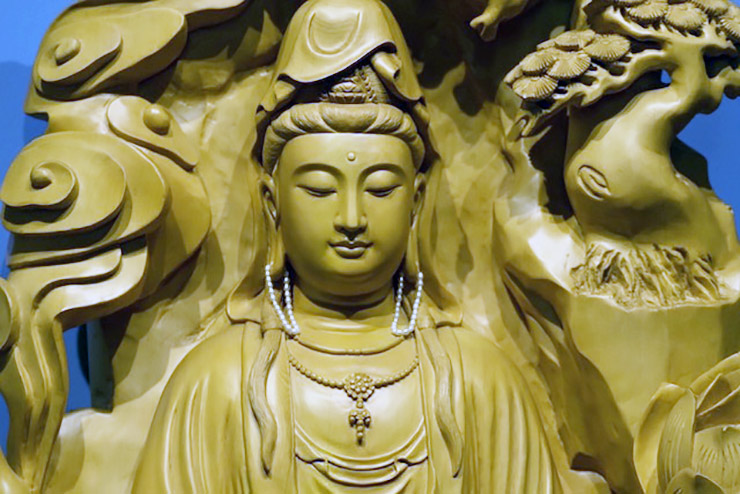
  • William S. Burroughs: 20th Century Gnostic Visionary

    William S. Burroughs: 20th Century Gnostic Visionary

    From New Dawn 199 (Nov-Dec 2006)

    In 1984, in Boulder, Colorado, an interviewer asked William S. Burroughs (1914-1997), “What religious persuasion would you consider yourself?” Without hesitating, Burroughs replied, “Gnostic, or a Manichean.”1Upon reading those words, suddenly everything made sense.

    Perhaps it’s appropriate that the above conversation occurred in 1984. In many ways, Burroughs was a far more lucid and accurate analyst of twentieth century politics than even George Orwell, whose speculative concept of “newspeak” in his 1948 novel 1984 was quickly overshadowed by the real-world machinations of post-WWII Madison Avenue advertising techniques and Washington D.C. public relations firms.

    Superior to Aldous Huxley’s brilliant 1958 collection of essays, Brave New World Revisited, Burroughs’s 1974 book The Job is a must-not-live-without essential guide to charting the opaque labyrinth of obfuscation and lies regularly constructed by the Reality Studio to protect itself from the light of scrutiny. Unlike his more naïve contemporaries among the Beat literary movement, Burroughs never took his eye off the twitchy sharpshooter in the corner, the wild card in the deck known as Control.

    With the analytical eye of a surgeon (Burroughs studied medicine at Harvard, specialised knowledge that would eventually serve him well in his novels), Burroughs performed an autopsy on the body politic in a multitude of bleak and humorous novels, foremost among them Junky (1953), Naked Lunch (1959), The Soft Machine (1961), Nova Express (1964), and The Place of Dead Roads (1983).

    But Burroughs never limited his vision to merely charting out the intricate connections that make up the system of control. Like Huxley before him, who eventually followed his dystopian novel Brave New World with a Utopian counterpoint titled The Island, Burroughs himself attempted to construct his own vision of a Utopia in such novels as The Wild Boys (1971) and Cities of the Red Night (1981).

    In both cases, Burroughs seemed to suggest that a Utopia was not possible except within an isolated oasis, what Hakim Bey would call “a temporary autonomous zone.”2 In the first case, the autonomous zone takes the form of an all-male enclave in the jungles of North Africa; these commandos, trained in combat for defensive purposes, can reproduce without the aid of women and travel through the trees on prehensile hemorrhoids. In Cities of the Red Night, Burroughs’s Utopia is based on historical fact and manifests as an island settlement established by Captain Mission, an actual pirate who lived in the eighteenth century.Mission explored the Madagascar coast and found a bay ten leagues north of Diego-Suarez. It was resolved to establish here the shore quarters of the Republic – erect a town, build docks, and have a place they might call their own. The colony was called Libertatia and was placed under Articles drawn up by Captain Mission. The Articles state, among other things: all decisions with regard to the colony to be submitted to vote by the colonists; the abolition of slavery for any reason including debt; the abolition of the death penalty; and freedom to follow any religious beliefs or practices without sanction or molestation.3

    In both Wild Boys and Cities of the Red Night, Burroughs celebrates the notion of an autonomous zone kept separate from the madding hordes through potentially violent defensive measures, where a human being is allowed to pursue life free from the constant surveillance of overly authoritarian social structures. In Burroughs’s hands, William Golding’s Lord of the Flies would no doubt have a very different outcome.

    Burroughs’s libertarian brand of morality was based on Jack Black’s notions of the “Johnson family” as chronicled in Black’s 1926 autobiography You Can’t Win. The impact this book had on Burroughs when he was still a young man can’t be overestimated. In Burroughs’s own words, the Johnson creed can be described as follows:

    “The Johnson family” was a turn-of-the-century expression to designate good bums and thieves. It was elaborated into a code of conduct. A Johnson honours his obligations. His word is good and he is a good man to do business with. A Johnson minds his own business. He is not a snoopy, self-righteous, troublemaking person. A Johnson will give help when help is needed. He will not stand by while someone is drowning or trapped under a burning car.4

    Surely in Burroughs’s world this would be the only mandatory social stricture established for his personal temporary autonomous zone.

    Burroughs’s vision of a Utopian autonomous zone could be seen as a metaphor for the Gnostic concept of “the pneuma,” an infinitesimally small fragment of the divine that exists in all human beings.

    Gnosticism, an early form of Christianity, flourished in the Middle East until approximately the second century CE when the movement was violently suppressed by Roman Catholic authorities. Dr. Stephan Hoeller, the current bishop of the Gnostic Church in Los Angeles, distinguishes Gnosticism from traditional forms of Christianity in this way:

    [Gnosticism is] much more orientated toward the personal, spiritual advancement and transformation of the individual, regarding figures such as Jesus as being helpers rather than sacrificial saviours. It is a form of religion that has […] a much more ecumenical and universal scope in terms of its relationship to spiritual, religious traditions other than the Christian.5

    According to literary scholar Gregory Stephenson:

    …the attitude that characterises all the Gnostic systems is that the world, the body, and matter are unreal and evil. They are illusions that are the products of malevolent powers called Archons, chief among whom is Sammael (the god of the blind or the blind god), also called Ialdabaoth or the Demiurge. These creator-gods are not the Deity of the Supreme Being, though they make claim to being so. The Deity is completely transcendent – absolutely distinct, apart, and remote from the created universe. However, a portion of the divine substance, called the pneuma, is enclosed in the human body – within the human passions and the human appetites […]. The aim of Gnosticism is to liberate the pneuma from its material, delusional prison and to reunite it with the Deity. The Archons seek to obstruct this liberation and to maintain their dominion.6

    This basic theological structure applies to almost all of Burroughs’s work. Burroughs’s strong sense of morality, of the distinct difference between right and wrong, is often lost in the lurid morass of details concerning his personal life. His heroin addiction, his homosexuality, his arrest in Mexico for the accidental death of his wife, his early experimentation with yage in South America and his later fascination with Wilhelm Reich’s unorthodox theories regarding orgone energy – all of these unusual aspects of his life, though admittedly intriguing, are often reduced to gossipy anecdotes that threaten to diminish the importance of the work itself.

    Burroughs was never the star of his own novels, not even in his highly autobiographical debut, Junky. The central figure in all his novels is war – a continuous war between Freedom and Control, what Burroughs himself might very well refer to as “good and evil.”

    The conflict between good and evil is considered to be a hollow theme by most literary scholars. After all, is this not the purview of Tolkienesque sword and sorcery epics and four-colour superhero comics? Surely no major literary figure of the twentieth century ever bothered to waste his time on such silliness.

    But that’s not quite true. In the work of no other American writer do we find this theme explored in as complex and harrowing a manner as in the novels and essays of William Burroughs. At the beginning of this essay Burroughs described himself as a “Manichean.” Burroughs defined this term as follows:

    The Manichean believe in an actual struggle between good and evil, which is not an eternal struggle since one of them will win in this particular area, sooner or later. Of course, with the Christians there was this tremendous inversion of values where the most awful people are thrown up as this paragon of virtue for everyone to emulate…7

    The Manichean sect of Gnosticism spread across three continents over the course of eleven hundred years beginning, approximately, in CE 240. It was founded by the Persian prophet Mani, who was eventually imprisoned at the age of 61, tortured for 26 days, and assassinated. According to Dr. Hoeller, Mani is among “two of the great luminaries of the Gnostic tradition.”8

    Dr. Hoeller sums up Mani’s basic doctrine as follows:

    In the beginning, said Mani, the kingdoms of Light and Darkness coexisted in uneasy peace. While Light had no quarrel with the existence of Darkness and would have remained content existing side-by-side with it, Darkness would have it otherwise. Darkness was in a state of agitation and wrath and decided to attack and invade the realm of light.

    As the legions of Darkness approached the realm of Light, the primal light needed to defend itself. It called upon the Mother of Life to bring forth the Primal Man (a cosmic figure, not related to Adam or other human beings except in an indirect way). The Primal Man in turn had five sons, and together the six expelled the Dark forces from the kingdom of Light and pursued them onto the battlefield of the lower aeons. Unfortunately, on the battlefield the chief demons of Darkness overpowered the Primal Man and his five sons and devoured them, incorporating their luminous essence into their dark forms. This is how the first terrible intermingling of Light and Darkness occurred […].

    In the course of the rescue efforts the Primal Man is freed, and he gloriously ascends to the Godhead. The souls of the human beings, however, have been left behind, along with Light particles that derive from the captivity of the Primal Man and of his sons. It is only at this point that the material world as we know it comes into being. The Earth is created as an alchemical vessel of purification and transformation where the Light can be extracted from dark matter. The Sun and the Moon are both vessels of Light that serve as vehicles to transport Light upwards out of earthly darkness.9

    In Burroughs’s world, evil disguises itself as good and good disguises itself as evil. The Archons are Christians and politicians and “jus’ good folk.” The Gnostics are roving bands of criminals and thieves known only to themselves as “the Johnsons.” The visionaries, the ones who have attained genuine gnosis (i.e., “knowledge”) can see through the illusions forged by control, identify the face of the enemy, and from that point begin the quest for true freedom.

    These visionaries regularly employ unorthodox and seemingly “insane” methods to overthrow the hypnotic bonds of control: opiates, orgone energy, tape recorders that are used to cut up, analyse, and reconfigure the endless barrage of shallow mass media used to keep the masses docile, astral travel through time and space, hermetic magic, telepathy, etc. These are the tools of the twentieth century Gnostic in Burroughs’s revitalised Libertatia.

    The goal of these latter day Gnostics is to establish an autonomous zone, a physical approximation of the pneuma, while having as much fun as possible trying to “wise up the marks,” a paraphrase of a key sentence in the third chapter of his 1964 novel Nova Express: “And you can see the marks are wising up, standing around in sullen groups and that mutter gets louder and louder.”10

    The Archons are represented on Earth by parasite-infected control-freaks Burroughs aptly calls “the shits”: “…my contention is that evil is quite literally a virus parasite occupying a certain brain area which we may term the RIGHT centre. The mark of a basic shit is that he has to be right.11 The shits will use all the power they have on this planet in order to prevent the Johnsons from waking up the marks.

    This conflict between good and evil is played out in Burroughs’s fiction over and over again, perhaps most prominently in Nova Express. In this novel the Johnsons are called “The Nova Police” and the shits are called “The Nova Mob,” or simply “The Board”: “All right you board bastards, we’ll by God show you ‘Operation Total Exposure.’ For all to see. In Times Square. In Piccadilly.”12 Operation Total Exposure represents an attempt by the Nova Police to pull back the illusory curtain that protects the parasite-infected Reality Studio from being seen in its true form, to induce gnosis in the madding hordes, to transform the “marks” into “Johnsons.”

    In chapter one of Nova Express, Inspector J. Lee of the Nova Police addresses the human race:

    What scared you all into time? Into body? Into shit? I will tell you: ‘the word.’ Alien Word ‘the.’ ‘The’ word of Alien Enemy imprisons ‘thee’ in Time. In Body. In Shit. Prisoner, come out. The great skies are open.13

    Chapter two, titled “Prisoners, Come Out,” is an open letter addressed to the “peoples of the earth” and is signed by Inspector Lee. In this letter the Inspector explains that the purpose of his novels are

    …to expose and arrest Nova Criminals. In Naked Lunch, Soft Machine and Nova Express I show who they are and what they are doing and what they will do if they are not arrested. Minutes to go. Souls rotten from their orgasm drugs, flesh shuddering from their nova ovens, prisoners of the earth to come out. With your help we can occupy The Reality Studio and retake their universe of Fear Death and Monopoly.14

    In his 1978 collaboration with Brion Gysin, The Third Mind, Burroughs wrote in reference to Nova Express:

    A new mythology is possible in the space age where we will again have heroes and villains with respect to intentions toward this planet.15

    The central villain of Inspector Lee and his Nova Police is a Demiurge-like figure named Mr. Bradly-Mr. Martin who leads the extraterrestrial Nova Mob, and through this Mob he has kept the Earth enslaved for thousands of years. In The Third Mind, Burroughs describes Mr. Bradly-Mr. Martin in terms that are overtly Gnostic:

    Mr Bradly-Mr Martin, in my mythology, is a God that failed, a God of Conflict in two parts so created to keep a tired old show on the road, The God of Arbitrary Power and Restraint, Of Prison and Pressure, who needs subordinates, who needs what he calls “his human dogs” while treating them with the contempt a con man feels for his victims – But remember the con man needs the Mark – The Mark does not need the con man – Mr Bradly-Mr Martin needs his “dogs” his “errand boys” his “human animals” – He needs them because he is literally blind. They do not need him. In my mythological system he is overthrown in a revolution of his “dogs.”16

    Throughout the novel, Inspector Lee explicitly warns the people of Earth about some of the most insidious tools the Mob is using against them:

    Their drugs are poison designed to beam in Orgasm Death and Nova Ovens – Stay out of the Garden of Delights – It is a man-eating trap that ends in green goo – Throw back their ersatz Immortality – It will fall apart before you can get out of The Big Store – Flush their drug kicks down the drain – They are poisoning and monopolising the hallucinogen drugslearn to make it without any chemical corn – All that they offer is a screen to cover retreat from the colony they have so disgracefully mismanaged. To cover travel arrangements so they will never have to pay the constituents they have betrayed and sold out. Once these arrangements are complete they will blow the place up behind them.17

    The succeeding chapters introduce us to members of Mr. Bradly-Mr. Martin’s Archon-like Nova Mob:

    ‘Sammy the Butcher,’ ‘Green Tony,’ ‘Iron Claws,’ ‘The Brown Artist,’ ‘Jacky Blue Note,’ ‘Limestone John,’ ‘Izzy the Push,’ ‘Hamburger Mary,’ ‘Paddy the Sting,’ ‘The Subliminal Kid,’ ‘The Blue Dinosaur’.18

    In a section eerily redolent of current events, a chapter titled “Coordinate Points,” the Inspector does us the favour of outlining the Mob’s plan to bring about global destruction:

    The basic nova mechanism is very simple: Always create as many insoluble conflicts as possible and always aggravate existing conflicts – This is done by dumping life forms with incompatible conditions of existence on the same planet – There is of course nothing “wrong” about any given life form since “wrong” only has reference to conflicts with other life forms – The point is these forms should not be on the same planet – Their conditions of life are basically incompatible in present time form and it is precisely the work of the Nova Mob to see that they remain in present time form, to create and aggravate the conflicts that lead to the explosion of a planet that is to nova – At any given time recording devices fix the nature of absolute need and dictate the use of total weapons – Like this: Take two opposed pressure groups – Record the most violent and threatening statements of group one with regard to group two and play back to group two – Record the answer and take it back to group one – Back and forth between opposed pressure groups – This process is known as “feed back” – You can see it operating in any bar room quarrel – In any quarrel for that matter – Manipulated on a global scale feeds back nuclear war and nova – These conflicts are deliberately created and aggravated by nova criminals – […] In all my experience as a police officer I have never seen such total fear and degradation on any planet – We intend to arrest these criminals and turn them over to the Biological Department for the indicated alterations.19

    Jack Kerouac once wrote, “Burroughs is the greatest satirical writer since Jonathan Swift,” but the truth is that Burroughs never wrote a word of satire in his life. He was writing about life as he saw it, exactly as he experienced it. The Nova Mob and the virus parasites from outer space were not metaphors for him. They were real.

    Burroughs, perhaps more so than F. Scott Fitzgerald or even Ernest Hemingway, was the prime mimetic writer of the twentieth century. He never wrote anything other than realistic novels. Marshall McLuhan, author of Understanding Media and The Gutenberg Galaxy, might have been the first to catch onto this subtle but significant point when he wrote in 1964,

    It is amusing to read reviews of Burroughs that try to classify his books as nonbooks or as failed science fiction. It is a little like trying to criticise the sartorial and verbal manifestations of a man who is knocking on the door to explain that flames are leaping from the roof of our home.20

    Indeed, Burroughs wasn’t trying to satirise modern culture, nor was he trying to create a hypothetical, science fictional representation of it. He was simply explaining his society within the only context that seemed appropriate to him, and that context was undoubtedly a Gnostic one.

    Even the so-called science fictional elements of his books were not intended as satire or metaphor. Burroughs could very well have been introduced to the Nova Express model of invading extraterrestrials (and/or intrusions from alternate dimensions) at a very young age. In various interviews, for example, Burroughs has recounted one of his earliest childhood memories.

    When he was four, he woke up early in the morning and saw little gray men playing in a block house he had made. “I felt no fear,” he said, “only stillness and wonder.”21 When asked about this incident in 1987, interviewer Larry McCaffery offhandedly referred to such experiences as “hallucinatory.” Burroughs replied, “I wouldn’t call them hallucinatory at all. If you see something, it’s a shift of vision, not a hallucination. You shift your vision. What you see is there, but you have to be in a certain place to see it.”22

    This image of “little gray men” evokes more recent, popular conceptions of extraterrestrials as seen on the mass market covers of any number of books by Whitley Strieber, the author of Communion (1987), Transformation (1988) and several others in which his ostensible contacts with alien beings are delineated. Burroughs was so convinced of the reality of invading extraterrestrials that in 1989 he wrote a letter to Strieber asking to visit him and his family in their cabin in upstate New York. The 1996 revised edition of Victor Bockris’s With William Burroughs: A Report from the Bunker contains an in-depth interview about this meeting:

    I was very interested in his first books and I was convinced that he was authentic. I felt he was not a fraud or fake […]. I wrote a letter to Whitley Strieber saying that I would love to contact these visitors […]. His wife, Anne Strieber, wrote back saying, “We, after talking it over, would be glad to invite you to come up to the cabin.” So we spent the weekend there. I had a number of talks with Strieber about his experiences, and I was quite convinced that he was telling the truth […].

    Burroughs follows this comment by exploring the idea of “invasion” on all levels. He genuinely believed the human race was, and is, being infected by hostile intelligences on a regular basis:

    When I go into my psyche, at a certain point I meet a very hostile, very strong force. It’s as definite as somebody attacking me in a bar. We usually come to a standoff, but I don’t think that I’m necessarily winning or losing […]. Listen, baby, I’ve been coping with this for so many years. I know this invasion gets in. As soon as you get close to something important, that’s when you feel this invasion, and that’s the way you know there’s something there. I’ve felt myself just marched up like a puppy to go and do something that would get me insulted or humiliated. I was not in control […]. There are all degrees of possession. It happens all the time. What you have to do is confront the possession. You can do that only when you’ve wiped out the words. You don’t argue […]. You have to let it wash through. This is difficult, difficult; but I’ll tell you one thing: You detach yourself and allow this to wash through, to go through instead of trying to oppose, which you can’t do […]. The more you pull yourself together the further apart you get. You have to learn to let the thing pass through. I am a man of the world; I understand these things. They happen to all of us. All you have to do is understand them or see them for what they are, that’s all.23

    John Lash, co-founder of Metahistory.org, a website that concerns itself with Gnosticism and related topics, has many Burroughs-like perceptions regarding the Gnostic model of spiritual “intrusion.” Lash states:

    It might be said that Gnostics believed that only by confronting what is insane and inhumane in ourselves, can we truly define what is human. In essence, to define humanity is to defend it against distortion. Gnostics asserted that the capacity for distortion of humanitas, or dehumanisation, is inherent in our minds, but this capacity alone is not potentially deviant. Since we are endowed with nous, a dose of divine intelligence, we are able to detect and correct distorted thinking […]. In a practical sense, Gnostic teachers in the Mystery Schools instructed the neophytes in how to face the Archons both as alien intruders, comparable to the Greys and Reptilians of contemporary lore, and as tendencies in their minds. The detection of […] intrusion in both these modes of experience seems to be unique to the finely nuanced noetic science of the [Gnostic] Mysteries.24

    And it is this “finely nuanced science” that Burroughs attempted to keep alive in the form of fiction. Burroughs’s many readers were all potential recruits, “marks” who had “wised up” just enough to see a hint of light behind the illusion. His sincerest hope was that at least some of them were paying attention, would pick up the tools he left behind within his books, and use them to storm through the mass of Nova Mobsters whose unenviable job is to surround and protect the ramparts of the fragile Reality Studio until its dying day.

    [alert type=”general” dismiss=”no”]This article was published in New Dawn 99.[/alert]

    [alert type=”success” dismiss=”no”]If you appreciate this article, please consider subscribing to help maintain this website.[/alert]

    Footnotes:

    1. Gregory Corso Interview, “Attack Anything Moving.” Burroughs Live: The Collected Interviews of William S. Burroughs 1960-1997, Ed. Sylvere Lotringer, New York: Semiotext(e), 2000.

    2. Bey, Hakim, T.A.Z., Brooklyn: Autonomedia, 1991, p. 99.

    3. Burroughs, William S., Cities of the Red Night, New York: Holt, Rinehart and Winston, 1981, p. xii.

    4. Burroughs, William S., The Place of Dead Roads, New York: Henry Holt, 1983, p. ix.

    5. Robert Guffey Interview, “The Suppressed Teachings of Gnosticism.” Paranoia Magazine, www.paranoiamagazine.com/hoeller.html.

    6. Stephenson, Gregory, The Daybreak Boys: Essays on the Literature of the Beat Generation, Carbondale: Southern Illinois U P, 1990, p. 60.

    7. Gregory Corso Interview.

    8. Hoeller, Stephan A, Gnosticism: New Light on the Ancient Tradition of Inner Knowing, Wheaton: Quest, 2002, p. 135.

    9. Ibid, pp. 140-41.

    10. Burroughs, William S., Three Novels: The Soft Machine, Nova Express, The Wild Boys, New York: Grove P, 1988, p. 196.

    11. Burroughs, William S., The Adding Machine, New York: Seaver, 1986, p. 16.

    12. Three Novels, p. 197.

    13. Three Novels, p. 186.

    14. Three Novels, p. 189.

    15. Burroughs, William S. and Brion Gysin, The Third Mind, New York: Viking, 1978, p. 97.

    16. Ibid.

    17. Three Novels, p. 188.

    18. Three Novels, p. 236.

    19. Three Novels, pp. 235-36.

    20. Murphy, Timothy S, Wising Up the Marks: The Modern William Burroughs, Los Angeles: U of California P, 1997, p. 145.

    21. Bockris, Victor, With William Burroughs: A Report From the Bunker, New York: St. Martin’s Griffin, 1996, p. xx.

    22. Hibbard, Allen, Conversations with William S. Burroughs, Jackson: U P of Mississippi, 1999, p. 182.

    23. With William Burroughs: A Report From the Bunker, pp. 242-46.

    24. Lash, John, “A Gnostic Catechism: Encounters with Aliens in a Mystery School Text.” www.metahistory.org/GnosticCatechism.php.

    © New Dawn Magazine and the respective author.
    For our reproduction notice, click here.