New Dawn – World's Most Unusual Magazine

Category: Secret Wisdom

  • Satsang: The Power of Spiritual Presence

    Satsang: The Power of Spiritual Presence

    From New Dawn 101 (Mar-April 2007)

    Enlightened people are like spiritual dynamos: they have a very strong presence which touches the people they come into contact with, transmitting something of their enlightenment to them. Even people who aren’t at all “spiritual” usually feel a sense of well-being in their presence, and so feel attracted to them without knowing why. And for people who have made some spiritual progress already, the effect can be extremely powerful.

    Contact with an enlightened person may enable them to make the final “jump” to permanent enlightenment themselves. This is one of the reasons why many spiritual traditions place so much emphasis on the role of a guru. The guru is so important not just because of the advice and guidance he can give you, but because he can transmit his spiritual power to you, giving you a taste of enlightenment and speeding up your spiritual development. (In Sanskrit, this is called satsang, literally “good company.”)

    Paul Brunton and Ramana Maharishi

    The early 20th century author and spiritual teacher Paul Brunton became aware of this when he visited the ashram of the great sage Ramana Maharishi, while travelling around India in search of spiritual wisdom (as described in his book A Search in Secret India). Brunton knew that Ramana was a truly enlightened man the first time he met him, someone who had completely transcended his ego and become one with ultimate reality. He felt the spiritual effect of his satsang straight away. He sensed that “a steady river of quietness seems to be flowing near me, that a great peace is penetrating the inner reaches of my being.” While sitting near him, he realised that his mind was becoming more still, and suddenly all of the intellectual questions he’d had about spiritual matters no longer seemed important. The only question in his head now was, “Does this man, the Maharishee, emanate the perfume of spiritual peace as the flower emanates fragrance from its petals?”1

    At the end of his first visit to the Ashram, Brunton was sitting quietly while the sage was meditating. He felt a sense of awe building up inside him, as a powerful force started to fill the room, emanating from Ramana. Ramana opened his eyes and gazed at him and he felt that he was aware of his every thought and feeling. He felt that a telepathic current was passing between them, that Ramana was transmitting his deep serenity to him, and began to feel a sense of euphoria and lightness. He felt that his own being became one with Ramana’s, and that he had transcended all problems and all desires.

    After this, Brunton resumed his travels around India, meeting magicians and miracle workers and self-proclaimed gurus who are less enlightened than they claimed to be, and eventually returned to the Maharashi’s ashram. Again he experienced an “ineffable tranquillity” when sitting close to him, and again he experienced revelations which he was sure were “nothing else than a spreading ripple of telepathic radiation from this mysterious and imperturbable man.”2 And finally, after a period of wrestling with his own thoughts and his intellect, he had an experience of genuine enlightenment which changed him forever:

    I find myself outside the rim of world consciousness. The planet which has so far harboured me disappears. I am in the midst of an ocean of blazing light. The latter, I feel rather than think, is the primeval stuff out of which worlds are created, the first state of matter. It stretches away into untellable infinite space, incredibly alive.3

    Andrew Cohen and H.W.L. Poonja

    The American spiritual teacher Andrew Cohen had a similar experience when he first met the Indian teacher who became his guru, H.W.L. Poonja – who was, coincidentally (or perhaps not!), a direct disciple of Ramana. Cohen had had profound spiritual experiences before, but had spent many years feeling frustrated and disillusioned, yearning for spiritual liberation but being disappointed by a series of other teachers. Cohen asked Poonja whether it was important to make an effort in spiritual practice, and he replied, “You don’t have to make any effort to be free.” And at that moment Cohen experienced enlightenment:

    His words penetrated very deeply, I turned and looked out into the courtyard outside his room and inside myself all I saw was a river – in that instant I realised that I had always been Free. I saw clearly that I never could have been other than Free and that any idea or concept of bondage had always been and could only ever be completely illusory.4

    After this, Cohen spent three weeks with Poonja and found the liberation he’d been yearning for. After a week or so, he “surrendered” to his guru, let go of his own identity and everything which made up his life. He felt himself become one with Poonja, and began to experience “waves of bliss and love that at times were so strong that I felt my body wouldn’t be able to contain it.” And from that point on, although his initial euphoria faded a little, he had a constant sense of “being always in the present with much contentment and calm. I feel no desire for other than what IS.”5

    And now that he had attained moksha (freedom) himself, Cohen realised that other people were affected by his presence in the same way that he had been by Poonja’s. Friends who spent time with him found that they experienced a powerful sense of bliss and freedom too. He became a spiritual teacher, giving talks and holding retreats, and found that people were naturally drawn to him, and that around him they would “easily and often instantly… have profound realisations, insights into their true nature and powerful feelings of love, joy and bliss.”6

    My wife and I went to one of Andrew’s talks several years ago in Manchester, England, and for days afterwards Pam – my wife – felt like a different person. There was a feeling of freedom inside her, a sense that – in her words – “nothing mattered, that I didn’t have any problems. I didn’t want anything because I was happy as I was. My life was quite stressful at that point but suddenly none of the stress could affect me.” And she’s sure that this wasn’t so much because of what Andrew actually said but the effect of simply being there, in his presence.

    Russell Williams

    I was a little jealous because I didn’t have any of those feelings – at that time I was taking a more intellectual approach to spiritual matters, and was so busy trying to understand what Andrew was saying conceptually that I must have been shut off from the feeling dimension.

    A couple of years before then, I’d started to visit a spiritual teacher called Russell Williams, and also took a largely conceptual approach to his teachings. Russell – who I still go to see now – is 85 years old, and has been the president of the Manchester Buddhist Society for over 50 years, even though he’s not specifically a Buddhist. He doesn’t chant or meditate or read Buddhist scriptures, and doesn’t adhere to or promote any particular set of teachings. He’s a humble self-realised man, who talks about the most profound spiritual truths and the most intense spiritual states as if they’re the most simple and natural things.

    In my first years of going along to Russell’s twice weekly meetings, I used to wonder why most people didn’t seem to be paying attention to him. He was saying some of the most profound things I’d ever heard and people didn’t seem to be listening – they were just staring into space, or sitting with their eyes closed. They rarely asked questions, seeming content to let Russell be silent, when as far as I was concerned he was full of wisdom which I wanted to absorb.

    But about three years ago I began to realise why this was. Perhaps I’d changed, become less interested in the conceptual side of spirituality, or perhaps I’d finally completed a long process of getting attuned to the atmosphere at the meetings, but when I went there I started to experience very strange, pleasurable states of consciousness. Even when I’d been taking a conceptual approach, I’d often experienced feelings of peacefulness and well-being, which sometimes lasted for a couple of days afterwards. But this was something stronger.

    The first time it happened, I was staring at Russell while he was speaking to me, and began to feel very relaxed and calm, as if the flow of my life-energies was becoming smoother and lighter. And then, all of a sudden, everything became unfamiliar – the light became brighter, the colours began to merge and the distinctions between people and objects began to fade away. My main feeling, however, was of a powerful sense of strangeness – the scene was completely alien, as if I was suddenly on a different planet. Even though it was accompanied with a sense of exhilaration, I was a little scared and pulled away from it.

    Over the following months I had the same experience several times again, and I learned to relax and trust it. I let the sense of strangeness overcome me, as the light in the room became brighter and all objects began to shimmer and merge into one another. The light seemed to be flowing out and immersing everything in its brightness. The room was filled with this beautiful shimmering haze of golden light, and I was filled with a deep serenity, a glow of intense well-being filling my whole body. I could feel it flowing through my legs and my feet, as if I’d taken a sedative of some kind. And even when I didn’t have this particular experience at the meetings, I usually had a very powerful feeling of calmness and serenity inside. I was often aware that my breathing had slowed down dramatically, and when I left I found myself doing everything very slowly, with a natural mindfulness. My mind was still and quiet, and outside everything looked beautiful and alive.

    After a few months I was talking to one of the members of the group, and said to him, “I’ve been having really very strange experiences here over the past few months.” I tried to describe them, and he laughed and said, “So now you know why we’ve all been coming here for so long! Now you’re really a member of the society.”

    I still have these experiences now, and I’m certain that they’re the result of satsang, of being in the presence of an enlightened person. The experience of the scene becoming unfamiliar and the light becoming brighter usually only happens when Russell is talking directly to me. In these moments I can almost feel spiritual power radiating from him and flowing into me, feel my own life-energy being affected by his.
    The Sources of Satsang

    The big question is: why do enlightened people have this strange ability to generate spiritual experiences in others, this power to “transmit” their enlightenment to the people around them?

    Spiritual experiences induced by satsang strongly suggest that the esoteric concept of an “aura” has a basis in fact. They suggest that our being or life-energy isn’t just confined to our own mind or body – it radiates out from us, creating an atmosphere (or aura) which can affect the people we come into contact with. The auras of most people don’t appear to be particularly strong, or at least don’t have particularly strong negative or positive qualities, so that we don’t usually feel anything palpable from them. But we’ve all met certain people who we instinctively recoil from. We might not even exchange any words with them but they still fill us with a sense of unease or even fear or dread. These are people who have a strong “bad aura” around them, perhaps because their life-energy is heavily poisoned with negative emotions and egotism. But with enlightened people, of course, the exact opposite happens. Their life-energy is so intensified and stilled, and has such powerful positive qualities, that they “transmit” waves of calm and bliss to everyone around them.

    But spiritual experiences are more than just feelings – they are also experiences of vision, insight and revelation. And one of the most important aspects of satsang experiences, I believe, is that they show that spiritual illumination is also communicable. Feelings of bliss can certainly spread from person to person – and so can the vision of the oneness of the universe, the awareness that the essential reality of the universe is a limitless ocean of Spirit, and the experience of transcending the ego and being reborn as a deeper and higher Self. These experiences are completely transferable – under the right circumstances, they can be passed from an enlightened person to others without any loss of intensity.

    There are two basic types of spiritual experiences (in the sense I’m using the term). The first are ecstatic experiences caused by a disruption of the homeostasis of the human organism. These can occur as a result of fasting, sleep deprivation, drugs, breathing exercises, pain, dancing, and so on. All of these activities can put us “out of homeostasis” – by changing our body temperature, blood pressure or metabolic rate, causing dehydration and exhaustion or chemical changes – and when this happens there’s a chance that we’ll experience a higher state of consciousness. (Although this certainly doesn’t always happen, of course. Most of the time the only effect that depriving yourself of sleep and food often has is to make you feel miserably tired and hungry.)

    The second type of spiritual experiences are more serene and calm states which occur when there is an intensification and stillness of life-energy (or vitality) inside us. This can happen in any situation when we’re very relaxed, when there’s peacefulness around us, and when the mental chatter inside our heads fades away. In meditation, we make a conscious effort to intensify and still our life-energy by being inactive, by withdrawing our attention from the world around us, and by focusing on a mantra (or a candle flame or on our breathing or any other object) to slow down and quieten our mental chatter. As a result, meditation is probably the most effective way of generating spiritual experiences.

    However, they can also happen more spontaneously – in natural surroundings, for example, when there’s peacefulness around you and the beauty of nature has a similar effect to a mantra in meditation, focusing your attention and quietening your mental chatter. They often occur when people are listening to music or contemplating works of art. Certain sports are also very conducive to spiritual experiences, such as long-distance running or swimming. This is also probably part of the reason why spiritual experiences can occur during or after sex. The sheer pleasure of sex can have the effect of shifting our attention away from our ego-minds, which may fall silent as a result.

    Spiritual experiences caused by satsang clearly belong to this second type. Contact with an enlightened person has the effect of intensifying and stilling our life-energy. He or she gives us an extra input of energy – the “current” or “telepathic radiation” which Paul Brunton was aware of. At the same time, the sheer power of an enlightened person’s presence stuns the ego-mind into silence and brings our chattering thoughts to a halt. As a result, we attain the same state of inner stillness and intensified life-energy which we reach after periods of intense and very focused meditation.

    However, satsang isn’t just a phenomenon which can affect us as individuals; it also has an important bearing upon the concept of collective spiritual awakening. It’s now almost a cliché to state the human race as a whole may be on the threshold of an evolutionary jump, a collective shift to a higher level of consciousness which will give rise to a new era of true spirituality and harmony. Some people find this idea far-fetched – perhaps understandably so when you look at the state of the world today – but satsang experiences show us a process by which this transformation could occur. They show us that enlightenment is highly contagious.

    After all, it’s surely not just wholly enlightened individuals who affect the people around them. Anybody who has become spiritually developed to a degree will have some power to affect the people around them. And so it’s possible that a kind of positive cycle might take place – as more people become spiritually developed, they will “transmit” their insight and well-being to the people around them, who will in turn transmit their spirituality to the people around them, and so on. It may be that once a certain critical threshold has been reached – once a certain number of people have become enlightened, or once the collective spiritual power of the human race has built up to a certain degree – a great wave of spiritual illumination will spread through the world like a forest fire; a process of “spiritual transmission” building up power and intensity, and eventually leading to an Omega point of permanent change.

    This may still sound like wishful thinking – but then again, the experience of satsang itself is miraculous, showing that our apparent individuality is an illusion, and that we are parts of an indivisible ocean of consciousness.

    [alert type=”general” dismiss=”no”]This article was published in New Dawn 101.[/alert]

    [alert type=”success” dismiss=”no”]If you appreciate this article, please consider subscribing to help maintain this website.[/alert]

    Footnotes:

    1. Paul Brunton, A Search in Secret India, London: Rider, 1934/1972, p. 141.
    2. Ibid., p.280.
    3. Ibid., p. 305.
    4. Andrew Cohen, Autobiography of an Awakening, Corte Madera, CA: Moksha Press, p. 30.
    5. Ibid., pp.34-5.
    6. Ibid., p.35.

    © New Dawn Magazine and the respective author.
    For our reproduction notice, click here.

  • The I Ching, The Most Modern Ancient Wisdom Classic

    The I Ching, The Most Modern Ancient Wisdom Classic

    From New Dawn 100 (Jan-Feb 2007)

    In a changing and unpredictable world, no classical text is more rewarding, or more challenging, than the ancient Chinese I Ching or Book of Changes. This classic presents itself as a book of divination and invites dismissal on such grounds amongst educated Western circles, including even the great British sinologist and advocate of Chinese science and technology Joseph Needham. It is, however, the most modern of practical handbooks, being a remarkably wise and profound guide to that nagging imperative of contemporary personal and political life – self-organisation.

    This truth only grows as political authority shifts from West to East, as economic productivity travels from America to China, as industrial technology grows robustly throughout Asia and shrivels in the developed economies and as health and well-being wisdom is found more surely in Asian therapeutic traditions than in contemporary share market driven medical innovations.

    Indeed, the I Ching is not only the source of a profound personal, social and political wisdom but also of a scientific genius that is holistic and organic and that led the world for several millennia until the rise of Anglo-American power over the past two hundred years. Moreover, this scientific culture promises much for the future of a troubled global community. It contrasts with the culture that has turned contemporary life into one large uncontrolled and poorly understood scientific experiment, where the casino of the marketplace has ceased to respect the ecologies of life.

    Central elements of the text of the I Ching are attributed to men (King Wen and his sons King Wu and the Duke of Zhou) who were responsible for overthrowing the powerful tyrant who ruled a declining and corrupt Shang Dynasty, as the prelude to founding the Zhou Dynasty around 1045 BCE. As such, much of its wisdom can be read as a political text, informed by profound and holistic wisdom. This wisdom is shaped by a keen sense of the social morality needed to win widespread popular support, the human understanding needed to avoid the perils of carelessness and hubris and the acute insight into the dynamics of life and nature essential to prosper in this world.

    There is no more seminal influence in Chinese culture than the I Ching, with its history of over three thousand years and its roots in the wisdom that guided the founding of China’s longest and most culturally productive dynasty. Contrary to modern fashion, the authority of the I Ching tends to increase with the age and experience of the reader or interpreter. Japanese who lived during the Tokugawa Shogunate counseled against serious study before the age of fifty. At the same time, one of the most renown Chinese commentaries on the I Ching was completed by a scholar who died at the age of twenty three in 249.

    Despite the fact that the 17th and 18th century German philosopher Gottfried Leibnitz had been shocked to discover that his binary arithmetic was matched by an arrangement of the I Ching’s hexagrams, the West’s greatest authority on Chinese science and technology – the 20th century Joseph Needham – dismissed it as of little worth. Now, it has been shown by later scholars to have a mathematical structure similar to that of DNA, discovered in the West more than three thousand years later. In this, it is the world’s first, and possibly still only, serious guide to self-organisation at personal, social and political levels.

    Moreover, another scholar suggests that it may reveal an understanding of still poorly understood fundamentals that inform a wide variety of physical change, in both living and non-living structures. This all reflects the almost unbelievable Chinese genius for observing the minutiae of nature, a quality that long informed the world’s most innovative and productive scientific and technological civilisation.

    In many ways, the I Ching is an enigma. Apart from qualities noted above, it offers a unified understanding of what are often seen as China’s two main contending spiritual traditions – Confucianism and Daoism – and some even see in it the source of both these traditions of thought. Moreover, while the I Ching has always served as a book of divination, this article will treat it essentially as a book of moral, political and scientific wisdom.

    (It should be noted that I Ching is more accurately written as Yi Jing, as laid down in the transliteration system prescribed by the Chinese Government, but is presented here as I Ching in order to avoid confusion in referring to several book titles, which use a dated system of transliteration that is often preferred in the United States.)

    Contrasting Wisdom – East and West

    The use of the I Ching as a book of divination has worked since ancient times to give the I Ching an authority that has shaped all levels of Chinese society. Anything with related aspirations in the West has been marginalised either by the Christian Church or by the tradition of Greek rational thought. Consequently, despite its growing popularity in alternative Western circles, it is difficult for mainstream Western thought to accommodate or relate to the disciplines of the I Ching. Yet, the I Ching has made the mature management of inevitable and irresistible change one of the great art forms of the East Asian ruler, administrator and head of family. At the same time, it contains a gentle acumen that finds a fulfilling role for all who make up society and does not exclude the exceptional and idiosyncratic.

    Perhaps, the clearest and simplest explanation of the differences that derive from these two contrasting traditions has been given by Geoffrey Lloyd and Nathan Sivin in The Way and The Word: Science and Medicine in Early China and Greece. They conclude, with politically tactful deference to Western sensitivities, that neither China nor Greece uniquely monopolised the development of science. Each possessed the conceptual frameworks and institutional structures necessary to inquire systematically into organic physiologies, material nature and cosmic processes. Yet each displayed unique qualities.

    The Greek way sought predominantly foundations, demonstration, and incontrovertibility. Its central authority was found in the principles of clarity and deductive rigour. The Chinese approach was most strongly characterised by the search for correspondences, resonances and interconnections, which encouraged the exploration of holistic and organic relationships that integrate highly divergent areas of activity and order.

    The I Ching not only does not respond to a need for ‘clarity and deductive rigour’ but it will frustrate and irritate those with minds that insist on such convenience. Rather the I Ching inspires a seemingly infinite range of possible ‘correspondences, resonances and interconnections’ and warns against the impatient or thoughtless need for action.

    A little reflection may prompt recollection of the opening two lines of the Dao De Jing, the seminal Daoist classic. These assert effectively that words, concepts, rational structures and scientific theories may all be useful conveniences of the human mind but should not be mistaken for an accurate statement of the natural world.

    Once one has come to terms with what seems to the Western mind to be its counter-intuitive character, one can start to explore and discover in the I Ching a profound wisdom that has guided, shaped, preserved and advanced Chinese civilisation for more than three millennia.

    The Living I Ching

    Although deeply rooted in ancient Chinese history, the I Ching lives like perhaps no other classic form of wisdom. This is indicated by the commentary written by Wang Bi who lived almost thirteen hundred years after the founding of the Zhou Dynasty and who died at twenty-three. It can also be found in works translated respectively by the American Thomas Cleary as The Tao of Organisation, The Buddhist I Ching and The Taoist I Ching, which derive from texts attributed to the 11th century Neo-Confucian Cheng Yi, the 17th century Buddhist Chih-hsu Ou-I and the late 18th century Daoist Liu I-ming.

    The movement by some Westernising Chinese to marginalise and banish the I Ching from respectable intellectual company has, paradoxically, been parallelled by a contrasting movement in Western publishing, where it appears in diverse, numerous and multiplying forms of publication. At the same time, it assumes an identity that now ranks it for many at least on the same level of cultural authority as the Bible, even as some choose it in preference as a work that has nourished a more stable, prosperous and continuous sense of civilisation.

    The relevance of this may be most readily found in the manner in which one version, The Complete I Ching: The Definitive Translation by the Taoist Master Alfred Huang, introduces the work in a way that details the circumstances in which the founders of the Zhou Dynasty worked to replace the corrupt Shang Dynasty. This is given an acute sense of relevance because Alfred Huang makes it clear that the I Ching was a major form of spiritual and practical sustenance during difficult times for him and others personally after 1949.

    More pertinent, however, is the fact that contemporary leaders in Japan, Korea and China have emulated the qualities of patience and humility displayed by the Zhou founders as they have built their strength in a world that had earlier humiliated them. It might be going too far to liken the contemporary West with the self-indulgent and indiscriminately assertive Shang Dynasty. Even so, it is difficult to dismiss the thought that this parallel may present itself to many in East Asian communities.

    Any sensitive Westerner who has had the good fortune to live, work and reflect in contemporary East Asia is likely to have concluded that the certainties derived from a Western education are a poor guide for action in that part of the world. Many pleasant things will come one’s way but in a manner that defies explanation by familiar principles and in a manner that can invite an uneasy sense of losing control. In seeking to comprehend the reasons for such sentiments no better guide can be found than the classic texts that have shaped, informed and inspired its people. None of these is more seminal than the I Ching, even when today’s East Asian youth may feign disdain or ignorance of its wisdom.

    Yin and Yang

    The essence of the I Ching is to be found in the dynamic of yin and yang, complementary opposites that:

    •           lie at the heart of the I Ching and all Chinese thought

    •           require one always to adopt a holistic view of issues

    •           highlight the need for internal and external balance

    •           emphasise a constant state of flux

    •           are at the heart of all development

    •           are forever interdependent

    •           are essentially dynamic and creative in their interaction

    Five basic principles can be identified as inherent in yin and yang.

    •           all things have two facets: a yin aspect and a yang aspect

    •           yin and yang aspects can be divided into further yin and yang polarities

    •           yin and yang mutually create each other

    •           yin and yang control each other

    •           yin and yang transform into each other.

    It is customary to identify yin with qualities such as femininity, softness, darkness and receptivity and yang with the qualities of masculinity, hardness, brightness and assertiveness. At the same time, there is scope for endless discussion about yin and yang qualities in various specific situations.

    The important point rests, however, in the infinite range of dynamic reactions set up by the interplay of yin and yang. Most important, and infinitely complex, is the interplay of yin and yang within the sixty-four six line hexagrams that make up the I Ching. According to established procedures either yin or yang can transform into the other and the significance of yin and yang depends on which of the six positions is occupied by a yin or yang line and a variety of other complex relationships.

    In other words the use of the I Ching for divination creates an almost infinite range of possibilities for interpretation. This reinforces perceptions of the fundamental dynamism of the I Ching, of nature, of political fortune, of human relationships and, if one so chooses, of the sexes. The subtle interplay of eight basic three line sets of yin and yang that can be labeled heaven, earth, fire, water, valley, wind, mountain and thunder (two of which make up a six line hexagram) further strengthens the sense of forces of nature exercising an authority before which humanity must be humble and attentive.

    A most important consequence of the fluid sensitivity that flows from the use of the I Ching is the manner in which this reveals the rigid abstractions that have come to command Western thought as both limited and marginal. The cerebral universe that derives from the I Ching is incomparably more complex and dynamic. In just one example, it is difficult, not to say impossible, to apply Western notions of equality to a world where all nature and life is the product of the rich and intense interaction of yin and yang.

    Contingency

    The I Ching provides an endless flow of moving commentaries that remind continually of the need to recognise:

    •           the contingencies of chance

    •           the full environment of any action

    •           the possibilities of side-effects in any action

    •           the multiple layers of contingencies in organic beings

    •           the limitations of causality and rationality in managing life

    •           the need for mature reflection on all important actions

    The I Ching profoundly challenges Western intellectual and scientific certainties because:

    •           it is a unique mix of probabilistic science and timeless literary comment

    •           it portends to guide future behaviour, attracting Western derision as fortune telling

    •           it is integral to an organic and holistic sense of science

    •           it was part of a superior scientific culture until the beginning of the 19th century

    •           its formula for self-organisation has an unrivalled record of success in maintaining the continuity of Chinese civilisation.

    While Western commentators continue in a state of denial it is difficult to dispute that I Ching science:

    •           outperformed the West and rest of the world until the 19th century

    •           again today outperforms Western science and technology

    •           disdains the West’s mechanistic and reductionist scientific assumptions

    •           highlights an aggressive and shallow character in the European Enlightenment

    •           is genuinely holistic, organic and humanistic in ways denied Western science.

    The I Ching cultivates disciplines of the mind by encouraging continual questioning of and reflection on the dynamic and volatile forces that command natural and human processes. This commences with the acceptance of human humility before forces that will never be fully mastered but that must always be fully respected. Its seemingly infinite variety of possible readings nurtures an acute sensitivity to the contingencies that accompany action.

    Competing Medical and Scientific Cultures

    The contemporary West has gone in a very different direction: It has built a type of structured religious faith around a rational mythology that promises belief in endless progress. The associated human conquest and subjugation of nature is conducted through the use of experimentation to identify a variety of notionally universal truths. These are marketed as the fruits of medicine, science and technology even as they produce an exponentially mounting volume of environmental, ecological and health troubles.

    Problems inherent in this faith and mythology were compounded as the 20th century progressed by the annual allocation of many of the best brains and most vigorous spirits in each generation to intense training and lifetime service before the Gods of medicine, science and technology.

    Subsequently put in various ways at the service of large corporations, this talented and dedicated priesthood is then paid to sacrifice all for the corporation. It should surprise no one that this has produced scientific and medical cultures that are prone to systemic corruption. Highly educated, newly graduated and ambitious young souls quickly learn that this is the only way to gain a reasonable return on the investment of money, time, effort and hope spent in an exhausting and extended education. Some of the more obvious dubious aspects of the priesthood’s work is conducted:

    •           in relentless experimentation in artificial laboratories

    •           in high brow but often duplicitous marketing

    •           in peer reviewed, but misleading professional articles

    •           in misrepresentation or non-disclosure of research

    •           in the exercise of official responsibilities to serve corporate interests after being placed in government administration positions

    •           in some other use of prestigious, high sounding and daunting academic qualifications to fatten corporate bottom lines.

    Many of the certainties cultivated by Western beliefs and rational structures, ostensively verified by scientific processes of proof, are revealing themselves to be cruel hoaxes. These are often designed to persuade large communities to subject themselves to experiments that are neither understood nor controlled by their initiators. Increasingly, the profitable areas of a struggling American economy seem to fall into such categories, whether they be chemical agriculture, processed food, fast food, synthetic pharmaceuticals, bio-technology or nano-technology.

    The corporation, which is designed by its commercial nature and legal structure to maximise profit, has grown in reach and influence more or less in parallel with the advance of post-Enlightenment science and with the consolidation of Anglo-American political authority. With the exhaustion of new lands and new resources to discover and colonise, profit maximisation has increasingly focused on seizing a competitive advantage through innovation and the monopolisation of intellectual property. This frequently necessitates the authoritative denial and dismissal of the possibility of any harmful side-effects or consequences.

    In contrast, the I Ching scientific spirit advanced largely in harmony with environment, ecology and human health and achieved a record of diverse innovation predating many of the most critical European inventions. These included:

    •           developing a cybernetic machine 1,600 (possibly 3,000) years before Europe

    •           developing the compass 1,000 years before Europe

    •           inventing paper 1,500 years before Europe

    •           inventing printing 600 years before Europe

    •           developing a calendar 1,000 years before the ancient Greeks

    In fact, China preceded the West, in most cases by at least a millennium, in almost one hundred inventions and discoveries from a wide variety of fields of activity, including:

    •           agriculture

    •           astronomy and cartography

    •           engineering

    •           domestic and industrial technology

    •           medicine and health

    •           mathematics

    •           magnetism

    •           the physical sciences

    •           transport and exploration

    •           sound and music

    •           warfare

    Western communities have had neither the strength nor integrity to address the fact that this achievement did not involve the perils to the environment, living ecologies and human health generated by contemporary corporate science. This is not surprising because an adventurous, conquering corporate spirit has been fundamental to Western advance over the past two centuries. The cost has been high. Perversely, as it becomes more and more difficult to ignore the consequences so it also becomes more and more difficult to recognise their source.

    The West’s insistence on clarity and deductive rigour has conveniently enabled it to distract attention from many of the side effects of its scientific advances. It has made it easy to marginalise holistic concerns about identifying possible resonances, correspondences or inter-relationships that might compromise the desirability of some new energy source, innovative weapon or pharmaceutical breakthrough.

    The anomaly in all this is that in the early 21st century it is the economies of East Asia, long under the influence of the I Ching’s concern to cultivate sensitive attention to nature, its processes and its contingencies, which are proving most successful in the marketplace of catering to human needs. Unfortunately, communities programmed to compete blindly for economic growth, a legacy of the Anglo-American genius that has constructed the contemporary global order, are unlikely to find their way out of this Faustian dilemma.

    Caution, Humility and Patience

    No reading of the I Ching can leave an attentive auditor unimpressed by its concern to stress the importance of caution, humility and patience. In an important sense, this was probably the world’s first handbook on how to conduct a revolution in the face of overwhelming but intolerable power. It was imperative to emphasise the dangers inherent in the undertaking. In the process, however, it laid down standards that have informed Chinese politics and culture ever since, producing the world’s most resilient and robust civilisation. It also nurtured perhaps the world’s most deceptively cautious, humble and patient people.

    It is possible to see the Six Secret Teachings, a strategic classic that is attributed to a strategist and general credited with a major role in the founding of the Zhou Dynasty, Jiang Taigong, as being inspired by a similar ethos. These Teachings include the Twelve Civil Offensives, which lay out a strategy of essentially peaceful conquest, through the exploitation of an adversary’s moral weaknesses. These vulnerabilities are simply serviced and indulged by a more disciplined, purposeful and patient rival. Ultimately, dependence and excess ensures a favourable outcome for the more virtuous party. Such basic wisdom, which equates caution and humility with virtue, and ultimately strength, permeates the I Ching and the civilisations of East Asia.

    The two central lines (second and fifth) in the most auspicious hexagram with six yang lines (identified as Heaven) in the I Ching capture the judicious quality of the I Ching in all situations. In the popular Richard Wilhelm translation, the commentary on each of these lines is auspicious but concludes with the same caution ‘It furthers one to see the great man’. This reminds of the need to always seek guidance from those better qualified and hints that nothing can be taken for granted even in the most favourable circumstances.

    Equally, the hexagram composed of six yin lines (Earth) is characterised by ’receptive devotion’ and identifies the superior man as marked by breadth, purity and sustaining power, like the Earth capable of carrying and preserving all things that live upon it. In this way it quickly becomes apparent that the yin and yang distinction is one that enriches human perceptions and is far from the prejudicial attitudes that have come to characterise the contemporary West’s struggle with distinctions between male and female behaviour.

    The I Ching also reminds repeatedly that great success is often the prelude to difficulty and that great hardship is often the necessary preparation for subsequent achievement. In this manner this seminal Chinese classic works to inspire both caution and aspiration, with the emphasis being placed on life’s recurring rhythms and humanity’s endless challenges.

    Conclusion

    Like the Dao De Jing, the I Ching is a book that grows in significance and influence with familiarity and time. It continually surprises by revealing new dimensions and insights. These may be in the mathematical structure of its sixty-four hexagrams and their complex variations or in the philosophical and historical commentaries that it has accumulated over three millennia.

    Its role as a book of divination cannot be separated from its role as a book of wisdom, as one function complements and deepens the other. Ultimately, however, it is best evaluated as the product of the highly developed Chinese capacity to observe and order the minutiae of nature, whether personal, political or cosmic. In this it makes the clearest statement possible about the limitations inherent in the West’s preference for rational structures, which override the diversity and contingency of our world, simply to provide the often misleading convenience of clarity and deductive rigour.

    [alert type=”general” dismiss=”no”]This article was published in New Dawn 100.[/alert]

    [alert type=”success” dismiss=”no”]If you appreciate this article, please consider subscribing to help maintain this website.[/alert]

    © New Dawn Magazine and the respective author.
    For our reproduction notice, click here.
  • New Dawn Interview With Tobias Churton

    New Dawn Interview With Tobias Churton

    From New Dawn 91 (Jul-Aug 2005)

    Tobias Churton is one of today’s most lively and spirited investigators of that underground stream of the Western tradition known as Gnosticism. He first became interested in the Gnostics while reading for a degree in theology at the University of Oxford in the 1970s.

    Soon after leaving, he became interested in exploring these ideas for television. “I’d got it into my head that there had never been any religious television – only programmes about religion,” he later recalled. “I had written a paper on the subject which recommended a new kind of television for this most neglected area, something on the lines of television, a kind of programme which would enter into the very nature of the religious experience and not simply observe it.” Churton got his opportunity in the mid-1980s, when he produced a series on the Gnostics for British television. To accompany his series, he wrote his first book, The Gnostics, a history of this elusive esoteric movement from early Christianity to modern manifestations in such figures as Giordano Bruno and William Blake, and even in Mary Shelley’s Frankenstein.

    In the years since then, Churton has pursued and deepened his appreciation for the Western esoteric traditions. He was the Founder Editor of Freemasonry Today magazine, and during the last year has published two new books. The Golden Builders: Alchemists, Rosicrucians, and the First Freemasons explores the background of Masonry from its antecedents in the alchemical and Hermetic traditions of antiquity through its modern manifestations. His latest book, Gnostic Philosophy: From Ancient Persia to Modern Times, casts an even wider net, tracing the Gnostic heritage from its roots in Zoroastrianism, Mithraism, and the Essenes to the 20th century magus Aleister Crowley and manifestations of gnosis in pop culture. Churton currently makes his home in Britain.
    – Richard Smoley

    How exactly would you describe gnosis? What does it mean to you?

    How would I describe gnosis? I should like to describe gnosis as the experience of knowing or having intimacy with what we call God. God, the Bible tells us, wishes to be known. The word ‘Gnostic’ – one who has experienced gnosis – was first used as a nickname by those who opposed the whole idea or thought it was all too much for human beings to claim.

    In a way, it really is the most enormous act of cheek to say that one has had experience of God! John’s Gospel for example says that “no man hath seen God at any time.” Hospitals for the mentally sick are full of people who claim the most extraordinary intimacy with powers beyond themselves. In the Gnostic tradition broadly, sanity or peace of mind is a fruit of gnosis. And ‘sanity’ means becoming clean, or ‘whole’ so there is a moral as well as a physical and psychological dimension to be considered. It might be argued that one has got to share in Christ to know God. But clearly there has been gnosis outside of the Christian tradition. So God obviously wants to be known by everyone!

    Gnosis to me personally means receiving a gift – a gift that carries with it certain responsibilities. It’s quite a heavy thing to be lightened – or enlightened! There’s a lot we carry that prevents us from rising and growing in divine knowledge. For me, gnosis means a love of truth, a sensitivity to the magical aspects of life, and above all, a permanent struggle with material consciousness. People would rather see a person burnt than their own money burnt. That, we would say, is only natural. Politicians are adept at appealing to us on this level. Being gnostic does involve an unusual attitude to the natural order. The merely human in us does come under scrutiny – the light shows up the shadows and darkness in us, if you like. Obviously, no one likes being ‘shown up’, so we persecute the light-bringers and hide ourselves behind images of who we think we are. Gnosis is light and, if I may say so, “my burden is light.”

    Is it possible to experience gnosis for oneself?

    I obviously believe it is possible to experience gnosis for oneself. One could hardly experience it for other people! But the experience changes and one might not always be aware that one is experiencing gnosis. It is not a single state. It is not the same as ‘instant satori’. The universe itself is a projection of gnosis, if limited. I should say that if one has no experience of gnosis, one can hardly say one has been truly alive.

    Could you explain a little about the Gnostic schools of antiquity, and what happened to them?

    There were many Gnostic schools in late antiquity, as far as we can tell, surrounding some particular teacher, or the self-proclaimed followers of such a teacher. They had visions, dreams, statements, stances and orders of followers. Some were probably charlatans and some ‘the real thing’, as one would expect.

    The orthodox Christian teachers who made it their business to denigrate and destroy the Gnostic movement in the Church always tended to isolate the teacher. Naming names was a big part of the anti-Gnostic propaganda. Thanks to their efforts, we have some dim records of men like Basilides, Carpocrates, Marcus, Marcion, Valentinus, Simon Magus, Dositheos. The orthodox apologists Irenaeus, Hippolytus, Epiphanius and Tertullian, for example, made it their business to present these Gnostic teachers as demented quacks leading their followers into what Irenaeus called – in about 180 CE – “an abyss of madness and blasphemy.” I don’t know how seriously one can take their presentations of the evidence. It’s a bit like asking George Bush whether he prefers Sergeant Pepper’s Lonely Hearts Club Band to Revolver!

    The Gnostics represented a kind of counter-culture and therefore exposed themselves to persecution and ridicule. You can’t imagine Gnostics wandering around in suits and ties with briefcases talking about real estate values! Some seem to have met in catacombs and private places. There were Gnostics in the first ever monasteries of Saint Pachom in the Thebaid of Egypt. Indeed, it is arguable that the first monastic movement was chiefly inspired by the desire for a place to get away from the world and experience God, i.e.: a Gnostic inspiration. Clearly the monasteries have always had a special role in promoting authentic spiritual life, if usually in secret. The walls had ears.

    Sadly, the British and German Reformations, in attacking the monasteries in the name of the Protestant tendency, tended to throw the baby out with the bath-water, so the position of today’s Gnostic has some kinship with that of the early Christian Gnostics. Where do we go?, they might ask. San Francisco obviously didn’t work for everyone!

    However, as we know from the story of the Nag Hammadi Library, even in the desert monasteries the Gnostics were not safe. Official visitations weeded out the offending literature and condemned it to the flames. Soon the offending Gnostics would meet the same fate. The Church hooked up with the State in the 4th century CE and the true Gnosis was exiled. Just one good reason to keep religion out of politics!

    How did this Gnostic legacy survive after the end of the old Gnostic schools? What sort of heritage did they bestow on our civilisation?

    Thanks be to God, the Gnostic experience and challenge did just survive the end of the Roman eagle’s flight. As one might expect, it survived on the fringes of the old Empire – in Syria, Iraq, Bulgaria, Turkestan and Bosnia – possibly Ireland. Even, for a while, in Mongolia and China. The flame was kept alive through untold numbers of military campaigns, massacres and violent conflicts of kings, sultans, demigods, semi-gods, dictators and emperors. It was carried into the bosom of the Islamic Empire after the 7th century in the form of Hermetic philosophy as an inspiration to science and philosophy – examining God in His works and wonders. The Sabians of Harran – who were not Muslims but Sabians and permitted by the Koran – their role is extraordinarily important in keeping the flame alive.

    The appearance of Islamic mysticism – or rather, gnosis – among the so-called Sufis in the ninth and tenth centuries was highly significant. Magic, philosophy, science, mysticism – in short, human progress, were fostered by the enlightened circles of the Islamic world – always playing, it should be noted, a kind of shadow-boxing game with the hard-line authorities who cared as little for personal experience of the divine kingdom as did the Roman Church in the west.

    The annihilation of the so-called ‘Cathars’ in southern France and northern Italy in the 13th century showed just how far the authorities were prepared to go in attempting to destroy spiritual existence that was not controlled by the status quo – the ever-present authorities we find in every age: the manifest powers of invisible spiritual opposition, as the Gnostic sees it. The Gnostics have been the light of the world and the leaven in the bread. A world without gnosis would be a very dark place indeed. The Gnostic greets the Sun, the ‘visible god’. He or she is first to see the dawn – first, you might say, in the garden of resurrection.

    Some scholars suggest that the term “Gnostic” is too problematic to be valuable, and should be replaced by something else. Do you agree?

    Some scholars, you say, suggest the term ‘Gnostic’ is too problematic and should be replaced. Well, I’m sorry for them. Gnosis itself will always be problematic in this world. The day it fits cosily into some scholar’s dictionary will be the day it has ceased to have power. No, ‘Gnostic’ – like ‘Christian’ – began as a nickname and like all such names should be borne with pride in a blind world. Yes, there are problems of definition. In 1966 there was a Colloquium of scholars at Messina intended to define the term ‘Gnosticism’, but it could not hold the term down. So I, without even the benefit of the Italian sun, cannot do it for you in this interview. The subject could fill a book. There is, however, another tack we can follow. That is, Why should it be defined? Definition – like a census – leads to control. Much better that the Gnostic tradition bears the unique quality of resisting definition! There is no doubt that the issue has been muddied by the activities of the Christian churches that dominate thinking in the West to a greater degree than we perhaps realise.

    When I was a student at Oxford University for example, it took me a long time to realise the full implications of the fact that the Theology courses were run by church leaders chiefly for their benefit. Admittedly, it would have been odd if they had been run by industrial chemists! But the point was that ‘Gnosticism’ for example dealt with a universal experience in terms only of its presence or exile from the orthodox Christian Church. Theologising it denied its root in authentic experience. If we cannot trust our deepest most personal and absolutely authentic experience, what can we trust? Anyhow, it would have been better, I think, in retrospect, to study the entire field of Gnostic philosophy, religion and so on as a stream of its own that interpenetrates – necessarily – with all of the so-called ‘great religions’ of the world.

    One of the interesting things about the orthodox Church – if we may for just a second see the plethora of conflicting bodies as a broad unity – is that it finds it can eventually accommodate everything – everything, that is, except gnosis! By this I mean that Darwin was more or less accepted by the Church of England by the time of World War One. Church leaders – by no means all, I know – made accommodations with Hitler, Stalin and Mussolini and – let’s face it, the Church has pretty well made its peace with the world. Gnostic types do not find themselves in such a comfortable position with regard to the world as it is.

    There are many people who are on the road to gnosis who perhaps do not realise it, who out of love of God and fear of God – and fear of themselves and others – find themselves wasting years in very unsatisfactory Church gatherings which – in the name of God – demand their sacrifice and allegiance. I’ve always found that it was the most selfish groups that preached self-abnegation.

    But to get back to the point, what other tame word could replace the tattered glory and battered bread of the words Gnostic, Gnosis – even that scholars’ word ‘Gnosticism’? Mysticism is too misty. Magick has been bowdlerised and Disneyfied. Spirituality – well! It used to have meaning, now it means anything and probably nothing. It’s only a matter of time before car manufacturers come up with a car that meets your spiritual needs! I really don’t know what people mean when they talk about ‘spirituality’. It’s so vague as to be useful to every pseudo-religious charlatan and greedy politician in the world! When you say ‘Gnostic’, you always have to explain it. And when you do, people are always fascinated, whether they admit it or not! So that’s what we’ve got and we have to make the best of it. Gnosis means knowledge. Get it?

    What do you make of current attempts to revive Gnosticism? What value do they have?

    You ask about recent attempts to revive Gnosticism. This is a difficult question for people like myself who prefer authentic experiences with some real history attached. This is the scholar and antiquarian in me speaking. My path is not your path.

    I don’t believe ‘Gnosticism’ – that word really refers to the Gnostic groups that came into conflict with Christian orthodox authorities in the first five centuries of the known life of the Christian Church – can or needs to be ‘revived’. The patient is not dead – though the world might well be. “The dead are not alive,” as the Gnostic gospel has it, “and the living will not die.” This is my personal favourite among the many great Gnostic logia. The dead are not alive and the living will not die. How true.

    Besides, there are several great authentic Gnostic streams still going strong – though at least one of them is severely persecuted. The Yezidis of northern Iraq, western Iran, Georgian Armenia – that is to say Transcaucasian Kurdestan – have the most unbelievably inspiring tradition. There’s nothing to compare with it in the whole world. It is in a class of its own. The Yezidis have been persecuted cruelly by those in power about them because they are not regarded as “people of a book” as defined – there’s that word again! – in the Koran. They have long been accused of ‘Devil worship’, but that kind of cruelty has been common among oppressors since Jesus was accused of being a devil’s mouthpiece all those years ago. It’s the oldest trick in the book and works because people fear every type of evil – except their own.

    Yezidis are today being attacked and killed in and around Mosul and denied police protection in Georgian Armenia. This is fact.

    The second tradition I was thinking of was that of the Mandaeans of lower Iraq, who claim John the Baptist as a special prophet and have referred, interestingly, to ‘Christ the Roman’. As far as ‘Gnostics’ go, these people are undoubtedly the ‘real thing’.

    When I made the TV series Gnostics in 1985-87, we wrote to the Iraqi Embassy in London, and they denied any knowledge of the Mandaeans. I was worried that they had been wiped out under the last miserable Iraqi regime, but to my delight, I now observe that they have survived – though still having to justify themselves, surrounded as they are by the various Islamic traditions. I think they qualify as Sabians in the Koran and are therefore protected. The wonderful Yezidis, on the other hand, have been persecuted for 1300 years and have no such protection.

    An independent Kurdistan would probably offer these unique and admirable people a future that may otherwise be in jeopardy. This would be a very good thing to come out of the current mess in Iraq. The great powers have been screwing up the Middle East since the fall of the Roman Empire, so one may legitimately question whether the mad, bad game of sharing out the property of the vulnerable will end in our lifetimes. We must hope, have faith and love. Spare some love for the Yezidis – even though most people have probably never heard of them.

    This, to answer your question, would be a good way to care for the Gnostic tradition – the tradition, I should say, of the authentic spirit of man, enslaved in, and by, the world. The love of money is the root of all evil. The way to revive Gnosis, is to be revived by Gnosis.

    Why are people so interested in Gnosticism these days?

    I think people are interested in Gnosticism these days because there is clearly a spiritual vacuum at the heart of our culture. Science and mass production have done much for the outside of the cup, but the inside is empty and cannot be sated by drugs, sex and rock ‘n’ roll. The promised liberation is a brief delight followed by a swift fall. Grace looks away and the victim, must, if he or she be lucky, look within.

    Even in countries which have not been so saturated by big business as we have – where washing machines, central heating and personal stereos and computers might be very welcome – there is a now well-articulated complaint that with all the money and the “promise of freedom and liberty for all” comes a great threat.

    The threat is to the life of the heart and the delicate, invisible life – the thousand links with God – which have kept people alive for centuries in the face of countless dangers and privations. I don’t wish to romanticise here, but one must ask, ‘Who needs the most help?’ The East or the West? Clearly both suffer from poverty – material poverty and spiritual poverty – and, of course there is plenty of material poverty in the West and doubtless spiritual poverty in the East. But can’t we help each other? And thereby help ourselves? But how do we do this?

    Well, Jesus offers a clue: “First clean the inside of the cup.” Clean it? we may cry – most of us don’t even know it’s there! Where is this ‘inside of the cup’? Where is this kingdom of heaven (a kingdom, note, not a democracy!) that is supposed to be “nigh and within” us? Well, the example and uncompromising commitment to spiritual reality is such a strong and powerful river surging through the Gnostic tradition, that it would be extraordinary if our bone-dry world did not desire to take a dip in its life-giving waters!

    Until we sort ourselves out, we can only export our own confusion.

    Could you say a little bit about the Western esoteric traditions as a whole? What is their situation today? What do they have to contribute to our civilisation?

    You have asked me to say a little bit about the Western esoteric traditions as a whole and what they may contribute to our civilisation. The second part of that question is simple. What they have to contribute is civilisation. What is civilisation? It is clearly not power and might or the ability to force change. Otherwise we must rank Attila the Hun and Chingiz Khan as leaders of civilisation! Civilisation really boils down to the ability of a range of people to live in a city, organise themselves and get on with each other without falling into chaos. That which promotes the life of the busy hive may be described as a civilising influence. Civilisation is not then an arbiter of truth but of what works well. However, wise men and women have tended – against the odds – to the ancient conviction that nothing works quite as well as the truth, and that a rotten branch – rotten with corruption – will not even support itself for very long – never mind the burden of civilisation. Truth is good.

    When I think of Western civilisation with all its inequalities of ability and social status, its wide variety of racial and religious types, its sheer density of pulsating human existence, its vulnerability to natural forces, disease, despair, hysteria, false expectation, boredom and so on, I can’t help thinking that organisations like Freemasonry and discreet societies of personal development are important. While corrupting forces always aim to work within the carcass, the healing agents must also work within the fabric of the human hive – not in fearful secrecy but with a modesty and love that is suspicious of fame, vainglory and social attention. The cool breeze works well unseen. This is perennial wisdom. I think the best of the masonic tradition has contributed hugely to understanding of tolerance and barrier-breaking social idealism. Occasionally, we even find a spiritual insight occurring in some of the most stubborn mental material!

    Whatever good men and women try to achieve with this floppy idiot called man, the sincere busy bee is always up against our biological and moral heritage. This inheritance is surely dark enough to make strong men and women weep and give ample reason to despair or take refuge in a cynical stoicism of the type that Gore Vidal, for example, exemplifies with such taste and class.

    There is much to be said for contemporary Rosicrucian societies for introducing people to the world of imaginative spiritual development. Many find insight in the worlds of Theosophy, Thelema and Anthroposophy, for example. This is all well and good, as far as it goes, but human society can be corrosive – even destructive.

    Human beings really aren’t very nice – unless they’re in some kind of love with one another – and even then… well! The divorce rates with all their sad tales of acrimony and greed testify to the fragility of oaths built on enthusiasm and a lottery win. The Psalmist was being simply realistic when he uttered the words: “None is righteous. No, not one.” Involving oneself in groups may stifle the creative and divine spirit. But aloneness can be hard, and loneliness is, as Jimi Hendrix sang, “a drag.” Perhaps we need to revive in some adapted way the concept of the monastery – not, may I stress, that sad alternative, the ‘commune’. The hippies were hip to everything but their own depravity. Peter Coyote and the Diggers would doubtless tell me I just never saw the real hippies. He would be right. Maybe I was one of them – and how often do we see ourselves?

    I suppose in the life of a person, one will, as one puts one’s hand into the hand of God – as much as we may know of Him – for guidance, one will find oneself encountering all kinds of groups and people. No one way works for all people or all occasions. That is how it must be. Those who require absolute certainties will be prepared to believe anything. The One is always present, if unseen.

    Experience shows that there are many hidden veins to the cosmic life of humanity and I – for one – am glad – and have reason to be glad – that they exist. Gnosis is, as I said earlier, a gift. One has to be in the right place to receive it. No organisation can do that for anyone. The Spirit bloweth where it listeth. Heed the Spirit above all – and keep the powder dry!

    Could you talk a little bit about your own background, how you came to be interested in this area, and what meaning it has for you personally?

    You ask about my background. I am an Englishman born in Birmingham – the English Midlands – in 1960, who grew up to believe that something was seriously ‘out of kilter’ in my own dear country and in the world at large. This was something I found in myself as I grew older and travelled about the busy world. I had no special financial or educational advantages, but my father – a railwayman by choice in his later years – said “Seek and ye shall find.” I loved the past and had great respect for the ancients. I was always suspicious of words like ‘modern’ and ‘new’. No one knows the future and if, as someone once said, “the future is a poor place to store our dreams,” then I should say that a dream stored is a dream over. King Arthur will sleep so long as we do.

    I cannot remember when I first became interested in the authentic tradition of spiritual life. It seems to have always been with me. I suppose studying the Gnostics at Oxford in the late 70s made me realise that I was not alone, but there were always shadows and intimations of gnosis in books, films – especially old films (the new stuff is generally too cocksure, superficial and loud to have anything to say worth hearing) – and in music.

    I have often tried to ‘get away’ from Gnosis, rather like Jonah sailing to sea to avoid Nineveh, but I keep coming back to port, whether I like it or not. Often, I don’t like it at all. I’ve spent a fair amount of time in the cold belly of the whale. The world, however, needs this insight, even if for me it now seems an old story. Somehow, it comes alive afresh again with each telling. And I discover so many new aspects to it, each time I willingly return to its study. It makes us wise and makes fools of us. Gnosis means creation because we do what we know. Creation is the fiery dragon whose scolding breath burns away the void and leaves the golden tree. We pick its fruit and create nothing.

    I was lucky (by modern standards) to have both parents and that both parents believed in the individual and believed in the mystery and magick of life, and that they were plain speaking, virtuous and down to earth as well as being receptive to higher influence. That was a gift too. Come to think of it – it’s all been a gift. I’ve done little to deserve such a theatre of sorrow and joy! There’s so much more to do and life is really both too long and too short. We’re here and we’d better make the best of it. Long may She reign over us.

    Could you tell us about your recent books, The Golden Builders and Gnostic Philosophy? What are they about?

    My books The Golden Builders and Gnostic Philosophy took me ten years to write and were continuations of a work begun in 1986 when I wrote my first book, The Gnostics, at the age of 25. You could say that the new books are the considered works of research and experience – an attempt to bring readers of the first book into deeper acquaintance with the extraordinary Gnostic tradition. I was very aware that some terrible books have appeared in the last 20 years which have exploited the whole subject area and confused people with a lot of journalistic twaddle and conspiracy tales. Some have inspired a recent best-selling novel that suggested Leonardo Da Vinci worked with a code that could be understood by an idiot demented by marijuana.

    I wanted to put the record straight. The truth is stranger than fiction and a good deal more interesting. The trouble with fiction is that you can’t live on it; you always want more. Perhaps if you wanted to define the Truth, you might – with tongue in cheek – call it NON FICTION. There is NON FICTION in magick, Gnosis, mysticism and spiritual understanding – but then, I suppose, your readers know this already, or they would not be suffering this interview with a distant star.

    [alert type=”general” dismiss=”no”]This article was published in New Dawn 91.[/alert]

    [alert type=”success” dismiss=”no”]If you appreciate this article, please consider subscribing to help maintain this website.[/alert]

    © New Dawn Magazine and the respective author.
    For our reproduction notice, click here.
  • Brothers of the Shadows: A Perspective on Conspiracies

    Brothers of the Shadows: A Perspective on Conspiracies

    From New Dawn 86 (Sept-Oct 2004)

    In his book Perpetual War for Perpetual Peace Gore Vidal suggests that the American public has been conditioned to respond to the word ‘conspiracy’ with a smirk and a chuckle. Conspiracy, in other words, is for the nuts and the loners, and is not to be taken seriously. In this way, he argues, through the media’s association of the concept of conspiracy with fringe or extreme elements, the real conspirators go unnoticed.

    It is a vital point, and Vidal courageously chases and exposes genuine conspiracies by politicians, the FBI, lobbyists for the tobacco companies, and so on. But the flip-side of the conspiracy coin is the proliferation of fanciful and fantastic theories that now crisscross the globe in seconds with the help of electronic media.

    The spread of the internet has democratised conspiracy theory. Millions of people now have the means to publish their own unique analysis of what is going on. A necessary consequence of this massive growth in personal digital publishing is that it is getting to be much more difficult to find the pearls among the rubbish. Someone even observed that, in the age of the internet, if you want to keep something secret you make it public…

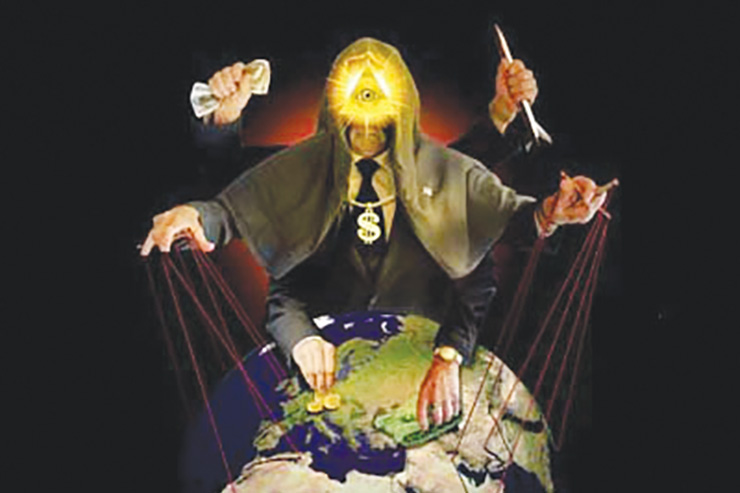
    Amidst the more fantastic theories of UFOs and intergalactic lizards, certain core themes do persistently reoccur in the mass of ‘conspiracy theory’ material now available. Principal among them is the idea that a shadowy elite is seeking to enslave humanity under the auspices of a single, centralised world government. The name of the mysterious ‘Illuminati’ is most often associated with such a group, although what is meant by it is frequently ill defined. The Illuminati are, supposedly, a cabal of top bankers, politicians and businessmen seeking to create the aforesaid all-powerful government.

    What is the truth of all this? I do not propose to give a full answer here, but would like to introduce a perspective on the theme – one that has generally not been given serious consideration – taken from the research of Rudolf Steiner. In the second part of the article I will try and relate Steiner’s ideas to other more familiar conspiracy research.

    So why Steiner? Because, if for no other reason, his pronouncements and indications on practical areas of life have borne such remarkable fruit, testimony to which are thousands of Waldorf schools offering a new kind of education, farms successfully practicing bio-dynamics, clinics dispensing anthroposophic medicines, and so on.

    As a profound clairvoyant, Steiner claimed to investigate other dimensions of reality for insight into the human condition. His legacy is hundreds of volumes of published talks and written works on a cornucopia of themes. However, as mentioned above, his work – in contrast to that of many other spiritual teachers and gurus – has shown itself to have practical applications in all areas of life. This in itself does not provide ultimate evidence for the truth of his work, but it does correspond to the biblical dictum: “[B]y their fruits ye shall know them.”

    In 1916 and 1917, in the midst of the catastrophic First World War, Steiner gave a series of 25 lectures to a group of his followers who gathered together at their centre in Dornach in neutral Switzerland. These lectures, since translated and published in English,1 offer a unique reading of contemporary events.

    Behind the outer façade of world affairs, suggested Steiner, the machinations of occult groups or ‘brotherhoods’ were at work. Certain of these brotherhoods had wanted the Great War to take place, and had manipulated events to bring it about. In doing this, they sought to protect the dominant economic position of the English-speaking world, and in turn to crush the ‘mediating’ role of Central European powers such as Germany, the Austro-Hungarian empire, and so on.

    These occult brotherhoods – small groups of men who met together in ‘lodges’ and practiced ceremonial magic as a means of achieving certain goals – originated from the English-speaking (Anglo-Saxon) world and were allied, in particular, with Anglo-American interests. Their aim was to extend Anglo-American influence across the globe, and to ensure the predomination of Anglo-American culture. Furthermore, they sought to extend its superiority into the distant future; essentially to ensure that the present state of affairs continues evermore.

    According to Steiner’s research, human evolution goes through ‘great periods’ of development. During each of these periods, a particular people is given the task of leading humanity in a spiritual sense. Over the millennia, it has been the destiny of different peoples to bring specific qualities, in a benevolent way, to the whole of humanity. Particular periods of history are thus led by particular nations. This does not imply a form of political control or empire – and is certainly not a theory of national or racial superiority – but is referring to a spiritual form of authority.

    Steiner suggested that the Western world, and in particular the English-speaking peoples, have been given the task of getting to grips with the material world – of becoming comfortable on Earth and developing in harmony with it. In this specific sense, the West was to introduce a certain kind of (beneficial) materialism into human development. But this materialism was only meant to be developed up to a certain point. It was necessary in order for humans to become fully part of the earthly world, and to help introduce an individualised consciousness (the ‘I’). But beyond that it had the potential to be destructive. Materialism as a philosophy, which shuts out the possibility of soul and spirit, is retrogressive, asserted Steiner, and works as an evil in human evolution.

    The Anglo-American brotherhoods that seek dominion over mankind know this, and hence today are deliberately sponsoring various kind of materialism in the hope of halting and trapping humanity at the present stage of its development. They don’t want humans to progress beyond the present stage of immersion in the material world. In other words, they don’t want us to reconnect in a free way with our spiritual ‘I’, because they know that their grip over humanity would then be lost. Human progress is dependent on spiritual knowledge, and thus the occult brotherhoods work against it.

    Steiner explained further the brotherhoods were aware that the Slavic peoples were to be given the task of leadership on behalf of humanity during the next ‘great period’ of history. For this reason, the Anglo-American brotherhoods not only sought to dominate the present great period of human development, but – knowing that the Slavs had an important mission in the future – sought to gain control over the Slavic peoples (Russia in particular) in the present, in order to interfere with or even put a halt to their coming task. In this way, the Anglo-American brotherhoods could extend their control over human development into the distant future.

    Steiner later claimed that the Bolshevik Revolution in Russia, which led to the creation of the USSR and the 72-year cultural, intellectual, economic and political repression of the populations of its various peoples, was masterminded and sponsored by these same brotherhoods as a means of controlling the region and its peoples.2

    What is the evidence for Steiner’s analysis? Apart from anything else, it is interesting to note the present state of world affairs, and how – since Steiner spoke about this topic in 1916-17 – Anglo-American culture has come to dominate the globe in tandem with American economic and political influence (with the enthusiastic support of British politicians). The assertion of unilateral military action by the United States and Britain in the 2003 invasion of Iraq – in the face of almost total global opposition – was a good example of this formidable power at work. However, admittedly these observations do not provide ‘proof’ in a strict sense.

    Another source of evidence is the remarkable research of Prof. Carroll Quigley (1910-77) who wrote two substantial volumes, The Anglo-American Establishment (1949) and Tragedy and Hope (1966),3 on the secret network which emerged from the enterprise of Cecil Rhodes. Quigley characterised the power of this group through its influence in politics, culture and social life as “terrifying”.

    It is important to note that Quigley was no crazed and paranoid conspiracy nut, but a respected Georgetown professor, and even the teacher of Bill Clinton. (How such networks might be related to the brotherhoods Steiner is talking about will be considered later.) Other authors have followed Quigley’s lead and complemented his studies with contemporary observations. A few have even related Steiner’s ideas to Quigley’s research.4 In this context, however, I would like to mention only two external ‘symptoms’, which, at the very least, offer circumstantial evidence for Steiner’s diagnosis.

    In 1893, an Englishman called C.G. Harrison delivered six lectures to the Berean Society, a mysterious group of ‘Christian esotericists’. A record of these lectures is to be found in Harrison’s remarkable book The Transcendental Universe. Little is known about the Berean Society or Harrison, although he wrote two further books in his lifetime. What is clear is that Harrison, who speaks in defense of the “high” Church, had access to a phenomenal store of esoteric thought, and was furthermore privy to a certain amount of inside knowledge. In his second lecture, he spoke not only of “the next great European war”, but also of the “national character” of the Slavic peoples and its ability to “enable them to carry out experiments in Socialism, political and economical, which would present innumerable difficulties in Western Europe”.5 Remember that these lectures were given in 1893, 21 years before the First World War and 24 years before the Bolshevik Revolution!

    While Harrison claimed to be a “theoretical occultist” as opposed to a “practical” one – i.e. he did not practice magic or ritual, with the implication that he was not a member of a “lodge” himself – from his work it is evident he represents an esoteric strain of thought which clearly defends the English establishment. How could he know about the forthcoming War as well as the “experiments in Socialism”, which would take a grip on Russia and its surrounding states for most of the twentieth century? If he was not, as he claimed, a “practical occultist” himself, it is reasonable to assume he had contact with people who were, and who had access to the malign plans of such secret groups referred to above.

    The second significant piece of evidence which offers some backing for Steiner’s claims of occult interference in world politics is to be found in a special edition of the satirical weekly The Truth, published at Christmas 1890. Under the heading ‘The Kaiser’s Dream’, the magazine featured a cartoon map of Europe together with a humorous commentary. Many observations can be made of the map, but the most pertinent point to note in relation to the above is that all the countries of Europe are shown as republics with the exception of Russia and its neighbouring states, over which are written the words “Russian Desert”. In addition, Germany is identified with the words “German Republics”! This map signifies not only a foreknowledge – similar to Harrison – of the fate of Russia to become a cultural as well as an economic ‘desert’, but also of the future splitting of Germany into ‘republics’. The magazine’s editor, Henry Labouchère, was a Freemason. Was his remarkable foresight pure luck, or once again did he have some inside knowledge of future plans to shape the world?

    It is of course possible that the above examples are merely coincidences and happy flukes, but surely it is unlikely. Do these examples offer evidence for the existence of occult brotherhoods with pernicious plans for political manipulation? We may never know for sure, but it is evident that Steiner’s perspective offers much serious food for thought, and opens up important new vistas for understanding current world events.

    Steiner and Modern Conspiracy Research

    Having sketched out Steiner’s picture of secret brotherhoods, I would like now to try and show how his perspective might relate to the more general conspiracy research referred to earlier. To many readers of this magazine the Bilderberg Group, the Council on Foreign Relations and the Trilateral Commission will be more than familiar. In addition, the Yale University secret society Skull and Bones is often identified by investigators in the conspiracy field. The latter has been thrown into the limelight recently due to the remarkable admission by both Republican and Democratic candidates of the 2004 American presidential election that they are members of the exclusive club.

    As Skull and Bones is a tiny society that invites only 15 undergraduates per year to join its ranks – and at any one time has only 800 or so living members – the fact that the two candidates for the post of the most powerful position in the world are members of it (from a population totaling some 293 million people) is quite incredible!

    It has long been known that George W. Bush is an initiate of Skull and Bones (as was his father George Bush Snr. and grandfather Prescott Sheldon Bush).6 According to the key researcher of Skull and Bones, Antony C. Sutton, the society was first founded in 1833. Members, who meet secretly in its ‘tomb’ on the grounds of Yale, are sworn to secrecy about the group’s rites and activities. In terms of its operations and philosophy, Sutton refers to the ‘dialectical’ process, based on the philosopher Hegel, as being at the heart of Skull and Bones thinking. In particular, he tries to prove that the group has been instrumental in funding and encouraging the development of both far-left and far-right political groupings – principally the Communists and Nazis – in the twentieth century. From the point of view of Skull and Bones’ broad vision of human development, left and right are viewed as two parts of the Hegelian dialectical process; one political wing represents ‘thesis’ while the other represents ‘antithesis’. These two aspects clash and fight each other, but eventually merge to form a ‘synthesis’. It is this synthesis, according to Sutton, that Skull and Bones is aiming to create. By controlling and manipulating the conflict, it controls the outcome (or synthesis).

    It is interesting to note that Sutton first published his interpretation of Skull and Bones in the mid-1980s. At that time, he quoted the group as working for a ‘New World Order’ (NWO). This NWO was to be the product of the synthesis of political left and right. Shortly after the collapse of the Eastern-bloc communist countries, and the subsequent triumph of Western capitalism – a triumph that Francis Fukuyama referred to in his famous book as ‘the end of history’ – George Bush Snr. began to use the specific phrase ‘New World Order’ in public speeches.

    This fascinating fact offers some circumstantial evidence for Sutton’s reading. Presuming that Sutton is correct, humanity is living right now within the period of ‘synthesis’ – the birth of a NWO led by the West, and principally the United States. (And perhaps it will come as no surprise to adherents of Sutton’s analysis that a new ‘dialectic’ has suddenly appeared to take the place of the old, i.e. Communism versus Capitalism is replaced with the West versus Islamic Fundamentalism.)

    Antony Sutton’s series of booklets on Skull and Bones begins with hisIntroduction to the Order,7  in which he points out that – despite them being commonly associated with conspiracy – organisations such as the Council on Foreign Relations and Trilateral Commission are ultimately not secret, and have large public memberships. Likewise, it could be added that despite the fact the Bilderberg conferences are not open to the press or public, the names of the people who attend these yearly private meetings are not concealed. (The minutes of the 1999 meeting in Sintra, Portugal were even leaked and published wholesale on the internet.) Lists of members of the above groups can be found in Robert Gaylon Ross’s Who’s Who of the Elite, Members of the Bilderbergs, Council on Foreign Relations, Trilateral Commission and Skull and Bones Society.)

    Sutton suggests that organisations such as the above form a larger ‘outer circle’ of members, while societies such as Skull and Bones form part of an ‘inner circle’ of truly secret groupings, of which there is a still further ‘inner core’ – the ‘decision-making core’ – which remains completely out of public view, i.e. truly hidden (or, literally, ‘occult’). This is a reasonable hypothesis. From what is known of the Bilderberg conferences, for example, it could be inferred that their essential motivation is to further the Western Capitalist Project through high-level networking and the grooming of young talent. To put it in another way, they are working for the economic, political and cultural domination of a globalised world by the West – in particular by the English-speaking peoples led by the United States and Britain. (Although the Bilderberg conferences include guests from around the world, the emphasis is on North America and Europe, and its leadership is Anglo-Saxon.)

    From what is known of the Bilderbergers – and much has reached the public domain – there appears to be no more conspiracy than that. Groups such as Skull and Bones (and Sutton deduces that there are others such as Scroll and Key) are not completely secret in that their existence and membership are well documented. According to Sutton these are the ‘core’, with similar objectives to the more public groups but with more focused and consciously-held goals.

    In contradistinction to the Bilderbergers etc., true secret societies usually have elaborate initiation ceremonies and use ritual as a critical part of their mutual enterprise. The brotherhoods Steiner speaks of, as has already been mentioned, are also built on Masonic principles of secrecy and ritual, but are hidden from public view.

    In relation to the groups referred to above, it is quite possible that such genuinely occult brotherhoods form part of the inner, ‘decision-making’ core, which Sutton refers to. Having said that, as Sutton points out, most members of the larger groups would have no inkling of any subterfuge or conspiracy, and neither would many members of Skull and Bones. This work would be left to the directors, or ‘initiates’, with esoteric knowledge and understanding. According to Steiner, the specific brotherhoods he is referring to not only have the conscious goal of maintaining Anglo-American domination, but complement this aim with real esoteric insight – i.e. an understanding of the evolutionary cycles referred to above.

    The above sketch gives a useful framework for comprehending how public groups such as Bilderberg, more secret groups like Skull and Bones, and the occult societies that Steiner refers to might interact and co-exist. In this sense, the true occult societies would be the central inspiration for the larger intersecting groups of organisations with politically active individuals. To my mind, such a complex picture is more convincing than the nebulous idea of a single all-powerful ‘Illuminati’ that is supposedly responsible for creating a massive conspiracy that controls every aspect of modern life.

    [alert type=”general” dismiss=”no”]This article was published in New Dawn 86.[/alert]

    [alert type=”success” dismiss=”no”]If you appreciate this article, please consider subscribing to help maintain this website.[/alert]

    Footnotes

    1. Karma of Untruthfulness Volumes I & II, Rudolf Steiner Press, London, 1988 and 1992.
    2. See further in Sergei O. Prokofieff, The Spiritual Origins of Eastern Europe and the Future Mysteries of the Holy Grail, Temple Lodge Publishing, London, 1993.
    3. The Anglo-American Establishment was only published in 1981, Books in Focus, New York.Tragedy and Hope was published in 1966 by Macmillan, New York.
    4. See Terry Boardman, Mapping the Millennium, Behind the Plans of the New World Order, Temple Lodge Publishing, London, 1998, and Amnon Reuveni, In the Name of the ‘New World Order’, Manifestations of Decadent Powers in World Politics, Temple Lodge Publishing, London, 1996.
    5. The Transcendental Universe, Lindisfarne Press, New York, 1993, pages 98-99.
    6. Daily Telegraph, London, 12 July 2004.
    7. The Secret Cult of the Order (1983), An Introduction to the Order (1984), How the Order Creates War and Revolution (1985), How the Order Controls Education (1985), Veritas Publishing Co., Aukland. A more recent and high profile study is Alexandra Robbins Secrets of the Tomb.

    © New Dawn Magazine and the respective author.
    For our reproduction notice, click here.
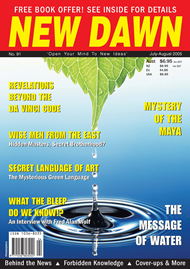
  • The Dawn of Aquarius: A New People, A New Consciousness, A New Era

    The Dawn of Aquarius: A New People, A New Consciousness, A New Era

    This article was published in New Dawn 78 (May-June 2003)

    Aquarius will be the new age, the new life. First there will be disastrous events, gigantic upheavals, turmoil and change of all kinds….
    – Omraam Mikhael Aivanhov (1900-1986)

    The transition to a new zodiacal age is altering the political map of the world. For the last two thousand years much of human history has been determined by events in Europe and the near Middle East. From Greece and Rome, the great power centres of two millennia ago, with their inheritance from ancient Egypt and Mesopotamia, a distinct civilisational impulse spread westward into Europe, eventually reaching North America. Decisions made in the grand capitals of Europe and, for much of the last century in New York and Washington, have impacted the lives of millions of people in every part of the planet.

    The advent of the Age of Aquarius coincides with the emergence of new world power centres. Just as old Egypt, Babylon and Sumeria were eclipsed by Greece and Rome, so too the ‘old world’ of Western Europe and North America will be overtaken by new geopolitical alliances and fresh centres of global influence. And this will be accompanied by a dramatic change in consciousness, as the worn-out Western values and Eurocentric rationalist thought prevailing for the last few centuries surrender to the new Aquarian thinking.

    The current turmoil and conflict unleashed on the planet by the United States and Britain is only the beginning of the climax of a struggle between cosmic influences of which most people are completely unaware. Today, America and Britain embody atrophied and degraded Piscean energies. The Anglo-Americans, as the standard bearers of bankrupt Western materialism, are trying to reorganise the world, imposing their imbalanced, egoistic approach to life on all societies. Yet their latest brutal and insane actions, witnessed in the tragic invasion of Iraq, are part of a frantic effort to prolong their collapsing system. Despite all their apparent power and wealth, Anglo-American universalism is in a state of rapid decline leading to death.

    A new era, a new consciousness and a new people are on the horizon, as the planet goes through a turbulent transitional period paving the way to the Aquarian Age.

    Aquarian Consciousness

    Whether the earth is shaken by natural catastrophes, or nuclear warfare, or both, earth and the life upon it does survive. More than that, however: A New Age emerges and the devastating changes that have preceded it are understood to have been necessary purgations effecting the transformation of humanity into a new mode of being. By analogy, just as the individual near death experiencer may have to endure the pain and suffering associated with the trauma of almost dying before positive personal transformation can take place, so the world may need to undergo a “planetary near-death experience” before it can awaken to higher, more spiritual, collective consciousness with universal love at its core.
    – Kenneth Ring, Transpersonal Psychologist

    Two thousand years ago, at the time of transition from the Age of Aries to that of Pisces, there were secret schools, most notably the Essenes, trained and taught to align themselves with the spiritual impulses of the incoming age. These small communities worked quietly, in retreats; but with the discovery of the Dead Sea Scrolls we now know they were actually the ‘seedbed’ from which came the original Christian revelation.

    These separated mystic communities provided the necessary environment for the message of Jesus the Christ. With their unique synthesis of Zoroastrian, Pythagorean, Egyptian and Israelite spirituality, the Essenes acted as a bridge between the ‘old age’ religions and the unfolding new revelation. Above all, they represent the budding of a new consciousness which would impact history for two millennia. The declining Roman Empire’s embrace of Christianity led to the triumph of the new religion in Europe. With the arrival of the Age of Pisces, Christianity became synonymous with ‘Western civilisation’.

    Writing a century ago, the gifted Englishman Edward Carpenter speculated about Man’s evolutionary future and the development of a new humanity imbued with a new consciousness. “We do not know,” he observed, “what possible evolutions are to come, or what new forms of permanent place or value, are being already slowly differentiated from the surrounding mass of humanity.” Carpenter noted that “at the present time certain new types of humankind may be emerging, which will have an important part to play in the societies of the future – even though for the moment their appearance is attended by a good deal of confusion and misapprehension.”

    Throughout the writings of the 20th century’s most influential spiritual teachers from Charles W. Leadbeater and Rudolf Steiner, to Bhagwan Shri Rajneesh and Omraam Mikhael Aivanhov, we find numerous references to the immanent emergence of a new human type. With one voice they link this new humanity to the dawn of the Aquarian era, which they warn will be ushered in by a major purging of mankind. In the words of Omraam Mikhael Aivanhov: “The Age of Aquarius is fast approaching, and it is going to overturn and shatter all the old forms and values that human beings thought of as permanent.”

    According to all the great mystic teachers and seers, the Age of Aquarius is heralded by a time of immense conflict and turmoil never before witnessed in recorded history.

    Writing in his book Love and Sexuality, Aivanhov notes:

    Human beings need to suffer before they begin to wish for harmony and peace and the splendour of the new life. If they are not ground down by all kinds of sufferings, they will never understand or make up their minds to work for the Kingdom of God.

    John White, a respected New Age author, observes in Science and Spirit that if modern civilisation is destroyed, “some people will survive, according to the predictions and prophecies. The great loss of life will open up niches in the environment where new life forms can emerge. Those most deeply attuned to cosmic processes will become the seedbed from which, it is said, a new race, a higher humanity will evolve in accelerated fashion.”

    The survivors of this ‘great tribulation’ ushering in the Aquarian Age will be those men and women who have not been ensnared by the ‘strong delusions’ of the dying old order.

    A remnant, who like the ancient Essenes before them, renounce the ephemeral fleeting attractions of the old era, will also live on to protect the law of the truth and lead the survivors in the new era.

    Most professing Christians are looking for the return of Christ who they expect to establish a new age. But how many Christians are willing to prepare themselves, after the manner of the Essenes and the Gnostic secret schools, for this new era? Christians are fighting each other over dogmas and doctrines. They are like the Pharisees of Christ’s day, searching the Scriptures in vain, unable and unwilling to see the plain truth in front of their eyes! Christians spend their time serving the very System of Money and Power which crucified Jesus the Christ and persecuted his early followers. The True God is not to be found in any of today’s Christian Churches. Christianity, a religion of the Piscean Age, has chosen to stay with the old order and will invariably perish with it.

    A new community is now being prepared in response to the first impulses of Aquarius. They are the ‘seedbed’ of the new era, a Noah’s Ark of Safety and Light in a time of turmoil, confusion and chaos.

    New Eurasia

    The Truth of Life descends from the world of Eternal Light to illuminate the minds, regenerate the hearts, raise and renew the souls of all the sons of Truth destined to constitute the nucleus of the new humanity of which the Slavs will be the cradle.
    – Peter Deunov, Bulgarian Mystic, 1898

    The inspired Gnostic Master Teacher Peter Deunov (Beinsa Douno), who lived in Bulgaria from 1864-1944, prophesied the birth of “a new type of man” on Earth to coincide with the astrological Age of Aquarius. According to Deunov, the final stage of the previous Piscean Age, transmitted by the Anglo-Saxons, was passing. In the new aeon the Slavic people are predestined to play a leading role. Speaking to his early Gnostic students, Deunov announced: “You are the chosen children of truth who were preordained to form the seed of the new humanity of which Slavdom as a family, descendants of Judah, will become the hearth.”

    The 20th century, in Deunov’s prophetic scheme, was a preparatory period distinguished by the waxing and waning of Anglo-American civilisation. From this perspective the collapse of the British Empire and the rise of the USA at the end of the Second World War marked a key turning point in history. Anglo-American culture having reached its peak is now in its death-throes, and the first light of the new culture is dawning in keeping with the incoming Aquarian influences.

    Russia constitutes the largest Slavic nation, and the last hundred years may rightly be said to have been the time of Russia’s ‘Golgotha’ or ‘crucifixion’. A hundred years of incredible human suffering and enormous national sacrifice claimed millions of Russian lives. Within the first five decades of the 20th century the Apocalyptic Horseman of Famine and War ravaged the vast Russian land. Archaic landmarks swept aside and old values overturned only to be replaced by radical new ways which themselves were soon found wanting. Spectacular material triumphs accomplished at the cost of personal liberty and paid for by human sacrifice. Was such collective suffering a preparation for the new era?

    Could it be Russia, a land that has endured so much in the 20th century, will finally find its prophetic destiny in this third millennium? Revolutions, civil war, famine, two world wars, political repression…. were these all part of a cleansing process signaling the beginning of a new era in which Russia discovers her true mission?

    Alice A. Bailey, who is credited by many as the founder of the contemporary New Age movement, saw a unique role for Russia in ushering in the new era. Writing at a time when Russia was firmly behind the communist iron curtain, she predicted:

    Behind the closed borders of that mysterious and magnificent country [Russia], a great and spiritual conflict is proceeding, and the rare mystical spirit and the truly religious orientation of the people is the eternal guarantee that a true and living religion and culture will finally emerge.

    Rudolf Steiner (1861-1925), who established the Anthroposophical society, believed the Slavic “folk soul” would play a major role in the future development of a new humanity. He saw the Slavs as a bridge between the Orient (East) and the Occident (West). According to Steiner, the religious thought of the Orient belongs to the past; the Occident’s philosophical-scientific thought to the present; the Slavic soul will bridge the two and create a pathway to a spiritual future. More than any other national soul, claimed Steiner, the Russian group soul strives to realise the world of the spirit. In Russia the synthesis of the highest features of both Eastern and Western cultures would one day be achieved.

    “Its geographic location places Russia between two extreme, monolithic cultures – between the materialist countries of the West and the passive, world-denying countries of the East. It is appropriate that Russia creatively unite these extremes,” wrote Nikolai Belotsvetov, one of Steiner’s leading Russian followers.

    “Our country is a peculiar country, placed between the hammer of Europe and the anvil of Asia, destined to reconcile them in one way or another,” wrote the world famous chemist Dmitri Mendeleev. “It is my deep conviction that Russia is called to allay the age-old hostility between Europe and Asia, to reconcile and unite those two different worlds, and find a proper balance between the progressive but proud and inconsequent individualism of Europe and the sense of social and political cohesion of Asia…”

    For the last two thousand years of the Piscean Age, civilisation has traveled the course of the Sun from East to West, reaching its apogee in the modern USA. With the end of the Piscean era, history and civilisation is reorienting. We are seeing a return to origins with the emergence of a new power centre at the cross-roads of the East and West, in Eurasia, the great heartland of Russia.

    The history of Russia is not the history of a country, but of a world. It is, in fact, the history of a vast organic whole which had for its cradle the immense open spaces of Eurasia. In the words of one author:

    The Eurasian world, as such consists of vast plains which extend, broken here and there by low mountain ranges, between the Arctic Ocean, the Pacific, the Black Sea, the Caucasian Range, the Iranian plateau, the heights of the Pamir and the Hindu Kush, and join up, through the tortuous valleys and foothills of the Tian Shan and the Altai ranges, with the plains of Eastern Turkestan and Mongolia.1

    According to the Ancient Wisdom teachings, in remote prehistory a spiritual disaster accompanied by a catastrophic shift in the Earth’s axis caused a great migration to Eurasia from the primal northern region of Hyperborea. Theosophical writers believe that millions of years ago Eurasia was the homeland of the people who:

    …later descended into the Indian peninsula those peoples who call themselves ‘Aryans,’ the ‘High Caste,’ who later were divided into Four Castes: Brahmanas, Kshattriyas, Vaisyas, and Sudras. From the southeastern parts came later the Babylonians, the Assyrians, the Medes and the Persians; and the peoples of Europe, Greeks, Romans, especially.2

    Viewed in the light of the Ancient Wisdom teachings, the appearance of Eurasia on the global stage is not only an affirmation of arcane origins but also of the Shambhala influence in our day. Eurasia, the Russian heartland, has long been called “Northern Shambhala” by Buddhist teachers. Having studied Tibetan Buddhism, Nikolai Roerich developed a deep interest in Shambhala and led a scientific expedition through Eurasia to look for traces of the hidden kingdom.3 He later remarked, “The East has said that when the Banner of Shambhala would encircle the world, verily the New Dawn would follow.”

    At this crucial period in world history we see the first signs of a Eurasia-oriented geopolitical alliance between Germany, Russia, India and China, as a counter balance to the Anglo-American order. Russia, together with the former Soviet states of Central Asia, constitutes the Eurasian ‘kernel’. In the West this Eurasian alliance reaches to Germany, while in the far East it includes China and north Korea. Iraq, Iran and Afghanistan make up the southern flank of Eurasia. The geopolitical struggles and wars of the first years of the 21st century are the outcome of not only political and economic factors, but of resistance to incoming cosmic energies. All around us we’re confronted with clear proof of the passing of one age and the dawn of a new era in human history.

    Britain and the United States represent the final phase of a Western civilisation which succeeded a decaying Rome at the start of the Piscean Age. And like ancient Rome before its collapse, the Anglo-American rulers are desperately seeking to expand what the writer Philip K. Dick termed the ‘Black Iron Prison’. However, the West at its zenith can only be the ‘evening land’, the place where the Sun sets to rise again in the East. To the ancient Egyptians the western lands were, after all, the kingdom of the dead.

    The End & The New Beginning

    For as the lightning cometh out of the East, and shineth even unto the West; so shall also the coming of the Son of Man be.
    – Jesus, Matthew 24:27

    The time in which we now live is charged with cosmic significance as nations and peoples unconsciously struggle to align themselves either with the old aeon influences or the incoming forces of the new Aquarian Age. The prophecies and predictions of so many gifted seers leave us in no doubt – we are right now in a turbulent, even chaotic, transitional period. Nations who cling to the dying old order will fall, to be finally swept away in the coming cataclysm, eclipsed by new global powers, of which Eurasia is preeminent.

    Out of this world catastrophe will come a new era attuned to Aquarius. Now is the time of decision, preparation and separation. People who separate from the old order and prepare themselves by harmonising with the rhythm of Aquarius will form the ‘seedbed’ from which develops a new culture and a new consciousness. Those who today place their trust in rampant materialism and the exploitation of the planet, all the while glorying in their wealth, power and might, will be debased.

    One hundred years ago the venerable European monarchies looked safe and secure, impervious to change. The British Empire, on which it was said the ‘sun never sets’, straddled the globe triumphant. Less than a century later the British Empire is no more and the traditional European monarchs a vague memory. A similar fate awaits today’s triumphalist powers. The victims of history will soon be the victors as the Earth is bathed in the Great Light of the Aquarian Age.

    [alert type=”success” dismiss=”no”]If you appreciate this article, please consider subscribing to help maintain this website.[/alert]

    © New Dawn Magazine and the respective author.
    For our reproduction notice, click here.