New Dawn – World's Most Unusual Magazine

Category: Secret Wisdom

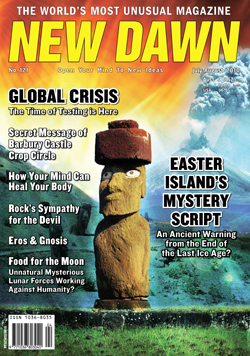
  • Eros & Gnosis: A Gnostic Study of Human Sexuality

    Eros & Gnosis: A Gnostic Study of Human Sexuality

    From New Dawn 121 (Jul-Aug 2010)

    Human beings are not only the funniest monkeys: they are the sexiest ones as well. In many ways we are a species singularly devoted to sex. We talk, write, read, joke and argue about it; we dress and undress for it, and, given favourable circumstances, we perform it regularly. More importantly, and sometimes lamentably, we have innumerable laws and commandments to organise, punish, curb, repress and otherwise influence sexual actions and feelings and have devised psychological penances of guilt and shame which we come to attach to our sexuality.

    Because of these and related circumstances, most people are confused and bewildered about sex much of the time, and those who profess not to be thus flummoxed tend to take umbrage under clichés and half truths which they have consciously accepted, but which are not in harmony with either their instinctual or their spiritual natures.

    It goes without saying that if the Gnostic worldview is any kind of a worldview at all, it must be able to address itself meaningfully to this predicament and thus to suggest spiritually sound ways in which men and women might successfully extricate themselves from the same. The present essay is an attempt to suggest some Gnostic ways of viewing and dealing with sexuality, and in offering it to the reader, the author is not unmindful of certain hazards.

    Psychoanalyst Edward Glover once suggested that writing on psychologically charged subjects should be classified as a dangerous occupation. When in the course of such writing one happens to expose the unconscious motives of some persons, pandemonium is certain to follow. The psychologically exposed individuals frequently relieve their anxiety by attacking the writer who has presumed to disturb their precarious and cherished peace of mind. Martyrdom is surely not an uncommon experience to the Gnostic, and if some form of it befall the author, the risk will hopefully have been worth taking!

    The ancient term “Gnosis” has two very useful modern analogues; they are the words “consciousness” and “meaning.” Both of these are vitally important to any useful consideration of sexuality. Without consciousness, in the psychological sense, sexuality is a mere expression of instinct: Useful in its domain, but unrelated to the enhancement of life, to the experience of the fullness of being. With the coming of consciousness, all experiences, including the sexual ones, acquire meaning. As consciousness adds a greatly needed component to experience, so meaning brings us the experience of totality, of the fullness (Pleroma) extolled by the Gnostics.

    Between the reality of our lives lived in time and the quality of life’s timelessness, between our personal and mundane experiences and the realm which transcends the tangible world, there exists a creative tensional relationship of opposites. The Apostle Thomas, reporting the words of Jesus, reminds us that the saving, or Christ principle, always comes to us to make the two into one, to unite the above and the below, the left and the right, the inner and the outer, and the male and the female into a single one.

    The reconciling agent of all such opposites is meaning. When, on the other hand, the tension between the poles of existence is lacking, then, as C.G. Jung has expressed it, human beings “have the feeling that they are haphazard creatures without meaning, and it is this feeling that prevents them from living their lives with the intensity it demands if it is to be enjoyed to the full. Life becomes stale and is no longer the exponent of the complete human being.” (Analytical Psychology and Weltanschauung).

    Sexuality is one of the most important tensional relationships of the opposites in life. It is therefore evident that it must have, it does have, great meaning. To leave such a rich mine of meaning, of Gnosis, unexplored would be a grave omission indeed. Let us then proceed with our exploration. As it is useful in such cases, we shall proceed from the ground upwards, as it were, and begin with the evidence of the physical aspect of humankind by reviewing the evidence of biology.

    The Gnosis of Biology

    The human species is a unique one in many ways, and not the least claim to such uniqueness is to be found in the sexual sphere. The human is the sexiest animal on earth. No other sexually reproducing species makes love with such frequency, and consequently, sexually toned behaviour saturates a large portion of the individual and social life of every man and woman. There is a biological reason for this. Unlike the female of every other species, the human female is capable of constant sexual arousal. She is biologically capable of copulating every single day of her adult life. She can make love during pregnancy, and she can become sexually active shortly after having a child. In fact, she can engage in sex whenever she pleases.

    Animals are far less sexy than humans. All female animals have a period of heat (the estrus) during which they copulate, and when this period is over, neither the females nor the males of the species engage regularly in sex. (Among caged baboons and chimpanzees one may observe some sexual activity outside of the period of heat, as one may among free chimps and orangutans, but their sexual activities at “unusual” times are minimal when compared to the human.) Unlike humans, female animals do not accept males while menstruating, they do not initiate sex during pregnancy, and they do not resume their menstrual cycle before their young are weaned.

    Due to the so-called “silent ovulation” (the absence of the signs of heat) of the human female, her fertility is never dramatically announced as it is among the animals. The result is that human couples do not know when a woman is ready to conceive. In order to insure the conception of offspring, humans thus must make love regularly, even past the time when conception has occurred. Similarly, especially where breast-feeding is not prolonged, human mothers are capable of resuming their ovulation about six weeks after delivering a child. There seems to be an unmistakable conspiracy of nature directed toward motivating human beings to make love daily, for the human female, alone of all other females, is uniquely designed to do so!

    Anthropologist Dr. Helen Fisher, in her book The Sex Contract (William Morrow and Co., 1982) traces the evolutionary development of the unique human sexual situation. She tells us that the genetic evolutionary process which led to the present condition of humanity in regards to sex began about 8 million years ago, when humans became accustomed to walking upright. Protohominid females who delivered their young in a relatively immature state had a better chance of surviving childbirth, because the smaller birth canal, developed as the result of walking, made the delivery of large, developed infants hazardous. The mothers, now forced to care for their children for a long period, were more prone to engage in sex outside of their limited periods of fertility than they were wont to do earlier in their evolution. Since the most popular females were fed and protected most adequately, they tended to survive in greater numbers and thus passed on their genetic traits to more offspring. Thus our present patterns of biologically unlimited sexual intercourse came into being.

    Dr. Fisher writes: “With the stimulus of constantly available sex, protohominids had begun the most fundamental exchange the human race would ever make.” The fundamental exchange consisted in bringing males and females more closely together than hitherto would have been possible. The bond of constant sexual interest kept them together in each other’s company; it made them divide their labours, to exchange food, to share the daily work and joys of living. Men and women became aware of each other emotionally, and eventually mentally and intuitively as the result of the sexual force which tied them together, creating a never abating forcefield of dynamic tension between them. Sex has become the progenitor of affection, love, relatedness, and above all, consciousness. From purely biological data we may thus infer with some justification that the coming of unlimited sexual expression became the fountain and origin of vast achievements of human consciousness which otherwise could and would not have come to pass. The implications of this insight for past, present and future are large indeed, and should be apparent to all.

    The Gnosis of Psychohistory

    Human biology has its history, and so does the human mind, or psyche. As one might expect, the importance of sexuality and of its influence on various aspects of human life are very much part of this history of the mind. Psychohistorians, whose theories contain elements relevant to the concerns of sexuality, are numerous. Among those inspired by Freud, singular distinction belongs to G. Rattray Taylor (Sex in History), while among C.G. Jung’s followers one needs to refer to Erich Neumann (The Great Mother and The Origin and History of Consciousness) as well as to Esther Harding (Psychic Energy; Its Source and Goal.) The considerations which are to follow here utilise the theories of these authors, and amplify their views by way of certain insights of the ancient Gnostics.

    The protopsychology of the ancient Gnostics (as well as of others in the Hellenistic culture) perceived three main divisions of the human person. The first of these is matter, or body (hyle, soma); the second mind, or soul (psyche); and the third spirit (pneuma). The existential point of gravity of a person’s life moves according to certain patterns from one of these three to the others, and an individual’s type (today called psychological type) would be determined by which one of these three principles acts as the primary focus of his or her consciousness. All people are capable of experiences of body, soul and spirit in some measure, but the seat of their principal identity is located within one only. Thus, there are people whose outstanding concerns are invariably material, while others function chiefly from a centre of consciousness lodged in their mind, while yet others look at all things from a point of view that is primarily of a character that we might call spiritual.

    The presence of any individual within one or the other of these three categories is not a matter of accident, but rather of a transformational growth and development or consciousness, which begins with the material plane and rises eventually to the spiritual.

    When we apply this Gnostic idea to the matter of human sexuality we may find some useful insights. There is, first of all, what we might call a hyletic (matter oriented) type of sexuality. To persons of this type sexuality is primarily a bodily urge, largely unrelated to any feeling or regard for the partner in sex, and originally even quite unaware of the possible results of copulation in reproduction. In a sense, we might say that persons in this stage of development are not participating in a sexual act, but they are identified with it. An interesting phenomenon connected with this is the identification of persons with their sexual organs, as evidenced by works of much primitive art, where men and women are represented with disproportionately large sexual organs. Similarly one may note the use of words denoting sexual organs when describing an individual in the idiom of obscene slang. All of these are evidences of the identification of the entire person with sex. Men are merely phallus bearers and women vagina-carriers; they are not persons, but embodiments of their sexuality. Hyletic sexuality in its later stages also becomes involved in the idea of offspring. Men thus come to look upon their mates not as persons but as the potential or actual mothers of their children, and women look upon men as beings capable of giving them children. In each case we are dealing with a primitive phenomenon, a manifestation of hyletic or biological urges. (It needs to be recognised that the urge to have offspring is just as primitive and unconscious an urge as the one moving to sexual intercourse. The notion that the desire for children is somehow more moral and refined than the desire for sex is nonsense!) Freudian psychohistorians tend to call the hyletic phase of sexuality “matrist,” by identifying it with the archaic domination of children by the Mother. Matrist sexuality is quite permissive, even promiscuous and polymorphous, and leads to the formation of “shame cultures” and the development of the incest taboo. The term “oral” is applied to its quality by Freudian writers.

    In the next stage of development, sexuality becomes linked with emotion and thinking. Ego-development having taken place, consciousness now wishes to subdue the unconscious and thus develops numerous devices for the control of impulse. This is the greatest period of sexual repression and the phase when issues of law and commandment take on a great importance. The Gnostic terminology calls this phase the psychic, for it is here that the mind-emotion complex called “psyche” (soul, or mind) becomes dominant. Mythologically and symbolically this ego or mind is frequently connected with the masculine principle, and thus we find that psychic humanity tends to be patriarchal and masculine in its orientation and consequently a negative view of femininity and of female sexuality predominates. Men in their desire for impulse control begin to view women as temptresses, as instinctual creatures who have to be subdued and controlled. Jungian psychology calls this the “patriarchal phase” while Freudian writers refer to it as “patrist” or father-identifying, and its predominant tendency is said to be “anal.” It is obvious that the dominant cultural influences of Western society are predominantly of this variety, and that most of these influences stem from religious roots within the semitic religiosity of Judaism, Islam and non-Gnostic Christianity. This phase of the development of consciousness is greatly attached to the institution of marriage, and its chief taboos are against adultery and homosexuality. Its result is the so-called “guilt culture.”

    The third, or pneumatic, phase is the most difficult to discuss, because it denotes a form or state of consciousness that is as rare today as it was in the second and third centuries A.D. There is little doubt, however, that several ancient Gnostic teachers, most notably Valentinus, envisioned this spiritual condition as a union of the masculine and feminine aspects of the human being with a consequent androgynation, which undoubtedly would have its reflection in the sexual sphere also. While the anti-Gnostic church fathers with fierce inconsistency accused the Gnostics of excessive asceticism and licentiousness in the same breath, the more recent discoveries of Gnostic writings indicate that the Gnostics were intent upon a mysterious pneumaticisation of sexuality, which process was embodied in the Valentinian sacrament of the bridal chamber. One of the chief results of the pneumatic state of Gnosis is the ability of the Gnostic to rise above the law (antinomianism) and to be motivated no longer by the external commandment of so-called revelation, but rather by the internal command of the indwelling divine spirit. This might be envisioned as the highest form of situation ethics, inspired by intuition, rather than by any rational considerations. The principle is compatible both with the ethics of existential philosophy and with Jungian psychology. The pneumatic Gnostic can no longer rely on any external commandment but must live by the existential courage of daily moral decisions. In Sartre’ swords, “he is doomed to freedom.” C.G. Jung also envisioned a condition within the individuation process where in the moral laws of society and church are relativated and indeed rendered meaningless by the spiritual growth of the individual. Right and wrong become a matter of personal choice based on spiritual insight, rather than standards derived from a code delivered by god or by society.

    The sexual implications of the pneumatic phase of the growth of consciousness are considerable. With the fusion of the masculine and feminine attitudes in the psyche, a fully mature sexuality may be expected to arise. Love becomes the fulfilling of the law, and it goes without saying that this love will have sexual expressions as well. Neither will the expressions of this love be in any way limited by human institutions and prejudices whether they concern marital status, the gender of the beloved or the permanence or impermanence of the love relationship. The spirit bloweth where it listeth; human institutions and earthly considerations must pale before the pneumatic love. The accusation of libertinism hurled against the Gnostics by Irenaeus, Hypolitus and others is thus revealed as the sort of misunderstanding the contemporary Gnostic might face also. The intuitive morality of the pneumatic can be readily confused by the uncomprehending with hyletic, immorality and amorality, while it is nothing of the sort. The pneumatic phase bears, incidentally, all the hallmarks of what Erich Neumann called the “integrative phase,” and its characteristics are to some extent identical with what Freudian psychologists envision as “genital” sexuality.

    Different Strokes for Different Gnostic Folks

    The above noted psychohistorical considerations raise important issues which might be of concern to contemporary Gnostics. Are all Gnostics obliged to follow the pneumatic ethic at all times? Is psychic morality, especially in the sexual area, still relevant to the Gnostic? Have we all successfully outgrown hyletic modes of behaviour? And how are the answers to these questions likely to affect the sexual behaviour of the contemporary Gnostic?

    Our situation might be summed up as follows: We live in a culture which ostensibly follows a psychic system of morality in sexual matters, but which is in practice more often than not composed of persons whose character is hyletic. Pneumatics are far and in between, and usually hidden away in the secret corners of contemporary life. Moreover, all persons possess hyletic, psychic, and pneumatic components in their character, with one or the other predominating. It is thus evident that most persons, including Gnostics, will express their sexuality sometimes in ways that are hyletic, at other times they may be attached to attitudes that are predominantly psychic and in some instances they may be capable of behaviour that may be properly recognised as pneumatic. Most people may also go through these phases in their own lifetimes. It is by no means unusual for early youth to be sexually quite hyletic (a sort of adolescent sexuality, as it were), for young adulthood to be involved in the marital and societal ambiance of a psychic sexual morality, and for the middle-aged person to achieve a matter-of-fact and liberated attitude toward sexuality, without serious inhibitions and guilts; in short, an attitude that approximates that of the pneumatic.

    Since it would be reasonable to say that modern Gnostics may thus find persons of all three orientations in their midst, it might be helpful to present here a few brief guidelines for all three types regarding sexuality.

    The hyletic needs to be reminded that, while hyletic sexuality is no more sinful or less virtuous than any other kind, it is still limiting and limited. Indiscriminate sexual behaviour is characterised by unconsciousness and this is a condition one ought to outgrow. Still, no one can be equally conscious of all aspects of life at all times, and a relatively high level of consciousness in one area may be accompanied by a relatively low level in another. The key concept must always be authenticity. If our behaviour has adduced to it as much consciousness as we could muster under the circumstances, this should be enough. There should be no judging of anyone for his or her sexual mores. Authenticity by nature is a highly personal issue. One person may be far more authentic and conscious while associating with multiple sexual partners than another locked into a rigid psychic cage of so-called monogamy. Striving for consciousness will inevitably bring its own reward and is far more useful than blind obedience to external rules.

    The psychic person may prove more troublesome within a Gnostic context than either the hyletic or the pneumatic. Unlike the happy-go-lucky hyletics, psychics tend to be rigid personalities with a strong proclivity for projecting their own shadows, especially their sexual shadows on others. They tend to be judgmental, intolerant and self-righteous. In short, they are a mess, or at least they appear as such. Psychics ought to remember that goodness, by anyone’s standards, including their own, is never enough. Wholeness, not goodness, is the objective of the Gnostic life. Jung was fond of saying in truly Gnostic fashion: “It is only the fullness of being that counts.” Rules exist in order to be outgrown. We may not always be ready to outgrow them yet, but the desirability of the prospect must always be kept in mind. When following rules after the fashion of the psychic we but see through a glass darkly, and we should aspire to the clear vision face to face with authentic reality. While we must be careful not to judge the hyletic, we must often dissuade the psychic from judging everyone. Psychics may also be reminded that it is the psychic law alone that creates sin. “I had not known sin but by the law” said a Hebrew prophet. The harsher our own standards of judgement the greater will be our own guilt and spiritual impotence and the more our potential for liberation will diminish. Sexual guilt has been the greatest single curse the demiurge and his minions have hurled against humanity; it has been the blight of our culture, the stifler of creativity and the enemy of Gnosis. It must be recognised and its suggestion rejected at all times.

    That rare bird known as the pneumatic, must above all, be discreet. Pneumatics have a divine right to their freedom, including their sexual freedom, but they have no right to bad manners. The spiritual nobility of the world must maintain decorum and discretion while exercising its prerogatives. The humourous adage often attributed to the British aristocracy of some time ago may be remembered here: “Do what you wish, but don’t do it in the road and frighten the horses.” Politicised sexuality, such as we have experienced in the era of the various liberation movements often comes under the heading of bad manners. Rigid psychics will not be converted to a pneumatic point of view by being confronted with sexual behaviour inappropriate to their level of consciousness. Ill advised action inevitably creates reaction. Pneumatics need not be apologetic about their liberated state, and they need not dissimulate or be guilty of hypocrisy. At the same time they must extend to the unliberated the same freedoms they demand for themselves. Persons who flaunt their sexual unconventionality and wish to force everyone to bear their sexual foibles without complaint are usually hyletics putting on the mask of pneumatics. “By their manners and their discretion ye shall know them” could be said of the true pneumatics.

    Conclusions for Daily – and Nightly – Life

    It is a cliché that we live in an era of great sexual confusion. Clichés, however, are not usually untrue, they have merely become clichés by excessive repetition. Can the Gnostic point of view bring some clarity into this confusion? Can the contemporary Gnostic offer meaningful suggestions on the sexual topics and perplexities of our times? We shall answer such questions by stating our Gnostic position regarding individual issues of sexual significance.

    Sex in general. Biology, psychology and Gnosticism indicate that sex is a beneficent, consciousness-enhancing factor in human life. Sexually active persons are healthier, more balanced, and generally more pleasant members of society then the sexually inactive. There is every indication that sex is good for you physically, psychologically and spiritually. All sex that is not injurious to anyone and does not violate the sovereignty of any person is good, although some kinds of sex, such as those among loving, concerned, compatible partners are no doubt better than others.

    Sex and the Sacred. In many religions, both pre-Christian and contemporary, sexual practices play some part. While there is nothing inherently wrong with the notion that sexual acts and religious acts can converge, one must exercise considerable care when trying to apply such principles within a contemporary context. Such magicosexual practices as one finds in the Hindu Tantras, in the “great rite” of the witches, and in the sex magic of the late Aleister Crowley, all suffer from the shortcoming that they tend to depersonalise the individuals who participate in them. Joseph Campbell in his splendid book Myths To Live By has pointed out that beginning with the mysticism of the Troubadours, the West came to espouse love-magic as against mere sex magic. C.G. Jung’s commentaries on the Rosarium Philosophorum indicate that a similar principle of love-magic was present in the system of Alchemy. The Gnostic tradition indicates that the early communities of knowers, particularly those attached to the teachings of Valentinus, practiced a supreme rite of pneumatic union, sometimes called the “mystery of the bridal chamber” which may have served as the prototype of many later rites of love-magic, symbolising the union of the lower personality with the heavenly pneuma, which may be envisioned as being of a contrasexual nature (female for men and male for women). The development of a conscious personality is one of the great achievements of Western spirituality. Persons love, unconscious beings merely copulate. Both actions are magical, but the former is preferable to the latter. There is no doubt that the magic of the sexes needs to be re-incorporated into religion, but we must take care that in attempting to do this we will not resort to archaic practices which were useful in periods of history when consciousness and personality were minimal compared to contemporary conditions.

    Marriage. The Christian sacrament of matrimony was the last to be formally accepted; it did not come to be generally used in the church for hundreds of years. The reason for this may be found in the unacknowledged fact that the early Church, along with the Valentinians, knew only one true marriage: the heavenly marriage of the personality to the spirit. The contractual relationship of two earthly personalities within the context of property, inheritance, and so forth, the church initially left purely to the state. Only when the Church allowed itself to become an agent of the secular power did she uniformly come to practice marriage as a sacrament. Thus the present practice of the sacrament of marriage is a deficient sacrament, a mere shadow of the mystery of the bridal-chamber. There is no reason why the church, even the Gnostic church, should not bless the contractual relationships of men and women when asked to do so, but it must be kept in mind that this is not a mystery of the same order as the Eucharist, or Holy Orders, or the other true mysteries. The notion that sexual congress without the benefit of such a contractual relationship is sinful cannot be accepted within a Gnostic context.

    Homosexuality, bisexuality, and androgyny. It is generally understood that at the non-physical level, people are not limited to their bodily gender. Jesus declared in the Gnostic scriptures that he “came to make the male and the female into a single one, so that the male will not be male and the female not be female.” We may take this to mean that in order to attain to the Wholeness of the Pleroma, all persons are striving toward a spiritual androgyny. In the hyletic phase of development this often manifests as polymorphous bisexuality, in the psychic phase as homosexuality, and in the pneumatic phase it moves increasingly into the area of a spiritually based androgyny. None of these are sinful or should be condemned in Gnostic thinking. The idea of a “crime against nature” is meaningless to the Gnostic, for our nature is not merely physical nature, such as our gender, but our total nature within which all dualities exist. When asked about homosexuality, the great modern Gnostic C.G. Jung merely said: “Well, they are the only people who are trying doing something against over-population.” The attraction of persons of the same gender toward each other meets with the most powerful taboos of the patriarchal-psychic phases of cultural development and is therefore encumbered by many unnecessary ideas and apprehensions.

    Birth control and abortion. Anthropologists have noted that agricultural societies tend to be opposed to the limiting of births, while nomadic-pastoral societies encourage the same. Many great religions came to adopt the mythos of the agricultural societies and have proscribed birth control and abortion. The theological justification brought forth in support of the position of these religions is more or less to the effect that the prevention of birth is a contravention of the will of God. Many religions believe that a distinct soul is attached to every foetus at conception and that therefore the destruction of the foetus is murder. This idea is highly speculative and, like all theological notions, not subject to any evidence. The Gnostic traditions hold that the soul’s connection with the foetus is minimal until the seventh month of pregnancy. The obsessive fury of various religionists in our days against both birth control and abortion ought to elicit no sympathy from Gnostics. It is obvious that the more conscious humanity becomes, the more it will exercise conscious control over the size of families and the less it will be inclined to place innumerable offspring heedlessly onto an overpopulated earth. That people simply ought to become sexually inactive when not desiring offspring is a notion that is as silly as it is unrealistic.

    Monogamy, celibacy, and chastity. While often confused, these three terms have very distinct meanings. Monogamy denotes sexual exclusiveness in favour of only one partner; it is an idea that acquired much importance in the psychic phase of psychohistory. Even today it may have merit for some, but it ought not be advocated or enforced generally. As consciousness expands, the affectionate and emotional needs widen also. It may be counterproductive to be attached to rigid ideas of monogamy in such instances. Celibacy is the unmarried state, as is customary among the clergy of the Roman Catholic Church. Gnostics make no rules about whether their clergy ought to marry or not, and thus the issue of celibacy is of no great import for us. Chastity implies abstention from sexual activity of any kind; it is a practice that puts a very heavy strain on the psyches of persons, and its benefits are minimal, if any.

    Family. Whenever this term is used today, it tends to denote the nuclear family unit of industrial society, which means, really, a phenomenon of the last hundred years. In the time of Jesus or even in that of Louis XIV the concept of family differed radically from the one of today. To go along with the moral reactionaries of our time and to hold up the nuclear family of recent vintage as the divinely decreed paragon of all virtue and goodness and the best possible cornerstone of society is, to say the least, unrealistic. While some sort of family structure is likely to continue to exist in humanity, we must possess an elastic vision regarding its future contours and character. Some modern research indicates that radical changes in the present family image would be highly beneficial to the psychological well-being of people in our society. Dr. David Cooper, existential psychiatrist, and associate of R.D. Laing, in his fine work The Death of the Family (Penguin Books, 1971) has built a convincing case for the need to develop alternatives to the nuclear family of conventional society. Once again it must be remembered that as human consciousness grows, the importance of ties and roots based purely in blood and soil tend to diminish. Relatively primitive, traditional societies are often so constructed that the individual is tyrannised and dwarfed by the family. In contrast with this, modern urban societies are moving more and more in a direction where the family loses its hold over individuals who thus need to develop their own lives and resources. For practical purposes it may be noted that the less closed off, the less insular and nuclear the family is, the less likely it is to destroy the sexual and social independence of the individual. A family ought to act as a springboard to life and to people and not as a fortress wherein a small nucleus of persons shuts itself in, while shutting the greater world out.

    Sex and the procreation of offspring. As one may deduce from various foregoing statements, the Gnostic cannot endorse the teaching that sex exists purely for the purpose of procreation. Such a view, even though held by theologians, is utterly un-spiritual and smacks of the worst kind of materialistic myopia. By this we mean that parenthood is but one of life’s functions, and it ought not to obtain ascendancy over all others. Children require “parenting” for only a certain period of their lives, and when parents fail to recognise this, untold unhappiness may result. Women, particularly, have been shunted by culture and religion into the over sentimentalised and inflated role of motherhood, and while starring in this role, have often forgotten how to be women. Monkish prudery being unable to accept the feminine in any other aspect but the maternal, the feminine ideal in Christendom became the mother, which condition in turn limited and constricted the psychic and physical lives of women.

    One of the great tasks of modern Gnosticism is to restore the dignity and importance of the feminine within a spiritual context and this task includes liberating the feminine from such confining expressions as “mother” and “virgin” (not to speak of the biological absurdity of “virgin mother.”) As motherhood and fatherhood are but one of the possible by-products of human sexuality, so it is obvious that sexuality has far more and vaster functions in life than merely serving as a vehicle for procreation. Love, affection, relatedness, spiritual bonding; all of these are facilitated and enhanced by sex. Sex, we need to state again, is beneficial to humanity physically, psychologically, and spiritually. Procreation, on the other hand, is assuredly not always beneficial to the human race. Gnostics ought to add their urgent voice to the ever swelling chorus calling for effective programs and concentrated action against the population explosion. It is obvious that what the world needs is not less sex but less offspring.
    Get the issue this article appears in

    Sexual Libertarianism

    Modern Gnostics are not antiquarians. It is not our purpose to try to resurrect the Gnostic tradition in its ancient form, rather we strive to retranslate the available elements of Gnostic wisdom into forms appropriate for the present. One of the most relevant features of ancient Gnosticism is what might be called the libertarianism of the Gnostics. The available documents authored by or attributed to such lights of the Gnosis as Valentinus, Basilides, Marcion, Carpocrates, Epiphanes and others are all thoroughly libertarian in spirit. All of these Gnostic teachers and leaders would have no difficulty in agreeing with the following example of libertarian reasoning: “You as a person are better able to control your life than I am. Your life is your personal affair, for· better or for worse, except as in the living of your life you may impair or endanger the life and livelihood of others. No person nor set of persons on this earth has any logical right to interfere with you except as you may do injury to them.” (A Libertarian’s Platform by James C. Ingebretsen). Even as the political, economic, and religious lives of people are their personal affair, so are their sexual lives. The talons of the authoritarian demiurges of this world must be made to retract from the bedrooms of free men and women. Sexual relations which do not harm or injure anyone should be of no concern to legislation and to the police. Vague conjectures, based on private prejudice, and masquerading as statements about the “public good” and the “moral health” of the body politic ought never to serve as the basis for laws and ordinances.

    It must be kept in mind that Gnostic libertarianism is not a mere matter of political or economic expediency. In reality this libertarianism is rooted in the most fundamental features of the Gnostic mythos, which has as its central theme the liberation of the incarcerated divine spirit from all bonds imposed upon it by the false cosmos of the demiurge. Early Christian leaders, even when not manifestly of the Gnostic fold, have often echoed the libertarian expressions of the Gnostic attitude. St. Paul the Apostle’s bold statement: “All things are permissible unto me,” as well as St. Augustine’s adage: “Love God and then do as you please” indicate that the Christian message was intended to replace the law of Jehovah, with the sovereignty of the individual soul restored by the new covenant of love. The relationship between freedom and love has been noted by many wise souls in many traditions, including in that of India, where we find a formulation of the five degrees of love through which the worshipper receives increase in what in our own tradition we might call Gnosis. The first degree of love, we are told, is the love of servant for the master, the second of comrade for comrade, the third that of parent for child, the fourth that of spouses for each other, and the fifth, or highest degree, is defined as passionate and illicit, that is, not sanctioned by any rule of society or of reason; a love totally unrestrained by any limitation whatsoever.

    This fivefold system of varieties of love shows not only an increase of intensity from stage to stage, but also, and most importantly, an increase of freedom. What began as servitude ends in total freedom. As restraint gives way to freedom, the force of love increases, until it becomes the supreme liberating influence of being. Now this concept, or rather reality, is not unknown in Western mysticism. Even as we may rightfully assume that the Gnostic mystery of the bridal chamber was a spiritual rite, which yet was not without the physically sexual concomitant, so we know that from a certain time onward the alternative mystical tradition of the West came to abrogate the dualism of orthodox Christianity regarding love, and came to replace it with a unitary experience which was at once spiritual and physical. Medieval Christian orthodoxy insisted on the duality of eros (fleshly, or sexual love) and agape (spiritual love, or charity). The Gnostic tradition, whether expressed by Valentinus in Alexandria, or by the troubadours in medieval France has as its objective to “make the two into one” by uniting eros with agape and replacing both with the higher synthesis, called by troubadours amor. Amor is neither fleshly nor ghostly, neither sensual nor spiritual, but partaking of both qualities represents a totally new quality. The whole is greater than the sum of its parts. This whole, or rather wholeness, is none other than the terrestrial epiphany of the Pleroma. Sexual and non-sexual love combine to bring forth the ineffable greatness in human life.

    Here then is to be found the royal secret of sexuality. As consciousness frees itself of the thraldom of the unconscious, and with it from the taboos, fears, and guilts inculcated by society and exoteric religion, the liberating force of eros joins the inspiring energy of agape. This mystic union then produces an explosion of freedom, a leap of liberty of unbelievable power. The sexual libertarianism of the Gnostic has now born its aeonial fruit, the great dénouement of the age long process has come. Sex is important because it liberates, and in order to liberate sexuality itself must possess an optimum degree of freedom.

    Humans are sexual and spiritual beings at once. When one or the other of these dualities is repressed or neglected, disunity and torment prevail. When both are united in freedom, true liberation and joy manifest. Therefore we must be free: Free to live intellectually, emotionally, and indeed sexually. We must be free to experiment, to fail and to succeed, to be perplexed and to be enlightened. The day of the old law of restriction must be declared defunct and the dawn of the new law of freedom must be ushered in. In stating this we are not proclaiming a novelty. We have the words of St. Paul to the Romans saying: “God has consigned all men to disobedience, that he may show his mercy to all.” Jesus said: “Judge not that you may not be judged.” And Heraclitus the Greek sage wrote: “To God all things are fair and good and right, but men hold some things wrong and some right. Good and evil are one.” The great and terrible truth is: That we must be free, lest we perish; that we are condemned to freedom, that the undying obligation of self-liberation has been imposed upon us before the world began, yea, even before the creator of this world came to be. We were not born to abide by the dark laws, and to wear the blackened chains of the rulers of this world, but to be free, liberated consciously divine children of the light. As a Gnostic hymn put it: “Ours is the voice of awakening in the eternal night.” Due to the design of heaven this voice is uttered not by one, but by two; not by man alone or by woman by herself but by both in unison. The voice of awakening is at least in part a sexual voice; the hymn is not merely one of praise but of passion. Today as ever the words of Goethe remind us of the Gnostic truth:

    “Mann und Weib, Weib und Mann,

    Reichenandie Gottheit an.”

    (Man and Woman, Woman and Man,

    Together they reach Divinity.)

    The above essay first appeared in Abraxas 84, published by Ecclesia Gnostica, 1984, and is reprinted here by permission of the author.

    [alert type=”general” dismiss=”no”]This article was published in New Dawn 121.[/alert]

    [alert type=”success” dismiss=”no”]If you appreciate this article, please consider subscribing to help maintain this website.[/alert]

    © New Dawn Magazine and the respective author.
    For our reproduction notice, click here.
  • Esoteric Australia

    Esoteric Australia

    From New Dawn Special Issue 3 (June 2007)

    In 2001 as Australians celebrated the centenary of federation, no attention was paid to the role of mystic thinkers and esoteric ideas in Australian history. The vast majority of Australians know nothing of the “inner side” of their country’s political, cultural and religious evolution.

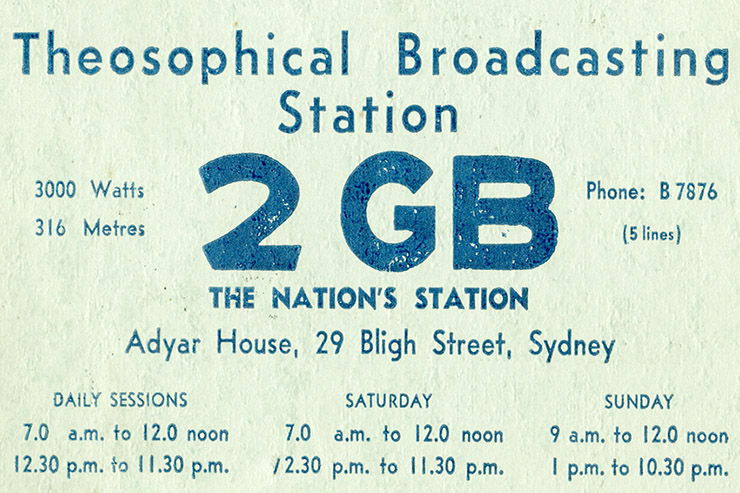
    How many people are aware, for example, that the call sign of Sydney’s pioneering radio station 2GB stands for the martyred sixteenth century mage Giordano Bruno (GB)? Or that Prime Minister Alfred Deakin, a major force in the foundation of the Australian Commonwealth, was heavily involved in spiritualism and an enthusiastic student of Madame Blavatsky’s writings? Who knows of Walter Burley Griffin’s use of occult principles in the design of Canberra, the national capital? Who today remembers the Star Amphitheatre built at Sydney’s Balmoral Beach to welcome the “World Teacher, when He Comes”? Or that in the 1920s Sydney was proclaimed a “great theosophical centre”, home of the renowned and controversial occult teacher, the Bishop Charles Webster Leadbeater. A prolific writer on metaphysics and one of the world’s greatest clairvoyants, Leadbeater predicted the “emergence of the new ‘sub-race’ in Australia and New Zealand.”

    In Other Temples, Other Gods, Nevill Drury and Gregory Tillett observe that, “despite its relative youth as a modern nation,” Australia, “has had a colourful and active history of occultists and occult movements.”1

    Some of the leaders of progressive politics in Australian were also students of esoteric wisdom. In 1892 the labour organiser William Lane’s political novel The Workingman’s Paradise was published in Sydney. In it the working girl Nellie says scornfully, “There is no God. How can there be?” But the mysterious socialist Geisner rebukes her in words straight from Madame Blavatsky’s Secret Doctrine. There is at least “the imperishable breath of the universe”. For Geisner explains, “the Purpose of Life is self-consciousness…. God seeking to know God. Eternal Force one immeasurable Thought. Humanity the developing consciousness of the little fragment of the universe within our ken.”2

    Disillusioned with the socialist movement in Australia, William Lane (1861-1917) established a communalist settlement in South America. A non-smoker and non-drinker, Lane was also a vegetarian who recognised the importance of a healthier attitude to diet. Inspired by Lane’s vision and example, hundreds of Australian workers sailed with him in 1893 to the “New Australia” colony in Paraguay.

    The first Gnostic study circle was established in Melbourne in 1886. A year earlier the Reverend Charles Strong led most of his congregation out of Victorian Presbyterianism to found a native, ethical church, the “Australian Church”. Strong’s Australian Church sponsored the Religious Science Club, a forum for all manner of independent thought and spiritual enquiry.

    AUSTRALIA & THE THEOSOPHICAL SOCIETY

    Such was the interest in mysticism and spiritualism at the turn of the century that Australia came to prominence in the largest international occult movement of the day – the Theosophical Society.

    “The occult movement which achieved the greatest publicity in Australian history,” explain Drury and Tillett, “and for which Australia was an international focus for many years, was the Theosophical Society.”3

    In the early 1890s study circles devoted to Theosophy as presented in the texts of Madame Blavatsky had formed around Australia, leading to the founding of the Australasian Section of the Theosophical Society in 1895.

    As Drury and Tillett explain:

    The progress of the T.S. [Theosophical Society] was steady; lectures given, meetings held, leaflets and publicity material produced, and journals published. Lodges were established throughout Australia…. But it was the lecture tours of one man which established Theosophy as a movement of public interest in Australia: Charles Webster Leadbeater toured the country in 1905, following a lecture tour of several years in the U.S.A. during which he attracted thousands of enthusiastic listeners, and in 1914 he settled in Sydney, remaining there more or less permanently until his death in 1934.4

    By the 1920s there were more paid-up members of the Theosophical Society than members of the Communist Party of Australia. The twenties witnessed a surge of Theosophical activism as Australian Theosophists sort to present a vibrant alternative to the mainstream, including the growing political ideologies of bolshevism and fascism. In addition to the public lectures, lodge meetings, and libraries, there was the Society owned Sydney Radio station 2GB as well as a successful publishing enterprise. Journals with titles like Advance! Australia and Theosophy in Australia, presented the society’s views and analysis of turbulent world events. Writing in Advance! Australia, one of the society’s leaders called for:

    purified patriotism, the promotion of a noble type of Australian citizenship, vitally Australian, eagerly conscious of Australia’s specific place and part in the building of the future, no less eagerly conscious of the wider and equally vital citizenship involved in Australia’s membership of the British Commonwealth, and recognising too… there is a World citizenship, the obligations of which may no longer be ignored.5

    Walter Burley Griffin wrote of “Building for Nature” and the “outdoor arts in Australia” in the pages of Advance! Australia. Together with Marion Mahoney Griffin, he set up an “organic” community at Castlecrag, Sydney. Griffin hoped for the awakening of “disused powers of the universal mind” and social renewal as people turned inward to reconnect with “the possibilities of co-operation between head and mind in social service and creative effort.”6

    Adyar Hall, the Theosophical Society’s impressive Sydney centre, served as the meeting place for many original social, political and spiritual groups, among them “The Australia First Movement”. Founded by P.R. Stephensen, a one time associate of Aleister Crowley, Australia First campaigned against Australian involvement in the Second World War.

    A.R. Mills, a Melbourne solicitor active in Australia First, had been on the fringe of the Theosophical Society. During the 1920s and 1930s, Mills formed the world’s first Odinist religion, a mixture of Nordic mythology and occultism.

    A persistent notion running through all the organisations and individuals concerned with esoteric wisdom is the conviction Australia has a special role to play in the dawn of a new Golden Age. Although popularised mainly by the Theosophists, the idea of Australia’s secret occult destiny surfaces in various mystical circles. In the early decades of the twentieth century the tireless Veni Cooper-Mathieson who founded – among other orders and institutions – the Home of Truth Esoteric College, the Church Universal, the Universal Truth Publication Company, taught that Australia was the “land of the dawning.”

    AUSTRALIA: HOME OF A NEW HUMANITY

    Madame Blavatsky, co-founder of the Theosophical Society, is credited with developing the theory that humanity evolves through a sequence of Seven Root Races, “four of which have already lived their day, the fifth still exists, and two are to appear in the future.”7

    In a series of lectures delivered in Sydney in August 1915, Bishop Leadbeater proclaimed “Australia and New Zealand as the home of a new sub-race.” He had detected in Australia “children and young people of a distinctly new type.” A new antipodean human type characterised by intuition and the powers of synthesis. Jill Roe in her book on Theosophy in Australia writes:

    Leadbeater urged his audience to align themselves with evolutionary law, assuring them that present confusions were merely transitional. He held that, despite distance and a small population, the Antipodes provided a favourable site for inauguration of a new era of brotherhood and cooperation, being neither decadent like Britain nor overblown by capitalist pride like America, and not yet delivered into unworkably democratic systems by ‘too young souls’. There was crudity, and reverse class legislation, but the wholesome environment held promise.8

    In Leadbeater’s view, however: “It would be important to purify child-rearing practices, by abstinence from alcohol, meat and tobacco, and to educate the next generation correctly…. The reward would be the coincidence of a new sub-race and the World Teacher in fifteen or twenty years’ time.”9

    By embracing techniques of physical and mental purification, Leadbeater believed in a couple of generations the whole of Australia would be controlled by a new people, who would constitute “what in Europe we should call the aristocracy of the country; that is to say, the best types”.10

    Of course the Bishop’s message was not taken up by the Australian people and no new “aristocracy” emerged to lead the Antipodes into a new Golden Age. Was there any truth in Leadbeater’s predictions?

    Nations, like individuals, have choices that eventually determine outcomes far beyond what can be recognised in the immediate. A collective – a group soul – like the individual soul must decide with which impulses to align. Nations can choose either the forces of materialism leading to decay and atrophy, or the higher influences of the spirit capable of leading to a New Beginning. In the case of Australia and New Zealand, the birth of the ‘new people’ was limited and distorted due to the infection of Mammonism. By concentrating on the search for outer happiness, following the path of the kingdoms of this world, the Australian nation stifled the quest for inner transcendence and the Kingdom of God.

    By taking the way of materialism Australians cut themselves off from the subtle influences of the spirit and cosmic destiny. Manning Clark, Australia’s greatest historian, expressed the spiritual crisis of modern Australia when he said:

    The decline of faith begat nihilism, and nihilism begat hedonism. It looked as though in the contest between Mammon and ‘millennial Eden’ Mammon had won. The dreams of all those who had migrated to the great south land had evaporated. The Aborigine had been corrupted and debased by contact with the white man. The voices of the Catholic who had spoken of a land dedicated to the Holy Spirit, the Dutch Protestants who had called for the discovery of a land that would yield ‘uncommonly large profit’, and the pleas of the followers of the Enlightenment with their faith in human perfectibility, had all dropped from a roar to a whisper, Mammon had won: Mammon had infected the ancient continent of Australia. The dreams of humanity had ended in an age of ruins.11

    Yet in every generation, and in every nation, there is always a remnant of men and women who have not succumbed fully to negative earthly bonds. They are the silent ones who stand among the ruins of the modern era, living testimonies to the higher world of the spirit. The ability of any nation or people to realise their spiritual potential and partake in the dawn of a new Golden Age depends on the vitality of this remnant.

    Have Australia and New Zealand forfeited their occult birthright?

    Certainly some of the ‘new people’ characterised by intuition and the powers of synthesis are found today in Australia, as well as in many other places throughout the world. The future depends on the ability of this remnant to impact the greater society and become a new Noah’s Ark capable of surviving the coming times of tribulation and transition. True, nearly every nation has a myth promising them a leading role in the dawn of a New Age. The universality of this myth in no way detracts from the responsibility it places on a people with ‘ears to hear’ the message of the times. Every people are called to turn within and align with the New Era. And Australasia is not impervious to this call, to this great Thought.

    Over a century ago, in 1892, the Australian socialist and mystic William Lane wrote:

    The brute-mother who would not be comforted because her young was taken gave birth in the end to the Christs who have surrendered all because the world sorrows. And we, in our yearning and our aspirations, in our longings and our strugglings and our miseries, may engender even in these later days a Christ whom the world will not crucify….12

    The earth still awaits the revelation of the Christ people, the new humanity destined to carry out the great work in which we all have a part to play. At the end of his book, William Lane challenged his readers with words that speak to us today:

    Let us not be deceived! It is in ourselves that the weakness is. It is in ourselves that the real fight must take place between the Old and the New. It is because we ourselves value our miserable lives, because we ourselves cling to the old fears and kneel still before the old idols, that the Thought still remains a thought only, that it does not create the New Order which will make of this weary world a Paradise indeed.13

    [alert type=”general” dismiss=”no”]This article was published in New Dawn Special Issue 3.[/alert]

    [alert type=”success” dismiss=”no”]If you appreciate this article, please consider subscribing to help maintain this website.[/alert]

    .

    Footnotes:

    1. Nevill Drury and Gregory Tillet, Other Temples, Other Gods
    2. As quoted in Jill Roe, Beyond Belief, Theosophy in Australia 1879-1939
    3. Nevill Drury and Gregory Tillett, Other Temples, Other Gods
    4. Ibid.
    5. As quoted in Jill Roe, Beyond Belief, Theosophy in Australia 1879-1939
    6. Ibid.
    7. H.P. Blavatsky, The Secret Doctrine
    8. Jill Roe, Beyond Belief, Theosophy in Australia 1879-1939
    9. As quoted in Jill Roe, Beyond Belief, Theosophy in Australia 1879-1939
    10. As quoted in Gregory Tillett, The Elder Brother: A Biography of Charles Webster Leadbeater
    11. Professor Manning Clark, A Short History of Australia
    12. ‘John Miller’ (William Lane), The Workingman’s Paradise
    13. Ibid.

    © New Dawn Magazine and the respective author.
    For our reproduction notice, click here.

  • Symbols & Psyche: Exploring Gateways to Realms of Knowledge, Power & Understanding

    Symbols & Psyche: Exploring Gateways to Realms of Knowledge, Power & Understanding

    From New Dawn 116 (Sept-Oct 2009)

    The Muggle world is filled with symbols. From Coke cans to McDonald’s arches, IBM computers to Apple Macintoshs, from flags to emblems and medals, to the endless variety of product packaging, modern culture is brimming with images. Open the Yellow Pages of your phone book – with the emblematic pair of walking fingers – and you will find a myriad of professional logo designers and artists, many of whom have trained at colleges whose crests may date back a century or more.

    Walk or Don’t Walk based on a traffic light flashing a message designed to prevent you from being run over by a car – whose distinctive hood ornament differentiates it from its competitors, and which is fuelled by different brands of gasoline whose identity may be apprehended from afar while travelling at high speed. Look at the dashboard and you can ascertain operational norms, be warned of engine trouble, and learn by iconic means about the vehicle and its amenities.

    We live in a world filled with visual identifiers intended to convey meaningful information at a glance without the need for words.Heraldry, the distinctive symbols of noble warrior families, traces back to the Middle Ages, when grand tournaments were held with jousts between heavily-armoured knights wearing visors. Since individuals were unrecognisable in such gear, unique coats-of-arms were designed to identify the combatants to fans and foe alike. Taverns and inns, village blacksmiths, printers and publishers, all manner of craftsmen and merchants were as recognisable in villages and cities a thousand years ago, as they are in today’s hyper-illuminated metropolitan areas and quieter rural main streets.However, there is another level of symbolism that goes beyond the merely commercial, socially informative, or technologically useful.

    And that is the universe of sacred symbols, whose resonance in the archetypal levels of the human psyche can cause spiritual change and expand consciousness beyond the confines of mundane reality. Symbols that serve as gateways to realms of knowledge, power, and understanding that inform and control life on earth, and, presumably, the after-death state of non-physical life as well. Symbols that can open the mind to communication with spiritual beings who welcome the opportunity to interact with human consciousness. Symbols that confirm to the aspiring student the nature of the truths he or she seeks.

    Symbols are the alphabet of the Law of Correspondence. This universal principle acknowledges the inter-connection of all things with all other things, the existence of multiple relationships within Nature’s kaleidoscopic richness.

    In The Mystery Traditions, I quoted the following statement by Titus Burckhardt from his book Alchemy, “True symbolism depends on the fact that things which may differ from one another in time, space, material nature, and many other limitative characteristics, can possess and exhibit the same essential quality.”

    This article will briefly examine two symbols of great importance to human life. I hope the reader may gain an insight into the richness of the subject and an appreciation for the multiplicity of ideas involved in the study of symbolism. I also hope it may suggest a means by which other symbols may be explored.

    The Circle

    Let us then begin with the Circle, a symbol of unity, wholeness, and completeness – a figure that seems to contain all within itself. Yet, conversely, it defines and delineates space. Thus it is simultaneously an image of distinction, separation, and difference – setting boundaries between that which is within and that which is without. It is a barrier against intrusion, offering a cocoon of protection within which growth may occur in safety – the egg wherein the babe may take form and mature, the magical circle in which spiritual progress may be made.

    The circle is traditionally a symbol of the Sun. To understand the derivation of this association, one need only look up at the sky. With a point in the centre, the circle is the glyph of the Sun in the alphabet of astrology. Its astrological zoomorph is the male lion, king of beasts, powerful, ravenous, swift, courageous, triumphant, regal. He is filled with a self-confidence that allows for the enjoyment of leisure, a kind of benign self-indulgence or laziness that springs from an understanding of his role in the aptly-named pride, or family of lions, over which he rules.

    The Sun is a symbol of resurrection. Each day it rises from the depths of night to gradually illumine the world. Through the course of the day it waxes in power and pulses with life-giving heat. Its radiance sustains the growth of crops and the activities of all species on earth. As the day draws to a close and the light of the sun diminishes, it sends forth rays of magnificent colour that herald its decline and descent, its apparent death as it is about to be swallowed by the dragon of night. And yet on the morrow it comes forth again, bursting the chains of its imprisonment, rising to herald the new dawn. It is the embodiment of continuity and hope, of the possibility of life beyond death, and of triumph in adversity.

    The Sun is a symbol of the self and of self-consciousness. It represents the unique individuality of each being. As he stands out among the luminaries of heaven, so is each of us the centre of our own universe. While it may not be quite politic to express it in words, each of us feels that he or she is the centre around which the world, as we know it, revolves. The Book of the Law expresses this image beautifully in the passage, “In the sphere I am everywhere the centre, as she, the circumference, is nowhere found.” While there are many who like to imagine themselves as amorphous ripples in a universal continuum, Nature herself rebels against this fantasy. The Sun is her proof.

    In the world’s mythology, the Sun is the archetypal essence of numerous deities who span all cultures while sharing the same identity.

    Ra in the Egyptian pantheon is hawk-headed. The hawk is far-seeing, inhabits the very heights of the celestial environment, is swift as a beam of light, able to penetrate all darkness and depths to snatch forth his nourishment from the myriad of creatures over whom he reigns. Ra is the creator god, both the spark that enlivens the world and the sustaining energy that keeps it alive. Ra was the first and most powerful of the gods; like the Sun, his role is that of prominence, leadership, and dominion.

    The Sun subsumes the resurrection gods, the saviours who act as mythic intercessors between Deity and humanity. The Sun is the eye of God monitoring its creation – prominently, unavoidably, consistently omnipresent in our world that we may learn the lesson of our own essence. The Sun is the link, the representative, the prince, vice-regent, and son of God – visible representative of the Invisible Father of all. As such, he is Jesus, Adonis, Bacchus, Krishna, Apollo, even the Buddha. His death is suffered as an inspiration to us of a life beyond, offering the promise of victory over the chthonic states of non-existence.

    The Tree of Life

    In the diagram of the Tree of Life (page 16) – the traditional esoteric geometric representation of the mystic totality of existence – the Sun is the number six, the Sephira, or sphere, of Tiphareth, Beauty. Tiphareth stands in the balance, midway between the topmost sphere of Kether, the Crown – the Point, the first manifestation of the Infinite – and the bottom sphere of Malkuth, the Kingdom – the world of three-dimensional physical reality in which we live. Tiphareth occupies the central of the three pillars of the Tree of Life, the Middle Pillar, surrounded on either side by the Pillars of Mercy and Severity.

    As the Sun is Tiphareth, the number six, its geometrical figure is the hexagram. The hexagram further exemplifies the nature of the Sun as intercessor or balance point between above and below, heaven and earth, God and man. The hexagram is formed by the union of the ascending male triangle of Fire, and the descending female triangle of Water. The number six, or hexad, was called “the Perfection of Parts” by Pythagoras. This reminds us that Tiphareth (Beauty) is the sphere of Harmony. And harmony is produced by the joining together of distinct, and, in some cases, discordant elements, to produce a unified and aesthetically pleasing whole. Pythagoras observed that the number six is the first mixture of odd and even, being the multiplication of two by three. The Pythagoreans designated odd numbers as male, and even numbers as female. Thus, we are reminded once again that the number six and the hexagram represent the union of male and female, the harmony upon which all creation relies.

    The Sun’s metal is gold, the luminous and most beautiful of all, whose value has been an unchanging indicator of wealth and a medium of exchange for millennia. A visit to any fine Egyptian collection, in either a museum or the pages of a book, will show the prominence of gold as the chosen metal of pharaonic iconography and architecture. Similarly, gold was the metal chosen for most of the ritual implements in the Temple of Solomon. It was also used to cover the sacred Ark of the Covenant. Medieval and Renaissance Europe used gold liberally in churches, shrines, and palaces, as did the Aztec, Mayan, Indian, and Chinese royalty and priesthood. Gold is the ultimate symbol of the perfection reached by the alchemist – who removes in countless stages the myriad of impurities that make up lead, and allows for its transformation and refinement into the king of metals.

    In the body, the Sun is the heart, symbolically the single most important organ. The heart is the central pumping station of the blood, the essence of life. All survival and health depend on its regular and consistent motion. Long regarded as the seat of courage, the heart was torn from the chest of enemies and eaten by ancient warriors, that they might increase their own strength by ingesting the essence of worthy opponents. Colloquially we speak of a person “with heart” to describe the motivation and self-discipline necessary to pursue a course of success in life. The heart denotes sincerity, the appreciation of the essence of the self in action. It is also the symbolic seat of love, the motivating force that sustains the world through generation.

    Among the parts of the Soul in the Qabalah, the Sun is one of six of the ten Sephiroth that compose the intellect, known as the Ruach. Here again, the Sun acts as an intercessor between the higher levels of the soul (the Self, Life Force, and Intuition) and its lowest aspect (the Animal Soul of Nature). The Intellect weighs and analyses, decides on the appropriate response to stimulation from above and below. It acts as the mediator between “heaven” and “earth.”

    On the level of spiritual experience, the Sun is a symbol of the magical virtue of Devotion to the Great Work, the path by which an aspirant may reach the heights of spiritual potential. The stage of initiation represented by Tiphareth, the sphere of the Sun, is known as the Knowledge and Conversation of the Holy Guardian Angel. This may loosely be understood as the point at which the upward motion of the soul is met with a profound response from the higher reaches of Divinity. A direct interaction occurs in the consciousness of the aspirant that allows for an understanding of one’s continuing mission, the reality of one’s faith in the quest, and the nature of the tasks and obligations under which one is to continue. Such an interaction is a perfect expression of the symbol set we began exploring with the Circle.

    The Moon

    In order to balance this Solar meditation, let us now turn to the Moon. She is represented by various glyphs in the astrological alphabet because of the several stages of her passage during the twenty-eight days of the lunar cycle from New to Full Moon. However the Crescent is the Moon’s standard astrological symbol.

    The Moon is the unconscious self. It represents the hidden parts of the psyche from which spring moods, emotions, dreams, and intuition. The depths of the soul are the very realm of images. The unconscious mind is the wellspring of magic and witchcraft – in which the hidden forces of nature are brought into operation by direct appeal from the hidden forces of the self. (On a practical level, to access such deeper levels of consciousness, the rational intellect must be enlisted to help strategise a means to bypass itself.) The Moon is the symbol of universality, the collective unconscious, the pleroma, wherein the individual self is united with the universal life stream.

    The Moon traditionally represents the Goddess, the complement of the solar male deity. In Egypt, she is Isis, the Enchantress. Isis is a complex deity who is identified as the mate of both Ra and Osiris, Lord of the Underworld. She is variously known as the daughter and mistress of Ra, and wife and sister of Osiris. (Osiris may be considered the nocturnal aspect of Ra – the Sun god beneath the horizon, Lord of the realm of death. Symbols, as the reader may have noticed, tend to run together. Their fluidity and tendency toward transmutation are among their lessons.)

    The Moon is further identified with goddesses such as Persephone, whose tenure in the Underworld is balanced by her time on earth. Diana, the beautiful virgin goddess of the hunt, is another lunar archetype, as is Mary, Athene, Vesta, Kuan Yin, Astarte, Inanna, and Kali. The symbols of the Moon and Venus run in close parallel (as do those of the Sun and Mars), so one can easily include Hathor, Venus, and Aphrodite, as well as darker feminine archetypes such as Lilith, Ereshkigal, Hecate, and Ashtoreth.

    Like the phases of the Moon, the Female archetype is intimately associated with time and the rhythms of life – from the tidal patterns of the ocean to the menstrual cycle. The natural threefold aspect of the feminine archetype is traditionally associated with menstruation: the virginal youth, wife and mother, and crone. Many calendars are lunar-based, among them the Jewish and Muslim calendars in use today.

    The Moon is a symbol of fecundity in her identification with the Woman, the ark of life sailing through the seas of time. Moon cycles also regulate planting and harvesting, and thus she is identified with nourishment and sustenance.

    On a physical level, the Moon reflects the light of the Sun at night. It is described as a “dead” planet, that is, one without a measurable active core. While these facts are aspects of the feminine archetype, particularly that of the Hag or Crone phase and the dark side of the witch power, there is a great deal more to consider. The Moon is the nocturnal complement of the Sun. How she illuminates the night may be of less immediate importance than the fact that she does. Walking through the countryside by the light of the Moon, it matters little whether the light that guides us is reflected or intrinsic.

    On the Tree of Life, the Moon is Yesod, the Foundation, the ninth Sephira. Yesod is also located on the Middle Pillar, directly below Tiphareth, and directly above the physical world of Malkuth, the tenth Sephira. Yesod completes the geometric symmetry of the preceding Sephiroth, while Malkuth hangs like a pendant from the Tree.

    Yesod is the world of images and ideas (angels) just prior to their incarnation in the matter and form of Malkuth. The Moon is of the Formative World, Yetzirah, the realm of causes behind the veil of physical life, the astral plane whose vibratory undulations inform the world of substance.

    Yesod is the number nine, the number of months of pregnancy. Reducible to three, nine is the first square of an odd number. (Three is “the first and proper joining together of unities,” that is, it is the extension from Point, to Line, to Plane, self-contained in and of itself.) Nine was called “Ocean” or “Horizon” by the Pythagoreans because it is the height of numbers: to go further to ten is only a return to one. Nine is the natural limit of number.

    The Moon’s metal is silver, the other traditional coin of the realm, defender of value, medium of exchange, and symbol of the beauty of the mineral world – shining and luminous, of pure composition.

    In the body, the Moon is the genitals, the organs of generation, and the sensual, instinctive, insistent fire of those passions on which lives and kingdoms are both built and destroyed. An unruly world of excess which may be channelled through initiation to become the engine of manifestation and great power.

    Get the issue this article appears in

    On the level of spiritual experience, the Moon is associated with the magical virtue of Independence. How interesting that after discussing her universality and identity with the unconscious mind – as well as the characterisation of the Moon as “the reflection” of the Sun – she would be identified with Independence. Perhaps the lesson here is that as Yesod is the Foundation, the Work can only take place within the individual. We must learn to separate the many strands of inherited and environmental tendencies in order to uncover our true and unique natures.

    While we have explored several aspects of these two important symbols, we have only touched the surface. It would be possible to write volumes on the archetypal symbolism of the Sun and Moon. By looking at the teachings implicit in the Circle and Crescent, we have entered a world, nay a universe, of magic, astrology, mythology, religion, morality, psychology, astronomy, biology, physics, and history. Most importantly, we have glimpsed a path by which men and women may achieve the ultimate goals of our lives – spiritual attainment, universal consciousness, oneness with God, and the accomplishment of the Great Work.

    Pedestrians may still safely cross the street in obedience to lights flashing with signs of upraised hands or stick figures in motion. Let us conduct our own ascent to the cosmic reaches of Eternity through the sacred symbols of Initiation.

    [alert type=”general” dismiss=”no”]This article was published in New Dawn 116.[/alert]

    [alert type=”success” dismiss=”no”]If you appreciate this article, please consider a contribution to help maintain this website.[/alert]

    © New Dawn Magazine and the respective author.
    For our reproduction notice, click here.
  • G.I. Gurdjieff & the Hidden History of the Sufis

    G.I. Gurdjieff & the Hidden History of the Sufis

    From New Dawn 107 (Mar-Apr 2008)

    Sufism belongs in spirit to the modern age. It has an affinity with it; it is in tune with secularism, with the modern thirst for objective knowledge. Yet the Sufi tradition is immensely old. In some quarters a belief still persists that it is a mystical offshoot of Islam, but most reliable sources claim it is far older than the Muslim religion.

    Evidence is emerging that suggests the tentacles of the brotherhood reach out to many religions and cultures and extend thousands of years into the past, and that its members were once better known as the Friends of Truth, the Builders, the Masters, the People of the Way and numerous other appellations that had been circulating for far longer than the lifetime of Islam. The Friends, it is said, were already present in Medina during Muhammad’s lifetime and adopted the name Sufi after taking an oath of fidelity to the Muslim cause.1

    A number of derivations of the word Sufi have been put forward, including Ain Soph, the Kabbalistic term for the unknowable, and Sophos, meaning Wisdom. This is in line with the view held by many students of Sufism who claim that it corresponds with the hidden esoteric wisdom-dimension that underlies all religions. Thus the British Sufi fellow-traveller and author Ernest Scott believes the Sufi tradition has impregnated Western culture to a degree we rarely realise, leading him indeed to call it the Invisible Tradition. Its covert influence, he says, has been strong in Manichaeism and the Cathar faith, in the Troubadour and Jester traditions of medieval Europe, in the evolution of Jewish Kabbalah, in alchemy and in Christianity itself. Scott quotes the Afghan Sufi teacher Idris Shah as saying that “there is evidence that at the deepest levels of Sufi secrecy, there is a mutual communication with the mystics of the Christian West.”2

    Scott further quotes Hakim Jami, a twelfth-century Sufi master, as implicitly denying Sufism’s Islamic origin by declaring that Plato, Hippocrates, Pythagoras and Hermes lay on an unbroken line of Sufi transmission, thus making a causal connection between Sufism and the Greek Mystery schools of antiquity.3 The British esotericist J.G. Bennett goes further, claiming that the Sufis are the descendants and spiritual heirs of the old master magicians of Altai, and that Central Asia has been their heartland for forty thousand years or more. He says that it was from the Altaic shamans that the Sufis inherited the religious tolerance, supremely practical expertise and democratic ideals that are their hallmark today. And it was from the Siberian schools of wisdom that they learned their unique way of surrender, the way of total obedience to a higher principle than man which has earned them the soubriquet “the slaves of God.”4

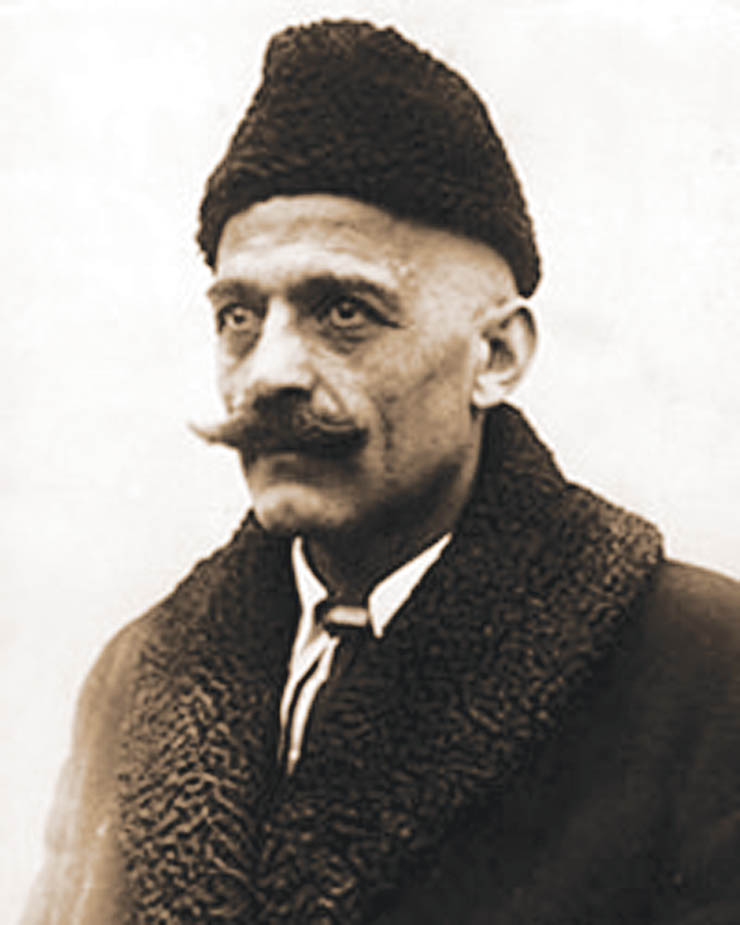
    Bennett gained much of this knowledge of Sufism’s hidden history from his mentor George Ivanovitch Gurdjieff (1877 – 1949), the Armenian-Greek mystic and spiritual teacher who travelled extensively in the Caucasus and Central Asia and who received Sufi training in the dervish schools he encountered there. In The Masters of Wisdom, Bennett recounts:

    Gurdjieff told me that he had learned about these ancient schools of wisdom from researches he himself had made in caves in the Caucasian mountains and in the great limestone caverns of the Syr Darya in Turkestan. I have since learned that there is a Sufi tradition in Central Asia that claims to go back forty thousand years.5

    Gurdjieff also told Bennett that the paintings in the Lascaux caves in the Dordogne, France, which the great authority on parietal art, the Abbé Breuil, has dated to about thirty thousand years BCE, were the work of later Sufi descendants of the shamans.6 Gurdjieff took the story of Atlantis literally. He associated it with pre-sand Egypt and believed the Lascaux artists were members of a brotherhood that survived after Atlantis sank seven or eight thousand years ago.7 They were highly evolved Masters of Wisdom, “‘psychoteleios’ who had learned the secret of immortality,” and whose centres of initiation on the now submerged Atlantic continental shelf have left us, in their paintings of deer, bison and auroch, a magical message of prehistoric spirituality that lay undeciphered for many thousands of years.

    In that palaeolithic age art and religion were still one; secular and religious consciousness had not yet separated out, and spirit and matter were not yet in opposition; nor was evil an absolute force seeking the overthrow of good. All things and all attitudes to things were filled with the magnetic, synthesising radiance of hypercosmic energy, which Gurdjieff called conscious energy. In such a unified world the great Initiates developed the unique type of spirituality that still distinguishes Sufism today, wherein the polarising activity of mind is submissive to the over-riding Spirit that ever seeks a return to the One. Only in the later more alienated religious systems, Gurdjieff believed, do we find the divisive seeds of philosophical dualism.

    The Sarmoun Society

    At the apogee of the Sumerian civilisation, Bennett continues, the Sufis are believed to have founded a brotherhood called the Sarman or Sarmoun Society, which, according to Gurdjieff, met in Babylon as far back as c. 2500 BCE and was responsible for preserving the inner teachings and initiations of the Aryan tradition in a period of religious decline. Sarmoun is a word meaning bee in Old Persian, and refers symbolically to the practice of the brotherhood of storing the “honey” of both the traditional wisdom and the supernatural energy or baraka enabling it to be understood, and sending this double “nectar” out into the world in times of great need.8 The word Sarmoun can also mean “those who are enlightened.” The Sarmouni are believed to have secret training centres hidden to this day in the most remote regions of Central Asia.

    In Gurdjieff: Making a New World, Bennett conjectures that around 500 BCE the Sarmoun Society migrated from ancient Chaldaea to Mosul in Mesopotamia, moving north into the upper valley of the Tigris, into the mountains of Kurdistan and the Caucasus. There it became active in the rise of Zoroastrianism under the Persian monarch Cambyses I. According to Gurdjieff, the Society later moved eastward to Central Asia, twenty days’ journey from Kabul and twelve days’ journey from Bokhara. “He [Gurdjieff] refers,” says Bennett, “to the valleys of the Pyandje and the Syr Darya, which suggest an area in the mountains south-east of Tashkent.”9 Although Gurdjieff was never explicit about his relationship to the Sarmouni or the precise locality of the monasteries in which he trained towards the end of his travels, he provides many hints in such autobiographical writings as Meetings With Remarkable Men that this Sarmoun brotherhood, whose monasteries were situated on the northern slopes of the Himalayas, was the custodian of the most ancient wisdom known and the primary source of his extraordinary esoteric knowledge and powers.

    Gurdjieff came to the West as a man with a mission. He had journeyed extensively in the Caucasus, where it is thought he first entered the tekkes of the Yesevi dervishes of Sheikh Adi in the Kurdish foothills and later those of the Sarmouni in Afghanistan, receiving a number of initiations by the remarkable age of twenty two. Those closest to him maintain that he remained in touch with hidden Sufi sources throughout his life and received help and support from them. He clearly believed that he acted on their authority in setting up schools in the West that transmitted the cosmological and psychological teachings he himself had learned during his travels. Yet while freely recounting his many Central Asian adventures in his search for wisdom, Gurdjieff managed to draw a permanent veil of secrecy and ambiguity over all details of these intimate encounters with the dervish tradition. This of course is in line with the extreme reticence of the Sufi orders themselves.

    Gurdjieff and the Masters of Wisdom

    A charismatic hypnotist, carpet trader, Russian spy and mystic extraordinaire, George Gurdjieff was the son of a Greek-Armenian bard and was deeply impressed by his father’s songs concerning the great spiritual luminaries of a vanished past. The boy apparently began his search for the lost wisdom of the ancients at the early age of fifteen, and maintained it at huge cost to his health and material resources until he emerged, nearly thirty years later, a magus of mysterious yet undeniably charismatic authority. Possessed of enormous personal courage, during World War I Gurdjieff led a large posse of Russian followers across Eastern Europe to safety, through the raging battle lines of Bolsheviks and Cossacks in turn, eventually establishing a school in Fontainbleu, outside Paris, for the study and practice of methods of spiritual self-transformation. These methods, revolutionary in their day, are believed to have included the sacred dance and music exercises of the shamanistic Yesevi dervishes of Kurdistan, a community in which Gurdjieff seems to have received his initial training in Sufi techniques of “soul-making.”

    The Yezidis, a secretive Kurdish religious sect from which the Sufi Bektashi order has sprung, live to this day in the foothills north of Mosul in Iraqi Kurdistan pursuing a cult of angels. According to the British baroness E.S. Drower, who in 1940 published a detailed paper on the sect, the chief Yezidi angel is Malek Taus, the Peacock Angel who has some likeness to Lucifer, the fallen angel of Christian fame. A black serpent is also held in special reverence in the Yezidi religion as a symbol of magical potency – no doubt ultimately a symbol of kundalini and the spinal system of energies elaborated in spiritual physiology. While paying lip service to the Muslim faith, the Yezidi have their own unique cosmogony, mythology and ritual practices, which have more commonality with the Magian or Gnostic belief-systems than with either Islam or Christianity. Ceaselessly persecuted and destroyed by Kurdish Muslims and Ottoman Turks as well as Islamic armies of both Iraq and Iran, the once powerful Yezidi tribes have been almost wiped out as heretics of the first order. Only isolated groups are now left. These include small pockets in Central Kurdistan, the Russian Caucasus and in satellite communities in Syria, Lebanon, Anatolia and Iran.

    Sheikh Adi, a noted mystic of the thirteenth or fourteenth century, was a Median Magi, and although he is regarded as the founder of the Yezidi faith and an incarnation of the Peacock Angel, both the religion and the tribe are ascribed a far earlier date of origin. They are believed to be heirs to an ancient ancestral tradition going back to Noah. Adrian G. Gilbert comments:

    It is my belief that they [the Yezidis] are descended from the ancient Chaldaeans. Their own tradition is that they migrated from the South, and they may well be the lost remnants of the Babylonian Magi who disappeared after the time of Alexander of Macedon.10

    This is certainly in line with Gurdjieff’s belief that the roots of Sufism lie in a spiritual tradition of extreme antiquity such as is found in the Yezidi faith, and that it was probably centred in the Caucasus and Central Asia. Nevertheless, there is much evidence that Sufism continually developed beyond its initial form and amplified its teachings over the ages.

    The late Hugh Schonfield, a noted Jewish scholar and author, says that by the third century CE Sufi schools were well established in the Middle East, particularly in Mosul, the heart of the old Assyrian kingdom, under the auspices of the Zoroastrian Magi. There the Sufis were joined by many Jewish refugees from Egypt fleeing Roman persecution. Among these were the Therapeutae, members of an Essene Order of contemplatives strongly imbued with a revolutionary New Covenant with God. The covenant involved a Judaic reformation that forbad militarism and animal sacrifice and embraced the principles of gender equality and an equitable distribution of wealth. The Therapeutae brought to the Sufi tradition not only these enlightened social ideals which were actually already enshrined in its own constitution, but much of the new Hermetic and Kabbalistic mysticism fermenting in Alexandria. Thus, says Schonfield, throughout Egypt and the Middle East

    there were religious fusions and amalgamations, and the emergence of spiritual hybrids… Zoroastrianism and Mithraism lent their characteristics to Jewish Essene teaching, and found a Greek expression in the Hermetic and Christian Gnostic. The coverage of the Roman empire right round the Mediterranean carried the cults with it, and opened the way to new blendings.11

    In this way Sufism was continually invigorated by new trends and in turn invigorated others. Then, when in the seventh century CE civilisation was in danger of total collapse through the ravages of global pestilence, war, earthquakes and the suppression of all Greek learning by Byzantine Christianity, the Sufi masters transferred their allegiance from Zoroastrianism to Islam, the latter offering the greater hope of rehabilitation for humanity. Thus the wisdom and science of Persia, with its great heritage of Greek learning, passed into the Muslim culture and was carried by Muslim sages into every quarter of the globe. The Dark Ages were halted and Islam, supported by the Sufis, brought about a brilliant revival of the Graeco-Roman arts and sciences.12

    The conquest of Spain by the Muslim Moors meant Jews, Muslims and Christians were able to live there harmoniously until the fifteenth century, creating a culture of superb beauty and intelligence which lasted until the Jews and Muslims were banished to Byzantium, and which gave Sufism entrance into the rest of backward Europe. During the same centuries Crusaders such as the Templars encountered the rich Saracen culture in the Holy Land and secretly brought back the cream of Sufi thought to Europe to enrich Christian theological scholarship, art and sciences.

    Himalayan Withdrawal

    With the Mongol invasions, however, came difficult days for European civilisation as many sources of Sufi wisdom withdrew. The Sufi Masters of Wisdom known in Central Asia as the Khwajagan lineage withdrew at this time to the Trans-Himalayas, where their schools still persist. The Khwajagan were neither savants nor mystical ecstatics. They were practical men who assiduously practiced the breathing and mantric exercise of the zikr, fought their own weaknesses by means of trials based on humiliation and abasement, and during the Mongol depredations of the conquered western cities built new schools, hospitals and mosques. Some say these Masters, who may be synonymous with the Sarmouni, have continued to this day to head the Sufi hierarchy – which Bennett has called the Hidden Directorate – from its hidden Trans-Himalayan headquarters. Meanwhile, the Sufi orders left behind continued to strengthen their ties with other esoteric systems, such as the Magian secret societies in Persia and the Copts in Egypt, and to extend their formidable influence across the world into South-East Asia.

    In the Sunda Islands they amalgamated successfully with the indigenous shamans, Hindu-Buddhists and Taoists and were instrumental in establishing in Java one of the most influential schools of Tibetan Kalachakra Tantra in the world. The result was a chain of hybrid secret societies around the globe whose roots were buried deep in a freedom-loving soil compounded of Sufism, Magian wisdom and the Solomonic and Hermetic wisdom of the Egyptian Essenes. It was these pan-religious amalgamations that produced over the centuries initiatic schools like the Templars, the Chartres masters, the Rosicrucians, the Illuminati, the Freemasons and the Theosophists, all dedicated to working for the religious and scientific dawning of a new age free from religious intolerance.

    Throughout the long Sufi saga, the West had been unaware of intervention in its affairs, or indeed of the very existence of a powerful organisation in its midst that was monitoring the course of history and at the same time maintaining its own hierarchy, objectives and worldview independently of the visible political and religious structures of society. But the Sufi masters knew that this unconscious condition, mainly imposed on the people by repressive forces outside their control, must end, and that the time of awakening was drawing near.

    Sufi Masters and Rosicrucianism

    The two Rosicrucian manifestos pseudonymously published in Germany in the early years of the seventeenth century marked the first Sufi venture into the public domain and caused a sensation. The manifestos purported to advertise a mysterious order called the Fraternity of the Rosey Cross which had been founded, it was claimed, by one Christian Rosencreutz; and a third publication called The Alchemical Wedding of Christian Rosencreutz, written in high Dutch, came out soon after. The manifestos declared that Fr. Rosencreutz had obtained the inspiration for his brotherhood from Arabia, Fez (the home of Sufic alchemy since the eighth century) and Egypt, all centres of Sufi activity. And Rosicrucian tradition has it that Fr. Rosencreutz was initiated in Palestine by an Arabic sect. Observes Ernest Scott:

    When it is realised that the Sufi teacher Suhrawardi of Aleppo had a teaching method called the Path of the Rose and that the Sufic word for a dervish exercise has the same consonantal root as the word for a rose, the Sufic origin of the Rosicrucians may be inferred with some confidence.13

    As we now know, the series of Rosicrucian publications with their visionary and reforming talk of an invisible college, a “winged academy” dedicated to a commonwealth of man, created a furore in Europe. Some saw the publications as a hoax, others as a God-given sign of the millennium. As ever, the Sufis were not directly mentioned: but, sweeping like a rejuvenating wind through Protestant and Catholic lands alike, the movement stirred up by the mysterious manifestos became a potent though short-lived catalyst for change. It instigated a religious and intellectual uprising that sought reform in education, religion and science, promising a coming utopia in which the dignity and worth of every man and woman would be recognised.

    Frances A. Yates, a foremost Renaissance scholar, believes this period in the seventeenth century can rightly be called the Rosicrucian Enlightenment and that out of its “great reservoir of spiritual and intellectual power, of moral and reforming vision”14 came the Royal Society and the age of scientific revolution.

    Full of Christian mysticism yet also permeated with Hermetic-Kabbalistic angelology and alchemical religious philosophy, the Rosicrucian teachings proclaimed that this age of enlightenment, in which religion and science would no longer be antithetical, was at hand. Great advances were to be made and a reformation of the whole wide world would presage “a great influx of truth and light” into fallen society such as shone on Adam in paradise. For a time large factions of the Church espoused these ideas, and the Jesuits, themselves of occult and hermetic origin, took over much of the Rosicrucian symbolism and emblematics.

    Yet in the event the whole programme was aborted by the fiercely reactionary response of the Spanish Inquisition and its political ally, the Hapsburg dynasty, which instigated the Thirty Years’ War, forcing thousands of religious dissidents to flee with the seeds of the new vision to the New World. The Sufi programme had to incubate in secret for several more centuries.

    Sufis Re-emerge in Twentieth Century

    Not until the twentieth century, in a more tolerant and receptive age, were the Sufis finally able to reveal themselves openly. In 1921 Gurdjieff, the emigré and entrepreneur from Armenia, was the first to make this possible. He came with a crucial message for the twentieth century and, as we shall see, for our own era in the third millennium. Of great personal magnetism, drive and unusual psychic powers, Gurdjieff burst upon the Western scene with his programme for spiritual development, bringing to the European cognoscenti for the first time an awareness of the sacred ritual dances and dervish exercises of the East. These, he said, had strong links with Altaic shamanism and Tibetan and Chinese Tantra.

    But Sufis have never regarded spiritual exercises alone as adequate. Generally speaking, little is said in Sufi literature about baraka, the effective grace that makes spiritual development on this path possible, yet its importance is primary. Baraka, as transmitted from teacher to pupil, is said to be a high emotional energy associated with the heart centre, and according to Bennett, enables the pupil to do what would be quite beyond his unaided strength.15 It is this inner infusion of conscious energy – energy of a high spiritual nature – that enables the zikhr, the Sufi invocatory exercise, to be fruitful. Discipline, austerity and voluntary suffering, which Gurdjieff translated as conscious labour and intentional suffering, were also needed. By intentional suffering he meant exposing oneself to painful situations in order to help others.

    While the southern Sufi orders embraced the mystical doctrine of love and union with God, these northern Sufis were strongly influenced by Buddhism and, like the Khwajagan, were concerned with a total liberation from self and the world of appearances. They were regarded by the more conservative southern Sufis as unorthodox, even being accused of magical practices learned from the Siberian shamans to the north. Nevertheless, Gurdjieff saw great benefit for the West in the dervish practices, disapproved though they were by the more purist brotherhoods such as the Nach’shbandi and the Qadiri, and made his unique programme available to all those wishing to develop their human potential.

    At his Institute for the Harmonious Development of Man in Fontainbleu, Gurdjieff trained his students in group dance movements set to dervish rhythms that demanded of them intense physical effort and coordination and which raised the body to a “high state of consciousness” conducive to a transformation of energies. He also encouraged his pupils to observe intensively their own psychic centres of thinking, feeling and instinct as a means of achieving a degree of self-government that man at present entirely lacks – but without which, Gurdjieff insisted, it is impossible for him to govern and maintain the planet. Public performances of Gurdjieff’s dervish dances were put on at various theatres, even in the prestigious Carnegie Hall in New York, and Europe and America marvelled: nothing like it had ever been known. Sacred dances, Gurdjieff said,

    have always been one of the vital subjects taught in esoteric schools of the East… Such gymnastics have a double aim: they contain and express a certain form of knowledge and at the same time serve as a means to acquire a harmonious state of being.

    At one time it was his intention to use the movements in the traditional way for which they were principally intended in the ancient temples of initiation – that is, as a means of transmitting knowledge directly to the higher centres without passing through the mind, which is the way of Tantra. But a car accident in which Gurdjieff’s physical health was severely damaged put an end to his wider plans for the movements and turned his attention to writing and training selected people to carry on his work at a more intellectual level.

    Sufi prescience, Sufi aptitude for the right teaching in the right time and place, is well attested. In many respects, Gurdjieff’s writings contributed enormously to the familiarisation of the West to the radical idea of the psyche or soul – the dynamic centre that mediates between the spiritual and the sensory functions – which at that time Sigmund Freud was also bringing to Western notice. Recognition of this unifying centre of relativity, which modifies the traditional absolutes of philosophy and religion on one hand and the physical sciences on the other, was just then opening up, and Gurdjieff’s psychological brand of theosophy, which became the vogue at the same time as Freudian and socialist theory, made a very great impact.

    The Gurdjieff schools of self-development spread to numerous countries and his ideas became common coinage in the new enlightenment of the sixties. Through the interest aroused in his methods and teachings, in which the centrality of individuation was paramount, Gurdjieff was able to give out for the first time a certain amount of information about the Sufi tarekats hidden in Eurasia. And in his train came a school of eminent Sufi writers like Guénon, Bennett, Ouspensky, Schuon, Hazrat Inayat Khan and Idris Shah, all of whom further opened up the world of Sufism to a vast reading public.

    One of the central strands in Gurdjieff’s belief-system was the principle of world-creation and world-maintenance, which he said was derived from “an old Sumerian manuscript” discovered by a great Kurdish philosopher. The doctrine can be summed up very simply: “Everything that exists maintains and is maintained by other existences.” Peculiar to Sufism and appearing in no other religion, it states that the whole of the universe is a web of mutually supporting systems, “apparatuses for transforming energy,” each one of which produces the means of sustenance for others.

    This law of reciprocal maintenance governs all of life and applies to man as well as in his relation to Mother Nature. The world is not made for man, as we have been taught; both are made for each other. Man’s destiny and the destiny of the earth are interdependent. The evolution of the one depends on the evolution of the other, the survival of one on the survival of the other. Man is not separate from the cosmic process; he is himself part of the ecosystem he observes out there, and he must serve the evolution of the world as well as his own. That is the law of the cosmos, even as the palaeolithic shaman defined it many millennia ago.

    From the Sarmounis, Gurdjieff learned that man is at present an automaton, a mere mechanism driven by the blind forces of action and reaction, his sense of identity fragmented, his will almost non-existent. Yet even work on himself will not redeem him without an acceptance that he is here to serve the world. Through Gurdjieff, therefore, the Sufis gave out to the twentieth century a new teaching, a new outlook on life that was revolutionary seventy years ago: man cannot advance spiritually unless he fulfils his obligation to planet earth, and through planet earth to the solar system. He must “pay the debt of his existence” by nurturing that which nurtured him.

    For man’s cross is a twofold spiritual destiny; to evolve as an individual, but also to serve the evolution of kingdoms other than his own, lives other than his own. Out of the friction these opposed drives generate, said Gurdjieff, there comes a transcendental third, the birth of conscience. This suffering of the tension between the opposites is the law of true religion and is alleviated only by the awakening of the mediating force inherent in the soul; that is, conscience or love. The Sufi theory of world-creation and world-maintenance – “a new master idea for the coming age,” as Bennett called it – has become increasingly relevant as the planet’s ecological crisis has worsened over the decades; and now, looking back from our vantage point in the new millennium, we see how it has indeed become the hallmark of our time, perhaps the key to its essential meaning. Wherever the next civilisation is centred it must be where the third and reconciling power can operate; where conscience can find a home. That is the prime Sufi message for our generation, as it was Gurdjieff’s.

    [alert type=”general” dismiss=”no”]This article was published in New Dawn 107.[/alert]

    [alert type=”success” dismiss=”no”]If you appreciate this article, please consider subscribing to help maintain this website.[/alert]

    Footnotes:

    1. Ernest Scott, The People of the Secret, Octagon Press, London, 1985, p.45.
    2. Ibid., p.118.
    3. Ibid., p.45.
    4. J.G. Bennett, Gurdjieff: Making a New World, Turnstone Books, London, 1973, p.94.
    5. J.G. Bennett, The Masters of Wisdom, Turnstone Books, London, 1977, p.40.
    6. J.G. Bennett, Gurdjieff: Making a New World, p.86.
    7. Ibid., p.86.
    8. Ibid., p.57.
    9. Ibid., p.64.
    10. Adrian G. Gilbert, The Magi, Bloomsbury, London, 1996, p.49.
    11. Hugh Schonfield, The Essene Odyssey, Element Book, UK, 1984, p.166.
    12. J.G. Bennett, The Masters of Wisdom, Ch. 6.
    13. Scott, op. cit., p.176.
    14. Frances A. Yates, The Rosicrucian Enlightenment, Routledge & Kegan Paul, London, 1986.
    15. J.G. Bennett, Gurdjieff: Making a New World, p.278.

    © New Dawn Magazine and the respective author.
    For our reproduction notice, click here.
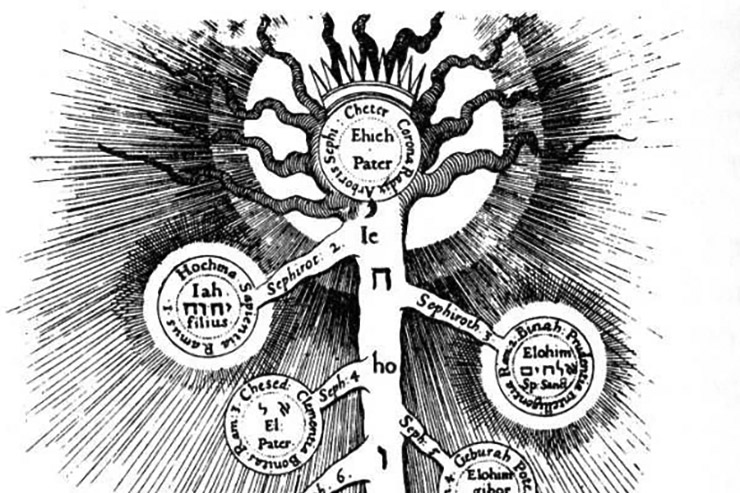
  • The Real Secret of The Secret

    The Real Secret of The Secret

    From New Dawn 103 (Jul-Aug 2007)

    The latest in the blockbusters of alternative spirituality is The Secret, now both a film and a book. Both have been huge successes. The film version has sold 1.5 million copies in DVD format, while at this writing in early June 2007, the book version of The Secret has been on The New York Times’s best-seller list in the US for “advice nonfiction” for twenty weeks, and currently sits on the top.

    No wonder. In breathless, gee-whiz language, The Secret’s Web site promises the key to human existence: “The Secret has existed throughout the history of humankind. It has been discovered, coveted, suppressed, hidden, lost and recovered. It has been hunted down, stolen, and bought for vast sums of money. Now for the first time in history, The Secret is being revealed to the world over two breathtaking hours.”

    Well, then, what is the Secret? Was it the source of the success of great men throughout history, including Plato, Aristotle, Galileo, Napoleon, and Einstein, as its promoters claim?

    The Secret as a film is the brainchild of Australian documentary producer Rhonda Byrne, who began reading self-help literature while going through a rough patch in her life in 2004. Through such books as The Secret of Getting Rich, The Master Key System, and The Secret of the Ages, Byrne was exposed to an idea that has long fascinated seekers and self-promoters alike: your health, wealth, and success in love, work, and life depend not on what you do but what you think. “That principle can be summed up in three simple words: thoughts become things,” proclaims Mike Dooley, one of the ‘teachers’ featured in The Secret.

    That, in essence, is the Secret. Whether it was “hunted down, stolen,” or “bought for vast sums of money” and whether Plato, Aristotle, and other great men had any knowledge of it remains highly open to question, but there’s nothing particularly astonishing about the Secret itself. As the film’s promoters concede, the idea has been a part of occult philosophy for centuries, although it entered the mainstream only about 150 years ago.

    The seminal figure in promoting the Secret was a now little-known American healer named Phineas Parkhurst Quimby (1802–66). Quimby, like many men of his time, was a jack of all trades. He started as a clockmaker but eventually became a healer. Eventually he realised that it didn’t matter what remedy he prescribed; it was the faith of the patient that made the difference. By simply convincing the individual that he or she was already well, Quimby became a tremendous success. His office filled with patients, many of whom went away feeling completely healed. He often treated people for free when they could not pay.

    Around 1859, Quimby began to write down his ideas. Believing he had discovered the secret by which Christ had performed his miracles, he wanted to make his discoveries known to all. “My philosophy,” he said, “will make man free and independent of all creeds and laws of man, and subject him to his own agreement, he being free from the laws of sin, sickness, and death.” The cardinal tenet of this philosophy was this: “Every phenomenon in the natural world has its birth in the spiritual world…. Instead of your happiness being in the world, the world’s happiness is in you. Here is your true position, and this is the struggle you will have to go through. Shall the world lead you, or shall you lead the world? This is the point that is to be settled in your mind.”

    Quimby, like his most famous pupil, Mary Baker Eddy, founder of Christian Science (a term coined by Quimby), focused mostly on health and healing. “Disease,” wrote Quimby, “is false reasoning. True scientific wisdom is health and happiness. False reasoning is sickness and death.” But as these ideas – which came to pervade nineteenth century American religion under the rubric of New Thought – grew more widespread, practitioners began to use ‘the Secret’ for prosperity and success. One of the most famous promoters of this idea was Napoleon Hill, who, in his 1937 book Think and Grow Rich, contended, “TRULY, THOUGHTS ARE THINGS – and powerful things that when they are mixed with definiteness and purpose, persistence, and a BURNING DESIRE for their translation into riches and other material objects.”

    The idea proved irresistible to the success-crazed American public, and Hill’s book became a perennial best-seller. In the 1960s it attracted a reader named Jerry Hicks, who would claim that the ideas in Hill’s book helped him succeed in business. Hicks would become responsible for the latest flowering of this perennial of American spirituality.

    In 1980, Hicks married. His wife, Esther, was at first indifferent to his interests in spirituality, but soon both of them became fascinated with the Seth books by Jane Roberts, which described Roberts’ activity as a channel for an entity named Seth. (‘Channelling’ is a term used to describe a situation in which the speaker believes he or she is serving as a mouthpiece for a invisible, spiritual being.) Later the Hickses began to meditate on their own, and in 1986 Esther began to channel a collective entity (that is, a number of related spiritual beings) called Abraham.

    “I have no real way of understanding how it is that Esther is able to allow Abraham to speak through her,” Jerry writes in the Hickses’ latest book The Law of Attraction. “From my point of view, Esther closes her eyes and breathes a few very deep, soft breaths. Her head gently nods for a few moments, and then her eyes open and Abraham addresses me directly.” The voice that speaks is slightly different from Esther’s own; a New York Times reporter characterises it as “rounder, quicker and more computerlike than Ms. Hicks’s natural voice,” and from the one Abraham session I attended, I would say it has a quality that I can only describe, somewhat imperfectly, as metallic.

    The Hickses first began publicising the Abraham material in 1988 with a series of recorded cassettes, and in the years since, the output has blossomed to include books, radio and television interviews, calendars, and even decks of cards. The Hickses regularly offer week-long ‘Well-Being Adventure Cruises’ and ‘Art of Allowing’ workshops, in which participants can ask their own questions of Abraham. At US$195 for a single day, the workshops aren’t cheap, particularly since they can include hundreds of people, making it fairly unlikely that you’ll be able to chat with Abraham yourself.

    At any rate, the Abraham material forms the core of The Secret’s teachings. Early versions of the film featured Esther and Abraham, although after disputes with Rhonda Byrne over revenues and distribution, the Hickses asked to be removed from the film entirely. “I’ve got to give Rhonda credit,” Esther has said. “I’ve never seen anybody do that like she’s doing it. And never mind honesty, and never mind doing what you said you were going to do, and never mind anything. Just stay in alignment.”

    Do what? Stay in alignment with what? Here lies the Secret. In The Law of Attraction, Jerry Hicks spells out the three “Eternal Universal Laws” that lie at the centre of the teaching.

    The first is the Law of Attraction. It says that “That which is like unto itself, is drawn [sic]” – or, less clumsily, like attracts like.

    The second is the Science of Deliberate Creation:That which I give thought to and that which I believe or expect – is.” In short, you get what you are thinking about, whether you want it or not.

    The third is the Art of Allowing: “I am that which I am, and I am willing to allow all others to be that which they are.”

    From this it’s easy to see how Abraham’s teachings resemble those of New Thought. What you create in your mind manifests in physical reality. If you have positive thoughts, you’ll have positive results in your life. The same is true if you hold negative thoughts.

    But, you may reply, how many people go around wanting bad things to happen to them? What about all the people who are constantly saying, “I don’t want this to happen,” but have it happen anyway?

    According to Abraham, the Law of Attraction is working in any case. To focus on something that you don’t want is still to think about it – and thus to bring it into your life. The book version of The Secret explains:

    The law of attraction doesn’t compute ‘don’t’ or ‘not’ or ‘no,’ or any other words of negation. As you speak words of negation this is what the law of attraction is receiving:

    “I don’t want to spill something on this outfit.”

    I want to spill something on this outfit and I want to spill more things.

    “I don’t want a bad haircut.”

    I want bad haircuts.

    This, in essence, is the Secret. As we’ve seen, it’s surfaced in many books and articles over the years, and it has become a central component of what one might call the American Religion. Does it really work?

    Yes and no. The ideas in The Secret do work, but the information it presents is incomplete in some serious ways, and incomplete information is wrong information.

    In the first place, it’s true that, as esoteric doctrine has always held, thought is creative. The world of thoughts and images – what the Kabbalists call Yetzirah and which Theosophy calls the astral realm – exists prior to the physical world and underlies it. What comes into being in physical form manifests first in the realm of images. This explains not only the ideas behind The Secret but the possibility of such things as precognition: under certain (highly limited) circumstances, you may be able to tap into the astral realm and see the future. (For more on this, see my article “Prophecy: Does It Work?” in New Dawn, Jan-Feb 2007.) Much of occult magic also involves forming a particular thought-form, infusing it with vital energy so that it makes its way into actuality, sometimes in odd and even quasi-miraculous ways.

    But there are some major caveats. Both The Secret and Abraham tell us to focus very specifically and precisely on what we want. Joe Vitale, one of the ‘teachers’ featured in The Secret, says, “Your job is to declare what you would like to have from the catalogue of the Universe. If cash is one of them, say how much you would like to have. ‘I would like to have twenty-five thousand dollars, unexpected income, within the next thirty days’.” Abraham also recommends having a ‘Magical Creation Box’ in which you put pictures of anything you want to manifest in your life – “furniture, clothing, landscaping, buildings, travel destinations, vehicles…. if it feels appealing to you in any way, clip it, and drop it into your Creation Box. And say, as you drop it in, ‘whatever is contained in this box – IS!’”

    The problem with these procedures is not that they don’t work, but that they do. The subconscious – the part of the mind that is involved in shaping the image and giving it energy – is slavishly literal-minded. As we’ve seen, it doesn’t understand negative commands terribly well, so if you ask it not to do something, it may end up doing that very thing. But the problem doesn’t stop there. You could have your wish fulfilled in a way that you don’t want. A friend of mine once used Secret-like techniques to get $10,000 to help her boyfriend start a business. Her car was robbed on the day she was moving, with all her belongings in it. The insurance settlement amounted to $10,000. As the proverb says, “Be careful what you wish for. You might just get it.”

    Sophisticated practitioners avoid this problem by making sure to leave the request more open-ended, and also to specify that no harm come to anyone through the wish. Florence Scovel Shinn, an American New Thought teacher of the early twentieth century, taught her students to say, for example, “Perfect work with perfect pay comes to me now under grace in a perfect way.” Adding the rider “under grace in a perfect way” should – at least theoretically – prevent any harm from resulting from one’s wish.

    Another equally serious omission in The Secret lies in its exclusive emphasis on thought. To read The Secret, and much of New Thought literature, you might conclude that it is thought alone that makes the difference. This is not really true. A small detail here has been overlooked because it (quite accurately) makes the process look like far more work than the best-sellers would have us believe. To sit around and visualise enormous cheques arriving in the mail is not much trouble; in fact, it’s a great deal like daydreaming. Sometimes the cheques do come. But sometimes they don’t. In what are, I would say, by far the most common cases, what really works is thought combined with action – a process that requires will, concentration, and effort. If you’re looking for the perfect job, the visualisation and affirmation techniques of various New Thought teachings may be helpful, but in all likelihood they will be far more so if you combine them with your own best efforts in finding the job – even if, in the end, the job seems to manifest in a completely unexpected way. This is not as breezily simple as The Secret and its kin like to make out, but it is so.

    A crucial issue is lying under the surface here. What you wish for comes true: that is the Secret. But it’s what you wish for with all your being – and much of your being is concerned with action, with doing. If you are thinking with your mind that you want the perfect job while your body is sitting on the couch all day watching cartoons, you may not get anywhere. What’s still worse is that you will tend to induce an inner dissociation that lies behind much of today’s mental illness: one part of your mind is doing one thing while another part is doing quite the opposite. This, in fact, is one of the dangers of simplistic applications of The Secret.

    Another difficulty with The Secret has to do with its ethical component. From The Secret’s point of view, you create your own reality. Which means that other people create theirs as well. Which means that you are not responsible for them. Which means that you are not your brother’s keeper. The Secret does, of course, talk about love (“There is no greater power in the Universe than the power of love. The feeling of love is the highest frequency you can emit”) and the Law of Allowing does teach a tolerance that can be helpful in enabling certain types of people to be less compulsive and controlling. But the emphasis in The Secret and in the Abraham teachings is on feeling love: “The greater the love you feel and emit, the greater the power you are harnessing.” And yet ‘feeling’ and ‘emitting’ love are not necessarily the same as doing loving things. The Secret does not leave much room for compassion. If everyone is creating their own reality, ultimately, it would seem, that is their business, and all one can do is cultivate one’s own garden.

    We can see this problem echoed in Esther Hicks’ comment about Rhonda Byrne’s behaviour: “Never mind honesty, and never mind doing what you said you were going to do, and never mind anything. Just stay in alignment.” Fortunately or unfortunately, “staying in alignment” is more than feeling good or thinking nice thoughts. The universe has a profoundly moral dimension, and you can’t “stay in alignment” with it by acting dishonestly or deceitfully. While I personally have no idea of the rights and wrongs in the Hickses’ differences with Byrne, I can see how they might directly result from Abraham’s ideas. The Hickses may have gotten a taste of their own medicine.

    This leads to another inaccuracy in The Secret. It is not only our thoughts that create reality, it’s also what Hindus and Buddhists call samskaras – a word that can be roughly translated as ‘karmic dispositions’ or ‘seeds of karma’. Put extremely simply, these are imprints left by one’s past actions on the mind at its deepest and most inaccessible level. These samskaras are a key component in creating our current reality. They can be eradicated by a persistent process of cleansing and release (one aspect of which is The Secret’s own “letting go of the past”), but they also require what the Twelve-Step programs call “a searching and fearless moral inventory” of oneself and “making direct amends” to those we have harmed. If you ignore these facts, your mightiest efforts at visualisation might go for nothing. No one is perfect, but if you’re to “be in alignment” with the universe, you are going to have to hold yourself to moral standards that are at least as high as those of ordinary decency and kindness.

    The ultimate problem with The Secret and the Abraham teachings may, however, be what they focus on. It’s almost entirely a matter of attracting abundance, of finding love, success, money, nice things. In fact, if you believe Abraham, that is what we’re here to do. The universe is an enormous vending machine that operates using the coinage of our thoughts.

    What’s striking about this advice is how directly it contradicts practically all of the great spiritual teachings. These teachings, as I’ve suggested, have no quarrel with the fundamental concepts of The Secret: mind does create its own reality. But they differ very much with The Secret about what we’re supposed to create. Most of the great spiritual traditions insist that the ‘abundance’ The Secret urges us to generate is nothing more than a distraction from discovering the truth of our own nature. You can call this enlightenment, liberation, gnosis, or whatever you like, but the goal is the same. Material wealth is nothing more than an impediment to this goal.

    While it would be possible to find examples of this truth in practically all the world’s spiritual traditions, I can cite only a very small number in this space. The Hindu master Ram Chandra has said, “Sit in loneliness for some time, and think of God with at least as much power as you have bestowed to your own difficulties. What then? It is as easy to realise your own God as it is to realise the worldly things in crude form.” There’s also the advice of A Course in Miracles, another extraordinarily popular channeled text, supposedly dictated by Jesus Christ to a New York psychologist named Helen Schucman in the 1960s. The Course has this to say about material wealth:

    The world you see holds nothing that you need to offer you; nothing that you can use in any way, nor anything at all that serves to give you joy. Believe this thought, and you are saved from years of misery, from countless disappointments, and from hopes that turn to bitter ashes of despair. No one but must accept this thought as true, if he would leave the world behind and soar beyond its petty scope and little ways.

    Each thing you value here is but a chain that binds you to the world, and it will serve no other end but this. For everything must serve the purpose you have given it, until you see a different purpose there. The only purpose worthy of your mind this world contains is that you pass it by, without delaying to perceive some hope where there is none. Be you deceived no more. The world you see holds nothing that you want.

    Passages like this one explain why, in my view, a single page of the Course is worth The Secret and all the utterances of Abraham put together.

    What, then, are we to want? The Course explains this in a lesson entitled “I want the peace of God,” adding:

    To say these words is nothing. But to mean these words is everything. If you could but mean them for just an instant, there would be no further sorrow possible for you in any form; in any place or time. Heaven would be completely given back to full awareness, memory of God entirely restored, the resurrection of all creation fully recognised.

    The Course, like much channeled material (including Abraham’s pronouncements), makes the process sound easier than it often is in practice; perhaps channeled entities don’t understand how difficult life can feel to those of us on earth. Nonetheless, a goal of manifesting inner peace strikes me as far superior to manifesting lovers and cheques and SUVs.

    On the other hand, it requires a certain amount of illumination even to see through the deception of appearances. Up to a point, we are going to desire the solid satisfactions of life because they are all we can trust in. A time will come, however, when disillusion sets in, when the desirable things of the world start to seem not so desirable after all, and one realises that there is something more to life. This recognition will come to each of us according to his or her own readiness. Until then, I suspect, many will use the ideas of The Secret and similar teachings as elementary lessons in the truth that the world is more than we can see with our physical eyes, and also as a mild but helpful form of cognitive therapy. After all, it’s better to focus the mind on good things than on bad.

    [alert type=”general” dismiss=”no”]This article was published in New Dawn 103.[/alert]

    [alert type=”success” dismiss=”no”]If you appreciate this article, please consider subscribing to help maintain this website.[/alert]

    © New Dawn Magazine and the respective author.
    For our reproduction notice, click here.