New Dawn – World's Most Unusual Magazine

Category: Secret Wisdom

  • Mercury Rising: The Life & Writings of Julius Evola

    Mercury Rising: The Life & Writings of Julius Evola

    This article was published in New Dawn 111 (Nov-Dec 2008)

    If the industrious man, through taking action,
    Does not succeed, he should not be blamed for that –
    He still perceives the truth.
    – The Sauptikaparvan of the Mahabharata (2,16)

    If we select a single aspect by which to define Julius Evola, it would have been his desire to transcend the ordinary and the world of the profane. It was characterised by a thirst for the Absolute, which the Germans call mehr als leben – ‘more than living’. This idea of transcending worldly existence colours not only his ideas and philosophy, it is also evident throughout his life which reads like a litany of successes.

    During the earlier years Evola excelled at whatever he applied himself to: his talents are evident in the field of literature, for which he is best remembered, and also in the arts and occult circles.

    Born in Rome on the 19th of May 1898, Giulio Cesare Andrea Evola was the son of an aristocratic Sicilian family, and like many children born in Sicily, he received a stringent Catholic upbringing. As he recalls in his intellectual autobiography, Il cammino del cinabro (1963, 1972, The Cinnabar’s Journey), his favourite pastimes consisted of painting, one of his natural talents, and of visiting the library as often as he could in order to read works by Oscar Wilde, Friedrich Nietzsche, and Otto Weininger.1

    During his youth he also studied engineering, receiving excellent grades, but chose to discontinue his studies prior to the completion of his doctorate, because he “did not wish to be bourgeois, like his fellow students.” At the age of nineteen Evola joined the army and participated in World War I as a mountain artillery officer. This experience served as an inspiration for his use of mountains as metaphors for solitude and ascension above the chthonic forces of the earth.

    Evola was also a friend of Mircea Eliade, who kept in correspondence with Evola from 1927 until his death. He was also an associate of the Tibetologist Giuseppe Tucci and the Tantric scholar Sir John Woodroffe (Arthur Avalon).

    During his younger years Evola was briefly involved in art circles, and despite this being only a short lived affair, it was also a time that brought him great rewards. Though he would later denounce Dada as a decadent form of art, it was within the field of modern art that Evola first made his name, taking a particular interest in Filippo Tommaso Marinetti and Futurism.

    His oil painting, ‘Inner Landscape, 10:30 a.m.’, today hangs on a wall of the National Gallery of Modern Art in Rome.2 He also composed ‘Arte Astratta (Abstract Art)’ but later, after experiencing a personal crisis, turned to the study of Nietzsche, from which sprang his ‘Teoria dell, individuo assoluto’ (Theory of the Absolute Individual) in 1925.

    By 1921 Evola had abandoned the pursuit of art as the means to place his unique mark on the world. The revolutionary attitudes of Marinetti, the Futurist movement and the so-called avant-garde which had once fascinated him, no longer appeared worthwhile to Evola with their juvenile emphasis on shocking the bourgeois. Likewise, despite being a talented poet, Evola (much like another of his inspirations – Arthur Rimbaud) abandoned poetry at the age of twenty four. Evola did not write another poem nor paint another picture for over forty years. Thus, being no longer enamoured of the arts, Evola chose instead to pursue another field entirely that would one day award him even greater acclaim.

    Evola & The Ur Group

    To this day, the magical workings of the Ur Group and its successor Krur remain some of the most sophisticated techniques for the practice of esoteric knowledge laid down in the modern Western era. Based on a variety of primary sources, ranging from Hermetic texts to advanced Yogic techniques, Evola occupied a prominent role in both of these groups. He wrote a number of articles for the esoteric journal Ur and edited many of the others. These articles were collected in the book Introduction to Magic: Rituals and Practical Techniques for the Magus, which alongside Evola’s articles, include the works of Arturo Reghini, Giulio Parese, Ercole Quadrelli and Gustave Meyrink. The original title of this work in Italian, Introduzione alla Magia quale scienza dell’lo, literally translates as Introduction to Magic as a Science of the “I”.3 In this sense, the ‘I’ is best interpreted as the ego, or the manipulation of the will – an idea also found in the work of that other famous magician, Aleister Crowley, and his notion of Thelema. Ur started out as a monthly publication, with the first issue released in January 1927.4

    Contributors to this publication included Count Giovanni di Caesaro, Emilio Servadio, a distinguished psychoanalyst, and Guido de Giorgio, a well-known adherent of Rudolf Steiner and an author of works on the Hermetic tradition. It was during this period that Evola was introduced to Arturo Reghini (1878-1946), who subsequently invited him to join the Ur group. Arturo Reghini was interested in speculative Masonry and the anthroposophy of Rudolf Steiner, introducing Evola to French author and intellectual René Guénon’s writings. Ur and its successor Krur gathered together a number of people interested in Guénon’s exposition of the Hermetic tradition and Vedanta, Taoism, Buddhism, Tantra, and magic.

    Arturo Reghini was to be a major influence on Evola, being himself a representative of the so-called Italian School (Scuola Italica), a secret order that claimed to have survived the downfall of the Roman Empire. It is said to have re-emerged with Emperor Frederic II, inspiring the Florentine poets of the thirteenth and fourteenth centuries, up to Petrarch. Like Evola, Reghini also wrote articles, one of which was entitled ‘Pagan Imperialism’. Appearing in Salamandra in 1914, Reghini summed up his anti-Catholic program for a return to a glorious pagan past. This piece profoundly impacted Evola, and served as the inspiration for his similarly titled ‘Imperialismo pagano’.

    Appearing in 1928, ‘Imperialismo pagano’ chronicled the negative effects of Christianity on the world. In the context of this work, Evola advocated an anti-Roman Catholic pagan imperialism. According to Evola, Christianity has destroyed the imperial universality of the Roman Empire by insisting on the separation of the secular and the spiritual. It is from this separation that arose the inherent decadence and inward decay of the modern era. Out of Christianity’s implacable opposition to the healthy paganism of the Mediterranean world arose the secularism, democracy, materialism, scientism, socialism, and the “subtle Bolshevism” that heralded the final age of the current cosmic cycle: the age of “obscurity,” the Kali-Yuga.5

    ‘Imperialismo pagano’ was later revised in a German edition as ‘Heidnischer Imperialismus’. The changes that occurred in the text in its German translation five years later were not entirely inconsequential. Although the fundamental concepts that comprised the substance of Evola’s thought remained similar, a number of critical elements were altered that transformed a central point in Evola’s thinking. The “Mediterranean tradition” of the earlier text is consistently replaced with the “Nordic-solar tradition” in this translation.6 In 1930 Evola founded his own periodical, La Torre (The Tower). La Torre, the heir to Krur, differed from the two earlier publications Ur and Krur in the following way, as announced in an editorial insert:

    Our Activity in 1930 – To the Readers: “Krur is transforming. Having fulfilled the tasks relative to the technical mastery of esotericism we proposed for ourselves three years ago, we have accepted the invitation to transfer our action to a vaster, more visible, more immediate field: the very plane of Western ‘culture’ and the problems that, in this moment of crisis, afflict both individual and mass consciousness […] for all these reasons Krur will be changed to the title La Torre [The Tower], ‘a work of diverse expressions and one Tradition.’”7

    La Torre was attacked in official fascist journals such as L’Impero and Anti-Europa, and publication of La Torre ceased after only ten issues. Evola also contributed an article entitled ‘Fascism as Will to Imperium and Christianity’ to the review Critica Fascista, edited by Evola’s old friend Giuseppi Bottai. Here again he launches vociferous opposition to Christianity and attests to its negative effects, evident in the rise of a pious, hypocritical, and greedy middle class lacking in all superior solar virtues that Evola attributed to ancient Rome. The article did not pass unnoticed and was vigorously attacked in many Italian periodicals. It was also the subject of a long article in the prestigious Revue Internationale des Sociétés Secrètes (Partie Occultiste) for April 1928, under the title ‘Un Sataniste Italien: Jules Evola’.

    Coupled with the notoriety of Evola’s La Torre was also another, more bizarre, incident involving the Ur Group’s reputation, and their attempts to form a “magical chain.” Although these attempts to exert supernatural influence on others were soon abandoned, a rumour quickly developed that the group wished to kill Mussolini by these means. Evola describes this event in his autobiography Il Cammino del Cinabro.

    Someone reported this argument [that the death of a head of state might be brought about by magic] and some yarn about our already dissolved “chain of Ur” may also have been added, all of which led the Duce to think that there was a plot to use magic against him. But when he heard the true facts of the matter, Mussolini ceased all action against us. In reality Mussolini was very open to suggestion and also somewhat superstitious (the reaction of a mentality fundamentally incapable of true spirituality). For example, he had a genuine fear of fortune-tellers and any mention of them was forbidden in his presence.

    Evola’s Works

    It was also during this period that Evola also discovered something that profoundly influenced many of his ideas: the lost science of Hermeticism. Though he undoubtedly came into contact with this branch of ancient philosophy through Reghini and fellow members of Ur, it seems Evola’s extraordinary knowledge of Hermeticism actually arose from another source. Jacopo da Coreglia writes that it was a priest, Father Francesco Olivia, who made the most far-reaching progress in Hermetic science and sensing a prodigious student, granted Evola access to documents that were usually strictly reserved for adepts of the inner circle. These were concerned primarily with the teachings of the Fraternity of Myriam (Fratellanza Terapeutica Magica di Myriam), founded by Doctor Giuliano Kremmerz, pseudonym of Ciro Formisano (1861-1930). Evola mentions in his The Hermetic Tradition that the Myriam’s ‘Pamphlet D’ laid the groundwork for his understanding of the four elements.8 Evola’s knowledge of Hermeticism and the alchemical arts was not limited to Western sources either, for he also knew an Indian alchemist by the name of C.S. Narayana Swami Aiyar of Chingleput.9 During this era of history, Indian alchemy was almost completely unknown to the Western world, and it is only in modern times that it has been studied in relation to occidental texts.

    In 1926 Evola published an article in Ultra (the newspaper of the Theosophical Lodge in Rome) on the cult of Mithras in which he placed major emphasis on the similarities of these mysteries with Hermeticism.10 During this period he also wrote the book Saggi sull’idealismo Magico (1925; Essays on Magic Idealism), and ‘L’individuo ed il divenire del mondo’ (1926; ‘The Individual and the Becoming of the World’). This article was to be followed by the publication of his treatise on alchemy, La Tradizione ermetica (The Hermetic Tradition). Such was the scope and depth of this work that Carl Jung even quoted Evola to support his own contention that, “the alchemical opus deals in the main not just with chemical experiments as such, but also with something resembling psychic processes expressed in pseudo-chemical language.”11 Unfortunately, the support expressed by Jung was not mutual, for Evola did not accept Jung’s hypothesis that alchemy was merely a psychic process.

    Taking issue with René Guénon’s (1886-1951) view that spiritual authority ranks higher than royal power, Evola wrote L’uomo come potenza (Man as Power); in the third revised edition (1949) the title was changed to Lo yoga della potenza (The Yoga of Power).12This was Evola’s treatise on Hindu Tantra, for which he consulted primary sources on Kaula Tantra, which at the time were largely unknown in the Western world. Decio Calvari, president of the Italian Independent Theosophical League, introduced Evola to the study of Tantrism.13Evola was also granted access to authentic Tantric texts directly from the Kaula school of Tantrism via his association with Sir John Woodroffe, who was not only a respected scholar, but also a Tantric practitioner himself, under the famous pseudonym Arthur Avalon. A substantial proportion of The Yoga of Power is derived from Sir John Woodroffe’s personal notes on Kaula Tantrism. Even today Woodroffe is regarded as a leading pioneer in the early research of Tantrism.

    In the words of Evola himself:

    During the last years of the 1930s I devoted myself to working on two of my most important books on Eastern wisdom: I completely revised L’uomo come potenza [Man As Power], which was given a new title, Lo yoga della potenza [The Yoga of Power], and wrote a systematic work concerning primitive Buddhism entitled La dottrina del risveglio [The Doctrine of Awakening].14

    Evola’s opinion that the royal or Ksatriya path in Tantrism outranks that of the Brahmanic or priestly path is readily supported by the Tantric texts themselves, in which the Vira or active mode of practice is exalted above that of the priestly mode in Kaula Tantrism. In this regard, the heroic or solar path of Tantrism represented by Evola is a system based not on theory, but on practice. An active path appropriate to be taught in the degenerate epoch of the Hindu Kali Yuga or ‘Dark Age’, in which purely intellectual or contemplative paths to divinity have suffered a great decrease in their effectiveness.

    Evola’s work on the early history of Buddhism was published in 1943. The central theme of this work is not the common view of Buddhism as a path of renunciation. Instead it focuses on the Buddha’s role as a Ksatriya ascetic, for it was this caste that he belonged, as found in early Buddhist records.

    The historical Siddharta was a prince of the sakya, a ksatriya (belonging to the warrior caste), an “ascetic fighter” who opened a path by himself with his own strength. Thus Evola emphasises the “aristocratic” character of primitive Buddhism, which he defines as having the “presence in it of a virile and warrior strength (the lion’s roar is a designation of Buddha’s proclamation) that is applied to a nonmaterial and atemporal plane… since it transcends such a plane, leaving it behind.”15

    The book considered by many to be Evola’s masterpiece, Rivolta contra il mondo moderno (Revolt Against the Modern World), was published in 1934. This book was influenced by Oswald Spengler’s Decline of the West (1918) and René Guénon’s The Crisis of the Modern World (1927), both of which had been previously translated into Italian by Evola. Spengler’s contribution in this regard was the plurality of civilisations, which then fell into patterns of birth, growth and decline. This was combined with Guénon’s ideas on the ‘Dark Age’ or Hindu Kali Yuga, which similarly portrays a bleak image of civilisations in decline. The work also draws upon the writings of Bachofen in regard to the construction of a mythological grounding for the history of civilisations.

    The original version of Julius Evola’s The Mystery of the Grail formed an appendix to the first edition of Rivolta contra il mondo moderno, and as such is closely related to this work.16 Three years later he reworked that appendix into the present book, which first appeared as part of a series of religious and esoteric studies published by the renowned Laterza Publishers in Italy, whose list included works by Sigmund Freud, Richard Wilhelm, and Carl Jung, among others. In this book Evola poses three main premises concerning the Grail myths: That the Grail is not a Christian Mystery, but a Hyperborean one; that it is a mystery tradition; and that it deals with a restoration of sacred regality. Evola describes his work on the Grail in the epilogue to the first edition (1937):

    To live and understand the symbol of the Grail in its purity would mean today the awakening of powers that could supply a transcendental point of reference for it, an awakening that could show itself tomorrow, after a great crisis, in the form of an “epoch that goes beyond nations.” It would also mean the release of the so-called world revolution from the false myths that poison it and that make possible its subjugation through dark, collectivistic, and irrational powers. In addition, it would mean understanding the way to a true unity that would be genuinely capable of going beyond not only the materialistic – we could say Luciferian and Titanic – forms of power and control but also the lunar forms of the remnants of religious humility and the current neospiritualistic dissipation.17

    Another of Evola’s books, Eros and the Mysteries of Love, could almost be seen as a continuation of his experimentation with Tantrism. Indeed, the book does not deal with the erotic principle in the normal sense of the word, but rather approaches the topic as a highly conceptualised interplay of polarities, adopted from the traditional use of erotic elements in Eastern and Western mysticism and philosophy. Thus what is described here is the path to sacred sexuality, and the use of the erotic principle to transcend the normal limitations of consciousness. Evola describes his book in the following passage:

    But in this study, metaphysics will also have a second meaning, one that is not unrelated to the world’s origin since “metaphysics” literally means the science of that which goes beyond the physical. In our research, this “beyond the physical” will not cover abstract concepts or philosophical ideas, but rather that which may evolve from an experience that is not merely physical, but transpsychological and transphysiological. We shall achieve this through the doctrine of the manifold states of being and through an anthropology that is not restricted to the simple soul-body dichotomy, but is aware of “subtle” and even transcendental modalities of human consciousness. Although foreign to contemporary thought, knowledge of this kind formed an integral part of ancient learning and of the traditions of varied peoples.18

    Another of Evola’s major works is Meditations Among the Peaks, wherein mountaineering is equated to ascension. This idea is found frequently in a number of Traditions where mountains are often revered as an intermediary between the forces of heaven and earth. Evola was an accomplished mountaineer and completed some difficult climbs such as the north wall of the Eastern Lyskam in 1927. He also requested in his will that after his death the urn containing his ashes be deposited in a glacial crevasse on Mount Rosa.

    Evola’s main political work was Men Among the Ruins, the ninth of Evola’s books published in English. Written at the same time as Men Among the Ruins, Evola composed Ride the Tiger which is complementary to this work, even though it was not published until 1961. These books belong together and cannot really be judged separately. Men Among the Ruins shows the universal standpoint of ideal politics; Ride the Tiger deals with the practical “existential” perspective for the individual who wants to preserve his “hegomonikon” or inner sovereignty.19

    Ride the Tiger is essentially a philosophical set of guidelines entwining various strands of his earlier thought into a single work. Underlying the more obvious sources that Evola cites within the text, such as Nietzsche, Sartre and Heidegger, there are also connections with Hindu thoughts on the collapse of civilisation and the Kali Yuga. In many ways, this work is the culmination of Evola’s thought on the role of Tradition in the Age of Darkness – that the Traditional approach advocated in the East is to harness the power of the Kali Yuga by ‘Riding the Tiger’ – which is also a popular Tantric saying. To this extent, it is not an approach of withdrawal from the modern world which Evola advocates, but an asceticism of contemplation in which we are advised to act in the modern world, while remaining intellectually and spiritually detached from and above it. Similarly, his attitude to politics alters here from that expressed in Men Among the Ruins, calling instead for a type of individual that is apoliteia.

    […] this type can only feel disinterested and detached from everything that is “politics” today. His principle will become apoliteia, as it was called in ancient times. […] Apoliteia is the distance unassailable by this society and its “values”; it does not accept being bound by anything spiritual or moral.20

    In addition to Evola’s main corpus of texts mentioned previously, he also published numerous other works such as The Way of the Samurai, The Path of Enlightenment According to the Mithraic Mysteries, Il Cammino del Cinabro, Taoism: The Magic, The Mysticism and The Bow and the Club. He also translated Oswald Spengler’s Decline of the West, as well as the principle works of Bachofen, Guénon, Otto Weininger and Gabriel Marcel.

    In 1945 Evola was hit by a stray bomb and paralysed from the waist downwards. He died on June 11, 1974 in Rome. He had asked to be led from his desk to the window from which one could see the Janiculum (the holy hill sacred to Janus, the two-faced god who gazes into this and the other world), to die in an upright position. After his death the body was cremated and his ashes were scattered in a glacier atop Mount Rosa, in accordance with his wishes.
    [alert type=”general” dismiss=”no”]This article was published in New Dawn 111.[/alert]

    [alert type=”success” dismiss=”no”]If you appreciate this article, please consider subscribing to help maintain this website.[/alert]

    Footnotes

    1. Julius Evola, The Yoga of Power: Tantra, Shakti, and the Secret Way, (Vermont: Inner Traditions, 1992), ix

    2. Ibid., x

    3. Julius Evola, Introduction to Magic: Rituals and Practical Techniques for the Magus, (Vermont: Inner Traditions, 2001), ix

    4. Ibid., xvii

    5. A. James Gregor, Mussolini’s Intellectuals (New Jersey: Princeton University Press, 2005), p.198

    6. Ibid., p.201

    7. Julius Evola, Introduction to Magic: Rituals and Practical Techniques for the Magus, xxi

    8. Julius Evola, The Hermetic Tradition: Symbols & Teachings of the Royal Art, (Vermont: Inner Traditions, 1992), ix

    9. Ibid., ix

    10. Ibid., viii

    11. Julius Evola, The Yoga of Power: Tantra, Shakti, and the Secret Way, xii

    12. Ibid., xiv

    13. Ibid., xiii

    14. Julius Evola, The Doctrine of Awakening: The Attainment of Self-Mastery According to the Earliest Buddhist Texts, (Vermont: Inner Traditions, 1996), xi

    15. Ibid., xv

    16. Julius Evola, The Mystery of the Grail: Initiation and Magic in the Quest for the Spirit, (Vermont: Inner Traditions, 1997), vii

    17. Ibid., ix

    18. Julius Evola, Eros and the Mysteries of Love: The Metaphysics of Sex, (Vermont: Inner Traditions, 1991), p.2

    19. Julius Evola, Men Among the Ruins: Post-War Reflections of a Radical Traditionalist, (Vermont: Inner Traditions, 2003), p.89

    20. Julius Evola, Ride the Tiger: A Survival Manual for the Aristocrats of the Soul, (Vermont: Inner Traditions, 2003), pp.174-175

    © New Dawn Magazine and the respective author.
    For our reproduction notice, click here.

  • Awakening Our True Potential

    Awakening Our True Potential

    From New Dawn 129 (Nov-Dec 2011)

    Man is born an unfinished creature. He cannot walk or talk or feed himself. Long years of care are required to bring him to even the most minimal levels of self-sufficiency.

    And yet even after the typical person has reached the stage of functioning that we call adulthood, something still seems to be missing. In a sense, of course, something will always be missing; there are always new horizons to discover and new skills to attain. But the lack may go further. There is a sense in which even the mature human being is incomplete. The Freemasons allude to this when they speak of the candidate for initiation as a “rough ashlar.” An ashlar is a block of stone; in its rough state it fits only approximately into its intended setting. Some kind of process is needed to adjust and polish it so that it is perfectly suited to its function.

    Some may balk at this description – are we, after all, nothing more than raw materials to be sent down some assembly line to be made into identical pieces of manufactured goods? That is the kind of transformation society as a whole seems to envisage. And we would do well to mistrust it. The process to which the Masonic initiations allude has something more than mere conformity as its goal; it is not a matter of circus horses trying to break themselves in. It is the opposite: it is a matter of having access to our own potential, developing it, and offering to the service of higher aims.

    This process has been discussed often, sometimes (as in Masonry) allegorically, sometimes in more straightforward terms. But even so it has rarely been presented in a reasonably honest and lucid way. Most of the time, developing human potential is portrayed as a kind of hypertrophy – the exaggerated development of certain functions at the expense of others.

    Recently I read a magazine profile of a prominent Oxford philosopher. He had written a fourteen-hundred-page treatise on moral philosophy, in which he had examined and refuted all possible criticisms and objections to his thesis. Yet the article said he wore the same clothes each day (white shirt, black trousers) and did not like to look at any building that was not adorned with columns. His capacity for human interaction sounded rather primitive. In the end I was left with the impression of a gigantic cerebrum attached to a vestigial body.

    Is this what is meant by developing our human potential? For many people it is. The abstracted philosopher is only one specimen. Others are the athlete who is nothing more than his sport, the painter who can do nothing more than paint. Some of the greatest achievements of the human race have been attained by such people. But the overdevelopment of talents can and does turn into a Faustian bargain. Breakdowns, crises, and collapses seem to dog these individuals. We may envy their achievements, but their fragility warns us against imitating them.

    The same holds true for abilities that are considered paranormal. Although science does not care to admit it, it is possible to develop psychic powers such as telepathy, clairvoyance, and telekinesis. Indeed, in his forthcoming book The Reality of ESP: A Physicist’s Proof of Psychic Abilities, Russell Targ, one of the leading parapsychologists in the US, argues that anyone with a certain amount of (not very difficult) training can develop these skills. Nevertheless, overemphasis on these abilities, no matter how miraculous they may seem, creates problems as well. Psychics, clairvoyants, visionaries, and healers frequently seem imbalanced, having developed one skill or power at the expense of the whole.

    That is why I would like to suggest a slightly different model of developing human potential, one that is not designed to serve the interests of society (or business or political powers) at the individual’s own expense, but also one that avoids the trap of hypertrophy of a single area. Hence it begins with the crucial need for balance.

    There are many models of the human mind, all of them insightful to a certain degree and all of them to a certain degree incomplete. One of the oldest and simplest sees the human makeup in terms of the body, the emotions, and the mind. We have already seen how some people are underdeveloped in one way or another. Even if we set aside extreme cases, esoteric teachings suggest that this is basically true of everyone. While it’s often easy enough to see someone else’s imbalances, it may not be so easy to see one’s own.

    Gurdjieff’s Three Types of Humanity

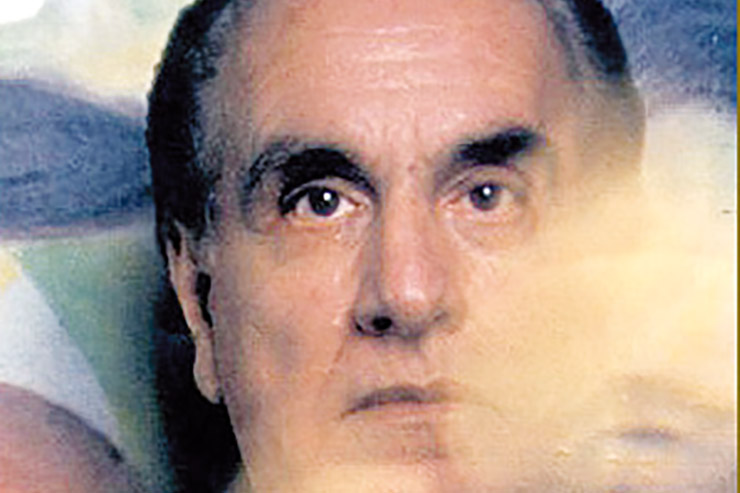
    The great twentieth-century spiritual teacher G.I. Gurdjieff (pictured below) divided the ordinary run of humanity into three types: man number 1, who is orientated toward the body; man number 2, who is centred in his emotions; and man number 3, who sees the world through the intellect. Moreover, Gurdjieff contended, human beings pass their lives in a kind of waking sleep – a low-grade trance populated by illusions and daydreams. These facts are all connected. Our sleep in ordinary life is characterised by the fact that we are overbalanced in one or another of these directions and fail to use the intelligence of the other parts of the mind.

    This, then, is the first step toward awakening human potential: to see what type of individual you are, because this shapes how you conceive of the world. Man number 1 is often of a highly practical turn; he can fix anything but may not have the dimmest idea of how to express his emotions, and may not even know what emotions he is having. Man number 2, by contrast, sees everything through his feelings. Artistic types (whether or not they have any real artistic talent) are a prime example; everything is emotion, everything is drama. Man number 3 sees life as a series of intellectual problems. He may be able to discuss philosophical issues brilliantly or add up long rows of figures in his head, but may, as James Joyce remarked of one of his characters, live a short distance from his body. (The Oxford philosopher I have mentioned would be an example of man number 3.)

    In all probability you are one of these three types. The first task in awakening human potential is, as the ancient motto said, to “know thyself,” and in a very fundamental sense this means knowing what type you are. One way of exploring this question is by looking at your leisure activities: what do you do with your free time? Are you compulsively active, running from sport to sport or task to task? Do you enjoy spending your time in pleasant fantasies of happier times past or present? Or would you rather curl up with a good book? Leisure activities are important cues because they are not compulsory; you are doing these things because you like them. Of course, work life offers its own share of data. Your profession is often based on type, even in cases where you are not doing the kind of work you want to do. You may think you are really an artist or writer but somehow you have found work as a plumber, and the work comes as second nature to you. You keep at it not because you like it but because it comes easily to you. Despite what he may think about himself, a person like this is probably man number 1.

    Very few people are pure examples of any given type; we tend to be admixtures, with bundles of strengths and weaknesses, with skills and affinities that harmonise or conflict in any number of ways. Consequently it is not a matter of simply typing yourself as you might do when taking a test out of a magazine. Knowing yourself is a lifelong course of study.

    Furthermore, self-knowledge is not a static process. There is a type of individual who is self-conscious to an extreme degree and can see her strengths and faults with remarkable clarity but is utterly unable to do anything about them. Consequently the next step in developing human potential is trying to consciously balance ourselves, strengthening the weaker aspects of our natures and making sure the stronger ones do not overpower the others. This is one meaning of Christ’s parable of the “evil servant,” who, when his master is away, “shall begin to smite his fellowservants, and to eat and drink with the drunken” (Matt. 24:45-49).

    Balancing the Different Aspects of Yourself

    Strengthening your weaker functions is never a pleasant task. Inevitably it involves giving time and energy to things you do not like. The intellectual must take up Tai Chi or learn carpentry; the artist must manage financial accounts; the athlete needs to paint pictures or write poetry. Because these are the things we do not like to do, we often find them unpleasant and humiliating, and it is a rare person who has the discipline to persist on his own.

    Speaking personally, when I was a high-school student, I realised that my connection to my body was not all that it could be, so I took the somewhat extreme step of attempting ballet. But the rigorous discipline ballet demands of the body was too much for me; I lost interest in it and dropped it after two or three classes. Only years later, as a result of involvement with esoteric disciplines, was I able to work on a more conscious connection with the body through various movements and exercises. But I never took up ballet again.

    Another one of my experiences, at an esoteric school in the north of England, casts further light on the sort of work required. The school was moving into a new centre, and a great deal of remodelling was needed. I was there for a residential course, and I was given the job of cutting wall-to-wall carpeting for one of the rooms. I was utterly hopeless at this task. I could not cut the carpet straight; I kept hacking at it and making a mess of it until I was relieved and someone was given the job who was able to carry it out in short order.

    Why was the job given to me first? Not because anyone was under any illusions about my skills at laying carpet. Rather it was to show me something about myself, so that, by struggling with an unfamiliar task, I could see where some of my limitations lay. And in fact to this day as a homeowner, I find it a challenge to do the types of household repairs that other men do without trouble and sometimes with pleasure.

    As this story suggests, it’s comparatively rare to even out one’s own imbalances completely. If you were really to do so, it would probably take a life’s work, and a life’s work cannot consist entirely of remedying imbalances. Nor is that the ultimate goal. Becoming a well-rounded person is a worthwhile aim, but from a spiritual point of view it still falls short of fulfilling the true potential that every human being possesses. What is this potential?

    The student becomes aware of it little by little in the course of struggling with his imbalances. In the first place, he learns to become free from the roles he has identified with in the past. A man thinks, “I’m not a handyman,” but if he has to carry out some task of repair he learns that this is a limitation. His identification with whatever roles he has traditionally clung to – thinker or artist – impedes him in other areas of life. In this way he learns to become free of roles – or at any rate he is a little bit more suspicious of his own tendency to identify with them. This seemingly small step actually marks a crucial point of transition, because it frees up an initially tiny amount of will and attention that had been completely fixed in identification. In short, the student learns that there is an “I” that is separate from, and free from, all the things he has identified with up to this point.

    I have spoken of this development taking place in the context of an esoteric school, and while there are not a huge number of these in the world, there are still a fair number. The ones I have encountered range across traditions: Gurdjieffian, Buddhist, Sufi, Qabalistic. Each has its own peculiar orientation, but the general type of training is the same – and in the beginning consists of the kind of work I have been talking about here. The question then arises, is a school necessary? Can you do this work all on your own?

    Generally speaking, no. You did not learn how to speak English alone; you did not learn math or cooking or carpentry or whatever life skills you have on your own. Almost always there was some instruction, and usually some instructor, behind your training. You can teach yourself how to do some things, but these are the exceptions in life. Human beings need each other for many reasons, and one of them is learning. While it’s true that people can and do undergo spontaneous moments of awakening that illuminate their being past all previous limitations and preconceptions, these are rare cases, and you can’t count on being one of them. If it has happened to you, you are fortunate. Even so, such moments of awakening are, for many people, mere glimpses intended to motivate them to undertake the hard, slogging work that I have been talking about here.

    In any event, at some point in one’s development, something starts to crystallise. And this something consists precisely of the small amount of will and attention that I spoke about earlier. An aspect of the mind begins to awaken and can see that it is not its roles, its tasks, or even its thoughts and feelings and emotions, but can step back and look at them almost as if they belonged to someone else. This is the true “I,” or at any rate the seed of the true “I.”

    Ultimate Key to Human Potential: The True “I”

    Remember that Christ in the Gospels often speaks of the kingdom of heaven as a seed. The metaphor is apt on more than one level. As the parable says, the sower sows seeds on all kinds of ground. That is, everyone has this seed of the true “I” – somewhere inside of you there is a Self that stands back and can witness, impartially but compassionately, all the doings of your life like a film. But most people take this for granted. They do not see it as important and they do not bother to develop it. To use the language of the parable again, the seeds fall on stony ground or the birds of the air eat them up.

    But this Self, this true “I,” is the ultimate key to human potential. Almost all of the parables in the Gospels speak of it in one way or another. It is the pearl of great price; it is the treasure buried in a field that a man sells all he has to buy; it is the light “that lighteth every man that cometh into the world.” Everyone has this and can never lose it; it is immortal and indestructible; indeed it is the only thing about us that is genuinely immortal – everything else will pass away. But you can make contact with it and make it develop and grow or you can neglect it, as the majority of people do and have done throughout the course of history.

    The choice is yours – now. Up to this point in your life you may not have been aware that you had this “I” within you or had the chance to develop it. You may have had the dim sense of something missing, or you may have had a vague longing of a journey that you have wanted to take without knowing where or why. This is the journey that you have wanted to take. If you were not aware of it before you read this article, you are aware of it now. And like the man in Christ’s parable of the treasure hidden in the field, you will either go out and sell all you have to buy it (figuratively speaking), or you will ignore it and return to the sleep of ordinary life.

    “Seek ye first the kingdom of heaven, and all else will be added unto you.” This true “I” is what the Gospels call the “kingdom of heaven.” If you have it – that is, if you are aware that you have it – the rest of life begins to fall into place, naturally and as it were spontaneously. This does not, of course, mean that life automatically becomes easy. It does mean that you become increasingly able to value things rightly. Money, possessions, status become progressively less important. You don’t need to become an ascetic and cast all these things away. You do need to put them in perspective and see that while they have instrumental value, they do not have ultimate value.

    This teaching of the true “I” extends far beyond even esoteric Christianity. The sacred Hindu texts known as the Upanishads speak of it frequently. Here is one example: “Verily… that Imperishable is the unseen Seer, the unheard Hearer, the unthought Thinker, the ununderstood Understander. Other than It there is naught that sees. Other than It there is naught that hears. Other than It there is naught that thinks. Other than It there is naught that understands. Across this Imperishable… is space woven, warp and woof” (Brihadaranyaka Upanishad, 3.8.10).

    The Gospels speak of this “unseen Seer,” also known as “the kingdom of heaven,” as a seed. A seed is not a fully developed plant. Similarly, this sense of “I” above and apart from our ordinary thoughts and feelings is also undeveloped when we first come across it. It is developed by further work, and even at a fairly early stage it becomes obvious what this work is. I’m tempted to use words here such as love and compassion, but what I am getting at goes far beyond even these characteristics. To put it as simply as possible, it involves a further insight: that this “I” that exists at the core of my being also exists at the core of all other beings, human and nonhuman, animate and inanimate. It is very hard in ordinary language to express the idea that what is most essentially myself is precisely that which I have in common with all others, but this is exactly the case.

    Most spiritual traditions speak of a dual path that they characterise as wisdom and compassion or of knowledge and love. While these two potencies may appear at first to be separate, in fact as a student progresses they seem more and more to converge. There is a first level of awakening – to become conscious of the true “I.” The second level is to understand how vast and all-pervasive it is and that so far from cutting us off from others, it is precisely what unites us with them. In this way individual consciousness becomes universal consciousness.

    Earlier in this article I mentioned that psychic powers are comparatively easy to develop. So they are. But if they are developed independently of the greater growth that I am speaking of here, they risk becoming a trap. (Practically all the great spiritual traditions warn of this.) By contrast, if we work to grow the seed of the individual consciousness into the greater consciousness that embraces all of us, paranormal powers come more or less naturally. You will not necessarily find that you can read minds or predict the future at will, but you probably will find that you know what you need to know when you need to know it – sometimes in ordinary ways, sometimes in ways that are quite startling.

    I have tried, in an extremely brief way, to sketch out some of the key aspects of developing human potential. Of necessity this description will seem somewhat linear. You start as a novice; you experience certain types of insight or awakening; and gradually these insights become more stable and present in your day-to-day life. In a sense this is all true. But the path – if it is right to call it a path – is more circuitous than this. Doubts come after awakening; fear closes in again after times of great opening. More than once it will seem as if all the gains of years of effort have suddenly evaporated. I do not know how to avoid this problem – if it can be avoided. I do know that when one picks up again, after however long a time, the knowledge and faith that one had before reasserts itself, and the long, laborious work of transformation can recommence. As one of Gurdjieff’s pupils once observed, “No conscious effort is ever lost.”

    [alert type=”general” dismiss=”no”]This article was published in New Dawn 129.[/alert]

    [alert type=”success” dismiss=”no”]If you appreciate this article, please consider subscribing to help maintain this website.[/alert]

    © New Dawn Magazine and the respective author.
    For our reproduction notice, click here.
  • India’s Science of Light

    India’s Science of Light

    From New Dawn 127 (Jul-Aug 2011)

    While most people in the Western world are aware of astrology, comparatively few know that other cultures have other systems of astrology. There are Chinese and Tibetan horoscopes, with their cycles of twelve signs going through years rather than months, so that the key to your character is the year, not the month, you were born in: the Year of the Dog, Dragon, Tiger, and so on.

    But the nation that probably has the oldest and richest astrological tradition is India. Indian astrology bears some strong resemblances to its Western counterpart: the signs of the zodiac are more or less the same, as is the significance of the planets. (Indian astrology, however, uses only the planets Mercury, Venus, Mars, Jupiter, and Saturn, as well as the Sun and the Moon, in its analysis.) In India, however, astrology is taken much more seriously than in the West. Few Indian parents would seek marriage partners for their children without having an astrologer evaluate their horoscopes; a wedding in India may take place at a strange hour of the night because the astrologer has chosen it as the most auspicious time; and some affluent Indian women are choosing to have childbirth by cesarean section so that they can time the births and their children can be born under auspicious stars.

    Indian astrology is often called Vedic astrology because it is rooted in the ancient sacred texts called the Vedas, the oldest of which are dated to c.1500 BCE by conventional academics and to 2000 or 3000 BCE by alternative scholars. A Sanskrit name for Vedic astrology is Jyotish or Jyotisha, meaning “science of light.”

    One of the most striking ways in which Vedic astrology differs from its Western counterpart is that it is sidereal rather than tropical. The tropical signs remain fixed throughout the centuries, whereas the constellations revolve in a long cycle sometimes called a Platonic year, lasting nearly 26,000 ordinary years. In c.2000 BCE, when the current Western astrological system was first devised by the Babylonians, the constellation of Aries was in the tropical sign of Aries, and, moreover, the spring equinox took place when the Sun was at 0 degrees of Aries (March 21 in our calendar). But because the cycle of the Platonic year produces a phenomenon called the precession of the equinoxes, the spring equinox took place in the sign of Pisces for approximately the last 2,000 years and is now beginning to move into the sign of Aquarius – hence the coming of the Age of Aquarius.

    Vedic astrologers do not use this tropical system; their horoscopes are based on the actual current positions of the zodiac constellations in the sky. Hence there is a discrepancy between the Vedic and Western systems, amounting to approximately 23 degrees. That is, if the Sun in your natal chart is at 24 degrees of Sagittarius in Western terms, it will be at 1 degree of Sagittarius in your Vedic chart; and so on. Because this is almost equivalent to the number of degrees that a whole sign occupies (30 degrees), chances are your astrological birth sign will be different in your Vedic chart. Say you have your Sun at 13 degrees of Virgo, Western style; in that case it will be at (approximately) 20 degrees of Leo in the Vedic system.

    While this may sound complex, with a computer a Vedic chart is no more difficult to compute than a Western one. Interpretation is another story. Vedic astrology is not necessarily more complex than Western astrology, but it is probably fair to say that the typical Vedic astrologer feels the need to look at the extended implications of the chart than the typical Western practitioner, who usually focuses on the birth chart and the current position of the planets in regard to it. Vedic astrology, by contrast, has over twenty subcharts called amshas or vargas, which provide insights into the subject’s chances of marriage, likely career, and degree of success in life. One amsha indicates the subject’s spiritual inclination and capacity, while another, particularly important one called the navamsha addresses marriage, general life themes, and the second half of life. Yet another amsha is said to cast light on past lives and incarnations.

    While the intricacies of Vedic astrology would be difficult to fit even into a substantial book, much less a short article, some key things about it are worth noting. One important feature of Jyotish is the system of nakshatras. This is a series of 27 lunar houses that, much like the Sun sign in Western astrology, gives crucial indications about character and fate. If your nakshatra is Rohini, for example, it is said that you will have an affectionate and truthful disposition as well as an affinity for the arts, beauty, and culture. Bharani, by contrast, is favourable for competition and for activities regarding bold or aggressive action. Each day is also governed by a nakshatra, making it favourable for certain types of activity (or inactivity).

    Birth nakshatras are also important because they form the basis for computing dashas, planetary cycles in life. The complete cycle of the dashas is 120 years; within this, there are individual dashas of varying length. Each of these is ruled by a planet or luminary: Venus, the Sun, the Moon, Mars, Jupiter, Saturn, and Mercury, as well as Rahu, the north node of the Moon, and Ketu, the south node of the Moon. (These last two are not planets, but have many of the same functions as planets in the Vedic system.) The particular dasha that you are running at a given period in your life is likely to give a strong clue of your key concerns at that time. If you are in a Venus dasha, you may be occupied with relationships and marriage; a Saturn dasha may indicate a time of sober responsibility. Whether these are fortunate or unfortunate will depend on the place of the planets in your chart; for most people most of the time, the influence of a dasha is likely to be mixed.

    These emphases mark another difference between Vedic and Western astrology. Particularly since the twentieth century, Western astrology has become reluctant to speak in terms of fate or destiny, preferring to describe a chart in terms of character tendencies and hesitating to make firm predictions about what will or will not happen to the subject. Vedic astrology has no such inhibitions. It is focused on what will happen to you in your life in very specific terms, and it purports to tell you when these things will come about. As such it can sound extremely fatalistic to the typical Westerner, and in truth Jyotish probably is more deterministic than the types of astrology that are most in vogue in the English-speaking world.

    But Vedic astrology is not fatalistic in the most negative sense. It does not encourage people to sit back in quietude and allow events to happen to them. Because it is rooted in the Vedic tradition, which is a whole system of knowledge that encompasses all fields, it also points toward remedies. Someone in a highly unfavourable dasha may, for example, be told to chant certain mantras as a way of counteracting its influence. Other remedies include ayurvedic medicine as well as certain religious rituals. Subjects have reported uncanny reversals in fortune (including cures of life-threatening diseases) as a result of carrying out these instructions.

    Gemstones are another popular way of countering unfavourable planetary influences. David Frawley, an American practitioner of Jyotish, advises strengthening a weak Sun in your chart by wearing a ruby. The remedy won’t be cheap, though: the ruby “should be a minimum of two carats in size, set in gold of fourteen carats or more…. As a substitute, a good-quality garnet can be used, but it should be of at least three carats in size, preferably five.” Gemstones for other planets include pearls for the Moon, red coral for Mars, emeralds for Mercury, and diamonds for Venus.

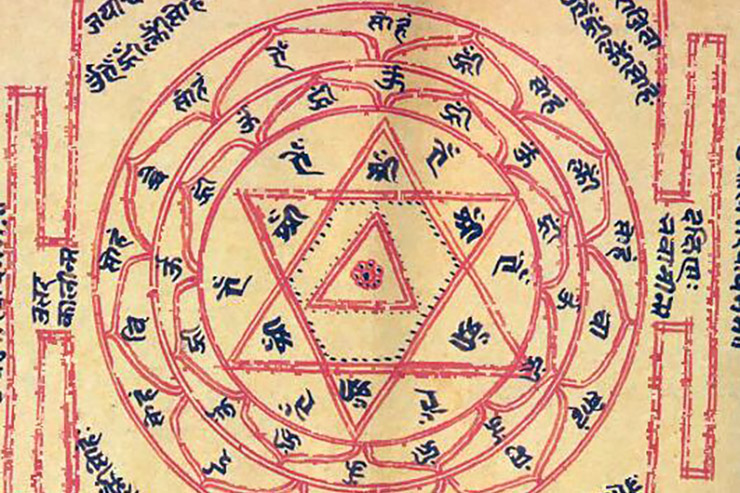
    As with most forms of divination, there are dangers associated with Jyotish, especially if it is practiced with impure motivation. Ammachi (pictured top left), one of contemporary India’s most beloved gurus, has said that the coming of Jyotish to the West, while generally a positive development, has a dark side. The American Vedic astrologer Linda Johnsen quotes Ammachi as saying, “When a powerful predictive system falls into the hand of a materialistic culture, the potential for abuse is enormous…. Astrologers concerned only with making money or gaining fame will not succeed. This is because it is not possible to do Vedic astrology properly without tapas (spiritual self-discipline). Real astrology lies beyond the calculations.”

    [alert type=”general” dismiss=”no”]This article was published in New Dawn 127.[/alert]

    [alert type=”success” dismiss=”no”]If you appreciate this article, please consider subscribing to help maintain this website.[/alert]

    SOURCES

    David Frawley, Astrology of the Seers: A Guide to Vedic/Hindu Astrology, Twin Lakes, Wisc., U.S.: Lotus Press, 2000.
    Linda Johnsen, A Thousand Suns: Designing Your Future with Vedic Astrology, St. Paul, Minn., U.S.: Yes International, 2004.

    © New Dawn Magazine and the respective author.
    For our reproduction notice, click here.
  • The Mysterious Kybalion

    The Mysterious Kybalion

    From New Dawn 124 (Jan-Feb 2011)

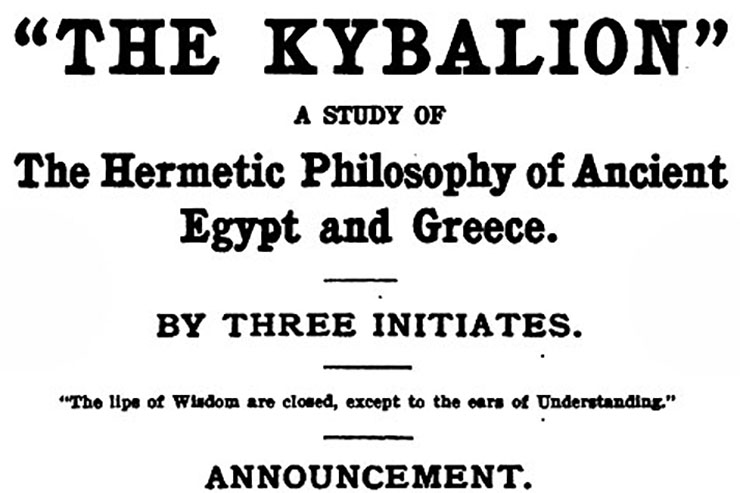
    People who have spent time grazing in metaphysical bookshops may have come across a mysterious volume called The Kybalion, written by “Three Initiates” and first issued by the Yogi Publication Society of Chicago in 1908.

    The most familiar edition is a plain volume bound in blue cloth and stamped with gold, in a format like those of other books from the same publisher, including various works on yoga by one Swami Ramacharaka.

    The Kybalion claims to be a brief introduction to a mystical tradition that has survived from antiquity. The core of the work is a series of aphorisms that, the authors contend, go back to the “early days” and were “passed on from teacher to student,…the exact signification and meaning of the terms having been lost for several centuries.”

    The word, taken at face value, looks vaguely Greek, but it has no meaning in this language (the closest Greek word to it, curiously, is kybeia, meaning “dice game” or “trickery”). It is also tempting to connect this work with the Jewish mystical tradition known as the Kabbalah, but as a matter of fact the Kabbalah is never mentioned in The Kybalion.

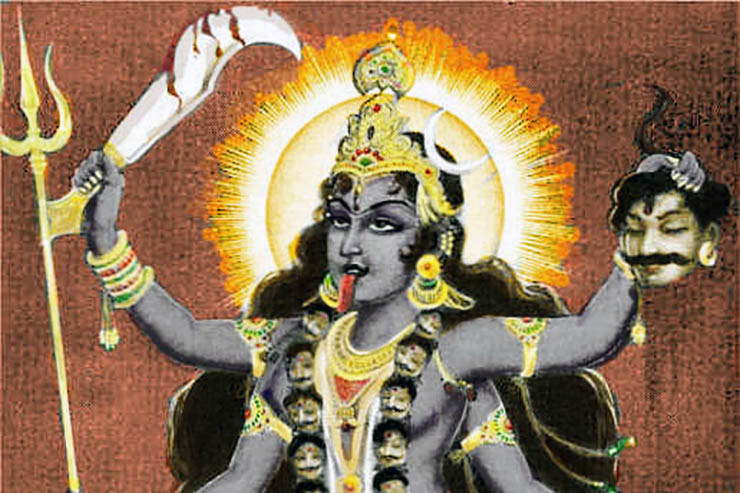
    Rather it presents itself as the essence of the teaching of Hermes Trismegistus (“Thrice-Greatest Hermes”), a legendary, semidivine figure who is said to have brought learning to Egypt in the remotest past. Hermes Trismegistus (pictured at top, right side) is often identified both with the Greek god Hermes and the Egyptian god Thoth (pictured at top, left side).

    The Kybalion is organised according to seven basic principles, which, it says, form the basis of occult philosophy:

    1. Mentalism. “The All is Mind; the Universe is mental.”

    2. Correspondence. “As above, so below; as below, so above.”

    3. Vibration. “Nothing rests; everything moves; everything vibrates.”

    4. Polarity. “Everything is Dual; everything has poles; everything has its pair of opposites.”

    5. Rhythm. “Everything flows, out and in; everything has its tides; all things rise and fall.”

    6. Cause and Effect. “Every Cause has its Effect; every Effect has its Cause; everything happens according to Law.”

    7. Gender. “Gender is in everything; everything has its Masculine and Feminine Principles; Gender manifests on all planes.”

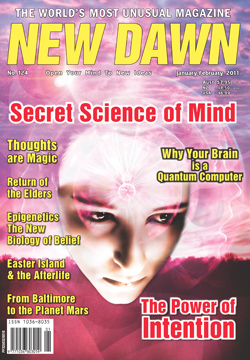
    The origins of this book are difficult to trace. As I noted in the accompanying article, “The Secret Science of Mind,” it is believed to have been written by William Walker Atkinson, who operated the Yogi Publication Society in Chicago (he is generally acknowledged to be “Swami Ramacharaka”).

    As the first principle – “Mentalism” – suggests, the ideas of The Kybalion bear some resemblance to New Thought, a movement to which Atkinson was closely connected.

    The universe, The Kybalion tells us, is contained in “the Mind of the All”: “The All creates the Universe mentally, in a manner akin to the process whereby Man creates Mental Images.” This idea is central to practically all New Thought teachings.

    Nevertheless, the book does echo a more remote past. The term “The All,” for example, resembles the Greek to pan – which also means “the all” and which appears in some Hermetic maxims, most famously Hen to pan: “All is one.”

    Given the claims made for it, the most obvious source to examine for the roots of The Kybalion is the Corpus Hermeticum or “Hermetic body” of texts. These were composed in the early centuries CE and purport to expound the wisdom of Egypt as narrated in a series of discourses and dialogues including Hermes and his son Tat (a version of “Thoth”). And indeed there are intriguing resemblances between these works and The Kybalion.

    The first text of the Corpus Hermeticum, the Poimandres (whose name is probably a Greek adaptation of the Egyptian p-eime-n-re or “mind of authority”), tells us that the source of the universe was nous – consciousness or mind – much as The Kybalion asserts the principle of “Mentalism.” Moreover, this divine mind is described as “being androgyne and existing as light and life” – which parallels the concept of “Gender” as set out in The Kybalion.

    The Kybalion also speaks of the principle of correspondence. This idea appears in another ancient Hermetic text: the extremely brief and elliptical Emerald Tablet, which says, “Quod est superius est sicut quod est inferius, et quod est inferius est sicut quod est superius, ad perpetranda miracula rei unius”: “What is above is like what is below, and what is below is like what is above, to enact the wonders of the one thing.” (The Emerald Tablet is said to have originally been written in Syriac, a Semitic language spoken in antiquity in the eastern Mediterranean world, but it survives only in somewhat dissimilar translations in Latin and Arabic.)

    Whether there really was a collection of aphorisms known as The Kybalion that was passed down from master to pupil from ancient times is hard to say. There are, to my knowledge, no copies of it in any form that predate the 1908 edition, but that does not mean there were none.

    And there are claims of similarly hidden texts in other traditions. The Russian esotericist Boris Mouravieff claimed that esoteric Christianity has an unpublished set of aphorisms called The Golden Book, some of which he quotes in his three-volume work Gnosis: Study and Commentaries on the Esoteric Tradition of Eastern Orthodoxy (although these do not resemble the maxims of The Kybalion to any great degree).

    In a blog posting, Tarot scholar Mary K. Greer suggests a plausible direct source for The Kybalion. In 1884, Anna Kingsford, an Englishwoman who founded an organisation called the Hermetic Society, published a book entitled The Virgin of the World of Hermes Trismegistus, which presents an adaptation of the Hermetic texts. As Greer points out, the introduction to this book bears a strong similarity to many of the ideas in The Kybalion. And in fact the introduction to The Virgin of the World, written by Kingsford’s associate Edward Maitland, does contain a number of things that are echoed in The Kybalion.

    For example, Maitland asserts that consciousness is “the indispensable condition of existence,” and that matter “is a mode of consciousness,” which certainly resonates with The Kybalion’s doctrine of mentalism. Maitland also mentions “the law of correspondence between all planes, or spheres, of existence.” He also speaks of “the doctrine of Karma,” which dictates “the impossibility either of getting good by doing evil, or of escaping the penalty of the latter” – an obvious parallel to The Kybalion’s “law of cause and effect.” In light of these resemblances and The Kybalion’s insistence that it contains the essence of Hermetic teaching, it is very likely that Kingsford and Maitland’s work was at least one of The Kybalion’s sources.

    Thus it is possible to trace out a lineage for The Kybalion: the original Hermetic texts, which have been known in the Western world since the fifteenth century and which have existed in English versions since at least the seventeenth; and the digest of these texts as presented by Kingsford and Maitland in Victorian London.

    But there is a major difference between the original Hermetic teachings and the New Thought–flavoured doctrines of The Kybalion. The Corpus Hermeticum did not exist in a philosophical vacuum; its elevated and abstruse dialogues form only a part of the ancient Hermetic literature. Much of the rest consists of magical texts, and scholars have become increasingly aware that these cannot be so easily divorced in content or inspiration from the Hermetic writings.

    What does this mean in short? It means that the ancient Hermetists probably did not use a type of New Thought-like mind power in their practice. Rather they probably made use of such things as magical rituals, divination, and invocations of the gods, just as we see in most ancient religions. The use of mind power as we find it in New Thought seems to be very much an innovation of the nineteenth century.

    Hence the aphorisms in The Kybalion are very likely a pious fraud. Certainly their style and mode of thought are more evocative of twentieth-century America than of ancient Egypt or Greece. Even so, it would be mistaken to conclude that this work is unfaithful to the tradition it invokes. A spiritual tradition is based, certainly, on timeless and unchanging truths; but the application to which these truths are put will vary from age to age, in accordance with that age’s need. In this sense, The Kybalion can lay genuine claim to the Hermetic heritage.

    [alert type=”general” dismiss=”no”]This article was published in New Dawn 124.[/alert]

    [alert type=”success” dismiss=”no”]If you appreciate this article, please consider subscribing to help maintain this website.[/alert]

    Sources

    Brian P. Copenhaver, Hermetica: The Greek Corpus Hermeticum and the Latin Asclepius in a New English Translation with Notes and an Introduction, Cambridge: Cambridge University Press, 1992.

    Mary K. Greer,  “Sources of The Kybalion in Anna Kingsford’s Hermetic System,” http://marygreer.wordpress.com/2009/10/08/source-of-the-kybalion-in-anna-kingsford%E2%80%99s-hermetic-system (Accessed Nov. 11, 2010).

    Anna Kingsford and Edward Maitland, The Virgin of the World of Hermes Mercurius Trismegistus, www.sacred-texts.com/eso/vow/index.htm (Accessed Nov. 11, 2010).

    Walter Scott, Hermetica: The Ancient Greek and Latin Writings Which Contain Religious or Philosophic Teachings Ascribed to Hermes Trismegistus, Boston: Shambhala, 1985 [1924].

    “Three Initiates,” The Kybalion, Clayton, Ga.: Tri-State Press, 1988 [1908].

    Roelof Van den Broek, “Hermetic Literature I: Antiquity,” in Wouter J. Hanegraaff et al, eds., Dictionary of Gnosis and Western Esotericism (Leiden: Brill, 2005), 1:487-99.

    © New Dawn Magazine and the respective author.
    For our reproduction notice, click here.
  • Waiting for the End of the World: René Guénon and the Kali Yuga

    Waiting for the End of the World: René Guénon and the Kali Yuga

    From New Dawn 122 (Sept-Oct 2010)

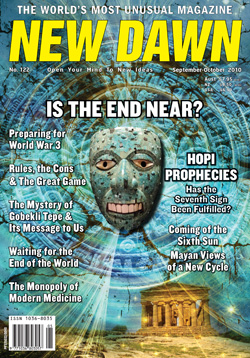
    Currently the fear – or hope – of the closing of the age pervades the air like a thick vapour. Sometimes this end is envisaged as an environmental calamity, sometimes as the second coming of Christ, sometimes as the return of the space brothers to claim their own.

    Figures including Jose Argüelles, the prophet of the 1987 Harmonic Convergence; Terence McKenna, the late pope of psychedelia; and the channelled entity known as Kryon have fastened onto 2012 as the turning point.

    A less well known, though in a way equally influential, figure was the French esoteric philosopher René Guénon, whose writings often speak of the end of a cycle that he equated with the Kali Yuga, the “dark age” of Hindu cosmology. While he did not point to 2012 or any other specific date, his ideas do resonate with some of these expectations for the dawning age to come.

    Born in Blois, France, in 1886, Guénon had a conventional education in mathematics. In his youth he began to explore occult currents in Paris and was initiated into esoteric groups connected with Freemasonry, Martinism, Taoism, and Advaita Vedanta. In 1911, he was initiated into a Sufi tariqah (order) under the leadership of an Egyptian sheikh, Abder Rahman Elish El-Kebir. In 1930, he moved to Egypt, where he converted to Islam and lived until his death in 1951. In the meantime, he published a wide range of books, articles, and reviews espousing what he said was the universal and primordial tradition underlying all religions.

    For Guénon, tradition is the ne plus ultra of human life. He conceives of tradition as a hierarchy: higher knowledge emanates from a now-hidden spiritual centre to all of humankind through the “orthodox” traditions, among whom he includes (with many caveats and qualifications) the great world religions as well as certain other lines such as Freemasonry. Or to put it more accurately, this tradition is preserved in certain initiatic lineages that lie embedded in these faiths, such as the Kabbalah in Judaism, Taoism in Chinese religion, and Sufism in Islam. The esoteric dimension of Christianity had, he believed, practically disappeared by the late Middle Ages and was now preserved (if at all) by small initiatic groups that he apparently regarded as inaccessible. Indeed Guénon’s conversion to Islam was motivated in part by his belief that these Western lineages had almost completely died out by the twentieth century.

    In fact, according to Guénon, this transmission of traditional knowledge – the “doctrine,” as he often styles it – has become almost completely blocked in our era. This, he argued, is the result of a long cosmic cycle, which is called a Manvantara in Hindu cosmology, and which is divided into four yugas or ages: the Satya Yuga, the Treta Yuga, the Dvapara Yuga, and the present Kali Yuga. The problems and anxieties of the current era are the result of this age. It’s worth exploring why he believed this and what he thought it meant.

    The Reign of Quantity & the End of an Age

    Guénon was first and foremost a metaphysician – indeed, he was one of the greatest and most lucid thinkers who have delved into this arcane subject. And for him, metaphysics concerns universal principles; the details of circumstance are of value only insofar as they illustrate these. At the beginning of his best-known work, The Reign of Quantity and the Signs of the Times (first published in 1945), he writes that “considerations of that order” – namely, factual details – “are worth nothing except in so far as they represent an application of principles to certain particular circumstances.”1

    Thus Guénon said that he not a prophet in any conventional sense of the term. He was not a visionary and believed that the visionary prophecy of the current age was nothing more than a cloud of lies emitted by sinister “counterinitiatic” forces. If he spoke of an outlook that made it possible “to foresee, at least in its broad outlines, what will be the shape of a future world,” he insisted that “previsions of this kind have not really any ‘divinatory’ character whatever, but are founded entirely on… the qualitative determinations of time.”2

    The use of the word “qualitative” may seem peculiar here, but for Guénon, the polarity between “quality” and “quantity” was central to understanding the dynamics at play. In his 1931 book The Symbolism of the Cross, he depicted reality in the form of a three-dimensional cross – one that has the dimension of height and depth in addition to the familiar two of length and breadth. At the top of this cross is what he called “absolute quality” – an abstract state that is impossible for us to conceive, because it has no element of quantity whatsoever. (An interesting mind game: try to conceive of a universe in which there is no number or quantity of any sort. It’s almost impossible to do.) At the bottom of this cross is “absolute quantity” – another abstract state that is impossible to conceive. (Again, try to imagine a universe where there is only number, in which there is nothing that has any particular qualities such as colour, shape, or anything else of the kind.)

    Hence it’s not possible in this relative level of existence to reach the absolute end of each pole, but in a given age one of the two will be more pronounced and the other less pronounced to an exactly inverse degree. According to Guénon, the Manvantara proceeds in an ages-long cycle from an era where quality is emphasised – the legendary time known to the Hindus as the Satya Yuga and to the ancient Greeks as the Golden Age – to one in which quantity comes more and more to dominate. This is our present era, the Kali Yuga or what the Greeks called the Iron Age. That’s why Guénon speaks of the present era as one of “the reign of quantity.” He goes on to argue that all the primary characteristics of our time are the result of this reign of quantity.

    Guénon produces modern philosophy and science as evidence for his argument. Modern Western philosophy to all intents and purposes begins with René Descartes (1596-1650), who divided the world into what he called res cogitans (literally, “the thing that thinks”) and res extensa (literally, “the extended thing”). That is to say, the world is divided into that which experiencesres cogitans – and that which is experienced: res extensa. According to Descartes (at least as interpreted by Guénon), everything material is characterised by – and only by – extension, by what can be measured and quantified.

    While this all may sound extremely abstract, Guénon argued – rightly, I believe – that this attitude has profoundly shaped Western thought over the last few centuries. Essentially, he is saying, materialistic science focuses exclusively on quantity: “The more specifically ‘scientific’ point of view as the modern world understands it… seeks to bring everything down to quantity, anything that cannot be so treated is not taken into account, and is regarded as more or less non-existent.”3 Unfortunately, as Guénon goes on to say, this creates any number of logical contradictions. Science conceived purely in terms of quantity argues that the same causes produce the same effects, but as Guénon points out, this is absurd, as no two events are ever completely identical. He also criticises “the delusion which consists in thinking a large number of facts can be of use in itself as ‘proof’ of a theory; …even a little thought will make it evident that facts of the same kind are always indefinite in multitude, so that they can never all be taken into account.”4

    This is precisely the problem that contemporary philosophers call “the justification of induction.” You base a theory on any number of similar events that have happened in the past; but how can you account for the ones that you have not seen, and how can you be sure that future facts will yield the same results? Bertrand Russell put the point wittily when he wrote, “The man who has fed the chicken every day throughout its life at last wrings its neck instead, showing that more refined views as to the uniformity of nature would have been useful to the chicken.”5 The notion of causation is at least as problematic.6 These facts place a ceiling on the degree to which science can understand and explain the universe.

    The Real Meaning of “Value”

    As even this short discussion suggests, Guénon raises profound philosophical issues, and contemporary thought has not done a terribly impressive job of coping with them. But, he contends, the problems go further still. In a chapter of The Reign of Quantity entitled “The Degeneration of Coinage,” he explores the economic aspects of the issue. At first glance, one might think that nothing was more purely quantitative than money. But that, Guénon argues, is an illusion fostered by the degenerate age we live in: “The ‘economic’ point of view…, and the exclusively quantitative conception of money which is inherent in it, are but the products of a degeneration which is on the whole fairly recent,… money possessed at its origin, and retained for a long time, quite a different character and a truly qualitative value, remarkable as this may appear to the majority of our contemporaries.”7

    In traditional societies, Guénon says, money had a sacred character. Not only were the coins stamped with the images of gods and other sacred symbols, but the currency was controlled by the spiritual authorities rather than by the secular powers. Money was meant to be a reminder of “value” in the qualitative as well as the quantitative sense. Today, however, “nobody is able any longer to conceive that money can represent anything other than a simple quantity.”8 Even such words as “value” and “estimate” have been deprived of their qualitative character, and today, when we ask how much a man is worth, we are almost always thinking in terms of cash and equities rather than moral or spiritual calibre.

    This quantitative approach extends to every object we use. “In a traditional civilisation,” Guénon writes, “each object was at the same time as perfectly fitted as possible for the use for which it was immediately destined and also made so that it could at any moment, and owing to the very fact that real use was being made of it (instead of its being treated more or less as a dead thing as the moderns do with everything that they consider to be a ‘work of art’), serve as a ‘support’ for meditation,… thus helping everyone to elevate himself to a superior state according to the measure of his capacities.”9 One obvious example are the tools of Masonry, such as the square, compass, and plumb line, each of which was intended to convey a spiritual and ethical meaning in the days when Masonry was limited to practicing stonemasons. Manufactured goods have no such meaning or value.

    It is not possible here to go further into Guénon’s critique, but even this short discussion reveals that his insights into the woes of the current era were remarkably perceptive and prescient. In The Crisis of the Modern World, published in 1927, he said, “It is… to be expected that discoveries, or rather mechanical and industrial inventions, will go on developing and multiplying more and more rapidly until the end of the present age; and who knows if, given the dangers of destruction they bear in themselves, they will not be one of the chief agents in the ultimate catastrophe, if things reach a point at which this cannot be averted?”10

    Guénon’s charge that the modern world has no use for anything apart from quantity could be substantiated by cases from every conceivable source. Writing about the BP oil spill in the Gulf of Mexico, in early July 2010 a front-page article in The Wall Street Journal reported, “BP PLC is pushing to fix its runaway Gulf oil well by July 27, possibly weeks before the deadline the company is discussing publicly, in a bid to show investors it has capped its ballooning financial liabilities.” Why did BP choose this date? “The July 27 target date is the day the company is expected to report second-quarter earnings and speak to investors.”11 In other words, the fact that the BP spill, one of the greatest environmental disasters in history, fouled a large portion of the Gulf of Mexico, killed innumerable creatures, and devastated the lives of people all along the Gulf Coast was not reason enough for the company to hurry: it needed a second-quarter earnings report to goad itself into action. Nothing could illustrate the reign of quantity more clearly.

    The Kali Yuga

    All this said, when it comes to Guénon’s discussion of the Kali Yuga as a traditional Hindu doctrine, he stands on much shakier ground. He says that the Kali Yuga began some six thousand years ago.12 He also says this era is close to its end. In The Crisis of the Modern World he writes: “We have in fact entered upon the last phase of the Kali-Yuga, the darkest period of the ‘dark age’, the state of dissolution from which it is impossible to emerge otherwise than by a cataclysm.”13

    Not all traditional sources agree about this point. The Hindu sage Sri Yukteswar, best-known as the master of the celebrated yogi Paramahansa Yogananda, discusses the matter in his book The Holy Science. Sri Yukteswar says that the Kali Yuga is actually over, although this has not been recognised even by many Hindu authorities. Ironically in light of Guénon’s claims, it was the very occlusion of the sacred centre that made it impossible to calculate the yugas correctly.

    Traditional dating for the beginning of the Kali Yuga starts from the death of Krishna, the avatar of Vishnu, at the end of the war between the Pandava and Kaurava clans chronicled in the Hindu epic the Mahabharata. Some sources date this to 3012 BCE, others to 1400 BCE.14 As the Kali Yuga began to dawn, Yudhisthira – the victorious Pandava king – gave his throne over to his grandson, Raja Parikshit. “Together with all the wise men of his court,” according to Sri Yukteswar, Yudhisthira “retired to the Himalayan Mountains, the paradise of the world. Thus there was none in the court of Raja Parikshit who could understand the principle of correctly calculating the ages of the several Yugas.”15

    Sri Yukteswar maintains that the Kali Yuga actually ended in 1699 CE. While his views may have been imbued with a belief in progress by his own British education and do not necessarily correspond with those of the majority of Hindus,16 at any rate his claim to being a source of “traditional” knowledge is much higher than Guénon’s. David Frawley, an American Vedic astrologer, agrees with Sri Yukteswar in saying that the Kali Yuga ended in 1699.17 In any event, the dating is far from clear-cut. In fact, many traditional sources reckon on a much larger scale for the duration of the Kali Yuga, placing its length at 432,000 years. If this were the case, it would render any imminent end to this epoch highly improbable.18

    One of the sources that come closest to Guénon’s view of the Kali Yuga is H.P. Blavatsky (1831-91), founder of the Theosophical Society. In her magnum opus, The Secret Doctrine, Blavatsky writes, “The Kali-yuga reigns now supreme in India, and it seems to coincide with the Western age.”19 Blavatsky, writing around 1888, dates the beginning of this epoch to “4,989 years ago” – close to the traditional date of 3012 BCE – and places its end roughly at the close of the nineteenth century: “We have not long to wait, and many of us will witness the Dawn of the New Cycle.”20

    This resemblance is peculiar, because Guénon loathed Blavatsky and Theosophy and criticised them in his first published book, Theosophy: History of a Pseudo-Religion. For Guénon, Theosophy was the ultimate counterinitiatic force, distorting and perverting the truth of traditional knowledge. He especially detested the Theosophical doctrine of evolution, which teaches that each living thing – indeed each atom – is progressing on a cycle of devolution into matter followed by evolution into higher consciousness. The Theosophical view is similar to Guénon’s in saying that the present era is the one in which materiality is most dominant and that it is coming to an end, but it generally portrays the progress of the human race in far more positive terms than Guénon.

    The connections between Guénon and Theosophy are intricate. One of his first spiritual teachers was the occultist Papus (Gérard Encausse), who was head of the French branch of the Theosophical Society, and the scholar Mark Sedgwick, whose book Against the Modern World is the best introduction to the impact of Guénon’s thought, sees Theosophy as one of Guénon’s chief influences.21 While it is impossible to go into this controversy here, it is at least clear that both Blavatsky and Guénon believed the end of the Kali Yuga was at hand. Another central figure in the esotericism of the twentieth century, C.G. Jung, did not deal at length with the Kali Yuga, but in Aeon, his compendious analysis of the symbolism of the astrological ages, he suggests 1997 as the starting point of the New Age, for intricate astronomical reasons.22

    Waiting for the End of the World

    Are we, then, at the end of a cycle? In one sense, yes, of course we are. There are many cycles in nature: every year, every day, is the end of a cycle. But whether we are at the end of the Kali Yuga is, at the very least, moot. My own impression is that the more genuinely traditional Hindus tend to see the Kali Yuga in terms of the much longer time frame of 432,000 years. While Guénon reviled the West and its attempt to erode the traditional values of Asian civilisation, ironically his view that the end is at hand comes far closer to the spirit of Christianity, the ultimate Western religion – which for 2,000 years has been predicting the imminent return of Jesus – than it does to Hindu thought.

    What does this mean in practical terms for us today? Waiting for the end of the world (or of the age) is a kind of narcotic. It enables the human mind to accommodate its own notion of cosmic justice to the realities at hand (because the wicked – who are always, of course, the others – will be brought low, while the good – oneself and whatever group one identifies with – will be exalted). It also serves as what psychology calls a displacement of the fear of death. For each of us individually, the end of the world is certainly coming, in a few decades at the very longest. But human beings dislike contemplating the certainty of death. They find it easier to deal with it by casting it in the remote and highly improbable form of whatever cataclysm happens to suit the fashions of the moment. (For a fuller treatment of this dynamic, see the chapter “Nostradamus and the Uses of Prophecy” in my book The Essential Nostradamus.)

    Unfortunately, we cannot stand around waiting for the end of the world to solve our problems for us. If we genuinely are at a threshold of a new era, we will be able to cross it only if we discard the contrived apocalypticism that suffuses mass culture and to which Guénon, as powerful a thinker as he was, was not immune.

    Nevertheless, Guénon’s claim that we are living under the reign of quantity is hard to refute. One has only to read prominent journals such as The Wall Street Journal and The Economist to see that the real protagonist in all their stories is money – money in the abstract, as a kind of hypostatised entity that stipulates all value and dictates all morality. What is good, we are being told, is what is good for money. Whether or not the Kali Yuga is about to end, we can bring the end of the reign of quantity a few steps closer by looking into ourselves and making sure that the values by which we guide our lives are more than merely economic ones.

    [alert type=”general” dismiss=”no”]This article was published in New Dawn 122.[/alert]

    [alert type=”success” dismiss=”no”]If you appreciate this article, please consider subscribing to help maintain this website.[/alert]

    Footnotes

    1. René Guénon, The Reign of Quantity and the Signs of the Times, trans. Lord Northbourne (Harmondsworth, Middlesex, UK: Penguin, 1972), 7.

    2. Guénon, The Reign of Quantity, 57.

    3. Guénon, The Reign of Quantity, 85.

    4. Guénon, The Reign of Quantity, 87.

    5. Bertrand Russell, The Problems of Philosophy (New York: Barnes & Noble, 2002 [1912], 42.

    6. For a more complete discussion of these issues, see my book The Dice Game of Shiva: How Consciousness Creates the Universe (Novato, Calif.: New World Library, 2009), chs. 4 and 5.

    7. Guénon, The Reign of Quantity, 133.

    8. Guénon, The Reign of Quantity, 136.

    9. Guénon, The Reign of Quantity, 137.

    10. René Guénon, The Crisis of the Modern World, trans. Arthur Osborne et al. (Ghent, N.Y.: Sophia Perennis et Universalis, 1996), 39.

    11. Monica Langley, “BP Sets New Spill Target,” The Wall Street Journal, July 8, 2010, A1.

    12. René Guénon, The King of the World, trans. Henry D. Fohr (Hillsdale, N.Y.: Sophia Perennis et Universalis, 2001), 49.

    13. Guénon, The Crisis of the Modern World, 17.

    14. See Klaus R. Kostermaier, A Survey of Hinduism, 3d ed. (Albany: State University of New York Press, 2007), 97.

    15. Jnananavatar Swami Sri Yukteswar, The Holy Science (Los Angeles: Self-Realization Fellowship, 1990), 16-17.

    16. See the forthcoming work by Joscelyn Godwin, Atlantis of the Occultists and the Cycles of Time.

    17. David Frawley, Astrology of the Seers: A Guide to Vedic/Hindu Astrology (Twin Lakes, Wis.: Lotus, 2000), 36-39.

    18. For a helpful summary of the various views, see Joseph Morales, “The Hindu Theory of World Cycles in the Light of Modern Science”; http://baharna.com/karma/yuga.htm (accessed January 14, 2010).

    19. H.P. Blavatsky, The Secret Doctrine (Wheaton, Ill.: Quest, 1993 [1888]), 1:377.

    20. Blavatsky, Secret Doctrine, 1:xliii-xliv.

    21. Mark Sedgwick, Against the Modern World: Traditionalism and the Secret Intellectual History of the Twentieth Century (Oxford: Oxford University Press, 2004), 40-44.

    22. C.G. Jung, Aion: Researches into the Phenomenology of the Self, trans. R.F.C. Hull (Princeton: Princeton/Bollingen, 1959), 94.

    © New Dawn Magazine and the respective author.
    For our reproduction notice, click here.