New Dawn – World's Most Unusual Magazine

Author: Gwendolyn Taunton

  • The Kali Yuga: Dicing with Death

    The Kali Yuga: Dicing with Death

    One of the most well-known cultural imports from India that has exerted an influence on Western thought is that of the Kali Yuga. This topic has been particularly dwelt upon by the Perennialist School, which includes authors such as René Guénon and Alain Daniélou. The reason for the popularity of this subject in the West is two-fold: Firstly, the Kali Yuga can be used to explain a number of political, economic, and environmental problems which currently face humanity. Secondly, the Kali Yuga and whole concept of cyclic time is not entirely foreign. The theory of time as non-linear and not always ‘progressive’ is a very ancient one, rooted in our own past. A similar cycle of Ages is present in Greek history, notably within the works of Hesiod, where he speaks of a fall from a Golden Age towards an apex of decline in the Iron Age. This cycle is also found in the Voluspá of the Poetic Edda which outlines Ragnarök and a Wolf Age (the equivalent of the Kali Yuga/Iron Age).

    The four Yugas (Satya, Treta, Dvapara, and Kali) have two standards of measurement, the chronological and the ethical. The chronological approach is based on astronomical positions and mathematical calculations. The stars and planetary positions have long been thought of as capable of influencing human behaviour via astrology, so from this viewpoint the cosmos itself would be the cause of the Yugas. Joscelyn Godwin brings the astronomical perspective to the fore when he states that “one of the recurrent themes of the Golden Age is that during it the earth’s axis was perpendicular to the ecliptic… If this were so there would be no seasons, but equal day and night throughout the year.”1 The influence on time would therefore be direct and visible. The symbolism used to portray the Golden Age often implies an alteration to time, as major planetary conjunctions are said to occur at the end of the Kali Yuga – and they are permanent conjunctions, which strongly implies time itself ceases.

    However, the majority of issues which arise in the Kali Yuga can also be attributed to a decline in human morality and ethics, so many of the problems could be entirely man-made. The imagery of time, the ultimate horror for all sapient life, could simply have been added as a metaphor for a more psychologically healthy state, wherein man no longer feels enslaved by others ‘from the cradle to the grave’, enjoying the spontaneous nature of life in a seemingly endless Golden Age.

    The Yuga itself is governed by the forces of ṛṭa, dharma, and karma. The first, ṛṭa (the cosmic law), is eternal and cannot be broken down. The second function, dharma (through ṛṭa) develops into a notion of individual human and social actions in relationship with the overarching cosmic order. It is dharma, the code of ethics which governs human society that erodes. Dharma decreases as the material aspect of existence (tamas) increases, and at certain points when the dharma is severely weakened, a new Yuga commences.

    Not only do the Yugas differ in the quality of dharma, they also differ in duration, for as the author René Guénon notes, the Yugas themselves have “decreasing lengths of the respective durations of the four Yugas that together make up a Manvantāra.”2 The duration of the Yugas decrease proportionally with a ratio of 4:3:2:1.3 Guénon elaborates on the different lengths of the Yugas explaining that “it can therefore be said not only that time compresses space, but also that time is itself subject to a progressive contraction, appearing in the proportionate shortening of the four Yugas, with all that this implies, not excepting the corresponding diminution in the length of human life.”4 Guénon provides an example of this explaining that if “the duration of the Manvantāra is 4,320, those of the four Yugas will respectively be 1,728, 1,296, 864, and 432.”5 Jean Robin highlights a flaw here though. Commenting on Guénon’s chronology, Robin states that Guénon’s calculations mean that the Kali Yuga would have ended in 1999: “The beginning of the Kali Yuga would thus be in the year 4481 BCE (3761 + 720), and its end would have to come 6,480 years later, i.e. in the year 1999 (6480–4481).”6

    The Kali Behind the Yuga’s Name

    It is a common misconception that the Kali Yuga is named after the Goddess Kālī. Instead it takes its name from an extremely powerful male demon. This mistake occurs due to errors in English translations of the name Kali – in Sanskrit the Goddess is named Kālī (with long vowels) – the name of the demon is spelt Kali (with short vowels). The demonic Kali takes his name from the Sanskrit root kad which means to “suffer, grieve, hurt, confound, or confuse.” Kali is the archenemy of Kalki, the 10th avatar of the God Viṣṇu. When Viṣṇu incarnates as an avatar, so does Kali – in the Mahābhārata he is said to be Duryodhana, and in the Rāmāyaa he is Rāvaṇa. Kali is the great-great-grandson of Lord Brahmā, as well as Adharma who was originally created from Lord Brahmā’s back as a Maleen Pataka (a sinful object). This is found in the Śrī Kalki Purāa where it says that, “After the annihilation, the secondary creator of the universe, Lord Brahmā, the grandfather of everyone, who was born on the universal lotus flower, created Sin personified, having a black complexion, from his back.”7 An alternate version of Kali’s origin states that he was born from the left-over poison that was drunk by Lord Śiva during the churning of the ocean of milk.
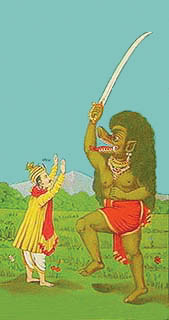
    Kali as dark-skinned monster with sword, From “The Cow with 84 Deities”, c. 1912, Ravi Varma Press

    Depictions of Kali portray him as both revolting and terrifying. The Kalki Purāa describes Kali as huge and the colour of “soot,” with a long tongue and a terrible stench. He carries a bone and has an abdomen that is said to be like that of a crow. Kali is always portrayed holding his genitals in his left hand and he has a dark complexion, like black ointment that has been mixed with oil.8 The Bhāgavata Purāa also describes him as a śūdra wearing the garments of a king. Kali’s symbol is an owl and he rides a donkey instead of a horse. Kali is very fond of gambling, drinking wine, enjoying the company of prostitutes, and associating with merchants – his whole persona exudes an aura of extreme excess, gluttony, and greed. Kali is also presumed to be responsible for all evil scriptures and badly composed religious texts. The favourite residences of Kali are

    the playgrounds of ghosts, foxes, and jackals. These places were permeated with the foul odour of decaying beef, and they were infested with crows and owls. Kali’s domain can be found wherever there is gambling and intoxication, as well as where women constantly quarrel.9

    In sum his domains are those which are deemed impure by Hinduism, and are found wherever people lose their rationality, generating strife and conflict. It is the influence of Kali that distorts the perception of humanity and lures them from the dharma. Kali’s association with negative human emotions and antagonism towards the dharma is symbolised by the names of his destructive progeny.

    Kali’s sister was Durukti (Harsh Speech). From Durukti’s womb Kali begot a son named Bhaya (Fear), and a daughter named Mṛtyu (Death). Bhaya begot a son named Niraya (Hell) from the womb of Mṛtyu, and Niraya begot ten thousand sons in the womb of his sister, Yatana (Excessive Pain). Thus I have described the destructive progeny of Kali, who were all blasphemers of genuine religious principles.10

    Kali’s reign, the Kali Yuga, commences within the Mahābhārata and this book is a pivotal text for understanding both the demon and the Yuga. The end of the Mahābhārata is traditionally believed to herald the dawn of the Kali Yuga, and it begins when Kṛṣṇa, the avatar of the God Viṣṇu, departs. Based on the astronomical observations of Parāśara, a date of c.1350 BCE can be provided for the Mahābhārata.11

    Kali’s presence in the text is subtle, and for the most part revealed only through symbolism. Hints of the infernal origin of Duryodhana are hidden within the Mahābhārata. Vidura issues warnings of the inauspicious symbols which surround Duryodhana and link him to Kali, saying,

    Listen to me, sire, even if my words are bitter, like medicine to a dying man. When Duryodhana was born he cried like a jackal. He will destroy us all. A jackal stalks our palace. Order Arjuna to kill him. Sacrifice a crow to get peacocks, sire; sell a jackal to buy tigers.12

    Jackals are one of the animals traditionally associated with both Kali and bad omens. In a different translation of the Mahābhārata, Kali’s presence is clearly stated.

    Know that Pāṇḍu of unfading glory and distinguished above all others, sprung from the Maruts. Kṣattri and Yudhiṣṭhira are both portions of the deity of Righteousness. Know that Duryodhana was Kali, and Śakuni was Dvāpara.13

    Just as the other main characters within the Mahābhārata are avatars of deities, so too is Duryodhana the avatar of Kali. The identity of Kali as the villain of the Mahābhārata also sheds much light on the actions of Krṣṇa, the avatar of Viṣṇu, and the role he plays in teaching Arjuna the katriya dharma. Kali also appears as Nala in the Mahābhārata, who he possesses via the dice game (a form of gambling). During the dice game, Nala loses everything and is forced into exile. Kali’s possession of Nala ends when the Nāga Karkoṭaka bites him and the venom turns Nala into an ugly dwarf named Bāhuka, who eventually masters the dice game. Learning this enables Nala to exorcise the demon and he vomits Kali from his mouth. The story of Nala is a micro-version of the Mahābhārata itself – Duryodhana also lures Yudhiṣṭhira into playing the dice game, unaware that Duryodhana, aided by another demon Dvāpara (who has incarnated as Śakuni) is manipulating the dice so he can take over the kingdom.

    “Challenged, I never retreat,” replied Yudhiṣṭhira. “We are pawns in the hand of fate. Let us begin. Who plays against me?” “I will supply the stakes,” Duryodhana said. “My uncle Śakuni will play.”14

    Yudhiṣṭhira loses the kingdom, his brothers, himself, and even his wife. The dice game is also of further importance because the Yugas were originally named after the four throws of dice – Krita, Trita, Dvita, and Kali – Krita being the best throw and Kali the worst. Therefore, Kali is not only winning the dice game, he is winning the Yuga and declaring it, albeit symbolically, as his reign and preparing to engage in conflict with his traditional enemy, Viṣṇu, who incarnates as Krṣṇa in the Bhagavad-Gītā section of the Mahābhārata. Despite the defeat of Kali/Duryodhana in the epic, the end of the Mahābhārata is the beginning of the Kali Yuga, because it is believed that the very moment Krṣṇa left the earth, Kali became active in the world.

    Kali will not leave the world again until his nemesis Viṣṇu incarnates as Kalki. The Kalki Purāa is set at the end of the Kali Yuga and narrates the battle between the final avatar of Viṣṇu and Kali, who is defeated one-third of the way through the text. As Kali’s connection to the Kali Yuga is much more explicit in the Kalki Purāa, the manner in which he influences humanity and the dharma is also more obvious. The problems of the Kali Yuga are both moral and ethical, and the central issue of the Kalki Purāa is that society rejects the dharma and Vedic teachings. This is portrayed in Kalki’s role vis á vis the mleccha. The mlecchas are understood to be

    those who do not follow the Vedic principles. In former days, the mlecchas were fewer, and Visvāmitra Muni cursed his sons to become mlecchas. But in the present age, [the] Kali Yuga, there is no need of cursing, for people are automatically mlecchas. This is only the beginning of [the] Kali Yuga, but at the end of [the] Kali Yuga the entire population will consist of mlecchas because no one will follow the Vedic principles. At that time the incarnation Kalki will appear.15

    It is also stated that,

    the pious Brāhmaa have left this country (India), having been chastised by the powerful Kali, who is envious of saintly persons, and who destroys the practice of religious principles.16

    In addition to the mlecchas multiplying and the Brāhmaṇas departing, the caste system also breaks down into a fifth caste that is a result of the other four intermingling, as stated in the Mahānirvāna Tantra: “In the Kali Age, however, there are five castes – namely, Brāhmaṇa, Kṣatriya, Vaishya, Śūda, and Sāmānya.”17 The effect of the lack of dharma in the Kali Yuga can therefore be interpreted as the collapse of traditional law and the negation of all things ethical, moral, or spiritual. The goal of Kalki is not to simply slay Kali, but also to restore the dharma and to reinstate Vedic Traditions. Kali, on the other hand, spreads adharma by perverting religious discourse and creating unscrupulous scriptures. This is undoubtedly what Guénon has in mind when he speaks of the “counter-tradition” in the context of the Kali Yuga.

    The reign of the ‘counter-tradition’ is in fact precisely what is known as the ‘reign of the Antichrist’, and the Antichrist, independently of all possible preconceptions, is in any case that which will concentrate and synthesize in itself for this task all the powers of the ‘counter-initiation’, whether it be conceived as an individual or as a collectivity.18

    The adharmic counter-tradition of the Kali Yuga is also identified with rigid dogma and out of date fundamentalist thinking, notes Alain Daniélou, who writes that, “Visually symbols – that is, the various forms of writing – only begin to be used to fix certain elements of tradition when the evolution of the cycle announces the decline of knowledge.”19 He elaborates further on this stating that,

    writing is an urban phenomenon, characteristic of the Kali Yuga. To freeze the teachings of “prophets” in books regarded as sacred is to paralyse the spirit of research; it fixes so-called established truths and tends to create blind faith instead of the search for knowledge.20

    This is very much in line with depictions of Kali (metaphorically) possessing the minds of men to compose scriptures with ‘evil intent’. One only needs to read the daily news to see how ‘cherry-picked’ religious passages can be used to attack ethnic groups, sexes, and sexual orientations. The most obvious modern example would be Daesh deliberately distorting Islamic teachings to perpetuate political violence in both Europe and the Middle East. But it is only when all spiritual teachings have been eradicated that Kalki will be born, for the Śrīmad Bhāgavatam says that, “At the end of [the] Kali Yuga, when there exist no topics on the subject of God, even at the residences of so-called saints and respectable gentlemen of the three higher varas and when nothing is known of the techniques of sacrifice, even by word, at that time the Lord will appear as the supreme chastiser.”21 It is by restoring the dharma, the moral and spiritual essence of society, that Kalki is able to end the Kali Yuga. Kalki says this himself when he announces that, “I will then again establish Satya Yuga, and thus reinstate the principles of religion as they were before.”22

    Events to Occur in the Kali Yuga

    Alain Daniélou provides numerous examples of events that will occur in the Kali Yuga from the Liga Purāa and the Viṣṇu Purāa. The vast majority of these events are disasters which arise from human actions. All of the issues cited here by Daniélou arise from socio-cultural problems such as greed, lust, pride, arrogance, and political corruption which are the end result of the negation of dharma. As the dharma decreases, the vice and evil in humanity increases. The predictions for the Kali Yuga include the following:

    They will be surrounded by pretentious, false philosophers.

    There will be many beggars and unemployed people.

    Rapes will be frequent.

    Unqualified people will pass as experts in matters of morals and religion.

    Women of good birth will abandon themselves to the desires of the basest of men and perform obscene acts.

    Men will devote themselves to earning money; the richest will hold power.

    Through the fault of the public authorities, many children will die.

    People will accept theories promulgated by anyone as articles of faith.

    In the Kali Yuga men will be without virtues, purity, or a sense of decency, and will know great hardship.23

    The Mahānirvāna Tantra also states that, “Those born in the Kali Age are by their nature weak in intellect, and their minds are distracted by lust,” implying that the character of people is what causes them to adopt practices which are essentially harmful to both themselves and others.24 Due to the growing influence of materialism, greed will also become a source of admiration, and only those who are wealthy will be deemed worthy of respect. The Kalki Purāa states that,

    In [the] Kali Yuga, a person with a lot of money will naturally be respected as a great soul. If a twice-born person earns his livelihood by lending money on interest, he will be considered a pillar of society.25

    Other human created disasters associated with the Kali Yuga are clearly the result of bad governments. Taxes will increase and political figures will be self-serving rather than protectors of the people. There will also be mass migrations – something that is currently happening as people leave the Middle East for more prosperous and stable countries. These events found in the Kali Yuga are located in the discourse by Mārkaṇḍeya in the Mahābhārata where it is written that,

    Rulers will become unreasonable: they will levy taxes unfairly.

    Rulers will no longer see it as their duty to promote spirituality, or to protect their subjects: they will become a danger to the world.

    People will start migrating, seeking countries where wheat and barley form the staple food source.

    Not all of the events of the Kali Yuga will be purely caused by the immoral activities of humans though, for there will also be natural disasters at the close of the Yuga.

    The God of the clouds will be inconsistent with the rains.

    There will be many children born whose life expectancy is no more than sixteen years.

    People who live for a hundred years will be few.

    Water will be lacking, and in many regions people will watch the sky, hoping for rain.26

    In light of recent warnings about climate change and critical levels of pollution in China, these events could also be interpreted as man-made, via neglect and the wanton use of natural resources that harm the environment. Regardless of whether the cause is natural or caused by people, these passages indicate severe climatic instability that afflicts the population and shortens the human life span. However, there is one disastrous event in the Kali Yuga which is definitely not man-made. There is a poignant description of a mass extinction event in the form of an under-water volcano.

    Fire from the mouth of an underground serpent will burn the lower worlds, then the surface of the earth, and will set the atmosphere ablaze […] Surrounded by these circles of fire, all animate and inanimate beings will be destroyed.27 Huge ash clouds then cover earth […] Then, by means of interminable downpour, they will flood the whole earth with water. This torrential rain will swamp the earth for twelve years, and humanity shall be destroyed.28

    It is worth mentioning that the Ring of Fire is currently very active, and that large earthquakes have become more frequent in recent years. Violent earthquakes have been particularly prolific in Japan and New Zealand – close to the site of what is a developing super-volcano growing on the ocean floor. Science predicts that this new super-volcano will be strong enough to eradicate most life in the Southern Hemisphere, and cover the world with ash clouds powerful enough to ruin the climate globally. Currently it is believed that the volcano will take at least thousands of years to form, despite the fact that Daniélou calculates the end of the Kali Yuga to be 2,442,29 a date which if correct places us very close to a catastrophic disaster.

    All is not lost however. Although dharma is set to collapse according to these texts, some Traditions rewrote their teachings in order to adapt to the changing current of the Kali Yuga. The most well-known of these are the esoteric branches of Hinduism collectively referred to as Tantra. The Mahānirvāna Tantra says that, “when the Kali Age is in full sway for all castes, commencing with the Brāhmaṇas, Tāntrika rites are alone appropriate.”30 Daniélou repeats this sentiment stating that, “Only Tantric Yoga methods are efficacious in this age in which values are lost; the rites, asceticism and virtues of other ages are ineffective.”31 He also believes that the “teachings of Lakuliśa expose the principles of the Darśana (the paths of knowledge) in a simple and popular form full of imagery, and suggest patterns of behaviour suitable for the final stages of the Kali Yuga.”32 The most simple and effective method of resisting the influence of the Kali Yuga, however, is actually very easy and can be practiced by anyone, for the Mahānirvāna Tantra says that,

    in the Kali Age alms are efficacious in the accomplishment of all things. The proper objects of such alms are the poor devoted to meritorious acts.33

    Thus the humble act of charity can counter the woe, greed, and cruelty of the Kali Yuga. If anything can save humanity from the disastrous effects of the Kali Yuga, then it must be human action, performed in accordance with dharma. Even if this assumption is incorrect, it may still be enough to make the world a slighter brighter place in this, the darkest of all ages, and forestall the apocalypse for just a little while longer.
    [alert type=”general” dismiss=”no”]This article was published in New Dawn Special Issue Vol 10 No 2.[/alert]
    [alert type=”success” dismiss=”no”]If you appreciate this article, please consider a contribution to help maintain this website.[/alert]

    Footnotes

    1. J. Godwin, ‘Decoding the Cycles of Time: When Does the Kali Yuga End?’, New Dawn 138 (May-June, 2013), 64
    2. R. Guénon, The Reign of Quantity & Signs of the Times, Sophia Perennis, 2004, 42
    3. B. G. Sidharth, The Celestial Key to the Vedas, Inner Traditions International, 1999, 60
    4. R. Guénon, The Reign of Quantity & Signs of the Times, 159
    5. R. Guénon, Traditional Forms & Cosmic Cycles, Sophia Perennis, 2004, 6
    6. J. Godwin, New Dawn 138, 65
    7. Śrī Kalki Purāa, trans. Bhumipati Das, B., ed. Das, P., (Tai Nitai Press), 5
    8. Śrī Kalki Purāa, 5
    9. Śrī Kalki Purāa, 5
    10. Śrī Kalki Purāa, 6
    11. B. G. Sidharth, 118
    12. Vyāsa, The Mahābhārata of Vyasa, trans. Lal, P., Vikas Publishing House, 1980, 129
    13. Vyāsa, The Mahābhārata of Krṣṇa-Dvaipāyana Vyāsa, trans. Kisari Mohan Ganguli, K. M., (c. 1883–1896), section XXXI
    14. Vyāsa, The Mahābhārata of Vyasa, trans. Lal, P., 128
    15. Śrīmad Bhāgavatam, 9:16:33
    16. Kalki Purāa, 2.45
    17. A. Avalon, The Tantra of the Great Liberation, Dover Publications, 1972
    18. R. Guénon, The Reign of Quantity & Signs of the Times, 270
    19. A. Daniélou, Shiva and the Primordial Tradition: From the Tantras to the Science of Dreams, Inner Traditions International Ltd., 2003, 103
    20. A. Daniélou, While the Gods Play, Inner Traditions International Ltd., 1987, 87
    21. Śrīmad Bhāgavatam, 2.7
    22. Śrī Kalki Purāa, 16
    23. While the Gods Play, 212-215
    24. The Tantra of the Great Liberation
    25. Śrī Kalki Purāa, 8-10
    26. While the Gods Play, 212-215
    27. Viṣṇu Purāa 1.8.18-31
    28. While the Gods Play, 218
    29. While the Gods Play, 197
    30. The Tantra of the Great Liberation
    31. A. Daniélou, Gods of Love and Ecstasy: The Traditions of Shiva and Dionysus, Inner Traditions International Ltd., 1992, 235
    32. While the Gods Play, 120
    33. The Tantra of the Great Liberation

    © New Dawn Magazine and the respective author.
    For our reproduction notice, click here.
  • Mercury Rising: The Life & Writings of Julius Evola

    Mercury Rising: The Life & Writings of Julius Evola

    This article was published in New Dawn 111 (Nov-Dec 2008)

    If the industrious man, through taking action,
    Does not succeed, he should not be blamed for that –
    He still perceives the truth.
    – The Sauptikaparvan of the Mahabharata (2,16)

    If we select a single aspect by which to define Julius Evola, it would have been his desire to transcend the ordinary and the world of the profane. It was characterised by a thirst for the Absolute, which the Germans call mehr als leben – ‘more than living’. This idea of transcending worldly existence colours not only his ideas and philosophy, it is also evident throughout his life which reads like a litany of successes.

    During the earlier years Evola excelled at whatever he applied himself to: his talents are evident in the field of literature, for which he is best remembered, and also in the arts and occult circles.

    Born in Rome on the 19th of May 1898, Giulio Cesare Andrea Evola was the son of an aristocratic Sicilian family, and like many children born in Sicily, he received a stringent Catholic upbringing. As he recalls in his intellectual autobiography, Il cammino del cinabro (1963, 1972, The Cinnabar’s Journey), his favourite pastimes consisted of painting, one of his natural talents, and of visiting the library as often as he could in order to read works by Oscar Wilde, Friedrich Nietzsche, and Otto Weininger.1

    During his youth he also studied engineering, receiving excellent grades, but chose to discontinue his studies prior to the completion of his doctorate, because he “did not wish to be bourgeois, like his fellow students.” At the age of nineteen Evola joined the army and participated in World War I as a mountain artillery officer. This experience served as an inspiration for his use of mountains as metaphors for solitude and ascension above the chthonic forces of the earth.

    Evola was also a friend of Mircea Eliade, who kept in correspondence with Evola from 1927 until his death. He was also an associate of the Tibetologist Giuseppe Tucci and the Tantric scholar Sir John Woodroffe (Arthur Avalon).

    During his younger years Evola was briefly involved in art circles, and despite this being only a short lived affair, it was also a time that brought him great rewards. Though he would later denounce Dada as a decadent form of art, it was within the field of modern art that Evola first made his name, taking a particular interest in Filippo Tommaso Marinetti and Futurism.

    His oil painting, ‘Inner Landscape, 10:30 a.m.’, today hangs on a wall of the National Gallery of Modern Art in Rome.2 He also composed ‘Arte Astratta (Abstract Art)’ but later, after experiencing a personal crisis, turned to the study of Nietzsche, from which sprang his ‘Teoria dell, individuo assoluto’ (Theory of the Absolute Individual) in 1925.

    By 1921 Evola had abandoned the pursuit of art as the means to place his unique mark on the world. The revolutionary attitudes of Marinetti, the Futurist movement and the so-called avant-garde which had once fascinated him, no longer appeared worthwhile to Evola with their juvenile emphasis on shocking the bourgeois. Likewise, despite being a talented poet, Evola (much like another of his inspirations – Arthur Rimbaud) abandoned poetry at the age of twenty four. Evola did not write another poem nor paint another picture for over forty years. Thus, being no longer enamoured of the arts, Evola chose instead to pursue another field entirely that would one day award him even greater acclaim.

    Evola & The Ur Group

    To this day, the magical workings of the Ur Group and its successor Krur remain some of the most sophisticated techniques for the practice of esoteric knowledge laid down in the modern Western era. Based on a variety of primary sources, ranging from Hermetic texts to advanced Yogic techniques, Evola occupied a prominent role in both of these groups. He wrote a number of articles for the esoteric journal Ur and edited many of the others. These articles were collected in the book Introduction to Magic: Rituals and Practical Techniques for the Magus, which alongside Evola’s articles, include the works of Arturo Reghini, Giulio Parese, Ercole Quadrelli and Gustave Meyrink. The original title of this work in Italian, Introduzione alla Magia quale scienza dell’lo, literally translates as Introduction to Magic as a Science of the “I”.3 In this sense, the ‘I’ is best interpreted as the ego, or the manipulation of the will – an idea also found in the work of that other famous magician, Aleister Crowley, and his notion of Thelema. Ur started out as a monthly publication, with the first issue released in January 1927.4

    Contributors to this publication included Count Giovanni di Caesaro, Emilio Servadio, a distinguished psychoanalyst, and Guido de Giorgio, a well-known adherent of Rudolf Steiner and an author of works on the Hermetic tradition. It was during this period that Evola was introduced to Arturo Reghini (1878-1946), who subsequently invited him to join the Ur group. Arturo Reghini was interested in speculative Masonry and the anthroposophy of Rudolf Steiner, introducing Evola to French author and intellectual René Guénon’s writings. Ur and its successor Krur gathered together a number of people interested in Guénon’s exposition of the Hermetic tradition and Vedanta, Taoism, Buddhism, Tantra, and magic.

    Arturo Reghini was to be a major influence on Evola, being himself a representative of the so-called Italian School (Scuola Italica), a secret order that claimed to have survived the downfall of the Roman Empire. It is said to have re-emerged with Emperor Frederic II, inspiring the Florentine poets of the thirteenth and fourteenth centuries, up to Petrarch. Like Evola, Reghini also wrote articles, one of which was entitled ‘Pagan Imperialism’. Appearing in Salamandra in 1914, Reghini summed up his anti-Catholic program for a return to a glorious pagan past. This piece profoundly impacted Evola, and served as the inspiration for his similarly titled ‘Imperialismo pagano’.

    Appearing in 1928, ‘Imperialismo pagano’ chronicled the negative effects of Christianity on the world. In the context of this work, Evola advocated an anti-Roman Catholic pagan imperialism. According to Evola, Christianity has destroyed the imperial universality of the Roman Empire by insisting on the separation of the secular and the spiritual. It is from this separation that arose the inherent decadence and inward decay of the modern era. Out of Christianity’s implacable opposition to the healthy paganism of the Mediterranean world arose the secularism, democracy, materialism, scientism, socialism, and the “subtle Bolshevism” that heralded the final age of the current cosmic cycle: the age of “obscurity,” the Kali-Yuga.5

    ‘Imperialismo pagano’ was later revised in a German edition as ‘Heidnischer Imperialismus’. The changes that occurred in the text in its German translation five years later were not entirely inconsequential. Although the fundamental concepts that comprised the substance of Evola’s thought remained similar, a number of critical elements were altered that transformed a central point in Evola’s thinking. The “Mediterranean tradition” of the earlier text is consistently replaced with the “Nordic-solar tradition” in this translation.6 In 1930 Evola founded his own periodical, La Torre (The Tower). La Torre, the heir to Krur, differed from the two earlier publications Ur and Krur in the following way, as announced in an editorial insert:

    Our Activity in 1930 – To the Readers: “Krur is transforming. Having fulfilled the tasks relative to the technical mastery of esotericism we proposed for ourselves three years ago, we have accepted the invitation to transfer our action to a vaster, more visible, more immediate field: the very plane of Western ‘culture’ and the problems that, in this moment of crisis, afflict both individual and mass consciousness […] for all these reasons Krur will be changed to the title La Torre [The Tower], ‘a work of diverse expressions and one Tradition.’”7

    La Torre was attacked in official fascist journals such as L’Impero and Anti-Europa, and publication of La Torre ceased after only ten issues. Evola also contributed an article entitled ‘Fascism as Will to Imperium and Christianity’ to the review Critica Fascista, edited by Evola’s old friend Giuseppi Bottai. Here again he launches vociferous opposition to Christianity and attests to its negative effects, evident in the rise of a pious, hypocritical, and greedy middle class lacking in all superior solar virtues that Evola attributed to ancient Rome. The article did not pass unnoticed and was vigorously attacked in many Italian periodicals. It was also the subject of a long article in the prestigious Revue Internationale des Sociétés Secrètes (Partie Occultiste) for April 1928, under the title ‘Un Sataniste Italien: Jules Evola’.

    Coupled with the notoriety of Evola’s La Torre was also another, more bizarre, incident involving the Ur Group’s reputation, and their attempts to form a “magical chain.” Although these attempts to exert supernatural influence on others were soon abandoned, a rumour quickly developed that the group wished to kill Mussolini by these means. Evola describes this event in his autobiography Il Cammino del Cinabro.

    Someone reported this argument [that the death of a head of state might be brought about by magic] and some yarn about our already dissolved “chain of Ur” may also have been added, all of which led the Duce to think that there was a plot to use magic against him. But when he heard the true facts of the matter, Mussolini ceased all action against us. In reality Mussolini was very open to suggestion and also somewhat superstitious (the reaction of a mentality fundamentally incapable of true spirituality). For example, he had a genuine fear of fortune-tellers and any mention of them was forbidden in his presence.

    Evola’s Works

    It was also during this period that Evola also discovered something that profoundly influenced many of his ideas: the lost science of Hermeticism. Though he undoubtedly came into contact with this branch of ancient philosophy through Reghini and fellow members of Ur, it seems Evola’s extraordinary knowledge of Hermeticism actually arose from another source. Jacopo da Coreglia writes that it was a priest, Father Francesco Olivia, who made the most far-reaching progress in Hermetic science and sensing a prodigious student, granted Evola access to documents that were usually strictly reserved for adepts of the inner circle. These were concerned primarily with the teachings of the Fraternity of Myriam (Fratellanza Terapeutica Magica di Myriam), founded by Doctor Giuliano Kremmerz, pseudonym of Ciro Formisano (1861-1930). Evola mentions in his The Hermetic Tradition that the Myriam’s ‘Pamphlet D’ laid the groundwork for his understanding of the four elements.8 Evola’s knowledge of Hermeticism and the alchemical arts was not limited to Western sources either, for he also knew an Indian alchemist by the name of C.S. Narayana Swami Aiyar of Chingleput.9 During this era of history, Indian alchemy was almost completely unknown to the Western world, and it is only in modern times that it has been studied in relation to occidental texts.

    In 1926 Evola published an article in Ultra (the newspaper of the Theosophical Lodge in Rome) on the cult of Mithras in which he placed major emphasis on the similarities of these mysteries with Hermeticism.10 During this period he also wrote the book Saggi sull’idealismo Magico (1925; Essays on Magic Idealism), and ‘L’individuo ed il divenire del mondo’ (1926; ‘The Individual and the Becoming of the World’). This article was to be followed by the publication of his treatise on alchemy, La Tradizione ermetica (The Hermetic Tradition). Such was the scope and depth of this work that Carl Jung even quoted Evola to support his own contention that, “the alchemical opus deals in the main not just with chemical experiments as such, but also with something resembling psychic processes expressed in pseudo-chemical language.”11 Unfortunately, the support expressed by Jung was not mutual, for Evola did not accept Jung’s hypothesis that alchemy was merely a psychic process.

    Taking issue with René Guénon’s (1886-1951) view that spiritual authority ranks higher than royal power, Evola wrote L’uomo come potenza (Man as Power); in the third revised edition (1949) the title was changed to Lo yoga della potenza (The Yoga of Power).12This was Evola’s treatise on Hindu Tantra, for which he consulted primary sources on Kaula Tantra, which at the time were largely unknown in the Western world. Decio Calvari, president of the Italian Independent Theosophical League, introduced Evola to the study of Tantrism.13Evola was also granted access to authentic Tantric texts directly from the Kaula school of Tantrism via his association with Sir John Woodroffe, who was not only a respected scholar, but also a Tantric practitioner himself, under the famous pseudonym Arthur Avalon. A substantial proportion of The Yoga of Power is derived from Sir John Woodroffe’s personal notes on Kaula Tantrism. Even today Woodroffe is regarded as a leading pioneer in the early research of Tantrism.

    In the words of Evola himself:

    During the last years of the 1930s I devoted myself to working on two of my most important books on Eastern wisdom: I completely revised L’uomo come potenza [Man As Power], which was given a new title, Lo yoga della potenza [The Yoga of Power], and wrote a systematic work concerning primitive Buddhism entitled La dottrina del risveglio [The Doctrine of Awakening].14

    Evola’s opinion that the royal or Ksatriya path in Tantrism outranks that of the Brahmanic or priestly path is readily supported by the Tantric texts themselves, in which the Vira or active mode of practice is exalted above that of the priestly mode in Kaula Tantrism. In this regard, the heroic or solar path of Tantrism represented by Evola is a system based not on theory, but on practice. An active path appropriate to be taught in the degenerate epoch of the Hindu Kali Yuga or ‘Dark Age’, in which purely intellectual or contemplative paths to divinity have suffered a great decrease in their effectiveness.

    Evola’s work on the early history of Buddhism was published in 1943. The central theme of this work is not the common view of Buddhism as a path of renunciation. Instead it focuses on the Buddha’s role as a Ksatriya ascetic, for it was this caste that he belonged, as found in early Buddhist records.

    The historical Siddharta was a prince of the sakya, a ksatriya (belonging to the warrior caste), an “ascetic fighter” who opened a path by himself with his own strength. Thus Evola emphasises the “aristocratic” character of primitive Buddhism, which he defines as having the “presence in it of a virile and warrior strength (the lion’s roar is a designation of Buddha’s proclamation) that is applied to a nonmaterial and atemporal plane… since it transcends such a plane, leaving it behind.”15

    The book considered by many to be Evola’s masterpiece, Rivolta contra il mondo moderno (Revolt Against the Modern World), was published in 1934. This book was influenced by Oswald Spengler’s Decline of the West (1918) and René Guénon’s The Crisis of the Modern World (1927), both of which had been previously translated into Italian by Evola. Spengler’s contribution in this regard was the plurality of civilisations, which then fell into patterns of birth, growth and decline. This was combined with Guénon’s ideas on the ‘Dark Age’ or Hindu Kali Yuga, which similarly portrays a bleak image of civilisations in decline. The work also draws upon the writings of Bachofen in regard to the construction of a mythological grounding for the history of civilisations.

    The original version of Julius Evola’s The Mystery of the Grail formed an appendix to the first edition of Rivolta contra il mondo moderno, and as such is closely related to this work.16 Three years later he reworked that appendix into the present book, which first appeared as part of a series of religious and esoteric studies published by the renowned Laterza Publishers in Italy, whose list included works by Sigmund Freud, Richard Wilhelm, and Carl Jung, among others. In this book Evola poses three main premises concerning the Grail myths: That the Grail is not a Christian Mystery, but a Hyperborean one; that it is a mystery tradition; and that it deals with a restoration of sacred regality. Evola describes his work on the Grail in the epilogue to the first edition (1937):

    To live and understand the symbol of the Grail in its purity would mean today the awakening of powers that could supply a transcendental point of reference for it, an awakening that could show itself tomorrow, after a great crisis, in the form of an “epoch that goes beyond nations.” It would also mean the release of the so-called world revolution from the false myths that poison it and that make possible its subjugation through dark, collectivistic, and irrational powers. In addition, it would mean understanding the way to a true unity that would be genuinely capable of going beyond not only the materialistic – we could say Luciferian and Titanic – forms of power and control but also the lunar forms of the remnants of religious humility and the current neospiritualistic dissipation.17

    Another of Evola’s books, Eros and the Mysteries of Love, could almost be seen as a continuation of his experimentation with Tantrism. Indeed, the book does not deal with the erotic principle in the normal sense of the word, but rather approaches the topic as a highly conceptualised interplay of polarities, adopted from the traditional use of erotic elements in Eastern and Western mysticism and philosophy. Thus what is described here is the path to sacred sexuality, and the use of the erotic principle to transcend the normal limitations of consciousness. Evola describes his book in the following passage:

    But in this study, metaphysics will also have a second meaning, one that is not unrelated to the world’s origin since “metaphysics” literally means the science of that which goes beyond the physical. In our research, this “beyond the physical” will not cover abstract concepts or philosophical ideas, but rather that which may evolve from an experience that is not merely physical, but transpsychological and transphysiological. We shall achieve this through the doctrine of the manifold states of being and through an anthropology that is not restricted to the simple soul-body dichotomy, but is aware of “subtle” and even transcendental modalities of human consciousness. Although foreign to contemporary thought, knowledge of this kind formed an integral part of ancient learning and of the traditions of varied peoples.18

    Another of Evola’s major works is Meditations Among the Peaks, wherein mountaineering is equated to ascension. This idea is found frequently in a number of Traditions where mountains are often revered as an intermediary between the forces of heaven and earth. Evola was an accomplished mountaineer and completed some difficult climbs such as the north wall of the Eastern Lyskam in 1927. He also requested in his will that after his death the urn containing his ashes be deposited in a glacial crevasse on Mount Rosa.

    Evola’s main political work was Men Among the Ruins, the ninth of Evola’s books published in English. Written at the same time as Men Among the Ruins, Evola composed Ride the Tiger which is complementary to this work, even though it was not published until 1961. These books belong together and cannot really be judged separately. Men Among the Ruins shows the universal standpoint of ideal politics; Ride the Tiger deals with the practical “existential” perspective for the individual who wants to preserve his “hegomonikon” or inner sovereignty.19

    Ride the Tiger is essentially a philosophical set of guidelines entwining various strands of his earlier thought into a single work. Underlying the more obvious sources that Evola cites within the text, such as Nietzsche, Sartre and Heidegger, there are also connections with Hindu thoughts on the collapse of civilisation and the Kali Yuga. In many ways, this work is the culmination of Evola’s thought on the role of Tradition in the Age of Darkness – that the Traditional approach advocated in the East is to harness the power of the Kali Yuga by ‘Riding the Tiger’ – which is also a popular Tantric saying. To this extent, it is not an approach of withdrawal from the modern world which Evola advocates, but an asceticism of contemplation in which we are advised to act in the modern world, while remaining intellectually and spiritually detached from and above it. Similarly, his attitude to politics alters here from that expressed in Men Among the Ruins, calling instead for a type of individual that is apoliteia.

    […] this type can only feel disinterested and detached from everything that is “politics” today. His principle will become apoliteia, as it was called in ancient times. […] Apoliteia is the distance unassailable by this society and its “values”; it does not accept being bound by anything spiritual or moral.20

    In addition to Evola’s main corpus of texts mentioned previously, he also published numerous other works such as The Way of the Samurai, The Path of Enlightenment According to the Mithraic Mysteries, Il Cammino del Cinabro, Taoism: The Magic, The Mysticism and The Bow and the Club. He also translated Oswald Spengler’s Decline of the West, as well as the principle works of Bachofen, Guénon, Otto Weininger and Gabriel Marcel.

    In 1945 Evola was hit by a stray bomb and paralysed from the waist downwards. He died on June 11, 1974 in Rome. He had asked to be led from his desk to the window from which one could see the Janiculum (the holy hill sacred to Janus, the two-faced god who gazes into this and the other world), to die in an upright position. After his death the body was cremated and his ashes were scattered in a glacier atop Mount Rosa, in accordance with his wishes.
    [alert type=”general” dismiss=”no”]This article was published in New Dawn 111.[/alert]

    [alert type=”success” dismiss=”no”]If you appreciate this article, please consider subscribing to help maintain this website.[/alert]

    Footnotes

    1. Julius Evola, The Yoga of Power: Tantra, Shakti, and the Secret Way, (Vermont: Inner Traditions, 1992), ix

    2. Ibid., x

    3. Julius Evola, Introduction to Magic: Rituals and Practical Techniques for the Magus, (Vermont: Inner Traditions, 2001), ix

    4. Ibid., xvii

    5. A. James Gregor, Mussolini’s Intellectuals (New Jersey: Princeton University Press, 2005), p.198

    6. Ibid., p.201

    7. Julius Evola, Introduction to Magic: Rituals and Practical Techniques for the Magus, xxi

    8. Julius Evola, The Hermetic Tradition: Symbols & Teachings of the Royal Art, (Vermont: Inner Traditions, 1992), ix

    9. Ibid., ix

    10. Ibid., viii

    11. Julius Evola, The Yoga of Power: Tantra, Shakti, and the Secret Way, xii

    12. Ibid., xiv

    13. Ibid., xiii

    14. Julius Evola, The Doctrine of Awakening: The Attainment of Self-Mastery According to the Earliest Buddhist Texts, (Vermont: Inner Traditions, 1996), xi

    15. Ibid., xv

    16. Julius Evola, The Mystery of the Grail: Initiation and Magic in the Quest for the Spirit, (Vermont: Inner Traditions, 1997), vii

    17. Ibid., ix

    18. Julius Evola, Eros and the Mysteries of Love: The Metaphysics of Sex, (Vermont: Inner Traditions, 1991), p.2

    19. Julius Evola, Men Among the Ruins: Post-War Reflections of a Radical Traditionalist, (Vermont: Inner Traditions, 2003), p.89

    20. Julius Evola, Ride the Tiger: A Survival Manual for the Aristocrats of the Soul, (Vermont: Inner Traditions, 2003), pp.174-175

    © New Dawn Magazine and the respective author.
    For our reproduction notice, click here.
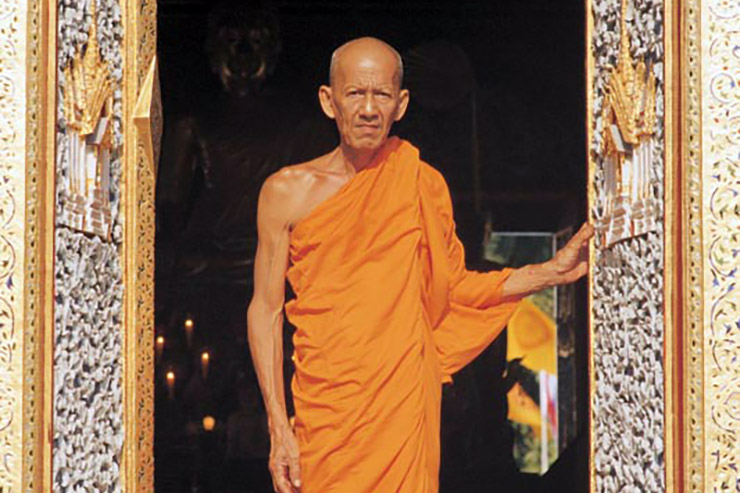
  • Monks & Magic: Buddhism and the Supernatural in Thailand

    Monks & Magic: Buddhism and the Supernatural in Thailand

    From New Dawn Special Issue 7 (Mar 2009)

    In August 2008 Bun Rany, the wife of the Cambodian Prime Minister Hun Sen, led Buddhist monks and soldiers to the site of the historic Hindu temple Preah Vihear to call upon their ancestors to protect the temple. The site of this temple is located on disputed land, perched atop a cliff on Cambodian soil but with the most accessible entrance to the site located on the Thai side of the border.

    This 11th century temple is located on the border between the two countries, but the borderline itself has never been clearly demarcated because the area is littered with landmines left over from decades of war. Ownership of the temple was originally awarded to Cambodia, but dispute between the two countries flared up when Preah Vihear was granted United Nations World Heritage status.

    Desperate to resolve the issue, both sides deployed military forces – but when they were unable to reach a solution to the conflict, Cambodia and Thailand resorted to supernatural means. Fearing that the magical abilities of Cambodia‘s Buddhist monks would weaken Thailand, residents throughout the province of Si Sa Ket wore yellow to help protect Thailand from Cambodian magic.

    Though Buddhism is not often thought of as a religion that practices magic, in such communities as those found in Thailand and Cambodia, there can be no doubt that Buddhism shares common ground with belief systems that are primarily associated with the use of magic.

    Both countries have a long history of engagement in spiritualist and animistic magical practices. When Buddhism first arrived in these areas it came into contact with pre-existent traditions that believed in spirits, both benevolent and malevolent, and a developed system of magic which was to be feared or revered, depending on whether or not it was used for good or ill.

    For Buddhism to flourish under such conditions in Thailand, it was necessary to develop a complex system of interaction between Buddhism and what has been called the Spirit religions. Debate still exists as to whether or not the two systems have become completely integrated or not, although the interaction of the two systems is sometimes referred to as an example of syncretism. On the subject of interaction between Buddhism and the Spirit religions in Thailand, the academician B.J. Terwiel says the following:

    When I interviewed villagers in Central Thailand on the relationship between Buddhist and non-Buddhist aspects of their religion, a variety of reactions were observed. The more sophisticated informants generally stated that the Lord Buddha had never forbidden rituals of ancient origin. Other persons hesitatingly made up their minds with regard to the orthodoxy of the ritual, but on subsequent occasions contradicted their own judgment. Many were at a loss to classify rituals or beliefs under rubrics such as ‘Buddhist’ and ‘non-Buddhist’.1

    It would appear from this statement that the boundary between the use of magic by the indigenous tradition of Thailand and the practice of Buddhism is not apparent to many of the inhabitants of Thailand themselves. This is most likely due to the fact that the people of rural Thailand are raised in a society where the two systems are found closely entwined together.

    The religious traditions of Thailand have always included the belief in spirits and the ability to manipulate them by means of magic. For example in Thailand preservation of the spirit of life (khwan) is considered to be of the utmost importance, as is ensuring that malevolent spirits (phii) do not enter the body. Control of these spirits is greatly emphasised in rural Thai culture, as the service of these spirits can be employed to improve the qualities of day to day existence.

    Magic and the Sangha

    In the lives of ordinary Thai people, more value is placed upon the improvement of their current existence than on transcending the cycle of rebirth, as is advocated by Buddhism. The relationship between the members of the Sangha (community of Buddhist monks) and the practitioners of magic in Thailand combine in a variety of ways, as one system (the Spirit religions) deals with the aspects of gain in this world (laukika), whilst the other (Buddhism) advocates the importance of salvation and ideas of transcendence (lokottara).

    This relationship is complicated even further by the fact that in Thailand almost every adult male will become a member of the Sangha at some stage in his life, for in rural areas the taking of vows is considered to be an essential element in preparation for adult life. Given the wide range of magic and animistic beliefs which operate within rural Thailand, these men will carry a variety of beliefs and practices with them into the Sangha, not all compatible with the ethics of Buddhism.

    In accordance with this, religious opinions are not questioned during ordination. As a direct result, villagers can be found entering the Sangha for a variety of reasons, as is reflected in the following Thai rhyme:

    Ordination to fulfil a promise to the Gods,

    Ordination to escape poverty,

    Ordination to flee from a wife,

    Ordination to save money,

    Ordination to eat better food than at home,

    Ordination to join one’s friends in the monastery.2

    Thai belief does not only consist of beneficial Gods and spirits. It also abounds with belief in ferocious spirits of pure malevolence, from who the villagers seek magical protection. Amongst these classes of malevolent spirits are such beings as the preed (a giant, looming shape with a small head that emits a sharp, piercing sound, as a reflection of its past sins), the phii krasy (a type of parasite which inhabits human bodies, feeds on excrement, and is shaped like a human head with entrails protruding from beneath), and the phii baan (the ghosts of ancestors that hover around their previous home and watch their descendants with malignant jealousy).

    Whilst it is possible for these spirits to be exorcised, Buddhism chooses to deal with their interfering presence in another way; the correct approach for a Buddhist to cause these spirits to cease meddling in the affairs of their human victims is to preach to them, thus converting the spirits involved to a more benign nature. There are certain canonical texts which serve this purpose of protection, which can also be recited at specific times in order to avert misfortune. These texts are known as the phraa parit. The source of the magical power of these texts has not yet been clearly identified, but Y. Ishii, author of Sangha, State & Society: Thai Buddhism in History, claims that whilst some possessed a magical content from the beginning, as modifications of Hindu rites, others such as the Mangalasutta originally had no magical connotations.3

    Indeed, for most people, including some who chant them, the parit are incomprehensible, being in Pāli. Rather, I believe, the magic of the parit stems from three factors: the social recognition that parit should be chanted for certain purposes (e.g. blessing); the existence of an established formula for their chanting; and the sanctity attributed to the chanter.4

    The use of parit is a means by which to ensure protection; it provides good luck and disperses misfortune whether caused by the presence of spirits or not. As is seen in the above passage the presence of magic being used by the Sangha is not overtly explicit in the parit texts, rather it is interpreted to be so by the lay audience. They do not understand the words the monks recite, but because of the respected state of the Sangha in Thailand, the lay community assumes that it must be not only beneficial, but also powerful.

    Amulets

    Another type of magic practiced by the Thai Sangha is the manufacture of amulets. These amulets are employed for a variety of reasons, including protection from diseases, black magic and accidents. Of these amulets the ones portraying the Buddha are the most popular, although some also are made in the likeness of famous monks and King Chulalongkorn (also known as Rama V, one of Thailand‘s most revered kings).

    The sanctity of the subjects portrayed upon the amulets is a reflection of the beneficial powers they are thought to contain. The Buddha images vary in size, from anywhere between two and eight centimetres, and can be manufactured from wood, metal, ivory or resin, although frequently they are made from a selected combination of these elements, pressed into a mould and baked.5 To create a pressed or printed image (phraaphim), a monk needs not only a mould, recipe and the proper ingredients; he also requires an advanced knowledge of spells and sacred script.6

    The inherent sanctity of the amulet is not always thought to be sufficient; hence its power needs to be enhanced by means of the correct recitation of spells and sacred scripts. The most simple of these sacralisation rites is known as plugseeg.7At the culmination of plugseeg the monk will either blow upon the Buddha image or draw over the amulet with the index finger of his right hand.8

    During the manufacture of amulets the Sangha is also invited to perform a consecration rite known as phutthaphisek.9The use of magic within the phuttaphisek is illustrated by the fact that it is desirable for at least one of the monks participating in the phutthaphiseek to be either advanced in meditative technique or in the Brahmanic rites known as saiyasat.10

    These rites are intimately entwined with another type of Thai ritual, namely the ceremony held to consecrate Buddha images which infuse the representation with the auspicious wisdom and power associated with Prince Siddhārtha’s victory over the demon Māra and the obtainment of enlightenment by Siddhārtha. During this ritual monks chant in Pāli or preach in Northern Thai several texts including the Buddha Abhiseka (Consecrating the Buddha [Image]).11 This text focuses on the powers of the mind attained by the Buddha that are associated with his enlightenment. Both the consecration of images and amulets draws their impetus from this core idea.

    One specific example of a text dealing with the extraordinary supernatural powers of the Buddha that occupies a position of prominence in Thailand is Bimbās Lament. (Bimbā is the Buddha’s wife, who he left to pursue the life of an ascetic.) 

    By his magical power he created a crystal path in the sky from the eastern boundary of the city of Kapilavastu to its western perimeter. Then, ascending into the air, the Tathāgata, surrounded by many previous Buddha’s, walked on the sky-bridge he had miraculously created… he also preformed other miracles, such as appearing to walk above the heads of the Śākyans.12

    Tattooing is another magical practice that is widespread throughout Thailand. At some stage in their adult life many Thai males will receive a tattoo of some description or another. This is of significance because in the culture of rural Thailand tattoos are representative of magical power. The magical power of these tattoos stems in part from the tattooist, for whilst both layman and monk may be a tattooist, there is vast difference in the scope of their work and the designs used.

    The types which may be employed by the monk are restricted. As a monk, he is limited to tattooing the upper parts of the body, for not only would it be seen as sexual misconduct on the part of the monk to tattoo the lower areas, the upper parts of the body represent the higher, more spiritual aspects of humanity, whereas the lower regions represent mankind’s more base, animalistic attributes. The tattoos done by the monk are also limited in application. The monk may bestow tattoos that are of a beneficial or protective nature. Other tattoos, such as those which bestow things such as sexual virility, can only be performed by members of the lay community.

    Another Thai rite involving magical skills of the members of the Sangha is the Wong Dai Sai (Encircling with Holy Thread).13 This is a type of consecration rite designed to protect a place from evil. It is believed that the consecrated place will be protected by the power of the Three Gems and the phraa parit.14 During this rite cotton is affixed to an image of the Buddha, stretched clockwise (as is the way of beneficial magic; anticlockwise is considered to be used for evil purposes) around the place to be consecrated, and finally wound back to its point of origin, at the Buddha image.15 If the thread should snap at any stage, it is considered to be an ill omen.

    The main doctrinal link between Buddhism and the Spirit religions is found in the incidences where magic is employed by the Sangha as a transfer of merit. The theory of the transference of merit is based upon the concept that when a member of the lay community performs a virtuous deed, such as making a donation or feeding a monk, the Gods witness the act and empathise with the process. The Sangha themselves are referred to as being a ‘field for merit’ (na bun), as is found in the Sanghnussati-bhavana.

    Well practiced is the Exalted One’s Order of Disciples, practiced in integrity, practiced in intellectual methods, in right lines of action – to wit the four pairs, the eight groups of persons – this is the Exalted One’s Order of Disciples, worthy of offerings, oblations, gifts, salutations, the world’s peerless field for merit.16

    Monk’s Superior Magical Status

    The greater the purity of the monk, the more magical power/merit he is said to generate. The sanctity of the monk himself is the source of belief in the efficacy of his magical power. The magical power that is generated by the monk is also classed as being superior to that of the layman, but by its very nature it is also more limited in its application. A monk is also deemed to be superior to a spirit, and thus a monk should never be seen to supplicate himself before a spirit. When a member of the Sangha addresses a spirit, he never raises his hands in supplication, in contrast to the layman who will raise his hands when requesting a favour from a spirit.

    The superior magical status of the monk stems from his purity; the monk must not do anything to compromise his superior position. Part of the magical power which results from the monks’ purity is derived from celibacy. A monk should never touch a female (human or animal), and is forbidden to even receive an object that is directly given to him by a woman.17 In order to receive an object given by a woman, the monk must first take a piece of cloth and place it upon the floor, upon which the woman will then place the gift in whilst the monk holds the edges of the cloth.18 The cloth is used as a medium by which to transfer merit since there can be no direct contact between a monk and a woman. The merit flows from the fingers of the monk holding the cloth, to the woman who has donated the cloth. The medium of cloth must be used so as not to deprive the female donor of the merit she would otherwise not receive. One of the reasons for which a monk may not have contact with women is not only due to the temptation of sexual misconduct, but also because women are believed to be associated with a type of magical power said to be diametrically opposed to that of the monk.19 This is due to the fact that menstruation is associated with dangerous magical power, and is classed as being capable of destroying some of the beneficial power of the Sangha.20

    Another aspect of magic in Thailand which needs to be considered is the import of magical systems via India. The branch of Buddhism found in Thailand is an older form known as Theravāda, and its links to Hinduism are much stronger than those of the later Buddhist schools. For example, in the book A Summary of the Seven Books of the Abhidhamma (Abhidhamma Chet Khamphi Ruam) there are elements of cosmology, cosmogony, buddhology, ethics, epistemology and language that are integrated into a yantric/mantric system.21 This system is very much similar to that found in Indian magic, and it is reasonable to assume that many of the formulas found within are directly based on the use of Hindu mantras. These are broken down into component syllables for recitation by the Buddhist practitioner. The mantra Namo Buddhāya (Homage to the Buddha), is correlated with the five vowels, symbolising the five elements (dhatū) – water, earth, fire, air and atmosphere.

    Furthermore, in the following passage from the Seven Books of Abhidahamma, we also find a formula which contains correlations with the Hindu Tantric Yoga techniques, dividing the body into a solar right and lunar left, and creating what appears to be Buddhist chakra centres. This integration of the occult, Tantra and Buddhism is by no means unique for it is prolific in Tibetan Buddhist texts and practices.

    Na = the Buddha Kakusandha at the right eye

    Mo = the Buddha Konagāmana at the left eye

    Bhud = the Buddha Kassapa at the back

    Dhā = the Buddha Gotama at the naval

    Ya = the Buddha Ariya Metteyya at the forehead22

    Get the issue this article appears in

    Transmission of Occult Techniques

    One possible explanation of how this similarity between Thai Buddhist and Hindu occult techniques occurred can be found by examining the magical history of a third South East Asian country – namely Myanmar (Burma).

    In the late eighteenth and early nineteenth centuries, Burmese kings imported large numbers of Sanskrit texts from India on topics such as medicine, alchemy, incantation and astrology.23 In Burma, these Buddhist wizards are practitioners of what is called the weikza-lam (path of occult knowledge). This tradition still exists today in Burma, and the largest of the groups practicing this occult path is based in the city of Pegy, and is called the Manosetopad Gaing. Like their Thai counterparts, this organisation bases an interest in the occult on the powers attained by the Buddha on the path to enlightenment. They also believe that the relics of the Buddha (Burmese dat-daw) (Pāli dhātu) are possessed of a kind of majestic power that he infused in them through the force of his samādhi.24 The similarity between this branch of Burmese magic with that of the Thai people is amply illustrated in the following extract from a magical treatise by the Manosetopad Gaing:

    A person wishing to practice the path must first suffuse his mind with thoughts of the Three Jewels, and cultivate loving kindness toward the various grades of nats… the nats referred to here include powerful nature spirits dwelling in trees, the earth, and mountains, minor deities who preside over the use of magical incantations and diagrams, and medicine spirits whose domain includes the well-known herbs and minerals of alchemical lore.25

    From this passage it is clear that the Manosetopad Gaing not only use Buddhist motifs, they are also drawing upon a much older tradition of Spirit religions and animistic world views. These Buddhist wizards, however, are also drawing upon Hindu texts on supernatural lore; and if such texts entered the Burmese magico-religious system then it is entirely possible that influences from India may help to explain what appears to be a yantric/mantric tradition within the Thai Seven Books of Abhidahamma.

    With their magical prowess and the protection of the Sangha, why do the Thai people fear the magic of the Cambodians? Cambodia is also a country with a long history of occult practices. For instance, in the Khmer book The Tale of Ancient History there is a legend of Prince Chey Ahca who led a ghost army against the Siamese – Siam being an earlier name for Thailand. More recently, we also find record of Po Kambo, who in 1866 protested against French colonial rule and was alleged to know a magical formula that deflected bullets. Even as recently as the 1970s and 1990s, Khmer soldiers utilised magical tattoos, in a similar manner to that of their Thai enemies, and used mantras written in Pāli and Sanskrit, the holy languages of Buddhism and Hinduism, to protect them in battle.

    All of the magic employed by the Sangha in Thailand is based on one important concept: the sanctity and purity of the Sangha themselves. The forms of magic the Sangha use is limited in scope by this fact, for they can use only what is generally referred to as ‘white’ magic: that which benefits another and causes no harm. Use of magic to harm another or for personal gain would result in expulsion from the Sangha. Similarly, a monk may not use magic that serves to improve the virility of a layman or create love charms, as this could severely impair the powers of the monk which stem from his sexual abstention. A monk may not request the spirit world for aid, for this would compromise the superior status of the monk who is deemed to be beyond the mundane affairs of this world.

    Whilst the power of the Sangha is more limited in application than that of laymen, it is also deemed as stronger for it stems from other worldly sources, as opposed to the spirits who remain bound to this world. As such, villagers come to the monk knowing that when they treat the monk with a proper attitude of respect, the cosmic forces shall share their merit and transfer it to demonstrate approval. The transfer of merit thus benefits not only the Sangha, but the laity as well – even providing protection in times of conflict.

    [alert type=”general” dismiss=”no”]This article was published in New Dawn Special Issue 7.[/alert]

    [alert type=”success” dismiss=”no”]If you appreciate this article, please consider subscribing to help maintain this website.[/alert]

    Footnotes:

    1. B.J. Terwiel, Monks and Magic: An Analysis of Religious Ceremonies in Central Thailand (Curzon Press, 1975), 3.
    2. Ibid., 20.
    3. Y. Ishii, Sangha, State & Society: Thai Buddhism in History (University of Hawaii Press, 1986), 21.
    4. Ibid., 21.
    5. B.J. Terwiel, Monks and Magic: An Analysis of Religious Ceremonies in Central Thailand, 74.
    6. Ibid., 75.
    7. Ibid., 77.
    8. Ibid., 78
    9. Y. Ishii, Sangha, State & Society: Thai Buddhism in History, 23.
    10. Ibid., 25.
    11. D. K. Swearer, Consecrating the Buddha, in ed. D. S. Lopez, Jr., Buddhism in Practice (Princeton University Press, 1995), 50.
    12. D. K. Swearer, Bimba’s Lament, in ed. D. S. Lopez, Jr., Buddhism in Practice (Princeton University Press, 1995), 543.
    13. Y. Ishii, Sangha, State and Society: Thai Buddhism in History, 22.
    14. Ibid., 22.
    15. Ibid., 22.
    16. Ibid., 14.
    17. B.J. Terwiel, Monks and Magic: An Analysis of Religious Ceremonies in Central Thailand, 114.
    18. Ibid., 114.
    19. Ibid., 115.
    20. Ibid., 115.
    21. D. K. Swearer, A Summary of the Seven Books of Abhidamma, in ed. D. S. Lopez, Jr., Buddhism in Practice (Princeton University Press, 1995), 336-7.
    22. Ibid., 340.
    23. P. Pranke, On Becoming a Buddhist Wizard, in ed. D. S. Lopez, Jr., Buddhism in Practice (Princeton University Press, 1995), 343.
    24. Ibid., 345.
    25. Ibid., 351.

    © New Dawn Magazine and the respective author.
    For our reproduction notice, click here.