New Dawn – World's Most Unusual Magazine

Author: Joscelyn Godwin

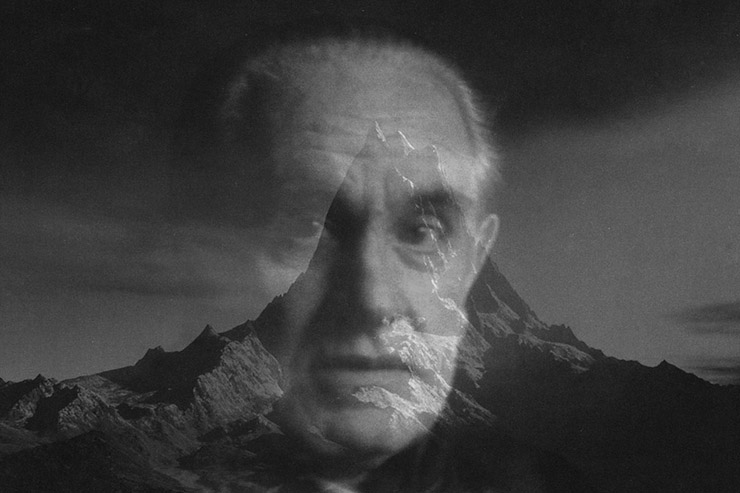
  • Matgioi – Warrior Metaphysician

    Matgioi – Warrior Metaphysician

    From New Dawn 207 (Nov-Dec 2024)

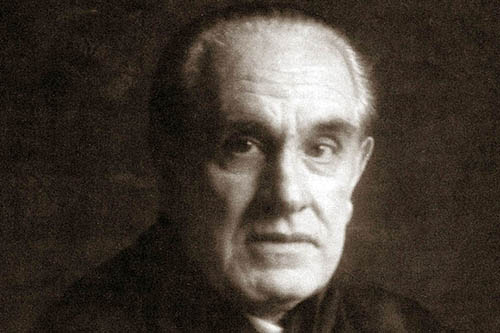
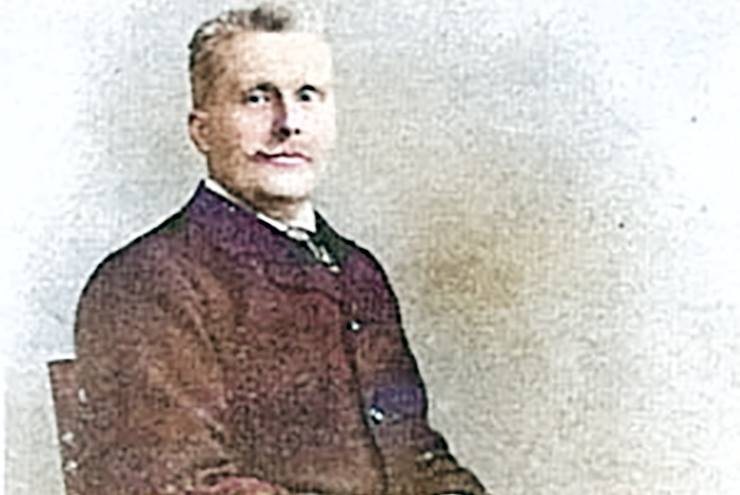
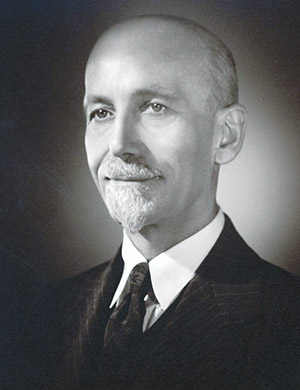
    One could not wish for a better example of the Kshatriya or warrior path than Albert, Comte de Pouvourville (1861-1939). He was born an “army brat” in a minor aristocratic family, richer in honours than in land or wealth. They lived in Lorraine, facing the ever-present threat of German invasion. Albert’s childhood was overshadowed by the Franco-Prussian war and France’s humiliation (1870). As he recalls, he learnt to read from the daily orders of the imperial camp at Châlons, and shot at his first paper targets with General Saussier’s pistols. As the eldest son, there was no doubt he would follow the family’s patriotic path to revenge.
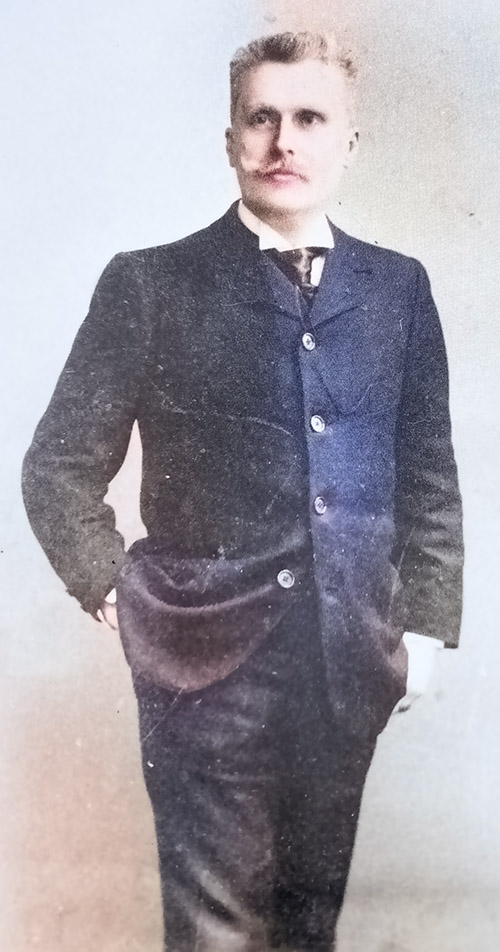
    Albert, Comte de Pouvourville

    A different world opened to Albert at his high school in Nancy, where his classmates included Stanislas de Guaita, Maurice Barrès, and Paul Adam. They formed a clique of aesthetes and poets, all destined for literary or political fame. Albert’s best friend Guaita would become a pillar of the French occult revival; Barrès, a popular novelist and right-wing politician; Adam, an anarchist and leader of the Symbolist school of literature. 

    After this inspiring interlude, Albert attended the academy of Saint-Cyr, a breeding ground of France’s generals. He distinguished himself by all-round brilliance and absolute intolerance of authority. This persisted in his first military posting, where his father kept him from its worst consequences. Eventually, Albert took the historic leap of anarchic warriors and joined the French Foreign Legion.

    Posting to Vietnam

    He was posted to Indochina (then called Annam, now Vietnam), where the colonists held a fragile balance between European traders, mandarin and peasant classes, Chinese interference, brigands and pirates. Corruption and violence were the order of the day. Sickly horrors awaited those sent up-country to map the jungle and pacify its denizens. Thanks to his Saint-Cyr training, Albert had better surveying skills than anyone in the colony and used them to prepare the territory for roads, forts, and telegraph. During his first tour of duty, he collected enough material for three books describing his campaigns and criticising colonial policy. He was sure that he could have run things much better.

    Arrogant he may have been, Albert had a natural sympathy with the Annamite people and respect for their ways. On his second tour of duty, he commanded a native militia corps and crushed a pirate gang that had massacred scores of civilians and soldiers alike. He writes impassively of scenes one would rather not read about. Always curious, he studied the Annamite executioner’s technique of striking between the cervical vertebrae and felt confident that he could do it if required.
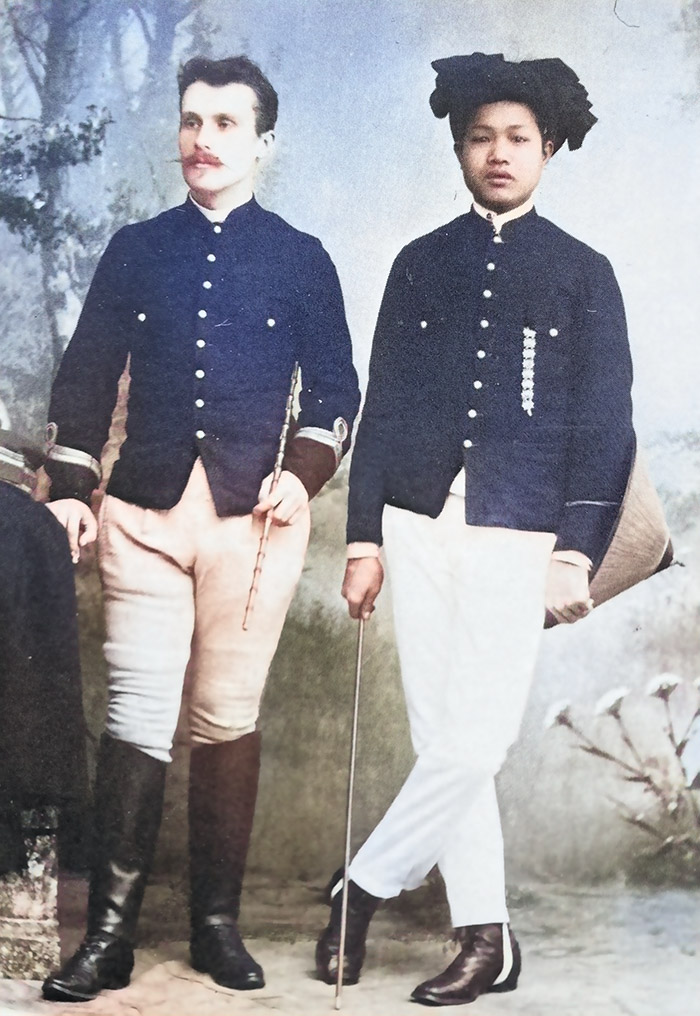
    Matgioi with Nguyen Van Cang.

    He also made friends with a village chief and physician, who authorised his younger son Nguyen Van Cang to join the militia under Albert’s personal care. The document was written in classical Chinese with interpolations in Vietnamese script. Albert became competent, up to a point, in both languages. The Annamite chief instructed him in Daoist philosophy and, in some sense, initiated him into a secret society. What actually happened is obscure, the narratives mixing fact with fiction. But it sufficed for Albert to pass forever after as a Daoist initiate. He took the Chinese name of Matgioi, meaning “eye of day,” under which he published the relevant works, while Albert de Pouvourville continued his parallel career as novelist and colonial expert.

    Matgioi’s third and final tour, ending in 1892, was more cultural than military. The resulting book on the arts and crafts of the region showed both an aesthete’s eye and a scientist’s attention to techniques and materials. It also contained the germ of the Traditionalist or “Perennialist” doctrine of art, as later preached by A. K. Coomaraswamy and Titus Burckhardt. This rejects the Western exaltation of the artist’s originality, style, and character in favour of the anonymous craftsman who aims for perfection in timeless forms endowed with spiritual symbolism.

    Devotion to Opium

    Matgioi’s time in Indochina, barely adding up to four years, yielded a mass of memoirs, novels, and cultural, geographical, and statistical studies. It also gave him a lifelong devotion to opium, on which he later ranked as a scientific expert. His nephew Guy de Pouvourville had childhood memories from the 1930s of his uncle’s extreme caution in admitting visitors and the odd smell permeating his house. Matgioi maintained that opium, properly prepared and used, protects one from most diseases and has no ill effects if kept within sensible limits: never more than fourteen pipes a day.

    Another advantage of opium, in Matgioi’s scheme of things, is its anti-aphrodisiac effect. He approves of the Annamite attitude to sex as merely the means of propagating male descendants who will continue the cult of the Ancestors. Thus, “the man dispenses with the passionate longings, the time wasted in love, jealousy, and all the sentimentality in which, among the Whites, woman reigns exclusively.” There is no evidence that he had lovers of either sex. Later, he had a brief marriage which produced one daughter and a quick separation, and in his old age a second wife appears, of whom nothing further is known.
    Occult Revival

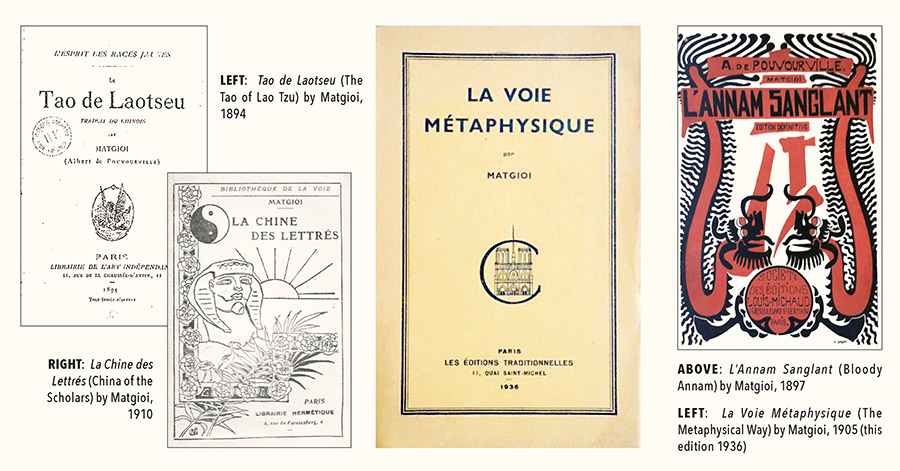
    On his final return from Indochina in 1892, Matgioi found the French occult revival at its height and its informal centre at the bookshop of Edmond Bailly near the Paris Opera. There, one could meet alchemists and kabbalists, symbolist painters, decadent poets, and musicians such as Debussy and Satie. Bailly aimed higher than the popular psychic and spiritualist fads. His publisher’s emblem was a sinister-looking siren with the motto: “Not everyone’s kettle of fish” (Non hic piscis omnium). His journal, La Haute Science (The High Science), presented translations of esoteric classics of all nations and eras. This suited Matgioi’s taste, while his Daoist initiation gave him a unique flair. In 1894, Bailly’s journal published his translation of Laozi’s Daodejing (Tao Te Ching), which credited Nguyen Van Cang, the village chief’s son, as collaborator for the “paraphrase of the Chinese characters.” Matgioi included so many put-downs of previous translators that the editor felt obliged to apologise, saying that they weren’t in the spirit of the journal. According to modern experts, this so-called “exact translation” contains gross errors, and it certainly does not resemble the standard French or English versions. Nonetheless, it shows how the famous text was understood by some educated Annamites given to a Francophone public avid for Eastern wisdom.

    Matgioi turned to Guaita’s friend Papus, the uncrowned despot of Parisian occultism, to publish his subsequent works: a series called “The Spirit of the Yellow Races.” This treated such themes as opium, Chinese medicine and poisons, popular ideas of the afterlife (mostly hellish), and Daoist secret societies. Meanwhile, “A. de Pouvourville” turned out novels and reportage set in Indochina. The most successful, Annam Sanglant (Bloody Annam), reached its 45th thousand by 1933. It is a superbly decadent work, glamorising the rebel as a superior and spiritual being, combining luscious description with gruesome violence, and promoting opium as the panacea for all ills.

    Guaita’s death in 1897, aged only 36, was deeply felt by Matgioi and the whole esoteric community. The following year, Pouvourville put his rebellious past behind him and joined the French Colonial Institute, probably alongside secret work for the intelligence services. Given his family origin, he moved easily in establishment circles. There are hints of returns to Indochina and missions to North African colonies. Like Guaita, Pouvourville left no progeny, and whatever documents survived after WWII seem to be lost now.

    Matgioi returned to the esoteric scene in 1904, directing his own journal, La Voie (i.e. “The Way” of Daoism). At last, he realised the project inspired by his Annamite master: “confronting the Truths of East and West with one another, which are really only one.” It would be a trilogy: La Voie Métaphysique (The Metaphysical Way, based on the Yijing), La Voie Rationnelle (The Rational Way, based on the Daodejing), and La Voie Social (The Social Way, based on Confucius). The first two were issued in monthly instalments, then as books in 1905 and 1907. The third volume never appeared.

    Paris in the 1890s seethed with cults, conventicles, and tiny churches with huge claims. One of these, the Universal Gnostic Church, originated at a séance in 1889, on the instructions of the spirit of a medieval Cathar. Gnosticism claimed to be the true Christianity, distorted and persecuted by the Roman church. This suited the anticlerical Matgioi, who was consecrated as “Simon, Bishop of Tyre and the Orient.” Together with “Théophane, Bishop of Versailles,” he wrote a short doctrinal book called “The Secret Teachings of Gnosis” (Enseignements secrets de la Gnose). Like his Daoist work, it reframed traditional wisdom in modern terms. These included concepts such as Being and Non-Being, Universal Possibility, the nature of the Demiurge, the equivalence of death and birth, and the contrast of the Primordial Tradition with its distortions by “revealed” religions. All this offered “a practical doctrine, in the sense that it seeks to influence men and guide them, through multiple transformations, towards what it knows to be their final and excellent end.”

    The Metaphysical Way & Yijing

    Matgioi’s biography opens some revealing windows into his times, both in Indochina and Paris. His writings are another matter. Are they worth reading, much less translating? In the case of The Metaphysical Way, I have no hesitation. It is a forbidding title. But if one is looking for solutions to the enigma of life, as I was when I read it fifty years ago, it can be a landmark and even a lifeline.

    My attention was first caught by mention of Matgioi in René Guénon’s Les États multiples de l’Être (The Multiple States of Being), which I was translating. La Voie Métaphysique was my first introduction to Daoism, apart from a friend who started each day by casting the I Ching, as it was known then. Matgioi’s approach could hardly have been more different. His interest is not in divination but in the Yijing as the earliest witness to the Primordial Tradition, as old as humanity. 

    According to Matgioi’s understanding of prehistory, which was derived from esoteric sources such as Fabre d’Olivet and Theosophy, humanity originated in central Asia. Climate change, or mere curiosity, caused it to descend to the plains, where it divided into the four races, distinguished by skin colour. Aeons later, the mythical Chinese emperor Fuxi (Fo-Hi) adapted the Tradition by giving it a geometrical expression. The straight line represents “active Perfection,” which in theistic terms is God’s own nature; the broken line, “passive Perfection,” which is the manifested universe. Their combination yields the system of the 64 hexagrams of the Yijing. None of this has anything to do with an anthropomorphic God but the impersonal process by which universes are governed. Here, I will summarise the conclusions to which his study of the Yijing and his Daoist initiation led him.

    There is nothing special or privileged about Humanity. It is one of the universe’s innumerable forms, and earthly humanity is but one modification of that form. From our point of view, the human form is one of a multitude of others through which we pass. The process can be symbolised by a spiral inscribed on a cylinder (diagram 1). Each turn of the spiral represents one life, for example, that of an earthly man or woman. It begins with birth, which is, in fact, death to our previous and lower state (the preceding turn). It ends with death, which is birth into our next and higher state. The rising pitch of the spiral symbolises the Law of Harmony or “The Good,” which governs the evolutionary process on every scale – personal, collective, planetary, cosmic, and universal.
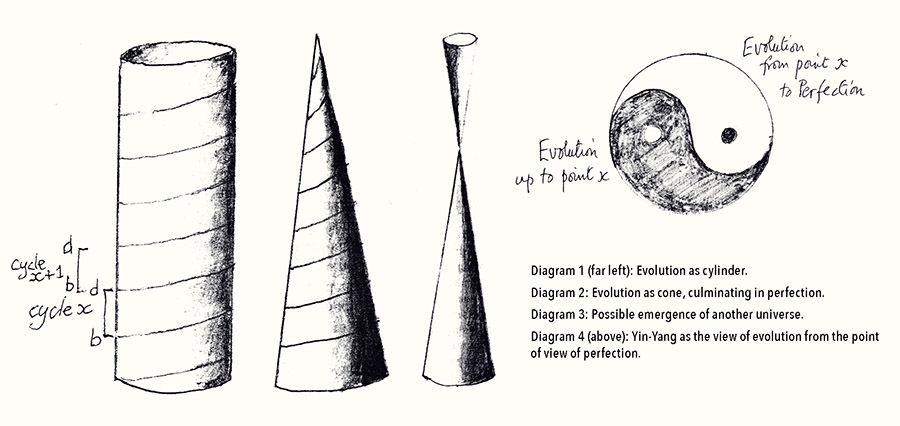
    In geometry, a cylinder projected to mathematical infinity becomes a cone. This is the more appropriate symbol for the evolutionary process (diagram 2). At its vertex, in Daoist terms, is the Will of Heaven, which draws the universe to its ultimate Perfection and reabsorption. Matgioi leaves open the question of whether, once that is attained, another universe begins. If so, its symbol would be the double cone (diagram 3).

    The Yin-Yang symbol (diagram 4) is like a slice through the evolutionary cylinder. It symbolises our present state, the dark half representing our emission from Perfection, the light half our future reintegration therein.

    There is no freedom or chance in this grand process of universal evolution. Humans are not free to choose either their birth or death. But the human state is unique in one respect: between those limits, the Will of Heaven is not felt. Consequently, humans do have freedom, which they can use for better or worse. This alone is the locus of good and evil, along with their repercussions in this or a future life. Since evil does not exist as an independent entity, no punishment can be eternal. All beings are eventually destined for Perfection.

    What joins our successive lives, these turns on the spiral of our evolution, is the Personality, a completely distinct entity. It is immortal, containing an indefinite number of individuals whose births and deaths do not affect it. It absorbs them all, the heritage of former cycles, and nothing of them is absolutely lost. All positive acts and emotions contribute to its ultimate goal of unity. This also ensures that personalities which were emotionally close will remain so in future cycles, as they were in past ones.

    These metaphysical studies have a practical corollary. Our current state as humans gives us the freedom to conform to the Will of Heaven. If we rely on its principle, disengage from passions, and rationally weigh the consequences of each act, then every step we take – every effort, thought, even dream – is part of our inevitable spiral ascent to the Centre and the Truth. 

    One can see from this summary that Matgioi’s is an optimistic philosophy, in contrast to Traditionalists like Guénon who dwell with good reason on the negative aspects of humanity’s current state. Whereas they emphasise the devolutionary cycle of four Ages or Yugas, Matgioi takes the broader, evolutionary view, symbolised by the rising turns of the spiral. Each turn would then comprise an entire Yuga cycle, its components apparently declining as they accelerate, but each cycle being “higher” than the previous one. This would be the macrocosmic equivalent of the individual’s life, which is, in a sense, a decline from the Golden Age of infancy to debility and death, but for whom death to this state is immediate birth into a higher one. Incidentally, there is no support here for the Yuga theory invented for political purposes by Sri Yukteswar Giri (see my article “When Does the Kali Yuga End?” in New Dawn 138.)

    Guénon & Matgioi
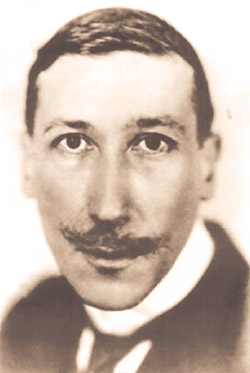
    René Guénon

    Having mentioned Guénon, I return to his role in Matgioi’s biography. In 1908, a group of Martinists held a séance in which the spirit of Jacques de Molay, last Grand Master of the Templars, manifested. He commanded that the Order of the Temple be renovated and headed by René Guénon. The young philosopher had already attracted attention by joining every possible esoteric, occultist, or Masonic group in Paris, and he consented – if, indeed, he did not precipitate the whole affair. The new Order’s first session of automatic writing produced a flood of information that included themes and even titles of Guénon’s future books, including The Multiple States of Being and The Symbolism of the Cross. The following year, the Gnostic Church, in which he was “Palingénius, Bishop of Alexandria,” started a monthly journal, La Gnose, under his direction. Just as La Voie had pre-published Matgioi’s books, so La Gnose served for Guénon’s. It also presented the Archéomètre, the great posthumous work of Saint-Yves d’Alveydre, and articles on Islamic esotericism by Ivan Aguéli, a Swedish painter who had been initiated in Egypt into a Sufi order. Matgioi contributed an article on “The Metaphysical Error of Sentimentally-Based Religions.”

    Guénon, like Saint-Yves, claimed to have received teachings from mysterious Hindus. Together with Matgioi’s Daoism, Aguéli’s Sufism, and a Gnostic approach to Christianity, the foundations were being laid for a Traditionalist movement dedicated to the transcendent unity beyond the diversity of exoteric religions. Theosophy had been proclaiming this for thirty years, but the Theosophical Society was riven by squabbles and scandals following Blavatsky’s death. The new movement, which soon forgot its spooky origins, preferred to go straight to the ancient sources and the symbols of a primordial wisdom.

    Matgioi later reflected on his Daoist initiation with a humility that other pretenders would do well to heed:

    Beside certain incidental but still valuable notions, I mainly acquired the certitude of my imperfections, my ignorance, and my unworthiness. This, it seems, is the first step of wisdom. I greatly fear that I have not risen to others. But this poor ascent has nevertheless been extremely useful in my existence: it has given me defiance of the ego and disdain for the universe. (Chasseurs de Pirates! 1928, p. 185)
    Get the issue this article appears in

    Matgioi’s Writings Post-WWI

    The First World War effectively ended the French occult revival and with it Matgioi’s metaphysical works. He remained all the more active as a writer on colonial and military studies, beginning even in the heat of the war with close analyses of its progress. His fiction ranged from pirate and spy stories to prophetic visions of the next war. These were aimed at a popular audience and published in cheap “pulp novel” format. 

    By 1934, after the re-arming of Germany and the Nazi ascent to power, another war seemed inevitable. This time, it would not be fought by infantry in trenches but in the air, in tanks, and with unheard-of weapons that scientists, to their shame, were already inventing. This was the subject of his epic novel, published during 1934-35 under the authorship of “A. de Pouvourville, de l’Institut Colonial.” The first six parts were called La Guerre Prochaine (The Coming War), the following twenty-four parts L’Héroïque Aventure (The Heroic Adventure). It appeared in weekly instalments of 96 pages, promising “three hours of the most gripping reading.” The lurid covers and illustrations show ray guns, “navigyres,” “aquatanks,” “Z-rays,” and other fantasies of Art Deco science fiction. Germany is the eternal enemy; France the ultimate victor, allied with Mussolini’s Italy, Czechoslovakia and, in a minor role, Britain. A separate novel, Griffes Rouges sur l’Asie, depicts the coming Communist takeover of Asia, but Pourvourville’s future war, with a sad lack of foresight, takes place exclusively in the European theatre. It concludes with the upstart Chancellor “Heizler” crushed by a Berlin mob and a peace conference in Rome under the presidence of the Pope.

    Was Matgioi, like that other warrior-author Ernst Jünger, turning Catholic in his old age? One wonders, for in 1934 he also published a book about Saint Theresa of the Child Jesus (1873-1897). Affectionately known as “The Little Flower,” Theresa represents an emotional Christianity for which Matgioi had always shown contempt. Guénon, when he heard about it, said that if Pouvourville was still alive, Matgioi was certainly dead! My interpretation is that with war clouds gathering, the ageing author felt a responsibility to his compatriots. His futurist epic warned readers of popular war stories, largely young and male, who would soon be on the front lines. The book on Theresa addresses devout Catholics in their own style, preparing them to face suffering with confidence in France’s protectors: Saints Genevieve, Clotilde, Joan of Arc, and Theresa. Now that the war has come and gone, those works are mainly of historical interest, while The Metaphysical Way, true to its subject, is a timeless contribution.

    Thanks to Dr. Jean-Pierre Laurant, first authority on Matgioi, for his guidance in the world of Parisian esotericism and his indispensable work Matgioi, un aventurier taoiste (Paris: Dervy, 1982), and to Dr. Davide Marino for his later discoveries and friendly advice.

    The author’s translation of Matgioi’s masterwork, The Primordial Tradition of Ancient China: The Esoteric Foundation of the I Ching and Chinese Cosmology, is published by Inner Traditions. Order your copy here.

    [alert type=”general” dismiss=”no”]This article was published in New Dawn 207.[/alert]

    [alert type=”success” dismiss=”no”]If you appreciate this article, please consider subscribing to help maintain this website.[/alert]

    © New Dawn Magazine and the respective author.
    For our reproduction notice, click here.
  • A Search for Paul Brunton

    A Search for Paul Brunton

    From New Dawn 191 (Mar-Apr 2022)
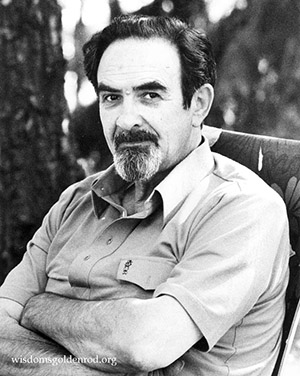
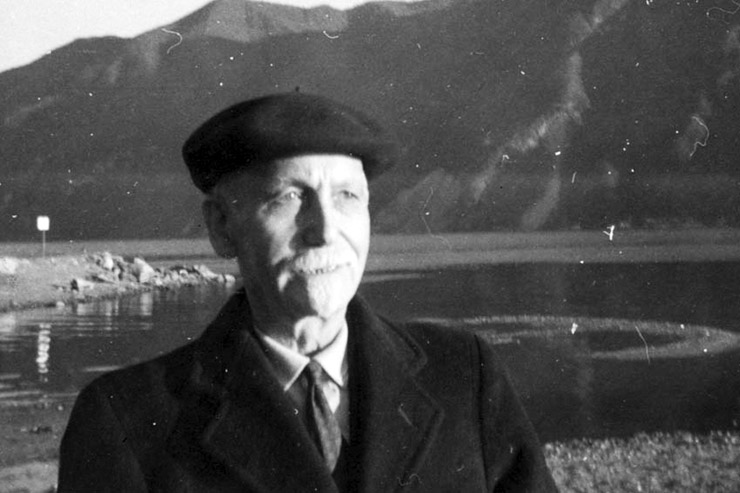
    Paul Brunton (1898-1981)

    There was a time when Paul Brunton (1898-1981) needed no introduction. From the 1930s through the 1950s, his eleven books were best-sellers in the field of alternative spirituality. A Search in Secret India and A Search in Secret Egypt played to a popular fascination with the Orient. 

    In Egypt, Brunton capped his meetings with magicians, snake-handlers, holy men and impostors by spending a night in the Great Pyramid, which he attributed to the Atlanteans. His Indian quest culminated in the encounter with Sri Ramana Maharshi, a living exemplar of Hinduism’s highest philosophy, that of Advaita or non-duality. (See “The Life and Teachings of Ramana Maharshi” by Jason Gregory in New Dawn 190.) These events defined the breadth of Brunton’s appeal, leading his readers, as he himself had been led, from psychism and mystical adventures to the supreme identity. 

    Paul Brunton with Ramana Maharshi, early 1930s.

    His subsequent books were a graded manual of training in what he simply called “philosophy,” from The Secret Path through The Quest of the Overself to the two-volume treatise The Hidden Teaching Beyond Yoga and The Wisdom of the Overself. He never sought disciples or led a movement in the outer world. His writings were a gift to the solitary seeker, who through circumstance or inclination lacks the support of a group or sect. But he accepted the burden of responding in person to sincere correspondents and giving his time and patience to countless private interviews.

    After his last book, The Spiritual Crisis of Man (1952), Brunton fell silent and apparently incommunicado. However, writing remained his daily habit. In his last decades, he wrote over 30,000 notes, ranging from one-liners to essays, in which he developed a universal philosophy for sane and spiritual living beyond anything in his books. During his last years, he allowed a few helpers to transcribe and classify them. They were published in 1984-89 as The Notebooks of Paul Brunton, in sixteen volumes bound in the bright orange cloth of the Buddhist monk, then in paperback. In one of the later notes, Brunton muses on how in a future incarnation he will discover them and be delighted by something so congenial to his tastes.

    He saw his mission, at least in one dimension, as making the wisdom and methods of the ancient East accessible to Westerners. The Theosophical Society, which he had joined in 1920, demonstrated the value of Eastern philosophies and the reality of occult phenomena, but had given little advice on how to apply them in one’s own life. This accounted for the success of magical and occult orders like the Golden Dawn, the A.M.O.R.C., or the Gruppo di Ur, which gave practical training or rituals, while also returning the West to its own esoteric heritage.

    In preference to such groups, Brunton had the advantage of two outstanding personal guides. One was Allan Bennett (1872-1923), a former member of the Golden Dawn who had travelled to the East in the company of Aleister Crowley and remained there to become a Buddhist bhikku. As “Ananda Mettaya,” he returned to London on a mission to proclaim the Noble Eightfold Path, and Brunton acted for a time as his secretary. Brunton’s own work retained a certain Buddhist character, with its freedom from formalism and mere belief, and its confidence in the possibility of liberation from the ego. But Gautama’s view of all existence as suffering did not seem to him a useful principle for modern Westerners. 

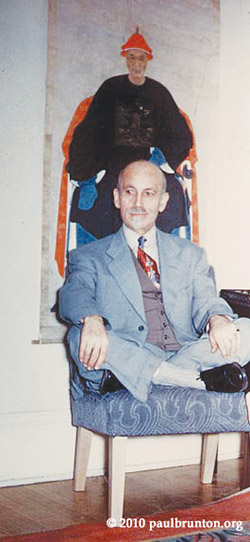
    Paul Brunton with painting of Chinese sage.

    Brunton’s other mentor was an obscure character known only as “Brother M” or by his surname of Thurston. He was of partly Native American ancestry, settled in London and worked as a painter in the arts and crafts field. Before the First World War, he had led a group called “The Brothers,” and his few publications bear their imprint. In the 1920s, “M” served a small circle of spiritual seekers as a fatherly adviser and guide on the occult ventures in which they were involved. One of them recalled this period in an “occult autobiography” of 1927 (The White Brother by Michael Juste), in which the young Brunton appears semi-fictionalised as “David.”

    There are mysteries about Brunton’s own biography, which he had no interest in revealing. To prevent misuse of his horoscope by inquisitive or hostile astrologers, he habitually gave out a false birthdate. When in 2019 his archive entered the library of Cornell University in Ithaca, New York, some of these mysteries were resolved – evidently with his consent, for before his death he had carefully sifted his papers and destroyed many of them. We now know that he was born on October 21, 1898, and named Hyman Abraham Isaacs, the only child of a master bootmaker in East London. He attended the Central Foundation School, originally called the “Middle Class School,” founded for the sons of skilled workmen and tradesmen who, while not poor, could not afford schools like Westminster, Eton, St. Paul’s, etc. In April 1914, he was registered as a “Temporary Boy Clerk” in government employment and subsequently worked in the Patent Office.

    At some point, the Isaacs adopted the surname Hurst, and Hyman the forename of Raphael. From 1917-18 he served in a tank regiment, perhaps chosen for his small stature to fit the cramped space in the vehicles. After the war, he ran a mail-order book service with his friend Michael Hurwitz (uncle of the eminent violinist Emanuel Hurwitz, writing as “Michael Juste” and bookselling as “Michael Houghton”), who established it as the Atlantis Bookshop, still flourishing near the British Museum. During the 1920s, Brunton worked for Foyle’s bookshop, in journalism, as personal assistant to a building contractor, and as author and editor, first of motivational and business publications, then as a prolific contributor to the Occult Review. By the end of the decade, Raphael Hurst was a familiar name in London’s esoteric subculture.

    Membership of that world, then as now, spanned the social scale from the impoverished Bohemians depicted in The White Brother to the titled and celebrated. Brunton joined the Astrological Lodge of the Theosophical Society on the same day as Mrs Eugene Goossens, wife of the conductor Sir Eugene Goossens, and Lady Smith Dodsworth, a baronet’s wife. Thanks to such connections, he was enabled to study in the library of the Royal Asiatic Society and had propitious meetings with Sir Francis Younghusband, who had commanded the invasion of Tibet in 1904 and was now President of the Royal Geographical Society.

    On the personal side, in 1922 Brunton married a young Danish woman, Karen Tottrup, and fathered one son, Kenneth Thurston Hurst. Within a few years, Karen and Kenneth moved into the household of Leonard Gill, proprietor of the Rudolf Steiner Bookshop, also near the British Museum. An amicable divorce followed in 1928, and as Kenneth matured, his father became his intimate friend and counsellor, steering him toward a successful publishing career in the USA. Kenneth’s memoir Paul Brunton: A Personal View remains the sole attempt at a book-length biography.

    The first intention of Brunton’s Indian quest of 1930-31 was to meet Meher Baba. The silent Iranian was enjoying his first period of international celebrity, and the trip may have been financed by his English disciples. When A Search in Secret India appeared, with its foreword by Younghusband and its instant rise to the best-seller lists, they were sorely disappointed by the author’s verdict on their master. The contrast was all too obvious with the climactic episode of the book, the meeting with Sri Ramana Maharshi, whose reputation as an authentic jivan mukti (liberated in life) would draw many pilgrims to the holy mountain of Arunachala.

    The tropical diseases which Brunton had caught in India affected him periodically for years. In order to recover and write his travelogue, he left London for Jordans, a Quaker village in Buckinghamshire where he had a cottage built and attended the venerable meeting house. Since 1932 he had been using “Paul Brunton” among his various noms-de-plume, and in 1935, with two books published under that name, he registered it formerly by deed poll. Later he always preferred to be addressed as “PB.”

    Although he had grown away from the Theosophists, his second book again secured a stellar endorsement: the foreword was by Alice A. Bailey, the scribe of neo-Theosophical works ascribed to “The Tibetan.” The Secret Path was a practical manual on how and why to meditate, inspired by Indian practices but free from Sanskrit or other foreign terms. This would remain Brunton’s principle: to put everything into plain English, including some terminology of his own when necessary. Its crucial concepts are the Overself, World Mind, and Mind in Itself, whose equivalents can be found in esoteric religions and in higher philosophies such as Neoplatonism. Also essential to Brunton’s teaching of the path are the ascending hierarchy of Religion, Mysticism, and Philosophy; the Sage as the ultimate goal of human endeavour; and the central doctrine of Mentalism.

    Get the issue this article appears in

    Brunton acknowledged that the mere observance of a religion, its morals, rituals, and beliefs, has its value for the majority of humankind. In a few, it kindles the aspiration for a personal experience of the Divine, a real encounter with one’s God. This leads to the higher degree of mysticism, with its special practices and great exemplars. But to realise the highest human potential, the mystic should not remain content with his or her experience, however sublime. The question of who or what is experiencing this must be asked, and there philosophy begins. Ramana Maharshi offered the exemplary practice of asking “Who (or What) Am I?”, whose answers become increasingly subtle, up to the sage’s state of absolute certainty where Overself and World Mind are one.

    The philosophic ascent confirms the truth of Mentalism, using the term in opposition to materialism. While the latter takes matter as its first principle, mentalism holds that matter has no independent existence, but is an apparent form taken by mental processes, both individual and cosmic. Modern philosophers classify this as “subjective idealism,” but the fact of classifying it implies distance. To actively embrace the mentalist philosophy affects psychology, cosmology, theology, and even the physical sciences. These lose nothing of their practical value, but they deal with forms in the mind, not with a separate material reality. The true philosopher aspires to exclaim, with a legendary Hindu sage, “The world is just one’s thoughts!” Brunton predicted that the best Western thinkers would come round to the mentalist position by the end of the twentieth century. Perhaps they have, but where are they? 

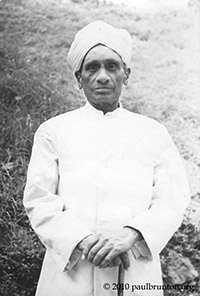
    V. Subrahmanya Iyer (1869-1949).
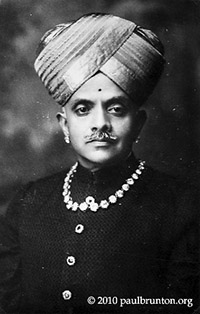
    The Maharaja of Mysore, Krishna Raja Wadiyar IV (1884–1940).

    A second stay in India (1935-37) brought Brunton into contact and friendship with the Maharaja of Mysore via his court philosopher V. Subrahmanya Iyer, and Mussorie Shamsher, Prince of Nepal, who facilitated the retreat chronicled in A Hermit in the Himalayas. On the way back to England, Brunton gave interviews in Austria, Hungary, and Czechoslovakia, where a devoted group of students persisted throughout the Nazi and Communist periods. In August 1937, he accompanied Iyer to the International Conference on Philosophy in Paris, then to Switzerland for a meeting with Carl Gustav Jung, which resulted in Jung’s own Indian journey at the turn of the year.

    With such high connections, one wonders why in 1938 Brunton obtained a PhD diploma from McKinley Roosevelt Graduate College in Chicago. This was not an accredited institution but a diploma mill that supplied impressive-looking documents for a fee. Brunton submitted a thesis that was the basis for his short book Indian Philosophy and Modern Culture. More worthy of the title was the magnum opus written during the early years of the war, published as The Hidden Teaching Beyond Yoga and The Wisdom of the Overself. The first volume reviews Brunton’s works to date and establishes the mentalist philosophy in a rather laborious way. The second takes flight, explaining how the universe comes into being, how individuals arise, what happens after death, the meaning of the current war, and ends with a series of practical exercises for turning this knowledge into realisation.

    The Second World War found Brunton in India again, intending to stay for a few months first with Ramana Maharshi, then in Mysore. In fact, he was trapped there for seven years before he could obtain a passage back to Europe. The Maharaja gave him a home. The British authorities declined his call-up application and encouraged him to continue his work for the Allied cause. One can only imagine what sort of discreet diplomacy that entailed, travelling the length and breadth of the subcontinent.

    Anthony Damiani (1922–1984)

    Brunton’s future biographers will continue the story of the next 35 years, drawing on his archive to track him through America, England, Australia, New Zealand, and the European continent, to his last homes on the Swiss lakes. They will soon come across the name of Anthony Damiani, who met Brunton in New York in 1946 and founded Wisdom’s Goldenrod Philosophic Center, not far from Cornell University. From the late 1960s, Damiani led a small group in the study of Brunton’s philosophy, together with Neoplatonism, Buddhism, Vedanta, astrology, and, on the psychological level, Jung.

    For those of Damiani’s students who visited Brunton in Switzerland, it was an unforgettable experience, as it had been for Brunton when he met Ramana, to be in the presence of a man who had fought the battle with the ego and won. That was the final invitation of his works: to overcome the obstacles to realisation of one’s true identity as the impersonal Overself and consequently as an unobstructed ray of the World Mind. In July 1977, Brunton spent a month at Wisdom’s Goldenrod, giving personal interviews, many of which are summarised in the Cornell archive. Two years later the Dalai Lama took time off his American tour to consecrate its new library building.

    In his last years, Brunton found his routine of housework, shopping, cooking his vegan diet, attending to Swiss bureaucracy and a constant flood of correspondence increasingly burdensome. Various members of the philosophic centre went for weeks or months to help with his mundane affairs. After his death, following a second stroke, Kenneth Hurst gave his father’s literary estate to the Paul Brunton Philosophic Foundation. Work began immediately on producing the Notebooks, supported by Brunton’s Swedish publisher, and thereafter on sorting, scanning, and digitising his formidable archive. It took almost forty years before a suitable home could be found for it, when Cornell University’s library recognised, at the very least, a unique contribution to the modern history of India.

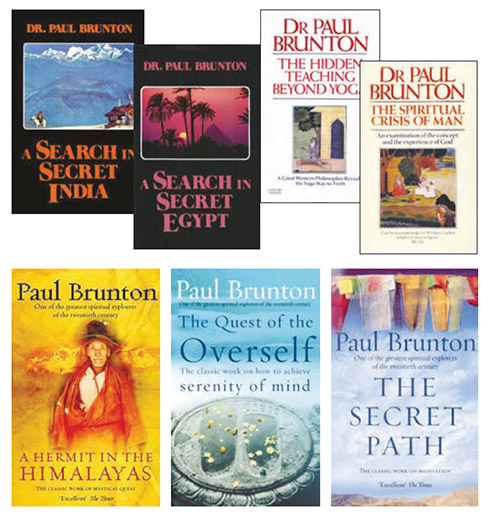
    From the 1930s through the 1950s, Paul Brunton’s eleven books were best-sellers in the field of alternative spirituality. The above is a selection of his titles from the 1930s with new editions in recent decades.

    There are not many accessible archives of twentieth-century spiritual masters and none that can be studied in their entirety from anywhere in the world. Among the 87 file boxes are drafts of his books, unpublished essays, records of interviews, and the original “notes,” including those omitted from the published Notebooks, together with personal details that a more ego-identified person might have suppressed. Cuttings from newspapers and magazines range from metaphysics through the occult sciences to diet, health, and the conduct of life. Brunton paid close attention to world events, which he saw through the lens not of politics but of destiny and karma. A curious relic from the pre-xerox era is his well-worn travelling library, made by Indian assistants who typed out articles, extracts, and entire books. A collection of photographs records scenes in Egypt and India that no longer exist. There is a vast horde of letters in which readers and friends from every walk of life, from royalty downwards, bared their souls to him. Even more inspiring are his replies, for their ability to say exactly what the recipient needs to hear. Yet the older and wiser he became, the more he disowned the role of master or guru, describing himself as “a student of these matters.” To which one can only exclaim: “Some student! Some matters!”

    Thanks and credit to the Paul Brunton Philosophic Foundation (www.paulbrunton.org) for the photos in this article and its digitisation of the archive at www.pbarchives.org, and to the Cornell University Library’s Division of Rare and Manuscript Collections, https://rmc.library.cornell.edu/EAD/htmldocs/RMM08692.html.

    The Notebooks of Paul Brunton (sixteen independent but related volumes) are available from https://www.larsonpublications.com/shop/product-detail.php?id=19.

    [alert type=”general” dismiss=”no”]This article was published in New Dawn 191.[/alert]

    [alert type=”success” dismiss=”no”]If you appreciate this article, please consider subscribing to help maintain this website.[/alert]

    © New Dawn Magazine and the respective author.
    For our reproduction notice, click here.
  • Magic for Grown-ups: The Work of the UR Group

    Magic for Grown-ups: The Work of the UR Group

    From New Dawn 172 (Jan-Feb 2019)

    In the consensus view, magic belongs (if at all) in Disney films and Harry Potter books, and adults who actually believe in it are stuck in infantile or medieval superstition. It does not help that the most famous magus of modern times, Aleister Crowley, was a sex maniac and a drug fiend.1 Nor does the later development of Chaos Magick inspire much hope, with its dark, postmodern metaphysic. To most sane people, whether or not they have a spiritual outlook, magic is best left alone.

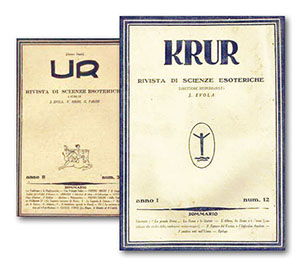
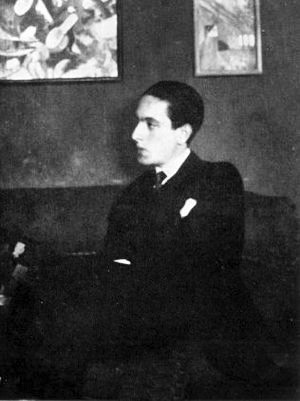
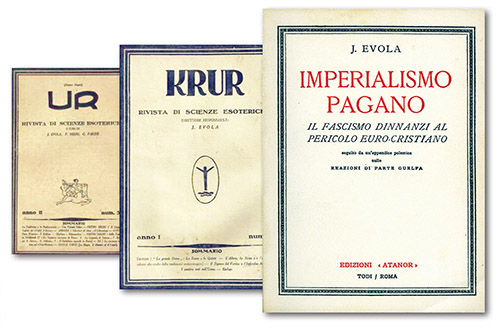
    This would also have been the attitude of the “Gruppo di UR,” a group of Italians led in the late 1920s by Julius Evola and Arturo Reghini.2 Their magic was not for the casual, the credulous, or those excited by the cool or the weird. It was for those dedicated to “magic as science of the I,”3 a concept that I will try to explain below. Although the group’s activities were private, involving only a handful of participants, they shared them with the world in a monthly journal, called first UR and then KRUR. The print-run, estimated at a thousand copies, suggests a surprising level of interest in Fascist-era Italy. In its three-year existence, UR/KRUR published 142 articles under 23 different pseudonyms, making it one of the twentieth century’s richest compilations of esoteric material and instruction.

    English language readers had access to the UR Group’s work in 2001, with a translation of the first of the three volumes.4 I helped with its preparation and promised that if no one else could be found to translate the other two, I would do so after I retired. Eventually I had to keep my promise. The second volume will appear in February 2019, and the third, hopefully, before another eighteen years have gone by.

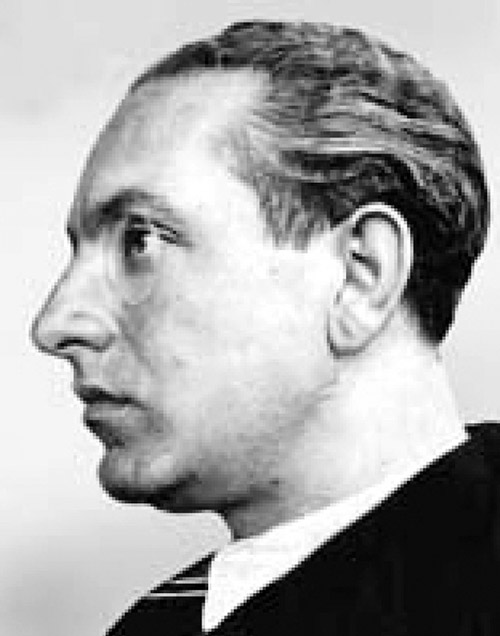
    Baron Julius Cesare Evola (19 May 1898 – 11 June 1974)

    In his Introduction, Julius Evola states that the goal of this magic is knowledge of “metaphysical reality.” 

    Metaphysical reality exists and works in transcendent mode, in utter independence from the world of men. Nonetheless, he who is established in that mode and casts his glance downward can draw from it reference-points for a system of values and principles, which may confer earthly and temporal life with an order and a meaning that would otherwise be wholly lacking. (p.1)5

    Those familiar with Evola will recognise in these few lines the core of his doctrine. It is a hard and chilly one for those preferring the comforts of religion and a warm embrace of humanity. This magic has nothing to do with them, or with the order and meaning that help them to get by in earthly life. It is anti-humanistic, antisocial, and utterly at odds with the modern world. But although Evola was at the centre of the UR enterprise, he was not so harsh in his choice of collaborators. Being “established in metaphysical reality” is a tall order, and none of them claimed more than temporary glimpses of it. What they did claim, though, is that it has existed, and left its traces in Tradition.

    “Tradition,” as the word was used by Evola, René Guénon, and Ananda Coomaraswamy, meant the body of wisdom acquired or revealed in the distant past and handed down in the form of myths, symbols, rites, and to an extent religions.6 There was a time, they say, when humanity lived in concord with it, open to spiritual realities and in harmony with nature. But that was a Golden Age, and we are in the Age of Iron, the Kali Yuga.7 The magic of the UR Group is a lifeline for a few in this dark age who sense what has been lost and are determined to regain it.

    The UR Group’s journals contained five different kinds of documents:

    • Expositions of methods, disciplines, and techniques; 
    • Reports of initiatic experiences, historical and contemporary;
    • Translations of traditional texts. The first volume included a Mithraic Ritual and excerpts from Neoplatonic, alchemical, and Buddhist writings; the second, songs of Milarepa and a complete translation of the Turba philosophorum, with commentaries.
    • Traditional doctrines placed in context, to challenge modern views and attitudes;
    • The study of various forms of Tradition over history, to show their continual validity in the human world.

    The three volumes are not necessarily sequential because new contributors appear and the articles address different levels of commitment. One need not tread the magical path to appreciate the UR Group’s global approach to esotericism, which owed much to the Theosophical Society’s example of opening to the wisdom of the East. Esotericism apart, there is a refreshing contrast between their attitudes and the forced consensus of today. 

    Magic Guided by Science

    When Evola edited the group’s papers for publication in book form, the title “Introduction to Magic as Science of the I” implied that this was not a belief system but a science. Nothing was to be taken on trust unless proved by personal experience – and even then, subjected to the test of Tradition. The latter acted as a control for evaluating modern movements such as spiritualism, psychical research, occultism, Theosophy, psychoanalysis, and Jung’s depth psychology. All of these failed the test of traditional authenticity and were dismissed as deviances only to be expected of a dark age. But unlike the Traditionalism of René Guénon and his followers, that of the UR Group paid no respect to exoteric religions. To the aspirant for their sort of magic, religions were simply irrelevant. To Reghini, especially, they were worse than that, for he was a staunch defender of pagan traditions against monotheism and the Christian hegemony. 

    A partial exception was made for Rudolf Steiner’s Anthroposophy. Several members of the UR Group were active in Steiner’s movement, and their contributions reflect this. But Evola, as editor, drew a firm line between Steiner’s techniques for obtaining “knowledge of higher worlds” and his Christocentric and reincarnational doctrines.

    The scientific method is essentially amoral: that is why it is widely mistrusted today. The science of the UR Group followed the same principle, but with a crucial difference:

    As an example, from the moral point of view one may say: “You mustn’t lie, because lying is bad, and telling the truth is good.” From the initiatic point of view one is simply aware that lying causes a sort of lesion and contradiction in the unity of the being, which is a condition contrary to that of an initiatic qualification. (p. 243)

    The most dedicated members of the group formed “chains” for group work, numbering perhaps no more than five participants. They worked with guided imagery to build up psychic energy, and might “eventually be able to contact other chains, created on the same principles by other groups and in other places.” One wonders whether this has actually happened. Hans Thomas Hakl’s Foreword mentions that UR-type groups continue up to the present day, mostly in Italy and all in deliberate obscurity. Here are some of the principles: 

    In some kinds of chain the individuals are simply thrown together, and the polarity of masculine 0 and feminine Y necessary for operations is not reflected harmoniously in every member. Instead, they separate into the opposition of the fluid, passive mass formed by the majority = Y, and the active role of a leader = 0. But in the type of chain proposed here, every member must distinctly and firmly possess self-awareness, control, and mastery: thus both aspects of the Hermetic complementarity. Each must participate in the chain as an individual, as a distinct force. The chain formed by such individuals will become compact and positive in every way when, through repeated meetings, the various distinct elements become attuned and form a unity. (p. 42)

    Beyond the Grave & the Great Liberation

    These practices served an intention that went beyond one’s earthly life. In a commentary on the Tibetan Book of the Dead, Evola (writing as “Ea”) remarks:

    One notes the special emphasis on qualities that need to be obtained in one’s lifetime, through suitable disciplines and control of one’s own mind; they are not only of use in this existence and for progress along the Way, but also beyond the grave, in the battle for one’s own destiny. (p. 137)

    Experiences “beyond the grave” are beyond the reach of the empirical science that the UR Group preferred. Consequently, they had to rely on Tradition and be very selective in their choice of authorities. That of Tibetan esotericism stood high in Evola’s estimation, and he sets out the options as found there. The first is said to be offered to everyone upon death, but very few are able to seize the opportunity:

    Then suddenly the supreme test occurs, the experience of the pure state of Being, dazzling, annihilating, with terrifying radiance and the “sound of a thousand thunders.” If the soul has the ability to identify with it, as though hurling itself out of itself, incinerating everything in itself that is “other” or “ignorance,” in an instant it will have attained the Great Liberation. (p. 134)

    If the soul fails in this – as almost all do – the Supreme Reality may take the form of a divine figure worshipped in life, to which the fortunate soul can abandon itself. But if that too fails, the being is fated for another incarnation. This is demonstrably the case with all of us, unless we are Bodhisattvas, so it is important to know the options that remain:

    Under such circumstances, which represent a fall and the loss of the higher possibilities offered after death, there are still actions to be taken, as it were in extremis, to avoid the worst outcome. It is possible to collect oneself and […] to “steer” it to some degree. Even in these crises, within these ultimate possibilities, the decisive factor is to restrain the mind, and not to give in to the irresistible emotions of attraction or repulsion that make play with the soul. (p. 136)

    These quotations show how the UR Group treated a traditional text, restating it in plain language without foreign words or alien images. Once those are eliminated, it is obviously the same doctrine as Plato taught at the end of his Republic, where souls choose their next lives, wisely or foolishly as the case may be. This example also served the purpose listed as no. 4 above, challenging modern notions of chance and genetic determinism.

    Initiation & Sex Magic

    The reports of initiatic experiences make fascinating reading. Reghini (writing as “Pietro Negri”) evokes their environment and atmosphere:

    Years ago we were doing the ritual in an inner room of an isolated old tower by the sea, with enormously thick walls. The conditions were ideal: the only biped around was the falcon that now and again took flight with its strident cry. The only opening was a tiny window in the thick wall; but between its weather-worn frame and the wall there was a little gap, through which a hornet once entered, probably attracted by the smell of incense. We noticed it at the beginning of the ritual because of the noise it made with its claws, walking on the paving. (pp. 309-10)

    Nothing could be done, except to hope that it wouldn’t sting anyone. A more analytic essay reports on what happens when one tries to maintain awareness during sleep. The writer glimpses his other self “slipping catlike out of my body, while I straightway plunged into the leaden unconsciousness of sleep.” (p. 185) Another describes how one’s faculties of thinking, willing, and feeling, usually blended, begin to separate during initiatic work:

    It is difficult to describe the nature of these experiences to those who have not been through them. There are apparitions of thoughts that present themselves rather as absolute entities, icy and sharp as crystals, absolutely detached from any kind of life. There are unconditioned determinations of the will, which asserts itself simply for the sake of its own assertion, passing above any imagination, motive or sentiment. There are also emotional states, both exalted and debased, which occur without cause and penetrate to the depths of the soul, with a sort of immensity that overwhelms any mental content.

    We must realise that the very thing that originates these phenomena simultaneously offers a basis for defending oneself against them. Through detachment one progressively realises an I that is not what thinks, wills or feels, because it possesses a simplicity that rests solely on itself. The chief principle is not to hold on to these reactions. Becoming scared and trying to repel them only opens a door to them. (p. 315)

    This volume also contains advanced instructions for sexual magic, much too complicated and demanding to arouse any prurient interest. Briefly, physical sex may not occur at all, or not before years of practice. The approach is exclusively from the male point of view, for reasons that Evola explains in alchemical terms: 

    Hermetically, one can say in general that woman can attain the “White Work,” while the “Red Work” is an eminently virile affair. These two degrees of the Hermetic Work correspond, moreover, to the Lesser and the Greater Mysteries. (p. 397)

    Pain, Illness & Drugs

    An essay on “The Metaphysics of Pain and Illness” states defiantly that “all that modern medical science can say is often based on the reversal of cause and effect, given that the plane on which the true causes are found is inaccessible to either physical eye or microscope.” (p. 190) These causes often lie in “certain forces to which consciousness has been unwilling or unable to open itself,” because of its fixed habits and self-identity: 

    This fixity works such that whenever there is a contact with a transcendent force, it causes something comparable to a lesion – an interior lesion. In that moment consciousness, taken by surprise, is thrown into a state of agitation and fear for its own individuality, feeling its foundations shaking. (p. 189)

    The chance offered is then lost, but the consequence may not be a total waste. Indeed, 

    …certain forms of illness can bring forth moments of illumination. Likewise, we know of schools and also traditions in savage peoples, in which suffering has been considered as a means of attaining ecstasy, as in the cases of shamans, flagellants, etc. We might make many other suggestions: for example, explaining why sometimes prayer in states of intense pain can cause extraordinary effects, facilitating a state of transcendence and thus the conversion of the forces we have mentioned. (p. 192)

    No serious book on magic can neglect drugs, called here by the alchemical term of “corrosive waters” and grouped together with poisons and alcohol. The ancients had knowledge of the most effective substances for initiatic use, which were always kept in deepest secrecy. They are not even for grown-ups, though in exceptional cases they may serve to give the ultimate push to a soul which is perfectly in control of itself. 

    And if in extreme cases consciousness may thus pass from the individual to the non-individual state, thereby becoming free, one of the consequences may be the manifestation, albeit sporadic, of various incidental magical powers, even influencing natural phenomena. (p. 151, note 3)

    Notice in this aside that the UR Group’s science had no problem with the paranormal, though it considered psychical research for its own sake a waste of time. Evola, writing here as “Agla,” had no illusions about the lure and consequences of drugs, which he describes with forcible eloquence:

    When the imagination is seized and transported on the wings of the “dragon,” there breaks forth the fantastic world of visionaries, the orgy of forms and colours of false clairvoyants, the dreams filled with subtle and seductive sensations of opium and hashish users.

    When it is the faculty of sensation that is seized – alone, or together with the former – the force gives rise to a world of strange pleasures, indefinable, intoxicating, which gradually become a necessity for the soul. It creates vice. All those in ordinary life who abandon themselves to drug use are precisely on this plane, almost without exception. (pp. 151-52)

    These quotations touch on the states of being to which occultists give various names, such as the subtle, etheric, and astral planes, or the imaginal world. Western occultism is full of efforts to classify the various levels, aethyrs, mansions, sub-planes, etc. The UR Group did not doubt their existence or the powers that might be derived from them, but their ambitions reached further than that. 

    Realising the Absolute Individual

    The “science of the I” rests on the assumption, fortified by Tradition, that the human being is potentially divine. Ercole Quadrelli (writing as “Abraxa”) puts it plainly:

    The Supreme Mystery of the Initiations – that is what you now hear: in man is the liberation and the immortality of the gods. The god realises the man – the man liberates the god. (p. 114)

    This turns the usual esoteric analysis inside-out. Instead of seeing us as compound beings culminating in a divine spark or atma, it sees us as gods, whose business it is to manifest through that compound. The “I” in question is what Evola had been calling the “Absolute Individual,” and the “science” is the method of realising it. 

    After ninety years, nothing about the UR Group seems old-fashioned, except their complete innocence of today’s pseudo-morality. Each member had a significant social, academic, political, or creative career outside the group, but there is very little pretentiousness or posing about them. Those who are interested in them as individuals can find out more in Renato del Ponte’s Preface to the first volume, which first broke their anonymity, and in Thomas Hakl’s Foreword to the second. Given their strong personalities, it is remarkable that they could come together, even for a few years, and produce something of such lasting value.

     All quotations are from Introduction to Magic, Volume II: The Path of Initiatic Wisdom by Julius Evola and The UR Group, translated by Joscelyn Godwin, foreword by Hans Thomas Hakl © 2018 Inner Traditions Press. Printed with permission from the publisher Inner Traditions International. www.InnerTraditions.com.

    [alert type=”general” dismiss=”no”]This article was published in New Dawn 172.[/alert]

    [alert type=”success” dismiss=”no”]If you appreciate this article, please consider subscribing to help maintain this website.[/alert]

    FOOTNOTES
    1. Of course Crowley was much more than that. I refer to his public persona.
    2. See my article “Who Was Julius Evola, Really?”, New Dawn 162 (May-June 2017), 60-68.
    3. The Italian phrase “magia quale scienza dell’Io” could be translated as “magic as science of the Self,” but that now carries a Jungian flavour alien to the group’s intentions.
    4. UR 1927, published as Julius Evola and the UR Group, Introduction to Magic: Rituals and Practical Techniques for the Magus, translated by Guido Stucco, edited by Michael Moynihan, preface by Renato del Ponte (Rochester, Vt.: Inner Traditions, 2001). 
    5. All quotations are from Introduction to Magic, Volume II: The Path of Initiatic Wisdom by Julius Evola and The UR Group, translated by Joscelyn Godwin, foreword by Hans Thomas Hakl © 2018 Inner Traditions Press. Printed with permission from the publisher Inner Traditions International. www.InnerTraditions.com
    6. See my article “Understanding the Traditionalists,” New Dawn 147 (Nov-Dec. 2014), 63-69.
    7. See my article “When Does the Kali Yuga End?”, New Dawn 138 (May-June 2013), 63-68.

    © New Dawn Magazine and the respective author.
    For our reproduction notice, click here.

  • Twisting the Threads: The Ageless Wisdom of the Western Mystery Tradition

    Twisting the Threads: The Ageless Wisdom of the Western Mystery Tradition

    This article was published in New Dawn Special Issue 5 (Winter 2008)

    Once upon a time, every religion was Janus-faced. It had its exoteric or outward side, serving or exploiting the majority of believers, and its esoteric or inward side, reserved for a few. Christianity had its esoteric side in theosophy, the science of the knowledge of God; Judaism in Kabbalah; Islam in Sufism; Hinduism in the various yogas; Paganism in its Mysteries. These esoterisms were for those with sufficient interest, motivation, and capacity to benefit from them. Entry was through initiation, whereupon, under expert guidance, the elect might embark on the lifelong and demanding quest for reality. That, at least, was the principle, however imperfect it may have been in practice. 

    It is different today. There is a widespread thirst for a deeper dimension to life than the consumer society can provide, and for a better explanation of its enigmas than exoteric religion or materialistic science has to offer. This thirst accounts for the popular success of books and films that feature Gnostic and occult themes, and of conspiracy theories that claim that things are ordered quite differently – for good or ill – than the public is led to believe. If anyone wants to learn more, the secrets once imparted only to initiates are there on the bookshelves, or the Internet. The doors of the sanctuary are agape, but where are the hierophants, adepts, and sages whom one hoped to find there? Most of us seem to be thrown back on our own resources, lonely travellers among the ruined monuments of ancient mysteries.

    The Golden Thread is one such traveller’s offering, and this article is a sampling of it. The book stems from a series of fourteen articles in the New York-based magazine, Lapis: The Inner Meaning of Contemporary Life. Its editor, Ralph White, suggested treating the Western mystery traditions in such a way as to make them not merely historical curiosities, but relevant to his readers. These were typically people with a secure footing in contemporary life, but feeling the call of that “inner meaning” that money and status cannot buy. So I had a dual task: to give them a quick and easy course in the main episodes of Western esoterism, and to show what these have to teach us today. 

    From the start, I wanted to shake the readers up a bit. In the first article, on The Chaldaean Oracles of Zoroaster, I seized on a hint that the Oracles contained an idea of bodily transmutation as a means towards immortality. Yea, yea, says the modern reader, a typically superstitious belief. But wait: what if there were something to it? 

    As testified in the Bible, Enoch, Elijah, and Jesus left no physical body behind after their deaths. The same was believed of the Virgin Mary from the fifth century onward, and in 1950 the Catholic Church proclaimed it dogma. Although always skeptical when told what I must believe, I have no difficulty in principle with this concept. It seems quite feasible that a person’s physical body might be so transformed during life that it becomes indistinguishable from the subtle “radiant body.” The soul then takes the body with it, wherever it goes after leaving earth.

    There is reliable evidence that this has happened in modern times in the case of Tibetan adepts. Eyewitness accounts support the tradition that adepts may achieve the “diamond body” during life. Then, within days after death, their physical body just disappears, leaving behind only the “vegetable” elements of hair and nails. A lesser phenomenon, well attested in Christendom, is that of saints’ bodies that remain uncorrupted, sometimes for centuries. Evidently there is a whole science here, studied in ancient Egypt and Tibet but temporarily in abeyance because of the limits of the Western imagination. Theoretical physics, with its concepts of matter, energy, and mind, might someday provide a framework within which such phenomena can be intelligently discussed.

    The Nature of Metaphysics

    In thirty years of writing, I have consistently tried to bridge the gulf between the academic and what, for want of a better word, I’ll call the metaphysical. It was only in the past century that the academic world virtually banned psychical research, and decreed that a materialistic philosophy was the only permissible base assumption. You can’t entirely blame them. Nowadays there’s such a fear of religion – the exoteric kind – infecting research and throwing its weight around in society as a whole, that the metaphysical baby has been thrown out with the religious bathwater. Yet the higher reaches of physics are already metaphysical. There, the rigid separation of mind from matter is a thing of the past, and things no less strange than the “diamond body” of Tibetan tradition are everyday currency. 

    Here’s another instance in which science is invited to loosen up the boundaries of the possible. It comes in a discussion of alchemy, one of the corner-stones of Western esoterism, which is sometimes interpreted as proto-chemistry, sometimes as proto-psychoanalysis, and sometimes as theosophical allegory. Each interpreter tends to take only one point of view, but I think this a mistake. 

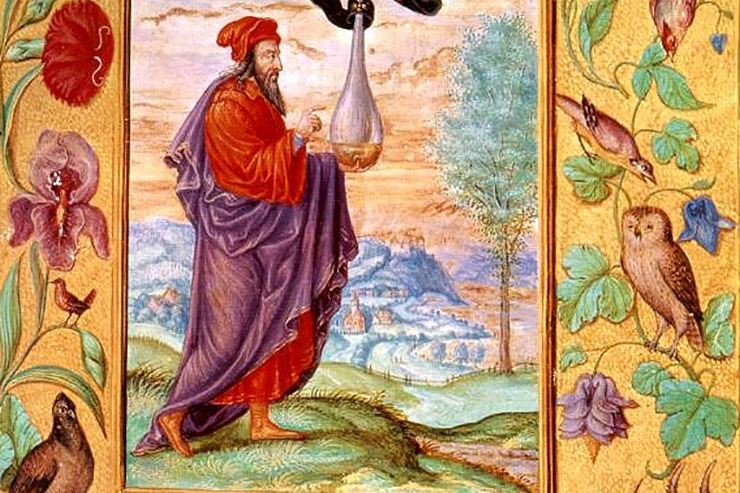
    The proponents of the different kinds of alchemy are different psychological types, and as such are unlikely to favour each other’s methods. Those who work with physical substances do so because it suits them, but it is just as well that the process of human transmutation can go forward without the expense of a well-equipped laboratory. Otherwise poor Jacob Boehme would not have got far. However, if we can believe what we read, is it not extraordinary that, when interpreted one way, chemical recipes deriving from Alexandrian Egypt work in the laboratory, and in another way, provide reliable guidance on the theosophic path? How could these two such different fields be connected?

    Yes, it is extraordinary to the modern mind, so brilliant in physics and chemistry, so ignorant of the inner and the imaginal world. It is almost touching, this childlike faith that the world of matter is the only real one, and all the rest epiphenomena of it. But what if we were to turn the tables and suggest that the inner world is prior to the outer? That the imagination precedes rather than follows the event? That the only reason we see the stars is that we share, for that moment, in their perpetual creation? Then it would be mental and imaginal states that are primary, and the chemical procedures that are secondary to them. As normal, undeveloped people, we are only able to live in a normal, undeveloped world, which is the world known to science. But once supernormal conscious states had been mastered, then one might live in a supernormal world with laws different from those of classical physics. This, incidentally, would explain the miracles of healing attributed to Christ and others, and even the turning of lead into gold.

    Obviously I am not speaking from experience of such “supernormal conscious states,” but only from a position that does not deny their possibility. Likewise, I have no personal knowledge of the Tibetan practices that make the physical body vanish three days after death, but confidence in the veracity of reports. I won’t say that I “believe” in these things, but I won’t disbelieve in them either. That is as far as I claim to have gone beyond the common mind, which snaps shut as soon as it encounters notions of this kind. 

    It is similar with the mentalist doctrine to which the above quotation alludes. I don’t experience the world around me as created by my mind, any more than I perceive the earth beneath my feet as spinning round on its axis, but I am as certain of the former as I am of the latter. In their respective fields, they seem to be the working hypotheses that best “save the phenomena.” However, all human explanations are no more than that. As that immortal American philosopher, Charles Fort, wrote: “I conceive of nothing, in religion, science, or philosophy, that is more than the proper thing to wear, for a while.” This can lead to pessimistic conclusions, but not necessarily depressing ones:

    Efforts to fit the universe into rational systems and schemata are doomed to provinciality, none agreeing with any other. At the present stage of human intelligence, we have no more chance of success than an ant with a theory about human society. 

    The great benefit of a sense of history is that it puts things into perspective, especially science and philosophy. Ideas and theories change with the centuries, and yesterday’s certainties are today’s quaint, archaic notions. One thing is a sure bet: that some of today’s scientific and moral certainties are going to be tomorrow’s quaint, archaic notions. The “touching, childlike faith” in the materialist explanation, mentioned above, is likely to be one of them.

    The certainties encountered in those “supernormal conscious states” are different in kind, and do not change with time and progress. At the peak of gnosis or philosophical mysticism, there seems to be agreement between the sages of all times and races. This is the “Ageless Wisdom” of my subtitle: the gnosis that is always and everywhere the same because it is the birthright of humanity, whether realised or not. However, it is of limited effectiveness in daily life, and communicating it is well-nigh impossible. The preceding quotation continues:

    When the rational mind is bypassed by gnosis, the result is “ineffable” (inexpressible in words), and paradoxically most certain; but that has nothing to do with categories of thought, molded as those are by genetics, language, and the senses.

    The mystery traditions were designed to bring people closer to the gnostic state, but even there, its formulations are contradictory. For example, the mysteries of Orpheus, Mithras, and the Egyptian teachings preserved in Hermetism emphasise preparations for the life after death, picturing the initiate as then deified or at least enjoying the company of the god(s). On the other hand alchemy, Kabbalistic meditation, Rosicrucianism, and occult Freemasonry all focus on transmutation in the here and now. The Greek tradition of philosophical mysticism – Pythagoras, Plato, and the Neoplatonists – combines both, teaching contemplative methods of detachment from earthly concerns that are a preparation for the inevitable detachment of death. 

    As for the religions, they cannot agree about such basic issues as whether there is one god, or many, because they are incapable of the shifting standpoints familiar to the philosophic mind. Given those, the matter is not difficult to resolve.

    The subtle intelligence of Indian, Egyptian, and Greek philosophers easily grasped the truth of monotheism: that there can be only one ultimate source of all things. But the ordinary worshipper, in every religion, takes comfort not from metaphysics but from faith, and draws spiritual sustenance from a personal relationship with a god or goddess. A polytheistic culture like ancient Rome or modern India recognises that there are many worthy objects for such devotion, and allows everyone his or her divinity of choice. Its philosophers keep their understanding to themselves, and do not interfere in people’s religious customs by saying: “You should throw down the idols of Jupiter (Shiva, Isis, etc.) and worship the ineffable One!” Not so the monotheists. The scriptures of Judaism, Christianity, and Islam insist that there is only one God, and in a sense they are right. But what they call God is no longer the One of the philosophers. He is a masculine entity with attributes of a far lower order, such as tribal chauvinism, the desire for love, response to prayers and bribery, and intervention in human affairs. He is no better than the gods of Olympus, yet he is supposed to be the source of all. And as he acts, with bitter enmity to the worshippers of other gods, so do his followers – as if the One could care!

    Some current books on the Western esoteric tradition are factual, scholarly accounts that add to one’s bank of learning. Others are inspirational, written out of enthusiasm for one or another stream, such as Christian theosophy or the divine feminine. The Golden Thread has something of both intentions, but even more, it encourages the reader to face some difficult questions. There is no lack of people eager to supply answers to them, but I see a greater virtue in leaving the questions open and admitting that one simply doesn’t know. This is the Socratic principle of facing one’s own ignorance, which Socrates and Plato taught as a superior philosophical stage to that of most of humanity, who live in a miasma of opinions and beliefs that they mistake for knowledge.

    [alert type=”success” dismiss=”no”]If you appreciate this article, please consider subscribing to help maintain this website.[/alert]

    The Philosopher’s Dilemma

    The following questions arise in the context of what I call “The Philosopher’s Dilemma” (meaning by “philosopher” the person drawn to esoteric studies). 

    The philosopher’s dilemma is the choice between these two fields of action, the political and the personal. It may be phrased thus: Can the state of humanity as a whole be remedied, or is it in such a parlous case that remedy is only possible on the individual level?

    One does not have to be excessively wise to be troubled by this question, but to answer it requires a sounding of one’s deepest convictions about human nature and the place of man on earth. For example, does one believe that life on earth is merely a prelude to a much more important life that begins after death? If so, the social conditions of this vale of tears are a secondary matter, even a distraction. Does one believe, with most Christians, that everyone has an individual and immortal soul, or, with some pagans, that personal immortality is won only by titanic efforts? Is there a clear distinction between material and spiritual existence, or are body and soul both part of a continuum that is split by our misperception? Should I concern myself with humanity as a whole, or with my own salvation, leaving the rest to Divine Providence or the goddess Fortuna? Am I a separate unit with my own spiritual history, a stranger or even exile on this earth (the Gnostic point of view), or do I belong to a tribe, race, or species with a macrohistory of past and future evolution? 

    In studying esoteric and mystery traditions, one cannot avoid coming up against the occult. The term “occultism” is a coinage of the nineteenth century, when it served as a counter-balance to growing materialism, but there have always been “occult sciences” that deal with that which is hidden from the senses. These include astrology, alchemy, the many forms of divination including palmistry, geomancy, cartomancy, and the interpretation of omens, natural magic or the manipulation of the hidden forces of nature, sexual magic, ceremonial magic including demonic and angelic invocations, the science of correspondences, and the study of the beings intermediate in the hierarchy between the gods (or God) and man.

    I see no reason to exclude these from esoteric studies, because the two have so often gone hand in hand. They are part of the practical side, without which book-learning is incomplete; yet the person who dabbles in the occult sciences without a philosophical grounding is worse off still. In The Golden Thread, I acknowledge the reality of the occult domain, and try to bring some sense to it. One concept in particular seems to me worth consideration: that of the “egregore,” explained in the chapter on the mysteries of the Roman empire.

    There is an occult concept of the “egregore,” a term derived from the Greek word for “watcher.” It is used for an immaterial entity that “watches” or presides over some earthly affair or collectivity. The important point is that an egregore is augmented by human belief, ritual, and especially by sacrifice. If it is sufficiently nourished by such energies, the egregore can take on a life of its own and appear to be an independent, personal divinity, with a limited power on behalf of its devotees and an unlimited appetite for their further devotion. It is then believed to be an immortal god or goddess, an angel, or a daimon. 

    One may deoccultise the theory of the egregore by imagining these entities to be mere energy-patterns reinforced by use, analogous to the way in which patterns of neurons in the brain are reinforced and strengthened by use and mental effort. The formation of language is one example of how such a pattern may come to form the dominant matrix for our entire human experience. On the collective level, then, I suggest that the old Roman gods and goddesses did have a certain limited reality, and that they were kept alive by the beliefs of the people, the rituals of the priests and priestesses, and psychic energy released and directed in a myriad of animal sacrifices. So long as this compact continued, the egregores watched over the city, which flourished under their protection. 

    The alert reader cannot avoid wondering what manner of egregores are being formed and might be active today. 

    Just as my philosophical attitude has been influenced by Charles Fort as well as by Plato, so I cannot fail to notice some modern equivalents to ancient occult ideas. One of these, which may have a connection to the egregore concept, is the “science fiction scenario” of Gnosticism, in which a malevolent god, the Demiurge, manipulates humanity. There is a good reason not to dismiss it lightly.

    There are scientists today who believe and even hope that the human race will eventually take over other planets and exploit their environments, with any life forms that may be found there, for human advantage. Give us a million more years and we might become an evil Demiurge ourselves, enslaving the inhabitants of some hapless planetary system, perhaps even without their knowledge. In an era of genetic manipulations, it is no longer frivolous to wonder whether our own earth, and our bodies, might have suffered some such intervention by beings cleverer than ourselves. In view of the continuing inability of materialistic science to explain the origins of humanity, it seems worth collecting material bearing on this hypothesis. There are several separate hypotheses to be considered: 1. That the mutation which brought homo sapiens into being was deliberately introduced by an entity or entities unknown. 2. That early man was educated by superior beings from elsewhere, later commemorated as “gods.” 3. That the motivation of such beings may not have been in mankind’s best interests. 4. That they are still engaged with us, perhaps as the “unknown superiors” of occult groups, perhaps as the aliens who perform abductions.

    The popular literature abounds in claims for all four hypotheses, boldly presented as fact and exemplifying the anti-Socratic method of pretending to knowledge that one doesn’t possess. I tabulate and offer them here in a Fortean spirit, hoping that the reader will agree with me that the cosmos is a strange and complex place, and that there is much we do not know about it.

    In this article I have emphasised the questioning and unsettling nature of The Golden Thread at the expense of its other functions. One of these is to give readers a short but solid outline of the main currents within Western esotericism. Another is to provide, in the notes, a guide to further readings ranging from scholarly studies in several languages to popular works. A third purpose is a personal one. Ever since I chanced, nearly half a century ago, upon Carl Jung’s Flying Saucers: A Modern Myth of Things Seen in the Skies and William Q. Judge’s The Ocean of Theosophy, these matters have fascinated me, and it seems time to draw up a temporary balance-sheet and see where I stand in relation to them. If I am none the wiser, I am certainly the richer for the experience, and readers may sense something of the joy and excitement of it.

    The Golden Thread: The Ageless Wisdom of the Western Mystery Traditions by Joscelyn Godwin, Foreword by Richard Smoley, published by Quest Books, is available from Dominion Press including a collector’s edition clothbound in red and gold with the author’s calligraphic cover design. To order, go to http://dominionpress.net/titles/the-golden-thread/

    [alert type=”general” dismiss=”no”]This article was published in New Dawn Special Issue 5.[/alert]

    [alert type=”success” dismiss=”no”]If you appreciate this article, please consider subscribing to help maintain this website.[/alert]

    © New Dawn Magazine and the respective author.
    For our reproduction notice, click here.
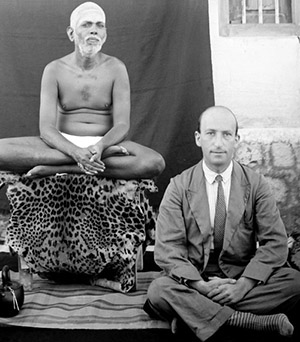
  • Who Was Julius Evola,  Really?

    Who Was Julius Evola, Really?

    New Dawn 162

    It is a pity that no researcher, while there was still time, ever spoke to the friends and relations who had known Julius Evola (1898–1974) in his youth. Like some other occult philosophers (Blavatsky and Gurdjieff come to mind), Evola covered his tracks, putting his apprentice years out of reach of the curious, then constructing an idealized biography.1 After his crippling injury in World War II he became an obscure and private figure, of little interest to the world in general, so that no one was prompted to go to Sicily, for instance, to try to find some cousins or to establish the status of the title “Baron” to which he sometimes answered. His few disciples, for their part, would never have had the bad manners to poke into the Master’s past, or to search out his aging school-fellows for insights into a level of his personality which he affected to despise.

    Like his early hero Nietzsche, Giulio seems never to have been a child, but to have come into the world fully-formed and ready for his life’s mission. We know that he completed university studies in engineering, but disdained to receive a diploma, as being too bourgeois an ambition.2 He served in World War I as an artillery officer, without seeing any serious action. His first public appearance was at the age of twenty-one, exhibiting 54 abstract paintings (now avidly collected, and some of them in public collections) and participating in the Dadaist movement. After abruptly quitting that phase, he reappeared as commentator and translator of the Tao Te Ching. By his mid-twenties, at a time when most young men are still finding themselves, he had completed a series of essays on Magical Idealism, a scholarly study of Tantra, and an 800-page treatise which he sent to the most eminent Italian philosopher of the time, Benedetto Croce. With typical hauteur, Evola explained that:

    For some years I have tried to organize my philosophical views into a system, mainly contained in an unpublished work entitled Theory of the Absolute Individual… I will release this volume, which has cost me several years of work, without any remuneration… For a number of reasons that I cannot go into here, the publication of the principal work represents something quite important to me, since, in the discipline I have followed, it is the opportunity to address freely and without reserve those for whom the general effect of my doctrine, expounded theoretically, is not merely an abstract scheme.3

    Croce recommended publication. The publisher divided it into two volumes, Teoria dell’Individuo Assoluto (“Theory of the Absolute Individual”) and Fenomenologia dell’Individuo Assoluto (“Phenomenology of the Absolute Individual”). Evola’s premises had been anticipated by some German Romantics, but are generally quite foreign to Western philosophy. They are more familiar to readers of the Taoist, Tantric, alchemical, and magical texts that Evola was simultaneously studying. The Absolute Individual is the Self, seen as identical to the source of all being. Like the philosophy of Plotinus and other Neoplatonists, and even more like the philosophic writings of India and China, Evola’s doctrine includes, but also transcends, the dimensions of religious experience and mysticism. His twin volumes contain a history of subjective idealism, and a practical philosophy of life, based on the assumption that the Absolute Individual is the ultimate object of human aspiration and attainment. Evola, at least, must have been familiar with the experiences about which he was writing; apart from the authoritative tone of his “phenomenology,” there is the evidence of an entire life lived most rigorously in the spirit of this philosophy. It is a question for specialists whether his youthful experiences of the Absolute, some of which he admits were drug-induced, were temporary samadhis (to use the language of Yoga) that confirmed him in the truth of his intellectual convictions, or whether they effected a permanent change in his being, leaving him, no matter what his outer activities and circumstances, in the simultaneous awareness of absolute consciousness.

    A young Julius Evola

    Evola’s concept of the Absolute Individual is inseparable from the other theme which he treated in this early period: that of Magical Idealism. “Magic” would remain his blanket-term for the methods taught in East and West that aim at the realization of the Absolute Individual. Questions such as whether magic is an irrational belief-system, or a reaction against modern science, would have been totally irrelevant to him. In his world, magic and the order of things classified as occult were the object of direct, intuitional knowledge. By stripping them of their superstitious associations and their Christian-Kabbalistic accretions, he reduced them to a form in which they could be sensibly and even scientifically discussed.

    There are two reasons why Evola’s Magical Idealism is a landmark in the history of modern occultism (another inevitable blanket-term). First, he raises questions that have scarcely ever been addressed to practitioners or answered by theoreticians of the occult sciences, concerning the ultimate motivation and validity of the latter. The answers that one could expect from most occultists are either of a very lowly order, aiming at personal power, knowledge, wealth, etc., or else, in more serious figures such as Eliphas Lévi and A. E. Waite, they give way to dogma, making magic a handmaid to Judeo-Christian mysticism. The second reason is that Evola was not content to stay within the Western streams of magic, philosophy, or mysticism, but needed for the completion of his experiential system the input of the East. In both respects, his philosophical journey resembles that of Aleister Crowley, who, for all the differences in their “personal equations,”4 would probably not have disagreed with many of Evola’s principles. These did for magic what the Theosophists had done for the theoretical study of esotericism: opened it to the whole world. 

    By this time, Evola had been introduced by the Futurist painter Giacomo Balla to Arturo Reghini (1878–1946), a mathematics teacher active in many esoteric and fringe-masonic groups. Reghini performed two important services for the younger man. By his own example as a kind of Pythagorean nationalist, he convinced Evola – hitherto a student more of German Idealism and of the East – of the value of his native Italian heritage; and he introduced him to the writings of René Guénon (1886–1951), proponent of the “integral tradition.”

    At the beginning of 1927 Evola and Reghini founded an esoteric group called the “Gruppo di Ur.” Its members included a number of Reghini’s previous collaborators, and had connections in Roman high society. The group produced a monthly journal which treated the whole spectrum of theoretical and practical magic, including classic texts from East and West, translations, and commentaries on their applicability to modern times. Some of the members worked alone; others formed “chains” for group work. Some of them wrote candidly of their own experiences, good or bad. Their magic was not of a superstitious kind but more in the practical mode of Rudolf Steiner’s “spiritual science,” for the group included some of Italy’s leading Anthroposophists. While the group itself was small, the fact that Ur was published in an edition of about 2,000 copies testifies to an astonishing level of interest in the Italy of those days.

    One consequence of the friendship with Reghini was the theme of Evola’s next book, Imperialismo pagano (“Pagan Imperialism”), which was so violently anti-Catholic that it later became an embarrassment to him, and was never reissued during his lifetime. It is subtitled “Fascism facing the Euro-Christian peril,” and argues, as Reghini had been doing since the end of World War I, for the restoration of the Roman pagan tradition as the proper spiritual foundation for the new Italy. Mussolini, more alive to political necessities than swayed by “traditional” spirituality, dealt the death-blow to these pagan dreams in 1929 with his Concordat with the Roman Church. The Duce remained a reader of Evola and his protector, up to a point, despite the philosopher’s fearless criticisms of Fascism. 

    The insistence, henceforth in Evola’s work, on “Tradition” is the legacy of Guénon, whose early writings had propounded the idea of a single primordial tradition from which the various religions were offshoots, and which contained in symbolic form the basic metaphysical truths about the universe and man’s self-realization. The Absolute Individual that Evola had found in Taoism and Tantra, Guénon had expounded as the Supreme Identity of the Vedanta. It seemed clear to both of them that the same ultimate truths and teachings were to be found at the deepest layer of every authentic tradition.

    Unlike Guénon, Evola was unsympathetic to exoteric religion and dubious about the Judeo-Christian tradition, which was so displeasing to him on a political and aesthetic level. He preferred other strands that had kept the authentic tradition alive in the West, foremost among which was alchemy. His contributions to Ur and Krur included many essays on this subject that he later gathered and expanded into a book on the Hermetic Tradition. In the history of alchemy in the twentieth century, Evola’s work represents a third stream, distinct from the practical, laboratory alchemy of Fulcanelli, Eugène Canseliet, Frater Albertus, Jean Dubuis, and their disciples, and equally distinct from the psychologized alchemy of Herbert Silberer or Carl Jung. Evola’s Hermetic Tradition is instead a cosmology, combined with a method for self-realization, in which sulphur and mercury, conjunction, transmutation, etc., are the names of otherwise undefinable states of mind and soul. Although it is not made explicit in the text, Evola’s alchemical method, like much else in occult practice, centres on the deliberate separation of consciousness from the body and on operations performed in the “astral world” or the world of the Imagination (taking this term in the sense used by William Blake or Henry Corbin), which require more than the usual degree of concentration and courage.

    [alert type=”success” dismiss=”no”]If you appreciate this article, please consider subscribing to help maintain this website.[/alert]

    The more one mentions things of this kind, the greater is the tendency to associate Evola with other modern occultists, in the broad sense of the term. But his next book drew the line firmly between himself and them, being a denunciation of the “Mask and True Face of Contemporary Spiritualism.” It was based on articles he had already published critical of Spiritualism, Psychoanalysis, Theosophy, Anthroposophy, the French occultists, etc., and it served the same purpose as Guénon’s earlier works against Theosophy and Spiritualism: it defined the field, the sources, and the individuals that were unacceptable to “traditionalists.” With Pagan Imperialism, this book established a dualist, even Manichean trend, always latent in Evola’s character, but which in his earlier works had not yet become the source of his creative energy. Now it was not enough to speak of the various royal paths by which the “superior man” (to use the I Ching’s expression) becomes the Absolute Individual: the machinations of inferior men (and women) had to be laid bare, and war had to be declared against them.

    Just as Evola’s early explorations in art, philosophy, psychedelics and magic had found their expression in the Theory of the Absolute Individual, so now he gathered his paganism, his sense of tradition, his political consciousness, and his contempt for most of the human race into definitive form and his most important and representative work: Rivolta contro il mondo moderno (“Revolt Against the Modern World”). This revolt was urged in the name of a primordial tradition whose metaphysical and cosmological principles occupy the first half of the book, while the other half is concerned with the process that led to the modern aberration. The fundamental assumption, without which Revolt makes no sense whatever, is the cyclical principle of history that is most fully developed in the Hindu system of four Yugas or world-ages (Satya, Treta, Dvapara and Kali Yuga), and also known to the Greeks as the Ages of Gold, Silver, Bronze and Iron. Evola accepts this, just as Guénon did, with the corollary that modernity is a phenomenon of the last part of the Kali Yuga or Age of Iron – after whose cataclysmic ending a new Golden Age will dawn, as certainly as the sun rises every morning.5

    Guénon and Evola both believed in a previous Golden Age with a perfectly ordered primordial tradition, situated in the Arctic if not positively at the North Pole. For Evola, at least, there seemed to be tangible proof in Herman Wirth’s collection of prehistoric symbols from the circumpolar regions. But the greatest value of Revolt may be as an epic work of the imagination, which like all epics offers an escape into a world more comprehensible than our own, if no less tragic. Evola’s exposition of the orderly cosmos of Tradition and its fall, if not historically verifiable, is a creative enterprise on a Wagnerian scale that, like a great opera, does not have to be “true” in order to be an inspiration and an enrichment to its audience. 

    If the Traditionalist concept of cyclical history is correct, the modern world is the inevitable consequence of the tail-end of the cycle. What else could one expect from the Dark Age, the Age of Iron, or the Kali Yuga? It is as inevitable as night, winter, or natural death. Yet Evola and the other Traditionalists rage against its secularism, its social organizations, its confusion of gender-roles, its materialism and vulgarity, its racial and spiritual degradation. Above all, there is Evola’s pervasive theme, apparently derived from his early reading of the Swiss anthropologist Bachofen, of the spiritual superiority of the masculine over the feminine, contrasting the virile, primordial, Arctic, “Uranian” and “Olympian” way with the Southern, orgiastic, sentimental, Dionysian way of the Mother-goddess. The former, one gathers, is the path to the Absolute Individual, while the latter leads only to extinction on the wheel of the Eternal Return.

    Baron Julius Cesare Evola (19 May 1898 – 11 June 1974)

    Only in modern times could someone have thought and written as Evola did, rejecting his native environment (whether one thinks of this as Italian Catholicism or as the rootless materialism of the Western world) and deliberately choosing an invented, or at least a foreign (because fundamentally Eastern) mode of thought. The critic of modernity is an essentially modern phenomenon, and his cultural pessimism, as it is generally known today, a natural reaction to events in Europe which none could ignore, least of all one of Evola’s warrior disposition. For all the lapidary certainties of his writing, Evola was looking for something to hold on to during the 1930s. He had been disappointed as Fascism cosied up to the Church and compromised itself with the bourgeois and proletarian world, even though he never found it so degraded as the rival systems of American capitalism or Soviet communism. During this decade his glance wandered continually to Germany, hoping to find there a political realization closer to his ideals. Fluent in German, he made several semi-official visits to Germany and Austria between 1934 and 1941 to give lectures and to meet dignitaries of the Schützstaffel (the “SS”). But these encounters also left a residue of mutual disillusionment: his hosts found him too unworldly and idealistic; he found National Socialism too narrowly Pangermanist; and the Italian regime became so uneasy about his activities that in 1942 it temporarily withdrew his passport.

    Two themes dominated Evola’s thought after the completion of Revolt Against the Modern World. One of them had been present incidentally in that book: the theme of race, and in particular the connection of the primordial tradition with a pure Hyperborean race that had interbred, after the destruction of its Arctic homeland, with the inferior races of the South. After Hitler’s rise to power, Mussolini’s German allies began to exert pressure on a Fascist system that had been quite innocent of anti-Semitism and racism, at least until the Abyssinian Campaign. Evola now became a self-appointed authority on this topic. With obsessive diligence he addressed both theory and practice in numerous articles and two full-length books, Il mito del sangue (“The Myth of Blood”), and Sintesi della dottrina della razza (“Synthesis of Racial Doctrine”). Both books were illustrated with photographs, some taken from anthropological sources, others being of contemporary figures including Rudolf Steiner. Evola also addressed “Three Aspects of the Jewish problem: in the Spiritual World, in the Cultural World, in the Socio-Economic World.” With this project, he attempted to give Fascism its own racial philosophy, distinct from that of the National Socialists, and in 1943 it was accepted, in principle, by Mussolini. The core of Evola’s theory was that race is of three kinds. One of these is the sense in which the term is generally used, to indicate physical and genetic types: this he calls the “race of the body.” The second is the “race of the soul,” which is expressed in art and culture; the third, the “race of the spirit,” expressed in religion, philosophy and initiation. Evola’s fundamental disagreement with the National Socialists was that, like cattle-breeders, they considered only people’s biological or bodily race: in his view, the least significant of the three. It is no wonder that the SS found him unworldly.

    The American-Italian scholar Dana Lloyd Thomas has found that this theory, as found in Evola’s books, is quite far removed from the polemical and often crude racism of his journalism. Thomas concludes that Evola’s studies, though presented as objective and historical, served two purposes: they made racism a respectable area of study, and all the examples he gave came to the same conclusion, affirming the superiority (spiritual as well as physical) of the “Nordic race” that was effectively equated with the Germans.6 Thomas’s project, stemming from honest moral conviction, needs to be balanced by the recent account of Evola’s war years, traced almost day-by-day through unprecedented archival research (see note 2). The author, Gianfranco De Turris, who has been writing about Evola for over forty years, is equally motivated by a desire for justice towards a philosopher who has been vilified like none other, and gifted with insight into circumstances that were very different from those of today. 

    The other theme that occupied Evola in the pre-war years also reflected his Germanophilia: he developed an admiration for the high Middle Ages that resulted in a book on the “Mystery of the Grail.” For whatever reason,7 his historical allegiances had now changed, and it was no longer ancient Rome, from Romulus to Augustus, that seemed to him to incarnate the last worthy manifestation of the tradition, but the “Holy Roman Empire of the German People” inaugurated by Charlemagne’s consecration in the year 800. In his book, Evola connects the Grail myths on the one hand with the prehistoric Hyperborean tradition, and on the other with the resurgence of the imperial and knightly spirit in the Middle Ages: no matter that Charlemagne was the pitiless suppressor of Nordic paganism, or that the Holy Roman Empire derived its authority from the church that Evola had so reviled in Pagan Imperialism. This medievalism, exacerbated by Evola’s later indulgence towards extreme reactionary Catholics, continues to puzzle those who would have thought that the Renaissance Neoplatonists were closer to his ideals. Instead, he lumped the Renaissance together with the Reformation, the Enlightenment, Socialism, Communism, and modernity as part of the degenerative process. 

    [alert type=”success” dismiss=”no”]If you appreciate this article, please consider subscribing to help maintain this website.[/alert]

    During the first years of World War II, Evola turned to yet another tradition, that of Buddhism, and wrote one of his best books: The Doctrine of Awakening: A Study on the Buddhist Ascesis. Just as with his early work on Tantra, Evola had to base his study on translations by English, German, and Italian scholars. Yet his insights into the human condition that Buddhism addresses, and the calm spiritual height from which it speaks, transcend mere erudition. The temporary habitation of Oriental modes of thought seems to have enabled him to forget the politics and the polemics which the modern West so easily provoked from him. At the same time, the work is revisionistic in its preference for Theravada (or Hinayana) Buddhism. The Western impression of Buddhism, abetted by nineteenth-century incomprehension and by Theosophical influence, has always been condescending to the primitive Hinayana (the word means “lesser vehicle”) in comparison with the “greater vehicle” of Mahayana Buddhism, to which belong the schools of Japan and Tibet that have been more successful exports. To Evola, the contrary was true: the Mahayana was a late and decadent development, sullying the original purity of Buddha’s philosophy with its sentimental and religious accretions (just the sort of thing Westerners would prefer!), while the uncompromising Hinayana was the original teaching, fit only for Aryas, i.e. the elite, in terms of their spiritual race. For a long time The Doctrine of Awakening was the only work of Evola’s available in English. It appeared from Luzac, a London Oriental publisher, uniformly with a number of René Guénon’s works, thus giving many (including myself) their first taste of the Traditionalist school.8 De Turris’s book, cited above, tells of Evola’s correspondence with the young translator Herbert Musson: a patrician Englishman who ended his life as a Theravada Buddhist monk.9

    The trauma of Evola’s war-injury on 21 January 1945 and the years-long search for a cure left him permanently disabled. This is how he described his condition in a letter to a fellow philosopher: “The last war made me the gift of a lesion in the spinal cord, which has deprived me almost entirely of the use of my legs: a contingency, however, to which I do not attach much importance.” After almost six years of treatment in Austrian, Hungarian, and Italian hospitals, he returned to the apartment at 197 Corso Vittorio Emanuele II which he shared with his mother until her death in 1956, and whose owner, an aristocratic admirer, allowed him a free lease for life. 

    The postwar climate was not favorable to Evola, who bore the stigma of having backed the losing side. Now that “fascism” had become a term of abuse, it was applied to him, who had never joined the Fascist or any other party, indeed who had risked much with his criticisms of the government.10 It was difficult for him to resume the career as a journalist which had supported him before the War. He first returned to print with a thorough recasting of his early book on Tantra. Then he was rediscovered by some who were still faithful to the principles of the Right, and for them he wrote the booklet Orientamenti (“Orientations”). 

    Evola paid dearly for this act of idealism. A week after his return to his Roman residence on May 18, 1951, he was arrested and accused of being the “master,” the “inspirer,” with his “nebulous theories,” of a group of young men, who were accused in their turn of having hatched organizations for clandestine struggle and attempted to reconstitute the dissolved Fascist party.11 Evola, confined to his wheelchair, was held in the Regina Coeli prison until the trial, which lasted from early October until 20 November 1951, when he was acquitted.12 

    In the early 1950s Evola was still hoping for some counter-revolutionary movement, somewhat in the spirit of the “Conservative Revolution” of post-World War I Germany, that would restore the Right to power. Gli uomini e le rovine (literally, “The Men and the Ruins”), a book largely about public, social and political matters, addresses the potential leaders of such a movement. It is an analysis of the postwar world, somewhat like an updating of Revolt Against the Modern World, that ends with an outline of what would be needed for the healing of Europe: a Europe that would no longer be the playground and victim of the rivalry between the USA and the USSR Evola hoped – but knowing that it was probably beyond hope – for a resurgence of the Imperial ideal, which would endow the separate nations with a spiritual unity, but not with a forced, political one. His description of how Europe should not become united is an uncanny anticipation of what would, in fact, transpire. For example, he writes: “Democracy, on the one hand, and a European parliament that reproduces on a larger scale the depressing and pathetic sight of the European parliamentary systems on the other hand: all this would bring ridicule on the idea of a united Europe.”13 In the end, he puts his faith in the foundation of an Order, if among the ruins there are sufficient men left to stand up and constitute one.

    Evola published no more books for five years after Men Among the Ruins. That his thought did develop is clear. The next time he addressed the elite, he no longer envisaged any possibility or desirability of changing the world itself: it was too far gone on the road to perdition and the conclusion of its cycle. The only place for revolution was now inside oneself. The title of the work in question, Ride the Tiger, refers to a Taoist emblem of how the superior man behaves towards a chaotic world: following the principles of “actionless action” and of “doing that which is to be done,” he uses it to fortify his own higher individuality. In contrast to the public themes of Men Among the Ruins, Ride the Tiger treats more private domains such as existential philosophy, belief and non-belief, sex, music, drugs, and death, always in the spirit of Tradition and from the point of view of their use for the man in quest of his Absolute Individual. 

    Metafisica Del Sesso (The Metaphysics
    of Sex) by Julius Evola 

    The sexist language used here is deliberate, for Evola does not seem to have considered woman as a likely candidate for the quest. He had ample heterosexual experience, especially in his earlier years, but his anti-bourgeois principles caused him never to marry or have children. His book of 1958, The Metaphysics of Sex, anticipated the sexual revolution of the 1960s with its assumption that sex was not primarily given us for reproduction. It has always been one of the secret weapons in the magician’s cabinet; but Evola was the first, and to date the only writer to treat sex from the point of view of “traditional” metaphysics, so as to explain why it has this function.

    Most of Evola’s remaining titles are anthologies of his earlier articles and journalistic essays on various subjects – genres to which he contributed prolifically up to his death.14 Only two more original books appeared: an autobiography, The Path of Cinnabar, and the provocatively titled Fascism, Seen from the Right:15 his verdict on the Fascism and National Socialism that had been, and will always be, the first thing with which his critics associate him. More importantly, he returned to the Ur and Krur materials which he had been working on since the war years, and gave them definitive form in 1971 as the three-volume Introduzione alla Magia (“Introduction to Magic”). This monumental collection, with its contributions from a dozen authors beside Evola, shows that the Italian strain in modern esotericism was in no way inferior to the French Martinist and occultist strain, or to the much-studied Order of the Golden Dawn. It remains for the other leading lights, notably Giuliano Kremmerz and Arturo Reghini, to gain equal recognition for their stature as thinkers and movers. 

    The fact that so much of Evola’s enormous output of books and articles has been reprinted bears witness to a stratum of readership to which there is no parallel in the Anglophone world, and whose influence as a ferment within political, cultural and academic circles, especially in Italy, cannot be ignored. In the first version of this essay I concluded that, “Evola is currently the only esoteric and magical philosopher to have any impact whatever on the ‘real world’.” That was after centennial conferences in Milan and Rome (1998) and a wave of other commemorations and publications had brought Evola into the public eye, synchronously with the rise of right-wing political parties such as the National Alliance and the Northern League. Whether anything came of it is for historians to judge.

    Now there are rumors of Evolian influences at the highest level of government in both Russia and the United States. One agent named is Alexander Dugin, a known admirer of the Traditionalists, whose Eurasian theories and possible influence on President Vladimir Putin’s policies have often been mentioned in this magazine. The other is Stephen K. Bannon, strategist and assistant to US President Donald Trump. In 2014, addressing a Vatican conference via Skype, Bannon mentioned that Putin has an adviser “who harkens back to Julius Evola and different writers of the early 20th century who are really the supporters of what’s called the traditionalist movement, which really kind of eventually metastasized into Italian fascism.”16 Some of his Roman listeners may have gasped at this off-the-cuff revision of history, but three years later it sent the journalists googling the unfamiliar name, and to Evola’s posthumous “fifteen minutes of fame” through exposures in the New York Times and other unlikely venues.17 

    A lot of dots would need to be connected before any causal link could emerge between Evola’s political and spiritual philosophy and the presidency of Donald J. Trump. First, Bannon was speaking about Putin’s advisor, not Trump’s, and hardly with approval, since in the same speech he stated that Putin ran a kleptocracy and was intent on expanding the Russian empire. Second, that the Traditionalists “inspired Fascism” is doubly inaccurate: the Fascist movement was underway while Guénon was unknown in Italy and Evola still dabbling in Dadaism. When Evola did turn to political journalism after the Gruppo di Ur had dissolved, it was to criticize the Mussolini regime’s deviance from the principles of the true Right. For him this meant a monarchic, organic state, rather than one based on competing parties (as in democracy) or on class warfare (as in communism). Third, any serious student of Evola knows that in his riper and wiser years he adopted the position of apoliteia (detachment from politics). In Ride the Tiger he reflected on the futility of the “rectifying, political action” that had still seemed a possibility in Men Among the Ruins. The context was now, in 1961, the Cold War, and while admitting that life was more comfortable on the capitalist side of the wall, the conflict mattered little to the differentiated man, whose “inner imperative” could only be to retire from the public arena. As for the latter, Evola now said with devastating scorn that “even if leaders worthy of the name were to appear today – men who appealed to forces and interests of a different type, who did not promise material advantages, who demanded and imposed a severe discipline on everyone, and who did not prostitute and degrade themselves just to ensure a personal, ephemeral, revocable, and formless power – they would have almost no hold on present society” (pp. 173-74). Perhaps this introduction will help to clear the air and indicate where the true value of Evola’s work lies, encouraging some readers to explore it first hand.

    An earlier version of this article appeared in TYR: Myth—Culture—Tradition, vol. 1 (2002), pp. 127-142, titled “Julius Evola: A Philosopher for the Age of the Titans.” It is adapted by kind permission of the Editors of TYR, on which more information can be found at Dominion Press
    English translations of Evola’s principal works, published by Inner Traditions in Rochester, Vermont, USA unless otherwise indicated: The Doctrine of Awakening, Eros and the Mysteries of Love (formerly The Metaphysics of Sex), The Hermetic Tradition, Introduction to Magic (by Evola and members of the Gruppo di UR), Meditations on the Peaks, Men Among the Ruins, The Mystery of the Grail, The Path of Cinnabar (Integral Tradition Publishing), Revolt Against the Modern World, Ride the Tiger, The Yoga of Power.

    [alert type=”general” dismiss=”no”]This article was published in New Dawn 162.[/alert]

    [alert type=”success” dismiss=”no”]If you appreciate this article, please consider subscribing to help maintain this website.[/alert]

    Footnotes

    1. See end for a list of Evola’s major works available in English. The original version of this article contained a full documentation of sources, both original and translated, and other notes, omitted here. Much information, complementary to the present article, can be found in Gwendolyn Toynton, “Mercury Rising: The Life and Writings of Julius Evola,” New Dawn 111 (2008): 63-68.
    2. Yet after World War II he was commonly addressed as “Dr.” or even “Prof.” The false identity he assumed in Austria was that of a Graf [Count] von Bracorens. See Gianfranco de Turris, Julius Evola: Un filosofo in guerra 1933-1945 (“Julius Evola: A Philosopher in Wartime 1933-1945,” Milan: Ugo Mursia editore, 2016), 96, 202, 214. 
    3. Evola, letter to Croce, 13 April 1925, quoted in Piero di Vona’s introduction to Teoria dell’Individuo Assoluto (Rome: Edizioni Mediterranee, 1998), 7-8.
    4. A favorite metaphor of Evola’s: each of us enters the world with a more or less difficult “equation” which it is our life’s project to “solve.” 
    5. For more on this subject, see J. Godwin, “When Does the Kali Yuga End?” New Dawn 138 (2013): 63-68.
    6. Thomas’s book, Julius Evola e la tentazione razzista: L’inganno del pangermanesimo in Italia (“Julius Evola and the Racist Temptation: The Deception of Pangermanism in Italy,” Mesagne: Giordano editore, 2006) has not appeared in English. The foregoing passage quotes from my combined review of that book and of Evola’s autobiography in TYR, vol. 4 (2014): 329-42.
    7. The reasons were analyzed by Piero Fenili in a series of articles in the periodical Politica Romana. These, too, are only accessible in Italian. I have summarized their arguments in an article “Politica Romana pro and contra Julius Evola,” in Arthur Versluis, Lee Irwin, and Melinda Phillips, eds., Esotericism, Religion, and Politics (Minneapolis: Association for the Study of Esotericism, 2012): 41-58.
    8. For a balanced evaluation, see J. Godwin, “Understanding the Traditionalists,” New Dawn 147 (2014): 63-69.
    9. See Musson’s biography at http://obo.genaud.net/backmatter/gallery/nanavira.htm
    10. In this as in many other regards, Evola resembles the anti-Nazi novelist Ernst Jünger.
    11. How reminiscent of the accusations against Socrates: misleading the young, and not believing in the gods of the city but in other, strange gods!
    12. See J. Evola, Self-Defence, published as an Appendix to Men Among the Ruins (see list of works).
    13. Men Among the Ruins, 278.
    14. Meditations on the Peaks (see list of works) is one such collection.
    15. Il fascismo, saggio di una analisi critica dal punto da vista della Destra (“Fascism, Essay of Critical Analysis from the Point of View of the Right.” Rome: Volpe, 1964). The second edition (1970) is enlarged with Note sul Terzo Reich (“Notes on the Third Reich”).
    16. Quoted from the website www.buzzfeed.com/lesterfeder/this-is-how-steve-bannon-sees-the-entire-world and the audio recording linked thereto.
    17. See Jason Horowitz, “Steve Bannon Cited Italian Thinker Who Inspired Fascists,” New York Times, Feb. 10, 2017.

    © New Dawn Magazine and the respective author.
    For our reproduction notice, click here.