New Dawn – World's Most Unusual Magazine

Author: Jeremy Naydler

  • Remembering Who We Truly Are in the Face of the Digital Revolution

    Remembering Who We Truly Are in the Face of the Digital Revolution

    From New Dawn Special Issue Vol 14 No 4 (Aug 2020)

    In the Western wisdom tradition, there is a recurrent theme of humanity’s self-forgetfulness. We find it, for example, in Plato, in the Corpus Hermeticum, in Boethius’s The Consolation of Philosophy and in Gnostic texts such as the Hymn of the Pearl. This self-forgetfulness is a forgetting of our spiritual origins, and of the fact that human nature has a transcendent source. The person we ordinarily identify with is not the totality of who we are. This totality includes a spiritual kernel of which we are for the most part unconscious, and yet is nevertheless the foundation of our being, and our relationship to it is the secret of true happiness. 

    The wisdom traditions of both West and East have perennially sought to inculcate awareness of this spiritual kernel, in order to counteract the tendency of humans of all cultural epochs to forget and to neglect our spiritual origins. But where we today differ from cultures of the past is that not only do we suffer from the forgetfulness that is part of the human condition, but we also pay scant attention to the wisdom traditions that seek to rouse us to remembrance. 

    Instead, the whole thrust of contemporary culture is towards distraction, fragmentation and dispersion of consciousness. The Digital Revolution has carried this tendency to an extreme, so much so that if we had deliberately set out to design technologies to induce the distractedness and self-forgetfulness that traditional spirituality has always endeavoured to save us from, then we could hardly have done better. This in turn has led to many of us failing to notice just how corrosive these developments can be to the essential human task of remembering the totality of who we are.

    But as well as inducing distractedness and self-forgetfulness, our technologies are the vehicles of something else, potentially far more detrimental to our wellbeing.

    The Inhuman

    Towards the end of his life, the post-modernist thinker Jean-François Lyotard formulated a question that haunts the times we live in. It lurks beneath the surface of our consciousness, for most of us unarticulated and for that reason all the more menacing. Lyotard had the sensitivity to understand its profound importance, and hence the need to raise it to conscious awareness. The question that he formulated is this:

    What if what is “proper” to humankind were to be inhabited by the inhuman?

    By the ‘inhuman’ we should understand that which is essentially hostile to the human. Lyotard distinguished two kinds of ‘inhuman’ – one is the inhumanity of our social, political and economic systems. The other is the ‘infinitely secret’ inhumanity that invades the soul and holds it hostage. It is this latter kind of inhumanity that is the more insidious of the two, and it is this that, as our relationship with our digital devices becomes ever more intimate, poses the greatest danger to us. For the inhuman is carried towards us by our technologies. 

    While we can stand back from and critique the inhumanity of the social, political and economic systems in which we live, our personal susceptibility to the ingress of the inhuman puts us in far greater jeopardy. This susceptibility has been exploited by the direction that our digital technologies have taken, which has been unwaveringly towards accommodating themselves within the sphere of the human. As they have evolved, they have adapted themselves to the human body as well as to the human soul, becoming physically smaller and lighter and at the same time more powerful and capable.

    The first computers were so large we had to stand in front of them or walk around them in order to operate them. With the invention of desktop computers, it became possible to sit in front of them and engage with them, as it were, face to face. Then it became possible to put computers in our pocket, and now it is possible, with smartwatches and smartglasses, to wear them. At each stage the interface between them and us has become more ‘human friendly’, while at the same time humans have inwardly adjusted to relating to them on a day-to-day, hour-by-hour and even minute-by-minute basis. 

    While the computer has been moulding itself to the contours of the human body and soul, the inner life of human beings has slowly but surely been moulded towards a greater degree of computer-compatibility – affecting our language, our thought-processes and our daily habits. In this evolving symbiosis, in which we have become ever more intertwined with the computer, we have also become more dependent on it. Biological integration is not far away. It is the logical next step. 

    It is of utmost importance, therefore, that we open our eyes to the fact that even though human beings are the inventors, manufacturers and eager consumers of digital technologies, the driving force behind the Digital Revolution is not simply human: the ‘inhuman’ is also seeking to be realised within the human. 

    How are we to characterise this spectre of the inhuman? Human beings have always had the tendency to fall away from their essential nature. For pre-industrial humanity, the danger was conceived in terms of our descending to the animal or bestial level, captives of our untransformed instinctual drives and passions. That, we could say, is to fall beneath the human level: to fall into the sub-human. In our industrial and post-industrial age, the primary danger to our humanity lies less in succumbing to instincts and passions than in succumbing to the cold inhumanity of the machine and the unfeeling, compassionless algorithm. That is to fall into the inhuman. 

    Both tendencies live within us, and both work to undermine the possibility of realising our true human potential, but today it is the peril of the inhuman that we must especially guard against. Its aim is to totally supplant the human, and it will surely succeed, should we fail to ground ourselves in the authentically human. We must wake up to the prospect of the colonisation of the human by the inhuman and, in full awareness of the gravity of the threat posed by the inhuman, consciously take on the challenge of living humanly. 

    To Live Humanly

    What does it mean to live humanly? If the totality of who we are includes a spiritual kernel of which we are for the most part unconscious, then it follows that to live humanly must be to live in greater consciousness of it. It is incumbent on us to strengthen our sense that this spiritual kernel is our deepest and truest self, and therefore the part of us with which we should seek to identify. This requires that we engage in the arduous work of inner transformation, so that those desires, inclinations and deep-seated habits of thought, which draw us away from that essential remembrance, are slowly changed, and become inwardly aligned with what the wisdom traditions tell us is the true centre of our being. 

    This moral effort of turning towards, and rooting ourselves in, the spiritual kernel of who we are also involves a shift in the quality of our thinking. This shift is from reliance on a result-oriented, discursive thinking that runs along from one thought to another, towards giving more value to the stillness and open receptivity of the act of contemplation. Boethius gives the beautiful image of the seekers of truth having to bend their wandering consciousness into a circle and teach their souls ‘to lodge in the treasure house’ at its centre. For there they will find a light, stronger even than the light of the sun, which will illumine their minds from within.

    This ‘contemplative turn’ has always been regarded as the foundation of the spiritual life, but it is of especial relevance to us today. Our technologies are based on the automation of logical analysis, calculation and problem solving, and are fundamentally discursive and result-oriented: they are hyperactive and aim always to output results. By contrast, the act of contemplation brings the mind to a standstill: it is not result-oriented, it cannot be automated, and it can only be engaged for its own sake. It enables us to gain insights into the deeper meaning of things, about which machine thinking knows nothing. These insights can well up from the imaginal world as powerful archetypal images, for contemplative thinking borders on imaginative vision. Equally they can take the form of ideas or intuitions that, like rays of light, illumine a question or life situation from a more comprehensive standpoint. 

    Contemplation is often described as involving the opening of an inner eye of the soul. It is referred to as ‘the mind’s eye’ or ‘the eye of the heart’, and through it we become aware of what is invisible to the physical eye. This more interior source of knowing, which is unconditioned by habits of thought and opinion, could also be described as entailing an opening of the ‘inner ear’ of the soul to the voice of conscience. It can guide us towards a sense of moral certainty about what it is we should or should not do, and to the ideals that can inspire our actions. 

    Aristotle maintained that an action is only fully our own when we have ‘carried back the origin of the action’ to this contemplative part of ourselves, referred to as the nous, or ‘the centre of spiritual intelligence’ within a person. Once it has been carried back to this source, then the action is entirely free because it has been chosen from the centre, rather than from the periphery, of ourselves. 

    In the Western wisdom tradition, the defining characteristic of any action that is truly human is that it is free, precisely because it stems from this originating source. In Aristotle, Thomas Aquinas and Rudolf Steiner, we find this vital tenet reiterated: that we cannot adequately conceive of what it means to live humanly if we exclude freedom. Freedom belongs to the essence of human nature. That is not to say we necessarily live from the essence of ourselves every moment of the day. Far from it! But the trouble is that our digital technologies, because of their tendency to scatter the soul, don’t help us to do this. Rather they introduce a dark undertow with which we must constantly contend, if we are to carry back the origin of our actions to the centre of ourselves.

    This movement back to the centre is the premise of true freedom. It is not given to us on a plate: it has to be won. To become free, we must engage in the work of inner transformation previously referred to, which involves permeating the everyday self and its fantasies, obsessions and desires with the clearly conceived aims that spring from the inmost source of who we are. In Christian mysticism this inner work is called theosis, or ‘making divine’. Another word used to describe it was coined by the Italian poet Dante, who called this inner work ‘to transhumanise’ (trasumanare). The verb ‘to transhumanise’ well expresses the fact that our core human striving must be to overcome ourselves, so that we go beyond the ‘merely human’ life lived at the periphery of who we are. It is a sign of our times that today ‘Transhumanism’ is a materialistic ideology that seeks to technologically ‘enhance’ the human being. Contemporary Transhumanists fail to grasp that to go beyond the merely human can only be achieved by grounding ourselves in the transcendent, and this requires dedicated soul-work, sustained by the spiritual discipline of coming back to the still point at the centre of the circle. 

    As one of the most influential ideologies steering the Digital Revolution, the contemporary Transhumanist movement, shows us the price that the Digital Revolution threatens to exact from us. The price is that we lose our ability to know the meaning and purpose of the spiritual life, we lose even our ability to understand the language that the wisdom traditions use. And ultimately we lose our humanity as, overcome by the collective amnesia regarding what it means to realise our deeper human potential, we succumb to the inhuman.
    The Interiority of Nature

    From nature, too, a price is exacted by the Digital Revolution, which has swamped the natural environment with a complex mix of artificially generated electromagnetic fields. As a result, not just human beings but all living organisms are exposed to levels of electromagnetic radiation far in excess of natural background levels. It would be unwise to assume that this does not have any adverse effect on the wellbeing of living organisms and the ecosystems to which they belong. A growing number of studies show that many organisms are highly sensitive to electromagnetic fields, and that increasing their exposure to them can indeed have demonstrable negative effects. It seems appropriate, at the very least, to extend the remit of the question originally posed by Lyotard to nature and ask: 

    “What if what is ‘proper’ to nature were to be inhabited by that which is hostile to nature? What if the living world were to be infiltrated by a force inimical to life?”

    The rollout of 5G is premised on a further significant increase in the overall amount of radiofrequency radiation to which the planet will be subjected. 5G will help to establish a global ‘electronic ecosystem’ that, in addition to servicing the technological desires and aspirations of city-dwellers living in their ‘smart homes’, will also enable greater monitoring and control of natural ecosystems and living creatures. It involves the insertion of the electronic ecosystem into these natural ecosystems, in order to create a ‘smart planet’.

    The Western wisdom tradition has long acknowledged two aspects of nature: visible and invisible, or manifest and unmanifest. The physical forms that we perceive in the world around us arise from non-perceptible creative and formative forces, which must be taken into account if we are to grasp things in their wholeness. It is these forces which carry the energies of life, just as surely as electromagnetic radiation opposes them. One of the challenges we face today is to overcome our collective de-sensitisation to these subtle life-forces. 

    One step towards doing so is to free ourselves from the dominant utilitarian stance towards nature, which prioritises data-collection and analysis and ever seeks practical results, but is closed to nature’s interiority just as it is closed to the interior of our soul-life. A different kind of consciousness is needed – more receptive, open and empathetic. Regarding this different kind of consciousness, Goethe advised:

    Our full attention must be focused on the task of listening to nature, to overhear the secret of her process.

    All of creation speaks of a transcendent spiritual intelligence at its source, if only we are able to hear it. The mystical path to union with God has long been understood to lead from the loving contemplation of creatures to the contemplation of this greater spiritual intelligence from which they issue, and on which they, like we, ultimately depend. For human beings to forget or neglect this relationship of nature to the divine is as serious a failing as it is for us to forget our relationship to the spiritual intelligence that dwells within us. To put it in Christian terms, the same Cosmic Logos lives at the very heart of both nature and the human soul. 

    Contemporary conditions make it very difficult for such perspectives to be taken with the seriousness they deserve. The incursion of the inhuman has allowed the utilitarian mind to break free of the moral and spiritual constraints that once kept it in bounds. But with the burgeoning electronics industry and the drive to forge a ‘smart planet’, a force hostile to nature insinuates itself into nature’s heart. These developments make nature vulnerable to increasing technologisation, one example of which is the fabrication of completely new synthetic organisms using computer programmes. Another example is the design of remotely controlled robot bees to replace the dwindling number of living bees. Such interventions are only the beginning of a vastly ambitious project to redesign the world to satisfy the requirements of a ruthlessly technological consciousness that has lost all connection with its spiritual roots. This consciousness has no sense of the sacredness of life, nor of the spiritual responsibilities of human beings towards nature.

    Foremost amongst these responsibilities is the obligation to know things in the truth of their being. Of all creatures on Earth, it is human beings alone who have the possibility of selflessly entering into the inner nature of another creature, without seeking to use or exploit it for our own ends. We alone can place ourselves imaginatively and empathetically into the being of another and, through opening the inner eye of the mind, or heart, we have the possibility of beholding the other in their truth. If we can regularly practice this, then we can help to build up a ‘spiritual ecosystem’ that can counterbalance the deathly ‘electronic ecosystem’ currently being established, for our mode of knowing can contribute something positive and life-affirming to the world. It can be a deed of illumination, which gives to nature the gift of our conscious recognition of its sacred ground. 

    Human beings and nature belong together. The struggle for a human future is at the same time a struggle for nature’s future. Just as we depend on nature for our survival, so too does nature depend on the quality of our knowing and relating, through which we may bring spiritual light to the world. 

    The above is slightly abridged and reprinted with permission of the publisher from the Introduction of Jeremy Naydler’s book Struggle for a Human Future: 5G, Augmented Reality and the Internet of Things (Temple Lodge Publishing, 2020). Available from all good bookstores and in Australia from www.rudolfsteinerbookcentre.com.au.

    Jeremy Naydler is the author of two articles on related subject matter that were recently published in New Dawn: ‘Machine Intelligence & Human Intelligence: What is the Difference?’ (New Dawn 170) & ‘5G: The Final Assault’ (New Dawn 173).

    [alert type=”general” dismiss=”no”]This article was published in New Dawn Special Issue Vol 14 No 4.[/alert]

    [alert type=”success” dismiss=”no”]If you appreciate this article, please consider subscribing to help maintain this website.[/alert]

    Footnotes

    1. Lyotard, The Inhuman: Reflections on Time, p.2.
    2. Ibid.
    3. Boethius, The Consolation of Philosophy, 3.11, poem. 
    4. The concept of the ‘inner eye’ goes back to Plato’s Republic, 7.4: 518c-d, where he describes how this invisible organ enables us ‘to look straight at reality, and at the brightest of all realities, which is what we call the Good’. Through St. Augustine, De Trinitate, 9-13 (see especially 12: 22-24), Plato’s teaching concerning the inner eye entered the mainstream Christian tradition.
    5. Aristotle, Nicomachean Ethics, 3.3.17 (1113a17). 
    6. Steiner, The Philosophy of Freedom, p.140: ‘We cannot, however, think out the concept of man completely without coming upon the free spirit as the purest expression of human nature. Indeed, we are human in the true sense only in so far as we are free.’ 
    7. See also Aristotle, Nicomachean Ethics, 3.3.15-18 (1112b32-1113a9); and Thomas Aquinas, Summa Theologiae, 1a2ae: 1.1-4. ‘The whole of this transformation of the human being is summed up by the Fathers in the celebrated formula, “God became man in order that man might become God”.’ Clément, The Roots of Christian Mysticism, p.263.
    8. Dante, The Divine Comedy: Paradise, 1.70. 
    9. See Chapter Three, p.9 with note 22.
    10. See Chapter Three, notes 21, 23, 26 and 42.
    11. A distinction was commonly made, from the early thirteenth century on, between Natura natura-ta (literally, nature ‘natured’) – the forms we perceive in the world around us – and Natura natur-ans (literally, nature ‘naturing’) – the invisible formative forces that unfold into manifestation. 
    12. Goethe, ‘Problems’ (Probleme, 1823), translated in Miller, Goethe: Scientific Studies, p.44.
    13. As Goethe said: ‘The works of nature are like a freshly spoken word of God.’ Letter to the Duchess Louise von Saschsen, 28 December, 1789, quoted in Steiner, Goethe the Scientist, p.198. Compare with Meister Eckhart who affirmed: ‘All things speak God. What my mouth does in speaking and declaring God is likewise done by the essence of a stone.’ Sermons and Treatises, Volume 1, Sermon 22, p.178.
    14. See, for example, Bonaventure, The Mind’s Road to God, pp.20-21. This ‘theophanic view of nature’ is discussed more fully in Naydler, The Perennial Philosophy and the Recovery of a Theophanic View of Nature
    15. The creation of the first synthetic life-form was achieved in 2010 by Craig Venter, based on digitised DNA code. Venter tellingly said at the time: ‘It is the first species on the planet to have its parent be a computer.’ BBC News, 20 May, 2010.

    © New Dawn Magazine and the respective author.
    For our reproduction notice, click here.
  • Machine Intelligence & Human Intelligence: What is the Difference?

    Machine Intelligence & Human Intelligence: What is the Difference?

    From New Dawn 170 (Sept-Oct 2018)

    We hear a lot about Artificial Intelligence today. It is a phrase that refers to a kind of intelligence that machines can function with, and over the last few decades this functionality has developed extremely rapidly. But how did this machine intelligence originate, and what exactly does it means to call a machine “intelligent”? Intelligence is a word that since time immemorial has been applied to human beings and other living creatures, but only very recently to machines, so how does this new machine intelligence relate to, and differ from, our human intelligence?

    Nature as a Machine 

    To answer these questions, we must first understand what originally motivated people to instil intelligence into machines. If we go back to the Middle Ages, the first astronomical clocks that began to appear in public places during the early decades of the fourteenth century exercised a fascination over people. Nobody regarded these clocks as intelligent, but they were clearly a manifestation of intelligence, for they were able accurately to represent the motions of the sun and moon (and in the more complex clocks the motions of the planets as well) against the background of the zodiacal constellations. It was an extraordinary technological achievement, and it led people to think that if the motion of the sun and stars could be replicated by a mechanism, then this implied that the whole cosmos could be thought of as a great machine. This idea began to impress itself onto the human psyche during the fourteenth century when, for example, the philosopher, theologian and astronomer, Nicole Oresme, put forward the image of God as a divine clockmaker. According to Oresme, God designed and made the universe as a vast mechanism, set it going, and then left it to run by itself.1 

    Peering out through the face of a clock overlooking a European town. The first astronomical clocks, built in the Middle Ages and appearing in public places, played a part in a change in mentality that led people to consider that the whole cosmos could be thought of as a great machine.

    In subsequent centuries, as the clock became smaller and more widespread, at first entering the houses of the wealthy, hanging rather inelegantly upon their drawing room walls, and later in more compact designs sitting upon the mantelpieces of middle class homes, it was a daily reminder to more and more people that the universe could be imagined as a great machine, and every creature in it as a more or less complex mechanism. By the time of the Scientific Revolution in the seventeenth century, the mechanistic worldview was one that many educated people could accept. Descartes’ characterisation of the human body, like that of every other living creature, as a machine was an idea whose time had come.2 

    Learning to Think Like a Machine 

    Behind this idea was a further idea that became the driving force of the Scientific Revolution. If the universe and all creatures in it are machines, then for human knowledge to be reliable, our thinking must align itself with the way the world is put together. In other words, we have to learn to think in the same way that machines function. This requires that we analyse nature’s mechanisms first by taking them apart, just as if we were taking a clock apart, reducing them to their smallest and simplest components. In this way, it should become more evident how each part relates to every other part, and we are then in a position to understand how they fit together to make a whole. Descartes’ Rules for the Direction of the Mind (1629)in effect describes exactly how to think like a machine.3 At roughly the same time, Francis Bacon wrote in the preface to his manifesto of the Scientific Revolution, the Novum Organum (1620),“the entire work of understanding” must be commenced afresh and the mind be “guided at every step and the business be done as if by machinery.”4 Thus the image of the machine came to be applied to the inner life of the human being. The operation of the machine became an ideal to which human beings intent on the acquisition of knowledge must conform their own thinking.

    Both Bacon and Descartes were convinced that ordinary human language gets in the way of doing this really effectively, because it is full of vagueness and imprecision. If we are seeking to understand a universe composed of parts external to other parts, they believed it is necessary to devise a science that can match the mechanical precision of nature in its mode of expression. Descartes saw that what was required was to adopt the precision of mathematical thought as the ideal of scientific enquiry. This meant that the qualitative aspect of nature should be re-expressed in terms that could be quantified, for only then would our knowledge achieve sufficient exactitude. Only then would it become useful knowledge, because it would give us the ability to manipulate, control and utilise that which we have come to know. As Descartes explained, the mathematical method would enable us to “render ourselves as the masters and possessors of nature.”5 

    There was always something of a Faustian bargain at the heart of the mechanistic worldview and methodology that underpinned the Scientific Revolution. In order to gain mastery over nature, nature had to be quantified, which meant that those who dedicated their lives to science had to render themselves into calculators, committed to a certain kind of thinking from which anything smacking of felt experience or spiritual intuition was excluded. In other words, seekers of knowledge had to submit their inner life to a certain curtailment. Since only the kind of thinking which was, or could be, conformed to mathematics – namely, calculative thinking – would count as legitimate, what could not be quantified fell outside the purview of legitimate knowledge. Thus, for Galileo, all qualitative phenomena should be regarded as illusory, and only those aspects of phenomena that could be quantified should be regarded as real.6 What began as a methodological principle became a way of redefining the reality being investigated. 

    In 1642, as if to make entirely explicit the mechanical nature of calculative thinking, Pascal invented his mechanical calculator. It was a relatively simple yet ingenious device, the mechanism of which was reminiscent of a clock. It was capable of adding and subtracting and, through repeated additions and subtractions, of multiplying and dividing. What was so ground-breaking about the mechanical calculator was that it substituted the rotation of cogs and wheels for the human mental effort required to perform mathematical calculations. It proved that certain human mental functions – adding and subtracting, multiplying and dividing – could actually be replicated by a physical mechanism. The human mind, functioning in this restricted way, was thus mirrored in the machine, albeit somewhat crudely. But for those who sought to re-conceive human thinking as an act of calculation, it reinforced the view that the human mind could be conceived in the image of the machine. When, for example, shortly after Pascal’s invention of the mechanical calculator, Thomas Hobbes declared that there is nothing more to human reasoning than calculating, the implication was that – since mathematical calculations could be carried out by machines – the very essence of human intelligence was mechanical.7 

    A Secret Yearning 

    There was a strange appeal to this view of human intelligence. Many people felt drawn to it, as if it corresponded to a secret yearning within the human soul to re-conceive itself in the image of the machine. Thus the cyborg fantasy slowly but surely emerged and took hold of the human imagination. In 1748, the first cyborg manifesto was published by Julien Offray de La Mettrie, entitled L’homme machine (“Man a Machine”). La Mettrie saw human consciousness as entirely the product of the physical brain, which he described as functioning like a clockwork mechanism, with so many wheels and springs. Such a picture of the human mind could admit no freedom to our inner life: all was mechanistically determined. La Mettrie was the first person to unflinchingly articulate the machine-human archetype. Although his book was received with utmost hostility by the Church and the establishment (copies of the book were actually burnt by the ecclesiastical authorities), it nevertheless sold well, having three printings in the year of its publication. It was swiftly translated into English, where again it was reprinted several times; meanwhile the author had to flee for his life from his native France.8 It is a sign of how highly charged the machine-human archetype was that people were both repelled and fascinated in equal measure. 

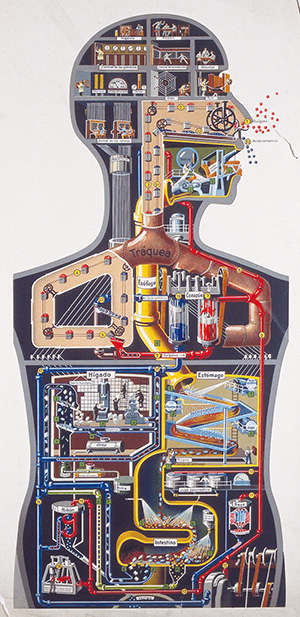
    “El hombre como palacio industrial” by Fritz Kahn, 1930. A graphic analogy between anatomy and machinery.

    Since this time, the shadow of the machine-human archetype has cast itself more and more deeply over us. Today, we can experience it not just in the degree of dependency we have on our intelligent machines – our laptops, tablets and smartphones, our sat navs and virtual assistants – but also in the degree of our intimacy with these machines that have become our daily and hourly companions. Not only are we increasingly deferent towards them, but we are also increasingly bound up with them emotionally. It is hard for many people to imagine being able to live without them. What lies behind this? Is it just convenience, or is it that their presence is somehow reassuring to us? Do they mirror back to us an image of ourselves that we secretly yearn for? Has the machine-human archetype already got inside us? In the late 1980s, the French postmodernist philosopher Jean-Francois Lyotard asked the question: “What if what is ‘proper’ to humankind were to be inhabited by the inhuman?”9

    Because the inhuman is now so close to us, this has become the question of our times.

    Machine Intelligence

    In order to answer Lyotard’s question, we need first to clarify exactly what kind of intelligence can be automated in a machine. As we have seen, with the first mechanical calculators of the seventeenth century, the model for automated intelligence was calculation. You would feed in data and the machine would calculate the answer. You fed in 236 and 528. You turned the “adding” cogwheel and the machine calculated the result: 764. But from the seventeenth century onwards, there was a further highly significant development. Many intellectuals sought to configure logic to mathematics, so that logical operations could become calculations, conducted independently of the medium of ordinary human language. As a result of an enormous amount of effort by many brilliant minds, this was finally achieved in the nineteenth century, most decisively by George Boole in his book An Investigation into the Laws of Thought (1854). Boole showed that calculations could be performed on data much more complex than numbers, by assimilating logical operations to mathematical operations, so that adding, subtracting and multiplying actually became logical operations. What this meant was that as long as data was fed into the machine in a machine-compatible (i.e. calculable) language – for Boole this was a form of algebra – it could be processed and analysed by the machine.10 The machine would simply follow a set of instructions or logical operations, which we now call algorithms, that would then lead to the required results. Boole thus laid the foundations for the development of machine intelligence. It is essentially data-processing using calculative or algorithmic thinking. The more data that can be analysed and the faster the machine can produce results, the more intelligent the machine is deemed to be.11 

    Many people today would like to persuade us that human intelligence is on exactly the same spectrum as machine intelligence. La Mettrie’s view that human consciousness is reducible to brain processes has become the standard scientific view. The difference today is that rather than the clock or mechanical calculator, the computer has now become the underlying image that is regarded as mirroring human consciousness, on the understanding that the brain is essentially a biological computer.12 Along with this view of the brain as a biological computer, it is argued that human thinking is nothing more than a kind of data-analysis that consists of working things out logically and making our calculations in order to arrive at a given result, ending up with the problem solved or the argument won.

    In the Western philosophical tradition this is called discursive thinking. It is discursive because it “runs along” (dis-currere) from one thought or logical inference to another, until it arrives at a conclusion or attains its goal. The problem is that if machines can run along much faster than us, processing vastly more amounts of data and coming up with recommendations or decisions before we have even turned our minds to thinking about whatever it is, then clearly we have been out-performed! It is predicted that in the next twenty years an increasing proportion of the work of lawyers, teachers and doctors will be undertaken by dedicated algorithms. Already we can see this happening. There are now companies that actually have algorithms on their board of directors because they have the ability to analyse huge amounts of data, take all relevant factors into account, and then make extremely sensible recommendations to the other members of the board based on their analysis. They are sometimes even given a vote along with the other directors.13 

    A nightmare scenario begins to unfold in which “superintelligent” machines will not just assist human beings, but they will replace us altogether. We will become redundant. This nightmare fantasy sent shudders through Silicon Valley a few years ago. Steve Wozniak, the co-founder of Apple, is reported to have said: “If we build these devices to take care of everything for us, eventually they’ll think faster than us and they’ll get rid of the slow humans to run companies more efficiently.”14 

    For those who see human intelligence as on the same spectrum as machine intelligence, the solution is greater integration with machines through direct computer interfaces, so that we will always stay one step ahead of them.15 But that would mean our human future would be a cyborg future. In order to escape one nightmare scenario we embrace another, in which human beings increasingly remove themselves from the limitations of their own biology, thereby supposedly becoming (in the view of some) “superhuman.”16 In Lyotard’s terms, we would then not only have allowed the inhuman to inhabit us, we would ourselves have become inhuman. So what, returning to Lyotard’s original question, is “proper” to humankind? 

    Human Intelligence

    In the Western philosophical tradition, stemming from Plato and Aristotle, a very clear distinction is made between discursive thinking, which “runs along” linking one thought with another through logical inferences, and contemplative thinking, which in many respects is the opposite of discursive thinking. Contemplative thinkingdoesn’t run along, but stops still. It doesn’t move, but is at rest in its own activity, which is a focused attentiveness that is both open and receptive. Unlike discursive thinking, contemplative thinking does not process data: it does not link one finished thought with another according to a set of instructions or logical rules. It goes behind thoughts and dwells in the thinking activity that produces them. In “machine intelligence” terms, contemplative thinking has the value of zero, because it has slowed down to a standstill. But this standstill is a creative space which machine intelligence does not and cannot recognise. 

    From the point of view of machine intelligence, contemplative thinking would seem to be completely useless, because it doesn’t concern itself with analysis or problem-solving. It doesn’t seek results. It is an activity engaged in for its own sake. And this activity involves a turning of one’s attention inwards, towards the spiritual world, through becoming aware of what rises up within the soul – beyond data, beyond information, beyond our favourite opinions. What arises in true contemplative activity are intuitions and insights into the deeper meaning of things, concerning which machine thinking knows nothing. These intuitions and insights may be informed by the primordial images of archetypal realities that well up from the imaginal world, and which simply cannot be accessed through logical inference or calculative thinking. In contemplative thinking we also come to stand on the ground of our own inner freedom, for it is an open space that is not conditioned by habits of thought or opinion, but is rather an active receptivity to a more interior source of knowing. From such a sourcethe voice of conscience may be heard, and a sense of moral certainty about what we must do may come to us. This is something which cannot be arrived at through mere calculation.

    These and other experiences fundamental to what it means to be human and not a machine are the gift of contemplation. The word “contemplation” has buried within it the Latin word for a sacred space, which houses the divine presence. The templum of“templation” translates as “temple.” The very word “contemplation” tells us that in order to contemplate we have to find our way to this inner temple, this sacred space within ourselves, where we can open ourselves to the spiritual dimension of existence.17 Machine intelligence cannot reach this sacred space, nor the contemplative activity that creates it, no matter how much data it processes and how fast it processes it. 

    Philosophers and mystics have time and again spoken of the activity of contemplation as being at the kernel of our human being. We are currently entering a period of great peril for humanity, as collectively we fall increasingly under the spell of the machine, and machine thinking. It is incumbent upon all of us who seek to uphold truly human values in an era dominated by intelligent machines that we ground ourselves in the contemplative activity that is specific to human intelligence, concerning which Aristotle long ago declared that it is “something within us that is divine… the highest thing in us, for though it be small in bulk, in power and value it far surpasses all the rest.”18 

    The above is based on a short talk given by the author to introduce his book In the Shadow of the Machine: The Prehistory of the Computer and the Evolution of Consciousness.

    [alert type=”general” dismiss=”no”]This article was published in New Dawn 170.[/alert]

    [alert type=”success” dismiss=”no”]If you appreciate this article, please consider subscribing to help maintain this website.[/alert]

    Footnotes 

    1. Nicole Oresme, Le Livre du Ciel et du Monde (1377), 2.2.
    2. René Descartes, Treatise on Man (1629) in Ralph M. Eaton, ed., Descartes: Selections (London: Charles Scribner’s Sons, 1927), p. 350 and p.354: “All the functions [of the human body]… follow naturally in this machine from the arrangement of its parts, no more nor less than do the movements of a clock, or other automata, from that of its weights and its wheels”
    3. René Descartes, Rules for the Direction of the Mind in Elizabeth Anscombe and Peter Thomas Geach, eds., Descartes: Philosophical Writings (Sunbury-on-Thames: Thomas Nelson and Sons, 1970).
    4. Francis Bacon, Preface to Novum Organum (1620) in Rose-Mary Sargent, ed., Francis Bacon: Selected Philosophical Works (Indianapolis: Hackett Publishing Inc., 1999), p.87. 
    5. René Descartes, Discourse on Method, in the Philosophical Works of Descartes, vol.1, ed. Elizabeth S. Haldane and G. R. T. Ross (Cambridge: Cambridge University Press, 1980), p.119.
    6. Galileo, Il Saggiatore (1623), in Stillman Drake, Discoveries and Opinions of Galileo (New York: Doubleday, 1957), p.274: “I do not believe that external bodies, in order to excite in us tastes, odours and sounds, need anything other than size, figure, number and slow and rapid movements; and I judge that if the ears, the tongue and the nostrils were taken away, the figure, the numbers, and the motion would indeed remain, but not the odours nor the tastes nor the sounds….”
    7. Thomas Hobbes, Leviathan (1651; London: J. M. Dent and Sons, 1973), p.18: “In sum, in what matter so ever there is a place for addition and subtraction, there is a place for reason; and where these have no place, there reason has nothing at all to do. For reason, in this sense, is nothing but reckoning (that is, adding and subtracting)…”
    8. Justin Leiber, Introduction to La Mettrie, Man a Machine (Indianopolis/Cambridge: Hackett Publishing Company, Inc., 1994), pp.4-6.
    9. Jean-François Lyotard, The Inhuman (Cambridge: Polity Press, 1993), p.2.
    10. Thus adding x to y represented one kind of logical operation, multiplying x by y another. Boole saw that the plus sign corresponded to logical disjunction (“either… or”), the multiplication sign to logical conjunction (“both… and”). It doesn’t matter to the machine what x and y are: they are already predefined, or pre-conceptualised entities. They hold no meaning for the machine, which simply subjects them to analysis, following the instructions or “algorithms” that produce the desired outputs. 
    11. Ray Kurzweil, The Singularity is Near (London: Duckworth, 2005), pp.70-72. 
    12. Stephen Pinker, How the Mind Works (New York: W. W. Norton, 2009), p.324: “The mind is what the brain does; specifically, the brain processes information, and thinking is a kind of computation.”
    13. Yuval Noah Harari, Homo Deus (London: Penguin Random House, 2016), p.322.
    14. Steve Wozniak, interview with Paul Smith, Financial Review, 23rd March, 2015.
    15. Rick Perera, “Hawking: Re-engineer humans or risk machine rule”, PC World, 4th September, 2001 reports Hawking as saying: “Humans must develop an interface that allows the human brain to be directly connected to a computer, so that the artificial brain contributes to human intelligence, rather than opposing it.”
    16. Harari, Homo Deus, pp.43-47.
    17. Henri Corbin, Temple and Contemplation (London: KPI, 1986), pp.386-388.
    18. Aristotle, Nicomachean Ethics, X.vii.8.

    © New Dawn Magazine and the respective author.
    For our reproduction notice, click here.

  • 5G: The Final Assault

    5G: The Final Assault

    The following article, published in New Dawn 173 (May-June 2019), presents important information on the 5G networks currently being erected across urban landscapes in Australia, Britain, Europe, the USA, Asia, and eventually everywhere.

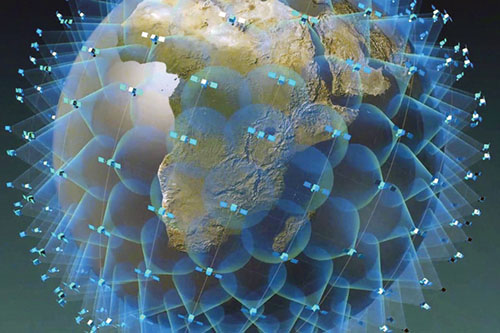
    In November last year (2018), the United States Federal Communications Commission (FCC) authorised the rocket company SpaceX, owned by the entrepreneur Elon Musk, to launch a fleet of 7,518 satellites to complete SpaceX’s ambitious scheme to provide global satellite broadband services to every corner of the Earth. The satellites will operate at a height of approximately 210 miles, and irradiate the Earth with extremely high frequencies between 37.5 GHz and 42 GHz. This fleet will be in addition to a smaller SpaceX fleet of 4,425 satellites, already authorised earlier last year by the FCC, which will orbit the Earth at a height of approximately 750 miles and is set to bathe us in frequencies between 12 GHz and 30 GHz. The grand total of SpaceX satellites is thus projected to reach just under 12,000. 

    Figure 1: Conceptual view of SpaceX’s plan for thousands of satellites, irradiating the entire planet with EHFs to beam 5G everywhere, even in remote deserts and rainforests.

    There are at present approximately 2,000 fully functioning satellites orbiting the Earth. Some beam down commercial GPS (or ‘SatNav’), some provide TV, some provide mobile phone services, and some bounce radar back and forth to produce images for meteorologists and military surveillance. The Earth is thus already comprehensively irradiated from outer space. But the new SpaceX fleets will constitute a massive increase in the number of satellites in the skies above us, and a correspondingly massive increase in the radiation reaching the Earth from them. The SpaceX satellite fleet is, however, just one of several that are due to be launched in the next few years, all serving the same purpose of providing global broadband services. Other companies, including Boeing, One Web and Spire Global are each launching their own smaller fleets, bringing the total number of projected new broadband satellites to around 20,000 – every one of them dedicated to irradiating the Earth at similar frequencies (figure 1). 

    Why this sudden flurry of activity? The new satellite fleets are contributing to a concerted global effort to ‘upgrade’ the electromagnetic environment of the Earth. The upgrade is commonly referred to as 5G, or fifth generation wireless network. It has become customary in tech circles to talk about the introduction of 5G as involving the creation of a new global “electronic ecosystem.” It amounts to geo-engineering on a scale never before attempted. While this is being sold to the public as an enhancement of the quality of video streaming for media and entertainment, what is really driving it is the creation of the conditions within which electronic or “artificial” intelligence will be able to assume an ever-greater presence in our lives. 

    The introduction of 5G will also require hundreds of thousands of new mini mobile phone masts (also referred to as “micro-cells” or “base stations”) in urban centres throughout Australia, and literally millions of new masts in cities throughout the rest of the world, all emitting radiation at frequencies and at power levels far higher than those to which we are presently subjected. These new masts are much smaller than the masts we currently see beside highways and on top of buildings. They will be discreetly attached to the side of shops and offices or secured to lampposts. The 20,000 satellites are a necessary supplement to this land-based effort, for they will guarantee that rural areas, lakes, mountains, forests, oceans and wildernesses, where there are neither buildings nor lampposts, will all be incorporated into the new electronic infrastructure. Not one inch of the globe will be free of radiation.

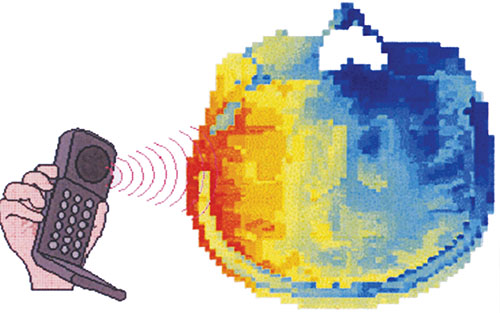
    Figure 2: The colours indicate the Specific Absorption Rate (SAR) of mobile phone radiation. The SAR is the amount of power absorbed by tissue, measured in watts per kilogram, shown here with red as the highest value, blue the lowest.2

    Given the scale of the project, it is surprising how few people are aware of the enormity of what is now just beginning to unfold all around us. Very few people have even heard about the 20,000 new satellites that are due to transform the planet into a so-called “smart planet,” irradiating us night and day. In the national media, we do not hear voices questioning the wisdom, let alone the ethics, of geo-engineering a new global electromagnetic environment. Instead, there is a blithe acceptance that technology must continue to progress, and the presence in our lives of increasingly “smart” machines and gadgets that each year become cleverer and more capable is an inevitable part of this progress. And who doesn’t want progress? Almost everyone loves their sleek and seductively designed phones, iPads and virtual assistants, and regards them as an indispensable part of their lives. 

    The question we should ask is whether we also want increasingly intense exposure of the natural environment and all living creatures, including ourselves, to more and more electromagnetic radiation. Is it likely that this does not entail any adverse health consequences, as both government and industry claim? If the electromagnetic waves that connect our smartphones to the Internet travel through brick, stone and cement, then what happens when these same waves encounter our bodies? Be assured that they do not just bounce off us! They travel into the human body. The degree to which they are absorbed can be precisely measured in what is called the Specific Absorption Rate, expressed in Watts per kilogram of biological tissue. When we fill our houses with WiFi, we are irradiating our bodies continuously. When we hold a smartphone to our ear, electromagnetic waves irradiate our brains (figure 2). Do we really believe this could be completely harmless? 

    Figure 3: The new 5G Active Phased Array Antennas (APAA) will concentrate energy in narrow, steerable high power beams.

    Waves and Frequencies

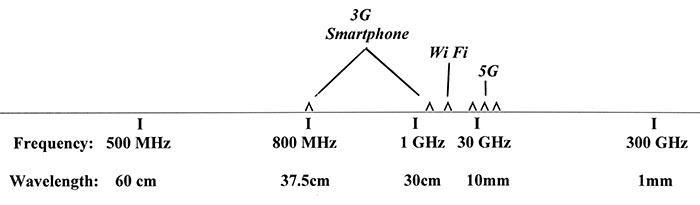
    At present, mobile phones, smartphones, tablets, WiFi and so on all operate at under 3 GHz in what is called the “microwave” region of the electromagnetic spectrum. If you could see and measure their wavelengths, you would find that they are many centimetres (or inches) long. A smartphone operating at 800 MHz, for example, sends and receives signals with wavelengths of 37.5 centimetres (just under 15 inches). Operating at 1.9 GHz, the wavelengths are 16 centimetres (just over 6 inches). WiFi uses the 2.4 GHz frequency band with 12 centimetre wavelengths (just under 5 inches long). 

    The introduction of 5G will entail the use of considerably higher frequencies than these, with correspondingly shorter wavelengths. Above 30 GHz, wavelengths are just millimetres rather than centimetres long. The millimetre waveband (from 30 GHz to 300 GHz) is referred to as Extremely High Frequency, and its wavelengths are between 10 millimetres and 1 millimetre in length.3 Up to the present time, Extremely High Frequency electromagnetic radiation has not been widely propagated, and its introduction marks a significant step change in the kind of electromagnetic energy that will become present in the natural environment (figure 4). 

    Figure 4: Frequencies and wavelengths of smartphone, Wi Fi and 5G.

    The reason why millimetre waves are to be used for 5G is that much larger bands of spectrum are available in the Extremely High Frequencies than at lower frequencies. This means that there can be much broader “bandwidth.” Broader bandwidth means that larger quantities of data can be transferred and the speed of transfer of the data will be significantly faster. One of the effects of this is that it reduces what is called “latency,” or time-lag, in the system, improving the quality of video streaming. But in so doing, it also enables a greater seamlessness between the data accessible from virtual sources and our perceptions of objects in the real world, as is required, for example, in Augmented Reality applications. Greater seamlessness means that we more effortlessly inhabit the natural and the electronic worlds as if they were a single reality. 

    One of the technical problems of using frequencies in the millimetre region of the spectrum is that because the waves carrying the data are so tiny, being only millimetres long, they are less able to pass through physical barriers, like walls and trees, than are the longer waves of lower frequencies. This is why it is necessary to have so many more new “micro-cells” or “base stations.” They will need to be spaced at 100 metres apart in cities because beyond this distance their signals weaken and are therefore less able to penetrate buildings and connect with the devices inside. As well as being more closely spaced, the 5G micro-cells will operate at much higher power than current phone masts in order to ensure that the signals are sufficiently strong. 

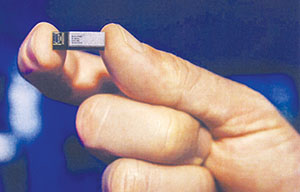
    Because the wavelengths are so much smaller, the antennas transmitting and receiving them will also be much smaller than those of current phone masts and electronic devices. A single 5G transmitter/receiver will have a large number of tiny antennas, grouped together in one unit. An array of just over a thousand such antennas measures only four square inches, so will easily fit into a small base station on a lamppost, while the smartphone in your pocket will probably have sixteen (figure 5). 

    Figure 5: Qualcomm’s millimetre wave antenna array module for a 5G smartphone. It has four antennas that can accurately point towards the nearest 5G base station. Phones will have four of these modules, i.e. sixteen antennas.4

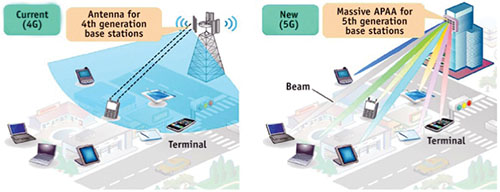
    Both 5G satellites and 5G land-based masts will use a system called the “phased array.” In phased array, groups of antennas are co-ordinated to radiate pulses in a specific direction and in a specified time sequence. This allows a concentrated beam of radio waves to be exactly aimed at designated targets, to enable signals to be sent or received. Because the beams are concentrated in this way, this adds to their power, which means they are able more easily to penetrate buildings. But it also means that any living creature that gets in the way of such a concentrated beam will be subjected to a powerful dose of extremely high frequency radiant electricity. 

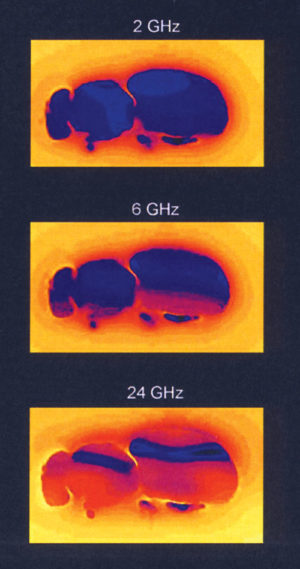
    A study published earlier this year demonstrated that certain insects, because of their small body-size, are particularly vulnerable to the millimetre waves of the higher frequencies to be utilised by 5G (figure 6).5 Other studies have shown that bacteria and plants are vulnerable, and so also (as one might expect) are the skin and the eyes of animals including, of course, human beings.6

    Figure 6: Illustration of the absorption of Radio Frequency electromagnetic radiation in the Honey Bee. At currently used frequencies between 2 GHz (top) and 6 GHz (middle), the wavelength is relatively large compared to the insect. But at 24 GHz, (bottom) the wavelength is closer to the insect’s size and the radiation penetrates further.7

    As well as its ability to concentrate power in focused beams, phased array technology has a further complicating factor. Either side of the main beam, the time intervals between the pulses are different from the time intervals between those of the main beam, but they may overlap each other in such a way as to produce extremely rapid changes in the electromagnetic field. This can have a particularly detrimental effect on living organisms, because instead of the radiation decaying when it is absorbed into living tissue, it can be re-radiated within the body. The moving charges streaming into the body effectively become antennas that re-radiate the electromagnetic field and send it deeper into the organism. These re-radiated waves are known as Brillouin precursors, named after the French physicist Leon Brillouin, who first described them in 1914. Research suggests that they can have a significant and highly detrimental impact on living cells.8 

    The Un-reassuring Assurances of Government and Industry

    The government body charged with advising on the health effects of electromagnetic radiation, the Australian Radiation Protection and Nuclear Safety Agency (ARPANSA), seeks to reassure us that there is no established evidence that Radio Frequency radiation (which radio, television, mobile phones, smartphones and 5G all use) has any adverse health effects on either adults or children.9 ARPANSA’s advice is largely based on findings derived from the supposedly independent AGNIR (Advisory Group on Non-Ionising Radiation), which advises the UK Health Department.10 AGNIR’s report, published in 2012, on the safety of Radio Frequency radiation stated that there was a lack of “convincing” and “conclusive” evidence for any adverse health effects. It was like giving a blank cheque to the telecommunications industry to move into the higher frequencies without any heed for the consequences.11 

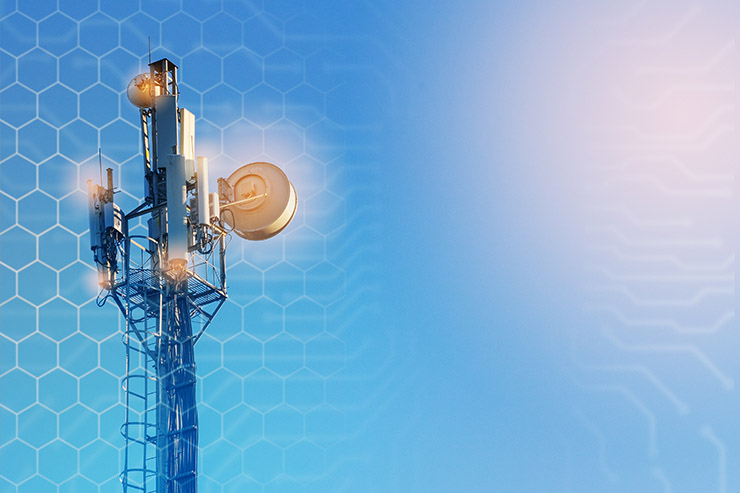
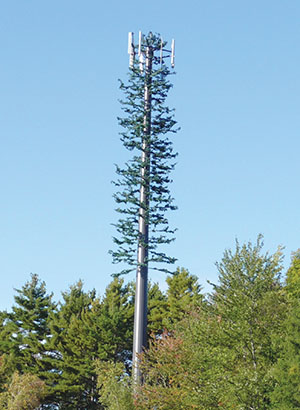
    Figure 7: Cell tower disguised as a tree.

    It turns out that far from being independent, AGNIR has a high proportion of members with blatant conflicts of interests, and their report distorted or simply left out of account evidence that should have compelled them to reach the opposite conclusion to the one they arrived at. In a forensic analysis of the report, the environmental health researcher Sarah Starkey makes it clear that only a wilful disregard of the available scientific evidence could explain its internal contradictions and apparent incompetence.12 Yet it is, it seems, not only the basis of current UK government policy but also Australian government policy, allowing the roll out of 5G without so much as even a nod towards the need for a prior health and safety assessment.13 Health and safety simply do not feature in government thinking, despite a veritable mountain of literally thousands of research papers demonstrating adverse health effects which continues to grow at the rate of roughly 350 per year, on average practically one every day.14

    One of the reasons for ignoring this evidence in the hell-for-leather dash to create the 5G electronic ecosystem is the conviction in government circles that unless we introduce it immediately, we will be “left behind” and our economic growth and competitiveness will be put at risk. There is simply no time to consider the possible health consequences. The rewards of the “connected future” are to be measured in billions of dollars worth of revenue. The mind-boggling amounts involved are well exemplified in a recent estimate that the global media industry alone stands to gain $1.3 trillion from 5G by 2025, not least because 5G will “unlock the potential of augmented reality (AR) and virtual reality (VR).”15 The irony that the “connected” future is one in which dizzying profits stand to be made from technologies that disconnect us more and more from the real world is entirely missed.

    The sums involved are sufficient to explain why the telecoms industry has for the last 25 years done its utmost to ensure that research into the health effects of wireless technologies produce negative or inconclusive results. Since 1993, the industry has financed a large number of studies, saving governments a great deal of expense and at the same time preserving the convenient illusion that the jury is still out on whether exposure to Radio Frequency radiation causes harm. 

    Earlier this year, The Guardian published an article citing research which showed that while 67% of independently funded studies found a biological effect of exposure to Radio Frequency radiation, only 28% of industry-funded studies did. Industry-funded studies are almost two and a half times less likely than independent studies to find health effects.16 The authors of the Guardian article explain that the telecoms industry doesn’t need to win the scientific argument about safety, but simply keep the argument running indefinitely by producing studies with results that fail to verify, or even better contradict, the research that does find adverse health effects. 

    One of the most notorious is the mammoth, industry-funded “Interphone Study,” which managed to conclude that holding a mobile phone to the head actually protects the user from brain tumours! This study, which is full of contradictions and suffers from grievous design flaws, is often quoted as the most authoritative to date, while it has in fact been thoroughly discredited.17 Nevertheless, the impression is maintained that there is no scientific consensus, and so there are not sufficient grounds for action to be taken. Needless to say, this suits government just as much as it suits industry. 

    [alert type=”success” dismiss=”no”]If you appreciate this article, please consider subscribing to help maintain this website.[/alert]

    The Path to Total Immersion

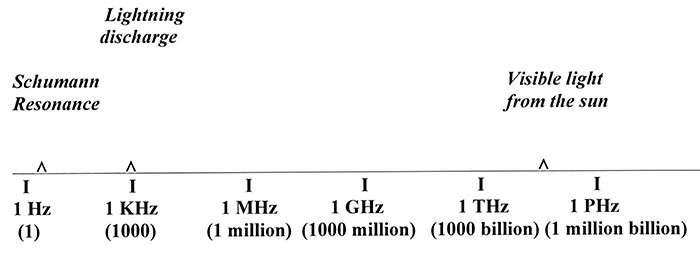
    Beyond the health effects there is another level altogether of what the roll out of 5G actually entails. To gain a perspective on this, we should remember that it was not so long ago that the Earth’s electromagnetic field was undisturbed by human-generated electromagnetic frequencies. Before the 1880s, there were only two main causes of electromagnetism, both of them natural: the lightning of thunderstorms, which also set in motion the very weak, low frequency resonances known as Schumann Resonances, and sunlight. Lightning and sunlight produce effects in specific, and very limited, parts of the electromagnetic spectrum. The very idea that such a thing as “electromagnetism” and an “electromagnetic spectrum” existed was not even entertained before the nineteenth century. And, from the point of view of the pre-electrical age, the truth of the situation was that they indeed did not exist as a factor of experience. Beyond lightning and sunlight, the energies of the electromagnetic spectrum did not impact on human life, for they were entirely dormant (figure 8). 

    Figure 8: Natural background electromagnetic radiation, showing frequencies in cycles per second.

    In that pre-electrical world, both lightning and sunlight were regarded with a certain degree of awe, as natural phenomena expressive of powers greater than anything human beings could muster. In antiquity both were associated with gods – lightning with violent storm gods invariably with Underworld associations, like Seth, Baal and Zeus; and sunlight with sublime solar deities like Ra, Shamash and Apollo. In the later Judaeo-Christian era, the widespread sense that these phenomena had a spiritual source persisted, with lightning regarded as expressive of the divine wrath, and light as the garment of the cosmic Logos. We touch here a deeply felt relationship to nature that has been largely eroded in the centuries since the Scientific Revolution. In the course of the eighteenth and nineteenth centuries, both lightning and light were stripped of their spiritual numinosity, clearing the way for an entirely materialistic explanation of light, and an entirely technological approach to electricity.

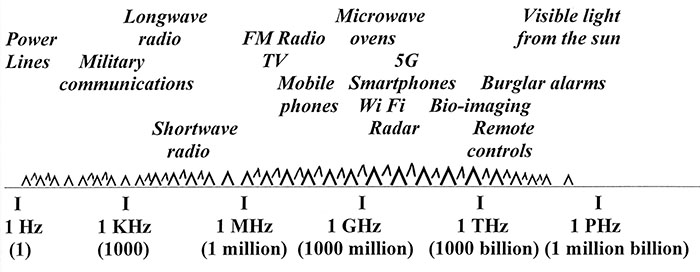
    In the early days, the frequencies utilised were at the lower end of the electromagnetic spectrum. In the 1890s, the power lines that delivered the new mains electricity to factories and houses were standardised at either 50 or 60 Hz (or cycles per second). When public radio broadcasts began in the 1920s, they were mostly in the longwave frequencies under 500 KHz (thousands of cycles per second). As the century wore on, the frequencies used by new and improved technologies became higher and higher. In the 1930s and ‘40s, medium and shortwave frequencies (between 500 KHz and 1700 KHz) were utilised, while in the 1950s the Very High Frequencies (VHF) of 30 – 300 MHz (or millions of cycles per second) were employed for both radio and TV broadcasting. 

    During World War II, a method was discovered for generating even higher frequencies, between 3 and 30 GHz (thousands of millions of cycles per second), which became the basis for radar. With each escalation in frequency, more power was required to transmit the radio waves. The advent of mobile phones, smartphones and WiFi, brought into widespread use the Ultra High Frequency (UHF) part of the spectrum (300 MHz – 3 GHz) for signal transmission. Transmission in these frequencies demands more than ten times the power needed for VHF transmission. 

    Today, poised at the threshold of the new era of an Extremely High Frequency “electronic ecosystem,” with frequencies of up to 70 GHz envisaged, yet more power will be required for effective transmission of its millimetre waves.18 Then the natural environment will be fully saturated with an invisible fog of radiation (figure 9). 

    Figure 9: Human induced electromagnetic radiation, showing frequencies in cycles per second.

    In this brief historical sketch, we see higher and higher frequencies forming the basis of each new technological innovation. As each one of the new technologies was introduced, human beings became a little more disassociated from the natural world. Consider how this happened. From the 1890s onwards, the supply of mains electricity to homes, schools, hospitals and factories caused a revolution in living standards, liberating humanity from subservience to nature’s cycles of day and night, summer and winter, by giving access to a new source of light, warmth and power. Then, in the 1920s, radio enabled people to communicate over vast distances, and brought the voices of kings and politicians, singers and poets into our living rooms, even though they were not physically present. 

    In the 1950s, television intensified the experience of an absent yet present world, conveyed by the moving image. I remember as a child the addictive quality of television: one is drawn out of oneself and away from awareness of one’s immediate surroundings into the fascinating world of images on the screen. 

    With the advent of the smartphone, the trend towards addictiveness was greatly strengthened, partly because the screen became a portable interface with the Internet, and partly because of the deliberately exploitative policies of Facebook, Google and others to hook people into an addictive relationship to their devices.19 Smartphone addiction both dislocates users from their own inner centre of stillness, and at the same time disconnects them from the natural environment. 

    5G will further accentuate this tendency for people to lose themselves, and it will weaken even more their relationship to nature, for it promises to make advanced immersive Virtual Reality accessible to all. While VR headsets have been commercially available for some time now, VR is still in its infancy. The next development in VR technology is to supplement the headset with a “haptic suit,” which enables the wearer to experience sensations of touch – pressure, warmth, hardness, softness, moisture and dryness – in virtual reality. Such opportunities for “total immersion” in virtual reality will lead to an increasing confusion as to which world we really belong: the electronically generated or the natural world. The use of Augmented Reality, made possible through special helmets, electronic glasses, or contact lenses, that overlay virtual content onto the experience of the physical world, will add to the confusion, as the virtual is increasingly integrated within the real world.20 

    People will become adjusted to regarding the virtual world as having as great a claim on their attention, their emotions and thoughts, as the natural world. The temptation will be to give their loyalty to that which not only undermines their relatedness to nature but also, through its assault on the imagination, has a corrosive effect on the inner life of the soul. The confusion will only be exacerbated by a huge increase in the use of 3D holographics that will give virtual entities the ability to incarnate electronically in the physical environment. This is what the saturation of the world with extremely high frequency millimetre waves will enable. The waves themselves are only part of the issue: it is the technologies that ride on the backs of the waves, and their impact on our inner life, that should also concern us.

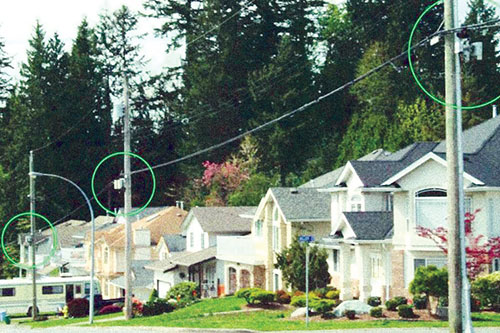
    Figure 10: 5G antennas installed along a street in a US town.

    The Formation of the Global Electronic Brain

    But if 5G promises to radically alter the experiential world we inhabit in these ways, there is something further that we must understand if we are to grasp what is really being prepared. At the same time as increasingly sophisticated technologies increasingly disconnect human beings from the natural world, a network of electronic “intelligence,” global in extent, gradually emerged. At first it was under close human supervision, but it has steadily grown more autonomous. Consider the difference between radio broadcasting and the Internet: the former is under tight human control and serves a very specific purpose, whereas the latter has established itself as a permanent, constantly available electronic infrastructure of undefined scope and reach. What has been happening over recent decades is the increasing co-ordination of intelligence-endowed machines, so that they operate without need of human supervision. 

    The efforts now underway to create a 5G electronic ecosystem are the necessary precondition for developing and perfecting a global Artificial Intelligence network which feeds on the very fast transfer of large amounts of information. This global electronic “brain,” innocuously called the “Internet of Things,” is already impacting on our lives. 

    Through the Internet of Things, more and more things will be linked to the Internet and made “smart” by being given the ability to function autonomously. On smart motorways your car will drive itself while you, wearing your VR headset and haptic vest, play interactive computer games in the back seat; and in your smart house your fridge will autonomously order more eggs, milk and cheese for you via a wireless connection with a supplier. 

    But the reality is that the Internet of Things is itself the precursor to what has been called the “Internet of Thinking,” in which human beings will find themselves having to live in relationship to the vast global electronic intelligence. It will be active everywhere in our environment and we shall be obliged to interact with it in order to accomplish the simplest of tasks.21 In the Internet of Thinking it is not hard to see the lineaments of an electronically supercharged totalitarian state, with unprecedented control over the minutiae of individuals’ lives. The possibility of this happening will only be increased by the thousands of new mini phone masts and satellites irradiating every inch of the planet with millimetre waves. For this is what 5G means: it means putting in place not just an improved telecommunications system, but rather a new “system of systems” – the infrastructure of electronic totalitarianism.22 

    A Curtain Drawn Against the Light 

    As our world is increasingly smothered by a fog of radio waves, microwaves and millimetre waves, it may seem that the gods of the Underworld have taken hold of humanity in an ever-tightening grip, drawing us towards the false lights – the illusory lights of the hell-beings and hungry ghosts that the Tibetan Book of the Dead long ago warned against. The electromagnetic energies that we have summoned, and which promised to give us new powers, now appear to be overpowering us, carrying us down into an Underworld realm of hellish entertainment and distraction, of illusion and disconnection from the reality that really matters – the reality of nature and the spiritual order that infuses nature, the reality of fellow creatures with whom we share our world, living in soil and sky and walking the Earth beside us. 

    We must ask: Does the Earth need an electronic ecosystem? Is it going to benefit in any way from being irradiated with millimetre waves? Is there actually any need at all for 5G? Can we even remotely conceive that 5G is the answer to any of the pressing ecological, social and spiritual problems that face us today? We stand at a dreadful threshold, and yet surrender to despair cannot be the right response. What can we do?

    First of all, we can protest! There are campaigns against 5G that we can join, there are petitions to sign, letters to write, and legal actions to support. The best place to begin is the “International Appeal to Stop 5G on Earth and in Space,” which has now gathered over 40,000 signatures, including those of many health professionals, environmentalists and other scientists.23 But as well as protest there is something further that needs to be done, and that is to bring spiritually informed understanding to the deeper significance of the global electronic brain whose emergence 5G will hasten. 

    To this end, we need to develop a clear perception of the moral quality of electricity, and to recognise the kind of spiritual entity or entities that it serves. This will empower us to break the spell that electricity and electronic technologies have cast over us, and enable us to form a more appropriate relationship to them. One of Rudolf Steiner’s most helpful insights into electricity was his observation that it is light in a fallen, degraded state – light that has fallen beneath nature into the sub-natural realm – and that is why we must actively guard against an ever-increasing dependence on it, for it threatens to drag us down.24 

    This points to a third thing we can do, which is really the foundation of everything else. It is to rebuild our relationship to the light, which in its selfless benevolence and purity greets us every morning, and which, unlike the false and illusory electronic lights that would lead us into the Underworld, beckons us in a quite different direction, towards our essential humanity. 

    Through a deepened meditative relationship to the light, practised through the hours of the day and the seasons of the year, we can nurture a relationship to the inner light that is the source of all that is creative and good in the world. This inner light the Christian tradition knows as the cosmic Logos. 

    As the curtain of electrosmog is drawn across our world, we are presented with a sacred task that, come what may, we attend to all that the light has to give, for therein lies the divine Saving Power. 

    The above article originally appeared in New View magazine (Jan-Feb 2019), and has been modified by the author with information relevant to the Australian situation.

    [alert type=”general” dismiss=”no”]This article was published in New Dawn 173.[/alert]

    [alert type=”success” dismiss=”no”]If you appreciate this article, please consider subscribing to help maintain this website.[/alert]

    Footnotes

    1. One of the best sources for this information is the website of the Global Union Against Radiation Deployment from Space (GUARDS) at www.stopglobalwifi.org, and the related Cellular Phone Task Force website at www.cellphonetaskforce.org. Both organisations are informed and inspired by the tireless research and campaigning of Arthur Firstenberg, to whom this article is greatly indebted.
    2. Source: ISEE/ISEA Conference: Environmental Epidemiology and Exposure, Paris, 5/9/2006
    3. The rule is, the higher the frequency at which the wave oscillates, the shorter the wavelength will be.
    4. Source: Qualcomm, July 2018
    5. Arno Thielens et al., “Exposure of Insects to Radio-Frequency Electromagnetic Fields from 2 to 120 GHz”, Nature, 8: 3924 (2018): “The insects show a maximum in absorbed radio frequency power at wavelengths that are comparable to their body size… The studied insects that are smaller than 1cm show a peak in absorption at frequencies (above 6 GHz), which are currently not often used for telecommunication, but are planned to be used in the next generation of wireless communication systems.”
    6. Cindy Russell, “A 5G Wireless Future,” The Bulletin (January/February, 2017), pp.20-23, reviews the research, and lists a large number of adverse health effects of millimetre wave electromagnetic radiation including arrythmia, antibiotic resistance, cataracts, compromised immune system, etc.
    7. Source: Arno Thielens et al., Nature, 8: 3924 (2018), fig.4
    8. Kurt Oughstun, interview on “Brillouin Precursors,” Microwave News, 22, 2 (2002), p.10. According to Oughstun, a professor of electrical engineering and mathematics at the University of Vermont, “A single Brillouin precursor can open small channels through the cell membrane because, as it passes through the membrane, it can induce a significant change in electrostatic potential across that membrane.” See also Arthur Firstenberg, “5G – From Blankets to Bullets,” January 17, 2018, at www.cellphonetaskforce.org.
    9. For example, in the ARPANSA fact sheet on “Wi-fi and Health” (“There is no established evidence that the low exposure to RF EME from Wi-fi adversely affects the health of children or the general population”) and on “Mobile Phones and Health” (“There is no established evidence that the use of mobile phones causes any health effects”), for which see www.arpansa.gov.au. Given the vast amount of evidence indicating adverse health effects, one wonders what it takes for this evidence to be “established.”
    10. ARPANSA TSR-164 Report, Review of Radiofrequency Health Effects Research – Scientific Literature 200-2012 (2014). This report has been critiqued by Victor Leach and Steven Weller of the Oceania Radiofrequency Scientific Advisory Association (ORSAA) in Radio Frequency Exposure Risk Assessment and Communication: Critique of ARPANSA TRS-164 Report: Do We Have a Problem? (2017), available at www.orsaa.org. Leach and Weller point out the derivative nature of the ARPANSA report, as well as serious flaws in its assessment of the evidence, which simply does not support the conclusions reached. 
    11. Report of the Advisory Group on Non-Ionising Radiation, Health Effects from Radiofrequency Electromagnetic Fields (2012)
    12. Sarah J. Starkey, “Inaccurate official assessment of radiofrequency safety by the Advisory Group on Non-ionising Radiation,” Review of Environmental Health, 31:4 (2016), pp.493-503
    13. The Australian Government Department of Communication and the Arts, October 2017 strategic report on the roll out of 5G, “5G – Enabling the Future Economy,” does not mention health and safety precautions. 
    14. One of the best sources for this mountain of research is The BioInitiative Report (2012), which helpfully gathers it into manageable sections, and is regularly updated. It can be accessed online at www.bioinitiative.org. According to the Report, between 2007 and 2012 approximately 1,800 new studies demonstrated adverse health effects, i.e. on average 350 per year. 
    15. Ovum, “5G Economics of Entertainment Report” (October, 2018). The report was commissioned by Intel, and a summary is available at www.newsroom.intel.com
    16. Mark Hertsgaard and Mark Dowie, “The inconvenient truth about cancer and mobile phones,” The Guardian, 14 July 2018. The blatant funding bias was first exposed in 2006 by Louis Slesin, “‘Radiation Research’ and the Cult of Negative Results,” Microwave News, 26.4 (July, 2006), pp.1-5. A good summary of the problem is given in “Bias and Confounding in EMF Science,” on the Powerwatch website: www.powerwatch.org.uk/science/bias.asp
    17. The Interphone Study is devastatingly critiqued in L. Lloyd Morgan et al., Cellphones and Brain Tumors: 15 Reasons for Concern (2009), available online at www.electromagnetichealth.org
    18. Ofcom, Enabling 5G in the UK (March, 2018), pp.3-4
    19. Jacqui Goddard, “Facebook exploits human weakness, admits former boss Sean Parker,” The Times, 10 November 2017
    20. Ovum, “5G Economics of Entertainment Report,” see note 14 above
    21. Maynard Williams, “Welcome to the Internet of Thinking,” The Telegraph, 8 May 2018
    22. Nokia White Paper, “5G – a System of Systems” (www.Nokia.com)
    23. The appeal can be accessed at www.5gspaceappeal.org
    24. Rudolf Steiner, Anthroposophical Leading Thoughts, Rudolf Steiner Press, 2007, p.218

    © New Dawn Magazine and the respective author.
    For our reproduction notice, click here.