New Dawn – World's Most Unusual Magazine

Author: Robert Buratti

  • Windows to the Sacred: Occult Art in Australia

    Windows to the Sacred: Occult Art in Australia

    From New Dawn 133 (Jul-Aug 2012)

    I think contemporary art is a myth. It’s like a fashion, there’s only ever been one idea in art, all the arts deal with it, and you have to look beyond fashion to see it…. The question of life and death?… Exactly, Gauguin’s old question.
    – An interview with Damien Hirst, 20061

    For most people, the term ‘occult art’ tends to conjure up images of devils, demons, pentagrams, and obscure and shocking imagery far removed from what many see as acceptable and valid contemporary art. In an industry which prides itself on being cutting edge, the mainstream art world remains largely distrustful and reasonably uneducated on occult art and all that comes with it, yet when one looks at its origins, one is actually looking to the origins of art itself.

    The term ‘occult’ means simply ‘hidden’, and is derived from the Latin, occullere, meaning to cover over, to hide, or conceal, and essentially occult art is Man’s search for hidden knowledge of himself and his place in the universe. Removed from the usual commercial modes of contemporary art, it has heavily influenced major movements including Symbolism and Surrealism, and often the process of creating work is more important than the result.

    Occult art is an exploratory practice for divining, decoding, re-visioning, and re-reading the human condition and takes us beyond the screen of our everyday senses to evoke a dimension of creativity operating powerful archetypal images and symbols. Hidden deep in the psyche are concepts which can be both enlightening and terrifying, and many artists have been able to uncover these worlds via trance, meditation or comparable methods, gaining an insight into the unbounded potential of human creativity and the range of positive and negative impulses which dwell within us all.

    Origins

    Art as a pure spiritual pursuit has its origins in early human evolutionary prehistory. Scientists have put forward that along with various forms of rhythmic expression such as dancing and singing, visual art developed very early in human evolution by the forces of natural selection in order to reach an altered state of consciousness.2 Researcher Joseph Jordania wrote recently that in this state, early humans lost their individuality, and acquired a “new collective identity, where they were not feeling fear or pain, and were religiously dedicated to the group interests, in total disregards of their individual safety and life.”3

    Ritualistic actions involving heavy rhythmic music and movement coupled with body painting, were universally practiced in traditional cultures before hunting or military sessions in order to induce specific altered states of consciousness and raise the morale of participants.4 From the outset, art served a dual purpose of recording life, as in Palaeolithic cave drawings, and also as a spiritual and ritual practice reserved to achieved a specific end.

    With the invention of writing, along with the rise of the great civilisations of Egypt and Mesopotamia, the pictorial and ideographic system found an expression in the cuneiform script, which emerged circa 3500 BCE. In ancient Egypt hieroglyphic writing developed, with one of the earliest examples appearing on the Narmer Palette, circa 3100 BCE. Here the practice was formalised under the direction of the High Priest, the only one charged with commissioning the creation of artwork for the land, and often the only one allowed to read and write the sacred hieroglyphic symbols inscribed on ritual objects and public monuments. The high arts of writing, painting and magic were inextricably linked and presided over by the same deity, Tahuti or Thoth (the Greeks later equated Thoth with Hermes). Tahuti maintained the balance of good and evil within the universe, stood with Maat as one of the two deities on either side of Ra’s boat, was the judge of godly disputes, judge of the dead and keeper of all secrets of arts and magic.5

    Artistic practice during this period was a function reserved for the initiate as a communion with the sacred. This line of practice continued throughout the following period into the classical era where temples and divinatory statues were designed in keeping with universal geometry based on star patterns, earth lines and the movement of the Sun.

    Modern Manifestations

    Occult art provided windows to the sacred for both the initiate and the non-initiate to reach the divine, but never entered the public gallery system until the Salon of the Rose-Croix, a series of six art and music salons hosted by Joséphin Péladan in 1890s Paris. These were followed by various underground exhibitions throughout Germany and Europe in the 1930-1940’s.

    The genre entered the domain of the critic during the 1960’s when art historians began looking deeper into this forgotten spiritual and mystical explanation for the modern art avant-garde. In Germany, Otto Stelzer looked to the early Symbolist origins of abstract art, while Sixten Ringbom researched how occultism had inspired painters such as Wassily Kandinsky.6 In America, Robert P. Welsh presented the theosophical influences of Piet Mondrian7 and Rose-Carol Washton Long illustrated hidden images within Kandinsky’s greatest works.8 In 1984, Robert Rosenblum drew his own conclusions from these new discoveries in proposing a Northern Romantic tradition leading directly from Caspar David Friedrich to Mark Rothko, taking in on the way the cosmogonies of William Blake and Philipp Otto Runge, Vincent Van Gogh’s quest for religious truth and Mondrian’s transcendental abstraction.9

    Over the following years, major exhibitions devoted to the spirituality of the artistic avant-garde were organised in Germany, the Netherlands and the United States, with the best-known and most important of these – directly inspired by these new art-historical researches – being The Spiritual in Art: Abstract Painting, 1890-1985. Opening in November 1986, the exhibition presented 257 works by 95 artists, and inaugurated the new wing at the Los Angeles County Museum of Art. Taking its title from a famous essay by Kandinsky, the curator, Maurice Tuchman, proposed that Abstract Art be reviewed through the modes of occultism, mystical thought, Theosophy and Anthroposophy. The exhibition opened with a substantial selection of Symbolist works including works by Gauguin, Redon and Ranson, along with occult and mystical books from the 17th to the 20th century, leading on to the principal rooms devoted to five pioneers of abstraction: Kandinsky, Kupka, Malevich, Mondrian and Hilma af Klint.

    The staging of such a major exhibition in a high profile museum achieved a great deal in bringing the occult roots of contemporary art to public awareness, and paved the way for the innovative and highly attended 2008 exhibition at the Pompidou Centre in Paris entitled, Traces du Sacre. Its aim was to address more than a hundred years of art’s response to what Max Weber diagnosed as “the disenchantment of the world,” and what the curators call the “irrepressible need for spirituality.” A broad selection of paintings, sculptures, installations and videos brought together some 350 major works by almost 200 artists of international renown.

    Across twenty four thematic sections, the exhibition looked at art history from the late nineteenth century to the present day, showing contemporary pieces alongside Romantic and Modern works and so bringing out the continuing importance of the question of the sacred in the art of the present day.10 The exhibition included works by de Chirico, Brancusi, Caspar David Friedrich, and Eduard Munch alongside spiritual works by Wassily Kandinsky, Frantisek Kupka, Piet Mondrian, and those by iconic magicians Aleister Crowley and Austin Osman Spare. A highlight of this exhibition was the satellite showing of The Nightmare Paintings by Aleister Crowley at the Palais de Tokyo. Sixteen never before seen works were exhibited to the public, all of which were painted during the artist’s creation of the infamous Abbey of Thelema in Sicily.

    Australian Manifestations

    The fascination of Australian culture with the occult is something unique and enduring. The writer Keith Richmond wrote,

    In the late nineteenth century Australians welcomed Theosophy and Spiritualism with a zeal surpassing that of most other nations, and during the First World War local interest in the occult reached such a level that for nearly two years one Sydney newspaper was able to run a column in which it satirised a different occult group (and sometimes a number of them) every week.11

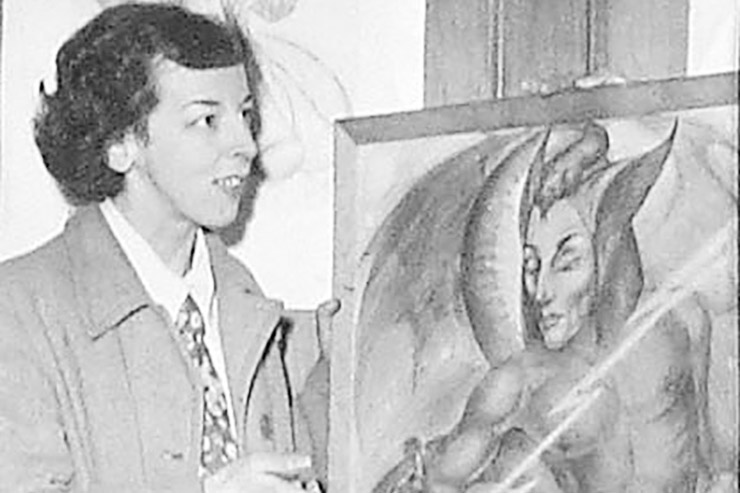
    Along with Richmond, writers such as Neville Drury did much to create a dialogue on occult art in Australia during the seventies and eighties. Drury is credited with the first serious overview of occultism in Australia with his 1980 book co-authored by Gregory Tillet, Other Temples, Other Gods, that featured, in particular, the forgotten Sydney artist Rosaleen Norton.

    Dubbed the “Witch of Kings Cross” by the popular press, she remains without doubt the most famous Australian occult artist. Born in Dunedin, New Zealand in 1917, Norton moved with her family to Sydney in 1924, where they established themselves in the middle-class suburb of Lindfield. Norton was expelled from the Church of England Girls’ School, Chatswood, at the age of 14 for producing ‘depraved’ drawings of vampires, ghouls and werewolves thought likely to corrupt the other girls. She later studied for two years at East Sydney Technical College.

    A key influence on the young Norton was her lecturer George Rayner Hoff. A skilled sculptor, he is credited as transforming the face of Australian sculpture in his adoption of art deco principles and redirecting monumental statuary in Sydney towards classicism. In 1919, Hoff began studies at the Royal College of Art, London, under the professor of sculpture Francis Derwent Wood. He exhibited two sculptures at the Royal Academy Summer Exhibition in 1920 and one in 1922. He won the Prix de Rome scholarship in 1921 and was awarded the Royal Society of British Sculptors’ diploma in 1923. After meeting the Australian architect Hardy Wilson at Naples, and discussions with Derwent Wood in London, he accepted appointment as teacher of drawing, modelling and sculpture at East Sydney Technical College in May 1923 and reached Sydney in August.

    Joining the Society of Artists, Sydney, in 1924, Hoff served on its executive and became a force for liberal ideals combined with stylistic moderation in art. The medal for the Society of Artists was created by Hoff in 1924. Later he produced, among others, the Sir Peter Nicol Russell memorial medal for the Institution of Engineers, Australia (1927), the Sir John Sulman medal for the Institute of Architects of New South Wales (1932) and the contentious Victorian centenary medallion (1934). He showed sculpture regularly with the Society of Artists, the Victorian Artists’ Society and the Australian Sculptors’ Society. He entered various official and prize exhibitions, and was awarded the Wynne prize in 1927.

    The most significant contribution Hoff made was his large-scale sculpture for various buildings and public memorials: he produced the large reliefs of the war memorial at Dubbo, New South Wales, in 1925, the figures for the National War Memorial, Adelaide, in 1927-31, and the more numerous and controversial sculptures for the Anzac Memorial, Sydney (made with the aid of students and assistants) in 1930-34. Hoff was also responsible for fine decorative reliefs in the now demolished Liberty Theatre (1934) and Hotel Australia (1934-35). He began work on the King George V Memorial, Canberra, in 1936, which was completed posthumously by John Moorfield. He also interestingly created the famous “lion and stone” logo for Holden Motors in 1928, based on a prehistoric fable, in which observations of lions rolling stones led to the invention of the wheel.

    At East Sydney Technical College Hoff taught drawing and sculpture, and amongst his students were Norton, James Gleeson and many others who both revered and imitated him – and were particularly inspired by his openly pagan approach to creation. Along with Norman Lindsay and Kenneth Slessor, Hoff pioneered the pagan movement known as “heroic vitalism” which was entering the mainstream of early twentieth century Australian art. The early works of James Gleeson shows elements of this approach in depicting an overtly sensual and writhing landscape dotted by idealised male figures.

    Norton no doubt would have seen first hand the vilification of Hoff’s friend Norman Lindsay and his flight from Australia in 1931 under the continual backlash against what were considered his “pornographic and occult artworks.” In response, Lindsay wrote in 1920:

    To whom does one offer the gift of a thought? To him who already thinks it. The mission of the thinker is not to enlighten, but to confirm. The material for enlightenment is already there, like a piled-up beacon; the new thought is but a spark that sets it alight. Anger at the stupidity of common minds is foolish, save in youth, when it is a stimulus. Yet all high minds wish to offer the gift of thought to mankind, and because it is rejected they become bitter. But gold is no use to a savage. He prefers iron, which is useful to him. And here the savage is wise. One cannot blame the common mind, because it seeks common thoughts – vulgar utilities – for these things help it. If the common man is also able to catch a little at higher thoughts, so much the better; but he has caught something in passing not addressed to him. The message of the Creative Effort is to him whose mission is to carry on the Creative Effort.12

    Hoff’s sculpture in contrast, while remaining robustly erotic, was never prurient, embodying a neo-paganism different in quality and kind from Lindsay. His work, Idyll: love and life in the collection of the Art Gallery of NSW, “might be described as chaste, despite the languor of its poses.”13 His work was softer and less obvious but held the same ideals. For many years he managed to avoid public outcry until later in his years. In 1932, he was embroiled in controversy with the Catholic Archbishop Kelly, the Master Builders’ Association of New South Wales, and the local chapter of the Royal Australian Institute of Architects over the morality of the form and symbolism of the Anzac Memorial Group ‘Sacrifice’, ‘Crucifixion of Civilisation’ and ‘Victory’. He was also attacked over his design of the Victorian centenary medal in 1934 for its depiction of a Ram’s head as the central motif.

    Rosaleen Norton

    Amongst the basics of art technique, Hoff would have shown Norton that art has the potential to make the artist a significant target to the public, a warning most likely lost on the young artist at the time. Despite her admiration for Hoff, Norton generally found it hard to take direction and preferred to follow her own path rather than the set college curriculum.

    In December 1933, whilst still at college, she submitted the first of three short stories to Smith’s Weekly that immediately drew the admiring attention of the editor Frank Marien. He saw promise at the author’s “vivid imagination” that was “quite beyond the ordinary,” and offered Norton a cadetship as a writer and illustrator. However, her graphic illustrations were deemed too controversial, and soon she lost the job. From there, Norton’s life took many turns, punctuated with high profile legal cases and often vehement vindication by the media.

    Her focus throughout her time remained on the core principle of developing and exhibiting her art and magical practice. However, the art world in Australia was generally far from responsive to Norton, and she found it all but impossible to have work accepted by any serious galleries. The dubious honour of being the first Australian artist to have her work seized by the government did little to help, and the book on her art, The Art of Rosaleen Norton, was also banned. Unable to reach a wider audience and forced to find some sort of income, Norton had to rely on selling her paintings to friends and acquaintances, and found it impossible to rid herself of the ‘Witch’ image. She died on 5 December 1979, at the age of sixty-two, having spent the last few years of her life as a semi-recluse. In 2000, an exhibition of Norton’s paintings was held in Kings Cross, Sydney, organised by writer Keith Richmond, and artist/curator Barry William Hale.

    It was not until the early 1940s that Norton began to seriously study the occult, starting with Eastern and theosophical texts, and slowly moving to the Western esoteric tradition, practicing Ritual Magic, and studying the texts of Aleister Crowley, Eliphas Levi and Dion Fortune. She became an active proponent of sex magick, and made regular use of drugs in her ceremonies, all of which contributed to Norton’s true lasting legacy, the techniques she developed to heighten her artistic perception. Through self-hypnosis she learned how to transfer her attention at will to inner planes of awareness in what could be termed “astral projection.” She wrote in her diaries that this practice “produced a number of peculiar and unexpected results… and culminated in a period of extra-sensory perception together with a prolonged series of symbolic visions.”

    In an interview conducted with Norton at the University of Melbourne in 1949, she explained further:

    I decided to experiment in self-induced trance, the idea being to induce an abnormal state of consciousness and manifest the results, if any, in drawing. My aim was to delve down into the subconscious mind and, if possible through and beyond it. I had the feeling (intuitional rather than intellectual) that somewhere in the depths of the unconscious, the individual would contain, in essence, the accumulated knowledge of mankind; just as his physical body manifests the aggregate of racial experience in the form of instinct or automatic reaction to stimulus.

    In order to contact this hypothetical source, I decided to apply psychic stimulus to the subconscious: stimulus that the conscious reasoning mind might reject yet which would appeal to buried instincts as old as man, and which – I hoped – cause psychic ‘automatic reflexes’. (Religious cults use ritual, incense etc for the same reason.) Consequently, I collected together a variety of things such as aromatic leaves, wine, a lighted fire, a mummified hoof etc… all potent stimuli to the part of the unconscious that I wished to invoke. I darkened the room, and focusing my eyes upon the hoof I crushed the pungent leaves, drank some wine, and tried to clear my mind of all conscious thought. This was a beginning (and I made many other experiments which were progressively successful).

    Following a surge of curious excitement, my brain would become emptied of all conscious thought: my eyes would shut, and I was merely aware that I was drawing on the blank sheet of paper in front of me… I seemed while experiencing a great intensification of intellectual, creative and intuitional faculties, to have become detached in a curiously timeless fashion from the world around me, and yet to be seeing things with a greater clarity and awareness than normally…

    Through these practices, Norton came to have a special reverence for the pagan deity Pan, regarding him as, “Totality of All Being and the true God of the World and Overlord of the Balance of Nature.” Various manifestations of Pan became a regular feature of her painting from the late 1940’s to the time of her death. While she also depicted Lucifer, Baphomet, Hecate and other similar deities, Pan was a regular visitor to her trances and held a special place in her consciousness.

    According to Norton, the other gods only appeared to her in trance visions if it pleased them – they could not be conjured. Some of the magical entities appearing in her artistic works seem to be atavistic hybrids – half-human, half-animal and often naked – revealing the primeval aspects of humanity’s spiritual evolution. Neville Drury saw great similarities between Norton and the English occult artist Austin Osman Spare:

    There are distinctive parallels between Austin Spare and Rosaleen Norton. Both were influenced by witchcraft and the occult traditions of western magic, both utilised trance states, and both believed that the realm of the gods had its own intrinsic existence – the artist simply serving to manifest these archetypal energies by acting as an inspired channel. It is also interesting that both employed mental focusing techniques – using sigils or specific physical objects to induce a state of trance. As in the Eastern forms of meditation which utilise “one-centredness of mind,” it seems that the focusing of intent is a valuable way of unleashing stored psychic energy.14

    Perhaps the most widely known occult artist, Austin Osman Spare died in 1956, similarly a recluse like Norton. In his younger days his work was applauded by the artistic establishment, until in the 1920’s he ceased showing commercially and returned to his native East End and created works almost entirely as part of his magical practice. He is particularly noted for his automatic drawing where images manifest through the artist, rather than being consciously devised. This was a practice inspired by the Surrealists of the early 1920’s who believed that art accessed through the unconscious or subconscious was more “real” or “true” than rationalist art works.

    Surrealism’s initial proponent was Andre Breton, who during World War I, served in a neurological hospital where he used Freud’s psychoanalytic methods with soldiers suffering from shell shock. After returning to Paris to find many of the local writers and artists scattered, he joined the anti-art movement, Dada, and started the literary journal Litterature. Along with other writers, he began experimenting with automatic writing, which was essentially a trance inspired form of spontaneous writing without self-censoring. He also started recording dreams in the same way and published them alongside the automatic writings in the journal. These works became the pointers for writers and artists across Europe to start looking to the unconscious and trance practice to create ‘true art’. Freud’s work with free association, dream analysis, and the unconscious became of utmost importance to the Surrealists in developing methods to liberate imagination and unlock the true creative mind. As Salvador Dali explained it: “There is only one difference between a madman and me. I am not mad.”15
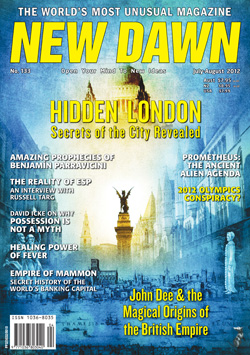
    Get the issue this article appears in

    The Australian Surrealist James Gleeson

    While not considered an esoteric or occult art form, Surrealism is saturated with occult ideals and practices all of which manifested openly in the work of its practitioners, and has maintained a central conceptual association between fine art and occult dialogues. The Australian father of surrealism, James Gleeson, was a skilled practitioner of trance technique in creating his unique landscapes, and influenced a great deal of contemporary occult and esoteric artists locally including Barry William Hale.

    Gleeson said that as a young artist, he caught the idea, “there existed a whole world behind what we see with our eyes, and my artwork became a way of finding and understanding that world.”16 At its heart Surrealism was an exploratory process demanding a level of mental discipline unlike any other of its day. The automatic drawings of James Gleeson remain full of insight, and up until his passing in 2008, he was at the height of his powers channelling the unconscious.

    A student at East Sydney Technical College around the same time as Rosaleen Norton, and also under Hoff, he discovered Dalí, De Chirico, Ernst and Magritte, but also Freud and Jung’s theories on the unconscious mind. His most famous work features writhing nightmarish landscapes, full of sometimes violent and disturbing imagery, ranging to serene and soft humanoid forms. The early paintings, it is said, made women faint, and at least one hysterical girl had to be escorted from an exhibition. The middle period of his life saw Gleeson better known as an art critic, author, poet and curator, until the age of 65, when he devoted himself to art full-time, and went on to produce more than 400 canvases. Unlike his contemporaries, who merely dabbled in Surrealism, Gleeson remained true to its philosophy until his death at the age of 92, securing his place as the Father of Australian Surrealism.

    This last phase of his artistic life is widely regarded as his most brilliant, yielding some truly monumental paintings, which Gleeson called “psychoscapes.” A key work, entitled Icons of Hazard, drew further dark inspiration from the atmosphere generated by 9/11 and the war in Iraq. One critic wrote of these works: “Representing an ineffable world in the furthest recesses of the human mind, these form an imaginary coastline, not of water, rock and sand, but a disturbing, organic morass of muscle, sinew, carapace, shell, hair and dripping membrane.”

    Another work that Gleeson suggested was amongst his most successful, The Wheel Has Come Full Circle, is a major study in what the artist described as the “great return.” A pure unconscious journey back to the source of life. Another entitled, A Moment in the Process depicts the glimpse “behind the curtain” to the world behind the world we see around us. An exceptionally talented draughtsman and painter, Gleeson never received the recognition he deserved, and his major 2004 retrospective, Beyond the Screen of Sight, was belated. Some blame his subject matter. While near-contemporaries such as Sidney Nolan and Russell Drysdale focused on Australian themes, Gleeson described the world of the imagination. On his passing, the director of the Art Gallery of NSW, Edmund Capon, said: “James saw into our inner soul.” More than any other Australian artist, Gleeson successfully mapped the unconscious and opened the doors for local curators, critics and museums to consider esoteric and occult art.

    This article includes a range of artwork, including a spread of Aleister Crowley paintings, courtesy of Buratti Fine Art. To view this, purchase the digital version of this magazine.

    Part 2 of this article, published in New Dawn 134, examines The contemporary Australian artists working in the occult tradition, including the work of Wolfgang Grasse, Norman Lindsay and Barry William Hale.

    [alert type=”general” dismiss=”no”]This article was published in New Dawn 133.[/alert]

    [alert type=”success” dismiss=”no”]If you appreciate this article, please consider subscribing to help maintain this website.[/alert]

    Footnotes

    1. Damien Hirst, The Death of God, Conversation Between Damien Hirst and Hilario Galguera, 2006, 11
    2. Joseph Jordania, Why do People Sing? Music in Human Evolution, 2011, 98-102
    3. Ibid.
    4. William McNeil, Keeping Together in Time: Dance and Drill in Human History, 1995, Cambridge: Harvard University Press
    5. Budge, The Gods of the Egyptians Vol. 1
    6. Sixten Ringbom, Occult Elements in the Early Theory of Abstract Painting, 1966; Sixten Ringbom, The sounding cosmos: a study in the spiritualism of Kandinsky and the genesis of abstract painting, 1970
    7. Robert P. Welsh, PIET MONDRIAN 1872-1944, 1966
    8. Rose-Carol Washton Long, doctoral thesis on the hidden images in Kandinsky, 1972
    9. R. Rosenblum, Modern Painting and the Northern Romantic Tradition, 1984
    10. Traces du Sacre, Editions du Centre Pompidou, Paris 2008
    11. K. Richmond, The Occult: An Exhibition of material from the Monash University Library Rare Book Collection, Monash University, 1998
    12. N. Lindsay, Creative Effort: An Essay in Affirmation, 1920, Art in Australia, Sydney
    13. Art Gallery Handbook, 1999, Art Gallery of NSW
    14. N. Drury, Three Magical Artists: Austin Spare, Rosaleen Norton & H.R. Giger, 1984
    15. S. Dali, Diary of a Genius, quoted in The Columbia World of Quotations, 1996
    15. R. Buratti, Interview with James Gleeson, 2006

    © New Dawn Magazine and the respective author.
    For our reproduction notice, click here.
  • The Templars and the Assassins: Angels and Demons?

    The Templars and the Assassins: Angels and Demons?

    From New Dawn 93 (Nov-Dec 2005)

    Following the success of The Da Vinci Code, Dan Brown’s earlier work Angels and Demons has been discovered by fans who are now fascinated by references to the medieval secret society known as the Order of Assassins. This group triggered exceptional public interest in the last few years, particularly after the September 11 attacks when the media was rife with accounts of the Assassin-like Al-Qaeda group. Public curiosity in the actual Assassins was at an all-time high and interest has not yet abated.

    While there have always been people fascinated by secret societies, James Wasserman, author of The Templars and the Assassins: The Militia of Heaven,1 believes contemporary interest in this area has peaked under the effect of two main social factors. The first is the breakdown of traditional religion prompting people to look for alternative theology, or in Dan Brown’s case, alternative re-readings of traditional religion. This is certainly a more popular option for the majority of thinkers who would rather not step too far away from their comfort zone. The second factor put forward by Wasserman is the increasing power of separatist groups within the socio-political life of world affairs. Political protocols are now limiting the actions of large governments who move too slowly to compete with smaller, more dynamic groups. As these smaller groups gain more ground, they trigger public interest and in some cases, public fear.

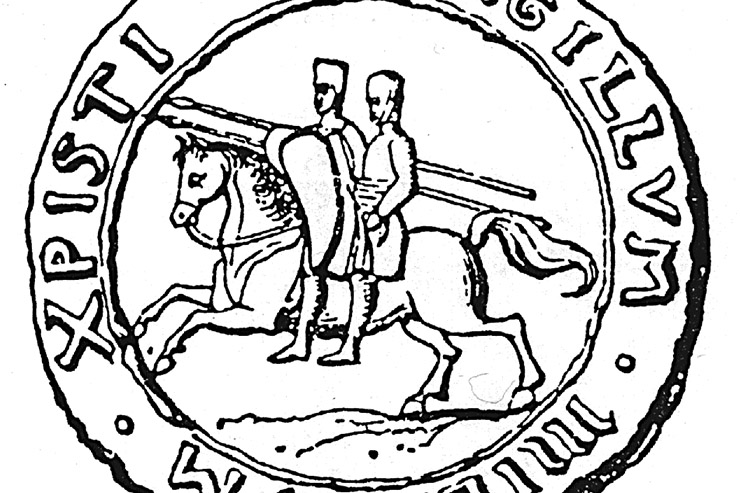
    Many influential groups started in a similar fashion. The famous Templar Knights were at first a small group of nine French knights who kept every action hidden under the radar of the established authorities. Within the conditions of secrecy they built the basis of a network that later extended across Europe. Wasserman believes the Assassin Order was created through the same process and had a great deal in common with the more well known Templars. Many scholars actually point to the Assassins as a seminal forefather of the secret society model, and as more evidence comes to light researchers are beginning to realise the Assassins were more influential and innovative than they were ever given credit for.

    The Assassins are infamous for their political murders. They created the concept of the ‘sleeper agent’ and pioneered the practice of training and placing operatives who would lay dormant within their environment, later spurred to action by a distant commander.

    The Old Man of the Mountain

    When the Prophet Muhammad died in 632 without having designated a successor to lead the community he founded, many Muslims believed his son-in-law and cousin Ali to be his legitimate successor. Over time this group, known as the Shi’atu ‘Ali, or party of Ali, divided from the majority Sunnis who followed Caliphs chosen by the consensus of the community. Centuries later a breakaway from the Shias, the Ismailis, founded the Fatimid dynasty in Egypt. A schism arose when the rightful Fatimid leader Nizar was imprisoned and supplanted by his younger brother. Hence, the followers of this subsect were called the Nizari Ismailis.

    The Nizari Ismailis are believed to have adopted elements of the Sufi tradition and its mystical symbolism, best known through the Rubaiyat of Omar Khayyam. Part of the Nizari sect took on a proactive military function with the aim of ensuring the survival of the Nizari as a whole and also working toward shifting the political scales in their favour.

    The founder of this militant group was a Persian called Hasan-i-Sabbah, born of lower middle class parents at Rayy, an old city a few kilometres to the south of modern Tehran in approximately 1060. A dedicated Ismaili, in 1090 he united the entire movement and took possession of a stronghold in Khorassan which became headquarters for the Order and known as Alamut, ‘the eagle’s nest’. Once established in a secure and permanent base, Hasan sent his agents out from Alamut in all directions, while at the same time pursuing a policy of territorial expansion, taking surrounding camps by force.

    Marco Polo claimed he passed Alamut in 1271 and described the splendour in his travel diary:

    In a beautiful valley, enclosed between two lofty mountains, had formed a luxurious garden stored with every delicious fruit and every fragrant shrub that could be procured. Palaces of various sizes and forms were erected in different parts of the grounds, ornamented with works of gold, with paintings and with furniture of rich silks. By means of small conduits contained in these buildings, streams of wine, milk, honey and some of pure water were seen to flow in every direction. The inhabitants of these places were elegant and beautiful damsels, accomplished in the arts of singing, playing upon all sorts of musical instruments, dancing, and especially those of dalliance and amorous allurement. Clothed in rich dresses, they were seen continually sporting and amusing themselves in the garden and pavilions, their female guardians being confined within doors and never allowed to appear.2

    Polo also put forward his explanation for the purpose behind such an impressive display.

    The object which the chief had in view in forming a garden of this fascinating kind was this: that Mahomet having promised to those who should obey his will the enjoyments of Paradise, where every species of sensual gratification should be found, in the society of beautiful nymphs, he was desirous of it being understood by his followers that he also was a prophet and a compeer of Mahomet, and had the power of admitting to Paradise such as he should choose to favour.

    Hasan had an excellent knowledge of theology, and the energy and allure needed to influence the minds of his contemporaries. He patiently prodded a potential candidate’s religious doubts until they were weak enough to admit the possibility of an alternative. Over time he managed to create a vast group and a powerful sectarian sense of community based on secrecy and conspiracy.

    According to the legend popularised by Marco Polo, the fortress court held boys as young as twelve years old who Hasan thought destined to become courageous men. When he sent them into the garden in groups of four, ten or twenty, he gave them hashish to drink where they slept for three days. It is thought they were carried sleeping into the garden where he had them awakened.

    Marco Polo, based on what he had heard about the Assassins, wrote:

    When these young men woke, and found themselves in the garden with all these marvelous things, they truly believed themselves to be in paradise. And these damsels were always with them in songs and great entertainments; they received everything they asked for, so that they would never have left that garden of their own will.

    And when the Old Man wished to kill someone, he would take him and say: ‘Go and do this thing. I do this because I want to make you return to paradise’. And the assassins go and perform the deed willingly.

    The strongest source of information on the Assassins came long after the Order fell from influence. Following the eventual demise of their headquarter stronghold in Alamut, volumes from their amazingly extensive library were examined by the Persian scholar Jawani, who later wrote a careful book in which he detailed the organisation of the Order. Their name has been attributed to the Arabic hashshashin meaning “consumer of hashish,” which they were said to use in the Initiation ritual. This is one of numerous explanations for the name of the sect, none of which can be confirmed. Assasseen in Arabic signifies ‘guardians’, and some scholars have considered this to be the true origin of the word: ‘guardians of the secrets’. There is no mention of hashish in connection with the Assassins in the library of Alamut. Even the most hostile Islamic writers of the time, both Sunni and Shia, nowhere accused the Assassins of drug use.

    Jawani’s account of the library of Alamut became the main reference for study of the Assassin Order. The only other sources are the few sparse accounts of the day, one of which came from a visit by Count Henry of Champagne to the stronghold of the Assassins in 1194. Following the murder of the Latin King of Jerusalem at the hands of the Assassins in 1192, Henry was appointed his successor and as a result was eager to negotiate a truce with the Assassins to avoid a similar fate. At a palace in the Nosairi Mountains Henry met the Assassin Master. Also popularly known as the Sheikh or ‘Old Man’ of the Mountain, he claimed that he did not believe Christians were as loyal to their leaders as his disciples were to him. He demonstrated his point by signalling to two young men standing high above on the palace towers. Immediately they leapt to their deaths on the mountain rocks below. It was written that Henry arrived from his visit “visibly shaken” by the ordeal of this contact.

    Influence on the Templars

    Dr. F.W. Bussel in Religious Thought and Heresy in the Middle Ages writes that it cannot be disputed the Templars had “long and important dealings” with the Assassins “and were therefore suspected (not unfairly) of imbibing their precepts and following their principles.”3

    Islamic culture of the day was a great deal more refined than that of Europe during the Dark Ages. The Templars along with all Europeans in the area were greatly affected by their contact with the Muslim East. They learnt the daily customs, the languages and business practices, discussed philosophy, and lived amongst what must have seemed an almost alien culture. In time, Templar ranks contained people who had spent more time in the Middle East than in Europe, and some who had little or no memory of European life, custom and philosophy.

    Under these conditions, the initial contact between the Templars and the Assassins occurred. “As the systematic overturning of Muslim Shariah took place among the Syrian Nizaris, some sense of the subtlety of their beliefs may have been communicated to their new acquaintances,” observes James Wasserman.4

    By this time, the Assassins had already rejected Islamic dogma and acquired the heretic tag. Later the Templars would also find themselves denounced as ‘vile heretics’. Assassins became known to the Muslim world as Ta’limiyyah or “people of the secret teaching.” The idea that they were the guardians of a secret or inner doctrine had always been promoted by Hasan, and they were feared and revered for this very reason.

    Branded as heretics, the Templars met their end in the 14th century. One of the charges levelled against the Templars was they kept “secret liaisons with Muslims,” and were accused of “being closer to the Islamic faith than to the Christian.” In reality, the Templars had found a mirror image of themselves in the mysterious Order of Assassins, and held the Western face of the same esoteric doctrine. It was even written that a number of Templar Knights were initiated by the Assassin Master, while others were given standing rank, so close was their secret teaching considered.

    The Organisational Model

    The Christian Order of the Knights of Templars, who came into contact with some of Ben Sabbah’s commanders during the Crusades… were reputed to have adopted Ben Sabbah’s system of military organisation.5

    The organisation of the Assassin Order called for missionaries and teachers known as da’is, the disciples and spiritual followers known as the rafiqs, and the fidais or devotees who in practice were the trained killers. The fidais were not part of the original Ismaili model, but were later added by Hasan. The Templar hierarchy is said to be derived from this model and can be easily compared, where the Assassin offices of da’is, rafiqs, and fidais correspond to the Templar degrees of Novice, Professed, and Knight.

    The Templars assimilated the system but adjusted the core symbolism to their own purposes. Where the levels used in the Assassin model denoted particular functions and duties, the Templar levels further developed the concept of progressive learning and acquired skill, similar to the modern military ideas of private, corporal, and general. Every Templar Knight was, at one point, a novice, and a professed member, but not every Assassin was a da’is or a rafiq. In fact it was said that Hasan would never let a candidate become a fidais who had sufficient intellect to become a missionary. The spiritual man stood above all others in the Order.

    The Assassins believed they held the secret or inner Islam, a completely esoteric component unavailable to those uninitiated in their philosophies. Their system of organisation was developed to both guard the secret doctrine and strictly control the continuance of the teaching. A number of schools were established practicing this organisational model, including secret rites and rituals. Members were enrolled on the understanding they were to receive hidden power and timeless wisdom that would enable them to become as important in life as some of the great teachers.

    Hasan enlisted young men between the ages of twelve and twenty from the surrounding countryside. Each day he held court where he spoke of the delights of Paradise. It was said that Hasan would often buy unwanted children from their parents, and train them in line with his purposes. The Order was an organisation of the common people of the land, far removed from the typical aristocratic blueblood that petitioned for the Knights Templar mantle.

    Another regular activity of the Assassins was the kidnapping of useful, rare and distinguished personages who could be of value to them in educational, military or other spheres and holding them captive in Alamut. These prisoners were respected physicians, astronomers, mathematicians and painters. Assassins coveted knowledge the way the Templars seemed to covet spirituality, although they were separated by the Assassin’s willingness to take knowledge indiscriminate of context, at any cost and by whatever means.

    It is true that both the Templars and the Assassins shared a policy of secrecy. Their teachings were kept for the eyes and ears of initiates only. Comparisons with the Essenes, Cathars, and Sufis spring to mind as similar attempts to release the esoteric heritage of the soul. In the past, these enlightened groups existed without knowledge of each other, but the Crusades caused two of these groups to meet, comparing doctrines and making alliances.

    The Legacy

    Following the destruction of Alamut by Hulegu in 1256, members of the Order are thought to have fled to Afghanistan and the Himalayas. Many of them journeyed to India where the Nizari Ismaili community flourished under the leadership of the Aga Khans. Other groups have been put forward as possible candidates for the legacy of the Assassins, but the true legacy of Hasan-i-Sabbah is his seamless creation, both religious and political. In this wider sense the thought and doctrines of the inventor of the Assassins may be said to have an enduring influence in the religious and political life of the Middle East.

    The Templar Order is believed to have refined their approaches under the direct influence of Eastern philosophy, and in confronting another group on the opposite side which existed to safeguard the same ancient teachings. According to Julius Evola, the Crusades, in many respects, created a “supratraditional bridge between West and East” where the Templars were the “Christian equivalent of the Arab Order of the Ishmaelites (Ismailis).”6

    Unfortunately, the Templars and the Assassins did not write the history books, and thus they have fallen to the state of Demons rather than Angels, while the authorities of the day are remembered in glowing terms. Yet, despite this, as James Wasserman concludes:

    The legends of the Templars and the Assassins are indeed very much alive to this day. The long-term survival of the memory of these two rather obscure groups points to various archetypal levels at which they affect the psyche. Meditation on certain concepts may help us better to understand this. Despite the best efforts and tenacity of the modern secular campaign to disparage traditional beliefs and ideals as either outdated or based on erroneous assumptions like God – traditional values somehow survive. The “innate knowledge of the Gods” described by Iamblichus demands of us that we aspire to honor, chivalry, self-sacrifice, redemption, patriotism, courage, and integrity. What better words could be used to describe the ideology shared by the Templars and Assassins of yore?7

    [alert type=”general” dismiss=”no”]This article was published in New Dawn 93.[/alert]

    [alert type=”success” dismiss=”no”]If you appreciate this article, please consider subscribing to help maintain this website.[/alert]

    Footnotes

    1. Wasserman, James, The Templars and the Assassins, 2001, Destiny Books, USA.

    2. Polo, Marco, Travels in Asia, 1938, G. Routledge, London.

    3. Bussel, F.W., Religious Thought and Heresy in the Middle Ages, 1918, R. Scott, London.

    4. Wasserman, James, The Templars and the Assassins, 2001, Destiny Books, USA.

    5. O’Ballance E, Language of Violence: The Blood Politics of Terrorism, 1979, San Rafael, CA: Presidio Press, p. 4.

    6. Evola, Julius, The Mystery of the Grail: Initiation and Magic in the Quest for the Spirit, 1996, Inner Traditions, USA.

    7. Wasserman, James, The Templars and the Assassins, 2001, Destiny Books, USA.

    © New Dawn Magazine and the respective author. For our reproduction notice, click here.
  • The Spiritual Dimensions of the Martial Arts

    The Spiritual Dimensions of the Martial Arts

    From New Dawn 85 (Jul-Aug 2004)

    He who wishes to live in an oriental martial art, rather than to just practice it on a physical level, must so train his consciousness to attain a self-discipline that at last his conscious mind will merge into an identity with the very principle of life itself.
    – Maurice Zalle

    Amongst the usual loud and predictable offerings at the Australian cinema box office last summer, the Hollywood movie The Last Samurai emerged as an interesting alternative for many curious movie-goers. We were presented with a unique perspective on the cultural interaction between East and West. The film deals almost exclusively with the philosophical, spiritual and martial differences between Japan and America, and presents in grand form the figure of the Samurai, and the way his martial practice has a powerful spiritual dimension to which the West cannot relate.

    The traditional practice of Martial Arts is now experiencing a renaissance of sorts, and this is largely due to the fact many people are realising the existence of the esoteric spiritual components behind widely known styles. The Arts are no longer considered remnants of old cultures, but valid and effective methods of achieving spiritual growth. The Martial Arts were actually formulated for this purpose all along.

    A Spiritual Heritage

    In 475, the Indian monk Bodhidharma arrived in Southern China. On his arrival he moved to the Huan province where he spent nine years in meditation, facing the rock wall of a cave. When the monk emerged from his retreat, he stumbled across a small mountain temple approximately one mile away called Shaolin. Bodhidharma was shocked to see the terrible physical condition of the monks of the Shaolin Temple who practiced long-term meditation exercises which, while making them spiritually strong, totally destroyed their physical health.

    Bodhidharma created an exercise regime for the monks involving physical techniques that were efficient in strengthening the body, and eventually, could be used to defend oneself from the inevitable travelling thieves and gangs prominent in the area at the time. The latter benefit was a simple side benefit of the practice. The former was the main objective. The primary concern was always maintaining the physical strength of the monks for the purpose of meditation. These physical exercises developed into what we now know as Martial Arts.

    Amongst the myriad of contemporary options for developing the spirit, the Martial Arts remains one of the oldest and most universally effective systems for teaching internal ideas which awaken the spiritual dimension in all parts of life.

    The Physical Path To Enlightenment

    The true value in studying the Martial Arts lies not in the learning of the technique or system itself, but in the acquisition of particular internal qualities that are developed through the learning process. The physical exercises are the concrete examples of abstract philosophical principles. Footwork systems teach the student about the qualities of energy, ebb and flow, and both creative and destructive potential. Handwork patterns teach the student about balance, dynamics and the intuition of natural spirit.

    The actions of blocking, deflecting, striking, breaking and throwing all contain concepts that can be applied to the human spirit. Then in combat, we unite these concepts and in the process discover our own nature which is forced to emerge under extreme stress and pressure.

    One is never rattled as much as when under attack. In this act, one’s metal is tested and they emerge with a new view of themselves and in many cases, a view of their true self. This is a first step to self realisation.

    The legendary Japanese swordsman, Myamoto Musashi, found that the more he looked for proficiency and efficiency in his training, the more he looked for proficiency and efficiency in all things. He began to look for the deeper purpose in everything that he did.

    When farming, he took land made useless by yearly floods and turned it into productive land by building his dikes and fields in the shape of the natural water flow. The farmers built a shrine in his honour for his concepts and prayed at that shrine daily. He found that every part of his life effected every other part of his life and he began to look for the spirituality in every part of his life.

    Combat places great demands on the capacities of the warrior. Such demands act as powerful learning situations for self-discovery and self-confrontation.

    Confronting Death

    To defeat a thousand enemies is good, but the Samurai who defeats himself is the greatest of warriors.

    Perhaps the first and most important of these is the confrontation with death. Throughout life we are sporadically confronted with death, be it through family, television or literature. In the modern world we are very familiar with death, but rarely if ever are we confronted with the prospect of our personal demise. But when it does arrive it most likely will be a sudden, irrevocable and inconvenient event from which we learn nothing. The martial artist does not ignore or wait for death, but walks right up to it.

    In the Martial Arts, death is a constant presence. The whole activity revolves around it. Attack, defense and counter-attack are all performed as if a true life-or-death situation were involved. With proficiency, the vigour of the actions increases and, if one is using weapons, one may employ, for instance, a ‘live’ (naked) sword instead of a bamboo or wooden sword – all of which make the situation genuinely dangerous. The practitioner confronts death and makes peace with it in the knowledge it is inevitable. With this understanding, there exists no more fear, and the martial artist is now truly free.

    All spiritual systems set up a confrontation with death, for confronting death is perhaps the most important element of spirituality. The basic preparatory practices of Buddhism involve the recognition one’s life is short and one may die tomorrow. In the Chod rite of Tibet, practitioners visit a graveyard at night (where the corpses are left exposed to the elements and scavengers) and invite the demons to come and take them. Christians and Muslims invite the Almighty to take their souls at any time.

    The fear of death is the greatest obstacle for the martial artist. This fear has a quality of rigidity, or paralysis, or of loss of control; one may freeze with terror, or one may panic and react blindly and irrationally. Such reactions, intruding at the crucial moment in combat, will spell death, even for the technically accomplished fighter.

    But freedom from this incapacitating fear releases great powers. There is a story of a Master of the Japanese Tea Ceremony from the province of Tasa – a man of no martial skill yet of great meditative and spiritual accomplishment. He accidentally gave offence to a high-ranking Samurai and was challenged to a duel.

    He went to the local Zen Master to seek advice. The Zen Master told him frankly that he had little chance of surviving the encounter, but that he could ensure an honourable death by treating the combat as he would the formal ritual of the Tea Ceremony. He should compose his mind, paying no attention to the petty chatterings of thoughts of life and death. He should grasp the sword straightforwardly, as he would the ladle in the Tea Ceremony; and with the same precision and concentration of mind with which he would pour the boiling water onto the tea, he should step forward, with no thought of the consequence, and strike his opponent down in one blow.

    The Tea Master prepared himself accordingly, abandoning all fear of death. When the morning of the duel arrived, the Samurai, encountering the total poise and fearlessness of his opponent, was so shaken that he promptly begged forgiveness and called off the fight.

    The recognition and mental triumph over death is the martial artist’s greatest power, in that he will focus on the fact he has little time and hence lets his acts flow accordingly. Each act is your last battle on Earth, and only with this philosophy will your acts have their rightful power. Otherwise they will be, for as long as you live, the acts of a timid man.

    In the words of a Samurai legend, “being timid is fine if you are to be immortal, but if you are going to die, there is no time for timidity, simply because timidity makes you cling to something that exists only in your thoughts.” It soothes you while everything is at a lull, but then the awesome, mysterious world will open its mouth for you, as it will open for every one of us, and then you will realise your sure ways were not sure at all. Being timid prevents us from examining and exploiting our lot as men.

    Mastery of Energy

    To the martial artist, Energy manifests within each individual as spirit, spirit manifests in each individual as mind. This Energy or “Chi” as it is known in China, or “Ki” in Japan, permeates everything, and hence is both the martial artist’s strongest connection to his enemy as well as his strongest weapon against his enemy.

    The mastery of this energy is a central element of all traditional forms of Martial Arts practice. Two widely recognised expressions of this ideal are the Chinese art of Tai Chi Chuan, and the Japanese art of Aikido.

    Tai Chi Chuan integrates many elements of Chinese culture such as philosophy and religion, medicine, and military practice. It draws its inspiration for movement heavily from the philosophy of yin and yang. It incorporates the theory of the Five Elements of cosmology and the principles of the Bagua (“Eight Trigrams”) together with motion, creating a continuous flow of movement that reflect the ideas behind these ideologies.

    The Yin-Yang symbol, which is often linked with Tai Chi Chuan, represents the interaction of Yin and Yang. Yin and Yang are shown in equal amounts, yet the Yin portion of the Yin-Yang contains a small amount of Yang and the Yang portion an equally small amount of Yin.

    The ancient Chinese saw the universe as a vast unity with every part of it being related to and dependent on every other part. Within this unity, there is continual change in an endless cycle between two partners, the Yin (feminine, dark, soft, yielding) and the Yang (masculine, hard, aggressive).

    The universe is entirely made from these two forms of energy and in order for all things to progress harmoniously, the forces of Yin and yang must constantly interact with each other. While doing so, each must evolve, over a period of time, into its opposite, just as day gradually turns to night. For this reason, everything that seems to be Yin contains some Yang and all that is Yang also contains some Yin, without which change would not be possible. (Chen Lei)

    From this view of existence and energy, the style of Tai Chi Chuan was constructed. It is a perfect physical expression of the Yin-Yang philosophy and operates within the same parameters and limitations.

    While other martial styles are violently fast and rigid, Tai Chi is slow and controlled, with techniques that flow endlessly into one another. Just as Yin-Yang energy maintains a continual flow, so does the Tai Chi form. There is no rigid stop-start, only a controlled natural mimic of energy. This is why Tai Chi is often seen as one of the most graceful and peaceful Martial Arts. Just as energy is circular in flow, all Tai Chi footwork is circular in direction, and just as energy is a natural phenomenon, the Tai Chi defence postures are always in a natural form, not rigid, boxing-like military stances.

    The effective practice of Tai Chi relies on a pure and deep understanding of the Yin-Yang/ Tai Chi view of Chi and the universe. Without this spiritual dimension to the art, the student is not practicing Tai Chi, they are simply performing empty movements of little significance to themselves or the world around them.

    Another art dealing with the dynamics of energy was founded by Ueshiba Morihei in 1942. The Japanese art of Aikido was considered a continuation of the Samurai Arts, and borrows much of its spiritual dimension and expression from Bushido (The Way of the Samurai), particularly its use of traditional sword practices. It is a relatively contemporary system and much a continuation of Japanese values and culture as it is a cultivation of philosophy and spirit.

    The meaning of Aikido is literally the “artful path of discovery of gathering Ki”. Ki is the Japanese translation of Chi, and shares an identical definition. It is suggested that Ki was “born” at the same instant as the rest of the universe, and that we are all born from the Ki of the universe. All living organisms have equal access to Ki, and it will course through our system if we allow it. Daily Aikido practice is primarily directed at maintaining a balanced state physically and emotionally, and practicing ways to cultivate this energy.

    Like Tai Chi, Aikido is a physical expression of this way of seeing the world. As a result, it has no attack form, because attacking an opponent would be like attacking a family member or damaging the flow of Universal Ki energy sustaining the world. Once again, because Ki moves constantly, so does the martial artist, with all of Aikido’s footwork occurring in circular patterns. Aikido also places great attention on the balance aspect of energy, and hence has created an awareness of balance essential to its maneuvers. The main techniques of the style involve particular throwing and wrestling patterns that are precisely dependent on the perfect balance of its practitioner.

    In Aikido like all Martial Arts, physical and emotional balance is codependent.  Physical balance helps to engender emotional balance. An understanding of the nature of our spirit will help the practitioner create an effective alignment of thought and action. When every aspect of the individual is aligned the individual is better able to adapt and change.

    Spirituality and the Samurai

    The Way of Zen perpetuates the earliest Buddhist traditions. It signifies the perfect natural state of enlightenment. Zen cannot be rationalised, only experienced, lived and realised. Unattainable through concrete thought and analysis, the Way of Zen is found through meditational practice engaging both mind and body. Zen may be considered a unique expression of the Mahayana Buddhism. It originated in the northern regions of India and later moved to China and then Japan where it became a strong influence from around 1190 CE onwards. It exerted such an influence that up until a few years ago, it would have been difficult to find a person of noble Japanese origins who had not been exposed to Zen philosophy.

    Zen offers an interesting perspective in the world of Martial Arts and spirituality, because it becomes hard to see where the spiritual philosophy ends and the martial practice begins. While most Martial Art philosophies are a building process supplying us with tools and understanding, the experience of Zen is a destructive process, in the strict sense that it removes things from our lives that keep us from enlightenment. Zen’s liberation comes in absolute autonomy. There are no gods, no denominations, and no higher authority. It is necessary to abandon all crutches and proceed forward with no assistance.

    The role of Zen in the Samurai society is amazingly complex. It sustained the warrior spirit in two ways: Morally, because Zen is a system which teaches the individual not to look back once the course is decided; and philosophically, because Zen treats life and death indifferently.

    The classic text, Hagakure or “Hidden by Leaves” attributed to the Samurai Yamamoto Tsunetomo, states that, “The Way of the Samurai is found in death” and goes on to say that the Samurai is powerful because his mind is no longer attached to life and death. The Samurai will “conquer immortality by dying without hesitations.” Great deeds are accomplished when one attains the Zen state of “no-mind-ness.”

    It is through this Zen state of “no-mind” that swordplay becomes not an act of killing but an instrument of spiritual self-discipline. The individual, the sword and the target become one. The blade moves by itself under the influence of the target without any individual decision, always finding a perfect blow. The acknowledgement of mastery in the sword is also the acknowledgement of a higher degree of Zen spirituality. The “no-mind” is one of the most influential Zen concepts to mix with the Samurai psyche.

    A mind unconscious of itself is a mind that is not at all disturbed by affects of any kind. It is the original mind and not the delusive one that is chock-full of affects. It is always flowing; it never halts; nor does it turn solid. It fills the whole body, pervading every part of the body. It is never like a stone or a piece of wood. If it should find a resting place anywhere, it is not a mind-of-no-mind. A no-mind will keep nothing in it. It is thus called mushin. (G.R. Parulski)

    This “empty-minded-ness” applies to all creative activities, such as dancing and swordplay.  The mind flows freely from one object to another stopping at no single concern. In this process the mind is free and fulfills every function required of it. When the mind stops at a single thought, it loses its freedom. It cannot hear, it cannot see, even when sound enters the ears or light flashes before the eyes. Every mind has the nature of Buddha and every person is already liberated beyond birth and death. They must only realise this fact. Zen seeks to promote this realisation, the gradual process of which is referred to as Satori. The consequence of Satori is a completely new way of seeing the world and one’s place within it. According to Zen, liberation should not be looked for in the next world, for this is the next world and is already liberated. We are already at our goal, yet we cannot realise it.

    Zen does not require involvement in speculation, sacred texts or writings, and every theory is valid only as an indication toward the Way. Originally a secret doctrine, passed on by the Buddha to his disciple Mahakassapa, Zen itself arose as a reaction against the fantastic and shallow rituals of traditional Hinduism, and while seeming quite loose in form, it actually operates on a base of severe self-discipline which appealed to the Samurai. Far removed from the harsh ascetic practices of its contemporary systems, the discipline of Zen involves a more subtle and inward form operating on four levels.

    The first is the mastery of external objects, in particular the reactions which emanate from them. The student must understand that every time a yearning leads him toward something, he is not in control of the external object, but rather the object is in control of him. “He who loves a liquor, deceived himself in thinking that he is drinking the liquor; the truth is, the liquor is drinking him.” (Hagakure)

    The second stage sees the student master the physical body. Often at this level, martial training accompanies spiritual growth as an initiatory counterpart. It is here that legends grew of superhuman Samurai and masters who could withstand the extremes of heat and cold, and break trees and stone with their bare hands. The Samurai exerts dominion over his body and mastery of his own mental functioning.

    Imagine your own body as something other than yourselves. If it cries, quiet it right away, as a strict mother does with her own child. If it is capricious, control it as a rider does his own horse, through the bridle. If it is sick, administer medicines to it, just as a doctor does with a patient. If it disobeys you, punish it, as a teacher does with a pupil. (Hagakure)

    The third stage involves controlling personal emotion, and establishing an inner equilibrium. Through meditational practices the student confronts every fear and excitement in an effort to “bring the heart under control.”

    The fourth stage is the rejection of the Ego, and the most difficult. The heart of the philosophy promotes a higher form of spontaneity, freedom and calmness in action. Traditional arts have originated in the East as a response and execution of this mental state. Many of these arts were developed as a means of achieving Zen awareness. While the majority are martial in nature, the Zen element extends to the art of drama, the tea ceremony, flower arranging, and painting. Mastery in any of these arts cannot be achieved without the inner enlightenment and transformative power of Zen.

    Generally Zen does not promote the hermit like existence found in legend, but rather asks that the practitioner lives in the world with a Zen state of consciousness which should be permanent and permeate every experience and activity. The student will labour with his mind and body until they have reached the extreme limit of all natural faculties, and eventually achieve Satori. The student is only supposed to spend the training period in Zen monasteries, and once they have achieved Satori, the student returns to the world, choosing a way of life that fits their needs.

    Martial Arts systems are all united in the fact they demand the practitioner to readjust their lifestyle. Aside from being an intellectual and physical pursuit, true practice arises in the expression of the Art throughout one’s daily life and thought. Attending a Martial Arts class once a week will not release the enormous transformative potential of this avenue, but it will start you on an ancient path that has affected lives for centuries. Like all spiritual endeavours it requires commitment and patience.

    [alert type=”general” dismiss=”no”]This article was published in New Dawn 85.[/alert]

    [alert type=”success” dismiss=”no”]If you appreciate this article, please consider subscribing to help maintain this website.[/alert]

    Bibliography

    Evola, J., The Zen Tradition, Holmes Publishing Group

    Tsunetomo, Y., trans. W. Wilson (1979), Hagakure, Kodansha Int. Company: Tokyo

    Parulski, G., (1976), An Introduction to Oriental Philosophy, Ohara Publications, Inc: California

    Suzuki, D.T., (1959), Zen and Japanese Culture, Pantheon Books, Inc: New York

    Chen Lei, Exploding the Myths of Martial Arts

    Geis, K.E., (1987), Christmas Clinic Newsletter, The Fugakukai International Association

    Geis, K.E., (1990) The Spiritual Aspect of the Martial Arts, The Fugakukai International Association

    Parulski, G., Zen and the Samurai: Why Zen Became Associated with a Warrior Class

    © New Dawn Magazine and the respective author.

    For our reproduction notice, click here.
  • Quest for the People of the Secret

    Quest for the People of the Secret

    From New Dawn 74 (Sept-Oct 2002)

    A persistent legend originating in the East tells of hidden locations on the Earth where there exists certain groups of individuals with both exceptional powers and highly perfected character and consciousness. From these secret locations, they influence the whole of humanity and are known variously as the Hierarchy of Adepts, the Great White Lodge, the Secret Chiefs, the Great White Brotherhood, the Masters, or The People of the Secret.

    In the biblical legend of the Three Wise Men from the East, we find one of the earliest spiritual archetypes and one of the best known written references to this Eastern legend. Researchers have openly argued the Eastern influence in Biblical writings for the best part of the twentieth century, but the appearance of the mysterious three wise men in the Gospel of Matthew is perhaps the first and most obvious example of Eastern legend in early scripture. Described as “men who studied the stars”, these travellers, “came from the east to Jerusalem” to meet the infant messiah.

    …Herod called the visitors from the east to a secret meeting and found out from them the exact time the star had appeared.1

    Herod consulted his own high priests and teachers of his kingdom on this matter to no avail, and afforded the three wise men great respect and reverence in requesting a private meeting with them. Little else is said of the men before they returned to their homeland following a warning by an angel that it was dangerous to cooperate with Herod. The concept of three mysterious teachers is an older element of Eastern culture certainly in circulation prior to and throughout the time of Jesus.

    In the 19th century, the French diplomat Louis Jacolliot wrote a number of remarkable works on the ancient legends of India during his posting in the East. During this time, he uncovered the Legend of the Nine Unknowns. According to this legend, a secret society of these Nine Unknowns was created by the Indian Emperor Asoka in 273 BC, in an attempt to encapsulate all human knowledge of the time, and ensure that it was governed by those incapable of misuse. Apparently the martial art of Judo is the result of a “leak” from the physiological teachings of the Unknowns.

    Researchers traced the transmission of this legend through Talbot Mundy, the English novelist who travelled extensively through India. It is thought that portions of this legend filtered through to the West during the Crusades from various secret and semisecret Islamic traditions. Perhaps this legend had an influence on the foundation story of the Knights Templar, an order begun by nine knights who have since been revered as holders of the knowledge of the ancients.

    The Hidden Directorate

    The term “Hidden Directorate” was coined by British author Ernest Scott in his classic work The People of the Secret, in which he makes a strong argument for the reality of an assembly or hierarchy of adepts. Initially, the book reads like a history of occult and esoteric tradition, eventually becoming more complex by presenting very clearly, and at times quite influentially, an alternative “theoretical history” of the world’s spiritual heritage.

    In tracing the tradition of esoteric thought throughout time, it is possible to find a pattern of movement in certain groups and individuals. This movement seems to be working in a particular direction concerned with freeing the consciousness of humanity. Scott’s work operates from certain premises.

    Firstly, History is not the equilibrant of chance and hazard. The plan for human history was written long ago, and is monitored constantly. Part of this process is ensuring that certain gains are attained to ensure the balance and evolution of man and life as a whole, the direction of which is “the Will of God.” The responsibility for this process on Earth lies with an intelligence called the Hidden Directorate. Below this level, members of ordinary humanity are in touch with the Directorate, and may at times share its consciousness.

    This group of advanced human individuals is what has been referred to as the Hidden Executive. It is the reality behind all legends of ‘masters’ and ‘initiates’ from earliest historical times to the present.2

    Scott claims the existence of several centres employed by the Executive, one of which is, or was, in Afghanistan, and corresponds to the legend of the Markaz or “Powerhouse.” Those under a chain of command from the Afghanistan centre have been known as “Sufis,” and from this base and others around the world, the Executive works to implement the overall plan of the Directorate.

    The aim of this process is to instigate the patterns and intellectual movements that will orient people to higher evolutionary states. Scott asserts that this unified theory of history is impossible if our search is limited to the “visible shadows and not the invisible substance”.

    The concept of a Hidden Directorate guiding the affairs of mankind can itself be traced as a subtle thread throughout the world’s spiritual and esoteric heritage. The early civilisations of Greece acquaint us with Mount Olympus, home to the pantheon of hidden Gods who constantly meddle in the lives of unfortunate mortals. Homer’s epic work, The Illiad, depicts how the war between the Greeks and the Trojans was decided by a war in Heaven, and the death of the epic hero, Achilles, was also determined by the same divine judges. Prior to these oral legends, another was recorded in stone and considered one of the oldest pieces of literature in history. Entitled The Epic of Gilgamesh, it relates the story of a true epic king, Gilgamesh, and clearly outlines the effect of an unseen divine community upon the daily life of the king and his people.

    Many researchers have wrongly likened the Hidden Directorate to subversive societies like the Illuminati. Rather than being an exterior, politically-oriented centre for control, the Directorate is more concerned with the inner dimension of human development, which may or may not be discernible to the general mind.

    By reintroducing the theory of “ancient wisdom guarded by hidden custodians or Masters”, Scott argues for a benevolent group that maintains a key influence over people of the world’s cultures, implanting key ideas and initiating experiences, “in a sacred, secular, or whatever context is required for the time, place and people.”3 They exist for the good of humanity and exist to override the sinister forces keeping man from achieving his true spiritual potential and right.

    It is important to understand that the Directorate seeks not to control, but to direct or influence humanity. Due to the higher natures apparent in man, he cannot be blindly lead, only prompted into action by creating certain opportunities at certain times, and implanting particular ideas. The power of man’s free will cannot be overrun.

    The French poet and esotericist Maurice Magre writes in the epilogue of his book The Return of the Magi:

    There have been men whose names are unknown because they cared little for fame, and truth radiated from them without knowing it. There have been revealers who were unaware of the revelation that was in them; modest sages who mingled their wisdom with their daily life… We have all of us met, at least once in our lives, one of these unheralded initiators, and received from them a priceless gift, by a kindly word, a certain look of sadness, a sincere expression in the eyes.4

    Sufism

    Sufism is a term originally used by Western orientalists to describe the mystical path of Islam, otherwise called tasawwuf by Muslims. In reality, this tradition existed long before Islam and forms a foundation for much of the world’s collective religion and ancient thought. The Directorate itself is part of many Sufi legends including those throughout Tibet involving the mythical inner kingdom of the planet known as Shambhala. Scott argues that the Sufi influence is a common thread connecting the entire history of Europe, and that its beginnings can be traced from Spain and from the Middle East.

    By the early eighth century, Cordoba, Spain, saw several schools of Sufi Initiates forming under the cover of Islam. Working in a fashion similar to the Western mystics during the later Inquisition, these individuals walked a fine line to heresy, occasionally crossing that line into the view of officialdom.

    As a result there were numerous Sufi martyrs, including Mansur el Hallaj (858–922) who claimed the importance of Jesus as a member of the chain of Initiates. He openly taught Sufi concepts, and was eventually dismembered alive by the Muslim Inquisition. As he died, he prayed for the souls of his murderers.

    Despite their persecution by the growing Muslim establishment, the Sufis continued an unbroken line of their wisdom and methods in a careful transmission between different secret brotherhoods or orders. Known as Tariqas, these groups acted as caretakers of the continuous line of knowledge.

    During this time a particular work arrived in Spain from Basra, and is known as the Basra Encyclopaedia. Held by the Sufi initiates, it is a coded written book of all world knowledge. It arrived in the first half of the 11th century either through the Sufi known as El Majriti, or his pupil, El Karmani. The encyclopaedia was chiefly concerned with the inner development of man, and the forms of knowledge that could develop in Europe. The actions of the underground Sufi movement in Spain preceding the 12th century was the first strategic effort from the Directorate to inject influence into Europe.

    Objectives of the Directorate

    It would seem that the movement of the Directorate involved five clear objectives. The first was quite obviously the injection of an intellectual component into the heart of Europe. This end was achieved through increasing philosophical and intellectual speculation through the advancement and appearance of Eastern mathematics. Another instrument was the introduction of the Kabbala into the Western consciousness around the year 1000.

    The developmental secret hinted at by the alchemists was incorporated into many forms from painting to architecture, and the true nature of the Gothic cathedrals as blueprints for human alchemy became realised in certain quarters. These elements continued to be reproduced as part of an esoteric tradition through various esoteric schools. Aspects of secret cathedral design remained a busy focus of research, particularly the complex structures left throughout key points of Europe.

    It is beyond doubt that some very significant material was introduced under the eyes of the official Church authority and that unwittingly they even approved much of this material, completely unaware of the hidden nature contained. An example was the commission of El Greco to paint “Burial of Count Orgaz” for the Catholic Church. Appearing to be another devotional work, it contains a few notable differences separating it from the usual.

    Its composition can, however, be dissected to show reincarnation concepts, something like the equivalence of consciousness and sexual energy and the plurality of ‘I’s’ in a human personality. These are not concepts which an ordinary clerical sponsor would have approved had he known of them.5

    The second objective was the establishment of certain modalities that could support the dissemination of knowledge on the basis of initiation. The instruments of modality were various, but survived in what would be now called Illuminism and Freemasonry, which combined as one of the most influential forces on world politics.

    It is claimed that Illuminism was injected into Europe from the school of Ibn Masarra (883–931) in Cordoba, a centre of underground Sufi teaching, while Freemasonry derives from the Knights Templar, a particularly powerful order that enabled Sufism to travel from the East to Europe through interaction with pilgrims and mystics in the Holy Land. They were initiated in rituals originally from the school of Hiram Abif, the builder of Solomon’s Temple, where they acquired their namesake. The order was later condemned and their leader burned alive in 1314 as a heretic. The Templars were the prototype for nearly every esoteric society to come afterwards.

    The publication of the mysterious Rosicrucian document Fama Fraternitatis in 1614 saw the open suggestion of the existence of certain “unknown superiors” or “Brothers of the Rosy Cross” who live and work in secret and yet direct much of the spiritual destiny of the world. Becoming part of the core belief system of many Western esotericists, this concept and the associated transmissions from these “hidden masters” melded with diverse strands of existing legend, and by the nineteenth century the foundations for a major unfolding of the adeptic myth were laid. The philosophy as a movement was accelerated through the efforts of Theosophy, without which the entire myth would probably have remained forever in obscurity.

    Much later in modern times, organisations like the Hermetic Order of the Golden Dawn did a great amount to further the Directorate’s goals throughout the West. In an age where magic attracted many of the keenest minds of the day, the Golden Dawn was a virtual melting-pot of personalities. The self-styled leader, MacGregor Mathers, claimed to be in direct contact with the Secret Masters, and used this influence over the majority of his followers including the poet W.B. Yeats and a young Aleister Crowley. In many ways, this order was a catalyst for the introduction of thousands into the area of Eastern magic and philosophy.

    The third objective of the Directorate was the introduction of a subtler shade to the concept of love, which recovered the dying mystery tradition of female or goddess reverence. This concept of love was introduced through the Troubadour movement of the Middle Ages. While restoring the feminine element lost in Pauline Christianity, it also recovered the traditions of pagan and, in particular, Egyptian thought, creating the Cult of Virgin Mary. This cult continues to be suppressed to all extents by the Catholic Church. The appearance of statues of the Black Madonna is another permutation, which implicitly suggests the Mary/Isis, and hence the Horus/Jesus concept of shared heritage and myth. In many ways, these statues are indicators of various awakened communities and the Sufi realisation that all true religions are one.

    The fourth objective was to establish a “psychokinetic technique whereby certain individuals, working perhaps in pairs, could increase their level of conscious energy.” This was enabled through the appearance of the technique of alchemy which, under the guise of base metal transmutation, outlined the course for the transmutation of the soul and increasing the level of conscious energy.

    The Transmittants

    The last objective of the Directorate for the Middle Ages was the act of securing an immediate development through specific individuals who have the ability to influence their society and its future for the good of humanity. These men chosen by the Directorate were capable of making a deep impression on their age, and they contributed material that had a quality of persistence in various guises through many centuries.

    The earliest alchemists were probably “knowers”. They had learned techniques which gave them access to an enhanced level of awareness. From this level they knew the inner content of religion. They discovered that all true religions are one.6

    These men were concerned with achieving particular evolutionary gains in the 12th and 13th centuries, regardless of whether they operated under the cover of Islam or Christianity. To declare that Christianity and Islam contained an inner truth overlaid by dogma and politics would have been considered heresy, and as Scott argues, these men “knew they had to build a bridge, but it so happened that bridge-building was illegal. The bridge builders had to pretend they were engaged in some other activity – like digging holes in the road. Not unnaturally, the holes were incomprehensible to their contemporaries and have remained largely so ever since.”7

    One of these individuals may have been Albertus Magnus, the Count of Bollstadt (1206–1280) and one of the earliest European alchemists. He refused to believe that knowledge ended with Aristotle, and was one of those challenging and ambivalent intellects that sought to break out of any conceivable cage that may limit its movement. His independent thought and liberated writing did much to raise his name across Europe, drawing numerous young, hungry scholars to his personal teaching. One such scholar was Thomas Aquinas.

    Legend has it that Magnus over the course of thirty years constructed a “talking head” and a complete artificial man. Idries Shah claims that “making a head” is a Sufi code phrase for a particular method of inner development, keeping with the stories of Magnus’ apparently obsessive attention to occultism, and his otherworldly powers of the mind. He is said to have commanded “instantaneous hypnotism”, an example of which is the story of his dinner party to whom he invited a minor royal family of Europe. It was mid-winter and he held the party in open air. When his guests entered the yard, the snow disappeared, the grass grew green and fruit appeared on the trees. As soon as the glorious dinner was finished, the perfect scene vanished, and the party found itself shivering and covered in snow. Clearly an extremely adept alchemist, his strange abilities and coded writings eventually earned him a wide regard. Throughout his time, Magnus was spoken of as holding a great amount of hidden knowledge in his grasp that seemed a great burden to him. It has been suggested that this knowledge may have been passed onto his pupil, Thomas Aquinas, later Saint Thomas Aquinas.

    Aquinas left university in Naples, much to the annoyance of his family, to join the same order of Dominican monks that his teacher Magnus was a part. For the next three years, he studied under Magnus and emerged “a philosopher and alchemist.” In 1256 he travelled to Paris, where he attained the seat of Master of Paris University.

    He began his post with the aim of assembling all world knowledge into a single encyclopaedia, quite similar to the Sufi Basra Encyclopaedia. He considered that both Reason and Faith were concerned with the same object. The former starts with sense-data and attains to a knowledge of the existence, goodness and will of God. The latter rests on revelation. Each requires the taking into account of the knowledge arrived at by the other. The Church took a quick and decisive stand against this notion, feeling “Rationalism” had gone too far in the European mindset and education system.

    Aquinas’ writings were condemned by the Church, particularly by the Bishop of Paris and two successive Archbishops of Canterbury. The basic concepts of Aquinas, namely that the human soul is “a single substantial form of the human body” was viewed as an attack on doctrine. The sorest point, however, was that the writings implicitly suggested a system, inspired by and derived from the new translations of Aristotle into the European languages, a self-sufficient view of man and the universe, not reliant on the teachings of the Church. This was probably the single most important reason for the suppression of Thomas Aquinas that followed, but not before he managed to inject the Sufi impulse into European thought and education.

    Both Magnus and Aquinas were engaged, it seems, in a perilous exercise of hunting with hounds and running with hares.

    They probably knew, because of their contact with a genuine esoteric source, that “known” truth and theological dogma need not, by any means, coincide. They were probably engaged in trying to reintroduce the original developmental force of Christianity, while gently diluting the organisational accretions which had all but smothered it.8

    If men like Magnus and Aquinas were in touch with an aspect of the Directorate, they would be capable of generating the effect required on their contemporaries and environment. Historically, it would seem that the effort failed. Yet behind the scenes much must have been achieved. “There is evidence that at the deepest levels of Sufi secrecy there is a mutual communication with the mystics of the Christian West,” says Idries Shah.

    Contemporary with Aquinas was Roger Bacon (1214–292). Renown for his eccentricity and genius, he wore Arab dress at Oxford and was considered to “make women of devils and juggle cats into costermongers”. He is also remembered as one of the greatest intellects of the period.

    After becoming a Franciscan monk in 1247, his views on almost everything brought him into conflict with the established cleric. He had in mind the formation of a vast encyclopaedia of all world knowledge, and in a secret letter to the Pope suggested that the Church should centralise this enterprise. This pattern suggests that one of the strongest elements of Sufi evolution is the realisation of this “World Encyclopaedia”, begun in Basra. This is argued as the platform from which the Directorate is planning the next stage of action for future centuries. Apparently in this instance, the Pope misunderstood the letter and thinking that the encyclopaedia already existed, expressed his interest in seeing it. Bacon then decided to write it himself.

    He worked diligently without the knowledge of his superiors, and in an amazingly short period of time he produced three monumental pieces, the Opus Major, Opus Minor and Opus Tertium. Each outlined a scheme for research and experimentation in languages, mathematics, optics, alchemy and astronomy. The Pope, Clement IV, died in 1268 before reading the works, taking with him Bacon’s dream of introducing the esoteric and natural sciences to the universities of Europe.

    Bacon professed to believe that the totality of human knowledge and possibilities was contained in the Bible; but unlike his contemporaries he did not believe that the Bible was an open book. To understand it, a certain kind of inner study was necessary and this involved a knowledge of alchemy, astrology and magic.9

    Bacon was quite clearly engaged in secretly building a bridge between the outward and exoteric side of Christianity and its true esoteric nature that was disappearing under the weight of dogma. He was clearly on dangerous ground, eventually paying for his views with a 14 year prison sentence in his own monastery.

    He openly cited the teachings of the Sufi master Suhrawardi, in particular his work “Wisdom of Illumination.” Suhrawardi claimed that his philosophy was that of the inner teaching of all the ancients – Greek, Persian and Egyptian.

    It was the science of Light and through it man could attain to a state about which he could not normally even dream. Bacon repeated this claim and declared that the same secret had been held by Noah, Abraham, the Chaldean and Egyptian masters, Zoroaster, Pythagoras, Socrates and the Sufis.10

    Many researchers recognise that Bacon was in touch with some genuine esoteric source, and like Nostradamus and Odhar centuries later, Bacon was subject to strange visions and prophecies in which he described in the plainest possible detail the motor car, the aeroplane, submarine and the cantilever bridge, and numerous other inventions which are only making sense to us now. His visions and inventions are still secretly discussed throughout the modern world.

    The Search for the Source

    The legend of the Directorate is one of those few lasting for countless centuries, in a surprisingly unchanged form. While it has moved throughout cultures, great and obvious care has been taken to assure careful and clear transmission. Offering great implications for the world, it actually offers many more for the individual. In its Sufi leaning and origin, it presents perhaps the closest form of a unified world religion, and a definite course for the realisation of humanity’s potential. It may be that matters will never be more explicit than they are now, and that a successful search for a Source, as Scott says, is – and always has been – the minimum price of admission.

    [alert type=”general” dismiss=”no”]This article was published in New Dawn 74.[/alert]

    [alert type=”success” dismiss=”no”]If you appreciate this article, please consider subscribing to help maintain this website.[/alert]

    Recommended Reading: People of the Secret by Ernest Scott, Meetings With Remarkable Men by G.I. Gurdjieff, In Search of the Miraculous by P.D. Ouspensky, The Templars and the Assassins by James Wasserman, The Sufis by Idries Shah.

    Footnotes

    1. Gospel of Matthew, GN Bible (New York: Collins, 1976)
    2. Ernest Scott, The People of the Secret (London: Octagon Press, 1983).
    3. Richard Holmes Jr, Critique Magazine
    4. Maurice Magre, The Return of the Magi, trans. Reginald Merton (London: Sphere Books, 1975), pp. 223-24.
    5. Scott, p.119
    6. Scott, p.123
    7. Scott, p.123
    8. Scott, p.118
    9. Scott, p. 121
    10. Scott, p. 121

    © New Dawn Magazine and the respective author. For our reproduction notice, click here.