New Dawn – World's Most Unusual Magazine

Author: Richard Smoley

  • In Search of the Lost Gospels

    In Search of the Lost Gospels

    This article was published in New Dawn Special Issue Vol 8 No 3 (June 2014)

    Slowly the public has learned that the Gospels in the Bible are not the only ones that were written. Some of these other half-forgotten texts have survived in whole or in part; some have vanished, known only by their names and, perhaps, by a few quotations in the works of other writers. Of some of them we do not even know the names.

    Were these Gospels suppressed and kept secret because they contain knowledge about Jesus that the established church did not like? Do they tell us any more about the life of Jesus than do the texts in the Bible? Is there any value to them at all?

    To try to answer these questions, it may be best to start by defining just what a Gospel is. The English word is a translation (via the Latin evangelium) of the Greek word euaggelion (euangelion), meaning “good message” or “good news.” The original word in Old English, godspell, or “good tale,” had much the same meaning.

    Thus a Gospel is an attempt to convey the “good news” about Jesus Christ. It presents his teachings and as much of his life as is relevant to those teachings. It is not a biography. The genre of biography was known in the ancient world, but the Gospels do not try to fit into it. Hence we know very little about the life of Jesus apart from his public ministry.

    The Gospels all share another striking feature. None of them – or, for that matter, any of the texts in the Bible – were written by anyone that knew Jesus personally. Nor do they claim to be. The Gospel of John has a curious statement at the end: “This is the beloved disciple which testifieth of these things, and wrote these things; and we know that his testimony is true” (John 21:24). This verse seems to start by saying that this Gospel was written by Jesus’s mysterious “beloved disciple” (usually identified with John), but then it says, “we know that his testimony is true.” No one who had been an eyewitness to Jesus’s life, or who had written the text himself, would have any reason to say this. The other Gospels are even more elusive about their connection to their subject. They were written by people who knew of Jesus only at second or third hand. It’s useful to remember this fact when looking at Gospels of any kind.

    In order to piece through the enormous amount of scholarship that the Gospels have inspired, we might start with some basic hypotheses that are accepted by most reputable (i.e., non-fundamentalist) scholars, although they are little known to the public.

    Marcan & Q Hypotheses

    The first is the Marcan hypothesis. This refers to the idea that Mark was the first of the New Testament Gospels to be written (one widely accepted date is c.70 CE). By intense textual analysis carried out over many decades, scholars have shown that Matthew and Luke are familiar with Mark and base their works on his, rather than the other way around. Because of their similarities, these three are called the synoptic Gospels. While they differ in important ways, their stories more or less parallel one another. The last, John, differs in many more ways from these three than they do from one another.

    The second is the Q hypothesis. Q, taken from the German Quelle, meaning “source,” is a document, now lost, that most scholars believe was used as source material by both Matthew and Luke – meaning they share elements with each other that they don’t share with Mark (including the Lord’s Prayer, the Golden Rule, and a number of the parables). Q did not have a narrative; it did not tell a story. Instead, it appears to have been a simple collection of Jesus’s sayings. 

    If this is true, it is very strange. What would have almost certainly been the first Gospel has been lost. Even its name has been forgotten; the nickname “Q” is just a scholarly appellation. Did this work contain material that the later church tried to suppress? Or was it lost simply because everything in it was duplicated in Matthew and Luke? We simply don’t know.

    Notice one other fact about this widely accepted theory. It holds that the earliest writings about Jesus were one, possibly more, collections of his sayings. They did not contain any narrative whatsoever.

    The Gospel of Thomas

    This fact is extremely interesting to consider in light of the most important and exciting of all the secret and suppressed Gospels: the Gospel of Thomas (not to be confused with another surviving Gospel of Thomas, which deals only with Jesus’s infancy). Until the mid-twentieth century it was known only by name and from a few scattered fragments of the Greek original. But in 1945, a cache of texts was discovered in Egypt. They have become known as the Nag Hammadi scriptures, and they contain a complete copy of the Gospel of Thomas, translated from the original Greek into Coptic.

    The Gospel of Thomas strikingly resembles the early lost collections of Jesus’s sayings that scholars had posited. It has no narrative. There is no nativity, no crucifixion or resurrection story. It is simply a collection of Jesus’s utterances, some of them familiar from the other Gospels, others previously unknown (“Cleave a [piece of] wood, and I am there. Raise up a stone, and you will find me there.” Note: bracketed and parenthetical material in this and other quotations have been inserted by the translators).

    Many of the sayings in Thomas resonate with the teachings of the so-called heresy of Gnosticism. Like the Gnostics, the Gospel displays a deep contempt for the world – “He who has known the world has found only a corpse” – and an emphasis on gnosis or spiritual awakening: “He who knows the all, (but) fails (to know) himself, misses everything.” 

    It is difficult to fit this Gospel into what was hitherto believed about early Christianity. The usual claim is that Gnosticism did not arise until the second century CE and that all Gnostic texts date from that time or later. But Thomas does not resemble these other works in some crucial respects – for example, it does not show any familiarity with the synoptic Gospels or any other Christian writings, so it cannot be proved to be later than these. As the scholar Beate Blatz concludes, “This collection is to be regarded as a phenomenon parallel to Q, and belongs to the early history of the formation of the Gospels.”

    Parallel to Q? But Q is usually dated to around 40-50 CE, very soon after Jesus’s lifetime. If the Gospel goes back that far, then Gnosticism in some form must go back that far as well. This fact poses problems for the old-fashioned view that the apostles all held to the same teaching, which would later be christened the “apostolic faith.” Rather it suggests that Jesus’s own disciples understood his teachings in very different ways right from the outset, and that these differences would give rise to what were later described as heresies – including Gnosticism – as well as to proto-catholicism.

    What about gnosis? Did the apostle Thomas make this up? Was he distorting the teachings of Jesus? Or did Jesus instruct individual disciples differently according to their interests and capacities? The Gospel of Thomas alludes to this possibility: “And he [Jesus] took him [Thomas], withdrew, (and) spoke to him three words. Now when Thomas came (back) to his companions, they asked him: What did Jesus say to you? Thomas said to them: If I tell you one of the words which he said to me, you will take up stones (and) throw them at me; and a fire will come out of your mouth and burn you up.”

    It may be the case, then, that the disciple Thomas understood or wanted to understand Jesus’s teaching in a deeper, more mystical way, and that Jesus taught him accordingly. Since the Gospel of Thomas is (for various reasons) thought to have been written in Syria, where the apostle was held in particularly high esteem, we may guess that soon after Jesus’s death Thomas found his way to Syria and started an esoteric school (or church, if you like) emphasising gnosis. Another tradition has Thomas going to India and starting churches there, some of which survive to this day; a cathedral in Chennai claims to have been built over his tomb. We could thus posit that Thomas went first to Syria and then to India, where he died.

    [alert type=”success” dismiss=”no”]If you appreciate this article, please consider subscribing to help maintain this website.[/alert]

    Other Secret Gospels

    I’ve dwelt at length on the Gospel of Thomas because it alone, of all the secret and suppressed Gospels, could be as old or older than the ones in the New Testament. But it is far from the only other Gospel that survived. Someone who peruses the New Testament apocrypha (meaning quasi-scriptural works that were excluded from the final canon) will find a wild farrago of texts: Gospels allegedly by each of the twelve Apostles (even a recently discovered Gospel of Judas); Gospels ascribed to female disciples (such as the Gospel of Mary); a Gospel of Nicodemus, which is mostly about Pontius Pilate; even a Gospel of Eve, whose only certain surviving fragment reads: “I stood upon a high mountain and saw a tall man, and another of short stature, and heard as it were a sound of thunder and went nearer in order to hear. Then he spoke to me and said, I am thou and thou art I, and where thou art there am I, and I am sown in all things; and whence thou wilt, thou gatherest me, but when thou gatherest me, then gatherest thou thyself.” The mystical nature of this passage – with motifs such as “I am thou and thou art I” – suggests a Gnostic context for this mostly forgotten Gospel of Eve.

    Except for Thomas, all the apocryphal Gospels are acknowledged to be later than, and often based on, the four that made their way into the Bible. Some were accepted as scripture by various faith communities, some never commanded much allegiance. Many of them are known only through quotations (often contemptuous) in the works of the early church fathers.

    But it would be mistaken to believe that the apocryphal Gospels did not leave their mark on Christianity. To begin with, they left a deep mark on Christian art and iconography. To take perhaps the best-known example, one of the most charming details of the nativity story is the adoration of the infant Christ by the ox and the ass. This detail does not appear in any of the four canonical Gospels. It was inspired by a passage in a second-century text called the Protevangelium (“first Gospel”) of James, which describes not only the birth of Jesus but the birth and childhood of Mary. The first direct reference to this motif appears in an early medieval compilation of infancy stories, known as the Gospel of Pseudo-Matthew: “On the third day after the birth of our Lord Jesus Christ holy Mary went out from the cave, and went into the stable and put her child in a manger, and an ox and an ass worshipped him.” This detail has been reproduced in countless depictions of the nativity of Christ down to this day.

    Other major issues with these suppressed Gospels cannot be covered here. Some of the most difficult are connected with various Gospels written in Aramaic and used in the early Jewish-Christian communities. (None of these have survived in their original language.) It is not clear even how many of these Gospels there were – the church fathers often seem to know them only by hearsay – and they have been preserved only in quotations. But their existence attests to the fact that in the earliest days of Christianity, there was a wide overlap between Christians and Jews, and they were not always easily distinguished. There have been Jews for Jesus from the very beginning.

    How the New Testament Came To be

    All this granted, how were the canonical Gospels selected? This subject has attracted an astonishing amount of misinformation, reproduced by such authors as the actress Shirley MacLaine in her New Age-inspired books, and in Dan Brown’s The Da Vinci Code, in which one of his characters asserts, “The Bible, as we know it today, was collated by the pagan Roman emperor Constantine the Great.”

    This statement is false. Constantine the Great, who reigned from 306 to 337 CE, is best known for issuing an edict of tolerance for Christianity in 313. He also convened the Council of Nicaea in 325 to enable the squabbling bishops to decide once and for all whether Jesus was coequal with God the Father or merely another of his creations (they decided that the Father and the Son were equal). Constantine converted to Christianity soon before his death. But he had nothing to do with the creation of the biblical canon.

    The canon of the Hebrew Bible, or Old Testament, was more or less established by the Jews by the end of the first century CE. The New Testament canon was created by, and grew up organically with, what later came to be known as the Catholic Church. Fundamentalist Protestants thus are wrong when they say the church was based on the Bible: the two came together and are inextricably intertwined.

    In the first century, when most of the New Testament texts were written, there was no established canon of Christian scripture. Many Christian communities had only one of the Gospels, or none, relying instead on oral tradition. Only during the second century did certain texts come to be accepted as scripture. These included the epistles of Paul (not all of which were actually written by him) as well as a collection of Gospels that came more and more to be narrowed down to the three synoptic Gospels, which were, as the church acknowledged, among the oldest and the most authentic. The Gospel of John was written later than the synoptics. It is dated between 80 and 110 CE, whereas the composition of Matthew, Mark, and Luke is generally placed between 60 and 95. John also came to be accepted later, partly because it differed so much from the other three.

    One of the first church fathers to insist upon the canonicity of the four Gospels was Irenaeus of Lyons (c.130-c.200), whose work Against the Heresies also gives a detailed, though vitriolic, account of the Gnostics. In this text Irenaeus writes: “The Gospels could not possibly be either more or less in number than they are. Since there are four zones of the world in which we live, and four principal winds, while the Church is spread over all the earth, and the pillar and foundation of the Church is the gospel, and the Spirit of life, it fittingly has four pillars, everywhere breathing out incorruption and revivifying men.”

    It would be hard to overemphasise Irenaeus’s importance on the development of the Catholic Church; he is sometimes regarded as its first real theologian. His delineation of four canonical Gospels – no more, no less – would eventually be accepted as authoritative, although the process of acceptance was long and spanned two centuries.

    The first complete list of the twenty-seven New Testament books as we have them now appears in an Easter letter from Athanasius, bishop of Alexandria, in 367. “These are the springs of salvation,” Athanasius wrote, “in order that he who is thirsty may refresh himself with the words contained therein. Let no one add anything to them or take anything away from them.”

    Note that this letter was written by Athanasius. It was he who led the victorious party at the Council of Nicaea in 325, when Christ was proclaimed as equal to God the Father. This is the only real connection that the Council of Nicaea has to the New Testament canon, and it is an extremely thin one. Contrary to what some have said, the Council of Nicaea did not throw many texts out of the canon (it did not deal with this subject at all), nor did it mention or condemn the doctrine of reincarnation, as it is sometimes also said to have done. Reincarnation has, contrary to the beliefs of many, never been a significant doctrine in mainstream Christianity.

    Athanasius’s letter may have some connection with the Nag Hammadi texts, which, as we have seen, were found in Egypt, where Athanasius had his diocese. Although he wanted the heretical texts to be burned, it is possible that a Christian community defied him by burying them instead. If so, then we ironically have Athanasius to thank for the preservation of these scriptures.

    Controversial Passages

    Now that we have some idea of these despised Gospels and how they came to be cast out, it’s time to ask what we can learn from them. Do they tell us anything about the historical Jesus? No: they are all much later than the Gospels in the Bible, except for Thomas, and Thomas has practically no biographical information about Jesus. The rest of these Gospels are much later, dating to between the second and fourth centuries. They may represent some genuine snatches of truth here and there, but at this point there is no way of telling which snatches those might be. The value of these Gospels lies chiefly in what they tell us different Christian sects and schisms believed.

    To take one example, let’s turn to the Gnostic Gospel of Philip, dated to the second or third century. It includes this tantalising passage: “The S[aviour] loved [Ma]ry Mag[da]lene more than [all] the disciples, and kissed on her [mouth] often. The other [disciples]… said to him: ‘Why do you love her more than all of us?’ The Saviour answered and said to them []: ‘Why do I not love you like her?’”

    This passage, along with some legends that have long circulated orally, led some to claim that Jesus had some kind of sexual or romantic relationship with Mary Magdalene. Some even argue that she was his wife, a theory reinforced by a newly discovered papyrus fragment, of disputed authenticity but probably dating to eighth-century Egypt. This fragment has the words “Jesus said to his wife…” The text breaks off, so we don’t know who his wife was supposed to have been or what he is supposed to have said. 

    By all accounts, both this papyrus fragment, recently dubbed “The Gospel of Jesus’s Wife,” even if it is genuine, and the Gospel of Philip date to much later than the time of Christ. What does this mean? While this evidence suggests there was some belief that Jesus had a wife, who could have been Mary Magdalene, we cannot go further and say he actually did. The evidence shows nothing more than there was a later tradition to this effect. It could be handing down an authentic piece of fact, but the best we can say is that we simply don’t know. We could say much the same thing about practically everything we learn about Jesus from the apocryphal Gospels.

    The quest for the historical Jesus – the obsession of theologians for some two hundred years – remains unfulfilled. Apart from the Gospels in the Bible and the Gospel of Thomas, there is little contemporary evidence about him. One of very few references that are even remotely contemporary appears in the Antiquities of the Jews by the first-century Jewish historian Flavius Josephus, and it is not about Jesus, but about his brother James. Actually it is about one Ananus, the high priest of Jerusalem in 62 CE, who, we learn, “called the Sanhedrin to judgment and brought before it the brother of Jesus the so-called Christ, James by name, and some others, and accusing them of transgression of the law had them stoned.”

    Another passage in Josephus, the so-called Testamentum Flavianum, also mentions Jesus. It goes as follows:

    At that time lived Jesus, a wise man, if indeed may one call him a man. For he was a doer of incredible deeds and a teacher of men, who with joy received the truth. And he attracted many Jews, and also many of the Greek sort. This was the Christ. And although Pilate at the insistence of our leading men punished him with crucifixion, those who loved him at first did not cease loving him. For he appeared to them on the third day living again, as the divine prophets had prophesied this and a thousand other wonderful things about him. And even to this day the tribe of the Christians which is named after him has not vanished away.

    Few scholars take this passage at face value. Some see it as the work of a later Christian apologist who inserted it into Josephus’s text. But most scholars believe that Josephus actually wrote some parts of this passage, although they by no means agree about which parts those are. Some look very much like interpolations (“This was the Christ”); others may belong to Josephus’s original.

    These passages, along with the four canonical Gospels, Thomas, and other parts of the New Testament (notably Paul’s epistles), constitute the sum total of the surviving material that was written about Jesus in the first century CE. While it would be excessive (as some have done) to conclude from this that Jesus was a fictional creation based on motifs of dying and resurrected gods, the evidence about him remains skeletal. It is even more so if – to reveal another scholarly secret that has not really made its way to the public – we concede that even the earliest Gospels contain some admixture of fact and legend. (Scholars for the most part agree about this point, but they differ wildly about how much is myth and how much is legend.)

    To sum up, someone approaching the secret and suppressed Gospels for knowledge about who Jesus was and what he did will probably go away disappointed. These texts are valuable more for what they say about early Christianity than for what they say about Christ. Others, however, going to these Gospels – particularly the Gnostic texts – for inspiration and illumination about the spiritual path may be better rewarded. As the Gospel of Thomas says, “He who seeks, let him not cease seeking until he finds; and when he finds he will be troubled, and when he is troubled, he will be amazed, and he will rule over the All.” 

    Quotations from the New Testament apocrypha and from Josephus have been taken from Wilhelm Schneemelcher, ed., The New Testament Apocrypha, volume 1, translated by R.McL. Wilson, Cambridge, UK: James Clarke, 1991.

    [alert type=”general” dismiss=”no”]This article was published in New Dawn Special Issue Vol 8 No 3.[/alert]

    [alert type=”success” dismiss=”no”]If you appreciate this article, please consider subscribing to help maintain this website.[/alert]

    © New Dawn Magazine and the respective author.
    For our reproduction notice, click here.

  • Dreams: Another Reality?

    Dreams: Another Reality?

    This article was published in New Dawn 135 (Nov-Dec 2012)

    For most of us, the dream world is the most immediate and pressing of all alternative realities. Its bizarreness, its sheer otherness, which presents itself to us every night, constantly reminds us that reality is multifaceted and malleable, and our experience of it very likely illusory. There seems to be nothing more solid and irrefutable than the fact that we see what we see and we hear what we hear. And yet each night we see and hear things – often vividly – that in waking life we take to have no reality whatsoever. Indeed some Hindu philosophers have said that the only reason that we believe waking life to be real and dream life to be illusory is that we spend more time in one than in the other.

    In the West, until the twentieth century dreams were regarded principally in two different ways. On the one hand, they were taken as continuations of everyday urges: a hungry man dreams of food, a thirsty man of drinking, a man with a full bladder of going to the bathroom. On the other hand, dreams were also taken as messages from the other world. If a dead mother or father appeared in a dream, that appearance was often regarded as a genuine contact with that person. Dreams were also seen as portents of the future. In one famous instance, Alexander the Great, besieging the city of Tyre in the fourth century BCE, dreamt that a satyr was dancing on his shield. The Greek seer Aristander interpreted the dream as a visual pun: satyros in Greek can be read as sa Tyros – “Tyre is yours” – in this case a prediction that came true.

    The most famous of dream interpreters in antiquity – Artemidorus of Ephesus, who lived in the second century CE – held that both perspectives were valid. The first type, those that are based on bodily needs and sensory stimuli, he called enhypnia; the second, oneiroi, which he held to be prophetic. He himself focused on the latter, and his interpretations of these were both complex and far-reaching; his treatise on the subject, the Oneirocritica (“Examination of Dreams”) covers the meanings of, for example, dreaming of being beheaded, writing with the left hand, and being sold into slavery. Even minor details were significant. In a prefiguration of Sigmund Freud’s Oedipus complex, Artemidorus wrote, “The case of [intercourse with] one’s mother is both complex and manifold and admits of many different interpretations – a thing not all dream interpreters have realised. The fact is that the mere act of intercourse by itself is not enough to show what is portended. Rather, the manner of the embraces and the various positions of the bodies indicate different outcomes.”

    Artemidorus’s dream manual – the only one to survive from classical antiquity – is not widely read today, but it is the forefather of all modern texts that discuss dreams as portents of the future. This has been a popular genre for generations, and I can remember a copy of a work entitled 10,000 Dreams Explained on my mother’s bookshelf, though I do not remember that she ever consulted it.

    By the end of the nineteenth century, no serious thinker would give any credence to interpretations of this kind, no matter how popular they remained among the masses. Instead some psychologists attempted to characterise all dreams as what Artemidorus called enhypnia – that is, as expressions of bodily needs and functions. The German psychologist W. Weigandt, for example, argued that all dream images “have their immediate cause in sensory stimuli.” Another psychologist of the era, Philippe Tissié, insisted that “dreams of an exclusively psychic [i.e., psychological] origin do not exist.”

    Freud’s Interpretation

    These quotations are cited in Sigmund Freud’s landmark work The Interpretation of Dreams, first published in 1900, which marked the definitive break with the reductionist notion that all dreams can be explained by sensory stimuli. Freud did not deny that some dreams were caused this way, but he took exception to the idea that all of them were. He went a step further and suggested that even dreams that could be explained by sensory stimuli had a deeper meaning: “There are no trivial initiators of dreams, and thus no innocuous dreams… The dream never wastes its time on trifles; we do not allow a mere nothing to disturb our sleep.”

    At the simplest level, Freud argued, the dream is a form of wish fulfilment. We dream of things of which we are deprived in waking life. He cited a case from his own experience. When he was young, he said, he had what he called “dreams of convenience” frequently. “Accustomed to working late into the night, I always found it difficult to wake betimes; then I used to dream that I was out of the bed and standing at the washstand.”

    Instances of this sort are easy enough to understand, but even wish fulfilment dreams have a way of disguising their content. At one point a friend of Freud’s told him, “My wife has asked me to tell you that yesterday she dreamed she had started her period. You will know what that means.” Freud commented, “Indeed I do; if the young woman has dreamed that she has had her period, then she is missing it. I can imagine she would have liked to enjoy her freedom a little longer before the difficulties of motherhood begin.”

    This relatively simple example points up a central fact about dreams: their content is not obvious. As Freud indicated, this is partly because the portion of the mind that dreams cannot express its own meaning in verbal discourse; that is, it cannot come out and say directly what it is trying to express; it speaks in symbols. But there is another consideration. As in the case of the young pregnant woman above, we often have desires that we cannot admit to ourselves. Thus the psyche chooses a roundabout way of expressing it. This is a way of getting around the inhibitions and taboos of our conditioning.

    Toward the end of The Interpretation of Dreams, Freud provides a preliminary summary of his findings:

    Dreams are fully paid-up psychical acts; their driving-force is a wish in need of fulfilment; their unrecognisability as wishes, and their many oddities and absurdities, derive from the influence of the psychical censorship which they have gone through in the course of their formation; as well as the compulsion to escape this censorship, the following factors have shared in forming them: the compulsion to condense the psychical material, regard for representability in visual or other sensory images, and – though not invariably – regard for a rational and intelligible appearance for the dream’s structure.

    Freud admitted that not every dream could be interpreted, and that there were many that made sense only in the context of many weeks of dreams that were interrelated, whether they appeared to be or not. Furthermore, he said, no interpretation of a given dream is exhaustive; there is always more that could be said and learned about it. But a central part of his theory was that the wishes that dreams attempted to fulfil arose out of the libido – the sex drive. This drive, constantly present and constantly frustrated in civilised humans, was the energy that gave life to dreams and indeed to the psyche as a whole. (Later in his career, in an enigmatic work entitled Beyond the Pleasure Principle, Freud would argue that another drive existed: the urge for an organism to return to its primordial inanimate state. This countervailing “death wish” existed alongside and in opposition to the drive toward reproduction.)

    Jung’s Interpretation

    Freud’s greatest student, the Swiss psychiatrist C.G. Jung, took exception to these views. To begin with, he questioned Freud’s idea that dreams were obscure because they concealed things that the conscious ego did not want to admit to itself. Jung wrote, “Some of the pioneers of psychology” – presumably including Freud – “came to the conclusion that dreams did not mean what they appeared to mean. The images or symbols that they presented were dismissed as bizarre forms in which repressed contents of the psyche appeared to the conscious mind. It thus came to be taken for granted that a dream meant something other than its obvious statement.

    “Why should they mean something different from their contents?” Jung countered. “Is there anything in nature that is other than it does not mean something it is not. The Talmud even says: ‘The dream is its own interpretation’. The confusion arises because the dream’s contents are symbolic and thus have more than one meaning. The symbols point in different directions from those we apprehend with the conscious mind; and therefore they relate to something either unconscious or at least not entirely conscious.”

    Jung also disagreed with Freud’s view that libido could be reduced to the sex drive. In an early work entitled Wandlungen and Symbole der Libido (“Transformations and Symbols of the Libido”; its English title is Symbols of Transformation), Jung wrote: “We know far too little about the nature of human instincts and their psychic dynamism to risk giving priority to any one instinct. We would be better advised, therefore, when speaking of libido, to understand it as an energy-value which is able to communicate itself to any field of activity whatsoever, be it power, hunger, hatred, sexuality, or religion.”

    From these two ideas – that dream symbolism had an intrinsic meaning of its own and that the libido could not be characterised only as the sex drive – sprang Jung’s mature theory of the psyche, which centred around what he called the archetypes: “The archetypes are the numinous structural elements of the psyche and possess a certain autonomy and specific energy which enables them to attract, out of the conscious mind, those contents which are best suited to themselves.” That is, the archetypes are centres of force within the psyche. We can never see them directly: they can only be approached through the symbols by which they manifest.

    Jung went further than this. The archetypes, he contended, do not only make use of symbols that they manage to unearth out of the conscious mind. They also produce symbols of their own that best express their nature. Since the structure of the human psyche is common to everyone, it thus follows that the same archetypes and symbols of the psyche would be discovered throughout the world. These symbols would also spontaneously appear in the dreams and fantasies of people who had never been exposed to them. And this, Jung argued, was in fact the case.

    In his late work Man and His Symbols, Jung describes the dreams of an eight-year-old girl that she wrote down and gave to her father as a Christmas present. The father, not knowing what to do with them, showed them to Jung. “They made up the weirdest series of dreams I have ever seen,” Jung wrote, “and I could well understand why her father was more than just puzzled by them.”

    In one of the dreams, for example, “‘the evil animal’, a snakelike monster with many horns, kills and devours all other animals. But God comes from the four corners, being in fact four separate gods, and gives rebirth to all the dead animals.” Jung observed that this dream resembled the motif of the apokatastasis, or restoration of all things, that appeared in early Christianity. Moreover, the four gods who come from the “four corners” form a fourfold figure that he called a “quaternity” – “a strange idea, but one that plays a great role in many religions and philosophies.” In the Bible, this quaternity appears in the chariot vision that opens the book of Ezekiel, with living creatures who have the faces of a man, an ox, a lion, and an eagle (Ezekiel 1:10). The Christians took up this motif and used it to represent the four evangelists, each of whom was symbolised by one of these animals. We see the same theme in the four sacred directions of Native American religion, and in the Tibetan mandala, which combines the motif of a circle with that of a square. But where could the little girl have learned of these images? “She had very little religious background,” Jung observed. “Her parents were Protestants in name; but in fact they knew the Bible only from hearsay.”

    Jung, with his compendious knowledge of the myths and symbols of the world, would have this experience often with his patients. Another case was that of a professor “who had had a sudden vision and thought he was insane. He came to see me in a state of complete panic. I simply took a 400-year-old book from the shelf and showed him an old woodcut depicting his very vision. ‘There’s no reason for you to believe that you’re insane’, I said to him. ‘They knew about your vision 400 years ago’. Whereupon he sat down entirely deflated, but normal.”

    What does this all come down to? For Freud, dream images of this kind were merely coping mechanisms, enabling men and women to function in some kind of way among “civilisation and its discontents” (the title of one of his works). But Jung believed that the psyche had a purpose and a direction of its own. Its ultimate drive was not toward sexual fulfilment, but toward its own wholeness and integration. The term he gave to this was individuation. The archetypes were the primordial forces that drove this process; the symbols of dreams and myths were their manifestation.

    Individuation consists of a long process in which certain archetypes in the psyche are confronted and (to a degree) made conscious. If this process continues long enough, eventually the archetype of the Self will appear in dreams. It can take the form of a wise old man or woman, a guru or guardian, a divine youth, a helpful animal, or even a stone. (The Bible alludes to this last motif when it says, “The stone which the builders refused is become the head stone of the corner”: Psalm 118:22). Jung’s associate Marie-Louise von Franz described the Self as “an inner guiding factor that is different from the conscious personality and that can be grasped only through the investigation of one’s own dreams. These show it to be the regulating centre that brings about a constant extension and maturing of the personality.” It is this “extension and maturing” that is the goal of Jungian analysis.

    [alert type=”success” dismiss=”no”]If you appreciate this article, please consider subscribing to help maintain this website.[/alert]

    Dreams & Neurology

    Although Freud and Jung remain the greatest dream interpreters of the twentieth century, their views are unfashionable in psychology today. This is in large part because neurology has made great strides in mapping mental states onto neural events. While this is useful work in its own right, it has led many modern researchers to conclude, with J. Allan Hobson of Harvard, that dreams are merely the result of random energy signals that reach the brain’s cortex during certain phases of sleep. The idea that there are hidden meanings to dreams are, Hobson says, nothing more than “the mystique of fortune cookie dream interpretation.”

    It seems that we have come full circle in our understanding of dreams. Modern researchers are telling us that, to use Artemidorus’s language, all dreams are enhypnia. They do not convey messages from the gods or from higher levels of reality; they do not even convey any meaningful messages from our own psyches. This is the state that psychology has reached in the early twenty-first century: we are back to a reductionism that is telling us that all mental activity can be reduced to the activity of the nervous system.

    Unfortunately, this approach is not only narrow but self-refuting. If all mental activity can be reduced to mere functions of our nerves – and hence can be dismissed as illusory or nonsensical – that would have to include waking experience as well, including the neural outputs that accompany scientific reasoning. We are left with no good reason to believe in a world “out there” beyond our own brains – certainly not in any world that has any genuine correlation to what we experience.

    The Dream World: Is It Real?

    This leads us back to the most difficult and most fascinating question about the dream world: is it real? If so, what sort of reality does it have? As I said at the beginning of this article, some Hindu philosophers have claimed that the only reason we take waking life to be real is that we spend more of our time in it than we do in dreams. To this we might add the consideration that there is an indefinable something in waking life that we call awareness, or perhaps clarity. But even this is not as decisive as we may think. We need point only to the existence of lucid dreams – that is, dreams in which the dreamer is aware that he is dreaming.

    Lucid dreaming has been studied at great length – notably by Stephen LaBerge of Stanford University – and, as with other types of dreams, it is associated with certain types of brain states, notably rapid-eye movements or REMs. LaBerge even trained his subjects to show that they were having lucid dreams by moving their eyes in certain directions. For the scientific materialist, this leads to the same inevitable conclusion: that lucid dreams are the products of certain brain states and nothing more. But I am not so sure.

    I myself had a lucid dream a number of years ago. I remember surveying the landscape of the dream and asked myself, “Is this really different from waking life? If so, how?” I concluded that there was a difference, but it was a difference in feeling-quality: the dream world simply felt different, in a way that I found difficult to characterise. But I did not have the sense that one world was “real” and the other “unreal”; each had its own independent reality.

    Among the world’s most proficient lucid dreamers are certain schools of Tibetan Buddhists, who practice a “dream yoga” that is meant to keep awareness unbroken between the waking and dream states. For them, it has a highly pragmatic function: to enable an individual to continue spiritual practice during sleep. The Tibetan lama Namkhai Norbu observes, “The night is very important for people because half our lives pass during it; but often we quietly sleep away all that time without any effort or commitment. There has to be real awareness that practice can occur at all times, even during sleep or eating, for example. If this does not happen, progress on the path is difficult to make.”

    In his book Dream Yoga and the Practice of Natural Light, Norbu describes the practices that are used to maintain awareness into the dream state. In essence, the practitioner visualises the Tibetan equivalent of the letter A in the centre of his body until he falls asleep. “If one is capable of falling asleep like this,” Norbu claims, “one would find the full presence of the state of natural light. One falls asleep, and one is asleep with virtually full awareness.” Even if you don’t succeed with this practice the first few times you try it, Norbu says, eventually you will be able to attain a state of lucid dreaming this way.

    The reason for doing this at all is, as I have said, highly practical: it enables the aspirant to continue spiritual work even while asleep. According to Norbu, certain texts claim that a spiritual practice is nine times more effective carried out in the dream state than it is in the waking state.

    As even this brief description suggests, the motive for Tibetan dream practice is completely different from the dream analysis practiced by either Freud or Jung. Tibetan Buddhist practitioner Michael Katz says, “Although there seem to be clear relative benefits from the extensive examination of dream material, it is quite possible that these benefits are only for the beginner. For the advanced practitioner, awareness itself may ultimately be far more valuable than the experience and content, no matter how creative. Great teachers have reported that dreams cease completely when awareness becomes absolute, to be replaced by luminous clarity of an indescribable nature.”

    As for the ontological reality of the dream world, the Tibetan Buddhists hold that it is ultimately no different from that of the waking world. In the words of the Mahayana Buddhist Heart Sutra, “Form is emptiness; emptiness is form.” Namkhai Norbu writes:

    In a real sense, all the visions that we see in our lifetime are like a big dream. If we examine them well, the big dream of life and the smaller dreams of one night are not very different. If we truly see the essential nature of both, we will see that there really is no difference between them. If we can finally liberate ourselves from the chains of emotions, attachments, and ego by this realisation, we have the possibility of ultimately becoming enlightened. 

    It would be possible, of course, to go much deeper into ideas and theories of dreams than the space of this article allows. But even the little we have been able to see tells us one important thing: our views of the dream state are inextricably linked with our views of reality as a whole. For materialistic researchers like J. Allan Hobson, dreams arise from the firings of neurons and nothing more. Freud and Jung held that dreams were the expression of primordial instincts – for Freud, the sex drive; for Jung, a more comprehensive urge within the psyche for wholeness. For Tibetan Buddhists, they serve to remind us that the phenomena that pass before the screen of the mind – whether seen in waking or in sleeping states – are devoid of an ultimate reality. Our own views of dreams will almost certainly reflect our own beliefs and preconceptions. The question that faces us then is, are these views expanding our knowledge of reality or limiting it?

    [alert type=”general” dismiss=”no”]This article was published in New Dawn 135.[/alert]

    [alert type=”success” dismiss=”no”]If you appreciate this article, please consider subscribing to help maintain this website.[/alert]

    Sources

    Sigmund Freud, The Interpretation of Dreams, Translated by Joyce Crick, Oxford: Oxford University Press, 1999
    C.G. Jung, Symbols of Transformation, Second edition, Translated by R.F.C. Hull, Princeton, N.J.: Princeton University Press, 1956
    C.G. Jung, et al., Man and His Symbols, Garden City, N.Y.: Doubleday, 1964
    Namkhai Norbu, Dream Yoga and the Practice of Natural Light, Edited by Michael Katz, Ithaca, N.Y.: Snow Lion, 1992

    © New Dawn Magazine and the respective author.
    For our reproduction notice, click here.

  • The Way of the Sly Man: The Teachings of G.I. Gurdjieff

    The Way of the Sly Man: The Teachings of G.I. Gurdjieff

    This article was published in New Dawn 131 (Mar-Apr 2012)

    It has happened to everyone. You go into a room only to find you have no recollection of why you went; someone reminds you of a promise you made but have completely forgotten; or you realise you’ve set down your keys but can’t remember where. Nor are such cases always matters of failure: sometimes you discover that you have done a perfectly good job of making coffee or writing a cheque even though you have no memory of it.

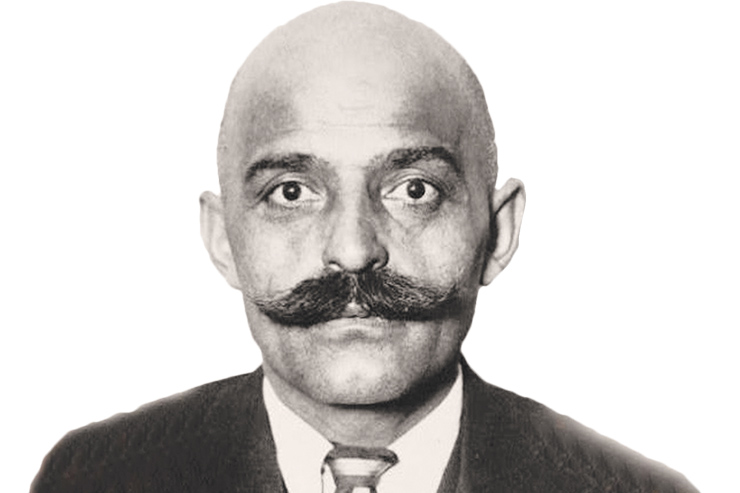
    We usually take these harmless instances of forgetting for granted; it’s hard to believe that they can tell us anything important. But according to George Ivanovich Gurdjieff (1866?-1949), they point to the heart of the human predicament.

    Long before the twentieth century’s discovery of the unconscious, people knew that there were unseen parts to themselves. “I cannot totally grasp all that I am,” wrote St. Augustine in the fifth century CE. “For that darkness is lamentable in which the possibilities in me are hidden from myself: so that my mind, questioning itself upon its own powers, feels that it cannot rightly trust its own report.”

    Gurdjieff would have agreed. Indeed he insisted that we are not awake even in the so-called waking state, but go about our lives in a hypnotic stupor. “It may surprise you,” he said, “if I say that the chief feature of a modern man’s being which explains everything else that is lacking in him is sleep. A modern man lives in sleep, in sleep he is born and in sleep he dies” (emphasis here and in other quotes is in the original). 

    This sleep, Gurdjieff contended, is universal, or nearly so. Today some contend that the mass of humanity is being manipulated by a small and sinister elite who are keeping people in the dark in order to maintain their own power and position. This is not Gurdjieff’s view. According to him, the world’s leaders are in the same position as the rest of us. During World War I, Gurdjieff said, “Neither Emperor Wilhelm [of Germany], nor generals, nor ministers, nor parliaments, signify anything or can do anything.” Nor is it a matter of a secret cabal pulling the strings behind the scenes. Instead “everything that happens on a big scale is governed from outside, and governed either by accidental combinations of influences or by general cosmic laws.”

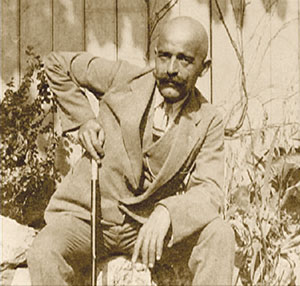
    George Ivanovich Gurdjieff (1866?-1949)

    In 1915 in St. Petersburg, Gurdjieff met his most famous student, the man who, more than Gurdjieff himself, would become the most widely read exponent of his teaching: Piotr Demianovich Ouspensky (1878–1947). Ouspensky’s account of his experiences appears in what is perhaps the best and most famous book about Gurdjieff’s teaching: In Search of the Miraculous: Fragments of a Forgotten Teaching, which Gurdjieff himself endorsed as an accurate picture of his views. It presents an intricate and fantastic esoteric system. One theme is the “sleep” of ordinary life. Another is the disunity of the human being. Gurdjieff says:

    Man such as we know him… cannot have a permanent and single I. His I changes as quickly as his thoughts, feelings, and moods, and he makes a profound mistake in considering himself always one and the same person; in reality he is always a different person, not the one he was a moment ago….

    Each minute, each moment, man is saying or thinking “I.” And each time his I is different. Just now it was a thought, now it is a desire, now a sensation, now another thought, and so on, endlessly. Man is a plurality. Man’s name is legion.

    Gurdjieff is here alluding to an ancient view of the human mind, which regards human beings as essentially tripartite, consisting of the intellect, the emotions, and the instinctive and motor functions of the body.

    These three “centres,” as Gurdjieff called them, “instead of fusing inwardly in the normal way to produce common outer manifestations, have become, especially of late, quite independent outward functions…. [Man] cannot be master of himself, for not only does he not control these centres, which ought to function in complete subordination to his consciousness, but he does not even know which of his centres governs them all.”

    This disjunction would be bad enough on its own, but it is compounded by “sleep,” the hypnotic trance in which we habitually live. Gurdjieff links this “sleep” to the concept of kundalini.

    The spread of Eastern teachings over the past generation has made kundalini a comparatively familiar term. Most esotericists use this Sanskrit word to refer to the “serpent fire” at the base of the spine. This subtle energy is said to lie dormant in most people but can be awakened through meditation or yogic practices. Travelling up the spine, it brings about illumination when it reaches the head.

    Gurdjieff thought this view of kundalini was completely wrong. “In reality Kundalini is the power of imagination, the power of fantasy, which takes the place of a real function. When a man dreams instead of acting, when his dreams take the place of reality,… it is the force of Kundalini acting in him. Kundalini can act in all centres and with its help all the centres can be satisfied with the imaginary instead of the real.”

    In his immense and difficult magnum opus, Beelzebub’s Tales to His Grandson, Gurdjieff speaks of “the crystallised consequences of the properties of the organ kundabuffer.” Kundabuffer, a coinage of Gurdjieff’s, is a portmanteau word formed from “kundalini” and “buffer”; “buffers” were what he called those psychic mechanisms that keep the different “I” ’s from confronting each other. (The idea resembles the modern psychological concept of dissociation.)

    But what Gurdjieff calls “the terror of the situation” is still worse. It might not matter if we lived our lives in sleep; perhaps we would not achieve all we could, but that almost inevitably happens anyway. According to conventional religion, if we are good, we will still go to heaven (or obtain a favourable rebirth) when we die.

    Gurdjieff does not subscribe to conventional views of immortality. For Gurdjieff, we possess the possibility of having immortal souls, or what he calls “higher being-bodies,” but we almost never attain them because we live in sleep. And for undeveloped human beings, there is no immortality. “The ‘man-machine’… who is now one, the next moment another, the next moment a third, has no future of any kind; he is buried and that is all.”

    This bleak view of human fate is reminiscent of the gloomier Gnostic cosmologies, and to many who have read In Search of the Miraculous, Gurdjieff sounds like a Gnostic. “Kundalini is a force put into men in order to keep them in their present state,” he asserts. “One would think that there are forces for whom it is useful and profitable to keep man in a hypnotic state.”

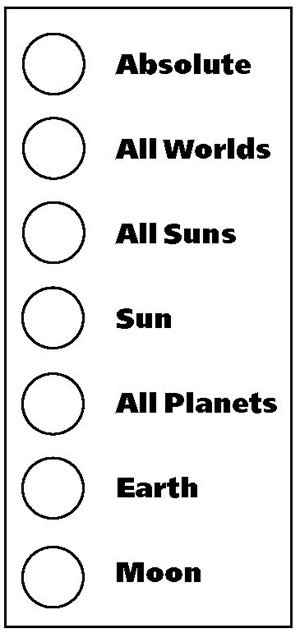
    Figure 1. Gurdjieff’s Ray of Creation. From P.D. Ouspensky, In Search of the Miraculous.

    There is some truth to the idea that Gurdjieff is a kind of Gnostic, but only some. To understand it fully, we need to grasp something of his intricate cosmology. It can be best seen in a diagram known as the Ray of Creation (Figure 1). Gurdjieff did not claim to have originated it but said it “belongs to ancient knowledge.” Many other esoteric systems are, he adds, distorted or incomplete versions of this system.

    As one can see from the diagram, the Ray of Creation rather resembles the way children sometimes address envelopes: after listing the street, city, and state, they will add “USA, North America, Planet Earth, the Solar System, the Milky Way, the Universe.” It also resembles the levels of manifestation seen in other systems, like the Kabbalistic Tree of Life. But Gurdjieff depicts the cosmic levels in terms of scale. The Absolute, or God, is all-encompassing. The next level is that of “all worlds,” that is, all galaxies (and perhaps all universes) taken as one. The next stage is that of “all suns” in our own galaxy, and so on. Each level, as it descends, is subject to a new set of cosmic laws of its own in addition to those of all the levels above it.

    In contrast to the higher realms, where there is comparative freedom, we on Earth are subject to many cosmic laws. In fact we are very nearly at the bottom rung of the ladder – but not at the absolute bottom, for that rung is occupied by the Moon. Contrary to the prevailing scientific views both of his time and of our own, Gurdjieff held that the Moon is not cold and dead but is rather “an unborn planet, one that is, so to speak, being born. It is becoming warm gradually and in time (given a favourable development of the Ray of Creation) it will become like the Earth and have a satellite of its own.”

    “Food for the Moon”

    The growing Moon needs to be fed by certain cosmic energies. What Gurdjieff calls “a huge accumulator” exists on Earth to accomplish this end. This “accumulator” is organic life in all its forms: “Everything living sets free at its death a certain amount of the energy that has ‘animated’ it: this energy, or the ‘souls’ of everything living – plants, animals, people – is attracted to the Moon as though by a huge electromagnet.” Human beings, like the rest of life on Earth, are thus merely “food for the Moon.”

    Such is the view set out in In Search of the Miraculous. Because this book is much more readable than Gurdjieff’s own magnum opus Beelzebub’s Tales to His Grandson, many take it as the final word. But Beelzebub amends this picture in an important way. For while Gurdjieff here reiterates that humanity was indeed designed as “food for the Moon,” he adds that we have a choice of how to serve this end.

    Buried toward the end of Beelzebub, in a convoluted passage on war, Gurdjieff makes an important and often overlooked disclosure: that the energy needed to “feed the Moon” is precisely the same as that given off by people “forming and perfecting… their higher bodies by means of conscious labours and intentional sufferings.” If people do not serve the purposes of “Great Nature” by inner work, this energy will be extracted from them on a massive scale by means of wars and epidemics.

    Gurdjieff’s picture of the universe, stated so baldly, seems improbable. What are we to make of “higher being-bodies,” “kundabuffer,” and the idea that we are “food for the Moon”? Does he mean these things literally? There was always a touch of the rogue about Gurdjieff, and the reader is sometimes struck by his writing in the same way that some people were struck by him in life: he seems to be staring at you with a penetrating gaze and asking you to decide whether or not he is kidding.

    Yet there is nothing in Gurdjieff’s life and work to indicate that he did not mean what he said. He despised conventional wisdom, and indeed one of the main themes interwoven throughout Beelzebub’s 1,200 pages is that modern people are so stuffed with absurdities that they have lost sight of cosmic truths. So Gurdjieff would hardly be concerned that today’s scientists and psychologists might differ with many points of his teaching.

    At the same time there is an elegance and sublimity to Gurdjieff’s vision. He is telling us not only that we are here for a purpose, but that the universe is benign and intricately constructed: if we fulfil its designs, we will be rewarded with immortality.

    [alert type=”success” dismiss=”no”]If you appreciate this article, please consider subscribing to help maintain this website.[/alert]

    “The Fourth Way”

    To rescue us from our plight, Gurdjieff brought what he called “the Fourth Way.” He contrasts his approach with three more familiar ways: (1) the way of the fakir, who masters his body to the point where he can stand “motionless in the same position for hours, days, months, or years”; (2) the way of the monk, who, by prayer and devotion to God, masters the emotions; (3) the way of the yogi, the one who gains control over the mind.

    Unlike these paths, the Fourth Way, “the way of the sly man,” does not require withdrawal from the world, but can and should be pursued in the course of everyday life; and instead of working with the mind, the body, or the emotions alone, it works with all three. It is, Gurdjieff claimed, faster and more efficient than the other three ways. “The ‘sly man’ knows the secret,” said Gurdjieff, “and with its help outstrips the fakir, the monk, and the yogi.”

    What is the sly man’s “secret”? It is a higher force, an energy that is able to penetrate the being of man and create unity in his centres where there was none before. This energy must come from above, but it will not come by itself; Gurdjieff does not preach quietism but advocates “conscious labours and intentional suffering.” (Indeed Gurdjieff’s disciples refer to his teaching as “the Work”; those attempting to follow it are said to be “in the Work.”) For a long time these “labours” and “sufferings” will consist, not in some sophisticated form of masochism, but in striving to overcome the slumber of daily life and see oneself as one really is.

    A central practice of the Fourth Way is self-remembering. “You do not remember yourselves,” Gurdjieff chides Ouspensky’s Petersburg group. “You do not feel yourselves; you are not conscious of yourselves. With you, ‘it observes’ just as ‘it speaks,’ ‘it thinks,’ ‘it laughs.’ You do not feel: I observe, I notice, I see.”

    Anyone who has read even a little in the literature of contemporary spirituality will find familiar resonances here, for many books emphasise the need for mindfulness. Gurdjieff’s teaching goes still further, for it puts this effort at the centre of the spiritual search. It also gives many more specific practices for “self-remembering”: people in the Work often receive instructions about being consciously present at certain moments of the day or during particular tasks.

    Many who have read about – or even practiced – Gurdjieff’s teaching seem to fall into the trap of seeing “self-remembering” as a completely cerebral practice; trying to carry it out, they end up simply being self-conscious in the ordinary sense. They miss an essential part of the practice: that self-remembering entails a conscious effort of sensing the body.

    Self-remembering begins with the body because, as the French Gurdjieffian Jean Vaysse puts it, the body “is solid and concrete, with an apparently stable form which can… be relied on to some degree. It is the instrument through which we perceive and our means of action. It can stay still voluntarily and thus is easier than the other parts for us to observe. It is relatively obedient, and we have a certain amount of control over it (in any case more than over our other parts). In addition, it is the one solid material base in us.”

    Hence a Gurdjieffian reading this article might attempt to read while giving some attention to the sensation of some part of the body, the foot or hand, say, or even the body as a whole. This may sound simple, but if you try it, you’ll find it isn’t. If you’re lucky, you may be able to keep this “divided attention” for a few seconds before you lose it again. For a long time the Work involves returning to this sensation of the body over and over again no matter what you’re doing. Such attempts are known as “efforts.” They are meant to counteract the sleep of everyday life. Those who persist in this practice find that some of the “maleficent consequences of the properties of the organ kundabuffer” are, if not destroyed, at least interrupted, for these efforts help to dissipate daydreaming, absentmindedness, and the hazy stupor in which we stumble through our lives.

    These efforts of attention tie into other aspects of the teaching as well. Gurdjieff defined attention as “the direction of the thinking centre’s activity.” Self-remembering, at least in the early stages, directs the “thinking centre” toward the body, which is governed by the “moving-instinctive centre.” Self-remembering brings these two centres closer together. When the mind is paying attention to the body, they are working a bit more in harmony, and the practitioner is slightly closer to becoming a unified being. (See the accompanying article on page 27 for further discussion – purchase a copy of the magazine to read it.)

    Gurdjieff further explains that “making a conscious effort at the moment an impression is received” enables the organism to absorb more of certain subtle energies than it ordinarily does. These energies are used to create “higher being-bodies” that can withstand the shock of death. Thus self-remembering, a practice as rich and multileveled as meditation itself, is meant not only to counteract the sleep and disunity of man, but to help one attain the immortality that, Gurdjieff says, usually exists for us as nothing more than a possibility.

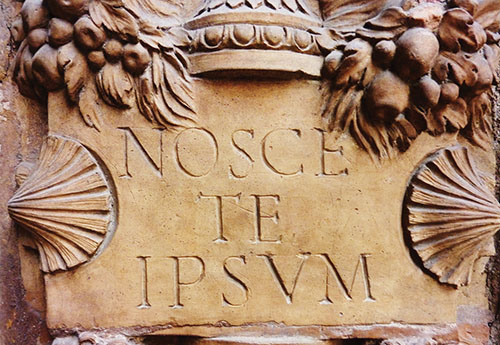
    The Ancient Greek aphorism “Know thyself”, Latin: nosce te ipsum, was inscribed in the forecourt of the Temple of Apollo at Delphi.

    A second, closely related practice is self-observation, whereby one tries to see as much as possible of one’s own immediate state – thoughts, moods, emotions, reactions, and physical postures. Self-observation attempts to fulfil the injunction of the ancient oracle at Delphi: “Know thyself.” All true teachings must work toward this goal in some way. The Gurdjieffian technique is to observe ourselves in the course of daily life, to see ourselves as others see us, in all our moments of awkwardness, irrationality, and sleep.

    This process not only helps students accumulate material for understanding themselves better, including the subtle organism of the “centres,” but it enacts certain changes in its own right. “Many psychic processes can take place only in the dark,” says Gurdjieff. “Even a feeble light of consciousness is enough to change completely the character of a process, while it makes many of them altogether impossible.”

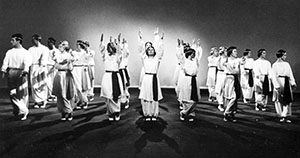
    Today most Gurdjieffian groups focus on the practices of self-remembering and self-observation; people also take part in various forms of physical labour and craftwork as a means of seeing different aspects of themselves. There are even some who continue an interesting facet of his teaching known as the Gurdjieff Movements.

    The origins of the Movements form part of Gurdjieff’s legend, for most people in the Work connect them with the “sacred dances” he learned in his explorations in Central Asia during his youth. These dances, which Gurdjieff claims are over 4,500 years old, “correspond precisely to our books. Just as is now done on paper, so, once, certain information about long past events was recorded in dances and transmitted from century to century to people of subsequent generations.” Each posture forms a letter in an alphabet of gestures; understanding this code, you can read the information therein.

    The “sacred dances” known as the Gurdjieff Movements.

    Although the Movements, accompanied by music written by Gurdjieff and his pupil, the composer Thomas de Hartmann, are still taught in some Gurdjieffian schools, it is not clear that the means of “reading” them has been passed down as well. If Gurdjieff did impart the secret to some of his pupils, it has been well hidden. It is rarely possible even to see a performance of the Movements; the best way of glimpsing them is in the 1977 film Meetings with Remarkable Men, directed by Peter Brook under the supervision of Gurdjieff’s pupil Jeanne de Salzmann, which shows the performance of some of these dances toward the end.

    Anyone who does see the Movements can understand how they fit in with Gurdjieff’s teaching. They require the performer to maintain two or three different rhythms with different parts of the body, say, the head, arms, and feet, often while executing complicated dance steps. The difficulty of these “sacred dances” is obvious, but they accord with Gurdjieff’s goal of integrating the “three centres” so that a new, higher “I” can be created. As for the difficulty, Gurdjieff insisted that “only super-efforts count.”

    What possibilities does the Work offer for the seeker today? Its hardships rarely take the peculiar forms they did under Gurdjieff himself, but much of the master’s rigor remains. It is not a path for those who crave conviviality or emotional warmth; many who encounter the Work complain of its coldness. On the other hand, this very characteristic tends to weed out dilettantes, so the calibre of people one encounters is probably higher than in many traditions. There are of course dubious entities that lay claim to Gurdjieff’s heritage, but most of them can be avoided if one keeps clear of groups that aggressively proselytise or demand exorbitant sums of money.

    For a sense of the possibilities offered by the Gurdjieff Work, one might take a clue from Beelzebub, whose hero at one point remarks that of all the creatures in our solar system, “personally I liked best of all the three-brained beings breeding on the planet bearing the name Saturn.” Traditional astrology portrays Saturn as the cold, remote planet that creeps slowly through the sky. As such, it has always been associated with slow, unstinting labour (which is why in the old rhyme “Saturday’s child works hard for a living”) as well as with authority and depth. Hence the “super-efforts” required by the Work may seem to lack glamour and fun, but they may also confer knowledge that cannot be won by easier means.

    [alert type=”general” dismiss=”no”]This article was published in New Dawn 131.[/alert]

    [alert type=”success” dismiss=”no”]If you appreciate this article, please consider subscribing to help maintain this website.[/alert]

    © New Dawn Magazine and the respective author.
    For our reproduction notice, click here.
  • Gematria: The Link Between Numbers & Letters

    Gematria: The Link Between Numbers & Letters

    From New Dawn 148 (Jan-Feb 2015)

    Count the numerical values

    Of the letters in Nero’s name,

    And in “murdered his own mother”:

    You’ll find the sum is the same.

    This piece of doggerel, written on a wall in Rome around 60 CE, points to a widespread (and very likely true) rumour that was circulating about the wicked emperor Nero: that he had his mother, Agrippina, killed.

    It is one of the earliest recorded uses of gematria, or isopsephy. By this technique, you add up the number equivalents of letters in the alphabet. If the numbers are the same for two different words or phrases, they are pointing to a connection between the two things – and may even suggest they are identical. This particular calculation was done in Greek. If you add up the numerical values for the Greek letters in Neron (Nero) and in the phrase idian metera apekteine (“killed his own mother”), they both equal 1005.

    The verse above was quoted by the Roman historian Suetonius. If Suetonius was right about this story, the use of gematria was so well-known in first-century Rome that it could be used by a juvenile delinquent (although a highly educated one) scrawling a nasty comment on a wall.

    Gematria is based on the fact that the alphabets of some languages do double duty as letters and as numbers. This is certainly the case for both ancient Greek and Hebrew, and it makes gematria a particularly fascinating technique when those languages are involved.

    Curiously, the most famous use of gematria also concerns Nero. In all likelihood, he is the famous Beast of Revelation 13:18, which reads, “Here is wisdom. Let him that hath understanding count the number of the beast: for it is the number of a man; and his number is Six hundred threescore and six.” Scholars generally agree this refers to Nero, because the Hebrew letters for the words “Nero Caesar” do in fact add up to 666.

    This identification also fits the time, since Revelation, at least in part, probably dates from the era of the Jewish War of 66-73 CE, in which the province of Judea rebelled from Rome and was crushed by the Roman army. Nero, whose cruelty was excessive even by Roman standards, was overthrown in 68.

    The number 666, being of the Beast, is sometimes contrasted with 888, which by Greek gematria is the number of Jesus.

    So where does gematria come from? It is a Hebrew word, derived from the Greek geometria (“geometry”) or possibly grammateia (“grammar”). As we’ve just seen, one of the earliest instances of gematria is based on Greek letters. But the Greeks did not invent it. Perhaps the Babylonians did. The oldest known use of gematria appears in an inscription from the reign of the Babylonian king Sargon II (727-707 BCE). It says that Sargon built the wall of the city of Khorsabad “equivalent to the value of his name,” which, according to Babylonian calculation, was 16,283 cubits.

    Nevertheless, it was the Jewish tradition, particularly its mystical strain known as the Kabbalah, that took gematria the furthest. The single best-known use of gematria has to do with the word chai (“life”), whose numerical value equals eighteen, making eighteen a traditionally lucky number for Jews.

    Thirty-six, twice eighteen, thus pointing to two lives (presumably a heavenly as well as an earthly one), is a still more important number. According to Jewish tradition, at any given time there are thirty-six righteous people on Earth for whose sake the world is preserved, no matter how wicked it may become. Their identity is known to no one, for the most part not even to themselves. If anyone claims to be one of them, it is a sure sign that he is not.

    Thirty-six may have another meaning as well: it is written with the Hebrew letters lamed and waw, or vav, which equal thirty and six respectively. These letters spell the word lo, “to him,” possibly indicating these thirty-six belong specially to God. The thirty-six righteous are sometimes known as “lamed-vavniks.”

    Far more famous than gematria, of course, is numerology, which is based on the same principle. Although this method seems more artificial in English and other modern languages, whose alphabets do not serve as numerals, it has been undyingly popular. It generally focuses on determining an individual’s fate by adding up the numbers associated with the letters of her name, or sometimes the numbers of her birthdate. There are innumerable guides to numerology available. One concise account I found helpful can be found in chapter 2 of Richard Cavendish’s book The Black Arts (published in the UK under the title The Magical Arts).

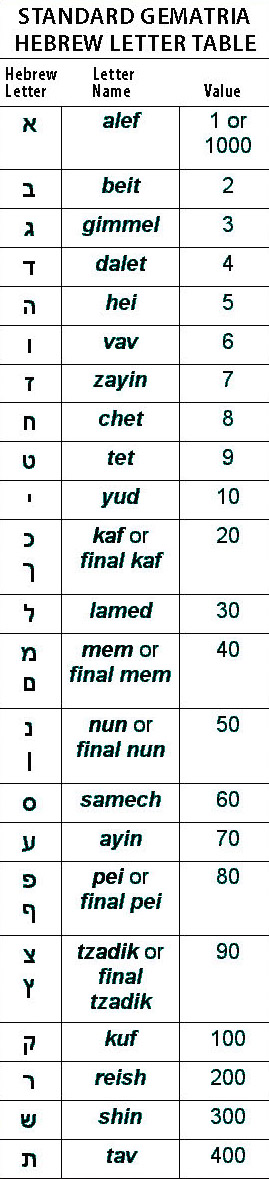
    Gematria in its most standard form (there are many variants) uses the actual numerical value of the Hebrew letters. Vav, the sixth letter, stands for the number six. Yod, the tenth letter, stands for ten, and so on. But there is another, more esoteric value for numbers based on a complex but fascinating system.

    There are twenty-two Hebrew letters as there were in the Phoenician alphabet from which it derives. And the number twenty-two has a little-known mystical significance. It comes from the fact there are exactly twenty-two regular polygons that can be inscribed in a circle.

    Why should this idea have any importance? Probably because the circle, whose dimensions are based on pi, an irrational number, represents the unseen – thus heaven. The polygons, all of which have dimensions that can be expressed in rational numbers, represent the visible – thus the earth. These twenty-two figures would thus symbolise the interaction of heaven and earth.

    This schema is, as far as I can tell, almost unknown in the English-speaking world. I have come across it in two sources, both originally published in French: La Bible, document chiffré (“The Bible: A Coded Document”) by Raymond Abellio, and Gnosis: Study and Commentaries on the Esoteric Tradition of Eastern Orthodoxy by Boris Mouravieff. The latter has been translated into English; the former has not.

    Abellio points out that the esoteric numerical value of each Hebrew letter corresponds to the number of sides of the polygon to which it relates. For example, the first Hebrew letter, aleph, corresponds to the triangle, the first of the regular polygons. Hence the esoteric value of the aleph is three. (Its value in more familiar versions of gematria is one, because it is the first letter of the alphabet.) The second letter, beth, has the value of four, because it corresponds to the next polygon, the square, which has four sides, and so on.

    Mouravieff adds another dimension to this picture. In the first place, he says this system was expounded esoterically in the 118th Psalm. This psalm, the longest by far, consists of twenty-two stanzas, each of which corresponds to one of the Hebrew letters. The eight lines of each stanza all begin with that letter. I have never found it easy to find these deeper meanings in this psalm, but that doesn’t mean they don’t exist.

    In the second place, Mouravieff gives a table of the esoteric meanings of these numbers. Although he insists they are not equated with images in the esoteric Christian tradition and he does not mention the Tarot, his list bears a striking resemblance – at least at some points – to the Major Arcana of the Tarot deck.

    For example, according to Mouravieff the key of three has the meaning “Love (coming from the feminine principle), Queen of the Heavens.” It’s easy to see the resemblance between this description and the Empress card, the third of the Tarot trumps. The key of thirteen has the meaning “fall, decomposition, death.” Anyone familiar with the Tarot will immediately see that this corresponds directly to the thirteenth trump, which is Death. The key of fifteen has the meaning “thought, calculation, lie, illusion,” which again corresponds neatly to the Devil card.

    The last number is of particular interest. The twenty-second trump has the meaning “the Whole, in Space and Time as well as out of Space and Time, comprising the perceptible and the imperceptible, the imaginable as well as the unimaginable.” The twenty-second figure is the 360-gon, which has 360 sides. Although I have never seen a drawing of this figure, I would imagine that its sides would be so small that you could be fooled into thinking it was a circle. It is striking, then, to recall that the twenty-second Tarot trump is the Fool. Moreover, its number is given as zero in most decks, which again resembles a circle.

    This system of polygons in the circle may provide a link between the Tarot and the Hebrew letters, which was posited by the French magus Éliphas Lévi in the nineteenth century, but most scholars today no longer take seriously. It’s possible, then, that the Tarot trumps were not modelled on the Hebrew letters or vice versa, but they were both inspired by the same geometrical schema.

    What is the value of this numerological knowledge? I doubt it has the kind of practical application that will enable one to cure cancer or blow up cities. Its power lies at another level. Mouravieff hints at how one might use it: “Each of these Numbers in its turn contains a whole bundle of ideas, bound together by a general idea that often escapes the mind that is still untrained in this contemplative research.” Contemplation of these ideas and figures is as much the point as any factual knowledge it may convey.

    Thus, as with other esoteric codes, mere information is only a small part of the picture. The knowledge involved is not merely a collection of facts, but the perception of interconnections between things that had previously seemed separate and isolated. This kind of practice, we can surmise, is a way of training and integrating the mind. In this way it helps the individual consciousness to correspond more closely to the primordial, integrated Unity that underlies all things.

    [alert type=”general” dismiss=”no”]This article was published in New Dawn 148.[/alert]

    [alert type=”success” dismiss=”no”]If you appreciate this article, please consider subscribing to help maintain this website.[/alert]

    Sources

    Raymond Abellio, La Bible, document chiffré, 5th ed., Gallimard, 1950

    Kieren Barry, The Greek Qabalah: Alphabetic Mysticism and Numerology in the Ancient World, Samuel Weiser, 1999

    Richard Cavendish, The Black Arts, G.P. Putnam, 1967

    Boris Mouravieff, Gnosis: Study and Commentaries on the Esoteric Tradition of Eastern Orthodoxy, vol. 3, edited by Robin Amis, Praxis Institute Press, 1993

    Gershom Scholem, Kabbalah, Dorset, 1987

    © New Dawn Magazine and the respective author.
    For our reproduction notice, click here.
  • What Is Consciousness?

    What Is Consciousness?

    From New Dawn 120 (May-June 2010)

    One of the central themes of our age is consciousness. Mystics, scientists, philosophers alike have cast their eyes on this elusive entity, but no one seems quite able to say what it is. If you look up “consciousness” in a dictionary, you will often find that it is circularly defined with such terms as “awareness” and “perception.” To be conscious is to perceive; to perceive is to be aware; to be aware is to be conscious; and so on.

    Admittedly, it’s difficult to define basic terms without some circularity: right is the opposite of left, and left is the opposite of right. But consciousness is especially problematic because it is so central to our life and experience.

    Furthermore, no one has ever figured out how the human brain produces consciousness. In a recent issue of Scientific American, neuroscientists Christof Koch and Susan Greenfield sum up the state of current knowledge when they write, “Neuroscientists do not yet understand enough about the brain’s inner workings to spell out exactly how consciousness arises from the chemical and electrical activity of neurons” (their emphasis). Neuroscientists know that the brain affects consciousness, but that was known as far back as the fifth century BCE, when the Hippocratic text On the Sacred Disease argued (radically for the time) that epilepsy was not caused by divine possession: rather “the brain is the cause of this affection, as it is of other very great diseases.” If you have any doubts on this score, you can prove it for yourself by gulping down three or four shots of vodka: when the body drinks alcohol, the mind gets drunk. Research into the neurological mechanisms that regulate these processes add more detail but no more insight into what philosophers call the “mind-brain problem.”

    Personally I believe that this is in large part because up to now no one has clearly defined what consciousness is. Gregory Sams echoes a common sentiment when he writes in the September-October 2009 issue of New Dawn: “There is no accepted standard definition for consciousness. Mystics and philosophers have devoted books to it or summed it up with the two words ‘consciousness is’.”

    I would like to propose a very simple, but, I believe, extremely fertile definition: consciousness is the capacity to relate self and other.

    How do we know this? It’s quite simple. If there is no sense of self versus other, there is no consciousness. The most obvious example is the state of deep, dreamless sleep. You are unconscious at that time, and there is no sense of self or other – not even the elusive and tenuous sense of self that we possess while dreaming.

    No sooner have we said this, however, than we realise that consciousness, this capacity to relate self and other, admits of innumerable gradations. You are not conscious of the physical world when you are dreaming, but you are still possessed of consciousness of a kind. Even dreamless sleep is not utterly devoid of this quality. What, after all, is the most universally prescribed remedy for all sorts of ailments? Sleep, which enables the “self” of the body to fight off the “others” known as pathogens.

    We can go further. Anyone with even the slightest experience of animals knows that they too are capable of relating self and other. Dogs and cats can’t reason except in the most rudimentary sense, and yet they have emotional lives that are enough like our own to be more or less understandable. Can we, then, say they are conscious, not as we are, but conscious nonetheless? What about more primitive creatures, going down as far as plants and even protozoans? We may be fairly sure that they don’t engage in Cartesian introspections, but their fierce attachment to life, to perpetuating their own existence, indicates that they too have some sense of themselves over and against an external world.

    Like many of the discoveries of the past few centuries, these insights seem to erode the human sense of privilege in being the sole possessors of the magnificent gift called consciousness, but there are some consolations. The problem of human consciousness becomes less confounding if we see it not as something sprung mysteriously out of nowhere but as a stage on a continuum. Moreover, if it is taken to heart, this outlook may help mitigate the feeling of isolation and separation that is the unhappy side effect of our arrogant sense of uniqueness.

    Where, then, do we draw the line? At inanimate things? That apparently inanimate objects contain a rudimentary form of consciousness has long been known to the philosophy of India. The British scholar Sir John Woodroffe explains it thus: “In the mineral world Cit [consciousness] manifests as the lowest form of sentiency evidenced by reflex response to stimuli, and that physical consciousness which is called in the West atomic memory.” This ostensibly Eastern idea appears in the West as well, sometimes in unexpected places. Here is an excerpt from an 1890 interview with Thomas Edison by the American writer George Parsons Lathrop:

    “I do not believe,” [Edison] said, “that matter is inert, acted upon by an outside force. To me it seems that every atom is possessed by a certain amount of primitive intelligence. Look at the thousand of ways in which atoms of hydrogen combine with those of other elements, forming the most diverse substances. Do you mean to say that they do this without intelligence?… Gathered together in certain forms, the atoms constitute animals of the lower orders. Finally they combine in man, who represents the total intelligence of all the atoms.”

    But where does this intelligence come from originally?” I asked.

    “From some power greater than ourselves.”

    Restating the point, we could say that a hydrogen atom “knows” how to recognise an oxygen atom and, under certain circumstances, how to combine with it to form water. It can, in a manner of speaking, perceive something outside of it and relate to it; it is, in a very rudimentary sense, conscious. If an atom could not take a stance in the physical world and draw some kind of line between itself and what is not itself, it could not exist. Perhaps this is the secret of those tenuous submolecular particles about which today’s physics so tantalisingly speculates. They seem to flash in and out of existence, or, in certain instances, not to exist at all unless they are observed. It is as if their sense of themselves is so frail and ambiguous that it takes an external perceiver to bring them into being, much as the eighteenth-century Anglo-Irish bishop and philosopher George Berkeley claimed that the universe would vanish if God were not there to perceive it.

    The sense of self versus other underlies our entire sense of the world. In a human context, it has produced a very strange effect: the pervasive sense that something is wrong. Indeed, we could say that man is the animal that believes something is wrong. A proverb tells us, “A man may have many problems; a man who is hungry has only one.” Granted – but if the man’s hunger is satisfied, the other problems that were waiting in the wings now come on stage. To all appearances, this is not true of other species – a dog or cat that is warm and well-fed and in comfortable circumstances does not seem to be aware of any problems. (We often envy them for this.) The sense that existence itself is problematic is basic to practically every religion – whether it calls that problem “sin” or “the Fall” or “samsara” or “maya.” Nor is it eliminated if we take religion out of the picture; it is then simply called something like “existential angst.”

    What is this “something wrong”? To make an extremely broad generalisation, Western religion has tended to portray it in moral terms – chiefly sin. At some point man chose to go his own way apart from God, and he has been in a vale of tears ever since. Eastern religions, on the other hand, have tended to portray this problematic nature of existence in cognitive terms. It is a matter of illusion or ignorance. As I say, this is an extremely broad generalisation, and many exceptions can be found. Socrates and Plato, for example, the fathers of Western philosophy, said that the human condition is characterised by ignorance and delusion. But by and large the generalisation holds true.

    The moral aspect of the human condition has been overemphasised in the West. No doubt there is a moral dimension to the universe – whether we call it the Tao, dharma, the will of God, or something else – and it is possible within this dimension to do evil. At the same time, it seems an exaggeration to say that we are conceived and born in sin, as conventional Christianity has too often done. One has the impression that Christianity created original sin as a problem to which it could then offer itself as the solution. It is as if a doctor were to make up a disease for which, of course, only he would have the cure.

    For Western civilisation today, then, it would make sense to look more deeply into the cognitive nature of this problem, and as a matter of fact that is what many people are doing. The popularity of Buddhism and certain forms of Hinduism, such as Advaita Vedanta, indicates as much. In this context it may be possible to say more clearly what this problematic nature of existence has to do with the relation of self and other that we call consciousness. One of the most profound myths to cast light on this issue, taken from the Hindu tradition, is the curious tale of the dice game of Shiva.

    One day the embraces of the Hindu god Shiva and his consort, Parvati, who have spent eternity rapt in lovemaking, are interrupted by a sinister yogi named Narada. Narada says he can show them something that is even more delightful than love. It is a game of dice – an ancestor of today’s Parcheesi.

    Intrigued by his offer, the divine couple begin to play. Each of them cheats as much as possible, but no matter how long they play, the outcome is always the same: Shiva loses and Parvati wins. Shiva may have the advantage for a round or two, but he can never win a game.

    At one point Shiva is ahead; he has won a couple of Parvati’s jewels, enraging her. Noticing that the angrier she becomes, the more beautiful she grows, he coaxes her into continuing. Parvati agrees to play if Shiva will wager his chief attributes: his trident, the crescent moon, and a pair of earrings.

    Of course Shiva plays and loses. But he refuses to accept this fact; after all, he is Shiva, the lord of the universe. “No living being can overcome me,” he tells her. She replies, “No living being can overcome you, it’s true – except me.” In spite, she leaves him. She takes not only the trident and moon and earrings but a pair of snakes and even his last item of clothing, his loincloth.

    Shiva is not troubled. He withdraws to the wilderness and leads the life of an ascetic, free from the preoccupations of the world, meditating in solitary peace. Parvati, on the other hand, feels lonely and frustrated without him. Intent on winning him back, she takes the form of a lovely tribeswoman (an untouchable in the Hindu caste system) with red lips, a graceful neck, and magnificent full breasts. She is so beautiful that even the bees in the forest are overcome with love.

    Shiva, roused from his meditation by the noise of the bees, sees Parvati in the guise of the tribeswoman and is overcome with desire for her. Coquettishly she says, “I am looking for a husband who is omniscient, who is free and fulfils all needs, who is free of mutations and is the lord of the worlds.”

    Shiva says, “I am that one.”

    Parvati replies, “You shouldn’t talk to me that way. I happen to know that you have a wife who won your devotion by many austerities, and you left her in a flash. Besides, you are an ascetic, living free from duality.”

    “Even so, I want you.”

    Parvati says that he must ask permission of her father, Himalaya, the lord of the mountain chain. Shiva approaches him, but Himalaya says, “This is not right. You should not be asking me. You are the one who gives everything in all the worlds.”

    At this point Narada reappears and tells Shiva, “Listen. Infatuation with women always leads to mockery.”

    “You’re right,” Shiva replies. “I have been a fool.” And Shiva withdraws to a remote part of the universe where even yogis cannot go.

    At this point Narada convinces Parvati and Himalaya to implore Shiva to return, and they do so by praising him lavishly. Mollified, Shiva comes back, and he and Parvati resume their reign in unity.

    Contrary to Einstein, this myth seems to be saying that God not only plays dice with the universe but constantly loses. Why should Shiva, the lord of the universe, be lured into indulging in a version of strip Parcheesi? How can he lose? Who is his consort? Why does she win?

    In essence, we could say, Shiva represents consciousness – what the Hindu tradition often calls purusha. Sometimes translated as “spirit,” it signifies consciousness in a sense much more universal than mere human awareness. Parvati represents prakriti. This is sometimes translated as “matter” or “nature,” but it signifies something far more encompassing – the contents of consciousness, experience in all its forms, internal and external – what esoteric Christianity calls the “world.” At the beginning of the myth they are locked in union. There is no distinction between consciousness and its contents. Therefore there is no world. The Hindus call this state pralaya, the state of primordial sleep that prevailed before the universe bestirred itself to manifest. The Hindu scripture known as the Rig Veda describes it:

    Then [before the beginning]
    there was neither death nor no-death,
    no sign of night or day.
    The One breathed, breathless,
    through its own impulsion,
    and there was no Other of any kind.

    Note that it’s precisely the absence of the “Other” that characterises this primal repose. The dice game, introduced by Narada, the personification of discord, symbolises the beginning of manifestation. No manifestation can exist without a distinction between self and other. But this distinction is not the property only of conscious subjects such as we imagine ourselves to be. It is characteristic of everything, because, as I have indicated, even an atom or electron must have some sense of itself simply to cohere at all. It must perceive an other in order to distinguish itself from that other and so maintain a stable existence.

    The fundamental dynamic of reality, then, is that of Shiva and Parvati: consciousness, or self, in all its forms, and experience, or the other, in all its forms. After all, if consciousness consists of the ability to relate self and other, this polarity is and must be primary. If there is no self and other, there is no universe.

    Nothing in manifest existence is absolutely a self or an other. They are merely matters of perspective. A hydrogen atom has some consciousness, demonstrated by its ability to recognise an atom of oxygen and interact with it under certain circumstances to form water and other compounds. From its point of view, it is a self and the oxygen atom is the other. To the oxygen atom, exactly the opposite is the case: the hydrogen atom is the other, just as I am other to you and you are other to me. This fact indicates that the relation between self and other, between “I” and the “world” outside, is a constant, dynamic interplay for all entities at all scales and levels of complexity. We can find metaphor for this in the game known as Othello, or Reversal, which employs disks that are black on one side and white on the other. Each player takes turns setting them down on a grid, and the player who has more disks of his own colour on the board at the end of the game wins. If, say, you are the black player and you manage to cap a line of white disks with your own black disks at both ends, the whole line of white disks flip over to black. In the course of the game, whole lines of disks flip from white to black and back again. This process hints at the ever-shifting reversal of self and other that prevails in the universe at all levels.

    But to return to the dice game, where does it fit in? And why does Shiva always lose?

    Shiva represents what one of the Upanishads calls the “seer of seeing.”5 Seeing in all its forms – that is, consciousness – imparts existence to the world. Nothing exists unless it is seen. Paradoxically, this includes Shiva’s own attributes. They do not, strictly speaking, belong to consciousness, which in its pure form has no attributes; it simply sees. (This may explain why philosophers are frustrated in their attempts to define it.) Any qualities that we can ascribe to consciousness are immediately seen; they are part of the world; and the world is Parvati. And so Parvati always wins. Her victory strips Shiva down to his pure, naked essence, which is seeing alone. For all the possible throws of the dice – that is, for all the possible directions manifestation can take – Shiva will always lose.

    Nevertheless, Shiva takes his defeat with aplomb and simply retreats to the forest. That is to say, consciousness can detach itself from its experience; it can free itself from its own contents. This detachment is the goal of many forms of meditation. It suggests why Shiva is described as an ascetic.

    Consider your own experience now. Most likely you are not aware of yourself, except as part of a vague background. But if you bring your attention to yourself, you can feel yourself as an “I” having experiences. Many of these are sensory: this room, this chair, this magazine. You can go still deeper. You can be aware of your thoughts and feelings as they pass over the screen of your awareness (which is generally easier to do if you close your eyes). If you can be aware of even these most private and intimate thoughts as somehow “other,” then where is the “I”? Who or what is it? It has no attributes as such, no qualities; it simply sees. Hence the Hindu sage Sri Ramana Maharshi says that the question “Who am I?,” taken back far enough, will lead to enlightenment.

    Enlightenment as customarily conceived is a shadowy concept. About all one can say of it is that it is a higher state of consciousness than we’re accustomed to or for that matter usually believe possible. In light of the ideas I’ve sketched out, however, we might be able to say a bit more. The consciousness that causes the world to arise is common to all things, human and nonhuman, animate and inanimate; there is nothing that does not possess it to some degree. But we almost never experience it in this universal way. On the contrary, it is always me, my consciousness, fenced in with rigid lines to insulate it from all others. It is precisely this rigid distinction, which is to a great extent artificial and delusory, that constitutes the problematic nature of existence, the sense of something wrong that pervades our souls. As the Greek sage Heraclitus said, “Consciousness is common to all, but most people live as if they had their own private minds.”

    Enlightenment, it would seem, lies precisely in the recognition of these truths, not conceptually but directly and intuitively. It may and often does come in an instant. Such insight may be dazzling for the one who experiences it, but it may also not be. For many people, I suspect, it appears “as a thief in the night,” and they cast it aside in the belief that enlightenment means the heavens open and one sees ladders full of angels going up and down, or that one becomes instantly omniscient.

    In any event, this experience of insight – whether we call it enlightenment, illumination, gnosis, or something else – marks a fundamental shift in an individual’s orientation. Afterward she is not necessarily immune to the vicissitudes of life: joys and sorrows and aches and pains come as they always have. But in a subtle way they have lost their hold on her. They are no longer absolutes, to be taken at face value. She is aware of a dimension of mind that is above the passing thrills and irritations of existence. This is supernally real and can never be taken away, and so is to be valued above all things. As Christ puts it in the Gospels, “The kingdom of heaven is like unto treasure hid in a field: which when a man hath found, he hideth, and for joy thereof goeth and selleth all that he hath, and buyeth that field” (Matthew 13:44).

    [alert type=”general” dismiss=”no”]This article was published in New Dawn 120.[/alert]

    [alert type=”success” dismiss=”no”]If you appreciate this article, please consider subscribing to help maintain this website.[/alert]

    © New Dawn Magazine and the respective author.
    For our reproduction notice, click here.