New Dawn – World's Most Unusual Magazine

Author: Richard Smoley

  • Mystery of the Seven Seals: Seven Spheres, Planetary Archons & Corruption on High

    Mystery of the Seven Seals: Seven Spheres, Planetary Archons & Corruption on High

    From New Dawn 158 (Sept-Oct 2016)

    Until baptism …fate is true. But afterward the astrologers are no longer correct. 
    – Excerpta ex Theodoto, 78

    The New Testament is probably the most widely read book in the world. And yet it is also a book that is mysterious, and, at best, not fully understood. In some cases, this is because what the churches teach today no longer corresponds with what the New Testament says. This is the case with the nature and person of Jesus. (See my article, “The Strange Identity of Jesus Christ,” in New Dawn 156.)

    In other instances, it is not so much that the teaching has been changed, but that it has been lost completely.

    This is true of the early Christian view of cosmology. It is peppered throughout the New Testament but has been completely overlooked or forgotten. The result is that many parts of the text are baffling or incomprehensible today.

    Here’s one example – the angels. Today angels are golden-haired beauties who save you from car wrecks. In the US there is even a magazine, Angels on Earth, that is devoted to printing readers’ firsthand experiences of encounters with angels. It has a circulation in the hundreds of thousands.

    But in the first century CE it was not so. Here is a curious fact: in the New Testament, the apostle Paul never speaks of angels in a favourable way. Examples: “For I am persuaded, that neither death, nor life, nor angels, nor principalities, nor powers, nor things present, nor things to come… shall be able to separate us from the love of God” (Romans 8:38–39; biblical quotations are from the Authorised King James Version). “For I think that God hath set forth us the apostles last, as it were appointed to death: for we are made a spectacle unto the world, and to angels, and to men” (1 Corinthians 4:9; emphasis added in both passages).

    In both examples, the angels are not friends of humanity but barriers to God.

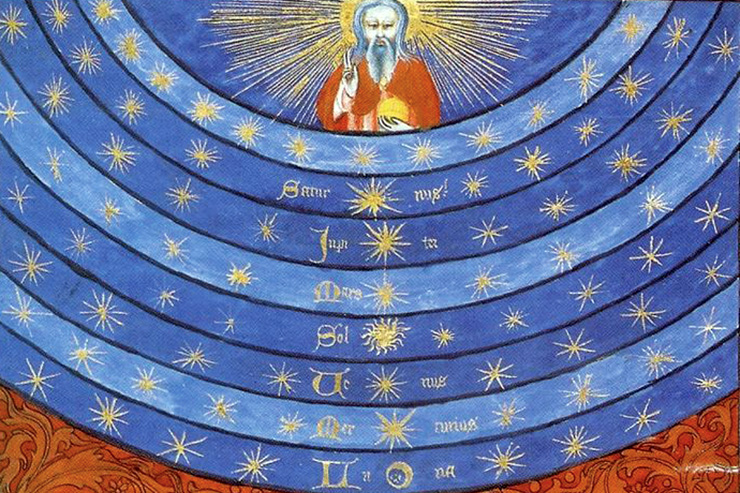
    To understand the implications of this fact, it might be best to begin with the cosmological worldview that was current in the first century CE. It is based on the seven planets as known at that time: the Moon, Mercury, Venus, the Sun, Mars, Jupiter, and Saturn. They were believed to revolve around the earth (in the order just given), each in its own crystalline sphere. Beyond these was the realm of the fixed stars, and beyond that, God himself.

    Another curious fact: you will notice that in English the word heaven has two meanings, one having to do with the physical sky (usually in the plural form heavens), the other having to do with the spiritual realm. The ancient Greek word ouranós had a similar dual sense. The heavens above, including the spheres of the planets, were regarded both as physical space and as a spiritual dimension. 
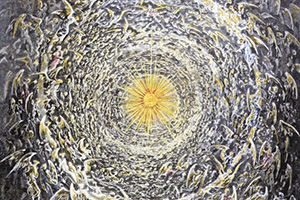
    Section of Gustave Doré depiction of the Empyrean, or highest heaven, for Dante’s Divine Comedy.

    It’s difficult for us today to understand this worldview. Although we do think of heaven in the spiritual sense as being “up there,” we understand it as a metaphor only. The realms of the physical planets and stars in outer space, to our minds, have no spiritual component as such.

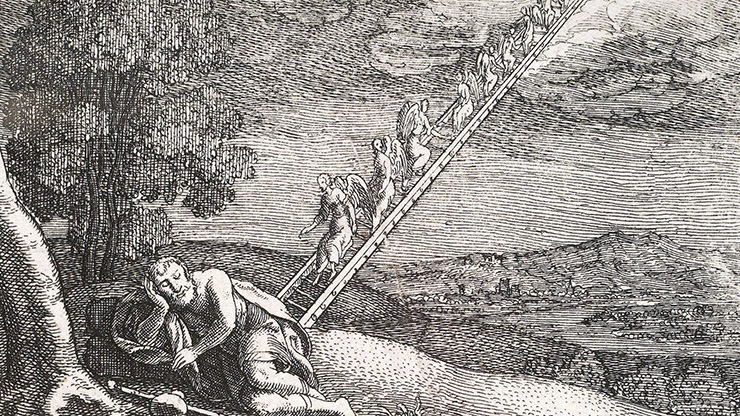
    In antiquity it was not so. The physical heavens were identified with the levels through which the soul had to ascend after death. These levels, and the planets associated with them, were, as often as not, viewed as a series of gates that blocked the soul from its ascent to its true home.

    Each of these planets had a vice associated with it, which is where we get the concept of the seven deadly sins. The soul could only ascend if it shed these vices. The process is described in the Poimandres, a treatise that makes up part of the Corpus Hermeticum or “Hermetic body” of writings, generally dated to the early centuries of the Common Era:

    The human being rushes up through the cosmic framework, at the first zone [the moon] surrendering the energy of increase and decrease; at the second [Mercury] evil machination, a device now inactive; at the third [Venus] the illusion of longing, now inactive; at the fourth [the sun] the ruler’s arrogance, now inactive; at the fifth [Mars] unholy presumption and daring recklessness; at the sixth [Jupiter] the evil impulses that come from wealth, now inactive; and at the seventh [Saturn] the deceit that lies in ambush. (Poimandres, 1.25)

    Each of these seven spheres was also ruled by a planetary archon, who could be viewed as an angel or as a god.

    Heavenly Realms & Corrupt Evil Forces

    Another part of the Christian teaching – and, again, I am speaking of the New Testament – was that these planetary spheres were ruled by corrupt forces. The epistle to the Ephesians, according to most scholars, was not written by Paul, but it is close to his thought. Here is what it says: “For we wrestle not against flesh and blood, but against principalities, against powers, against the rulers of the darkness of this world, against spiritual wickedness in [heavenly] places” (Ephesians 6:12). The word “heavenly,” in this version, appears in a note. But it is closer to the Greek epouraníois than is the reading in the main text, “high places.” This verse makes it clear that the “principalities” and “powers” were not the Roman emperors, but spiritual forces of evil. Paul himself in Romans 8:38–39 (quoted above), uses more or less identical terms in the same way.

    Let’s go ahead five hundred years, to the single most important work on angelology in the Christian tradition: the Celestial Hierarchy of Dionysius the Areopagite. (Dionysius the Areopagite is a figure mentioned in Acts 17:34 as a contemporary of Paul. This work is attributed to him, but was very likely written 500 years later, in the sixth century CE. Hence the author, otherwise unknown, is often called “Pseudo-Dionysius.”) He lists orders, or “choirs,” of angels, each class having a different name. Two of these are the “Principalities” and “Powers.” Pseudo-Dionysius’s system was taken up by Dante in his Divine Comedy, among others. 

    Notice the change here. For Paul and the author of Ephesians, writing in the first century, the “principalities” and “powers” are among the forces of “wickedness in heavenly places.” For Pseudo-Dionysius, writing five hundred years later, they are honourable members of the heavenly hierarchy.

    It would be an intricate task to show when and how this change came about. For our purposes, it’s enough to know that it did come about. Thus the mainstream Christian view of the angels as unilaterally benevolent simply does not go back to the earliest times of the faith.

    The result of all this is that, among the early Christians, at any rate among the ones who wrote the New Testament, there was a widespread belief that the celestial realms were occupied by evil forces. The struggle of the Christian was to rise above them, to contend with them, and possibly to defeat them.

    This too is a theme that appears throughout the New Testament. In Luke 10:18 we find a mystifying verse. It appears in this context: Jesus has sent out seventy disciples to preach his message. They return “with joy, saying, Lord, even the devils are subject to us through thy name.” Jesus replies: “I beheld Satan as lightning fall from heaven.”

    A similar idea appears in John 12:31: “Now is the judgment of this world: now shall the prince of this world be cast out.”

    The upshot of all these details is clear: the early Christians – at any rate, those who wrote the New Testament – believed that somehow Satan and the forces of spiritual wickedness had managed to ensconce themselves in the celestial spheres, and that it was the task of Christ (and his followers) to cast them down. The verse from Luke quoted above makes it sound as if this has already happened: the verses from Paul suggest that the struggle is still going on.
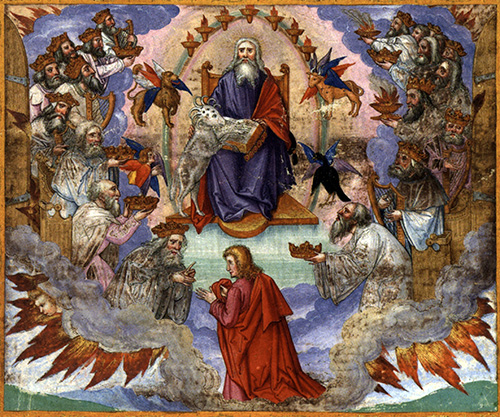
    “The Lamb opening the book with seven seals” by Matthias Gerung, ca. 1530-1532

    The Book of Revelation

    To understand this picture more fully, we will have to turn to the most enigmatic book of the Bible: Revelation. 

    Revelation has a grip on the Western imagination like no other work. In Doctor Zhivago, Boris Pasternak wrote, “All great, genuine art resembles and continues the Revelation of St. John.” Its images and themes have long since soaked into the popular imagination: the Beast, the Whore of Babylon, the number 666, the Four Horsemen. Nonetheless, very few have managed to pull its narrative together and explain it in terms that might have made sense to its original audience in the first century CE.

    But it is possible to do this in light of the ideas I have sketched out above.

    To begin with, a very brief sketch of this enigmatic book: John – traditionally associated with Jesus’s “beloved disciple,” although he probably did not write it – has a vision of the “Son of man” among seven golden candlesticks, which represent seven churches, all of them in Asia Minor. The messages are unenthusiastic at best: to the one in Ephesus, for example, he says, “I have somewhat against thee, because thou hast left thy first love” (Revelation 2:4).

    Then John has a vision of heaven, where he sees “seven lamps of fire burning before the throne, which are the seven Spirits of God.” A book with seven seals is presented, and these seals is opened, each revealing some new and terrible manifestation: the renowned Four Horsemen, “a great earthquake,” and cosmic cataclysm: “The stars of heaven fell unto the earth… And the heaven departed as a scroll when it is rolled together” (Revelation 6:12–14).

    When these are completed, seven angels sound seven trumpets, with similar tribulations: a star named Wormwood falls upon the waters of the earth, “and the third part of the waters became wormwood: and many men died of the waters, because they were made bitter” (Revelation 8:11).

    Finally, the climactic moment arrives: “And there was war in heaven: Michael and his angels fought against the dragon: and the dragon fought and his angels, And prevailed not; neither was their place found any more in heaven. And the great dragon was cast out, that old serpent, called the Devil, and Satan, which deceiveth the whole world: he was cast out into the earth, and his angels were cast out with him” (Revelation 12:7-9).

    The images in Revelation have been used so often, and in so many ways, that certain facts have become obscured. In the first place, the vision does not have to do with some imagined end of the world in the immeasurably remote future. It is something that the prophet sees as happening in his own time.

    In the second place, we may wonder why the number seven is repeated and emphasised to an almost maniacal degree. In the light of the things we’ve already seen, the reason becomes clearer: it has to do with the realms of the seven planets. They have been inhabited by corrupt forces, including evil angels. The opening of the seven seals and the blast of the seven trumpets culminate in a war in which all of them, led by Satan, are cast down from the heavens onto the earth.

    Revelation appears to be describing a great purge of the cosmic realms that, the prophet believes, has been initiated by Christ, “the Son of man,” “the Lamb.” Satan is cast down to earth. (Remember the line from Luke in which Jesus says that he sees Satan falling “as lightning” from heaven.)
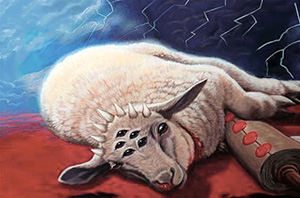
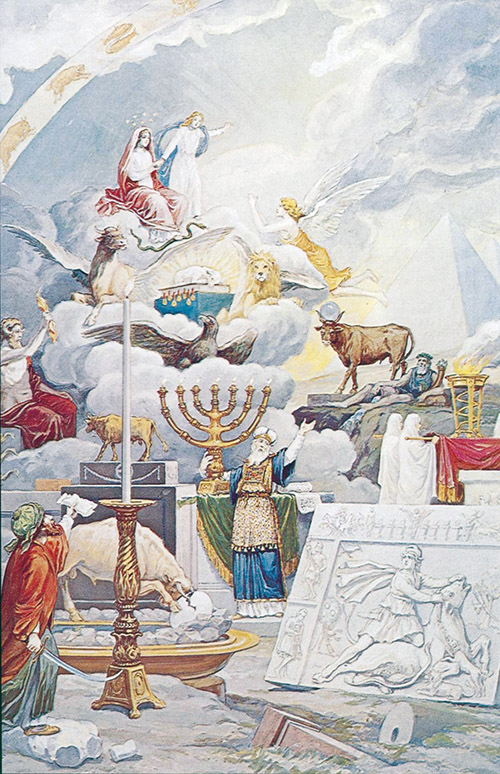
    Literal interpretations of Revelation result in images such as the above. Perhaps the symbolism of the text is more correctly understood in the context of how the ancients conceived of the heavens.

    At this point the action switches to earth. Then ensues “the judgment of the great whore that sitteth upon many waters.” She sits on “a scarlet-coloured beast… having seven heads.” The text explains, “The seven heads are seven mountains, on which the woman sitteth” (Revelation 17:3, 9). The identification of this woman and beast are obvious: it is Rome, which was famously built on seven hills. It has “seven kings. Five are fallen, and one is, and the other is not yet come; and when he cometh, he must continue a short space.” If we identify them with the Roman emperors, the first five are Augustus, Tiberius, Caligula, Claudius, and Nero, who was overthrown in 68. By this reckoning Galba would be the sixth, although he reigned for only seven months. This takes us up to 69 CE, known as “the year of the four emperors,” because in fact four emperors followed one another in quick succession. The prophet believes that there will be another, but that his reign will be brief, and that he will be the last. John was partly right: The reign of Otho, who succeeded Galba, was only three months long. But he was far from the last emperor.

    If this is actually what John has in mind, we find ourselves in the midst of the Jewish War (66–73 CE), in which the Jews revolted against Rome. It would seem likely that the prophet is writing around this time, and he expects it to usher in the Last Judgment, which will involve a final battle with the result that “Babylon the great is fallen” (Revelation 18:2). After that, the prophet sees “a new heaven, and a new earth, and the holy city, new Jerusalem, coming down from God out of heaven” (Revelation 21:1–2).

    This did not happen. Instead the Jews were crushed. The Temple in Jerusalem was sacked and Judea partly depopulated. Rome, the “great whore,” was not overthrown, and celestial forces did not descend to destroy it. The Roman empire continued to last for centuries. The Last Judgment did not occur. Nor did the world end.

    In any event, we can sum up the action of Revelation as follows: Christ, the Lamb, is slain and resurrected. He ascends into heaven and purges the seven heavens of evil influences, led by Satan. They are cast down to earth, and are embodied in the Roman empire, which itself will be crushed by heavenly forces led by the Lamb, culminating in a new world.

    The Host of Heaven

    I can’t claim to understand the entire symbolism of Revelation, which is profound and multilayered, but I am willing to say that this, at least in part, is what is going on here. The evidence we have seen from other New Testament texts indicate that this belief was current, if not universal, among the early Christians – at least the ones who wrote the New Testament.

    I also must admit that this account leaves one major question unanswered. Why and how did the heavenly realms come to be infested with evil influences?

    One answer appears in the passage from the Poimandres that I quoted above. Here the planetary zones seem to be identified with evil propensities. Could the Hermetic texts – of which the Poimandres is a part – be the sources of this doctrine of “spiritual wickedness in heavenly places”? Or could both the texts and this doctrine have come out of the same stream?

    It is possible. Although the Hermetic texts have been studied, often intensively, over the centuries, there is much that remains baffling about them. But it is probably accurate to say, along with scholar Brian Copenhaver, that they “can be understood as responses to the same milieu, the very complex Greco-Egyptian culture of Ptolemaic, Roman, and early Christian times” – meaning the long period between the fourth century BCE and the second century CE. This was also the milieu in which Christianity arose. So there may be some trace of these Greco-Egyptian influences on the Christianity of the New Testament.

    The Poimandres does not portray these cosmic forces as evil. When the cosmic man is created, it is said that the seven “governors” – of the planets, that is – “loved the man, and each gave a share of his own order.” But man, like Narcissus, fell in love with his image in the natural world, and fell. Thus his nature is twofold: immortal, given by God, and mortal, born of his infatuation with matter. He is in bondage to things over which he should be master. The qualities that the “governors” gave him become vices that he has to overcome.

    There are hints of similar ideas in the Hebrew Bible. Over and over we encounter entities called “the host of heaven” or “the sons of God.” Here is one example. The prophet Micaiah says, “I saw the Lord sitting on his throne, and all the host of heaven standing by him on his right hand and on his left” (1 Kings 22:19). In this passage, the host of heaven is part of Yahweh’s heavenly court, and thus part of the cosmic order.

    But here is another verse. It is a warning given to the children of Israel by Moses, “lest thou lift up thine eyes unto heaven, and when thou seest the sun, and the moon, and the stars, even all the host of heaven, shouldest be driven to worship them, and serve them, which the Lord thy God hath divided unto all nations under the whole heaven” (Deuteronomy 4:9).

    In fact many references in the Hebrew Bible to the “host of heaven” amount to warnings against worshipping them, or condemnations for having done so.

    The host of heaven plays an ambiguous role in the Hebrew Bible. Again these beings – personifications of the stars and the planets and the signs of the zodiac – are not necessarily evil; they are part of the celestial court. At the same time there is a strong temptation to worship them that is repeatedly and vehemently denounced. As in the Poimandres, man is not meant to worship the seven heavenly “governors” or to be subject to them.

    The ascent portrayed in the Poimandres has to do with the fate of the soul after death. The ascent through the spheres happens to the virtuous, those who obey this divine dictum: “Let him [who] is mindful recognise that he is immortal, that desire is the cause of death, and let him recognise all that exists.” (The bracketed insertion is the translator’s.) Salvation here comes from gnosis: insight into one’s own true nature and estate. One who lacks such insight, “the one who loved the body that came from the error of desire goes on in darkness, errant, suffering sensibly the effects of death.”
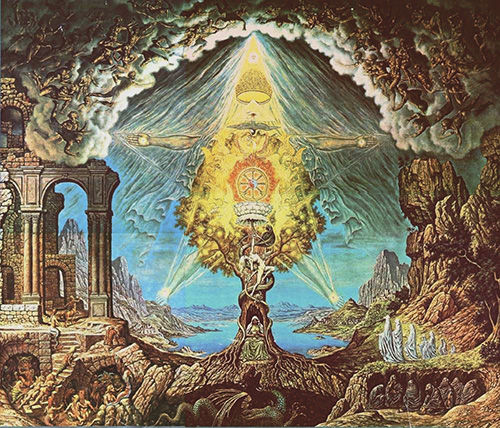
    Unio Mystica – Interior (1973) by the Dutch modern artist Johfra Bosschart. The interpretation of this image can be read here: www.visionaryrevue.com/webtext2/herjof12.html

    Initiation & Gnosis: Free from Fate

    There is another thread that we need to take up at this point. The Bulgarian sage Omraam Mikhaël Aïvanhov observes that the message of Revelation is “a description of the elements and processes that are common to our own inner life and the life of the cosmos.” These processes of our “inner life” have to do with initiation. As is often said, initiation is a kind of death and rebirth. On the simplest level, this has to do with a death to one’s former life and a birth to a new, higher life. But there is more to it than that. In a famous passage, Cicero, the great Roman statesman and philosopher, writes about initiations into the mysteries: “So in very truth we have learned from them the beginnings of life, and have gained the power not only to live happily, but also to die with a better hope” (Cicero, Laws 2.14.36; my emphasis).

    This theme keeps appearing around the ancient mysteries. They have to do with death, not merely in a symbolic sense, but in a highly practical one. In some way they prepare the candidate for death. They are intended to make the process that he undergoes in the afterlife easier and more assured of success. It seems likely to me that the pagan mysteries had more than a little to do with this process. The mysteries of Mithras in fact took place in seven stages of initiation, which were very likely connected to the seven planets.

    We then turn back to the epigraph of this article, a quotation from the Excerpta e Theodoto (“Excerpts from Theodotus,” a Gnostic figure from the second century CE): “Until baptism… fate is valid. But afterward the astrologers are no longer correct.” Christian baptism, viewed esoterically, raises the candidate up beyond the levels of the seven planets, which rule fate. The initiate is free from the influence of the planets and thus from fate.

    This passage also emphasises that liberation is not merely due to a rite but is the result of gnosis: “It is not only the cleansing that is liberating, but the knowledge [gnosis] of who we were, and what we have become, where we were or where we have been thrown, where we hasten, what we are cleansed of, what birth is and what rebirth is” (Excerpta e Theodoto, 78; my translation).

    Thus, at least for some early Christians, baptism was correlated with a liberating ascent through the realms of the planets, whose associated vices were made inoperative by the sacrament. The initiate reaches a level of consciousness and being that is above the domain of the planets.

    Certainly much of this teaching has been lost or obscured over the centuries, to the point where a typical Christian today would be unlikely to recognise it as part of his own religion. The view of the planetary spheres as benign – indeed, as levels of heaven, as they are in Dante’s Paradiso – completely supplanted this older view.

    And yet echoes continue to resound. In the early twentieth century, the Theosophist James M. Pryse wrote The Apocalypse Unsealed:

    Many actors, apparently, play their parts in the drama of the Apocalypse; yet in reality there is but one performer – the neophyte himself, the sacrificial “Lamb,” who awakens all the slumbering forces of his inner nature, passes through the terrible ordeals of the purificatory discipline and the telestic [i.e., initiatic] labors, and finally emerges as the Conqueror, the self-perfected Man who has regained his standing among the deathless Gods.
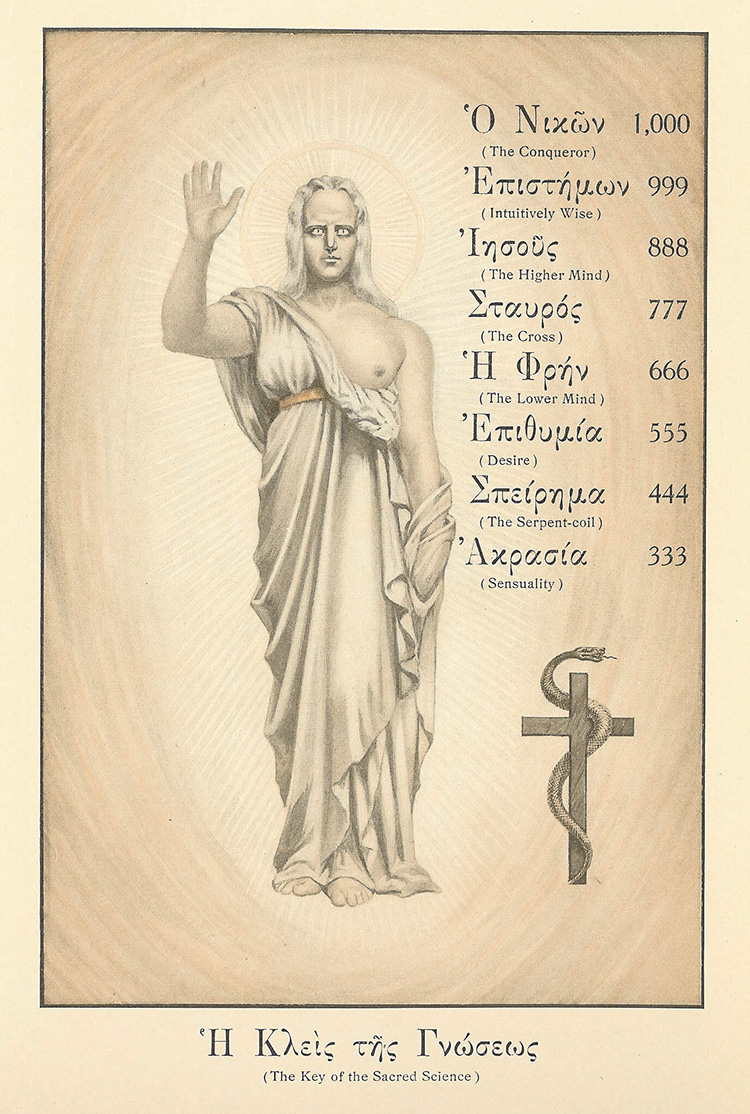
    Theosophist James M. Pryse, author The Apocalypse Unsealed, connects the seven seals with the chakras, the seven subtle centres in the human body. According to certain theories, these need to be opened in order for the seeker to attain enlightenment. Hence he translates the Greek apokálupsis (usually rendered as “revelation”) as initiation.
    Pryse connects the seven seals with the chakras, the seven subtle centres in the human body. According to certain theories, these need to be opened in order for the seeker to attain enlightenment. Hence he translates the Greek apokálupsis (usually rendered as “revelation”) as initiation.

    Aerial Tollhouses

    One question remains: did any fragment of this early teaching survive in later Christianity? Yes, it did – in a curious form. Eastern Orthodox teaching refers to “aerial tollhouses” that the soul must pass through while ascending after death.

    Seraphim Rose, a twentieth-century American Orthodox monk, writes, “The particular place which the demons inhabit in this fallen world, and the place where the newly-departing souls of men encounter them – is the air” (emphasis Rose’s). He quotes a liturgy written by John Damascene in the eighth century: “When my soul shall be about to be released from the bond with the flesh, intercede for me, O Sovereign Lady [i.e., the Virgin]… that I might pass unhindered through the princes of darkness standing in the air.”

    And the quaint metaphor of aerial tollhouses is actually used. Another passage from John Damascene: “O Virgin, in the hour of my death rescue me from the hands of the demons, and the judgment, and the accusation, and the frightful testing, and the bitter toll-houses.” At each tollhouse, the soul is presented with all the sins it has committed of that kind: lying, envy, fornication, and so on. If it is found guilty of any of these sins, it is cast down to hell. If it is innocent, it is permitted to ascend.

    These ideas clearly go back a long way. A nineteenth-century Orthodox historian of theology, Metropolitan Macarius of Moscow, writes: “Such an uninterrupted, constant, and universal usage in the Church of the teaching of the toll-houses, especially among the teachers of the 4th century, indisputably testifies that it was handed down to them from the teachers of the preceding centuries and is founded on apostolic tradition.”

    The resemblance between these ideas and those in the Poimandres is striking. One could cite other parallels, such as the seven hekhalot (palaces) of heaven mentioned in the early Kabbalah.

    It would be foolish, I think, to try to argue that all these teachings are exactly the same, or were so in antiquity. Then as now, there was a panoply of religions and beliefs and cults, and it would useless to try to show that their teachings were identical. Nevertheless, the resemblances are unmistakable.

    Looking at this from a broader perspective, we can see the theme of man trying to situate himself in the cosmos. He looks up at the sky and sees the stars and planets and feels some connection with them. What sort of connection? Are these entities hostile, beneficent, indifferent? Do they lead to God, or do they block the way? And what of the unseen realms that, however dimly, each of us knows to exist?

    The questions multiply. The picture of the seven planetary realms no longer fits in well with what we know from astronomy, and yet one cannot help sensing that it remains profoundly valid. We may have to wait till death – or initiation – to find out the truth.

    [alert type=”general” dismiss=”no”]This article was published in New Dawn 158.[/alert]

    [alert type=”success” dismiss=”no”]If you appreciate this article, please consider subscribing to help maintain this website.[/alert]

    Sources

    Omraam Mikhaël Aïvanhov, The Book of Revelations [sic]: A Commentary, Editions Prosveta, 1991
    Brian P. Copenhaver, Hermetica: The Greek Corpus Hermeticum and the Latin Asclepius in a New English Translation, with Notes and an Introduction, Cambridge University Press, 1992
    James M. Pryse, The Apocalypse Unsealed, Being an Esoteric Interpretation of the Initiation of Ioannes, James M. Pryse, 1931 [1910]
    Pseudo-Dionysius the Areopagite, The Celestial Hierarchy, www.esoteric.msu.edu/VolumeII/CelestialHierarchy.html; accessed Feb. 26, 2016
    Seraphim Rose, The Soul after Death, St. Herman of Alaska Brotherhood, 1980
    Richard Smoley, “The Esoteric Revelation,” Quest 102:4 (fall 2014), 138

    © New Dawn Magazine and the respective author.
    For our reproduction notice, click here.
  • Prophecy: Does it Work?

    Prophecy: Does it Work?

    From New Dawn 100 (Jan-Feb 2007)

    Elie Wiesel, in his sombre memoir Night, describes a poignant incident from his time in a Nazi concentration camp. Amidst unimaginable suffering and despair, an inmate named Akiba Drumer “had discovered a verse from the Bible, which, translated into numbers, made it possible for him to predict Redemption in the weeks to come.”

    There have been countless Akiba Drumers over the last 2,000 years. Confronting dismal memories of the past and the bleak actualities of the present, they have turned to the future for hope and solace.

    The trend is not necessarily as old as humanity itself. While traditional mythologies ranging from those of the Hindus to those of the ancient Germans spoke of the rising and passing of ages in cycles, the Abrahamic religions – Judaism, Christianity, and Islam – have tended to see history as aimed toward a final destination point, an end of time in which the ledger books of justice will be balanced and all of humanity will be marched off to either salvation or perdition. This is sometimes called the Apocalypse, and literature devoted to it is called apocalyptic.

    What exactly is prophecy? Can we trust it?

    The esoteric tradition – the body of knowledge that underlies all the great spiritual traditions of humanity – teaches that the future is, at least in principle, knowable. There are several theories to account for such events (and they are not mutually exclusive). One of these holds that there exists a realm of images and forms, which has many names in many traditions. The Kabbalists call it the world of Yetzirah, or “formation”; quite possibly it is what Australian aborigines call the Dreaming and what some Western occultists refer to as the astral realm. This realm of images does not exist in any physical sense, but all the same it has a reality of its own. If you think of a light bulb, say, that image in your mind has some reality, even some substance, although not physically.

    Esotericism also teaches that this world of images is prior to the physical world: events and things manifest in this realm before they appear in palpable reality. Consequently, someone with reasonably clear access to this dimension – deliberately, through divination or prophetic contemplation, or spontaneously, through dreams or hunches or intuitions – should be able to see the future.

    Some readers may wonder what this theory may have to do with synchronicity, a concept that is often invoked when people attempt to understand such forms of divination as the Tarot or the I Ching. Synchronicity in this sense is a coinage of the Swiss psychologist C.G. Jung, who defines it as an “acausal connecting principle.” Jung gives a case in point: “The wife of one of my patients, a man in his fifties, once told me in conversation that, at the deaths of her mother and her grandmother, a number of birds gathered outside the windows of the death-chamber.” Such incidents are common: I can tell similar stories from my own family. For Jung, the connection between these events – the deaths and the appearance of the birds – is not causal; that is, the impending death didn’t cause the birds to come or vice versa. But they are related by what he calls a “meaningful cross-connection.”

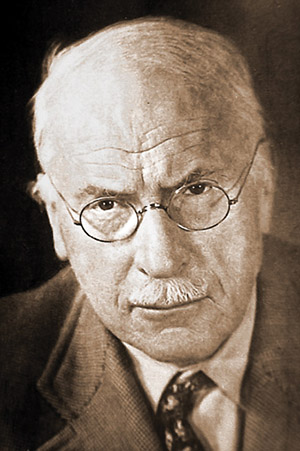
    Swiss psychologist C.G. Jung defined synchronicity as an “acausal connecting principle.”

    Jung’s attempt to characterise synchronicity as “acausal” appears misguided. He seems to be veering toward a connection that is not acausal in the strict sense; rather it implies a hidden factor lying outside the physical dimension that, so to speak, “caused” both the death and the appearances of the birds. Jung locates this hidden cause in the realm of the archetypes, the psychic forces that underlie the human mind and possibly reality itself. For Jung, “meaningful coincidences… seem to have an archetypal foundation.”

    Granting this much, we are left with a theory very close to the esoteric doctrine sketched out above. Jung’s archetypal world is more or less identical to the realm of Yetzirah, of forms and images. As such it can give rise to two phenomena that have no obvious causal relation (such as a death and the sudden appearance of a flock of birds) and yet seem to be meaningfully connected. Jung made much of being scientific, and to a great degree he was – but his conclusions in many respects resemble those of the old occultists.

    Another esoteric theory about seeing the future is based on the highly relative nature of time. Time, as Immanuel Kant argued, is one of the basic structural components of our experience, but it is a construct that our minds have imposed on reality. As hard as it may be to imagine, time has no absolute reality in itself (a conclusion to which contemporary physics may also point). If so, it may be possible to step past the portals of our own experiential framework and take some measure of events in the future.

    Many spiritual traditions speak of a higher Self, a part of our being that stands over and above our selves as we customarily experience them. The names for this Self are countless. The ancient Greeks called it the daimon; the ancient Romans, the genius; to esoteric Christians, it is the kingdom of heaven or the Christ within. This Self stands outside the personality, the conscious self, and outside the categories of conscious experience, including time. It perceives our lives, not as a sequence of events and experiences that span several decades, but as a whole. It can see a lifetime as we can see a snapshot.

    A famous instance of the workings of this Self appears in the Crito of Plato. Socrates, under sentence of execution, is urged to escape by his rich friend Crito, who assures him that he has bribed the guards and can furnish the necessary getaway. Socrates refuses, saying he has had a dream in which a beautiful woman dressed in white appeared to him and recited a line from the Iliad: “On the third day to the fertile land of Phthia thou shalt come.” Socrates takes this as a message from his daimon, the guiding spirit that has directed him all throughout his life, that he will be executed in three days, and that he should not try to escape. One way of understanding such episodes is that the daimon, the Self, can see the whole of one’s life from start to finish, apart from the linearity of time, and can give appropriate guidance. 

    Note, however, that, as in Socrates’ case, these glimpses usually have to do with one’s deeper destiny. It’s not a question of picking next week’s lottery number or finding hot stocks. While these are in principle no more unknowable than anything else, one soon discovers that the higher Self is not terribly interested in them – and anyway, how helpful would the knowledge really be? I know directly of only one case where someone got this kind of information. A friend of my father’s once told me he had been awakened in the middle of the night by the image of some numbers that flashed in his mind. It struck him that they might be lottery numbers and that he should buy a ticket using them, but he never got around to it. Of course they were the winning numbers that week.

    If these visions of the future are ultimately personal in nature – that is, they are meant to give guidance or inspiration to an individual at crucial junctures in his or her life – what then of prophecy in a grander sense, the prophecy that purports to open a window onto the fates of nations and peoples, and of humanity itself?

    As a whole, the record of prophecy in predicting the future on a large scale is not good. We can see this as far back as the start of the apocalyptic genre in Palestine in the second century B.C.E. At the time the Jewish nation was living under the rule of the Hellenistic Seleucid monarchs, who were heirs to a portion of the empire of Alexander the Great. In 167 B.C.E., one of these rulers, Antiochus IV Ephiphanes, embarked on a program of forced Hellenisation of the Jews. He set up an altar, and perhaps an image, of Olympian Zeus in the Temple in Jerusalem.

    The Jews’ outrage is reflected in the Book of Daniel, one of the earliest apocalyptic writings and the only one to make its way into the Hebrew Bible. Written during the ensuing revolt against the Seleucids, this book sets up Daniel, a legendary sage of the sixth century B.C.E., as the mouthpiece of a prophecy that would “foretell” events 400 years after his time. (The technical term for this practice is vaticinium ex eventu, “prediction after the event.”) Daniel refers to “a vile person” – Antiochus – who will “pollute the sanctuary of strength, and shall take away the daily sacrifice, and… shall place the abomination that maketh desolate” (Dan. 11:21, 31) – that is, the idol in the Temple (cf. 1 Macc. 1:54). The archangel Michael will come to Israel’s rescue; the dead will be raised, “some to everlasting life, and some to shame and everlasting contempt.” Antiochus “shall come to his end, and none shall help him” (Dan. 11:45, 12:1-2).

    What happened in fact was that the Jews rose up under the priestly clan of the Maccabees and won back their religious liberties as well as a measure of political autonomy, but this obviously did not begin the end of time. Antiochus did not perish as a result of any obvious divine wrath: he died of natural causes.

    Despite its failure as a prophecy, the Book of Daniel established the basic structure of the apocalyptic genre. Arising during some crisis, such texts predict that this event is the harbinger of the imminent Day of Judgment, when justice will be done and evildoers will receive their due. The Book of Revelation at the end of the New Testament follows this pattern. Most scholars agree that it is a response to the Roman persecution of Christians in the first century C.E. Here, too, the prophecy, taken as literal truth, is not accurate. The book seems to foretell the end of the Roman Empire and the coming of a millennial kingdom, but this did not happen. The Roman Empire did come to an end (close to 400 years after Revelation was written), but it did not usher in the reign of God on Earth. Rather it initiated a period of collapse and chaos that came to be known as the Dark Ages.

    Even the prophecies of Jesus as related in the Gospels do not seem trustworthy. If we are to read what scholars call his Apocalyptic Discourse literally (three versions of it appear in Matthew 24, Mark 13, and Luke 21), we would conclude that he was predicting the destruction of the Temple by the Romans, to be followed by the return of the Son of God. This did not happen either. The Romans did sack the Temple, in 70 C.E., about a generation after Jesus’s lifetime, but Jesus did not return and did not establish a millennial kingdom. Things went on much as they had (except for the Jews, who were expelled from Palestine).

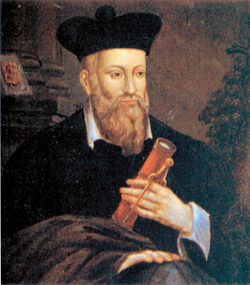
    Michel de Nostra-dame (1503-1556), better known as Nostradamus.

    I’m using instances from the Bible as it is by far the best-known work of prophecy, but if we were to look at prophecies from other sources, they would not look much better. The American trance medium Edgar Cayce foretold that much of California would be under water by 1972. Nostradamus predicted some kind of great manifestation in the sky for the seventh month of 1999, but the year 1999 had very little that was remarkable, much less cataclysmic, either in the seventh or in any other month. (For more on Nostradamus’s prophecies, see my new book The Essential Nostradamus.)

    How, then, can we reconcile the abysmal performance of prophecy as a whole with the esoteric theory that I’ve sketched out above? If we can know the future, why don’t we?

    The astral realm is a sea of images. We can think of it as containing every image and idea that every human being has ever thought and possibly will ever think. No sooner do we say this than we realise that this dimension must contain an enormous amount of psychic rubbish – the fears, dreads, and anxieties of humanity, most of which have nothing to do with reality past or present. This dimension is described most clearly in the spiritual text known as A Course in Miracles:

    The circle of fear lies just below the level the body sees, and seems to be the whole foundation on which the world is based. Here are all the illusions, all the twisted thoughts, all the insane attacks, the fury, the vengeance and betrayal that were made to keep the guilt in place, so that the world could rise from it and keep it hidden. Its shadow rises to the surface, enough to hold its most external manifestations in darkness, and to bring despair and loneliness to it and keep it joyless.

    Without going into the elaborate psychological system of the Course, I will simply point to the notion of the “circle of fear” – a zone of fears, hatreds, and anxieties that lie just below the surface of consciousness. This circle of fear is universal: each of us participates in its creation. Probably only the most enlightened human beings are entirely free from its effects. For the rest of us, it sits underneath our experience of reality like a water table. We all tap into it in our own ways.

    This fear is not “about” anything particular; it is not necessarily connected to anything real or substantial; it is simply a nameless, objectless anxiety that can attach itself to anything. It holds tremendous power over each of us precisely because we are usually unconscious of it. We imagine that our fears and anxieties are about something real and justified, but there is something suspect about this belief: no sooner does one anxiety disappear than another pops up to take its place. For many people, this anxiety can manifest in fears about their personal future or about society or humanity or the Earth; for others, it is displaced onto a fear of an imminent end of the world.

    Some say fear is a healthy and normal emotion, that without it we could not function in the world. So it may be under certain circumstances. If a man finds himself facing a wild animal, his fear will make him run away. But the kind of fear I am talking about is not healthy. It does not increase our chances for survival; instead it is weakening and debilitating. Much of mental dysfunction no doubt stems from too close a contact with this kind of fear.

    Saying this much explains the horrific imagery of so many prophecies, but what about the nice part? What about the beautiful dreams of a utopian future that is always just around the horizon? The explanation is the same. The Yetziratic or astral realm is known to esotericists as the zone of illusion. We can think of it as literally a bandwidth of fantasies and illusions that surround us on a psychic level. While many of these fantasies are negative, there are also many that are positive; they are the flip side of the circle of fear. The power of wishful thinking – which is very strong – can easily lead someone to put all these images together into a picture of the future that involves both terrible calamities (usually visited on one’s enemies) and ultimate salvation (for oneself and one’s own sect). Akiba Drumer’s prophecy in the concentration camp most likely falls into this category.

    Our age imagines itself to be more sophisticated than its predecessors, and yet the contemporary mind falls prey to many of the temptations of the past. Cataclysmic and millennialistic thinking is as much with us as ever. The religious-minded cast it in biblical images. The secular mindset translates it into visions of nuclear or environmental disaster. The problems posed by both nuclear power and environmental contamination are very great and should not be dismissed out of hand, but it is also well to separate them from unconscious apocalyptic expectations, which can erupt from the minds of supposedly rational scientists just as easily as they can from men wearing sandwich boards on streetcorners.

    Having said this much, we might want to compare prophecy with prediction of a more conventional kind, which has evolved into an academic discipline (or pseudodiscipline) known as futurology. Futurology makes no supernatural assumptions. It is based entirely on what is currently known. It takes current statistics – about population, economic growth, political trends, resource capacity – and extrapolates them into the future. That is its strength but also its weakness. Futurology can only make predictions on the basis of current trends, but one thing we know is that current trends never continue. There are shocks, dislocations, cataclysms. Conventional forecasters cannot predict these; their unpredictability is at the root of their nature.

    The apocalyptic prophet faces no such restrictions. He has no incentive to predict more of the same; who would pay attention to him then? So he is entirely happy to foretell all kinds of upheavals, natural and supernatural: the submerging of continents; the manifestation of extraterrestrials; the shifting of the Earth’s pole; the return of Jesus Christ. In a sense, he is right. Cataclysms do occur. But somehow they never occur in the way they were predicted.

    In the end, I personally would not base my plans for the future on any prophetic claims from any source. I can’t say that none of these prophecies will be fulfilled – that would be making a prophecy of my own – but to my mind they haven’t been proved reliable enough in the past to merit any serious attention now. Conventional futurology may offer some insights, but frequently it, too, better represents the analyst’s preconceptions than any reality that is likely to come.

    All this still leaves us with the possibility of a knowable future, whose seeds are present in the astral realm amidst all the fears and fantasies. How can we have contact with it? Trying to glimpse the future on a collective level is extremely tricky, often because it is something into which we as individuals are not supposed to stick our noses. Recently a friend of mine used the divinatory technique of horary astrology to ask a question about a national issue. Horary astrology, though not practiced or understood even by most astrologers, can produce quite striking insights for one who knows how to use it. In my friend’s case, the answer was quite sharp: “None of your business.”

    When we come to the personal future, the situation is different. I myself have often found that when I needed to be told of something that was going to happen to me, I was informed of it, usually through some form of inner perception, bidden or unbidden. I have not found divination methods like the Tarot or the I Ching to be particularly useful. Astrology, on the other hand, can have remarkable predictive value – provided one knows the system well enough to understand what the stars are saying.

    These are my conclusions from my own experience. Others may have different results; these matters are more individual than popular books like to let on. In the end, for me nothing has proved to be of as much value as a clear-sighted determination to see what was going on both inside and outside myself, to look upon my own hopes and fears and wishes, and to bring them face to face to what Freud called “the reality principle.” A.R. Orage, a pupil of the great spiritual teacher G.I. Gurdjieff, defined conscience in a rather unusual way as “the simultaneous experience of all one’s emotions.” If one can do this with a naked and even remorseless honesty (and it is considerably harder than it may first seem), one is far more likely to have an accurate basis for future action than if one follows the advice of any number of psychics or prophets. 

    [alert type=”general” dismiss=”no”]This article was published in New Dawn 100.[/alert]

    [alert type=”success” dismiss=”no”]If you appreciate this article, please consider subscribing to help maintain this website.[/alert]

    © New Dawn Magazine and the respective author.
    For our reproduction notice, click here.
  • Life, Death & Gnosis: The Gnostics on the Afterlife

    Life, Death & Gnosis: The Gnostics on the Afterlife

    From New Dawn 109 (Jul-Aug 2008)

    The possibilities for life after death come down to a mere three:
    1. There is no life after death. Death is the total extinction of consciousness. 2. Life after death continues on earth (through reincarnation). 3. Life continues after death on another plane than that of earthly reality (such as in heaven or hell).

    If we’re going to talk about this subject at all, we can rule out the first option categorically, especially since practically every culture and religion teaches that there is some form of life after death. There are many discussions of the evidence for the afterlife, and while this is a fascinating subject, it’s out of the scope of this article.

    Which, then, of the two remaining options is most likely? Usually these are simplistically conceived. You reincarnate: depending on your karma, you come back down to earth to live again as a sage or a stockbroker. Or you are judged before the heavenly throne and are sent up to heaven or down to hell once and for all.

    The Gnostics, the mysterious esoteric teachers of the early centuries of the Common Era, had their own perspective on the afterlife. Although their teachings have been all but lost, enough material remains so that we can reconstruct them. If we do, we will reach some valuable insights not only about some elements of the later Western occult traditions but about the project of spiritual liberation.

    The Gnostic texts speak very little about reincarnation. We do, however, find some references to this concept in the Corpus Hermeticum (“Hermetic body” of writings). Probably written in the first to third centuries CE, they largely consist of dialogues between a divine figure named Hermes Trismegistus and his son Tat (or Thoth, the Egyptian god that most resembled the Greek Hermes). Their origin is suggested by the title of the leading treatise: Poimandres (from which I’ll quote below). This is a Grecization of p-eime-n-re, “illumined mind” in Egyptian. The Hermetic texts were descriptions of ancient Egyptian esoteric knowledge recast in the language and thought of the Greeks, who were culturally dominant in the Mediterranean world of that time. The Hermetic texts aren’t usually considered to be Gnostic per se, although their ideas were extremely similar to those of the Gnostics and can be taken as part of the same milieu.1

    The Hermetic texts speak of reincarnation, but not in the sense familiar from New Age versions of the doctrine. The Hermetic writings generally portray reincarnation as a punishment. One treatise tells us that a person who dies childless “is sentenced to a body that has neither a man’s nature nor a woman’s – a thing accursed under the sun.” And a text known as the Asclepius says that “those who live faithfully under god” will ascend to become divine beings, but “for the unfaithful it goes differently: return to heaven is denied them, and a vile migration unworthy of a holy soul puts them in other bodies.”2

    Both the Hermeticists and the Gnostics were much more interested in the spirit’s ascent after death. In order to understand their views, we have to set aside one background assumption that we may have received from conventional Christianity: that heaven is all good, that, as it were, all the evil is down below. As a matter of fact, the Gnostics say little about hell as such. To them the dangers encountered by the spirit after death took a very different form.

    Meet the Archons

    If you read even a small amount about Gnosticism, you will come across references to the archons, whose name comes from a Greek word meaning “rulers.” Malign spiritual powers, they stand in the celestial realms interposed between us and the true, good God far above. Who are these archons?

    Although it’s sometimes forgotten, the Gnostics took much of their inspiration from the apostle Paul. One key verse appears in Ephesians (an epistle that, most scholars today agree, was not actually written by Paul, although it was attributed to him): “For we wrestle not against flesh and blood, but against principalities, against powers, against the rulers of the darkness of this world, against spiritual wickedness in high places” (Eph. 6:12).3 Although the verse does not use the word archons (in the Greek New Testament, this word usually refers to human rulers; cf. Luke 12:58, John 3:1), the word translated as “principalities” is arkhas, which comes from the same root. The writer of Ephesians is saying that these “rulers of the darkness of this world” are in the celestial spheres that are interposed between the earth and the realms of the true heaven far above. For the Gnostics, this meant that there are two heavens: one a sinister, intermediary realm of the archons, the other the realm of the true, good God above. To reach the true heaven (sometimes called the Pleroma or “fullness”) after death, the spirit has to pass through the spheres of the archons.

    There were many Gnostic systems, and their critics sometimes complained that they changed their teachings every day. But in essence both Gnosticism and Hermeticism envisaged the journey of the spirit in the afterlife as an ascent through the realms of the concentric spheres surrounding the earth. Often these were associated with the seven planets as understood by the ancients: the moon, Mercury, Venus, the sun, Mars, Jupiter, and Saturn (in that order), each of which had its own ruler or archon. The clearest and most concise description of this process appears in the Poimandres, which describes the bad qualities the spirit must shed after death in each planetary zone:

    Thence the human being rushes up through the cosmic framework, at the first zone [the moon] surrendering the energy of increase and decrease; at the second [Mercury] evil machination, a device now inactive; at the third [Venus] the illusion of longing, now inactive; at the fourth [the sun] the ruler’s arrogance, now freed from excess; at the fifth [Mars] unholy presumption and daring recklessness; at the sixth [Jupiter] the evil impulses that come from wealth, now inactive; and at the seventh zone [Saturn] the deceit that lies in ambush. And then, stripped of the effects of the cosmic framework, the human enters the region of the ogdoad [the spiritual realm]; he has his own proper power, and along with the blessed he hymns the father.4

    Another portrait of the soul’s ascent appears in Contra Celsum (“Against Celsus”), a polemical work written by the Church Father Origen (c.185–c.254 CE). Origen at one point describes the teachings of a Gnostic sect called the Ophites. Not much is known about them, but they were so called from the Greek word ophis (“serpent”). Unlike orthodox Christianity, they regarded the serpent of Genesis as a positive figure, bringing Adam and Eve gnosis or knowledge.

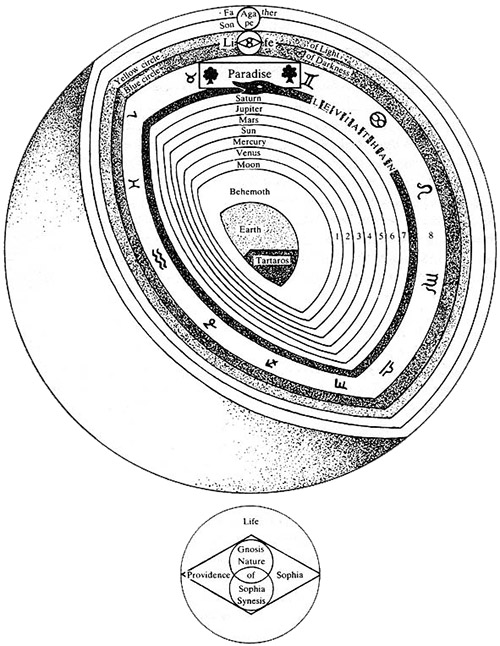
    Ophite Gnostic cosmology symbolising the structure of Reality.
    The world serpent Leviathan encircles the planetary realm, with Saturn on the boundary. After death the soul/spirit attempts to ascend through the spheres of the archons that are identified with the planets.

    The Ophites, Origen tells us, believe that after death the soul has to pass through a “barrier of evil.” Then it has to confront a series of archons, who are associated with the planets. In ascending order from the earth, they are:

    • 1. Moon: Horaeus
    • 2. Mercury: Ailoaeus or Eloaeus
    • 3. Venus: Astaipheus
    • 4. Sun: Adonai
    • 5. Mars: Sabaoth
    • 6. Jupiter: Iao
    • 7. Saturn: Ialdabaoth

    (Note that the order is the same as in the Poimandres.) In order to pass through these spheres, the Gnostic initiate was taught what to say to the archons and which symbol to present to them as a kind of passkey. To Ialdabaoth, for example, one is supposed to say:

    And thou, Ialdabaoth, first and seventh, born to have power with boldness, being ruling Word of a pure mind, a perfect work for Son and Father, I bear a symbol marked with a picture of life, and having opened to the world the gate which thou didst close for thine eternity, I pass by thy power free again. May grace be with me, father, let it be with me.5

    Irenaeus of Lyons, the second-century Church Father whose work Against the Heresies is one of our chief primary sources about Gnosticism, describes another view of this process. Speaking of one school of Gnostics, he writes:

    These hold that the knowledge of the unspeakable Greatness is itself perfect redemption. For since both defect and passion flowed from ignorance, the whole substance of what was thus formed is destroyed by knowledge; and therefore knowledge is the redemption of the inner man. This, however, is not of a corporeal nature, for the body is corruptible; nor is it animal, since the animal soul is the fruit of a defect, and is, as it were, the abode of the spirit. The redemption must therefore be of a spiritual nature; for they affirm that the inner and spiritual man is redeemed by means of knowledge, and that they, having acquired the knowledge of all things, stand thenceforth in need of nothing else. This, then, is the true redemption.6

    Soul, Spirit & the Afterlife

    Irenaeus indicates that the Gnostics believed in a tripartite division of the human entity: the physical body, the soul (what Irenaeus calls the “animal soul”), and the spirit. Orthodox Christianity originally had the same teaching, although it would be lost over the centuries. Today you will have great difficulty finding a churchman of any denomination who can explain to you the difference between the soul and the spirit.7 But the Gnostics thought these two things were very different indeed, and this fact provides the key to their views of the afterlife.

    When you read a standard version of the New Testament and come across the word “soul,” it is almost always translating the Greek word psyche. That’s what “soul” originally meant. It is the psyche – the constellation of thoughts and feelings, conscious and unconscious, that constitute your inner life. It also includes the vital principle, or life force (the “animal soul”). As the passage from Irenaeus suggests, the Gnostics knew that this soul was not immortal and was not meant to be.

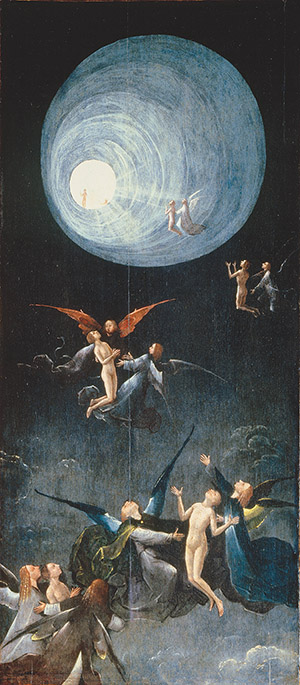
    ‘The Ascent into the Empyrean or Highest Heaven’ by Hieronymus Bosch

    The spirit is another matter. It is that in you which, at the deepest level, says “I.” It is the principle of pure consciousness that looks out of your body and psyche as through a telescope. There are many names for it: Atman, the Self, the kingdom of heaven, ruach in Hebrew and pneuma in Greek. This principle is immortal and indestructible; it will remain long after both body and soul have disintegrated. 

    In fact the soul is supposed to disintegrate. It is made up of planetary influences (hence it is sometimes given the name “astral body”), which are as temporary and transitory as the combinations of molecules that make up the physical body. The Gnostics conceived of incarnation as a descent from the supernal realms through the spheres of the seven planets down to earth. As the spirit made its way through these spheres, it takes on the colouration of each of these planets. Conversely, at the time of death, the spirit ascends and (at least ideally) shakes off the influence of each planet in turn, since these influences are the shackles that bind the soul to materiality. That’s why the Hermetic text quoted above tells us that “the human being rushes up through the cosmic framework, at the first zone [the moon] surrendering the energy of increase and decrease” and so on. Some of the Gnostics, such as the Ophites, thought it was necessary to know the occult names of each of the archons guarding these tiers as a way of getting through (in ancient magic, to know the name of something is to have power over it). Others, like the ones described by Irenaeus, apparently believed that the mere knowledge of the situation was enough for liberation.

    For individuals who do not have access to this salvific knowledge in one form or another, “it goes differently,” as we read in the Hermetic text quoted above: “return to heaven is denied them, and a vile migration unworthy of a holy soul puts them in other bodies.”

    Reincarnation Undesirable

    Reincarnation today is an increasingly popular belief. Surveys show that about 20–25% of the population of the Western countries (and as many as a third of the people in Russia) believe in it. It has the advantage of being more reassuring than the conventional Christian view that you could fry in hell for an infinite amount of time as punishment for sins committed for an extremely finite amount of time on earth. And there is a considerable body of work attesting to past-life memories (Ian Stevenson is a pioneer in this field), so that reincarnation is far better-validated than scientistic materialism would have us believe.

    Nonetheless, practically all the traditions that teach reincarnation view it as undesirable. We can come back, but if we do, it is the result of a problem or a mistake on our part. The ideal fate for an individual in Hinduism is moksha or liberation from the chain of incarnation; nirvana has the same position in Buddhism. The celebrated Tibetan Book of the Dead consists of step-by-step instructions for the newly deceased in how to avoid reincarnating. The Gnostics and Hermeticists portrayed this liberation as the ascent of the spirit through the realm of the hostile archons into the Pleroma. 

    Even the position of reincarnation in conventional Christianity is not quite what you might expect. Astonishingly, the doctrine of reincarnation has never been explicitly repudiated by the Catholic Church, even though most of its theologians have dismissed or derided it. Today some people claim that the doctrine was rejected either by the First Council of Nicaea in 325 CE or by the Second Council of Constantinople in 553, but as a matter of fact neither of these dealt with the topic; instead they were concerned with the nature of Christ. One source of this misconception is Shirley MacLaine, the actress and New Age author, who introduced these ideas in her highly popular books, adding further to the confusion by mixing up the two councils.8

    At any rate, reincarnation sits ambiguously on the edge of the Christian tradition. Valentin Tomberg (1900-73), a Baltic German convert to Roman Catholicism whose Meditations on the Tarot, published anonymously, remains one of the great modern classics of esoteric Christianity, observes:

    The Church was hostile to the doctrine of reincarnation, although the fact of repeated incarnations was known – and could not remain unknown – to a large number of people faithful to the Church with authentic spiritual experience. The deeper reason is the danger of reincarnation by way of the ghost, where one avoids the path of purification (in purgatory), illumination and celestial union. For humanity could succumb to the temptation of preparing for a future terrestrial life, instead of preparing for purgatory and heaven, in earthly life.9

    If you set aside the Catholic term of “purgatory” in this passage, you end up with a view very much like that of the Gnostics. The spirit is purified and illumined in its ascent, and eventually enters the realm of the Father. The “ghost” of which Tomberg speaks is a soul – that is, an astral body – that has not properly disintegrated. It either lurks around the earth, causing ghostly phenomena, or becomes entrapped in yet another physical body. 

    Curiously, the Gnostic teachings also survived in Eastern Orthodoxy, which owes more to Gnosticism than it cares to admit. Orthodox Christianity uses the quaint but vivid metaphor of “aerial tollhouses” to speak of the spirit’s perilous ascent after death. The number of these tollhouses is usually said to be twenty. Here is one account, attributed to Taxiotes, a soldier in antiquity who had a near-death experience:

    When I was dying, I saw Ethiopians who appeared before me. Their appearance was very frightful; my soul beholding them was disturbed. Then I saw two splendid youths, and my soul leaped out into their arms. We began slowly to ascend in the air to the heights, as if flying, and we reached the toll-houses that guard the ascent and detain the soul of each man. Each toll-house tested a special form of sin: one lying, another envy, another pride; each sin has its own testers in the air. And I saw that the angels held all my good deeds in a little chest; taking them out, they would compare them with my evil deeds. Thus we passed by all the toll-houses. And when, reaching the gates of the heavens, we came to the toll-house of fornication, those who guard the way there detained me and presented to me all my fleshly deeds of fornication, committed from my childhood up to now. The angels who were leading said to me, “All the bodily sins which you committed in the city, God has forgiven, because you repented of them.” To this my adversaries said to me, “But when you left the city, in the village you committed adultery with a farmer’s wife.” The angels, hearing this and finding no good deed which could be measured out for my sin, left me and went away. Then the evil spirits seized me, and overwhelming me with blows, led me down to earth. The earth opened, and I was let down by narrow and foul-smelling descents into the underground prison of hell.10

    It’s easy to find resemblances in this passage to the Gnostic and Hermetic texts we’ve already examined. The basic process is the same: the soul ascends through the aerial region toward heaven but encounters sentinels that bar its way. The Gnostic texts saw the way through in esoteric terms: it was necessary to know the name of the archon guarding each one and to know how to address him, or at any rate to understand the truth of the situation. Here, in an Orthodox Christian context, it is a matter of purity from sin. (As a matter of fact, the seven planets are associated with the seven deadly sins: the moon, with envy; Mercury, with sloth; Venus, lust; the sun, pride; Mars; anger; Jupiter, gluttony. The seventh, covetousness, is associated with the earth, but as we can see from the Poimandres, the seventh is sometimes taken to be deceit, and is associated with Saturn.) Like the Gnostics, the Orthodox regard these aerial tollkeepers as evil spirits. Their leader is the Devil, “the prince of the power of the air, the spirit that now worketh in the children of disobedience” (Eph. 2:2). 

    Echoes of Gnostic ideas resonate in other forms of esotericism. Here is one passage from the Zohar, the central text of the Kabbalah, the mystical tradition of Judaism. A rabbi tells of his encounter with some “children of the East” and their books of sacred wisdom, which, he says, resemble the teachings of the Jewish Torah. These books from the East said that:

    It is by his acts, by his words, and by his fervency and devotion that [the worshipper] can draw to himself that spirit from on high. They further said that if a man follows a certain direction in this world, he will be led further in the same direction when he departs this world; as that to which he attaches himself in this world, so is that to which he will find himself attached in the other world; if holy, holy, and if defiled, defiled. If he cleaves to holiness he will on high be drawn to that side and be made a servant to minister before the Holy One among the angels…. Similarly if he clings here to uncleanness, he will be drawn there towards that side and be made one of the unclean company and be attached to them. These are called “pests of mankind,” and when a man leaves this world they take him up and cast him down into Gehinnom [i.e., hell].11

    The rabbi also says that these books also have “rites and ceremonies pertaining to the worship of the stars, with the requisite formulas and the directions for concentrating the thoughts upon them, so as to draw them near the worshipper.” These would seem to resemble the Gnostic formulas and directions for encountering and passing through the gates of the archons, who are associated with the planets. But the rabbi discourages this kind of practice, saying that Jews are to worship the Holy One alone.

    It would be possible to trace the threads of these Gnostic ideas in many more directions, certainly in the Kabbalah. Gershom Scholem, the greatest twentieth-century scholar of the Kabbalah, emphasised that “it was Gnosticism, one of the last great manifestations of mythology in religious thought… which lent figures of speech to the Jewish mystic.”12

    Such is the view of the scholar. He sees affinities and resemblances between texts and traditions, and naturally assumes that the earlier ones must have influenced the later ones. But someone who wants to transcend the limits of mere academic scholarship has to ask another question: are these similarities the result of influence in a conventional sense, or is it rather that these mystics and illuminates of different traditions saw the same reality and tried to express it in terms of their own language and thought? I myself suspect that both of these things are true.

    What, then, is the mystical reality to which all these teachings point? I would suggest that it is something like this: The psyche, the soul, is made up not only of planetary influences (which is why the natal horoscope is believed to give the key to your character) but of the concepts and conditioning that were attached to it over the course of an incarnation. The Tibetan Book of the Dead, which describes this process in Tibetan Buddhist terms, calls this complex “the thought-body of propensities.”13 The ascent through the realms of the archons or the aerial tollhouses represent the stripping away of these influences, including concepts and conditioning of a religious nature. If the break is more or less complete, the unconditioned spirit can make its way to the “true heaven” – that is, other realms of existence where it will continue to be perfected. If not, it is thrown back down to earth (or perhaps to still darker realms) for another round. The Tibetan Book of the Dead says that the way to penetrate through the bardos (the Tibetan equivalent of the tollhouses) is to “know these apparitions to be thine own thought-forms.”14

    What practical conclusions can we draw from all this? Personally I would point back to the passage from the Zohar quoted just above: “If a man follows a certain direction in this world, he will be led further in the same direction when he departs this world.” The future of the divine monad, the spark of pure consciousness that lies at the centre of our being like a jewel in a lotus and whose refinement and perfection is perhaps the sole purpose of human existence, will be determined by how we cultivate it in this life. For all of the archons and celestial tollkeepers that may appear to face us after death, the responsibility for our evolution – or, if you like, salvation – continues to rest with ourselves.

    [alert type=”general” dismiss=”no”]This article was published in New Dawn 109.[/alert]

    [alert type=”success” dismiss=”no”]If you appreciate this article, please consider subscribing to help maintain this website.[/alert]

    Footnotes

    1. For further discussion of this topic, see my Forbidden Faith, 32–35.
    2. Asclepius 12, in Brian P. Copenhaver, ed. and trans., Hermetica: The Greek Corpus Hermeticum and the Latin Asclepius in a New English Translation, with Notes and an Introduction (Cambridge: Cambridge University Press, 1992), 74; Corpus Hermeticum II, 17, in Copenhaver, 12.
    3. Biblical quotations are from the Authorised (King James) Version.
    4. Corpus Hermeticum I, 25–26; in Copenhaver, 6.
    5. Origen, Contra Celsum, 6.31; in Henry Chadwick, ed. and trans., Contra Celsum, rev. ed. (Cambridge: Cambridge University Press, 1965), 347.
    6. Irenaeus, 1.21.4; www.ccel.org/ccel/schaff/anf01.ix.ii.xxii.html; May 24, 2008.
    7. For more on this subject, see my article “Christianity: The Ultimate Secret,” New Dawn No. 84 (May-June 2004), 27–32; also my Inner Christianity, 19–20, 70–71 et passim.
    8. See Wouter J. Hanegraaff, New Age Religion and Western Culture (Albany: State University of New York Press, 1998), 321-22.
    9. Meditations on the Tarot: A Journey into Christian Hermeticism, trans. Robert A. Powell (Warwick, N.Y.: Amity House, 1985), 361. Emphasis in the original.
    10. Quoted in Seraphim Rose, The Soul after Death (Platina, Calif.: St. Herman of Alaska Brotherhood, 1980), 84.
    11. Zohar 1, 99b; in The Zohar, Harry Sperling and Maurice Simon (London: Soncino, 1934), vol. 1, 324–25.
    12. Gershom Scholem, Major Trends in Jewish Mysticism, 3d ed. (New York: Schocken, 1961), 35.
    13. The Tibetan Book of the Dead, W.Y. Evans-Wentz, ed. and trans., 3d ed. (New York: Oxford University Press, 1957), 104.
    14. Ibid.

    © New Dawn Magazine and the respective author.
    For our reproduction notice, click here.
  • René Guénon &  Counterinitiation: Are Things Getting Better or Worse?

    René Guénon & Counterinitiation: Are Things Getting Better or Worse?

    From New Dawn Special Issue Vol 10 No 3 (June 2016)

    A question nags at everyone today: are things getting better or worse? The answer depends on the criteria you’re using. In terms of material comfort, it seems clear that life is better and easier for most people – certainly most people in the West – than they were a century ago.

    Yet somehow this is not reassuring. The very forces that have created these comforts threaten to destroy us. And in any case the complexities of advanced civilisation have by no means enabled us to feel that we, individually or collectively, have any meaningful place in the universe. Indeed there would seem to be powers that are trying to thwart this sense of meaning and to stamp it out whenever it raises its head. The works of René Guénon (1886–1951) attempt to deal with this problem.

    Guénon is still little-known even among the mainstream intelligentsia. But his critique of the modern world – set out particularly in his books East and West, The Crisis of the Modern World, and The Reign of Quantity and the Signs of the Times – has become increasingly influential both in the West and in the Islamic world (Guénon, a convert to Islam, moved to Cairo in 1930 and lived there for the rest of his life).

    Guénon starts with the concept of the yugas, the world ages as conceived in traditional Hindu metaphysics. The first and best is the Satya Yuga; next is the Treta Yuga; third is the Dvapara Yuga; the last, shortest, and worst is the Kali Yuga, the age of darkness. This is the age we are in. It began in 3102 BCE, with the end of the great war described in the epic known as The Mahabharata. Most Hindu sources say that the Kali Yuga will last 432,000 years – in short, we are nowhere near the end of it. Guénon sees the matter otherwise. In The Crisis of the Modern World he writes: “We have in fact entered upon the last phase of the Kali-Yuga, the darkest period of the ‘dark age’, the state of dissolution from which it is impossible to emerge otherwise than by a cataclysm.”

    The reasons for Guénon’s belief are complex, but they have to do with his view of the ages as a gradual movement (and decline) from a pure and direct contact with the primordial source of Tradition, which he associates with prehistoric polar civilisation known as Hyperborea. Over the millennia, contact with this Tradition has become more and more occluded so that in our time we are almost entirely cut off from it. (For more about this, see my article “Waiting for the End of the World: René Guénon and the Kali Yuga” in New Dawn 122.)

    The modern West is thus, for Guénon, not the summit of progress. It is at the tail end of a long decline. Although Guénon does not specify when this age will end, he seems to think it will be comparatively soon – a few decades from the time he is writing in the early to mid-twentieth century.

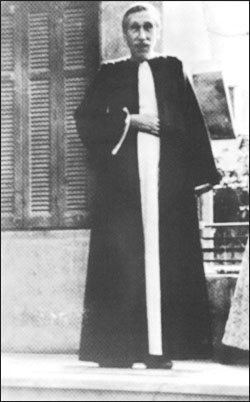
    René Guénon (1886–1951), Cairo, Egypt.

    For Guénon, this decline is cyclical and thus inevitable. At the same time, despite his claims of holding himself above the fray, he displays a strong animus against the era. One senses a dissociation here. If materialism and the “reign of quantity” are omnipresent, surely it is a result of the cycle; things could hardly be different in the late stages of the Kali Yuga. In that case, why be upset about it?

    Years ago I had a discussion with the philosopher Jacob Needleman in which I made this complaint about the Traditionalists. “It’s as if they’re mad because it’s November,” I said. (I am speaking from a northern-hemisphere perspective.) “No,” Needleman replied. “They’re mad because people are going around saying, ‘It’s May’.”

    Needleman was right. Guénon’s time, the early twentieth century, was the high-water mark of Western triumphalism. Guénon felt a powerful need to fight this attitude as well as what he considered a deluded belief in “progress” and “evolution.” Indeed the very things that the West has trumpeted as signs of progress were, for Guénon, the sign of the very opposite: “Have we not arrived at that terrible age, announced in the Sacred Books of India, ‘when the castes shall be mingled, when even the family shall no longer exist’?” Most modern people would say that the decline of the caste system is a good thing.

    Besides, Guénon did not think the woes of modernity could be blamed completely on a cyclical entropy. There were conscious factors at work as well. In The Reign of Quantity, he writes, “Since all effective action necessarily presupposes agents, anti-traditional action is like all other kinds of action, so that it cannot be a sort of spontaneous or ‘fortuitous’ production, and, since it is exercised particularly in the human domain, it must of necessity involve the intervention of human agents.”

    This action comes in two stages. The first is one of “quantification and mechanisation.” Quantification is the warping of the modern mind so that it only perceives things in terms of number. Statistics are one example of this trend, and Guénon has an insightful chapter in The Reign of Quantity entitled “The Illusion of Statistics.” Also, the use of quantification in industry – as opposed to the “crafts” that flourished in traditional civilisations – “had the effect of attaching men more and more completely to purely material realisations. Man ‘mechanised’ everything and ended at last by mechanising himself, falling little by little into the condition of numerical units, parodying unity, yet lost in the uniformity and indistinction of the ‘mass’.” The result? Man loses practically all contact with higher realms. He is so focused on materiality that he believes nothing else exists.

    A second phase ensues: “dissolution.” Guénon explains: “After having enclosed the corporeal world as completely as possible, it was necessary, while guarding against the re-establishment of any communication with superior domains, to open it up again from below, so as to allow the dissolving and destructive forces of the inferior subtle domain to penetrate into it. It is the ‘unleashing’ of these forces, so to speak, and the setting of them to work to complete the deviation of our world and effectively to bring it towards final dissolution, which constitutes the second part or second phase referred to.” 

    Guénon calls the sum total of these forces – who are, as he has emphasised, human – the “counter-initiation.” Now it is not merely a matter of being passively unaware of Tradition, but of forces that actively seek to block and divert this awareness.

    Mark Sedgwick, author of Against the Modern World, an important study of Guénon and Traditionalism, observes: “Traditionalists are those who… recognise that one of the most important aspects of modernity is inversion – that the world sees the valuable as worthless and the worthless as valuable, the good as bad and bad as good. Guénon never saw a punk, but it would have made a lot of sense to him. And with that comes ‘counter-initiation’ – religious movements that are actually irreligious, that actually lead away from what religion is meant to lead to.”

    Two of the most prominent “counter-initiatic” movements, in Guénon’s view, were Theosophy and Spiritualism. This is why he devoted two books to denouncing them. Theosophy was pernicious because it presented a loathsome parody of the genuine Traditional teachings of Hinduism. Moreover, in teaching the idea of the soul’s evolution – a word that was anathema to Guénon – it was presenting dangerous modern ideas in esoteric form.

    Actually it is difficult to tease out the differences between Guénon’s views of the ascent of the Self through multiple states of being from the Theosophical model, which describes a very similar process. (One difference is that Theosophy posits multiple incarnations on earth, whereas Guénon denies it.) But he saw the very similarity of these views as yet another sign of the diabolical cleverness of the counter-initiation. Spiritualism too, with its séances, was stirring up “inferior forces.”

    For a Traditionalist, practically every modern movement or school of thought can be – and is – seen as an example of “counter-initiation” at work. Psychoanalysis, for example, involves an excursion into the lower depths of the psyche from which the subject may well never return. “In the ‘fall into the mire’,” as Guénon characterises it, “the inferior possibilities take possession of him, dominate him, and end by submerging him completely.” Guénon makes a similar argument about the revivals of shamanism and “sorcery.” Eventually, he predicts, “counter-initiation” will lead to a “counter-tradition” – a grotesque and evil imitation of true Tradition.

    Another symptom of the present crisis is syncretism: the random mixture of teachings and images from any number of traditions. For Guénon, this is radically different from synthesis, by which common themes and symbols are seen to be reflections of one universal Tradition. Someone might object that from the exterior, synthesis and syncretism are hard to tell apart. Guénon would say that is the point: from the exterior, one does not have knowledge to integrate these themes properly. It is only intellectual intuition – the possession of true knowledge – that makes this a possibility for initiates.

    It does not take much imagination to see how many present-day trends fit into Guénon’s model. Mark Sedgwick mentions punk, but Guénon would have found every other form of popular music just as abominable. Similarly with the visual arts: he would have seen transgressive works such as the photography of Robert Mapplethorpe or Andres Serrano’s notorious Piss Christ as extreme examples of such degeneration – in the unlikely event that he deigned to take notice of them at all. 

    He may even have a point about the penetration of “the dissolving and destructive forces of the inferior subtle domain” into world. In his 1936 essay “Wotan,” psychiatrist C.G. Jung writes about the Germany of that time: “What is more than curious… is that an ancient god of storm and frenzy, the long quiescent Wotan, should awake, like an extinct volcano, to new activity, in a civilised country that had long been supposed to have outgrown the Middle Ages.” For Jung, much like Guénon, the terrible forces of the twentieth century were eruptions from the unconscious.

    Guénon may even have been right about the deliberate evocation of such forces. Occultist Donald Tyson writes that the magus Aleister Crowley, a contemporary of Guénon’s, “firmly believed that he was the herald of a new age of strife and destruction that would sweep across the world. He called this the Aeon of Horus, after the Egyptian god of war.” [See article in this issue, ‘Enochian Apocalypse’ by Donald Tyson, page 43.] In 1909 Crowley conducted some magical workings to accomplish this end by opening “the four great Watchtowers that stand guard against chaos at the extremities of our universe.” Tyson writes:

    Let us suppose for the sake of argument that… Crowley’s Enochian evocations of 1909… pried the doors of the Watchtowers open a crack – enough to allow a foul wind to blow through the common mind of the human race. This would explain the senseless slaughter of the First World War and the unspeakable horror of the Nazi Holocaust during the Second World War. It would explain the decline of organised religions and why the soulless cult of science has gained supremacy. It would explain the moral and ethical bankruptcy of modern times and the increase in senseless violence.

    Whether or not Crowley really did open up the cosmic Watchtowers, he no doubt would have liked to think he did. In any case, this description sounds very much like what Guénon is talking about.

    To go back to Guénon, no one can lay out such a comprehensive denunciation of a civilisation without offering some positive alternative. He evidently hoped that his works would inspire a nucleus of Western illuminates to gain access to, and perpetuate, the Traditional knowledge, either to reverse the decline of the modern world, or, more likely, to serve as an ark for the preservation of the sacred knowledge for a better future time.

    To a small extent, his hopes have been realised. London’s Temenos Academy, for example, founded in 1990 by the poet Kathleen Raine and associates including the Traditionalist Philip Sherrard, is committed to perpetuating the “perennial philosophy” – another name for Guénon’s Tradition. The Prince of Wales is among its patrons. Indeed, as Angel Millar points out in his recent book The Compass and the Crescent: Islam, Freemasonry, Esotericism, and Revolution in the Modern Age, Prince Charles is very likely a Traditionalist himself, and his ideas and programs cannot be understood without reference to Traditionalism.

    The number of people sympathetic to Traditionalism, of course, remains infinitesimal. But Guénon did not believe that mere numbers were necessary to influence the course of civilisation. Numbers, after all, are merely another manifestation of the reign of quantity. He believed that certain awakened individuals, even if only a few, could extend a powerful and beneficent influence on civilisation.

    Was he right? We are certainly far from anything like a “reign of quality.” But history has a way of reversing course, and the prospects for a civilisation that incorporates a sense of the sacred may not be so dismal after all.

    [alert type=”general” dismiss=”no”]This article was published in New Dawn Special Issue Vol 10 No 3.[/alert]

    [alert type=”success” dismiss=”no”]If you appreciate this article, please consider subscribing to help maintain this website.[/alert]

    Sources

    René Guénon, The Crisis of the Modern World, Translated by Arthur Osborne et al. Sophia Perennis et Universalis, 2004 [1942]
    René Guénon, East and West, Translated by Martin Lings, Sophia Perennis et Universalis, 1994 [1941]
    René Guénon, The Reign of Quantity and the Signs of the Times, Translated by Lord Northbourne, Penguin, 1972 [1953]
    C.G. Jung, “Wotan.” www.philosopher.eu/others-writings/essay-on-wotan-w-
    nietzsche-c-g-jung/; accessed April 3, 2016
    Jean-François Mayer, “Traditionalism: René Guénon’s Legacy Today: An Interview with Mark Sedgwick,” ReligioScope, 2004; http://religion.info/english/interviews/article_53.shtml; accessed April 3, 2016.
    Angel Millar, The Compass and the Crescent: Islam, Freemasonry, Esotericism, and Revolution in the Modern Age, Numen Books, 2015
    Mark Sedgwick, Against the Modern World: Traditionalism and the Secret Intellectual History of the Twentieth Century, Oxford University Press, 2004
    Donald Tyson, “The Enochian Apocalypse,” Gnosis 40 (summer 1996), 56–62

    © New Dawn Magazine and the respective author.
    For our reproduction notice, click here.
  • The Gods Are Dead! Long Live the Gods!

    The Gods Are Dead! Long Live the Gods!

    From New Dawn 142 (Jan-Feb 2014)

    When the veil descended, men revered what it covered. And as time went on it seemed to hide more and more and was revered still more. Then, when it was heavy with age, young men fresh and arrogant demanded the removal of the veil and demanded to see what was hidden. For they said that whatever is hidden from the people cannot be for the common good. In the thunder and lightning of indignation, the veil was torn down. Nothing lay beyond. At first the young men were startled, but then they laughed jubilantly at the absurd fraud they thought they had uncovered. And the old men grieved, cursing the young men because they had destroyed the veil.
    – The Tree of Life Oracle

    Why do so many creation sagas sound alike? Why can myths of a universal flood be found worldwide? And why do we find prophecies of an end of the world in equally far-flung places?

    There are two basic theories that try to account for these similarities. One is the archetypal, which argues that these universal myths point to a common structure within the human mind. The Swiss psychologist C.G. Jung is the best-known advocate of this approach. The other is the diffusionist view, which claims that these resemblances point to a common source of myth in the past.

    In a recent book, entitled Origins of the World’s Mythologies, E.J. Michael Witzel, a professor of Sanskrit at Harvard University, argues on behalf of the diffusionist view. He compares the myths of nations around the world and paints a picture of the history of myth that reaches back as far as 100,000 years.

    Witzel claims that certain universal mythic elements may actually go back to the earliest stages of humanity, when the whole species still lived in Africa. He calls this strain the “Pan-Gaean” mythos (he uses the geological names of prehistoric continents to label these different strata). The next oldest is that of “Gondwana,” a mythos that can be found today chiefly among the indigenous peoples of sub-Saharan Africa and Australia. By this account, the gods, heaven, earth, and so on, preexist; there is no story that tells of their origins. The gods create humans from substances such as trees or clay, but the humans commit acts of hubris and are punished by a worldwide flood (an element that apparently goes back to the Pan-Gaean mythos). Afterward, local tribes emerge.

    The myths of the rest of the world – not only Europe and Asia but the Americas and even Polynesia – are “Laurasian.” They first arose, probably in southwestern Asia, between 40,000 and 20,000 BCE, and share one crucial feature: unlike the earlier strains, they all present a continuous and more or less similar narrative; Witzel even describes it as a “novel.” It has some of the features of the earlier Gondwanan story, but it goes much further and is much more coherent. It begins with the origins of the cosmos and the gods and extends to the birth of humanity, whose history is delineated into four or five “ages.” Humans show hubris in this narrative as well, and are also punished with a universal flood.

    The mythos proceeds to the end of time, in which heaven and earth are destroyed and a new heaven and new earth emerge. This event is represented in legends as different as the Nordic Götterdämerung (“twilight of the gods”) and the Last Judgment of Christianity. Indeed, for Witzel, the creation narratives and eschatology of the Bible are only the latest manifestations of the Laurasian mythos. 

    Why have these myths lasted so long? According to Witzel, one reason is that, quite simply, they are good stories. Another is that the Laurasian mythos in particular recapitulates the human lifespan on a universal scale: like us, it is saying, the cosmos is born, grows to maturity, and eventually withers and dies; it even goes through several distinct stages of development. He also echoes the claim made by certain neuroscientists that in some yet undefined way the human brain is “hardwired” for myth and religion (although this leads toward the archetypal view that Witzel dismisses).

    We can also see that these myths have been recast into new forms every few thousand years. Little by little, the old gods cease to be taken seriously; sometimes they are mocked. This happened in classical antiquity. The period that is most familiar to us – from 500 BCE to 300 CE – is a comparatively late one for that civilisation, and we can see the old gods losing their hold. Around 500 BCE, the pre-Socratic philosophers arose in Greece, some of whom disdained the gods, claiming that they were mere personifications of natural phenomena or outright fictions. The gods were also satirised in literature then and in later centuries, as we see in the comedies of Aristophanes and the dialogues of Lucian. While paganism remained alive in the popular mind until Christianity won out in the fourth century CE, the intelligentsia had long ceased taking it seriously – or interpreted the gods symbolically or allegorically. (Sometimes when the new mythos takes over, it keeps some of the gods of the previous one, but as demigods or demons: early Christianity saw the Greek and Roman gods this way.)

    The Ages of Greece

    Every people have gods to suit their circumstances.
    – Henry David Thoreau

    This constant need for creation and recreation of myth leads us to wonder what may cause these upheavals. It is tempting to look at this issue in the light of the “ages” that are so universal a mythic motif. Among the most familiar are those of the Works and Days by Hesiod, a Greek poet of the eighth century BCE: the ages of Gold, Silver, Bronze, the Heroes, and Iron. Hesiod’s sequence of these periods, like those of many Laurasian myths, is one of decay and degeneration, from the Golden Age, whose people “lived like gods without sorrow of heart, remote and free from toil and grief” down to the present Age of Iron, when “men never rest from labour and sorrow by day, and from perishing by night.” Although Hesiod laments that he had rather “died before or been born afterward,” the present age will deteriorate still further, and will approach an end when people “come to have grey hair on their temples at their birth.” 

    Hesiod may be preserving some historical memory here, at least in his choice of names. The Bronze Age in Greece lasted till around 1100 BCE, and the Age of Heroes centres around the sack of Troy, which is generally dated to the early twelfth century. The Greek Dark Ages (1100-750 BCE), when iron was introduced, then began, at the end of which Hesiod himself lived. The ages of Gold and Silver would then be part of a more or less imaginary mythic prehistory.

    While the idea of the Golden Age still floats about in the popular mind today, Hesiod’s other ages do not. But we have something similar in the mythos of Christianity. One common version of Christian sacred history speaks of several “dispensations” or different periods of worship. Based on the biblical narrative, they are usually divided thus: the period between Adam and Noah; the period between Noah and Abraham; the period between Abraham and Moses; the one between Moses and Christ; and from Christ to the present, which will last until Judgment Day, and restore a new heaven and a new earth. The last days, again, will be characterised by decay and degeneracy, as we see in Christ’s apocalyptic discourse in Matthew 24, Mark 13, and Luke 21.

    Thus we see ancient Laurasian myth transposed into both classical Greek and Christian modes. And this in itself illustrates how a universal mythos can shift from one era to another.

    Astrological Ages

    For some today, the concept of the ages can take an astrological form, and this idea has been extraordinarily popular since the 1960s, when the coming of the Age of Aquarius was proclaimed. The idea of the Aquarian Age itself now seems somewhat dated, but that, I would argue, is because we are now actually in the Age of Aquarius, and we take some of its most characteristic features for granted.

    The idea of the astrological ages is based on the precession of the equinoxes, in which, by an extremely long and slow cycle, the point of the sun’s rising at the spring equinox (that is, in the northern hemisphere) moves from one sign of the zodiac to another over a period of nearly 26,000 years. Dividing this by twelve, we can see that each age lasts somewhat less than 2,170 years. Since there is no dotted line in the sky separating one constellation of the zodiac from another, the time of this transition as given by different authorities can vary by centuries. Moreover, there is a tremendous overlap of influences, so that no sharp delineation can be drawn.

    Our understanding of the earliest of these ages, which were preliterate, is imperfect, relying on surviving artefacts that may or may not reflect the totality of the culture. It is really only with the Age of Aries, which began in the second or third millennium BCE, that we can begin to fill in details and learn how religious observance in particular has changed throughout these ages.

    It’s common to date the recent astrological ages as follows: the Age of Aries, 2100-7 BCE; the Age of Pisces, 7 BCE-2100 CE; the Age of Aquarius, 2100-4200 CE. These dates are highly approximate, although 6 or 7 BCE is sometimes given as the beginning of the Age of Pisces, when a “great conjunction” (between Jupiter and Saturn, opposing the sun) supposedly marked the birth of Christ.

    But, on the basis of history, I would suggest that the ages took place much earlier: Aries, between roughly 3000 and 800 BCE; Pisces, between 800 BCE and 1400 CE; and Aquarius, from 1400 CE to, perhaps, 3600. There is also an overlap of several centuries.

    My reasoning is as follows: Pisces is associated with religion, and the great world religions all arose around what the German philosopher Karl Jaspers called the Axial Age, the period between 800 and 200 BCE, when figures including the Hebrew prophets, the Greek philosophers, Lao Tzu, Confucius, the Buddha, and Mahavira, the founder of Jainism, all lived.

    Thus, by my account, the Age of Pisces marked the birth of all the great world religions, with the possible exception of Zoroastrianism. (Zoroaster’s date is controversial: although his life was traditionally dated to c.800 BCE, scholarly opinion has now pushed it back to the late second millennium BCE.) Judaism and Hinduism certainly existed before the Axial Age, but they changed profoundly during that era. One of the most remarkable changes is that they, like most of the world, gave up animal sacrifice.

    Animal Sacrifice In Religion Phased Out

    In the Hinduism of the Age of Aries, one of the most important rites was the asvamedha or horse sacrifice. It could only be performed by a king and was meant to ensure the prosperity of the kingdom. The horse was released and allowed to roam for a year; if it wandered into hostile foreign territory, that territory had to be conquered. After its return, it was sacrificed. The Brihadaranyaka Upanishad compares the horse to the universe, so that symbolically the universe is sacrificed in this rite.

    After the Axial Age, however, the old Vedic animal sacrifices were phased out. The more philosophical and ethical Hinduism that we know today arose, and the sacrifices that were retained (such as the extremely ancient fire sacrifice) did not involve animals. The difference in eras is illustrated by a line from the Hindu Laws of Manu (5:53), which date from the early centuries of the Common Era: “He who sacrifices every year with a horse-sacrifice, and he who eats not flesh, the fruit of the virtue of both is equal.”

    Judaism practiced animal sacrifice up until the sack of the Second Temple in Jerusalem by the Romans in 70 CE. And the sacrifice was on a grand scale. Many people have a sugary, children’s-Bible image of the Jerusalem Temple, but the reality was quite different. A text dating probably from around 100 BCE called The Letter of Aristeas gives one of the few surviving eyewitness descriptions of it. One detail that especially impressed the author was the temple’s elaborate plumbing system, which was needed to drain off the blood of all the animals killed.

    Animal sacrifice and blood were major themes in the religions of the Age of Aries. Blood keeps surfacing in the biblical narrative; in Genesis 9:6, for example, where God forbids Noah to eat meat with the blood, “which is the life thereof”; a commandment repeated in the Mosaic law, for example in Leviticus 17:11 and Deuteronomy 15:23. Blood, reserved for God alone, is to be poured out on the ground.

    The spilling of blood in sacrifice is an ancient and widespread theme. It is treated vividly in the eleventh book of the Odyssey, where Odysseus summons up the shade of the prophet Teiresias to learn how he can return home. Odysseus begins with a huge sacrifice:

    I took the sheep and cut their throats over the pit, 
    and the dark-clouding blood ran in, and the souls of the perished dead gathered to the place…
    These came swarming around my pit from every direction
    with inhuman clamour, and green fear took hold of me. 

    When Odysseus wants to speak to the spirits of the dead, he allows them to draw near and drink the blood – or, as we might put it today, the energies given off by the blood.

    One might begin to wonder about the nature of animal sacrifice and of the gods that demanded it. Were the gods of the Age of Aries lower-grade spirits that, like the ghosts from Homer’s Hades, literally fed on the life force released from the blood? And did the Age of Pisces, with its more abstract and ethical religions, mark an actual transition to a worship of a higher form of god? (For one view of this transition, see the accompanying article, “Is Your God a Devil?”)

    One case of this transition appears in Pythagoreanism, a mystery school founded by the Greek philosopher Pythagoras (c.570-c.495 BCE). Pythagoras enjoined his followers not to eat meat or fish (indeed, until the term “vegetarianism” was coined in the nineteenth century, this was called “the Pythagorean diet”). Nonetheless, in the first century of their existence, the Pythagoreans did not seem to have any problem with the animal sacrifices that were so central to Greek religion; only later, in the fourth century BCE, did this become an issue. This in itself gives a hint of the shift that was taking place in Western consciousness.

    Animal sacrifice is still practiced to some degree. Muslims sacrifice domestic animals at the festival of Eid el-Adha. The practice survives as well in Santería and Voudun, the religions of the African diaspora that flourish in the Americas. Years ago in San Francisco, I remember seeing a dead bird on a street corner. It was not the typical grey city pigeon that had dropped dead; it was pure white. I suspect it was the offering of some devotee of Santería who had sacrificed a dove at a crossroads.

    Pisces, as we have seen, was the age of the great world religions, and all the major world religions arose during that period, the latest being Islam, which came in the seventh century CE. The most famous symbol of the Age of Pisces is the ιχθυΣ (ichthys) symbol, which is the acronym of the Greek phrase “Jesus Christ, son of God, saviour.” It is the Greek word for “fish.”

    The largest and most successful of the Piscean religions (at least in terms of size) are Christianity and Islam, which together account for approximately half of the human race. Both of these posit a monotheistic, personal God who demands obedience, prayer, and ethical behaviour.

    Age of Aquarius and the Changing God Image

    The changing and diverse figures and forms of world religion over the ages. The arch of the zodiac appears in the top left hand corner. This drawing appears in Manly P Hall’s Secret Teachings of All the Ages (and was redrawn from Lanoir’s La Franche-Maconnerie).

    While the monotheistic God continues to command the belief of much of humanity, another radical change of thought seems to have taken place with the approach of the Age of Aquarius around the beginning of the Renaissance. At that point, humanism began to supplant religion. Humanism has a dual meaning: it can refer to the learning of classical pagan civilisation as well as to a kind of nonreligious philosophy that promotes ethical behaviour without recourse to the supernatural. Both of these began to come to the fore at this time. In the Age of Aquarius – whose symbol is a man – humanity began to focus on a human-centred rather than a divine-centred world.

    As I argued in my New Dawn article “The Other Side of Aquarius,” (New Dawn 141) the final transition from the Piscean to the Aquarian age came centuries later, with the great upheavals of the world wars. From a military point of view, these began with naval power dominant (as evidenced by the British Empire) and ended with the triumph of air power (as seen at Hiroshima and Nagasaki). Pisces is a water sign, Aquarius an air sign.

    We are thus now in the Aquarian Age. Those who predicted that it would be an age of harmony and understanding were only half-right. It is an age like any other, with its progress and tumult. It is not a dawning millennium that will save us from all our problems; rather it has brought a number of problems of its own – environmental damage, an obsession with computers and technology, and so on.

    So we have seen that the previous two ages saw the demise of one set of gods and the rise of another. Who are the new gods of Aquarius?

    Aquarius is a rather impersonal sign, as zodiac signs go; it is more comfortable with ideals than with particulars. (It reminds me of a line from Charles Schultz’s comic strip “Peanuts”: “I love mankind. It’s people I can’t stand!”) So it stands to reason that the Aquarian gods would be impersonal as well. And we see that science has pushed aside the creator God of Christianity in favour of abstract entities such as natural selection and the forces of physics. Unlike the gods of Aries, they do not require animal sacrifice. Unlike the gods of Pisces, they do not require worship and moral behaviour. They are completely and utterly indifferent to, and unaware of, the human race.

    Science is the dominant mode of thought in the present age. It is taken as the final arbiter of reality and the ultimate determinant of meaning: if science sees no meaning in the universe, then, many would say, there is none. Consequently, the struggle between science and religion is a struggle between the old worldview of Pisces and the new worldview of Aquarius.

    From all this, someone might look back and see a steady elevation in conception from the blood-drinking gods of Aries to the moral but vindictive God of Pisces to the bright, shiny new world of science, technology, and progress. There is some truth to this picture – but only some.

    We tend to assume that whatever is newer is better, but that itself is a fairly recent development in human thought – and probably Aquarian in inspiration. We’ve already seen how Hesiod portrays the cycle of the ages as one of decay. The classical scholar E.R. Dodds argued that the ancient Greeks had no concept of progress as we know it today. In classical Latin, the word for “new” – novus – had the same pejorative connotation that “old” has for us. In Christian apocalyptic terms too, the present age deteriorates until it can only be saved by the return of Christ. Progress does appear in some Laurasian myths – such as in the Mayan Popol Vuh, which says that the gods created several unsuccessful races until they got it right with humans – but not in very many.

    In any event, we can now see Witzel’s Laurasian mythos in its latest incarnation: that of science. There is no creation by God; rather there is a Big Bang. The picturesque ages named after metals have been replaced by immeasurably long and grandiose-sounding ones such as the Precambrian and the Jurassic. And instead of a Götterdämerung or Last Judgment, physicists posit a Big Crunch or heat death as the final fate of the universe.

    What remains most striking is that, even in this supposedly objective view of the universe, we have a cosmos that is born, grows up, and dies – just like us. No matter how much intellectual and technical sophistication human beings acquire, they still tend to view the universe as themselves writ large. Is this objectively true – that man is the measure of all things, and our lifespan recapitulates that of the cosmos? Or are we simply foredoomed by our own makeup, with its all-too-finite duration, to see things this way?

    I myself go back and forth between these two points of view. In any event, contemporary science faces a fundamental contradiction in its outlook. It holds (1) that our minds are necessarily limited and conditioned by the structure of our nervous system and yet (2) this nervous system, expressing itself in scientific formulae, gives a complete and accurate version of the universe. The Christian theologians papered over their logical contradictions by appeals to divine mystery and the inscrutable will of God. I wonder what escape route the scientists will find.

    Finally, the question of meaning remains. Paganism and the world religions did give meaning to the universe. Science, or its quasi-religious form known as scientism, has not. In fact it has gone in the opposite direction. Scientism says not only that it can find no meaning in the universe, but that there is none. Any attempt to find such a thing is derided as a reversion to the supposedly obsolete idea of a personal God.

    Are the cultists of scientism right? Science may have squashed simplistic notions of meaning and purpose, but this need persists, and it is not going away. The failure of the new gods of Aquarius to provide it have left our civilisation with a deep sense of anomie and isolation. We can ask how accurate or complete a picture this impersonal Aquarian religion really offers. After all, our very appetite for meaning attests to its existence. You would never feel thirst if there were no such thing as water.

    [alert type=”general” dismiss=”no”]This article was published in New Dawn 142.[/alert]

    [alert type=”success” dismiss=”no”]If you appreciate this article, please consider subscribing to help maintain this website.[/alert]

    Sources

    Arthur Coke Burnell and Edward R. Hopkins, ed. and trans., The Ordinances of Manu, Munshiram Manoharlal, 1995 [1884]
    R.H. Charles, ed., The Apocrypha and the Pseudepigrapha of the Old Testament, volume 2: Pseudepigrapha, Oxford at the Clarendon Press, 1913
    Cherry Gilchrist and Gila Zur, The Tree of Life Oracle, Friedman Fairfax, 2002
    Homer, The Odyssey, Translated by Richmond Lattimore, Harper & Row, 1965
    R.E. Hume, ed. and trans., The Thirteen Principal Upanishads, 2d ed., Oxford University Press, 1931
    G.S. Kirk, J.E. Raven, and M. Schofield, The Presocratic Philosophers, 2d ed., Cambridge University Press, 1983
    Rudolf Steiner, “The Occult Significance of Blood: An Esoteric Study”, http://wn.rsarchive.org/Lectures/19061025p01.html; accessed Sept. 16, 2013
    E.J. Michael Witzel, The Origins of the World’s Mythologies, Oxford University Press, 2012

    © New Dawn Magazine and the respective author.
    For our reproduction notice, click here.