New Dawn – World's Most Unusual Magazine

Author: Robert Temple

  • Inorganic Intelligent Beings May Dominate The Universe

    Inorganic Intelligent Beings May Dominate The Universe

    From New Dawn 192 (May-June 2022)

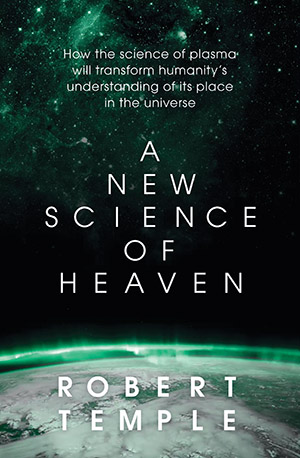
    My new book, A New Science of Heaven (Hodder & Stoughton), gives a full scientific description of the nature of inorganic, non-biological, intelligent beings in space. 

    We have two such ‘creatures’ close to our own planet. They are the recently confirmed Kordylewski Clouds, which together are eighteen times the size of the Earth. They reside between the Earth and the Moon, but not in a direct line of sight. They are 60o behind and 60o in advance of the line of sight to the Moon. They exist at the two points known as L4 and L5, the ‘L’ standing for ‘Lagrange’ (named after a famous scientist and mathematician of the past). 

    At these two Lagrange Points, the gravitational pulls of the Earth and the Moon cancel out, so that clouds can rest there free of gravitational pull in either direction.

    The Kordylewski Clouds were discovered in 1961 by the Polish astronomer Dr. Kazimierz Kordylewski (1902-1981.

    As the Clouds emit no light and are largely transparent, it was difficult for Kordylewski’s discovery to be confirmed by others. But in 2019, the existence of the Clouds was confirmed using modern techniques which did not exist in Kordylewski’s day. This was done by a group of Hungarian astronomers. 

    I noticed this very soon after their initial publication and contacted them to ask whether they were studying the plasma aspects of the Clouds. They replied saying no, they were only considering the celestial mechanics. (The plasma aspects do not seem to have occurred to them, as they were only observational astronomers, not physicists.) 

    I phoned my friend Professor Chandra Wickramasinghe, a brilliant astrophysicist, told him about the Clouds and suggested that we publish a joint article immediately calling attention to these two entities from the more important perspective of space plasma. Our article appeared in the journal Advances in Astrophysics shortly thereafter, and is reprinted in its entirety as an appendix to my book.
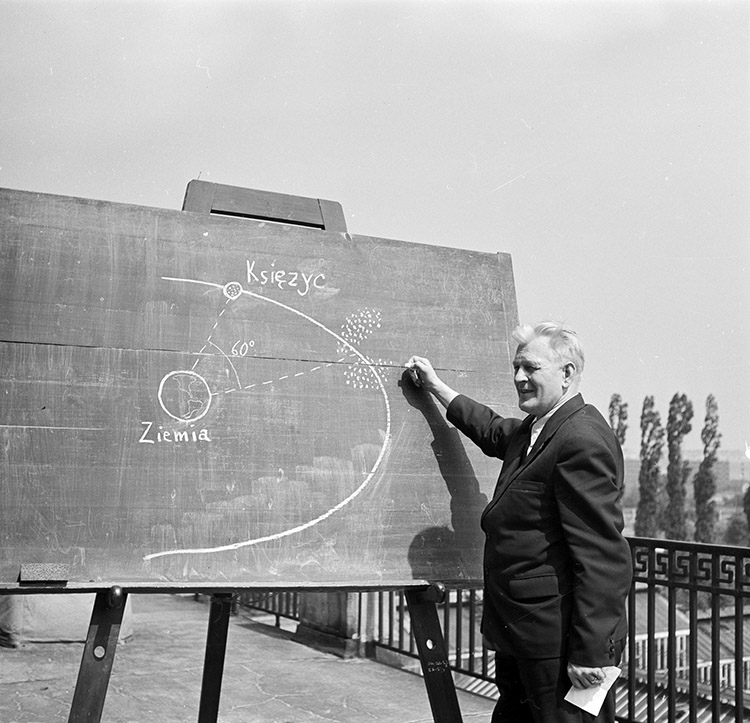
    Dr. Kazimierz Kordylewski in 1961 drawing a picture of the Kordylewski Cloud at Lagrange Point L5. Ziemia in Polish means “the Earth.” Księzyc in Polish means “the Moon.” The 60o angle away from the direct line of sight to the Moon is clearly shown. The Cloud is depicted as a collection of dust particles, which we now know must be charged and form a dusty complex plasma. Each one of the Kordylewski Clouds measures 65,000 miles by 45,000 miles across, which is equivalent to 30 x 20 lunar discs as seen from Earth. Each one is now known to be nine times the size of the Earth, so that the two together are 18 times the size of the Earth. They thus entirely dominate what until now has been called ‘the Earth-Moon System’, and which is now known to be a four-entity system, not a two-entity one. 

    ‘Dusty Complex Plasma’

    The Clouds are composed of tiny dust particles and grains only a few nanometres in size, whereas our satellites can only detect particles of 100 nanometres or larger, which is why no satellites have detected them. The dust is highly electrically charged (10,000 electrons can cling to a single dust particle, and for positively charged dust, protons and ions of a somewhat lesser number because they are bulkier). 

    The Clouds are constituted of what is now called ‘dusty complex plasma’, and they are cold plasmas rather than hot plasmas such as our Sun. 

    Plasma is a distinct form of matter which is not made of atoms. Our own bodies and the world in which we live are made of what we call physical matter, or more accurately, atomic matter. But plasma is non-atomic matter. It is not made of atoms at all, but of atomic particles

    Recognition of it as being literally a new form of matter occurred in 1879 when it was discovered by the British scientist Sir William Crookes (inventor of the vacuum tube), who called it “radiant matter.” Its name was changed to ‘plasma’ in 1928 by the American scientist Irving Langmuir. It has no connection to blood plasma, familiar to doctors and nurses, which is a different use of the word, which derives from ancient Greek.
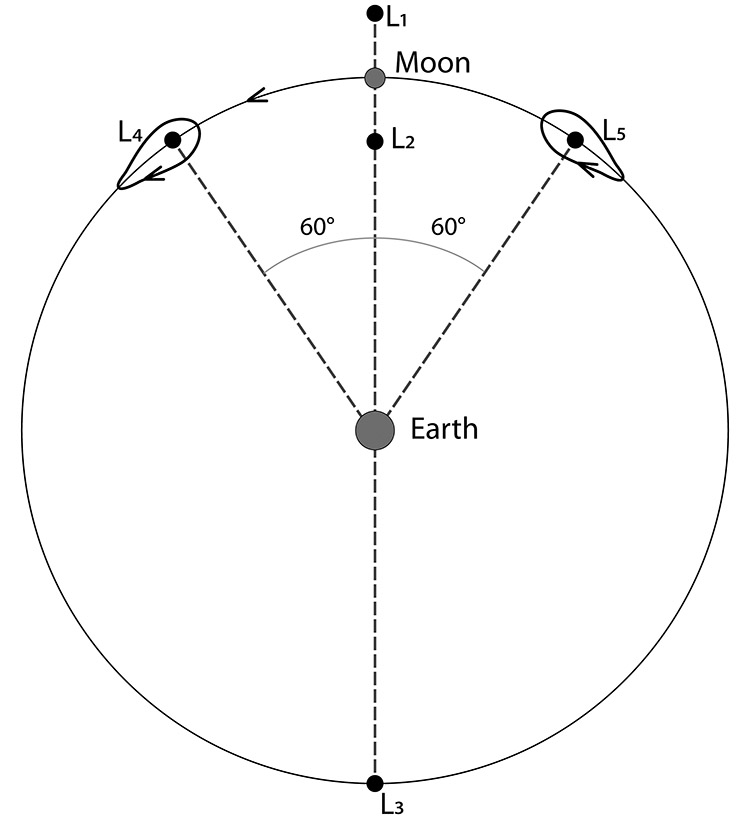
    This diagram shows the locations of the ‘Lagrange Points’ known as L4 and L5 of the Earth–Moon system, indicating the positions of the two clouds. In this diagram, the Earth is at the centre, and the Moon directly above it. Although distinct, bounded balls of plasma can form anywhere at modest scales (as for instance, the tiny balls of ball lightning on the Earth), for really big ones in space it is helpful for them to come to rest in spaces free of gravitational pulls, and when such a niche appears it is pretty certain that it will soon be filled by plasma which will form a ball as big as the niche allows. And that is why the L4 and L5 points are perfect homes for huge plasma clouds, for they are the only two points between the Earth and the Moon free of gravitational pull from either the Earth or the Moon. The image is not drawn to scale and the relative sizes of the bodies shown here bear no relation to their true sizes; this image is intended solely to show the geometrical spatial configuration. Seen at this scale, the Earth and the Moon would be extremely tiny or perhaps even too small to see. The Clouds can cohere despite being continuously blasted by the solar wind, details of how that happens being explained in the book. (Image drawn for the author by Eric Wright.)

    Plasma Universe

    Astronomers and astrophysicists agree that the Universe consists of 99.9% plasma and at the most 0.1% atomic matter such as we have here on Earth. Our Sun is entirely composed of plasma, and so are all the stars in the Universe. 
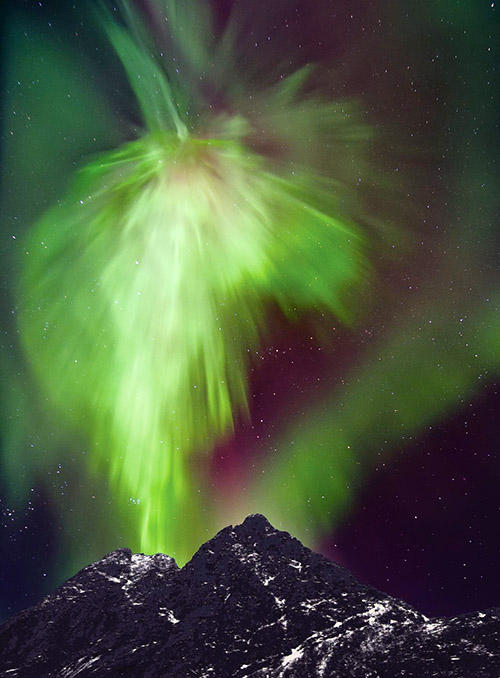
    Solar plasma, ejected from the Sun, is seen here in this aurora, an effect of the plasma penetrating Earth’s magnetic shield. Photograph by Lars Tiede, island of Kvaløya, Norway, 2011. 

    Plasma occurs frequently on Earth because lightning is plasma. When you turn on a neon light, the neon gas in the centre of the tube is changed to plasma, the temperature of which has been measured to be approximately 12,000 degrees Celsius. But despite that, you can hold such a tube in your hand and it feels cool. The surface of our Sun, known as the photosphere, is about half the temperature of the interior of a neon light tube. 

    Knowing this, one begins to understand the weird and wonderful world of plasma. With plasma, the seemingly impossible frequently occurs. Extreme heat and extreme cold can exist side by side inside a plasma because the interior regions or cells are protected by what are called ‘sheaths’, which are double layers of charge.

    Most people have no idea that the Universe is a plasma universe because there has been a massive failure of the media at all levels to report this to the public. Nor is the situation any better in schools and universities. Many ordinary physicists who do not concern themselves with astrophysics have never even heard of this. 

    It is a sad commentary upon the disintegration of Science as a coordinated field of enquiry. The people in one lab simply do not know what the people in the next lab down the hall are doing. Even if they did, the jargon is different in the next lab, certain terms and words are unknown to outsiders, and they even frequently change the conventional uses of mathematical symbols in their equations, so that even the equations, which used to be ‘the Latin of Science’ which could be understood by all, now exist in a fragmented world. The Tower of Babel of Scientific Communication largely collapsed long ago. 

    Self-Organisation & Intelligence

    A large part of my book (which contains no equations!) is devoted to explaining in detail, for the general reader, precisely how a large charged dusty complex plasma cloud can self-organise into an entity even more complex than an organic body. 

    Such a cloud becomes filled with filaments carrying currents, which act like blood vessels, or cells which act like organs, of semi-conductors which modulate current flow, of current pinches which act as nodes and so on and so on. 

    All that I have said is based upon sound scientific discoveries. Such plasma clouds can definitely develop an interior structure more complex than an organic body, and by the now recognised processes of ‘emergence’, ‘entanglement’, and self-organisation, can spontaneously develop intelligence. 

    The Kordylewski Clouds are so gigantic that their processing power exceeds by many orders of magnitude all the computers and brains on Earth. Furthermore, the Clouds are apparently billions of years old, whereas humans have only existed for about two million years. Anyone who needs convincing about all of this will find plenty of evidence in the book. And there is an audio book as well, narrated by myself.

    If these giant clouds in space are intelligent entities, what would their personalities be like? Very different from ours. From our point of view they would appear disturbingly aloof and indifferent to our sufferings. They would be interested in events but would not care greatly about how we might feel about those events. 

    I explain at great length why we all exist as double creatures: we all have bioplasma bodies (called souls or spirits in daily speech) and physical bodies which I call “smart overcoats,” jettisoned when they wear out or are destroyed. A plasma cloud would not necessarily waste energy worrying about our ‘deaths’ because they would know that we did not really die, we merely transitioned back to the plasma state. Do I believe that anyone ever really dies? No. I believe we continue to exist, and that therefore we had better take the long view and try to be less obsessed with ‘things’. You can’t take your smart overcoat with you, nor anything you have which is made of atomic matter. 

    UFOs & Ball Lightning

    I suggest that, based on this knowledge, lightning balls and many UFOs are likely to be plasma drones. There are thousands of reports of ball lightning seeming to be intelligently directed, inspecting things for instance. I suggest that they are constantly prowling around looking at everything as drones. And as for UFOs, while I would never presume to try and explain all of them, when you know enough about plasma it is painfully obvious that many of them must be plasma entities, presumably controlled either remotely or by robotic means based on miniature super computers. As to whether they contain creatures, that is another matter. But if one presumes that the creatures called ‘the greys’ really exist (I have no idea, and have never encountered one), it seems to me likely that they would be semi-organic robots. 
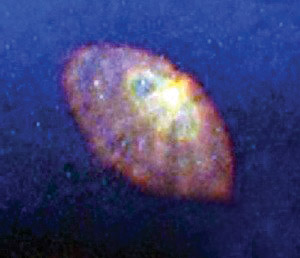
    Have the Kordylewski Clouds ever attempted to communicate with us? I believe they have. But no one ‘gets it’. We need to smarten up. If we really want to find extraterrestrial life, it is not necessary to look even as far as the Moon. It’s right here.

    What’s more, the Universe is clearly filled with dusty complex plasma clouds, most of them presumably of gigantic intellectual capacity, at all scales. Our Sun is probably alive and conscious. All stars presumably are. And the vast nebulae and clouds throughout space both within and beyond our Galaxy must be inorganic intelligent entities. In other words, inorganic life forms dominate the Universe, and have done so for billions of years. The truth is, therefore, that the Universe is an endless society of beings. And they are not like us. They have charged particles flowing through their ‘veins’ rather than blood. And our local Kordylewski Clouds, which may seem enormous to us, are small fry. 

    Get the issue this article appears in

    A New Science of Heaven

    Are the Kordylewski Clouds hostile to us? Hardly likely, as we would not have survived if that were the case. And they must have some reason to want us and need us. They may even have arranged for organic life to appear here in the first place. It may be that the Clouds wish to engage in dialogue with us. After all, being inorganic themselves, they may wish to experience vicariously through us what organic life is like. This would be part of their intellectual curiosity. They may regard us as their probes. Without intelligent organic beings they could never hope to do this directly. We may therefore, despite our small size and seeming insignificance, be part of what they hope to make into a shared experience. Without us, they are missing an entire aspect of Reality. And they must know this.
    The first thing we need to do is wake up and realise that inorganic beings exist. Then we need to gather our thoughts and think this through. If the Kordylewski Clouds and our Sun are conscious, intelligent inorganic beings, then we are part of the family. We are all here in the same solar system together. Let’s get talking. 

    Finally, I wish to make clear that I believe that there is a ‘plasma world’ which is essentially what religious people have always called ‘the spiritual world’. It is the same as a ‘parallel world’ or ‘a world in another dimension’, except that it is not in another dimension, it just seems as if it were. It is invisible to us because we and our sensory organs are made of atomic matter, which cannot perceive plasma matter unless the plasma is glowing or shining. Cold plasma is dark and emits no light. I believe that ‘dark matter’ is really plasma which is in the dark mode, and hence invisible to observation. 

    The age-old argument between science and religion can be resolved as follows: the materialists are correct, in that ‘the Other World’ is not immaterial, but is made of matter. But the religious spiritual people are also correct, for there is indeed ‘another World’. All we have to do is understand plasma, and we can stop wasting our breath disagreeing with one another and settle down instead to trying to understand Plasma Reality. 

    We ourselves are plasma beings who have come here temporarily, donning our ‘smart overcoats’ for a brief sojourn in ‘the physical world’ in order to test our characters against all the obstacles it presents to us and experience successes and failures, loves and losses, ups and downs, in the wild tempestuous world of physical matter.

    Robert Temple’s A New Science of Heaven (Hodder & Stoughton) is available from all good bookstores. A review of A New Science of Heaven can be read in this issue of New Dawn.

    [alert type=”general” dismiss=”no”]This article was published in New Dawn 192.[/alert]

    [alert type=”success” dismiss=”no”]If you appreciate this article, please consider subscribing to help maintain this website.[/alert]

    © New Dawn Magazine and the respective author.
    For our reproduction notice, click here.
  • The True Story of Archaic & Predynastic Egypt

    The True Story of Archaic & Predynastic Egypt

    From New Dawn Special Issue 13 (Sept 2010)

    In my book Egyptian Dawn, I challenge many aspects of the conventional opinions about the history of Egypt before 2000 BCE. Not only do I put forward a lot of new evidence, I show that some of the old evidence is faked.

    For instance, it can be demonstrated that the Egyptian annals known as the ‘Cairo Fragments’ are the product of antiquities forgers in 1909/10. These were sold in the Cairo Bazaar in 1910 and credulously accepted by most Egyptologists. As a result, large portions of the reconstructed history of Archaic Egypt are false.

    My colleague Professor Ioannis Liritzis, of the University of the Aegean at Rhodes, and I have re-dated several key Egyptian monuments using a revolutionary new dating technique. It is called optical thermoluminescence (not the same as ordinary thermoluminescence which is used for pottery). It was invented by Ioannis, who as a former nuclear physicist has come up with this new method for dating stone structures directly for the first time. Most of our results show that the structures tested are older than they should be.

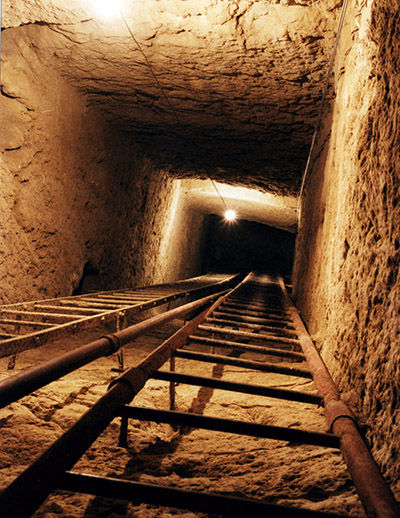
    From the sarcophagi within it, we have dated the famous Osiris Shaft which extends 114 feet below the surface of the Giza Plateau, and made surprising discoveries about it. We have re-dated the pyramids of Giza and proved that they could not have been built by Cheops, Chephren, and Mycerinus.

    A 75 foot drop down the central portion of the Osiris Shaft at Giza. Photo courtesy of Robert Temple.

    I describe the suppressed details of the royal pyramid of King Enezib, fifth king of the First Dynasty, at Saqqara, which was 75 long and 43 feet high, but is never mentioned in histories of pyramid evolution because it is ‘too embarrassing’. I show the surprising connection between it and the Step Pyramid of the later King Zoser, built by Imhotep. I translate for the first time the names of seven predynastic kings of Lower [northern] Egypt which are recorded on the Palermo Stone, an ancient annal.

    I believe I have discovered the precise locations of no fewer than seven intact royal tombs at Giza, and I publish the photos and plans. These include the tombs of Cheops, Chephren, and Mycerinus, which have never been entered since those pharaohs were buried. Those pharaohs were never buried in pyramids as naively imagined today, but within the Plateau, as insisted upon by Herodotus as long ago as the 5th century BCE, though everyone ignores his explicit statements because of ‘consensus blindness’. I believe the tomb of Sneferu is also one of them.

    As for the other three, I do not know whose they are. One is probably a gigantic Hall of Sokar (later referred to as Sokar-Osiris, Ptah-Sokar-Osiris, or simply as Osiris). This may be what enthusiasts tend to call ‘the Hall of Records’. A much larger ‘Tomb of Osiris’ is probably down there than the tiny one at the bottom of the Osiris Shaft. It would contain another subterranean canal surrounding an island with a sarcophagus, but on a very grand scale. I have discovered evidence connecting King Send (Sened), fifth king of the Second Dynasty, with Giza. It is possible that he is buried there. Only excavation and opening of these sealed time-capsules will answer our questions.

    I have been able to prove that large underground caverns were hollowed out of the limestone plateau of Giza, and that enormous complexes of subterranean chambers exist beneath the Giza Plateau, as many people have long suspected. I suspect that these locations must contain texts as well as the usual treasures, gold, etc. Frankly, I am more interested in texts than gold. Any sensible person would be.

    I have previously suggested in my earlier book The Sphinx Mystery (2009) that the Giza Plateau was a unified design complex, and that all three main pyramids and the Sphinx were constructed as one single concept. I produce much more proof of this in this new book.

    I have been able now to reconstruct the remaining two (of three) superimposed ‘Giza plans’ which explain the essentials of Giza. They consist of two separate but overlapping squares. One I call the ‘Shadow Square’ and the other I call the ‘Perfect Square’. These are merely names I have given them for convenience, but I believe them to be appropriate.

    The fundamental aspects which everyone else has missed in trying to reconstitute the concealed design plans of Giza are these: (1) there are three superimposed plans, each separate from the other, but complementary, and this was done on purpose to prevent anyone from ever discovering more than one, a kind of ‘triple lock’, and (2) the ‘key’ to unlocking the secrets of two of the plans is the shadow cast at noon on the winter solstice by the Great Pyramid. (Hence the name ‘Shadow Square’.) If you do not take this shadow into account, you cannot find the true northern boundaries to the Giza Plans. (One of them has the shadow tip define that distance, and the other is a secondary derivative of it.) In my study of the geometry of Giza I have achieved an accuracy to within two feet in an area of just under 11 million square feet.

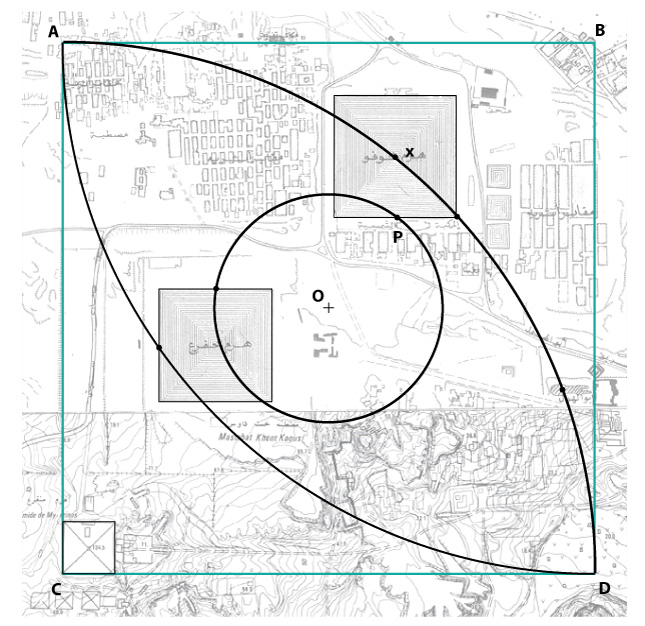
    The ‘Perfect Square’ of Giza gives an Eye of Ra design staring up at the zenith of the sky. I reproduce this here (see illustration, courtesy of Robert Temple, on page 41). Only if this particular square is used can a compass point put at the NE and SW corners of the square swing arcs which make the vesica piscis (which constitutes the Egyptian hieroglyph for the letter ‘r’, thus writing ‘Ra’ or ‘Re’, and which also means ‘fraction’ in Egyptian mathematics) that cuts key points on the Giza monuments. When the correct circle is drawn within this using the centre of the Square as its origin, to form the iris of the eye, an Eye of Ra intersecting six key points is formed staring straight up at the sky.

    This Eye of Ra occurs throughout the entire history of Egyptian art for thousands of years. But its largest and finest expression was the invisible Eye of Ra formed upon the Giza Plateau as a consequence of the Giza Plan which gave rise to the precise sizes and positions of the three main pyramids. The Eye, seen in the illustration, intersects the apex, southeast corner, and midpoint of the base of the south face of the Great Pyramid, the midpoint of the Sphinx, and the midpoints of the bases of the northern and western faces of the Pyramid of Chephren.

    ‘The Eye of Ra’ at Giza. This can meaningfully be inscribed only in the Perfect Square (where it intersects many key points of the monuments), not in the Shadow Square (where it intersects none). If you put a compass point on B and inscribe an arc between A and D, and put a compass point on C and inscribe an opposite arc between A and D, you get the eye shape. In geometry this is known as a vesica piscis, and is usually derived by the intersection of two circles of equal size. It is the Egyptian hieroglyph for the letter ‘r’ and in Egyptian mathematics it is also the sign meaning ‘fraction’. Since the Egyptians did not write vowels, it also means ‘Re’ or ‘Ra’, which is the name of the sun god. This inscribed hieroglyph intersects (1) the apex of the Great Pyramid, (2) the southeast corner of the Great Pyramid, (3) the midpoint of the waist of the Sphinx, (4) the midpoint of the base of the western face of the Pyramid of Chephren. If you take a compass point and put it on the centre of the Perfect Square, point O, and draw a circle of radius OP, it intersects both point P (the midpoint of the base of the southern face of the Great Pyramid) and the midpoint of the base of the northern face of the Pyramid of Chephren. The ‘Eye of Ra’ thus intersects six key points of the monuments within the Perfect Square of Giza. Because these are curves inscribed on the sloping surface of the Plateau rather than straight lines, as we find with all the other monument point correlations, the accuracy is slightly fuzzier than it is with the straight lines, and may be within a few feet of some points rather than within only one or two feet. However, as the Perfect Square contains nearly 11 million square feet, such a slightly diminished level of accuracy is still rigourous and acceptable. This ‘Eye of Ra’ gazes straight up at the sky, at the central point which we call the zenith. It is a fitting symbol of the solar nature of the entire Giza complex. (source: http://www.egyptiandawn.com/chapter1.html)

    One might well wonder why the ancient Egyptians should go to all this trouble to design an Eye of Ra which no one could ever see, and which is invisible, and even if it weren’t could only be seen looking down from the sky, since it exists only on a geometrical plan or in the mind, and nothing whatever can be seen on the ground. The answer to this may well be found in a strange text surviving amongst the collection of ancient wisdom texts known as the Hermetica, Tractate Five. (These texts are of mixed date, having been written in their present form in Greek under the rule of either the Ptolemies or the Romans, thus possibly as late as the 2nd century CE.) Many of them were reworked as Greek philosophical works mixed with ancient Egyptian material in a complete hodgepodge. No one has ever been able to come up with a definitive list of which material is Egyptian and which is Greek, as these are all mixed up, though a few of the tractates such as this one seem relatively undiluted. In this text, the Egyptian god of wisdom and writing, Thoth (in the guise of his Greek name, Hermes), is addressing his disciple called Tat:

    You must understand how something that seems invisible to the multitude will become entirely visible to you. Actually, if it were not invisible, it would not always be. Everything seen has been begotten because at some point it came to be seen. But the invisible always is, and, because it always is, it does not need to come to be seen. …Clearly, the one who alone is unbegotten is also unimagined and invisible… understanding… is invisible, sees the invisible, and if you have the strength, Tat, your mind’s eye will see it. …Can you have a vision of the image of god?… If you want to see god, consider the sun. …Would that you could grow wings and fly up into the air, lifted between earth and heaven, to see the solid earth… Oh, this is a most happy sight to see, my child… This is the order of the cosmos, and this is the cosmos of order.

    The answer is that the ancient Egyptian priests believed that the true image of the divine could only be invisible. This is the deeper truth of the Egyptian sacred mysteries, ironical in a civilisation normally believed to worship idols. In fact, the Egyptian did not ‘worship idols’ in the sense we think of those words at all. There was no word in ancient Egyptian meaning ‘belief’, just as there was no word meaning ‘religion’. They communed with the cosmic order, and all the gods and goddesses were personified images and facets of that One.

    Just as your parent or your spouse may keep an album or a computer folder of photographs of you, all different, some smiling, some frowning, some dressed as Santa Claus, so the Egyptians had their portrait gallery of the One Supreme Being looking like different personifications of the endless aspects of himself/herself, arrayed as statues and relief carvings and paintings in all the temples throughout the land. At one moment, God was Osiris, at another moment God was Isis, and at yet another God was Amun, which significantly means ‘the Hidden One’ who cannot be seen and is invisible. I believe that the sacred concept that the invisible is more important than the visible existed from predynastic times in Egypt and explains the thinking behind all the empty sarcophagi, tombs, pyramids, and secret chambers.

    What I have just said about invisible patterns does not appear in my book, it is an extension of what that book contains. Amongst the many other ‘invisibles’ and hidden things which I reveal is an elaborate network of secret passages, shafts, and chambers riddling the walls of the Valley Temple of Giza like a honeycomb. The book and its website www.egyptiandawn.com contain many, many photos of these previously unknown features of the only intact temple surviving from the Old Kingdom of Egypt. I have also translated from German the only excavation report of this structure, published in 1912, which does not mention these passages and chambers at all. This translation can be downloaded from the book’s website.

    Oh yes, and I almost forgot to mention that the final chapter of the book contains a solution to the riddle of Atlantis. What and where was it? Did it have any connection with ancient Egypt? All this is answered. I also publish photos and a description of the world’s largest megalithic ring, of which few people have until now had any knowledge at all.

    Illustrations courtesy of the author. Egyptian Dawn by Robert Temple is available from all good bookstores.

    [alert type=”general” dismiss=”no”]This article was published in New Dawn Special Issue 13.[/alert]

    [alert type=”success” dismiss=”no”]If you appreciate this article, please consider subscribing to help maintain this website.[/alert]

    © New Dawn Magazine and the respective author.
    For our reproduction notice, click here.
  • Who Was Moses?

    Who Was Moses?

    From New Dawn Special Issue 8 (June 2009)

    When people are spoken of constantly, we feel we know them. Christians and Jews have been talking about Moses for thousands of years, so they assume they know who he was. But is this an illusion? Is it possible that no one really knows who Moses was? That the evidence about him is contradictory and enigmatic? Is it even possible that he never existed except in fable?

    Even religious fundamentalists have an immediate problem with Moses, and the accounts of him in the biblical Book of Exodus. People who fanatically believe that every word written in the Bible or the Torah is somehow ‘the word of God’, ‘written by God’, or ‘inspired by God’ (these claims vary and are rarely defined with any degree of precision), are faced with serious contradictions in the biblical text itself.

    Near the beginning of Exodus, God speaks to Moses from a burning bush at Mount Horeb in Sinai and tells him to go back to Egypt. So Moses, not wishing to be impolite to an unknown entity who has spoken to him from a burning bush in no uncertain terms, duly begins to travel to Egypt as instructed. But what happens next? Suddenly we are told in Exodus, Chapter 4, 24-27:

    During the journey, while they were encamped for the night, the Lord met Moses, meaning to kill him, but Zipporah [the wife of Moses] picked up a sharp flint, cut off her son’s foreskin, and touched him with it, saying, “You are my blood-bridegroom.” So the Lord let Moses alone. Then she said, “Blood-bridegroom by circumcision.”

    Can anybody explain what is going on? Here the supposed ‘Word of God’, i.e., the Bible, says the entity calling himself God instructs Moses to drop everything and rush off to Egypt, and then the same entity meets him on the way with the intention of killing him. This homicidal impulse is however appeased by Moses’s wife grabbing a sharp flint and circumcising her son and claiming that he is her bridegroom. This all sounds more like an incident from a really bad Hollywood horror movie. And as for the actions of Zipporah, it is more like the kind of thing one might expect at a voodoo rite in Haiti than what one would expect from the wife of such a reputedly sober character as Moses, who is on a mission to Pharaoh to persuade him to “let My people go.”

    As for “the Lord” so-called, he seems capricious at best and a homicidal maniac at worst. There is no need for us to assume, as so many have uncritically done for millennia, that “the Lord” of Moses had anything whatever to do with God. The world is full of paranoid schizophrenics who hear voices and believe that ‘God has spoken’ to them. If all of these people were to be believed, there would be tens or hundreds of thousands of ‘Gods’.

    In order to try to figure out more about this puzzling episode from the Bible, I turned to a volume I have in my library which is a commentary on Exodus published by a biblical scholar named A.H. McNeile. He says:

    The narrative in these three verses appears, from its contents, to be one of the oldest portions of the Bible. Its antiquity is shewn [sic] by the use of the flint knife, and by the part circumcision plays according to the belief of the actors.1

    McNeile then goes on to add that the text really says of the foreskin that she “made it touch his feet,” but he says that is a conventional euphemism of the time which really means touching her “pudenda,” i.e. her genitals.

    If we are to believe this remarkable bit of information, we are faced with the undignified magical scene of the superstitious wife of Moses circumcising her son and pressing his bloody foreskin to her vagina and pronouncing him her bridegroom, or as McNeile translates her words: “A bridegroom of blood art thou, because of the circumcision.”

    For some reason not explained at all, Yahweh is appeased by this and decides not to murder Moses after all. I ask any rational person: is such a Yahweh to be identified with ‘God’? Do all the people who attend church and synagogues seriously believe that ‘God’ wanted to murder Moses on his way to Egypt but was appeased by this tawdry bit of superstitious magic?

    The confusion over the true nature of Moses probably reached its most extreme form at Petra. Many tourists have now visited the amazing enclosed city of Petra in modern Jordan, which is reached by passing through a narrow crevasse in a cliff face. It is one of the surviving archaeological wonders of the world. Epiphanius of Salamis (who lived circa 310/320 CE – 403 CE) recorded in his book The Panarion, sometimes known as his book Against Heresies:

    The profundities and glories of the sacred scripture, which are beyond human understanding, have confused many. The natives of Petra in Arabia [modern Jordan], which is called Rokom and Edom, were in awe of Moses because of his miracles, and at one time they made an image of him, and mistakenly undertook to worship it. They had no true cause for this, but in their ignorance their error drew an imaginary inference from something real.2

    I wonder how many tourists going to Petra realise that they are going to the only place in the world where Moses was worshipped as a god. That’s not something you would be told by your tourist guide!

    In the second century BCE, a Jewish playwright named Ezekiel lived at Alexandria in Egypt, and he wrote a drama in the Greek style called ‘The Exodus’, in which Moses was the leading character. This play survives only in extended fragments preserved by Eusebius (circa 263 CE – 339 CE) in his book The Preparation for the Gospel, which he took from an earlier historian named Alexander Polyhistor. The text of the play is largely lifted from the Bible, with flowery language and interpolations, as shown by this monologue by Moses:

    Ha! See! What sign is this from yonder bush?

    A marvel such as no man might believe.

    A sudden mighty fire flames round the bush,

    And yet its growth remains all green and fresh.

    What then? I will go forward, and behold

    This wondrous sign, that passes man’s belief.3

    From this, we can see that Ezekiel was no Shakespeare, and his task was a simple one, to dramatise the story of the Book of Exodus in a straightforward and rather unsubtle manner for the stage, so that the Gentiles of Alexandria could have the Jewish legends presented for them in an outdoor theatre. It was a bit like producing a soap opera for mass television, but it was two thousand years ago. One does not read anything about this play in the histories of the theatre, but it deserves a mention. It was probably much less corny than Cecil B. DeMille’s film about Jesus, ‘King of Kings’, which I had to sit through several times at the Roman Catholic school I attended as a child (an experience which helped put the finishing touches to my lack of affection for the Catholic Church).

    The Staff into Snake into Staff Trick

    Children who read the Bible always remember the vivid incident where Moses throws his staff on the ground before Pharaoh and it becomes a snake, and then he picks the snake up and it becomes a staff again. Actually, this is how we remember the tale but in fact the Bible says that Aaron, not Moses, does this before Pharaoh. In Exodus 4, “the Lord” and Moses have this dialogue:

    Moses answered, “But they will never believe me or listen to me; they will say, ‘The Lord did not appear to you.’” The Lord said, “What have you there in your hand?” “A staff,” Moses answered. The Lord said, “Throw it on the ground.” Moses threw it down and it turned into a snake. He ran away from it, but the Lord said, “Put your hand out and seize it by the tail.” He did so and gripped it firmly, and it turned back into a staff in his hand. “This is to convince the people that the Lord the God of their forefathers, the God of Abraham, the God of Isaac, the God of Jacob, has appeared to you.” (4:1-6)

    Later, the story of the snake continues in Book 7:

    The Lord said to Moses and Aaron, “If Pharaoh demands some portent from you, then you, Moses, must say to Aaron, ‘Take your staff and throw it down in front of Pharaoh, and it will turn into a serpent.’” When Moses and Aaron came to Pharaoh, they did as the Lord had told them. Aaron threw down his staff in front of Pharaoh and his courtiers, and it turned into a serpent. At this, Pharaoh summoned the wise men and the sorcerers, and the Egyptian magicians too did the same thing by their spells. Every man threw his staff down, and each staff turned into a serpent; but Aaron’s staff swallowed up theirs. (7:8-13)

    Even though this seems one of the most unbelievable stories in the Bible, it is curiously enough one of the most convincing (and hence, a source of encouragement regarding the veracity of some of Exodus), because this was a genuine trick of Egyptian magicians which was recreated in the twentieth century.

    The way this trick is done is by means of ‘animal hypnosis’, or animal catalepsy. I described the use of the trick by Moses in my book Open to Suggestion, which was published in 1989. However, the book was only published in Britain, and readers in the USA never saw it. My book was an extremely long survey of worldwide hypnosis research, compiled by me over a period of 15 years. It also contained a survey of 150 years of documented case histories of the criminal abuses of hypnosis. My book so alarmed the hypnosis community and various security agencies (especially my sections on mind control and mass hypnosis), that every effort was made to suppress the book.

    Eight American publishers to whom the book was submitted sent my agent identical letters from two referees (always the same two men in each case, whom I knew personally and strongly disliked) warning them that the book would be a public danger, and they must not publish it. The two referees were not distinguished clinicians or experimentalists, they were functionaries whose job it was to liaise between the security services and the hypnosis community.

    They succeeded admirably in their task, which was to prevent the American public from ever reading such things as this revelation which I made: more than fifty percent of the hypnosis experiments carried out in the United States have been carried out by the government and are classified as top secret. You can understand why my book was considered seriously ‘uncool’ by various grim persons.

    Dr. Franz Völgyesi & Animal Hypnotism

    The man who perfected the ‘snake-into staff-into snake’ trick in the 1930s was one of the most extraordinary characters of his time, a Hungarian psychologist named Dr. Franz Völgyesi. I discussed him in my book, and that was especially unpopular, for reasons which will be clear in a moment.

    In the 1930s, Völgyesi published a book in Hungarian entitled Ember és állat Hypnosis. I’m sorry I can’t translate that, for my Hungarian is rusty. This book appeared in a German translation in 1938, as Menschen- und Tierhypnose (Human and Animal Hypnosis).4 The book was so shocking and astounding that it inevitably came to the attention of the Nazis. I have a copy of this rare book, an item that various interested parties would not like any members of the public to have.

    Völgyesi became the hypnotist-in-chief to the Nazi regime, and considering that Hitler went into spontaneous auto-hypnotic trances nearly every day, it is more than likely that Völgyesi became Hitler’s personal, as well as official, hypnotist. (I have no evidence of that, and I am merely speculating, though I believe, soundly.)

    Völgyesi was given carte blanche by the Nazis to carry out experiments on human beings. During the years between 1938 and 1945, he hypnotised no less than sixty thousand individuals, most of them Jews, Slavs, Gypsies, and leftists who were interned in the concentration camps. He could perform any experiments he liked, without reference to anyone. Considering the detailed evidence which we have of his experiments with dozens of animals, it takes little imagination to visualise what he would have done with sixty thousand human beings to play with.

    There is no doubt whatsoever that Franz Völgyesi was the most experienced hypnosis researcher in the entire history of the world. His research notes on these 60,000 cases ‘vanished’. But he himself did not vanish. He was one of those Germans snatched by the Americans, like Werner von Braun, and taken off to the United States, as a consultant to the security services. His research files probably exist somewhere in a high security archive of the American security services, ‘snatched’ at the end of the war. Someone should make an attempt to have them released through the Freedom of Information Act. I have ceased to pursue this subject, so I leave this task to others.

    In 1963, Völgyesi was allowed to bring out a sanitised second edition of Menschen- und Tierhypnose, and in 1966 this appeared in London in an English translation as Hypnosis of Man and Animals.5 This time, the book appeared with his Hungarian first name of Ferenc rather than his German first name of Franz. (In America he was sometimes called Francis or Frank.) It is possible to purchase occasional copies of this book without too much difficulty.

    In both books, Völgyesi published photos of cataleptic snakes which are stretched straight as rods, and have gone stiff. In the 1938 book, one is seen in Figure 8 on page 16. In the 1966 book, another one (an adder) is seen in Figure 18 in the first plates section. Völgyesi hypnotised just about every kind of animal, bird, or reptile you can possibly imagine. He would enter zoo cages and put bears and lions and crocodiles into trances with the greatest of ease. Many photos of these cataleptic animals are reproduced in his books. I cannot go into this fascinating subject further, and must return to Moses.

    The fact is that any skilled animal cataleptist can turn a snake into a staff and a staff into a snake very easily. Such tricks were standard in ancient times. They were ways of calling attention to oneself as a wise man. And, frankly, if you couldn’t turn a snake into a staff no one would listen to you. So you might say Moses had little choice. And that is why I say that this incident is convincing evidence that there is genuine ancient material in Exodus, since later writers would not have been able to invent such a thing.

    Moses’ Sacred Mountain

    Moses is generally associated with Mount Sinai in the Sinai Peninsula. However, that is the wrong mountain. Although Mount Sinai was also important, it was Mount Horeb where Moses did most of his communing with his ‘Lord’, and where he saw the burning bush. But if you ask any biblical scholar where Mount Horeb is, they cannot tell you. It is officially unknown.

    I am certain that it was the great mountain at Serabit in southwest Sinai. There is specific evidence to support this idea in the writings of Philo Judaeus (20 BCE – 50 CE), also known as Philo the Jew or Philo of Alexandria, where he lived and wrote. He wrote in Greek a lengthy ‘Life of Moses’, which survives in its entirety. Near the beginning of the third book of this treatise, Philo tells us:

    For, having gone up into the loftiest and most sacred mountain in that district in accordance with the divine commands, a mountain which was very difficult of access and very hard to ascend, he is said to have remained there all that time without eating any of that food even which is necessary for life; and, as I said before, he descended again forty days afterwards, being much more beautiful in his face than when he went up, so that those who saw him wondered and were amazed, and could no longer endure to look upon him with their eyes, inasmuch as his countenance shone like the light of the sun.6

    Tourists often comment about how easy it is to ascend Mount Sinai, which goes completely against this evidence. On the other hand, the sacred mountain at Serabit in Sinai, much further south, which I believe to be the biblical Mount Horeb, is notoriously difficult to ascend. There is a great deal of crucial archaeological evidence about Serabit to support this hypothesis, but it is too lengthy and detailed to give here.

    A magnificent ruined Temple of Hathor survives at the top, which dates from the Middle Kingdom period. It is known that the site was shared between the Jews and the Egyptians. Excavations have uncovered beneath the floor of the temple extremely thick layers of ash from offerings made on the mount before the temple was built, and it was admitted by Sir Flinders Petrie and other Egyptologists that this was clearly the famous ‘High Place of Burning’ of the early Jews before the time of the ‘Lord’ of Moses, who came to be known as Yahweh, and when the Jews still worshipped the deity or deities whom they called El, Elyon (the Canaanite form of the name), or Elohim (Elohim being a plural form of the name).

    Apparently, during the period when Sinai was under Israeli occupation, General Moshe Dayan was so interested in Serabit that he had an entire Hathor column lifted out by helicopter and flown back to Israel, where he placed it in his private garden. That is not the correct way to behave! I hope that, since his death, it has at least gone to a museum somewhere.

    I have elsewhere written about the associations of Moses and the early Jews with Serabit, and cannot repeat all of that here. I also have suggested that Jesus spent his forty days in ‘the wilderness’ at this same spot, in emulation of Moses, who spent forty days on this very mountain.

    I think I should explain once again one other detail of the account in Exodus, which is the so-called ‘golden calf’. The explanation for this is that it was a Hathor-face, a wild cow’s face, and which to someone unfamiliar with Hathor traditions looks like the face of a calf. Philo specifically tells us that the misbehaving Jews who made the golden calf did so for this reason:

    …they made a golden calf in imitation of the Egyptian worship and folly and established dances and prepared an altar…7

    The only ‘calf’ worshipped by the Egyptians was the Hathor face, which looks like a calf to the uninitiated. Public dances were an integral part of Hathor worship at festival time, and were common at the Temple of Hathor at Denderah, so would have been common at Serabit as well. There were altars of Hathor at Serabit, and of course her huge temple, much of which remains, though it is never visited by tourists, and there is no road to it.

    As for the gold used to cast the golden calf (the Temple of Hathor must have been full of these), it is explained by the fact that Serabit was from Old Kingdom times a famous mining and metallurgical centre, where carvings of Pharaohs Cheops and Sneferu were engraved on the rocks. It was the main source of Egyptian copper for millennia. Gold was also processed and cast there, and the metallurgical workers were traditionally the Jews, who had a permanent settlement at the foot of the mountain. These Jews would have been respectful to Hathor because they were thoroughly Egyptianised. This was intolerable to the purist Moses, and with the aid of the Levites, he massacred 3,000 of them in the name of his ‘Lord’, Yahweh.8

    At other times he massacred other people, and so he was not a peaceful sort of fellow by any means. We don’t really know who he was, although he clearly was born in Egypt and grew up there. It is all very mysterious. But I, for one, am glad not to have met him, as he was not someone to mess with, and I would probably have said something sarcastic and been ‘massacred’. After all, Moses was into commandments. And some of us don’t like authority.

    [alert type=”general” dismiss=”no”]This article was published in New Dawn Special Issue 8.[/alert]

    [alert type=”success” dismiss=”no”]If you appreciate this article, please consider subscribing to help maintain this website.[/alert]

    Footnotes:

    1. A. H. McNeile, The Book of Exodus with Introduction and Notes, Westminster Commentaries, Methuen, London, 1908, p. 27 notes.

    2. Frank Williams, translator and introduction, The Panarion of Epiphanius of Salamis, Brill, Leiden, Netherlands, 1994, p. 78 (IV, 1, 9).

    3. Eusebius, Praeparatio Evangelica (Preparation for the Gospel), translated by Edward Hamilton Gifford, 2 vols., Oxford, 1903, Baker Book House, Grand Rapids, Michigan, USA, reprint of 1981; Vol. I, p. 470 (IX, 29, 440).

    4. Franz Völgyesi, Menschen- und Tierhypnose (Human and Animal Hypnosis), translated by L. Ofner, Orell Füssli Verlag, Zurich and Leipzig, 1938.

    5. Ferenc András Völgyesi, Hypnosis of Man and Animals, second edition revised in collaboration with the author by Gerhard Klumbies, Ballière, Tindall & Cassell, London, 1966.

    6. Philo, ‘On the Life of Moses’, in The Works of Philo Judaeus, translated from the Greek by C. D. Yonge, 4 vols., Henry G. Bohn, London, 1855; Vol. III, p. 89 (III, 2).

    7. Ibid., p. 132 (III, 37).

    8. Ibid., pp. 109-110 (III, 20).

    © New Dawn Magazine and the respective author.
    For our reproduction notice, click here.

  • What was the Sphinx?

    What was the Sphinx?

    From New Dawn 112 (Jan-Feb 2009)

    There has never been a satisfactory answer to what the Sphinx actually is or was. Anyone who goes to Giza can see for himself or herself that there is something ‘wrong’ with the Sphinx. It only takes an instant. The body is gigantic and the head is just a pimple. The Egyptians never did anything like that, they were always meticulous about proportions in their art. So how is it that we have this monster with a tiny head sitting there in the sand, then?

    There are several other things wrong with the Sphinx. They are:

    • The back is flat. Who ever saw a lion with a flat back, no big chest, and no mane?
    • The Sphinx is sitting in a deep hole in the ground. Why is that? Why is it not sitting somewhere high up so that it can show off?
    • There is a ruined temple right in front of the Sphinx, with a wall practically up against its nose, and no door in that wall. Why obstruct the view of the Sphinx from the front like that? And if the temple was for worshipping the Sphinx, why is there no access from the temple to the Sphinx, so that you can’t even get to it?
    • The pit in which the Sphinx sits seems to be deeply eroded, as if by flows of water. What caused all that? It looks as if water has poured down the sides. On the other hand, there are no such vertical erosion patterns on the Sphinx itself, which instead has clear horizontal erosion patterns. How can these two different patterns at right angles to each other be reconciled? And what could possibly have caused either of them?

    None of this makes any sense if you think about it. Of course, many people don’t think. They just gawp and move on, their brains in neutral.

    But when my wife Olivia and I first saw the Sphinx many years ago, we just stood there in astonishment and both agreed that the whole thing was wrong, wrong, wrong.

    So now after many years of work, we think we have found some answers. Naturally, any new idea about anything that ‘everybody knows’ makes (1) conventionally thinking people enraged, and (2) makes anti-establishment people delighted. No prizes for guessing which side I’m on.

    Let me first declare my position on what has become something of an entrenched notion amongst my fellow anti-Establishmentarians. I do not believe that the Sphinx is 12,500 years old. Nor do I believe in ‘ancient rain’.

    I do believe that the Sphinx is older than conventionally believed. But I do not believe it is thousands of years older, or anything of that kind.

    I do believe there is water erosion at the Sphinx site, but I do not believe it had anything to do with ‘ancient rain’, nor do I believe there was anything there to be eroded at the time any ‘ancient rain’ fell.

    So what is the answer, then?

    Sphinx Island & Moat

    The water of the Nile in those days, at the time of inundation once a year (which no longer happens because of the Aswan dam), came right up to the edge of the Sphinx Temple, where there are even quays in front. So what I believe happened was that the water of the Nile was let into the Sphinx Pit, which I now call the Sphinx Moat, by some simple water-raising devices, led along the narrow channel between the Sphinx Temple and the Valley Temple (the two structures in front of the Sphinx), and its flow was controlled by a series of sluices and water gates. The signs of these sluices and gates, with their many bolt holes and so forth, no longer exist, because new stones and cement have been laid over them. But not to worry! I took plenty of photographs of them before they disappeared, and those are all reproduced in our book. Everyone can then see it all very clearly. The reason why the temple wall is in front of the Sphinx is to act as the fourth barrier to the water. The reason why there is no door in the wall is that it would have let the water out.

    The horizontal erosion on the side of the Sphinx (where it is not covered by ‘restoration stones’) is because the Sphinx was sitting in the middle of a moat filled with water. The vertical erosion on the sides of the pit, especially the south side, is because of the continual dredging of the Moat due to the windblown sand accumulating there. Every time the Moat was dredged, water poured down in torrents onto the sides, leading to vertical erosion, accentuated by the natural cavities in the limestone bedrock.

    So I think the Sphinx was, amongst other things, an island!

    This immediately solves the puzzle of the evidence recorded by the fifth century BCE Greek historian Herodotus, who said that King Cheops let water in from the Nile to surround an island at Giza. Here it is!

    Whose Head is on the Sphinx?

    So we have got an island. Now what do we do with it? And why is King Cheops’s head the size of a pimple on the front of this large flat-backed lion, surrounded by water? What’s going on?

    But wait! Who says that is King Cheops’s head? Some say it is King Chephren’s head, but if you have ever seen Chephren’s head on that huge statue in the Cairo Museum, you know they look nothing alike at all, since Chephren has a long face and the Sphinx has a round face, just for starters, and there’s plenty else that’s not the same too.

    At this point of my wonderings, I began to feel really uncomfortable. I generally know when something doesn’t fit. I may not know what does fit, but I more often know what does not.

    And that face is neither Cheops (not that we know what he really looked like anyway, as the only likeness of him that survives is a three inch-high ivory statuette, which could be your Uncle Tony or even your Auntie Madge for that matter) nor old Chephren Long-Face. So who is it?

    It was at this point that I discovered one of those forgotten sources which keep falling into my lap, and in this case it was an article written by a German archaeologist named Ludwig Borchardt long before the Sphinx was excavated, when only its head and neck were sticking above the sand. Borchardt used to go and stand there and look at it. In those days, you could look the Sphinx in the eye and he wouldn’t even flinch, in fact he smiled back. Nowadays, he’s very stuck up, with his head high above us if we stand at his feet, so you can’t make out the details of his head all that well.

    Borchardt got to thinking. He noticed that the Sphinx was wearing eye-paint stripes (no comment, pharaohs have the right to do what they like as consenting adults in the privacy of their own Sphinx Pits), and he knew that those were not worn in the period known as the Old Kingdom, when Cheops and Chephren lived. He noticed the details of the stripe patterns in the strange headdress worn by the Sphinx. The face had to be that of a pharaoh, since this headdress was the sacred religious headdress of the pharaoh known as a nemes. But Borchardt, who was head of the German Institute at Cairo and therefore knew a thing or two, realised that those stripe patterns were also not used in the Old Kingdom.

    He started to do some research on nemes headdresses, and he discovered that those particular stripe patterns were only used in the Middle Kingdom period, hundreds of years later than Cheops and Chephren. He wrote this all up in technical form and published it in a distinguished scholarly periodical (in German of course, but I have translated it and it appears as an appendix to our book), and concluded that the Sphinx had been carved in the Middle Kingdom Period, not in the Old Kingdom period.

    But everybody laughed at poor old Borchardt. Who ever heard of such a thing? The Middle Kingdom! Borchardt must have gone crazy! And then the Sphinx was excavated in 1926, and finally completely excavated in 1936, and it was perfectly clear to everyone that the Sphinx was much older than the Middle Kingdom. But everybody forgot that Borchardt had never seen the Sphinx’s body at the time he wrote the article, he was only talking about the head.

    So I have reopened the case and concluded that the head was recarved in the Middle Kingdom, just as Borchardt said, and what is more, I believe I can even identify precisely which pharaoh’s face that is. Of course, to find that out, you really need to see the book.

    However, it is all very well identifying the face on the Sphinx. Some people might be satisfied just doing that. But no, it’s like watching a film noir without knowing the ending. Even if you know whodunnit, you still want to know the motive.

    “Everybody knows” Herd Mentality

    So what was the Sphinx before it had that guy’s face carved on it? Well, to figure that one out you have to try to figure out what the Sphinx was before that pharaoh got his chisels on it. This draws one’s attention to the flat back. “Everybody knows” that the Sphinx has the body of a lion. As soon as I hear that “everybody knows” something, I know that it must be wrong. I have a pathologically anti-herd mentality. All you have to do is tell me “everybody knows” something, and I will instantly disbelieve it. That is because crowds are always wrong. Crowds have about as much sense as a mollusc.

    I started from the premise that the Sphinx was not a lion at all. Millions of people see it every year, from all over the world, and they all “know” that it is a lion. So that means that it cannot possibly be one. They “know” it is a lion because they have been told that it is a lion. The Germans were told that Hitler was their saviour and so they “knew” it, the Russians all “knew” that Stalin was like a gentle father, who would look after them. Yes, everybody, or at least everybody they knew, “knew” these things. And people also all once “knew” that the Earth was flat, and that the Sun went round the Earth. Those things were all “known.” But were they true?

    If it wasn’t a lion, what was it? Well, it had to be an animal with a straight back, with no huge chest, and no mane. It also had to be an animal that crouched like that with its legs stuck out in front of it. (There is no use looking too closely at the paws, as they are completely covered in restoration stones, and have been shaped to look like “what everybody knows,” in order to re-confirm the consensus falsehood which everybody has agreed to believe in.)

    Anubis – Guardian of the Necropolis

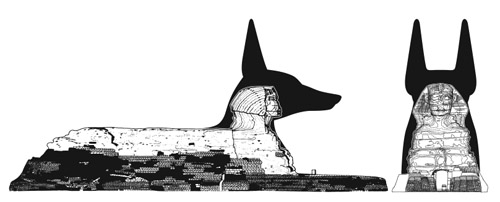
    The Sphinx is crouching there at the entrance to the Necropolis like a guardian. Well, there it is! It is a guard dog! The ancient Egyptians had a god called Anubis, who was a crouching wild dog, generally referred to as a jackal (although strictly speaking there were no jackals in Egypt, and Anubis was really a wild dog species which is now extinct). Anubis was the guardian of the Necropolis, the guardian of the dead, and he was often depicted in the precise position of the Sphinx – and famously in a statue found in the Tomb of Tutankhamun as well – so that his image is familiar to almost anyone who has ever had an interest in ancient Egypt.

    Anubis001

    In Figure 1 I show the drawing I commissioned which shows how the recarved head of the Sphinx was carved out of the neck stump which remained on the Sphinx after the original statue was mutilated by the rampaging mobs who smashed up everything they could on the Giza Plateau during the period of chaos known as the First Intermediate Period, between 2200 and 2000 BCE.

    It was the easiest thing in the world to knock the ears and nose off the Sphinx when the Sphinx was Anubis. You couldn’t put them back because the Sphinx was carved out of the solid bedrock, and the pieces must have been smashed to bits anyway. So the later exhibitionist pharaoh could even tell himself he was doing a pious act and ‘restoring’ the statue by flaunting himself, just as, say, Madonna helps the world, doesn’t she? Tom Cruise is also saving the world, remember? Yes, we all know that all celebrities are getting their pictures in the papers only for noble causes, and it has nothing to do with wanting people to look at them, or with such a low thing as vanity.

    Speaking of movie stars, the Sphinx is now so botoxed and has had so much plastic surgery from crazy ‘restoration’ (which is all shown in great detail in our book) that he could easily get a lead part in a blockbuster. But his ‘nose job’ didn’t go so well, as it is still missing. It was hacked off in the 13th century by a fanatical imam named Sheikh Mohammed, who wished to purge Egypt of non-Islamic influences. He got as far as the nose, at least. (The story that the nose was shot off by Napoleon’s soldiers is false.)

    So now we have a crouching Anubis as an island, surrounded by a little lake. And at last we have something which students of the ancient texts can suddenly recognise. For the most ancient surviving Egyptian texts, known as the Pyramid Texts, often speak of a sacred place associated with the Giza Necropolis called Jackal Lake. And here it is!

    Now we are getting somewhere. It is all beginning to make sense. In our book we gather together the many ancient texts which refer to Anubis guarding the Necropolis, situated at Giza, being beside a causeway, and being very large. We also reproduce Fourth Dynasty Giza tomb reliefs showing a giant Anubis, which may be intended as actual depictions of the Sphinx.

    Secret Chamber Beneath the Sphinx

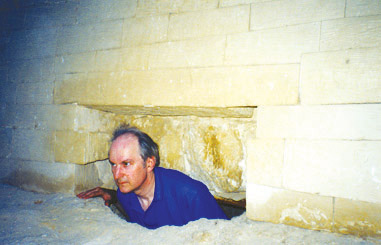
    Most people who are intrigued by Egyptian mysteries have been wondering for a long time whether there might be any secret chamber beneath the Sphinx. I have crawled around inside the Sphinx, and I describe the tunnel which exists in the rear portion of the Sphinx’s body, as well as the vertical tunnel carved out of the bedrock beneath the Sphinx’s rump, and reproduce photos of these. In Figure 2 you see a photo which Olivia took of me with my head sticking out of the Sphinx’s ass, which perhaps proves how well I know him.

    Temple001

    Then an amazing thing happened. I came across a passage in one of the old books which I collect, in this case one published in 1715, which described a chamber beneath the Sphinx and gave an eyewitness account of it! I was astounded. The book referred to earlier accounts of this chamber, but neglected to say who had written them or when they had been published. Slight problem! How was I to find these books?

    If you went into the British Library and told a librarian you needed a book published before 1715 which described a chamber beneath the Sphinx, you would be told to come back when you had the author’s name or the title of the book. All I had to go on was ‘a book mentioning the Sphinx before 1715’, so how did I do it?

    That is where my special abilities come in, which enable me to obtain information which others seem not able to obtain. I am what you might call an information retrieval expert, and I do not need to know anything about the field in order to obtain its ‘concealed’ information. There is no such thing as concealed or destroyed information: it is all there in Information Space if you have access. Everyone knows about the emails which people think they have deleted from our computers, but which can be recovered by computer data recovery experts (as part of a criminal investigation, for instance). Well, there is a higher version of that, which enables all information which has ever existed in any material form to be accessed from the wholly non-material realm of Information Space.

    Unfortunately, I have never met anyone who seems to be able to access this material methodically and systematically. Most human beings can access it in a feeble and flickering fashion, by means of what is called ‘intuition’ or ‘hunches’. Perhaps it is just as well that proper access to all this information is limited. After all, the purpose of our being here in the material world is to see how we cope without information. That is why people like myself find it so difficult to communicate what we know when we somehow, in a way we do not understand, acquire information from Information Space. It is mostly not intended for circulation, and maybe I should not even be doing it. When I reveal such information to people, they never believe me anyway, so I generally do not bother.

    I cannot explain how I access it. I seem to ‘see through matter’ in some way which is difficult to describe, and I see the Information behind it on the other side. Matter becomes increasingly transparent to me every day anyway, and I no longer believe in it. On only one occasion was I so desperate that I ‘raped’ Information Space. That was when our beloved dog Kim was mistakenly locked in a room with a digital security code. Because she was old and ill and needed water, and might otherwise die before I could get someone with the code to come, I ‘accessed’ the numerical code, punched it in, the door opened, and I released her. I didn’t do it instantly. I first made two or three hysterical wrong attempts and wasted precious minutes through being over-stressed. I made myself try to remain calm and then got it right. This meant that I actually had to access the whole number of several digits, none of which was known to me. Really, we are not supposed to do this sort of thing, but my dog was more important to me than protocol.

    Also important to me is a Larger Dog, the Sphinx! I feel almost as affectionate towards him as I did… well, no, that would not be fair to Kim. But I also like the Dog Star. In fact, I am a sucker for dogs, I really am. I am not a cat person, even though I am a great fan of the original version of the film ‘Cat People’ (1942). Watch it sometime! See my review of it on my website.

    I was eventually able to find 281 years’ worth of published eyewitness accounts of the chamber beneath the Sphinx, including detailed information about exactly where it was, its size, and the fact that it contained the remains of a wooden coffin. Because the chamber was described as having hieroglyphics on the walls, I am certain that it was what archaeologists call ‘an intruded burial’, but it must have been a royal one, as a shaft was carefully constructed and a chamber cut in one of the most important monuments in Egypt, within the sacred precincts of the royal Necropolis. The shaft was sealed with cement by Émile Baraize in 1926. A century earlier, Henry Salt also sealed some openings and passages elsewhere at the Sphinx, and was sharply criticised for it by the French Count de Forbin. All of this is described in full detail in our book. So, yes, there is a ‘secret chamber’ beneath the Sphinx. And the information in our book proves this beyond all possibility of doubt. But no, it is not original and does not date from the time of the Sphinx’s carving. Also, it is empty, so there is no gold or treasure. But if we could just read what it says on the walls!

    Another thing I was able to demonstrate is that the Sphinx and the three Giza pyramids were part of a single unified design concept of the Giza Plateau. The position and size of the Sphinx is determined precisely in relation to the three pyramids, in a manner never before noticed. This is shown and explained at great length in the book, and it is not really possible to summarise that material, as it is too lengthy and detailed for a brief description. I can say, however, that it was part of a resurrection cult. In the process of explaining this in detail, I even have occasion to explain the true nature of those bizarre reliefs in a crypt at Denderah which have excited a great deal of speculation, the ones with the ‘lightbulbs’, although they are 2,500 years more recent, and their only connection is through the symbolism.

    I hope everybody will get a lot out of looking through our book, and, who knows, maybe even reading it. Stranger things have happened.

    Oh yes, I almost forgot: ‘Woof! Woof!’

    [alert type=”general” dismiss=”no”]This article was published in New Dawn 112.[/alert]

    [alert type=”success” dismiss=”no”]If you appreciate this article, please consider subscribing to help maintain this website.[/alert]

    © New Dawn Magazine and the respective author.
    For our reproduction notice, click here.
  • Lost Technology of the Ancients: The Crystal Sun

    Lost Technology of the Ancients: The Crystal Sun

    From New Dawn 65 (Mar-Apr 2001)

    The ancient Greek Pythagoreans of the 5th century BC believed that the sun was a gigantic crystal ball larger than the earth, which gathered the ambient light of the surrounding cosmos and refracted it to earth, acting as a giant lens.

    A giant lens? In the 5th century BC? Perhaps it was because nobody until now has been willing to recognise that lenses existed in antiquity, and that the crystal sun idea was overlooked, and has never been described in any books on the history of science or philosophy. However, it appears in my book The Crystal Sun.

    What, then, is all this about ancient lenses? Surely some mistake?!

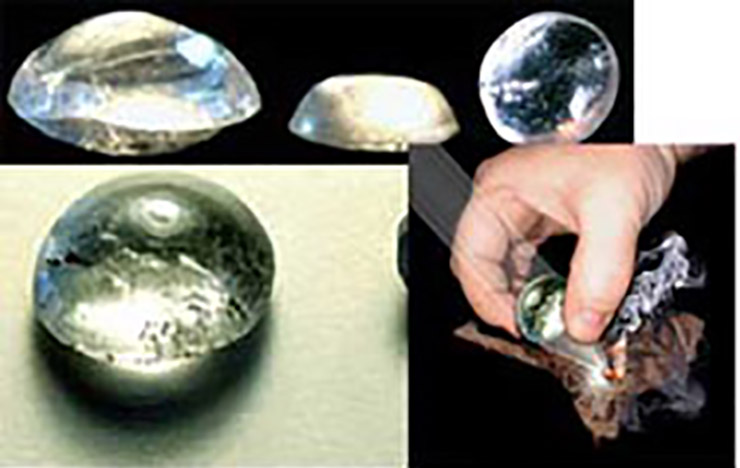
    The fact is that I have located more than 450 ancient lenses in museums all round the world, and I even own a Greek crystal lens of the 6th century BC myself. Photos of many of these ancient lenses appear in my book. Anyone interested in full details of the actual lenses themselves should obtain the hardback edition of my book, because ten appendices full of such detailed information have been omitted from the paperback because the book was too thick.

    Ancient lenses! Well, how far back do they go? The earliest actual lenses which I have located are crystal ones dating from the 4th Dynasty of Old Kingdom Egypt, circa 2500 BC. These are to be found in the Cairo Museum and two are in the Louvre in Paris. But archaeological evidence showing that they must have been around at least 700 years earlier has recently been excavated at Abydos in Upper Egypt. A tomb of a Pre-Dynastic king there has yielded an ivory knife handle bearing a microscopic carving which could only have been done under considerable magnification (and of course can only be seen with a strong magnifying glass today). Thus, we know that magnification technology was in use in Egypt in 3300 BC. I reproduce both photos and drawings of this crucial evidence.

    But magnification technology was not of interest merely for making and viewing small carvings. Its most important use was in telescopes. In fact, on the jacket of my book the reader will encounter an ancient image of someone looking through a telescope. This is a photo I took of a fragment of a Greek pot excavated about twenty years ago at the Acrocopolis in Athens, and dating to about the 6th century BC.

    If there is all this evidence, why has no one ever talked about it before? The answer seems to be that unique capacity for stupidity which so distinguishes the human race, for obstinacy and the determination not to see. I call it consensus blindness. Everybody agrees not to look at things that make them uncomfortable, or which they think shouldn’t exist. Therefore, the fact that more than 450 ancient lenses have been sitting around in the world’s museums for all of these years and have been invisible is explicable only by invoking the theory that people subconsciously conspire not to see what they don’t want to see.

    It is not as if I have come up with a little bit of vague evidence and want to use it to construct some wacky theory of my own. There are plenty of people crying in the wilderness with theories based on a little bit of disputed evidence. That is not the case with my book at all. I am standing right in the centre of the town square surrounded by a mountain of evidence which can only be ignored if people are so determined to look the other way that they are prepared to walk around with their necks crooked.

    I attended the 8th International Congress of Egyptologists in Cairo in the spring of 2000, and went prepared to deliver a paper on ancient Egyptian optical technology. But I was not allowed to deliver it. I was told there was ‘no appropriate category’. Alas, it is true that there was no such category, as I was the only historian of science present at the Congress of 1500 people, a fact which I found rather depressing.

    It might be worthwhile to review just why my discoveries are so important for Egyptology, and everyone interested in the pyramids needs to know about them as well.

    First of all, there is the famous question of the orientation of the Great Pyramid. It is so perfectly oriented to the geographical points of the compass that no one has ever been able to understand how this was done, for the accuracy exceeds any hitherto known technology of ancient Egypt.

    Then there is the equally famous question of how the extreme accuracy of the construction of the Great Pyramid was possible. In 1925, J. H. Cole discovered in his survey that the great pavement, upon which the Great Pyramid partially rests and which surrounds it, is flat to within 15 mm. Earlier scholars had commented that the accuracy of the surface of the Great Pyramid was equivalent to the accuracy of the grinding of an optical reflective mirror in a giant modern telescope. The original (now largely destroyed) casing stone sides of the structure have been compared in their precision to the mirror of the Mount Palomar Telescope. How were such feats accomplished?

    Back in the 1960s and 1970s, the Argentine physicist Jose Alvarez Lopez claimed that it was physically impossible for the Great Pyramid to have been constructed without extremely accurate optical surveying techniques such as are used in theodolites. I met Lopez in the 1970s and he told me this himself, arousing my interest in this question for the first time. But Lopez said to me sadly that he could not find any evidence for any ancient optical technology, so it was all a mystery.

    Well, it is a mystery no longer.

    The Great Pyramid was clearly surveyed with early forms of optical surveying instruments that we could call proto-theodolites. This is all described at great length in my book, and I urge anyone interested in the pyramids to read all about it.

    I have proved from archaeological evidence that the technology for surveying the Great Pyramid existed at least as far back as 3300 BC, and doubtless earlier than that, since we can hardly presume that the ivory knife handle was the first such object to exist, as it is already highly sophisticated and suggests a long-standing tradition.

    I was surprised as I strolled through the museums of the world and saw ancient lenses on public display labelled as all kind of crazy things – as anything but lenses! When I went to study ancient Greek lenses in the Department of Classical Antiquities at the British Museum, I met one member of the staff who insisted that there never were any ancient Greek lenses. (This is despite the fact that Aristophanes describes one in his play The Clouds, and there are countless ancient references to optical technology in the ancient literature, which I have combed exhaustively and described in my book.) I then proceeded to photograph and measure some ancient Greek lenses in that very room, which the person concerned refused to acknowledge, and I thought more than a little ironic that there is a display cabinet standing just outside the door to the room containing ancient Greek lenses mis-labelled as ‘counters’, and which can be seen clearly magnifying the strands of the cloth underneath them.

    When I was in the Athens Archaeological Museum studying Mycenaean lenses, which were clearly on display in the Mycenaean Room (where they are mis-labelled), I could not help but be aware that a former Deputy Director of the same museum had written an article about an apparent crystal lens which he had himself excavated on Crete, but he neglected to mention in his article that his own museum had many such lenses in display cabinets which anyone could walk into the museum and see on any day of the week.

    Ancient lenses tended to be of rock crystal until Carthaginian and Roman times, beginning about the 4th century BC, after which glass lenses became more common (being much cheaper), and crystal lenses then became rare.

    I discovered significant numbers of ancient British lenses, mis-catalogued in mineral collections; they had been moved to geological museums from their original archaeological collections and were thought to be ‘crystal specimens’! Some of them were most ingenious, and had what I called ‘resting-points’ protruding from their backs so that they could rest on a surface and an artisan could reach his cutting tool round the back and have both hands free for his work. In ancient Troy, one crystal lens excavated by Schliemann had a hole in the centre. Some people thought this was an argument for claiming that the lens in question was ‘useless’ because it was perforated in the middle and thus clearly no lens. However, the hole in the centre in no way interferes with the magnification, and offers an extremely clever way for an artisan to insert his cutting tool directly through the middle of the magnifier, and have magnification of his work all around it in a circle!

    Schliemann excavated about 48 crystal lenses at Troy, but these all disappeared during the Second World War, and all that remained were catalogue descriptions and a single photo of four of the lenses in a group (reproduced in my book). I tried for many years to find these missing lenses, and a friend who various times approached the museum in East Berlin where the lenses were last known to have been stored was repeatedly lied to and told that the lenses had ‘been destroyed by Allied bombing in the War’. But of course all this was complete rubbish. When the truth finally came out about the missing Trojan gold hoard found by Schliemann, and that the Red Army had seized it and taken it back to Russia, I suspected the lenses were probably with the gold. And indeed they were. But I have never been granted access to them; the Russians are afraid the Germans will claim them back, and so they won’t let scholars have normal opportunities to study them.

    To return to the subject of the ancient British lenses, I should mention that they provide the missing physical evidence that the late Professor Alexander Thom was looking for when he said the accuracy of the astronomical observations of the ancient Britons exceeded the capacities of the naked eye, and he wondered about their optical technology. We now have the lenses that seem to fill Thom’s need. Indeed, there are good reasons for suspecting that the real purpose of the trilithon lintels at Stonehenge were to support a wooden observation platform for telescopic observations of the moon. In other words, Stonehenge would have been domed. I present the evidence for all of this in my book at some length.

    The only group of archaeologists who wholly and enthusiastically welcomed my findings into early optics were the Scandinavian ones, in particular the Swedish archaeologists. Far from being put out with my findings, they were delighted by them. I made very extensive studies of the Viking lenses, and recently one of my articles has been published in Swedish translation in the Swedish archaeological annual, Gotlдndskt Arkiv (Vol. 72 for the year 2000). The Vikings were the last of the ancients, as far as optical technology went, and they accomplished miracles of crystal engineering. They actually produced crystal lenses as small as water drops that could magnify three times. I call their achievements ‘micro-optical technology’.

    Although my discoveries about ancient Chinese optical technology were rather limited (extracts from ancient texts plus reports of six excavated ancient lenses which I was unable to inspect personally, in one case because of floods preventing me from getting to a provincial museum), The Crystal Sun is being translated into Chinese and I have been asked to lecture about it at China’s leading technical university, Tsinghua University in Beijing, of which I am a Fellow.

    My resources not being infinite, I never travelled to Mexico and Peru to inspect the ancient crystal lenses which apparently are to be found there, so the New World is not well represented in my account. I hope others will remedy this deficiency one day. I do, however, have a special account of the so-called ‘Skull of Doom’, a life-sized crystal skull of Maya origin, in my book, since it was the first ancient crystal object I ever studied, when I was 18 years old!

    There is much weird lore in my book, so much so in fact that it cannot all be absorbed as casual reading. I have written a long chapter on the subject of ‘thunderstones’, and another on meditative hallucinations, all of which are linked in wonderful ways to ancient optical ideas. I give a lot of attention to the religious traditions associated with light, from ancient Egypt down through the ‘light-theology’ of Christians like Robert Grosseteste in the Middle Ages.

    But it is not only light that is considered in The Crystal Sun. Shadows are equally important. In ancient Egypt, the science of shadows was far advanced and highly precise. And in this connection I have made a major discovery, which is shown in a photograph taken on 21 December. For I found that there is a special winter solstice sunset shadow cast upon the south face of the Great Pyramid, which nobody had ever noticed before, despite the fact that it has been clearly visible once a year for at least 3500 years. Just think, 3500 missed opportunities!

    As the Gnostic Gospel of Thomas likes to say, ‘Those who have ears to hear, let them hear.’ I would extend this to say: ‘Those who have eyes to see, let them damned well start using them! It would make a change!’

    What is this winter solstice shadow, then? It is a shadow cast by the second pyramid, known as the Pyramid of Khafre (or Chephren, which is the Greek form of the name), upon the Great Pyramid at sunset on 21 December.

    But the mere fact that one pyramid casts a shadow on another is not the point. What is important is the nature of that shadow. And here is where it all gets very interesting. Anyone who has made a study of the interior of the Great Pyramid will be aware that both the ascending and descending passages inside the structure have the same slope, a curious angle of slightly more than 26 degrees. This in itself might seem a bit odd. But bearing in mind how the ancient Egyptians loved a good tease, it was wonderfully amusing and surprising for me to discover that at sunset on the winter solstice they had chosen to project a giant shadow on the exterior of the same structure having the same slope as the passages concealed on the inside!

    It was a bit of a game, surely: what you see on the outside is what you get on the inside, but you can only realise this if you already know it in advance! In other words, it was for the initiated only. They could have their little laugh to themselves, but nobody else knew what the hell was going on.

    I also managed to demonstrate that the ascending passage leading up to the causeway from the Valley Temple beside the Sphinx also has this same slope. Its slope had never been considered or measured before. And yet the fact that its slope is the same as the ascending and descending passages of the Great Pyramid surely indicates a common canon of design for the two structures, at the very least.

    If the Egyptians were really intending to cast a shadow on the outside of the Great Pyramid which secretly indicated the nature of the slopes to be found in the concealed interior, then there are important consequences to be considered: it means that the Pyramid of Khafre had to be the precise size it is, and in precisely the position it is, for this shadow to be correctly cast.

    That is rather a lot of stone to lug around, just to cast a shadow.

    So isn’t there something more to this than just the common slope angle? Well, yes, there is indeed. It just so happens that this odd angle of slightly more than 26 degrees is the only acute angle possible for a right triangle to be formed that is known as ‘the golden triangle’, because it embodies the famous Golden Mean Proportion. And it also just so happens that the Golden Mean Proportion is at the basis of the entire canon of ancient Egyptian art and architecture, as I also explain in my book at some length. And in fact, the shadow if truncated by a vertical line running up the middle of the south face of the Great Pyramid, does actually form a golden triangle, which once again is mirrored on the inside, because it is a similar golden triangle which determines the precise point of commencement of the Grand Gallery on the interior of the pyramid, as I show in a drawing in my book. And as for the vertical line running up the pyramid, that too is real, and has been shown from an aerial photograph, although it is invisible to the naked eye or by any perceptual means at ground level. There is actually a purposeful slight indentation of a few inches in the construction of the side of the pyramid, discovered in measurements made by Petrie. This ‘apothegm’, as geometers call such vertical lines, forms the right angle to transform the solstice shadow into a perfect golden triangle.

    So we see here the Egyptians were playfully carrying on with their geometric obsessions in full view of the world, casting giant shadows in golden mean proportion, but for at least 3500 years nobody noticed.

    All this blindness! What more have we not noticed?

    I hope that people will dip into, if not fully read, The Crystal Sun, because all of these findings are important and need to be known. I was disappointed not to be able to speak at the Cairo Conference and reveal some of these findings to the Egyptologists. For instance, I was able to demonstrate the existence and use of diamond-tip drills in Egypt, but they are so small they can easily be overlooked, just as the much larger lenses always have been. I wanted to warn the diggers that those dirty little objects that might seem like tiny dark pebbles could be diamond drill tips. But alas, they still don’t know.

    One of the lessons from all of this is surely the need for archaeologists not to close their eyes to scientific subjects. They have always been reluctant to study the fundamentals of astronomy, so the field of ‘archaeo-astronomy’ is one of struggle and travail, making relatively little headway in the academic community, despite heroic efforts on the part of a few scholars. But as for ‘archaeo-optics’, as its sole investigator, I fear we have a long way to go before its implications will get through to other scholars. And so, I ask you as readers to help out, by calling these things to the attention of anyone you know, and beating some friendly drums. Let’s get the news out!

    [alert type=”general” dismiss=”no”]This article was published in New Dawn 65.[/alert]

    [alert type=”success” dismiss=”no”]If you appreciate this article, please consider subscribing to help maintain this website.[/alert]

    © New Dawn Magazine and the respective author.

    For our reproduction notice, click here.