New Dawn – World's Most Unusual Magazine

Author: Walter Mason

  • An Interview with Gary Lachman: “I’m interested in too many things”

    An Interview with Gary Lachman: “I’m interested in too many things”

    From New Dawn 178 (Jan-Feb 2020)

    American author Gary Lachman has long called London his home, but I caught up with him during a recent visit to Australia. Compact, quiet and stylishly dressed, Lachman’s gentle scholarly manner belies the fact that he is a child of rock and roll, having come of age during the Punk/New Wave movement in New York and being once a member of the now legendary pop band Blondie.

    These days he is a writer and has produced some of the best and most readable and accessible books about occultism and the major figures in the field of Western Esotericism. He has published superb biographies of Madame Blavatsky and Colin Wilson and an extraordinary history of the major figures of the occult tradition (The Secret Teachers of the Western World, 2016), along with extended reflections on magic, politics and the history of thought. 

    In a noisy, packed Indonesian restaurant, I asked Gary how he developed his interest in the occult. 

    “In 1975 I was a musician playing in New York,” he said in his companionable manner. “I was playing in Blondie – this was before Blondie became anybody. I was living on the Bowery with Debbie Harry and Chris Stein and they had a kind of kitschy interest in occult stuff. The guy who rented us our loft was a very flamboyant artist who had studied Aleister Crowley and he had a Thoth tarot deck which, at the time, was rather rare. He would do readings with it and I just got interested in it.” 

    Gary’s biography of the prolific British writer and historian of the occult, Colin Wilson, is a fascinating read and is the book that really made me determined to meet Gary and study with him. His 2014 biography of Crowley is a wickedly good read and the book I recommend to anyone who wants to learn more about the self-styled ‘Great Beast’. I asked Gary how these two men in particular influenced his life.

    “During this period [the early 70s] I was in someone’s room and on a bookshelf saw this big book called The Occult [by Wilson, published 1971]. I’d already been reading Crowley, so I pulled it off the shelf and started reading it and it totally grabbed me. He has a wonderful writing style and he was looking at all of this from the philosophy of consciousness. I had read some of the existentialists and Nietzsche, but I really didn’t know all that much and I found this totally gripping work and it was basically the start of it.” 
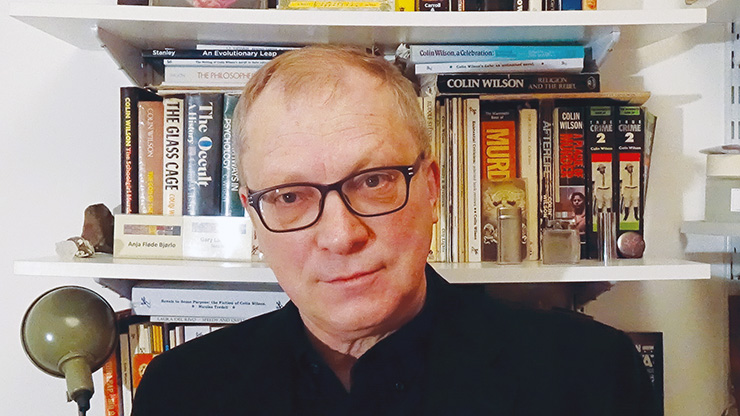
    “Not only did it get me interested in the occult, esotericism, mysticism and all that, I became completely devoted to the work of Colin Wilson. I remember that wherever we went on tour I would head to the local used bookstore and look for books by Wilson. I wound up getting a big collection of them and in 1983 I made a pilgrimage to Cornwall, where he lived, and met him.” 

    “You seem to be someone who uses everything you read,” I said. “Nothing ever goes to waste. How did you get into that habit?”

    “Well it was something I picked up from Wilson. He read an enormous amount and he made the effort to connect it all together. I wanted to write the kind of books I liked reading, and I wanted to write those sorts of books where you learn a lot. If you follow up on the books Colin Wilson mentions in his writing, it’s like getting a liberal arts education. From reading him I followed up people like Ouspensky, Gurdjieff, Husserl, Yeats… You follow up on the strands he leaves for you. So, I do that now myself. If I get a commission for a book, I read everything I can about the subject for the first six months or so. Then I spend the next six months trying to write about it.” 

    Since so much of Gary’s work is about the importance of thinking for ourselves and allowing ourselves the time and space to think deeply, I asked him if he thought we had lost the habit of thinking.

    “We’re thinking less and less,” he responded, without hesitation. “I mean, it has never been particularly popular, but people are now letting machines do our thinking for us. I guess that’s one of the problems with the internet, when everything is based on algorithms based on what you have searched – you can’t get out of that loop. I often wonder that if you put Siri and Alexa next to each other, would they be able to have a conversation? Siri says one thing and Alexa something else and we can just let them fight it out.”

    Though his work has been almost exclusively centred on the Western tradition, I was curious to know if he’d ever explored any of the Eastern traditions. 

    “Early on, when I was first reading this stuff, I was quite taken with Zen. I tried to practice for a while, inspired by people like Alan Watts and D. T. Suzuki. More recently I have been interested in Taoism, in the context of Jung’s ideas about alchemy and ‘The Secret of the Golden Flower’ [the Chinese alchemical text that had come into Jung’s life in an act of remarkable synchronicity – see Gary Lachman’s book Jung the Mystic]. I think there’s a great deal to learn from the Eastern traditions.”

    I asked him if there were any gaps in 21st century presentations of the history of occultism – was there anyone who wasn’t being written about that deserved a closer study. 

    “Well, Owen Barfield,” he said. “Not necessarily an occultist, but certainly in the consciousness tradition. And Kathleen Raine, who is one of my heroes. I interviewed her just before she died. She devoted her life to resurrecting what she called ‘the lost knowledge of the imagination’ – that’s where I got the title of my book. It’s a tradition of the imagination that has been rejected in the West. We tend to see the imagination either as make believe or something with practical, utilitarian applications – in the context of innovation or cutting-edge technologies.”

    “Raine saw it as a way in which we could actually know the world. There can be a cognitive content to the imagination, and she devoted her life to reviving that. She found it in the Romantic poets that she loved – poets that Barfield loved as well, people like Shelley or Blake. She was a great Blake scholar. If you read Blake the imagination is everything.”

    Is “the imagination” another term for God, I asked.

    “Well…” he demurred politely. “I don’t know if it’s another term for anything. In the Hermetic tradition they say that in order to know God you have to be like God. And one can be like God through the imagination. Through the imagination you acquire God-like powers. Maybe not the specific Christian God but in the sense of a level of consciousness that is not constrained by our limitations. Blake talks about ‘Jesus the imagination’ so Jesus was for him someone who lived the imagination. What did he mean by that? I think that depends on our own understanding. I think that Blake meant that he lived through the spontaneity of his inner world.” 

    Part of the great thrill of spending time in the company of someone like Gary Lachman is the incredible breadth and depth of his knowledge. A conversation with him veers all over history, religion and literature. He has been a determined scholar since he was a very young man, and now he wears his learning lightly on his sleeve and has a charming way of assuming his conversation companion is as learned as he. Almost inevitably, given the circumstance of two bookish people sharing lunch, our chat turned to literature more generally. 

    “Well I’ve just finished writing a book about Russia, and Dostoevsky has always been an interest of mine,” he volunteered. “Sadly, the fiction I read now is mostly for entertainment and I have been reading a lot of the Maigret novels by Georges Simenon. I guess you could call it thinking-person’s crime fiction. I used to love fantasy and science fiction and I grew up on Lovecraft. There’s an English novelist called John Cowper Powys who wrote A Glastonbury Romance. That book is a real commitment – it is a huge thick thing. But reading it is a mystical experience; he sees everything from a cosmic perspective. There is a life running through every aspect of the novel, from the protagonist’s loftiest speeches to the most mundane description of landscape. He has a wonderfully mythic consciousness.” 

    As lunch wound up, I thought I would take a chance at asking him if there was single spiritual path to which he had found himself committed. He allowed that in his youth he had been for a while involved in a Crowley group and then the Gurdjieff work. But now this great polymath is content to exist between worlds.

    “I’m interested in too many things,” he said with his trademark impish grin. “I see connections between things and so rather than stick to one school of thought I need to be true to myself. Being constant has its virtues but I want to explore the contradictions and similarities I notice. I don’t belong to anything, but I study whatever I can.” 

    Gary is currently completing two books, one on precognitive dreams, and another titled The Return Of Holy Russia: Apocalyptic History, Mystical Awakening, and the Struggle for the Soul of the World, to be published by Inner Traditions in May 2020.

    Gary Lachman is the author of 21 books on topics ranging from the evolution of consciousness to literary suicides, popular culture and the history of the occult. His work has appeared in many journals, magazines and newspapers. Gary lectures regularly and has appeared in several film and television documentaries. Before becoming a full-time writer, he studied philosophy, managed a new age bookshop, taught English Literature, and was a Science Writer for UCLA. He was a founding member of the pop group Blondie and in 2006 was inducted into the Rock and Roll Hall of Fame. Lachman was born in New Jersey, USA, but since 1996 has lived in London, UK. Website: garylachman.co.uk, Twitter @GaryLachman

    [alert type=”general” dismiss=”no”]This article was published in New Dawn 178.[/alert]

    [alert type=”success” dismiss=”no”]If you appreciate this article, please consider subscribing to help maintain this website.[/alert]

    © New Dawn Magazine and the respective author.
    For our reproduction notice, click here.
  • Spirituality in Today’s Vietnam

    Spirituality in Today’s Vietnam

    From New Dawn 148 (Jan-Feb 2015)

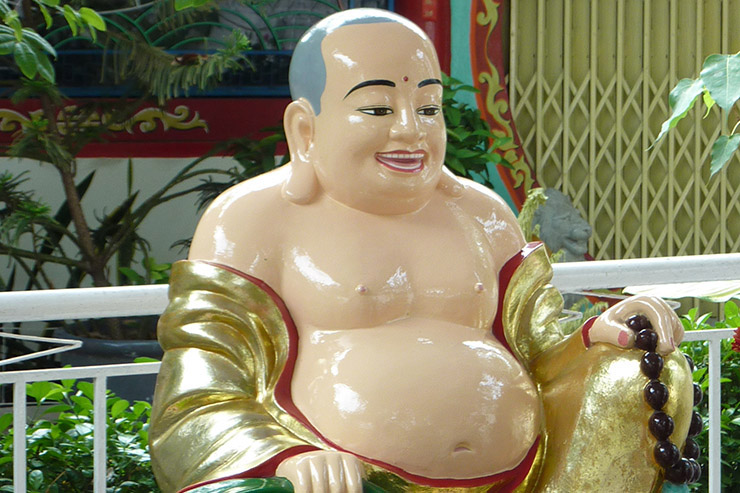
    The Vietnamese Buddha I have a great reverence for is Di Lac Phat, the Maitreya Buddha, the fat, laughing Buddha of the future. It is impossible to gaze upon his form for even a moment and not feel slightly amused, slightly more hopeful. Di Lac represents hope for the future, the wealth and abundance of which is represented in his bodily form. As such, he is a worthy symbol for the new Vietnam, a forward thinking, vastly energetic nation with a huge population and a great thirst for renovation and renewal. As depicted in Vietnam, Di Lac Phat is always smiling and often carries a mysterious sack which most say is filled with gold. The Maitreya hasn’t arrived yet, but his day is just around the corner.

    The spirit realm is ever-present in Vietnam, in homes, businesses, temples and busy intersections. On street corners, even in sophisticated downtown Ho Chi Minh City (old Saigon), you can come across small shrines dedicated to the wandering ghosts and the spirits of place. These shrines are actively tended by people in the community who offer fruit and incense every day. They speak to an ancient animist tradition that still holds great sway in Vietnam.

    Streets and suburbs are possessed of their own protective spirits, but even more so are mountains, old trees and waterfalls. There is a shrine atop Nui Ba Den, the Black Lady Mountain that rises up out of the plains of Tay Ninh that stretch from Ho Chi Minh City to Cambodia. It is a place of immense mystical significance, said to house a Black Goddess whose power is so great that all around the mountain is a mystically obsessed Holy Land that was and is something of a spiritual powerhouse in Vietnam.

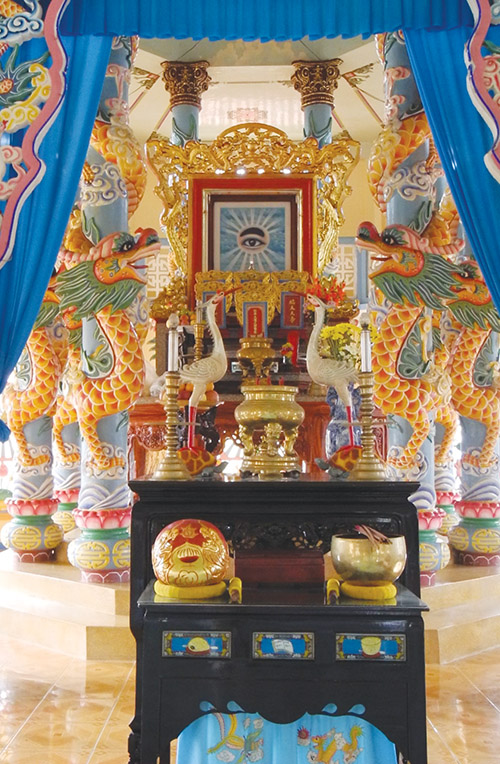
    Cao Dai altar

    The Black Lady Mountain dominates the landscape in Tay Ninh City, about two hours drive from Ho Chi Minh City. Perhaps it is no accident that from this extraordinary place emerged the Cao Dai religion, Vietnam’s greatest indigenous religious experiment and one that has fascinated authors and observers ever since it first emerged in the 1930s.

    Cao Dai means High Tower, which is one of their names for God. This extravagantly colourful, hierarchically structured religion was founded by a group of men experimenting with automatic writing. It has always captured the imaginations of visitors, and Graham Greene wrote about it in his book about Vietnam, The Quiet American. The Cao Dai Holy See at Tay Ninh sits in the shadows of Nui Ba Den, and the population of this city of over one million people is almost exclusively of that religion.

    The Cao Dai faith reveres all religions and hopes that one day humanity will be united. Their shrines feature a central image of a single eye, which represents the all-seeing eye of a universal God. Followers of Cao Dai are strict vegetarians, and the Cao Dai elder priests wear brilliantly coloured robes that signify the branch in which they are reincarnated – Buddhist, Taoist or Confucian. The Cao Dai religious structure is based on the Catholic Church, with popes, cardinals, a holy city and saints – some of their saints include Victor Hugo, Sun Yat Sen, the Virgin Mary and Kuan Yin. There is only one God in Cao Dai, and he/she overlooks all people, regardless of what religion they profess. Their scriptures say: “we all know there is something over our heads.”

    But, of course, Buddhism is the principal religion of Vietnam, and is represented in a surprising number of varieties. The Buddhist nuns and monks of Vietnam are a huge unpaid workforce that is the spiritual powerhouse of the nation. Almost alone they represent the only social welfare structures that exist in the country. They care for the orphaned, the sick, the elderly and the disabled, and temples operate as community welfare and meeting centres.

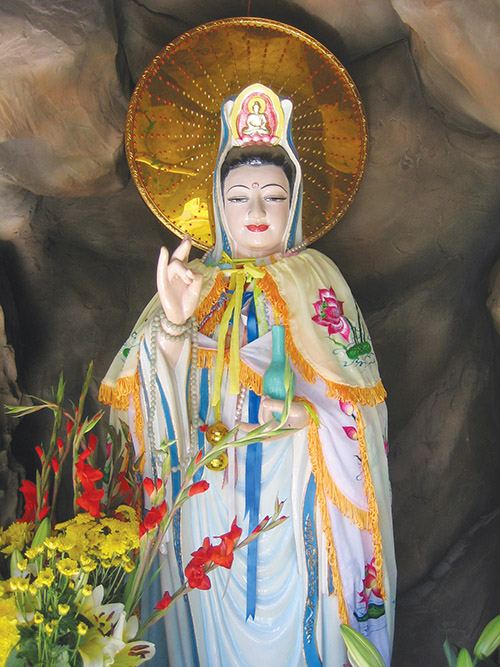
    Kuan Yin

    Vietnamese Buddhism, noteworthy for its laid-back character, has become something of a successful religious export. The second-most-famous Buddhist in the world is Vietnamese Zen Master Thich Nhat Hanh, and he has established monasteries and meditation groups across the Western world. He has also written numerous best-sellers and has appeared on Oprah.

    There is, too, a very old reverence for Confucius and the Confucian tradition in Vietnam. The Temple of Literature in Hanoi – constructed in 1070 – was an early Confucian University. It is evidence of the Vietnamese reverence for learning, and the grounds of the temple feature carved stone turtles with steles on their backs recording the names of graduates from 1484–1788. These were recently declared special objects of protection by UNESCO.

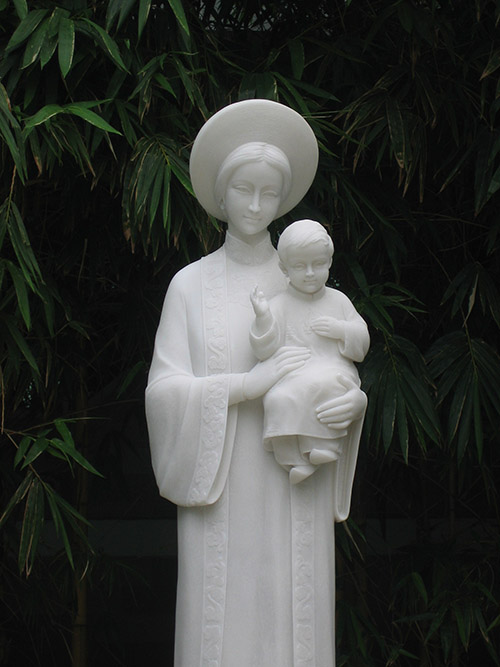
    Our Lady of La Vang

    Kuan Yin, the Buddhist Goddess of Mercy, or Bodhisattva of Compassion, is one of the most popularly revered religious figures in Vietnam. Indeed, her images are so ubiquitous that she might seem to be the great patron saint and protector of the Vietnamese people. Her name (Quan The Am in Vietnamese) means “The Hearer of All the World’s Cries.”

    Shrines to her are to be found everywhere, in people’s houses, on streetsides and, of course, at temples. She embodies the qualities of compassion and unconditional love. Vietnam’s culture has a great reverence for the mother, and people indulge in a great deal of devotion directed toward this Divine Mother – one of her appellations is Me Hien, the Gentle Mother.

    Interestingly, for Vietnamese Catholics (a sizeable minority, particularly in the South), there is another Vietnamese mother who is greatly revered. This is Our Lady of La Vang, an apparition of the Blessed Virgin Mary that appeared to the Vietnamese Catholic faithful during a period of religious repression during the 18th century. Her beautiful form – representing the Madonna and Child as entirely Vietnamese, in traditional dress and often rendered in white marble or plaster, just like Kuan Yin – is to be seen all over Vietnam.

    [alert type=”general” dismiss=”no”]Image credits: Di Lac Phat, Kuan Yin & Our Lady of La Vang by Walter Mason; Cao Dai altar Franzfoto[/alert]

    [alert type=”general” dismiss=”no”]This article was published in New Dawn 148.[/alert]

    [alert type=”success” dismiss=”no”]If you appreciate this article, please consider subscribing to help maintain this website.[/alert]

    © New Dawn Magazine and the respective author.
    For our reproduction notice, click here.
  • Unity: The Remarkable Story of Charles & Myrtle Fillmore

    Unity: The Remarkable Story of Charles & Myrtle Fillmore

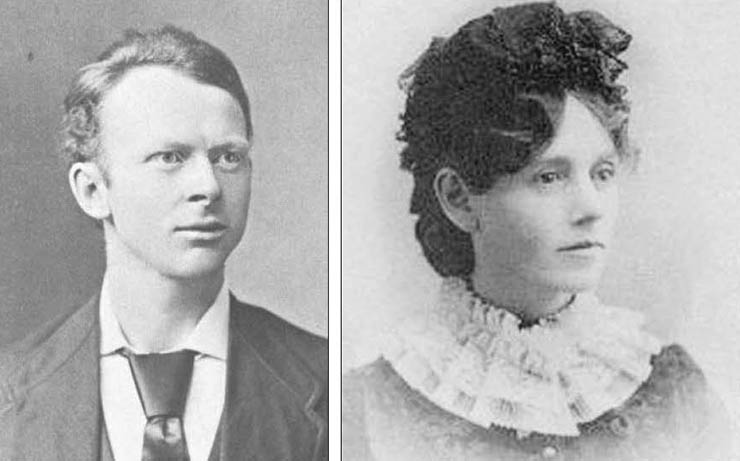
    Myrtle Fillmore was in desperate straits in 1886. Sick from tuberculosis and malaria, her much-younger husband had managed to bankrupt himself in both the mining and real-estate industries. She was so weak that she was incapable of caring for her children, and her aged mother-in-law was added to an already impoverished household as cheap live-in care.

    One evening she went along to see a visiting faith healer, something she always did in the vain hope there might be some way of remedying her situation. Sitting in the lecture hall she heard Dr. E. B. Weeks say something that would change her life forever: “I am a child of God and therefore I do not inherit sickness.”

    Her cure seemed to happen from the moment of hearing this affirmation, and she went home and spent some intense time in meditation and prayer, day after day repeating this simple sentence. Soon she was cured of her illness, and her previously agnostic husband Charles became convinced there was something in this mind-cure business. Together they would go on to form one of the most established and long-lived of the New Thought religious organisations, the Unity School of Christianity.

    Charles himself had been an invalid since he was a small boy. Having fallen on the ice and dislocated his hip as a child, he had been lame ever since. The injured leg was shorter than his other leg, and his hip was frozen in place, incapable of movement. The combined injuries caused him chronic pan, which he bore with great fortitude. It wasn’t, however, until he began to follow his own wife’s lead that he managed to find some degree of relief from his lifelong physical handicaps. He set himself his own regimen of intensive prayer, meditation and affirmation, booking an appointment between himself and God every night that he observed scrupulously. This effort soon bore fruit, and Charles Fillmore could later boast of his own cure through the application of New Thought methods.

    Dr. E. B. Weeks, the metaphysical lecturer who had been Myrtle Fillmore’s unexpected saviour, was a student of Emma Curtis Hopkins, one of the most influential New Thought teachers in history. Hopkins had been a close confidante of Mary Baker Eddy, but had eventually, almost inevitably, fallen out with that strong personality. She re-located to Chicago in 1886 and quietly proceeded to influence generations of writers, teachers and spiritual leaders. Even now, those in the know refer to Hopkins as “the teacher of teachers,” though her name has been eclipsed by her more famous students. The Fillmores became so enamoured of Hopkins that they frequently made the expensive trip to Chicago to study with her, and sponsored her visit to Kansas City.

    While taking part in one of Hopkins’ study groups they were inspired to establish a silent prayer ministry, which was eventually to become Unity, a name also revealed to them under the auspices of Hopkins. It was she who encouraged them in their ministry, recognising in this peculiar couple the energy, curiosity and talent for organisation that would eventually see them spreading New Thought ideas across America. In June 1891 Hopkins ordained them, and later, after they had established their own religious congregation, they would have their own students re-ordain them.

    In 1891 they also caught the attention of a woman who was to become their greatest student and the author of what is seen by many as the textbook of the movement. H. Emilie Cady was a student of Emma Curtis Hopkins, and she started writing pieces for the Fillmore’s journal, also called Unity (and still being published). In 1896 she compiled Lessons in Truth, A Course of Twelve Lessons in Practical Christianity, one of the great classics of the New Thought movement, and a canonical text for all Unity students.

    The Fillmores, by nature open-hearted, had always seen the potential for camaraderie among the different New Thought schools and teachers, and in 1896 they hosted a meeting for like-minded groups from around the country. Charles, busy teaching and developing his new movement, waited until 1909 to publish his first book, the influential Christian Healing. Presented in twelve lessons, this book prefigures the metaphysical theory for which he would become most famous: The Twelve Powers of Man. This set of “spiritual tools” was built around a twelve-fold framework that incorporated the twelve Disciples of Christ and the twelve months of the year. It was set out in a 1930 book of the same name, and is still used by Unity groups as a handy structure of spiritual learning.

    Unity was from the start characterised by its progressive ideas and openness to all people and traditions. Part of its official doctrine is that: “All the sacred scriptures from the world’s great religions can be used to discover truth.” Charles himself had read widely in Eastern religion, as well as among the Western esoteric traditions. His exhaustive knowledge of the Bible lead him to conclude that it and all other canonical scriptures should be read and interpreted metaphysically, not literally. His Metaphysical Bible Dictionary (1931) drew on a lifetime of reading and study, and remains a useful resource for anyone seeking to understand the Bible outside of conservative Christian analysis.

    Even before his conversion, Charles Fillmore had been convinced by a prophetic dream to move his family to Kansas City. This would eventually become the headquarters for the Unity movement, with Fillmore purchasing 58 acres in Jackson County, Missouri, to establish Unity Village. This religious complex, that housed his family along with worship and training facilities, is still thriving today. It is symbolised by the Unity Tower, completed in 1929, which doubles as a reservoir to help supply the complex with its water.

    Myrtle Fillmore, nine years older than her husband, died in 1931, after which Charles married his secretary Cora Dedrick, with whom he worked closely on his later writings.

    The organisation is best known these days for its Silent Unity prayer ministry, once accessed by letter and telephone and these days by filling in an online form, and its long-lived magazine of inspirational readings and affirmations, The Daily Word. In these forms it has touched countless lives, including many people who might not necessarily identify themselves as New Thought practitioners. It also produces a very popular online radio station, all part of this group’s tradition of media engagement and forward thinking.

    The Fillmores initially strengthened their ministry through the judicious publication and distribution of journals and tracts, moving with technological changes to produce well-remembered radio and TV spots which were part of the American popular cultural landscape into the 1980s. Their inspirational late-night TV talks delivered by Charles’ daughter and many other celebrities remain iconic memories for many Americans in their 40s and 50s.

    The great charm and personal conviction of the Fillmores has seen their organisation in good stead, and it has continued to operate through the years more or less free from any taint of scandal. They managed to take the distinctly nineteenth century tone of their great teacher, Emma Curtis Hopkins, and usher it into the twentieth and now into another century. They taught from example, and their teachings have gone on to help countless others properly use their minds and employ the spiritual technologies of prayer and meditation.
    [alert type=”general” dismiss=”no”]This article was published in New Dawn 161.[/alert]
    [alert type=”success” dismiss=”no”]If you appreciate this article, please consider a contribution to help maintain this website.[/alert]

    References

    Hugh D’Andrade, Charles Fillmore: Herald of a New Age

    Thomas E. Witherspoon, Myrtle Fillmore: Mother of Unity

    James Gaither, The Essential Charles Fillmore

    Charles Fillmore, Christian Healing; The Twelve Powers of Man; Metaphysical Bible Dictionary

    H. Emilie Cady, Lessons in Truth, A Course of Twelve Lessons in Practical Christianity

    © New Dawn Magazine and the respective author.
    For our reproduction notice, click here.

  • Sister Veni Cooper-Mathieson: Pioneer Thinker & Metaphysical Teacher

    Sister Veni Cooper-Mathieson: Pioneer Thinker & Metaphysical Teacher

    From New Dawn 141 (Nov-Dec 2013)

    Australia has a long tradition of self-help literature and much of it was written, in the early years, by colourful characters who embraced a hodgepodge of new and progressive ideas which included Theosophy, New Thought, Swedenborgianism, Socialism, Christian Science, temperance, vegetarianism and marriage reform. This connection between minority religious and social philosophies and ideas of individual mental development was to be observed across the Western world from the late 19th century, though the connection often surprises modern readers.

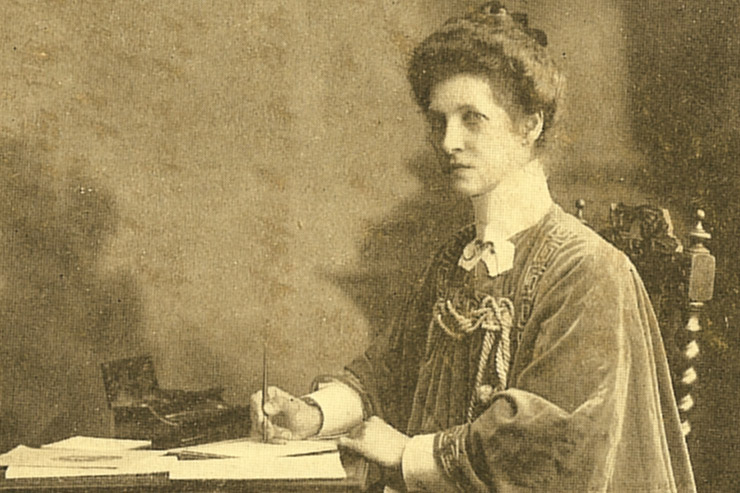
    One of the greatest characters to have written and taught in early 20th century Australia called herself Sister Veni Cooper-Mathieson (1867–1943). She was a prolific, if highly eccentric, author in the field of self-help, a true pioneer who perambulated through most of the cities of Australia peddling her New Thought philosophy.

    A polymath in outlook, Sister Veni saw Australia as ripe for the development of new ideas about religion and mental development. She anthropomorphised, and at times even eroticised, a country she saw as being undeveloped, writing in her 1904 book Australia! Land of the Dawning:

    “Still no man knoweth thee, O! Virgin Land! No hand hath yet uncovered thy secret parts, nor eye searched out thy hidden mysteries. In thy fair bosom thou holdest treasures unknown and even undreamed of.”

    Australia was, for her, a metaphor for the individual, all of us containing vast and unexplored richnesses and possibilities, though few men knoweth them. In this same book she set out her vision of Australia as a “lovely virgin freshly risen from the waves,” ready to lead the world in these new philosophies, quickly to become a universal “City of Refuge.”

    She was a serial religious entrepreneur who posited herself as a thoroughly modern woman. “Sister,” in her case, did not connote any membership of a Catholic religious order. The usage was in fact common among non-conformist religious groups, as best exemplified in the person of the American Pentecostalist preacher Aimee Semple McPherson, known lovingly across the world as “Sister Aimee,” founder of the International Church of the Foursquare Gospel. Sister Aimee was herself a visitor to Australia in 1922, and I suspect her name and example would have been well known to Sister Veni long before that visit.

    Sister Veni made her living publishing books and journals, conducting lecture series and correspondence courses and overseeing spiritual libraries, study centres and healing rooms, the latter which saw her eventually fall foul of the Australian law. Any close examination of her output, and of mentions of her in the contemporary press, proves that Sister Veni was somewhat luckless. She was pursued doggedly by the authorities across Australia who seemed convinced that she was a fraud. She moved from city to city, and frequently found trouble with the police.

    The Tasmanian authorities, for example, looked askance at Sister Veni’s claims to be a medical practitioner. After she had offered a young constable treatment for his bad back, which involved her blowing across a damp flannel draped over his naked form, she was arrested and charged with fraudulent practise.

    Sister Veni was a charismatic teacher, writer and leader in what was already recognised as a traditional American mould, and it is highly likely her slightly dictatorial and grandiloquent style got in the way of her attracting a genuinely popular following in the always-cynical Australia.

    Her writing is littered with colourful and grandiose references to the Christ ideal, a central idea of New Thought (as it was of Christian Science). From the turn of the 20th century till the advent of the First World War, she was a prolific publisher of New Thought journals in the various state capitals she moved between. In organs such as 1913’s ‘The Healer’ (“A monthly publication devoted to the teaching of the true science of life, health and happiness”), Sister Veni variously bullied, lectured and bamboozled her readers with these new ideas, relying heavily on biblical quotation and Christian imagery to make her point.

    Interestingly, Sister Veni was also much involved in questions relating to women. She wrote on Woman’s Emancipation (1904), and, like the Adelaide Theosophist and eccentric Agnes Benham before her, was concerned that a correct conception of marriage is essential to personal and social spiritual development. She wrote that unless a marriage is a, “true spiritual union there is no marriage in the sight of the most High God, for he deals with us purely as spiritual beings.”

    This idea is lifted directly from the 18th century Swedish mystic Emanuel Swedenborg, who taught of the importance of true spiritual marriages, in which bonds are unbroken even in the afterlife, where married couples will spend an eternity in heaven together. For Sister Veni marriage was mostly a prison for women, and true spiritual companionship was rare. Most marriages, she opined, were useless because they were based on temporal considerations.

    She advocated what she called “Free Unions,” unvisited by state intervention, in which the children of love matches might be raised in a spirit of genuine affection, and which might allow couples to dissolve their bonds with ease if it might be discovered that theirs is not, in fact, a spiritual marriage in the eyes of the most High God.

    She was also the founder of the White Cross Moral Reform Crusade, a group for young women that met in Sydney’s Domain and required of its members a pledge of chastity and “womanly modesty.” This group was formed as a reaction to what Sister Veni perceived as a “defiling and debasing atmosphere of lust.” This atmosphere was, she asserted, “robbing our women of their womanhood, undermining the health, strength and beauty of our girls. It is a menace to the home-life of the future, to the stability of the Nation, and the true development of the coming generations.”

    Moral destitution was a by-product of an insufficiently exercised mind and body, and Sister Veni saw the ideas of New Thought as a way out of this low point in human history caused, in part, by the hypocrisies of older religious frameworks. An advancing era of personal responsibility would save young people from their destructive lusts. Basically, this was a group advocating sexual abstinence among young people to avoid the social and health problems of early pregnancy and venereal disease.

    Again this kind of connection to self-improvement might seem unlikely, more associated, perhaps, with the puritan fundamentalism of mainstream Protestant groups of the times like the Methodists and Presbyterians. But this was a direct copy of a similar movement among New Thought women in America. The movement had from its earliest days made a neo-gnostic connection between sexual purity and spiritual advancement.

    This wonderfully inspired and energetic woman has, until recently, been almost lost from Australia’s history books. Historians, writers and academics have traditionally been hostile to expressions of overt spirituality, and have dismissed important figures such as Sister Veni Cooper-Mathieson as quacks unworthy of serious examination. But perhaps a new generation of thinkers will recognise these fascinating figures as the great pioneers they were, and re-instate them as important figures in literary and cultural history.

    [alert type=”general” dismiss=”no”]This article was published in New Dawn 141.[/alert]

    [alert type=”success” dismiss=”no”]If you appreciate this article, please consider subscribing to help maintain this website.[/alert]

    © New Dawn Magazine and the respective author.
    For our reproduction notice, click here.
  • The Lost City of Angkor Wat & the Mysteries of a Great Asian Civilisation

    The Lost City of Angkor Wat & the Mysteries of a Great Asian Civilisation

    From New Dawn Special Issue Vol 6 No 1 (Feb 2012)

    Angkor Wat is a vast stone temple at the heart of an ancient stone city. But at the ends of its corridors and the centres of its hidden rooms lie surprising Buddhist shrines still active in a place abandoned for hundreds of years. These Buddhist statues are imposters, hasty late additions to a religious building constructed to accommodate the myths and rituals of Hinduism.

    They are splendid still, some draped incongruously in new and garish orange robes, the polyester glowing harsh against the cool, old stone. They are alive, thriving on the centuries of mystical memory that make Angkor Wat one of the most fascinating and mysterious places on Earth. Among these ancient religious ruins there still exists a living, beating heart of spirituality that has survived almost 1,000 years. Imagine the incredible spiritual power that exists in such a place.

    These days the revered King of Cambodia, for whose ancestors the ancient temples at Angkor were built, lives in his official residence right in the centre of Phnom Penh, the capital city of Cambodia. I often wonder if he thinks about what it would be like to live at that other place. Angkor Wat would be uninhabitable, of course, for any modern head of state. But its presence must play in the king’s heart and mind, reminding him that his was one of the greatest of the lost civilisations, and now still the largest standing stone religious structure in the world.

    Angkor Wat was built over a 30 year period beginning in 1113. It was a royal palace, temple and eventually tomb for a god-king and the hundreds of women who attended him. The five famous lotus-bud towers still rise above the flattened landscape so characteristic of Cambodia, the central one containing the holiest of shrines once attended only by the King himself.

    Though it was lost to the world for centuries, rumours of this great complex would pop up occasionally in Europe, principally in the accounts of Spanish and particularly Portuguese Catholic missionaries who would periodically stumble upon the place. Of course, when you go to Angkor Wat now you are more likely to see hundreds of Chinese and Korean tourists on package holidays. It is more than compensating for its centuries of obscurity.

    It has tantalised the popular imagination, periodically slipping from the collective memory, only to be discovered and celebrated over again. Angkor Wat was once again “rediscovered” by the West in 1860 by French Protestant naturalist Henri Mouhot, who became its great publicist and created a vogue for Cambodia and for Angkor in particular. This rediscovery very nearly destroyed it by creating a market for the exquisite sculpture that was littered all through the jungle which covered the complex.

    Writers and aristocratic travellers like Somerset Maugham and the eccentric Sitwells travelled to Angkor in the 1930s, 40s and 50s. Maugham thought that everyone should see Angkor once before they die. They were charmed by Angkor Wat and its surrounding reservoirs and canals. It reminded them of an oriental version of the Palace at Versailles, though it far surpassed Versailles in scale.

    The temple has been plundered over the centuries, and much of its best statuary is now in collections all over the world, as well as in places like the National Museum of Cambodia – an astounding institution – probably one of the best in the world – in an exquisitely designed building. The grounds of the museum also house a University of Fine Arts and a College of Traditional Performing Arts. It is in this museum that you will see the best sculpture of the Angkor period. Cambodian religious art is simply the best in the world, the refined and beautiful Buddha heads becoming such iconic items that they are reproduced now in cement and resin and found in gardens and on coffee tables across the world. To come face to face with them in their original stone glory is really quite exceptional.

    Angkor Wat was not constructed as a Buddhist temple. It represents an extraordinary moment in religious history where an ancient civilisation shifted from Hinduism to Mahayana Buddhism and later to the more deliberately primitive form of Theravada Buddhism, which it continues to practise today.

    The King & His Wives

    The stone temples at Angkor are covered with intricate carvings of women. The dancing, flying and singing angels called apsaras and the more substantial and sensuous goddesses or devadattas. They look out at you from every wall and from every column. Kent Davis, writing in the recent book To Cambodia With Love (Andy Brouwer ed.), claims that there are 1,850 women carved into the stone at Angkor Wat alone, making them the real subject of the temple, crowding out the image and idea of Vishnu, to whom the place is meant to be dedicated. For Angkor was a city of women. The temples were allowed to house only women, apart from the god-king himself.

    He had hundreds of wives, plus attendants and staff and the sacred court musicians and dancers. He was also attended by an all-female bodyguard, a picturesque police force that made quite an impression when he paraded amongst his people outside the temple walls, standing on the back of an elephant. It is said that these carvings are in fact portraits of the very women who lived here, and certainly each is different and quite unique. They are imbued with clothing and jewellery and attitudes that are quite individual. And the faces are still quite recognisably those of the women you meet outside on the streets of 21st century Siem Reap. It’s the most extraordinary communication across the centuries.

    The King and his women walked through these galleries and cloisters, attending to a particular religious cult that was said to be the very purpose of the Khmer people. During the Angkorian empire – when this place was the centre of a vast city of over a million people – the Kingdom extended its rule over huge areas of south-east Asia, over the whole of the Mekong Delta, Laos, Burma, Thailand and Malaysia. What’s so eerie about Angkor Wat now is that it stands alone, with none of the immense wooden city which once surrounded it. All we have left are the stone cloisters, galleries and temples that served the empire’s religious purpose. There is no record anymore of the places where people actually lived and pursued their everyday lives. Just constant, monolithic stone structures dedicated to a purely religious purpose.

    And into these structures are carved religious iconography, and out of it are carved the most sensuous and alive statues – Garudas, Bodhisattvas, the Naga. This Naga, the snake king, was the special protector of the Angkorian empire, and his hooded, cobra-like image, bearing seven, nine or eleven heads, is still there in the antique stone, emerging at the end of stairways on balustrades, looming up at the visitor in an attitude both threatening and majestic. Each evening the King of Angkor had to ascend to the temple at the summit of the complex and spend the night with his only true wife, the Queen of Serpents. This is the central tower of Angkor Wat, with a well 120 feet deep, its bottom scattered with sacred golden objects. He was locked into the holiest of shrines each night of his life to consummate this supernatural relationship. If the Queen of Serpents were not to appear, the King was doomed to die the next day. And if the King didn’t appear then the Khmer kingdom would be destroyed and the world would end.

    This was the mythology of the Khmer people, and the reason behind their great stone city. They saw themselves as the creators of humanity, and the keepers of humanity’s secrets. The continued existence of the whole world, they believed, relied on the religious duties of the Khmer King. This mythology continues even into the present day, with a real conviction amongst the Khmer people that whoever could build Angkor Wat must still be possessed of extraordinary talents. This conviction has fed into some of the more unfortunate moments of recent Cambodian history, with the genocidal butcher Pol Pot employing this imagery to justify his savagery and his lunatic ambitions.

    The holy ground surrounding the ancient and mysterious (and fundamentally Hindu) Angkor Wat has been colonised by the more modern Buddhists, recognising the special significance of this amazing place. Indeed, almost from the day it was deserted as the centre of royal power, the city of Angkor became a place of pilgrimage for the Buddhists of Cambodia, though century by century it fell into further disrepair.

    These days in the surrounding areas you can have your palm read, make offerings to Buddhist monks and have the special blessed red thread tied around your wrists, and all of these activities have an especial significance on the hallowed ground of Angkor. Wizened old women performed the thread-tying ceremony on me and my partner, and these threads stayed around our wrists for almost a year, something we took as an auspicious and remarkable sign – they normally only last for a month or two. Attesting as well to Angkor Wat’s Hindu heritage is the presence of shrines to the sacred cow at various points around the city. These shrines are still recognised as holy by the local people, though they have no real understanding of why this is so, and Cambodian Buddhist culture has no taboos surrounding the eating of cows.

    The Amazing Construction of the Temple

    So who built the place? The king Suryavarman the 2nd built Angkor Wat as a Hindu temple dedicated to Vishnu, in a recreation of the mythical Holy Mountain of Meru. He was said to be the descendant of an intrepid Hindu family that had managed to conquer vast swathes of Asia. This included the island of Java, where a relative built the extraordinary temple of Borobudur, another evocation of Mount Meru, though on far less grand a scale than Angkor. The glory of the Angkor Wat period was short lived. Having been completed in 1150, it was sacked by the sister Hindu Kingdom of Cham – in modern-day Central Vietnam – in 1177. In the nineteenth century, when Henri Mouhot asked the locals how it was built they were as mystified about its origins as he was. They suggested that it was self-created, somehow emerging entirely perfect from the jungle floor. At this point in history the Cambodian people had forgotten the greatness of their empire. Some others thought that it had been created through magical intervention – that such a feat of construction was impossible given the technology of the time.

    Maverick historian Graham Hancock believes the temples mirror the constellation Draco as it would have been seen some 12,000 years ago, so that they in fact map out an even more ancient – and perhaps even extraterrestrial – set of astronomical records. Many have hinted that Angkor contains wisdom that is Atlantean in its origins. The lost civilisation archetype is at its most powerful in this place because it provides such solid and inexplicable evidence of technology, sophistication and architectural complexity seemingly out of its time. It is no accident that it calls to so many people from across the world. Angkor is a point of power, and to be amongst it is to feel a connection that cannot be described or defined.

    Others still wondered if it was constructed by a prehistoric race of giants who embodied the perfection of the Khmer nation. This last theory still has some currency today, with one of my smart young university-educated friends in Phnom Penh confessing to me that he was sure the Khmer had once been giants. Giants and demons make up the balustrades of the stone bridges in Angkor, representing the act of the churning of the ocean of milk, the fundamental creation myth of Hinduism, and a central idea behind the architecture of Angkor Wat.

    The temples are surrounded by still-functioning reservoirs, artificial lakes and ornamental pools. These served, not a practical purpose as the earliest French archaeologists supposed, but a religious and symbolic purpose. Australian Cambodia expert Milton Osborne explains it best in his book The Mekong: “Symbolically, the water that surrounded the temples represented the ‘seas’ of the Hindu universe, just as the towers of the temples were evocations of Mount Meru, the sacred mountain at the centre of the universe.” Such incredible complexity exists in this antique cityscape. The average tourist is almost entirely unaware of the sacred intent of the ground on which they wander.

    As might be expected in such an ancient, mysterious and palpably spiritual place, there is much talk of prophecies found etched in the stones of Angkor. Monks and magicians are all privy to these tales, all of which hinge on the destruction of Cambodia and the eventual return to power of the Khmer on the global stage. The prophecies are quite spooky in their prescience, though perhaps they speak more to the agony of a powerless and impoverished nation destroyed by war and internal conflict. Certainly they are shared at drunken gatherings of men all over Cambodia. It is written in Angkor, they say – one day we shall be great again.

    The man who restored the Angkorian empire to greatness was Jayavarman the 7th, descendent of the man who constructed Angkor Wat. He led Cambodia during its very brief period in the sun and remains a great hero to the Cambodian people, the epitome of the God-King. He is so much still revered that they are making a new movie about him featuring Khmer martial arts and a muscular movie star playing the king. The real truth is probably Jayavarman the 7th was a recluse who rarely left his Temple at Bayon and was said to have leprosy. Nonetheless he seems to have been a strong and capable leader and he got rid of the invading Chams in 1181.

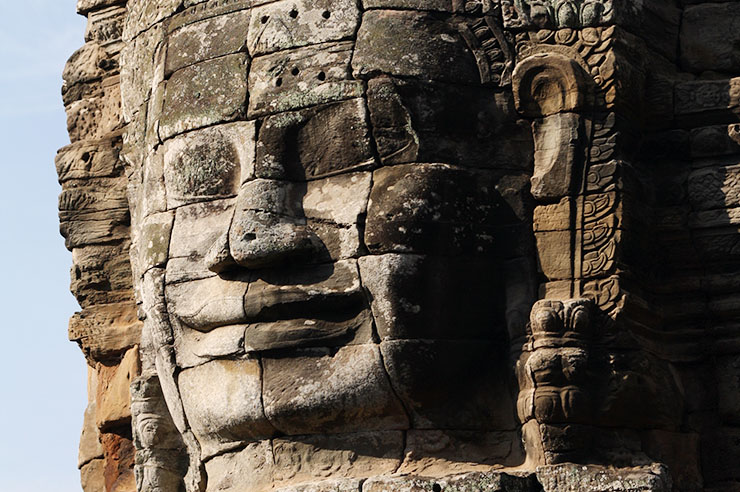
    That’s when he built the enigmatic Bayon Temple, which has his own face carved into dozens of towers scattered at random around the temple. The King rendered himself, not just as the supreme ruler and representative of the Godhead, but also as the Bodhisattva Lokesvara, thereby combining in his person the multiple religious currents of the Khmer. There is something, as well, supremely human in these heads, so perfectly recreated throughout the complex. The full lips and plump cheeks are beautiful, and speak of gentleness rather than fear, of contemplation rather than exertion. I am always delighted to be in the presence of this enormous cosmic friend, no matter how many hundred elderly Korean ladies might be pushing past me in the hot sun. That is the connection between the ruler and his people – perhaps all people. We respond to majesty, and recognise its presence and its guiding hand, even across the division of ages.

    After he died in 1218 the Khmer Empire began its slow and sad decline, from which it is only now beginning to rescue itself. From the 17th century the Khmer empire began to spiral downward, ceding vast amounts of territory to Thailand and Vietnam – including the whole of what we now know as Southern Vietnam, including the city of Saigon, which the Khmer called Prey Nakor (and still do, if you ask them). In 1865 Cambodia became a French protectorate.

    The Legacy of the Khmer Empire

    The Khmer empire is responsible for so much of what we recognise as south-east Asian culture – including many of the things we normally attribute to Thailand, such as Thai boxing, Thai dancing, even the Thai script is derived from Khmer, which was itself derived from Sanskrit. The traditional story of the Ramayana – though considerably changed in its Cambodian version – is carved on kilometres of stone panels in Angkor Wat, said to contain eighteen to twenty thousand carved figures. The women of the temple spent much of their time re-creating the stories in sacred dance. This dance has survived, quite miraculously, through its continuous royal patronage, and these days is performed once again on the terraces of the temples of Angkor.

    Cambodia is still a very poor place. It has suffered the effects of war and the disastrous Khmer Rouge years. Angkor Wat is its jewel, glorious and majestic still, and the Khmer people are justly proud of it. In our enthusiasm for this ancient site it’s important that we not glamorise the poverty that still blights the nation or, more subtle still, spiritualise it. The Cambodian people struggle to exist, and it’s a country of immense poverty and injustice. But there exists as well a great continued interest in the traditional arts, the arts that you can see being practiced on the 900 year-old carved stones of Angkor.

    And Angkor Wat is no longer the centre of political power in modern Cambodia. The capital city is Phnom Penh, 315 kilometres to the south-east. Interestingly enough, Phnom Penh has its own spiritual and mystical roots in Angkor. The city was said to have been founded by an elderly woman who, scavenging for firewood in the debris washed up by a recent flood, split a log and found in its hollow five religious statues – four stone Buddhas and one bronze Vishnu. They had come from Angkor, magically transported in the floodwaters. The woman, called Penh, decided to have them enshrined on a hill (Phnom in Khmer) on her property around 1372. Around this grew the city of Phnom Penh, eventually the new heart of the Khmer kingdom. But at its very centre remains the spiritual energy of Angkor.

    The temples of the Angkor area are still alive as points of worship and pilgrimage. They have seen such a strange shift over the centuries – as Hindu temples, then Mahayana Buddhist temples, then Theravada Buddhist temples, and finally as shrines to the tourist dollar. They will survive this, too, and their stones will continue to speak to people a thousand years after we have gone.

    [alert type=”general” dismiss=”no”]This article was published in New Dawn Special Issue Vol 6 No 1.[/alert]

    [alert type=”success” dismiss=”no”]If you appreciate this article, please consider subscribing to help maintain this website.[/alert]

    © New Dawn Magazine and the respective author.
    For our reproduction notice, click here.