New Dawn – World's Most Unusual Magazine

Category: Ancient Mysteries

  • The Problem with Paradigms: In Search of Earth’s Hidden History

    The Problem with Paradigms: In Search of Earth’s Hidden History

    Mainstream orthodox (or ‘physical’) science contains as many paradigms as it does supposed facts, if not more; but it still tends to treat the former as largely substantiated facts. However, a paradigm – as the dictionary confirms – is merely a model, involving one or more assumptions. In fact, it is representative of the seemingly best functional theory or hypothesis available with accessible data in the face of ignorance of the true facts, which may in fact be quite different. That then, along with all the rest, is then presented to the world as ‘scientific knowledge’.

    This, however, presents us with a problem because physical science sees itself as technology based, due to the need for reliably consistent reproduction of accurate data in the face of man’s own psychological and sensory inconsistency. Problematically, physical technology is itself based on paradigmatic assumptions and the associated limitations of then available sub-technology. So where does that put us in relation to the wider human experience which takes into consideration states of existence beyond the physical and even treats these as more real than the physical?

    Alternative (or more accurately, sequentially parallel) states of existence have been discussed in openly allegorical or hermeneutic (structured) terms for thousands of years by both mystics and more metaphysically orientated philosophers, by virtue of their own actual experiences through self-experimentation. Those experiences were of course subjective in nature (because other states can only be accessed in such a manner) and it is therefore assumed by critics that they lacked the objectivity necessary to achieve any real degree of reliable accuracy. But this assumption is itself based on the highly questionable hypothesis that laboratory methods and/or modern academic forms of presentation and substantiation are the only reliable ones when these are themselves largely un-natural. So where do we go from here?

    Over the last three centuries there has developed a growing belief that the objective physical world and the ‘subjective’ states of existence are or can be inter-connected and can thus directly affect each other. This started with the phenomenon of mesmerism in the eighteenth century and continued with human ectoplasmic manifestations in spiritualistic séances in the nineteenth (although spiders have been producing ectoplasm to form their webs since time immemorial). Subsequent to this, the new science of psychology began to show the subjective worlds of human thought and feeling as having a real consistency of internal dynamics if and when viewed on their own terms. Furthermore, quantum physics in the twentieth century seemed to confirm that physical experiments could be phenomenally affected by the psychological attitude of the observer. Yet we now appear to stand at something of an impasse.

    Physical science has accepted that consciousness has to be considered a fundamental part of the equation of existence but it still sees consciousness as a merely electrical phenomenon generated (by extension at the physical level) by aggregations of base atomic and then molecular matter forming itself into organisms. Yet it is unable to answer the question of how it is that organic life can somehow emerge from apparently ‘dead’ matter – or why it should do so. Esoteric philosophy, on the other hand, has always taken the view that there is no such thing as ‘dead matter’; that there is in fact only one principle in the omniverse and that this is Life itself, manifesting as a homogeneous substance called, for want of a better term, ‘spirit-matter’ and appearing in a vast spectrum of qualitatively based states, each with its own potential polarity and apparent fields of progression or limitation, thus giving rise to a sympathetic sense of inter-connectedness, which we call consciousness. Furthermore, esoteric philosophy has always seen the universal spectrum of Life as the manifestation of a single, Universal Consciousness possessing an infinite range of memory and intelligence. Deists call more remote aspects of this by the name ‘God’ and try to give it a sort of humanly interactive personality. However, philosophers say that it is not only inconceivable in all respects, but that it is also approachable only by a progressively expansive understanding of what it is not.

    This, of course, is not acceptable to a science which states that everything must have a testable rationale. However, in adopting that stance, science again makes an erroneous assumption. Esoteric philosophy (if properly followed) is itself based on the understanding of a rational approach to the existence of progressive fields of consciousness; but its technique is necessarily both subjective and objective. Subjectivity is necessary for direct experience by self-experimentation and selection; objectivity (which, problematically, is also subjective) is necessary to rationalise and understand the effects in due context. However, these have to be used in tandem by an intelligence specifically trained in their simultaneous use – one that has itself developed the capacity not to merely react to experience. In other words, one that is self-consciously aware but which has also passed beyond the stage of a reactive self-association which is usually based on a mere mixture of like and dislike.

    The science and art of true esoteric faculty involves a fundamental detachment of consciousness from that which is being observed. That is to say, one must learn to use a higher quality of consciousness to observe a lesser quality of consciousness in action and thereby understand its qualitative status and its modus operandi. We have to develop an adult perspective based on our own prior experience before we can really understand the motivation and actions of a child. There is no short cut. A child cannot understand the motivations of an adult because he/she does not have the experience and has thus not yet learned of the associated limitations by virtue of which we progress through such experience to a wider perspective of understanding.

    Plato made the point that “All is recollection.” In other words, there is nothing new in Universal Nature; but it is up to us to access it. Yet the first thing we have to understand is that memory is organised and works in progressive sequences, each involving its own essential field of limitation. But the progression is not linear. The Ancients tell us that the universe is concentrically organised and so each memory is part of a greater one. So, we have to first explore the plenum of one idea (or field of ideas) before we can break through its field of limitation into a yet greater one. This is the way in which the intelligent development of consciousness works. Thus it is that we first need to establish where a limitation exists (or potentially exists) before we can set out to go beyond it and thus achieve a greater perspective. Otherwise we shall merely go around in chaotically confused circles, merely re-exploring the past over and over again, thereby wallowing in a sea of superficiality. This, sadly, is what many people tend to do throughout their adult lives and it is the cause of needless frustration. Instead, we need constantly to move forward. That is why we have ideals to pursue.

    Curiously, science – despite its incessant materialism – is moving in the right direction, albeit grudgingly. It accepts the fundamental principle that a theory has to be fully and carefully examined before it can be accepted for further and wider usage. It also accepts that theories (paradigms) are all ultimately disposable, even though it currently chases the ultimate march hare of a supposed Grand Unified Theory which fails to take consciousness into account. However, many ‘New Age’ theorists are as much at fault in that they comprehensively tend to avoid the rigorous approach to consideration of both esoteric and scientific principles, substituting instead their own off-the-cuff theories, which cannot even be called paradigms because most of them are based on either partial perceptions or even pure wishful thinking. That is why physical science, with all its questionable paradigms, is so suspicious of ‘New Age’ thought. But as they say, “It takes one to recognise one.”

    That, however, brings me to one or two examples of mis-orientated scientific thinking (which I have highlighted in my recently published book The Rise & Fall of Atlantis) which may perhaps be of interest to readers of this magazine. The first of these involves the relationship between the core of the Earth and the planet’s surrounding ionosphere. The modern geological orthodoxy is that the core is composed of solid or liquid iron, or a combination of both, this providing the basis of the planet’s gravitational magnetism. However, this idea is based on the supposition that the Earth, originally part of the Sun and thus composed of plasma, was to begin with a superheated mass which cooled down, thereby allowing the heavy element of iron to sink towards the centre. But the supposition that the Sun’s plasmic mass is actually superheated (rather than electrically superactive) in the first place is also pure assumption. My suggestion is that it is not – and also that the core of the planet is still a plasmic mass, which responds to the fluctuations of solar energy coming our way as a result of voltage changes in our ionosphere. Interestingly, the Woods Hole Oceanographic Institute in the USA has already noted that the Earth’s core appears to rotate at a different speed to the crust. Present concepts of the Earth’s core fail to provide any suggestion as to how this could possibly occur.

    Now the ionosphere surrounding our planet at a distance of some 60 kilometres from the crust is itself an electrified field of matter whose voltage necessarily fluctuates because of the incessant variations in energy received from the Sun. As that occurs, so it must expand and contract. But this will itself produce a sympathetic response in the Earth’s plasmic core, which must also expand and contract in fluctuation, thereby causing huge changes in the magma sea under the crust. As the magma expands, it must necessarily generate internal pressure in the geological fields which contain it, thereby inducing volcanic activity and localised crustal expansion. Correspondingly, as it contracts, so the magma will cool and recede, thus causing the Earth’s crust to shrink back again, which will in turn lead to earthquake activity. Now the first effect of this different perspective is that it calls into question the paradigm theory of plate tectonics.

    The basis of plate tectonics (which was first suggested in 1915 and cast out through general scientific disapproval for some fifty years after that) is that all the visible landmasses were once gathered together as one gigantic continent called Gondwanaland, or Pangaea. For some inexplicable reason this then supposedly split up like a jigsaw puzzle into various continental landmasses, which began cruising around the globe on top of the supporting magma sea, and then started bumping into each other like ‘dodgem cars’ at the fairground. The next part of the theory then has some of the landmasses literally crawling over others and down the other side, this experience however, amazingly leaving both masses looking geographically pretty well just the same. The ‘proof’ behind this idea is that the eastward Brazilian projection of South America supposedly fits geographically very neatly under the westward projection of the African continent, thereby confirming the original, broken jigsaw puzzle theory.

    Proponents of the plate tectonic theory also draw attention to what is called the Mid-Atlantic Ridge, the fragmented central area of the Atlantic seabed which we can see on bathyspheric maps. All along this ridge are to be found hydrothermal vents (sometimes known as ‘black smokers’) which are chemically based extrusions, often several metres in length, pumping out volcanic gases from within the crust. These, we are told, are clear evidence that the Atlantic seabed is splitting, so pushing South America and Africa gently even further apart. However, there is no actual proof of such a split.

    Now, as is pointed out in my book – citing evidence provided by others far more knowledgeable in the field than I – the idea that continental landmasses can just cruise around in the manner suggested is absurd. It takes inconceivably huge expenditure of energy to shift large geological landmasses – energy levels which scientific measurement itself has proven the planet just does not begin to possess in sufficient capacity to motivate the landmasses in such a manner. Furthermore, the idea that landmasses could somehow slide over each other without damaging their geographic identity is altogether ludicrous. Even more unanswerably, new landmasses are constantly being created by the acre every year (as for example in Hawaii) by the spread of volcanic lava, or destroyed by gradual erosion or cataclysm. So how can plate tectonics work in the face of all these various facts?

    Geologists have used their theories to ‘prove’ that the profile of the Atlantic seabed confirms why the ancient idea of a mid-Atlantic continent (aka Atlantis) could not possibly have existed. However, my suggestion (my own paradigm, if you will) as previously explained, provides a very clear indication as to how and why huge masses of the Earth’s crust could indeed be deformed by expansion and contraction generated by electromagnetic pressure from the planet’s core. However, that is not the whole story behind the Mid-Atlantic Ridge. Its peculiarly twisted shape tells us of another influence – this time an astrophysical one.

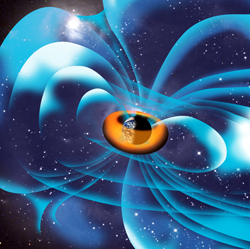
    The Ancients described our planet as being suspended in Space between two great magnets. But this does not sound so absurd when one takes into consideration that the indentation of the ionosphere at both poles effectively means that the true poles are in fact to be found far above the Earth’s surface, not on it as is commonly imagined. However, the ionosphere itself is like a giant squeezable crystal – indeed the ancient Egyptian god Ptah was described as containing the planet within a crystal globe which he fashioned. When I suggest that it is ‘squeezable’ I mean to draw attention to the idea that it behaves piezo-electrically. I am suggesting, in other words, that during certain stages of the solar cycles which our planet goes through, it is necessarily forced through much more powerful electrical fields in Space, which cause its biosphere to contract because of the corresponding electrical hypertension generated in the ionosphere.

    As the ionosphere is thus ‘squeezed’ centripetally inwards, at both poles, so the plasmic core of the Earth is forced to respond by centrifugal expansion. At a particularly critical point, these two antagonistic forces will literally cause the magma under the planetary crust to generate a coreolis effect, resulting in the upper and lower crustal hemispheres twisting in opposite directions. If you now look closely at a map of the world you will see that the volcanic ridges along the oceanic beds follow an interestingly parallel pattern which could only be achieved, I suggest, by such a twisting in different directions of the upper and lower hemispheres. The nett effect of this, of course, is that the crust in the tropics would be subjected to such terrible force that any geologically ancient landmass in the area would literally crack up and fall apart.

    This, I further suggest, is precisely what happened to Atlantis and, as I have described in my book, it is also very probably what caused the almighty cataclysm in the Gulf of Mexico mentioned in the Troano Codex to the Mayan sacred book, the Popol Vuh, as having taken place some 8,060 years before the author’s time, thus killing some sixty million people in the space of one or two days. Just consider the probable extent of the central American landmass before this cataclysm, which itself appears to have coincided historically with the submergence of Plato’s Atlantean island of Poseidonis in the north-eastern Atlantic, plus a variety of other events, such as the sudden raising of the Andes to the south.

    Furthermore, this same historical time seems to coincide not only with what my friend Robert Bauval has shown as the Egyptian period of Zep Tepi (the ‘First Time’) but also with the celestial solstice generated by the 25,920 year cycle which we moderns call the ‘precession of the equinoxes’ – which was known to the Ancients as ‘the Great Year of the Pleiades’. It would take too long to describe the importance of the Pleiades in this paper (it is described at some greater length in my book); but suffice it to say that there appears to have been seen a pivotal (cyclic) association between it, our solar system and the seven stars of the circumpolar constellation, Ursa Major, leading to the very appearance of an originally spiritual, proto-human-kind on this planet, literally millions of years ago.

    Most astronomers and astrophysicists will of course just laugh at this as the products of ancient superstitions. But then many of our modern scientists – not finding themselves able to credit the possibility of spirit-matter in the first place (notwithstanding their as yet hypothetical ‘dark matter’ and ‘quantum fluid’) – would hardly be likely to consider the possibility of the massed spirit-organisms of humankind (i.e. souls, not human beings per se) perhaps originating in another but kindred celestial system. I hasten to add that this can in no way be considered in terms of UFO activity. Spirits – organised as cellular groups of souls – would not need spacecraft if an astrologically and astronomically helpful period of relative proximity were cyclically available to enable a fluid transmission of celestial consciousness between greater and lesser star systems, which ancient tradition holds to be repositories of such consciousness. But is this not perhaps the origin of the very ancient idea of Man having ‘fallen’ from a superior state of ‘Grace’? Is this not perhaps also why the ancient Egyptians were so focused on spiritual development leading the highest initiates or Piru (not the pharaoh, as Egyptologists fondly imagine) back to the circumpolar stars?

    In The Rise and Fall of Atlantis I have quite deliberately addressed the hitherto cloudy issue of spirits and souls in relation to the hugely ancient origins of humankind on this planet and its continued evolution of culture through civilisation. In doing so, I recognise the immediately apparent dangers of being treated as just another New Age nutcase. However, I have gone to some considerable lengths to show that Darwinism and Creationism not only do not work, but are also not the only (or even most viable) alternatives. When consciousness is itself brought into the equation as inherent in all the kingdoms of Nature, in concert with the concept that there is no such thing as dead matter, it will immediately be seen why the universe in toto has to be considered as a psychologically based organism (with a wide spectrum of intelligence) within which spirit and matter are qualitatively polarised aspects of one and the same principle. It will then be understood why astrologically timed and astro-physically organised insemination (or withdrawal) of different qualities of intelligence from any celestial body or system (as an organism) must itself be a quite natural function in universal Nature.

    I hope that my book will be seen as providing a logically reasoned, alternative perspective for public discussion, rather than as merely another book on Atlantis and its geographic whereabouts. The sub-title to it – “The Mysterious Origins of Human Civilisation” – should be enough to suggest that there is far more inside it to chew on than one would normally find in a book on the subject. May I therefore wish my readers many happy hours of further discovery.

    [alert type=”general” dismiss=”no”]This article was published in New Dawn 111.[/alert]

    [alert type=”success” dismiss=”no”]If you appreciate this article, please consider a contribution to help maintain this website.[/alert]

    Bibliography

    H.P. Blavatsky, The Secret Doctrine (Los Angeles, Theosophical Publishing House, 1947)

    M. Cremo & R. Thompson, The Hidden History of the Human Race (Bhaktivedanta Book Publ., 2000)

    C. Darwin, The Descent of Man (London, Penguin Classics, 2004)

    J.S. Gordon, The Rise & Fall of Atlantis (London, Watkins Publishing, 2008)

    B. Greene, The Elegant Universe (New York, Random House, 2000)

    F. Hoyle & C. Wickramsinghe, Evolution from Space (London, Paladin Books, 1983)

    R. Milton, Shattering the Myths of Darwinism (Vermont, Inner Traditions, 1997)

    Plato, Timaeus & Critias (London, Penguin Classics, 1965)

    P. Russell, The Awakening Earth (London RKP, 1982)

    G. Santillana & H. von Dechend, Hamlet’s Mill (Boston, D.R. Godine, 1992)

    D.E. Scott, The Electric Sky (Portland, Oregon, Mikamar Publishing, 2006)

    Sir W. Scott, Hermetica (England, Solos Press, 1993)

    S. Wolinsky, Quantum Consciousness (Bramble Books, 1993)

    © New Dawn Magazine and the respective author.
    For our reproduction notice, click here.
  • Mankind’s Cradle of Civilisation Found in Java?

    Mankind’s Cradle of Civilisation Found in Java?

    “Men fear time,” the old saying used to go, “but time fears the Sphinx.” That famous statue and Egypt’s Great Pyramid before which it has reclined for thousands of years have been long regarded as the most ancient monumental structures on Earth. Indeed, their late 20th century reappraisals indicated that they were even older than suspected.

    Beginning in 1974, a medical physicist and colleague of Albert Einstein, Kurt Mendelssohn, showed that the Great Pyramid was not the 2560 BCE tomb of some vainglorious king described by mainstream scholars.1 Instead, the “Mountain of Ra” was raised nearly six centuries earlier, at the very outset of Pharaonic Civilisation, as a massive public works project to unify the numerous, divisive tribes of the Nile Delta in the common cause of its construction.

    So too, the Great Sphinx – roughly contemporaneous, according to Egyptologists, with the Great Pyramid – has been back-dated to at least 5000 BCE – two millennia before the first Egyptian dynasty – by an American geologist at Boston University. During the early 1990s, Robert M. Schoch found that erosion on the Sphinx was not caused by the effects of wind-driven sand, as consensus opinion held, but by moving water, when conditions at the Nile Valley were far more rainy, long prior to the 26th century BCE.2

    As recently as 2009, these extreme chronological disclosures were radically eclipsed by radiocarbon testing of a monumental ceremonial centre in southern Turkey. Its T-shaped pillars, arranged in concentric, stone circles emblazoned with anthropomorphic, zoomorphic and geometric bas-relief images, pushed the start of civilisation back to eleven thousand years ago. But now, even Gobekli Tepe’s primacy has been overtaken by the announcement last autumn of a much larger megalithic complex, half a world away from Anatolia, two thousand or more years older.

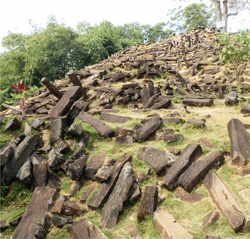
    The paradigm-shattering ruins were found in western Java, fifty kilometres southwest of Cianjur, a city with more than two million residents; Jakarta lies one hundred twenty kilometres to the northwest. A half-hour drive over asphalt and unpaved roads to the village of Karyamukti passes through mountainous landscape dotted with rice paddies and farms flourishing in the volcanic soil with chillies, peanuts, pineapple and corn, then skirts an immense tea plantation. At Mount Padang, hardy visitors need about twenty minutes to climb some 370 stone steps, rising at almost a forty-degree angle, ninety-five metres to the summit, which is crowned with the largest megalithic site in southeastern Asia. It encompasses more than twenty-five hectares, including nine hundred square metres of five, rectangular, stone courtyards ascending northwest to southeast, precisely laid out on a series of landscaped terraces, and neatly organised into low walls, inner partitions, and outward gateways, all of them connected by flights of stairs.

    Within and without the enclosures are dozens of standing monoliths, but many more lie scattered about. The entire complex comprises an estimated 3,703,700 black, andesite blocks ranging from one to two metres in length, and formed by geological processes into polygonal structures of five-, six- or eight-sided columns. (Andesite is an extrusive, igneous rock, a type of basalt formed by volcanic action.) Average dimensions for the columns are 0.3-by-0.3-by-1.5 metres. These smooth-sided blocks weigh from ninety to six hundred kilograms, with an average, individual weight of about three hundred kilograms. In other words, the site’s prehistoric workers transported approximately 1,111,110,000 kilograms (1,224,790 short tons) of building materials 885 metres above sea level, up the precipitous slopes of Mount Padang. Added to their burden was a non-local source for their andesite, which had to be brought in from some distant quarry unknown to academic scholars.

    Archaeologists were further surprised to find traces of a kind of adhesive, glue or perhaps cement that bound some of the top courses of the walls. Beneath, investigators were perplexed by the presence of several layers of sand that had been deliberately incorporated into the original stonework by the prehistoric engineers, perhaps allowing the blocks to move and slide against each other with the motion of seismic disturbances, instead of rigidly resisting such geologic upheavals and breaking under tension. Here was possible evidence for ancient earthquake-proof construction. Java is notorious for its tectonic violence, which claimed the lives of about eighty victims as recently as 2 September 2009. But it seemed utterly inconceivable that some pre-industrial people living in a remote, Indonesian backwater could have actually applied a form of technology our modern world has only recently begun to grasp.

    ‘Musical’ Rocks

    Contributing to the stones’ high strangeness, most of them possess an unusual quality that may have additionally warranted their distant importation by the ancient builders to the top of Mount Padang. Most of its andesite blocks and columns resonate with a bell-like tone when struck with another hard object. They belong to a rare, geological occurrence known as lithophony, the property of some rocks to emit musical sounds under percussive stress. Although only slightly more than one dozen lithophonic boulder fields have been identified in the world, most are found on private property, or have been obliterated by urban development.

    Two, separate sites identically named “Ringing Rocks Park” may be visited in the United States at Upper Black Eddy and Lower Pottsgrove Township, or Stony Garden on the northern slope of Haycock Mountain, all in Pennsylvania. Yet another American “Ringing Rocks” field is found in Montana’s Deerlodge National Forest, on the southwestern flank of Dry Mountain, in Jefferson County, southeast of Butte. Australia has its own “Ringing Rocks” in northwest Queensland, and Mexico’s Cerro de las Campanas, or “Hill of the Bells,” is located on a hill in the city of Querétaro. There are the Musical Stones of Skiddaw in Cumbria, England, but Scotland’s Clach a’ Choire is more cogent to our investigation, because this “Ringing Stone Of Tiree” bears fifty-three circular “cup marks” made by New Stone Age musicians, 4,500 years ago. They, like the builders at far-off Java’s Mount Padang, discovered something unusually mystical in the bell-like sounds. Remarkably, all these various sites produce very different tones from one another; no two locations sound exactly alike.3

    During laboratory testing of several lithophonic rocks in 1965, Pennsylvania geologist Richard Faas found that they created a series of tones at frequencies lower than the range of human hearing, and only became audible when they interacted with each other. Although lithophonic rocks sound metallic, their somewhat higher iron content is not responsible for such music, but rather a combination of the density of the stone and high degree of internal stress. Or so geologists speculate. In truth, beyond the cursory examinations undertaken by Faas, no actual studies to identify the source of lithophony have been made. Why some rocks produce ringing tones remains a scientific riddle.

    Their anomalous appearance among the ruins of Mount Padang is another dimension of their ancient mystery. No doubt, they were used by the prehistoric inhabitants as part of their ceremonial and spiritual activities. A concentration of lithophonic rocks on the site’s first terrace is referred to as “the gamelan stones” for their suggestive arrangement and the variety of musical sounds they make. Notes they produce have been identified as F, G, D and A by Hokky Situngkir from the Bandung Fe Institute, an Indonesian research organisation.4

    Alignments at Gunung Padang

    Archaeo-astronomers have determined that at least several of Mount Padang’s larger standing stones point to very definite celestial phenomena, such as sunrise and sunset on the summer and winter solstices, together with those of the spring and vernal equinoxes. The ceremonial centre’s name may, in fact, have actually derived from these prehistoric solar orientations. For example, the word padang, in the language of the Sundanese people of West Java Province, translates as “bright.” Gunung Padang, the archaeological zone itself, is commonly referred to by native residents as Sundapura, or “the Shrine of the Sun,” while the hill on which the ruins are located (“Mount Padang”) is traditionally called Parahyang Padang: “Where The Sun Ancestors Dwell,” or “Place Of The Ancestors Of The Sun.” These names or titles imply that the original inhabitants were astronomer-priests and/or priestesses, who aligned some of their monoliths with important solar positions. As such, these “Sun Ancestors” were light-worshippers, not unlike the European megalith-builders, who often oriented their own standing stones in western France and the British Isles with identical solar coordinates. Today, Gunung Padang is still sought out as a holy place by the two hundred to seven hundred visitors, most of them religious pilgrims, who visit every month.

    Geomantic alignments are also in evidence. Terrace I is deliberately aligned with nearby Mount Gede, where Karuhun cemetery has been revered for untold generations as the country’s oldest ancestral burial ground. Five, crudely sculpted, andesite thrones stand in Terrace II; six more are found in Terrace V. Although overshadowed by their massive courtyards, Mount Padang’s hundreds of stone terraces are themselves engineering marvels, two metres in height and diameter, with an uncanny resemblance to their far better known agricultural counterparts at another mountainous location on the other side of the world, in the Inca citadel of Machu Picchu, among the Peruvian Andes.

    The Mysterious Nan Madol

    But this South American parallel is not Gunung Padang’s only overseas’ comparison. No less great is an astounding, perhaps kindred mystery 4,345 kilometres northeast from Java, in a remote corner of the western Pacific Ocean. Off the coast of the Micronesian island of Pohnpei – “Built Upon An Altar” – stand the massive ruins of a long-dead archaeological site. Incongruously built on a coral reef less than two metres above sea level, Nan Madol – “Spaces In Between” – is a series of rectangular islands and colossal towers choked by draping vegetation. Ninety-two man-made islands are enclosed within the “downtown” area’s 2.6 square kilometres. All are inter-connected by an extensive network of what appear to be massive canals, each nine metres across and more than one metre deep at high tide.

    An estimated two hundred fifty million tons of prismatic basalt – related to Gunung Padang’s andesite – went into the construction of Nan Madol. Its stone girders rise in a cribwork configuration to eight metres. Between four and five million stone columns went into the construction of this prehistoric megalopolis. These prismatic columns range in length from one to four metres, although many reach six metres. Their average weight is around five tons each, but the larger examples weigh twenty or twenty-five tons apiece. An estimated four to five million basalt pillars, girders and logs went into building Nan Madol. It is, in effect, a double-walled enclosure comprising thirteen thousand, five hundred cubic metres of coral, with an additional four thousand, five hundred cubic metres of basalt. Remove all concealing vegetation, and visitors would behold crudely worked masses of basalt contrasting with orderly courses of stone rising in massive towers and overpowering walls amid a complex of smaller, rectangular buildings and man-made lakes interconnected by dozens of canals and numerous steps, sometimes formed into grand staircases, and spread out over eighteen square kilometres.

    Construction migrated to the main island of Pohnpei, where a rectangular enclosure fifteen metres long by eleven metres wide, with bisecting, one-metre-high interior wall, was discovered in a remote, swampy meadow high in the mountains; its configuration and mountaintop setting are particularly reminiscent of Gunung Padang. Although the Micronesian island’s twin courtyards contain a five hundred square-metre area, a pair of inner platforms are only a third of a metre high. As at Nan Madol, roughly cut basalt boulders and basalt “logs” were stacked to form the enclosure. Several others stand on Pohnpei’s southwest coast, with the largest example atop a two hundred forty-metre-high mountain. The summit is entirely surrounded by walls about two metres high connected via paved walkways to several terraced platforms.

    No one knows who raised them, when or why. Micronesian myth recounts only that exceptionally tall, twin-brother sorcerers, named Olisihpa and Olsohpa, arrived sometime during the ancient past in a “large canoe” from their distant homeland. It was a great kingdom of glittering splendour, until falling stars and earthquakes eventually destroyed Kanamwayso, which sank to the bottom of the sea. This native oral tradition seems like a variation on the more famous story of Mu, or Lemuria, a deeply ancient and supposedly sophisticated, pan-Pacific civilisation that exerted lasting influence on both Asia and America prior to its destruction by a natural catastrophe similar to the tsunami that ravaged northern Japan, in 2010. Before the analogous loss of Kanamwayso, Olisihpa and Olsohpa allegedly built the basalt enclosures and staircases that continue to grace Nan Madol and Pohnpei. Despite more than one hundred years of scientific investigations, however, no known culture has been associated with these places. Meanwhile, the moist, tropical climate skewers accurate carbon-dating at both locations.

    Nor is their original purpose entirely clear. Nothing about either location suggests real urban centres, lacking as they do any provision for food production or storage. No human burials have been found there, save a few, individual skeletons of above-average stature – calling to mind local myths of the founding-fathers, Olisihpa and Olsohpa – unearthed by Japanese archaeologists during the 1930s. The rectangular arrangement of walls with regularly spaced openings and partitions suggest a ceremonial function. But for what people, and why in this extremely remote, obscure corner of the vast Pacific? Nevertheless, Nan Madol’s and Pohnpei’s fundamental resemblances to Gunung Padang imply, at the very least, a relationship of some kind, however inconceivable.

    14,000 BCE?

    Yet more extraordinary than even these comparisons and the monumental greatness of the Indonesian site itself is its uniquely profound age. The first archaeological survey of Gunung Padang appears in a “Report, the Department of Antiquities” (Rapporten van de Oudheidkundige Dienst) for Holland’s colonial office, whose anonymous author posited during 1914 that the ruins could not predate the official beginning of Java’s history in the early 5th century CE, although they appeared much older. For the rest of the 20th century, the site went unrecognised by the outside world, even after it was briefly mentioned by the prolific Dutch archaeological author, Dr. N.J. Krom, in 1946’s Under Palm And Banyan Trees.5 

    Thirty-three years later, a Canberra team from the Australian National University’s Centre for Archaeological Research – “dedicated to investigating and learning with and about the people, languages, and land of Asia and the Pacific region” – returned for the site’s first, scientific examination.6 In doing so, they determined that Gunung Padang was far older than previously imagined. Lichen growth alone covering many of the megaliths bespoke an antiquity going back millennia before Java’s earliest known culture. Not until February 2012, however, was a State-sponsored evaluation of the site carried out, when thorough radiocarbon testing revealed it was built and first occupied about 4,800 years ago. This surprisingly early Third Millennium BCE date placed Gunung Padang squarely within Western Europe’s Megalithic Age, with implications for transoceanic contact, however heretical such considerations struck conventional scholars.

    But as the researchers were carrying out their investigations, they noticed traces on Mount Padang’s surface of what might be other, underground structures. No less a supporter of science than the President of Indonesia himself, Susilo Bambang Yudhoyono, lavished the archaeologists with costly GSSI and Multi-Channel SuperSting R-8 ground-penetrating radar units, plus GEM-Ovenhausser geo-magnetometers. These state-of-the-art instruments readily found and accurately confirmed the existence of large and small chambers, walls, gates and staircases buried deep beneath the often-visited, open-air ruins in a virtual subterranean mirror image of Gunung Padang.

    According to team leader and geologist, Dr. Danny Hilman Natawidjaja, “3-D geo-electric and geo-radar [procedures] discovered two doors in the hallway” of a chamber measuring ten-by-ten-by-ten metres at a depth of twenty-five metres.7 Throughout last summer and into early fall, he and his twenty colleagues – leading seismologists, philologists, archaeologists, anthropologists, and petrographers – carefully dredged up organic materials, which were sent for laboratory testing in the United States, because the Indonesians were determined to avoid any appearance of politically motivated results.

    “US lab validates Cianjur ‘ancient structure’ theory,” The Jakarta Post announced on 5 November. “A recent analysis of carbon-dating by the Miami-based Beta Analytic Lab has apparently validated findings by a government-sanctioned team that a man-made structure lies buried under Mount Padang in Cianjur, West Java. The lab used samples of sand, soil and charcoal found at a depth of between three and twelve metres beneath the mountain’s surface. Based on geo-electric, geo-radar and geo-magnetic [surveys], a large chamber is buried at least up to fifteen metres from the surface… Carbon-dating test results from the Miami lab show that the structure could date back to 14,000 B.C., or beyond.”8

    Since publication of The Jakarta Post report, repeated and additional analysis by Beta Analytic scientists confirmed their initial 14,000 BCE findings. The significance of this discovery cannot be over-stated, because it crosses the Ice Age event horizon. Even Turkey’s Gobekli Tepe, for all its Tenth Millennium BCE antiquity, came into being only after the close of the last glacial epoch, when environmental conditions were moderating sufficiently to allow for the development of proto-civilisation. Less distracted by the incessant challenges to their survival, our ancestors were afforded opportunities for broader, more complex social cooperation. But Gunung Padang proves that humans were already in possession of a relatively high culture two thousand years earlier, while the Ice Age was still in progress.

    This “Shrine of the Sun” has radically pushed back the origins of civilisation to remoter levels of time and space, because mainstream palaeo-anthropologists, fixated on Europe and the Near East, are resistant to the very notion of mankind’s transition from ‘savagery’ in Indonesia. Yet, it is precisely here that Stephen Oppenheimer, a British geneticist, member of Green Templeton College, Oxford, and an honorary fellow of Liverpool School of Tropical Medicine, traced the beginnings of civilised mankind with his controversial Eden in the East, in 1999.9 It had been preceded during the previous century by The Lost Continent of Mu, written by another Englishman, James Churchward, an Imperial British Army colonel serving in India, where his translation of original Hindu monastery source materials likewise recorded how humans took that first step in the Western Pacific realm.10 My own The Lost Civilization of Lemuria (2006) and Before Atlantis (2013) similarly trace the rise of homo erectus in Java, his Pacific-wide dispersal and accelerated evolution after the eruption of history’s greatest volcanic event, and his descendants’ subsequent invention of civilisation.

    These conclusions are wonderfully brought to life by recognition of Gunung Padang as Man’s earliest-known megalithic complex. Its apparent sophistication declares that it was not the first, but must have been preceded by the construction of even earlier ceremonial centres. Civilisation is, therefore, older than we presently comprehend. If, however, the quest for its ultimate origins goes on, and deeper into the past than ever imagined, then at the very least, Gunung Padang is pointing us in their proper direction.

    [alert type=”general” dismiss=”no”]This article was published in New Dawn 136.[/alert]

    [alert type=”success” dismiss=”no”]If you appreciate this article, please consider a contribution to help maintain this website.[/alert]

    Footnotes

    1. Kurt Mendelssohn, The Riddle of the Pyramids, London: Thames & Hudson, 1974.

    2. Robert M. Schoch, Voices of the Rocks, NY: Harmony, 1999.

    3. Ringing Rocks Park, Upper Black Eddy, Pennsylvania, www.youtube.com/watch?v=V4VtjFhysgc; Ringing Rocks Park, Lower Pottsgrove Township, Pennsylvania, www.youtube.com/watch?v=NBfrLoBpsIQ; Ringing rocks, Queensland, Australia, www.youtube.com/watch?v=dl_zL4g2gvs; Musical Stones of Skiddaw, England, www.youtube.com/watch?v=inWKcmVEwvs; Ringing Rocks, Montana, www.youtube.com/watch?v=smiCS1Ixfts; Cerro de las Campanas, Querétaro, Mexico, www.youtube.com/watch?v=_dMRcnlZ2tk; The Ringing Stone, or Clach a’ Choire, Scotland, www.youtube.com/watch?v=eNn-4O_G-bU

    4. www.abovetopsecret.com/forum/thread880575/pg1

    5. Dr. N. J. Krom, Onder Palmen En Waringins, Holland: Uitgeverij in Den Toren, 1946.

    6. ANU Centre for Archaeological Research, http://chl.anu.edu.au/archaeology/car.php

    7. www.abovetopsecret.com/forum/thread880575/pg1

    8. “U.S. lab validates Cianjur ‘ancient structure’ theory,” 5 November 2012, The Jakarta Post, www.thejakartapost.com/news/2012/11/05/us-lab-validates-cianjur-ancient-structure-theory.html.

    9. Stephen Oppenheimer, Eden in the East, London: George Weidenfeld & Nicholson, Ltd., 1999.

    10. Col. James Churchward, The Lost Continent of Mu, U.S.: Brotherhood of Life, 1987 reprinting of the 1924 original.

    11. Frank Joseph, The Lost Civilization of Lemuria, U.S.: Bear and Company, 2006; Before Atlantis, U.S.: Bear and Company, 2013.

    © New Dawn Magazine and the respective author.
    For our reproduction notice, click here.
  • The Gympie Pyramid: Evidence of an Ancient Civilisation in Australia?

    The Gympie Pyramid: Evidence of an Ancient Civilisation in Australia?

    From New Dawn 132 (May-June 2012)

    The Gympie Pyramid near the town of Gympie in Queensland, Australia has long been a source of fascination for people from around the world as well as Australia, and the subject of a great many claims about its origin and true purpose.

    Archaeologist Greg Jefferys, who has worked on the pyramid, refers to it as “a serious, famous and unexplained archaeological anomaly.”1 Unfortunately, academia and the government dismiss the pyramid on the grounds that it is a nineteenth century or even more recent construction for the purpose of growing grapes, ignore evidence to the contrary and refuse to conduct an excavation which would settle the matter.

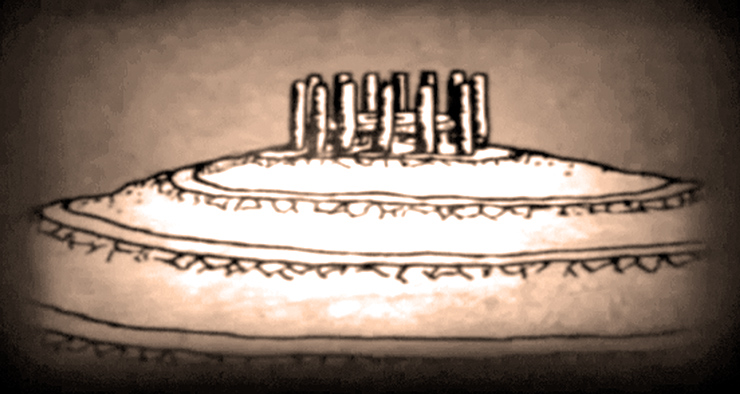
    What is known as the Gympie Pyramid is the rounded eastern end of a sandstone ridge north of the town of Gympie that had stone terraces cut into the sides, giving it a pyramidal shape. It is not a pyramid in the Egyptian or South American sense. The pyramid is approximately 5 km from the centre of Gympie, and is located north of the town on the Tin Can Bay road.

    Its interior remains unknown and has been a source of speculation, and there are believed to be three or four entrances, some blocked, leading into it. The pyramid is 30.4 metres (100ft) high and has six stone terraces varying from 10 metres wide at the bottom to two metres wide towards the top, and incorporate some natural rock features. Stone for many of the terraces has been shaped, and squared and some of the larger stones used would be extremely heavy.

    On the summit is a sort of ‘turret’, an upstanding section made of drystone walls with a depressed centre, and nearby there are two very heavy stone grinders, which may have been used to prepare ritual offerings. There is also a pile of stones that look like a collapsed building. Three large flat stones roughly shaped as diamonds have been found on the site. These have slots in the centre, which may have been for offerings and iron bars have been found on the site that fit the slots.2

    The terraces were believed to have been up to three metres high, but have become lower due to cattle and weathering. The pyramid is originally thought to have been terraced on three sides, but much of these were destroyed by bulldozing or early (or later) settlers carting away the stone for building purposes. An interesting little stone lined cell has recently been found at the base of the pyramid.

    The pyramid currently has large trees growing on it, which make it difficult to recognise at any distance, or to photograph.

    The would-be researcher of the Gympie Pyramid has to wade through a great deal of oral history and myth associated with it, and also try to sort out the different variations on the stories.

    When the pyramid was first discovered the summit is believed to have had thirteen pillars surrounding a round stone table with a hollow centre standing on the summit, and a stone gateway standing on the lower slopes of the pyramid, and other standing stones inscribed with symbols. Most of these are believed to have been removed by early settlers. Fortunately they were recorded in a diary by John Green, a great grandfather of Brett Green, a local historian who has spent much of his life researching the pyramid, and is the author of a book entitled The Gympie Pyramid Story.3

    Gold was found at Gympie in 1867, and settlement began from that year. Early settlers naturally regarded the pyramid as an easy source of stone and it was quarried to supply new buildings, doing much damage and removing all the inscribed stones. Inscribed stones from the gateway were apparently found quite recently under the floor of one of the Gympie churches – from where they vanished.4

    The pyramid became a source of much speculation and interest as unusual phenomena were reportedly seen or experienced on it, and unusual artefacts found nearby suggesting contact with earlier civilisations, and was given publicity by writer Rex Gilroy.

    Other Pyramids

    Another pyramid, or a building which looked like one, is believed to have existed at what is now Tin Can Bay, on the coast from Gympie. (Tin Can Bay has nothing to do with tin cans. The name is believed to be a corruption of tuncumba, the aboriginal name for dugong, possibly the indigenous name of the bay.) The area was taken over as an army base, and the story relates that the pyramid was covered with earth and used for target practice. However, subsequent damage to the pyramid resulted in the discovery of carved stones used in its construction. At this point the army became worried about losing land to heritage purposes, and destroyed the pyramid. The carved stones were reputedly crushed and used to fill a creek, or else taken out and dumped in deep water. This is believed to have taken place either in the 1940s, after World War II or in the 1950s. One of the people who took part agreed to be interviewed years later, and mysteriously died on the day of the interview, the large police presence at the death causing some surprise.5

    Other pyramids have reputedly been found around Australia. The well-known surveyor Len Beadell is said to have found a pyramid on the Nullabor plains, and was told by the local aborigines that the pyramid was outside the dreamtime, and that it was very bad luck to talk about it. This pyramid is said to be made of stone, and largely buried, which is why it has not been located on Google Earth.

    More recently, a passenger flying across central Australia saw a pyramid in the desert north of Alice Springs. One needs to bear in mind that central Australia used to be a lush area several millennia ago. A prophecy exists to the effect that a pyramid will be found in central Australia sometime this century, and that this site will be a major spiritual centre. Other pyramids are believed to have been seen in New South Wales.

    Archaeological Surveys

    There has been no major archaeological excavation of the Gympie Pyramid. An archaeological survey was undertaken by Michael Morwood in 1967 (for some unknown reason this report is unobtainable). He attributed the construction of the terraces to Italian wine growers or other immigrants in the nineteenth century. This idea was laid to rest by archaeologist Greg Jefferys, who did a survey while a student in 1990,6 and another survey and a limited excavation in 2007.7

    Jefferys found that the terraces were in some cases constructed with very heavy stones, some in excess of one ton in weight. And the terraces were too high for cultivation, the more so when you consider that they become more pronounced towards the top of the pyramid. Inspection of the soil in the terraces reveals only poor or rather thin native soils, becoming sandy in the top trenches, and show no sign of backfilling with more fertile soils. There is no trace of old vine stems, or roots or trellises, such as one would associate with former vine cultivation, and there is no equipment for wine making in the way of vats, etc. There would have been a major problem with watering the terraces, and there is no visible sign of any of the pipes and pumps that would be necessary.

    Greg also found that the existing side of the pyramid faces south-east, making it unsuitable for wine growing, Vine cultivators are advised to use areas facing north. He also found there had been no Italian community in Gympie before World War II, and research in the land titles office indicated that in any case the land had not been owned by the people credited with farming it. Greg points out that it would also be very unlikely for would-be cultivators to go to the trouble and effort of constructing the terraces when there is better and far more suitable land nearby.8 Terraces are not usually constructed for agricultural purposes unless there is a shortage of arable land, which is certainly not the case in Gympie. Work with a bobcat in 2007 revealed how very poor the soils in the terraces were.9

    The aborigines did not build the pyramid, and are not known too have constructed stone terraces anywhere in Australia, or to have shaped stones. If anything, they were afraid of the site and left it alone. Aboriginals taken to it in recent times declared they felt sick, and wanted to leave. Quite possibly it was regarded as a place of evil spirits. Jefferys has pointed out that the Polynesians had a tradition of terracing hills for forts and religious purposes, of which examples exist on Raiaiti and Tonga that bear a resemblance to the Gympie terraces, so the pyramid could be of Polynesian origin. If so, nothing else has been found on it to support this theory.10

    Dowsing has indicated there are a number of burials on the pyramid, but these have not been dug.11 If so, this would suggest a sacred site.

    The purpose of the pyramid is not known. Greg Jefferys points out that it would have made a good fort given its location,12 but there is no evidence for this, and it does not ‘feel’ like one. It quite possibly had a ritual function, particularly given the pillars on the summit, and was possibly also used as an observatory. If it involved a ritual function then very possibly there would have been connections with the stars. However, at the present time it can only be concluded the pyramid was built by unknown people for an unknown purpose.

    Reports from Dowsers & Psychics

    Dowsers have found the pyramid is on a major energy line, and energy rays out in four directions, like a Maltese cross. It is also connected by energy lines with what may be other pyramids or energy centres in the area.13 The pyramid may serve the function of drawing energy down (or up) and then radiating it over the countryside. Normally the destruction of such a centre would have very serious consequences. There is a powerful healing vortex at the top, near the grinders, and three people, including local resident and pyramid supporter Mick Dale, have, on separate occasions, experienced considerable healing for back problems there.14

    Psychics maintain the Gympie Pyramid has links with nearby and as yet undiscovered pyramids in the Gympie area, with pyramids in central Australia and the Nullabor, and with remains in Antarctica. It will be interesting when we are finally able to put together maps of the psychic centres around Australia.

    There has been considerable consistency in the findings of psychics and clairvoyants visiting the site. Brett Green mentions that local residents used to see ‘Nim Nim’ lights on top of the pyramid,15 and other phenomena have been encountered. One of the most frequently encountered apparitions are soldiers wearing bronze helmets and armour and holding shields. Since the 1960s people have encountered white-clad female spirits, who identified themselves as guardians of the site. Jefferys mentions a Betty Dodd who encountered a white clad apparition.16 

    The most recent encounter took place last August when clairvoyant Michael English, who had no knowledge of previous reports, encountered a soldier in bronze armour and then two white clad ladies on the summit. One of these was blond and wore a heavy gold necklace. She gave her name as Nitarla, and said she was one of three such guardians (this name was also given to Mick Dale by another source as the name of the guardian. Michael had no knowledge of this). Nitarla said they had lived on the pyramid in antiquity, which was when the pyramid was bombarded, but they had elected to stay to try to protect it. Unfortunately they had been unable to stop the damage to the pyramid.17 

    The present writer also unexpectedly encountered a white-clad lady, this one with black hair, a couple of days later on the topmost terrace. This lady said nothing but bade him welcome by gestures. People about to ascend the pyramid frequently experience being ‘stopped’ by invisible means, and have to obtain permission before going up. The writer also found that an L-shaped dowsing rod, when held loosely in the hand, spun around freely by itself on the pyramid, usually a sign of a powerful site.

    Michael English said the pyramid originally had a vortex on the top used to help spacecraft take off. This was destroyed when the pyramid was bombarded by banana shaped aircraft, possibly from Atlantis. This account has since been corroborated by another clairvoyant, Richard Shar, while using psychometry (reading the past) long distance from Adelaide.18 Visiting psychics report seeing an inner chamber in the pyramid containing various artefacts, and in particular, commonly report seeing a large dark crystal. If so, this crystal would very probably be essential to the energy functions of the pyramid.

    Individuals have had spiritual experiences equating to what is called ‘cosmic consciousness’ (a spiritual realisation of higher consciousness and unity with all things) on the pyramid, and others have seen what may be the future (one person saw New Zealand splitting in two and sinking).19 There is also thought to be antimony underground, which attracts lightning.20

    In the 1960s the summit of the pyramid was bulldozed by a person wanting to build a house. In doing so he is said to have destroyed the remaining two columns and dumped them in a mineshaft. Afterwards it is said he suffered illnesses, bad dreams and mechanical trouble, and started seeing figures in his house near the pyramid. He was thoroughly ‘spooked’ and left the area.21

    Unusual Objects

    Several unusual objects have been found in and around the Gympie area. These include among other things (refer to illustrations on page 50): a carved, yellow stone head suggesting South American influence; an ancient statuette of the Indian goddess Lakshmi; a Grecian urn; an ancient Chinese bronze teapot, and an apparent stone statue of an ape-like figure, known as ‘The Gympie Ape’. The archaeological value of these objects has been reduced by them being taken out of context, but they are still interesting. A piece of ‘bloomery’ iron was found more recently on the pyramid. According to aboriginal legend, lakes or seas used to extend from the coast almost to the base of the pyramid, which is apparently supported by geological evidence. This would account for foreign contact in the area, and seismic uplift has since emptied the lakes.22

    The carved yellow stone head was found next to the pyramid in 1985 after the construction of the railway line alongside the pyramid. The head is carved from a yellow conglomerate stone, usually an unlikely material for sculpture, which is not found anywhere near Gympie, if indeed it is found in Australia. The head has strong central or South American connotations, and it has been suggested it is of Olmec origin. The head has healing properties. It’s also suggested that in constructing the railway, workers found either an entrance to the pyramid, or a large underground chamber containing artefacts. Either way, the railway is said to have removed the artefacts and filled up the chamber. The yellow head is thought to have been one that was mistakenly dropped during the excavation.23

    What is known as ‘The Gympie Ape’ was found in a paddock diagonally opposite the pyramid, by Dell Barry and Ken Blakemore, a former owner of the pyramid. It was considered possibly to be a statue of the Egyptian god Thoth in ape form, or the Indian god Hanuman. The statue is in the Gympie Museum.24

    A bronze statuette depicting either the Indian goddess Lakshmi or the Tibetan goddess Tara was found in clay in a creek bed in the Gympie region. The amount of corrosion on the statuette suggests that it must be of ancient origin.25 

    An ancient and unusual bronze and copper Chinese teapot or wine pot was found on Fraser Island, near Tin Can Bay. The corrosion on it indicates its age, and it may possibly have come from a shipwreck. The fact that it has three legs suggests it was a wine pot.26

    A bronze Grecian urn was found in the hills north of Gympie by Brett Green.27 

    A piece of bloomery iron was found on the pyramid along with other fragments during the 2007 visit by Greg Jefferys suggested smelting on the pyramid. This form of smelting has not been used in Australia as it died out in the Middle Ages, with some exceptions in parts of Asia. Other smelting related objects were found on the site, suggesting that smelting was done on site. So far three iron bars have been found on the pyramid, and at least one of these fits exactly into the central piercing of the flat diamond shaped stones. To date their purpose in doing so remains unknown.28

    Australian Eucalyptus was apparently and inexplicably found in Tutankhamen’s tomb. So were boomerangs believed to be of Australian origin.29 Gympie was a gold-mining area, which would account for members of other civilisations being there. It is rumoured the gold in the funeral mask of Tutankhamen has been traced to Gympie.

    Pyramid Site to be Bulldozed

    The Gympie Pyramid is a tourist attraction for the town of Gympie, which otherwise does not have a great deal to offer, and has brought in people from around the world. For all that, many Gympie residents still dismiss it as a myth.

    Irrespective, the Queensland government intends to bulldoze the pyramid in the near future and put a highway through the site. Local objections have been overruled, and no attempt is being made to excavate or find out more about the pyramid while it still exists.

    A lecturer in archaeology at the University of Queensland, Dr. Pranganell, said in an interview with the editor of the Gympie Times on 9 September 2006: “The University has no intention of trying to test the myth as any digging on the site (of the Gympie Pyramid) would just give credibility to something that was impossible.”30 

    People feel there is much more to be learnt from the Gympie Pyramid, and it should at least be properly excavated. It is an energy centre, and also a tourist attraction for Gympie.

    Normally, destruction of a major energy centre such as this would have very serious consequences for the nearby community. In the Scottish highlands, moving even so small a sacred object as a standing stone is considered to bring bad luck, and crofters go to a lot of trouble to preserve the stones in situ. If so, destruction of a large site would result in more than bad luck. But the pyramid may have ways of striking back, which will be interesting to see.

    If the pyramid is bulldozed and skeletons found, it will create a serious problem for the plans of the Queensland government, since it would have to regard it as a sacred site.

    Efforts should be made to save the pyramid. One can also meditate on saving the pyramid, and ask meditation and ritual groups to work to preserve the pyramid. Much will be lost if the Gympie Pyramid is destroyed, especially if it goes unexcavated and unexplored.

    Thanks to Brett Green and Mick Dale for oral assistance and permission to use photos and drawings from The Gympie Pyramid Story. Thanks are also due to Daphne Salt for much help with the photographs, and to Laurie de Lia for making the visit to Gympie possible. You can view all the photos by downloading a copy of this issue of New Dawn.

    [alert type=”general” dismiss=”no”]This article was published in New Dawn 132.[/alert]

    [alert type=”success” dismiss=”no”]If you appreciate this article, please consider subscribing to help maintain this website.[/alert]


    Further Reading

    Brett J. Green, The Gympie Pyramid Story, De Grene Enterprises 2000, Tel: 07 5482 3909

    Brett J. Green and Mick Dale, The Gympie Pyramid Story, DVD.

    Greg Jefferys, The Gympie Pyramid – The Big Dig Report, 27 March 2007

    Greg Jefferys, The Gympie Pyramid; a nice little mystery that Australian Academia like to ignore (incorporating his 1990 archaeological report).

    Footnotes

    1. Greg Jefferys, The Gympie Pyramid – The Big Dig Report, 27 March 2007

    2. Ibid.

    3. Brett J. Green, The Gympie Pyramid Story, De Greene Enterprises 2000, page 148

    4. Mick Dale, Personal Communication (PC)

    5. Ibid.

    6. Greg Jefferys, The Gympie Pyramid; a nice little mystery that Australian Academia like to ignore, 2006, (incorporating his 1990 report on the site.)

    7. Jefferys, The Big Dig Report.

    8. Jefferys 2006.

    9. Jefferys 2007.

    10. Jefferys 2006, page 4.

    11. Mick Dale (PC).

    12. Jefferys 2006.

    13. Mick Dale and Michael English (PC).

    14. Mike Dale (PC).

    15. Greene, The Gympie Pyramid.

    16. Jefferys 2006, page 3.

    17, Michael English and Mick Dale (PC).

    18. Richard Shar (PC).

    19. Mick Dale (PC).

    20. Ibid.

    21. Mick Dale and Brett Greene (PC).

    22. Mick Dale (PC).

    23. Ibid.

    24. Ibid.

    25. Mick Dale (PC) and Jefferys 2007, page 2.

    26. Jefferys 2006, page 5 and Mick Dale (PC).

    27. Mick Dale (PC).

    28. Jefferys 2007 and Mick Dale (PC).

    29. Brett Greene, The Gympie Pyramid Story, page 82.

    30. Jefferys 2006, page 1.

    © New Dawn Magazine and the respective author.
    For our reproduction notice, click here.
  • The First Race: Out-of-Australia, Not Africa!

    The First Race: Out-of-Australia, Not Africa!

    Over the last decade, all manner of unexpected archaeological discoveries have led to many experts questioning much of what was assumed to be fact. Recent findings and field-work relating to little ‘hobbits’ in Flores Island, Siberian hominids with mtDNA connections to people of Papua New Guinea, the exclusivity of our distinct genetic Homo sapiens code being compromised by a 4% Neanderthal input, and a variety of unexpected findings have called into question many elemental assumptions held about the past.

    Professor Clive Gamble (Southampton University) succinctly summarised the current impasse and polarisation this has caused, when declaring we have to construct “a completely new map of the world and how we peopled it.”1 Granted, our response to Gamble’s call may seem radical, however, these discoveries, found not only in America but throughout the entire Indo-Pacific Region, all point to the same ancient southern inspiration.

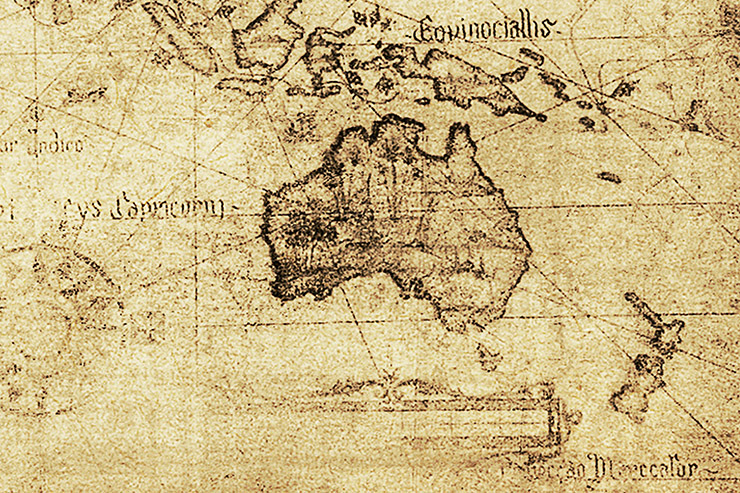
    After extensive consultation and research, we are of the opinion that at some time in the distant past, no less than 50,000 years ago and possibly much earlier, Aboriginal men and women set sail from Australia and began exploring foreign lands. They were the bearers of new insights and options, and bequeathed humanity the cornerstones of civilisation: religion, culture, gender equality, art, sailing, democracy, astronomy, surgery, and their genes.

    Australian Aboriginal guardians of traditional Lore and Law have made it clear to us that they are indeed the “First Race.”2 They were not, as assumed by some of the general public, ignorant savages stagnating in their primitive inertia. As highly respected Dhungutti Elder Rueben Kelly states, “Centuries ago you white people chose the path of science and technology. That path will destroy the planet. Our role is to protect the planet. We are hoping you will discover that before it’s too late.”3

    Unlike others out in the field or laboratory, we’ve ‘discovered’ nothing: our role is to act as scribes and faithfully present their history. The rest is easy: find white-fella proof to substantiate black-fella truth.

    Questioning Out-of-Africa

    Before setting off on this ancient journey there is one destination and exodus that needs to be repositioned: Africa. According to academics and archaeological texts, Africa is the place from where modern humans evolved then spread their genes throughout the continents. The Out-of-Africa theory has over the years, since first proposed, transformed into fact. One of the original papers laying claim to charting our ancient ancestor’s movements and origin, The Recent African Genesis of Humans, written by Professors Alan Wilson and Rebecca Cann, is acknowledged as the closing chapter in this mystery. However, amongst the absolutes was one qualifier that has been conveniently and repeatedly overlooked. Wisely, with the benefit of hindsight, the authors stated Homo sapiens “probably,”4 never definitely, evolved in Africa.

    Wilson and Cann proposed all modern humans shared the same ancient mother, who they named Eve, and according to their calculations she lived in Africa at sometime between 150-200,000 years ago. Of crucial importance are two of the three assumptions that underpin their mathematics.

    The aboriginal (sic) populations of New Guinea and Australia are estimated to have been founded less than 50,000 to 60,000 years ago. The amount of evolution that has since occurred in each of those places seems about one third of that shown by the whole human species. Accordingly, we can infer that Eve lived three times 50,000 to 60,000 years ago, or roughly 150,000 to 180,000 years ago.5

    This declaration was regarded as the final word, and the resolution of “15 years of disagreement”6 between two branches of science. Wilson and Cann triumphantly proclaimed victory on behalf of the molecular geneticists declaring that “we won the argument, when the palaeontologists admitted we had been right and they had been wrong.”7

    With the case closed and bragging rights secured in perpetuity, science had once again provided certainty and an African ancestry. Or so it seemed. But not long after their paper was published Rebecca Cann realised they were mistaken. In 1982 she examined the mitochondrial DNA of 112 Indigenous people, including twelve full-descent Aboriginals, and the results were in total opposition to what they assumed was fully resolved.

    Nevertheless, Cann was obliged to contradict a central tenet of their paper, stating that “mitochondrial DNA puts the origin of Homo sapiens much further back and indicates that the Australian Aboriginals arose 400,000 years ago from two distinct lineages, far earlier than any other racial type.”8 Not only was the emergence of Aboriginal Homo sapiens “far earlier”9 than any Africans, she provided a sequence and motherland.

    The Australian racial group has a much higher number of mutations than any other racial group, which suggests that the Australians split off from a common ancestor about 400,000 years ago. By the same theory, the Mongoloid originated about 100,000 years ago, and the Negroid and Caucasian groups about 40,000 years ago.10

    The realignment and reversals were of immediate concern to Alan Wilson. If Cann was correct in detecting a “much higher number of mutations”11 they may as well tear up their original paper.

    Desperate to resolve the obvious inconsistencies, Wilson made two visits to Australia. In 1987, Wilson sampled the mtDNA of 21 full-descent Australian Aboriginals and provided 15 different strands. This number was well outside what anyone expected and compelled Wilson to unconvincingly conclude there were more than 15 pregnant females on the first boat. A second visit in 1989 increased the crew size to levels that quite literally sank the boat as it entered the water, and forced Wilson to abandon Africa as the place where Homo sapiens originated. From a second sampling of ten, a similar percentage (70%) of mutation was present. Upon receiving the results of his second mtDNA sampling Wilson immediately conceded the Out-of-Africa theory was wrong.

    The math wasn’t complicated: the agreed rate of mtDNA mutation for every new strand is 3,500 years, therefore 22 x 3,500 = 77,000 years. Wilson realised if he returned and increased the population surveyed, so too would the crew-size increase. He was left with no other option but to dismiss their original paper.

    It seems too far out to admit, but while Homo erectus was muddling along in the rest of the world, a few erectus had got to Australia and did something dramatically different – not even with stone tools – but it is there that Homo sapiens have emerged and evolved… Homo sapiens would have evolved free from competition out of a small band of Homo erectus 400,000 years ago.12

    Sadly, and somewhat puzzlingly, these findings were mostly ignored. In fact, opposition to the Out-of-Africa theory lost momentum. Perhaps this timid climate goes some way towards explaining the reactions to Alan Thorne’s research into the genetics and antiquity of Lake Mungo Man (WLH3). Re-dated to be over 60,000 years old and the oldest Homo sapiens yet found, this in itself raises serious doubts relating to the credentials of any theory claiming the first mariners reached the northern parts of Australia 60,000 years ago. Thousands of kilometres from any potential point of entry, the practicalities involved in reaching this distant in-land lake within days after disembarking are insurmountable. This date, coupled with the discovery that WLH3 had an “extinct DNA”13 which does not resemble any other population, surely calls into question the reality of an African migration.

    Referring back to Wilson and Cann’s original calculations, their proposed timing of somewhere between 50-60,000 years stands on no less shaky ground than their genetic miscalculation. There are at least ten Australian sites claimed to be older than 60,000 years, granted every date is challenged by conservative critics, but even so, all are the products of respected academics.

    What needs to be accepted is that if just one date proves to be correct, irrespective of whatever judgment is passed on the other nine, it can be confidently declared as a fact that Australia was not settled by African Homo sapiens 60,000 years ago. Whether the winning site turns out to be Lake George-fire-stick farming (120,000 years); Lake Eyre-skullcap (135,000 years); Jinmium-tools (176,000 years); Panaramittee-rock-engraving of saltwater crocodile (75,000 years); Rottnest Island-tools (70,000 years); Devonport-rock-engravings (>115,000 years); Jinmium-art (75-116,000 years); Great Barrier Reef-fire-stick farming (185,000 years); Lake Mungo (WLH3)-complete skeleton (61-65,000 years); or (WLH1)-cremated bones (61,000 years); one out of the ten is sufficient to deny African entry.

    The First Americans

    Compounding the inconsistencies of the Out-of-Africa theory is the recent discoveries of “hundreds of skeletal remains”14 in America that “look like Australian Aborigines.”15 

    In the October/November edition of Cosmos, Jacqui Hayes presented a compelling morphological case in support of Australian Aboriginal presence in America. According to Hayes, Aboriginal settlement of the Americas began at an indeterminate time before the second migration of people “with distinctive Mongoloid features”16 and left, within her by-line, a series of unresolved questions.

    When stating that “startling new finds suggest Australia’s first people made it all the way to South America more than 11,000 years ago,”17 the narrative is incomplete. How far back did these Aboriginal settlements span, and were other locations settled? If indeed Hayes is right in that Australian Aboriginal people were in America, any date obtained beyond 11,000 years must be due to the actions of people bearing Australian Aboriginal genes.

    The impossibility of any African migration, genes or antigens entering America, was confirmed through the examination of Aboriginal bones establishing the presence of distinctive antigens.

    Arnaiz-Vilena and his team looked at the human leukocyte antigen (HLA) system, which is a group of proteins on the surface of human immune cells. The HLAs are what the doctors test for to determine whether one person’s tissues are compatible for organ or bone transplants. HLA is a nuclear marker giving an even genealogy and genetic history for both sexes. The best test showing that HLA is a good genetic marker for studying population relatedness is that it usually correlates with geography.18

    As expected, the first nominee was Australian, but just as importantly the comparative results bore witness to one notable omission: it seems the Africans forgot to sign on.

    “So what did they find? Unique signatures only found in Australian Aborigines, Pacific Islanders, and peoples in Asia and even in Europe.”19 Missing in action and mention, the non-appearance of African HLA is yet another inconvenient piece of evidence that bears an Australian imprint.

    When recalibrating this Australian Aboriginal/American time-line, dates just exceeding the maximum Clovis (Mongoloid) entry date are certainly inconvenient, but not demanding of tearing out pages. Corroborating evidence of Aboriginal presence during the 10,000 years before the second migration from Asian began can be found at Tlapacoya, 21,700-25,000 B.P., Los Toldos Cave, Patagonia, 14-15,000 B.P., “Meadowbank Rockshelter 19,000 B.P. (southwest Pennsylvania), Tibito 14,400 B.P. (Columbia), Walker 15,000 B.P. (Minnesota) and Mud Lake 13,450 B.P. (Wisconsin).”20

    But it doesn’t stop there. Professor Silvia Gonzales, who is a leading advocate of the Out-of-Australia theory, was quite staggered21 by the dates obtained when analysing footprints found in a layer of volcanic ash at Lake Vasequillo (Mexico). “A variety of prints (human and animal) captured in this layer of rock were dated using O.S.L.”22 She found, much to her understandable surprise, that 40,000 years marked the “last time that these sediments were lit by the sun’s rays or the last time that the material was heated.”23 Gonzales is adamant these are Australian Aboriginal footprints, and that they reached America by boat through means of “island hopping”24 around the Pacific Basin.

    Such a date, 40,000 years, pushes the boundaries and affirms an extensive Aboriginal tenure, and does not stand alone. The corroborative timing at Albert Goodyear’s site, accentuated by the considerable distance between locations, cannot be a coincidence.

    Goodyear had been working at an archaeological site on the Savannah river, near Topper. It was agreed all the available evidence from the Clovis site had been gathered and their work was complete… He kept digging for another four metres before an assortment of stone tools, along with a hearth, were unearthed. A small piece of charcoal was then analysed by counting the residual Carbon 14 and a date of no less than 37,000 years was deemed appropriate.25

    Uncomfortable as these dates are in relation to when ancient Australian Aboriginals first came to America, it gets worse for any clinging to traditional theories.

    Not far from the Lake Vasequillo footprints Gonzales investigated is another site that was deliberately ignored for close to 30 years after a comprehensive investigation conducted by Cynthia Irwin-Williams. The dates are so sensational and numerous, and so obviously associated with objects made by Homo sapiens artists, the archaeologists downed tools and clipboards and vowed never to return. The dates returned by a variety of sound geological analyses were far too ancient, not only for occupation, but well outside the assumed period when Homo sapiens first appeared. To some extent the issue isn’t just a matter of whether these numbers are feasible, but more a case of open antagonism between two competing branches of science.

    Christopher Hardaker, author of The First American, created a fictional conversation between the two competing parties that graphically highlights how the argument over which group of academics is right has blinded the combatants.

    ARCHAEOLOGIST: You are asking us to believe that the sophisticated art and technology of the Upper Palaeolithic was actually invented over 200,000 years ago in Central Mexico by Homo erectus? Ridiculous. GEOLOGIST: You are asking us to believe that Science is off by a magnitude of 10? Ridiculous.26

    Often the result of cutting-edge technology, the chemicals analysed and computations made came from extremely reputable institutions and individuals. Some of the offending techniques and dates (which came from the layer of volcanic ash and debris deposited above the artefacts/or footprints) include: Uranium Series Dating (200,000 years); Zircon Fission Track (170-640,000 years); mineral solutions (200,000 years); Diatom analysis (80,000 years); U-Th/He (200,000 years); tephrahydration (250,000 years); magnetic shifts in rocks (790,000 years); and argon argon (1,300,000 years).

    The facts, and large figures, demand a response. What if just one date is actually right? Does that mean Homo sapiens were, as Christopher Hardaker claims, responsible for “600,000 year old art?”27 If so, does this alone suggest the often sniggered at talk of Mu, Atlantis and other ancient civilisations has real geological substance?

    As to whether Gonzales’ “island hopping”28 route from Australia, up through Asia, Japan, Siberia then America is plausible, it is often said a picture can act as a worthy substitute for quite a few words. The photograph (see page 27) of the Japanese full-descent Ainu Elder was taken in the late 19th century by German anthropologist Dr. Hermann Klaatsch. The physical characteristics displayed in this photograph, in association with the recent discovery of “a very well-preserved skeleton from Gua Gunung, Malaysia,”29 resonates to one ancient southern inspiration. The Malaysian “specimen is aged 10,200 B.P. and is said to be a late representative of a non-specialised morphology, similar to Australian Aborigines.”30

    The First Boat

    For the appearance of a population “similar to Australian”31 Aboriginals in Malaysia, Japan, America, or any other place, a boat is needed. The oft-proposed settlement of Australia from Africa by ramshackle raft, or through desperately clinging on to driftwood during storms, doesn’t measure up. This vessel must be able to withstand monsoons and weeks at sea, and accommodate a crew of close to 20 adults to negate in-breeding thus successfully repopulate an uninhabited continent. Nowhere today is anyone going to discover the actual ancient wooden remains of such an ancient sophisticated “ocean-going”32 vessel. But if seeking out everything else bar the planks there is only one place to look.

    Graham Walsh was “the widely recognised authority on the intriguing Bradshaw art of the Kimberley area… Within this area, he has discovered the oldest paintings of boats in the world, dated at a minimum age of 17,000 years, but with the strong possibility of being up to 50,000 years old…”33 Walsh insisted that the “high prow of the boat”34 is “unnecessary for boats used in calm, inland waters. The design suggests it was used on the open ocean.”35 Walsh was quite shocked by the function, antiquity, and most importantly dimensions of these vessels: “they are massive boats, totally alien.”36 Moreover not only was the sophistication and technology exhibited difficult for Walsh to assimilate, he still had to account for the reasons why there were “two paintings of ocean-going boats, one with 23 people on board, the other 29.”37

    These are ideal numbers as foundation populations when sailing towards distant lands, however diagrams and specifications do not make a boat. To have a clever idea is a promising first step, but there are some practicalities to be addressed before any idea takes form. There are materials, tools, and navigation skills required which supposedly did not exist for at least another 20,000 years. Irrespective of what is assumed, the first tool needed to build a ship that can comfortably cater for 30 people, is an axe. Wood in its prime, not the rotting logs that fall, is essential in manufacturing a vessel strong enough to sail across oceans.

    It should come as no surprise that the oldest axe in the world, dated at 40,000 years, was found at Huon Terrace PNG (which was part of the Australian mainland until 8,000 years ago), others discovered in Jaowyn land, Northern Territory (35,500 years), at Sandy Creek, Queensland (32,000 years) and Malangangerr Northern Territory (23,000), are all at least 8,000 years older than the first axe found outside Australia (Niah Cave, Sarawak, 15,000 years).

    With axe at hand, plans on the wall, and overseas bookings made, there still remains one vital navigational skill any journey beyond landfall demands. Hugh Cairns’ book Dark Sparklers is the first and only publication dedicated to the sharing of traditional Aboriginal astronomical knowledge. Cairns won the trust of Wardaman Elder Bill Harnley, who spoke of his ancestral knowledge of the stars, “great black shapes,”38 the movements and constellations in between, and of up “on top.”39 According to Cairns, there have been Aboriginal astronomers for “over 30,000 years.”40

    Not only the Pacific, but the Indian Ocean, was a path used to navigate then share so many esoteric gifts, technologies, guidelines, and of course, genes.

    “Dr. Raghavendra Rao and researchers from the Indian-backed Anthropological Survey of India project found unique mutations were shared between modern-day Indians and Aborigines.”41 They “identified seven people from central Dravidian and Austro-Asiatic tribes who shared genetic traits only found in Aborigines.”42 

    Much earlier linguistic studies of the Dravidian language had already identified the same relationship. Dravidian “fishermen of the Madras coast use almost the same words for I, thou, he, we, and you as some Aboriginal tribes. Many other key words in the Dravidian dialects are identical in Tasmanian Aboriginal terms both in pronunciation and meaning.”43 

    It needs to be appreciated that Tasmanian culture and language is a relatively recent event, and the island is the outcome of the final thawing at the end of the last Ice Age when the seas covered the low plains between Victoria and Tasmania. Over the last 8,000 years this isolation has been instrumental in the development of a distinctive Tasmanian culture.44

    With a language that came into existence no earlier than 8,000 years ago forming a substantial part of the basic Dravidian vocabulary, this mtDNA connection strongly suggests the Australian Aboriginals kept in contact with India for some considerable time.

    Especially since “Australian canoes are constructed identically to those of the coastal Dravidian tribes of India, and wild tribes in the Deccan region of India are the only culture known to use the boomerang outside Australia.”45 The oldest boomerang discovered in the world was found at Wyrie Swamp, South Australia, and is dated at 10,200 years.

    The dingo, accepted to have been brought into Australia from somewhere in Asia about 6,000 years ago, only strengthens the possibility of an extended Australo-Indian link. It would appear that the Dravidians adopted the Australian boomerang to hunt with, chose their better designed canoes to assist in fishing, and as is often the case when two cultures first meet, shared technology, friendship and genes.

    There is so much more to this ancient Aboriginal narrative. At best we have provided a brief geographical overview of where ancient Aboriginal people sailed, and hopefully presented evidence validating their belief that they are descendents of the “First Race.”46 

    Whether the African strand of Homo sapiens emerged 40,000 years ago is of no account, our focus is on the much earlier Australian genes, journeys and heritage. We have examined a few of the locations reached, but as for the religious legacy of the Dreaming as evidenced through the nine shared mystical principles, underpinned by equality of gender and species, that is yet another chapter of an ancient story that spans eons and geography. Their intimate awareness of the divine, along with the lesser gifts of sailing, astronomy, brain surgery, penicillin, burial/cremation/embalming, amputations, axe-making, democracy, bows and arrows, and so much more, is part of a forgotten origin that deserves to be heard once more.

    Steve Strong also contributed articles on the ancient Egyptian connection to Australia in New Dawn Special Issue 19 and New Dawn 130.
    [alert type=”general” dismiss=”no”]This article was published in New Dawn 125.[/alert]

    [alert type=”success” dismiss=”no”]If you appreciate this article, please consider subscribing to help maintain this website.[/alert]

    Footnotes

    1. “Australia’s ‘First Americans’,” Daily Telegraph, 8 September 2004, 3 (n).

    2. The Nephew of Reuben Kelly, 2010, Recounting Uncle Rueben Kelly From his Nephew, Personal Communication to Steven Strong.

    3. Anne Wilson Schaef, Native Wisdom for White Minds: Daily Reflections Inspired by the Native Peoples of the World (Random House, 1995).

    4. Allan C. Wilson & Rebecca L. Cann, “The Recent African Genesis of Humans: Genetic Studies Reveal That an African Woman of 200,000 Years Ago Was Our Common Ancestor,” Scientific American 266, no. 4. (April 1992), 68.

    5. Ibid. 72.

    6. Ibid. 68.

    7. Ibid. 68.

    8. Robert Lawlor, Voices of the First Day: Awakening in the Aboriginal Dreamtime (Inner Traditions International, 1991), 26.

    9. Ibid. 26

    10. Ibid. 26.

    11. Ibid. 26.

    12. Ibid. 26.

    13. Leigh Dayton, “DNA Clue to Man’s Origin: How Mungo Man Has Shaken the Human Family Tree,” The Australian, 9 January 2001, 1(n).

    14. Jacqui Hayes, “Ancient Odyssey,” Cosmos issue 35, 2010, 42.

    15. Ibid. 39.

    16. Ibid. 40.

    17. Ibid. Front Cover.

    18. Ibid. 45.

    19. Ibid. 45.

    20. Steven Strong & Evan Strong, Constructing a New World Map, 1st ed. (University Press of America Inc., 2008), 42.

    21. Martin Redfern (producer/reporter), Pauline Newman (producer) & Robyn Williams (presenter), “Oldest American Footprints” (transcript), The Science Show, ABC Radio National, 11 Feb. 2006, http://abc.net.au/rn/sciencesshow/stories/2006/1564746.htm

    22. Strong & Strong, Constructing a New World Map, 48.

    23. Redfern, Newman & Williams, The Science Show.

    24. Ibid.

    25. Strong & Strong, Constructing a New World Map, 49.

    26. Christopher Hardaker, The First American: The Suppressed Story of the People Who Discovered the New World (New Page Books, 2007), 187.

    27. Ibid. 45.

    28. Redfern, Newman & Williams, The Science Show.

    29. Walter A. Neves & Mark Hubbe, “Cranial Morphology of Early Americans from Lagoa Santa, Brazil: Implicatons for the Settlement of the New World,” Proceedings of the National Academy of Sciences of the United States of America 102, no. 51 (2005), www.pubmedcentral.nih.gov/articlerender.fcgi?artid=1317934, 467.

    30. Ibid. 467.

    31. Ibid. 467.

    32. Michael Winkler, “Rock Star of the Kimberley,” The Age, 20 Sept. 2004.

    33. Strong & Strong, Constructing a New World Map, 47.

    34. “First Americans Were Australian,” BBC News, 26 Aug. 1999, http://news.bbc.co.uk/2/hi/science/nature/430944.stm.

    35. Ibid.

    36. Winkler, “Rock Star of the Kimberley.”

    37. Ibid.

    38. Hugh Cairns & Bill Yidumbuma, Dark Sparklers, 2nd ed. (H.C. Cairnes, 2004), 42.

    39. Ibid. 39.

    40. Ibid. 42.

    41. AAP, “First Australians Were Indian: Research,” Sydney Morning Herald, 23 July 2009(n); Within Steven Strong & Evan Strong, Forgotten Origin (University Press of America, Inc., 2010), 16.

    42. AAP, “First Australians Were Indian: Research”; Within Strong & Strong, Forgotten Origin, 16.

    43. Lawlor, Voices of the First Day, 120.

    44. Strong & Strong, Forgotten Origin, 17.

    45. Lawlor, Voices of the First Day, 120-121.

    46. Kelly.

    © New Dawn Magazine and the respective author.
    For our reproduction notice, click here.
  • Ancient Egyptians in Australia! Could Mysterious Engravings Rewrite our History?

    Ancient Egyptians in Australia! Could Mysterious Engravings Rewrite our History?

    Until receiving a phone call from Nina Angelo (OAM), I knew nothing of neither the struggles involved in protecting the land around Kariong (near Gosford) nor that part of this land was now on the market. When on-site I had seen a lot of tagged trees, and a for sale sign somewhere along a main road, but being unfamiliar with the whole region, nothing registered.

    The land for sale contains the Gosford Glyphs, located near Kariong, about 60 km north of Sydney. This site features little known carved ‘ancient Egyptian’ hieroglyphs that were brought to light by various researchers in past decades.

    We are convinced that close to this site, and never before seen by non-Aboriginals until discovered very recently, is a rock platform covered with a set of sacred engravings of considerable significance. On this large platform we saw a fish, serpent, massive dolphin or whale, circles and a variety of shapes and symbols.

    Without doubt, it is an impressive gallery of ancient Aboriginal rock art deserving of protection. There is one life-sized engraving of Durramullan (son of Creation Spirit Biamie) that is so unique, utterly unexpected, and obviously sacred, decisions had to be made as to how it can be publicly described.

    There is nothing remotely like it anywhere in Australia. And that’s it. That is all we have agreed to reveal. The photographs taken late in the afternoon on this site, and in particular those of Durramullan, should never be reproduced or published through any form of the media but…

    Owing to the real possibility this land, irrespective of the credentials for or against the Gosford Glyphs, could be sold then developed, a different approach is compulsory. It has been our agreed stance to categorise all the sites/relics we are sharing as being ‘found within 2 hours of Sydney’, but that generalised approach doesn’t apply in this location. Those engravings, and other related platforms (one is actually located within this block) are now directly under threat.

    The distance between this unique site and that of the Gosford Glyphs is far too close for coincidence or comfort. As to determining the bona fides of this supposed Egyptian site, we have one advantage. According to Dr. Hans-Dieter von Senff, who has produced a draft paper on the site:

    These Hieroglyphs are real and have existed for some 4,500 years in Australia. In order to prove that these Proto-Egyptian glyphs are not graffiti, as claimed by various “Experts” and “Egyptologists,” but are the written record left by pre-historic man, written in a coherent and understandable language that makes sense even 4,500 years later. This site is no hoax, but a genuine archaeological discovery; as is proven by the newly discovered second set of glyphs.

    The critics who dispute the origin of these engravings numbering over 300 are not sensitive to the bigger picture, and if proven to be engraved by Egyptians, these glyphs form a pivotal and historic epitaph to an Australian history very few suspect. The engravings were first properly translated by Ray Johnson, claimed to be proto-Egyptian and accepted “as correct by the General Director of Cairo Museum, Dr. Dia’ Abou-Ghazi.”1 However, despite the endorsement of the resident expert in Cairo, Australian academics with less impressive credentials are adamant this is an elaborate hoax.

    The site includes an engraved Ankh (see image above courtesy of Steve Strong), an essential accompaniment to Thoth, placed alongside an Ibis footprint (Thoth’s recent animal counterpart) and what we believe to be the ‘River of Life’. Two Ibis-men engraved into rock, both in profile with the head of an ibis and body of a human, seem to resonate to the same ancient Egyptian theme. What really surprised us was that not only are the ibis and Thoth synonymous, but originally Thoth was depicted in ape-form. And it is this more ancient representation that is found twice in Australia, extending the horizons considerably. A statue found at Gympie, said to act as one of five sentries guarding the controversial seven-stepped pyramid at Gympie, is a depiction of Thoth in his more primal ape-like form and has been argued over and often ridiculed.

    The recent discovery of an engraving of Durramullan, again in profile, is less open to debate. The pronounced long forehead and protruding lips is reminiscent of a baboon or one of the larger apes, and so out of context when carved into a continent lacking ape or monkey. The engraving is ancient, carved by an artist aware of an African animal and Egyptian deity supposedly unknown until the British invasion. In what only adds to the quality and quantity of this cross-cultural partnership, there are two sets of Aboriginal engravings, one containing 31 separate and distinct human characters and the other five figures, of which three have human bodies and what appears to be crocodile heads.

    It is for these reasons, and many others, we are in complete agreement with Robert Lawlor, author of the highly regarded Voices of the First Day, when noting the same origin and sequence. “The Egyptian religious practices, zoomorphic pantheon of gods, concepts of death and rebirth, sorcery, magic and medicine all have their origins in the primal culture of the First Day.”2

    We see the presence of Egyptians in Australia beginning at around 5,000 years ago, entirely in keeping with a global history that saw, for a variety of reasons too complex to discuss now, the Australian Aboriginal mariners and explorers finally return to Australia at around the same time. We believe the glyphs and other Egyptian remains found ‘within two hours of Sydney’ bear testimony to a spiritual sabbatical to the place where Egyptian religion and culture began.

    That the Gosford Glyphs are so close to the sacred Durramullan site suggests an agreement between the first Australians and people from a distant continent. The Durramullan platform is undeniably special, and the Glyphs are an integral part of this arrangement, unique not only in Australia but the world. The Egyptian crypt and engravings, dedicated to the memory of the son of a Pharaoh, was constructed close to the Durramullan rock platform and could only be created with the consent of the local Aboriginals.

    Of course, if Australian Aboriginals did sail the globe in ancient times this journey is dependent upon ocean-going boats being constructed in Australia. Up at the Top End there are many engravings and paintings of boats which are mistakenly claimed to be inspired by Maccassan boats fishing for trepan. No such claims can be made for the engraving of an ocean-going boat found in the northern section of the Gosford site. The boat’s design, with a steep prow and stern, has one primary function: to sail through large waves. It would be a waste of time, effort and resources to construct a boat according to the shape and proportions engraved into the rock, if the vessel sailed in stiller waters. More importantly, this engraving goes a long way towards establishing the claims made by Ramindjeri Elders. If indeed, as they insist, their ancestors circumnavigated the globe in a figure eight then this sophisticated design would serve that purpose.

    That engraving and the Ramindjeri account provide answers to a series of unresolved questions that mainstream academia are unable to appreciate. The presence of Australian Aboriginal people in America was the focus of Issue 35 of the highly respected science magazine Cosmos. The front cover carried the following caption: “Did Aborigines discover America? Startling new finds suggest Australia’s first people made it all the way to South America more than 11,000 years ago.”3

    Of course, America was merely one port-of-call when the First Australians set sail. “Dr. Raghavendra and researchers from the Indian-government backed Anthropological Survey of India project found unique genetic mutations were shared between modern-day Indians and Aborigines.”4 They “identified seven people from central Dravidian and Austro-Asiatic tribes who shared genetic traits only found in Aborigines.”5 These facts, along with newly discovered Australian genetic links to a hominid in Siberia referred to as Denosovan, necessitate the same means of transport: a boat.

    However, the plan of a boat is insufficient. Also required are both the tools needed to construct such a vessel and navigational skills before sailing to India, America, Asia, Egypt or any other destination. An axe is an essential prerequisite if building a vessel capable of sailing across oceans. In keeping with all other firsts, it should come as no surprise that the oldest axes yet found are located within Sahul (the greater Australian continent which includes PNG, Tasmania, etc). The oldest axe was found at Huon Terrace (PNG) and is dated at 40,000 years, followed by an axe found in Jawoyn land (N.T.) claimed to be 35,500 years old. Remaining within Australia, an axe was discovered at Sandy Creek (QLD 32,000 years) and another at Malangangerr (N.T. 23,000 years). In what confirms the antiquity of Australian axe technology, and by association boats, Angel John Gallard has in his possession a hand-held chopper (the precursor to the axe) which he believes to be no less than 60,000 years old, with the real possibility it is over 100,000 years old. The oldest axe discovered outside Australia was found at Niah Cave (Sarawak) and is thought to be 15,500 years old.

    For such an epic journey to succeed, especially if circumnavigating the world in a figure eight, Aboriginal mariners must have navigated by the stars. Once again it all begins here. As announced by a team of scientists from the CSIRO, the oldest astronomical construction was found at Wurdi Youang (Victoria). “The strange stone arrangement”6 has “two points set in perfect alignment with the setting sun on a midsummer’s day.”7 CSIRO experts are of the opinion the “ancient Aboriginal sundial could be upwards of 10,000 years old.”8 Nor do these rocks stand in isolation – there are two sets of walls recently found in the Snowy Mountains, the first is aligned east-west, marking out the conjunction of planets and contains no less than 10,000 rocks. The second is at least four times bigger and runs down an extremely steep slope.

    Within ‘two hours from Sydney’ is a perfectly aligned five-rocked compass and another construction that is far more enigmatic, which for obvious reasons, we call ‘mini-Stonehenge’. It is made up of 46 stones in the inner circle and 18 rocks forming what we feel are clusters of stars. The four directions are marked out by arches with a horizontal stone supported by stone pillars. All four constructions, although separated by hundreds of kilometres, serve the same purpose: charting the heavens.

    There is one pattern exhibited by these sites that seems to openly contradict an artistic maxim we assumed held fast throughout Australia. It was our belief that traditional Aboriginal art was region specific. Within this area we have found over 25 styles/techniques, many of which are claimed to be created in one tribal estate. We found evidence of the following Aboriginal artistic styles: Panaramitee; X-Ray; Figurative; Mimi; Lightning Brothers; Wandjina; Papunya; Hand stencils (two types); Representational; Rock engraving; Rock Pecking; Stone Arrangements; Bands across the body; Egyptian symbols; Bird prints; Engraved shield design (found throughout Australia); Profiled spirits; and others we could not identify.

    Where does that leave us? Relying on textbooks and academics ‘dazed and confused’… Or there is an alternative route. We are convinced the First Australians are completely separate to the Africans and were the first homo sapien sapiens. It was from Australia, not Africa, the first migration originated, and it is from Australia that religion, gender equality, astronomy, burials, sailing, music, art, democracy and all the nobler pursuits began. And it is in Australia, in particular the area ‘within 2 hours from Sydney’, that proof of this global legacy can still be found.

    Steve Strong has contributed an article on the ancient Egyptian connection to Australia in New Dawn Special Issue 19.
    [alert type=”general” dismiss=”no”]This article was published in New Dawn 130.[/alert]

    [alert type=”success” dismiss=”no”]If you appreciate this article, please consider a contribution to help maintain this website.[/alert]

    Footnotes

    1. “The Kariong Glyphs and the Prohibited Egyptians: Research Proves the Kariong Glyphs to Be Genuine and Exposes the Critics as Hoaxters” by Hans-Dieter von Senff, 2011, 99.

    2. Voices of the First Day: Awakening in the Aboriginal Dreamtime by Robert Lawlor, Inner Traditions International, Ltd., 1991, 75.

    3. “Ancient Odyssey” by Jacqui Hayes, Cosmos, 2010, Front Cover.

    4. “First Australians Were Indian: Research,” Sydney Morning Herald, 23 July 2009, 16.

    5. Ibid.

    6. “Wurdi Youang Rocks Could Prove Aborigines Were First Astronomers,” 5 February 2011, www.news.com.au/technology/sci-tech/ancient-aboriginal-eyes-were-on-the-skies/story-fn5fsgyc-1226000523978

    7. Ibid.

    8. Ibid.

    © New Dawn Magazine and the respective author.
    For our reproduction notice, click here.