New Dawn – World's Most Unusual Magazine

Category: Behind the News

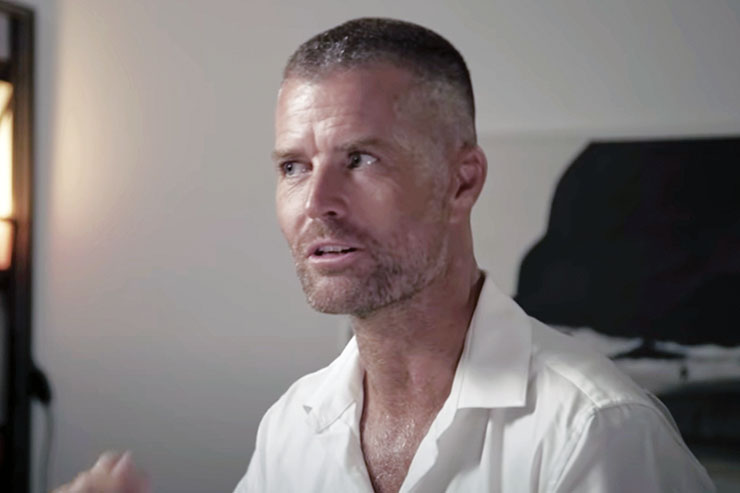
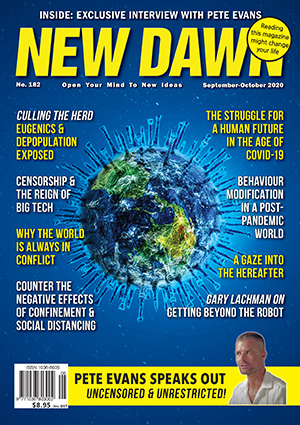
  • Pete Evans – Uncensored Unrestricted

    Pete Evans – Uncensored Unrestricted

    From New Dawn 182 (Sept-Oct 2020)

    The mainstream media has become a consolidated, corporate behemoth, that promotes a distorted and limited perception of reality to the Australian people.

    These organisations have shed their once-noble mission, the pursuit of truth, to adopt a new purpose – manufacturing narratives and manipulating the public.

    Historically, anyone who speaks out against this system of propaganda on a public level is demonised by the press. David Icke’s banning from Australia in 2019 is a perfect example of this (see New Dawn #180).

    Dominant alternative theories to emerge during the COVID-19 event circle around a belief that authorities, scientists and medical professionals are deceiving the public on a grand scale.

    Regardless of your thoughts on the event, the hallmark of any free society is the ability to share information and discuss ideas openly, regardless of personal position or perspective.

    Despite this, we have seen a continuing campaign to squash any information deemed ‘dangerous’ or ‘misleading’, including targeting and attacking those who simply ask questions that contradict the mainstream narrative.

    As the coronavirus event continues to unfold, one public personality has become a central target of this crusade against open and free discussion –Pete Evans.

    Pete Evans became a household name in Australia as a chef, restaurateur, author and television presenter, best known as a judge on the competitive cooking show My Kitchen Rules. He is one of Australia’s leading authors of healthy cooking books.

    He has been an active supporter of the Paleo Diet which advocates eating unprocessed foods that our ancestors would have eaten in the Palaeolithic era.

    Evans has a long history of stoking ‘controversy’, with health ‘experts’ regularly condemning him for promoting alternative medicine and practices. 

    He has campaigned against fluoridation of water, supported a pro-choice position concerning vaccines, questioned the chemical concoctions in sunscreen, amongst other issues.1

    In recent years, Evans has publicly veered to alternative approaches and ways of thinking, regularly sharing COVID-19 information from a variety of independent non-official sources.

    In July 2020, he appeared on popular Australian television show 60 Minutes as part of feature segment focusing on ‘COVID-19 conspiracy theories’.

    “I am sceptical. And I also am suspicious because history has shown us that, I mean, even science and you know, this as a fact, science has been bought by vested interests in so many different fields over the years,” Evans told 60 Minutes presenter Liz Hayes.

    The hit-piece attempted to highlight “COVID crazies” (their words) who are sceptical of government narratives. Despite this, Pete did not play their game of ‘labelling’ and division.

    Pete admitted he would not get a vaccine unless it was “100 per cent” safe – no vaccine can ever be deemed 100 per cent safe – but refused to call himself an “anti-vaxxer”:

    “We are living in a society where we label people this or that. Are you ‘anti this’ or ‘pro this’? Why can’t we be open to everything? I’m anti-labels. Modern medicine and ancient wisdom need to live harmoniously because if we disregard one or we disregard modern medicine and science, where is that going to leave us?”

    During the interview, the pair touched on a number of topics, including current aged-care restrictions, lockdown legislation, a potential COVID-19 vaccine, and the virus itself.

    Pete’s interview was a calm and collected display that highlighted the importance of asking sensible questions about all information, regularly pushing back against attempts to ‘pick a side’. 

    “It’s a belief system. Am I going to believe this and not look at other opportunities or options, because that’s my belief, or am I going to be on this side of the fence? I like to see it in the middle and look at it all.”

    In the aftermath of the segment, a swath of Australian media identities, ‘experts’ and viewers, took to social media to express disbelief and anger at Evans and 60 Minutes. Tabloid outlets also did their best to distort the heavily-edited interview.

    Meanwhile, Evans remained two steps ahead, following through on an earlier promise to post the full, unedited footage of his interview. He had agreed to the 60 Minutes interview on the proviso he could film the whole interview. He subsequently shared it onYouTubeat the same time the segment aired on Channel Nine.

    Pete Evans has become a national symbol of open-mindedness, curiosity and balanced perspective, and the interview not only highlights this but also exposes the deceptive nature of media.

    I recently spoke with Pete to get his perspective on the mainstream media and their tactics, his 60 Minutes interview, and the importance of critical thinking and discernment.

    ETHAN NASH (EN): Thank you for taking the time, Pete. You are no stranger to disinformation campaigns and poor journalism from a variety of sources over the years. In recent months, this increased to new heights after the unprecedented circumstances we all face across the world. We have seen press coverage of Pete Evans shift from a ‘loveable television personality, with a few crazy views’, to whatever you say is ‘dangerous’. What do you think when you see your name published in a negative or misleading light by the mainstream media? How does 2020 compare to previous years in the spotlight?

    PETE EVANS (PE): It’s really fascinating what has been going on at the moment, and I am no stranger to being in the headlines, that’s for sure. I’m very curious about it and how I ended up in that position.

    The things I’m talking about have the potential, in my opinion and many others, to improve people’s lives, so it has always struck me as odd from the beginning.

    It first started when I was talking about fluoride. I choose not to have fluoride in my water and have a system in place at our home that takes out the fluoride. Now, the backlash from the mainstream media and from the dental association about fluoride was, to me, shocking. ‘Surely you guys are up-to-date with the science on this?’, I thought. Obviously they are not, because it’s not debatable anymore – it’s classified as a neurotoxin. The first book I read about this was 30 years ago (laughter), and I can’t believe people still haven’t woken up.

    I think the next thing that happened was sunscreen. All I simply said was, ‘I don’t use a sunscreen unless it’s a non-toxic one’. That became a headline saying, ‘Pete Evans gives you cancer’ or something like that (laughter). Well, number one, I never said that. Number two, read what is in most mainstream sunscreens. Look at the ingredients, look at the side effects. You will probably find they might be cancer-causing. The fact that most people are Vitamin D deficient in this country should ring the alarm bells, or better yet, common sense bells.

    I was talking about dairy. The fact that modern dairy is nothing like it was once upon a time and the fact raw milk is banned in this country. Modern dairy is an abomination, I believe. That also become quite controversial. So, I find it very interesting.

    The list goes on and on and on. Whether it’s vaccine safety, whether it’s talking about glyphosate sprayed on our fruit and vegetables, whether it’s new technologies such as 5G being rolled out into your children’s schools or daycares, or now the current issues relating to COVID-19, it feels like the same old tricks to me.

    I just got off a podcast with a wonderful doctor over in the US, and he said that he’s taught his kids, basically, anything you see in the mainstream media where they are telling you to do something, do the opposite! (laughter).

    If we’re not asking questions, things are going to keep rolling out. We need to inform ourselves and empower ourselves with knowledge. It’s been proven time-and-time again that our governments have been corrupted. They have falsified science, whether it’s in the food sector, the medical sector, the pharmaceutical sector –we know this. It’s been proven over and over again. Yet, people still believe in their government, they still believe in medical authorities. Now, I’m not saying there isn’t good parts in these sectors, there are. But to blindly follow, assuming everything they say is for the benefit of individuals, community and the planet? I think that’s naive.

    To return to the question, I am actually encouraged and I see the positives when the mainstream media creates a sensationalist headline based on lies. Because what happens is it creates a conversation or a debate, and sometimes people investigate further.

    I have a lot of people who come on board with different ideas or ways that we share, from environment or diet to emotions or the spiritual. They come to me and say, ‘Hey Pete, I used to think you were the biggest wanker in the world, from what I used to believe on mainstream media. But then, they wrote something and it triggered me to do some more research. I’ve got to say, I’ve changed my life by adopting some of the principles that you have shared over the years’.

    I particularly love the ones that say, ‘I don’t believe everything you say’. I think that’s great! Imagine if we all applied that to everything? If the health ministers say one thing, are we going to believe everything they say? Or, should we question it? I encourage everyone to question, even the things that I share. I might not be right 100% of the time, but at least I’m giving it my best intentions.

    That’s not something that I can say for the mainstream media in many cases.

    EN: You are certainly resilient, that’s for sure, and it definitely hasn’t slowed you down. It is refreshing to hear you see a positive side to all of this, particularly surrounding discussions that are generated as a result of sensationalist media coverage. Now Pete Evans is regularly grouped in with so-called ‘conspiracy theorists’ who question the COVID-19 narrative, and the focus of the recent 60 Minutes presentation. I want to touch briefly on your experience with 60 Minutes. Was this the same type of thinking that led you to appear on the show? To generate a healthy discussion? 

    PE: Absolutely. It’s all about generating a positive discussion and highlighting shortcomings at the same time. I think the bias was shown in how the journalist interviewed myself and Fanos [Panayides], compared to the authority figures. There was a change in tone, a change in music, a change in lighting, a change in appreciation of the guests, so to speak.

    It was plain to see, and that’s cool. To me, the most stunning part of this whole coronavirus conversation has been the fact our health authorities and people in positions of power aren’t educating people about their immune system. If this attacks the immune system, why isn’t anybody talking about it? Think about everything they are recommending at the moment, from wearing a mask to social distancing to staying inside. These activities seem to me, and many others, that they will weaken the immune system of anybody that follows those directives. Not the law, the directives. What is the agenda here? Is it to create a weaker immune system?

    I mean, am I a ‘conspiracy theorist’ just for asking questions? To me, it seems like people might draw a conclusion that our governments and media are weakening our immune systems through fear, through misinformation, through bad science and through demonisation of many doctors who say the current direction isn’t working. In fact, they say it is the opposite thing to do. The ‘conspiracy theories’ these days seem to be right in front of your face.

    EN: How was this originally framed to you? Did the story stay the same from conception to reality? Did it influence you to publish the full interview on your YouTubechannel?

    PE: When I was invited to be a part of it, the narrative they presented was, ‘why is there a massive distrust of mainstream media and government now?’ I thought that would be great, so I agreed to the interview on the basis that I could film the interview. I understand why there is such a mistrust at the moment, and I knew 60 Minutes would present one side very biasedly. I wanted to expose why people are now increasingly dubious of these media outlets.

    Now, I don’t mean to generalise here. I love mainstream entertainment, I love mainstream news –there’s stuff in there that is good. Just like everything, you take what is good. It’s not all bad, I just want to say that. It’s like alternative news – it’s not all good either! (laughter). We have to come to the realisation that we need to have discernment, and we need to engage critical thinking, engage common sense. When 60 Minutes said they were doing a story, I thought to myself, ‘this is going to be a great experiment’ because I will film it and I will show people the whole interview.

    It was interesting to see which parts they included from the whole interview. It was predictable, and that’s why I went and did it. I think my YouTubeversion of the interview has been seen by 350,000 people so far, compared to roughly 600,000 viewers of the episode. We have more than 50% of viewers who already watched the full 90-minute interview. That shows it is generating conversation.

    I saw it as an experiment in which I could share the whole thing without it being filtered or manipulated to create a story.
    EN: One of the most interesting things that I took from the interview was almost a persistence to label you. From ‘anti-vaxxer’ to ‘COVID denier’, ‘conspiracy theorist’, you name it. All of the usual terms we hear coming from mainstream channels. Why do you think the media tries so hard to label everything? What does putting someone in a particular category or ‘box’ achieve?

    PE: It’s very simple. I mean, I’ve worked in the media for 20 years. Without any disrespect to anybody, they structure their information for the lowest common denominator. They need to be able to spoon-feed their content. I believe every single person on the planet is an intelligent and wondrous human being. We all have the capacity to think freely, to think critically and use discernment. We are intelligent human beings.

    What I have noticed over the years from working in that industry is that they don’t think and feel the same way. Listen to talkback radio or watch breakfast television, for instance. I refuse to go on those platforms anymore. The reason is because the intelligence level of the question or the conversation created by these talking heads is of a level that is just embarrassing.

    I’ve been on those programs and asked, ‘can we have an intelligent conversation about things that actually mean something and share knowledge that empowers people?’ My observation is they dumb down information such as putting Pete Evans in a box or attaching him to a label, so they think people at home will go, ‘oh, he’s an anti-vaxxer!’ (laughter). People aren’t like that.

    More people can now see through that BS. Why are you treating the population like children? The perfect example of role-reversal regarding this is Donald Trump at his press conferences when he does question time with the media. He treats them like children, and the reason he does that is because they treat the public like toddlers and infants. They tell people how to think, how to behave, who to fear, who to ridicule. I love watching Trump. I don’t agree that he should treat them like children, but it’s a great thing to witness the role-reversal and the media’s reaction (laughter).

    Putting someone into a box is something that I’ve never been comfortable with all my life. I believe that we as human beings are so unique and multifaceted that we defy description. Once we try to limit ourselves by an identity, such as ‘I am a person of faith’ or ‘I follow this political party’, it becomes very difficult to step outside that box.

    I’ve witnessed that over the last four years. Again, I refer back to Trump and people that were so anti-Trump, almost abusively aggressive towards this man. Because they have been so vocal and outspoken against somebody, it almost inhibits them emotionally (and possibly even spiritually) to be able to change their opinion. Even when they may be hearing information they agree with. They become fearful of being judged as a hypocrite or as someone with no conviction.

    In fact, I think it should be seen as the opposite. When we can admit we should look at all sides, that’s when true freedom happens. So, I refuse to be put into a box, and I encourage others to refuse that from their friends, their families, their cultures. I believe we are here to express ourselves creatively and to keep evolving; to keep learning and gaining knowledge. A perpetual student and teacher at the same time. When we are a student of life, we can come at it humbly and ask questions. This is the most beautiful and free way to be.

    The mainstream media does not like that.

    EN: Absolutely. You have always touched on the importance of keeping an open mind, double-checking information and also getting that information from a variety of sources. The establishment believes that alternative sources of information are potentially harmful to the civil functions of daily life, and that we should only trust official sources in times of crisis. What are your thoughts on this? Should keeping a balanced perspective ever ‘take a back seat’, particularly during times when authorities claim alternative information can be ‘dangerous’?

    PE: Just look at the history of humanity to get your answer. We have seen this type of thing over and over again. The burning of books, the rewriting of history and the following of various belief systems. 

    Wars created with false agendas pushing them. Look at the invasion of countries and lands of tribal peoples. Realising that the version of history we were taught as kids was not factual.

    Should we believe all of a sudden that humans have grown a conscience? Or is [humanity] at a point of enlightenment, that we are all caring for each other? Or that we all have the best interest of humanity at heart? It would be insane to think like that.

    It has been proven over and over again in the past that we can be the most destructive species on the planet –hurting other species and hurting our own. Slavery, genocide, political dictatorships.

    We are heading that way in this country, it seems. I shared a video this morning of a woman in Victoria who was abused by a police officer for not having a mask on.

    Is that our ‘new normal’? Is that what the police are there to do? Locking people down and lowering their immune system for a virus that doesn’t affect 99% of the population?

    If anybody doesn’t think there is another agenda going on! I’m not religious, but God help us. (laughter)

    FOOTNOTE: 1. These topics have been regularly covered in New Dawn. See, for example, New Dawn Special Issue Vol.9 No.5 and New Dawn Special Issue Vol.14 No.2.

    You can find more great content from Pete Evans, including his books, products, initiatives, social platforms, public speaking events and more, by heading to peteevans.com.

    Pete is the host of the Evolve with Pete Evans Podcast, available on Apple Podcasts, Spotify and Acast. Find out more here: peteevans.com/evolve-podcast. Also check out his latest project Evolve Network for a fantastic range of films, interviews and much more.

    [alert type=”general” dismiss=”no”]This article was published in New Dawn 182.[/alert]

    © New Dawn Magazine and the respective author.
    For our reproduction notice, click here.

  • COVID Consciousness: A Contagion of Awakening or a Consensus Reality?

    COVID Consciousness: A Contagion of Awakening or a Consensus Reality?

    From New Dawn 181 (Jul-Aug 2020)

    Many of us are asking – is reality broken? This is the question I posed at the beginning of my ‘Year Ahead 2020’ piece published in New Dawn 178 (Jan-Feb 2020). In my review of the year ahead, which I titled ‘Consensus Reality Meltdown,’ I wrote: 

    What we have come to regard as ‘reality’ will officially become intangible and fluid, leading to the rise of adverse ideologies… We are increasingly losing our bearings, our fixed moorings, and this is likely to lead to further anxiety as people try to cling to invested beliefs. My sense is that throughout 2020 many of us will experience discomfort in one form or another. 

    The fluidity and changeability of reality that I suspected would emerge came suddenly, and not in a trickle but with the bursting of the dam. 

    In my review of the consensus reality meltdown, I noted that a certain rootlessness would creep into the world – a rootlessness of frantic uncertainty mixed with desperate tech-salvation. Things would become increasingly more liquid-like as older, established social forms dissolved faster than new ones could replace them. As the full COVID-19 pandemic began to arrive upon our shores, I wondered whether during the consensus reality meltdown there would be a reshuffling, allowing each person to take this time to listen to themselves. In the reshuffling, I considered that new pathways of connection could be forged. In a follow-up essay, I wrote: 

    After the consensus reality meltdown – after the reset button has been pressed – life will not be the same again. We will begin a new historical era. People across the world will climb out of their quarantined cocoons into a new time. Today as I write these words it is the day of the Spring Equinox – it is when a new year begins. The reset button was pressed before this Spring Equinox. Afterwards, there will be no Anno Domini, no Common Era. It shall be a New Era (N.E.).

    It now appears evident that a rising confusion is entering into the world ‘reality-bubble’. Our social and political systems seem so full of abstract madness partly because they have lost their relation to anything tangible or remotely truthful. The writer Elias Canetti recognised this situation when he wrote: 

    A tormenting thought: as of a certain point, history was no longer “real.” Without noticing it, all mankind suddenly left reality; everything happening since then was supposedly not true; but we supposedly didn’t notice.

    We are now beginning that gradual climb out of our quarantined cocoons and seeing the world anew. What now faces us is the question of how we accept, or allow, our collective future to unfold. The ‘COVID Consciousness’ that has infected us globally, through the entire human species, can have the effect of awakening us into a stimulated frame of mind, with new perceptions triggered – or it can force us into accepting a new consensus reality (the ‘new normal’) for the foreseeable future. Do we come out of our cocoons with a butterfly consciousness, or do we retain the caterpillar’s mind?

    We are presently not out of our ‘cocooned lockdown’ – not fully yet. And this, I feel, is a good thing as many of us still have time for a reconsideration of where we are, what we are doing, and where we wish to go. This is not a story about viruses or dead infectious parasites – this is a tale of contagious sentient life. 

    Global ‘Stop’ Exercise

    What I see is that human life has been radically halted – the brakes applied – as if being placed under a microscope of our own viewing. We have been compelled to view and to see ourselves in a way that has never been done before. We have entered into humanity’s largest experiment, and we are the test cases. Before we can take our further steps into what will become the most significant era for humanity’s future – into a phase of rapid evolutionary acceleration – we first need to take a ‘stop’ and to examine ourselves. 

    This forced stoppage reminds me of a physical-psychological exercise used by the Greek-Armenian mystic G.I. Gurdjieff. He named this his ‘stop’ exercise. According to Gurdjieff’s own words:

    …at the command “stop,” or at a previously arranged signal, every student must instantly stop all movement, wherever he may be and whatever he may be doing… while he is in this state of arrested movement, the student must also arrest the flow of his thoughts, not admitting any new thoughts whatever… this is simply a movement interrupted at the moment of passage from one posture to another… generally we pass from one posture to another so rapidly that we do not notice the attitudes we take in passing. The “stop” exercise gives us the possibility of seeing and feeling our own body in postures and attitudes which are entirely unaccustomed and unnatural to it… the style of the movements and postures of every epoch, every race and every class is indissolubly connected with distinctive forms of thought and of feeling. And they are so closely bound together that a man can change neither the form of his thought nor the form of his feeling without having changed his repertory of postures…

    This extract illustrates that its function was to give the ‘student’ a necessary moment for unhindered self-observation. A person, remarked Gurdjieff, is generally not aware as they pass from one posture to another – we are ‘entirely unaccustomed’ to this point of observation to the extent that it is unnatural to us. The only way to enforce this is through an externally produced state of arrested movement. Interestingly, Gurdjieff states that every epoch, race, and class have their distinctive forms of thought which are so tightly bound to their ‘posture’ that they cannot be changed. Later in this description it is remarked that, 

    psychological analysis and the study of the psychomotor functions, applied in a certain manner, demonstrate that each of our movements, voluntary or involuntary, is an unconscious transition from one automatically fixed posture to another, equally automatic…

    If we now consider this at the larger scale, it implies that people are culturally bound to particular ‘postures’ of thought (aka, social conditioning); and that these thoughts and feelings are automatic (programmed). Gurdjieff’s method of breaking down these automatisms so that they could be observed was through imposing an external command of ‘stop’ that had to be obeyed. Now, what if we are to apply this to the current global social quarantines and the halt on global trade and business. Have we not just experienced a ‘stop’ command enforced upon us by an external impact in response to the 2020 pandemic?

    For the first time in our known history, human civilisation in most of its forms came to a halt. We were stopped in mid-posture – a state of arrested movement – and placed in a space we are totally unaccustomed to. Time now, is it not, to ‘arrest the flow of thoughts’ – i.e., our regular social programming – in order to enter into a period of self-observation? What are we likely to find in this moment of ‘frozen’ introspection? What are the implications of the reset button being pressed?

    Similarly, we may consider this as an act of force majeure, whereby humanity is now free from its prior commitments to a way of life it had contracted itself into. If we are free from our past contract, then whilst the world’s politicians are speaking of a ‘Second Wave’ of the virus, perhaps we should be considering this as allowing a ‘Second Wave’ for our human experiment – to begin a new trajectory, a new timeline for a human-planetary future. The past contract that humanity got itself involved in came to represent dysfunctional systems, damaging ideals and beliefs, and a ruinous path to a destructive future. If there was ever a time to break with this contract and to agree upon a new manner of collaboration and reciprocal maintenance, then this force majeure offers us a unique opportunity.

    We entered a ‘stop’ phase upon an individual, community, and global level. Never before has this occurred, nor has it been possible. For most of humanity’s evolution, we existed as localised aspects of psyche and consciousness. We participated in the ‘mental life’ of those around us, the community; and later, the country. Only within a relatively short span of time has our species gained a global perspective. Whilst a collective unconscious species mind has existed, this lay beneath the conscious awareness of most people. This has now ‘flipped over’ into a physical presence in that so many more people are currently aware of psychical fluctuations across the world. We are presently experiencing these fluctuations during the 2020 pandemic. This was not possible before, even at the time of the ‘Spanish Flu’ of 1918–20. Why does this matter? It matters because the effects of consciousness, although seemingly intangible, are just as important as those tangible, physical effects we are generally more aware of. 

    Contagions of Consciousness

    Consciousness is just as contagious as any biological virus. Perhaps more so, as it is not bound by physical parameters of movement. Consciousness is an open arena – and it spreads like ripples across fluid and intangible, interconnected fields. Each person, too, creates these ripples, which are then strengthened by the larger community and national consciousness fields. Similar to what Gurdjieff spoke of, we are creating thought postures that belong to collectives of human thought. As many people are aware, like things attract and resonate with like things. It is the same with thought. This is the reason why so many ‘like-minded’ people group together. They share a common bond in their thinking. At the same time, these physical groupings create collective fields of consciousness. These fields can become powerful and very influential. They have operated throughout extreme cases, such as warfare, where people behaved against their ‘better judgement’. Likewise, they have operated during moments of mob violence and mob psychosis. Such collectives of thought are easy to be caught up within – that’s why they are contagious. And now, as our species’ collective psyche is growing and developing, such ‘contagions of consciousness’ are extremely powerful. 

    Generally, as a person becomes ‘socially programmed’ by layers of conditioning, they are absorbed into the ‘national psyche’ of their respective country. This has always operated as a useful function of social management. As a person learns to de-condition themselves, and to throw off these layers of their psychological conditioning, they create more expansive states of awareness by having access to a broader range of consciousness fields. We are each of us affected by the ‘consciousness ripples’ emanating from others. It is how the ecology of consciousness operates. And since it is an interconnected ecology, individual awakening – or expansion of awareness – does not just remain at the individual level. As transpersonal researcher Chris Bache puts it, the ecology of consciousness is an inherently collective ecology. What we feed into our localised fields of consciousness will then go on to form part of a larger body or consciousness field. And this, ultimately, will form part of a grander resonating field of collective consciousness – at the community, national, and global level. Therefore, what and how we think is indeed part of our responsibility. 

    What we are experiencing now is not only a biological pandemic but also a psychological one. How we feed into this, and what is fed into this, will establish the tone of an overall psychic resonance. And this overall field of resonance can be coherent or dissonant, and many other degrees in-between. That is, if a psychological environment of fear, panic, and anxiety is created through thousands, or even millions, of individualised fields of consciousness, these will ripple out to congeal into a grander collective field of increased psychic density. The resonance of disturbance will be on a scale far exceeding the individual level. Similarly, if localised ripples of coherence, hope, trust, and empowerment are transmitted, these will not only influence local and community environments at the psychological level but also the larger global psyche. This is not voodoo or magical thinking – it reflects how the intangible realm of thoughts and human consciousness operates. Psychologically, we are not alone. Each person lives as a part of the world, and not apart from it. Each person has a responsibility to manage their thoughts – what they receive and process as well as what they transmit. 

    This present moment of a global ‘stop’ phase should give us time for reflection and consideration. Our automated movements and our automatic thinking patterns have been put on hold. We should take advantage of this unique opportunity. It may never happen again. It is likely we shall receive external impacts in our lives that momentarily make us pause as individuals – yet global ones are a very, very rare occurrence. In this exceptional moment, we should consider carefully. We will have questions now that are of great importance. It is crucial that people do not fall back into a heightened state of cultural programming swayed by external agents/systems that compete for increased control and social management. The ‘COVID Consciousness’ is an opportunity for a contagion of awakening, or it can be used as a strategy for managing a controlled consensus reality. It is now very much a question of our human freedom.

    Human freedom, with genuine conscious awareness, also recognises the need for the social community, but not as an unconscious community. The human community needs to come together with at least a minimum of psychological insight. When communities and individuals lack psychological insight, they are open and vulnerable to the impulses of the unconscious from within as without. That is, manifestations of the unconscious do not just occur within an individual’s mind but also within the mass psyche of the collective. Unawareness of such forces can bring about emotional, mental, and physical instability. It is a psychological trait that when our minds recognise a repressed force within ourselves, a corresponding expression manifests in our outer, physical world. The source for so many ills resides within us. This is because the psychic or soul reality is real. We are conditioned into thinking that ‘psychic’ elements or things of the spirit are inferior to the physical things of life because they are non-material. The images we have within us, however, can be just as powerful as those without. It is a necessity that human civilisation returns to the fundamental recognition of the person as a human being; also, as a being with psychical force. We need to get back to ourselves in so many ways.

    In the gnostic Gospel of Thomas, it is written that Jesus pronounced: “If you bring forth what is within you, what you bring forth will save you. If you do not bring forth what is within you, what you do not bring forth will destroy you.” The inner resources each person has within them can bring insight, conscious awareness, and experiential knowing onto contemporary issues and their distress. It is essential to bring the inner world to bear onto the physical, material world. Both realms must participate and be in congruence. In order to achieve genuine solutions, each of us must be prepared to change and transform from within, and not just by changing our ideas. Each person has a responsibility not only to the outer world but also to their individual inner life. 

    Resist Conditioned Conventions of Mass Mind

    A person cannot live by the conventions of society alone, or from the impacts and influences of everyday life. We need sustenance from a source that is beyond all social institutions, and from beyond the distractions and attractions of physical life. It is necessary to create a distance from the tirades that life brings us. Ironically, the newly imposed rules of social distancing may assist indirectly by triggering an awareness of a form of distancing in terms of unhealthy energetic attachment and identification. In this, perhaps, a more acute state of self-awareness can develop as an antidote to the general state of social unconsciousness. Of importance now is how to resist the conditioned conventions of the mass mind by cultivating new faculties of perception. It is a question of personal freedom of thought and perspective. Our choice is thus twofold: between recognising the unconscious forces of the mass mind; and aiming for the personal development of our awareness to act as individuals. 

    What humanity is largely experiencing today is the moral uncertainty that precedes a new understanding as the old morality enters its death phase. As long as the majority of people expect all problems to be solved outside of themselves then our societies will continue to be dominated by unruly forces. The question of human freedom from these forces depends upon people willing to assume the responsibility of conscious awareness. 

    The great perennial task of humanity has always been the same: to become what we have always been and to show others the way by our own individual presence and behaviour. When we are finally able to heal ourselves from within then, and only then, can we heal others and the world without. The power for change begins and ends with us, the individual – not from the hand of a minority elite. 

    The question of human responsibility is to resist the forces of dehumanisation. If we do not awaken to our potentials during this space of ‘COVID consciousness,’ then we are vulnerable to the encroaching forces of dehumanising social-technological control, as I shall explore in the second part of this essay in the next issue of New Dawn.

    [alert type=”general” dismiss=”no”]This article was published in New Dawn 181.[/alert]

    [alert type=”success” dismiss=”no”]If you appreciate this article, please consider subscribing to help maintain this website.[/alert]

    Footnotes

    1. https://kingsleydennis.com/the-reset-button/
    2. Taken from his collection of personal writings from 1942 to 1972 called The Human Province.
    3. Taken from ‘Talks with Gurdjieff’ – various online sources.

    © New Dawn Magazine and the respective author.
    For our reproduction notice, click here.
  • Secrecy & Surveillance: The Australian National Security State

    Secrecy & Surveillance: The Australian National Security State

    From New Dawn 177 (Nov-Dec 2019)

    Australian society, as has been its wont for some time, relishes secrecy and surveillance. Forget the laid-back, relaxed demeanour that remains the great fiction of a confected identity; like all such forced assumptions, the slight trace should not be mistaken as the main tendency. The political culture of Australia remains shaped by penal paranoia and indifference to transparency. The citizen is not to be trusted; governments know best. The subject is to be policed and regulated into apathetic submission, convinced that such measures are for the broader good. 

    As Brian Toohey notes in his latest, sprawling book titled Secret, power has accrued to Australian officials and ministers incrementally through “a succession of new laws and policies” driven by the profane trinity of secrecy, ignorance and fear. These have served to “deprive Australians of basic liberties and increase the risk of being dragged into a devastating war that could escalate into a full-blown nuclear catastrophe.”1

    The statute books of the federal parliament are larded with provisions of secrecy that make doing credible journalism in the country, not to mention any of its cognates, nigh impossible. Journalists and scribblers are left to their own devices, inventive as these might be, assisted by the odd prized leak from a source who will, in time, be punished. This is particularly so regarding the public service and public servants, who do not fall within newly enacted laws covering the private sector; they remain the traditional targets of state regulation and punishment. 

    The leakers, in turn, are offered shallow protections. The public servant must, essentially, keep any whistleblowing confined to the narrowest of circles while following obscured hoops of process within regulated channels. Investigations must be permitted to take place, though these may not lead to any resolution. Patience must be exercised as the most taxing of virtues. This invariably endangers and compromises the whistleblower, rendering information confined that might have greater value in the public domain.

    The Australian National Security State has been particularly aggressive in this regard, emboldened by additions to its form since the 11 September 2001 attacks on the United States by the Al Qaeda terrorist group. As the head of the Home Affairs department, Mike Pezzullo, explained with sinister import to a gathering of the Trans-Tasman Circle in October 2017, “The state has to embed itself invisibly into global networks and supply chains, and the virtual realm, in a seamless and largely invisible fashion, intervening on the basis of intelligence and risk settings, increasingly over a super scale and very high volumes.” 

    Fitting words for the chief bureaucrat of Australia’s dangerously enlarged department that includes, as Toohey notes, ASIO, the Australian Federal Police, the Australian Criminal Intelligence Commission, and the Australian Transaction Reports and Analysis Centre.2 And while such a department flourishes in conspiratorial paranoia in assessing and responding to perceived threats, those monitoring potential abuses within the system, such as the Inspector-General of Intelligence and Security, have found themselves marginalised and relegated to minor importance. “This is not abracadabra,” lamented its current officeholder, Margaret Stone. “It’s not an incantation. It has to be real.”3 

    The national security state has taken several notable scalps over the years. Individuals such as former customs officer Allan Kessing, who authored two reports on lax airport security, faced a suspended sentence, convicted in 2007 under section 70(2) of the Crimes Act 1914 (Cth). The reason? Disclosing confidential material obtained in the course of his employment even if, in his words, it involved exposing “theft, smuggling and systematic criminality” at Sydney Airport.4 All efforts to either seek a public clearance of his name, or legal remedy, have failed. In a startling note of disingenuousness, Kessing became something of a poster boy for the Labor Party in the 2007 federal election, a figure of inspiration behind a change to the secret state that never took place. As he recalled to Alan Jones, then-leader Kevin Rudd “actually mentioned me by name and promised me there would be reform to whistleblower laws and a pardon would be considered. And neither of which happened.”5 

    In an even graver and more recent case, David McBride is facing prosecution for theft and three counts of breaching the Defence Act for being a person who, as a member of the defence force, allegedly communicated a plan, document or information to journalists Dan Oakes, Andrew Clarke and Chris Masters. The old official secrets provision of the Crimes Act 1914 has also come into play, meaning that any jail sentence is bound to be a lengthy one.

    The central part of McBride’s contribution to the latest flexing of muscle by the national security apparatus centres on the alleged war crimes by Australian special forces in Afghanistan. This came from material obtained by McBride in 2014 at the high-security joint operations headquarters in Bungendore. It led to the publication of “The Afghan Files,” an invaluable source of information on Australia’s flawed military effort in Afghanistan available via the ABC. 

    McBride fits the blueprint of the complicated, troubled whistleblower, a believer in institutions, yet disturbed by their atrophy and what he insists is an obsession by decision-makers with “opinion polls.”6 It was McBride who proved the figure of inspiration behind raids by the Australian Federal Police in June upon Australian journalists, raids which have revealed the extent the unwieldy security apparatus has grown.

    Raiding journalists

    On the morning of 4 June this year, News Corp political editor Annika Smethurst was readying to leave for work, only to witness Australian Federal Police bearing down on her home with a warrant. The warrant was broad, essentially limitless. A statement from the AFP subsequently confirmed that it had “executed a search warrant at a residence in the ACT suburb of Kingston today (4 June 2019)” on a matter relating “to an investigation into the alleged unauthorised disclosure of national security information that was referred to the AFP.”7 The AFP “will allege the unauthorised disclosure of these specific documents undermines Australia’s security.” The gravity of the allegations was affirmed in an update that soon followed: “This warrant relates to the alleged publishing of information classified as an official secret, which is an extremely serious matter with the potential to undermine Australia’s national security.”

    Within hours, radio 2GB Drive presenter and Sky News contributor Ben Fordham revealed that he was also the subject of an investigation after discussing the attempt of six asylum seeker boats to reach Australia. The story piqued the interest of a peeved Department of Home Affairs official, who proceeded to scold Fordham’s producer for discussing “highly confidential” material in a berating phone call. “In other words,” explained the broadcaster bluntly, “we weren’t supposed to know about it.”8 

    Over the course of the next morning, with no settling of dust in order, a second raid by the AFP was executed against the Sydney offices of the national broadcaster, the ABC. Those named in the warrant – investigative journalists Dan Oakes and Sam Clark, along with ABC director of news Gaven Morris – were linked to The Afghan Files.9 Australia’s national security state has gotten very busy indeed.

    Since Smethurst’s story titled “Let Us Spy on Aussies” broke last year, the security wallahs have been attempting to root out relevant sources, mobilising the AFP in the process. The account detailed information on discussions between the Home Affairs and Defence departments on the possibility of granting the Australian Signals Directorate powers to monitor the emails, bank records and text messages of Australian citizens. Letters between Secretary of Home Affairs Mike Pezzullo and Defence Secretary Greg Moriarty featured. The case with the ABC was even more dubious: as the source was already known to be McBride, the effort to raid the national broadcaster was a crude statement of state power. 

    Inadequate protections

    The modus operandi of any national security state is that any effort to open it up to scrutiny must be resisted. Concessions to openness are bound to be minimal and ineffectual. As a 2016 review by Philip Moss of the Public Disclosure Act 2013 noted, the Commonwealth statute supposedly meant to protect whistleblowers in the public sector has left its fair share of disappointments. “The experience of whistleblowers under the PID Act is not a happy one… The experience of agencies is that the PID Act is hard to apply.” In its application, surmises Stephen Easton writing in The Mandarin, “it is very difficult for a whistleblower to understand the precise sequence of actions they should take to qualify, and there is very little advice or support available to help them meet the criteria.”10

    Initial disclosures, for instance, must be made to supervisors, the authorised officer in the agency, the Commonwealth Ombudsman or the Inspector-General of Intelligence and Security. Avenues for external public interest disclosures are narrow and infuriatingly vague. Submissions made to Moss to assist his review were also sceptical about the illusory balance struck in the name of the public interest. “We believe the spirit and intent of the PID is appropriate,” went the submission from the Australian Tax Office, “however the legislation in its current form does not always strike the right balance to ensure serious matters in the public interest are addressed and other matters which are less serious are dealt with under alternate legislation.”11 Various other defects were also noted: how, for instance, to compel supervisors to give public interest disclosures (section 60A) made to them to an authorised officer, and what might be seen to be a serious disclosure as opposed to one not deemed such (section 29).

    Jurisprudence referring to the PID has also found it wanting. Federal Court judge John Griffiths called it “technical, obtuse and impracticable” in finding that the Act did not apply to a Parliament House security guard.

    Media organisations would like to see parliament shed its conservative skin in this regard, passing legislation that would enhance Freedom of Information provisions, arm press outlets with the means to contest warrants aimed at journalists, furnish whistleblowers with credible protections, and tilt the balance away from the national security grand inquisitor that seems to prevail in Canberra.

    This is a tall order indeed given the surveillance infrastructure that is already in place. The Telecommunications (Interception and Access) Amendment Act 2015, passed with bipartisan support, imposes a noxious data retention regime that risks compromising the respect of a journalist’s confidences. The grant of a Journalist Information Warrant permits some 21 government agencies access to the telecommunications data of journalists or those who employ them which are required to be retained for up to two years. This can be undertaken without their knowledge, is unimpeachable in a court of law and has a duration for up to six months. Such measures are political, not legal determinations, granted at the discretion of the Minister, rather than a judicial officer. The test is simple and expedient: warrants will be granted if the public interest in exposing the source outweighs that of keeping confidentiality. To leave such measures of calculation to a political agent is a dangerous gamble indeed.

    Those working to a Canberra drum beat might well point out that recent reforms have taken place in terms of protecting journalists. The Smethurst-ABC raids took place in the aftermath of amendments that were meant to ease the sting in what had been archaic official secrets provisions of the Crimes Act 1914 (Cth). These, including those provisions used to punish Kessing, were repealed on 29 June 2018, leaving the way for new regulations dealing with national security information. A public interest defence, found in the National Security Legislation Amendment (Espionage and Foreign) Interference Act 2018, protects those “engaged in the business of reporting news, presenting current affairs or expressing editorial or other content in news media.” A closer inspection of the provisions shows this to be inadequate for two crippling reasons: the sources remain unprotected, and journalism remains arbitrarily open-ended. (Will, for instance, the modern blogger or citizen journalist fall within such a defence?) 

    The Act makes the point of covering what is deemed “inherently harmful information”: security classified information; information obtained by, or made by or on behalf of, a domestic intelligence agency or a foreign intelligence agency in connection with the agency’s functions; or information on “the operations, capabilities or technologies of, or methods or sources used by, a domestic or foreign law enforcement agency.” A close reading of the legislation shows that leaking sources, and more broadly those informants who supply classified material, cannot avail themselves of any defence. The Law Council’s efforts to convince the federal government to extend the public interest defence to suppliers of the information was rejected, leaving the way open for such cases as Smethurst’s: spare the journalist but attack the source. According to Law Council president Arthur Moses, the protection is shabby, a mere “mirage because it does not cover a journalist’s source.”12 Conduct deemed a contravention of provisions regarding intelligence sources (the publication of names or identity of staff, for instance), does not satisfy the test, nor conduct deemed to assist, directly or indirectly, “a foreign intelligence agency or a foreign military organisation.” 

    Unchanging environments

    Understanding Canberra and the public service is to understand a form of studied stasis, an effort to stymy change. Ideas tend to go there to find cold storage if not expire altogether. The way to keep them in cold storage and throw away the key is to set up an inquiry, with all the baubles and tinsels of cheap accountability. This is the preferred approach of the Morrison government, knowing that such an inquiry will be guaranteed to kill off any reform drive. (Four months should do it: the inquiry is due to report on 17 October.) In his letter to the opposition leader Anthony Albanese, Prime Minister Scott Morrison informed his counterpart that, “The Government is committed to ensuring our democracy strikes the right balance between a free press and keeping Australians safe – two fundamental tenets of our democracy.”13 

    Knowing the hostility this government and its predecessors have had to the exposure of abuses of state and corporate power, limitations have already been inked. The mechanism being used to ensure only modest changes is to use the Parliamentary Joint Committee on Intelligence and Security (PJCIS), a body of approved politicians who can be trusted to do the right thing by the dictates of secrecy and security. Morrison claims the PJCIS is “well placed to conduct this inquiry given its responsibility for, and experience in, handling issues concerning national security information and legislation.” He would: independent MPs are excluded; contrarians are barred. Whatever qualifications the sitting members will have, their most valued pre-requisite is the capacity for premature adjudication of the problem, adjusted to satisfy the security apologists. 

    The PJCIS has been one of the most important entities behind approving the shabby Australian national security state, a clumsy creation that does nothing to improve security let alone preserve freedoms. Its members are terrified by the predations of technology and the wilder elements of the Internet. They see any effort to restrain such reach as necessary to protect Australians. Andrew Wilkie, the independent MP more qualified than most to sit on the committee given his background as an officer of the Office of National Assessments, makes the point starkly. “The Labor and Liberal-dominated PJCIS is part of the problem because it’s signed off on every unnecessary security reform in recent history.”14 

    Wilkie reminds us of the dubious resume of the PJCIS, which features reserve, acceptance of the surveillance rationale, and clay-footedness towards civil liberties. “Who could forget the controversial data retention bill of 2015 and just last year the encryption bill? In both cases the PJCIS recommended some tweaks around the edges, but… recommended the bills be passed, despite the serious concerns about both.”15 While the European Union makes strides against such inefficient and dangerous policies as data retention, Australian governments embrace them with a relish for anachronism, ears bent to the warnings of Duncan Lewis of the Australian Security Intelligence Organisation about the next foreign threat of interference. “It’s constant,” he is reported to have told The Weekend Australian (27 July 2019). “Every day there is a discovery. Some of them are more alarming than others.”16

    To permit the PJCIS the means and latitude to decide that balance on press freedom and security would be the equivalent of granting full powers of determination to a taxidermist over your favourite pet. Denis Muller of the Centre of Advancing Journalism at Melbourne University saw this move as appointing foxes the guards of henhouses or giving poachers the means to oversee game-keeping.17 

    The inquiry hopes to assess, in part, “Whether and in what circumstances there could be contested hearings in relation to warrants authorising investigative action in relation to journalists and media organisations; (and) the appropriateness of thresholds of law enforcement for law enforcement and intelligence agencies to access electronic data on devices used by… media organisations.” A full agenda for reform is guaranteed to be avoided.

    Labor, in turn, is trying to shore up its poor parliamentary performance of late in attempting to set up a second, separate inquiry free of the clutches of the PJCIS. That inquiry makes explicit reference to the “public’s right to know and press freedom.” Senator Kristina Keneally, shadow minister for home affairs, notes a prevailing “culture of secrecy and perverting the public’s right to know that has been making its way through this government for too long.”18 In unwittingly casting such stones in the glasshouse, she ignores the record of previous Labor governments with similar leanings towards the national security state. The bipartisan consensus remains unchallenged.

    The parliamentary committee has its Canberra compliment of defenders. This is hardly surprising: the national security state will always have its sponsors, ensuring that the narrative is not so much controlled as scotched. Jacinta Carroll, as director of national security policy at the National Security College at ANU, writing in The Strategist (8 July), sees the PJCIS as “the appropriate body to undertake this review, as it’s made up of elected representatives of the people in Australia, and it’s also an established and expert body in the matter at hand.”19 Carroll’s they-know-best tone is schoolmarmish, characteristic of the befuddlement shown by security hacks. She accepts, in tokenistic fashion, that, “A functioning and vibrant democracy is characterised by engaged civil society and informed debate.” As Australian democracy is not vibrant, lacking oxygen for a civil society struggling to fend off the overly keen regulators and over-committed spooks, her observation has little bearing on reality. 

    Given all that, she still insists, as the inquiry takes place, that all “maintain the focus on being informed about the complexities, nuances and competing interests at play, and not be lured into an oversimplified debate.” Read: let bought parliamentarians seduced by national security briefs and their promoters dictate the balance. The parents of the Australian Security State know best.

    [alert type=”general” dismiss=”no”]This article was published in New Dawn 177.[/alert]

    [alert type=”success” dismiss=”no”]If you appreciate this article, please consider subscribing to help maintain this website.[/alert]

    Footnotes

    1. Brian Toohey, Secret: The Making of Australia’s Security State, Melbourne University Press, 2019, xiii
    2. Toohey, Secret, 241
    3. Quoted in Toohey, Secret, 244
    4. Crikey, 14 Sep 2009
    5. 2GB, 6 Jun 2019
    6. www.smh.com.au/politics/federal/what-i-ve-done-makes-sense-to-me-the-complicated-colourful-life-of-david-mcbride-20190621-p5204h.html
    7. www.afp.gov.au/news-media/media-releases/afp-statement-search-warrant-kingston-act
    8. www.news.com.au/finance/business/media/radio-star-ben-fordham-targeted-after-australian-federal-police-raid-political-editor-annika-smethursts-home-over-spy-story/news-story/ee864fd6be6c84dfa108647565c7ee25
    9. www.abc.net.au/news/2017-07-11/killings-of-unarmed-afghans-by-australian-special-forces/8466642
    10. www.themandarin.com.au/110350-attorney-general-open-to-reforming-obtuse-federal-whistleblower-protection-law/
    11. www.pmc.gov.au/sites/default/files/public-submissions/pid/submission-ato.pdf
    12. www.theaustralian.com.au/commentary/actions-expose-risk-to-journalism-democracy/news-story/7f20ccaae6301d55b899b4f382b8c6ac
    13. https://theconversation.com/morrison-and-albanese-to-discuss-inquiry-into-press-freedom-119767
    14. www.theaustralian.com.au/nation/politics/alp-push-for-press-freedom-committee/news-story/314162de8da318ba97c829f80a098cbd
    15. Ibid.
    16. www.theaustralian.com.au/nation/defence/espionage-threats-unprecedented-says-spy-boss-duncan-lewis/news-story/e90c51bb103ffd1d536ae7b691671891
    17. https://theconversation.com/parliamentary-press-freedom-inquiry-letting-the-fox-guard-the-henhouse-119820
    18. www.theaustralian.com.au/nation/politics/alp-push-for-press-freedom-committee/news-story/314162de8da318ba97c829f80a098cbd
    19. www.aspistrategist.org.au/parliaments-joint-intelligence-committee-the-right-body-to-review-press-freedom/

    © New Dawn Magazine and the respective author.
    For our reproduction notice, click here.

  • False Flags & Geopolitical Objectives: From the Reichstag Fire to Douma

    False Flags & Geopolitical Objectives: From the Reichstag Fire to Douma

    From New Dawn Special Issue Vol 12 No 3 (June 2018)

    The easiest way to gain control of a population is to carry out acts of terror. [The public] will clamour for such laws if their personal security is threatened.
    – Joseph Stalin

    Stalin’s statement has been taken as a guiding principle by several governments in the past century. The objective is not just to “gain control” of their citizens, although that is certainly a by-product. An examination of history shows that the false flag attack is also designed to serve a wider geopolitical purpose.

    Wikipedia defines a false flag as a “covert operation designed to deceive; the deception creates the appearance of a particular party, group or nation being responsible for some activity, disguising the actual source of responsibility.”

    This article examines some of the more notable false flags, but the focus needs to be on the underlying geopolitical objective. In other words, what was the false flag designed to achieve, beyond Stalin’s adage of being a means to control one’s population.

    It is also necessary to broaden the scope of the definition to include a frequent corollary of a fictitious argument designed to serve the same geopolitical purposes. A third aspect is the blatant coup designed to effect ‘regime change’. Those three aspects are not necessarily discrete but often shade into one another with, for example, lies about an alleged attack serving as a pretext to influence a change in an opposing government’s policy short of a coup.

    Ukraine in 2014 was a blend of several different forms of the regime change paradigm whose actual target was a third country – in that case, Russia. The false flag shooting down of MH17 followed the February 2014 American organised coup. The complete misrepresentation of the circumstances around Crimea re-joining the Russian Federation has been part of an unparalleled demonisation of Russia in the Western media. Anyone who raises any questions about allegations against Russia, of which there are many, is attacked in a manner not seen since the worst days of the late US Senator Joe McCarthy.

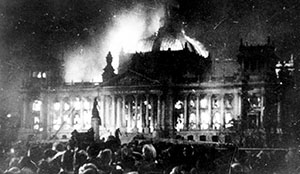
    On 27 February 1933, the German parliament (Reichstag) building burned down.

    One of the best-known false flag attacks of modern history was the Reichstag fire of 1933. At the Nuremberg war crimes trials in the late 1940s, Hermann Goering admitted German government responsibility for the fire. The fire was used to blame the communists, thus demonising a potential counterforce to Nazi rule. It also enabled the Nazis to pass a series of laws allowing them to arrest designated groups who were then tried and executed after ‘trials’, or held in concentration camps, or used as slave labour.

    Martin Niemoller wrote about the consequences in his famous poem in which he refers to “they” who came for the communists, then the trade unionists, then the Jews and finally for him, by which time there was no one left to speak for him. It is a salutary reminder of the perils of remaining silent.

    Operation Gladio was a post-World War II program that incorporated many different elements of the broader false flag. It was initially established in the immediate postwar years as a plan to have ‘stay behind’ resistance fighters in the event of a Soviet invasion of western, northern and southern Europe.

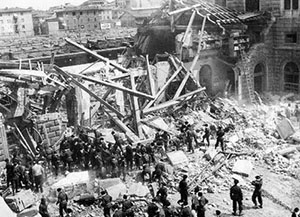
    In August of 1980, Gladio operatives bombed a train station in Bologna, Italy, killing 85 people.

    The idea was that if a country was occupied, trained resistance fighters could carry out acts of sabotage against the occupying forces, much as for example French partisans continued to fight German occupying forces during the period 1940-1945.

    Whatever the initial plans of Operation Gladio, they rapidly morphed into a program to carry out sabotage and murder that could be blamed on leftist or communist groups. The general public was thereby to be frightened into voting for conservative right-wing parties who could be relied upon to follow the US’s geopolitical wishes.

    The fear, largely imagined, of a Soviet takeover of the countries not allocated to it by the Yalta agreement was part of the driving ideology. Hatred of the Soviet Union and its successor States was always uppermost in Western political leader’s minds. 

    Operation Unthinkable was an actual plan devised by Winston Churchill in 1945. It called for an attack upon the Soviet Union immediately after the war had ended. The plan envisaged using recently defeated German troops as part of the spearhead.

    Winston Churchill ordered the planning of Operation Unthinkable in 1945.

    Churchill’s hatred of the ‘Bolsheviks’ had a long history. He was instrumental in sending British forces into Russia to fight in the civil war on the anti-communist side, for the so-called ‘White Russians’. An Australian warship was used in the Black Sea in 1918 to gather intelligence on behalf of the same operation.

    Operation Gladio (which was the Italian version) carried out a series of terrorist attacks. One of the better-known incidents was the bombing of the Bologna railway station which killed scores of people. The bombings, blamed on the Red Brigades, were a powerful propaganda tool against Italy’s Communist Party. The actual perpetrators were right-wing fascist groups such as Ordine Nuovo, organised, financed and armed by the CIA.

    The CIA had barely been formed when it organised the rigging of the 1948 Italian elections. In a genuinely free election, the communists would undoubtedly have emerged the largest and strongest party. Since 1948 the CIA has accumulated a long and dishonourable history of interfering in foreign elections. It is a point always worth recalling in the current hysteria being generated over alleged Russian interference in the 2016 US presidential election.

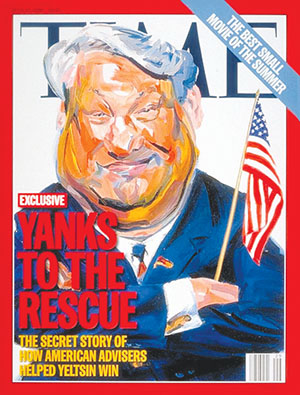
    Ironically, one of the more blatant examples of US interference in foreign elections was the engineering of Boris Yeltsin’s ‘victory’ in the Russian presidential elections of 1995. Time magazine even ran a cover story boasting about the manipulated result.

    Next Major False Flag – Target Iran

    The United States CIA and Britain’s MI6 also organised the 1953 coup that overthrew the democratically elected government of Mohammad Mosaddegh in Iran. Iran’s crime? It nationalised the Anglo Persian oil company (now BP). That a country should control its own resources was intolerable to these two imperial powers. In 2013 the CIA admitted it was behind the coup. In documents released that year, it was also clear that the British opposed the release of any documents disclosing its role in the Iranian coup. The British still refuse to acknowledge they were the instigators of the coup, and that they needed American help in order to carry it off.

    That coup is significant on a number of levels. The then British Prime Minister Anthony Eden saw Mosaddegh as a serious threat to Britain’s strategic and economic interests. Iran’s national interests were not considered.

    The coup saw the installation of the Shah’s regime, whose brutal secret police, the Savak, trained by the Americans, became a byword for cruelty and oppression.

    The third lesson was that the Shah’s brutalities lead to the 1979 Islamic revolution, putting Iran on America’s “axis of evil” list. Hybrid warfare by the Americans including assassinations, cyber attacks, sanctions and support for the terrorist group MEK have followed ever since.

    Iran’s government is still designated for violent overthrow as set out in the Brooking Institution’s “Which Path to Persia” (2009). That publication is nothing less than a blueprint for violent regime change. Again, something to remember when one hears protestations from Western leaders about their commitment to such concepts as the rule of law and respect for national sovereignty.

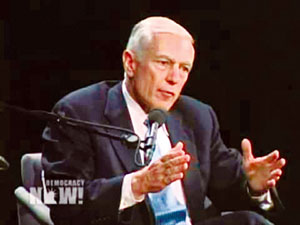
    Iran was one of the seven countries designated for regime change as disclosed by US General Wesley Clark in a revealing interview he gave on the American TV programme ‘Democracy Now’ in 2007. Clark was talking about a document he had seen in the Pentagon shortly after the events of September 2001. The seven countries referred to were Iran, Iraq, Lebanon, Libya, Somalia, Sudan and Syria.

    In a 2007 interview US General Wesley Clark revealed knowledge of a Pentagon document that called for regime change in seven countries after 9/11.

    The United States and its allies have directly attacked five of those seven since Clark’s revelations. Lebanon was previously attacked and occupied by Israel, the United States’ staunchest ally in the Middle East.

    Iraq, Syria and Libya have all been devastated by the United States and its allies in regime change operations. They have a number of features in common, not least that they are rich in natural resources, particularly oil and gas. They were and continue to be the objects of sustained vilification through propaganda, false flag attacks and outright lies used to justify invasion and occupation.

    In Iraq’s case, for example, the first Gulf War in 1990 featured in its build up the US Senate testimony of a 15-year-old girl identified only as Nayirah. She testified that Iraqi soldiers who had occupied Kuwait (following a green light from the US ambassador to Iraq, April Gillespie) took babies from their incubators in Kuwait’s hospital and threw them onto the “cold hard floor” to die.

    It was a complete lie, told by the daughter of Kuwait’s ambassador to the United States, and coached by the public relations firm Hill and Knowlton. None of this was, of course, told to the American public.

    In May 1996, 60 Minutes interviewed Madeleine Albright. Correspondent Leslie Stahl said to Albright, “We have heard that a half-million children have died. I mean, that’s more children than died in Hiroshima. And — and, you know, is the price worth it?” Albright replied, “I think this is a very hard choice, but the price — we think the price is worth it.”

    The decade of sanctions on Iraq following its defeat in that war caused the death of more than half a million civilians, mainly women and children. This was a price that the then US Ambassador to the UN, Madeleine Albright, considered “worth it.”

    First Gulf War, Vietnam & 9/11

    The 1990 first Gulf War was bracketed by two other major wars based on false flags and lies. The American war in Vietnam got its major reboot (it had been going on in one form or another for the preceding ten-plus years) from the so-called Gulf of Tonkin incidents.

    These incidents involved two US warships operating in the Gulf of Tonkin, the USS Maddox and the USS Turner Joy. On 2 August 1964, North Vietnamese gunboats attacked the Maddox. The US said the attack was “unprovoked.” It was anything but. The Maddox was gathering intelligence on the North Vietnamese and giving that intelligence to the South Vietnamese, which in turn used it in attacking the North.

    Two days later, the US said the Maddox was attacked again, and also the Turner Joy. In fact, there was no attack at all. The false allegation was used by US President Lyndon Johnson to obtain the Gulf of Tonkin resolution, giving him the power to wage warfare on the North.

    The resulting war, which ended in 1975 with the undignified scramble for evacuation by helicopter from Saigon’s rooftops, killed more than three million Vietnamese, devastated the countryside, and left a toxic legacy from chemical warfare that reverberates to this day.

    No legal consequences have flowed from this or any other attack upon nation states undertaken by the US and its allies, including the ever-willing Australians.

    The other ‘bracket’ to the first Gulf War was the October 2001 attack on Afghanistan. It was ostensibly justified by the ‘9/11’ attacks in New York City and Washington. The whole 9/11 saga ranks as one of the major false flag operations of the past 100 years. To accept the US government’s version of that event requires a total suspension of disbelief. It also requires one to reject as false basic scientific principles, common sense, and a now overwhelming body of evidence demonstrating the falsity of the official conspiracy theory.

    The events of 9/11 have a much broader significance. Exactly as with the Reichstag fire 68 years earlier, 9/11 was used to implement a legislative program and policy changes that dismantled basic constitutional protections, to wage war on dissent, and to justify a series of foreign wars and occupations under the false rubric of a “war on terror.” A series of wars of terror would be a more accurate nomenclature.

    The events of 9/11 were blamed on ‘former’ CIA asset Osama bin Laden and the Taliban government of Afghanistan who the United States alleged were sheltering him and refusing to turn him over. As noted, none of the official story relating to 9/11 could possibly be true, and that extends to the invasion of Afghanistan. We now know that the decision to invade Afghanistan was made in July 2001, two months before 9/11, and immediately after the Taliban government had refused an American offer to build and control a gas pipeline from the Caspian Sea. 

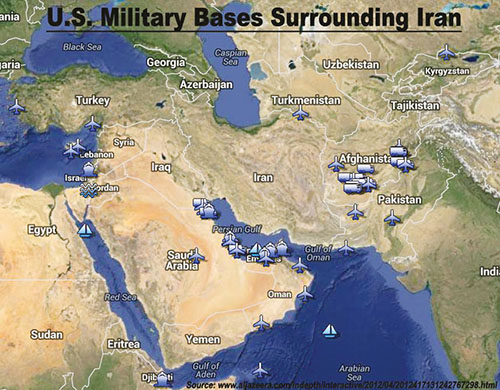
    The decision to invade was only partly due to the pipeline issue. Afghanistan has a very lucrative opium crop, and the proceeds from the sale of its refined product – heroin – finances much of the US’s clandestine operations. Afghanistan is now part of a string of nearly 400 military bases designed to ‘contain’ China. 

    Although the Taliban government was quickly overthrown, the United States and its allies (including Australia) have shown no intention of leaving. Nearly 17 years after the invasion, there is precious little progress for the Afghan people that can be demonstrated. The Taliban now control more Afghan territory than at any time since the 2001 invasion. The Australian government periodically makes statements about staying to complete its ‘mission’ of training Afghan security forces. It is silent on the question of what it hopes to achieve in the future that it has been unable to realise in the past 17 years.

    Since Operation Cyclone in the 1970s, the US geopolitical objectives in Central Asia have been control of its oil and gas resources, fomenting unrest in the Muslim republics of the then Soviet Union and China’s Xinjiang province (also with a significant Muslim population), and undermining the capacity of China and Russia to challenge the full spectrum dominance ambitions of the US government and its Deep State operatives.

    Yinon Plan for the Middle East

    Another key to understanding the geopolitical dynamics of the Middle East is the Yinon Plan, named after Oded Yinon, an advisor to former Israeli prime minister Ariel Sharon. In an article published in the Hebrew journal Kivunim (Directions) in February 1982, Yinon sets out what he termed “a strategy for Israel in the 1990s.”

    The plan envisaged the dismemberment of Egypt with Israel annexing the Sinai Peninsula. The Palestinians were to be squeezed out of the West Bank. Jordan was to be liquidated as a State, Lebanon was to be cantonised along ethno-nationalist lines, and Iraq split into its Shi’ite, Sunni and Kurdish components.

    Syria was similarly to be split into smaller states. Israeli foreign policy has essentially followed this plan, although there have been setbacks including the expulsion from Lebanon and Iraq retaining its territorial unity. Syria is an ongoing project, although thanks to Russian, Hezbollah and Iranian intervention, that plan has also, at least for the time being, been thwarted. The ethnic cleansing of Palestinians, blatant murders of Palestinians including children, and the theft of their land has, however, continued unabated. 

    Israel continues to illegally occupy the Golan Heights, seized from Syria in the 1967 war. It does so in defiance of international law and multiple UN General Assembly resolutions (Security Council resolutions are invariably vetoed by the United States). On all these issues they have the tacit support of the Australian government, either through silence or voting in Israel’s favour on UN resolutions.

    Iran represents far too big a challenge for Israel on its own, and accordingly the US has been recruited to fight Iran on Israel’s behalf. That is also likely to fail, not only because the US has failed for the past 39 years to achieve its geopolitical goals in Iran, but that Iran’s increasing integration into the wider Russia-China geopolitical realignment through organisations such as the SCO, BRI, NSTC and EAEU means Iran’s security is increasingly underwritten by both China and Russia.

    The progressive destruction of the US dollar’s role as the principal medium of exchange in world trade will greatly accelerate the diminution of the US’s capability to wage endless war. The changing financial structure of the world, including but not limited to the demise of the petrodollar, is quite probably the single most important change to the dynamics of the geopolitical world likely to occur in the very near future.

    In countries like Australia, the political leadership of both major parties seems singularly unable to grasp the significance of these changes. Major political and economic risks will flow from maintaining the ‘joined at the hip’ US alliance. China, which currently takes a third of Australia’s total exports, has already issued several increasingly blunt warnings about the economic consequences to Australia of being shown “a friendly face but a cold shoulder.” The import of this warning is seemingly lost on Australia’s political class.

    False Flags that Flopped – Salisbury & Douma

    It is in this context of the rapidly changing geopolitical balance that one has to interpret the two latest false flag initiatives by the Anglo-American duopoly – the Skripal poisoning in Salisbury, England, and the Douma ‘chemical attack’ in Syria.

    Although some thousands of kilometres apart, they are linked both in their characteristics and what they signal about modern geopolitical realities. Almost everything said by the British government about the Skripal attack is false. The same is true about the alleged ‘chemical attack’ in Douma.

    The significance of these two events is not just their manifest absurdity. Anyone with a modicum of intelligence, common sense and the ability to conduct basic research, rapidly ascertained the contradictions, implausibility and sheer scientific nonsense of the official story.

    An important and encouraging factor is that the histrionic response to both events was limited almost exclusively to a small number of mostly Western nations. Africa, Latin America and most of Asia conspicuously failed to support the UK/US version of events about either Salisbury or Douma.

    Those Western countries who supported the UK’s version of the Skripal poisoning and the illegal missile attack on Syria following the Douma allegations, including Australia, simply ignored the conventions that underlie their much-vaunted belief in the “rules-based international order” and the “rule of law.”

    These conventions include a presumption of innocence until the contrary is established. The contrary can only be established by admissible evidence proven to a very high standard. The accused, whether an individual or a nation, is entitled to know the evidence against them. A true rule of law system does not argue by assertion, and following Alice in Wonderland’s ‘Mad Queen’, demand the sentence before the verdict. 

    These and other fundamental conventions were simply ignored. The British simply pronounced Russian guilt, told blatant lies, tried to pre-empt any valid scientific inquiry, defied several international conventions to which they were a party, imposed sanctions before evidence had even being gathered, and launched in the case of Douma a missile attack that was a blatant violation of international law.

    More evidence emerges, both in Salisbury and Douma, discrediting the original wild claims by the British, the Americans and others including Australia. But rather than withdraw their wild allegations and apologise, government ministers simply ignore that evidence and repeat their fabrications ad nauseum.

    In this they are unquestionably supported by a mainstream media for whom notions of fair and accurate reporting are but a distant memory. Important revelations are unreported, and the original lies repeated in the confident expectation they will be contradicted neither by other parts of the mainstream media or by politicians.

    The lessons we draw from the experiences of the past eighty years are that in increasingly important respects our democracy is a sham. The abdication of the media, the pro-war consensus of the politicians, and the complete absence of accountability in any meaningful sense for the endless breaches of international law, strongly indicate there are effectively no longer any limits that the citizens can impose on their political leaders.

    George Orwell’s 1984, rather than being seen as a warning of a dystopian future, is instead treated by our political leaders as a training manual. We have every right to be fearful.

    [alert type=”general” dismiss=”no”]This article was published in New Dawn Special Issue Vol 12 No 3.[/alert]

    [alert type=”success” dismiss=”no”]If you appreciate this article, please consider subscribing to help maintain this website.[/alert]

    © New Dawn Magazine and the respective author.
    For our reproduction notice, click here.
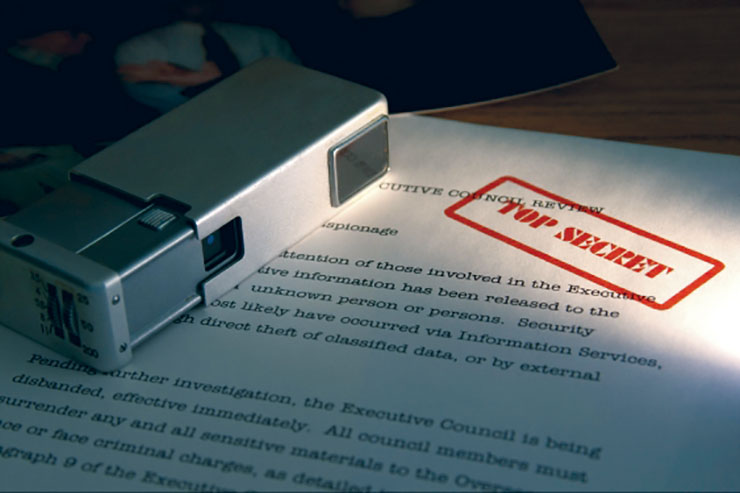
  • The Five Eyes: The International Syndicate That Spies on the Entire World

    The Five Eyes: The International Syndicate That Spies on the Entire World

    From New Dawn 177 (Nov-Dec 2019)

    Power is a peculiar thing. In different ways, we’ve become accustomed to co-existing with it and will even forgo some liberties as part of a Faustian trade-off for various modern conveniences. When that power is virtually invisible, it is beyond scrutiny; and when it’s transnational, it takes on a whole new dimension. We are now fast approaching a point in history where opaque structures of power pose a direct threat to our hard-fought-for constitutional and democratic institutions. 

    Former US National Security Agency (NSA) and Central Intelligence Agency (CIA) analyst turned whistleblower Edward Snowden offered the general public their first real glimpse of this new reality, back in 2013, when he leaked the largest single classified document dump in history. He revealed what could only be described as a vast international conspiracy, in which multiple Western intelligence agencies work hand-in-hand collecting and analysing the personal data of their citizens, completely side-skirting any domestic laws guarding our right to privacy and due process. This ‘conspiracy’ plays a pivotal role in backing-up various allied deep states around the world. 

    The operational core of this digital syndicate is known as the Five Eyes alliance. Code named FVEY, it represents an international signals intelligence (SIGINT) and communications intelligence (COMINT) gathering agreement between the United States, United Kingdom (UK), Canada, Australia and New Zealand. The Five Eyes alliance agencies include, but are not limited to, the US’s NSA and CIA, the UK’s Government Communications Headquarters (GCHQ), Canada’s Communications Security Establishment Canada (CSEC), the Australian Signals Directorate (ASD), and New Zealand’s Government Communications Security Bureau (GCSB). 

    This cooperative intelligence-sharing arrangement traces its historical roots to the UKUSA Agreement of 1946, as generally agreed in the 1941 Atlantic Treaty signed between the Allied powers during World War Two. 

    After its official status was announced in 1955, the Five Eyes was expanded to the Nine Eyes, which includes the original five members along with four additional partnering governments who are granted “third party status.” These include spying agencies from Denmark, France, the Netherlands, and Norway. 

    The Nine Eyes would later expand to a Fourteen Eyes agreement which includes the Nine Eyes plus Germany, Belgium, Italy, Spain, and Sweden. Not surprisingly, the Fourteen Eyes more or less corresponds with the core European members in the NATO military alliance. The Fourteen Eyes may also be extended up to 17 Eyes when considering other regular third party contributors like Japan, Singapore, and Israel. 

    In the late 1960s, the Five Eyes launched the ECHELON program, powered by a global array of US-run satellites and SIGINT bases located in North America, Europe, Asia, and Australia. Initially, the Five Eyes arrangement was ideally suited for the Cold War where the primary task was gathering intelligence from the former Soviet bloc countries and their allies. Later, as the internet expanded, the sheer volume of digital content and communications meant that the Five Eyes had to readjust its core competency – from an organisation mainly preoccupied with spying on governments, institutions, and persons of interest, to an organisation whose primary task was to spy on absolutely everyone. With this new raison d’être in mind, the Five Eyes cooperative framework became ideal for allowing spy agencies to bypass domestic laws that might prohibit them from conducting surveillance or hacking their country’s own citizens. Overcoming legal or technical barriers became fairly straightforward, especially in the wake of the attacks of 9/11. The USA Patriot Act meant that intelligence and law enforcement agencies could invoke national security and require telecoms companies and internet service providers (ISPs) to allow fibre optic splitters to be installed at key nodes in the telecommunications infrastructure, allowing spooks to divert massive data flows to be captured and run through the various Five Eyes data analysis centres. 

    The participating intelligence agencies of each country in the 5 Eyes
    alliance.

    The digital revolution gave the Five Eyes syndicate the ability to amalgamate and combine what was previously separate disciplines of intelligence – like SIGINT, COMINT, geospatial and human intelligence – now all rolled into one comprehensive data collection system. Once they reached this stage, getting it to perform was simply a case of tweaking the software. When Snowden’s story broke in 2013, one of the key components of the NSA’s mass surveillance operation was a software interface called XKEYSCORE. The Intercept describes the tool as follows: 

    The sheer quantity of communications that XKEYSCORE processes, filters and queries is stunning. Around the world, when a person gets online to do anything – write an email, post to a social network, browse the web or play a video game – there’s a decent chance that the internet traffic her device sends and receives is getting collected and processed by one of XKEYSCORE’s hundreds of servers scattered across the globe.

    Whereas previous iterations of the NSA’s global information dragnet hauled in large quantities of data and required a combination of computer and human intelligence to sift through it all, XKEYSCORE “extracts and tags metadata and content from the raw data so that analysts can easily search it,” allowing for a much more refined and efficient data capture operation. In essence, what used to be done by the entire ECHELON system and scores of human analysts could now be achieved with a few strokes of the keyboard.

    Spectre is Real

    Michael McKinley of the Australian National University, in an article describing the full scope of the NSA’s digital arsenal, mentions “[t]he known codewords for them over recent times: Blarney, Echelon, Dancingoasis, PRISM, Tempora, XKEYSCORE [sic], Muscular, Pinwale, EgotisticalGiraffe, Stormbrew, Fairview, Oakstar, Mainway, Rampart-T, and Nucleon. Between them, they aim to attack computers using certain types of legal privacy software, and overall to harvest, store, and analyse whatever internet traffic can be hoovered up.”

    Imagine if the NSA connected all of these data trawling nodes with an artificial intelligence backbone that analysed and parsed out teraflops of information in real-time. It would make the agency omnipotent. This very same dystopian scene was brought to life on the big screen in the 2015 James Bond film Spectre starring Daniel Craig. In the film, a latter-day Blofeld, played by actor Christoph Waltz, devised a new unofficial international ruling committee, S.P.E.C.T.R.E. (Special Executive for Counter-intelligence, Terrorism, Revenge and Extortion), comprised of the world’s top organised crime figures. Through his network’s infiltration of the very top levels of Western intelligence, Blofeld receives unrestricted, real-time access to all surveillance data collected by the “Nine Eyes” countries. This backdoor key gives Blofeld the power to steer global political events, move markets, and when necessary, blackmail any individual or institution into compliance. 

    Aside from its striking parallel to the West’s current global surveillance dragnet, Spectre raises important questions obscured by the film’s ostentatious plot. Even without Blofeld, the current Nine Eyes intergovernmental network retains all of the capabilities that any nefarious villain would ever want, to wield power or ward off any potential challengers. If operations are conducted outside public view, then the potential for abuse is virtually boundless. 

    Five Eyes: A Fraternal Order

    The fraternal nature of SPECTRE was alluded to by the antagonist’s cinematic forefather, Ernst Stavro Blofeld, depicted in the 1963 Bond film Thunderball. “SPECTRE is a dedicated fraternity whose strength lies in the absolute integrity of its members,” said Bond’s nemesis.

    Blofeld wasn’t wrong. In essence, the Five Eyes intelligence network is precisely that – a type of Anglo-fraternal organisation that wields a noticeable advantage over its rivals. Such unfettered cooperation between advanced nations like the US, UK, Canada, Australia and New Zealand, means that the technical continuity of this geopolitical alliance remains more or less unmatched. Leveraging the resources of five countries spread around the globe affords the coalition a substantive advantage over just about any other global competitor. No other bloc can match its scope and scale, geographically and technologically. 

    It is also fundamentally neo-colonial in nature. The fact that this network comprises current and former British colonial possessions speaks to the Anglo-centric or Atlanticist worldview on which its mission is based. That Atlanticist agenda is best described as something akin to a Bilderberg Committee agenda – a set of political and industrial objectives and goals informally agreed upon by some of Western society’s most powerful luminaries and technocrats who meet at the beginning of summer at the annual Bilderberg Meeting. 

    Interestingly, this fraternal brotherhood only seems to extend to certain allies. While German spy agencies like the Bundesnachrichtendienst (BND) cooperate with their US counterparts as a “third party” government through the Fourteen Eyes agreement, Washington spooks still feel the need to constantly spy on Berlin. The 2013 Snowden leaks revealed that Germany is a major target of US espionage run out of the NSA’s own European Cryptologic Center (ECC), known affectionately as the “Dagger Complex,” located in Griesheim, in the German state of Hesse. 

    According to “secret” NSA documents viewed by the German publication DER SPIEGEL, the American bunker accounts for the agency’s “largest analysis and productivity in Europe.” The documents also note that the NSA uses its infamous XKEYSCORE software to trawl up its main areas of interest from inside the German government, namely foreign policy, economic stability, new technologies, advanced weaponry, arms exports, and international trade. 

    To add insult to injury, WikiLeaks revealed in 2015 that the phone of German Chancellor Angela Merkel had been wiretapped for years by US spies.

    When interviewed on the matter, former NSA and CIA head Michael Hayden was quite flippant, openly admitting, “We steal secrets. We’re number one in it…. But, he adds, this is not malicious or industrial espionage…. We steal stuff to make you safe, not to make you rich.”

    Hayden lamented the German disclosure but admitted the US government had grossly underestimated German values on issues pertaining to privacy, stating: 

    Perhaps we underestimated the depth of feelings that the German people – and again, not just the chancellor, but the German people, felt about this question of privacy, given their historical circumstances compared to our historical circumstances. At the Munich Security Conference it was clear to me that Germans regard privacy the way we Americans might regard freedom of speech or religion. 

    In similar fashion, both the European Union and the United Nations are also said to be under US surveillance. Like with Germany, NSA espionage objectives on the EU include foreign policy goals, the economy, international trade, and “energy security.” The targeting of the UN adds a whole other international dimension to these operations. A 2013 report filed by The Guardian newspaper paints a rather disturbing picture: “[L]ong before [former United Nations Secretary-General] Ban’s limousine had even passed through the White House gates for the meeting, the US government knew what the secretary general was going to talk about, courtesy of the world’s biggest eavesdropping organisation, the National Security Agency.” 

    Australia: Casualty in a Cold War

    On the surface, having the NSA conduct surveillance operations on key allies like Germany may not make much sense. Why would America risk compromising an important relationship with a pivotal partner and fellow NATO member? To help answer that question, we need to go back 50 years and look at what happened in Australia circa 1970. 

    Cover of the new film release of Allies (available at 
    www.roninfilms.com.au/feature/9916/allies.html).  

    In the groundbreaking documentary film Allies (1983), a number of top former US and Australian politicians and intelligence officials went on camera to recount one of the most tumultuous periods in the country’s history during the Cold War, marked by the establishment of the Australian Security Intelligence Organisation (ASIO). 

    The film disclosed a series of shocking admissions rarely heard before in public, but which lifted the veil on the hidden hierarchy latent within the Five Eyes order. Revelations included an admission by Victor Marchetti, former executive assistant to the deputy director of the CIA (1955-1969), who stated: “Intelligence organisations in many countries have a loyalty that is not necessarily to the duly constituted government, they have a loyalty to what they consider the establishment.” Some officials testified that their loyalty was not to their elected leaders but the CIA. 

    Such testimony provides some of the most unequivocal evidence to date about the existence of an unelected shadow government or Deep State, directed by America’s Central Intelligence Agency. For the Americans, managing this autonomous power structure first meant securing its geostrategic interests in host countries as well as its strategic facilities like the NSA’s Pine Gap listening base located in central Australia. Securing these assets became a national security issue – Washington could not risk any newly elected government interfering with US intelligence operations.

    In the film, Dr John Burton, Secretary of the Australian government Department of External Affairs (1947-1950), described the Five Eyes thinking as follows: 

    …the need for an intelligence organisation was to ensure that governments elected (for example) on a social welfare platform would not argue that they had a mandate to recognise China, to change the agreement with the United States, or other things which the Labor Party had intended before the Petrov Commission. They’ve always argued that the intelligence operation, or the intelligence services, operating as an informal group – are the protection of democracy against itself.

    While the notorious Petrov Affair (1954) helped sideline Australia’s Labor party for many years afterwards, the real trigger for a US-backed coup came in 1972 when Gough Whitlam led Labor to victory for the first time in 23 years. The Whitlam government called into question Australia’s supporting roles in various military conflicts taking place in Southeast Asia, including Vietnam and Indonesia, and challenged the top-secret nature of US bases operating in Australia. Details of a CIA plot to depose Whitlam were revealed by NSA contractor Christopher Boyce, who was convicted of espionage and sentenced to federal prison in the US. Boyce’s story was later made into a cinematic classic, The Falcon and the Snowman.

    Whitlam would soon be removed from office in 1975 after being “dismissed” by the country’s Governor-General, with much of the evidence pointing to a US/British regime-change operation. This marked a noticeable shift to the right in Australian politics and an unflinching “special relationship” with subsequent US Administrations. 

    This story demonstrates the lengths that the US-led Five Eyes syndicate is willing to go to secure its assets in foreign countries. In the case of Australia, this meant US intervention to derail any government that might threaten US foreign policy and its global intelligence operations. From this vignette, one could draw a parallel to Washington’s ill-treatment of Germany – another ally that also hosts numerous US military bases and intelligence-gathering facilities, and which functions as an anchor for US operations in Europe in much the same way Australia does for the Asia-Pacific region. 

    The China Syndrome

    In the 21st century, mere national monopolies are no longer sufficient for Silicon Valley moguls and their shepherds in the intelligence community. Firms like Google, Apple, Facebook and Twitter command near-global monopolies in their respective markets. This means that as long as those Western firms permeate and dominate the planetary information space, Five Eyes operatives only require a backdoor into a handful of these firms to surveil and control almost every aspect of public (and even private) life. 

    Controlling technology markets has become a matter of paramount concern for the Five Eyes. That includes keeping out any foreign product which could cause a wrinkle in their control matrix. As expected, this situation feeds neatly into a ready-made geopolitical drama, especially if the Trojan Horse in question arrives in the form of a Chinese firm. 

    As Britain expedites the roll-out of its controversial high-frequency 5G network, new security concerns have surfaced at the heart of the Five Eyes as politicians and spooks debate the possibility a foreign actor could compromise the alliance from within. 

    Western technocrats have rushed to finalise preparations to create a grid of “smart cities” and smart infrastructure including fleets of self-driving cars on “smart highways,” as well as a host of public services – all linked as part of the “internet of things.” To make this project work, the UK has to partner with the only company who can deliver enough advanced equipment on time and on budget – Chinese telecommunications giant Huawei. 

    In theory, Five Eyes fears may be warranted. With 5G set to provide the new framework for real-time spying and data monitoring, Western spy chiefs and politicians are afraid of becoming too reliant on potential geopolitical and commercial rival China. Practically speaking, Huawei’s hardware is fairly standardised and compatible with other components used to configure the UK’s new 5G network, and to date, there is no proof of any latent Chinese spyware in any of the components in question. UK spy chiefs are already lining up in defence of the realm, with former MI6 head Richard Dearlove chiming in: “…we must conclude the engagement of Huawei presents a potential security risk to the UK. The key question that follows is can that risk be sufficiently mitigated to render it negligible?”

    A number of tertiary arguments against Huawei are being employed by Western officials including charges that China steals Western intellectual property, or that Chinese firms are inherently ‘anti-competitive’ because of state subsidies given to many enterprises. Reading between the lines, more of a worry for the Five Eyes (or a privatised Spectre syndicate) is the fact that a whole range of other Huawei products could employ a different proprietary Chinese encryption protocol that would give not only Chinese officials and intelligence workers a privacy edge, but the public mass-consumer too – keeping the NSA from intercepting a user’s communications, or at least making it much more difficult. Thus, keeping Chinese products out of Western surveillance zones could be a major priority for Five Eyes technocrats. 

    Earlier this year, US President Donald Trump escalated the technology war with China by signing an executive order that prohibits US companies from installing any “foreign-made” telecoms equipment which the US deems a national security threat, meaning that Huawei requires a special license issued at the discretion of Washington. Huawei Chairman Liang Hua responded at an industry press conference during the China-Germany-USA Media Forum, saying that the US placing Huawei on its entity list has had “no substantial impact” on Huawei’s business and that all of the company’s flagship products are shipping as normal.

    In the short-term, the Trump Administration is more likely to deploy economic warfare by drastically increasing tariffs on Chinese products. In this war, the winning edge might be with the state-managed economy where Chinese planners typically plot the course ahead looking at 20 to 30-year windows, as opposed to US firms that prioritise mere quarterly gains and shareholder dividends. 

    Liang Hua remarked that in only two or three years, Huawei will have developed a complete technological and commercial “ecosystem” for its range of products, making it more difficult for the Five Eyes syndicate to maintain their digital hegemony by trying to shut Huawei out of international markets. Naturally, this poses a direct threat to the West’s global digital media and communications mafia, and its overlapping fraternal network of government agencies, corporations and ‘white-collar’ organised criminal syndicates. 

    The War on Encryption 

    Aside from concerns about statecraft, most independent-minded citizens might be alarmed by the unbridled Orwellian power of such a global operation. On this point, there is little advice one can offer other than to stay off social media or go ‘off-grid’ (offline) as much as possible to avoid leaving a detailed digital footprint that can be used to build a profile on you. 

    For those who depend on the internet for their day-to-day existence, going off-grid is not really a practical option, but there are tools available that can help make surveillance difficult for 5, 9, and 14 Eyes member governments. Besides using a reliable encrypted chat or messaging service, if you are not already using a Virtual Private Network (VPN), then now may be a good time to start. VPN encrypts all of your internet traffic and scrambles your IP address, making it difficult for anyone monitoring you online to pinpoint your identity, device, and physical location. One key requirement is trying to use a service based outside the Fourteen Eyes countries. This means you may not be immediately exposed should your service provider’s host country ask for back door access to your internet records. If you are using a service within the Fourteen, then be sure to choose a company that has a ‘no logs’ policy. In other words, should a US or UK agency like the NSA or GCHQ make a formal request from a service provider to hand over all your internet search data, then there will be nothing they can hand over. Likewise, you can use a number of encrypted instant messaging services like Telegram, or encrypted email services like Proton Mail, and also consider using an internet browser that doesn’t keep data on your surfing like Brave, or a search engine like Duck Duck Go which doesn’t save data on all of your search activity.

    Perhaps the biggest obstacle to Five Eyes hegemony are digital services that use end-to-end encryption. This means only the sender and receiver can view the content, concealing communications from the prying eyes of Western spy agencies. Needless to say, insatiable state authoritarians are not happy about this and have laid down a harrowing ultimatum to tech companies, demanding write-in backdoor access protocols supposedly for “law enforcement.” If firms do not comply, government officials threaten they should be ready for brute force intrusions by agents of the state. Knowing they do not have the public on their side, governments have resorted to intimidation and scare tactics in order to swing public opinion in their favour. 

    While served as Home Secretary in 2015, former UK Prime Minister Theresa May authored a rather opprobrious piece of legislation entitled the Investigatory Powers Act (IPA), which outlines where the British police state is heading in terms of privacy and encryption. The bill requires that any “communications service provider” (ISPs, social media platforms, VOIP, email providers and messaging service) must comply with a secret warrant signed by the Home Secretary which names any persons or organisations the government wishes to spy on. 

    One watchdog organisation who has followed the IPA is the Electronic Frontier Foundation (EFF). According to researchers, the draconian decree, also known as the ‘Snooper’s Charter’, requires tech companies to insert special malware onto their systems so the spooks can use their platforms to “interfere with any other system.” The secret warrant explicitly allows those companies to violate any other laws in complying with the warrant. Essentially, the warrant enables said tech firms to violate the law in the process of complying with the government’s secret snooper’s warrant. This would also include the Home Secretary ordering firms like Facebook, Samsung or Apple to quietly remove their ‘secure communication’ features from products without notifying the public about it. 

    In terms of its legality (or lack thereof), the devil is in the absence of detail. Danny O’Brien from EFF noted how the UK government has been very careful not to pin itself down with any specifics, explaining, “Sure enough, the word ‘encryption’ does not appear in the Investigatory Powers Act (IPA). That’s because it is written so broadly it doesn’t need to.”

    EFF describes the severity of the IPA in terms of riding roughshod over basic civil rights and protections:

    “The Investigatory Powers Bill, one of the first laws to explicitly permit such techniques for law enforcement and intelligence work, contains very little in the way of oversight, and grants the British government an almost blank check for deploying malware against individual users as well as the heart of the internet’s infrastructure. It also demands that private companies and individuals assist in the deployment of this spyware, no matter where they operate in the world, and requires that this assistance be kept permanently secret from customers, partners, and the general public.

    IPA provisions might also include the government forcing a chain of coffee shops to use the company’s free WiFi service to deploy British spy agency malware against its customers. 

    The state’s intrusion goes even further with the IPA laying the parameters for the UK government to demand tech companies supply them with new product designs… in advance of commercial release. This is a shocking act of overreach by the British state – one that exceeds even the most invasive state intervention in a country like China. 

    One has to ask: given the chance, would the UK government eventually pursue a complete ban on encryption? 

    While there is considerable push-back from tech companies and public advocacy groups, there’s surprisingly little rebellion from most mainline politicians, partly because they are not being pressured from their constituents on this issue. What anti-privacy initiatives like the IPA clearly demonstrate is that Britain is the one clearly setting the dark tone and aggressive pace for the Five Eyes cohort. The agenda clearly seeks a renewed license to put tech firms in a corner by deploying emotive language and invoking evermore dramatic conspiracy claims. In her article written for the Telegraph, current UK Home Secretary Priti Patel even went so far as to equate Facebook’s noncompliance with aiding and abetting “child abusers, drug traffickers and terrorists plotting attacks.” 

    Of course, Patel’s comments shouldn’t surprise anyone who has followed the issue of privacy over the years, particularly in the post-9/11 era where politicians and national security state operatives routinely gaslight the public to justify every intrusion or roll-back of privacy rights by citing the most extreme and infrequent instances of ‘terrorism’. For the 21st century technocracy and police state, that’s been the gift that just keeps giving, but by the same token the public have become increasingly wary of such dramatic government claims due to the fact that very rarely, if ever, has government wiretapping or backdoor spying actually thwarted a terrorist attack in what is popularly referred to in national security rhetoric and Hollywood propaganda lore as ‘the ticking bomb’ scenario. 

    According to a report by security experts Sophos, at a recent Five Eyes security summit officials left no doubt as to their intentions, stating: “Tech companies should include mechanisms in the design of their encrypted products and services whereby governments, acting with appropriate legal authority, can obtain access to data in a readable and usable format.”

    Five Eyes member Australia took the matter even further, threatening to “break in” if tech companies do not facilitate the access requirements of the state. This new policy initiative was expressed unabashedly in a memo issued by the Australian Dept of Home Affairs on behalf of the Five Eyes alliance:

    The Governments of the Five Eyes encourage information and communications technology service providers to voluntarily establish lawful access solutions to their products and services that they create or operate in our countries…. Should governments continue to encounter impediments to lawful access to information necessary to aid the protection of the citizens of our countries, we may pursue technological, enforcement, legislative or other measures to achieve lawful access solutions.

    A closer look at the memo reveals that Australia’s authoritarian designs are not restricted to stopping terrorists and paedophiles but appear to target any entities they feel are “sowing discord” (including any popular dissenting opinion and analysis), that supposedly threatens our vaunted “democratic institutions.” This may also include any foreign media (as depicted in the heavily promoted ‘Russian disinformation’ narrative), independent media, and free-thinking individuals on social media. The language could not be more arbitrary: 

    We are determined to ensure that the technologies that have been developed to enhance prosperity and freedom are not exploited by those who seek to promote terrorism and violent extremism; prey upon and exploit our children; or spread disinformation and discord to undermine our democratic institutions.

    This, alongside Britain’s notorious ‘Snooper’s Charter’, demonstrates how Five Eyes partners are working in concert by gradually laying down an alliance-wide legal framework that will legitimise what would normally be unwarranted activity by state agencies. This is done by suspending any constitutional provisions or rights – all in the name of protecting national security, or even the national interest as the state defines it. 

    Many leading VPNs and messaging services can protect your data with 256-bit encryption, now used in most modern encryption algorithms and protocols. For the moment, this technology offers fairly robust protection from the prying eyes of the intelligence services, but advances in computing power may eventually put many of these protections at grave risk. New advances in quantum computing threaten to usher in a new event horizon whereby the next generation of computers could conceivably crack today’s industry-standard 256-bit encryption key in a relatively short period of time – in mere minutes, or even seconds. Researchers at the Massachusetts Institute of Technology (MIT) have shown how a quantum processor can crack a seemingly impenetrable 2,048-bit RSA encryption in only eight hours. Exactly how far off we are to this quantum revolution is anyone’s guess but when it arrives it could tip the scales of privacy away from the consumer and in favour of those organisations who control this new technology, namely Silicon Valley monopolists and the intergovernmental Five Eyes complex. On the flip side, advances in quantum decryption may also coincide with new methods of encryption that could slow down quantum crackers enough to make decryption impractical. 

    It’s incredible to think that these technological battles waged in binary virtual space may end up defining our relationship with the state in the physical world. 

    Things are moving extremely fast right now. Such a dystopic state of affairs must be resisted on every level. Our future depends on it. 

    [alert type=”general” dismiss=”no”]This article was published in New Dawn 177.[/alert]

    [alert type=”success” dismiss=”no”]If you appreciate this article, please consider subscribing to help maintain this website.[/alert]

    Footnotes

    1. UKUSA Agreement Release (1940-1956),www.nsa.gov/news-features/declassified-documents/ukusa/
    2. A Look at the Inner Workings of NSA’s XKEYSCORE, www.theintercept.com/2015/07/02/look-under-hood-xkeyscore/
    3. The unsettling reality if Five Eyes is the guardian against Huawei (Part 2), www.johnmenadue.com/michael-mckinley-the-unsettling-reality-if-five-eyes-is-the-guardian-against-huawei-part-2-a-survey-audit-concerning-prudence-integrity-law-and-ethics/
    4. US Intelligence Watches Germany Closely, www.spiegel.de/
    international/world/germany-is-a-both-a-partner-to-and-a-target-of-nsa-
    surveillance-a-916029.html
    5. NSA tapped German Chancellery for decades, WikiLeaks claims, www.
    theguardian.com/us-news/2015/jul/08/nsa-tapped-german-chancellery-
    decades-wikileaks-claims-merkel 
    6. Shame on US, www.spiegel.de/international/world/spiegel-interview-with-former-nsa-director-michael-hayden-a-960389-2.html
    7. Portrait of the NSA: no detail too small in quest for total surveillance,
    www.theguardian.com/world/2013/nov/02/nsa-portrait-total-surveillance
    8. Huwaei, 5G and the Five Eyes, www.henryjacksonsociety.org/shop-hjs/defending-our-data-huawei-5g-and-the-5-eyes/
    9. US blacklists Huawei, places it on entity list, www.economictimes.
    indiatimes.com/news/international/business/us-blacklists-huawei-places-it-on-entity-list/articleshow/69353632.cms
    10. Twitter, https://twitter.com/HuXijin_GT/status/1176465008974123008
    11. Five Eyes Unlimited: What A Global Anti-Encryption Regime Could Look Like, www.eff.org/deeplinks/2017/06/five-eyes-unlimited
    12. UK Investigatory Powers Bill, www.eff.org/issues/uk-investigatory-powers-bill
    13. Facebook’s encryption could stop our police doing their job properly –
    and I won’t allow that to happen, www.telegraph.co.uk/politics/2019/07/30/facebooks-encryption-could-stop-police-job-properly-wont-allow/
    14. What’s the Evidence Mass Surveillance Works? Not Much, www.pro
    publica.org/article/whats-the-evidence-mass-surveillance-works-not-much 
    15. Five Eyes nations demand access to encrypted messaging,www.naked
    security.sophos.com/2019/08/01/five-eyes-nations-demand-access-to-
    encrypted-messaging/
    16. Five Country Ministerial 2018, www.homeaffairs.gov.au/about-us/our-port
    folios/national-security/security-coordination/five-country-ministerial-2018
    17. MIT Technology Review, www.technologyreview.com/s/613596/how-a-quantum-computer-could-break-2048-bit-rsa-encryption-in-8-hours/
    18. Why Quantum Computers Might Not Break Cryptography, www.quanta
    magazine.org/why-quantum-computers-might-not-break-cryptography-20170515

    © New Dawn Magazine and the respective author.
    For our reproduction notice, click here.