New Dawn – World's Most Unusual Magazine

Category: New Science/Consciousness

  • DNA, Apes & the Demiurge: Did Something Interfere With Our Genetic Structure?

    DNA, Apes & the Demiurge: Did Something Interfere With Our Genetic Structure?

    New Dawn Special Issue Vol 8 No 4

    An amazing transformation has occurred in modern science. It has been slow in coming and is one that many scientists avoid discussing: there is a point where science and religion coincide. The frightening truth about this agreement is that it isn’t about new age physics, the nature of God or the transcendent union of science and religion – it concerns the nature of man, or rather, the problem of man.

    For many years, under the influence of liberalism and humanism, science tended to favour the logic of the ‘Noble Savage’. Violence and evil were human problems, probably caused by the conflict between our intellect and natural instincts. Nature was great, instincts were marvellous and sex was fun. This logic was buttressed with romantic notions about the innocence of animals, the moral purity of instinct, and the marketable icon of the harmless, playful, innocent ape. However, as science progressed, these notions fell like a house of cards.

    During the 1970s science began to refine its interpretation of Darwin’s theory of evolution. This refinement became known as sociobiology – the inclusive fitness theory – or in journalistic terms, ‘the selfish gene’. It was popularised by Richard Dawkins’s book The Selfish Gene. This discovery, which is now conventional scientific wisdom, holds that the ultimate driving force for evolution is the genes, the molecular unit of heredity of a living organism. The maximisation of genetic successes to assure the passing on of certain genes to subsequent generations. This principle, however terrifying in its ramifications, is the state of present evolutionary theory. 

    When this is combined with our new understanding of the nature of animal behaviour, a darker and more reflective scientific paradigm arises, one that has more in common with Gnosticism, a stream of thought that extends from the early followers of Christ.

    A Man & a Chimp

    Our relationship to apes has always been a matter of conjecture. We need to abandon the theories and debates about origins and consider the state of humanity at present. There are many ways to consider evolution: Whether we accept Darwinian evolution or a modification thereof, or that evolution was manipulated by ETs, God(s), or even if we consider we are part of a stage of a larger evolutionary cycle (Theosophy, Anthroposophy etc.), the fact remains that our present genetic inheritance indicates something about our present condition. 

    Science places modern man (Homo sapiens sapiens) in the centre of the ape kingdom. It says humans are part of the same lineage as orangutans, gorillas, chimpanzees, and bonobos. The standard view of this great-ape ‘family tree’ is that humans and chimps are more similar to each other than either is to the gorilla – because chimps and humans diverged more recently. But with the publication of the sequence of the full gorilla genome in 2012, this theory has been overthrown. Scientists realised that much of the human genome more closely resembles the gorilla than it does the chimpanzee genome.

    While they may seem affectionate and lovable at first appearance, extensive study in the wild has shown a far darker side to ape behaviour. Apes murder, rape and torture. They will defend their territory and intrude on any surrounding territories using guerrilla warfare, literally! In various studies of ape behaviour, it is estimated that at least forty per cent of all cases of copulation involves elements of violence, which would be interpreted as rape. Apes have short-term memories when it comes to companions. If an ape leaves one pack to join another, he becomes an instant enemy. Raids on other packs are frequent, bloody and brutal and involve ambush, torture and death. Apes behave differently from many other animal species and their aggressiveness seems very similar to human behaviour. It’s frighteningly clear that our genetic heritage is directly related to the ape kingdom. This invokes some fascinating questions and quandaries.

    Why Intellect?

    Apes and related kin are excellent reproducers. They create many offspring and continually reinforce their genetic heritage by territorialism and brute force. Researchers in this field raise the question: why would the ‘genetic program’ create what we understand as the conscious mind?

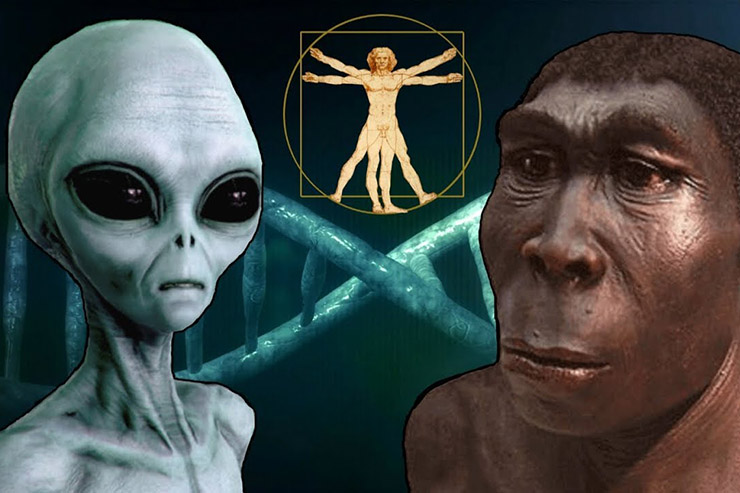
    Many argue that intelligence developed as the result of enhanced hand-eye coordination by using tools. However, many other species use tools, including apes. Apes are quick learners, and use whatever they can find to open that nut, get that fruit, or crush that skull. But apes did not develop a high level of intelligence – only the offshoot of Homo sapiens sapiens. This argument sheds light on a fascinating possibility – was human nature tweaked? Did genetic engineering take place that modified available genetic substances to create modern humans? Such writers as Zecharia Sitchin and Erich von Daniken use this sort of reasoning extensively.

    The darker side of this theory is why would an alien life form modify genetic substance without adequately balancing the social effects of the inherent flaws within the original substance? If an alien species, a deity or whatever was capable of manipulating genetic materials, then surely it would be aware of the destructive power within the primate form it was transforming. If we consider there was some manipulation of our genetic structure, then was this accomplished by a somewhat primitive and ignorant entity (which is unlikely considering the required technology)? An entity or force that was malefic and unsympathetic to the resulting human condition?

    This may seem too much to grasp at first, yet if we consider the myths and legends that abound within humanity’s history, they all seem to include such tales of genetic interference.

    The Gnostics believed that a false creator (Demiurge) formed Matter (the physical world), and humans were moulded out of fallen substance in an effort to trap particles of Light (preexistent Souls). Sitchin argued that an alien race (the Anunnaki) genetically engineered humanity as a slave species, but the early humans rebelled and developed consciousness. Numerous myths, stories and legends suggest someone or something interfered with the ape to create man, and all tend to see this creation as negative. While most religions insist that Matter is good and ‘God’ is the creator, other more esoteric approaches from the Vedas to the Gnostic suggest that Matter is at best dangerous, at worst malefic, and our creation was the result of either a miscalculation or error – or a deliberate destructive act.

    This view posits that apes were engineered as a mechanism to trap Souls which existed in the ‘first estate’ (the spiritual worlds). Many Gnostic sects believed that the fallen creator, in his attempt to wrest control of the universe, first created Matter to encapsulate and control the Light. He then evolved the physical form of mankind to capture the preexistent Light forms and turn them into automations under his control. While we may debate details, it is certainly true there is a dichotomy between our genetic programming and mind (which is the gate for one’s true spiritual self). Even if we have trouble accepting the more flamboyant aspects of this theory, the split within humanity and the violent traits of our innate genetic programming cannot be ignored.

    [alert type=”success” dismiss=”no”]If you appreciate this article, please consider subscribing to help maintain this website.[/alert]

    The Role of the Mind

    The role of the mind in human development has been ambivalent to say the least. From one perspective it is our saving grace, from another it keeps us enslaved. According to Sitchin, the mind was genetically engineered through modifications to the brain so that a slave race could be created. Apes were difficult to command, so a brain/mind complex (however originally limited) was created. Through the dichotomy between the brain/mind and the instincts, mind control was achieved. Continuing from this argument, early religions and social structures would have worked as ‘control mechanisms’ to keep the slaves in their preordained roles. As time went on, however, the mechanism of control became the tool of liberation. Even the most limited mind/brain complex began to develop thoughts outside the ‘control spectrum’, and one thought led to another and ultimately rebellion. Whether we accept this paradigm or not, we can see that intellect has a contradictory role: it exists as an affront to what science understands as the normal evolutionary process and can work to enslave or liberate.

    In this extraterrestrial cosmology, we deduce there are diverse alien species – some wish to help humans, while many desire to keep us enslaved. Accordingly, some early cultures worked to liberate humanity’s intellect, while some cultures, if not the same ones over time, regressed their culture back into slavery by the same means.

    It is interesting to note that many early Gnostic groups had a similar view of human nature. In one Mandean account, we read of demons copulating together and their progeny being man’s body and mind. Man’s physical and mental forms are in direct opposition to his spiritual essence. In other Gnostic traditions, our mind is a mixture of light and darkness which offers the opportunity to ascend beyond limitation through its redemption.

    Sigmund Freud argues that civilisation exists only in as much as it suppresses instinct, and in many ways we are now returning to his understanding. While pleasure may be the veneer that we accept as justification for our behaviour, not far under the surface is a pit of uncontrolled violence. The major contradiction in our culture is the desire for individualism – the more we demand freedom, the more restraints removed, the more we return to the unfettered ape-like creature we once were. As moral codes are loosened and as we gain more supposed freedom, crime, rape, murder and social disorder arises. As culture fails, the apes return.

    Light Emissaries

    If we contemplate the adversarial view of prehistory with evil alien forms controlling humanity for their own purposes, we can perceive it in different ways. Gnostics and some Christians may interpret this on a more spiritual level, with dominions and principalities, demos and demi-gods replacing the ‘little green men’. For the scientifically-minded researcher, we could replace aliens and demons with complexes and unconscious social control mechanisms (memes).Ultimately the symbol system is irrelevant. This model could be extended to explain the role of such figures as Zoroaster, Krishna, Jesus, Gautama (Buddha) and so on.

    As humanity’s consciousness began to expand, it rejected the ‘social control religions’ and tried to make it on its own. However, humanity was unaware that the forces which created these paradigms of control also started the human mind on a journey of development. An immense conflict evolved. When man rejects tyranny, his instincts take over and a new tyranny, one of ape violence, comes into effect. He is caught in a vicious cycle.

    The forces of Light, which exist beyond the contamination of Matter, decided to intervene. Over many millions of years, they sent emissaries to explain to man his real constitution and the conflicting nature of his being. Each avatar taught that man is a hybrid, a mixture of fallen Matter and Light ‘stuff’. Man is a split being – Animal, Intellect and Spirit – each with its own agenda and programming. The physical organism is made of fallen Matter and its programming is that of an ape ruled by the ‘selfish gene’. It is innately violent and destructive. In some sense it has its own consciousness, we could perhaps call it the ‘GE’ (genetic entity).

    The mind is another problem. It was created as a modification to the brain but evolved into something more. It has facets (such as the brain stem) which hark back to its original nature, and yet has advanced nodes that offer interface to the spirit. It is a collection of false I’s, sub-identities and personas. It craves domination and works best under control, whether by a cult or ism or by TV and computer games. Its liberation is painful, yet necessary. The emissaries of Light have been giving man ‘wake-up’ calls for thousands of years, yet man does not listen. As soon as the emissaries die, sometimes even before, their messages are distorted and become part of the ‘social control mechanism’.

    Aliens, DNA & Beyond

    Ultimately it does not matter how we perceive our masters, whether we believe the extraterrestrial theory of our origins or see them in more religious, psychological or scientific terms. The point of reference for all these paradigms is spiritual: if the aliens created slaves, it was under the influence and control of greater and more malefic spiritual powers and dominions. The Gnostics said that Matter is fallen, nature is a trap, and man’s real self is locked in an eternal game. 

    As we move further and further into the Kali Yuga, the age of blood and iron, the game becomes more and more vicious. The ‘selfish gene’ is far more malleable than we care to realise, since it is an intrusion from a spiritual reality: it can transform and change according to new challenges. In the distant past the ‘selfish gene’ program realised man could not be controlled by the genetic entity alone, so it evolved new gene-like structures to control the mind like Memes. A Meme is a virus of the mind.

    Meme: (pron. ‘meem’) A contagious idea that replicates like a virus, passed on from mind to mind. Memes function the same way genes and viruses do, propagating through communication networks and face-to-face contact between people.
    – David S. Bennahum

    Memes mould consciousness to fulfil the directive of the original DNA program. Memes transform meaningful social movements into bureaucracies, and take ideals and turn them into commodities. They take transformational technologies and turn them into mechanisms of control. TV, computer games and sport are means to stop us using our mind to any spiritual end by keeping it absorbed and controlled. Our entire culture is based on this premise: all thought must be controlled, albeit covertly, so that freedom is impossible. Democracy is simply the choice between different paradigms of control. Isms, cults and ologies offer further mechanisms of control. Many appear to be outside of the structure, but are really part of it.

    Where Science Meets Religion

    We have arrived in the new millennium, and science meets religion at last, yet in a way neither would have expected. By understanding the ‘selfish gene’, and the split nature of humanity, we have uncovered the reasons behind the constant tension and violent behaviour of modern man. Illusions are washed away when we truly comprehend the hybrid composition of human nature. 

    [alert type=”general” dismiss=”no”]This article was published in New Dawn Special Issue Vol 8 No 4.[/alert]

    [alert type=”success” dismiss=”no”]If you appreciate this article, please consider subscribing to help maintain this website.[/alert]

    © New Dawn Magazine and the respective author.
    For our reproduction notice, click here.
  • The Cycles of Time & the Birth of A New Consciousness: An Interview with Albert Amao, Ph.D

    The Cycles of Time & the Birth of A New Consciousness: An Interview with Albert Amao, Ph.D

    New Dawn Special Issue Vol 10 No 4

    I first became aware of Dr. Albert Amao’s groundbreaking work in consciousness development when I booked him to speak at a Theosophical Society meeting in the US state of Minnesota. The occasion allowed a number of us to spend some time with Dr. Amao and hear him personally describe his work.

    Dr. Amao’s latest book, The Birth of a New Consciousness and the Cycles of Time, examines the development of human consciousness on the eve of the new Aquarian age and the ‘God’ image that changes throughout the cycles of time. 

    A graduate of San Marcos University in Lima, Peru, Albert Amao holds a Ph.D. in sociology and has written extensively on metaphysics and New Thought. The author of several books, his Healing without Medicine: From Pioneers to Modern Medicine, published in 2014, was the basis of an article he wrote for New Dawn 144 (May-June 2014).

    I asked Dr. Amao to explain the ideas in his new book. These are his responses.

    Dr Albert Amao

    VON BRASCHLER (VB): What do you mean by the concept of cosmosociology?

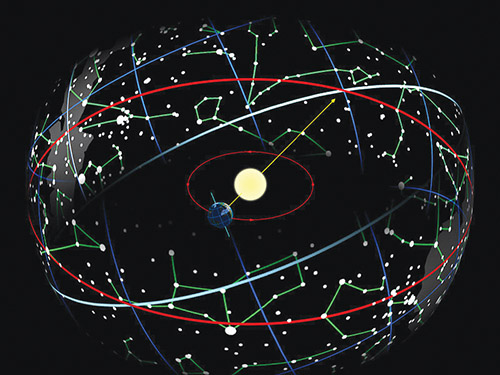
    ALBERT AMAO (AA): The concept of cosmosociology refers to the study of the evolution of human consciousness through the zodiacal ages. It considers that there is a meaningful coincidence between the zodiacal glyphs and mass consciousness. There is a resonance between the cosmic rhythms of an age and the behaviours of social groups at large. Cosmosociologyis a theoretical framework to discuss human evolution based on cosmic cycles, which in turn are based on the precession of the equinoxes. The anchor point for cosmosociology and the zodiacal ages is the ecliptic, not the constellations. 

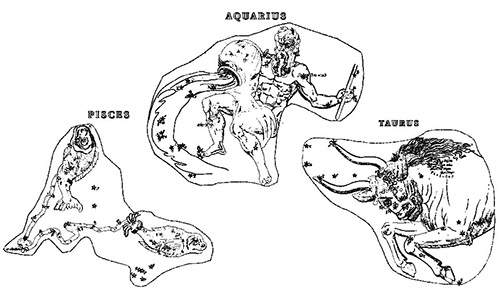
    The mathematical and geometrical models on which cosmosociology rests are based on the principle that the length of the ecliptic is 360° (degrees), which is then divided into 12 equal sectors of 30° of arc (called zodiacal signs). On the other hand, the sizes of the individual constellations vary and do not cover exactly 30 degrees of the zodiacal band. Some constellations are smaller, while others are larger than 30 degrees. Nevertheless, some astrologers measure the cosmic ages based on the actual constellations. This can be complicated, because the constellations are not of equal size. Some constellations are larger than others. For instance, the constellations Pisces and Virgo are much larger than Aries and Cancer. In this case, since Pisces is greater than 30° in length, the Age of Pisces would stretch out 600 years longer than the Age of Aries. Likewise, the constellation Virgo span a much larger space (47°) in the ecliptic circle than does the constellation of Cancer (17°). To complicate matters further, astronomers do not universally agree about where the constellations start or end.

    Furthermore, there is another constellation named Ophiuchus (the Serpent Bearer), located between Scorpio and Sagittarius, making thirteen in total. In the year 1930, the International Astronomical Union (IAU) revised the boundaries of the constellations and adjusted to the real number of constellations. According to it, the path of the ecliptic now officially passes through thirteen constellations – the twelve traditional constellations plus Ophiuchus. 

    The word cosmosociology also can be understood as world astrology, applied to the study of the evolution of collective consciousness through the zodiacal ages. 

    The science of cosmosociology is based on the astronomical fact of the precession of the equinoxes. As the earth moves in an orbit around the sun, it appears from the perspective of the earth that the sun is moving along the ecliptic (red) on the celestial dome. Over thousands of years the sun moves slightly in relationship to the constellations of the zodiac (on the celestial dome). Image credit: Wikipedia/Tau’olungA

    VB: What are the purposes of your book? What do you want to demonstrate? 

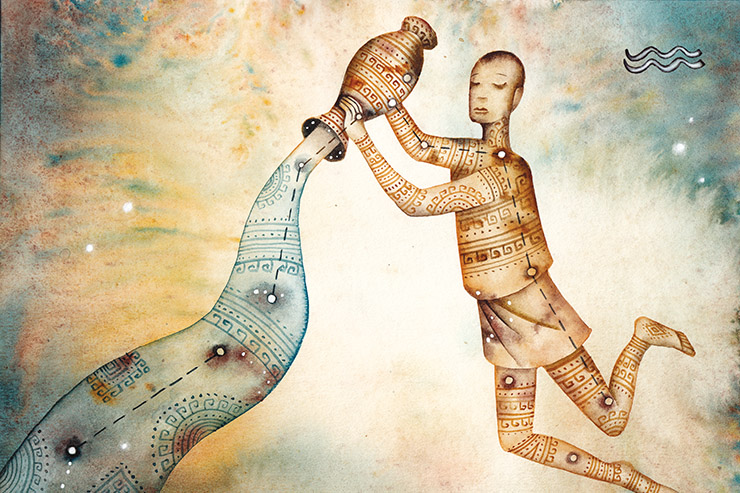
    AA: The goals that I want to cover can be summarised as follows: (a) To set an approximate date for the ending of the Age of the Fishes and the beginning of the Water-Carrier Age, (b) To define the transitional period from the Age of the Fishes to the Water-Carrier Age, (c) To clarify and differentiate between the concepts of cosmic cycles based on the constellations and those based on the zodiacal ages, (d) To delineate the sociological and religious characteristics of the Age of Fishes and the Water-Bearer Era, and (e) To outline the unfolding of a new God-image – the Water-Carrier archetype. 

    Religious ideas reflect the predominant symbolism inherent in each zodiacal age. For example, the era of Taurus (approximately 4430 BCE–2270 BCE) exhibited bull symbolism in religious imagery. During the following Age of Aries, Ram symbolism became prevalent. For the Piscean Age, fish featured in early Christian symbolism.

    VB: Has human consciousness evolved through history? 

    AA: Since simple unicellular organisms evolve into multicellular colonies, consciousness has been evolving parallel to human evolution. The fundamental idea to understand this process is thatconsciousness creates the means to express itself in the physical realm. Consciousness has created humans with brains able to manipulate physical reality. Materialistic science has taken this concept upside down, considering that the brain creates consciousness. The reverse is true; the brain is the epiphenomenon of consciousness. The Life-force or universal consciousness has been evolving since the beginning of creation. We live in a purposeful universe.

    [alert type=”success” dismiss=”no”]If you appreciate this article, please consider subscribing to help maintain this website.[/alert]

    VB: How will human consciousness expand in this coming age? In what direction? Is this development necessary?

    AA: The cosmic vibrations of the upcoming zodiacal age propel human consciousness to expand through awareness of internal and external realities. The expansion of consciousness is reached through steady meditation and inner awareness, while the latter is accomplished through scientific exploration of the external world. The expansion and evolution of consciousness is always toward the realisation of the oneness of humankind. Depth psychology has demonstrated that the personal psyche is connected to the World Soul or anima mundi. In short, our understanding of the nature of reality has dramatically shifted toward a new consciousness – a cosmic consciousness. 

    VB: What is the relationship between the zodiacal ages and the development of consciousness? 

    AA: The development of consciousness parallels the changes of zodiacal ages. This book attempts to explain the transformations of consciousness and the God-image of the predominant religions of the world, according to the changing of the zodiacal ages. The primary hypothesis is that the evolution of consciousness is expressed in the psychological development of religious ideas according to the predominant symbol of each zodiacal age. Moreover, the symbolism of the prevalent zodiacal age is manifested in religious and sociocultural ideas in the leading civilisations of the world. In other words, one can explain the transformations of the God-images of the major religions by the changing of the zodiacal ages. 

    VB: What are zodiacal ages and what is their importance?

    AA: Ever since the great Greek philosopher Plato articulated the concept of the cosmic age commonly known as the Platonic year (consisting of 26,000 years), there has been much speculation about this subject. Religious historians, astronomers, astrologers, philosophers, and other scholars have written about it; but there has never been a clear conception about the cosmic ages, their lengths in time (i.e., their starting and ending points), or their individual characteristics, etc. The zodiacal signs set the “spirit of the time” of each epoch. 

    The fundamental concept in establishing the dawning of the Water-Carrier Age is the precession of the equinoxes. The language of the zodiacal signs and the planetary system provides the dates of past cosmic events with accuracy, as they are not subject to human manipulation. 

    VB: Many authors have predicted different dates for the coming of the Aquarius (or Water-Carrier) Age. Which one is correct?

    AA: You are absolutely right that many different dates have been proposed for the upcoming age. There is wide agreement that humankind is approaching this New Age; however, there is no agreement about the date of its commencement. Some authors say that the Age of Aquarius started in the year 2000. Others, including the occult lodges known as the Hermetic Order of the Golden Dawn and the Builders of the Adytum, believe this era began in 1781, when the planet Uranus was discovered. Jung suggested that the Aquarian Age would begin either in 1997 or 2154. Esoteric writer Edward Carpenter proposed 1936, Serge Raynaud de la Ferrière, founder of the Great Universal Brotherhood, advanced March 21, 1948. French astrologer Paul Le Cour asserted that the Age of the Water-Carrier would start in 2160. The American sleeping prophet, Edgar Cayce, predicted the beginning of the New Age would take place in 1998, and Mme. Blavatsky, 2156. In short, the dates suggested range from 1781 to 2160. Determining which one is the correct was one of the goals of the book. 

    VB: You describe entry into a transitional period from the Age of Fishes (Pisces) to the Water-Bearer (Aquarian) Age. How soon will these coming changes be realised?

    AA: Humankind hasstepped into a transitional period from the Age of the Fishes (Pisces) to the Age of the Water-Carrier (Aquarius)beginning with the spring equinoxof 2010.The transitional period proposed assigns two degrees’ leeway for each adjoining zodiacal sign from the point of intersection of the two zodiacal signs. The current transition thus comprises two degrees of the first part of the Fishes (Pisces) and two degrees of the end the Water-Carrier (Aquarius). Hence, the transitional period covers the last two degrees of the Fishes (28 and 29 degrees) and the first two degrees of the Water-Carrier (0 and 1 degrees). This is because the precession pointer (vernal equinox) runs backward on the cosmic clock.

    Two degrees leeway for the ending of one zodiacal sign, along with two degrees of the upcoming sign, result in a total of 144 years for each zodiacal sign. Thus, the total years of a transitional period would be 288 years. Consequently, if we agree on the timetable proposed in this book for the zodiacal ages, the Water-Carrier Age will “officially” start in the year2154, with a transitional period that encompasses the years from 2010(2154 – 144) to 2298 (2154 + 144). 

    During the transitional period, a combination of events that belong to both zodiacal signs is expressed in the world. This is the period of great transmutations and adjustments in all levels of human activity. We are fortunate to be witnessing one of the greatest sociopolitical and religious transformations that planet Earth has ever undergone. It is vital for modern man to understand this fact, so he can be mentally and spiritually prepared to confront the upheavals entailed by these changes of cosmic dimensions. 

    VB: Your book describes how people must be prepared to confront the upheaval that entails the shift in ages. Could you describe these psychological upheavals?

    AA: During a transitional period many radical changes are likely to come. The mind has the power to create whatever it believes and conceives. As a result, unfounded predictions have wider consequences than are sometimes imagined. Susceptible and uninformed people believe they are true. They are then inspired to subconsciously create unfavourable situations in their lives that have ripple effects on their families and on society in general. And a group mind is an even more powerful device for materialising ideas.

    This work is a stride toward the acceleration of a new reality – a consciousness of the oneness and solidarity of humankind. As these ideas start sinking into the collective psyche, individuals will create this reality accordingly. Consequently, humans as a whole will experience a leap in consciousness, as they become aware of the true nature of the world and of our role in this world. They will realise that humans need to be conscious participatory agents in the development of their history. Prayer, meditation, fasting, and contemplation will help people to maintain peace of mind. 

    VB: You indicated that the God image of this coming age will be different? How so?

    AA: Jung discovered the existence of a central “archetype of wholeness” that dwells in the collective unconscious. This archetype of wholeness can be identified with the life force energy, expressed in human terms as a deity or God-image. The God-image is a symbolic conceptualisation of the collective self, which is different from God per se. God is unknowable and undefinable. By contrast, God-images are symbolic mental representations of central archetypes of the collective subconscious. Usually linked to myths, legends, and religious symbols, they have played an active role in the evolution of human thought since the dawn of civilisation. The new God-image is the acknowledgement of the inner self, the manifestation of the Divine Spark that dwells in every human being.

    The social and psychological crisis that modern man is confronting is caused by the lack of a central myth that can provide meaning and purpose at both the individual and collective level. The myth of the Age of the Fishes – in the Western world, the Judeo-Christian religion – has lost power and influence as a source of spiritual inspiration. Thus, it is extremely important to redefine the concepts of God, man, and the universe. 

    VB: What are the tell-tale signs of the advent of this coming new age? 

    AA: The radical changes occurring as we enter into a new dispensation (Age) have been taken by some as signs of the end of the world. Something similar happened with the end of the Long Count of the Mayan calendar on December 21, 2012, which received a great deal of attention before it occurred. However, this date only represents the closing of an epoch and the beginning of a new chapter in history. 

    The current planetary crisis amounts to a series of signs that we are entering into a transitional period – the ending of the Age of the Fishes and the slow dawning of the Water-Carrier Age. Currently, humankind is witnessing one of the greatest sociopolitical and religious transformations that planet Earth has ever undergone. I attempt to demonstrate that the present challenging situation of the world is part of a natural cycle in human history. Political, socioeconomic, and religious upheavals are necessary adjustments for the entrance into a new worldwide order of social and economic justice, which will be based on a higher level of international understanding and knowledge. 

    VB: What role will organised religion have in this coming age?

    AA: There is an ancient Rosicrucian aphorism that states, “There is no God but man, and man is the son of God.” The whole philosophical discussion about religions is based on that statement. The God-image we are used to is an old, white-bearded deity seated on a golden throne somewhere in the infinite surrounded by his angels, and giving them orders to manage human affairs. 

    The fundamental purpose of this new dispensation is to change the paradigm from one of the relationship between a far-distant God to one of an indwelling God principle. The era of organised religion as an intermediary between God and man – and as a means of social control – is coming to an end. Instead, we will witness the direct spiritual connection of each individual with his or her divine self. 

    [alert type=”general” dismiss=”no”]This article was published in New Dawn Special Issue Vol 10 No 4.[/alert]

    [alert type=”success” dismiss=”no”]If you appreciate this article, please consider subscribing to help maintain this website.[/alert]

    The Birth of a New Consciousness and the Cycles of Time (AuthorHouse, 2016) is available in book or electronic format online from Amazon, Barnes & Noble and other outlets. Dr. Albert Amao is available for lectures upon request. Email: stgermain777@gmail.com

    © New Dawn Magazine and the respective author.
    For our reproduction notice, click here.

  • What Is Consciousness?

    What Is Consciousness?

    From New Dawn 120 (May-June 2010)

    One of the central themes of our age is consciousness. Mystics, scientists, philosophers alike have cast their eyes on this elusive entity, but no one seems quite able to say what it is. If you look up “consciousness” in a dictionary, you will often find that it is circularly defined with such terms as “awareness” and “perception.” To be conscious is to perceive; to perceive is to be aware; to be aware is to be conscious; and so on.

    Admittedly, it’s difficult to define basic terms without some circularity: right is the opposite of left, and left is the opposite of right. But consciousness is especially problematic because it is so central to our life and experience.

    Furthermore, no one has ever figured out how the human brain produces consciousness. In a recent issue of Scientific American, neuroscientists Christof Koch and Susan Greenfield sum up the state of current knowledge when they write, “Neuroscientists do not yet understand enough about the brain’s inner workings to spell out exactly how consciousness arises from the chemical and electrical activity of neurons” (their emphasis). Neuroscientists know that the brain affects consciousness, but that was known as far back as the fifth century BCE, when the Hippocratic text On the Sacred Disease argued (radically for the time) that epilepsy was not caused by divine possession: rather “the brain is the cause of this affection, as it is of other very great diseases.” If you have any doubts on this score, you can prove it for yourself by gulping down three or four shots of vodka: when the body drinks alcohol, the mind gets drunk. Research into the neurological mechanisms that regulate these processes add more detail but no more insight into what philosophers call the “mind-brain problem.”

    Personally I believe that this is in large part because up to now no one has clearly defined what consciousness is. Gregory Sams echoes a common sentiment when he writes in the September-October 2009 issue of New Dawn: “There is no accepted standard definition for consciousness. Mystics and philosophers have devoted books to it or summed it up with the two words ‘consciousness is’.”

    I would like to propose a very simple, but, I believe, extremely fertile definition: consciousness is the capacity to relate self and other.

    How do we know this? It’s quite simple. If there is no sense of self versus other, there is no consciousness. The most obvious example is the state of deep, dreamless sleep. You are unconscious at that time, and there is no sense of self or other – not even the elusive and tenuous sense of self that we possess while dreaming.

    No sooner have we said this, however, than we realise that consciousness, this capacity to relate self and other, admits of innumerable gradations. You are not conscious of the physical world when you are dreaming, but you are still possessed of consciousness of a kind. Even dreamless sleep is not utterly devoid of this quality. What, after all, is the most universally prescribed remedy for all sorts of ailments? Sleep, which enables the “self” of the body to fight off the “others” known as pathogens.

    We can go further. Anyone with even the slightest experience of animals knows that they too are capable of relating self and other. Dogs and cats can’t reason except in the most rudimentary sense, and yet they have emotional lives that are enough like our own to be more or less understandable. Can we, then, say they are conscious, not as we are, but conscious nonetheless? What about more primitive creatures, going down as far as plants and even protozoans? We may be fairly sure that they don’t engage in Cartesian introspections, but their fierce attachment to life, to perpetuating their own existence, indicates that they too have some sense of themselves over and against an external world.

    Like many of the discoveries of the past few centuries, these insights seem to erode the human sense of privilege in being the sole possessors of the magnificent gift called consciousness, but there are some consolations. The problem of human consciousness becomes less confounding if we see it not as something sprung mysteriously out of nowhere but as a stage on a continuum. Moreover, if it is taken to heart, this outlook may help mitigate the feeling of isolation and separation that is the unhappy side effect of our arrogant sense of uniqueness.

    Where, then, do we draw the line? At inanimate things? That apparently inanimate objects contain a rudimentary form of consciousness has long been known to the philosophy of India. The British scholar Sir John Woodroffe explains it thus: “In the mineral world Cit [consciousness] manifests as the lowest form of sentiency evidenced by reflex response to stimuli, and that physical consciousness which is called in the West atomic memory.” This ostensibly Eastern idea appears in the West as well, sometimes in unexpected places. Here is an excerpt from an 1890 interview with Thomas Edison by the American writer George Parsons Lathrop:

    “I do not believe,” [Edison] said, “that matter is inert, acted upon by an outside force. To me it seems that every atom is possessed by a certain amount of primitive intelligence. Look at the thousand of ways in which atoms of hydrogen combine with those of other elements, forming the most diverse substances. Do you mean to say that they do this without intelligence?… Gathered together in certain forms, the atoms constitute animals of the lower orders. Finally they combine in man, who represents the total intelligence of all the atoms.”

    But where does this intelligence come from originally?” I asked.

    “From some power greater than ourselves.”

    Restating the point, we could say that a hydrogen atom “knows” how to recognise an oxygen atom and, under certain circumstances, how to combine with it to form water. It can, in a manner of speaking, perceive something outside of it and relate to it; it is, in a very rudimentary sense, conscious. If an atom could not take a stance in the physical world and draw some kind of line between itself and what is not itself, it could not exist. Perhaps this is the secret of those tenuous submolecular particles about which today’s physics so tantalisingly speculates. They seem to flash in and out of existence, or, in certain instances, not to exist at all unless they are observed. It is as if their sense of themselves is so frail and ambiguous that it takes an external perceiver to bring them into being, much as the eighteenth-century Anglo-Irish bishop and philosopher George Berkeley claimed that the universe would vanish if God were not there to perceive it.

    The sense of self versus other underlies our entire sense of the world. In a human context, it has produced a very strange effect: the pervasive sense that something is wrong. Indeed, we could say that man is the animal that believes something is wrong. A proverb tells us, “A man may have many problems; a man who is hungry has only one.” Granted – but if the man’s hunger is satisfied, the other problems that were waiting in the wings now come on stage. To all appearances, this is not true of other species – a dog or cat that is warm and well-fed and in comfortable circumstances does not seem to be aware of any problems. (We often envy them for this.) The sense that existence itself is problematic is basic to practically every religion – whether it calls that problem “sin” or “the Fall” or “samsara” or “maya.” Nor is it eliminated if we take religion out of the picture; it is then simply called something like “existential angst.”

    What is this “something wrong”? To make an extremely broad generalisation, Western religion has tended to portray it in moral terms – chiefly sin. At some point man chose to go his own way apart from God, and he has been in a vale of tears ever since. Eastern religions, on the other hand, have tended to portray this problematic nature of existence in cognitive terms. It is a matter of illusion or ignorance. As I say, this is an extremely broad generalisation, and many exceptions can be found. Socrates and Plato, for example, the fathers of Western philosophy, said that the human condition is characterised by ignorance and delusion. But by and large the generalisation holds true.

    The moral aspect of the human condition has been overemphasised in the West. No doubt there is a moral dimension to the universe – whether we call it the Tao, dharma, the will of God, or something else – and it is possible within this dimension to do evil. At the same time, it seems an exaggeration to say that we are conceived and born in sin, as conventional Christianity has too often done. One has the impression that Christianity created original sin as a problem to which it could then offer itself as the solution. It is as if a doctor were to make up a disease for which, of course, only he would have the cure.

    For Western civilisation today, then, it would make sense to look more deeply into the cognitive nature of this problem, and as a matter of fact that is what many people are doing. The popularity of Buddhism and certain forms of Hinduism, such as Advaita Vedanta, indicates as much. In this context it may be possible to say more clearly what this problematic nature of existence has to do with the relation of self and other that we call consciousness. One of the most profound myths to cast light on this issue, taken from the Hindu tradition, is the curious tale of the dice game of Shiva.

    One day the embraces of the Hindu god Shiva and his consort, Parvati, who have spent eternity rapt in lovemaking, are interrupted by a sinister yogi named Narada. Narada says he can show them something that is even more delightful than love. It is a game of dice – an ancestor of today’s Parcheesi.

    Intrigued by his offer, the divine couple begin to play. Each of them cheats as much as possible, but no matter how long they play, the outcome is always the same: Shiva loses and Parvati wins. Shiva may have the advantage for a round or two, but he can never win a game.

    At one point Shiva is ahead; he has won a couple of Parvati’s jewels, enraging her. Noticing that the angrier she becomes, the more beautiful she grows, he coaxes her into continuing. Parvati agrees to play if Shiva will wager his chief attributes: his trident, the crescent moon, and a pair of earrings.

    Of course Shiva plays and loses. But he refuses to accept this fact; after all, he is Shiva, the lord of the universe. “No living being can overcome me,” he tells her. She replies, “No living being can overcome you, it’s true – except me.” In spite, she leaves him. She takes not only the trident and moon and earrings but a pair of snakes and even his last item of clothing, his loincloth.

    Shiva is not troubled. He withdraws to the wilderness and leads the life of an ascetic, free from the preoccupations of the world, meditating in solitary peace. Parvati, on the other hand, feels lonely and frustrated without him. Intent on winning him back, she takes the form of a lovely tribeswoman (an untouchable in the Hindu caste system) with red lips, a graceful neck, and magnificent full breasts. She is so beautiful that even the bees in the forest are overcome with love.

    Shiva, roused from his meditation by the noise of the bees, sees Parvati in the guise of the tribeswoman and is overcome with desire for her. Coquettishly she says, “I am looking for a husband who is omniscient, who is free and fulfils all needs, who is free of mutations and is the lord of the worlds.”

    Shiva says, “I am that one.”

    Parvati replies, “You shouldn’t talk to me that way. I happen to know that you have a wife who won your devotion by many austerities, and you left her in a flash. Besides, you are an ascetic, living free from duality.”

    “Even so, I want you.”

    Parvati says that he must ask permission of her father, Himalaya, the lord of the mountain chain. Shiva approaches him, but Himalaya says, “This is not right. You should not be asking me. You are the one who gives everything in all the worlds.”

    At this point Narada reappears and tells Shiva, “Listen. Infatuation with women always leads to mockery.”

    “You’re right,” Shiva replies. “I have been a fool.” And Shiva withdraws to a remote part of the universe where even yogis cannot go.

    At this point Narada convinces Parvati and Himalaya to implore Shiva to return, and they do so by praising him lavishly. Mollified, Shiva comes back, and he and Parvati resume their reign in unity.

    Contrary to Einstein, this myth seems to be saying that God not only plays dice with the universe but constantly loses. Why should Shiva, the lord of the universe, be lured into indulging in a version of strip Parcheesi? How can he lose? Who is his consort? Why does she win?

    In essence, we could say, Shiva represents consciousness – what the Hindu tradition often calls purusha. Sometimes translated as “spirit,” it signifies consciousness in a sense much more universal than mere human awareness. Parvati represents prakriti. This is sometimes translated as “matter” or “nature,” but it signifies something far more encompassing – the contents of consciousness, experience in all its forms, internal and external – what esoteric Christianity calls the “world.” At the beginning of the myth they are locked in union. There is no distinction between consciousness and its contents. Therefore there is no world. The Hindus call this state pralaya, the state of primordial sleep that prevailed before the universe bestirred itself to manifest. The Hindu scripture known as the Rig Veda describes it:

    Then [before the beginning]
    there was neither death nor no-death,
    no sign of night or day.
    The One breathed, breathless,
    through its own impulsion,
    and there was no Other of any kind.

    Note that it’s precisely the absence of the “Other” that characterises this primal repose. The dice game, introduced by Narada, the personification of discord, symbolises the beginning of manifestation. No manifestation can exist without a distinction between self and other. But this distinction is not the property only of conscious subjects such as we imagine ourselves to be. It is characteristic of everything, because, as I have indicated, even an atom or electron must have some sense of itself simply to cohere at all. It must perceive an other in order to distinguish itself from that other and so maintain a stable existence.

    The fundamental dynamic of reality, then, is that of Shiva and Parvati: consciousness, or self, in all its forms, and experience, or the other, in all its forms. After all, if consciousness consists of the ability to relate self and other, this polarity is and must be primary. If there is no self and other, there is no universe.

    Nothing in manifest existence is absolutely a self or an other. They are merely matters of perspective. A hydrogen atom has some consciousness, demonstrated by its ability to recognise an atom of oxygen and interact with it under certain circumstances to form water and other compounds. From its point of view, it is a self and the oxygen atom is the other. To the oxygen atom, exactly the opposite is the case: the hydrogen atom is the other, just as I am other to you and you are other to me. This fact indicates that the relation between self and other, between “I” and the “world” outside, is a constant, dynamic interplay for all entities at all scales and levels of complexity. We can find metaphor for this in the game known as Othello, or Reversal, which employs disks that are black on one side and white on the other. Each player takes turns setting them down on a grid, and the player who has more disks of his own colour on the board at the end of the game wins. If, say, you are the black player and you manage to cap a line of white disks with your own black disks at both ends, the whole line of white disks flip over to black. In the course of the game, whole lines of disks flip from white to black and back again. This process hints at the ever-shifting reversal of self and other that prevails in the universe at all levels.

    But to return to the dice game, where does it fit in? And why does Shiva always lose?

    Shiva represents what one of the Upanishads calls the “seer of seeing.”5 Seeing in all its forms – that is, consciousness – imparts existence to the world. Nothing exists unless it is seen. Paradoxically, this includes Shiva’s own attributes. They do not, strictly speaking, belong to consciousness, which in its pure form has no attributes; it simply sees. (This may explain why philosophers are frustrated in their attempts to define it.) Any qualities that we can ascribe to consciousness are immediately seen; they are part of the world; and the world is Parvati. And so Parvati always wins. Her victory strips Shiva down to his pure, naked essence, which is seeing alone. For all the possible throws of the dice – that is, for all the possible directions manifestation can take – Shiva will always lose.

    Nevertheless, Shiva takes his defeat with aplomb and simply retreats to the forest. That is to say, consciousness can detach itself from its experience; it can free itself from its own contents. This detachment is the goal of many forms of meditation. It suggests why Shiva is described as an ascetic.

    Consider your own experience now. Most likely you are not aware of yourself, except as part of a vague background. But if you bring your attention to yourself, you can feel yourself as an “I” having experiences. Many of these are sensory: this room, this chair, this magazine. You can go still deeper. You can be aware of your thoughts and feelings as they pass over the screen of your awareness (which is generally easier to do if you close your eyes). If you can be aware of even these most private and intimate thoughts as somehow “other,” then where is the “I”? Who or what is it? It has no attributes as such, no qualities; it simply sees. Hence the Hindu sage Sri Ramana Maharshi says that the question “Who am I?,” taken back far enough, will lead to enlightenment.

    Enlightenment as customarily conceived is a shadowy concept. About all one can say of it is that it is a higher state of consciousness than we’re accustomed to or for that matter usually believe possible. In light of the ideas I’ve sketched out, however, we might be able to say a bit more. The consciousness that causes the world to arise is common to all things, human and nonhuman, animate and inanimate; there is nothing that does not possess it to some degree. But we almost never experience it in this universal way. On the contrary, it is always me, my consciousness, fenced in with rigid lines to insulate it from all others. It is precisely this rigid distinction, which is to a great extent artificial and delusory, that constitutes the problematic nature of existence, the sense of something wrong that pervades our souls. As the Greek sage Heraclitus said, “Consciousness is common to all, but most people live as if they had their own private minds.”

    Enlightenment, it would seem, lies precisely in the recognition of these truths, not conceptually but directly and intuitively. It may and often does come in an instant. Such insight may be dazzling for the one who experiences it, but it may also not be. For many people, I suspect, it appears “as a thief in the night,” and they cast it aside in the belief that enlightenment means the heavens open and one sees ladders full of angels going up and down, or that one becomes instantly omniscient.

    In any event, this experience of insight – whether we call it enlightenment, illumination, gnosis, or something else – marks a fundamental shift in an individual’s orientation. Afterward she is not necessarily immune to the vicissitudes of life: joys and sorrows and aches and pains come as they always have. But in a subtle way they have lost their hold on her. They are no longer absolutes, to be taken at face value. She is aware of a dimension of mind that is above the passing thrills and irritations of existence. This is supernally real and can never be taken away, and so is to be valued above all things. As Christ puts it in the Gospels, “The kingdom of heaven is like unto treasure hid in a field: which when a man hath found, he hideth, and for joy thereof goeth and selleth all that he hath, and buyeth that field” (Matthew 13:44).

    [alert type=”general” dismiss=”no”]This article was published in New Dawn 120.[/alert]

    [alert type=”success” dismiss=”no”]If you appreciate this article, please consider subscribing to help maintain this website.[/alert]

    © New Dawn Magazine and the respective author.
    For our reproduction notice, click here.

  • Science of the Whole: Integrating Matter & Spirit

    Science of the Whole: Integrating Matter & Spirit

    From New Dawn Special Issue Vol 9 No 3 (June 2015)

    Science today is a double-edged sword. On the one hand, it points towards a greater reality. On the other hand, it unwittingly blocks our direct experience of that greater reality. This needs a little explanation.

    Ever since Fritjof Capra’s The Tao of Physics in the 1970s, there have been books that draw striking parallels between the reality described by the new physics and the reality described by mystics. Both speak about interconnectedness, wholeness, the “dance of energy” and the critical role of consciousness. At the same time, science tends to block out certain types of reality because it limits itself to knowledge of the physical. It observes and studies only the physical aspects of the world and the human being.

    Although some scientists have tried to take science beyond reductionism and into holism, science remains firmly rooted in the physical. It continues to claim that physical reality is the only possible reality. I suspect that this is at the root of our big limiting beliefs, for example that the universe began for no apparent reason, that life evolved by chance on this planet, and that we have no existence before conception and after death.

    If, however, we were to extend the range of human faculties that we use in the pursuit of knowledge, knowledge itself would extend accordingly. If this happened, our beliefs about the nature of the universe and humanity would be transformed. This is significant because it is our beliefs that determine our lives – our economics, our politics, our education, our science, our culture, our relationships, our lifestyles, and much more. Change your fundamental beliefs, and your thinking and behaviour change. Meanwhile, let us examine why science today is effectively “science of the physical.”

    Science of the Physical

    Modern science was born when it became possible to observe and measure things much more accurately than ever before. The telescope and microscope played central roles, but just as important were accurate clocks, thermometers and weighing machines. Being able to do this brought many benefits, and science has changed our lives in important ways. But there was a price to be paid. It was only a short step from being better able to observe and quantify physical things to believing that if something was not physically observable or quantifiable, it was not really important, or might not even exist. At a stroke, a whole range of human experience was pushed to the margins.

    Over time, science increasingly became science of the physical, because the knowledge that it generated was about the physical aspects of the universe, the physical aspects of our home planet and the physical aspects of the human being, to the virtual exclusion of all other aspects. Now, there is nothing inherently wrong with this. The problem arises only because most scientists – and, to be fair, much of the world – appear to believe that science is exploring all possible aspects of the universe, the world and the human being.

    Although science undoubtedly tells us much that is useful about the world and ourselves, it does not and cannot give us the whole picture. It is “science of the part.” There are two reasons for this. The first is that scientific knowledge is always changing. Despite the claims of some that we are close to producing a “theory of everything” or to “knowing the mind of God,” it is helpful to remind ourselves that the history of science is littered with the corpses of “hard facts” that have had to give way to newer “hard facts” as we make new discoveries. This is well illustrated by our understanding of the nature of matter.

    At one time we were convinced that matter consisted of tiny solid things that we decided to call “atoms,” because we thought there could be nothing smaller. This is what the word “atom” implies. This belief eventually had to give way when we discovered that atoms consisted of even smaller things that we decided to call “protons,” “neutrons” and “electrons.” For some time this was the scientific “truth” until it was replaced by yet another “truth,” that protons and neutrons are themselves constructed of even smaller things, which may not be things at all, but “probabilities” or “tendencies to exist.”

    This process, of facts being replaced by newer facts, is unlikely to stop, and there is no reason to suppose that the facts of the early 21st century are more sacrosanct than those of any other period. If they were, we would eventually reach the point at which there is no more for us to discover and learn. That would be the ultimate stasis, the ultimate boredom. Quite apart from anything else, it just does not ring true, and it sits ill beside the daily diet of human affairs. If as a species we cannot even live in peace and harmony with each other and the planet, claims that we shall soon know nearly everything about almost everything sound hollow indeed. The likelihood is that what we currently know is greatly outweighed by what we do not yet know.

    The second reason why science is a partial form of knowledge is because, as with all other forms of knowledge, science is the product of the means of acquiring it. And it is we who are the means! It is we who do the acquiring. Now, if we were to apply the whole of ourselves to acquiring knowledge in the pursuit of science, then science would reflect this. It would be science of the whole. However, if we apply only part of ourselves, then scientific knowledge will be correspondingly limited. It will be science of the part. Since we have applied, almost exclusively, only the physical and intellectual parts of ourselves to the pursuit of scientific knowledge, science reflects this. It is knowledge of the physical and the rational. If, however, we were to use parts of ourselves that are almost never used these days – such as other forms of consciousness – our understanding of who we are and what the universe is would change out of all recognition. Before I say something about this, it is worth dwelling for a moment on how influential science has become.

    The Dominant Worldview

    In theory, science does not have a worldview because it is supposed to be based on evidence only. In practice, it is fair to say that the core beliefs of science today are:

    • The universe and everything in it, ourselves included, is physical, and only physical. Scientists may talk about a universe that consists only of “energy,” but they leave little doubt that they believe this energy to be physical.
    • The universe, and everything in it, can usefully be thought of as a machine.
    • The universe has no intrinsic meaning or purpose. A lot of things just happen by chance.
    • Matter is primary, and consciousness is secondary.
    • Causation is upwards – in the sense that the “primary reality” is believed to be at the level of the smallest things, such as waves and particles.

    This set of beliefs has become so influential that all metaphysical, religious and philosophical claims that contradict it tend to be rejected. The fact is these beliefs persist despite discoveries in physics and biology that suggest the universe is anything but a machine, that “chance” may lie only in the eye of the beholder, and that the universe is rich in intrinsic meaning. Yet if, as science continues to insist, the universe began suddenly for no reason (the “Big Bang”) and life on this planet emerged by chance, then the world that science wants us to believe in must be totally meaningless.

    These beliefs are causing all kinds of problems. For example, they have pushed spiritual experience and the paranormal into a box labelled: “Interesting, but strange. I can probably ignore it.” However, what we believe strongly determines what we value. If our core beliefs are that the universe is little more than a highly complex machine, that it consists entirely of physicality, and that we, too, are little more than complex machines, then our values will reflect these beliefs. They will be mechanistic/material values, and this means that we will tend to give high priority to material things and technology. It can surely be no accident that shopping and new technologies are now the world’s main activities, and that financial pundits and technology experts are the new high priests.

    I have used the term “physical” as if its meaning is self-evident. But perhaps some explanation is required.

    The Physical

    Something is physical if it can be perceived by one or more of our five physical senses (sight, hearing etc.) The thing might not be able to be perceived directly, because it is very far away (a distant galaxy), or very small (a microbe), or very subtle (a radio wave). However, we have created technological extension to our senses, to overcome this. We can perceive the very distant with telescopes, the very small with microscopes, and the very subtle with radar, radio and other devices. The point to note is that at least one of our five senses has to be involved if something is to count as physical. By definition, then, the non-physical is anything that can never be perceived by any of our five senses, with or without the aid of technology. I hope the distinction is clear.

    It is because most scientists, and many others, do not normally admit to the existence of modes of perception other than the physical senses that they do not admit the possibility of other forms of reality, which can be generalised as “non-physical.” They continue to believe that the physical universe is one and the same as the whole universe. The mistake they make is to use their narrowly based “map” to interpret a world that not only far transcends the limitations of this map, but also far transcends the comprehension of any one of us.

    Scientists have come to rely exclusively on one form of perception – their physical senses and extensions to these senses – to explore the world. Perhaps we need to remind ourselves that if we use only one form of perception – the physical one – to view the world, the world will respond accordingly, by appearing to be physical, and nothing else. If we had used another form of perception, the world would seem different. This is analogous to viewing the world through different coloured lenses. If we look through a red lens, the world seems to be red. If we look through a blue one, it seems to be blue. Reality changes according to the “lens” we use to view it.

    There can be little doubt that the physical “lens” has become the lens of almost universal preference in the modern world. I say “almost” because there are a few people who are able to use other “lenses,” in addition to the physical one. In other words, they have access to other forms of consciousness. The world they experience is richer and more extensive, because they experience the non-physical as well as the physical. But we have to ask why the physical “lens” has become the lens of universal preference today. I believe it is because, for the vast majority of people, the non-physical “lens” has become dormant, through lack of use over millennia. And I believe there are good reasons for this, but that is beyond the scope of this article. The fact is most people today probably do not know that such a “lens” even exists. However, what many people do have is the occasional fleeting glimpse of what it would be like to have the use of their non-physical “lens.” This happens when they have particular types of “extraordinary experience.”

    Most of us have extraordinary experiences from time to time. It could be a vivid dream, or a powerful sense of being totally connected to the whole of creation, or a feeling of absolute certainty that we have just met the love of our life. Although each of these counts as extraordinary, they are not all that extraordinary, in the sense that they do not pose a threat to the prevailing worldview, the worldview of science. Science does not discount these experiences. On the other hand, there are very different kinds of experiences that many people have at least once in their lives. These include telepathy, precognition, distant healing, clairvoyance, a near death experience, or an out of the body experience. These cannot be explained by science. But it goes further than this. Science actively rejects them because it believes they are impossible, but also because they threaten the prevailing worldview. They are indeed impossible from the point of view of science, but that is only because science has become a restricted form of knowledge. It is because science today is the world viewed through the physical “lens.”

    The Non-Physical

    If we want to experience and understand the non-physical aspects of ourselves and the world, we first have to develop the means to do so. In practice, this involves developing and using forms of consciousness that are dormant in the great majority of people. The actual process of awakening and training this “additional consciousness” is not easy. There is a lot to it. It is as much a general character training as it is a specific training in being able to experience at will what we may have experienced only haphazardly and infrequently, in the form of an extraordinary experience. If we did go though such a training, the range of our perception would extend considerably, and I believe our lives would change as a consequence. I think it is worth trying to imagine some of the changes.

    First, extraordinary experiences – such as telepathy and clairvoyance – would become a normal, accepted part of our daily lives. That alone would change much that we believe to be true and possible. And that, in turn, would almost certainly lead to changes in our behaviour and our lifestyles.

    Second, we would learn about aspects of the universe and the human being that we are completely unaware of. What we think of today as indisputable scientific facts will turn out to be the product of restricted (physical) consciousness. That would change our understanding of who we are, as human beings, why we are here, and what we are capable of.

    Third, we would have something very different to be serious about. What do I mean by this? At present, by far the biggest source of seriousness in the world is worrying about, or trying to solve, the huge problems that we keep creating for ourselves. Just think about the amount of time, money and energy devoted these days to trying to solve problems. The fact that a lot of people appear to derive their sense of meaning from having problems to deal with suggests there is a widespread, albeit unconscious, vested interest in having a reliable supply of problems to deal with for the foreseeable future. This must surely act against any serious attempts to solve our problems once and for all. If, however, we had the use of our inner senses, we would see there are very different things to be serious about, very different sources of meaning and purpose, which have nothing to do with problems. I believe that we would then cease to be a problem-creating race, and become a life-enhancing race.

    Esoteric Knowledge

    I should like to say a few words about “esoteric knowledge” because I believe that it will have an important role in a “science of the whole.” In essence, esoteric knowledge is a coherent description of the non-physical aspects of humanity and the world, with some guidelines on how to behave and develop on the basis of this description. Arguably the best known modern works are Occult Science by Rudolf Steiner, A Treatise on Cosmic Fire by Alice Bailey, and the works of Helena Blavatsky. There are others from other cultures, mainly India, Egypt and Tibet, but they are packed with metaphors and symbolism, whereas the three writers I mention attempt to describe the non-physical in modern concepts and language.

    There is much that is useful to draw on in esoteric knowledge and the world’s spiritual traditions. But we need to take a fresh look at these. We need to be surer of our ground. We need to know which facts within these traditions are true, which are partly true and which are false. This implies that we need to find ways of ascertaining this directly for ourselves – hence the need to awaken and train our “inner senses.” When we do this, we will then be able to add to the body of non-physical (spiritual) knowledge, just as our body of physical knowledge (science today) is constantly growing. By doing this, that which science currently regards as non-measurable, or even impossible, will eventually be seen as measurable and possible.

    A Science of the Whole

    Although it is impossible to know exactly how a science of the whole will develop, it is possible to say something about its main “building blocks.” In my opinion, they will be:

    • Being open to the possibility that the universe and human beings have non-physical aspects, as well as physical ones.
    • Being open to the possibility that all of us have dormant “inner senses” that, when awakened and trained, will give us direct access to the non-physical aspects of ourselves and the universe.
    • Being open to the possibility that esoteric knowledge – in the form of modern books (e.g. Steiner) and ancient traditions – describes and explains some features of the non-physical.
    • The willingness and ability to see connections between modern science (e.g. some insights in physics) and esoteric knowledge. Capra’s seminal work has been mentioned, but there has already been much exploration in this area.
    • New, wider concepts, which will be able to accommodate new, different forms of knowledge. For example, we will need to expand the meaning of “energy,” “universe,” “life” and “spirit,” to name but a few.
    Get the issue this article appears in

    Conclusion

    If we are to fill the spiritual vacuum created by what science has become, we need to evolve a quite different knowledge base – one in which ethics, values, human development and spiritual growth are central components. That said, it is important to state that science, despite the loss of its spiritual roots, remains a useful attempt to discover new facts and to authenticate existing ones. However, just as the scientists of today have evolved the tools to penetrate the secrets of the physical, so scientists of the future will evolve the tools to penetrate beyond the physical. This will mean developing as yet unused forms of perception – effectively, our “inner senses” – to the point at which they, too, will be as useful in the search for knowledge and understanding as our familiar five physical senses.

    It is also important to acknowledge that neither physical science nor esoteric knowledge can on their own give us the whole picture. Each is a partial form of knowledge. But since they are both talking ultimately about the same universe and the same human being, albeit from very different perspectives and using different forms of perception, they are, by definition, complementary to each other. They therefore have the potential to enrich and enhance each other.

    None of this is likely to happen soon. People do not easily give up the beliefs and habits of a lifetime, particularly if these are sources of status, income and security. That said, the conditions needed for the development and acceptance of a science of the whole are already beginning to emerge. They include:

    • Large numbers of people are reacting to the gross materialism of our time, and are looking for ways to live more spiritually and ecologically.
    • Personal development, in all its forms, is constantly growing in popularity. Many people engaged in this realise that it goes far beyond “success” or “life goals.” Personal development is ultimately about developing the whole of you, your whole potential, and this surely includes parts of you that you have not yet discovered, such as the non-physical parts.
    • For all its many achievements, science is unable to answer the big questions and provide deeper meaning. Many people feel this, and are searching for ways to go beyond the limits of science.

    Although I cannot predict when a science of the whole will emerge, I am certain that it will emerge one day. When it does, our understanding of who we are, where we came from, and where we are going will all change fundamentally. And when that happens, life for all of us will be very different and much richer.

    Chris Thomson’s book Full Spectrum Intelligence: A Practical Course on Behaving Wisely and Well is available from all good bookstores and online retailers.

    [alert type=”general” dismiss=”no”]This article was published in New Dawn Special Issue Vol 9 No 3.[/alert]

    [alert type=”success” dismiss=”no”]If you appreciate this article, please consider subscribing to help maintain this website.[/alert]

    © New Dawn Magazine and the respective author.
    For our reproduction notice, click here.
  • Is the Brain Really Necessary? The Answer Seems to be a No-Brainer

    Is the Brain Really Necessary? The Answer Seems to be a No-Brainer

    This article was published in New Dawn Special Issue Vol 10 No 4 (Aug 2016)

    This is what we’re told: Your brain is where your mind, consciousness and personality reside. “Reductionism,” noted the English writer & philosopher Colin Wilson, is the “simple theory that tries to explain the mind in terms of physical mechanisms.” Thus, consciousness “is a mechanism of the brain and nervous system.”1

    Put another way: Our mind, our consciousness, our awareness and our personality all come from the brain’s chemical and electrical machinery. When the brain works our ‘mind’ is its product. And when the brain stops working we simple cease to be. That’s the standard scientific presentation.

    The opposing view is we have a ‘soul’, a conscious self-awareness that uses the body and brain to gather and process information. When the brain stops working the ‘soul’ leaves the body to continue its existence in a so-called ‘afterworld’.

    Thanks to modern CAT scans, scientists can see inside people’s heads and view their brains, with some surprising results. The results don’t prove we have a ‘soul’ but certainly reveals there is something very wrong with the mechanistic theory that “mind is a function of brain.”

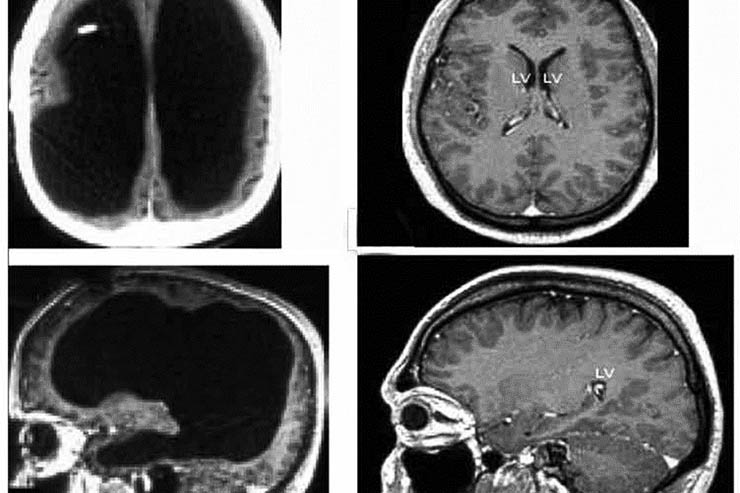
    There are people with 9/10ths of their brain cells replaced with water, and they still function normally. Refer to the images above. On the left, the dark area in the CAT scan is water (cerebrospinal fluid) and on the right is a normal brain. The horrifying photo to the right shows mother and her child with hydrocephalus. In babies, who have a soft skull, excess water in the brain can result in hugely inflated skulls. In adults the same process results in a brain that is squashed against the side of the rigid skull (as in the CAT scan). In some cases less than 10% of brain remains, yet these people often continue to function normally.

    We are told or presume this is impossible because the image (on page 37 of the print magazine) shows the areas in which various functions of the mind take place. The second image illustrates the way electrical and chemical impulses turn the brain into our mind allowing us to think, to have memories and to function in our daily lives. But it appears there is something wrong with this concept… Well, maybe not wrong but inadequate.

    The CAT scan image of the water filled skull belongs to 44-year-old French civil servant (proving, I guess the old adage, that civil servants are often brainless) who is married, has two children and lives a normal life. Another case often cited in the literature is of a man with a brain weight of between 50 and 150 grams – normal brain weight is 1,500 grams – who has a first class honours degree in mathematics and a tested IQ of 126. This man was documented by neurologist Dr. John Lorber who ran the spinal bifida unit at Sheffield Hospital. He studied 600 people who had this condition. Some had ‘only’ between 50 and 70% of their brains replaced by fluid, some between 70 and 90% replaced fluid, and there were 60 people who had 95% of their brains replaced by fluid. Of the last group, half had an IQ of over 100 (which is considered the mean average for intelligence).

    There are enough cases of, for all intents and purposes, average people who have their head filled with water not normal ‘grey cells’. This is a challenge to the accepted theory that mind, personality and consciousness are the result of chemical and electrical activity between ‘grey matter’ in the brain.

    Perhaps the idea that our personality rests in our heart or liver has something going for it? Aristotle believed the brain just served to cool the blood.

    How does the medical and psychology establishment explain the ‘inconvenient’ fact there are a considerable number of people who can function without a brain? Simply by distorting or ignoring the data available from CAT scans.

    Here are a few quotes:

    Scores of similar accounts litter the medical literature and they go back a long way,” observes Patrick Wall, professor of anatomy, University College London. He adds, “To talk of redundancy is a cop-out to get around something you don’t understand. How can we explain it?2

    There is a tendency in the medical community and elsewhere to marginalise anomalous observed phenomenon, to shove such troubling stuff into a closet where it can be safely ignored”3

    We live in a definition based reality, with a peer review ensuring that definitions are maintained.4

    If the facts in a discussion are against you, ignore them or change them.5

    And here are the two common explanations:

    We use such a small percentage of our brains anyway – perhaps as little as 10%.

    …there is such a high level of redundancy of function in the normal brain that what little remains is able to learn to deputize for the missing material.6

    Here is a further thought by a neurologist:

    [The discussion] reminds us of the mystery of memory. At first it was thought that memory would have some physical substrate in the brain, like the memory chips in a PC. But extensive investigation of the brain has turned up the surprising fact that memory is not located in any one area or in a specific substrate. As one eminent neurologist put it, ‘memory is everywhere in the brain and nowhere’. But if the brain is not a mechanism for classifying and storing experiences and analysing them to enable us to live our lives then what on earth is the brain for? And where is the seat of human intelligence? Where is the mind?”

    “One of the few biologists to propose a radically novel approach to these questions is Dr. Rupert Sheldrake. In his book A New Science of Life Sheldrake rejected the idea that the brain is a warehouse for memories and suggested it is more like a radio receiver for tuning into the past. Memory is not a recording process in which a medium is altered to store records, but a journey that the mind makes into the past via the process of morphic resonance. Such a ‘radio’ receiver would require far fewer and less complex structures than a warehouse capable of storing and retrieving a lifetime of data.7

    My position is close to that of Sheldrake. As a way of finding a solution to the metaphysical riddle of ‘do we have souls’, I postulate that the body and the brain are actually antennas that pick up limited wavelengths of information [see main article ‘Antenna Theory of Consciousness’ in New Dawn Special Issue Vol 10 No 4]. My concept also takes into account the ‘spine brain’, with its associational cerebellum. I consider this the seat of the ‘Monkey Mind’ – the Body Mind we use for everyday worldly functioning. (Note that in the CAT scans the cerebellum area of the brain remains intact). The skull brain I consider a link to the cosmic whole, what in some literature is referred to as the ‘Higher Self’.

    My Antenna Theory of human consciousness has much to recommend as an explanation of the ‘brainless’ phenomena. I suggest that the people involved are missing only one aspect of their consciousness – their connection to the stela cosmos – but retain the use of their spine brain and cerebellum to continue to lead their daily lives.

    To check if my hypothesis has value, it would be interesting to see if the severely affected have a spiritual awareness and creative ability. What are their dreams and sleep patterns? Can any electrical activity in their brains be found and assessed? The fact that this research apparently hasn’t been done may be simply because, as quoted above, “There is a tendency in the medical community and elsewhere to marginalise anomalous observed phenomenon, to shove such troubling stuff into a closet where it can be safely ignored.”
    [alert type=”general” dismiss=”no”]This article was published in New Dawn Special Issue Vol 10 No 4.[/alert]
    [alert type=”success” dismiss=”no”]If you appreciate this article, please consider subscribing to help maintain this website.[/alert]

    Footnotes

    1. Colin Wilson, Rudolf Steiner: The man and His Vision, Aquarian Press, 1985, 78
    2. http://flatrock.org.nz/topics/science/is_the_brain_really_necessary.htm
    3. A forgotten source.
    4. Personal communication with a Jesuit priest.
    5. Jesuit priest describing how to win an argument.
    6. www.supernoetics.com/who-needs-a-brain-1/
    7. www.rense.com/general63/brain.htm

    © New Dawn Magazine and the respective author.
    For our reproduction notice, click here.