New Dawn – World's Most Unusual Magazine

Category: New Science/Consciousness

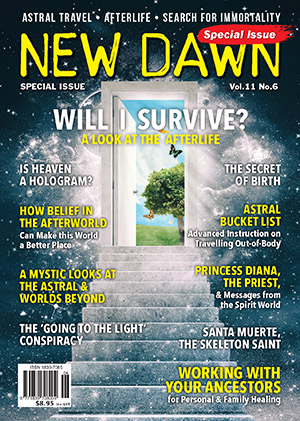
  • Astral Bucket List: Advanced Instruction on Travelling Out-of-Body

    Astral Bucket List: Advanced Instruction on Travelling Out-of-Body

    From New Dawn Special Issue Vol 11 No 6 (Dec 2018)

    So you’ve had your first out-of-body experience (OBE) and found yourself spontaneously floating from your bed up to the ceiling. Or you’ve read everything you could get your hands on about OBEs, taken a course, joined a forum, traded techniques, and finally you’re standing by your bedside looking at your physical body lying on the bed, knowing that the self by your bedside is the real you, you haven’t died – and it’s true, you’re more than your physical body. 

    Or maybe you’ve joined a shamanic journeying circle. The leader of the group provides a slow, monotonous drumbeat to lull you into an altered state of consciousness while guiding you through an interior landscape. You see yourself dropping down into a world beneath the ground to locate a power animal, such as a bear or fox, to help you with healing yourself and others. Or maybe you’ve taken the lucid-dream route. You’ve learned to recognise that you’re dreaming while you’re actually experiencing a dream – and you now have unlimited powers of controlling the dream environment and shaping the plot as you wish. Or maybe you’ve had a near-death experience that took you through a tunnel of light, guided by angelic beings to meet dead relatives with a glimpse of the afterlife before being whisked back to your physical body, resuscitated after a medical emergency. 

    Though each of these experiences seems like a milestone and there are many fellow experiencers who discuss them in books, training, and blog posts, there’s not much information about what happens next. Some people hit a wall, get bored, lose interest. Others move from one to another of the techniques listed above. Then there are the one-time experiencers who’ve had a life-changing mystical revelation while climbing a mountain or listening to music or making love – the boundaries between people, nature, even physical objects were momentarily transcended, and they felt at one with the whole universe. How did that happen – and could it ever happen again?

    The problem is that we don’t have a comprehensive map of the inner terrain we’re exploring in such adventures in consciousness. In the case of spontaneous OBEs or mystical experiences, we often don’t know how we got there and have no idea of how to get there again. In the case of better explored and more-travelled routes such as lucid dreaming, we may learn to achieve and sustain the targeted state of consciousness and then run out of ideas about what to do when we’re in it.

    Anyone who has experienced or read about more than one of these routes naturally wonders how they relate to each other, intuitively sensing a connection between them. The Internet is full of speculation and theories on the relations between the subjective reality of such states of consciousness and the objective reality of the physical world, ranging from explanations based on quantum mechanics and string theory to the latest developments in neuroscience, which attempts to assign the origins of these states to specific portions of the brain. But none of this helps the one-time experiencer or the practiced-but-stuck explorer take the next step. We need a map that goes beyond the easily achievable milestones and we need goals that motivate us to cover the inner territory between where we are and where we want to be. We need an astral bucket list.

    The phrase bucket list refers to things you want to do before you die (i.e., ‘kick the bucket’). For most people, it refers to performing an action long dreamed of and never attempted, possibly difficult to afford or achieve, but considered as the acme of physical, emotional, mental, or spiritual intensity and fulfilment. Skydiving or visiting a place of great natural beauty or spiritual significance such as the Grand Canyon or Machu Picchu would be examples of typical bucket list items. However, these items pertain purely to the physical body.

    If we believe that we’re more than our physical body, then we could also create bucket lists for one or more nonphysical bodies. Most people have heard about one of these bodies – the astral (‘starry’) body – so called because it seems to shine with its own light. In the theosophical tradition I’ve researched for somewhat more than a decade, there are other such bodies, each associated with a particular level of being or reality called a plane. Even though this system was developed by clairvoyant members of the Theosophical Society in the late nineteenth and early twentieth centuries, I believe it still has some useful things to teach us – though it requires a bit of modernising before its relevance to such things as OBEs, shamanic journeys, and other adventures in consciousness can be perceived.

    Following is a list of bodies discussed in theosophical literature. It’s not exhaustive – these are the ones we’re most likely to experience:

    Physical body – the material body we act with on the physical plane.

    Etheric body – the body of life force and health, sometimes called the model body since it’s said to be the energetic template from which the physical body is formed; correlated with the physical plane in its less material (‘higher’) aspects.

    Astral body – the body we feel with, also called the emotional or desire body, correlated with the astral plane, which most of us experience while dreaming and in which the early stages of the afterlife occur (often cathartic or purgatorial, in that the deceased are shedding negative emotions and unfulfilled desires).

    Mental body – the body we think with, correlated with the lower mental plane, where the more heavenly stages of the afterlife are experienced and where institutions of higher spiritual learning and expanded creativity in all areas of human culture may be found.

    Causal body – the body we evolve with, our higher self or soul, correlated with the upper mental plane where we choose a location, body, family, and life plan for our next incarnation and where the so-called Akashic records, containing the history of our past lives, may be found.

    Buddhic body – the body we intuit with (where intuition represents an instant apprehension of the true nature of things); also the body within which we experience unity consciousness, a mystical blissful oneness with all beings, physical and nonphysical.
    Out-of-Body Experiences

    The traditional out-of-body experience that occurs in the vicinity of the physical body is often an indication that we’re in the etheric body. For some people, having such an OBE is a bucket list item. It might include sight without eyes, 360-degree vision, even seeing the fronts and backs of things simultaneously. Movement in the etheric body might be free of gravity, as in levitation. The body might be extendible in any direction, far beyond the reach of physical arms and hands. It might also be able to penetrate and move through physical substances such as wood, metal, or glass. However, its range of movement is usually limited to fifteen to twenty feet from the physical body. It is said that if the etheric body strays beyond that distance, the physical body is in danger of dying.

    Etheric OBEs may occur as preludes to nonphysical adventures, in which we visit known or unknown people or locations on the physical plane. But such adventures take place in the astral body. They’re a variety of astral projection – the projection of the astral body away from the physical body so it can travel throughout the physical plane or the astral plane. The learning curve for use of the astral body is greater than that required for etheric body OBEs. Thus there’s often a training period in which we rehearse various skills of perception and movement in the astral body, usually in neutral, dreamlike environments that I call simulations.

    A typical simulation environment is like a room that the projector can’t leave without waking up. Usually there’s a problem to solve. When it has been solved, the walls of the room disappear and we may find ourselves on the astral plane. When the problem hasn’t been solved, the simulation repeats itself during subsequent OBEs.

    Many beginning projectors give up in frustration when they encounter simulations, not understanding that they are like gyms for the development of the astral body. Thus a useful astral bucket list item is getting into a nonphysical training program for the astral body, perhaps with a special type of spiritual guide that I call a personal trainer who acts as coach and cheerleader, explaining the purpose of each simulation (they often develop in a graded sequence) and suggesting possible solutions for the problems they pose.

    Shamanic Journeys

    In shamanistic practice, the technique of journeying usually involves three possible destinations:

    Lower world – a realm of positive and negative forces and the beings that embody them, often perceived in animal form (power animals) and having to do with disease and health.

    Middle world – a realm that closely resembles the physical earth, within which it’s possible to travel anywhere on the planet more or less instantly to see or hear information relevant to the shaman’s questions, as in remote viewing.

    Upper world – a bright heavenly region in which it’s possible to contact dead relatives and more distant ancestors, including wise teaching elders.

    In theosophical terms, the lower world would be the body consciousness of the physical body. This body consciousness is called the physical elemental. It’s a being in its own right, whose purpose is to hold the body together and ensure its health and survival. If we take care of it by providing the physical body with quality sense experience – nourishing, healthy, tasty food; beautiful sights and sounds; interesting smells and textures; neither too much nor too little sleep, pleasurable exercise, and sexual experience – then this physical elemental is like a well-trained horse and supports us in whatever we do. When we deny or deprive it of such things, it misbehaves, like a horse that wants to throw us off, drag us by the reins, wander off course to eat whatever it wants, or doing all it can to get back to the barn (bed, couch) and do nothing.

    Many addictions, whether to food, sex, stress hormones (as in extreme sports), drugs, oversleeping and so on, are indications that the physical elemental needs attention. We’re giving it the wrong food or too much of the right food. If we’re rundown from lack of proper care of the physical elemental, our immune system may suffer and make us prone to illness. In shamanic journeys to the lower world, we can perceive and interact with the physical elemental, perceived as a power animal, to restore such imbalances, finding out what it needs from us so it supports rather than undermines us.

    Each of our other bodies also has an elemental that holds it together and ensures its health and survival. Thus the astral body has its astral elemental which needs quality emotional experience such as heart-to-heart connection with others, including partners, family members, and close or best friends. If we get too little of that, we become hard and unsympathetic, inured to our own suffering or that of others. Or our emotional reactions build up until they explode into a dramatic meltdown of operatic proportions. Again, we can use shamanic journeying into the lower world to discover what the astral elemental needs from us to stay receptive to others and remain on an even keel. 

    The mental elemental holds together our mental body. To survive and thrive, it needs the experience of socialising with others who share our beliefs and values – friends, coworkers, a church-based or other spiritually focused group. If we get too little such social time, the elemental becomes addictively involved in the self-isolating pursuit of interesting information, such as computer searches, cell-phone or video games, and watching endless hours of TV. If we spend too much time among people who do not share our beliefs and values, the elemental causes us to become loudmouthed, bigoted, and argumentative advocates of our beliefs. Thus it could be said that the relative who rants about politics at family holiday gatherings without allowing others to express their own opinions is possessed by an out-of-control mental elemental.

    Although I haven’t seen mention in theosophical texts of an elemental associated with the causal body, I’ve encountered this elemental in my own adventures in consciousness. The causal elemental needs the feeling of having a fulfilling purpose in life, of somehow being useful to others. Without a sense of life purpose and an arena within which to act on it – at one’s job, at home, as an avocation, or through volunteer work – the causal elemental shuts down, triggering depression so serious that we lose all interest in life and may not be able to get ourselves out of bed. We feel paralysed. The same effect can develop from pursuing our life purpose too zealously and neglecting our self-care, especially the needs of the other elementals. We experience burnout so severe we can do nothing.

    Whether we do too much or too little to satisfy our life purpose and keep the causal elemental in line, if we lose interest in life, the physical, astral, and mental elementals are likely to run riot. It could be said that most of the personal and social problems of contemporary civilisation are the result of elementals on the rampage because we don’t know they exist or how to care for them. If we think of the elementals as power animals and can learn to interact with them through shamanic journeying or other guided imagery techniques, we’ll feel more purposive and peaceful. Since other people’s elementals and our own often influence each other (this is why bad moods or depression in family or office tends to spread), our peacefulness may encourage their restive elementals to settle down too.

    The physical, astral, mental, and causal elementals are examples of a nonhuman type of consciousness that evolves in parallel with human consciousness. In theosophical teachings, this nonhuman evolution is called the deva realm – deva is a Sanskrit word meaning “shining ones” – a continuum that includes elementals at its lower end, nature spirits such as elves and fairies in its middle ranges, and angels and archangels at its upper end. 

    I recommend an astral bucket list item that involves learning to perceive and interact with our physical, astral, mental and causal elementals. When we learn to work with the elementals, we’re using our etheric body, and that may open our inner senses to perceiving other beings of the deva realm, such as nature spirits. By making friends with our elementals, we stabilise our subtle bodies, making our exploration of these bodies through astral projection much safer.

    Shamanic journeys to the middle world are a species of astral projection on the physical plane, already discussed. Similarly, journeys to the upper world might involve projection to the areas of the astral plane in which the dead abide for a time; or those of the mental plane in which more highly developed souls of the dead or master teachers may be found (wise ancestors and elders).
    Lucid Dreams

    As mentioned, once the big event occurs – becoming aware that you’re dreaming while still in a dream – you can shape the dream environment and plot at will. The possibilities seem endless. You can slow down or speed up dream events. You can make objects or characters appear or disappear. You can completely transform the dream environment. You can will the dream characters to do whatever you wish. You can transform yourself, making yourself big or small, young or old, attractive or repellent, or shapeshifting into heroes, animals, mythical beings. You can alter the plot or create a completely new plotline. You can even pursue multiple endings as a means of creative problem-solving.

    A popular scenario is shaping a dream along the lines of a sexual fantasy and experiencing one or more climaxes wherever, whenever, and with whomever you choose. But after a while these infinite possibilities may pall. You run out of ideas. You’ve done it all before. Even lucid sex dreams lose their appeal. What next?

    Your lucid dream experiments probably took place on the astral plane where most dreams occur, and you were in your astral body. You were experiencing what I call the private areas of the astral plane Dream Zone, where dreams of a personal nature occur. There are also public areas of the Dream Zone where it’s possible to interact with astral beings and environments rather than those of your own creation. Next time you’re lucid, ask to see these public areas. You could even request an astral guide or teacher to take you there. One test of your readiness for such exploration is whether you can tell the difference between a dream character you’ve invented and an astral being such as a guide or teacher.

    Your bucket list for exploring the astral plane Dream Zone might include the following areas:

    Passive Learning Zone – movie theatres, often grouped in clusters by theme, in which dreamers watch the playing out of solutions to various typical human problems (family, romance, work, etc.); the plots are archetypal but the imagery is usually drawn from each viewer’s life.

    Interactive Learning Zone – classrooms, seminars, or universities where higher spiritual beings act as teachers, not merely providing solutions to earth-plane problems but also teaching methods of problem-solving from a higher spiritual perspective.

    Guided Learning Zone – meeting places for one-on-one guidance from a nonphysical spiritual guide or teacher, usually involving the realisation of creative and entrepreneurial projects.

    Simulation Zone – a sequence of environments, perceived as rooms from inside and biodomes from outside, in which the already mentioned training program for the astral body occurs.

    Similar areas exist in the mental plane Dream Zone, including a sequence of simulations for training the mental body.

    Near-Death Experiences

    NDEs may go through the following stages, though not every NDE includes all of them and some stages are rare:

    • Serious medical crisis 
    • OBE on the physical plane, near the physical body, perceiving the actions of people on the scene of an accident, including paramedics or medical personnel in an emergency room or operating room
    • Passage through a tunnel of light 
    • Meetings with dead relatives 
    • Review of the experiencer’s life 
    • Encounter with a being of light who acts as a judge of sorts, indicating what the experiencer has or has not learned in life and offering the choice or requirement of return to the physical body
    • A tour of the afterlife, which might include hellish, purgatorial, and/or heavenly realms
    • A tour of the universe, which might include encounters with god-like beings and information concerning the origin and purpose of creation
    • Return to the physical body after resuscitation

    Some NDE experiencers discover upon return that they can experience astral projection spontaneously or at will. Others cling to the ecstatic and transcendental aspects of the experience wishing they could return to the light or recall more about their tour of the afterlife or the universe. Those of us who read about NDEs might wish we could verify what they reveal about the afterlife through personal experience – without the medical crisis. Why not?

    The NDE often begins with an etheric body OBE. The realms through which the experiencer passes may include locations on the astral or mental plane. Tours of the universe may require a higher body, perhaps the causal or buddhic. In other words, each stage of the NDE corresponds to a plane or body described in theosophical teachings. We don’t necessarily need a medical crisis to experience them. We just need to learn how to access and move about in our nonphysical bodies. Therefore, the NDE stages listed above are a bucket list for astral projectors who want to go beyond bedroom-based etheric body OBEs and explore astral and mental plane locations in the afterlife – especially the possibility of visiting deceased relatives or friends.

    Other Gateways

    Another means of accessing various bodies and planes is remote viewing, in which the practitioner enters a trance-like state, sometimes through meditation, sometimes through the use of sound technologies designed to produce altered states of consciousness through modifying brain waves. They are able to visit and report back on things seen and heard at a remote location known or unknown and confirm the accuracy of what was perceived. Like shamanic journeys in the middle world, this is a type of astral projection on the physical plane, though the experience of leaving the physical body, as in an OBE, may be absent.

    It’s possible to extend this approach to visit any of the planes. The reason it works is that the nonphysical bodies surround the physical body in layers, making up our energy field or aura. If we can access any of these layers, we’re instantly in touch with and can use the body associated with it, and can perceive and move on the appropriate plane. Ultimately, it doesn’t matter whether we gain such access through OBEs, shamanic journeys, lucid dreams, NDEs, remote viewing, or meditation practices. Even the use of hallucinogens is simply another means of moving between the layers of the aura, accessing one or another subtle body, and experiencing the plane it belongs to, along with its scenes, dwellers, and phenomena.

    How to Get There

    In the 1920s, a theosophist by the name of Arthur Powell compiled a series of books about the subtle bodies, drawing upon dozens of books written by Annie Besant and Charles W. Leadbeater, the primary clairvoyant investigators of these bodies within the Theosophical Society from the mid-1890s to the early 1930s. (Besant died in 1933 and Leadbeater in 1934.)

    The Etheric Double: The Health Aura of Man (1925) – Little in this book is of use to astral projectors; what might be of value is repeated in the next volume of the series, so you can skip it. 

    The Astral Body and Other Astral Phenomena (1927) – This book is a goldmine for projectors, perhaps the most complete study of the astral body and plane that has ever been attempted; the sometimes obscure theosophical terminology is clearly laid out, and the inhabitants and environments of various regions of the astral plane (here called subplanes) are described in detail, providing many possible astral bucket list destinations.

    The Mental Body (1927) – This book, too, is a goldmine, but only for more advanced projectors; if you’ve thoroughly explored the dream and afterlife areas of the astral plane, you’ll get some hints of what to expect when visiting their mental plane equivalents – and more locations to add to your bucket list.

    The Causal Body and the Ego (1928) – This is a very technical book, dealing with the upper mental plane, which is more abstract (i.e., less time and space oriented) than the lower mental plane described in the previous book; only the most advance projectors are likely to understand and make use of it, though it does provide rare descriptions of the buddhic plane and body to add to your bucket list.

    Once you’ve made up your astral bucket list from reading books such as these, or ones by more contemporary adventurers, you’ll need to treat it just as you would a physical plane bucket list. Yearn to visit the nonphysical locations on the list, just as you would yearn to go to Machu Picchu or any other place on a physical plane bucket list. Be patient, since there are tasks you may need to accomplish before you can make the journey. On the physical plane, visiting Machu Picchu may require getting a passport and certain vaccinations, learning the language, acquiring the local currency; on other planes, you may need to demonstrate you can use the body associated with it and communicate with the beings you encounter. Just as you’re likely to record your trip to the Andes in photographs and videos, so you should record your adventures in consciousness in words in a journal. That’s the only way to see how the bodies are developing as you visit and cross off items on your astral bucket list.

    I mentioned having a passport for physical plane journeys. There seems to be a passport for the higher planes as well. It’s the attitude of service – being willing to help those who suffer at any level of being through any means available to us. It could be the living, comforted through astral body visits; or the dead, shown the way in the afterlife when they’re disoriented after passing. It could be our own neglected elementals, or devas or master teachers who have missions for us to perform on various levels of being. In theosophical teachings, such service is called being an invisible helper. In New Age teachings, it’s called being a light worker. No matter what we call it, the desire to be of service on any plane marks our aura so we can be perceived by nonphysical beings as someone who needs and deserves instruction in how to navigate the bodies and planes. 

    [alert type=”general” dismiss=”no”]This article was published in New Dawn Special Issue Vol 11 No 6.[/alert]

    [alert type=”success” dismiss=”no”]If you appreciate this article, please consider subscribing to help maintain this website.[/alert]

    © New Dawn Magazine and the respective author.
    For our reproduction notice, click here.
  • Mind of Light: Optical Networks in the Brain (and Beyond)

    Mind of Light: Optical Networks in the Brain (and Beyond)

    From New Dawn Special Issue Vol 13 No 6 (Dec 2019)

    Modern brain research is conducted under the rather arbitrary assumption that the original emergence of consciousness was likely to have been a lucky accident, a random byproduct of neuronal activity within the brain over millennia of interacting with a challenging external environment. 

    Based upon this initial assumption, vast sums of research money have been committed in a global effort to map the complex wiring system of billions of neurons throughout the brain. But in recent years this “tracing the door-bell wiring approach” is being challenged as new information urges us to begin to search in a radically new direction to discover how consciousness actually operates within the human body. 

    A growing number of researchers now believe that we have been looking for consciousness in the wrong place, that we have been so one-pointedly focused upon electrical impulses running along nerve fibres that we have neglected to consider the possibility that consciousness might be found to be the activity of 3-dimensional electromagnetic flux within the brain cavity, rather than in the activity of nerve impulses flowing through neuronal pathways.

    New evidence supports the idea that consciousness may be operating through an optical network system using biophotons, light “packets” emitted by living cells, a phenomenon that was first discovered in 1923. More recently, Sergey Mayburov at the Lebedev Institute of Physics in Moscow, measured streams of biophotonic emission within living fish eggs. These streams consisted of short quasiperiodic bursts, which were seen to be remarkably similar to those used to send binary data over a noisy channel. 

    Within our bodies, such a network of biophotonic information packets could very well operate in a manner similar to our current global information network, which is primarily interconnected through beams of light coursing through fibreglass cables. Of course, such a possibility would not be news to those highly skilled mystics, saints, and ayahuasceros who have described experiencing a “Mind of Light.” Further support for this idea can be found in numerous recent scientific papers such as the neuroscientist Tuszyński’s “Are There Optical Communication Channels in the Brain?” 

    This article will examine the five considerations listed below which seem to have been persistently neglected in research to date. Taken together, they may provide a synergistic framework for future experiments designed to detect and perhaps interact with an existing “Mind of Light” within each human being.

    1. Scale (the relationship of bandwidth to wavelength size) 
    2. Signal modulation of electromagnetic waves
    3. Biophotonic information packets 
    4. Biophotonic communication networks (powered and modulated by DNA supercoiling)
    5. Spherical harmonics of electromagnetic fields in the cosmos 

    If the fundamental nature of consciousness could be identified, it is not difficult to imagine the subsequent development of numerous new possibilities for mind-brain interaction. Such a breakthrough could quickly lead to unanticipated new hardware interfaces to consciousness, new devices designed to interact with, amplify, influence, and enhance human consciousness itself. 

    The Relevance of Scale

    Understanding the importance of scale should be a major consideration when searching for consciousness within the human body. Electromagnetic signals interact with physical objects at the same dimensional scale as the wavelength of those frequencies. In physics this phenomenon is called resonance. This is why radio antennas are physically tuned to the exact size of the wavelengths of the radio frequency that will be received and/or transmitted through the antenna. 

    Many consciousness researchers claim that consciousness must somehow be associated with Alpha waves which have a frequency of 8Hz. However, the length of an 8Hz wave is 23,285 miles. This is nowhere near the size of any structure within human physiology (and of course an 8Hz signal could carry relatively little encoded information). Human consciousness requires much higher frequencies to encode complex information, and higher frequencies imply wavelengths many magnitudes smaller than 23,285 miles. Any search for an electromagnetic basis for consciousness should begin by looking for frequencies that have the same scalar wavelength as physiological structures within the human body.

    It is well known that the human body broadcasts electromagnetic energy (as can be seen with night vision goggles). This energy frequency peaks at a wavelength of 10 microns (or 10μm) which is in the infrared range, just below visible light. If this energy is somehow associated with consciousness it should resonate with some structure that is in the 10 micron range. It turns out that this 10μm is the precise physical size of the inner diameter of human blood capillaries, which if laid out end-to-end, would stretch out close to 50,000 miles. Thus, it is quite possible that the human capillary system acts as a waveguide for a network of infrared light energy, carrying a 10 micron electromagnetic data stream throughout the human body. A signal with a wavelength of 10 microns has a frequency of 3×10¹³ Hz, with a relatively enormous capacity to carry encoded information as compared to the 8Hz Alpha waves.

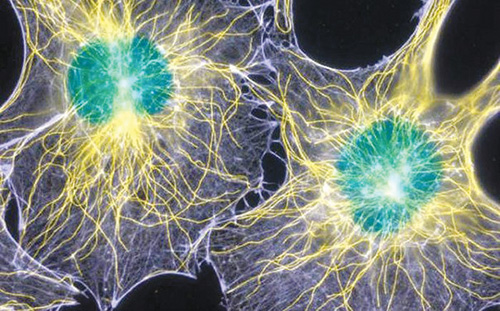
    Another possible physiological candidate for resonant interaction with a system of electromagnetic consciousness would be microtubules, part of the structural cytoskeleton of all human cells, including neurons. Microtubules are hollow structures with inner diameters of approximately 12 nm. Accordingly, microtubules could also act as waveguides, but in this case, for electromagnetic wavelengths of 12 nm (or in scientific notation, 1.2 x 10⁻⁸m). Such a wavelength corresponds to a resonant frequency of 2.5×10¹⁷ Hz, a frequency that is within the ultraviolet range of the electromagnetic frequency spectrum and has an enormous capacity for encoding information.

    Signal Modulation of Electromagnetic Waves

    Discerning these frequency bands of electromagnetic consciousness is only the first and perhaps the easiest step in mastering the physics of consciousness. Once located, the information encoded within the dynamics of the electromagnetic frequencies in that band have to be decoded or demodulated. There are innumerable ways to modulate, or encode, information. 

    Simple “AM radio” varies the amplitude, or strength, of the signal at the frequency. The variation in time matches precisely the same equivalent variations in the frequency of air motion that our human hearing system interprets as “sound.” “FM radio,” however, varies the frequency itself while maintaining a constant amplitude. The frequency changes up and down within a 2 KHz range to match the equivalent 2 KHz range of audio vibrations that can be heard by most humans.

    There are many more ways of encoding information via frequencies. Modern digital communication systems are all directly built upon detecting the data “bit,” used as a binary toggle, the “ON/OFF” signal state. This is indeed the basis of all digital encoding of information. Other data modulation schemes can use variable rates of amplitude, frequency, or a combination of the two over a specific period of time.

    The greatest challenge to neurophysicists, brain scientists, and those involved in consciousness studies is to determine how nature, specifically within the human brain, is modulating and demodulating information via electromagnetic fields. Just how is thought encoded within these non-linear electromagnetic fields given the three separate domains (five dimensions) of time, space, and frequency?

    Photons as Information Packets

    At this point we must ask the following question: By what mechanism might electromagnetic information in these high frequency bands operate within the physiology of the brain and throughout the human body (and perhaps even outside of the human body)? Is there any evidence that, in addition to the well-studied molecular chemical communications in human physiological systems, there might very well be some photonic communication network in operation, simultaneously active (but distinct from) the chemical-carrier network? 

    Contemporary research has discovered that there appears to be a photonic communication network within human physiology. A growing number of experiments have detected the existence of widespread biophotonic radiation within the human body. These results have supported the conjecture that photons may indeed play an important role in the basic functioning of cells.

    Photons are the fastest and most robust carriers of information over long distances, as can be seen in the ubiquitous global man-made networks supporting the internet, all of which rely on optical communication channels (typically fibre optic cables routing modulated photons in the infrared range). Photonic communication also offers quantum information processing capabilities with which to support the incredibly high rates of information processing necessary for cognitive operation of the human mind.

    Biophotons in Living Creatures

    Is there evidence of photon emission in the brain? Recent experiments in several countries have repeatedly detected the existence of biophotons in all living creatures. 

    All living cells of plants, animals and humans continuously emit biophotons (ultraweak electromagnetic waves) in the optical range of the spectrum, which is associated with their physiological states and can be measured using special equipment. Neural cells also continuously emit biophotons. The intensity of biophotons is in direct correlation with neural activity, cerebral energy metabolism, EEG activity, cerebral blood flow and oxidative processes.

    Biophotons were first discovered in Russia in 1923 by Professor Alexander Gurwitsch and were widely researched in Europe and the USA in the 1930s. In 1974 German biophysicist Fritz-Albert Popp was able to demonstrate that their origin lies within DNA. In fact, the emission of biophotons appears to be linked to what is called “DNA supercoiling.”

    In studies as early as those by Gurwitsch in the 1920s, researchers have been testing the bio-communication aspects of photonic emission from cells. Gurwitsch put forth the idea that “radiation generates cell division” as early as 1911.

    Now if we assume that these biophotons in plants, animals, and humans are participating in an active communication network linking innumerable physiological subsystems into one whole, then information must somehow be modulated and retrieved via these photonic messengers.

    What would be required to support a biophotonic communication network? First of all, photonic communication systems within the brain would require optical waveguides to channel the biophotons while protecting them from decoherence (the degradation of their own signal content) due to the myriad of larger wavelength EMF activity (referred to as “static” in radio receivers), external “noise” within the brain beyond each waveguide. Typically, waveguides would likely also function to facilitate routing of biophotons to other systems of the brain/mind.

    The biophoton emission rate is about 1 photon per neuron per minute. If one takes such a low rate of biophoton emission and considers the fact that there are about 1011 neurons in a human brain, there would still be over a billion photon emissions per second.

    In discussing the propagation of electromagnetic fields in brain tissue, Giuseppe Vitiello suggests the following: 

    In biological systems coherent oscillations of dipoles… would be confined inside filaments or tubes. The electromagnetic field would thus propagate within a network of filaments inside the correlated water medium, provided the strength of the electric disturbances is sufficiently high…. The diameter of the filament in the simplified case of a completely aqueous medium with maximum of polarization may be computed and it turns out to be of the order of 15 nanometers, which is a figure very near to the inner diameter of microtubules…. As a matter of fact, the observed dynamical behavior of the cytoskeleton, with its intricate network, with continuous creation and destruction of branches, and with its movements, is a true puzzle to biochemistry.

    Optical Networks in the Brain

    A recent study points out the reasonable expectation of an optical communication network within the human mind/brain systems.

    With the advantages optical communication provides in terms of precision and speed, it is indeed a wonder why biological evolution would not fully exploit this modality.

    The twenty-first century communications network operates through a vast network of fibre optic cables that act as the waveguide for photons connecting our continents. It is interesting to compare the performance of this optical system with the first electrical intercontinental cabling system.

    In August 1858 the first message between nations was sent by modulated electrical signals over the new cable, a message from British Queen Victoria to US President James Buchanan. These first messages were exchanged over the newly laid transatlantic cable resting on the floor of the Atlantic Ocean, and though the messages were short in length, they required 17 hours for transmission via Morse code. Due to the many unknowns affecting long range transmission of electrical signals through this underwater cable, it took a full two minutes to transmit even a single character. Over time the technology would improve, but even forty years later the maximum transmission rate over transatlantic cables had only reached 120 words per minute. Yet previously, even a one-way message from her Majesty, Queen Victoria, to President Buchanan would have had to be sent through a combination of steamship courier and land telegraph, taking 12 full days. Thus, the first transatlantic cable was hailed as “the 8th Wonder of the World.”

    By contrast, the average two-way internet rate of information transmission in 2017 was 7,200,000 bits (7.2 Megabits) per second. Of course, modern cables are not copper wires but fibre-optic bundles which stream enormous networks of modulated photons. The estimated total length of underwater intercontinental fibre optic cables as of 2014 was a total of 550,000 miles. 

    In the human body, the total length of capillaries branching out from the blood vessel system is about 50,000 miles, or about one tenth of the current global fibre optic communication network (the internet). The capillary system would thus be a suitable waveguide for channelling photonic information within the 10μm electromagnetic infrared range throughout the human body.

    It is interesting to note that the network of photons modulating our internet is powered by carbon dioxide lasers, currently the highest-power continuous wave lasers available. These CO2 lasers produce a beam of photons that resonate within the infrared wavelength band, between 9.4μm and 10.6μm, with the principal wavelength centred on 10μm. Surprisingly (or perhaps not surprisingly?) this is identical to the wavelength of peak radiation that streams throughout the human blood capillary system. The human body produces over two pounds of carbon dioxide each day, and all of this CO2 is distributed in the coursing ionic bloodstream flowing throughout the body in the system of capillaries.

    DNA Supercoiling

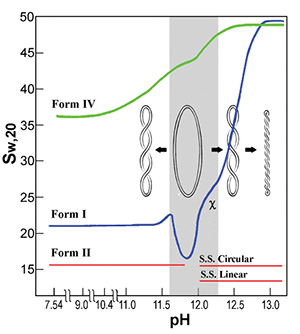
    Electromagnetic radiation occurs when an electric charge spins (“oscillates”) within a specific frequency range. Biophotons radiate electromagnetic energy throughout the spectral range from 180 nm to 1000 nm, covering the ultraviolet, visible and near infrared. The corresponding frequency range is from 3 × 10¹⁴ to 1.6 × 10¹⁵ Hz. The generation of these photons requires two phases: (1) an energy pumping that builds up the charge of the spinning electron to the excited level, and (2) the emission of a photon with the corresponding loss of charge of the spinning electron. Where might we look to discover the source of biophotonic plasma generation? The answer seems to be in DNA supercoiling (see Figure 1).

    Figure 1: DNA Supercoiling versus pH. Notahelix/Wikimedia Commons/CC BY-SA 3.0

    DNA rings have been found to be extremely sensitive to variations in pH, the excess or deficit of electrons in surrounding aqueous fluids. Slight changes in pH result in causing these DNA rings to alternately coil and uncoil. In coiling, the rings store up energy from the surrounding ionic electromagnetic environment; when they relax from a coiled state to a circular state, the additional stored energy is released as biophotons. It has been determined that biophoton emission rates are about 1 photon per neuron per minute. Given that there are about 1011 neurons in the human brain, this would equate to over a billion photon emissions per second, more than sufficient to facilitate transmission of a large number of bits of information, and to offer the possibility of an enormous network of quantum entanglement in the resulting swarm photonic plasma. It is quite feasible that these biophotons themselves are modulated in some fashion with information transferred from within the DNA configuration. 

    Waveguides

    It has been speculated that myelinated axons could serve as the waveguides for travelling biophotons within the brain. The widest myelinated axons in the brain have an inside diameter of 10μm, while the narrowest are 0.2μm in diameter. Of course, narrower waveguides channel higher frequencies (and correspondingly can handle higher rates of encoded information transfer).

    Kirlian Photography

    Figure 2: Kirlian photograph of an oak leaf. Mark D Roberts Photography/Wikimedia Commons/CCBY4.0

    One final piece of the puzzle in support of electromagnetic field consciousness is the phenomenon of Kirlian photography, first discovered in 1939 by the Russian electrical engineer Semyon Kirlian. It was found that by placing an object on a photographic plate connected to a high-voltage source, a photographic image of previously unsuspected radiation patterns emitted by the object could be produced. This phenomenon has been subsequently called by various names: electrography, electrophotography, corona discharge photography (CDP), bioelectrography, electrophotonic imaging (EPI), and in Russia, Kirlianography. The corona discharge glow at the surface of an object (Figure 2) subjected to a high-voltage electrical field is referred to as a “Kirlian aura” in Russia and Eastern Europe.

    In short, there are numerous avenues of exploration open to future researchers in the search for the physics of consciousness. Many of these areas have been largely ignored by neurophysiologists in their race to map the complex neuronal wiring systems of the brain. It is this author’s hope that broader avenues of exploration will eventually result in a true understanding of the physics and dynamics of this amazing phenomenon that is consciousness.

    Shelli Joye’s book Developing Supersensible Perception: Knowledge of the Higher Worlds through Entheogens, Prayer, and Nondual Awareness, is available from all good bookstores. The footnotes for this article are published in the print and PDF versions of this magazine.

    [alert type=”general” dismiss=”no”]This article was published in New Dawn Special Issue Vol 13 No 6.[/alert]

    [alert type=”success” dismiss=”no”]If you appreciate this article, please consider subscribing to help maintain this website.[/alert]

    © New Dawn Magazine and the respective author.
    For our reproduction notice, click here.
  • The Power of Egregores: An Interview with Mark Stavish

    The Power of Egregores: An Interview with Mark Stavish

    From New Dawn 176 (Sept-Oct Dec 2019)

    Diane Fraser speaks with Mark Stavish about egregores, their existence and power in our lives, and how they can help or restrict us. Mark shares practical advice on how to determine if an egregore has too great a hold on you.

    Mark Stavish is a respected authority on Western spiritual traditions and the author of over 26 books. His most recent book is Egregores, The Occult Entities That Watch Over Human Destiny. This book provides information on the history and use of egregores, true accounts of disengaging from egregores, and how to free yourself from one when you realise it’s no longer working for you. His book has gained considerable attention among various politicians in the United Kingdom and the European Union. 

    An egregore is an autonomous thought form or psychic entity created when two or more people are focused on the same idea or image. Thoughtforms are purposely developed to serve the aim of a group or individual. They’re also created organically when people who are not necessarily connected in a formal group focus on the same ideal or image, like entertainment characters that go viral and become icons. Spiritual, occult, religious, political and other groups with specific aims create egregores, using symbols and rituals to focus and draw upon the energy of individual members/believers/fans/participants to fuel it. Their energy helps to sustain the psychic entity, and the psychic entity then influences the individual in some way through this connection. 

    Egregores Exist on Three Levels

    It is believed that only humans can form egregores, but once formed they exist on three levels: the material, the astral, and the celestial. On the material level the thoughtform is connected to symbols, icons, images, talismans, relics, ritual objects, rituals, or materials that represent and connect to it. We live in a world of symbols and icons, from the simple forward pointing arrow that means ‘go this way’ to the ubiquitous Coca-Cola symbol and religious symbols like the Christian cross. Every symbol has an egregore associated with it, and that psychic entity exists on the astral plane, in the realm of emotion, spirits, and thoughts. The entity’s vitality is fed and nurtured by the emotions and thoughts of the individuals who connect to it. 

    What is the connection between egregores and the celestial plane? I wasn’t sure, so I asked Mark about it. 

    MARK STAVISH (MS): On the celestial level, egregores are connected to cosmic principles. These could be deities, god forms, archetypes, or abstract principles like beauty, harmony, or war. For example, any Parisian or Italian fashion show will have a connection to the ideals of Venus such as beauty and harmony, regardless of how ridiculous the outfits might be. Every football team’s egregore has a relationship to the archetype of Mars, and its characteristic competition. Egregores are connected to the celestial plane, whether to specific deities or to the much broader ideals that they represent. The thing we have to remember is that these entities have their own agendas. We don’t know what their agendas are, all we can do is try to understand them. One takes a serious risk if they think they can control it. It’s better to take the approach of developing a relationship with it, with the understanding that the relationship is going to be tricky. Anyone who thinks they can control one is foolish. These things have their own agendas and if yours doesn’t match theirs, you lose.

    Egregores Ban be Used for Positive and Negative Purposes

    “There is no such thing as good or evil, only ideas and their consequences.”1 Egregores are utilised by people every day, they just don’t call them by that name. Instead they call them by the name of a sports team, a political party, a political leader, a church/temple/spiritual group, by the name of an entertainer, or activity, or by an ideal as broad as justice. Egregores can have positive, negative, or neutral impacts. These psychic entities can be positively used by individuals when they’re seeking change or specific results that a particular group can help them attain. For instance, there are many people who struggle with drug or alcohol addiction. In their efforts to maintain recovery, they may join a group like Alcoholics Anonymous. Becoming a part of this group and tapping into its ideals and thoughtform can help them overcome a harmful one – the egregore of addiction. Some personal changes require the use of one powerful force to overcome another.

    There are instances, though, when people are devoting their time, energy, and resources to a group and the leader(s) of the group may be using them for selfish purposes, or funnelling resources to activities that individuals in the group may not agree with. Other times the group requirements can become too burdensome to their members, the group values and focus can change, but because they’ve been so enmeshed in the group they find it very hard to leave. This is when a relationship with an egregore can become limiting and inhibit personal growth.

    DIANE FRASER (DF): Every person is connected to several egregores, all the time, is that right? They’re connected to them through their relationships with politics, sports, entertainment, religion, culture, jobs, corporations, brands, beliefs.

    MS: Yes, that’s right. Think of egregores like uniforms. They exist because they’re useful to us, they have a purpose. The question for any individual is when does that purpose no longer serve you and when do you serve it? People grow and change and seek new experiences. When you decide you want to experience something new and different, you’re going to make new friends. You go to new clubs, new scenes, you become exposed to new cultures and absorb those. At some point you settle down and then you go on to something else and you absorb all that. You do this several times in your life, depending on what’s going on and your level of enmeshment in these groups. Every uniform is connected to a group, they’re a package deal with their own beliefs, mores, and ways. However, we often do not realise the full package that we’re identifying with when we don a uniform. 

    With collective ideas and ideals, there is a strong call or pull on us to identify with them. Whenever we say “I am __________” we’re associating ourselves with an egregore. Think of all the things that are supposed to go along with that uniform, the whole package. They can be religious, political, or social terms that we’re using, but as soon as we say, “I am this,” the whole package comes along with it. These uniforms are control mechanisms.

    Social control mechanisms are dangerous because they don’t want you to choose outside of them. They only want you to choose them. That’s where the restriction comes in. But if we’re really careful, if we’re paying attention, we might realise that we don’t need to identify with the whole package. Hopefully we realise that we have the power of choice and free will to varying degrees. Clearly one has little choice once they’ve joined the military; one has more if they joined the local Rotary, and there are varying degrees in-between. 

    Egregores Can Take on a Life of Their Own

    In his book, Mark makes an important point that “egregores who have existed for a period of time will become independent and no longer obey their earthly masters.”2 This sounded intriguing and ominous to me, soI asked Mark for some examples. 

    MS: When you have any dream that you seek to manifest in your life in terra firma, it has to take on a life of its own to some degree. You begin with an idea, for instance you want to write a book. When you work on it, that book goes from being just a notion or an abstract idea to becoming closer to reality. You notice it takes on a life of its own because there are things involved in creating it that you didn’t anticipate. You aren’t aware of them when you begin, but there’s a lot more involved. Suddenly the book becomes bigger than you, bigger than itself. We can also look at different spiritual groups that we’re involved with or even something like a counterculture movement – at some point in your involvement you might realise that what the group is doing now isn’t what you signed up for. We can have good unexpected experiences with this too. When we’re involved with something and discover it’s very different from what we thought it would be – in a good way – it’s so much better and more than we anticipated. 

    Ideas are like anything else. Once they get rolling and moving, they seek to expand and grow. We have to do the work to direct and restrain and control them so that they actually become a functioning force in our life. I’ll return to the example of writing a book. I have a very good friend who was writing a book and at some point I had to say to him: it’s a book, not an encyclopedia – stick a fork in it. It’s done! The point is, we have to take control of our relationship with these forces or they can and will control us.

    Some Egregores Exist Just to Distract 

    DF: That brings me to the subject of entertainment and the egregores of TV shows, movies, and games. What are these doing for people? What are they influencing them to do?

    MS: TV and movies give people an escape, a distraction from daily life. They keep them from seeing reality as it is. And what is enlightenment? It’s being able to see reality for what it is. I’ve dealt with a lot of folks who served in the military and in law enforcement and people don’t understand just how difficult that is, being involved with violence on a regular basis. One guy said to me, “you know, we grew up on a steady diet of World War II films and stuff like that.” But the reality of military service isn’t like the movies. There is an element of propaganda in entertainment. One of the best movies out there about war is a movie called Attack! (1956), with several stars in it who were World War II combat veterans. Normally in the 1950s one could get a lot of free stuff to make these movies, but this one was denied support by the Pentagon because it painted the officer corps in a bad light. It was a pretty gritty film for its time and provided a harsh look at political competence in the military and what that meant for the guys on the front lines. So they made that movie in a month on a really low budget on a back lot. 

    On the other hand, there are franchises like Star Trek. Star Trek is constantly telling us that we can technology our way out of any problem. It tells us there isn’t any problem we can’t solve through warping around the solar system. Now we have this belief that technology is so fast and we can do anything we want. I can be anything I want simply because technology is able to make it so – at least superficially, right? We get a lot of notions about human behaviour and activity through entertainment. It’s a particularly American phenomenon that we always like our movies to have happy endings. And hey, I like them too, they’re fine. You don’t see that in a lot of other places, but then again, how does that affect the social views of countries where that’s the case? Americans tend to be more optimistic. 

    Egregores Can be destroyed 

    Freeing oneself from an egregore is entirely possible – it takes effort, action, and mindfulness. Depending on one’s relationship with it, disconnecting from it may require several levels of disengagement. There’s a chapter at the end of Egregores: The Occult Entities That Watch Over Human Destiny that provides instructions for severing one’s relationship to an egregore, or ‘DIY deprogramming’. There are also a few personal accounts in the book of individuals who belonged to spiritual or occult groups who discovered the power of the egregores when they tried to leave those groups.

    One of the instructions in Mark’s book for freeing ourselves from these psychic entities is getting rid of, or in some cases, destroying the icons and symbols in our home or personal space that belong to them. The same tactic is sometimes used by invading armies to disempower their targets. When they invade, they destroy the religious or political icons that belong to that culture, thereby weakening the egregore and the people.

    As we talked about the destruction of egregores, I thought of the recent fire at Notre Dame in Paris, and asked Mark about it.

    DF: A lot of people in metaphysical circles are talking about the fire of Notre Dame because it’s such a huge symbol. It’s a symbol of the Roman Catholic Church, of France, of Mary. Could this fire be related to some kind of battle of egregores or was it really just a terrible accident?

    MS: Even if it were an accident, we would say that it was an egregore because Notre Dame is its own egregore seeking dominance. It’s connected to several broader ones: the church, the alchemical milieu, the notion of the black Mary, among others. About a week before it occurred, I had a vision of Notre Dame being on fire and I kind of dismissed it. The same thing happened the day of 9/11. I woke up and I wrote it down because it was very particular. A few hours later we saw it happening. My point is that when these energies reach a certain threshold, they become perceivable to people who have clarity. To answer your question about Notre Dame, I think all we can say right now is that it wasn’t an accident. The active destruction of a vital symbol like that has many layers to it. I’d need another whole interview just to discuss it!

    Back to my point about clarity. A lot of contemporary occultism and esotericism that’s out there is so skewed and misguided in its false idealism. It’s filled with a lot of false idealism. I jokingly said to someone, “How do you know if you need a new spiritual teacher? Well, if your teacher was telling you that Trump wasn’t going to win (the 2016 election), then you need a new teacher.” If they have that much obscuration, do you really want them to be your teacher?

    How to Determine if an Egregore is Holding You Back

    MS: Figure out where you put a lot of your time and energy on a daily, weekly or monthly basis. Take a month off from it. Take everything associated with that activity – books, posters, email newsletters, apps, magazines, channels, etc. – and put them away in a closet or make them inaccessible to you for a month. If it’s a group activity you are involved with, take a break from it. During that month off, don’t talk about the subject with anyone. Just don’t talk about it. Get off the email list or autosave them in a folder so you can’t see them. Remove the app from your phone. Then notice how much free time you have. Notice how neurotic you suddenly get because those control mechanisms that were filling your mind and time are no longer there. They may be trying to call you to go back – notice where you’re pulled. Notice if and how your friends and family treat you differently when you withdraw from these activities, or when you say no and do something else. 

    Notice how much influence other people were having on you.

    [alert type=”general” dismiss=”no”]This article was published in New Dawn 176.[/alert]

    [alert type=”success” dismiss=”no”]If you appreciate this article, please consider subscribing to help maintain this website.[/alert]

    Footnotes

    1. Mark Stavish, Egregores: The Occult Entities That Watch Over Human Destiny, Inner Traditions, 2018, 112
    2. Ibid., 53

    © New Dawn Magazine and the respective author.
    For our reproduction notice, click here.
  • Walking Between Worlds:  UFOs & Consciousness

    Walking Between Worlds: UFOs & Consciousness

    From New Dawn Special Issue Vol 13 No 6 (Dec 2019)

    In December 2017 the New York Times released two videos of UAPs, or “unidentified aerial phenomenon” – a more official-sounding term for what most of us call UFOs or flying saucers. Both videos, now widely circulated on YouTube and various news outlets, show footage from an F-18 aircraft’s gun camera which has locked on to a mysterious disk-like object.

    The monochrome tracking screen shows an indistinct ‘craft’ travelling at technologically impossible speeds and is accompanied by the pilot’s excited commentary. Perhaps the most disturbing part is that the US Navy validated the footage as the real deal, and not some hoax or misidentification. This has left many professional sceptics and debunkers with a tough nut to crack. True believers have celebrated the footage, seeing it as a significant step in full public disclosure of the reality of UFOs and extraterrestrials. 

    The rest of us are left feeling bewildered over an enigma that remains unexplained but also by its very nature seems fundamentally unanswerable. We have been presented with a true mystery, one that shows no signs of leaving us alone any time soon.

    This remarkable new footage, says philosopher and journalist Daniel Pinchbeck, has moved the UFO phenomenon from the outer edges of public awareness to the centre. In his latest book, The Occult Control System (2019), Pinchbeck explores ways to understand the UFO mystery in a psychological and spiritual framework. He argues the UFO is fundamentally “unpresentable, unfathomable” but if we are to understand it and successfully neutralise its “implicitly threatening aspects,” we must define a “conceptual model that gives shape and coherence to the phenomenon.”

    The new resurgence of interest in the UFO, sparked by the NYT article and other developments, finds us in an enviable position to think anew about a mystery that has haunted our skies and psyches for over half a century. Where do we begin?

    The Birth of a Mystery

    Ever since the ‘official’ birth of the enigma, with Kenneth Arnold’s famous 1947 sighting of nine shiny disks zooming past Mount Rainer in the far north west of the United States, the mystery of the UFO has evolved and expanded at a dizzying pace. Related subjects now include crop circles, alien implants and abduction, genetic experimentation and extra-sensory perception. Undoubtedly there is a haunting question mark lingering over its existence and forming a vacuum for the human mind to wonder, speculate, and, perhaps most commonly of all, to project its fears and dreams. 

    Indeed, the famous Swiss psychologist Carl Jung pioneered this view in his 1959 book Flying Saucers. Jung argued that the “strange contents” of the UFO enigma “cannot be integrated directly [into the psyche] but seek to express themselves indirectly” and as a result “[gives] rise to unexpected and apparently inexplicable opinions, beliefs, illusions [and] visions.”

    The UFO had become an aspect of human consciousness, a crack in the veritable mirror of our collective mind.

    Human Consciousness and its Symbols

    “Human consciousness is not static,” says philosopher Jeremy Naydler, PhD. We might add neither is the UFO phenomenon. As the two intertwine, we are offered a unique glimpse into our evolutionary potential, and an opportunity to investigate and integrate not only the phenomenon’s import, but also those deepest parts of ourselves. 

    After over a decade studying ‘alien abduction’ experiences, Harvard psychologist John E. Mack, MD, discovered that such jarring and often traumatising experiences often led to witnesses and experiencers discovering a new “world of symbols and archetypes that take them far beyond the level of everyday psychological or material reality.” In other words, the UFO or abduction experience initiates a profound shift in human consciousness that has more in common with visionary indigenous shamanism or Christian and Indian mysticism, than with our scientific-materialistic worldview. 

    In his final work, Passport to the Cosmos (1999), Mack interviewed a UFO witness and abductee pseudonymously called ‘Sue’. She said that whatever intelligence is behind the phenomenon, it uses our culture’s symbols to draw attention to itself (or disguise itself) while simultaneously drawing us into examining our own preconceptions and consciousness. She stated there are “universal symbols” from what Jung called the collective unconscious, and there are also civilisation-specific symbols reflecting “whatever is in human consciousness at the time, whatever’s most appropriate.” A scientist, she argued, would perceive the UFO and its entities as engaged in a gigantic experiment, involving us biologically and physically, while a religious person would likely perceive them as angels on a spiritual mission.

    The ‘abduction’ phenomenon associated with UFOs is what we might call its most inner experience, and the closest we come to understanding the deeper symbolic and psychological nature of the UFO. And more importantly, its relationship to consciousness. 

    Often, these abductions are reported to have an ultra-real quality and yet, paradoxically, they exhibit a ‘high-strangeness’ that frustrates our ordinary understanding of time, space and even meaning. Furthermore, ufologist Jacques Vallee noted direct similarities between the fairy folklore of Northern Europe and the UFO/abduction phenomenon. Both have strange lights, ‘missing time’ episodes, and reports of being taken into strange worlds with alien-like entities that appear to be occupied by bizarre and inexplicable activities, including the creation of a new race of human-fairy hybrids. 

    The UFO and Cosmic Individuation 

    As we delve deeper into the mystery of consciousness, we meet the strange, the repressed, the uncanny, surrealistic and mythological. Entire new realities open before us, populated by unknown entities that we did not know to exist in our ordinary state of consciousness. Consciousness appears to be fundamental, even foundational. As attested by the strange and mind-bending world of quantum physics, it reaches right down to the very building blocks of reality itself.

    Max Planck, the father of quantum physics and winner of the Nobel Prize in Physics, observed in 1931: “I regard consciousness as fundamental. I regard matter as derivative from consciousness. We cannot get behind consciousness. Everything that we talk about, everything that we regard as existing, postulates consciousness.”

    The notion that our minds are part of a greater reality places each of us in what we could call “participation consciousness.” For not only do we effect the very subatomic substrate of all matter by simply observing it – proven in experiments by way of the observer effect in which particles only become particles upon the act of observation (technically known as wave function collapse) – we also participate in the themes and archetypes of our culture or what Jung called the “collective unconscious.” 

    The collective unconscious is essentially the myth-making mainframe underlying human consciousness. It shapes, informs and challenges the development of humanity’s collective psyche. As we have seen, it also appears to interpenetrate other realities with their respective ‘entities’ and independent intelligences. Through dreams, visions, mystical insights, and even alien ‘abductions’, these other modalities of consciousness provide a telescope into an inner universe rich and varied as our everyday reality. 

    In his remarkable book, Meaning in Absurdity, the Dutch computer scientist and philosopher Bernardo Kastrup [see his interview on page 9 of this issue] provides an exciting theory that bridges the gap between the complex world of quantum physics and deeper realities found in the depths of human consciousness: 

    [I]nsofar as reality is a reflection of the psyche and the process it undergoes, we must confront the startling implication: nature itself must undergo a kind of “cosmological individuation” by means of which unconscious meta-realities progressively emerge in awareness and get absorbed into consensus meta-reality.

    Kastrup posits that the UFO is a fundamental part of our cultural myth-making process, and as an instrumentality essential for our “cosmological individuation.” The UFO may represent the unconscious aspect of our culture – the rejected, the Other, the mysterious. Our bewilderment is due to a blind spot built into the reductive, scientific-materialistic paradigm. Our struggles to understand the phenomenon reflects precisely our stresses to integrate and absorb its sheer implications, while its presence grows by deliberately frustrating the limits of our worldview. 

    Novelist Ian Watson offers an excellent demonstration of what he calls “UFO Consciousness” in Miracle Visitors (1978). For Watson the UFO is not simply a physical event but an evolutionary agent working closely alongside human evolution. Although Watson writes science fiction, the novel sketches out a remarkably grand theory of both the UFO mystery and the nature of evolution. 

    Reflecting on the phenomenon’s evolutionary implications, the novel’s protagonist focuses on the absurdity and sheer strangeness that often accompanies the anomalous, which he calls its “inaccessibilities,” noting these frustrations of logic may cause “a fierce suction towards ever higher patterns of organisation, towards higher compression.” He continues, using the example of biological evolution for the formation of mind:

    So molecules become long-chain molecules, and these became replicating cells that transmitted information… till mind evolved, and higher mind. The universe, he realised, was an immense simulation: of itself, by itself. It was a registering of itself, a progressive observation of itself from ever higher points of view. Each higher order was inaccessible to a lower order, yet each lower order was drawn towards the higher – teased by the suction of the higher.

    Human consciousness is involved in an ascent towards more self-awareness and self-directed evolution. According to some quantum physicists, and thinkers like Kastrup and Watson, the universe is consciousness, and we humans represent one of nature’s most formidable spearheads into the world of matter. With our growing awareness of the fundamental, ever-present nature of consciousness, we are slowly actualising Kastrup’s “cosmological individuation” in which humanity realises that consciousness is primary, before matter, and not merely a random epiphenomenon of biological evolution. 

    In The Holotropic Mind, psychologist Stanislav Grof, MD cites the remarkable case of a philosophy professor who entered a non-ordinary state of consciousness and met with a mysterious Council of Cosmic Elders. Describing this collective ‘intelligence’ as responsible for our entire universe, he relates how this intelligence must teach the human being how to receive its knowledge. He then says: “Since this intelligence is nothing other than your own being, it is a matter of learning how to be awake at more and more levels of ‘your’ own being, or Being itself.” 

    One of the world’s most famous UFO witnesses and abductees, Whitley Strieber, once stated that the whole phenomenon may be what the “force of evolution looks like when it is applied to a conscious mind.” 

    The implications are staggering and wide-ranging. Why does the phenomenon take these guises? How do we better “integrate” its threatening aspects, as Daniel Pinchbeck pointed out at the beginning of this article? And what larger implications does this have for human existence?

    A Convergence of Worlds

    While researching my book on the UFO phenomenon, Evolutionary Metaphors, I turned to many of the classic works in the field and sought out satisfying theoretical models to answer this truly anomalous incursion into our culture. The more I read, the more human consciousness became my focus.

    Each witness, abductee, or psychologist like Carl Jung, John E. Mack and Stanislav Grof, emphasise our modern culture’s limitations in regard to the human mind’s relationship to the cosmos. Our scientific culture treats consciousness as far too passive. Its methodology rejects human-centric visions as mere subjectivism and does away with any notion that the universe is intrinsically meaningful. Of course, positing that the cosmos is meaningless can also be regarded as a projection, an assumption. This is a quandary that the philosopher Richard Tarnas amusingly called our “hubris of cosmic proportions.”

    The UFO phenomenon’s connection to consciousness seems fundamental due to its disregard of our epistemological and ontological boundaries, as it frustrates, turns inside out, and crosses beyond the thresholds of everyday believability. The entities or aliens associated with the mystery often exhibit miraculous powers and extra-sensory perception. Mack commented that it “represents a kind of return of the repressed that is ‘designed’… to break down this separation” between two worlds – seen and unseen – and allow us glimpses into a far richer reality of significance, mystery, and meaning. 

    Studies of UFOs often point to the inadequacy of our conceptual models and that our political, ecological, spiritual, and scientific paradigms are all back-to-front. The reason for its steady presence in our culture may be a calling card for us to address these limitations. But paradigm shifts are slow, and for decades we have attempted to fit the UFO into pre-existing categories. The result is we are consistently left unsatisfied and baffled when new and stranger evidence turns up. 

    This story has turned in the direction of the mysterious and unknown – towards unseen dimensions and deeper aspects of human consciousness. If the UFO has taken up a disguise, then it may be precisely in aspects of reality and the human mind that we have rejected. Almost dutifully, this persistent mystery keeps exhibiting cases that cannot be explained in our present paradigms. The problem of integration therefore becomes a problem of our evolution, for only when we make the leap into a new way of seeing, a new way of being, may our consciousness untangle the mystifying and sometimes terrifying logic of the phenomenon. 

    The human mind appears to be multi-storeyed, with a basement and an attic with a view out onto the entire universe; that we are intimately connected is evidenced in quantum physics. At the same time, we exist in a culture that emphasises a passive form of human consciousness. A belief, nevertheless, that is slowly being eroded by our growing recognition of the fundamental relationship of consciousness to reality itself. 

    In this context, we can consider the UFO as a symbol within the vast spectrum of consciousness, beckoning us to investigate ourselves, our culture, and our presumptions about reality. Perhaps the connection between the two – the UFO & Consciousness – is the bridgeway not only into ourselves but also toward an entirely new paradigm that recognises consciousness as foundational to existence as the Sun is to life on Earth. 

    Shamans, mystics, occultists, and even revolutionary psychologists recognise that the human mind pans out into worlds unseen. Our role may be to evolve and breach the constricting barriers of an outdated worldview. For one day, when human consciousness blossoms into the super-spectrum of realities seen and unseen, we too could become walkers between worlds, to appear like mysterious lights in the heavens. 

    David Moore’s book Evolutionary Metaphors: UFOs, New Existentialism and the Future Paradigm is available from all good bookstores.

    [alert type=”general” dismiss=”no”]This article was published in New Dawn Special Issue Vol 13 No 6.[/alert]

    [alert type=”success” dismiss=”no”]If you appreciate this article, please consider subscribing to help maintain this website.[/alert]

    References 

    Daniel Pinchbeck, The Occult Control System, 2019, independently published 
    I. Watson, Miracle Visitors, 2003, Gollancz
    Jacques Vallee, Passport to Magonia, 1975, Tandem Books
    C.G. Jung, Flying Saucers, 2002, Routledge 
    John E. Mack, Passport to the Cosmos, 2008, White Crow Books
    S. Grof, The Holotropic Mind, 1990, HarperCollins

    © New Dawn Magazine and the respective author.
    For our reproduction notice, click here.
  • Machine Intelligence & Human Intelligence: What is the Difference?

    Machine Intelligence & Human Intelligence: What is the Difference?

    From New Dawn 170 (Sept-Oct 2018)

    We hear a lot about Artificial Intelligence today. It is a phrase that refers to a kind of intelligence that machines can function with, and over the last few decades this functionality has developed extremely rapidly. But how did this machine intelligence originate, and what exactly does it means to call a machine “intelligent”? Intelligence is a word that since time immemorial has been applied to human beings and other living creatures, but only very recently to machines, so how does this new machine intelligence relate to, and differ from, our human intelligence?

    Nature as a Machine 

    To answer these questions, we must first understand what originally motivated people to instil intelligence into machines. If we go back to the Middle Ages, the first astronomical clocks that began to appear in public places during the early decades of the fourteenth century exercised a fascination over people. Nobody regarded these clocks as intelligent, but they were clearly a manifestation of intelligence, for they were able accurately to represent the motions of the sun and moon (and in the more complex clocks the motions of the planets as well) against the background of the zodiacal constellations. It was an extraordinary technological achievement, and it led people to think that if the motion of the sun and stars could be replicated by a mechanism, then this implied that the whole cosmos could be thought of as a great machine. This idea began to impress itself onto the human psyche during the fourteenth century when, for example, the philosopher, theologian and astronomer, Nicole Oresme, put forward the image of God as a divine clockmaker. According to Oresme, God designed and made the universe as a vast mechanism, set it going, and then left it to run by itself.1 

    Peering out through the face of a clock overlooking a European town. The first astronomical clocks, built in the Middle Ages and appearing in public places, played a part in a change in mentality that led people to consider that the whole cosmos could be thought of as a great machine.

    In subsequent centuries, as the clock became smaller and more widespread, at first entering the houses of the wealthy, hanging rather inelegantly upon their drawing room walls, and later in more compact designs sitting upon the mantelpieces of middle class homes, it was a daily reminder to more and more people that the universe could be imagined as a great machine, and every creature in it as a more or less complex mechanism. By the time of the Scientific Revolution in the seventeenth century, the mechanistic worldview was one that many educated people could accept. Descartes’ characterisation of the human body, like that of every other living creature, as a machine was an idea whose time had come.2 

    Learning to Think Like a Machine 

    Behind this idea was a further idea that became the driving force of the Scientific Revolution. If the universe and all creatures in it are machines, then for human knowledge to be reliable, our thinking must align itself with the way the world is put together. In other words, we have to learn to think in the same way that machines function. This requires that we analyse nature’s mechanisms first by taking them apart, just as if we were taking a clock apart, reducing them to their smallest and simplest components. In this way, it should become more evident how each part relates to every other part, and we are then in a position to understand how they fit together to make a whole. Descartes’ Rules for the Direction of the Mind (1629)in effect describes exactly how to think like a machine.3 At roughly the same time, Francis Bacon wrote in the preface to his manifesto of the Scientific Revolution, the Novum Organum (1620),“the entire work of understanding” must be commenced afresh and the mind be “guided at every step and the business be done as if by machinery.”4 Thus the image of the machine came to be applied to the inner life of the human being. The operation of the machine became an ideal to which human beings intent on the acquisition of knowledge must conform their own thinking.

    Both Bacon and Descartes were convinced that ordinary human language gets in the way of doing this really effectively, because it is full of vagueness and imprecision. If we are seeking to understand a universe composed of parts external to other parts, they believed it is necessary to devise a science that can match the mechanical precision of nature in its mode of expression. Descartes saw that what was required was to adopt the precision of mathematical thought as the ideal of scientific enquiry. This meant that the qualitative aspect of nature should be re-expressed in terms that could be quantified, for only then would our knowledge achieve sufficient exactitude. Only then would it become useful knowledge, because it would give us the ability to manipulate, control and utilise that which we have come to know. As Descartes explained, the mathematical method would enable us to “render ourselves as the masters and possessors of nature.”5 

    There was always something of a Faustian bargain at the heart of the mechanistic worldview and methodology that underpinned the Scientific Revolution. In order to gain mastery over nature, nature had to be quantified, which meant that those who dedicated their lives to science had to render themselves into calculators, committed to a certain kind of thinking from which anything smacking of felt experience or spiritual intuition was excluded. In other words, seekers of knowledge had to submit their inner life to a certain curtailment. Since only the kind of thinking which was, or could be, conformed to mathematics – namely, calculative thinking – would count as legitimate, what could not be quantified fell outside the purview of legitimate knowledge. Thus, for Galileo, all qualitative phenomena should be regarded as illusory, and only those aspects of phenomena that could be quantified should be regarded as real.6 What began as a methodological principle became a way of redefining the reality being investigated. 

    In 1642, as if to make entirely explicit the mechanical nature of calculative thinking, Pascal invented his mechanical calculator. It was a relatively simple yet ingenious device, the mechanism of which was reminiscent of a clock. It was capable of adding and subtracting and, through repeated additions and subtractions, of multiplying and dividing. What was so ground-breaking about the mechanical calculator was that it substituted the rotation of cogs and wheels for the human mental effort required to perform mathematical calculations. It proved that certain human mental functions – adding and subtracting, multiplying and dividing – could actually be replicated by a physical mechanism. The human mind, functioning in this restricted way, was thus mirrored in the machine, albeit somewhat crudely. But for those who sought to re-conceive human thinking as an act of calculation, it reinforced the view that the human mind could be conceived in the image of the machine. When, for example, shortly after Pascal’s invention of the mechanical calculator, Thomas Hobbes declared that there is nothing more to human reasoning than calculating, the implication was that – since mathematical calculations could be carried out by machines – the very essence of human intelligence was mechanical.7 

    A Secret Yearning 

    There was a strange appeal to this view of human intelligence. Many people felt drawn to it, as if it corresponded to a secret yearning within the human soul to re-conceive itself in the image of the machine. Thus the cyborg fantasy slowly but surely emerged and took hold of the human imagination. In 1748, the first cyborg manifesto was published by Julien Offray de La Mettrie, entitled L’homme machine (“Man a Machine”). La Mettrie saw human consciousness as entirely the product of the physical brain, which he described as functioning like a clockwork mechanism, with so many wheels and springs. Such a picture of the human mind could admit no freedom to our inner life: all was mechanistically determined. La Mettrie was the first person to unflinchingly articulate the machine-human archetype. Although his book was received with utmost hostility by the Church and the establishment (copies of the book were actually burnt by the ecclesiastical authorities), it nevertheless sold well, having three printings in the year of its publication. It was swiftly translated into English, where again it was reprinted several times; meanwhile the author had to flee for his life from his native France.8 It is a sign of how highly charged the machine-human archetype was that people were both repelled and fascinated in equal measure. 

    “El hombre como palacio industrial” by Fritz Kahn, 1930. A graphic analogy between anatomy and machinery.

    Since this time, the shadow of the machine-human archetype has cast itself more and more deeply over us. Today, we can experience it not just in the degree of dependency we have on our intelligent machines – our laptops, tablets and smartphones, our sat navs and virtual assistants – but also in the degree of our intimacy with these machines that have become our daily and hourly companions. Not only are we increasingly deferent towards them, but we are also increasingly bound up with them emotionally. It is hard for many people to imagine being able to live without them. What lies behind this? Is it just convenience, or is it that their presence is somehow reassuring to us? Do they mirror back to us an image of ourselves that we secretly yearn for? Has the machine-human archetype already got inside us? In the late 1980s, the French postmodernist philosopher Jean-Francois Lyotard asked the question: “What if what is ‘proper’ to humankind were to be inhabited by the inhuman?”9

    Because the inhuman is now so close to us, this has become the question of our times.

    Machine Intelligence

    In order to answer Lyotard’s question, we need first to clarify exactly what kind of intelligence can be automated in a machine. As we have seen, with the first mechanical calculators of the seventeenth century, the model for automated intelligence was calculation. You would feed in data and the machine would calculate the answer. You fed in 236 and 528. You turned the “adding” cogwheel and the machine calculated the result: 764. But from the seventeenth century onwards, there was a further highly significant development. Many intellectuals sought to configure logic to mathematics, so that logical operations could become calculations, conducted independently of the medium of ordinary human language. As a result of an enormous amount of effort by many brilliant minds, this was finally achieved in the nineteenth century, most decisively by George Boole in his book An Investigation into the Laws of Thought (1854). Boole showed that calculations could be performed on data much more complex than numbers, by assimilating logical operations to mathematical operations, so that adding, subtracting and multiplying actually became logical operations. What this meant was that as long as data was fed into the machine in a machine-compatible (i.e. calculable) language – for Boole this was a form of algebra – it could be processed and analysed by the machine.10 The machine would simply follow a set of instructions or logical operations, which we now call algorithms, that would then lead to the required results. Boole thus laid the foundations for the development of machine intelligence. It is essentially data-processing using calculative or algorithmic thinking. The more data that can be analysed and the faster the machine can produce results, the more intelligent the machine is deemed to be.11 

    Many people today would like to persuade us that human intelligence is on exactly the same spectrum as machine intelligence. La Mettrie’s view that human consciousness is reducible to brain processes has become the standard scientific view. The difference today is that rather than the clock or mechanical calculator, the computer has now become the underlying image that is regarded as mirroring human consciousness, on the understanding that the brain is essentially a biological computer.12 Along with this view of the brain as a biological computer, it is argued that human thinking is nothing more than a kind of data-analysis that consists of working things out logically and making our calculations in order to arrive at a given result, ending up with the problem solved or the argument won.

    In the Western philosophical tradition this is called discursive thinking. It is discursive because it “runs along” (dis-currere) from one thought or logical inference to another, until it arrives at a conclusion or attains its goal. The problem is that if machines can run along much faster than us, processing vastly more amounts of data and coming up with recommendations or decisions before we have even turned our minds to thinking about whatever it is, then clearly we have been out-performed! It is predicted that in the next twenty years an increasing proportion of the work of lawyers, teachers and doctors will be undertaken by dedicated algorithms. Already we can see this happening. There are now companies that actually have algorithms on their board of directors because they have the ability to analyse huge amounts of data, take all relevant factors into account, and then make extremely sensible recommendations to the other members of the board based on their analysis. They are sometimes even given a vote along with the other directors.13 

    A nightmare scenario begins to unfold in which “superintelligent” machines will not just assist human beings, but they will replace us altogether. We will become redundant. This nightmare fantasy sent shudders through Silicon Valley a few years ago. Steve Wozniak, the co-founder of Apple, is reported to have said: “If we build these devices to take care of everything for us, eventually they’ll think faster than us and they’ll get rid of the slow humans to run companies more efficiently.”14 

    For those who see human intelligence as on the same spectrum as machine intelligence, the solution is greater integration with machines through direct computer interfaces, so that we will always stay one step ahead of them.15 But that would mean our human future would be a cyborg future. In order to escape one nightmare scenario we embrace another, in which human beings increasingly remove themselves from the limitations of their own biology, thereby supposedly becoming (in the view of some) “superhuman.”16 In Lyotard’s terms, we would then not only have allowed the inhuman to inhabit us, we would ourselves have become inhuman. So what, returning to Lyotard’s original question, is “proper” to humankind? 

    Human Intelligence

    In the Western philosophical tradition, stemming from Plato and Aristotle, a very clear distinction is made between discursive thinking, which “runs along” linking one thought with another through logical inferences, and contemplative thinking, which in many respects is the opposite of discursive thinking. Contemplative thinkingdoesn’t run along, but stops still. It doesn’t move, but is at rest in its own activity, which is a focused attentiveness that is both open and receptive. Unlike discursive thinking, contemplative thinking does not process data: it does not link one finished thought with another according to a set of instructions or logical rules. It goes behind thoughts and dwells in the thinking activity that produces them. In “machine intelligence” terms, contemplative thinking has the value of zero, because it has slowed down to a standstill. But this standstill is a creative space which machine intelligence does not and cannot recognise. 

    From the point of view of machine intelligence, contemplative thinking would seem to be completely useless, because it doesn’t concern itself with analysis or problem-solving. It doesn’t seek results. It is an activity engaged in for its own sake. And this activity involves a turning of one’s attention inwards, towards the spiritual world, through becoming aware of what rises up within the soul – beyond data, beyond information, beyond our favourite opinions. What arises in true contemplative activity are intuitions and insights into the deeper meaning of things, concerning which machine thinking knows nothing. These intuitions and insights may be informed by the primordial images of archetypal realities that well up from the imaginal world, and which simply cannot be accessed through logical inference or calculative thinking. In contemplative thinking we also come to stand on the ground of our own inner freedom, for it is an open space that is not conditioned by habits of thought or opinion, but is rather an active receptivity to a more interior source of knowing. From such a sourcethe voice of conscience may be heard, and a sense of moral certainty about what we must do may come to us. This is something which cannot be arrived at through mere calculation.

    These and other experiences fundamental to what it means to be human and not a machine are the gift of contemplation. The word “contemplation” has buried within it the Latin word for a sacred space, which houses the divine presence. The templum of“templation” translates as “temple.” The very word “contemplation” tells us that in order to contemplate we have to find our way to this inner temple, this sacred space within ourselves, where we can open ourselves to the spiritual dimension of existence.17 Machine intelligence cannot reach this sacred space, nor the contemplative activity that creates it, no matter how much data it processes and how fast it processes it. 

    Philosophers and mystics have time and again spoken of the activity of contemplation as being at the kernel of our human being. We are currently entering a period of great peril for humanity, as collectively we fall increasingly under the spell of the machine, and machine thinking. It is incumbent upon all of us who seek to uphold truly human values in an era dominated by intelligent machines that we ground ourselves in the contemplative activity that is specific to human intelligence, concerning which Aristotle long ago declared that it is “something within us that is divine… the highest thing in us, for though it be small in bulk, in power and value it far surpasses all the rest.”18 

    The above is based on a short talk given by the author to introduce his book In the Shadow of the Machine: The Prehistory of the Computer and the Evolution of Consciousness.

    [alert type=”general” dismiss=”no”]This article was published in New Dawn 170.[/alert]

    [alert type=”success” dismiss=”no”]If you appreciate this article, please consider subscribing to help maintain this website.[/alert]

    Footnotes 

    1. Nicole Oresme, Le Livre du Ciel et du Monde (1377), 2.2.
    2. René Descartes, Treatise on Man (1629) in Ralph M. Eaton, ed., Descartes: Selections (London: Charles Scribner’s Sons, 1927), p. 350 and p.354: “All the functions [of the human body]… follow naturally in this machine from the arrangement of its parts, no more nor less than do the movements of a clock, or other automata, from that of its weights and its wheels”
    3. René Descartes, Rules for the Direction of the Mind in Elizabeth Anscombe and Peter Thomas Geach, eds., Descartes: Philosophical Writings (Sunbury-on-Thames: Thomas Nelson and Sons, 1970).
    4. Francis Bacon, Preface to Novum Organum (1620) in Rose-Mary Sargent, ed., Francis Bacon: Selected Philosophical Works (Indianapolis: Hackett Publishing Inc., 1999), p.87. 
    5. René Descartes, Discourse on Method, in the Philosophical Works of Descartes, vol.1, ed. Elizabeth S. Haldane and G. R. T. Ross (Cambridge: Cambridge University Press, 1980), p.119.
    6. Galileo, Il Saggiatore (1623), in Stillman Drake, Discoveries and Opinions of Galileo (New York: Doubleday, 1957), p.274: “I do not believe that external bodies, in order to excite in us tastes, odours and sounds, need anything other than size, figure, number and slow and rapid movements; and I judge that if the ears, the tongue and the nostrils were taken away, the figure, the numbers, and the motion would indeed remain, but not the odours nor the tastes nor the sounds….”
    7. Thomas Hobbes, Leviathan (1651; London: J. M. Dent and Sons, 1973), p.18: “In sum, in what matter so ever there is a place for addition and subtraction, there is a place for reason; and where these have no place, there reason has nothing at all to do. For reason, in this sense, is nothing but reckoning (that is, adding and subtracting)…”
    8. Justin Leiber, Introduction to La Mettrie, Man a Machine (Indianopolis/Cambridge: Hackett Publishing Company, Inc., 1994), pp.4-6.
    9. Jean-François Lyotard, The Inhuman (Cambridge: Polity Press, 1993), p.2.
    10. Thus adding x to y represented one kind of logical operation, multiplying x by y another. Boole saw that the plus sign corresponded to logical disjunction (“either… or”), the multiplication sign to logical conjunction (“both… and”). It doesn’t matter to the machine what x and y are: they are already predefined, or pre-conceptualised entities. They hold no meaning for the machine, which simply subjects them to analysis, following the instructions or “algorithms” that produce the desired outputs. 
    11. Ray Kurzweil, The Singularity is Near (London: Duckworth, 2005), pp.70-72. 
    12. Stephen Pinker, How the Mind Works (New York: W. W. Norton, 2009), p.324: “The mind is what the brain does; specifically, the brain processes information, and thinking is a kind of computation.”
    13. Yuval Noah Harari, Homo Deus (London: Penguin Random House, 2016), p.322.
    14. Steve Wozniak, interview with Paul Smith, Financial Review, 23rd March, 2015.
    15. Rick Perera, “Hawking: Re-engineer humans or risk machine rule”, PC World, 4th September, 2001 reports Hawking as saying: “Humans must develop an interface that allows the human brain to be directly connected to a computer, so that the artificial brain contributes to human intelligence, rather than opposing it.”
    16. Harari, Homo Deus, pp.43-47.
    17. Henri Corbin, Temple and Contemplation (London: KPI, 1986), pp.386-388.
    18. Aristotle, Nicomachean Ethics, X.vii.8.

    © New Dawn Magazine and the respective author.
    For our reproduction notice, click here.