New Dawn – World's Most Unusual Magazine

Category: New Science/Consciousness

  • A Convergence of Science &  Real Magic

    A Convergence of Science & Real Magic

    From New Dawn Special Issue Vol 12 No 5 (Oct 2018)

    The word “real” in the title distinguishes the type of magic we’re discussing. This is not about the fictional magic of Harry Potter or the fake magic of Harry Houdini. This is about real magic, which falls into three main categories: divination, or perception of events distant in space or time; force of will, or mental influence of the physical world; and theurgy, or interactions with nonphysical entities.

    In my book Real Magic (Harmony, 2018), I describe how these traditional, esoteric forms of magic (occultists use the term “magick”) have been scientifically studied for over a century, and why the accumulated evidence in favour of real magic is now overwhelmingly positive. This assertion might be surprising given that college textbooks teach us that magic is merely an ancient superstitious belief. But textbooks are regularly revised and updated as science marches on, and at the leading edge of science today we’re finding that some of the ancient ideas about magic are actually correct. Science and magic appear to be converging.

    How do we know this?

    One strong indication appeared in May 2018. The American Psychological Association (APA) is the principal organisation for academic and clinical psychologists, with nearly 120,000 members worldwide. Its flagship journal is the august American Psychologist. In the May 2018 issue, a lead article was entitled, “The Experimental Evidence for Parapsychological Phenomena: A Review.” The author was Etzel Cardeña, a psychology professor at Lund University in Sweden. After analysing ten classes of experiments exploring psychic effects (“psi” for short), the article’s conclusion was unequivocal: “The evidence for psi is comparable to that for established phenomena in psychology and other disciplines.” That this article appeared in the conservative voice of academic psychology cannot be overstated.

    There are many other signs. For example, University of California statistics professor Jessica Utts was President of the American Statistical Association (ASA) in 2016. The ASA is the world’s largest organisation of academic and professional statisticians. In her Presidential Address in 2016, Utts mentioned that one area she had studied in detail for the US government was parapsychology. She said: “The data in support of precognition and possibly other related phenomena are quite strong statistically and would be widely accepted if they pertained to something more mundane.” 

    These are just two examples, but there is an increasing number of scientists who are willing to say to their peers, in public, that based on evaluation of the experimental evidence, psi exists. This is hardly news to the majority of the general public who already believe this, but among many scientists the mere possibility that psi might be real has been such a contentious issue that few were willing to express such positive opinions in public. The reason for the ongoing debate has had very little to do with the evidence and very much to do with the scientific worldview – that collection of ideas that form how science understands reality and our place in it.

    The debate over psi has persisted for hundreds of years because generations of students have been taught that psi violates one or more unspecified laws of physics, and so any claims about it, either experiential or experimental, must be mistaken. This belief has forced psi out of the academic mainstream, and its marginal status has had important consequences. As the late Irvin Child, former chair of the psychology department at Yale University, wrote in 1985 in American Psychologist

    Books by psychologists purporting to offer critical reviews of research in parapsychology do not use the scientific standards of discourse prevalent in psychology. Experiments… on possible extrasensory perception (ESP) in dreams… have received little or no mention in some reviews to which they are clearly pertinent. In others, they have been so severely distorted as to give an entirely erroneous impression of how they were conducted.

    We see these distortions starkly reflected in the contemptuous way that Wikipedia articles describe topics in parapsychology. This is a pity, not only because psi phenomena are extremely common human experiences, but because the state of the scientific evidence is so strong. Still, many journalists within the “serious” media continue to portray such experiences at best as spooky or silly, and at worst as a sign of mental illness. Despite the evidence, it’s not surprising that this topic has become an entrenched taboo.

    I explored where this taboo came from, and why it persists, in Real Magic. I surveyed the history of the esoteric traditions, the classes of magical practices, magic’s relationship to psi, what scientific tests tell us about magic, and why leading-edge scientific ideas are suggesting a science/magic convergence. The bottom line was as follows: When you survey 10,000 years of esoteric history, ranging from shamanism through Neoplatonism, Hermeticism, the Kabbalah, Gnosticism, the Rosicrucians, the Free Masons, and so on, you find that they are all based on a single perennial wisdom that can be summarised in three words: Consciousness is fundamental.

    By consciousness, I mean a primordial, universal awareness, a perplexing type of “substance” that’s woven into the fabric of reality. From this esoteric worldview, scientific concepts like space, time, energy, and matter are said to emerge out of a universal consciousness. It also means that our personal sense of awareness, our self-consciousness, is composed of the same stuff. The esoteric traditions tell us that ultimately you are the universe. That is, universal awareness is the source of everything, including our bodies, brains, minds, and that spark of awareness within you that you call “me.” This is the source of the affirmation mantra “you create your own reality,” and it is meant in a literal sense. The esoteric worldview makes it far easier to understand psi experiences like telepathy and clairvoyance because the idea that awareness spans all space and time, and that it can manifest the physical world, is simply a consequence of the nature of consciousness itself. 
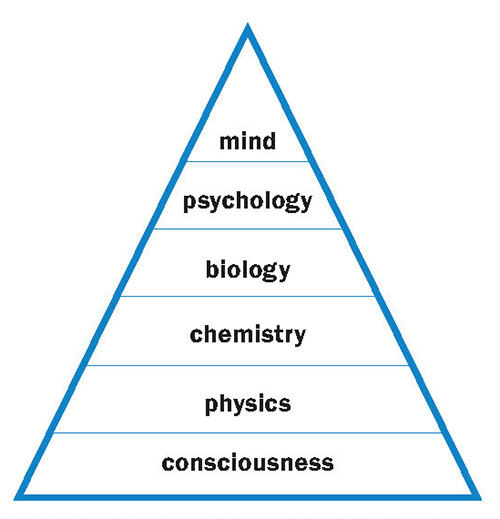
    Dean Radin proposes a more comprehensive knowledge hierarchy which places Consciousness (C) at the bottom to indicate where the physical world emerges from. At the top of the pyramid is Mind, meaning the brain’s machinery involved in information processing, cognition and perception. From this perspective, he says, “we enjoy conscious awareness not because the brain generates it, but because (C) permeates every layer of the physical world, just like electrons permeate every later ‘above’ the discipline of physics. Based on his hierarchy, which maintains everything currently known in science… magic is no longer an impossible anomaly.”

    What does this have to do with real magic? 

    Real magic is the pragmatic application of the esoteric worldview, just like today’s technologies are the application of the scientific worldview. That is, if consciousness is indeed as fundamental as the esoteric traditions claim, then magic must be genuine because awareness is primary over the physical world. Thus, we have the capacity to transcend the limits of space and time, and we can determine (to a small extent) how the physical world emerges. Further, human embodiment can now be seen as just one way, among a potentially infinite number of other ways, that consciousness can manifest into a physical being. 

    Why aren’t there university-based departments of magic? Why can’t we earn an accredited advanced degree in magical practice? The usual answer is that the esoteric worldview is so radically different from today’s scientific worldview that it cannot possibly be true. But that’s only because the scientific worldview as portrayed in the typical college textbook is five to ten years out of date. The leading edge today in science, represented by articles and books written by mainstream thought-leaders in physics, mathematics, and the neurosciences, is proposing that reality is literally made out of information. That is, the emerging scientific worldview tells us that reality is not composed of matter or energy, but rather of something far stranger, more abstract, and much closer to the esoteric worldview than the materialistic perspective that’s commonly associated with science.

    Theoretical concepts aside, how can science study magic? Here’s an example involving tests of the magical force of will. These studies were sparked by asking why ancient practices of blessing food, water, and wine are still vibrantly alive in the modern world. Indeed, proposing toasts with wine and spirits are as popular today as they have been throughout history.

    Anthropologists who study these practices have found that wine has been a popular beverage for at least 8,000 years. Its popularity was partially due to its pleasant psychoactive properties, but also because it was much safer to drink than water. Drinking from a pond, a river, or a well can be dangerous because the water might be contaminated. In ancient times (and still today), it was not easy to tell if water was safe or hazardous, and the alcohol in wine tended to neutralise most of those dangers. 

    Besides becoming a common beverage, wine was also associated with special or “holy” properties. It was celebrated by devotees of the Greek god Dionysus, and it was incorporated into the Catholic belief of transubstantiation. In these contexts, the belief was that divinely inspired intentions could alter the properties of wine, and this belief remains an act of faith for many today. But here’s the rub: Does anything actually happen to the wine that can be detected without having to rely on faith or anecdotal reports?

    Research anthropologist Stephan Schwartz conducted a series of experiments to find out. In each test, he took a bottle of Cabernet Sauvignon, separated it into two carafes of equal volume, and then asked a small group of meditators to intentionally bless one of the carafes for 20 to 30 minutes. Then he randomly labelled one A, the other B, and set the two carafes aside. Later, he asked a host of a dinner party to run a taste test. The host didn’t know that one carafe contained blessed wine and the other contained unblessed or “control” wine. The host told her guests that a friend was considering buying several cases of wine and he wanted to see which one was preferred. The guests tasted each wine and marked on a card which one they preferred. The host then evaluated the group’s preference, told them the result, and thanked them for participating.

    Over 12 such parties, involving a total of 93 meditators involved in blessing the wine, and 84 party guests, the results were clear. In 11 of the parties the tasters preferred the blessed wine, and in one party the preference was a tie. The odds against chance for this outcome was 2,000 to 1, indicating that under double-blind conditions the blessed wine tasted better than the non-blessed wine. This is an astounding outcome because wine-tasting is a highly complex process involving not just taste and smell, but sophisticated forms of cognitive processing, and neither the host or the party guests knew that they were tasting wine from exactly the same bottle. Something had happened to the wine as a result of the blessing.

    This was not the only experiment to find that focused intention altered properties of a beverage. The late Dr Masaru Emoto claimed that conscious intention could change the shape of frozen water crystals, such that pleasant thoughts would result in beautiful, symmetric crystals, while bad thoughts would result in displeasing, misshaped crystals. Emoto published many books showing results of his tests, but much of that work was more along the lines of artistic efforts rather than controlled experiments, so most scientists were not impressed by his claims. 
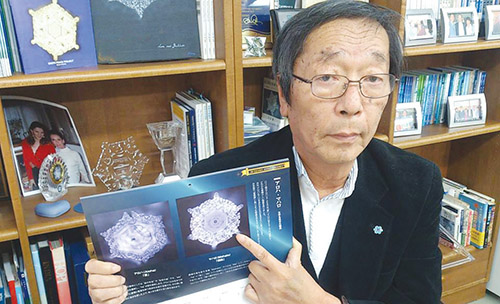
    Dr Masaru Emoto (1943–2014), the Japanese scientist and water researcher, revealed the true nature of water and how thoughts and vibrations affect the molecular structure of water.

    After attending a lecture Emoto presented in 2005, we asked if he would be willing to participate in a double-blind, scientific study. He agreed, and in our collaboration the technician who took the photos of the frozen water crystals did not know if the water used to create the crystals was blessed or not blessed. The blessing in our study was performed by a group of 2,000 people who focused their intentions on bottled water from a commercial source. The unblessed, control water, was another bottle from the same source and purchased at the same time. The results showed that the blessed water produced more beautiful crystals, as assessed by independent judges. This supported Dr Emoto’s claim. Later, we conducted a more rigorously controlled triple-blind study, which again supported his claim.
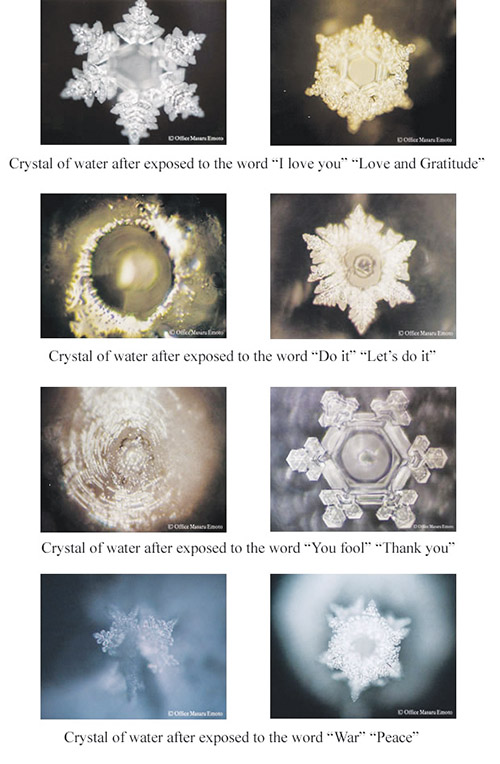
    In his years of water research, through high speed photography of thousands of water crystals, Dr Emoto showed the most beautiful crystals are those formed after the water is exposed to the words ‘love’ and ‘gratitude’. His claims were subsequently backed up by rigorous scientific experiments completed by Dean Radin and associates. (Source: www.masaru-emoto.net/english/water-crystal.html)

    We followed that up by testing if pieces of a gourmet brand of chocolate blessed by Buddhist monks and a Mongolian shaman would improve the mood of people who ate that chocolate, as compared to people who ate the same but not-blessed chocolate. Again, under double-blind, placebo-controlled conditions, we found a statistically significant elevation in mood among those who ate the blessed chocolate. Later, we tried a similar experiment with people in Taiwan using oolong tea blessed by Buddhist monks. Again, people drinking the blessed tea reported statistically significant elevations in mood as compared to people drinking unblessed tea from the same source.

    In these studies, we did not investigate which physical properties of wine, water, or food were altered by the blessing. But something clearly was affected. 

    Over the past century, many other scientific experiments have explored the effects of focused intention on physical systems ranging from elementary particles, to water, bacteria, seeds, plant growth, red blood cells, electronic circuits, and human physiology (I describe these in Real Magic). 

    These experiments demonstrate that modern scientific tools and techniques can be applied to ancient magical beliefs, and that when the lens of science is used to inspect magic, to our surprise we find that some of those beliefs are actually true. As science on these topics slowly advances, we may be rediscovering why these ancient practices have persisted for millennia: because they work. Explaining exactly how they work is becoming a topic of discussion at the leading edges of science today.

    Despite evidence for an imminent science/magic convergence, we may not see Harvard announcing its new Department of Magical Studies any time soon. Ancient taboos about magic are still very much alive, and those prohibitions tend to reinforce all sorts of fears: Fear of the unknown, of being thought weird, of being shunned by one’s peers, and of stories about demons and black magic. Such concerns have prevented the academic world from openly and seriously acknowledging the coming convergence, even though it’s unfolding right in front of our eyes.

    Fortunately, the taboo is beginning to crumble because of the popularity of books on affirmations and the law of attraction, the fast-rising mainstreaming of alternative healing therapies, development of new tools for enhancing intuition, the popularity of mindfulness meditation, the blockbuster success of superhero feature films, and in general the flourishing of “positive psychology.”

    Given the many challenges faced by the modern world, I believe we would all benefit by encouraging the unprejudiced study of real magic, especially because this topic is really about gaining a better understanding of the nature of consciousness

    Indeed, a case can be made that expanding what we know about consciousness may be a prerequisite for humanity to evolve from our present adolescence phase – which like all adolescents is chronically permeated by angst and emotion – to a more mature phase where concepts like wellness for all and “peace on Earth” become genuine, realistic possibilities.

    The convergence of science and magic is the theme of Dean Radin’s book Real Magic: Ancient Wisdom, Modern Science, and a Guide to the Secret Power of the Universe, available from all good bookstores.

    [alert type=”general” dismiss=”no”]This article was published in New Dawn Special Issue Vol 12 No 5.[/alert]

    [alert type=”success” dismiss=”no”]If you appreciate this article, please consider subscribing to help maintain this website.[/alert]

    © New Dawn Magazine and the respective author.
    For our reproduction notice, click here.

  • Cosmic Consciousness & Outer Spaces in Popular Culture

    Cosmic Consciousness & Outer Spaces in Popular Culture

    This article was published in New Dawn 165 (Nov-Dec 2017)

    Science fiction is always more important than science.
    – Timothy Leary

    The sacred, the sublime, has always walked amongst the profane. The signs are everywhere, blended into the sidewalks, pulp fictions, and the kitsch trappings of the art world. For iconic sci-fi writer Philip K. Dick, most of the sublime things of his world were disguised as trash that seamlessly slipped into the background of a dysfunctional world reality. The seeming trash of the everyday mundane clashed with incoming cosmic mutterings that have found their way into much of our popular culture.

    In the US especially, a blend of anarchic cultural subversions manifested that played upon known semi-mystical memes. Enochian magic, Golden Dawn rituals, meta-computing of the mind, and a weird kind of chaos were springing up within treatises of popular culture. One of these was the text of the Principia Discordia that emerged in the 1960s as a ‘sacred text’ of Discordianism. Written by Malaclypse the Younger (Greg Hill) and Omar Khayyam Ravenhurst (Kerry Thornley), it proclaimed “All hail Discordia!” in a mixture of goddess worship with the notion of order and disorder as balancing illusions. The fifth commandment of Principia Discordia states, “V – A Discordian is Prohibited of Believing What he Reads.”1 In line with what today we would call a ‘post-truth’ position, the Principia Discordia knew that “Tis an ill wind that blows no minds.” 

    Discordia came to influence the writings of maverick author-philosopher Robert Anton Wilson, who popularised it further in his books, especially in The Illuminatus! Trilogy. These utterances were further echoed by the writer William S. Burroughs who, besides experimenting with cut-up narrative techniques, proclaimed a Discordian-esque, “Nothing is absolutely true – Everything is permissible.” With this endless possibility came the rise of literate figures, or rather literary magicians, who were connected to systems of magic, such as the Golden Dawn. Popular culture began to open up and see combined forms of neo-shamanism, eastern philosophy, quantum science, visionary art, and computer technology. This modern twist on magic was part of a wider trend in experimenting with new forms of stimulating and awakening consciousness. These paths were attempting to destabilise our conditioning patterns and our resultant consensus reality. They were all aimed at waking up the usually-slumbering human mind. 

    As the seminal work Waking Up (1986) by Charles Tart showed, humanity was largely intoxicated with a “consensus trance” that kept us from recognising sigils of the sacred. In more recent years the metaphors and memes of being trapped within a waking dream, or of dreams within dreams, have been explored in such popular films as ‘The Truman Show’ (1998); the ‘Matrix Trilogy’ (1999-2003); and ‘Inception’ (2010). Part of the myth we find ourselves popularising is the mythology that we are in some sort of constructed reality – a gnostic-inspired simulacrum of truth. 

    Gnostic ideas are now being presented and consumed in ever more popular forms of culture. There’s an odd wave of mystical-spiritual impulses now radiating through popular culture that encourages us to throw ourselves into new fantastic realms and mythological fictions. These are modern mash-ups of the counterculture now being packaged and presented as part of mainstream culture. In recent years the most extraordinary success in this area has been the incredible, phenomenal rise of the modern superhero.

    Superheroes & the Super-Self

    It appears we are now in desperate need of our superheroes and mutants to save us from a form of tyrannical humankind. We seek a cultural expression for the human psyche; for our psychic currents and transmissions and sacred communication. Hence, our superheroes must live on! We have the X-Men walking amongst us, a mutant subspecies of humans. The natural order is evo-mythological – it is sacred, beyond human, and connects us with evolutionary currents. In the absence of our ancient myths we have ingested the sacred alchemical root and through pop-culture morphed this transformation into the new wave of superheroes – myth lives anew in spandex. Maybe it is a cliché because it’s true; we wish to find the personal superhero within each of us – the journey of the individual, unfolding within the great cosmic drama. This mythical journey has so far taken us from scientific rationalism and industrial modernity, and now we may finally be becoming more than we are; that is, more than human. 

    Our popular subcultures are gradually becoming the norm. It is not only a question of whether more people are interested or not, but rather that these ideas are more widely available now thanks to popular culture. The waking life and the dream are becoming part of the same movie plot, as in Richard Linklater’s film version of Philip K. Dick’s ‘A Scanner Darkly’ (2006). We are more and more waking up into our own movie – our very own Truman Show – where ideas are seeded directly into our environments in order to catalyse our awakening. Like many of the ancient wisdoms foretold, we have been asleep in a distant land, and now we are receiving messages and signals flashing like neon signs through our popular culture. This marks our juncture, our crisis point, between moving toward waking up or falling back into catastrophic and catatonic slumber. 

    Our ultra high-definition visual culture is acting like a portal for the otherworld to enter. The psychedelic experiences that were once fringe and condemned are being re-played out through modern fictions that blend gnostic, mythological, and multidimensional themes. Transcendental states of consciousness, ratified by the far explorations of new science, are adding to the mix of a new 21st century mythology that as of yet remains unnamed. Perhaps we are emerging toward the birth of new sacred gods. These are the gods of mutations, of neurological and biological adaptations. And they are emerging first in our pop cultures as our superheroes and psychic mutants. In this initiation into a psychically enhanced future, we will need more than ever to learn how to distinguish the demonic from the spiritual. Hence the current barrage of films, TV series, and fiction that shows angels vs devils, humans vs vampires, and the whole gamut of the good vs the bad that has crawled from the forest floor to enter into the quest for the Holy Grail. In this way, the gods will never be forgotten as they merge with a super-augmented mutant humanity in spandex. The real gods, temporarily forgotten, reside within our psyche – they are kept in mind. And yet they can only become real for us – to re-mind us – when dashing about on the stage and streets in front of our very eyes. We need the sacred to slap our faces in spandex gloves before we begin to blink a waking eye. That is, our sacred and supernatural fictions appear for us and require our engagement with them. 

    The latest revival of the superheroes genre is significant in how it takes the mutant meme further and projects it forward as a form of evolutionary mysticism. These new heroes are displaying to us our latent capacities and powers that are yet to unfold. We are witness to the first wave of mutant evolutionary pioneers. The summit of human evolution is far in the distance, and yet its early stages are manifesting through the Marvel and DC Universes where god-like potentials await us. Through such characters as Spider-Man, Iron Man, Captain America, Wolverine, and Doctor Strange, Marvel mesmerises paranormal subliminals into popular cultural consciousness. And DC does the same with Superman, Batman, Wonder Woman, Green Lantern, Flash, and Green Arrow. Then as gangs they come together as the Guardians of the Galaxy, the Fantastic Four, the X-Men (Marvel), or as the Justice League (DC). They are now our teachers, our guides, our mutant futures that are beyond human. The mutants have become practising mystics. 

    We are seemingly living more and more in a mutational and metaphysical universe, and with the arrival of augmented reality, our boundaries of interaction with the physical world around us will blur. We are already well on our way as our outer and inner spaces explode into a new blistering supernova. 

    [alert type=”success” dismiss=”no”]If you appreciate this article, please consider subscribing to help maintain this website.[/alert]

    Outer Spaces – Inner Spaces

    Humankind has always been a child of the stars. Our early civilisations mapped the heavens before they mapped the terrain under their feet. It was no surprise when UFOs started to dart across our urban skies and come crashing down disguised as government weather balloons.2 Recent popular culture has nurtured a fascination with outer spaces and our galactic cousins from the Golden Age of science fiction of the 1930s, 40s, and 50s to the new wave of the 60s and 70s. The concerns of our outer space relations shifted from how to make contact with our space cousins to the entropic death of the universe. Then the environmental theme entered our outer spaces as if a subliminal projection from our very own inner spaces. The growing number of alleged UFO abductees that emerged in the latter part of the 20th century began to relay messages of extraterrestrial concern for our planetary wellbeing.

    John. E Mack, an American professor of psychiatry at Harvard Medical School, in his later years became a leading authority on the spiritual or transformational effects of the alien abduction experience. Mack came to view the alien abduction phenomenon as acting as a catalyst to open human consciousness to the wider possibilities of connection with the universe. For more than a decade Mack rigorously studied the alien abduction phenomenon and interviewed hundreds of people (whom Mack referred to as “experiencers”).3 What initially started out as an exercise in studying mental illness soon turned into an in-depth inquiry into personal and spiritual transformation. Mack eventually came to see the alien abduction phenomenon as one of the most powerful agents for spiritual growth, personal transformation, and expanded awareness – in other words, as a trigger for a sacred experience. Despite the external anxiety produced by the experience, it was clear to both Mack and his set of experiencers that a profound communion was being established between humankind and other realities. Further, this interaction was catalysing a shift in human consciousness toward collapsing the old models of materialistic duality and opening up a connection not only ‘beyond the Earth’ but with other dimensional realities.

    This interconnectedness became a channel for the experiencers (abductees) to receive an impressive range of information on healing knowledge, spiritual truths, science, technology, and ecology. A major part of the information was apparently concerning the status of the Earth and humanity’s relationship with its environment. Many of the experiencers referred to their own abduction phenomenon as participating in a trans-dimensional or interspecies relationship. The transformative effects of these unusual encounters were often remarkable. Mack’s experiencers talked about an expansion of psychic or intuitive abilities; a heightened reverence for nature; the feeling of having a special mission on Earth; the collapse of space/time perception; an understanding of multi-dimensions of reality and the existence of multi-verses; a feeling of connection with all of creation; and a whole range of related transpersonal experiences. Significant from these accounts is that, according to the experiencers, the abduction phenomenon is sometimes accompanied by a sense of moving into, or connecting with, other realities or dimensions. The sacred space and outer space were becoming one and the same. Or to put it another way, the contact initiated from those ‘out there’ was having a catalysing effect, triggering an awakening in the inner spaces way ‘down here.’ It made sense then that our human future was going to include space migration. And, according to our galactic cousins, it may even be a necessity if we continue to mess up our planetary home.

    Inner space junkie Timothy Leary was already riding that space-me-outta-here ticket with his S.M.I.2L.E. philosophy. Leary’s S.M.I.2L.E. stood for Space Migration, Increased Intelligence, and Life Extension. Basically, these were all the themes from the post-humanism, sci-fi dream of humanity living off-planet. We also have now the commercial race to establish a new branch of space tourism, with Virgin Galactic being one of the visible and vocal frontrunners. SpaceX, another private enterprise, is banking its dollars on helping to colonise Mars. There’s no lack of vision; it’s down to the know-how and the technological leg-up. 

    Now that the space cat is out the bag (excuse the pun), it’s only a matter of time before the picture we have of ‘being human’ incorporates the starry, cold vistas of outer space. From the earliest sacred expressions in the cave art of our ancestors to the ideas of space migration, they all show two fundamental urges within the human being: 1) I am human, I am here (recognition), and 2) Where is the heavenly connection? (contact). Human dreams have encompassed living on Mars, leaving and migrating beyond the solar system, and contact with ‘Higher Intelligence’. 

    Gene Roddenberry, creator of ‘Star Trek’, managed to combine both contact and communication through his receiving of channelled information. It has been documented that Roddenberry was introduced to an entity called ‘Tom’ who represented the Council of Nine, through the channel medium Phyllis Schlemmer.4 Roddenberry allegedly received information for a film script to be written that would help prepare the public for extraterrestrial contact. The alleged film never got made, yet we might wonder what ideas made their way into ‘Star Trek’ (including ‘Star Trek: Deep Space Nine’). It appears there are those ‘out there’ who are concerned for our proper preparation for the sacred communion. And the archetypes are now flooding through popular culture like an evangelical tsunami. 

    The mythic archetypes from Joseph Campbell’s The Hero with a Thousand Faces filled out the roles in George Lucas’s epic ‘Star Wars’ universe. It is now well-known that Lucas took personal inspiration from Campbell’s mythological structure, as well as personal advice from the man himself. The good, the bad, and the hairy all took their cue and played along with the hero’s journey for an updated mythological rendering. There may be those who bemoan that our current civilisation does not have a mythic centre, but they’re missing the point. The point is that there is no exact point anymore. As Hermetic lore states, the centre is everywhere and the circumference nowhere. The earlier gods retreated back on their sky chariots until we finally arrived at the point where we asked ourselves where all the gods went. The new sacred guides are now secreted in our popular texts that penetrate the outer and inner worlds. These post-historic mythic guides are first to be found within us – within our collective species psyche that gets projected out onto our celluloid and digital landscapes. These mythical memes are telling us that we are not here alone, nor are we here for ourselves alone. The future is both arriving, is here now, and has already been. 

    We have such films as ‘Back to the Future’, ‘Primer’, ‘Looper’, ‘Terminator’, ‘Interstellar’, and all the rest to attest to our obsession with shifting our timely perspectives. Everything is now malleable, according to our new quantum sciences, and this new reality is knocking down our rigid, linear walls. Just when you thought you were safe in stable comfort zones, the paranormal is getting ready to redress itself as the new normal. A gnostic-like awareness of being embedded in a reality-construct will become ever greater as our technologies increasingly broker and interface our physical experience. There are plentiful arrays of fictions and films that are trying to signal our entry into a new space of hybrid awareness. 

    Transcendence is the only real alternative to extinction.
    – Vaclav Havel

    We are not on our way out yet, despite what the fear-mongering mainstream media may be trying to ram down our throats. Nor are we heading toward a techno-machine Overlord future with us as slaves. Because the sacred works in multiple ways and never hedges all its bets on one horse only.

    The game changer coming onto the scene is the participatory mind of human consciousness. The coming space migration is a reflection of our expanding inner spaces. We are toying with these memes in our popular culture now ahead of their coming actualisation. Our fictions are dealing with the blueprints before we’re ready to go the full distance. That’s why we’re in a period of incredible experimentation – we are juggling with a new type of energy coming into our cultural realities. This new ‘pranic force’ is getting expressed in a myriad of multiple forms; be it creatively, chaotically, commercially, or crazily. It’s an incredible mix of exuberance and experimentation trying to find its harmonic resonance. 

    We are gaming, surfing our minds, and trailblazing our way into a re-identification with a sacred energy. There’s a strong sense of these sacred themes filtering through our modern popular culture, and we can only guess that it’s preparing us for something. Here we go…

    Kingsley L. Dennis’s book, The Sacred Revival: Magic, Mind & Meaning in a Technological Age (Select Books) is available from all good bookstores & online retailers.

    [alert type=”general” dismiss=”no”]This article was published in New Dawn 165.[/alert]

    [alert type=”success” dismiss=”no”]If you appreciate this article, please consider subscribing to help maintain this website.[/alert]

    Footnotes

    1. Available online at www.sacred-texts.com/eso/pridisc.htm
    2. A tongue-in-cheek reference to the Roswell incident of 1947 
    3. See John E. Mack, Passport to the Cosmos: Human Transformation & Alien Encounters, 1999
    4. For Schlemmer’s channelled information see The Only Planet of Choice, 1993

    © New Dawn Magazine and the respective author.
    For our reproduction notice, click here.
  • Mind at the Centre: The Radical Liberation of My Mental World

    Mind at the Centre: The Radical Liberation of My Mental World

    It is a curious fact that we have successfully used our minds to penetrate profound secrets of the physical universe, but when it comes to grasping the nature of our minds, we are baffled. This is the famous mind-body problem, the ‘hard’ problem being to account for our consciousness, which is utterly unlike anything physical. The mind, it seems, has a hard time trying to understand itself.

    In this essay, I describe how I evolved my view of the subject, which is deeply at odds with mainstream physicalism. Without putting a label on my view, there were two crucial steps I took, theoretical and empirical.

    First, a comment on the word empirical – it comes from a Greek verb that means ‘experience’, but the modern trend has been to use it only for sense experience, which is too narrow. All kinds of experience are possible, including dreams, out-of-body states, hallucinations, visionary trances – the whole range of reported mental experiences.

    Certain experiences I had were decisive in helping me form my concept of mind. Very few people are concerned with trying to understand the nature of their own minds; we all use our minds constantly but rarely reflectively. This shouldn’t surprise us. Our brains evolved to help us survive and replicate in a material world. To wonder too much at the mysteries of being could be extremely hazardous. To do so represents a study called philosophy of mind, one of a subset of problems that come under the heading of metaphysics.

    The question about the nature of our minds is not only fundamental but riddled with controversy. Nor is the topic inconsequential, as I suggest in my conclusion. But here is the problem – in an age of advanced physical science, a certain default conception of mind has jelled into a state of uncritical acceptance. Although people constantly use mental terminology – the problem is on my mind, I dreamt of my dead aunt, I remember the first time we met, I am afraid to take the exam, I felt that was a beautiful piece of music, etc., etc. – the mainline view has taken the form of physicalism. According to this view, our mental life is in one way or another reducible to some set of physical conditions, especially if they are brain-based. Talk of mind for many who subscribe to physicalism is pegged as folklorish. It’s talk of something that either doesn’t exist or if it does is some kind of puzzling illusion without any real effects on anything. My instinctive response to that self-satisfied conceit: bullshit!

    I first became conscious of this situation when I was in graduate school at Columbia University. I recall one day casually mentioning to a fellow student that from time to time I had psychic experiences. My friend looked at me rather wide-eyed and said: “But that’s impossible! It would imply dualism!” Evidently, it was official. I could not have had the experiences I said I had. I realised there was a choice: ignore, deny, indeed destroy my own experience or reject the mainline dogma that my fellow student had blithely repeated.

    One thing I learned from this exchange: the counter-intuitive anti-mind position is entrenched in the prevailing ‘educated’ culture. It often seems necessary to have a jolting psychic encounter before one comes out and opposes the reigning dogmas. Neuroscientists who have near-death epiphanies make strong witnesses willing to come out and challenge mainstream materialism.1

    After graduate school I continued to have psychic experiences that were officially forbidden, telepathic and precognitive, as well as incidents of unexplained physical events, and even some that pointed toward postmortem survival.2

    All these are officially forbidden because they contradict the materialist creed; they imply the independent reality of mental occurrences and therefore perhaps of a mental world. But most outrageous is anything suggesting people survive bodily death. The official standpoint wants us completely and totally dead.

    I knew I wasn’t the only person in the world to have psychic experiences. So I met others who had been in the metaphysical twilight zone, began to read the vast literature on the subject, and got to know contemporary researchers.

    All of this information and all the persons involved in this largely extra-institutional field of study altered my perception of reality. I learned to see myself in a different light. I often had dreams that I lived in a house with rooms I didn’t know I had, rooms that opened up into wild landscapes. I would often wake up feeling both uneasy and exhilarated. I was confident I had hardly begun to know myself. And here is one coup I can boast of: I learned to resist feeling nauseated when I listened to know-it-alls pontificate about the non-existence of things I knew by acquaintance.

    I taught college level courses on psychic phenomena and found that virtually all my students were able to write reports – given highly specific criteria to guide them – on cases of apparent psychic performance they were able to dig up from their immediate social environment. Add the constant appearance of such phenomena as themes in movies, TV, fiction, art, and now everywhere on the Internet – and finally, and scarcely a minor matter, the whole of history, especially the so-called ‘religious’ history of humankind, is oozing at every pore with all that officially forbidden psychic, spiritual, and mystical stuff and its attendant physical weirdness. The most extraordinary case I came across was the ecstatic, Joseph of Copertino, a full-spectrum thaumaturge, and in my eyes, a neat mock-up for a postmodern Superman.3

    How the massively profound and mysterious experience of the human race can be squeezed into the pint-sized intellectual apparatus of reductive physicalism, beats me. To insist on such a tyrannically constricted peep-hole into reality is a war-crime against the human spirit. The main point: my own experience and the experience of countless human beings blatantly contradict the little jail-house worldview of reductive physicalism. So much for that initial, but for me, decisive first step in talking about the nature of mind: as it should, experience trumps theoretical obsession. On now to theory.

    Certain theoretical steps freed me to form a picture of mind more in tune with my experience. Ideas of William James, Irwin Schrödinger, and Carl Jung combined to get rid of an oppressive assumption. As long as I saw my mind and interior world as solely an outgrowth of my brain, my existence seemed that of a doomed outlier, a creature tainted to the core by contingency and suffering from severe causal impotence.

    William James, however, offered an alternate view of what might be going on. In a lecture on immortality he gave to a Harvard audience at the end of the nineteenth century, he was faced with trying to account for a variety of human experiences that made no sense in light of the new scientific materialism, according to which everything mental must be some kind of secondary side effect of the really real stuff, the physical. James showed that we are free to assume that consciousness does not emerge from the brain at all. We may in fact assume that brains transmit but do not create consciousness. Consciousness may be a reality, or dimension of being, in and of and even for itself. Mind, not derived from anything physical, does interact with the physical. So we can grant all the mind-brain correlations of neuroscience, without assuming that mind is brain-born or brain-derived.

    The idea used to illustrate this is a radio or a TV set: what is heard or seen through such machines originate from somewhere outside the machines. The machines (our brains) are detectors, transmitters, transducers of signals, energies, but from elsewhere; brains are not creators of anything and minds are not machines.

    I – my mind – is affected by my body; I can also affect my body, even my brain, and it turns out that the brain is more plastic than formerly assumed. By effort and practice one’s mind can appropriate parts of the brain to reconnect and recapture a lost function. But then brain disease can impair mental function. However, evidence shows that people with impaired brains sometimes recover their mental capacities just before death. This seems to show that impaired brains suppress but do not destroy mental function and content since the latter may reappear as death disentangles mind from brain.

    The big point learned from James is that although we live enmeshed with and through our brains, our personal mental life is part of a pre-existing and larger reality. The irreducibility of the mind to the brain that James’s view entails has been reiterated in a different form in recent times with talk of the so-called “hard problem” enunciated by David Chalmers. Virtually everybody nowadays agrees that the reduction of consciousness to the physical is not even remotely conceivable.

    Now to a big idea. It seemed perfectly reasonable to assume that consciousness, if not brain-derived, is then a given, a basic part of the basic furniture of being. As far as the mainline view, with a little help from James, we have just turned it upside down. Instead of reducing and eviscerating the substance of mind, we have assigned it a much wider and more fundamental place in nature.

    There’s a second move I made toward the radical liberation of my mental life. Schrödinger, one of the founders of quantum mechanics, declared that mind is and can only be numerically one. There is nowhere in the world of mind that you can carve out pieces so as to make mind plural, as you could a sheet of paper or a carbon atom. This doctrine of the one mind, which inspired Schrödinger, can be traced back to the Hindu Upanishads,

    The one mind that is filtered through my brain is bound to create the illusion of isolation and separateness. We then naturally identify with our bodies and unique personal perspectives, so the differences between you and me are real enough. And yet, the more deeply we enter ourselves, the more we merge toward the oneness of our humanity that lies in our common consciousness. Simply as a practical point I would say: The way toward the oneness of humanity is not by forcing uniformity but by not fixating on our uniqueness. We can celebrate diversity without neglecting the underlying oneness of spirit.

    Another teacher that helped free me to place mind at the centre of my worldview was C. G. Jung. According to Jung, we live from moment to moment and from first to last in a psychical world of images. The stream of interweaving mental and bodily imagery that we experience, punctuated by episodes of more but different kinds of dream imagery, is our existential milieu. There is no exit from this infinitely complex and nuanced world of subjectivity. Jung’s psychical idealism in which the psyche is composed of images is literally where it’s at. It’s impossible to exit from our subjectivity. This, however, does not imply solipsism. In fact, it suggests a much wider range of communication potential. According to the physicalist, however, we have no deep communal mental or spiritual roots; we are separate bodies driven wholly and solely to consume and replicate.

    Thanks to my own experience, and helped by fellow travellers, I fought my way free from the suffocating worldview that would have imposed itself on me, if I had let it. Aware now of the primal status of my inner reality, of its numerical oneness in Schrödinger’s Upanishadic sense, and of its self-existence and pervasiveness in nature, I’m in a better place than I began, with the albatross of physicalism off my back. Once we expand our concept of mind, the range of the possible increases exponentially. The idea is not just to think this but to embrace it as we embrace somebody we love.

    I want to discuss two big ideas in relation to this expanded concept of mind. The first is the question of life after death, a perennial belief or at least hope of humankind. No doubt that if the prevailing view of mind as some blurry side-effect of living brains is correct, afterlife or immortality talk would have to sputter to a stop. My story is not quite so grim. I can at least report that a large body of evidence exists suggesting that some people survive death with their personalities intact.4 The vast majority of competent scientists and generally educated people are ignorant of this evidence, and seem to lack the curiosity (or the courage) to look into it with an open mind.

    I will make one specific point about the idea of consciousness after death. If physicalism were true, we’d have to say no to life after death. But physicalism is false, as anyone with a mind can prove with thoughtful self-scrutiny. So the question remains open. If the model suggested here is true, and consciousness does not ‘emerge’ from the brain – if in short the brain does not create but transmit consciousness – then brain-death would not entail consciousness-death. This move will not guarantee there is a heaven. But the scene has shifted to a sunnier living-room, a room with bay windows that look out upon what seems a magical and enticing forest. Consciousness after bodily death assumes a new mantle of possibility. In light of the evidence collected by researchers, a country of new thought awaits explorers with honest minds and rich hearts.

    Given the premise of a primary mental reality, as put forth here, there is another big issue related to rejection of the mainstream view of mind. In the world traditions, besides the idea of life after death, we find ideas of divine agencies – of spirits, angels, demons, gods, goddesses, and so forth. The so-called new atheists have tried to demolish religion, but the critique is shallow, intolerant and too sweeping. They mostly have nothing to say of interest about the core spiritual beliefs that revolve around the mystical experiences of religion.

    Expansion of the concept of mind as one and transpersonal, based on our discussion of James, Schrödinger, and Jung, helps us understand how certain religious ideas might arise: for example, the belief in agencies listed above, along with the belief that humans can interact with these higher ones, however named or described. Different cultures and individuals perennially engage the transcendent mind we have described, always in diverse ways, using diverse vocabularies, rites and myths. While happily granting all this, we also assume there is the transcendent one mind, the one underlying consciousness that seeps into our experience through our uniquely conditioned brains and cultures. This too is real and may be thought of as the matrix of all transcendent experience.

    In short, while materialists are forced to condemn the whole of ‘religion’ as nonsensical and pernicious, once we acknowledge the reality of transcendent mind, we can appreciate the positive content of all the religions. But we can – must – also carry on a critique of the violently stupid and anti-human offshoots of religious psychopathy.

    I think that a good deal of anti-religionism can be as narrow and destructive as the warped religionism the critics love to attack. This leads to my final thought regarding my evolution toward this highly expanded (and radically democratic) view of mind. My views are broadly shared by a significant portion of scholars and thinkers, living and dead. But at this point we are a minority, a voice in the wilderness of self-destructing neo-liberalism,5 and at a time when physicalist metaphysics and practical materialist ideologies are triumphant almost everywhere on the planet.

    To take a single but revealing example, consider the amount of money the US invests in its military budget. Of the $1.11 trillion dollars of federal discretionary spending, the US in 2015 consumed 54% or $598.5 billion dollars on the military budget, equal to the next seven largest military budgets, China, Saudi Arabia, etc. Now here is my strange-sounding question: How much of the discretionary spending goes to research on what happens to people after we kill them? The answer, of course, is nothing at all. More than half the national treasure is spent on producing and sustaining an unprecedented world-dominating military machine, with tentacles in the 800 bases planted all over the planet.

    This may be an odd way to point out how our civilisation operates, but it’s only one example of how materialist values are acted out to the detriment of life everywhere. What’s clear is that the default option is military not diplomatic, force rather than persuasion. Another example is the way the pharmaceutical industries are edging talk (and therefore mental) therapy out of existence.6 Our entire capitalist-consumerist economy privileges materialist values such as limitless profit and gratification of appetite over justice and self-mastery. Materialism today is not just a philosophical position. It is an attitude, a disposition – a cancer metastasizing in human society. It needs to be not just intellectually refuted but excised from the entrails of a morally corrupt culture.

    [alert type=”general” dismiss=”no”]This article was published in New Dawn Special Issue Vol 10 No 4.[/alert]

    [alert type=”success” dismiss=”no”]If you appreciate this article, please consider subscribing to help maintain this website.[/alert]

    Footnotes

    1. See, for example, Eben Alexander’s challenging Proof of Heaven (2012) and Marjorie Woolacott’s equally compelling Infinite Awareness (2015), both neuroscientists with experiences that helped them realise they were misled by their mainstream teachers in the field of medicine, as I was at first misled by the mainstream current of thought.
    2. See, Soulmaking (1997), also consciousnessunbound.blogspot.com
    3. The Man Who Could Fly: St. Joseph of Copertino and the Mystery of Levitation (2016)
    4. The literature on this is vast but the reader might begin with Irreducible Mind (2007), Eds. Ed Kelly, Emily Kelly.
    5. See Noam Chomsky, Chris Hedges, Naomi Klein, Abbe Martin, etc. much that is instructive is available online, especially YouTube.
    6. See Peter Goetsche’s Deadly Medicines and Organized Crime: How Big Pharma Has Corrupted Healthcare (2013).

    © New Dawn Magazine and the respective author.
    For our reproduction notice, click here.
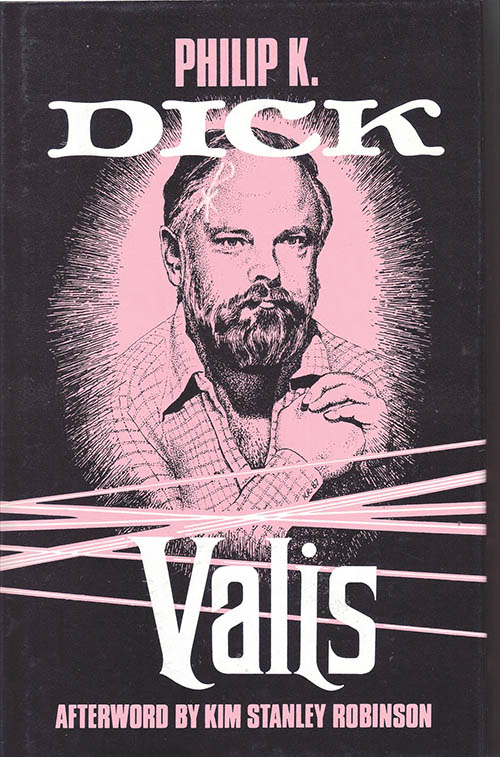
  • VALIS “Vast Acting Living Intelligence System”: The Invasion of Philip K. Dick’s Mind

    VALIS “Vast Acting Living Intelligence System”: The Invasion of Philip K. Dick’s Mind

    This article was published in New Dawn Special Issue Vol 8 No 4 (August 2014)

    In an interview with English journalist Charles Platt in 1979, the American science fiction writer Philip K. Dick claimed that in the spring of 1974 his mind was taken over by something he described as a “transcendentally rational mind.” Dick added that up until that point he felt as if he had “been insane all of my life and suddenly I had become sane.” What could he have meant by such a strange comment? Was it simply writer’s imagination or was it something of significance? Dick certainly thought so.

    Philip K. Dick (1928-1982) is considered by many to be one of the greatest American writers of the second half of the twentieth century. This was recognised by fellow author Ursula LeGuin when she called him our “home grown Borges” in reference to the works of the great Argentinian writer.

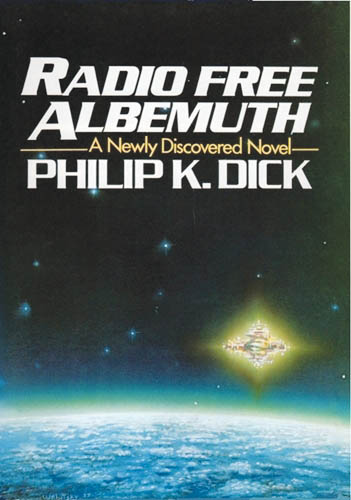
    But Philip K. Dick was more than just a writer; he was a philosopher who described in his short stories and novels a view of the world brought about from his own experiences. In the final few years of his all-too-short career he wrote a series of semi-autobiographical novels describing his encounter with this entity that invaded his consciousness. The most famous of these novels is VALIS but in many ways the one that most closely follows Dick’s actual encounter is his posthumously published novel Radio Free Albemuth, recently made into an intriguing movie of the same title written, produced and directed by Los Angeles based John Alan Simon.

    There is strong evidence that the entity Phil was later to call VALIS, “Vast Acting Living Intelligence System,” had been with him for most of his life, only made more manifest through a series of neurological facilitators (both natural and artificial) that affected Dick in the early 1970s. 

    From a very early age there was something distinctly odd about Philip K. Dick. He was a quiet, somewhat introverted child, recovering from the loss of his twin sister Jane, who died soon after they were born in a cold Chicago December in 1928, and the subsequent abandonment of his father a few years later. As he grew older he was clearly highly intelligent but with certain neurological and psychological problems that caused him difficulties at school. These issues tended to come to the surface during periods of stress such as exams. The young Phil would suffer from vertigo attacks together with strong feelings of disassociation from the physical world. He once described the sensation as like viewing the world through the wrong end of a telescope. It was in one crucial physics exam that something very peculiar took place.

    In an interview with his friend Greg Rickman recorded in October 1981, Dick described how the exam was not going at all well:

    I sat for almost two hours staring at the page and my college entrance depended on getting that test right. It was the final test… I didn’t understand the principle. I didn’t even remember the principle let alone know how to apply it. I prayed and prayed and prayed and prayed and then this voice clicked in and said… “the principle is really very simple.” And then it went on and stated the principle and it explained how it was applied… I got (the test) back with an “A.”1

    Dick believed this “entity” was some form of “guide” that was to become a permanent fixture in his life, lying dormant for years but involving itself in his life and in times of great crisis. In another interview Rickman asked Dick if the voice had ever returned. The writer described that although he regularly sensed its presence its verbal comments were very rare. Dick cited one particularly odd manifestation that took place in the late 1960s. 

    He described how he had been watching a TV programme about the Galapagos turtles. The fight for survival of one particular female turtle had really upset him. After laying her eggs she had turned in the wrong direction and instead of going towards the sea she crawled inland. Soon the heat brought about extreme dehydration. She was dying. As she began to fade her legs were still seen to be moving. The film had been edited to give the impression that the dying turtle was imagining she was back in the ocean. He went to bed with this tragic image in his mind. He woke up in the night to hear the same voice that he had heard many years before during his physics exam. It explained to him that the turtle actually believed she was in the water:

    I was just terribly amazed and dumbfounded to hear that voice again. It wasn’t my own voice because one of the sentences the voice said was “And she shall see the sea” and I would not use the two words “see” and “sea” in the same sentence. It tends to do that, use word choices I don’t use. One time it used the expression “a very poisonous poison” which I would not use.2

    Dick was intrigued by the source of this “voice.” It was clearly located within his brain and yet it used terminology and word structures that were alien to him. Indeed, it was clear from his childhood exam experience that this being knew things he did not know. 

    By the late 1970s Dick discovered a possible answer to this mystery. At that time he had encountered the theories of Princeton psychologist Julian Jaynes. A few years before, in 1976, Jaynes had written a highly influential book entitled The Origin of Consciousness in the Breakdown of the Bicameral Mind. Jaynes suggested the brains of ancient human beings may have been “bicameral.” By “bicameral” Jaynes meant that the twin hemispheres of our ancestors brains were isolated from each other. Whereas modern humans understand that the “inner narrative” we all use to decide upon our actions is all part of a singular “self,” the ancients did not. They heard the “inner voice” and identified it with the voice of the gods. Jaynes then argued that at around 1000 BCE the two hemispheres somehow merged into a unitary consciousness of the sort experienced today. He was of the opinion that certain neurological conditions such as schizophrenia are a throwback to this earlier dual state of consciousness. In this way he attempted to explain how certain individuals hear voices which give instructions, criticise or assist on a regular basis.

    Dick suggested to Rickman this may have been the source of his lifelong “partner,” a subliminal and much wiser version of himself located in his right hemisphere:

    I have that. I have that right hemisphere intuition thing occur. Unless you know what it is it does seem like psychic power. That’s the way the right hemisphere works. It’s got to work like that…. And it seems as if it knows the future. What it sees is in the way of a pattern, and part of a pattern is still yet to come. It is actually seeing part of a pattern that is not fully emerged. It can tell from the section it has what the total pattern will be like. It can fill in the missing part.3

    His comment here is of significance. He is suggesting this life-long partner has “psychic power” and that it uses these powers to assist its less able associate located in the left hemisphere. The question that has to be answered is how can something located within the brain have access to information not available via the everyday senses? A clue may lie in another very curious incident that Dick described in a 1977 interview with journalist Richard Lupoff. This is worth quoting in full:

    Back at the time I was starting to write science fiction, I was asleep one night and I woke up and there was a figure standing at the edge of the bed, looking down at me. I grunted in amazement and all of a sudden my wife woke up and started screaming because she could see it too. She started screaming, but I recognised it and I started reassuring her, saying that it was me that was there and not to be afraid. Within the last two years – let’s say that was in 1951 – I’ve dreamed almost every night that I was back in that house, and I have a strong feeling that back then in 1951 or ’52 that I saw my future self, who had somehow, in some way we don’t understand – I wouldn’t call it occult – passed backward during one of my dreams now of that house, going back there and seeing myself again. So there really are some strange things…4

    What Dick is suggesting here is that his future self was able to go back in time and experience from another location in space an earlier life-incident. Note there are two viewpoints here. Dick’s older self does not re-live the experience from the viewpoint of his younger self. He sees it as an outside observer. This suggests either a very strange time-slip or else that in some profound way part of Phillip K. Dick could view from the present incidents from his own past. What if the consciousness existing in Dick’s older right hemisphere perceives the whole of his life from a vantage point outside of linear time and as such it can travel anywhere within the author’s time-line? If this was the case then from its vantage point it is totally precognitive. It knows the outcome of every decision that its linear-time existing partner will make.

    [alert type=”success” dismiss=”no”]If you appreciate this article, please consider subscribing to help maintain this website.[/alert]

    This suggests a stunning explanation: that the guiding voice may have been Dick’s own future self guiding from the future. That the author had on-going access to information known to his future self is evidenced from the way in which Dick frequently claimed that his fictional plot-lines came from his future experiences. He cited a handful of quite startling “future experiences” that turned up in his earlier fictional writings. For example, here Phil describes how an incident in his book Flow My Tears, the Policeman Said actually came to pass many years later:

    In 1970 I wrote a novel called Flow My Tears, the Policeman Said. One of the characters is a nineteen-year-old girl named Kathy. Her husband’s name is Jack. Kathy appears to work for the criminal underground, but later, as we read deeper into the novel, we discover that actually she is working for the police. She has a relationship going on with a police inspector. The character is pure fiction. Or at least I thought it was. Anyhow, on Christmas Day of 1970, I met a girl named Kathy – this was after I had finished the novel, you understand. She was nineteen years old. Her boyfriend was named Jack. I soon learned that Kathy was a drug dealer. I spent months trying to get her to give up dealing drugs; I kept warning her again and again that she would get caught. Then, one evening as we were entering a restaurant together, Kathy stopped short and said, “I can’t go in.” Seated in the restaurant was a police inspector whom I knew. “I have to tell you the truth,” Kathy said. “I have a relationship with him.” Certainly, these are odd coincidences. Perhaps I have precognition.5

    Is it possible that in writing Flow My Tears Dick incorporated subliminal “future memories” into his work of fiction? As we know, most writers use visualisation techniques in which they allow their subconscious to take the story where it needs to go. Could it be that Phil simply accessed the “memories” of his own non-dominant hemisphere? There was a second incident in Dick’s life in which he found himself experiencing in real life an event he described in Flow My Tears.

    In the book one of the characters, Felix Buckman, meets a black stranger at an all-night gas station. Buckman is in a very emotional state as he has just heard that his sister had died. The stranger and Buckman make an emotional link. Buckman then walks away, only to return and hug the man a few minutes later. Four years after writing the novel Phil found himself helping out a stranger in an all-night gas station when he was overcome with a powerful déjà vu sensation:

    Suddenly I realised that this was the scene in my novel – the novel written eight years before. The all-night gas station was exactly as I had envisioned it in my inner eye when I wrote the scene – the glaring white light, the pump jockey – and now I saw something which I had not seen before. The stranger who I was helping was black. We drove back to his stalled car with the gas, shook hands, and then I returned to my apartment building. I never saw him again. He could not pay me back because I had not told him which of the many apartments was mine or what my name was. I was terribly shaken up by this experience. I had literally lived out a scene completely as it had appeared in my novel.6

    Dick wrote Flow My Tears in the early 1970s, a period in his life in which he had become fascinated by the workings of the two hemispheres of the brain. As we have already seen, Dick had been intrigued by the work of Julian Jaynes. He had also become aware of the surgical operations of Roger Sperry, a neurosurgeon based at the Californian Institute of Technology. Sperry and his associate Michael Gazzaniga had operated on the brains of individuals with severe epilepsy. It was believed that by cutting the communication channels between the two hemispheres of the brain they could stop seizures spreading across the whole brain. In their initial aim they succeeded, the patients showed a marked improvement. But there were intriguing side-effects including the bizarre observation that the patients had become dual personalities. In effect, Sperry and Gazzaniga had created a neurological situation similar to Jaynes’ bicameralism. Dick was fascinated by the implications of these operations and wondered if his own “inner voice” could be explained by this outcome.

    In early March 1974 Dick read an article in the popular science magazine Psychology Today that suggested he could check out his suspicions regarding his own mental duality. The author of the article Harvey Ross described how the condition of a young boy with severe schizophrenically-induced visions was improved by the introduction of a high-protein, low-carbohydrate diet supplemented by a cocktail of vitamins. Ross gave the recipe for the cocktail and included in it the instructions that 500 mg of vitamin C should be taken in the first month with an increase to 1,000 mg for the second month onwards. Ross argued that the large dose of vitamins brings about a marked improvement in the firing of brain cells (neurons) which, in turn, facilitates the synchronisation of the two hemispheres of the brain.7

    As such Dick was very excited by this discovery. This was a way for him to cure himself of his own “bicameralism,” reconnect the two hemispheres of his brain, and finally open up direct, rather than arbitrary, communication with the part of him that had identified itself as being his “Tutelary Spirit.” As the cocktail of vitamins were all water soluble and easily available from any pharmacist, Dick decided he would try this himself. He was already aware of the developments in neurology suggesting that the right and left hemispheres of the brain function independently and that most “normal” people only use their “dominant” hemisphere. For Phil it was logical to conclude that by using Ross’s recipe human consciousness could be raised onto another level of awareness:

    It occurred to me that maybe in a normal person with normal, which is to say, average synchronisation, it might cause firing to take place so efficiently that both hemispheres of the brain might come on together.8

    He then goes on to describe how, after taking the dose, he found that his two hemispheres did, indeed, “came on together” as he termed it. According to one of his biographers, Lawrence Sutin, Dick actually got the recipe wrong and ending up taking seven grams more vitamin C than he should have.9

    This “coming together” may have facilitated the most intriguing part of Dick’s life; a series of events that took place in February and March 1974 that he was later to describe as being his “theophany.” His use of wording here is quite precise. “Theophany” is Greek for “the appearance of God” and this is exactly what Phil believed took place over that period. It seems that the overdose of vitamin C, mixed with a cocktail of pain killers that he was taking to relieve the symptoms of an impacted wisdom tooth, may have allowed his mysterious partner to become far more immanent in his life. He called this entity “AI,” “Firebright,” Zebra, “Sophia,” Shekinah, finally settling on “Vast Acting Living Intelligence System” (VALIS). This being became very active in Phil’s life. It organised his accounts, told him to sack his agent and even had him buy clippers to trim his somewhat unruly nose hair! 

    So what was the source of this “transcendentally rational mind”? Was it really a manifestation of God that Phil believed it to be? Was it simply a misunderstood “inner dialogue” suggesting that Phil was experiencing a form of schizophrenia? An intriguing suggestion made by, among others, astrophysicist Bernard Haisch, anthropologist Martin W. Ball and comedian Bill Hicks is that we are all God and that under certain circumstances we all can access elements of the “mind of god.”

    Phillip K. Dick was of a similar opinion. In his personal journal, now published under the title of The Exegesis of Philip K. Dick, Dick makes the following comment: 

    we ourselves are units of God’s (the total organism’s) memory system? Suppose, for some of us at least, that (called, I think, witnessing) is our prime purpose? We are (parts of) his memory? 

    Dick once described himself as a “acosmic pan-entheist.” He defined this as being somebody who doesn’t believe the universe exists in itself but is an extension of God in space and time. For Phil, God exists outside of space and time and extends himself into space-time.

    In his novel VALIS he described this as being a “concealed god” who takes on the likeness of “sticks and trees and beer cans in gutters,” later adding that God subsequently becomes “debris no longer noticed.” In the Exegesis he went further: “Premise: things are inside out… Therefore the right place to look for the almighty is, e.g., in the trash in the alley.”

    In this model, what exactly is “God”? It is clear Dick was not describing the Western concept of a personal deity but more the Eastern idea of an impersonal life-force that permeates everything. Recent work by researchers such as Vlatko Vedral,10 Tom Campbell11 Nick Bostrom, and Frank Tipler12 suggests the great mystery of the mind-matter split can be explained if that at a more fundamental level everything is simply mathematical information. 

    In his book Decoding Reality, quantum physicist Vedral presents support for such a belief. In effect, the universe and everything in it is a huge “computer” program containing the en-coded information of everything that has happened and can happen. This “program” exists outside of space-time (as space-time itself is part of the program). In a quotation that could have been taken from Dick’s Exegesis, French mathematician Alain Connes, made the following observation:

    It is humility, finally, that forces me to admit that the mathematical world exists independently of the manner in which we apprehend it, that it isn’t localised in time and space. But the manner in which we apprehend it is subject to rules very similar to those of biology. The evaluation of our perception of mathematical reality causes a new sense to develop, which gives us access to a reality that is neither visual nor auditory, but something else altogether.13

    As we are all elements of the program, it is logical to conclude that under certain circumstances we may be able to perceive information within the program. This information (or in-formation as it was termed by another great scientist-philosopher, David Bohm) is analogous to the digitised data found encoded within the reflective surface of a DVD. The DVD contains ALL the information of the respective movie, video game or whatever linear narrative it has been created to re-create. But the linear nature only exists from the viewpoint of the observer. In actuality, all the information exists in a single location, in this case the DVD itself. Many years ago Philip K. Dick made a similar analogy using the technology of his time, a long-playing gramophone record. The information system that the physical universe is based:

    …contains in it as a simultaneous plane or extension everything which was, just as the grooves on an LP contain the part of the music which has already been played; they don’t disappear after the stylus tracks them. A phonograph record is, actually, a long helical spiral, and can be represented entirely in a plane geometry sort of way: in space, although I suppose you can talk about the stylus accumulating the music as it goes along.14

    Does this explain the origin of Dick’s “transcendentally rational mind”? Was he actually accessing the information field from which everything that we perceive is constructed? Or was it simply that he had taken too many mind-altering substances?

    Whatever the case, Philip K. Dick’s encounter with the noetic will continue to fascinate, beguile and intrigue all who encounter them, and, in doing so, will be the source of debate and discussion for many years to come. I hope this article may have made its own small contribution to these discussions.

    The film adaption of Philip K. Dick’s novel Radio Free Albemuth was released in June 2014. The film is written, directed, and produced by John Alan Simon and stars Alanis Morissette in a lead role.

    [alert type=”general” dismiss=”no”]This article was published in New Dawn Special Issue Vol 8 No 4.[/alert]

    [alert type=”success” dismiss=”no”]If you appreciate this article, please consider subscribing to help maintain this website.[/alert]

    Footnotes

    1. Gregg Rickman, To The High Castle Philip K Dick: A Life 1928-1962, Fragments West, 1989, 140 
    2. Gregg Rickman, Philip K. Dick: The Last Testament, Fragments West, 1985, 23
    3. Ibid., 19
    4. Richard A. Lupoff, ‘A Conversation with Philip K Dick’, Science Fiction Eye, Vol. 1, No. 2, August 1987, 45-54
    5. Philip K. Dick, ‘How To Build A Universe That Doesn’t Fall Apart Two Days Later’, 1978, http://deoxy.org/pkd_how2build.htm
    6. Ibid.
    7. Harvey M. Ross, ‘Orthomolecular Psychiatry: Vitamin Pills for Schizophrenics’, Psychology Today, April 1974
    8. Philip K. Dick, The Exegesis of Philip K Dick, Hachette Littlehampton, Locations 990-991, Kindle Edition
    9. Lawrence Sutin, Divine Invasions – A Life of Philip K Dick, Orion Books, 2006, 212
    10. Vlatko Vedral, Decoding Reality – The Universe as Quantum Information, Oxford University Press, 2012
    11. Tom Campbell, My Big Toe: A Trilogy Unifying Philosophy, Physics, and Metaphysics, Lightening Strike Books, 2007
    12. Frank J. Tipler, The Physics of Immortality, MacMillan, 1994
    13 Alain Connes & Jean-Pierre Changeux, Random Thoughts About Mind, Matter and Mathematics, Princeton University Press, 1995
    14. Philip K. Dick, ‘Man, Android and Machine’ (1975), From The Shifting Realities of Philip K. Dick: Selected Literary and Philosophical Writings edited by Lawrence Sutin

    © New Dawn Magazine and the respective author.
    For our reproduction notice, click here.
  • Sacred Geometry: A New Spin

    Sacred Geometry: A New Spin

    This article was published in New Dawn 136 (Jan-Feb 2013)

    I had trouble with calculus in college. The concept of mathematics describing geometric shapes just did not resonate in my brain. Yes, I knew the formula for the circumference of a circle, and some Pythagorean stuff about triangles, but I never realised it could all get so complicated. Over the course of the semester, the basic premise slowly penetrated, and I began to speculate that perhaps God is simply a great mathematician. 

    Maybe all He really had to do to create the universe was to invent some formulas and everything then fell into place. Space, suns, planets, black holes, cosmic dust, vegetation, animals, humans, non-humans – all just tumbled out of His mind as He rapidly generated long strings of calculus formulas. While this is, of course, a fanciful view of the act of Creation, there may be at least a germ of truth in the premise. 

    As we learn more and more about the concept of Sacred Geometry, it begins to appear that life really is all about numbers. The term “Sacred Geometry” has been bandied about for years as though it had a very specific meaning. But, in fact, it means different things to different people, and has really been an amorphous concept. Now that we are able to view the universe through powerful telescopes, and the minutiae of life through equally powerful microscopes, it has become apparent that the entire physical realm displays elegant geometric proportion. This being the case, we are awestruck and led to the conclusion that such orderliness can only be the product of a Divine Mind. Hence we view it as proof of Creation as opposed to the disorderly and random Darwinian Evolution. 

    And so, the word “sacred” has been appended to this universal “geometry” to imply that it was all created by God. We find these types of definitions from various researchers on the subject. For example, according to Charles Gilchrist on his website (www.charlesgilchrist.com), “Sacred Geometry is literally The Architecture of the Universe…. Sacred Geometry is pure universal truth springing directly from God Mind. Worlds turn in Sacred Geometry, and the galaxies spin because of it.” He says further, “Studying the natural unfolding of the geometric archetypes aligns our human consciousness to the infinite and the eternal. In these studies and meditations we begin to see the way of things… the true nature of the universe.” 

    The golden ratio, also known as the divine proportion, golden mean, or golden section, is found throughout nature. When it is applied to constructing a particular geometric form (see overlay above), a “golden spiral” can be drawn. This is best exemplified in the design of the nautilus sea-shell (above).

    The Golden Ratio

    As scientists discovered the deep mathematical principals underlying all forms, they took it as proof of the workings of a Great Mind. In this regard, a breakthrough was the discovery of “the golden ratio.” This ratio, usually denoted by the Greek letter φ (phi), expresses the relationship between two numbers where the sum of the two is to the larger, as the larger is to the smaller. That is, where “a” is the larger, “a+b” is to “a” as “a” is to “b.” Solving this equation algebraically, the only solution is the irrational number 1.618033989. Like Pi, the decimal string goes on infinitely. 

    Geometric forms conforming to, or incorporating, the golden ratio are abundant in nature. The number of petals on flowers conforms to the phi ratio, and it is the way the human body grows, finger to hand, hand to forearm. The golden ratio defines human beauty and consequently plastic surgeons use it for facial measurements. When applied architecturally it results in buildings that are strangely appealing to the human eye and to the spiritual imagination. To the ancient Greeks the Golden Section embodied philosophy and wisdom. Thus it was appropriate to incorporate the golden ratio in a building dedicated to a god. 

    When the phi proportion is used to construct a triangular form it becomes a “golden triangle,” and a “golden spiral” gets wider by a factor of φ every quarter-turn it makes, which means it gets wider by a factor of φ4 (about 6.854) every full turn. The nautilus sea-shell exemplifies a golden spiral. 

    Energy & Geometry

    In order to clear up the cloudiness around the term “Sacred Geometry,” and to better understand how it has been, and may be, used in healing, inspiration, spiritual advancement, art, design, architecture, Feng Shui and crop circles, we decided it was necessary to consult an expert. 

    Very impressed by his presentation at the recent Crop Circle Conference in Tempe, Arizona, and after experiencing a definite energetic influx while sitting under one of his unique, spinning metallic forms, we chose Gregory Hoag for our interview. Hoag is an artist, scientist and entrepreneur who has been working with form energy for over 40 years. For the past 27 years, he has lectured on Sacred Geometry on radio, TV and at conferences. His vision is to bring the archetypes of form to life for all to experience and benefit. He has been involved in various spiritual practices since the 1970’s. 

    It was in the 70’s that maverick New Age author and inventor Patrick Flanagan discovered and became a proponent of “pyramid power,” which he promoted through books, lectures and seminars. Influenced by Flanagan’s research, Hoag began building pyramidal forms and sleeping in them. 

    In 1982, he claims to have had “a very strong kundalini experience which was catalysed by a large pyramid filled with crystals.” Subsequently he began to “see” geometric energy patterns before they turned into physical matter. He decided to try to build those forms out of various metals, and found that people reacted strongly to his creations “both aesthetically and especially in an energetic sense. They said that they felt energy coming from the forms.” As a result, he started to manufacture the metallic objects which he calls “Metaforms.” 

    In his literature he says, “They are precisely composed, 3-dimensional sculptures that radiate an energetic field which can positively influence your environment and help create a sacred space.” He says further, “the entire structure of the Universe is based on the eternal laws of creation, which are mathematical and geometric in nature. Metaforms are designed to bring these archetypal laws into tangible experience in your life. “

    In our conversation with Hoag, we found his definition and explanation of Sacred Geometry to be logical and enlightening. He says, “We are higher dimensional beings. Our souls are rooted at the Causal level. All energy springs from that world. We have chosen to come down many levels into this dimension, this level of density… to learn and grow.” He explains further, “The universe wants to expand through us.” Consequently, it is necessary to “build a bridge, a conduit to the higher realms so that energy can flow into this dimension through us… giving us the opportunity for the highest, most rapid expansion.” 

    As the higher energy flows from the out Source through each dimension, it wants to make each dimension like itself – to create resonance with itself. Each dimension has a language of its own that relates to the out Source. In the physical realm, that language is geometry. Sacred geometrical forms are those that directly incarnate and express the higher energies. Hoag elaborates on this concept eloquently on his website, “There is a language that translates universally and is the true nature of ‘above’, which reflects in the substance of this physical reality ‘below’. That language is number, used by science to describe interactions in all realms of the physical and energetic universe. When number moves from the mental and theoretical into the physical it becomes pattern, rhythm, cycle and geometry. Thus, we see the language of God expressed everywhere in our universe. The Above is the archetype, the blueprint, so to speak.”

    The subtle power of pyramids have been attested by numerous investigators and experiencers over the years. They claim that model pyramids can preserve and energise food and water, sharpen or maintain the sharpness of razor blades, and improve the health of some people. It is also said pyramids – especially in the act of sitting inside one – can function as thought-form incubators, enhance meditative states, and even trigger sexual urges!

    [alert type=”success” dismiss=”no”]If you appreciate this article, please consider subscribing to help maintain this website.[/alert]

    The Human Factor

    While sacred geometry is apparent in nature without human intervention, humans have the power to consciously bring down the higher energies and deliberately impress these energies into matter. This capability was demonstrated dramatically by Japanese scientist Dr. Masaru Emoto in his now famous “water experiments.” He asked his subjects to deliberately imagine flasks of water to be impregnated with love, joy and peace. When this water was frozen, snowflakes were produced, each flake exhibiting a spark of free-will expression through a unique geometric design. He then asked another group of subjects to impress water with hate, anger and other negative emotions. This water produced no snowflakes when frozen – just blobs of ice. Hoag says this demonstrates that, “we can be a conduit for higher consciousness. In human beings, our own negative emotions block the flow of higher energy. Whereas, when things (human or otherwise) are connected to the higher dimension, they exhibit a pattern or a rhythm that reflects the order of the dimension of the source.” The fact that humans can actively channel and therefore have the ability to absorb these higher energies, is what makes us potentially god-like. 

    With regard to architecture, Hoag says, “…particular energies are attracted to particular shapes. They are further reinforced into a coherent presence by that shape. Thus the energy is made palpable and available to the individual by using Sacred Geometry as an antenna to both attract resonant energies and to coalesce and reconfigure ambient energies.” Then further, “When we create our structures so that they reflect this pattern, there can be a resonance with, or a reflection of, the higher. Many ancient structures were built to mimic the pattern of the higher order, and thus people could experience that higher energy. That’s where the term ‘sacred geometry’ comes from. The more we mimic the divine order, the more sacred the form becomes.” 

    Hoag claims that the Atlanteans understood this principle very well, and utilised it extensively. Some of this carried over to Greece and Egypt and other ancient civilisations. We now understand that the Great Pyramid at Giza, Egypt, focuses intense energy in the King’s Chamber. Some of these architectural principles became carefully guarded secrets in the Middle Ages, primarily by Freemasons and the Guilds, and were used in the design of Gothic Cathedrals. Hoag says that modern civilisation is spiralling downward into a place of separation. Modern architecture is based more upon human ego factors, and modern technology loads toxins and electromagnetic pollution into our environment, which blocks the flow of higher subtle energy. 

    Hoag’s view of crop circles is unique. He claims that higher entities are constantly working to bring higher energies down to this dimension to assist in the spiritual transformation of the human race. In order to accomplish this, the energies must be grounded in this three-dimensional world so that they may flow freely from the Causal to the Physical. The crop circles are evidence of the intensification of this effort in recent times. The circles form geometric patterns on the earth resonating with the divine energies that are being grounded. They are attracted to that particular section of the English countryside because the vibrations of that area are compatible with the energies. So basically, the crop circles are simply by-products of the ongoing process of the inculcation of higher energies needed to raise the consciousness of the planet. The beautiful designs are inspiring examples of Sacred Geometry, and hint at the beauty and power of their source at the Causal level. 

    Spinning Metaforms, E.Pendants & I.Connect

    Hoag’s basic purpose is to educate people about the deliberate, intelligent use of higher energies through understanding Sacred Geometry. He believes that this process is becoming more and more critical as we sink deeper and deeper into a chaotic energetic mire all over the planet, and it will be necessary to become proactive just to maintain the status quo, to say nothing of facilitating spiritual transformation. 

    Hoag frequently makes reference to channelled readings by Evalena Rose, who claims to communicate with “The Council of Twelve.” From a reading given by her on 2 August 2002, the Council says, “The energetics are changing so fast on the planet these days, that people need support in holding a field of energy around them that allows them to stay centred in their own radiance. To not be tossed about on the waves of change and the waves of chaos created by those who would obfuscate through things like promoting a war on terrorism.” 

    The Metaforms can be a potent aid in holding and building the energy body. They are designed to be suspended overhead and spin slowly while meditating or simply sitting quietly. Hoag says, “They can create awareness and empower you in making appropriate choices. Their beauty and perfection can bring peace to your heart and mind. This positive amplification of safe, subtle energy can activate creativity, healing, dreaming, meditation, and relationships.” Popular, prolific New Age author Carolyn Myss says, “Metaforms are extraordinary tools which enhance health and inner awareness by working with subtle energies. I highly recommend them as a part of one’s daily health maintenance regimen.”

    Perhaps more potent as an agent for energetic renewal are Hoag’s “e. Pendants.” Designed to be worn around the neck, the pendants are fiberglass disks about the size of a large wristwatch. The fiberglass acts as an insulator to “antenna systems” consisting of metallic sacred geometric designs bonded to both surfaces. The metal patterns are made of copper bonded to the disk, and plated with nickel and gold. The outer ring is layered with 100 mils of gold, titanium or chrome (which is up to ten times the industry standard), over sterling silver. This combination is referred to as vermeil. Each surface is then adorned with embedded gemstones like rubies, sapphires and emeralds based on the particular designs and the customisations requested or needed by the client. 

    Each side of the pendant has a different purpose. Hoag says, “Each face of the double-sided Pendant has a distinct energy when pointed toward the body. Choose the Star Face for an active, external and higher mental experience. The Earth Face is more receptive, grounding and heart centred in nature.” Hoag makes some extraordinary claims about the efficacy of the pendants. He says that they are “capable of transducing and focusing energy from the highest levels of consciousness.” He claims further, “most people feel the energy coursing through it and discover it to be unlike any other energetic tool that they have ever experienced… Changes in the body are immediately felt… the pendant has a balancing effect on whatever major chakra disturbance is happening in the person at that time. The pendant energy moves on further to begin opening areas of blockage, which… occurs simultaneously with soothing areas of stress. This is a tool of major transformation.” Wearers become “directly linked to the energies of creation, which may facilitate healing, balancing and higher consciousness. This is a channel of life force energy for physical and spiritual transformation. It enhances your ability to understand and manifest your soul.” 

    Metaforms is now focusing on their newest product, the I.Connect. This is an amazing small tool (that slips into the pocket) with a huge purpose: connection. It demonstrates advanced technology that expands awareness, increases energy and activates purpose. Hoag says, “We have been conducting scientific research with this piece with amazing results. In terms of Sacred Geometry the I.Connect utilises a new discovery that I made: Every three-dimensional form has three axis of perfect symmetry. When these three two-dimensional patterns are grouped together in a triad within a circle, a two-dimensional analogue of the three dimensional form is created that is capable of transducing the same energies as the three-dimensional form. This has opened up a new field of study that demonstrates that many of the basic beliefs in modern sacred geometry are wrong. Much of this new information will be available on our website: Iconnect2all.com.”

    While these may perhaps be extravagant claims, Hoag’s basic arguments seem applicable to these times. We do seem to have strayed far from the principles of harmony and beauty appreciated by the Egyptians and Greeks, and to have embraced ugliness on a major scale. If Hoag is right, this is symptomatic of a disconnection with the divine energies and the principles of Sacred Geometry. Hoag is clearly a pioneer in helping to lead us back to a re-connection which could transform the planet, and allow each of us to find a renewed inner harmony, and get onto a higher spiritual path. 

    You can obtain more information on the work of Gregory Hoag and Metaforms here: www.IConnect2all.com, www.metaforms.net, www.facebook.com/IConnect2all.

    [alert type=”general” dismiss=”no”]This article was published in New Dawn 136.[/alert]

    [alert type=”success” dismiss=”no”]If you appreciate this article, please consider subscribing to help maintain this website.[/alert]

    © New Dawn Magazine and the respective author.
    For our reproduction notice, click here.