New Dawn – World's Most Unusual Magazine

Category: New Science/Consciousness

  • Can We See the Future? Exploring the Science of Precognition

    Can We See the Future? Exploring the Science of Precognition

    This article was published in New Dawn 155 (Mar-Apr 2016)

    The theme of this article is precognition. I will begin by relating an example, one included in a collection of precognitions compiled by the great psychical researcher of the late nineteenth century Frederic W. H. Myers (1843-1901).1

    Mr. Haggard of the British Consulate, Trieste, Austria, gives the following account of a premonitory dream and its fulfilment:—

    September 21st, 1893.

    A few months ago I had an extraordinarily vivid dream, and waking up repeated it to my wife at once. All I dreamt actually occurred about six weeks afterwards, the details of my dream falling out exactly as dreamt.

    There seems to have been no purpose whatsoever in the dream; and one cannot help thinking, what was the good of it.

    I dreamt that I was asked to dinner by the German Consul General, and accepting, was ushered into a large room with trophies of East African arms on shields against the walls. (N.B. – I have myself been a great deal in East Africa.)

    After dinner I went to inspect the arms, and amongst them saw a beautifully gold-mounted sword which I pointed out to the French Vice-Consul – who at that moment joined me – as having probably been a present from the Sultan of Zanzibar to my host the German Consul General.

    At that moment the Russian Consul came up too. He pointed out how small was the hilt of the sword and how impossible in consequence it would be for a European to use the weapon, and whilst talking he waved his arm in an excited manner over his head as if he was wielding the sword, and to illustrate what he was saying.

    At that moment I woke up and marvelled so at the vividness of the dream that I woke my wife up too and told it to her.

    About six weeks afterwards my wife and myself were asked to dine with the German Consul General; but the dream had long been forgotten by us both.

    We were shown into a large withdrawing room which I had never been in before, but which somehow seemed familiar to me. Against the walls were some beautiful trophies of East African arms, amongst which was a gold-hilted sword, a gift to my host from the Sultan of Zanzibar.

    To make a long story short, everything happened exactly as I had dreamt – but I never remembered the dream until the Russian Consul began to wave his arm over his head, when it came back to me like a flash.

    Without saying a word to the Russian Consul and French Vice-Consul (whom I left standing before the trophy) I walked quickly across to my wife, who was standing at the entrance of a boudoir opening out of the withdrawing room, and said to her:– “Do you remember my dream about the Zanzibar arms?” She remembered everything perfectly, and was a witness to its realisation. On the spot we informed all the persons concerned of the dream, which naturally much interested them.

    Myers and members of the Society for Psychical Research (SPR, founded in London, 1882) thoroughly researched and verified to their satisfaction all cases that were published in their official Proceedings. In this example, there was a separate signed corroboration from Mr. Haggard’s wife as well as signed statements from the Russian Consul and the German Consul General.

    Mr. Haggard’s dream illustrates some salient points of a precognition as opposed to a prediction. It includes various details, in this case details that are apparently quite trivial, which could not have been foreseen rationally by inferring from past and present information. I can rationally predict (or calculate), based on past experience, that the Sun will rise above the horizon tomorrow morning. If I dream that a dear friend whom I have not seen in five years, and last I heard was in excellent health (and indeed is in excellent health at the time of the dream as far as anyone is aware), will die of a heart attack three weeks hence, and this in fact occurs (as I later learn from a mutual colleague), such would be a precognition and not a prediction. Sometimes the term premonition is used as somewhat synonymous with precognition (as Myers did in introducing Mr. Haggard’s dream as a “premonitory dream”), but usually a premonition is more of a vague feeling that something – generally something of a negative nature – is going to happen. A strict premonition lacks the specificity of a fully developed precognition; for purposes of discussion, premonitions can be considered poorly developed precognitions. Genuine premonitions are probably quite common, but easily ignored as simply coincidences and also difficult to verify as genuine and fulfilled due to the lack of specificity as to what the future event will be.2 Retrocognition is the equivalent of precognition, but in the opposite temporal direction; that is, the reception of information about the past by other than ordinary means.

    There are literally thousands of well-attested cases of spontaneous (as opposed to laboratory induced) precognition recorded in the literature.3 In an early overview, Harold Francis Saltmarsh (1881-1943) analysed and evaluated records of spontaneous precognitions collected by the SPR during the first fifty years of the society. After sifting through 349 cases of apparent precognition and rejecting 68, Saltmarsh identified 134, which he was satisfied were well documented and contained the necessary details to establish true precognition (as opposed to prediction); Mr. Haggard’s dream was included among them. Saltmarsh counted another 147 cases, which “by themselves… would not afford a sufficient basis for belief in precognition, but when they are considered as a part of the whole evidence, they certainly lend collateral support…”4 Due to the careful work of the members of the SPR, collections such as that analysed by Saltmarsh remain a mainstay of spontaneous precognition research. Personally I agree with Saltmarsh and other researchers in the field who contend that the evidence for precognition is so overwhelming that it cannot be ignored.

    To suggest, as some sceptics (a.k.a. debunkers and scoffers) assert, that it is all due to false memories, chance coincidence, misunderstandings, or pure lies and fabrications, is simply a convenient but invalid way to dismiss data that perhaps threatens one’s deepest beliefs and philosophical premises concerning such topics as cause and effect, temporal relationships, and free will versus determinism. As Saltmarsh noted, “Many people overcome the difficulties involved in the problem by the simple expedient of ignoring the whole thing: they refuse to listen to the evidence and behave as though it did not exist.”5

    Beyond spontaneous cases, there are numerous laboratory studies that confirm the reality of precognition. Classic precognition experiments are of the forced-choice kind. For instance, a participant is told that there is a picture behind one of two curtains and the task is to guess behind which curtain the picture is located. If no paranormal means are involved, the correct answer should be chosen by chance 50% of the time. As described so far, this would be a test of “clairvoyance.” However, if the position of the picture (and in some cases, the picture itself drawn from a number of possibilities) is not determined until after the participant makes a guess (for instance, the picture position can be subsequently determined using a random number generator), then the experiment becomes a test of precognition.6 Another example of a forced-choice precognition experiment is simply to guess which of two lights will flash next, where of course the guess is placed first and the randomly generated decision of which light will flash is made after the guess.7

    Hundreds of forced-choice precognition experiments have been carried out in numerous laboratories around the world with positive results indicative of the presence of precognition.8 Meta-analyses have been carried out on such studies (taking into account experiments that included both positive and negative results), reconfirming the reality of some sort of anomalous processes taking place. For instance, in one meta-analysis of 309 such studies reported by 62 different senior authors, statistically significant results were found overall. Particularly interesting is the finding that immediate feedback (as to whether the guess was correct or incorrect) to the participant resulted in the most significant evidence for precognition (highest number of correct hits) whereas progressively delayed feedback resulted in decreasingly significant results. In studies where the participant was never told the results, the evidence for precognition apparently dropped to effectively zero. As Jessica Utts (University of California, Davis) summarised the situation, “The mean effect sizes [a measure of the significance of the data, where larger values indicate higher significance] showed a clear trend, decreasing in order as the time interval increased from minutes to hours to days to weeks to months.”9 This confirms somewhat anecdotal observations from spontaneous cases of precognition that the numbers of such cases overall drop off with increasing amounts of time between the precognition and the actual event. Complicating factors in real life occurrences include the “strength” or “significance” of the precognition and event. Thus, the precognition of the death of a loved one (a not uncommon type of spontaneous precognition) may be “stronger” or send a “stronger signal,” and thus be more likely to be received “earlier” than a precognition of a more “trivial” nature. Even in laboratory studies, the nature of the object or event can have an effect on the success of a precognition being received; for instance, in one particular forced-choice precognition experiment with college undergraduates, significant results were obtained only when erotic pictures were used.10

    Laboratory studies have also been carried out to test for the reality of “premonitions.” Here I am referring to a series of experiments on phenomena known as presentiments or “pre-sponses.” These are essentially a form of short-term vague and subconscious “premonitions” as measured by physiological parameters (heart rate, electrodermal activity, and so forth). Numerous replicated experiments have demonstrated physiological responses of individuals to disturbing photographs, for instance, a second or two before they are actually viewed by the person. According to conventional wisdom, it should not be possible for a person to respond to a stimulus that has not yet occurred, even if the response is only a second (or less) before the stimulus. However, modern experiments show that this does happen.11 If we have a physiological precognition or premonition ability at a basic subconscious or unconscious level, this only reinforces for me the possibility that precognition at a conscious level might also be manifested.

    Given the strong evidence that precognition really does occur, what does this say about the future? Does it already exist? Is the future fixed? What are the implications of genuine precognition for free will? As Saltmarsh astutely noted, just because some future events have been foreseen by precognition, it does not follow that all future events can be foreseen. Occasional instances of precognition do not prove that the future is completely determined (if the future were fully determined, it could be argued that free will does not exist).12 Rather, the future may, indeed it seems it must, exist to a certain extent, but some aspects of the future may also be plastic, malleable, subject to change depending on what occurs in the present (and has occurred in the past and perhaps will occur in the more distant future, if influences can traverse time in all directions). Although I cannot argue the case here, based on the evidence, I am of the opinion that certain aspects of the past are “malleable” and in a state of “uncertainty” until “fixed.”13 Ultimately these are deep and thus far unresolved issues that most people might prefer to brush off and ignore; however, the reality of even a few well-documented occurrences of precognition should force us to face them honestly.

    Precognition is just one form of what is often referred to collectively as psi phenomena.14 Besides precognition (and retrocognition), psi phenomena are generally considered to include: 1) telepathy – direct mind-to-mind transfer of information from one person to another through some means other than the normal senses and without the intervention of any conventionally known or understood processes, 2) clairvoyance (remote viewing) – the reception of information about objects or events in the physical world by means other than telepathy, and 3) psychokinesis – mind over matter effects, where thoughts or intentions can influence directly physical processes (psychokinesis acting upon biological systems, whether human or non-human, is sometimes distinguished as psychic healing or DMILS (Direct Mental Interactions with Living Systems). I will not address psychokinesis further here, as this is a complex topic (including both laboratory studies and spontaneous incidents, such as poltergeist phenomena), which is not directly relevant to our current discussion of precognition.15

    I have long been of the opinion that telepathy, clairvoyance, and precognition (in a broad sense, including premonitions and retrocognition, as discussed above) are not distinguishable from one another, and all may be different (or not so different) aspects of the same basic phenomenon. The way I usually think about these psi phenomena is that they are all forms of telepathy – with the understanding that telepathic information transfer can occur not only in the present, but rather telepathically transmitted information may also be transmitted from the future to the present or past and vice versa. Telepathy that transcends the present can be viewed as precognition (if the information comes from the future) or retrocognition (if it comes from the past). It also appears that telepathic information transfer is favoured between “minds” (whether human or otherwise) that are somehow “close” or “bonded” (one can think in terms of close emotional bonds). Typically, the individual who is closest to a particular person is himself or herself. That is, the person one will typically have the strongest telepathic rapport with is oneself. In this sense, many well-documented cases of precognition can be viewed as the telepathic reception of information by a person from their future self. Thus, simplistically, one has a precognition of seeing an event or learning about an event (transferred telepathically from one’s future self), and this is subsequently fulfilled in terms of later seeing the event or learning about the event in the “present.”

    However, one can turn the issue around and suggest that perhaps all phenomena generally viewed as telepathic might actually be forms of precognition. For instance (to give a genuine example), waiting to be served at a restaurant, I mentally concentrated on the number 46 and my wife commented that for some reason the number 46 had popped into her head and she could not shake it. I then told her verbally that I was concentrating on 46 and attempting to send it to her telepathically. Could it be rather that “telepathically” receiving the 46 from me, she “precognized” that I would tell her that I had attempted via telepathy to place the number 46 in her head? Likewise, in typical tests of telepathy and clairvoyance, the subject is told or learns the correct answers afterwards, so perhaps when she or he arrives at a correct answer paranormally it is via precognition and not by telepathy nor by true clairvoyance – or it is by telepathy from one’s future self who knows the answer. Thus, in my assessment, the case can be made that telepathy and precognition are (at least in many cases) functionally indistinguishable and perhaps two different aspects of the same underlying phenomenon.16

    Regarding clairvoyance, which now often goes by the name “remote viewing,” I have never viewed this as a phenomenon distinct from either telepathy or precognition. In many cases of “clairvoyance” there are other minds involved, for instance persons at the scene or event that is being “clairvoyantly viewed,” that could be tapped into telepathically. Or, in the case of “clairvoyant viewing” of a scene or event with no persons present, later some person will view the scene or learn of the event and thus this information can be transmitted telepathically or precognitively to the person performing the clairvoyant viewing (this is particularly true if the viewer is given feedback as to whether or not she or he was correct in the information that was gained “clairvoyantly”).
    Thus, one might view telepathy, clairvoyance, and precognition/retrocognition as different names for diverse aspects of what is ultimately the same underlying phenomenon. The focus of this article is the aspect generally recognised as precognition. Arguably a new name to encompass the entire complex of phenomena may be advisable – perhaps a term such as “teletempocognition” (distance and time transcendent cognition). Such terms as “anomalous cognition” or “ESP” (extrasensory perception) might serve the same purpose as teletempocognition, except that they have been used in various ways, more or less restrictively, and also carry the baggage of various connotations, both negative and positive. To use the “46” example, the number was shared by my wife and me “teletempocognitively”; we need not ask whether it was a telepathic incident (and perhaps further ask, who was the “sender” and who was the “receiver”?) or alternatively whether it was an example of precognition. Indeed, the reality may be that the universe (or whatever or however one wants to think of such things) does not distinguish between senders and receivers, telepathy or clairvoyance or precognition/retrocognition. Rather, to use a perhaps over popularised and often misunderstood term from quantum theory, the persons or minds involved are “entangled” in mutual relationships that transcend linear distance and time differentiation.17 In this context, entanglement might be viewed as a metaphor, but not necessarily. Recent theoretical work in quantum mechanics suggests that entanglement at the quantum level may be the essence of what we know as space-time. To quote physicist Mark Van Raamsdonk (University of British Columbia, Vancouver), “Space-time is just a geometrical picture of how stuff in the quantum system is entangled.”18

    Rather than being some sort of anomalous phenomenon of a rather trivial nature, and thus easily ignored or dismissed, precognition (teletempocognition) may be inherent in the very fabric of our universe at the most fundamental level.

    [alert type=”general” dismiss=”no”]This article was published in New Dawn 155.[/alert]

    [alert type=”success” dismiss=”no”]If you appreciate this article, please consider subscribing to help maintain this website.[/alert]

    Footnotes

    1. Quoted from: Proceedings of the Society for Psychical Research, 1895, vol. XI, 491-492. Also note that the first name of Myers is spelled “Frederic” and not “Frederick.”
    2. Premonitions may occur, and in some cases be acted upon, at a subconscious or unconscious level. Here is a possible example: In late 2007 or thereabout, I was driving on a crowded highway in a torrential downpour, doing my best to focus and not lose my way. By “mistake” I took a wrong branch where the highway split and found myself on an exit where I did not want to be. I circled around and got back on the highway again, only to encounter the cars just beginning to back up. I saw that a multi-car accident had just occurred, and I suddenly realised that if I had not taken that wrong turn, there was a very high likelihood that I would have been involved in the accident. Is it possible that at an unconscious level I had a premonition of the accident about to happen and took the wrong turn to get off the highway briefly so as to avoid it? It makes me wonder.
    3. See references and discussion in: Daryl J. Bem, “Feeling the Future: Experimental Evidence for Anomalous Retroactive Influences on Cognition and Affect.” Journal of Personality and Social Psychology, vol. 100, no. 3, 407-425 (2011); E. Douglas Dean, “Precognition and Retrocognition,” in Edgar D. Mitchell and John White, editors, Psychic Exploration: A Challenge for Science, New York: A Perigee Book, G. P. Putnam’s Sons, 1974, 153-177; Michael S. Franklin, Stephen L. Baumgart, and Jonathan W. Schooler, “Future Directions in Precognition Research: More Research Can Bridge the Gap Between Skeptics and Proponents.” Frontiers in Psychology, vol. 5, article 907, 1-4 (August 2014); Archie E. Roy, A Sense of Something Strange. Glasgow, Scotland: Dog and Bone, 1990; Robert M. Schoch and Logan Yonavjak, editors and compilers, The Parapsychology Revolution: A Concise Anthology of Paranormal and Psychical Research, New York: Jeremy P. Tarcher/Penguin, 2008.
    4. H. F. Saltmarsh, Foreknowledge, London: G. Bell & Sons, Ltd., 1938, page 9. (Reprinted in full, with a foreword by Charles T. Tart, in: H. F. Saltmarsh, The Future and Beyond: Evidence for Precognition and the Survival of Death, Charlottesville, Virginia: Hampton Roads Publishing Company, Inc., 2004.)
    5. Saltmarsh [note 4, above], page 67.
    6. See, for example, Bem 2011 [note 3, above] for a more detailed description of this type of forced-choice precognition experiment.
    7. George Karolyi, An Excursion into the Paranormal (revised edition), Upper Sturt, South Australia: The Paranormal Research Foundation, 2009. If one accepts the concept of psychokinesis (mind over matter effects), then it is also possible to hypothesise that certain of these experiments are actually testing for psychokinesis – that is, the subject psychokinetically influences the machine (such as a random event generator) to turn on the light that the subject previously guessed.
    8. See for instance references cited in Franklin et al. 2014 [note 3, above].
    9. Jessica Utts, “Replication and Meta-Analysis in Parapsychology.” Statistical Science, vol. 6, no. 4, 363-403 (1991); reprinted in Schoch and Yonavjak 2008 [note 3, above]; quotation is from page 194 of The Parapsychology Revolution.
    10. Bem 2011 [note 3, above].
    11. See Schoch and Yonavjak 2008 [note 3, above], 339-340, for more details.
    12. Saltmarsh 1938 [note 4, above], 108-109.
    13. See discussion in: Robert M. Schoch, Forgotten Civilization: The Role of Solar Outbursts in Our Past and Future, Rochester, Vermont: Inner Traditions, 2012, 247-249.
    14. Psi phenomena are known by many diverse names, and include a variety of phenomena, such as parapsychological phenomena, paranormal mental phenomena, anomalous cognition and anomalous perturbation or anomalous energy transfer, ESP [extrasensory perception] and psychokinesis, and psychical phenomena, to name just a few. See discussion in Schoch and Yonavjak 2008 [note 3, above].
    15. See Schoch and Yonavjak 2008 [note 3, above] for discussions of psychokinetic phenomena.
    16. For similar ideas see: Jessica Utts, “An Assessment of Evidence for Psychic Functioning.” Chapter 3, Review 1, in Michael D. Mumford, Andrew M. Rose, and David A. Goslin, An Evaluation of Remote Viewing: Research and Applications. [Washington, D.C.]: The American Institutes for Research, 1995, 3-2 to 3-40.
    17. This is not to say that all entanglements are “stable” over vast distances of space and time. Rather, as the distance (either in space or time) increases, the coherence or strength of the entanglement may decrease, as is often seen in telepathy (see discussion in Schoch and Yonavjak 2008 [note 3, above], 346-347) and precognition (as noted in the text of this article).
    18. Quoted on page 291 of: Ron Cowen, “Space. Time. Entanglement.” Nature, vol. 527, 290-293 (19 November 2015).

    © New Dawn Magazine and the respective author.
    For our reproduction notice, click here.
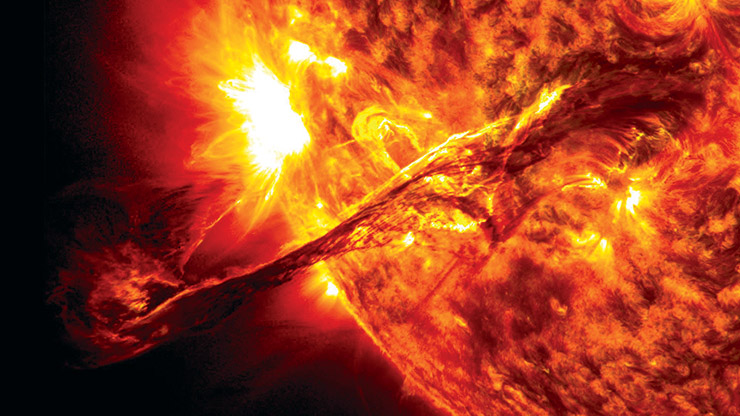
     

  • Is Our Sun Conscious?

    Is Our Sun Conscious?

    This article was published in New Dawn Special Issue Vol 10 No 6 (Dec 2016)

    I have been studying our Sun for some years, focusing on the influence of erratic solar behaviour (erratic from a modern human perspective) on the course of human development and civilisation. One of my major conclusions is that the last ice age ended abruptly circa 9700 BCE due to a major solar outburst (or series of outbursts). Solar activity is intimately tied to climate changes on Earth, which in turn have major effects on life on our planet, including humanity.

    Following the solar agitation and disturbances that ended the last ice age and possibly continued for several millennia, during the last 8,000 years or so the Sun has been relatively stable, with periods of quiescence.1 For example, in historical times during the Maunder Minimum (circa 1645 to 1715) the Sun appeared to “shut down” or go dormant (as reflected in the rarity of sunspots), corresponding on Earth to the middle of the “Little Ice Age” (which in totality lasted from circa 1500 to circa 1860). At the end of the “Little Ice Age,” in 1859, the Sun “burped,” spewing out two coronal mass ejections (CMEs), accompanied by solar flares and other solar activity, that hit Earth. This become known as the Carrington Event (named after British astronomer Richard Carrington who observed a solar flare that preceded the main event). At the time unusual auroras were seen around the world due to the solar outburst, and the primitive mid-nineteenth century telegraph lines were overloaded by the incoming charged particles and accompanying geomagnetic storm.

    Overall, in 1859 the solar outburst caused little more than minor damage and a bit of an inconvenience for those who utilised the telegraph lines. If a Carrington-level event were to hit today, the story would be much different! A Carrington-level event could knock out modern electronics around the globe, bringing computer systems, electrical grids, the Internet, communications, satellites, and much more to a standstill.2

    In modern times, that is since about the middle of the twentieth century, the Sun has shown increasing signs of agitation, of variability, of erratic behaviour, of “mood swings,” the likes of which have not occurred since the solar outbursts that ended the last ice age. And the solar outbursts of circa 9700 BCE and the succeeding millennia were orders of magnitude greater than the 1859 Carrington Event. Prior to 9700 BCE sophisticated cultures – civilisation – had developed (witnessed dramatically by the archaeological remains found at Göbekli Tepe in southeastern Turkey). This early cycle of civilisation was devastated by the solar outbursts of circa 9700 BCE and a solar-induced dark age (or SIDA for short, an acronym coined by my wife Catherine Ulissey) ensued for thousands of years until civilisation fully re-emerged in places such as Mesopotamia and Egypt during the period of circa 4000 BCE to 3000 BCE.

    If we were to witness a repeat of the events, the solar outbursts, that ended the last ice age, there is no doubt our modern technological civilisation would be utterly decimated. We would be thrown back to a “stone age” and worse. Why do I say “and worse”? Because today we have hundreds of nuclear power plants around the globe. If a Carrington-level event, much less a solar outburst at the level of that at the end of the last ice age, were to hit us today, power lines would be disabled, the cooling systems and other components of nuclear power plants would be compromised, and we would have Fukushima type situations or worse around the world releasing radioactivity into the environment, compounding all of the other problems brought on by the failure of modern electronic and electrical systems.3

    What are the chances of a Carrington-level event, much less a 9700 BCE-level event, occurring in the foreseeable future? I suspect very high! I do not want to be a scaremonger or doomsayer, but there is evidence to suggest that our Sun is going through a volatile period, with major ups and downs in activity.4 Some researchers suggest that although the Sun was very active in the last few decades, it has in recent years gone into a quiescence period. Some even claim we might be headed for another “ice age” (whether a mini or major ice age).5 I feel this is an invalid extrapolation of the limited data we have.

    Activated Sun

    It could be that the Sun is once again going through a period of extreme variability, manifesting as a pattern of highs and lows in solar activity. That is, we should not extrapolate from a few years (or even a couple of decades) of relatively low solar activity to the conclusion that we are imminently entering another ice age. Indeed, the Sun may suddenly become active again, or it might undergo a major solar outburst even in the midst of an overall period of relative inactivity. The 1859 Carrington Event occurred between a solar minimum and a solar maximum during a rather mediocre solar cycle; based on short-term methods of analyses, it is unlikely to have been predicted even with modern techniques (at the time, scientists were not even aware of the modern concept of major solar outbursts so no one was even attempting such predictions).

    Looking at the longer term pattern of solar activity over the last 12,000 years (reconstructed from such data as isotope concentrations in Greenland ice cores), my judgment is that our Sun is showing all of the same signs of extreme variability and disequilibria which occurred at the end of the last ice age.6 The implication is we may experience a major solar outburst in the very near future. Indeed, in July 2012 a significant solar outburst barely missed hitting Earth.7 If the eruption had occurred just a week or so earlier it would have been Earth-directed, and most likely destroyed or compromised much of our modern electronic and electrical technology and infrastructure. Even now, years later, we would still be attempting to rebuild the modern world. And the July 2012 event occurred during our current solar cycle,8 which has been unusually quiet overall, to the point that (as noted above) some people predict a partial solar shutdown and a “mini ice age” or even the beginning of a true ice age.

    With this introduction, I want to turn to the subject of the title of this article: Is Our Sun Conscious? I wonder, in all seriousness, if it was just luck or good fortune that the July 2012 solar event was a near miss from Earth’s perspective, or if there was possibly something else involved?

    A Conscious Sun?

    For the past several years my wife, Catherine (Katie) Ulissey, has been following observations of the Sun on a regular – usually daily – basis. Solar flares and accompanying coronal mass ejections (CMEs) can erupt from sunspots, so sunspots and their activity are a potential short-term indicator of an impending major solar outburst that, if Earth-directed, could cause massive devastation to our modern technological society, as might have happened if the July 2012 solar eruption had hit us.

    Katie often comments to me that otherwise very active sunspots strangely lessen the severity of their activity, producing smaller solar flares and so forth, or even appear to become temporarily dormant and shut down their activity, when they are Earth-facing. Then, as they move around to the side and back of the Sun (as viewed from Earth; the Sun rotates on its axis and of course Earth revolves around the Sun), these same sunspots begin firing again, increasing their activity dramatically. It is as if the Sun is aware of Earth’s presence and is attempting to avoid spewing a major solar outburst (whether a solar flare, CME, or some other type of solar eruption) directly at us.

    Katie is not the only observer to comment anecdotally on this apparent pattern;9 others have independently suggested, perhaps in jest, that our Sun is consciously attempting to protect us from being hit by a major solar outburst. In analogy, imagine a person who is about to sneeze, but is able to hold it long enough to turn away and avoid sneezing on someone else.

    This may seem like a very weak basis for suggesting our Sun has the property of consciousness, but there is additional evidence. The Sun is a fairly typical star, and it has been found stars exhibit anomalous behaviours that are not easily explained by the theories of standard physics.

    As physicist Gregory Matloff (New York City College of Technology) has discussed,10 stars do not appear to move in the ways that standard theories, such as formulations based on Newton’s theory of gravity, predict. Stars typically move around the centre of the galaxy in which they are located. Standard theory predicts that stars closest to the galactic centre should revolve more rapidly than those farther from the centre (just as Mercury travels more rapidly around the Sun than does Saturn, which is much farther from the Sun). However, this proves not to be the case. On the whole, stars farther from the galactic centre move more rapidly than stars closer to the galactic centre; it is as if all of the stars are mounted on a huge rotating wheel. Another problem with standard theory is that the masses of clusters of galaxies (as best as can be calculated based on our observations) are not great enough to hold the clusters together gravitationally. To address these issues, the concept of “Dark Matter” has been hypothesised. In simple terms, Dark Matter, which according to its advocates is said to compose the majority of matter in the universe, is essentially undetectable except for its gravitational effects on visible matter and radiation. Supposedly, Dark Matter can explain the anomalous movements of stars and the clustering of galaxies.

    Do Stars have a Will of Their Own?

    There is another explanation that could also account for the anomalous behaviour of stars, an explanation that does not need to invoke undetected Dark Matter: stars are conscious and move according to their own will or volition. In one of his articles, Gregory Matloff defines “a conscious entity as one capable of volition – it has enough self-awareness that it can decide to take (or not take) a selected action.” Thus “a conscious star can decide to alter its motion to participate in the great stellar dance as stars orbit the centres of their galaxies. Such a star need not have a human-level or god-like consciousness. A simple herding instinct is enough.”11 The existence of such consciousness in stars, which are following a herding instinct (similar to a school of fish swimming together or a flock of birds flying together), would adequately explain their otherwise anomalous motions. Is this a simpler explanation than invoking Dark Matter?

    Matloff has also discussed several potential mechanisms by which stars might be able to express their will and consciously change their trajectories. The best established mechanism is the use of jets of material emitted from the star. Young stars emit intense jets of material, often bipolar but not necessarily symmetrical. Asymmetric jets exuded by young stars could be used to preferentially change and adjust their trajectories. Mature stars, such as our Sun, emit a “solar wind” consisting of electrically-charged particles. Variations in the intensity, in various directions, of the solar wind could change the path of the star. One must remember that, as Matloff points out, changes in the trajectory of a star that may be “significant” to the star over its long lifetime of millions or billions of years (our Sun is estimated to be nearly five billion years old) may appear trivial or imperceptible to us. The use by our Sun of jets and variations in the solar wind to express will and volition could be related to the idea that our Sun may consciously attempt to avoid throwing solar eruptions toward Earth – and if this is the case, it is then also the case that the Sun could consciously decide at some point to hit Earth with a major solar outburst. Is this what happened at the end of the last ice age, circa 9700 bce? Or was the solar outburst at that time an “accident”?

    Matloff tentatively suggests two other mechanisms by which our Sun, or any conscious star, might theoretically change its trajectory: 1) Variations in the pressure of electromagnetic radiation, including visible light, given off by the star; and 2) by psychokinesis. Electromagnetic radiation pressure seems like a plausible possibility, although little work has been done to model how great the variation would have to be to change a star’s trajectory. Possibly changes in electromagnetic radiation could be used volitionally by stars for other purposes, such as communication among themselves. Psychokinesis (also known as telekinesis or mind-over-matter) has, to my satisfaction, been demonstrated to exist among biological organisms such as humans.12 Whether psychokinesis could (or does) exist among other conscious entities, such as possibly stars, is currently unknown – although I am not aware of any theoretical reason why it should not.

    But how can the Sun and stars be conscious when they are not even biological organisms, at least not in the sense of carbon-based cellular creatures like ourselves? A common notion, which is not to say it is correct (all too often common notions and “common sense” are wrong), is that consciousness and volition (at least in nature) can only occur in carbon-based forms of biological organisms, and many people would limit the notion of consciousness to “advanced” biological organisms like vertebrates, mammals, or, according to some, only human beings. However, various researchers have argued that consciousness may arise at a quantum level and may not be limited to familiar biological organisms such as ourselves.

    For instance, the British physicist Sir Roger Penrose (University of Oxford) and anesthesiologist Stuart Hameroff (The University of Arizona Medical Center) have developed the theory of orchestrated objective reduction as an explanation for how consciousness arises. Essentially, an orchestrated coherent series of quantum reductions (wave function collapses) result in moments and sequences of consciousness and choice or decision-making.13 As it turns out, according to such analyses, the conditions conducive to the manifestation of consciousness may occur on and in stars. Indeed, at a more fundamental level, consciousness may be inherent to the manifestation of matter and exist throughout the universe – with most conscious beings taking forms other than “biological organisms,” yet we as carbon-based life forms may have a difficult time recognising consciousness in other forms of matter. The physicist Max Tegmark (Massachusetts Institute of Technology, Cambridge, USA) has suggested consciousness may be a “state of matter” (“perceptronium”)14 – perhaps this is a state of matter that our Sun, and stars more generally, possess.

    “Afterthoughts” of Our Sun

    Possibly related to the concept of a conscious Sun is research that found a correlation between patterns in solar activity and earthquakes on Earth.15 Furthermore, there may be a correlation between earthquakes and major atmospheric disturbances, such as cyclone activity, on our planet.16 If our Sun is conscious, does it consciously influence storm activity, weather patterns, and earthquake activity on our planet? Or are these types of phenomena linked to the Sun, yet “afterthoughts” from the Sun’s perspective? Is the Sun sometimes rather oblivious to its influence on Earth, just as we might be rather oblivious when we unknowingly destroy a colony of bacteria or step on an ant mound by mistake?

    When we look at traditional mythologies and ancient beliefs, many past cultures considered the Sun and stars to be conscious entities – and this can perhaps be seen as the basis of astrology. The gods were associated with stars (including objects in the sky that we now classify as planets), and the ancient Egyptians (to give but one example) hoped to be united with the Sun and stars upon death. Plato in Timaeus (circa 360 bce) wrote, “And when he [the Artificer] had compounded the whole, he portioned off souls equal in number to the stars and distributed a soul to each star…”17

    Building on such ideas, my wife Katie has speculated that perhaps when human beings die their hydrogen is released (hydrogen can potentially carry information, and many would argue that information is an essential element of consciousness) and at least some of the hydrogen escapes to space where it collects as clouds, collapses under gravitational attraction, is compressed, and ultimately gives rise to stars – stars which may retain some of the information, some of the consciousness aspects, of the former beings who gave up their hydrogen. In this way, perhaps we (and possibly all biological organisms) may be reborn as stars. Of course, this is a highly speculative hypothesis,18 but if we can demonstrate our Sun and other stars are conscious, it may lend support to the idea that ultimately (perhaps after a number of incarnations on Earth) we join our consciousnesses with those of the Sun and stars.

    At this point some would suggest I have crossed the boundary from “science” to “science fiction,” but I prefer in this case the label of “speculative science.” What might we conclude? Is our Sun conscious? While the consciousness of our Sun and the stars has yet to be definitively demonstrated, I do not think we should simply dismiss the idea. Indeed, a conscious Sun and stars may go a long way toward explaining various “anomalies” that standard paradigms cannot readily accommodate.

    [alert type=”general” dismiss=”no”]This article was published in New Dawn Special Issue Vol 10 No 6.[/alert]

    [alert type=”success” dismiss=”no”]If you appreciate this article, please consider subscribing to help maintain this website.[/alert]

    Footnotes

    1. S. K. Solanki, I. G. Usoskin, B. Kromer, M. Schüssler, and J. Beer, 2004, “Unusual activity of the Sun during recent decades compared to the previous 11,000 years”, Nature vol. 431, 1084-1087; G. Usoskin, S. K. Solanki, and G. A. Kovaltsov, 2007, “Grand minima and maxima of solar activity: new observational constraints”, Astronomy and Astrophysics, vol. 471, 301-309.
    2. For more detailed discussion of the topics in this paragraph, see: Robert M. Schoch, Forgotten Civilization: The Role of Solar Outbursts in Our Past and Future, Inner Traditions, 2012.
    3. See Note 2.
    4. See Notes 1 and 2.
    5. Anonymous, 2015, “Diminishing solar activity may bring new Ice Age by 2030”, available at https://astronomynow.com/2015/07/17/diminishing-solar-activity-may-bring-new-ice-age-by-2030/, article dated 17July 2015, accessed 29 October 2016; Zoë Schlanger, 2015, “An atmospheric scientist explains why that ‘mini ice age’ is bogus”, available at www.newsweek.com/mini-ice-age-bogus-global-cooling-climate-change-354632, article dated 17 July 2015, accessed 29 October 2016; Michael J. I. Brown, 2015, “The ‘mini ice age’ hoopla is a giant failure of science communication”, available at http://phys.org/news/2015-07-mini-ice-age-hoopla-giant.html, article dated 24 July 2015, accessed 29 October 2016.
    6. See Notes 1 and 2.
    7. NASA, 2014, “Near Miss: The Solar Superstorm of July 2012”, available at https://science.nasa.gov/science-news/science-at-nasa/2014/23jul_superstorm, article dated 23 July 2014, accessed 29 October 2016; Jason Samenow, 2014, “How a solar storm two years ago nearly caused a catastrophe on Earth”, available at www.washingtonpost.com/news/capital-weather-gang/wp/2014/07/23/how-a-solar-storm-nearly-destroyed-life-as-we-know-it-two-years-ago/, article dated 23 July 2014, accessed 29 October 2016.
    8. Solar Cycle 24, which began in 2008; this is the twenty-fourth cycle of magnetic polarity changes and minima to maxima to minima in sunspots since astronomers began systematically recording and numbering such cycles, starting in 1755. The average solar cycle is about eleven years in duration.
    9. This apparent phenomenon is also noted in Ben Davidson, Observing the Frontier: Eyes Open, No Fear, 2015, Space Weather News, LLC, 68-71.
    10. Greg Matloff, 2012, “Stars That Wander, Are You Bright: Are Stars Conscious?”, available at www.baen.com/starsconscious, article dated 2012, accessed 29 October 2016; see also, Gregory L. Matloff, 2012, “Star Consciousness: An Alternative to Dark Matter”, available at www.centauri-dreams.org/?p=23203, posted 13 June 2012 by Paul Gilster, accessed 29 October 2016; Greg Matloff (introduced by Paul Gilster), 2015, “Greg Matloff: Conscious Stars Revisited”, available at www.centauri-dreams.org/?p=33995, dated 18 September 2015, accessed 29 October 2016.
    11. Matloff quotations from www.baen.com/starsconscious, accessed 29 October 2016; italics in the original.
    12. See discussion, articles, and references in: Robert M. Schoch and Logan Yonavjak, The Parapsychology Revolution: A Concise Anthology of Paranormal and Psychical Research, Tarcher/Penguin, 2008.
    13. See my discussion of their work in: Robert M. Schoch, 2014, “Life, Death, and Raymond: Exploring the Nature of Death and Consciousness”, Darklore, vol. 8, 189-212.
    14. Max Tegmark, 2015, “Consciousness as a State of Matter”, available at https://arxiv.org/abs/1401.1219 and https://arxiv.org/pdf/1401.1219v3.pdf, accessed 29 October 2016 (original paper dated 6 January 2014, revised version of 18 March 2015 consulted).
    15. See, for instance, the following works and also references cited therein: John F. Simpson, 1967, “Solar activity as a triggering mechanism for earthquakes”, Earth and Planetary Science Letters, vol. 3, 417-425; A. Zátopek and L. Krivsky, 1974, “On the correlation between meteorological microseisms and solar activity”, Astronomical Institutes of Czechoslovakia, Bulletin, vol. 25, no. 5, 257-262; A. L. Morozova, M. I. Pudovkin, and T. V. Barliaeva, 2000, “Variations of the Cosmic Ray Fluxes as a Possible Earthquake Precursor”, Physics and Chemistry of the Earth, vol. 25, 321–324; S. Odintsov, K. Boyarchuk, K. Georgieva, B. Kirov, and D. Atanasov, 2006, “Long-period trends in global seismic and geomagnetic activity and their relation to solar activity”, Physics and Chemistry of the Earth, vol. 31, 88–93; Jean-Paul Poirier, Jean-Louis Le Mouël, and Vincent Courtillot, 2009, “Microseismicity, meteorology and the solar cycle”, Académie des Sciences, Comptes Rendus Geoscience, vol. 341, 977–981; Jeffrey J. Love and Jeremy N. Thomas, 2013, “Insignificant solar-terrestrial triggering of earthquakes”, Geophysical Research Letters, vol. 40, pp. 1165-1170; Mikhail Kovalyov and Selena Kovalyov, 2015, “On the relationship between cosmic rays, solar activity and powerful earthquakes”, available from https://arxiv.org/abs/1403.5728 and https://arxiv.org/pdf/1403.5728v2.pdf, accessed 29 October 2016 (original paper dated 23 March 2014, revised version of 10 February 2015 consulted); Ben Davidson, Kongpop U-yen, and Christopher Holloman, 2015, “Relationship between M8+ Earthquake Occurrences and the Solar Magnetic Fields”, New Concepts in Global Tectonics Journal, vol. 3, no. 3, 310-322. Interestingly, various seismic events on our Moon (moonquakes) are apparently correlated with, or triggered by, some phenomenon or phenomena outside of our Solar System; see Cliff Frohlich and Yosio Nakamura, 2006, “Possible extra-Solar-System cause for certain lunar seismic events”, Icarus, vol. 185, 21–28. If this is true, it suggests the possibility that in at least some cases phenomena on our Sun and earthquake activity on Earth (as well as moonquakes) may be correlated with each other because both the Sun and Earth (or Earth-Moon system) are responding to common phenomena outside of our Solar System, or perhaps the Sun is responding to something from outside the Solar System and then causing effects on Earth (and presumably on other planets and bodies in our Solar System as well). Such studies are still in their infancy.
    1. See discussion in: B. Davidson, Observing the Frontier [see Note 9].
    2. R. D. Archer-Hind, The Timaeus of Plato, edited with Introduction and Notes, London and New York: Macmillan and Co., 1888, 141 and 143.
    3. Discussed further in: Forgotten Civilization [see Note 2], 255-259.

    © New Dawn Magazine and the respective author.
    For our reproduction notice, click here.
  • Enlightenment in the East: Misunderstood & Misinterpreted

    Enlightenment in the East: Misunderstood & Misinterpreted

    Enlightenment in the East is often misunderstood and misinterpreted. It is completely different from the philosophical movement known as “the Enlightenment” in Europe during the 18th century.

    Eastern enlightenment is often studied but never experienced. It is usually viewed through our Western and modern linear view of life. Yet the Eastern view of life is built on the natural world’s foundation of a nonlinear view, inclusivity rather than exclusivity, collectivism over individualism, which all contribute to a perception of reality attuned to holism rather than an analytical perspective. Instead of dissecting reality into separate parts to try and understand the whole, the East focused on how the apparent separateness of life is integral and essentially one.

    Both the holistic and analytical mind were environmentally determined by life’s circumstances thousands of years ago which influenced the way an Easterner and Westerner perceive the world until present day. The analytical mind is attributed to the West. It was the result of smaller communities during the first two millennia BCE in Greece which were naturally more individualistic because they had to fend for themselves and live off the individual labour of hunting, herding, and fishing for obtaining food.

    While during the same period in the East the environment determined that it was best to live in large communities due to the arduous labour required for rice cultivation. This was especially the case in China and India. For example, the birth of Chinese civilisation evolved from the Yellow River Valley area of northern China where rice cultivation was the essential food source.

    Living in large communities in the East, people were dependent on each other and the health and well-being of every person. The sense of your own individual self-interest and self-importance was surrendered to what is important for the collective good. This attitude geared people’s mind towards being holistic and as a result they sustained a natural nonlinear view of reality.

    The analytical mind and linear view is the result of individualism, and the holistic mind and nonlinear view is the result of the collective perspective. Does this mean one view is better or more real than the other? No, of course not. But the problem we encounter in the modern day is the holistic mind and nonlinear view of reality is fading off in to the distance in favour of a world driven by individual pursuits at the expense of our collective well-being, even in the modern East.

    The holistic mind and nonlinear view is the way of nature and is expressed through our intuition. While the analytical mind and linear view is expressed through our intellect. Both are somewhat necessary but we overcompensate for the latter, which ultimately leads to the decline of nature and our own enlightenment as an individual. A mind that is primarily driven by a perception of reality based on the linear analytical view contributes to the slow destruction of nature and also the mind itself, as we see with the alarming abundance of mental health issues in the world today.

    The natural mind’s perception of the world is rooted in the holistic nonlinear view which is actually the fundamental framework of nature and human beings are an aspect of nature. This doesn’t mean the analytical mind and linear view cease to exist. Instead, they are only employed in those brief moments that require such attention to detail. And yet if your mind is rooted in its holistic nature then any attention to detail will be done without the sense of a separate person doing it.

    The nonlinear world of nature and our own individual enlightenment are intimately related. But our sense of an identity separate from everything else has to disappear before we can realise enlightenment. Patanjali, the founder of yoga, explains this using the Sanskrit purusha (absolute pure awareness and the identical source of the universe within each of us, similar to the concept of Atman in Vedic scripture) and prakrti (all the form and energy of the manifest universe, including thoughts). He explains that the fundamental purpose of nature (prakrti) is for the human being to bring purusha forth into the world. Purusha, then, according to Patanjali, is the ultimate fulfilment of nature and why we essentially exist.

    Yet this could only happen if the idea of an isolated separate personality has disappeared because when our mind is pulled here and there by the movement of mental activity and life we lose our sense of purusha within as it is eclipsed by a haze of overstimulated mental activity. As a result we begin to firmly believe in the notion of past and future without an appreciation or recognition of the present moment.

    This is a disaster according to the Eastern wisdom traditions. In the East eternity and our connection to it is not some far off destination or someplace we go after death. It is right now where time and thinking are completely cut off. And the eternal aspect within our mind is felt and lived from when we ground ourselves constantly in pure awareness (purusha). The more we bring our consciousness back to pure awareness the more we reside in the eternal aspect of the universe because pure awareness is beyond time, form, and mental activity.

    Our personality, on the other hand, is built and sustained by the linear view of the world. It is an accumulation of experiences from the past that we believe determines our future. Actually we tend to project our desires into the future based on our past. As a result our personality becomes entangled with suffering because it is the outcome of linear time which has no resonance with pure awareness and the eternal now.

    When we realise we are the charioteer and begin to reign in the wild horses, to use Plato’s analogy of the mind, we become free from the entanglement of a time-bound personality that is unknowingly causing all the trouble in the world. The real you, the true Self/Atman is the unstained pure awareness beyond time. (Atman is a Sanskrit word for the Self with a capital S in reference to the pure undifferentiated consciousness deep within us that is eternal and a pure state of awareness that is identical to the Absolute Ultimate Reality of existence known in Sanskrit as Brahman.) That is who we truly are but it becomes background noise to the foreground of our isolated personality.

    Your real nature, the true Self, is what some people of the East realised thousands of years ago. When they individually surrendered their own selfish desires upon the altar of life as it is, they realised they are part of something much greater than their personality. Call it Brahman, Tao, or the Godhead, but we don’t need to give it a name as it is eternally nameless. True liberation burst through their hearts as they finally understood that they are no more special than anyone else or anything else. When their personality disappeared, the splendour of enlightenment dawned on their consciousness.

    The great sages of the East experienced this splendour. They lived a life fully enlightened which is the fulfilment of nature. Nature is nonlinear and a sage’s mind becomes a reflection of nature. Having no beginning or end, enlightenment is a state of consciousness firmly rooted in the eternal now where the illusion of past and future evaporate like dew drops on a summer’s day.

    Our mental impressions/subliminal psychological imprints (samskaras in Sanskrit), latent habits and tendencies (vasanas in Sanskrit), and action (karma in Sanskrit) cannot be purified if we don’t make the effort to bring our wandering mind back to the eternal now of purusha. Only then when we attune to That which is beyond name and form can we truly experience the fact that liberation is your true nature. Enlightenment now in this eternal moment is the ultimate liberation and you are That!

    The subject matter covered above is explored in Jason Gregory’s new book, Enlightenment Now: Liberation Is Your True Nature.

    [alert type=”general” dismiss=”no”]This article was published in New Dawn 158.[/alert]

    [alert type=”success” dismiss=”no”]If you appreciate this article, please consider subscribing to help maintain this website.[/alert]

    © New Dawn Magazine and the respective author.
    For our reproduction notice, click here.

     

  • The Next Big Bang: Human Consciousness & the Universe’s Ultimate Secret

    The Next Big Bang: Human Consciousness & the Universe’s Ultimate Secret

    This article was published in New Dawn 160 (Jan-Feb 2017)

    The stream of human knowledge is heading toward a non-physical reality. The universe begins to look more like a great thought than a great machine.
    – Sir James Jeans

    For at least two hundred years science has been telling us that any ideas of spirituality we might hold dear are little more than ignorant leftovers of a superstitious past – foolish relics. But the truth is, physics itself, that most foundational of all sciences, has now progressed far beyond that initial, dismissive assessment, to a conceptual worldview far more accepting of spirituality than ever before. To grasp the nuts and bolts of this new science, then, is to understand the nuts and bolts that support a new, evolving and far more sophisticated grasp of spirit than has ever before been available to us.

    This new conceptual framework is absolutely critical to our grasp of spirit, and, frankly, for those previously unfamiliar with the discoveries of modern physics, this new framework may at first seem nothing short of “other worldly” itself – as the old saying goes, the truth can at times be far stranger than fiction. So let’s start by taking a close look at what the new physics has to tell us.

    In 1964 the scientific world was literally turned on its head by a new theorem, but very few at the time understood just what had taken place. Indeed, so astounding were the material, philosophical, and spiritual implications of this assertion that it would soon be referred to as “the most profound discovery in science.”1 Yet even today, few beyond a small community of physicists have come to grips with its meaning. The conceptual implications for particle physics were so extreme that for decades after its announcement many within the scientific community resisted its implications, as do some resist them to this day.

    The theoretical contentions offered in 1964 have been confirmed and replicated in laboratories across the globe on numerous occasions, and today there is no question that the original assertion was correct. This monumental insight is called Bell’s theorem, and the sea change it caused in physics is still being digested as I write. So central is Bell’s theorem to our understanding of the physical universe, how it functions, and what that means for us as human beings, that to grasp its implications is crucial for anyone interested in the science that today enables us to envision universal processes as far more than simply material phenomena. Yet, simultaneously, to truly grasp the new reality Bell’s theorem implies, it is essential that we first understand the old reality it so violently overturned.

    Today many within the scientific community believe that our modern science – that is, the science of observation and testing, of the scientific method – was inaugurated in the seventeenth century when Galileo Galilei first pointed his homemade telescope toward the heavens and started poking around. How did this new science differ from previous approaches to the study of physical phenomena? Dr. Dean Radin, Laboratory Director at the Institute of Noetic Sciences in Petaluma, California explains:

    “Classical physics began in the seventeenth century when pioneers such as Italian mathematician Galileo Galilei, French philosopher Rene Decartes, German astronomer Johannes Kepler, and English mathematician (and alchemist) Isaac Newton advanced a new idea. The idea was that through experiments one could learn about Nature, and with mathematics, describe and predict it. Thus rational empiricism was born. Classical physics was extended and substantially refined in the nineteenth and twentieth centuries by luminaries like James Clerk Maxwell, Albert Einstein, and hundreds of other scientists.”2

    This physics – called classical, or Newtonian, or material physics – has made an enormous contribution to our understanding of the universe we inhabit, and as a result has had a profoundly positive effect upon the overall human condition. Food production, health services, economics, education, transportation, etc., etc., have all been vastly improved as a result of scientific applications made available through analysis and testing. No doubt, material science has been a boon to human kind.

    Initially, this new science looked outward as had Galileo toward the planets and stars for answers regarding how the universe worked and the matter by which it was constructed. Larger and better telescopes were developed in order to augment this process, and today, of course, spacecraft have been constructed that fly to points distant enough to inspect and photograph distant terrestrial bodies. As a result, a great deal has been learned.

    In the eighteenth and nineteenth centuries enormous strides were made in terms of our understanding, not only of the greater cosmos, but also of the physics by which it functions. Most of the planets, their orbits, and their relationship with the sun were established early on. The mathematical calculations for all of this fit nicely within the prevailing understanding, or model, of the universe, and all of these findings both confirmed and augmented our grasp of Newtonian physics.

    The Emergence of Quantum Physics

    Still, despite all the advances, there were some oddities that did not quite fit. In 1801, for instance, British physicist Thomas Young conducted a “double-slit” experiment in an attempt to deduce the true nature of light. Prior to that, it was assumed that light was composed of small particles of matter, but the result of Young’s experiment seemed clearly to indicate that light was in fact a wave. It was presumed, as a consequence, that light waves would require some sort of medium in order to propagate (conceptualised as a luminiferous ether or ether “wind”), and the search for this medium was promptly initiated. Physics soldiered on essentially unruffled by all of this, however, still confident in its overall grasp of the universe. But this subtle medium, despite numerous attempts at detection, remained elusive.

    As a result, light continued to be a thorn in the side of Newtonian physics, thus it was naturally toward the study of light that much attention became focused. In 1900, for instance, American physicist Max Planck developed a mathematical model that demonstrated that light appeared to exist as distinct bursts or “packets” of matter. Planck named these packets “quanta” after the Latin quantus, which translates as essentially “how much.” Planck’s discovery proved the birth of what we today call quantum physics – that is, the study of that group of infinitely small particles that ultimately comprise all matter. Then, in 1905, Albert Einstein, an unknown physicist at the time working as a patent clerk in Switzerland, clearly demonstrated the validity of Plank’s quanta, but it was a proof that also allowed that light had to have both wave and particle characteristics – a perplexing side issue.

    Quantum understanding snowballed rapidly. Dean Radin tells us that, “Danish physicist Niels Bohr showed how the quantum concept could explain the structure of the atom (1922 Nobel Prize). In 1924, Louis de Broglie proposed that matter also has wavelike properties (1929 Nobel Prize). In 1926, Erwin Schrodinger developed a wave-equation formulation of quantum theory (1933 Nobel Prize).”3 Our insight into quantum mechanics was accelerating rapidly, but, despite all the progress, the seemingly dual nature of light remained a vexing problem. Was light comprised of particles or waves? No one could say.
    [alert type=”info” dismiss=”no”]If you appreciate this article, please consider a subscription to New Dawn magazine.[/alert]

    The Big Bang Theory

    Meanwhile, additional progress was being made at the observatory by looking in the opposite direction – far out into the depths of the universe. In 1929, as an example, by carefully analysing the red shifts (observed light frequencies) of distant galaxies, American astronomer Edwin Hubble demonstrated that the universe was expanding. An expanding universe was evidence contrary to the Steady State theory of the universe, or a universe that was essentially constant and eternal. Hubble’s finding also suggested that our universe, since it was now seen to be expanding, may naturally have had a beginning; that is, a moment when all that matter had been consolidated in a single point before it started to expand.

    Over time this “beginning” became conceptualised as what we today call the Big Bang theory of the universe, or a moment when the material universe emerged from a background of utter nothingness in an enormous burst of heat, light, and matter. The name actually came from British astronomer Fred Hoyle, who quipped one day on British radio that the theory sounded like little more than a “Big Bang,” and while this was stated in jest, the term stuck, nevertheless. The Big Bang theory postulates that the universe emerged from a “singularity” (a point of infinite density, which remains, frankly, beyond our current physics to explain or, as humourist Terry Pratchett once quipped, “In the beginning there was nothing, which exploded”) some 13.8 billion years ago as an incredibly small and incredibly hot point of matter. According to the theory, this material then inflated, expanded then cooled over time allowing for the formation of light elements like hydrogen and helium. Due to a slightly uneven distribution of matter throughout the universe, gravitational attraction then began to consolidate these elements into clouds which over eons formed the stars, planets and galaxies that comprise the celestial panorama we observe today in our night time sky.

    Evidence supporting the Big Bang theory of creation then began to accumulate. This evidence included the original “red shift” Hubble discovered, the discovery of cosmic microwave background radiation (which had been predicted as a residual product from the heat of the initial inflation), and more recent red shift observations of distant supernovae indicating that the expansion of the universe is actually accelerating (and which suggest the existence of dark matter in substantial quantities as the driving force behind this acceleration).

    This explanation of the Big Bang is, to say the least, a very brief and general summary of a vast and complex event, but it serves our purposes by bringing us forward conceptually to the year 1964, and the model of the universe that was prevalent at the time Bell’s Theorem made its shocking appearance (minus the dark matter, which was theorised later).

    The truth of the matter is, however, while the Big Bang theory provided the universe with both a beginning and a direction, it did not alter the assumption that the universe was fundamentally a material phenomena; a belief central to modern science ever since Galileo had peered through his telescope. History tells us, as an example, that when asked by Napoleon Bonaparte in the early years of the nineteenth century as to why his most recent treatise did not mention the existence of God, the great French scientist Pierre-Simon Laplace was said to have remarked, “I had no need of that hypothesis.” Later, and likewise, Laplace explained to an admiring audience that, “We may regard the present state of the universe as the affect of its past, and the cause of the future.” In other words, Laplace, along with almost all other scientists at the time, believed that the universe was little more than a vast, material machine, driven by physical forces, and nothing more. If, for instance, you could determine the position and direction of every particle in the universe at any given point in time, it would be possible, at least theoretically, to crank that picture forward or backward, observing as you did every event that had taken place in the past while accurately predicting every event that would take place in the future. This view therefore supported the notion of a deterministic universe, and a universe that was devoid of either free will or human consciousness as a result.

    Importantly, this understanding, or model, of the universe rested on certain suppositions that were accepted as true and universal by material physics down through the years simply because the universe appeared to function in accordance with them. The Big Bang was conceptualised as the beginning of an entirely material process that had evolved over eons in accordance with the known parameters of Newtonian (or classical, reductionist, or material) physics. In that sense, the universe was still perceived essentially as a vast, physical mechanism, a machine that was now understood to be a bit more complex than it had been conceived during the earlier days of, say, Pierre-Simon Laplace one hundred and fifty years before, but differing now only in terms of its sophistication, not its fundamental nature. Thus Laplace’s statements regarding the absence of God and the predictive power of the original conditions still held true as far as modern physics was concerned.

    The universe was also considered to be a true, functioning reality, and a reality that, having been put in motion by a natural (although inexplicable) occurrence, remained utterly deterministic, events formed and driven forward in time, no longer by the unseen hand of God, but by random particle collisions alone. All events occurred due only to the action of physical forces in contact or proximity with one another, and no force, field, or matter could – according to Einstein’s calculations – ever travel faster than the speed of light. But the wave/particle nature of light still remained an intellectual conundrum that, much like one rotten apple, threatened to subvert the entire structure of physics if not sensibly accounted for.

    ‘Uncertainty Principle’ Neuters Newtonian Physics

    Still, as far as the quantum theory was concerned, great new strides were being made. Physicist Nick Herbert tells us, for instance, that, “By the late [nineteen] twenties physicists had constructed a quantum theory adequate to their needs: they possessed, thanks to the work of Heisenberg, Schrodinger, and Dirac, rough mathematical tools that organised their quantum facts to a remarkably accurate degree. At this point Hungarian-born world-class mathematician John von Neumann entered the picture. Von Neumann put physicists’ crude theory into more rigorous form, settling quantum theory into an elegant mathematical home called ‘Hilbert space’, where it resides to this day, and awarded the mathematician’s seal of approval to the physicists brand-new theory of matter.”4

    But the enigma of light continued to plague quantum theory, and it is precisely here where the old physics of determinism and cause and effect began to unravel. In 1927, for instance, German physicist Werner Heisenberg authored his now famous uncertainty principle, the intellectual consequences of which did great mischief to Newtonian physics. Heisenberg was at the time attempting to measure the precise speed and position of a particle in order to predict its future position – a process that should have been entirely within the accepted parameters of Newtonian physics. But Heisenberg discovered that this could not be done. British physicist Stephen Hawking tells us that Heisenberg’s uncertainty principle indicated unequivocally that “the more accurately you try to measure the position of the particle, the less accurately you can measure its speed, and vice versa.” This finding sent shock waves rippling through physics. “Moreover,” Hawking tells us, “this limit does not depend on the way in which one tries to measure the position or velocity of the particle, or on the type of particle: Heisenberg’s uncertainty principle is a fundamental, inescapable property of the world.”5

    In a very real sense, Heisenberg’s principle delivered a body blow to Newtonian physics. Because, if the precise state of the universe was impossible to measure at any given moment, then any state either before or after was also impossible to calculate. It was as simple as that. Laplace had been wrong. Determinism, material cause and effect, even the forward moving arrow of time surely appeared to be “on the ropes.” Suddenly, many of the underlying presumptions upon which classical physics rested had seemingly evaporated into thin air due to Heisenberg’s principle. What was going to replace them? Moreover, what did Heisenberg’s findings actually mean? How could it be that aspects of the material universe were, had always been, and would always be, utterly beyond our ability to measure?

    And there was still more damage as a result of Heisenberg’s new principle. Because, if particles could not be clearly defined in terms of their position and movement, then particles could no longer be clearly defined as material objects anymore. If, after all, the position and movement of a particle could not be described with precision, then in a sense a particle could only be described with imprecision – a mathematical approximation. A photon, for instance, could no longer be considered a discrete particle, but rather a combination – part particle, part wave – or a mathematical description now called a wave function. Even more importantly, if the manner by which a particle was measured (or observed) altered the resultant observation (a fact Heisenberg had demonstrated), then it followed logically that observation itself had to be a fundamental aspect of reality. Physics had been thrown for a loop.

    A World of Pure Possibility… Magic

    Indeed, some physicists, Heisenberg included, began to interpret the wave part of the particle/wave aspect of light as meaning that particles became particles only when observed, and remained waves (that is, in a state of material potential) when not observed. This, of course, was an extraordinary claim, something that many physicists thought sounded disturbingly akin to ancient superstition, like magic or voodoo. What Heisenberg and his colleagues were suggesting, in essence, was that the unseen world of quantum mechanics was not a material realm at all, but a realm rather of pure potential. That’s right: quantum researchers like Heisenberg argued that the fountainhead of the physical universe appeared to be utterly immaterial. And as damaging as all of this was to classical physics, even more shocking news was on the way. Because if the foundation of our physical reality arose from a source of pure potential (was not material at all), then what, exactly, was this non-physical stuff? Could it even be called stuff? At this point in time many scientists became dizzy just trying to get a handle on the facts, and who could blame them?

    Nick Herbert explains the next leap in logic that took place. “If we take quantum theory seriously, it seems to demand that the world before an observation is made up of pure possibility. But if everything around us is only possible not actual, then out of what solid stuff do we construct the device that will make our first observation? Either there are some physical systems whose operations unaccountably evade the quantum rules or there are nonphysical systems not made of multivalued possibility, but of single-valued actuality – systems that exist in definite states capable of interacting in an observational capacity on indefinite quantum-style matter.” Yet it was clear that all material systems consisted of particles, and that these particles always obeyed the rules of quantum mechanics (not individually, but in statistical aggregates), because these rules had been tested and verified throughout countless experiments. “On the other hand,” Herbert continues, “we are aware of at least one nonphysical system that not only can make observations but actually does so as part of its function in the world – the psychological system we call human consciousness.”6

    This assertion, while sound mathematically and entirely logical, was so startling that it literally turned classical physics on its head. A science that had accepted as utterly valid a universe constructed of, and driven by, material particle movement was told suddenly that it had had it all wrong from the very beginning. And make no mistake about it, that’s exactly what was being said. “The general idea of von Neumann and his followers,” Herbert explains, “is that the material world by itself is hardly material, consisting of nothing but relentlessly unrealised vibratory possibilities. From outside this purely possible world, mind steps in to render some of these possibilities actual and to confer on the resultant phenomenal world those properties of solidity, single-valuedness, and dependability traditionally associated with matter. This kind of general explanation may be enough for philosophers, but physicists want more. They want to know exactly how it all works, in every detail.”7

    Indeed, the notion that our material reality was not real after all was simply too much for many physicists, and their response at the time was entirely reasonable. No determinism, cause and effect, or arrow of time? What was happening to the foundational principles of classical physics? Many physicists tossed up their hands in dismay, others in disgust. One of those physicists was the extraordinary Albert Einstein himself, the very father of relativity theory, and the most respected physicist in the world. All of this sounded crazy to Einstein. As to the notion that the universe was the construct of little more than the capricious whims of human observation, he supposedly responded with the now famous quote that, “God does not play dice with the universe.” Obviously, he did not agree with the newest speculations of quantum physics.

    Einstein bristled at these new interpretations of quantum theory to the point that in 1935 he along with Boris Podolsky and Nathan Rosen issued a thought provoking analysis now known as the EPR (Einstein, Podolsky, Rosen) paper. This analysis was meant to be a clear-headed challenge to the wave function description of matter that had been adopted by many quantum physicists, and described above. The EPR paper insisted that the position and momentum of any given particle had to be able to be measured far more accurately than Heisenberg’s principle allowed for, or else information between certain “entangled” particles (Erwin Schrodinger had previously demonstrated that when quantum systems interact their wave functions become entangled, and they will remain entangled even when no longer interacting) would be theoretically transferred faster than the speed of light, instantaneously in fact, which was a fundamental violation of Einstein’s theory of relativity. According to the EPR paper, hybrid particles like wave functions, and instantaneous transmissions (what Einstein called “spooky action at a distance”) were inelegant solutions clearly out of line with relativity theory, which was the accepted gospel of physics at the time. In that sense, then, the EPR paper was issued as a direct challenge to quantum theory as it was currently being developed.

    Bell’s Theorem & a Nonlocal Universe

    This was more or less the state of affairs in 1964 when John Stewart Bell entered the picture. Without going into great detail, suffice it to say that Bell demonstrated in his theorem that the EPR analysis was right, but that its conclusions were wrong, and that superluminal (faster than light) entanglements were not only possible, but required if quantum theory was to make sense. Prior to this, physics had always assumed the universe to be local in nature, that is, interactions between physical systems had of necessity to involve a signal transferred by force at a rate below the speed of light. Bell’s theorem, on the other hand, demonstrated that the universe was in fact nonlocal (“a nonlocal effect is an interaction that does not involve force, nor does it involve the transfer of signals, and it happens instantaneously regardless of the distance between objects”8), and as a consequence the “spooky action at a distance” Einstein had argued against, was, in fact, a foundational aspect of the universe. Not only that, but within a few years, and repeatedly, Bell’s theorem was tested in the laboratory, and found to be accurate. The science was now clear: we live in a universe that is nonlocal. As Columbia University physicist, Brian Greene, noted, “This is an earth-shattering result. This is the kind of result that should take your breath away.”9 The fact is, this finding has taken a good many people’s breath away.

    And if all of this is not weird enough for you, Philippe Eberhard, then working at Berkeley, soon demonstrated that “no quantum calculation will ever result in an observable superluminal connection between the patterns of individual quantum events.”10 Nonlocal interactions are thus built into the fabric of the universe, but in such a way that we can never actually observe them. But that does not mean we cannot observe their effects. For as Herbert explains, “The present situation seems to be as follows: quantum theory is superluminal [faster than the speed of light], quantum reality is superluminal, but quantum appearances are not… Since quantum theories of consciousness assume that the cause of individual quantum events lies in the mental world and Bell’s theorem proves that the causes of some quantum events must be superluminally connected, then we should expect to find some mental events that behave like the Bell connection, that is, human experiences that are unmediated, unmitigated, et cetera.”11

    In the span of approximately seventy-five years the world of particle physics had been turned upside down, and the philosophical and spiritual implications of this have yet to be fully digested by either science or the public in general. Indeed, the implications are mind-boggling. Our conceptual understanding of the universe (of which we are all material manifestations) changed from one that might be characterised as a vast, relentless, grinding particle machine, to one that seems almost, well… magical. What other word will do? As physicist Richard Feynman noted, “What I am going to tell you about is what we teach our physics students in the third or fourth year of graduate school… It is my task to convince you not to turn away because you don’t understand it. You see my physics students don’t understand it… That is because I don’t understand it. Nobody does.”12

    Yet to this day many scientists continue to scoff at any understanding of physics beyond the material boundaries of the classical interpretation, as if all the advancements in quantum theory had never really taken place. We are often lectured that any sort of spiritual or religious belief we may hold are the products of faith alone, discredited convictions rooted in either medieval dogma or rank superstition; that they are simply not scientific. But today the truth of the matter is actually the polar opposite, for it has been clearly demonstrated that those individuals making these charges are the ones trafficking in faith, in fact clinging to material dogmas that physics has left behind in the dust. Laplace’s material cosmos is now an intellectual relic of the past, overturned, not by faith, but by science.

    All is One in the Entangled Universe

    It seems to me, for a moment, then, that the seemingly limitless world of the observatory and the minute world of quantum mechanics are far more than even light years apart; that this universe of colossal, spinning galaxies, numbered now to be in the hundreds of billions, and the world of the particle wave function are so intellectually incompatible that today they seem almost alien to one another. Then again, maybe they are not. For if the Big Bang began with a singularity, as we are told, and a singularity that was infinitely dense, then every particle that has ever emerged was initially contained within this extraordinary particle of infinite density, merged or forged or crushed in some magical way into this one tiny something. The seeds of our entire universe were fused into that one, and if all were once one then is it not reasonable to speculate that all were entangled at that moment – if indeed it can even be described as a “moment” – and thus quite possibly remain entangled to this day. Suddenly, then, from this perspective, the universe no longer appears to be an alien landscape of far distant, whirling bodies at all, but rather a vast masterpiece of infinite and instantaneous communication – of instant knowing.

    As Feynman suggests, what, precisely, the world of quantum mechanics might ultimately be determined to be remains a mystery, and may well remain a mystery some time to come, but what has already been established is surely enough to reformulate our ideas about what the universe is and how it functions. For, while quantum interactions cannot be observed, their effects can nonetheless be experienced, and those experiences can be demonstrated scientifically.

    But for now the most important concept for us all to hold onto is that of a vast and connected universe of instantaneous communication and knowing, of a universe that begins to look far more like a conscious organism than it does a grinding material mechanism, and this is far more than mere layman’s interpretation.

    Indeed, it was the great British physicist Sir James Jeans who penned the quote heading this article: “The stream of human knowledge is heading toward a non-physical reality. The universe begins to look more like a great thought than a great machine.” This a view of reality shared today by many physicists. In all probability we will not have all the answers to the true nature of the universe in our lifetimes, but one thing does seem abundantly clear – the old dogmas of material science have been proven relics of the past, and a new concept of a foundationally conscious universe appears clearly to be arising to take its place. And there, in simple terms, rests the case for human consciousness, for our compassion, and the spirit that binds us all.

    [alert type=”general” dismiss=”no”]This article was published in New Dawn 160.[/alert]

    [alert type=”success” dismiss=”no”]If you appreciate this article, please consider subscribing to help maintain this website.[/alert]

    Footnotes

    1. Dean Radin, Entangled Minds, Simon & Schuster, 2006, statement from Henry Stapp as quoted, 226
    2. Ibid, 209–210
    3. Ibid., 213
    4. Nick Herbert, Elemental Mind, Plume Books, 1993, 248
    5. Stephen Hawking, A Brief History Of Time: From The Big Bang To Black Holes, Bantam Books, 1988, 55
    6. Herbert, 249–250
    7. Ibid., 250
    8. Dean Radin, Supernormal: Science, Yoga, and the Evidence for Extraordinary Psychic Abilities, Deepak Chopra Books, 2013, 209
    9. Radin, Entangled Minds, as quoted, 231
    10. Herbert, 238
    11. Herbert, 238–239
    12. Radin, Elemental Mind, as quoted, 215

    © New Dawn Magazine and the respective author.
    For our reproduction notice, click here.

  • Intuitive Linked Communication: A Practical Way to Connect

    Intuitive Linked Communication: A Practical Way to Connect

    This article was published in New Dawn 146 (Sept-Oct 2014)

    You can communicate with minds on the other side. In fact, you already do, whether or not you know it. It’s just a matter of learning to do so consciously. You already use the necessary techniques. Communication is communication, whether with physical beings or non-physical.

    I have been doing this for more than 25 years. After some fumbling experiments with automatic writing, I learned how to engage in written dialogue, and in the next few years I learned how to get into closer touch with what I now call The Guys Upstairs (TGU). Early in 1993 I allowed them to come through in speech as I held myself in a conscious but altered state, and this led to years of my acting as conduit for them to answer the questions posed by others.

    What I can do, you can learn to do, and I’ll show you how. It isn’t really difficult. Employing this technique correctly, within its limitations, will provide you with information. Once you obtain that information, you have to weigh it, just as you do with information you obtain in other ways. Verification is always going to be an issue. But that merely amounts to saying, don’t check your common sense at the door.

    Intuitive Linked Communication

    I don’t use the word “channelling,” chiefly because it makes the process seem more mysterious, more “special” than it is. So one day I asked the guys for a better way to describe the process we were engaged in, and they came up with Intuitive Linked Communication, or ILC. I like that. It is a good descriptor that doesn’t exalt either the process or those engaged in it. It is simply a method of mind-to-mind communication.

    A little thought will show you that mind-to-mind communication is the same process whether we think of it as telepathy, or access to guidance, or channelling, or after-death communication. In each case, your mind directly contacts another mind. The variable is not the process, but the other mind.

    Telepathy connects you to a mind in another physical body.

    Accessing guidance connects you to minds specifically attuned to yours.

    What is commonly called channelling connects you to minds on the other side that are, by definition, within your range, but are not necessarily specifically attuned to you.

    And after-death communication is nothing but connecting with specific minds on the other side that have had lives on earth.

    You see? What at first seems like four different processes is actually one process, connecting with four different kinds of mind.

    In the past decade my conversations have come to include specific individuals of three types: some of my own “past lives”; deceased people I have known closely, such as my father, a brother, and friends; and historical figures such as Carl Jung and Ernest Hemingway. They seemed to be familiar with anything I knew, even if it was long after their own time. So, Hemingway could talk about Star Trek videos. Lincoln could discuss the 2006 elections. Joseph P. Kennedy could talk about the cover-ups that followed his sons’ assassinations. How could this be?

    TGU say that it is because the mind is subject to the laws of the non-physical world, rather than the physical world, and because all times continue to exist, and because all communication involves the creation of a temporary joint mind.

    Let’s look at those three statements:

    The mind is subject to the laws of the non-physical world, rather than the physical world. The physical and non-physical worlds differ from each other in two main ways.

    In the physical world, we have no way to move our bodies forward or backward in time, but our minds do it all the time, effortlessly. We can no more fall forward into the future than we can fall backward into the past, physically, but in the non-physical world, apparently all times are equally available. This suggests that although the brain is located in the physical world, mind is in the non-physical, because mind obeys non-physical laws.

    The non-physical world does not experience the illusion of separation that we do in the physical. Although our bodies keep even the most ardent of lovers separate, our minds know no such boundary. Everything connects and knows it connects. And this suggests that communication always takes place between minds operating under non-physical conditions, even when you are talking to your neighbour.

    All times continue to exist. Physical-matter 3D reality is divided by time as it is by space, and we necessarily experience ourselves as always balancing on the knife-edge of the present moment, as though the past ceased to exist and the future had not yet come into existence. But from a perspective outside of time-space, either no times exist or all times exist, and the guys say it is the latter. (They also say it isn’t a matter of one past and future, but of many pasts and futures, available for us to choose.) All times continuing to exist within their own frame of reference, communication between minds in different times becomes not only conceivable, but commonplace.

    Communication involves the creation of a temporary joint mind. Especially when communication is not funnelled through the senses, knowing jumps from one mind to another. I have concluded that it is this temporary joint mind, in connection with the fact that all times are equally alive within their own frame of reference, that allows Hemingway to experience Star Trek with me.

    A Working Model of Minds on the Other Side

    Over the course of several days in 2007, TGU discussed the nature of the soul. As they said, “It is from lack of a plausible model more than from any other single thing that the division between seen and unseen world has come to seem so absolute.” I put the entire 5,000-word discussion (and two diagrams) as “A Working Model Of Minds On The Other Side” on my blog, I of my own knowledge… www.hologrambooks.com/hologrambooksblog. Here is the part relevant to communication.

    ‘The Guys Upstairs’ had Frank draw this diagram, a radically simplified look at how minds can connect across time and different worlds.

    TGU had told me that the pattern of mind we create by living survives on the other side, and is available for us to contact. I asked them to spell out what they meant.

    They started by having me draw a diagram, and letter the circles arbitrarily, not implying hierarchy.

    In the diagram the lettered circles represent minds on the non-physical side of life, then there is the dark line representing the “veil between worlds” separating 3-D and non-3-D, and then the numbered circles representing minds in 3-D. The lines between circles are links of affiliation, temperament, etc. that organise the fields.

    This is radically simplified. It takes no account of the multiple overlapping layers of relationship that become more obvious as you look more deeply in time and space. Nonetheless, you can see that things connect not simply and uniformly like single-cell organisms, but complexly like the physical body.

    Suppose A knows chemistry, B psychology, F practical politics, and J is an artist. Perhaps A connects to G because one is parent and the other is child. Perhaps G in turn connects to C, D and L by profession, affection, and kinship respectively. (And here you see the tip of the iceberg of complexity: if G is kin to A and L, L is in some way kin to A as well as G.)

    Now if 3, say, inquires about chemistry, he may need to talk to A. If they are not close enough in wavelength that it may be done directly, then, either silently and unobserved by 3, or openly and described to 3 (as a “control,” say), 3 gets linked to A by whatever route serves. So it may be that 3 can link to I, a good networker. The chain may have to go like this: 3 -> I -> B -> E -> H -> D -> G -> A and back! But as soon as 3 and A have once linked up, they will have established a direct link. In future exchanges, 3 could then perhaps go by way of A (silently or explicitly) to reach G, and any that connect via G, by a shorter or more direct route. Thus the network is ever changing.

    (Remember, explanations are analogies that try to explain the unfamiliar by comparing it to the nearest similar thing. You could say that the colour orange is “like” red, and also “like” yellow, but the statement would be incomprehensible to those who have experienced red and yellow until they have also experienced orange. Thus, the circles in the diagram are not units but are complex meeting-points, different parts of which may come into play in different circumstances.)

    The difference between the nature of the physical and nonphysical world makes us as valuable to the other side as it can be to us. The ability to form ever more complex relationships is central to the universe (to physical and nonphysical reality considered as one). And – since we are in contact with the part of the universe that is outside of time, in which all moments of time exist equally – we may contact all the past, all the future, anyone and everyone in the physical or nonphysical part of the world. So what can’t we reach? The key is to redefine ourselves, redefine the world, so as to disable the thought systems that persuade us that it is not possible. It is that simple, that easy, that overwhelmingly powerful. But it can only be done one by one.

    Practicing ILC

    It’s much like talking on the telephone. When you go to use the phone, you don’t ask permission, or engage in elaborate rituals, or wonder if the phone really exists or if you are worthy to use it. You just take it for granted and talk! This isn’t all that different. Here’s the process, step by step.

    1. Form a question or have in mind something you want to discuss. Until you are entirely comfortable with the process, don’t ask life-or-death questions, don’t ask about your health, and don’t ask your source to predict the future. I’ll explain why, below.
    2. Write the question down. Not only does the process of phrasing the question focus the mind, it provides a record of what you ask, to remind you later what your starting-point was.
    3. Get in a quiet, receptive mental space, and wait. Be open to whatever comes. You may get words, or general ideas, or “knowings,” or what seem like stray thoughts out of nowhere.
    4. Whatever comes, write down whatever will help you to remember what you got. Don’t judge the information’s relevance or accuracy at this point, just receive it as best you can.
    5. Ask follow-up questions as they occur to you, and again be open to whatever comes. Continue until the process dries up.
    6. While you’re still in the process, don’t judge what you’re getting. The payoff will come later, when you re-examine what you got and find yourself saying, “holy cow, where did that come from?”
    7. After you are back in a more or less normal mental state, take another look at what you received, in light of the question you started with, which you wrote down. See what you can make of it. Don’t treat it as gospel, and don’t dismiss it as fantasy. Treat it at least as seriously as you would if you were interpreting a dream.

    That’s all there is to it.

    “What? That’s it? That’s all there is?”

    Well, there’s always practice, practice, practice, but yes, that’s all there is. Let’s look at the process.

    The Process and the Information

    It is critically important to bear in mind the two-stroke way the mind processes information. First it perceives, then it interprets what it perceived. These are complementary functions, both necessary, but they function alternately. While you are in the process of perceiving, you can’t be interpreting. While interpreting, you can’t be receiving. Eliminating either function, or cutting either one short, distorts the results. Indeed, it may prevent you from acquiring anything at all.

    Ideally, while perceiving, we function as temporary know-it-alls, accepting without question anything we receive. While perceiving, we don’t judge. Remember, as soon as you start interpreting, and for as long as you continue interpreting, you have ceased perceiving. Perceive first. Interpret later. It’s the only way it can be done. Don’t let that left-brain logic machine prevent you from perceiving. But then, after you have perceived, it’s the interpreter’s moment. The process of analysis is just as important as the process of perception – but each in its own time.

    In your analysis, there are two useless worries that you might as well dismiss immediately: Is it true, and who or what is the source?

    1) Is it true? It’s natural to ask this question because we don’t want to be fooling ourselves. But ask yourself, how do you know what’s true in the rest of your life? I think it comes down to two things. Either it resonates (feels true) or doesn’t, and it either is supported by whatever data we have, or it isn’t. I don’t know any other tests we can employ, either in ordinary communication or in Intuitive Linked Communication. As with the rest of life, you don’t take it for Gospel, and you don’t refuse to even look at it. You use your judgment.

    2) Who or what is the source? This is another good and natural question. But again, ask yourself, what is the source of your dreams? Your intuitions? Your inexplicable certainties? What is the source of your thoughts or ideas? Ultimately, it’s all a mystery. I don’t know of anything to do other than to follow the advice Jesus gave long ago, to judge things by the fruits they bear.

    Obstacles

    Herewith, a list of obstacles that may present themselves in your practice of ILC. Overcome these, and you’re good to go. Merely being aware of them is more than half the battle.

    • False expectations. Don’t prejudge how the information is going to come. I have had it come in so many ways: visuals or ideas that I have had to interpret; words that arise within me, that I speak without trying to shape or edit them; knowings; hunches; urges; vague impressions. What I get doesn’t always “make sense” – that is, it can’t always be immediately understood or interpreted.
    • Fear of what you might encounter. Set your intention to contact only those beings who have your highest good at heart. The intention itself will protect you.
    • Stepping on the hose. If you ask questions that raise too much anxiety, your own anxiety about the answer may prevent you from getting anything. That’s why, earlier, I said you shouldn’t start off asking life-or-death questions.
    • Keeping score. It doesn’t matter when you “get it.” There are no prizes for finishing first. Inventor Thomas Edison used the trial-and-error method with great success, and regarded failures as steps to ultimate success. Don’t discourage yourself by your expectations.
    • Illusion of separation or of distance. If we were really separate, connecting would involve overcoming some obstacle. But distance is not involved in non-physical communication, and the way to overcome the illusion of separation is to practice empathy, such as that which connects mothers and their new-born children.
    • Ego, too large or too small. Succeeding at ILC is no big deal. Don’t let your ego swell because you succeed. It is, after all, a universal human ability. Why get puffed up because you learned what somebody taught you? At the other extreme, you don’t need to be “special” to do it.
    • “I can’t do it.” There’s no harm in trying. If at first you get no results, pretend, if necessary to get started. Answer the question as if you really had someone on the line. Often this will quickly segue into the real thing, and when it does you will know the difference. The only thing is, if you use this method to prime the pump, remember that you did. Even at best, you might sometimes fool yourself inadvertently. Don’t do it deliberately or from carelessness.
    • “I don’t want someone reading my mind!” This fear of people overhearing what we’re thinking is a misunderstanding of what’s going on. You aren’t reading, or overhearing, or collecting data. As I said earlier, it’s closer to active empathy.
    • Finally, two complementary errors that stem from ignoring the necessarily complementary nature of this form of communication. If you neglect the process of analysis, you may fall into what I call Psychic’s Disease. If you neglect perception, the pitfall might be called Over-Rationalism.
    • Psychic’s Disease: Beware of thinking that if you feel it strongly, it must be true. Trust, but verify.
    • Over-Rationalism: Equally, beware of the reaction that says, “I don’t have a logical reason for what I just perceived, so it must be false and needn’t even be examined.”

    Problems Arising

    As you can imagine, a world in which we all knew we could extend our awareness to the other side would be a very different place. Will be a very different place, I hope. But it won’t come without problems, and here’s a few that come to mind.

    What do you do about the information people bring back? How are we to judge? They aren’t right just because they’re sure they’re right; they aren’t wrong just because we’re sure they’re wrong.

    Of course there are going to be the fakers, the hoaxers. One more reason to keep our faculties of discernment polished.

    And there are those with Psychic’s Disease, sincere but unbalanced in their belief and perhaps their need to believe.

    And the pretentious, who will claim false authority, speaking as if delegated by the person they are convinced they spoke to. They may be sincere, but they also may be motivated at least partially by the need to bolster their own importance. I spent many months discussing Hemingway’s life and work with him. Can I claim to be his authorised spokesman? I don’t think so. I connected with those aspects of Hemingway for which I had resonance – the writer, the romantic, the family man, political observer, above all – but I know nothing of other sides of him, for instance the hunter, the warrior, the fisherman, the celebrity, the prodigious consumer of alcohol. I would doubt anyone claiming to encompass all aspects of anyone they connect to, no matter how strongly they feel. Nonetheless, this is a problem that’s going to grow with time, I suspect, as the practice of ILC widens.

    Still, if ILC is a real ability (and I am convinced it is), we have to decide how to deal with its down side. I don’t see that we can do more than we do in the rest of life: use our judgment, look at the person’s track record and general air of reliability, and preserve a cautious scepticism.

    Another problem, at an entirely different level. Once we know that we can contact the dead, do we have obligations to do so? If we know we can help them (and sometimes we can), how far does our implicit obligation extend? Does it exist at all? What are the ground rules? Probably we’re going to have to make them up (or discover them) as we go.

    Get this issue this article appeared in

    Conclusion

    We already extend beyond time/space. Because we do, it is easy to get information from the part of ourselves that is already on the other side, and easy for that part of us to get information from others. In fact, many people have learned to do it almost without noticing because they were focused on other goals.

    Some who read this will hear an inner voice saying “yes, that’s the way it is; this actually can be done, though it may require practice.” Just listening to the voice helps break the logjam. Making your own attempts helps more. Overcoming your own scepticism and making the effort to not negate results by declaring that you made it all up helps even more.

    Working with friends is another step. Coming out into the open about your experiments and your experiences adds vastly to the effect. Every attempt – even if made in silence in a darkened room on an island without telephones, so to speak – adds its weight to the scales. And so it goes, as each one pioneers as best he or she can. You can do this, and you will find it well worth doing.

    [alert type=”general” dismiss=”no”]This article was published in New Dawn 146.[/alert]

    [alert type=”success” dismiss=”no”]If you appreciate this article, please consider subscribing to help maintain this website.[/alert]

    © New Dawn Magazine and the respective author.
    For our reproduction notice, click here.