New Dawn – World's Most Unusual Magazine

Category: Articles

  • Chinese Triads, Japanese Black Dragons & Hidden Paths of Power

    Chinese Triads, Japanese Black Dragons & Hidden Paths of Power

    From New Dawn 92 (Sept-Oct 2005)

    The influence of secret societies on the history of the West is well documented in numerous books and articles. Freemasons figured prominently in the American Revolution and the birth of the American Republic. The French Revolution, with its notions of “Liberty, Equality, and Fraternity,” originated in the radical Masonic lodges. Secret societies have been connected to a range of movements that sprang up around Europe in the eighteenth and nineteenth centuries to defend people’s rights against the abuses of royal and priestly power, and to promote freedom by any and every means.

    Secret societies are often viewed as a largely Western phenomenon, but their roots reach deep into the ancient civilisations of the East. While much is written about Europe’s hidden fraternities, little attention has been given to Asia’s secret societies and the important part they played in organising resistance to the violent onslaught of European colonialism. As one China specialist points out, the Chinese secret societies “were closely linked to the struggles which the Chinese people tirelessly waged… against their internal and external adversaries.”1

    Secret societies were deeply rooted in Chinese historical reality, and did not divide matters into the spiritual and the mundane. The source of their power lay in their total opposition to the established order: political and religious, social and ideological. The secret societies relied for support primarily upon the oppressed classes of China. They were the authentic expression of popular hostility to China’s harsh imperial authorities and to foreign encroachment. In the words of the Sorbonne professor Jean Chesneaux:

    the secret societies constantly threatened the imperial regime in the nineteenth century, formed a powerful part of the tidal wave which finally overwhelmed it in 1911, and reacted strongly to foreign penetration at the end of the nineteenth century as they did to the Japanese invasion in the twentieth.2

    Enter the Black Dragon

    Secret societies also emerged in Japan, Korea, Vietnam, and Southeast Asia. Like the societies in China, their mystico-political teachings combined elements of Buddhism, Taoism, and traditional beliefs. All refused to recognise the dominant system and resolutely opposed the humiliations inflicted by the Western powers.

    By the late nineteenth century secret society networks in Indochina were struggling against French occupation. Tracing their origins to China, these Vietnamese brotherhoods served economic and social purposes as well as religious ones. A sense of solidarity between members was strengthened by initiation rites drawn from Buddhism and Taoism, and directed by a spirit medium. Resembling Freemasonry in some ways, their elaborate ceremonies were held at night with the blessings of Buddhist monks. As in China these groups had clearly defined political objectives, in this case, the ending of French domination.

    In the 1890s members of the Japanese secret society Genyosha (the Black Ocean society) created the Tenyukyo (Society for the Celestial Salvation of the Oppressed) which gave covert support to the Tonghak, a Korean mystico-political group, espousing equality and the dignity of human beings, opposed to Korea’s imperial Yi dynasty.

    Founded in the mid 1800s, the Tonghak or Eastern Learning society sought to rally the Korean people against foreign intrusion. The movement’s leader Ch’oe Che-u, after a period of ‘aimless wandering’ reminiscent of a Taoist monk, derived the movement’s ideology from Confucianism, Buddhism, and Taoism. The Tonghak greatly contributed to the development of Korean national consciousness, one of their leaflets proclaiming:

    The people are the root of the nation. If the root withers, the nation will be enfeebled… We cannot sit by and watch our nation perish. The whole nation is as one, its multitudes united in their determination to raise the righteous standard of revolt…

    At the dawn of the twentieth century secret societies were behind radical nationalist uprisings across Asia. From the Young Turks and Young Persians of the Muslim East to Japan’s Black Ocean society and Chinese Triads, the secret societies provided support networks for Asia’s young revolutionaries.

    With Japan’s military victory over Russia in 1905, Tokyo became the centre of a powerful Pan-Asian movement aimed at freeing all the people of Asia from Western domination. One notable founding member of the Black Ocean society was Toyama Mitsuru (1855–1944).

    According to historian Richard Storry, Mitsuru “appeared to be the opponent of all established governments in Asia, including that of his own country. Chinese, Indian and Filipino dissidents visiting Tokyo tended to gravitate to his home in Shibuya.” A complex, charismatic, and controversial figure known as the “Shadow Shogun” and “Spymaster Supreme,” Mitsuru became one of the most powerful men in Japan. A master of traditional Japanese brush work, he lived frugally and remained a private citizen all his life.

    Hiraya Amane, another prominent leader of the Black Ocean society and a pioneer of revolutionary Pan-Asian solidarity, compiled the first authentic history of the Triads and other Chinese secret societies. His book was the fruit of friendships he cultivated with Chinese secret society leaders and militant Chinese revolutionaries. Hiraya Amane’s writings were diligently studied by a new generation of Japanese secret society members in the 1920s.

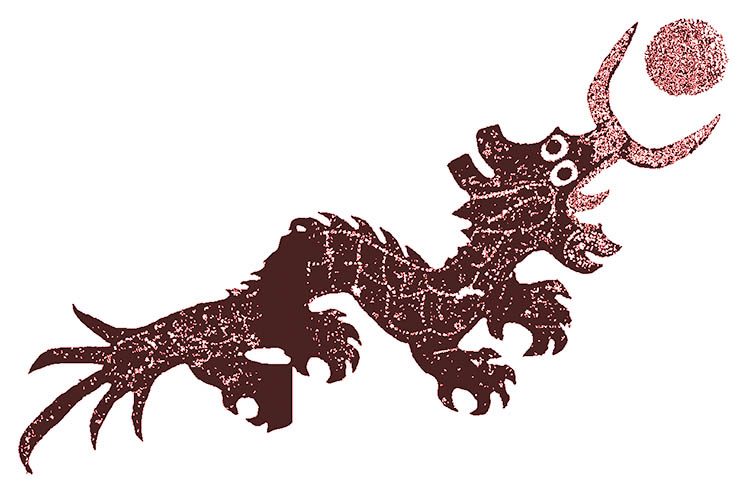
    The Amur River Society (Kokuryukai), later to become notorious in the West as the Black Dragon society, took over the work and traditions of the Black Ocean society in the years leading up to the First World War. Established in 1901 by a Black Ocean society leader and Buddhist monk, Ryohei Uchida, the Black Dragons, with their Pan-Asian vision, had links with the Triads and supported China’s 1911 Republican Revolution. Their agents undertook intelligence gathering operations in China, Korea, Manchuria, Mongolia, Siberia, and established relations with anti-colonialist circles in the Muslim world.

    Forming alliances with revolutionaries in Indochina, India, Indonesia and the Philippines, the Black Dragons also had close contact with several Buddhist sects. Throughout the 1920s and 30s the Black Dragon society supported Indian independence activities, providing political and financial assistance to Indian nationalists who looked to Japan as the only Eastern power capable of liberating Asia from the stranglehold of European colonialism. One such Indian nationalist was Subhas Chandra Bose (founder of the anti-colonialist Indian National Army), a correspondent in the 1930s for the influential German journal Geo-political Review, published by Professor Karl Haushofer.

    Major General Karl Haushofer encountered the Pan-Asian geopolitics and Buddhist mysticism of Japan’s secret fraternities during his time in Tokyo as the German military attaché. After the First World War, Haushofer became Professor of Geopolitics at the University of Munich where Rudolf Hess (later to become Hitler’s deputy) was his student assistant. Haushofer wrote that, “the struggle of India and China for liberation from foreign domination and capitalist pressure agrees with the secret dreams of Central Europe.” He urged Japan to come to terms with China and the Soviet Union, and consistently advocated an alliance between Germany and the USSR. This would facilitate what Haushofer called the “Eurasian continental organisation from the Rhine to the Amur and the Yangtze [rivers].”

    Some researchers are convinced Haushofer, a lifelong admirer of Oriental wisdom, was the emissary of “Unknown Superiors” in Asia, effectively acting as a crucial link between the Eastern secret societies and their European counterparts in the German lodges. The French authors Pauwels and Bergier mention a rumour that Haushofer was initiated into a secret Buddhist society and to have sworn, if he failed in his ‘mission’, to commit suicide “in accordance with the time-honoured ceremonial.” Haushofer, who committed suicide in 1946, is still remembered today by Russia’s Eurasian thinkers because he never reconciled himself to Hitler’s invasion of the USSR. Had the Nazi leadership taken note of Haushofer’s views, the Second World War could have been avoided. No doubt conscious of Haushofer’s remarkable role in hidden history, Anton LaVey, founder of the Church of Satan in the United States, dedicated his infamous Satanic Bible to the German general.

    By the start of the Second World War agents of Japanese secret societies, all lumped together by Western intelligence agencies under the name Black Dragons, were operating worldwide from North Africa to the United States. One successful Black Dragon agent in America was Satohata Takahashi. Sent to the US in 1929, Takahashi formed a mystico-political movement called the Society for the Development of Our Own, recruiting several thousand members to his Pan-Asian cause, most of them of African-American, Filipino, or East Asian descent. The “Five Guiding Principles” of the group were “Freedom, Justice, Equality, Liberty, and Honour.”

    Through Takahashi the Black Dragon society channelled financial aid to Black Muslim groups in the US. The Moorish Science Temple, founded by Noble Drew Ali in 1913, taught the true origin of Black Americans was “Asiatic.” Another Muslim teacher, Master Wallace D. Fard, the mysterious leader of the Allah Temple of Islam declared, “I’m an Asiatic black man. I have come to America to save my long lost uncle [the Black Americans].” Fard’s chief disciple the Honorable Elijah Muhammad, prophet of the Nation of Islam, told his followers, “It is Japan’s duty to save you; they have been given the power by the Asiatic nation to save you in the West.” Another organisation to enjoy Takahashi’s patronage was the Pacific Movement of the Eastern World, which campaigned for the US to stay out of the war and promoted the Pan-Asian agenda among non-white Americans.

    Based on intelligence reports from their agents around the globe, the Black Dragon leadership in Tokyo concluded in 1941 that the United States had secretly started preparing to enter the war against Germany, Italy and Japan. Fearing a surprise American attack on Japanese forces, the Black Dragons urged Japan’s military hierarchy to launch a pre-emptive strike on the US. “The signal for war in the Pacific was given on August 26, 1941, at a session of the Black Dragon Society in Tokyo,” an American author noted in 1944. After the Japanese attack on Pearl Harbor the espionage and sabotage operations carried out by the Black Dragons became legendary.

    However, the society’s original mystico-political vision of Pan-Asian solidarity and anti-colonialism had been subsumed in the pre-war years by Japanese ultra-nationalism and militarism. Many Black Dragon members were part of Japan’s industry and government, holding key diplomatic and military posts. With the Japanese surrender in 1945 some Black Dragons in government were charged as war criminals. But the Allied victory in Asia could not extinguish the dream of freedom. Japan had shattered the myth of the military invincibility of Western colonialism. The seeds sown by the secret societies flourished in a new wave of national liberation movements that led the peoples of Asia to independence in the years immediately following the end of the war.
    Political Intrigues of Secret Societies in the Modern World

    A century and a half ago, the British politician Benjamin Disraeli commented that, “the world is governed by very different personages from what is imagined by those who are not behind the scenes.” In our twenty-first century most people, mesmerised by the electronic media, are conditioned to dismiss the notion that secret societies may be tied-up with political intrigue. Yet Western intelligence agencies frequently rely on clandestine conspiratorial networks in their subversion of foreign governments. British intelligence services have a long history of involvement with underground ‘Muslim’ brotherhood groups actively opposed to the Arab nationalist states of the Middle East. The roots of the recent bloody conflict in the Russian republic of Chechnya can be traced to British intelligence service support of secretive ‘Muslim’ sects in the Caucasus. Many believe the American CIA is currently using a range of quasi-religious cults in clandestine operations aimed at destabilising the People’s Republic of China.

    “The history of the world is the history of the warfare between secret societies,” said the African American poet Ishmael Reed. Has world history been shaped by conspiratorial groups employing secret knowledge? Are the Anglo-American secret societies engaged in a titanic struggle with Eastern adepts and their allies?

    At a time when a shadowy global “war on terror” is used to justify increased government control and the serious erosion of personal freedom, we’d do well to recall the admonition of the Roman poet Ovid: “It is one’s duty to learn from the enemy.” The counterculture novelist William S. Burroughs once suggested the form of the Chinese secret society served as the perfect mode of organisation for marginal groups. Indeed, when the State becomes the oppressor of its own citizens, the only alternative is to disconnect and seek autonomy by any means necessary. The hidden history of secret societies may still have a lot to teach us.

    [alert type=”general” dismiss=”no”]This article was published in New Dawn 92.[/alert]

    [alert type=”success” dismiss=”no”]If you appreciate this article, please consider subscribing to help maintain this website.[/alert]

    Footnotes

    1. Jean Chesneaux, Secret Societies in China in the Nineteenth and Twentieth Centuries 
    2. Ibid.

    © New Dawn Magazine and the respective author.
    For our reproduction notice, click here.
  • The Rosicrucian Vision

    The Rosicrucian Vision

    The word “Rosicrucian” is one that most readers will have heard many times. Yet if I were to ask for a definition of the word I would probably be given a wide variety of different answers. I might be told that it was something to do with esoteric Christianity, with alchemy, or with Cabala. All of these things are part of the answer, but not the whole answer.

    So what is Rosicrucianism? For the time being let us call it a current of thought and ideas which has been flowing through history for at least three and a half centuries and probably quite a bit longer, sometimes underground, sometimes coming to the surface, but always pushing human beings towards certain goals. I say that we can trace the current back three and a half centuries because that was when it first came to the surface. So let us go back to that moment in history.

    The opening scene is Germany at the beginning of the 17th century. The Reformation had taken place just over a hundred years earlier. Now part of Germany was Protestant, part was still Catholic. The two sides had not yet reached any proper modus vivendi, and the tension between them was soon to erupt into the Thirty Years War, which was to prove one of the most disastrous wars in European history. So there was an expectation of coming calamity. And there was a feeling that European civilisation in general had somehow gone wrong. Now it was at this time that strange things began to happen in a certain part of Germany.

    We now focus on the town of Kassel. It was here, in 1614 and 1615, that there appeared two mysterious manifestos of unknown authorship. The first was in German, but its title was a mixture of German and Latin. It was called Fama Fraternitatis dess Löblichen Ordens des Rosenkreutzes, which means: The Fame (or Proclamation) of the Praiseworthy Order of the Rosy Cross. The second was called the Confession Fraternitatis, the Confession of the Fraternity.

    These documents told a curious story. They told of somebody called Christian Rosenkreutz who was born in the year 1378. As a boy of 16 he travelled to the Middle East and spent some time at Damcar in Arabia where there evidently existed some kind of utopian community. As the Confessio puts it: “those who dwell in the City of Damcar in Arabia… have a far different political order from the other Arabians. For there do govern only wise and understanding men, who by the King’s permission make particular laws.”

    At Damcar Rosenkreutz learned Arabic and received scientific and occult teaching and came into contact with a mysterious book, referred to simply as “the Book M”, which he translated into Latin.

    After three years at Damcar he was directed to go, via Egypt, to Fez in Morocco, which was, and still is, one of the holy cities of Islam and the site of one of the oldest universities in the world. So at the time Rosenkreutz is said to have gone there it would already have been a great centre of learning for many centuries. This is how the Fama describes his experience at Fez:

    “At Fez he did get acquaintance with those which are commonly called the Elementary Inhabitants, who revealed to him many of their secrets…” (Possibly what is meant by Elementary Inhabitants are the “Elemental Spirits” of magic).

    After two years at Fez he went to Spain hoping to impart his new-found knowledge but met only with hostility and mockery. And this experience was evidently repeated in other countries. So he returned to Germany and eventually gathered about him a small group of men who shared his ideals, and this was the beginning of the Fraternity of the Rosy Cross. The Fraternity had, as its headquarters, a building called the House of the Holy Spirit. The brothers dedicated themselves to studying and spreading the ancient wisdom and also travelled around doing good work such as healing the sick. One of them, it is said, went to England where he cured the young Earl of Norfolk of leprosy. Christian Rosenkreutz himself lived for 106 years, dying in 1484.

    After his death the brotherhood was continued by his successors. Then in 1604 the brethren were carrying out some rebuilding in their headquarters when they came across a hidden door on which was written in Latin: “after 120 years I shall open.” Behind the door they found a seven-sided vault illuminated by an artificial Sun placed in the middle of the ceiling. The floor, walls and ceiling of the vault were covered in symbolic figures, and there were also chests containing books and ritual objects. In the middle of the vault was an altar, and beneath the altar was a coffin containing the perfectly preserved body of Christian Rosenkreutz.

    This description of the vault was to capture many people’s imaginations. Two and a half centuries later the English occult society, the Golden Dawn, actually made a vault corresponding to the description in the Fama. One of the key rituals of the order, the Adeptus Minor initiation ritual, was a re-enactment of the discovery of Rosenkreutz’ body.

    The discovery of the vault was taken by the brethren as a sign that the time was ripe for the society to declare its existence publicly and to invite people of learning and goodwill to participate in the society’s aims and ideals. What were those aims and ideals? We don’t get a very clear idea from the manifestos, but it appears that the brethren believed in a system of universal knowledge incorporating theology, philosophy, mathematics, astrology, and so on. They were firm believers in Christ and the Scriptures. Furthermore, they claimed to have access to an ancient and secret body of wisdom which enabled them to interpret the scriptures correctly. What they appear to be referring to here is Cabala, which is, among other things, a means of decoding the Bible. They talk about being able to understand certain characters and letters which form the basis of all creation. Again, this seems to refer to the cabalistic notion that the universe is actually made up of the letters of the Hebrew alphabet in different combinations.

    Their beliefs can perhaps best be summed up in the word Gnosticism. By Gnosticism I mean the ancient belief that man’s spirit is imprisoned in matter by a mischievous creator. Man is, as it were, living underwater, not realising that up above is light and air and that if only he could swim to the surface he could get back to his true element. In the Gnostic view this predicament is not entirely hopeless because there are some people who possess Gnosis, that is, knowledge or wisdom which enables them to swim up and to teach this to others. (This Gnosis, this lifebelt of wisdom, is very often represented by a female figure. The Greeks called her Sophia.) This is the essence of Gnosticism, and this is, I believe, what lies behind Rosicrucianism.

    The Rosicrucians also knew about alchemy, in the sense of a dual process, physical and spiritual, in which the spiritual part was the more important. The early Rosicrucians clearly belonged to the Protestant rather than the Catholic camp. (There are some very contemptuous references to the Pope in the manifestos.) But, they felt that all of Christendom was in need of a new impulse. They believed that Europe was on the threshold of a new age in which spiritual, intellectual and political enlightenment and brotherly love would flourish, and they saw their role as being able to help usher in this new age.

    That essentially was the message of the first two manifestos, but, of course, what is not clear is whether the brotherhood existed at all or whether it was a deliberately created myth.

    In 1616 appeared a third Rosicrucian document published at Strassbourg, in German, under the title of Die Chymische Hochzeit Christiani Rosenkreutz (The Chemical Wedding of Christian Rosenkreutz). The title is slightly misleading because it is not about the wedding of Rosenkreutz himself but purports to be an account by him of his experiences as a guest at the wedding of a King and Queen. The wedding takes place in a castle which Rosenkreutz reaches after an arduous journey.

    The story is full of occult imagery. For example, on the fifth day of the celebrations, the guests are taken to an island in seven ships flying flags bearing the symbols of the planets. On the island an alchemical operation is conducted in a seven-storied tower, in which two homunculi are created from the bodies of six people who have been killed. In the roof of the Tower is a hole through which two souls descend and enter the homunculi. Finally, the company returns to the castle, this time in twelve ships flying flags of the zodiacal signs.

    The author of this document was a 19-year old man, Johann Valentin Andreae. Andreae was in fact a very important figure. He was a Protestant pastor and theologian, immensely influential in the German Protestant movement – in fact almost a kind of Luther of his day. And the strange thing about him is that in some of his later writings he referred very contemptuously to the Rosicrucian movement. In his autobiography, for example, he called it a “jest” – and this had led some people to say that the Chemical Wedding was in fact an attempt to debunk Rosicrucianism. I don’t believe this myself. I believe Andreae was – at least when he wrote the Chemical Wedding – very deeply involved with the whole Rosicrucian movement. So these three manifestos are the basis of the Rosicrucian movement as we know it.

    The effect of the three manifestos was astonishing. They stirred up a tremendous controversy in Europe. Many people wrote to the brotherhood hoping to be admitted. If any received replies they remain unrecorded. Other people attacked the brotherhood. Others claimed to be members of it. And in due course many societies were set up imitating the one that is described in the original manifestos – which, as I say, may or may not have existed. So what you ended up with was a core of mystery with huge ramifications, emanating out from these publications.

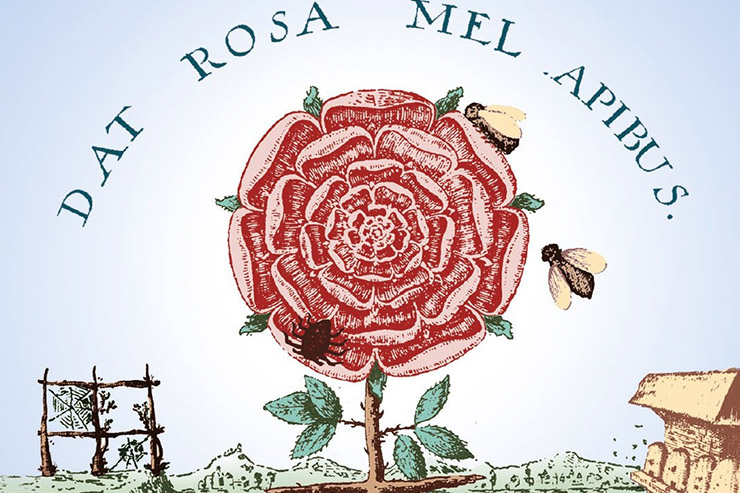
    Part of the appeal of the Rosicrucian movement lies in the richness of the Rose Cross symbol. It is possible to interpret this in all sorts of different ways. Both the cross and the rose are very ancient motifs. The cross appears in many religions and mythologies and seems to indicate a universal tendency for man’s inner consciousness to seek fourfold patterns: you have four points of the compass, four seasons, four elements, four worlds in the Cabala, and so on. The cross also suggests masculinity, and – in the Christian tradition – suffering, sacrifice and death.

    As for the rose, this can also be seen in many different ways. One of the things that the rose stands for is secrecy. The sign over Roman taverns signified that anything said in drunkenness would not be repeated – hence the expression sub rosa, meaning confidential. On another level the rose can be seen as the Western form of the lotus. Now the lotus, in Hindu mythology, represents the female life principle and is the symbol of the yoni or female sexual organs. So we have lotus/rose as female, cross as male.

    And if we look at ancient Egyptian mythology we find that Osiris, the god of the underworld who died and came to life again, is often shown wearing a crown of lotus flowers. So here we have another possible interpretation: lotus/rose = resurrection, cross = death. In other words, the Rose Cross represents the balance between a series of polarities: death and resurrection, male and female, sacrifice and the reward of sacrifice.

    It is an elusive symbol, but a very suggestive and powerful one. And it is typical of the great inner wisdom tradition of which Rosicrucianism is part, to use these shorthand emblems which carry deep layers of meaning. Many examples can be found in the emblem books of the 16th, 17th and 18th centuries – for example the famous image of the dolphin curled around an anchor, with the motto festina lente (“hasten slowly”). These emblems serve as a secret code through which those in touch with the inner traditions can communicate their ideas, but they also work at a deeper level than a message which is framed in straightforward words.

    So did the Rosicrucian plan misfire? I think not, because this is an interesting example of what happens when you plant a mystery in the collective mind of society. It’s like dropping a stone into a pond: the ripples go on and on. And, in this case, the initial impact was so strong that the ripples are still going today.

    And this, I believe, is exactly what the authors of the manifestos intended. They took the view that if you wanted to bring about a new age, the way to do it was to frame your ideals in the form of a legend, to cloak the legend in mystery and then to launch it in such a way that it was bound to create endless debate and controversy.

    How successful was this ploy? Did those men who launched the manifestos succeed in bringing about any of the reforms that they desired? You may well say – looking at the state of Western civilisation – that they failed. But before we judge, let’s look a bit more closely at some of the repercussions of the manifestos.

    Although the Rosicrucian philosophy was presented as a total package of religion, science, etc., it tended to divide into three different streams: first, there was the scientific, philosophical stream; secondly, the social and political stream; thirdly, the Hermetic-Cabalistic-Alchemical stream.

    There is evidence the first of these two streams gave rise to a number of learned institutions in various parts of Europe, including the Royal Society in England, which of course was, and still is, one of the most important scientific bodies in the world. Many of the inventions and discoveries that have shaped our environment have come out of the Royal Society. I shall not go in detail into the connection between the Rosicrucian movement and the Royal Society, but one link, for example, is through an interesting man called Comenius: a Bohemian refugee, a member of the Andreae circle, interested in Utopian ideas, who envisaged an ideal state in which science and religion would flourish side by side and in which men of all creeds and races would be respected. Comenius came to England in about the 1640’s and he knew the leading scientists of the time. And furthermore, it is clear that scientists such as Robert Boyle and John Wilkins knew all about the Rosicrucian movement. When the Royal Society was founded in 1660 it is very likely that it was in some sense an attempt to realise the scientific and philosophical side of the Rosicrucian ideal.

    It is also possible that Rosicrucian influences were behind the creation of speculative masonry. For example, there is a Scottish poem of the year 1638, which contains the lines:

    “For we be brethren of the Rosie Cross

    We have the Mason’s word and second sight”1

    So clearly there is at least some connection between Rosicrucianism and the early history of masonry. And in masonry we see really a combination of all three of the streams that I mentioned: the philosophical, the social and the esoteric. Here again there may be a link with Comenius, as he also knew many of the men who were behind the formation of the Grand Lodge of London.

    Think for a moment of the multifarious ways in which Masonry has influenced the world: its role in promoting the ideas of the Enlightenment, its influence on the French Revolution, the fact that a large proportion of the signatories of the American Declaration of Independence were Masons, the way in which it has impacted on literature, art, architecture and music, the famous figures who have been Freemasons, from Voltaire to Goethe and from Mozart to Churchill. It can be argued that all of this is indirectly part of the Rosicrucian heritage.

    Let me give you another example of the influence of Rosicrucianism in history. I mentioned earlier that many societies and fraternities have adopted the Rosicrucian label. One of the most important was a German fringe masonic group called the Order of the Golden and Rosy Cross. This Golden and Rosy Cross was a remarkable phenomenon. It was a kind of Golden Dawn of its day, bringing together many different elements and fusing them together in the same sort of way that the Golden Dawn did. In fact the Golden Dawn adopted the grade system used by the Golden and Rosy Cross.

    The aim of the order was described as follows: “to make effective the hidden forces of nature, to release nature’s light which has become deeply buried beneath the dross resulting from the curse, and thereby to light within every brother a torch by whose light he will be able better to recognise the hidden God… and thereby become more closely united with the original source of light.”2

    That passage is pure Gnosticism, and it confirms what I was saying earlier about the Gnostic character of the whole Rosicrucian movement.

    The Golden and Rosy Cross was founded in about 1757, and it soon had lodges all over the German-speaking world. There was, for example, a very active lodge in the duchy of Sulzbach. And it is no coincidence that Sulzbach at the time was a tremendous centre of Hermetic and Cabalistic studies. There was even a Hebrew press there.

    But the real heyday of the order came when one of its members became King of Prussia in 1786. This was King Frederick William II, successor to Frederick the Great. During his reign the court and government were dominated by a Rosicrucian clique led by the King’s two Rosicrucian mentors, Wöllner and Bischoffswerder. Wöllner was something of a fanatic, and there is a story that on one occasion he wrote to a fellow member of the order telling him to stop doubting that adepts of the 8th degree had the ability to hatch chickens out of hard-boiled eggs.

    Under Frederick William II Prussia became for a time virtually a Rosicrucian state. Unfortunately it all collapsed because Wöllner and Bischoffswerder pursued thoroughly reactionary policies, made themselves very unpopular, and were eventually turfed out when the King died and his son came to the throne. So the Rosicrucians – like any other body of men – sometimes failed.

    There are many other examples I could give you of the practical influence of Rosicrucianism. I could point to the mystical community of German settlers in Pennsylvania that was influenced by Rosicrucian ideas. I could point to the Golden Dawn and the enormous ramifications which that has had. I could point to the vast amount of literature, art, even music, inspired by Rosicrucianism.

    So it begins to look as though those early Rosicrucians did achieve something after all.

    When we look at something like Rosicrucianism, or at the Templars or at Freemasonry or at the legends of the Holy Grail, we are looking at the tip of an iceberg. I believe that behind these phenomena lies a very ancient current. What precise form it takes I know not, but I believe that every so often in human history this current comes to the surface. It can emerge in the obvious form of an esoteric movement. It can also come out in more subtle ways. It can come out in the arts or in science; in architecture, in garden design, in craftwork, in typography. But one usually recognises it when one sees it because it has a certain stamp of yearning for eternal beauty and truth.

    And at this point I should like to mention a piece of fiction that struck me as being a remarkable allegory of the Rosicrucian movement. It comes in a short story by Jorge Luis Borges called Tlön, Uqbar, Orbis Tertius. The essence of the story is this: you are asked to imagine a group of people who come together and decide that they will invent a fictitious country. They then decide that they cannot invent a country in isolation so they must invent an entire planet. And this is what they do. Furthermore they produce an encyclopedia of 40 volumes all about this planet, which they call Tlön. The encyclopedia contains minutely detailed descriptions of every aspect of this imaginary world: its geography, history, folklore, its religions, its languages and their grammar, its literature, and so on. Then they surreptitiously leak out clues about the imaginary world – at first just little things such as religious objects. Then they plant a copy of the encyclopedia in a library, and gradually this mysterious world starts to capture people’s imaginations to such an extent that the real world starts to imitate it. And towards the end of the story Borges writes: “A scattered dynasty of solitary men has changed the face of the world. Their task continues.” That could equally well describe the men who launched the Rosicrucian movement.

    In conclusion let me address the question: what is the relevance of all this to us today? In the first place, it is possible to draw certain parallels between the age of the Rosicrucian manifestos and the present day. There was the same feeling then, as there is today, that the world was in chaos and needed a change of direction. And there was the same expectation of a coming New Age. The Rosicrucians linked it with certain astrological indications. Likewise we link it with the Age of Aquarius.

    The Rosicrucian vision of the New Age is one that makes a lot of sense today. I mentioned the Rosicrucian emphasis on universality. One aspect of this is the need to draw together religion and science, so that the scientist always works in a spirit of service to God, as the alchemists did. Today we are seeing a renewed striving to reconcile science and spirituality. Furthermore this holistic vision has begun to embrace not just religion and science but many other areas of our culture including art, architecture, technology, politics and ecology.

    I think perhaps the most important thing about the relevance of the Rosicrucian path for us today is that it involves not only personal enlightenment but also service in the widest sense. We are talking about a complete vision, a dream of what humankind and the world could be like. If you want to have a dream, the Rosicrucian one is still alive.

    The above article is reprinted with permission from The Inner West: An Introduction to the Hidden Wisdom of the West, edited by Jay Kinney (published by Jeremy Tarcher/Penguin USA). It originally appeared in Gnosis 6 (winter 1987-88) under the title “The Rosicrucian Dream”.

    [alert type=”general” dismiss=”no”]This article was published in New Dawn 90.[/alert]

    [alert type=”success” dismiss=”no”]If you appreciate this article, please consider subscribing to help maintain this website.[/alert]

    Footnotes

    1. Henry Adamson, Muse’s Threnodia, quoted in Knoop, Jones and Hamer, Early Masonic Pamphlets (Manchester, 1945); p.30; cited in Frances A. Yates, The Rosicrucian Enlightenment (Boulder, Co: Shambhala, 1978), p. 211

    2. J.J. Bode, Starke Erweise (Leipzig: Goschen, 1788), p. 25.

    © New Dawn Magazine and the respective author.
    For our reproduction notice, click here.
  • Madame Blavatsky & the Spirit World

    Madame Blavatsky & the Spirit World

    From New Dawn Special Issue Vol 6 No 2 (Apr 2012)

    Séances. Mediums. Apparitions. And fraud. These are a few of the things that come to mind when the subject of Spiritualism comes up. Like so many things in the world of the occult, Spiritualism presents a dual face of mystery and deception. The minute one begins to believe, one comes across evidence suggesting that the whole thing may be a hoax. The minute one starts to think it’s a hoax, evidence appears to suggest there might be something to it after all.

    So also it must have seemed during Spiritualism’s heyday during the mid-nineteenth century. The craze began in the US, when in March 1848 two sisters, Margaret and Kate Fox, began to experience strange rappings in their house that, they claimed, had been generated by spirits. Soon they were able to work out a kind of Morse code with the raps so they could exchange questions and answers with the visitors from the other world.

    Although the sisters’ evidence was eventually called into question – Margaret Fox later admitted the whole thing was a hoax, only to retract her confession afterward – Spiritualism became one of the great fads of the era, to the point where even Abraham Lincoln attended a séance at the White House in April 1863.

    Another figure associated with Spiritualism had a rather ambiguous connection with the movement. Helena Petrovna Blavatsky, a Russian noblewoman turned spiritual adventurer, initially associated herself with Spiritualism, only to decry it later.

    Blavatsky’s own story is surrounded by its own amount of shadows and haze. By her own account, in 1849, at the age of eighteen, she left her elderly husband (to whom she had been married for a mere three weeks) and began a worldwide search for spiritual truth that took her as far afield as England, Italy, Egypt, India, and possibly Tibet. Around 1851, she claimed, she met a master from India who agreed to give her training in occultism if she would take part in a larger mission to disseminate the teachings of universal brotherhood throughout the world.

    Much of the next twenty years of Blavatsky’s life is hard to document. Both in her own account and in those of her followers, fact and legend are inextricably mixed. But one of the earliest places for which there is proof of her appearance is Cairo in 1871, where she found herself stranded after a shipwreck. Here she started a “Société Spirite [“Spiritualist Society”] “for the investigation of mediums and phenomena.” The ill-fated organisation foundered within two weeks, as the mediums drank and cheated; once a madman broke in to interrupt the proceedings. While there is evidence that the society did regroup and continue at least into the following year, Blavatsky was not part of it: she had gone further afield, first to Odessa in her native Russia, then to Paris, finally sailing to New York, where she arrived in July 1873 and where she made her first impact on a spiritually hungry public.

    Indeed one of the most significant encounters of Blavatsky’s life took place through Spiritualism. In the improbable setting of a remote farmhouse in Vermont, a spirit medium named William Eddy allegedly materialised a range of ghostly beings, who appeared in period costume. Eddy would sit in a narrow closet in his farmhouse, and a blanket would be hung across the doorway. Shortly after Eddy entered the closet, the blanket would be pulled aside, and the ephemeral image of a dead person would appear, only to disappear soon afterward, sometimes in the full gaze of the spectators.

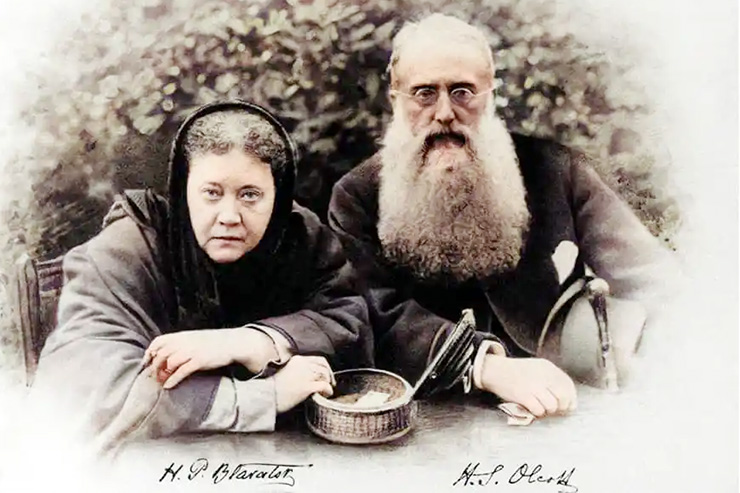
    At Eddy’s farmhouse in the autumn of 1874, the visiting Blavatsky met Henry Steel Olcott, a correspondent from a New York newspaper who had come to report on the phenomenon. Olcott later recounted that on the night of Blavatsky’s arrival, the Eddys’ closet produced the shades of “a Georgian servant boy from the Caucasus; a Mussulman merchant from Tiflis; a Russian peasant girl; and others… The advent of such figures in the séance room of those poor, almost illiterate Vermont farmers, who had neither the money to buy theatrical properties, the experience to employ such if they had had them, nor the room where they could have availed of them, was to every eye-witness a convincing proof that the apparitions were genuine.”

    What did Blavatsky believe about these phenomena? Her equivocal attitude toward Spiritualism is best illustrated by a clipping in her scrapbook. It is a copy of an article she wrote in 1875 entitled “The Science of Magic.” In the printed version of the article she states, “I am a Spiritualist,” but on the clipping she corrects the statement to “I am not a Spiritualist.”

    These contradictions are not necessarily the result of either schizophrenia or dishonesty. Blavatsky believed that the Eddy apparitions were real occult phenomena – but they were not the spirits of the dead. According to Olcott, she told him that if the Eddy phenomena were genuine, “they must be the [etheric] double of the medium escaping from his body and clothing itself with other appearances.”

    In an 1872 letter, Blavatsky explains her views: “[The Spiritualists’] spirits are no spirits but spooks – rags, the cast off second skins of their personalities that the dead shed in the astral light as serpents shed theirs on earth, leaving no connection between the reptile and his previous garment.” In the case of William Eddy, these astral shells would presumably have been using Eddy’s etheric body as a kind of subtle matter in order to manifest. In the Theosophical view, the astral body is discarded at a certain point after death. Usually it simply disintegrates as the physical body does, but under certain conditions, it can be inhabited by vortices of subtle energy that can make it appear to physical sight in the guise of the deceased.

    A similar, but not identical, phenomenon was displayed by Blavatsky herself. In November 1874 Olcott visited her in New York, “where,” he reported, “she gave me some séances of table-tipping and rapping, spelling out messages of sorts, principally from an intelligence called ‘John King’.” Supposedly the shade of the celebrated buccaneer Henry Morgan, “it had a quaint handwriting, and used queer old English expressions.”

    But Olcott eventually became convinced that “John King” was not the ghost of the long-dead Morgan. He later wrote, “After seeing what H.P.B. could do in the way of producing mayavic (i.e., hypnotic) illusions and in the control of elementals, I am persuaded that ‘John King’ was a humbugging elemental, worked by her like a marionette and used as a help toward my education. Understand me, the phenomena were real, but they were done by no disincarnate human spirit” (emphasis in the original).

    Elementals are, in the Theosophical view, nature spirits who live on the astral and mental planes. These entities are centres of force; they do not have any form in their own right. Hence they can be shaped and controlled by human thought, responding to the preconceptions of the perceivers, individual or collective. The so-called spirit of “John King” would have been an elemental that Blavatsky shaped with the force of her own will and concentration – as perhaps she had done in the Eddy farmhouse.

    The subtleties of these ideas are considerable, and it would be hard to disentangle them all in an article of this length. But the theory seems to go something like this: sometimes, as in Eddy’s case, a wandering astral shell can temporarily inhabit the etheric body of a medium and so make its presence known to the physical senses. In other instances, such as with Blavatsky’s phenomena, the will of an occultist can mould the subtle matter of the “astral light” into the shape desired.

    To dismiss these ideas out of hand would, in my view, be foolish. On the other hand, to verify them would require an intense training in esoteric practices that is difficult to come by. For our purposes, though, the essential point is clear. There is a middle ground between the allegations of the skeptics – that all spiritualistic phenomena are simply fraudulent – and the beliefs of the credulous, who take everything at face value. While there have been fraudulent mediums, it would be overhasty to dismiss every spiritualistic experience as a fraud. At least some of the phenomena associated with Spiritualism seem to be the play of forces in the astral realm, that domain of thoughts and images that is as plastic as the figments of our imaginations – and indeed contains them.

    [alert type=”general” dismiss=”no”]This article was published in New Dawn Special Issue Vol 6 No 2.[/alert]

    [alert type=”success” dismiss=”no”]If you appreciate this article, please consider a contribution to help maintain this website.[/alert]

    SOURCES

    H.P. Blavatsky, Collected Writings, vol. 1: 1874-78, Edited by Boris de Zirkoff, Adyar, India: Theosophical Publishing House, 1966.
    H.P. Blavatsky, The Letters of H.P. Blavatsky, vol. 1: 1861–79, John Algeo, ed, Wheaton, Ill.: Quest, 2003.
    Vicente Hao Chin, Jr., Theosophical Encyclopedia, Manila: Theosophical Publishing House, 2006.
    Joscelyn Godwin, The Theosophical Enlightenment, Albany, N.Y.: State University of New York Press, 1994.
    Mitch Horowitz, Occult America: The Secret History of How Mysticism Shaped Our Nation, New York: Bantam, 2009.
    Henry Steel Olcott, Old Diary Leaves, vol. 1, Adyar, India: Theosophical Publishing House, 1974.

    © New Dawn Magazine and the respective author.
    For our reproduction notice, click here.
  • Reincarnation: The Eastern View

    Reincarnation: The Eastern View

    Reincarnation has become an increasingly popular doctrine in the West. For example, polls taken in the US over the past couple of decades have shown that between 20 and 28 percent of the population believe in it. The figures for western Europe are similar.

    What explains the appeal of an idea that until recently was the province of a few occultists and eccentrics? Some of it can be explained by the appeal of Asian religions, such as Hinduism and Buddhism, to which reincarnation has always been integral. But this does not explain much: you could turn the argument around and say that Hinduism and Buddhism are so appealing because they teach reincarnation.

    The allure of the doctrine is easy to see, particularly when it is weighed against the conventional Christian view of heaven and hell. The latter is hard to defend in the light of any real sense of cosmic justice. It holds that the deeds of an individual’s life on earth will bring upon him either eternal reward or eternal damnation. And this is hard to swallow. Even the greatest monsters of history, no matter how many evil acts they committed, committed only a finite number of acts. How can even these extreme cases merit an infinite series of punishments?

    By contrast, the doctrine of reincarnation, along with the closely associated doctrine of karma, holds that evil acts do entail retribution – but only in proportion to the act. The punishment suits the crime. Nor do good deeds done in a single life win the individual an infinite life of bliss, merely a limited number of auspicious future lives.

    The idea of reincarnation has also spread because of the specific form in which it has been disseminated. Many of the ideas about reincarnation in New Age and other sectors of alternative spirituality can be traced back to the influence of Theosophy. During the 136 years of its history, the Theosophical Society, always a tiny organisation (worldwide membership in 2008 was under 21,000), has been influential out of all proportion to its numbers.

    The Theosophical view of reincarnation is fundamentally an optimistic one. There is a purpose to these nearly endless cycles of birth and death. It is the education of consciousness. The Self descends into the darkness of materiality through a process known as involution. Then it begins to reascend, through a process known as evolution. This is not the evolution of the Darwinists, which is essentially a blind and meaningless process. Rather it is a carefully structured series of lessons in identifying with, and then detaching oneself, from the material world. Each separate incarnation is a tiny phase of this process.

    Thus the trajectory of the journey of each human soul is an upward one. An evil or misspent life is only a delay or setback in a process that is ultimately going in a positive direction in any event.

    When it’s stated this way, one immediately sees why this idea is so appealing. Far more than the conventional Christian view – or the secular materialist view, which holds that death is final and nothing survives the body’s demise – the evolutionary picture of reincarnation speaks to the current age, with its deeply rooted belief in progress.

    This view of reincarnation, pioneered by the Theosophists, differs in some major ways from the pictures given by Hinduism and Buddhism. These portray the soul’s progress not as an ascent upward, where success is ultimately guaranteed no matter how many setbacks take place along the way, but as a merciless whirligig from which the only recourse is to escape. Indeed, they teach that we have lived through this cycle a virtually endless number of times already. In the Hindu Katha Upanishad, Death says:

    The passing-on [i.e., death] is not clear to him who is childish,

    Heedless, deluded with the delusion of wealth,

    Thinking “This is the world! There is no other!” –

    Again and again he comes under my control.

    And in one of the Buddha’s discourses we read, “What, monks, do you think is more: the water in the Four Great Oceans or the tears, which you have shed when roving, wandering, lamenting and weeping while on this long way, because you received what you hated and did not receive what you loved?”

    The fundamental cause of this cycle of rebirths, in both Hinduism and Buddhism, is ignorance or heedlessness. The remedy is enlightenment, which (in Hindu terms) leads to moksha or release, or (in Buddhist terms) to nirvana, or cessation. For the rest of this article, let us focus specifically on Buddhism.

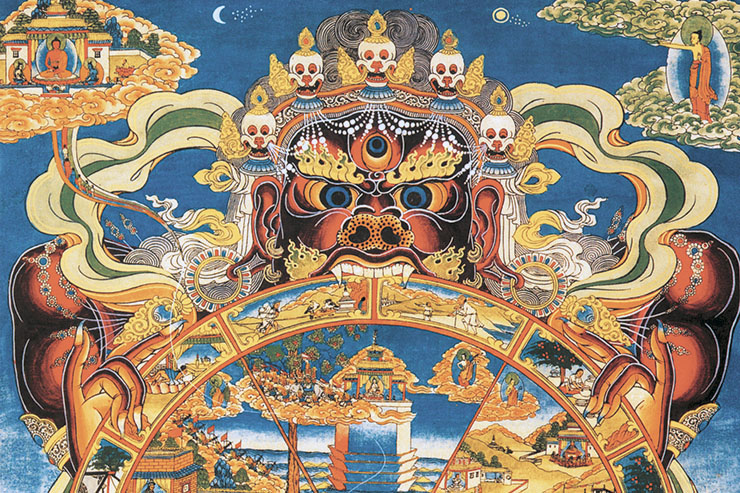
    One of the most elaborate pictures of the cycle of births and deaths can be found in the Tibetan Buddhist Wheel of Birth and Death. While the symbolism of this wheel is too intricate to describe in full here, one thing it depicts is the six realms of existence, three of which are bad, three of which are comparatively good. The three good realms are those of the gods, the asuras or demigods, and humans. The three bad realms are hell, the realm of the pretas or hungry ghosts, and the realm of animals.

    Beings are drawn to the hell realms through acts of violence and cruelty. As in Christian teaching, these are places of unimaginable suffering. The thirteenth-century Tibetan sage Longchenpa writes:

    All the tears you have shed would be more (than the water) in the four oceans,

    And the amount of molten metal, foul blood, and excrements

    You have consumed when your mind had become a denizen of hell or a spirit [i.e., a preta]

    Would not be matched by the rivers flowing to the end of the world.

    Longchenpa again emphasises the circularity of this process: his description of hell is not a warning of future punishment, but a reminder to the aspirant of what he has already undergone during many lifetimes in the immeasurable past. Buddhist teaching differs from that of Christianity by saying that since karma is finite, the suffering of hell beings and pretas, though enormous, is finite as well.

    The animal realm is less painful than the worlds of the hell beings and hungry ghosts but scarcely more desirable. Humans are drawn there by bestial behaviour – by obsession with food or sex, the cravings that we share with the animals. While animals do not suffer continually, they too are beset with pain and grief. Moreover, they do not have the mental capacity to achieve liberation, “not realising the natural misery of their state,” as Longchenpa puts it.

    The human realm, although it too is characterised by suffering, is the most auspicious. Buddhist texts emphasise the rarity and preciousness of a human birth. The sage Nagarjuna writes:

    More difficult is it to rise
    from birth as animal to man,

    Than for the turtle blind to see
    the yoke upon the ocean drift;

    Therefore, do you being a man
    practice Dhamma [the Buddhist teaching] and gain its fruits.

    Here lies the advantage of being born into the human realm. Individuals here are not so deeply immersed in suffering as they are in the realms of hell beings and hungry ghosts. Nor are they in such favourable circumstances as the gods, who enjoy so much pleasure and delight that they have no interest in liberation, or even the demigods, who have relatively enjoyable circumstances but are tormented by the jealousy of the gods, with whom they wage continual warfare. The human existence is an intermediate one, where beings are endowed with enough intelligence to follow the path to liberation but not so intoxicated with pleasure that they have no interest in it.

    Note that the gods and demigods, though their lives are pleasant compared to ours, are not immortal. Eventually their good karma is exhausted and they fall down into less favourable realms. This goes on endlessly. In one traditional text, a sage who is asked about the power and strength of Indra, king of the gods, points to a line of ants marching on the ground and says, “Each of those ants has been an Indra.”

    It would be mistaken, however, to conclude from all this that Buddhism is at its core a pessimistic, world-denying doctrine, as many have done. The German scholar of Buddhism Hans Wolfgang Schumann observes, “To assume that in their present life more than a few advanced seekers are able to conquer craving and ignorance would be to overrate man. Most men will need a long time, a whole series of rebirths in which by good deeds they gradually work themselves upward to better forms of existence. Finally, however, everyone will obtain an embodiment of such great ethical possibilities that he can destroy craving and ignorance in himself and escape the compulsion for further rebirth. It is regarded as certain that all who strive for emancipation will gain it sometime or other.”

    Schumann is referring to the attitude of the Theravada (“way of the elders”), one of the two primary divisions of Buddhism. The other sector, known as the Mahayana (or “great vehicle”), which includes such lines as Tibetan Buddhism and Zen, moves still further in a universalistic direction. It encourages its adherents to strive, not for nirvana per se, but for the condition of the bodhisattva – one who renounces or rather postpones enlightenment to work on behalf of the illumination of all sentient beings. In short, both sectors of the Buddhist tradition are ultimately positive in nature. If they do not teach evolution as such, they nevertheless hold that the gates of mercy are infinite and will eventually accommodate all beings, no matter how far they may seem from their goal.

    [alert type=”general” dismiss=”no”]This article was published in New Dawn Special Issue Vol 6 No 2.[/alert]

    [alert type=”success” dismiss=”no”]If you appreciate this article, please consider subscribing to help maintain this website.[/alert]

    SOURCES

    Robert Ernest Hume, ed. and trans., The Thirteen Principal Upanishads, 2d ed. Oxford: Oxford University Press, 1931.

    Klaus K. Klostermaier, A Survey of Hinduism, 3d ed., Albany, New York: State University of New York Press, 2007.

    Longchenpa, Kindly Bent to Ease Us, Part One: Mind, Translated by Herbert V. Guenther, Berkeley, California: Dharma Publishing, 1975.

    Hans Wolfgang Schumann, Buddhism: An Outline of Its Teaching and Schools, Translated by Georg Feuerstein, Wheaton, Illinois: Quest, 1974.

    © New Dawn Magazine and the respective author.
    For our reproduction notice, click here.
  • Consciousness: The Beginning & the End

    Consciousness: The Beginning & the End

    Nothing is more certain than the fact that we are conscious. And yet there is something very puzzling, even uncanny, about being conscious; and the learned talk of the mystery of consciousness. The mystery centres around the origin of consciousness; the prevailing scientific view is that consciousness is a property that emerges from complex brains. The problem is that we haven’t the foggiest idea of how the stuff of our minds could conceivably come forth from anything physical. Bits of electrified meat don’t easily translate into episodes of consciousness – we have it, we know it, in some sense we are it – but what it is and where it came from escapes us.

    There is also a mystery about the future of consciousness – I mean for each one of us there is the mystery of what comes after death. There’s no easy answer to the ‘after’ question, but I will offer my opinion, based on my own experience and research. We might begin by saying that the imagination of the human race is clearly in the affirmative about the ongoing journey after death. The mythic consensus is that consciousness continues after death, and does so in many forms and styles; accounts are recorded in the history of religion and poetry and more recently in the annals of psychical research. No doubt individuals have always had their private views and hunches on the great mystery. But a crucial turn of events took place in the seventeenth century; the scientific revolution began to overthrow the entire mythical worldview of humanity with its instinctive sense of gods and souls and spirits. The sky was disrobed of its divinity and turned into meaningless emptiness; according to Leopardi’s Story of the Human Race, all the illusions of the imagination were exposed and a great void of meaning settled down triumphantly in their place. Our consciousness, the new prophets of reductive materialism declared, will vanish with the brain’s entropic rot.

    Are we really forced into this worm’s-eye view of reality? People generally go along with the stories, rites, and customs for dealing with death that they inherit. But some break free and think for themselves. Some are exposed to modern scientific ideas (possessed by the conceits of reductive materialism) and the idea of another world starts to seem unreal. And yet, our views (apart from fashion) continually change in the face of new and unexpected experiences. So how we view death and the fate of our consciousness is sometimes based on the kinds and intensities of experience we have. For example, I am at least open to the idea of something going on after death because of some odd experiences I’ve had. (For an account of some of these, see my Soulmaking [1997] Hampton Roads: Charlottesville, VA.) A person who has had an unusual experience is likely to be more receptive to the idea of postmortem survival. Of course, one might have such a vivid encounter, and still in the end dismiss it as some seductive delusion. Others, on the other hand, may embrace great cosmic schemes on the basis of trivial coincidences.

    I have come to form my own view based on my experiences and my own thinking. My attitude toward this question of life after death is slightly odd. Three times I had encounters that were clear evidence for something smacking of survival, (including on one occasion being attacked and physically paralysed by a ghost), and yet I have doubts; I lack robust confidence that I will survive. Nevertheless, I would insist there are good reasons not to be cowed into premature disbelief.

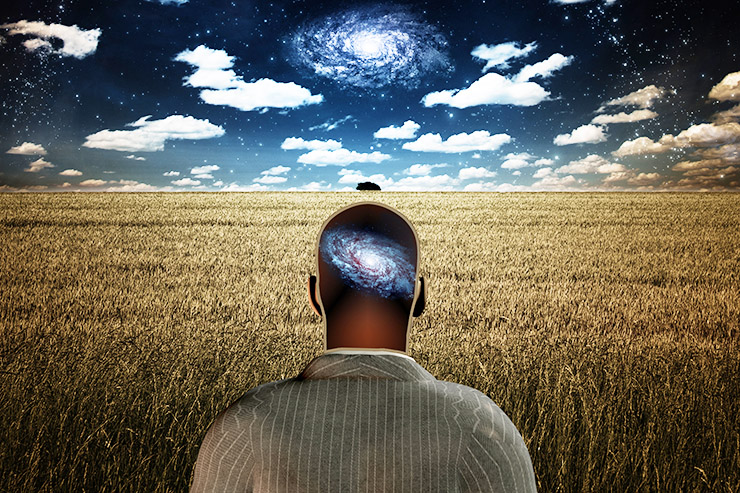
    We can be silent about the dreaded subject or we can discuss and confront it. Moreover, it seems natural enough to yearn for more life, for infinite life, and there is no reason to suppress, condemn, or feel embarrassed about these yearnings. Let me explain one reason I resist the idea of survival. If indeed consciousness is an emergent property of the brain, it’s hard to suppose it could go on when the brain dies. In spite of being acquainted with ghosts and telepathy and precognition, the initial dependence on and emergence from the brain weighs against the idea of survival. But there is a way to move ahead on this. It is to drop the assumption that consciousness must be a product of the brain. Consciousness, after all, is utterly different in kind from anything physical we are acquainted with (barring certain abstract resemblances to quantum states). If one thinks carefully about it, the idea that consciousness grows out of our brains is more a verbal construct than an intelligible idea.

    Does the Brain DETECT OR Transmit Consciousness?

    Some scientists and philosophers have indeed argued that consciousness is not produced by the brain; rather, they hold that the brain is more like an organ that detects or transmits consciousness than produces it. According to this view, consciousness pre-exists and transcends body and brain, although it interacts with them. The important move is this: if we deny that consciousness is born from the brain, there is no reason to believe it must disappear with the death of the brain. (This is similar to an argument used by Plato in the dialogue Phaedo.) Now this shift toward the idea that we possess or are constituted by an irreducible mental factor has certain advantages. One of them William James noticed in his Ingersoll Lecture on Immortality of 1898: we are no longer obliged to try to figure out how the brain could create consciousness. If it’s so hard trying to explain consciousness as an emergent property of brains, it may be because it does not emerge from brains in the first place. Henri Bergson makes a similar point by suggesting that the mind by its nature continually overflows the boundaries of brain and body.

    This hypothesis of the irreducible nature of mind is consistent with the idea of postmortem survival. As pointed out, if the beginning of consciousness is not essentially tied to the brain, then death of the brain needn’t imply death of consciousness. This way of looking at consciousness as something basic in nature has other advantages. It is in tune with the great spiritual traditions that posit the primacy of some kind of greater mind. It also helps explain unusual mental functions like extrasensory perception. Consider something like telepathy, direct mind-to-mind contact. According to the view we have touched on, we are already mentally connected, it’s just that our minds generally cluttered with sensations and all kinds of distracting thoughts screen us (some would say protect us) from the mental life of others; if through some accident or discipline we could remove the clutter we would “see” things otherwise occluded.

    But there is something else. Our revision provides a basis for a type of experimentation that promises to induce experiences, impressions, and insights into the mystery of life after death. For this very personal question of life after death, there are things we can do; alter our life style, revise attitudes and values, and adopt specific practices. Reading about case histories and weighing all the arguments and interpretations are necessary and admirable. We need to supplement this indirect method by practice. And we need to experiment with the most fascinating subject we can readily find – ourselves.

    Break on Through to the Other Side

    Throughout history people have engaged in practices designed to help them “break on through to the other side” (The Doors). Certain kinds of people are more suited for this kind of venture: edgy, neurotic, strong-willed. These are the people who practice divination and shamanism; inspired poets, dancers and musicians; prophets and mystics; or ordinary people who find themselves in extraordinary, dangerous, life-threatening situations. By accident or by deliberate practice, human beings have and continue to have encounters with the transcendent. In terms of our practical hypothesis, they are either forced by circumstance or choose by discipline to remove the clutter of their ordinary mental life, so as to increase the likelihood of being struck by some form of transcendent lightning.

    There is nothing terribly strange about calling for this kind of self-experimentation. Traditions of the world are full of such practices. The native peoples of the Americas have always cherished their vision quest in highly individual ways. In the ancient world there were all sorts of mystery religions, which were group inductions into what Aristotle called pathe, experiences, not episteme, rational cognition. Like the native Americans, techniques of fasting, dance, chant, manipulation of symbols, etc., were used to induce contact with spirits, gods, and goddesses. Most famous were the Eleusinian Mysteries that lasted two thousand years in ancient Greece, an annual rite whose most notable effect was to create confidence in the soul’s immortality; after a nine day fast, the ingestion of a kykeon or “brew” of beer and psychoactive ergot, the rite culminated in the telesterion: the Goddess Persephone appeared in a blaze of glory. The experience was transformative as we know from testimonials of various notables, including Cicero and Sophocles and (indirectly) Plato. Different mystery rites used different gods to induce their encounter with the powers suggestive of immortality.

    With the rise of Christianity, a new mystery was invented called the Mass. As Carl Jung has explained, the Mass is a classic mystery rite in which the divine and immortal powers temporarily become present on the altar and the human becomes one with the God. And in the ancient world, even philosophy, especially as practiced by Platonists and neo-Platonists, was a kind of mystery rite designed to induce direct awareness of other worlds and higher dimensions of reality. Modern analytic philosophy would be at the antipodes of ancient philosophy, which was always about radical liberty and self-transformation. So, for Plato, philosophy was defined as the “practice of death” – in short, detachment of the psyche from the soma. To “practice death” is to quiet the distracted brain and open oneself to the greater consciousness.

    It is certainly an ironical fact that in this age of science and technology that seems to sponsor materialism, medical science is responsible for thousands of paradigm-challenging near-death experiences. NDEs and the Eleusinian rites have this in common: they produce feelings of confidence about the reality of another world. The near-death experience has become the equivalent of an ancient Greek mystery rite.

    In 2001, the Dutch cardiologist Pim van Lommel published a paper in the Lancet that described about a hundred and fifty cases of cardiac arrest in which individuals reported NDEs. This publication made headlines around the world. What is interesting is that these people had any experiences at all. The mainline view of neuroscience is that to have any conscious experience, certain specific parts of the brain (stem, frontal cortex, etc.) must be functionally interacting. But the moment the heart stops, blood stops flowing to those brain parts, so they can’t function. Nevertheless, in these cases, not only are there conscious experiences but experiences of an exalted character; brain quits working but consciousness doesn’t; on the contrary, it expands and intensifies in cognitive scope and richness of meaning. The NDE, instead of reflecting materialist views of mind, reflects the traditional view of mind as an independent reality – to be released not annihilated at death. In a near-death incident, the ‘filter’ on the full flood of consciousness is ripped away; the famous luminous bliss-drenched experience results. According to near-death research, deprived of a functioning brain, you may still have profound, conscious experience. This is an extraordinary scientific discovery.

    It would be a mistake to focus on one strand of evidence, however striking. What the diligent seeker of the mysteries must do is gain a sense of a whole family of pressure points on the belly of reductive materialism. We began by pointing to the sheer fact of consciousness, which is the basis of everything, and about which we know practically nothing. But there are specific features of consciousness that are suggestive for our purposes. Physicist Steven Weinberg, who thinks physics is inching toward a theory of everything, admits he would love to unpack the riddle of memory. Nobody even knows for sure if memory is even “stored” in the brain no less how.

    Memory Puzzles

    There are oddities of memory that compound the mystery of consciousness. A phenomenon only recently being studied is called ‘terminal lucidity’. These are cases widely reported of persons suffering from Alzheimer’s or other forms of brain disease unable to recognise even members of their own kin; then, at a time very near death these persons suddenly regain their memories, as if their conscious minds were starting to disengage from their brains in preparation for departure. Other puzzles about memory involve the stupendous mnemonic feats of some people afflicted-blessed with so-called ‘savant-syndrome’. And let me say that we fail to appreciate the astonishing creative power of the most common dream, in which an individual fashions for himself out of nothing a full-spectrum sensory world that one becomes completely immersed in – surely a phenomenon to give the earnest neuro-fundamentalist a headache. All these intellectually squishy spots we are palpating have something in common: the phenomena – dreams, terminal lucidity, and the enlarged mental faculties associated with arrested development – all these seem to be related to consciousness being forced back into itself. We attain to the omnipotence of dream, when (like the mystic) we cast aside reason and sense in sleep. The omnipotence of memory, whether with savant or near-death experiencer, seems to result from being robbed of the capacity to negotiate the external world. Again, the ‘filter’ is debilitated or entirely cast off.

    What I’m trying to say is this: Anyone who craves a more inwardly felt conviction not only concerning their survival but the qualitative value of that survival, should head for the green fields of personal experimentation. It would, however, help to know that behind us stands a mass of human experience that seems to say, “Yes, we found something – come on! Do not fear!” It would be useful to bear in mind the lush variety of tales, stories, and authenticated reports contending or implying that real people survive bodily death.

    It seems important there are many forms of experience that seem to reveal different people survived death. The manifold of breakthroughs seems to fit with the theory that has guided these reflections. The notion is that we – our individual mind-bodies – are immersed (so to speak) in a sea of consciousness. The pressure is constant on us, so to speak, and the slightest crack or fissure in our cognitive apparatus will cause a cascade into our consciousness.

    There is a well-known case of a man from North Carolina being visited by his father’s angry apparition during a series of dreams. The father proved himself by instructing his son as to the whereabouts of his hidden but final will and testament. He had hid it in an old Bible, and then died. The will was found and probated in court; it led to a more fair distribution of the father’s estate. Mr. Chaffin was dead for four years; no one knew the whereabouts of the will he had hidden in the old Bible until an apparition of the dead man revealed it to his living son. Actually, there is a parallel story about the last missing Cantos of Dante’s Divine Comedy. They were said to be missing until Dante’s son received intelligence from a dream of his illustrious father. Hidden in a secret compartment sequestered in a wall, the manuscript was found. In general, there are patterns of phenomena that are like words in a language that seems to want to speak to us. Such patterns cluster around the event of death. An interesting example would be the psychokinetic events often reported to occur at the moment of somebody’s death. Ernesto Bozzano collected cases of clocks stopping at the moment of death, paintings falling off walls, glassware shattering, pianos playing themselves, and in fact a huge variety of actual occasions. What appears to be happening is that a psychic factor at the moment of death is released and expresses itself in some meaning-bearing part of the environment. Again, the idea of death as a transition to enhanced power is indicated.

    As I said, the paths to post-mortem consciousness are manifold. One way is via reincarnation, and here I must mention the massive achievement of Ian Stevenson in collecting case histories all over the world. Thousands of carefully assessed cases – to use Stevenson’s word – suggest that memories, likes and dislikes, physical habits and even bodily marks may be identified usually among children no older than eight years old. Stevenson’s work has implications for understanding the depth and complexity of the human personality. These may shape our lives even if for the most part we are consciously out of touch with them. The Buddha once said that a person can see all his or her previous lives at the moment of enlightenment.

    Discarnate Intelligence

    Mediumship is another way that information about other worlds and discarnate intelligence may be obtained. Mediumship is found in the vicinity of ecstasy and possession. Mediums generally deploy ‘controls’, psychic constructs essential to make contact with the subliminal universe. A striking bit of evidence for life after death came about at the turn of the last century. The medium was the great Leonora Piper, under the careful investigation of the highly critical Richard Hodgson. It happened that Piper obtained a new control, called GP (for George Pelham); in life, he happened to be an acquaintance of Hodgson. The younger man was skeptical about survival, and promised offhandedly that should he die first, he would do his best to prove it to Hodgson. Soon after he fell off a horse in New York and was killed. Soon after that he was claiming to be speaking and writing through the body of Leonora Piper (as her new ‘control’). Hodgson wrote up the ensuing experiments in painstaking critical detail, and published the five hundred pages in the English Proceedings for Psychical Research. During “GP”’s tenure as control of Piper, “he” received one hundred and fifty people, thirty of whom GP in life personally knew. The personality that acted through the medium’s body behaved in a recognisably consistent manner, always in character and knowledgeable of precisely the thirty persons he knew in life, never confusing anyone he knew in life with any of the remaining strangers at the sittings. In short, the persona acting through Piper’s vocal chords and nervous system acted exactly like the real personality of a deceased person – a very difficult case to dismiss.

    So there is some robust evidence for life after death – as well as much that is tantalising and dubious. In the meantime, if you are impatient, you can try to launch your consciousness out of this world here and now and not hang on mincing proof, nor care about arguments or degrees of their weightiness. It might for all we know be very easy to gain an insight into the beginning and the end of consciousness. “Imagination is Eternity,” said William Blake who also said that death was just stepping from one room into another. It may not be possible to step all the way in, but you may be able to push open the door for a peek.
    [alert type=”general” dismiss=”no”]This article was published in New Dawn Special Issue Vol 6 No 2.[/alert]

    [alert type=”success” dismiss=”no”]If you appreciate this article, please consider subscribing to help maintain this website.[/alert]

    © New Dawn Magazine and the respective author.
    For our reproduction notice, click here.