New Dawn – World's Most Unusual Magazine

Category: Articles

  • Search for the Mind of God

    Search for the Mind of God

    From New Dawn 127 (Jul-Aug 2011)

    Stephen Hawking famously ended his 1988 bestseller A Brief History of Time with the statement that, if and when physics finds its long-sought grand unified field theory “we would know the mind of God.”1 Although since then he has reportedly regretted the phrase, and famously announced in 2010 that “God did not create the universe,” his original statement was – knowingly or not – in fact simply a repetition of the underlying quest of the historical scientific revolution.

    All its great pioneers, from Copernicus to Newton, were motivated by the passionate belief that by discovering the way the universe works they were not only uncovering God’s design, but also taking humankind closer to the divine. Science was for them primarily a spiritual quest. And, given the evidence, that’s precisely what it should be now.

    Despite rather desperately cowering behind the wall of strident rationalism most of them are famous for, the startling truth is that cosmologists and quantum physicists themselves have revealed that the mind of God may be much nearer than we think. Science itself has effectively proven that ours is not a random universe. Science itself has demonstrated it was literally designed for life, which implies a designer… But as science itself – in general – is rather backward in coming forward about this, permit us to explain.

    The sensational conclusion that the universe appears to be meant began to be formulated with the famous ‘anthropic principle’ brought to the attention of the scientific community at the end of the 1970s by the seminal Nature paper by British cosmologists Bernard Carr and Martin Rees. The latter, now Lord Rees – Astronomer Royal and President of the Royal Society until 2010 – recently attracted the disdain of many colleagues by accepting the annual million-pound Templeton Foundation prize awarded for an “outstanding contribution to affirming life’s spiritual dimension.” Quite something for a mainstream scientist – and of course hugely controversial.

    The Designer Universe

    At its most basic, the anthropic principle states that all the cosmological data shows the laws of physics are, to an uncanny degree, exactly the ones needed for a bio-friendly universe. According to Paul Davies’ book The Goldilocks Enigma (2006) conditions are, like her porridge, “just right” for organic life. It needs precisely our kind of universe: relatively stable, with galaxies and stars – and this was by no means inevitable: if things were even slightly different matter could never have coalesced, or the universe would be riddled with black holes, preventing the formation of heavenly bodies. Life requires certain chemical elements, primarily carbon, which need stars to manufacture them and disperse them in their supernovae explosions. It also needs planets where the building blocks can be assembled for living beings to develop.

    All this requires not only fundamental particles and energies to possess particular values, but the relationships between them must be very precise. Carr and Rees noted that for almost every variation of the physical laws, a bio-friendly universe would be impossible. Yet as Hawking writes, “a series of startling coincidences” make the laws of physics “a system that is extremely fine-tuned” to produce conditions propitious for life.2 Freeman Dyson, the British-born American physicist, writes that there are “numerical accidents that seem to conspire to make the universe habitable,”3 while Paul Davies notes the “ingenious and seemingly contrived ways”4 the laws of physics allow the creation and dispersal of the elements necessary for life – and that we appear to live in a “designer universe.”

    More astoundingly, as all the values were ‘set’ by the big bang – if the conditions at the start of the universe had been say, bigger and bangier or smaller and less bangy (sorry for the technical terms), the physical laws would also be different – then life seems to have been an integral part of the design from the very beginning.

    One of the first examples of the fine-tuning to be recognised, back in the 1950s, is the formation of carbon – quintessential to organic life – which like all except the simplest three elements is forged in the centre of stars. However, scientists had long realised that according to conventional wisdom, carbon shouldn’t exist at all (or if it did it should be extremely rare). Even the vast temperatures and pressure in stars shouldn’t produce enough energy for stable atoms to form. But we now know there is a lucky fluke – a quantum effect known as resonance – which produces a ‘spike’ that enormously amplifies the energy to exactly the right value. This only happens for carbon.

    The scientist who worked out the process, the maverick British astronomer and mathematician Fred Hoyle, was so astonished by the coincidence that he famously described it as a “put-up job.” In a 1957 lecture he observed:

    If this was a purely scientific problem and not one that touched on the religious problem, I do not believe that any scientist who examined the evidence would fail to draw the inference that the laws of nuclear physics have been deliberately designed with regard to the consequences they produce inside the stars. If this is so, then my apparently random quirks have become part of a deep-laid scheme. If not then we are back again at a monstrous sequence of accidents.5

    The most recently-discovered example of fine tuning is perhaps the most compelling. This relates to ‘vacuum energy,’ a force arising from ‘virtual particles’ that fill even empty interstellar space, and which has a profound effect on the universe, since it determines its rate of expansion and this in turn determines how life-friendly it is. If the universe was expanding too quickly, then gravity would be unable to build galaxies, planets and stars; if too slowly, then all matter would be pulled back to the ‘big crunch’ before life had time to evolve. Obviously, our universe is expanding within that critically narrow range that allows it to be bio-friendly. But only recently has it been discovered how narrow – indeed, wafer-thin – that range is.

    It all hangs on the rate of expansion, determined by the balance between the negative and positive energy of the virtual particles. In the mid-1990s, based on new improved data from the Hubble Space Telescope and other sources, cosmologists were finally able to calculate the balance. It turns out that the negative energy cancels out all but an infinitesimal amount of the positive – all but 10120 (that’s 119 zeroes after the decimal point and before the 1).

    But the scary thing is that if this number was just one decimal place shorter – 10119 – then the universe would be expanding too quickly: there would be no stars and no planets. That tiny decimal place is the difference between life and no-life. The leading American theoretical physicist Leonard Susskind wrote: “This seems like an absurd accident and we have no idea why it should happen. There is no fine-tuning quite like this in the rest of physics.”6 Nobel prize-winning theoretical physicist Steven Weinberg commented in 1993 that if the extraordinary balancing act of the vacuum energy was confirmed then, “it will be reasonable to infer that our own existence plays an important part in explaining why the universe is the way it is,” but went on, “For what it is worth, I hope that this is not the case.”7 Unfortunately for Weinberg, it has since been confirmed. It is the case.

    It’s rather like winning the lottery (we assume). If our numbers come up we might think we’re clever or destined to win but of course it would be just chance. Not so long ago astrophysicists assumed that’s how it was with life: the right conditions just happened by accident. But the anthropic principle has shown that the game appears to have been fixed – as if only our numbers went into the machine. We couldn’t lose. In fact, the ‘coincidences’ involved in the universal fine tuning are so vast it’s more like winning the lottery week after week for several years.

    Of course this was unthinkable for most scientists – after all, design implies a designer – so they desperately searched for a get-out clause. Susskind duly came up with the now-ubiquitous multiverse as a way out of the anthropic conundrum: the theory that there are really billions – perhaps an infinity – of universes, each with its own physical laws (since conditions at the big bang were different for each one). The vast majority don’t possess life, but because we live in one of the few that does, we are mistakenly over-impressed by the coincidence that it is spot on for us.

    The multiverse hypothesis turns the virtually improbable into the inevitable. This time it’s like entering our lottery numbers into several billion games simultaneously. We’re bound to scoop the jackpot at least once. The multiverse allowed scientists uncomfortable with the implications of the anthropic principle to breathe a sigh of relief.

    There is, however, a major problem with the multiverse – and its exotic brother theories, string and M. There’s not a shred of evidence for any of it. Ironically it’s a fundamental aspect of the multiverse that there can never be any, since interaction between universes is by definition impossible. Which also conveniently makes the theory impossible to disprove. As Carr wrote in 2007, the multiverse “is highly speculative and… currently untestable. Indeed, it may always remain so…”8

    It gets worse. Being untestable means it violates one of science’s cardinal rules – that any hypotheses should be capable of being tested by experiment or observation. At best the multiverse is an interesting speculation, a possible but unprovable answer to the conundrum of the anthropic principle. But the majority of physicists take it as the answer to their prayers. If indeed they ever admit to praying.

    It’s easy to understand why. Hawking, for example, has acknowledged it’s a straight choice between intelligent design (begging the awkward question of the designer) and the multiverse.9 Naturally he champions the latter, as do most of his colleagues, keen to look cool and cutting-edge, and beguiled by the seduction of endless equations – even if by definition they can never lead anywhere or prove anything.

    The Anti-Science of the Multiverse

    One of the key principles of every other area of science is that it is contingent, the consensus at any time being based on the best data, but with the underlying acknowledgement that future discoveries may lead to major revisions. But here we have hard data pointing directly to a designer universe – and yet the overwhelming majority of scientists prefer to accept the entirely speculative and untestable multiverse, just because one day they might find a way of proving it. In other words, they accept it on faith, their belief in a non-designed universe blinding them to the overwhelming evidence for one that is obviously designed, and that science itself now points to.

    The anthropic principle has been conceptually divided between the ‘weak’ version (the universe appears to be designed for intelligent life, but this is an illusion) and the ‘strong’ version (the universe appears to be designed for us because it is). Enter the American John Archibald Wheeler (1926-2008), one of the most eminent modern theoretical physicists, discoverer of black holes and originator of the concept of space-time wormholes, who came up with a new spin: the “participatory anthropic principle.”

    Wheeler developed the concept as the logical extrapolation of another weird aspect of quantum physics, the implications of which few other physicists have dared explore. It is accepted that by observing events at the quantum level they will inevitably be changed by the act of observation. The outcome of a particular experiment often depends on how the experimenter chooses to make the observation – in effect they assign particular values to a subatomic particle.

    This is seen most famously in the ‘double slit experiment’, where the experimenter can ‘choose’ whether a beam of light behaves as a particle or a wave even when only a single photon is involved. Bizarre though it might seem, a fundamental principle of quantum theory is that the photon does not take a single path, but takes every possible path simultaneously. They exist as a series of probabilities (‘wave functions’), and only when an observation is made does the wave function ‘collapse’ and the photon take a specific position. As Wheeler declared (his emphasis): “Each photon is governed by laws of probability and behaves like a cloud until it is detected… The act of measurement is the transforming act that collapses uncertainty into certainty.”10 On a much wider scale, every particle in the universe exists as a wave function, ‘waiting’ to be given specific values by being observed.

    Wheeler showed that it wasn’t just a question of the experimenter determining through observation how a particle behaves now. In the double-slit experiment choosing how the photon is observed after it has passed through the slit produces the same effect. The observer effectively chooses how the particle behaved in the past – maybe only microseconds ago, but in the past nevertheless (‘backward causation’).

    Initially Wheeler’s proposal could only be a thought experiment as the technology allowing a choice to be made in the infinitesimally small period while a photon is in ‘flight’ wasn’t available. But in 2006 a French team devised a method of experimenting for real. Wheeler was proved right.

    He then realised the same effect could be obtained if light from a distant star was involved, but the observer on Earth would be ‘choosing’ how a photon behaved when it set out on its journey thousands, maybe millions, of light years ago. The observer effect must be truly cosmic in scale. He then developed the notion of the “participatory universe” – by observing the universe, we are actually creating it, not just now but in the past. In short, we are determining the initial conditions set by the big bang. Physicists aren’t discovering the laws of physics – they are creating them. As he noted: “The past history of the universe has no more validity then is assigned by the measurements we make – now!”11 And in a somewhat Star Trekky soundbite he declared: “We are participators in bringing into being not only the near and here but the far away and long ago.”12

    In Wheeler’s vision, human consciousness (and that of any other sentient beings out there) is an integral part of cosmic evolution. The big bang creates the subatomic particles from which galaxies, stars and planets are built. Life forms on planets and evolves to produce intelligent, conscious beings, who through their active observation actually manifest the big bang itself, “the mechanism of genesis.”13 (Wheeler pointed out that this disposes of the multiverse: if consciousness is needed to make the universe, then only a universe such as ours, with its conscious living beings, can exist.)

    In other words, there is a circular relationship between mind and the universe – human consciousness is in some way necessary for its completion: the universe is evolving from a starting point towards some end, and mind plays a key part in that process. As Bernard Carr commented: “Wheeler has suggested a more radical interpretation [of the anthropic principle] in which the universe does not even come into being in a well-defined way until an observer is produced who can perceive it. In this case, the very existence of the universe depends on life.”14

    Although to the casual reader this might seem somewhat off the wall, Wheeler’s logic holds up – and, unlike the multiverse, its predictions have been tested experimentally – winning acceptance from other prominent physicists. Among them is Stephen Hawking, who writes in The Grand Design: “We create history by our observation, rather than history creating us.”15 If Wheeler is right, then we play a part in the grand design implied by the anthropic principle. And if for ‘designer’ we read ‘God’, then we are, at least in part, God, or have a share in God’s mind.
    Back to the Future

    Perhaps the oddest – and most satisfying – aspect of this is how Wheeler’s participatory universe dovetails with the beliefs of the ancients, as Austrian astrophysicist Erich Jantsch (1929-80) noted. Based on the mass of evidence for cosmic purpose, he developed the concept of the ‘self-organising universe’, very similar to Wheeler’s. To him, the universe, through its components – including conscious beings – determines its own evolution. He wrote, “God is not the creator, but the mind of the universe.”16 But although acknowledging that the self-organising universe was prefigured in many mystical religious systems, Jantsch singled out one in particular: “the oldest recorded world view, Hermetic philosophy.”17

    Bingo! In fact we had pinpointed the very same tradition while researching our latest book, The Forbidden Universe, as the inspiration for all the great heroes of the scientific revolution: Copernicus, Kepler, Galileo, William Harvey, William Gilbert, Isaac Newton – even the allegedly arch-rationalist Francis Bacon.

    The Hermetic system is a metaphysical and magical philosophy and cosmology contained in a collection of texts known as the Hermetica, ascribed to a legendary Egyptian teacher, Hermes Trismegistus (‘Thrice-Great Hermes’). These writings, of which around twenty survive out of a much larger body, were set down in Egypt during the period of Greek domination, some time after the third century BCE.

    They were largely lost to Europe after the crackdown on pagan scholarship when Christianity became the state religion of the Roman Empire in the fourth century CE. But they survived in the Middle East (where they actually laid the foundations of medieval Arab science), and were rediscovered by Europe in the mid-fifteenth century by an agent working for the great patron of learning, Cosimo de’ Medici – the event that actually triggered the Renaissance.

    As we show in The Forbidden Universe, not only did the Hermetica go on to be the driving force behind the scientific revolution of the sixteenth and seventeenth centuries, but it also – somewhat spookily – outlines a cosmology that fits very neatly with Wheeler’s and Jantsch’s. (This may not be entirely coincidental, as Wheeler’s great philosophical hero was Gottfried Wilhelm Leibniz [1646-1716], the extraordinary intellect and contemporary of Newton, who, like him, was steeped in the Hermetic tradition – although it was expedient to downplay his interest in matters esoteric.)

    The Hermetica, too, celebrated the universe as an emanation of the mind of God, declaring: “… you must think of god in this way, as having everything – the cosmos, himself, the universe – like thoughts within himself.”18 American historian of science Ernest Lee Tuveson sums up the fundamental Hermetic principle: “the world emanates from the divine intelligence, and, as a whole in which each part is an essential component member, expresses the great Mind.”19 And modern Hermetic specialist, American philosopher Glenn Alexander Magee, writes: “Hermeticists not only hold that God requires creation, they make a specific creature, man, play a crucial role in God’s self-actualisation. Hermeticism holds that man can know God, and that man’s knowledge of God is necessary for God’s own completion.”20 Back to Wheeler’s participatory universe…

    In the Hermetic cosmology, the universe is God, everything in it is an emanation of God’s mind, and human beings play a necessary part in God’s self-actualisation. In Wheeler’s, consciousness plays a fundamental role in actualising the universe.

    But where did the writers of the Hermetic treatises get their ideas? Renaissance devotees of their philosophy believed it encapsulated the highest wisdom of the ancient Egyptian civilisation, that of the pyramid builders themselves. In later centuries there was a more critical view: the texts might have been written in Egypt, but owed more to Greek ideas. However, recent research shows that – while written for a Greek audience – the Hermetic books do indeed contain traditional Egyptian religious and cosmological ideas. In fact, there a compelling case that they came from the most ancient known Egyptian cult: the religion of Heliopolis, as set out in the Pyramid Texts, the oldest magical writings in the world. And as it was indeed the religion of the builders of the great pyramids of Giza, this would vindicate the beliefs of the Renaissance Hermeticists.

    In their complex and highly symbolic system, the Pyramid Texts too reveal many parallels with Wheeler’s participatory universe. According to the Heliopolitan theology the cosmos is an emanation flowing out from the creator-god, Atum, expanding from a single point of origin outward to the material world. But it, too, involves a flow from ourselves back to the moment of creation. As specialist in the Heliopolitan religion, American anthropologist Karl Luckert puts it, the universe not only “exhales” from Atum but “inhales.” We might need Atum/God, but he needs us.

    So perhaps instead of tying themselves in the knots of string theory and abandoning themselves to the siren seduction of the non-existent multiverse, scientists would be better advised to read the Hermetica. After all, they would only be following in the footsteps of intellectual giants. But they should be warned: there is a creative consciousness involved, as science itself shows. It is a fact: face it. But we must stress that while this ‘god’ bears no resemblance whatsoever to the petty tyrant of the Old Testament, he/she/it is not too hard to find. Simply start the quest with a mirror.

    Lynn Picknett & Clive Prince are the authors of the book The Forbidden Universe: The Occult Origins Of Science And The Search For The Mind Of God (Constable, 2011), available from all good bookstores.

    [alert type=”general” dismiss=”no”]This article was published in New Dawn 127.[/alert]

    [alert type=”success” dismiss=”no”]If you appreciate this article, please consider subscribing to help maintain this website.[/alert]

    Footnotes

    1. Stephen Hawking, A Brief History of Time, Bantam Press, London, 1988, 175.

    2. Stephen Hawking and Leonard Mlodinow, The Grand Design, Bantam Press, London, 161.

    3. Freeman J. Dyson, A Many Colored Glass: Reflections on the Place of Life in the Universe, University of Virginia Press, Charlottesville, 2007, 44.

    4. Paul Davies, The Mind of God: Science and the Search for Ultimate Meaning, Penguin, London, 1993, 197.

    5. In Mervyn Stockwood (ed.), Religion and the Scientists, SCM Press, London, 1959, 64.

    6. Leonard Susskind, ‘A Universe Like No Other’, New Scientist, no. 2419, 2003, 37.

    7. Steven Weinberg, Dreams of a Final Theory, Hutchinson, London, 1993, 182.

    8. Bernard Carr, Universe of Multiverse?, Cambridge University Press, Cambridge, 2007, 14.

    9. In the Sunday Times’ Eureka magazine, September 2010.

    10. John Archibald Wheeler and Kenneth Ford, Geons, Black Holes, and Quantum Foam: A Life in Physics, W.W. Norton & Co., New York, 1998, 334.

    11. Ibid., 337.

    12. On ‘The Anthropic Universe’, The Science Show, ABC National Radio, 18 February 2006.

    13. John Archibald Wheeler, ‘Genesis and Observership’, in Robert E. Butts and Jaakko Hintikka (eds.), Foundational Problems in the Special Sciences, D. Reidel, Dordrecht, 1977.

    14. B.J. Carr, ‘On the Origin, Evolution and Purpose of the Physical Universe’, in John Leslie (ed.), Physical Cosmology and Philosophy, Macmillan, New York, 1990, 152.

    15. Hawking and Mlodinow, op. cit., 140.

    16. Erich Jantsch, The Self-Organizing Universe: Scientific and Human Implications of the Emerging Paradigm of Evolution, Pergamon Press, Oxford, 1980, 308.

    17. Ibid., 308.

    18. Brian P. Copenhaver, Hermetica: The Greek Corpus Hermeticum and the Latin Asclepius in a New English Translation, Cambridge University Press, Cambridge, 1992, 41.

    19. Ernest Lee Tuveson, The Avatars of Thrice Great Hermes, Bucknell University Press, London, 1982, xi.

    20. Glenn Alexander Magee, Hegel and the Hermetic Tradition, Cornell University Press, Ithaca, 2001, 9.

    © New Dawn Magazine and the respective author.
    For our reproduction notice, click here.

  • The Russian Occult Revival

    The Russian Occult Revival

    Known in certain new age circles as the focus of the Aquarian age, Russia is currently undergoing a massive ‘occult revival’. Interest in paranormal phenomena, occultism and parapsychology has never been more prevalent. With the end of the communist system, which brought with it the elimination of censorship, the Russian people were no longer forced to repress their interests in spiritual and religious matters. This led to a ‘spiritual renaissance’ of sorts – which is very much in full force today. 

    According to the British paranormal expert Colin Wilson, “occult powers seem to be a matter of temperament.” When it comes to second sight and telepathy, he says, the Irish are by far the most gifted. The Germans seem to produce the world’s best astrologers, while a significant number of talented clairvoyants are of Dutch origin – Croiset and Hurkos being two examples.

    Russia, claims Wilson, “tends to produce mages – men or women who impress by their spiritual authority; no other nation has produced a spiritual equivalent of Tolstoy and Dostoyevsky, or even of Rozanov, Merezhkovsky, Soloviev, Fedorov, Berdaev, Shestov. Certainly no other nation has come near to producing anyone like Madame Blavatsky, Gregory Rasputin or George Gurdjieff. Each is completely unique.”

    To find further evidence of Russia’s deep involvement in matters of a spiritual nature, one needn’t look very far. Simply by visiting bookshops and street vendors in Moscow, St. Petersburg, Kazan, Novosibirsk and other Russian cities, one will notice an abundance of titles on occult topics. Birgit Menzel, a professor of Russian Culture and Literature, says “it is almost impossible to understand contemporary Russian literature without being equipped with an encyclopaedia of the occult.” In the 1990s, around 39 percent of all non-fiction publications in the humanities dealt with topics of an occult-esoteric nature.

    Not surprisingly, television programs on paranormal phenomena are also very popular in Russia. One such show is called ‘Inexplicable, But True’, which first aired on Russian television in early-2005. “The show’s creators are betting that the Russian audience’s readiness to believe in psychic powers and UFOs will guarantee good ratings,” says Brian Droitcour, a Moscow Times journalist. In the first episode of the program, its host, Sergei Druzhko, an actor and singer with a passionate interest in the paranormal, spoke about his near-death experience. While skiing near Mount Elbrus, Druzkho had a serious accident, and was buried in a snowy ravine for several hours, before being found by rescue workers. Were it not for the help of “supernatural forces,” believes Druzko, he would not have survived the incident.

    In a nationwide survey conducted in 2005, involving 1500 respondents in 100 residencies in 44 regions, Russian interviewees were asked the following question: “Are you interested in publications and television programs dedicated to various paranormal phenomena (UFOs, telepathy, ESP, magic, astrology, etc.)?” An astonishing 48 percent of respondents answered yes. Forty-eight percent said no, and four percent were unsure.

    One of the most popular television shows in Russia during the late-1980s and early-1990s was called ‘120 Minutes’, featuring the faith healer Allan Chumak. While working as a reporter and TV journalist, Chumak set out to expose faith healers, researching the subject extensively. He soon discovered, however, that he himself had healing powers and “an extremely strong aura” – or so he claimed. David Remnick, a Washington Post journalist, describes his own experience of watching the show: “Sitting behind a desk, the owlish middle-aged man with a mane of white hair stares at the camera and flings his hands about, as if he were petting an irritable cat. Five minutes of silent thrashing, and he is done.”

    The thousands of fans who watched the show early each morning were firmly convinced that Chumak had genuine healing powers. People would place water and jars of cold cream in front of their television screens, waiting for them to be ‘charged’ with Chumak’s healing ‘energy’. Since Chumak made very little money from his ‘gift’, the possibility that he was a charlatan seems unlikely.

    In a fascinating book called The Occult in Russian and Soviet Culture, one of the authors, Holly DiNio Stephens, provides great insight into the numerous occult beliefs and practices that form an intrinsic part of contemporary Russian culture. One of the most popular spiritual practices in Russian today is yoga, says Stephens, which is commonly regarded as a means of psychic development, and an effective way of enhancing one’s psychic energies. Iury M. Inanov, a prolific Russian author and ‘extrasensitive’ (psychic), believes the practice of yoga enables one to develop the psychic abilities that are needed to become a successful healer, such as the capacity to perceive and interpret ‘biofields’ (auras).

    Another widespread occult belief is that of energy vampirism. “Discussion about energy vampirism,” explains Stephens, “may be heard in Russia on city streets, in cafes, in institutes and universities, and in private residences.” As the name suggests, an energy vampire is someone who steals the ‘life force’ (or prana) from the auras of others. These individuals are believed to be deeply egocentric, yet ostensibly altruistic and benevolent.

    Because they have ‘locked energy fields’, energy vampires are unable to absorb ‘cosmic energy’ like most people, which is why they are driven to take energy from others.

    In 1992, the St. Petersburg School of Spiritual Development of the Personality, published what is now an extremely popular pamphlet, entitled, ‘How to Avoid Energy Vampirism and How Not to Become a Vampire Yourself’. Says Stephens, “the average Russian does believe in the existence of auras and energy vampires, and in the havoc such people can wreak on a person’s biofield and health.”

    As well as having an influence on popular culture and the humanities, the Russian occult revival has also left its mark on science and politics. In recent years, numerous cosmism-based organisations have sprung into existence, such as the Association for a Complex Survey of the Russian Nation, which collaborates closely with the Mir Station as well as the Slavic International Union of Aviation and Aeronautics. Based on the work of a number of great Russian thinkers, including the philosopher Nikolai Fyodorov, the geochemist Vladimir Vernadsky, the space scientist Konstantin Tsiolkovsky and the cosmobiologist Alexander Chizhevsky, cosmism was developed in the 1920s, and is now gaining wide popularity.

    Defined as a broad theory of natural philosophy concerning the origin, evolution and future existence of the universe and humankind, cosmism is a combination of scientific, parapsychological and theosophical ideas. “The impact of cosmism on science in Russia today can be seen in the growing number of conferences, projects and college textbooks on topics ranging from bioenergy and the so-called ‘torsionic fields’ to UFOs and extrasensory psychic phenomena,” explains Menzel.

    Also gaining popularity in Russia today are Transpersonal Psychology and shamanism, the latter of which is being practised as a form of alternative medicine, and has now entered the realm of scientific discourse, not just in Russia, but also in the West. In July 2005 the International Congress of Transpersonal Psychology was held for the first time in Moscow. The event attracted a large number of Russian psychologists and psychiatrists.

    But not everyone in Russia has greeted the occult revival with open arms. In 1998, a commission within the Russian Academy of Sciences was established to combat the spread of what it called ‘pseudoscientific’ ideas within Russian society, the scientific community in particular. A report written by the commission begins as follows: “At the present time in our country parascience and paranormal beliefs are widely proliferated and propagandised: astrology, charlatanism, occultism, etc.

    “Attempts to carry out various senseless projects at state expense, like the creation of torsion generators. The Russian population is being duped by TV and radio programs, articles and books with openly anti-scientific content.” The report continues: “These irrational and basically amoral trends doubtless present a serious threat to the normal intellectual development of the nation.”

    Given the fact that spirituality and religion are an intrinsic part of the Russian soul and always have been, it’s fair to assume that these “irrational” trends won’t be going away any time soon.

    An interview with Louis Proud about his new book The Secret Influence of the Moon appears in New Dawn 143 (March-April 2014).

    [alert type=”general” dismiss=”no”]This article was published in New Dawn 104.[/alert]

    [alert type=”success” dismiss=”no”]If you appreciate this article, please consider a contribution to help maintain this website.[/alert]
    References:

    FOM: Public Opinion Foundation, Paranormal Phenomena and Occultism, 2005 (http://bd.english.fom.ru/report/cat/man/mistika/etb054412)

    Brian Droitcour, ‘Freak Show’, The Moscow Times, 2005 (http://context.themoscowtimes.com/story/140333/)

    Birgit Menzel, ‘The Occult Revival in Russia Today and Its Impact on Literature’ (The Harriman Review, vol. 17, no. 1, Trustees of Columbia University, 2007)

    Sheila Ostrander and Lynn Schroeder, Psychic Discoveries (Marlowe and Company, 1970)

    Bernice Glatzer Rosenthal, The Occult In Russian and Soviet Culture (Cornell University Press, 1997)

    Colin Wilson, The Occult (Grafton Books, UK, 1979)

    © New Dawn Magazine and the respective author.
    For our reproduction notice, click here.
  • A Way to Live: The Path of Self-Knowledge

    A Way to Live: The Path of Self-Knowledge

    From New Dawn 104 (Sept-Oct 2007)

    For all the scarcity in the world, one thing we never seem to be lacking is advice. We’re constantly deluged with exhortations of one sort or another – for diet, exercise, health, wealth, happiness, spiritual illumination. Of course these pieces of advice often conflict.

    The question then becomes, whose advice do we take? There are few, if any, sources of authority that have not been called into doubt: church, society, government, the media, even the grand edifice of science itself. Consequently we’re thrown back on ourselves as the final arbiters of our own decisions, and while this may give a sense of freedom, that very freedom can feel dizzying and disorienting.

    In putting together some brief suggestions about how to live one’s life, I’m making no claim to grand success or touting myself as a model, but having looked at many of these things from the perspective of the Western esoteric traditions, I can at least offer a few thoughts.

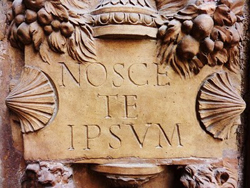
    To my mind, there is one and only one universal and inflexible commandment that is to be applied at all times and in all situations: it is the old Greek axiom inscribed in Apollo’s temple at Delphi, Gnothi seauton: “Know thyself.” This exhortation has many levels of meaning. At the most basic level, it calls us to understand the truth about ourselves and our actions in daily life – such as knowing how many cups of coffee you can drink without facing insomnia tonight, or recognising how far you can be trusted (or trust yourself) in a delicate moral situation. Could you spend a weekend alone with your best friend’s spouse and keep everything above board? Maybe you can, maybe you can’t.

    Knowing yourself in this relentlessly honest way, making what the Twelve-Step programs call “a searching and fearless moral inventory of ourselves,” is necessary not only for freeing oneself from addiction but for facing the challenges of day-to-day life as well. It calls for a merciless honesty in realising all one’s weaknesses and limitations – but without the insane and compulsive guilt that often results from such realisation. It does little good to moan, like the more fanatical Christian saints or characters in Dostoyevsky’s novels, about how you are the most wretched sinner on earth, particularly since in all likelihood the truth is that you are no better and no worse than anyone else.

    This realisation may be deflating (we all want to excel and will choose to excel in our sins if we lack any alternative), but it’s also freeing. Furthermore, it leads to the next dimension of knowing yourself: having compassion. The French have a saying: Tout comprendre, c’est tout pardonner: “To know all is to forgive all.” This is applied to ourselves as well. Christ urges us to be “wise as serpents and harmless as doves” (Matt. 10:16). In one sense, this verse means that in order to live in any truly meaningful way, we have to see ourselves with two eyes: one of remorseless honesty, one of forgiveness and compassion. If we lack one or the other, life soon goes out of balance. Compassion without honesty becomes a license for anything; honesty without compassion breeds pathological guilt.

    Given these principles, how are we to apply them to everyday life? Let’s begin with our relationship to the body. Not so long ago, what was healthy was (or seemed) reasonably clear: a balanced diet, regular exercise, moderation in (or abstention from) use of alcohol or tobacco. Today, on the other hand, we’re deluged with claims that any number of things in our daily lives are bad for us. There is probably no food product that hasn’t been hailed by one source as a cure-all and damned by another as a poison. Fruits and vegetables? Laced with pesticides. Meat? Riddled with antibiotics and hormones. Water? Polluted. Even organic products have come under suspicion. If we took all these claims seriously, we would be unable to let a single morsel pass our lips.

    Claims about what’s healthy are often equally preposterous. I was amused, for example, by a study conducted by Harvard University several years ago. It showed that men who ate more than ten servings of tomatoes a day had a 35 percent reduced risk of prostate cancer. Even if we grant that the study was sound, who is going to eat ten servings of tomatoes a day? Probably if you did, the harm done to your stomach by the acid in the tomatoes would probably more than outweigh the benefits to your prostate. And this is merely one item. If you multiplied this sort of claim for everything on the market, it would require a Gargantuan diet to protect yourself from all illness – and then, of course, you would have to deal with obesity.

    I make this point at such length because health (of which nutrition is, of course, merely one aspect) in many ways has become a preoccupation, even a neurosis in contemporary society. The American esotericist Manly P. Hall once said that there is a type of person that confuses God with vitamins. This kind of confusion is partly the handiwork of the mass media – for whom sensationalistic claims are the very lifeblood – but we are most susceptible to it if we remain disconnected from ourselves.

    What can you eat, and what can’t you eat? The answer varies wildly from person to person. Some people need meat; others find it loathsome or nauseating. Some people can drink alcohol; others ought to stay away from it at all costs. The same goes for coffee or tobacco or almost any item you can put into your mouth. As for residues and contaminants, we have to face the issue with common sense. There is no way of avoiding them all. The most sensible approach is notice what adverse effects any given product has on you and act accordingly, while staying away from products that have extremely high risks associated with them.

    Even so, it’s important to remember that scientific reports and media broadcasts all have this in common: they are talking about generalities and probabilities. There is nothing wrong with this in itself; it is how science thinks. But we ourselves are not generalities or probabilities; we are individuals, and what applies to people as a whole may not apply to us.

    Again, of course, this can turn into a license for anything. A man may destroy his health through smoking while insisting that he, unlike everyone else, can smoke without harm. But you can cut through a great deal of this nonsense (inner and outer) with a certain amount of self-knowledge and inner honesty. Self-knowledge naturally includes a knowledge of the body, and this does not so much mean knowing the body as an abstract anatomical object as knowing how the body feels, even from moment to moment. Someone who is attentive in this way is far more likely to have a clear picture of what is good for her and what isn’t. It will be much easier for such a person to be able to connect, say, a feeling of late-afternoon fatigue with a skimpy breakfast eaten several hours earlier. Consequently, it will be far easier to fine-tune your diet according to what you really need rather than what the books and magazines say you need (advice that, in any case, usually turns out to be contradictory).

    I could say much the same things about any other health-related issue – exercise, sleep, medicine. But let’s go on and suppose that your investigations reveal that you need to make some changes in your way of life. In order to accomplish this, you will again need a certain amount of self-knowledge to know what will work and what won’t. Take exercise. Many people admit that they could use more exercise, but the vast majority of these do one of two things: procrastinate (the spiritual teacher G.I. Gurdjieff once observed that the sacred quality of hope had in modern man deteriorated into a noxious disease called “tomorrow”) or launch into some regimen that they have almost no chance of maintaining in the long run. If you’ve spent the last twenty years in front of the television, it makes very little sense to declare by fiat that from now on you will work out for two hours a day. You will probably quit within the week. Someone who is both more serious about exercise and more honest with himself might start with ten minutes a day. Ten minutes a day, after all, is better than nothing, and it has a far greater chance of remaining enjoyable or at any rate manageable to someone who is just beginning. Notice also the element of compassion: rather than inflicting exercise on yourself like a punishment, you are introducing it into your life in a kind and thoughtful way. As the regimen becomes more of a habit, you can expand it, and maybe after a few years (we are, after all, talking about a long-term change in life habits) you will find yourself working out for two hours a day.

    It doesn’t take a great deal of imagination to extend these principles into most areas of your life. In the case of finances, for example, say you realise you need to save more money. How much, really, are you going to be able to save from month to month? It’s far better to aim for a more modest amount that you will be able to sustain rather than to put away a huge chunk that you will only need to dip into a month or two from now. Some changes may be astonishingly easy to make; others require more patience and skill.

    When you begin to examine these dimensions of life through the lens of self-knowledge, you will almost certainly find resistance of one kind or another within yourself. Looking through my own life, I’m constantly amazed by what forms resistance takes and where it manifests. The most obvious types have to do with things I find unpleasant – doing a dirty job, delivering a message the other person will not want to hear – but often I find myself curiously resistant to doing things that on the face of it require no unpleasantness at all – sometimes even something as simple as returning a phone call from a friend. Beyond a certain elementary point it’s useless to analyse why I don’t feel like making the call. What’s more important is simply being aware of the resistance and consciously going past it to do what you need to do.

    All of this may seem obvious enough, but there is another, subtler dynamic going on. It’s one that, for example, I have almost always found to be involved in procrastination of any sort (procrastination being merely one form of resistance). The need to accomplish something, when it runs up against inner obstacles, creates a curious cycle: the energy that you would have devoted to the task starts to feed the resistance, so that you finds yourself going around in circles. I need to make the phone call; I don’t want to; the fact that I don’t want to makes the task seem larger and more obnoxious than it is; which in turn makes me want to do it even less; and so on. I have known people who have tied up practically their entire lives this way. Sometimes the task does indeed turn into something daunting, as is the case with hoarders, who find themselves so buried in clutter that an entire day of cleaning will hardly make a dent in it.

    Where does the solution lie? In his book Skillful Means: Gentle Ways to Successful Work, the Tibetan lama Tarthang Tulku writes:

    Once we understand how we escape from our difficulties and fears, we can resolve to change this pattern. The next time you encounter a problem and find yourself looking for a way around it, you can make a conscious decision to redirect your energy, to go into your problem and find a solution. Although you may at first feel a resistance to doing this, the positive feelings you will gain from honestly facing work and life will strengthen your ability to meet future challenges directly, and you will increase your incentive to grow.

    When we honestly evaluate our motivation, our attitudes, our strengths and weaknesses, we begin to see a deeper side to our nature from which we can draw a vital energy that lends real meaning to our lives.

    Tarthang Tulku speaks of gaining energy as a result of facing resistance. This is an important point. You may literally feel that there is a subtle wall of energy between you and your task, and you almost find yourself bouncing off it as if it were a force field. All of this is, of course, your own creation, and you can pierce through it simply by “honestly facing work and life” and plunging in. My own experience with this leads me to formulate it in what may be a strange way: when I confront the task, it sometimes feels as if I am somehow slicing into this wall of resistance.

    The good news is that “slicing into” the resistance immediately begin to free up the energy that was bound up in it; it is as if some subtle membrane that was keeping things bottled up has burst and the energy is now free to circulate into the task itself. As a result, simply overcoming the resistance can give you much of the energy you need to accomplish the job.

    These are, I realise, only rather brief indications of a process that individuals need to explore for themselves. Usually it’s easiest to do this in the context of an esoteric school of one sort or another, where tasks are often set up to create this kind of resistance and to teach the student how to overcome it. One of the most common techniques is to give a student a job he or she is not particularly good at. The intellectual is sent to carpentry; the businessman is told to paint a picture; the dreamer is given financial accounts to reckon. Indeed one of the functions of esoteric schools is precisely to teach the skills of overcoming resistance to the pupils. Finding one’s way in daily life with only a few indications is a harder task, but with luck it can be accomplished.

    Whether it takes place in the context of an esoteric school or in an ordinary office, this overcoming of resistance again takes us back to knowledge. You can only overcome resistance if you see it. A friend of mine who was interested in the spiritual side of animal training was trying to teach her dog not to bark. “To stop a dog from barking,” she said, “you first need to make it aware it’s barking.” So it is with resistance: to overcome it, you must first see that you’re caught up in it. If you avoid this realisation through excuses, self-justification, blaming other people, and so on, you have lost before you begin.

    Because awareness is so important to all aspects of inner growth, it’s usually made a central point of many esoteric teachings. Gurdjieff called it “self-remembering”; the Buddhists call it “mindfulness”; whatever the name, the process is more or less the same. You are to see yourself, and you are to see yourself as you are now, not in some past or future that is in any event largely the creation of your own imagination. To do this requires conscious presence, and there are many ways of practicing this on a day-to-day basis.

    So far I’ve been speaking of self-knowledge in a comparatively external sense: seeing clearly one’s own strengths and weaknesses in daily life and coping with them as a builder has to cope with defects in a site or materials. This kind of knowledge is not to be despised; it can add tremendously to one’s efficiency and productivity. But it assumes that you know what your work is, and for many people this remains a highly vexing issue.

    Get the issue this article appears in

    The answer, I believe, lies in a concept for which there is no word in English. In Sanskrit it is called svadharma, and it roughly means doing one’s own duty. The classic text that discusses it is the Bhagavad-Gita, one of the greatest of the Hindu sacred scriptures, written probably between the fifth and second centuries BCE. This book forms a part of a much larger whole, the titanic epic known as the Mahabharata, which culminates in a great war between two rival clans, the virtuous Pandavas and the corrupt Kauravas. One of the greatest warriors among the Pandavas is Arjuna, and his charioteer is Krishna, the incarnation of the god Vishnu. As the lines are drawn up for the decisive battle, Arjuna sees his relatives and some of his closest friends on the opposing side. He knows that enormous numbers of them will be slain, and he loses heart. He turns to Krishna and says he does not want to fight; he has no appetite for the power or glory that victory would bring.

    Most of the Bhagavad-Gita consists of Krishna’s reply. It contains philosophy and cosmology as well as directions for yogic practice, but all of this centres on Krishna’s urging Arjuna to fight. Arjuna is a Ksatriya, a member of the warrior caste, and it is his duty – his dharma – to take part in the battle. Krishna goes so far as to say: “Better one’s own duty [to perform], though void of merit, than to do another’s well: better to die within [the sphere of] one’s own duty: perilous is the duty of other men.”

    The word for “one’s own duty” here is svadharma. It is not a moral duty in the ordinary sense: rather it is the duty that is embedded in your deepest self. No one else can do the job that you were created to do. Liberation consists not of inaction or withdrawal from the world but of performing your duty selflessly and without attachment to results. Arjuna’s dharma is to fight in this monumental battle, which has more than a political or even moral function. It is destined to bring an end to the age and to restore a corrupt cosmic order.

    People learn their svadharma, their special functions, in many different ways and at many different times of life. One person knows hers from childhood; another discovers it only in middle age. It is revealed by still, small voices and by visions on the road to Damascus, but also sometimes in a career aptitude test or by answering an ad in the classifieds. It may remain steadfastly the same, a ridgepole upon which one’s entire life depends, or it may gradually change and shift as time and circumstances change. In any event, it has a single core feature: you have (or come to have) the unshakable sense that this function, whatever it is, is why one exists, is what you were created to do.

    For the Hindus, svadharma is intimately intertwined with svabhava, one’s own being, the core of one’s essence. To know your own work is to know your own being; you can’t understand one without the other. For some, this function may involve wealth and position; for others, modest and humble circumstances. It may call one person onto the magnificent stage of history and may require another to spend his life in obscurity. In any case, to know one’s task is in a very profound sense to know oneself.

    Such a perspective leads us very deep into the recesses of our own nature, and as we make this journey of self-knowledge, we paradoxically go past the self as it’s conventionally conceived – the ego, the street-level personality. Ultimately we move toward our true nature, what we may call the “true I,” which Christianity calls the spirit or the kingdom of God, which Hinduism calls Atman or the Self, and which is known in countless other traditions under countless other names. The Hindu sage Sri Ramana Maharshi went so far as to say that simply following the question “Who am I?” as far back as possible in oneself will lead to enlightenment.

    Strictly speaking, however, one can never, perhaps, truly know oneself. This is simply because what one is, the “I am” at the core of one’s being, the Self, is always that which knows. “The Kingdom of the Father is spread out upon the earth, and men do not see it,” says Christ in the Gnostic Gospel of Thomas. Men do not see it because it is the very principle in them that sees. The path to this realisation is, it would seem, an endless one, not because progress is impossible but because progress, if it is real, always opens up new horizons and new directions to move in.

    [alert type=”general” dismiss=”no”]This article was published in New Dawn 104.[/alert]

    [alert type=”success” dismiss=”no”]If you appreciate this article, please consider subscribing to help maintain this website.[/alert]

    © New Dawn Magazine and the respective author.
    For our reproduction notice, click here.
  • Colin Wilson & the War Against Sleep

    Colin Wilson & the War Against Sleep

    Colin Wilson passed away on 5 December 2013. A tribute to his life and examination of his work written by Colin Stanley appears in New Dawn 143 (March-April 2014). New Dawn Special Issue Vol 8 No 2, published in April 2014, contains an interview with Colin conducted by Australian writer Louis Proud. The following article was published in New Dawn on the occasion of Colin Wilson’s 80th birthday in 2011. 

    Whether we agree with him or not, Colin Wilson has to be one of the most challenging and stimulating writers of the last half century.
    – Gary Lachman, American writer & musician

    I have heard Colin Wilson speak in person only once. It was in 1987 or 1988, when he gave a lecture at the First Unitarian Church in San Francisco. The event was well-attended, with at least a couple of hundred people present. But what struck me most about the talk was the strange state of consciousness it inspired in me.

    I had come in no special mood, and I remember nothing of the evening before or after. But I remember observing myself as Wilson spoke and finding myself possessed of a completely clear and attentive concentration. A great deal of the noise of the usual mental chatter was simply absent. At the same time I was alert and aware – I was not merely absorbed in the talk, as one can be in a particularly gripping movie thriller.

    Because the state disappeared soon after the lecture ended, I can only believe that this peculiarly focused and alert attention was a reaction to something that Wilson himself was generating. I mention it here because this kind of concentrated attention is one of the central themes of Wilson’s work and thought.

    Born in Leicester, England, in 1931, Wilson came from a middle-class background and as a teenager pursued a conventional education in the sciences. But at some point he discovered literature and philosophy, and he became so engrossed in these that he neglected his studies, dropping out of school at the age of sixteen. In the 1950s, he spent time among the political and intellectual circles of London, and for a while spoke at London’s famed Hyde Park Corner – the world’s capital for soapbox orators – on anarchical syndicalism. This was not, as he later admitted, because of any real sympathies for syndicalism but “because I was bored, frustrated, and had a vague feeling that something ought to be done about something. I also wanted to practise speaking in public, and would have been equally happy to discourse on Communism, Mormonism, or Nudism.” He also engrossed himself in an intense program of reading, which bore fruit in his first book, The Outsider, published in 1956.

    The Outsider was a tremendous success, and won accolades from mainstream critics such as Cyril Connolly, who in the Sunday Times of London called it “one of the most remarkable first books I have read for a long time.” As its title suggests, this insightful and gracefully erudite book deals with what Wilson contends is one of the central themes of twentieth-century literature: the individual who is isolated, set apart, alienated from the crowd. He is typified by Meursault, the central character in Albert Camus’s The Stranger, who starts the novel by stating, “Mama died today. Or maybe yesterday, I don’t know.” Meursault’s affectless response to his mother’s death is followed by an equally impassive love affair and the killing of an Arab (the novel is set in Algeria). Although Meursault has committed the act in self-defence, his utter apathy during the course of the trial leads to his conviction.

    Twentieth-century literature (and nineteenth-century literature to a certain degree) is teeming with Meursaults: Fyodor Dostoevsky’s Underground Man; Joseph K. in Franz Kafka’s The Trial, who is arrested, tried, and executed without even knowing what he has done; and the bored and alienated scholar Antoine Roquentin, hero of Jean-Paul Sartre’s Nausea – all of whom Wilson discusses in The Outsider.

    As this brief list suggests, The Outsider reflects Wilson’s interest in existentialism. To most people today, existentialism is more of a mood than a philosophical system. One thinks of gloomy French intellectuals in smoky cafés, immersed in opaque but inevitably pessimistic discussions. But existentialism means something quite specific in philosophical terms. Unlike Thomas Aquinas and other Aristotelian philosophers who came to dominate Roman Catholic philosophy, the existentialists argued that man has no essence – that is to say, there is nothing he is at his core that God has created (most forms of existentialism are radically atheistic). Or rather, man’s essence is derived from existence, from his actions in the world. Because God has not made man in any particular way, man is free. If he feels he is not free, this is only because he has failed to acknowledge his own freedom.

    The notorious pessimism of the existentialists comes from the idea that man’s freedom is the result of his existence in an alien and indifferent world. There is no intrinsic meaning in the universe, because there is no God who created it. It is up to man to make his own meaning.

    Unfortunately, as Wilson recognised, this stance creates problems. You can take up carpentry to while away the time, but can you create meaning and purpose for your own life as you might make a workbench? Some of the existentialists – particularly Sartre – may have thought so, but Wilson argues that this creation of meaning, while necessary, cannot be accomplished just by taking up a cause at random.

    Wilson also displays a deep affinity with another, less well-known twentieth-century philosophical school: phenomenology. While phenomenology is a vast and intricate system none of whose primary exponents completely agree, it contends that all consciousness is intentional; it is toward something. Explaining the thought of Edmund Husserl, the founder of the school of phenomenology, Wilson writes, “All mental activities are essentially acts, analogous to reaching out one’s hand or shooting an arrow at a target.” Indeed, he adds, “the mind has no equivalent of the non-intentional act – even becoming unconscious under anaesthetic” (emphasis here and in other quotes Wilson’s).

    Existentialism and phenomenology set the stage for Wilson’s mature thought, but it is perhaps with the great twentieth-century sage G.I. Gurdjieff with whom he has the deepest affinity. Wilson discusses Gurdjieff in The Outsider, in his 1970 book The Occult: A History, and in other works, including Gurdjieff: The War against Sleep. Indeed, Wilson contends, “Gurdjieff’s system can be regarded as the complete, ideal Existenzphilosophie [existentialist philosophy].” Why? Because it shows a genuine and realistic way to rise up from the sleep of ordinary, habitual life – the boredom and alienation that are the marks of the existentialist antihero – and awaken into a higher dimension of experience.

    As Wilson points out, one of the central disciplines in Gurdjieff’s teaching is “self-remembering” – which Wilson describes as follows: “Normally, when you are looking at some physical object, the attention points outwards, as it were, from you to the object. When you become absorbed in some thought or memory, the attention points inwards. Now sometimes, very occasionally, the attention points both outwards and inwards at the same time, and you find yourself saying, ‘What I, really here?’: an intense consciousness of yourself and your surroundings.” It may have been Wilson’s own self-remembering that stimulated a similar response in me during that lecture over twenty years ago.

    It is this self-remembering, this awakening, deliberate or inadvertent, that Wilson discovers in many account of mystical experience. Gurdjieff might have agreed. When asked once what higher consciousness was like, he replied, “Everything more vivid.” For Wilson, this awakening is the gateway to what he calls Faculty X, which he calls “the power to grasp reality,” and which “unites the two halves of man’s mind, conscious and unconscious.”

    Wilson argues that “Faculty X is the key to all poetic and mystical experience; when it awakens, life suddenly takes on a new, poignant quality. Faust is about to commit suicide in weariness and despair when he hears the Easter Bells; they bring back his childhood, and suddenly Faculty X is awake, and he knows that suicide is the ultimate laughable absurdity.”

    It is Faculty X, and Wilson’s exploration of it, that provides the key to much of his writing, which over the years has ventured further and further into the waters of the paranormal. For Wilson, Faculty X does not lie in some distant evolutionary future, when the human race will have evolved capacities that now seem preternatural; it is something we possess in latent form now, and which in fact our remote ancestors may have possessed in the past, when the human mastery of the physical world was far less complete and when people had to rely on inner resources for tasks that we now entrust to machines.

    But Faculty X has more than merely pragmatic value. When it is awakened, it provides an intensity of experience, a lived reality that not only makes “everything more vivid” but provides the added dimension of meaning for which the existentialists pined so acutely – and which forms what may be the point of focus for Wilson’s voluminous writings. If there is a thread that holds together a body of work that comprises over one hundred published books, it is, I suspect, Faculty X and the strange sense of vivid concentration of which I had a glimpse over twenty years ago.

    How do Wilson’s insights look today? We live in a time of change, which continues to accelerate to the point of destabilising not only nations and societies but the individual soul. There is a fascination with new technologies – with iPads and Facebook – that seems to take us away from the issues of meaning and presence that Wilson emphasises so strongly. But if these novelties distract us from the existential questions that face us, they neither answer these questions nor remove them. At best they are diversions, like a film or a game of chess, which might take our minds off our problems for an hour or two but which leave the problems waiting for us when they are done. Even politics and world affairs, I suspect, serve as this kind of entertainment for many.

    I believe that Wilson is right. If we are to win the war against the sleep of everyday life, it will not come out of technology nor even from political or social reform, as much as this may be needed. It will come from the liberation of individuals who awaken from the dreams that pass across their televisions and computer screens – and their minds – and are able to say, “I – here now.”
    [alert type=”general” dismiss=”no”]This article was published in New Dawn 126.[/alert]

    [alert type=”success” dismiss=”no”]If you appreciate this article, please consider subscribing to help maintain this website.[/alert]

    © New Dawn Magazine and the respective author.
    For our reproduction notice, click here.
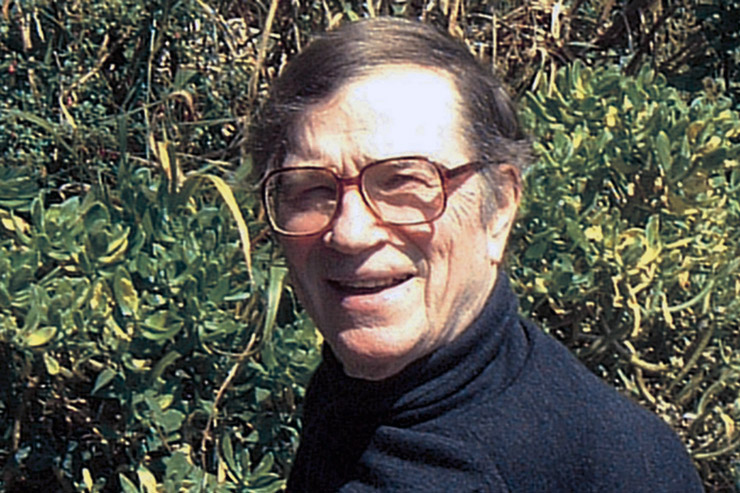
  • Onside with The Outsider: Colin Wilson at 80

    Onside with The Outsider: Colin Wilson at 80

    Colin Wilson passed away on 5 December 2013. A tribute to his life and examination of his work written by Colin Stanley appears in New Dawn 143 (March-April 2014). New Dawn Special Issue Vol 8 No 2, published in April 2014, contains an interview with Colin conducted by Australian writer Louis Proud. The following article was published in New Dawn on the occasion of Colin Wilson’s 80th birthday in 2011. 

    You know individuals have become icons when they are referred to simply by their first names: Marilyn and Diana being perhaps the two most obvious. But in New Age, occult and esoteric circles there is only one Colin (while Wilsons may be thick on the ground). And as the last of the Angry Young Men has reached the age of 80, if ever there was a time to celebrate Colin (Wilson’s) contribution to the world of the mind and spirit, this is it.

    This is something of a personal paean, as he has touched both of our own lives in his typically exhilarating way. Back in the 1980s, when Lynn was Deputy Editor of the landmark weekly publication The Unexplained, he was one of its consultants. Thank the gods for Colin! Always polite and affable, he was also the consummate professional, being particularly noted for delivering an article on any subject at a moment’s notice that was word-perfect and guaranteed to be a hot topic for discussion, not only among the readership but even among the cynical editorial team. He was never grand, although with his fame, he could well have been. And of course he has added to the list of his remarkable achievements in the quarter century after the last edition of The Unexplained saw the light of day.

    His main achievement has always been to shake his readers up. Through his books on philosophy, psychology, criminology, parapsychology and the weirder aspects of the paranormal – even his novels – he has challenged consensus reality head on. Few authors have done this so consistently, bravely and anarchically, although many have tried. And in our view, no author has done so quite so successfully, if success is measured in kick-starting a mass awakening from spiritual and mental zombie-hood.

    This intellectual dynamism – more akin to actual dynamite – has been there right from Colin’s first work on existential philosophy, The Outsider (1956), through to more recent books dealing with weird phenomena such as his study of alleged ET encounters and alien abductions, Alien Dawn (1998).

    It all stemmed from a profound dissatisfaction with the way most people experience the world – the feeling that we’re all missing something important. Or “the vague, brainless, cow-like drifting of the people around me” Colin was aware of from adolescence.1

    The occasional individual – usually an artist, poet or mystic – may experience “certain moments when he feels curiously immortal, god-like, as if hovering above the world, untouched by its dullness.”2 But is this just an illusion? Which is the ‘real’ world: the mundane everyday reality or the mystics’ and artists’ glimpse of something bigger, brighter and considerably more joyful?

    Pursuing such questions led the young Colin to existential philosophy, resulting in his first book, The Outsider, published in 1956 when he was 24. It was an immediate sensation. The term ‘angry young men’ was originally coined by The Times to describe both himself and John Osborne (whose Look Back in Anger premiered the same week as The Outsider was published).

    Over the next decade Colin pursued his search for meaning through a mainly philosophical and literary approach. His ‘Outsider cycle’ of six books, plus a final summary volume in 1966 – covering religious experience, human sexuality and discoveries in psychology – developed his ‘new existentialism’, basically existentialism minus the customary pessimism. While Colin regards the flashes of meaning experienced by poets/mystics – or by many ordinary folk as a ‘peak experience’ – as evidence of a state of consciousness towards which humans are evolving, existentialists see them as the mind’s trick to convince us that life’s worth living. Colin has no truck with turgid pessimism – one of his most endearing and encouraging traits, which also, incidentally, makes his talks so life-enhancing.

    All his work has continued to develop the original themes of The Outsider, right through to his 2009 Super Consciousness: essentially an update of The Outsider but incorporating all the other major fields of interest he has accrued throughout his long career.

    But back in the early 1970s it was The Occult, his great landmark book that set the world alight. Ironically, as a sceptic, he only accepted the commission for the money, intending to write a noncommittal survey of the subject, but it was to turn his worldview upside down. His research not only persuaded him that psychic abilities are real, but it also transformed and enhanced his vision of human beings. (And the vision of many of its readers too, such as Clive, whose own life changed dramatically because of The Occult and its sequel, laying the foundations for his career as a writer of books on the esoteric and alternative history.)

    It is hard not to gush about The Occult. In retrospect, it is probably not much of an exaggeration to say that this mammoth work, published in October 1971, worked the same blinding epiphany on many of its readers as did say, Darwin’s Origin of Species in its day. And it had a happy spin-off: not only was The Occult a seminal book for a popular audience but it also revived Colin’s career, which had languished since the heady days of angry young manhood.

    Discovering that “the mind possesses hidden powers that can influence the external world”3 finally answered his question about whether the mystics’ and poets’ insights of a purposeful universe were real or illusory – and about whether or not the pessimist-philosophers are right. To Colin not only are they wrong, but their state of mind is actively dangerous, since it inhibits the human ability to tune in to and even order the world: “…there is something in our minds that can alter our lives – the ‘something’ that causes synchronicities, for example.”4

    Perhaps with all the gloom and doom centred on 2012 hysteria, the New Age community in particular needs to receive an injection of Colin’s inspired optimism. Like the Hermeticists of old, he actively celebrates what it means to be human. O what a miracle is Man!

    Mysteries (August 1978), his sequel to The Occult, explored in greater depth the relationship between the hidden powers of the mind and the outside world, covering subjects such as dowsing and Earth mysteries.

    Another major development in Colin’s thinking came in 1980. Until then he had understood paranormal phenomena purely in terms of the interaction between the hidden depths of human consciousness and the physical world. But through his research into poltergeists (which he originally thought were projections of the subconscious) he came to accept the reality of spirits, the afterlife and also the existence of non-human entities. As he wrote in 1992:

    More than twenty years of psychical research have led me to the conclusion that there is a ‘psychic reality’ which runs parallel to our physical reality. Ghosts, demons, poltergeists, fairies, even ‘vampires’, are incursions from this ‘other reality’ into our own.5

    These, too, found a place in his all-encompassing philosophy:

    …their effect is to remind human beings that their material world is not the only reality. We are surrounded by mystery that cannot be understood in terms of scientific materialism. If psychic phenomena have a purpose, it is to wake us up from our ‘dogmatic slumber’, and galvanise us to evolve a higher form of consciousness.6

    In Alien Dawn (1998) Colin came to agree with researchers such as Jacques Vallée and John A. Keel that encounters with apparent extraterrestrial entities, including alien abductions, belonged to that parallel, psychic reality – essentially as an updating of the ancient fairies and demons tradition. Discussing the work of abduction researcher John Mack he noted:

    Since The Outsider was about people who feel that there is something deeply wrong with ‘consensus reality’, and that we need to broaden our views about what is real or possible, I experienced an instant rapport with his conclusions. I ended by coming to believe that although UFO phenomena seem to contradict consensus reality, they do not contradict the reality described by quantum physicists. Or, for that matter, mystics.7

    Colin has, over an astonishing six decades, built a grand, all-encompassing and consistent vision of the universe and humanity’s place in it. He started out with the basic question: why are we here? This is his bold and heartening answer (from his 2004 autobiography Dreaming to Some Purpose): “The purpose is to colonise this difficult and inhospitable realm of matter and to imbue it with the force of life.”8

    This gels astonishingly with the latest (if weirdest) scientific thinking, such as physicist John Archibald Wheeler’s idea that we live in a ‘participatory universe’ that is being created by human observation.

    That’s perhaps the most enviable of Colin’s talents as an author – he is always relevant. From the days of the angry youth to the spiritually bereft and scared 21st century he has always understood the underlying mood. But instead of feeding off our angst like other authors he always has taken us by the scruff of the neck, shaken us and made us glad to be alive. With Colin’s words in our heads we face the future with confidence and courage.

    It also helps that he writes and speaks like a dream – always with utter sincerity and deep knowledge – and that he’s a really, really nice guy.

    Happy birthday, Colin!
    [alert type=”general” dismiss=”no”]This article was published in New Dawn 126.[/alert]

    [alert type=”success” dismiss=”no”]If you appreciate this article, please consider subscribing to help maintain this website.[/alert]

    Footnotes

    1. The Outsider (Picador, London, 1978 edition), 296.

    2. Ibid., 300.

    3. Super Consciousness: The Quest for the Peak Experience (Watkins, London, 2009), 141.

    4. Dreaming To Some Purpose (Century, London, 2004), 386.

    5. Alien Dawn: An Investigation Into the Contact Experience (Virgin, London, 1998), 295, quoting from a 1992 article.

    6. Ibid.

    7. Dreaming To Some Purpose, 372.

    8. Ibid., 386.

    © New Dawn Magazine and the respective author.
    For our reproduction notice, click here.