New Dawn – World's Most Unusual Magazine

Category: Articles

  • Beyond Tantra

    Beyond Tantra

    “It’s all sex nowadays” my mother used to grumble after an evening in front of the television. Even her favourite nature programmes, she moaned, were increasingly obsessed with it. Much the same might be said about Tantra. Or, at least, about what currently passes for Tantra, something which to many people today means little more than sex with fancy trimmings. 

    No surprise then that among the first ‘tantrik’ sites to appear on Google is one that markets books on sexual techniques, as well as performance-enhancing potions like – currently on special offer – tiny pots of nipple sensitising cream. True, there’s a token reference to Tantra’s origins in India but it’s the “get your kit off” message that counts. My mother wouldn’t approve. And neither, frankly, do I.

    What offends me is not so much the sexual free-for-all – each to his own as far as I’m concerned – but the attempt to glamorise, even sanctify it by calling it Tantra.

    After all, Tantra is first and foremost a spiritual practice by which the self aspires to merge with the energies that sustain or, rather, constitute, the universe. It is a means of becoming one with the Whole, of escaping from the illusion of separateness that determines how we experience the phenomenal world around us. Sensitised nipples have precious little to do with it. (And anyway a dab of Vaseline does the job, if you’re curious.)

    The word Tantra is Sanskrit for ‘weave’, a term used to indicate that a particular text has been composed according to an orderly pattern (samhita). Others prefer to believe it points to secret teachings ‘woven’ into the Vedas, the thread visible only when teased out by a scholarly commentator or qualified guru. This interpretation, though appealing, is undermined by evidence that before being taken up by Hinduism, Tantra was already a feature of Buddhist practice, later becoming associated with Mahayana Buddhism in particular. (There the feminine principle, sakti, has long been held in high esteem.) This might also explain its early adoption by the Vajrayana (Sk. “Diamond Vehicle”) sect of Tibet, one that borrowed heavily – again significant perhaps – from that country’s indigenous religion (Bön).

    Yet the true origins of Tantra almost certainly pre-date all of these and are rooted in the ancient practice of Yoga, especially in what later became Hatha Yoga, so called because it is the path (Sk. marga) of effort and discipline, both essential if the body and its vital energies are to be brought under control. Appropriately enough, one of the early names given to Tantrik teaching – Agamas or ‘What has come from before’ – may be an acknowledgement of its great antiquity.

    Not all Hindu teaching is sympathetic to Tantra, with many scholars, especially more recent ones, uneasy with its intentionally blunt language (Sandhya-bhasha) and overtly erotic symbolism. At times even its defenders sound apologetic, pleading that, for want of anything better, it is at least a convenient path to mystical experience in the current Dark Age (Kali-yuga),1 a period when our race is woefully lacking in spiritual refinement. (Held to have started 5,000 years ago or, as others maintain, following the death of Krishna in 3120 BCE, the Dark Age is scheduled to last for 430,000 years so there’s lots more of it ahead.)

    With the advent of Kali-yuga we are said to have lost our ability to see beyond the illusory appearance of things (maya), something traditionally expressed as the loss of our Third Eye or Eye of Siva. This symbolic organ is depicted in art as a lotus blossom, the sun, a snake or a star and set in the middle of the forehead, though some occultists maintain, none more forcibly than Mme. Blavatsky, that the Third Eye was, literally, just that. Today, the pineal gland is claimed to be its only anatomical remnant.

    Hinduism accommodates two kinds of Tantra, that of the right hand (Dakshinacara) and that of the left (Vamacara). The first, regarded as the more respectable, favours a metaphorical interpretation of the erotic language found in the texts, while the second, often dismissed as ‘black’ magic, adopts a more literal approach, treating what it finds as a practical guide to attaining enlightenment. Only the latter approach need concern us.

    As was said earlier, Tantra is not about sex. Well, not just about sex. Its spiritual element – ‘psychical’ may be a better epithet – is at least as important as the physical. In any case the two are complementary. More than that, they are inter-dependent for only when acting together – physical act and spiritual intention – will they induce awareness of the unity subsisting between the conditional world and the absolute reality on which it depends.

    Nowhere is this togetherness more sublimely realised – here comes the sex – than in the act of coition, that synergic conjunction (Paramsiva or the union of Siva and Sakti) of two individuals or, better still, two creative polarities.

    As for the erotic techniques described in tantrik literature or even in the teach-yourself manuals peddled on the internet, their purpose is to facilitate this beatific outcome by means of, inter alia, breathing exercises, tactile stimulation and, most famous of all, delayed orgasm or, on occasion, the disciplined retention of semen.

    Above all, however, recourse is had to the goddess Sakti herself, the initiatory and dynamic expression of divine power. (The name itself means nothing less.) As the “Princess who sleeps at Brahman’s gate” the goddess is dormant inside each of us under the guise of Kundalini, the Serpent Power coiled three and a half times around the Muladhara chakra at the base of the spine.

    Aroused from its slumber, Kundalini can be persuaded to ascend the spinal column – or, more correctly, spiral through the citrini nadi of its subtle equivalent (Sushumna) – like a jet of blue flame, shedding sparks in its wake, red on one side, yellow on the other.2

    Passing rapidly through the next five chakras, it brings each of them into harmonious and tuneful life – the first syllable of Kundalini (the word itself denotes a coil of rope) means ‘sound’ – until at last its cosmic fire ignites Sahasrara, a supernumerary chakra and the noblest of them all, immediately transforming that glorious, thousand-petalled lotus into the marriage bed of Siva and Sakti. It is their divine coupling, mirrored in our own, that facilitates our release (moksha) into the ineffable bliss of absolute being.

    A similar bliss is accessible through magical practices, particularly those with an overtly sexual component. For that reason the latter are often referred to as Tantra, proof again of how the word has become synonymous with sex. And true enough, the methods of sexual arousal available to the magician are often similar to – because copied from – those of the tantrika. (They have, after all, proved their worth over time.) Even so it may be misleading, no matter how convenient, to describe sexual magic as tantrik because there is one important, indeed fundamental, difference between the two.

    To grasp it we need to remind ourselves that for Vedic scholars, phenomena and form enjoy no real existence (avastu). Our awareness of them is merely the accidental reaction of our senses to a reality, itself imperceptible, which is nothing less than the creative self-projection of Brahman.3

    Over time this emphasis on the “otherness” of what is truly real (and, as such, a manifestation of God’s inviolable Oneness) led to the view that the phenomenal world, product of our faulty perception, could not be other than inferior to what lay beyond it. After all, was it not the imperfect, because conditional, aspect of what is immutable and absolute? And so the notion grew that the world of matter was somehow debased and, as such, unworthy of being cherished or respected on its own terms.

    Such a notion is not confined to Hinduism. Closer to home we come across it in much Christian thinking, both orthodox and (to a far greater extent) heretical, while the neo-Platonists – to whom Western magic owes much – were, like the Manicheans, particularly infected by it. The celebrated Plotinus summed up their views by dismissing matter as “the primary evil.”

    We have always to remember, therefore, that while Tantra indulges the body and the senses, it does so with the aim of transcending both. Because of that, all the tantalising foreplay and eventual orgasm, however incidentally enjoyable, are simply means to an end, devoid of any ultimate value themselves. A way of escape from the snares of conditionality, they facilitate a brief triumph of mind over matter.

    For the magician by contrast, matter is inherently sacred. Far from being a route to the Absolute it is the route by which the Absolute becomes real and present – even palpable – to us. For that reason the aim of Magic is to exploit the sacramental nature of matter, treating it (in the language of St. Augustine, as modified by St. Thomas Aquinas) as the outward and visible sign of an inward, divine and efficacious grace.

    From this it follows that for the magician the sexual act is no longer the means to an end but correctly understood, the end itself. Through it, with it, in it, a higher, unconditioned reality manifests itself in terms appropriate to our environment. Tantra, by contrast, requires us to ‘liberate’ ourselves from that environment before the same reality is met. At the risk of labouring the point: for Tantra it is through matter that we strive to touch the Absolute; for Magic it is through matter that the Absolute touches us. Matter is the Absolute in posse.4

    It should be emphasised that sexual activity is not an indispensable constituent of magical practice. (Like Tantra, Magic is not, definitely not, ‘all sex’!) Readers who feel ill at ease with it or, as must happen to us all, no longer up to it, need on no account despair! But those who have at some time or other been privileged to participate in this type of work will be aware of its tremendous efficacity.

    My own first experience, following hints so discreet it took months to work them out, occurred when I was fifteen and introduced me – too soon, I sometimes think – to matters which (if my memory serves me well) are deemed in some sections of the Ordo Templi Orientis  (O.T.O) to belong to the arcana of the VIII and IX. Ten years later in a crowded warehouse deep within the meat-packing district of Manhattan (now gentrified beyond recognition) I watched dumbstruck as a veritable phantasmagoria of mighty beings were lent form and substance by the tremendous power inherent in what Verlaine called “ce divin phosphore.”5 Indeed, I have only to recall that occasion to be made giddy by the memory of it and, more importantly, to have again at my disposal (for such was the purpose of the undertaking) the ‘phosphoric’ energy simultaneously generated in the theurgic fervour of that night.

    But of course there’s no need to cross the Atlantic for such experiences. Members of the gentlest, least pretentious Wiccan group will have experienced something of the kind – and of comparable worth – each time the Goddess deigns to bless them with her presence in the quiet of the night.

    On all such occasions the aim is not to gratify the senses – however gratified they are in the process – but to permit the physical to make explicit the spirituality implicit within it. This requires of us an immense act of will, something that again distinguishes Magic from Tantra. There, you may remember, the participant’s will, like the rest of his individuality, is dissolved in a supra-mundane reality where all differentiation has ceased. The magician, on the other hand, applies his will – and such should be his highest ambition – to effect changes that help advance the evolution of the world.5 His is above all an act of love. Of love freely exercised in accordance with his true will, a concomitant of that divine will which sustains the dynamic reality, perceptible and imperceptible, of which we are at once the part and the whole: verum est…. quod superius est sicut quod inferius et quod inferius est sicut quod superius, ad perpetrando miracula rei unius.

    Unlike Tantra, which uses the ‘below’ to embrace the ‘above’, Magic, sexual or otherwise, enables the magician, loyal to the Thrice Great Hermes, to embrace the ‘above’ in the ‘below’.

    And by so doing, he sanctifies the world.
    [alert type=”general” dismiss=”no”]This article was published in New Dawn 110.[/alert]

    [alert type=”success” dismiss=”no”]If you appreciate this article, please consider a contribution to help maintain this website.[/alert]

    Footnotes

    1. According to the Puranas there are four successive ages within each maha-yuga of 4,320,000 years. Kali-yuga is the fourth and darkest of the current Maha-yuga, its predecessors (Krita or Satya, Treta, and Dvapara) each marking a progressive decline in the moral, spiritual and physical condition of mankind. Another Puranic tradition speaks of time divisions known as kalpas, divisible into fourteen manvantaras each consisting of 71 maha-yugas, though the duration does seem to vary. Each manvantara is governed by a different Manu, our present one (the “post-Atlantean” as some occultists call it) being in the custody of Vaivasvata (Sk. “Child of the Sun”) whose responsibilities include the ethno-cultural progress of mankind. (Manu – Sk. “Man” – is another term for the Purusha or Paradigmatic Man, comparable to the Hebrew Adam Kadmon.)

    2. Usually the red flames occur on the left side (ida) in men, the right (pingala) in women but variations occur as, for instance, when the sexual activity is other than heterosexual. Solitary activity by either sex may produce a brilliant mix of red and yellow flames on both sides, often suprasensibly ‘visible’ to observers. Alas, some esotericists condemn masturbation in terms worthy of those stern Victorian moralists who claimed it led to blindness and insanity. There are also lurid warnings from certain Jewish authorities that onanism (and nocturnal emissions) are induced by Lilith, the first Eve, who then uses the spilled seed to manufacture bodies for the demons in her charge. No less devilish are the incubi and succubi – I always forget which of them does what – who feature prominently in accounts of the witch trials.

    3. The creative impulse (Brahman) is other than the “divine Nothingness (ahava), which alone is God. Referred to in the Upanishads as Neti, neti (‘not this, not that’), the featureless nature (nirguna) of God was cleverly expressed by Crowley as God=0. None of which should be taken to mean that God is the negation of everything (in itself impossible since it presupposes a positive ground), but, rather, that God is the absence of ‘something’. And in this case the ‘something’ is ‘existence’ as opposed to ‘non-existence’. Yet by denying existence to God, neither Crowley nor Hindu thinkers call in question the fact that God is. For them existence is secondary, the product of God’s self-awareness, manifesting itself – the Vedas speak of an effulgence of cosmic light (hiranyagarbha) – in the dualistic world of “becoming” (Crowley’s 0=2), of which we are part. (The Kabbalah, of course, teaches much the same, as did the Neo-Platonists, albeit in a typically complicated manner.)

    4. In the impending New Age this same principle – that matter is the vehicle of spirit – will be of particular significance to those who encounter the Lord of the Aeon himself, end product of the equation already quoted (note 3): 0=2=1. Outwardly human, inwardly – or in the Thomistic sense, ‘substantially’ – divine, His person will become a valid object of devotion. For out of this Divine Child, as the liturgy of the A.O.M (II) proclaims, there gushes forth the solar light that vivifies creation, microcosmic equivalent of that greater light, more incandescent than a million suns, that is His true, unmanifested self. Especially inimical to the New Aeon are the secret forces currently responsible for the growth in fundamentalist religion and, paradoxically, novel and belligerent forms of scientific dogmatism.

    5. The location in Washington Street with animal carcasses stacked on the pavement and in surrounding buildings – there was a pervasive odour of fat and stale blood – may not have been accidental. For as Dion Fortune observed in her book, Sane Occultism, “…blood being a vital fluid, contains a large proportion of ectoplasm, or etheric substance. When shed, this ectoplasm rapidly separates from the congealing blood and thus becomes available for materialisations.” Several psychic researchers, notably the less-than-reliable Harry Price, have observed that physical phenomena are more prevalent during seances conducted when the (female) medium is menstruating. (It may be for this purpose that the use of blood is recommended in certain magical operations.) Luckily, for those who, like me, are of a squeamish disposition, the power of creative visualisation, known in Yoga as Kriyasakti, works just as well.

    © New Dawn Magazine and the respective author.
    For our reproduction notice, click here.
  • Tasmania’s Mysterious Monuments: Decoding the Work of Ian Sykes

    Tasmania’s Mysterious Monuments: Decoding the Work of Ian Sykes

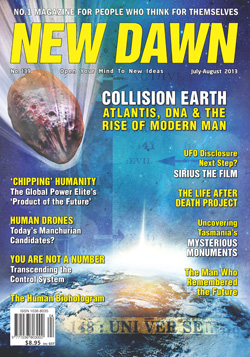
    From New Dawn 139 (Jul-Aug 2013)

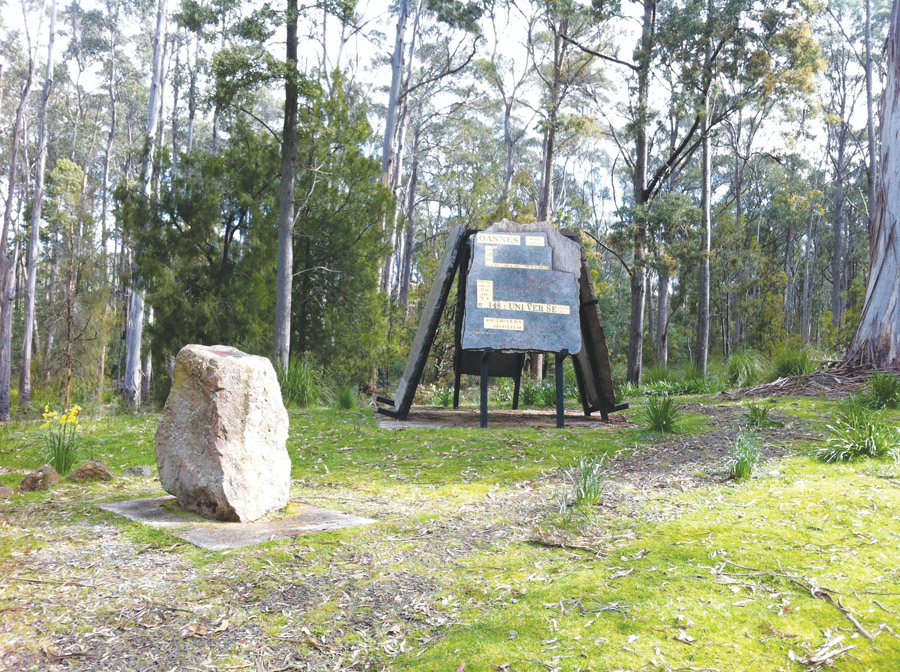
    Earlier this year [2013] a New Dawn reader came across a mysterious set of strange monuments in a rural recreation area called Sanctuary Park, situated in Railton, Tasmania – just 20km south of the city of Devonport. What he found was a set-up of four horizontal stone plates. Inscribed on them are writings, grids and mathematical equations – the kind that you can tell aren’t taught in school. These plates have puzzled the locals, as it turns out, ever since they were placed there, one by one, between 2002 and 2003.

    NOTE TO READERS: You can view all photos, plates & diagrams in this article by obtaining a digital copy of the magazine in which this article appears, New Dawn 139 (July-August 2013)

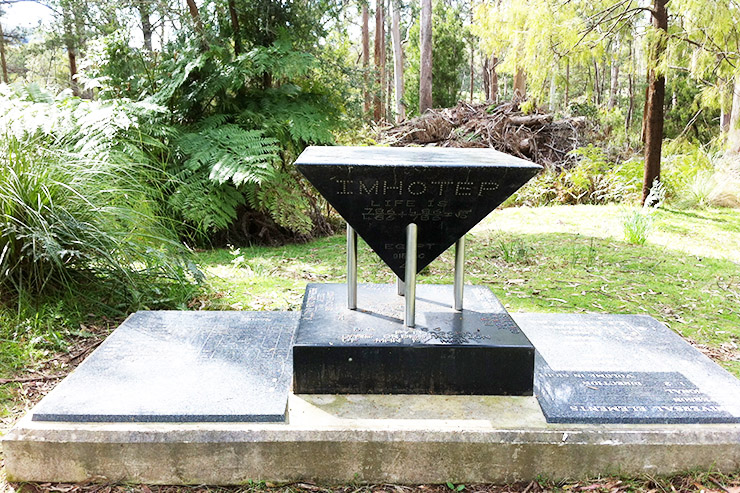
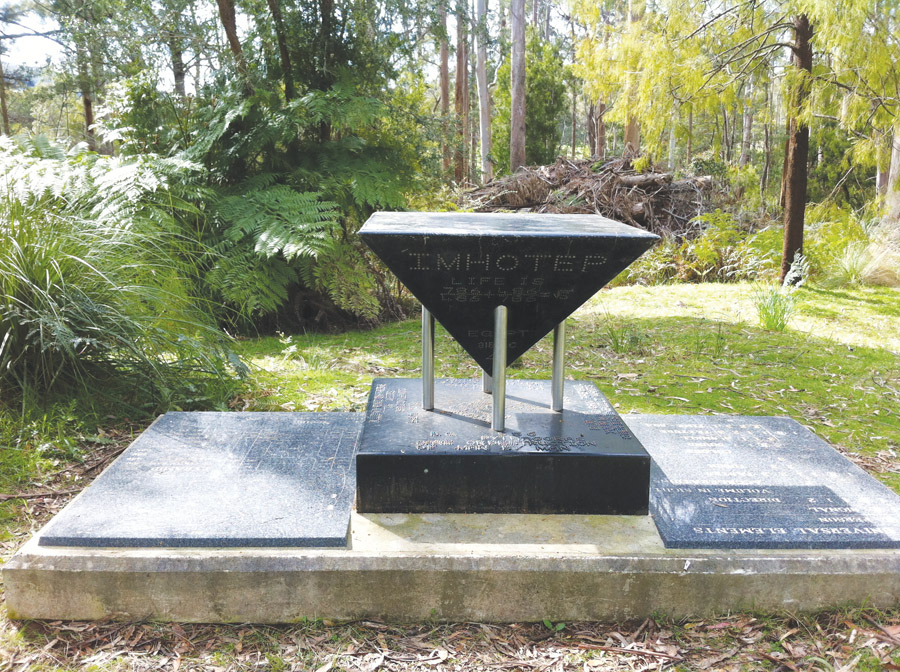
    And these are just the newest additions. In September 1990, another enigmatic upside down pyramid shaped object with attached plates was erected. A slab of concrete keeps the whole thing off the grass and atop it sits a black rectangular prism. Four shafts extend from the prism to support an upside-down pyramid. To the left and right of this rectangular prism are two plates with inscribed mathematics – apparently dealing with the design and purpose of ancient Egyptian pyramids. Under the upside down pyramid is this eulogy – Norman Sykes: 1896–1981.

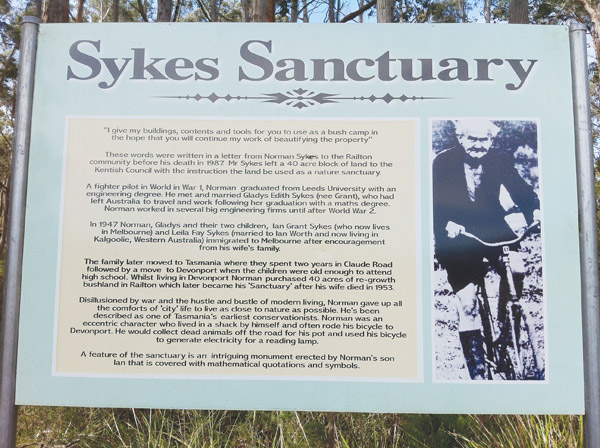
    Sanctuary Park is 40 acres in size, and was donated by Mr Norman Sykes to the town of Railton to be used as a sanctuary for the local wildlife. Norman was World War One fighter pilot and engineer who, after the war, moved to Railton with his wife and two children. Norman lived in a shack on the sanctuary land.

    Sykes was known locally for his eccentric ‘bushman’ lifestyle, and is described as one of Tasmania’s earliest conservationists. At Sanctuary Park a sign shows an old newspaper photo of Norman, his wife and son riding in his home-made, completely pollution-free, built-from-scrap pedal car. Norman remained a local activist all his life who wrote letters to the editor of newspapers explaining his ‘eccentric’ ideas that today might be regarded as far-sighted.

    IMG_0169
    A sign at the entry to Sanctuary Park, Railton, Tasmania. It contains a short history (and photo) of the man who donated the land for the sanctuary, Mr Norman Sykes.

    A brochure made by students from a local primary school identifies the builder of the mysterious monuments to be Ian Sykes, Norman’s son.

    Sourcing Ancient Wisdom

    The pyramid and its underlying slabs reference a variety of ‘ancient wisdom’ figures (see below for photo of this structure). The architect of these monuments clearly went about his complicated mathematical business by building upon information from the past (these images and descriptions are available in the magazine).

    The most important of these figures is Oannes, an ancient Sumerian ‘god’ credited with the invention of writing (his name appears a few times on the monuments). Oannes supposedly taught humans how to create symbols – the idea that some thing can be used to represent another thing. This concept is important to understand because the purpose of these monuments – as we will learn – is to analyse the nature of symbols, or more specifically words. The monuments are unlocking a code to the real hidden meaning of words and letters.

    A Hidden Numerical Matrix

    Since erecting the monument I have “advanced” some of its ideas, but as it remains a proper symbolism to the central idea that word and number are one and the sole, all embracing unity of diversity it seems to perhaps be in line to qualify as the world’s second monument to what word and number are. (Text from one of the explanatory panels at Sanctuary Park)

    The theory advanced here is that every word, phrase and audible sound runs off a hidden numerical source/matrix. All the mathematical equations at Sanctuary Park are designed to prove this theory.

    One of the first mysteries I resolved in my investigation of this site is that Norman Sykes did not create the monuments. In fact, Norman apparently had nothing to do with the monuments or their theories at all. This I learn from speaking to Norman’s son, Ian. Ian made it clear he’s still working on the very same project he began the moment he retired decades ago – the enumeration of our language.

    The Sanctuary Park monuments were created and erected by Ian. Since then his work has advanced even further. He devotes 4-5 hours a day, basically ‘decoding’ words in our English dictionary, finding in these words (plus their meanings) numbers and patterns that connect the words and meanings to each other – a hidden code.

    IMG_0208
    Section of Sanctuary Park, Railton, Tasmania. Between 2002 & 2003, Ian Sykes erected these four massive stone plates etched with a range of enigmatic inscriptions.

    What Ian has uncovered is more-or-less a mathematical blueprint that underlines our entire language. This blueprint maps out and defines, in single fact-form, how every single word/symbol specifically relates to one another. It is a number-based dictionary system that has not changed since it was supposedly introduced by Oannes.

    Below are good examples of Ian’s system in action, and he promises these examples will make people “scratch their heads in wonder.” But first, it is necessary to explain some of the complex (yet coherent) methods/theory used by Ian to build this numerical system. Ian’s work is so mind-boggingly complex that it cannot be explained it in its entirety, so my aim here is to communicate Ian’s central premises.

    Sound Bites

    It is crucial to understand that Ian doesn’t decode words in their written textual form. He doesn’t look at the letters and how they behave/interact specifically on the page. Rather, Ian analyses the sounds of words. Our language is sound. Letters and words on a page are simply the codes for making certain sounds, whether to be read aloud or thought out in our minds. On a page, letters express different sounds depending on context. The letter “C,” for example, is used to make a whole range of sounds, e.g. car, chicken and cereal.

    Some letters are silent, forming and indicating no sound at all. To avoid confusion and inconsistency, Ian’s approach to analysing and decoding language is through breaking words down into sound bites. If Ian wishes to decode the word “SAVE,” he will set it out as “S/AY/V.” Or, the word “CHINESE” as “CH/AY N/ IES.” By doing this, Ian can properly examine our language so it can be analysed consistently through sounds. Ian says there around 150 sounds (or what I call “sound bites”) that make up our language.

    Each syllable/sound bite has an inherent number (which can be a ‘positive’ or ‘negative’ number). See below.

    Sh/ ell/ ter
    9/ 4/ -2

    Each number is tied to a respective sound bite. “Sh” always yields the number 9, “ell” will always be number 4, “ter” is the negative number -2, and so on. The sound bites are the physical vibrations of certain laws rediscovered by Ian. How did he do this? When crunching individual numbers for individual sound bites, Ian used trial-and-error. He crosschecks a new word with other words and meanings that he’s uncovered previously, finding patterns, consistency, etc. He tells me the process of decoding a word or two takes a full day or more.

    Ian has rules which help him anchor this otherwise chaotic-seeming work. These derive from ancient knowledge. Two significant texts are the ancient Chinese I Ching and the somewhat less-known ancient “Oannesian” Sumerian artefact known as WB444 of the Weld Blundell collection, Oxford University Expedition (1928). Ian says these texts contain the founding principles of his work.

    IMG_0206
    The upside down pyramid monument on the same site. It acknowledges a range of notable figures from humanity’s ancient past. It also contains two marble etched plates outlining numerical and word codes of an original language and the Great Pyramid.

    WB444 & the I Ching

    The official description for WB444 is that it contains a timeline of Sumerian Kings prior to the Great Flood. The graphic at the bottom of page 70 contains the official translation of this object (WB64 has an alternative timeline that is also important to Ian’s research). (You can see this graphic in the PDF version of this magazine.)

    The first two numbers in WB444 are 28,800 and 36,000. They appear in other sections of the timeline and add to form the number 64,800. Ian says the numbers here are not intended to simply be read as years. On one of the explanatory panels in Sanctuary Park, Ian claims that on monument WB444, “Oannes, the inventor of writing, set out the values of words [and… numbers] of the three common elements in the DNA and RNA viruses.” Here Ian appears to refer to the concept of language as a virus in the same way that a biological agent reproduces inside the cells of living hosts. Oannes allegedly set the original ‘rules’ of the code that manifested into language.

    The I Ching is also important in Ian’s system and is recognised on one of the monuments at Sanctuary Park. It defines the concept of Yin/Yang, or the idea that from one half of a thing you can see what is needed to make that half whole. Words are connected to each other through meaning. From one word, another can arise. This is not unlike pulling a new meaning from one word by using a thesaurus. These two words are connected in a mathematical Yin/Yang kind of way.

    Another Example

    Take a look at the word “Malice” which Ian deconstructs as:

    M/AL/I/-CE
    3/ 11/ 5 /-8

    They combine to make the number 11 (3 + 11 + 5 – 8 = 11). Malice = 11.

    A closely related word (from the dictionary) is “Spite.”

    SP/I/TE
    4/5/2
    Spite = 11

    These two words share in common the same meaning. Both words can be traced (via dictionary) to the meaning “Ill will.” According to what Ian has discovered, the number pulled from “Ill will” happens to be -22. Put it through his process and we get 11 (the process is too difficult to explain here, but Ian is convinced what he’s found is correct due to its consistency across our entire language).

    The phrase “get back” (i.e “get back at someone,” a term attached to “revenge” or other ill-will related words) also equates to -22. What about the other meaning of “get back” – the literal meaning which equates to “recover”? Ian has that correlated too.

    All of this coincides from what is essentially a larger 4th dimension (or higher) range of numbers. After laying out his system to me, Ian said: “I can’t be wrong. There are too many correlations.” He has amassed a notebook comprising hundreds of words and interconnected numbers that all fit together just like this.

    The Perfect Language

    Ian is upset by the way we use too many words that don’t match with the original code. He plans to publish a dictionary containing all of the correct numerical meanings and connections of our language. Any meanings not supported by the math are simply that – errors in language, nothing that actually has a grasp on reality, or rather, the Oannesian-imbedded “true meaning” as defined by the DNA and RNA fabric of our worded reality.

    Ian hopes that once humanity finds the true meanings in words, they will find true knowledge. According to his system, truth will concretely be found through math and logic. We can know the true meaning behind the words “universe,” “perception,” “life,” “logic,” etc. He further says his laws will leave no room for people to “deny” or “blur the lines” of reality.

    The almost forgotten mysterious monuments laying in an isolated park in northern Tasmania may yet contain a set of keys that unlock hidden truths about our Universe.

    NOTE TO READERS: You can view all photos, plates & diagrams in this article by obtaining a digital copy of the magazine in which this article appears, New Dawn 139 (July-August 2013).

    You can visit Sanctuary Park (also known as Sykes Sanctuary) at Railton, Tasmania (see www.sheffieldcradleinfo.com.au/pages/sykes-sanctuary). For more information, contact the Kentish Visitor Information Centre on 61(03) 64911036.

    [alert type=”general” dismiss=”no”]This article was published in New Dawn 139.[/alert]

    [alert type=”success” dismiss=”no”]If you appreciate this article, please consider subscribing to help maintain this website.[/alert]

    © New Dawn Magazine and the respective author.
    For our reproduction notice, click here.
  • The Life After Death Project: Interview With Paul Davids

    The Life After Death Project: Interview With Paul Davids

    From New Dawn 139 (Jul-Aug 2013)

    PAUL DAVIDS is the author of widely-released books and acclaimed writer and director of highly original films including the controversial 2008 documentary film Jesus In India, discussed by Len Kasten in New Dawn Special Issue Vol 6 No 3.

    He is a leading expert on the history of science fiction cinema and the Hollywood connection to extraterrestrial-related phenomena. Davids was executive producer and co-writer of the Showtime film Roswell, starring Martin Sheen and Kyle MacLachlan.

    Paul earned a B.A. from Princeton University, where he won the university’s three top creative writing awards all in one year (including the F. Scott Fitzgerald Prize). Afterwards, he studied under full scholarship at the American Film Institute Center for Advanced Film Studies in Los Angeles.

    He is the noted author of six Star Wars books for Lucasfilm, was a producer of the popular Transformers animated TV series. Paul is also an accomplished artist and is generally well known and respected in Hollywood.

    We spoke to Paul about his latest film, The Life After Death Project, which recently aired on the SyFy Channel and is being made available on DVD.

    NEW DAWN (ND): In your films, you’ve taken on a lot of controversial issues – aliens in Roswell, LSD in Timothy Leary’s Dead, the high price of Van Gogh paintings in Starry Night – you even investigate Jesus’ missing years that aren’t mentioned at all in the New Testament, in your film Jesus In India. Now you take on one of the biggest controversial questions of all time – is there life after death? How did you end up there?

    PAUL DAVIDS (PD): I refer to The Life After Death Project as a personal confession. On March 7, 2009, the day of the large Hollywood tribute for science-fiction luminary Forrest J Ackerman at the Egyptian Theater, very strange things happened to two Canadian filmmakers who visited his crypt. The filmmakers had made a documentary about his life. Forry Ackerman, born in 1916, was the original editor of Famous Monsters of Filmland Magazine beginning in 1958, and his influence on the world of science-fiction (and horror and fantasy) and his impact on all the major filmmakers of that genre was huge – incalculable. I was one of the speakers at the tribute and the Canadians (Mike MacDonald and Ian Johnston) told me very sincerely why they were convinced they literally “heard from him” within an hour of Mike MacDonald knocking on his crypt to say “Hello Uncle Forry.” (All of his fans called him “Uncle Forry.”) I had known Forry and looked up to him since I was a teenager and became a winner in an amateur movie contest run by his magazine. He was a major influence in my decision to pursue a career in film and TV. In 1996 I made a film that was in part a tribute to him (The Sci-Fi Boys, which Universal released on DVD and which won the Saturn Award for Best DVD of that year.)

    I didn’t know what to make of the strange story of the Canadian filmmakers, and I wasn’t immersed in “the paranormal.” But about one week later, I was alone in my vacation house in Santa Fe, New Mexico when something simply impossible happened to me. It was a very precise inkblot that appeared on a document I was studying – it appeared while I was out of the room for just a few minutes. There had been nothing unusual at all about the document when I left the room. I want to say it again: What happened was IMPOSSIBLE in the world as we think we all know it. But it happened, and evidence in the form of ink was left behind. It took me awhile to catch on that it actually could have been a message to me from the late Forrest J Ackerman, done in his usual humorous style with a specific “word within a word” pun, his trademark. I realised it could have been a reference to the man who was his closest friend and caretaker for the last 10 years or more of his life… actually a sort of very personal “thank you” for the tribute to him. The detective work to figure that out was a long trail, and it took me first to the Chairman of the Chemistry Department of the University of Indiana, a world class expert in inks, paints and solvents. I brought my video camera along to document what he did in his lab. That was the beginning. I never knew then this would become a major documentary film that I would make. But it became a colossal adventure involving major authors and three universities, with repeating evidence that simply has to be seen to be believed. And it took me four very long years to make the film.

    ND: Recently there’s been quite a focus on life after death even in the mainstream media – particularly noteworthy is neurosurgeon Dr. Eben Alexander’s Near-Death Experience as documented in his book Proof Of Heaven. What makes your film unique?

    PD: It’s tough to take on subject matter that in a way has been “beaten to death.” Exploitation TV shows with dizzying fast cuts and irritating music and sound effects – a lot of those shows leave people thinking that all they need is an EMF meter and a creepy old house and they’ll be the next person to document a ghost. My film is not exploitation – it is a quiet and deliberate unfolding of a colossal mystery that unfolded from “one seed” – the inkblot.

    What really separates my film from the pack is that I am telling about a deceased man I had a personal relationship with that spanned decades. I knew his style, his humour – I had been “aboard” for many parts of the journey of his life. So there is a relationship to the departed who appears to have “dropped me a line.” It’s not about seeking out ghosts or spirits of people you never knew in creepy places. It is about evidence of a continuing relationship after death that was not just a single incident but was a long string of many incidents, continuing now for about four years. I never knew when these strange things would occur, but they kept happening – AND they started happening to people I involved in the case, including the scientists at the three universities. Things happened to them THEY couldn’t explain, many of which seemed to have Forry Ackerman’s “authorship.” He seems to be enjoying himself. I love him and welcome all this. I seem to have had extensive and continuing help from a “personality unseen” to enable me to build the very best case that there really is survival of consciousness and personality after a person dies. In this case it was an exceptional person who accomplished a lot in his lifetime and never seemed to be finished. I never would have taken this on even five years ago. Something had to happen to me first. What I have personally concluded, because no other explanation fits the data, is that I heard from Forry loud and clear, multiple times, after he had departed this world.

    ND: Life after death covers a lot of ground, from orthodox religious views of heaven and hell, to ghosts, spiritualism, reincarnation, poltergeists, mediums, angels, apparitions, materialisations and of course the Near Death Experience. How did you choose what to emphasise?

    PD: As I’ve said, I emphasised the Forry Ackerman case, which is a case of apparent After Death Communication, or ADC. Sometimes ADC is accomplished with ITC (Instrumental Transcommunication, which includes EVP, Electronic Voice Phenomena). So I get into all those topics, and I also deal with Sir Arthur Conan Doyle’s devotion to spiritualism, because there is a real history to this field. There have been impostors and phonies, but I think that science “threw out the baby with the bathwater.” I think there are real phenomena, there are mediums with genuine uncanny gifts. Many scientists apparently knew that over 100 years ago, but they have been drowned out by the modern skeptics and materialists who have dismissed this topic and think it’s dead and buried. I also deal with the phenomenon of aports or aportation (the appearance of objects in a way that cannot be explained) – and also there is one astonishing case involving photography which Dr. Lynne D. Kitei, M.D. brings to the film.

    I had so much material after years of interviews and research, it could not all go in one film. I did not want to leave lots of wonderful material “on the cutting room floor” as we say, so I created a sequel I call The Life After Death Project 2 – and that comes as a second DVD disc in the 2-DVD Set of The Life After Death Project available both at our website and at www.amazon.com The national release date for the US, where it will be available everywhere, was July 16, 2013. Our website (www.lifeafterdeathproject.com) will ship the all-region DVD all around the world.

    ND: Tell us more about the inexplicable inkblot incident which you personally experienced, and do you think you’ll be believed once people watch the film? (A photo of the inkblot can be seen in the magazine).

    PD: I think the incident of the inkblot is VERY important. Sometimes the answers to very big cosmic mysteries come in very small packages. Scientists deal at the level of individual atoms and sub-atomic particles. Others study photons or very faint astronomical phenomena from far off in space that has been traveling toward earth for billions of years. My first question was, does the blacking out of 4 words in my document, at 2 separate levels of opacity, contain clues as to its origin that can tell us how it was done or why it was done? Is there something “paranormal” about it that can be demonstrated? The 4 words on my document were clearly targeted and the ink obliteration was deliberate and done by “someone” or “something” other than me while I was out of the room, at a time when NO ONE else was physically present in the house. I knew this for a fact, but could I convince anyone else? It actually surprises me the overwhelming extent to which the two key chemists who worked on it (one of them, Dr. John Allison, continued the work for years) state categorically that it is still a huge mystery they cannot explain and cannot duplicate in any way they can conceive – and they have tried hundreds of ways to duplicate it. Both Dr. Allison and Dr. Jay Siegel are world class authorities on the chemistry of inks, paints and solvents. Dr. Siegel has testified in a massive number of court cases where someone was needed to testify about the chemistry of evidence.

    The other part of your question: Do I think I will be believed? I have learned that there are many hugely intolerant and bombastic closed-minded debunkers who, without leaving their armchair or educating themselves as to the real issues, will make horrifyingly stupid comments and declarations. As soon as the movie was announced, some declared that it had to be exploitation. It lends itself to a kind of tabloid slant, and interestingly the story was refused by Huffington Post’s Science Editors, but Huffington Post did have Lee Speigel, one of their best writers of stories for “Weird News,” do an article – and I must say his article was superb. He spent a lot of time digging out the scientific information and even linking to one of Professor Dr. Gary Schwartz’ peer-reviewed papers on scientific evidence of after death communication. But there is a taint in the fact that something with so much scientific basis usually is not treated as science because of the subject matter. Also I will say this, as to whether I will be believed, I will stand up to ANY debunker. I know this case is valid and true.

    ND: All of Forrest Ackerman’ bios online and in books emphasise the fact that he was a skeptic and an atheist who didn’t believe in an afterlife. Could you elaborate on that and – if it’s not giving away too much – do you know what type of afterlife he exists in?

    PD: He was an atheist and a skeptic about all things paranormal. At least that was his most public stance. But there were incidents in his life that showed his thinking was more complex than that. His grandfather, George Wyman, designed the famous Bradbury Building in Los Angeles (where they filmed some of Blade Runner). His grandfather was very hesitant to take the assignment until an incident with the Ouija Board where the message was: “Take the Bradbury Building and You Will Succeed.” Forry always kept that scrawled pencil Ouija message framed and on display in his home. He also once wrote a story called ‘Letter To An Angel’, about a hunchback boy who is thrilled when he gets to meet his hero, Lon Chaney (who played The Hunchback Of Notre Dame) in heaven – and the boy is equally thrilled to be alive in the afterlife without his debilitating body and its handicap. So Forry did imagine, at least as fiction, the possibility of us living in a non-physical form where we do not have the physical limitations we have in life. He occasionally said to close friends that he didn’t believe in an afterlife, but if he turned out to be wrong, if it were possible he’d try to “drop a line.” In my case, that’s exactly what I got. A line crossed out in a document which I could demonstrate had specific meaning related to the tribute for him.

    I surely do not have any knowledge of “what type of afterlife he exists in.” But it has been surprising to me that incidents that seem to “bear his signature” (I mean that metaphorically) have continued from March 7, 2009 to as recently as the last few weeks. Two of the oddest recent incidents are covered in the sequel The Life After Death Project 2 – Personal Encounters.

    At the end of that film I give an update on the Forry Ackerman case. First I have to tell you that I own a plastic mask that I obtained at his estate auction – it is his smiling face with his “trademark” moustache and thick glasses, and for decades it was in his 18-room Ackermansion along with 250,000 or more items of sci-fi and horror memorabilia. In that Ackermansion, which was both his home and his personal museum that he shared with the public, the mask was on top of a futuristic costume he wore at the First World Science-Fiction Convention in 1939. That mask has been in my home office for 4 years and had never moved for those years. It actually sits right on top of the case for the prop alien that we used in the Showtime film ROSWELL that I executive produced in 1993. The very day I learned that there would be a broadcast of THE LIFE AFTER DEATH PROJECT on Syfy, I went out to lunch for an hour and a half, and my home was locked with no one in it. When I returned, the Forry mask had moved – about 10 feet across the room, to the floor on top of a pile of wires for my many computer hard drives. I have no open windows, the door to my office was closed, the cat was outside the house, there was no breeze or known physical force that could cause the mask to move. (One friend speculates Forry was telling me that he’s going to be “getting his nose into my computer equipment,” which does seem to have been happening in many ways.) Another of several recent incidents was this: When I attempted to make the final computer Quicktime HD file from which the broadcast master of the film would be made, it inexplicably lost the soundtrack during the movie and became silent. This happened even though all the soundtrack info was there in the files, and it worked perfectly on another attempt without having to fix anything. The key was WHERE the film sell silent. EXACTLY at the moment that one of the people in the film discuses a painting of Forry where Forry is making a “Shush” gesture like the silence of death. Bingo. From that exact fraction of a second… all the way to the end of the film, total SILENCE.

    ND: A recent article in New Dawn Special Issue Vol 7 No 2 by Len Kasten was titled “Speaking to the Dead: The Pioneers Who Opened a Channel to the Other Side”. Len documented the incredible history of what is known as electronic voice communication (EVP) from the ‘other side’ or the afterlife. You and other people involved in making the film had some pretty amazing incidents of similar communication. Could you elaborate a little on what happened?

    PD: The incident of EVP in making my film is documented in the sequel, but the back-story is in the main movie. There was an actual tribal mask from Zimbabwe in a display case in the living room of my Santa Fe vacation house. I regarded it as an art object and it was on loan to me from a close friend who is a world traveller. The mask was right at the other side of the door from the bedroom where the inkblot appeared. The day after the inkblot incident, extensive EMF readings (electro-magnetic field readings) were made in various places in the house. Nothing unusual was found in the bedroom. But the mask, made entirely out of non-metal parts by natives in Zimbabwe, gave off EMF readings that were “off the charts.” The buzzing and beeping and lights on the meter were all at maximum. The camera was rolling when the testing was done to document it. The owner of the mask (Todd Mills) later promised he was going to locate the actual slides he took in 1983 when he bought the mask from natives – slides of it being danced in an African ceremony. To our astonishment, those slides have completely disappeared from the safe place he always kept them – they have not shown up even in four years since then. And he guarded those slides as precious keepsakes – no one had access to them. The Zimbabwe mask was the one object in my Santa Fe home that especially would have captured Forry’s attention. He was an avid collector of strange masks, and the Zimbabwe mask looked like something out of his favourite movie, KING KONG.

    Many months after the filming of the EMF reading of the mask I was doing post-production editing and I heard an EVP right at that point as the meter was being moved, between the beeping. There was no one there who ever actually said the word heard clearly on the videotape, but the voice was very clear: LENORE. One word said one time but very audible. (This is in the sequel.) What does Lenore make you think of? To me, it’s Edgar Allan Poe’s poem LENORE and also, Lenore is the lost love being mourned in his poem, THE RAVEN.

    Here is a synchronicity tying these very odd events together. Months later while going through memorabilia, I found the special delivery letter that Forrest J Ackerman sent to me notifying me that I was a winner in his Famous Monsters Magazine Amateur Movie Contest, when I was a teen. I was almost in shock when I saw the stamps on the envelope which had been sent to my childhood home in Maryland from Los Angeles over 40 years previously. There was a special delivery stamp, plus a stamp of EDGAR ALLAN POE plus 4 stamps of the Palace of the Governor of SANTA FE, New Mexico. The house with the inkblot incident and the Zimbabwe mask was in Santa Fe, and the EVP of “Lenore” was of one of the most famous names in Poe’s works. Forry was an incurable fan of Edgar Allan Poe. So here you see something specific from over 40 years ago (the selected stamps on the envelope from Forry) in a sense seemingly “predicting” that something significant would eventually happen to me involving both Santa Fe and Poe.

    The capper to this is that, soon after this incident happened, I began writing profuse amounts of rhyming poetry, which I had never done before – I created so much that these poems fill three published books (available at lulu.com) and some of the poems, especially in RIGHT BRAINED POEMS FOR LEFT BRAINED PEOPLE, are about Edgar Allan Poe. The other two books are humour: POEMS TO READ WHILE DRIVING ON FREEWAYS (AND OTHER WAYS TO DIE LAUGHING) and POEMS TO READ WHEN YOU RUN OUT OF WEED.

    ND: Your press release says there are four New York Times best‐selling authors in your film. Who are they, and what do they contribute?

    PD: Richard Matheson (Somewhere In Time, What Dreams May Come, I Am Legend) was a friend of Forrest J Ackerman. He offers his theories of communication with the deceased through dreams as sometimes being real cases of contact from the dead. He also says definitively that he has concluded that Forrest J Ackerman really did contact me after Forry died. Whitley Strieber (Communion, Transformation, Majestic and many other books) has an intense interest in life after death and mediums, as does his wife, Anne Strieber. My wife and I had lunch one day with the Striebers months after the inkblot incident happened to ask their opinions. They had much to say!

    The key thing was that they knew many experts in the field of life after death research, and Anne Strieber connected me to so many people who are in the film that she earned a credit as Executive Producer, along with my wife, Hollace Davids. Anne and Whitley appear in the film, and Whitley tells about the most astonishing “psychic hit” he ever experienced from a medium, Glennys MacKay of Australia.

    The third New York Times best-selling author is Dannion Brinkley (Saved By The Light, At Peace In The Light) who recounts his famous near death experience (NDE) of being struck by lightning and having been “clinically dead.” He insists there is life after death and his book tells of his experience during the time his heart had stopped, his breathing had stopped and he had no EKG. The fourth New York Times best-selling author in my film is Michael Shermer, President of the Skeptic Society and author of books such as Why People Believe Weird Things and The Believing Brain. He is also publisher of the magazine called Skeptic.

    ND: Everyone knows that Michael Shermer is an arch skeptic about all paranormal claims. He doesn’t usually show up in independent films – he’s sort of known as the hatchet man a network brings in when they need someone to contradict someone who has a claim. Did you choose him of your own free will to be in this film, and what does he add to the picture?

    PD: I did choose Michael Shermer “of my own free will” to be in my film, and he readily agreed and gave a very good interview. I chose him because I wanted someone “the Establishment” considers completely credible as a skeptic. He cannot and does not attempt to explain the events that are in my film. He does categorise most of it as “one-off” events that can’t be repeated in a lab and therefore of limited interest to him. Of course, in regard to the inkblot incident, lab scientists have spent hundreds of hours on it and are perplexed. And Dr. Gary E. Schwartz, who is in my film, performs university-sponsored experiments under laboratory conditions, but Michael Shermer never delves into that. He admits that weird things do happen to people that have not been explained, but he dismisses any possibility of a “paranormal” answer out of hand, conceding only that perhaps some of these phenomena will someday fall under theories covered by quantum physics.

    ND: The Life After Death Project builds to a pretty astonishing climax involving the research of Dr. Gary Schwartz, a psychology professor at the University of Arizona in Tucson. What is his research trying to show, and how does it apply to your apparent after death communication from Forrest Ackerman?

    PD: As far as I can see, Dr. Gary Schwartz is doing the most forward-thinking (and perhaps the most courageous) studies and experiments involving life after death today. There may be others whose work is of great importance with whom I’m not familiar, but I was fortunate to have Gary’s participation, and he gradually became more and more involved. Author and researcher Mark Macy in my film makes the statement that spirit life is not somewhere off in the distance, that it exists right here, right now, all around us, on different frequencies that we cannot see. He compares it to radio or TV transmission – you would need to be able to tune in the right frequency to be aware of it or attempt interaction with it. Gary Schwartz seems to accept that premise – that spirits are accessible, and that just as we can call someone on the phone, we can actually talk to spirits (of deceased people) and have them be aware we are thinking about them and talking to them. With that theory in mind, he asks, what would be necessary for them to communicate back in a way that could be measurable with our technology? To that end, he has developed computer software programs (and is developing more) to facilitate communication and actually measure “yes” and “no” responses to spirits when he asks questions. His experiments have been successful thus far, and he has published a peer-reviewed paper in a scientific journal on this. The climax of my film becomes so fascinating because Gary attempts actual communication with Forrest J Ackerman using his computer program – and we see it all unfold in real time – and there are very real and precise responses. He says that both my documentary, which he calls “historic,” and his research point to the fact that “Forrest is here.”

    ND: Synchronicities played an important role in the lead-up and production of The Life After Death Project. How do these ‘meaningful coincidences’ tie in with ‘Messages from the Other Side’?

    PD: Swiss psychiatrist Carl Jung first articulated the concept of synchronicity, describing it as a very improbable or unlikely coincidence that brings events together in a way that has meaning in the eye of the beholder. Statistics tells us that some synchronicities will and must occur by chance, because “almost all things are possible.” There is an old adage that says if a million monkeys typed on a million typewriters for a million years, by chance one of them would produce a perfect copy of Shakespeare’s “Hamlet.” No one has ever tested that theory! But we get the concept. One of the synchronicities I discuss here is the juxtaposition of stamps on an envelope from over 40 years ago, bringing Poe together with Santa Fe in a letter to me when I was a young teenager living in Maryland. (I had never been west of Virginia then!) Another synchronicity in The Life After Death Project is the wine bottle that just happened to be the same type as the wine served at Sean Fernald’s wedding, that Forry had attended, and the vintage of the wine was the same year as the wedding.

    I have experienced so many unusual synchronicities that the list would be long. Notably in The Celestine Prophecy and its sequels, synchronicities are extolled as having high spiritual significance as forms of guidance from spirit. Synchronicites make us think of an alternative reality that is sort of like the film, The Adjustment Bureau, but non-fiction!

    ND: Several of your films deal with life after death. In The Artist And The Shaman you speculate about whether a certain 3‐year old boy might be the reincarnation of your father. In Starry Night you bring Vincent van Gogh back from the dead for 100 days, a century after he died. In Jesus In India, there’s speculation about the accuracy of the reports of the disciples that Jesus died and rose from the dead. And now you have The Life After Death Project. Has this topic been a long time obsession for you?

    PD: The topic has not been an obsession, but it indirectly entered into those three other stories you mentioned. I do wonder about the theory of reincarnation. The studies of Ian Stevenson and others lend a lot of support for it, and great yogis, such as Paramahansa Yogananda, insist that it is true. But it would take at least a film to explore the evidence, and I have not produced such a film. There have been hundreds of books (or thousands) written about reincarnation, and I hope that someday I’ll read the best of them. As for Jesus In India, the claim of Jesus returning to life from the dead is central to Christianity. There is some exploration of that in my movie, which was covered in a previous issue of New Dawn in a Len Kasten article about Jesus’ purported travels in India. You can learn more about that at www.jesusinindiathemovie.com. Starry Night is strictly a fantasy. (www.starrynightmovie.com) When Vincent van Gogh’s ‘Sunflowers’ sold for 33 million dollars in the 1980’s, it made history. I thought to myself: If only Vincent could be here to know this happened and that he turned out to be one of the most successful artists in history. And so I created a fiction screenplay based on that premise and was fortunate to be able to make the movie (about 10 years after I wrote it!) Universal released it to DVD in around 2000, and it is still available.

    Get the issue this article appears in

    ND: Your films are known for creating controversy in a good way, and we at New Dawn wholeheartedly support your intentions. Some Christians thought you’d overstepped the line in Jesus In India, while the US Air Force took you over the coals for your film Roswell: The UFO Coverup about the so‐called alien UFO crash at Roswell. You also angered some atheists who think you were much too kind to Catholicism in Before We Say Goodbye, your movie about a Hispanic‐American family. And you made Timothy Leary’s Dead about the ‘Prophet of LSD’ who President Richard Nixon described as “the most dangerous man in America.” How do you handle criticism?

    PD: I have had to develop what they call a “thick skin” in response to criticism, as does every artist in every creative field. There are as many opinions about things as there are people on this planet. A big change in our world, from when I was a child, is that now everyone can make his or her opinion count. People can go on message boards, they blog, they post comments about books and movies online. The professional critic is no longer the only force the artist has to deal with. And you get comments at every level. Some are intelligent, others are personal attacks, and sometimes anonymous people post profanity and obscenities. That’s what they want to do, and currently there’s no way to stop them.

    One of the traits that some people have that probably bothers me the most is a tendency to be absolutely fixed in rigid beliefs: hard-headed, not open to discussion or alternative approaches, and sometimes to the point of being bitter, furious, argumentative or insulted that anyone could contradict them or have another opinion. These traits have taken over politics to a large extent in the US. We see this trait creeping into religion at the point where it becomes “Fundamentalist” – some religions are so convinced that they have the Truth as handed down from “On High” that all others are wrong or damned or are infidels to be disposed of even with violence. People now actually kill one another every day in the name of God – and not just a few people, they blow up 100 or more at a time. As if God is looking to them to help him out by destroying the lives of His children that He lovingly and painstakingly nurtured from their days in the womb.

    I have often chosen topics, quite deliberately, because they challenge some cherished beliefs. I think it’s most worthwhile and productive when I choose a topic that, by exploring it, can help the human race grow in its thinking capacity, stretch the mind a little. But when it comes to the topic of life after death, I always tell people, I never chose that topic…. It chose me!

    ND: Could you give a brief overview of the sequel film The Life After Death Project 2 – Personal Encounters?

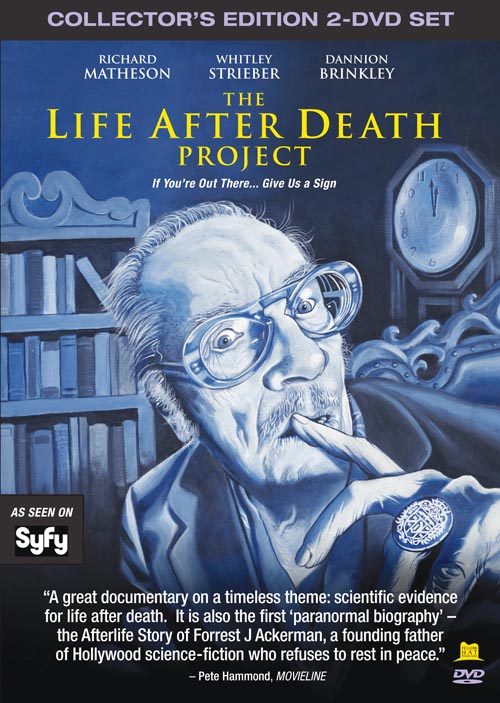
    LIFE AFTER DEATH PROJECT - DVD COVER

    PD: In the sequel, I let witnesses to many other life after death cases tell their stories. These are people from all walks of life. We hear from them, with very little editing (except for length) – we learn what happened and why they felt that it relates to unseen spirits or survival of consciousness and personality after death. A few might be considered “ghost stories,” but most have physical phenomena attached and were seen by more than one person. I am interested in what palliative care doctors have to say – end of life physicians who witness a lot of people die. And nurses who work with people during their final weeks and moments. It is surprising to hear how committed some of these people are to the concept that there is evidence of a “spirit” that departs the physical body at death. And these are for the most part not religious people – they do not hold these convictions because they were taught them as part of a religion in which they believe. Three exceptional people in the film are Dr. John Lerma, M.D., Dr. Lynne D. Kitei, M.D., and John B. Alexander, a former military man and author about non-lethal weaponry. Dr. Alexander extensively studied the issue of life after death and was the president of a non-profit organisation dealing with this topic. Also of interest is Dr. Stanislav O’Jack. His extraordinary abilities to take unusual, unexplained photos, sometimes while the lens cap is still on the camera, have been studied at length by a Stanford physics professor (now emeritus), Dr. William Tiller, who was in What The Bleep Do We Know. Dr. Tiller’s assessment gives credibility to Dr. O’Jack’s claims. One of those claims is that Dr. O’Jack’s wife appeared to him and one other colleague in body, in full physical form, after she was dead… and she then disappeared. John Alexander also tells of an incident that happened that was just like the O’Jack story – it happened to one of John Alexander’s mentors, Dr. Elizabeth Kubler-Ross. One of her deceased students appeared to her in physical form, spoke to her, wrote her name down, and then vanished down a hallway. So although the sequel is somewhat different than The Life After Death Project in style, and is less devoted to scientific evidence, I think viewers will find it compelling. In any event, a complete list of the people in the sequel and description of it can be found at www.lifeafterdeathproject.com For those who order the Collector’s Edition 2-DVD Set of The Life After Death Project, the sequel is included on the 2nd DVD as part of the package. I also want your readers to know of my two websites: www.pauldavids-artist.com and www.pauldavids.com.

    ND: Thank you very much Paul Davids for taking the time to answer these questions. We are confident your new film will take us one step closer to understanding the mystery of consciousness and life after death.

    You can learn more and follow what Paul Davids is up to through his website www.pauldavids.com.

    [alert type=”general” dismiss=”no”]This article was published in New Dawn 139.[/alert]

    [alert type=”success” dismiss=”no”]If you appreciate this article, please consider subscribing to help maintain this website.[/alert]

    © New Dawn Magazine and the respective author.
    For our reproduction notice, click here.
  • Nikola Tesla: Maverick, Visionary & Master of Light

    Nikola Tesla: Maverick, Visionary & Master of Light

    From New Dawn 97 (Jul-Aug 2006)

    It’s almost a cliché. Working alone, an inventive genius pioneers new devices that ultimately change the world but his genius is barely recognised and he goes on to die in relative poverty; and whilst he dies, virtually alone and unrecognised, his inventions eventually transform life across the planet.

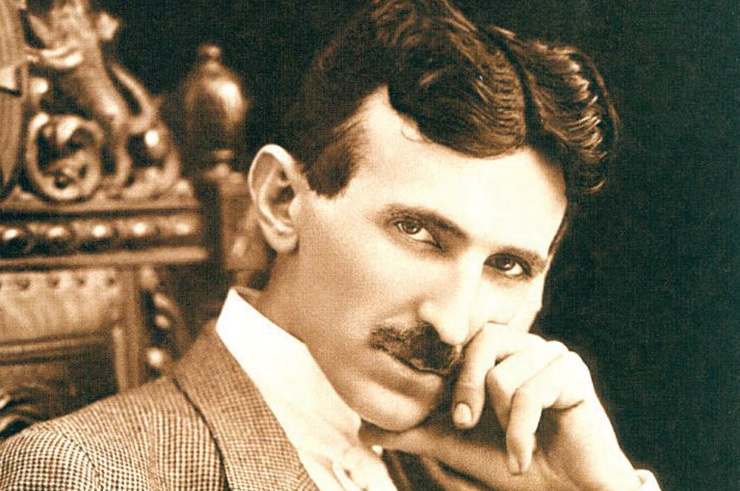
    Unfortunately it’s pretty much the story of Nikola Tesla, the scientific visionary whose inventions shaped much of the 20th century, whilst the man himself has been all but forgotten. And it is no exaggeration to call Tesla a visionary.

    In contrast to many scientific pioneers who spent years developing their projects, Tesla’s ideas were often conceived and perfected in his mind’s eye in an instant.

    “Birth, growth and development are phases normal and natural,” said Tesla, but, “It was different with my invention(s). In the very moment I became conscious of it, I ‘saw’ it fully developed and perfected…”

    In fact these extraordinary powers of memory and visualisation were to characterise much of his life and work. One day while walking with a friend in Budapest, Tesla was reciting lines from Goethe’s Faust when the idea of a rotating magnetic field suddenly appeared before him, literally. In an instant Tesla knew how to produce the alternating current.

    “Can’t you see it right here in front of me, running almost silently?” He asked his companion: “It is the rotating magnetic field that does it… Isn’t it beautiful? Isn’t it simple? My motor will set man free, it will do the work for the world.”

    He was in every sense of the word a scientific visionary; he initially developed the fluorescent bulb and neon lights; he pioneered the speedometer and the car ignition system, and helped reveal the basic scientific principles behind electron microscopes, and the microwave oven. Yet apart from a small but enthusiastic following that has grown around him, most people have hardly even heard of Nikola Tesla.

    Born at the stroke of midnight, July 9-10, 1856 in Similjan, Croatia, the son of a priest of the local Serbian Orthodox Church, the young Tesla quickly distinguished himself as intelligent and went on to study physics and mathematics in Gospic and electrical engineering at the Polytechnic Institute in Graz, Austria.

    A turning point came in 1884 when Tesla first arrived in America but initially he wasn’t too impressed: “What I had left was beautiful, artistic and fascinating in every way.” He wrote to a friend: “What I saw here was machined, rough and unattractive.”

    The young immigrant arrived with four cents in his pocket, some mathematical computations and a letter of introduction from Charles Batchelor, one of Thomas Edison’s business associates in Europe.

    After a short spell working for Thomas Edison, Tesla went out on his own and by December 1887 he had filed for seven US patents. These comprised a complete system of generators, transformers, transmission lines, motors and lighting. So original were the patents that they were issued without a challenge, as would normally happen. They turned out to be the most valuable patents since the telephone.

    Pittsburgh industrialist George Westinghouse heard about Tesla’s inventions and decided to investigate for himself. Acting on his sharp business instincts, Westinghouse arrived at Tesla’s lab, inspected the inventions and promptly bought the patents, which ironically were to lay the foundations for the Westinghouse Corporation, one of the pillars of the Military/Industrial complex (otherwise known as the ‘New World Order’).

    The Westinghouse Corporation went on to win the bid for illuminating the World’s Fair. Held in Chicago in 1893, the fair was also the world’s first ever all-electric fair. It opened on the evening of May 1 when President Grover Cleveland pushed a button and a hundred thousand incandescent lamps illuminated the fairground’s neoclassical buildings.

    Tesla inventions had arrived and they were about to illuminate not only the World Fair but also the world itself.

    Unlike Westinghouse though, Tesla didn’t have any business sense, nor was he driven by any overwhelming desire to make money; instead he had vision, genius, a God given creative gift that has led some observers to liken him to a Da Vinci of the modern day sciences.

    In fact it’s no exaggeration to say that Westinghouse Corporation was built on Tesla’s lack of business sense. Years of fierce competition with Edison’s Corporation had left Westinghouse financially drained and by 1896 his company’s position was looking extremely precarious.

    J.P. Morgan, the Stock Market’s ‘robber baron’, saw his chance. In an effort to bring the US power industry firmly under his control he began to manipulate the Stock Market, with the intention of ruining Westinghouse and buying Tesla’s valuable patents.

    In desperation, Westinghouse pleaded with Tesla to revise his contract and release him from a bond to pay the inventor generous royalties. In a gesture that was typical of his true spirit, Tesla is said to have torn up the contract.

    Rocky Mountain High

    Around the turn of the century Tesla concluded that it would be possible to transmit electrical power without wires. To optimise results, he chose to experiment at high altitude, where the air was thinner and therefore more conductive.

    As a result he ended up building a research laboratory in Colorado Springs where he conducted some of his most extraordinary experiments, tests that even to this day are shrouded in mystery.

    Tesla theorised that unlimited amounts of power could be transmitted anywhere on Earth, without wires and with virtually no loss of energy. It is not clear exactly how he intended to do this, but right up until the end of his life he maintained it was quite possible and that he only needed sufficient funds to make it a reality.

    The funds, however, were not forthcoming, and Tesla was eventually forced to abandon his Colorado experiments in what was to become a recurrent feature in his life: no money or insufficient finance to pursue an idea… but a constant stream of new ideas.

    At the beginning of the First World War, Tesla described a means for detecting ships at sea. His idea was to transmit high-frequency radio waves that would reflect off the hulls of vessels and appear on a fluorescent screen. The idea was way ahead of its day, and at the time few quite understood it, but it was a forerunner of what we now call radar.

    Tesla was also the first to see a time when flying vehicles could be remotely controlled to land with an explosive charge on an unsuspecting enemy. In effect he was describing what we know today as a cruise missile.

    By 1922 Tesla was working as a consulting engineer. He was making just enough money to live on, but often the plans he drew up were rejected as impractical.

    Interestingly, around this time Tesla spoke out against the new theories of Albert Einstein. In contrast to the Nobel Laureate, Tesla maintained that energy was not contained in matter, but in the space between the particles of an atom.

    Toward the end of his life Tesla became even more eccentric and reclusive. He began visiting parks to rescue pigeons that he then took home to nurse.

    In his final years, at the Hotel New Yorker, he had the chef prepare a special mix of seeds for the birds. He also became obsessive about cleanliness, eating only boiled foods.

    Nonetheless the ideas continued to flow and in the years prior to the Second World War he announced that he had discovered a new energy source, and a technology that could end war entirely.

    The New York Times of 11 July 1934 announced that: “TESLA, AT 78, BARES NEW DEATH BEAM.”

    “The Death Beam,” the Times continued, “will send concentrated beams of particles through the free air, of such tremendous energy that they will bring down a fleet of 10,000 enemy warplanes at a distance of 250 miles…”

    The weapon, said Tesla, would make war impossible by surrounding every country with an “invisible Chinese Wall.” It was, in effect, what we know today as a charged particle beam accelerator.

    Once again though, Tesla was unable to summon sufficient finance to back his proposal and as the prospect of war became more likely so Tesla became ever more desperate.

    In despair he finally sent detailed plans for his ‘peace weapon’ to the governments of the US, Britain, France, Canada, Yugoslavia and the Soviet Union. But to Tesla’s dismay, none of the Western governments took his proposal seriously, not at the time anyway.

    Get the issue this article appears in

    However, in the aftermath of Tesla’s death in 1943, it became apparent that some of these governments had grown more than a little interested.

    Tesla’s nephew, Sava Kosanovic went to his uncle’s rooms on the morning of his death. On arrival, according to Kosanovic, the rooms looked as if they had been searched; notebooks and crucial technical papers were missing, and two days later the Office of Alien Property seized all of Tesla’s remaining belongings.

    One result of this is H.A.A.R.P.1 Situated in Alaska, exactly where Tesla first proposed it should be sited, H.A.A.R.P. is seen by some observers as a working example of a device first proposed by Tesla in 1915. Long before anyone had heard of H.A.A.R.P., before it had even been built, Tesla was talking to the press about it.

    “It is perfectly practicable to transmit electrical energy without wires and produce destructive effects at a distance,” he told the New York Times in an interview published on December 8, 1915.

    “I have already constructed a wireless transmitter which makes this possible, and have described it in my technical publications. . . With a transmitter of this kind we are enabled to project electrical energy in any amount to any distance [HAARP’s output is a full gigawatt] and apply it for innumerable purposes, both in war and peace.”

    [alert type=”general” dismiss=”no”]This article was published in New Dawn 97.[/alert]

    [alert type=”success” dismiss=”no”]If you appreciate this article, please consider subscribing to help maintain this website.[/alert]

    Footnote

    1. See ‘Weapons of the New World Order’, http://www.thetruthseeker.co.uk/?p=1485

    Sources

    www.pbs.org/tesla/
    UFO Magazine (American edition), Vol. 15, No. 7, devoted to Tesla and his work.
    www.teslasociety.com

    © New Dawn Magazine and the respective author.
    For our reproduction notice, click here.
  • Before The Pharaohs: The Evidence for Advanced Civilisation in Egypt’s Mysterious Prehistory

    Before The Pharaohs: The Evidence for Advanced Civilisation in Egypt’s Mysterious Prehistory

    From New Dawn 97 (Jul-Aug 2006)

    There is no other place on Earth like Egypt’s Giza Plateau. Anyone with even a slight interest in history and civilisation is aware of this fact. For on this plateau there stands the Great Pyramids and their sculpted guardian, the Great Sphinx.

    Although there are plenty of theories, no one really knows who built the Giza Pyramids or carved the Sphinx, or when they were constructed. Any statement as to who built them, or when they were built, is pure theory. In light of all the various theories concerning these mysterious structures, I don’t think the theoretical nature of the pyramid builders can be emphasised enough.

    What stands out at Giza more than anything else is not only the magnitude of the construction of the pyramids, but the internal design of the Great Pyramid; three chambers, of which one is subterranean, and their connecting passageways. The passageway that leads to the so-called King’s Chamber rises to a height of thirty-six feet! On the other hand, all other passageways were not built tall enough to accommodate the average man or woman.

    There is also the unique configuration of the King’s Chamber as well as the Queen’s Chamber. Both of these contain two shafts, one on each side of the chamber. The Queen’s Chamber contains a corbelled niche built into its east wall, and the King’s Chamber’s ceiling is composed of five granite slabs stacked one atop the other. Why these chambers were constructed in this manner is unknown.

    The official theory is that the pyramids were tombs, and that King Khufu kept changing his mind where his burial chamber was to be placed; thus, the reason for three chambers in the Great Pyramid. However, in comparison to typical Egyptian burial methods (the mastaba and the tombs in the Valley of the Kings), the Giza pyramids, and particularly the Great Pyramid, do not fair well within the Egyptian concept of a tomb.

    The Ancient Egyptian View of the Afterlife

    The Egyptians believed in an afterlife, and the tomb was an important part of that belief. As the tomb of King Tutankhamun testifies, the deceased’s chamber of internment was to be decorated with art and filled with that person’s possessions. Why they practiced this ritual was not for superstitious reasons, as one might suspect. It was practical, according to their beliefs, and aimed at preventing that person’s energy (spirit) from being re-absorbed into Nature’s spiritual force.

    For the ancient Egyptians, Ba animated a living person, whereas Ka was the energy emanating from that person. Although not an exact analogy, the Ka and the Ba are what traditional Western thought might refer as spirit and soul. Another important aspect of Egyptian belief represented immortality, the ankh, depicted as the crested ibis.

    The Ka, represented in art by up-stretched arms, was believed to be the part of man’s consciousness and energy (man’s spirit or inner quality) that related to the immediate world. It is the part of us connected to the physical body; where it lived, its possessions, as well as the people he or she was acquainted with. The Ka can be likened to one’s personality, which upon death is separated from the body, and naturally seeks a way to once again take form. The Ba, represented by a winged human head, or sometimes a human-faced bird, represented the part of consciousness that is immortal.

    When someone passed away, it was their goal as well as the hope of the family, that the deceased’s Ka would seek a way to remain united with their Ba. To help accomplish this eternal union, the possessions of the deceased were gathered together by the family and placed in the tomb with the mummified body. Mummification prevented the body from decomposing and returning to the soil of the Earth, whereas the tomb, with the deceased’s possessions, served as a ‘home’ for the Ka. As a result, the Ka maintained its identity in the spiritual world and could seek out its Ba in order to achieve ankh, which resulted in the resurrected and glorified form of the deceased beyond the limits of an earthly realm.

    Pyramids and the Concept of the Egyptian Tomb

    Like the pharaonic tombs carved into the Valley of the Kings, royal mastabas built during the early dynasties – some as early as 3000 BCE – were also designed with ‘home’ in mind, as that home relates to a person’s Ka. Case in point: from the sixth dynasty, Mereruka’s mastaba was crafted in mansion-like proportion with thirty-two rooms and adorned with statues and art depicting, for example, scenes of wildlife along the Nile River.

    The traits of Egyptian domestic life, so beautifully incorporated into the design of their tombs, are not found in the Giza pyramids. The Giza pyramids contain no art or hieroglyphics of any kind, very uncharacteristic of Egyptian tombs. So why is it the case that the Giza pyramids are generally considered to be tombs of fourth dynasty Pharaohs? The reason is because of an association of the Giza complex with another development ten miles south at Sakkara where the Egyptians really did build tombs as pyramids.

    At Sakkara in 1881, the French Egyptologist, Gaston Maspero (1846–1916) discovered that the subterranean chamber of the Pepi I Pyramid (second ruler of the sixth dynasty) was engraved with hieroglyphics. Over the course of subsequent explorations, it was discovered that a total of five pyramids at Sakkara also contained inscriptions, from the fifth, sixth, seventh, and eighth dynasties of the Old Kingdom. In 1952, Dr. Samuel A.B. Mercer (1879–1969), Professor of Semitic Languages and Egyptology at the University of Toronto, published a complete English translation of “The Pyramid Texts” in a volume of the same name. According to Mercer, The Pyramid Texts contained ‘words to be spoken’ concerning funerary ritual, magical formulae, and religious hymns, as well as prayers and petitions on behalf of the deceased king.1

    With the pyramids at Sakkara being confirmed as tombs the associative logic came to be that all pyramids must be tombs. Furthermore, since there are two cemeteries (mastaba fields) to the east and west of the northernmost Giza pyramid, assuming that all pyramids are tombs was a likely conclusion. However, the condition of the Sakkara pyramids – most of which are believed constructed after the Giza pyramids – poses serious problems in this logical association. Of the pyramids at Sakkara only Djoser’s ‘Step Pyramid’ is in good condition, although not really a true pyramid. (The Step Pyramid was originally a mastaba that was modified into a pyramid.) All other pyramids at Sakkara, most of which belong to the fifth and sixth dynasties are in ruins today and resemble mounds of rubble.

    According to a consensus of Egyptologists, Djoser’s Step Pyramid at Sakkara was constructed during the third dynasty and was the forerunner to the fourth dynasty pyramids on the Giza Plateau. After pyramid development at Giza, for whatever reason, the focus of pyramid building shifted back to Sakkara.

    The Great Pyramid – A Device

    The easily observable and obvious differences in the Giza pyramids and the Sakkara pyramids, which were all supposed to have been built during the same era, are a problem. Clearly, the construction techniques, as well as materials, for the Giza pyramids were different than those at Sakkara, or else we would expect pyramids at both sites to have stood the test of time in a similar manner. They did not. The important point is why. Did the engineers and construction workers of the Old Kingdom not pass along their methods from the fourth to the fifth dynasty? It seems they did not, which is a very curious occurrence given the stability of Egyptian civilisation. It may also be the case that the fourth dynasty Egyptians did not build the Giza pyramids.

    No other pyramid in Egypt (the world for that matter) is like the Giza pyramids, and in particular the Great Pyramid. Additionally, there is no direct evidence to support the claim that the Great Pyramid, or the other Giza pyramids were tombs. Nor is there any record left by its builders as to what it was for or when it was built. This creates a problem of explanation. If the Great Pyramid was not a tomb, then what was it? A mystical temple for initiation ritual, or a public works project designed to unify the country? Or, was it something else entirely? Theories are abundant, but the only theory I am aware of that covers all aspects of the Great Pyramid’s interior design, is Christopher Dunn’s theory that it was a device. According to Dunn, the Great Pyramid was a machine for producing power by converting tectonic vibration into electricity.

    There are a number of reasons to accept Dunn analysis. First, he explains the interior design and all other evidence within the Great Pyramid in a cohesive manner. Second, he demonstrates the technical skills required to accomplish precision construction. Third, Dunn’s expertise and career is in the precision fabrication and manufacturing industry, which makes him uniquely qualified to express a professional opinion on the techniques and tools of the Giza pyramid builders.

    The fact is, modern construction companies could not build the Great Pyramid today without first inventing specialised tools and techniques in order to deal with blocks of stone that vary in weight from ten to fifty tons. Such an endeavour would be on a magnitude equivalent to building a hydroelectric dam or a nuclear power station requiring tens of billions of dollars in resources. Although our modern economy is different than that of the ancient world, the resource required now as compared to then is the same! The stone must be quarried and moved and the workers must be paid. The fact that an extremely large amount of resources were dedicated to Giza pyramid development over a long period of time demands, in my opinion, that pyramid building was utilitarian, and not for any fourth dynasty pharaonic vanity of having the largest headstone in the world.

    Prehistory – Evidence and Perspective

    For me, the evidence clearly tells a very different story of early dynastic Egypt. Sometime around 3000 BCE, the establishment and growth of permanent settlements in the Lower Nile Valley led to the development of civilisation. Why Giza and the surrounding area were chosen as the focal point for early Dynastic Egypt was because ‘civilisation’ had been there before, as the three pyramids and the Great Sphinx testify. Without knowing what the pyramids were designed for, the early Egyptians also assumed they must have been tombs. As a result, they rejuvenated the Giza Plateau and turned it into a Necropolis, then expanded to Sakkara where they built tombs in pyramid form, albeit of lesser quality and not brandishing the skills the original builders of the Giza pyramids demonstrated. Pyramid building, even the smaller ones at Sakkara, was resource intense, so the Egyptians reverted to burying their nobility in the traditional mastaba.

    This scenario, which calls for an earlier civilisation with advanced technical skills, poses another problem. It does not fit the standard model of history. However, the notion that an earlier civilisation existed does not rest on the Giza pyramids alone. There is also the Sphinx, which in 1991 was geologically dated to between 7,000 and 9,000 years old by the team of John Anthony West and geologist Dr. Robert Schoch. Add to that the megaliths of Nabta Playa in southwestern Egypt, which is believed to have been a star viewing diagram, according to astrophysicist Dr. Thomas Brophy, that relates not only the distance from Earth to the belt stars of Orion, but their radial velocities as well. Another ‘head scratching’ discovery is the 1260-ton foundation stones of the Baalbek temple, west of Beirut in Lebanon, one of which was left in its quarry.

    Clearly history has its secrets, but there is enough evidence to validate, as theory, that civilisation is much older than we have previously believed. History, according to the ancient Egyptians themselves, confirms this. According to the Papyrus of Turin, which is a complete list of kings up to the New Kingdom, before Menes (before 3000 BCE) the:

    …venerables Shemsu-Hor, [reigned] 13,420 years
    Reigns up to Shemsu-Hor, 23,200 years2

    These two lines in the king’s list are explicit. According to their documents, the total years of Egyptian history goes back 36,620 years. The argument that the years in the king’s list do not represent actual years, but some other, shorter, measurement of time seems more of an attempt to explain away than to explain. The ancient Egyptians employed a sophisticated calendar system that involved a 365-day year, which was periodically corrected through the predictable and cyclical nature of the star Sirius. Every 1,461 years, the heliacal rising of Sirius marked the beginning of the new year. A single Sirius cycle corresponds to 1,461 years, where each year is equivalent to 365.25 days. In essence, the marking of the New Year at the heliacal rising of Sirius was the ancient Egyptian’s ‘leap year.’ Of course, determining the length of Sirius’ cyclical nature requires stellar observation over thousands of years which means the origins of pharaonic Egypt, or its source of knowledge, must originate in the remote past.

    Late twentieth century Egyptologist Walter Emery seems to have agreed in principle that the origins of ancient Egypt date well into prehistory. Emery believed that ancient Egypt’s written language was beyond the use of pictorial symbols, even during the earliest dynasties, and that signs were also used to represent sounds, along with a numerical system. When hieroglyphics had been stylised and used in architecture, a cursive script was already in common use. His conclusion was that:

    All this shows that the written language must have had a considerable period of development behind it, of which no trace has as yet been found in Egypt.3

    Ancient Egyptian religion also testifies to a considerable period of development. Their religion, which is more of a philosophy of nature and life than it is a ‘religion,’ is based on a level of sophistication that, in all respects, appears more scientific than it does mythical.

    Symbolism and Nature: The Method of Egyptian Thought

    From a modern Western perspective their religion has been billed as primitive and polytheistic, and appears as a mythological menagerie of gods. Nothing could be further from the truth. The source of this misunderstanding stems from the Egyptian word neter being translated into Greek as ‘god,’ which later took on the Westernised meaning of deity. The true meaning of neter was to describe an aspect of deity, not a deity to be worshipped. In essence, neters referred to principles of nature in a practical scientific way.

    Yet, the meaning of a specific neter was communicated in a visually symbolic manner. When a human was depicted with an animal head, this signified the principle as it occurs in man. If the whole animal was depicted it was a reference to a principle in general. Alternatively, a human head depicted on an animal represented that principle as it relates to the divine essence within mankind, not any person in particular, but the archetypal; as the immortal Ba is represented by a human-faced bird.

    Another example is Anubis (the jackal), who presided over the process of mummification. He did so as a representation of the decomposition or fermentation process. In nature, the jackal keeps its prey and allows it to decompose before consumption. Therefore, he who presided over the mummification ritual was depicted in art as a man with the head of the jackal, thereby representing man’s death as the digestive principle found in nature. From a universal perspective, the decomposition of a body is, to Nature, digestion. Hence, those organs associated with digestion, after being removed from the deceased, were placed in a Canopic jar with a lid shaped in the image of the jackal’s head.

    Before the Pharaohs

    The sudden emergence of Dynastic Egypt, at the beginning of the third millennium BCE, is one of civilisation’s greatest mysteries. How did this supposedly primitive North African culture organise itself into a civilisation of such magnificence? One aspect that I believe has been overlooked is that mankind – anatomically modern humans – has been around for a very long time. According to recent genetic studies, all people today are the descendents of a single African woman who walked the Earth 150,000 years ago. According to geneticists, her mitochondrial DNA exists in all of us.

    This is a long time, 147,000 years, for our ancestors to have remained in a relatively primitive state. In my opinion, the evidence, some of which is incredibly anomalous (in particular the Great Pyramid) suggests they did not remain primitive. Given the evidence of ancient Egypt’s technical abilities (their monument, temples, and other crafted artifacts still exist), as well as their sophisticated symbolism in describing Nature, it appears that in establishing a dynastic society, the Egyptians of the third millennium BCE benefited from a legacy of knowledge.

    Skeptics of this approach to history, of course, would want to know where the evidence of this technical and prehistoric civilisation is. If such a civilisation existed, surely there would be overwhelming evidence to support its existence. If an exclusively uniformitarian approach to geologic formation were generally accepted as fact, I would agree with the skeptic.

    However, mass extinctions, as a result of environmental catastrophism because of volcanism, asteroid or comet impact, or stellar (gamma) radiation, now seems to be a reality.

    According to geologists there have been five large mass extinctions in Earth’s history: the Ordovician (440–450 mya), Devonian (408–360 mya), Permian (286–248), Triassic (251–252 mya), and Cretaceous (144–65 mya). Although all of these cataclysms occurred well before the modern human form, there are two global disasters that occurred relatively recently.

    Approximately 71,000 years ago Mount Toba, in Sumatra, erupted spewing an enormous amount of ash into the atmosphere. It was the largest volcanic eruption in the last two million years, nearly 10,000 times larger than the Mount St. Helen’s explosion in 1980. The resultant caldera formed a lake 100 kilometres long by 60 kilometres wide, with devastating and lasting climatic consequences. A six-year long volcanic winter followed, and in its wake an ice age that lasted for a thousand years. With its sulfuric haze, the volcanic winter lowered global temperatures, creating drought and famine decimating the human population.

    According to geneticist’s estimates, the population was reduced to somewhere between 15,000 and 40,000 individuals. Professor of Human Genetics at the University of Utah, Lynn Jorde, believes it may have been as low as 5,000.4

    Even closer to our time is the mysterious cataclysm at the end of the Ice Age, only 10,000 years ago. No one really knows if it was the result of natural phenomenon or an asteroid impact. What is known is that the climate drastically altered life for those who lived at that time. It is a known geologic fact that at the end of the Ice Age many North American species became extinct, including the mammoth, camel, horse, ground sloth, peccaries (pig-like hoofed mammals), antelope, American elephant, rhinoceros, giant armadillo, tapirs, saber-toothed tigers and giant bison. It also affected the climates of lower latitudes in Central and South America, as well as Europe in a similar way. Those lands have also revealed evidence of mass extinction. Yet, the mechanism that brought on this Ice Age ending cataclysm remains a mystery.

    If an ancient technical civilisation existed during the remote past, what would be the likelihood of that civilisation surviving a global catastrophe intact? Estimates from the Toba eruption are not encouraging. Neither are the scenarios that astronomers and climatologists build today for a theoretical asteroid impact.

    According to the archeological evidence, anatomically modern man (Cro-Magnon) appeared in Western Europe 40,000 years ago. Where they came from has been a long-standing mystery. The logical deduction is that they migrated from Africa. However, such a migration requires a host culture, of which there is no evidence.

    Nevertheless, a likely location for this host culture would have been along the shores of the Mediterranean Sea, which were likely a series of fresh water lakes during the remote past.

    If ancient civilisation existed in the region of the Mediterranean, it would not have survived the conflagration that turned those lakes into a salt-water sea.

    If that were indeed the case, the remnants of those who lived on the perimeter of that civilisation would appear to us, today, as anomalies such as the Giza pyramids and the giant stones of Baalbek.

    Cro-Magnon cultures of Western Europe, although once a part of a great Mediterranean civilisation, would also appear as an anomaly. For us, it would be as if they appeared from nowhere.

    [alert type=”general” dismiss=”no”]This article was published in New Dawn 97.[/alert]

    [alert type=”success” dismiss=”no”]If you appreciate this article, please consider subscribing to help maintain this website.[/alert]

    Footnotes

    1. Samuel A. B. Mercer, The Pyramid Texts, Longmans, Green and Co., 1952, p.2.

    2. René Schwaller de Lubicz, Sacred Science: The King of Pharaonic Theocracy, Inner Traditions, 1982, p.86.

    3. Walter B. Emery, Archaic Egypt, Penguin Books, 1961, p.192.

    4. ‘Supervolcanoes’, BBC2, 3 February 2000, also see www.bbc.co.uk/ science/horizon/1999/supervolcanoes_script.shtml.

    © New Dawn Magazine and the respective author.
    For our reproduction notice, click here.