New Dawn – World's Most Unusual Magazine

Category: Articles

  • Consider the Kali Yuga

    Consider the Kali Yuga

    From New Dawn 97 (Jul-Aug 2006)

    Academics abhor a mystery the way nature abhors a vacuum, yet in nature there are no vacu­ums, while in academia there are many mysteries. In no field of science or scholarship are there more (or more glaring) mysteries than in Egyptology. Yet, at the same time, there is no field in which mysteries are more systematically denied.

    Pick up a book, any book, written by a creden­tialed Egyptologist and you will find nothing but agreement – about everything but the most insignificant details. In his gloriously mis-titled volume The Complete Pyramids, Egyptologist Mark Lehner does not bother to even mention the controversies that have swirled (and continue to swirl) about these extraordinary structures for two centuries. Nothing; not a word. It’s all been solved by the experts: The pyramids were built as tombs by powerful but deluded pharaohs desperately trying to ensure their own immortality (wink, wink, nod, nod).

    No matter that there is no evidence, not a shred, that these pyramids – of Giza and Dahshur – were ever used as tombs – and much cogent argument strongly suggesting they were not. The huge stones were hauled up ramps by gangs of laborers and just wafted into place with lapidary precision. No matter that engineers, quarrymen and masons, people accustomed to moving large blocks of stone around, insist it could not be done in this fashion, while toolmakers and machinists study the precision and cannot fathom how it could possibly have been achieved with hand tools. The acknowledged mathematical properties exhibited by the Great Pyramid are mere accidents of design, etc. etc.

    No doubts ruffle the calm, smooth surface of Lake Consensus, that bottomless pool where the Church of Progress’ (un)faithful go for solace, baptism and to pledge undying allegiance to the Great God Status Quo. (This act of ritual intellec­tual servitude is called, in the quaint terminology peculiar to their Church, “critical thinking” and sometimes even “reason.”)

    Nevertheless, despite the near-total control exercised by the Church of Progress over the educational systems of the world (especially the West), heresy abounds. A vast public simply refuses to acknowledge the infallibility of “experts” and, indeed, exults in their discomfiture when unwelcome facts breach the walls of their fortified ivory towers.

    The Churchmen fume about “ignorance and superstition,” they try to get laws passed outlawing what they don’t approve of (e.g. astrology, home­opathy), organised debunkers pressure the media to display to the public only that which carries a Church imprimatur upon it. To no avail. While the mainstream press remains largely obedient to Church of Progress directives, television and Hollywood are less docile. They are interested in dollars, not dogma, and in their corporate amorality they will not hesitate to present heretical material. They don’t even care if it is both good and true. In other words, as long as it brings in dollars and ratings, academic disapproval goes unheeded. The merely intellectual inquisition mounted by this Church lacks the effective dissuasive powers of the Church that preceded it – since it is no longer considered politically correct to subject heretics to physical torture. Churches are not what they used to be. And torture is now illegal – sort of.

    The moral: People are less stupid than our arro­gant academics assume. However, people are also undiscriminating. Wildly speculative, even loony work gets accepted as readily, indeed, much more readily, than anything based upon rigorous scholarship. Erich von Daniken is far more popular than R. A. Schwaller de Lubicz (which is probably unavoidable except in some ideal world going through its Golden Age) and, of course, given the goals of Hollywood and TV, it is always the ratings-­and-dollar producing mysteries/heresies/alterna­tives that get the bulk of screen and air time.

    Regarding Egypt, most of the heretical attention is focused on the Pyramids of Giza and the Sphinx – which is legitimate enough since the establishment answers to virtually every question raised about these structures are so manifestly inadequate that the fires of controversy never run short of fuel. But the Giza Plateau has no monop­oly on Egyptian mysteries and some of these, unrecognised for what they are, have serious impli­cations, not only for a better understanding of the ancient world, but also for contemplating and understanding the huge, slow processes of history and our own present position within that process.

    The founding, establishment and breathtaking rise of dynastic Egypt (beginning around 3200 BCE) is one such mystery. In the space of just a few cen­turies, Egypt (apparently) went from primitive Neolithic beginnings to a complex, utterly assured command of a spectrum of disciplines. In little more than a blink of the historical eye Egypt somehow developed a sophisticated hieroglyphic system, a complex theology and cosmology, astronomy and mathematics, advanced medicine and a total mas­tery of architectural construction and artistic form.

    Egyptologists sometimes find this mildly remark­able, but by insisting that despite appearances to the contrary (and the careful work of a dozen scholars categorically proving the contrary) Egypt was “really” still a “primitive” society, devoid of “real” science and “real” philosophy (and therefore “real” civilisation). The world would have to wait for Greece for “real” civilisation to begin. And therefore, however remarkable, the flowering of Egypt presents them with no mysteries and few problems. Though this is an evasion of great mag­nitude, it will not be my focus here.

    If Egypt attained such unacknowledged heights so early, what then accounts for the long decline? Egyptologists have no problem responding to this question, and the conventional explanation, while not illogical, is unsatisfactory once you stop to question it.

    Plotted on a graph, Egypt’s history does not show a long, steady, gradual descent (from the glories of the Pyramid Age to Ptolemaic moral and artistic decadence and ultimately to the dissolution of Egypt as a coherent entity under Roman domina­tion). Rather the graph shows a series of waves, with troughs more or less equal, and each peak generally lower than the preceding peak – like waves on a beach after a storm. But it is unar­guably at its height very nearly at its beginning (a bit like starting off automobile technology with the first horseless carriage, proceeding in a couple of years to the 2005 Ferrari and then gradually working backward to the Model T Ford).

    The descent is ascribed to a combination of fac­tors: years of famine and failed Nile floods may have brought on the end of the Old Kingdom c. 2300 BCE. (An interesting alternative theory: it was an asteroid or comet strike, some sort of major but localised event that destroyed not just Egypt but much of the Middle East along with it). Then, Egypt’s early military superiority was eventually challenged and then defeated by the more warlike (read “progressive and advanced”) civilisations of Anatolia (modern Turkey) then later Mesopotamia to the east and still later Greece to the north. Concurrently, her internal centralised political, artis­tic, moral and religious authority was eroding from within. One complementary (and attractive) theory claims that the use and abuse of black magic played a significant role. There can be no doubt that magic was rife in Egypt (and actually still is).

    Civilisations come and go; we know that Roman, Holy Roman (about as holy as Lehner’s Complete Pyramids is complete), Mongol, Mogul, Dutch, French, British – all have established themselves, invariably by force, held sway briefly (by ancient Egyptian standards), weakened and ultimately fallen. So where is the alleged mystery?

    It lies in recognising the fallacy of the standard scholarly assessment of Egyptian sophistication ­which is actually a deliberate exercise in academic malpractice. As long as Egypt is seen as a kind of magnificent (but primitive) dry run for Greece, lead­ing eventually (by discrete but identifiable stages) to our current state of technological expertise, there is no problem and no mystery. But as soon as that assessment corresponds to reality then the problems arise and the mystery surfaces.

    Through the work of Schwaller de Lubicz, Giorgio de Santillana and Herta van Dechend (Hamlet’s Mill) and many other careful scholars over the past 50 years or so, it is now clear that not just ancient Egypt, but ancient civilisations worldwide, were far more sophisticated than the societies that followed them. In other words, for a few thousand years at least, what is called progress is actually regress. Indeed, it is only the major advances in our current cosmological and scientific understanding that allowed these scholars to recognise the ancients had this knowledge as well; and that it is written into their mythology and symbol­ism, their understanding of mathematics, their astronomy/astrology and their religion.

    Since Egypt’s Old Kingdom, up until very recently civ­ilisation has been going down, not up; simple as that.

    We can follow that degenerative process physi­cally in Egypt; it is written into the stones and it is unmistakable. The same tale is told in the mythologies and legends of virtually all other societies and civilisations the world over.

    This is the ultimate heresy to our Church of Progress. Progress does not go in a straight line from primitive ancestors to smart old Us with our bobble head dolls and weapons of mass destruc­tion, our traffic jams and our polluted seas, skies and lands. There is another, and far more realistic way to view history. Plato talked about a cycle of Ages: the Golden, Silver, Bronze and Iron (or Dark) Ages; a cycle, a wave form – not a straight line. A similar understanding is reflected by virtually all other ancient accounts.

    The best-known and by far the most elaborately developed of these systems is the Hindu, with its Yuga Cycle, which corresponds to the Platonic idea of four definable Ages (the Hindu Kali Yuga – our cur­rent Age – corresponds to Plato’s Iron, or Dark Age). The problem with the Hindu version, however, is the time frame traditionally applied to the separate ages: hundreds of thousands, or even millions, of years.

    No matter how wrong archaeologists may be in their chronologies or their interpretations of the ancients, it is hard to imagine they can be that wrong! Yet not long ago, a little-known work on the Yuga Cycle came my way that fits the four stage cycle within the more manageable 20-odd thousand year cycle of the precession of the equinoxes. There can be no doubt the ancients were fully aware of the phenomenon of precession, and they regarded it as a matter of commanding impor­tance, but it is difficult to see why. I now believe that integrating the Yuga cycle with precession may hold the key to understanding just why the ancients considered it so important, and also, just possibly, to figuring out with some accuracy just where we stand within that cycle.

    Of Myth And Meaning

    Microsoft Word’s in-PC thesaurus lists two meanings or synonyms for “myth”: legend and falsehood. Interestingly, the synonyms for “legend” do not include “falsehood,” while the synonyms for “false­hood” do not include “legend.” Nevertheless, in common usage, both definitions are used, often indiscriminately, and in some cases both actually apply. Utterances made by George W. Bush, for example, achieve legendary status instantly, and in most cases they are also falsehoods. But in dealing with the myths of the ancients, it is wise to exercise caution before summarily equating a legend with a falsehood, no matter that it generally does not cor­respond to our modern manner of communicating fact. The ancients, obviously, did not think of their legends as falsehoods. That negative meaning is a contemporary judgment, promulgated by Victorian proto-anthropologists of the nineteenth century and turned into dogma by Church of Progress devotees in the twentieth. (James Frazier’s exhaustive Golden Bough was probably the most influential single work of the genre.)

    Though still prevalent, especially in academia, that Victorian assessment has been under attack almost since its beginning. It is now becoming clear that these strange, seemingly haphazard and irrational ancient tales contain within them forgotten history and profound psychology, but also, amazingly, astronomy, cosmology, physics, genetics and an understanding of the workings of the Universe so advanced and comprehensive that it is only the most recent advances in our own sciences that allow us to begin to understand what knowledge was available in the very distant past – at a time when, according to our “experts,” there was no civilisation to speak of at all.

    In short, it is time for a total re-evaluation of the knowledge of the ancients. Not only did they know more than we thought they knew; it is also very possible they had knowledge we do not yet have, and that might be extremely useful, even crucial for us to acquire.

    An Egyptian myth may be one place to start looking.

    Introducing Sekhmet

    In ancient Egyptian mythology, Sekhmet, the goddess portrayed as a woman with the head of a lioness, is associated with vengeance, warfare and also, curiously enough, with healing; but healing by fire, or purgation. Esoterically, she represents the female aspect of the fire (initiat­ing) principle. Ptah (architect of heaven and Earth) creates the Universe with “words” fur­nished by Djehuti (cosmic wisdom) but it is Sekhmet, Ptah’s female consort, who actually gets the work done. Her name “Sekhem” means “power”; the addition of the feminine suffix, “t” makes it “feminine power.”

    In one well-known myth, Re, the Sun (creative principle) is old and tired; fractious, disobedient mankind no longer pays him homage. So Sekhmet is dispatched by the gods to punish humanity and bring it back into line. She proceeds to carry out this task with the gleeful fury proper to her lioness nature. By day she massacres; by night she returns to gorge herself on the blood-covered fields – until a point is reached when it becomes clear that unless checked, she will soon destroy mankind altogether, and she is not distinguishing between those few still obedient to the gods and the scornful and skeptical majority. (This attitude will show up peri­odically throughout subsequent history, most memorably perhaps at the Siege of Bezier, during the Albigensian Crusades, when the general in charge of the siege, and about to storm the walls, asked the Papal Legate, Arnald-Amalric, Abbot of Citeaux, how he was to distinguish between the true believers in the town so that they might be spared, and the targeted heretics who, needless to say, deserved to die. The Abbot is reputed to have said: “Kill them all. God will recognise his own.”)

    In any event, in the Egyptian myth, the gods prove more merciful. For reasons difficult to ascertain, they decide mankind has been punished enough and something has to be done to stop Sekhmet before she annihilates the race entirely. A trick is played upon Sekhmet, instigated by the wise Djehuti. While Sekhmet sleeps, the blood cov­ering the fields is replaced by wine. And when Sekhmet wakes and visits the fields to gorge her­self as is her wont, the wine has its intended effect. Sekhmet falls into a drunken stupor, goes to sleep, and wakes up transformed into the benefi­cent Hathor, provider of cosmic nourishment and associated with sexuality, song, dance and the cycles of time. There the Egyptian story stops, but extrapolating, it is probably safe to suppose the mythmakers assume that at this point, with Sekhmet pacified, mankind regroups and pro­ceeds along its not-so-merry way.

    Consider the Kali Yuga

    In the first part of this article, I left off with a brief discussion of the Vedic/Hindu doctrine of the Yugas, the idea that history follows a cycle, corresponding to the Platonic doctrine of Aeons or ages (Golden, Silver, Bronze and Iron, or “Dark” Ages). Most Hindu accounts assign improbably long time periods to each of these ages, but one relatively modern thinker, Sri Yukteswar, the guru of the influential twentieth century yogi, Paramahansa Yogananda, wrote that originally, the Yuga cycle was supposed to correspond to a precessional cycle (Yukteswar allots approximately 24,000 years to this cycle, modern astronomy puts it close to 26,000 years but variable within narrow limits. Plato gives a precise numero­logically interesting canonical number of 25,920 years – six times six times six times 12). Moreover, in the standard accounts, the Kali Yuga (or Dark Age) is followed immediately by a new Golden Age. This does not make sense; the end of winter is not followed immediately by summer.

    Now in Hindu mythology, Kali the Destroyer is equivalent to the Egyptian Sekhmet, and it may be that the Sekhmet myth has legitimate astronomi­cal/astrological significance.

    An aging or dying god is a feature of many ancient myths and legends and it is the mythic way of signaling the end of an astronomical cycle of some sort (cf. Hamlet’s Mill). Unfortunately, our standard view of history is not only very wrong, it is also very short. We have a good idea of the Piscean Age of the last 2,000 years, a much less comprehensive picture of the Arian Age preceding it (c. 2000-0 BCE), but in the Taurean Age (4000-­2000 BCE), except for Egypt, we enter a realm of myth and legend with relatively little factual material to base sound interpretations upon. The further back we go, the mistier it gets.

    The English writer Samuel Butler once remarked that, “Analogy may be misleading but it is the least misleading thing we have.”

    So, to appreciate our own position within the grand Yuga cycle, analogy may help.

    We are familiar with the cycle of night and day. But imagine a sentient creature that lives for just a minute. If that minute falls at midnight, then our Minute Man can have absolutely no idea of what that minute of life might be like at high noon, espe­cially if it’s raining.

    Now move up a step in the cyclical hierarchy to the seasons, and imagine a sentient creature that lives for just a day. If that day falls in February and it’s still raining (both Minute Man and Day Man live in Wales) then he can have no idea of what a day would be like in mid-June – unless, of course, leg­ends and myths have somehow survived the course of the year, in which case they would be so inconsis­tent with their own life experience that they might well dismiss them as falsehoods, i.e. myths.

    Now move up to ourselves, within the preces­sional cycle. Allowing an ideal 100 year life span, if that 100 years corresponds to a rainy midnight minute or equally rainy February day in Wales then we can have no experiential possibility of under­standing what a sunny 100 years in June in Cosmic California might be like, much less that life might actually be much prolonged under such circumstances – as so many myths and legends assert. There can be no doubt the ancients under­stood precession, and equally no doubt they considered it of paramount importance. And maybe that is why – because it enabled them (at least in principle) to live in harmony with the dic­tates of their era, or so the legends say.

    So if there is validity to the concept of the Yuga cycle, just where would we stand? Not in June in Cosmic California, that is for sure! Scan the front page of any daily newspaper in the world and it looks like mid-January: war, terrorism, murder, rape, robbery, scams, famine and disease – chaos everywhere. The greatest military and economic power in recorded history has as its leader an inarticulate, illiterate dunce, himself under the control of a tribe of corporate cannibals. The entire planet is threatened by a gamut of poten­tially terminal environmental, ecological, medical and military disasters. The institutionalised reli­gions of both East and West (at their best but stunted, pale offshoots of much more robust and earlier root stocks) are degraded and degenerate. Education everywhere is controlled by the priest­hood of the Church of Progress, forcibly proselytising its psychotic and spurious doctrine of meaning­lessness, accident and despair.

    A good case could be made that it’s mid-Kali Yuga, and Sekhmet has again been summoned and is already exercising her bloody trade. But this could be a misperception. Certainly a cosmic bliz­zard is blowing, of that there can be no doubt, yet maybe it’s March in the cycle – and even though it doesn’t look that way, spring is on the way. Under the snow, the seeds of spring are germinating. The substantial minority of us who aren’t trapped in hopeless third world conditions know that at the very least we’re not back in the post-Roman Dark Ages – which were pretty dark everywhere around the planet as far as we can determine.

    Opposition to the Church of Progress Mounts: A Positive Sign

    There is one potentially major positive sign that goes generally unrecognised. The past three centuries have seen a prodigious flowering of creative energy, most of it undeniably dedicated to destruc­tion and frivolity (even the most nauseating TV commercial is the result of an extraordinary expen­diture of creative and technical expertise).

    While imbeciles insist upon calling this progress, in its standard manifestation it is little more than shiny barbarism.

    Even so, that standard is not necessarily a fait accompli, an unalterable condition. The outpouring of creative energy is a fact. In itself it is neutral in principle. Directed consciously and constructively, things could change, everywhere – and in a hurry. When ideas change, everything changes. Of course, getting the ideas to change is another mat­ter altogether. Nevertheless, it could happen. Even before it’s too late. If only…

    Maybe, just maybe, Sekhmet is just growling and flexing her claws, and despite all appearances to contrary, there is still some wiggle room.

    It’s a thought.

    [alert type=”general” dismiss=”no”]This article was published in New Dawn 97.[/alert]

    [alert type=”success” dismiss=”no”]If you appreciate this article, please consider subscribing to help maintain this website.[/alert]

    © New Dawn Magazine and the respective author.
    For our reproduction notice, click here.

  • Minds Beyond Brains: New Experimental Evidence

    Minds Beyond Brains: New Experimental Evidence

    From New Dawn 110 (Sept-Oct 2008)

    Where are our minds located? We have been brought up to believe that they are inside our heads, that mental activity is nothing but brain activity. Instead, I suggest that our minds extend far beyond our brains; they stretch out through fields that link us to our environment and to each other.

    Mental fields are rooted in brains, just as magnetic fields around magnets are rooted in the magnets themselves, or just as the fields of transmission around mobile phones are rooted in the phones and their internal electrical activities. As magnetic fields extend around magnets, and electromagnetic fields around mobile phones, so mental fields extend around brains.

    Mental fields help to explain telepathy, the sense of being stared at and other widespread but unexplained abilities. Above all, mental fields underlie normal perception. They are an essential part of vision.

    Look around you now. Are the images of what you see inside your brain? Or are they outside you – just where they seem to be?

    According to the conventional theory, there is a one-way process: light moves in, but nothing is projected out. The inward movement of light is familiar enough. As you look at this page, reflected light moves from the page through the electromagnetic field into your eyes. The lenses of your eyes focus the light to form upside-down images on your retinas. This light falling on your retinal rod and cone cells causes electrical changes within them, which trigger off patterned changes in the nerves of the retina. Nerve impulses move up your optic nerves and into the brain, where they give rise to complex patterns of electrical and chemical activity. So far, so good. All these processes can be, and have been, studied in great detail by neurophysiologists and other experts on vision and brain activity.

    But then something very mysterious happens. You consciously experience what you are seeing, the page in front of you. You also become conscious of the printed words and their meanings. From the point of view of the standard theory, there is no reason why you should be conscious at all. Brain mechanisms ought to go on just as well without consciousness.

    Then comes a further problem. When you see this page, you do not experience your image of it as being inside your brain, where it is supposed to be. Instead, you experience its image as being located about two feet in front of you. The image is outside your body.

    For all its physiological sophistication, the standard theory has no explanation for your most immediate and direct experience. All your experience is supposed to be inside your brain, a kind of virtual reality show inside your head. That means your skull must lie beyond everything you are seeing: if you look at the sky, your skull must be beyond the sky! This seems an absurd idea, but it seems to be a necessary implication of the mind-in-brain theory.

    The idea I am proposing is so simple that it is hard to grasp. Your image of this page is just where it seems to be, in front of your eyes, not behind your eyes. It is not inside your brain, but outside your brain.

    Thus vision involves both an inward movement of light, and an outward projection of images. Through mental fields our minds reach out to touch what we are looking at. If we look at a mountain ten miles away, our minds stretch out ten miles. If we gaze at distant stars our minds reach out into the heavens, over literally astronomical distances.

    Sometimes when I look at someone from behind, he or she turns and looks straight at me. And sometimes I suddenly turn around and find someone staring at me. Surveys show that more than 90% of people have had experiences such as these. The sense of being stared at should not occur if attention is all inside the head. But if it stretches out and links us to what we are looking at, then our looking could affect what we look at. Is this just an illusion, or does the sense of being stared at really exist?

    This question can be explored through simple, inexpensive experiments. People work in pairs. One person, the subject, sits with his or her back to the other, wearing a blind-fold. The other person, the looker, sits behind the subject, and in a random series of trials either looks at the subject’s neck, or looks away and thinks of something else. The beginning of each trial is signalled by a mechanical clicker or bleeper. Each trial lasts about ten seconds and the subject guesses out loud ‘looking’ or ‘not looking’. Detailed instructions are given on my website, https://www.sheldrake.org/participate/online-staring-experiment

    More than 100,000 trials have now been carried out, and the results are overwhelmingly positive and hugely significant statistically, with odds against chance of quadrillions to one. The sense of being stared at even works when people are looked at through closed-circuit TV.

    Animals are also sensitive to being looked at by people, and people by animals. This sensitivity to looks seems widespread in the animal kingdom and may well have evolved in the context of predator-prey relationships: an animal that sensed when an unseen predator was staring would stand a better chance of surviving than an animal without this sense.

    Educated people have been brought up to believe that telepathy does not exist. Like other so-called psychic phenomena, it is dismissed as an illusion. Most people who espouse these opinions, which I used to myself, do not do so on the basis of a close examination of the evidence. They do so because there is a taboo against taking telepathy seriously. This taboo is related to the prevailing paradigm or model of reality within institutional science, namely the mind-inside-the-brain theory, according to which telepathy and other psychic phenomena, which seem to imply mysterious kinds of ‘action at a distance’, cannot possibly exist.

    This taboo dates back at least as far as the Enlightenment at the end of the eighteenth century. But this is not the place to examine its history (which I discuss in my book The Sense of Being Stared At). Rather I want to summarise some recent experiments, which suggest that telepathy not only exists, but that it is a normal part of animal communication.

    I first became interested in the subject of telepathy some fifteen years ago, and started looking at evidence for telepathy in the animals we know best, namely pets. I soon came across numerous stories from owners of dogs, cats, parrots, horses and other animals that suggested that these animals seemed able to read their minds and intentions.

    Through public appeals I have built up a large database of such stories, currently containing more than 3,500 case histories. These stories fall into several categories. For example, many cat owners say that their animal seems to sense when they are planning to take them to the vet, even before they have taken out the carrying basket or given any apparent clue as to their intention.

    Some people say their dogs know when they are going to be taken for a walk, even when they are in a different room, out of sight or hearing, and when the person is merely thinking about taking them for a walk. Of course, no one finds this behaviour surprising if it happens at a routine time, or if the dogs see the person getting ready to go out, or hear the word ‘walk’. They think it is telepathic because it seems to happen in the absence of such clues.

    One of the commonest and most testable claims about dogs and cats is that they know when their owners are coming home, in some cases anticipating their arrival by ten minutes or more.

    In random household surveys in Britain and America, my colleagues and I have found that approximately 50% of dog owners and 30% of cat owners believe that their animals anticipate the arrival of a member of the household. Through hundreds of videotaped experiments, my colleagues and I have shown that dogs react to their owners’ intentions to come home even when they are many miles away, even when they return at randomly-chosen times, and even when they travel in unfamiliar vehicles such as taxis.

    Telepathy seems the only hypothesis that can account for the facts. (For more details, see my book Dogs that Know When their Owners Are Coming Home, and Other Unexplained Powers of Animals.)

    In the course of my research on unexplained powers of animals, I heard of dozens of dogs and cats that seemed to anticipate telephone calls from their owners. For example, when the telephone rings in the household of a noted professor at the University of California at Berkeley, his wife knows when her husband is on the other end of the line because Whiskins, their silver tabby cat, rushes to the telephone and paws at the receiver.

    “Many times he succeeds in taking it off the hook and makes appreciative miaws that are clearly audible to my husband at the other end,” she says. “If someone else telephones, Whiskins takes no notice.” The cat responds even when he telephones home from field trips in Africa or South America.

    This led me to reflect that I myself had had this kind of experience, in that I had thought of people for no apparent reason who shortly there afterwards called. I asked my family and friends if they had ever had this experience, and I soon found the majority were very familiar with it. Some said they knew when their mother or boyfriend or other significant person was calling because the phone sounded different!

    Through extensive surveys, my colleagues and I have found that most people have had seemingly telepathic experiences with telephone calls. Indeed this is the commonest kind of apparent telepathy in the modern world.

    Is this all a matter of coincidence, and selective memory, whereby people only remember when someone they were thinking about rang, and forget all the times they were wrong? Most sceptics assume that this is the case, but until recently there had never been any scientific research on the subject at all.

    I have developed a simple experiment to test for telephone telepathy. Participants receive a call from one of four different callers at a prearranged time, and they themselves choose the callers, usually close friends or family members. For each test, the caller is picked at random by the experimenter by throwing a die. The participant has to say who the caller is before the caller says anything. If people were just guessing, they would be right about one time in four, or 25% of the time.

    We have so far conducted more than 800 such trials, and the average success rate is 42%, very significantly above the chance level of 25%, with astronomical odds against chance (1026 to 1).

    We have also carried out a series of trials in which two of the four callers were familiar, while the other two were strangers, whose names the participants knew, but whom they had not met. With familiar callers, the success rate was 56%, highly significant statistically. With strangers it was at the chance level, in agreement with the observation that telepathy typically takes place between people who share emotional or social bonds.

    In addition, we have found that these effects do not fall off with distance. Some of our participants were from Australia or New Zealand, and they could identify who was calling just as well as with people down under as with people only a few miles away.

    Laboratory studies by parapsychologists have already provided significant statistical evidence for telepathy (well reviewed by Dean Radin in his book The Conscious Universe). But most laboratory research has given rather weak effects, probably because most participants and ‘senders’ were strangers to each other, and telepathy normally depends on social bonds.

    The results of telephone telepathy experiments give much stronger and more repeatable effects because they involve people who know each other well. I have also found that there are striking telepathic links between nursing mothers and their babies. Likewise, the telepathic reactions of pets to their owners depend on strong social bonds.

    I suggest that these bonds are aspects of the fields that link together members of social groups (which I call morphic fields) and which act as channels for the transfer of information between separated members of the group. Telepathy literally means ‘distant feeling’, and typically involves the communication of needs, intentions and distress.

    Sometimes the telepathic reactions are experienced as feelings, sometimes as visions or the hearing of voices, and sometimes in dreams. Many people and pets have reacted when people they are bonded to have had an accident, or are dying, even if this is happening many miles away.

    There is an analogy for this process in quantum physics: if two particles have been part of the same quantum system and are separated in space, they retain a mysterious connectedness. When Einstein first realised this implication of quantum theory, he thought quantum theory must be wrong because it implied what he called a “spooky action at a distance.”

    Experiments have shown that quantum theory is right and Einstein wrong. A change in one separated part of a system can affect another instantaneously. This phenomenon is known as quantum non-locality or non-separability.

    Telepathy, like the sense of being stared at, is only paranormal if we define as ‘normal’ the theory that the mind is confined to the brain. But if our minds reach out beyond our brains, just as they seem to, and connect with other minds, just as they seem to, then phenomena like telepathy and the sense of being stared at seem normal. They are not spooky and weird, on the margins of abnormal human psychology, but are part of our biological nature.

    Of course, I am not saying that the brain is irrelevant to our understanding of the mind. It is very relevant, and recent advances in brain research have much to tell us. Our minds are centred in our bodies, and in our brains in particular. However, that they are not confined to our brains, but extend beyond them. This extension occurs through the fields of the mind, or mental fields, which exist both within and beyond our brains.

    The idea of the extended mind makes better sense of our experience than the mind-in-brain theory. Above all, it liberates us. We are no longer imprisoned within the narrow compass of our skulls, our minds separated and isolated from each other. We are no longer alienated from our bodies, from our environment and from other people. We are interconnected.

    [alert type=”general” dismiss=”no”]This article was published in New Dawn 110.[/alert]

    [alert type=”success” dismiss=”no”]If you appreciate this article, please consider subscribing to help maintain this website.[/alert]

    © New Dawn Magazine and the respective author.
    For our reproduction notice, click here.
  • Secrets of Siberian Shamanism

    Secrets of Siberian Shamanism

    From New Dawn 110 (Sept-Oct 2008)

    Today, especially in New Age circles, the term ‘shamanism’ is often used in a generalised way to describe all kinds of indigenous magical practices in a wide range of cultures worldwide. It has also been projected back into a past that it never had, so we can find modern books on so-called ‘Celtic shamanism’ and even ‘Ancient Egyptian shamanism’. Modern writers on the subject such as Dr. Michael Harner have also created what is called ‘core shamanism’ or ‘urban shamanism’.

    This takes the essence of shamanic beliefs and practices and repackages them in a safe, sanitised and often diluted form that is acceptable for Western seekers of alternative spirituality. In this article, however, we examine and describe the real ‘core shamanism’ as it has been practised for hundreds of years in its homeland of Siberia and the Turkic-speaking areas of Mongolia, and where it is now being revived.

    In the late 16th and early 17th centuries the area known as Siberia was colonised by the Russians. They were led there by its abundance of wild animals that created a flourishing trade in animal skins and furs. The Tsars used the income from this enterprise to boost their economy and access the foreign currency that helped create the Russian empire. The influx of Russian hunters, fur traders and merchants drastically affected the local population, which consisted of many different tribes. By the 1900s the native population had dwindled to about 10% of the total people living in Siberia. Along with the fur traders there also came missionaries and, in later times, anthropologists. The former were interested in converting the indigenous population to Orthodox Christianity, while the latter wanted to study their tribal culture, spiritual beliefs and ritual practices. Both these groups of outsiders contacted the tribal shamans of Siberia and, for totally different reasons, recorded and commented upon their religious observances.

    The earliest references to magical practitioners that could be described as shamans in fact date back to the 13th century. It was then that the first Western travellers penetrated Central Asia and visited the court of the Mongol rulers. The explorer Marco Polo, for instance, met magicians who were healers and could diagnosis diseases by the use of divination. Polo says they became possessed by what he described as “a devil,” who then used their vocal chords to speak through them.

    However, it was an English explorer called Richard Johnston in the 16th century who first described what sounds very like the activities of shamans proper. He reported witnessing a tribal priest wearing animal skins and playing a drum “shaped like a great sieve” in “devilish rites.” During the ritual the drummer fell into a trance and was possessed by “evil spirits.”

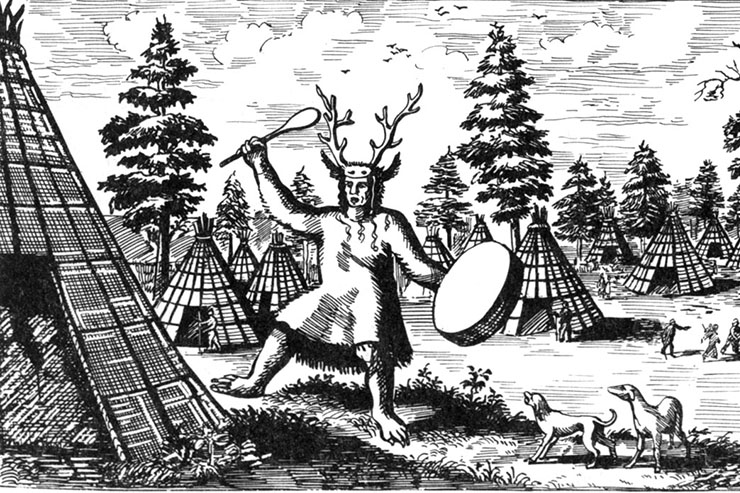
    In 1692 another Western explorer, Nicholas Witsen, described seeing a “shaman” or “priest of the Devil.” He was clad in ritual regalia, consisting of an antlered head-dress and a richly decorated robe, and chanted and beat on a drum to attract the spirits. Generally, reflecting the Catholic culture they came from, these Westerners regarded the shamans as fanatical “devil worshippers” who forced their ignorant and uneducated followers to serve evil spirits and demons.

    What is Siberian Shamanism?

    The meaning of the word ‘shaman’ is shrouded in linguistic mystery and various explanations have been put forward for its origin. One theory is that it is possibly derived from an ancient Chinese term for a Buddhist priest or monk. The Oxford English Dictionary defines its meaning as “a priest or witch-doctor [sic] of (a) class claiming to have sole contact with gods etc.” It says the word comes from the Russian “shaman” and is a translation of the Tungusion word “saman.” In Siberia and Mongolia, shamanism was known as Tengerism, meaning a reverence for sky spirits. It reflected an animistic belief system where everything in the natural world was alive, permeated by spirit force or, in simple terms, inhabited by spirits.

    These spirits had to be respected and appeased or else the land would become infertile and barren, the animals relied upon for food would disappear and eventually the world would come to an end. To achieve this essential and vital balance between humans, nature and the spirit world, a magical specialist was required and the shaman took that role. He or she acted as an intermediary or middle person between humanity and the Other, and a caretaker of cultural and magical tradition. Their job involved conducting blessings, especially on new-born babies, performing rituals of protection, divining the future, healing the sick, exorcising ghosts and demons, overseeing the burial of the dead, and generally communicating on behalf of the tribe with the spirit world and its denizens.

    Initiation into the shamanic cult could be achieved in several different ways. The easiest was the hereditary route where magical knowledge, power and skill were passed down from grandfather or father to son or, more rarely, from grandmother or mother to daughter. Sometimes children were chosen at a very early age or even at birth by the spirits and instructed by them through the medium of visions and dreams. Young people who suffered a serious illness or disease or from epileptic fits, were introverted and dreamy, or had any form of mental condition or disability, were regarded as natural shamans who had been specially chosen by the spirits.

    In later life those who felt a strong calling to become a magical practitioner would retreat from society, usually to a remote place in the wilderness, and undergo a vigil during which they invited the spirits to contact them and teach them the shamanic ways. When a person was actually taken on by another shaman as his assistant or sorcerer’s apprentice, a formal initiation rite was often carried out. The candidate offered an animal sacrifice, called on the spirits to aid them in their task, took an oath of loyalty to their shamanic master or spiritual clan, and accepted the special ritual regalia of a shaman’s office.

    Often these initiations by either another shaman or the spirits involved a traumatic visionary death and rebirth experience. Sometimes this included a journey to the underworld, meetings with deities and the would-be shaman’s body being dismembered and then put together again.

    The ritual regalia given to the new shaman reflected the fact that he or she was a special person who was separate and different from other members of the tribe. Siberian shamans wore robes made from animal hide and fur and decorated with embroidery, bird’s feathers, silk tassels, ribbons, bells, small mirrors, jewellery representing symbolic motifs such as the World Tree, and assorted metalwork such as copper discs. Headwear consisted of a conical or pointed cap made from felt or fur or the antlers of a reindeer. Some shamans wore iron-shod fur boots so when they stamped their feet they could drive away evil spirits.

    The majority of shamans carried a ritual drum similar in shape to the traditional Irish bodhran. These were made from an animal skin stretched over a wooden frame and decorated with feathers and magical symbols representing spirit journeys to the Otherworld or the shamanic cosmology. The drum was very important and represented the symbolic and magical steed that enabled the practitioner to travel from Middle Earth to the realm of the spirits. It was also a magical object in its own right that contained and focused spirit force or energy. By playing it the shaman could both attract spirits and exorcise them. In addition to the drum a magical staff was often carried. This was made of either wood or metal and was decorated with feathers, bells, ribbons and the pelts of small woodland animals.

    Different Types of Shaman

    Although Westerners used the generic term ‘shaman’ to describe all the tribal magical practitioners of Siberia and Mongolia, in practice they were divided into several different types, categories or classes with specific magical duties and responsibilities. Using English terminology, these included ‘conjurors’ who summoned and controlled spirits, prophets or psychics who foresaw the future, sorcerers who practised ‘black magic’, trance-workers who travelled in spirit form to the Otherworld, healers who were experts in folk medicine and herbalism, and guides to the dead who laid out corpses and conducted funeral rites.

    The shaman-healers were often female and they specialised in health matters connected with human and animal fertility, sexuality and children. They were recognisable by their distinctive skirts made from animal hide and brightly coloured woollen hats. Instead of the ritual drum used by the male shamans, they carried a silk fan and prayer beads. Unfortunately when Buddhism came to Siberia and Mongolia many of these female healers were ruthlessly persecuted and exterminated by the misogynist monks. As a result their extensive knowledge of herbs and plants used for natural healing was either lost completely or taken over by Buddhist healers and only practised in a debased or diluted form.

    Another female practitioner was the shaman-midwife, who inherited her power from the maternal line of familial descent. As well as ensuring that babies entered this world safely in a physical sense, she was also responsible for their spiritual protection from evil influences during birth and their well-being as children. In this sense she took on the role of a human fairy godmother. Immediately after a birth the shaman-midwife cut the umbilical cord and then purified the new-born baby with salt water and fire. Any (female only) witnesses to the birth could only be present if they had first been ritually purified by the midwife with fire and water. During the first few weeks of a baby’s life it was very important that the proper rituals were performed to protect the child until its spirit was fully established in the material world. If they were not performed properly then the baby’s spirit might return from whence it had come. These essential rites were the responsibility of the shaman-midwife and her assistants.

    Another type of shamanic healer was a bone-setter who called upon spirit guides to help them in their healing work. They mainly repaired broken and dislocated bones and torn ligaments, healed back pain caused by spinal injuries or disease and also skin infections such as boils, rashes, psoriasis and eczema. These gifts were inherited from the paternal side of the family and, because the bones of the human body were considered to be spiritually ‘masculine’ in nature, these shamanic bone-setters were always male.

    Most of the shamans worked with what modern New Agers call animal allies or spirit-helpers in animal form. These entities assisted them with their magical work and also taught them. For instance, the shaman-midwives described above worked with an animal spirit in the form of a mountain fox. The first bone-setter is supposed to have been taught his skills by a snake so that creature was sacred to the clan. Other shamanic practitioners were assisted by reindeer or wolves for attacking and destroying evil spirits, and ravens for getting rid of diseases. Other important animal spirit helpers included owls, wild ducks, geese, squirrels, bears, frogs and toads, dogs, seagulls and eagles.

    One of the most important and respected types of magical practitioners was the shaman-smith. In all cultures all over the world from Europe to Africa the smith took a central role in tribal society and was regarded as a powerful magician or sorcerer because of his mastery over fire and skill in working with metal. There are many legends about blacksmiths making pacts with demons, gods or the Devil or tricking and outwitting them to acquire their skills. There are also many smith gods in ancient mythology who were magicians, made weapons for the Gods or acted as cultural exemplars by inventing agricultural tools. In Siberia the shaman-smiths made and magically consecrated the ritual metal objects used by other shamans. They were only chosen by the spirits and instead of a drum they used their anvils to communicate with the spiritual realm.

    ‘Black’ & ‘White’ Shamans

    As well as the different types of magical practitioner, the shamans were also divided into two separate, but sometimes overlapping, categories – ‘black’ or ‘white’ shamans. The former were regarded as the most powerful of the two and were sometimes known as ‘warrior-shamans’ because they battled evil forces and were consulted as military advisors. They obtained their power from the north (possibly the North Pole or the North Star) and could be easily identified as they always wore black robes with very little, if any, decoration. The primary function of the black shaman was to deal with demons and the dark gods on behalf of their clients. In this role they were hired to curse their enemies and blight their crops and livestock.

    In wartime the black shamans attached themselves to the army rather like the modern padres and helped to win battles using their occult powers. In peacetime they took a more positive role as diplomats, political advisors and emissaries and they oversaw the preparation and signing of treaties with the appropriate magical rites. Black shamans were greatly feared, even after their deaths. In the 19th century when a famous one died she was placed in a coffin made from the ‘unclean’ wood of an aspen. Her corpse was then nailed down with aspen stakes so she could not become a ‘night walker’ and haunt the living.

    In contrast, the so-called ‘white’ shamans obtained their magical power from a westerly direction, the home of the benevolent deities and spirits. They operated at a tribal level almost exclusively as healers and diviners and they only had dealings with beneficent entities. It was their role to pacify angry or evil spirits, exorcise them if they possessed human beings and help the tribe live in harmony with their natural environment and the spirit world. To this end on a physical level they were often employed in an administrative role to oversee tribal affairs.

    The Yurt, the World Tree & Spirit Flight

    In Siberian and especially Mongolian shamanism the yurt, a traditional dwelling constructed from a framework of wooden poles covered with animal skins and with a central smoke-hole in the roof, was a microcosmic symbol or representation of the universe. For this reason all movement inside the yurt was conducted, if at all possible, in a deosil or sunways direction. This also reflected the traditional direction of movement used in shamanic rituals and dances. The centre of the yurt, where a fire burnt in a hearth and was seldom extinguished, was symbolic of the actual centre of the world or universe. The column of smoke that drifted up from the fire and left the yurt through the central smoke-hole in the roof was symbolic of the axis mundi – the World Mountain, World Pillar or World Tree. This links the underworld below with the heavens above and ends at the North and Pole Star around which all the other stars revolve in the night sky.

    The shamans believed in three worlds of existence connected together by the World Tree or Tree of Life. They were the lower world or underworld inhabited by the dead who are awaiting reincarnation, the middle world or Middle Earth, the material plane of existence in which human spirits are incarnated, and the upper world or Heaven, the dwelling place of the Gods. Numerous non-human spirits also inhabit each of these three worlds. The shaman can access these other worlds in trance by means of spirit travel. His soul body ascends the column of smoke from the fire and passes through the aperture in the roof of the yurt. It is interesting to note that in medieval times European witches were supposed to fly to their Sabbats by ascending the chimney on their broomsticks. It is obvious that this was not done physically so they also were practising a shamanic type of spirit flight.

    Shamans can also fly through the air when they spirit travel, either by shapeshifting into the form of birds (such as geese) or by riding on the back of a flying deer, horse or some other large animal. Again, there are many woodcuts dating from the Middle Ages depicting witches riding through the night sky on the backs of goats and rams. Sometimes the shaman visited the spirit world by ascending the World Tree itself or by travelling along a rainbow. This is another symbol that is found in Northern European paganism where a rainbow bridge connects Midgard (Middle Earth) with Asgard, the realm of the Gods.

    One of the methods used by the Siberian shamans to achieve trance and spirit travel was the hallucinogenic fungi amanita muscaria or fly agaric. This red capped white-spotted toadstool has a symbiotic relationship with both birch and fir trees, which grow profusely in northern and arctic climes. It is so closely associated with magical properties in myth and fairy tales that it is frequently depicted in illustrations to modern children’s stories about woodland elves, faeries and goblins. Fly agaric is reputed to be able to open up the ‘crack between the worlds’ and experiments in the 20th century by the two well-known ethonomycologists Gordon and Valentina Wasson revealed the ethenogenic qualities of this most famous of ‘sacred mushrooms’.

    In Siberia fly agaric was sometimes fed to reindeer and then the animal’s toxic urine is drank. The shamans said that taking it put them in touch with the spirit of the plant, who appeared as small mushrooms with eyes and arms and legs attached. Needless to say that in large quantities fly agaric is highly poisonous and can be deadly. It must, as with all hallucinogenic plants used in magical practice, be used in small quantities, treated with respect and only taken after the proper spiritual preparation and then only under expert supervision. It should also be noted that in many countries fly agaric and other psychedelic fungi are classified as dangerous drugs and the possession or partaking of them is illegal.

    In common with indigenous folk beliefs in the West, it was accepted in shamanism that the spirit world was not entirely separated from the material one. There are special places in the natural environment – sacra loci – where the two realms meet and touch and interconnect. These can be a sacred mountain or hill, a stone, a river, a lake, a forest or any natural landmark in the countryside. While the shaman may be able to access such ‘gateways’ or ‘portals’ between here and there easily, lesser mortals may be unaware of them or, if they are sensitive, they may feel they are ‘different’ or ‘other’. Spooky places, whether natural sites in the landscape or buildings, associated with folklore, paranormal phenomena and hauntings are usually spirit gateways.

    In shamanistic belief all inanimate objects were inhabited or possessed by spirit energy or force who controlled their environs. Some shamans taught that living beings, especially human ones, could have more than one spirit inhabiting their physical body. Many accepted that humans had an etheric, astral or spirit double and this could be projected in trance or spirit travel to roam over the Earth and also enter the Otherworld. The shamans believed that the soul of a human being resided in a spherical or ovoid energy field that surrounds each of us. It is probably what Western occultists would refer to as the auric field or aura. It was this energy field that was attacked by demons or black shamans when they psychically attacked their victims and in that way they could cause illness or death. It was the task of the white shaman to redress the balance by healing the damaged aura and if possible bring the victim back to full health.

    Earlier we saw how animals were important clan totems and spirit guides to the shaman. Before the 20th century and the rise of industrial scale food production, hunting was widespread on the Siberian steppes and in the forests. Unlike Christian belief, it was accepted without question that animals had souls and when hunting them down and killing them it was essential that their sprits were respected and appeased. If they were not, disaster and misfortune could befall the hunter, his family and tribe. When a hunter killed his prey it was always despatched quickly, cleanly and without cruelty. Before it was killed the hunter apologised for having to do so and after death its remains were treated with care and respect. The same rule applied to domestic animals. A master animal spirit ruled each species and prayers and sacrificial offerings of incense and fire were made to them before the hunt began. Hunting purely for pleasure, as practised in the West, was an unknown concept.

    Buddhism & the Stamping Out of Shamanism

    Despite the early arrival of the fur traders and merchants in Siberia and Mongolia, shamanism survived. In the 16th century, however, a Mongolian ruler called Altan Khan invited a Tibetan Buddhist mission to the country. His motives were political as he wanted to consolidate his own position as the supreme tribal leader by claiming to be the reincarnation of the great Kubla Khan. The Buddhists agreed to recognise his claim and in return the Khan gave the head of the Buddhist Order the spiritual title of Dalai Lama, which of course exists today even though the present holder is in exile in India. As a result of the Khan’s one conversion, he passed laws banning shamanic rituals and granted the Buddhist priesthood a special status in society and privileges that were not granted to the shamans.

    In the 17th century attempts were made by the Mongolian rulers to eradicate shamanic survival entirely. The black shaman brotherhood refused to submit to the new religion and many were killed. Some of the white shamans came to an accommodation with it. This led to the creation of a third way called ‘yellow shamanism’ that submitted to the control of the lamas and combined shamanic beliefs and practices with Tibetan Buddhism.

    During the 18th century in Siberia, Buddhist, Orthodox Christian and Muslim missionaries attempted to convert the native population and opposed the practice of all rival religions. Considering their modern peaceful and pacifist image, the Buddhist monks were the most severe in this respect and they hunted down shamans, beat them and destroyed their sacred sites, replacing them with their own image-filled shrines. The Russian Orthodox Church also forced the pagan tribes to accept baptism at the point of a sword and they flogged or imprisoned anyone who dared to practice shamanic rites such as divination and animal sacrifice.

    Despite this religious persecution, shamanism survived the forced conversions and it continued underground in remote rural areas. Sometimes shamanic elements were incorporated into an unorthodox form of folk Christianity that flourished despite the censure of the priests. This movement produced hybrid sects who coincided their sacrifices with Church festivals and made offerings to saints. Some shamans accepted the patron saints of Russia, SS George and Michael, as their deities. St Michael was even given the honorary title of ‘Master of the Shamans’ and blood sacrifices were made to his icons.

    After the Bolshevik Revolution in 1917, shamanism had a brief revival as the power and influence of the Orthodox Russian Church and Buddhism in Siberia faded away. However, with the beginning of the bloody Stalinist regime in the 1920s, the new policy of agricultural collectivism caused drastic changes in Siberian society. The Soviet communists regarded the shamans as an example of primitive superstition and social inequality and they were condemned as enemies of the state. There are horrific stories of KGB agents throwing shamans out of helicopters to prove to their followers that they could not fly and also randomly executing them by firing squad. In 1980 the central government in Moscow claimed that shamanism was extinct in Siberia.

    When Professor Ronald Hutton of Bristol University visited Siberia in the early 1980s he was told by experts in the field that there were no more shamans alive and shamanism had died out. At the time he accepted this, but later he came to believe that a number of former shamans had managed to survive the pograms. With the collapse of Soviet communism in the later 1980s and early 1990s there was a revival of traditional culture among the ethnic peoples of the former USSR. Professor Hutton has described an encounter by some British musicians visiting Siberia in 1997 with a person who claimed to be a hereditary shaman. He said he had inherited his powers and knowledge from his grandfather, who had been a blacksmith, and he used his skills for healing and exorcising evil spirits.

    Tengrism

    In the 1990s a neo-shamanic movement known as Tengrism arose in Central Asia and the new Russian Federation. It quickly organised itself and now claims a rather inflated membership of 500,000. One of its prominent leaders is a Kyrgyzstan Member of Parliament called Dastan Sarygulov, who also runs an international scientific centre for Tengrist studies. Its members have a political agenda and attempt to spread their beliefs and ideology in government circles. Apparently they have had some success as a former Kyrgyz president and the present President of Kazakhstan have both declared that Tengrism is the natural and national religion of the Turkic population.

    Unlike the shamanism of former times, Tengrism is a monotheistic form of religion with a cosmology that is suitable for the modern world. It is firmly based on trendy ‘green’ or environmental concerns and believes that humanity should live in harmony with the natural world. Forgetting or ignoring the persecution of the past, it also preaches tolerance towards other religions and seeks to co-exist with them in the spirit of interfaith. Strangely it is also a religion without dogma, prayers or a priesthood. The American academic Marlene Larvelle, who has studied Tengrism, claims that it has been influenced by the atheism of the Soviet years and contemporary ideas about modernity. Its political agenda calls for a recognition of Turkic national ideals and the ultimate unification of all Turkic-speaking peoples.

    The revival of shamanism in its modern Tengrist form would seem to hearken back to a romantic past that probably never existed in reality. Its increasing popularity among urban Russians is based on an idyllic image of yurts on the steppes, a nomadic lifestyle and living in harmony with nature. This is in direct contrast to the struggle of daily existence in a modern neo-capitalist and corrupt society governed by autocratic rulers.

    An inner desire to reconnect with the natural world and follow spiritual values in a technocratic consumer society, a romantic view of the past and an urge to ‘save the planet’ is also the driving force behind so-called ‘urban shamanism’ in the West. However, the Siberian shaman and his Mongolian counterpart were not so much interested in preserving the environment than surviving day by day appeasing the spirits they believed inhabited it. In that sense the shamanism of the past was an essential part of daily life.

    [alert type=”general” dismiss=”no”]This article was published in New Dawn 110.[/alert]

    [alert type=”success” dismiss=”no”]If you appreciate this article, please consider subscribing to help maintain this website.[/alert]

    Select Bibliography

    Dr. Mircea Eliade, Shamanism: Archaic Techniques of Ecstasy (Princetown University Press, USA, 1972)

    Professor Ronald Hutton, Siberian Shamanism and the Western Imagination (Hambledon and London, UK, 2001)

    Terence McKenna, Food of the Gods: A Radical History of Plants, Drugs and Human Evolution (Bantam Press, USA 1992)

    Marlene Laurelle, ‘Tengrism: In Search of Central Asia’s Spiritual Roots’ in Central Asia-Caucasus Institute Analyst, www.cacianalyst.org/?q=node/3837 (22 March 2008), and www.tengerism.org.

    © New Dawn Magazine and the respective author.
    For our reproduction notice, click here.
  • Rescuing the Bible from Literalism

    Rescuing the Bible from Literalism

    From New Dawn 110 (Sept-Oct 2008)

    “The world,” wrote the philosopher Ludwig Wittgenstein, “is the totality of facts, not of things.” So it is, but facts take many forms. The hard-edged events of ordinary reality are only one form, and not always the most important.

    This insight can be hard to accept in the positivist world of mainstream Western thought. In these terms, either an event took place or it did not. Truth and falsehood are judged by this criterion alone. And yet such a stance has only a limited value. It is indispensable in history and journalism and perhaps in science (although the anomalous discoveries of twentieth-century physics have blurred the picture somewhat). But in the spiritual dimension, even though there are facts here as well, they are not of this kind. To overlook this truth is to mistake one reality for another.

    Conventional Christianity has often made this mistake. Practically from the start, it has presented its case in literalistic terms: the Bible is true; moreover it is literally true. Its facts must be historical facts, and its record of the past must be a true one. At first these claims fostered Christianity’s rapid success in the ancient world. By the early centuries of the Common Era, Greco-Roman civilisation could no longer take its own myths seriously, so it was persuaded to adopt the Scriptures of the Jews and Christians on the grounds that these presented not only sacred truths but an accurate record of the past.

    Since the Enlightenment, such claims have been more of an embarrassment than an advertisement for the faith. Over the last 250 years, scholars in many fields have taken Christianity at its word and investigated in great depth just how much the Bible jibes with science and history. The findings have not exactly vindicated the Good Book. Indeed the trend over time has been to call more and more of the Bible into question as a historical record.

    From a scientific point of view, the tide began to turn in the early nineteenth century. In 1830–32, the British scientist Charles Lyell published his classic Principles of Geology, arguing that geological changes that are recorded in rocks could not possibly have taken place in the mere 6,000 years that Genesis assigned to the earth’s lifetime, but had occurred over a much longer period. A generation later, another, even more famous scientist, Charles Darwin, suggested that animal species had not been created by the Almighty on a single day of creation in 4004 BCE, but had evolved over much longer periods by what he called “natural selection.” (In fact, when Darwin had finished his magnum opus, The Origin of Species, he sent it to Lyell for comments.)

    Historicity of the Bible Questioned

    In recent decades, archaeology has cast doubt even on parts of the Bible that had seemed more or less factual, such as the history of Israel in the Old Testament. To take one example, a generation ago most scholars accepted the historicity of the Exodus from Egypt, believing at least that some migration of this kind happened, even if the narrative had to be stripped of its miraculous festoonings. Since then, the picture has changed considerably. Summarising recent findings in their 2001 book The Bible Unearthed, Israel Finkelstein and Neil Asher Silberman contend that the Exodus did not happen in any form that is recognisable from the archaeological record. The first mention of Israel in any known inscription, they note, dates from the reign of the Egyptian Pharaoh Merneptah in 1207 BCE. While this is around the time traditionally assigned to the Exodus, the inscription speaks not of a flight of Israelites (or even an expulsion), but of Merneptah’s successful incursion into Canaan, where Israel is reckoned among the peoples subdued. In any case, the Israelites could not have escaped to Canaan out of the hands of the Egyptians, because Canaan was part of Egyptian territory at the time; Merneptah’s invasion would have been to quiet a troublesome province.

    Instead, Finkelstein and Silberman suggest that the biblical account of the Exodus is a composite of folk memories of the Hyksos – a Semitic people who ruled Egypt from c.1670 to c.1570 BCE before being expelled by the Egyptians. The Exodus story as we know it was framed in the seventh century BCE, when the national ideology of Jerusalem and the nation of Judah was beginning to crystallise – and Egypt was a powerful and aggressive neighbour.

    Other scholars have come up with equally revolutionary insights. In her work The Great Angel, the British biblical scholar Margaret Barker points out that originally the Israelites worshipped a female goddess, known as Asherah (or sometimes as Hokhmah or “Wisdom”), as the consort of Yahweh, alongside El, the Most High God, and Yahweh himself, who was essentially a national deity allocated to Israel alone. Barker suggests that the famous Deuteronomic reform under the Judahite King Josiah – in which Josiah purges the Temple of these other gods and restores the worship of Yahweh alone (2 Kings 22-23) – was not a reform but an innovation, a purge of time-honoured traditions in an attempt to create a “Yahweh-alone movement.” This movement eventually took over Judaism after the Babylonian Exile and imposed its own agenda on the past.

    One could make similar points about much of the rest of the Bible. The “quest of the historical Jesus,” as Albert Schweitzer so famously dubbed it, has gone on for over two centuries now without any really conclusive results. Most scholars are convinced that there is some admixture of myth and legend in the life of Christ as portrayed in the New Testament, but they differ enormously about just what was legend and what was not. The panel of liberal New Testament scholars known as the Jesus Seminar has won some notoriety for contending that Jesus neither said nor did most of the things attributed to him in the Gospels. As shocking as some may find this claim, it is hardly new: an array of German New Testament scholars reached much the same conclusions in the nineteenth century. A still more radical view holds that Jesus never existed at all: his story was merely a Jewish equivalent of the numerous death-and-resurrection myths circulating in the ancient world. Since there is no archaeological evidence for Christ’s life, and the textual evidence is elusive (none of the Gospels, canonical or apocryphal, even claims to be an eyewitness account), this position, as extreme as it is, is hard to definitively refute.

    Biblical Stories as Allegory, Not History

    What, then, are we to do with the Bible as history? Some will no doubt cling to it. The literary critic Harold Bloom has noted that in evangelical Christianity, the “limp leather Bible,” waved at the audience by the preacher, has itself become a totem. But others are unlikely to find refuge in a simplistic bibliolatry. They may be drawn to another approach – one that is equally ancient, and possibly more profound. It is that the Bible is not, and never was, meant to be taken literally, but has deeper meanings that are to be unearthed by those are capable of doing so.

    This idea goes back to the very beginnings of Christianity and has always existed side by side with narrow literalism. Ironically, it was a major impetus for the creation of Christianity as a separate religion from Judaism. The nascent Christian movement often had to allegorise the Hebrew Scriptures to make use of them for its own purposes. The Apostle Paul writes about one biblical passage:

    It is written, that Abraham had two sons, the one by a bondmaid, the other by a freewoman.

    But he who was of the bondwoman was born after the flesh; but he of the freewoman was by promise.

    Which things are an allegory: for these are the two covenants; the one from the mount Sinai, which gendereth to bondage, which is Agar.

    For this Agar is mount Sinai in Arabia, and answereth to Jerusalem which now is, and is in bondage with her children.

    But Jerusalem which is above is free, which is the mother of us all (Gal. 4:22–26).

    Paul is saying that the real meaning of the story of Abraham and his two sons lies in the relationship of the Jews and the Christians. Ishmael, the older son, born to Hagar (or Agar), “the bondwoman,” is the Jews, who are in “bondage” to the Law of Moses. Isaac, the younger, born to Sarah, the “freewoman,” represents the Christians, who are freed from having to follow the Law. The story is an “allegory.”

    The first authority to use the word “allegory” in this sense (the Greek is allegoria) – and the first to expound the Hebrew Bible in this way – was a philosopher who lived at the same time as both Jesus and Paul: Philo of Alexandria (c.20 BCE–c.50 CE). Although there is no reference to Jesus or Paul in his works or to Philo in the New Testament, it would be hard to overstate Philo’s influence on Christianity. To take one example, it was he who first used the Greek word logos (often translated as “word”) to mean the creative, structuring element in consciousness and to contend that this principle had engendered the world. Philo’s view was prevalent in the Judaism of the first century CE, in which the logos was often seen as a kind of deuteros theos or “second god.” The Christians appropriated this theology, especially in the Gospel of John, whose prologue “In the beginning was the Word” etc. is almost a programmatic statement of Philo’s thought. Philo, of course, never equated this logos with Jesus, as the Christians did, and once the Christian view had spread throughout the ancient world, the Jews dropped the concept of the logos entirely.

    In any event, Philo viewed the Hebrew Bible through the lens of allegory. Here is Philo on Genesis:

    “And on the sixth day God finished his work which he made.” It would be a sign of great simplicity to think that the world was created in six days, or indeed all in time…. But… it would be correctly said that the world was not created in time, but that time had its existence as a consequence of the world….. When, therefore, Moses says, “God completed his works on the sixth day,” we must understand that he is speaking not of a number of days, but that he takes six as a perfect number.

    Philo goes on to explain what he means by a perfect number. Obviously this is a far richer and more sophisticated understanding of a sacred text than the simplistic idea that the world was made in six literal days.

    The Christian theologian who is most indebted to Philo was the third-century Church Father Origen. Origen went further than Philo, however, in being much more eager to discard the literal truth of passages that seemed contrary to reason. Here is Origen on Genesis:

    Who is so silly as to believe that God, after the manner of a farmer, “planted a paradise eastward in Eden,” and set in it a visible and palpable “tree of life,” of such a sort that anyone who tasted its fruit with his bodily teeth would gain life: and again that one could partake of “good and evil” by masticating the fruit taken from the tree of that name? And when God is said to “walk in the paradise in the cool of the day” and Adam to hide himself behind a tree, I do not think anyone will doubt that these are figurative expressions which indicate certain mysteries through a semblance of history and not through actual events.

    Origen does not spare the Gospels or the writings of the Apostles, “for,” he writes, “the history even of these is not everywhere pure, events being woven together in the bodily sense without having actually happened; nor do the law and the commandments contained therein entirely declare what is reasonable.”

    Such an attitude seems strikingly modern – and yet these are the words of a third-century Church Father. Origen spoke of three levels of meaning to Scripture (body, soul, and spirit, in accordance with the tripartite division of human nature accepted by early Christianity). This view would be tremendously influential. The scholar Beryl Smalley has written that “to write a history of Origenist influence on the West would be tantamount to writing a history of Western [biblical] exegesis.”

    By the Middle Ages, Origen’s three levels of meaning for Scripture would be expanded to four. They were called the literal, allegorical, moral, and “anagogical” or mystical senses. Dante, writing in the early fourteenth century, refers to them in his Letter to Can Grande, where he says of the Exodus:

    If we look at it from the letter alone it means to us the exit of the Children of Israel from Egypt at the time of Moses; if from allegory, it means for us our redemption done by Christ; if from the moral sense, it means to us the conversion of the soul from the struggle and misery of sin to the status of grace; if from the anagogical, it means the leavetaking of the blessed soul from the slavery of this corruption to the freedom of eternal glory. And though these mystical senses are called by various names, in general all can be called allegorical, because they are different from the literal or the historical.

    Origen, who is evasive about actually setting out the hidden meaning of Scripture (“it was the method of the Holy Spirit rather to conceal these truths and to hide them deeply,” he writes), makes reference to Egypt as well. He speaks of “the descent of the holy fathers into Egypt, that is, into this world.” For Origen as for Dante, then, the Exodus ultimately presents an allegory of spiritual liberation.

    Origen died around 253 CE, crippled by torture during the persecution of the Christians by the Roman Emperor Decius. Since then, Origen has had an ambiguous destiny in the mainstream church. Revered in his own day, in later centuries he fell into disrepute among the orthodox. This happened for a number of reasons, but it was largely because his views on the relationship between the Father and the Son did not jibe with the doctrine of the Trinity as it would evolve in the fourth and fifth centuries. Furthermore, later theologians did not feel entirely comfortable with Origen’s assertion that much of Scripture was not meant to be taken as literally true. Although the churchmen were generally content to accept his idea that there were other meanings in addition to the literal one, they did not like to think the literal sense was wrong or even (as we’ve seen Origen say about the myth of Eden) ridiculous.

    Protestantism and Literalism

    If the Catholic and Orthodox churches were always comfortable with a symbolic meaning to the Bible, where did today’s excruciating biblical literalism come from? Partly from Protestantism. Catholicism and Orthodoxy always regarded the Bible as an authority, but never as the authority: the teachings and practices of the Church itself were held to be of at least equal weight. The Catholic Church always insisted that the Bible could be easily misunderstood by those who lacked the proper training; this was why the Church discouraged Bible reading by laypeople until comparatively recently.

    By the early modern era, however, the Catholic Church had become so corrupt that some Christian leaders (and many of the ordinary faithful) realised that the church was keeping an exclusive monopoly on spiritual power largely to suit its own worldly ends. In breaking with the church, these leaders – the Protestant Reformers – decided to return to the Bible as the only proper authority: sola scriptura, “Scripture only,” as the formula had it.

    This in itself might not have been so problematic, but the Protestantism that reached the American frontier in the nineteenth century was dominated by men who had little education and little idea of any other literature than the Bible. Such people have always existed: Thomas Aquinas, the medieval Catholic theologian, was alluding to them when he said, “Timeo hominem unius libri”: “I fear a man of one book.” In the United States, and, I suspect, in much of the rest of the English-speaking world, evangelical Christianity has become co-opted by these “men of one book.” Today in many parts of the US, it is possible to go into people’s houses and see no other book than the Bible. It is this element in Christianity that has made its presence felt in the rise of fundamentalism.

    As a result, the Bible’s inner meaning has increasingly become the province of esotericism. Regarding the story of Christ, in her book Esoteric Christianity the Theosophist Annie Besant speaks of “the Christ of the human Spirit, the Christ who is in every one of us, is born and lives, is crucified, rises from the dead, and ascends into heaven, in every suffering and triumphant ‘Son of Man.’” The story of Christ is thus the story of each of us; the Incarnation symbolises our own descent into the world of materiality, where we pass across the stage for a short while before being crucified on the cross of time and space. But this suffering and death is only transitory or even illusory, since the Logos – the principle of consciousness – in ourselves cannot die. It will be resurrected again in other forms, recognisable or otherwise. (In the Gospels the risen Christ is sometimes recognised by his disciples, sometimes not.)

    Some may find themselves impatient with these ideas, insisting that they are nothing more than a way of skirting the issue of historical factuality that must supposedly serve as the bedrock of faith. But what, might one ask, is being dismissed as mere allegory? Viewed in the way sketched out above, the stories of the Exodus and the passion of Christ are not mere edifying tales of the past. Nor are they creeds for blind belief or flags around which to rally the faithful. Rather they are deep expressions of what is going on inside us now. To know from inner experience what it is to be spiritually in “the land of Egypt, the house of bondage,” to see the Logos in ourselves crucified on the cross of time and space, is not evasion but among the most profound insights a human being can have.

    I would even take the argument a step further. An allegorical reading of the Bible can actually be more demanding than merely dwelling on the meaning of the letter. Acknowledging “Pharaoh,” “Moses,” the “scribes and Pharisees,” even Christ as parts of ourselves can be unsettling. Few are eager to come to grips with their inner tyrants and hypocrites, and there are possibly even fewer who can bear to see their own higher natures. After all, to know that Moses the lawgiver exists in oneself is already a step out of the house of bondage. To see the Christ within is already to experience a resurrection. Such realisations confer a responsibility upon us that we are not always delighted to face.

    As a result, it is often easier to keep these things at the safe remove of antiquity – to follow the disputes about who was the Pharaoh of Exodus; to pore over accounts of recent excavations in Biblical Archaeology Review; to thrill over the latest news feature that breathlessly proffers some allegedly new fact about the historical Jesus. In such a way we can keep these issues alive, but at a comfortable distance: they remain ineluctably “other,” about people who lived long ago. I suspect that this dynamic helps explain the unshakable thirst for biblical archaeology among the American public.

    All this said, there is admittedly a problem with leaning too heavily on allegorical readings of Scripture. To be no longer able to take one’s own myths literally – even while accepting them in a figurative sense – does strip them of their power. This is due to the limits of our own understanding; we as a civilisation seem unable to hear the message “Blessed are they that have not seen, and yet believed” (John 20:29). This is not a call to blind, stupid faith; it is an appeal to recognise realities that do not present themselves to our physical eyes and hands – the “evidence of things unseen.” But, trusting as we do in the Gradgrindian world of cold, hard facts, we put more trust in texts than in our own inner experience. We discover that the texts are not telling the exact truth about history, and we lose our faith.

    Despite the noise (much of it overstated) about rising fundamentalism in the Western world, this loss of faith is likely to accelerate. What will happen when the news sinks in and we collectively understand that much, perhaps most, of the Bible is not literally true? We may continue to see their beauty and power as myths, just as we do with the tales of the Olympian gods, but they will have lost their numinous force for us. We will see the old gods mocked and derided, as they were in antiquity in the satyr plays of the classical Athenian stage and the satires of Lucian, and as we see today in films like Dogma and Jesus Christ Superstar.

    In such instances, new myths, new versions of eternal truths arise. What these will be in the future remains to be seen; it is hard to imagine that they will come from any religion now existing. Of the models of reality now available, it is above all the one provided by science that has most captured the imagination of the thinking public. Like Christianity in ancient times, it seems to offer truth in place of myth, actualities in place of legend. And then we are left with a question that, I suspect, will not be answered in the lifetime of anyone reading these pages now: what will happen when the facts of science, implacably hard and substantial as they now seem, are proved to be myths in turn?

    [alert type=”general” dismiss=”no”]This article was published in New Dawn 110.[/alert]

    [alert type=”success” dismiss=”no”]If you appreciate this article, please consider subscribing to help maintain this website.[/alert]

    Bibliography

    Dante Alighieri, Letter to Can Grande della Scala, Translated by James Marchand, http://medieval.ucdavis.edu/20B/Can.Grande.html

    Margaret Barker, The Great Angel: A Study of Israel’s Second God, Louisville, Ky.: Westminster/John Knox, 1992.

    Annie Besant, Esoteric Christianity, or the Lesser Mysteries, Reprint, Wheaton, Ill.: Quest, 2006.

    Harold Bloom, The American Religion, New York: Simon & Schuster, 1992.

    Israel Finkelstein and Neil Asher Silberman, The Bible Unearthed: Archaeology’s New Vision of Ancient Israel and the Origin of Its Sacred Texts, New York: Touchstone, 2001.

    Susan A. Handelman, The Slayers of Moses: The Emergence of Rabbinic Interpretation in Modern Literary Theory, Albany: State University of New York Press, 1982.

    Origen, On First Principles, Translated by G.W. Butterworth, Reprint, New York: Harper & Row, 1966.

    Philo, The Works of Philo, Translated by C.D. Yonge, Peabody, Mass.: Hendrickson, 1993.

    Albert Schweitzer, The Quest of the Historical Jesus: A Critical Study of Its Progress from Reimarus to Wrede, Translated by W. Montgomery, Reprint, New York: Macmillan, 1961.

    Ludwig Wittgenstein, Tractatus Logico-Philosophicus, Translated by D.F. Pears and B.F. McGuinness, 2nd edition, London: Routledge & Kegan Paul, 1971.

    © New Dawn Magazine and the respective author.
    For our reproduction notice, click here.
  • A Western Book of the Dead

    A Western Book of the Dead

    I have known since I was a very small boy in Australia that there are worlds beyond physical reality, and that we can journey to those worlds and gain first-hand knowledge of the multidimensional universe and about what actually happens after death.

    When I was nine years old, I was woken up to these possibilities during a crisis of illness. I was rushed to hospital in Melbourne after complaining of a pain in my lower right abdomen. The medical staff found that my appendix was about to burst and I was wheeled into an operating room in short order for an emergency appendectomy.

    Under anesthesia on the operating table, I found myself hovering above my body, somewhere up near the ceiling. I decided I didn’t want to watch the bloody work with the scalpel and flowed through the door and along the corridor to where my mother sat hunched and weeping. I couldn’t stand her pain, so I drifted off to a window, to the brightness outside, to the colours of spring and the laughter of young lovers seated at a sidewalk table, drinking each other’s smiles. I felt the pull of the ocean. I could not see the beach from the hospital window, so I floated through the glass and out onto a ledge where a blackbird squalled at me and shot straight up into the air. I followed the bird and sailed over the rooftops.

    I saw a huge moon-round face, its mouth opened wide to form the gateway to Luna Park. I swooped down through the moon-gate – and plunged into darkness. I tried to reverse direction, but something sucked me downwards. It was like tumbling down a mineshaft, mile after mile beneath the surface of the earth.

    I fell into a different world. It was hard to make out anything clearly in the smoke of a huge fire pit. A giant with skin the colour of fine white ash lifted me high above the ground, singing. The people of this world welcomed me. They were tall and elongated and very pale, and did not look like anyone I had seen in my nine years in the surface world. They told me they had dreamed my coming, and raised me as their own. For the greater part of my schooling, I was required to dream – to dream alone, in an incubation cave, or to dream with others, lying in a cartwheel around the banked ashes of the fire in the council house.

    Years passed. As I grew older, my recollection of my life in the surface world faded and flickered out. I became a father and grandfather, a teacher and elder. When my body was played out, the people placed it on a funeral pyre. As the smoke rose from the pyre, I travelled with it, looking for the path among the stars where the fires of the galaxies flow together like milk.

    As I spiralled upward, I seemed to burst through the Earth’s crust into a world of hot asphalt and cars and trams – and found myself shooting back into the body of a nine-year-old boy in a Melbourne hospital bed.

    It was a little hard to discuss these experiences with the adults around me at that time, and we did not yet have Raymond Moody’s useful phrase “near-death experience” to describe an episode of this kind. One of the doctors said simply, “Robert died and came back” – with memories that made me quite certain of the existence of worlds beyond the obvious one, and of the fact that consciousness survives physical death.

    There is great contemporary interest in the NDE in Western society, and this is a very healthy thing, because to know about the afterlife, we require first-hand experience, and need to be ready to update our geographies and itineraries frequently in the light of the latest reliable travel reports. In ancient and traditional cultures where there is a real practice of dying, near-death experiencers – who may be called shamans or initiates – have always been heard with the deepest attention and respect.

    There is a Tibetan name for such a person, delog, pronounced “day-loak”. It means someone who has gone beyond death and returned. The famous Tibetan Book of the Dead, with its detailed account of the possible transits of spirit after death, emerged from the experiences of such travellers.

    But to have first-hand knowledge of what lies beyond death, we do not have to go through the physical extremity of an NDE. We can learn through our dreams, the dreams in which we receive visitations from departed loved ones and others who are at home on the Other Side, and the dreams in which we travel beyond the body and into their realms.

    Our dreams open portals into the multidimensional universe, including the places we may travel after physical death. As we become active dreamers, we come to realise that dreaming is not so much about sleeping as about waking up – to a deeper reality and a deeper meaning in life, and death.

    The Departed are Dreaming with Us

    One of my driving purposes in writing The Dreamer’s Book of the Dead was to help some of the many people in our society who are hungry for confirmation that communication with the departed is not “weird” or “unnatural”, let alone impossible, and that it is possible to extend love and forgiveness and healing across the apparent barrier of death. We encounter our departed, especially in dreams, because they are still around (sometimes because they have unfinished business or are not actually aware they are dead); or because they come visiting; or because we travel, in dreams or visions, into astral realms where the departed are entirely at home.

    It’s not just that we dream of the dead; our departed are dreaming of us, and trying to reach us through dreams. Sometimes our departed return as counsellors or “family angels”, as my father returned to me, many times, in the year after his death in Australia in 1987, with loving messages and practical guidance for the family. Sometimes our departed need us to play guides, because they are confused or stuck between the worlds, clinging to old appetites and attachments – which can be extremely unhealthy for the living, who may pick up the feelings and addictions and even the past physical symptoms of the dead.

    One of the cruelest things that mainstream Western culture has done is to suggest that communication with the departed is either impossible or unnatural.  There is nothing spooky or “supernatural” involved, though these experiences take us into realms beyond physical reality. It is especially easy to meet our departed in dreams (if we are willing to listen to our dreams) for three reasons:

    Our Departed are Still With Us

    Quite frequently dreams reveal that the departed are present because, quite simply, they never left. The departed may linger because they have unfinished business, or wish to act as guide and protector to the family, or are attached to people and places they loved in waking life, and this may be a perfectly happy situation for a year or two.

    But there comes a time when our departed need to move on, for their own growth, and so they do not become a psychic burden to the living. Because our society does a poor job in preparing people for the afterlife, many people who have passed on do not know they are dead, and hover in a limbo close to familiar people and places on this Earth. After death, we continue to be driven by our ruling interests, appetites and addictions. Some of those who have died but not truly “passed on” continue to try to feed their cravings via the living. When the departed remain earthbound, the effects are unhealthy both for those who have died and those among the living to whom they are connected. When the dead are enmeshed with the living, the result is mutual confusion, loss of energy, and the transfer of addictions, obsessions and even physical ailments from the departed to the person whose energy field he or she is sharing.

    Helping the departed may involve a loving dialogue, a simple ritual of honouring and farewell, and invoking spiritual helpers. As we become active dreamers, familiar with the geography of the afterlife, we may find we are called on to provide personal escort services and help to instruct some of our departed on their options on the other side. William Butler Yeats noted, with a poet’s insight, that “the living can assist the imaginations of the dead.”

    Our Departed Come Calling

    Most people who remember dreams can recall one in which someone on the other side made a phone call, sent a letter, or simply turned up at the door or the bedside. Our departed return to us in dreams for all the reasons they might have called on us in physical life – including the simple desire to tell us how they are doing and see how we are coping – and for larger reasons: to bring emotional healing, to bring us helpful information, to instruct us on life beyond death and the reality of worlds beyond the physical.

    Our departed may come visiting to offer or receive forgiveness. They may come to show us how they are doing on the other side.

    Our departed can be excellent psychic advisers when they achieve clarity on the other side and are aware that they are not confined to the rules of space and time.

    Our departed may come as health advisors and family counsellors. My friend Wanda Burch had received many dreams containing possible health advisories, but was finally driven to seek medical attention when her deceased father turned up in her dreams in a doctor’s white coat and yelled at her, “You have breast cancer!” Her father’s dream intervention helped put her on the path of healing and recovery.

    Our departed may visit us in dreams to help us prepare for our own deaths and reassure us that we have friends on the other side. 

    In Dreams, We Travel to Realms of the Departed

    In our dreams, we are released from the laws of physical reality, and travel into other dimensions, including environments where the departed may be living. Through dreams of this kind, we can begin to develop a personal geography of the afterlife, which will be vastly enriched when we learn the art of conscious dream travel, which is at the heart of my own teaching and practice.

    In my workshops, I often invite participants to focus on a dream or memory of a departed person and make it their intention to journey – with the help of shamanic drumming – to seek timely and helpful communication with that person and to learn about the environment where that person is now living. From these journeys, we have collected multifarious and fascinating details of reception centres, transition zones, places of recovery and further education and communications arrangements on the other side. We have learned that more than one vehicle of soul survives physical death, and each has a different destiny. We have explored many afterlife locales shaped by human imaginations and collective belief systems.

    Dreaming is the Best Preparation for Dying

    A second reason I wrote The Dreamer’s Book of the Dead is that I believe that dreaming is the best preparation for dying, and that through dreams we can gain first-hand knowledge of the transitions of spirit after death. Active dreamers have no doubt there is life after death. We become familiar with many alternative neighbourhoods and transition zones on the Other Side. We may develop the understanding – again through direct experience – that consciousness survives the body in more than one energy body, and that different vehicles of consciousness have different fates.

    By helping someone who is approaching death to open to their dreams, we help them to find their way home, and approach the last stage of physical life with greater courage and clarity, as a time of growth and awakening.

    All we need do, to begin with, is to suggest to the dying person that if he or she happens to remember a dream, we would love to hear it, and to cherish the moment of sharing.

    Open a safe space for dreaming, and beautiful things can happen. Katy’s octogenarian father Ed moved into hospice care after a debilitating series of strokes. His doctors thought he would probably succumb to kidney failure within a month. In fact, he survived for another six months, a time of deepening pain and frustration over the failures of the flesh that was nonetheless a period of immense learning and high adventure thanks to his discovery of dreaming. In each of her frequent visits, Katy gently encouraged him to share any dreams he remembered.

    As dream sharing became daily practice for Katy’s father, many varied gifts came through. Some of his dreams rehearsed him for physical adjustments he needed to make as his body declined, easing these passages for a proud and once strong man. Dreams of broken plumbing and laying pipes, for example, prepared Ed for the catheterization that was eventually required.

    In an intriguing series of dreams, he was excited to find himself doing new work and feeling really good about it – an unlikely scenario, in ordinary reality, for a sick man in his 80s. In one of these dreams, he was working on an “angel machine.” When Katy asked him what that was, he explained, “I’m supposed to comb out the feathers on the angel wings” and giggled like a happy child, full of wonder.

    Towards the end, Katy’s father often slipped into waking dreams, moving between the worlds with increasing fluency, learning the art of re-entering a sleep dream to gather more insight and energy effortlessly, without any formal instruction.

    One of his big dreams seemed to promise a happy landing on the other side and opened a fascinating personal locale in the possible afterlife. He dreamed that on a day of heavy snow, he attended a magnificent banquet in a beautiful mansion. Everyone was dressed to the nines, and an elegant, distinguished man wearing an ambassador’s sash with his dinner jacket showed Ed around and poured him a delicious drink “like white champagne” but beyond anything available in ordinary reality. Delighted by his welcome, Katy’s father had the feeling he would be going back to the mansion of the dream ambassador. On the day he passed, it was snowing heavily for the first time in months, as in the dream.

    Through their days and nights of dream sharing, father and daughter deepened their loving connection. Katy confirmed and validated her father’s experiences as he opened to realities beyond the physical, an inspiring example of how we can help each other on the roads of dying (and living). Katy believes that dreaming provided her father with a vehicle in which he could travel to the other side. “He was fearful of leaving this life that he loved so much, but with the dreaming he grasped that perhaps there really is a life ‘over there’ that is just as much fun.” His fear of death gave way to a willingness to let go.

    The story of Ed’s dreaming does not end with his passing. Within days, he started turning up in the dreams of his loved ones. He appeared to the one family member who had not been able to visit him in the hospice, sat with her under a tree for what seemed like hours, and made her laugh. He returned Katy’s visits in the dreamtime. In Katy’s dreams, he often appeared doing things (like skiing) that he had failed to do, or to master, in the life he had left.

    This moving episode confirms the wisdom of the Lakota Indian saying that “the path of the soul after death is the same as the path of the soul in dreams.” This is why dreaming is the best preparation for dying.

    The Poet as Guide to the Other Side

    I had another reason for undertaking The Dreamer’s Book of the Death. I have noticed that most of us tend to live with more courage and clarity – and cope with the challenges of everyday life with better grace – when we have looked Death in the face.

    As we do this, we may enlist the support of personal guides who are quite familiar with conditions on the Other Side.

    I was well advanced on my work, a little after Samhain/Halloween in 2004, when I learned that I had drawn a most interesting helper. On a raw day on the Connecticut coast, I was leading a visionary journey for a circle of my advanced students. We had made it our shared intention to travel to a location in nonordinary reality that I call the House of Time, a place from which onward journeys to other times and other life experiences are usually easy, and where encounters with master teachers sometimes take place. I was drumming for the group and watching over them while – at the same time – I let part of my consciousness travel into the Library of the House of Time.

    I found Yeats waiting for me, on an upper level. He asked me, “What better guide to the Other Side than a poet?” The answer that came to me was: none. I remembered how Virgil appears as Dante’s guide through the Inferno, drawn by Dante’s “love and long study” of his poetry. Whether the Yeats who was appearing to me now was a projection of a part of myself, or some essence of his life and work, or the individual spirit of the dead poet, I could hardly refuse his offer to guide me.

    So my work took on a further dimension. This, of course, was not my first encounter with Yeats. He had appeared in my dreams many times. In one series of dreams, he demonstrated experiments in “mutual visioning” that he had conducted with Florence Farr, and attempts to build his Celtic Castle of the Heroes on the astral plane with his great (but forever lost) love Maud Gonne.

    But after that post-Halloween encounter in 2004, things picked up. While I immersed myself in fresh study of the books and papers in which Yeats had recorded his efforts to communication with the dead and to monitor the soul’s journey between death and rebirth, the play of dreams and visions and synchronicity in my own life became intense and wonderful. That benign entity that Koestler called “the Library Angel” worked overtime, arranging bookish discoveries at the most unlikely times and places. In a screened and protected psychic environment, I was introduced to many “dead” people who described their experiences of afterlife transitions in vivid and fascinating detail. Sometimes I felt that the dead were holding a séance for the living – specifically myself.

    I gained a new depth of understanding of what Yeats had laboured to convey about death and dreaming in the two versions of his fascinating, difficult book A Vision. He concluded that the main difference between the dream state during physical life and the dream state after death is that prior to death the soul remains in “exclusive association with one body.”

    In the 1925 edition of A Vision, Yeats made his simplest and most important observation about the connection between death and dreaming: “In sleep we enter upon the same life as that we enter between death and birth.” He explains that in dreaming, the spirit may travel through some of the levels of being that are accessible after death. In rare cases, moving beyond the astral plane, the spirit may discover “a new centre of coherence” in the celestial body. So dreaming may be an exact rehearsal for the progression of the spirit after death as it gradually disentangles itself from lower energy bodies to move to higher planes.

    In the 1937 edition of A Vision, Yeats develops the provocative thesis that our dreams of the departed are frequently the result of the departed reaching for us. Yeats describes an early phase in the after-death transition that he calls “Dreaming Back,” through which the departed seek to review, understand and resolve the issues of the life experience that has ended. With the help of “teaching spirits” a soul in this phase “may not merely dream through the consequences of its acts but amend them, bringing this or that to the attention of the living.” During this phase the dead often appear to the living in dreams.

    Yeats wrote that “the souls of enlightened men return to be schoolmasters of the living, who influence them unseen.” I believe this has been my experience, and that it is an experience open to all of us, which will unfold according to our interests and affections, and our willingness to do the work.

    In The Dreamer’s Book of the Dead I have sought to honour Yeats’s grand design of producing a Western Book of the Dead that shows a little of what happens in the soul’s journey between death and rebirth. At its heart, the message of my Book of the Dead is as simple, and as urgent, as this: We don’t need to wait for death to remember what the soul knows: how and why we came into our present bodies, and where we will go when we leave them.
    [alert type=”general” dismiss=”no”]This article was published in New Dawn 96.[/alert]

    [alert type=”success” dismiss=”no”]If you appreciate this article, please consider subscribing to help maintain this website.[/alert]

    © New Dawn Magazine and the respective author.
    For our reproduction notice, click here.