New Dawn – World's Most Unusual Magazine

Category: Articles

  • The Mystery of Iniquity: Does Evil Exist or Do Bad Things Just Happen?

    The Mystery of Iniquity: Does Evil Exist or Do Bad Things Just Happen?

    On June 10, 1991, a cover story appeared in Time magazine on the topic of evil. The author, Lance Morrow, did not argue for a particular thesis and did not reach any conclusions. What he did, however, was in a sense more important. He began by stating three propositions:

    God is all-powerful.

    God is all-good.

    Terrible things happen.

    Citing several sources, Morrow said that you can match any two of these propositions, but not all three. You can declare that there is an all-powerful God who allows terrible things to happen, but this God could not be all-good. On the other hand, there might be an all-good God who lets terrible things happen because he does not have the power to stop them; thus he is not all-powerful.

    This analysis might easily have been stated by a Gnostic of the first three or four centuries of the Christian era, or for that matter by a contemporary Gnostic, such as the present writer. Not that Gnostics were the only ones who recognised this uniquely monotheistic predicament. The supreme medieval luminary of Catholic theology, St. Thomas Aquinas, admitted in his Summa Theologiae that the existence of evil is the best argument against the existence of God. If the concept of the monotheistic God is to be accepted, then the issue of evil has no viable explanation. Conversely, if evil exists, then the monotheistic God as presented by the mainstream religious traditions cannot exist.

    Whence Cometh Evil?

    Throughout history, religious traditions have accounted for the existence of evil in a number of ways. In primeval times, the undifferentiated nature of human consciousness allowed people to say that both good and bad come from the Divine. Thus archaic shamans would not have found it difficult to say that good and evil are visited upon human beings by the Great Spirit. In the more sophisticated context of Sumero-Babylonian traditions, it was believed that the gods amused themselves by creating terrible things – freakish beings, evil demons, and horrible conditions for human life.

    To employ a psychohistorical rationale, one might say that when people did not yet possess a differentiated consciousness (which we may equate with the conscious ego), it was relatively easy for them to envision God or the gods as being like themselves, so that the coincidence of good and evil was part of their nature. More advanced spiritual traditions have inherited some of this attitude; thus in mystical Jewish theology we find the notion that God partakes of both good and evil tendencies (yetzirim).

    With the growth of consciousness, the mind begins to differentiate between the beneficent and the malefic sides of being. The tension induced by trying to hold a God concept that unites good and evil becomes unbearable, so that it becomes necessary for the mind to separate the two. The notion of radical dualism thus arises. The most prominent example is that of Zoroastrianism. Here the true and good God, Ahura Mazda (sometimes called Ormazd), possesses a divine antagonist known as Angra Mainyu (Ahriman). The two are engaged in a perennial cosmic struggle for supremacy. Although Ahura Mazda is supreme and his ultimate victory is assured, as long as creation endures Angra Mainyu will continue to fight him and bring suffering into the world.

    A sophisticated but very impersonal view of evil and its origins can be found in the great religions that originated in India. Most of these imply that evil is part of the unenlightened state of existence, and that the cause of evil is ignorance (avidya). If one attains to a transformed or enlightened consciousness and thus rises above all dualities, one is liberated from karma and from all other conditions in which evil plays a role. Whether such liberation inevitably leads to the cessation of incarnate existence is not always clear, but it is clear that life as one has known it ceases, and with it evil ceases also.

    The fourth category is that of classical monotheism as found in mainstream Judaism and Christianity. As some of the other traditions ascribe the existence of evil to God, a malign counter-God, or human ignorance, this position ascribes the origin of evil to human sin.

    The creation myth of the mainstream Judeo-Christian tradition, with its story of the Garden of Eden and of the curious events that are said to have transpired there, forms the foundation for this view. This belief holds that the transgressions committed by the first human pair brought about a “Fall” of creation, resulting in the present state of the world. The sin of the original pair passed by inheritance to all members of the human race, who are born corrupt, afflicted by the weight of this “original sin.” Such evils as we find in this world, including natural disasters, plagues, and the ruthlessness of the food chain, are all somehow part of the momentous consequences of the Fall.

    As some scholars, notably Elaine Pagels, have pointed out, these mythologems inevitably exercise a profound influence on the cultures founded on them. Even in a secularised age like our own, the powerful shadow of such beliefs continues to cast a pall on our minds. One may wonder how differently our history would have proceeded had the guilt of the Fall not been present to oppress the souls of men and women in our culture!

    The Gnostic View

    All spiritual traditions acknowledge that the world is imperfect; they differ only in how they believe this happened and in what is to be done about it. Gnostics have always had their own views of these matters. They hold that the world is flawed not because of human sin, but because it was created in a flawed manner.

    Buddhism (regarded by many scholars as the Gnosticism of Asia) begins with the recognition that earthly life is filled with suffering. Gnostics, both ancient and modern, agree. Suffering is indeed the existential manifestation of evil in the world. Although humans, with their complex physiology and psychology, are subject to torments of a singularly refined nature, the fear, pain, and misery of all other creatures is evident as well. To recall St. Paul’s insight, all creation groans and travails in pain. Yet Gnostics have not been inclined to attribute such misfortunes to the sin of the first human pair. They reasoned that it makes much more sense to say that the world has not fallen but was made in a sadly imperfect manner to begin with. To put it in slightly more abstract terms, evil is part of the fabric of the world we live in; it is part and parcel of the existential reality of earthly life. If indeed there is a creator of this reality, then it is assuredly this creator who is responsible for the evil in it. Since, for the monotheistic religions, this creator is God, the Gnostic position appears blasphemous to conventional believers, and is often viewed with dismay even by those who consider themselves unbelievers.

    The Gnostic position may need to be considered in the light of the historical roots of the tradition. According to most contemporary scholars, Gnosticism originated in the Jewish religious matrix (probably in its heterodox manifestations) and then came to ally itself with the Jewish heresy that became Christianity.

    Thus the Gnostics were confronted with the image of the monotheistic God in the Old Testament and its adaptations in the New Testament. They faced a God who was often capricious, wrathful, vengeful, and unjust. It was easy for them to conclude that this flawed God might have created a world in his own flawed image. The greatest of all questions the Gnostics asked was this: is this flawed creator truly the ultimate, true, and good God? Or is he a lesser deity, who is either ignorant of a greater power beyond himself or is a conscious impostor, arrogating to himself the position of the universal deity?

    The Gnostics answered these questions by saying this creator is obviously not the true, ultimate God, but rather a demiurgos (“craftsman”), an intermediate, secondary deity. This Demiurge whom they equated with the deity of the Old Testament was the originator of evil and imperfection in the world.

    Thus the apparent blasphemy of attributing the world’s evil to the creator is revealed as originating in the Gnostics’ confrontation with the monotheistic God. Kindred movements, such as Hermeticism, did not face this predicament: being pagans, the Hermeticists did not inherit the dark, ambivalent figure of the Old Testament God, so they were able to adopt a less harsh position. (Ironically, today many people tend to favour Hermeticism over Gnosticism for this very reason.)

    Many have tried to evade recognition of this flawed creation and its flawed creator, but none of their arguments have impressed Gnostics. The ancient Greeks, especially the Platonists, advised people to look to the harmony of the universe, so that by venerating its grandeur they might forget their own afflictions as well as the innumerable grotesqueries of ordinary life. “Look at this beautiful world:” they said; “see its superbly orderly way of functioning and perpetuating itself, how can one call something so beautiful and harmonious an evil thing?” To which Gnostics have always answered that since the flaws, forlornness, and alienation of existence are also undeniable, the harmony and order of the universe are at best only partial.

    Those influenced by Eastern spirituality have at times brought up the teaching of karma whereby one’s misdeeds generate misfortune later in life or even in another life as explaining the imperfection of the manifest world. Yet a Gnostic might counter that karma can at best only explain how the chain of suffering and imperfection works. It does not tell us why such a sorrowful system should exist in the first place.

    Qualified Dualism

    As we noted earlier, one way of explaining the existence of evil was radical dualism, of which the Zoroastrian faith is a possible example. The Gnostic position, by contrast, is not of a radically dual nature; rather it might be called “qualified dualism.” In a simplified form one might define this position as declaring that good and evil are mixed in the manifest world; thus the world is not wholly evil, but it is not wholly good either. If the evil in the world should not blind us to the presence of good, neither should the good blind us to the reality of evil.

    Here we might resort to the approach that was most favoured by the Gnostics themselves – the mythological. (The power of this method has been rediscovered by such contemporary figures as C. G. Jung and Joseph Campbell.)

    Myths telling of the commingling of good and evil in creation predated the Gnostics. One of these tales is the Greek myth of Dionysus. When this god was torn apart by the Titans, Zeus came to his aid and blasted the malefactors with a thunderbolt. The bodies of both the Titans and Dionysus were reduced to ashes and mixed. When all sorts of creatures, including humans, rose from these ashes, the divine nature of Dionysus was mingled with the evil nature of the Titans. Thus light and darkness are at war with each other within human nature and in the natural world.

    The Gnostics had their own myth about the origins of good and evil. They began by speaking of a boundless, blissful fullness (Pleroma) that dwells beyond all manifest existence. The Pleroma is the abode of and constitutes the essential nature of the true, ultimate God (alethes theos).

    Before time and memory, this ineffable fullness extended itself into the lower regions of being. In the course of this emanation, it came to manifest itself in a number of intermediate-deities who were rather like great angels endowed with enormous talents of creativity and organisation. Some of these beings, or demiurgoi, became alienated from their supernal source, thus becoming replete with evil tendencies.

    Thus the world-creating will was tainted with self-will, arrogance, and the hunger for power; through the works performed by these alienated agencies, evil came to penetrate creation. Ever since then, as the Gnostic teacher Basilides reportedly said, “Evil adheres to created existence as rust adheres to iron.” As one of these created beings, the human entity partakes of the nature of his flawed creators. The human body, being a material creation, is subject to disease, death, and various other evils; even the soul (psyche) is not free from imperfection. Only the spirit (pneuma), deeply hidden within the human essence, remains free from the admixture of evil and tends toward the true God.

    Such mythic statements can convey insights in a fashion that is not possible through other methods of communication. At the same time it must be admitted that these myths were formulated long ago and far away and so may profit from certain amplifications and clarifications within a contemporary context.

    Contemporary Conclusions

    Terrible things do happen, as the Time essay stated. The world is filled with evil, with grotesque horror and universal suffering. Fiendish humans, often possessing great power, torment and slay others daily. The history of the twentieth century offers much proof of rampant wickedness in the world. Believers in the monotheistic God and/or in karma often tell us that this does not matter all that much, because in the final analysis evil really promotes good. They seem to be saying that evil is not really evil at all, but good masquerading in an unpleasant disguise. Yet this kind of topsy-turvy argument is an affront to all those who have looked evil in the face. To present this argument to survivors of the Holocaust or the Gulag or the killing fields would be insulting as well as ridiculous. For these victims, evil is evil, and all else is but an evasion.

    Moreover many terrible things happen that are in no way due to human volition. While the perversities of the human condition are responsible for some of the suffering in this world, much of it is not our fault. Frequently, however, we believe that it is. Yet, whether occasioned by the myth of Adam and Eve or by the propaganda of some trendy folk today who make out humans to be the sole villains in the environment, the cultivation of guilt in the human mind is no remedy for evil. On the contrary, guilt usually begets more sorrow in the long run. Let us be done with this self-flagellation and try to mitigate the evils over which we have some control while remembering that it is beyond our powers to eradicate misfortune altogether.

    Like the world, humans are a mixture of good and evil. Just as it is impossible to exorcise evil from the fabric of creation, so we cannot entirely get rid of it in ourselves. If human schemes and techniques were able to eliminate evil from human nature, they would have succeeded in doing so long ago.

    This is why so many spiritual traditions teach the need for redemption from outside. Every spiritual tradition worth its salt has always possessed a soteriology – a teaching about salvation. Gnostics ancient and modern do not perceive liberating gnosis as a do-it-yourself project. We cannot purify or psychoanalyse evil away by our own strength. The Messengers of Light recognised in the Gnostic tradition, such as Jesus, Mani, and others, have always been envisioned as the great facilitators of salvation. Their salvific mission is to enable the consciousness of the individual to experience gnosis. An early Gnostic source, Excerpta de Theodoto, defines this gnosis as the knowledge of “who we were, what we have become; where we were, whereinto we have been thrown; whither we hasten, whence we are redeemed; what is birth and what rebirth.”

    Many have noted the similarities between these Gnostic teachings and those of Hinduism and Buddhism. In all of these traditions, insight into the origin and nature of the manifest world is seen as liberating us from it and its evils, reuniting our spirits with transcendental reality. Unlike the great Eastern religions, however, Gnosticism specifically identifies the root of all evil as the faulty creation brought about by spiritual agencies of limited wisdom and goodness.

    The Gnostic view of the human condition thus also differs from the modern secular view. Gnostics do not share the assumption of many in our culture that there is a purely naturalistic and humanistic remedy for evil.

    Contemporary Gnostics for the most part agree with the fundamental insights of their ancient counterparts. Do modern Gnostics believe in the Demiurge? Do they believe in Messengers of Light? Do they regard such ideas as metaphysical truths or as mythologems hinting at more subtle and mysterious realities? The answer is that some Gnostics may believe these things more in a literal sense, while others may believe them symbolically; still others may hold a mixture of both views.

    What matters is not the precise form of these teachings but their substance. And this is clear enough. It speaks of the reality and power of evil, of its fundamental presence in all of manifest existence. It declares that while we may not be able to rid the world or ourselves of evil, we may and indeed will rise above it through gnosis. And when the task of this extrication is accomplished, then we shall indeed no longer fear the noonday devil or the terror that walks by night.

    This essay appeared in Gnosis: A Journal of the Western Inner Traditions, Winter 1999, and is reproduced here by permission of the author.

    You can find out more about the Lumen Foundation which published Gnosis by visiting http://www.lumen.org/index.html

    Dr. Stephan A. Hoeller has produced a series of recordings on metaphysical related subjects including Gnosticism. For further details, visit http://bcrecordings.net/store/
    [alert type=”general” dismiss=”no”]This article was published in New Dawn 96.[/alert]

    [alert type=”success” dismiss=”no”]If you appreciate this article, please consider subscribing to help maintain this website.[/alert]

    © New Dawn Magazine and the respective author.
    For our reproduction notice, click here.
  • The Necronomicon

    The Necronomicon

    From New Dawn Special Issue 9 (Sept 2009)

    In 1977, America had barely heard of Iraq or of Saddam Hussein. The first Gulf War was more than a decade away; the second, more than twenty-five years away. The attacks on the World Trade Centre in New York City – the first during the administration of American President Bill Clinton, the second during the administration of George W. Bush – were likewise in the distant and unimaginable future.

    In New York, those of us who lived there were consumed with news of the Son of Sam killings: a spate of cultic serial murders that thrummed the nerve endings of the “city that never sleeps.” There is a reason for this metropolitan insomnia. Dangers lurk in the darkness of our dreams. Like characters in a Freddy Krueger film, we are afraid to close our eyes lest our nightmares prove fatal.

    But seeds were being sown like dragon’s teeth in that forgotten decade of the 1970s. The Soviets invaded Afghanistan, and the contours of the twenty-first century were being drawn like a blueprint for Armageddon. With the end of the Afghan conflict came the rise of the Taliban, and eventually of Osama bin Laden. A “mad Arab,” indeed!

    Yet in 1977 the attention of a relatively small number of occultists had been drawn to a document whose spiritual focus was the country now known as Iraq but known to its author as Babylon. That the single-most influential occult text of the last three decades should have been a grimoire whose origins are to be found in the ancient civilisations of Iraq may be proof enough of its supernatural origins. Like Aleister Crowley’s Book of the Law and its prophetic utterances concerning the 1940s and the 1980s, the Necronomicon gave us a panicked and desperate warning about the dire consequences of opening the Gate: a Gate that had been opened before, in Iraq.

    Of course, H.P. Lovecraft had “invented” the Necronomicon, and thought little of those who were absolutely certain that it existed in reality. So much ink has been spilled already (much of it by myself!) in claims and counter-claims concerning the book’s authenticity that it would be tiresome to repeat those charges, or to defend them, here. There has also been a concerted attempt to “unmask” me and reveal my “true” identity. The assumption seems to be that revealing my identity will go some distance towards proving or disproving the Necronomicon’s authenticity. Like many such assumptions, it is based on a false premise. Is a search for Thomas Pynchon’s home address a viable strategy for determining the worth of Gravity’s Rainbow? Even then, the analogy falls apart since Pynchon is undoubtedly the author of that encyclopedic novel, and not merely the editor. But what if “Thomas Pynchon” was the author’s nom-de-plume, like George Sand or one of Stephen King’s many aliases? Would that disqualify Gravity’s Rainbow as a major literary work of the twentieth century?

    In any event, the story of the Necronomicon and its discovery is told at length in my Dead Names. Much supporting documentation is provided, and anyone with a genuine desire to prove the facts of the case need only begin with the references given there. Rather, I would prefer to speak of the mysterious nature of the text, in deference to the theme of this issue of New Dawn magazine.

    In Gates of the Necronomicon, I write of the nature of magic and the occult. We agree that there is a world we can see, and a world we cannot see; and that actions that take place in the world we see can influence events in the world we can’t see, and vice versa. The former is called magic. An example of the latter is astrology, or divine intervention, or even “coincidence.” There is a point of tangence between these two worlds which is referred to by many cultures as a “gate.”

    The word “Babylon” refers to a Gate: bab-ilu, or “gate of the gods.” The science of sacred space may have had its first written origins here, for Babylon was a Gate and the city of Cutha was also a Gate: a Gate to the Underworld, the site of a massive necropolis and a city sacred to Nergal, the God of War. I have suggested that the infamous Lovecraftian term Cthulhu may, indeed, refer to Cutha and its associated realm of the Dead.

    We know there is a world we cannot see because of death itself. If no one died, if all were immortal, there would be no recognition of an afterlife and thus no “other world.” It is death that provides us with a glimpse of other possibilities and which motivates us to do what we can to postpone death as long as possible so that we may discover the true nature of the afterlife: so that we may have dominion over it or at the very least communication with it. In ancient times, that task was given to the magician, the sorcerer, the shaman, the occultist.

    With the scientific revolution came the division between science and spirituality. The Church had famously attacked scientific discoveries because they contradicted biblical statements. The scientists thus were forced to extricate themselves from ecclesiastical bondage, but not before a group of scientists tried mightily to integrate the two. One need only think of Elias Ashmole or Isaac Newton to understand the degree to which spiritual men struggled with the task of using science to understand theology, and vice versa. The noble art of alchemy is one of the most obvious attempts to explain the one with the other. Today, quantum mechanics and the movement known as quantum consciousness is a modern attempt to accomplish the same mission.

    With these latest discoveries, we come to see that the “gate” can be accessed through our own physiologies. The microtubules that are part of our brain’s neurological system may represent the physical means of reaching through to other realities and are, according to proponents of quantum consciousness theories, quantum computers. They may provide a biological link to such quantum phenomena as non-locality, among others. There is evidence to suggest that they are involved in information processing and communication on a scale far beyond our “rational” imaginings, but known only too well to those who Walk the Gates.

    Thus, the Lovecraftian characterisation of the “Mad Arab” may be explained by using this model to amplify what so many since then have insisted: that to attain altered states of consciousness one needs to go temporarily insane. One needs to break down the superstructure of social expectations and norms in order to “see” clearly that which society has deemed harmful, or evil, or unclean. Kenneth Grant has understood this quite clearly and has expressed this in a detailed manner in his many books that unite Lovecraftian concepts with Hindu Tantra and western ceremonial magic. He has understood the connection between the Necronomicon and these extra-dimensional workings of the dark magicians who travel in unknown manner to unseen realms.

    That all of this may be linked to human DNA and the legacy of our ancient ancestors going back to prehistoric times is another field of conjecture. The chanting of ancient Sumerian and Babylonian incantations may stimulate long-buried memories of rituals that took place among the ziggurats and shrines of Mesopotamia and what is now Iraq. The invasions of Iraq, the intense bombings, and the looting of the museum in Baghdad may have activated these sacred spaces and contributed to a growing sense of unease around the world as the old gods – dead but dreaming – are shaken violently awake from their millennial slumbers. Conversely, the summoning of these dark forces by priests and magicians Walking the Gates may have resulted in the desperate attempt by the western world to control and “pacify” the lands of ancient Mesopotamia and Babylon as the ancient deities struggled to proclaim their existence on the earth.

    That there is a link between the Necronomicon and today’s Iraq is not in question. The Necronomicon and its Babylonian mythos was published in 1977, long before Iraq made international headlines on a daily basis. Thus the connection between the two can only be a supernatural one, however we define that term. It may be a result of the discovery of the text; or the discovery of the text might have been a prediction of what was to occur. Either way, there is a message encoded in the rituals and concepts of the Necronomicon. The message may reveal a solution to the conflict in the Middle East. Or it may be that the Middle East conflict is a metaphor for a deeper spiritual struggle – a jihad – taking place within our own hearts and minds as our modern sensitivities wrestle with our ancient instincts.

    Get the issue this article appears in

    However we characterise it, a Gate has been opened. It has physical and biological components as well as purely spiritual or psychological ones. Indeed, at this level, there are no differences among these various parameters for understanding the world. It will take determination, skill, and a little madness to confront the demons that are slithering through the narrow window of opportunity like those that preceded the goddess Ishtar when she ascended from the Underworld.

    The last thirty-two years have seen tremendous advances made in science and technology, as well as a renaissance of occultism and other spiritual practices. I am proud of the contribution made to this effort by the Necronomicon and by its many and varied practitioners around the world.

    Good hunting!

    [alert type=”general” dismiss=”no”]This article was published in New Dawn Special Issue 9.[/alert]

    [alert type=”success” dismiss=”no”]If you appreciate this article, please consider subscribing to help maintain this website.[/alert]

    © New Dawn Magazine and the respective author.
    For our reproduction notice, click here.
  • Dogon Cosmology & Egyptian Hieroglyphic Writing

    Dogon Cosmology & Egyptian Hieroglyphic Writing

    From New Dawn 112 (Jan-Feb 2009)

    Along the cliffs of the Bandiagara escarpment in Mali – south of the Niger river and north of Upper Volta – live the modern-day Dogon tribe, a reclusive society consisting of approximately 300,000 individuals. To all outward appearances, they are a primitive tribe, who manage a near-subsistence living as onion farmers, metal-workers, weavers, and artisans under the often difficult conditions of a Sahelian climate, one that typically provides four months of rain followed by an extended dry season. 

    The current locale of the Dogon, which is far from any of the well-travelled routes of modern society, may have been a deliberate choice based on its ability to shelter a valued traditional way of life from unwelcome outside influences – the Dogon are thought to have migrated to this region from the Niger River in the 1500’s as a way of avoiding forced conversion to Islam.

    Although Dogon society may seem well distanced from outside contact, their culture appears to constitute a kind of spiritual crossroads for several important ancient religious traditions. The Dogon are the keepers of a well-preserved cosmology that is cast in the symbols and myths of the classic ancient cosmologies. These myths provide a conceptual framework upon which many Dogon civic traditions are based, and often take forms distinctly similar to those that are known to have existed in ancient Egypt.

    Likewise, the cosmology is often expressed ritually through familiar acts that are shared commonly with Judaism – such as the wearing of skull-caps and prayer shawls, the celebration of a Jubilee year, and the practice of circumcision. Furthermore, the cosmology appears to be a close relative to the ancient Vedic tradition of India, which served as the foundation for Buddhism and Hinduism.

    Likewise, key concepts are couched in well-defined cosmological keywords whose pronunciations and meanings often closely reflect similar pronunciations and meanings found in the ancient Egyptian hieroglyphic language. Parallels such as these suggest that the Dogon religion may well have had its roots in much more ancient cosmological traditions.

    What we know of Dogon cosmology and religion was attained through the expeditions of French anthropologists Marcel Griaule and Germaine Dieterlen, which began in the 1930’s and continued until Griaule’s untimely death in 1956. These studies culminated in two primary texts relating to Dogon religion, entitled Dieu D’Eau and Le Reynard Pale (later translated into English as Conversations With Ogotemmeli and The Pale Fox.) Griaule and Dieterlen meticulously documented a well-kept secret Dogon tradition – known primarily to the Dogon priests and a relative handful of other tribe members.

    After decades of devoted study, Griaule himself was eventually initiated into the Dogon cosmological tradition. In fact, the tradition as Griaule describes it is actually open to any person who chooses to pursue it in an orderly manner. Griaule and Dieterlen tell us that the Dogon priests are required to respond truthfully to any question posed to them that is deemed to be in order, or appropriate to the initiated status of the questioner. Likewise, a priest is required to remain silent – or even to lie, if necessary to protect inner secrets of the tradition, in response to a question that is deemed to be out of order.

    In 1975, nearly two decades after Griaule’s death, the studies of Griaule and Dieterlen stirred controversy with the publication of a book by Robert K.G. Temple called The Sirius Mystery. Temple’s book focused on unexpected Dogon knowledge of subtle astronomic details relating to the stars of Sirius, many of which should be undetectable without access to a powerful telescope. Temple offered this purported Dogon knowledge as evidence of a possible alien contact. Soon after, popular researcher Carl Sagan countered the suggestion of an alien contact with the proposal that the Dogon priests had simply learned these facts about the stars of Sirius from some modern visitor – a suggestion that Germaine Dieterlen sought to refute by producing a 400-year-old carved artefact that depicted the star system.

    During the 1980’s, a second wave of anthropologists – led by Belgian Walter Van Beek – restudied the Dogon and – notwithstanding Griaule’s description of Dogon cosmology as a well-kept secret – reported an inability to recreate Griaule’s findings. Van Beek wrote in his book Dogon: Africa’s People of the Cliffs (p. 103):

    The Dogon have no creation myth, no deep story relating how the world came into being. (An anthropologist some decades ago probed his informants for creation myths so insistently that the Dogon, polite as ever, obligingly produced them….)

    Unfortunately, what Professor Van Beek and his colleagues failed to notice – as apparently did every other Dogon researcher for the first half-century following Griaule’s death – were the many abiding parallels that can be shown to exist between Griaule’s Dogon cosmology and that of classical Buddhism.

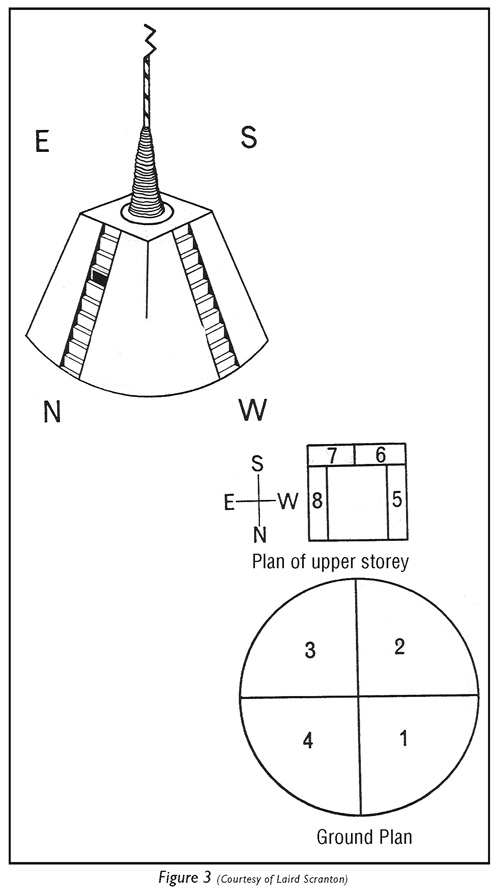
    Both the Dogon and Buddhist cosmologies begin conceptually with an aligned symbolic ritual structure that serves as a grand mnemonic for the cosmology itself – the Dogon granary and the Buddhist stupa. These structures are built on a common base plan and evoke a series of matching symbolic shapes, such as the figure of a circular base around a central point that represents the sun, intersecting perpendicular lines that symbolise the axis munde, a dome or hemisphere that represents the concept of essence or substance (the Dogon say mass or matter), and culminate in a square that is said to represent the concept of space. Both structures serve as the foundation for a complex system of cosmology that ultimately defines matter as the product of primordial threads woven by a spider; these threads are said to pass through seven vibrations conceived of as rays of a star of increasing length, and are characterised by the spiral that can be drawn to inscribe the endpoints of the rays.

    In essence, we can show that Griaule’s descriptions of Dogon cosmology closely conform to a known system of cosmology, and therefore that the correctness of Griaule’s observations are directly affirmed. Such parallels leave Professor Van Beek in the unenviable position of having falsely accused the Dogon priests of fabrication – a claim that we know most assuredly cannot be true.

    The classic Dogon granary – a structure that Van Beek later called “a chimera known only to Griaule” – is in truth a symbolic structure that is quite well-known to large populations all across India and Asia. (Details of Buddhist stupa symbolism were documented some two decades after Griaule’s death by Adrian Snodgrass of the University of West Sydney, Australia – a leading authority on Buddhist architecture and symbolism – in his book The Symbolism of the Stupa.)

    We can only surmise that the rush to judgment against Griaule’s Dogon cosmology was done without adequate consideration of the principles of comparative cosmology. No critic seems to have seriously investigated the possibility that Dogon cosmology as reported by Griaule might represent a known and legitimate cosmological form.

    (In fairness, although Griaule openly cited parallels between Dogon and ancient Greek mythology, neither Griaule, Dieterlen, nor any member of their anthropological team seems to have been aware of the many intimate parallels to Buddhism.)

    The same might be said for researchers in other disciplines whose fields of studies might be potentially impacted by the findings of comparative cosmologists.

    There are suggestions that the earliest characters in various ancient written languages may have borrowed their shapes and meanings from ancient cosmology. This possibility should not be a surprising one, since key elements of Egyptian cosmology are known to have existed in pre-dynastic cultures.

    FIG1 - Dogon

    For example, there is clear evidence for the worship of both the mother goddess Neith and the creator god Amen that dates from pre-dynastic times – well before the first surviving written text in Egypt. This view is also upheld by a variety of on-going parallels that become evident when we compare Dogon cosmological drawings with ancient Egyptian glyph shapes, and key words of Dogon cosmology with likely counterparts in the ancient Egyptian hieroglyphic language.

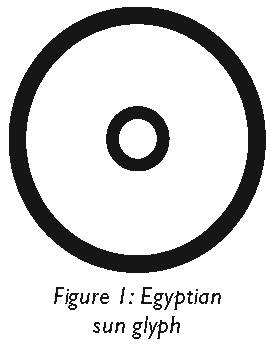
    A classic example of this apparent relationship between cosmological shapes and written characters is found in the Egyptian sun glyph (Figure 1), which for traditional Egyptologists can represent the sun, the concept of a day, or can indicate by its presence in a word that the word’s meaning relates to a period of time. 

    Any Egyptologist will be aware of the multiple meanings of the glyph, but few offer credible suggestions for how this specific shape may have come to be assigned to these specific meanings. Some researchers attribute the dotted-circle shape to an effect that happens when a person stares too long at the glaring sun. My personal view is that the natural impulses of humanity will likely be reflected in those of a typical five-year old, and in my experience, no five-year-old draws the sun as a circle around a central dot. More often, he or she draws the sun as a simple circle, perhaps coloured yellow.

    FIG2 - Dogon

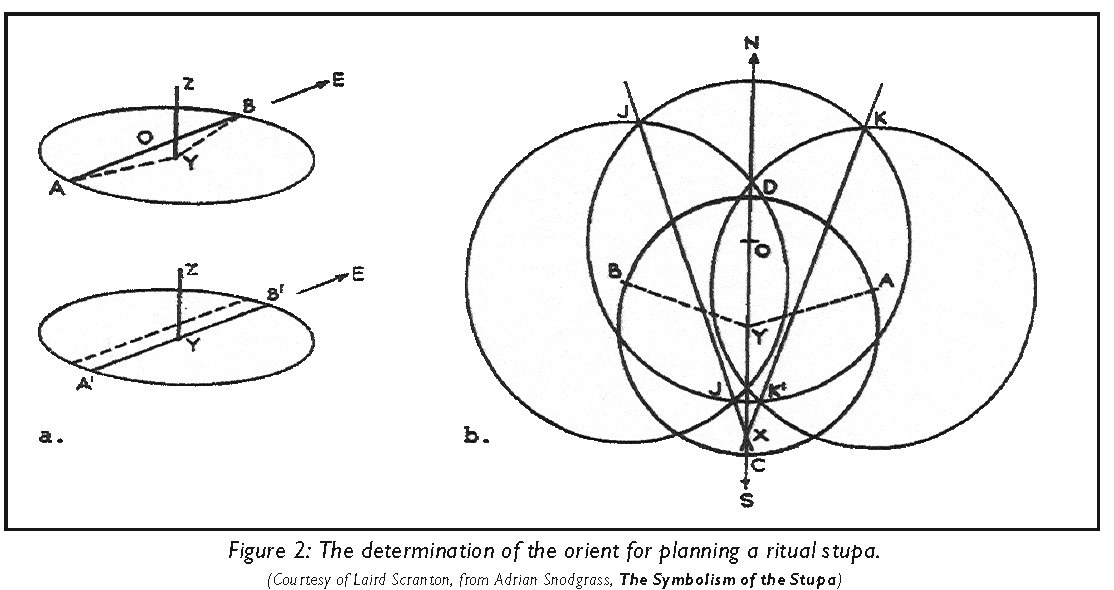
    In Dogon and Buddhist cosmology, the sun glyph shape represents the starting point both for the cosmology and for the ritually aligned structures that both mnemonically symbolise the cosmology. The base of these structures are established when an initiate draws a circle around a central stick or gnomen. This simple act creates an effective sun dial which can be used to track the hours of a day. The sun glyph shape can be thought of as resulting from the circular progression of shadows that are cast by the sun as it shines on the central stick throughout the course of a day. Consequently, the figure becomes a sensible symbol to represent both the sun and the concept of a day as defined by a single rotation of the earth in relation to the sun. We can see these meanings play out symbolically in terms of the ancient Egyptian hieroglyphic word for ‘week’, which is written with only two characters – the sun glyph and the number ten. 

    As a second step in the alignment of a ritual stupa or granary, the initiate marks the two longest shadows of the day (morning and evening) at the points where they intersect the drawn circle (see Figure 2). These points define an east/west line or axis that will pass through the stick on the two equinoxes, and that moves progressively further away from the stick until the date of the next solstice. In this way, the same sun glyph figure can be used to track and measure the length of a season or a year, and thereby comes to represent the concept of a period of time.

    FIG3 - Dogon

    The many close parallels that exist between the Dogon and Buddhist cosmologies define a kind of framework, within whose context we can make sense of the various fragmentary references of Egyptian cosmology.

    For example, the Egyptian god Amen is a likely counterpart to the ‘hidden’ Dogon god Amma; the eight paired gods and goddesses of the Egyptian Ogdoad or Ennead share important attributes with the eight male/female ancestors of Dogon tradition. Like the ancient Egyptians and the Buddhists, the Dogon conceive of the processes of creation in terms of multiple Worlds. The Dogon define a Second World similar to the Egyptian Underworld that is associated with a jackal – a figure who is symbolic of the concept of disorder – and is governed by a canine who is assigned the role of judge between truth and error. Likewise, careful comparison shows that many of the key Dogon cosmological drawings take shapes reminiscent of ancient Egyptian glyphs and are often defined by the Dogon priests in relation to concepts or meanings similar to those found in ancient Egypt.

    In fact, there are many different ways in which the study of Dogon cosmology provides us with potential insights into the forms and meanings of ancient Egyptian hieroglyphic characters and words. It is almost impossible for the comparative cosmologist to miss stark similarities between words such as Ogo (the name of a character who plays the role of light in Dogon myth) and Aakhu (the name of the Egyptian light god), or Sigui (the name of an important Dogon festival) and skhai (an Egyptian word meaning ‘to celebrate a festival’.) Support for these comparisons is most often provided by the cosmology itself, which typically defines a second level of meaning for important cosmological words – one that is logically disconnected from the first such that one cannot reasonably derive one meaning from the other.

    Another example is that Amma and Amen are both defined as ‘hidden gods’, but both words can also mean ‘to grasp, to hold firm, or to establish’. The significance of these multiple meanings may be more obvious in the Dogon language, where – because no actual written Dogon language exists – words must be grouped based on similarity of pronunciation. However in the modern view of the Egyptian hieroglyphic language, the choice has been made to categorise words based on commonality of spelling – not pronunciation – and so any significance that may have originally rested on similarities of pronunciation is often rendered effectively transparent.

    The initial impulse to consider the possible influences of cosmology on the Egyptian hieroglyphic language begins with the many persistent parallels that have been shown to exist between modern-day Dogon culture and that of ancient Egypt. These are documented in greater detail in my book The Science of the Dogon, but include such subtle practices as the founding of villages and districts in deliberate pairs – one called Upper and the other Lower.

    Cultural comparisons between the Dogon and the ancient Egyptians range from the types of calendars observed, to common units of measure such as the cubit, to the observance of similar holidays and festivals, common modes of dress for their priests, common ritual practices such as circumcision, and a host of common words, mythical themes and symbols relating to concepts of cosmology. Given the depth and breadth of these other cultural parallels, it seems somewhat surprising that the Dogon have no native written language, but rather simply define an extensive set of drawn figures and signs. Many of these are closely associated with concepts of cosmology, and often take similar form and meaning to written Egyptian glyphs.

    Given that the Dogon are understood to place a high value on purity of language, it seems unthinkable that they might once have possessed a written language but then – as an entire culture – somehow simply lost track of it. It seems far more likely that the priestly Dogon tribe never possessed a written language.

    The absence of a written language among the Dogon suggests that any close contacts that may have occurred between the Dogon and the ancient Egyptians may have happened prior to the onset of written language in Egypt, or roughly at the boundary between pre-dynastic and dynastic Egypt. Support for this view can be found in many other aspects of Dogon cosmology and culture, which can also be seen to make sense if we postulate an early Dogon relationship to ancient Egypt.

    Where Dogon cosmology defines eight relatively undifferentiated ancestors/teachers who emerge as paired opposites, ancient Egypt defines eight paired ancestor/gods and goddesses, who together define a category of deity that is simply not found in Dogon cosmology. Again and again we see non-deities in Dogon cosmology – characters from Dogon mythology (such as a jackal who symbolises the concept of disorder and a fox who is defined as a judge between truth and error) rise to the status of deities in ancient Egypt.

    Yet Dogon cosmology also includes many cosmological elements from pre-dynastic Egypt that are known to have carried forward to ancient Egypt much in their pre-dynastic form. Such evidence again points to a likely timeframe for any close contact between the Dogon and the ancient Egyptians at or around the boundary between pre-dynastic and dynastic Egypt.

    Matching aspects of Dogon and Buddhist cosmology provide us with a series of defined shapes that are evoked by the cosmology and explicitly assigned to symbolic concepts – the first of these is the circular sun glyph shape, which both the Dogon and Buddhists associate with the sun (see Figure 3, page 55). Among others is the shape of a hemisphere or dome, which is associated with the concept of essence or mass, substance or matter. Another is the shape of a square, which the Dogon and Buddhists correlate to the concept of space. (One expressed purpose of a stupa is to define an ordered space from a disordered field.)

    These shapes and their associated concepts, the pairing of which is cross-confirmed between the plans of the Buddhist stupa and the Dogon granary, play out in similar ways to the sun glyph when we examine their usage in ancient Egyptian words. My book Sacred Symbols of the Dogon traces the likely origins of these shapes along with likely relationships between them and ancient Egyptian counterparts, and illustrates how concepts such as mass and space play out symbolically in the definitions of various ancient Egyptian cosmological words. It is not surprising that the decidedly scientific creational themes of ancient cosmology should play out in terms of symbols that appear to relate to scientific concepts.

    Most importantly, it is the cross-confirming evidence that can be drawn from comparative cosmology that supports a new view of Egyptian language. The straightforward argument runs like this: Dogon cosmology assigns a specific word to a cosmological concept and associates that word both with a drawn cosmological shape and with two logically-disconnected meanings. Buddhist stupa symbolism – through its direct parallels to Dogon cosmology – directly affirms the association between the concept and the shape. The pronunciation of the Dogon word, along with its well-defined pair of meanings, links us to a set of corresponding Egyptian words pronounced like the Dogon word, and which reflect the same logically-disconnected concepts. Most often, at least one of these related written Egyptian words includes the related Dogon cosmological shape as a written glyph.

    Get the issue this article appears in

    Perhaps the best clue to indicate that the ancient Egyptian hieroglyphic language was intended to be primarily symbolic – rather than phonetic – in nature lies with its lack of written vowel sounds. Like ancient Hebrew and other contemporaneous ancient languages, vowel sounds are only implied in ancient Egyptian hieroglyphic words. When we interpret the word symbolically – by substituting concepts for glyphs to produce a symbolic sentence – any question of a missing vowel is rendered moot. No vowel is provided because none is required. It is a known fact that Hebrew acquired markings later in history to signal vowel sounds, whereas the Egyptian hieroglyphs did not. To the comparative cosmologist, it seems nonsensical to choose phonetic interpretation as the first purpose of a language that deliberately omits key phonemes from every word.

    Additional clues to the symbolic meanings of Egyptian glyph shapes are provided in Egyptian mythology, and are perhaps best understood through comparisons to Dogon cosmology. In Dogon myth, each discreet mythological character – such as the one true Dogon god Amma, who initiates creation, or Ogo, a character who plays the role of light in Dogon myth – represents a component stage of creation – the very same component stages that are illustrated by the Dogon cosmological drawings whose shapes we correlate to Egyptian glyphs. This hint leads us to examine Egyptian deities and glyphs shapes in a similar context, and ultimately to uncover a systematic relationship between Egyptian deities and Egyptian glyph shapes – governed by similarities of pronunciation between the name of the deity and the corresponding glyph. This relationship is outlined in great detail in my book Sacred Symbols of the Dogon. 

    From this perspective, evidence of a symbolic written language becomes one of the signature attributes of a likely parent cosmology – one that could provide a sensible conceptual umbrella over the Dogon, Buddhist and Egyptian cosmologies.

    Likewise, it becomes glaringly obvious that ancient Chinese writing, which increasingly, based on recent discoveries, can be reasonably dated to a period contemporaneous with the ancient Egyptian hieroglyphs and ancient Hebrew – shares key attributes in common with these written cosmological symbols. These begin with a Chinese sun glyph that takes a form similar to the Egyptian sun glyph and that carries the same three signature cosmological meanings. We know that Chinese language first emerged in the earliest Chinese civic centres that – according to some authorities – arose at the sites of important ritual shrines. These proto-cities were carefully aligned to the cardinal points according to the same principles as a Buddhist stupa. 

    Clearly, the relationship between ancient cosmology and early written language offers us an important key by which to potentially synchronise yet another classic cosmology with the three cosmologies we have already addressed.

    [alert type=”general” dismiss=”no”]This article was published in New Dawn 112.[/alert]

    [alert type=”success” dismiss=”no”]If you appreciate this article, please consider subscribing to help maintain this website.[/alert]

    © New Dawn Magazine and the respective author.
    For our reproduction notice, click here.

  • What is Biodynamic Farming?

    What is Biodynamic Farming?

    From New Dawn 112 (Jan-Feb 2009)

    My first introduction to a biodynamic farm was over 35 years ago, yet it made such an indelible impression upon me that I can still vividly recreate the mem­ory. Nestling in the soft East Sussex hills, Busses Farm, run by Jimmy and Pauline Anderson, was a clear demonstration of a living example of biodynam­ics. 

    Walking through the kitchen garden was like being in a Monet painting. The French intensive biodynamic method was being practised, with raised beds and an exuberant riot of herbs, flowers and vegetables. Patches of marigolds, tagetes and nasturtiums tangled with bright blue borage, lavender, rosemary, courgettes, cucumbers and firm-hearted lettuce. Runner beans busily twined up poles and tomatoes grew warm, sweet and ripe.

    If you managed to glimpse the soil through this cornucopia it was black and crumbly, the kind that produces happy plants. Bees provided the background hum as they gratefully progressed from flower to flower, spoilt for choice between gardens and orchards. This was the first time I remember hearing about companion planting.

    Out in the fields was a herd of horned Sussex cows, most with their calves, for breeding as well as some milk cows; a few fluffy sheep that looked like an advertisement for washing powder, 300 pecking and excitable hens, and a wonderful workhorse that was used for transporting heavy loads.

    All of these animated the landscape with their variety of shapes, colours, sounds and behaviours. In addition to this huge quantity of mouths and beaks to feed there was usually a group of very hard-working and very hungry apprentices who would come to train for 3-6 month blocks. Their healthy appetites meant that Pauline’s four-oven Aga was always on the go, full of marvellous dishes. And, as if this was not enough, the indefatigable Andersons pioneered a veg­etable and wholefood shop in the village of Forest Row, which has continued to go from strength to strength.

    So many people were enthusiastic about getting biodynamic produce that a number came forward with their various talents, and the next enterprise was a restaurant run by a team of good cooks – some days the queues would stretch round the block The salads fairly jumped off the plates with vitality and we all felt that this was an ‘idea whose time had certainly come’.

    On the farm were study groups looking at the theoretical side of biodynamics, and regular celebrations of festivals with music, singing and dancing. It was very hard work to be sure, but it made the profound statement of Manfred Klett (former head of biodynamic work in Germany) that “the farm is the university of the future,” a living ideal to be realised eventually on a much wider scale.

    When it honours the particular piece of land that forms it, in all its true depth of potentiality, the farm is a world of symbiotic relationships and processes. Then the farm becomes the most excellent, cheap and efficient place to study botany, zoology, chemistry, physics, water, soil, chemistry, nutrition, cooking, animal husbandry, crafts, climatology, astronomy and true economy (the Greek oikos, meaning house + nomia, meaning management; to manage nature’s household properly we will need to develop a new and qualitatively different understand­ing of economic principles).

    To bring us back to today, my local biodynamic farmer Richard Smith takes up the theme:

    “Walking around a biodynamic garden, or as in my case, over the fields of a biodynamic farm, one soon begins to realise that there is something different going on here. It is usually an impression of vibrancy in the plants, warmth in the soil and a health and con­tentment amongst the animals. When we look at some of the sur­rounding conventional farms, the fact that they have become highly specialised will be evident. There will be a small selection of crops spread out over huge fields or there will perhaps be animals, usually cattle or sheep. We rarely see poultry or pigs, because they tend to be kept in barns or feedlots where they stay summer and winter. It is hard to think of the deprivations that they endure. Whereas on a biodynamic farm we will usually see a wide diversity of crops and animals outside in smaller groups, smaller machines (e.g. lighter tractors) and generally a closer connection between human beings and nature.”

    One of the biodynamic farmer’s main goals is to create a balance between plants, animals and humans, and the needs of that particular soil. The aim is as far as possible to grow food for the animals entirely on the farm. No artificial fertilisers are brought in since the fertility of the soil will be derived exclusively from composted plant waste mixed with the different animal manures. If there are so many animals that it is necessary to buy feed in, or the plants do not thrive because there is insufficient compost, then somehow a more realistic and secure ratio of plants and animals has to be achieved. With experience, most biodynamic farmers usually find this to be possible. It is a principle at the heart of biodynamic farming; it is also one of the ways biodynamics may differ from organic farming (where the main aim for some farmers is to be able to grow food without chemicals).

    Sometimes, of course, there are difficulties to be faced, such as extremes of weather, which seem to be occurring with greater frequency. A farmer who has a wide spread of plants and animals usually observes that not all are affected with equal severity. Failures are neither total nor ruinous, and there is a meas­ure of security in such an approach. (No biodynamic cattle succumbed to the foot and mouth epidemic. The only cull of biodynamic cattle was in Scotland where the farm was contiguous with an infected farm.) Such security came from diversity, which used to be true of traditional farms before the last World War, but is not the lot of the current conventional farmer who has sacrificed a wide spread of farm products to concentrate on mono-crops or only dairy cows and has to cope with the unpredictable and fluctuating prices of different com­modities. This is short-term, high-risk farming because specialisation also exhausts the soil, limits the habitat of insects and birds and can open the door to disease.

    A biodynamic farmer trying to ‘orchestrate’ the number and type of animals required to create the ideal and appropriate balance on the farm will need to consider the different types of manures produced by the various animals, and this in a qualitative way. In animal dung there is something of the essence of the animal and its whole relationship with the earth. Each group of animals has a different attribute or gift, and a good farmer will understand how to direct cer­tain animals to specific parts of the farm where they can improve and enliven the soil. Here are some thoughts on various farm animals.

    The Pig is a very intelligent creature. It spends a great deal of time rooting in the soil and is inexhaustibly curious, heaving up the soil and disturbing it where it is compact and damp, letting in the air. As an omnivore it is partial to whatever is rich in flavour, especially the taproots of pernicious weeds. With only a sparse coat of hair it likes to grow fat to keep itself warm and it seems to extract all the potential for warmth from its feed, so that its dung tends to be much more earthly and cold (compared to that of the cow). But this type of manure works well on the cold root crops.

    Sheep, clothed in the ‘Golden Fleece’ and famous as the ‘Golden Hoof’, improve the land wherever they tread. They nibble close to the ground thus allowing light to penetrate the pasture, which responds by the production of a rich clover. Their silica-rich manure encourages the growth of strong stems that help the plant reach up into the air and light. Although the sheep is a ruminant animal with a complex digestion, involving four stomach chambers and a circu­lar process of regurgitation into the mouth for further chewing, its digestion is not as advanced as that of the cow.

    The Cow, a ruminant, has a digestive system that has reached a state of perfection. The reach of the cow’s senses out into the world, however, is limited; she chews the cud in a state between dreaming and waking. She seems to inwardly experi­ence all the plants of the meadow as she chews and re-chews them in a wonder­ful reverie. It is not difficult to appreciate why this animal is so venerated by the Hindus as a model of meditative peace. The dung that derives from a digestive tract 22 times the length of the animal is so transformed from the original plant state that cattle are not repulsed by it, as other animals are by theirs. Cow dung has been so well assimilated that it is provides the most nutritionally available dung for maturing plants on the farm or in the garden, when composted. Its effect is strongest on the soil surface; it nourishes leaves – the watery part of the plant – ­and so balances the earthly and watery realms. The cow is indeed quite central to the proper workings of a biodynamic farm.

    So farm animals are connected with the four elements of earth, air, fire and water. If only there were still horses on farms, then the aspect of ‘warmth’ would be more completely fulfilled. (Horse manure has always been prized by flower growers.) The dung of the pig specially fertilises root crops and sheep’s dung the stems and flowers. Much that we have been describing could be observed on a well-run organic farm, so what is different about biodynamics?

    Origins of the Biodynamic Movement

    The biodynamic movement grew out of the deep concerns of a group of farm­ers in central Europe back in the 1920s. They had noticed an increasing degen­eration in seed strains, in many cultivated plants, and in their livestock. They approached scientist and philosopher Rudolf Steiner in 1924 seeking some insights and practical ideas to offset this decline. (How much has happened to exacerbate this trend since then!) Steiner envisaged what might happen if mineral fertilisers should be used extensively in farming rather than the natural fertility of animal manures and good compost. He said:

    “The materialistic farmer who thinks about these matters can cal­culate how many decades it will be in this century before agricul­tural products have degenerated so far that they can no longer nourish the human being adequately. With the materialistic world conception, agriculture has come the furthest away from rational principles.” (Agriculture)

    He went on to predict how farm products would become so denatured that people would endeavour to make mineral blueprints of them, and here we are reminded of the growth of the mineral and vitamin supplement industry over past decades. Steiner pointed out that not only was the earth already middle­ aged, but it would become increasingly sclerotic (declining in vitality) as a result of the developing materialistic view of the earth as a resource for human beings to exploit. When he was persuaded to offer his insights into agriculture, his aim was to try and correct a largely one-sided, mechanistic view of nature, entrenched as early as the 1920s.

    Steiner’s approach offered a view of life that reconnected the earth and the cosmos, physical life with its origins, in a spiri­tual worldview – a vision that takes account of the powerful forces that pour down from the cosmos to work within the soil and plant. These forces stimu­late the processes vital to agriculture, but in order for these beneficent influ­ences to be fully active, the soil needs to be sufficiently sensitive. This in turn requires the use of natural organic fertilising materials, to keep it alive. Coupled with this, special potentised ‘medicines’ (usually known as ‘preparations’) would be required for the compost heap and for spraying on the land, as well as a renewed understanding of planetary and zodiacal influences, to be creatively harnessed by the sensitive farmer.

    The Moon and Its Relation to the Zodiac

    The forces that come from the zodiac (Greek zodiakos means circle of animals) have always been recognised as being connected with the enlivening forces of the four elements, for the earth is indeed a living organism, deriving energy, warmth and light from the sun. The processes of rain, evaporation, day and night, summer and winter all depend on our relationship to the sun. The earth’s satellite, the moon, particularly influences the move­ment of the waters on the surface of the earth, waters that are in con­stant ebb and flow according to the phases of the moon.

    As the moon circles the earth it is able to focus the particular aspect of each con­stellation rather like a lens, accord­ing to its passage in front of that sign. So that when the moon is in front of the constellation of Pisces, Cancer or Scorpio (all water signs), it magnifies their influence on the watery part of the plant – the leaves. The earth element (partic­ularly favourable for root vegetables) can be stimulated by the arrangement of planting, hoeing or any work that disturbs the soil, at a time when the moon is in Capricorn, Taurus or Virgo (earth signs).

    Some biodynamic gardeners arrange their garden rotations so that each year a different plant activity is accentuated on each plot. Flowers should be grown under air signs (Gemini, Aquarius and Libra) and cereal and seed crops under the fire signs (Leo, Sagittarius and Aries).

    The Roman scholar Pliny the Elder, in his Natural History, examined the influ­ences of the moon’s phases on vegetal and animal life. He observed that if one wanted juicy and good-looking fruits and vegetables for sale or for consump­tion, the optimal time to pick them was at full moon, just when ants were busiest in their hills, even at night, and marine animals such as oysters were in their period of burgeoning growth. At new moon the ants were seen to be list­less and the growth of sea creatures slack. “Fruit,” said Pliny, “is much less sus­ceptible to rotting at new moon and can be easily and efficiently dried.”

    Virgil, born just after the death of Pliny, told in a discourse on agriculture how hus­bandmen took cues from the heavenly spheres and constellations to tell them when to sow their crops, certain seeds being best put into the ground when “glit­tering Taurus opens the year with his gold­en horns.” Paracelsus – a healer and one of the last of the true alchemists – made much of the connections in astronomy and astrology for perceiving the ‘signa­tures’ of plants and to use remedies much more effectively, as did Nicholas Culpeper who saw that each planet was linked to a particular plant species, in turn connected to a particular organ of the body. From the seventeenth century onwards people following such traditional wisdom have been systematically marginalised, so we have lost the link to the cosmos.

    Biodynamic farmer Alan Brockman adds:

    “Each planet has its own force field; thus each planet can, at some time or other, be seen in every part of the zodiac. The earth can be pictured as being surrounded by seven spheres of force, of which each physically visible planet is marking out its own particular boundary. These spheres were known as ‘crystal spheres’ (a description attributed to Ptolemy). Steiner indicated that the var­ious leaf spirals and their positioning around the stem, or ‘phyl­lotaxis’, indicates which particular force field the plant is reacting to. So clearly plants and planets have correspondences, as healers such as Paracelsus and Culpeper knew.”

    Part two of this article appears in New Dawn 113 and explains how biodynamic preparations are made and their effectiveness compared to modern chemical fertilisers.

    Reprinted with permission from The Biodynamic Food & Cookbook: Real Nutrition that Doesn’t Cost the Earth by Wendy E. Cook, ISBN: 1905570015, published by Clairview Books.

    [alert type=”general” dismiss=”no”]This article was published in New Dawn 112.[/alert]

    [alert type=”success” dismiss=”no”]If you appreciate this article, please consider subscribing to help maintain this website.[/alert]

    © New Dawn Magazine and the respective author.
    For our reproduction notice, click here.
  • What Gorilla? Why Some Can’t See Psychic Phenomena

    What Gorilla? Why Some Can’t See Psychic Phenomena

    From New Dawn 112 (Jan-Feb 2009)

    Imagine you’re watching a basketball game. Your favourite team is wearing white and the other team is in black. In the midst of the action, someone in a dark gorilla suit calmly walks to the centre of the court, waves to the crowd, then walks off the court. Do you think you would notice this peculiar event? Most people might say yes. Most people would be wrong. 

    Our perceptual system unconsciously filters out the vast majority of information available to us. Because of this filtering process, we actually experience only a tiny trickle of information, by some estimates a trillionth of what is actually out there. And yet from that trickle our minds construct what we expect to see. So when we pay attention to our favourite white-shirted basketball team, the likelihood of clearly seeing darker objects moving about is substantially reduced. That includes even obvious objects, like gorillas. Psychologists call this phenomenon “inattentional blindness,” and it’s just one of many ways in which our prior beliefs, interests and expectations shape the way we perceive the world and cause us to overlook the obvious.

    Because of these blind spots, some common aspects of human experience literally cannot be seen by those who’ve spent decades embedded within the Western scientific worldview. That worldview, like any set of cultural beliefs inculcated from childhood, acts like the blinders they put on skittish horses to keep them calm. Between the blinders we see with exceptional clarity, but seeing beyond the blinders is not only exceedingly difficult, after a while it’s easy to forget that your vision is restricted.

    An important class of human experience that these blinders exclude is psychic phenomena, those commonly reported spooky experiences, such as telepathy and clairvoyance, that suggest we are deeply interconnected in ways that transcend the ordinary senses and our everyday notions of space and time.

    Exclusion of these phenomena creates a Catch 22: Human experiences credibly reported throughout history, across all cultures, and at all educational levels, repeatedly tell us that psychic phenomena exist. But Big Science – especially as portrayed in prominent newspapers and popular magazines like Scientific American – says it doesn’t.

    Well then, is this gorilla in the basketball game, or not? One way to find out is to study the question using the highly effective tools of science while leaving the worldview assumptions behind. That way we can study the question without prejudice, like watching a basketball game without preferring either the white or black team. Neutral observers are much more likely to spot a gorilla, if one is indeed present.

    This form of investigation has been going on for over a century, and despite official denials, the jury is in: Some psychic phenomena do exist. But like blindingly obvious gorillas, not everyone can see them. (Actually, like the majority of the general public, many scientists do have these experiences, but as in the parable of the Emperor’s New Clothes, fledgling science students quickly learn in college that it is not politically expedient to talk about it.)

    Here’s an example of not seeing. In the July/August 2008 issue of the Skeptical Inquirer (the Playboy of the enthusiastic debunker), neuroscientist Amir Raz and psychologist Ray Hyman describe their impressions of an invitation-only scientific meeting held on “anomalous cognition” at the University of British Columbia (UBC) in July 2007. Anomalous cognition is a neutral euphemism for psychic or “psi” phenomena, one that avoids the connotation of séances and ghostbusting associated with the touchy p-words. I was a co-organiser of the UBC meeting. Sixty prominent scientists and physicians were invited to the meeting, including a couple of Nobel Laureates, representing a variety of disciplines and perspectives.

    Not surprisingly, given the skeptical focus of the magazine in which their essays appeared, Raz and Hyman both concluded that they were not persuaded by what they heard at the meeting, that nothing interesting was going on, and that the scientific pursuit of anomalous cognition is akin to a misguided search for the Tooth Fairy (Raz’s term).

    Now, let me preface what I’m about to say by first noting that I respect Raz’s and Hyman’s opinions and I’m glad that they attended the UBC meeting. There is always room for critical debate in science; as President Dubya once said in another context, “Bring it on.” But what I am concerned about is that sometimes holding a fruitful debate stalls before it can get off the ground because one side regards the topic as fantasy. And so to make a point I’ll be ruthless in pointing out problems with these two authors’ opinions.

    One of Raz’s principal complaints was that he would “be curious to see compelling scientific demonstrations of psi (i.e., a string of multiple successful experiments by several independent investigators producing lawful and replicable outcomes). Alas, I have found none to date.”

    When I first read that statement I felt like I increasingly do these days when driving past a gas station. What did that sign say? A gallon of gas costs what? Didn’t we discuss several classes of repeatable experiments at the UBC meeting? For example, I presented an overview of “presentiment” experiments, an unconscious precognitive effect that has been independently and successfully replicated numerous times. (Nearly all of the 20 experiments I’m aware of to date have produced results in the predicted direction, and of those 10 were independently statistically significant.)

    And among researchers who have closely studied the psi literature, the vast majority have little doubt that something interesting is going on, something not easily attributable to chance or to any known conventional artefacts. These effects are in principle no more difficult to demonstrate than the efficacy of new pharmaceutical drugs or medical procedures. Such effects tend to be small in magnitude, they are highly reactive to the psychosocial context and other environmental factors, and they take substantial amounts of careful data collection to overcome the statistical noise generated by dozens of poorly understood interactive factors. But they are real, and they are repeatable in the laboratory.

    Real and repeatable, and yet what Raz meant by a “compelling” demonstration does not exist for him, at least not yet. When one regards evidence from a position where the claimed phenomenon is viewed as exceedingly unlikely, like a gorilla on a basketball court, then the evidence required to change one’s mind must be super-powerful. Not merely a string of successful experiments by independent investigators, as Raz calls for, but effects that are robust enough to be easily repeatable by anyone, anywhere, any time, and highly stable over long periods of time. And better yet, the effect should be predicted by a theory that doesn’t do much violence to orthodox dogma about how the world works.

    This is what I call the “UFO landing on the White House lawn” type of evidence. Alas, such robust evidence is rarely available when dealing with phenomena at the bleeding edge of the known. And it’s true that the evidence for psi today does not quite achieve the status of a Special New Bulletin interrupting the season finale of ‘Lost’ by reporting a UFO landing on the White House lawn (would anyone believe such a story, even if it were true?). Instead, the evidence available today for psi is more like a formation of UFOs repeatedly flying over the US Capitol, captured on film and spotted simultaneously by radar, jet pilots, and hundreds of witnesses on the ground. Well, surely that would convince a few people.

    Oh, wait. Such a UFO sighting actually did occur in Washington DC in 1952. All the major newspapers carried the story. But who remembers that today?

    Perhaps Ray Hyman does. Hyman earned his PhD in 1953 at John Hopkins University, near Washington DC. Today, Hyman is a retired psychology professor who has been one of the premier academic critics of parapsychology for over 50 years. In his essay in Skeptical Inquirer, his major complaint was the lack of easy repeatability of psi effects. To support his claim he cited “a psi proponent reported a meta-analysis of [a class of telepathy experiments] with an average effect size that significantly differed from zero with odds of more than a trillion to one while another meta-analysis… concluded that the average effect size was consistent with zero.” (A meta-analysis is a quantitative review of many similar experiments.) He bolstered this assertion by citing a few parapsychologists who have acknowledged difficulties in producing “UFO on the White House lawn” form of evidence. From this viewpoint, he concluded that parapsychology does not deserve serious scientific attention. He’s been repeating this opinion for 50 years.

    Except there’s a small problem. The parapsychologists mentioned by Hyman were expressing well known difficulties in producing robust repeatable effects on demand. But none of them doubt that the preponderance of evidence strongly indicates the presence of genuine anomalies. Hyman’s selective reporting is akin to dismissing as worthless a clearly visible formation of UFOs flying over the US Capitol, because of a stubborn insistence that the only acceptable data are UFOs landing on the White House lawn precisely at high noon, followed by alien pilots emerging from their crafts, offering tea and biscuits to the President and Vice President of the United States, and then soberly shooting the VP in the face with a projectile weapon (due to regarding that act as a sign of diplomatic friendship, having unfortunately misinterpreted a news story regarding the former Vice President’s shooting his friend in the face – but I digress).

    There’s another problem, one more substantial. Hyman’s damning denouement was that not all meta-analyses of telepathy experiments were judged to be positive. By mentioning the meta-analysis where the “average effect size was consistent with zero,” he reinforced his contention that telepathy experiments are slippery and unrepeatable, and not to be trusted. The study he cited appeared in a 1999 publication by British psychologists Julie Milton from the University of Edinburgh and Richard Wiseman from the University of Hertfordshire. They analysed a selected subset of telepathy experiments, ended up with a positive but statistically non-significant result, and then quite reasonably concluded that nothing interesting was going on. Well, as I said, there’s always room for debate. Except when conclusions are based on a mistake. It turns out that their analysis was miscalculated.

    Jessica Utts, a professor of statistics at the University of California at Irvine, explained at the UBC meeting that Milton and Wiseman had employed a technique that underestimated the actual telepathy effect. If they had used the same (simpler and more powerful) technique employed in all of the other published telepathy meta-analyses, they would have reached the same conclusion that everyone else did: There is indeed significant positive and repeatable evidence for telepathy obtained under controlled laboratory conditions.

    Hyman was in the audience during Utts’ presentation. I don’t know why he chose to ignore her analysis, although if he had acknowledged it that would have neutralised his own arguments. So perhaps its exclusion is not so puzzling.

    Speculations aside, one thing is crystal clear: It can take a White House lawn party to overcome one’s long-held beliefs, so if nothing obviously wrong can be found in a reported experiment, skeptics will still worry if the experiment was conducted by “believers,” because they imagine that believers would not be as rigorously careful as “non-believers.” Indeed, fervent skeptics are quite vocal in asserting that non-believers cannot get the same results in these experiments. Unfortunately, the fact is that skeptics hardly ever conduct these studies, and on the scant occasions when they do, they rarely publish them in sufficient detail to evaluate the results. So we really don’t know whether the suspicion is justified or not.

    That is, until recently. In 2005 two keenly skeptical psychologists, Edward Delgado-Romero from the University of Georgia and George Howard from the University of Notre Dame, conducted the same type of telepathy experiment under consideration here. To their chagrin, they not only obtained a significant positive outcome after conducting a series of eight studies, but their results were perfectly in alignment with the earlier meta-analytic estimates. That is, based on thousands of previous trials, it is possible to estimate the “hit rate” one should get when running a standard telepathy experiment. Delgado-Romero and Howards obtained exactly that value. To their credit, they published their results.

    But their article also included an astounding twist: They ended up rejecting their own experimental evidence based on a single additional study they conducted, which they based on an ad hoc, untested design they proposed, and which ultimately resulted in a statistically significant negative outcome! Strong negative outcomes are just as important statistically speaking, and just as unlikely to occur by chance, as strong positive outcomes. Both indicate that something interesting is going on.

    Another way of illustrating the invisibility of gorillas is by revealing an asymmetry in how psi experiments are reported in newspapers. In January 2008, newspapers around the world hailed the first conclusive test for telepathy conducted by two Harvard University researchers. According to the Boston Globe: “Brain scan tests fail to support validity of ESP. Research on parapsychology is largely taboo in academia, but two Harvard scientists recently set out to settle, once and for all, the age-old question: Is extrasensory perception, or ESP, real? Their sophisticated experiment answers: No, at least, not as far as they can tell using high-tech brain scanners to detect neural evidence of it.”

    Finally. Once and for all. A sophisticated magnetic resonance imaging brainscanner was used (technically, an fMRI), for the first time, to answer this age-old question. The high-tech “no” answer seems conclusive unless you read the actual article, which reported that one of 16 tests conducted showed a stupendously significant outcome exactly in alignment with what was predicted if psi were real. But the authors then took pains to explain why that result was probably an artefact, and so the newspapers didn’t mention that one intriguing outcome. (It also makes one question why they employed an experimental design which allowed positive results to be explained away so easily.)

    But the study was conducted at Harvard, for goodness sake, so surely that’s the last word on ESP. After all, for the first time ever Harvard scientists used one of those expensive and mysterious fMRI brainscanners to peer deep inside the brain, and they didn’t see any psi in there. End of story, no?

    Well, no. Was this really the first psi study conducted using an fMRI? No, it wasn’t even the second such study. Or the third. Or fourth. Or fifth. It was the sixth. And all of the earlier experiments, all conducted since 2000, showed significant evidence for psi effects. Somehow the newspapers overlooked this, despite the fact that most of those studies are freely available in an instant via PubMed.gov, the National Institutes of Health massive online bibliography of scientific articles related to health and healing.

    I could continue along the same vein ad nauseum when it comes to how scientific evidence for psi is often ignored or distorted beyond recognition. Unfortunately, there are countless other tales of ignoring other invisible gorillas at the frontiers of knowledge. They include serious scientific arguments that global warming is not being caused by human activities, analyses suggesting that HIV does not cause AIDS, repeatable electrochemical-nuclear reactions once known as “cold-fusion,” credible reports of UFOs, and so on. All of these ideas encounter strong sociopolitical resistance in academia, so credible counter-arguments are difficult to locate and even more difficult to discuss in scientific forums unless you have a phalanx of beefy bodyguards watching your back. One of the best sources of information about these “frontier” science topics is the Journal of Scientific Exploration, a peer-reviewed multidisciplinary journal published by the Society for Scientific Exploration.

    Without belabouring the point, such tales expose a skeleton in the closet of Big Science. From the popular perspective, science is portrayed as a flawlessly rational enterprise, where accumulating evidence slowly but surely overcomes stubborn skepticism. In reality, science is like any other human activity, and as such, emotions always trump reason. There is as least as much pig-headedness and motivated inattention in science as in politics and religion.

    Given the non-rational skeleton, will mainstream science ever be prepared to admit that psychic phenomena warrants serious investigation? I believe the answer is yes. Acceptance someday is inevitable. We are dealing with human experiences reported since the dawn of human history, experiences that do not go away in tightly controlled laboratory tests using the most sophisticated experimental tools and designs. So some of these phenomena will eventually become integrated into the mainstream. Exactly when I cannot say. Perhaps one to five decades.

    Will this happen because the accumulated data will overwhelm skepticism? Probably not. As Max Planck, the physicist who dreamt up the idea of the “quantum” in quantum mechanics, once wrote, “A new scientific truth does not triumph by convincing its opponents and making them see the light, but rather because its opponents eventually die, and a new generation grows up that is familiar with it.”

    Some of the 60 participants at the UBC meeting represented that younger generation, and while a handful of the older crowd are certain to remain mulishly skeptical to their deaths, based on the written opinions of many of the participants collected before, during and after the meeting, it was clear that the majority were more open to anomalous cognition after the meeting than they were before.

    I expect that trend to continue, and then one day a threshold will be crossed, and on that day some of the invisible gorillas in our midst will become a bit easier to see. The very next day no one will remember that this topic was once considered controversial.

    [alert type=”general” dismiss=”no”]This article was published in New Dawn 112.[/alert]

    [alert type=”success” dismiss=”no”]If you appreciate this article, please consider subscribing to help maintain this website.[/alert]

    © New Dawn Magazine and the respective author.
    For our reproduction notice, click here.