New Dawn – World's Most Unusual Magazine

Category: Articles

  • The Problem with Paradigms: In Search of Earth’s Hidden History

    The Problem with Paradigms: In Search of Earth’s Hidden History

    Mainstream orthodox (or ‘physical’) science contains as many paradigms as it does supposed facts, if not more; but it still tends to treat the former as largely substantiated facts. However, a paradigm – as the dictionary confirms – is merely a model, involving one or more assumptions. In fact, it is representative of the seemingly best functional theory or hypothesis available with accessible data in the face of ignorance of the true facts, which may in fact be quite different. That then, along with all the rest, is then presented to the world as ‘scientific knowledge’.

    This, however, presents us with a problem because physical science sees itself as technology based, due to the need for reliably consistent reproduction of accurate data in the face of man’s own psychological and sensory inconsistency. Problematically, physical technology is itself based on paradigmatic assumptions and the associated limitations of then available sub-technology. So where does that put us in relation to the wider human experience which takes into consideration states of existence beyond the physical and even treats these as more real than the physical?

    Alternative (or more accurately, sequentially parallel) states of existence have been discussed in openly allegorical or hermeneutic (structured) terms for thousands of years by both mystics and more metaphysically orientated philosophers, by virtue of their own actual experiences through self-experimentation. Those experiences were of course subjective in nature (because other states can only be accessed in such a manner) and it is therefore assumed by critics that they lacked the objectivity necessary to achieve any real degree of reliable accuracy. But this assumption is itself based on the highly questionable hypothesis that laboratory methods and/or modern academic forms of presentation and substantiation are the only reliable ones when these are themselves largely un-natural. So where do we go from here?

    Over the last three centuries there has developed a growing belief that the objective physical world and the ‘subjective’ states of existence are or can be inter-connected and can thus directly affect each other. This started with the phenomenon of mesmerism in the eighteenth century and continued with human ectoplasmic manifestations in spiritualistic séances in the nineteenth (although spiders have been producing ectoplasm to form their webs since time immemorial). Subsequent to this, the new science of psychology began to show the subjective worlds of human thought and feeling as having a real consistency of internal dynamics if and when viewed on their own terms. Furthermore, quantum physics in the twentieth century seemed to confirm that physical experiments could be phenomenally affected by the psychological attitude of the observer. Yet we now appear to stand at something of an impasse.

    Physical science has accepted that consciousness has to be considered a fundamental part of the equation of existence but it still sees consciousness as a merely electrical phenomenon generated (by extension at the physical level) by aggregations of base atomic and then molecular matter forming itself into organisms. Yet it is unable to answer the question of how it is that organic life can somehow emerge from apparently ‘dead’ matter – or why it should do so. Esoteric philosophy, on the other hand, has always taken the view that there is no such thing as ‘dead matter’; that there is in fact only one principle in the omniverse and that this is Life itself, manifesting as a homogeneous substance called, for want of a better term, ‘spirit-matter’ and appearing in a vast spectrum of qualitatively based states, each with its own potential polarity and apparent fields of progression or limitation, thus giving rise to a sympathetic sense of inter-connectedness, which we call consciousness. Furthermore, esoteric philosophy has always seen the universal spectrum of Life as the manifestation of a single, Universal Consciousness possessing an infinite range of memory and intelligence. Deists call more remote aspects of this by the name ‘God’ and try to give it a sort of humanly interactive personality. However, philosophers say that it is not only inconceivable in all respects, but that it is also approachable only by a progressively expansive understanding of what it is not.

    This, of course, is not acceptable to a science which states that everything must have a testable rationale. However, in adopting that stance, science again makes an erroneous assumption. Esoteric philosophy (if properly followed) is itself based on the understanding of a rational approach to the existence of progressive fields of consciousness; but its technique is necessarily both subjective and objective. Subjectivity is necessary for direct experience by self-experimentation and selection; objectivity (which, problematically, is also subjective) is necessary to rationalise and understand the effects in due context. However, these have to be used in tandem by an intelligence specifically trained in their simultaneous use – one that has itself developed the capacity not to merely react to experience. In other words, one that is self-consciously aware but which has also passed beyond the stage of a reactive self-association which is usually based on a mere mixture of like and dislike.

    The science and art of true esoteric faculty involves a fundamental detachment of consciousness from that which is being observed. That is to say, one must learn to use a higher quality of consciousness to observe a lesser quality of consciousness in action and thereby understand its qualitative status and its modus operandi. We have to develop an adult perspective based on our own prior experience before we can really understand the motivation and actions of a child. There is no short cut. A child cannot understand the motivations of an adult because he/she does not have the experience and has thus not yet learned of the associated limitations by virtue of which we progress through such experience to a wider perspective of understanding.

    Plato made the point that “All is recollection.” In other words, there is nothing new in Universal Nature; but it is up to us to access it. Yet the first thing we have to understand is that memory is organised and works in progressive sequences, each involving its own essential field of limitation. But the progression is not linear. The Ancients tell us that the universe is concentrically organised and so each memory is part of a greater one. So, we have to first explore the plenum of one idea (or field of ideas) before we can break through its field of limitation into a yet greater one. This is the way in which the intelligent development of consciousness works. Thus it is that we first need to establish where a limitation exists (or potentially exists) before we can set out to go beyond it and thus achieve a greater perspective. Otherwise we shall merely go around in chaotically confused circles, merely re-exploring the past over and over again, thereby wallowing in a sea of superficiality. This, sadly, is what many people tend to do throughout their adult lives and it is the cause of needless frustration. Instead, we need constantly to move forward. That is why we have ideals to pursue.

    Curiously, science – despite its incessant materialism – is moving in the right direction, albeit grudgingly. It accepts the fundamental principle that a theory has to be fully and carefully examined before it can be accepted for further and wider usage. It also accepts that theories (paradigms) are all ultimately disposable, even though it currently chases the ultimate march hare of a supposed Grand Unified Theory which fails to take consciousness into account. However, many ‘New Age’ theorists are as much at fault in that they comprehensively tend to avoid the rigorous approach to consideration of both esoteric and scientific principles, substituting instead their own off-the-cuff theories, which cannot even be called paradigms because most of them are based on either partial perceptions or even pure wishful thinking. That is why physical science, with all its questionable paradigms, is so suspicious of ‘New Age’ thought. But as they say, “It takes one to recognise one.”

    That, however, brings me to one or two examples of mis-orientated scientific thinking (which I have highlighted in my recently published book The Rise & Fall of Atlantis) which may perhaps be of interest to readers of this magazine. The first of these involves the relationship between the core of the Earth and the planet’s surrounding ionosphere. The modern geological orthodoxy is that the core is composed of solid or liquid iron, or a combination of both, this providing the basis of the planet’s gravitational magnetism. However, this idea is based on the supposition that the Earth, originally part of the Sun and thus composed of plasma, was to begin with a superheated mass which cooled down, thereby allowing the heavy element of iron to sink towards the centre. But the supposition that the Sun’s plasmic mass is actually superheated (rather than electrically superactive) in the first place is also pure assumption. My suggestion is that it is not – and also that the core of the planet is still a plasmic mass, which responds to the fluctuations of solar energy coming our way as a result of voltage changes in our ionosphere. Interestingly, the Woods Hole Oceanographic Institute in the USA has already noted that the Earth’s core appears to rotate at a different speed to the crust. Present concepts of the Earth’s core fail to provide any suggestion as to how this could possibly occur.

    Now the ionosphere surrounding our planet at a distance of some 60 kilometres from the crust is itself an electrified field of matter whose voltage necessarily fluctuates because of the incessant variations in energy received from the Sun. As that occurs, so it must expand and contract. But this will itself produce a sympathetic response in the Earth’s plasmic core, which must also expand and contract in fluctuation, thereby causing huge changes in the magma sea under the crust. As the magma expands, it must necessarily generate internal pressure in the geological fields which contain it, thereby inducing volcanic activity and localised crustal expansion. Correspondingly, as it contracts, so the magma will cool and recede, thus causing the Earth’s crust to shrink back again, which will in turn lead to earthquake activity. Now the first effect of this different perspective is that it calls into question the paradigm theory of plate tectonics.

    The basis of plate tectonics (which was first suggested in 1915 and cast out through general scientific disapproval for some fifty years after that) is that all the visible landmasses were once gathered together as one gigantic continent called Gondwanaland, or Pangaea. For some inexplicable reason this then supposedly split up like a jigsaw puzzle into various continental landmasses, which began cruising around the globe on top of the supporting magma sea, and then started bumping into each other like ‘dodgem cars’ at the fairground. The next part of the theory then has some of the landmasses literally crawling over others and down the other side, this experience however, amazingly leaving both masses looking geographically pretty well just the same. The ‘proof’ behind this idea is that the eastward Brazilian projection of South America supposedly fits geographically very neatly under the westward projection of the African continent, thereby confirming the original, broken jigsaw puzzle theory.

    Proponents of the plate tectonic theory also draw attention to what is called the Mid-Atlantic Ridge, the fragmented central area of the Atlantic seabed which we can see on bathyspheric maps. All along this ridge are to be found hydrothermal vents (sometimes known as ‘black smokers’) which are chemically based extrusions, often several metres in length, pumping out volcanic gases from within the crust. These, we are told, are clear evidence that the Atlantic seabed is splitting, so pushing South America and Africa gently even further apart. However, there is no actual proof of such a split.

    Now, as is pointed out in my book – citing evidence provided by others far more knowledgeable in the field than I – the idea that continental landmasses can just cruise around in the manner suggested is absurd. It takes inconceivably huge expenditure of energy to shift large geological landmasses – energy levels which scientific measurement itself has proven the planet just does not begin to possess in sufficient capacity to motivate the landmasses in such a manner. Furthermore, the idea that landmasses could somehow slide over each other without damaging their geographic identity is altogether ludicrous. Even more unanswerably, new landmasses are constantly being created by the acre every year (as for example in Hawaii) by the spread of volcanic lava, or destroyed by gradual erosion or cataclysm. So how can plate tectonics work in the face of all these various facts?

    Geologists have used their theories to ‘prove’ that the profile of the Atlantic seabed confirms why the ancient idea of a mid-Atlantic continent (aka Atlantis) could not possibly have existed. However, my suggestion (my own paradigm, if you will) as previously explained, provides a very clear indication as to how and why huge masses of the Earth’s crust could indeed be deformed by expansion and contraction generated by electromagnetic pressure from the planet’s core. However, that is not the whole story behind the Mid-Atlantic Ridge. Its peculiarly twisted shape tells us of another influence – this time an astrophysical one.

    The Ancients described our planet as being suspended in Space between two great magnets. But this does not sound so absurd when one takes into consideration that the indentation of the ionosphere at both poles effectively means that the true poles are in fact to be found far above the Earth’s surface, not on it as is commonly imagined. However, the ionosphere itself is like a giant squeezable crystal – indeed the ancient Egyptian god Ptah was described as containing the planet within a crystal globe which he fashioned. When I suggest that it is ‘squeezable’ I mean to draw attention to the idea that it behaves piezo-electrically. I am suggesting, in other words, that during certain stages of the solar cycles which our planet goes through, it is necessarily forced through much more powerful electrical fields in Space, which cause its biosphere to contract because of the corresponding electrical hypertension generated in the ionosphere.

    As the ionosphere is thus ‘squeezed’ centripetally inwards, at both poles, so the plasmic core of the Earth is forced to respond by centrifugal expansion. At a particularly critical point, these two antagonistic forces will literally cause the magma under the planetary crust to generate a coreolis effect, resulting in the upper and lower crustal hemispheres twisting in opposite directions. If you now look closely at a map of the world you will see that the volcanic ridges along the oceanic beds follow an interestingly parallel pattern which could only be achieved, I suggest, by such a twisting in different directions of the upper and lower hemispheres. The nett effect of this, of course, is that the crust in the tropics would be subjected to such terrible force that any geologically ancient landmass in the area would literally crack up and fall apart.

    This, I further suggest, is precisely what happened to Atlantis and, as I have described in my book, it is also very probably what caused the almighty cataclysm in the Gulf of Mexico mentioned in the Troano Codex to the Mayan sacred book, the Popol Vuh, as having taken place some 8,060 years before the author’s time, thus killing some sixty million people in the space of one or two days. Just consider the probable extent of the central American landmass before this cataclysm, which itself appears to have coincided historically with the submergence of Plato’s Atlantean island of Poseidonis in the north-eastern Atlantic, plus a variety of other events, such as the sudden raising of the Andes to the south.

    Furthermore, this same historical time seems to coincide not only with what my friend Robert Bauval has shown as the Egyptian period of Zep Tepi (the ‘First Time’) but also with the celestial solstice generated by the 25,920 year cycle which we moderns call the ‘precession of the equinoxes’ – which was known to the Ancients as ‘the Great Year of the Pleiades’. It would take too long to describe the importance of the Pleiades in this paper (it is described at some greater length in my book); but suffice it to say that there appears to have been seen a pivotal (cyclic) association between it, our solar system and the seven stars of the circumpolar constellation, Ursa Major, leading to the very appearance of an originally spiritual, proto-human-kind on this planet, literally millions of years ago.

    Most astronomers and astrophysicists will of course just laugh at this as the products of ancient superstitions. But then many of our modern scientists – not finding themselves able to credit the possibility of spirit-matter in the first place (notwithstanding their as yet hypothetical ‘dark matter’ and ‘quantum fluid’) – would hardly be likely to consider the possibility of the massed spirit-organisms of humankind (i.e. souls, not human beings per se) perhaps originating in another but kindred celestial system. I hasten to add that this can in no way be considered in terms of UFO activity. Spirits – organised as cellular groups of souls – would not need spacecraft if an astrologically and astronomically helpful period of relative proximity were cyclically available to enable a fluid transmission of celestial consciousness between greater and lesser star systems, which ancient tradition holds to be repositories of such consciousness. But is this not perhaps the origin of the very ancient idea of Man having ‘fallen’ from a superior state of ‘Grace’? Is this not perhaps also why the ancient Egyptians were so focused on spiritual development leading the highest initiates or Piru (not the pharaoh, as Egyptologists fondly imagine) back to the circumpolar stars?

    In The Rise and Fall of Atlantis I have quite deliberately addressed the hitherto cloudy issue of spirits and souls in relation to the hugely ancient origins of humankind on this planet and its continued evolution of culture through civilisation. In doing so, I recognise the immediately apparent dangers of being treated as just another New Age nutcase. However, I have gone to some considerable lengths to show that Darwinism and Creationism not only do not work, but are also not the only (or even most viable) alternatives. When consciousness is itself brought into the equation as inherent in all the kingdoms of Nature, in concert with the concept that there is no such thing as dead matter, it will immediately be seen why the universe in toto has to be considered as a psychologically based organism (with a wide spectrum of intelligence) within which spirit and matter are qualitatively polarised aspects of one and the same principle. It will then be understood why astrologically timed and astro-physically organised insemination (or withdrawal) of different qualities of intelligence from any celestial body or system (as an organism) must itself be a quite natural function in universal Nature.

    I hope that my book will be seen as providing a logically reasoned, alternative perspective for public discussion, rather than as merely another book on Atlantis and its geographic whereabouts. The sub-title to it – “The Mysterious Origins of Human Civilisation” – should be enough to suggest that there is far more inside it to chew on than one would normally find in a book on the subject. May I therefore wish my readers many happy hours of further discovery.

    [alert type=”general” dismiss=”no”]This article was published in New Dawn 111.[/alert]

    [alert type=”success” dismiss=”no”]If you appreciate this article, please consider a contribution to help maintain this website.[/alert]

    Bibliography

    H.P. Blavatsky, The Secret Doctrine (Los Angeles, Theosophical Publishing House, 1947)

    M. Cremo & R. Thompson, The Hidden History of the Human Race (Bhaktivedanta Book Publ., 2000)

    C. Darwin, The Descent of Man (London, Penguin Classics, 2004)

    J.S. Gordon, The Rise & Fall of Atlantis (London, Watkins Publishing, 2008)

    B. Greene, The Elegant Universe (New York, Random House, 2000)

    F. Hoyle & C. Wickramsinghe, Evolution from Space (London, Paladin Books, 1983)

    R. Milton, Shattering the Myths of Darwinism (Vermont, Inner Traditions, 1997)

    Plato, Timaeus & Critias (London, Penguin Classics, 1965)

    P. Russell, The Awakening Earth (London RKP, 1982)

    G. Santillana & H. von Dechend, Hamlet’s Mill (Boston, D.R. Godine, 1992)

    D.E. Scott, The Electric Sky (Portland, Oregon, Mikamar Publishing, 2006)

    Sir W. Scott, Hermetica (England, Solos Press, 1993)

    S. Wolinsky, Quantum Consciousness (Bramble Books, 1993)

    © New Dawn Magazine and the respective author.
    For our reproduction notice, click here.
  • C.W. Leadbeater: Saint or Sinner?

    C.W. Leadbeater: Saint or Sinner?

    This article was published in New Dawn 96 (May-June 2006)

    Rare is the man or woman whose controversy in life outlives their death into the next century. But such were H.P. Blavatsky and C.W. Leadbeater, the founder and promoter, respectively, of Theosophy. Their legacy of notoriety and fame are generated less by the unorthodox, even heretical ideas they espoused with such unrepentant vigour during an era of Victorian sensibilities, than their outrageous personal behaviour which, even today, would have gotten them both into deep trouble. But of the two, Charles Webster Leadbeater was the most influential Theosophic spokesperson of the twentieth century, the man who some now regard as the true founding-father of the so-called “New Age” movement.

    At a time when Western civilisation was almost exclusively Christian, he boldly presented an alternative spirituality based on the psychic powers innate in all human beings, obviating the need for any priestly intermediaries in a direct (or virtually direct) personal relationship with the Compassionate Mind that organises all Creation. To best achieve that gnostic awareness, teachers like himself and an occult college of elusive (if mostly invisible) Masters from the higher planes of existence exist to serve the nobler spiritual aspirations of man. It was an unlikely stance taken by an established English clergyman locally renowned for his devotion to conventional religion.

    Born in 1854, Leadbeater was a twenty nine year-old Anglican priest when he was welcomed into the Theosophical Society by Helena Petrovna Blavatsky, who celebrated his membership as a personal triumph over mainstream churchmen, with whom she was at logger-heads. “I was revenged,” she later recalled. Leadbeater’s defection stemmed from his restless dissatisfaction with contemporary Christianity, particularly as it was preached in Britain. He felt it had ossified over the centuries into a meaningless repetition of traditional ceremonialism that extinguished the original enlightenment initiated two thousand years ago by Jesus.

    To India With Madame HPB

    In Theosophy, whose followers strove to penetrate the mystical truth they believed was at the core of every religion, he found the authentic mystical experience he sought. They convinced him that a synthesis of Buddhist and Hindu beliefs combined with exercise of mankind’s innate psychic powers could elevate our species to its godlike destiny. Madame Blavatsky warned him, however, that attaining the lofty spiritual illumination he desired was no easy matter. She urged him to address a personal letter to the Master Kuthumi, a usually invisible entity of great wisdom who chose to interact with mortal men of particular promise.

    In his missive to this profound spirit, Leadbeater asked if he should go to India for enlightenment. Madame Blavatsky alone knew how to put his request before the Master, so it was entrusted to her. A response was promptly received in the affirmative, and the former church official set out with Madame Blavatsky, who undoubtedly forged the letter, the envelope of which, in fact, had been stamped with a London postmark indicating the very neighbourhood where she resided at the time. Nonetheless impressed, Leadbeater and his dowdy mentor sailed across the Eastern Mediterranean, through Suez, and into the Indian Ocean.

    While on board, Madame Blavatsky put her enthusiastic follower through a series of exercises meant to humble his spirit, all the better to strengthen him for the transformation ahead. As part of this preparatory regimen, she had him walk around the deck of the steamer carrying a chamber-pot brimming with human waste, something the other passengers could never forget. Nor, apparently, did Madame Blavatsky. In later years, she alluded to his on-board performance by addressing him as “W.C. Leadbeater.”

    Once at Adyar, the Theosophical headquarters located outside Madras, his unquestionable abilities as a writer and speaker combined with his impressive physical appearance as a kind-eyed, wise-bearded teacher. Even so, years were to pass before he gained the clairvoyant insight that was later to make his fame. How he acquired it was recounted by Leadbeater after he became Theosophy’s most articulate spokesman. He recalled his stay in 1885 at the Adyar headquarters, which was virtually empty, the Society having fallen on hard times. Until then, he said:

    I possessed no clairvoyant faculty, nor had I ever regarded myself as at all sensitive. I remember that I had a conviction that a man must be born with some psychic powers and with a sensitive body before he could do anything in the way of that kind of development, so that I had never thought of progress of that sort as possible for me in this incarnation, but had some hope that if I worked as well as I knew how in this life I might be born next time with vehicles more suitable to that particular line of advancement.

    One day, however, when the Master Kuthumi honoured me with a visit, He asked me whether I had ever attempted a certain kind of meditation connected with the development of the mysterious power called kundalini. I had of course heard of that power, but knew very little about it, and at any rate supposed it to be absolutely out of reach for Western people. However, He recommended me to make a few efforts along certain lines, which He pledged me not to divulge to anyone else except with His direct authorisation, and told me that He would Himself watch over those efforts to see that no danger should ensue.

    I worked at it for forty-two days, and seemed to myself to be on the brink of the final victory, when the Master Himself intervened and performed the final act of breaking through which completed the process, and enabled me thereafter to use astral sight while still retaining full consciousness in the physical body — which is equivalent to saying that the astral consciousness and memory became continuous whether the physical body was awake or asleep. It must not for a moment be supposed, however, that the attainment of this particular power was the end of the occult training. On the contrary, it proved to be only the beginning of a year of the hardest work that I have ever known. He would make a vivid thought-form, and say to me: “What do you see?”

    And when I described it to the best of my ability, would come again and again the comment: “No, no, you are not seeing true; you are not seeing all; dig deeper into yourself, use your mental vision as well as your astral; press just a little further, a little higher.”

    The result achieved is assuredly far more than worth while, for it leads directly up to the union of the lower and the higher self and produces an utter certainty of knowledge based upon experience which no future happenings can ever shake.2

    Thus enlightened, Leadbeater was credited with discovering Jiddu Krishnamurti, who was staying at the Theosophical Society’s headquarters with his family for some months. They met while walking along the private beach that formed part of the Adyar complex. Leadbeater declared to his companion Ernest Wood that the boy would become a great spiritual teacher and speaker. He also told Wood that Krishnamurti was in all probability to become the “Vehicle” for the coming “World Teacher” in the incarnational pattern of Moses, Buddha, Zoroaster, Christ, and Muhammad. Leadbeater personally supervised the raising of Krishnamurti, under conditions occasionally less than tender. Annoyed at the young man’s habit of sometimes staring with a blank expression into vacant space, with mouth open, he reprimanded Krishnamurti by striking him violently on the chin, an act of violence that spoiled the hitherto “blessed relationship” between them.

    Australia

    Thereafter, the temperamental tutor departed for Australia, settling in Sydney in 1914, where he felt particularly called to fulfill some as yet ill-defined mission. His instinct was correct, judging from the profound public success he enjoyed there. Attendance at his lectures swelled with overflow crowds of people to whom the ancient principles he described so beautifully were entirely new. For all the accusations of his critics, it was chiefly Charles Leadbeater, in the tradition of his predecessor Madame Blavatsky, who introduced the contemporary Western world to the age-old spiritual ideas of the East.

    In Sydney, he became a leading member of the Liberal Catholic Church. A flurry of booklets, manuals, and full-length books flowed from him in a spate of creativity that brought the Theosophical Society much-needed prestige, income and membership in the tens of thousands.

    As his modern biographer, Gregory Tillett, writes in The Elder Brother:

    The range of his writings, and the wealth of material that flowed from his prolific pen, was vast. Some forty volumes, even more pamphlets, and for much of his life probably five or six journal articles a week constituted his literary output. The modern occult revival owes more to him than to anyone else; his concepts and ideas, his popularising of occult and Theosophical terms and principles, run through all modern works on these subjects.

    Leadbeater’s written words were as successful as those he spoke, and his readership was truly international. A sampling from his very many published materials provides a glimpse of his active mind: “The Astral Plane: Its Scenery, Inhabitants and Phenomena”; “The Aura: An Enquiry into the Nature and Functions of the Luminous Mist Seen about Human and Other Bodies”; “Invisible Helpers: A Story of Helping at Night the So-called ‘Dead’ by Those Who Are Still in the Land of the Living”; “Dreams: What They Are and How They Are Caused”; “Thought-Forms: A Record of Clairvoyant Investigation”; “Man Visible and Invisible: Examples of Different Types of Men Seen by Means of Trained Clairvoyance”; “The Other Side of Death: Scientifically Examined by Clairvoyant Observation and Carefully Described”; “Guardian Angels and Other Unseen Helpers”; “The Perfume of Egypt and Other Weird Stories”; “The Life After Death, and How Theosophy Unveils It”; “To Those Who Mourn: Solace for Bereaved Person based on Principles of Evolution and Reincarnation”; “Vegetarianism and Occultism: On the Effects of Meat Eating and Slaughter of Animals”; “Australia and New Zealand as the Home of a New Sub-race”; “The Hidden Side of Christian Festivals”.

    As author Alvin Boyd Kuhn observed in Theosophy: A Modern Revival of Ancient Wisdom:

    He wrote elaborate descriptions of these things in a style of simplicity and clearness. He asserted that such powers enabled one to review any event in the past history of the race, inasmuch as all that ever happened is imprinted indelibly on the substance of the Astral Light or the Akasha, and the psychic faculties of trained occultists permit them to bring these pictures under observation. With the same faculties he asserted his ability to investigate the facts of nature in both her realms of the infinite and the infinitesimal. For years he stood as perhaps the world’s greatest ‘seer,’ and in books dealing with Clairvoyance, Dreams, The Astral Plane, The Inner Life, The Hidden Side of Things, etc., he labored to particularise and complement Madame Blavatsky’s sweeping outline of cosmic evolution and human character, as given in The Secret Doctrine.

    Scandal and Seership

    At the height of Leadbeater’s renown, however, serious moral charges were brought against him. As Nevill Drury and Gregory Tillett explain in their authoritative study of the occult in Australia, “the police undertook an investigation into Leadbeater and his relationships with his pupils, although Leadbeater himself would not be interviewed.

    The official conclusions of the enquiry were that there was no evidence to sustain any charge, however the officers undertaking the investigation were satisfied Leadbeater did have a sexual relationship with at least some of his young male pupils, although he denied this. He did not deny habitually sleeping with his pupils, or sharing his bath with them. The precise details of Leadbeater’s sexual relationship with his pupils, and his occult teachings of these matters remain one of the mysteries in his life.3

    Many of Leadbeater’s public pronouncements were igniting no less heated controversy, both inside and outside the Society. He stated that mankind originated on the Moon, eventually came to Earth several hundred thousand years ago, and is destined to some day leave this world, resettling on the planet Mercury. Mars, he said, was a pleasant place inhabited by human beings not much unlike ourselves, though more spiritually and intellectually elevated, and go around like Buddhist monks, bare-footed and dressed in common robes. In the midst of this balderdash, there nevertheless appear flashes of apparent psychic insight. For example, Leadbeater stated that Mars,

    is a smaller planet than the Earth and more advanced in age, and was in much the same condition as is the Earth at the present time; that is to say, there was much more water than land on its surface. Now it has passed into comparative old age, and the water surface is far less than that of the land. Large areas of it are at present desert, covered with a bright orange sandwich giving the planet the peculiar hue by which we so readily recognise it.4

    In his book The Masters and the Path, Leadbeater told of a secluded ravine in Tibet, where ancient records documenting an otherwise forgotten prehistory were preserved at an occult “museum” staffed by initiates of the Great White Brotherhood. “The museum houses images of every type of man which has existed on the planet,” he wrote, “from gigantic, loose-jointed Lemurians to pygmy remains of even earlier and less human races.”

    More than sixty years after the publication of The Masters and the Path, American scientists found suggestions of unusual early human habitation at Liang Bua, a “cool cave” in the local Manggarai language, extending 130 feet into a hillside on Flores, a remote Indonesian island east of Java and northwest of Australia. They eventually revealed a virtually complete human skeleton unlike any they had ever seen. Beginning in September 2003, excavators undertook the laborious task of reassembling and identifying each of its bones in a Jakarta laboratory. Thirteen months later, the restored skeleton represented “a fundamentally new being,” according to Joseph B. Verrengia, science writer for the Associated Press, “a discovery that could rewrite the history of human evolution. It would be the eighth species in the Homo category.”

    Homo floresiensis, or Flores Man, declared George Washington University anthropologist Bernard Wood, “is arguably the most significant discovery concerning our own genus in my lifetime.” The proportionally formed adult female stood just three feet tall, weighed no more than fifty-five pounds, and had a brain less than a third the volume of a modern human’s, small even for a chimpanzee. Although far smaller than any member of the genus Homo, her brain was complexly convoluted, suggesting a higher level of intelligence that belied its grapefruit size.

    Dean Falk, a paleoneurologist at Florida State University, declared that the creature’s brain “has features I’ve not seen in anything this size.” She was not “some kind of ‘freak’ that we just happened to stumble across,” added Richard G. Roberts from Australia’s University of Wollongong, but an example of the first-known human dwarf species, as additionally confirmed by six other specimens found in the Liang Bua cave. They range in age from 9,500 to 12,000 years old, although the best-preserved skeleton belonged to a woman who lived 18,000 years ago. Nicknamed “Hobbit” after J.R.R. Tolkien’s Lord of the Rings trilogy, she inhabited a real-life Middle Earth populated by giant tortoises large enough to ride, midget elephants no bigger than ponies, and monster rats the size of full-grown black Labrador hunting dogs.

    Leadbeater’s “pygmies of even earlier and less human races” had become anthropological reality.

    But it was his outspoken views on World War One that most divided his audiences. He seemed to contradict the concepts of humanity and compassion forming the bedrock of their faith, so much so, members, particularly new recruits and originally sympathetic followers, left the Theosophical Society in droves. The stampede of the disaffected had been prompted by Leadbeater’s uncharacteristically brutal remarks:

    I am stating the facts based on knowledge and not on supposition when I say that it is actually a kindness to these ruffians [common German soldiers] to kill their bodies, for in that way we save their souls from this madness; we actually help in carrying out the training which will show them that they must not again let themselves be misled and hypnotised as they have been at this time. They are simply dangerous wild beasts who must be sent back into the savage tribes to which they belong.5

    Leadbeater’s listeners were utterly divided by such comments, unsure he was speaking from a higher compassion or from his own, deeply engrained Tory conservatism. In any case, it seems strange that the founder of today’s New Age movement should have been almost totally forgotten by its modern followers. Throughout the early twentieth century, he was a father figure of global reputation, despised and revered by millions. Routledge & Kegan Paul, the publisher of Leadbeater’s biography, asked:

    Is he the world’s greatest occultist and psychic? Or the worst sort of charlatan and con-man? These widely ranging views of Charles Leadbeater were current in his lifetime and even now, years after his death in 1934, he remains a controversial icon even for Theosophists. His disciples hailed him as the greatest seer of their age. His enemies attacked him as a fraud or worse. Yet, he has exerted great influence on modern ideas about the occult.6

    Clearly, the controversy his life set in motion has not yet abated.

    [alert type=”success” dismiss=”no”]If you appreciate this article, please consider subscribing to help maintain this website.[/alert]

    Footnotes

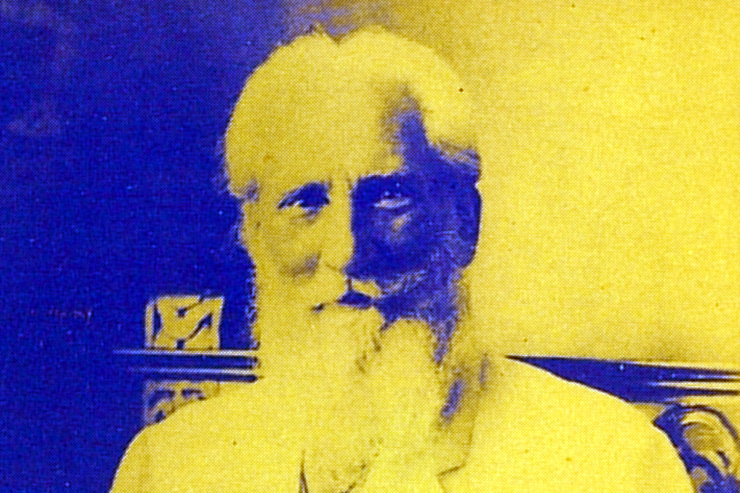
    1. Artist’s impression of C.W. Leadbeater which adorned the cover of a 1973 edition of his book The Inner Side of Christian Festivals published by the St Alban Press.
    2. “The Third Object of the Theosophical Society”, Adyar Pamphlet Number 184, Adyar, India, 1930.
    3. Other Temples, Other Gods: The Occult in Australia, Nevill Drury and Gregory Tillett, Hodder & Stoughton Australia Pty Ltd, 1982
    4. The Inner Life by C.W. Leadbeater, Madras, India:  Theosophical Pub. House, 1912.
    5. The Hidden Side of Christian Festivals by C.W. Leadbeater, as quoted in The Elder Brother: A Biography of Charles Webster Leadbeater by Gregory Tillett.
    6. The Elder Brother: A Biography of Charles Webster Leadbeater,  Routledge & Kegan Paul Books, 1982.

    © New Dawn Magazine and the respective author.
    For our reproduction notice, click here.
  • Mankind’s Cradle of Civilisation Found in Java?

    Mankind’s Cradle of Civilisation Found in Java?

    “Men fear time,” the old saying used to go, “but time fears the Sphinx.” That famous statue and Egypt’s Great Pyramid before which it has reclined for thousands of years have been long regarded as the most ancient monumental structures on Earth. Indeed, their late 20th century reappraisals indicated that they were even older than suspected.

    Beginning in 1974, a medical physicist and colleague of Albert Einstein, Kurt Mendelssohn, showed that the Great Pyramid was not the 2560 BCE tomb of some vainglorious king described by mainstream scholars.1 Instead, the “Mountain of Ra” was raised nearly six centuries earlier, at the very outset of Pharaonic Civilisation, as a massive public works project to unify the numerous, divisive tribes of the Nile Delta in the common cause of its construction.

    So too, the Great Sphinx – roughly contemporaneous, according to Egyptologists, with the Great Pyramid – has been back-dated to at least 5000 BCE – two millennia before the first Egyptian dynasty – by an American geologist at Boston University. During the early 1990s, Robert M. Schoch found that erosion on the Sphinx was not caused by the effects of wind-driven sand, as consensus opinion held, but by moving water, when conditions at the Nile Valley were far more rainy, long prior to the 26th century BCE.2

    As recently as 2009, these extreme chronological disclosures were radically eclipsed by radiocarbon testing of a monumental ceremonial centre in southern Turkey. Its T-shaped pillars, arranged in concentric, stone circles emblazoned with anthropomorphic, zoomorphic and geometric bas-relief images, pushed the start of civilisation back to eleven thousand years ago. But now, even Gobekli Tepe’s primacy has been overtaken by the announcement last autumn of a much larger megalithic complex, half a world away from Anatolia, two thousand or more years older.

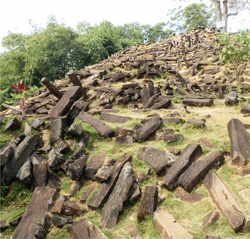
    The paradigm-shattering ruins were found in western Java, fifty kilometres southwest of Cianjur, a city with more than two million residents; Jakarta lies one hundred twenty kilometres to the northwest. A half-hour drive over asphalt and unpaved roads to the village of Karyamukti passes through mountainous landscape dotted with rice paddies and farms flourishing in the volcanic soil with chillies, peanuts, pineapple and corn, then skirts an immense tea plantation. At Mount Padang, hardy visitors need about twenty minutes to climb some 370 stone steps, rising at almost a forty-degree angle, ninety-five metres to the summit, which is crowned with the largest megalithic site in southeastern Asia. It encompasses more than twenty-five hectares, including nine hundred square metres of five, rectangular, stone courtyards ascending northwest to southeast, precisely laid out on a series of landscaped terraces, and neatly organised into low walls, inner partitions, and outward gateways, all of them connected by flights of stairs.

    Within and without the enclosures are dozens of standing monoliths, but many more lie scattered about. The entire complex comprises an estimated 3,703,700 black, andesite blocks ranging from one to two metres in length, and formed by geological processes into polygonal structures of five-, six- or eight-sided columns. (Andesite is an extrusive, igneous rock, a type of basalt formed by volcanic action.) Average dimensions for the columns are 0.3-by-0.3-by-1.5 metres. These smooth-sided blocks weigh from ninety to six hundred kilograms, with an average, individual weight of about three hundred kilograms. In other words, the site’s prehistoric workers transported approximately 1,111,110,000 kilograms (1,224,790 short tons) of building materials 885 metres above sea level, up the precipitous slopes of Mount Padang. Added to their burden was a non-local source for their andesite, which had to be brought in from some distant quarry unknown to academic scholars.

    Archaeologists were further surprised to find traces of a kind of adhesive, glue or perhaps cement that bound some of the top courses of the walls. Beneath, investigators were perplexed by the presence of several layers of sand that had been deliberately incorporated into the original stonework by the prehistoric engineers, perhaps allowing the blocks to move and slide against each other with the motion of seismic disturbances, instead of rigidly resisting such geologic upheavals and breaking under tension. Here was possible evidence for ancient earthquake-proof construction. Java is notorious for its tectonic violence, which claimed the lives of about eighty victims as recently as 2 September 2009. But it seemed utterly inconceivable that some pre-industrial people living in a remote, Indonesian backwater could have actually applied a form of technology our modern world has only recently begun to grasp.

    ‘Musical’ Rocks

    Contributing to the stones’ high strangeness, most of them possess an unusual quality that may have additionally warranted their distant importation by the ancient builders to the top of Mount Padang. Most of its andesite blocks and columns resonate with a bell-like tone when struck with another hard object. They belong to a rare, geological occurrence known as lithophony, the property of some rocks to emit musical sounds under percussive stress. Although only slightly more than one dozen lithophonic boulder fields have been identified in the world, most are found on private property, or have been obliterated by urban development.

    Two, separate sites identically named “Ringing Rocks Park” may be visited in the United States at Upper Black Eddy and Lower Pottsgrove Township, or Stony Garden on the northern slope of Haycock Mountain, all in Pennsylvania. Yet another American “Ringing Rocks” field is found in Montana’s Deerlodge National Forest, on the southwestern flank of Dry Mountain, in Jefferson County, southeast of Butte. Australia has its own “Ringing Rocks” in northwest Queensland, and Mexico’s Cerro de las Campanas, or “Hill of the Bells,” is located on a hill in the city of Querétaro. There are the Musical Stones of Skiddaw in Cumbria, England, but Scotland’s Clach a’ Choire is more cogent to our investigation, because this “Ringing Stone Of Tiree” bears fifty-three circular “cup marks” made by New Stone Age musicians, 4,500 years ago. They, like the builders at far-off Java’s Mount Padang, discovered something unusually mystical in the bell-like sounds. Remarkably, all these various sites produce very different tones from one another; no two locations sound exactly alike.3

    During laboratory testing of several lithophonic rocks in 1965, Pennsylvania geologist Richard Faas found that they created a series of tones at frequencies lower than the range of human hearing, and only became audible when they interacted with each other. Although lithophonic rocks sound metallic, their somewhat higher iron content is not responsible for such music, but rather a combination of the density of the stone and high degree of internal stress. Or so geologists speculate. In truth, beyond the cursory examinations undertaken by Faas, no actual studies to identify the source of lithophony have been made. Why some rocks produce ringing tones remains a scientific riddle.

    Their anomalous appearance among the ruins of Mount Padang is another dimension of their ancient mystery. No doubt, they were used by the prehistoric inhabitants as part of their ceremonial and spiritual activities. A concentration of lithophonic rocks on the site’s first terrace is referred to as “the gamelan stones” for their suggestive arrangement and the variety of musical sounds they make. Notes they produce have been identified as F, G, D and A by Hokky Situngkir from the Bandung Fe Institute, an Indonesian research organisation.4

    Alignments at Gunung Padang

    Archaeo-astronomers have determined that at least several of Mount Padang’s larger standing stones point to very definite celestial phenomena, such as sunrise and sunset on the summer and winter solstices, together with those of the spring and vernal equinoxes. The ceremonial centre’s name may, in fact, have actually derived from these prehistoric solar orientations. For example, the word padang, in the language of the Sundanese people of West Java Province, translates as “bright.” Gunung Padang, the archaeological zone itself, is commonly referred to by native residents as Sundapura, or “the Shrine of the Sun,” while the hill on which the ruins are located (“Mount Padang”) is traditionally called Parahyang Padang: “Where The Sun Ancestors Dwell,” or “Place Of The Ancestors Of The Sun.” These names or titles imply that the original inhabitants were astronomer-priests and/or priestesses, who aligned some of their monoliths with important solar positions. As such, these “Sun Ancestors” were light-worshippers, not unlike the European megalith-builders, who often oriented their own standing stones in western France and the British Isles with identical solar coordinates. Today, Gunung Padang is still sought out as a holy place by the two hundred to seven hundred visitors, most of them religious pilgrims, who visit every month.

    Geomantic alignments are also in evidence. Terrace I is deliberately aligned with nearby Mount Gede, where Karuhun cemetery has been revered for untold generations as the country’s oldest ancestral burial ground. Five, crudely sculpted, andesite thrones stand in Terrace II; six more are found in Terrace V. Although overshadowed by their massive courtyards, Mount Padang’s hundreds of stone terraces are themselves engineering marvels, two metres in height and diameter, with an uncanny resemblance to their far better known agricultural counterparts at another mountainous location on the other side of the world, in the Inca citadel of Machu Picchu, among the Peruvian Andes.

    The Mysterious Nan Madol

    But this South American parallel is not Gunung Padang’s only overseas’ comparison. No less great is an astounding, perhaps kindred mystery 4,345 kilometres northeast from Java, in a remote corner of the western Pacific Ocean. Off the coast of the Micronesian island of Pohnpei – “Built Upon An Altar” – stand the massive ruins of a long-dead archaeological site. Incongruously built on a coral reef less than two metres above sea level, Nan Madol – “Spaces In Between” – is a series of rectangular islands and colossal towers choked by draping vegetation. Ninety-two man-made islands are enclosed within the “downtown” area’s 2.6 square kilometres. All are inter-connected by an extensive network of what appear to be massive canals, each nine metres across and more than one metre deep at high tide.

    An estimated two hundred fifty million tons of prismatic basalt – related to Gunung Padang’s andesite – went into the construction of Nan Madol. Its stone girders rise in a cribwork configuration to eight metres. Between four and five million stone columns went into the construction of this prehistoric megalopolis. These prismatic columns range in length from one to four metres, although many reach six metres. Their average weight is around five tons each, but the larger examples weigh twenty or twenty-five tons apiece. An estimated four to five million basalt pillars, girders and logs went into building Nan Madol. It is, in effect, a double-walled enclosure comprising thirteen thousand, five hundred cubic metres of coral, with an additional four thousand, five hundred cubic metres of basalt. Remove all concealing vegetation, and visitors would behold crudely worked masses of basalt contrasting with orderly courses of stone rising in massive towers and overpowering walls amid a complex of smaller, rectangular buildings and man-made lakes interconnected by dozens of canals and numerous steps, sometimes formed into grand staircases, and spread out over eighteen square kilometres.

    Construction migrated to the main island of Pohnpei, where a rectangular enclosure fifteen metres long by eleven metres wide, with bisecting, one-metre-high interior wall, was discovered in a remote, swampy meadow high in the mountains; its configuration and mountaintop setting are particularly reminiscent of Gunung Padang. Although the Micronesian island’s twin courtyards contain a five hundred square-metre area, a pair of inner platforms are only a third of a metre high. As at Nan Madol, roughly cut basalt boulders and basalt “logs” were stacked to form the enclosure. Several others stand on Pohnpei’s southwest coast, with the largest example atop a two hundred forty-metre-high mountain. The summit is entirely surrounded by walls about two metres high connected via paved walkways to several terraced platforms.

    No one knows who raised them, when or why. Micronesian myth recounts only that exceptionally tall, twin-brother sorcerers, named Olisihpa and Olsohpa, arrived sometime during the ancient past in a “large canoe” from their distant homeland. It was a great kingdom of glittering splendour, until falling stars and earthquakes eventually destroyed Kanamwayso, which sank to the bottom of the sea. This native oral tradition seems like a variation on the more famous story of Mu, or Lemuria, a deeply ancient and supposedly sophisticated, pan-Pacific civilisation that exerted lasting influence on both Asia and America prior to its destruction by a natural catastrophe similar to the tsunami that ravaged northern Japan, in 2010. Before the analogous loss of Kanamwayso, Olisihpa and Olsohpa allegedly built the basalt enclosures and staircases that continue to grace Nan Madol and Pohnpei. Despite more than one hundred years of scientific investigations, however, no known culture has been associated with these places. Meanwhile, the moist, tropical climate skewers accurate carbon-dating at both locations.

    Nor is their original purpose entirely clear. Nothing about either location suggests real urban centres, lacking as they do any provision for food production or storage. No human burials have been found there, save a few, individual skeletons of above-average stature – calling to mind local myths of the founding-fathers, Olisihpa and Olsohpa – unearthed by Japanese archaeologists during the 1930s. The rectangular arrangement of walls with regularly spaced openings and partitions suggest a ceremonial function. But for what people, and why in this extremely remote, obscure corner of the vast Pacific? Nevertheless, Nan Madol’s and Pohnpei’s fundamental resemblances to Gunung Padang imply, at the very least, a relationship of some kind, however inconceivable.

    14,000 BCE?

    Yet more extraordinary than even these comparisons and the monumental greatness of the Indonesian site itself is its uniquely profound age. The first archaeological survey of Gunung Padang appears in a “Report, the Department of Antiquities” (Rapporten van de Oudheidkundige Dienst) for Holland’s colonial office, whose anonymous author posited during 1914 that the ruins could not predate the official beginning of Java’s history in the early 5th century CE, although they appeared much older. For the rest of the 20th century, the site went unrecognised by the outside world, even after it was briefly mentioned by the prolific Dutch archaeological author, Dr. N.J. Krom, in 1946’s Under Palm And Banyan Trees.5 

    Thirty-three years later, a Canberra team from the Australian National University’s Centre for Archaeological Research – “dedicated to investigating and learning with and about the people, languages, and land of Asia and the Pacific region” – returned for the site’s first, scientific examination.6 In doing so, they determined that Gunung Padang was far older than previously imagined. Lichen growth alone covering many of the megaliths bespoke an antiquity going back millennia before Java’s earliest known culture. Not until February 2012, however, was a State-sponsored evaluation of the site carried out, when thorough radiocarbon testing revealed it was built and first occupied about 4,800 years ago. This surprisingly early Third Millennium BCE date placed Gunung Padang squarely within Western Europe’s Megalithic Age, with implications for transoceanic contact, however heretical such considerations struck conventional scholars.

    But as the researchers were carrying out their investigations, they noticed traces on Mount Padang’s surface of what might be other, underground structures. No less a supporter of science than the President of Indonesia himself, Susilo Bambang Yudhoyono, lavished the archaeologists with costly GSSI and Multi-Channel SuperSting R-8 ground-penetrating radar units, plus GEM-Ovenhausser geo-magnetometers. These state-of-the-art instruments readily found and accurately confirmed the existence of large and small chambers, walls, gates and staircases buried deep beneath the often-visited, open-air ruins in a virtual subterranean mirror image of Gunung Padang.

    According to team leader and geologist, Dr. Danny Hilman Natawidjaja, “3-D geo-electric and geo-radar [procedures] discovered two doors in the hallway” of a chamber measuring ten-by-ten-by-ten metres at a depth of twenty-five metres.7 Throughout last summer and into early fall, he and his twenty colleagues – leading seismologists, philologists, archaeologists, anthropologists, and petrographers – carefully dredged up organic materials, which were sent for laboratory testing in the United States, because the Indonesians were determined to avoid any appearance of politically motivated results.

    “US lab validates Cianjur ‘ancient structure’ theory,” The Jakarta Post announced on 5 November. “A recent analysis of carbon-dating by the Miami-based Beta Analytic Lab has apparently validated findings by a government-sanctioned team that a man-made structure lies buried under Mount Padang in Cianjur, West Java. The lab used samples of sand, soil and charcoal found at a depth of between three and twelve metres beneath the mountain’s surface. Based on geo-electric, geo-radar and geo-magnetic [surveys], a large chamber is buried at least up to fifteen metres from the surface… Carbon-dating test results from the Miami lab show that the structure could date back to 14,000 B.C., or beyond.”8

    Since publication of The Jakarta Post report, repeated and additional analysis by Beta Analytic scientists confirmed their initial 14,000 BCE findings. The significance of this discovery cannot be over-stated, because it crosses the Ice Age event horizon. Even Turkey’s Gobekli Tepe, for all its Tenth Millennium BCE antiquity, came into being only after the close of the last glacial epoch, when environmental conditions were moderating sufficiently to allow for the development of proto-civilisation. Less distracted by the incessant challenges to their survival, our ancestors were afforded opportunities for broader, more complex social cooperation. But Gunung Padang proves that humans were already in possession of a relatively high culture two thousand years earlier, while the Ice Age was still in progress.

    This “Shrine of the Sun” has radically pushed back the origins of civilisation to remoter levels of time and space, because mainstream palaeo-anthropologists, fixated on Europe and the Near East, are resistant to the very notion of mankind’s transition from ‘savagery’ in Indonesia. Yet, it is precisely here that Stephen Oppenheimer, a British geneticist, member of Green Templeton College, Oxford, and an honorary fellow of Liverpool School of Tropical Medicine, traced the beginnings of civilised mankind with his controversial Eden in the East, in 1999.9 It had been preceded during the previous century by The Lost Continent of Mu, written by another Englishman, James Churchward, an Imperial British Army colonel serving in India, where his translation of original Hindu monastery source materials likewise recorded how humans took that first step in the Western Pacific realm.10 My own The Lost Civilization of Lemuria (2006) and Before Atlantis (2013) similarly trace the rise of homo erectus in Java, his Pacific-wide dispersal and accelerated evolution after the eruption of history’s greatest volcanic event, and his descendants’ subsequent invention of civilisation.

    These conclusions are wonderfully brought to life by recognition of Gunung Padang as Man’s earliest-known megalithic complex. Its apparent sophistication declares that it was not the first, but must have been preceded by the construction of even earlier ceremonial centres. Civilisation is, therefore, older than we presently comprehend. If, however, the quest for its ultimate origins goes on, and deeper into the past than ever imagined, then at the very least, Gunung Padang is pointing us in their proper direction.

    [alert type=”general” dismiss=”no”]This article was published in New Dawn 136.[/alert]

    [alert type=”success” dismiss=”no”]If you appreciate this article, please consider a contribution to help maintain this website.[/alert]

    Footnotes

    1. Kurt Mendelssohn, The Riddle of the Pyramids, London: Thames & Hudson, 1974.

    2. Robert M. Schoch, Voices of the Rocks, NY: Harmony, 1999.

    3. Ringing Rocks Park, Upper Black Eddy, Pennsylvania, www.youtube.com/watch?v=V4VtjFhysgc; Ringing Rocks Park, Lower Pottsgrove Township, Pennsylvania, www.youtube.com/watch?v=NBfrLoBpsIQ; Ringing rocks, Queensland, Australia, www.youtube.com/watch?v=dl_zL4g2gvs; Musical Stones of Skiddaw, England, www.youtube.com/watch?v=inWKcmVEwvs; Ringing Rocks, Montana, www.youtube.com/watch?v=smiCS1Ixfts; Cerro de las Campanas, Querétaro, Mexico, www.youtube.com/watch?v=_dMRcnlZ2tk; The Ringing Stone, or Clach a’ Choire, Scotland, www.youtube.com/watch?v=eNn-4O_G-bU

    4. www.abovetopsecret.com/forum/thread880575/pg1

    5. Dr. N. J. Krom, Onder Palmen En Waringins, Holland: Uitgeverij in Den Toren, 1946.

    6. ANU Centre for Archaeological Research, http://chl.anu.edu.au/archaeology/car.php

    7. www.abovetopsecret.com/forum/thread880575/pg1

    8. “U.S. lab validates Cianjur ‘ancient structure’ theory,” 5 November 2012, The Jakarta Post, www.thejakartapost.com/news/2012/11/05/us-lab-validates-cianjur-ancient-structure-theory.html.

    9. Stephen Oppenheimer, Eden in the East, London: George Weidenfeld & Nicholson, Ltd., 1999.

    10. Col. James Churchward, The Lost Continent of Mu, U.S.: Brotherhood of Life, 1987 reprinting of the 1924 original.

    11. Frank Joseph, The Lost Civilization of Lemuria, U.S.: Bear and Company, 2006; Before Atlantis, U.S.: Bear and Company, 2013.

    © New Dawn Magazine and the respective author.
    For our reproduction notice, click here.
  • Political Secret Societies: The Hidden Paths of Power

    Political Secret Societies: The Hidden Paths of Power

    Did Zanoni belong to this mystical Fraternity, who, in an earlier age, boasted of secrets of which the Philosopher’s Stone was but the least; who considered themselves the heirs of all that the Chaldeans, the Magi, the Gymnosophists, and the Platonists had taught; and who differed from all the darker Sons of Magic in the virtue of their lives, the purity of their doctrines, and their insist­ing, as the foundation of all wisdom, on the subjugation of the senses, and the intensity of Religious Faith?
    – Zanoni, Sir Edward Bulwer Lytton

    The governments of the present day have to deal not merely with other govern­ments, with emperors, kings and ministers, but also with the secret societies which have everywhere their unscrupulous agents, and can at the last moment upset all the governments’ plans.
    – British Prime Minister Benjamin Disraeli, 1876

    Two very different views of secret societies are revealed in the quotations above. The first describes a spiritual brotherhood pledged to Wisdom and guiding humanity toward the realm of the Infinite; the second seeks to expose the machinations of power-seekers who cloak their manipulative agendas in darkness. In addition to spiritual and political secret societies, one could add criminal secret societies such as the Mafia, or even clandestine elite military units – neither of which will be discussed here.

    All secret societies share certain fundamental themes. Membership is restricted to those who have an abiding interest in the subject. Thus, a spiritual group will attract people seeking more knowledge of a particular teacher or type of practice. The student is aware of the subject matter in advance and will approach the group for further instruction. More rarely, an individual may be “tapped” by the group because of a perceived affinity to its purpose.

    In a political secret society, membership is restricted to those who share an ideological affinity with the goals the group represents. At the furthest end of the political spectrum, the mission will be revolution. Such a society will go to great lengths to defend itself. Generally there will be small semiautonomous cells working in overall concert but with cut-outs introduced at all levels to pro­tect other members from exposure or betrayal. This type of society is represented by a contemporary group such as al-Qaeda. The infamous Weathermen of the 1960s and 1970s had a sim­ilar structure. The clandestine revolutionary model was developed and perfected by Hasan-i-Sabah, leader of the Nizari Ismaili Order of Assassins between the late 11th and early 12th centuries.

    On another political plane are ideological groups such as the Council on Foreign Relations, or participants in the World Economic Forum. Here we find leaders in politics, business, finance, education, and the media who may share a belief in the value of global solutions; are in high positions of authority and influence; and represent different levels of involvement with the inner circle of the group. Most members simply welcome the opportu­nity to associate with other well-known luminaries and are honoured by being offered membership or attendance privileges. Yet, the ideology at the highest levels of such groups supports a world government – to be adminis­tered by a class of experts and planners, entrusted with running centrally organised social and political institu­tions. Although members may be persuaded to add their considerable voices to certain transnational political and economic policies, they may not be as supportive (or even aware) of the long-range ambitions of the inner circle. While these groups quite often hold their meetings in secret, their membership lists are a matter of public record. It is the central agenda that is disguised.

    Adam Weishaupt founded the Bavarian Illuminati in 1776. The Illuminati are perceived by many as spanning the chasm between the spiritual and the political secret society. Often credited (or blamed) for influencing the French Revolution in 1787, the Illuminati taught a doctrine of social and political liberation that hinged on the equal­ity of man, the embrace of rationalism, and the denial of crown and church as the legitimate institutions for the regulation of social and moral values. The bitterness of life in Europe at this time – when church and state monopolised resources and often acted in an irresponsi­ble manner toward the citizenry – created widespread resentment among all classes. While the views of the Illuminati may sound quite advanced for the time, the European revolutions they are believed to have encour­aged degenerated into brutal bloodbaths whose singular lack of moral compass was appalling.

    Reprinted with permission from The Mystery Traditions: Secret Symbols and Sacred Art by James Wasserman (Destiny Books, 2005).
    [alert type=”general” dismiss=”no”]This article was published in New Dawn Special Issue Vol 6 No 6.[/alert]

    [alert type=”success” dismiss=”no”]If you appreciate this article, please consider a contribution to help maintain this website.[/alert]

    © New Dawn Magazine and the respective author.
    For our reproduction notice, click here.
  • The New World Order Vs. The New Age: Separating Truth from Falsehood

    The New World Order Vs. The New Age: Separating Truth from Falsehood

    From New Dawn Special Issue Vol 6 No 6 (Dec 2012)

    There are numerous difficulties in trying to discern what among the proliferation of new or revived faiths might be regarded as working to usher forth a New Age based on eternal values, and those that work to establish the rule of malignant, matter-bound forces. The problem is that there are often superficial resemblances that occur between them. Even within the same occult orders, such as Freemasonry, there are a range of views that might be in opposition but are mistaken as being part of a single, all-embracing conspiracy. There is a tangle of terminology, groups, personalities, ‘Hidden Masters’, accusations and counter-accusations of black magic, and so forth. This article considers ways in which the positive and negative currents within the ‘New Age’ might be identified.

    The Cycles of Rise and Fall

    The school of Perennial Tradition regards traditional cultures, religions and spiritualities as sharing core beliefs, values of an eternal nature, on which are founded Civilisations and societies in their cycles of health. Hence, in the analogous cycles of cultures as far removed geographically and ethnically as the Japanese, Hindu, Norse, and Arabian, all will possess analogous beliefs in regard to social hierarchy, chivalric ethos, and a nexus that exists between the Divine and the temporal. In such a society one’s highest calling, whether as peasant or prince, is to work in accord with one’s cosmic duty, or what the Hindus call dharma. In such a society castes reflect the Divine order on earth: ‘as above, so below’, and degenerate into contending economic classes in the cycle of decline.1

    This cyclical view of history2 is another shared featured of various Traditional cultures, expressed in the Norse,3 Hindu,4 Hopi oral lore,5 and many others. In our own era the German historian-philosopher Oswald Spengler provided empirical evidence for the cyclicity of cultures.6 The two primary Traditionalist exponents of cultural cyclicity in our era are Rene Guenon7 and Julius Evola.8 Esoterically, it is the cycle of life expressed in ‘The Wheel’ of the ‘Major Arcana’ of the Tarot, which is derived from the Medieval ‘Wheel of Fortune’ or Rota Fortuna depicted in Gothic Churches.9 

    Tradition, Anti-Tradition & Counter-Tradition

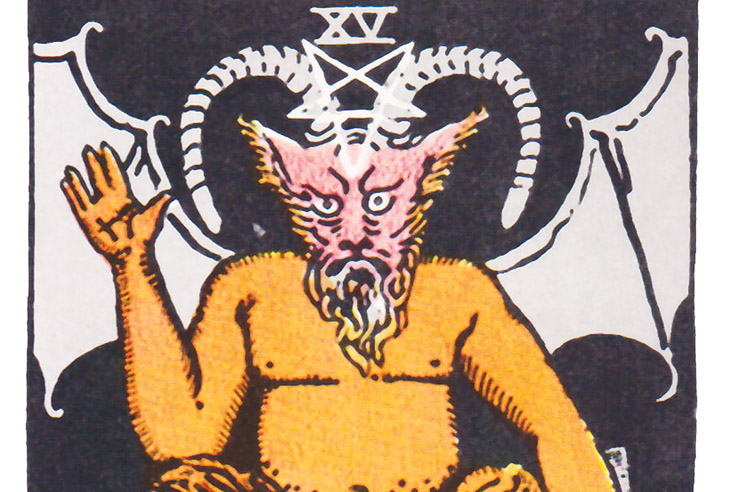
    A glance at cultural cycles is necessary to identify the occult forces that work in the context of Tradition for a return to eternal values based on a reconnection with the Divine, and those that want to enslave humanity to matter. Again, recourse to Tarot symbolism is instructive. Here we see that the Counter-Tradition that stands behind Anti-Tradition, is in the esoteric sense, literally satanic. Paul Foster Case10 provides a meaning for ‘The Devil’ trump that is particularly relevant:

    In its most general meanings, it signifies Mammon and thus big business, the conventions of society, the injustice and cruelty of a social order in which money takes the place of God, in which humanity is bestialised, in which war is engineered by greed masquerading as patriotism, in which fear is dominant. Students of astrology will have no difficulty in seeing how this corresponds to Capricorn, the sign of big business, and the sign of world fame.11

    In this one paragraph Case says much. He cogently differentiates the Traditionalist from the Anti-Traditionalist in what is an occult war. Case identifies the Counter-Tradition that controls Anti-Tradition as ‘Mammon’. Mammon infers something more than simply plutocracy; it is the spirit behind plutocracy. Plutocracy controls the present era. Oswald Spengler pointed out that Money rules in the epoch of decline of a Civilisation. It is not merely the temporal influence of Money which Spengler is referring to, but the spirit behind Money, or what Case calls Mammon. “The dictature of money marches on, tending to its material peak in the Faustian [Western] Civilisation as in every other.”12 

    The other significant point raised by Case is the ‘bestialisation’ of humanity. In this trump ‘The Devil’ is depicted enchaining the human pair to matter. Like the ‘Devil’, the human pair is depicted with tail and horns. This is suggestive of the esoteric belief in cyclic regression rather than lineal progression, when humanity regresses from a higher state of Being, of a spiritual mode, descending ever more into a baser, material existence. Anti-Tradition is the agency for this decline and enslavement. The modern world is therefore, according to the Traditionalist perspective, not ascending upward toward the Godhead, nor toward manifesting the God within; but is in a downward spiral towards – metaphorically – ‘The Devil’ – the master of our base drives.

    A problem of identifying who belongs to what arises because forces work behind the guise of Tradition, while they are in reality the initiates of Anti-Tradition and Counter Tradition, or what Aleister Crowley called the ‘Black Magick School’. The purpose of Anti-Tradition is that of subversion and the sowing of confusion to pave the way for Counter-Tradition. ‘Anti-Tradition’ was stated by Perennial Traditionalist scholar and initiate Rene Guenon to be “pure negation and nothing more.”13 In regard to Counter-Tradition there is a “counter-initiation,”14 representing a satanic current of those who seek the severing of the nexus between the terrestrial and the divine. Guenon wrote of this:

    After having worked always in the shadows, to inspire and to direct invisibly all modern movements, it will in the end contrive to ‘exteriorise’, if that is the right word, something that will be as it were, the counterpart of a true tradition, at least as completely and as exactly as it can be so within the limitations necessarily inherent in all possible counterfeits as such.15

    To Guenon the Counter-Traditionalist movements are void of spiritual content. This can be seen in the many movements and ‘orders’ professing a ‘tradition’ and having a mystical or spiritual façade, yet who expound a materialistic universal republic. This is why various esoteric orders can be seen to be promoting materialistic doctrines such as Marxism, and such Anti-Traditional dogmas as those expressed in slogans like “liberty, equality, fraternity,” to usher in the “reign of quantity.”16 Anti-Traditionalist movements and ideologies are only a means, and not the end. Guenon aptly uses the term “satanic”17 to describe these currents.

    Of these Counter-Traditions, Guenon states that they can never be anything other that a “parody,” an “inverted spirituality” involving organisations of “counter-initiation.”18 Guenon regarded these movements as being of supernatural origin, as satanic and believed that a figure analogous to the “The Anti-Christ” will manifest at the head of a world order.19

    Guenon described the order which Counter-Tradition tries to impose by at first using the doctrine of “egalitarianism” as a means of overthrowing the remnants of Tradition and spirituality, after which will be erected in place of the divine hierarchies a “counter-hierarchy,” atop which sits an individual that seems analogous to “The Anti-Christ,” Guenon describing him as “nearest to the very bottom of the ‘pit of hell’.”20

    Of the numerous orders that were emerging, especially in France during the 19th century, Guenon referred to them, regardless of their pretensions, as “anti-tradition.” One might say that they reflect the zeitgeist21 of the present epoch of Western decline. Guenon refers to the numerous orders that claimed to be “Rosicrucian.”22 Of these, the primary order is that of Freemasonry, from which much of the current “occult revival” derives, including cults purporting to represent a “New Age.” They are, in Guenon’s term, “counterfeits,” and as counterfeits are intended to be, often difficult to detect.

    Profanation of Tradition

    Eliphas Levi23 was one of the primary theoreticians of the modern occult revival. Among Levi’s books, The History of Magic provides insights into the history, nature and influence of Anti-Traditional, Counter-Traditional and counter-initiatory currents. Levi was well-placed to offer informed opinion. He had been a prominent socialist propagandist, having been jailed for his views24 and seems to have been a highly initiated Freemason.25 However, Levi rejected socialism in favour of a conservative, monarchical position, and came to see Freemasonry as having had a noble tradition that had been “profaned” by Anti-Tradition. Having defended what he regarded as the genuine traditional and spiritual legacy of Masonry, Levi then posed and answered the question:

    Now if Masonry is thus holy and thus sublime, we may be asked how it came to be proscribed and condemned so often by the Church?… Masonry is the Gnosis and the false Gnostics caused the condemnation of the true.26

    Levi contends that the Traditionalists were driven underground for fear of being associated with the “sacrilege” of the “false interpreters… the enemies of all belief and all morality”:

    Masonry has not merely been profaned but has served as the veil and pretext of anarchic conspiracies descending from the secret influence of the vindicators of Jacques de Molay,27 and of those who continued the schismatic work of the Temple. In place of avenging the death of Hiram28 they have that of his assassins. The anarchists have resumed the rule, square and mallet, writing upon them the words Liberty, Equality, Fraternity – Liberty, that is to say, for all the lusts, Equality in degradation and Fraternity in the work of destruction. Such are the men whom the Church has condemned justly and will condemn forever.29

    Levi states that during the 18th century,

    A schism took place in illuminism:30 on the one hand, the wardens of the traditions concerning Nature and science wished to restore the hierarchy; there were others, on the contrary, who desired to level all things by disclosing the Great Arcanum, thus rendering the royalty and priesthood alike impossible in the world. Among the latter, some were ambitious and unscrupulous, seeking to erect a throne for themselves over the ruins of the world. Others were dupes and zanies. The true initiates held with dismay the launching of society toward the abyss, and they foresaw all the terrors of anarchy.31

    Levi is here referring to the Order of the Illuminati, founded in Bavaria in 1776 by Adam Weishaupt, with the purpose of inaugurating a communistic universal republic; and similar cabals generally emanating from Freemasonry, including the French revolutionary Jacobin Club and Lodges that formed after the French revolutionary tumult from whence came the subversive creeds, including that of Karl Marx.

    The revolutionary atheists, rationalists and humanists flocked to the Lodges during the 18th and 19th centuries, where they “worked the degrees” of the ancient Mysteries for their own counter-initiatory purposes. Of the type of profanation Levi referred to, we can state the following.

    Philippe Buonarroti, the Italian exponent of the French Revolution, was initiated into Masonry in 1786. In 1808 he formed Les Sublimes Maîtres Parfaits. Buonarroti had a major influence on revolutionist Auguste Blanqui, and through his book Conspiration pour l’Egalité dite de Babeuf, suivie du procès auquel elle donna lieu he was also a seminal influence on the revolutions that erupted throughout Europe in 1848. Buonarroti also advised Mazzini and other revolutionaries in Italy.32

    Buonarroti had co-founded with Francois Babeuf, another significant revolutionist, the Society of the Pantheon, one of the first of the revolutionary secret societies to emerge from the French Revolution, believing the Revolution had failed; and he organised a group of ‘Philadelphe’ Masonry within the Lodge ‘Amis Sincères’. Dr. J M Roberts states:

    What may be termed the first international political secret society, the Sublimes Maîtres Parfaits, was founded by Buonarroti, perhaps in 1808. Only freemasons were admitted to it. The Elect were aware that they were to work for a republican form of government; only the Areopagites knew that the final aim of the society was social egalitarianism, and the means to it the abolition of private property.33

    Marxism was the 19th century culmination of this Anti-Traditional current of a long line of secret societies. Although numerous conspiratologists have written of the alleged role of the Illuminati in ‘hiring’ Marx to write the Communist Manifesto, via the League of the Just, reliable documentation is infrequent. However, there is scholarly evidence that Marx was part of the Anti-Traditionalist current. Blanqui organised the League of the Just, which was called the League of Outlaws by German exiles in Paris. This became the Communist League, and in 1847 this cabal asked Marx to write the Communist Manifesto. It is from Blanqui that the dictum now credited to Marx, the “dictatorship of the proletariat,” originated.34 Marx was initiated into the Mysteries of Memphis-Mizraim Masonry. Prof. Mark Lause, a scholar of labour history,35 writes:

    …Certainly, the tangled history of freemasonry has largely mirrored the political and social views of those drawn to the craft, and some of those drawn to the more peculiar pseudo-Egyptian forms of the order reflected views that were accordingly distinctive.36

    The 18th century Cabalistic mystic Cagliostro founded the Rite of Memphis in 1779. He insinuated himself into the French Court, like Philippe de Lyon insinuated his way into the Court of the ill-fated Czar Nicholas II.37

    Lause cites I Nicolaevsky38 as an authoritative source in stating “that the nineteenth century Order of Memphis actually did mask the ongoing revolutionary activism of French radicals both at home and abroad, strikingly so in the case of émigré circles at London.”39 This confirms the statement by occult historian Lewis Spence, who in a laudatory entry on Cagliostro writes that the Mizraim Rite included the communistic doctrines of the Illuminati.

    In 1785 Cagliostro was implicated in a scandal in the French Royal Court and exiled himself to England where he wrote revolutionary propaganda against the monarchy and declared that the French Throne would be overthrown. His 1786 ‘Letter to the French People’ declared prophetically that the Bastille would be stormed and the governor killed.40 

    Spence states that Mizraim had been set up to subvert the traditional society of Europe and, significantly, received large financial backing:

    There is a small question that the various Masonic lodges which he [Cagliostro] founded and which were patronised by persons of ample means, provided him with extensive funds, and it is a known fact that he was subsidised by several extremely wealthy men, who, themselves dissatisfied with the state of affairs in Europe, did not hesitate to place their riches at his disposal for the purpose of undermining the tyrannic powers which then wielded sway.41

    London was the centre of revolutionary intrigue where political refugees from throughout Europe sought refuge and, with the help of English Masons, founded the Internationale.42 Masonry provided acceptance for diverse and radical views, and a model for a secret revolutionary structure. Lause writes of this:

    In any event, if your declared purpose was something as radical as that of the Philalethes, the perfection of the human race, it helped legitimise the goal by describing oneself as an “Ancient and Primitive Rite of Masonry.”43

    Lodges were established in England and elsewhere, the most important being La Grand Loge des Philadelphes at London in 1851. Lause states that the Order of Memphis “fostered what became the International Association in March 1855 [and] provided almost all of the French members of the General Council of the later International Workingmen’s Association.”44 Another prominent socialist historian, Dr. Bob James, identifies as Masons Garibaldi, Mazzini,45 Charles Bradlaugh46 and Karl Marx, stating this was “neither an accident nor an aberration.”47

    Crowley on the Schools of Black and White Magick

    Aleister Crowley is perhaps the best example of how unclear can be the identification of Traditional, Anti-Traditional and Counter-Traditional currents.48 Crowley claimed Adam Weishaupt, the founder of the Illuminati, among the “saints” of his religion, Thelema.49 However, the doctrines of Thelema and the Illuminati are polar opposites. Crowley, in contrast to the communistic doctrines of Illuminism, sought the establishment of a neo-aristocratic society: the revival of hierarchy.50 It is notable that the German philosopher Friedrich Nietzsche, the antithesis of communistic and liberalistic doctrines, is also a “Saint” of Thelema.51

    Evola acknowledged Crowley as a genuine initiate of Tradition. Evola also regarded the Hermetic Order of the Golden Dawn, under which Crowley served his magickal apprenticeship and which was a seminal influence on the modern occult revival as, “to some extent,” a successor “to those of an initiatic character.”52 Evola granted that Crowley’s system of Magick was drawn from Traditional initiatic practices: “It is certain that in Crowleyism the inoculation of magico-initiatic applications is precise, and the references or orientations of ancient traditions are evident.”53

    Why then did Crowley identify with Adam Weishaupt and the Illuminati, whose doctrines are antithetical to Thelema? Perhaps the reason is that Crowley took on a certain role when assuming the mantle of leadership of the Ordo Templi Orientis (OTO) founded by Theodor Reuss, who was in the employ of the German secret service. Reuss is said to have revived the Order of the Illuminati by virtue of what he claimed to be family connections with the 18th century cabal.54 He was an initiate of Martinist and Mizraim Masonry headed by ‘Papus’.55 He was also in contact in 1902 with Dr. William Wynn Westcott, a high initiate of Grand Lodge Masonry, head of the Societas Rosicrucia in Anglia and founder of the Golden Dawn.56 Reuss had influential international connections.57 As Dr. Richard Spence of the University of Idaho has shown, Crowley was involved with the British secret service at least from 1913, when he was acting for British interests in Moscow,58 and was called on during both World Wars.59 Reuss was obviously a valuable asset to the Germans, and Crowley was ideally placed to track him.60 

    At any rate, Crowley’s identification of the White, Yellow and Black Schools of Magick show that the Illuminati and Freemasonry can be identified with the Black School or what Guenon called the Counter-Tradition and Anti-Tradition. Crowley explained that each School has its own “Hidden Masters.” While the Yellow School “stands aloof,” “the Black School and the White are always more or less in active conflict.”61 The Yellow School regards the universe as “neutral.” The Black regards it as a curse and a sorrow.62 Hence we might summarise the three Schools of Magick in regard to their philosophy of life as being: Yellow: Neutral, Black: Negative, White: Positive.

    Crowley, like Eliphas Levi and Guenon, saw Masonry as having been subverted by the ‘Black School’ and referred to English Masons as being “in official relationship with certain masonic bodies whose sole raison d’etre is anti-clericalism, political intrigue and trade benefit,” despite English Masonry supposedly eschewing such motives.63 These critical sentiments towards the subversion of English Masonry are not consistent with anyone who would be an adherent of Weishaupt and Illuminism, whose raison d’etre was anti-clericalism and political intrigue.

    Crowley saw anarchism sweeping the world of the type that had been initiated by the Illuminati and other forms of Masonry during the 18th and 19th centuries. Again, it can be seen that Crowley’s attitude was anything but Illuminist. “The last quarter of a century had swamped”64 the monarchies, and for Crowley the world was poorer for it:

    The world is seething from the dissatisfaction that springs from insecurity. Men can adapt themselves to pretty well any conditions, but when they do not know from one day to another where some fundamental principle may not be abolished in the interests of progress, they no longer know where they are. They tend to adopt the principles of the man who flits from one place to another… Civilisation has become a hysterical scramble for momentary material advantage…65

    Syncretic Religion and the Perennial Tradition

    The centuries of subversion of Tradition by Black adepts and their dupes has caused a confusion of cults, religions, and spiritualities, most of which claim to offer humanity the path to peace and happiness, and even to Godhood. As has been indicated throughout this article, it is not an easy matter to determine the real motives of many claiming the mantle of the Ageless Wisdom.

    There is an abysmic gulf between adherents of the Perennial Tradition and the Anti- and Counter-Traditions, yet they will often appear similar, because of the ‘counterfeit’ nature of the latter. The Perennial Traditionalist sees a commonality between faiths over expanses of time and space, the assumption generally being that they all derived from a primordial source and differ in so far as they reflect differences of ethnos, geography and historical circumstances. The Perennial Traditionalist will seek to maintain the distinctiveness of these faiths.

    The Black adept, while masquerading as a Traditionalist, aims to amalgamate the world’s faiths into one new syncretic faith, the altar to which all humanity will be chained under the guise of ‘universal brotherhood’, preludes of which were the bloody Reigns of Terror in Jacobin France and Bolshevik Russia. Therefore, when a State’s secular politicians, who also happen to be adherents of the aim of a ‘new world order’, start talking about ‘inter-faith dialogue’, under the guise of ‘representing all religions’, and of ‘tolerance’, one should be suspicious.

    Those who adhere to the Ageless Wisdom of many faiths eschew materialistic agendas. The World Forum of Spiritual Culture, formed on the initiative of the President of Kazakhstan, Nursultan Nazarbayev, brings together those who seek a new civilisation, in the aftermath of what they regard as a technical civilisation that is “anti-cultural.”66 Significantly, Nazarbayev is also a champion of a Eurasian geopolitical bloc67 that would challenge the very possibility of a ‘New World Order’. Such a bloc could serve as the axis for a New Age founded on spiritual and cultural principles, and freed from the bonds of matter.

    [alert type=”general” dismiss=”no”]This article was published in New Dawn Special Issue Vol 6 No 6.[/alert]

    [alert type=”success” dismiss=”no”]If you appreciate this article, please consider subscribing to help maintain this website.[/alert]

    Footnotes

    1. J Evola, Revolt Against the Modern World, Inner Traditions International, 1995.

    2. In contrast to the progressive-lineal, darwinistic view of history as a straight line running from primitive to modern.

    3. Voluspa, reprinted in The Masks of Odin: Wisdom of the Ancient Norse, Elsa-Brita Titchenell, Theosophical University Press, 1985.

    4. Bhagavad-Gita, Ch.9:8.

    5. G Hancock, Fingerprints of the Gods: A Quest for the Beginning and the End, Mandarin, 1996, 532-533.

    6. Oswald Spengler, The Decline of The West, George Allen & Unwin, 1971.

    7. Rene Guenon, The Reign of Quantity and the Signs of the Times, Sophia Perennis, 2001.

    8. J Evola, Revolt Against the Modern World, op. cit.

    9. D Phillips, ‘Wheel’, Man, Myth & Magic, Purnell, 1970, Vol. 7, 3014-3015.

    10. Case can be regarded as an adept of Tradition. He was initiated into the Golden Dawn, Crowley’s OTO, and in 1926 into 3º Masonry, and founded the Builders of the Adytum. His adherence was to the ‘Ageless Wisdom’. Lee Moffitt, Case Timeline, 26 September 1997, http://kcbventures.com/pfc/documents/timeline.pdf

    11. John Foster Case, Oracle of The Tarot: A Course on Tarot Divination, Chapter 6, ‘The Major Trumps: 15. Le Diable’, http://tarotinstitute.com/free/Oracle2.pdf

    12. However, Spengler also points out that at the cycle of decline – Kali Yuga, etc. – Money exhausts its possibilities and is met by a Traditional resurgence which he called “blood”: “the conflict between money and blood.” Oswald Spengler, op. cit., Vol. II, 506.

    13. Rene Guenon, The Reign of Quantity and the Signs of the Times, Sophia Perennis, 2001, 260.

    14. Ibid., 261.

    15. Ibid., 261.

    16. Ibid., 271.

    17. Ibid., 261.

    18. Ibid., 267.

    19. Ibid., 271-273. Guenon draws on both Islamic and Christian traditions here.

    20. Ibid., 271.

    21. ‘Spirit of the Age’ which, as Spengler, Evola and Guenon showed is, in the epoch of Western decline, materialism and the rule of money. This ‘spirit’ will be reflected even in movements intended to be in opposition to it. Hence as Oswald Spengler pointed out, Marxism is the mirror image of capitalism, both being doctrines of the materialistic zeitgeist. Oswald Spengler, op. cit. Vol. 2, 402, 464.

    22. Rene Guenon, op. cit., 251.

    23. The pseudonym of Alphonse Louis Constant (1810-1875).

    24. J W Revak, ‘Eliphas Levi: Clergyman, Radical, Magus’, www.villarevak.org/bio/levi_1.html

    25. Levi’s Masonic initiation can be construed from a comment he makes in The History of Magic (1860), indicating that he was an initiate of the 18º of Knight of the Pelican & Eagle & Sovereign Prince Rose Croix of Heredom. Levi writing: “Having attained by our efforts to a grade of knowledge which imposes silence, we regard ourselves as pledged by our convictions even more than by an oath… and we shall in no wise fail to deserve the princely crown of the Rosy Cross….” The History of Magic, Rider, 1982, 286.

    26. Eliphas Levi, Ibid., 286.

    27. Last Grand Master of the Knights Templar, executed for heresy.

    28. Hiram Abif, one of mythical architects of the Temple of Solomon whose murder Masons are sworn to avenge; a central motif of Masonic ritual.

    29. Eliphas Levi, op. cit., 286.

    30. By which Levi here means adepts of Gnosis; not the Order of Illuminati, the ‘schism’ among the adepts resulting in the formation of the Illuminati by “the ambitious and unscrupulous.”

    31. Eliphas Levi, op. cit., 305.

    32. Dr. John M Roberts, The Mythology of the Secret Societies, Secker & Warburg, 1972, 230.

    33. Ibid., 266.

    34. D Conway, A Farewell to Marx, Penguin Books, 1987, 146.

    35. Lause specialises in the history of the labour movement. An associate professor of history at McMicken College of Arts & Sciences, University of Cincinnati, his faculty biography states that he “teaches specialised courses in American Labor History, Comparative Labor History, and the Age of Jackson… For years, he has presented his work or participated in panels at the Annual North American Labor History Conference at Detroit… and the centennial conferences on Eugene V. Debs and Henry George.”

    36. M A Lause, ‘Walking Like an Egyptian: The American Destinies of a Revolutionary French Secret Society’; http://archives.econ.utah.edu/archives/marxism/2004w23/msg00109.html

    37. Philippe de Lyon was the protégé of Gerard Encausse, alias Papus, 33º Mason, who became Grand Master of Memphis-Mizraim, and the Grand Master of the Supreme Council of Martinist Masonry. Martinism had been founded in 1754 by Martinez de Pasquales who was, according to Bernard Lazare, an Illuminist who established Lodges of the Order in France. B Lazare (1894) Antisemitism: Its History & Causes, Britons, 1967, 153. Hence, there is a line of descent from the Illuminati to Memphis-Mizraim and Martinist Masonry. It is from this milieu, incidentally, that the Protocols of Zion might have emerged, rather than either as ‘Zionist’ records or a Czarist forgery.

    38. According to Lause, I Nicolaevsky based his work on the origins of the Internationale on the records of the organisation: “Clearly, when Nicolaevsky found the manuscript records on this society a century later, he opened a window into a genuine revolutionary conspiracy with far-reaching influences.”

    39. I Nicolaevsky, Secret Societies and the First International, The Revolutionary Internationals, 1864-1943, ed. Milorad M. Drachkovitch, Stanford University Press for the Hoover Institution on War, Revolution, and Peace, 1966, 37.

    40. L Spence (1920), An Encyclopaedia of Occultism, Citadel Press, 1960, ‘Cagliostro’, 90.

    41. Ibid., 92.

    42. International Workingmen’s Association, which included the rival followers of Karl Marx and of the anarchist Bakunin.

    43. M A Lause, op. cit.

    44. Ibid.

    45. The Italian revolutionaries.

    46. With Charles Braudlaugh there is another intriguing example of England’s leading atheist professing the arcane Mysteries as a Freemason. Annie Besant, who assumed the presidency of the Theosophical Society and leadership of Co-Masonry, was a close colleague. J J Lewis, ‘Annie Besant – Heretic’, http://womenshistory.about.com/od/freethought/a/annie_besant.htm

    47. Dr. Bob James is the Convenor and Co-ordinator of the Australian Centre for Fraternal Studies. He states of himself: “I make these claims on the basis of 25 years of research, of ten years or so as Secretary of the Hunter Labor History Society, and as organiser of a National Labor History Conference.”

    48. Nicholas Roerich, the Russian mystic, is another significant example of a Traditionalist initiate with anti-Traditionalist connections, which included US President F D Roosevelt and Vice President Henry Wallace and Soviet luminaries Maxim Gorky, Education Minister Lunarchsky, and Foreign Minister Chicherin. Roerich aimed to create a pan-Buddhist geopolitical and spiritual bloc that would embrace parts of the USSR. He seems to have been a genuine initiate of the Perennial Tradition trying to resist those of the Counter-Tradition through his own high level diplomacy. See: M Pashkovsky, ‘Nicholas Roerich: Secret Agent of Hidden Masters’, New Dawn Special Issue No. 3, Winter 2007, 9-14.

    49. A Crowley (1911), ‘Liber XV OTO Ecclesiae Gnosticae Catholicae Canon Missae’, Magick, Samuel Weiser, 1984, 430. Appendix VI, ‘The Saints’.

    50. K R Bolton, ‘Aleister Crowley as Political Theorist’, Crowley: Thoughts & Perspectives Vol. II, ed. T Southgate, Black Front Press, 2011, 5-28. Also: K Preston, ‘The Whole of the Law: The Political Dimensions of Crowley’s Thought’, ibid., 68-85.

    51. A Crowley (1911), op. cit.

    52. J Evola, ‘Aleister Crowley’, Crowley: Thoughts & Perspectives Volume 2, op. cit., 208.

    53. Ibid., 212.

    54. Reuss claimed in 1914 in his magazine Oriflamme to have ‘revived’ the Illuminati in 1880. It had been founded in Munich and called the Ludwig Lodge. It was from these origins that the OTO emerged.

    55. Lady Queenborough, Edith Starr Miller (1933), Occult Theocracy, California: 1980, Appendix IV, 42-43.

    56. Letters between Reuss and Westcott reproduced in: Lady Queenborough, ibid., Appendix IV, 8-35.

    57. According to testimonials for Reuss reproduced by Lady Queenborough, he was commended by the Military attaché to the US Embassy in Germany, and in 1896 was recommend by the First Secretary of the Embassy in Berlin to be Berlin correspondent for the NY Herald. Central News Ltd. (London), United Press and many others accredited him as a journalist. Lady Queenborough, ibid., Appendix IV, 2-5.

    58. Dr. R Spence, ‘The Magus Was A Spy: Aleister Crowley & the Curious Connections Between Intelligence and the Occult’, New Dawn 105, November-December 2007, 26.

    59. Crowley, masquerading as an Irish republican, served British Intelligence during World War I by infiltrating a German propaganda coterie in the USA. That the OTO under Crowley’s leadership served as a means of keeping tabs on esoterically inclined German agents is indicated by the involvement of Hanns Heinz Ewers, a German agent in New York. R Spence, ibid., 27. As for Reuss, Spence states that this association may have enhanced Crowley’s credibility among German agents. Reuss had worked for the German secret service since the 1880s, when he infiltrated the Socialist League in London. Crowley maintained contact with Ruess during World War I. Interestingly Reuss went to Switzerland where he attempted to recruit exiled radicals via another occult order, the Anational Lodge and Mystic Temple, where Crowley’s Gnostic Mass was among the ceremonies (Spence, ibid., 28). Again we see an example of a crypto-Masonic order being used for political purposes. Crowley meanwhile denounced Reuss to New York authorities as a German agent.

    60. Dr. Spence replies in this regard: “Basically, yes, I think your supposition about Crowley and Reuss is correct though the spying went both ways. The nagging question to me is Reuss’s exact connection to German Intelligence. He fits the profile of a spotter/recruiter and Crowley, with his connections… would have been a useful asset. From that vantage, Crowley could then funnel information back to his British handlers. The man who likely held the strings in all this was the eminence grise of pre-war British Intelligence, William Melville. In the 1880s and 90s, Melville had led Scotland Yard’s efforts against the anarchists, many of whom were German. He had informants among the German anarchists and it’s not inconceivable that Reuss was one of them. German and British Intelligence were generally very cooperative prior to 1900.” R Spence to K R Bolton, e-mail 10 September 2011. It could therefore be that both Reuss and Crowley were working against the anti-Traditional current, and that the crypto-masonic societies founded by Reuss were a means of subverting the subverters.

    61. A Crowley, Magic Without Tears, Falcon Press, 1983, 66.

    62. Ibid., 72-73.

    63. A Crowley, The Confessions of Aleister Crowley, Routledge and Kegan Paul, 1986, 697.

    64. Ibid., 284

    65. Ibid.

    66. ‘World Forum of Spiritual Cultures’, New Dawn 126, May-June 2011, 7-8.

    67. Régis Genté, ‘Kazakhstan or Eurasian geopolitics’, Le Monde Diplomatique, 18 November 2010, http://mondediplo.com/2010/11/18osce

    © New Dawn Magazine and the respective author.
    For our reproduction notice, click here.