“The earth abideth for ever,” says the Bible (Ecclesiastes 1:4). Whether this is literally true or not, it corresponds to the deepest core of human experience. The Earth was around long before the existence of human beings, and it will probably continue to exist long after we are extinct. Why, then, does the belief in the end of the world – not as a remote possibility but as an imminent event – persist so stubbornly in the mass consciousness?
For we continue to believe – and even long for – the fabled Time of the End. The number of predicted dates for this event are astonishing,1 and the huge number of failures has not diminished our appetite for plenty of new dates to come.
To understand how this mentality came about, it would be useful to look at the history of the genre known in theological jargon as apocalyptic (from the Greek apokalypsis, “revelation”). While apocalyptic has important predecessors in biblical literature (such as Ezekiel and parts of Isaiah), its origins are generally dated to the second century BCE. At the time the Jewish nation was living under the rule of the Hellenistic Seleucid monarchs, who were heirs to a portion of the empire of Alexander the Great. In 167 BCE, one of these rulers, Antiochus IV Epiphanes, embarked on a program of forced Hellenisation of the Jews, setting up an altar, and perhaps an image, of Olympian Zeus in the Temple in Jerusalem.
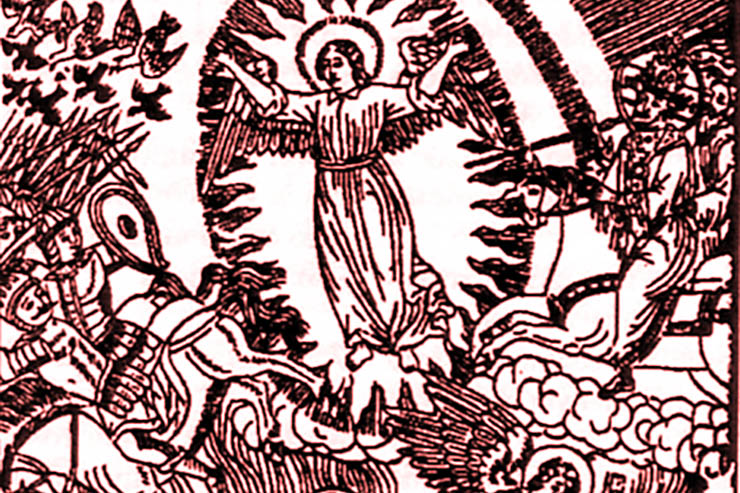
The outrage of the Jews is reflected in the Book of Daniel, one of the earliest apocalyptic writings and the only one to make its way into the Hebrew Bible. Written during the ensuing revolt against the Seleucids, this book sets up Daniel, a legendary sage of the sixth century BCE, as the mouthpiece of a prophecy that would “foretell” events 400 years after his time. (The technical term for this practice is vaticinium ex eventu, “prediction after the event.”) Daniel refers to “a vile person” – Antiochus – who will “pollute the sanctuary of strength, and shall take away the daily sacrifice, and… shall place the abomination that maketh desolate” (Dan. 11:21, 31) – that is, the idol in the Temple (cf. 1 Macc. 1:54). The archangel Michael will come to Israel’s rescue; the dead will be raised, “some to everlasting life, and some to shame and everlasting contempt.” Antiochus “shall come to his end, and none shall help him” (Daniel 11:45, 12:1-2).
What happened in fact was that the Jews rose up under the priestly family of the Maccabees and won back their independence, but this obviously did not begin the end of time. Antiochus himself did not perish as a result of any obvious divine wrath: he died of disease.
Despite its failure as a prophecy, the Book of Daniel set up the basic structure of the apocalyptic genre. Arising during some crisis, a text of this kind predicts that this event is the harbinger of the Day of Judgment, when justice will be done and evildoers will receive their due. The Book of Revelation at the end of the New Testament is much the same: many scholars say that it is a response to the persecution of Christians by the Roman emperor Domitian in the last decade of the first century CE. (The Greek title of Revelation, apokalypsis, gave its name to the genre.)
Even this very brief survey tells us something important about apocalypse and our attraction to it. There is a profound human hunger for justice – not only in the social arena but in the universe. And yet the forces of history often seem indifferent to justice: the righteous suffer while the wicked thrive. Every culture has made its own attempt to reconcile these facts. The traditions that arose out of India – Hinduism and Buddhism – posit the law of karma, played out across the backdrop of many lifetimes, as a way of explaining the apparent unfairness of the world. But reincarnation has always been very much a minority view in the West. Nor did the ancient Jews even have a very clear conception of the afterlife; reward in heaven and hell was only introduced later on, from Greek mystery religions.
Thus the solution the Jewish prophets proposed was the “day of Yahweh” – a final point in history when malefactors would all be brought to justice and the good (inevitably identified with one’s own people or sect) would finally be given their due. This has been such a powerful perspective that it has left its stamp upon practically everyone in Western civilisation. Even twentieth-century distortions such as Hitler’s Thousand-Year Reich and the glorious utopia under the rule of the proletariat, as prophesied by communism, owe much of their inspiration to the apocalyptic genre.
From all this it would seem that both the fears and the longings for the End Times are simply foolish. And yet it is not quite that simple. Deep down within the human heart lies the unshakable conviction that something is not right about the world we live in. We characterise the problem in different ways – politically, sociologically, psychologically, theologically – but the feeling is so pervasive that man can be defined as the animal that believes something is wrong. We can then ask ourselves, is there a chance that the cosmic order can be restored to its proper state?
This idea has constantly resurfaced in human thought, and as more than a simplistic version of the Last Judgment. The Christian church father Origen (c.185-c.254 CE) speculated about what he called the apokatastasis or “restoration” of all things, citing such biblical passages as 1 Corinthians 15:28: “And when all things shall be subdued unto him [God], then shall the Son also himself be subject unto him that put all things under him, that God may be all in all.” Origen even dared to suggest that all beings had the possibility of redemption, including the devil himself.
For bold theological moves such as this, Origen was eventually repudiated by the mainstream church, but his theology has continued as a source of inspiration up to the present. Even some orthodox church fathers, such as Gregory of Nyssa (c.335-c.395) and Maximus the Confessor (c.580-662), discussed universal redemption as a serious possibility. In the nineteenth-century United States, the Universalist Church was founded on the basis of this doctrine, and in the twentieth century the highly popular and influential text A Course in Miracles spoke of what it called the “Atonement,” in which all beings will eventually come to realise their fundamental unity with God. A parallel in Mahayana Buddhism is the hope for the ultimate enlightenment of all sentient beings.
Underlying this idea is another, equally important theme. We constantly hear the saying “We are all one,” but what does that really mean? Certainly in ordinary life we are not all one; I am not you, and you are not me. But, the esoteric traditions tell us, this is only apparently so. In reality we are all cells in a much larger being – a cosmic human who has been known to the Kabbalists as Adam Kadmon, to the eighteenth-century Swedish mystic Emanuel Swedenborg as the maximus homo or universal human, and to A Course in Miracles as the Sonship. (In reply to the question of whether Jesus Christ is the Son of God, the Course replies, “O yes, along with you!”) The apokatasasis is the restoration of each individual to his or her rightful place in this cosmic human, which will then reveal the profound truth of the assertion that we are all one.
This esoteric idea differs from the popular conception of the Last Judgment in two important ways. In the first place, it holds that ultimately no one will be condemned. While some will accept the truth of the Atonement sooner than others, eventually all will take part in it. In the second place, it is not posited as some kind of event that will occur next year or next decade. Instead the teaching says that the process of the Fall – the fragmentation of this cosmic human into the disharmonious, apparently separate entities that we now seem to be – took place over the span of unimaginable eons, and that the restoration will require a similarly immense amount of time to be realised.
As such, this vision does not offer many of the consolations that the conventional picture of the apocalypse provides. It does not give the believer the satisfaction of contemplating the immolation of the wicked (who are usually imagined as one’s own enemies, however these are construed). It does not provide the sensational thrill one might get from thinking that the end of the world is just around the corner. But in acknowledging that the human race is part of an enormous cosmic process, on a scale that we can scarcely conceive of, and in reconciling divine justice with divine mercy, it is a vision that deserves our consideration as well as our respect.
[alert type=”general” dismiss=”no”]This article was published in New Dawn 135.[/alert]
[alert type=”success” dismiss=”no”]If you appreciate this article, please consider subscribing to help maintain this website.[/alert]
Footnote
1. For one list, see http://en.wikipedia.org/wiki/List_of_dates_predicted_for_apocalyptic_events
Perception determines “truth.” We invent our own reality through our own perceptions and others’, and by accepting what appears to be real as real. History is filled with stories of people who, in “slipping between the cracks” of their own consciousness (thus altering how they perceived the world around them) uncovered different ways to experience reality. What they accomplished in doing this made an impact on society. You and I, all of us, have profited again and again because this happened.
Chester F. Carlson, for example, inventor of the Xerox duplication process and founder of the Xerox Corporation, was a devotee of a certain trance medium who channelled spirit beings. While attending a series of sessions with the woman, he eventually “received” the photocopy process from the spirit beings she contacted. After experimenting with the technique and making a few adjustments, the Xerox process was born, along with a multi-billion-dollar company.
George Washington Carver took the peanut, until then used as hog food, and the exotic and neglected sweet potato, and turned them into hundreds of products, including cosmetics, grease, printer’s ink, coffee, and peanut butter. Carver said he got his answers by walking in the woods at four in the morning. “Nature is the greatest teacher and I learn from her best when others are asleep,” he said. “In the still hours before sunrise, God tells me of the plans I am to fulfil.” How did George Washington Carver communicate with God during the wee hours of morning? He said it himself – through the assistance of angels and fairies. And he isn’t the only one to make such a claim.
Peter and Eileen Caddy and their colleague Dorothy Maclean give the same credits in describing the work they accomplished. This troupe, along with Caddy’s three sons, took up residence near an inlet to the North Sea at Findhorn, Scotland, for the purpose of setting up a co-creative link between themselves and nature intelligences – that is to say, angels (what they later called “devas”) and fairies (“nature spirits”). They became willing workers with nature’s own in an attempt to co-create a garden the likes of which would defy every known rule of convention and climate. That was 1962. Today, the Findhorn Gardens regularly draw people from across the globe to tour the premises and take classes at Cluny Hill College, classes on how to communicate with angelic forces and helper spirits while at the same time enhancing one’s own sense of spirituality.
The people I have mentioned came to perceive reality from a vantage point other than the norm; then they used what they gained from that experience to benefit others. Different ways of experiencing reality happen when individuals expand their consciousness. Whether accidental or on purpose, that shift in perception also alters the meaning and the importance of time and space.
Native Runners Expand Reality
Documented cases of native runners, especially those in North and South America, illustrate this. In Peter Nabokov’s book Indian Running, an anthropologist by the name of George Laird described what happened to one runner who lived in the southwestern part of the United States:
“One morning he left his friends at Cotton Wood Island in Nevada and said he was going to the mouth of the Gila River in southern Arizona. He didn’t want anyone else along, but when he was out of sight, the others began tracking him. Beyond the nearby dunes his stride changed. The tracks looked as if he had just been staggering along, taking giant steps, his feet touching the ground at long irregular intervals, leaving prints that became further and further apart and lighter and lighter in the sand. When they got to Fort Yuma they learned that he had arrived at sunrise of the same day he had left them,” thus arriving before he departed. The runner’s altered perception enabled him to accomplish this feat; he did not allow himself to be bound by normal perceptions of time and space.
Let’s not forget the Australian aborigines. Theirs is the oldest continually existing culture on Earth (around for at least 50,000 years), and they maintain an understanding of time and space – of reality – that deserves our attention.
What they call “dreaming” has little to do with sleep or dreams which occur during sleep. Dreaming for them is actually more akin to a type of “flow” where one becomes whatever is focused on and suddenly knows whatever needs to be known at the moment. Aborigines sometimes use drugs to achieve this state but, more often than not, drumming, chanting, rhythmic movements, and certain other sounds and rituals suffice. In this state of consciousness participants seem to “merge with” or “enter into” soil, rocks, animals, sky, or whatever else they focus on – including the “Inbetween” (what appears to exist between time and space, as if through a crack in creation).
These people believe reality consists of two space/time continua, not one – that which can be experienced during wake time and that during dream time, with dream time slightly ahead of its counterpart, yet capable of merging into all time, of what Pulitzer Prize-winning poet Gary Snyder calls “everywhen.”
To Australian aborigines, wake time is where learning is acted out and utilised, but dream time is where learning is first acquired. For them, dream time is the place where all possibilities and all memory reside. Stories are told of aborigines who physically appear and disappear as they slip back and forth from one continuum to the other, from the here and now to the alternate universes they believe exist and the everywhen they know awaits them. Wise ones, be they monks or shamans or healers or mystics, are like this. They know life extends beyond the boundaries of perception. Yet perception itself can be flawed.
Yes, it is a fact that individuals and societies have always organised the cosmos to fit their own preferred beliefs. This is what defines the relationship between heresy (independent thinking) and orthodoxy (mutually accepted bias). But it is also a fact that the bizarre can intrude upon one’s life so dramatically that one is forced to shift one’s awareness of real versus unreal.
Fiction Can Foretell Reality
Reality shifts (sometimes called coincidences) take on many guises. Fiction, for example, sometimes foretells reality. Were the authors of prophetic works inspired by altered perceptions of reality?
The popular movie China Syndrome, starring Jane Fonda, depicted a nuclear facility meltdown. Three weeks after the movie opened, the same kind of disaster actually happened at Three Mile Island near Harrisburg, Pennsylvania.
The 1961 novel Strangers in a Strange Land, written by Robert A. Heinlein, told the story of a global chief executive who made decisions based on his wife’s advice, advice she obtained from regular consultations with a San Francisco astrologer. In 1988, media headlines carried the story that Nancy Reagan frequently consulted a San Francisco astrologer, and that the advice she passed along to her husband Ronald Reagan, then President of the United States, was based on those consultations.
The novel Futility, an 1898 creation of Morgan Robertson, detailed the sinking of an unsinkable ship, the largest vessel afloat. This imaginary ship, named Titan, collided with an iceberg during April, resulting in a high loss of life because the ship carried too few lifeboats. Fourteen years later, with uncanny similarities, the real ship Titanic re-created what happened in the novel: The two ships had almost identical names; both ships were designated unsinkable; both were touted as the largest ships at sea; both collided with icebergs in April; both resulted in many deaths due to a shortage of lifeboats. Plus, both had strikingly similar floor plans and technical descriptions.
Radio broadcaster Paul Harvey aired a grim tale of three shipwrecked sailors and one cabin boy, adrift and facing starvation, who drew lots to see who would forfeit his life so the others could survive. The contest was rigged to make certain the cabin boy, Richard Parker, would lose. Evidence used at the subsequent court trial that convicted all three of murder and cannibalism included a story written by Edgar Allen Poe. Titled ‘The Narrative of Arthur Gordon Pym of Nantucket’, Poe’s tale described three shipwrecked sailors who rigged a drawing of lots, then killed and ate their cabin boy companion, Richard Parker. Poe’s story, which so accurately described the drama, every detail as it actually happened – including the victim’s correct name – was written and published 46 years before the event happened, even before the participants were born.
The astonishing ability of fiction to accurately foreshadow what physically occurs happens more often than you might think. It’s almost as if on some level, knowingly or unknowingly, consistently or occasionally, individuals can tap into or stumble across other dimensions of reality, as well as knowledge of a predestined or potential future.
Remarkable reality shifts also occur that cannot be correlated with any sort of imaginings:
Brad Steiger, in his book The Reality Game and How to Win It, tells about Charles W. Ingersoll of Cloquet, Minnesota, who appeared in a travelogue made and copyrighted by Castle Films in 1948. Ingersoll could be seen leaning over the rim of the Grand Canyon taking pictures with his 35mm camera. Yet Ingersoll did not go to the Grand Canyon in 1948. He had planned to do so, but his plans changed and his first trip there was made in 1955, when he took with him a newly purchased camera manufactured the same year of his trip. A week after his return, he chanced upon the old travelogue in a store and bought it, discovering to his utter amazement that the film clearly showed him there in 1948 – holding a camera that did not exist until 1955. An investigation verified the incident and the dates, but no explanation was ever offered as to how Ingersoll could have appeared in a film showing him at a site seven years before he got there.
On October 21, 1987, Claude and Ellen Thorlin were sitting at breakfast. Ellen heard a disembodied voice ask her to tune in Channel 4 on their television set. Even though that channel did not receive broadcast transmissions in their area, Ellen turned the set on. There she saw the face of their dear friend and colleague, Friedrich Jergenson, a well-known Swedish documentary filmmaker and the father of EVP (electronic voice communication with spirits). Ellen was shocked; Claude snapped a photo that recorded the image and the time – 1:22 p.m. That time was 22 minutes into Jergenson’s funeral service that was occurring 420 miles away, a funeral service the Thorlins had been unable to attend.
When T.L. of Fort Worth, Texas, was 21 years old, he borrowed his parents’ car for a drive from Darby, Montana, to Missoula, to visit friends. Staying later than expected, he found himself speeding back to Darby between one and two in the morning. At a place where the road wound around hills paralleling the river channel, the car headlights suddenly picked up a herd of 20 to 30 horses sauntering across the highway. With no time to hit his brakes and no place to pull off the road, TL hoped to avoid a collision by driving between the animals. Two large horses stopped directly in front of his path. The inevitable seemed his fate until, in the flash of an instant, TL found himself well beyond the herd, driving as if nothing unusual had happened. To this day he cannot explain how he missed hitting the horses. “It was as if I and my car were ‘transported’ to the other side of the herd,” he said.
Each of these “coincidences” involved people as real as you and me, on days that began as ordinary days.
Are these events merely coincidences? Too much evidence from too many sources contradicts this idea. Something else is going on here.
The events described in this article underscored moments when subjective reality overlaid objective reality to determine experience. And when that happened, the future easily surfaced. This peculiarity occurred automatically, without provocation, and regardless of logic. What we call time – past, present, future – ceased to be sequential for these people and took on the aspect of simultaneity.
All of the cases – whether involving aboriginal or present-day societies, fictional or nonfictional themes – centred on men and women who encountered alternate versions of time and space. What occurred changed their perception of the world.
Adapted from Future Memory: How Those Who See the Future Shed New Light on the Working of the Human Mind By P.M.H. Atwater (Birch Lane Press, New York, 1996).
It usually goes something like this: average family live peaceful existence in house. Then one day, objects mysteriously relocate. The dog barks at unseen intruders. The tap that usually streams hot water now vomits a liquid the colour of blood. Strange noises are heard in the middle of the night; on the bed, the billowing duvet outlines the shape of a body that no one can see. The youngest child becomes fluent in a previously dead ancient language before scribbling cryptic words such as REDRUM all over the walls (hint: read in front of a mirror). The mother turns hysterical, the husband tries to rationalise the unusual hubbub only to succumb to paranoia followed by the sudden acquisition of otherworldly powers, such as freezing objects with his breath and fingernails that turn into meat cleavers whenever he loses his cool.
Modern paranormal movies have come a long way from the halcyon days of grainy black and white film noir when a good fright involved a poor choice of short cut through the cemetery at midnight. Latter-day blockbusters such as Paranormal Activity, The Sixth Sense and X-Men not only leverage the visual baggage we carry in our cultural psyche, they also rely on cutting-edge special effects to bring these myths to life and peel several more micro-layers of skin off our collective hides. Just like zombies, they come crawling into our homes, hell-bent on scaring the living daylights out of the living. And we can’t get enough of it.
Modern society seems obsessed with the paranormal, and yet our comfort level with it is 50-50: we are at the same time curious and repelled by that which we cannot see. This dichotomy is due in part to how we perceive the world around us. Or to be more precise, how we don’t.
The human eye is an apparatus whose function is severely restricted. While our visual cortex offers a generous spectrum that is 400-790 Terahertz wide, it is nevertheless a very narrow window through which we can see the Universe; insects, for example, can see well beyond us into the ultraviolet. Still, reality is far wider in scope, with gamma and X-rays, infrared, and microwaves and so on. No wonder we are afraid of the dark, there’s so much more of it around. And it takes up much more space than we sometimes dare imagine.
It’s not just paranormal movies that have progressed over time; our relationship with the unseen has evolved as well. In its modern connotation the adjective ‘paranormal’ denotes events or phenomena that are beyond the scope of normal scientific understanding. However, had you been alive 5,000 years ago the paranormal would have been considered very normal. It was a subtle, yet integral part of the whole universal prism: an agreeable lodger cohabiting the same condominium whom you saw by appointment.
Even flying Tibetan monks and other extraordinary feats by avatars who transformed water into wine and raised the dead were once considered ordinary achievements by extraordinary people in control of their full co-creative power. Shaman once levitated colossal stones into massive stone circles using nothing more than their guided will-power which, scientifically-speaking, is a series of electromagnetic impulses. Somewhere along the line we lost that knowledge and ability, and it’s taken 2,000 years and Princeton’s P.E.A.R. laboratory to prove that a correctly-applied frequency does indeed levitate rock. So if ordinary people are capable of such ‘paranormal’ feats then these powers are within reach of anyone who wishes to master them.
All that is needed is an unshakable belief that it can be done. And lots of practise. And there’s the rub: our curiosity in the paranormal exists today because we see in it a seed of truth, that welling within us lies the ability to create whatever we so wish. We are gods in our own fashion, and there are days in our lives when our will manifests in such a way that we believe it. But something happened that made us frightened of wielding this awesome power.
When the Supernatural Became Scary
You could say that humans lost confidence in themselves, and in time we began to see the spook in everyday things. From that point on the incredible turned into superstition. Take the much-maligned ‘cemetery’, a word whose Greek origin means ‘a place of sleep’. Sleep equates to rest, hardly cause for alarm. So, how did we become such a frightened species of carbon units? Our recent history provides us with a good excuse.
Much of the shift from normal to paranormal happened during the Dark Ages. Famine, pestilence, plague, slaughter, pillage, barbarian invasion, social decline, cultural collapse – there are good reasons why this era is so aptly named. These were times when humanity seriously lost the plot. And stirring this concoction of doom was the new kid on the block, the Roman Catholic Church, whose intolerant attitude to anything outside the confines of its orthodox view was in full zeal by the 7th century.
Following the first ecumenical council in Nicea in 325 CE, it was agreed by the bishops in attendance that only a select number of Christian gospels should be included in the official church canon. What was removed (or covered up) were such esoteric writings as the gospels of Thomas and of Mary Magdalene. In so doing the Church began its systematic dismantling of feminine power throughout the known world. The low point culminated with the burning of millions of women falsely accused of witchcraft. But we are getting ahead of our selves.
Of importance to our discussion is the preoccupation by the Church fathers of all things evil. With the fall of the Roman Empire and the rise of conflicting ‘barbarian’ hordes, all of Europe was awash in blood – literally. The emerging Church saw this time as an opportunity to flex its muscle upon a largely illiterate society, and fear would become its most useful tool. And what better way to bring people to the protective bosom of the Church by making evil the culprit in every situation. Evil brought the plague to your town, evil took your wife to hell; evil, not malaria, consumed your children, evil was the vermin behind your failed harvest.
By the 11th century evil was the stranger skulking on every corner. And who better to personify this unseen danger than some misshapen character called the devil. With the Church pushing God as the supreme light, a mirror-character was required to personify everything that was outside orthodox scripture, or ‘good’. Let us remember that the success of any conflict has always been defined by who we chose to accept as the scapegoat, and in this grab for the control of human souls, ‘Lucifer’ became it.
‘Devil’ stems from the Greek diavolos, meaning “one who throws across.” So far, nothing too malicious or paranormal about that. But given the Church’s disposition towards pagans (whom the church also considered evil, even if pagan simply means “one who lives in the country”) it was not long before Pan, the pagan god of fecundity and nature, was retrofitted to become the horned, half-man half-fawn creature and the Church’s best recruitment officer. Thus, our irrational fear of the devil, the central protagonist in the land of the paranormal, is nothing more than a misplaced belief: fear of the very force that gives birth to everything in life, including ourselves: nature.
The Origins of Our Irrational Fears
Strictly speaking, to fear the paranormal is to fear the unknown, and in today’s societies that means the fear of evil. But what is evil? There are several schools of thought on this. The origin of the word comes from the old English yfel, whose roots are linked to eve, the primordial woman. Given the Church’s position on the divine feminine, the connection seems very plausible. After all, we have been brainwashed to believe that it was this luckless woman (whose Hebrew origin havva and hayya means ‘living’) took a bite of the apple of knowledge which led to her expulsion from Paradise, along with that of her husband Adam. Since then, all patriarchal societies have had a green light to blame, nay, persecute women for any ill that befalls them. So far this is in complete concordance with the patriarchal position of the Church.
But wait. That apple: wasn’t it a serpent who whispered bons mots into Eve’s ear and made her partake of the forbidden fruit? And isn’t the serpent one of the many disguises worn by the devil?
So we are made to believe. The devil, of course, also went on to inherit other roles such as the vampire bat, the goat, the rooster, flies, even the black pussycat. Yet despite the obvious brainwashing, our heart rate revs closer to red whenever we see the image of the goat superimposed on an inverted pentagram. This was yet another concoction by the Church. People have an equally irrational fear of snakes, quite possibly for the same reason (myself included, and yes, I was raised as a Catholic). If you doubt any of this, watch people on the street give a very, very wide berth to any passing black cat.
Such associations, once ingrained in the subconscious, particularly by seemingly trustworthy political and religious offices, can take generations to overcome. Take for example the paranormal connotations surrounding the number 13. To this day many prominent buildings in the western world have no 13th floor – a supernatural feat in itself, when you think about it, because the 14th floor IS the 13th, the upper part of a building doesn’t float in mid-air!
Collective fear of the number 13 is such that it even has its own adjective: paraskevidekatriaphobia. In America up to 21 million people are negatively affected by this number whenever it occurs on a Friday, costing the economy an estimated $800 million in lost revenue. It can be argued that such a mass belief inevitably becomes self-fulfilling, and yet in Holland accidents, fires and thefts occur at a lower rate on this day because people are generally more vigilant of the forces of evil.
Thirteen’s drawing of the short straw can be traced back to two pivotal events in history. The first occurred on Friday, 13 October 1307. On this most infamous of days, orders from the Vatican enforced to exterminate the entire order of the Knights Templars. The original Templars – along with related Orders such as Cathars, Albigensians and Bogomils – pledged allegiance to the divine feminine, not to Rome. They served Isis, Mary Magdalene, and honoured the rising of Sirius, whom ancient societies equated with universal wisdom and truth.
The second event goes back to the negation of the divine feminine in everyday life by an encroaching patriarchal society through such things as the superseding of the 13-month lunar calendar by the 12-month solar cycle. In ancient traditions, lunar is equated with feminine, due to the Moon’s influence on water and fertility cycles; and solar with masculine, due to its explosive ferocity. This change started as far back as 1300 BCE; it was further implemented by the Romans and later enforced by its secular arm at the Vatican.
It only takes a small effort to understand how such concepts can alter our perception of reality, and yet to this day the association between things evil or paranormal and the 13th and/or Friday continue to be reaffirmed, albeit for commercial exploitation: films such as Resident Evil 5 and Friday the 13th were released on… you guessed it; not to mention one of my favourite albums, Black Sabbath’s eponymous debut LP. Even 2012 was released on Friday, 13 November 2009. While marketers see such associations as harmless fun, all it does is help reinforce and prolong an institutional belief system.
Our Bonds With the Unseen Universe Were Severed
Our relationship with the paranormal is to a large degree shaped by lingering superstition. Superstition is what remains after the underlying understanding behind a fact has been distorted or lost. Take the devil-serpent association: the serpent or dragon has forever been a symbolic representation of one of nature’s fundamental motions of energy, the meandering pathways of magnetism that slide along the Earth. These are the same energy pathways upon which sit countless sacred sites – the temples once designed to help you reconnect with the invisible world.
In the old days you did not need a bishop to act as intermediary (and an unreliable one at that) to help you speak to God. You could do it all by yourself by visiting a pyramid or a stone circle. Back then it was perfectly acceptable to eat the apple of knowledge, because with total knowledge comes total understanding, and with understanding comes a lack of fear. And without fear all that you don’t see suddenly becomes your friend. As Jesus once taught, “Know Thyself.” But such self-awareness did not allow room for the rising class of religious middle men aiming to keep a safe distance between you and God. There’s a strange irony here, for in Latin, the origin of the word ‘religion’ is religio, which means ‘reconnecting’. Yet by painting a supreme creative force as external rather than internal, religion is designed to do the very opposite. And what lies beyond the physical and the rational belongs to God; and the rest, to some seemingly very unpleasant and ugly entities.
Our symbiotic relationship with the paranormal has shifted over the course of time, and demonstrates how far, as a global society, we have shifted from total understanding to ignorance.
It also makes for a gripping script. Mass consciousness evolves in periods of roughly 4,320 years. During each period humanity strives to have a collective experience. Between 6628-2308 BCE cultures such as those in Europe worked with the feminine principles of nature: cooperation, nurturing, the greater good of the tribe, and the implementation of a lunar-based culture.
By working with the life-affirming laws of nature, people were more sensitive to the forces that surround and permeate the tangible world, and were thus far better attuned to its subtleties. They sourced locations rich in magnetism, where even the force of gravity is lessened. In harnessing these basic principles they forged a closer bond with the unseen universe. The payback for such a relationship was the maintaining for thousands of years of a society that flowed in perpetual rhythm with all life. Some native cultures, such as the Aborigines, to some extent, still maintain such abilities of psychic perception.
Many of our ancestors’ shamanic experiences of the otherworld were carved in stone – from Egyptian hieroglyphs to Asian temple reliefs. Myths were constructed in which the acts of the gods would be memorialised for times to come, and many of their stories describe the physics of the universe. In the Rig Vedas there exist descriptions of nuclear processes now familiar to particle physicists.
Several of the parables in the New Testament of the life of Jesus are paranormal events in themselves, and they are brimming with esoteric wisdom and hidden information. The story of the miraculous catch of precisely 153 fish which occurs in the last chapter of St. John can be deconstructed to reveal a geometric framework revealing the Kabalistic Tree of Life as well as numeric values of great cosmological significance.
That great temples should be constructed at locations rich in magnetism became an extension of this relationship with the paranormal. The practise was also an insurance policy for later times: should people ever become too immersed in the physical world and lose the ability to see the subtle one, they at least know where to go to reconnect. To help communication with the invisible, names were ascribed to entities who provided humanity with specific things, such as agriculture, the arts, or weather forecasting. These would in time be honoured – not worshipped – as gods, and visiting a temple would be like attending a meeting with family, such was the close relationship with otherworldly forces. And because there was no need for competition, the relationship between worlds benefited everybody. Indeed, this was Paradise.
The act of dying was regarded merely as a stage one goes through in the bigger scheme of things, a boat trip of the soul to ports on the sea of Infinity. As the Pyramid Texts assert, Egyptian temple culture stressed the importance of the conduct of the soul during its human incarnation, and the meticulous rites of passage afforded the deceased were a matter of great importance. Again, the cooperation with those paranormal forces called ‘gods’ was paramount in aiding the transfer of a bunch of molecules – the body and its soul – from one form and toward another. Death was the continuation of a great journey, not a destination. It was even cause for celebration.
Around 2600 BCE things change dramatically. A sudden reversal of weather and an abrupt rise in sea-levels coincides with the next 4,320-year phase of human consciousness evolution. The feminine-cooperative experiment is slowly dismantled in favour of solar, masculine-driven power which has led us to experience the opposite properties of the divine feminine: control over cooperation, power of the few over the many, scarcity replaces abundance, fear trumps trust, knowledge slides into ignorance.
Existing sacred sites are adapted from lunar to solar, and inevitably, the places of connection with the world of the unseen are corrupted; understanding is lost and slowly the whole-istic system disintegrates into superstition. By 1300 BCE the climate deteriorated further. By the time of the Aztec and Mayan cultures, unlike the former keepers of the temples, the view of the invisible universe held by the newly entrenched priestly caste had become so distorted that it neither understood the relationship with nor possessed the ability to control the gods. Of course, no one ever did, it always had been a relationship. Out of an irrational fear of the wrath of the spirits, the priests condemned thousands of people to be slaughtered in open ball-courts to appease the spirit world, who never had it in for humanity in the first place.
The communicating cord with the invisible frayed, and the distance between god, good and hu-man, which the Church would eventually exploit, widened into an unbridgeable chasm. At this point humanity began to approach death with dread, and the gods of yesterday became the ghosts of today.
You could not write a better paranormal movie script, only this one is scarier, considering the many millions who died in the fruitless pursuit of appeasement.
It took until the late Victorian era for science – or a tiny band of enlightened scientists, at least – to engage with the bogey man. Just as Bram Stoker was putting the finishing touches to his canine-toothed protagonist, across the Irish Sea, in London, a group of gifted men of their day were busy inking an experiment that would prove the survival of the soul after death. The Society For Psychical Research was a brain trust of people such as William Crookes, who gave us the cathode ray tube, and Oliver Lodge, who, along with Tesla, gave us radio.
Lodge’s fascination with life after death had begun whilst a member of the Ghost Club. Later he designed a posthumous experiment whereby he would communicate from the otherworld using an alpha-numerical code based on sound. While the experiment appears to have worked shortly after his death in 1940, his initials, along with those of all the past presidents of the Society For Psychical Research reappeared in the 1990s, encoded in a number of those otherworldly geometric shapes created by sound, the crop circles.
Like the ancient Egyptians before, it appears these luminaries succeeded in proving that life is nothing more than a bunch of molecules and frequencies in a state of transition from one form into another.
It could be that most of the life that exists beyond the veil is not so paranormal after all. Modern research into parapsychology and quantum states suggest that a substantial part of it is us reassembled in a super-human, superabundant state. And our concept of this invisible world whether in film or in the mind, is shaped by our relationship with those forces that lie but a whisper away from our breath.
So whenever you next celebrate Helloween, sorry, Halloween remember that this celebration of accelerated tooth-decay once was borne of higher, less menacing ideals: originally the Celtic feast of Samhain, it was the time of tribute to the spirit world, to those who’d gone ahead to protect those in the physical world to survive the dark, cold months of winter. And in so doing, we rise safely out of the darkness and into the light each Spring.
One, two, buckle my shoe Three, four, knock at the door Five, six, pick up sticks …And so the nursery rhyme goes. Preschool kids learn to count in many fun ways to give them a head start in arithmetic. Once they enter the formalised school system, the subject matter eventually takes on a more serious “measure.” As the grades advance, the material progresses into more complex and diverse subjects, such as geometry, trigonometry, algebra and calculus.The focus of formalised mathematical education is all about quantity, for numeracy is as important as literacy in our Western world of clocks, commerce and computers. This type of calculation, although very pragmatic, is really only half the equation. The educational system is usually devoid of any reference to the quality of numbers. The ancient traditions of “sacred number” and “sacred geometry” have been largely snuffed out over time. The deeper spiritual aspect – studying the repeating shapes, forms, symbols and patterns in nature – is all but lost in our work-a-day world. We need to bring these esoteric traditions back into view, and what better way to begin than with vision itself.
Number One
One touch of nature makes the whole world kin. – Shakespeare
The spiritual side of the computational equation starts at the same point – literally. The ancient Greek mathematical philosophers viewed the number one as unity, a wholeness that provides a divine order to the cosmos. The circle, which is constructed from a central point, is the sacred geometric representation of this wholeness, the One that forms the Many. There exists one unique pattern of the circle, of which all circles share the same principles. But no two circles that arise from the One are identical.
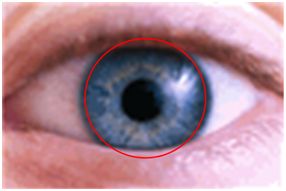
Circular shapes abound in nature. Of particular significance is the circular shape of the human eyeball, the organ of our most valuable sense of sight. Ralph Waldo Emmerson recognised the first sacred shape in the human form when he wrote, “The eye is the first circle, the horizon which it forms is the second.” Other circles immediately apparent in the eye are the iris, the coloured portion, and the pupil, the black area which dilates and contracts in response to changing light stimuli.
Deep within the eye, unbeknownst to an observer, the point and the circle play an important role in how we visually perceive the outside world. The inside back portion of the eye (the “retina”) contains numerous light receptors called “cones.” The cones are distributed in such a way that the highest concentration is packed in a very small centre area called the “fovea centralis.” The cones gradually diminish in density as the distance increases from the fovea centralis. The cones are virtually non-existent at the outer periphery, or circumference, of the retina.
Contrary to what some may believe, we do not see equally clearly within the entire circle of our visual field. The focus is different than that captured on photographic film by a camera. The distribution of cones in the eye means that we see the clearest in the central point of our sight. Objects in the periphery are less clear. Because the cone distribution in the retina follows a geometric pattern similar to the energy distribution in a concentric wave, I call it “concentric focus.”
Also within the retina are receptors called “rods.” It is believed that the rods sense movement in our peripheral field. The distribution of the rods is essentially the opposite of the cones. The rods are non-existent in the centre and gradually increase in density towards the periphery. That’s why something moving in your peripheral field of vision can abruptly grab your attention.
Another principle of the circle is the continuous rotary motion of cycles and rhythms. With eyesight, oscillating rhythms are manifest in several ways. One of the most obvious is the continuous blink reflex. Our eyes also respond in cycles by closing at night and opening in the day. During sleep, the eyes have an alternating motion called rapid eye movement (REM), and when awake, they have numerous subconscious micro-movements – some vibrating at the frequency of a strummed guitar string – to key in on objects and maintain focus. The motion is contrary to that of a still camera, for without the continuous rhythmic activity, objects would quickly fade into blur.
Dr. William Bates was a New York ophthalmologist who pioneered the concept of natural vision improvement almost a century ago. He discovered that the most common types of blurred eyesight, for which glasses are usually prescribed, are actually responses to stress in our environment. The habitual pattern of strained looking causes the eyeball’s natural circular shape to go out of round. By removing strained vision habits, a person can gradually improve one’s eyesight and return to the purity of the One.
The ancient philosophers considered a true mathematical point within the circle as symbolic. It emerges from the immaterial realm and has no dimensions. Dr. Bates related this concept when he said, “The part seen best when the sight is normal is extremely small… the nearer the point of maximum vision approaches a mathematical point, which has no area, the better the sight.” The idea of concentric focus is a fundamental fact that must be truly appreciated when improving eyesight naturally.
Number Two
Tao gives birth to one, One gives birth to two – Lao Tzu
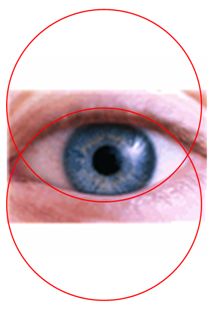
If the number one represents unity and wholeness, how does a second separate number emerge? The root word for “nature” means “to be born,” and the number two emerges through a birth-like process. Symbolically speaking, this process begins as the circle divides and replicates itself – just as a living cell does. The geometric representation of this replication is two circles of the same diameter each having their centre points touching the circumference of the other. The One projects forth as a reflection of itself and a “true” mathematical line is created from point to point.
The sacred principle of number two is polarity, whereby the line forms a tensile link between opposite poles. Paradoxically, there is both a separation and an attraction that binds the two, yearning once again for wholeness. It’s the yin/yang principle of Taoist thought, the perpetual rhythmic alternation of all life and the universe. The human body has a left side and a right side, a feminine side and a masculine side, an intuitive side and intellectual side, and so on. The modern left brain/right brain theory suggests the eyes are extensions of the brain’s two hemispheres. Although each eye sees things from a slightly different angle, they must work together seamlessly.
The concept of “two” in eyesight has further spiritual significance beyond the apparent. In Plato’s Timaeus, eyesight is described as a two-way process; the eye mediates between the inner realm and the external world of objects. The fire of the soul was said to emit a gentle light from within, flow through the eye and meet the outer daylight. Like falls upon like, coalesces and forms the perception of sight. In this philosophical view, the eye acts as a portal, the proverbial “window of the soul.”
The portal is actually a symbol that arises geometrically from one circle beginning to replicate into two. The fish-shaped vesica piscis is the area of overlap between the linked circles. It has been venerated throughout history by various cultures and nations and dates back to pagan and mystical religions. The early Christians considered it the link between heaven and earth, a bridge between spirit and form. Consequently, much medieval art symbolically depicts Christ within the fish-shaped area. In ancient architecture, particularly in cathedrals and holy temples, the vesica piscis was used extensively in the design of doorways. They were portals which permitted entry from the mundane world of reality into spiritual space.
Applying the metaphor of a portal to the eyes, one is immediately drawn to the distinct vesica piscis shape which the upper and lower eyelids produce. Within the eye itself, the same pointed oval shape is found when studying the anatomy of the lens from a side view. The lens is the part of the eye where light rays emitted from an external object refract in such a way to form an image on the retina.
Dr. Bates discovered that visual perception is more than simply a biomechanical process of camera-like parts in the body. The inner and outer aspects of eyesight are linked, as the mind and emotions have a great impact on how well we see external objects. During thirty years of clinical observation, he studied various ways in which people strained to see. He concluded that imagination, memory and sight coincide, and that when one is imperfect, all are imperfect. He encouraged visualisation as a healing technique long before it became in vogue. Perhaps a good mental image is to imagine the gentle light of your soul meeting the external light in the vesica piscis of your eyes.
The Western, scientific mindset artificially separates objective reality and subjective reality. This creates a tendency to overemphasise the external world of objects, freezing them into a supposed condition of permanence. Greek philosopher Heraclitus apparently equated such an unbalanced view as being stung by a scorpion. This “scorpion vision” paralyses us from seeing the eternal rhythm.
In a related vein, Dr. Bates cautioned against the forced concentration of staring, claiming it is an attempt to imagine things as stationary. The forced attention of staring immobilises the natural, healthy movements of the eye, and this straining actually has a boomerang effect. Instead of objects coming in more clearly, the objects become more blurred. An essential habit of healthy vision, therefore, is to maintain relaxed seeing by continuously shifting.
Number Three
But every tension of opposites culminates in a release, out of which comes the “third,” In the third, the tension is resolved and lost unity is restored. – Carl Jung
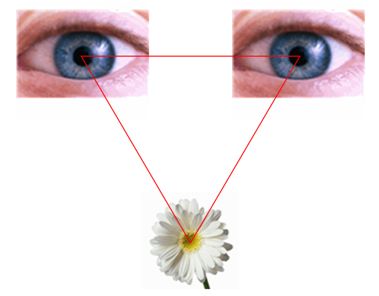
When our two eyes work together in harmony to fuse a single image, our visual perception restores the “lost unity.” An outcome of this reunion is the emergence of a new number; three dimensional (3D) vision is born. The technical term for 3D vision is “stereopsis,” which is derived from stere, New Latin for “solid,” and opsis, Greek for “vision.” A stereoscopic image is, thus, solid sight that gives us a sense of volume. 3D vision provides depth to our world view, a level of understanding that goes beyond a two dimensional (2D) flat surface.
The sacred geometrical representation of number three is the triangle, which takes shape from the vesica piscis. An object in our sight is the third point midway between the eyes, the vertex that balances the opposing views of each eye’s unique perspective. The ancient philosophers valued the triad, assigning it qualities such as piety, friendship, harmony, peace, justice, temperance and virtue. It is the symbol of wisdom, for living prudently in the present requires learning from the past and planning for the future.
In addition to the physical concept of 3D vision, there is another principle of the triad in vision, but in a metaphysical sense. Mystics throughout the ages have spoken of a “third eye” between the brows that is the seat of the spirit. Renowned spiritual scientist and philosopher Rudolf Steiner described humans as a three-fold constitution – body, soul and spirit. Seers have supposedly awakened the eye of the spirit, the highest of the three levels, resulting in clairvoyant vision. The third eye, which remains dormant for the majority of people, may also be responsible for triggering hallucinations and out-of-body experiences. The pinecone shaped pineal gland, about the size of a pea and located between the brain’s two hemispheres, is claimed by some to be the location of the mysterious third eye.
Awakening the third eye may be highly elusive, but re-awakening a diminished sense of 3D vision is more easily attainable. Lenses prescribed to compensate for blurred vision are a compromise solution. Dr. Bates noted that glasses do provide immediate artificial clarity, but they don’t restore eyesight to a normal state. The lenses, although curved to help light rays converge properly inside the eye for better acuity, act as a barrier. Colours are less intense through the glass and objects are distorted in size. For people wearing glasses for distant viewing, the lenses diminish 3D perception, flattening it almost to the point of 2D vision for those with high strength prescriptions. The condition is reversible, for people who improve their eyesight by natural means invariably notice a marked improvement in their ability to see 3D again.
Mathematics and geometry are applied with efficient precision in our technological era. A prime example is the science of optics, where good vision is reduced to purely a numerical term, 20/20. Ironically, as the vision industry has grown and prospered, we’re collectively seeing worse, not better. The incidence of vision difficulties in North America signifies the imbalance. Fewer than three percent of children are born with visual defects yet, as they reach adulthood, nearly two thirds will become dependent on prescription eyewear. Non-industrialised nations are virtually free of such widespread vision problems. To help restore a quality outcome, perhaps it’s time we return to the spiritual teachings of sacred number and sacred geometry to understand what really “counts.”
[alert type=”general” dismiss=”no”]This article was published in New Dawn 111.[/alert]
[alert type=”success” dismiss=”no”]If you appreciate this article, please consider a contribution to help maintain this website.[/alert]
What we are today comes from our thoughts of yesterday, and our present thoughts build our life of tomorrow: Our life is the creation of our mind.
– Buddha
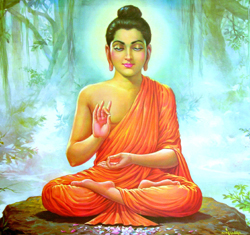
Those of us who grew up in the 1980s were, quite unknowingly, absorbing a healthy dose of Eastern mysticism when we watched the wonderful Japanese television series “Monkey” every weekday evening at 6.30pm. For all of the colour and movement and occasionally risqué language that appealed to my childish mind, I was also, perhaps, taking to heart the wonderful précis of Buddhist philosophy that made up the introduction to each episode: “With our thoughts, we make the world.”
This is a quote from “The Dhammapada,” that exquisitely brief text that provides the reader with all of the main ideas to be found across all of the schools of Buddhism. In fact, it is the very first verse of that most fundamental book. It is the construct that informs the Buddhist world-view – all of this, that we so keenly call “reality,” is a product of thought, and so it can be influenced by the shape of our thoughts, and we can begin to craft a new reality through disciplining our process of thought and directing it towards wiser outcomes.
Volition and free-will were the points of divergence between Buddhism and the other religious systems of the ancient world, which tended to favour notions of fate and pre-destination. The Buddha taught that karma provided us with conditions only. In every single moment we are free to choose a wise thought and do a wise action. Buddhism is brutal in its advocacy of personal responsibility. Such a point of view seems strikingly modern and rational, though perhaps slightly politically incorrect in this more feeling age.
It is the rigorous control of thought, its careful disciplining, that grew to become the central practice of Buddhist practitioners. Samantabhadra, the Universal Worthy Bodhisattva, is the patron saint of meticulous religious training in the world of Mahayana Buddhism. He imposed upon himself the almost-impossible task of honouring the Buddha in each and every thought. If his thoughts were filled with the Buddha, so must his actions and words be inhabited by the goodness of the Awakened One. Look after the thoughts, and the actions will take care of themselves.
In the Western tradition there emerged, as well, the notion that one’s actions reflected one’s spiritual wellbeing. The way a person looked and spoke was seen by Emanuel Swedenborg as evidence of habitual reflection: either on the beauties of heaven or the torments of the natural world. Much later, the great teachers of New Thought in the twentieth century saw the spiritual importance of thought control, teaching that the thoughts were our channels to God, and so should be as perfect, loving and happy as possible.
We perhaps fool ourselves that our thoughts can be allowed to stray and our lives will not be affected. Gossip, habitual negativity, judgement and constant criticism can seem fun when we are engaged in them. We can justify them, or elevate them, priding ourselves on our cynicism and critical capacities. But the Buddha was aware that all that we thought was, in fact, the sum total of our life’s experience – we cannot know goodness and happiness if we do not allow our thoughts to cultivate those qualities. He recognised that it requires discipline and the conscious application of energy to direct our minds into positive directions. Without such care we can slide into destructive patterns. To watch over the mind, he said, is conducive to happiness.
All that we are is the result of what we have thought. If a man speaks or acts with an evil thought, pain follows him. If a man speaks or acts with a pure thought, happiness follows him, like a shadow that never leaves him. – Buddha
[alert type=”general” dismiss=”no”]This article was published in New Dawn 131.[/alert]
[alert type=”success” dismiss=”no”]If you appreciate this article, please consider a contribution to help maintain this website.[/alert]
 If the number one represents unity and wholeness, how does a second separate number emerge? The root word for “nature” means “to be born,” and the number two emerges through a birth-like process. Symbolically speaking, this process begins as the circle divides and replicates itself – just as a living cell does. The geometric representation of this replication is two circles of the same diameter each having their centre points touching the circumference of the other. The One projects forth as a reflection of itself and a “true” mathematical line is created from point to point.
 When our two eyes work together in harmony to fuse a single image, our visual perception restores the “lost unity.” An outcome of this reunion is the emergence of a new number; three dimensional (3D) vision is born. The technical term for 3D vision is “stereopsis,” which is derived from stere, New Latin for “solid,” and opsis, Greek for “vision.” A stereoscopic image is, thus, solid sight that gives us a sense of volume. 3D vision provides depth to our world view, a level of understanding that goes beyond a two dimensional (2D) flat surface.