New Dawn – World's Most Unusual Magazine

Category: Articles

  • The Mystery of the Crystal Skulls

    The Mystery of the Crystal Skulls

    From New Dawn Special Issue 8 (Winter 2009)

    An old native American legend describes the existence of thirteen ancient crystal skulls, the size of human skulls, with moveable jaws that were said to speak or sing. The legend tells that these crystal skulls contain important information about some of the great mysteries of life and the universe. They contain knowledge about the past history of our species on this planet, and information about mankind’s true purpose and future destiny.

    The Cherokee version of the legend says that there were originally twelve planets in the universe inhabited by human life and that there was one skull for each of these planets, together with a thirteenth skull which was vital to reconnecting all of these worlds.

    The legend also says that one day, at a time of great need, all of these crystal skulls will be rediscovered and brought back together to reveal their information vital to the very survival of the human race. But the legend also warns that when that time arrives mankind must first be sufficiently developed, suitably evolved both morally and spiritually, so as not to abuse this great knowledge.

    When we first heard this legend, whilst visiting the ancient Mayan ruins of Tikal in Guatemala, we considered it merely a colourful story, until we found out that a real crystal skull had actually been discovered on an archaeological dig in Central America, way back in the 1920’s.

    The Mitchell-Hedges Crystal Skull

    Frederick Mitchell-Hedges (1882-1959) was your archetypal British adventurer-explorer; a member of the Maya Committee of the British Museum and a real Indiana-Jones type character determined to make his mark in the twilight years of the British Empire. He was of the opinion that the cradle of civilisation lay not in the Middle East, as is commonly supposed, but instead he was convinced that Atlantis was a real civilisation which had disappeared after some natural catastrophe. He believed that the remnants of this Atlantean civilisation could still be found somewhere in Central America, and he was determined to prove it.

    To this end, he gathered together a party of explorers who set sail from Liverpool in 1924 bound for British Honduras (now Belize). One day, deep in the jungle, his party stumbled upon some mounds of stone overgrown with moss and foliage, and suffocated by roots and vines. So they set fire to the undergrowth. When the fire had subsided the ruins of a once great city emerged from the flames.

    It was a place known to the local Mayans as ‘Lubaantun’ or ‘The City of Fallen Stones’, and it was in this lost city that Mitchell Hedges’ adopted daughter Anna found a magnificent and perfect crystal skull, buried beneath an altar in the ruins of one of the great temple-pyramids. The Mayan helpers on the dig went wild with joy on the emergence of the skull. They seemed to recognise it. They kissed the ground crying, placed it on an altar, and performed ceremonial rituals and dances around it.

    But what was this mysterious object and did it have anything to do with the ancient legend?
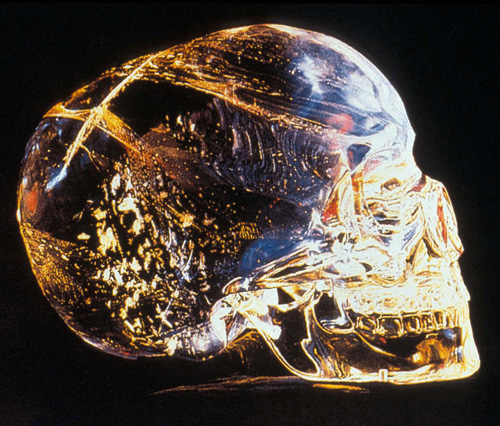
    In a lost city in a remote jungle, located in what is now Belize, Central America, Anna Mitchell Hedge found this magnificent and perfect crystal skull, buried beneath an altar in the ruins of a great temple-pyramid.
    In a lost city in a remote jungle, located in what is now Belize, Central America, Anna Mitchell Hedge found this magnificent and perfect crystal skull, buried beneath an altar in the ruins of a great temple-pyramid.

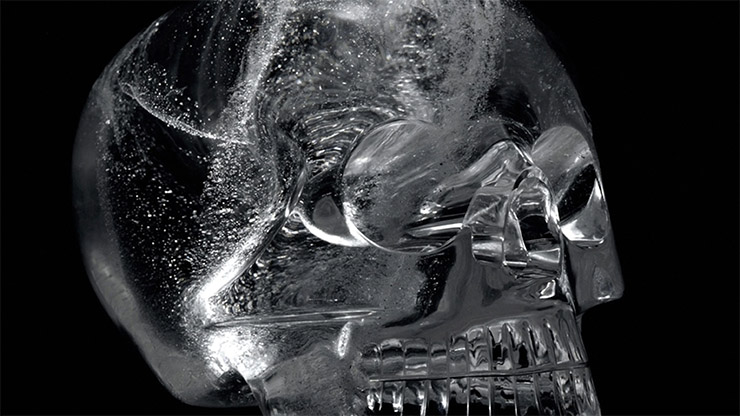
    The crystal skull is a mystery as profound as the Pyramids of Egypt, the Sphinx, the Nasca Lines of Peru, or Stonehenge. Ever since its original discovery the crystal skull has been the source of much archaeological controversy – nobody seems to know quite how old it really is, how it was made, what it was used for, and where it originally came from. All that is known for sure is that ever since it emerged from the temple ruins, the most incredible claims have been made about the crystal skull and there have been a whole host of reports of strange and unusual phenomena surrounding the skull.

    As mentioned above, Anna Mitchell-Hedges is the woman who first uncovered the crystal skull as a teenager back in the 1920’s. Although the crystal skull was found on what most archaeologists consider to be a Mayan site, Anna Mitchell-Hedges and many others like her believe that it is actually much older than this, and that it belonged to some mysterious pre-Mayan civilisation that has now long since disappeared from this Earth.

    The crystal skull has been valued at several millions of dollars, but it is far more than just an expensive and exotic ancient artefact. For, over the years, people have reported all kinds of strange and unusual experiences in the skull’s presence. In particular, it is said to have incredible ‘psychic’ and ‘healing’ powers. According to Anna Mitchell-Hedges, who passed away at the age of 100 in 2007, it is thanks to the ‘healing power’ of the skull that kept her alive. She said that all through her life the skull kept her in good health and happiness. The skull, she said, ‘protected’ her and ‘communicated’ with her all through her long life, and she is not the only person to have reported such experiences.

    Anna allowed many visitors into her home and she accumulated hundreds of letters from the many people who came to her house to sit with the skull and who claim to have been ‘healed by the skull’ or that it somehow ‘communicated’ with them. Many of those who have spent time alone with the skull claim to have seen or heard things in its presence. Many say they have seen a gentle glow, like an aura, extending around the skull, or that they have heard sounds, like the soft chanting of human voices, emanating from it, such that it has now earned the title ‘the talking’ or ‘singing skull’, just as in the old legend.

    Others claim to have seen things inside the skull. When they have sat with the skull for a long time it has started to present them with images, almost like watching a bit of cinema film. Hundreds of visitors attest to having seen incredible images from the past or the future deep inside its crystalline structure. The reports include images of ancient sacred sites, with ceremonies being performed beneath great pyramids. Others say they have seen whole periods of planetary history with great shifting of continents, the rising of sea levels and destruction of land masses, and geological cataclysm on a global scale. One of the most commonly reported images is considered by many to be the holographic image of a UFO appearing within the crystal skull – and this has even been photographed! This image in particular has led many to suggest that perhaps the crystal skull has some kind of strange unearthly origin?

    But, just as the ancient legend suggests, this is not the only crystal skull to be discovered. Several other crystal skulls have since come to light. All are of mysterious origin and all are surrounded by claims of strange or unusual phenomena and tales of inexplicable, paranormal powers.

    Max, the ‘Talking’ Crystal Skull

    A woman named Joann Parks, who lives in Houston, Texas, also has a crystal skull. She, too, claims that her crystal skull has the power to heal and can communicate with her telepathically. The story of how Joann Parks came into possession of her crystal skull starts with a very sad story. In 1978 Joann’s eldest daughter, Diana, was diagnosed as having bone cancer and the conventional medical doctors gave her only three months to live. Joann turned to the help of a Tibetan Lama and healer named Norbu Chen. This man owned a crystal skull, and with the help of this healer and his crystal skull, her daughter managed to live for a further three years. When her daughter eventually died, the healer gave Joann the crystal skull, telling her nothing about it except that he had originally received it from a Guatemalan shaman and that one day Joann would understand it and know what it was for.

    Not knowing what to do with it, Joann put the crystal skull in a box in the bedroom closet. A few years later the skull started to appear in her dreams. Then it started “speaking to her,” saying that it wanted out of the closet. She tried to ignore this ‘voice’ but it started “talking to her” at all times of day, saying “You must let me out of this closet. I am important to mankind,” and “I will be remembered.” Joanne thought she was losing her mind and even spoke to her family doctor about it, but the voice just wouldn’t go away, and so she eventually found herself sitting in the bedroom closet “talking to this lump of rock” and telling it to go away, saying “Just leave me alone skull!” She slammed the skull away in a case and pushed it to the back of the wardrobe, but as she ran back down the stairs the skull kept talking to her. “It was very persistent,” explained Joann and it was determined that I take it out of the closet and “tell mankind” of its existence. It even added that, “By the way, my name isn’t skull, it’s Max!” And since that time Joann has been showing the skull all over the United States where she says “Max has now spoken to and healed many people.”

    The skull had also told Joanne that it came many thousands of years ago from a civilisation far in advance of our own, and from a dimension different from our own, and that one day soon this is something mankind would understand!

    What can we learn from the other crystal skulls that have now been discovered? Recently a massive crystal skull turned up at the Smithsonian Institution in Washington under very sad and mysterious circumstances. It had been sent through the post by an anonymous donor whom it transpired had taken his own life, apparently on account of the ‘curse’ the skull had brought on him since it came into his possession.

    The British Museum also has a crystal skull which is kept in The Museum of Mankind, just off Piccadilly Circus, in London. Like the Mitchell-Hedges specimen, this skull is made from highly transparent crystal and displays an incredible degree of anatomical accuracy. This skull has been in the museum’s possession since 1898 and is reported by staff to have been seen moving around by itself in its sealed glass case. The museum’s cleaners are said to be so frightened of this skull that it has to be covered by a cloth before they will go anywhere near it. Where did this skull come from?

    The British Museum have always considered their skull to be of Aztec origin. The note accompanying the Smithsonian skull also said that it had once belonged to the mighty Aztecs of Central America. Anna Mitchell-Hedges and Joann Parks said their skulls are at least as old as the ancient Mayan civilisation of Central America, if not far older and perhaps of extraterrestrial origin.

    The ancient Aztec and Mayan people built up highly developed civilisations in an incredibly short period of time. These civilisations appeared as if from nowhere and the Mayan civilisation, just as suddenly, mysteriously disappeared.

    Many archaeologists are baffled as to where they got their advanced knowledge from and why they suddenly disappeared. All the evidence that remains of this civilisation suggests they were great watchers of the skies and the heavenly bodies. They were great scientists, mathematicians and astronomers. They had a complex calendar based on the movements of the planets and the stars and which they used to predict the future. They were able to predict eclipses, even ones they could not see and that were happening elsewhere in the world. They even managed to accurately predict eclipses that have happened recently – over a thousand years after their own civilisation mysteriously disappeared.

    Some researchers claim the Mayan records say their people came from Atlantis and their ancestors before that ‘came from the stars’. The Mayan civilisation was also obsessed with the image of the skull, which made up an important part of their sacred, divinatory calendar.
    Get the issue this article appears in

    Modern Fakes?

    Many archaeologists, however, unable to explain the strange phenomena associated with the crystal skulls, claim they are simply ‘modern fakes’. So how old are the crystal skulls and where did they really come from? Are they modern, Aztec, Mayan, or did they come from some other civilisation altogether?

    In an attempt to try to answer these questions, Anna Mitchell-Hedges loaned her skull to one of the world’s leading computer companies, Hewlett-Packard, for rigorous scientific testing. The scientists in their crystal laboratories were completely unable to determine the age of the skull, as crystal cannot be carbon-dated. But what surprised the scientists was that both the skull and its detachable lower jawbone were made from the same massive piece of pure, natural rock crystal. As crystal is only slightly softer than diamond, this finding was truly incredible.

    The scientists concluded that even with modern diamond-tipped power tools, it would have been impossible to carve such an object without it shattering. At first they thought the skull must have been made by hand using sand and water to slowly abrade the material over several generations – a process they estimated must have taken around “300 man-years of effort!” But soon they were forced to revise even this conclusion. For when the skull was examined under intense magnification the scientists were in for an even bigger surprise – they were completely unable to find any evidence of tools having been used to make the skull at all! A fact which led one member of the team to comment: “This skull shouldn’t even exist!”

    The crystal skull challenged all conventional opinion. Here was an object that simply defied explanation. It showed no evidence of any existing technology used in its construction, no evidence of tool markings either ancient or modern. But the scientists at Hewlett-Packard said they were simply not prepared to countenance the only alternative explanation – that the skull had not even been made by humans.

    The scientists other interesting discovery was that the skull had been made from precisely the same type of quartz now used in modern electronic equipment. Modern science has established that among the unusual properties of quartz crystal is its ability to hold under control electrical energy and to oscillate at a constant and precise frequency. In other words, the crystal skull is able to hold electrical energy – potentially a form of information – and send out vibrating impulses – or waves of energy information. This is why quartz crystal is used for the ‘brain cells’ of electronic equipment such as watches and computers. The silicon crystal chip inside a computer, for instance, is where the information is actually stored. This finding raised the distinct possibility that the crystal skulls are in fact some kind of information storage system, just as the ancient legend suggests. But what might that information be, and where do the crystal skulls really come from?

    The Legend of the Crystal Skulls

    Native Americans have long believed in the power of quartz crystal. They refer to quartz crystals as “the brain cells of Mother Earth” and have traditionally used them for healing. The crystal skulls have long been a part of Native American teachings but until now they have been forbidden to speak about them. Now, they say, the time has come for them to speak out about these amazing artefacts and to reveal their secret knowledge.

    Professor Paula Gunn-Allen of the University of California is of Laguno Pueblo origin. She specialises in Native American literature and is well versed in the mythology and oral history of Native America. According to her the crystal skulls were created by beings “who are not humans like we are.” She says the crystal skulls were designed specifically for the purpose of communication with extraterrestrial life. As she explains, “What they are is transceivers – devices to help us communicate with the other quadrants of the galaxy.” She said that we might think of them “as like telephones” that get you connected with Galactic Central and enable you to stay in touch with “civilisations beyond our littie bitty modern world.”

    Native American medicine woman Jamie Sams says that “the crystal skulls contain information about our own ancestors, about our own past and our own future that will very soon change the whole way we see ourselves, our world, and our true place in the universe.”

    According to Metis Cherokee medicine man Harley Swiftdeer, the full version of the legend of the crystal skulls says that there were originally twelve planets in the universe inhabited by human life; that there was one skull for each of these planets, and a thirteenth skull which was vital to finally reconnecting all of these worlds. According to Harley Swiftdeer and other native Americans, the crystal skulls were brought to this Earth as “gifts from the gods” – brought long ago by these beings from elsewhere in the universe.

    These crystal skulls contained the wisdom necessary to found civilisation on this Earth and when all thirteen crystal skulls are brought back together again, we will have finally found the key to reconnecting with our brothers and sisters elsewhere in this beautiful universe.

    [alert type=”general” dismiss=”no”]This article was published in New Dawn Special Issue 8.[/alert]

    [alert type=”success” dismiss=”no”]If you appreciate this article, please consider subscribing to help maintain this website.[/alert]

    © New Dawn Magazine and the respective author.
  • Atlantis in Antarctica? Tracking the Myths of a Lost Island Paradise

    Atlantis in Antarctica? Tracking the Myths of a Lost Island Paradise

    From New Dawn Special Issue 8 (June 2009)

    Our exciting adventure tracking the history of the Ancients began in 1976. It was then that we read Plato’s account of an Egyptian priest’s description of the lost continent of Atlantis. We were intrigued when we realised that the account reflected a picture of the world as seen from Antarctica in 9600 BCE. That fascination culminated in the January 1995 publication of When the Sky Fell: In Search of Atlantis. 

    The idea that Antarctica was home to Atlantis has at its root a radical rethinking of the geological history of our planet. Formulated by our mentor, Charles H. Hapgood (1904–1982) the theory of an Earth crust displacement enjoyed the enthusiastic support of Albert Einstein (1879–1955). Hapgood and Einstein corresponded about Hapgood’s work for the last three years of the great physicist’s life.

    The essence of the theory that piqued his interest lay within the physical dynamics of the Earth’s inner structure. The bulk of our planet’s mass consists of an inner core of solid iron surrounded by liquid iron. This core is encircled by the thickest part of the Earth which is composed of two mantles of solid rock.

    Covering the upper mantle lies the asthenosphere or “weak zone.” It is the asthenosphere’s mobility that allows the Earth’s crust (lithosphere) to shift.

    An Earth crust displacement occurs when the entire outer shell of the planet moves leaving a devastating climatic legacy. Because the Earth’s tilt (axis) is not affected, the planet’s climatic zones (polar, temperate and tropical) don’t change. However, vast areas of the crust (which includes ocean basins) do experience a catastrophic change in climate. Before the last Earth crust displacement, part of Antarctica lay outside the polar zone. This is the area that could have been the site of Atlantis.

    The consequences of a crustal displacement are monumental. As the Earth’s crust ripples over its interior, the world is shaken by incredible earthquakes and floods. The sky seems to fall. The sun appears to rise and set over an altered horizon until finally the crust grinds to a halt. Beneath the ocean, earthquakes generate massive tidal waves that inundate coastlines. Some lands shift to warmer climates. Others, propelled into the polar zones, suffer the direst of winters. Melting ice caps, released from the polar areas, raise the ocean’s level ever higher. All living creatures must adapt, migrate or die.

    Solar Typhoons

    In 2000, Rand and Colin Wilson published The Atlantis Blueprint, a book that explored the idea that over 60 of the world’s most sacred sites fit into a global pattern that suggests that they were positioned by a long lost, yet extremely advanced, civilisation. In 2001, the book appeared in the United States and Rand began a correspondence with Jared Freedman who suggested an answer to the mystery of the missing mechanism of Earth crust displacements. Jared is a computer professional and inventor who worked extensively with electromagnets. He was aware that the Earth is in effect a gigantic magnet surrounding a metal core.

    When magnets pass through an electromagnetic field heat is generated. Jared wrote:

    If the Earth’s magnetic field received such a tremendous distortion of its magnetic field, over a prolonged period of time, it would generate immense amounts of heat within the Earth’s core as the Earth spun through the force that was causing the magnetic field disruption. The only force that can collapse the Earth’s magnetic field is the Sun’s magnetic field.

    Jared noted that the Sun also experiences climatic variations but because of its immense size they happen over longer periods of time. Solar storms can theoretically last for “days, weeks or even more.” If the Earth passes through electromagnetic waves coming from the Sun then force would be applied steadily at one of the poles. That energy would be carried into the Earth’s core. Metal flowing to the Earth’s surface could transform the asthenosphere from a sluggish tar into a liquid. Jared wrote:

    Perhaps it is not the disruptions of the Earth’s core that cause fluctuations in the Earth’s magnetic field, but rather disruptions of the Earth’s magnetic field cause fluctuations in the Earth’s core.

    Einstein had doubted that the weight of the Earth’s ice sheets would be sufficient to dislodge the crust. He also doubted that an abrupt shift of the entire axis was the explanation because any force that could accomplish that would probably shatter the planet. What he sought was a steady force applied to the crust for a sustained period.

    Jared Freedman’s theory not only addresses all these problems but also provides a mechanism for stopping the displacements.

    Once the Earth moves through the path of the electromagnetic storm, it cools, changing the liquid-like asthenosphere once again into a tarry substance which prevents the crust from shifting any further.

    Aztlan

    On April 21, 1519, the silence of Mexico’s Caribbean coast is broken by the clang of swords and the shuffle of boots through white sand. From his ship stepped a bearded conquistador named Hernando Cortes, his helmet adorned with “a plume of feathers.” The Spaniard pounded a great cross into the beach to honour his faith, little realising that the cross was also the symbol of the Plumed Serpent.

    Aztec spies watched in amazement and horror before hurrying back to their leader Montezuma. Montezuma’s astrology had told him to expect gods to appear from the Atlantic Ocean. Never in the course of human history has there been a greater case of mistaken identity. On that day, Cortes, with blind luck on his side, began a bloody march that would ultimately end in the annihilation of the Aztec empire.

    The Spanish conquerors believed that Mexico was once an Egyptian colony. It is little wonder, since the Aztecs shared several common mythological themes with the Egyptians. The Egyptians believed that the world was surrounded on all sides, including the heavens, with water. In Aztec mythology:

    The sea was thought to extend outward and upward until – like the walls of a cosmic house – it merged with the sky… The sky, therefore, was known to contain waters which might in perilous times descend in deluges, annihilating man.

    This empire, like that of the Egyptians, had built great pyramids that symbolised the land that saved their ancestors from the flood. And like those of Egypt the solar megaliths were aligned with the rising sun. It was atop the Temple of the Sun that Cortes met Montezuma. He recounted their conversation in a letter to the King of Spain. Montezuma told Cortes about the island homeland of the Aztecs’ ancestors: “Our fathers dwelt in that happy and prosperous place which they called Aztlan, which means whiteness.”

    Aztlan is described as “…a bright land of shining light and whiteness which contained seven cities surrounding a sacred mountain.”

    Perhaps the blazing lights of Aztlan were actually the southern lights of Antarctica before that land was thrust into the confines of the Antarctic Circle.

    Aztlan was said to be “…located beyond the waters, or as surrounded by waters; and the first stage of the migration is said to have been made by boat.”

    Once again we have the familiar story: They believed that two persons survived the deluge, a man, named Coxcox, and his wife. Their heads are represented in ancient paintings, together with a boat floating on the waters, at the foot of a mountain.

    Throughout America the myth of a lost island paradise haunts the memories of the native people. But they were not alone in their grief for the lost land. Across the ocean the tale was told in ancient India, Iran and Japan.

    Polar Paradise

    In 1922, Mahatma Gandhi, about to be sentenced to six years in prison, said to the judge:

    Since you have done me the honour of recalling the trial of the late Lokamaya Gangadhar Tilak, I just want to say that I consider it the proudest privilege and honour to be associated with his name.

    Bal Gangadhar Tilak forged the tactic of passive resistance as a means of overthrowing British rule in India. He was held in such esteem that Gandhi used the title “Lokamaya” (“Beloved Leader of the People”) when referring to him. Tilak earned his title while imprisoned in 1897 for seditious writings. The British hoped to curb his role in the rising tide of Indian nationalism by locking him up. The harsh conditions of his Bombay cell took their toll. Tilak’s health waned. Fearing that his death in custody might spark a general uprising, the British moved the “Beloved Leader of the People” to a safer prison in Poona. Helped by donations of fruit and vegetables Tilak partially recovered his health. But soon a new hunger overtook him – the need for intellectual stimulation. Relief came from an unlikely quarter: England.

    Tilak had published a respected work on India’s oldest texts, the Vedas, and Sanskrit scholars at Oxford and Cambridge were outraged by his imprisonment and treatment. Professor F. Max Muller, the world’s leading authority on the Vedas, was successful in having Tilak’s case reviewed by Queen Victoria. She shortened his sentence and granted him a reading light in his cell. Denied access to newspapers or any other current material, Tilak used this “privilege” to continue his studies of the Vedas.

    Upon his release Tilak retired to the mountains to rest at a favourite family retreat. In 1903 his great work, The Arctic Home in the Vedas, was published. In it he argued that the remains of an island paradise could be found beneath the Arctic Ocean: “It was the advent of the Ice Age that destroyed the mild climate of the original home and covered it into an ice-bound land unfit for the habitation of man.”

    Tilak summarised a key passage in the oldest saga of Iran, the Zend-Avesta:

    Ahura Mazda warns Yima, the first king of men, of the approach of a dire winter, which is to destroy every living creature by covering the land with a thick sheet of ice, and advises Yima to build a Vara, or an enclosure, to preserve the seeds of every kind of animal and plant. The meeting is said to have taken place in the Airyana Vaêjo, or Paradise of the Iranians. (Italics added)

    Tilak chose the Arctic Circle as the location of the lost continent of Airyana Vaêjo after reading Paradise Found: The Cradle of the Human Race at the North Pole (1885), written by the founder of Boston University, Dr. William Fairfield Warren. Warren had been impressed by how often the story of a falling sky and great flood was found intertwined with accounts of a lost island paradise. He also realised that the lost land had many polar features. In Warren’s view, the worldwide nature of these descriptions suggested a common physical explanation. The exciting idea of the Ice Ages provided part of his answer:

    Now if, during the prevalence of the Deluge, or later, in consequence of the on-coming of the Ice Age, the survivors of the Flood were translocated from their antediluvian home at the Pole to the great Central Asia “plateau of Pamir,” the probable starting-point of historic postdiluvian humanity, the new aspect presented by the heavens in this new latitude would have been precisely as if in the grand world-convulsion the sky itself had become displaced, its polar dome tilted over about one third of the distance from the zenith to the horizon. The astronomical knowledge of those survivors very likely enabled them to understand the true reason of the changed appearance, but their rude descendants, unfavoured with the treasures of antediluvian science, and born only to a savage or nomadic life in their new and inhospitable home, might easily have forgotten the explanation. In time such children’s children might easily have come to embody the strange story handed down from their fathers in strange myths, in which nothing of the original facts remained beyond an obscure account of some mysterious displacement of the sky, supposed to have occurred in a far-off age in connection with some appalling natural catastrophe or world-disaster.

    Warren conjectured that the island paradise myths and their dramatic accounts of a falling sky and worldwide flood were part of the actual history of traumatised populations who had lost their homeland in a geological upheaval. Again and again in the most ancient records Warren found evidence that the lost land was near the pole.

    For example, in 681 AD, the Japanese Emperor Temnu ordered that a written record be made of his people’s most ancient stories. The compilation was known as the Ko-ji-ki (“Records of Ancient Matters”) and appeared in 712. Warren believed that the earliest part of the book described an original island homeland located near the Earth’s axis.

    The Ko-ji-ki begins with the “Seven Generations of the Age of the Gods.” Each “generation” consisted of a brother and sister. After the seven generations had been created, two more gods, Izanagi and his sister/wife Izanami, were brought into being. They were charged with the task of creating the world out of the porridge-like chaos that was the primordial Earth. Warren summarises the moment when the two celestial deities create the first world.

    …standing on the bridge of heaven, pushed down a spear into the green plain of the sea, and stirred it round and round. When they drew it up the drops which fell from its end consolidated onto an island. The sun-born pair descended onto the island, and planting a spear in the ground, point downwards, built a palace round it, taking that for the central roof-pillar. The spear became the axis of the Earth, which had been caused to revolve by stirring round.

    Warren concluded that Onogorojima (“Island of the Congealed Drop”) was an island somewhere near the pole. The central “roof-pillar” represented, in his view, the Earth’s axis. A great palace was built on the island, a theme that reappears in the legend of Atlantis. (Later, Izanagi created other islands, including the eight main islands of Japan.)

    Warren believed that the polar paradise was destroyed when a critical temperature drop resulted in worldwide geological upheaval. A huge mass of the Earth’s interior collapsed inward, pulling sections of the planet’s crust with it. The ocean rushed to drown the sunken areas. The globe then cooled – suffocating the original island paradise in snow and ice.

    Because he believed that the entire island had disappeared beneath a polar ocean Warren dismissed the South Pole as a possible location since the Antarctic continent still existed as land. Instead, he focused his attention on the Arctic Ocean, which to him represented the true “Navel of the Earth”:

    Students of antiquity must often have marvelled that in nearly every ancient literature they should encounter the strange expression “the Navel of the Earth.” Still more unaccountable would it have seemed to them had they noticed how many ancient mythologies connect the cradle of the human race with this Earth-navel. The advocates of the different sites which have been assigned to Eden have seldom, if ever, recognised the fact that no hypothesis on this subject can be considered acceptable which cannot account for this peculiar association of man’s first home with some sort of natural centre of the Earth. (Italics in original.)

    Warren believed that the “Navel of the Earth” referred to the Arctic Ocean. His map of the location of the lost paradise depicts the Earth as it appears from the North Pole.

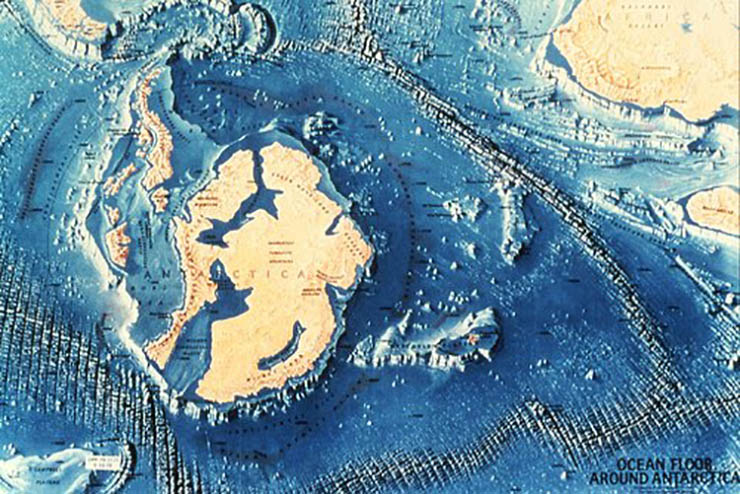
    If Warren hadn’t been fixed on the northern view and had instead looked south he would have seen that Antarctica represents a far more natural “Navel of the Earth,” as we can see in a US Navy map of the world as seen from Antarctica.

    Antarctica, like the Aztec’s “Aztlan” is “white.” Like Iran’s lost paradise, it is covered “with a thick sheet of ice.” And like the “first land” of Japanese mythology, it is close to one of the Earth’s poles.

    Even if Plato had never written about Atlantis, the mythology of the ancients has always cradled the memories that would have led us to Antarctica.

    Get the issue this article appears in

    Atlantis in Antarctica

    Most rewarding for us, since 1995, the idea that Antarctica could have been the home of Atlantis has entered the popular imagination in unexpected ways and triggered the talents of many artists and writers.

    Clive Cussler gave us Atlantis Found in which James-Bond-like-superhero Dirk Pitt travels to Antarctica and fights neo-Nazi villains over the remains of Atlantis. Later, Cussler teamed with Paul Kemprecos to write Pole Shift, a novel that envisioned terrorists hell bent on artificially displacing the Earth’s crust. Stel Pavlou created Decipher. Richard Scott, a linguist, travels around the world cracking ancient hieroglyphs including those found in the city of Atlantis two miles beneath the ice of Antarctica. Thomas Greanias wrote Raising Atlantis in which astro-archaeologist Conrad Yeats and Vatican linguist Serena Serghetti survive their quest to find Atlantis in Antarctica. In 2007, a Kindle book by Jeremy Robinson, Antarktos Rising, imagined a present-day Earth crust displacement that frees Antarctica from the polar zone, revealing the formerly iced continent and awakening the long hibernating civilisation that lies beneath.

    On television, the long running science fiction series Stargate SG1 (1997–2007) and its spinoff Stargate Atlantis (2004–2009) both assume a close connection between Atlantis and Antarctica. On the big screen, AVP: Alien vs Predator (2004) and AVPR: Alien vs Predator – Requiem (2007) are both predicated upon the idea that Antarctica was once the site of an advanced civilisation. In 2009 a film predicated on the idea of an Earth crust displacement corresponding with the end of the Mayan calendar carries the provocative title, 2012. 

    In music, Atlantis Blueprint, a rock band in Ontario is enjoying success. And in Australia the group When the Sky Fell is gathering fans.

    Tom Miller’s evocative painting of scientists retrieving artefacts from beneath Antarctica’s ice was inspired by When the Sky Fell and was featured on the cover of the US magazine Atlantis Rising.

    The authors invite you to visit the new, expanded and updated second edition of When the Sky Fell available as an eBook at www.flem-ath.com. Rand & Rose Flem-Ath continue the search and detail the breakthroughs in science over the past decade and include the compelling evidence that points to Lesser Antarctica as the site of the lost island continent of Atlantis.

    [alert type=”general” dismiss=”no”]This article was published in New Dawn Special Issue 8.[/alert]

    [alert type=”success” dismiss=”no”]If you appreciate this article, please consider subscribing to help maintain this website.[/alert]

    © New Dawn Magazine and the respective author.
    For our reproduction notice, click here.

  • 11:11 Is it Happening to You?

    11:11 Is it Happening to You?

    From New Dawn 112 (Jan-Feb 2009)

    Imagine waking up at exactly the same moment night after night for years and seeing the same time appear on the alarm clock beside your bed. For those who experience this strange occurrence, their first thoughts might be that it was random chance, or simply the product of an overactive imagination. But is it? Is there perhaps a hidden message that is encoded within these mysterious events?

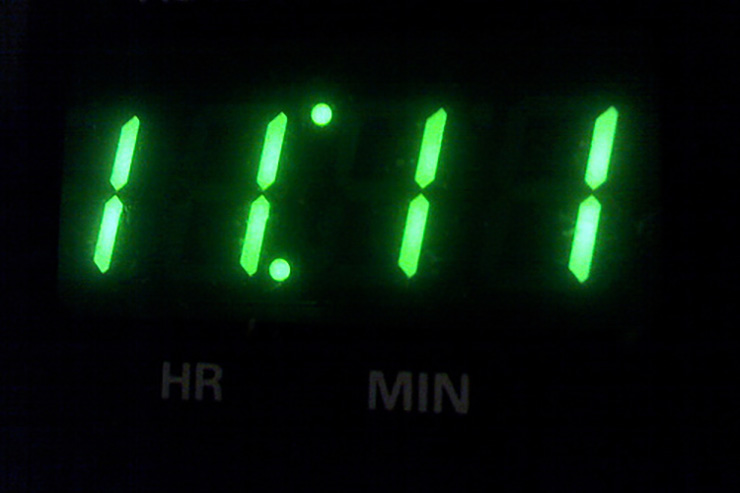
    It is most assuredly not their imagination causing them to awaken at exactly 11:11pm each night, or to see “11:11” appear on digital readouts, watch faces, billboards, signs, and even calculators. The time prompt phenomenon is real and it is happening to people all over the world.

    The significance of “11:11” may be linked to the coming enigmatic year of 2012, when some scholars believe that the exact moment of transformation predicted in the Mayan Calendar, and prophesied by the Hopi, the Hindu and even the Bible itself, will occur at 11:11am GMT. This theory further suggests that our “junk DNA,” the approximately 97% of our non-coding DNA, will somehow be responsible for triggering this spiritually awakened state of consciousness.

    Regardless of one’s belief in the numerous theories surrounding 2012, those who find this mysterious number sequence appearing over and over again, often for years at a time, the significance seems elusive.

    Some believe the time prompts, which do not always have to occur at 11:11, may be a type of “wake up call” from a source of higher intelligence. Perhaps these entities are eager to alert our attention to both personal and collective changes we are soon to deal with. Others report experiencing paranormal or spiritual events during these time prompts. Some have even claimed to see their guardian angels, or encounter aliens and ghosts! Others still report nothing but an annoyance that a particular series of numbers seems to haunt and taunt them as they go about their daily lives.

    “I wake up every night at the same time, sometimes 11:11pm, sometimes 1:11am, 2:22am, 3:33am,” a geophysicist told us. When asked if anything unusual occurred, he said no, but that the very circumstances intrigued him. Was the brain triggering this nightly occurrence, or was there an outside, external source causing the influence?

    Others report the exact same circumstances, even down to looking at clocks throughout the day and noticing the time to be 11:11a.m., 1:11p.m., and on and on. Each time they looked, they became “aware” of the synchronistic pattern, but did not really understand what was behind it. Is it sheer coincidence? Is the brain itself acting as an inner alarm clock, or prompt?

    One woman told us: “I have this problem and it really IS becoming a problem… I don’t even wear a watch anymore, I’m always looking at the clock at 11:11am/pm and 1:11am/pm. I’ll even wake up just to look at the clock at 1:11am… It’s getting worse, too. Last night I woke up at 1:11am, 2:22am, and 3:33am!”

    Another individual named Cinde, had much to say about these prompts.

    First of all, I try very hard NOT to follow man’s time.  To me, clocks and the structure of time were created by man to control man, and I simply do not want to be controlled by anyone.  I do have to follow it for work, however.  The rest of the time, I try to simply go by natural time.  No clock required.

    I work 2nd shift.  So I’m up pretty late.  And because of this stupid phenomenon, I don’t sleep well at night.  I tend to wake up at 11:11pm (on my night’s off), followed by 1:11am.  Sometimes, but not always, it will continue with 2:22, 3:33, etc.  But that is rare.

    As a result of not sleeping well, I tend to snooze in the mornings, relaxing, cat napping, and watching TV until I FEEL it’s time to get up.  When do I get this “feeling”?  11:11am.  I’ll get up, do what I have to do, and hang around until it’s time to get ready for work.  I have an alarm set for 1:30, since I have to leave by 2.  But it never fails, I will look at the clock early, and it’s usually 1:11.

    On one online message board, one person reported: “Everyday of my life it seems I see, 1:11, 2:11, 3:11, 4:11, 5:11, 6:11, 7:11, 8:11, 9:11, 10:11, 11:11, 12:11, I was born on 4/11/89, I’ve been seeing 11:11 for quite sum time now and I know there is no way it can be a coincidence (sic), I have so many unusual 11:11 stories…”

    One of the more intriguing reports: “One of my sightings that really stands out is walking past 2 boys wearing bright red football shirts as I turned round to look back at them (don’t know why I did) they both had number 11 on their backs!”

    11  11

    Over at AngelScribe.com, readers post their stories of encounters with invisible angels at such times as 11:11, 2:22, and on.

    “Last night as I pulled into my driveway, I looked down at my mileage and it read 11,111.1! Weird! Than (sic) I woke up this morning at 2:22am! This is just getting too weird! Those Angels are working their magic!”

    “In the summer of 1978 I began seeing 1111. I also see 111, 222, 333, etc. Sometimes I’ll wake in the middle of the night at exactly 1:11. These numbers have appeared on boxes, license plates, house numbers, friends addresses, phone numbers, totals at the grocery store.”

    “I woke up at 11:11 last night! I had only been asleep a short time! This morning I was outside with my granddaughter and she said she wanted to go in! Weird, she never wants to go in! LOL… so we went in and sat in the rocking chair and turned a video on… I noticed that the time on the VCR and cable box was 11:11! I love the little reminders… makes my day go so much better!”

    It seems that the more people we had an opportunity to speak with while writing our book, the more we came to realise that these stories all seem to share common, recurring traits. Is there a scientifically objective reason why the time prompt phenomenon seems so incredibly common? From a statistical standpoint, it would seem patently obvious that there was some type of connective correlation. But what? And equally as important, why?

    Perhaps, the truth combines elements of all these explanations.

    But it’s not just the number 11 that is showing up in people’s lives – often accompanied by unusual events or profound insights. Sometimes it’s 2:22, 3:33, 4:44 or any combination of digits that sparks a pattern and shakes us out of our complacent view of the world as random and chaotic.

    Throughout the history of human experience, mysterious numbers and strange sequences appear. Even in nature we find numbers, often grouped into sequences and patterns that seem to form an underlying structure to all of reality – both the seen and unseen.

    Two of the most stunning examples are the Golden Ratio and the Fibonacci Spiral, both of which imply a higher order of measurement behind what many of us take for granted, like the proportion of our own bodies, or the layout of petals on a flower.

    The Golden Ratio, also known as the Divine Ratio, the Golden Ration and Golden Mean, is an irrational number of approximately 1.618033988749. This ratio is found throughout the natural, scientific and man-made worlds as the highest expression of balance, symmetry and aesthetics. This fundamental formula can be described as “the ratio whereby the ratio of the whole to the larger section equals the ratio of the larger section to the smaller section.”

    Referred to as “phi,” this ratio is present in many sacred icons such as the measurements of the Great Pyramid of Giza, the structure of a five-pointed star, a Pentagram (a sacred object to followers of Plato and Pythagoras) and even in the outline of the Acropolis near Athens, Greece (which takes the shape of a Golden Rectangle.) Most notably, as represented by Leonardo Da Vinci’s famous Vitruvian Man, the golden ratio is present in the structure of the human body, with outstretched arms and legs showing the Golden Ratio at work.

    Sacred geometry is the realm of the divine nature of numbers, suggesting that the great churches, temples and megalithic structures and monuments that mark the earth follow a pattern based upon heavenly properties and resonances.

    Harmonics and music actually form the foundation of many of the accepted mathematical laws. Even within the field of sacred geometry, the basics of musical theory provide a structure from which the divine and the human find common ground. One such example is the famous Rosslyn Chapel with its remarkable display of sacred geometry and the use of symbol, harmonics and numbers to convey a sense of otherworldliness, and a divine connection.

    [alert type=”info” dismiss=”no”]If you appreciate this article, please consider a subscription to New Dawn magazine.[/alert]

    Rosslyn Chapel is a 15th century chapel designed by William Sinclair of the St. Clair family of Scottish nobles descended from the Norman knights, and some claim, linked to the Knights Templar. Originally known as the Collegiate Chapel of St. Matthew, Rosslyn has gained notoriety from the recent best-selling book and movie The Da Vinci Code by Dan Brown, which served to further inextricably link it to the legend of the Holy Grail. Many historians and esotericists even insist the Grail legend itself ends at Rosslyn, where ensconced deep within its walls may lie a secret that only music itself can unlock.

    Father Richard Augustine Hay was the principle authority of the Chapel and St. Clair Family. He wrote that Rosslyn was unlike any other house of God’s service, and that it was a “most curious work, that which it might be done with greater glory and splendour.” Sir William is said to have engaged the services of the best masons and workmen available in Europe at the time to build this magnificent structure. Hay and other Rosslyn researchers suggest that the west wall of the Chapel was intended by design to be a model of Jerusalem’s Wailing Wall. In addition, in 2005, mystical symbols carved into the stone ceiling were reportedly discovered which appear to be a musical score hidden in 213 cubes in the ceiling. The cubes, when combined, formed a series of patterns that resulted in a one-hour musical accompaniment for 13 medieval prayers!

    Many scholars insist that these musical tones and corresponding patterns on the ceiling cubes are far more than mere coincidence, and that one day we may be able to unlock a medieval secret by repeatedly playing the proper frequencies. While some have attempted, so far the musical mystery remains just that.

    Even the Universe itself can be described in both harmonic and mathematical terms. In fact, some scientists and mathematicians believe that our Universe is comprised of six discrete numbers, and that these numbers are so precisely tuned as to suggest the presence of a higher intelligence at work. Call it the “Universal Symphony” if you will.

    In his book Just Six Numbers, Sir Martin Rees, the Royal Society Research Professor at Cambridge University and Astronomer Royal, makes a bold case for explaining how these six fundamental numbers can explain the entirety of the physical cosmos. These numbers, “constant values that describe and define everything from the way atoms are held together to the amount of matter in our universe,” were somehow imprinted during the Big Bang itself and began a process of cosmic evolution that allowed for the creation of stars and galaxies, as well as all of the necessary energy states that govern matter and force as we know it.

    The six fundamental numbers that shape the Universe, and helped make it in the first place, are:

    Nu – “N” a critically huge number with the value of

    1,000,000,000,000,000,000,000,000,000,000,000,000. This is a ratio of the strength of electrical forces holding atoms together, divided by the force of gravity (which is 10 to the 37th power) between them. If this number were smaller, even by a few zeros, it has been posited that the Universe’s lifespan would be too short for biological evolution to occur. As Rees states, a short-lived universe would mean that no creatures could ever grow larger than insects, with no time for biological evolution to unfold. Thus, a buggy world indeed.

    Epsilon – 0.007 – Another ratio, this time the proportion of energy released when hydrogen fuses into helium. This number defines how firmly atomic nuclei bind together and how all of the atoms on Earth were made. The value of epsilon controls the power from the Sun and how stars transmute hydrogen into all the atoms of the periodic table. Carbon and oxygen are common, and gold and uranium are rare, because of what happens in the stars. Were this number 0.006, or 0.008, Rees states that we could not possibly exist, again suggesting that the minutest tweaks would have resulted in a universe far different than this one.

    Omega – The cosmic number 1 or omega measures the amount of material in our Universe – galaxies, diffuse gas, and ‘dark matter’. Omega refers to the relative importance of gravity and expansion energy in the Universe. According to Rees, a universe with too high of an Omega level would have collapsed long ago; too low, no galaxies would have formed. The inflationary theory of the Big Bang says omega should be one, but astronomers have yet to measure its exact value. Some scientists point to the finely-tuned initial speed of expansion as a hint of Creative Intelligence.

    Lambda – the force of cosmic antigravity that was discovered in 1998. This is an extremely small number and appears to control the expansion of the Universe; however, it has no effect on scales of less than a billion light years. If Lambda were any larger, its effect would have stopped galaxies and stars from forming and cosmic evolution would have been “stifled before it could even begin.”

    Q = 1/100,000 – The basic seeds for all cosmic structures such as stars, galaxies and clusters of galaxies, all of which were imprinted in the Big Bang itself. The fabric – or texture – of our Universe depends on a number that represents the ratio of two fundamental energies. If Q were smaller, the Universe would be inert and without structure; if Q were much larger, the Universe would be a violent place where no stars or suns could exist, dominated by giant black holes.

    Delta – 3 – the number of spatial dimensions in our world. Rees argues that life can only exist in three dimensions, not two or four. At least in our Universe, but not necessarily in others. This number it seems has been known for hundreds of years, but is now being viewed in a whole new way, especially in light of superstring theory, which posits that the most fundamental underlying structure are vibrating superstrings that operate in a potentially 10-dimensional “arena.”

    “Mathematical laws underpin the fabric of our universe – not just atoms, but galaxies, stars and people,” Rees writes. The goal of theorists, Rees continues, is to one day “encapsulate the essence of the physical laws in a unified set of equations.”

    These six numbers allow for the absolute “rightness” of the universe that we live in, a rightness that in turn allowed for all the perfect chemical and physical combinations, events and interactions to lead to the creation of stars, galaxies and planets.

    English astronomer James Jeans said, “The universe appears to have been designed by a pure mathematician.” The laws that govern motion, gravitation, force and matter are all, at their foundation, mathematical laws that give order to nature and form the bedrock of all physical reality. The word “astronomy” itself means “law of the stars,” and those laws have their basis in mathematics.

    While many consider the mix of science and spirituality to be tantamount to oil and water combining, there are some spiritually leaning scientists who look to this fine-tuning of our Universe as an indication of an intelligent force behind all of creation. Is it beyond the realm of possibility that God may be a number? Though no scholar has yet come up with the perfect divine equation, it is still quite evident that the mark of a master Mathematician with deep respect for numbers is behind what we perceive as our reality.

    The “God numeral,” according to physicist Scott Funkhouser, could be an unimaginably big number, say 10^122, or 10 times itself 122 times. This number seems to show up in some very critical cosmic instances, appearing first in the late 1990s when scientists began researching the presence of dark energy. This energy is believed to be behind the accelerating rate of expansion we see in our universe. This same number, albeit with a give or take of a factor of ten, appears in other important ratios, such as the ratio of mass of the observable Universe to that of the smallest “quantum” of mass, which is 6×10^121. In the current Universe, one of the measurements of entropy that determines the many ways in which particles can be spatially arranged is 2.5×10^122.

    On a more microcosmic level, our personal lives mirror this same fundamental truth. We live according to numbers. Whether we ascribe to the beliefs of astrology, which tells us about our character traits through the positioning of stars at the times of our births, or we are the result of DNA and its own numeric structural forms, numbers own us. Regardless, we seek to find meaning and understanding in them when they appear over and over again in our lives. There are those who even believe that numbers have the power to shape our lives, our relationships, and our destinies.

    Numerology consists of a number of systems, traditions or beliefs that posit a mystical or esoteric relationship between numbers and physical objects. Numerology and numerological divination were popular among early mathematicians such as Pythagoras, but are now regarded as pseudo mathematics by most modern scientists.

    According to accepted scientific tenets, it would not be entirely accurate to call numerology a science. Rather, it can best be described as a belief system founded on the concept that the “number behind a name” can literally dictate a person’s destiny, future, and fortune. Like astrology, numerology is based upon the idea that everything, even the names we were given by our parents at birth, has a profound meaning and purpose in the realisation and unfoldment of our individual paths. From the jobs we choose to the places we live, to the mates we give our hearts to, people throughout the centuries have studied their astrological and numerological charts and signs in hopes of gleaning prescient information and patterns which might enable them to make better informed life choices.

    The human brain is hard-wired to seek and find patterns wherever it can, in order to understand a complex situation or arrangement. This phenomenon, known as “matrixing,” or more commonly “pareidolia,” is a universal human response. The term pareidolia, according to Wikipedia, describes a “psychological phenomenon involving a vague and random stimulus (often an image or sound) being perceived as significant. Common examples include images of animals or faces in clouds, the man in the moon, and hidden messages on records played in reverse.”

    Get the issue this article appears in

    Many studies support the brain’s ability to not only construct patterns based upon evident information, but additionally, to assign a time upon them. To wake up once at “11:11” would mean little… but if the brain makes a neural connection after waking up twice at that specific time, that connection would then become an embedded time code that will continue to manifest, becoming a learned response.

    If indeed the brain can tell time, and if the brain engages in the matrixing of meaning in an attempt to discern a pattern, how can we then know whether a time prompt is just a time prompt, a sheer coincidental event dictated by the Law of Truly Large Numbers or something more miraculous? Remember, according to that law, when there is a large enough sample of people or subjects, pretty much anything can happen.

    Perhaps we will find out on a numerologically significant date, when our collective “junk DNA” may be triggered, sending us to a new level of conscious awareness. Maybe we will find out individually, as the meaning behind the math sinks in through our experience as we find ourselves guided by a higher source along our path.

    Either way, one thing is certain – we will know what the sages and scholars knew before us.

    It all comes down to numbers.

    The laws of nature are but the mathematical thoughts of God.
    – Euclid

    [alert type=”general” dismiss=”no”]This article was published in New Dawn 112.[/alert]

    [alert type=”success” dismiss=”no”]If you appreciate this article, please consider subscribing to help maintain this website.[/alert]

    © New Dawn Magazine and the respective author.
    For our reproduction notice, click here.

  • Mysterious Celtic Mummies of the Gobi

    Mysterious Celtic Mummies of the Gobi

    The discovery of Caucasoid mummies in China shows that East and West have been meeting since the Bronze Age. Do they validate some of our most ancient legends?

    Christopher Columbus is said to have been the first to break down the barrier that was the Atlantic Ocean, that massive body of water separating two continents. But such a physical obstruction never existed between Europe and the East – one could always travel over land. The discovery of Caucasoid mummies in China provides not only indisputable evidence ‘Europeans’ travelled to the far East thousands of years before anyone imagined, it has also created controversy.

    At the beginning of the 20th century, the likes of Sven Hedin, Albert von Le Coq and Sir Aurel Stein travelled to the East in search of ancient civilisations, hoping to reach the then forbidden city of Lhasa, the capital of Tibet, and its ruler, the Dalai Lama. On their travels to this almost mythical region, they stumbled upon many ancient ruins and on occasion spoke about the discoveries of desiccated bodies.

    In 1907, the Russian explorer Pyotr Kuzmich Koslov (1863-1935) actually reached Lhasa and met the Dalai Lama. Afterwards, he organised further expeditions and excavated Khara Khoto, a Tangut city founded in 1032 that had been ruined by the Ming Chinese in 1372. Koslov unearthed a tomb fifty feet below the ruins and found the body of a woman, apparently a queen, accompanied by various sceptres, wrought in gold and other metals. Though Koslov took numerous photographs that were published in American Weekly, he was not allowed to disturb or remove anything from the tomb, which was sealed again. His last expedition to Mongolia and Tibet occurred from 1923 to 1926 and resulted in the discovery of Xiongnu royal burials at Noin-Ula.

    Mu & Lemuria

    When news of such discoveries were reported back in the West, it ignited a wide interest in the mysteries of the East, which even today remain largely beyond the reach of most tourists. It were in these remote regions that James Churchward (1851-1936) claimed he had found evidence of a lost civilisation: Mu. For Churchward, Mu was a lost civilisation and continent in the East, which he estimated was 50,000 years old and once the home of 64 million inhabitants. Though Mu once stretched from Micronesia in the West to Easter Island and Hawaii in the Pacific Ocean, knowledge – if not descendants – of Mankind’s original homeland could possibly be found in India and surrounding regions. Churchward believed that the primary colony of Mu was the Great Uyghur Empire, Khara Khoto being its ancient capital, and the civilisation was at its height around 15,000 BCE. Check any encyclopaedia and you will find Churchward ‘borrowed’ that name from the historical Uyghur, who today live primarily in the Xinjiang Uyghur Autonomous Region of China.

    Churchward’s Mu was not too different from Madame Blavatsky’s Lemuria, and it was the American Theosophist Gottfried de Purucker (1874-1942) who published his thoughts on Blavatsky’s doctrine in 1937. He argued that this region, this “enormous tract of country, most of it desert waste,” was once fertile and lush with cities, and that it was here one would “find the seat from which we came as a racial stock,” which was the “Fifth Root Race.” Blavatsky described the fifth root race as such:

    The Aryan races, for instance, now varying from dark brown, almost black, red-brown-yellow, down to the whitest creamy colour, are yet all of one and the same stock – the Fifth Root-Race – and spring from one single progenitor, […] who is said to have lived over 18,000,000 years ago, and also 850,000 years ago – at the time of the sinking of the last remnants of the great continent of Atlantis.

    Later, the French author Robert Charroux (1909-1978) wrote that the Gobi Desert had Magi, or sages of the East, surpassing in wisdom even those resident in Tibet. Stories go that these cities once had ocean ports, and Edgar Cayce even argued that a “City of Gold” will be discovered in the Gobi Desert, including a temple with elevators and electric cars. Others have seen this region as the homeland of those ancient UFOs, the vimanas.

    Taklamakan Desert Gives Up Its Secrets

    But whereas the Gobi Desert might still hold some secrets, it is the Taklamakan Desert that has provided us with revelations. The Taklamakan Desert is a large sandy expanse, part of the Tarim Basin, a region roughly between Tibet and Mongolia, in western China, and crossed at its northern and southern edge by the Silk Road. Conditions are so harsh that travellers avoided the desert as much as possible, but in millennia gone by the region was populated and habitable – very much like de Purucker argued.

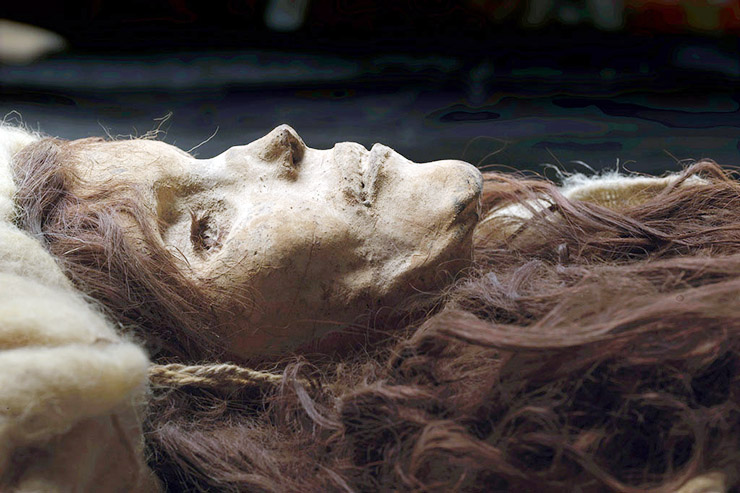
    In recent decades, however, the south east section of the desert, on the edge of Gobi, has become an oasis for archaeologists and historians, as it is here that hundreds of Caucasoid mummies have been found. The most notable mummies are the tall, red-haired “Cherchen man” (dated to ca. 1000 BCE), the “Hami Mummy” (c. 1400-­800 BCE) and the “Witches of Subeshi” (4th or 3rd century BCE), who received their name because of the tall pointed hats they wore. However, the oldest mummy of all is the “Loulan Beauty” (1800 BCE).

    Though not the oldest, one of the most famous mummies of the Taklamakan Desert is that of “Cherchen Man” (see photo in PDF version). His body was placed in a poplar-wood box, lowered into narrow shaft grave, and left for eternity. The climatic circumstances that make this region so inhospitable today preserved these corpses over the millennia, turning them into mummies.

    Cherchen Man is six feet tall, was around fifty years old at the time of his death, has reddish brown hair, a long nose, full lips and a ginger beard. He was buried in a red twill tunic and tartan leggings, and his body is far better preserved than any Egyptian mummy. Most interestingly, Cherchen Man too was buried with no less than ten hats, one of which looks Roman, another looking like a beret, a cap, and even a conical “witch” hat – something commonly found with many of the mummies. His body dates back to 1000 BCE and he looks like a Bronze Age European. In fact, he’s every inch a Celt. Even his DNA says so.

    Next to him were found the mummies of three women and a baby. One of the women is dressed in a red gown, wearing tall boots, her hair brushed and braided. She has a red yarn through her ear lobes and – like the man – has several tattoos on her face. All mummies were painted with a yellow substance, believed to help in the preservation of the body. The baby, probably 3-4 months old, is wrapped in brown blankets, tied with blue and red cord, with a blue stone placed on each eye (see photo in PDF version).

    The oldest of the mummies is the 4,000 year old “Loulan Beauty,” (see photo in PDF version) a mummy discovered in 1980 in an ancient Chinese garrison town located by Sven Hedin in 1900. The town is near the Lop Nor marshes on the north-eastern edge of the Lop Desert. Hedin recovered many manuscripts that state the culture was wiped out by a large seismic occurrence which drastically changed the climate of the area and turned it into a desert. But that was several millennia after the Loulan Beauty lived. This female mummy has long, fair hair. Aged 45 when she died, the Loulan Beauty was buried with a basket of food containing domesticated wheat, combs and a feather. No doubt, these nourishments were for the afterlife.

    She is not the lone ‘European’ to have lived here in those days: the cemetery at Yanbulaq contained no less than 29 mummies that date from 1800-500 BCE, 21 of which are Caucasoid. Best preserved of all the corpses is “Yingpan Man,” who is also known as “the Handsome Man,” a two metres tall 2,000 year old Caucasian mummy discovered in 1995. His blond bearded face was covered with a gold foil death mask, which is a Greek tradition; he also wore elaborate golden embroidered red and maroon wool garments with images of fighting Greeks or Romans. His head rests on a pillow in the shape of a crowing cockerel.

    Elsewhere in the Tarim Basin, hundreds of other mummies have been found, with the earliest ones being genetically Caucausoid or Europoid. Some of the mummies are thought to have been sacrificial victims. A young woman was found partially dismembered, her eyes gouged out. A baby boy had apparently been buried alive. The question remains whether the latter was sacrificial, or he was merely buried with his dead mother.

    How did Europeans End up in the Tarim Basin over 4,000 years ago?

    Although their location is certainly an intriguing one, interest in these mummies exists largely because they are ‘out of place’ relics. Not only does DNA evidence show that the earliest arrivals were from Europe, analyses such as the weave of the cloth reveal it was identical to those found on the bodies of salt miners in Austria, dating from 1300 BCE. The wooden combs buried in Asia are also identical to those found in Celtic countries. So are the stone structures on top of their burial sites – similar to the dolmens of western Europe.

    Despite such certainties, archaeologists and historians have struggled to fill in the ‘soft evidence’ – which are nevertheless the most important questions: how did they get to China, and why did they go?

    We know about these early European visitors to the Tarim Basin largely thanks to the work of Dr. Victor Mair, a professor of Chinese Studies at the University of Pennsylvania. His fascination began when he toured the Urumchi Museum where some of the mummies are displayed. He then invited Dr. Elizabeth W. Barber of Occidental College (California) to visit the mummies and give her expert opinion on the weaving of their clothes.

    “From around 1800 BCE, the earliest mummies in the Tarim Basin were exclusively Caucausoid, or Europoid,” says Mair. East Asian migrants arrived in the eastern portions of the Tarim Basin about 3,000 years ago, while the Uyghur peoples arrived after the collapse of the Orkon Uyghur Kingdom, based in modern-day Mongolia, around the year 842.

    Mair has also stated:

    The new finds are also forcing a reexamination of old Chinese books that describe historical or legendary figures of great height, with deep-set blue or green eyes, long noses, full beards, and red or blond hair. Scholars have traditionally scoffed at these accounts, but it now seems that they may be accurate. (http://en.wikipedia.org/wiki/Tarim_mummies)

    In short, Mair leaves little doubt that we are confronted with a ‘lost civilisation’ of a group of European settlers in a region millennia before any historical accounts were recorded.

    Mair believes that early Europeans headed in different directions, some travelling west to become the Celts in Britain and Ireland, others taking a northern route to become the Germanic tribes, and then another offshoot heading east and ending up in Xinjiang. His team suggests they may have arrived in the region by way of the forbidding Pamir Mountains about 5,000 years ago.

    His opinions tally with those of textile expert Barber, who in her book The Mummies of Ürümchi examined the tartan-style cloth and concluded that the garments can be traced back to Anatolia and the Caucasus, the steppe area north of the Black Sea. She argues this group of people divided, starting in the Caucasus and then splitting, one group going west and another east – confirming Mair’s opinion.

    So, what do we know about these people? We know they were horsemen and herders using chariots, and may have invented the stirrup. We know they had arrived in this region by 1800 BCE. That around 1200 BCE, they were joined by another wave of Caucasoid immigrants from what is now Iran (the so-called Saka branch).

    In fact, the Saka nomads had high-pointed hats – like the ones found next to Cherchen Man – as displayed on the Persepolis reliefs in southern Iran. A bronze statue found in the Altai Mountains from the 5th century BCE has a similar hat. Most important is the fact that the statue has Caucasoid features, and shows similarities in dress to Cherchen Man. It is therefore clear that apart from ‘hard’ DNA evidence, there is other incontrovertible evidence of an early European presence in China. The discovery of the mummies indeed rewrites history.

    When Sir Thomas Douglas Forsyth reported on his 1875 mission to the region, he stated many of the people were tall, fair-faced, with light eyes, sandy whiskers and hair. He added they “only require to be put into coat and trousers to pass, so far as outward appearance goes, for the fairest Englishman.” Two millennia before, Pliny the Elder in “Taprobane” wrote about the Seres, which were described to the Roman Emperor Claudius by an embassy from Taprobane (Ceylon). He said they “exceeded the ordinary human height, had flaxen hair, and blue eyes,” a description which comes close to those people living in the Tarim Basin. Pliny the Elder also said they had an “uncouth sort of noise by way of talking, having no language of their own for the purpose of communicating their thoughts.”

    Political Controversy

    Though no texts have been found in relation to the Tarim mummies, it is now accepted these emigrants spoke a language known as Tocharian (the Chinese called them Yuezhi), that proved to be close to the languages of western Europe. Today, the region‘s inhabitants are the Uyghur people. With their light-coloured skin and hair, many Uyghur‘s are obviously of mixed genetic ancestry, and this fact has a political dimension.

    If one were to find evidence of a Bronze Age seafarer in America, it would obviously create controversy. The discovery of the ‘European’ mummies on Chinese soil also has major political implications. The region is rife with separatist movements and the government fears that promoting a truly unique archaeological find might result in serious social and political unrest. This is one of the main reasons why the Terracotta Army is far more famous than the Tarim mummies!

    Social unrest is greatest between the Uyghur and the Han Chinese. In their drive to lay claim to the region, the Loulan Beauty was even raised to the status of racial icon by the Uyghur, who call her “mother of the nation” – without little supporting evidence.

    The Chinese historian Ji Xianlin, writing a preface to Ancient Corpses of Xinjiang by Wang Binghua, says that China “supported and admired” research by foreign experts into the mummies – i.e. Mair and Barber.

    “However, within China a small group of ethnic separatists have taken advantage of this opportunity to stir up trouble and are acting like buffoons. Some of them have even styled themselves the descendants of these ancient ‘white people’ with the aim of dividing the motherland. But these perverse acts will not succeed,” Ji writes.

    In comparing the DNA of the mummies to that of the modern day Uyghur, Mair’s team found some genetic similarities with the mummies, but “no direct links.” The fact of the matter is that neither the Uyghur nor the Han Chinese seem to be directly related to these ancient settlers – and that both are modern additions to, and admixtures in, a region populated millennia earlier.

    What the discoveries suggest is that both immigrants and modern local Chinese are a mixture of races. “While it is clear that the early inhabitants of the Tarim Basin were primarily Caucasoids,” Mair has written, “it is equally clear that they did not all belong to a single homogeneous group. Rather, they represent a variety of peoples who seem to have connections with many far-flung parts of the Eurasian land mass for more than two millennia.”

    He adds: “Modern DNA and ancient DNA show that Uyghurs, Kazaks, Kyrgyzs, the peoples of central Asia are all mixed Caucasian and East Asian. The modern and ancient DNA tell the same story.”

    Furthermore, a National Geographic study of the DNA of the mummies suggests the Tarim Basin was continually inhabited from 2000 BCE to 300 BCE and preliminary results indicated the people, rather than having a single origin, originated from Europe, Mesopotamia, India and other regions yet to be determined.

    It underlines, once again, that ethnic groups, whether ancient or modern, are genetically a mixture of many races.

    The Formation of the Silk Road

    What brought ‘Europeans’ to the Tarim Basin over 3,800 years ago? The southern Taklamakan Desert is an area where the Silk Road once flourished and prosperous cities were built. In Khotan, two large rivers were channelled, creating an oasis that grew wheat, rice, corn, cotton, grapes, peaches and melons, and irrigated fields for the grazing of sheep. It is clear that life must have been good in those days, and our ancient adventurers had everything they could want. However, because of gradual climate change, the cities were eventually abandoned and subsequently eroded and buried by the dunes.

    The Silk Road was an ancient caravan route connecting China to the West. The Caucasoid mummies in this part of the world suggest the trade route is older than previously thought – very much like transoceanic contact might be several millennia older than Columbus’ first voyage to America.

    The Silk Road was not just a conduit for silk; many other products were transported and traded and the routes were not merely travelled by merchants, but anyone wanting to go East – or West. The routes should therefore be seen as the ancient ‘highways’ between China and the Mediterranean Sea.

    Trading between the East and West occurred from the dawn of civilisation – if not before. Between 6000 and 4000 BCE, people in the Sahara were already importing domesticated animals from Asia. By 3000 BCE, lapis lazuli – the only known source of which was Badakshan, in northeastern Afghanistan – was found in Egypt. Most specifically, the supply of Tarim Basin jade to China from ancient times is well established. Nephrite jade from mines in the region of Yarkand and Khotan – not too far from the lapis lazuli mines of Badakshan – was found in China. Xinru Liu writes:

    It is well known that ancient Chinese rulers had a strong attachment to jade. All of the jade items excavated from the tomb of Fuhao of the Shang dynasty, more than 750 pieces, were from Khotan in modern Xinjiang. As early as the mid-first millennium [BCE] the Yuezhi [Indo-European people] engaged in the jade trade, of which the major consumers were the rulers of agricultural China. (http://en.wikipedia.org/wiki/Tarim_mummies)

    The Tarim mummies overturn the idea that the West and the East developed independently and they only recently started to interact. As Dr. Mair notes,

    I do believe that there is a growing mountain of hard evidence which indicates indubitably that the whole of Eurasia was culturally and technologically interconnected.

    An interesting question is did the Celts go east – or did a Caucasoid group of people, perhaps native to the Tarim Basin, go to Europe? Turning the path of travel in the opposite direction could offer confirmation of speculation this region was an ancient ‘homeland’ that spread to other regions – specifically Europe.

    With so little known about Bronze Age Celts both in Europe and Asia, no firm conclusions can be drawn either way – and perhaps never will. However, the Book of Manu (also known as the Laws of Manu), one of the supplementary arms of the Vedas, states that the “Uyghurs had settlements on the northern and eastern shores of the Caspian Sea” and German anthropologist Max Muller (1823-1900) wrote that “the first Caucasians were a small company from the mountains of Central Asia.”

    These conclusions are obviously ‘old’ – but are they therefore erroneous? Written more than a century before the Tarim mummies were discovered, they actually speak of the presence of Caucasians in China. And if they got that right, is it possible they got other things right too?

    Only future discoveries are likely to tell. But at least it’s an undeniable fact there was contact between Bronze Age Caucasians and East Asians along the Silk Road. The evidence is for all to see in the Urumchi Museum.

    [alert type=”general” dismiss=”no”]This article was published in New Dawn 112.[/alert]

    [alert type=”success” dismiss=”no”]If you appreciate this article, please consider subscribing to help maintain this website.[/alert]

    © New Dawn Magazine and the respective author.
    For our reproduction notice, click here.

  • Credo Mutwa & the Alien Agenda: UFOs & Alien Abduction in the Eyes of a Zulu Shaman

    Credo Mutwa & the Alien Agenda: UFOs & Alien Abduction in the Eyes of a Zulu Shaman

    From New Dawn 111 (Nov-Dec 2008)

    The Zulu sangoma (a shaman or healer) and high sanusi (clairvoyant and lore-master) Vusamazulu Credo Mutwa (Editor’s note: Credo Mutwa passed away in 2020) is recognised by many as one of the most distinguished African traditional healers. He is, in fact, the spiritual leader of the sanusis and sangomas of South Africa.

    As well as being a successful artist, author and historian, Mutwa is also an outspoken victim of alien abduction, having allegedly been in contact by entities his people call the mantindane (‘the tormentors’), which are similar in nature to what we in the English speaking world call ‘the grays’. Stories of UFOs and alien beings make up a big part of African tribal culture, he says.

    Awakener of the Zulus

    Mutwa was born on July 21, 1921 in the South African province of Natal. The name Vusamazulu means ‘awakener of the Zulus’, and was appointed to Mutwa during his initiation as a sangoma. Mutwa means ‘little bush man’, and Credo means ‘I believe’. Born out of wedlock, Mutwa was considered “an illegitimate child, a child of shame.” Because his mother, who was descended from a long line of medicine men and women, refused to convert to Christianity, Mutwa’s parents separated shortly after his birth. Thus he was primarily raised by his Roman Catholic father, who frequently travelled from place to place, working as a builder.

    Mutwa claims that much of the knowledge he now possesses – of art, science, medicine, engineering and so on – can be attributed to the fact that, when he was child, he was taught by “strange companions.” These “little people,” he says, some of whom were blue in colour, used to make their presence known to other children as well. In fact, “all African children used to see such things.” Thanks to the help of these beings, he says, he was often more knowledgeable than some of his teachers at school.

    When, in 1937, Mutwa was brutally raped by a gang of mineworkers outside a mine compound, he experienced “a great shock and trauma,” remaining ill for a very long time. He developed a feverish condition, accompanied by nightmares and visions, which caused great pain and debilitation, and which, he says, almost killed him. It also caused him to become highly psychic, and he was sometimes able to read the minds of those around him, as well as perceive auras. The treatment he received from European doctors and Christian faith healers didn’t help at all.

    Shortly afterwards, Mutwa was brought to his mother’s village in Zululand, where his grandfather, Ziko Shezi, a sangoma and warrior – “whom my father despised as a heathen and a demon worshipper” – brought him back to health using traditional African methods. Mutwa was told by his grandfather that the illness he had undergone “had actually been a sacred illness which required that I had to become a shaman, a healer.” Mutwa agreed, and, having renounced Christianity, was initiated into the shamanic path by his aunt Myrna, a fully fledged sangoma. Mutwa’s ‘spiritual sickness’ had been part of the initiatory process of becoming a shaman, and is a common aspect of shamanic traditions all over the world.

    Sadly, when his father and stepmother learned that he had become a ‘heathen’, they immediately disowned him, telling him “never to set foot in their home again.” Virtually alone and homeless, Mutwa began to travel “for knowledge, in search of clarity of mind and in search of the truth about my people.” He journeyed all over the country, meeting, and studying under, a number of traditional healers. His first destination was Swaziland. He then made his way to Mozambique, and later, Rhodesia (now called Zimbabwe). At the end of this not only physical, but spiritual, journey, he realised his life’s purpose – to help preserve the culture of his people, and to help mend the problems in his country, of drugs, unemployment, crime, disease and poverty. Mutwa’s first book, Indaba, My Children: African Folk Tales, was published in 1964, and is considered a classic. His other works include: Africa Is My Witness (1966), My People (1971), Let Not My Country Die (1986), and Zulu Shaman: Dreams, Prophecies, and Mysteries (1996).

    Very much a cosmic thinker, Mutwa claims that many of humanity’s difficulties can be explained by the negative influence of manipulative extraterrestrial beings, particularly the mantindane, who “share the Earth with us. They need us. They use us. They harvest things from us.” It’s about time, he says, that we acknowledged the alien presence on this planet. “We are being watched, we are being explored and investigated, and we are being controlled, and yet there are those among us who refuse to accept this fact,” he explains in Zulu Shaman.

    A World Ruled by Aliens

    The late, great John E. Mack is among one of the first UFO researchers in the West to interview Mutwa. He has also been interviewed by the Australian UFO researcher Bill Chalker, the author and historian Zecharia Sitchin, as well as the controversial conspiracy theorist David Icke, who once called him “the most amazing and knowledgeable man it has been my privilege and honour to call a friend, a genius.” Supposedly, many of Icke’s speculations about ‘shape-shifting reptilian aliens’ – whom he believes to be the true rulers of this earth – have been confirmed by Mutwa. According to Mutwa, when he talks about extraterrestrials and other topics of this nature he often feels “caught between, on the one hand, Western thought, including the Christian religion, and African thought, which accepts these things without question.”

    Mack first met Mutwa in 1994, during a short trip to South Africa, the main purpose of which was to investigate the Ariel School incident in Zimbabwe. “Credo seemed a noble, even regal figure with his colourful robes and heavy metal adornments of the sangoma, which seemed as if they ought to weigh him down,” writes Mack in Passport to the Cosmos. During the interview, Mutwa spoke a great deal about his traumatic alien abduction experiences – experiences that Mack, a world-renowned expert on the subject, found difficult not to take seriously.

    Mutwa views the world as a mysterious and frightening place, controlled by alien forces that possess far more knowledge than – and are intellectually and technologically superior to – humanity. Some of these beings, he says, are wise, benevolent and wish to help us. But the same cannot be said of the mantindane, who are just as selfish and power-hungry as humans. They preserve humanity, he says, in order to protect their own self-interests, because they are “obsessed with self-preservation… This wish to play God over lesser beings is with us and with them. Throughout the cosmos vice is the same.”

    Some of these beings, says Mutwa, have covertly and profoundly influenced all human cultures and civilisations for millennia. They have aided our evolution and helped us survive by providing us with knowledge – of science, farming, medicine and so on. “Throughout Africa we are told that these mysterious beings taught human beings many things,” writes Mutwa. “They taught human beings how to have laws, knowledge of herbal medicine, knowledge of arts and knowledge of the mysteries of creation and the cosmos as a whole.”

    Some of them – the mantindane in particular – are “part of the Earth,” and should not be considered foreign. “We and the mantindane are one and the same stupid race,” says Mutwa. “Far from these creatures being aliens, they are our future descendants. I am sure of this.” Out of all the different types of alien beings that have been in contact with humanity, the mantindane are apparently the most important to Africans, who fear them greatly. Mutwa described these entities to Mack as troublesome and “parasitic,” claiming that they “instil superstition, sow discord, and may even cause disease.”

    A Difficult Life

    Given the fact that he has led such a difficult life, it is perhaps not surprising that Mutwa’s world view is less than optimistic. Over the years, he’s been a victim of violence on a number of occasions, and has lost many loved ones. In 1960, his fiancée was shot dead when South African police open fired on a crowd of people to which she belonged. In addition, his first-born son was knifed to death by a group of black activists, “murdering people under the banner of the mass democratic movement.”

    During the Soweto riots of June 16, 1976, Mutwa was attacked by a group of thugs who stabbed him repeatedly. “I could feel the knives going into my body,” he says. “The thing that always helps me happened then. I split into two, and so I escaped the pain.” Looking down, he saw his own body, a “bloodied mess that looked like me.” He was apparently pronounced clinically dead. On another occasion, Mutwa was almost burnt alive when a group of thugs doused him in gasoline. In Africa it’s widely believed that when a person is killed in this manner, their soul is destroyed along with their body, preventing them from reincarnating. Mutwa remembers this incident as one of the few times in his life when he felt genuinely terrified.

    Unbelievably traumatic though these experiences must have been, nothing compares to Mutwa’s 1958 alien abduction episode – assuming it actually took place, of course. The incident has been detailed in a number of books, including Passport to the Cosmos, Bill Chalker’s Hair of the Alien (2005), and Mutwa’s semi-autobiographical Zulu Shaman (also known under the title Song of the Stars).

    Caught by the God of the Mountains

    It all started in the bush, in the sacred Inyangani Mountains of Rhodesia, while Mutwa, at the time a sangoma apprentice, was busy searching for a particular type of herb, which he planned to use as medicine. All of a sudden the temperature dropped, says Mutwa, even though it was a very hot day. He was then engulfed by a bright blue mist, which, he says, “was swirling all around me, getting between me and the eastern landscape.” A moment later, he found himself in what looked like a mining tunnel lined with silver-greyish metal.

    The next thing he knew, he was lying on a table of some sort. His boots and trousers were missing. He was approached by a group of grey-skinned creatures, with “very large heads, very thin arms, and very thin legs.” He wanted to flee, but could not move, as his arms and legs were paralysed. “I just lay there like a goat on a sacrificial altar.” On closer inspection, he noticed that the creatures were short, “about the size of African Pigmy.” They looked, he says, identical in appearance to the ‘gray aliens’ (or grays) commonly reported by abductees in America and other Western countries.

    Mutwa noticed that what appeared to be the creatures’ eyes were actually black, goggle-like covers. Their ‘real’ eyes were “round, with straight pupils, like those of a cat.” At least one of the creatures – the one closest to him – had a potent and very unpleasant odour, “a throat-tightening chemical smell, which smelled like rotten eggs, and also like hot copper [sulphur].” Mutwa was then subjected to some kind of operation on his left thigh, which caused him to scream out in agony. An abundance of blood flowed from the wound. Next, one of the creatures stuck a silver, pen-like object up his right nasal passage; then yanked it out. “The pain,” he says, “was out of this world.”

    The pain subsided, however, when one of the creatures – who was bigger and taller than the others, and who possessed an air of authority – placed its hand on Mutwa’s forehead. Mutwa could ‘sense’ that the creature was female, despite the fact that ‘she’ lacked breasts and other feminine characteristics. Staring at Mutwa intently, it projected visions of destruction into his mind. He saw cities being destroyed by floods, fires and other natural disasters.

    One of the creatures pushed a small, black tubular instrument into Mutwa’s penis. As soon as the instrument was withdrawn, Mutwa’s bladder opened, and he urinated straight into the creature’s chest. It then “staggered away like a drunken insect, and left the room.” A moment later, two other creatures entered the room, one of whom appeared to be a large, metallic robot. Its eyes were bright, seemed to move, and seemed to change colour. The other creature, which was naked, had pink skin, blue eyes, high cheek-bones and looked almost human, yet its body was swollen and strangely out of proportion. Something about it reminded Mutwa of a doll, for it looked and felt “totally unnatural.”

    The creature mounted Mutwa “like a crazy Zulu girl,” and proceeded to have sex with him. But the experience was not at all pleasant – much the opposite, in fact. The creature’s body was cold, bony and lifeless, and Mutwa felt as if he were making love to a machine. To make matters worse, it attached something to his penis that made him ejaculate “too much.” It then left the room, leaving Mutwa alone with the tall, female creature. His penis “was burning as if I had put it in scalding water.”

    Gripping him violently by the head, the creature forced Mutwa off the table he was laying on, and he fell to the floor, landing on his hands and knees. He was then led roughly from room to room. One of the things that most captured his interest, and which, he says, is still “haunting my dreams,” was a collection of huge cylindrical objects, filled with greyish-pink liquid. They contained “small editions of the alien creatures floating round and round, like disgusting little frogs.”

    Mutwa witnessed other human beings being “tortured” by the aliens, one of whom was a white man, “smelling of sweat, urine, excrement and fear.” As Mutwa walked past him, they looked deeply into each others eyes. Incredibly, Mutwa claims to have run into this very same man about two years later, while delivering parcels in the city of Johannesburg. He was working at a curio shop at the time. The man asked Mutwa where he had seen him before, to which he replied, “in Rhodesia, in a certain place underground.” As though the realisation was too much to bear, the man turned away and walked off quickly down the street.

    The next thing he knew, Mutwa was once again in the bush. His mind was hazy, and it took him a moment to realise that something terribly wrong had occurred. He felt a pain in his left thigh, as well as his penis, which was starting to swell. He noticed, moreover, that his shorts and trousers were torn, and that his boots were missing. Clinging to his body was the god-awful stench of the place he had been earlier. Coating his skin was a fine, grey powder. He began to stagger home, making his way along a bush track.

    Mutwa eventually encountered a group of locals, who guided him back to the village, where his teacher, Mrs. Zamoya, informed him that he had been missing for three days. She believed his story straight away. She told him that he had been “caught by the God of the mountains,” and that many other people had similar experiences. He was lucky to have returned alive, she said, “because many people have disappeared in that part of the land, never to be seen again…”

    While staying in the village to recover, Mutwa was bathed every day, so as to wash away the tiny droplets of blood that continued to ooze from the pores of his itchy skin. He found a scoop mark on his left thigh, about a half-inch in diameter, which remains there to this day. Most unpleasant of all, however, skin started to peel off his penis. It also developed sores. This condition did not go away completely, he says, which is one of the reasons his first wife left him. Mutwa was eventually taken to Mrs. Zamoya’s ‘Solace Mission’ in western Rhodesia, where it took him several months to make a full recovery.

    The ‘Sky Gods’

    It would appear that the alien abduction phenomenon is alive and well in Mutwa’s homeland, just as it is in many Western countries, for he claims to have met numerous abductees like himself. During his long career as a sangoma, Mutwa has been approached by countless African women who insist that they have been impregnated by the mantindane and other alien beings. In each case, the pregnancy has mysteriously terminated, as though the foetus has been stolen. Because, says Mutwa, many of these women have been accused of committing abortion – which, in Africa, is regarded as an act “worse than murder” – it has been his job to “convince the family of the woman’s innocence, to try and heal the terrible spiritual and mental – as well as physical – trauma that the woman has undergone.”

    According to Mack in Passport to the Cosmos, many African tribes believe that the mantindane and other alien beings harvest sperm and ova from unsuspecting human victims. The Masai warriors, for instance, fear that the mantindane are able to drain a man’s semen, which is why they go into battle wearing codpieces to protect their genitals, whereas the women of the tribe wear certain ornaments to protect themselves from being sexually molested by these entities.

    “Once a mantindane has dealt with you,” says Mutwa, “you become afraid of making love to a woman…These beings scar you for the rest of your life.” Flawed though the mantindane may be, Mutwa points out that they are “part of us, part of our lives,” and that “they are moved by a desperate need.” Mutwa calls the mantindane “solvers of great problems.” Their technology, he says, may be “several million years ahead of ours.”

    Whether or not one accepts Mutwa’s claim that the mantindane and other alien beings are sexually compatible with human beings – or that such entities actually exist – it cannot be denied that these matters are a very big part of African tribal culture. The “sky people,” or “sky gods,” says Mutwa, have visited Earth for thousands of years, arriving from the heavens in “magic sky boats.” The Pygmies, the Kalahari Bushmen, the Ovahimba of Namibia, the tribes people of Zaire, and of course the Zulus – all of them accept the existence of extraterrestrials, and even believe that humanity is descended from such beings.

    The stars are revered by Mutwa’s people, who consider them more important than even the sun or the moon. The word ‘Zulu’, in fact, means ‘people from the stars’. It is from the stars that much knowledge and wisdom has originated, they say. The people of Botswana, explains Mack, “call a star naledi, which means ‘light of the spirit’, and have carved in wood, painted on rocks, or even scratched on metal ‘the so-called UFOs,’ the ‘magic vehicles’ in which the mantindane and the star gods of the various tribes travelled.”

    In addition to the somewhat sinister and repulsive mantindane, Mutwa speaks of another significant alien race – one that UFO enthusiasts and conspiracy theorists in the West call ‘the reptilians’. “Some say that these creatures were like crocodiles, with crocodile like teeth and jaws, but with very large round heads,” he says. Anyone who’s read Robert Temple’s impressive and scholarly The Sirius Mystery (1976) would be familiar with the enigma surrounding the Dogon people of Mali, west Africa, who possess advanced astronomical knowledge of the Sirius star system, and who claim that they gained this knowledge, many thousands of years ago, from the Nommo, a race of advanced reptilian or amphibian beings who hail from Sirius (more specifically, Sirius A). Throughout Africa, says Mutwa, these mysterious, reptilian gods are known by other names as well. “In West Africa, in the land of the Bumbara people, these amphibian or reptilian sky gods are known as Zishwezi… In West Africa again, these creatures are called the Asa, which means the mighty ones of magic…”

    Fact or Fiction?

    What, then, are we to make of Mutwa’s claims? Was he really abducted by alien beings? Or was his story a fabrication – either completely or partially? And what about his people’s beliefs that we are “descendants from gods who came out of the skies thousands of years ago,” and that these beings “share the earth with us,” and exploit us? Should this information be interpreted literally?

    According to Mack and Chalker, both of whom looked deeply into Mutwa’s story, these questions are difficult to answer with a simple yes or no. The truth may lie somewhere in the middle, they say. In Passport to the Cosmos, Mack points out that Mutwa and other indigenous people with whom he has discussed the UFO phenomenon and other related matters, do “not sharply distinguish material or literal reality from mythic truths.” He adds, moreover, that certain ideas of Mutwa’s, “like the dominant role of the mantindane and other extraterrestrial or star beings in human cultural history, seem related to tribal myth and legend.” Chalker is of much the same opinion as Mack. “‘Oral material’ like Credo’s is very difficult to judge,” he says.

    Given the kind of life he’s lead, it’s a miracle that Mutwa is still alive to this day. Now eighty-six or thereabouts and suffering from diabetes and asthma, his health is continuing to worsen at a rapid rate, and it’s fair to assume that he probably won’t be alive for very much longer. He claims that the ‘alien knowledge’ he has divulged in recent years, which he once pledged never to reveal, was supposed to be reserved for initiate sangomas like himself only. He decided to ‘break ranks’ and ‘reveal all’, however, because he lacks a successor onto whom he can pass his unique and sacred knowledge – knowledge he has earned during a lifetime of initiations. Plus, he insists, this information is too important to be withheld from humanity, and is needed in this time of great global crisis.

    This article was originally published, in a substantially different form, in the May 2008 issue of FATE (vol. 61, no.5, issue 697), under the title ‘Vusamazulu Credo Mutwa and the Alien Agenda’.

    [alert type=”general” dismiss=”no”]This article was published in New Dawn 111.[/alert]

    [alert type=”success” dismiss=”no”]If you appreciate this article, please consider subscribing to help maintain this website.[/alert]

    References:

    About Credo Mutwa, Credo Mutwa on Alien Abduction and Reptilians, www.bibliotecapleyades.net/esp_credo_mutwa03.htm

    About Credo Mutwa, Credo Mutwa – Biography, www.bibliotecapleyades.net/esp_credo_mutwa04.htm

    Bill Chalker, Hair of the Alien: DNA and Other Forensic Evidence of Alien Abduction, Paraview Pocket Books, USA, 2005

    Nancy Connor and Bradford Keeney, Shamans of the World: Extraordinary First-Person Accounts of Healings, Mysteries, and Miracles, Sounds True, Inc., USA, 2008

    David Icke, Children of the Matrix: How an Interdimensional Race has Controlled the world for Thousands of Years – and Still Does, Bridge of Love Publications, USA, 2001

    John E. Mack, Passport to the Cosmos, Crown Publishers, USA, 1999

    John E. Mack, Abduction: Human Encounters with Aliens, Simon & Schuster, UK, 1994

    Vusamazulu Credo Mutwa, Zulu Shaman: Dreams, Prophecies, and Mysteries, Destiny Books, USA, 1996

    © New Dawn Magazine and the respective author.
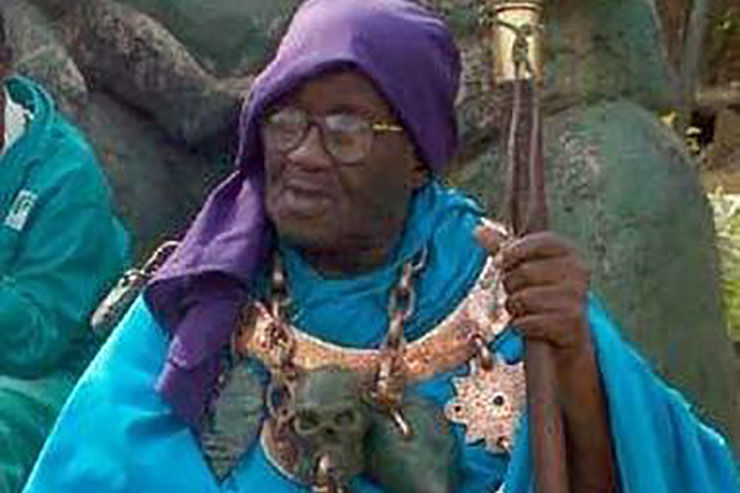
    For our reproduction notice, click here.