If current trends continue, within the next 20 years, almost everyone will be microchipped and dependent on electronics for their survival. Unless we start counter-acting on it now.
I am going to quote from three different articles to show that is indeed the direction we are headed before I explain why I won’t be microchipped, implanted or otherwise tracked or made dependent.
A few quotes from the article ‘People in Sweden Are Upgrading Their Hands, and It Makes Us a Little Scared’:
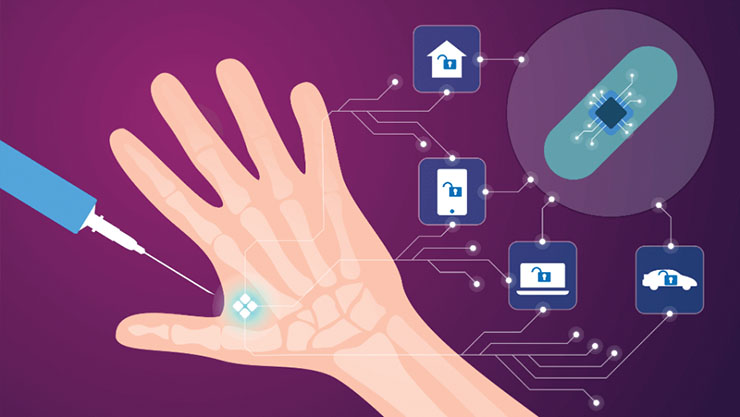
Many people in Sweden have been starting to get chipped since the spring of 2018. People get a chip surgically inserted between their thumb and index finger which then replaces all plastic cards, keys, and other things that people usually have to carry with them. And if last year around only 100 people had these chips, then now, according to the Daily Mail, this number has risen to more than 4,000 people and it’s still growing.
It replaces all electronic wallets, bank cards, travel cards, and different key cards. You can use it to pay by simply touching a terminal with your hand.
It’s as small as a grain of rice.
Its price together with the procedure is $180. Some companies even offer this service to their employees.
Sceptics think that first of all, nobody can guarantee that the personal information contained in these chips will be confidential. Second, some people are sure that these chips will soon have GPS trackers in them.1
A recent article in the New York Times was titled ‘“Big Brother” in India Requires Fingerprint Scans for Food, Phones and Finances’:
Seeking to build an identification system of unprecedented scope, India is scanning the fingerprints, eyes and faces of its 1.3 billion residents and connecting the data to everything from welfare benefits to mobile phones.
For other countries, the technology could provide a model for how to track their residents.
The government has made registration mandatory for hundreds of public services and many private ones, from taking school exams to opening bank accounts.2
And here’s an article from the Guardian, ‘Alarm over talks to implant UK employees with microchips’:
Britain’s biggest employer organisation and main trade union body have sounded the alarm over the prospect of British companies implanting staff with microchips to improve security.
UK firm BioTeq, which offers the implants to businesses and individuals, has already fitted 150 implants in the UK.
The tiny chips, implanted in the flesh between the thumb and forefinger, are similar to those for pets. They enable people to open their front door, access their office or start their car with a wave of their hand, and can also store medical data.3
The first article claims that microchips do not have GPS trackers in them, but it’s easy to add trackers as that’s already done on animals and soon to follow with employees. Not to mention that most of us already have GPS trackers on them – our phones! In some areas of the world, GPS tracking implants are already being offered for children. “Don’t want to lose your child? Implant a GPS tracker!”
The reason I believe this development is almost inevitable is that not enough people are speaking up against it. The entire country of India, more than a billion people, simply accepted the fact that they can now no longer buy or sell without electronic identification. A lot of people have a positive view of it. The first article above mocks people who are sceptical of it, implying that we are old-fashioned. Some of the online hashtags used by those who got microchipped reveal positive imagery they associate with it: Cyborg, Biohacker, Bodymod and Digiwell are just a few.
In other words: “Getting chipped makes you a Superhuman Android!”
There are numerous reasons I won’t allow myself to get microchipped or implanted. Nor will I allow all of my data to be stored in one place. Nor will I make all of my buying and selling dependent on one device or on electronics. If someone pulls the plug, where does all the money go? Having all activities, purchases, sales, movements stored and tracked in one place makes a person exploitable, controllable and hopelessly dependent. There is nothing old-fashioned about not wanting to be a slave to technology. That’s reason number one.
Reason number two is more metaphysical: Metals and electronics interfere with my spiritual energy-field. As if it’s not enough to be surrounded by laptops, cell phones and broadcasting towers at all times almost everywhere in the world, you won’t connect my body to electronic devices! It’s not going to happen.
Reason number three: I don’t like what happened in India, where fingerprinting in exchange for all sorts of services was made mandatory. That’s only one step shy of making microchipping mandatory. The problem lies in the “mandatory.” When someone tries to force me to do something, I reject it.
Reason number four is that this was predicted as something undesirable, thousands of years ago. Even people such as myself, who are not particularly religious, are aware of this passage from the Bible:
It also forced all people, great and small, rich and poor, free and slave, to receive a mark on their right hands or on their foreheads, so that they could not buy or sell unless they had the mark, which is the name of the beast or the number of its name. This calls for wisdom. Let the person who has insight calculate the number of the beast, for it is the number of a man. That number is 666. – Revelation 13:16-18
My interpretation of the number 666 is the Internet’s world wide web. In Hebrew Gematria, the letter w has the value 6. Therefore, 666 can be translated as www. In other words, anyone who isn’t connected to the world wide web through his right hand won’t be able to buy or sell.
Does this mean I believe there will come a time that I will barely be able to survive because I refuse to be microchipped? A time where I have to go underground and join a resistance or militia, scrambling for food and shelter? No. That’s not the timeline I choose. Anyone who knows my writings also knows that I believe we can choose our own reality by making the right, conscious choices. And I am going to choose one where I stay microchip-free and continue to live a wonderful, healthy, wealthy and fun life.
Should the day come when they try to force this stuff on free people, that is going to create a gigantic black-market and currency systems that are independent of banks. We will learn to trade amongst each other again.
[alert type=”general” dismiss=”no”]This article was published in New Dawn 175.[/alert]
[alert type=”success” dismiss=”no”]If you appreciate this article, please consider subscribing to help maintain this website.[/alert]
Humans were in America long before we’ve been told, and the Australian Aborigines have a genetic connection to the Amazon which once had great cities. FRANK JOSEPH looks at the fresh discoveries in Graham Hancock’s latest book.
As the former editor-in-chief (1993 to 2007) and ongoing writer for Ancient American – a US magazine examining Old World impact on the New World before 1492 – recently released materials regarding pre-Columbian possibilities often come my way. I was surprised, however, to find that Graham Hancock’s latest tome, America Before, compares remarkably with Before Atlantis (2013), my own book, published six years earlier, in more than title.
Both works go into the Bering land-bridge Theory, megalithic alignments with the Cygnus constellation, Easter Island’s moai, Gobekli Tepe, the discoveries of Albert Goodyear, Brazil’s Stonehenge, the Meadowcroft Rock shelter, Neanderthals, the Clovis First Controversy, Pedra Furada, etc., etc. Other topics tackled in America Before – Ohio’s Great Serpent Mound, North American earthworks, the Piasu Bird, Cahokia, et al. – were likewise described at length in my earlier releases: Discovering the Mysteries of Ancient America (2006), Atlantis and Other Lost Worlds (2008), Unearthing Ancient America (2009), Advanced Civilizations of Prehistoric America (2010), Lost Worlds of Ancient America (2012), Lost Colonies of Ancient America (2014), and Lost History of Ancient America (2016).
Independent research that arrives at common conclusions tends to validate disparate investigators at work in the same field. Of them all, Graham Hancock is certainly the best known, thanks to his early association with such prestigious periodicals as The Times, The Independent, The Economist, and The Guardian, which granted him access to major book publishers with international distribution, such as St. Martin’s Press, publisher of his latest work. His Fingerprints of the Gods was a worldwide bestseller. At the time of its release in 1995, critics – even those sympathetic to the author’s belief in ancient catastrophism – faulted him for merely reworking long-known if not well-publicised information. But they were forced to admit that Hancock acquainted millions of readers with otherwise neglected information about the deep past.
America Before is not unlike Fingerprints of the Gods in that it introduces an international audience to a version of antiquity not otherwise available in schools or mainstream publications. America Before also joins Before Atlantis in highlighting “a global cataclysm that occurred near the end of the Ice Age around twelve thousand eight hundred years ago. A disintegrating comet crossed the orbit of the Earth and bombarded our planet with a ‘swarm’ of fragments.” Familiar language to readers already familiar with The Destruction of Atlantis (2002) and its sequel. Survivors of Atlantis (2004) similarly tells how an abundance of physical proof for worldwide destruction left by comets during the Bronze Age was offered by scientists meeting at Fitzwilliam College in Cambridge, England.
In 1997 they presented undeniable evidence in the form of annual growth rings at Irish bogs and oak forests, ash-fall deposits from Greenland ice-cores, impact lines made by colossal waves along the shores of Morocco, abrupt lake level changes from Western Europe to South America, and small, glassy spherules that result specifically from cometary collisions subjecting rock to intense heat. Earth’s periodic brushes with celestial upheaval belong to a pattern of astronomical interface with our planet that abruptly terminated the Ice Age, as described in America Before and earlier in Before Atlantis.
Buried in the floor of Lake Cuitzeo was a thin, dark layer containing unequivocal evidence for a large, cosmic body that struck central Mexico just when the Younger Dryas period opened with such violence. Virtually identical sediment strata dated to the same period have been previously located at numerous locations throughout North America, Greenland, and Western Europe. According to Science Daily, “The data suggest that a comet or asteroid – likely a large, previously fragmented body, greater than several hundred meters in diameter – entered the atmosphere at a relatively shallow angle. The heat at impact burned biomass, melted surface rocks, and caused major environmental disruption.” The resulting crater became Lake Cuitzeo, measuring twelve and one-half miles across, with an average depth of ninety feet.
Dr James Kennett, professor of earth science at the University of California (Santa Barbara), told the Proceedings of the National Academy of Sciences: “These results are consistent with earlier reported discoveries throughout North America of abrupt ecosystem change, megafaunal extinction, and human cultural change and population reduction. These changes were large, abrupt and unprecedented, and had been recorded and identified by earlier investigators at a ‘time of crisis’. The timing of the impact coincided with the most extraordinary biotic and environmental changes over Mexico and Central America during the last approximately twenty thousand years, as recorded by others in several regional lake deposits.”
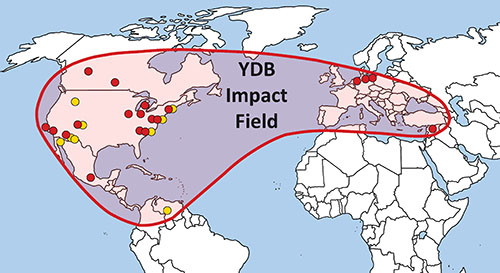
Professor of earth science Dr James Kennett and other researchers postulate from the evidence that a fragmented comet slammed into the Earth close to 12,800 years ago, causing rapid climatic changes, megafaunal extinctions, sudden human population decrease and cultural shifts and widespread wildfires (biomass burning). They studied the impact spherules in 18 sites in nine countries on four continents for their study. (Graphic credit: YDB Research Group)
The floor of Lake Cuitzeo is rich in spherules formed when they collided with each other at high velocities during the whirling chaos of an extraterrestrial impact. They are joined by numerous specimens of lonsdaleite – an identifiable configuration nanodiamonds assume when they are pressured by large meteorite collisions – and aciniform soot, the acne-like appearance of dust residue resulting from the same cause. “These materials form only through cosmic impact,” Kennett explained, not through volcanic or other natural terrestrial processes. In the entire geologic record, the only other known continental layer with abundant peaks in lonsdaleite, impact spherules and aciniform soot is in the sixty-five-million-year-old Cretaceous-Paleogene boundary layer that coincided with the extinction of the dinosaurs.
Evidence for Early Human Settlement
“Recent discoveries show that North America was first peopled at least one hundred thirty thousand years ago,” according to Hancock, “many tens of thousands of years before human settlements were established in Europe and Asia.” Homo sapiens-sapiens? Yes, but the European continent was actually settled one hundred seventy thousand years earlier by Neanderthals. In fact, the oldest evidence for proto-humans in Europe goes back 1.3 million years. “At least” is a bit of an understatement for human settlement in the New World, because Before Atlantis describes how prehistorian Juan Armena Camacho discovered lithic implements at Hueyatlaco, seventy miles south-east of Mexico City. According to US geologist Dr Virginia Steen-McIntyre, “radiometric dates using methods identical to those used in Africa to date the early sites there place Hueyatlaco’s stone tools to slightly over a quarter of a million years ago.”
Some thirty years prior to Camacho’s find, a still older site came to light one mile north from the Oklahoma town of Frederick, at a ten-mile-long, half-mile-wide ridge. Ten to twenty-five feet beneath the surface of this gravel deposit occur dozens of well-crafted stone implements cemented in place in common strata with the bones of extinct animals firmly dated to seven hundred fifty thousand years ago. C.N. Gould, Director of the Oklahoma Geological Survey, reported: “There can be no doubt that the artifacts occur in the pit near the basal portion, on the same level as the fossil remains. An examination of the undisturbed face of the pit, immediately above the position of the finds, showed unbroken, nearly horizontal strata above it. As the case stands, it looks very much as though the artifacts are of the same antiquity as the fossil animals. At the same time, it would be well to reserve final judgment until we are certain that the artifacts are not secondary inclusions.”
Since Gould released his report in 1929, subsequent investigations of the Holoman Pit, as it is locally known, repeatedly confirmed that the stone tools are not later inclusions but were indeed laid down at the same time the animal bones were stratified, three quarters of a million years ago. As recently as 2005, archaeologist Silvia Gonzalez of Liverpool’s John Moore’s University in England discovered a line of human footprints dating back forty thousand years ago near Puebla, in Mexico. Conventional scholars, convinced no human set foot in Middle America before twelve thousand years ago, sought to debunk the heretical period she assigned the evidence by dispatching a team of leading geologists led by Paul R. Renne, director of California’s Berkeley Geochronology Center, to the site.
Once there, they took repeated argon testing to investigate the magnetic imprint of the foot-printed, magmatic rock, together with other state-of-the-art procedures. Renne announced their results in the scientific journal Nature, stating that the rock featuring the footprints was not forty thousand years old after all. It was, instead, 1.3 million yearsold.
During the early 20th century, archaeologist Carlos Ameghino (1865 to 1936) led teams of excavators along the Argentine coast south of Buenos Aires after detecting clues to an early habitation site at Miramar. By 1914, he discovered numerous stone tools cemented within Pliocene Era strata. As Silvia Gomez experienced in the following century, Ameghino’s critics commissioned a group of professional geologists to debunk his assertion. Instead, they verified it, stating that the artefacts had been laid down between two million and three million years ago. Although their analysis was released by the prestigious Anales del Museo de Historica Natural de Buenos Aires, it has since been ignored by archaeologists in the outside world.
Australia-Amazon: An Unexpected Discovery
“Certain tribes of the Amazon jungle,” states America Before’s back cover blurb, “are closely related to Australian Aborigines. How did this extraordinary, unexpected, and extremely ancient DNA signal get to the Amazon?” This question elevates Hancock’s new book with fresh discoveries that threaten to shake the scientific establishment to its core by opening an entirely new and revolutionary archaeological theatre of operations.
The vast Amazon region has long been dismissed by mainstream scholars as anciently under-populated and barren of all but the most backward, native cultures, hermetically sealed off by nature from the outside world. Hancock writes, “in September 2015, Pontus Skoglund, his senior colleague Professor David Reich of the Department of Genetics at Harvard Medical School, and other leading experts in the field, announced in the pages of Nature that they had found new evidence in South America, and specifically in the Amazon rainforest, that called for a rethink.”
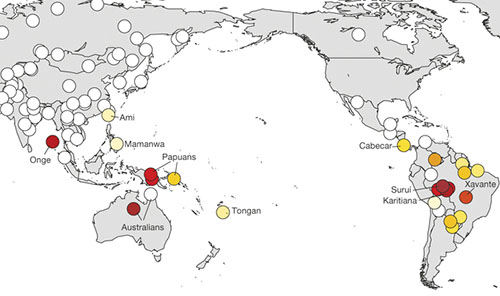
Researchers mapped similarities in genes, mutations and random pieces of DNA of Central and South American tribes with groups in other parts of the world including Australia. Warmer colours indicate the strongest affinities. Researcher Skoglund said “a statistically clear signal linking Native Americans in the Amazonian region of Brazil to present-day Australo-Melanesians and Andaman Islanders” was confirmed. (Graphic credit: Pontus Skoglund, Harvard Medical School)
He quotes Skoglund’s “genome-wide data to show that some Amazonian Native Americans descend partly from a Native American founding population that carried ancestry more closely related to indigenous Australians, New Guineans and Andaman Islanders than to present-day Eurasians or Native Americans,” and are, in Hancock’s words, “more closely related to Melanesian Papuans and Australian Aborigines than to any other Native American population.” “We spent a really long time trying to make this result go away,” Skoglund explained, “but it just got stronger.” In the end, “a statistically clear signal linking Native Americans in the Amazonian region of Brazil to present-day Australo-Melanesians and Andaman Islanders” was confirmed.
“We also know it has to be pre-Columbian,” added Professor Eske Willerslev of Denmark’s Center for GeoGenetics at the University of Copenhagen. Further studies by Willerslev and his colleagues “found Australian DNA already present in skeletal remains from Lagoa Santa, Brazil, dated to 10,400 years ago, and confirmed the suspicion of the researchers that the anomalous genetic signal must have reached South America in the Late Pleistocene – that is, near the end of the last Ice Age, [when] a group of people carrying Australo-Melanesian genes settled in what is now the Amazon jungle.”
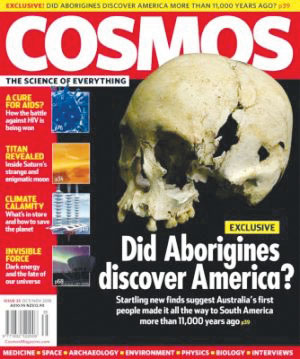
The headline of the Oct/Nov 2010 edition of Cosmos magazine and accompanying by-line, augmented by a photograph of an American skull (Luczia) exhibiting morphology that closely resembles Australian Aboriginal people. The oldest human skull unearthed in the Americas has cranial features similar to those of Australian Aborigines. Another piece of anomalous evidence pointing to an early human story, but largely ignored because it contradicts official scientific theory.
This is undoubtedly one of the most striking revelations ever made in the entire history of archaeology, as inexplicable as it is astounding. It does not mean that a few Australoid castaways accidentally washed ashore on Peruvian shores, then somehow traversed the formidable Andes Mountains and descended into Brazil’s totally different, but no less forbidding jungle, where they cohabited with a few, indigenous individuals.
Rather, DNA evidence signifies a mass-migration of Australo-Melanesians to Amazonia, where they interbred with native peoples on such a broad scale some ten and a half centuries ago, the genetic imprint is still discernible. Their epic, 12,940–kilometre, trans-Pacific voyage to coastal Peru and subsequent 1,890–kilometre trek to Brazilian rain forest were successfully achieved at a time when Western European Man was struggling to survive the challenging Upper Paleolithic, or Late Stone Age. Australia’s contemporaneous material culture was itself far too underdeveloped for undertaking anything even approaching an oceanic crossing of such magnitude, not only in terms of the extreme distances concerned, but especially regarding the large number of persons participating in the expedition, or expeditions.
The maritime technological requirements necessary for conducting an operation of transpacific scope alone rule out all possibilities for Australoid responsibility. Moreover, what conceivable motivation could have possessed them to attempt such a huge enterprise? Hancock wonders if a third party was involved – a different, unrelated, unknown, though far higher culture that, for reasons even more obscure, transported Australo-Melanesians to Amazonia.
Speculation like this begins to conjure ‘legendary’ Lemuria, the pre-Polynesian civilisation that rose to ancient heights of technological greatness and imperialist domination of the Pacific realm, before succumbing to a natural catastrophe sufficiently powerful enough to shake the very foundations of the Earth itself. Hancock, however, shies away from any Lemurian connotations.
Ancient Amazonia Rises Out of the Cleared Forests
Even so, America Before’s most valuable and original contribution to our deepening grasp of antiquity is its investigation of Amazonia, an area of the world hitherto neglected by conventional and alternative researchers alike. They traditionally laboured under the assumption that Brazil’s rain forest was always far too environmentally hostile for civilisation to have taken root there. Hancock cites the academic view “that the Amazon could only have been inhabited for about 1,000 years, and then only by very small groups of hunter-gatherers, since the jungle was ‘resource poor’.”
Among the very few archaeologists who personally challenged this dominant paradigm was Percy Harrison Fawcett. His disappearance in search of the lost city of Z during 1925 seemed to confirm consensus opinion that no such place could possibly exist in the Brazilian jungle, and America Before is remiss in failing to properly credit or even mention in passing the British Colonel, whose self-sacrificial, if percipient effort foreshadowed the very discoveries Hancock describes in Chapters 11 through 17.
Together with the two previous chapters detailing Amazonia’s genetic connection with Ice Age Australia, they combine to represent the book’s highest worth. Nowhere else may readers learn more about the Amazon Basin’s otherwise unknown archaeological wealth.
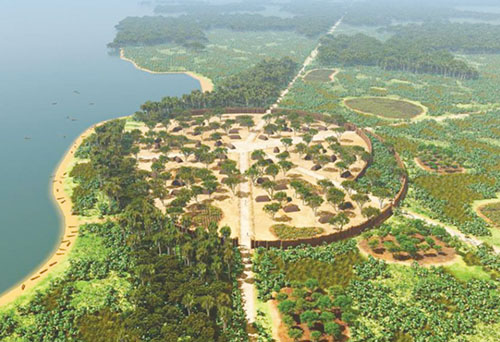
An artist’s conception shows a Xinguano village of the Brazilian Amazon as it might have appeared before 1492. An example of how the Amazon was once likely inhabited by hundreds of thousands of people in numerous well-managed cities, towns and villages. Archaeologists have found traces of wide, curbed roads and managed parklands.
He tells how the first modern Europeans travelling the Amazon River from Ecuador to its estuary on the Atlantic coast of Brazil saw “great cities” that “glistened in white” (suggesting limestone construction, like that favoured by Maya construction engineers) during their 7,000-kilometre, seventeen-month journey. Some of these urban centres were “more than twenty kilometres from end to end, roughly the length of Manhattan… enormous expanses were given over to productive agriculture, and there were signs everywhere of large and well-organised political and economic systems linked to centralised states that were capable of fielding disciplined armies thousands strong.”
Hancock quotes the mid-16th century expedition’s Spanish chronicler, Dominican friar Gaspar de Carvajal, concerning an abandoned, native “villa, in which were a great deal of porcelain ware of various makes, both jars and pitchers, very large, with a capacity of more than twenty-five arrobas [one hundred gallons] and other small pieces such as plates and bowls and candelabra of this porcelain of the best that has ever been seen in the world, for that of Malaga [Spain’s centre for pottery production] is not its equal, because this porcelain which we found is all glazed and embellished with all colours, and so bright, that these colours astonish, and, more than this, the drawings and paintings which they make on them are so accurately worked out that one wonders how with only natural skill they manufacture and decorate all these things making them look just like Roman articles.” Native porcelain of such high quality does not appear in Brazilian archaeology.
The largest native city Carvajal and his companions saw was greater than twenty kilometres in extent, with a population of twenty thousand or more residents. Their chieftain, Machiparo, also ruled over “many settlements and very large ones, which together contribute for fighting purposes fifty thousand men…”
Two, subsequent expeditions, twenty years later and 1637-38, respectively, supported Carvajal’s report. Hancock quotes UCLA Professor David Wilkinson, “an authority on long-term and large-scale phenomena in world politics [who] has made a special study of the level of civilisation in the Amazon prior to European contact.” Based on a late 17th-century report that one of Brazil’s native cities could field 60,000 warriors, Wilkinson found “comparative-civilisational standards have implied an urban population of 300,000 to 360,000.”
He goes on to describe “more than 30 epidemics – smallpox, measles, and other outbreaks – some on a massive scale – in 16th-18th century South America.” With fatal consequences in the upper ninety percentile, the Amazonian metropolitan areas literally died out though depopulation. “Once left deserted,” Hancock explains, “the great cities and monuments and other public works of any hypothetical Amazonian civilisation would quickly have been encroached upon and soon completely hidden by the jungle…” They only began re-emerging in 1977, “when giant, geometrical earthworks were discovered in the Rio Branco area of the Brazilian state of Acre, in the southwestern Amazon.”
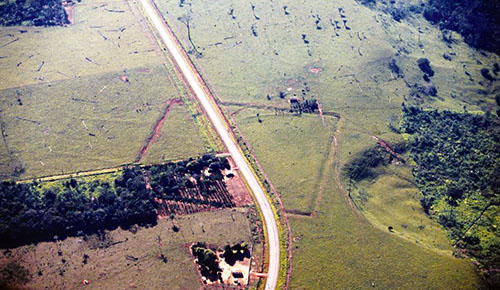
It was the first of many related sites that have since come to light, including a pair of perfect squares – 200 metres and 100 metres wide – connected by a 20-metre-wide, 100-metre-long causeway. Archaeologists estimate “that as many as 1,500 geoglyphs might ultimately be found.” Severino Calazans, the largest Amazonian structure of its kind so far surveyed, “defined by an enclosure ditch twelve metres wide, measures 920 metres.” This particular location and other, outsized designs “have since been revealed by mass clearing of the forest for the cattle industry, thus becoming visible, especially from the sky, over the past 30 years. Indeed, the enormous size of the geoglyphs makes it easier to distinguish their shape and configuration from an aerial perspective, than at ground level…”
Groups are composed chiefly of circles, ellipses and rectangles, suggesting possible celestial orientations. Hancock writes that “because they offer an unobstructed view of the horizon, such locations are also very often what ancient astronomers looked for when they set out monuments on the ground – aligned, say, to the June solstice sunset or to the March equinox sunrise. Without a full-scale archaeo-astronomical survey of the Amazonian geoglyphs,” however, their suspected celestial significance remains unproven.
Their resemblance to Old World Stone Age sites nevertheless inspires provocative comparisons. Hancock tells how “the square enclosure ditch at Severino Calazans shares the ground plan, base diameter and cardinality [orientation to the Four Cardinal Directions] of the Great Pyramid of Egypt. That epoch, moreover, around 2500 BC, coincides and overlaps with the megalithic epoch in Europe, so another curiosity is the way that the circular geoglyphs of Amazonia resemble henges – the circular embankments with deep, internal ditches that surround the great, stone circles of the British Isles. The scale is very similar and the resemblance is so obvious that even the most sober archaeologists, usually wary of cross-cultural comparisons, are willing to remark upon it.”
The Severino Calazans site, formed by a single square-shaped ditch, is cut and partially destroyed by Highway BR-317. A farm has been built inside the area enclosed by the ditch. Indigenous people consider the earthworks sites as sacred and do not use them for housing. (Photograph by Sanna Saunaluoma)
Whatever critics may make of America Before, they cannot deny that its unique discussion of the lost civilisation of the Amazon, plus revelations concerning the mind-boggling heritage of its present-day descendants from 9th millennium BCE Australia, opens new vistas of antiquity, as trailblazing, as they are intriguing.
America Before is available from all good bookstores.
[alert type=”general” dismiss=”no”]This article was published in New Dawn 175.[/alert]
[alert type=”success” dismiss=”no”]If you appreciate this article, please consider subscribing to help maintain this website.[/alert]
In December 2017 the New York Times released two videos of UAPs, or “unidentified aerial phenomenon” – a more official-sounding term for what most of us call UFOs or flying saucers. Both videos, now widely circulated on YouTube and various news outlets, show footage from an F-18 aircraft’s gun camera which has locked on to a mysterious disk-like object.
The monochrome tracking screen shows an indistinct ‘craft’ travelling at technologically impossible speeds and is accompanied by the pilot’s excited commentary. Perhaps the most disturbing part is that the US Navy validated the footage as the real deal, and not some hoax or misidentification. This has left many professional sceptics and debunkers with a tough nut to crack. True believers have celebrated the footage, seeing it as a significant step in full public disclosure of the reality of UFOs and extraterrestrials.
The rest of us are left feeling bewildered over an enigma that remains unexplained but also by its very nature seems fundamentally unanswerable. We have been presented with a true mystery, one that shows no signs of leaving us alone any time soon.
This remarkable new footage, says philosopher and journalist Daniel Pinchbeck, has moved the UFO phenomenon from the outer edges of public awareness to the centre. In his latest book, The Occult Control System (2019), Pinchbeck explores ways to understand the UFO mystery in a psychological and spiritual framework. He argues the UFO is fundamentally “unpresentable, unfathomable” but if we are to understand it and successfully neutralise its “implicitly threatening aspects,” we must define a “conceptual model that gives shape and coherence to the phenomenon.”
The new resurgence of interest in the UFO, sparked by the NYT article and other developments, finds us in an enviable position to think anew about a mystery that has haunted our skies and psyches for over half a century. Where do we begin?
The Birth of a Mystery
Ever since the ‘official’ birth of the enigma, with Kenneth Arnold’s famous 1947 sighting of nine shiny disks zooming past Mount Rainer in the far north west of the United States, the mystery of the UFO has evolved and expanded at a dizzying pace. Related subjects now include crop circles, alien implants and abduction, genetic experimentation and extra-sensory perception. Undoubtedly there is a haunting question mark lingering over its existence and forming a vacuum for the human mind to wonder, speculate, and, perhaps most commonly of all, to project its fears and dreams.
Indeed, the famous Swiss psychologist Carl Jung pioneered this view in his 1959 book Flying Saucers. Jung argued that the “strange contents” of the UFO enigma “cannot be integrated directly [into the psyche] but seek to express themselves indirectly” and as a result “[gives] rise to unexpected and apparently inexplicable opinions, beliefs, illusions [and] visions.”
The UFO had become an aspect of human consciousness, a crack in the veritable mirror of our collective mind.
Human Consciousness and its Symbols
“Human consciousness is not static,” says philosopher Jeremy Naydler, PhD. We might add neither is the UFO phenomenon. As the two intertwine, we are offered a unique glimpse into our evolutionary potential, and an opportunity to investigate and integrate not only the phenomenon’s import, but also those deepest parts of ourselves.
After over a decade studying ‘alien abduction’ experiences, Harvard psychologist John E. Mack, MD, discovered that such jarring and often traumatising experiences often led to witnesses and experiencers discovering a new “world of symbols and archetypes that take them far beyond the level of everyday psychological or material reality.” In other words, the UFO or abduction experience initiates a profound shift in human consciousness that has more in common with visionary indigenous shamanism or Christian and Indian mysticism, than with our scientific-materialistic worldview.
In his final work, Passport to the Cosmos (1999), Mack interviewed a UFO witness and abductee pseudonymously called ‘Sue’. She said that whatever intelligence is behind the phenomenon, it uses our culture’s symbols to draw attention to itself (or disguise itself) while simultaneously drawing us into examining our own preconceptions and consciousness. She stated there are “universal symbols” from what Jung called the collective unconscious, and there are also civilisation-specific symbols reflecting “whatever is in human consciousness at the time, whatever’s most appropriate.” A scientist, she argued, would perceive the UFO and its entities as engaged in a gigantic experiment, involving us biologically and physically, while a religious person would likely perceive them as angels on a spiritual mission.
The ‘abduction’ phenomenon associated with UFOs is what we might call its most inner experience, and the closest we come to understanding the deeper symbolic and psychological nature of the UFO. And more importantly, its relationship to consciousness.
Often, these abductions are reported to have an ultra-real quality and yet, paradoxically, they exhibit a ‘high-strangeness’ that frustrates our ordinary understanding of time, space and even meaning. Furthermore, ufologist Jacques Vallee noted direct similarities between the fairy folklore of Northern Europe and the UFO/abduction phenomenon. Both have strange lights, ‘missing time’ episodes, and reports of being taken into strange worlds with alien-like entities that appear to be occupied by bizarre and inexplicable activities, including the creation of a new race of human-fairy hybrids.
The UFO and Cosmic Individuation
As we delve deeper into the mystery of consciousness, we meet the strange, the repressed, the uncanny, surrealistic and mythological. Entire new realities open before us, populated by unknown entities that we did not know to exist in our ordinary state of consciousness. Consciousness appears to be fundamental, even foundational. As attested by the strange and mind-bending world of quantum physics, it reaches right down to the very building blocks of reality itself.
Max Planck, the father of quantum physics and winner of the Nobel Prize in Physics, observed in 1931: “I regard consciousness as fundamental. I regard matter as derivative from consciousness. We cannot get behind consciousness. Everything that we talk about, everything that we regard as existing, postulates consciousness.”
The notion that our minds are part of a greater reality places each of us in what we could call “participation consciousness.” For not only do we effect the very subatomic substrate of all matter by simply observing it – proven in experiments by way of the observer effect in which particles only become particles upon the act of observation (technically known as wave function collapse) – we also participate in the themes and archetypes of our culture or what Jung called the “collective unconscious.”
The collective unconscious is essentially the myth-making mainframe underlying human consciousness. It shapes, informs and challenges the development of humanity’s collective psyche. As we have seen, it also appears to interpenetrate other realities with their respective ‘entities’ and independent intelligences. Through dreams, visions, mystical insights, and even alien ‘abductions’, these other modalities of consciousness provide a telescope into an inner universe rich and varied as our everyday reality.
In his remarkable book, Meaning in Absurdity, the Dutch computer scientist and philosopher Bernardo Kastrup [see his interview on page 9 of this issue] provides an exciting theory that bridges the gap between the complex world of quantum physics and deeper realities found in the depths of human consciousness:
[I]nsofar as reality is a reflection of the psyche and the process it undergoes, we must confront the startling implication: nature itself must undergo a kind of “cosmological individuation” by means of which unconscious meta-realities progressively emerge in awareness and get absorbed into consensus meta-reality.
Kastrup posits that the UFO is a fundamental part of our cultural myth-making process, and as an instrumentality essential for our “cosmological individuation.” The UFO may represent the unconscious aspect of our culture – the rejected, the Other, the mysterious. Our bewilderment is due to a blind spot built into the reductive, scientific-materialistic paradigm. Our struggles to understand the phenomenon reflects precisely our stresses to integrate and absorb its sheer implications, while its presence grows by deliberately frustrating the limits of our worldview.
Novelist Ian Watson offers an excellent demonstration of what he calls “UFO Consciousness” in Miracle Visitors (1978). For Watson the UFO is not simply a physical event but an evolutionary agent working closely alongside human evolution. Although Watson writes science fiction, the novel sketches out a remarkably grand theory of both the UFO mystery and the nature of evolution.
Reflecting on the phenomenon’s evolutionary implications, the novel’s protagonist focuses on the absurdity and sheer strangeness that often accompanies the anomalous, which he calls its “inaccessibilities,” noting these frustrations of logic may cause “a fierce suction towards ever higher patterns of organisation, towards higher compression.” He continues, using the example of biological evolution for the formation of mind:
So molecules become long-chain molecules, and these became replicating cells that transmitted information… till mind evolved, and higher mind. The universe, he realised, was an immense simulation: of itself, by itself. It was a registering of itself, a progressive observation of itself from ever higher points of view. Each higher order was inaccessible to a lower order, yet each lower order was drawn towards the higher – teased by the suction of the higher.
Human consciousness is involved in an ascent towards more self-awareness and self-directed evolution. According to some quantum physicists, and thinkers like Kastrup and Watson, the universe is consciousness, and we humans represent one of nature’s most formidable spearheads into the world of matter. With our growing awareness of the fundamental, ever-present nature of consciousness, we are slowly actualising Kastrup’s “cosmological individuation” in which humanity realises that consciousness is primary, before matter, and not merely a random epiphenomenon of biological evolution.
In The Holotropic Mind, psychologist Stanislav Grof, MD cites the remarkable case of a philosophy professor who entered a non-ordinary state of consciousness and met with a mysterious Council of Cosmic Elders. Describing this collective ‘intelligence’ as responsible for our entire universe, he relates how this intelligence must teach the human being how to receive its knowledge. He then says: “Since this intelligence is nothing other than your own being, it is a matter of learning how to be awake at more and more levels of ‘your’ own being, or Being itself.”
One of the world’s most famous UFO witnesses and abductees, Whitley Strieber, once stated that the whole phenomenon may be what the “force of evolution looks like when it is applied to a conscious mind.”
The implications are staggering and wide-ranging. Why does the phenomenon take these guises? How do we better “integrate” its threatening aspects, as Daniel Pinchbeck pointed out at the beginning of this article? And what larger implications does this have for human existence?
A Convergence of Worlds
While researching my book on the UFO phenomenon, Evolutionary Metaphors, I turned to many of the classic works in the field and sought out satisfying theoretical models to answer this truly anomalous incursion into our culture. The more I read, the more human consciousness became my focus.
Each witness, abductee, or psychologist like Carl Jung, John E. Mack and Stanislav Grof, emphasise our modern culture’s limitations in regard to the human mind’s relationship to the cosmos. Our scientific culture treats consciousness as far too passive. Its methodology rejects human-centric visions as mere subjectivism and does away with any notion that the universe is intrinsically meaningful. Of course, positing that the cosmos is meaningless can also be regarded as a projection, an assumption. This is a quandary that the philosopher Richard Tarnas amusingly called our “hubris of cosmic proportions.”
The UFO phenomenon’s connection to consciousness seems fundamental due to its disregard of our epistemological and ontological boundaries, as it frustrates, turns inside out, and crosses beyond the thresholds of everyday believability. The entities or aliens associated with the mystery often exhibit miraculous powers and extra-sensory perception. Mack commented that it “represents a kind of return of the repressed that is ‘designed’… to break down this separation” between two worlds – seen and unseen – and allow us glimpses into a far richer reality of significance, mystery, and meaning.
Studies of UFOs often point to the inadequacy of our conceptual models and that our political, ecological, spiritual, and scientific paradigms are all back-to-front. The reason for its steady presence in our culture may be a calling card for us to address these limitations. But paradigm shifts are slow, and for decades we have attempted to fit the UFO into pre-existing categories. The result is we are consistently left unsatisfied and baffled when new and stranger evidence turns up.
This story has turned in the direction of the mysterious and unknown – towards unseen dimensions and deeper aspects of human consciousness. If the UFO has taken up a disguise, then it may be precisely in aspects of reality and the human mind that we have rejected. Almost dutifully, this persistent mystery keeps exhibiting cases that cannot be explained in our present paradigms. The problem of integration therefore becomes a problem of our evolution, for only when we make the leap into a new way of seeing, a new way of being, may our consciousness untangle the mystifying and sometimes terrifying logic of the phenomenon.
The human mind appears to be multi-storeyed, with a basement and an attic with a view out onto the entire universe; that we are intimately connected is evidenced in quantum physics. At the same time, we exist in a culture that emphasises a passive form of human consciousness. A belief, nevertheless, that is slowly being eroded by our growing recognition of the fundamental relationship of consciousness to reality itself.
In this context, we can consider the UFO as a symbol within the vast spectrum of consciousness, beckoning us to investigate ourselves, our culture, and our presumptions about reality. Perhaps the connection between the two – the UFO & Consciousness – is the bridgeway not only into ourselves but also toward an entirely new paradigm that recognises consciousness as foundational to existence as the Sun is to life on Earth.
Shamans, mystics, occultists, and even revolutionary psychologists recognise that the human mind pans out into worlds unseen. Our role may be to evolve and breach the constricting barriers of an outdated worldview. For one day, when human consciousness blossoms into the super-spectrum of realities seen and unseen, we too could become walkers between worlds, to appear like mysterious lights in the heavens.
David Moore’s book Evolutionary Metaphors: UFOs, New Existentialism and the Future Paradigm is available from all good bookstores.
Many New Dawn readers are familiar with Andrew Collins, the British writer and researcher specialising in books that “challenge the way we perceive the past.” He is a pioneer in the study of archaeoastronomy – ‘the science of stars and stones’ – the designed correspondences between prehistoric monuments and celestial patterns. In fact, Andrew Collins has become a leading player in the continually evolving field of the origins of civilisation
A central theme of his books is that the Watchers and Nephilim of Enochian literature, as well as the biblical ‘fallen’ angels and Anunnaki of Mesopotamian mythology, are memories of an elite group that helped forge the foundations of civilisation in Anatolia and the Near East. He asserts that this same region, particularly eastern Turkey, was the site of the biblical Garden of Eden and terrestrial Paradise.
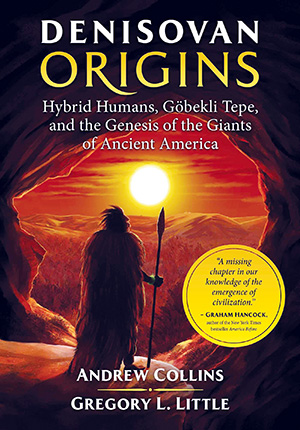
In this exclusive interview for New Dawn magazine, Andrew Collins talks about his new book, co-written with Gregory L. Little, Denisovan Origins: Hybrid Humans, Göbekli Tepe, and the Genesis of the Giants of Ancient America, and lots more.
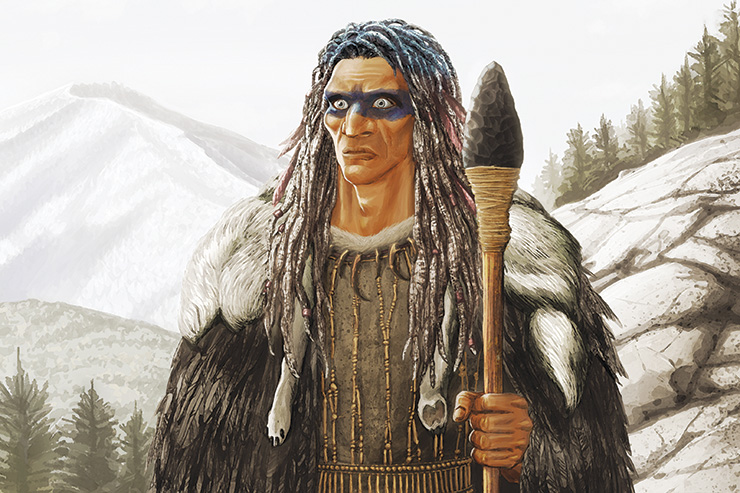
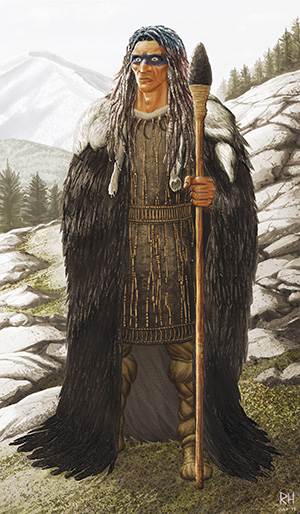
Reconstruction of a Denisovan-modern human hybrid. Artist credit/copyright: Russell M. Hossain
BRETT LOTHIAN (BL): In your new book Denisovan Origins: Hybrid Humans, Göbekli Tepe, and the Genesis of the Giants of Ancient America, you quite aptly begin with the paradigm-shattering findings at Göbekli Tepe. Can you explain Göbekli Tepe and how it changes our understanding of human history?
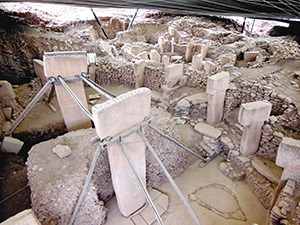
ANDREW COLLINS (AC): Göbekli Tepe is arguably one of the most important archaeological discoveries of the twenty-first century. It is a series of stone enclosures with rings of carved T-shaped pillars facing two large monoliths standing at their centres, like twin gateways into some invisible liminal realm. Located on a mountain top in SE Turkey, Göbekli Tepe was built enclosure by enclosure between 11,600-10,000 years ago. Thereafter the site was abandoned, its inhabitants spreading out across Anatolia and the Near East, and eventually into Europe, creating what is known as the Neolithic revolution.
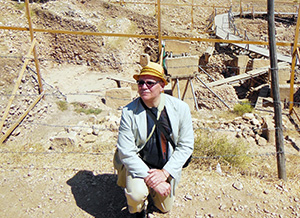
Andrew Collins at Göbekli Tepe (copyright: Andrew Collins)
Göbekli Tepe’s importance is its immense sophistication and the fact that it constitutes the world’s earliest known monumental architecture. Of even greater importance is that it shows us that, even by this age, modern humans had tiered hierarchical societies able to pull off incredible feats of engineering. The question then becomes: Who built it and why?
For me, it existed as part of a response to the cataclysmic events surrounding the Younger Dryas comet impact event of approximately 10,800 BCE. Caused most likely by multiple fragments of Comet Enke entering the upper atmosphere, air blasts triggered unimaginable wildfires across the Northern Hemisphere. The ash, smoke and debris rising into the air brought about a nuclear winter that instigated a 1,200-year long mini-ice age that gripped both the American and Eurasian continents and did not end until 9600 BCE, the very time frame of the construction of Göbekli Tepe.
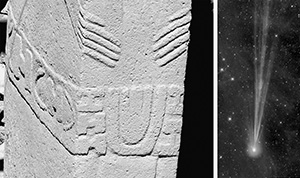
Göbekli Tepe’s Pillar 18 showing its three-tailed comet motif as a belt buckle, next to which is a comet with three tails. (Copyright: Andrew Collins)
There is very clear comet imagery on one of the standing monoliths at Göbekli Tepe which tells us that its purpose was to create a place of easy access to the sky world, which was thought to lie in the northern part of the heavens. Here the supernatural creatures thought to be responsible for such cataclysms were seen to roam, their arrival in the skies marked by the appearance of comets.
These were ideas I first proposed in my 2014 book Göbekli Tepe: Genesis of the Gods. I am now pretty sure they are correct as they have now been adopted by other researchers in this field, who also see the construction of Göbekli Tepe as a response to the Younger Dryas comet impact event.
Göbekli Tepe’s Enclosure D with Enclosure C behind. (Copyright: Andrew Collins)
BL: The enigmatic Denisovans are the most recently discovered additions to the Homo genus. Can you tell us what we know about these mysterious archaic hominids?
AC: The Denisovans were not even known about before 2010. It was in this year that a small fragment of finger bone, found two years earlier during excavations at the Denisova Cave in the Altai Mountains of Siberia, was sequenced. It was determined the bone came from a girl of around 13 years old who lived approximately 50,000 years ago. The uniqueness of the individual’s genome made it clear she belonged to a previously unknown hominin group that would thereafter be known as the Denisovans after the place of their discovery (incidentally, ‘Denisovans’ is correctly pronounced dee-niss-o-vans and not denis-o-vans). The exact status of the Denisovans does, however, remain undecided since some scholars are convinced they are simply an early form of Homo sapiens, and not a unique human type, the reason why they have so far not been given their own species name.
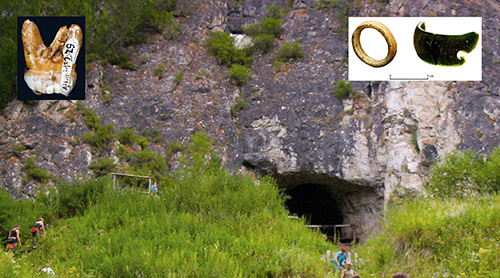
What the so-called Altai Denisovan genome also made clear was that this unique human group shared more gene alleles with Neanderthals than they did with modern humans, leading to the surmise that the Denisovans must have been a sister group of the Neanderthals. This conclusion was backed up in 2016 with the discovery during excavations at the Denisova Cave of two fragments of a Denisovan skull that was particularly robust like that of Neanderthals and other early hominins. Even earlier, the discovery, again at the Denisova Cave, of two enormous molars had also suggested the Denisovans would be found to be particularly robust in nature. However, this is now known to be only part of the story, for a recent examination of the finger bone of the 13-year-old Denisovan girl who lived 50,000 years ago makes it clear that the Denisovans had long, gracile fingers like those of modern humans. This means there is every chance they looked more like us, and also perhaps thought more like modern humans that they did Neanderthals.
The Denisova Cave in southern Siberia with inset, left, one of the large Denisovan molars found there and, right, the so-called Denisovan bracelet found in the same occupational layer.
What is more, evidence of a sophisticated mindset existing in connection with the Denisova Cave’s Denisovan layer had already been noted. This stems from the discovery of the beautiful choritolite (chlorite) arm bangle dubbed the Denisovan bracelet, which shows evidence of sophisticated drilling, sawing and polishing, along with the earliest known bone needles used to make tailored clothing. In addition to this, fragments of a bone whistle or flute were found in the cave’s Denisovan layer, telling us that the Denisovans must have had an understanding of music, while more recently archaeologists working at the cave found an ochre “pencil” with evidence of usage. This suggests that the Denisovans were able to write and draw. The discovery of horse bone fragments and equine DNA suggested to some scholars that the Denisovans might even have domesticated and ridden horses.
All this implies that certainly by 45,000 years, and arguably earlier, the Denisovans displayed immense technological capability and advanced human behaviour. It is also now thought they developed what is known as blade tool technology, which is the product of a complicated process known as pressure flaking. This is where a handle-like instrument, usually made of bone, antler or wood, is applied to a prepared stone core to literally prise off long, slim blades or bladelets.
This blade tool technology, which started its life in southern Siberia and northern Mongolia, was then carried westwards across the Ural Mountains into Europe, as well as into southwestern Asia, where it was introduced to the Pre-Pottery Neolithic world of southeastern Anatolia around the same time that Göbekli Tepe came into existence. This recorded path of blade tool production suggests that the ancestors of those who built Göbekli Tepe came not just from the north, beyond the Caucasus Mountains on the Russian steppe, but from much farther east – beyond the Ural Mountains in western Siberia somewhere. It is even possible they came from as far away as the Altai Mountains of southern Siberia, where the Denisova Cave is located, or even northern Mongolia, close to the great inland sea called Lake Baikal.
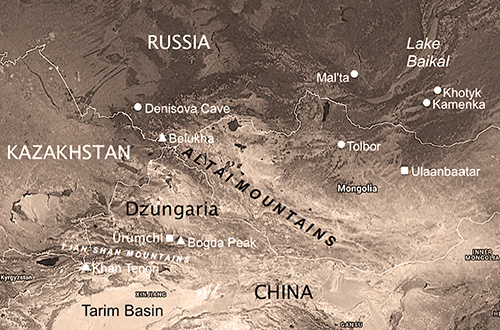
Map of Siberia and Mongolia showing the location of the Denisova Cave and other sites mentioned in this article. (Copyright: Andrew Collins)
Archaeologists now believe our earliest ancestors first encountered Denisovans and Denisovan-Neanderthal hybrids somewhere in northern Mongolia around 45,000 years ago. Sites in this region such as Tolbor-16 show evidence of modern human occupation, and yet they also have the same high culture associated with the Denisovan layer in southern Siberia’s Denisova Cave. This, then, is where our own slow rise to civilisation began at the beginning of the Upper Palaeolithic epoch.
BL: DNA evidence reveals that ancient modern humans interbred with not only the Denisovans but the Neanderthals and as yet unidentified archaic hominids. Can you explain this complex web of interactions and how modern humans have benefitted from this gene flow?
AC: What becomes clear is that both the Denisovans and modern humans must have gained their gracile fingers from the same source, a common ancestor of both populations from whom we split around 700,000 years ago. If correct, then it means that the stubby, blunt-ended fingers displayed by Neanderthals only developed after they split from the Denisovans some 400,000 years ago (and arguably earlier still).
All this gave every branch of hominin – Denisovans, Neanderthals and modern humans – the chance to develop their own unique genome, which helped engineer their physical appearance, capabilities, and material culture. By around 45,000 years ago, the Denisovans were out in front with an acute level of human development, suggesting that as we encountered them in places like northern Mongolia, we not only interbred with them but also at the same time gained their technologies and understanding of our relationship to the cosmos. This, then, would have been the legacy passed down through their hybrid descendants to the founders of human civilisation.
Girl from Papua New Guinea. It has been found that six per cent of the Papuan population contains Denisovan DNA. Other groups categorised under the Australo-Melanesian genome, such as Australia’s Aborigines, also have higher amounts of Denisovan DNA.
After this time the Denisovans disappear from the scene, in Siberia and Mongolia at least. However, one recent genetic study suggests that some Denisovan groups might have survived in Island Southeast Asia and Melanesia through till as late as 15,000 years ago. This tells us that the sophisticated Denisovan mindset might well have been behind the spread of Australo-Melanesian ancestry from Island Southeast Asia all the way across South America, where both Australo-Melanesian and Denisovan DNA has been found among certain tribes of the Amazon.
BL: A key theme of Denisovan Origins is how cultural and technological exchange – the interaction and hybridising of archaic hominids such as the Denisovans – influenced modern humans. In your opinion, how did this flower human civilisation?
AC: What the evidence is beginning to tell us is that the Denisovans were truly sophisticated in many ways – they created beautiful jewellery, almost certainly wore tailored clothing, used musical instruments, and may even have ridden horses. On top of this, there is every possibility that they were sea voyagers, and might well have travelled between Island Southeast Asia and the Americas, South America especially. All of these technologies were thereafter passed on to their hybrid descendants, who carried them out to the farthest reaches of the Eurasian continent. Yet it is the Denisovans’ apparent invention of blade tool technology that becomes crucial in telling us exactly how far their legacy reached and which cultures benefitted from it.
The westward pulses of Denisovan technology would eventually flower among the Eastern Gravettians of central-western Russia at key sites such as Kostenki and Sungir. From these sites, as well other settlement areas in places like the Czech Republic, the Denisovan legacy was carried westward in western Europe by Proto-Solutrean groups, from whom emerged the Solutreans of southwestern Europe. Also benefitting from the Denisovans’ blade tool technology were the much later Swiderian and Post-Swiderian groups, who thrived just before, during and immediately after the Younger Dryas impact event of circa 10,800 BCE.
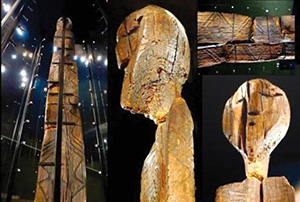
The 11,600-year-old Shigir idol found in a peat bog in the Middle Urals in 1894, which has been linked to the contemporary Pre-Pottery Neolithic culture of Göbekli Tepe in southeastern Anatolia.
It is the Swiderians who I believe came to bear on the Pre-Pottery Neolithic peoples of southeastern Anatolia, resulting in the rapid emergence of Göbekli Tepe circa 9600 BCE. You can see clear similarities between the carved art of Göbekli Tepe and that being produced around the same time by Mesolithic peoples of the Ural Mountains. The 11,600-year-old Shigir Idol best exemplifies this connection. This is a carved wooden totem pole that was found alongside other fragments of similar idols in a peat bog in the Middle Urals in 1894. It is fashioned from an enormous tree trunk and was originally around 5.3 metres in height. The style of carving, particularly of the human heads it displays, bears striking similarities to some of the carved human heads unearthed at Göbekli Tepe. It is surely no coincidence then that the same blade tool technology found at Mesolithic sites in the Ural Mountains is also found at Pre-Pottery Neolithic sites like Göbekli Tepe. There was clearly a connection between these two very distant worlds as early as 9600 BCE.
BL: To this day, legends such as the destruction of Atlantis, floods of astonishing proportions and of the very sky itself falling, persist all over the world about a cataclysm on a scale we can barely imagine, which you date to around 10,800 BCE. Can you explain what happened and the evidence to support this?
AC: The Younger Dryas comet impact event occurred around 10,800 BCE. It was a devastating cataclysm that ignited as much as 10 percent of the world’s biomass. However, the cosmic events just kept coming, with further fragments hitting the Northern Hemisphere periodically for around 11 years, with some estimates suggesting they continued through until around 11,340 BCE; this being at least 500 years after the initial impact event.
What we can say is that the termination of the Younger Dryas around 9600 BCE coincides almost perfectly with Plato’s proposed date for the destruction of Atlantis, and also the emergence of Göbekli Tepe in southeastern Anatolia.
BL: After the Earth-shattering events of the Younger Dryas impact, the way humans think – our social organisation and how we interact with the environment – was forever altered in many parts of the world. Can you explain these drastic changes and how they still impact us today?
AC: Understanding why Göbekli Tepe was built so soon after the Younger Dryas episode can be shown to relate to the state of mind prevailing among indigenous populations in the wake of this terrible human tragedy. Those that did survive would have feared it would happen again, and next time the world really would come to an end. Paranoia of this kind would have been widespread.
Visionary writer Barbara Hand Clow has aptly termed this fragile state of mind catastrophobia, the fear of further catastrophes. I think she is entirely right in not only predicting the existence of catastrophobia, but also in the way it would have affected generations of humanity for many thousands of years afterward.
How could you prevent catastrophobia from eating at the heart of a community every time a comet appeared in the skies? There were no psychoanalysts or counsellors back then who could offer advice on how best to overcome this problem. There were, however, go-to people who would have been considered able to allay the fear of further catastrophes. These were the complex individuals known as shamans. They can act as human interfaces between the world of the living and a perceived otherworld existing beyond the normal senses, and accessible only through dreams, visions, and the achievement of altered states of consciousness.
Shamans are able to induce trance-like states to propitiate, appease or negotiate deals with, among other things, the supernatural creatures seen as responsible for malefic intrusions into the physical world. This includes the appearance in our skies of comets, which in many ancient societies were seen as harbingers of death and destruction. Supernatural creatures of this type were generally considered animistic in form, most obviously monstrous canines (dogs), lupines (wolves), and vulpines (foxes). Comets were also associated with snakes, which in myth and legend are occasionally seen as responsible for natural catastrophes associated with impact events.
BL: Of particular interest to our more esoterically minded readers is the belief system, cosmology and spiritual practices of the “shamanic elite” that are central to your theories – the enigmatic bird shamans?
AC: From the Upper Paleolithic age through till Neolithic times, there appear to have been certain universal principles in cosmology that were reflected not only in shamanic beliefs and practices but also in ideas regarding both the origin of the soul and its destination in death. They featured the Milky Way as a kind of road or river along which the souls both of the deceased and those of shamans would take to reach an afterlife among the stars. Such beliefs were universal in both the Eurasian continent and in North America. For these beliefs to have existed simultaneously on both continents means they must be at least 12,000 years old, and arguably much older still, for it was shortly after this time that the Beringia land bridge linking the Russian Far East with North America was drowned beneath the waters of the Beringia Sea. After this time there would have been no widespread contact between the two continents.
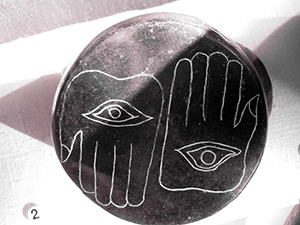
Orion as a double hand symbol as seen on a ceramic platter in the museum at Moundville, Alabama. The “eye” in the centre of the hand is almost certainly the M42 nebula in the sword of Orion. This was seen as an “ogee” or portal onto the Milky Way. (Copyright: Andrew Collins)
As many as 30 to 40 Native American tribes of North America share a belief in what can only be described as the Path of Souls death journey. This involved a leap of faith at the time of death (either for the deceased or the shaman in a death trance) towards a portal located where the ecliptic, the sun’s path, crosses the Milky Way on one side of the sky. This portal was located generally in the Orion constellation, with the Messier object named M42 in the ‘sword’ of Orion being singled out for this purpose, or in the Pleiades star cluster located in the constellation of Taurus, the bull. The first appearance of the Pleiades following a period of absence each year signalled the beginning of a new year or season on both the American and Eurasian continents. It was a perfect timekeeper, and so must have become important to ancient peoples at a very early date.
From here the soul was thought to travel along the Milky Way sometimes going to the south, and even directly beneath the earth until it would eventually turn northward and reach a point where the starry stream split into two separate branches. Each branch symbolised one of two possible outcomes for the soul: one led to the afterlife, while the other led only to oblivion (or at best reincarnation). A supernatural figure standing at the fork in the Milky Way would pass judgment on the soul. It could be male or female, although most usually it was a supernatural bird or birdman, which went by the appealing name of Brain Smasher or Skull Crusher. Its purpose was, we believe, to liberate the spirit of the person trapped inside the soul in its form as a skull or head. This enabled the freed spirit to enter the afterlife proper. As Graham Hancock points out in his new book America Before, a very similar skull crushing figure stood at the same position in the soul’s journey in ancient Egyptian tradition.
These ideas are connected with the age-old belief that the seat of the soul was located in the head, the reason why the skulls of deceased peoples were revered during the prehistoric age as points of contact, not just with its former owner, but also with any ancestor associated with the person’s familial line.
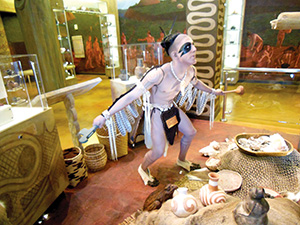
Mississippian era shaman dressed as a birdman representing the character Brain Smasher encountered on the Path of Souls cosmic death journey. In the sky, Brain Smasher is identified with the constellation of Cygnus, the celestial bird. (Copyright: Andrew Collins)
Brain Smasher in Native American tradition was almost certainly identified with the Cygnus constellation, which is positioned exactly where the Milky Way splits into two separate branches. Almost universally, Cygnus is seen as a sky bird. What species it takes varies from country to country. Across most of the Eurasian continent it is usually seen as a swan or goose flying down the Milky Way. In southwestern Asia (Armenia and ancient Greece in particular) it was the vulture, while in North America it was very often a large raptor or vulture. Among the Algonquian-speaking peoples of the Great Lakes-St Lawrence River region, it was a crane, goose, as well as the Thunderbird.
The one thing these birds have in common is that they were all considered soul birds – vehicles for the soul to travel from this world to the next, and then, when required, back again to the world of the living. It is most likely for this reason that bird-related paraphernalia, such as bones, skulls, feathers and talons have been incorporated into the ritual clothes of shamans since the age of the Neanderthals.
BL: A large part of Denisovan Origins focuses on the peopling of the Americas, where you and your co-writer Gregory L. Little propose a radical re-thinking of the established paradigm. Using both archaeological and DNA evidence, you both skilfully paint an entirely new and far more interesting picture of America’s ancient past, even explaining the mysterious finds of giants that the mainstream continually ignores. Can you give us a brief outline of this radical reinterpretation?
AC: Until recently North American anthropologists, palaeogeneticists and archaeologists all perpetuated the view that the First Americans came across from the Russian Far East some 15,000 years ago. They created what are known as Pre-Clovis bi-points, which with the emergence of the Clovis culture around 13,200 years ago would evolve eventually into the highly distinguishable Clovis Point.
This view has now changed. Firstly, a large number of Pre-Clovis sites have yielded types of stone tools and projectile points that have nothing to do with the later Clovis culture. Many of these sites are in the American Southwest suggesting a point of foundation in this region and not in the American Northwest, close to the former Beringia land bridge. Secondly, there is now overwhelming evidence from various genetic studies telling us that the picture is even more complicated, with migrations across the Beringia land bridge taking place as early as 24,000 years ago, while the presence of Australo-Melanesian DNA in South American tribes suggests further migrations to South America no later than 10,000 years ago.
Palaeogeneticists and archaeologists are unwilling to accept that peoples carrying Australo-Melanesian ancestry arrived in South America directly from Island Southeast Asia and Melanesia. Instead, they propose that Australo-Melanesian peoples must have embarked on an extremely arduous coast-hopping journey all around the rim of the Pacific until they reached the Aleutian Islands off Alaska, where Australo-Melanesian DNA has also been found among the indigenous Aleuts. From here they would have travelled down the Pacific coast of North America, finally entering South America.
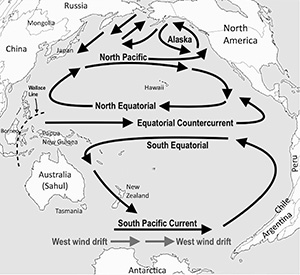
Map showing the ocean currents and prevailing winds that may well have determined transpacific journeys bringing both Denisovan and Australo-Melanesian ancestry to the Americas. (Copyright: Andrew Collins)
Such a theory can certainly explain the presence of at least some Australo-Melanesian ancestry in the Americas, although it makes far more sense to assume direct transpacific journeys as well, perhaps using the ocean currents and prevailing winds that would take a vessel from the northern coast of Sahul, the former continent embracing Papua New Guinea, Australia and Tasmania, past New Zealand and down to the Antarctic continent. From here the ocean currents would have carried a vessel toward the southern tip of South America, from where it would have been an easy journey northwards along the continent’s west coast, making landfall in what is today Chile, or along the continent’s east coast, making landfall in Argentina, Uruguay, or Brazil. Navigable rivers would then have permitted a vessel entry into the interior of South America, accounting perhaps for the presence of Australo-Melanesian ancestry among certain tribes of the Amazon. With all these journeys Denisovans or, more likely, Denisovan hybrids, would no doubt have been present, explaining the presence of Denisovan DNA in some South American tribes and populations.
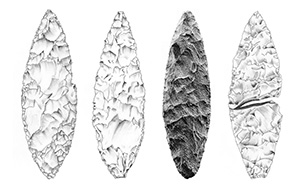
Solutrean points and Pre-Clovis points side-by-side. a) Upper Solutrean laurel leaf point from Fourneau-du-Diable, Dordogne, France; b) Solutrean laurel leaf point from Les Jean-Blancs, Dordogne, France; c) Cinmar point found on the Outer Continental Shelf off Chesapeake Bay, Virginia, in 1970, and, d) the point, fashioned from a stone type only found in France, discovered on Eppes Island, Virginia, in 1971. (Copyright: Andrew Collins)
Then there is the likelihood also of Solutrean peoples from southwestern Europe crossing the ice flows that spanned the entire Atlantic Ocean from northern Spain across to the area of the Chesapeake Bay on the Atlantic coast of the United States at the height of the last ice age circa 22,000-20,000 years ago. This might explain why a large number of Pre-Clovis bi-points have been found in the Chesapeake Bay area that closely resemble very similar so-called leaf points manufactured by the Solutreans of southwestern Europe between 22,000-17,000 years ago. One particular example of a Pre-Clovis projectile point found in the Chesapeake Bay area is even made of a type of stone only available in France.
The presence of Solutreans in North America is backed up by genetic evidence, particularly in the fact that a particular mutation of mitochondrial DNA (mtDNA) found extensively among the Algonquian-speaking peoples of the Great Lakes-St Lawrence River and known as haplogroup X is found also among the indigenous peoples of southwestern Europe, this being the former territories of the Solutreans. It is not found anywhere in the eastern half of the Eurasian continent, telling us that it did not enter North America from the Russian Far East.
In the book, I show that the Proto-Solutrean ancestors of the Solutreans came originally from as far east as Siberia and Mongolia and were most likely North Asian in origin. This is important since there is every reason to suspect they were carrying at least some Denisovan ancestry, as well as haplogroup X. Such a surmise makes perfect sense of the fact that the Algonquian-speaking peoples with the highest incidence of haplogroup X, the Ojibwa and Cree, also have the highest incidence in North America of Denisovan DNA, something that surely cannot be coincidence.
BL: In Denisovan Origins, you explain how the minds of the Denisovan and the Neanderthal hominids likely worked differently to that of our own. How do you think these hominids differed from us mentally and what advantages did this give them?
AC: There is good reason to suspect that the Denisovans had a completely different mindset to that of modern humans – one that acted almost like that of someone who would today form part of the autistic spectrum. If so, then some of their number might well have displayed what is known as savant syndrome, enabling them to advance quicker than their western counterparts, the Neanderthals. This is suggested by the fact that the Denisovans are known to have possessed two genes – ADSL and CNTNAP2 – that have been linked to autism in modern human populations. Is it possible that autism, and the savant-like qualities that often accompany autism, were responsible for the rise of the shamanic civilisation at the start of the Upper Palaeolithic age? This is the theory outlined in both Denisovan Origins and my previous book The Cygnus Key.
BL: Finally, I have no doubt you are already working on your next book following the truly outstanding Denisovan Origins and the central themes that make up so much of your work. What can we expect to see from you in your next work?
AC: We shall have to wait and see! At the moment I can think of nothing more beyond promoting Denisovan Origins, something that will continue for a good few months yet! However, people can keep up with my adventures on social media and also via my website at www.andrewcollins.com.
[alert type=”general” dismiss=”no”]This article was published in New Dawn 177.[/alert]
[alert type=”success” dismiss=”no”]If you appreciate this article, please consider subscribing to help maintain this website.[/alert]
We hear a lot about Artificial Intelligence today. It is a phrase that refers to a kind of intelligence that machines can function with, and over the last few decades this functionality has developed extremely rapidly. But how did this machine intelligence originate, and what exactly does it means to call a machine “intelligent”? Intelligence is a word that since time immemorial has been applied to human beings and other living creatures, but only very recently to machines, so how does this new machine intelligence relate to, and differ from, our human intelligence?
Nature as a Machine
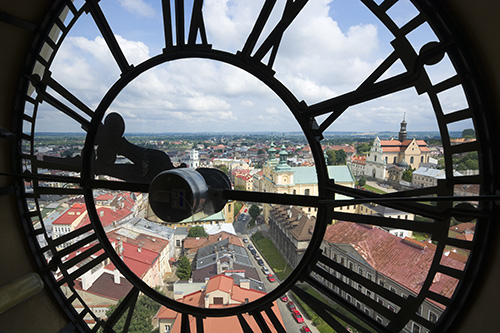
To answer these questions, we must first understand what originally motivated people to instil intelligence into machines. If we go back to the Middle Ages, the first astronomical clocks that began to appear in public places during the early decades of the fourteenth century exercised a fascination over people. Nobody regarded these clocks as intelligent, but they were clearly a manifestation of intelligence, for they were able accurately to represent the motions of the sun and moon (and in the more complex clocks the motions of the planets as well) against the background of the zodiacal constellations. It was an extraordinary technological achievement, and it led people to think that if the motion of the sun and stars could be replicated by a mechanism, then this implied that the whole cosmos could be thought of as a great machine. This idea began to impress itself onto the human psyche during the fourteenth century when, for example, the philosopher, theologian and astronomer, Nicole Oresme, put forward the image of God as a divine clockmaker. According to Oresme, God designed and made the universe as a vast mechanism, set it going, and then left it to run by itself.1
Peering out through the face of a clock overlooking a European town. The first astronomical clocks, built in the Middle Ages and appearing in public places, played a part in a change in mentality that led people to consider that the whole cosmos could be thought of as a great machine.
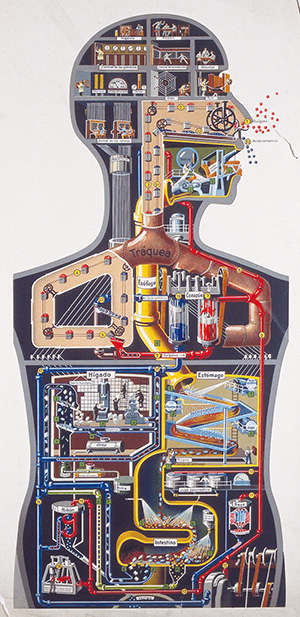
In subsequent centuries, as the clock became smaller and more widespread, at first entering the houses of the wealthy, hanging rather inelegantly upon their drawing room walls, and later in more compact designs sitting upon the mantelpieces of middle class homes, it was a daily reminder to more and more people that the universe could be imagined as a great machine, and every creature in it as a more or less complex mechanism. By the time of the Scientific Revolution in the seventeenth century, the mechanistic worldview was one that many educated people could accept. Descartes’ characterisation of the human body, like that of every other living creature, as a machine was an idea whose time had come.2
Learning to Think Like a Machine
Behind this idea was a further idea that became the driving force of the Scientific Revolution. If the universe and all creatures in it are machines, then for human knowledge to be reliable, our thinking must align itself with the way the world is put together. In other words, we have to learn to think in the same way that machines function. This requires that we analyse nature’s mechanisms first by taking them apart, just as if we were taking a clock apart, reducing them to their smallest and simplest components. In this way, it should become more evident how each part relates to every other part, and we are then in a position to understand how they fit together to make a whole. Descartes’ Rules for the Direction of the Mind (1629)in effect describes exactly how to think like a machine.3 At roughly the same time, Francis Bacon wrote in the preface to his manifesto of the Scientific Revolution, the Novum Organum (1620),“the entire work of understanding” must be commenced afresh and the mind be “guided at every step and the business be done as if by machinery.”4 Thus the image of the machine came to be applied to the inner life of the human being. The operation of the machine became an ideal to which human beings intent on the acquisition of knowledge must conform their own thinking.
Both Bacon and Descartes were convinced that ordinary human language gets in the way of doing this really effectively, because it is full of vagueness and imprecision. If we are seeking to understand a universe composed of parts external to other parts, they believed it is necessary to devise a science that can match the mechanical precision of nature in its mode of expression. Descartes saw that what was required was to adopt the precision of mathematical thought as the ideal of scientific enquiry. This meant that the qualitative aspect of nature should be re-expressed in terms that could be quantified, for only then would our knowledge achieve sufficient exactitude. Only then would it become useful knowledge, because it would give us the ability to manipulate, control and utilise that which we have come to know. As Descartes explained, the mathematical method would enable us to “render ourselves as the masters and possessors of nature.”5
There was always something of a Faustian bargain at the heart of the mechanistic worldview and methodology that underpinned the Scientific Revolution. In order to gain mastery over nature, nature had to be quantified, which meant that those who dedicated their lives to science had to render themselves into calculators, committed to a certain kind of thinking from which anything smacking of felt experience or spiritual intuition was excluded. In other words, seekers of knowledge had to submit their inner life to a certain curtailment. Since only the kind of thinking which was, or could be, conformed to mathematics – namely, calculative thinking – would count as legitimate, what could not be quantified fell outside the purview of legitimate knowledge. Thus, for Galileo, all qualitative phenomena should be regarded as illusory, and only those aspects of phenomena that could be quantified should be regarded as real.6 What began as a methodological principle became a way of redefining the reality being investigated.
In 1642, as if to make entirely explicit the mechanical nature of calculative thinking, Pascal invented his mechanical calculator. It was a relatively simple yet ingenious device, the mechanism of which was reminiscent of a clock. It was capable of adding and subtracting and, through repeated additions and subtractions, of multiplying and dividing. What was so ground-breaking about the mechanical calculator was that it substituted the rotation of cogs and wheels for the human mental effort required to perform mathematical calculations. It proved that certain human mental functions – adding and subtracting, multiplying and dividing – could actually be replicated by a physical mechanism. The human mind, functioning in this restricted way, was thus mirrored in the machine, albeit somewhat crudely. But for those who sought to re-conceive human thinking as an act of calculation, it reinforced the view that the human mind could be conceived in the image of the machine. When, for example, shortly after Pascal’s invention of the mechanical calculator, Thomas Hobbes declared that there is nothing more to human reasoning than calculating, the implication was that – since mathematical calculations could be carried out by machines – the very essence of human intelligence was mechanical.7
A Secret Yearning
There was a strange appeal to this view of human intelligence. Many people felt drawn to it, as if it corresponded to a secret yearning within the human soul to re-conceive itself in the image of the machine. Thus the cyborg fantasy slowly but surely emerged and took hold of the human imagination. In 1748, the first cyborg manifesto was published by Julien Offray de La Mettrie, entitled L’homme machine (“Man a Machine”). La Mettrie saw human consciousness as entirely the product of the physical brain, which he described as functioning like a clockwork mechanism, with so many wheels and springs. Such a picture of the human mind could admit no freedom to our inner life: all was mechanistically determined. La Mettrie was the first person to unflinchingly articulate the machine-human archetype. Although his book was received with utmost hostility by the Church and the establishment (copies of the book were actually burnt by the ecclesiastical authorities), it nevertheless sold well, having three printings in the year of its publication. It was swiftly translated into English, where again it was reprinted several times; meanwhile the author had to flee for his life from his native France.8 It is a sign of how highly charged the machine-human archetype was that people were both repelled and fascinated in equal measure.
“El hombre como palacio industrial” by Fritz Kahn, 1930. A graphic analogy between anatomy and machinery.
Since this time, the shadow of the machine-human archetype has cast itself more and more deeply over us. Today, we can experience it not just in the degree of dependency we have on our intelligent machines – our laptops, tablets and smartphones, our sat navs and virtual assistants – but also in the degree of our intimacy with these machines that have become our daily and hourly companions. Not only are we increasingly deferent towards them, but we are also increasingly bound up with them emotionally. It is hard for many people to imagine being able to live without them. What lies behind this? Is it just convenience, or is it that their presence is somehow reassuring to us? Do they mirror back to us an image of ourselves that we secretly yearn for? Has the machine-human archetype already got inside us? In the late 1980s, the French postmodernist philosopher Jean-Francois Lyotard asked the question: “What if what is ‘proper’ to humankind were to be inhabited by the inhuman?”9
Because the inhuman is now so close to us, this has become the question of our times.
Machine Intelligence
In order to answer Lyotard’s question, we need first to clarify exactly what kind of intelligence can be automated in a machine. As we have seen, with the first mechanical calculators of the seventeenth century, the model for automated intelligence was calculation. You would feed in data and the machine would calculate the answer. You fed in 236 and 528. You turned the “adding” cogwheel and the machine calculated the result: 764. But from the seventeenth century onwards, there was a further highly significant development. Many intellectuals sought to configure logic to mathematics, so that logical operations could become calculations, conducted independently of the medium of ordinary human language. As a result of an enormous amount of effort by many brilliant minds, this was finally achieved in the nineteenth century, most decisively by George Boole in his book An Investigation into the Laws of Thought (1854). Boole showed that calculations could be performed on data much more complex than numbers, by assimilating logical operations to mathematical operations, so that adding, subtracting and multiplying actually became logical operations. What this meant was that as long as data was fed into the machine in a machine-compatible (i.e. calculable) language – for Boole this was a form of algebra – it could be processed and analysed by the machine.10 The machine would simply follow a set of instructions or logical operations, which we now call algorithms, that would then lead to the required results. Boole thus laid the foundations for the development of machine intelligence. It is essentially data-processing using calculative or algorithmic thinking. The more data that can be analysed and the faster the machine can produce results, the more intelligent the machine is deemed to be.11
Many people today would like to persuade us that human intelligence is on exactly the same spectrum as machine intelligence. La Mettrie’s view that human consciousness is reducible to brain processes has become the standard scientific view. The difference today is that rather than the clock or mechanical calculator, the computer has now become the underlying image that is regarded as mirroring human consciousness, on the understanding that the brain is essentially a biological computer.12 Along with this view of the brain as a biological computer, it is argued that human thinking is nothing more than a kind of data-analysis that consists of working things out logically and making our calculations in order to arrive at a given result, ending up with the problem solved or the argument won.
In the Western philosophical tradition this is called discursive thinking. It is discursive because it “runs along” (dis-currere) from one thought or logical inference to another, until it arrives at a conclusion or attains its goal. The problem is that if machines can run along much faster than us, processing vastly more amounts of data and coming up with recommendations or decisions before we have even turned our minds to thinking about whatever it is, then clearly we have been out-performed! It is predicted that in the next twenty years an increasing proportion of the work of lawyers, teachers and doctors will be undertaken by dedicated algorithms. Already we can see this happening. There are now companies that actually have algorithms on their board of directors because they have the ability to analyse huge amounts of data, take all relevant factors into account, and then make extremely sensible recommendations to the other members of the board based on their analysis. They are sometimes even given a vote along with the other directors.13
A nightmare scenario begins to unfold in which “superintelligent” machines will not just assist human beings, but they will replace us altogether. We will become redundant. This nightmare fantasy sent shudders through Silicon Valley a few years ago. Steve Wozniak, the co-founder of Apple, is reported to have said: “If we build these devices to take care of everything for us, eventually they’ll think faster than us and they’ll get rid of the slow humans to run companies more efficiently.”14
For those who see human intelligence as on the same spectrum as machine intelligence, the solution is greater integration with machines through direct computer interfaces, so that we will always stay one step ahead of them.15 But that would mean our human future would be a cyborg future. In order to escape one nightmare scenario we embrace another, in which human beings increasingly remove themselves from the limitations of their own biology, thereby supposedly becoming (in the view of some) “superhuman.”16 In Lyotard’s terms, we would then not only have allowed the inhuman to inhabit us, we would ourselves have become inhuman. So what, returning to Lyotard’s original question, is “proper” to humankind?
Human Intelligence
In the Western philosophical tradition, stemming from Plato and Aristotle, a very clear distinction is made between discursive thinking, which “runs along” linking one thought with another through logical inferences, and contemplative thinking, which in many respects is the opposite of discursive thinking. Contemplative thinkingdoesn’t run along, but stops still. It doesn’t move, but is at rest in its own activity, which is a focused attentiveness that is both open and receptive. Unlike discursive thinking, contemplative thinking does not process data: it does not link one finished thought with another according to a set of instructions or logical rules. It goes behind thoughts and dwells in the thinking activity that produces them. In “machine intelligence” terms, contemplative thinking has the value of zero, because it has slowed down to a standstill. But this standstill is a creative space which machine intelligence does not and cannot recognise.
From the point of view of machine intelligence, contemplative thinking would seem to be completely useless, because it doesn’t concern itself with analysis or problem-solving. It doesn’t seek results. It is an activity engaged in for its own sake. And this activity involves a turning of one’s attention inwards, towards the spiritual world, through becoming aware of what rises up within the soul – beyond data, beyond information, beyond our favourite opinions. What arises in true contemplative activity are intuitions and insights into the deeper meaning of things, concerning which machine thinking knows nothing. These intuitions and insights may be informed by the primordial images of archetypal realities that well up from the imaginal world, and which simply cannot be accessed through logical inference or calculative thinking. In contemplative thinking we also come to stand on the ground of our own inner freedom, for it is an open space that is not conditioned by habits of thought or opinion, but is rather an active receptivity to a more interior source of knowing. From such a sourcethe voice of conscience may be heard, and a sense of moral certainty about what we must do may come to us. This is something which cannot be arrived at through mere calculation.
These and other experiences fundamental to what it means to be human and not a machine are the gift of contemplation. The word “contemplation” has buried within it the Latin word for a sacred space, which houses the divine presence. The templum of“templation” translates as “temple.” The very word “contemplation” tells us that in order to contemplate we have to find our way to this inner temple, this sacred space within ourselves, where we can open ourselves to the spiritual dimension of existence.17 Machine intelligence cannot reach this sacred space, nor the contemplative activity that creates it, no matter how much data it processes and how fast it processes it.
Philosophers and mystics have time and again spoken of the activity of contemplation as being at the kernel of our human being. We are currently entering a period of great peril for humanity, as collectively we fall increasingly under the spell of the machine, and machine thinking. It is incumbent upon all of us who seek to uphold truly human values in an era dominated by intelligent machines that we ground ourselves in the contemplative activity that is specific to human intelligence, concerning which Aristotle long ago declared that it is “something within us that is divine… the highest thing in us, for though it be small in bulk, in power and value it far surpasses all the rest.”18
[alert type=”general” dismiss=”no”]This article was published in New Dawn 170.[/alert]
[alert type=”success” dismiss=”no”]If you appreciate this article, please consider subscribing to help maintain this website.[/alert]
Footnotes
1. Nicole Oresme, Le Livre du Ciel et du Monde (1377), 2.2.
2. René Descartes, Treatise on Man (1629) in Ralph M. Eaton, ed., Descartes: Selections (London: Charles Scribner’s Sons, 1927), p. 350 and p.354: “All the functions [of the human body]… follow naturally in this machine from the arrangement of its parts, no more nor less than do the movements of a clock, or other automata, from that of its weights and its wheels”
3. René Descartes, Rules for the Direction of the Mind in Elizabeth Anscombe and Peter Thomas Geach, eds., Descartes: Philosophical Writings (Sunbury-on-Thames: Thomas Nelson and Sons, 1970).
4. Francis Bacon, Preface to Novum Organum (1620) in Rose-Mary Sargent, ed., Francis Bacon: Selected Philosophical Works (Indianapolis: Hackett Publishing Inc., 1999), p.87.
5. René Descartes, Discourse on Method, in the Philosophical Works of Descartes, vol.1, ed. Elizabeth S. Haldane and G. R. T. Ross (Cambridge: Cambridge University Press, 1980), p.119.
6. Galileo, Il Saggiatore (1623), in Stillman Drake, Discoveries and Opinions of Galileo (New York: Doubleday, 1957), p.274: “I do not believe that external bodies, in order to excite in us tastes, odours and sounds, need anything other than size, figure, number and slow and rapid movements; and I judge that if the ears, the tongue and the nostrils were taken away, the figure, the numbers, and the motion would indeed remain, but not the odours nor the tastes nor the sounds….”
7. Thomas Hobbes, Leviathan (1651; London: J. M. Dent and Sons, 1973), p.18: “In sum, in what matter so ever there is a place for addition and subtraction, there is a place for reason; and where these have no place, there reason has nothing at all to do. For reason, in this sense, is nothing but reckoning (that is, adding and subtracting)…”
8. Justin Leiber, Introduction to La Mettrie, Man a Machine (Indianopolis/Cambridge: Hackett Publishing Company, Inc., 1994), pp.4-6.
9. Jean-François Lyotard, The Inhuman (Cambridge: Polity Press, 1993), p.2.
10. Thus adding x to y represented one kind of logical operation, multiplying x by y another. Boole saw that the plus sign corresponded to logical disjunction (“either… or”), the multiplication sign to logical conjunction (“both… and”). It doesn’t matter to the machine what x and y are: they are already predefined, or pre-conceptualised entities. They hold no meaning for the machine, which simply subjects them to analysis, following the instructions or “algorithms” that produce the desired outputs.
11. Ray Kurzweil, The Singularity is Near (London: Duckworth, 2005), pp.70-72.
12. Stephen Pinker, How the Mind Works (New York: W. W. Norton, 2009), p.324: “The mind is what the brain does; specifically, the brain processes information, and thinking is a kind of computation.”
13. Yuval Noah Harari, Homo Deus (London: Penguin Random House, 2016), p.322.
14. Steve Wozniak, interview with Paul Smith, Financial Review, 23rd March, 2015.
15. Rick Perera, “Hawking: Re-engineer humans or risk machine rule”, PC World, 4th September, 2001 reports Hawking as saying: “Humans must develop an interface that allows the human brain to be directly connected to a computer, so that the artificial brain contributes to human intelligence, rather than opposing it.”
16. Harari, Homo Deus, pp.43-47.
17. Henri Corbin, Temple and Contemplation (London: KPI, 1986), pp.386-388.