New Dawn – World's Most Unusual Magazine

Category: Articles

  • The Science of  Plant Intelligence Takes Root

    The Science of Plant Intelligence Takes Root

    From New Dawn 176 (Sept-Oct 2019)

    For centuries, Western philosophy has viewed animals and plants as unthinking automatons. The famous 17th scientist and philosopher, Rene Descartes, maintained that non-human organisms cannot reason or feel pain; they are robotic machines that purely act on impulse.1 

    While science has recently proven that animals are intelligent creatures, capable of logical thinking and emotional experience, the notion that plants possess a similar kind of intelligence is largely disregarded by the scientific community. It is assumed that because plants do not possess a brain, they have no conscious experience. 

    Goethe and other thinkers through history observed that plants constitute an intelligent life-form, develop symbiotic relationships with other organisms, and can respond to complex changes in the environment. While the scientific community explains the intelligence of plant behaviour in terms of electrical and chemical responses to sensory stimuli, others believe that plants could provide a valuable insight into other forms of consciousness. 

    One of the most famous scientists to observe plant intelligence was the English naturalist, geologist and biologist, Charles Darwin.2 While Darwin is most prominently known for the theory of evolution, he was deeply fascinated by the behaviour of plants and made a valuable contribution to the botanical sciences. Unlike many of his contemporaries, Darwin maintained that plants are not unthinking automatons but highly complex and receptive organisms. In one of his last works, The Power of Movement in Plants, published in 1880, Darwin suggests that the root of the plant operates in a similar way to the neural networks found in lower animals, receiving information about the external environment and communicating it to other areas of its structure, writing:

    “It is hardly an exaggeration to say that the tip of the radicle thus endowed (with sensitivity) and having the power of directing the movements of the adjoining parts, acts like the brain of one of the lower animals; the brain being seated within the anterior end of the body, receiving impressions from the sense-organs and directing the several movements.”3 

    Unfortunately, Darwin’s observations were rejected by leading scientists of the time, particularly the eminent plant physiologist Julius Sachs. He labelled Darwin an amateur scientist who performed careless experiments and acquired misleading results. However, in-depth analysis of plants is beginning to reveal they possess highly developed neural systems and even utilise the same neurotransmitters we do. 

    Modern Science & Plant Intelligence 

    While it is easy to dismiss these findings as pseudoscience, more and more scientists are recognising that plants exhibit brain like-functions and make sentient decisions. In 2009, researchers Dieter Volkmann, Stefano Mancuso, Peter W Barlow and Frantisek Baluska, published an article in the journal Plant Signal Behaviour entitled “The ‘root-brain’ hypothesis of Charles and Francis Darwin” in which they examined Darwin’s root hypothesis and whether current scientific literature supports his theory.

    Based on complex analysis of scientific data, they concluded that “recent advances in chemical ecology reveal the astonishing complexity of higher plants as exemplified by the battery of volatile substances which they produce and sense in order to share information with other organisms about their physiological state.”4 According to the paper, plants can recognise self from non-self and roots, even secrete signalling exudates that “mediate kin recognition.” Moreover, plants are “capable of a type of plant-specific cognition, suggesting that communicative and identity re-cognition systems are used, as they are in animal and human societies, to improve the fitness of plants and so further their evolution.” 

    Darwin’s theories were ridiculed at the time he was writing, but now more open-minded scientists are discovering that plants may possess some form of conscious awareness, a discovery that would have pleased Darwin immensely. 
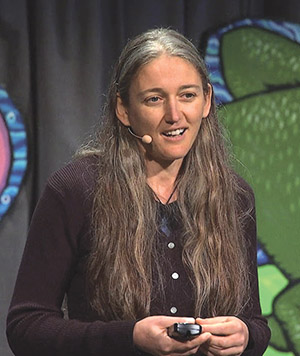
    Monica Gagliano delivered a keynote speech on Plant Intelligence and the Importance of Imagination in Science at the 2018 National Bioneers Conference in San Rafael, CA, USA.

    One of the most interesting scientists to have undertaken research into plant intelligence is Monica Gagliano, associate professor at the University of Western Australia. In 2014, she conducted a series of experiments using Mimosa Pudicas plants to work out whether plants ‘memorise’ changes in their environment.

    In order to test her hypothesis, she placed the plants in pots and then loaded each one onto a specially designed plant-dropping device. Each plant was dropped from a height of six inches, sixty times in a row at five second intervals. The plants would fall onto a soft foam to prevent them from bouncing, with the drop quick enough to cause the plants to curl up their leaves. Since the plants were not harmed in any way, Gagliano wondered whether they would eventually realise the drop did not signify an external danger. After a short amount of time, she found that “some individuals did not close their leaves when fully dropped.”The plants realised that falling from six inches would not cause them any harm and no longer curled their leaves. 

    Members of the scientific community were cynical of Gagliano’s findings, suggesting the plants merely became exhausted. Gagliano disproved this theory by taking a group of plants and placing them in a shaker in order to deplete them of energy. She found that the plants still curled their leaves, indicating they only became unguarded when dropped from a height to which they had become accustomed.5 

    Mimosa pudica is known as the ‘sensitive plant’, and appears to be able to learn from experience. Image credit: Flickr/foam, CC BY-SA

    Gagliano’s research has significant implications in terms how we see plants. The fact that they respond differently to situations that present no harm to those that do, implies plants recall sensory information and ‘memorise’ changes around them. While there is much uncertainty as to how plants recall this information, Gagliano believes it could be representative of a distributed intelligence operating entirely different to the mammalian brain. 

    This corresponds with Rupert Sheldrake’s ‘morphic resonance’ hypothesis that memories are not stored in the brain but in a universal informational field. We should imagine the brain to be like a television set which tunes into different programmes we watch, rather than a memory hard-drive. From this perspective, the brain has limited memory. Most of the information is stored somewhere else in some sort of ‘quantum database’. As Sheldrake points out, it has been proven that animals have memories that are engendered in other members of their species, and past experience is passed onto future generations. For example, in the United States cows learned about cattle grids and now farmers simply paint lines on the road to trick them from crossing. They seem to know what a cattle grid is even if they never seen one before. Examples like this suggest memory may not be an entirely neurological phenomenon but exists in other forms; this may explain why plants are able to memorise information without possessing a physical brain structure.6 

    The notion that plants operate within a wider intelligence network is supported by recent experiments in plant communication. In a study conducted by Dr Velemir Ninkovic and his associate researchers at the Swedish University of Agricultural Sciences, a soft brush was applied to corn seedlings, a stimulus that could represent different external stresses, such as new plants encroaching on their territory or an animal trying to eat it. New seedlings were then placed in the same soil as the recently touched plants to see whether it impacted their growth. The scientists discovered that the fresh seedlings responded by growing more leaves and fewer roots than the plants that had grown under unmodified conditions. This suggested that the corn seedlings were exposed to the chemical signals of the recently touched plants in the soil and therefore were preparing themselves against future stresses more effectively.7 
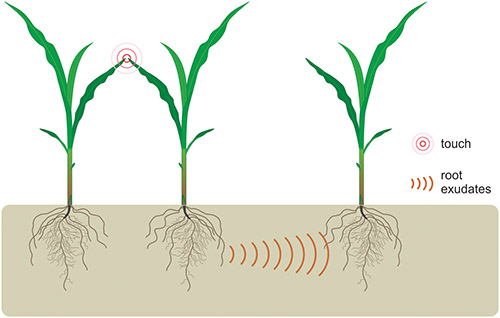
    Illustration of above ground interactions between neighbouring corn seedlings by light touch and their effect on below-ground communication. (Image credit: https://journals.plos.org/plosone/article?id=10.1371/journal.pone.0195646)

    In order to establish whether the plants were able to distinguish between the soil occupied by touched and untouched plants, the scientists offered corn seedlings the option of which medium they preferred growing in. When placed near both types of soil, the roots had a preference towards the growing solution that contained the untouched plants. These findings suggest that plants are able to communicate with each other even when they are not simultaneously present. This challenges the view that plants cannot exchange information in the way animals do and utilise complex communication networks to protect the interests of the group species. While science has historically depicted plants as inanimate and mechanical, in reality plants possess a profound ‘social’ intelligence that supports the continuation of their survival. 
    Plant Sentience in Shamanic Cultures

    The belief that plants constitute an intelligent life form is commonplace in shamanic cultures, particularly those found in South America. As Michael Winkelman, Associate Professor at Arizona State University states, “the self-identifications with the broader universe, particularly personification of the sentient cosmos which is a hallmark of ecopsychology, is a fundamental aspect of shamanism.” 

    Religious ceremonies, practised for hundreds of years in these cultures, often involve the consumption of entheogenic plants to access alternative realities and altered states of consciousness. During these ceremonies, the shaman assumes the role of a spiritual guide to direct the experience through chanting, drumming, singing and other psycho-dramatic practices. The plants are believed to hold sacred properties, with the potential to provide the participant with profound insights. 

    Many people who have ingested Ayahuasca, an entheogenic brew made from the Banisteriopsis caapi vine in South America, report telepathic communication with plants, animals and people during the experience; the natural world becomes personified as an animated fractal intelligence that is constantly adapting, changing and evolving. Many also say the experience had a long-lasting impact on their connection with animals, people and nature, helping them solve their existential issues more effectively.8

    In this sense, recent experiments into plant intelligence prove what shamanistic cultures have known all along – that plants are intelligent, sensitive and sentient life-forms.9 By observing their behaviour, we can learn more about the natural world and the complexity of all living things. Although modern science provided us with tremendous technological innovation and development, the reductionist belief that animals and plants are ‘mechanical’ in their nature, rather than a dynamic expression of intelligence and consciousness, has disconnected us from our environment and thus ourselves. As the independent scholar, author, teacher, and speaker on sacred plant medicine, Stephen Buhner, states:
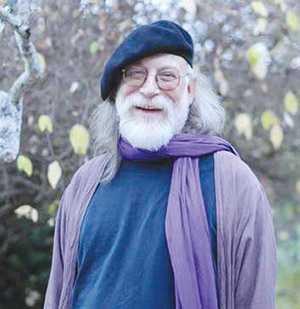
    Stephen Harrod Buhner

    “All people, and I mean all, know that the earth and everything in it is alive. Four-year-old children naturally know this. They have to be forcefully taught that the world is dead. Ancient and indigenous cultures never killed that sensibility but rather developed it. They were interwoven into the life web of the planet, not separate from it. But it was not only indigenous cultures but all ancient cultures that knew this, no matter how they developed… The thing that we call science has taken the long way around. And, they are now getting back to where we started long ago, aware that all of nature is alive, intelligent and aware. That we are merely one part of a very large living scenario.”10 (See my interview with Stephen Buhner in this issue.)

    A Challenge to Outmoded Paradigms & Thinking

    There are significant social, philosophical and religious implications for plant intelligence. It challenges the anthropocentric and monotheistic view that humans are the only species with a mind and a soul – we are not the most important entity in the universe but part of an interconnected web of life. There is great value in recognising nature’s extraordinary intelligence as we find ourselves on the brink of social, economic and environmental collapse. For decades, the capitalist economic model has depended on resources provided by non-human life forms in order to meet the needs of consumers. Perceiving plants as sentient life forms, rather than a mere resource for our consumerist habits, may prompt us to formulate new ways of living in harmony with the natural world. By expanding our view of how consciousness expresses, we can better appreciate the complexity of the ecological world and possibly halt the current path of environmental destruction. Buhner notes:

    “The older, reductive, mechanistic paradigm that looked at the earth as a ball of non-sentient resources, we do with as we please, has reached its limits. It is destroying the ability of most life forms to endure, and the eco-systems of the planet. Younger and less mentally restrictive scientists in every field are finding that the world around us is far different than the picture that reductionists have created and taught us to believe. All life is intelligent, none of it is mechanical, and you cannot use the ecosystems of the planet as resources for unlimited extraction.”11

    Plant intelligence also forces us to reconsider the nature of consciousness. Mainstream science currently posits the idea that consciousness is an epiphenomenon of the brain (it is generated by the brain). When we die, the brain ceases to operate, and consciousness switches off. In this reductionist perspective, plants and animals possess a very limited consciousness since their brains are not as neurologically complex. But the fact of the matter stands that modern science does not understand the mystery of consciousness and the process by which neural pathways, which are non-conscious, become self-aware as a complex web of connections in the brain. If plants have the ability to recall sensory information, socially communicate with each other, and respond to complex changes in the environment, we are forced to rethink our current models of consciousness. It may be the case that the human brain constitutes a very specific expression of consciousness, and intelligence manifests across a broad spectrum of life with plants possessing their own unique form of awareness which modern science does not currently understand. 

    To conclude, there is increasing evidence suggesting plants are an intelligent life-form. Recent scientific experiments indicate that plants are able to retain sensory information, respond to complex changes in their environment and even communicate with one another via complex biological networks. While we have yet to fully understand how plant intelligence works, these experiments challenge the orthodox scientific view that plants are non-sentient, and intelligence only emerges via neural pathways in the brain. 

    More free-thinking scientists and researchers are beginning to prove that plants possess brain-like functions and can make intelligent decisions, an idea accepted by shamanic societies for millennia. 

    There are significant philosophical implications for plant intelligence. Not only does it challenge reductionist explanations for consciousness but forces us to consider our treatment of the planet and agro-capitalism’s ongoing large-scale commodification of the plant kingdom.

    As we teeter on the brink of environmental collapse, and traditional social, economic and political models become increasingly redundant and outmoded, it is critical we start perceiving nature and plants in a different light, rather than a depletable, capitalist resource. 

    An interview with Stephen Harrod Buhner accompanies this article and can be read inside the same issue of New Dawn.

    Further reading: Stephen Harrod Buhner’s books, Secret Teachings of Plants: The Intelligence of the Heart in the Direct Perception of Nature and Plant Intelligence and the Imaginal Realm.

    [alert type=”general” dismiss=”no”]This article was published in New Dawn 176.[/alert]

    [alert type=”success” dismiss=”no”]If you appreciate this article, please consider subscribing to help maintain this website.[/alert]

    Footnotes

    1. The Philosophical Works of Descartes, Cambridge University Press, 1969
    2. See Plant Intelligence and the Imaginal Realm by Stephen Harrod Buhner (Bear & Co, 2014)
    3. Charles Darwin, The Power of Movements in Plants, John Murray, 1880
    4. F. Bulska, S. Mancuso, et al., The ‘root-brain’ hypothesis of Charles and Francis Darwin, Plant Signal Behaviour, 2009; Dec; 4(12): 1121-1127
    5. M. Gagliano, et al., Experience teaches plants to learn faster and forget slower in environments where it matters, Oecologia, 5 January 2014; doi: 10.1007/s00442-013-2873-7
    6. R. Nissen, Memory is not in your head, http://animalnav.org/memory-not-in-your-head/ 
    7. J. Gabbatiss, Plants use underground communication to learn when neighbours are stressed, The Independent, 2 May 2018 
    8. M. Winkelman, Shamanism and Psychedelics: A biogenetic structuralist paradigm of ecopsychology, European Journal of Ecopsychology
    9. J. Kounen, Advice for Encounters with Scary Serpents and Talking Plants During Ayahuasca Visions, https://kahpi.net/scary-serpents-talking-plants-ayahuasca-visions/
    10. Interview conducted with Stephen Buhner, 16 July 2019
    11. Ibid.

    © New Dawn Magazine and the respective author.
    For our reproduction notice, click here.

  • Astral Bucket List: Advanced Instruction on Travelling Out-of-Body

    Astral Bucket List: Advanced Instruction on Travelling Out-of-Body

    From New Dawn Special Issue Vol 11 No 6 (Dec 2018)

    So you’ve had your first out-of-body experience (OBE) and found yourself spontaneously floating from your bed up to the ceiling. Or you’ve read everything you could get your hands on about OBEs, taken a course, joined a forum, traded techniques, and finally you’re standing by your bedside looking at your physical body lying on the bed, knowing that the self by your bedside is the real you, you haven’t died – and it’s true, you’re more than your physical body. 

    Or maybe you’ve joined a shamanic journeying circle. The leader of the group provides a slow, monotonous drumbeat to lull you into an altered state of consciousness while guiding you through an interior landscape. You see yourself dropping down into a world beneath the ground to locate a power animal, such as a bear or fox, to help you with healing yourself and others. Or maybe you’ve taken the lucid-dream route. You’ve learned to recognise that you’re dreaming while you’re actually experiencing a dream – and you now have unlimited powers of controlling the dream environment and shaping the plot as you wish. Or maybe you’ve had a near-death experience that took you through a tunnel of light, guided by angelic beings to meet dead relatives with a glimpse of the afterlife before being whisked back to your physical body, resuscitated after a medical emergency. 

    Though each of these experiences seems like a milestone and there are many fellow experiencers who discuss them in books, training, and blog posts, there’s not much information about what happens next. Some people hit a wall, get bored, lose interest. Others move from one to another of the techniques listed above. Then there are the one-time experiencers who’ve had a life-changing mystical revelation while climbing a mountain or listening to music or making love – the boundaries between people, nature, even physical objects were momentarily transcended, and they felt at one with the whole universe. How did that happen – and could it ever happen again?

    The problem is that we don’t have a comprehensive map of the inner terrain we’re exploring in such adventures in consciousness. In the case of spontaneous OBEs or mystical experiences, we often don’t know how we got there and have no idea of how to get there again. In the case of better explored and more-travelled routes such as lucid dreaming, we may learn to achieve and sustain the targeted state of consciousness and then run out of ideas about what to do when we’re in it.

    Anyone who has experienced or read about more than one of these routes naturally wonders how they relate to each other, intuitively sensing a connection between them. The Internet is full of speculation and theories on the relations between the subjective reality of such states of consciousness and the objective reality of the physical world, ranging from explanations based on quantum mechanics and string theory to the latest developments in neuroscience, which attempts to assign the origins of these states to specific portions of the brain. But none of this helps the one-time experiencer or the practiced-but-stuck explorer take the next step. We need a map that goes beyond the easily achievable milestones and we need goals that motivate us to cover the inner territory between where we are and where we want to be. We need an astral bucket list.

    The phrase bucket list refers to things you want to do before you die (i.e., ‘kick the bucket’). For most people, it refers to performing an action long dreamed of and never attempted, possibly difficult to afford or achieve, but considered as the acme of physical, emotional, mental, or spiritual intensity and fulfilment. Skydiving or visiting a place of great natural beauty or spiritual significance such as the Grand Canyon or Machu Picchu would be examples of typical bucket list items. However, these items pertain purely to the physical body.

    If we believe that we’re more than our physical body, then we could also create bucket lists for one or more nonphysical bodies. Most people have heard about one of these bodies – the astral (‘starry’) body – so called because it seems to shine with its own light. In the theosophical tradition I’ve researched for somewhat more than a decade, there are other such bodies, each associated with a particular level of being or reality called a plane. Even though this system was developed by clairvoyant members of the Theosophical Society in the late nineteenth and early twentieth centuries, I believe it still has some useful things to teach us – though it requires a bit of modernising before its relevance to such things as OBEs, shamanic journeys, and other adventures in consciousness can be perceived.

    Following is a list of bodies discussed in theosophical literature. It’s not exhaustive – these are the ones we’re most likely to experience:

    Physical body – the material body we act with on the physical plane.

    Etheric body – the body of life force and health, sometimes called the model body since it’s said to be the energetic template from which the physical body is formed; correlated with the physical plane in its less material (‘higher’) aspects.

    Astral body – the body we feel with, also called the emotional or desire body, correlated with the astral plane, which most of us experience while dreaming and in which the early stages of the afterlife occur (often cathartic or purgatorial, in that the deceased are shedding negative emotions and unfulfilled desires).

    Mental body – the body we think with, correlated with the lower mental plane, where the more heavenly stages of the afterlife are experienced and where institutions of higher spiritual learning and expanded creativity in all areas of human culture may be found.

    Causal body – the body we evolve with, our higher self or soul, correlated with the upper mental plane where we choose a location, body, family, and life plan for our next incarnation and where the so-called Akashic records, containing the history of our past lives, may be found.

    Buddhic body – the body we intuit with (where intuition represents an instant apprehension of the true nature of things); also the body within which we experience unity consciousness, a mystical blissful oneness with all beings, physical and nonphysical.

    Out-of-Body Experiences

    The traditional out-of-body experience that occurs in the vicinity of the physical body is often an indication that we’re in the etheric body. For some people, having such an OBE is a bucket list item. It might include sight without eyes, 360-degree vision, even seeing the fronts and backs of things simultaneously. Movement in the etheric body might be free of gravity, as in levitation. The body might be extendible in any direction, far beyond the reach of physical arms and hands. It might also be able to penetrate and move through physical substances such as wood, metal, or glass. However, its range of movement is usually limited to fifteen to twenty feet from the physical body. It is said that if the etheric body strays beyond that distance, the physical body is in danger of dying.

    Etheric OBEs may occur as preludes to nonphysical adventures, in which we visit known or unknown people or locations on the physical plane. But such adventures take place in the astral body. They’re a variety of astral projection – the projection of the astral body away from the physical body so it can travel throughout the physical plane or the astral plane. The learning curve for use of the astral body is greater than that required for etheric body OBEs. Thus there’s often a training period in which we rehearse various skills of perception and movement in the astral body, usually in neutral, dreamlike environments that I call simulations.

    A typical simulation environment is like a room that the projector can’t leave without waking up. Usually there’s a problem to solve. When it has been solved, the walls of the room disappear and we may find ourselves on the astral plane. When the problem hasn’t been solved, the simulation repeats itself during subsequent OBEs.

    Many beginning projectors give up in frustration when they encounter simulations, not understanding that they are like gyms for the development of the astral body. Thus a useful astral bucket list item is getting into a nonphysical training program for the astral body, perhaps with a special type of spiritual guide that I call a personal trainer who acts as coach and cheerleader, explaining the purpose of each simulation (they often develop in a graded sequence) and suggesting possible solutions for the problems they pose.

    Shamanic Journeys

    In shamanistic practice, the technique of journeying usually involves three possible destinations:

    Lower world – a realm of positive and negative forces and the beings that embody them, often perceived in animal form (power animals) and having to do with disease and health.

    Middle world – a realm that closely resembles the physical earth, within which it’s possible to travel anywhere on the planet more or less instantly to see or hear information relevant to the shaman’s questions, as in remote viewing.

    Upper world – a bright heavenly region in which it’s possible to contact dead relatives and more distant ancestors, including wise teaching elders.

    In theosophical terms, the lower world would be the body consciousness of the physical body. This body consciousness is called the physical elemental. It’s a being in its own right, whose purpose is to hold the body together and ensure its health and survival. If we take care of it by providing the physical body with quality sense experience – nourishing, healthy, tasty food; beautiful sights and sounds; interesting smells and textures; neither too much nor too little sleep, pleasurable exercise, and sexual experience – then this physical elemental is like a well-trained horse and supports us in whatever we do. When we deny or deprive it of such things, it misbehaves, like a horse that wants to throw us off, drag us by the reins, wander off course to eat whatever it wants, or doing all it can to get back to the barn (bed, couch) and do nothing.

    Many addictions, whether to food, sex, stress hormones (as in extreme sports), drugs, oversleeping and so on, are indications that the physical elemental needs attention. We’re giving it the wrong food or too much of the right food. If we’re rundown from lack of proper care of the physical elemental, our immune system may suffer and make us prone to illness. In shamanic journeys to the lower world, we can perceive and interact with the physical elemental, perceived as a power animal, to restore such imbalances, finding out what it needs from us so it supports rather than undermines us.

    Each of our other bodies also has an elemental that holds it together and ensures its health and survival. Thus the astral body has its astral elemental which needs quality emotional experience such as heart-to-heart connection with others, including partners, family members, and close or best friends. If we get too little of that, we become hard and unsympathetic, inured to our own suffering or that of others. Or our emotional reactions build up until they explode into a dramatic meltdown of operatic proportions. Again, we can use shamanic journeying into the lower world to discover what the astral elemental needs from us to stay receptive to others and remain on an even keel. 

    The mental elemental holds together our mental body. To survive and thrive, it needs the experience of socialising with others who share our beliefs and values – friends, coworkers, a church-based or other spiritually focused group. If we get too little such social time, the elemental becomes addictively involved in the self-isolating pursuit of interesting information, such as computer searches, cell-phone or video games, and watching endless hours of TV. If we spend too much time among people who do not share our beliefs and values, the elemental causes us to become loudmouthed, bigoted, and argumentative advocates of our beliefs. Thus it could be said that the relative who rants about politics at family holiday gatherings without allowing others to express their own opinions is possessed by an out-of-control mental elemental.

    Although I haven’t seen mention in theosophical texts of an elemental associated with the causal body, I’ve encountered this elemental in my own adventures in consciousness. The causal elemental needs the feeling of having a fulfilling purpose in life, of somehow being useful to others. Without a sense of life purpose and an arena within which to act on it – at one’s job, at home, as an avocation, or through volunteer work – the causal elemental shuts down, triggering depression so serious that we lose all interest in life and may not be able to get ourselves out of bed. We feel paralysed. The same effect can develop from pursuing our life purpose too zealously and neglecting our self-care, especially the needs of the other elementals. We experience burnout so severe we can do nothing.

    Whether we do too much or too little to satisfy our life purpose and keep the causal elemental in line, if we lose interest in life, the physical, astral, and mental elementals are likely to run riot. It could be said that most of the personal and social problems of contemporary civilisation are the result of elementals on the rampage because we don’t know they exist or how to care for them. If we think of the elementals as power animals and can learn to interact with them through shamanic journeying or other guided imagery techniques, we’ll feel more purposive and peaceful. Since other people’s elementals and our own often influence each other (this is why bad moods or depression in family or office tends to spread), our peacefulness may encourage their restive elementals to settle down too.

    The physical, astral, mental, and causal elementals are examples of a nonhuman type of consciousness that evolves in parallel with human consciousness. In theosophical teachings, this nonhuman evolution is called the deva realm – deva is a Sanskrit word meaning “shining ones” – a continuum that includes elementals at its lower end, nature spirits such as elves and fairies in its middle ranges, and angels and archangels at its upper end. 

    I recommend an astral bucket list item that involves learning to perceive and interact with our physical, astral, mental and causal elementals. When we learn to work with the elementals, we’re using our etheric body, and that may open our inner senses to perceiving other beings of the deva realm, such as nature spirits. By making friends with our elementals, we stabilise our subtle bodies, making our exploration of these bodies through astral projection much safer.

    Shamanic journeys to the middle world are a species of astral projection on the physical plane, already discussed. Similarly, journeys to the upper world might involve projection to the areas of the astral plane in which the dead abide for a time; or those of the mental plane in which more highly developed souls of the dead or master teachers may be found (wise ancestors and elders).

    Lucid Dreams

    As mentioned, once the big event occurs – becoming aware that you’re dreaming while still in a dream – you can shape the dream environment and plot at will. The possibilities seem endless. You can slow down or speed up dream events. You can make objects or characters appear or disappear. You can completely transform the dream environment. You can will the dream characters to do whatever you wish. You can transform yourself, making yourself big or small, young or old, attractive or repellent, or shapeshifting into heroes, animals, mythical beings. You can alter the plot or create a completely new plotline. You can even pursue multiple endings as a means of creative problem-solving.

    A popular scenario is shaping a dream along the lines of a sexual fantasy and experiencing one or more climaxes wherever, whenever, and with whomever you choose. But after a while these infinite possibilities may pall. You run out of ideas. You’ve done it all before. Even lucid sex dreams lose their appeal. What next?

    Your lucid dream experiments probably took place on the astral plane where most dreams occur, and you were in your astral body. You were experiencing what I call the private areas of the astral plane Dream Zone, where dreams of a personal nature occur. There are also public areas of the Dream Zone where it’s possible to interact with astral beings and environments rather than those of your own creation. Next time you’re lucid, ask to see these public areas. You could even request an astral guide or teacher to take you there. One test of your readiness for such exploration is whether you can tell the difference between a dream character you’ve invented and an astral being such as a guide or teacher.

    Your bucket list for exploring the astral plane Dream Zone might include the following areas:

    Passive Learning Zone – movie theatres, often grouped in clusters by theme, in which dreamers watch the playing out of solutions to various typical human problems (family, romance, work, etc.); the plots are archetypal but the imagery is usually drawn from each viewer’s life.

    Interactive Learning Zone – classrooms, seminars, or universities where higher spiritual beings act as teachers, not merely providing solutions to earth-plane problems but also teaching methods of problem-solving from a higher spiritual perspective.

    Guided Learning Zone – meeting places for one-on-one guidance from a nonphysical spiritual guide or teacher, usually involving the realisation of creative and entrepreneurial projects.

    Simulation Zone – a sequence of environments, perceived as rooms from inside and biodomes from outside, in which the already mentioned training program for the astral body occurs.

    Similar areas exist in the mental plane Dream Zone, including a sequence of simulations for training the mental body.

    Near-Death Experiences

    NDEs may go through the following stages, though not every NDE includes all of them and some stages are rare:

    • Serious medical crisis 
    • OBE on the physical plane, near the physical body, perceiving the actions of people on the scene of an accident, including paramedics or medical personnel in an emergency room or operating room
    • Passage through a tunnel of light 
    • Meetings with dead relatives 
    • Review of the experiencer’s life 
    • Encounter with a being of light who acts as a judge of sorts, indicating what the experiencer has or has not learned in life and offering the choice or requirement of return to the physical body
    • A tour of the afterlife, which might include hellish, purgatorial, and/or heavenly realms
    • A tour of the universe, which might include encounters with god-like beings and information concerning the origin and purpose of creation
    • Return to the physical body after resuscitation

    Some NDE experiencers discover upon return that they can experience astral projection spontaneously or at will. Others cling to the ecstatic and transcendental aspects of the experience wishing they could return to the light or recall more about their tour of the afterlife or the universe. Those of us who read about NDEs might wish we could verify what they reveal about the afterlife through personal experience – without the medical crisis. Why not?

    The NDE often begins with an etheric body OBE. The realms through which the experiencer passes may include locations on the astral or mental plane. Tours of the universe may require a higher body, perhaps the causal or buddhic. In other words, each stage of the NDE corresponds to a plane or body described in theosophical teachings. We don’t necessarily need a medical crisis to experience them. We just need to learn how to access and move about in our nonphysical bodies. Therefore, the NDE stages listed above are a bucket list for astral projectors who want to go beyond bedroom-based etheric body OBEs and explore astral and mental plane locations in the afterlife – especially the possibility of visiting deceased relatives or friends.

    Other Gateways

    Another means of accessing various bodies and planes is remote viewing, in which the practitioner enters a trance-like state, sometimes through meditation, sometimes through the use of sound technologies designed to produce altered states of consciousness through modifying brain waves. They are able to visit and report back on things seen and heard at a remote location known or unknown and confirm the accuracy of what was perceived. Like shamanic journeys in the middle world, this is a type of astral projection on the physical plane, though the experience of leaving the physical body, as in an OBE, may be absent.

    It’s possible to extend this approach to visit any of the planes. The reason it works is that the nonphysical bodies surround the physical body in layers, making up our energy field or aura. If we can access any of these layers, we’re instantly in touch with and can use the body associated with it, and can perceive and move on the appropriate plane. Ultimately, it doesn’t matter whether we gain such access through OBEs, shamanic journeys, lucid dreams, NDEs, remote viewing, or meditation practices. Even the use of hallucinogens is simply another means of moving between the layers of the aura, accessing one or another subtle body, and experiencing the plane it belongs to, along with its scenes, dwellers, and phenomena.

    How to Get There

    In the 1920s, a theosophist by the name of Arthur Powell compiled a series of books about the subtle bodies, drawing upon dozens of books written by Annie Besant and Charles W. Leadbeater, the primary clairvoyant investigators of these bodies within the Theosophical Society from the mid-1890s to the early 1930s. (Besant died in 1933 and Leadbeater in 1934.)

    The Etheric Double: The Health Aura of Man (1925) – Little in this book is of use to astral projectors; what might be of value is repeated in the next volume of the series, so you can skip it. 

    The Astral Body and Other Astral Phenomena (1927) – This book is a goldmine for projectors, perhaps the most complete study of the astral body and plane that has ever been attempted; the sometimes obscure theosophical terminology is clearly laid out, and the inhabitants and environments of various regions of the astral plane (here called subplanes) are described in detail, providing many possible astral bucket list destinations.

    The Mental Body (1927) – This book, too, is a goldmine, but only for more advanced projectors; if you’ve thoroughly explored the dream and afterlife areas of the astral plane, you’ll get some hints of what to expect when visiting their mental plane equivalents – and more locations to add to your bucket list.

    The Causal Body and the Ego (1928) – This is a very technical book, dealing with the upper mental plane, which is more abstract (i.e., less time and space oriented) than the lower mental plane described in the previous book; only the most advance projectors are likely to understand and make use of it, though it does provide rare descriptions of the buddhic plane and body to add to your bucket list.

    Once you’ve made up your astral bucket list from reading books such as these, or ones by more contemporary adventurers, you’ll need to treat it just as you would a physical plane bucket list. Yearn to visit the nonphysical locations on the list, just as you would yearn to go to Machu Picchu or any other place on a physical plane bucket list. Be patient, since there are tasks you may need to accomplish before you can make the journey. On the physical plane, visiting Machu Picchu may require getting a passport and certain vaccinations, learning the language, acquiring the local currency; on other planes, you may need to demonstrate you can use the body associated with it and communicate with the beings you encounter. Just as you’re likely to record your trip to the Andes in photographs and videos, so you should record your adventures in consciousness in words in a journal. That’s the only way to see how the bodies are developing as you visit and cross off items on your astral bucket list.

    I mentioned having a passport for physical plane journeys. There seems to be a passport for the higher planes as well. It’s the attitude of service – being willing to help those who suffer at any level of being through any means available to us. It could be the living, comforted through astral body visits; or the dead, shown the way in the afterlife when they’re disoriented after passing. It could be our own neglected elementals, or devas or master teachers who have missions for us to perform on various levels of being. In theosophical teachings, such service is called being an invisible helper. In New Age teachings, it’s called being a light worker. No matter what we call it, the desire to be of service on any plane marks our aura so we can be perceived by nonphysical beings as someone who needs and deserves instruction in how to navigate the bodies and planes. 

    [alert type=”general” dismiss=”no”]This article was published in New Dawn Special Issue Vol 11 No 6.[/alert]

    [alert type=”success” dismiss=”no”]If you appreciate this article, please consider subscribing to help maintain this website.[/alert]

    © New Dawn Magazine and the respective author.
    For our reproduction notice, click here.
  • Architects of Power: How the Global Elite Profit from Extreme Inequality & Pre-empt the Backlash

    Architects of Power: How the Global Elite Profit from Extreme Inequality & Pre-empt the Backlash

    From New Dawn Special Issue Vol 13 No 3 (June 2019)

    There is a new, mega-rich global elite consisting of a small number of billionaires and multibillionaires. Many of them made their money in the technology sector. Others play financial markets or inherit fortunes. They are wealthier and more powerful than some entire nation-states. 

    The British Ministry of Defence (MoD) says: “Whilst there have always been differences between the wealthier, better educated and the less privileged, these differences appear likely to widen in the coming decades.” 

    The mega-rich deliberately order the world in ways that guarantee their wealth by institutionalising inequality. Occasionally, this is admitted. In 1997, a book published by the Royal Institute for International Affairs in the UK acknowledged: “The present international order may not be the best of all possible worlds, but for one of the ‘fat cats of the West’ enjoying a privileged position in an international society that is structured and organised in ways which perpetuate those privileges, there are good reasons for not pursuing radical change.” 

    This is also true of internal policymaking. The third richest man in the world, Warren Buffett (worth over $80bn), confirmed this: “There’s been class warfare for the last 20 years, and my class has won.” This echoes his statement in 2006, just prior to the global financial crisis: “There’s class warfare all right… but it’s my class, the rich class, that’s making war, and we’re winning.” Around the same time, the liquidity firm Citigroup circulated an investor memo, stating: “Society and governments need to be amenable to disproportionately allow/encourage the few to retain that fatter profit share.” More recently, the UK MoD admitted: “In the coming decades, the very highest earners will almost certainly remain rich, entrenching the power of a small elite. Vested interests could reduce the prospect of economic reforms that would benefit the poorest.”

    Consider the enormous concentration of wealth and power that results from this imbalance. 

    Ever-Increasing Power

    Global and national inequality is staggering and getting worse. By 2011, a mere 147 – mainly US and European – corporations owned and controlled 40% of world trade and investment. Just four corporations influence the profitability and power of these 147: McGraw-Hill, which owns Standard & Poor’s ratings agency; Northwestern Mutual, owner of the indexer Russell Investments; the CME Group, which owns 90% of the Dow Jones market index; and Barclay’s bond fund index. Evaluative decisions by analysts at these firms affect the wealth and performance of each of the 147 giants.

    That’s corporate wealth concentration. But what about wealth concentration among individuals?

    There are 7.7 billion people in the world. Of those, just 2,153 are billionaires. According to Forbes, their combined wealth totals $8.7 trillion. The list of billionaires reflects where power is most concentrated: in the US. While China and Europe’s number of billionaires declined in the previous 12 months, the US and Brazil gained billionaires. The US is home to 607 billionaires or 0.000001% of the population. It is worth noting that President Donald Trump was a billionaire before he came to power. Trump has cut taxes for his fellow billionaires. As an indication of continued wealth concentration, consider the wealth disparity among the billionaire class itself. He Xiangjian, founder of the Midea Group, is the joint-50th richest person, worth over $19.8bn. Jeff Bezos, by comparison, the founder of Amazon, is the richest man in the world, worth over $131bn – more than six times He Xiangjian.

    Part of the problem has been the US-led imposition of an economic dogma called “neoliberalism” (which is neither new nor liberal) on much of the rest of the world. 

    Neoliberalism can be roughly defined as: 

    1) Financialisation, i.e., allowing investors to make money from money as opposed to tangible things; 

    2) Deregulating financial services; 

    3) Taking out government insurance policies so that working people bail out financial institutions; 

    4) Cutting taxes for the wealthy; 

    5) Privatising public services to reduce social mobility; 

    6) Imposing austerity to make markets more attractive to investors. 

    Neoliberalism has cut taxes for the super-rich, enabling them to hold onto their wealth at the expense of others. According to Oxfam, the average rate of personal income tax for the wealthy was 62% in 1970. In 2013, it was 38%. In the UK, the poorest 10% pay a higher proportion of their income in taxes than the richest 10%. Global GDP, i.e., how much money there is in the world, is $80 trillion. But, of this, $7.6 trillion is untaxed. In the decade since the financial crisis, the number of billionaires doubled. This reveals that the system rewards greed. In 2017, 43 people owned as much wealth as half the world’s poorest. In 2018, the number was 26.

    To put all this into perspective, Jeff Bezos owns as much wealth as the poorest fifty countries. When it comes to more ‘developed’ nations, Bezos’s wealth equals the entire GDP of Hungary. Consider how Bezos makes his money. Amazon is a corporation that primarily advertises and delivers products. The innovation, design, and investment in and of those products is the work of others. Amazon treats “workers like robots” by spying on them, discouraging unions, offering insecure contracts, and encouraging long hours. Amazon is also notorious for paying little or no corporation tax. Amazon is an online retailer. The Internet was developed by the US Defense Department in the 1960s as ARPANET, with public money. The satellites that enable online transactions are first and foremost military hardware. Not only did Amazon take advantage of state-funded innovation, but it also rewards government investors by selling the CIA cloud technology and the Pentagon artificial intelligence.

    Bezos is far from being the only one. Bill Gates’s Microsoft and the late Steve Jobs’s Apple, which became the first trillion-dollar company, also enjoy low taxes, technologies developed with government grants, and procurement contracts. 

    Consider also the immoral activities of other hi-tech nouvelle méga riche. Without making it clear to users, Facebook founder Mark Zuckerberg (worth $66bn) has made his money by selling personal data to insurers and advertisers. Scientists have used Facebook in social media experiments without the knowledge or consent of users in an effort to see how memes affect mood. 

    Other mega-rich, including the hedge fund manager Robert Mercer of Renaissance Technologies, used Facebook to market political candidates. Other tech billionaires include Google founders Larry Page and Sergey Brin. Google technology was funded by the CIA’s venture capital firm In-Q-Tel. Also relying on technologies developed by the Pentagon with workers’ tax dollars, the company cooperates with the National Security Agency to spy on citizens and it has even enabled US assassination programmes. 

    Consequences

    How do the billionaires get away with it, and what are the social and political consequences? The examples below are from the US, but it should be noted that the US exports its mega-wealth model. 

    A study by Martin Gilens and Benjamin I. Page on plutocracy (government by the rich) notes that the rich buy political parties. Politicians draft and/or vote for laws that help the rich. The authors analysed 1,779 policy issues in the US and conclude that “average citizens and mass-based interest groups have little or no independent influence.” Unlike the public, “economic elites and organised groups representing business interests have substantial independent impacts on US government policy.” Other research into wealth inequality in the US finds that “[c]ertain policies, such as the decreased support for unions and tax cuts favouring the relatively well-off and corporations, have benefitted a small minority of the population at the expense of the majority and have thus contributed to widening income inequality.” 

    At the turn of the last century, 9% of American families owned 71% of the nation’s wealth. The elite of the day included familiar names: John D. Rockefeller (oil), J.P. Morgan (banking), W. Averell Harriman (industry), and so on. Things balanced out after the Second World War, with the majority of Americans becoming middle class. Gradually, state controls over the economy were removed, and the situation reverted to the inequality of bygone centuries. 

    Since the 1970s, the US middle class has been shrinking. Until recently, the middle classes of Asia grew, precisely because strong Asian economies (notably China, South Korea, and Singapore) either retained some state controls or refused to adopt the US neoliberal model. 

    Alan B. Krueger, a labour economist and key Obama advisor, explains that, “since the 1970s income has grown more for families at the top of the income distribution than in the middle, and it has shrunk for those at the bottom.” Between 1979 and 2007, the top 1% ((multi)millionaires and (multi)billionaires) enjoyed a 278% increase in their after-tax incomes. But 60% of Americans saw their incomes rise by just 40%, which when adjusted for rising living costs means stagnation. Krueger notes that during that period, $1.1 trillion of annual income was moved to the top 1%. “Put another way, the increase in the share of income going to the top 1% over this period exceeds the total amount of income that the entire bottom 40 percent of households receives.”

    The exportation of this model means that Australia, Britain, and Canada became what the billionaire-dollar liquidity firm Citigroup calls “plutonomies,” economies in which the rich drive luxury goods markets such as jewellery, fashion, cruises, and sports cars: hence the recent entry of celebrity Kylie Jenner into the billionaire class. The Citigroup document also notes that in plutonomies the top 1% owns 40% as much wealth as the bottom 95%. No matter where you live, you can’t escape the institutional structures that create inequality. 

    The US military exists, in part, to maintain the unjust status quo. Yet, it acknowledges the dangers of dominance: “A global populace that is increasingly attuned and sensitive to disparities in economic resources and the diffusion of social influence,” thanks in part to the very technologies that enrich the rich, “will lead to further challenges to the status quo and lead to system rattling events,” like Brexit or the Yellow Vest protestors in France. 

    The mega-rich and international think tanks and forums they sponsor are beginning to reluctantly accept that their status quo political puppets might get voted out of office and give way to so-called far-left or far-right parties unless they address wealth inequality. 

    New Paradigms of Control

    The question, then, is how to deal with the restless and disaffected majority while not radically altering the system and taking away the privileges of the elite. In 1961, US President John F Kennedy said: “If a free society cannot help the many who are poor, it cannot save the few who are rich.” In the 1980s, World Economic Forum founder Klaus Schwab said: “Economic globalisation has entered a critical phase. A mounting backlash against its effects… is threatening a very disruptive impact on economic activity and social stability in many countries… This can easily turn into revolt.” More recently, he said: “Today, we face a backlash against that system and the elites who are considered to be its unilateral beneficiaries.” Likewise, the billionaire Johann Rupert of Cartier jewellery (one of the many luxury services driving plutonomies) said: “We are destroying the middle classes at this stage and it will affect us.” Similarly, the British MoD discusses
    “[m]anagement of societal inequalities,” as opposed to the elimination of social inequality.

    Many of the new elites make people redundant by automating the workplace. While Amazon still relies on human shelf-stackers and delivery drivers, it uses an increasing number of physical robots to stack shelves and algorithmic robots to assist online customers. Likewise, Facebook and Google’s content filters rely on heavy automation. This is creating precarious employment conditions. According to the Washington Post (which is owned by Bezos): “…the modern emerging workforce of tech, urbanised professionals, and ‘gig economy’ labourers all represent an entirely new political demographic.” Politicians then “focus more on education, research and entrepreneurship, and less on regulations and the priorities of labour unions.” 

    But there are many problems. For one thing, the financial services economy, which markets everything, has made “education” a form of unsustainable debt. The quality of US education is notoriously low by world standards, and many young people are “overqualified” for menial jobs, like delivering for Uber or stacking shelves in Amazon warehouses. The UK MoD acknowledges that, “Freelance work is… often low-paid, lacking the benefits and security of formal employment and, therefore, the growth of the gig economy could increase inequality.”

    The crisis of what to do with a young, indebted, restless population automated out of steady work by – and competing with – algorithms and physical robots has been considered for at least 50 years. 

    Traditionally, ‘education’ meant brainwashing children to work in menial jobs for life in adulthood. But as the economy changes and employment becomes less stable, new methods of ‘education’ for re-skilling adults are required. In the late 1960s, future political advisor Zbigniew Brzezinski authored a book in which he advocated for lifelong learning as a way of re-skilling an aging population that finds its employment opportunities diminished, as small-to-medium-sized businesses get overtaken by tech giants. Around the same time, the British Labour Party (when it was a real labour party) introduced the Open University with the aim of providing lifelong learning. Likewise, in the 1980s, futurist Alvin Toffler envisaged an “electronic village” in which flexible working hours and lifelong learning would be required in a hi-tech economy.

    To keep the poor from rioting while trapping them in a system that works for those who design it, today’s multibillionaire elites help to privatise public services and education by offering scholarships and infrastructure investments. In doing so, they train poor people to work for their system by developing others’ technology skills while hiding their own taxable wealth in charity foundations. 

    Howard G. Buffett is the son of Warren. While enjoying largely tax-free wealth that further impoverishes the global poor, the Buffetts, via Howard’s foundation, invest in dams and irrigation in the poorest nations of Africa. Bezos’s foundation awards scholarships for STEM courses (Science, Technology, Engineering, Mathematics). Zuckerberg’s foundation seeks “to find new ways to leverage technology, community-driven solutions, and collaboration to accelerate progress in Science, Education, and within our Justice & Opportunity work.” 

    Conclusion

    By using free online services, we have allowed ourselves to be the products that tech giants sell to advertisers. By not organising to raise taxes on the mega-wealthy, we have underfunded our public services. By not keeping an eye on who’s funding what, we’ve allowed our political parties to hoover up donations from elites. By failing to understand the economy, we’ve allowed a new normal of instability and political uncertainty to flourish to the advantage of asset managers and hedge fund investors. As the US pursues global domination, this model will continue to be exported. It’s time to wake up. 

    The footnotes for this article are published in the print and PDF versions of this magazine.

    [alert type=”general” dismiss=”no”]This article was published in New Dawn Special Issue Vol 13 No 3.[/alert]

    [alert type=”success” dismiss=”no”]If you appreciate this article, please consider subscribing to help maintain this website.[/alert]

    © New Dawn Magazine and the respective author.
    For our reproduction notice, click here.
  • Mind of Light: Optical Networks in the Brain (and Beyond)

    Mind of Light: Optical Networks in the Brain (and Beyond)

    From New Dawn Special Issue Vol 13 No 6 (Dec 2019)

    Modern brain research is conducted under the rather arbitrary assumption that the original emergence of consciousness was likely to have been a lucky accident, a random byproduct of neuronal activity within the brain over millennia of interacting with a challenging external environment. 

    Based upon this initial assumption, vast sums of research money have been committed in a global effort to map the complex wiring system of billions of neurons throughout the brain. But in recent years this “tracing the door-bell wiring approach” is being challenged as new information urges us to begin to search in a radically new direction to discover how consciousness actually operates within the human body. 

    A growing number of researchers now believe that we have been looking for consciousness in the wrong place, that we have been so one-pointedly focused upon electrical impulses running along nerve fibres that we have neglected to consider the possibility that consciousness might be found to be the activity of 3-dimensional electromagnetic flux within the brain cavity, rather than in the activity of nerve impulses flowing through neuronal pathways.

    New evidence supports the idea that consciousness may be operating through an optical network system using biophotons, light “packets” emitted by living cells, a phenomenon that was first discovered in 1923. More recently, Sergey Mayburov at the Lebedev Institute of Physics in Moscow, measured streams of biophotonic emission within living fish eggs. These streams consisted of short quasiperiodic bursts, which were seen to be remarkably similar to those used to send binary data over a noisy channel. 

    Within our bodies, such a network of biophotonic information packets could very well operate in a manner similar to our current global information network, which is primarily interconnected through beams of light coursing through fibreglass cables. Of course, such a possibility would not be news to those highly skilled mystics, saints, and ayahuasceros who have described experiencing a “Mind of Light.” Further support for this idea can be found in numerous recent scientific papers such as the neuroscientist Tuszyński’s “Are There Optical Communication Channels in the Brain?” 

    This article will examine the five considerations listed below which seem to have been persistently neglected in research to date. Taken together, they may provide a synergistic framework for future experiments designed to detect and perhaps interact with an existing “Mind of Light” within each human being.

    1. Scale (the relationship of bandwidth to wavelength size) 
    2. Signal modulation of electromagnetic waves
    3. Biophotonic information packets 
    4. Biophotonic communication networks (powered and modulated by DNA supercoiling)
    5. Spherical harmonics of electromagnetic fields in the cosmos 

    If the fundamental nature of consciousness could be identified, it is not difficult to imagine the subsequent development of numerous new possibilities for mind-brain interaction. Such a breakthrough could quickly lead to unanticipated new hardware interfaces to consciousness, new devices designed to interact with, amplify, influence, and enhance human consciousness itself. 

    The Relevance of Scale

    Understanding the importance of scale should be a major consideration when searching for consciousness within the human body. Electromagnetic signals interact with physical objects at the same dimensional scale as the wavelength of those frequencies. In physics this phenomenon is called resonance. This is why radio antennas are physically tuned to the exact size of the wavelengths of the radio frequency that will be received and/or transmitted through the antenna. 

    Many consciousness researchers claim that consciousness must somehow be associated with Alpha waves which have a frequency of 8Hz. However, the length of an 8Hz wave is 23,285 miles. This is nowhere near the size of any structure within human physiology (and of course an 8Hz signal could carry relatively little encoded information). Human consciousness requires much higher frequencies to encode complex information, and higher frequencies imply wavelengths many magnitudes smaller than 23,285 miles. Any search for an electromagnetic basis for consciousness should begin by looking for frequencies that have the same scalar wavelength as physiological structures within the human body.

    It is well known that the human body broadcasts electromagnetic energy (as can be seen with night vision goggles). This energy frequency peaks at a wavelength of 10 microns (or 10μm) which is in the infrared range, just below visible light. If this energy is somehow associated with consciousness it should resonate with some structure that is in the 10 micron range. It turns out that this 10μm is the precise physical size of the inner diameter of human blood capillaries, which if laid out end-to-end, would stretch out close to 50,000 miles. Thus, it is quite possible that the human capillary system acts as a waveguide for a network of infrared light energy, carrying a 10 micron electromagnetic data stream throughout the human body. A signal with a wavelength of 10 microns has a frequency of 3×10¹³ Hz, with a relatively enormous capacity to carry encoded information as compared to the 8Hz Alpha waves.

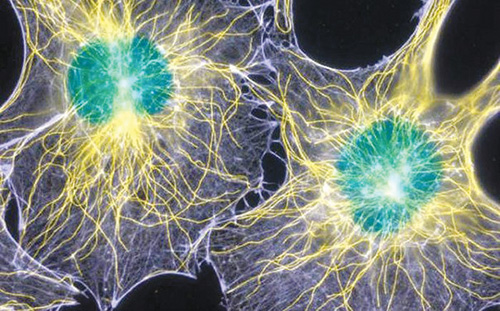
    Another possible physiological candidate for resonant interaction with a system of electromagnetic consciousness would be microtubules, part of the structural cytoskeleton of all human cells, including neurons. Microtubules are hollow structures with inner diameters of approximately 12 nm. Accordingly, microtubules could also act as waveguides, but in this case, for electromagnetic wavelengths of 12 nm (or in scientific notation, 1.2 x 10⁻⁸m). Such a wavelength corresponds to a resonant frequency of 2.5×10¹⁷ Hz, a frequency that is within the ultraviolet range of the electromagnetic frequency spectrum and has an enormous capacity for encoding information.

    Signal Modulation of Electromagnetic Waves

    Discerning these frequency bands of electromagnetic consciousness is only the first and perhaps the easiest step in mastering the physics of consciousness. Once located, the information encoded within the dynamics of the electromagnetic frequencies in that band have to be decoded or demodulated. There are innumerable ways to modulate, or encode, information. 

    Simple “AM radio” varies the amplitude, or strength, of the signal at the frequency. The variation in time matches precisely the same equivalent variations in the frequency of air motion that our human hearing system interprets as “sound.” “FM radio,” however, varies the frequency itself while maintaining a constant amplitude. The frequency changes up and down within a 2 KHz range to match the equivalent 2 KHz range of audio vibrations that can be heard by most humans.

    There are many more ways of encoding information via frequencies. Modern digital communication systems are all directly built upon detecting the data “bit,” used as a binary toggle, the “ON/OFF” signal state. This is indeed the basis of all digital encoding of information. Other data modulation schemes can use variable rates of amplitude, frequency, or a combination of the two over a specific period of time.

    The greatest challenge to neurophysicists, brain scientists, and those involved in consciousness studies is to determine how nature, specifically within the human brain, is modulating and demodulating information via electromagnetic fields. Just how is thought encoded within these non-linear electromagnetic fields given the three separate domains (five dimensions) of time, space, and frequency?

    Photons as Information Packets

    At this point we must ask the following question: By what mechanism might electromagnetic information in these high frequency bands operate within the physiology of the brain and throughout the human body (and perhaps even outside of the human body)? Is there any evidence that, in addition to the well-studied molecular chemical communications in human physiological systems, there might very well be some photonic communication network in operation, simultaneously active (but distinct from) the chemical-carrier network? 

    Contemporary research has discovered that there appears to be a photonic communication network within human physiology. A growing number of experiments have detected the existence of widespread biophotonic radiation within the human body. These results have supported the conjecture that photons may indeed play an important role in the basic functioning of cells.

    Photons are the fastest and most robust carriers of information over long distances, as can be seen in the ubiquitous global man-made networks supporting the internet, all of which rely on optical communication channels (typically fibre optic cables routing modulated photons in the infrared range). Photonic communication also offers quantum information processing capabilities with which to support the incredibly high rates of information processing necessary for cognitive operation of the human mind.

    Biophotons in Living Creatures

    Is there evidence of photon emission in the brain? Recent experiments in several countries have repeatedly detected the existence of biophotons in all living creatures. 

    All living cells of plants, animals and humans continuously emit biophotons (ultraweak electromagnetic waves) in the optical range of the spectrum, which is associated with their physiological states and can be measured using special equipment. Neural cells also continuously emit biophotons. The intensity of biophotons is in direct correlation with neural activity, cerebral energy metabolism, EEG activity, cerebral blood flow and oxidative processes.

    Biophotons were first discovered in Russia in 1923 by Professor Alexander Gurwitsch and were widely researched in Europe and the USA in the 1930s. In 1974 German biophysicist Fritz-Albert Popp was able to demonstrate that their origin lies within DNA. In fact, the emission of biophotons appears to be linked to what is called “DNA supercoiling.”

    In studies as early as those by Gurwitsch in the 1920s, researchers have been testing the bio-communication aspects of photonic emission from cells. Gurwitsch put forth the idea that “radiation generates cell division” as early as 1911.

    Now if we assume that these biophotons in plants, animals, and humans are participating in an active communication network linking innumerable physiological subsystems into one whole, then information must somehow be modulated and retrieved via these photonic messengers.

    What would be required to support a biophotonic communication network? First of all, photonic communication systems within the brain would require optical waveguides to channel the biophotons while protecting them from decoherence (the degradation of their own signal content) due to the myriad of larger wavelength EMF activity (referred to as “static” in radio receivers), external “noise” within the brain beyond each waveguide. Typically, waveguides would likely also function to facilitate routing of biophotons to other systems of the brain/mind.

    The biophoton emission rate is about 1 photon per neuron per minute. If one takes such a low rate of biophoton emission and considers the fact that there are about 1011 neurons in a human brain, there would still be over a billion photon emissions per second.

    In discussing the propagation of electromagnetic fields in brain tissue, Giuseppe Vitiello suggests the following: 

    In biological systems coherent oscillations of dipoles… would be confined inside filaments or tubes. The electromagnetic field would thus propagate within a network of filaments inside the correlated water medium, provided the strength of the electric disturbances is sufficiently high…. The diameter of the filament in the simplified case of a completely aqueous medium with maximum of polarization may be computed and it turns out to be of the order of 15 nanometers, which is a figure very near to the inner diameter of microtubules…. As a matter of fact, the observed dynamical behavior of the cytoskeleton, with its intricate network, with continuous creation and destruction of branches, and with its movements, is a true puzzle to biochemistry.

    Optical Networks in the Brain

    A recent study points out the reasonable expectation of an optical communication network within the human mind/brain systems.

    With the advantages optical communication provides in terms of precision and speed, it is indeed a wonder why biological evolution would not fully exploit this modality.

    The twenty-first century communications network operates through a vast network of fibre optic cables that act as the waveguide for photons connecting our continents. It is interesting to compare the performance of this optical system with the first electrical intercontinental cabling system.

    In August 1858 the first message between nations was sent by modulated electrical signals over the new cable, a message from British Queen Victoria to US President James Buchanan. These first messages were exchanged over the newly laid transatlantic cable resting on the floor of the Atlantic Ocean, and though the messages were short in length, they required 17 hours for transmission via Morse code. Due to the many unknowns affecting long range transmission of electrical signals through this underwater cable, it took a full two minutes to transmit even a single character. Over time the technology would improve, but even forty years later the maximum transmission rate over transatlantic cables had only reached 120 words per minute. Yet previously, even a one-way message from her Majesty, Queen Victoria, to President Buchanan would have had to be sent through a combination of steamship courier and land telegraph, taking 12 full days. Thus, the first transatlantic cable was hailed as “the 8th Wonder of the World.”

    By contrast, the average two-way internet rate of information transmission in 2017 was 7,200,000 bits (7.2 Megabits) per second. Of course, modern cables are not copper wires but fibre-optic bundles which stream enormous networks of modulated photons. The estimated total length of underwater intercontinental fibre optic cables as of 2014 was a total of 550,000 miles. 

    In the human body, the total length of capillaries branching out from the blood vessel system is about 50,000 miles, or about one tenth of the current global fibre optic communication network (the internet). The capillary system would thus be a suitable waveguide for channelling photonic information within the 10μm electromagnetic infrared range throughout the human body.

    It is interesting to note that the network of photons modulating our internet is powered by carbon dioxide lasers, currently the highest-power continuous wave lasers available. These CO2 lasers produce a beam of photons that resonate within the infrared wavelength band, between 9.4μm and 10.6μm, with the principal wavelength centred on 10μm. Surprisingly (or perhaps not surprisingly?) this is identical to the wavelength of peak radiation that streams throughout the human blood capillary system. The human body produces over two pounds of carbon dioxide each day, and all of this CO2 is distributed in the coursing ionic bloodstream flowing throughout the body in the system of capillaries.

    DNA Supercoiling

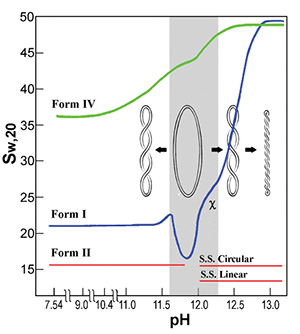
    Electromagnetic radiation occurs when an electric charge spins (“oscillates”) within a specific frequency range. Biophotons radiate electromagnetic energy throughout the spectral range from 180 nm to 1000 nm, covering the ultraviolet, visible and near infrared. The corresponding frequency range is from 3 × 10¹⁴ to 1.6 × 10¹⁵ Hz. The generation of these photons requires two phases: (1) an energy pumping that builds up the charge of the spinning electron to the excited level, and (2) the emission of a photon with the corresponding loss of charge of the spinning electron. Where might we look to discover the source of biophotonic plasma generation? The answer seems to be in DNA supercoiling (see Figure 1).

    Figure 1: DNA Supercoiling versus pH. Notahelix/Wikimedia Commons/CC BY-SA 3.0

    DNA rings have been found to be extremely sensitive to variations in pH, the excess or deficit of electrons in surrounding aqueous fluids. Slight changes in pH result in causing these DNA rings to alternately coil and uncoil. In coiling, the rings store up energy from the surrounding ionic electromagnetic environment; when they relax from a coiled state to a circular state, the additional stored energy is released as biophotons. It has been determined that biophoton emission rates are about 1 photon per neuron per minute. Given that there are about 1011 neurons in the human brain, this would equate to over a billion photon emissions per second, more than sufficient to facilitate transmission of a large number of bits of information, and to offer the possibility of an enormous network of quantum entanglement in the resulting swarm photonic plasma. It is quite feasible that these biophotons themselves are modulated in some fashion with information transferred from within the DNA configuration. 

    Waveguides

    It has been speculated that myelinated axons could serve as the waveguides for travelling biophotons within the brain. The widest myelinated axons in the brain have an inside diameter of 10μm, while the narrowest are 0.2μm in diameter. Of course, narrower waveguides channel higher frequencies (and correspondingly can handle higher rates of encoded information transfer).

    Kirlian Photography

    Figure 2: Kirlian photograph of an oak leaf. Mark D Roberts Photography/Wikimedia Commons/CCBY4.0

    One final piece of the puzzle in support of electromagnetic field consciousness is the phenomenon of Kirlian photography, first discovered in 1939 by the Russian electrical engineer Semyon Kirlian. It was found that by placing an object on a photographic plate connected to a high-voltage source, a photographic image of previously unsuspected radiation patterns emitted by the object could be produced. This phenomenon has been subsequently called by various names: electrography, electrophotography, corona discharge photography (CDP), bioelectrography, electrophotonic imaging (EPI), and in Russia, Kirlianography. The corona discharge glow at the surface of an object (Figure 2) subjected to a high-voltage electrical field is referred to as a “Kirlian aura” in Russia and Eastern Europe.

    In short, there are numerous avenues of exploration open to future researchers in the search for the physics of consciousness. Many of these areas have been largely ignored by neurophysiologists in their race to map the complex neuronal wiring systems of the brain. It is this author’s hope that broader avenues of exploration will eventually result in a true understanding of the physics and dynamics of this amazing phenomenon that is consciousness.

    Shelli Joye’s book Developing Supersensible Perception: Knowledge of the Higher Worlds through Entheogens, Prayer, and Nondual Awareness, is available from all good bookstores. The footnotes for this article are published in the print and PDF versions of this magazine.

    [alert type=”general” dismiss=”no”]This article was published in New Dawn Special Issue Vol 13 No 6.[/alert]

    [alert type=”success” dismiss=”no”]If you appreciate this article, please consider subscribing to help maintain this website.[/alert]

    © New Dawn Magazine and the respective author.
    For our reproduction notice, click here.

  • UNPLUG: Staying Spiritually Sane in the World of Advanced Technologies

    UNPLUG: Staying Spiritually Sane in the World of Advanced Technologies

    From New Dawn 170 (Sept-Oct 2018)

    When I was sixteen our family moved to western Kentucky, about sixty miles from the Abby of Gethsemani where the famous Trappist (Cistercian) monk Thomas Merton lived. I became acquainted with Merton the year before when I read No Man Is An Island – the book had a significant impact on my spiritual journey. Within months, my mother, father and I decided to spend a day at the Abby. I remember we turned off the main highway onto a winding tree-lined road, suddenly after crossing over a small hill, a steeple-cross appeared in the distance, and we were in the most serene setting I had ever been in. That day marked a major transition in my spiritual life.

    After that day at the Abby I entertained becoming a monk, but circumstances would lead me away from the monastic life. Although I never pursued becoming a monk within a community, I would spend the rest of my life periodically going on retreats in monasteries and retreat centres. It was at the Abby of Gethsemani some twenty-five years later I had a religious calling while on retreat that eventually led me into the Priesthood. 

    In the oncoming years, I studied a variety of meditational practices, beginning with Christian contemplation in which I focused on a religious icon or sacred symbol incorporating the image and the attributes into my spiritual self. This meditation led to Kabbalistic pathworking meditation, Buddhist Diamond meditation, Transcendental Meditation, chakra meditation, and finally settled on mindfulness meditation and Qi Gong. Decades later I incorporated Passage Meditation into my practice. I used several of these meditational practices to reduce stress and anxiety with myself as well as my psychotherapy clients, and currently use them with clients in spiritual direction. With these meditational practices I eventually developed a secular contemplative lifestyle that keeps me connected to the sacred as well as keeping me balanced and sane when it comes to new technologies. 

    Staying Spiritually Sane in the World of Advanced Technologies 

    It took many years of intense work for me to develop a contemplative lifestyle amid my work as a psychotherapist, priest, writer and adjunct professor. The challenge in developing a spiritual lifestyle in our changing world of advanced technologies is to commit to a daily routine and practice. One needs to create an internal personal and outer physical environment that allows one to disconnect from the world of technology. Contemplative practices facilitate and promote this type of setting, and they all come from the world’s religious and spiritual traditions. 

    These traditions promote a calmer, quieter and relaxing environment in which one can experience an inner focus, a calmer mind, a balanced life and a profound change in conscious awareness. The contemplative practices that achieve this type of lifestyle include inner reflection, centring prayer, imaginary journeying, sacred reading, journal writing, Qi Gong, contemplation and all types of meditation. 

    To understand the foundations of contemplative lifestyles, one needs to know where they derive. All contemplative practices come from religions and spiritualities. There are major differences between these two concepts. According to Timothy Freke,1 religion focuses on “rituals, observances, creeds and codes of social morality.” Religion also centres on major “life transitions such as birth, marriage and death with appropriate rites that bind together a community. Religion is the outer form of spirituality,” which is a personal journey of transformation. Within this context, spiritual practices are used to transform a person’s inner life from baser needs into higher needs. To attain this inner transformation, spiritual practices such as prayer, contemplation and meditation are used. However, it is “possible to be religious without being spiritual,” such as “many people piously participate in religious customs without ever understanding a personal journey of spiritual transformation. Fundamentalism of all religious persuasions,” including scientific materialism and scientism with its “insistence on blind faith in dogmas, is religion without spirituality. This is why it divides people rather than uniting them.”

    On the other hand “spirituality is the inner content of all religions, but it does not necessarily have to have a religious context. Spirituality is about setting out on a personal journey of transformation, searching for answers to the most profound questions of life.” In this context, “spirituality is a journey of awakening to who we really are; a journey of opening the heart to the love that permeates the universe; a journey from confusion to meaning; a journey from fear to faith” (faith meaning trust); “a journey from” malaise or dissatisfaction “to a life filled with magic and wonder; a journey from feeling alone in a hostile world to being one with everyone” and everything, a journey into the awakening that all existence is an interconnected whole, in essence, a journey from fragmentation into wholeness or oneness.2

    As stated, contemplative practices are significant components of both religion and spirituality in the development of a personal spiritual lifestyle. A contemplative lifestyle is a life of spiritual unfoldment coupled with the experience of spiritual oneness. Spiritual unfoldment is the process of becoming aware of one’s spiritual nature and aware of the spirit within. Spiritual oneness is the recognition that everything that exists is part of one grand experience, and within that grand experience everything is interconnected or interdependent. Within the experience of spiritual unfoldment and oneness, there is a personal awareness of a divine presence within one’s self and outside of one’s self; this awareness is totally absent in Artificial Intelligent (AI) machines. 

    To live and develop a contemplative lifestyle one cultivates a daily spiritual practice with methods and techniques that open one to become consciously aware of their connection with all existence. The various contemplative practices cited above facilitates conscious awareness and being mindful of the present moment. However, Passage Meditation or PM is a special type of meditation because it is a multi-sectarian practice appealing to both the religious and the non-religious. 

    PM uses mindfulness, wisdom passages and a mantram to centre and keep a person balanced and calm. In this practice, one chooses a wisdom passage from the world’s wisdom traditions and memorises it. During meditation, the meditator says each word in the passage, one word at time, which brings the meditator into the present moment. The passage is repeated over and over for 30 minutes. Then, throughout the day, the meditator says a mantram over and over to keep calm and balanced. The mantram one chooses can be as simple as saying Buddha, St. Frances, Om, or just the word calm over and over. One interesting result of PM is over time the meaning of the wisdom passage becomes incorporated into the meditator’s spiritual life – they become one with the passage. 

    Religion and spirituality have always been major parts of my life as well as science. With science, Einstein had a deep impact on me, especially when it comes to how I understand the connections between religion and science. The moving statement from Einstein that became a beacon for me was “Religion without science is blind. Science without religion is lame.” These words have guided me through my years in scientific research as well as my perceptions of religion and spirituality. 

    In our contemporary world with advanced technologies we have forgotten what Einstein’s words really mean. It takes both of these areas working together and in harmony to keep us balanced as we move into the world of advanced technologies. We already see negative results of these technologies. People are unconsciously becoming addicted, dependent, obsessed, angry, frustrated and anxious with the Internet and technologies in general. If we can’t keep ourselves balanced as we use the technologies we already have, then how are we going to react to new advanced technologies that are now creeping into our lives. Because of these technologies, our spiritual selves or the core that makes us human is fragmenting. 

    This fragmentation is the result of awareness lag. Awareness lag is a phenomenon in which our awareness lags behind the rapidly changing technologies prohibiting us from adequately adjusting to these innovations and inventions. In this phenomenon, we don’t know what to do with our lives or whom to trust because we are blind-sighted by the rapid changes affecting our lives – we simply can’t adjust. We have not prepared for the present or the future, and we don’t understand what is happening and we don’t know where advanced technologies are leading us. 

    Because our awareness lags behind our rapidly changing world, we are overloaded with useless information. By the time we understand what is happening and able to sort through the data, it’s too late because new AI technologies such as smartphones, robotics and the Internet have taken over our lives. Awareness lag can be addressed by slowing down one’s daily pace by using contemplative practices that allow us to be in the moment so we can centre ourselves, freeing our minds, allowing us to understand the direction our lives are heading and what is happening in our existential world. 

    Advanced Technologies Shaping our Spiritual LiFe

    The current technologies that are responsible for fragmenting and overwhelming us are smart TVs, advanced computers, smartphones, robotics, and self-driving vehicles with their accompanying AI algorithms. These technologies are taking us away from intimate face-to-face interactions as we lose sight of our humanness. Many people are becoming lost in these virtual AI realities, and many can’t distinguish the virtual world from the real world. The image of your wife on your smartphone is not your wife, but photons and electrons arranged by AI algorithms creating specific human-like patterns. People mistake the virtual world for the real world, which furthers spiritual fragmentation. Although these technologies add conveniences to our hectic lives, our spiritual selves are suffering. 

    Current technologies are just the tip of the iceberg when it comes to spiritual fragmentation because these new technological innovations seeping into our lives will create more alienation and fragmentation. The following five technologies are destined to change and reshape humans forever. However, to maintain our sense of humanness, there are ways to sustain our spiritual connections through contemplative practices. These practices will keep us centred and in the present moment as we adjust to the radical changes that are here and those that are coming as a result of quantum computers, artificial intelligence (AI), robotics, nanotechnology and gene editing tools.

    The major invention that will be here soon is the quantum computer that uses quantum mechanical phenomena such as superposition and entanglement to perform operations on data. Quantum computers are very different from our conventional computers because the storage capacity is enormous and speed is exponentially faster. This computer with its quantum effects will further fragment our core selves because it will change our reality into something unforeseen.

    Artificial intelligence, also called synthetic intelligence or Machine Learning (ML), is the ‘intelligence’ exhibited by machines or software. Quantum computers will use and control AI programming with unanticipated consequences. There are four types of AI and the first two are already here on your smartphones and self-driving vehicles.  

    Type I AI is purely reactive and is in the category of narrow or weak AI, and is the most basic form. According to an infographic by the website Futurism.com, “It perceives its environment” or “situation directly and acts on what it sees. It doesn’t have a concept of the wider world” and “can’t form memories or draw on past experiences to affect current decisions.” This type of AI is very specialised and was the basic programming for “IBM’s Deep Blue” that “beat [Garry] Kasparov at chess.”3

    Type II AI is called limited memory and is a category of general AI, but currently has very limited decision-making capabilities. This type of AI takes portions “of past information and adds them to its preprogrammed representations of the world,” and “has just enough memory” or experience “to make proper decisions and execute appropriate actions.” Type II examples are self-driving vehicles, chatbots and personal digital assistants. Personal digital assistant is a term for small, mobile, handheld devices that provide computing and information storage and retrieval capabilities for personal or business use, often for keeping schedules, calendars, and address book information. The latest innovation is scheduling using AI voice interactions in which one cannot distinguish between the AI voice and a real person.4

    Type III AI is called theory of mind, an advanced type of general AI that will have the capabilities “to understand thoughts and emotions affecting human behaviour.” This type of AI hypothetically will “comprehend feelings, motives, intentions and expectations” as well as the ability to “interact socially.” However, Type III is “yet to be built,” but will “likely be the next class of intelligent machines.” Examples are C-3PO and R2D2 from the movie Star Wars.5

    Type IV AI is self-aware and “can form representations about themselves,” which is “an extension of the theory of mind.” It is Type IV AI that troubles many in the AI field, a fear that intelligent machines could render humans obsolete or even eliminate humans altogether. Type IV would be aware of “internal states” and “predict the feelings of others.” It will be able to “make abstraction and inferences.” This type of AI is “the future generation of machines” with “super intelligent, sentient and conscious” capabilities but not on the human scale. No machine will fully exhibit humanness. How can you program true emotions, intuitions, hunches, leaps of insight, spiritual transcendence and numinous states into a logical structure – you can’t – because we don’t really understand these experiences and humans are both logical and non-logical – machines are only logical. An example of Type IV would be Eva in the 2015 movie Ex Machina.6

    Robotic systems are mechanical or virtual artificial agents; usually an electro-mechanical machine guided by a computer program such as AI, including machines resembling a human being, and able to replicate specific human movements and functions automatically. These AI machines will eventually take over most of the work presently performed by humans.7 As robots continue to take over many jobs in the workforce, stressing the human psyche, the result is spiritual fragmentation and a loss of internal cohesion.

    The next technology is nanotechnology, also called atomically precise or manufactory machines. These machines are created by the manipulation of matter on the atomic, molecular, or supramolecular scale. The earliest description of nanotechnology refers to the particular technological goal of precisely manipulating atoms and molecules for fabrication of macroscale products, now referred to as molecular nanotechnology.8 These small micro-machines are similar to robots and they will take more jobs from humans, further fragmenting our core selves.

    CRISPR-Cas9, or CRISPR, is a gene-editing tool. The word CRISPR stands for “clusters of regularly interspaced short palindromic repeats.” It is a specialised region of DNA with two distinct characteristics: the presence of nucleotide repeats and spacers. Repeated sequences of nucleotides, the building blocks of DNA, are distributed throughout the CRISPR region. CRISPR is the first genome-editing tool that is faster, cheaper and more accurate than previous techniques for editing DNA, and has a wide range of potential applications. CRISPR is the protein with their RNA guide that finds the area in the DNA to be edited. The Cas9, also a protein, is the editing component that snips and removes the DNA allowing the DNA to be restructured. 

    CRISPR-Cas9 enables geneticists and medical researchers to edit parts of the genome by removing, adding or altering sections of the DNA sequence. It is currently the simplest, most versatile and precise method of genetic manipulation.9 This technology will reshape us physically as well as mentally, further fragmenting our humanness. However, on the upshot, this technology may offset human extinctions due to superintelligent machines creating new forms of humans, but that would also contribute to spiritual fragmentation. 

    Unplugging

    Contemplative practices facilitate a calmer mindful environment. Mindful in this context is the ability to focus attention in the here and now by controlling distractions. Being mindful also means taking time for what really matters in your life by being conscious or aware of where your attention is focused, and what you are doing and feeling. In a mindfulness mode of awareness, you are being sensible, accepting and non-judgmental of what is going on in the present moment and being attentive to your emotions, thoughts and sensations. 

    An example of how mindfulness is used in one’s daily life is to take the time and move into the present moment. Take a few minutes and settle down becoming mindful in the moment, either in front of the technology you are using, or in the room you are in, or what’s going on around you, and focus on your present experience. Close your eyes, take a few deep breaths, and relax. What are you feeling? Are you frustrated, angry, anxious or happy, content and at ease? What are the smells in the room you are in? Are they pleasant or noxious? What are you thinking, is it something specific or non-specific? Where you are sitting, are you comfortable? Do you have aches, pains, itches, tingling sensation or a subtle calmness throughout your body? What do you hear? Do you hear natural sounds such as birds singing, traffic sounds or undefined sounds? Are you comfortable or tense being where you are now? Be mindful of these sensations and experiences for a few minutes. Now slowly move your awareness back into the everyday world. 

    Being mindful in our world of advanced technologies is essential in reducing awareness lag, technology addiction, obsession and dependence by keeping yourself calm, balanced and centred. In this regard, approach all technologies with a mindfulness perspective. Before turning on your computer or any other communication device, sit for a few minutes in front of the technology and close your eyes and focus on your breath going into your lungs and your breath going out of your lungs. On the in-breath, say to yourself “I am calm,” and on the out-breath say to yourself “and I’m at peace.” By sitting in front of your computer or any technology performing a meditation, you centre yourself before being exposed to the Internet, email or Facebook. When you are on a computer or any technology, pay attention to your thoughts, feelings and emotions – if you become anxious, frustrated or angry, stop, take time out and meditate to centre yourself. I say the Buddhist Metta Prayer before turning on my computer to centre and calm myself.

    When on the Internet, selectively pay attention to what you are viewing, and how much time you spend on each such as e-mails or Blogs. While on the Internet, or using your smartphone or on Facebook, always pay attention to your emotions – are you angry, frustrated, happy or in an upbeat mood. In being mindful, do not surf the Internet without a specific goal, always be aware of where you are emotionally. After viewing, take a short 10-minute rest period, re-centre yourself by doing something non-technical or just sit and meditate. At the end of the day, turn off your computer and smartphone, prepare to rest, and relax before going to bed. Take control of technologies and don’t let technologies take control of you because this helps to prevent technology addiction, obsession and dependence. By being mindful, you avoid spiritual fragmentation by moving into a state where your life has purpose and meaning. I control my time at the computer by turning it off each day around 6 PM, and on most Friday afternoons I turn the computer off – in most cases, I don’t turn it back on until Monday.

    Once you have created a mindfulness set of practices in working with technologies, it is time to broaden your contemplative lifestyle to assure you have purpose and meaning in your life. To achieve a contemplative lifestyle and keep yourself mindful and centred, take a no-technology day by limiting your use of technology. As the five advanced technologies discussed earlier take centre stage in our global world, we need time to connect to our humanness – finding meaning and purpose in our life. We ask ourselves, what really matters in my life? It’s not these advanced technologies; it’s our connections with ourselves and with other people, the beauty of a sunset, the songs of birds, the simple evening meal with our loved ones – meals where cell phones are forbidden. When loved ones eat together, there needs to be a rule – no cell phones and no texting, only face-to-face communication – we are humans not AI-driven robots. Find a day you can set aside to reconnect with yourself or life partner or family.

    On the no technology day, UNPLUG and choose the technologies you want to UNPLUG from. I set aside all technologies except for the CD player in which I only play slow relaxing music and Gregorian Chants. Before bed, I may watch a non-violent commercial free movie for a short time and then turn on the Music Choice channel and fall to sleep listening to Soundscapes. As you UNPLUG from your hectic consumer driven materialistic outer life, you will begin to engage in quiet time, listening to slow relaxing music in the background, reading poetic stories or spiritual reading also called lectio divina. Throughout the day, sit and relax by centring yourself in the calmness of meditation. DO NOT THINK ABOUT THE PAST OR THE FUTURE; ONLY BASK IN THE PRESENT MOMENT. 

    Conclusion

    I have found the contemplative lifestyle centring and rejuvenating. Setting aside one day in which I can reflect on what has meaning and purpose in my life is very fulfilling. What’s fulfilling are not new technologies, buying things I don’t want or need, but the interconnections with friends, family and everything around me. It’s our face-to-face human communications with each other that is important, not the phony one-sided view of a person on Facebook. You will never honestly get to know that person electronically; it’s only in our flesh and blood interaction one gets to know a person. 

      If we are not mindful and acutely aware, new advanced technologies will take total control of our life, rendering us pawns in a world of fragmentation. We end up shallow, with no real meaning and purpose in our life. The antidote is to cultivate a contemplative lifestyle using various mindfulness practices such as Passage Meditation and simply UNPLUGGING. 

    [alert type=”general” dismiss=”no”]This article was published in New Dawn 170.[/alert]

    [alert type=”success” dismiss=”no”]If you appreciate this article, please consider subscribing to help maintain this website.[/alert]

    Footnotes

    1. Encyclopedia of Spirituality: Information and Inspiration to Transform your Life by Timothy Freke, Godsfield 2000, 152
    2. Ibid.
    3-6. https://futurism.com/images/types-of-ai-from-reactive-to-self-aware-infographic/
    7. Rise of the Robots: Technology and the Threat of a Jobless Future by Martin Ford, Basic 2015 
    8. Radical Abundance: How a Revolution in Nanotechnology will Change Civilization by K. Eric Drexler, Public Affairs 2013
    9. A Crack in Creation: Gene Editing and the Unthinkable Power to Control Evolution by Jennifer A. Doudna & Samuel H. Sternberg, Houghton Mifflin Harcourt 2017; also see Brett Lothian’s article ‘The Rise of Homo Technicus’ in New Dawn 169.

    © New Dawn Magazine and the respective author.
    For our reproduction notice, click here.