New Dawn – World's Most Unusual Magazine

Category: Articles

  • ONE: The New Tarot & the Secret Doctrine that Launched the Counterculture

    ONE: The New Tarot & the Secret Doctrine that Launched the Counterculture

    From New Dawn 145 (Jul-Aug 2014)

    It is a little known fact that an actual doctrine lies at the heart of the counterculture of the Haight Ashbury in San Francisco that emerged in 1967. 

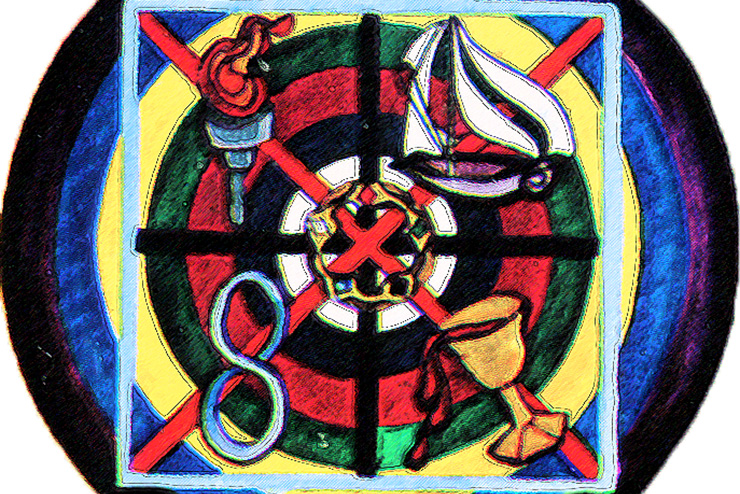
    This doctrine expresses a new consciousness – One Consciousness – illustrated by 22 new (or reversed) tarot images. These 22 “Books of T” – known as the Word of One Tarot – were communicated through the Ouija board in 1962 and 1963 by an entity naming itself “ONE.” 

    This is the story of that doctrine which, like a buried talisman, has remained concealed since those times. It is also the story of “the great crippled wizard” (as Timothy Leary termed him), who not only was instrumental in bringing these images through the Ouija board and painting them, but also in publishing them during the fabled Summer of Love.
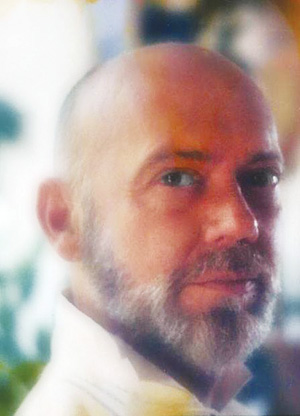
    John Starr Cooke, 1965 (Courtesy of the estate of John Starr Cooke)

    John Starr Cooke was a descendant of Dr. Comfort Starr, who came to New England, USA in 1635. He was a great patron and benefactor to Harvard College, which began in 1639 on the site of his former house. Another of Cooke’s notable early American ancestors is Revolutionary War hero Joseph Platt Cooke, who was one of George Washington’s generals and was in Danbury the night the British razed the town in 1776.

    Cooke’s great-grandparents Amos Starr Cooke and Juliette Montague arrived at the (then) Sandwich Isles in 1838 as missionaries. They established the Royal School where all five final monarchs of Hawaii were educated, including the final ruler Queen Liliokulana. Juliette spoke fluent Hawaiian and had a particular gift for music. Hawaiian-style music, which endures to this day, is said to have stemmed from her work.

    The Cookes left missionary work in 1850 and went into business, establishing Castle and Cooke, a farm supply enterprise, with another ex-missionary family. They met with swift and great success. 

    The good fortune of the Cooke family continued as they diversified into sugar, pineapples, irrigation, railroads, shipping and banking. John Cooke’s grandparents Charles Montague and Anna Rice Cooke (also a daughter of missionaries), travelled widely, particularly to the Far East, where they indulged their passion for collecting fine art. 

    The strict puritan ethic established by Amos and Juliette saw a separation between the family and the islanders. This separation was less evident by the time John Starr Cooke was born in 1920. His Hawaiian nursemaid took him to secret shamanistic ceremonies from the age of three or four. These involved chanting and dancing all night, and John became a very young initiate.

    The women in his family were immersed in Theosophical ideas, Madame Blavatsky, Swami Vivekananda, G.I. Gurdjieff, Annie Besant and Krishnamurti. On his mother Lily Love’s side, the Love family were bakers. It was often said in John Cookes family that the Loves had come to the islands to cook, and that the Cookes had come to the islands to love.

    Anna Rice Cooke left a great legacy to the world in the Honolulu Museum of Art. She donated land, the building, her personal art collection and enough money to run the museum in perpetuity. At the opening in 1927, no doubt attended by John Starr Cooke, the traditional Hawaiian blessing was most likely performed by David “Big Daddy” Bray, a lifelong friend of John.

    Tarot Cards & Ouija

    On one of his many visits to San Francisco, Cooke, aged nine, was at a hotel and felt ill. Deciding to play some solitaire, he went downstairs to purchase playing cards. However – to his horror! – he bought something altogether more strange: Tarot cards. He considered the images to be evil and threw the cards out the window. According to his sister Alice, on a different occasion curiosity got the better of John and he bought a second pack, only to again throw the cards out the window. Incredibly, he repeated the whole process a third time! 

    John’s mother Lily died in 1933, and his father took him on a long cruise soon afterwards. John later recalled that on this trip he met Cole Porter, and that Porter wrote the song ‘Begin the Beguine’ for him. This is part of the reason John produced the photograph of himself, with the inscription “BEGIN.” After the death of their mother, Alice became a mother-figure to the young John. 

    By the age of fifteen, he was a seasoned traveller, with numerous trips to San Francisco. With his sister Alice, John started using the Ouija board at 19. 

    In 1943, Cooke was married, on the advice of the Ouija board, to Wilma Dorothy Vermilyea, who became known as Millen Cooke. Millen Cooke was a poet, occultist and Science Fiction author, most prolific between May 1946 and May 1950. She was published in such magazines as Amazing Stories, Fantastic Fiction and Other Worlds Science Stories. She was also a chela of a Tibetan Mahayana Buddhist monk, and had a deep understanding of kundalini yoga. John’s father Clarence Hyde Cooke died in 1944.
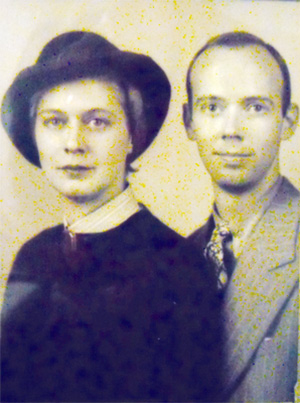
    John Cooke and Millen Cooke on their wedding day in 1943

    John and Millen Cooke travelled around Europe, with John studying medieval tarot decks and tracking down various holy men. They spent a lot of time in London. During this period, Millen dictated, while in a dream state, a set of Tarot images which John subsequently drew. These were issued in 1992 as the Atlantean tarot, part of the Word of One Tarot boxed set.

    John had encountered Meher Baba briefly in Europe in the mid-40s. In 1948 he was able to assist the followers in California to purchase a mountain property in the Ojai Valley in California, known as Sulfur Mountain and subsequently as Mehermount. 

    Dianetics by L. Ron Hubbard was released in mid-1950, an instant bestseller. When Millen Cooke read Dianetics later that year, she was so enthused that she immediately went alone to New York to explore this new work with serious practitioners. John followed Millen to New York, where he joined the Dianetics practitioners. 

    Mary Oser had come to New York from Basel, Switzerland on a mission. Her husband Peter Oser was fantastically rich but terribly unhappy. Nothing Mary could do would bring him out of his torpor until she encountered Dianetics, and had some success. She needed to find a competent practitioner of Dianetics so she went to the centre of Dianetics activity in New York. She found John Cooke and realised she had found the right person. Cooke returned to Basel with her. 

    In Basel, Cooke ran the household along Dianetics principles. This seemed to work for Peter Oser, and he became a blind follower of Cooke. On one occasion, Peter was driving and asked where to turn. John said “right here,” indicating a crossroad some distance ahead. Peter followed John’s word so closely that without even a moment’s hesitation, he turned right, and straight into a ditch.

    Millen and John were divorced in 1951, and she was briefly married to John’s friend and associate William Belknap Jr. The Belknaps were both into Dianetics. Millen later married Brinsley Le Poer Trench, with whom she co-authored some seminal works on flying saucers. 

    The Oser household in Basel, Switzerland, was under John’s direction and also under the direction of the Ouija board. One day the board indicated they should travel at once to Central Africa. Within three hours they had packed up and left, with John convincing Peter to buy an aeroplane at the airport.

    Tangier & the Naqshbandi Order

    John Cooke lived in North Africa for the next six years, mostly in Tangier. He became associated with a Sufi sect, the Naqshbandi Order, and among them he was known as Sufi Rashid. He went deeply into their system of initiation, and danced to their drumming with his own whirling dervish style. The group came to look upon him as a great healer and the reincarnation of Hassan, a blue-eyed Muslim from nine centuries earlier. He never considered himself Muslim, although travelling with the Naqshbandi Order meant that Muslims assumed that he was. Thus he set foot in a certain holy Muslim city, the first non-Muslim to do so in over a thousand years. 

    In 1952, John and Mary married. In 1954 they became associated with Brion Gysin and his famous restaurant, The 1001 Nights. Gysin later described the Cookes as looking like very rich hippies with “veils and spangles and bangles,” ten years before their time.
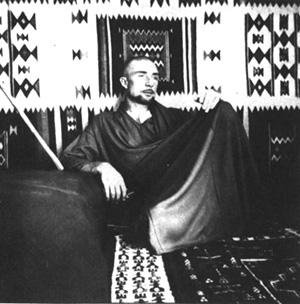
    Brion Gysin in 1956 at John and Mary Cooke’s home in Algeria

    In early 1956 they travelled to London. John Cooke was about to purchase a Tarot deck, which had belonged to Aleister Crowley, and was annotated in Crowley’s hand. At the home of Alexis Lykiard, Cooke was warned against buying these cards by Lykiard’s father. Lykiard Sr predicted dire consequences should Cooke proceed; Cooke bought the cards and returned to Tangier. 

    Mary purchased a wing of an old colonial-era palace near Algiers and renovated it. The time came to move there to live. She was about 7 months pregnant when, in August 1956, John made arrangements to leave Tangier and join her in Algeria. 

    However, the Naqshbandi had no intention of letting John Cooke leave Tangier. Membership was a lifetime affair. If he was to leave, he must pay the penalty. At the railway station, where he went to buy his ticket to leave, a cleaner said “Oh you’re leaving?” “Yes, I am” said John. “Oh, you really think so?” At the bank soon afterwards, as he entered, a white shawl was placed on his shoulders by a person known to him. As he left the bank, he suddenly tore it off and collapsed, feeling a sudden burning sensation, as if he had been stung by a scorpion, consonant with a feeling of being hit hard at the base of the spine. He was paralysed from the waist down. 

    Mary paid Brion Gysin to close down The 1001 Nights and to come to Algiers and look after John. Gysin became the godson of their child.

    After some unsuccessful attempts at treatment, John Cooke returned to the US, and never walked again. John was interested in a total miracle, or nothing else, according to his sister Alice. Told he would be able to walk again with the aid of crutches, he refused to become an object of pity, preferring the dignity of the wheelchair. 

    Cooke, the Wizard

    An apparently miraculous new mystical technique was announced to the press in November 1957 by actress Eva Bartok. She claimed to have been cured of cancer by the methods of Subud. At this time, John took an interest in Subud. He helped finance Pak Subuh to come to the US, who was welcomed by John and Alice on arrival.
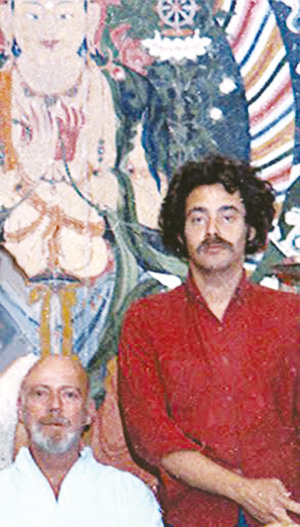
    John Starr Cooke & Michael Bowen (Courtesy of the estate of Michael Bowen)

    From 1958 the Subud group became a meditation group centred around John. He moved to a clifftop mansion at Carmel, California, and his reputation as a “real wizard” grew among the Beat community of San Francisco’s North Beach area.

    One of those attracted was Michael Bowen. He walked in to John’s living room, where John sat at a coffee table, with a plain envelope in front of him. “Those are Aleister Crowley’s Tarot cards,” said Bowen. According to Bowen, those cards, inside that envelope, had Crowley’s very small and neat handwriting all over them.

    Crowley had predicted a new aeon, and many now point to the 60s as evidence of Crowley’s Aeon of Horus. Although Crowley’s Thoth deck filled out the existing imagery of the cards with the symbolism of Thelema, the archetypes themselves remained largely unchanged. Would a new aeon require a new tarot? According to John Cooke, there was a prediction made by Madame Blavatsky in the Theosophical Society magazine Lucifer that a new Tarot would emerge in the latter part of the twentieth century.

    And now begins our story, that of the emergence of the Word of One Tarot, and its place in history.
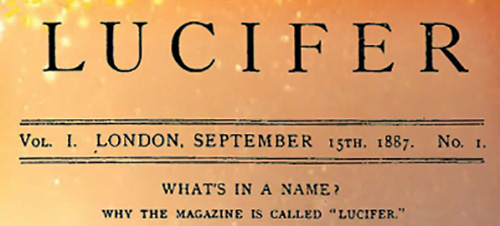
    Madame Blavatsky, co-founder of the Theosophical Society, is said to have predicted in her Lucifer magazine that a new tarot would be revealed in the latter half of the 20th century.

    Word of One Tarot

    On 17 August 1962, four people met at John Starr Cooke’s cliff top home in Carmel, California. They had been meditating regularly since 5 February, when a seven-planet conjunction in Aquarius had occurred. The group expected this conjunction to bring some kind of a consciousness shift that would affect all of mankind.

    Discussion this night turned to John Cooke’s use of the Ouija board for the last twenty-three years and as a result, an impromptu Ouija session was held. Cooke drew the letters of the alphabet on a large piece of paper, and for a planchette (the moveable pointer), used a silver dollar. He tried one person, then another as co-operators, without success, until he teamed up with Bill Eaton, whereupon the planchette moved swiftly around the board. They were in communication with an entity that later identified itself as “ONE.” 

    The group conducted another session twelve days later, and continued to do so every week or two for the next fifteen months, totalling over one hundred sessions. 

    During the seventh session, Cooke asked a question about the tarot. The response was that revisions would be forthcoming, and in that session new names were given for the Fool (Nameless One) and Hanged Man (Hanging Man). 

    Between October 1962 and May 1963, the ONE described the complete 22 New Tarot cards and John Cooke painted the images as the instructions came through. Below are the 22 new Books of T with the old Tarot trump names.
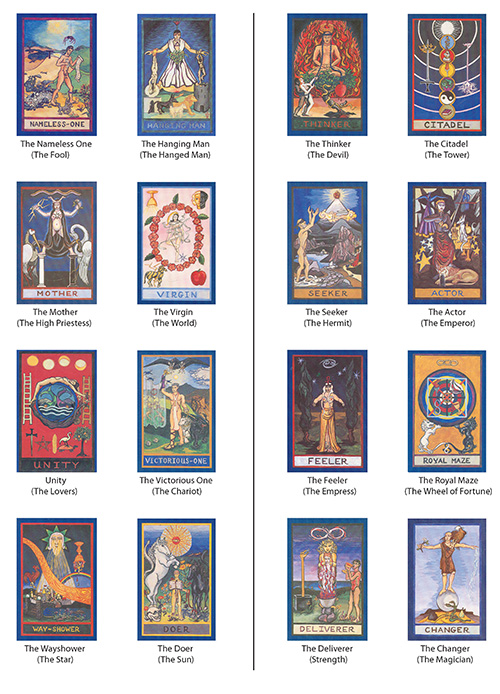
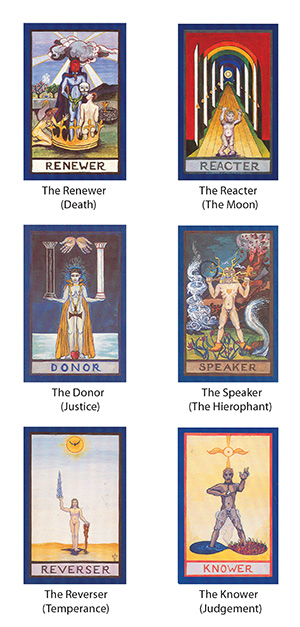
    The New Tarot images can be viewed in full here: www.tarot.one.
    The New Tarot images can be viewed in full here: www.tarot.one.

    The sessions stopped altogether in November 1963, when Cooke moved to Mexico. He was soon followed by his chief disciple Michael Bowen. They had already discussed staging a great event aimed at reversing society’s thought processes, as outlined by ONE, an event which would be historically recorded and serve as a reference point for the future. In Mexico, they continued to formulate what would become “Reversal USA.” 

    LSD & Timothy Leary

    In the midst of the reception of the Books of T, John Cooke and the group held an LSD session. LSD was at that time a legal substance, but there was no certainty as to its proper place – whether it was in the church, the psychoanalyst’s office, or to be freely available. 

    Cooke understood the Books of T (also known as the New Tarot, or the Reverse Tarot) to represent a change in man’s unconscious in the present time-period. His recent experience with LSD showed him how this consciousness could be experienced; how unity could be known. He saw LSD, like the Books of T, as a tool for understanding love as the basis of reality, for understanding the unity of all things as the ultimate truth. To this end, Cooke was in favour of the sacramental use of LSD. 

    Professor Timothy Leary was in the news at that time, achieving his initial infamy. His LSD experiments led to his being sacked by Harvard and deported from Mexico, where he had established an LSD colony. By late 1963, however, Leary, with Dr. Richard Alpert and Dr. Ralph Metzner had been offered a large estate near Millbrook in upstate New York, where they continued their work.
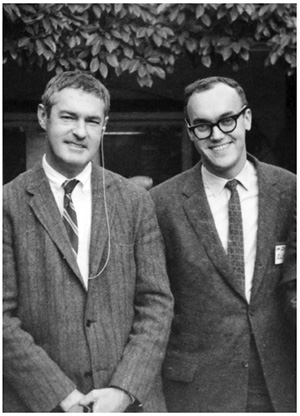
    Dr. Timothy Leary and Dr. Richard Alpert (later known as Ram Dass), Harvard, 1961

    Cooke wanted to find out whether Leary and his colleagues were for good or ill in the psychedelic movement, and he wanted to bring the Books of T to their attention. 

    John Starr Cooke had put his fortune to spiritual ends several times already. Meher Baba, the Naqshbandi Sufi order and Subud had all been recipients of his generosity. Now, once again, he bankrolled a new spiritual philosophy – only this time it was his own doctrine of One Consciousness. Michael Bowen was his means of achieving this. 

    After some months in Mexico, and after Bowen had been initiated under Cooke’s supervision, Cooke sent Bowen on his way. For the next few years, he provided Bowen with funds and guidance from time to time. Bowen’s mission was to find, befriend and evaluate Leary. The aim was for Leary to join them in their work on the reversal of society.

    Bowen and certain others became known as Psychedelic Rangers, roaming protagonists for LSD. The Rangers were loosely under Cooke’s control and undertook various psychedelic revolutionary activities. 

    And Bowen is going on. He has no choice. The forces behind his symbols are relentless. He is a pawn as well as an artist and would be overtaken if he slowed. So, by observing his work we may glimpse our own energies. It is a breathtaking trip. Look, reflect, and see yourself.
    – John Starr Cooke, letter to Rosalind Sharpe

    Michael Bowen moved to New York and in 1965 made his way to Millbrook to meet Leary and his associates for the first of several visits. Bowen had brought with him reproductions of the paintings Cooke had made of the Books of T. Ralph Metzner was impressed with the images, later writing: 

    When I first encountered the images of the “Reverse tarot” here described and presented I was immediately struck by their evocative force. Unlike the images of the old Tarot deck, which (to me) had appeared lifeless, these had a kind of direct electric-emotional “charge,” and some of them were strongly reminiscent of images found in dreams or under the effects of certain chemicals.

    However, these “certain chemicals” were under legislative attack. In April 1966 Millbrook was raided by the FBI. Michael Bowen, who was present at the raid, soon left for San Francisco, at John Cooke’s suggestion.

    Bowen had introduced Leary to the idea of a new religion, the League for Spiritual Discovery, whose sacrament was LSD. The League was to be cellular, with no central management. The central tenet was that LSD taken in private, on private property, was a private concern. It had been obvious for some time that it was only a matter of time before LSD became illegal. The League was an attempt to provide an appropriate setting for the drug before such legislation was enacted. Leary announced the League in September 1966.
    Get the issue this article appears in

    A Prophecy in The Oracle

    In San Francisco, Bowen joined Allen Cohen on the staff of the Oracle, the main counter-culture newspaper of the Haight Ashbury district. For the past couple of years, the Haight Ashbury had grown as a hip centre, aided by the availability of LSD on the streets since early 1965. 

    However, LSD was to become illegal on 6 October 1966. Bowen and Cohen understood the futility of angry protest, and instead organised “a celebration to demonstrate opposition to legislative repression of chemical mysticism.” The Love Pageant Rally, as it was named, was promoted in the first issue of the Oracle in late September 1966. 

    Bowen wrote a Prophecy of a Declaration of Independence, which posited the expansion of consciousness as an inalienable right, and this was also included in the Oracle’s first issue.
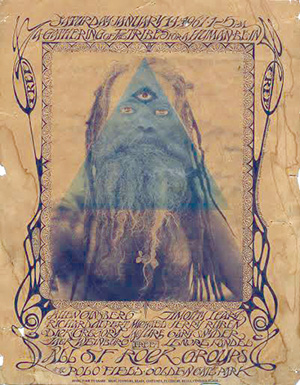
    Be-In poster by Michael Bowen & Stanley Mouse

    At 2pm on 6 October, the Prophecy was read out at the Love Pageant Rally and those hundreds assembled broke a brand-new law in unison. The point being made was that Americans were free under their Bill of Rights and their Constitution to alter their consciousness. It is a personal matter, and not the province of government.

    The Love Pageant Rally was such a success that it led to the creation of a similar event, but on a much larger scale. This was the Human Be-In on 14 January 1967. 

    When Bowen was at Millbrook, he stood on a bridge over the lake. He thought about the great event he and Cooke had discussed as he dropped pebbles into the lake and watched the ripples spread. It occurred to him that for the ripples to reach the furthest shore, a big splash was required. With some effort, he dropped a boulder into the lake – watching, satisfied as the ripples reached the far shores. 

    The big-splash event which Bowen had envisaged was the First Human Be-In. Many people contributed to the creation of this grand event, but Bowen was the driving force behind it. 30,000 people came to the Be-In in Golden Gate Park, San Francisco. The Be-In was designed with no particular stars of the show, the speakers all limited to three minutes each. There were bands, but none were promoted. It was an event designed specifically for people – even the people on the stage – to just being with each other. This allowed an authentic sense of One-ness to occur. 

    The poster by Michael Bowen for the Human Be-In is a snapshot of a moment in American spiritual history. It marks the moment when the first apostles of One Consciousness created an American spiritual event which allowed a mass mystical experience of unity. 

    According to Michael Bowen and many others, for about six months after the Be-In, the sense of One-ness persisted in Haight Ashbury. There was a psychic harmony, a telepathic connection at a day-to-day level. 

    Michael Bowen was actively involved in the Haight Ashbury community. At the press conference for the Council for a Summer of Love in April 1967, alongside the other forces in the community, he was the representative of the Church of One. 

    History records that the Summer of Love came to pass. Estimates of the numbers of young people who descended on Haight Ashbury in the summer of 1967 usually begin at 100,000 and go up to about 300,000. It was a significant time in history, and the whole world seemed to suddenly switch from black and white to colour.

    Bowen had some of the images of the Books of T reproduced as large meditation posters, published by East Totem West the Haight Ashbury early in 1967, and then in August 1967 came what John Starr Cooke termed “the perfect jewel in its perfect setting.”

    The Books of T

    To Cooke, the Books of T were the perfect jewel; the perfect setting was the Oracle in the Haight Ashbury during the Summer of Love. This publication of the Books of T stands, in a way, as an acknowledgement that One Consciousness had thrived in the Haight Ashbury since the Be-In. 

    However, the pageant was now over and a mass exodus from the Haight began. 

    The magical act had been accomplished. The new doctrine had been documented at a particular point in history, that point itself influenced by the said doctrine. Michael Bowen now left the Haight Ashbury and joined John Cooke in Mexico. 

    In October 1967 Bowen wrote a letter to the Oracle, exhorting the V-for-Victory hand signal be adopted by “ALL” as the next step of Reversal USA. It was swiftly taken up and became known as the hippie peace sign. 

    In 1968, John Cooke and Rosalind Sharpe published T: The New Tarot. In early 1969, Ralph Metzner added an introduction. Preparations were made to finally release the Books of T as a deck of cards. 

    At this time, Cooke mailed William S Burroughs the new edition of T: The New Tarot, of which Burroughs did a cut-up, and they began a correspondence which lasted about three years. Burroughs ordered a set of the cards, although he was mainly seeking Scientology secrets, which John, never being a Scientologist, did not have.

    A final ONE Ouija session took place, which included Ralph Metzner. 

    In May 1969, The Process was published by John’s old friend in Tangier, Brion Gysin. The novel was based upon a series of adventures Gysin and Cooke had shared in the mid-1950s. Cooke is characterised as Thay Himmer, “Bishop of the Far-Out Isles.” On page 122 he enters the narrative: “He was funny, hilarious even, to look at but he looked, also, very very rich in his regulation threads of camel, cashmere, vicuna and Thai silk.”

    Many of the incidents in The Process are taken from real life and give a sense of what Cooke was like. In a letter to Burroughs, Cooke says he wished Gysin had included more real events, like the time he was chased by wolves while skiing in Norway!

    By the end of 1969 the Books of T had been published as a tarot deck – the New Tarot for the Aquarian Age. As well as Burroughs, Ken Kesey was another underground luminary who ordered a set. But the Books of T were and remained an obscurity to all but a devoted few. 

    Jordan Rivers corresponded with John Cooke after buying the New Tarot, and visited him in Mexico in 1972. Rivers says: “John told me that the Hippie/Love movement started in his living room in 1962. I didn’t understand what he meant by that for many years.”
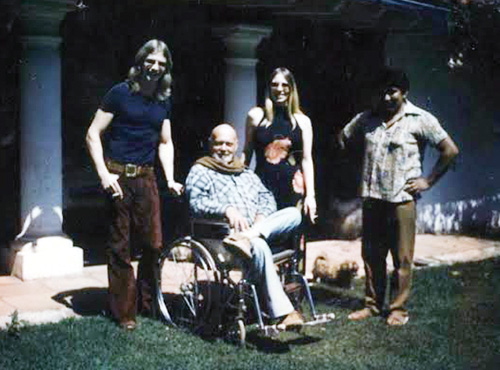
    Jordan Rivers, John Starr Cooke, Brita Corrae & Pablo, Tepotzlan, 1972 (Courtesy of Jordan Rivers)

    In 1975, John and Rosalind Wall published The Word of One, the edited transcripts of the ONE Ouija sessions. In 1976, John appeared in the short film ‘Prophecy of the Royal Maze’, before dying in August 1976.

    A new edition of the Word of One Tarot was released by the Cooke family in 1992, and these are once again available (click here to purchase a pack).

    The Books of T do not proclaim a new way. Rather, they indicate the breakthrough of the way in our time, and the time to come.
    – John Starr Cooke

    John Starr Cooke and Michael Bowen worked to their program of “Reversal USA” to bring the Books of T into the light of day. It was a magical working, the intention being to embed this new mystical doctrine deep in the heart of a new society, a doctrine which reflected their society at that transformational time. According to Michael Bowen, it was all about creating a future humanity firmly established upon the consciousness of ONE.

    The Haight Ashbury is still with us. Right now you can get the latest Rolling Stone magazine, or drop in to Govindas for a vegetarian meal, or pick up some produce at the organic food cooperative, or at the health food store, or maybe something to read at the new age bookshop on your way to Yoga class after which you might go to a psychedelic rock show. All of this stuff flourished for the first time in the Haight. 

    The hippie movement had its day and faded; however, the Word of ONE remains. It is a foundation stone of the new Aeon and a foretaste of the zodiacal precession from Pisces into Aquarius. 

    There is One only. You are that One. One is being. One is in motion. That motion – that being – is love. 

    All New Tarot images are copyright Catalyst Enterprises, and are reproduced here with permission. The Process by Brion Gysin is still in print. A website devoted to John Starr Cooke’s legacy and the New Tarot is www.royalmaze.com. The short film ‘Prophecy of the Royal Maze’ can be viewed here.

    [alert type=”general” dismiss=”no”]This article was published in New Dawn 145.[/alert]

    [alert type=”success” dismiss=”no”]If you appreciate this article, please consider subscribing to help maintain this website.[/alert]

    © New Dawn Magazine and the respective author.
    For our reproduction notice, click here.
  • Rooted in Secrecy: The Clandestine Element Driving  Australia’s Foreign Misadventures

    Rooted in Secrecy: The Clandestine Element Driving Australia’s Foreign Misadventures

    From New Dawn 171 (Nov-Dec 2018)

    The dominant feature of all Australian politics is that governments come and go, with Labor alternating with the Liberal National coalition, but changes in Australian foreign policy are so slight as to be almost invisible.

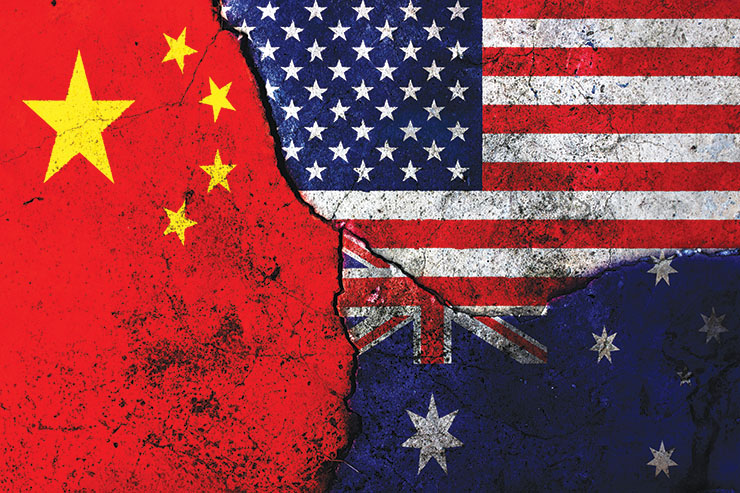
    Not since the Whitlam Government was elected in 1972 and promptly recognised the Beijing government as the proper representative of China, and withdrew Australian troops from the enduring fiasco known as the Vietnam war, but more accurately described by Vietnamese themselves as the American war, has there been a truly bold and principle based foreign policy innovation.

    It is one of history’ revealing vignettes that Whitlam’s pre-election trip to China and obvious intention to recognise the PRC as the legitimate government was heavily criticised by Billy McMahon, the Liberal prime minister at the time. McMahon was adhering to what he thought was the Washington line when the United States itself, under Richard Nixon, was already moving to normalise US-China relations. It seems that no one in the United States administration thought to tell McMahon that the policy had changed, thereby exposing McMahon to embarrassment and ridicule. 

    The Whitlam era was notable for another aspect of foreign policy that Australian historians are loathe to approach, but which arguably has had an impact up to and including the present foreign policy stance of both major political parties.

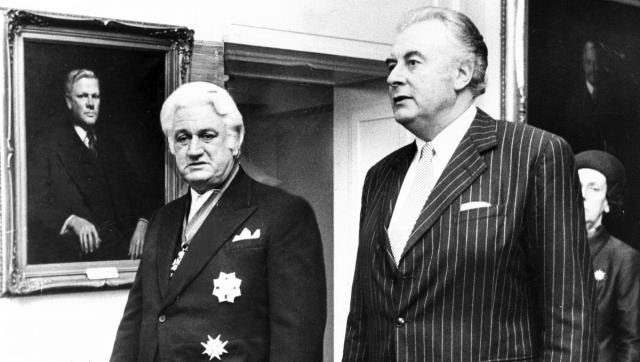
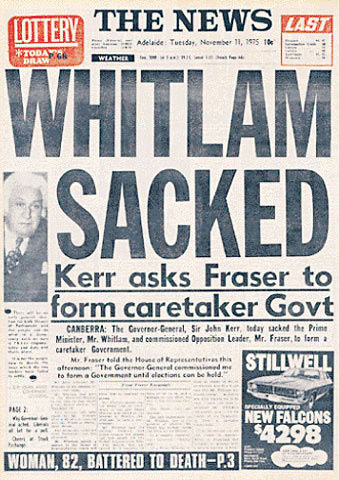
    The day before Whitlam was to make a speech in parliament announcing that the United States run spy facility at Pine Gap in the Northern Territory would be closed, he was deposed in a coup d’état by the Governor General Sir John Kerr. That much is common knowledge and has been widely analysed, in particular by historian Jenny Hocking who is engaged in an ongoing battle to access Kerr’s papers, in particular communications between Kerr and the British Queen.

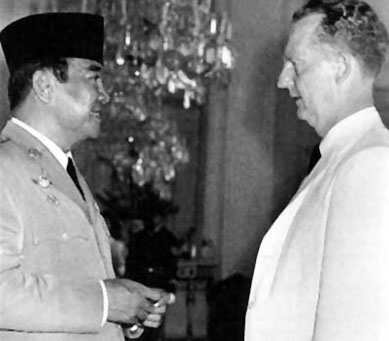
    His next role was in Indonesia where he was instrumental in the 1965 coup that brought Suharto to power. Between 500,000 and three million Indonesians were murdered in the coup’s aftermath, many of them from a CIA supplied kill list of communists or suspected communist sympathisers.

    Marshall Green (right), US ambassador to Indonesia between 1965 and 1968, meeting with Indonesia President Sukarno.

    Less well known was the role of the United States embassy in Canberra where Marshall Green was the ambassador. Green had an interesting career. He had been assigned to South Korea as charge d’affaires where he organised the 1961 coup that brought the dictatorship of Park Chung-Hee to power.

    He was similarly dispatched to Chile where he oversaw the resolution of the ‘problem’ being created for the United States by its left-wing president Allende. Allende was murdered and replaced by a military dictatorship under General Pinochet. Again, hundreds of thousands of Chileans were murdered or ‘disappeared’.

    Whitlam posed a similar ‘problem’ for the Americans with his intention to disclose the CIA’s role in Pine Gap. Thanks to Edward Snowden, it is established beyond doubt that Pine Gap is a giant electronic vacuum cleaner, spying on the communications of Australia and a range of other countries, friend and foe alike.

    Green, known in State Department and CIA circles as the “coup master,” was sent to Canberra as United States ambassador in 1974, specifically to deal with the Whitlam ‘problem’.

    1974: Sir John Kerr (left) and Australian Prime Minister Gough Whitlam, King’s Hall, Parliament House, Canberra. The day before Whitlam was to inform parliament he intended to close Pine Gap, he was sacked by Kerr. 

    Whitlam was unaware of Kerr’s close ties to the CIA. Neither did he know until 1975 that Britain’s MI6 had been intercepting secret foreign affairs communications for Whitlam’s Office, and passing those onto the Americans.

    On 10 November 1975 Whitlam was shown a Telex message later sourced to the notorious Ted Shackley of the CIA that described Whitlam as a security threat to his own country. The following day Kerr used his power to dismiss Whitlam.

    It has subsequently become clear that Green, Shackley, MI6 head Maurice Oldfield and CIA head William Colby co-ordinated the dismissal of the Whitlam Government, knowing that they could rely on “their man” Kerr to solve the Whitlam ‘problem’.

    My argument is that without knowledge of this historical background it is not possible to fully understand the foreign policy of Australia in subsequent decades.

    Not in Australia’s Interest

    Time and again Australia has undertaken foreign policy initiatives that if viewed from the perspective of Australia’s vital national interests are simply inexplicable. That process has if anything accelerated in recent years.

    In August 1990 Iraq invaded its neighbour Kuwait. Iraq had some legitimate grievances with Kuwait, but the decision to invade, otherwise a blatant violation of international law, was only made after the United States ambassador to Iraq told Saddam Hussein that the United States was not really interested in the argument between Iraq and Kuwait. Saddam took that as a green light.

    There followed a massive propaganda campaign against Iraq, perhaps best exemplified by the appearance of a young woman on US television describing how Iraqi soldiers took Kuwaiti babies from their cots in a Kuwait hospital and smashed them on the concrete floor.

    That the young woman concerned was the daughter of the Kuwaiti ambassador to the United States (not disclosed to viewers) and that she had witnessed no such thing was only part of the lie.

    The Americans assembled a “coalition of the willing” to force the Iraqis to leave Kuwait. Australia was a member of that coalition. The Iraqis were quickly defeated, but that did not prevent the slaughter of the retreating troops. Worse was to come. Sanctions were imposed on Iraq, supported by Australia, resulting in the deaths of more than half a million civilians, including women, children and old persons. This was infamously described by US Secretary of State Madeleine Albright as “worth it.”

    In what sense it was “worth it” for Australia to join this war in the first place, to sustain a role in the blockade and sanctioning of Iraq (tempered by dubious Wheat Board dealings), has never been adequately explained.

    In 2001 Australia again joined a United States led coalition in the attack upon, invasion and occupation of Afghanistan, an occupation still ongoing 17 years later. That the invasion was illegal under international law cannot be seriously argued against. We now know that the decision to invade Afghanistan was made in July 2001, two months prior to the ostensible excuse of the events of 11 September 2001, themselves one of the most distorted and falsified accounts of recent history.

    Nor can Australia explain why, 17 years later, it is still in Afghanistan, the Taliban government having been defeated before Christmas 2001. The official explanation, in so far as it is ever proffered, is that Australia is helping to train Afghan forces. The manifest absurdity of this claim, especially in the face of what are known to be the real reasons for the American invasion, is never questioned in the Australian mainstream media.

    Acknowledging the vital role the heroin crop plays in financing off the books United States operations; control of the gas pipeline from the Caspian Sea basin; the $3 trillion worth of unexploited mineral deposits; and providing a springboard for hybrid warfare operations in Central Asia and China is not permitted in mainstream discourse.

    The Afghanistan misadventure was closely followed by the 2003 invasion of Iraq, now widely regarded as one of the most disastrous United States foreign policy decisions of recent decades. Like so many of these foreign policy ventures, the 2003 Iraq invasion was built upon a multi-tiered pyramid of lies. Weapons of mass destruction are only the best known of these. The repercussions of that disastrous invasion are well documented. Three aspects from the Australian perspective are worth briefly noting.

    The first is that the Howard government did not need to be asked twice to participate. To their credit, they did table in the House of Representatives the legal opinion, poor as it was, that provided the ostensible justification for joining the invasion. But even an abysmal legal argument could not conceal the absolute lack of a national interest argument as to why Australia should join an invasion of a country that posed no threat whatsoever to Australia’s national interests.

    The second consequence was that the invasion spawned a plethora of terrorist groups. That these same terrorist groups are supported with arms, money, political cover and military intervention by the United States and its allies such as Israel and Saudi Arabia is never acknowledged, much less discussed, in either the Australian mainstream media or in political circles.

    Thirdly, the so called “terrorist attack” of 11th of September 2001 has spawned an avalanche of legislation ostensibly aimed at protecting Australia from terrorist threats, but in reality posing the greatest threat of all to human rights and civil liberties in Australia.

    More than 600 pieces of legislation have been passed that directly threaten what many Australians would regard as their basic human rights. Most are unaware of the draconian nature of that legislation. Australia is the only country in the so-called democratic world that does not have a national Bill or Charter of Rights.

    Significant portions of those 600+ Acts or Amendments would not survive judicial scrutiny in those democratic countries that do have a Bill of Rights or equivalent. It is difficult to know what is of more concern: that such legislation could be passed with the willing compliance of the opposition party (regardless of who is in power) or that such systematic erosion of civil liberties is not met with outrage and protest from media and public alike.

    Is Australia any longer a democracy?

    It is now legitimate to ask the question one never expected ever having to pose: is Australia any longer a democracy in any meaningful sense of the word?

    The other military misadventure that should be noted in this context is Australia joining, yet again, a United States led “coalition” attacking Syria. This war, while Australia’s involvement from a military point of view is largely inconsequential, nonetheless reveals several aspects of Australian foreign policy.

    For example, the then prime minister and foreign minister Tony Abbott and Julie Bishop respectively, announced in August 2015 that no decision would be made on joining the Syrian war until the government received legal advice on the matter. In September 2015 they announced that they were going to join that war. What they did not say was that they had received legal advice more than a year earlier. The government has refused (unlike the Howard government in 2003) to release that advice.

    When asked on ABC Radio what was the legal basis for joining the war, Bishop claimed it was pursuant to a request from the Iraqi Government, and also pursuant to the collective self-defence provisions of Article 51 of the United Nations Charter.

    The Iraqi Government issued a statement denying having made such a request; and Article 51 manifestly does not apply. In short, the ostensible reasons were as much a lie as the reasons given for the 2001 Afghanistan invasion and for the 2003 Iraq invasion.

    The real reasons are therefore different. Based on comments made by various government ministers over time, the inference may be drawn that Australia sees involvement in unwinnable, costly and illegal wars with no discernible benefit to Australia as premium payments on the national security insurance policy, the ANZUS Treaty.

    Australia helps the Americans, the argument runs, because in the event that Australia is attacked the Americans will come to their aid under the ANZUS Treaty. Like so many of the justifications put forward by the politicians for involvement in these various wars, this argument also does not withstand scrutiny.

    Unlike Article 5 of the NATO treaty, the ANZUS Treaty requires the parties, effectively now only Australia and the United States, to “consult” in accordance with their constitutional procedures. Notwithstanding the vagueness of this commitment, which is far from any kind of security guarantee, it appears to be an article of faith the United States will in fact come to Australia’s aid in the event that it is ever attacked. Like most faith-based systems, it lacks any empirical basis for the belief that motivates its adherents.

    That adherence to such a policy basis can result not only in involvement in wars, especially illegal ones such as Afghanistan, Iraq and Syria, and done with no discernible national interest, it can actually operate contrary to Australia’s national interest.

    Russia & China

    Two recent examples are the anti-Russian campaign waged by the United States and the United Kingdom in particular, and the trade wars being waged against China by the United States, itself part of a wider anti-China policy that has essentially been a centrepiece of American foreign policy since 1949.

    The anti-Russian campaign manifests itself in endless demonisation of Russia in general and of President Vladimir Putin in particular. Current illustrations of this are the alleged Russian “interference” in the 2016 US presidential election; Russia’s support for the legitimate Syrian government which is alleged to wage chemical warfare on its own people; the assault upon Sergei Skripal and his daughter Yulia in the English city of Salisbury; and the shooting down of MH17 over Ukraine in 2014.

    That there is not a shred of verifiable evidence to support any of these allegations, but rather, conclusive evidence to the contrary, is never acknowledged by the politicians, nor even given reasonable coverage by the mainstream media.

    When confronted with rebuttal evidence, or even shown the manifest absurdities and contradictions of the official narrative, the standard response is either denial or, more commonly, simply ignoring the evidence. A collateral response is to attack the intellectual integrity of the person(s) making the criticism.

    The hostility toward China is even less explicable. China is Australia’s largest trading partner by a very considerable margin. It is the largest source of foreign tourists, the largest source of foreign students, and the third largest source of foreign investment. Australia’s recent decades of prosperity and wealth accumulation owe more to China than to any other country. It is difficult therefore to comprehend the overt hostility, manifesting itself for example in the absurd claims about Chinese intentions in the South Pacific.

    It cannot be only ignorance and prejudice that explains the constant misreporting of China’s Belt and Road Initiative, or issues in the South China Sea, Tibet, Xinjiang province and elsewhere. One possible explanation is proffered by Hugh White who suggests that Australia has never really come to terms with the unique historical phenomenon of where Australia’s largest trading partner (and source of prosperity) is not also its ally.

    While this is undoubtedly true, it does not sufficiently explain the extraordinary degree of obeisance to Australia’s “joined at the hip” American ally. Even the recent revelations of obvious Russian and Chinese military superiority over the Americans have done little or nothing to shake what must now be described as blind and irrational faith.

    From UK colony to American Colony

    One possible explanation, and it is not suggested that it is a sufficient or complete explanation, lies in the history of 1975 outlined above and the multiple other examples of like behaviour by the Americans before and since.

    That is, Australian politicians are acutely aware of the coup organised against Whitlam when he was implementing policies, past and proposed, that the Americans perceived as a threat to their vital interests. That those vital interests include waging perpetual wars for perpetual profit; attempting to maintain a unipolar hegemony over all other nations; and moving ruthlessly to invoke “regime change” upon recalcitrant nations irrespective of their designation as friend or foe, is a lesson not lost upon the Australian body politic.

    Australia has gone from being a British colony to an American one without ever being truly independent. There is nothing in its current policy framework to suggest any imminent change in that position. When accompanied as it is by a progressive erosion of the structural elements of a functioning democracy, the future looks very bleak.

    There is another consequence of having a foreign policy that is in effect no more than an echo of the Washington line. Australia’s region, the “near North,” is undergoing major transformation. In part this transformation is a re-assertion of the traditional dominance of the East, interrupted as it was by the Anglo-American-European imperialism of the past three centuries. That transformation is being driven by the China led Belt and Road Initiative, creating trade and political linkages not only through Eurasia, but also to South America and Africa.

    The BRI in turn is linked to other major trade and security organisations such as the Shanghai Corporation Organisation and Eurasian Economic Union. There are parallel developments in the financial world leading inexorably to the demise of the Dollar based system.

    The unipolar hegemonic world of the past few decades is rapidly disappearing. Australia risks isolation from the prospects offered by this new multipolar world, clinging as it does to the discredited structures of the US dominated system. Even more than a change in policy, Australia needs a change in mindset. A failure to make that adjustment to the geopolitical realities of the 21st century will inevitably lead to Australia fulfilling Lee Kuan Yew’s prophecy of becoming the white trash of Asia.

    [alert type=”general” dismiss=”no”]This article was published in New Dawn 171.[/alert]

    [alert type=”success” dismiss=”no”]If you appreciate this article, please consider subscribing to help maintain this website.[/alert]

    References

    George Williams & Daniel Reynolds, A Charter of Rights for Australia, UNSW Press 2017
    Jenny Hocking, The Dismissal Dossier: Everything you were never meant to know about November 1975, Amazon Australia, 2016
    William Blum, America’s Deadliest Export, Zed Books, 2014
    www.theblogmire.com (on Skripal)
    Alfred McCoy, In the Shadows of the American Century, Haymarket Books, 2017
    Andrei Martyanov, Losing Military Supremacy, Clarity Press, 2018
    David Ray Griffin, Bush & Cheney: How They Ruined America and the World, Olive Branch Press, 2018

    © New Dawn Magazine and the respective author.
    For our reproduction notice, click here.

  • The Return of Holy Russia

    The Return of Holy Russia

    From New Dawn 178 (Jan-Feb 2020)

    The following is excerpted from the Introduction to my book The Return Of Holy Russia: Apocalyptic History, Mystical Awakening, and the Struggle for the Soul of the World (published in May 2020). 

    In it I point out one of the reasons for writing the book, specifically the idea that Russian President Vladimir Putin is very keen on revitalising the notion of Russia as the last bastion of the true faith, the bearer of the true Word in an age of unholy godlessness, a mantle it last wore in the nineteenth century. 

    Why would Putin want to do this? Is his belief and defence of “traditional values” genuine, or merely a means of providing Russia with an identity, something that seems to have slipped away from it through the years of turbulence and chaos following the breakup of the Soviet Union? 

    Yet it is no secret that except for the brief seventy years of Soviet rule, Russia was the most mystical of Western nations – if indeed it is a “Western” nation at all. As the reader will see here, and as I spell out in greater detail in the book, Russia’s history has always been informed by mystical, spiritual ideas and powerful religious feelings. And it has always been a nation with an ineradicable sense that history was leading somewhere. To where, exactly? Well, that would be telling, but as I say, Russians have not given lip service to the apocalypse. For better or for worse, the Russian soul has never had the end times too far from its thoughts. What might that mean for us today? That is another question I devote more than a few pages to in the book.
    – Gary Lachman

    Welcome to the Silver Age: A Time of Magic and Mysticism

    Another idea that [Russian President Vladimir] Putin is taking seriously is that of Russia as a nation of “traditional values.” It is along these lines that commentators are beginning to speak of a new cold war opening up between Russia and the West. Skirmishes here are not triggered by ideological clashes between capitalism and communism, but by different moral, ethical, and religious worldviews. To think of Russia, home of gangland politics and ostentatious oligarchs, as more morally sensitive than the West may seem counterintuitive. But in Putin’s Russia, the extreme liberalism and permissiveness that characterize Western society – its “anything goes” sensibility – smacks of little more than decadence, and our commercialization of practically everything reeks of selfishness and ego gratification. Nothing seems to resist the spread of the “me” economy, in which everything is yielding and negotiable, even reality. Compared to this, Putin’s Russia upholds more “traditional” standards, and its attitude toward sex, family, and gender roles seems to the “progressive” West highly conservative, if not repressive.

    Russian President Vladimir Putin

    Putin finds his traditional values in his Orthodox belief, and it is in this role of defender of the true faith that, along with Eurasia and the thinkers of the Silver Age, the idea of Holy Russia seems to be making a comeback. This was an identity that Russia and her “God-bearing people” embraced practically from the start, from their earliest adoption of Orthodox Christianity, to the attempt at a theocratic rule during the Muscovite empire of the late Middle Ages, and to the idea of its being a “Third Rome,” after the downfall of the first one and the capture of Constantinople by the Turks in 1453. And it is here, perhaps, that we can find the roots of the notion that Russia has a “mission,” that special destiny that informs the different versions of the “Russian idea.”

    Although many fine points of doctrine and dogma separate the Eastern Orthodox Church from Roman Catholicism and Protestantism, one thing that does set Russian Orthodoxy apart from its Western counterparts is its attitude toward the end-time, the Apocalypse, and the Second Coming. While these are indeed part of the Western Church, it has generally damped down any millenarian zeal, and focused more on dealing with the crises and challenges of everyday life. “Repent ye sinner for the end is nigh,” is left to street-corner prophets and Jehovah’s Witnesses. The Western Church has been more this-worldly, and its interest in worldly power is one of the criticisms that its eastern counterpart has made against it.

    The end days, however, have always been of great importance to the Eastern Church, which has always been more open to mysticism and esoteric knowledge. Its focus has been more eschatological than the West, and this anticipation of the Second Coming and the establishment of the Kingdom of Heaven on Earth was something that the Russian people embraced wholeheartedly when they accepted Eastern Orthodoxy as their religion. They took the idea of rebirth very seriously; this is why Easter is a much more important holy day in the Orthodox calendar than Christmas. Resurrection was of the essence. They did not give lip service to the Apocalypse.

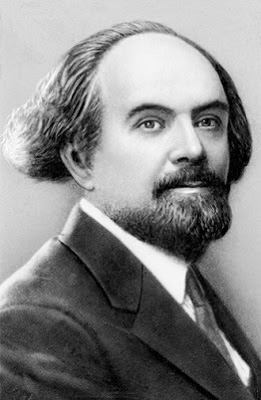
    Russian religious philosopher Nikolai Berdyaev (1874–1948)

    This belief that the world was moving toward some event after which everything would be different became a part of the Russian soul. As [the Russian religious philosopher Nikolai] Berdyaev said, Russians are either “apocalyptists” or “nihilists,” that is, for them it is a case of everything or nothing, either the millennium and Heaven on Earth or the void.

    But the mystical, spiritual character of the Russian soul seemed to be in place even before its contact with Orthodoxy and its embrace of the true faith. The Russian people had a rich pagan tradition full of gods and goddesses, elemental forces, and nature spirits. As with other pagan people converted to Christianity – of whom the Russians were one of the last – this tradition did not die out but was maintained alongside the new Christian belief, an arrangement known as dvoeverie, “double faith,” an example, perhaps, of the ability of the Russian soul to hold contradictory ideas simultaneously, and of the tensions at work in doing so.

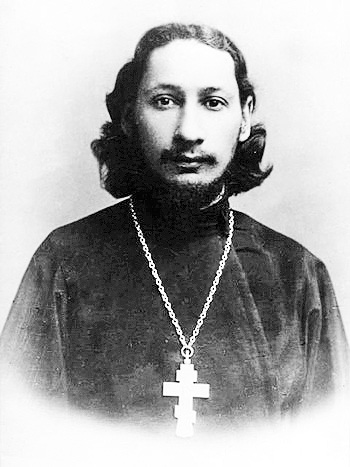
    Father Pavel Florensky (1882–1937)

    With the aid of mystically potent icons – “windows on another world” as they were called by Father Pavel Florensky, an important figure of the Silver Age – this native paganism helped the spread of Orthodoxy within Russia. During the centuries of the “Mongol yoke,” the influence of shamanism and other magical practices reached the courts of the vassal Russian princes, and when that yoke had been broken, in the days of the Muscovite empire, alchemists, Hermeticists, Kabbalists, and other savants of the occult sciences were welcomed and their counsel sought.

    Esoteric ideas even made their way to Tsar Alexander I, the savior of Europe in the Napoleonic wars and leader of the Holy Alliance, who was believed to have faked his own death in order to retire from power to spend his last days in spiritual contemplation. That the last days of the Romanovs were filled with mystical and apocalyptic expectation is well known. Rasputin is the most notorious figure here, but he was not the only mystical character giving advice to the doomed dynasty. And in the years of Soviet rule, ideas of an occult, mystical, and magical character continued to influence the commissars and comrades of the great Bolshevik experiment, with God-seekers becoming God-builders. More than one historian has noted that the millenarian trend in Russia thought made it more receptive to the Marxist vision of a coming classless utopia.

    With Putin’s interest in notions such as Eurasia, in the philosophers of the Silver Age, and his gestures toward Holy Russia, this Russian interest in things mystical and apocalyptic seems to be continuing.

    Excerpted from The Return Of Holy Russia: Apocalyptic History, Mystical Awakening, and the Struggle for the Soul of the World by Gary Lachman © 2020 Inner Traditions. Printed with permission from the publisher Inner Traditions International. www.InnerTraditions.com. The Return Of Holy Russia is available from all good bookstores

    [alert type=”general” dismiss=”no”]This article was published in New Dawn 178.[/alert]

    [alert type=”success” dismiss=”no”]If you appreciate this article, please consider subscribing to help maintain this website.[/alert]

    © New Dawn Magazine and the respective author.
    For our reproduction notice, click here.
  • An Interview with Gary Lachman: “I’m interested in too many things”

    An Interview with Gary Lachman: “I’m interested in too many things”

    From New Dawn 178 (Jan-Feb 2020)

    American author Gary Lachman has long called London his home, but I caught up with him during a recent visit to Australia. Compact, quiet and stylishly dressed, Lachman’s gentle scholarly manner belies the fact that he is a child of rock and roll, having come of age during the Punk/New Wave movement in New York and being once a member of the now legendary pop band Blondie.

    These days he is a writer and has produced some of the best and most readable and accessible books about occultism and the major figures in the field of Western Esotericism. He has published superb biographies of Madame Blavatsky and Colin Wilson and an extraordinary history of the major figures of the occult tradition (The Secret Teachers of the Western World, 2016), along with extended reflections on magic, politics and the history of thought. 

    In a noisy, packed Indonesian restaurant, I asked Gary how he developed his interest in the occult. 

    “In 1975 I was a musician playing in New York,” he said in his companionable manner. “I was playing in Blondie – this was before Blondie became anybody. I was living on the Bowery with Debbie Harry and Chris Stein and they had a kind of kitschy interest in occult stuff. The guy who rented us our loft was a very flamboyant artist who had studied Aleister Crowley and he had a Thoth tarot deck which, at the time, was rather rare. He would do readings with it and I just got interested in it.” 

    Gary’s biography of the prolific British writer and historian of the occult, Colin Wilson, is a fascinating read and is the book that really made me determined to meet Gary and study with him. His 2014 biography of Crowley is a wickedly good read and the book I recommend to anyone who wants to learn more about the self-styled ‘Great Beast’. I asked Gary how these two men in particular influenced his life.

    “During this period [the early 70s] I was in someone’s room and on a bookshelf saw this big book called The Occult [by Wilson, published 1971]. I’d already been reading Crowley, so I pulled it off the shelf and started reading it and it totally grabbed me. He has a wonderful writing style and he was looking at all of this from the philosophy of consciousness. I had read some of the existentialists and Nietzsche, but I really didn’t know all that much and I found this totally gripping work and it was basically the start of it.” 

    “Not only did it get me interested in the occult, esotericism, mysticism and all that, I became completely devoted to the work of Colin Wilson. I remember that wherever we went on tour I would head to the local used bookstore and look for books by Wilson. I wound up getting a big collection of them and in 1983 I made a pilgrimage to Cornwall, where he lived, and met him.” 

    “You seem to be someone who uses everything you read,” I said. “Nothing ever goes to waste. How did you get into that habit?”

    “Well it was something I picked up from Wilson. He read an enormous amount and he made the effort to connect it all together. I wanted to write the kind of books I liked reading, and I wanted to write those sorts of books where you learn a lot. If you follow up on the books Colin Wilson mentions in his writing, it’s like getting a liberal arts education. From reading him I followed up people like Ouspensky, Gurdjieff, Husserl, Yeats… You follow up on the strands he leaves for you. So, I do that now myself. If I get a commission for a book, I read everything I can about the subject for the first six months or so. Then I spend the next six months trying to write about it.” 

    Since so much of Gary’s work is about the importance of thinking for ourselves and allowing ourselves the time and space to think deeply, I asked him if he thought we had lost the habit of thinking.

    “We’re thinking less and less,” he responded, without hesitation. “I mean, it has never been particularly popular, but people are now letting machines do our thinking for us. I guess that’s one of the problems with the internet, when everything is based on algorithms based on what you have searched – you can’t get out of that loop. I often wonder that if you put Siri and Alexa next to each other, would they be able to have a conversation? Siri says one thing and Alexa something else and we can just let them fight it out.”

    Though his work has been almost exclusively centred on the Western tradition, I was curious to know if he’d ever explored any of the Eastern traditions. 

    “Early on, when I was first reading this stuff, I was quite taken with Zen. I tried to practice for a while, inspired by people like Alan Watts and D. T. Suzuki. More recently I have been interested in Taoism, in the context of Jung’s ideas about alchemy and ‘The Secret of the Golden Flower’ [the Chinese alchemical text that had come into Jung’s life in an act of remarkable synchronicity – see Gary Lachman’s book Jung the Mystic]. I think there’s a great deal to learn from the Eastern traditions.”

    I asked him if there were any gaps in 21st century presentations of the history of occultism – was there anyone who wasn’t being written about that deserved a closer study. 

    “Well, Owen Barfield,” he said. “Not necessarily an occultist, but certainly in the consciousness tradition. And Kathleen Raine, who is one of my heroes. I interviewed her just before she died. She devoted her life to resurrecting what she called ‘the lost knowledge of the imagination’ – that’s where I got the title of my book. It’s a tradition of the imagination that has been rejected in the West. We tend to see the imagination either as make believe or something with practical, utilitarian applications – in the context of innovation or cutting-edge technologies.”

    “Raine saw it as a way in which we could actually know the world. There can be a cognitive content to the imagination, and she devoted her life to reviving that. She found it in the Romantic poets that she loved – poets that Barfield loved as well, people like Shelley or Blake. She was a great Blake scholar. If you read Blake the imagination is everything.”

    Is “the imagination” another term for God, I asked.

    “Well…” he demurred politely. “I don’t know if it’s another term for anything. In the Hermetic tradition they say that in order to know God you have to be like God. And one can be like God through the imagination. Through the imagination you acquire God-like powers. Maybe not the specific Christian God but in the sense of a level of consciousness that is not constrained by our limitations. Blake talks about ‘Jesus the imagination’ so Jesus was for him someone who lived the imagination. What did he mean by that? I think that depends on our own understanding. I think that Blake meant that he lived through the spontaneity of his inner world.” 

    Part of the great thrill of spending time in the company of someone like Gary Lachman is the incredible breadth and depth of his knowledge. A conversation with him veers all over history, religion and literature. He has been a determined scholar since he was a very young man, and now he wears his learning lightly on his sleeve and has a charming way of assuming his conversation companion is as learned as he. Almost inevitably, given the circumstance of two bookish people sharing lunch, our chat turned to literature more generally. 

    “Well I’ve just finished writing a book about Russia, and Dostoevsky has always been an interest of mine,” he volunteered. “Sadly, the fiction I read now is mostly for entertainment and I have been reading a lot of the Maigret novels by Georges Simenon. I guess you could call it thinking-person’s crime fiction. I used to love fantasy and science fiction and I grew up on Lovecraft. There’s an English novelist called John Cowper Powys who wrote A Glastonbury Romance. That book is a real commitment – it is a huge thick thing. But reading it is a mystical experience; he sees everything from a cosmic perspective. There is a life running through every aspect of the novel, from the protagonist’s loftiest speeches to the most mundane description of landscape. He has a wonderfully mythic consciousness.” 

    As lunch wound up, I thought I would take a chance at asking him if there was single spiritual path to which he had found himself committed. He allowed that in his youth he had been for a while involved in a Crowley group and then the Gurdjieff work. But now this great polymath is content to exist between worlds.

    “I’m interested in too many things,” he said with his trademark impish grin. “I see connections between things and so rather than stick to one school of thought I need to be true to myself. Being constant has its virtues but I want to explore the contradictions and similarities I notice. I don’t belong to anything, but I study whatever I can.” 

    Gary is currently completing two books, one on precognitive dreams, and another titled The Return Of Holy Russia: Apocalyptic History, Mystical Awakening, and the Struggle for the Soul of the World, to be published by Inner Traditions in May 2020.

    Gary Lachman is the author of 21 books on topics ranging from the evolution of consciousness to literary suicides, popular culture and the history of the occult. His work has appeared in many journals, magazines and newspapers. Gary lectures regularly and has appeared in several film and television documentaries. Before becoming a full-time writer, he studied philosophy, managed a new age bookshop, taught English Literature, and was a Science Writer for UCLA. He was a founding member of the pop group Blondie and in 2006 was inducted into the Rock and Roll Hall of Fame. Lachman was born in New Jersey, USA, but since 1996 has lived in London, UK. Website: garylachman.co.uk, Twitter @GaryLachman

    [alert type=”general” dismiss=”no”]This article was published in New Dawn 178.[/alert]

    [alert type=”success” dismiss=”no”]If you appreciate this article, please consider subscribing to help maintain this website.[/alert]

    © New Dawn Magazine and the respective author.
    For our reproduction notice, click here.
  • The Power of Egregores: An Interview with Mark Stavish

    The Power of Egregores: An Interview with Mark Stavish

    From New Dawn 176 (Sept-Oct Dec 2019)

    Diane Fraser speaks with Mark Stavish about egregores, their existence and power in our lives, and how they can help or restrict us. Mark shares practical advice on how to determine if an egregore has too great a hold on you.

    Mark Stavish is a respected authority on Western spiritual traditions and the author of over 26 books. His most recent book is Egregores, The Occult Entities That Watch Over Human Destiny. This book provides information on the history and use of egregores, true accounts of disengaging from egregores, and how to free yourself from one when you realise it’s no longer working for you. His book has gained considerable attention among various politicians in the United Kingdom and the European Union. 

    An egregore is an autonomous thought form or psychic entity created when two or more people are focused on the same idea or image. Thoughtforms are purposely developed to serve the aim of a group or individual. They’re also created organically when people who are not necessarily connected in a formal group focus on the same ideal or image, like entertainment characters that go viral and become icons. Spiritual, occult, religious, political and other groups with specific aims create egregores, using symbols and rituals to focus and draw upon the energy of individual members/believers/fans/participants to fuel it. Their energy helps to sustain the psychic entity, and the psychic entity then influences the individual in some way through this connection. 

    Egregores Exist on Three Levels

    It is believed that only humans can form egregores, but once formed they exist on three levels: the material, the astral, and the celestial. On the material level the thoughtform is connected to symbols, icons, images, talismans, relics, ritual objects, rituals, or materials that represent and connect to it. We live in a world of symbols and icons, from the simple forward pointing arrow that means ‘go this way’ to the ubiquitous Coca-Cola symbol and religious symbols like the Christian cross. Every symbol has an egregore associated with it, and that psychic entity exists on the astral plane, in the realm of emotion, spirits, and thoughts. The entity’s vitality is fed and nurtured by the emotions and thoughts of the individuals who connect to it. 

    What is the connection between egregores and the celestial plane? I wasn’t sure, so I asked Mark about it. 

    MARK STAVISH (MS): On the celestial level, egregores are connected to cosmic principles. These could be deities, god forms, archetypes, or abstract principles like beauty, harmony, or war. For example, any Parisian or Italian fashion show will have a connection to the ideals of Venus such as beauty and harmony, regardless of how ridiculous the outfits might be. Every football team’s egregore has a relationship to the archetype of Mars, and its characteristic competition. Egregores are connected to the celestial plane, whether to specific deities or to the much broader ideals that they represent. The thing we have to remember is that these entities have their own agendas. We don’t know what their agendas are, all we can do is try to understand them. One takes a serious risk if they think they can control it. It’s better to take the approach of developing a relationship with it, with the understanding that the relationship is going to be tricky. Anyone who thinks they can control one is foolish. These things have their own agendas and if yours doesn’t match theirs, you lose.

    Egregores Ban be Used for Positive and Negative Purposes

    “There is no such thing as good or evil, only ideas and their consequences.”1 Egregores are utilised by people every day, they just don’t call them by that name. Instead they call them by the name of a sports team, a political party, a political leader, a church/temple/spiritual group, by the name of an entertainer, or activity, or by an ideal as broad as justice. Egregores can have positive, negative, or neutral impacts. These psychic entities can be positively used by individuals when they’re seeking change or specific results that a particular group can help them attain. For instance, there are many people who struggle with drug or alcohol addiction. In their efforts to maintain recovery, they may join a group like Alcoholics Anonymous. Becoming a part of this group and tapping into its ideals and thoughtform can help them overcome a harmful one – the egregore of addiction. Some personal changes require the use of one powerful force to overcome another.

    There are instances, though, when people are devoting their time, energy, and resources to a group and the leader(s) of the group may be using them for selfish purposes, or funnelling resources to activities that individuals in the group may not agree with. Other times the group requirements can become too burdensome to their members, the group values and focus can change, but because they’ve been so enmeshed in the group they find it very hard to leave. This is when a relationship with an egregore can become limiting and inhibit personal growth.

    DIANE FRASER (DF): Every person is connected to several egregores, all the time, is that right? They’re connected to them through their relationships with politics, sports, entertainment, religion, culture, jobs, corporations, brands, beliefs.

    MS: Yes, that’s right. Think of egregores like uniforms. They exist because they’re useful to us, they have a purpose. The question for any individual is when does that purpose no longer serve you and when do you serve it? People grow and change and seek new experiences. When you decide you want to experience something new and different, you’re going to make new friends. You go to new clubs, new scenes, you become exposed to new cultures and absorb those. At some point you settle down and then you go on to something else and you absorb all that. You do this several times in your life, depending on what’s going on and your level of enmeshment in these groups. Every uniform is connected to a group, they’re a package deal with their own beliefs, mores, and ways. However, we often do not realise the full package that we’re identifying with when we don a uniform. 

    With collective ideas and ideals, there is a strong call or pull on us to identify with them. Whenever we say “I am __________” we’re associating ourselves with an egregore. Think of all the things that are supposed to go along with that uniform, the whole package. They can be religious, political, or social terms that we’re using, but as soon as we say, “I am this,” the whole package comes along with it. These uniforms are control mechanisms.

    Social control mechanisms are dangerous because they don’t want you to choose outside of them. They only want you to choose them. That’s where the restriction comes in. But if we’re really careful, if we’re paying attention, we might realise that we don’t need to identify with the whole package. Hopefully we realise that we have the power of choice and free will to varying degrees. Clearly one has little choice once they’ve joined the military; one has more if they joined the local Rotary, and there are varying degrees in-between. 

    Egregores Can Take on a Life of Their Own

    In his book, Mark makes an important point that “egregores who have existed for a period of time will become independent and no longer obey their earthly masters.”2 This sounded intriguing and ominous to me, soI asked Mark for some examples. 

    MS: When you have any dream that you seek to manifest in your life in terra firma, it has to take on a life of its own to some degree. You begin with an idea, for instance you want to write a book. When you work on it, that book goes from being just a notion or an abstract idea to becoming closer to reality. You notice it takes on a life of its own because there are things involved in creating it that you didn’t anticipate. You aren’t aware of them when you begin, but there’s a lot more involved. Suddenly the book becomes bigger than you, bigger than itself. We can also look at different spiritual groups that we’re involved with or even something like a counterculture movement – at some point in your involvement you might realise that what the group is doing now isn’t what you signed up for. We can have good unexpected experiences with this too. When we’re involved with something and discover it’s very different from what we thought it would be – in a good way – it’s so much better and more than we anticipated. 

    Ideas are like anything else. Once they get rolling and moving, they seek to expand and grow. We have to do the work to direct and restrain and control them so that they actually become a functioning force in our life. I’ll return to the example of writing a book. I have a very good friend who was writing a book and at some point I had to say to him: it’s a book, not an encyclopedia – stick a fork in it. It’s done! The point is, we have to take control of our relationship with these forces or they can and will control us.

    Some Egregores Exist Just to Distract 

    DF: That brings me to the subject of entertainment and the egregores of TV shows, movies, and games. What are these doing for people? What are they influencing them to do?

    MS: TV and movies give people an escape, a distraction from daily life. They keep them from seeing reality as it is. And what is enlightenment? It’s being able to see reality for what it is. I’ve dealt with a lot of folks who served in the military and in law enforcement and people don’t understand just how difficult that is, being involved with violence on a regular basis. One guy said to me, “you know, we grew up on a steady diet of World War II films and stuff like that.” But the reality of military service isn’t like the movies. There is an element of propaganda in entertainment. One of the best movies out there about war is a movie called Attack! (1956), with several stars in it who were World War II combat veterans. Normally in the 1950s one could get a lot of free stuff to make these movies, but this one was denied support by the Pentagon because it painted the officer corps in a bad light. It was a pretty gritty film for its time and provided a harsh look at political competence in the military and what that meant for the guys on the front lines. So they made that movie in a month on a really low budget on a back lot. 

    On the other hand, there are franchises like Star Trek. Star Trek is constantly telling us that we can technology our way out of any problem. It tells us there isn’t any problem we can’t solve through warping around the solar system. Now we have this belief that technology is so fast and we can do anything we want. I can be anything I want simply because technology is able to make it so – at least superficially, right? We get a lot of notions about human behaviour and activity through entertainment. It’s a particularly American phenomenon that we always like our movies to have happy endings. And hey, I like them too, they’re fine. You don’t see that in a lot of other places, but then again, how does that affect the social views of countries where that’s the case? Americans tend to be more optimistic. 

    Egregores Can be destroyed 

    Freeing oneself from an egregore is entirely possible – it takes effort, action, and mindfulness. Depending on one’s relationship with it, disconnecting from it may require several levels of disengagement. There’s a chapter at the end of Egregores: The Occult Entities That Watch Over Human Destiny that provides instructions for severing one’s relationship to an egregore, or ‘DIY deprogramming’. There are also a few personal accounts in the book of individuals who belonged to spiritual or occult groups who discovered the power of the egregores when they tried to leave those groups.

    One of the instructions in Mark’s book for freeing ourselves from these psychic entities is getting rid of, or in some cases, destroying the icons and symbols in our home or personal space that belong to them. The same tactic is sometimes used by invading armies to disempower their targets. When they invade, they destroy the religious or political icons that belong to that culture, thereby weakening the egregore and the people.

    As we talked about the destruction of egregores, I thought of the recent fire at Notre Dame in Paris, and asked Mark about it.

    DF: A lot of people in metaphysical circles are talking about the fire of Notre Dame because it’s such a huge symbol. It’s a symbol of the Roman Catholic Church, of France, of Mary. Could this fire be related to some kind of battle of egregores or was it really just a terrible accident?

    MS: Even if it were an accident, we would say that it was an egregore because Notre Dame is its own egregore seeking dominance. It’s connected to several broader ones: the church, the alchemical milieu, the notion of the black Mary, among others. About a week before it occurred, I had a vision of Notre Dame being on fire and I kind of dismissed it. The same thing happened the day of 9/11. I woke up and I wrote it down because it was very particular. A few hours later we saw it happening. My point is that when these energies reach a certain threshold, they become perceivable to people who have clarity. To answer your question about Notre Dame, I think all we can say right now is that it wasn’t an accident. The active destruction of a vital symbol like that has many layers to it. I’d need another whole interview just to discuss it!

    Back to my point about clarity. A lot of contemporary occultism and esotericism that’s out there is so skewed and misguided in its false idealism. It’s filled with a lot of false idealism. I jokingly said to someone, “How do you know if you need a new spiritual teacher? Well, if your teacher was telling you that Trump wasn’t going to win (the 2016 election), then you need a new teacher.” If they have that much obscuration, do you really want them to be your teacher?

    How to Determine if an Egregore is Holding You Back

    MS: Figure out where you put a lot of your time and energy on a daily, weekly or monthly basis. Take a month off from it. Take everything associated with that activity – books, posters, email newsletters, apps, magazines, channels, etc. – and put them away in a closet or make them inaccessible to you for a month. If it’s a group activity you are involved with, take a break from it. During that month off, don’t talk about the subject with anyone. Just don’t talk about it. Get off the email list or autosave them in a folder so you can’t see them. Remove the app from your phone. Then notice how much free time you have. Notice how neurotic you suddenly get because those control mechanisms that were filling your mind and time are no longer there. They may be trying to call you to go back – notice where you’re pulled. Notice if and how your friends and family treat you differently when you withdraw from these activities, or when you say no and do something else. 

    Notice how much influence other people were having on you.

    [alert type=”general” dismiss=”no”]This article was published in New Dawn 176.[/alert]

    [alert type=”success” dismiss=”no”]If you appreciate this article, please consider subscribing to help maintain this website.[/alert]

    Footnotes

    1. Mark Stavish, Egregores: The Occult Entities That Watch Over Human Destiny, Inner Traditions, 2018, 112
    2. Ibid., 53

    © New Dawn Magazine and the respective author.
    For our reproduction notice, click here.