What happens when we die? Human beings have asked this question probably more than any other, with “Does God exist?” and “What is the meaning of life?” coming in as close seconds. All three, of course, are intertwined, but while the reality of the deity and the solution to life’s riddle may be grasped in the here and now, what happens when we give up the ghost seems to be something we can know only by doing just that. It seems that the only way we can know for certain what happens after death is by dying. And while the attraction of that ultimate mystery is strong, the means of solving it appear, to most of us at least, somewhat less attractive.
But is it really the case that the answer to what happens after death lies beyond a threshold which, once crossed, cannot be uncrossed? While messages from the dead fill folklore, myth, and séances, and religions around the world and through the ages have in different ways assured their devotees of the reality of an afterlife, many of us are nevertheless not entirely certain that anything awaits us beyond the grave – except perhaps annihilation, which is, of course, the standard modern view. In recent times, however, assurances of a continuity of consciousness beyond the brain have come, not from the camp of religion, mysticism, or the occult, but from that of their often sworn enemy, science.
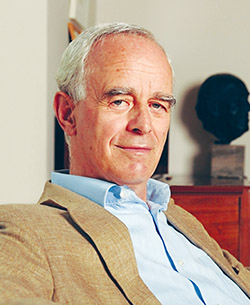
Dutch cardiologist Pim van Lommel
In 2001 a paper appeared in the prestigious medical journal The Lancet purporting to show evidence supporting the reality of Near-Death Experiences, or NDEs. In “Near-death experiences in survivors of cardiac arrest: a prospective study in the Netherlands,” the Dutch cardiologist Pim van Lommel and his research team presented the results of a twenty-year long study of the strange experiences reported by patients who survived heart failure. That these patients reported being aware of anything during cardiac arrest was strange enough. The standard view is that when the heart and lungs stop so do the brain and consciousness. What should have happened was that they experienced nothing at all. Nevertheless they did.
The patients Lommel studied reported that during the period of unconsciousness brought on by their seizure, they experienced some very remarkable things indeed. Many recounted feelings of bliss and intense happiness; many spoke of a bright white light, of a tunnel, of seeing deceased relatives and of going through a kind of “life review,” in which their entire lives, as the cliché goes, “passed before their eyes.” Many spoke of having an “out-of-the-body experience,” of seeing themselves and their nurses and doctors from some vantage point near the ceiling. Many spoke of guides, angels and spirits, come to comfort them. Many also assured Lommel that the experience was entirely beneficial, that it relieved them of their fear of death, that it had transformed them in some way, and that it gave them the certainty that the life we know here on earth is not the only one.
Lommel’s Lancet paper understandably caused an uproar, yet the research was impressive. The statistics Lommel and his team provided seem to show that the usual explanations given to account for NDEs – from the mainstream scientific view – did not, at least in these cases, work. Lommel studied some 562 survivors of cardiac arrest and he discovered that up to 18% of them reported having had a NDE. Of these, none could be chalked up to oxygen deficiency to the brain, the effects of drugs, or the other physiological or psychological reasons usually offered as a way of explaining the phenomenon. Lommel and his team concluded the NDE was an actual, objective event and that it argued in favour of some kind of ‘post-death’ survival.
Perhaps even more controversial, the findings also seemed to offer proof that consciousness can exist outside or even without the brain. While most mainstream scientists will merely snort at the idea of an afterlife, they will positively bellow at the suggestion consciousness is anything more than a by-product of that three-pound mass of grey matter. According to a number of prestigious neuroscientists and philosophers of mind – I talk about some of them in my book A Secret History of Consciousness – consciousness is absolutely, positively, 100% produced by the brain.
Lommel was unrepentant and in 2007 he produced a book, Consciousness Beyond Life [available from New Dawn, see page 79], based on his paper, presenting his case studies in greater depth and bringing his research to a wider public. The results were encouraging. The book was a bestseller in the Netherlands, then repeated its success in Germany, the UK and the US. Lommel has presented his ideas in interviews and videos and on television. Lommel’s work has, of course, attracted criticism. Yet his findings seem to stand and for the open-minded provide the kind of ‘hard’ evidence that scientists dismissive of any non-materialist accounts of consciousness demand, in order for them to consider changing their minds in any way about the matter.
A Neurosurgeon Visits “Heaven”
Lommel was not the only medical practitioner to take NDEs seriously and to subject them to study. Even more controversial than Lommel’s findings was the account by the American neurosurgeon Eben Alexander of his own NDE. Alexander had twenty-five years’ experience studying the brain and teaching others how to study it, at institutions such as the Harvard Medical School. Like most of his colleagues, he accepted the dogma that the brain produces consciousness. Then, in 2008, a bacterial infection – a rare form of meningitis – had him in a coma for a week and taught him otherwise. His chances of recovery were slim at best, and his family was advised that if he did survive, he would be little more than a vegetable: the infection had caused irreparable brain damage. Yet on the seventh day under a ventilator Alexander opened his eyes and came to. This was miracle enough. But the story Alexander had to tell was even more remarkable.
The white light was there, and also beautiful melodies, angelic choirs, fantastic landscapes with strange plant life, waterfalls, crystal pools, and thousands of beings, dancing, and a girl who came to him on a butterfly wing. During the week of his coma, when his brain shouldn’t have produced the slightest hallucination – should have produced no consciousness at all – Alexander went on a journey to “higher realms” and eventually to what he calls the “Core,” a centre of reality “filled with the infinite healing power of the all-loving deity,” the source of everything. He was privy to fundamental realities, for which “God seemed too puny a little human word.” He speaks of experiencing a “higher dimensional multiverse” and an “oversphere” and that his notions of time, space, and everything else were radically changed. During his coma he underwent a kind of spiritual evolution, from what he calls the “Earthworm’s Eye View” to the Core, many times, learning truths about the nature of existence and our part in it. One truth was about the reality of the afterlife, knowledge of which Alexander has tried to pass on to his many readers in his bestselling books Proof of Heaven and Maps of Heaven.
American neurosurgeon Eben Alexander and the covers of his best-selling books.
Like Pim van Lommel, Alexander came to believe that human beings are much more than their physical bodies and consciousness is something more than a by-product of the brain. They disagree with the philosopher John Searle who argues that the brain produces consciousness as the liver does bile. Consciousness, they argue, is not localised in or produced by the brain because consciousness itself is the ultimate reality, not the physical world – an insight echoed down the ages by mystics and visionaries, but which in recent times it seems some scientists are cottoning on to as well. They see it as a way out of the cul-de-sac reached by trying to solve the ‘hard problem’ in mainstream neuroscience: how does a neuron, a physical phenomenon, become a thought, a mental one? The answer is it doesn’t. It’s the other way around.
Filtering Reality
Whatever we might think of Alexander’s account of the afterlife and his ideas about mankind’s spiritual evolution – he has since become a popular advocate of the union of science and spirituality with appearances on ‘Oprah Winfrey’ and other talk shows – the notion of a non-local consciousness has a history. What was remarkable about the cases Lommel studied and Alexander’s own, was that they reported vivid inner, transformative experience during a time when the brains involved should have been incapable of ‘producing’ anything. If brains ‘produce’ consciousness, this should have been impossible, rather like a flashlight shining without the battery. Some studies done in the 1960s suggest consciousness may not need much brains at all. In 1965 John Lorber, a specialist in hydrocephalus – “water on the brain” – published a paper as remarkable as Lommel’s. In “Hydranencephaly with Normal Development,” published in Developmental Medicine and Child Psychology for December 1965, Lorber presented several case studies in which people with little or no cerebral cortex functioned normally. In one case the subject had an IQ of 126 and an honours degree in mathematics. Two girls born in the 1960s had fluid where their cerebrums should have been, with no evidence of a cerebral cortex, yet both had perfectly normal intelligence. Unlike ‘The Wizard of Oz’s Scarecrow, they, and the other cases Lorber studied seemed to get on perfectly well without a brain.
Such cases, though well documented, may push the believability barrier, but we need not resort to these extremes to argue the brain does not ‘produce’ consciousness. In the late nineteenth century the philosopher Henri Bergson argued eloquently that, rather than produce consciousness, the brain served an eliminatory function, acting as a reducing valve, filtering reality and allowing only what was necessary for survival to reach conscious awareness. Rather than produce consciousness, the brain edits it down to something manageable, otherwise we would be overwhelmed by reality’s complexity, a condition common to many mystics. Aldous Huxley resorted to Bergson’s idea when, in The Doors of Perception, he tried to account for the effects of the drug mescaline on his consciousness. The mystical effects of the drug, Huxley believed, were due to its ‘opening’ the filters of the brain, allowing more consciousness than needed for mere survival to flood into awareness. The fact that in the cases Lommel studied and in Alexander’s own, the brain was out of commission, seems to support the Bergson/Huxley thesis. With the filters off, much more of Reality – what Huxley called “Mind at Large” – became available. If the brain “mutes” reality, allowing, as Huxley said, only a “thin trickle” to enter consciousness, in the NDE the taps seem to be on full blast. The analogy is apt as our kitchen taps do not ‘produce’ the water in our sinks, but quite the opposite, they stop it from running. It’s already there in the pipes.
Some variant of Bergson’s idea is popular among ‘alternative’ scientists, such as the biologist Rupert Sheldrake who speaks of the brain acting as a kind of “tuner,” “selecting” different “wavelengths” of reality, rather as a radio works by cutting out all transmissions except the one you wish to hear, or as a television that picks up a broadcast but is not responsible for it. Neither my radio nor my television ‘produces’ the programs they play. They ‘receive’ them from the broadcaster, and Sheldrake and other scientists and philosophers like him, see the brain as a kind of inner TV, picking out different ‘channels’, broadcast by – well, we’re not quite sure. The general idea is that consciousness is the fundamental reality; rather than being stuffed into the cramp confines of our skulls, it pervades the universe. This is the “panpsychism” that philosopher David Chalmers advocates, following in the philosophical footsteps of Bergson and his contemporary Alfred North Whitehead, who, in different ways, envisioned some version of Mind at Large. Needless to say – or perhaps not – such an idea as an all-pervasive consciousness or mind is, of course, a staple part of many pre-modern worldviews.
Another who accepted the idea of Mind at Large was, oddly enough, an early investigator into NDEs, although in his aptly posthumous Human Personality and Its Survival of Bodily Death (1903), the first “scientific” study of the afterlife, F.W.H. Myers did not call them that. Myers spoke of the “subliminal mind,” by which he meant something different than Freud’s “unconscious,” which Myers’ coinage preceded by some years. It was Huxley who in his foreword to Myers’ classic compared his “subliminal mind” to an “upstairs” in the “house of the soul,” rather than Freud’s “garbage-littered basement.” This upstairs had some unusual characteristics and in the late nineteenth century Myers and his fellows in the Society for Psychical Research devoted their lives to studying them. Take, for example, the remarkable experience of Dr A. S. Wiltse who in 1889 “died” from typhoid fever. Wiltse was pronounced dead but found himself “waking up” inside his body, and gradually being “released” from it. He felt himself emerge from his body and found that he could walk away from it. No one noticed him and, stranger still, he found that he could walk through people. Wiltse then found himself confronting huge rocks standing beneath storm clouds. A voice told him that if he continued past them he would enter eternity but if desired he could return to life, a common choice in many modern NDEs. He then “woke up,” four hours after being pronounced dead, and told of what he saw.
Myers’ account of Dr Wiltse’s experience was preceded by an even earlier one. In 1871 Albert Heim, a professor of geology, fell some seventy metres while climbing in the Alps. During the few seconds of his fall, Heim experienced a panoramic “life review,” seeing his whole past “take place in many images, as though on a stage at some distance from me.” Like many who have experienced an NDE, he saw a “heavenly light” and was free from fear and anxiety. Conflict was “transmuted into love” and he found himself moving “painlessly and softly” into a “splendid blue heaven.” Heim survived his fall but the experience so moved him that he began to collect accounts of similar experiences by other climbers. Forgotten for years, Heim’s work was re-discovered when what we might call the “NDE and afterlife boom” of the 1970s and 80s, in the work of Elizabeth Kübler-Ross, Raymond Moody, Kenneth Ring and others, brought it back to light. Another fairly well-known account of a NDE is that of C. G. Jung, who, in 1944, following a heart attack, found himself orbiting the earth and confronting a strange temple and Hindu floating in space. Jung was about to cross the threshold like Dr Wiltse when he found himself whisked back to earth, disappointed at the prospect of coming back to life.
Do Lommel and Alexander bring anything new to this study? Their scientific and medical credentials certainly bring new attention to it, although to be sure, not all of it is positive, and the claims and expertise of both have come under heavy scrutiny and criticism. But part of what makes their and other studies convincing – at least to the open-minded – is the similarity between the accounts they study and older reports on what happens when we die. As Ptolemy Tompkins in The Modern Book of the Dead makes clear, there is much overlap between accounts of the afterlife found in the Egyptian Book of the Dead and the Tibetan Book of the Dead, to speak of only the two most famous earlier reports on the beyond. And these two share much with recent investigations, such as the insights about the “life between death and rebirth” gleaned by the “spiritual scientist” Rudolf Steiner through his access to the “Akashic Record.” For instance, Steiner too makes the “life review” a central part of the process of dying, in preparation for reincarnation.
But, as Tompkins makes clear, there are also differences. The Swedish scientist and religious philosopher Emanuel Swedenborg, who wrote much about the brain, journeyed to heaven, hell, and also to an intermediary realm he called the “spirit world,” not through a NDE but through inducing visionary states. He gave his own “proof” of the higher spheres in his book Heaven and Hell, yet his account is somewhat different from Eben Alexander’s, while both Swedenborg’s and Alexander’s differ considerably from Steiner’s.
Enough similarities exist among these accounts to suggest that in some way they and other voyagers were encountering different parts of the same inner landscape. And if the ‘proofs’ of heaven we have glanced at here are at all reliable, it is one that, at some point, we all will have an opportunity to journey through, in this life and the next.
[alert type=”success” dismiss=”no”]If you appreciate this article, please consider subscribing to help maintain this website.[/alert]
Footnotes
1. www.ebenalexander.com
2. John Searle The Mystery of Consciousness, Granta Books, 1997, 6
3. Gary Lachman A Secret History of Consciousness, Lindisfarne Books, 2003, xxv-xxvi
4. Aldous Huxley, Foreword, F. W. H. Myers, Human Personality and Its Survival of Bodily Death, Dover Publications, 2005, 7
5. Ibid. 212-217
6. The “life review” has a solid basis in the brain, as the neurosurgeon Wilder Penfield discovered. While operating on a patient who was conscious – the brain feels no pain – Penfield discovered that when certain parts of the brain were stimulated, the patient “relived” experiences of his past with what we would call “total recall.” It seems the brain in some way stores every experience we’ve ever had and, with the requisite trigger, can “replay” them. The “life review” seems a more intense and total experience of this.
7. Quoted in Colin Wilson, Afterlife, Doubleday, 1987, 215-16
8. Gary Lachman, Jung the Mystic, Tarcher/Penguin, 2010, 186-88
9. Gary Lachman, Swedenborg, Tarcher/Penguin, 2012, 87-98
This article was published in New Dawn Special Issue Vol 8 No 3 (June 2014)
Slowly the public has learned that the Gospels in the Bible are not the only ones that were written. Some of these other half-forgotten texts have survived in whole or in part; some have vanished, known only by their names and, perhaps, by a few quotations in the works of other writers. Of some of them we do not even know the names.
Were these Gospels suppressed and kept secret because they contain knowledge about Jesus that the established church did not like? Do they tell us any more about the life of Jesus than do the texts in the Bible? Is there any value to them at all?
To try to answer these questions, it may be best to start by defining just what a Gospel is. The English word is a translation (via the Latin evangelium) of the Greek word euaggelion (euangelion), meaning “good message” or “good news.” The original word in Old English, godspell, or “good tale,” had much the same meaning.
Thus a Gospel is an attempt to convey the “good news” about Jesus Christ. It presents his teachings and as much of his life as is relevant to those teachings. It is not a biography. The genre of biography was known in the ancient world, but the Gospels do not try to fit into it. Hence we know very little about the life of Jesus apart from his public ministry.
The Gospels all share another striking feature. None of them – or, for that matter, any of the texts in the Bible – were written by anyone that knew Jesus personally. Nor do they claim to be. The Gospel of John has a curious statement at the end: “This is the beloved disciple which testifieth of these things, and wrote these things; and we know that his testimony is true” (John 21:24). This verse seems to start by saying that this Gospel was written by Jesus’s mysterious “beloved disciple” (usually identified with John), but then it says, “we know that his testimony is true.” No one who had been an eyewitness to Jesus’s life, or who had written the text himself, would have any reason to say this. The other Gospels are even more elusive about their connection to their subject. They were written by people who knew of Jesus only at second or third hand. It’s useful to remember this fact when looking at Gospels of any kind.
In order to piece through the enormous amount of scholarship that the Gospels have inspired, we might start with some basic hypotheses that are accepted by most reputable (i.e., non-fundamentalist) scholars, although they are little known to the public.
Marcan & Q Hypotheses
The first is the Marcan hypothesis. This refers to the idea that Mark was the first of the New Testament Gospels to be written (one widely accepted date is c.70 CE). By intense textual analysis carried out over many decades, scholars have shown that Matthew and Luke are familiar with Mark and base their works on his, rather than the other way around. Because of their similarities, these three are called the synoptic Gospels. While they differ in important ways, their stories more or less parallel one another. The last, John, differs in many more ways from these three than they do from one another.
The second is the Q hypothesis. Q, taken from the German Quelle, meaning “source,” is a document, now lost, that most scholars believe was used as source material by both Matthew and Luke – meaning they share elements with each other that they don’t share with Mark (including the Lord’s Prayer, the Golden Rule, and a number of the parables). Q did not have a narrative; it did not tell a story. Instead, it appears to have been a simple collection of Jesus’s sayings.
If this is true, it is very strange. What would have almost certainly been the first Gospel has been lost. Even its name has been forgotten; the nickname “Q” is just a scholarly appellation. Did this work contain material that the later church tried to suppress? Or was it lost simply because everything in it was duplicated in Matthew and Luke? We simply don’t know.
Notice one other fact about this widely accepted theory. It holds that the earliest writings about Jesus were one, possibly more, collections of his sayings. They did not contain any narrative whatsoever.
The Gospel of Thomas
This fact is extremely interesting to consider in light of the most important and exciting of all the secret and suppressed Gospels: the Gospel of Thomas (not to be confused with another surviving Gospel of Thomas, which deals only with Jesus’s infancy). Until the mid-twentieth century it was known only by name and from a few scattered fragments of the Greek original. But in 1945, a cache of texts was discovered in Egypt. They have become known as the Nag Hammadi scriptures, and they contain a complete copy of the Gospel of Thomas, translated from the original Greek into Coptic.
The Gospel of Thomas strikingly resembles the early lost collections of Jesus’s sayings that scholars had posited. It has no narrative. There is no nativity, no crucifixion or resurrection story. It is simply a collection of Jesus’s utterances, some of them familiar from the other Gospels, others previously unknown (“Cleave a [piece of] wood, and I am there. Raise up a stone, and you will find me there.” Note: bracketed and parenthetical material in this and other quotations have been inserted by the translators).
Many of the sayings in Thomas resonate with the teachings of the so-called heresy of Gnosticism. Like the Gnostics, the Gospel displays a deep contempt for the world – “He who has known the world has found only a corpse” – and an emphasis on gnosis or spiritual awakening: “He who knows the all, (but) fails (to know) himself, misses everything.”
It is difficult to fit this Gospel into what was hitherto believed about early Christianity. The usual claim is that Gnosticism did not arise until the second century CE and that all Gnostic texts date from that time or later. But Thomas does not resemble these other works in some crucial respects – for example, it does not show any familiarity with the synoptic Gospels or any other Christian writings, so it cannot be proved to be later than these. As the scholar Beate Blatz concludes, “This collection is to be regarded as a phenomenon parallel to Q, and belongs to the early history of the formation of the Gospels.”
Parallel to Q? But Q is usually dated to around 40-50 CE, very soon after Jesus’s lifetime. If the Gospel goes back that far, then Gnosticism in some form must go back that far as well. This fact poses problems for the old-fashioned view that the apostles all held to the same teaching, which would later be christened the “apostolic faith.” Rather it suggests that Jesus’s own disciples understood his teachings in very different ways right from the outset, and that these differences would give rise to what were later described as heresies – including Gnosticism – as well as to proto-catholicism.
What about gnosis? Did the apostle Thomas make this up? Was he distorting the teachings of Jesus? Or did Jesus instruct individual disciples differently according to their interests and capacities? The Gospel of Thomas alludes to this possibility: “And he [Jesus] took him [Thomas], withdrew, (and) spoke to him three words. Now when Thomas came (back) to his companions, they asked him: What did Jesus say to you? Thomas said to them: If I tell you one of the words which he said to me, you will take up stones (and) throw them at me; and a fire will come out of your mouth and burn you up.”
It may be the case, then, that the disciple Thomas understood or wanted to understand Jesus’s teaching in a deeper, more mystical way, and that Jesus taught him accordingly. Since the Gospel of Thomas is (for various reasons) thought to have been written in Syria, where the apostle was held in particularly high esteem, we may guess that soon after Jesus’s death Thomas found his way to Syria and started an esoteric school (or church, if you like) emphasising gnosis. Another tradition has Thomas going to India and starting churches there, some of which survive to this day; a cathedral in Chennai claims to have been built over his tomb. We could thus posit that Thomas went first to Syria and then to India, where he died.
[alert type=”success” dismiss=”no”]If you appreciate this article, please consider subscribing to help maintain this website.[/alert]
Other Secret Gospels
I’ve dwelt at length on the Gospel of Thomas because it alone, of all the secret and suppressed Gospels, could be as old or older than the ones in the New Testament. But it is far from the only other Gospel that survived. Someone who peruses the New Testament apocrypha (meaning quasi-scriptural works that were excluded from the final canon) will find a wild farrago of texts: Gospels allegedly by each of the twelve Apostles (even a recently discovered Gospel of Judas); Gospels ascribed to female disciples (such as the Gospel of Mary); a Gospel of Nicodemus, which is mostly about Pontius Pilate; even a Gospel of Eve, whose only certain surviving fragment reads: “I stood upon a high mountain and saw a tall man, and another of short stature, and heard as it were a sound of thunder and went nearer in order to hear. Then he spoke to me and said, I am thou and thou art I, and where thou art there am I, and I am sown in all things; and whence thou wilt, thou gatherest me, but when thou gatherest me, then gatherest thou thyself.” The mystical nature of this passage – with motifs such as “I am thou and thou art I” – suggests a Gnostic context for this mostly forgotten Gospel of Eve.
Except for Thomas, all the apocryphal Gospels are acknowledged to be later than, and often based on, the four that made their way into the Bible. Some were accepted as scripture by various faith communities, some never commanded much allegiance. Many of them are known only through quotations (often contemptuous) in the works of the early church fathers.
But it would be mistaken to believe that the apocryphal Gospels did not leave their mark on Christianity. To begin with, they left a deep mark on Christian art and iconography. To take perhaps the best-known example, one of the most charming details of the nativity story is the adoration of the infant Christ by the ox and the ass. This detail does not appear in any of the four canonical Gospels. It was inspired by a passage in a second-century text called the Protevangelium (“first Gospel”) of James, which describes not only the birth of Jesus but the birth and childhood of Mary. The first direct reference to this motif appears in an early medieval compilation of infancy stories, known as the Gospel of Pseudo-Matthew: “On the third day after the birth of our Lord Jesus Christ holy Mary went out from the cave, and went into the stable and put her child in a manger, and an ox and an ass worshipped him.” This detail has been reproduced in countless depictions of the nativity of Christ down to this day.
Other major issues with these suppressed Gospels cannot be covered here. Some of the most difficult are connected with various Gospels written in Aramaic and used in the early Jewish-Christian communities. (None of these have survived in their original language.) It is not clear even how many of these Gospels there were – the church fathers often seem to know them only by hearsay – and they have been preserved only in quotations. But their existence attests to the fact that in the earliest days of Christianity, there was a wide overlap between Christians and Jews, and they were not always easily distinguished. There have been Jews for Jesus from the very beginning.
How the New Testament Came To be
All this granted, how were the canonical Gospels selected? This subject has attracted an astonishing amount of misinformation, reproduced by such authors as the actress Shirley MacLaine in her New Age-inspired books, and in Dan Brown’s The Da Vinci Code, in which one of his characters asserts, “The Bible, as we know it today, was collated by the pagan Roman emperor Constantine the Great.”
This statement is false. Constantine the Great, who reigned from 306 to 337 CE, is best known for issuing an edict of tolerance for Christianity in 313. He also convened the Council of Nicaea in 325 to enable the squabbling bishops to decide once and for all whether Jesus was coequal with God the Father or merely another of his creations (they decided that the Father and the Son were equal). Constantine converted to Christianity soon before his death. But he had nothing to do with the creation of the biblical canon.
The canon of the Hebrew Bible, or Old Testament, was more or less established by the Jews by the end of the first century CE. The New Testament canon was created by, and grew up organically with, what later came to be known as the Catholic Church. Fundamentalist Protestants thus are wrong when they say the church was based on the Bible: the two came together and are inextricably intertwined.
In the first century, when most of the New Testament texts were written, there was no established canon of Christian scripture. Many Christian communities had only one of the Gospels, or none, relying instead on oral tradition. Only during the second century did certain texts come to be accepted as scripture. These included the epistles of Paul (not all of which were actually written by him) as well as a collection of Gospels that came more and more to be narrowed down to the three synoptic Gospels, which were, as the church acknowledged, among the oldest and the most authentic. The Gospel of John was written later than the synoptics. It is dated between 80 and 110 CE, whereas the composition of Matthew, Mark, and Luke is generally placed between 60 and 95. John also came to be accepted later, partly because it differed so much from the other three.
One of the first church fathers to insist upon the canonicity of the four Gospels was Irenaeus of Lyons (c.130-c.200), whose work Against the Heresies also gives a detailed, though vitriolic, account of the Gnostics. In this text Irenaeus writes: “The Gospels could not possibly be either more or less in number than they are. Since there are four zones of the world in which we live, and four principal winds, while the Church is spread over all the earth, and the pillar and foundation of the Church is the gospel, and the Spirit of life, it fittingly has four pillars, everywhere breathing out incorruption and revivifying men.”
It would be hard to overemphasise Irenaeus’s importance on the development of the Catholic Church; he is sometimes regarded as its first real theologian. His delineation of four canonical Gospels – no more, no less – would eventually be accepted as authoritative, although the process of acceptance was long and spanned two centuries.
The first complete list of the twenty-seven New Testament books as we have them now appears in an Easter letter from Athanasius, bishop of Alexandria, in 367. “These are the springs of salvation,” Athanasius wrote, “in order that he who is thirsty may refresh himself with the words contained therein. Let no one add anything to them or take anything away from them.”
Note that this letter was written by Athanasius. It was he who led the victorious party at the Council of Nicaea in 325, when Christ was proclaimed as equal to God the Father. This is the only real connection that the Council of Nicaea has to the New Testament canon, and it is an extremely thin one. Contrary to what some have said, the Council of Nicaea did not throw many texts out of the canon (it did not deal with this subject at all), nor did it mention or condemn the doctrine of reincarnation, as it is sometimes also said to have done. Reincarnation has, contrary to the beliefs of many, never been a significant doctrine in mainstream Christianity.
Athanasius’s letter may have some connection with the Nag Hammadi texts, which, as we have seen, were found in Egypt, where Athanasius had his diocese. Although he wanted the heretical texts to be burned, it is possible that a Christian community defied him by burying them instead. If so, then we ironically have Athanasius to thank for the preservation of these scriptures.
Controversial Passages
Now that we have some idea of these despised Gospels and how they came to be cast out, it’s time to ask what we can learn from them. Do they tell us anything about the historical Jesus? No: they are all much later than the Gospels in the Bible, except for Thomas, and Thomas has practically no biographical information about Jesus. The rest of these Gospels are much later, dating to between the second and fourth centuries. They may represent some genuine snatches of truth here and there, but at this point there is no way of telling which snatches those might be. The value of these Gospels lies chiefly in what they tell us different Christian sects and schisms believed.
To take one example, let’s turn to the Gnostic Gospel of Philip, dated to the second or third century. It includes this tantalising passage: “The S[aviour] loved [Ma]ry Mag[da]lene more than [all] the disciples, and kissed on her [mouth] often. The other [disciples]… said to him: ‘Why do you love her more than all of us?’ The Saviour answered and said to them []: ‘Why do I not love you like her?’”
This passage, along with some legends that have long circulated orally, led some to claim that Jesus had some kind of sexual or romantic relationship with Mary Magdalene. Some even argue that she was his wife, a theory reinforced by a newly discovered papyrus fragment, of disputed authenticity but probably dating to eighth-century Egypt. This fragment has the words “Jesus said to his wife…” The text breaks off, so we don’t know who his wife was supposed to have been or what he is supposed to have said.
By all accounts, both this papyrus fragment, recently dubbed “The Gospel of Jesus’s Wife,” even if it is genuine, and the Gospel of Philip date to much later than the time of Christ. What does this mean? While this evidence suggests there was some belief that Jesus had a wife, who could have been Mary Magdalene, we cannot go further and say he actually did. The evidence shows nothing more than there was a later tradition to this effect. It could be handing down an authentic piece of fact, but the best we can say is that we simply don’t know. We could say much the same thing about practically everything we learn about Jesus from the apocryphal Gospels.
The quest for the historical Jesus – the obsession of theologians for some two hundred years – remains unfulfilled. Apart from the Gospels in the Bible and the Gospel ofThomas, there is little contemporary evidence about him. One of very few references that are even remotely contemporary appears in the Antiquities of the Jews by the first-century Jewish historian Flavius Josephus, and it is not about Jesus, but about his brother James. Actually it is about one Ananus, the high priest of Jerusalem in 62 CE, who, we learn, “called the Sanhedrin to judgment and brought before it the brother of Jesus the so-called Christ, James by name, and some others, and accusing them of transgression of the law had them stoned.”
Another passage in Josephus, the so-called Testamentum Flavianum, also mentions Jesus. It goes as follows:
At that time lived Jesus, a wise man, if indeed may one call him a man. For he was a doer of incredible deeds and a teacher of men, who with joy received the truth. And he attracted many Jews, and also many of the Greek sort. This was the Christ. And although Pilate at the insistence of our leading men punished him with crucifixion, those who loved him at first did not cease loving him. For he appeared to them on the third day living again, as the divine prophets had prophesied this and a thousand other wonderful things about him. And even to this day the tribe of the Christians which is named after him has not vanished away.
Few scholars take this passage at face value. Some see it as the work of a later Christian apologist who inserted it into Josephus’s text. But most scholars believe that Josephus actually wrote some parts of this passage, although they by no means agree about which parts those are. Some look very much like interpolations (“This was the Christ”); others may belong to Josephus’s original.
These passages, along with the four canonical Gospels, Thomas, and other parts of the New Testament (notably Paul’s epistles), constitute the sum total of the surviving material that was written about Jesus in the first century CE. While it would be excessive (as some have done) to conclude from this that Jesus was a fictional creation based on motifs of dying and resurrected gods, the evidence about him remains skeletal. It is even more so if – to reveal another scholarly secret that has not really made its way to the public – we concede that even the earliest Gospels contain some admixture of fact and legend. (Scholars for the most part agree about this point, but they differ wildly about how much is myth and how much is legend.)
To sum up, someone approaching the secret and suppressed Gospels for knowledge about who Jesus was and what he did will probably go away disappointed. These texts are valuable more for what they say about early Christianity than for what they say about Christ. Others, however, going to these Gospels – particularly the Gnostic texts – for inspiration and illumination about the spiritual path may be better rewarded. As the Gospel of Thomas says, “He who seeks, let him not cease seeking until he finds; and when he finds he will be troubled, and when he is troubled, he will be amazed, and he will rule over the All.”
Quotations from the New Testament apocrypha and from Josephus have been taken from Wilhelm Schneemelcher, ed., The New Testament Apocrypha, volume 1, translated by R.McL. Wilson, Cambridge, UK: James Clarke, 1991.
This article was published in New Dawn Special Issue Vol 8 No 4 (August 2014)
The development of the digital camera has led to an upsurge in the number of people capturing the objects now known as ‘Orbs’, with much speculation as to exactly what they really are: simple digital camera image processing ‘errors’ or manifestations of other worldly ‘spirit’ forms.
Studies have shown that some of the objects captured by the digital cameras are, indeed, modified images of dust, water droplets or other fine particulate matter. But this does not explain the large number of Orbs appearing that seem to ‘interact’ with human activities, nor does that apply to the various other forms that appear, often to the naked eye as well as the cameras lens and CCD imaging circuitry.
There are cases of ‘plasma’ clouds, wraith-like and ‘ghostly’ torus or doughnut shapes, as well as elongated ‘light rods’ and strange fairy-like ‘winged things’. None of these can be satisfactorily explained by the critics or any scientific dynamic.
Anomalous lights of varying types have been known for millennia. Tomb paintings, medieval murals, native art and legend have shown the existence of many strange phenomena. Early cameras, using the old silver halide emulsion systems, occasionally captured these phenomena, often referred to as ‘Earth lights’. Occultists, shamans and sensitives have all ‘seen’ these.
There may well be a relationship between Earth energies and these lights. Recent research by the British ‘Dragon Project’ team (www.dragonprojecttrust.org) into the energies ambient at sacred sites, henges, stone circles and menhirs etc, with magnetometers, geiger counters and gravitometers, as well as the cooperation of accredited dowsers and psychics, showed that all the sites had magnetic anomalies, increased ionizing radiation levels, often with associated mind-altering effects upon many humans exposed to their energy. Many of the sites were on, or near, fault lines, most of the stones were of types high in quartz (silica) which is prone to piezoelectric effects causing electrical discharges, often appearing as light phenomena, sometimes before or during tectonic events such as earthquakes!
The externally visible ‘optical’ effects are also often accompanied by (or alternatively) ‘internal’ cerebral effects of flashing lights and in some cases ‘full on’ hallucinations of various types, a fact no doubt known to the ancient people who built and worshipped at these sites. It is well known that humans have deposits of ‘magnetite’ compounds sensitive to magnetic field strengths within the brain, one such at the ethmoid sinuses, making humans as susceptible to magnetic anomalies as birds and other animals.
It is also postulated that such sites could function as ‘stargates’ or portals to other dimensions, from whence ‘entities’ could enter our reality that are usually only seen by a few ‘sensitives’ or under certain sets of rare suitable conditions, i.e. higher than normal radiation or magnetic field variations of a local nature.
This ties in with current scientific work into what has become known as ‘string theory’, which postulates that minute, subatomic ‘strings’ of energy permeate the various multiple dimensions that are now believed to exist. These ‘strings’ of energy are believed able to penetrate the ‘membrane’ or ‘veil’ between the dimensions, and (probable) parallel universes.
So presuming we do have multiple dimensions and universes, it may well be that under certain circumstances energies, or ‘entities’, pass through ‘the veil’ and briefly manifest themselves in our reality! This then would seem to prove what occultists have believed for years – there is a ‘veil’ between this world and the next, and that it can be parted at certain times under certain conditions, like at the times celebrated by our pagan ancestors, the special ‘magical’ times e.g. Beltaine.
Quantum physics has also shown that if a ‘particle’ be divided and part thereof removed, no matter how far removed, something done to the one part is mirrored in the reaction of the other part! This then would lend veracity to the magical concept that a person, or thing, may be influenced at a distance by certain actions, usually of a ritual nature, by a ‘shaman’, witch or other practitioner.
As light phenomena have been observed and recorded for millennia in tomb paintings, medieval frescos, etc, obviously ‘things’ have been seen and recorded. Occasionally, with the advent of photography, even ‘old fashioned’ film cameras captured strange light phenomena. But with the advent of the CCD digital camera and its greater spectral sensitivity, capturing wavelengths well into the infrared, there has been a great upsurge in photographs of various phenomena, and ensuing debate as to their true nature.
Many people also can actually see, albeit briefly, Orbs and related manifestations. The writer and others have personally, at times, seen these things, but mostly it is via the modern digital still and video camera that their presence is observed.
Detractors have asserted that Orbs (etc) are merely the result of the way the CCD circuitry in the digital cameras ‘misinterprets’ water droplets or particulate matter in the atmosphere, but this does not explain many of the phenomena, such as the ‘winged things’ or ‘light rods’. True, there are effects (false orbs), due to water droplets & dust, but they do not have the same internal ‘structure’ of real Orbs, nor do they ‘interact’ with humans as ‘real’ Orbs seem to. Orbs are known to attend occult activities, seances, festivals, love making and many human activities with a high ‘energy’ output. Perhaps they are ‘energy feeders’?
Orbs surround the author as he works his blacksmiths forge.
Hundreds of Orbs seen moving near the author’s house.
The Experiments
To this end, a series of experiments was undertaken to gain an insight and to see if ‘Orbs’ could be persuaded to appear upon ‘request’. At several occult ritual occasions, wearing black robes to observe any ‘fallout’ of dust, etc, quantities of dust, talcum powder & wood ash were thrown into the air as well as quantities of fine water droplets were sprayed from an atomiser around the area of the proposed tests. A digital video camera was set running on the infrared ‘night vision’ setting as well as having a digital still camera on hand. The area had been ‘dowsed’ with both a crystal pendulum and rods of iron showing the chosen area to be on an ‘energy spot’. A radiation detection meter was activated to measure ionizing radiation levels.
The results showed there was an increase in radiation above normal average background levels, a magnetic compass showed deflection. The number of Orbs filmed was quite large in every case, whilst there was little appreciable ‘fallout’ on the black robes, and the dust, etc, barely showed up on the films and photos thus indicating it was not forming the Orbs.
Another interesting fact has been observed in that when a magical ritual is performed ‘sky clad’ (naked), and an ‘Orb’ actually comes in contact with the operator’s bare skin, an electrical ‘tingling’ sensation is felt, like the effect one gets if holding a hand near a TV screen. This effect has been noted by several persons of my acquaintance who are active occultists and may be worthy of further investigation.
In the USA some have claimed Orbs have ‘healing effects’. I have had a minor indication of this possibility when, in connection with my occult activities, I was working a small blacksmiths forge, outdoors, on a full moon making a witches ritual ‘athame’ by a ritual method (‘skyclad’ of course). An old shoulder injury was troubling me as I worked the small bellows till I felt a ‘tingling’ on my shoulder. I asked my wife to take a photo and ‘lo’ there was an Orb sitting on my shoulder! The pain faded rapidly and did not return until many hours later, after the work had ended! Hmm?
This area lies over a quartz reef with an adjacent fault line which may be instrumental in the appearance of several other energy entities we have encountered over the years around the house, workshop and ritual circle (of mostly white and crystalline quartz stones).
[alert type=”success” dismiss=”no”]If you appreciate this article, please consider subscribing to help maintain this website.[/alert]
Orbs, Winged Things & Light Rods
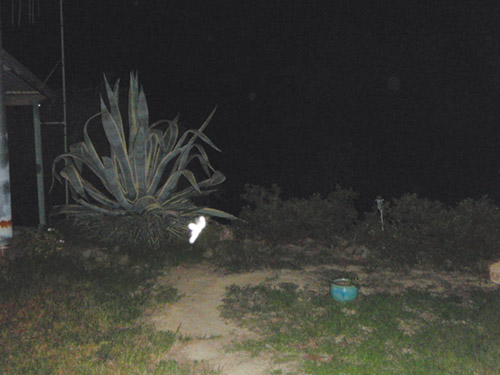
Besides Orbs, fairy-like winged things have been photographed.
At least six of the fairy-like winged things fly close to the author’s wife.
Besides multitudinous ‘Orbs’, we have been visited by the following: ‘Winged things’ (fairies?) either singly, or in small groups, definite ‘winged’ things of almost ‘lepidopteric’ (moth/butterfly) form have been photographed around the garden, at the ‘circle’ and near the ‘fault line’. They seem to have been greatly attracted to my wife! We checked to ascertain there were no moths or other insects, which, anyway, looked different on the photos, as we later took control shots of moths etc.
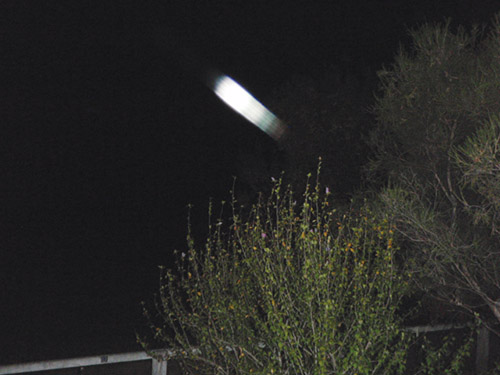
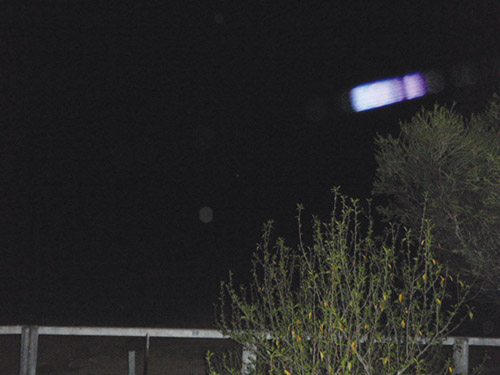
One of the Light Rods that are often photographed with standard Orbs.
Another Light Rod. They can also appear to the naked eye.
‘Light Rods’: there were several types of ‘light rods’ observed and photographed. These appear to the naked eye at times, and often ‘hang about’ for several minutes, even coming close to people as if ‘interested’! The main type is a short mostly ‘bluish’ rod, with a notedly ‘striated’ body, a definite groove or ‘cannelure’ at its rear-end usually trailing a row of ‘Orbs’ behind, like an ‘exhaust’. Could it be that this is how Orbs travel? An interdimensional ‘mother ship’? There is also a rarer type which is a golden/yellow colour, it follows the blue one, mating?? Maybe the golden rods are of a different ‘polarity’ to the blue, or even of a different ‘race’?
Interestingly, if one looks at photos of the Orbs that ‘flow’ from the Rods, the internal markings on these Orbs seem to match the striations on the Rods, as if they were, in fact, ‘sections’ or slices of the Rods! Another Rod formation is mainly longer, thinner and ‘spindle shaped’ similar in form to some photographed by the authors of Beyond Photography: Encounters with Orbs, Angels and Light Forms by John Pickering & Katie Hall. These are not as common as the short Rods, but often come with a ‘bang’. I photographed the ‘arrival’ of one of these ‘spindle shaped Rods’ when photographing Orbs near the wife’s pony. I noticed a small glowing spot in the air, a few feet above ground level, quite near me. It ‘hovered’ for a few seconds, and I got a shot of it, which on later inspection proved to be a number of coloured ‘doughnuts’ each a mini-torus. Then, with an audible ‘electric’ crack, it transformed into the long thin spindle shape, which I also photographed as it zoomed over the horse and into the sky. Similar types have appeared from time to time, some quite lengthy.
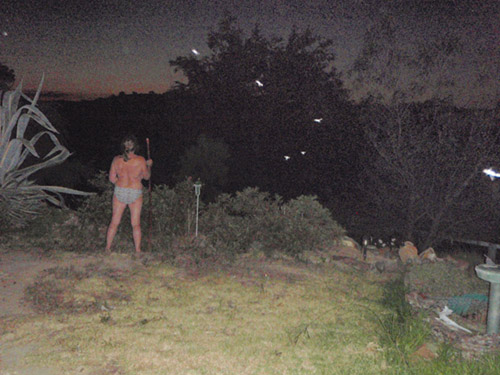
At times we have had strange ‘Plasma’ (?) clouds appear which turn into groups of Orbs, occasionally forming a ‘torus’ of Orbs, before dissipating, raising the possibility of an ‘Orb’ stargate via the ‘torus’ formation. On several occasions we have also photographed what appeared to be the appearance of a person’s ‘other self’ (astral body?) which has been known to many cultures. Certainly a spirit-like doppelganger was captured behind the subject of the photograph during a ritual activity. The camera used in this, and all the other photography, was a very basic digital with no capacity for double exposure or any form of image manipulation. Therefore, it would seem that we are at the reception point of various ‘entities’ of spiritual or interdimensional form.
As an experienced occultist, of over fifty years experience, I have seen many things and am inclined to believe that these visiting entities are ‘aware’ and represent some kind of intelligence, whether ‘spiritual’ or ‘alien’!
The Quartz/Silica Connection
There is a related factor in the phenomena, that of the existence of high concentrations of quartz in this area. Dowsing reveals many ‘high energy’ spots. Using dowsing rods of antique Victorian era wrought iron, which itself has a silica (quartz is a silica) content, produces better results than those of modern steel. That silica is a factor is borne out by the fact that silica (chips) are used in your computer, phone, and various devices. It was thought that ‘stones have memory’. Most of the old standing stones and circles were of quartz, or siliceous rock, and were noted for their effect upon sensitive persons, such as hallucinations or similar mind altering states. The Australian aborigines venerated crystalline quartz, equating it with the ‘rainbow serpent’ of their Dreamtime. Medicine men were known to insert quartz crystals into the bodies of would be initiates! As our planet is very largely composed of silica, in one form or another, could it be that the ‘gaia’ concept of our planet being ‘alive’ is true?
Interestingly the properties of silica, beside computer chips, have been investigated and it is postulated that indeed there could be actual life forms based not on the carbon cycle, as we are, but on a silica mode, which does indeed lend weight to the living planet concept!
In my years of work as a blacksmith, I have been called upon to forge many blades and other ritual items for witches, etc, by following ancient techniques, making such blades from high silica content wrought iron, which I have often smelted myself from the iron ore. It was believed that blades made by the ancient ‘pattern welding’ process had certain ‘magical properties’ and acted as ‘psychic amplifiers’ to ‘sensitives’. Hence the old legends of ‘magical blades’ such as Excalibur could indeed have some truth in them, as yet undiscovered by science. Certainly blades that have been ‘ritually’ forged, incorporating silica threads, have been found to be of a more ‘magical’ quality than similar commercially produced examples, according to ‘customer feedback’ on the examples I have produced over the years for occultists and witches.
Finally, an interesting parallel to the mystery is that recently a Canadian TV station operator, Martyn Stubbs, used certain high tech processes to decode NASA space TV transmissions and found that not only ‘Orb’ like things were being filmed in space, but that ‘Light Rod’ like entities were turning up both inside and outside the space station! These elongated Light Rods were similar to the ‘spindle shaped’ ones I had captured in my photographs, albeit smaller versions, so it would seem that the Orbs and Light Rods are all pervading throughout the universe, possible travellers in Space/Time, possible intelligences of multidimensional capability.
Should we not make every effort to investigate these phenomena which would seem to be interconnected on both material and non-material levels? It would seem science is, indirectly, lending veracity to many of the ancient mystical and occult truths known to the wise.
This article was published in New Dawn Special Issue Vol 6 No 5 (October 2012)
Like many New Dawn readers, I occasionally heard rumours over the years of firefights alleged to have taken place between United States armed forces and technologically superior Nazi naval units in, of all places, Antarctica, soon after the Second World War. Having authored several 20th century military histories,1 possibilities for such a confrontation seemed to me unlikely in the extreme, an impression deepened by some writers, who insisted the Germans were piloting “flying saucers” around the South Pole.
These far-fetched claims long convinced me that the subject was unworthy of consideration, until I was recently shocked to learn how the US Navy actually did launch nothing less than a secret, full-scale invasion of Antarctica less than a year following the Second World War, and under highly suspicious circumstances that have never been fully explained, even after the passage of nearly seven decades. I was determined now to investigate this truly bizarre event with the sole aim of discovering, if possible, what really happened – to discard every groundless speculation, hearsay or obvious fantasy – by narrowing my research exclusively on hard data and credible information only from reliable sources. Here are those facts:
With the words, “these proceedings are closed,” US General Douglas MacArthur, representing the victorious Allies, accepted Imperial Japan’s surrender aboard the battleship USS Missouri on 2 September 1945, thereby officially concluding the Second World War. But eleven months later, a huge armada departed US waters on 26 August 1946 for Antarctica. Its flagship was the USS Philippine Sea, Captain Delbert S. Cornwell commanding her 3,448 officers and enlisted men. At 27,100-tons, she was among the largest aircraft carriers afloat, powered by eight boilers and four Westinghouse geared steam turbines for a combined 150,000 horse power and a range of 20,000 nautical miles. In addition to the Philippine Sea’s 100 fighters, dive- and torpedo-bombers, she bristled with arrays of five-inch artillery and 40-mm Bofor anti-aircraft guns. Four-inch, 2.5-inch, and 1.5-inch steel armour protected her 888-foot-long hull, hanger deck and conning tower.
The Philippine Sea was screened by USS Brownson (Commander H.M.S. Gimber) and USS Henderson (Captain C.F. Bailey). At 3,460 tons each, these Gearing Class destroyers were 390 feet long, and powered pairs of General Electric steam turbines, plus four boilers for 60,000 horse power. Armament consisted of half-a-dozen five-inch guns guided by Mark 37 Gun Fire Control Systems with Mk25 fire control radar linked to Mark 1A fire-control computers. Additional weapons included twelve 40-mm Bofors guns, sixteen 20-mm Oerlikon cannons, and ten 21-inch torpedo tubes.
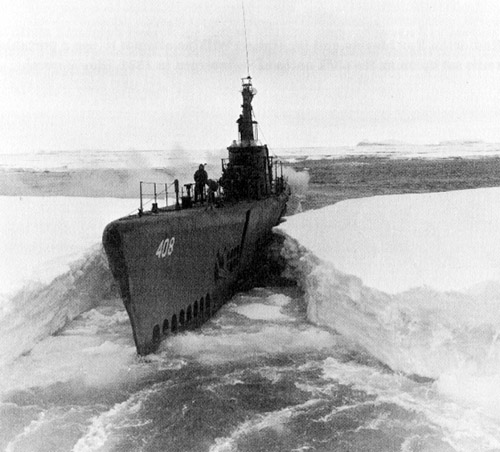
These surface units were joined by a 312-foot-long submarine, the 2,401-ton Sennet, with 10 officers and 71 enlisted men aboard. In addition to 24 torpedoes, Commander Joseph B. Icenhower’s boat featured a five-inch deck gun, one 40-mm Bofors, and a single 20-mm Oerlikon cannon.
USS Sennet struggles through Operation Highjump (Image Credit: US Navy, Arctic Submarine Laboratory, 1946)
All warships were supported by the tankers USS Canisteo and USS Cacapon (Captains Edward K. Walker and R.A. Mitchell, commanding, respectively), plus the supply ships USS Merrick (Captain John J. Hourihan) and USS Yancey (Captain J.E. Cohn, commanding).
Their passage through Antarctic waters was cleared by the ice-breakers USS Burton Island (Commander Gerald L. Ketchum) and USCGC Northwind (Captain Charles W. Thomas, commanding). Two seaplane tenders – USS Pine Island (Captain Henry H. Caldwell, commanding) and USS Currituck (commanded by Captain John E. Clark) – were part of the Antarctic-bound fleet. They were Barnegat-class vessels, 2,750 tons fully loaded, 311 feet long, each manned by 215 crewmembers, and armed with two 5-inch guns, six dual 20-mm anti-aircraft guns, plus four depth-charge racks. Combined, the Pine Island and Currituck stored 160,000 gallons of aviation fuel, enough spare parts, repairs, and berthing for two, full seaplane squadrons.
These capacious tenders serviced six specimens of a large and powerful flying boat. With a wing area of 1,408 square feet and loaded weight of 56,000 pounds, the Martin PBM Mariner’s twin Wright R-2600-12, fourteen-cylinder, 1,700-horse power, radial engines allowed its seven-man crew to deliver 4,000 pounds of bombs over 3,000 miles. Another half-dozen examples of the Sikorsky H-5 helicopter (referred to in the Navy as the HO3S Dragonfly) flitted between USS Philippine Sea and the seaplane tenders.
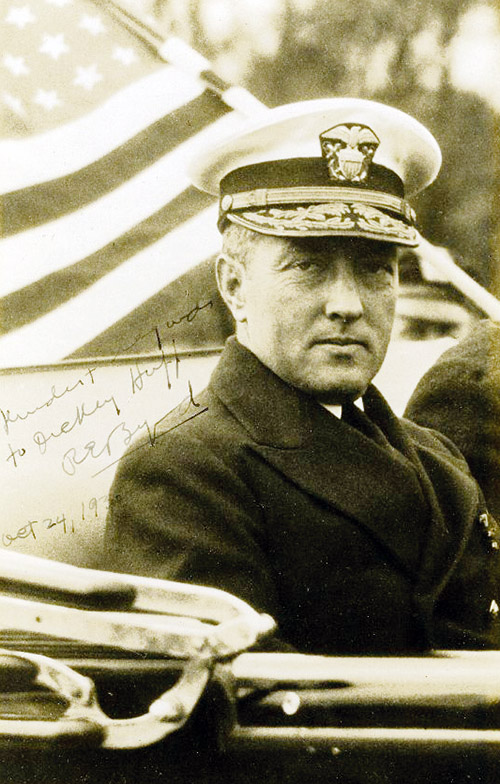
So many ships and aircraft necessitated their division into an Eastern Group commanded by Captain George J. Dufek, a Western Group headed by Captain Charles A. Bond, a Central Group, Rear Admiral Richard H. Cruzen, commanding, and a Carrier Group with none other than Richard E. Byrd, Jr. in overall command. This is the same Admiral Byrd world-renowned for his epic polar explorations during the 1920s and ‘30s. He was usually to be found aboard the USS Mount Olympus (Captain R.R. Moore, commanding), a Mount McKinley-class, amphibious force command ship, with advanced communications equipment and extensive combat information spaces for large-scale landing operations. The 12,142-ton, 459-foot-long vessel, operated by 729 officers, specialised technicians and enlisted men, was armed with a pair of five-inch deck guns, eight 40-mm guns, and twenty 20-mm anti-aircraft guns.
Operation Highjump
Altogether, the four Groups were known collectively as Task Force 68. Their assignment, referred to officially, if rather vaguely in an initial report as “The United States Navy Antarctic Developments Program,” was to establish Little America IV, a research base in the Antarctic; train personnel and test equipment in frigid conditions; determine the feasibility of establishing, maintaining and utilising bases in the Antarctic and investigating additional, possible base sites; develop techniques for establishing, maintaining and utilising air bases on ice; increase knowledge of hydrographic, geographic, geological, meteorological and electro-magnetic propagation conditions in the area.2
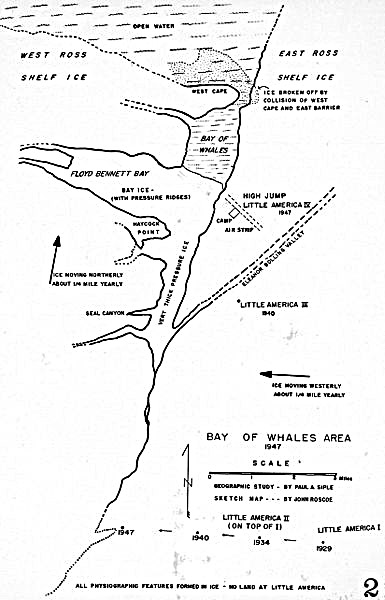
Upon landing at the Bay of Whales on 15 January 1947, work commenced on building a headquarters, Little America IV, in what was to be of one of the few expedition goals actually attained.
The report also mentioned that the expedition aimed at consolidating and extending United States sovereignty over the largest practicable area of the Antarctic continent, a goal previously and emphatically denied in repeated public pronouncements issued by the US government, even before Operation Highjump ended. In any case, its official, modest, entirely peaceful agenda was overwhelmingly dwarfed and contradicted by the prodigious fire-power and armed might assembled by Task Force 68. In fact, few research scientists and very little investigative equipment were included. Moreover, most of its stated objectives were never attempted, much less achieved.
No personnel training nor equipment testing took place. No effort was made to explore possibilities for other base sites involving aircraft or ships. No practice manoeuvres or exercises of any kind were undertaken. And whatever was learned, if anything, about Antarctica’s hydrographic, geographic, geological, meteorological and electro-magnetic propagation conditions was never disclosed. While Operation Highjump’s declared goals represented hardly more than an academic exercise, it was in reality an entirely military affair.3 An aircraft carrier, two destroyers, a pair of armed seaplane tenders, one submarine and a sophisticated communications ship, supported by a flotilla of supply vessels, plus 112 aircraft and 4,700 servicemen organised by US Navy commanders and rear admirals – including world-famous Richard E. Byrd, Jr. himself – far outstrips the requirements of some scientific investigation, no matter how ambitious.
This unlikely armada entered the Ross Sea ice pack on 31 December 1946, finally landing at the Bay of Whales by 15 January the following year. Work commenced there at once on building a headquarters, Little America IV, in what was to be of one of the few previously announced expedition goals actually attained. Just forty days later, the Central Group cast off to join the rest of Task Force 68’s units already withdrawing toward South America for repairs, thus prematurely terminating their massive, expensive mission, which had been originally scheduled to take from half a year to eight months. Even so, in only eight weeks, its aircraft logged 220 hours flying time over 22,700 miles – an area half the size of the United States – taking some 70,000 reconnaissance photographs, only a very few of which were subsequently released to the public by the Navy. To this day, the remainder, if they still exist, are still classified. The aerial survey also recorded ten new mountain ranges.
Attacked by Flying Objects?
Immediately after arriving in several Chilean ports, word of the apparently aborted expedition’s high strangeness and even disasters that plagued it began spreading like wildfire from some loose-lipped Operation Highjump sailors. Admiral Byrd himself contributed to the dire speculation. The mainstream press in Chile was quoting some of his men to the effect that his expedition had “run into trouble” and suffered “many fatalities.” Instead of denying these allegations, he expressed deep concern to reporter Lee van Atta about real possibilities for devastating aerial attacks on the US at a time when the whole world, having been largely devastated, was at peace, hardly what one would have expected to hear from the leader of a purely scientific enterprise. Van Atta published the results of his startling interview, headlined “Aboard the Mount Olympus on the High Seas,” in the 5 March 1947 edition of El Mercurio, a conservative newspaper and Chile’s largest, “considered the country’s paper-of-record and its Valparaíso edition is the oldest daily in the Spanish language currently in circulation,” since 1827.4
Rear Admiral Richard E. Byrd, Jr. (1888-1957)
“Admiral Richard E. Byrd warned today that it was imperative for the United States to initiate immediate defense measures against hostile forces threatening from the Arctic or Antarctic,” according to van Atta. “The Admiral explained that he was not trying to unduly alarm anyone, but the cruel reality is that in case of a new war, the United States could be attacked by flying objects which could move from pole to pole at incredible speeds. This statement was made as part of a recapitulation of his own polar experience, in an exclusive interview with the International News Service.
“Talking about the recently completed expedition, Byrd said that the most important result of his observations and discoveries is the potential effect that they have in relation to the security of the United States. He repeated the above points of view, resulting from his personal knowledge gathered both at the north and south poles. The fantastic speed with which the world is shrinking – recalled the Admiral – is one of the most important lessons learned during his recent Antarctic exploration.
“‘I have to warn my compatriots’, Byrd said, ‘that the time has ended when we were able to take refuge in our isolation and rely on the certainty that the distances, the oceans, and the poles were a guarantee of safety’.”5
On his return to Washington, D.C., after Byrd’s interrogation by Security Services officers, he never uttered another word about Operation Highjump, which was simultaneously classified, thereby legally preventing any of its veterans from ever discussing the mission.6 Shortly thereafter, the US Navy published a brief, not very informative, even evasive summary of the Antarctic expedition’s “achievements,” which nonetheless stated that some losses had been incurred.7 Although these were glossed over and minimised, the typically anonymous report nonetheless admitted that fully half of Byrd’s seaplane and helicopter forces had been destroyed, and that he himself was nearly brought down in the aircraft he was flying, avoiding an otherwise inevitable crash only because he jettisoned everything on board, save the most bare essentials and reconnaissance films he had just taken for staying aloft. During that perilous flight, he had gone missing for more than three hours in an episode of lost time officially blamed on failed radio communications.8
The summary further admits that Task Force 68 did indeed suffer some human casualties, but all were supposedly due to accidental causes. On 30 December 1946, three men flying George 1, their Martin flying-boat, died when it crashed, allegedly during a blizzard. Six surviving crewmembers were rescued thirteen days later. Another man died in a construction accident, totalling the number of fatalities. The official summary concludes by explaining that the mission was terminated due to the early approach of winter and worsening weather conditions – which were supposedly just what the Americans had specifically come for and required to test themselves and their equipment.
[alert type=”success” dismiss=”no”]If you appreciate this article, please consider subscribing to help maintain this website.[/alert]
Soviet Secrets Released
Released in 1948, short film coverage of Operation Highjump, ironically entitled, “The Secret Land” – although more of a breast-beating propaganda send-up for the US Navy than a real documentary – nevertheless gives viewers something of a feeling, however incomplete, for the expedition.9 It went otherwise unnoticed by the general public, and, beginning with the onset of the Korean War two years later, soon fell into virtual obscurity over the next forty years. 1991’s collapse of the Soviet Union, however, suddenly declassified literally millions of previously secret papers, among them, surprisingly, a 1947 description of Task Force 68’s mission to Antarctica.
That Joseph Stalin should have known far more about it than the American people is not surprising. Their country’s close alliance with him during World War Two allowed his spies to infiltrate all levels of the US government, including its armed forces – espionage that peaked, but did not end, with the 1953 conviction of Communists Julius and Ethel Rosenberg for their betrayal of America’s atomic bomb research to the USSR. As early as the 1930s, through the Second World War and into the so-called “Cold War,” US Congressman Samuel Dickstein (New York) was a Democrat Party confidant of President Franklin Roosevelt, all the while a paid agent of the NKVD, the Russian secret police. There were many others like him, and, because of the often high positions attained, they had access to classified undertakings such as Operation Highjump.
Its details, hidden from the US public and the rest of the outside world, were transmitted by a Soviet operative to the Kremlin, where they languished until their rediscovery before the turn of the 21st century. Shortly thereafter, a Moscow Television documentary featured spokesmen from both the Russian Army (Dr. Dimitri Filippovitch, lieutenant adjutant) and prestigious Russian Academy of Sciences physicist, Dr. Vladimir Wasilev, who finally disclosed the Stalin era report about Task Force 68’s covert experiences in Antarctica.
An Attack by “Spherical Lights”
It quotes radioman John P. Szelwach aboard USS Brownson, where, around 0700 hours, in the early morning darkness of 17 January 1947, just two days after Admiral Byrd’s Central Group made landfall at the Bay of Whales, “we observed the following: On the horizon, a bright, colourless light. We thought it was another ship. We were below the Antarctic Circle in unchartered waters [off Charcot Island, in the Weddle Sea]. Our radar was activated to no avail. I and my shipmates in the pilothouse port side observed for several minutes the bright lights that ascended about 45 degrees into the sky very quickly. We couldn’t i.d. the lights, because our radar was limited to 250 miles in a straight line. Our quartermaster, John Driscoll, recorded this in our log.”10
Their ominous sighting was followed nearly three hours later, when the lights (five) reappeared in the same area of the Ross Sea and began to rapidly close on the destroyer. Commander Gimber ordered the ship’s 40-mm Bofors anti-aircraft guns and 20-mm Oerlikon cannons to commence firing on the objects, which flew over the Brownson at high speed and low altitude (about 200 feet), without sustaining any hits. This encounter opened a series of brief, but fierce skirmishes that lasted over the next several weeks, according to the Soviet espionage report, between Task Force 68 and the lights, resulting in “dozens” of officers and men killed or wounded. Most casualties were suffered by Admiral Byrd’s Central Group, which even the sanitised, post-expedition US Navy version admitted had to be evacuated by the Burton Island ice-breaker from the Bay of Whales on 22 February 1947.
After four days, in a kind of parting shot, the spherical lights executed a dramatic attack witnessed by Lieutenant John Sayerson, a flying-boat pilot aboard one of the seaplane tenders: “The thing shot vertically out of the water at tremendous velocity, as though pursued by the devil, and flew between the masts [of the ship] at such a high speed that the radio antenna oscillated back and forth in its turbulence. An aircraft [Martin flying-boat] from the Currituck that took off just a few moments later was struck with an unknown type of ray from the object, and almost instantly crashed into the sea near our vessel. I could hardly believe what I saw. The thing flew without making any sound, as it passed close over our ships and harmlessly though their lethal anti-aircraft fire.
“About ten miles away, the torpedo-boat Maddox burst into flames and began to sink. Despite the danger, rescue boats went to her aid before she sank twenty minutes later.
“Having personally witnessed this attack by the object that flew out of the sea, all I can say is, it was frightening.”11
February 26th’s engagement was the last experienced by Task Force 68, which by then was already in headlong retreat from Antarctica.
Although identity of the invincible “lights” was unknown to Lieutenant Sayerson, he wondered if they were perhaps German “wonder weapons” operated by survivors of the recently defeated Third Reich flying out of a secret Antarctic base. His speculation is still shared by investigators today, not without cause.
German Expeditions to Antarctica
Nine years before the mighty forces of Operation Highjump had been routed from the South Polar Region, the Schwartzwald, a freighter built during 1924, was refitted in Hamburg shipyards for Germany’s most ambitious Antarctic expedition at a cost of about one million Reichmarks, almost a third of the entire mission’s budget. Re-named after the Schwabian region in southern Germany, the Schwabenland was mounted with steam catapults for a pair of Dornier Do J II Wal (“Whale”) seaplanes. They were powered by pairs of 650 HP BMW VI water-cooled V-12 engines mounted in tandem, inside a nacelle above the high-mounted, strut-braced monoplane wing aligned with the hull. The forward engine drove a tractor propeller, while the rearward turned a pusher propeller.
At 56 feet, 7 inches long, with a 72-foot, 2-inch wingspan, the unarmed Wal had a maximum take-off weight of 15,432 pounds and an effective range of 497 miles, with carrying capacity for twelve passengers. Dornier’s reliable, rugged, seaworthy aircraft established its suitability for polar operations as early as 1925, when famed Norwegian explorer, Roald Amunsen, flew two of them into the Arctic. Now, thirteen years later, they were being loaded with specially designed Zeiss RMK 38’33 Reihenmess-bildkameras and miles of film.
By late 1938, the German Society of Polar Research was ready to undertake its assignment: locating an area in Antarctica for establishment of a whaling station, as a means of augmenting their country’s production of fat. Whale oil was then the most important raw material for the production of margarine and soap in Germany, the second largest purchaser of Norwegian whale oil, importing some 200,000 metric tons annually. To avoid this dependency on foreign imports, the Reich needed to find alternative sources outside the Arctic, then something of a Norwegian monopoly. But the military side of the expedition was apparent in its determination to scout possible locations for a naval base in the Antarctic.
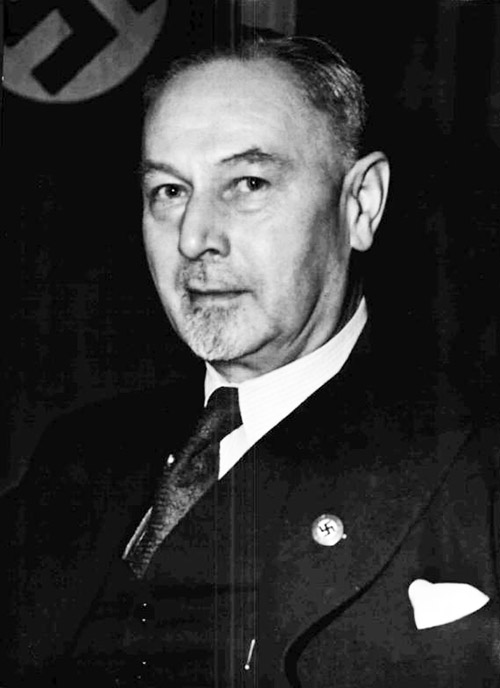
The mission, although not secret, was, after all, headed by a captain in the Kriegsmarine, the German Navy, Alfred Ritscher, a veteran Arctic explorer. He and his fellow 33 German Society of Polar Research members, together with the Schwabenland’s 24 officers and crew, were addressed in Berlin by none other than Admiral Richard E. Byrd, Jr., who, in the next decade, would be heading his own expedition in the same direction. Thus, the first connection between Task Force 68 and the Third Reich appears early on as a prelude to Operation Highjump. Byrd evinced sincere enthusiasm for the German undertaking, regretfully turning down Ritscher’s invitation to join it, only because of deteriorating relations between their two nations.
Captain Alfred Ritscher
On 17 December 1938, the New Schwabia Expedition left the port of Hamburg, arriving one month and two days later at the Princess Martha Coast of Antarctica. After dropping anchor at 4° 30’ W and 69° 14’ S, Ritscher and company spent three weeks at Queen Maud Land, the same area later invaded by America’s Task Force 68. They flew their seaplanes, nicknamed Passat and Boreas, in fifteen missions across some 370,000 square miles of the continent, taking tens of thousands of photographs and making a colour film of their finds. These included a mountain still known as Ritscher Peak, Schirmacher Oasis (named after its discoverer, Boreas pilot, Richard Heinrich Schirmacher), and a far larger ice-free region, some 300 square miles in extent, embracing a trio of large lakes, plus several smaller lakes, separated by masses of barren, reddish-brown rocks, and filled with relatively warm, brackish water of green, blue and red algae. Connected to the sea, the geothermal heated area represented a perfect setting for a military base, particularly for u-boats.
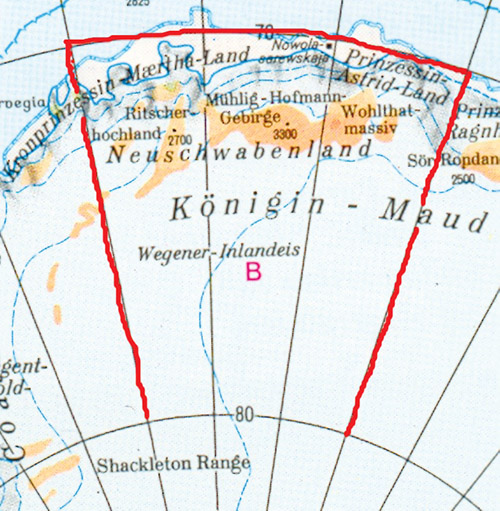
The location of Neuschwabenland
Although the Germans reconnoitred nearly a fifth of Antarctica – most of it never seen before – they left no permanent structures, save for a few hundred small, aluminium stakes flying swastika pennants dumped by the Dornier Whales on snow-covered ground between 20°E and 10°W. In honour of his ship, Ritscher christened this area Neuschwabenland, or “New Schwabia,” a purely cartographic designation never intended as a territorial claim. The name still appears on many maps of Queen Maud Land, which the German Society of Polar Research departed on 6 February 1939. Soon after arriving back in Hamburg on 11 April, plans were laid for a return to Antarctica, which the outbreak of war in September forever cancelled.
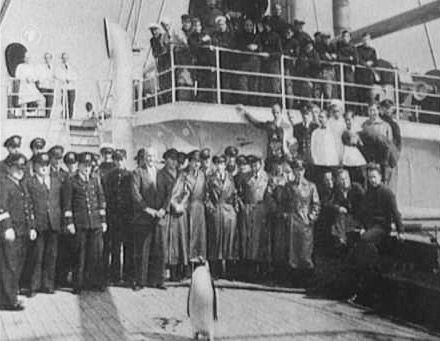
Members of the German Society of Polar Research after arriving in Antarctica are entertained aboard the Schwabenland by a native performer.
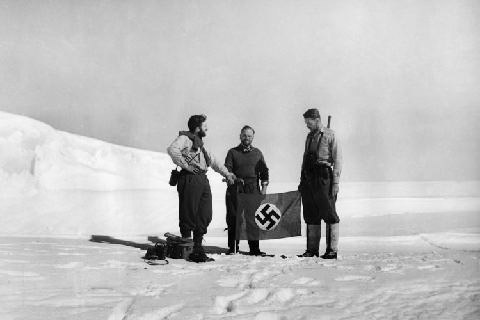
German Society of Polar Research expedition members pose with the Nazi swastika flag.
Over the next six years of international conflict, no u-boat put in at New Schwabia or anywhere else along the continental coast, contrary to postwar speculation, if only because the Kriegsmarine’s submarine force was taxed to its limits and beyond by the exigencies of transoceanic combat. All its u-boats have been satisfactorily accounted for since, and absolutely no evidence exists to even suggest that a military installation of any kind – temporary or permanent – was based in Neuschwabenland.
Spherical “Lights” not Third Reich Forces
Nor did German aeronautical engineers ever develop the kind of overpowering spherical “lights” that attacked Task Force 68. While Third Reich advances in jet and rocket technology are well known, plans, eyewitness reports, and even photographs of Iron Cross-insignia bedecked flying saucer-like craft attributed with truly out-of-this world performance capabilities are undocumented, postwar fabrications perpetuated by uncritical writers more interested in controversial sensationalism than factual research. At most, Luftwaffe draftsmen may have sketched out theoretical concepts for designs somewhat resembling disc-shaped air-frames late in the war. But these pipe dreams certainly never left their drawing board, given the very long-term development such projects required, to say nothing of the Fatherland’s steady depletion of all materials and resources. At the time of Admiral Byrd’s early 1947 interview with a Chilean newspaper, no one, not even German scientists, had built “flying objects which could move from pole to pole at incredible speeds.”
In 2007’s Moscow Television documentary about Operation Highjump, aerospace engineer Professor Dr. Valeri Burdakov and astro-physicist Yuri Bondarenko theorised that electro-magnetically operated extraterrestrial vehicles would naturally base themselves at Antarctica and the Arctic in order to take advantage of streams of magnetic energy streaming from the Earth’s South to the North Pole. Our planet, they explained, is like a large bar magnet, which continuously repels these lines of force at one end and attracts them at the other. An electro-magnetic propulsion technology might be able to ride these magnetic currents similar to a ship riding the ocean currents of the sea. The US Navy’s published report about Operation Highjump declared that one of its primary goals was to study the South Polar Region’s “electro-magnetic propagation conditions.” To carry this out, each seaplane was equipped with a magnetometer, a device that resisters anomalies in the Earth’s magnetism, thereby determining hollow spaces under the surface ice or ground.
Antarctica’s 300-square-mile anomaly the Dornier Wal pilot discovered and years later scouted by Lieutenant Commander David Bunger, flying his Marin Mariner for Task Force 68, was, as Admiral Byrd stated, “a land of blue and green lakes and brown hills in an otherwise limitless expanse of ice” – an idyllic location for an installation, if not for u-boats, then for something else.12
Beings from Another World?
Developed from the foregoing facts, however incomplete, the most credible possible reconstruction of events, at least in general outline, begins with the accidental find by the German Society of Polar Research of a base near the coast of New Schwabia built and occupied by beings from another world in possession of highly advanced flight technology. Returning with this disclosure to Hamburg, Captain Alfred Ritscher begins organising a return trip prior to its cancellation by the advent of war.
Immediately after the close of hostilities, he arrives in the United States, where he confides the disturbing, secret discovery made in February 1939 to his old friend, Richard Byrd. Somehow, both men determine that the extraterrestrials embody a serious threat, and the highly regarded Admiral uses his prestige and influence to organise Operation Highjump, a codename for the armed invasion of Antarctica and planned destruction of its alien base.13 But his Task Force is defeated and retreats in the face of superior weaponry.
The story does not end here, however. Just three months later, a pair of UFOs crashed in the New Mexico desert, not far from America’s original nuclear research facilities, where the first atomic bomb was constructed just two years before. Published testimony by US military veterans of the famous Roswell Incident reveals that both flying disks were deliberately shot down during the first week in June 1947 by Air Force batteries operating, not ground-to-air missiles or anti-aircraft fire, but highly focused radar beams that fatally disrupted the space craft’s guidance systems.14 Over the next twelve years, a secret war raged around the world between extraterrestrial intruders violating the air space of several nations determined to defend it, as thoroughly documented by competent researchers.
Outstanding among them is Ukrainian Paul Stonehill, born in Kiev, who received his BA in Political Science from California State University for his thesis on the USSR’s invasion of Afghanistan. A world-recognised expert on Soviet covert operations, his published books describe hundreds of bloody skirmishes between Russian interceptors and off-world craft throughout the Stalin era and after.15 Similar aerial confrontations occurred over Britain and the United States during the same period. Losses occurred on all sides, but the earthlings usually came off second best. These combat engagements came to a head, according to American physicist Joseph P. Farrell and historian Henry Stevens, under cover of the International Geophysical Year, when, at the height of the Cold War, the air forces of the United States and the Soviet Union, in a unique and unprecedented cooperative effort, together attacked New Schwabia with nuclear weapons.
“Three bombs were thus detonated at an altitude of approximately 300 miles above the target,” writes Farrell, “one on August 27, 1958, one on August 30, 1958, and a third on September 6, 1958.”16
These high altitude bursts were apparently aimed at causing severe enough disruption of the South Pole’s electro-magnetic field to short out the alien space-crafts’ operational capacities; to literally fry their directional systems. Just how effective was this joint, if drastic effort is not fully known, but it certainly demonstrated the urgency felt by both the Americans and Russians.
That the under-publicised, triple atomic bombing of Antarctica was not, after all, a final solution has been suggested as recently as the 12 January 2011 up-date of a previous 13 December article entitled, “WikiLeaks Set To Reveal U.S.-UFO War In Southern Ocean”. The EU Times stated, “A new report circulating in the Kremlin today prepared for President Medvedev by Russian Space Forces (VKS) 45th Division of Space Control, says that an upcoming WikiLeaks release of secret U.S. cables details that the Americans have been ‘engaged’ since 2004 in a ‘war’ against UFOs based on or near the continent of Antarctica, particularly the Southern Ocean.
“According to this report, the United States went to its highest alert level on June 10, 2004 after a massive fleet of UFOs ‘suddenly emerged’ from the Southern Ocean and approached Guadalajara, Mexico barely 1,600 kilometres (1,000 miles) from the American border. Prior to reaching the U.S. border, however, this massive UFO fleet is said in this report to have ‘dimensionally returned’ to their Southern Ocean ‘home base’ …Since 2004, this report continues, fleets of Southern Ocean UFOs have continued to emerge from their bases, with the latest such event being this Friday past, when another of their massive fleets was sighted over the South American nation of Chile.”17
Interestingly, the EU Times’ quoted report describing UFOs that “‘suddenly emerged’ from the Southern Ocean” is identical to Operation Highjump accounts of spherical lights shooting out of the water. If, indeed, such an interplanetary war has been raging, perhaps on and off, for the past 65 years, then the consistent determination of world leaders to keep all knowledge of it from the rest of mankind is understandable: Were they to admit that the most potent Earth-made weapons – even nuclear bombs – are patently inferior to extraterrestrial violators of our air space, resultant social dislocation could shatter human civilisation, especially in our present condition of economic fragility and cultural instability. Less certain is the future of such a secret conflict.
[alert type=”success” dismiss=”no”]If you appreciate this article, please consider subscribing to help maintain this website.[/alert]
Footnotes
1. The Axis Air Forces, Praeger Press, 2011; Mussolini’s War, Helion, 2010; Last of the Red Devils, Galde Press, 2003. 2. David A. Kearns, Where Hell Freezes Over: A Story of Amazing Bravery and Survival, Thomas Dunne Books, 2005. 3. Just before departing for Antarctica, referring to Operation Highjump, Byrd declared to representatives of the American press, “My expedition has a military character.” www.youtube.com/watch?v=znbHUcbKkjk&feature=related 4. Peter Kornbluh, The Pinochet File: A Declassified Dossier on Atrocity and Accountability, The New Press, 2003. 5. Lee Van Atta, “El almirante Richard E. Byrd se refiere a la importancia estrategica de los polos,” Santiago de Chile, El Mercurio, 5 March 1947. 6. “Byrd was returned to Washington, D.C., debriefed, and his personal and operational logs from the mission were seized and remain classified to this day…” Joseph P. Farrell, Reich of the Black Sun, Adventures Unlimited Press, 2004, 247. 7. Robert S. Dietz, Some oceanographic observations on Operation Highjump: final report, University of California Libraries, 1948. 8. Three hours over due, but his plane did not run out of fuel? 9. www.youtube.com/watch?v=tHXZGV6mQfs 10. www.thetruthbehindthescenes.org/2010/05/23/us-navy-secret-operation-high-jump-antartica/comment-page-1/ 11. www.youtube.com/watch?v=znbHUcbKkjk&feature=related The NKVD report refers to Sayerson’s ship as the “Casablanca,” probably because the Russian spy had trouble pronouncing its real name, Currituck. The Soviet agent also stated that an American vessel set afire and destroyed was the USS Maddox, either a torpedo boat or torpedo-carrying destroyer. Official records list only the Henderson and Brownson as part of Task Force 68, which possessed no torpedo boats. Both destroyers survived the mission and are accounted for. A USS Maddox was indeed sunk by enemy action, but five years earlier by a German dive-bomber during the Allied invasion of Sicily. Actually, there were at least three American destroyers known by that name (DD-168, DD-622, and DD-731), all of them contemporaneous. The US Navy has long been notorious for falsifying the identity of its ships and re-writing their histories if they embarrass official policy. Cases in point include 1944’s pre-Normandy Invasion Battle of Slapton Sands, where a number of vessels were sunk and many servicemen killed by Kriegsmarine torpedo boats, but unacknowledged for the next half century; another American massacre, off the Italian coast near Bari, in 1943, was censored when numerous Allied units, illegally carrying nerve gas, were sunk by the Luftwaffe; although the largest loss of US troops at sea (1,015 fatalities) in a single incident occurred when the troopship, Rohna, was sunk by a German guided missile in the Mediterranean on 26 November 1943, only after aged veterans won a lengthy, costly lawsuit against the US Navy 57 years later did they receive official recognition for their role in the disaster. So too, the “Maddox” cited by Soviet espionage was similarly consigned to an official memory hole. 12. www.eaglespeak.us/2009/03/sunday-ship-history-operation-high-jump.html 13. Although the German Society of Polar Research took more than 16,000 aerial photographs of Antarctica in 1939, Ritscher allowed publication of a chosen few, rather unenlightening examples; the rest have never been seen by outsiders. So too, a radically edited, truncated version of the full-colour film his colleagues made of the expedition was briefly premiered in the Reich during the early war years. Since then, only snippets of a swastika flag waving in a south polar breeze, or a few Society members posing on the ice are still occasionally viewed. Task Force 68 was thrown together with a truly frantic haste, in contradistinction to its allegedly scientific purposes, as though it were absolutely imperative to the security of the United States. The ice-breaker Burton Island, for example, had only recently been commissioned, and was still undergoing sea trials off the Californian coast, when Operation Highjump was launched. Pulling a newly commissioned ship off trials adds to the mission’s sense of urgency still echoed months later, even after conclusion of the expedition, when Byrd could only talk about potential attacks coming from over the Polar Regions. 14. http://crazyhorsesghost.hubpages.com/hub/Interview-With-One-Of-The-Army-Sergeants-At-Roswell-In-1947 15. Paul Stonehill, The Soviet UFO Files, Clb, 1998; with Philip Mantle, UFO Case Files of Russia, 11th Dimension Publishing, 2010. 16. Joseph P. Farrell, Reich of the Black Sun, Adventures Unlimited Press, 2004, 254. 17. www.eutimes.net/2010/12/wikileaks-set-to-reveal-us-ufo-war-in-southern-ocean/
This article was published in New Dawn 165 (Nov-Dec 2017)
I sometimes suspect that we deploy the word ‘Hermetic’ – a term for late ancient Greek-Egyptian mystical texts attributed to the mythical man-god Hermes Trismegistus, or thrice-greatest Hermes – as a kind of marker, intended to connote a venerable ancestor to modern mysticism, and thus giving our current spiritual pursuits the weight of historical gravitas.
The truth is, Hermeticism is a living philosophy, which ought to be read, debated, and engaged. The Hermetic texts, mostly those found in the Corpus Hermeticum and the dialogue called Asclepius, can serve the needs of a twenty-first century person in search of metaphysical ideas and clarity.
Hermeticism is of immediate value much like the more arcane books of the Old Testament. Although certain Hebrew rites, rituals, and genealogical record keeping may seem period-bound, or of little more than liturgical significance to any but the religiously orthodox, such passages provide a framework for luminous ethical and spiritual insights. Similarly, elements of the late-Egyptian Hermetic books also reflect traditions of formalism, ritual, and recital – and these elements likewise frame passages of penetrating relevance to current seekers. This fact has not always been apparent due to the longstanding paucity of quality translations, a deficit that is thankfully being redressed in our time.1
The central and most enduring theme of the Hermetic literature – and one that left its mark on the ancient and Renaissance worlds, and, indirectly, on our contemporary culture of New Thought and mind metaphysics – is that the human mind is an extension and imitation of Nous, the Higher Mind, which serves as the divine creative force behind all that is.
This perspective finds particular resonance in books I and XI of the seventeen tracts that make up the Corpus Hermeticum. In book I, sometimes called the Divine Pymander of Hermes Trismegistus, we learn of the mind’s causative abilities: “…your mind is god the father; they are not divided from one another for their union is life.”2 As we come to realise our creative capacities, we grow closer in nature and perspective to the Eternal: “…he who has understood himself advances toward god.”
Book XI goes further in urging man’s awareness of how his mind, through its abilities to visualise all things, originate new concepts, and surpass physical boundaries, reflects innate divinity:
See what power you have, what quickness! If you can do these things, can god not do them? So you must think of god in this way, as having everything – the cosmos, himself, (the) universe – like thoughts within himself. Thus, unless you make yourself equal to god, you cannot understand god; like is understood by like. Make yourself grow to immeasurable immensity, outleap all body, outstrip all time, become eternity and you will understand god. Having conceived that nothing is impossible to you, consider yourself immortal and able to understand everything, all art, all learning, the temper of every living thing.
In the student-teacher dialogue called Asclepius, which is often grouped as an adjunct to the Corpus Hermeticum, man’s estimate is even further elevated. We first learn that, “one who has joined himself to the gods in divine reverence, using the mind that joins him to the gods, almost attains divinity.” Using a variant of the famous Hermetic formula, “as above, so below” (enunciated in another text called the Emerald Tablet), this dialogue counsels: “Forms of all things follow kinds… Thus, the kind made up of gods will produce from itself the forms of gods.” This adds a deeper resonance to man being made in God’s image, as found in Hebrew scripture.
Hermes goes on to teach his disciple Asclepius that man, at his highest, is actually on par with the gods: “Because of this, Asclepius, a human being is a great wonder, a living thing to be worshipped and honored: for he changes his nature into a god’s…” Hermes ultimately evaluates man as even greater than the gods because, while a god’s nature is fixed in immortality, the striving and aware man is ever in the process of becoming and fulfilling his highest nature: “In short, god made mankind good and capable of immortality through his two natures, divine and mortal, and so god willed the arrangement whereby mankind was ordained to be better than the gods, who were formed only from the immortal nature…”
Moreover, man in his reverence and worship performs necessary acts of caretaking of the gods: “He not only advances toward god; he also makes the gods strong.”
In considering man’s potential, the modern reader of Hermetic literature may find himself facing a question that also faces contemporary students of New Thought: Given the causative powers ascribed to our minds, and the manner in which thought relates to the highest source of creation, why do we suffer physical decline, illness, and bodily death? Indeed, the most Hermetic of all New Thought teachers, Neville Goddard (1905–1972), instructed that your mind is God, and all that you experience is the product of your imagination – so, again, why must we “die as princes?” as the psalmist puts it?
The Corpus Hermeticum offers a reconciling response. Man, for all his potential greatness, is nonetheless conscripted to dwell within a “cosmic framework,” where physical laws must be suffered and limitations experienced. “The master of eternity,” Hermes tells Asclepius, “is the first god, the world” – or great nature – “is second, mankind is the third.” Man may be the greatest of beings in God’s schema of creation, but he nonetheless remains bound to other aspects of the creative order.
In book I we learn, “mankind is affected by mortality because he is subject to fate” – fate being a term for nature’s governance – “thus, although man is above the cosmic framework, he became a slave within it.”
These views of man’s greatness and weakness, the forces in which he functions, and his higher possibilities are considered with surprising adroitness in the 1908 occult classic, The Kybalion (see article “Nothing Is Impossible” on page 51). Published under the tantalizingly Hermetic pseudonym “Three Initiates,” the slender but powerful book is a reasonable iteration of certain Hermetic concepts, as well its author’s personal insights into New Thought psychology.
In essence, The Kybalion adds specific techniques to the overarching Hermetic principle that the mind of the individual is an adjunct to the Mind of God, through which man may not only create but also aspire to his eventual return to the source from which he was created.
For those seeking a guiding, cosmic philosophy, as well as the reconciliation of certain vexing ideas within New Thought and other modern mystical schools, I recommend reading the Hermetic literature hand in hand with Neville, The Kybalion, and other mature New Thought works.
You will also discover within the Hermetic texts, particularly Asclepius, a poignant and, incidentally, accurate prophecy of Ancient Egypt’s decline, and the demise of its lexicon of gods. With today’s renewed interested in Hermeticism, and the arrival of a new generation of supple translations, we may be entering a phase of Hermetic rebirth. This renewal, however, comes with a caveat, one deeply grounded in Hermetic tradition: If Hermes is to be resurrected, such an operation must occur within you.
[alert type=”general” dismiss=”no”]This article was published in New Dawn 164.[/alert]
[alert type=”success” dismiss=”no”]If you appreciate this article, please consider subscribing to help maintain this website.[/alert]
Footnotes
1. Of particular note are Hermetica translated by Brian P. Copenhaver (Cambridge University Press, 1992), and The Way of Hermes translated by Clement Salaman, Dorine van Oyen, and Jean Pierre-Mahé (Inner Traditions, 1999, 2000).