New Dawn – World's Most Unusual Magazine

Category: Articles

  • Supernatural Stories of the Original People: An Interview with Steven Strong

    Supernatural Stories of the Original People: An Interview with Steven Strong

    Steven Strong (and his co-researcher/author Evan Strong) are no strangers to New Dawn readers. They are best known for their articles, interviews and publications on the controversial theory that Australia was the cradle of civilisation – the home of an Original humanity that branched out into other parts of the world to seed culture and a more advanced way of being. 

    Steven’s knowledge is steeped in secret Aboriginal lore and rituals that for obvious reasons cannot be divulged to the general public. His – and Evan’s – mission is informing the wider Australian community on the forgotten heritage of the Original people and the metaphysical changes happening right now in this country. 

    Recently Steven was interviewed by Jeffery Pritchett & Wahabah Hadia Al Mu’id (WHAM) for their online radio show. The interview covered the Strong’s work about Australia as the cradle of civilisation but Steven also shed light on personal encounters with the mysterious and supernatural. He speaks of an Original way of being foreign to the vast majority of Australians, but lived and practiced by members of indigenous communities, especially the Clever Fellas and Elders. 

    The following is an edited extract from Steven’s spoken interview with Jeffery & WHAM in April.

    Jeffery Pritchett (JP): I’ve heard the Aboriginal people are connected in some way to the Pleiadians [ancient extraterrestrials from the star system of the Pleiades that have an interest in Earth]?

    Steven Strong (SS): Way back at the start when I was given a very strong ceremony by the Ramindjeri [Aboriginal people of Kangaroo Island, South Australia], I sat down at the finish and they told us about circumnavigating the world in a figure 8 in ancient times. And one of the elders turned to me and said, “You do realise in the old days, there were other ways we travelled this earth?” I knew what he was talking about, he was talking about moving through the air. 
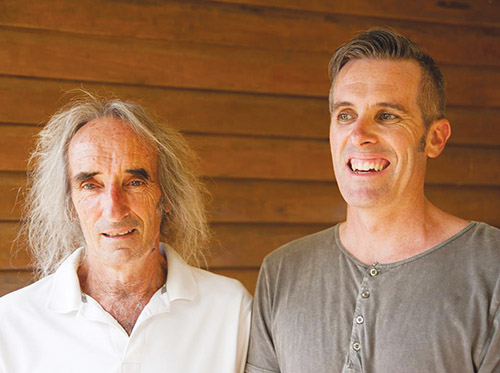
    Steven Strong (left) & Evan Strong. Researcher, historian, author, and former high school teacher with a background in archaeology, Steven was involved in the formation of a Graduate Diploma of Aboriginal Education for the NSW Department of Education, writing units on Traditional Law and Contemporary History. He also co-authored the highly successful “Aboriginal Australia: A Language and Cultural Kit.” 

    They are absolutely obsessed with the Pleiadians. In fact, I’ve had elders who will finish their conversation by repeating the same thing time after time. They tell me the Pleiadians are their countrymen, they are part of them. Quite recently a genetic study has come out to confirm this. What we’ve now found is the Original people have a genetic strand that no one has ever seen before. And the scary part for the mainstream is they don’t know where it’s from. They cannot associate it with any hominid, semi-hominid, or other Homo sapiens on the planet. It’s only found in Australia with the Original people. 

    I know it’s the Pleiadian gene they’ve found. And the reason why they can’t find it anywhere on this planet is because they have their eyes permanently fixed down, they should be looking up. In fact, this is why we talk about this now, not because I had a chance but because I promised we would tell their story. I don’t meet an elder who will not talk about the Pleiadians. We are pushed into a story that I remember on one occasion I said we’d never touch. In fact our first three books, published by University Press in America, never mentioned it. We never mention this story. We’re coming into this story simply because we don’t have a choice. And the Original elders have made it clear, we must talk about this part of the story now. That’s what we’re doing, we’re only doing what we’re told. 

    JP: When it comes to the Pleiadians and the Aboriginals, what is the creation story?

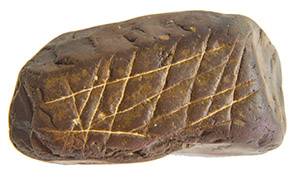
    SS: I’ve got two rocks, two marked rocks, and the elders have told me the full story with those two rocks. And they’ve shown me the rocks and they’ve shown me how it’s put together. Those two rocks are called Ros’ rock 1 and 2. My main elder is a Clever Fella and can do things you shouldn’t be able to do in any science book today, and I’ve seen him do it. He told me one day, after knowing I had this rock [Ros rock 1] for a couple of years. (I’ve got to tell you something about Original elders – when you’re working with them, don’t ask them a question because they’ll never answer it. They’ll ask another question you can’t answer and they’ll answer that question a year later.) 
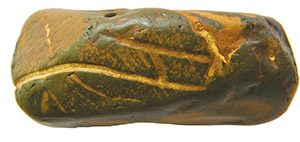
    Ros’ rock 1 and 2

    A year and a half passed when Karno told me the full story of that rock, and it’s basically the beginning. What he said was that way back in the Dreaming, at the very beginning, the Pleiadians came in the totem of the Goanna, which is the one that gives wisdom. When they came to this country (Australia), they asked permission. They didn’t barge in – they asked permission to come. They came here looking for the best that was on this planet and they found the Original people, but they said no. The story goes that the eagle and the crow fought against the Goanna, the Pleiadians. The eagle and the crow are the Original people. And they couldn’t come, they could not come. But one day, according to the elders, the crow saw the wisdom of the Pleiadians and changed sides. And then what happened was the fight continued and the crow and the Goanna defeated the eagle. And they came and landed on this country. Then what they did, because they’d won the battle, is the Goanna asked the eagle for some totem or memento of his victory, and he was given the claws of the eagle, and the laws of the Pleiadians were scratched into this rock we have now. The Original story is we were given this information from the Pleiadians, and the second rock talks about the Original people and their contribution. 

    They look upon this as a unification of two different species. The Pleiadians did not come to this planet to subjugate, or to mine, or anything like that. They came here to find a body to incarnate into. What we have according to these people is the best of both worlds. From this planet, the Original people, and from outside, the Pleiadians. Together they created a set of genes. I look upon something like the walkabout genes, where you go off and find your own salvation and your own wisdom. The Original people were told to spread around the world, and therefore every human on this planet has within them the Original and Pleiadian genes. And yes I know, some of us may have those Assyrian genes [a reference to the Anunnaki slave race creation], very much more compliant. 

    What we have today in our genetic bank is an absolute dog’s breakfast of genes from all over this planet. We’ve got Denisovan and Neanderthal genes within us, and genes from outside. The story goes that the day would come when each person would be demanded and asked to look for their Pleiadian genes and to strike out and find the truth. That’s why they seeded the whole of this planet with their genes – they had a long term plan. The story I’m told is it’s now time for every human being on this planet to access their Pleiadian-Original genes and find the wisdom and truth. Because if they rely on the other ones, they’ll end up on the wrong side of the equation when the cutoff line appears. 

    There is a long, long story about the Pleiadians being part of this particular continent. I can’t speak on behalf of Africa and places where other mobs came, that’s not our issue here. We just talk about what happened here. Now the Original people are telling us the time for the Pleiadian-Original genes to come to fruition, to give us wisdom and an alternative to what we have today, which is appalling, is now upon us. Original history and archaeology doesn’t run in a straight line – it runs in a circle. And the circle, ladies and gentlemen, has been completed. 

    JP: When it comes to the Dreamtime, I’m wondering your perception on it? When I was 17 I went through testicular cancer and chemo. And then a year later my dad died, and I started to attract UFO activity. Multiple witnesses have seen all kinds of stuff with me. And I’ve seen some different types of beings. I’ve seen beings made out of energy, what I call a luminous being or beings made out of light. And I’ve kind of come to the conclusion through talking to other shamans that they’re us without our bodies on some levels. I’m kind of curious, what is the Dreamtime? 

    SS: If I was to give a fairly reasonable description of the Dreaming it would probably finish in about three hours. But I think we’re going to have to go the 101 because it’s so difficult. Look, the Dreaming is about connecting with the Spirit and about connecting with our reality, but it’s a lot more than that. It’s not a religion. Original people don’t have churches, they don’t have steeples and they don’t have altars. How can I best put it? It runs something like this… 

    A young man or woman around 14 or 15 or 16, when it’s determined they become adults, goes through some very severe cuts and a lot of pain, because most Original learning comes through pain. What’ll happen is once the boy has been cut and he’s taken on site, he goes out into the bush on his own. Then the uncle will watch him from a distance, but won’t have a thing to do with him. He’ll be on his own for three or four months. During that period he makes his own connection with the Dreaming. Original people believe every human being has magic within them, they think it’s like breathing. Everyone of us has it. What that person then does is finds their own magic, finds their own way of communicating with the spirits. 

    You’ve got to remember, in our society the spirits are in the land, they’re in the trees, they’re in a blade of grass, they’re everywhere and they watch us eternally. I’ll give you a very good example of what happened to us when we offended the spirits and the Dreaming acted upon us. We went to a site. Our elder that takes us in, Auntie Beve [Darkinoong Elder], was unwell at the time and couldn’t smoke us, and we always get ceremonied before we go on site. I had another ceremony given to me by Uncle Jerry, six of us did it, and we walked into this place. It was full of orbs and we filmed them. As we came in a brown owl flew out and left a feather. We thought that was a good sign. Oh my god, it wasn’t. Anyways, we did our business for the day, filmed what we saw, and it was quite amazing. We did some work on the carvings and engravings and paintings there. 

    I went back that night to Gosford [New South Wales] and we sat around talking about what we saw that day, and I got a phone call from my elder. My elder lives in Kangaroo Island, that’s 3,500 kilometres away. We’d left that site five hours ago, and he rang me. I knew I was in trouble. Normally what happens is when the elder speaks, someone else rings you and tells you to ring them. They don’t approach you, you must approach them. This time he was approaching me. And I’ve had that a couple of times and it means I’m getting growled at. This time was huge. This is how the conversation went. He said, “You’ve been on country today.” I said, “Yes, but Karno it’s not your country.” He said, “I know that, but did you smoke yourself today?” I said, “Well no.” He said, “I have a red kangaroo here, and that red kangaroo is telling me the whole story of what happened. You did another ceremony, didn’t you?” I said, “Yes, I did.” He said, “Well that was just accepted but they’re not happy.” And he told me, “If you ever go on site again without smoking yourself, they will kill you. That is your last warning.” And then he hung up. 

    Now my question is, I never told him about this. How did he know 3,500 km away I was walking on country and had broken a law? That owl flew out and told someone else, who told another animal and went across and told Karno. I’ve figured that message travelled 700 kilometres per hour to get to him. How he got that message was through the animals. In the Dreaming, if you really are locked in with the Dreaming, you can communicate with animals, you can communicate with everything. 

    I’ll go to another story. This same guy [Karno], when [British author] Graham Hancock and I sat round a campfire, he disappeared completely. We all know that. He smiled as he did it, and then reappeared about three seconds later, about 50 metres behind someone else. We asked his wife how did he do this. She said, “I don’t know, I’ve never seen that one before.” He told me later, “The disappearing is nothing. I come from this place and we all do. The only difference is I know it and you’re not sure. Once you know it, everything is possible.” What is the Dreaming? It’s us finding our true powers, our true reality and our true purpose in life.

    JP: Do the Aboriginals ever say anything about Yowies or Sasquatch? 

    SS: Yes they speak about them. I’ve been to Yowie country, and I’ve met the keeper of the Yowies. I won’t write about it, because you get smashed. I get smashed enough as it is. I just can’t afford another punch in the face for that one. Do I know they exist? Absolutely. In fact, on one occasion we went into country, and the elders made it clear because they’d been finding all these kangaroos and wallabies with their heads ripped off, because the Yowie is incredibly powerful. They made it clear that if we went on to that country, we had to sing the song of the Yowies before we could get there. He said don’t go in there without that song or they will attack you. There were six of us, and we all sung. None of us questioned for one second what they told us. So yes, it is very much a part of Australia. 

    We also had big robust people with massive skulls, 1540 cc, and they stood about 6 foot 6, but they’re not Yowies. We had tiny people that were 3 foot high, I’ve got pictures of them, a whole tribe of 150 people smaller than pygmies. Then there are other groups they talk about. My understanding is there’s at least four different types of Original people in Australia still existing to this day. It’s a very common story about the Yowies. But finding them is bloody hard because these guys are masters of deception and camouflage, and they will show themselves when they want to be shown. That’s the only way you’ll see one. 

    JP: What other stories of the supernatural can you share?

    SS: Four days ago an elder rang me up, 4,000 km away. I’d been waiting four weeks for the phone call. I’d just set my 150 rocks into two formations. She rang me up and said, “Been waiting four weeks to ring you, I’m ringing you now because now’s the time to ring.” She said: “You’ve got those rocks in formation right now, haven’t you?” I said, “Yes.” She said, “You’ve got someone sitting inside there haven’t you?” I said, “Yes.” “He’s a good man, he can stay there, pass that on.” And then she hung the phone up. 4,000 km away. How did she know I just took the rocks out an hour before and put them in two circles and joined them up? That, ladies and gentlemen, is what we could do, all of us. I didn’t know that, I can’t do it, and I probably never will because I’m not as wise as they are. My job is to be pragmatic and try to convince people through logic and science it’s true. But I can tell you this now, I swear on a stack of bibles, what I’m telling you is true. That woman rang us up and said, “You’ve got your rocks in formation.” How did she know? She was 4,000 km away. This is what we could be. 

    Instead what we get is phones where we press buttons and play games. I remember recently I was in a train in Melbourne. I was with a friend and we were lost in the city and we didn’t know where we were going. There were about 80 people in four carriages and no one was talking, not one of them. All they were doing is sitting there pressing buttons, wasting their lives, and going to work and coming back the next day and then going back again. They don’t think they’re slaves, and they don’t think they’re trapped. They are, because they’ve been sucked into this system that’s wrong. 

    We’re trying to wake people up to the truth of what Original people know. Remember this, I’m not only talking about the Original people [in Australia], there are many people that have this story. We have to look to all our indigenous people because they are the only ones that can save us now. We go down this path [of materialism and technology obsession] and we are done for. We really are. And it’s time for the Original, and they are coming out, believe me, they are coming out. 
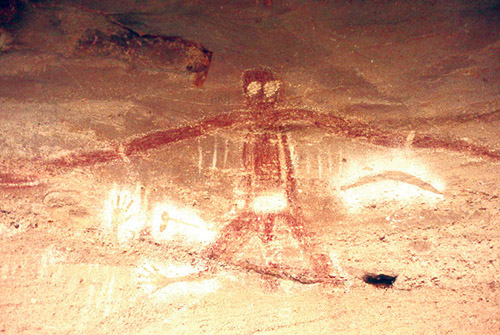
    Aboriginal painting of Baiame, a creator Spirit of the Dreaming, Baiame Cave, Milbrodale, New South Wales. CREDIT: en.wikipedia.org/Sardaka/CC BY-SA 3.0

    JP: When it comes to shamanism and the Aboriginals, is there a shaman? 

    SS: The best way to explain that, of course, is to go to the Original people but I’ll give an example of a study done by an American called Richard Gould in the mid-1960s. With all credit to him, he went and lived with the Original people for a year and a half, which is the best way to find out information. 

    He gave us a great story about the time that a young child was ready to walk. The grandmother worked that out, and everyone came around. They watched the child make three footsteps into the ground. Then, they picked the child up and spent the next hour discussing that’s child’s life, the whole of their life, what they were going to be, who they were going to be. This particular child had some magic in them, as they all do. 

    To say there’s one shaman is not correct. They are four or five different elders that will have skills in that area, because magic is one of the most important parts of the culture. It’s multi-dimensional. It runs in a lot of different areas. There will be a woman with wisdom about creation. There will be men who have wisdom about, unfortunately in some cases, using magic to harm others who are causing them issues, and other men who can heal. There’ll be different types. There won’t actually be one shaman because once you get into the real esoteric, it has got so many levels to it that you can’t be proficient in all of it. There would be different men and women. Remember this. There’ll be women too. 

    In fact, I do know up our way, where we are, we had what was called a Dhurangan, which is a female elder. She was the one who trained the male elders to become Clever Fellas. They would climb up to this cave, real high up about 1,500 metres. After four or five months, she’d initiate the male. She’d take him out to the ledge and make him step forward. Now, if he levitated, and he didn’t fall, he would become a Clever Fella, because he could levitate. But if he fell to the ground, it was about 600 metres down, he wasn’t a Clever Fella. But don’t worry, she was so strong, she’d catch him. Then, he’d go back to his tribe. There’s no shame in that. What we’ve got is a woman who can actually be in two places at once, and catch someone who’s falling, and a man who’s got to levitate, so that he’s got that magic. Then he can become a Clever Fella, but another person from their tribe could also go and do that job, too. 

    The difference here is it’s not one shaman, there could be four or five – there could be two apprentices and three that are at the top level in different areas. It is really basically the magic. Learning the magic and the esoteric is the most important thing you could do in Original society before [Captain] Cook came. That was what everything was about. That was the most important thing you could do. 

    The worst crime you could ever do, in Original society, was maybe go and desecrate a sacred cave, or break a sacred object. You know what punishment they would give you for that? Freedom. That would be the worst thing you could ever get because this is what they would do. They would say you’ve insulted the spirits, you’ve insulted the tribe. Leave our land, never come back, and spend the rest of your life elsewhere. The problem is that Original people believe that when you die, you go up into the air, to a black hole called Rock Cod Dreaming, and then you come back and incarnate back into your country. But if you die off country, your soul is in limbo for an eternity. That gives you an idea how much the spiritual was so ingrained into their culture. They would say, “Please kill me on country rather than let me go free.” 

    When you live a lifestyle, under those conditions, it’s nothing like we’re living today, where the magic is everywhere. There would be another elder that could read signs. Birds would come and talk to the elder and tell them information. So it really is multi-dimensional, once you get into the mystical side. All the different elders would take on different roles at different times.

    The Devils Marbles, south of Tennant Creek, Northern Territory, stand on ground sacred to the Warumungu, Kaytetye, Alyawarra and Warlpiri peoples.

    JP: When it comes to Earth changes and things coming up in the future, do the Aboriginals speak of that? 

    SS: You’ve got to remember I’m now in the deepest level, but in that level I’m just an initiate. I’ve got a long way to go. I was with an elder recently who gave me fourth level women’s magic, but didn’t get five, six, or seven. Was shocked to be able to give me even four. I’m still a long way to go, but having said that, I can put two and two together, and give you a bit of an idea of what the expectation is. I’m going to say this is the first time, where every other time I’ve been basically paraphrasing what the elders told me. In this case, I’m reading between the lines. I’m going to start with something that’s true. I know it happened because I spoke to the two people there, at the time. I’ve mentioned this many times because I’m allowed to. 

    This happened probably about five or six years ago in Darwin. That’s the top end of Australia. An elder, whose name I won’t give, turned up to the [TV] studio, stood in front of me and told me the story. One was a cameraman for ‘60 Minutes’, and the other guy doesn’t know how to lie. He still had trouble telling me the story anyway. The elder then said – and I’ve held one of these sticks when I’ve done ceremonial – I know what they’re like. They said, “It’s time to tune this magic stick up,” and he put it the ground in the park. Now, the story was there were about 90 odd people walking around in a park, at that time, and 88 collapsed. The guy that put the stick in, plus one of the two guys who was talking, they did not collapse, and everyone else fell down on the ground. They laid there for hours. Ambulances came, took them to hospitals. All of them, five hours later, woke up and said, “What are we doing here?” They said, “You collapsed.” “No, no, what am I doing here?” They were fine. 

    Now, the story is that the rocks I have, and others have, when I put them in formation, someone rang up 4,000 kilometres away [previously mentioned], so we know they work. Those rocks and those sticks lift elevations. When you put that one in the ground in the park, just a practise go, 88 fell, two stood. My understanding is I do know there’s a time, and we are part of this because we are putting these rocks in the ground and I know where but we can’t talk about that yet, we’re in the process of doing that. When all the rocks are in the right places, and the sticks in place in the ground, the Earth’s elevation will rise. That much, I know. I know they’re doing that. 

    The part I’m going to read between the lines is this. I believe when that happens, many people will fall. But this time, the ones who didn’t make the right decision will never wake again. What a beautiful way to cleanse the planet. Not through conflagration, not through warfare, not through some natural disaster. But each person makes their own judgment. This is why the elders keep saying hurry up and make up your mind. I believe when all the rocks and all the pyramids from around the world, when all the indigenous people put them in the right portals, the Earth’s elevation will lift up, vibration lifts massively, and many fall and never stand again. 

    Do they believe there’s a change coming? Absolutely. They’re obsessed by it. For me, personally, if there’s no change I’ll just carry on banging my head against a brick wall until I pass on. I’m comfortable either way. But for them, absolutely. I’ve heard things that have happened recently that make me believe, “Oh my God, it’s getting close.” I’ve heard a couple of events that took place that’s got my attention. I thought, “Gee, something’s coming. Something’s coming.” I can tell you there’s a quickening. There are things going on now, within our own country, that I never thought would happen. Now, people don’t know about it, because it’s coming through the grapevine to us, but there’s some stuff going on that makes me feel like, “Geez, it’s got to be less than a decade way. It’s got to be getting awful close now.” Yeah, this is the main reason I’m talking today, to let people know, from an Original viewpoint, there is a change coming.

    JP: When you talk about the Pleiadians and their state of being, is it like a total state of grace and positivity, a state of love?

    SS: It’s a state not so much of love, but a state of complete awareness. They understand. They fully understand the notion of what’s taking place and why things are. They know what is good, what is bad, but they’re still not perfect. They’re still looking for something else. 

    I have a rock that I was told in the beginning is creation. It goes like this. I’m holding the rock now. In the very, very beginning, the Pleiadians were one of the first beings that came into material form in the cosmos. They had the wisdom of the ages with them. The story is that way back in the very beginning, they sent a spear which was about four miles long, and aimed it at the Earth. It was a long spear with a cap, and it was coated with life, algae and bacteria and all the things that create life. It’s a bit like Hitchhiker’s Guide to the Galaxy. It was for seeding a planet. It sounds science fiction, but the beauty of it is this particular rock has got all the lines there, it’s got a very big impression in the middle. That is where the spear hit. Now, that place is called Uluru which is the middle of Australia. If you look at it, from underneath, there is a three-mile spear that tapers to a point. And it jammed into this planet and created the beginning of the whole of humanity here and this planet was known way back then as a special planet. 

    Yes, they are wise, and they’ve got incredible awareness that we will never have. They do things we can’t do. But the one thing we’ve got in abundance here is absolute love, and that’s the missing part of their wisdom. This is why the Earth and the Pleiadians are so intertwined, because my understanding is the salvation of the universe sits with those two planets. Our role in this – I know we don’t look like we’re performing well – is to be an equal of theirs. I do know two rocks I have that tell the story about the two together. The first rock has two and a half languages, and the second rock, which is the original rock of the people here, has four and a half. I tell people, “Do not dismiss the fact that, when they came here and they seeded this planet, they came back when they found something that was worthy of their presence.” Remember that. 

    We should not dismiss human beings. I know that we aren’t playing well in the sandpit at the moment. I get that. It looks pretty bad. Yes, our leaders have no idea what they’re doing anymore, and they don’t work for the right people. They work for the wrong beings both here and elsewhere. But within us, we have everything. We could do anything, and we are their equals. At the moment, there’s only one difference. They know we are their equals. We just don’t know it yet. Hopefully, now, we’re going to learn it.

    JP: Do you think that these light beings that I see are us without our bodies? Do the Aboriginals ever talk about light beings, or anything like that?

    SS: They do, and they have this belief. It’s a very important one. In fact, you will see it on every TV station when they put up a picture or a story about Original people. When someone’s passed on, you are not allowed by law to mention their name. In fact, I’ll give you an example of this. Say somebody’s name is Bundara, which means in a lot of places kangaroo. That would mean once that person dies, the language of the word kangaroo will now change for at least five years. Then, they can put it back. When we pass on we condense ourselves into energy form, but that energy form, as we’ve learned from quantum physics, is not way off in the distance. It is right next to us. If you call their names, they’ll come back straight away. Like my elders who’ve passed over, I can talk about Karno. I can talk about Auntie Beve, but I could never say both names. I’d be punished severely for that, and I never would. I can’t say two names of that person because we know as Original people, they’re right there. 

    I heard you mention before about little orbs and spirits. That’s exactly what we are. We are that. Karno is one who’s passed on. He’s given spirit messages to lots of people, and he’s an eagle form. I’ve had eagles sitting on top of my bedroom in the morning. I’ve had eagles flying so close I can see what’s in their claws. That’s Karno. He can come in spirit form, he can come in orb form, he can come in animal form, he can come in bird form, it doesn’t matter. 

    They understand death much better than we do. They look at death as the greatest ceremony a human can carry out in any life. He must die with dignity. Often, they know when they’re going to die, and they say, you’ve heard the Indians saying, “It’s a good day to die.” That is exactly what we talk about. When you die, it is a good day. They understand that. See, they understand we incarnate and come back. It’s part of their belief, and they believe the incarnation, very importantly, is an agreement between the woman and the spirit. The male has nothing to do with incarnation. He just chucks the sperm in, and they decide when it’s used. 

    What is death? I understand what it really is. It means that you’ll be back soon. You’ll be back, and they know when you come back. Often, they know who that person is, when they look at those three steps. They’re like, “Oh my gosh, it’s so and so. They’ve come back again. I was wondering who they’d be. I see this time they’re a male. They were a female last time.” They know it. For them, death is just part of a circle that leads on to rebirth, that leads on to trying to get it right, that leads on to death, that goes round and around and around. Finally, when you do get it right, they don’t come back in body form. They go to a site, and they guard it. Then, you have to call out. Whenever I go to a site, I have to call out. I have to go through ceremony to let them know, because that person I’m talking to was a person but was so evolved they didn’t need to come back in human form, and now guards a sacred site. That’s why you’ve got to be extra careful when you go on your sacred sites, because you’re not just dealing with any old person. You’re dealing with someone who’s 40,000 rungs above you, and can see through you like a piece of glass. You’ve got to be careful. 

    Conflict & War in the Deep Past

    SS: There are many, many dreaming stories about major conflict. I’ve been to a place I can’t mention, because it scares the crap out of me. I’ve been there twice, and I hate it. There’s not an insect. There’s not a bird. There’s nothing there. It’s dead. I’ve been to a place where you pick up rocks and crumble them in your hand. I’ve seen columns of 30 metres broken into pieces, rocks melted all over the place. There were explosions here. Something major took place, because the people in this country, this area, still had some technology, but it was wiped out. I believe it was wiped out either by an advanced civilisation, or maybe another alien group fighting the Pleiadians. I’m not sure which it is. I’m inclined to think it’s the second one, but I don’t know for sure, because they can overlap. In fact, I know Auntie Beve was guarding one such place, with a massive red explosion in the air painted on a cave. They tried to destroy it. [The Dept of] Main Roads [New South Wales] wanted to put a road through there, and she stopped them. But when she was in hospital, they blew the site up. They didn’t want that picture up. That was the story of this massive explosion. Graham King, who’s the elder and keeper of around Sydney, told me the story of that happening, too, of something coming through the sky and blowing things up. Yes, we know about that. There was a war here.

    The interview can be listened to in full at: https://ufoparanormalradio.podbean.com/e/com-steven-evan-strong-out-of-australia-aborigines-the-dreamtime-and-the-dawn-of-the-human-race/

    [alert type=”general” dismiss=”no”]This article was published in New Dawn Special Issue Vol 11 No 4.[/alert]

    [alert type=”success” dismiss=”no”]If you appreciate this article, please consider subscribing to help maintain this website.[/alert]

    © New Dawn Magazine and the respective author.
    For our reproduction notice, click here.
  • Mind at the Centre: The Radical Liberation of My Mental World

    Mind at the Centre: The Radical Liberation of My Mental World

    It is a curious fact that we have successfully used our minds to penetrate profound secrets of the physical universe, but when it comes to grasping the nature of our minds, we are baffled. This is the famous mind-body problem, the ‘hard’ problem being to account for our consciousness, which is utterly unlike anything physical. The mind, it seems, has a hard time trying to understand itself.

    In this essay, I describe how I evolved my view of the subject, which is deeply at odds with mainstream physicalism. Without putting a label on my view, there were two crucial steps I took, theoretical and empirical.

    First, a comment on the word empirical – it comes from a Greek verb that means ‘experience’, but the modern trend has been to use it only for sense experience, which is too narrow. All kinds of experience are possible, including dreams, out-of-body states, hallucinations, visionary trances – the whole range of reported mental experiences.

    Certain experiences I had were decisive in helping me form my concept of mind. Very few people are concerned with trying to understand the nature of their own minds; we all use our minds constantly but rarely reflectively. This shouldn’t surprise us. Our brains evolved to help us survive and replicate in a material world. To wonder too much at the mysteries of being could be extremely hazardous. To do so represents a study called philosophy of mind, one of a subset of problems that come under the heading of metaphysics.

    The question about the nature of our minds is not only fundamental but riddled with controversy. Nor is the topic inconsequential, as I suggest in my conclusion. But here is the problem – in an age of advanced physical science, a certain default conception of mind has jelled into a state of uncritical acceptance. Although people constantly use mental terminology – the problem is on my mind, I dreamt of my dead aunt, I remember the first time we met, I am afraid to take the exam, I felt that was a beautiful piece of music, etc., etc. – the mainline view has taken the form of physicalism. According to this view, our mental life is in one way or another reducible to some set of physical conditions, especially if they are brain-based. Talk of mind for many who subscribe to physicalism is pegged as folklorish. It’s talk of something that either doesn’t exist or if it does is some kind of puzzling illusion without any real effects on anything. My instinctive response to that self-satisfied conceit: bullshit!

    I first became conscious of this situation when I was in graduate school at Columbia University. I recall one day casually mentioning to a fellow student that from time to time I had psychic experiences. My friend looked at me rather wide-eyed and said: “But that’s impossible! It would imply dualism!” Evidently, it was official. I could not have had the experiences I said I had. I realised there was a choice: ignore, deny, indeed destroy my own experience or reject the mainline dogma that my fellow student had blithely repeated.

    One thing I learned from this exchange: the counter-intuitive anti-mind position is entrenched in the prevailing ‘educated’ culture. It often seems necessary to have a jolting psychic encounter before one comes out and opposes the reigning dogmas. Neuroscientists who have near-death epiphanies make strong witnesses willing to come out and challenge mainstream materialism.1

    After graduate school I continued to have psychic experiences that were officially forbidden, telepathic and precognitive, as well as incidents of unexplained physical events, and even some that pointed toward postmortem survival.2

    All these are officially forbidden because they contradict the materialist creed; they imply the independent reality of mental occurrences and therefore perhaps of a mental world. But most outrageous is anything suggesting people survive bodily death. The official standpoint wants us completely and totally dead.

    I knew I wasn’t the only person in the world to have psychic experiences. So I met others who had been in the metaphysical twilight zone, began to read the vast literature on the subject, and got to know contemporary researchers.

    All of this information and all the persons involved in this largely extra-institutional field of study altered my perception of reality. I learned to see myself in a different light. I often had dreams that I lived in a house with rooms I didn’t know I had, rooms that opened up into wild landscapes. I would often wake up feeling both uneasy and exhilarated. I was confident I had hardly begun to know myself. And here is one coup I can boast of: I learned to resist feeling nauseated when I listened to know-it-alls pontificate about the non-existence of things I knew by acquaintance.

    I taught college level courses on psychic phenomena and found that virtually all my students were able to write reports – given highly specific criteria to guide them – on cases of apparent psychic performance they were able to dig up from their immediate social environment. Add the constant appearance of such phenomena as themes in movies, TV, fiction, art, and now everywhere on the Internet – and finally, and scarcely a minor matter, the whole of history, especially the so-called ‘religious’ history of humankind, is oozing at every pore with all that officially forbidden psychic, spiritual, and mystical stuff and its attendant physical weirdness. The most extraordinary case I came across was the ecstatic, Joseph of Copertino, a full-spectrum thaumaturge, and in my eyes, a neat mock-up for a postmodern Superman.3

    How the massively profound and mysterious experience of the human race can be squeezed into the pint-sized intellectual apparatus of reductive physicalism, beats me. To insist on such a tyrannically constricted peep-hole into reality is a war-crime against the human spirit. The main point: my own experience and the experience of countless human beings blatantly contradict the little jail-house worldview of reductive physicalism. So much for that initial, but for me, decisive first step in talking about the nature of mind: as it should, experience trumps theoretical obsession. On now to theory.

    Certain theoretical steps freed me to form a picture of mind more in tune with my experience. Ideas of William James, Irwin Schrödinger, and Carl Jung combined to get rid of an oppressive assumption. As long as I saw my mind and interior world as solely an outgrowth of my brain, my existence seemed that of a doomed outlier, a creature tainted to the core by contingency and suffering from severe causal impotence.

    William James, however, offered an alternate view of what might be going on. In a lecture on immortality he gave to a Harvard audience at the end of the nineteenth century, he was faced with trying to account for a variety of human experiences that made no sense in light of the new scientific materialism, according to which everything mental must be some kind of secondary side effect of the really real stuff, the physical. James showed that we are free to assume that consciousness does not emerge from the brain at all. We may in fact assume that brains transmit but do not create consciousness. Consciousness may be a reality, or dimension of being, in and of and even for itself. Mind, not derived from anything physical, does interact with the physical. So we can grant all the mind-brain correlations of neuroscience, without assuming that mind is brain-born or brain-derived.

    The idea used to illustrate this is a radio or a TV set: what is heard or seen through such machines originate from somewhere outside the machines. The machines (our brains) are detectors, transmitters, transducers of signals, energies, but from elsewhere; brains are not creators of anything and minds are not machines.

    I – my mind – is affected by my body; I can also affect my body, even my brain, and it turns out that the brain is more plastic than formerly assumed. By effort and practice one’s mind can appropriate parts of the brain to reconnect and recapture a lost function. But then brain disease can impair mental function. However, evidence shows that people with impaired brains sometimes recover their mental capacities just before death. This seems to show that impaired brains suppress but do not destroy mental function and content since the latter may reappear as death disentangles mind from brain.

    The big point learned from James is that although we live enmeshed with and through our brains, our personal mental life is part of a pre-existing and larger reality. The irreducibility of the mind to the brain that James’s view entails has been reiterated in a different form in recent times with talk of the so-called “hard problem” enunciated by David Chalmers. Virtually everybody nowadays agrees that the reduction of consciousness to the physical is not even remotely conceivable.

    Now to a big idea. It seemed perfectly reasonable to assume that consciousness, if not brain-derived, is then a given, a basic part of the basic furniture of being. As far as the mainline view, with a little help from James, we have just turned it upside down. Instead of reducing and eviscerating the substance of mind, we have assigned it a much wider and more fundamental place in nature.

    There’s a second move I made toward the radical liberation of my mental life. Schrödinger, one of the founders of quantum mechanics, declared that mind is and can only be numerically one. There is nowhere in the world of mind that you can carve out pieces so as to make mind plural, as you could a sheet of paper or a carbon atom. This doctrine of the one mind, which inspired Schrödinger, can be traced back to the Hindu Upanishads,

    The one mind that is filtered through my brain is bound to create the illusion of isolation and separateness. We then naturally identify with our bodies and unique personal perspectives, so the differences between you and me are real enough. And yet, the more deeply we enter ourselves, the more we merge toward the oneness of our humanity that lies in our common consciousness. Simply as a practical point I would say: The way toward the oneness of humanity is not by forcing uniformity but by not fixating on our uniqueness. We can celebrate diversity without neglecting the underlying oneness of spirit.

    Another teacher that helped free me to place mind at the centre of my worldview was C. G. Jung. According to Jung, we live from moment to moment and from first to last in a psychical world of images. The stream of interweaving mental and bodily imagery that we experience, punctuated by episodes of more but different kinds of dream imagery, is our existential milieu. There is no exit from this infinitely complex and nuanced world of subjectivity. Jung’s psychical idealism in which the psyche is composed of images is literally where it’s at. It’s impossible to exit from our subjectivity. This, however, does not imply solipsism. In fact, it suggests a much wider range of communication potential. According to the physicalist, however, we have no deep communal mental or spiritual roots; we are separate bodies driven wholly and solely to consume and replicate.

    Thanks to my own experience, and helped by fellow travellers, I fought my way free from the suffocating worldview that would have imposed itself on me, if I had let it. Aware now of the primal status of my inner reality, of its numerical oneness in Schrödinger’s Upanishadic sense, and of its self-existence and pervasiveness in nature, I’m in a better place than I began, with the albatross of physicalism off my back. Once we expand our concept of mind, the range of the possible increases exponentially. The idea is not just to think this but to embrace it as we embrace somebody we love.

    I want to discuss two big ideas in relation to this expanded concept of mind. The first is the question of life after death, a perennial belief or at least hope of humankind. No doubt that if the prevailing view of mind as some blurry side-effect of living brains is correct, afterlife or immortality talk would have to sputter to a stop. My story is not quite so grim. I can at least report that a large body of evidence exists suggesting that some people survive death with their personalities intact.4 The vast majority of competent scientists and generally educated people are ignorant of this evidence, and seem to lack the curiosity (or the courage) to look into it with an open mind.

    I will make one specific point about the idea of consciousness after death. If physicalism were true, we’d have to say no to life after death. But physicalism is false, as anyone with a mind can prove with thoughtful self-scrutiny. So the question remains open. If the model suggested here is true, and consciousness does not ‘emerge’ from the brain – if in short the brain does not create but transmit consciousness – then brain-death would not entail consciousness-death. This move will not guarantee there is a heaven. But the scene has shifted to a sunnier living-room, a room with bay windows that look out upon what seems a magical and enticing forest. Consciousness after bodily death assumes a new mantle of possibility. In light of the evidence collected by researchers, a country of new thought awaits explorers with honest minds and rich hearts.

    Given the premise of a primary mental reality, as put forth here, there is another big issue related to rejection of the mainstream view of mind. In the world traditions, besides the idea of life after death, we find ideas of divine agencies – of spirits, angels, demons, gods, goddesses, and so forth. The so-called new atheists have tried to demolish religion, but the critique is shallow, intolerant and too sweeping. They mostly have nothing to say of interest about the core spiritual beliefs that revolve around the mystical experiences of religion.

    Expansion of the concept of mind as one and transpersonal, based on our discussion of James, Schrödinger, and Jung, helps us understand how certain religious ideas might arise: for example, the belief in agencies listed above, along with the belief that humans can interact with these higher ones, however named or described. Different cultures and individuals perennially engage the transcendent mind we have described, always in diverse ways, using diverse vocabularies, rites and myths. While happily granting all this, we also assume there is the transcendent one mind, the one underlying consciousness that seeps into our experience through our uniquely conditioned brains and cultures. This too is real and may be thought of as the matrix of all transcendent experience.

    In short, while materialists are forced to condemn the whole of ‘religion’ as nonsensical and pernicious, once we acknowledge the reality of transcendent mind, we can appreciate the positive content of all the religions. But we can – must – also carry on a critique of the violently stupid and anti-human offshoots of religious psychopathy.

    I think that a good deal of anti-religionism can be as narrow and destructive as the warped religionism the critics love to attack. This leads to my final thought regarding my evolution toward this highly expanded (and radically democratic) view of mind. My views are broadly shared by a significant portion of scholars and thinkers, living and dead. But at this point we are a minority, a voice in the wilderness of self-destructing neo-liberalism,5 and at a time when physicalist metaphysics and practical materialist ideologies are triumphant almost everywhere on the planet.

    To take a single but revealing example, consider the amount of money the US invests in its military budget. Of the $1.11 trillion dollars of federal discretionary spending, the US in 2015 consumed 54% or $598.5 billion dollars on the military budget, equal to the next seven largest military budgets, China, Saudi Arabia, etc. Now here is my strange-sounding question: How much of the discretionary spending goes to research on what happens to people after we kill them? The answer, of course, is nothing at all. More than half the national treasure is spent on producing and sustaining an unprecedented world-dominating military machine, with tentacles in the 800 bases planted all over the planet.

    This may be an odd way to point out how our civilisation operates, but it’s only one example of how materialist values are acted out to the detriment of life everywhere. What’s clear is that the default option is military not diplomatic, force rather than persuasion. Another example is the way the pharmaceutical industries are edging talk (and therefore mental) therapy out of existence.6 Our entire capitalist-consumerist economy privileges materialist values such as limitless profit and gratification of appetite over justice and self-mastery. Materialism today is not just a philosophical position. It is an attitude, a disposition – a cancer metastasizing in human society. It needs to be not just intellectually refuted but excised from the entrails of a morally corrupt culture.

    [alert type=”general” dismiss=”no”]This article was published in New Dawn Special Issue Vol 10 No 4.[/alert]

    [alert type=”success” dismiss=”no”]If you appreciate this article, please consider subscribing to help maintain this website.[/alert]

    Footnotes

    1. See, for example, Eben Alexander’s challenging Proof of Heaven (2012) and Marjorie Woolacott’s equally compelling Infinite Awareness (2015), both neuroscientists with experiences that helped them realise they were misled by their mainstream teachers in the field of medicine, as I was at first misled by the mainstream current of thought.
    2. See, Soulmaking (1997), also consciousnessunbound.blogspot.com
    3. The Man Who Could Fly: St. Joseph of Copertino and the Mystery of Levitation (2016)
    4. The literature on this is vast but the reader might begin with Irreducible Mind (2007), Eds. Ed Kelly, Emily Kelly.
    5. See Noam Chomsky, Chris Hedges, Naomi Klein, Abbe Martin, etc. much that is instructive is available online, especially YouTube.
    6. See Peter Goetsche’s Deadly Medicines and Organized Crime: How Big Pharma Has Corrupted Healthcare (2013).

    © New Dawn Magazine and the respective author.
    For our reproduction notice, click here.

  • Dreams: Another Reality?

    Dreams: Another Reality?

    This article was published in New Dawn 135 (Nov-Dec 2012)

    For most of us, the dream world is the most immediate and pressing of all alternative realities. Its bizarreness, its sheer otherness, which presents itself to us every night, constantly reminds us that reality is multifaceted and malleable, and our experience of it very likely illusory. There seems to be nothing more solid and irrefutable than the fact that we see what we see and we hear what we hear. And yet each night we see and hear things – often vividly – that in waking life we take to have no reality whatsoever. Indeed some Hindu philosophers have said that the only reason that we believe waking life to be real and dream life to be illusory is that we spend more time in one than in the other.

    In the West, until the twentieth century dreams were regarded principally in two different ways. On the one hand, they were taken as continuations of everyday urges: a hungry man dreams of food, a thirsty man of drinking, a man with a full bladder of going to the bathroom. On the other hand, dreams were also taken as messages from the other world. If a dead mother or father appeared in a dream, that appearance was often regarded as a genuine contact with that person. Dreams were also seen as portents of the future. In one famous instance, Alexander the Great, besieging the city of Tyre in the fourth century BCE, dreamt that a satyr was dancing on his shield. The Greek seer Aristander interpreted the dream as a visual pun: satyros in Greek can be read as sa Tyros – “Tyre is yours” – in this case a prediction that came true.

    The most famous of dream interpreters in antiquity – Artemidorus of Ephesus, who lived in the second century CE – held that both perspectives were valid. The first type, those that are based on bodily needs and sensory stimuli, he called enhypnia; the second, oneiroi, which he held to be prophetic. He himself focused on the latter, and his interpretations of these were both complex and far-reaching; his treatise on the subject, the Oneirocritica (“Examination of Dreams”) covers the meanings of, for example, dreaming of being beheaded, writing with the left hand, and being sold into slavery. Even minor details were significant. In a prefiguration of Sigmund Freud’s Oedipus complex, Artemidorus wrote, “The case of [intercourse with] one’s mother is both complex and manifold and admits of many different interpretations – a thing not all dream interpreters have realised. The fact is that the mere act of intercourse by itself is not enough to show what is portended. Rather, the manner of the embraces and the various positions of the bodies indicate different outcomes.”

    Artemidorus’s dream manual – the only one to survive from classical antiquity – is not widely read today, but it is the forefather of all modern texts that discuss dreams as portents of the future. This has been a popular genre for generations, and I can remember a copy of a work entitled 10,000 Dreams Explained on my mother’s bookshelf, though I do not remember that she ever consulted it.

    By the end of the nineteenth century, no serious thinker would give any credence to interpretations of this kind, no matter how popular they remained among the masses. Instead some psychologists attempted to characterise all dreams as what Artemidorus called enhypnia – that is, as expressions of bodily needs and functions. The German psychologist W. Weigandt, for example, argued that all dream images “have their immediate cause in sensory stimuli.” Another psychologist of the era, Philippe Tissié, insisted that “dreams of an exclusively psychic [i.e., psychological] origin do not exist.”

    Freud’s Interpretation

    These quotations are cited in Sigmund Freud’s landmark work The Interpretation of Dreams, first published in 1900, which marked the definitive break with the reductionist notion that all dreams can be explained by sensory stimuli. Freud did not deny that some dreams were caused this way, but he took exception to the idea that all of them were. He went a step further and suggested that even dreams that could be explained by sensory stimuli had a deeper meaning: “There are no trivial initiators of dreams, and thus no innocuous dreams… The dream never wastes its time on trifles; we do not allow a mere nothing to disturb our sleep.”

    At the simplest level, Freud argued, the dream is a form of wish fulfilment. We dream of things of which we are deprived in waking life. He cited a case from his own experience. When he was young, he said, he had what he called “dreams of convenience” frequently. “Accustomed to working late into the night, I always found it difficult to wake betimes; then I used to dream that I was out of the bed and standing at the washstand.”

    Instances of this sort are easy enough to understand, but even wish fulfilment dreams have a way of disguising their content. At one point a friend of Freud’s told him, “My wife has asked me to tell you that yesterday she dreamed she had started her period. You will know what that means.” Freud commented, “Indeed I do; if the young woman has dreamed that she has had her period, then she is missing it. I can imagine she would have liked to enjoy her freedom a little longer before the difficulties of motherhood begin.”

    This relatively simple example points up a central fact about dreams: their content is not obvious. As Freud indicated, this is partly because the portion of the mind that dreams cannot express its own meaning in verbal discourse; that is, it cannot come out and say directly what it is trying to express; it speaks in symbols. But there is another consideration. As in the case of the young pregnant woman above, we often have desires that we cannot admit to ourselves. Thus the psyche chooses a roundabout way of expressing it. This is a way of getting around the inhibitions and taboos of our conditioning.

    Toward the end of The Interpretation of Dreams, Freud provides a preliminary summary of his findings:

    Dreams are fully paid-up psychical acts; their driving-force is a wish in need of fulfilment; their unrecognisability as wishes, and their many oddities and absurdities, derive from the influence of the psychical censorship which they have gone through in the course of their formation; as well as the compulsion to escape this censorship, the following factors have shared in forming them: the compulsion to condense the psychical material, regard for representability in visual or other sensory images, and – though not invariably – regard for a rational and intelligible appearance for the dream’s structure.

    Freud admitted that not every dream could be interpreted, and that there were many that made sense only in the context of many weeks of dreams that were interrelated, whether they appeared to be or not. Furthermore, he said, no interpretation of a given dream is exhaustive; there is always more that could be said and learned about it. But a central part of his theory was that the wishes that dreams attempted to fulfil arose out of the libido – the sex drive. This drive, constantly present and constantly frustrated in civilised humans, was the energy that gave life to dreams and indeed to the psyche as a whole. (Later in his career, in an enigmatic work entitled Beyond the Pleasure Principle, Freud would argue that another drive existed: the urge for an organism to return to its primordial inanimate state. This countervailing “death wish” existed alongside and in opposition to the drive toward reproduction.)

    Jung’s Interpretation

    Freud’s greatest student, the Swiss psychiatrist C.G. Jung, took exception to these views. To begin with, he questioned Freud’s idea that dreams were obscure because they concealed things that the conscious ego did not want to admit to itself. Jung wrote, “Some of the pioneers of psychology” – presumably including Freud – “came to the conclusion that dreams did not mean what they appeared to mean. The images or symbols that they presented were dismissed as bizarre forms in which repressed contents of the psyche appeared to the conscious mind. It thus came to be taken for granted that a dream meant something other than its obvious statement.

    “Why should they mean something different from their contents?” Jung countered. “Is there anything in nature that is other than it does not mean something it is not. The Talmud even says: ‘The dream is its own interpretation’. The confusion arises because the dream’s contents are symbolic and thus have more than one meaning. The symbols point in different directions from those we apprehend with the conscious mind; and therefore they relate to something either unconscious or at least not entirely conscious.”

    Jung also disagreed with Freud’s view that libido could be reduced to the sex drive. In an early work entitled Wandlungen and Symbole der Libido (“Transformations and Symbols of the Libido”; its English title is Symbols of Transformation), Jung wrote: “We know far too little about the nature of human instincts and their psychic dynamism to risk giving priority to any one instinct. We would be better advised, therefore, when speaking of libido, to understand it as an energy-value which is able to communicate itself to any field of activity whatsoever, be it power, hunger, hatred, sexuality, or religion.”

    From these two ideas – that dream symbolism had an intrinsic meaning of its own and that the libido could not be characterised only as the sex drive – sprang Jung’s mature theory of the psyche, which centred around what he called the archetypes: “The archetypes are the numinous structural elements of the psyche and possess a certain autonomy and specific energy which enables them to attract, out of the conscious mind, those contents which are best suited to themselves.” That is, the archetypes are centres of force within the psyche. We can never see them directly: they can only be approached through the symbols by which they manifest.

    Jung went further than this. The archetypes, he contended, do not only make use of symbols that they manage to unearth out of the conscious mind. They also produce symbols of their own that best express their nature. Since the structure of the human psyche is common to everyone, it thus follows that the same archetypes and symbols of the psyche would be discovered throughout the world. These symbols would also spontaneously appear in the dreams and fantasies of people who had never been exposed to them. And this, Jung argued, was in fact the case.

    In his late work Man and His Symbols, Jung describes the dreams of an eight-year-old girl that she wrote down and gave to her father as a Christmas present. The father, not knowing what to do with them, showed them to Jung. “They made up the weirdest series of dreams I have ever seen,” Jung wrote, “and I could well understand why her father was more than just puzzled by them.”

    In one of the dreams, for example, “‘the evil animal’, a snakelike monster with many horns, kills and devours all other animals. But God comes from the four corners, being in fact four separate gods, and gives rebirth to all the dead animals.” Jung observed that this dream resembled the motif of the apokatastasis, or restoration of all things, that appeared in early Christianity. Moreover, the four gods who come from the “four corners” form a fourfold figure that he called a “quaternity” – “a strange idea, but one that plays a great role in many religions and philosophies.” In the Bible, this quaternity appears in the chariot vision that opens the book of Ezekiel, with living creatures who have the faces of a man, an ox, a lion, and an eagle (Ezekiel 1:10). The Christians took up this motif and used it to represent the four evangelists, each of whom was symbolised by one of these animals. We see the same theme in the four sacred directions of Native American religion, and in the Tibetan mandala, which combines the motif of a circle with that of a square. But where could the little girl have learned of these images? “She had very little religious background,” Jung observed. “Her parents were Protestants in name; but in fact they knew the Bible only from hearsay.”

    Jung, with his compendious knowledge of the myths and symbols of the world, would have this experience often with his patients. Another case was that of a professor “who had had a sudden vision and thought he was insane. He came to see me in a state of complete panic. I simply took a 400-year-old book from the shelf and showed him an old woodcut depicting his very vision. ‘There’s no reason for you to believe that you’re insane’, I said to him. ‘They knew about your vision 400 years ago’. Whereupon he sat down entirely deflated, but normal.”

    What does this all come down to? For Freud, dream images of this kind were merely coping mechanisms, enabling men and women to function in some kind of way among “civilisation and its discontents” (the title of one of his works). But Jung believed that the psyche had a purpose and a direction of its own. Its ultimate drive was not toward sexual fulfilment, but toward its own wholeness and integration. The term he gave to this was individuation. The archetypes were the primordial forces that drove this process; the symbols of dreams and myths were their manifestation.

    Individuation consists of a long process in which certain archetypes in the psyche are confronted and (to a degree) made conscious. If this process continues long enough, eventually the archetype of the Self will appear in dreams. It can take the form of a wise old man or woman, a guru or guardian, a divine youth, a helpful animal, or even a stone. (The Bible alludes to this last motif when it says, “The stone which the builders refused is become the head stone of the corner”: Psalm 118:22). Jung’s associate Marie-Louise von Franz described the Self as “an inner guiding factor that is different from the conscious personality and that can be grasped only through the investigation of one’s own dreams. These show it to be the regulating centre that brings about a constant extension and maturing of the personality.” It is this “extension and maturing” that is the goal of Jungian analysis.

    [alert type=”success” dismiss=”no”]If you appreciate this article, please consider subscribing to help maintain this website.[/alert]

    Dreams & Neurology

    Although Freud and Jung remain the greatest dream interpreters of the twentieth century, their views are unfashionable in psychology today. This is in large part because neurology has made great strides in mapping mental states onto neural events. While this is useful work in its own right, it has led many modern researchers to conclude, with J. Allan Hobson of Harvard, that dreams are merely the result of random energy signals that reach the brain’s cortex during certain phases of sleep. The idea that there are hidden meanings to dreams are, Hobson says, nothing more than “the mystique of fortune cookie dream interpretation.”

    It seems that we have come full circle in our understanding of dreams. Modern researchers are telling us that, to use Artemidorus’s language, all dreams are enhypnia. They do not convey messages from the gods or from higher levels of reality; they do not even convey any meaningful messages from our own psyches. This is the state that psychology has reached in the early twenty-first century: we are back to a reductionism that is telling us that all mental activity can be reduced to the activity of the nervous system.

    Unfortunately, this approach is not only narrow but self-refuting. If all mental activity can be reduced to mere functions of our nerves – and hence can be dismissed as illusory or nonsensical – that would have to include waking experience as well, including the neural outputs that accompany scientific reasoning. We are left with no good reason to believe in a world “out there” beyond our own brains – certainly not in any world that has any genuine correlation to what we experience.

    The Dream World: Is It Real?

    This leads us back to the most difficult and most fascinating question about the dream world: is it real? If so, what sort of reality does it have? As I said at the beginning of this article, some Hindu philosophers have claimed that the only reason we take waking life to be real is that we spend more of our time in it than we do in dreams. To this we might add the consideration that there is an indefinable something in waking life that we call awareness, or perhaps clarity. But even this is not as decisive as we may think. We need point only to the existence of lucid dreams – that is, dreams in which the dreamer is aware that he is dreaming.

    Lucid dreaming has been studied at great length – notably by Stephen LaBerge of Stanford University – and, as with other types of dreams, it is associated with certain types of brain states, notably rapid-eye movements or REMs. LaBerge even trained his subjects to show that they were having lucid dreams by moving their eyes in certain directions. For the scientific materialist, this leads to the same inevitable conclusion: that lucid dreams are the products of certain brain states and nothing more. But I am not so sure.

    I myself had a lucid dream a number of years ago. I remember surveying the landscape of the dream and asked myself, “Is this really different from waking life? If so, how?” I concluded that there was a difference, but it was a difference in feeling-quality: the dream world simply felt different, in a way that I found difficult to characterise. But I did not have the sense that one world was “real” and the other “unreal”; each had its own independent reality.

    Among the world’s most proficient lucid dreamers are certain schools of Tibetan Buddhists, who practice a “dream yoga” that is meant to keep awareness unbroken between the waking and dream states. For them, it has a highly pragmatic function: to enable an individual to continue spiritual practice during sleep. The Tibetan lama Namkhai Norbu observes, “The night is very important for people because half our lives pass during it; but often we quietly sleep away all that time without any effort or commitment. There has to be real awareness that practice can occur at all times, even during sleep or eating, for example. If this does not happen, progress on the path is difficult to make.”

    In his book Dream Yoga and the Practice of Natural Light, Norbu describes the practices that are used to maintain awareness into the dream state. In essence, the practitioner visualises the Tibetan equivalent of the letter A in the centre of his body until he falls asleep. “If one is capable of falling asleep like this,” Norbu claims, “one would find the full presence of the state of natural light. One falls asleep, and one is asleep with virtually full awareness.” Even if you don’t succeed with this practice the first few times you try it, Norbu says, eventually you will be able to attain a state of lucid dreaming this way.

    The reason for doing this at all is, as I have said, highly practical: it enables the aspirant to continue spiritual work even while asleep. According to Norbu, certain texts claim that a spiritual practice is nine times more effective carried out in the dream state than it is in the waking state.

    As even this brief description suggests, the motive for Tibetan dream practice is completely different from the dream analysis practiced by either Freud or Jung. Tibetan Buddhist practitioner Michael Katz says, “Although there seem to be clear relative benefits from the extensive examination of dream material, it is quite possible that these benefits are only for the beginner. For the advanced practitioner, awareness itself may ultimately be far more valuable than the experience and content, no matter how creative. Great teachers have reported that dreams cease completely when awareness becomes absolute, to be replaced by luminous clarity of an indescribable nature.”

    As for the ontological reality of the dream world, the Tibetan Buddhists hold that it is ultimately no different from that of the waking world. In the words of the Mahayana Buddhist Heart Sutra, “Form is emptiness; emptiness is form.” Namkhai Norbu writes:

    In a real sense, all the visions that we see in our lifetime are like a big dream. If we examine them well, the big dream of life and the smaller dreams of one night are not very different. If we truly see the essential nature of both, we will see that there really is no difference between them. If we can finally liberate ourselves from the chains of emotions, attachments, and ego by this realisation, we have the possibility of ultimately becoming enlightened. 

    It would be possible, of course, to go much deeper into ideas and theories of dreams than the space of this article allows. But even the little we have been able to see tells us one important thing: our views of the dream state are inextricably linked with our views of reality as a whole. For materialistic researchers like J. Allan Hobson, dreams arise from the firings of neurons and nothing more. Freud and Jung held that dreams were the expression of primordial instincts – for Freud, the sex drive; for Jung, a more comprehensive urge within the psyche for wholeness. For Tibetan Buddhists, they serve to remind us that the phenomena that pass before the screen of the mind – whether seen in waking or in sleeping states – are devoid of an ultimate reality. Our own views of dreams will almost certainly reflect our own beliefs and preconceptions. The question that faces us then is, are these views expanding our knowledge of reality or limiting it?

    [alert type=”general” dismiss=”no”]This article was published in New Dawn 135.[/alert]

    [alert type=”success” dismiss=”no”]If you appreciate this article, please consider subscribing to help maintain this website.[/alert]

    Sources

    Sigmund Freud, The Interpretation of Dreams, Translated by Joyce Crick, Oxford: Oxford University Press, 1999
    C.G. Jung, Symbols of Transformation, Second edition, Translated by R.F.C. Hull, Princeton, N.J.: Princeton University Press, 1956
    C.G. Jung, et al., Man and His Symbols, Garden City, N.Y.: Doubleday, 1964
    Namkhai Norbu, Dream Yoga and the Practice of Natural Light, Edited by Michael Katz, Ithaca, N.Y.: Snow Lion, 1992

    © New Dawn Magazine and the respective author.
    For our reproduction notice, click here.

  • Ancient Cosmology: A Path to the Future?

    Ancient Cosmology: A Path to the Future?

    From New Dawn 135 (Nov-Dec 2012)

    We all know the two celestial motions that have a profound effect on life and consciousness. The first, the diurnal motion or Earth rotating on its axis, causes mankind to move from a waking state to a subconscious sleep state and back again every 24 hours. Our bodies have adapted to the Earth’s rotation so well that it produces these regular changes in consciousness without us even thinking the process remarkable. 

    The second celestial motion as defined by Copernicus – the Earth’s revolution around the Sun – has an equally significant effect, prompting trillions of life forms to spring out of the ground, bloom, fruit, and then decay while billions of other species hibernate, spawn, or migrate en mass. Our visible world literally springs to life, completely changes its colour and stride, and then reverses with every waxing and waning of this second celestial motion.

    The third celestial motion, the precession of the equinox, is less understood than the first two, but if we are to believe ancient cultures from around the world, it is equally transformative in its effect. What disguises the impact of this motion is its timescale. Like the mayfly that lives but one day a year and knows nothing of the seasons, so the average lifespan of a human being comprises just one 360th of the roughly 24,000-year precessional cycle. And as the mayfly born on an overcast windless day might have no idea that there is anything as splendid as sunshine or a breeze, so might we, born in an era of materialistic rationality, have little knowledge of a Golden Age or higher states of consciousness, yet that is the ancestral message.

    Giorgio de Santillana, the former professor of the history of science at MIT, tells us that most ancient cultures believed consciousness and history were not linear but cyclical, meaning they would rise and fall over long periods of time. In his landmark work, Hamlet’s Mill, de Santillana and co-author Hertha von Dechend, showed that the myth and folklore of over 30 ancient cultures around the world spoke of a vast cycle of time with alternating Dark and Golden Ages that move with the precession of the equinox. Plato called this the Great Year. 

    Although the idea of a great cycle linked to the slow precession of the equinox was common to multiple cultures before the Christian era, most of us were taught that this is just a fairytale; there was no Golden Age. However, an increasing body of new astronomical and archaeological evidence suggests the cycle may have a basis in fact. More importantly, understanding the cycle might provide insight into where society is headed at this time and why consciousness may be expanding at an exponential rate in the not-too-distant future. If this is so, then concepts like 2012 may have real significance. Understanding the cause of precession is key to understanding the cycle.

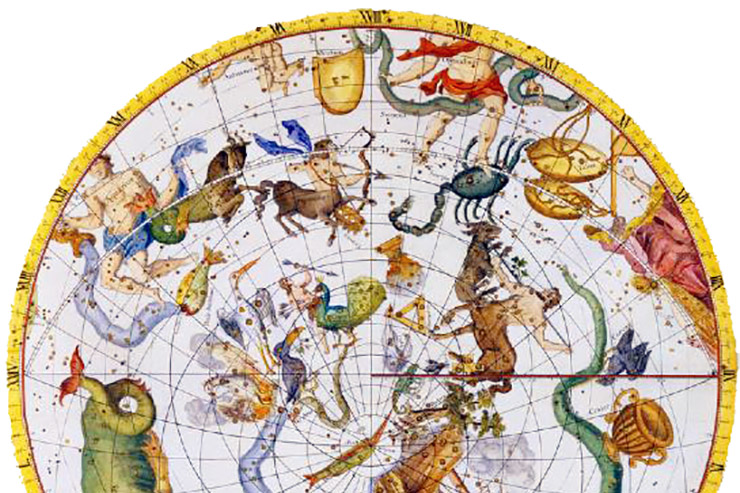
    Precession Observed

    The observation of the Earth’s three motions is really quite simple. In the first rotation we see the Sun and stars rise in the east and set in the west every 24 hours. And if we looked at the stars just once a day, we would see a similar pattern over a year: they rise in the east and set in the west, with all twelve constellations of the zodiac (those ancient markers of time that lie along the ecliptic – the Sun’s path) passing overhead at the rate of about one per month until we return to our starting point in the sky at the end of the year. And if we looked just once a year, say on the autumnal equinox, we would notice the stars move retrograde (opposite to the first two motions) at the rate of about one degree every 70 years. At this pace, the equinox falls on a different constellation approximately once every 2,000 years, taking about 24,000 years to complete its cycle through the twelve constellations. This is called the precession (backward motion) of the equinox, relative to the fixed stars.

    The standard theory of precession says it is principally the Moon’s gravity acting upon the oblate Earth that must be the cause of the Earth’s changing orientation to inertial space, a.k.a. “precession.” However, this theory was developed at a time before astronomers knew the solar system could move and has now been found by the International Astronomical Union to be “inconsistent with dynamical theory.” Ancient oriental astronomy teaches that the observable of an equinox slowly moving or “precessing” through the twelve constellations of the zodiac is simply due to the motion of the Sun curving through space around another star (changing our viewpoint of the stars from Earth). Here at the Binary Research Institute, we have modelled a moving solar system and found it does indeed better produce the precession observable while resolving a number of solar system anomalies. This strongly suggests the ancient explanation may be the most plausible, even though astronomers have not yet discovered a companion star to the Sun.

    Beyond the technical considerations, a moving solar system appears to provide a logical reason why we might have a Great Year with alternating Dark and Golden Ages. That is, if the solar system carrying the Earth actually moves in a huge orbit, subjecting the Earth to the electromagnetic (EM) spectrum of another star or EM source along the way, we could expect this would affect our magnetosphere, ionosphere, and indirectly all life in a pattern commensurate with that orbit. Just as the Earth’s smaller diurnal and annual motions produce the cycles of day and night and the seasons of the year (both due to the Earth’s changing position in relation to the EM spectrum [light] of the Sun), so might the larger celestial motion be expected to produce a cycle that affects life and consciousness on a grand scale.

    A hypothesis for how consciousness might be affected in such a celestial cycle can be built on the work of Dr. Valerie Hunt, the former professor of physiology at UCLA. In a number of studies she has found that changes in the ambient EM field (that surrounds us all the time) can dramatically affect human cognition and performance. In short, consciousness appears to be affected by subtle fields of light. Or as quantum physicist Dr. Amit Goswami would say, “Consciousness prefers light.” Consequently, the concept behind the Great Year or cyclical model of history, consistent with myth and folklore, is based on the Sun’s motion through space, subjecting the Earth to waxing and waning stellar fields (all stars are huge generators of EM spectrum), resulting in the legendary rise and fall of the ages over great epochs of time.

    Historical Perspective

    Current theories of history generally ignore myth and folklore and do not consider any macro external influences on consciousness. For the most part, modern history theory teaches that consciousness (or history) moves in a linear pattern from primitive to modern with few exceptions. Its tenets include:

    • Mankind evolved out of Africa.
    • People were hunter-gatherers until about 5,000 years ago.
    • Tribes first banded together for protection from other warring parties.
    • Written communication must precede any large engineered structures or populous civilisations.

    The problem with this widely accepted paradigm is that it is not consistent with the evolving interpretation of recently discovered ancient cultures and anomalous artefacts. In the last hundred years, major discoveries have been made in Mesopotamia, the Indus Valley, South America, and many other regions that break the rules of history theory and push back the time of advanced human development. Specifically, they show that ancient man was, in many ways, far more proficient and civilised nearly 5,000 years ago than he was during the more recent Dark Ages of just five hundred to a thousand years ago.

    In Caral, an ancient complex of unknown origin on the west coast of Peru, we find six pyramids that are carbon dated to 2700 BCE, a date contemporaneous with Egyptian pyramids and rivalling the time of the first major structures found in the so called “Cradle of Civilisation” in Mesopotamia. However, Caral is an ocean away from the “cradle,” and we find no evidence of any writing or weaponry, two of the so-called necessities of civilisation. What we do find is beautiful musical instruments, astronomically aligned structures, and evidence of commerce with distant lands, all signs of a peaceful and prosperous culture.

    Gobekli Tepe presents an even greater challenge to current accounts of history. This site in Turkey, dated to 9000 BCE, contains dramatic architecture including carved pillars of huge proportions. To find something so large and complex long before the dates accepted for the invention of agriculture and pottery is an archaeological enigma. These sites defy the standard historical paradigm. But what is stranger still is that so many of these civilisations seemed to decline en mass.

    In ancient Mesopotamia, Pakistan, Jiroft, and adjacent lands we see knowledge of astronomy, geometry, advanced building techniques, sophisticated plumbing and water systems, incredible art, dyes and fabrics, surgery, medicine, and many other refinements of a civilised culture that seemed to arise from nowhere yet were completely lost over the next few thousand years. By the time of the worldwide Dark Ages, every one of these civilisations including the big ones, Egypt and the Indus Valley, had largely turned to dust or nomadic ways of life. Near the depths of the downturn there were ruins and little else, while the local populace knew nothing of the builders except through legend. And in some areas where larger populations still remained, such as throughout parts of Europe, poverty, plague, and disease were often rampant and the ability to read, write, or duplicate any of the earlier engineering or scientific feats had essentially disappeared. What happened?

    While records of this period are still very spotty, the archeological evidence indicates that consciousness, reflected as human ingenuity and capability, was greatly diminished. We seemed to have lost the ability to do the things we used to do. Ironically, this is just what many ancient cultures predicted. The world’s foremost Assyrianologist, Stefan Maul, shed light on this phenomenon in his Stanford Presidential Lecture where he tells us that the Akkadians knew they lived in a declining era; they revered the past as a higher time and tried to hang on to it but at the same time lamented and predicted the Dark Ages that would follow. His etymological studies of cuneiform tablets show the ancient words for “past” have now become our words for “future,” whereas their words for the “future” have now become our words for the “past.” It is almost as if mankind orients his motion through time depending on whether he is going towards or away from the Golden Age.

    This principle of waxing and waning epochs of time is depicted in numerous bas-reliefs found in ancient Mithraic “mystery school” temples. The famed Tauroctany, or bull-slaying scene, is usually surrounded by two boys, Cautes and Cautopetes, with one holding a torch up on the ascending side of the zodiac, indicating it is a time of light; the other holds a torch down on the descending side of the zodiac, indicating it is a time of darkness (see example on page 48). As the chart on the opposite page shows, these time periods correspond with the Greek description of when the Earth goes through periods of rising and falling consciousness.

    Mithras and the Bull. This fresco from the mithraeum at Marino, Italy (third century) shows the Tauroctony and the celestial lining of Mithras’ cape. On Mithras’ left and right are the two boys Cautes and Cautopetes, with one holding a torch up on the ascending side of the zodiac, indicating it is a time of light; the other holds a torch down on the descending side of the zodiac, indicating it is a time of darkness.

    Jarred Diamond, the well-known historian-anthropologist and author of Guns, Germs and Steel, makes a good case that it is primarily local geographic and environmental advantages on the planet Earth that determine which group of humans succeeds or fails versus another. Those that have the steel, guns, and bad germs win. While this helps explain many regional differences of the last few thousand years, it does not address the macro trends that seemed to have affected all cultures (including China and the Americas) as they collectively slipped into the last worldwide Dark Age. The cyclical or Great Year model overlays and augments Diamond’s observations, giving a reason for the widespread downturn. It suggests that it is not just the geography and environment of man on Earth that determines his relative success but also the geography and environment of the Earth in space that affects mankind on a macroscopic scale. Just as small celestial motions dramatically affect life over the short term so it appears that large celestial motions colour life over the long term, resulting in the seasons of the Great Year. 

    Understanding that consciousness may indeed rise and fall with the motions of the heavens gives meaning to ancient myth and folklore and puts anomalous cultures and artefacts (such as the Antikythera device and the Babylon battery) into an historical context that makes sense. It speaks to why so many ancient cultures might have been fascinated with the stars and it provides us with a workable paradigm in which to understand history. It could also help us identify the forces that propelled the renaissance and that may be accelerating consciousness in the current era. Myth and folklore, the scientific language of yore, provide a deeper look at consciousness throughout the different ages.

    [alert type=”success” dismiss=”no”]If you appreciate this article, please consider subscribing to help maintain this website.[/alert]

    An Ancient Look at the Future

    The Greek historian Hesiod tells us of the wonderful nature of the last Golden Age when “peace and plenty” abounded. Hopi myths tell us of cities on the bottom of the sea. Typically ancient peoples broke the great cycle into an ascending and descending phase, each with four periods. The Vedic culture tells us that when the Autumnal Equinox moves from Virgo to Aires, we go through the ascending Kali, Dwapara, Treta, and Satya “Yugas” (the latter being their Golden Era) before slowly declining in reverse order as the equinox completes its journey. The Greeks and other early Mediterranean civilisations used like periods and labelled them the Iron, Bronze, Silver, and Golden Ages. More distant cultures such as the Maya or Hopi used still other names such as “worlds” or “Suns” and numbered them to identify specific epochs.

    Whatever the language used, the concept is the same. The sage, Swami Sri Yukteswar, in his book The Holy Science (1894), illustrates that when our solar system is at a point farthest from its companion star, mankind’s consciousness is at its lowest point (last occurring around 500 CE), and when the Sun is at its closest point (next occurring in 12,500 CE) consciousness will reach its highest point of this cycle. The points are seen in the sky by where the autumnal equinox Sun intersects one of the twelve constellations of the zodiac (the celestial clock). When the AE Sun is in Aries, which is almost always placed in the 12 o’clock position of the zodiac, then the Earth is in the best possible stellar environment, making it easy for many people to experience an awakened state of consciousness. And when the AE Sun is in the constellation Libra, conditions are at their worst and a Dark Age, a period of deluded consciousness, prevails. 

    Presently we are just a few hundred years into the ascending age, crossing over from what the Greeks would call the Age of Man (Iron) to the Age of the Hero (Bronze), yet still very far from the Age of the Demigods (Silver) or the Age of the Gods (Gold), which are utterly inconceivable to us at this time. This means we are now awakening from a time when individual consciousness perceives itself as purely a physical form living in a strictly physical universe to a time when we begin to see ourselves and the universe as more transparent mostly made up of subtle energy. This began with the discoveries of the Renaissance (principles of electricity, laws of gravitation, microscopes, telescopes, and other inventions that expand our awareness) and has accelerated since with quantum physics that teach us that matter and energy are interchangeable, and Einstein’s concepts that even time and space are relative. In short, we are back on the upswing just beginning to “re-member” ourselves as pure consciousness living in a world of undreamed possibilities.

    According to Paramahansa Yogananda, the author of Autobiography of a Yogi, by the year 4100 CE (when we cross into the Treta yuga proper) “telepathy and clairvoyance will once again be common knowledge.” It may seem far-fetched but according to myth and folklore there was such a time on Earth before, in about 3100 BCE, the last Treta yuga. That is what Genesis would call the pre-Babel age, when mankind communed freely with nature before God “confused the tongues.”

    People often forget what the world was like just 500 years ago when every nation was at war with one another, plagues and poverty regularly decimated large populations of the Earth, lifespans were half what they are today, individual rights were nonexistent, and justice was doled out by torture, inquisition or burning at the stake. Yes, the world still has problems but consciousness is now expanding rapidly. According to Time magazine over 17 million people are now meditating in the US alone. Increasing awareness manifests in many ways, most visibly as technology, with many believing we are now approaching a point of singularity, but it is so much more. Can there be any doubt our improvements across all areas of society over the next 500 years will be off the charts compared to the last 500?

    [alert type=”general” dismiss=”no”]This article was published in New Dawn 135.[/alert]

    [alert type=”success” dismiss=”no”]If you appreciate this article, please consider subscribing to help maintain this website.[/alert]

    © New Dawn Magazine and the respective author.
    For our reproduction notice, click here.
  • VALIS “Vast Acting Living Intelligence System”: The Invasion of Philip K. Dick’s Mind

    VALIS “Vast Acting Living Intelligence System”: The Invasion of Philip K. Dick’s Mind

    This article was published in New Dawn Special Issue Vol 8 No 4 (August 2014)

    In an interview with English journalist Charles Platt in 1979, the American science fiction writer Philip K. Dick claimed that in the spring of 1974 his mind was taken over by something he described as a “transcendentally rational mind.” Dick added that up until that point he felt as if he had “been insane all of my life and suddenly I had become sane.” What could he have meant by such a strange comment? Was it simply writer’s imagination or was it something of significance? Dick certainly thought so.

    Philip K. Dick (1928-1982) is considered by many to be one of the greatest American writers of the second half of the twentieth century. This was recognised by fellow author Ursula LeGuin when she called him our “home grown Borges” in reference to the works of the great Argentinian writer.

    But Philip K. Dick was more than just a writer; he was a philosopher who described in his short stories and novels a view of the world brought about from his own experiences. In the final few years of his all-too-short career he wrote a series of semi-autobiographical novels describing his encounter with this entity that invaded his consciousness. The most famous of these novels is VALIS but in many ways the one that most closely follows Dick’s actual encounter is his posthumously published novel Radio Free Albemuth, recently made into an intriguing movie of the same title written, produced and directed by Los Angeles based John Alan Simon.

    There is strong evidence that the entity Phil was later to call VALIS, “Vast Acting Living Intelligence System,” had been with him for most of his life, only made more manifest through a series of neurological facilitators (both natural and artificial) that affected Dick in the early 1970s. 

    From a very early age there was something distinctly odd about Philip K. Dick. He was a quiet, somewhat introverted child, recovering from the loss of his twin sister Jane, who died soon after they were born in a cold Chicago December in 1928, and the subsequent abandonment of his father a few years later. As he grew older he was clearly highly intelligent but with certain neurological and psychological problems that caused him difficulties at school. These issues tended to come to the surface during periods of stress such as exams. The young Phil would suffer from vertigo attacks together with strong feelings of disassociation from the physical world. He once described the sensation as like viewing the world through the wrong end of a telescope. It was in one crucial physics exam that something very peculiar took place.

    In an interview with his friend Greg Rickman recorded in October 1981, Dick described how the exam was not going at all well:

    I sat for almost two hours staring at the page and my college entrance depended on getting that test right. It was the final test… I didn’t understand the principle. I didn’t even remember the principle let alone know how to apply it. I prayed and prayed and prayed and prayed and then this voice clicked in and said… “the principle is really very simple.” And then it went on and stated the principle and it explained how it was applied… I got (the test) back with an “A.”1

    Dick believed this “entity” was some form of “guide” that was to become a permanent fixture in his life, lying dormant for years but involving itself in his life and in times of great crisis. In another interview Rickman asked Dick if the voice had ever returned. The writer described that although he regularly sensed its presence its verbal comments were very rare. Dick cited one particularly odd manifestation that took place in the late 1960s. 

    He described how he had been watching a TV programme about the Galapagos turtles. The fight for survival of one particular female turtle had really upset him. After laying her eggs she had turned in the wrong direction and instead of going towards the sea she crawled inland. Soon the heat brought about extreme dehydration. She was dying. As she began to fade her legs were still seen to be moving. The film had been edited to give the impression that the dying turtle was imagining she was back in the ocean. He went to bed with this tragic image in his mind. He woke up in the night to hear the same voice that he had heard many years before during his physics exam. It explained to him that the turtle actually believed she was in the water:

    I was just terribly amazed and dumbfounded to hear that voice again. It wasn’t my own voice because one of the sentences the voice said was “And she shall see the sea” and I would not use the two words “see” and “sea” in the same sentence. It tends to do that, use word choices I don’t use. One time it used the expression “a very poisonous poison” which I would not use.2

    Dick was intrigued by the source of this “voice.” It was clearly located within his brain and yet it used terminology and word structures that were alien to him. Indeed, it was clear from his childhood exam experience that this being knew things he did not know. 

    By the late 1970s Dick discovered a possible answer to this mystery. At that time he had encountered the theories of Princeton psychologist Julian Jaynes. A few years before, in 1976, Jaynes had written a highly influential book entitled The Origin of Consciousness in the Breakdown of the Bicameral Mind. Jaynes suggested the brains of ancient human beings may have been “bicameral.” By “bicameral” Jaynes meant that the twin hemispheres of our ancestors brains were isolated from each other. Whereas modern humans understand that the “inner narrative” we all use to decide upon our actions is all part of a singular “self,” the ancients did not. They heard the “inner voice” and identified it with the voice of the gods. Jaynes then argued that at around 1000 BCE the two hemispheres somehow merged into a unitary consciousness of the sort experienced today. He was of the opinion that certain neurological conditions such as schizophrenia are a throwback to this earlier dual state of consciousness. In this way he attempted to explain how certain individuals hear voices which give instructions, criticise or assist on a regular basis.

    Dick suggested to Rickman this may have been the source of his lifelong “partner,” a subliminal and much wiser version of himself located in his right hemisphere:

    I have that. I have that right hemisphere intuition thing occur. Unless you know what it is it does seem like psychic power. That’s the way the right hemisphere works. It’s got to work like that…. And it seems as if it knows the future. What it sees is in the way of a pattern, and part of a pattern is still yet to come. It is actually seeing part of a pattern that is not fully emerged. It can tell from the section it has what the total pattern will be like. It can fill in the missing part.3

    His comment here is of significance. He is suggesting this life-long partner has “psychic power” and that it uses these powers to assist its less able associate located in the left hemisphere. The question that has to be answered is how can something located within the brain have access to information not available via the everyday senses? A clue may lie in another very curious incident that Dick described in a 1977 interview with journalist Richard Lupoff. This is worth quoting in full:

    Back at the time I was starting to write science fiction, I was asleep one night and I woke up and there was a figure standing at the edge of the bed, looking down at me. I grunted in amazement and all of a sudden my wife woke up and started screaming because she could see it too. She started screaming, but I recognised it and I started reassuring her, saying that it was me that was there and not to be afraid. Within the last two years – let’s say that was in 1951 – I’ve dreamed almost every night that I was back in that house, and I have a strong feeling that back then in 1951 or ’52 that I saw my future self, who had somehow, in some way we don’t understand – I wouldn’t call it occult – passed backward during one of my dreams now of that house, going back there and seeing myself again. So there really are some strange things…4

    What Dick is suggesting here is that his future self was able to go back in time and experience from another location in space an earlier life-incident. Note there are two viewpoints here. Dick’s older self does not re-live the experience from the viewpoint of his younger self. He sees it as an outside observer. This suggests either a very strange time-slip or else that in some profound way part of Phillip K. Dick could view from the present incidents from his own past. What if the consciousness existing in Dick’s older right hemisphere perceives the whole of his life from a vantage point outside of linear time and as such it can travel anywhere within the author’s time-line? If this was the case then from its vantage point it is totally precognitive. It knows the outcome of every decision that its linear-time existing partner will make.

    [alert type=”success” dismiss=”no”]If you appreciate this article, please consider subscribing to help maintain this website.[/alert]

    This suggests a stunning explanation: that the guiding voice may have been Dick’s own future self guiding from the future. That the author had on-going access to information known to his future self is evidenced from the way in which Dick frequently claimed that his fictional plot-lines came from his future experiences. He cited a handful of quite startling “future experiences” that turned up in his earlier fictional writings. For example, here Phil describes how an incident in his book Flow My Tears, the Policeman Said actually came to pass many years later:

    In 1970 I wrote a novel called Flow My Tears, the Policeman Said. One of the characters is a nineteen-year-old girl named Kathy. Her husband’s name is Jack. Kathy appears to work for the criminal underground, but later, as we read deeper into the novel, we discover that actually she is working for the police. She has a relationship going on with a police inspector. The character is pure fiction. Or at least I thought it was. Anyhow, on Christmas Day of 1970, I met a girl named Kathy – this was after I had finished the novel, you understand. She was nineteen years old. Her boyfriend was named Jack. I soon learned that Kathy was a drug dealer. I spent months trying to get her to give up dealing drugs; I kept warning her again and again that she would get caught. Then, one evening as we were entering a restaurant together, Kathy stopped short and said, “I can’t go in.” Seated in the restaurant was a police inspector whom I knew. “I have to tell you the truth,” Kathy said. “I have a relationship with him.” Certainly, these are odd coincidences. Perhaps I have precognition.5

    Is it possible that in writing Flow My Tears Dick incorporated subliminal “future memories” into his work of fiction? As we know, most writers use visualisation techniques in which they allow their subconscious to take the story where it needs to go. Could it be that Phil simply accessed the “memories” of his own non-dominant hemisphere? There was a second incident in Dick’s life in which he found himself experiencing in real life an event he described in Flow My Tears.

    In the book one of the characters, Felix Buckman, meets a black stranger at an all-night gas station. Buckman is in a very emotional state as he has just heard that his sister had died. The stranger and Buckman make an emotional link. Buckman then walks away, only to return and hug the man a few minutes later. Four years after writing the novel Phil found himself helping out a stranger in an all-night gas station when he was overcome with a powerful déjà vu sensation:

    Suddenly I realised that this was the scene in my novel – the novel written eight years before. The all-night gas station was exactly as I had envisioned it in my inner eye when I wrote the scene – the glaring white light, the pump jockey – and now I saw something which I had not seen before. The stranger who I was helping was black. We drove back to his stalled car with the gas, shook hands, and then I returned to my apartment building. I never saw him again. He could not pay me back because I had not told him which of the many apartments was mine or what my name was. I was terribly shaken up by this experience. I had literally lived out a scene completely as it had appeared in my novel.6

    Dick wrote Flow My Tears in the early 1970s, a period in his life in which he had become fascinated by the workings of the two hemispheres of the brain. As we have already seen, Dick had been intrigued by the work of Julian Jaynes. He had also become aware of the surgical operations of Roger Sperry, a neurosurgeon based at the Californian Institute of Technology. Sperry and his associate Michael Gazzaniga had operated on the brains of individuals with severe epilepsy. It was believed that by cutting the communication channels between the two hemispheres of the brain they could stop seizures spreading across the whole brain. In their initial aim they succeeded, the patients showed a marked improvement. But there were intriguing side-effects including the bizarre observation that the patients had become dual personalities. In effect, Sperry and Gazzaniga had created a neurological situation similar to Jaynes’ bicameralism. Dick was fascinated by the implications of these operations and wondered if his own “inner voice” could be explained by this outcome.

    In early March 1974 Dick read an article in the popular science magazine Psychology Today that suggested he could check out his suspicions regarding his own mental duality. The author of the article Harvey Ross described how the condition of a young boy with severe schizophrenically-induced visions was improved by the introduction of a high-protein, low-carbohydrate diet supplemented by a cocktail of vitamins. Ross gave the recipe for the cocktail and included in it the instructions that 500 mg of vitamin C should be taken in the first month with an increase to 1,000 mg for the second month onwards. Ross argued that the large dose of vitamins brings about a marked improvement in the firing of brain cells (neurons) which, in turn, facilitates the synchronisation of the two hemispheres of the brain.7

    As such Dick was very excited by this discovery. This was a way for him to cure himself of his own “bicameralism,” reconnect the two hemispheres of his brain, and finally open up direct, rather than arbitrary, communication with the part of him that had identified itself as being his “Tutelary Spirit.” As the cocktail of vitamins were all water soluble and easily available from any pharmacist, Dick decided he would try this himself. He was already aware of the developments in neurology suggesting that the right and left hemispheres of the brain function independently and that most “normal” people only use their “dominant” hemisphere. For Phil it was logical to conclude that by using Ross’s recipe human consciousness could be raised onto another level of awareness:

    It occurred to me that maybe in a normal person with normal, which is to say, average synchronisation, it might cause firing to take place so efficiently that both hemispheres of the brain might come on together.8

    He then goes on to describe how, after taking the dose, he found that his two hemispheres did, indeed, “came on together” as he termed it. According to one of his biographers, Lawrence Sutin, Dick actually got the recipe wrong and ending up taking seven grams more vitamin C than he should have.9

    This “coming together” may have facilitated the most intriguing part of Dick’s life; a series of events that took place in February and March 1974 that he was later to describe as being his “theophany.” His use of wording here is quite precise. “Theophany” is Greek for “the appearance of God” and this is exactly what Phil believed took place over that period. It seems that the overdose of vitamin C, mixed with a cocktail of pain killers that he was taking to relieve the symptoms of an impacted wisdom tooth, may have allowed his mysterious partner to become far more immanent in his life. He called this entity “AI,” “Firebright,” Zebra, “Sophia,” Shekinah, finally settling on “Vast Acting Living Intelligence System” (VALIS). This being became very active in Phil’s life. It organised his accounts, told him to sack his agent and even had him buy clippers to trim his somewhat unruly nose hair! 

    So what was the source of this “transcendentally rational mind”? Was it really a manifestation of God that Phil believed it to be? Was it simply a misunderstood “inner dialogue” suggesting that Phil was experiencing a form of schizophrenia? An intriguing suggestion made by, among others, astrophysicist Bernard Haisch, anthropologist Martin W. Ball and comedian Bill Hicks is that we are all God and that under certain circumstances we all can access elements of the “mind of god.”

    Phillip K. Dick was of a similar opinion. In his personal journal, now published under the title of The Exegesis of Philip K. Dick, Dick makes the following comment: 

    we ourselves are units of God’s (the total organism’s) memory system? Suppose, for some of us at least, that (called, I think, witnessing) is our prime purpose? We are (parts of) his memory? 

    Dick once described himself as a “acosmic pan-entheist.” He defined this as being somebody who doesn’t believe the universe exists in itself but is an extension of God in space and time. For Phil, God exists outside of space and time and extends himself into space-time.

    In his novel VALIS he described this as being a “concealed god” who takes on the likeness of “sticks and trees and beer cans in gutters,” later adding that God subsequently becomes “debris no longer noticed.” In the Exegesis he went further: “Premise: things are inside out… Therefore the right place to look for the almighty is, e.g., in the trash in the alley.”

    In this model, what exactly is “God”? It is clear Dick was not describing the Western concept of a personal deity but more the Eastern idea of an impersonal life-force that permeates everything. Recent work by researchers such as Vlatko Vedral,10 Tom Campbell11 Nick Bostrom, and Frank Tipler12 suggests the great mystery of the mind-matter split can be explained if that at a more fundamental level everything is simply mathematical information. 

    In his book Decoding Reality, quantum physicist Vedral presents support for such a belief. In effect, the universe and everything in it is a huge “computer” program containing the en-coded information of everything that has happened and can happen. This “program” exists outside of space-time (as space-time itself is part of the program). In a quotation that could have been taken from Dick’s Exegesis, French mathematician Alain Connes, made the following observation:

    It is humility, finally, that forces me to admit that the mathematical world exists independently of the manner in which we apprehend it, that it isn’t localised in time and space. But the manner in which we apprehend it is subject to rules very similar to those of biology. The evaluation of our perception of mathematical reality causes a new sense to develop, which gives us access to a reality that is neither visual nor auditory, but something else altogether.13

    As we are all elements of the program, it is logical to conclude that under certain circumstances we may be able to perceive information within the program. This information (or in-formation as it was termed by another great scientist-philosopher, David Bohm) is analogous to the digitised data found encoded within the reflective surface of a DVD. The DVD contains ALL the information of the respective movie, video game or whatever linear narrative it has been created to re-create. But the linear nature only exists from the viewpoint of the observer. In actuality, all the information exists in a single location, in this case the DVD itself. Many years ago Philip K. Dick made a similar analogy using the technology of his time, a long-playing gramophone record. The information system that the physical universe is based:

    …contains in it as a simultaneous plane or extension everything which was, just as the grooves on an LP contain the part of the music which has already been played; they don’t disappear after the stylus tracks them. A phonograph record is, actually, a long helical spiral, and can be represented entirely in a plane geometry sort of way: in space, although I suppose you can talk about the stylus accumulating the music as it goes along.14

    Does this explain the origin of Dick’s “transcendentally rational mind”? Was he actually accessing the information field from which everything that we perceive is constructed? Or was it simply that he had taken too many mind-altering substances?

    Whatever the case, Philip K. Dick’s encounter with the noetic will continue to fascinate, beguile and intrigue all who encounter them, and, in doing so, will be the source of debate and discussion for many years to come. I hope this article may have made its own small contribution to these discussions.

    The film adaption of Philip K. Dick’s novel Radio Free Albemuth was released in June 2014. The film is written, directed, and produced by John Alan Simon and stars Alanis Morissette in a lead role.

    [alert type=”general” dismiss=”no”]This article was published in New Dawn Special Issue Vol 8 No 4.[/alert]

    [alert type=”success” dismiss=”no”]If you appreciate this article, please consider subscribing to help maintain this website.[/alert]

    Footnotes

    1. Gregg Rickman, To The High Castle Philip K Dick: A Life 1928-1962, Fragments West, 1989, 140 
    2. Gregg Rickman, Philip K. Dick: The Last Testament, Fragments West, 1985, 23
    3. Ibid., 19
    4. Richard A. Lupoff, ‘A Conversation with Philip K Dick’, Science Fiction Eye, Vol. 1, No. 2, August 1987, 45-54
    5. Philip K. Dick, ‘How To Build A Universe That Doesn’t Fall Apart Two Days Later’, 1978, http://deoxy.org/pkd_how2build.htm
    6. Ibid.
    7. Harvey M. Ross, ‘Orthomolecular Psychiatry: Vitamin Pills for Schizophrenics’, Psychology Today, April 1974
    8. Philip K. Dick, The Exegesis of Philip K Dick, Hachette Littlehampton, Locations 990-991, Kindle Edition
    9. Lawrence Sutin, Divine Invasions – A Life of Philip K Dick, Orion Books, 2006, 212
    10. Vlatko Vedral, Decoding Reality – The Universe as Quantum Information, Oxford University Press, 2012
    11. Tom Campbell, My Big Toe: A Trilogy Unifying Philosophy, Physics, and Metaphysics, Lightening Strike Books, 2007
    12. Frank J. Tipler, The Physics of Immortality, MacMillan, 1994
    13 Alain Connes & Jean-Pierre Changeux, Random Thoughts About Mind, Matter and Mathematics, Princeton University Press, 1995
    14. Philip K. Dick, ‘Man, Android and Machine’ (1975), From The Shifting Realities of Philip K. Dick: Selected Literary and Philosophical Writings edited by Lawrence Sutin

    © New Dawn Magazine and the respective author.
    For our reproduction notice, click here.