This article was published in New Dawn 165 (Nov-Dec 2017)
Science fiction is always more important than science. – Timothy Leary
The sacred, the sublime, has always walked amongst the profane. The signs are everywhere, blended into the sidewalks, pulp fictions, and the kitsch trappings of the art world. For iconic sci-fi writer Philip K. Dick, most of the sublime things of his world were disguised as trash that seamlessly slipped into the background of a dysfunctional world reality. The seeming trash of the everyday mundane clashed with incoming cosmic mutterings that have found their way into much of our popular culture.
In the US especially, a blend of anarchic cultural subversions manifested that played upon known semi-mystical memes. Enochian magic, Golden Dawn rituals, meta-computing of the mind, and a weird kind of chaos were springing up within treatises of popular culture. One of these was the text of the Principia Discordia that emerged in the 1960s as a ‘sacred text’ of Discordianism. Written by Malaclypse the Younger (Greg Hill) and Omar Khayyam Ravenhurst (Kerry Thornley), it proclaimed “All hail Discordia!” in a mixture of goddess worship with the notion of order and disorder as balancing illusions. The fifth commandment of Principia Discordia states, “V – A Discordian is Prohibited of Believing What he Reads.”1 In line with what today we would call a ‘post-truth’ position, the Principia Discordia knew that “Tis an ill wind that blows no minds.”
Discordia came to influence the writings of maverick author-philosopher Robert Anton Wilson, who popularised it further in his books, especially in The Illuminatus! Trilogy. These utterances were further echoed by the writer William S. Burroughs who, besides experimenting with cut-up narrative techniques, proclaimed a Discordian-esque, “Nothing is absolutely true – Everything is permissible.” With this endless possibility came the rise of literate figures, or rather literary magicians, who were connected to systems of magic, such as the Golden Dawn. Popular culture began to open up and see combined forms of neo-shamanism, eastern philosophy, quantum science, visionary art, and computer technology. This modern twist on magic was part of a wider trend in experimenting with new forms of stimulating and awakening consciousness. These paths were attempting to destabilise our conditioning patterns and our resultant consensus reality. They were all aimed at waking up the usually-slumbering human mind.
As the seminal work Waking Up (1986) by Charles Tart showed, humanity was largely intoxicated with a “consensus trance” that kept us from recognising sigils of the sacred. In more recent years the metaphors and memes of being trapped within a waking dream, or of dreams within dreams, have been explored in such popular films as ‘The Truman Show’ (1998); the ‘Matrix Trilogy’ (1999-2003); and ‘Inception’ (2010). Part of the myth we find ourselves popularising is the mythology that we are in some sort of constructed reality – a gnostic-inspired simulacrum of truth.
Gnostic ideas are now being presented and consumed in ever more popular forms of culture. There’s an odd wave of mystical-spiritual impulses now radiating through popular culture that encourages us to throw ourselves into new fantastic realms and mythological fictions. These are modern mash-ups of the counterculture now being packaged and presented as part of mainstream culture. In recent years the most extraordinary success in this area has been the incredible, phenomenal rise of the modern superhero.
Superheroes & the Super-Self
It appears we are now in desperate need of our superheroes and mutants to save us from a form of tyrannical humankind. We seek a cultural expression for the human psyche; for our psychic currents and transmissions and sacred communication. Hence, our superheroes must live on! We have the X-Men walking amongst us, a mutant subspecies of humans. The natural order is evo-mythological – it is sacred, beyond human, and connects us with evolutionary currents. In the absence of our ancient myths we have ingested the sacred alchemical root and through pop-culture morphed this transformation into the new wave of superheroes – myth lives anew in spandex. Maybe it is a cliché because it’s true; we wish to find the personal superhero within each of us – the journey of the individual, unfolding within the great cosmic drama. This mythical journey has so far taken us from scientific rationalism and industrial modernity, and now we may finally be becoming more than we are; that is, more than human.
Our popular subcultures are gradually becoming the norm. It is not only a question of whether more people are interested or not, but rather that these ideas are more widely available now thanks to popular culture. The waking life and the dream are becoming part of the same movie plot, as in Richard Linklater’s film version of Philip K. Dick’s ‘A Scanner Darkly’ (2006). We are more and more waking up into our own movie – our very own Truman Show – where ideas are seeded directly into our environments in order to catalyse our awakening. Like many of the ancient wisdoms foretold, we have been asleep in a distant land, and now we are receiving messages and signals flashing like neon signs through our popular culture. This marks our juncture, our crisis point, between moving toward waking up or falling back into catastrophic and catatonic slumber.
Our ultra high-definition visual culture is acting like a portal for the otherworld to enter. The psychedelic experiences that were once fringe and condemned are being re-played out through modern fictions that blend gnostic, mythological, and multidimensional themes. Transcendental states of consciousness, ratified by the far explorations of new science, are adding to the mix of a new 21st century mythology that as of yet remains unnamed. Perhaps we are emerging toward the birth of new sacred gods. These are the gods of mutations, of neurological and biological adaptations. And they are emerging first in our pop cultures as our superheroes and psychic mutants. In this initiation into a psychically enhanced future, we will need more than ever to learn how to distinguish the demonic from the spiritual. Hence the current barrage of films, TV series, and fiction that shows angels vs devils, humans vs vampires, and the whole gamut of the good vs the bad that has crawled from the forest floor to enter into the quest for the Holy Grail. In this way, the gods will never be forgotten as they merge with a super-augmented mutant humanity in spandex. The real gods, temporarily forgotten, reside within our psyche – they are kept in mind. And yet they can only become real for us – to re-mind us – when dashing about on the stage and streets in front of our very eyes. We need the sacred to slap our faces in spandex gloves before we begin to blink a waking eye. That is, our sacred and supernatural fictions appear for us and require our engagement with them.
The latest revival of the superheroes genre is significant in how it takes the mutant meme further and projects it forward as a form of evolutionary mysticism. These new heroes are displaying to us our latent capacities and powers that are yet to unfold. We are witness to the first wave of mutant evolutionary pioneers. The summit of human evolution is far in the distance, and yet its early stages are manifesting through the Marvel and DC Universes where god-like potentials await us. Through such characters as Spider-Man, Iron Man, Captain America, Wolverine, and Doctor Strange, Marvel mesmerises paranormal subliminals into popular cultural consciousness. And DC does the same with Superman, Batman, Wonder Woman, Green Lantern, Flash, and Green Arrow. Then as gangs they come together as the Guardians of the Galaxy, the Fantastic Four, the X-Men (Marvel), or as the Justice League (DC). They are now our teachers, our guides, our mutant futures that are beyond human. The mutants have become practising mystics.
We are seemingly living more and more in a mutational and metaphysical universe, and with the arrival of augmented reality, our boundaries of interaction with the physical world around us will blur. We are already well on our way as our outer and inner spaces explode into a new blistering supernova.
[alert type=”success” dismiss=”no”]If you appreciate this article, please consider subscribing to help maintain this website.[/alert]
Outer Spaces – Inner Spaces
Humankind has always been a child of the stars. Our early civilisations mapped the heavens before they mapped the terrain under their feet. It was no surprise when UFOs started to dart across our urban skies and come crashing down disguised as government weather balloons.2 Recent popular culture has nurtured a fascination with outer spaces and our galactic cousins from the Golden Age of science fiction of the 1930s, 40s, and 50s to the new wave of the 60s and 70s. The concerns of our outer space relations shifted from how to make contact with our space cousins to the entropic death of the universe. Then the environmental theme entered our outer spaces as if a subliminal projection from our very own inner spaces. The growing number of alleged UFO abductees that emerged in the latter part of the 20th century began to relay messages of extraterrestrial concern for our planetary wellbeing.
John. E Mack, an American professor of psychiatry at Harvard Medical School, in his later years became a leading authority on the spiritual or transformational effects of the alien abduction experience. Mack came to view the alien abduction phenomenon as acting as a catalyst to open human consciousness to the wider possibilities of connection with the universe. For more than a decade Mack rigorously studied the alien abduction phenomenon and interviewed hundreds of people (whom Mack referred to as “experiencers”).3 What initially started out as an exercise in studying mental illness soon turned into an in-depth inquiry into personal and spiritual transformation. Mack eventually came to see the alien abduction phenomenon as one of the most powerful agents for spiritual growth, personal transformation, and expanded awareness – in other words, as a trigger for a sacred experience. Despite the external anxiety produced by the experience, it was clear to both Mack and his set of experiencers that a profound communion was being established between humankind and other realities. Further, this interaction was catalysing a shift in human consciousness toward collapsing the old models of materialistic duality and opening up a connection not only ‘beyond the Earth’ but with other dimensional realities.
This interconnectedness became a channel for the experiencers (abductees) to receive an impressive range of information on healing knowledge, spiritual truths, science, technology, and ecology. A major part of the information was apparently concerning the status of the Earth and humanity’s relationship with its environment. Many of the experiencers referred to their own abduction phenomenon as participating in a trans-dimensional or interspecies relationship. The transformative effects of these unusual encounters were often remarkable. Mack’s experiencers talked about an expansion of psychic or intuitive abilities; a heightened reverence for nature; the feeling of having a special mission on Earth; the collapse of space/time perception; an understanding of multi-dimensions of reality and the existence of multi-verses; a feeling of connection with all of creation; and a whole range of related transpersonal experiences. Significant from these accounts is that, according to the experiencers, the abduction phenomenon is sometimes accompanied by a sense of moving into, or connecting with, other realities or dimensions. The sacred space and outer space were becoming one and the same. Or to put it another way, the contact initiated from those ‘out there’ was having a catalysing effect, triggering an awakening in the inner spaces way ‘down here.’ It made sense then that our human future was going to include space migration. And, according to our galactic cousins, it may even be a necessity if we continue to mess up our planetary home.
Inner space junkie Timothy Leary was already riding that space-me-outta-here ticket with his S.M.I.2L.E. philosophy. Leary’s S.M.I.2L.E. stood for Space Migration, Increased Intelligence, and Life Extension. Basically, these were all the themes from the post-humanism, sci-fi dream of humanity living off-planet. We also have now the commercial race to establish a new branch of space tourism, with Virgin Galactic being one of the visible and vocal frontrunners. SpaceX, another private enterprise, is banking its dollars on helping to colonise Mars. There’s no lack of vision; it’s down to the know-how and the technological leg-up.
Now that the space cat is out the bag (excuse the pun), it’s only a matter of time before the picture we have of ‘being human’ incorporates the starry, cold vistas of outer space. From the earliest sacred expressions in the cave art of our ancestors to the ideas of space migration, they all show two fundamental urges within the human being: 1) I am human, I am here (recognition), and 2) Where is the heavenly connection? (contact). Human dreams have encompassed living on Mars, leaving and migrating beyond the solar system, and contact with ‘Higher Intelligence’.
Gene Roddenberry, creator of ‘Star Trek’, managed to combine both contact and communication through his receiving of channelled information. It has been documented that Roddenberry was introduced to an entity called ‘Tom’ who represented the Council of Nine, through the channel medium Phyllis Schlemmer.4 Roddenberry allegedly received information for a film script to be written that would help prepare the public for extraterrestrial contact. The alleged film never got made, yet we might wonder what ideas made their way into ‘Star Trek’ (including ‘Star Trek: Deep Space Nine’). It appears there are those ‘out there’ who are concerned for our proper preparation for the sacred communion. And the archetypes are now flooding through popular culture like an evangelical tsunami.
The mythic archetypes from Joseph Campbell’s The Hero with a Thousand Faces filled out the roles in George Lucas’s epic ‘Star Wars’ universe. It is now well-known that Lucas took personal inspiration from Campbell’s mythological structure, as well as personal advice from the man himself. The good, the bad, and the hairy all took their cue and played along with the hero’s journey for an updated mythological rendering. There may be those who bemoan that our current civilisation does not have a mythic centre, but they’re missing the point. The point is that there is no exact point anymore. As Hermetic lore states, the centre is everywhere and the circumference nowhere. The earlier gods retreated back on their sky chariots until we finally arrived at the point where we asked ourselves where all the gods went. The new sacred guides are now secreted in our popular texts that penetrate the outer and inner worlds. These post-historic mythic guides are first to be found within us – within our collective species psyche that gets projected out onto our celluloid and digital landscapes. These mythical memes are telling us that we are not here alone, nor are we here for ourselves alone. The future is both arriving, is here now, and has already been.
We have such films as ‘Back to the Future’, ‘Primer’, ‘Looper’, ‘Terminator’, ‘Interstellar’, and all the rest to attest to our obsession with shifting our timely perspectives. Everything is now malleable, according to our new quantum sciences, and this new reality is knocking down our rigid, linear walls. Just when you thought you were safe in stable comfort zones, the paranormal is getting ready to redress itself as the new normal. A gnostic-like awareness of being embedded in a reality-construct will become ever greater as our technologies increasingly broker and interface our physical experience. There are plentiful arrays of fictions and films that are trying to signal our entry into a new space of hybrid awareness.
Transcendence is the only real alternative to extinction. – Vaclav Havel
We are not on our way out yet, despite what the fear-mongering mainstream media may be trying to ram down our throats. Nor are we heading toward a techno-machine Overlord future with us as slaves. Because the sacred works in multiple ways and never hedges all its bets on one horse only.
The game changer coming onto the scene is the participatory mind of human consciousness. The coming space migration is a reflection of our expanding inner spaces. We are toying with these memes in our popular culture now ahead of their coming actualisation. Our fictions are dealing with the blueprints before we’re ready to go the full distance. That’s why we’re in a period of incredible experimentation – we are juggling with a new type of energy coming into our cultural realities. This new ‘pranic force’ is getting expressed in a myriad of multiple forms; be it creatively, chaotically, commercially, or crazily. It’s an incredible mix of exuberance and experimentation trying to find its harmonic resonance.
We are gaming, surfing our minds, and trailblazing our way into a re-identification with a sacred energy. There’s a strong sense of these sacred themes filtering through our modern popular culture, and we can only guess that it’s preparing us for something. Here we go…
Kingsley L. Dennis’s book, The Sacred Revival: Magic, Mind & Meaning in a Technological Age (Select Books) is available from all good bookstores & online retailers.
[alert type=”general” dismiss=”no”]This article was published in New Dawn 165.[/alert]
[alert type=”success” dismiss=”no”]If you appreciate this article, please consider subscribing to help maintain this website.[/alert]
Footnotes
1. Available online at www.sacred-texts.com/eso/pridisc.htm
2. A tongue-in-cheek reference to the Roswell incident of 1947
3. See John E. Mack, Passport to the Cosmos: Human Transformation & Alien Encounters, 1999
4. For Schlemmer’s channelled information see The Only Planet of Choice, 1993
This article was published in New Dawn Special Issue Vol 11 No 4 (August 2017)
A leading academic in the field of Neopaganism, Witchcraft, and Druidry, Ronald Hutton is Professor of History at the University of Bristol. During the 1990s, he produced a string of books dealing with historical paganism, folklore and contemporary paganism in Britain: The Pagan Religions of the Ancient British Isles (1991), The Rise and Fall of Merry England (1994), The Stations of the Sun (1996) and The Triumph of the Moon (1999), the last of which has come to be praised as a seminal text in Pagan studies.
Since the millennium, he has published Shamans (2001), a collection of essays on folklore and paganism, Witches, Druids and King Arthur (2003) and then two books on the role of the Druids in the British imagination, The Druids (2007) and Blood and Mistletoe (2009). Professor Hutton has also appeared on British television and radio, and his documentaries include A Very British Witchcraft (2013) and Professor Hutton’s Curiosities (2013).
His new book, The Witch: A History of Fear from Ancient Times to the Present, employs underused anthropological and ethnographical findings to revise entirely our understanding of the witch around the world. He illuminates a fascinating ancient and global context to argue that prehistoric beliefs and experience of broader magical practices such as pre-Christian religions and shamanism provided the milieu within which European witchcraft developed and the perspective from which they were viewed.
He also looks at specific local and popular traditions across Europe and the Near East, such as ceremonial magic, beliefs about ghosts and night-spirits, Satanism, fairies, animal familiars, and the reasons behind witchcraft’s prevalence in Celtic-speaking areas.
The following interview was conducted via email in June 2017.
Prof. Ronald Hutton
Professor Hutton, would you mind telling us how you came to write your new book, The Witch: A History of Fear from Ancient Times to the Present?
I have long been interested in the reasons behind the notorious early modern European witch hunts, and from an early stage it seemed to me that they could only be properly understood and explained in a much broader context than had usually been employed hitherto. That context would include ancient and global perspectives. This idea also connected neatly with a lot of my other interests – in ancient paganism, in ritual magic, in shamanism, and so on – and from 1990 onward I slowly began accumulating the different expertise needed for it.
On the way, I realised how great a problem witch hunting still was, in the developing world, and became involved in the public debate over whether to revive laws against witchcraft in South Africa. I came to hope that a book which explained the roots of the fear of witchcraft might play a part in eradicating that fear.
In 2014 I was ready to write it, and got the Leverhulme Trust to fund a team of researchers to work upon aspects of the subject with me, for three years. It was eight strong, including an artist, entirely female apart from me and a quarter self-identified as Pagan, and aimed to produce three books, four doctoral theses, five symposia and the art works. My own book was the largest of those outputs and completed punctually before the project concluded in February 2017.
You have achieved a considerable level of acceptance and appreciation among the broader contemporary neo-pagan and Wiccan communities – how do you imagine they will receive The Witch?
It is not really written for them, but for the wider reading world, although I would hope that they benefit from it. It is designed as a contribution to ending the fear of witchcraft, and so the persecution of people as witches, across the world, in the manner in which humanity has combined to eliminate diseases such as smallpox, polio and leprosy. This need is still especially acute in the developing world, but has resonances even in the West, where the early modern stereotype of Satan-worshipping witches that produced the great witch hunts underlay the Satanic Ritual Abuse scares of the 1980s and 1990s and fuels much of the Deliverance Ministry in contemporary North America.
More generally, the name ‘witch’ still inspires a vague but intense fear and hostility among many ordinary people in the West which makes life uncomfortable for Pagans who use it for themselves. I want to show where this comes from, and why it is not necessary. In addition, however, Pagans of all kinds will probably find much of direct interest in my book, such as attitudes to witchcraft in the ancient world, the origins of the Western tradition of ritual magic, the history of the idea of the Wild Hunt, and the relationships between witches and fairies, and witches and animals.
You are well-known and greatly appreciated for the series of books in which you explore all manner of different aspects of the Pagan world, from Druidry to King Arthur, shamanism, and now witches. Your 1999 volume, The Triumph of the Moon, is practically required reading in Wiccan circles! What is it that you think drew you to explore these areas in the first place, and how do you find it sits alongside your, shall we say, more mainstream work as a historian?
I was brought up as a Pagan, in a non-denominational, Victorian and Edwardian sense, of regarding the Greek and Roman pagan classics as the best introduction to the nature of divinity and sensing an immanent sanctity in the land, and especially natural places. This meant that when I first encountered Wicca, in my teens, I liked it at once and found it made perfect sense as a mystery religion within the wider and vaguer paganism to which I adhered. I did not start my career as a historian by working on such subjects, as I knew that I would never get a job if I did, but on more mainstream political history, in areas which I also genuinely enjoyed. Once firmly established, however, I felt able to turn to paganism, witchcraft and magic at last. In doing so I underestimated both the security of my position and the blind hostility to anything associated with witchcraft that even members of my own highly educated profession could manifest.
Although I never publicly identified myself as a Wiccan, or any other kind of Pagan, my identification with both, when I published Triumph did me enormous damage. An American historian visiting Cambridge at that time asked my colleagues what I was doing and was told that he could forget about me, as I had gone mad, become a witch and left the profession. The student newspaper at my own university denounced me as a satanic witch and warned people against me. Research grants and invitations to speak – the lifeblood of my profession – dried up, and my career stalled. However, I stood firm and carried on writing, and after some years it all died down. My progress in my profession – which had initially been unusually rapid – resumed, and I received its highest honours, such as election to the British Academy, to both history and archaeology sections, in the end.
What would you say to anyone who was troubled by the somewhat pejorative definitions of the term ‘witch’ that you open the discussion in your book with? (For example, leading anthropologist Rodney Needham’s 1978 summing up of the witch as “someone who causes harm to others by mystical means.”)
I start the book by apologising to anybody offended by my employment of that pejorative term as my standard one for the rest of the contents. The problem is that four different definitions of the word ‘witch’ are circulating in the current world, and they all have some legitimacy. The first is somebody who uses magic to harm others. The second is somebody who uses magic for any means, positive or negative, with the positive often distinguished by calling those practitioners ‘good’ or ‘white’ witches. The third is a practitioner of a surviving or recreated Pagan nature religion. The fourth is a strong and independent woman victimised by the forces of patriarchy. The first two are old, the last two modern, but still established for well over a hundred years. Pagans generally use one or all of the last three, but most of British society, at all levels, still uses the first, and equivalent terms and attitudes are found all over the world. I am trying to stop belief in such a figure for good, or rather am striving to make a contribution to a long, long struggle of re-education which will achieve that work.
Down the ages – and from culture-to-culture – there have been innumerable men who pursued the study and practice of everything from alchemy to Kabbalah and ceremonial magic: all those wizards and warlocks, sorcerers and shamans – and yet the stereotype of the ‘witch’ has almost always remained defiantly female. Why is that, do you think?
This is because most Europeans – in sharp contrast to many other peoples across the world, and some in Europe itself (most of these in the far north and east of the continent) – have traditionally seen women as the more magical sex. They believed that men can learn magic, from books or teachers, but women just have it in them. That is why women were traditionally brought in by ancient Europeans, whether Greeks, Romans, Germans or Celtic-speakers, when established religious and magical processes could not cope – as prophetesses, seeresses, sibyls and pythonesses. It also means they were more readily suspected of witchcraft, because magic was regarded as inherent in them and could be used spontaneously.
Are you aware of recent movies like Robert Eggers’ The Witch (2015) – which, even though it does not reference the Salem Witch Trials directly, makes use of a comparable setting? Or even Anna Biller’s comedy-horror-thriller, The Love Witch (2016)? What are your thoughts on films like these (if any), and why the figure of the witch continues to interest and intrigue, or even inspire fear, still?
The enduring power of the figure of the witch lies in the very versatility it now possesses, to which I referred above. She (or sometimes he) can represent the ultimate force of evil, or of good, or the ultimate victim, and the apotheosis of either power or vulnerability. So she is very, very exciting for modern creative minds. Of the specific works mentioned, I have not seen The Love Witch. I did see The Witch, in a special screening arranged for me by the British Broadcasting Corporation, which wanted me to review it for Jonathan Ross’s national radio show. I thought that the costumes, acting, and period setting were all excellent, but the moral message completely haphazard, being sacrificed to a series of dramatic effects. At the end, the story-line seemed completely to reaffirm the early modern stereotype of the satanic witch – of a conspiracy of witches who have sworn allegiance to (an objectively real) Devil and are given superhuman powers, in turn, with which to torment and murder humans – and so effectively to justify the witch hunts. You may gather that this is not a message which resonates well with me.
What is next for Professor Hutton, professionally and personally?
In literary terms, I am busy writing the extras which I did not put into The Witch: essays on the meaning of the word, on images of witches and cunning folk in British fiction between 1800 and 1940, and on the place of the Wild Hunt in the modern British imagination. The first two are already finished, but I am not sure yet whether to put them separately into academic journals or to publish them together as part of a collection of essays from Yale University Press. A proper revised second edition of Triumph of the Moon is due, twenty years after the original. My main next project, which will take years, will however be to return to my original power base of mainstream political history and produce a study of Oliver Cromwell. In contrast to subjects concerning paganism and magic, it is really easy to get leave and other support systems for a topic like that, and I have already been granted them. As for my professional and personal future, I shall as usual work with whatever opportunities fate sends me.
Professor Hutton, thank you so much for your time!
Thank you very much for yours.
The Witch: A History of Fear from Ancient Times to the Present(Yale University Press) is available from all good bookstores.
In the third and final part of this series, MARC STAR looks at how the war on Iraq in 2003 was based on a deliberate deception. This disastrous war opened the gates of hell in the Middle East – with the killing and destruction continuing to this very day (read Part One here & Part Two here).
By late 2002, the White House and a complicit American press were beating the same war drums, characterising Saddam Hussein’s regime as non-compliant with UN Security Council resolutions via the concealment of an active weapons of mass destruction (WMD) program – most notably a nuclear development capability.
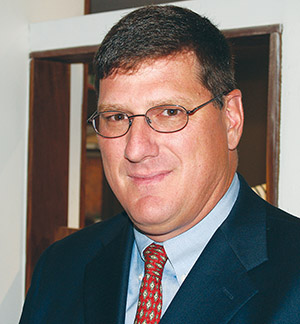
Amidst this din of propaganda, dissenting voices were generally drowned out – save for one, former UN weapons inspector Scott Ritter, who was often seen on US national news programs. When interviewed for a September 2002 book entitled War on Iraq, Ritter refuted the entire case for war – with authority.
“Since 1998 Iraq has been fundamentally disarmed,” Mr Ritter said. “90-95% of Iraq’s weapons of mass destruction capability has been verifiably eliminated… We have to remember that this missing 5-10% doesn’t necessarily constitute a threat. It doesn’t even constitute a weapons program… There’s no evidence Iraq retains this material… When I left Iraq in 1998, when the UN inspection program ended, the infrastructure and facilities had been 100% eliminated. There’s no debate about that.”73
Former UN weapons inspector Scott Ritter
The only ongoing point of non-compliance Mr Ritter would later relate in a pair of books released after the initiation of the war on Iraq (Iraq Confidential and Frontier Justice), was that Iraq failed to reveal its concealment program – the methods by which it sought to protect its state secrets from UN weapons inspectors, methods that led directly to the presidential security apparatus of Saddam Hussein. So long as the Iraqi regime resisted UNSCOM inspections into the presidential security system – what may have been Iraq’s last bastion of sovereignty against what it rightly saw as cover for a CIA spying operation – inspectors could not declare Iraq disarmed, thus placing it in the crosshairs of UN non-compliance. As it would turn out, compliance was a bigger threat to those fuelling the US agenda than non-compliance.
“Inspections could expose the truth,” Mr Ritter noted. “And truth was the enemy.”74 Truth was, Iraq had been disarmed, and a disarmed Iraq provided no justification for invasion.
In order for the Bush administration to sell the war, it had to fabricate a lie. A big one. In the shape of a mushroom cloud.
The war on Iraq was largely sold on the fear generated by the Niger documents, a set of forgeries that alleged Iraq had attempted to purchase uranium from mines in Niger. The source of the documents – delivered to the CIA and to Britain’s MI6 – was Italy’s intelligence agency, SISMI, which used a cash-strapped freelance Italian spy, Rocco Martino, to pass the forgeries and take the fall. In a series of articles exposing the scandal, la Repubblica described Mr Martino as “a failed policeman. A dishonest snitch… a scoundrel.”75 Mr Martino, however, described himself as a pawn.
“It’s true,” he ultimately confessed. “I had a hand in the dissemination of those documents (Niger uranium), but I was deceived. Behind this story there are, together, Americans and Italians. It was a disinformation operation.”76 It would ultimately become part of a much larger agenda: “…the active deception of the United States Congress, the international community, and the American people,”77 wrote Ambassador Joe Wilson.
In February 2002, the CIA asked Ambassador Wilson to travel to Niger to investigate the uranium charges – charges that the CIA found dubious. During his trip, he found nothing to substantiate the claims. He wasn’t the only one. The American ambassador to Niger, as well as Marine General Carlton Fulford, the deputy commander of US Armed Forces Europe, each met with Niger’s president and concluded that due to the controls in place, the uranium deal could not possibly have happened. Ambassador Wilson concluded the same thing.
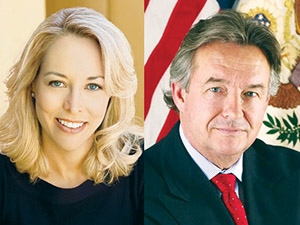
Former US Ambassador Joe Wilson and his wife Valerie Plame. She was outed as a covert CIA officer by the neo-cons responsible for the war on Iraq.
While the matter died a slow death in the American intelligence community, President Bush’s National Security Adviser, Dr Condoleezza Rice, on 8 September 2002, set the stage for its return during a CNN interview in which she said: “We know that [Saddam] has the infrastructure… [and] there will always be some uncertainty about how quickly he can acquire nuclear weapons. But we don’t want the smoking gun to be a mushroom cloud.”78 Two weeks later, the British government resuscitated the corpse in a white paper that stated, “there is intelligence that Iraq has sought the supply of significant quantities of uranium from Africa.”79
Although the charge had been discredited by Ambassador Wilson, General Fulford, the CIA and the ambassador to Niger, this Frankenstein accusation became the cornerstone in the US rebuttal to Iraq’s last ditch effort to fully declare the history of its WMD program. A 12,000 page disclosure submitted in December 2002, the final attempt by Iraq to publicly demonstrate compliance and avoid war. The US State Department, in reply to Iraq’s disclosure, asked, “Why is the Iraqi regime hiding their Niger procurement?”80 It was a question that Franz Kafka may have appreciated.
January 2003 was pivotal for marketing the Iraq war to the world. That month Australian Prime Minister John Howard met with his US and UK counterparts in Washington to discuss “post-invasion plans, including issues of security, humanitarian issues, reconstruction, political leadership, economic matters and the oil industry.”81 A week later, President Bush sold it to the American people in his State of the Union address, claiming that, “The British government has learned that Saddam Hussein recently sought significant quantities of uranium from Africa.”82
According to ex-CIA agent Paul Pillar: “The White House attributed the charge to the British because the CIA wouldn’t vouch for it.”83 In fact, Secretary of State Colin Powell, during his infamous address to the UN Security Council the following month, avoided citing the uranium claims and instead relied on a cache of aluminium tubes which had been intercepted in 2001 on their way to Iraq. These tubes would cause Secretary Powell to conclude, “there is no doubt in my mind, these elicit procurement efforts show that Saddam Hussein is very much focused on putting in place the key missing piece for his nuclear weapons program.”84
The tubes, however, were for conventional rockets.85 International Atomic Energy Agency (IAEA) Director General Mohamed el-Baradei concluded as such and confirmed that the Niger documents were, in fact, forgeries when he addressed the UN Security Council on 7 March 2003.
That day the United Nations made this point crystal clear in its press release:
“The Director-General of the IAEA, Mr ElBaradei, reported that, after three months of intrusive inspections, the Agency had found no evidence or plausible indication of the revival of a nuclear weapons programme in Iraq. There was also no indication that Iraq had attempted to import uranium since 1990 or that it had attempted to import aluminium tubes for use in centrifuge enrichment.”86
The American media failed to bring the UN’s news to a volume that could compete with the national debate over mushroom clouds. The White House had made its case and presented war as the only solution. Twelve days later, the United States invaded Iraq.
But there was, in fact, another option.
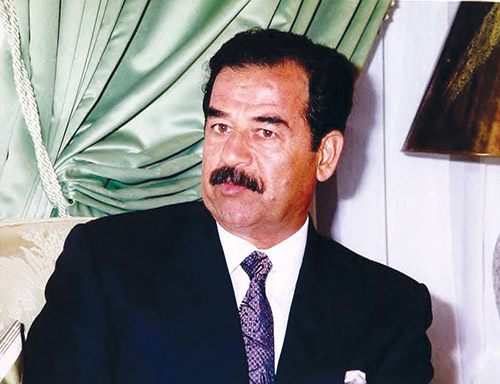
Former President of Iraq, Saddam Hussein (1937–2006), tried in vain to negotiate a path away from war, but the Anglo-Americans had already made up their mind, even justifying the invasion of Iraq based on lies (Saddam’s “weapons of mass destruction” and link to 9/11). Saddam Hussein was subjected to a show trial by the interim Iraqi authorities and hanged in 2006.
Peace Deal
In October 2002, when Hans Blix, the head of the United Nations Monitoring, Verification and Inspection Commission (UNMOVIC) and Mohamed el-Baradei, Director General of the International Atomic Energy Agency (IAEA), met with Amer al-Saadi, Saddam’s liaison with the UN weapons inspectors, the Iraqis were ready to comply, if only to avoid a full-scale invasion. During the meeting, Iraq agreed to once again cooperate with UN weapons inspectors, and as a result, inspections resumed that November.
As war approached, Saddam Hussein’s regime was cooperating with UN inspections, Mr Blix later told CNN correspondent Christiane Amanpour.87 In reply to Iraq’s cooperation, a White House official told CNN, “We’re not surprised. Obviously the Iraqis want to delay and deceive.”88
But the White House did not have any open communication channels with Iraqi diplomats. White House policy was based on hunches and gut feelings absent of any face-to-face dialogue. Susan Lindauer, however, had been negotiating with Iraqi diplomats, on behalf of the CIA, since November 2000, and what she accomplished had the power to pull the rug right out from underneath Bush’s war footing.
Fortunately, she kept a fairly detailed record of her progress via multiple correspondences to her second cousin, Andy Card, Bush’s chief of staff, the man who, on 11 September 2001, in front of a class of second grade students, whispered in the President’s ear, “America is under attack.” Ms Lindauer’s letters are dated from 1 March 2001 and continue to 6 January 2003. They detail an intriguing story that begins with Iraq’s desire to peacefully end its conflict with the United States and continues towards desperation as the American invasion drew imminent.
Ms Lindauer’s negotiations began with Dr Saeed Hasan, Iraq’s Ambassador to the United Nations. “I emphasised that the return of weapons inspectors would be a critical precondition to ending the conflict,” Ms Lindauer wrote in the first of her letters. “Dr Hasan confirmed that Iraq could complete negotiations within three to four weeks, so great was the government’s desire for a comprehensive resolution to the troubles.”89 The Bush administration was just settling into the White House at this point, but wasted no time to exercise aggression. An American and UK bombing campaign against Iraq on 16 February 2001 complicated Ms Lindauer’s efforts.
Nevertheless, “Iraq is ready for direct dialogue with no conditions,” Dr Hasan told Ms Lindauer. “Once the United States conducts a thorough review of its regional policy, we are ready for a mature discussion that will achieve a comprehensive solution.”90
By July 2001, Ms Lindauer was discussing Iraqi oil concessions for American petroleum companies. But what she really needed was “White House support.”91
After 11 September, everything changed. Ms Lindauer’s 24 September letter to Mr Card was sent with “an urgent prayer for peace”92 between the US and Iraq. Whereas, previously, Iraqi diplomats had insisted on meeting with high-level representatives from the White House or State Department, the Iraqis put on paper their willingness to meet “any American official in a covert or incovert manner to discuss the common issue.”93 By December, the Iraqis upped the ante. In addition to allowing the weapons inspectors to return, Iraq offered its cooperation on terrorism investigations. By March 2002, Baghdad offered concessions to American corporations to help rebuild Iraq, which was in dire need of infrastructure after twelve years of sanctions and bombings. Additionally, “Baghdad offered to buy one million American manufactured automobiles every year for 10 years.”94
Nevertheless, by January 2003 the invasion of Iraq seemed all but inevitable. Andy Card had not responded to a single one of her missives during the two years she delivered them. She made one final attempt to make contact with the Bush administration, delivering a letter to Colin Powell on 27 January 2003, one week before his presentation at the UN.
“Mr Secretary, there’s a great deal that can be done… if you would allow me, I will set this in motion. I would be more than content to make the appropriate introductions for a covert meeting, which could take place in Baghdad or Jordan. I could make sure you’ve got the right people in the room, and then I could step into the hallway, and get out of the way.”95
Ms Lindauer had the skeleton of bilateral negotiations on paper – a framework for peace. Concessions in hand. But there were no negotiations. And the weapons inspectors of UNMOVIC were ignored.
As Mr. Blix later concluded, “Had the inspections been allowed to continue, there would likely have been a very different situation in Iraq.”96
The Unravelling
While the first chink in the Bush administration’s shield of lies was exposed by former FBI agent Coleen Rowley, who revealed how close the FBI was to actually breaking open the 9/11 case in August 2001, the public was content to let the buck stop at FBI Director Robert Mueller.
By summer 2003, no WMDs had been found in Iraq. Fingers started pointing.
In June 2003, the US Senate Select Committee on Intelligence (SSCI) initiated the first phase of its investigation, ultimately to determine “the objectivity, reasonableness, independence, and accuracy” of the intelligence community’s judgments and “whether any influence was brought to bear on anyone to shape their analysis to support policy objectives.”97 In other words, did the White House pressure CIA to ensure that its intel matched the President’s script?
On 6 July 2003, the New York Times published an op-ed piece by Ambassador Joe Wilson that reverberated all the way to the White House and which, after the White House took its revenge, led to Vice President Dick Cheney’s chief of staff, “Scooter” Libby, taking the fall in a legal case that stopped far short of its potential.
In Ambassador Wilson’s article, titled “What I Didn’t Find in Africa,” he laid bare the truth from the first sentence: “Did the Bush administration manipulate intelligence about Saddam Hussein’s weapons programs to justify an invasion of Iraq?”98 Ambassador Wilson then told a story to which the general public had not yet been privy: the truth about his trip to Niger to confirm that the so-called Niger documents were utterly baseless – confirmation that the Bush administration knew that no substantive evidence existed to suggest Iraq had a nuclear program.
Like gangsters, Cheney and his posse went after Ambassador Wilson’s family – his wife, Valerie Plame – by outing her as a covert CIA officer.
“It seemed that the motive for the attacks on me was to discourage anyone else from coming forward who had a critical story to tell,” Ambassador Wilson later wrote. “The message to mid-career intelligence officers was clear: Should you decide to speak, we will come after you and your family.”99
The Fall Guy
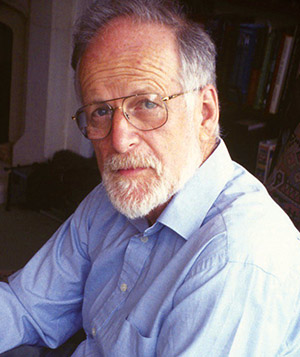
Welsh weapons inspector Dr David Kelly supposedly committed suicide on 17 July 2003. In the previous days, Kelly had testified before the UK Parliament’s Foreign Affairs Select Committee that he was not the source of a BBC story which had accused the government of making false claims about Iraq’s WMD. His death ruled suicide at the time, now even close friends of Dr Kelly believe he was murdered by agents of British intelligence.
Within weeks of Ambassador Wilson’s op-ed piece, Welsh weapons inspector Dr David Kelly was found dead – a supposed suicide – in the woodlands of Oxfordshire, England. His wrists were cut, but paramedics reported a suspicious lack of blood at the scene.100 The knife he apparently used to slash his wrists had no fingerprints, nor did the blister pack of pills from which he allegedly overdosed.101 Although Ambassador Wilson and Dr Kelly aren’t directly linked, both cases involved governments lying their countries to war on bogus intelligence and leaking names after the truth was revealed. In both cases, the public narrative focused on who leaked instead of the far more important issue of bogus intelligence and how such shoddy intel could make its way into the speeches of President Bush and Prime Minister Tony Blair.
Days after Ambassador Wilson’s article, on 11 July, CIA Director George Tenet took the fall for the Niger debacle, issuing a press release that stated, “I am responsible for the approval process in my agency.”102
The White House officially had its scapegoat.
In fact, the Bush administration was in full propaganda mode, using legendary Watergate journalist Bob Woodward as its mouthpiece. Mr Woodward was given exclusive access to Bush and his circle at the end of 2003 for Plan of Attack, which details the debates within the White House about going to war. According to Mr Woodward, the President was hesitant about invading Iraq until swayed by an emotional outburst by the CIA chief.
“Bush turned to Tenet. ‘I’ve been told all this intelligence about having WMD and this is the best we’ve got?’… Tenet rose up, threw his arms in the air. ‘It’s a slam dunk case!’ the DCI said.”103
War of the Words
Within months of the Iraq invasion and Bush’s declaration of “Mission Accomplished,” things started getting messy. It was in August 2003 when America got the first real taste of what the Iraq invasion had wrought. The doors had been opened for the next stage of jihad. Abu Musab al-Zarqawi was a mujahideen-turned-street thug who ended up in a Jordanian prison during the late 1990s. Here he was indoctrinated in Wahhabist philosophy by Abu Muhammad al-Maqdisi, “a firebrand preacher known for penning screeds against Arab leaders.”104
Within a three-week period that August, Zarqawi’s network in Iraq executed three mass murder attacks that first served to isolate America and then initiated a quagmire into which the US would sink deeper and deeper. On 7 August, Zarqawi’s team set off a remote controlled bomb at the Jordanian embassy, killing 17. On 19 August, a suicide bomber hit the UN building, killing 22, the deadliest attack ever on a UN facility. The UN left the country. The NGOs were driven out and nations were discouraged from opening embassies. On 29 August, two car bombs exploded at a Shia mosque, Imam Ali, killing at least 85 people and igniting a sectarian war between Shia and Sunni.
The American “coalition” military was left alone in the midst of a civil war. Americans were dying in Iraq. The quagmire had begun and former Treasury Secretary Paul O’Neill, who retired in 2003, found that the price of loyalty to Bush was too high.
With Mr O’Neill, journalist Ron Suskind co-wrote a damning exposé of the Bush administration, published in February 2004, and for the first time the protective code of secrecy surrounding the criminals in the White House had been broken. Mr O’Neill was one of the principals within the administration from 2001 to 2003. When Price of Loyalty was released, so too was a first glimpse of the truth – a President who was disengaged from the threat of terrorism and overly obsessed with invading Iraq.
In February 2004, the Senate Select Committee on Intelligence (SSCI) broadened the scope of its inquiry beyond WMD to “the collection of intelligence on Iraq from the end of the Gulf War to the commencement of Operation Iraqi Freedom.”105 That is when Susan Lindauer decided to go public. She called the offices of Senators Trent Lott and John McCain. She wanted to go on record and testify.
“If Congress wanted to study Pre-War Intelligence,” Ms Lindauer would later write, “they had better talk to me.”106
On 11 March 2004, Ms Lindauer was arrested and charged with being an unregistered Iraqi agent.107
Two weeks later, former Terrorism Czar Richard Clarke released his tell-all, Against All Enemies, giving the public its first true glimpse into the White House’s crisis management of 9/11. The title alone, quoted from the United States Oath of Allegiance, stated what Mr Clarke would only imply – that the enemies of the United States are not only foreign, but also domestic.
The Incarceration and Vindication of Susan Lindauer
Spies are not encouraged to keep diaries, send memos or make carbon copies of reports. If they attract suspicion, ‘deniability’ is their only hope. But if a spy is cut off by his own country, deniability works like a hangman’s noose… it usually comes down to his word against his government’s. – Lester Coleman & Donald Goddard, Trail of the Octopus108
Although Susan Lindauer was not a spy, she was an intelligence asset, working covertly for the CIA. In March 2004, she was arrested under the authority of the Patriot Act. As such, evidence against her was classified, her court appointed attorney was legally forbidden from sharing information with her, and if he did share this “secret evidence,” he would risk going to jail or being disbarred. It was, in effect, an attempt to prevent Ms Lindauer from building her case. But those who wanted to keep her quiet had more than indefinite detention in mind. In order to discredit her, the government intended to label her crazy.
Her arrest under the Patriot Act was only the first act of very dark drama. The second act began with a psychiatric evaluation.
“In the 1970s and 1980s due to the systematic political abuse of psychiatry in the Soviet Union… approximately one-third of the political prisoners were locked up in psychiatric hospitals.”109
Prior to the dissolution of the Soviet Union, those who opposed the regime were deemed mentally ill because “there was no other logical explanation why one would oppose the best sociopolitical system in the world.”110 This abuse became so rampant within the USSR that the Soviets were forced to withdraw from the World Psychiatric Association in 1983. Prior to that, however, in 1972, representatives of the USSR testified in front of the US Congress to bring this abuse to the world’s attention.
When the chief counsel for the Senate subcommittee introduced the topic of the hearing, “Abuse of Psychiatry for Political Repression in the Soviet Union,” he added, “and its implications for American security.”111 Truth is American security is compromised by an infrastructure that mimics exactly the types of abuses performed by the former Soviet Union – in particular, “special hospitals [that] are, in fact, prisons under military supervision and guards.”112
Ms Lindauer had intended to use a government defense at her trial, arguing that she “had authorization to deal with Iraq because of my Asset status.”113 But after she was compelled to submit to court ordered psychiatric evaluations, the psychiatrist recommended that she was “incompetent to stand trial” because she wouldn’t agree to an insanity defense, and because she insisted that her court appointed lawyer pursue witnesses, and because she believed she would prevail at trial.114
Subsequently she was transferred to Carswell Prison, a psychiatric prison inside of Carswell Air Force Base, where she would undergo an extended psychiatric evaluation – for the next year.
“Legally, once a person has been found psychotic or ‘not responsible’ by the Soviet authorities, compulsory treatment may be terminated only by a court of justice,” noted one of the Russian witnesses in 1972. “In practice, a favorable determination by the commission usually depends on the readiness of the patient to give the desired answers to certain questions; namely, recognition of the correctness of the patient’s confinement, admission that his views were wrong, and the promise to conform with the established ideology in the future.”115
Ms Lindauer refused to give the desired answers, refused to admit to the correctness of her confinement and refused to admit her views were wrong.
Then came the drugs.
“There are many cases of the forcible use in Soviet psychiatric hospitals of medical preparations harmful to the mental and physical health of the patient,” one Russian witness noted in 1972. Another added: “A deeply disquieting pattern, sometimes involving the punitive and potentially dangerous use of powerful drugs, seems to be emerging in the treatment of dissenters in Soviet mental institutions.”116
Within the military-run psychiatric prison of Carswell Air Force Base, the doctors proposed for Ms Lindauer a treatment of Benzodiazepeines, Prozac and Haldol. Common side effects of Haldol include hallucinations, seizures and memory loss.
Ms Lindauer described her experience with one of the Carswell inmates who had been subjected to Haldol treatments for a number of years: “She was docile like a baby. She could no longer speak in sentences. Or eat. Or dress. Or bathe. She slept 18 to 20 hours a day, and wet the bed frequently. All family ties had been lost, since she could not talk on the prison phones.”117
However, Ms Lindauer’s uncle, Thayer Lindauer, a corporate lawyer, took up her case and sidelined the court-appointed attorney during a yearlong fight to keep his niece from being forcibly drugged. Mr Lindauer later wrote in an affidavit:
“She has not exaggerated the threat of ‘indefinite’ detention that she faced, or the aggressive push to forcibly drug her with Haldol.
“It is absolutely correct that Carswell’s psychology staff, the US Attorney’s Office in New York, the FBI and the main Justice Department had direct knowledge that Susan had told the truth about her Asset work. I have spoken to witnesses myself, who told me that they assured the FBI and/or psychologists at Carswell that Susan was telling the truth. I must conclude the request for forcible drugging was politically motivated.”
Fortunately, Ms Lindauer prevailed in court and she retained her senses, so upon release she could tell her tale.
Nevertheless, the question remains: Why does the United States have an infrastructure in place that mimics exactly the type of infrastructure used by the Soviet Union to abuse psychiatry to repress political dissidents? Who copied whom? Or are both infrastructures a matter of similar origin?
In September 2006, Ms Lindauer was released from prison on bail after Judge Michael Mukasey ruled against forced medication. She would continue to fight the charges for another two-and-a-half years until the government disposed of the case in a filing that stated, “the continued prosecution of this case… would not be in the interests of justice.”118 But while her story of back channel communication with Iraq may seem contrary to the establishment narrative, Ms Lindauer’s peace negotiations were only one avenue the Iraqis sought to avert a looming war.
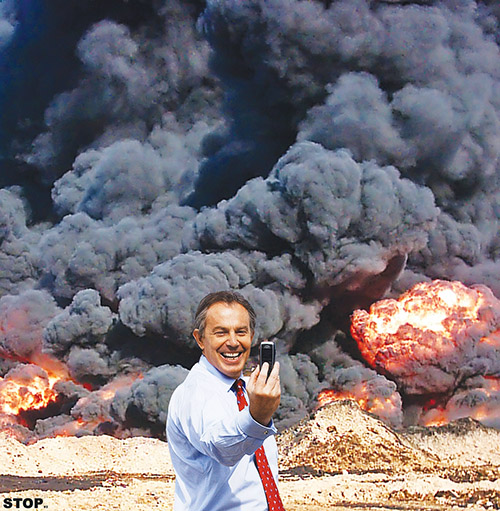
Former UK Prime Minister Tony Blair. Doctored photo illustrates Blair’s willingness to invade Iraq in 2003.
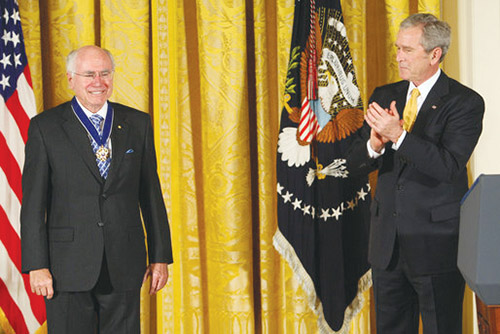
In 2009, US President George W Bush awarded Australian Prime Minister John Howard the US Medal of Freedom, describing Howard as “his man of steel.” In the immediate aftermath of 9/11, George W Bush, Tony Blair and John Howard strutted the world stage as members of the ‘Coalition of the Willing’. They led the invasion of Iraq in 2003, a country that had nothing to do with the events of 11 September 2001. Their reputations have since been savagely damaged. Britain’s recent Chilcot Report slammed the nation’s rush to war. A report from the Australian Directorate of Army Research, declassified in 2016, demonstrated that the only reason Australia got involved in the war was to shore up its alliance with the USA. The conflict reverberates to this day, with Amnesty International recently accusing Australia of war crimes. A number of international tribunals have found the trio guilty of war crimes. Former intelligence officer Andrew Wilkie, the only insider to publicly speak out about the false evidence used to justify the invasion of Iraq, recently said: “Prime Minister John Howard and then foreign minister Alexander Downer rightly stand accused of war crimes and their actions should be properly investigated. The bottom line is that these matters constitute Australia’s greatest foreign and security policy blunder in our history.” (Source: www.thenewdaily.com.au/news/national/2017/09/11/911-terror-attack-anniversary)
The root of all the destruction in our world is itself the very thing that can wake us up. – Paul Levy119
We are almost a generation removed from 9/11 and the Iraq War, but the pattern of corruption hasn’t much changed – only the intensity of violence broadcast around the world. The murder of 3,000 Americans on 11 September 2001 was savage. The digital age culture of beheadings initiated by Zarqawi relishes in that savagery. There’s also been the savagery of so-called ‘Islamic State’ – mass beheadings, immolations, crucifixions, firing line executions – recorded on video and distributed throughout the Internet. Such violence, however intense, pales in comparison to the mass murder visited on the civilian populations of the Middle East via Western initiated or sponsored warfare.
In the West, whistleblowers have become fugitives, with Edward Snowden exiled in Russia and Wikileaks’ Julian Assange exiled at the Ecuadorian embassy in London. Meanwhile the Western public is fed a steady diet of anti-Russian and anti-Iranian propaganda.
Though sidelined by analysts and academics, al Qaeda is alive and kicking with Muslim Brother al Zawahiri the man in charge. In Pakistan alone, there are reportedly 24,000 madrassas preaching Wahhabi-style jihad to two million boys.120
Israel, meanwhile, has become the most militarised nation in the world.121 Its defense sector is exporting technology and population control methodology, what Jeff Halper (head of the Israeli Committee Against House Demolitions) calls securitization, or the securocratic war against the people, lab tested on Palestinians in the occupied territories. The two-state solution is now all but dead. Meanwhile, Israel’s former enemy, Saddam Hussein’s Iraq, has basically been removed from the chessboard while its primary enemy, Iran, is encircled by Western forces and its other enemy, Syria, is in tatters.
The rise of so-called ‘Islamic State’ neatly paralleled aspects of the rise of the Taliban, with abandoned weapons caches supporting highly mobilised infantries zipping through the countryside in waves of Toyota trucks, promising stability to populations racked by civil war and corrupt administrations – along with plenty of outside funding to back up their efforts. Not surprisingly, a Hillary Clinton email released by Wikileaks named Saudi Arabia as a primary funder of ISIL.122 Closer to the truth is the following statement by a former veteran jihadist whose testimony was recently published by Oxford University Press:
“In his description of the Islamic State in Iraq and other such ‘post-al-Qaeda’ groups at the time, he said that ‘the support infrastructure provided by Gulf financiers has been the elephant in the room… funded and directed by the elite for their own purposes… Jihad is no longer an activity carried out by the [whole Muslim world]; it is jihad led by the rich’.”123
It is a jihad led by the rich and used as a tool to destabilise regimes that are non-compliant with the global corporatocracy. And when we put it all together, that is the point – the looming global elite takeover. It’s not ultimately about oil, war profits, Hanbali sharia or any of the singular narrative threads within this ego-driven ball of yarn. Rather, it is the closing in of a global corporate takeover. The same global takeover that Bill Cooper – and more recently David Icke – warned us about.
Humanity on planet Earth has been corrupted by an ordering principle of criminality that quietly self-organises behind the scenes in a web of common interests.
Does it completely self-organise? Or, like intersecting ripples on the surface of the water, do the various strands of the web merge as the result of impulses originating from sources unknown; moments of inspiration, as Mr Brzezinski would say, to knowingly increase the probability that certain things will occur, perhaps many years in the future?
As of this writing, the so-called ‘Islamic State’ is on its last leg, entrenched in the dwindling territory of its former ‘capital’, Raqqa, in Syria, where it is currently surrounded and losing territory by the day. “The caliphate’s short, brutal life is drawing to a close,” The Economist reported.124
If history is any guide, however, the Islamist infrastructure will produce a new wave of jihad. The jihadists are reportedly fleeing to the northwestern Syrian countryside and regrouping for the next period of jihadi gestation.125 With increasing American involvement in Syria, global jihad is preparing for a fresh new call. Just like the Iraq war saved a dying al Qaeda, American engagement in Syria will likely save a dying ISIL.
[alert type=”general” dismiss=”no”]This article was published in New Dawn 165.[/alert]
[alert type=”success” dismiss=”no”]If you appreciate this article, please consider subscribing to help maintain this website.[/alert]
Footnotes
73. Scott Ritter, War on Iraq, Context Books, 2002, 28-31
74. Ritter, Frontier Justice, 150
75. Carlo Bonini, Giuseppe D’Avanzo, “Double Agents and Amateur Italians of Nigergate”, la Repubblica, 24 October 2005, www.repubblica.it/2005/j/sezioni/esteri/iraq69/sismicia/sismicia.html
76. Ibid.
77. Wilson, 424
78. Wolf Blitzer, “Search for the ‘Smoking Gun’,” CNN, 10 January 2003, www.cnn.com/2003/US/01/10/wbr.smoking.gun/
79. United States Senate Select Committee on Intelligence, Report on the U.S. Intelligence Community’s Prewar Intelligence Assessments on Iraq, 9 July 2004, 50
80. U.S. Department of State, “Illustrative Examples of Omissions From the Iraqi Declaration to the United Nations Security Council,” 19 December 2002, https://2001-2009.state.gov/r/pa/prs/ps/2002/16118.htm
81. James O’Neill, “Lessons from the Iraq War: a reappraisal,” 7 January 2017, http://johnmenadue.com/?p=8963
82. George Bush, “State of the Union,” 28 January 2003, https://george
wbush-whitehouse.archives.gov/news/releases/2003/01/20030128-19.html
83. “Niger Uranium Rumors Wouldn’t Die,” Los Angeles Times, 17
February 2006
84. Colin Powell, “Remarks to the United Nations Security Council,”
5 February 2003, https://2001-2009.state.gov/secretary/former/powell/
remarks/2003/17300.htm
85. The Commission on the Intelligence Capabilities of the United States Regarding Weapons of Mass Destruction, Report to the President of the United States, 31 March 2005,49
86. United Nations, United Nations Weapons Inspectors Report to Security Council on Progress in Disarmament of Iraq, 7 March 2003, www.un.org/press/en/2003/sc7682.doc.htm
87. “U.N. weapons inspector Hans Blix faults Bush administration for lack of ‘critical thinking’ in Iraq,” 18 March 2004, www.berkeley.edu/news/media/releases/2004/03/18_blix.shtml
88. Kelly Wallace, “Iraq: No obstacles to inspections,” CNN, 12 October 2002, www.cnn.com/2002/WORLD/meast/10/12/iraq.letters/index.html
89. Susan Lindauer, Letter to Andy Card, 1 March 2001, http://911review.org/Lindauer/
90. Ibid.
91. Susan Lindauer, Letter to Andy Card, 3 July 2001, http://911review.org/Lindauer/
92. Susan Lindauer, Letter to Andy Card, 24 September 2001, http://911review.org/Lindauer/
93. Ibid.
94. Lindauer, 405
95. Susan Lindauer, Letter to Colin Powell, 27 January 2003, www.scribd.com/document/337187153/Susan-Lindauer-letter-to-Colin-Powell
96. “U.N. weapons inspector Hans Blix faults Bush administration for lack of ‘critical thinking’ in Iraq,” 18 March 2004, www.berkeley.edu/news/media/releases/2004/03/18_blix.shtml
98. Joseph Wilson, “What I Didn’t Find in Africa,” The New York Times, 6 July 2003
97. U.S. Senate Select Committee on Intelligence, 20 June 2003, www.
intelligence.senate.gov/press/senator-pat-roberts-r-ks-chairman-and-
senator-jay-rockefeller-iv-d-wv-vice-chairman-senate
99. Wilson, 6, 338.
100. “Medics raise Kelly death doubts,” BBC News, 12 December 2004, http://news.bbc.co.uk/2/hi/uk_news/4089729.stm
101. “Attorney General refuses Fiat for fresh inquest into death of Dr David Kelly,” Leigh Day, 9 June 2011, www.leighday.co.uk/News/2011/June-2011/Attorney-General-refuses-Fiat-for-fresh-inquest-in
102. Jamie MacIntyre, David Ensor, “Tenet admits error in approving Bush speech,” CNN, 25 December 2003, www.cnn.com/2003/ALL
POLITICS/07/11/sprj.irq.wmdspeech/
103. Bob Woodward, Plan of Attack, Simon & Schuster, 2004, 249
104. Joby Warrick, Rise of Isis, Anchor, 2016, 19
105. U.S. Senate Select Committee on Intelligence, 12 February 2004, www.intelligence.senate.gov/press/chairman-roberts-and-vice-chairman-rockefeller-issue-statement-intelligence-committees-review
106. Lindauer,11
107. United States of America vs. Susan Lindauer,S2 03 Cr. 807 (MBM), http://news.findlaw.com/usatoday/docs/iraq/uslindauer31004ind.pdf
108. Lester Coleman & Donald Goddard, Trail of the Octopus,
Bloomsbury, 1993, 2
109. Robert Van Voren, “Political Abuse of Psychiatry – An Historical Overview,” Schizophrenia Bulletin, vol. 36 no. 1, 2010, 33
110. Ibid.
111. United States Senate Committee on the Judiciary, Abuse of Psychiatry for Political Repression in the Soviet Union, Arno Press, 1974, 6
112. United States Senate Committee on the Judiciary, 6-7
(emphasis added)
113. Lindauer, 222
114. Lindauer, 226-227, 238
115. United States Senate Committee on the Judiciary, 7
116. Ibid., 8, 44
117. Lindauer, 297
118. United States of America vs. Susan Lindauer,S2 03 Cr. 807 (LAP), www.courtlistener.com/docket/4328367/108/united-states-v-al-anbuke/
119. Paul Levy, Dispelling Wetiko, (North Atlantic Books, 2013), 100.
120. “The Hard Choice for Pakistan,” The Economist, 2 April 2016
121. Max M. Mutschler/BICC, Global Militarization Index 2016, Bonn International Center for Conversion, 2016
122. Patrick Cockburn, “US allies Saudi Arabia and Qatar are funding Isis,” The Independent, 14 October 2016,www.independent.co.uk/voices/hillary-clinton-wikileaks-email-isis-saudi-arabia-qatar-us-allies-funding-barack-obama-knew-all-a7362071.html
123. Christopher Davidson, Shadow Wars, OneWorld, 2016, 446-447
124. “The Iraqi army is on the brink of defeating Islamic State,” The Economist, 11 March 2017
125. “‘Second ISIS’ made up of defeated rebels is emerging in Syria,” RT, 11 March 2017, www.rt.com/news/380308-second-isis-syria-rebels/
In the second part of this series, MARC STAR examines ignored or suppressed events connected to the September 11, 2001 attacks and the real reasons for the war against Iraq (read Part One here).
9/11 and the Plan to Remake the Middle East
In the United States of the 1990s, officials within the Clinton administration were well aware of the growing threat of global terrorism. From the original World Trade Center bombing in 1993, the bombings of Kenya and Nairobi in 1998, the foiled Millennial Plot at the turn of the century, and the attack on the USS Cole in 2000, counterterrorism had become an official priority and a covert policy. Public policy, however, consisted of NATO wars, Iraq’s UN weapons violations and the President’s Oval Office inequities with female interns.
In 1998, Iraq ceased cooperating with UN weapons inspectors after accusing UNSCOM (United Nations Special Commission) of running cover for a CIA spying program. In response, the US pulled out the inspectors and began Operation Desert Fox, a bombing campaign that, as UN weapons inspector Scott Ritter would later note, “…had nothing to do with weapons production capability, but rather the leadership and security establishments of the government of Iraq and that the precision in which these targets were bombed was due in large part… to the information gathered by weapons inspectors.”28
Mr. Ritter’s account of his years as a weapons inspector details his unfolding realisation the CIA was using UNSCOM as a cover to spy on Iraq. In January 1999, US government employees admitted as such to the Washington Post and Boston Globe with, as the newspapers claimed, documentation to back it up. American officials substantiated the allegations later that month – all, however, under the cover of anonymity.29
Nevertheless, by 2000 a division within the CIA was interested in developing a covert dialogue with Iraqi diplomats to foster a framework for peace. Perhaps it was clear that Saddam was not going to step down or be deposed. Perhaps public support for bombing campaigns and sanctions had dried up. Or perhaps, just as UN weapons inspectors were used as cover for a CIA spying program, the CIA wanted a cover in the Iraqi embassy.
This division of the CIA chose a declared peace activist, Susan Lindauer, to be its liaison with Iraqi diplomats.
In the overt world, Ms. Lindauer had been, most notably, a congressional staffer. Covertly, she had been a CIA asset for years, working in the 1990s with Libyan diplomats “for the hand over of accused Lockerbie bombers to Scottish authorities”30 on behalf of her liaison at the CIA, Dr. Richard Fuisz.
In 2000, Dr. Fuisz gave Ms. Lindauer the opportunity to bring her negotiating talents to the issue of Iraqi weapons inspections.
“It would be a One-Woman Experiment with a new and wholly different approach to counter-terrorism. Success would depend on my ability to cultivate difficult relationships with… Iraqi diplomats in the opposite direction of official US policy,” she wrote.31 But, of course, it wasn’t only about peace. “[The CIA] wanted to leverage access from my activism to these embassies because they understood that Iraq and Libya had the best intelligence on terrorist activity in the Middle East. And the US needed to capture that intelligence.”32
By 2001, the relationships Ms. Lindauer had developed would prove to be of paramount importance as the chatter of an impending event grew to a near deafening volume.
9/11 Warnings
When President George W. Bush took office at the beginning of 2001, he was not interested in the threat of terrorism – despite alarm bells being rung by Richard Clarke, the National Coordinator for Counterterrorism, or the regular warnings given by CIA Director George Tenet and his analysts.
Instead, as later revealed by former Treasury Secretary Paul O’Neill, the Bush administration was drawing up plans and looking for excuses to invade Iraq from January 2001. According to Mr. O’Neill, “Ten days in, and it was about Iraq.”33
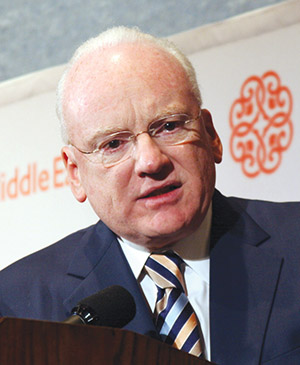
Richard Clarke
Mr. Clarke noted that in regards to funding, the Bush administration “had not placed terrorism in the top-priority issues for the Justice Department.”34 Additionally, Mr. Clarke’s position as National Coordinator for Counterterrorism (or Terrorism Czar, as the press labelled him) was downgraded below the status of principal. During the Clinton administration, he had been included in top-level meetings. After Bush took office, Mr. Clarke was excluded and, as he describes it, ignored.
Nevertheless, Mr. Tenet would plainly note, “at CIA, we knew al-Qa’ida was coming.”35
By 6 August, the intelligence community couldn’t have been clearer. In a now-famous President’s Daily Brief entitled “Bin Ladin Determined to Strike in US,” hand-delivered to Bush, he reportedly dismissed the PDB and responded, “You’ve covered your ass, now.”36 The 9/11 Commission later concluded that not only was no further action taken by Bush in response to this memo, “We have found no indication of any further discussion before September 11 among the President and his top advisers of the possibility of a threat of an al Qaeda attack in the United States.”37
Bush’s National Security Adviser, Condoleezza Rice, in 2004, testified to Congress: “Let me read you some of the actual chatter that was picked up in that spring and summer. ‘Unbelievable news coming in weeks’, said one. ‘Big Event. There will be a very, very, very, very big uproar. There will be attacks in the near future’. Troubling, yes, but they don’t tell us when. They don’t tell us where. They don’t tell us who. And they don’t tell us how.”38 It is almost unconscionable that the administration in charge of the United States of America, without being spoon-fed a specific when, where, who and how, would instead simply choose to do nothing.
Truth is, there was more than enough intelligence available to put the puzzle pieces together. The only thing missing was leadership from the top and a cohesive policy. In other words, the President should have gotten off the golf course and done his job because that summer’s prize capture, Zacarias Moussaoui, the alleged “20th hijacker,” was found in possession of flight manuals for the Boeing 747 Model 400, a flight simulator computer program, software that could be used to review pilot procedures for the Boeing 747 Model 400 and more.39 FBI Minneapolis Chief Division Counsel Coleen Rowley would later blow the whistle that within days of Moussaoui’s arrest, “the French Intelligence Service confirmed [Moussaoui’s] affiliations with radical Islamic fundamentalist groups and activities connected to Osama bin Laden.”40
While the Bush administration was wilfully and knowingly asleep at the wheel in 2001, the intelligence community was not. That summer, Dr. Fuisz tasked Susan Lindauer to deliver a message to the Iraqi embassy. As the United States had no official communication channels with Iraq, Ms. Lindauer found herself in the role of messenger.
Dr. Fuisz instructed her to demand that, “‘Iraq must hand over any intelligence regarding conspiracies involving airplane hijackings or airplane bombings… The United States would bomb Baghdad back into the Stone Age… if [we] discovered a terrorist conspiracy involving airplane hijackings or airplane bombings and [Iraq] failed to notify us. They would lose everything. We would destroy them. Those threats originated at the highest levels of government’, and I quote, ‘above the CIA Director and the Secretary of State’.”41
Ms. Lindauer added, “There’s no question that months before 9/11, a cabal of pro-War neo-Conservatives at the top of the government was already prepping the Intelligence Community to accept War with Iraq in the aftermath of a strike.”42
A close friend of Ms. Lindauer, Parke Godfrey, a tenured associate professor in the Department of Computer Science and Engineering at York University in Toronto, Canada, would later testify at a court hearing in June 2008 that Ms. Lindauer did share with him, in the summer of 2001, warnings of the impending terrorist attack.
“In the spring and summer of 2001, on several occasions Ms. Lindauer expressed heightened concern that a terrorist attack was in the works that would strike the southern part of Manhattan. She claimed it would reprise the 1993 attack on the World Trade Center.”43
9/11
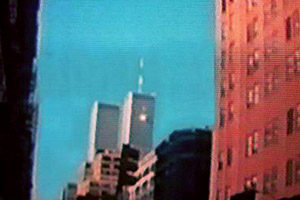
The story of 11 September 2001 is one of fascinating coincidences and absurd anomalies. Perhaps the most amazing coincidence is the incredible story of the Naudet brothers, Jules and Thomas, two filmmakers who happened to be shooting a documentary about the firemen of Engine 7, Ladder 1, the closest firehouse to the World Trade Center complex. Brother Jules happened to be on the streets of Lower Manhattan that morning with a small crew of firefighters responding to a gas leak – at a spot that gave Mr. Naudet a clear view of American Airlines Flight 11 as it flew overhead before impacting the North Tower between the 93rd and 99th floors. Mr. Naudet’s footage is, as far as the public knows, the only footage of the impact of Flight 11, the first plane to strike.
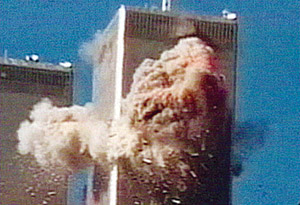
Jules Naudet’s film footage incidentally captured the moment when the first plane hit the North Tower of the World Trade Center.
That morning, President Bush was reading a children’s book to a class of second graders. However, he would later say, “I was sitting outside the classroom, waiting to go in, and I saw an airplane hit the tower. The TV was obviously on. I used to fly myself, and I said ‘There’s one terrible pilot’.”44
But Jules Naudet’s footage of Flight 11 wasn’t broadcast on television until long after both towers had collapsed and Jules had made his way through the dust. What footage did President Bush claim to see that morning?
The North Tower impact was captured by only one known video, that taken by Jules Naudet. However, his video only came to light long after the event, so what footage did President Bush claim to see that morning?
One might even wonder how hijacked airplanes could possibly confound the world’s most sophisticated air defense system, NORAD (North American Air Defense). The answer to this may lie in a military exercise being conducted that day called Vigilant Guardian, a semi-annual drill that, among other things, simulates plane hijackings. In 2006, Vanity Fair had the opportunity to review the NORAD tapes.
“For the neads [Northeast Air Defense Sector] crew, 9/11 was not a story of four hijacked airplanes, but one of a heated chase after more than a dozen potential hijackings – some real, some phantom – that emerged from the turbulence of misinformation that spiked in the first 100 minutes of the attack… At one point, in the span of a single mad minute, one hears [Major Kevin] Nasypany struggling to parse reports of four separate hijackings at once.”45
Following the impact of United Airlines Flight 175 into the South Tower, Bush’s chief of staff Andy Card entered the classroom and whispered in his ear, “A second plane hit the second tower. America is under attack.” Bush then took to the air within Air Force One while Vice President Cheney holed up in the President’s Emergency Operations Center (PEOC), an underground bunker beneath the White House. The task of managing the 9/11 crisis fell entirely on the shoulders of Richard Clarke, the recently demoted National Coordinator for Counterterrorism.
“I was most of the day, the nation’s crisis manager,” Mr. Clarke would later recount. “The government had largely fled Washington.”46
Safely underground in the PEOC bunker, the senior official of the executive branch of the United States government at the White House, Vice President Dick Cheney, was actively cutting off communication between his PEOC bunker and the crisis management team in the White House Situation Room, led by Mr. Clarke. At the outset of the crisis, Mr. Clarke sent Army Major Mike Fenzel into the PEOC to maintain an open line with him in the Situation Room. In the midst of it all, “Major Fenzel whispered, ‘but I can’t hear the crisis conference because Mrs. Cheney keeps turning down the volume on you so she can hear CNN… and the Vice President keeps hanging up the open line to you.”47
Susan Lindauer, meanwhile, was on the phone with her CIA handler, Dr. Fuisz. He knew, somehow, about the existence of video footage showing the first plane hitting the North Tower.
“‘How often does a bystander have a camera cued up to record a car accident on the street?’” Ms. Lindauer would later quote him telling her. “‘It never happens, Susan. It never happens’.” He would then add one of the most disturbing revelations of that day. “‘Those are Israeli agents’,” he told her. “‘They were waiting for it all morning’.”48
Israeli Spies
This brings us to perhaps the most controversial aspect of 9/11 – the Israeli connection. While Dr. Fuisz’s comment to Ms. Lindauer is, on its face, hearsay, an additional incident that occurred on 9/11 stands out as more than simply anomalous – the strange case of the so-called “dancing” Israelis.
As the Twin Towers burned that morning on 9/11, three young men were seen atop the roof of a white van taking photos of themselves with the World Trade Center ablaze in the background. The woman who reported the incident later said, “They were like happy, you know…” She wrote down the van’s license plate number and reported it to the police. When the van was pulled over later that day, five men were found inside. The driver told the arresting officer, “We are Israeli. We are not your problem. Your problems are our problems. The Palestinians are the problem.”49,50
The white van belonged to Urban Moving Systems. The FBI questioned the company’s owner, Dominik Otto Suter, an Israeli citizen, not only about the five detained Israelis, but also, “oddly,” as the FBI report stated, about another Urban Moving Systems truck stopped in Pennsylvania, headed towards the direction of Shanksville, the location where Flight 93 crashed. Mr. Suter told the FBI that the truck had no scheduled pickups or deliveries outside of New Jersey that day.51 Following the interview, Mr. Suter fled back to Israel. When the New York State Department of Transportation learned that the company’s main office was only a mailing address, its business license was revoked.52
Four of the arrested Israelis passed lie detector tests. A fifth, Paul Kurzberg, refused. Ten weeks later, however, Mr. Kurzberg finally agreed to test and failed. After 71 days in jail, the five Israelis were charged with visa violations and deported. The FBI closed its case, concluding that “no basis” was found to suggest that four of the Israelis were “in possession of or had any prior knowledge relating to the attacks on the World Trade Center of 9/11/01.” The FBI, however, found “no articulate facts… to demonstrate” that the “least cooperative” of the five Israelis “was in possession of or had any prior knowledge…”53 In other words, the FBI couldn’t make the case on Paul Kurzberg, despite a potential basis for doing so.
Forward, an American Jewish weekly, was able to get to the bottom of the story. According to a “former high-ranking American intelligence official… the five Israelis arrested in New Jersey last September were conducting a Mossad surveillance mission and… their employer, Urban Moving Systems… served as a front.” The mission was to spy on “a common enemy… radical Islamic networks suspected of links to Middle East terrorism.”54
The Forward article concludes with a quote from Chip Berlet, a senior analyst at the Boston-based Political Research Associates, noting a “backdoor agreement between allies that says that if one of your spies gets caught and didn’t do too much harm, he goes home. It goes on all the time. The official reason is always a visa violation.”
Harmless enough, until one more incident is taken into account. Prior to 11 September, a group of 120 Israeli “art students” were rounded up as part of a “widespread investigation into a suspected espionage ring run by Israel inside the USA.”55 One group of students resided in Hollywood, Florida, “just down the block from the 3389 Sheridan St. apartment where terrorist mastermind Mohammed Atta holed up with three other Sept. 11 plotters.”56 According to a French intelligence report on the “art student” bust, “Mossad agents were spying on Mohammed Atta and Marwan al-Shehi, two of [the] leaders of the 9/11 hijack teams.”57
Vincent Cannistraro, former chief of operations for counterterrorism with the CIA, told journalist Christopher Ketcham, “the FBI investigation [of the ‘dancing’ Israelis] operated on the premise that the Israelis had foreknowledge.” But the investigation was quashed. And the order to do so came from the top. A former CIA counterterrorism officer also told Mr. Ketcham, “There was no question but that [the order to close down the investigation] came from the White House. It was immediately assumed at CIA headquarters that this basically was going to be a cover-up so that the Israelis would not be implicated in any way in 9/11.”58
Some Mossad agents had foreknowledge. Some at the White House had foreknowledge. The events that unfolded indicate they knew each other knew, at least after the fact.
The 800-pound gorilla in the room, however, is the question of why Mossad agents would have been publicly celebrating on 9/11, conducting themselves in a way to attract the most attention? And why would Israeli spies posing as art students have “an inexplicable interest in peddling art to G-men”?59 Aside from the fact that both missions have been identified as surveillance programs to track Islamists in America, both sets of agents behaved in a manner that suggests they intended to be caught.
And Then the Towers Disappeared
Amidst the tragedy of 11 September 2001, an anomaly occurred that should give everyone pause for thought. It is a story of 14 firemen and an office worker trapped between the first and the sixth floors of the North Tower’s B stairwell when the tower disintegrated – the only people from inside either disintegrating tower who lived to tell the tale – and it was later immortalised in a UK broadcast documentary The Miracle of Stairway B.60
Arrow marks the section of North Tower’s B stairwell that somehow survived the collapse of the tower.
After the second plane hit, firemen were on their way up the North Tower, while office workers were on their way down. About an hour into the firemen’s journey, they had reached the 31st floor, which is when the South Tower disintegrated, causing such an earth shaking rumble that the firemen in the North Tower’s stairwell B were thrown to the floor. Captain Jay Jonas soon gathered that the South Tower had “collapsed.” He knew that his men were now in a race against time to descend the 31 floors they had just climbed. But they didn’t make it out.
As the North Tower disintegrated, “you could actually hear the floors hitting one another,” fireman Sal D’Agostino said. “Boom, boom, boom, boom. And as it fell, it got faster” (emphasis added). One hundred floors of the North Tower and more than a half million tons of material were presumably falling down upon them. Truth was, the 110-story tower disintegrated in just under 10 seconds – except for one pocket of the building in which fourteen people were left untouched.
The building didn’t fall down upon them. It disintegrated around them. Hours later, when the dust cleared, something amazing happened.
“All of the sudden, a ray of sunshine hit the stairwell,” said Captain Jonas.
“It was clearly sunlight,” added fireman Mickey Kross. “A 110-story building fell down on top of us, and I’m on the third floor looking at sunlight.”
The documentary claimed that, “experts… offered a tentative explanation. The tower fell with its exterior collapsing outwards at a faster rate than its interior, leaving a protected stump towards the base of the building.” Such an explanation, however, ignores one enormously crucial necessity: the cause of the “collapse.” The collapse hypothesis requires a ten-story section above the impact point of each tower crushing the floors below it.
The only problem with this hypothesis – which any cursory study of top-down images of ground zero will confirm – is that no ten-story sections are evident at the site. Absent the evidence of these ten-story sections at ground zero one must question the collapse hypothesis.
This lack of rubble was not lost on ABC News anchor Peter Jennings who, on 12 September, asked a question that bears repeating.
Aerial shot of collapse zone, fifteen days after 11 September, revealed a strange lack of rubble.
Mr. Jennings asked George Stephanopoulos, “[ABC News correspondent] Jackie Judd and several other people keep asking us, when you look at where the towers used to stand, there is surprisingly so little rubble. Where did all the rubble go?”
Mr. Stephanopoulos, the ABC reporter at Ground Zero, responded: “The reason there is so little rubble is that all of it simply fell down into the ground and was pulverized, evaporated.”61
The ten-story sections that supposedly crushed the 90-plus stories of building below them hit the ground and evaporated.
Magic.
The Plan
In March 2007, Amy Goodman of Democracy Now! interviewed Wesley Clark, a retired American four-star general who had commanded allied forces in the Kosovo War during his term as the Supreme Allied Commander Europe of NATO from 1997 to 2000. By 2007, the American war on Iraq had become an embarrassment, and insiders wanting to distance themselves from the Bush administration’s misadventures, were speaking freely. General Clark recounted a story that still has meaning today.
“About 10 days after 9/11,” General Clark said, “I went through the Pentagon [to see] Secretary Rumsfeld and Deputy Secretary Wolfowitz. I went downstairs just to say hello to some of the people on the Joint Staff who used to work for me, and one of the generals called me in. He said, ‘Sir you’ve got to come in and talk to me a second… We’ve made the decision we’re going to war with Iraq.’ …I said, ‘We’re going to war with Iraq? Why?’ He said, ‘I don’t know… I guess they don’t know what else to do’.
“So I came back to see him a few weeks later, and by that time we were bombing in Afghanistan. I said, ‘Are we still going to war with Iraq?’ And he said, ‘Oh it’s worse than that… I just got this down from upstairs’ – meaning the secretary of defense’s office – ‘…This is a memo that describes how we’re going to take out seven countries in five years, starting with Iraq, and then Syria, Lebanon, Libya, Somalia, Sudan and finishing off Iran’.”62
Your government allowed this to happen to its own people, so you could declare war on us. – Iraqi diplomat to Susan Lindauer after 9/1163
Elements within the government of the United States were no doubt itching to invade Iraq to not only clean up the mess the West created when it supported the Ba’athists to power in the late 1960s, and gain control of Iraq’s oil fields – a fuel-hungry military sweep through the Middle East was looming – but it also would be the beginning of a plan to subdue geopolitically relevant Middle Eastern countries not aligned or subordinated to the Western corporate power structure.
The CIA had initially helped the Ba’athists take power in 1960s Iraq to oust Prime Minister Abdel Kassem, a pro-communist who withdrew Iraq from the pro-West Baghdad Pact and opposed foreign forces on Iraqi soil. The CIA provided the Ba’athists with a list of communists and pro-leftists. The result was a bloodbath. “Soon, Western corporations like Mobil, Bechtel and British Petroleum were doing business with Baghdad – for American firms, their first major involvement in Iraq.”64
Al-Shaheed Monument (Martyr’s Memorial) was constructed in the Iraqi capital, Baghdad, by President Saddam Hussein’s Ba’athist government, and is dedicated to the Iraqi soldiers who died in the Iraq-Iran war.
But that relationship soured when Iraq nationalised its oil resources in 1972 and expelled Western oil companies. Saddam Hussein rose to power in 1979. It is now clear that the subsequent Iran-Iraq War, started when Iraqi forces invaded Iran, developed into a wilful effort to weaken two countries that weren’t playing ball with Western petroleum companies. In order to “avoid victory by both sides,”65 the US backed Iraq with covert arms shipments, while Israel clandestinely shipped US arms to Iran (in addition to secret US arms shipments to Iran that came to light during the Iran/Contra scandal in 1980s America).
The Arc of Triumph in Baghdad, also called the Swords of Qādisīyah, was constructed to commemorate the Iran-Iraq war, led by then Iraqi President Saddam Hussein.
When the war ended in August 1988, Iraq’s coffers had bled dry. Iraq was in debt to the tune of $80 billion, the bulk owed to surrounding Gulf states. Meanwhile, oil prices were dropping.
“By 1990, he [Saddam Hussein] was regularly defaulting on payments to his Arab creditors, particularly Kuwait, which held some $10 billion of Iraq’s debt.”66 But the drop in oil was no accident. Kuwait and the United Arab Emirates were overproducing, driving the prices down. Exacerbating the situation, Iraq claimed Kuwait was siphoning oil from the Rumaila oilfield underneath the Iraqi side of the border.
US Ambassador April Glaspie (on left) told Iraq’s President Saddam Hussein, “[W]e have no opinion on the Arab-Arab conflicts, like your border disagreement with Kuwait.”
As Iraqi forces massed along the border with neighbouring Kuwait, the US State Department and President George H. W. Bush, in official statements, took no position on the brewing conflict.67 US Ambassador April Glaspie told Saddam, “[W]e have no opinion on the Arab-Arab conflicts, like your border disagreement with Kuwait.”68 State Department spokeswoman Margaret Tutwiler stated, “We do not have any defense treaties with Kuwait, and there are no special defense or security commitments to Kuwait.”69 Ambassador Joseph Wilson would later write that Assistant Secretary of State John Kelly declared: “We don’t have any defense treaty with the Gulf States. That’s clear.” Ambassador Wilson added, “Within minutes, Kelly’s testimony was transmitted to Iraq.”70
Like the Soviet “Afghanistan trap,” Mr. Brzezinski might have categorised Iraq’s invasion of Kuwait as such: We didn’t push Iraq to invade Kuwait, but we knowingly increased the probability that it would.
Iraq’s invasion of Kuwait was followed by America’s Gulf War of 1991, the first salvo of a twelve-year process by which Iraq was beaten and slowly bled dry. By 2003, sanctions and ongoing bombing campaigns had effectively destroyed the country’s economy, infrastructure and military – well before Americans fired the first shot during the March 2003 invasion.
The Afghanistan War of 2002 was primarily a CIA-led conflict, executed with a strategy that the CIA does best – purchasing support from local warlords and supplying them with the means to get the job done. The American military was barely involved and, notoriously, Osama bin Laden escaped. The full force of the United States war machine instead was being saved for Iraq.
“There was… a surety inside CIA – also widely held – that the President would eventually get his way and there would be an invasion,” wrote journalist Ron Suskind.71
The Islamists also knew Iraq was next. After the US started bombing Afghanistan, members of al Qaeda began fleeing to Iraq, including Abu Musab al-Zarqawi, who “began establishing local support networks in Baghdad,”72 later becoming the leader of al Qaeda in Iraq.
All that remained was for the Bush administration to create enough fear to sell the war to the American people and the United Nations.
[alert type=”general” dismiss=”no”]This article was published in New Dawn 164.[/alert]
[alert type=”success” dismiss=”no”]If you appreciate this article, please consider subscribing to help maintain this website.[/alert]
Footnotes
28. Scott Ritter, Frontier Justice, Context Books, 2003, 37-38
29. Barton Gellman, “U.S. Spied On Iraq Via U.N.”, The Washington Post, 2 March 1999
30. Michael Collins, “American Cassandra – Susan Lindauer’s Story”, Scoop Independent News, 17 October 2007, www.scoop.co.nz/stories/HL0710/S00266.htm
31. Susan Lindauer, Extreme Prejudice, (self-published, 2010), 48
32. Lindauer, 60
33. Ron Suskind, The Price of Loyalty, Simon & Schuster, 2004, 75
34. Richard A. Clarke, Against All Enemies, Free Press, 2004, 256
35. Tenet, 187
36. Ron Suskind, One Percent Doctrine, Simon & Schuster, 2006, 2
37. Thomas H. Kean and Lee Hamilton, 9/11 Commission Report, National Commission on Terrorist Attacks Upon the United States, 2004, 261-262
38. “Testimony of Condoleezza Rice Before 9/11 Commission,” The New York Times, 8 April 2004
39. United States vs. Zacarias Moussaoui, Statement of Facts, Criminal No. 01-455-A, www.vaed.uscourts.gov/notablecases/moussaoui1/dktsheets/docs/70543/0.pdf
40. “Coleen Rowley’s Memo to FBI Director Robert Mueller”, Time, 21 May 2002
41. Lindauer, 20-21
42. Lindauer, 22
43. Parke Godfrey, Affidavit, 19 October 2009, https://extremeprejudiceusa.files.wordpress.com/2010/10/parke-godfrey-affidavit-on-911-warning.pdf
44. “On 9/11, Bush watched the first plane impact,” www.youtube.com/watch?v=BUXglJU2w6U
45. Michael Bronner, “9/11 Live: The Norad Tapes,” Vanity Fair, 17 October 2006,www.vanityfair.com/news/2006/08/norad200608
46. Clarke, 17-18
47. Clarke, 18
48. Lindauer, 95
49. Chris Isham, et al., “Were Israelis Detained on Sept. 11 Spies?”, 20/20, 21 June 2002, http://abcnews.go.com/2020/story?id=123885&page=1
50. Scott DeCarlo. East Rutherford Police Department, CSRR# 014157.
52. Neil Mackay, “Five Israelis were seen filming as jet liners ploughed into the Twin Towers on September 11”, Sunday Herald, 02 November 2003, http://web.archive.org/web/20031202162323/http://www.sunday
herald.com/37707
54. Marc Perleman, “Spy Rumors Fly on Gusts of Truth”, Forward,15 March 2002, http://web.archive.org/web/20020323052403/http://www.forward.com/issues/2002/02.03.15/news2.html
55. Sunday Herald, 2 November 2003
56. Christopher Ketcham, “The Israeli ‘Art Student’ Mystery”, Salon,7 May 2002, www.salon.com/2002/05/07/students/
57. Sunday Herald, 2 November 2003
58. Christopher Ketcham, “What did Israel Know in Advance of the 9/11 Attacks?”, Counterpunch, vol. 14, no. 3/4, 3
59. Ketcham, “The Israeli ‘Art Student’ Mystery”
60. “The Miracle of Stairway B”, www.youtube.com/watch?v=EpTRNEVKMY4
61. “ABC News, ‘Where’s all the rubble gone?’ (12:44 pm 9/12/2001)”, www.youtube.com/watch?v=GdBQOe85i3M
62. “Gen. Wesley Clark Weighs Presidential Bid”, Democracy Now!, 2 March 2007, www.democracynow.org/2007/3/2/gen_wesley_clark_weighs_presidential_bid
63. Lindauer, 103
64. Roger Morris, “A Tyrant 40 Years in the Making”, The New York Times, 14 March 2003
65. Seymour Hersh, “U.S. Secretly Gave Aid to Iraq Early in Its War Against Iran”, The New York Times, 26 January 1992
66. Zachary Karabell, Philip Zelikow, “Prelude to war: US Policy Toward Iraq 1988-1990”, Harvard Intelligence and Policy Project, 1999
67. R. Jeffrey Smith, “State Department Cable Traffic on Iraq – Kuwait Tensions, July 1990,” Washington Post, 21 October 1992
68. Stephen M. Walt, “Wikilieaks, April Glaspie, and Saddam Hussein,” Foreign Policy, 9 January 2011
69. Elaine Sciolino, Michael R. Gordon, “Confrontation in the Gulf; U.S. Gave Iraq Little Reason Not to Mount Kuwait Assault”, The New York Times, 23 September 1990
70. Joseph Wilson, Politics of Truth, PublicAffairs, 2005, 104
Those who cannot remember the past are condemned to repeat it. – George Santayana1
In May 2017, The Atlantic headlined “The Scramble for Post-ISIS Syria Has Officially Begun” as American-led forces are now directly attacking the Assad government and its Iranian-backed allies. What was once a proxy war has evolved into a Western dominated effort to “carve out spheres of influence”2 in Syria.
Like Iraq and Libya before it, Syria was next in line among a list of seven nations officially targeted by the American government to be taken out. The list, revealed by American General Wesley Clark in 2007, was quietly circulated at the Pentagon following the post-9/11 invasion of Afghanistan – and one by one, those targeted nations have been destabilised. The list ends with Iran.
While the mainstream media, year after year, reports on the events in the Middle East as happenstance conflicts exacerbated by popular rebellions and illogical fanatics bent on destroying infidels (unbelievers), the truth is far more revealing. The endless wars of our post-9/11 era have been a calculated drive to eliminate those resource-rich countries outside of Western corporate-military influence – most particularly countries within the sphere of Russian and Iranian influence.
To accomplish this goal, the West chose as its ally the very force against which most believe we are fighting – Islamist jihadists.
In 2015, the US watchdog group Judicial Watch obtained an August 2012 declassified US Department of Defense (DoD) document about the conflict in Syria. That document revealed, “The West, Gulf countries, and Turkey support the opposition” which, it noted, is comprised of “Salafist[s], the Muslim Brotherhood, and AQI [al-Qaeda in Iraq].”3
The document also revealed that Western support would create “safe havens” for the opposition to allow “the possibility of establishing a declared or undeclared Salafist principality in Eastern Syria… and this is exactly what the supporting powers to the opposition want in order to isolate the Syrian regime.”
Islamic State was exactly that principality predicted by the DoD document. Contrary to what the mainstream media and popular consensus intone, Islamic State and most jihadists are the undeclared allies of the West. This alliance, however, is not a new development. It is a courtship that spanned the entirety of the 20th century and into the 21st.
To study this alliance is truly an adventure in Wonderland – a crucial first step towards understanding how far the rabbit hole goes. Are you ready to take the red pill?
Global Terrorism and the Seduction of the Islamist Mind
The overriding reason for keeping the Middle East divided has been to ensure that no single power dominates the region’s oil resources and so that a strong combination of powers cannot challenge Western hegemony. – Mark Curtis, Secret Affairs4
Today, we live in a post-9/11 world and it is therefore imperative, most of all, to understand this pivot point in the global narrative. It was 9/11 that brought the United States into Iraq, and it was the destruction of Iraq that gave rise to Islamic State (IS).But if we want to understand contemporary jihad, we must examine, at least briefly, the origin of political Islam, or Islamism, which finds its most extreme expression in Salafism, an ideology that seeks to emulate the traditions of the Salaaf (the “pious forefathers” or “devout ancestors”). Global jihad is built on a Salafist ideology, and those who answer the call are the latest participants in a decades-old effort to export Hanbali-style sharia law (the most orthodox form of sharia) from Saudi Arabia to the rest of the Muslim world via the establishment of a modern caliphate.
Significantly, the West has had a long relationship with this pan-Islamic movement.
The impetus to establish a 21st century caliphate can be traced to a late-19th century freemason named Sayyid Jamal al-Din al-Afghani who established himself in Egypt, the intellectual centre of the Islamic world, to rouse Muslims to “unite under the banner of one Caliph”5 and expel the British.
Al-Afghani’s ideological success brought him to the attention of British officials who, in 1885, met with him in London to discuss joining the forces of Islam with England in an alliance against Russia. Although al-Afghani was rebuffed, the idea of this alliance did not die. Following the First World War, Britain used the Islamic world to complete the dismantling of the Ottoman Empire. This Arab Revolt against their Ottoman rulers cleared the way for the Sykes-Picot Agreement, a secret agreement which carved up the Middle East between England and France, establishing the nations with which we are familiar today – Iraq, Syria, Palestine, Saudi Arabia, Jordan, Kuwait and others.
Preceding the Arab Revolt, the British had promised to pave the way for an Islamic caliphate centred in Mecca, the spiritual centre of Islam, under the rule of Hussein ibn Ali, Sharif of Mecca, regarded as a descendant of Prophet Muhammad. But after the dissolution of the Ottoman Empire, the British did an about face and gave their support to Ibn Saud, patriarch of modern Saudi Arabia, whose forces took complete control of Arabia by 1924 and whose alliance with the Wahhabi cult – philosophical brethren of Salafists everywhere – would help solidify an authoritarian kingdom under Saudi rule. It would also be the start of an ideological arms race between extremist Sunni and extremist Shia sects. For the UK, it was a natural fit. The British, foremost among the world’s imperial powers, were masters at dividing indigenous populations, keeping them too busy fighting amongst themselves to unite against English rule.
Among England’s interests in the Middle East, oil was (and is) significant. Following WWI and Sykes-Picot, the region’s oilfields were in the hands of Western oil companies – companies that became synonymous with “British interests.” In all its new nations of the Middle East, England sponsored client rulers whose loyalties sided with British interests, at the expense of the local populations. Naturally, this fostered unrest in the Arab street, which found expression in three competing ideologies: Arab nationalism, communism and Islamism. Arab nationalism threatened to nationalise the oil industry, and thus extricate Western corporations from Middle Eastern oil fields. Communism threatened to do virtually the same. Islamism, however, would become a tool used by the West to undermine the threat of the other two – starting with the Muslim Brotherhood.6
In the 1920s, al-Afghani’s ideological successor, Hassan al-Banna, founded the Muslim Brotherhood, which “…preached strict observance of the tenets of Islam and offered a religious alternative to both the secular nationalist movements and communist parties in Egypt and the Middle East.”7 In 1942, during a meeting with Egyptian Finance Minister Amin Osman Pacha at their embassy in Cairo, Britain formally began financing and infiltrating the Muslim Brotherhood. A British embassy document stated that “‘subsidies from the Wafd [Party] to the Ikhwan el Muslimin [Muslim Brotherhood] would be discreetly paid by the [Egyptian] government and they would require some financial assistance in this matter from the [British] Embassy’. In addition, the Egyptian government ‘would introduce reliable agents into the Ikhwan to keep a close watch on activities and would let us [the British embassy] have the information obtained from such agents’.”8
While at the time it might not have seemed such a scandalous turn of events – at least not scandalous enough to keep out of the official record – the Brotherhood would go on to be, at the very least, the ideological foundation of every major Sunni militant organisation that has made headline news for the past fifty years.
While England cozied up to the Brotherhood, the Nazis looted the gold supply from all the central banks of Europe and laundered it by the ton through the Swiss banks.9 Following WWII, flush from the greatest robbery of the 20th century, the financial capitalists turned to America, methodically constructing the world’s most formidable war machine.
The war machine needed oil. Therefore, in 1945, just after the Yalta Conference, US President Franklin D. Roosevelt met with Saudi Arabia’s King Abdulaziz ibn Saud aboard the USS Quincy to secure a formal arrangement that still exists today. In exchange for a steady supply of Saudi oil, the US would guarantee military support in defence of the royal family – from both internal and external threats.
One can only guess if FDR knew he was also guaranteeing support for the Saud family’s partners in authoritarian rule – the Wahhabis, the cult that provides the Saudis the spiritual authority to maintain their rule over Mecca and Medina, the holiest shrines of Islam. We will see that while al-Afghani’s ideology formed the intellectual foundation of the modern Islamist movement, the Wahhabi cult is the totalitarian source that has indoctrinated a Salafist army.
The Muslim Brotherhood and Saudi Arabia
The Muslim Brotherhood is the origin of it all. All these other extremists emanated from them. – Abdel Fattah el-Sisi, President of Egypt10
In the 1950s, Arabs were wise to the West’s trickery, steering many to the populist side of politics. This secular, nationalist fervour must have been felt in Saudi Arabia because by 1952 the royal family had a plan in place. In a US State Department memo entitled “Conversation with Prince Saud,” the Saudi intention to ignite a pan-Islamic movement was revealed.
In the 1952 memo, Frederick Awalt, of the US State Department’s Office of African and Near Eastern Affairs, wrote: “[Prince Saud] added that Saudi Arabia was a leader among the Arab states because of two things; the presence of the Holy Cities within the Kingdom and the enormous prestige enjoyed by the King…. Some day, he said, he was going to give more tangible form to this leadership. He said he had plans which he did not wish to discuss in detail now to spark plug a pan-Islamic movement.”11
Gamal Abdel Nasser (1918–1970) served as president of Egypt from 1956 to his death in 1970.
Months later, in July 1952, that prestige would be threatened by the overthrow of the Egyptian monarchy by the Free Officers led by Gamal Abdel Nasser who later became President of Egypt. Nasser nationalised the Suez Canal and gained widespread support among the Arab world, inspiring a movement that became the latest, and perhaps final, expression of secular Arab Nationalism (save for the Palestinian struggle).
To the global financial powers that controlled the Suez Canal, Nasser was a threat, and with little hesitation the Muslim Brotherhood, covertly funded by Britain and infiltrated by British informants, went on the attack, attempting to assassinate him. The assassination failed. Members of the Brotherhood were rounded up, jailed, tortured, murdered and expelled.
The survivors were welcomed into Saudi Arabia. The respected Arab journalist Abdel Bari Atwan writes they were, “assimilated into the Wahhabi kingdom’s own particular brand of fundamentalism, many rising to positions of great influence. While Saudi Arabia actively prevented the formation of a home-grown branch of the Muslim Brotherhood, it encouraged and financed the movement abroad in other Arab countries.”12
By 1970, the Western powers and their client states in the Middle East had neutralised Nasser. His successor Anwar Sadat welcomed the Muslim Brotherhood back to Egypt, flush with two decades of Saudi financing and support. With Nasser’s Arab Nationalism in retreat, the plans for a Saudi inspired pan-Islamic movement, first revealed to the US in 1952, would now kick into high gear.
Brzezinski’s Jihad
In the 1970s, Saudi Arabia’s vaults were overflowing with oil money. The plan for a pan-Islamic movement was put into action via the funding of a Wahhabi-based madrassa (Islamic school) system dotted throughout the Muslim world – most notably in the Baluchistan province that straddles the border between Afghanistan and Pakistan. By 1979, the “godfather”13 of Islamic jihad, aMuslim Brother named Abdullah Azzam, was travelling the world, proselytising the call to jihad. Azzam had studied sharia at Damascus University and Al-Azhar University in Cairo where he formed his early connections to the Muslim Brotherhood. He later took a lecturing post at the King Abdul Aziz University of Jedda, Saudi Arabia, where he is said to have become a Wahhabi. Informed by Brotherhood and Wahhabist ideology, Azzam travelled the Muslim world and inspired an army of youth into the Saudi-sponsored madrassas and CIA-funded training camps in Pakistan and Afghanistan. They came to be known as the “Afghan Arabs,” 20 to 30,000 strong, and a critical component of Afghanistan’s army of mujahideen who fought against the Soviet Union’s occupation.
Notable in this context is the name of one of Azzam’s most famous students at King Abdul Aziz University: Osama bin Laden. Azzam and bin Laden set up an office in Afghanistan to register the influx of foreign recruits, the Office of Services to the Mujahideen. This organisation would later become al Qaeda.
United States political strategist Zbigniew Brzezinski was President Jimmy Carter’s National Security Advisor at the time. Years after the events in question, he revealed in an interview to Le Nouvel Observateur that the mujahideen were not roused in resistance to Soviet aggression, they were roused to incite a Soviet invasion.
National Security Advisor Zbigniew Brzezinski and US President Jimmy Carter at the daily brief, 1979. It was Brzezinski who devised the “Afghanistan trap,” a plan that succeeded in drawing the Soviets into Afghanistan.
“According to the official version of history, CIA aid to the Mujahiddin began during 1980, that is to say, after the Soviet army invaded Afghanistan on December 24, 1979. But the reality, closely guarded until now, is completely otherwise: Indeed, it was July 3, 1979 that President Carter signed the first directive for secret aid to the opponents of the pro-Soviet regime in Kabul. And that very day, I wrote a note to the president in which I explained to him that in my opinion this aid was going to induce a Soviet military intervention.”
Mr. Brzezinski added, “We didn’t push the Russians to intervene, but we knowingly increased the probability that they would.”14
Mr. Brzezinski referred to it as the “Afghanistan trap,” or the USSR’s Vietnam War. Conveniently, an army of youth indoctrinated through the Saudi Arabian madrassas was ready to go into action. It is now known the CIA funded the mujahideen.
The US State Department’s website, in an effort to distance itself from the idea that the United States created Osama bin Laden, quotes CNN terrorism analyst Peter Bergen: “The United States wanted to be able to deny that the CIA was funding the Afghan war, so its support was funnelled through Pakistan’s Inter Services Intelligence agency (ISI). ISI in turn made the decisions about which Afghan factions to arm and train, tending to favour the most Islamist and pro-Pakistan.”15 ISI’s funding went primarily to the most ruthless of mujahideen commanders, Gulbuddin Hekmatyar, who founded a branch of the Muslim Brotherhood in Kabul, Afghanistan in the 1960s, and was later funded by the Muslim Brotherhood during the Afghan War against the Soviets.16
The United States didn’t simply help fund the mujahideen into existence. The CIA directly provided training to those who would later be re-named terrorists and whose network would be responsible for the attacks of September 11, 2001.
Michael Springmann was former head of the American visa bureau in Jeddah, Saudi Arabia from 1987 to 1989 – the final years of the Afghan jihad. He was repeatedly ordered by “high level [US] State Department officials” to issue visas to unqualified applicants.
“I complained bitterly at the time there. I returned to the US, I complained to the State Department here, to the General Accounting Office, to the Bureau of Diplomatic Security and to the Inspector General’s office. I was met with silence. What I was protesting was, in reality, an effort to bring recruits, rounded up by Osama Bin Laden, to the US for terrorist training by the CIA. They would then be returned to Afghanistan to fight against the then-Soviets.”17
Michael Springmann was subsequently fired.
Order From Chaos
This alliance between the West and the forces of political Islam has been described by various authors as partnerships of convenience, expediency, or the result of plain ignorance. For the Western politicos involved, such assessments may very well be true. But if we step back at this point and assess the larger picture, something else begins to emerge.
Afghan fighters at a camp in Pakistan in 1980, not long after the Soviets invaded Afghanistan.
By the end of the Afghan War against the Soviets, a jihad factory had been established in Pakistan. The country had transformed from an Islamic nation to an Islamist nation under the Saudi supported General Zia. The Saudi Arabian madrassa system was indoctrinating youth by the thousands into a life of jihad against what ultimately turned out to be the common enemies of the West and its client states in the Middle East. This long-term plan can be traced on paper at least back to the 1950s (as demonstrated by the US State Department memo) and, at least overtly, seems to be driven financially by Saudi Arabia, whose monarchy likely would not exist absent the support of the West. It is worth reading between the lines.
Conveniently, filmmaker George Lucas provides us with an apt analogy. In Episode II of the Star Wars saga, a young Obi Wan Kenobi arrives on Kamino to find that the Republic is in possession of a freshly minted clone army, bred in secret under orders from Supreme Chancellor Palpatine and conveniently ready to take on the impending threat of the Trade Federation’s droid forces. The Republic has no choice but to use the clone army in its defence, and the result is an all out galactic war, the Clone Wars.
To what end? In the Star Wars universe, it is the Sith who step out from the shadows and, with deceptive charm, are called to bring order to the chaos. Such is how the Empire is formed.
Global Terrorism Phase 2: Proof of Concept
…the Taliban were not a new, post-Soviet phenomenon. They were taught by the same teachers in the same seminaries that had produced the mujahideen. – Former President of Pakistan, General Pervez Musharraf18
On 4 October 1995, Abdul Rahim Ghafoorzai, the Deputy Minister for Foreign Affairs of Afghanistan, spoke at the United Nations. He was calling on the nations of the world to help end the conflict still raging within Afghanistan. By 1995, it had been six years since the mujahideen defeated the Soviets. In Afghanistan, a country nearly destroyed by war and abandoned by its former allies in the West, the people were desperate for stability.
Following the Soviet withdrawal, the United States and the Soviet Union negotiated the Geneva Accord of 1988 between Pakistan and the Republic of Afghanistan, the Soviet-backed communist regime against which the mujahideen had spent the previous decade fighting. Although the mujahideen had defeated the Soviets, they were subsequently left out of the peace process, and Afghanistan was left in the hands of Mohammad Najibullah, former head of KHAD, Afghanistan’s secret police under Soviet occupation. Not surprisingly, the mujahideen rejected the agreement. Civil war ensued. By 1992, Kabul fell to the mujahideen, and President Najibullah fled to the United Nations headquarters in Afghanistan’s capital, a refugee from a war that continued to rage after his retreat – most notably from the ongoing belligerence of Muslim Brotherhood-sponsored Gulbuddin Hekmatyar, whose support from Pakistan and Saudi Arabia allowed him to terrorise Kabul with years of rocket attacks.
Mr. Brzezinski and his ilk had achieved their primary goal – the dissolution of the Soviet Union, which officially disbanded in 1991. The next step was to extract Afghanistan from the sphere of Russian and Iranian influence. The mujahideen warlords who took control of Kabul in 1992 – those who would later be renamed the Northern Alliance – were part of that sphere.
By 1995, Hekmatyar’s belligerence had taken its toll, and the resultant instability paved the way for a brand new threat, a threat bred in Pakistan via the Saudi Arabian-backed madrassas, a threat whose very name indicated from whence they came – the Taliban. Talib means student.
When Mr. Ghafoorzai spoke at the United Nations on 4 October, the Taliban had already taken over most of the country and were knocking on the doorstep of Kabul. Mr. Ghafoorzai was amazed, in fact, that those outside Afghanistan were referring to the conflict within his country as a ‘civil war’, since not only did the funding originate from foreign sources, but the majority of fighters were foreigners, Arab youth from around the Middle East, raised in the madrassas and led to war with Pakistani logistical, technical and air support, along with additional command support from former mujahideen and enough cash to purchase a threshold of alliances. The Taliban’s initial sweep through the Pushtun provinces in 1994 possessed an air of invincibility, inevitability and the myth that the talib would stabilise Afghanistan.
“Our people find it astonishing,” Mr. Ghafoorzai said at the UN, “…[that] the actual causes of the continuing imposed war… are not understood…. Some call this a civil war in a society that they consider ‘fragmented’. Others look at it as the scene of a contest, a struggle for power. Yet others try to find the roots of the conflict in the ethnic and tribal composition of the country. The truth is far more clear: whatever it is, it is not a civil war; nor is it a tribal or ethnic conflict; it is an imposed war.”19
On 26 September 1996, the Taliban overran Kabul and stormed the United Nations headquarters. Residents awoke the next morning to find the tortured corpse of Mohammad Najibullah, the former president, hanging from a traffic tower. Two days later, the US State Department sent a cable to its embassy in Pakistan: “We wish to engage the new Taliban ‘interim government’ at an early stage to… demonstrate USG [US government] willingness to deal with them as authorities in Kabul…”20
It seems preposterous that the United States would rush to legitimise the Taliban, a barbaric regime that had primarily served to destabilise the formation of any potentially representative government. Tellingly, the oil industry along with Western governments and their allies, were painting a picture of the Taliban as a stabilising force in the region.
Central Asia is a motherlode of oil and natural gas. Afghanistan sits on the path of potential pipelines. One of the first relationships the Taliban struck was with UNOCAL, an oil company looking to construct a pipeline from the fields of Turkmenistan through Afghanistan to Pakistan.
Oil, however, was not the point. Oil is a means to an end – in this case, an attempt to normalise and legitimise the Taliban regime, for the Taliban would be the first to impose an institutional adoption of Hanbali-style sharia outside of Saudi Arabia.
After issuing the first of two fatwas in 1998 followed by the simultaneous bombings of US embassies in Nairobi and Dar-es Salaam, Osama bin Laden became public enemy number one in the West. Global terrorism suddenly had a face, and a focus. As Abdel Bari Atwan, former editor-in-chief of the London-based pan-Arab newspaper Al Quds Al Arabi, notes in The Secret History of al Qaeda, “Al-Zawahiri’s strategy was a master stroke of propaganda; bin Laden’s face was flashed around the globe.”21
But bin Laden was neither the main theoretician of al-Qaeda, nor main strategist, nor operations chief, nor the main source of funding. Rather, he was propped up as the spiritual leader of al-Qaeda, always making clear his desire for martyrdom. He was, in a sense, the most famous would-be suicide bomber of all, giving his face and life for the cause, while a well-established network of jihad, in various stages of development for decades, operated well below the radar.
Former Muslim Brother, Ayman al-Zawahiri, has been identified as the “undisputed main theoretician and strategist of al-Qaeda.”22 Khalid Sheikh Mohammed, also a Muslim Brother, was the operations chief. And as the National Commission on Terrorist Attacks concluded in 2004:
“Contrary to common belief, Bin Laden did not have access to any significant amounts of personal wealth (particularly after his move from Sudan to Afghanistan) and did not personally fund al-Qaeda, either through an inheritance or businesses he was said to have owned in Sudan. Rather, al-Qaeda was funded, to the tune of approximately $30 million per year, by diversions of money from Islamic charities and the use of well-placed financial facilitators who gathered money from both witting and unwitting donors, primarily in the Gulf region.”23
Bin Laden was a fundraiser. He was the Jerry Lewis of the al-Qaeda Telethon. Meanwhile al-Zawahiri, who began his career as a Muslim Brother, stood by bin Laden’s side the whole time, whispering in his ear, not unlike the role Vice President Dick Cheney played to President Bush.
Bin Laden was Azzam’s successor – Azzam who created the Afghan call to war by proselytising jihad to the madrassa youth of the Muslim world. After the Soviets left, Azzam’s vision for al-Qaeda conflicted with the vision of al-Zawahiri. Azzam wanted to liberate his homeland of Palestine from the Israelis; and he likely would have been a moderating force upon bin Laden.24 Al-Zawahiri, at least at this point, was focused on liberating Islamic countries from illegitimate governments – in particular, Egypt.25 Multiple analysts have speculated, and events played out suggest, that Azzam was removed to make way for al-Zawahiri’s more extreme style of jihad in which civilians are seen as legitimate targets.
Azzam’s murder cleared the way for bin Laden to assume the public face of terrorism. And when bin Laden returned to Afghanistan in 1996, the Saudi-sponsored madrassashad already primed a fresh set of ‘clone army’ soldiers into the Afghanistan-based terrorist training camps.
CIA Director George Tenet says that an al-Qaeda defector informed the CIA that bin Laden, “…was the head of a world-wide terrorist organisation with a board of directors that would include the likes of Ayman al-Zawahiri…”26 In any corporation, the board of directors ultimately steers the ship. CEOs are hired and fired. Osama bin Laden filled a particular role, at a particular time.
Yet, as Ahmed Rashid noted in Foreign Affairs at the end of 1999:
“…Washington’s sole response so far has been its single-minded obsession with bringing to justice the Saudi-born terrorist Usama bin Ladin – hardly a comprehensive policy for dealing with this increasingly volatile part of the world.”27
Hardly, indeed. It was a classic case of misdirection. Not only was the administration of President Bill Clinton waging a covert war on a figurehead, the brunt of American foreign policy was on a collision course with Iraq.
8. British embassy, Cairo, ‘First Fortnightly Meeting with Amin Osman Pacha’, 18 May 1942, FO141/838 (cited in Secret Affairs, p. 24).
9. Jean Ziegler, The Swiss, the Gold and the Dead, Houghton Mifflin Harcourt, 1998
10. Dieter Bednarz, Klaus Brinkbäumer, “Extremists Offend the Image of God”, Spiegel Online, 9 February 2015, www.spiegel.de/international/world/islamic-state-egyptian-president-sisi-calls-for-help-in-is-fight-a-1017434.html
11. National Security Archive, Conversation with Prince Saud, http://nsarchive.gwu.edu/NSAEBB/NSAEBB78/propaganda%20055.pdf
12. Abdel Bari Atwan, Islamic State: Digital Caliphate, University of California Press, 2015, 194
13. Charles Allen, God’s Terrorists, Da Capo Press, 2006, 279
14. Zbignew Brzezinski, as translated and quoted in David Gibbs, “Afghanistan: The Soviet Invasion in Retrospect,” International Politics 37 (June 2000) 241
15. US Department of State, ‘Did the U.S. “Create” Osama bin Laden?’, https://web.archive.org/web/20050310111109/http://usinfo.state.gov/media/Archive/2005/Jan/24-318760.html
16. Alfred McCoy, Politics of Heroin, Chicago Review Press, 2003, 475; Thomas H. Johnson, “Financing Afghan Terrorism,” in Harold Trinkunas and Jeanne Giraldo, eds., Terrorism Financing and State Responses, Stanford University Press, 2007, 108
17. Michael Springman, “CBC Interview,” 3 July 2002, https://web.archive.org/web/20030101072456/radio.cbc.ca/programs/dispatches/audio/020116_springman.rm
18. Pervez Musharraf, In the Line of Fire: A Memoir, Free Press, 2008, 209
19. United Nations, Official Records of the General Assembly, Fiftieth Session, Plenary Meetings,19th meeting, A/50/PV.19, 4 October 1995, 7
20. US Department of State Cable, 1996STATE203322, “Dealing with the Taliban in Kabul,” September 28, 1996
21. Abdel Bari Atwan, Secret History of al Qaeda, University of California Press, 2008, 79
22. Ibid., 82
23. John Roth, Douglas Greenburg and Serena Wille, “Monograph on Terrorist Financing: Staff Report to the Commission,” National Commission on Terrorist Attacks Upon the United States, 2004, 4
24. Aryn Baker, “Who Killed Abdullah Azzam”, Time, 18 June 2009
25. Marc Sageman, Understanding Terror Networks, University of Pennsylvania Press, 2004, 36
26. George Tenet, At the Center of the Storm, Harper Collins, 2007, 102
27. Ahmed Rashid, “The Taliban: Exporting Extremism,” Foreign Affairs, (November/December 1999), 23