This article was published in New Dawn Special Issue Vol 11 No 6 (Dec 2017)
I was introduced to Diana, Princess of Wales, through one of my parishioners at St Mary Abbots Parish Church, Kensington. A personal friend, he was employed by the Royal Family. Diana was technically a parishioner of mine as her London residence, Kensington Palace, was just around the corner from my church, where I had been Curate since my return from being Chaplain of St Nicholas Church, British Embassy, in Ankara, Turkey. ‘Curate’ means a priest entrusted to cure souls. Caring for the spiritual health of his people. I felt that being concerned for Diana’s soul was an integral part of my priestly duties.
Before being formally introduced to the Princess via my friend, I had seen Diana once inside St Mary Abbots. She never came to church on Sunday, or indeed to weekday services like Holy Communion or Even Song, but she would sometimes sneak in at other times and sit at the back of the church in quiet contemplation. It was a rainy afternoon when I noticed her sitting there, her bodyguards discreetly hovering nearby. I did not want to impose on her so I pretended to be reading my prayer book until she actually got up and came towards me. She wore what looked like a kind of tracksuit as if she had just been for a jog. We exchanged a few pleasantries. She asked about my accent. “Italian,” I told her. “You are very tall for an Italian!” she exclaimed. I smilingly agreed. I was bowled over by her. She was so sexy. (Well, a priest is only human!) Her face, especially. I have a feeling for faces. Her eyes, her nose… her nose, particularly. Loved it. Anyway, after a few more polite exchanges she left. Sometime later my parishioner friend let me know the Princess would like to meet me.
That was the beginning of an extraordinary relationship. Diana shared with me that she was in love with Dodi al-Fayed. “I want you to meet him,” she said. That took place at Dodi’s apartment, near Marble Arch. He struck me as a very pleasant, unstuffy fellow. A young Egyptian who could easily have been an Italian. The way the two of them interacted left me in no doubt that they were passionately in love. The amorous sparkle in the Princess’ eyes, the way he held her hand, how she beamed… things like that. She privately questioned me about whether the Church of England permitted marriage between a Christian and a Muslim. I reassured her. As a resident parishioner, she was entitled to be married in the parish church. (“Could you marry us?” she asked.) Had she still been a member of the Royal Family, she would have required permission from the monarch. Of course, she had been cruelly stripped of the title of ‘Princess of Wales’ after her divorce from Prince Charles, so she was no longer a formal member of that gang. Anyhow, I have no doubt that had the two lovers not died in Paris on that terrible Sunday of 31 August 1997, today they would be husband and wife.
I vividly recall hearing the news of the fatal car crash on the BBC while I was shaving and getting ready for church on that morning. Could not believe it. ‘A hoax!’ I first thought. Alas, it was true, all too true. I walked down to St Mary’s for the 9.30 Eucharist Service with a sense of unreality, silently praying for the repose of her soul and Dodi’s. I preached my sermon amidst a great hush. The congregation was still and recollected. The news had already got to them.
The possibility of foul play did not occur to me at the time. My primary concern was praying for the couple’s eternal salvation. Then doubts began to arise. I distrust conspiracy theories, but some of the murky aspects that emerged later troubled me. They still do. Later I got to know Dodi’s father, Mohamed al-Fayed, and I fully appreciated that much was still to be explained. A Chief Superintendent from Scotland Yard visited me. My house was burgled and some papers vanished. Buckingham Palace inquired about me. Some very powerful people didn’t like what I knew about the Princess – that was obvious to me. (I can say no more than that.) However, I would not let anyone intimidate me.
Twenty years have gone by since Diana and Dodi died. “She will not go quietly,” the Princess had said in an interview. Indeed, she hasn’t. She is still with us. She haunts the universal imagination now as much as she did when alive – witness the huge interest in stories and putative revelations about her. The media are full of them. It is like an endless stream. Her unquiet soul, like the ghost in Hamlet, will not go away. That is partly why I decided to publish my book, Princess Diana: Letters from a Soul, available on Amazon Kindle. It was a labour of love but also a duty. I wanted her not to be silenced forever, as her detractors would like, but to go on speaking. To empower her voice to continue being heard. In the first person. From where she is now. The Beyond. More precisely, from a state, a condition – not necessarily a place – called Purgatory. A locus of purification, prior to a soul being allowed to enter into the perfect bliss of Heaven. That is from where Diana speaks to me in her Letters.
While writing I sought spiritual inspiration from Dante, the immortal poet author of the Divine Comedy. I studied him in my school days – all Italian students have to read Dante, he is the father of Italian literature – and I constantly come back to his great work. Apart from the beauty of his verse, I gain all sorts of new insights from Dante. Particularly about the world to come. The figures of Diana and Dodi perhaps could be compared to Paolo and Francesca, two unforgettable doomed lovers in the Comedy. Or, as I suggest in my book, to the pathetic figure of Pia de’ Tolomei, a woman from Siena murdered by her husband. While meditating on lines from Dante’s Comedy I received great encouragement towards completing my book. Another major influence was the great Islamic mystic Muhyiddin Ibn Arabi. A fountainhead of Sufi wisdom. I got to know of him in Turkey where he has a large following amongst mystics, some of whom taught me their spiritual techniques. Ibn Arabi postulated the existence of an intermediate world between this one and the next, called Alam al-Mithal. A supernal dimension where the spirits of the living mingle and dialogue with the souls of the departed.
The third influence on me was Carl Gustav Jung. His idea of the archetypes as well as his own visions. Diana in a way was an embodiment of the ‘eternal feminine’ archetype, I feel. Unlike the materialist Freud, Jung believed in transcendence. His conception of the unconscious was not as negative, as pessimistic as Freud’s. The unconscious must be integrated into the conscious personality, not regarded as a wild beast inside us. I learnt much from Jung. And I am still learning.
Speaking as a Christian and a priest, I don’t think I should apologise for being interested in the next world. Christ talked and made promises about it. The Church affirms her belief in the world beyond the grave in the Creeds and prays regularly for the dead. Why is it wrong in having an interest in what goes on in the invisible world? We should not leave that only to spiritualist and Gnostic sects. It is part of Christian doctrine. Moreover, when confronted with the fearful climate of secularisation, atheism and indifference which obtain in the West, I regard it as imperative for a priest to draw attention to eternity, to the values of transcendence and their implications for the life of man.
The Anglican Church often gets caricatured as consisting either of wishy-washy liberals or evangelical fundamentalists. Both kinds certainly exist, but there are also serious-minded and devout persons who cling to the historical teachings of the Book of Common Prayer. A crisp and compact text filled with wisdom, still offering valuable guidance and spiritual and moral orientation to priests and laity alike. When at theological college near Oxford, I was impressed by the writings of Alan Watts, an Englishman who was ordained as an episcopal priest in the States and composed a book urging that Christianity should become mystical. Watts also wrote about Zen and that was another influence on me.
When I was writing my book I dreamt of the Princess three times. Gloriously transfigured, yet as adorable as ever. Like an angel. She spoke about William and Harry. Asked for some corrections to be made in what I was writing. She told me to keep praying for her. Every day. “You have no idea how much it helps,” she said. She also expressed concern about an aspect of my life but that I cannot go into here. Once or twice she seems to be in some discomfort. That saddened me, but I recalled that the flames of purgatory are a necessity. No purification, no salvation.
As a young man in Italy, I was for some years a close disciple of the traditionalist guru and writer Julius Evola. A man of tremendous depth and esoteric knowledge about whom I have written another e-book, Julius Evola: The Sufi of Rome. (Although an Anglophobe, Evola took a special interest in the mystery of Stonehenge and much regretted not having seen it.) He knew all about Italian and international shadowy intelligence operations and repeatedly warned me about them, because the far right, then as well as today, crawled with police spies and agent provocateurs. He himself had been the object of many attacks by sinister forces, visible and invisible. What would Evola say about Diana and the circumstances of her death? Although a believer in occult warfare, Evola was the very opposite of credulous. Despite what some people might think, his frame of mind could be critical and sceptical. I see him sitting in his wheelchair, smiling sardonically at me and cautioning: “Vedremo, caro Franco, vedremo.” We shall see, dear Franco, we shall see.
To conclude, where is Princess Diana now? She certainly has not perished. I like to imagine that, had I been by her in Paris where she died twenty years ago, I would have beheld her before closing her eyes to this mortal life, turning her lovely face confidently to that inexhaustible force and grace that Dante in the Paradiso calls “l’eterna fontana.”
[alert type=”general” dismiss=”no”]This article was published in New Dawn Special Issue Vol 11 No 6.[/alert] [alert type=”success” dismiss=”no”]If you appreciate this article, please consider subscribing to help maintain this website.[/alert]
If an Illuminati exists, then Basil Zaharoff was surely part of it, and if he wasn’t, he should have been. In the course of his long life (1849-1936), he garnered some 300 honours from thirty-one nations including two British knighthoods. But how many of those who bestowed the honours, or who despised him, really knew him?
Best known as a premier arms merchant, and for decades a key figure in the Vickers cartel, he was many things to many people. To his detractors Zaharoff was the “Merchant of Death,” whose “monument is the graves of millions; his epitaph their dying groans.”1 To his friends and accomplices, who dubbed him “Zedzed” (ZZ), he was a veritable wizard. A British ambassador to Paris, Lord Bertie of Thame, boasted of his “great personal regard” for Zaharoff, his “very just… though hard” character, his immense wealth, and the fact that he was said to have “many of the leading French politicians in his pocket.”2 On the other hand, the Infanta Eulalia of Spain proclaimed him a manifestation of sinister “occult forces” dominating Europe.3
French muckraker Roger Mennevee saw him as part of an “international oligarchy,” while his compatriot Jacques Bonzon believed Zaharoff to be an insidious agent of British imperialism. Another Frenchman, Rene Guenon, suspected Zaharoff of being nothing less than a secret master of the “counter-initiation,” while Church of Satan founder Anton Sandor LaVey praised him as an embodiment of Satanic virtue.4 Still others dismissed Zaharoff as a “mountebank who indulged in self-mystification and encouraged fabulous rumours.”5
Fabulous or not, Zaharoff’s reputation has left its mark on popular culture. He crops up as an influence in two of Orson Welles’ creations, Citizen Kane, and the lesser known Mr. Arkadin.6 Tintin creator Herge (Georges Remi) thinly disguised Zaharoff as – what else? – an unscrupulous arms dealer named Bazil Bazaroff and Ezra Pound invoked him in the guise of Zenos Metevsky in two of his Cantos.7 And this author has described him as a model for Ian Fleming’s SPECTRE kingpin Ernst Stavro Blofeld.8
Zaharoff was undoubtedly most of these things, perhaps all of them. He has been the subject of several biographies over the years, all of which leave questions unanswered.9 What follows makes no attempt to survey his whole, complex career. Rather it will try to illuminate some new or lesser known facts about the “Man of Mystery” and counter some common myths and misconceptions. Most importantly, it will explore his alleged role as an agent of British imperial interests.
The Mystery of Zaharoff’s Birth Place
The basic question about Zaharoff, and one that defies a definitive answer, is just who he really was. The usual answer, because it’s the only one supported by documentation, is that he was born a Greek subject of the Ottoman Empire in the Anatolian town of Mugla, on 6 October 1849. The problem is that said documentation consisted of the statement, more than forty years after the fact, by an aged cleric who never met Zaharoff and who may have been paid for his “recollection.” The family name, probably originally Zacharias or Zachariadis, supposedly changed to the Russianised Zacharoff/Zaharoff during a brief residence in Odessa. Yet other sources insist the original name was Zarapoulos or Zaharopoulos.10 The one consistent factor is that young Zacharias Basileos and his parents were Greeks.
Zaharoff could never keep the story straight. He variously gave his birth year as 1849, 1850 or 1851, and swore at different times and places that he had been born in Mugla, or the poor Constantinople district of Tatavla, or the upscale Phanar section.11 Still other sources claimed Athens.12 He muddied the waters further by claiming a Polish father and Levantine mother, a Greek mother and Russian father, or a Romanian birth and Romanian mother. A real possibility, of course, is that even Zaharoff wasn’t sure. One biographer, Robert Neumann, summed up the situation thusly:
“[Zaharoff] did everything he could to confuse the picture. You ask for his birth certificate. Alas! A fire destroyed the church registers. You search for a document concerning him in the archives of the Vienna War Office. The folder is there, but it is empty…. You obtain permission to inspect the papers of a law case. The papers are requested, but alas! no one in the office can find them.”13
Zaharoff also had a penchant for conjuring up phony educations which included Rugby and Oxford. Rugby, in fact, was quite pleased to claim him as an alumnus even though they had no record of his attendance!14 This is evidence that with sufficient wealth and prestige, one can manufacture a past and get others to help you. Yet, as we’ll see, some sort of English education may not have been total fantasy.
There were those who denied that Zaharoff was any sort of Greek at all, and with his fair hair and light blue eyes, he did not fit the stereotypical Hellenic profile. Rather, they insisted, he was an Armenian, or Albanian, or Bulgarian or Russian. In support of the latter, besides his name, biographer Donald McCormick claims that a Tsarist secret police dossier identified our man as a Russian deserter, while yet another biographer, Guiles Davenport, trots out the improbable tale that the future Sir Basil was a disgraced Russian Orthodox bishop cum jewel thief!15
If not Greek, Zaharoff was most commonly alleged to be Jewish. This was a particularly attractive notion to anti-semites as it made perfect sense to them that anyone as rich and unscrupulous as Zaharoff just had to be a Jew.16 But there is more to the notion than that. In the early 1920s, the Soviets provided the Turks with documentation proving that Zaharoff was the scion of an Odessite Jewish family named Sahar.17 French writer Jacques Bonzon claimed much the same and even insisted there was a rabbinical certificate to prove it.18 The most insistent proponent of this idea was himself a Jew, Haim Sahar, a Russian immigrant living in Birmingham, England. In 1911, Sahar stepped forward to claim that the illustrious Mssr. Zaharoff was none other than his long-lost father, Manel Sahar, formerly of Wilkomir, Lithuania. Haim, who later changed his name to Hyman Barnett Zaharoff, had no evidence to back his claim and his purported daddy simply ignored him. It turns out, though, that a Manel Efroimovich Sahar had lived in Wilkomir and as of 1877 he was “absent.”19 That, of course, in no way proves that he and Basil Zaharoff were the same.
Zaharoff surely had secrets to hide. For the first thirty odd years of his life, the future confidante of moguls, prime ministers and kings amassed a tawdry record of theft, embezzlement, bigamy, fraud and God only knows what else. As Orson Welles’ once opined, Zaharoff was “a shabby character,” at least early on.20 Yet he always managed to skate past potential ruin and resurface, phoenix-like, with a new name in a new place. It was almost as if he had a guardian angel – or some very influential friends.
The British Connection
The most persistent thread running through Zaharoff’s career is his connection to Britain and British interests. It begins with his father. He, also named Basileios, was said to “have seen a good bit of the world. On one occasion he had even come to England as a cloth merchant.”21 By all indications, Zaharoff pere was a man of some means and education, and with commercial connections that stretched not only to England, but also to Russia.22 He also lived in interesting times. The early decades of the 19th century saw ferment among the Greeks of the Ottoman Empire and the Diaspora, culminating in the War of Independence that re-established a free Greece. A key factor in this was Masonic lodges and Freemasonry-based secret societies like the Philike Hetairia, the hidden nexus that bound together Greeks and their cause all over the world. It seems logical to suppose that Basileios Zaharoff was acquainted with this nexus and that he would have passed on such connections to his son.
The first hint of a British connection in Zaharoff’s life was when a wealthy family friend or relation, Iphestidi, offered to pay his tuition to an English school in Constantinople. However, biographer Anthony Allfrey wonders whether the school may not have been in England after all. Zaharoff once recommended to a friend that a good and affordable education could be secured for a boy in “plenty of English schools in & about London.”23 According to one of Zaharoff’s contemporaries, Stephanos Zinopoulos, “Zaharoff had even as a youth regarded Britain as the one nation which could give him the kind of career he wanted.”24 Whether in Constantinople or London, a British schooling afforded opportunity for someone to take notice of a bright, eager boy with a knack for numbers and languages. A young man like that might be useful and would be someone to watch, groom, and when necessary, protect.
The first documented presence of Basil Zaharoff, or the man who would become him, is in London in 1872. Three significant things happened over late 1872 and early 1873: he would apply to change his name, he would get married, and he would be arrested. Records show that a Z. B. Zacharoff of 41 Threadneedle St., “merchant and interpreter,” applied to change his name to Zacharoff-Gortzacoff.25 On 16 October 1872, Zacharius Basilius Gortzacoff, “General de Kieff,” wed Emily Ann Burrows, a builder’s daughter, at the All Saints’ Church in Westminster.26 The Threadneedle St. office put Zacharoff in the heart of London’s City, the epicentre of the British Empire’s financial power. Not unimpressive for a twenty-three year old Greek immigrant. But what inspired him to restyle himself a Russian officer and nobleman? Was the point to impress his bride and her family, or was there someone else in mind?
In any event, the marriage proved his undoing, since news of it reached far-off Constantinople where a certain Hephistidez (another version of the above Iphestidi), sometimes described as an “uncle,” recognised the groom as the man who had absconded with goods and money.27 Hephistidez raised a complaint which led to the culprit facing a judge in the Old Bailey. The case was duly covered in the press. A felony charge of larceny was dropped over a question of jurisdiction, but in January 1873, “Zacharia Basileus Zacharoff” pled guilty to a misdemeanour charge of “making consignment of goods entrusted to him.”28 He put up a £100 bond and was bound over for sentencing. That would never come, because he soon afterwards fled England.
He next surfaced, later that year, in Cyprus, where he was “using a British passport in the name of Z. Z. Williamson” and making a living buying and selling whatever he could.29 One can only wonder how he, a foreigner and a fugitive, managed to obtain it. Years later, Zinopoulos offered this explanation:
“In London [Zaharoff] had tried to ingratiate himself in intelligence circles, not without some success…. The trial had been a setback in one sense, but in another it had enabled him to invoke help from intelligence sources which, to some extent at least, caused him to be dealt with leniently…. Zaharoff needed a new alias; intelligence work on the British side provided it for him.”30
He simultaneously was doing a thriving real estate business as Zacharias Vasilios Zachariades.31 In 1873, Cyprus was still a possession of the Ottoman Sultan, but given its proximity to Egypt and the new Suez Canal, British interest in the island increased. By the time he departed seven years later, Cyprus was firmly under London’s control. Did Zaharoff’s acquisition of property anticipate this, or even facilitate it?
His most important associate in this period was a British “commercial merchant,” William Shaw.32 It seems fair to suppose that Shaw was more than a mere tradesman; his travels and contacts in the Near East mark him as an archetypal political and intelligence agent. Shaw had many acquaintances among the Greek expat community in Britain, so he likely knew all about the new arrival’s recent difficulties. Ignoring unsavoury stories circulating about Williamson/Zachariades, Shaw became the young Greek’s partner or, perhaps more to the point, his controller. In 1877, when Shaw stepped down as the local representative of the Swedish Nordenfelt Guns and Ammunition Co., Zaharoff stepped into his shoes. And thus, Sir Basil’s career as a merchant of death got its start. Not incidentally, to seal the deal with Nordenfelt, Zaharoff “let it drop that he had connections with British Intelligence.”33
According to Xavier de Hauteclocque, Zaharoff had all the necessary qualities for a good British agent; he was “young, brave, physically attractive and a polyglot.”34 Plus, he had demonstrated a “large conscience.” Hauteclocque also speculated that Z belonged to “one of the Near Eastern Freemasonic lodges.” “The British Freemasons,” he added, were “their protectors” and had “helped these lodges win independence for the Balkan states….”
Zaharoff’s Cyprus period includes a peculiar incident in which he “died.” Around 1875, an Athens newspaper described how one Zacharias Basileios Zaharoff had been shot dead while attempting to escape a local prison.35 Inquiries from Zaharoff’s family and friends led to an exhumation which determined that the body was not his but that of a Canadian seaman. Sir Basil later dismissed the episode as a dirty trick by enemies, but it seems fair to wonder if it wasn’t he who was trying to literally kill off his past. Could the corpse have been the real Zacharoff/Zachariadis born in Mugla, an identity that our man stole for his own purposes?
In 1879, Zaharoff paid a brief return visit to England where he was received as an important man of affairs by the likes of Nathaniel Rothschild and Lord Salisbury.36 Again, surprising access for a young man widely seen as a crook back in Cyprus and Athens and convicted of being one in London. This may explain why he soon moved on to greener pastures. The next place he can be fixed with any certainty is Ft. Wayne, Indiana. On 13 July 1882, the Ft. Wayne paper noted that Z. Z. Zacharoff-Williamson, “a gentleman from London, England,” had checked into a local hotel.37 Zaharoff’s five years in the USA is a story in itself, but suffice it to say that it involved speculation in land, railroads and oil along with activities that can only be characterised as those of a con man.
As in Cyprus, Zaharoff played front man buying up property and making investments for bigger, British clients. One of these was the 7th Earl of Aylesford, a close friend of the Prince of Wales.38 In New York, the Greek assumed the temporary guise of an Egyptian mystic, Zanat el-Zahan.39 But his most daring and successful imposture was that of “Count Zaharoff,” a flamboyant, fez-wearing Russian whose visiting card identified him as an officer of the imperial guard and an aide-de-camp to His Majesty the Emperor of Russia.40 He eventually landed a position as general secretary of the Mann Boudoir Car Co., a sleeping car concern catering to the lavish tastes of patrons like opera diva Adelina Patti. The story went that he was “a nobleman who had consented to accept an important executive position because of his disinclination to lead a life of idleness.”41
“Count Zaharoff” Embroiled in Scandal
For a time the bogus Count was the toast of San Francisco and Broadway, but once more, his undoing was matrimony. In August 1885, the suave Russian convinced an impressionable heiress, Jeanne Frances Billings, to be his bride. Her family was not pleased. Some digging unearthed his earlier life in London and his long-abandoned first wife. Zaharoff convinced his new spouse to flee with him to Holland where he hoped to dodge the scandal, but upon arrival in Rotterdam, he faced a swift-footed American detective and a very angry Emily Ann. The charade came crashing down, Jeanne slunk back home to file for divorce, and “Count Zacharoff” vanished. The whole tawdry tale was spread far and wide in the American press.
A detail buried in American coverage of the scandal is that Zaharoff “was generally believed to be dead by his English acquaintances.”42 A story had circulated some years earlier that he had been killed trying to escape a Persian prison! Was this a muddled version of the Athens tale, or had Zaharoff planted a fresh rumour to cover his tracks before heading to America?
However, back in May 1883, papers in the US had carried another story: Count Zaharoff, agent for the Allan Steamship Co, had been anonymously threatened with death if he did not leave Galway, Ireland, where he was recruiting factory girls for jobs in Boston. This peculiar incident may hint that Zaharoff’s comic-opera antics in the USA were more serious than they seemed. Zaharoff’s American interlude coincides with one of the strangest episodes in the long struggle between Irish nationalists and the British Empire. In 1881, not long before ZZ arrived, Irish-American inventor John Phillip Holland launched a submarine dubbed the “Fenian Ram.” The vessel had been commissioned by the Irish Republican Brotherhood, “Fenians,” who planned to use it to terrorise the Royal Navy. In the end, it came to naught; when the Fenians and Holland fell out over payment, the former stole the sub and carried it off to New England, where it sat, since no one knew how to operate it.
Allfrey offhandedly mentions that the “possibility that Zaharoff was behind this coup has never been explored.”43 As Count Zaharoff was busy in Galway, Holland’s sub was undergoing sea trials in the waters around New York. Galway was Holland’s home town and it also was a prime spot for hiding or basing the Ram once it had been smuggled across the Atlantic. The Count’s soliciting of local girls, therefore, may have been a cover for spying on Fenian intrigues. Moreover, as a Russian he could pass as an agent of the Tsar and a potential friend and benefactor to Irish rebels. Might he have promised, and then withheld, money at the critical moment? Or was he simply spying on Holland and trying to bankrupt him through promoting bad deals with the Irish? The greatest naval power in the world was bound to be interested in what Holland was up to, and if the Admiralty didn’t have Zaharoff watching him, they had someone.
It’s also curious that once back in Europe, Zaharoff was very, very interested in all things submarine. In 1886, now calling himself plain Basil Zaharoff, he showed up in Spain. While drumming up business for Nordenfelt, the Greek took keen interest in the sub design of Spanish engineer Isaac Peral. Although technically sound, Peral’s invention was plagued by sabotage and eventually killed by political opposition, all, it is alleged, masterminded by Zaharoff.44
Not coincidentally, Nordenfelt, now based in England, was working on his own submarine. In 1886, Zaharoff had the privilege of selling a prototype to Greece and, a little while later, two more advanced designs to Turkey.45 For the time being, Britain, not America or Spain, had cornered the sub market.
The Budding Merchant of Death
1888 was a stellar year for the budding Merchant of Death. First, Nordenfelt merged with its chief rival, American Hiram Maxim (inventor of the Maxim Gun), and Zaharoff became lead salesman. Next, he took up residence in Paris at 54 rue de la Bienfaissance; the city would remain his headquarters for decades to come. The French government had recently recognised the private trade in arms and munitions, but his arrival also coincided with something else. The same year witnessed the first rumblings of the Panama Scandal, a financial debacle that would engulf the country. Caught up in this was another Parisian resident of uncertain background, Dr. Cornelius Herz. A wealthy entrepreneur and confidant of the rich and powerful, including the French Rothschilds, when the storm finally broke a few years later, Herz stood accused of being an agent for bribes and influence-peddling. He found refuge in England, and he remained there, despite frantic French efforts to extradite him, until his death in 1898.46 Among the many rumours was that Herz had been the resident agent of British intelligence in France which explained why London granted him sanctuary.47 Whether there was any truth to this, or whether is was just Gallic paranoia, remains uncertain.
In years following, some believed that Zaharoff’s appearance just as Herz began to fall was no coincidence, and that the mysterious Greek had simply taken over as the eyes and ears of L’Intelligence Service in the upper echelons of French politics and finance.48 Jacques Bonzon later fingered Zaharoff a tool of the Intelligence Service and the “reincarnation” of Cornelius Herz.49 Even at the time, some thought it curious that the arms dealer became a habitué of the Café Anglais, an infamous gathering place for schemers and high-rollers, as well as spies.
But 1888 is also notable for another development; in that year Vickers & Sons went into the weapons business. Ten years later it had absorbed Maxim-Nordenfelt to become Vickers-Maxim. Zaharoff became its “General Representative for business abroad” and within a few years was earning annual commissions in the range of £100,000.50 There were some who wondered if he hadn’t been working for Vickers all along and that its absorption of Maxim and Nordenfelt had been finessed by the wily Greek.
The notion makes some sense if one considers who – or what – stood behind Vickers. Zaharoff’s two closest associates in the firm were its general manager, Commander Sir Trevor Dawson, and its financial chief, Vincent Caillard. Both were firmly connected to intelligence circles. Dawson spent almost twenty years in the Royal Navy and served as Vickers’, and Zaharoff’s, liaison to the Admiralty’s Naval Intelligence Division.51 Caillard had acted as a British agent in the Balkans and Middle East since the 1870s, and it’s likely that his and Zaharoff’s paths crossed early on. He served openly with the “Intelligence Department” in the 1880s, and his unofficial connection to such circles continued at least through WWI.52
A third close associate of the Greek’s at Vickers was its chief naval architect, George Owens-Thurston. In January 1918, Thurston wrote a letter of recommendation for one Sidney George Reilly which helped him secure a job with the Secret Intelligence Service. Thurston mentioned that he had known Reilly since 1905, and that the subject had been involved in a great deal of “Russian business,” business connected with or beneficial to Vickers.53 Reilly, later famed (if undeservedly) as Britain’s “Ace of Spies” had been Zaharoff’s cat’s paw for years and would continue to be.
Zaharoff did not, as sometimes claimed, own Vickers, or even control a large part of its shares, nor did he control the Monte Carlo Casino, though he sat on the board. His wealth and influence were not based on what he owned but on the diversity of his investments which included banks, oil, construction, shipping, salvage, railways, grain, and newspapers. He founded his first bank, in Paris, in 1891, a surprisingly audacious move for a then minor arms merchant. At its peak in the 1920s Roger Mennevee mapped Zaharoff’s empire embracing three spheres.54 The first was the “Vickers Group” which included banks and naval construction companies. Next was the “Anglo-Persian Group” based on oil, and third was the “Marconi Group” based around radio communications. Zaharoff, among other things, was one of the first media barons.
The Secret of Zaharoff’s Scheming
The soul of Zaharoff’s empire and the secret of his success was le Systeme. According to Jean Marie Moine, it rested on four “pillars.” The first was corruption: bribery, blackmail and insider trading. The second was the “double game”; backing and profiting from both sides in a conflict. Next was finance; if a client couldn’t afford Zedzed’s weapons, he would loan them the money. Finally, there was espionage, which provided the information to make everything else work. To handle this sensitive business, Zaharoff operated his own, far-reaching intelligence service, the “Reseau ZZ.”55
The Greek endeavoured, with varying success, to exert political influence, even to the extent of playing kingmaker. He helped bankroll Greece’s successful campaigns in the 1911-13 Balkan Wars, as well as its disastrous effort to reclaim Anatolia in the early 1920s.56 In 1914, he stage-managed Prince Wilhelm of Wied’s placement on the Albanian throne, while he failed in a bid to place a Greek prince on the Portuguese one.57 He also plotted to put his longtime Spanish mistress (and briefly, wife), the Duchess of Villafranca, on the throne of Monaco.58
In these and similar gambits, Zaharoff’s scheming was almost always in line with interests in London, if not directly sanctioned by them. During WWI, Zaharoff used his money and connections to unseat pro-German Greek King Constantine and secure the country’s adherence to the Allies. In 1918 he was the front man in British backdoor efforts to bribe the Ottomans out of the war. In late October of that year he put up £600,000 of his own money to persuade the Turks to accept an armistice, and by the end of the month they had.59 For such services, Zaharoff became a Knight Grand Cross of the British Empire in 1918 and a Knight Grand Cross of the Order of Bath a year later. Since he was a French citizen, these were honorary titles which meant he wasn’t really a “Sir.” He used it anyway, and no one made a fuss.
Another Frenchman, de Hauteclocque, believed that Zaharoff was an important asset of British intelligence and suspected his hand in the questionable deaths of three prominent men. The first was Count Leon Radziwill, who succumbed to a mysterious “lethal injection” administered in Monte Carlo in March 1927. A year later, the second, Luxembourg steel magnate Emile Mayrisch, perished in a car accident. In July 1928, Belgian financier and industrialist Alfred Loewenstein inexplicably fell out of his own airplane over the English Channel. He and Radziwill had crossed swords with Zaharoff. But what really united the trio, besides untimely demises, was that led by Loewenstein they had conspired to create a continental steel cartel.60 This represented a serious challenge not only to Vickers, but also to the British economy as a whole.
Zaharoff as Occult Adept
It was yet another Frenchman, esotericist Rene Guenon, who conjured up the darkest suspicions about the “Man of Mystery.” He found reason to suspect that Zaharoff was not simply an important British agent, but more importantly an occult adept and a “hidden master” of the Theosophists (see sidebar on page 69). Guenon believed the Greek to be none other than the modern incarnation of “Master Rakoczi,” an earthly representative of the even spookier “Unknown Superiors.”61 Theosophists believed that “Master R.” had been earlier embodied by the infamous Count de St. Germain, and before that by the titular Count Rakoczi, as well as both Francis and Roger Bacon.62 It’s easy to argue that Guenon had no facts and a very active imagination. He even expressed some doubt when Sir Basil’s death was announced on 27 November 1936 and thought it somehow significant that it occurred just as the abdication crisis of King Edward VIII reached its climax.63
In his last years, the Merchant of Death became a near recluse, shuttling between his residences in Monte Carlo, Paris and his Chateau de Balincourt. To the outside world, he had become little more than a morbid curiosity.64 When he finally shuffled off his mortal coil, he was laid to rest at Balincourt beside his beloved duchess. Whoever Zaharoff really was, whatever his wealth, whatever his connections to intelligence and the occult, the old man took most of his secrets to the grave. In the end, about the only thing that can be said with absolute certainty about Basil Zaharoff is that he existed. That’s probably just the way he wanted it.
A sidebar titled ‘Zaharoff & the Dark Side’ appears alongside the above article and can be read by purchasing a digital version of New Dawn 134.
[alert type=”general” dismiss=”no”]This article was published in New Dawn 134.[/alert]
[alert type=”success” dismiss=”no”]If you appreciate this article, please consider a contribution to help maintain this website.[/alert]
Footnotes
E. C. Knuth, The Empire of the City: The Secret History of British Financial Power, San Diego: Book Tree (2006), 40. Originally printed 1944.
Richard Davenport-Hines,” Zaharoff, Basil,” in Oxford Dictionary of National Biography. Online ed., May 2009. (Accessed 1 May 2012).
Infanta Eulalia, Courts and Countries after the War, New York: Dodd, Mead (1925), 283.
LaVey commends Zaharoff, alongside the likes of Rasputin and Cagliostro, in his Satanic Bible.
Davenport-Hines, op. cit.
Peter Bogdanovich, “Interview with Orson Welles”. In Naremore, James, Orson Welles’s Citizen Kane: A Casebook, Oxford University Press (2004), 48–49
Robert Luongo, “Sir Basil and Ezra Pound” (22 Sept. 2010), http://robertluongo.blogspot.com/2010/09/sir-basil-and-ezra-pound_22.html. (Accessed 10 May 2012).
Richard B. Spence, “Aleister Crowley, Sidney Reilly, Basil Zaharoff: Their Influence on the Creation of James Bond and His World,” in Jack Becker, Freedonia Paschall and Robert Weiner (eds.), James Bond and Popular Culture: The Films Are Not Enough, Cambridge Scholars Press, 2010.
Some examples: Anthony Allfrey, Man of Arms: the Life and Legend of Sir Basil Zaharoff, London: Weidenfeld & Nicolson (1989); Dr. Richard Lewinsohn, The Mystery Man of Europe: Sir Basil Zaharoff, Philadelphia: J. B. Lippencott (1929); Donald McCormick, Peddler of Death: the Life and Times of Sir Basil Zaharoff, New York: Holt, Rinehart and Winston (1965); Robert Neumann, Zaharoff, New York: Knopf (1935).
Tristan Gaston-Breton, “Basil Zaharoff,” Les Echos (29 July 2009), http://archives.lesechos.fr/archives/2009/lesechos.fr/07/29/300366299.htm.
Jean Marie Moine, “Basil Zaharoff,” Ethnologie francaise, Vol. 36, #1 (2006), 141. And special thanks to Bina Tiferet.
“Reputed Richest Man in the World,” Kansas City Star (31 May 1920), 13.
Neumann, 9.
“Sir Basil Zaharoff,” Augusta Chronicle (6 Nov. 1924), A3.
McCormick, 70, Davenport, 59-60.
Lindsay Nicholson, Zaharoff the Jew: Europe’s Greatest Enemy, Metairie, LA: Sons of Liberty (1972). Originally printed, 1937.
Moine, 148, n.12.
Jacques Bonzon, “La reincarnation de Cornelius Hertz, Sir Basil Zaharoff,” L’Activite francaise et etrangere, (July, Sept., Oct, Nov. 1922, and Feb. 1923).
Kaunas Regional Archives, Tax rolls, I-49/1/12938, p. 247.
“Orson Welles on ‘Mr. Arkadin’,” Cahiers du Cinema interview (1958), www.wellesnet.com/?p=35. (Accessed 10 May 2012).
Lewinsohn, 19.
Allfrey, 9.
Allfrey, 4.
McCormick, 38.
W. P. W. Phillimore and E. A. Frye, An Index to Changes in Name, 1760-1901, London (1905).
Marriage certificate, reproduced in McCormick, 48, facing.
Lewinsohn, 23.
UK, The National Archives (TNA), HO 27, Criminal Register, England and Wales, 1791-1892, file 165, pp. 170, 173. See also, The Times, 17 Jan. 1873, 10.
McCormick, 33.
McCormick, 38, citing a 1963 interview with Zinopoulos.
Allfrey, 14.
Biographical note, William Shaw Letters, Columbia University Library Archival Collections, www.columbia.edu/cu/lweb/archival/collections/ldpd_4079329/ (Accessed 10 May 2012).
Allfrey, 17.
Xavier de Hauteclocque, “Zaharoff: Merchant of Death,” The Living Age (May 1932), 206.
See, for instance, Lewinsohn, 51-55 and Neumann, 57-59.
Allfrey, 23.
Ft. Wayne Daily Gazette (13 July 1882), 6.
Allfrey, 31.
“A Marriage of Local Interest,” Springfield Republican, (29 Aug. 1885), 8.
Ibid.
Ibid.
“Adventurer Zacharoff,” San Francisco Bulletin (15 Oct 1885), 4.
Allfrey, 41.
Javier Sanmateo Isaac Peral, El Submarino Peral, La gran conjura, Cartagena: Divum y Mare (2009).
Richard Compton-Hall, The First Submarines, Penzance: Periscope Publications (1983), 67-69.
New York Times, 7 July 1898, 7.
Charles Rochat-Cenise, Roi des Armes: La vie mysterieuse de Basile Zaharoff, Bienne: Editions du Chandelier (1943), 77, and New York Times, 21 Jan. 1893, 2.
Rochat-Cenise, 77.
Bonzon, op. cit.
TNA, FO 371/10604, Caillard to Chamberlain, 23 April 1925.
Matthew S. Seligmann, Spies in Uniform: British Military and Naval Intelligence on the Eve of the First World War, New York:OUP (2006), 257-258.
UK, House of Lords Record Office, David Lloyd George Papers (LGP), F6/1/23, Caillard to Lloyd George 12 Oct. 1918.
TNA, KV2/827, “Reilly, Sidney G.,” Thurston, 19 January 1918.
Roger Mennevee, Sir Basil Zaharoff: L’homme mysterieux de l’Europe, Paris: Documents politiques (1928).
Moine, 143.
Ibid., 145.
Louis de Maistre, L’Enigme René Guénon et les “Supérieurs Inconnus”: Contribution à l’étude de l’histoire mondiale “souterraine”, Milan: Arche (2004), 612, 615. And special thanks to Markus Osterrieder.
Neumann, 259-265.
LGP, F/30/2/52, Walter Long to Lloyd George, 22 Oct. 1918, an F/44/3/47, Unsigned note, 22 Jan. 1918.
Hauteclocque, “L’Intelligence Service et ses mysteres,” Le Crapouillot, #11, 1931, 72-73, and “Radziwill and Loewenstein, The Living Age, May 1933, 203-211.
De Maistre, 611-612, 619 and Jean Reyor, Quelques souvenirs sur René Guénon et les “ÉtudesTraditionnelles” (Dossier confidentiel inédit), 9 Dec. 1996, 6.
The Western mainstream media falsifies the news resorting to euphemisms, half-truths and lies in the best (worst) style of George Orwell’s novel 1984.
We all live in the unreal world of “Newspeak” used by the Global Power Elite to control our minds.
Man gets confused when things that happen around him and to him, or which are done in his name, cannot be properly grasped, understood or made sense of.
Normally, such confusion leads to inaction. If you’re lost at night in the middle of a forest but you can still see the stars, then a bit of astronomical knowledge will at least quickly tell you which way is north. But if it’s cloudy or you’re ignorant of the constellations in starry heaven, then you might as well light up a fire and do nothing until dawn…. You’re lost!
Today, mainstream media coverage uses programmed distortion, confusion, even outright lying when its Money Power masters order it to support the “official story” on any major political, economic or financial process. When looked at closely, however, the “official story” of things can be seen to be inaccurate, misleading, often hardly believable if not downright stupid.
Examples of this: Iraq’s nonexistent WMD’s leading to the invasion and destruction of that country; global mega-banker bail-outs with taxpayer money; irrational US diplomatic, military, financial and ideological alignment to Israeli objectives; “we-killed-Osama-Bin-Laden-and-dumped-his-body-into-the-sea”; and the wide array of “whodunits” surrounding 9/11 in New York and Washington, 7/7 in London, the AMIA/Israeli Embassy attacks in Buenos Aires in 1992/1994, and – of course – that all time favourite: who shot JFK…?
These are but a few of the paradigmatic cases that have at least served to trigger millions of people to wake up and think with their own minds instead of the mainstream media’s!
But, unfortunately, the vast majority of such cases are not so clear-cut. The vast majority of Newspeak lies are like knots, difficult to untie as they carry built-in complexity resembling Gordian Knots. And, as with all Gordian Knots, you need to cut right through them, and this requires swift and precise action plus a good measure of intellectual courage.
To give an example of what we say, let’s take a quick look at how a “Newspeak” operation works. It requires sequential planning, it requires time, it requires proper logistics, it requires “credible” spokespeople in public and private sectors, it requires choosing the right words and images at the right time and in the right circumstances.
So, let’s say the Global Power Elite – working through the governments of the US, UK, EU into which they are deeply embedded, and joint-venturing with a wide array of media outlets, defense companies, oil companies, security and construction companies, and powerful lobbies – decide that they wish to overrun and destroy a specific country…
How do they ensure that “the international community” will just quietly look on (except for the still relatively small minority of voices that are increasingly raising hell against them)?
The Seven Step Mainstream Media Country Destruction Guide
First, they start by targeting a country ripe for “Regime Change,” and brand it a “rogue state”; then
They arm, train, finance local terrorist groups through CIA, MI6, Mossad, Al-Qaeda (a CIA operation), drug cartels (often CIA operations) and call them “freedom fighters”; then…
As mock UN Security Council Resolutions are staged that rain death and destruction upon millions of civilians, they call it “UN sanctions to protect civilians”; then…
They spread flagrant lies through their “newsrooms” and paid journalists, and call it “the international community’s concerns expressed by prestigious spokespeople and analysts…” then…
They bomb, invade and begin to control the target country and call it “liberation”; then…
As the target country falls fully under their control, they impose “the kind of democracy that we want to see” (as Hillary Clinton before visiting Egypt and Tunisia on 10 March 2011), until finally…
They steal appetising oil, mineral and agricultural reserves handing them over to Global Power Elite corporations, and impose unnecessary private banking debt and call it “foreign investment and reconstruction.”
Their keynotes are: Force and Hypocrisy, which they have used time and again to destroy entire countries, always in the name of “freedom,” “democracy,” “peace” and “human rights.” Utmost force and violence is used to achieve their ends and goals.
[alert type=”general” dismiss=”no”]This article was published in New Dawn 134.[/alert]
[alert type=”success” dismiss=”no”]If you appreciate this article, please consider subscribing to help maintain this website.[/alert]
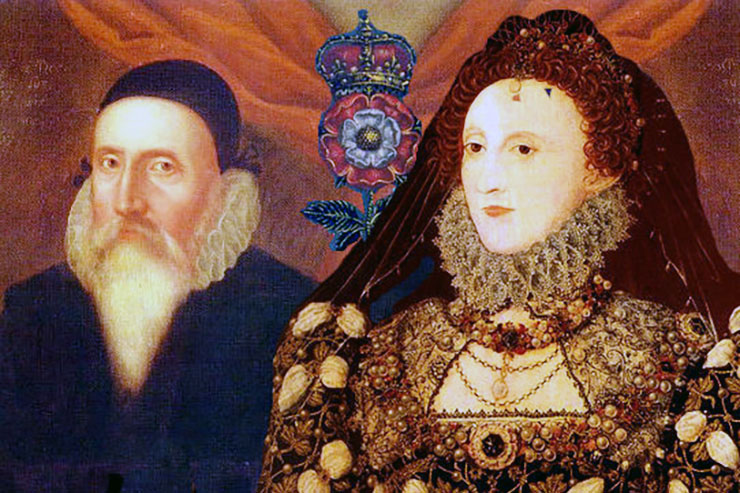
At last, the true purpose of John Dee’s invention of the ‘British Empire’, previously hidden, can now be revealed. Conventional wisdom holds that he was responsible for naming that empire, which became identified with a progressive Protestant mission to bring enlightenment to a benighted world. However, that picture is the complacent result of intervening centuries of imperial history. From neglected manuscripts and hints within Dee’s writings, we now discover that, for Dee, the real purpose of the British Empire was to fulfil its prophetic and apocalyptic destiny. He drew upon ancient prophecies of a Last World Empire under an Emperor (or Empress) who would reform global religion, society, and politics before the return of Christ to rule the world for a millennium.
In fact, Dee was not a Protestant of the kind assumed by later centuries. He was born into a Catholic London family in 1527, baptised in a ritual which the Church taught exorcised demons from the infant, and brought up to believe in the magical powers of the priesthood and its rituals. His patrons at St John’s College Cambridge, where he studied as an undergraduate, and Trinity College, where he became a Fellow in 1547, were all conservative Catholics. Dee also studied at Louvain, when that university had become a bastion of Catholic orthodoxy. Therefore it is no surprise that Dee finally became a Catholic priest in February 1554, partly to please his master, the Earl of Pembroke, who needed to ingratiate himself with Queen Mary, and partly to escape suspicion through his family’s connections with the Wyatt Rebellion, which had just been bloodily suppressed. Dee served ‘Bloody’ Bonner, Bishop of London, as chaplain, making rather ineffectual attempts to convert the Protestants whom Bonner persecuted. Dee was not a very doctrinaire Catholic; he belonged to an ecumenical generation of European intellectuals who hoped for a ruler who would heal the dreadful schisms in Europe. Many believed that alchemy would produce this end, for the Last World Emperor would wield the philosopher’s stone to reform all of decaying Nature, including human beings.
Dee was persuaded by these ideas, which had been repeated by European intellectuals and seers for many centuries. The prophecy had originated in an apocalyptic text known as Pseudo-Methodius, after a semi-legendary bishop. Written c.674-8 CE in remote Syrian Mesopotamia, recently conquered by Islamic invaders, the prophecy was influenced by Jewish messianic expectations of an earthly ruler over a period of peace and plenty. It promised a mighty Last World Emperor who would destroy Islam, recover Jerusalem, and rule benevolently until Gog and Magog appeared. Pseudo-Methodius prophesied that the Emperor would defeat them and rule in Jerusalem for ten and a half years until Antichrist appeared, when the Emperor would resign his powers into God’s hands and die. The short, troubled reign of Antichrist would end with his destruction by Christ, and the end of time.
Translated from Syriac into Greek, this prophecy of a great imperial destiny rapidly proliferated in the Byzantine Empire. Already by 800 CE it had been translated into Latin, as the expansion of Muslim power increasingly threatened western and southern Europe. Together with the biblical books of Daniel and Revelations it became the most widely-read of medieval apocalyptic texts and exercised a powerful fascination over the Western imagination for the next thousand years. Printed broadsheet excerpts describing God’s apocalyptic Emperor were distributed to stiffen the Christian defence of Vienna against the Ottomans in 1683.
The complex text known as the Tiburtine Sibyl eventually incorporated another variant of this story. Its Greek original was written in response to the disastrous defeat suffered by Byzantium at Adrianople in 378 CE, but the Latin text was often rewritten to keep it relevant. Originally it retrospectively ‘prophesied’ Constantine the Great, who would rule for 30 years, advance true religion, fulfil the law and do justice. Later it prophesied an Emperor Constans would reign for 112 years in peace and plenty over all the Christians, destroy pagan lands, baptise them and convert their temples to churches. After 120 years the Jews would be converted. Gog and Magog would appear and be defeated by the Emperor, who would surrender his rule over all Christians to God at Jerusalem before Antichrist appeared to battle Elijah and Enoch.
The Last World Emperor prophecy enormously enhanced the apocalyptic aura of eleventh-century Jerusalem and helped stimulate the first four Crusades. However, because Augustine of Hippo insisted that Christ’s Kingdom would not be a millennial or ‘chiliastic’ earthly kingdom, even in the fullest version by Godfrey of Viterbo in the late twelfth century, the Emperor’s triumph is almost immediately followed by the appearance of Antichrist.
Within a few years a twelfth-century Cistercian Abbot, the Calabrian Joachim of Fiore (d. 1202), revolutionised Augustine’s teaching that Christ’s Kingdom would only be established outside history. The enormously influential Joachim predicted human renewal in the third ‘status’ within history. After the ‘status’ of the Father and of the Son these ages would combine their natures in a long Sabbath Age within history. This spiritual and charismatic prediction added a powerful aura of apocalyptic expectation to both Joachim’s own prophecies and those that his later followers fathered upon him.
Furthermore, as Joachim’s ideas ‘went viral’ amongst a host of medieval followers, the Joachimist tradition absorbed texts that adapted Byzantine apocalyptic ideas to Western imperial needs. Later redactors blended prophecies about the Last World Emperor into pseudo-Joachimist prophecies. In the process they altered Joachim’s prophecies of apocalyptic troubles from the North, by looking to another scriptural tradition, in which threats originated in the hot, desert East. In Genesis, Cain, the first follower of Satan, dwelt in the land of Nod east of Eden (Gen. 4:16), whence came the east wind that blasted crops and dried up the waters (Gen. 41:6, Ezekiel passim), and in Exodus 10:13 brought plagues of locusts. Throughout the Old Testament story ‘the children of the east’, the descendants of Abraham’s concubines, persecuted Israel (Gen. 24:6). The Old Testament used the east wind as a metaphor for vain knowledge such as divination (Isaiah 2:6), and in Revelation 16:12 the vial poured out by the sixth angel prepared the way for the apocalyptic ‘kings of the east’ by drying up the Euphrates.
Therefore, the first apocalyptic text explicitly awarding the western emperors an apocalyptic role, the Frankish Abbot Adso’s Letter on the Origin and Life of the Antichrist (950 CE), drew on this pre-existing tradition. Adso not only became the most influential propagandist for the translation of empire from East to West, but also implicitly stigmatised the East by turning the Last Emperor from a ‘King of the Romans and Greeks’ to the ‘King of the Franks’ who would restore a chaotic world.
The Joachimist tradition also took up and publicised a text of Ps Methodius from which three quarters of the original text had been removed, in order to fit it to the rise of emperors in the West. The redactors added further references that envisaged a western power, rather than the Byzantine Empire, conquering Islam, now identified as the threat from the East.
The Tiburtine Sibyl was also shortened, to make room for new prophecies that German rulers would face threats from “a king from Babylonia, meeting place of Satan,” who would bring great calamities. Traditionally, Antichrist was to be born in Babylon from the tribe of Dan deported to Babylonia. This may refer to the sultans of the Seljuk Turks. In this way the East became the source of threats, countered by the rulers of the West, such as a descendant of Henry IV, who as Last Emperor sets out from Byzantium to defeat the Muslims, and to establish the universal kingdom of the Christians for an indeterminate but long period until the End.
Imperialists were particularly attracted to another apocalyptic text, the Erithrean Sibyl, which first appeared in the 800s but became so popular that its predictions were frequently revised to keep abreast of political developments. The most influential version was created c. 1195 by Eugenius of Palermo (d. 1203), Admiral to the King of Sicily. Written, therefore, at the front-line of the long struggle against the Saracens in the Mediterranean, this version of the prophecy describes Mohammed as a “horrible beast coming from the East” confronted by “a most mighty lion” from the West who would rule for 500 years.
The Hohenstaufen Emperor Frederick II sponsored interpretations of biblical prophecies that awarded him a messianic role, and adapted Joachimist prophecies for his own ends. The Erithrean Sibyl, revised about 1249-54, now served western powers, threatening the Greeks with the power of a Hohenstaufen as the Last World Emperor.
Throughout the 14th and 15th centuries the Kings of France contended with German emperors in claiming the inheritance of Charlemagne’s empire in the West and the prophetic status of the future Last World Emperor, especially because the weak fifteenth-century German emperors inspired few messianic hopes. However, with the accession of Maximilian I (1493-1519), Habsburg fortunes began to recover, and the emperor’s patronage of propaganda increasingly identifying the House of Habsburg with the role of messianic emperor began to drown out French claims in the sixteenth century. Skilful manipulation of printed texts and images by Habsburg publicists helped revive western Europe’s apocalyptic conception of the East, a revival exacerbated by the House of Habsburg’s struggle against the inexorable expansion of the Ottoman Empire. By the early sixteenth century, this cosmic conflict abundantly and increasingly fulfilled ancient western assumptions about the rise of the Whore of Babylon, the Antichrist, in the East.
The vision of the Last World Emperor enabled the Renaissance to hold in tension expectations of imminent Antichristian calamities with the positive prospect of a returning classical Golden Age and a Joachimist hope of a renovated world after Antichrist’s defeat. The prophetically-charged imperial election of Charles V in 1519 seemed to bring these hopes towards final fulfilment, because Charles united the French and German royal bloodlines. His early victories over both the Turks and Protestant heretics also seemed to fulfil a multitude of Sibylline prophecies, now clearly pointing to his destiny in the East. Ever since Virgil’s Iliad, imperial aspirants had appropriated the solar god Apollo, guarantor of the migration of sovereignty from East to West. This thousand-year-old tradition fed into prophecies of the Last World Emperor taken up by Charles’ grandfather, Maximilian I, and vigorously exploited by his son, Philip II, whose astrologers emphasised how his solar emblem prophesied the conquest of the East, conversion of the infidel, and perpetual establishment of universal peace.
The Mysterious & Enigmatic Dr. John Dee
Dee encountered Habsburg claims to the role of Last World Emperor at Maximilian of Habsburg’s coronation as King of Hungary at Bratislava in September 1563. In early 1564 Dee wrote his Monas Hieroglyphica to advise the soon to be Emperor Maximilian II. His contribution to Maximilian’s prophetic destiny, of uniting the world by defeating the Antichristian East, took the form of promising the philosopher’s stone. His Monas applied kabbalistic techniques, and ideas borrowed from Joachim of Fiore, to construct and then deconstruct a symbol he entitled his hieroglyphical Monad (right), which secreted the stone within it. This combined the astrological symbols for the Sun, Moon and Aries with the Cross. By now all these had become identified with Habsburg universal ambitions, and Charles V had elevated the Cross to a particular symbol of Habsburg veneration.
When Dee returned to Elizabeth I’s Court in the summer of 1564, he tutored the Queen in the arcane mysteries of his symbol. Some of his lessons probably concerned the alchemical mystery of the philosopher’s stone, which fascinated Elizabeth. Other lessons may have concerned the solar, Arian and cruciform symbolism supporting universal Empire. The decline in political relations between Elizabethan England and Habsburg Spain over the following decades created an ideological rivalry over ancient imperial iconography and prophecy, particularly about the destiny waiting the western empire in the East. The Tudors stole the Habsburgs imperial clothes.
In Elizabethan England such ideas became entangled in wider struggles between radical and conservative Protestants for influence over policy. Ancient imperial ideologies included Virgil’s prophecy in his Fourth Eclogue, addressed to Augustus Caesar, which celebrated the return of the Golden Age of peace and plenty under the virgin goddess of justice, Astraea. From her accession Elizabeth had claimed an imperial authority over both State and Church that reached back to Constantine. By the mid-1570s events enabled some of her courtiers to promote her as the imperial virgin, and to exploit a previously overlooked English strand of Joachimite expectation, in order to advance the aggressive anti-Catholic, anti-Habsburg foreign policy which they made synonymous with “the Protestant Cause.”
The collapse of Spanish Habsburg control in the Netherlands in 1576 persuaded the Earl of Leicester and his followers that Elizabeth could usurp the Habsburg role of Last World Emperor, and with it advance her ambitions in the East. They encouraged her to accept the proffered sovereignty of Holland and Zealand in 1576. John Dee supported these ambitions in a series of writings sponsored by Leicester and circulating at Court, which urged Elizabeth to recover her ‘British Empire’. This name did not look forward, but backward, to the empire of Arthur, King of the Britons. Part of this certainly included North America, where, Dee believed for a time, remnant Arthurian colonies controlled the fabled North West Passage to the Indies. But Dee’s writings placed more emphasis on the vast European empire of Elizabeth’s ancestor, Arthur, to the “south, and east” of the British Isles. Despite his association with Britain, Arthur had been a favoured Habsburg imperial hero, so here again the Tudors challenged the Habsburgs. Dee’s General and Rare Memorials, published in September 1577, included iconography connecting Elizabeth with Constantine, at a time when, Dee later recalled, “great hope was conceived, (of some no simple politicians), that her Majesty might, then, have become the Chief Commander, and in manner Imperial Governor of all Christian kings, princes, and states.” In 1576 Elizabeth also imagined herself bringing peace to the whole of Christendom.
As Dee well knew, a long tradition of astrological calculations added to the excited atmosphere surrounding the ‘British Empire’ in the 1570s. A flurry of apocalyptic prophecies had surrounded the election of Charles V as Holy Roman Emperor in 1519, predicting that he would restore unity to Christendom, shattered by the Reformation, and would prove the divinely chosen instrument against the Antichristian Turks in the East. One of the most influential prophecies for the later Habsburgs was the 1564 book On the Greatest Conjunction by the Bohemian Astrologer Cyprian Leowitz, which predicted apocalyptic consequences from the conjunction of the superior planets Jupiter and Saturn in the zodiacal sign of Aries in April 1584. Leowitz pointed out that such conjunctions occurred in Aries only every 800 years, that one foreshadowed the beginning of the Roman Empire and the birth of Christ, the next the transfer of the empire to Charlemagne. This must be the final conjunction, for the world could not last more than 6,000 years.
Leowitz knew that the zodiacal sign of Aries the Ram had particular significance for the Habsburgs. Ancient theories considered it first amongst zodiacal epochs, for the world had been created with the sun in Aries, meaning that the sign immortalised the first Age of Gold, mystically transfigured into the Ram’s Golden Fleece. The Habsburgs inherited the sovereignty of the Order of the Golden Fleece, whose members considered themselves God’s Elect, chosen to prepare the way for the return of Jesus Christ, the Lamb of God signified by the Golden Fleece, who would rule his earthly kingdom from Jerusalem. Leowitz argued that the imminent return of the heavenly bodies to their positions at the Creation pointed to cosmic struggles for the Habsburgs in Eastern Europe, from Bohemia to Constantinople, where they would battle the Antichristian power of the Ottomans in the Last Days, before planting their banners in Jerusalem and ushering in the second coming of Christ. Dee’s copy of Leowitz’s book survives, with his enthusiastic marginal annotations about the final battles against Antichrist and the foundation of an apocalyptic empire in the East.
In 1576 Dee’s associate in magical learning James Sandford, another Leicester client, dedicated his Houres of Recreation to Elizabeth’s favourite, Christopher Hatton. Sandford put Elizabeth’s universal pretensions into the cosmic apocalyptic context previously reserved for the Habsburgs. Citing Leowitz’s predictions about the great 1583 conjunction, and prophetic visions seen in Poland, Sandford added for good measure the widespread expectation that either the world would end in 1588, or “at leaste governementes of kingdomes shall be turned upside downe.” Elizabeth, in whom “there must needes be some diviner thing… than in the Kings and Queens of other countries” would play a leading role in the End Times. During the Royal Progress at Norwich in August 1578, court poets introduced a new theme into their masques and declamations, celebrating Elizabeth as the Virgin Queen for the first time. A few years later Sandford applied Joachim’s prophecies of the End when he dedicated to Leicester his translation of Giacopo Brocardo’s The Revelation of St John Reveled (London, 1582). This thoroughly Joachimite Protestant prophecy imagined Christ’s Kingdom soon covering “the whole worlde. No other religion, no other lawe, and rule to heare then that of the Gosple.” By now the idea that Elizabeth would prepare the way for Christ by triumphing over the East had permeated the excitable underworld of popular prophecy, and manuscripts circulated declaring that “Elizabeth now Queen of England is ordained of God to be Queen of Jerusalem.”
The ‘British Empire’ John Dee envisaged for Elizabeth I was profoundly different from that which actually emerged in later centuries. It drew upon an ancient prophetic tradition that had become interwoven with widely-held beliefs in astrological influence on earthly events, and with a profound belief in the ability of alchemists to create the philosopher’s stone, through which the Last World Empress would rule. Elizabeth certainly believed in alchemy’s transformatory powers, for she employed male and female alchemists in distilling houses at her palaces of Hampton Court and Whitehall, and in her Privy Chamber. She also believed in the power of astrological forces, on which Dee advised her many times. In the mid-1570s she found the prospect of becoming the universal ruler over a pacified globe deeply attractive.
Why then has Dee’s magical vision of the ‘British Empire’ been condemned to historical obscurity? The answer lies in the reactions of political conservatives at Elizabeth’s Court, particularly her long-time favourite, Sir Christopher Hatton, of more obscure figures who supported his rise, and of Hatton’s protégé, John Whitgift. From the mid-1570s these men became influential at Court, and Whitgift became Archbishop of Canterbury in 1583. From then on he and Hatton worked hard to drive prophetic expectations of a magical Empire out of politics, because they believed such ideas stirred up the ‘mob’, whom they feared above all, to follow radical, ‘popular’ politics. Once the Earl of Leicester died in 1588, Hatton and Whitgift became even more influential over the ageing Elizabeth. Throughout the 1590s they and their many followers used all the government propaganda machinery at their disposal to suppress the kind of magical ‘British Empire’ Dee had envisaged. They had already forced Dee’s students, the brothers Richard and John Harvey, to recant their beliefs in Leowitz’s astrological predictions of the Apocalypse. They now sponsored attacks on astrological prediction altogether, and others that denigrated alchemists as deluded fools. Whitgift made sure that Dee was blocked from the promotions and appointments he sought, and his career declined in consequence.
During the reign of James, the first English settlements in Virginia helped to switch attention away from the apocalyptic ‘British Empire’ in Europe to its real development in North America. The chaotic events of the Civil War sealed the fate of the magical Empire. The collapse of royal authority meant that press censorship also disappeared, and in the 1640s and 1650s there was a wild explosion of excited apocalyptic prophecies by obscure writers, again calling upon astrological and alchemical ‘proofs’ that their envisaged empire would come to pass. The restored monarchy of Charles II set out to suppress such ideas once and for all. It imposed a rigorous press censorship and made it clear that magical, prophetic thinking would disqualify anyone with pretensions to social or political advancement. As a result, magical ideas were driven underground, and members of ‘polite’ society, such as the Fellows of the Royal Society, felt constrained from discussing them in public, though they continued to do so in private letters. The success of the Establishment’s reaction can be measured by how forgotten ‘magical’ ideas of empire remain today. Thus the utopian ‘British Empire’ Dee imagined survived only in ‘popular’ culture, amongst the powerless and marginalised.
At the end of the day, if we still seek such ideas, we should perhaps look at what motivated migrants to leave Britain for its empire in recent centuries. Perhaps we will find a distant echo of John Dee’s belief in his magical ‘British Empire’ in their belief that Australia or New Zealand would prove a better world.
Glyn Parry is author of the new book The Arch-Conjuror of England (Yale University Press, 2012), the first full-length biography of John Dee based on primary historical sources. The book is available from all good bookstores or online book outlets.
[alert type=”general” dismiss=”no”]This article was published in New Dawn 133.[/alert]
[alert type=”success” dismiss=”no”]If you appreciate this article, please consider subscribing to help maintain this website.[/alert]
Further Reading
Marjorie Reeves, The Influence of Prophecy in the Later Middle Ages. A Study in Joachimism, Oxford, 1969
Marjorie Reeves, Joachim of Fiore and the Prophetic Future, London, 1976
Glyn Parry, The Arch-Conjuror of England: John Dee, New Haven and London, 2011
Bernard McGinn, Visions of the End. Apocalyptic Traditions in the Middle Ages, New York, 1979
Ann Williams, ed., Prophecy and Millenarianism. Essays in Honour of Marjorie Reeves, London, 1980
N. Cohn, The Pursuit of the Millennium, London, 1957
Marie Tanner, The Last Descendant of Aeneas, New Haven and London, 1993
Frances A. Yates, Astraea. The Imperial Theme in the Sixteenth Century, London and Boston, 1975
Margaret Aston, ‘The Fiery Trigon Conjunction: An Elizabethan Astrological Prediction’, Isis, Vol. 61, No. 2 (Summer, 1970), 159-187
‘The City’ – or, ‘The Square Mile’ – refers to the City of London Corporation. Together with Wall Street, The City forms the hub of the plutocratic system that controls most of the world, and is presently engulfing the few remaining states that it does not control, through the time-proven tactics of plutocracy: revolution ostensibly in the name of ‘the people’.1
Because The City is situated in England, and because it is often confused with the ancient capital, London, there has been a lot of obfuscation as to the character of the plutocratic system that is partially based in The City. Hence, there has been a great deal stated, even by the well-informed, in regard to the British Empire and even the British Crown, being intrinsically a part of this international oligarchy. This is to misunderstand the nature of international capital, which owes no steadfast loyalty to any system of government, head of state, religion, ethos, nation, ethnicity or culture. Any such allegiance is conditional.
What is ‘The City’?
The City of London Corporation is described in its promotional statements as “the world’s leading financial centre,” and as “the financial and commercial heart of Britain, the ‘Square Mile’.”2
The City of London is at the heart of the world’s financial markets. It is a unique concentration of international expertise and capital, with a supportive legal and regulatory system, an advanced communications and information technology infrastructure and an unrivalled concentration of professional services…3
Since the demise of the British Empire, worn out by two world wars that benefited it not a jot, Wall Street has popularly become identified as the international financial capital. Again, this is due to the error in thinking that Britishimperial interests were synonymous with international plutocracy, and because Britain is no longer a world power, ‘London’ is subordinated to New York. However, The City of London Corporation is neither synonymous with Britain nor British interests, other than when these happen to coincide with the interests of international finance. That is why, even though the British Empire has been defunct for over half a century, The City remains, in the words of its promoters, “at the heart of the world’s financial markets.”
Hence while Britain and the Commonwealth has a symbolic Head-of-State in the Monarch, the analogous Head-of-State for The City has precedence over the British Sovereign. The Lord Mayor of the City of London Corporation is “not the Mayor of (Greater) London”; nor is he a ‘mayor’ in the limited sense of the word. He assumes the position as ‘Head-of-State’, not of merely a borough or a county. This Lord Mayor is elected for one year, and acts as a global ambassador for the international financial institutions situated in The City, and is “treated overseas as a Cabinet level Minister.”4 He lives in the palatial 250-year-old ‘Mansion House’. On state visits the British Monarch waits at the Gate of The City to seek permission to enter and is presented with the sword of The City by the Lord Mayor.5
This tradition has been preserved for more than 400 years, and the ceremony now is carried out on major state occasions where the Queen halts at Temple Bar to request permission to enter the City of London and is offered the Lord Mayor’s Sword of State as a sign of loyalty.6
No matter how one rationalises the ceremony as an ostensible mark of ‘loyalty’ by The City towards the British Monarch, it is nonetheless the Monarch who is placed in a subordinated position in seeking permission for entry and waiting for a symbolic affirmation of loyalty from The City on each occasion.
International Finance
It should be kept in mind that ‘international finance’ is exactly that: international; not Dutch, German, British, or American. Jewish bankers might be loyal to Judaism or to Israel, and the French Huguenots who went to London had a religious identity. But international finance is not bound to the states of its residence.
The ‘modern’ financial system did not originate in Britain, or even in the Occident. Ezra Pound, the famous poet who was also an avid opponent of usury-banking and an advocate of Social Credit banking reform, traced the premises of the ‘modern’ usurious financial system back to “the loans of seed-corn in Babylon in the third millennium BC.”7
As indicated above, international finance can shift focus over the world as the requirements of commerce dictate. As for the shift of the Money Power to England, this can be traced to the English Civil War, and even to the Reformation, where a Cromwell was significant in both. Thomas Cromwell, Secretary of State, who “represented the mercantile community,”8 as distinct from the traditional landed interests, urged Henry VIII to suppress the religious Orders in 1533. Brooks Adams states of this in his historical masterpiece, The Law of Civilisation and Decay, that:
In 1533 Henry’s position was desperate. He confronted not only the pope and the emperor, but all that remained of the old feudal society, and all that survived of the decaying imaginative age. Nothing could resist this combination save the rising power of centralised capital, and Henry therefore had to become the mouthpiece of the men who gave expression to this force. He needed money, and money in abundance, and Cromwell rose to a practical dictatorship because he was fittest to provide it.9
Adams details how the era of Henry VIII and the Reformation was the beginning of the speculative, capitalistic system.10 Additionally, “The sixteenth-century landlords were a type quite distinct from the ancient feudal gentry. As a class they were gifted with the economic, and not with the martial instinct, and they throve on competition.”11
The expansion of commerce in the wake of the Age of Exploration, and the formation of the British East India Company in 1600, five years after the East India Company in Holland, were symptoms of this historical trend that had already been set in motion by the Reformation. The merchant interests felt constrained by the Monarchy and another Cromwell, Oliver, came forward, like his great-great-grand-uncle Thomas, to radically change England in the interests of money. The British Empire was expanding towards Asia and buccaneering was establishing fortunes. However,
As the city grew rich it chafed at the slow movement of the aristocracy, who, timid and peaceful, cramped it by closing the channels through which it reached the property of foreigners; and, just when the yeomanry were exasperated by rising rents, London began to glow with that energy which, when given vent, was destined to subdue so large a portion of the world. Perhaps it is not going too far to say that, even from the organisation of the East India Company, the mercantile interest controlled England. Not that it could then rule alone, it lacked the power to do so for nearly a hundred years to come; but, after 1600, its weight turned the scale on which side soever thrown.
Macaulay has very aptly observed that but for the hostility of The City, Charles the First would never have been vanquished, and that, without the help of The City, Charles the Second could scarcely have been restored.12
From the middle of the 16th century capital accumulated, and “the men adapted to be its instruments grew to be the governing class.”13 Adams states of the era, “In 1688, when the momentum of England suddenly increased, the change was equivalent to the conquest of the island by a new race.”14 London became the centre of this global expansionist acquisition, a new Rome, where the wealth of the world was deposited:
These hoards, the savings of millions of human beings for centuries, the English seized and took to London, as the Romans had taken the spoil of Greece and Pontus to Italy. What the value of the treasure was, no man can estimate, but it must have been many millions of pounds – a vast sum in proportion to the stock of the precious metals then owned by Europeans.15
What Adams calls a regime of merchants ruled England from 1688 to 1815. The wealth they accumulated, states Adams, became the primary source of power, and it was in the hands of a new breed of merchant: the bankers. “With the advent of the bankers, a profound change came over civilisation, for contraction began.”16 The value of money as distinct from the mercantile concern at the value of wares was the concern of the bankers. At the close of the 18th century “the great hoards of London” passed into the hands of the bankers, the “most conspicuous example” being the Rothschilds.17
It is here that we see a dichotomy arising between the old merchant, including the mercantile adventurers, such as Robert Clive of India to Cecil Rhodes, and on the other hand, the merchant bankers epitomised by the Rothschilds. It is here where the two are often mistaken as forming a common power elite.
Dr. Carroll Quigley18 described the character of international finance and the move of its centre to The City: “Financially, England had discovered the secret of credit. Economically, England had embarked on the Industrial Revolution.”19 Here we discern immediately a dichotomy operating within British power-politics: that of usury-based finance, which is cosmopolitan and parasitic; and that of the ingenuity of the Englishman and Scott as inventor and entrepreneur, as creator. It was this creativity and inventiveness, coupled with the bravery of the British military and the dedication of the British administrator, that was pressed into the service of parasitic finance, behind the cover of the British flag and Crown. These two factors at work: one cosmopolitan and one British, are often confused as being one and the same. Quigley continues:
Credit had been known to the Italians and the Netherlanders long before it became one of the instruments of English world supremacy. Nevertheless, the founding of the Bank of England by William Paterson and his friends in 1694 is one of the great dates in world history.20
Quigley explained, far more succinctly than economists, that the basis of the debt finance system is “fractional reserves.” This method had its origin in the realisation by goldsmiths that they did not need to hold the equivalent of gold reserves in their vaults to the amount of paper certificates issued representing the value of gold. As there was unlikely to be a run on the vault by its depositors all demanding at once the return of their gold deposits, the goldsmith could issue paper certificates far in excess of the value of the amount of gold in his vaults.21
Fractional reserves remains the method of international finance, albeit no longer with the need for gold reserves. In particular, it should be kept in mind that the basis of the system is usury, where interest is charged for the loan of this bogus credit. Not only must the principal be paid back in real wealth – productive labour or creativity – but added interest.
Quigley remarks that “in effect, this creation of paper claims greater than the reserves available means that bankers were creating money out of nothing.” According to Quigley, William Paterson, having obtained the Royal charter for the Bank of England in 1694 remarked, “The Bank hath benefit of interest on all moneys which it creates out of nothing.”22
The centre of gravity for the merchant bankers had long been Amsterdam. The “Republic of the United Provinces,” which included Holland, had from the start accorded Jews, as the catalysts of incipient international free trade, equal protection.23 According to Dr. Stanley Chapman, Professor of Economic History at Nottingham University, the Sephardic Jewish community in Amsterdam had become adroit as lenders to foreign governments.24
Shall we, then, say there had been a ‘conspiracy of Dutch merchants to rule the world’? I think not. Yet neither can it be said in justice this was a ‘Jewish conspiracy’. The establishment of the Bank of England was a Protestant affair with anti-Catholic underpinnings. From France came the Huguenots who, like the Dutch Sephardim, had established international connections through family networks across Europe and had also formed a community in The City, by the mid 18th century.25 The English Revolution of 1642-1648, which established the republican Commonwealth under Oliver Cromwell in 1649, enduring under his son Richard until 1659, had opened the way for a shift of international banking from Amsterdam to London. The impetus for British imperial expansion had started under Cromwell. The merchant coterie of Amsterdam, which had backed Cromwell, was permitted entry into England. Menasseh ben Israel had appealed to Cromwell on the grounds of mercantile profitability to any nation that gave the Jewish merchant bankers freedom, as Amsterdam had done. Menasseh assured Cromwell that profit was the best reason why the merchant bankers should be permitted into England:
Profit is a most powerfull motive, and which all the World preferres before all other things: and therefore we shall handle that point first. It is a thing confirmed, the merchandising is, as it were, the roper profession of the Nation of Jews…26
Menasseh proceeded with explanations as to why this is so, due to the lack of opportunity from the time of the Exile, to possess a state of their own and to till the land, leading Jews to “give themselves wholly unto marchandising.” Their dispersion throughout the world enabled them to form networks across borders, to engage in commerce, with a common language that transcended the linguistic barriers of others.27
While the supremacy of Money in England was set in motion by Henry VIII’s Reformation, and the English Revolution a century later heralded the triumph of the merchant, it was not until the usurpation of the Throne by William III of Orange in 1688, with the deposing of James II, that the Bank of England was established. From then on a National Debt was owed to the usurers.
From the time of King Henry I talley sticks had served as the King’s currency. These talley sticks were carved sticks broken lengthwise. The Chancellor of the Exchequer kept one half, and the King spent the other half into circulation,28 like President John F Kennedy did in 1963, when he issued $4 billion ‘United States Notes’ directly into circulation via the US Treasury, circumventing the Federal Reserve Bank.29 Eventually, the two halves would be matched to prevent counterfeiting. The talley sticks could be used as exchange for commerce and in payment of taxes. They circulated in England for 726 years until eliminated on the demand of the Bank of England in 1826.30
Although William was the maternal grandson of Charles I, he was born in Holland and destined to fulfil the legacy of Cromwell in placing England under the bondage of the merchant bankers, then centred in Holland. The anti-Catholic sentiment that had started under Henry VIII was a catalyst in assuring William support in driving James II from the Throne. Under William the authority of the Monarchy was reduced, and that of Parliament enhanced. The epochal act of William was to grant the Charter to William Paterson to establish the Bank of England. This acquiescence might be explained by William having “heavily borrowed in Amsterdam to fight his continental wars.”31 The link between the bankers of Amsterdam and of London was maintained even into the 19th century, and by the mid 18th century there was a considerable colony formed in the City by the scions of the Amsterdam banking families.32
The idea for the Bank of England came from the example of the Wisselbank, founded in 1609 which, according to the Bank of England’s account, was the lender to the City of Amsterdam, the Province of Holland and the Dutch East India Company, exercising a monopoly over state borrowing and coinage.33 The move to establish such a bank in England gained momentum “after the Glorious Revolution of 1688 when William of Orange and Queen Mary jointly ascended the throne of England.” The political economist Sir William Petty wrote that the power of England would be magnified if there were a bank to lend the Throne credit.34 He did not explain why it could not be a state bank issuing its own credit, and had to be a private bank accruing interest on credit that it makes out of nothing, as its founder, William Paterson, explained. According to Petty such a bank would “furnish Stock enough to drive the Trade of the whole Commercial World.”35
The Bank of England explains that after the rejection by Parliament of several proposals the bank and a “Fund for Perpetual Interest” were accepted, having gained support from The City on recommendation by Michael Godfrey, “a leading merchant.”36
In 1734 the Bank of England moved into a ‘vast’ purpose-built building, nicknamed ‘The Old Lady of Threadneedle Street’, in The City.37 It was from the founding of the Bank of England that “the funded National Debt was born.”38 The present-day description of credit by the Bank of England is quite illuminating. The Bank’s historical account states that at the time credit was called “imaginary money.” Until then ‘the man in the street’ had simply thought of money as coins, but this ‘shibboleth’ was now overturned. Money could take other forms “that had no intrinsic value.” “The 18th century was a period dominated by governmental demand on the Bank for finance: the National Debt grew from £12 million in 1700 to £850 million by 1815, the year of Napoleon’s defeat at Waterloo.”39
In 1946 the Bank was ‘nationalised’, but as in the nationalisation of other such banks, such as New Zealand’s Reserve Bank in 1936, this means little, as the real authority comes from the creation of credit by the international merchant bankers. However, as the Bank’s account states, in 1997 the Government formally handed its financial authorities over to the Bank and it “thus rejoined the ranks of the world’s ‘independent’ central banks.”40
The purpose of these ‘central banks’, which the general public believes are controlled by governments, was to bring into their
financial network the provincial banking centres… to form all of these into a single financial system on an international scale which manipulated the quantity and flow of money so that they were able to influence, if not control, governments on one side and industries on the other. The men who did this… aspired to establish dynasties of international bankers…41 The centre of the system was in London, with major offshoots in New York and Paris, and it has left, as its greatest achievement, an integrated banking system…42
Rothschilds: Lords of International Finance
From the establishment of the Rothschild banking dynasty in England by Nathan M Rothschild, The City becomes synonymous with that dynasty. Further still, these suddenly ‘British’ Rothschilds become ‘British’ imperialists in the manner a chameleon changes his colour according to survival needs. It is the insinuation of the Rothschilds into the British power-structure that has generated much discussion of a ‘British’ imperial conspiracy centred around Cecil Rhodes and Alfred Milner, and the so-called ‘Round Table Group’ that they founded to extend British influence throughout the world. It is further frequently claimed this emerged as an ‘Anglo-American’ conspiratorial ‘network’ that continues to the present in attempting to establish ‘Anglo-American’ global hegemony.
Theorists of this ‘Anglo-American network’ most frequently cite Harvard historian Dr. Carroll Quigley, who had access to what were presumably the papers of the Council on Foreign Relations. For reasons not known to this writer, Dr. Quigley, informative on so much in the course of his magnum opus, Tragedy & Hope, erred in thinking that an oligarchic ‘Anglo-American network’ was formed in the aftermath of World War I and continues to the present. We shall briefly examine this error in due course. However, for the moment Quigley had some pertinent things to say about both the Rothschilds and the “international system of control” that was developing.
Quigley stated that one of the primary reasons the centre of international finance shifted to London was because the British upper class, which was not as rooted in noble birth as in money, “was quite willing to recruit both money and ability from lower levels of society and even from outside the country, welcoming American heiresses and central-European Jews to its ranks.” This allowed the power structure to take on a cosmopolitan flavour. (We might note this vulgarisation of the English ruling-class seems to have begun during the time of Henry VIII).
Quigley described the development of the financial network by the international bankers into a world control system, and the assumption of the Rothschild dynasty to primacy:
In time they brought into their financial network the provisional banking centres, organised as commercial banks and savings banks, as well as insurance companies… The greatest of these dynasties, of course, were the descendents of Meyer Amschel Rothschild… whose male descendants, for at least two generations, generally married first cousins or even nieces. Rothschilds five sons, established at branches in Vienna, London, Naples, and Paris, as well as Frankfort, cooperated together in ways which other international banking dynasties copied but rarely excelled.43
Quigley pointed out these bankers were “cosmopolitan and international rather than nationalistic,”44 and this, by the very nature of their business, is what they remain.
Brooks Adams states that towards the close of the 18th century the boards of The City passed from the merchants to merchant bankers, “the most conspicuous example [being] the family of Rothschild.”45
Mayer Amschel had established his fortune by handling the financial affairs of William IX of Hesse-Kassel, who had been paid well by the British Government for supplying troops against the American revolt. At the time Amsterdam had been the capital of international banking, but the Napoleonic invasion of Holland had led to the closing of the Amsterdam Bourse, “the leading Continental exchange.” Mayer Amschel and several others were situated to provide William IX with funds.46 Additionally, in 1800 Mayer Amschel had become Imperial Crown Agent for the Emperor of Austria. He was what Derek Wilson described as “one of the first of a new breed of businessmen – the truly international merchant banker.” Wilson states that for centuries the Jews had played a prominent part in “long distance commerce” due to their communal loyalty with which they were able to create a “commercial sub-culture.” However, they were reliant on the patronage of rulers. Now, the revolutionary tumult in Europe had swept away traditional rulers and placed money on a footing of power.
In 1798 Nathan Rothschild set up shop in England and in 1806 he became a “naturalised Englishman.”47 The Rothschilds were backing the coalition against Napoleon, who was upsetting the Continental system of finance. In 1808 Nathan took over the financial affairs of the Landgrave William IX in England. That year he moved his business to 12 Great Helen’s Street, The City, under the name of N M Rothschild and Brothers.48 With agents throughout Europe, the Rothschilds were valuable allies in organising smugglers and couriers in the war against Napoleon. By now, on the initiative of Nathan Rothschild, “the nerve centre of Rothschild operations had shifted from Frankfurt to London.”49 Wilson reiterates that through Nathan’s family and his “large network of agents and couriers he was better informed about European affairs than any man in London – including members of the government.”50 Wilson is altogether too charitable in ascribing ‘patriotic’ – British – motives to Nathan, in contrast to what he frankly says about the lack of national ‘patriotism’ among the other Rothschild brothers toward anything other than “loyalty and responsibility to the Chosen People.”51 Rather, Nathan and the rest of the dynasty were assisting in the fight against Napoleon because the upstart was undermining the financial system.
Quigley explains that the credit creation mechanism developed by the international bankers, as previously described, was to become one of the chief weapons in the victory over Napoleon in 1815. “The emperor, as the last great mercantilist, could not see money in any but concrete terms, and was convinced that his efforts to fight wars on the basis of ‘sound money’, by avoiding the creation of credit, would ultimately win him a victory by bankrupting England.”52 Hence, the war against Napoleon was in part a war between two systems of economics involving the reorganisation of Europe.
The British Empire & Cecil Rhodes
It is a significant error of interpretation for historians such as Carroll Quigley or E C Knuth53 to suppose there is an ‘Anglo-American’ network working for world rule on the edifice of English sentiments. It is also erroneous to assume that because the merchant bankers found it opportune to lend credit to governments that ruled over empires, these bankers, who are cosmopolitan, have an enduring commitment to some type of nationally based imperialism, whether it be ‘British’, ‘American’, ‘German’, ‘Dutch’, etc.
The theory of the ‘Anglo-American’ network written about by Quigley was adopted by conspiracy theorists such as W Cleon Skousen.54 The basis of these theories centres on Lord Rothschild being the banker to Cecil Rhodes. The theory states that Lord Natty Rothschild was part of Rhodes’ secret society, the Round Table Groups, that aimed to spread the benevolence of British imperialism over the world.55 These imperial ideals were said to be motivated by the teachings of the Oxford art historian John Ruskin, who exhorted his students to take British culture to the ends of the Earth. While Lord Rothschild saw the Empire as the means by which commerce could be spread and maintained by force of arms, the support was pragmatic, and owes nothing to a commitment to any British ideals as envisaged by Rhodes et al. Derek Wilson writes of this in relation to Lord Rothschild’s opposition to Gladstone’s ‘flabby’ foreign policy: “But Lord Rothschild was not an unbridled expansionist. This is clearly shown by his relationship with a man who was an unbridled expansionist – Cecil Rhodes.”56
When diamonds were discovered in South Africa, the Rothschilds bought into the Anglo-African Diamond Mining Company Ltd., which was amalgamated with DeBeers. In 1887 Rhodes returned from South Africa to Britain to ask Lord Rothschild for financial backing. Lord Rothschild saw this as the means of establishing commercial stability in South Africa against their main rival, the Barnato Diamond Mining Company, which also ended up merging with DeBeers.57 For Rhodes, making money was a means of spreading British imperial ideals. Not so for Rothschild, although Rhodes persuaded himself Natty was of like mind. “He was wrong. Lord Rothschild was not an unreserved imperialist, as Rhodes gradually discovered.” In 1888 Rhodes made a will nominating Natty to administer most of his estate for funding The Round Table Groups. Wilson writes:
In response to Rhodes’ suggestion that company funds be used to finance territorial expansion, his banker advised: “if… you require money to finance territorial expansion, you will have to obtain it from other sources than the cash reserves of the DeBeers Company.” And Rhodes cannot have been very pleased to learn, in 1892, that Rothschilds had floated a loan for the Boer government of the Transvaal.58
The Rothschilds were interested in commercial stability, not British imperial expansion. By the time of the abortive Jameson Raid organised by Rhodes against the Boer Transvaal Republic in 1895,
he had long ceased to have close and cordial relations with Natty. Probably he never grasped the fact that, though the Rothschilds disliked Gladstone’s policy of colonial retrenchment, they were not advocates of unbridled imperialism for its own sake.59
Hence, when a few decades later imperialism became a hindrance to unbridled international free trade, the international bankers used the newly emergent power of the USA to scuttle the old European Empires over the course of half a century, and the oligarchs moved into the power-vacuum of the new decolonised states.60
This myth of the ‘Anglo-American network’ for world control is centred around a supposed alliance between the Royal Institute of International Affairs (RIIA) and the US globalist think tank, the Council on Foreign Relations (CFR),61 founded in the aftermath of World War I by the US power elite. Again, this assumed alliance is erroneous: the proffered alliance between the two bodies never eventuated. Far from there being accord between supposed ‘Anglophiles’ on both sides of the Atlantic, there was a breach. Peter Grose, the CFR’s historian, mentions that both sides soon rejected the suggested alliance before it eventuated.62
The Rothschilds were concerned with Britain’s imperial links “for sound commercial reasons,” but with “maximum freedom of trade.”63 It was inevitable that ‘free trade’ and the old European imperialism were going to conflict. The role assumed by the USA in subverting and destroying the old empires can be discerned by ‘The Fourteen Points’ decreed by President Woodrow Wilson as the blueprint for the post-war world in 1918;64 and by the ‘Atlantic Charter’,65 imposed on Britain by President F D Roosevelt in 1945, both of which focus on international free trade as the basis for the world economy and specifically repudiate the old empires.66
Soon after World War II the Rothschilds increased their focus on Wall Street, and their hitherto relatively small Amsterdam Incorporated was reformed as an investment bank named New Court Securities, its share capital being taken up by the Rothschild banks in Paris and London. Where hitherto the Rothschilds had mainly been concerned with negotiating loans with states, they were now involved in the rapid post-war expansion of Western commerce and industry,67 freed up by the destruction of the old empires, and the inauguration of a new era of international financial agreements, formalised by the Bretton Woods Agreement.
This is what the biographer Wilson calls the Rothschilds’ “new, deliberate internationalism”;68 no longer constrained by nation-states and imperial ideals. However, The City remains a focus. The Rothschilds led the way in forging links between Tokyo and London. Edmund co-led a delegation from The City to Tokyo in 1962 and received The Order of the Sacred Treasure from Emperor Hirohito.
Regardless of these new avenues opened up for post-war globalisation and free trade, certain plutocratic traditions remain features of The City: the ‘Gold Fixing Room’ at the Rothschild offices, New Court, continue to be the place where the leading London bullion dealers daily sit around a table “to agree on the price of gold.” N M Rothschild “continues to be the most important bullion dealer” in Britain.69 Of the “four hundred and eighty banks in the city,” Rothschild remains supreme.70
However, other avenues for profit besides the traditional dealings in gold bullion are emerging. The one for our era is credits for greenhouse emissions, and with this profit also comes new schemes for world control.
In 2008 Simon Linnett, Executive Vice Chairman of N M Rothschild, wrote a policy document on the issue.71 Linnett defines “greenhouse emissions” as the new form of “social market.” He states that while it must be free trade that operates in defining the value of the carbon emission exchange, what is required is an “international institution.” He writes that “such a market has to be established on a world basis coordinated by an international institution with a constitution to match.”72 Linnett frankly states that this involves a “new world order”:
That, perhaps, it might be regarded as having wider benefits than merely ‘saving the planet’ – perhaps it might be the basis of a new world order…73
Of various methods suggested to limit carbon emissions, carbon trading is held by Linnet to be the most effective.74 Implicit in the various measures, including funding new technology and changing the consumption habits of individuals is, “that nations have to be prepared to subordinate, to a certain extent, some of their sovereignty to this world initiative.”75 “When countries are already foregoing the right of direct control over monetary policy through the creation of independent central banks, this could be a relatively small price to pay for such inclusion.”76 The system being proposed by Linnett, in the cause of “saving the planet,” is the consolidation of the international banking system under a central authority. Linnett states that the European nations have already ceded their sovereignty to the European Union; the next step being, “to yield sovereignty to a bigger world body on carbon trading.”77 “If such a route map could be found, then perhaps we might be at the beginning of a new world constitution and a new world order.”78
The world authority that Linnett proposes he calls the World Environment Authority (WEA). This would be based in what he calls a “world city.”79 Linnett suggests that this “world city” should be London, The City, due to it being “a world financial centre (possibly ‘the’ world financial centre).”80
Whatever might be said about Wall Street, or the shift of global political power to Washington and New York, clearly The City still holds sway in the thinking of some of the primary oligarchs of international finance.
[alert type=”general” dismiss=”no”]This article was published in New Dawn 133.[/alert]
[alert type=”success” dismiss=”no”]If you appreciate this article, please consider subscribing to help maintain this website.[/alert]
Footnotes
K R Bolton, Revolution from Above, London: Arktos Media Ltd., 2011, passim.
City of London, ‘What is the City of London?’, www.cityoflondon.gov.uk/Corporation/LGNL_Services/Council_and_democracy/Council_departments/whatis.htm
Ibid., ‘The Lord Mayor of the City of London’, www.cityoflondon.gov.uk/Corporation/LGNL_Services/Council_and_democracy/Councillors_democracy_and_elections/The_Lord_Mayor/
‘History of Temple Bar’, www.thetemplebar.info/history
Ibid.
Ezra Pound (1944), America, Roosevelt & the Causes of the Present War, London: Peter Russell, 1951, 6.
Brooks Adams, The Law of Civilisation, London: MacMillan, 1896, 230.
Ibid., 233.
Ibid., 245.
Ibid., 245.
Ibid., 292-293.
Ibid., 294.
Ibid., 298.
Ibid., 305.
Ibid., 321.
Ibid., 321.
Carroll Quigley, of Harvard University, and the Foreign Service School at Georgetown University, was a scholar of considerable reputation, until he wrote a few dozen pages on the conspiratorial nature of international finance – albeit in a sympathetic light – in his 1,300 page magnum opus Tragedy & Hope in 1966.
‘The Estates General of the Republic of the United Provinces: Declaration Protecting the Interests of Jews Residing in Holland’, 13 July 1657; in Paul R Mendes-Flohr and Jehuda Reinharz (ed) The Jew in the Modern World: A Documentary History, New York: Oxford University Press, 1980, 16.
Stanley Chapman, The Rise of Merchant Banking, Oxon: Routledge, 2006, 2.
Ibid., 4.
Menasseh ben Israel, ‘How Profitable the Nation of the Jews Are’, ‘to His Highness the Lord Protector of the Commonwealth of England, Scotland and Ireland’, in Paul R Mendes-Flohr and Jehuda Reinharz (ed) The Jew in the Modern World, op. cit., 9.
Ibid., 10. The editors remark that although Menasseh’s mission to Cromwell in 1655 was “ostensibly unsuccessful, it did prepare the way for the resettlement of the Jews in England.” (Ibid., 12 Note 1).
L. LaBorde, ‘The Unholy Alliance’, Silver Trading Company, Article #18, 12 February 2012, www.silvertrading.net/articles_metals_18_the_unholy_alliance.html
J F Kennedy, ‘Executive Order 11110’, 4 June 1963.
L. LaBorde, op. cit.
Stanley Chapman op. cit. 2.
Stanley Chapman, Ibid., 3.
‘Major Developments’, Bank of England, www.bankofengland.co.uk/about/history/major_developments.htm
Peter Grose, Continuing The Inquiry:The Council on Foreign Relations from 1921 to 1996, New York: Council on Foreign Relations, 2006. The entire book can be read online at: Council on Foreign Relations: www.cfr.org/about/history/cfr/index.html; K R Bolton, Revolution from Above, op. cit., 24-25, Note 5.
Derek Wilson, op. cit., 305.
W Wilson, ‘Fourteen Points’, 1918, www.fordham.edu/halsall/mod/1918wilson.html
Franklin D Roosevelt and Winston S. Churchill, ‘The Atlantic Charter’, 14 August 1941, http://usinfo.org/docs/democracy/53.htm
E Roosevelt, As He Saw It, New York: Duell, Sloan and Pearce, 1946, 31, 35.
Derek Wilson, op. cit., 397.
Derek Wilson, Ibid.
Ibid., 436.
Ibid.
Simon Linnett, Trading Emissions: Full Global Potential, London: The Social Market Foundation, January 2008. Online at: www.smf.co.uk/assets/files/publications/SMF_Trading_Emissions.pdf

is available on Amazon Kindle.
 is available on Amazon Kindle.