New Dawn – World's Most Unusual Magazine

Category: Articles

  • Brothers of the Shadows: Overlords of Chaos

    Brothers of the Shadows: Overlords of Chaos

    From New Dawn Special Issue Vol 9 No 4 (Aug 2015)

    Who controls the past controls the future. Who controls the present controls the past.
    – George Orwell, 1984

    Back in 1893, an elusive Englishman named Charles George Harrison (b.1855) delivered a series of six lectures to the Berean Society, a London based association of Christian esotericists. Harrison, described as a “mysterious and unknown figure,” was an English occultist and Anglican Christian. A record of his lectures can found in the book The Transcendental Universe. What is clear is that C.G. Harrison had access to highly sensitive information and a good deal of inside knowledge of world changes then being engineered by certain circles in England.

    In his second lecture Harrison spoke of “the next great European war” and of how the “national character” of the Slavic peoples would “enable them to carry out experiments in Socialism, political and economical, which would present innumerable difficulties in Western Europe.” The “next great European war” points to what would be the First World War of 1914-18, while the “experiments in Socialism” predict the 1917 Bolshevik Revolution which brought about the Soviet Union, one of the boldest and bloodiest politico-economic experiments in human history. Harrison said the plan of a particular secret elite, which he doesn’t mention by name, was that “the Russian Empire must die that the Russian people may live.” It is amazing to consider these truly prescient words were spoken in 1893, 21 years before the First World War and 24 years before the Russian Revolution. Today we know that in 1917 Bolshevik leader Vladimir Lenin was transported from Zurich, then the banking capital of the world, to Russia in a train loaded with gold and weapons to start the revolution.

    Discussing C.G. Harrison’s extraordinary foreknowledge, Sevak Gulbekian asks:

    How could he [Harrison] know about the forthcoming War as well as the “experiments in Socialism,” which would take a grip on Russia and its surrounding states for most of the twentieth century? If he was not, as he claimed, a “practical occultist” himself, it is reasonable to assume he had contact with people who were, and who had access to the malign plans…1

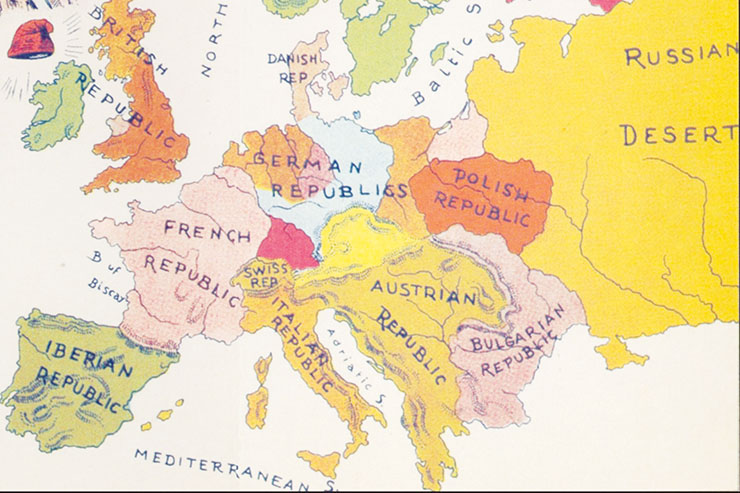
    Another significant piece of information coinciding with Harrison’s insights into the future is a cartoon map of Europe printed in the Christmas 1890 edition of the satirical English weekly, The Truth. Over the map is written: “The Kaiser’s Dream.” It showed wherever monarchies had been up to that time, there were going to be republics. The Austro-Hungarian Empire of the venerable Hapsburg monarchy had disappeared, as had the centuries old Russian Empire. Over the territory of Russia we read the words “Russian Desert.” In addition, Germany is identified with the words “German Republics”! Commenting on this map from 1890, Sevak Gulbekian notes:

    This map signifies not only a foreknowledge – similar to Harrison – of the fate of Russia to become a cultural as well as an economic ‘desert’, but also of the future splitting of Germany into ‘republics’. The magazine’s editor, Henry LabouchEre, was a Freemason. Was his remarkable foresight pure luck, or once again did he have some inside knowledge of future plans to shape the world?

    Why destroy the Hapsburg Empire? The influence of the Catholic Hapsburgs, as heirs of the Holy Roman Empire, was felt through all Europe. As Catholic Europe’s most important royal house they posed a particular obstacle to Britain’s plans for the Continent. Austria-Hungary, along with the ruling Hapsburg dynasty, had to be wiped off the map in order to create a patchwork of small states in Eastern Europe. These could be easily manipulated by London. Count Arthur Polzer Hoditz, director of the cabinet of the last Austro-Hungarian emperor stated in his memoirs that, “the destruction of the Hapsburg Empire was carefully prepared.” Late 20th century research reveals the suicide in 1889 of Crown Prince Rudolf, the Hapsburg Emperor Franz Joseph’s only son and heir, was a planned political assassination. Less than a decade later in 1898 the Empress Elizabeth was brutally murdered by a secret society member in Geneva. And the killing in 1914 of Emperor Franz Joseph’s nephew Franz Ferdinand in Sarajevo by a member of the Serbian secret society of the Black Hand, had as its immediate consequence the outbreak of the First World War.

    The occultist Rudolf Steiner (1861-1925), who knew a great deal about the mysterious nexus of politics and the occult, mentioned the above map in a talk given in Switzerland at the height of the First World War. He said the map, as a secret document, was in existence since the last decades of the 19th century. This is the same time as the British imperialist Cecil Rhodes was laying the foundations for “a secret society with but one object, the furtherance of the British Empire, and the bringing of the whole uncivilised world under British rule…” According to the American historian Carrol Quigley in his book Tragedy and Hope, Cecil Rhodes set up such a secret society known as the “Society of the Elect” in 1889.

    Sevak Gulbekian explains Rudolf Steiner’s perspective thus:

    Behind the outer façade of world affairs, suggested Steiner, the machinations of occult groups or ‘brotherhoods’ were at work. Certain of these brotherhoods had wanted the Great War to take place, and had manipulated events to bring it about. In doing this, they sought to protect the dominant economic position of the English-speaking world, and in turn to crush the ‘mediating’ role of Central European powers such as Germany, the Austro-Hungarian empire, and so on.

    These occult brotherhoods – small groups of men who met together in ‘lodges’ and practiced ceremonial magic as a means of achieving certain goals – originated from the English-speaking (Anglo-Saxon) world and were allied, in particular, with Anglo-American interests. Their aim was to extend Anglo-American influence across the globe, and to ensure the predomination of Anglo-American culture. Furthermore, they sought to extend its superiority into the distant future; essentially to ensure that the present state of affairs continues evermore.

    Rudolf Steiner in one of his lectures about the influence of secret societies on politics says that in the Slavic peoples there lies a “special future.” He believed at some point in the future a cultural-spiritual highpoint would be reached in the Slavic countries, principally Russia. This is apparently known to the Anglo-Saxon occult brotherhoods which seek to manipulate these powers and bring them directly under British domination. Steiner’s revelations, based in part on his intimate involvement with Europe’s leading secret societies, help explain the major events of the 20th century. Two world wars, the partition of Europe into the Anglo-American dominated West and the Soviet controlled East, the decades long ‘stand-off’ between Eastern communism and Western capitalism in the ‘Cold War’, the collapse of the USSR and the declaration of an Anglo-American dominated unipolar world, can all be traced to the dark intrigues of the Brothers of the Shadows.

    [alert type=”general” dismiss=”no”]This article was published in New Dawn Special Issue Vol 9 No 4.[/alert]

    [alert type=”success” dismiss=”no”]If you appreciate this article, please consider subscribing to help maintain this website.[/alert]

    Footnote

    1. ‘Brothers of the Shadows: A Perspective on Conspiracies’ by Sevak Gulbekian, New Dawn 86 (September-October 2004)

    © New Dawn Magazine and the respective author.
    For our reproduction notice, click here.

  • The Secret Elite & the Origins of the New World Order

    The Secret Elite & the Origins of the New World Order

    From New Dawn Special Issue Vol 9 No 4 (Aug 2015)

    Secret societies, the unseen hands that steer national and international affairs from the shadows, go back to the dawn of Western civilisation. The individual most famously linked to these occult forces is Adam Weishaupt (1748-1830), a Jesuit trained philosopher and lay professor of canon law at the University of Ingolstadt in southern Germany. On 1 May 1776 Weishaupt founded a secret society called the ‘Perfectilibists’ (which soon became known as the ‘Order of the Illuminati’.) The Illuminati recruited over 2,000 influential followers, but apparently lasted only until March 1785 when the Bavarian Government uncovered the conspiracy, exiled Weishaupt and outlawed the Order.

    Some investigators suggest that rather than being wound up in 1785, the Illuminati (‘enlightened ones’) continued in existence to the present day. For the past 200 years controversy persisted over its role in influencing global affairs. In 1798 John Robison, professor of philosophy at the University of Edinburgh, published Proofs of Conspiracy, a book alleging an Illuminati/Freemasonry plot to conspire against all religions, kings and governments of Europe.1 According to Robison, the Illuminati had been instrumental in fomenting the worst excesses of the French Revolution. That same year the Jesuit Abbé Augustin de Barruel published Memoires pour Servir a l’Histoire de Jacobinisme which supported Robison’s thesis.2 A century and a half later, Nesta Webster and William Guy Carr revived conspiracy theories about the Illuminati.

    Nesta Webster (1876-1960), who was linked to the British Union of Fascists, wrote that rather than being banished, the Illuminati remained active and within a few years had “multiplied its hotbeds all through the south of Germany, and as a consequence in Saxony, in Prussia, in Sweden, and even in Russia.”3 William Guy Carr, an English born Canadian naval officer and lay Christian preacher, supported this thesis, maintaining that Weishaupt had been retained by moneylenders, including the House of Rothschild. Carr claimed there was an evil force at the forefront of an international conspiracy to destroy religious institutions and national governments in order to bring about a “Satanic One World Government.”4

    According to Carr, the conspirators use a variety of methods to help them accomplish their aims, including:

    1) Monetary and sex bribes to obtain control of individuals already occupying important positions. Such recruits are then held in bondage through blackmail, threats of financial ruin, public exposure or physical harm or death of their loved ones.

    2) Illuminati in colleges and universities recruit students possessing exceptional mental ability.

    3) Individuals trapped into Illuminati control are placed behind the scenes of all governments as ‘experts’ and ‘specialists’ who advise adoption of policies which serve the secret plans for one world government.

    4) Control of the press and all other agencies which distribute information to the public.5

    However, Illuminati researcher Dr. Tony Page says that Webster and Carr totally misrepresented the situation and were anti-Semites indulging in madcap conspiracy theory. Page translated Weishaupt documents from the original German and presents him as a much maligned moral and virtuous man whose intentions were “assuredly high minded and benign.” A man who “strove for far nobler and morally exalted goals than are properly ascribed to him. In fact, his intention (naive perhaps) but in my view, sincere, was to promote and disseminate human virtue, equality and freedom, and the happiness and dignity that flow from them.”6

    Today, some see the Illuminati “as a major factor and influence in international power politics, allegedly fomenting wars, civil disorder and revolutions in their attempt to establish a one-world government.”7 It appears the jury is still out on whether the Illuminati is an ongoing occult force.

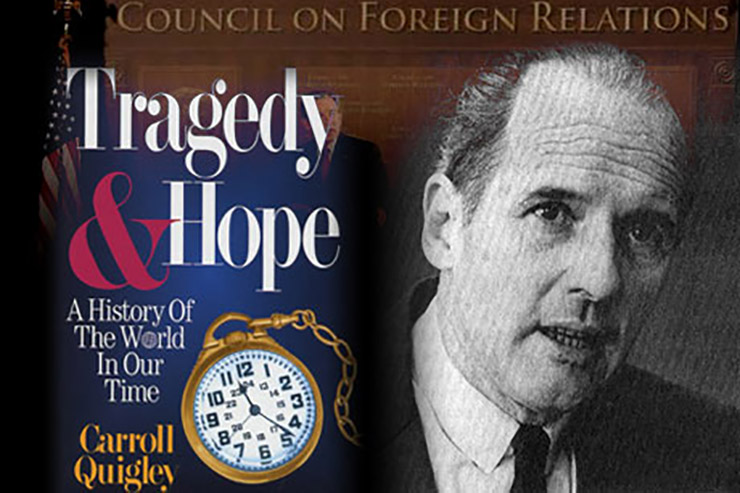
    What we can say is that in our own intensive research over the past 10 years on the true origins of the First World War, we found no direct connection whatsoever to Weishaupt’s creation. The secret society that we identify as responsible for the war employed similar tactics, but was a very different, very English creation. Furthermore, it remained concealed until exposed by the late Professor Carroll Quigley in the latter half of the 20th century. Quigley (1910-1977) was a highly esteemed American historian who moved in Establishment circles, lectured at top universities, including Harvard, Princeton and Georgetown, and was a trusted consultant to both the US Department of Defense and US Navy. He studied this secret network for 20 years and was permitted to examine its records. In 21st century parlance, Carroll Quigley was the whistle-blower par-excellence.

    THE QUIGLEY ENIGMA

    Professor Quigley wrote that the Rhodes secret society, or the ‘Milner Group’ as he called it after Cecil Rhodes’s death, was “one of the most important historical facts of the twentieth century” and of such significance that “evidence of its existence is not hard to find, if one knows where to look.”8 The ‘Milner Group’ exposed by Quigley is now widely recognised and variably named by others as the ‘Hidden Power’, the ‘Money Power’, the ‘Deep State’, or ‘the men behind the curtain’. All these labels are pertinent, but we call them, collectively, the Secret Elite.

    Without Quigley’s revelations, the lid on this secret society would still be closed today. By opening Pandora’s Box and revealing some of the evils therein, he enabled others to see the truth. His work exposing this powerful group has been enhanced and developed through years of careful research by other investigators into an explanation of how control of the civilised world has steadily been acquired through wars, economic manipulation and political chicanery by generations of privilege and money.

    Our own work, including the book Hidden History: The Secret Origins of The First World War, closely examines the men involved and reveals their nefarious global influence was greater even than Quigley believed. We garnered solid evidence that its members were directly responsible for taking the world to war in 1914 and deliberately prolonged the terrible carnage for over four long years while making massive fortunes from it. The immensely rich and powerful Secret Elite controlled the British and US governments from behind the scenes, then as now, and much of the global mayhem over the last century arose at their instigation.

    While Professor Quigley did mankind a great service, he remains an enigma. He exposed this ruthless, anti-democratic, totalitarian organisation and anguished over their determined attempts to suppress his writings, yet back-tracked on some of his original findings as if in fear of his life. He also side-stepped a number of key issues and failed to discuss the Secret Elite’s role in the genesis of the 1914-18 war, or their audacious coup d’etat in 1916 whereby they literally took over the British government. Rather bizarrely, Quigley stated that he agreed with their goals and aims.9 He did, however, disagree with their methods.

    Their tendency to place power and influence into hands chosen by friendship rather than merit, their oblivion to the consequences of their actions, their ignorance of the point of view of persons in other countries or of persons in other classes in their own country – these things, it seems to me, have brought many of the things which they and I hold dear close to disaster. In this Group were persons… who must command the admiration and affection of all who knew them. On the other hand, in this Group were persons whose lives have been a disaster to our way of life. Unfortunately, in the long run, both in the Group and in the world, the influence of the latter kind has been stronger than the influence of the former.… I feel that the truth has a right to be told, and, once told, can be an injury to no men of good will.10

    There is something deeply puzzling about Quigley’s assertion that while their methods brought much of what he held dear “close to disaster,” he agreed with their goals and aims for global control. These powerful men intended to replace democratically elected governments, arguing that their rule would be the rule of the best, whether or not the people wanted it.

    A few researchers raise the possibility that Quigley was at some stage an actual member of the secret society, but failed to admit it. We believe it far more likely his strange statements of support were down to self-preservation. In his major works – Tragedy and Hope and The Anglo-American Establishment – he narrated a history peopled by men who successfully concealed their power and influence, their connivance and common purpose. These individuals (and their descendants and agents ever since) conspired in secret towards the establishment of a world government that ultimately they, and they alone, would control.

    It is worth noting that Quigley’s histories have themselves been subject to suppression. Tragedy and Hope was removed from bookstore shelves by unknown persons and withdrawn from sale shortly after its release. His publisher, the Macmillan Company, destroyed the book’s original plates and lied to him for the next six years.11 Quigley believed that powerful people suppressed the book because it exposed matters they did not want known. In this instance, unlike his exposure of the British Establishment, he did not name his tormentors.

    IN THE BEGINNING

    The opening passage of Quigley’s The Anglo-American Establishment may read like a John le Carré thriller, but it is no spy fiction:

    One wintry afternoon in February 1891, three men were engaged in earnest conversation in London. From that conversation were to flow consequences of the greatest importance to the British Empire and to the world as a whole.

    The staunch British imperialists who met that day – Cecil Rhodes, William Stead and Lord Esher – were well-known public figures but it should be noted from the outset that each was linked to infinitely greater wealth and influence. They were joined weeks later by Lord Alfred Milner and Lord Nathaniel Rothschild, the international merchant banker and richest man in the world. He was inducted together with Lords Salisbury and Rosebery, whose families had for generations controlled the Conservative and Liberal parties in Britain and ruled the country as their personal fiefdom. Rothschild provided the financial clout while Salisbury and Rosebery provided the long-standing patronage and political networks.12

    Cecil Rhodes, in association with Rothschild, had made his fortune in the gold and diamond mines of South Africa. Stead was the most prominent English journalist of the day and a moral crusader of great standing. Esher represented the interests of the monarchy from Queen Victoria’s final years, through the exuberant excesses of King Edward VII, to the more sedate but pliable King George V. It was through Esher that the monarch was kept fully appraised of Secret Elite business.13

    Alfred Milner, a contemporary of Rhodes at Oxford University, was a self-made man of ability and ideas who began his working life as an aspiring lawyer, turned to journalism, led the political agitation against the Boer separatists in South Africa, and eventually emerged as an immensely powerful and successful power-broker. Milner was the master manipulator, the iron-willed assertive intellectual who offered that one essential factor: strong leadership. On Cecil Rhodes’s death in 1902, he became the undisputed leader of the world’s most powerful and far reaching secret society. These were the founding fathers of what we recognise today as the ‘New World Order’ movement.

    They met at private town houses and magnificent stately homes. These might be lavish weekend affairs or dinners in private clubs which provided suitable London bases for their intrigues. The heady mix of international finance, political manipulation and the control of government policy was at the heart of this small clique who set out to dominate the world. They drew up their plan for a secret society that would take political control in Britain and, later by extension, the United States of America. They renewed the Anglo-Saxon bond between the two countries – the ‘special relationship’ – expanding their power base to bring Anglophile Americans into the secret brotherhood; men who would go on to dominate the world through financial institutions, global corporations and dependent governments. Wars, revolutions and other major events of the last 100 years are directly attributable to these individuals. The Boer War and the destruction of Germany in 1914-18 were merely the first steps in their long-term strategy.

    The secret society comprised concentric circles with an inner core of trusted associates known as “The Society of the Elect” who unquestionably knew that they were members of an exclusive cabal devoted to taking and holding power worldwide. A second circle “The Association of Helpers” was larger and quite fluid in its membership. A third outer ring comprised members who may or may not have been aware they were either an integral part of, or inadvertently being used by, a secret society, though “it is more likely they knew it.”14

    The overlapping rings are themselves concealed, hidden behind formally organised groups of no obvious political significance. As Quigley put it, the group was able to “conceal its existence quite successfully, and many of its influential members, satisfied to possess the reality of power rather than the appearance of power, are unknown even to close students of British history.”15 In the early 20th century its tentacles spread throughout the British Empire to America, Russia, France, the Balkans and South Africa. Their targets were agents in the highest offices of foreign governments who were bought and nurtured for future use.

    What’s more, they had the power to control history, to turn history from enlightenment to deception. The Secret Elite dictated the writing and teaching of history from the ivory towers of academia down to the smallest of schools. They carefully controlled the publication of official government papers, the selection of documents for inclusion in the official version of history, and refused access to any evidence that might betray their covert existence. Incriminating documents were burned, removed from official records, shredded, falsified or deliberately rewritten, so that what remains for genuine researchers and historians is carefully selected material. Their ambitions overrode humanity and the consequences of their actions have been minimised, ignored or denied.

    [alert type=”info” dismiss=”no”]If you appreciate this article, please consider a subscription to New Dawn magazine.[/alert]

    SPREADING THEIR TENTACLES

    One of the problems facing anyone who turns to Quigley’s seminal The Anglo American Establishment is that it makes for a difficult read. Like several of the early chapters of the Christian Bible, his inter-connecting lists name many from the aristocracy, big business, high finance, politics and the press. Some were linked by matrimonial alliances while others by their gratitude for titles and positions of power.20 He devotes an entire chapter revealing how the Secret Elite controlled The Times (then Britain’s most influential newspaper) for more than 50 years with the exception of the period 1919-1922.21

    A list of Oxford graduates, especially those given fellowships at All Souls College, included Milner’s heir apparent, Lionel Curtis, and numerous others who later gained positions of great significance and power. Indeed, they all did, every single name listed by Quigley. Oxford gave the Secret Elite access to influential professorships, some of which they created and funded themselves, such as the Beit Chair of Colonial History, established in 1905. It remains a serious concern that Carroll Quigley was absolutely correct when pointing an accusing finger at those who monopolised “so completely the writing and the teaching of the history of their own period.”22 There is no ambivalence in his accusation. The Secret Elite controlled the writing and teaching of history through numerous avenues including the press, but none more effectively than at Oxford University where they held huge influence over Balliol, New College and All Souls, and largely dominated the intellectual life of Oxford in the field of history.23 They ensured we learn only those ‘facts’ that support their version of history. The influence was so powerful that they controlled the Dictionary of National Biography, meaning the Secret Elite wrote the biographies of its own members. They created their own official history of key members for public consumption, striking out any incriminating evidence and portraying the best public-spirited image that could be safely manufactured. Has anything changed?

    Oxford University was also the Secret Elite base for the Rhodes Scholarships, funded by the legacy left by Cecil Rhodes when he died in 1902. Rhodes’s wish was to create a “worldwide” secret group devoted to English ideals and to the Empire as the embodiment of these ideals,24 and the scholarships brought that international dimension to the society. They “were merely a facade to conceal the secret society, or, more accurately, they were to be one of the instruments by which members of the secret society could carry out his purpose.” Professor Quigley leaves us in no doubt that the secret society is the real power behind the scholarships.25 From its inception, Rhodes Scholarships favoured American students, with 100 places allocated, two for each of the 50 states and territories, whereas only 60 were made available for the entire British Empire and, strangely, several from Germany. The ‘best talents’ from the ‘best families’ were to be nurtured at Oxford University and imbued with an appreciation of ‘Englishness’ and the importance of the “retention of the unity of the Empire.”

    In The Anglo-American Establishment, Quigley concluded that the secret cabal advanced its power-base through a triple-front penetration in politics, the press and education.26 We would go further, and can but wonder why he omitted banking and the military-industrial complex from his analysis. Politicians will always be easy targets. Ambition, greed and sexual proclivity can be nurtured and harnessed. Sometimes men of real stature come to the fore and bring strong leadership to the cause. In the early years Alfred Milner assumed that mantle. Fired by a zeal forged by Ruskin at Oxford, he was consumed by the need to establish the primacy of upper-class Englishness at the pinnacle of world power. He believed in the need to bring the British Empire and the American ideal together to sweep aside any rival for world domination.

    Milner went to South Africa in 1897 to save it from falling to the Boers. He deliberately started the Boer War and saved the diamond and gold mines for fellow Secret Elites Rhodes, Rothschild, Beit and Bailey. He was idolised by Cecil Rhodes who placed his legacy in Milner’s safekeeping, and he was rewarded by the King with a knighthood and then a Viscountcy. Critically, in South Africa between 1897 and 1905, he built a personal following of young carefully chosen civil servants who loyally followed his every decision behind the scenes in British and world politics. Lord Alfred Milner was arguably the most important man living in the first decades of the 20th century, yet his name remains virtually unknown outside academic and political circles. Why?

    MILNER’S LEGACY

    To demonstrate the privileged path that the Secret Elite created in their quest to establish a ‘New World Order’, we have chosen to follow the trail that began with Alfred Milner, the undisputed leader for 23 years following Rhodes’s death in 1902. Critically, his most important achievement in South Africa was the creation of a network of extremely able acolytes to whom he entrusted the future direction of his cause: the domination of the world by the Anglo-Saxon race. His secretariat in South Africa comprised young men of “breeding, ability and conviction” from Oxford University, All Souls College in particular. Dubbed “Milner’s Kindergarten,” they absorbed his commitment to Ruskin’s philosophy, his disdain for career politicians and his concern that democracy as it had developed in the Western world was corrupt and untrustworthy. It was akin to “a religious brotherhood like the Jesuits, a church for the extension of the British Empire.”27

    From 1909 Milner began expanding the Kindergarten into a highly secretive organisation called the “Round Table,” with branches in South Africa, Canada, New Zealand, Australia and, crucially, the United States. (It is not to be confused with a benign charitable organisation of the same name.) The grand Arthurian title suggested equality of rank and importance, nobility of purpose and fairness in debate, but was nothing of the kind. Milner, and most of the Group, held democracy in contempt, and far inferior to rule by those who had an “intellectual capacity for judging the public interest” and “some moral capacity for treating it as paramount to their own.”28 Wealth, of course, also counted and “the key to all economics and prosperity was considered to rest with banking and finance”29 which the Secret Elite controlled. Alfred Milner acted as both elder statesman and father figure to the Round Table with his role described as “President of an Intellectual Republic.”

    The Round Table groups across the world kept in touch through regular correspondence and a quarterly journal called The Round Table that was controlled by the Secret Elite. They saw Britain as the defender of all that was fine or civilised in the modern world. Her “civilising mission” was to be carried out by force if necessary, for the “function of force is to give moral ideas time to take root.” Asians, for example, would be compelled to accept “civilisation” on the grounds they would be better off under British rule than that of fellow Asians. “To be sure, the blessings to be extended to the less fortunate peoples of the world did not include democracy.” They would simply be educated up to a level where they could appreciate and cherish “British ideals.”30 The ‘White Man’s Burden’ is indeed great.

    Milner, his Round Table, and the Secret Elite generally saw the new Germany with its economic, industrial and commercial strength as the great threat to their global ambitions. In The Round Table journal of August 1911, Lord Lothian, a member of the Secret Elite’s inner core, wrote: “There are at present two codes of international morality – the British or Anglo-Saxon and the continental or German. Both cannot prevail.”31 Alliances with France and Russia were created for the specific task of destroying Germany through a prolonged war.32 These men had no fear of war, though they rarely put themselves in the direct firing line.

    EXPANDING THE ANGLO-AMERICAN PRIMACY

    Cecil Rhodes had long dreamed of Anglo-American unity, and in 1891 actually discussed the possibility of achieving it by Britain joining the United States.33 On his death, the Secret Elite developed an even greater appreciation of America’s vast potential and the need for closer union. They adjusted the original concept of British race supremacy to Anglo-Saxon supremacy, so that Rhodes’s dream had only to be slightly modified. They created a common ideology and world outlook among the peoples of the United Kingdom and the United States, and the instruments and practices of cooperation in order to pursue parallel policies.34

    Alfred Milner believed these goals should be pursued by a secret political and economic elite influencing “journalistic, educational and propaganda agencies” behind the scenes. The flow of money into the United States during the 19th century advanced industrial development to the immense benefit of the millionaires it created: Rockefeller, Carnegie, Morgan, Vanderbilt and their associates. The Rothschilds represented British interests, either directly through front companies or indirectly through agencies they controlled. Small groups of massively rich individuals on both sides of the Atlantic knew one another well, and the Secret Elite in London initiated the very select and secretive dining club, the Pilgrims, that brought them together on a regular basis. On 11 July 1902, an inaugural meeting was held at the Carlton Hotel of what became known as the London Chapter of the Pilgrims Society. It was to have a select membership limited by individual scrutiny to 500. Ostensibly, The Pilgrims was created to “promote goodwill, good friendship and everlasting peace” between Britain and the United States, but its highly secretive and exclusive membership leaves little doubt as to its real purpose.35

    Seven months later the American chapter was formally created on similarly exclusive lines. This was the pool of wealth and talent that the Secret Elite drew together to promote its agenda in the years preceding the First World War. Behind an image of the Pilgrim Fathers, the persecuted pioneers of Christian values, this elite cabal advocated the idea that “Englishmen and Americans would promote international friendship through their pilgrimages to and fro across the Atlantic.” It presented itself as a spontaneous movement to promote democracy across the world, and most of the membership probably believed that. But the Pilgrims included a select collective of the wealthiest figures in both Britain and the United States who were deeply involved with the Secret Elite. They shared Rhodes’s dream and wanted to be party to it.36

    In Britain, at least 18 members of the Secret Elite, including Lords Rothschild, Curzon, Northcliffe and Esher, and Sir Edward Grey and Arthur Balfour, attended Pilgrims dinners, though the regularity of their attendance is difficult to establish. Such is the perennial problem with secret groups. We know something about the guests invited to dinner but not what was discussed between courses. In New York, members included both the Rockefeller and Morgan dynasties, and many men in senior government posts. The power elite in America was New York centred, carried great influence in domestic and international politics, and was heavily indulgent of Yale, Harvard and Princeton universities. Within a short period of time they created an American version of what Carroll Quigley termed the triple-front penetration of politics, the press and education. The Pilgrims Society brought together American money and British aristocracy, royalty, presidents and diplomatic representatives. It was indeed a special relationship.37

    Because closer ties with the United States were considered of such crucial importance, a Round Table group was also established in New York to further develop links between Westminster and Washington, and high finance in the City of London and Wall Street. It was supported by Rockefeller and Morgan, managed in secret, hidden from the electorate and the politicians, and normally its meetings went unreported in the press. Members aimed to gain political influence and set the political agenda in the US, but they were rarely willing to speak out in public. All was to be carried out in secret.38 How dangerous are those who believe they have the capacity to think and plan for the world’s good, impervious to the will of the people and disdainful of democracy itself?

    The first American to be directly associated with the Round Table was George Louis Beer, an outspoken Anglophile academic and writer who contributed reports and articles to their magazine for many years. Beer called Alfred Milner “the intellectual leader of the most progressive school of imperial thought throughout Europe,” and was one of the chief supporters of America’s intervention in the First World War. His link to the Secret Elite opened many associated doors and Beer became the recognised expert on colonial questions at the Paris Peace Conference in 1918-19. In the manner which typifies how these powerful men write their own histories, Beer and his Secret Elite compatriot, Lord Eustace Percy, later drew up the outline plan for the History of the Peace Conference. In other words, the Secret Elite made sure that the record for future generations was one they dictated. They supported Beer’s appointment to the head of the Mandate Group of the League of Nations and he was one of the creators of the Royal Institute of International Affairs in London (Chatham House), its American branch, The Council on Foreign Relations (CFR) and sister organisation the Institute of Pacific Relations.39 Lest there be any doubt, these were all Secret Elite creations. Milner’s Kindergarten had been expanded into the Round Table and that, in turn, had been expanded into the Royal Institute of International Affairs in London, the CFR in New York, and other Institutes across the globe.

    The dominant role of the CFR in controlling American policy and politics cannot be overstated because almost all of America’s leadership has stemmed from this elite group. That includes US presidents and their advisors, cabinet members, ambassadors, members of the board of the Federal Reserve, directors of the largest banks and financial houses, presidents of universities and heads of metropolitan newspapers, news services, and television networks. “It is not an exaggeration to describe this group as the hidden government of the United States.”40 It is no less than a carbon copy of how the Secret Elite took control of Britain in the 20th century. These organisations were direct extensions of the Round Table Groups and have helped drive the Secret Elite agenda through the 20th century and beyond.

    Carroll Quigley was the trailblazer in unmasking the Secret Elite, and it is plain to see they still dominate the British and American governments among others; still control banking and finance, politics, the press, the military-industrial complex, the universities and the key offices of state.

    Wherever you live, ask yourself this, “is it happening here?” The grotesque plan set in motion by Rhodes and Milner at the end of the 19th century rolls on. Can it be stopped from reaching its ultimate destination – totalitarian, elite-controlled one world government? The challenge is to reach beyond what Gore Vidal described as a conditioned response to the word ‘conspiracy’ where people react with a smirk and a chuckle; where historical analysis and contemporary evidence that demonstrates the power these people wield is dismissed as the product of ‘nuts and loners’ or fringe extremists.41 If we give up trying to educate the doubters, give up telling it as it really is, we the people are doomed to an Orwellian nightmare.

    Readers are encouraged to obtain a copy of the authors’ book Hidden History: The Secret Origins of the First World War and visit the authors’ blog at firstworldwarhiddenhistory.wordpress.com. Hidden History is available from all good bookstores and online retailers.

    [alert type=”general” dismiss=”no”]This article was published in New Dawn Special Issue Vol 9 No 4.[/alert]

    [alert type=”success” dismiss=”no”]If you appreciate this article, please consider subscribing to help maintain this website.[/alert]

    Footnotes

    1. E-book available at www.sacred-texts.com/sro/pc/pc03.htm
    2. E-book available at https://books.google.com.pe/books/about/M%C3%A9moires_pour_servir_a_l_histoire_du_ja.html?id=y8NWAAAAMAAJ
    3. Nesta H Webster, Secret Societies and Subversive Movements, HRP edition, 254
    4. William Guy Carr, Pawns in the Game, X
    5. Ibid., X-XI
    6. Tony Page, A Brief Justification of My Intentions by Adam Weishaupt, www.amazon.com/Brief-Justification-Intentions-Adam-Weishaupt-ebook/dp/B00M4TL9RS
    7. ‘The Enlightened Ones: The Illuminati and the New World Order’ by Michael Howard, New Dawn Special Issue 11
    8. Carroll Quigley, The Anglo-American Establishment, IX-X
    9. Ibid., XI
    10. Ibid., IX-X
    11. www.youtube.com/watch?v=JeuF8rYgJPk
    12. Gerry Docherty & Jim Macgregor, Hidden History: The Secret Origins of the First World War, 17-29
    13. Carroll Quigley, Tragedy and Hope: A History of the World in Our Time, 137
    14. Quigley, The Anglo-American Establishment, X
    15. Ibid., 4-5
    16. www.youtube.com/watch?v=JeuF8rYgJPk
    17. D. J. Markwell, ‘Zimmern, Sir Alfred Eckhard (1879–1957)’, Oxford Dictionary of National Biography, Oxford University Press, 2004, www.oxforddnb.com/view/article/37088
    18. Quigley, The Anglo-American Establishment, X
    19. Docherty & Macgregor, Hidden History, 14
    20. Quigley, The Anglo-American Establishment, 15
    21. Ibid., 101-116
    22. Ibid., 197
    23. Ibid., 84-100
    24. Ibid., 37
    25. Quigley, Tragedy and Hope, 131
    26. Quigley, The Anglo-American Establishment, 15
    27. Ibid., 34
    28. Ibid, 134
    29. Ibid., 122
    30. Ibid., 133-6
    31. Ibid., 329
    32. Docherty & Macgregor, Hidden History, 75-96
    33. Quigley, The Anglo-American Establishment, 38
    34. Ibid., 150
    35. Docherty & Macgregor, Hidden History, 210-224
    36. Ibid.
    37. Ibid.
    38. Ibid.
    39. Quigley, The Anglo-American Establishment, 168
    40. G. Edward Griffin, The Creature From Jekyll Island, 110
    41. Gore Vidal, Perpetual War for Perpetual Peace

    © New Dawn Magazine and the respective author.
    For our reproduction notice, click here.
  • Magicians of the Gods: An Interview with Graham Hancock

    Magicians of the Gods: An Interview with Graham Hancock

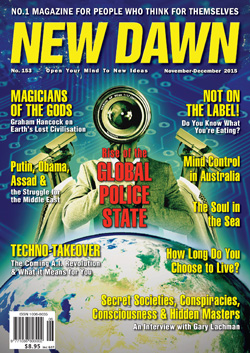
    From New Dawn 153 (Nov-Dec 2015)

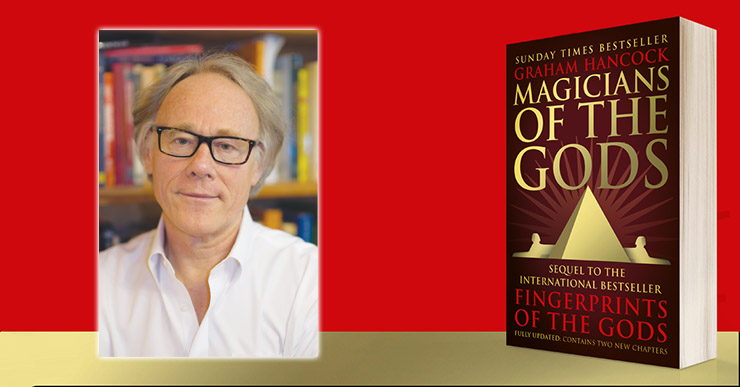
    Author and theorist Graham Hancock has had a sizeable impact upon the popular understanding of humanity’s ancient past. His global 1995 bestseller Fingerprints of the Gods contended that some previously ancient but highly advanced civilisation existed in prehistory, one which served as the common progenitor civilisation to all subsequent known historical ones. Further books such as Keeper of Genesis (with Robert Bauval), Underworld (studying underwater ruins as evidence of lost civilisations) and others propose bold new theories that challenge mainstream dogma.

    Hancock’s new book Magicians of the Gods: The Forgotten Wisdom of Earth’s Lost Civilization – a sequel of sorts to Fingerprints – gathers compelling evidence pointing to an ancient global cataclysm, caused by devastating meteor impacts, that may have all but erased a highly advanced human society and forced the survivors to, in essence, start again. Hancock also presents evidence the Earth may soon face this potentially species threatening meteor stream again.

    David Thrussell spoke to Graham Hancock in this exclusive interview for New Dawn.

    DAVID THRUSSELL (DT): From a distance, you appear to have what could be described as an ideal life Graham, travelling around exotic and interesting places, exploring the edges of history and knowledge. Are there any downsides, disappointments or frustrations in your work?

    GRAHAM HANCOCK (GH): I feel glad that I’ve had the opportunity in this life to explore and spend time in so many incredible, mysterious, profoundly moving ancient sites, all around the world. It’s been a great privilege to have the opportunity to do this, and I have no complaints whatsoever. I’m grateful for my life. I have a lot of freedom and I’ve worked from home since I was 29 as a matter of fact – that’s when I decided I couldn’t work in a large organisation anymore, and struck out on my own. For a very long time I was completely broke. Eventually I started to manage to make a living from it. But I have no complaints. I think I’ve been very fortunate and I’m grateful for the life I’ve had the opportunity to lead.

    DT: How long have you been working, brewing away on the new book [Magicians of the Gods]?

    GH: Well in a sense, 25 years. As a focused project, about 3½ years, but this book draws on my interests and enquiries into this field going back to the end of the 1980s.

    DT: Now, if you had to advance a single most compelling piece of evidence to support your theory, what would it be and why would it be that?

    GH: Well, it’s more complicated than that. This is not a problem that can be solved by a magic bullet. This is a problem that requires co-ordination of evidence from many different sources. I would offer you three pieces of evidence that are all in a sense joined together, and one of those pieces of evidence, a very important piece of evidence, is something we have now, but I didn’t have when I wrote Fingerprints of the Gods in 1995. It’s effectively a smoking gun, globally. Scientific evidence for a global cataclysm between 13,000 and 12,000 years ago. That was essentially the hypothesis I put forward in Fingerprints of the Gods, that there had been a global cataclysm between 13,000 and 12,000 years ago, and it wiped out an advanced civilisation, and I speculated on many possible causes of that cataclysm – notably pole shift and Earth crust displacement.

    What happened since 1995, and particularly since 2007, is that a group of scientists have put before the scientific community – very little of this has yet leaked out to the public – absolutely compelling evidence Earth suffered a series of impacts from fragments of a giant comet, and these impacts happened 12,800 years ago when several fragments hit the North American ice cap, causing global flooding and radical climate change. It happened again 11,600 years ago when more fragments from the same comet came out of orbit and smacked down into an ocean – almost certainly the Pacific – sending up a huge plume of water vapour into the upper atmosphere and causing very sudden global warming. So the interval between those two periods, the 1,200 years between 12,800 years ago and 11,600 years ago, is an episode of almost unparalleled global cataclysm, coupled by massive extinction of animal species, the mega mammals, the mammoth, the woolly rhino, and so on. And this is the event that I believe lost us a whole civilisation of pre-history that previously has not entered the archaeological records.

    Now, let’s co-ordinate this with the latest discoveries in archaeology. Remember that one of the two dates for that cataclysm is 11,600 years ago. This was a sustained event that involved two separate bombardments from fragments of a comet. On both occasions there were massive sea level rises and a global cataclysm unfolded. The first occasion 12,800 years ago, the second occasion 11,600 years ago, were also accompanied by global flooding and massive sea level rises. It’s therefore intriguing that the archaeological site in south eastern Turkey, known as Göbekli Tepe – which means ‘pot-bellied hill’ in the Turkish language – was created 11,600 years ago by people who already knew how to work with giant megaliths. Göbekli Tepe is an anomaly, because it’s 7,000 years older than other megalithic sites around the world, and yet it demonstrates advanced techniques of stonework and stone cutting, organisation of labour, planning, site design and alignment to the heavens. This is not the work of a group of hunter-gatherers who woke up one morning and felt suddenly inspired to create the world’s first megalithic architecture. In my view, what we’re looking at is a transfer of technology, the knowledge brought by the survivors of the lost civilisation, including the knowledge of how to create large-scale megalithic structures – and at exactly the same moment 11,600 years ago we get this sudden and unexplained appearance of a sophisticated megalithic site in south eastern Turkey.

    We also get the dissemination and uptake of agriculture in exactly the same region, whereas previously the inhabitants had been entirely hunter-gatherers. I say again, what we’re looking at is a transfer of technology, the fingerprint of the survivors of a civilisation that was lost in the cataclysmic events between 12,800 and 11,600 years ago.

    And I mention a third point, the age-old myth of Atlantis, which isn’t actually that old because the version of it that comes down to us – the only version that comes down to us – is in the works of the Greek philosopher Plato. Plato said he got the story of the submergence and destruction of the advanced civilisation of Atlantis through his ancestor Solon, the Greek law-maker who visited Egypt in 600 BCE, and there was told, by Egyptian priests, the story of Atlantis. And they said Atlantis had been destroyed and submerged, having incurred the anger of the gods, 9,000 years before the time of Solon. We know that Solon was in Egypt around 600 BCE, therefore they are talking about 9,600 BCE in our calendar, 11,600 years ago, which is the date precisely for the appearance of these hitherto unheralded techniques of megalithic architecture and agriculture in the region of south eastern Turkey.

    DT: The cataclysm you’re talking about has been staring us in the face really, hasn’t it?

    GH: It has been staring us in the face, but I don’t blame historians and archaeologists for failing to get to grips with it sooner than this. Because the leading scientists in the field have only really been compiling and presenting evidence on what is now referred to as the Younger Dryas comet for the last seven or eight years. It’s a very recent discovery and the reason it’s a recent discovery is that the major impacts of this comet 12,800 years ago were on the North American ice cap. This was still the Ice Age. North America, as far south as New York, was covered with ice, two miles deep, and at least four fragments of the comet hit the ice cap. But they did not leave prominent craters on the ground because the craters were in the ice itself and the vast heat and kinetic energy of the comet melted away that ice, so the craters were transitory and what we have is shock effect on the ground underneath. Recently, a number of craters have been found. The kind of craters that would be left when an object hit a two mile deep ice cap and transferred its shock to the bedrock underneath.

    Much more important is the evidence of the Younger Dryas scientific team – more than 30 scientists are working on the Younger Dryas comet. That evidence is based on what I call “impact proxies.” When you get an object coming in at 60 or 70 thousand miles an hour, and that object is a kilometre or two in diameter, it has unbelievable quantities of kinetic energy, and then you’re looking at an explosive power in the range of the entire nuclear arsenal of planet Earth, going up at once, with any single one of these objects. And there are certain, very recognisable outcomes of this. One is melt glass. You have heat unleashed in excess of the boiling point of quartz. Temperatures in excess of 2,200 degrees centigrade. This produces melt glass which is indistinguishable from the melt glass we find as a by-product of nuclear explosions. You also get carbon micro-spherules and very distinct nano-diamonds that are caused by the shock and heat. These nano-diamonds are only visible under a microscope, and they are combined with the melt glass, the carbon micro-spherules, and other evidence all around the world. They are compelling evidence for a gigantic cosmic impact 12,800 years ago.

    And, by the way, it’s exactly this kind of evidence that was initially put forward to prove the asteroid that wiped out the dinosaurs 65 million years ago. There’s only two occasions in Earth’s history, in the last 100 million years, that we get precisely the same impact proxies spread around the world. One of them is the so-called KT event 65 million years ago that wiped out the dinosaurs. And the other is the hitherto unrecognised, but now very obvious extinction level event that happened 12,800 years ago, and was caused by the Younger Dryas comet. I say “Younger Dryas” because that is the geological name for the period between 12,800 years ago and 11,600 years ago when the Earth’s climate fell into a sudden and hitherto unexplained deep freeze. We now know the cause of this. It was our interaction with the fragments of a giant comet, and the effects were truly cataclysmic.

    [alert type=”info” dismiss=”no”]If you appreciate this article, please consider a subscription to New Dawn magazine.[/alert]

    DT: Is it reasonable to suggest that mainstream academia, media and science are wedded to a particular view of history?

    GH: Yes. It is reasonable to suggest that, and it’s not surprising either. It’s just always the case – when you have any area of study, any discipline, whether it’s geology or whether it’s archaeology for that matter – that a body of knowledge is built up. And respected elders have contributed to that body of knowledge, and the new generation obviously respects the work of their elders. And gradually what builds up is a reference frame, a picture for how that area of study should be. In the case of archaeology, the picture that built up over the last 100 years of work is of a slow evolution of civilisation – that our ancestors were hunter-gatherers and nothing more until perhaps 8 or 9 thousand years ago. Then we begin to see the gradual movement towards more permanent settlement and about 5,000 years ago we get the first big cities and the first great megalithic architecture. This is the picture of civilisation taught to us by mainstream academic historians and archaeologists. It’s taught in the schools, it’s by and large conveyed through the media, but it is not a fact, it is a reference frame. It is a reference frame built up by 100 years of archaeological study. And this is, I think, the problem with archaeology and other scientific disciplines that get locked in a particular reference frame. When new facts emerge that don’t fit the reference frame, they find it difficult to adjust to them, and the first step is the attempt to discredit those facts. When more and more evidence comes in that the existing paradigm can’t explain, eventually the paradigm gets overthrown. A lot of good people who’ve done a lot of good work, who are convinced they’re right, who respect the work of their elders, and who don’t want to rock the boat – I think that’s the central problem. It always happens in science. No ideas change suddenly overnight without overwhelming new evidence that the previous paradigm cannot explain. That’s what we’re finding in the field of history and archaeology now – more and more new evidence coming in that simply can’t be explained by the existing reference frame of history.

    DT: Would you care to speculate – if the theory that you’re advancing is indeed correct – what pre-history looked like? What would history on Earth look like before this comet struck the planet?

    GH: A much more complicated world than the world portrayed to us by mainstream historians and archaeologists. Not a world populated entirely by hunter-gatherers as they suggest, but a world in which hunter-gatherers, and a more advanced civilisation, co-existed. This, in a way, is not odd. If you think about it, we are a very advanced technological civilisation today – Western technology, the industrial-technological-complex that has spread around the world, but we are not alone. We share the world with hunter-gatherer people – hunter-gatherers in the Kalahari Desert, for example, and in Southern Africa. Hunter-gatherers in the Amazon Basin. There are even tribes in the Amazon Basin who are completely un-contacted, who don’t even know that we exist; an advanced technological culture has not even impinged on their worldview yet. So the co-existence of advanced technology with hunter-gatherers that we see today, I would project that back into the past, and I would say more than 13,000 years ago during the Ice Age there was a much more advanced civilisation on this planet, than is given credit for by historians and archaeologists. It is remembered in myth and tradition all around the world, and it’s increasingly supported by recent striking archaeological discoveries such as Göbekli Tepe.

    DT: You mentioned two obvious cataclysmic events – the dinosaur extinction and the Younger Dryas events. Is it possible there have been other cataclysmic events that we have no inkling of?

    GH: Certainly there have been other cataclysmic events, and we do have inklings of them. The only question is, whether they affected the human species, and this becomes a matter for further enquiry. I hold, for the moment, the view that anatomically modern humans – people who look just like you and I – have only existed on Earth for about 200,000 years. It may well be that further discoveries will produce evidence of earlier anatomically modern humans. I don’t rule that out. But at the moment the evidence points to the emergence of our anatomically modern line about 200,000 years ago. We have, for example, a skeleton from Ethiopia, 196,000 years old, which is indistinguishable from an anatomically modern human being. So for these cataclysms to involve humanity and to impact the human story, they need to have happened within a human timeframe. This is why the Younger Dryas event is so intriguing because not only is it within the human timeframe, it’s right on the edge, on the border of a period when historians and archaeologists think civilisation began. Yet they had not yet taken into account this extinction level cataclysm, right in the backyard of history, and I would say that until they do take it into account, all their notions about the origins of civilisation are up for grabs.

    There have been multiple other global cataclysms of an extinction level going back hundreds of millions, even billions of years in the past. These things happen from time to time, and every time they happen they reset the clock on this planet, and life changes due to these dramatic and radical events. I think it’s only the most recent one, the one that happened 12,800 years ago, that directly impacted the human story – and this recent global cataclysm has not yet been taken into account in the model building of our past by historians and archaeologists.

    DT: Is it possible that mainstream science, the media, or even the general population in a sense, don’t want to know about our own history as a species?

    GH: There appears to be a kind of directive operating at governmental level, not to say things too alarming. It particularly applies to issues that involve global cataclysms. Anybody who’s worked in the field of geology will know that proposing a cataclysmic agent results in furious criticism. There was a great geologist called J. Harlan Bretz – whose work I write about in Magicians of the Gods – who provided the first evidence of cataclysmic flooding in North America, particularly in the Pacific north-west, in the channelled scablands, an area I researched quite intensively for Magicians of the Gods. J. Harlan Bretz was absolutely 100% right, but it took from the 1920s, almost to the 1970s, before he was accepted as being right. Prior to that he had been subjected to the most grievous and unpleasant abuse, which a weaker man might not have borne. In the end he turned out to be correct and he lived until the age of 99. And when he was awarded America’s highest honour for a geologist, he said: “My only regret is that all my enemies are now dead, and I have no-one to gloat over.”

    DT: If there is an active effort to forget or obscure history, why would that be?

    GH: I’m not sure. I don’t want to go in the direction of a conspiracy. I think it’s just the way people’s minds work. We find it difficult to conceive of certain things, or apply them to ourselves. There may be a conspiracy. I have to contemplate this possibility a little bit in the book. I don’t like conspiracy theories – it’s an area of enquiry where facts get thin on the ground and speculation gets very thick and long. When I look at the way the catastrophists’ ideas have been systematically rubbished, sometimes for decades until proved correct – the same was true, by the way, about the dinosaur impact. Initially no scientists believed that either. Luis and Walter Alvarez, who initially proposed the idea of a cosmic impact 65 million years ago, were subjected to abuse and persecution, and they too were eventually vindicated.

    DT: Are you aware of the work of Steven and Evan Strong in Australia?

    GH: I know Steven and Evan Strong. They were kind enough to show me a number of interesting sites in Australia last year. I’ve got a lot of respect for their leg work and they’ve opened my eyes to mysteries in Australia which I do intend to look at in the future. Australia has not been a big focus of my work up till now.

    DT: Do you ever suffer from ‘apocalypse fatigue’? It seems to be a staple of human endeavour, doesn’t it, thinking that a cataclysm is around the corner?

    GH: No, I don’t suffer from ‘apocalypse fatigue’, and I don’t go around thinking that the end of the world is nigh, either. I do think we should be paying much more attention to our cosmic environment. At the moment the human race has its priorities all screwed up. We’re capable of spending trillions of dollars a year on weapons of mass destruction, quite ready to wipe each other out and destroy this beautiful and precious habitat, the Earth, that the universe has given us. Humanity shows every sign of being an insane species at the moment, an insane and unconscious species, totally devoted to material production and consumption, uninterested in matters of spirit. Negligent of this beautiful garden in which we find ourselves.

    If we were to take the responsibility of human life seriously, we would closely and carefully inspect our immediate cosmic environment. I have drawn attention in the book to the fact that the debris stream of the giant comet that caused the cataclysm 12,800 to 11,600 years ago is still in orbit. It’s called the Taurid meteor stream. We pass it twice a year. If we were smart we’d pay a great deal of attention to the objects that orbit in the Taurid meteor stream. And if, as seems likely, some of them threaten Earth in the future, we have the technology, we have the ability to avert that danger. I’m only interested in the issue of future cataclysms to the extent that we can avoid them, and that foreknowledge of them would help us avoid them, and I believe that is the case with the cosmic threat. There is a threat, there is an ongoing danger. Most responsible and serious astronomers would absolutely agree with that.

    We mark World Asteroid Day on 30 June, which is an attempt to draw attention to the dangers of our immediate cosmic environment, and to do something about it. We’re probably the first civilisation in the history of Earth that has the capacity to intervene in our cosmic environment and to deflect or divert objects that might threaten life. I think we’d be doing a lot better if we directed our resources more responsibly – a lot of the money we spend on useless military pursuits at the moment – and channelled it instead to a thoroughly worked out space-watch project to ensure Earth never again suffers the kind of disasters it suffered between 12,800 and 11,600 years ago. We are going down the path of insanity and madness with our military spending. With all the fear and hatred and suspicion circulating in the world at the moment, we need to recognise that we’re all brothers and sisters, we’re one human family, and perhaps the prospect of dealing with a shared common threat would be the very thing to bring us together.

    DT: Ironic, isn’t it, there may be a weapon of mass destruction bearing down upon us all right now.

    GH: Yes, exactly. This is possible. A number of astronomers (including Bill Napier) and the mathematician Emilio Spedicato at the University of Bergamo, are all deeply concerned about the Taurid meteor stream. They believe it has a number of very large objects, including one that may be 30km wide, and the Earth crosses this stream twice a year. Some calculations indicate we may be crossing particularly lumpy and dangerous parts of the stream within the next 30 years or so. Nothing really could be more urgent. We need to pay attention to this problem. We need to identify objects that endanger Earth, and we need to move them. All of that we can do, it just takes the will. We already have the technology. But while we go around fearing and hating and suspecting one another, our eye’s not on the ball. Our eyes are on totally the wrong place.

    DT: I couldn’t agree more with you.

    Magicians of the Gods: The Forgotten Wisdom of Earth’s Lost Civilization by Graham Hancock is available from all good bookstores. Graham Hancock’s website is www.grahamhancock.com.

    [alert type=”general” dismiss=”no”]This article was published in New Dawn 153.[/alert]

    [alert type=”success” dismiss=”no”]If you appreciate this article, please consider subscribing to help maintain this website.[/alert]

    © New Dawn Magazine and the respective author.
    For our reproduction notice, click here.
  • American Gurus & the Search for Enlightenment: An Interview with Arthur Versluis

    American Gurus & the Search for Enlightenment: An Interview with Arthur Versluis

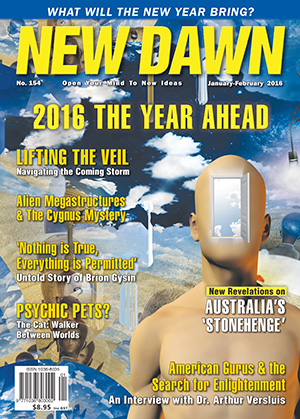
    From New Dawn 154 (Jan-Feb 2016)

    Until recently the academic world paid almost no attention to the Western mystical and esoteric traditions. If any scholars strayed into these areas, they did so gingerly and apologetically, often feeling the need to sneer at these currents as a way of safeguarding their reputations.

    This situation began to change in the 1980s. A small group of academic scholars in mainstream universities began to pay serious attention to esotericism as a formative part of the Western spiritual and intellectual culture.

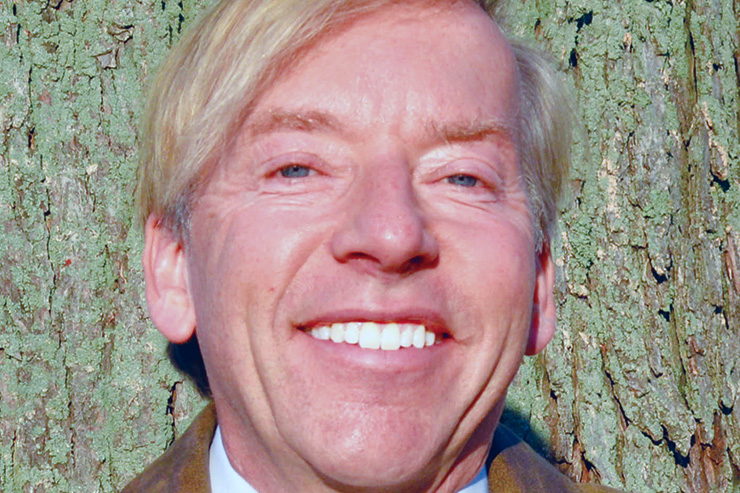
    Arthur Versluis (left) is one of the central figures in this development. Chairman of the department of religious studies at Michigan State University in the US, he has helped form a community of academics that share these interests. He is the founding president of the Association for Esoteric Studies, the leading academic research group in the US in this field, and founder of the online journal Esoterica.

    Versluis’s books include The Secret History of Western Sexual Mysticism: Sacred Practices and Spiritual Marriage (2008), Magic and Mysticism: An Introduction to Western Esotericism (2007); The New Inquisitions: Heretic-Hunting and the Intellectual Origins of Modern Totalitarianism (2006); Restoring Paradise: Esoteric Transmission through Literature and Art (2004); The Esoteric Origins of the American Renaissance (2001); Wisdom’s Book: The Sophia Anthology (2000); Wisdom’s Children: A Christian Esoteric Tradition (1999); and American Transcendentalism and Asian Religions (1993).

    His 2014 book, American Gurus: From Transcendentalism to New Age Religion, traces the rise of spiritual teachers outside the folds of religious traditions. Many of them claim to teach various forms of instant or immediate enlightenment.

    In October 2015, I conducted an e-mail interview with Versluis to discuss American Gurus.

    RICHARD SMOLEY (RS): One of the main themes of American Gurus is a phenomenon called immediatism. Could you talk a little bit about that?

    ARTHUR VERSLUIS (AV): Immediatism refers to a religious assertion of spontaneous, direct, unmediated spiritual insight into reality (typically with little or no prior training), which some claim is enlightenment. It refers to a claim of a “pathless path” to religious enlightenment, because the immediatist says “away with all ritual and practices!” and claims that direct spiritual awakening or enlightenment is possible at once, without meditation or years of guided praxis. In American Gurus, I show that an immediatist approach to enlightenment is deeply embedded in the contemporary religious scene, and is fundamentally a modern New Age phenomenon with some historical antecedents.

    RS: How has this quality of immediatism played itself out in the America of the last 150 years?

    AV: As I said, immediatism as discussed in the book is really a phenomenon of the last several decades. Of course, some antecedents are visible in Anglo-European American literature in much earlier authors. I argue that if contemporary American immediatism has a single ancestor to whom it owes the most, that figure is Ralph Waldo Emerson. In the book, I show that Emerson is much more deeply influenced by Platonism than is usually acknowledged today, and further, I discuss his work in terms of Emerson’s own gnostic experience. Literary critic Harold Bloom was right when he said that in American literature, the titanic figure is Emerson, and one can measure American literature as being before and after Emerson. Of course, Bloom wants to cordon off the term Gnostic to refer to the world-rejecting perspective attributed to it by Hans Jonas and those who follow his existentialist, early-twentieth-century interpretation of “Gnosticism” in late antiquity. However, in my usage, gnosis and gnostic have only their generic implications of one who claims direct spiritual insight, a “gnostic” being someone who experiences gnosis, or illumination. Emerson is the archetypal American figure in this regard.

    But strictly, speaking, Emerson is best described as a Platonist, whereas immediatism discussed in the latter half of the book is a contemporary or relatively recent New Age phenomenon based to a considerable extent, though by no means exclusively, in Neo-Advaitic Hinduism, or what is known as the “satsang movement.”

    RS: You contrast immediatism with Platonism. What are some of the main differences between the two?

    AV: Platonism, like Buddhism and Hinduism, includes contemplative practices and rituals. As I show in my new book Perennial Philosophy [see excerpt, ‘Leaving the Cave’, on page 60], Platonism centres on the contemplative ascent and illumination, and although it does not exclude the possibility of immediate illumination without praxis, it also certainly is not based in that. Immediatism, on the other hand, typically represents a claim that one does not need practices or ritual, but simply needs to be in the presence of a guru, or, sometimes, that one needs to do nothing at all. Immediatism is quite attractive in a New Age consumerist marketplace because it doesn’t ask anything in particular of us, but tells us that we’re “always already” “enlightened.”

    RS: Which of these do you feel more in sympathy with?

    AV: My admiration for and understanding of Platonism continues to grow. Plotinus is an extraordinary figure, whose work Enneads should be read by everyone in the West who feels called to an inner life. But Platonism is not like Buddhism, which has so many available teachers and gurus, as well as a wide range of practices and traditions.

    RS: One figure that you discuss at length is Robert Anton Wilson. Both in Wilson and the Discordian movement there’s obviously a great deal of spoofing going on. Where do you think the joking stops and the serious message begins? Could you comment on Wilson’s work a little and say why it’s significant?

    AV: Robert Anton Wilson is an entertaining figure, and of course Discordianism and variants of or like it are often quite funny. I think one of the more interesting connections mentioned in the book are the links between Wilson and various magical practitioners, authors, and groups, including Christopher Hyatt, Lon Milo DuQuette, and others who might be grouped roughly in the category of “left-hand” magic. In fact, one of the other authors in a volume Wilson contributed to says directly “We are Black Magicians.” I think Wilson’s work needs to be understood in the context of overcoming monotheistic and other forms of what he would call “programming” as well as in the context of going beyond dualities, but as an individualist and a spiritual anarchist. He specialises in semantic disorientation toward those ends.

    RS: Could you comment about William S. Burroughs and his relation to this tradition?

    AV: Burroughs is quite different from many of the other figures discussed in the book. He rejects traditional religions, and offers instead what he calls a “Magical Universe” full of gods and demons in conflict. His magical world is harsh, demonic, characterised by paranoia, and could be described as a kind of cosmic confidence game. He is a somewhat sinister and fascinating figure. I’d suggest readers take a listen to the Bill Laswell album that includes Burroughs reading passages from his novel The Western Lands to get a sense of his unmistakable voice. Critical accounts of his work have not fully taken into account his occultism, for the most part. But his work represents more of a reference point in the book, not a main subject.

    RS: Could you talk a little bit about the Traditionalist Frithjof Schuon and the kind of Sufism that he came to embrace?

    AV: The book really doesn’t focus on Schuon or Traditionalism, but rather mentions them in passing as a reference point. Broadly speaking, I think Traditionalists would dismiss many of the more recent figures discussed in the book as spiritually harmful and deluded. I think it’s pretty clear that Schuon and his circle emphasise spiritual practices and thus aren’t immediatist in the way that, say, Andrew Cohen might be.

    RS: Another figure you discuss is Peter Lamborn Wilson, who has embraced what he regards as a radical, heretical Islam. What would you say are some of the most significant things about Wilson and his work?

    AV: I know Peter – we published my conversation with him in JSR: Journal for the Study of Radicalism a few years back. I talk to him from time to time. He is one of the liveliest intellects I know, a voracious reader, and full of interesting and surprising ideas. I think the radical, antinomian aspects of some offshoots of Sufism both influenced and appeal to him. He is fundamentally what I call a spiritual anarchist, and a real American character.

    RS: At the end of your book you discuss a number of self-styled enlightened masters ranging from Andrew Cohen to Franklin Jones (Adi Da) to Ken Wilber. You mention that teachings of love and compassion seem more or less absent from their discourse. Could you say a little bit about why?

    AV: In the last chapter, I quote Georg Feuerstein’s critique of some of the guru figures you mention. He argues, as do a number of others, that it’s possible to believe one has reached the end of a spiritual path when one actually has only gone partially down it, for instance. It might well be that some people who claim enlightenment have realised something, but have not gone through all the stages as described, for instance, in Buddhist descriptions of the stages leading to enlightenment. Lama Surya Das refers to such claims, cleverly, as “premature immaculation.” One can’t discount the possibility of less charitable interpretations as well, of course.

    Get the issue this article appears in

    RS: One of the most striking conclusions in your book is that the whole immediatist strain in American spirituality could be viewed as part of the absorption of Asian religions, notably Hinduism and Buddhism, in American culture. Many of the self-styled enlightened masters seem to have an affinity for the Hindu Advaita tradition in particular. Could you suggest why this might be?

    AV: One of two epigraphs for the book as a whole is a remark by pollster George Gallup, Jr., who observed, “Americans want the fruit of religion, but not its obligations.” I think there’s a lot of truth to that, and it does help explain why what’s called “Neo-Advaita” Vedanta is popular; it tends to require only that one show up for satsang, or an audience with a Neo-Advaitic guru. But there’s a larger frame, which is the emergence of the New Age movement more generally. The basic idea of a “New Age” is that it just happens to you; it is fundamentally more passive and consumerist than based in traditional practices. It lends itself to spiritual consumerism.

    RS: How do you believe these impulses – notably the influence of Asian religions – will develop in our civilisation in the time to come?

    AV: This is really an interesting question to explore. Asian religions in America, in particular Buddhism and Hinduism, but also Taoism and others, are becoming acclimated, but also are beginning to be Americanised and, more broadly, Westernised. Thus there are a number of practitioners and teachers who see themselves as maintaining the essence of the religious tradition, but at the same time adapting it to the modern American or Western context. Of course, one argument is that some of them, for instance, many Neo-Advaitin teachers, have so essentialised the tradition as to have created something else, which critics argue is diminished into a variant of New Age consumerism. And that is the argument that may often be wielded. But one also has to recognise that as Asian religions become rooted in the West, especially the gnostic initiatory lineages, it is inevitable they also adapt and are adapted to new and very different cultural contexts. An example of this would be the German teacher of Zen Buddhism and mysticism, Willigis Jäger. Another would be B. Alan Wallace, who has a Ph.D. in religious studies and is also a teacher of Tibetan Buddhism. And there are many others, in different traditions. This phenomenon will continue to develop, I’m sure – it is arguably the most important religious development in the West since the emergence of Protestantism.

    American Gurus: From Transcendentalism to New Age Religion (Oxford University Press, 2014) is available from all good bookstores and online sellers. Professor Arthur Versluis has a website at www.arthurversluis.com.

    [alert type=”general” dismiss=”no”]This article was published in New Dawn 154.[/alert]

    [alert type=”success” dismiss=”no”]If you appreciate this article, please consider subscribing to help maintain this website.[/alert]

    © New Dawn Magazine and the respective author.
    For our reproduction notice, click here.
  • Freemasons, Secret Societies, Conspiracies, Consciousness & the Hidden Masters: An Interview with Gary Lachman

    Freemasons, Secret Societies, Conspiracies, Consciousness & the Hidden Masters: An Interview with Gary Lachman

    From New Dawn 153 (Nov-Dec 2015)

    An overlooked but powerful current is flowing in our time. It’s found in a small group of writers and thinkers who are trying to overcome the materialism and rationalism of the present age and rediscover the perennial truths that lie behind all religion. These writers are grappling with the occult and esoteric paths of the past and present. They’re trying to explore these movements without falling into either credulity or blinkered scepticism. They include Jay Kinney, founder of Gnosis magazine and author of The Masonic Myth; Mitch Horowitz, a New York book editor whose own works include Occult America and One Simple Idea: How Positive Thinking Reshaped Modern Life; and Erik Davis, author of TechGnosis and Nomad Codes: Adventures in Modern Esoterica.

    In this small but distinguished company is Gary Lachman. He started out in the 1970s in the New York rock scene as one of the original members of the groundbreaking New Wave band Blondie. In 1996 he moved to London, where he established himself as a full-time writer, contributing to publications such as Fortean Times, The Guardian, and The Times Literary Supplement.

    Since 2001 Gary has produced a steady stream of books, including Turn Off Your Mind: The Mystic Sixties and the Dark Side of the Age of Aquarius; The Secret History of Consciousness; A Dark Muse: A History of the Occult; and Politics and the Occult: The Right, the Left, and the Radically Unseen. In recent years he has published biographies of major esoteric figures including P.D. Ouspensky, Emanuel Swedenborg, Rudolf Steiner, Carl Jung, and H.P. Blavatsky (see his interview in New Dawn 137).

    Gary’s latest work, published in December 2015 by Tarcher/Penguin, is The Secret Teachers of the Western World, a monumental work that unveils the esoteric masters who have shaped the intellectual development of the West, from Pythagoras and Zoroaster to little-known twentieth-century figures such as Jean Gebser and René Schwaller de Lubicz.

    In June 2015 I conducted an e-mail interview with Gary about secret currents in the Western tradition.

    RICHARD SMOLEY (RS): Many people have a sense, however dim, that what is going on in the news is only the thinnest skin upon a sea of struggles and forces that we can barely conceive of. Would you agree with this assessment?

    GARY LACHMAN (GL): I suspect that at most times what we are aware of is only a selection of what is actually taking place. I mean this in the broadest sense possible. In terms of the media, it’s reasonable to assume there are a variety of filters in place that result in an edited version of things getting to us. But then there are people who devote their energies to ‘uncovering’ the truth and ‘revealing’ the facts about this or that event. It does strike me that one could get lost in attempting to track down the ‘truth’ about things, in terms of the political, economic, social situation. I mean conspiracy theorists who pursue an elusive solution to the mystery of who ‘really’ is in power and what ‘really’ happened in this or that situation.

    I think it is important to be discriminating about what we accept from our sources and to be aware that every source has its bias. Personally, I am more interested in the kind of things that are outside this kind of ‘hermeneutics of suspicion’, in the philosopher Paul Ricoeur’s phrase. I mean philosophy, thought, etc. I think it’s always a good time to pursue the good, the true, and the beautiful, whoever is running the show. I also think there is less covert control than some people believe, but it seems de rigueur nowadays to feel that everything we see on the news is false. The show itself is ultimately unimportant. It is an unavoidable nuisance that we nevertheless need to be aware of in order to pursue our aims.

    RS: Novelist Ishmael Reed wrote, “Beneath or behind all political and cultural warfare lies a struggle between secret societies.” How much truth do you think there is in this statement?

    GL: Well, I don’t know. I first came across it, as many people did, in Robert Anton Wilson and Bob Shea’s conspiracy fantasy Illuminatus. Are there really secret societies at work, manipulating events and controlling the world? If there are, they don’t seem to be doing a particular good job of it.

    I think that at different times there have been societies or groups of people who have worked together to effect some change or introduce some idea into the societies of their time. I talk about some of them in my new book, The Secret Teachers of the Western World. But these were relatively small groups who were active at a certain time, and when you look at what they were doing, the aura of mystery and sensation around them being ‘secret’ dissolves. That isn’t what is important about them. Take the Fedeli d’Amore of Dante’s time and of whom Dante was a member. They weren’t secret in the way that we think of Skull and Bones or that kind of thing (and I should say here that my book isn’t about that kind of secret group). But they were a relatively private group of poets who wanted to introduce ideas about the divine feminine or Sophia into the consciousness of their time. They were more like what G.I. Gurdjieff and P.D. Ouspensky mean when they talk about the ‘inner circle of humanity’ or ‘esoteric school’. I’m not saying the Fedeli d’Amore were agents of esoteric schools, but that their objectives and practice were like theirs, rather than some cabal of powerful individuals directing events from behind the scenes, which is how secret societies are popularly imagined to be.

    In one sense I think conspiracy consciousness is a good sign, in the way that Jung said neuroses were, as an attempt by the psyche to deal with a problem. It shows that we have a hunger for meaning. We prefer feeling that someone is in charge, even if we don’t know who that is, to feeling that no one is and that everything is chance and arbitrary. The hunger for meaning is good; it’s the means of satisfying it that I find questionable. We are purposive beings who seek out patterns and meanings. The mainstream narratives – religion, progress – no longer satisfy our appetite for meaning, and so we seek it elsewhere. One of the ideas of the book is that the meaning is there, but we won’t find it by looking for it outside ourselves.

    RS: One period in which occult orders were especially influential was the eighteenth century, in which lodges like the Freemasons played a crucial role in transforming the old feudal and ecclesiastical order into the modern world. Do you have any thoughts or insights about this development?

    GL: Freemasonry was a very important means for some fundamental ideas about modernity to be disseminated. I mean ideas about tolerance, social justice, democracy, individual worth regardless of social or economic rank. It was the spread of these ideas through different lodges that helped prepare the eighteenth-century zeitgeist for the radical changes that happened with the American and French revolutions. It is a mistake, though, to think, with Abbé Barruel and more recent writers on the Masonic influence on these events, that Freemasonry arranged or stage-managed them. There were Masons on both sides of the American Revolution, and the Illuminati – the real society, not the popular romanticised idea of it that’s present on the Internet – wasn’t ‘responsible’ for the French Revolution. The ideas that informed Adam Weishaupt’s short-lived and ineffective Masonic offshoot certainly were active forces in the revolution, and they were spread through Masonic lodges. But I think we have to credit the zeitgeist more than Weishaupt and Co. for the storming of the Bastille. In fact in one sense we could say Freemasonry itself was a product of the shift in consciousness that began around that time.

    RS: Your new book is entitled The Secret Teachers of the Western World. If they were secret, how have they been able to have such influence?

    GL: Well, again, my secret teachers aren’t necessarily secret in the sense that no one knows about them. I mean, if they were that secret, how could I know about them? One can be a secret teacher by teaching secrets, or one can be a secret teacher in the sense that the influence and importance of your ideas haven’t been recognised or have been misunderstood. Or you can be secret in another sense, as with several important thinkers who have been marginalised or don’t fit into the standard model of Western consciousness. It’s a broad term referring to a variable status rather than specific group of people. Jesus Christ, for example, is one of my secret teachers, and most people know about him. But there is a whole school of thought that argues that what we have accepted as Christianity really has little to do with the original teachings associated with Jesus. The Gnostics, for example, are thought to be more in line with what Jesus actually taught then the Petrine church of Rome.

    Or take Madame Blavatsky. If people know about her at all, she is chalked up to be an entertaining but fraudulent nineteenth-century spiritualist with a lot of chutzpah. But she was enormously influential on the modern world, in everything from art, religion, and science to what became known as the ‘counterculture’. I am not saying that everything she said about science or religion is ‘true’. That’s not the point. True or not – and she is more often on the ball than you might think – her ideas were tremendously influential, and I am amazed that feminists haven’t appropriated her. I suspect the occult connotations put them off. She isn’t secret, but her influence is not generally recognised.

    I should say the central idea of my book is that the whole Hermetic, esoteric tradition is the victim of a war going on inside our heads. I mean the rivalry between our two cerebral hemispheres. One of the inspirations for the book came from reading Iain McGilchrist’s very important work The Master and His Emissary, which is about the left and right brain and the differences between them. Briefly put, McGilchrist revamps the left/right brain discussion by showing that the difference between them is not in what they do – as was originally believed – but in how they do it. They respond to the world in very different ways, and the way they present the world is also very different. In the simplest sense, the right brain presents a total picture of the world. Its mode of consciousness is relational, connective, holistic. It presents what McGilchrist calls the ‘big picture’, the overall pattern, but its picture is fuzzy, vague. It works with metaphor, symbols, and is focused on the living character of being. It is aware of implicit meanings, meanings that we know and feel but cannot express explicitly. (Think of our appreciation of music: we know a Beethoven string quartet means something, but we’d be hard pressed to say exactly what.)

    The left brain is aimed at breaking up the big picture into smaller bits and pieces that it can manipulate. Its main function, as Henri Bergson said long ago, is to help us survive. It reduces the living, flowing whole presented by the right brain to a kind of map that allows us to manoeuvre through the world effectively. It’s interested in the trees; the right brain is interested in the forest. One looks through a microscope, the other at a panorama.

    Both are necessary, and for the most part each gets along with the other in a system of checks and balances, each inhibiting the other’s excesses. But McGilchrist argues – convincingly, I believe – that in the last few centuries the left has increasingly gained an upper hand against the right and has, in a sense, gone on a smear campaign against it. One expression of right brain thinking that the left brain targeted was the Hermetic, esoteric tradition, which was cast into disrepute with the rise of mechanical science – itself an exemplar of left brain thinking. With the dismissal of the esoteric tradition it was transformed into what the historian James Webb called ‘rejected knowledge.’ What my secret teachers teach is this rejected knowledge.

    [alert type=”info” dismiss=”no”]If you appreciate this article, please consider a subscription to New Dawn magazine.[/alert]

    RS: Of the figures that you would include among these secret teachers, which do you consider the most influential?

    GL: That’s difficult to say, and I should point out that the book isn’t a ‘top ten’ or ‘ten best’ list or something like that. Plato is certainly one of the most influential; in many ways the esoteric, Hermetic roads all lead to him. He is believed to have ‘gone to school’ in Egypt, and whatever he learned there is supposed to inform his philosophy. But whether Plato studied in Egypt or not, his ideas about the Forms, the ideal essences of which the physical realities of time and space are merely shadows, is certainly at the heart of the esoteric tradition. And Platonism informed Christianity, Hermeticism, Gnosticism, and other esoteric teachings. We can argue with and reject or accept different aspects or elements of his philosophy, but I would say that for the West, Plato is certainly one of, if not the most, significant source of esoteric thought, or thought in general. Alfred North Whitehead said long ago that all Western philosophy is but a series of footnotes to Plato.

    In saying this I’m not saying I think Plato is the ‘best’. My own philosophical background is more in Nietzsche, Bergson, Whitehead, William James, and existentialism. But Plato is still there too.

    RS: Which of these figures do you admire the most?

    GL: I’m not quite sure how to answer that. There are plenty of admirable figures in the book, as well as more questionable ones, and also some martyrs, like Hypatia the Neoplatonist, and the Persian theosopher Suhrawardi, both of whom fell victim to religious persecution, as well as truly secret teachers like the so-called Dionysius the Areopagite who welded Neoplatonism to Christianity. We do not know who he really was, just as we have no names for the Hermeticists of ancient Alexandria.

    I can say who has been an influence on me. One of first writers on esotericism that I read was P.D. Ouspensky. His books Tertium Organum and A New Model of the Universe made a big impact on me, even before I read In Search of the Miraculous and became interested in Gurdjieff. I first read these books forty years ago, and Ouspensky seemed a model of the kind of thinker I wanted to be: he combined a romantic openness to ideas, and poetry and art with a rigorous critical mind and he remains the best writer from what I call the ‘golden age of modern esotericism’, which took place during the 1920s, when people like Ouspensky, Gurdjieff, Rudolf Steiner, Jung, Crowley, and others were all active. Again, I’m not saying Ouspensky is the ‘best’ – that’s as pointless as arguing about who’s the best guitarist. But reading his books excited me and made me want to learn more. I tend to like figures that combine imagination with critical thinking, which we can see as the right and left brain working together, which is another theme running through the book.

    RS: One theme that you advance in your new book is that the cosmos is a living, conscious being, and that we need to rediscover that fact. To what extent do you think this rediscovery is actually happening in the world today?

    GL: It seems some form of that idea has been revived and presented in a variety of different ways throughout the last century and into our own. Bergson argued a form of it as did Whitehead. In the nineteenth century we have Gustav Fechner, who wrote about the Earth as a living being well in advance of James Lovelock. The philosopher David Chalmers has argued for a kind of panpsychism, meaning that in some sense, the entire universe is conscious. What headway this idea has made in altering our ‘standard model’ of the cosmos is unclear. We’d have to interview lots of scientists, I guess, and go through the numbers. I think more people today have some sense of it than, say, in the nineteenth century – at least the kind of mechanistic picture of the world popular then is less so now. Of course, any scientist who takes the idea literally and talks about it is subject to the scorn of his peers. But that too is an expression of the rivalry between the two modes of thinking. The ‘hard’ left brain makes fun of the ‘soft’ right brain’s ‘need’ to see a nice, cozy universe that cares about him, while he shows how ‘tough’ he is by saying that he doesn’t need that and prefers the ‘truth’ about the cold, indifferent cosmos. I write about this in an earlier book, The Caretakers of the Cosmos, where the idea of a living cosmos is a central theme.

    RS: Thirty or forty years ago, it seemed possible to believe that we were on the verge of a new age of rising consciousness and compassion. It’s a little harder to believe this now. How do you personally respond to hopes and dreams of a coming new age (however imagined)?

    GL: I’m not that keen on predicting a new age. Western history is littered with them. I think the current pessimism, or, more accurately, nihilism is a kind of ‘sound barrier’ that our culture, our civilisation, has to break through. Nietzsche predicted it at the end of the nineteenth century. I think we have somewhat naïve ideas about a new age. I believe there are shifts in consciousness. One of the thinkers I refer to in the book and in others is the little-known German philosopher Jean Gebser, who talks about different ‘mutations’ of consciousness happening throughout history. But these come about through our own participation in them; I mean we are active players, not passive recipients of something happening in the stars or according to some ancient teachings.

    The real new age will come round when we learn how to master our own consciousness. This means coming to understand it. This takes hard, determined work. I don’t think the new age will come about because of nice thoughts or fun raves or because of a conference or a festival. It will start to appear in individuals who have an obscure hunger for some purpose higher or more demanding than what our ordinary life can provide. These types embody in embryonic form a new consciousness that demands a new kind of inner freedom.

    We tend to think of freedom as liberation, as being free from something. The new types want a more significant freedom, the freedom for some purpose greater than just fulfilling their individual needs. In The Caretakers of the Cosmos I borrow a term from the Russian existential philosopher Nikolai Berdyaev and talk of a ‘creative minority’. These are the individuals who quietly and solitarily confront the demands of the new consciousness emerging within them. We tend to think that a new form of consciousness will be lots of fun and full of ecstasy. But more often people experiencing a different kind of consciousness, with different needs and appetites, tend to feel like misfits and have to go through a long struggle to actualise their possibilities. I have a very evolutionary way of thinking. I feel that any important development at first makes life more difficult for those in whom it occurs. Those who can get through the initial difficulties develop a strength that will help them impose the new vision on the world around them.

    RS: Which living people do you consider to be most important and impressive in fostering this higher awareness?

    GL: The most important one for me has been Colin Wilson, who sadly died at the end of 2013 at the age of eighty-two. I have been a dedicated Wilson reader since 1975, when I first read The Occult. After that I tracked down and read as many of his books as I could find. I am in fact preparing to write a book about his work and ideas, which more or less form the basis for much of my own writing. Wilson spent a lifetime in a determined analysis of consciousness and developed what I find to be a very convincing argument for why our consciousness is how it is and what we can do to intensify it. It isn’t for everyone, but I personally have got the most out of following his leads.

    Gary Lachman’s The Secret Teachers of the Western World (Tarcher/Penguin) is available from all good bookstores and online retailers.

    [alert type=”general” dismiss=”no”]This article was published in New Dawn 153.[/alert]

    [alert type=”success” dismiss=”no”]If you appreciate this article, please consider subscribing to help maintain this website.[/alert]

    © New Dawn Magazine and the respective author.
    For our reproduction notice, click here.