New Dawn – World's Most Unusual Magazine

Category: Articles

  • The People vs. the Hidden Hand: David Icke Speaks Out (Part 2)

    The People vs. the Hidden Hand: David Icke Speaks Out (Part 2)

    From New Dawn 157 (July-Aug 2016)

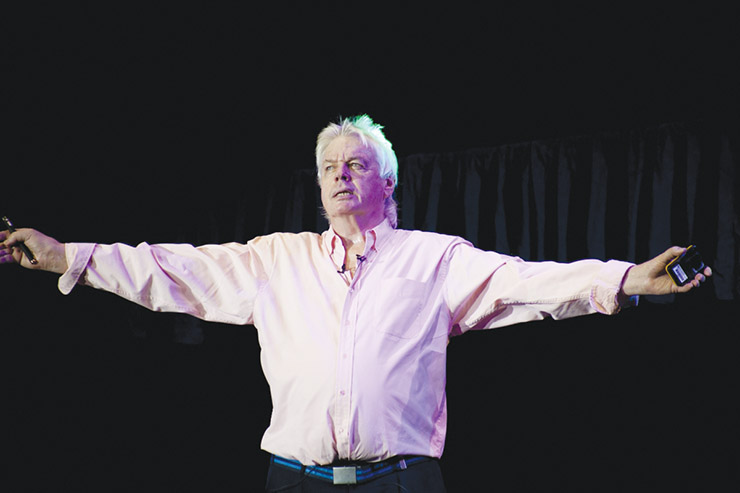
    The May-June 2016 issue of New Dawn featured the first part of David Icke’s interview with Marc Star. Here we present the second part of his interview (David’s surname is pronounced “ike”).

    MARC STAR (MS): You’ve noted that the current state of the world is only a reflection of the inner state of the individual. Humanity is at a spiritual roadblock reflected by a lack of awareness and the cutting off of our own spiritual essence. One might say we’ve gone mad, a chronic case of PTSD. Perhaps we never recovered from World War II. We’ve certainly never stopped being at war. Can this patient be cured?

    DAVID ICKE (DI): What is the patient? The patient is incarnate awareness disconnected from its infinite self – disconnected from inspiration, knowing, insight and intuition from its greater self operating at frequencies outside of this fake reality we call the world. As I’ll explain at the events, I say that what we call the universe is actually a quantum computer. It’s a fake reality. It’s a vast equivalent of, if you like, a computer game. It’s the same principle – which is why the physics of computer games and the physics of our world are basically the same.

    The patient is a patient in that term because people are disconnected from their true selves. What we call awakening is simply awakening from the program to tap into greater swathes of our true self. If you do it at first, and you just start to tap into some of the greater self, then you start to see that 9/11 was set up to create an excuse for what has followed – the war on terrorism, etc. You see that the banking system is basically that, the banking system, and individual banks are just agencies of that overall system controlled by a few people. And so it goes on. You start to understand the five-sense level of connection because you’re now looking at things from a more expanded state of awareness.

    Some stop at that point. And that’s where most of the alternative media is, frankly. When you move on and continue to expand your awareness, then everything is questioned. Everything comes under questioning in terms of what’s real and what’s true. You start to realise that the physical world is not physical at all. There is no physical, as quantum physics has shown. There is only the illusion of physical. Just like the computer in front of me decodes information in the tower and puts on the screen pictures, moving pictures, text, graphics because it’s decoded that information from the tower in that state, so we are decoding through what I call the biological computer – the body. We are decoding information from the unseen – what I call a cosmic wireless internet – into the reality we think is so real, so solid.

    The patients cure themselves by breaking out of the perception prison of the program and allowing their true self, infinite awareness, to enter the game, and enter the perception process – allowing people to tap into their true power, as opposed to their suppressed power of ‘phantom self’ [see Part 1]. More and more people are doing this. This is what the awakening is. And the more people awaken, the more people question things they took for absolute granted before – like the desk in front of me is solid. No it’s not. It appears to be but it’s not.

    This is a massive part of what I’m talking about in the events and in my new book Phantom Self, because there is no other way of bringing an end to all this nonsense that doesn’t involve people expanding their awareness out of the program and into their true self. Let’s think about it – this whole structure of human society, which is specifically designed to disconnect incarnate self from infinite self, is not done for a laugh. It’s not done for a bit of fun. It’s absolutely fundamental to the success of what they’re trying to achieve. So it must make basic common sense that the way to address that is to reverse what they want, and what they’re doing – i.e., reconnect incarnate self to infinite self.

    Much of the alternative media is focused on the five-sense world because it’s been through the program too, and thus can only see five-sense solutions to what it perceives to be five-sense problems and five-sense situations. Stockpile weapons, stockpile food, fight the system. The system depends in its entirety on the existence of phantom self. Without it, there is no system.

    I’m not saying sit cross-legged on a mountain, meditate for the rest of your life, do nothing and everything will be fine because you’re on a higher frequency now. No, no. Absolutely not. A lot of what is called ‘new age’ falls into that illusion because that means it doesn’t have to do anything that it actually doesn’t want to do – i.e., get its hands dirty and look this situation in the face, in the eye.

    By all means, meditate if you like, go into deeper levels of self, get insight, get inspiration, but then express that inspiration towards changing the world, or else there’s no point. I hear people say, “knowledge is power.” No it’s not. Knowledge is not power at all. The use of knowledge is power. Knowledge that you don’t use you might as well not have it at all.

    But everything, in terms of playing this out and doing what is necessary, comes from an expanded perception of self and the world. Then you’ll know what your individual unique contribution should be.

    All these things are connected. The awakening to a different view of the world and self is happening because those people are expanding their perception out of the program. If they weren’t, they wouldn’t be re-evaluating the world of self. All this is moving in the right direction. It’s just a case of numbers.

    On the subject of the alternative media, I have enormous respect for people worldwide who take the trouble and often dedicate their lives to communicating this information. So much of the alternative media is itself stuck in phantom self – not all the alternative media, by any means. No. But vast chunks of it. Vast swathes of it are just like the mainstream media in a mindset of “here and no further” because they literally can’t get their head around going any further. It doesn’t make any sense to them. They can’t process it because phantom self has still got you.

    There is an incredible amount of ego in the alternative media and among people that follow the alternative media, which you see in the extraordinary levels of abuse on social media, the forums, the comment columns and all that stuff. Along with abuse between different researchers and what have you. It’s extraordinary. I’ve had as much abuse from the alternative media as I have from the mainstream media – which, given the scale of the abuse from the mainstream media, is saying something. Because the alternative media – again, not all of it, but a great chunk of it – is also an expression of the sheep and the sheepdog that I mentioned earlier [see Part 1]. Sheep keeping sheeple in line.

    I think the alternative media has to look at itself – that part of it that I’m talking about – and ask, too, if it’s not caught in the same conspiracy, the same perception deception that those which it targets are caught in. Once you think, “I know what’s going on” in the sense of its entirety, you’re kidding yourself and you’re kidding others because in the end there’s an infinity of awareness/knowledge/perception that never gets to the conscious mind.

    I’ve always done my work on the basis of a certain recurring theme. Socrates has a version of it. Confucius has a version of it. There are many versions of it. Basically the theme is: Wisdom is knowing how little we know. When you hold that then your mind is open to all possibility all the time, instead of closed off to possibility that doesn’t suit your current belief system. And the alternative media needs to be aware of that because much of it gets caught in that trap of “here and no further.” The rabbit hole is so deep, far deeper than almost anyone can imagine.

    MS: With Russia propagandised by the West as the aggressor in Ukraine, and Russia’s success against ISIL in Syria, it seems Vladimir Putin has become the leading face of global resistance against Empire. What are your thoughts on Putin and the role he is playing – knowingly or unknowingly – in the larger drama?

    DI: Obviously, if you look at Putin’s history, he’s not a nice man. But when I look at people like Obama, and of course his predecessor Bush, when I look at David Cameron, when I look at Hollande in France, and all these characters, one thing that shouts out about Putin is that he is phenomenally more intelligent than all of them put together. And Putin is clearly aware of what the agenda is for Russia.

    When I played on a football team managed by a guy named Jimmy Hill, a well-known guy in this country [UK], back in the 1960s, he used to say, when you start a match, get your retaliation in early. What he meant by that was take physical control of the game early. What Putin has been doing is getting his retaliation in early.

    He has, to an extent, thrown a spanner in the works – although there are other deeper levels of this. It depends on what level you’re actually looking at and talking about at the time. But he’s fully aware of the Western coup, the American coup in the Ukraine, where this puppet Poroshenko was put into power. And, of course, Wikileaks documents have come to light that talk many years ago, long before anyone heard of it in the Western public, that Poroshenko is a United States asset in Ukraine, and this asset of long years suddenly becomes president in a coup that was a classic George Soros colour revolution – what they call regime change. The idea was to create antagonism between Ukraine and Russia to try to justify the demonisation of Russia. In Syria, of course, the American/British/NATO-created terrorist groups – whether it be the so-called Free Syrian Army, or ISIL/ISIS, or whatever name is given – they were created as proxy armies for the West to take over country after country.

    And, of course, they have long wished to dethrone Assad, going back at least to documents in the pre-9/11 world, which listed the countries they wanted to take over – regime change. These countries have been ticked off – Iraq, Libya, Syria and so on.

    The idea was to let loose these proxy armies, funded and trained by the West, to remove Assad and tear Syria asunder. This is why, despite having the biggest military on Earth by a vast, vast distance, despite having European countries involved in the fight against ISIL, in the bombing of ISIL… actually ISIL were just expanding and expanding because they were being allowed to. The idea was not to stop them but just to give the illusion of trying to stop them. Assad reached the point where he was in imminent danger of losing control, including Damascus. Putin could see what was going on and got his retaliation in early, if you like. He went in there to turn that around and blatantly showed, by the success of pushing ISIL back, how the West has been systematically allowing ISIL to expand – because that’s just what they want. They’re a proxy army for the West.

    I’m sure that threw a spanner in the works of where they wanted to go. Assad is not gone. They thought Assad would go as quickly as Qadhafi, and he hasn’t. Largely that is because of Putin. So from here on in it’s going to be interesting to see where this goes in terms of Russia because Putin has been playing these other idiots, like Obama and Cameron and Hollande, etc., like a stringed instrument. It’s like a chess match and he’s been putting them in check all over the place. Interesting to see where it goes because the plan all along has been to create, at some point, a third world war with the West against Russia and China. I’ve been talking about that since the 1990s.

    Whether they can pull that off is another thing given that Putin will be absolutely aware of that agenda.
    MS: What about Brexit and the European Union?

    DI: The European Union is the forerunner for what they want around the world. The EU, as it’s become – a fascist/communist/bureaucratic dictatorship controlled by dark suit appointees in Brussels – was created originally as a free trade area because people back then would not have accepted the EU that it’s become now. What has happened is a classic and perfect example of what I call the totalitarian tiptoe.

    That free trade area has evolved through the incessant centralisation of more and more power in Brussels with the dark suits. It has been transformed from a free trade area – which is “good for jobs, mate” they said – into this bureaucratic prison state, in effect, where national laws are overridden by anything these dark suits come up with.

    Other trade areas around the world including Australia and New Zealand are planned to become their version of the European Union, because the structure of the ‘hunger games society’ is designed to be a world government, a world central bank, with a cashless world currency, dictating to all people everywhere – imposed by a world army which is what NATO is designed to evolve into. I mean, look how fast that’s coming in now. In books in the 1990s I was saying watch for NATO to start operating outside of its designated area of the North Atlantic region. Now, of course, NATO turns up in the Middle East, and all over the bloody place. It’s the evolving world army.

    Under that structure, at the global level, it’s designed to be versions of the European Union all over the world – in the Australia/New Zealand part of the world, in the Americas, in the Middle East. We’ve already got the African Union, and so on.

    The plan for the EU is to continue to absorb more and more countries. Goodness knows, when you see the European Union there are still countries that want to join. I’ve said before – wanting to join the EU and the European monetary system, having seen it for what it is now – which has been a disaster – wanting to join that is equivalent to looking up at a blazing apartment block and asking when you can move in. It’s insane.

    But the hidden hand, of course, is behind these countries, pushing them in. So the last thing they want are for countries to start to leave because that’s starting to reverse where they want to go.

    What’s happened in Britain is this moronic man, David Cameron, the prime minister, was coming up to an election last year, and opinion polls were showing big support for a party here called UKIP, the UK Independence Party, which was specifically created to campaign to leave the European Union.

    What they call here middle England invariably votes for Cameron’s Conservative Party over the decades. They are sick of the European Union and its impositions, and the incredible red tape it imposes upon small and medium size businesses – red tape which is simply designed to destroy them so the corporations can take over everything.

    Therefore, UKIP’s campaign to leave the European Union was getting more and more support in the polls from these otherwise natural conservative voters. And so Cameron panicked and said if he got elected again as prime minister he would have a referendum on giving people the opportunity to vote in or out of the EU.

    The polls also strongly suggested the Conservative Party would not win outright, but again, like the administration before, would have to share power with a second party in a coalition. The Liberal Democrats coalition was with the conservatives in the government before the election. And the Liberal Democrats are EU fanatics. Cameron obviously thought that in this coalition he’d have the excuse of saying the Liberal Democrats are blocking the referendum. In other words, he thought he could promise the referendum without any consequences.

    But unfortunately – unfortunate in one way, but in this way, fortunately – he got power without needing to be in a coalition, and thus he was stuck with a promise of the referendum. And this referendum coincides with this vast influx of migrants and refugees into Europe. The fear of the consequences of this influx of refugees has turned more and more people against EU membership – so they say Britain can control its own borders rather than having them dictated by the dark suits in Brussels.

    MS: In 2009, you began your Melbourne talk with a story of being held up by immigration officials at Melbourne airport who compelled you to sign a “character test” agreement. What aspects of Australia’s role in the hidden hand’s agenda most concern you?

    DI: Actually I had to sign something that said I read something. Bizarre. “Just sign and say you’ve read this.” Well okay, I’ve read it.

    Australia is a very obvious example of the fact that this agenda is global, and therefore globally coordinated. The things that are happening in Australia – more and more surveillance, even the exposure of elite paedophilia rings, etc. – they’re everywhere. I won’t get into it now, but paedophilia among the elite is everywhere, all over the world, for reasons I explain. Thus for it to come up in Australia as it’s come up in Britain – and they’re trying to desperately put the lid on it in Britain and other places – is because it’s a global phenomenon. So is this increasing surveillance that Australians are being put under. The same is happening here, the same is happening in America, the same is happening in Europe – because it’s a global agenda.

    The thing that stands out for me, in recent times, in Australia – and should send alarm bells and big red flashing lights everywhere – is the law that says you can’t get benefits if your children aren’t vaccinated. This is another global phenomenon – mandatory vaccinations. This Australian law, in effect, targets people who survive because of those benefits. It is a stepping stone – and only a stepping stone – to a fully fledged mandatory program of vaccinations for everybody.

    In California, and in other parts of America, there is this theme coming of mandatory vaccinations because this awakening, even on that level, is causing more and more people to look, for instance, at what’s in vaccines and the evidence of their effect. The fact is vaccines are demolishing developing immune systems in kids less than 2 who are being subjected to this tidal wave of toxic shite – called vaccines – which is ensuring their immune systems will never be the same as they could be. And they’re adding more and more all the time. But because of the awakening, people, in greater and greater numbers, are rejecting vaccinations.

    There are two things they plan to do. First of all – and this is happening more and more – they have to outlaw, censor and block information that exposes what’s going on and that helps people awaken to what’s going on. Where people are awakening and saying, “we’re not having this,” then they introduce laws that say, “you are having it and you’ve got no choice.”

    The scale of fascism, the scale of arrogance, that believes it can dictate what human beings put into their own bodies and what is allowed into their children’s bodies is so unspeakable, almost unimaginable to anyone with a sense of decency, a sense of fairness and a sense of justice.

    From what I read, there’s been a big vaccination take-up as people have been forced into it, otherwise lose benefits. The people of Australia need to open their minds to what’s going on and what the connections are because the vaccine agenda is just part of the larger agenda. It’s one strand in the web, and a very important one.

    Because Australia has such a small population, comparatively, to so many other countries, it has the opportunity to take back control of the country from that which hijacked it – going back to the British empire. You look at excess of 300 million people in America – well that takes some turning around. But you look at the population of Australia. You’ve got a great chance there, if enough people say enough, realise what’s going on and respond to it with unity. And I hope that going to Perth, Brisbane, Sydney, Melbourne and onto Auckland will stimulate awareness of not just the nature of what’s happening, but the scale of it and how all these apparent unconnected dots connect to show a very clear picture.

    I hope – and this is the whole idea – that when I leave, this information is in greater circulation and being talked about more than when I arrived. That’s the whole point of doing it. And I do pay great tribute to the work that New Dawn and everyone involved in it has done because it’s great more and more people are getting involved, more and more people are becoming researchers, more and more people are starting websites to circulate this information.

    But it was a lonely road some time ago, trying to make heard what people were dismissing and being called every name you can think of. And New Dawn was there. I’ve got enormous respect for what that publication has done when, as you well know, there weren’t a lot of people compared with now that were interested in hearing it. It’s the pioneers that start the change. New Dawn in Australia has absolutely been one of the pioneers.

    David Icke’s book Phantom Self (and how to find the real one) is available through https://shop.davidicke.com.

    The first part of this interview appears in New Dawn 156 (May-June 2016)..

    [alert type=”general” dismiss=”no”]This article was published in New Dawn 157.[/alert]

    [alert type=”success” dismiss=”no”]If you appreciate this article, please consider subscribing to help maintain this website.[/alert]

    © New Dawn Magazine and the respective author.
    For our reproduction notice, click here.

  • Psychic Pets? The Cat: Walker Between Worlds

    Psychic Pets? The Cat: Walker Between Worlds

    From New Dawn 154 (Jan-Feb 2016)

    Following publication of my Nexus article, “The Shared Evolution of Dolphins and Humans,”1 reader response, as much as my own growing interest in the subject, urged me to pursue it much further by writing a book-length investigation slated for release by Bear and Company in March. But my quest for answers about interspecies’ relationships with a creature apparently so much different than us opened up even stranger digressions mostly left out of my book Our Dolphin Ancestors. These bizarre accounts and insights are instead presented here, in the same venue where my inquiry began, because they merit, I believe, further consideration.

    Among them is a one-minute, forty-nine-second home movie taken at the Theater of the Sea, a marine animal park in Islamorada, Florida, USA.2 Since it was posted in May 2012, the film clip has attracted an audience of some seven million viewers (see video image above, more images are in the magazine). It shows two bottlenose dolphins, named Shiloh and Thunder, engaging Arthur, a common domestic cat, which, to all appearances, is thoroughly enchanted with them. There is much chummy inter-play between feline and cetaceans, as the former continuously paws and nuzzles the latters’ snouts. Shiloh and Thunder respond by repeatedly offering their sensitive rostrums for affection, and gently tap the cat on the top of its head – remarkably, given physical disparities between a thirty-three-centimeter-long, four-kilogram, water-hating cat and aquatic, four-meter, one hundred eighty-two-kilogram dolphins.

    One might expect Arthur to have been utterly horrified by mere sight of such beasts, while the dolphins, for their part, should have little or no interest in the tiny landlubber. Their gentle care in petting the cat’s head – something most cats do not tolerate by anyone – is astonishing. When they suddenly vanish, Arthur nervously paces back and forth, attentively searching the surface of the water for his absent friends. When they reappear, he rushes back across the gangplank to greet them again with undiminished affection.

    Yet, the animals were less curious about exploring two different species, than interested in greeting each other, as though resuming a former acquaintance. They seemed to recognise each other from the start. The cat knew at once that the dolphins were not only harmless, but exceptionally desirable companions, while Shiloh and Thunder quite obviously loved Arthur. It is inexplicable that these wildly divergent species should find the least commonality between themselves, much less such intimate rapport. Throughout their extraordinary encounter, eye contact was virtually unbroken. Given dolphins’ renowned telepathic abilities, as discussed in my forthcoming book – many cat-owners experience telepathic connections with their pets – thought transference appears to have been the medium that fashioned their instantly amiable relationship.

    But what kind of information passed between them? Certainly, not words, but perhaps some form of emotional knowing illustrated by mental imagery. Nor was the video-recorded meeting between house-cat and wild dolphins a freak incident. Such unlikely get-togethers have been observed by sailors over thousands of years of sea-faring, whenever their feline shipmates were visited by dolphins. Fundamentally different from each other as these animals might seem, both are notable for their curiosity, acute perception and quick awareness, which may comprise at least the basis for their anomalous commonality. In any case, Arthur’s loving relationship with Shiloh and Thunder suggests an empathic bond between these widely divergent species.

    PET Telepathy

    Such enigmatic connections are more commonly observed between felines and humans. A 2012 Anglo-American study of households in England and the United States found that “a third of cat owners claim that their pets respond to their thoughts and silent commands.” The sample study additionally showed that, on average, thirty percent of pet owners claimed their cats usually wait at a door or window a few minutes before their loved ones come home, even when arrival times vary or are never the same. Many cats are reported to know the identity of particular callers before the telephone rings. The wife of a University of California professor at Berkeley told how she always knows when he is calling, because their cat interrupts its sleep or whatever activity in which it is engaged, and rushes to the telephone: “When I pick it up,” she says, “the cat meows. If someone else calls, the cat does not react. It meowed even when my husband called home from Africa or South America.”3

    The About.com website relates that an American housewife and her friend “were standing in the bathroom, talking, and the cat was there, too. I happened to mention a recent story I heard from another lady friend about her cat – that her cat always drank from her bathtub’s dripping faucet. Up until then, my friend never saw her kitty drink from anything other than her bowl. The next day, her cat was found in the tub, drinking from the faucet!”4

    Sammy, the Norwegian Forest Cat

    It is quite one thing to read about the personal experiences of strangers and another to have one yourself. When he was younger, Sammy, our Norwegian Forest cat, sometimes amused my wife and me by leaping on a tree, scooting straight up, fifteen feet or more above the ground. When he got as high as he wanted to go, he looked around from his lofty vantage point, then descended like a lumberjack, tail-first, in spurts. But as he grew older, he withdrew these athletic performances from his normal routine. During one of our strolls across the yard on some spring afternoon, I recalled his tree-climbing days of the past, and wished he would attempt at least one more demonstration. The thought had no sooner crossed my mind than Sammy sprang from my side to a nearby walnut tree, scampering up the first three-quarters of its height, before executing his lumberjack descent.

    His unbidden, wholly appropriate response seemed a clear example of telepathy, although it was entirely one-sided. Henceforward, all my attempts at mentally commanding him to jump on another tree failed. He had other paranormal tricks up his sleeve, however. On a single occasion only, after sundown one summer evening, he suddenly and excitedly demanded that the front door be opened. He flew outside without pausing, as usual, at the threshold, dashed down the front steps, and shot around the eastern side of the house. By the time I caught up with him, he was staring fixedly at something on the sidewalk. In the shadows, I could make out what appeared to be a small pile of writhing humps.

    On closer inspection, they belonged to a little snake never seen there before or since. Previously, back in the house, all his normal, physical senses had been cut off from the outside world. He could have neither seen nor smelled the creature, and even his superb hearing ability would not have likely detected the smooth motion of a serpent gliding slowly across the sidewalk. Sceptics may dismiss such anecdotal episodes as unrevealing, but anyone who lives on intimate terms with an animal for an extended period can integrate such events into the broader context of the pet’s personality. While these incidents do not pass muster for strict up-holders of the scientific method, it nevertheless depends upon accurate observations. I can only conclude, therefore, that Sammy accessed a form of extrasensory perception to determine the presence and whereabouts of the snake, which was otherwise unknown to him.

    Can a Cat Know the Time?

    More remarkable than Sammy’s talents at remote viewing is his concept of time, as demonstrated during our outdoor excursions. He is very sensible about them, does not run off, stays fairly close to me and mostly out of mischief, so does not require a leash. If I take along some writing that needs work, listen to music on my ‘walkman’, or read, we could spend hours together ‘outside’, a word he certainly knows. More often, my time is limited, and our walks may go on for ten or twenty minutes, though we usually take several each day.

    It was at the outset of one of our first outdoor jaunts that I glanced at my watch, and made a mental note to myself: “We’ll go back inside the house at 2:30.” For the next half hour, Sammy went about his usual business of sniffing the air, chomping grass, urinating on a territorial bush, exploring a suspicious hole in the yard, making his customary inspection of the back patio, chasing a squirrel, stalking a mole, or observing bugs and birds from a favourite vantage-point. In the midst of these commonplace feline pursuits, he paused for a moment, while a puzzled expression came over his face, as though he were trying to remember something, then bolted up the front steps and demanded to be let in the door. My watch read precisely 2:30.

    What first seemed a trifling coincidence progressively grew into something more significant. Over the subsequent years of our friendship, we shared and continue to share – weather permitting – daily kitty walks, which may take place from early morning to dusk, but never at the same hour. Usually, I do not think of a definite minute when we should go back inside, and either of us concludes our walk in a normal fashion. Any potential visual clues from me – conscious or not – Sammy may pick up seem unlikely, due to the entirely random nature of these outings. Yet, he abruptly terminates about sixty-five per cent of his walks at the explicit instant I mentally programmed before we set out. For example, in three, consecutive walks I counted, he concluded each one at the appointed minute.

    Engaged as I am in my own activity during our walks, I usually forget about the specific time I predetermined for their conclusion. Even so, Sammy still returns to the house at that preordained moment, often to the exact second. Moreover, whenever I mentally willed him to come in from the outdoors, without having scheduled any prior cut-off, he never responded. What could a cat possibly know about time? Even if Sammy does indeed read my mind, the hour or minute I set inside my head to end our walk is surely far beyond the limits of his feline intellect to grasp. Yet, the timeliness of his behaviour is repeatedly – if not invariably – demonstrable. What it suggests is just as certainly outside our current ability to understand inter-species communication.

    [alert type=”info” dismiss=”no”]If you appreciate this article, please consider a subscription to New Dawn magazine.[/alert]

    Morphic Resonance

    The famous British biologist, Rupert Sheldrake, proposes a broader basis than explanations for telepathy, although inclusive of extrasensory perception: “Natural systems, or morphic units, at all levels of complexity, are animated, organised, and coordinated by morphic fields, which contain an inherent memory. Natural systems inherit this collective memory from all previous things of their kind by a process called morphic resonance, with the result that patterns of development and behaviour become increasingly habitual through repetition.”5

    In other words, members of a particular group are linked by self-organising energy fields that contain a collective memory unique to themselves, and shape certain patterns of behaviour or adaptation. Applying his hypothesis to the animal kingdom, Sheldrake maintains that animals communicate telepathically among themselves and with us through emotional bonding. Hence, morphic fields are channels for extrasensory perception. But theoretical proposals are less capable of explaining how a common house cat born in the United States ten years ago is capable of regularly predicting the imminent death of his human companions with perfect accuracy.

    The Cat That Knows When Death Approaches

    While a kitten, Oscar was adopted from a local animal shelter to serve as a so-called ‘therapy cat’ at Providence, Rhode Island’s Steere House Nursing and Rehabilitation Center. He spends most his time in the facility’s third-floor, end-stage dementia section, a forty-one-bed unit for treating sufferers with Alzheimer’s, Parkinson’s disease and other illnesses. Most of the residents are terminally ill and generally unaware of their surroundings. Some months after Oscar settled in, staff members noticed that, like the doctors or nurses, he began making his own customary rounds, sniffing and observing patients, then curling up to sleep with certain convalescents. Those he slept with died within two hours of his arrival. He remains with an invalid until he or she passes away, then, post mortem, quietly leaves the room.

    “He seems to understand when patients are about to die,” observes David Dosa, a geriatrician, assistant professor at Rhode Island’s Brown University, and affiliate of Warren Alpert Medical School, both in Providence.6

    “It’s not that the cat is consistently there first,” says Dr. Joan Teno, who cares for Steere House residents and sees Oscar on a regular basis. “But the cat always does manage to make an appearance.”7

    Also, he is “not a cat that’s friendly to [living] people,” states Dr. Dosa. When, for example, an elderly woman with a walker passed him by during his rounds, Oscar “[let] out a gentle hiss, a rattlesnake-like warning that [said] ‘leave me alone’.”8

    He only shows consistent affection to terminally ill persons. In an early, typical instance, Oscar wrapped his body around the ice-cold calf of an old woman who had a serious blood clot in her leg, and stayed with her until she died. By the time Steere House staff members counted twelve persons in succession he had accurately prognosticated with impending death, his powers seemed to fail him. Having determined that another woman was about to die, an attending physician noticed that Oscar took no interest in the situation, and casually walked away. But the cat proved the doctor wrong, because she survived for another ten hours. Oscar dutifully returned to the patient, curling up in her lap and purring, until she died two hours later.

    According to Dr. Teno, “it always seems to be in the last two hours” that he makes his farewell visits.9 Since Oscar began his ministrations, he has correctly predicted an average of ten deaths per year, bringing his total number to more than one hundred. His accuracy persuaded Steere House directors to institute a unique protocol: when discovered sleeping with a patient, family members are notified of their loved one’s momentarily expected passing. Most of them do not object to a cat’s presence at the time of death, but on those rare occasions when relatives request Oscar’s removal from the room, he invariably shows his annoyance by pacing back and forth in front of the closed door and loudly meowing in protest.

    Dr. Dosa speculates that, “the cat might be picking up on specific odours surrounding death.”10 He is supported by Dr. Teno: “I think there are certain chemicals released when someone is dying, and he is smelling and sensing those.”11 Margie Scherk, a Vancouver, British Columbia veterinarian and president of the American Association of Feline Practitioners, suspects “he is smelling some chemical released just before dying” – ketones, bio-chemicals produced by decaying cells. “Cats can smell a lot of things we can’t.”12 While no one could disagree with her last statement, Scherk’s and her colleagues’ conclusions are not convincing.

    Although Oscar was one of six cats simultaneously delivered to Steere House in 2005, he alone comforts the dying in their last moments. Also, no other cat, anywhere, evidences such regularly attentive behaviour, so far as I have been able to determine. However, cats have long been known to ‘knead’ ailing or dying animals – feline and human – by slowly, rhythmically, gently pumping their front paws, back and forth, on a suffering creature, while purring with half-closed eyes in an apparent state of altered consciousness, an apparent effort at healing, somewhat like “the laying on of hands” practiced by spiritual healers. Since ketones are emitted by someone twenty-four hours, more or less, before expiring, they cannot be responsible for prompting Oscar, because he only visits the dying no sooner than one hundred twenty minutes prior to their deaths. More importantly, Scherk, et al, ignore the most important question posed by his actions: why does he perform them?

    The answer is obvious to observers unencumbered by materialism; namely, Oscar feels compassion for humans experiencing the last and probably greatest trauma of their lives, and voluntarily assists them in an otherwise lonely, difficult transition. He recognises a resident’s forthcoming demise in his or her diminishing aura, that metaphysical light source all living things emit until it declines with terminally ill health and is ultimately extinguished when the physical body ceases to function. While the accompanying release of ketones cannot account for Oscar’s fortuitous bedside manners, another set of bio-chemicals produced by a woman during pregnancy may at least partially explain why cats commonly become especially attentive and affectionate toward an expectant mother. They detect human female pheromones, which are similar to feline versions.

    Reverence for Cats in Ancient Egypt

    Ancient Egyptians knew less about pheromones but they observed the particular concern and care cats show human mothers-to-be. Bast, among the oldest-known deities in the Nile Valley, was venerated as the divine patroness of pregnant women. Worship of Bast dates as early as the Second Dynasty (circa 2890 BCE), although her cultic origins undoubtedly preceded Dynastic Civilisation in the mid-4th Millennium BCE. Translated as “She of the Ointment Jar,” her name was written with the hieroglyph for a container of protective ointments associated with the goddess. These receptacles, as well as her image, were usually made of a local stone Greek followers referred to, after Bast, as alabaster, a word that passed into our own language. An entire city – Busbastis – was founded in her honour.

    Busbastis, originally known in ancient Egypt as Per-Bast – “House of Bast” – was located on the Lower Nile. 20th century excavation of Bast’s temple there yielded in excess of three hundred thousand mummified cats. Previously, during 1888, a farmer accidentally uncovered seven hundred thousand in Beni Hasan, Middle Egypt. These million feline mummies testify to the high veneration with which the ancient Egyptians accorded the creature, which they protected with animal rights legislation. Killing a cat was a capital offense, punishable by death. Whenever a household cat passed away, mourning residents traditionally shaved their hair and eyebrows, as expressions of respect and grief. Not without cause. Nile Valley Civilisation owed its existence to cats, which saved storage granaries from rat infestation. Beyond any obvious, mundane boon they granted, however essential, cats – in the sacred personification of Bast – were regarded as walkers between worlds, this one and the next, natural emissaries to and from the Afterlife.

    Get the issue this article appears in

    Cats & Otherworldly Encounters

    Something of that ancient conception is borne out in modern accounts around the world describing feline behaviour, as exampled in Oscar, that feline Angel of Death, described above. An American woman recounted how a cat joined her family in reacting to a spectral appearance: “This incident occurred during my junior year of high school, in 1972. During a particularly hot and muggy July evening, my parents, sister and I were seated in the living room watching television. The house was unbearably hot and the windows were open with screens in them. All of this was to no avail that evening. There was no air moving, and I was wearing a light t-shirt and shorts, trying to keep cool. The chair I was sitting in was next to the doorway and the upstairs hallway. The hallway in the house divided the living room from the kitchen and was enclosed on both sides with a large curtain at the bottom of the steps. I looked to my left toward the stairway, just as our cat started up. The cat was a calico and was very even tempered.

    “Just as the cat climbed the first step, an icy blast of air rushed down the stairs. The cat hissed loudly and froze. The hair on its back and tail stood straight out, and in its frozen position it resembled a pointer. Simultaneously with the cat’s behaviour, the cold breeze continued to build to the extent that the curtains were almost blowing straight out. In 1972, we had no air conditioning or any other device in the house that could have created the icy air that we now felt. None of us said anything. I felt goose bumps form on my arms and back, and the temperature in the living room perceptibly cooled. Fifteen to twenty seconds had passed with no diminishment of the icy air or relief for our poor cat.

    “I got up from the chair and cautiously peered up the stairway. The light at the top of the steps was on and nothing was visible. The cat was still frozen in mid-stride, and the breeze was almost heavy and very cool on the face. Out of the corner of my eye, it appeared that a very faint, gold-tinted light could be seen shimmering. Yet, when I looked directly at the light, nothing could be seen. I continued to look up the stairs for the next few seconds, but could not discern any apparent reason for the arctic air. I sensed something, but could not see it. Suddenly, as quickly as it had occurred, the breeze stopped. The cat shook itself as if it had just recovered from an injury. Her fur relaxed and she proceeded up the stairs and went into the left bedroom.

    “The topic of discussion the rest of the evening concerned what had just happened. My father revealed to me that when he was less than three years old, two of his older brothers had been playing cowboys and Indians between the kitchen and the living room of this house. The brothers in question were Buell and Boyd. Boyd, who was a year senior to Buell, was playing the Indian. Buell, in the kitchen, was playing as the cowboy. An old, .22 calibre tube rifle was being used by Buell. Boyd was using an old toy bow. The rifle in question had no firing pin and had been used in this game for years.

    “Horribly, unknown to anyone, their older brother Joe had been working on the rifle and had replaced the firing pin. He had loaded and fired the rifle the previous day. One lone shell had been left in the tube. My grandmother, Hazel, had been sitting in the living room forty-one years earlier in approximately the same place I had been. Boyd jumped out from hiding beside his mother. Buell dodged and brought the rifle to bear. He squeezed the trigger and a loud bang echoed in the house. Boyd took the round in his heart. He turned to his mother and said, ‘Mom, I’m shot’. With those words, he collapsed into her arms and died.

    “Could what I witnessed twenty-nine years ago have been the spirit of that small boy, my uncle, who died in that same house forty-one years prior? I never felt fear, as I gazed up those stairs, but am absolutely certain that what happened was outside of our normal world. And our cat sensed it, too.”13

    Petadviser, an authoritative website consulted by ailurophiles everywhere, carried the following subscriber’s report: “Once upon a time, very long ago, I was visiting my parents’ home, and they had gone out for the evening. I was alone in their very large house, and, sitting with me, was my wonderful great big ginger cat, Gatito. After a while, I felt I could hear the footsteps and voice of my grandmother, who lived about fifty miles from us. It sounded like she was walking all over the place and calling the name, ‘Bill… Bill’. Bill was my father, her son. Ordinarily, I would have felt I was hearing things, but Gatito’s fur puffed up all over the place, and he got into a stalking position, and became uneasy in the house.

    “Later, my mother came home, and, while I didn’t tell her I thought I heard Grandma (because she [the mother] was never a believer), I did say I thought I heard noises in parts of the house. She opened doors and walked around to see if everything was in place, and as she did that, Gatito crept along with her – belly to the ground and fur still puffed up all over. The following morning, we heard the news that Grandma had died. It never occurred to mother that I truly had heard Grandma, but my father was always sensitive, and when I told him the story, he truly did believe me, and was very much comforted.”14

    On The Catsite, a pet owner recounted how she and her cat, “Toes,” both simultaneously observed the apparition of Penny, an older cat that had recently died: “I was in the kitchen and saw Penny cross the living room and go down the hall to the back of the house. Toes watched her walk by and then took off after her. He came back and looked all over before complaining to me. All I could do was say, ‘I know. I saw her, too’.”15

    These accounts are more than anecdotal, since at least one of them was captured on video in 1999.16 A simple laptop with webcam had been set up on the floor of a hallway at the Norton Hall Care Home, in Worchester, England, after repeated complaints from residents and staff about an unknown cat. No one had ever observed the animal, which nonetheless made its presence known by repeatedly meowing late at night. After several weeks of unsuccessful attempts to lure the elusive creature by laying out food and catnip over night, the caretaker positioned his computer camera where the feline fugitive was most often heard, in an effort to at least identify it. The resulting video showed the transparent, ghostly image of an otherwise ordinary, black-and-white cat materialise in a doorway, then saunter down the hall, beyond the webcam.

    Among the elderly residents was Mrs. Martha Mildred Jones, a devoted ailurophile, who, earlier in life, ran a stray cat shelter for many years. In an instance of remarkable synchronicity, she died at the Care Home in her ninety-ninth year on the ninth day of September – the ninth month – in 1999. Traditionally, cats are supposed to have nine lives. In any case, the ghost cat of Norton Hall was neither seen nor heard again after Mrs. Jones passed away.

    [alert type=”general” dismiss=”no”]This article was published in New Dawn 154.[/alert]

    [alert type=”success” dismiss=”no”]If you appreciate this article, please consider subscribing to help maintain this website.[/alert]

    Footnotes

    1. Nexus, Vol. 21, No. 3, April-May 2014
    2. “Cat and Dolphins playing together,” www.youtube.com/watch?v=rynvewVe21Y
    3. Anna Lemind, www.learning-mind.com/do-animals-have-telepathic-abilities
    4. http://paranormal.about.com/library/weekly/aa021201a.htm
    5. David Pratt, “Rupert Sheldrake: A Theosofical Appraisal,”
    www.bibliotecapleyades.net/esp_sheldrake_3.htm
    7-11. Ibid.
    12. www.inquisitr.com/1967618/psychic-cat-patrols-nursing-home-
    offering-comfort-to-patients-in-their-dying-days/
    13. Anna Lemind, op. cit.
    14. www.petsadviser.com/behaviors/can-cats-see-ghosts/
    15. www.thecatsite.com/a/can-cats-see-ghosts
    16. “Ghost Cat,” www.youtube.com/watch?v=i3gvHfD6ojA

    © New Dawn Magazine and the respective author.
    For our reproduction notice, click here.
  • Technetronic Enslavement: Life Inside the Matrix of Control

    Technetronic Enslavement: Life Inside the Matrix of Control

    From New Dawn 156 (May-June 2016)

    The march of modern progress has brought forth many advances for humanity, and yet man is lost. Technology, automation, and miniaturisation, along with the micro-processing revolution, allow things to happen that were unimaginable only ten years ago, let alone a century before. These rapid advances have brought with them a number of complex problems, some of which challenge the very notion of progress.

    If you define the level of an advanced civilisation by how much freedom its citizens experience in their day to day lives – along with the protection of individual liberties as we have come to expect in the 21st century – then the march of the mass surveillance state over the last 15 years should be of serious concern. Despite public pleas from our leaders that, ‘if only we pass this next law or security measure’, or ‘if we can just launch one more month of airstrikes’, or ‘if the public will allow just a bit more access to their personal information…’ and so on, the state and its corporate partners have developed a firm grip on power over, and intrusions into, our personal lives that is only increasing.

    In the West, a type of cognitive dissonance has already set in regard to this and other related issues – partly due to the sheer dominance of the ‘war on terror’ and national security narratives that overtook society after 11 September 2001. Since then, it seems that every six months or so the narrative is revised; as one perceived threat subsides, another emerges in its place.

    What remains is a stark picture; a society where real time monitoring of every aspect of day to day home and work life is now expected, and where thought conformity is rampant. It’s a self-policing, self-perpetuating interdependent, paranoid system of globalised capitalism governed by the ruling class’s Thatcheresque trope known as the T.I.N.A. principle1 which stands for: There Is No Alternative. When challenged on the efficacy of this master default position, most bureaucrats, technocrats and neoliberal financiers will loyally cling to this mantra as if it were the only commandment etched in Moses’s stone tablets.

    Welcome to the technetronic age.

    Sleepwalking Into a Technetronic Nightmare

    Since its inception, the dream of technological progress was sold to the West as the new liberation, embodied by breathtaking advances in automation and increased consumer convenience.

    The trap has been sprung. The micro-processing revolution gave way to the Internet and the information technology revolution, but it didn’t take long for our most celebrated advances to turn on society.

    A primary exhibit would be the NSA-Snowden revelations of 2013. For the first time, the mainstream media and the public at large got a broad scope look at the actual scale and reach of the digital surveillance state. Instead of fighting back, or demanding reform, the public cowed instead, as people began self-policing their speech on social networks. The mass psychological ‘chilling effect’ that so many contemporary futurists and writers warned us about has finally come to pass. A century and a half later after his death it seems Jeremy Bentham was right – the Panopticon actually works.2 20th century prophets like Eric Blair aka George Orwell, Aldous Huxley and others all issued vivid warnings about this dark prospect, but in the end it seems the intense glimmer of technology has somehow blinded society to its inherent risks.

    It’s true that history often repeats itself but never in the exact same way. During the post-WWII Cold War era, Soviet citizens maintained a rigid hyper-socialised system because they feared an existential threat – in this case the possibility of nuclear attack from its ideological nemesis, the so-called ‘capitalist’ countries. North Americans and western Europeans backed a fifty year-long arms race because of a perceived existential threat from its ideological opposite commonly referred to as ‘Communist Russia’ or the Soviet Union. The United States also used this perceived threat to project power on every continent, and in nearly every country on the planet. This shaped America’s idea of itself, and also of its role in the world as a benevolent force for freedom and democracy.

    In today’s Western threat matrix, yesterday’s communists have been replaced by today’s Islamic terrorists. Who will it be tomorrow?

    How much of this was true or just public perception is beside the point because the systems of control erected during this long and dark era are with us today – a full spectrum of total information awareness, and a technetronic society driven by a highly mechanised military industrial complex economy.

    As technology advances the fundamental questions remain: are we smarter now than we used to be? Are we living longer and more fruitful lives? Is this true progress?

    What’s lost cannot easily be regained.

    Smart Machines, Obsolete Man

    It’s not as if philosophical and social critics didn’t see it coming. Many did in fact.

    Orwell and others recognised the potential power of applied behavioural science and its dystopian clinical applications. Should the state ever have the ability and technology to claim preeminent domain over the technosphere, then a social malaise might set in not unlike that depicted in the novel 1984, or in Philip K. Dick’s story The Minority Report. What Orwell and other futurist visionaries could not fully calculate, however, was the intimacy that has developed between technology and the ‘user’. So deep is the personal relationship between these two seemingly opposite parties that the user becomes one with the technology.

    The complete inversion of their relationship becomes apparent when technology is awarded a personality by society, as it’s widely celebrated for being ‘personalised’ and ‘smart’ (technological algorithms appear to predict what the user wants next). Conversely, the human is stripped of his or her individuality by being labelled a ‘user’. Here the human side of this transaction is characterised as a mechanised party, while the robotic or automated actor is celebrated as the ‘smart’ side of this interactive equation.

    As man becomes increasingly dependent on technology, the difference between man and machine will become narrower. As artificial intelligence, big data and algorithm modelling amplify inside the matrix, this fusion of man and machine will beg the question: Are humans interacting with technology, or is technology interacting with the ‘user’?

    This is an important fundamental point to consider because it means the difference between who is considered a superior form – man or machine. Already, today, many argue that machines have certain distinct advantages over their human creators. As technology advances, the machines become increasingly independent of man to perform certain basic functions and tasks. This can be as simple as turning itself ‘off’ and ‘on’, or as complicated as self-regulating its energy output, parsing out operational tasks, and processing and self-analysing data streams in real-time. All of these things were once considered the job of the human ‘operator’ of the machine who has been steadily replaced by programming instructions in the form of customised software ‘apps’.

    Considering this phenomenon of the changing relationship between man and technology in the context of the relationship between the state and its citizens, immediately we can see certain areas that cause concern.

    When a Bureaucracy Becomes a Technocracy

    It’s important to both understand and recognise the technocrat and his or her mindset.

    A bureaucrat can be characterised as a human administrator performing highly impersonal administrative processes. Bureaucrats will quietly celebrate delays and ‘red tape’ as proof of the primacy of ‘the process’.

    The technocrat takes this management concept level higher and proselytises about seemingly omnipotent abilities of technology in performing administrative tasks, all in real time. With these new ‘smart’ tools of the future in hand, the old bureaucrat will soon be obsolete. One form of bureaucratic tyranny is replaced by another.

    Here the technocrat engages in a kind of infatuation with his or her machines. For the technocrat, there is a certain beauty in the perfection and perception of infallibility of the machine. The bureaucrat’s archaic world of carbon copies, notaries and stamps seems almost organic in comparison.

    Once again, the machine is elevated to a higher station than human.

    Between Two Ages

    When viewed with a wider social and culture lens, a clearer, albeit more disturbing picture comes into focus. In this new world, be it a progressive or free market capitalist future (depending on which new religion you subscribe to), society’s values are clearly shifting away from past traditions that were underpinned by introspection and the inherent spiritual and organic aspects of individual experience. Regardless of your political or social position, it’s a near given that most people have become acutely aware of this phenomenon at some point. That something is happening is not in question, but rather what are we shifting towards is perhaps a much more profound question. The answer isn’t hard to find. In fact, it’s right at our finger tips – every hour of every day.

    In his book Between Two Ages: America’s Role in the Technetronic Era,3 globalist luminary and geostrategist Zbigniew Brzeziński described (back in 1970) the transition between the 20th and 21st centuries:

    “The technetronic era involves the gradual appearance of a more controlled society. Such a society would be dominated by an elite, unrestrained by traditional values. Soon it will be possible to assert almost continuous surveillance over every citizen and maintain up-to-date complete files containing even the most personal information about the citizen. These files will be subject to instantaneous retrieval by the authorities.”

    Arguably, Brzeziński’s vision was stunningly accurate, and some might argue this globalist architect was speaking with the certainty of a deep state insider. Indeed, recent state measures in both Australia and the United Kingdom are indicative of the very system outlined in Between Two Ages. In both instances, the technocrat state’s over-reliance on both signature and algorithmical data, coupled with an unhealthy fixation on computer modelling. Undoubtedly, this has resulted in some cold and brutal social applications.

    In Australia, odious counter-terrorism laws brought in under former PM Tony Abbott seem to be going from bad to worse – with the latest power grab being the extension of “control orders” for children as young as 14 years old.

    Writer Daniel Hurst of The Guardian describes Australia’s disturbing new legislation rolled out only this year.4 New draconian control order laws would allow the court to consider evidence that is hidden from the suspect – a reversal of the basic principles of habeas corpus and due process. This new regressive law would “provide the subject of a control order and their lawyer with a censored or summarised form of ‘national security information’ against them even if the court considers other, secret details when making its decision; or, Provide the subject and lawyer with none of the information in the source document, even if the court considers all of that information when making its decision.”

    In the UK, through a new scheme called ‘Prevent’, an obsessive security state has been attempting to indirectly draft secondary and high school level teachers into the role of spies in order to profile and report on any young students, namely Muslims, who “might be candidates for radicalisation.” The Guardian reports that:

    “Since last summer, Prevent has obliged teachers to refer to police pupils they suspect of engaging in some sort of terrorist activity or radical behaviour. The duty has been largely considered a failure by teaching leaders, partly because about 90% of referrals end without action being taken.”5

    In both examples, our freedoms are now being stripped by technocrats and their computer models.

    The Quantification of Everything

    In the 21st century, people have been reduced to numbers, literally. While in the recent past you may have often felt like a number, and you sometimes objected to being treated like a number, today you really are a number. As society moves along the Maglev track of progress and the hyper reality of computerisation, now at the very cusp of artificial intelligence (AI), those old traditional values and deeper human ethics have been replaced with one singular, all-encompassing, all-knowing and all-powerful principle of modernity: functionality.

    Writer and philosopher Jay Dyer describes this cultural chasm:

    “The trek of modernity from the Enlightenment has resulted in the mechanisation of society to such an extent, everything is viewed through that lens. This is the overriding Grand narrative now – that everything is a version of technology, including nature itself and so everything is there to be quantified and measured. This is what the philosopher René Girard talked about in his work – when you mechanise everything, everything becomes just merely some statistic or quantity and this is a reflection of the binary aspect of computers. So if everything is viewed as statistics or quantities within bureaucratic processes, then you have a kind of atomisation where everything is broken apart.”

    In this new world order, this is the primary principle for all value judgments and remains the only interest of any technocrat inquiry: is it functional? How well does it function? Can the outcome be measured? Can we model the data in order to profile the subject? Welcome to the brave world that is a world of mechanisation.

    Notice how most capital and wealth has flowed into areas of the economy where investors place the highest value: areas integral to functionality. Big data, digital apps, social networks and automated computerised trading and transactions. As the technology becomes faster and more advanced, less emphasis is placed on the human element, which also means less value is allocated there too.

    Dyer adds: “This is what the dominant mindset of Western imperialism has led to, where everything is broken apart and it’s then left to the power blocks – corporate, banking, security, media and social engineering, to take all the broken pieces and put them back together in a new form by design, and that results in the notion that you no longer have any collective belongings such as gender, or a tribe, or family, and by extension, you are no longer part of something called humanity, because there’s no such thing as human nature anymore.”

    Such is the unstoppable evolution of technology, and only a few visionaries have had the foresight to see it coming and pose some warning of the inevitable evolutionary tribulation which is already taking place.

    Humanity is in the process of transformation, from what it used to be – spiritual individuals part of a family, to what he or she eventually will become – a component part of a larger mechanised design.

    In this new technetronic age, humans reside below and are subservient to technology within the mechanised society’s social hierarchy.

    Technetronic End Game

    Who shoulders the blame in this dystopian scenario – humans or machines?

    One might argue that once the AI horizon is eclipsed, it’s simply too late to lament, much less analyse the merits of such advanced technology. The answer to this question may emerge from a careful psychological analysis of post-modern man.

    Author Jay Dyer explains the dangers that could result from the fetish or perversion characterised by the blind acceptance of technology as an omnipotent force in the world, where society and its leaders are unable to question the manifestation of a new technology. He explains:

    “This dovetails with the idea of techno fetishism, and the idea that technology can solve all our problems. The grand narrative that [Richard] Dawkins presents, this is the generic idea that we are all on this grand track of progress where technology fits into this scheme where everything is automatically progressive. This fetishism can be extended even to military applications. For instance, someone detonates a nuclear bomb and this is seen as high technology, and therefore progressive.”

    Dyer is not merely exaggerating by introducing the prospect of thermonuclear warfare. Partly due to a mainstream media that is either afraid or too ignorant to address this issue, the majority of the public are unaware of recent advances and increased stockpiles of next generation nuclear weaponry, held primarily by the United States. In all likelihood, these will be eventually sold and distributed to its strategic geopolitical partners.

    Enter the next generation of nuclear weapons, courtesy of the Pentagon. This year’s $8 billion upgrade includes the new guided B61-12 nuclear bomb which adds features such as the nuclear yield of the bomb can be adjusted before deployment. Previously, this fell under the banner of ‘tactical’ or ‘battlefield nukes’, but now under the heading of ‘smart’ bombs.

    Plans are already underway in Washington to spread these new weapons across the planet from the year 2024. The Guardian reports: “The issue has a particular significance for Europe where a stockpile of 180 B61’s is held in six bases in five countries. If there is no change in that deployment by the time the upgraded B61-12’s enter the stockpile in 2024, many of them will be flown out to the bases in Belgium, the Netherlands, Germany, Italy and Turkey.”12

    Former head of US Strategic Command, US Marine General James Cartwright, reveals what is perhaps the most insidious aspect of this new generation military tech:

    “If I can drive down the yield, drive down, therefore, the likelihood of fallout, etc, does that make it more usable in the eyes of some – some president or national security decision-making process? And the answer is, it likely could be more usable.”

    The Guardian article’s author Julian Borger concludes: “The great thing about nuclear weapons was that their use was supposed to be unthinkable and they were therefore a deterrent to contemplation of a new world war. Once they become ‘thinkable’ we are in a different, and much more dangerous, universe.”

    Imagine that. If you consider this ‘usability’ talking point within the context of the previously mentioned prophetic statements about artificial intelligence by an esteemed panel of innovators, philosophers and scientists, then any sane person might be concerned we are passing over a dangerous threshold in human history.

    It’s an epic tale, echoed in biblical lore and throughout ancient mythology. Mankind is now, again, in danger of falling prey to his own creation.

    Is jumping ship an option, at least out of North America or Europe, and other urban centres around the globe? While fleeing to the remains of the old ‘free world’ in places like South America, Asia or Africa may provide temporary respite from a pernicious globalised system, it is in no way a long term solution. The long arm of progress knows no borders and if left unimpeded, it will colonise even the most remote location.

    For those who truly value their freedom and want to pass on a positive legacy to their progeny, the final battle is unavoidable: standing up to, and confronting the machine.

    Nine out of ten experts agree: this very well could be mankind’s last stand.

    [alert type=”general” dismiss=”no”]This article was published in New Dawn 156.[/alert]

    [alert type=”success” dismiss=”no”]If you appreciate this article, please consider subscribing to help maintain this website.[/alert]

    Footnotes

    1. TINA Principle, https://en.wikipedia.org/wiki/There_is_no_alternative
    2. For more on the Panopticon, see Oceania Forever: Rise of the Global Police State by Patrick Henningsen, New Dawn 153 (Nov-Dec 2015)
    3. Between Two Ages: America’s Role in the Technetronic Era by Zbigniew K. Brzezinski, Praeger, 1970
    4. ‘Call for lawyers to speak up for terrorism suspects in closed courts’ by Daniel Hurst, The Guardian, 15 Feb 2016
    5. ‘Teachers back motion calling for Prevent strategy to be scrapped’ by Richard Adams, The Guardian, 28 Mar 2016
    6. ‘Flying the Flag, Faking the News’ by John Pilger, http://johnpilger.com/articles/flying-the-flag-faking-the-news
    7. Collectivization and Social Engineering by Zeev Levin, Brill 2015
    8. ‘Google’s Gods of Truth’, http://21stcenturywire.com/2015/05/06/behold-googles-new-gods-of-truth/
    9. ‘Apple co-founder on artificial intelligence: “The future is scary and very bad for people”’ by Peter Holley, The Washington Post, 24 Mar 2015
    10. ‘Stephen Hawking just got an artificial intelligence upgrade, but still thinks AI could bring an end to mankind’ by Peter Holley, The Washington Post, 2 Dec 2014
    11. ‘The 21st Century Matrix: Technocracy and the Rise of the Machines’, http://21stcenturywire.com/2010/08/02/what-is-the-21st-century-matrix/
    12. ‘America’s new, more “usable”, nuclear bomb in Europe’ by Julian Borger, The Guardian, 11 Nov 2015

    © New Dawn Magazine and the respective author.
    For our reproduction notice, click here.
  • [Trapped] in The Net: What They Don’t Tell You About  the Internet & Social Media

    [Trapped] in The Net: What They Don’t Tell You About the Internet & Social Media

    This article was published in New Dawn 158 (Sept-Oct 2016)

    “Technological progress is carrying us to inevitable disaster.”
    – Theodore J. Kaczynski (a.k.a. ‘The Unabomber’)

    Flawed, to a depth unlike any other beast in the animal kingdom, human beings rapaciously despoil their own environment and continue to conduct activities that appear to threaten the very existence of the biosphere – our home, planet Earth.

    Through the latter half of the 20th century an insatiable technological race to develop weapons of mass annihilation resulted in nuclear standoff among a handful of belligerent nations and an incongruous co-operative policy of Mutually Assured Destruction (M.A.D.). That dire policy still stands today, a shadow cast unthinkingly over all human endeavour and indeed life itself.

    The very idea that humanity willingly chose to pursue a scientific course that delivered the capacity to destroy the world many times over should be breathtakingly troubling, yet inspires relatively little comment. From the very same tumultuous technological crucible that produced the enduring madness of nuclear weaponry came a more recent development – the Internet. The online world promises an ‘abundance of riches’ (as its techno-evangelists constantly assure) but it also has a profound (and profoundly under acknowledged) dark side.

    Birthed from the Pentagon’s desire to be able to maintain communications through the early stages of a nuclear assault (by spreading the electronic and telephonic communications load over a labyrinth of interconnected routes and servers), what we today call the Internet (which at one point was called ARPANET) was shepherded into existence by D.A.R.P.A. (the Pentagon’s Defense Advanced Research Projects Agency) in partnership with the scientific, academic and corporate communities.

    In these times of giddy techno-utopianism (sleekly designed Apple products are fetishized throughout our entire culture, social media is worshipped as the new frontier in community ‘cohesion’ and ‘inclusive’ communication – to name just a few examples) it would seem important to remember that the architecture of the Internet (and all the associated soft and hard-ware) was parented by a nexus of the Military Industrial Complex, the Secret State, the Corporate Leviathan and deliriously utopian elements of the scientific and academic worlds.

    Many have noted the deleterious relationship between humankind and technological development, where humanity acts as virtual slave to a misdirected and essentially unstoppable scientific progression.

    Though now used as a term of derision, the original Luddites rightly feared the impact of encroaching technology on their livelihoods and sought means to disable it. Thinkers from Karl Marx to Marshall McLuhan also addressed and questioned mankind’s enthralled relationship with technological innovation. For whom shall be the servant and whom shall be the master?

    The New Dark Age of Mediocrity & Narcissism

    Since the invention of Gutenberg’s printing press five centuries ago, the linear/literary mind has evolved and shaped prodigious developments in art, science and culture. We may now have entered an era of far more seismic – though not necessarily positive – changes. Acclaimed neuroscientists like Michael Merzenich and Eric Kandel suggest that the Digital Revolution’s hyper-stimulating and overtly transient landscape may be responsible for ‘re-wiring’ our neural circuitry to a more ‘efficient’ and industrialised state (producing more, more quickly) that also downgrades our capacity for concentration (the locus of education) and even wisdom.

    Writer Nicholas Carr warns in The Shallows: What The Internet Is Doing To Our Brains that “the seductions of technology are hard to resist” but, as German philosopher Martin Heidegger put it, the advance of technology dictates that a new, superficial “calculative thinking may someday come to be accepted and practised as the only way of thinking.”

    Carr also notes that a raft of recent research indicates that the “more distracted we become, the less able we are to experience the subtlest, most distinctively human forms of empathy, compassion and other emotions.” Bombarded by endless linked options and stimuli, we reduce our human qualities and become more machinelike – simply fleshy automata.

    Most online experiences are mediated by algorithms that expedite efficiency in searching the web, comparing products and offering connections to calculated similar content. They advance easy options, rarely subjecting us to the discomfort of a differing opinion or intellectual challenges (as may happen in the real world). If the World Wide Web is an infinite digital library, search algorithms are most likely to fill that library only with volumes chosen to please us. An endless feedback loop of gratifying, self-serving opinions and subtle reinforcement – a mirrored cubicle of refracting self-reflection, an echo-chamber of recycled automatic sound bites. An apocalypse for the enquiring soul.

    A cursory scan of Facebook, Instagram or Tumblr will produce mountainous evidence that we are enduring The Age Of The Ego. Current digital technologies have been designed by fevered armies of psychologists to appeal to the very weakest flaws in human nature – self-obsession and flagrant narcissism. Can there be a sadder, more alienating device than the ubiquitous ‘selfie-stick’? Surely the end is nigh.

    Another question posed by Carr was, “Is Google making us stupid?” Forever distracted by the digital avalanche, research and voluminous anecdotal evidence suggests that we are already drowning under the online tsunami – vast amounts of information at our fingertips, yet unable (or unwilling) to analyse, prioritise, sift and evaluate – we simply consume and regurgitate.

    Obesity of the Mind

    Richmond, Virginia author Matthew Crawford proposed in his book The World Beyond Your Head that we are seeing a social crisis as more and more people lose touch with physical reality and escape into the online matrix.

    According to Crawford: “Figuring out ways to capture and hold people’s attention is the centre of contemporary capitalism. There is this invisible and ubiquitous grabbing at something that’s the most intimate thing you have, because it determines what’s present to your consciousness.” In the clamour to advertise in every mental space (and monetise every social interaction), we are fast losing the room to think, be creative, be playful – to ponder. “Attention is a resource, convertible into actual money,” and we need to reclaim our own senses and resources, “because when you talk about attention, you’re talking about the faculty by which you encounter the world.”

    Crawford continues… “the media has become expert at making irresistible mental stimuli” and systems are designed to encourage “playing till extinction,” a cognitive science and “social engineering project” facilitated by “mind-bogglingly wealthy corporations.”

    Crawford has found respite, peace and fulfilment in discovering working with his hands again – between writing projects he restores vintage motorbikes in a local repair shop and eschews the seductive online experience.

    The Creeping Tide

    A creeping tide of evidence now suggests that the online experience itself (aside from the content) may also affect direct cognitive damage.

    Research conducted in 2012 at the Chinese Academy of Sciences (in Wulan, China) scanned the brains of 35 men and women (between the ages of 14 and 21). Those classed as suffering from Internet Addiction Disorder (IAD) were shown to have notable changes to the white matter of the brain (the nerve fibres/connections) compared to those that did not suffer from IAD. The researchers noted “abnormal white matter integrity in brain regions involving emotional generation and processing, executive attention, decision making and cognitive control.” The neurological damage observed shared “psychological and neural mechanisms with other types of substance addiction and impulse control disorders” and was comparable to the effects seen in alcoholics, drug addicts, video game addicts and those with other behavioural afflictions.

    As a multitude of libraries close (or partially divest their collections to make room for the ubiquitous computer terminals and Wi-Fi routers) scholars from University College London conducted a five-year research programme examining evolving reading and research habits. They logged the activity of visitors to two popular research sites (one a British Library site and one the portal of a UK educational group) that offered journal articles, e-books, and other information. The study found a notable “form of skimming activity” as students and researchers bounced from one source to another, rarely reading more than a page or two and almost never returning to an earlier source. As the study concluded: “It is clear that users are not reading online in the traditional sense; indeed there are signs that new forms of ‘reading’ are emerging as users ‘power browse’ horizontally through titles, contents pages and abstracts going for quick wins. It almost seems that they go online to avoid reading in the traditional sense.”

    What is suggested here is a ‘pancaking’ of intelligence, as cognition is spread wider, but also thinner, with a more superficial comprehension and understanding.

    The deluge of multitasking and ‘multi-screening’ (having numerous windows or devices open and active at once) is, according to scientists, shattering focus and rewiring our brains. Eyal Ophir, after stints in Israeli intelligence and the airforce, joined Stanford University in 2004. He sought to challenge (through research) the traditional view that the human brain can only competently process a single stream of information at any given moment. Devising tests involving the timed comprehension and filtering of patterns of red rectangles from patterns of blue rectangles, what Ophir and his colleagues found shocked them. Those who identified in the study as ‘multitaskers’ were significantly worse at sorting the shapes and thus filtering out what was deemed as irrelevant information. Also multitaskers were shown to be less efficient at juggling problems, taking longer to switch between simple tasks. It’s possible that technological overload may be confusing the brain’s systems for determining priorities, marking every form of digital stimulation as urgent, creating a haze of constant, buzzing panic and distraction.

    A study conducted at the University of California indicated that constant interruptions from email alerts and pinging phones contributed significantly to stress levels. Gary Small, a psychiatrist at the University, noted that stress hormones can affect short-term memory loss and promote debilitating mental ‘fog’. According to studies conducted at the University of Utah, only a fraction of people (possibly around 3%) are capable of operating calmly with regular digital disruption.

    Numerous studies by psychologists, neurobiologists, and educators now show that ‘hyper-texting’ (the ability to click highlighted sections of text linked to sources or further information) actually decreases comprehension significantly. Interestingly, even the appearance of a hypertext (whether clicked or not) erodes understanding by offering the disorientating opportunity for distraction. A 2001 Canadian study tasked subjects with reading the Elizabeth Bowden short story ‘The Demon Lover’. The control group read the story in traditional linear text, the test group read a version dotted with hyperlinks. It took the test group longer to read the story and they were an extraordinary seven times more likely to report ‘confusion’ in their comprehension of it. A further 2007 academic review of related experiments concluded that bouncing between digital documents and linked pages seriously undermined understanding. Today’s Internet landscape of pop-up ads, competing videos and flashing, bouncing images can only yield to more mental maelstrom.

    As pointed out by Nicholas Carr: “When we go online, we enter an environment that promotes cursory reading, hurried and distracted thinking, and superficial learning. Even as the Internet grants us easy access to vast amounts of information, it is turning us into shallower thinkers, literally changing the structure of our brain.”

    The available pool of information entering our working memory is referred to by psychologists as the ‘cognitive load’. The Internet turns this steady ‘drip’ of ideas into a ‘blast’, overwhelming our limited cognitive abilities and thence disabling vital components of them. As Carr noted, “The Internet is an interruption system. It seizes our attention only to scramble it.”

    The Long Shadow of the Surveillance State

    In June of 2013 the revelations of former NSA contractor Edward Snowden seized headlines around the world. Snowden confirmed what many have long suspected: built over decades, we now exist under a vast and omniscient surveillance infrastructure. Ostensibly constructed under the rubric of combatting ‘terrorism’, it doesn’t take much imagination to see that the real target is domestic dissent and any and all threats to capital and authority.

    Much like Jeremy Bentham’s 19th century design of the guard-less prison (the Panopticon), today’s admitted (and much publicised) Surveillance State leads directly and unequivocally to mass self-censorship and reflexive self-regulation.

    An Oxford University study conducted by Jonathon Penney reported a notable ‘chilling effect’ on the Internet habits of American adults directly related to the Snowden revelations. Monitoring Wikipedia searches after June of 2013 (the date Snowden surfaced) Penney noted “a 20 percent decline in page views on Wikipedia articles related to terrorism, including those that mentioned ‘al-Qaeda’, ‘car bomb’ or ‘Taliban’,” as compared to prior to that date. Page views continued to decline over a year, suggesting a “longer-term impact from the revelations.”

    “This is measuring regular people who are being spooked by the idea of government surveillance online,” Penney opined. “You want to have informed citizens. If people are spooked or deterred from learning about important policy matters like terrorism and national security, this is a real threat to proper democratic debate.”

    Other research from MIT indicated that “users were less likely to search using search terms that they believed might get them in trouble with the US government,” and a recent study conducted for the US Department of Congress noted that respondents reported that “29 percent of households concerned about government data collection said they did not express controversial or political opinions online due to privacy or security concerns.”

    The ‘chilling effect’ has also spread to the legal profession and substantially impinged on press freedoms. A 2014 report from the ACLU and Human Rights Watch was based on interviews with lawyers and journalists “covering intelligence, national security, and law enforcement for outlets including the New York Times, the Associated Press, ABC, and NPR.” According to the report, it has become apparent that lawyers, journalists and their sources are now considerably more fearful of surveillance and their ability to protect sources and attorney/client privilege. Examples cited include:

    “[Journalists’] techniques ranged from using encryption and air-gapped computers (which stay completely isolated from unsecured networks, including the Internet), to communicating with sources through disposable ‘burner’ phones, to abandoning electronic communications altogether… As with the journalists, lawyers increasingly feel pressure to adopt strategies to avoid leaving a digital trail that could be monitored. Some use burner phones, others seek out technologies designed to provide security, and still others reported travelling more for in-person meetings. Like journalists, some feel frustrated, and even offended, that they are in this situation. ‘I’ll be damned if I have to start acting like a drug dealer in order to protect my client’s confidentiality’, said one.”

    If the Snowden revelations were, perchance, designed to stun, cower and silence the general population (and perhaps even potentially problematic professions) for the advantage of the Security State, then one can only marvel at their resounding success.

    In April of 2014, speaking at a St. Petersburg media conference, Russian President Vladimir Putin described the Internet dubiously as a “CIA Project.” Despite the expected howls of denial from the dutiful Western press, it should be noted that Putin is a former KGB official and probably has some inkling of what he speaks.

    In a remarkable (and remarkably overlooked) piece for The Medium (entitled ‘How The CIA Made Google’) journalist Nafeez Ahmed charted the labyrinthine connections between the entire functional architecture of the Internet and the National Security State. Not only entwined through injections of start-up capital and seed funding, the ostensibly ‘private’ mega-corporations of the online experience (Google, Microsoft, Yahoo et. al.) boast an extraordinary overlap of board and executive personnel with the Security State (NSA, CIA, DIA, DoD etc.) but also a co-operative and synergistic culture that appears more like a corporate family structure than an adversarial private/public relationship. Likewise, the CIA’s capital investment arm (In-Q-Tel) has been there since the beginning for Facebook (a fact curiously absent from the Hollywood version) and the entire spectrum of social media appear to be nothing less than an extraordinarily enthusiastic data harvesting and social engineering project (data being delivered willingly and on an incredible, in fact, unimaginable scale).

    Theodore Kaczynski (the notorious ‘Unabomber’) wrote a remarkably prescient document circa 1995 called ‘Industrial Society and Its Future’. In it, the author (‘F.C’ – assumed to be the convict Kaczynski) decried the apparently endless march of scientific technology to dehumanise and demean humankind and separate us from the ‘power process’ and the fulfilling fundamentals of human survival.

    Kaczynski may have been a terrorist or murderer – but he was certainly no armchair hypocrite – calling in his manifesto for “a new revolutionary movement, dedicated to the elimination of technological society.” And he had admirers in unlikely places, famed Silicon Valley alumni Bill Joy allowing that, “As difficult as it is for me to acknowledge, I saw merit in the reasoning in (Kaczynski’s writing).”

    Indeed, perhaps it is time to turn our backs on giddy techno-utopianism and revolt against our fevered technological servitude (before we become too stupid, disempowered or lethargic to do so).

    Time to wind back, or even destroy, our Internet addictions, turn off the candy-coated Information Superhighway and reclaim some vestige of our flawed but fleshy independence before we are subsumed in a deluge of mediocrity and totalitarianism. Before we are Pokémon Go-ed into a virtual net of moribund surveillance capitalism.

    But who, dear friends, has the courage for that?

    [alert type=”general” dismiss=”no”]This article was published in New Dawn 158.[/alert]

    [alert type=”success” dismiss=”no”]If you appreciate this article, please consider subscribing to help maintain this website.[/alert]

    Sources/Recommended Reading

    Ted Kaczynski, Technological Slavery: The Collected Writings of Theodore J. Kaczynski, Feral House 2010

    Nicholas Carr, The Shallows: What The Internet Is Doing To Our Brains, Norton 2010

    A. Keen, The Internet Is Not The Answer, Atlantic Books 2015

    © New Dawn Magazine and the respective author.
    For our reproduction notice, click here.

  • The Ancient Art of Memory & the Modern Science of Dreaming

    The Ancient Art of Memory & the Modern Science of Dreaming

    From New Dawn Special Issue Vol 10 No 4 (Aug 2016)

    I’m old enough to remember a time before we knew that birds were just a modern form of dinosaurs. Like many children in the 1970s, I thought dinosaurs were the coolest things ever, partly because they were so remote in time, so very extinct. But to later find out what palaeontologists were just then realising, that these ancient monsters were still around us everywhere, always audible outside the window, was mind-blowing and inspiring in a whole new way.

    Something similar is true of much ‘ancient wisdom’. Lore that we may assume has been long forgotten often turns out to have just morphed into something different. In some cases, it still survives in places, or in disguises, that we might least suspect. This is true of my favourite piece of ancient knowhow, one that has been centrally important in my life and learning for three decades: the astonishingly effective memorisation method practiced by scholars and orators in pre-literate, pre-Gutenberg times.

    Few know about this technique anymore, but I was lucky to read about it when I was in college at the University of Colorado in the 1980s. A lecturer recommended I read a book called The Art of Memory by Frances Yates,1 saying it was literally the most interesting book he’d ever read. That sounded like a pretty good recommendation – so I headed over to the university bookstore and picked up a copy. Reading it that evening at home, I felt like I was being initiated into a whole new way of thinking, not only about the mind and history, but also about film, visual arts, literature, psychology. It felt like an initiation, and was really one of those life-changing reading experiences.

    We speak today of the ‘reading experience’, but for people in the ancient world and Middle Ages – the time period of Yates’ study – texts were precious, rare objects, and the aim of reading, if you could read, was not to have a fleeting and diverting experience with a book before moving on to the next one. A travelling scholar studying a rare volume in the library of some wealthy patron may never get another chance to look at that book. Even a monk or priest would have very limited opportunities to read the Bible. But amazingly, learned men in ancient Greece or Rome, or in the Middle Ages, actually knew many books by heart; their minds were well-organised libraries of texts that, in their studies and travels, they had the good fortune to hold and read and study. In debates, they could assemble and arrange evidence, quoting long passages by heart, without a scrap of paper in front of them.

    The method was actually easy: If you wanted to remember an idea or fact, you just needed to break the fact down into its parts, substitute each part with some other thing it called to mind for you, and then assemble those things together into an arresting little tableau or scene. To remember a whole speech or sermon, you just ‘placed’ a sequence of those images, in your imagination, along a route through a familiar or well-memorised environment like your home or public plaza. Then, when the time came to deliver your discourse, you took a mental stroll through the same space, visiting each vivid image in sequence, ‘retrieving’ the facts or ideas you had planted there.

    Here’s an example: A college student needs to learn a long list of major milestones in European history for an exam. The study handout lists names and dates and facts that might be on the test like “The Normans invaded England in 1066.” On their own, the bare facts, Normans, England, 1066, may mean little or nothing to the student – she doesn’t know what a Norman invader looks like; like most numbers, the date 1066 might as well be a random string of digits; and she has never been to England, although she has a lot of impressions from TV and magazines constantly showing Prince William and his wife and children. If she is lucky, though, our hypothetical student may have been taught the basic tricks of the art of memory by a teacher or adviser at some point: The idea is to use all her random, stupid, personal associations and make a mental picture from them.

    So, say our student is a maven of 60s rock trivia and knows the years of every Bob Dylan album like the back of her hand. The year 1066 thus might immediately call to her mind 1966, the year Blonde on Blonde was released. And while she may not know what an actual historical Norman looked like, she does have an uncle named Norman. Instead of repressing such absurd and irrelevant connections as they occur to her while she’s staring at her study handout, a clever, mnemonically-trained student will actually allow her naturally playful mind to make and even embellish those associations on the fly – allowing, perhaps, a mental image of a weirdly blond-haired version of her uncle (who in real life has black hair), wearing a cheap Darth Vader cloak and mask (i.e., ‘in Vader’; the ‘cheap mask’ instead of a full helmet allows us to see his blond hair) slicing Prince William in half with a stroke of his light sabre. For all the other events and dates on the study sheet, she creates a similarly bizarre and, yes, idiotic image, using the same principles, and then mentally plants these little dioramas at intervals along some familiar route, such as the path from her dorm to her history class.

    She will, I promise you, ace the test.

    When Yates first wrote her book (also in 1966), she took a somewhat sceptical attitude: Although there was clearly something magical about this technique, and while its famous practitioners like the Hermetic freethinker Giordano Bruno boasted amazing feats with it, it didn’t make sense to her. She assumed creating new images to remember facts would actually require more effort at memorisation, not less. But the psychological study of memory over the last half century has revealed why the ancient methods really did work a lot better than cramming stuff into our heads by rote repetition.

    Memory works by association – the linking of information not by logic but by how things look or sound alike (for instance puns and rhymes); where they fit in some arbitrary sequence like a list or a song; or even what we were doing, where we were, or how we felt when we learned about them. When searching our mental archive for information, we find what we need by quickly following trains of very personal and idiosyncratic links – like what we were eating for breakfast when we heard a particularly interesting piece of news on the radio. It’s that associative illogic that, counterintuitively, makes our memories strong, because it enables us to quickly access needed information by many alternative paths. Your cortex is a vast multidimensional net of illogical interconnections, spanning the length and breadth of your experience on earth.

    When that college student is creating an image of her uncle in a Darth Vader costume killing Prince William, she isn’t really creating anything new she needs to remember along with the historical fact of the Norman invasion; she is taking stuff already in her memory, the first associations that just naturally and effortlessly pop to mind, and hooking them to each other by slightly distorting them, the way you might attach two lengths of wire by bending the ends. It’s like a little playful mental art project. It takes little effort to concoct such images, and it takes zero effort to remember them. Because of their absurdity, they stick in mind automatically.

    The biographies of modern geniuses like Einstein show that, even when they don’t know they are doing it, they are essentially using the art of memory, treating information as toys or materials to be creatively transformed, not intimidating data to be crammed into the head by brute force.

    [alert type=”info” dismiss=”no”]If you appreciate this article, please consider a subscription to New Dawn magazine.[/alert]

    The Royal Road

    Like I said, it is always exciting to learn about the wisdom of the ancients – I’ve been practicing the art of memory for decades and it has paid off in countless ways, along with the thrill of feeling like I’m privy to an ages-old secret. It is even more exciting, though, to realise this ancient wisdom is still alive in the most unexpected places. What if we are all memory wizards like Giordano Bruno, and don’t even know it? Consider: Uncle Norman attacking Prince William while wearing a Darth Vader costume is just the sort of surreal image we might encounter at night in our dreams. Is there some connection between dreaming and the art of memory?

    The strangely sensible bizarreness of dreams has led reasonable people at all times and in all cultures to assume that these nightly visions and visitations have some kind of important role to play in our lives. In 1900, Sigmund Freud famously wed the folk wisdom that dreams are symbolically meaningful with the then-new scientific study of mental process in his masterpiece The Interpretation of Dreams.2 He argued that dreams are symbolic tableaux staging the fulfilment of our repressed wishes. It was the keystone of his big idea that the unconscious mind contains secrets that can make us ill, or at least make us confused and unhappy, until they are brought out into the light of day. Dreams, he said, were the ‘royal road’ to the unconscious.

    Freud’s theory is hard to test scientifically, though, and with the assumption that there is some secret desire being expressed, it is easy to twist Freudian dream interpretations to mean whatever the patient, or doctor, wants them to mean. The ‘wish fulfilment’ idea is also a bit of a stretch, which even Freud began to realise later in his life, when studying the dreams of war veterans: Some dreams are thoroughly unpleasant – definitely not showing us our deep desires. For these and other reasons, psychologists and brain scientists in the second half of the 20th century mostly rejected Freud and went in a totally different direction, searching for a biological basis of dreaming. In doing so, they tried hard to discredit the mystical-sounding idea that dreams contained symbolic meanings that you could interpret like a poem, or decode the way a spy might extract the hidden meaning from a cipher.

    Over the decades, brain scientists have produced many, usually pretty dull theories about why we dream – for instance, they are just random brain noise, or they somehow prepare us to deal with threats. But circumstantial evidence has accumulated gradually, from lots of different sources, that there may be an inner logic in dreams after all, and that logic has something to do with reinforcing old memories and making new ones.

    In laboratory experiments, people who have been exposed to new information remember it better after ‘sleeping on it’ than if they don’t; and studies also show that during sleep, complex material learned during the day is simplified, made easier to understand. Animal species most dependent on their parents at birth, like birds and humans and many other mammals, show much more REM sleep than species born fully able to function, like reptiles. (In other words, the more an animal needs to learn in order to survive in the world, the more its brain is active at night, and the more it dreams.) Rodent studies have shown that brain areas activated during daytime exploration and learning are reactivated during sleep. We additionally know that the hippocampus, long recognised to play a key role in making new memories, is extremely active while we slumber.

    There is also growing evidence that important episodes and upheavals in our day are metabolised at night, specifically during the roughly two and a half hours we spend during REM sleep, when we are dreaming most vividly. It thus makes sense that the vividly bizarre images in dreams could directly reflect this nightly process of memory-making. Yet, the fact that dreams are bizarre and usually don’t realistically relate to events in our daily life has been a sticking point in figuring out what their exact connection to memory might be.

    A big part of the problem is that scientists are usually too busy (and science-minded) to venture out of the science stacks in their library. It was only in 2013 that a psychologist named Sue Llewellyn at Manchester Business School realised that the ancient art of memory, well known to cultural historians, might be the missing piece of the puzzle of dreams.3 She saw that the bizarre content in dreams seems to bear the same relationship to real-life events in our lives that a scene of Uncle Norman in a Darth Vader costume attacking Prince William bears to the fact of the Norman Invasion in 1066. Dreams, she suggested, are basically just the ancient art of memory operating automatically while we sleep. They don’t literally re-present events that happened in our day; instead they show us our private associations to those events. Those associations are the new connecting material being formed nightly in our brains, linking those recent events to older, deeper priorities and older memories.

    Getting Ahead

    The new mnemonic theory of dreaming makes brilliant sense of several old commonplaces about dreams, such as why they so often involve sex, why they so often contain clever witticisms and puns, and why they are usually so hard to remember.

    Because dreams have so much sex and suggestive genital symbolism in them, Freud thought they must be basically about our repressed sexual desires. But if dreams actually serve a mnemonic function, then we might expect sexual motifs to be so prevalent simply because exciting emotions make things more memorable. This is a well-known fact about memory; in fact, sex was an important part of the ancient art of memory for exactly that reason. Most of the teachers kept quiet on this aspect of it, but one Renaissance memory teacher, Peter of Ravenna, admitted that sexy imagery was one of his trade secrets: “I usually fill my memory-places with the images of beautiful women, which excite my memory,” he said. “If you wish to remember quickly, dispose the images of the most beautiful virgins into memory places; the memory is marvellously excited by images of women…”4

    In our more enlightened day, you can of course substitute ‘whatever turns your crank’ for Peter’s “beautiful virgins.” The point is not that women are sex objects, but that whatever for you is a sex object is also an ideal memory hook.

    Another common feature in dreams is brilliant wordplay, especially puns. For instance, a friend of mine once told me a disturbing dream in which she attended a dinner party thrown by her older sister, where she was horrified to see her sister’s head resting on an appetiser tray. I knew my friend was annoyed by her sister’s recent accomplishments, such as getting married and purchasing a home (neither of which my friend was close to doing), so there was nothing really mysterious about my friend’s dream image: Her sister was ahead. Her jaw dropped when I pointed this out.

    The puns in dreams often link multiple associations and enlist all our senses, not just the sounds of words. There are sight gags, as well as emotional and multisensory puns and situations that ‘rhyme’ with those in real life. Of course, witty wordplay is central to the consciously applied arts of memory too: Using Uncle Norman to stand for the Norman invaders is a kind of pun, as is putting Norman in a Darth Vader costume to make him an invader.

    Freud thought that multilayered puns helped dreams say a lot with a little – the same principle in jokes – and here the mnemonic theory is in complete agreement. Freud might have suggested that my friend’s dream image brilliantly stated the case that her sister was ‘ahead’ along with the hope that the sister’s accomplishments were nothing but a trivial prelude (an appetiser) to my friend’s own later achievements – and maybe there was a little sibling ‘death wish’ thrown in as well. The multiple trains of association radiating out from a single dream image represent multiple paths in the brain’s associative network, which keep some idea – in this case, ‘I kind of hate my sister because she’s ahead of me’ – alive and available in the dreamer’s thoughts.

    But why, if dreams’ purpose is memory, are they among hardest of our experiences to remember? We dream for about two and a half hours each night but are lucky to recall just one or two brief dreams every morning, if any. Unless you write them down, even those have usually faded by breakfast. It’s not so strange if you think about it: The thing we are supposed to remember is our memories of yesterday. Dreams make yesterday, the same way the stomach digests our meals and transforms it into the stuff of our bodies. Yesterday is more vivid to me today than it was before I slept, because of that activity of dreaming, which created and solidified the pathways in my brain that lead to those memories. Nature may not really mean us to see or remember our dreams per se, any more than it means us to see the contents of our stomach… and when we do, something may be wrong.

    I like to think of dreams as the scaffolding and cranes at a construction site: They quickly dismantle themselves – they just vanish – once the building they are constructing is finished. The same is true of the images created in the art of memory: I can rattle off my debit card number over the phone without looking at my card, and I no longer even remember the weird sequence of images I used to remember it a few years ago – something about a sailboat and a big tongue, I believe. I think there were also some naked people. (For a guide to the art of memory, including a simple system to remember strings of numbers, see my online article, “The Art of Memory: Why It Is the Coolest Thing Ever and Why You Should Learn It Today” at http://thenightshirt.com/?page_id=186).

    Childhood’s Beginning

    Get in touch with your inner dreamer. Write down your dreams in detail as soon as you can in the morning – every person, object, and situation, and every noteworthy or odd detail you notice. Then for every noticed element, take a moment to note the first one or two things or situations that pop into mind that it reminds you of. Be honest and don’t force it. With a moment’s free association, a dream element that may seem bizarre at first glance will usually point surprisingly to a recent situation or current preoccupation in your life, and going through this process for an entire dream will reveal astonishing connections to more distant memories, popular culture, and all kinds of forgotten stuff in your mental attic. You can fill pages and pages of journal on a single dream.

    Dream-thought is so wild and brilliant, so beyond our daily button-down intelligence, that people unused to observing their dreams have a hard time accepting that their own ordinary minds could be responsible for creating these Shakespeare-worthy stories. This probably accounts for why dreams have often been felt to have divine origins, and why today many people don’t remember their dreams at all – that kind of playfulness and genius simply doesn’t fit into who we think we are or who we think we should be. But there’s no reason not to own it; it’s our brains doing it, and it is who we are.

    And don’t limit your dreamwork to dreaming. Get in the habit of making your own dreams, by practicing the art of memory. It builds flexibility and creativity and can quickly turn you into an amazing storehouse of knowledge. People will wonder how you know so much, and more importantly it coaxes that childlike brilliance of dream thought into your daily life so you can apply it creatively to situations. With just a little practice, anybody can re-learn this playful attitude toward knowledge, becoming a memory wizard in the process.

    Childhood didn’t really end, just like the dinosaurs didn’t really go extinct. It just went underground. Through dreamwork and the art of memory you can coax it to the surface very easily.

    [alert type=”general” dismiss=”no”]This article was published in New Dawn Special Issue Vol 10 No 4.[/alert]

    [alert type=”success” dismiss=”no”]If you appreciate this article, please consider subscribing to help maintain this website.[/alert]

    Footnotes

    1. Frances A. Yates, The Art of Memory, Pimlico, 1996 (1966)
    2. Sigmund Freud, The Interpretation of Dreams, Avon Books, 1965 (1900)
    3. Sue Llewellyn, “Such stuff as dreams are made on? Elaborative encoding, the ancient art of memory, and the hippocampus,” Behavioral and Brain Sciences, Volume 36, Issue 06, December 2013, 589-607
    4. In Paolo Rossi, Logic and the Art of Memory, University of Chicago Press, 2000, 22

    © New Dawn Magazine and the respective author.
    For our reproduction notice, click here.