New Dawn – World's Most Unusual Magazine

Category: Articles

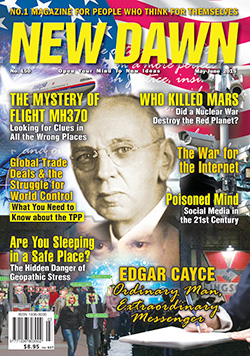
  • Poisoned Mind: Social Media in the 21st Century

    Poisoned Mind: Social Media in the 21st Century

    From New Dawn 150 (May-June 2015)

    According to an article on the website of ‘Radio Free Europe’, a nondescript modern 4-storey building on Savushkina Street, St. Petersburg, houses the innocuously titled ‘Internet Research Centre’.

    Inside the building operate government controlled and tasked teams of professional ‘trolls’. Spread across approximately 40 rooms, the trolls prowl the Internet in 12 hour shifts, generating pro-Kremlin comments and ‘gaming’ Internet forums and online conversations.

    St. Petersburg blogger Marat Burkhard recently came forward to describe the apparent covert activities in detail. Burkhard describes his co-workers as “politically illiterate young people” who must be briefed on current topics at the beginning of each shift and continually supervised.

    At this point it would be pertinent to note the source of the article – Radio Free Europe – notoriously a CIA funded propaganda outlet for decades (now financed, more obtrusively, through the State Department and ‘private donors’). While only the congenitally naive would doubt the veracity of the article’s basic claims, what is (unsurprisingly) lacking is context. Whether financed and operated by Russia’s intelligence agency FSB, or some other shadowy enclave, it is estimated that the entire Russian security establishment currently operates with just one twentieth (1/20) of the US equivalent (not even including the UK and other close Western allies).

    What that means, in a nutshell, is that for every Internet Research Centre in Russia, the CIA/NSA/GCHQ/private contractor nexus would be operating the equivalent of (at least) 20 such centres. Flooding the social media networks, news and other sites of their domestic populations with thousands upon thousands of comments, posts, disruption, disinformation and propaganda bullets every day. Salvos in an escalating, but largely unseen, ‘Information War’.

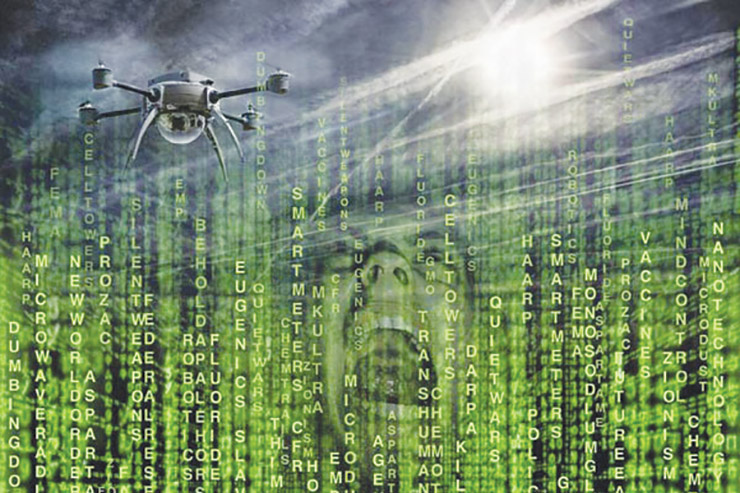
    Furthermore, recent reports cite the development of software that actually scours the web, automatically switching between user names/identities and generating propaganda, provocations and automated comments as it goes. Coupled with Google’s recent announcement of A.I. software that can discern (Google’s version of) ‘the truth’, it doesn’t take much imagination to envisage any online expression of ‘untruth’, ‘heresy’ or ‘dissent’ being automatically swamped beneath a torrent of managed obscurity, cyber-troll bile, distraction and chicanery.

    Seismically underreported, similar allegations about the ‘troll farms’ or ‘web brigades’ of the West (such as GCHQ’s ‘77th Brigade’) have barely surfaced in the blinding mass of ‘Snowden Revelations’. Chilling images (reportedly leaked from internal GCHQ presentations) document operations in ‘virtual communities’, ‘social identity theory’, ‘herding’, ‘mimicry’ and the ‘psychology of deception’. Much of the language used seems best suited to neutralising dissent and activism in the ‘target’ (domestic) populations (and not the lame-duck excuse of ‘fighting terrorism’).

    As an astounding amount of human activity and intercourse migrates online, public spaces empty and forums/social media fill with a new species – homo digitalis – a being safely cubicled and shepherded into approved opinions, paradigms and navel gazing.

    Accordingly, corporations now view social media and online social networks as their plaything and happy-hunting-ground – each ‘like’, ‘trend’, ‘tweet’ and online action the precious raw material to map, direct and monetise consumer behaviour. Edward Bernays (pioneer marketeer, nephew of Sigmund Freud and author of the seminal text Propaganda) could hardly have dreamed of the marketing, perception management and social engineering possibilities now available at the press of a few attractive and endorphin-stimulating keystrokes. Today’s brave new keyboard-warrior looks an awful lot like yesterday’s plantation indentured servant or herd of cattle (in sleek, Apple designed ergonomic garb).

    A plethora of research (let alone common sense) suggests that our reliance/addiction to social media and its associated devices is already having a profoundly deleterious effect on basic cognitive skills, human interaction, attention spans and functional intelligence. Factor in a cocktail of narcissistic personality disorders and body dysmorphic disorders (with a chaser of smartphones and other hand-held devices) and humankind looks at last set to plunge over the precipice of unfathomable stupidity.

    Doubtlessly technologists (and the teams of psychologists who work for them), minutely design every latest gadget to further exploit the very human weaknesses of vanity and the desperate need to be endlessly and pointlessly distracted. A chronically self-obsessed, trivialised generation (like no other generation before it) of ‘selfie’ snappers and banal ‘tweeters’ is the technocrat’s utopia.

    Disinterested, disenfranchised and disengaged from the outside world, ‘Generation Now’ (the iGeneration) have become tyranny’s best enablers – politically, philosophically and spiritually ineffective – vapid consumers and mindless infants. Delivering themselves up ‘freely’ to the corporate-military-complex – their every mood, ‘status’, location, relationship and conversation accessible in real time or stored in vast information vaults secreted away in distant desert bunkers.

    The very architecture of social media seems intrinsically designed to be nothing more than a gargantuan electronic trap to collect as much data, biometric and psychological information as possible about the population.

    Facebook’s notorious ‘experiments’ in ‘emotional contagion’ and political herding become even more sinister when placed in their rightful context. Despite Facebook’s chummy image and branding, ostensible founder Mark Zuckerberg has made it clear in numerous interviews his desire to mould a future of what can only be described as pure techno-totalitarianism. A consumer’s/user’s every action and thought mediated through the ‘safe’ interface of Facebook – always surveilled, always stalked and tabulated – available to corporations and intelligence agencies at all times. ‘Dangerous’ physical interactions minimised and discouraged.

    Whilst Facebook may have a hidden nativity story, its birth secretly shepherded by funds channelled through In-Q-Tel (the CIA’s venture capital arm), the same in fact may also apply to the very foundational platforms of the Internet itself. Recent research by journalist Nafeez Ahmed has revealed the cosy (symbiotic even) relationship between (‘Don’t Be Evil’) Google and the entire American intelligence apparatus. Mediated through a decades-old shadowy group known as the ‘Highlands Forum’ – leading technologists, corporate heads and intelligence chiefs have met privately innumerable times to cross-pollinate innovations, strategies and policy.

    Ahmed makes it clear that the entire contemporary surveillance landscape may well have been seeded through the Highlands Forum, as business and the secret state pursue their (remarkably similar) aims. Much like the unspoken ‘revolving door’ that operates between the Pentagon and the armaments industries – the board members and senior officials of Google, Facebook and alike have the striking habit of being familiar faces from the recesses of the Pentagon, CIA, NSA and so on. So ubiquitous is this limited personnel pool, that ultimately the question must be asked whether Google and Facebook are simply not just clandestine arms of the national security state.

    No matter how earnestly we may choose to look the other way, even the bedrock technology of the Internet itself (developed apparently to protect communications in case of a devastating nuclear conflict at the height of the Cold War) are naturally products of ARPA (the predecessor of today’s DARPA) the research and development arm of the Pentagon.

    Does it take the mind of a paranoiac to wonder whether decades of social engineering research, think-tank profiling and Rand Corporation policy directives, coupled with the natural desires of bureaucrats, tyrants and salesmen (control of a captive market), has finally produced the perfect homogenised and pasteurised Panopticon Supermarket? An online, and global, Stepford village.

    The only rational reaction to such a possibility is disconnection. To remove oneself from the insidious web of trivia, celebrity inanities, prefabricated media events and puerile conversation. Escape from the moronic matrix. But who has the courage to do that?

    And anyway, I’ve got to check on the status update of my friend’s friend’s friend of a friend’s friend…

    [alert type=”general” dismiss=”no”]This article was published in New Dawn 150.[/alert]

    [alert type=”success” dismiss=”no”]If you appreciate this article, please consider subscribing to help maintain this website.[/alert]

    © New Dawn Magazine and the respective author.
    For our reproduction notice, click here.
  • The Mystery of Flight MH370: Looking for Clues in All the Wrong Places

    The Mystery of Flight MH370: Looking for Clues in All the Wrong Places

    From New Dawn 150 (May-June 2015)

    The following article appeared in New Dawn 150 (May-June 2015). For an up to date look at the continuing mystery surrounding Flight MH370 see Paul Young’s story in New Dawn 161 (Mar-Apr).

    As we marked the first anniversary of the disappearance of Malaysian Airlines Flight MH370 on 8 March 2015, the mystery has demonstrably deepened over time. The lack of substantial news over the past year spawned much speculation – some of it over-imaginative, some of it plausible.

    If we are willing to disengage from officialdom’s misinformation, we can follow some credible suggestions that lead us into that twilight zone where quantum physics has settled in as an uneasy neighbour alongside the paranormal.

    Some observers, including former Malaysian PM Mahathir Mohamad1 and opposition leader Anwar Ibrahim, have accused the Malaysian government of holding back “missing bits of information.”2 If we are to believe that an aircraft over 60 metres long, with an equally wide wingspan and weighing more than 250 tonnes, can vanish with no-one knowing where it is, then concerns about the alleged spying capabilities of the major powers may be overstated.

    Of particular interest is the plane’s last known position (LKP). In all possible scenarios, from crashing into the sea to being shot down by military fire, from cyber-hijacking to paranormal interference, the real indications are that the incident took place between Malaysia and Vietnam, above where the Gulf of Thailand meets the South China Sea. Witnesses who say they observed an event in MH370’s last recorded neighbourhood have been discredited and testimonials ignored. Australia has taken on the role of sheriff, perhaps at the behest of the USA, in drawing the scent away from the actual geographical vanishing point to the Indian Ocean, where over fourteen months of exploration has yielded nothing.

    In re-examining the puzzle, there are some insights to be gained from comparing it to the loss of Air Asia Flight QZ8501 between Christmas 2014 and New Year. Unlike MH370, QZ8501 was not a Boeing, but an Airbus A320. But like the 777, this Airbus has fly-by-wire (FBW) flight controls, rendering it vulnerable to takeover by remote control. In fact, the Airbus A320 was the first commercial aircraft to be equipped with such a system. This leaves open the possibility that either or both could have been subject to cyber-hijack by a military power or terrorist group, or by an intelligence beyond our normal perception and comprehension.

    In both cases the planes deviated from their intended course and neither sent a distress signal. The Air Asia flight, according to its black box, was climbing at an extraordinarily rapid rate of 6,000 feet per minute, something it was not designed to do and would not be attempted by a responsible commercial pilot. Could it have been under remote control? In the case of MH370 we don’t have recorded information from the time of its disappearance, but we are asked to accept that the missing aircraft deviated way off its intended path, undetected by the widely respected Royal Malaysian Air Force, flown for another six hours and then ditched into the Indian Ocean, with all on board lost.

    The Official Line: Ditching Into the Ocean

    Having commenced at the LKP in the South China Sea, the search was diverted after just a few days and before any substantial progress could have been made, first to the Southern Indian Ocean, then to the North-West, based on information from British satellite telecommunications company Inmarsat. Their assessment was based on hourly ‘pings’ allegedly picked up from the plane, using the vague mathematical variability of the ‘Doppler Effect’ method, never before applied to such an investigation. An article by Ari Schulman in The Atlantic challenged the correctness of their calculations, stating:

    Its analysis has become the canonical text of the Flight 370 search. It’s the bit of data from which all other judgments flow – from the conclusive announcement by Malaysia’s prime minister that the plane has been lost with no survivors, to the black-box search area, to the high confidence in the acoustic signals.… The biggest risk to the investigation now is that authorities continue to assume they’ve finally found the area where the plane went down, while failing to explore other possibilities simply because they don’t fit with a mathematical analysis that may not even hold up.3

    Similar doubts have been expressed by Radiometrics CEO Mike Exner, as well as scientific writers Duncan Steel and Jeff Wise.

    At the helm of the most expensive airplane search in history, under Australia’s leadership, is Australian Transport Safety Bureau (ATSB) commissioner Martin Dolan. He is allegedly a discredited civil servant whose integrity was called into doubt by the Australian Senate inquiry into the ATSB’s handling of a Pel-Air crash investigation in 2009. The ATSB has itself been found seriously wanting by a peer review of their procedures in producing that report, by the Transport Safety Board of Canada.4 Has this whole operation been set up to fail? If so, Australia may not be privy to the conspiracy.

    There are two popular lines of thought warranting attention, both involving the USA. One is that the plane was subjected to cyber-jacking and ended up at a US military base. The other is that it was shot down.

    Shot Down or Cyber-jacked: Blaming the USA

    Author Nigel Cawthorne, in a book released very soon after the incident, covered almost every conceivable angle, including that the plane might have been shot down accidentally during a US-Thai military exercise and hushed up.5 Marc Dugain, former chief executive of Proteus Airlines, added to the shoot-down theory by suggesting it might not have been accidental, but that the plane had been cyber-jacked and was to be crashed into a US military base, so it had to be terminated. Fuel for this theory was added when eyewitnesses in the Maldives claimed to have seen a low flying, large airplane above their islands early in the morning of 8 March. A further theory arose claiming the plane had been taken over by remote control and landed at a US military base on Diego Garcia. Even allowing for means and opportunity, there is no clear motive and no claims regarding hostages have emerged.

    The argument against a shoot-down is the same as that of a crash: where is the flotsam and jetsam? From South East Asia across to the Maldives there are densely populated lands, major shipping channels and countless fishing vessels. For not one piece of debris to have shown up defies belief.

    The Other-Worldly Spectre

    Several UFO reports coincide with the time and location of the missing MH370 aircraft. The International Business Times – quoting two different sources (UFO Blogger & Forbidden Knowledge TV’s Alexandra Bruce) – reported on 23 April 2014:

    Malaysia’s air force chief, Rodzali Daud, said military radar detected a UFO in an area in the northern Malacca Strait at 2:15 a.m. local time on Saturday about an hour after the plane vanished from air traffic control screens.… The radar playback depicts dozens of planes in flight over the region at the time. The first peculiarity is seen in the lower left of the screen. A round object appears in the vicinity of Flight 370 (and amid several others), which the radar does not automatically ‘read’ as an airplane. Suddenly, this round object takes the form of a ‘plane’ on the radar screen and accelerates at a rate of speed that must be at least five times the speed of the surrounding planes, heading eastward, over the South China Sea – and just as suddenly the object stops and appears to hover in place.6

    However it does not bring any conclusion to the matter to simply say that a UFO ‘took’ the aircraft. Why take it and where is it?

    The Human Factor

    From the angle of human intervention who, other than the pilot, could take control of a Boeing 777 mid-flight? On board MH370 were twenty employees of Freescale Semiconductor, an American company described as an “Electronic Warfare and Military Radar firm.” A theory that “Jacob Rothschild” wanted four joint patent holders eliminated doesn’t hold much water, as their names are not on the passenger manifest and the patent itself was not significant enough to drive anyone to murder 239 innocent people. But of those twenty on board, Freescale’s spokesman Mitch Haws said: “These were all people with a lot of experience and technical background and they were very important people.” According to International Business Times, Freescale’s newly patented invention was in fact the world’s smallest microcontroller called the Kinesis KL02, described as “the most potent next-generation war weaponry.” They add that it is for use in remote controlled or automatically programmed devices and is “significant in making plausible the Pentagon’s ultimate dream of a human-controlled robotic warrior.”7

    So we know Freescale is interested in remote control technology. What about ‘invisibility cloaking?’ According to Bibliotecapleyades.net, “Avoiding radar via ‘cloaking technology’ has long been one of the objectives of the defence industry and Freescale has been active (in) developing chips for military radar. Last June (2013) it announced it was creating a team of specialists dedicated to producing ‘radio frequency power products’ for the defence industry.”8 On its website, Freescale RF says, “These RF power standard products meet the requirements for applications such as avionics, HF through L- and S-Band radar, communications, missile guidance, electronic warfare, and identification, friend or foe (IFF).”9

    Could there have been an experiment of sorts, being carried out in conjunction with Freescale, whose biggest client is the US military, together with Boeing, whose biggest client is also the US military, to hide the plane with an invisibility cloak – a seemingly innocent test that went bizarrely wrong? Unlike in 1943 when the US navy was alleged to have carried out the infamous Philadelphia experiment using enlisted seamen, these days ‘cloak of invisibility’ prototypes such as the Rochester Cloak10 are said to be well advanced and already in use. But as routine as authorities might deem these developments to be, there are scientists who remain obsessed with the goal of uniting electromagnetism and gravity into a single field to produce invisibility, in line with Einstein’s Unified Field Theory. Beforeitsnews.com points out that this is the type of technology Freescale Semiconductor develops, and “it is conceivable that the Malaysia Airlines Flight MH370 plane is ‘cloaked,’ hiding with hi-tech electronic warfare weaponry that exists and is used.”11

    Is it realistic to conceive the possibility that MH370 slipped into a parallel world or different physical dimensional frequency, not by accident but perhaps aided by UFO(s) that were sighted in the area? By joining the dots, the following is one scenario. As the narrative is conjecture, passenger’s names have not been used.

    A Modern-day Philadelphia Experiment?

    Approaching midnight on 7 March 2014, 227 passengers are boarding a Malaysian Airlines Boeing 777 in Kuala Lumpur for a routine flight to Beijing. Ten are in business class and, among the rest in economy is a corporate group of twenty who work for the American company Freescale Semiconductor. All are Malaysian and Chinese nationals. These twenty are seated in two clusters in the foremost economy cabin which houses rows 11 to 26, with the arrangement of two seats to the left designated A and C, two seats J and K to the right, with five marked D to H in the centre, separated by aisles either side.12 One group of Freescale employees settle in their assigned A and C seats to the left while over to the right, the four pairs of J & K seats in rows 16 to 19 are occupied by senior Freescale staff. All are seated right above the wings. The plane lifts off at 41 minutes past midnight and ascends in good flying conditions. As it passes 10,000 feet the pilot announces that personal electronic devices may now be switched on. Three of the senior Freescale personnel in the right-hand J/K seats anxiously activate their laptops, embarking on a covert mission destined to chalk up a technological milestone.

    The loyal workers have been convinced by their American employers that the ever advancing surveillance techniques used by Beijing are dangerous and herald a new kind of cold war between the two real superpowers on the world stage today: China and the USA. China’s ‘feather in the cap’ is its new Gaofen-1 eye-in-the-sky satellite which it put into use in December 2013. Washington intends to demonstrate to Beijing that it is a giant step ahead in the spying game. They’ve been assured that the cloak of invisibility they are about to deploy around the aircraft is completely safe and no-one on board need even know it is happening. Once the Chinese realise the plane has entered their airspace undetected, they will be embarrassed and, of course, neither side will want to announce it publicly. Being a civilian aircraft should assure there is no military backlash.

    At 1:19am they see that co-pilot, First Officer Hamid, has just signed off from Malaysian air traffic control and has not yet handed over to Vietnamese control. The time is perfect. They are at 35,000 feet over the sea, in a black spot between cell-phone masts and can no longer be seen from land, not that anyone will be looking at this time of morning. Freescale Passenger 1 (FP1), from his window seat at the right-side of the plane, uses his laptop to remotely turn off the transponder, then the satellite phone system installed in business class, then disables the ACARS system located below deck, which had sent its last signal at 1:07. With his tasks completed in just two minutes, he makes the prearranged hand gesture to FP2, seated directly behind him. FP2 notes that the plane is now on autopilot but he is ready, at the push of a button, to take control away from the cockpit, should the crew attempt to manually alter course or altitude before the mission is accomplished. He in turn signals FP3, seated behind him, that all is well and going according to plan.

    There is no time to lose and FP3 immediately activates the sequence which, although programmed to take effect in under a minute, is the culmination of many years of development. Tonight they are making history, surrounding a Boeing 777 wide-body aircraft with a magnetic field, producing a cloak of invisibility. It is about to become undetectable to radar, satellite GPS, visual search and contact by radio or mobile phone. Once they are inside Chinese airspace, their triumphant demonstration completed, they will remove the cloak and hand control back to the flight crew. What they haven’t been told is that the physicists back home have resolved to complete what Einstein could not – his Unified Field Theory. Seventy years have passed since the disastrous Philadelphia Experiment and the scientists are sure they have it right this time. Not only is the plane to become invisible, but to actually dematerialise, just for a while, from our physical space-time dimension.

    Out of the blue comes an unexpected reaction, something not anticipated in their many hours of rigorous simulator training. An almost blinding light envelopes the plane, accompanied by loud, low pitched hum. This lasts only a moment and, as the light fades, the plane remains sheathed in a green glowing fog. There is complete quiet. Not only do those on board maintain a stunned silence but, eerily, there is no engine noise. Then the alarming realisation dawns that they are motionless, they are neither ascending nor descending, not going forward or sideways. It is as if time and space have somehow stood still. At that very moment, as far as the outside world is concerned, the plane no longer exists – not just invisible, but actually vanished.

    Into Thin Air

    Where did the aircraft go and why hasn’t it returned as it was supposed to? The popular on-line forum Project Avalon posts many varied theories, including that of a multiverse whereby other realities overlap and connect with ours. Many psychics have expressed opinions such as ‘Lynn,’ who has stated repeatedly on her Psychic Focus Blogsite that she sees the plane entering ‘another reality’ in a parallel world and landing on a beach along an area of jungle, watched over by tribal people.13 Another site, Prout Scandinavia, offers a précis of Lynn’s lengthy material as follows:

    What looks like a clear day turns into dark, gloomy surrounding. Looks like discharges of static electricity coming off the plane. People are trying to stand and grab something above their heads? Lot of turbulence. Oxygen masks start to fall. Loud thundering sound, people are grabbing their ears. Then… it feels like the plane is floating into a different layer, dimension or into “cloaking” energy; ETs cloaking the plane? It lands mainly intact in a cove on jungle island with a large snow-capped mountain, around the Andaman Islands? Asian man held up 2 fingers, then 3 and lastly 7, location where they are?

    Captain Zaharie Shah, pilot: There was a real struggle to maintain control during this moment of turbulence. Then everything goes calm, he lifts his hands off the controls in complete astonishment. He is just looking at the wheel and it is moving by itself. There is a silence over the whole plane. A flood of emotions came over him, fear, confusion, intrigue; he couldn’t make sense of it. He didn’t land the plane, it landed itself??? To some extent he is still in shock, and he replays that situation in his mind, but he doesn’t want to talk about it. Fariq Abdul Hamid, copilot is in the cockpit, they hit some turbulence. He is holding on tightly to the controls as if they had to turn off or assist the auto steering to manage though this rough patch in the air. Then I see him with this very strange look on his face as if something took the plane over.14

    Just how fantastic or absurd is this speculation on parallel worlds? On 3 November 2014 it was reported that an Australian team at the Centre of Quantum Dynamics in Griffith University, under the title “Many Interacting Worlds,” proposed that stable parallel worlds exist and it is possible to test for their existence. It deviates from standard quantum theory, firstly in that it suggests electrons do behave like particles, not waves or clouds; secondly, that there must be a finite number of realities, not infinite as suggested before; thirdly, that no new universes are ever created – instead many worlds have existed, side-by-side, since the beginning of time.

    In the new picture proposed by the Griffith team, tests show

    the electrons being fired at the slits are particles after all – tiny little spheres just as Newton would have imagined them. In our world the electron might pass through the bottom slit. But in a parallel world the electron passes through the top slit. As the two ghostly twins travel towards the detectors (one in our world, one in a parallel world), their paths could overlap. But according to the theory, a newly proposed repulsive force stops the electrons coming too close to one another. In effect, the electron in our world “collides” with its ghostly twin, like billiard balls knocking together as they roll across a pool table.15

    If parallel worlds exist, then they have always been there and possibly account for many of the mysterious disappearances of ships and planes in the past. Various spots around the world known as ‘Vile Vortices’ include the Bermuda and Devil’s Triangles, and the volumes of unexplained events are legendary. It is only now that we have reached the stage that our technology can test and enter these worlds – but can it yet be done safely?

    Get the issue this article appears in

    “Someone Knows”

    If scientists engaged in such a test, they presumably did so with best intentions – after all, they would have wanted this to be a well-documented success. It could be, however, that while experiments conducted inside a laboratory indicated they could maintain complete control and guarantee safety, a 250 tonne airliner at 35,000 feet may have behaved differently to the predicted model. Who else besides Freescale would have been in on it? Arguably Boeing and the US military; possibly Rolls Royce and some personnel at Malaysia Airlines; probably neither China nor Vietnam would know, just as it is unlikely the Australian government is privy to what happened. Australia may be acting in good faith, serving the wishes of overseas governments as they have done in various conflicts and exercises over the past century.

    On 29 January 2015, the Malaysian government officially declared the plane to be lost in an accident with no survivors. But even though this statement was intended to allow the airline to start paying compensation, many of the victims’ families are having none of it. As reported by The Straits Times after the announcement:

    Many desperate MH370 relatives have continued to insist that the plane may have landed safely somewhere, and Malaysian authorities and the airline had until now refrained from drawing firm conclusions about its fate. But Thursday’s announcement essentially declared that the plane had crashed somewhere after its disappearance last March 8.… Ms Sarah Bajc, whose partner, Mr Philip Wood, was on board the plane, was one of several relatives who poured scorn on the announcement. “I think they are lying,” she said. “It could very well be that the plane crashed. But there is no evidence, and until there is evidence we just can’t believe them,” she said, referring to the Malaysian government and flag carrier. “It is impossible to bring any closure until we have proof.” Many relatives accuse the Malaysian government and its flag carrier of a chaotic and bungled response to the plane’s initial diversion, which allowed the jet to disappear, and a subsequent cover-up.16

    Emirates Airlines’ Sir Tim Clark says:

    Our experience tells us that in water incidents, where the aircraft has gone down, there is always something. We have not seen a single thing that suggests categorically that this aircraft is where they say it is, apart from this so-called electronic satellite ‘handshake’, which I question as well.

    Sir Tim said it was the total disappearance of the plane that ignited his suspicions and called for better transparency in the investigation. “I’m totally dissatisfied with what has been coming out of all of this,” he said. In remarks likely to further incite conspiracy theories, Sir Tim added: “We need to know who was on the plane in the detail that obviously some people do know.”17 So the suspicion lingers that someone knows something and is not speaking. Could it be to avoid causing public panic, or could it be out of embarrassment of a scientific experiment gone horrendously wrong?

    What, if anything, did the sighting of a UFO at the time have to do with it? Going back as far as WWII there were allegations that both the Nazis and the USA had technological assistance from aliens. Even Werner von Braun, one of the fathers of rocket-science, famously said, “We had help.” If there was an experiment being conducted, was it in conjunction with other-worldly parties? And if MH370 entered a parallel dimension, how would you locate it? In a paper posted on 3108.info by Walter Vetcsh, he claims there are regular interdimensional flights known to the US government. He also asserts that both electricity and magnetic fields (which would include ‘cloaks’) are visible in the fourth dimension and techniques exist to view them through a filter, using the blue-violet dye known as dicyanin.18

    As with all other possible scenarios, the essential point is that you have to be looking in the right place.

    [alert type=”general” dismiss=”no”]This article was published in New Dawn 150.[/alert]

    [alert type=”success” dismiss=”no”]If you appreciate this article, please consider a contribution to help maintain this website.[/alert]

    Footnotes

    1. See www.youtube.com/watch?v=HnOWKrGVTwI
    2. www.theweek.co.uk/world-news/flight-mh370/58037/mh370-conspiracy-theories-what-happened-to-missing-plane
    3. www.theatlantic.com/technology/archive/2014/05/why-the-official-explanation-of-mh370s-demise-doesnt-hold-up/361826/
    4. http://blogs.crikey.com.au/planetalking/2015/01/18/mh370-is-it-time-to-investigate-the-investigators/
    5. Flight MH370 The Mystery by Nigel Cawthorne, John Blake Publishing, 2014, 245
    6. http://au.ibtimes.com/mh370-radar-detected-ufo-jet-goes-missing-malaysian-air-force-head-reportedly-confirms-sightings
    7. http://au.ibtimes.com/mh370-how-fatal-chip-rothschild-reportedly-acquired-1337851
    8. www.bibliotecapleyades.net/sociopolitica/esp_sociopol_rothschild46.htm
    9. www.freescale.com/webapp/sps/site/taxonomy.jsp?code=RF-AEROSPACE-DEFENSE-TRANSISTORS&cof=0&am=0
    10. www.rochester.edu/newscenter/watch-rochester-cloak-uses-ordinary-lenses-to-hide-objects-across-continuous-range-of-angles-70592/
    11. http://sputniknews.com/voiceofrussia/news/2014_03_31/MH370-kept-hidden-at-top-secret-US-military-base-media-reports-8550/
    12. Information about passengers and seating plans are from New York Daily News: www.nydailynews.com/news/world/names-faces-aboard-malaysia-airlines-flight-370-article-1.1739217 & NST site: http://cached.newslookup.com/cached.php?ref_id=433&siteid=2354&id=5907624&t=1398947340
    13. http://psychicfocus.blogspot.com.au/2014/03/malaysia-airline-mh370.html
    14. http://proutscandinavia.blogspot.com.au/2014/03/psychics-know-where-malaysia-plane-370.html
    15. https://cosmosmagazine.com/physical-sciences/can-we-test-parallel-worlds
    16. www.straitstimes.com/news/asia/south-east-asia/story/relatives-fume-malaysia-declares-mh370-accident-no-survivors-2015012
    17. www.apfn.org/apfn/370.htm
    18. Occult Practices of the United States (OPUS) 2014 by Walter C Vetch on 3108.info

    © New Dawn Magazine and the respective author.
    For our reproduction notice, click here.
  • Vietnam: Encounters with the Spirit World

    Vietnam: Encounters with the Spirit World

    From New Dawn 148 (Jan-Feb 2015)

    A medium is an individual who has a connection with the spiritual world, or the “other side” as some people call it. The spirits on the other side of the veil between life and death can communicate with them. In the West, there is a long tradition of mediums relaying messages from the deceased to family and friends left behind. This is known as “mental mediumship.” Another more intriguing form of mediumship known as “physical mediumship” prospered in the 19th century. In this form, mediums would sometimes go into a trance and spirit controls would subsequently speak through them. These controls would harness subtle forces as well as the medium’s own energies to levitate objects and produce materialisations. These displays stunned great men of science like Alfred Russell Wallace and William Crookes.

    In Vietnam, mediumship has been turned into an art form. Far from the table tipping and communication with deceased loved ones in the West, Vietnamese mediumship more resembles divinely inspired performance art. These spirit possession rituals are known as Lên đồng. With an array of beautiful glittering costumes, heavenly music, and dancing, watching a mediumship ritual in Vietnam is akin to visiting Broadway. However, mediumship in Vietnam is not completely uniform.

    There are two basic camps of mediums – those affiliated with St Tran Hung Dao and those associated with the goddesses, princesses, princes, and mandarins of the Four Palaces. The latter mediums are associated with elaborate performance rituals. The former don’t often give elaborate performances, but play a key role in protecting people via the power of St Tran.

    Four Palace mediums accept the existence of four realms: Heaven, Mountains and Forest, Waters, and Earth. Each realm is presided over by a goddess, the highest being Liễu Hạnh, who is the goddess of Heaven. Under each of these goddesses there lies a pantheon of warrior heroes (called Great Mandarins), Holy Ladies who are the royal representatives of the mother goddesses, and stately Princes and Princesses.1 A mythology associated with each of the spirits grants them their defining characteristics. Mediums of the Four Palaces may actively incarnate each spirit in the pantheon except for the mother goddesses at the top of the hierarchy. They are said to make only brief appearances with no accompanying performance or speech.

    To get a feel for the setting, cultural anthropologist Kirsten Endres reports:

    Lên đồng rituals are undoubtedly symphonic in character, as they tease the senses with a complex blend of sights, scents and sounds: the magnificent temple interior, the artfully arranged trays of offerings, the intoxicating smell of incense and flowers, the sumptuous robes and accessories that transform the medium into a deity, the entrancing rhythm of the liturgical music, and, ideally, the virtuosity of the ritual performance.2

    The first key ingredient in a successful Lên đồng ritual is distinctive costumes. Each spirit sports its own unique blend of costume and accessories. For this reason, a contemporary medium requires upwards of “20 different brocade tunics, wrap-around skirts and blouses, as well as various headdresses and a range of trinkets and jewellery.”3 Male spirits often require accessories such as swords, spears and sticks with bells. Female spirits, on the other hand, require things like fans, rowing oars, combs, flowers, bracelets, and makeup.4 Once the medium is adorned in the right attire, they must then put on a great performance.

    Each spirit has a particular style of dance. A good mediumistic performance is one in which the medium’s heart and soul is divested in the ritual. They must lose themselves as any great actor would and truly embody the spirits. During the performance, the spirits are said to act upon the medium and guide his or her movements, but in order for this to happen, a total and wholehearted submission to the spirits’ guidance is required.5

    Most mediums do not actually enter a full trance state during the rituals. However, they are aware of the spirits presence through various sensations such as a feeling of lightness for female spirits, or, conversely, heaviness in the head and shoulders, or “hotness of the guts” for male spirits. In some instances, especially if the medium has a close affinity with a particular spirit in the pantheon, they may become fully entranced and lose all awareness of their surroundings.6 In any event, the spirit is said to be incarnated in the medium during the performance.

    A typical possession ritual begins with food offerings to the various spirits at the main altar. The medium then sits in front of the altar surrounded by ritual assistants who help them change into the appropriate dress for each spirit who he or she embodies during the performance, which can last for several hours due to the great number of spirits the medium may embody. Next, the medium covers his or her head with a red veil, sometimes shaking or swaying as the spirit descends into him or her. Then, by a hand gesture, the medium signals which spirit has descended, and throws off the red veil once the spirit has embodied him or her. The assistants then act quickly to dress the medium and hand them the accessories. The medium next performs a ritual dance, the movements, postures and gestures of which reflect the deity’s rank, gender and personality. Depending on the spirit, they may dance with rope candles, oars, fans, swords or other items. After the dance, the deity might speak through the medium expressing words of thanks, blessings, or wishes to the participants. Afterwards, the deity may bless the altar offerings, and participants can come forward to present offerings and request a favour from the deity, such as advice, divination, healing, prosperity or protection.7 Granting a specific favour will depend on which deity is currently ‘possessing’ the medium. The Seventh Prince was a gambler in life, so devotees will ask for his blessing on their next gambling venture. The Tenth Prince, associated with talent and knowledge, may help devotees with studies.8

    When a medium’s spirit embodiment is complete, they will replace the red veil over their head until a different spirit in the pantheon embodies them, and the process is repeated. During each incarnation, a band of musicians plays specific musical pieces for each of the different spirits. In these songs, traditional instruments play a melody appropriate for the spirit, and a vocalist sings a song that tells the history, merits, and amazing powers of that spirit.9 Finally, when the ritual is finished, the offerings (gifts presented to the deities during the ritual) are redistributed among the participants as lộc, meaning ‘blessed gifts’. Since these items now have the blessings of the spirits, they are thought to be imbued with power and are prized by all. Each participant receives a bag of gifts to take home. These may include food, beverages, and money.10

    Becoming a Medium

    Mediums enter their trade because they have a heavy spirit root (căn), meaning their fate is tied to one or more of the spirits in the pantheon. This usually means they owe a karmic debt to the spirit(s) incurred during a previous incarnation.11 A medium thus has close affinity with a pantheon spirit who shares a strong spirit root with him or her. This particular spirit may influence the medium’s personality and habits. If a male medium has a female spirit root, they may act effeminately and, vice versa, a female medium with a male spirit root may act hot-tempered and masculine.12 Even clothing style can be traced back to a medium’s spirit root. One medium, Mrs Duoc, has a fetish for pink clothes because she has the root of the Ninth Young Lady, who always wore pink.13

    Besides having a spirit root, there are other reasons to be a medium as well. Sometimes a person will become a medium as a debt of gratitude for a service provided by the spirits.14 The biggest reason for entering mediumship is to relieve suffering. Anthropologists Karen Fjelstad and Lisa Maiffret explain:

    Several individuals become mediums in response to life crises – such as the loss of a loved one, financial problems, or interpersonal conflicts. These crises caused grief, mental and physical illness, stress, and generalised anxiety.15

    Mediumship in this context is a way to connect with a support group of fellow mediums (and spirits) and find greater meaning in life through spiritual practice. Another interpretation, however, is these misfortunes are caused by the spirits in order to drive people into mediumship.

    Illness & the Supernatural

    Vietnamese mediums recognise two kinds of illness, yin and yang. A yin illness is one caused by supernatural forces, whereas a yang illness is physical in nature. A person afflicted with a yin illness may indicate they are destined for mediumship. The spirits will cause misfortune and sometimes mental illness until the person enters mediumship. Other times, of course, they are not destined for mediumship, but are simply afflicted by an angry ghost and must make offerings at a temple or drink healing water. One example of the former is described by Fjelstad and Maiffret:

    Hung’s life was full of difficulty before he became a spirit medium. He worked on a lunch truck from two in the morning until six in the evening every day of the week… During this time, Hung’s son was imprisoned for a shooting, and his eighteen-year-old daughter tried to commit suicide. Full of stress and anxiety, Hung said he wandered the streets “like a water buffalo,” roaming here and there. Physically ill for three months before he attended his first possession ceremony, Hung said he had intense stomach pain and vomited everything he ate. Everything changed when he became a spirit medium. His physical health improved, he stopped wandering the streets, he found a better job, and his daughter began feeling better.16

    The above story and many others hint at the belief that spirits in the other world have control over people and worldly affairs. Kirsten Endres describes a woman who was told she must become a medium or her husband would die. Not believing this, she ignored the advice and a few months later her husband suddenly became ill and died. She was subsequently told that if she did not enter mediumship her son would begin behaving badly. This time, she did not want to take the risk, so went ahead and organised an initiation ceremony and is now a medium.17

    Besides relieving hardship, mediumship has other rewards. The Mother Goddesses of the Four Palace religion are said to bring prosperity and good fortune to their adherents.18 This is why mediums spend lavishly on Lên đồng rituals. In essence, Four Palace mediumship is said to bring material success to the medium and his or her devotees. Researcher Pham Quynh Phuong writes:

    For spirit mediums, mediumship is an endless circle: working hard to earn money in order to spend generously in possession rituals, hoping to be more successful and luckier in business, then using part of the profits earned from doing business to thank spirits by performing more rituals. In Hanoi, middle-class mediums who host Four Palaces rites often spend between two and ten million dong (US$150 to 700) [for a single ritual], six to fifteen times the monthly salary of the average civil servant…19

    Mediums believe the more they spend, the more the spirits will appreciate and help them further to succeed in life. As one medium told Phuong, “Many people who calculate carefully are quite willing to spend money to serve spirits because after they perform the rituals their business becomes more successful and they gain more money than they spend.” Phuong says he is struck by the wealth of some master mediums and their disciples. He is awed by the opulent shrines some master mediums own, with dozens of gold-inlaid statues. He describes leaving one Lên đồng ceremony with his bag of blessed gifts containing “not only a ‘green rice’ cake and some apples, but also a note worth one-fifth of my monthly salary as a researcher.”20

    Not only do the spirits of the Four Palaces provide material success, they also help mediums feel more at ease and confident in their daily lives. One medium explains: “Firstly, when I serve the spirits, I am very happy, I like it. Secondly, when I return home after a Lên đồng, living is easier and more prosperous, and the children study well.”21 Many mediums speak this way and say their mind is at ease after performing a spirit ritual. They “have something to trust in” and “don’t have to worry anymore.” They feel confident in their activities, knowing the spirits will look out for them.22

    Another controversial view of mediumship in Vietnam is that it allows both males and females to transgress gender boundaries.23 In a country where homosexuality is still taboo, being a medium of the Four Palaces is a way for men to openly act in an effeminate manner – wearing women’s clothing, makeup, and other accessories during possession by a female spirit, as well as acting and speaking like a woman. Not only during the rituals, but also in their daily lives, it is not looked down upon for male mediums to act effeminately. It is communally accepted because of the male’s spirit root with a female member of the pantheon. Likewise, this interpretation vindicates a female medium’s masculine behaviour, an embodiment by a male spirit.

    Interpreting personality via a spirit affinity can give license to all sorts of behaviours. One medium, Rose, traces not only her hot-temperedness back to the influence of the Prince spirits, but also her love of gambling, smoking cigarettes, and having love affairs. Furthermore, she traces her unforgiving nature to the spirit root of the Third Princess who, legend has it, never forgives. Finally, she says she has a very sharp tongue and will not concede an argument because of her affinity with the Little Princess.24 We see here that mediums can claim karmic ties to multiple spirits of the pantheon, and by doing so almost any behaviour can be justified. Even drug addiction could be said to be due to the influence of the Seventh Prince, who was addicted to opium in his earthly incarnation.25

    Mediumship of St Tran

    The other main form of mediumship in Vietnam is the mediumship of Tran Hung Dao and his family. Tran Hung Dao is a national hero in Vietnam who is best known for defeating the Mongol-Chinese army in the thirteenth century.26 As commander-in-chief of the Vietnamese military at the time, his multiple victories over the much larger Mongol-Chinese army are seen as being due to his “sound and creative military tactics.”27 Held by many as an exalted warrior, his spirit is now called upon for protection. He protected the Vietnamese territory physically during his earthly incarnation, and now from the afterlife he provides spiritual protection against ghosts and demons.28

    The mediumship of St Tran is said to be a polar opposite of the Four Palaces’ mediumship. While Four Palace mediumship is theatrical, beautifully performative, and meant to confer prosperity and good fortune upon its participants, St Tran mediumship is violent and intended to protect one from worldly and spiritual dangers. Phuong details his experiences at a St Tran possession ceremony:

    Four men of the Nguyen lineage, dressed in the red and white costumes of Saint Tran’s sons and generals, repeatedly throttled themselves with white cloths, pierced their cheeks with skewers, and used a small knife to cut their tongues, smearing their blood on sheets of paper to distribute. The last man… held a sword in one hand, shouted at the top of his voice, and jumped forwards and backwards before cutting his tongue…. Blood was smeared on two kinds of papers on which were written, in Sino-Vietnamese characters, “Trừ tà sát quỉ” (expel ghosts, kill devils)…. People excitedly vied with each other for them, groaning, even laughing, while attempting to grab the bloody sheets.29

    These sheets of paper, marked with the blood of St Tran or one of his generals or family members, are thought to have the power to keep evil spirits away and protect one from yin, or supernaturally caused illness. In the past, these bloody sheets were burnt to ashes and then the ashes were mixed with water for drinking. Nowadays people make amulets out of them and carry them around their necks, in their wallets, or even under their pillows.30

    You would think these two completely different forms of mediumship will always exist in total separation, but in recent times there has been an integration of sorts. Four Palace mediums have started to adopt St Tran as part of their pantheon of spirits. Mediums of the Four Palaces will embody St Tran just like they embody other spirits of the pantheon, performing a beautiful dance and delivering messages to the participants. This is, however, extremely controversial. One medium explains: “A ‘great hero’ like Saint Tran ‘never appeared to dance like others’ or ‘deliver nonsense messages’.”31 Even so, it is often the case that mediums serve both the spirits of St Tran and his family, and the spirits of the Four Palaces. This is because each has its own set of benefits. By serving St Tran, one affords oneself good health and protection from ghosts. On the other hand, by serving the spirits of the Four Palaces, one gains material success and prosperity. As was told to Phuong: “A pagoda [temple] that has no mother goddess altar has no wealth,” and “Saint Tran’s altar is essential for every shrine to protect the shrine from harassment by evil spirits.”32

    It seems Vietnam has a spiritual marketplace rivalling Thailand in its immensity.33 There is a cultural heritage in both places for worshipping spirits. In the past, Vietnamese kings and high-ranking civil and military court officials would make offerings and pray to St Tran at a temple before conducting important national business or going into battle.34 Today, though a lot has changed in the world, the situation is much the same. You can see company directors attending spirit possession rituals before signing or bidding for a contract. Likewise, government officials sometimes make generous offerings to the spirits at these same rituals before and/or after an important election.35 In Vietnam, the power of the spirits in the minds of the people is still very much alive.

    [alert type=”general” dismiss=”no”]This article was published in New Dawn 148.[/alert]

    [alert type=”success” dismiss=”no”]If you appreciate this article, please consider subscribing to help maintain this website.[/alert]

    Footnotes

    1. K.W. Endres, Performing the Divine: Mediums, Markets and Modernity in Urban Vietnam, NIAS Press, 2011, 16
    2. Ibid., 64
    3. Ibid., 95
    4. Ibid., 95-97; K. Fjelstad & Hien, (eds.), Possessed by the Spirits: Mediumship in Contemporary Vietnamese Communities, Cornell University, 2006, 60-61
    5. Endres, 85
    6. Fjelstad, 90
    7. Ibid., 27-28, 40; Endres, 3-4
    8. Endres, 101-102
    9. Fjelstad, 62, 65
    10. Ibid., 28; Endres 114
    11. Endres, 31, 52
    12. Fjelstad, 67-68
    13. Pham Quynh Phuong, Hero and Deity: Tran Hung Dao and the Resurgence of Popular Religion in Vietnam, Mekong Press, 2009, 104
    14. Fjelstad, 120-121
    15. Ibid., 112-113
    16. Ibid., 115
    17. Endres, 45
    18. Phuong, 131
    19. Ibid., 138
    20. Ibid., 138-139
    21. Fjelstad, 69
    22. Ibid., 84, 88
    23. Endres, 98
    24. Ibid., 50
    25. Ibid., 100-101
    26. Phuong, 21
    27. Ibid., 24
    28. Ibid., 74
    29. Ibid., 85
    30. Ibid., 86
    31. Ibid., 111
    32. Ibid., 131-132
    33. ‘Living With Spirits: Magic & the Supernatural in Thailand’ by Daniel Neiman, New Dawn 141 (Nov-Dec 2013); ‘Mystery Thailand: Monks, Magic & the Spirit World’ by Daniel Neiman, New Dawn 140 (Sept-Oct 2013)
    34. Ibid., 27
    35. Ibid., 135

    © New Dawn Magazine and the respective author.
    For our reproduction notice, click here.

  • The Mystique of the Manor: Australia’s Occult Centre Revealed

    The Mystique of the Manor: Australia’s Occult Centre Revealed

    From New Dawn 152 (Sept-Oct 2015)

    Pilgrims have been drawn to the other-worldly auras of hallowed sites, both natural and man-made, all around the globe since antiquity. One such sanctuary sits right in the heart of Sydney and, although it has slipped from prominence today, it played a significant role in Australia’s spiritual and esoteric history.

    While its narrative has primarily been expressed through the descriptions of the characters who have occupied it, the magnetism of the building and the ground it stands on are worthy of examination in their own right. Today it has become less visibly conspicuous, surrounded as it is by so many other grand dwellings. However, a century ago the world was a different place and it was quite the topic of conversation in Sydney society.

    The late nineteenth century saw a surge of spiritual and metaphysical pursuits in the Western world, springing from Europe and Britain and streaming into the United States, Canada, Australia and New Zealand. While the British Victorian era is generally associated with industrial and scientific advances, not to mention Darwinism, many Victorians (including the Queen herself) embraced Spiritualism, séances and other forms of mysticism. At what is now considered the birth of the New Age movement, independent thinkers in England freed themselves from centuries of religious dogma and placed their faith in the powers of ESP, experimenting in telepathy and clairvoyance. Many enthusiastically explored new branches of knowledge with exotic names like mesmerism, electro-biology and crystal-gazing.

    On the other side of the Atlantic, Americans felt no sense of conflict in having a Ouija board on their desk alongside the Bible. Spiritualism seemed quite compatible with Christianity inasmuch as it provided reassurance on the existence of souls and the afterlife. Madame Helena Petrovna Blavatsky (HPB) was the daughter of a White Russian princess and had been involved in the Spiritualist movement early on.1 On moving to the USA she befriended Henry Steel Olcott and together they founded the Theosophical Society (TS) in 1875. In the early twentieth century, as Americans were becoming fascinated with psychic phenomena, Harvey Spencer Lewis was initiated into a Rosicrucian order during a visit to France, thereby enabling him to establish the order known as AMORC on his return to the USA.

    Australia was not impervious to the ground-swell of New Age beliefs and Sydney became a focal point for their proponents – some of them more colourful than saintly – along with their mystical doctrines, which concocted a curious blend of Christianity with the occult. The popularity of Spiritualism soared, counting among its adherents such notables as Prime Minister Alfred Deakin and the newly arrived American architect Walter Burley Griffin. A hundred years ago, while James Wedgwood was founding the Liberal Catholic Church (LCC) back in Britain, his friend Charles Webster Leadbeater had already decided to settle in Sydney and would, in the succeeding years, establish the Australian headquarters of both the LCC and Theosophy, together with various other societies, at Mosman in Sydney. A number of theosophists first rented, then purchased under trust deed, the capacious 55-room mansion and its grounds at Clifton Gardens that was to be known as The Manor.

    Gateway to Heaven or Simply a Grand Old Mansion?

    While The Manor became the focal point for Theosophy and associated societies almost a century ago, it had originally been built by wealthy businessman William Bakewell and was known to the locals as ‘Bakewell’s Folly’. He purchased six building blocks of what is now prime real estate at Clifton Gardens. The entire district of Mosman is rich with Aboriginal heritage, with over a hundred known sites found across the municipality, particularly along the foreshore area. After the North Shore population of several thousand original inhabitants witnessed the arrival of the first British colonisers, their numbers were decimated by the smallpox epidemic of 1789.

    Was this grand and mysterious building at Mosman, which had been described by a TS member almost eight decades ago as a “specially selected Centre of the power of the Masters of the Wisdom,”2 really a kind of cosmic portal and, if so, should it be revered as a sacred site today? Perhaps we should consider the possibility that an other-worldly force guided even William Bakewell from the outset when he selected the location for his construction. Quoting Nicholas Van Gelder:

    He began with a simple purpose: to build an eight-room house. What passed through his mind over the next 8 years is not known. Suffice that by 1913 the house had become a rambling 55-room mansion with many rooms lined with copper. Perhaps he foresaw the days when the Australian security service could listen in on conversations by using laser or microwave devices.3

    The fact that most rooms have pressed metal ceilings, as well as copper lined walls, is claimed by some occultists to serve the purpose of conserving magnetism. Following his death in 1917, William’s family declined to live there and the house stood vacant for five years, until it was acquired by TS members.

    In 1922 the imposing building would become home to a commune of fifty-plus people. As explained by Theosophy Forward on their website:

    It was Theosophist Lucius Van Gelder who had the idea for an experimental community to make life more “reasonable, cheaper, and more useful” for the families and individuals concerned.… Leadbeater, who became the focus for the community, invited Van Gelder to assume the task of managing it; and the residence became known as “The Manor”…. A trust was formed, whose purposes were “the formation of a spiritual centre where people may be trained in religious matters and the formation of a community based on Theosophical ideals.” The appointment of trustees was placed in the hands of Annie Besant, then the International President of the Theosophical Society, and her successors.4

    According to the authoritative booklet The Manor: A Short History5, The Manor became an important centre for the Society and was regarded as a great “occult forcing-house.” Curuppumullage Jinarājadāsa (known simply as Raja), the Theosophical Society’s international vice-president, asserted that Leadbeater was directed to the house by command of the King of Shamballa, and promptly settled in it, declaring, “In June 1922, the Great White Brotherhood established in the City of Sydney an occult Centre, charged directly from Shamballa.” “Thus was born the notion that The Manor was the occult nexus for the Southern Hemisphere.” And writer C.V. Williams added: “In 1922 Theosophist families began to move in with him (Leadbeater), feeling secure in the idea that they were close to heaven.”

    What marks The Manor as a keystone in Australia’s alternative spiritual heritage is that it served as a passageway, like the neck of an hourglass, by which so many doctrines and societies were funnelled into this country, before being disseminated throughout the land. The sheer number of activities including Theosophy, Co-Freemasonry, the LCC and other less well-known societal offshoots anchored to this geographical location at Mosman, poses the question: was it, and is it still, an occult centre of power? Had it always been, as the commune’s founders believed, a kind of heavenly gateway, or did it really derive its power from the “égrégore”6 of its human participants?

    The following are some of the principal known organisations, alongside their commonly used acronyms:

    TS         The Theosophical Society
    OSE      Order of the Star in the East
    LCC      The Liberal Catholic Church
    ES         The Esoteric Section; also The Eastern School
    Co-M   Co-Masonry

    According to a biographical study of Charles Webster Leadbeater (CWL) by Gregory Tillett:

    The arrangement of a weekly schedule posed no small difficulty, since it involved regular meetings of the TS, both those for members only and those open to the public, and of the OSE, together with the ES and Co-Masonry, and now the Liberal-Catholic Church. The considerable overlap between the TS, the LCC and Co-Masonry can be seen from examining lists of Co-Masonic Lodge officers around this time: the officers of Sydney Lodge No.404 in 1918 included Mr and Mrs Kollerstrom, Leadbeater, Hazel, and L.W. Burt, all of them (as they were by then being described) TS, ES, OSE, LCC and Co-M.7

    Gregory Tillett adds, in a book co-written with Nevill Drury:

    Another ceremonial movement which he (CWL) established, the Egyptian Rite of Ancient Freemasonry, also meets there (The Manor); in this rite Leadbeater hoped to bring together the angels of Freemasonry and of the Church, and it was regarded as “the most powerful occult rite in the world.”8

    One newspaper article reports that, in the 1920s,

    The Manor had its own theatre company performing Shakespearean plays on the gently sloping lawns. Painters, writers and poets congregated in its meeting rooms to discuss modernism, materialism and the importance of patriotism in nation building. There were Greek garden fetes, fairy dances, light operas and musicals.9

    In keeping with the times, TS launched radio station 2GB in 1926, using The Manor and two outlying cottages on the property. The initials GB stood for sixteenth century philosopher Giordano Bruno, whom they believed was a former incarnation of Annie Besant. The station is still a household name in Sydney radio ninety years on. Alfred Edward ‘A.E.’ Bennett (not to be confused with Frank Bennett) was appointed general manager and the first broadcast took place on Armistice Day, 1926. Bennett wrote, “The intention is to conduct the station on ideal principles and solely with the object of uplifting our Australian people.”10 Raja, however, was concerned this sacred ground was being disturbed by the psychically enervating signals emanating from the antennae.

    A Hidden Fraternity

    What unseen guiding hand drew this array of key personalities together and why at this particular location? Was the torch being lit for an ‘Antipodean Utopia’ and, if so, did the flame fizzle out, or does it continue to flicker away from the public eye in preparation of a new Golden Age? Those confraternities we dub ‘secret societies’ always have twin facets: the overt aspect, consisting of their beliefs and philosophies, which these days can be readily researched in books and online; then their practical agenda which forms the basis of their secrecy – the initiation rites, rituals and techniques that are intended to raise consciousness, quicken one’s psychic abilities and ultimately allow communion with higher intelligence, sometimes including ‘invisible Masters’.

    Who are these ‘Masters’ that are said to have appeared to, and spoken with, the likes of Madame Blavatsky, Annie Besant, Alice Bailey and Charles Leadbeater? They are called by various names, including The Ascended Masters, The Great White Brotherhood, The Elder Brothers or The Secret College. They form a Hierarchy, which Phillip Lindsay defines as a “Group of spiritual beings on the inner planes of the solar system who are the intelligent forces of nature and who control the evolutionary processes. Divided into twelve hierarchies. The Occult Hierarchy or Masters of Wisdom, of which disciples and initiates are a reflection.”11 They exist on subtle planes known as the Etheric or the Astral, transparent to normal physical sight. In addition to Masters there are angelic, devic and elemental entities.

    [alert type=”info” dismiss=”no”]If you appreciate this article, please consider a subscription to New Dawn magazine.[/alert]

    Also known as Mahatmas, the Masters of Ancient Wisdom are those who once lived as human beings. The enlightened ones who most often imparted their teachings to Theosophists and other occultists from the late nineteenth century are identified as Morya, Kuthumi (or Koot Hoomi), Djwal Kul (usually just known by the initials DK), and Count Saint Germain – although there are many more. While many of these Masters dwell on a non-physical plane, some do take corporeal form and they often attach themselves to specific earthly retreats, the most well-known being in and around the Himalayas.

    Author Edmund Harold states:

    There are momentous periods in our evolution, times when we recommence the age-old search for self-purpose. At such times we re-acquire awareness of the existence of a spiritual hierarchy, one that is represented by highly evolved beings. These are known as The Great White Brotherhood, or the Brotherhood of the Light.12

    The voices of the masters have been silent at The Manor for a long time, but perhaps another one of these ‘times’ approaches again.

    The Pioneering Spirit

    The modern Theosophical movement first reached Australia in 1879 when Gilbert Elliot of Melbourne joined the TS. By 1891 when Henry Steel Olcott, as the Society’s international president, came for a brief tour, there were enough branches to form what was called “a Section.” While in Sydney, Olcott also chartered the Sydney Lodge. The Australian Section was given a further boost in 1894 when Annie Besant, a persuasive orator, arrived to give a series of lectures on Theosophical topics. In 1905 Charles Leadbeater toured the country to wide acclaim and then, three years later, membership skyrocketed on Besant’s return.

    The LCC and the Co-Freemasonry movement that developed alongside the TS in Sydney can be traced to one man: James Ingall Wedgwood (JIW). In 1915 Wedgwood, who first met Leadbeater in 1906, arrived in Sydney. As a gay clergyman, JIW suffered an ongoing inner turmoil between “the angel and the beast within” – a dilemma that haunts some clerics to this day. He swung between alternating extremes of spiritual fervour and the temptations of the flesh. Eminent British Theosophist E.L. Gardner said of him privately, “JIW was a ‘dual’ – at times skilled, able and impressive. Then, a bout of sensualism of the worst grade, sexual perversion.”13

    In 1909 Leadbeater identified the 14 year-old Jiddu Krishnamurti as a vehicle for the coming World Teacher, the Bodhisattva Maitreya, by way of clairvoyant perception of his aura. From then on Krishnamurti was groomed by both CWL and Annie Besant, eventually coming to Sydney in 1925. He did not stay at The Manor, but lived at a nearby house in Mosman with his brother, Nitya, with whom he was very close. The OSE’s raison d’être was to prepare the way for the arrival of this new messiah. With this advent in mind, CWL and Besant guided the construction of the ambitiously conceived Star Amphitheatre at nearby Balmoral Beach.14

    Built in ancient Greek style and completed in 1924, the Amphitheatre had seating accommodation for 2,500 people and was intended as a venue for lectures by the expected World Teacher, embodied by Krishnamurti. Just as The Manor earned the reputation of being a folly, surely the Amphitheatre is to be remembered as an extravagance – perhaps even an eccentric one at that. Stories circulated that it was located for the best view of the expected ‘second coming’ that would see “Jesus Christ come through the Heads of Sydney Harbour.”15 Clearly this never eventuated and, a quarter of a century later, the Star Amphitheatre was demolished. These days a rather ordinary looking apartment block stands on the site.

    In the same year The Manor was first occupied by TS members, Krishnamurti and Nitya travelled from Sydney to Ojai in California, where they experienced a new sense of freedom accompanied by a fresh perspective on worldly matters. A big upheaval for Krishnamurti came when he was asked to attend a function in India marking the golden anniversary of TS in 1925, while his brother stayed in Ojai. Nitya had been in poor health, but George Arundale (more about him shortly) had assured Krishna that he would not die, promising that the Masters would protect him. But Nitya did die, causing Krishnamurti’s dedication to the TS to wane, until finally in 1929 he dissolved the Order of the Star in the East (OSE) and stated he was not going to be the new messiah, with the famous words, “The moment you follow someone you cease to follow Truth.” He did not renounce public life, however, continuing on his own path with the Krishnamurti Foundation. His mentors at the TS felt sadly let down and distanced themselves from him over the years.

    The Momentum of The Arundale Years

    George Sydney Arundale joined the TS in England during 1895 and, seven years later, followed Annie Besant to India where he became principal of her Central Hindu College. Life there revolved around Krishnamurti, who had become Besant’s adopted son. Arundale instituted the OSE in Europe and also took on the role as regional bishop for LCC in India. Soon after, he claimed himself to be clairvoyant and then, late in 1925, began openly expressing doubts about Krishnamurti’s intended role as the earthly vehicle for Maitreya. This caused a slight rift with Besant, after which he transferred to Sydney to join Charles Leadbeater at Mosman.

    He launched himself so enthusiastically into the affairs of The Manor that the ensuing period is remembered as ‘The Arundale Years’. In quick succession he became general secretary, chairman of 2GB, editor of the Australian Theosophist, and co-editor of the Australian Star News. An able preacher and experienced publicist, he competently formulated political commentary and supported advanced causes, from a Theosophical angle. Together with his wife Shrimati Rukmini Devi, a well-known Indian dancer, he stayed at The Manor until 1931. It seems George Arundale’s assessment of Krishnamurti was correct and in fact the 1930s was the last great decade for the TS at The Manor.

    Attention Wanes

    The defection of Krishnamurti along with the deaths of Annie Besant and Charles Leadbeater led to a period of decline for the TS in the 1930s, from which it never fully recovered. It appears the Society, like many temporal vehicles on this material plane, carried at its nucleus the elements of its own decline. Author Nicholas Van Gelder portrays the Esoteric Section as the cause of the eventual downturn in the fortunes of the TS, although today’s Manorites deny there has ever been a schism in Theosophical ranks. HPB formed the ES as an inner group back in 1888, consisting of students who were members of the Society, but separate from it and controlled solely by her. Unfortunately it came to be seen by some non-members as an elitist group. It remains a separate entity today.

    Perhaps the reason that a number of the groups that put down roots at The Manor failed to endure is that Charles Webster Leadbeater held no clear vision for their future nurturing and growth. As noted by author Frank Joseph, he “departed for Australia, settling in Sydney in 1914, where he felt particularly called to fulfil some as yet ill-defined mission (italics added). His instinct was correct, judging from the profound public success he enjoyed there.”16 CWL left Australia for India in 1929, to take over the leadership of the TS from Annie Besant, whose health was failing. He returned to Sydney for short periods but died during a stopover in Perth in 1934.

    James Wedgwood left Australia and in the late 1920s resumed his activities with the TS in Holland, allegedly with increasingly frequent visions and meetings with masters, angels, archangels and denizens of the higher realms. He would eventually return to England in poor health and battling dementia, dying in 1951 after a heavy fall.

    George Arundale ended up returning to India where he died in 1945. The ‘Arundale Years’ had helped stabilise the TS and perhaps presented a more acceptable, scandal-free image to the Australian public.

    There is a conviction held by organisations and individuals concerned with esotericism that Australia has a special role to play in the dawn of a new Golden Age. In a series of lectures delivered in Sydney in August 1915, CWL had proclaimed “Australia and New Zealand as the home of a new sub-race.” He detected in Australia “children and young people of a distinctly new type.” A new antipodean human type characterised by intuition and the powers of synthesis.17 This is consistent with the New Age concept of ‘Indigo Children’. In the last years of his life, CWL claimed to have been instructed by the ‘World Mother’ to establish a ministry for her worship, including an apostolic succession to be passed on through women and for the foundation of a feminine religion to parallel the masculine-dominated Christianity. To date this has not made any public appearance, but the tradition is said to be perpetuated within Theosophical circles privately.

    Guarding its Secrets and its Grandeur, A Century On

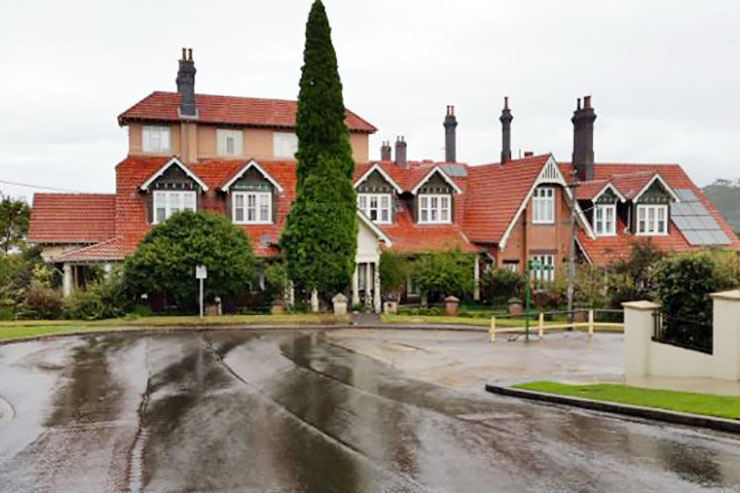
    Today, as one approaches The Manor from the road above, its sprawling grandeur first reveals itself by way of the dormers and gables of the red tiled roof, including the impressive 18-metre long studio perched atop the eastern wing. Most first-time visitors can’t resist trying to count the host of chimney pots that crown it. The very ground that The Manor stands on exudes a palpable magnetism and benign spiritual presence. One does not have to be psychic to experience the peaceful calm emanating from the mansion’s walls, and it is not hard to see why many have claimed to feel closer to the divine here.

    Whether or not Australia fulfils its secret occult destiny and hosts a new Golden Age remains to be seen. So long as the Manorites maintain the high energy levels through their esoteric rites, this site will remain sacred and, should the Masters decide the time is right to publicise their messages once again and guide the populace, surely this will be the prime spot for their transmission.

    This article’s graphics are viewable in the print or digital version of New Dawn 152.

    [alert type=”general” dismiss=”no”]This article was published in New Dawn 152.[/alert]

    [alert type=”success” dismiss=”no”]If you appreciate this article, please consider subscribing to help maintain this website.[/alert]

    Footnotes

    1. It should be noted that Madame Blavatsky (and Theosophy) rejected Spiritualism, however: “By the early 1870s, Blavatsky was involved in the Spiritualist movement; although defending the genuine existence of Spiritualist phenomena, she argued against the mainstream Spiritualist idea that the entities contacted were the spirits of the dead.” (https://en.wikipedia.org/wiki/Helena_Blavatsky)
    2. ‘The Manor Family: Australia’s oldest urban commune’ by Bill Metcalf, JRAHS Vol 100, 9
    3. ‘The Manor: A Short History’ by Nicolas Van Gelder, Theosophical History Occasional Papers, Vol XIV, 1
    4. www.theosophyforward.com/theosophical-encyclopedia/521-manor-the
    5. Nicolas Van Gelder, 14-15
    6. An egregore is a ‘group thought form’ or ‘collective group mind.’ See: http://en.wikipedia.org/wiki/Egregore
    7. ‘Charles Webster Leadbeater 1854-1934: A Biographical Study’ by Gregory John Tillett, http://leadbeater.org/tillettcwlchap17.htm
    8. Other Temples Other Gods by Nevill Drury & Gregory Tillett, Hodder & Stoughton, 1982, 32-33
    9. ‘Age of reason’ by John Zubrzycki, Sydney Morning Herald, Good Weekend supplement, 29 Nov 2014
    10. Nicolas Van Gelder, 24
    11. Masters of the Seven Rays by Phillip Lindsay, Apollo Publishing, 2000, 119
    12. The Ascended Masters of The Great White Brotherhood by Edmund Harold, Grail Publications, 2002, 13
    13. http://en.wikipedia.org/wiki/J._I._Wedgwood
    14. “Mary Rocke, a retired doctor, member of the Theosophical Society, secretary and physician to Leadbeater, purchased three adjacent blocks of land sloping from Wyargine Street, Balmoral to the beach. With a loan of 4,000 pounds and the rest of the cost raised by selling subscription seats, the Star Amphitheatre was built on this site.” (www.mosman.nsw.gov.au/file_download/1865/The-Star-Amphitheatre-Balmoral.pdf)
    15. “Leadbeater, Charles” by Garry Wotherspoon, http://dictionaryofsydney.org/entry/leadbeater_charles
    16. ‘C.W. Leadbeater: Saint or Sinner?’ by Frank Joseph, New Dawn 96 (May-June 2006)
    17. ‘Esoteric Australia’ by Mehmet Sabeheddin, New Dawn Special Issue 3

    © New Dawn Magazine and the respective author.
    For our reproduction notice, click here.

  • What Happened to the New Age? Sorting Truth from Nonsense

    What Happened to the New Age? Sorting Truth from Nonsense

    This article was published in New Dawn 147 (Nov-Dec 2014).

    Not long ago I was walking through the aisles of a New Age fair in the suburbs of Chicago. All the usual suspects were there: booths for Baha’i and Eckankar; ladies selling essences and fragrances; bodyworkers offering ten minutes of chair massage; psychics inspecting the etheric fields of their subjects. Like most New Age events I have gone to over the past decade, the fair had a tired quality to it.

    I could simply be jaded. I’ve been going to such gatherings for over thirty years now, and at this point they hardly impress me with their novelty. But I may not be alone. One has the sense that for many, the energy that gave rise to the New Age has ebbed.

    Even the term “New Age” has come to sound stale, harking back to the ’80s and the Harmonic Convergence, and, still further, to the spirituality of the 1960s counterculture. Commercial interests have backed away from the name, preferring the term “mind-body-spirit” or “MBS.” In January 2012, New Age Retailer, the primary trade magazine for this field in the US, changed its name to Retailing Insight.

    Was the New Age a fad? Was it a noble but misguided hope that the world was ready for an enlightenment to which it now seems indifferent or hostile? Probably neither. More likely this is the case: much of what the New Age pioneered, including yoga, meditation, and organic foods, has become mainstream. Thus you could say the New Age won out in many ways – but at the cost of seeming fresh.

    What about its ideas? Many of them too entered the mainstream and have even become clichés. At this point it may be useful to step back and look at some of the clichés of the New Age and see how well they stand up.

    The New Age

    Let’s start with the phrase “New Age” itself. It goes back far beyond the ’60s, even beyond the turn of the twentieth century. It first started being used in 1864, when an American clergyman, Warren Felt Evans, published a book entitled The New Age and Its Messenger.

    Evans was propounding the ideas of the great Swedish visionary Emanuel Swedenborg (1688-1772). In the 1740s Swedenborg underwent a series of spiritual awakenings that, he said, gave him access to the invisible realms and to the hidden meanings of Scripture. One of his most remarkable claims was that the Last Judgment of the Bible had no resemblance to the way it was seen by conventional Christianity. It was never meant to mean Christ’s second coming on earth. In fact it took place entirely in the world of spirits, a realm which, in Swedenborg’s theology, occupies a middle place between heaven and hell and serves as a clearinghouse for the newly deceased. This spirit realm had accumulated a great deal of debris, such as base and mean entities, and it needed a housecleaning. The Lord accomplished this in the year 1757.

    This Last Judgment, according to Swedenborg, had no immediate consequences for life on earth. Its only effect would be to weaken the power of spiritual tyranny and oppression (notably on the part of the Catholic Church, but also among the Protestants). New horizons on the spiritual world would therefore open. This was the New Age that Evans proclaimed, and Swedenborg was its messenger.

    In his way Swedenborg was right. Many of the religious shackles that seemed solid in the eighteenth century have been broken. There is still a great deal of nonsense, deception, and crime in religion, but there is also much more freedom of inquiry – even the freedom not to believe if you don’t want to.

    Since the nineteenth century, Swedenborg has faded into comparative obscurity, and Evans, once a best-selling author, has been almost completely forgotten. But the term “New Age” was given new life in the twentieth century by figures such as the British esotericist Alice Bailey, and, as we have seen, the New Age as an ideal reached its own peak in the late twentieth century.

    To go back to the initial question: how much truth is there in this idea of a New Age?

    In a trivial sense, every age is a new age. Today we face unprecedented dangers and opportunities. So did our fathers; so did our grandfathers. So will our children and grandchildren. Thus it has been since the beginning of history.

    But I don’t believe the human condition is going to change in any radical way in the future. Whatever wonders and disasters we may engender, we will still be born, love, experience pleasure and pain, and die as humans have since the beginning of time. As Anton Chekhov said in his play Three Sisters, written in 1900: “When we’re dead people will fly around in balloons, there will be a new style in men’s jackets and a sixth sense may be discovered and developed, but life itself won’t change, it will still be as difficult and full of mystery and happiness as it is now.”

    Paradigm Shift

    This phrase is often connected to the idea of the New Age. “Paradigm” means a scientific model. The Ptolemaic view of the solar system, which put the earth at the centre, was one such paradigm. It was replaced by another: the Copernican paradigm, which puts the sun at the centre.

    How did the new view replace the old one? The historian of science Thomas Kuhn asked this question in his influential book The Structure of Scientific Revolutions. His answer goes something like this: A scientific model inevitably has some flaws. It explains the data, but not quite perfectly. There are anomalies. For a long time these are set aside and either explained away or simply ignored. But after a certain point too many anomalies accumulate and can no longer be set aside. Science must then find another model – another paradigm.

    In the case of astronomy, the Ptolemaic view explained the movements of the planets quite well in light of the observations that could be made at the time (up to the sixteenth century). This even included the retrograde motion of the planets. If the planets moved around the earth, why did they sometimes move backwards in the sky? The Ptolemaic theory replied by positing epicycles – meaning that the planets not only revolved around the earth, but moved in small cyclical orbits as they did.

    Eventually the epicycle theory, which still did not match the data entirely, began to break down. Astronomers responded by positing epicycles within epicycles, but there was a point when this model seemed implausible. Another one had to be found. The theory of Copernicus, modified by Kepler, accounted for the planets’ motion much better. This was a scientific revolution, also known as a paradigm shift.

    The paradigm shift that the New Age speaks of is more vague. To some degree it has to do with another scientific revolution – from Newtonian to quantum physics. Newtonian physics is mechanistic and materialistic: it is a universe of ricocheting billiard balls. The quantum universe is much stranger, and some of its most brilliant theorists have stressed how bizarre and counterintuitive it is. But one idea from quantum theory has captured the public imagination: the observer affects the results of an experiment simply by the process of observation. This theory seems to place consciousness, rather than matter, at the centre of the universe.

    This idea fascinates people who dislike the meaningless, materialistic Newtonian universe. Some physicists, such as Amit Goswami, author of The Visionary Window and other works, say quantum theory proves that consciousness is the ground of all being. This is a step many other scientists are not willing to take, largely because quantum theory talks about the behaviour of submolecular particles; they are very reluctant to say quantum effects occur on greater scales. Quantum physics is sometimes defined, in fact, as “the science of the very small.”

    What does this all amount to? There is certainly a new scientific paradigm (although it is well to remember that much of quantum theory was in place by 1930, making it nearly a hundred years old). But this new paradigm, as understood and applied by physicists themselves, does not prove consciousness is the ground of all existence. Nor is it leading toward a more holistic and satisfying view of the universe. In fact the trend is going in the opposite direction.

    A generation ago there was much excitement, at least in the popular mind, about the connections between quantum physics and mysticism. But the majority of scientists, rightly or wrongly, have never bought it. They remain firmly materialistic in their outlook.

    Other disciplines have also moved backward. The psychology of the ’60s and ’70s embraced humanistic and transpersonal perspectives, but to all appearances this process has been turned around. Neuroscience has had so much luck modifying behaviour through pharmaceuticals that now scientists seem to assume more or less universally that consciousness is a mere side-effect of brain states. (Never mind that this claim has never been proved or even explained in any kind of coherent way.) Computer science, for its part, has made such progress in simulating brain processes that some people now believe it will soon be possible to download your consciousness into a computer, allowing cognition to go on through the operation of a machine rather than a brain. You will no longer need your body to be you. Minds are machines, whether they are made of carbon-based protein or silicon.

    In short, the paradigm that was so fondly expected to bring about a new, satisfying, and holistic view of man’s place in the universe failed to arrive. Conventional science, for all its accomplishments, is as drearily materialistic as it was in the days of Queen Victoria.

    That is not to say change will never come. Trends reverse themselves without warning, and fashions in science come and go almost as arbitrarily as the ones in couture. But that is how it looks now.
    [alert type=”info” dismiss=”no”]If you appreciate this article, please consider a subscription to New Dawn magazine.[/alert]

    You Create Your Own Reality

    In a trivial sense, this is certainly true. Your senses and nerves and brain filter the data from the outside world (whatever this “outside world” ultimately is) and create a picture of reality that enables you to function.

    But some New Agers go further. They say that all you have to do is change your thinking and the world will change automatically.

    To some degree this is true as well. Say you are having money trouble. Try this mental experiment. Believe, as fully as you can, that a cheque for a million dollars is coming to you next week. Suddenly your problems will seem to vanish. You will have no worries.

    Your thinking certainly changes the way you feel. But the claim that you create your own reality is a little stronger than this. It is saying that if you believe hard enough that this cheque will be coming, it will come: the universe will manifest it for you. And this idea is harder to swallow. At best, it can motivate you to strive to bring more money into your life; at worst, it is nothing more than daydreaming.

    Some people practice creative visualisation. By this method you formulate a vivid mental picture, and you concentrate on it so that the energy you are directing will make it appear in the physical world. This can and sometimes does work. But it very often brings unwanted consequences in its wake. You can visualise a cheque for a million dollars, and the cheque may appear. But you didn’t count on the fact that you would get into a crippling accident, and the cheque is to compensate you for the fact that you will never walk again. Granted, this is an extreme example. Another more likely outcome is that you will find that you really didn’t want what you were asking for and were disappointed when you got it.

    A few weeks ago, for no reason that I can discern, a file suddenly opened up on my computer. It said, “Please, God, protect me from everything I have been praying for.” I wrote it several years earlier and had completely forgotten about it. Evidently I needed to hear it again.

    Another thing is often overlooked: You are not the only one creating your own reality. There are others like you. All of them have the same power over reality that you do. And you are part of their reality as well.

    This fact raises a large but unexamined question: if we create our own reality, it must be a collective creation. And what is the effect of all these minds creating and cocreating together? How do the thoughts of your neighbours, your countrymen, your fellow humans as a whole, affect you? How do the minds of many engender a collective reality?

    This is, I believe, one of the most important questions facing humanity today. There is a collective imagination – psychologist Charles Tart called it “consensus trance” – that shapes our reality as much as, and probably more than, our own private thoughts do.

    As far as I can tell, psychology has not dealt with this question or even acknowledged it. It is true that the psychiatrist C.G. Jung spoke of the collective unconscious. He touched upon collective mentalities in some of his articles, such as “Wotan,” which discussed the resurgence of an old Germanic archetype in the Nazi ideology, and “The Complications of American Psychology,” which related the American psyche to the nature of the land in which it found itself. From another angle, the Russian psychologist V.M. Bekhterev explored mass and mob behaviour in his book Collective Reflexology. Bekhterev, who saw the Russian Revolution firsthand, had plenty of observations to work from. Even so, the science of collective psychology is embryonic.

    Thus up to a point it is true you create your own reality. But so does everyone else, and you are part of that reality too. The question for the twenty-first century is how we create our reality.

    Be Here Now

    Let’s turn to one of the most famous artefacts of the New Age. A squarish, large-format paperback book, with a purple cover, its contents printed on rough brown paper that looks like wrapping material. Its title: Be Here Now. Its creator: the beloved American guru Richard Alpert, best known as Ram Dass. The words, pasted down clumsily with letterpress as if to simulate the visual distortions caused by LSD, urge you to awaken:

    What are you doing?

    Planning for the future?

    Well

    IT’s ALL RIGHT NOW

    But later?… Forget it baby

    That’s later

    Now is

    NOW

    Are you going to

    BE HERE or not?

    IT’S AS SIMPLE AS THAT!…

    If you get so efficient…

    If you’ve got to turn off all the vibrations of the scene…
    because you’re so busy

    about the future

    or the past

    or time has caught you…

    IT COSTS TOO MUCH!

    No message from the New Age has burned itself into the collective mind as deeply as this command: Be here now. The past is an artificial construct. The future is an equally artificial construct. There is only the present moment. There is always only the present moment. This is the way to liberation.

    The idea still reverberates. Just as its effect was starting to fade, Eckhart Tolle came out with a booster shot: the best-selling Power of Now, published in 2004.

    No one could possibly refute this idea. It is always now, and, it would seem, the atomic moments felt through meditative awareness – an endless chain of nows, each one inexorably strung upon its predecessor – bring us as close to ultimate reality as we are likely to come in this world.

    As a mental discipline, what has sometimes been called “the doctrine of the present” has no peer. Every moment – or, rather, every moment you are aware of it – you bring your attention to the present; you sense your feet on the floor and feel the breath go in and out. The welterings of your mind subside. You are centred and at peace.

    How could anyone question this?

    In essence, I could not hope to. But in practice, another view arises.

    There is the sensation of my foot on the floor. This is direct, immediate, real. There are, on the other hand, the thoughts and fantasies and daydreams in my head, flowing before my mesmerised eyes like the scenes of a thriller. By contrast, they seem unreal.

    But maybe this is not the whole picture. Am I not, after all, experiencing all these supposedly delusory thoughts in the present as well? Why should one experience be held up as real and genuine, while the other is despised as false?

    Someone who goes to a few of the innumerable talks given by Tibetan lamas in the West will sometimes hear them denigrate the conceptual mind – the ‘monkey mind’ that must be suppressed, or even killed, if enlightenment is to occur. But I once heard the Dalai Lama speak, and he criticised this point of view. Although I don’t remember his exact words, I do remember that he said this contempt for the conceptual mind was unjustified, that this part of the mind too has its place, and one must not try to uproot or kill it.

    And sometimes this conceptual mind will take you out of the present.

    The present, then, that magic moment that discloses God, is only one of innumerable types of experience. It is well, of course, to be able to recognise and rest in it. But it may not be wise, and it certainly seems impossible, to stay there all the time.

    R.H. Blyth, in his celebrated collection of essays Zen and Zen Classics, writes: “Where Buddhism makes its great mistake is in asking for eternity without time. As Blake said, ‘Eternity is in love with the productions of time’.”

    Peace

    Peace. If there is one word that encapsulates the New Age, it is this one. In its day, it was more than a word. It was a gesture (the fingers forming a V, the palm facing out in an exact reversal of Churchill’s ‘V for victory’ gesture). It was an ideograph, the circle bisected vertically, with two other lines extended down from the centre – a combination of two letters in semaphore code standing for ND or “nuclear disarmament.”

    But peace – a cliché? That is a harsh verdict. And if it is, you will say, we need more of such clichés. And badly.

    In the ’60s the peace movement was the result of a genuine collective impulse. It was not only the recent memory of the horrors of the Second World War. It was also an aftershock from the Cuban missile crisis of 1962, when the world came the closest it has ever come to nuclear war. In the US, the peace movement was also a response to the Vietnam conflict and to the real likelihood that, like the states in Orwell’s 1984, the superpowers would maintain a permanent state of war.

    Events turned out differently from the expectations, as events always do. The threats to world peace that seemed so menacing during the Cold War are gone, but they have been replaced by others, and when these are gone, there will be others still.

    Do we need a peace movement to turn ourselves around? I think we do, but I also think we have never had a genuine peace movement. What we have had are antiwar movements. And to be against war is not the same thing as to be for peace.

    Earlier in this article I talked about the possibility that thoughts play a part – a major part – in shaping reality. And I think this is the case. In this light what are we to make of today’s mentality, which projects so much hatred toward its leaders? Do they deserve it? Maybe – but you are not making them any better or their work any easier by directing hatred and vituperation at them. Not if there is the dimmest bit of truth to the idea that your thoughts create reality. And of course this goes double for any collective feelings of hatred.

    In this light I find myself thinking about the possibility of a peace march – a genuine peace march. Such an event would be aimed not at stopping the latest war but at offering peace and blessings to the leadership of the nation, of any and all ideologies, without any agenda whatsoever. This would be a real peace march, because it would be offering peace rather than opposition, blessings rather than grievances. I wonder what effect it would have.

    A cliché, of course, could never become a cliché unless it is widely disseminated. And it would never become widely disseminated if it did not have much truth, and even wisdom, in it. So it is with the clichés of the New Age. Many of them are rooted in ancient and indeed perennial truths. That these truths need to be recast and restated in the language of a particular time and place is hardly a flaw; it is a way of adapting them to the needs of a generation. They will be restated and recast in many ways in the generations to come.

    [alert type=”general” dismiss=”no”]This article was published in New Dawn 147.[/alert]

    [alert type=”success” dismiss=”no”]If you appreciate this article, please consider subscribing to help maintain this website.[/alert]

    Sources

    V.M. Bekhterev, Collective Reflexology: The Complete Edition, translated by Eugenia & Alissa Lockwood, Transaction, 2001

    R.H. Blyth, Zen and Zen Classics, vol. 5, Hokuseido, 1962

    Amit Goswami, The Visionary Window: A Quantum Physicist’s Guide to Enlightenment, Quest, 2006

    Ram Dass, Be Here Now, Lama Foundation, 1971

    C.G. Jung, Civilizations in Transition: Collected Works, vol. 10, 2d ed., translated by Gerhard Adler & R.F.C. Hull, Princeton/Bollingen, 1970

    Emanuel Swedenborg, True Christianity, translated by Jonathan S. Rose, 2 vols, Swedenborg Foundation 2006-2012

    © New Dawn Magazine and the respective author.
    For our reproduction notice, click here.