New Dawn – World's Most Unusual Magazine

Category: Paranormal

  • Entangled Minds: Telepathically Entering Another Person’s Lucid Dreams

    Entangled Minds: Telepathically Entering Another Person’s Lucid Dreams

    From New Dawn 149 (Mar-Apr 2015)

    In the late 1970s I read the research on dream telepathy conducted at Maimonides Medical Center’s Dream Laboratory in New York.1 I was fascinated with how a person could send pictures into the minds of sleeping subjects during dream sleep, also called Rapid Eye Movement or REM sleep. The sleeping subjects would incorporate aspects of a sent picture into their dream motifs or dream stories.

    In one target picture there were two men in a boxing match, the sender or agent also had on display in his office “a genuine dark-brown leather boxing glove.”2 The picture and the physical object on display enhanced the telepathic transfer more significantly than the picture alone.

    This research got me interested in dreamwork and a year later I began studying methods on how to control my dreams.3 At the time I was having an unusual recurring dream and thought dream control would help me explore it. However, this endeavour fell short of what I expected. I continued working on dream control, and added to my dream retinue Freudian and Jungian dream interpretation. I also discovered dream control was the antecedent to experiencing lucid dreams.

    By the mid-1980s more research into the nature of lucid dreaming had accumulated accompanied with new methods on how to experience a lucid dream.4 Now somewhat successful with controlling my dreams, I decided to try one of the new techniques, and it worked; I was becoming more consciously aware in my dream states. But remembering and staying conscious in my dreams was a constant struggle. I began noticing that on nights I did not smoke marijuana, I could recall my dreams, they were more vivid, and I was more consciously aware of them and as a result. I curtailed my marijuana use.

    During this period Joe, a long time friend, and I were studying rituals from the Hermetic Order of the Golden Dawn. He and I had a close friendship, and according to the studies on dream telepathy to be successful, there needed to be an “agent-subject rapport,”5 which is what we had. We decided to experiment with the directional symbols from the Golden Dawn: the dagger, wand, chalice and pentacle. The pictures of these symbols were all in black and white, and copied from Israel Regardie’s book The Golden Dawn.6 Joe was a night owl, so while I slept he attempted to send these symbols into my dreams randomly, one symbol per night. After several months without success we stopped the experiment.

    Shortly thereafter I began teaching a course at the University of Cincinnati, ‘Dreams: The Night Theatre’. By the seventh week of class I noticed some of the students began sharing aspects of each other’s dreams. Each time I taught the course this phenomenon would occur. I finally concluded these students unconsciously were telepathically transferring dream information into each other’s dreams, changing the dream motifs. Eventually I discovered research into this phenomenon called shared dreaming or mutual dreaming.7

    If these students could telepathically send information into each other’s dreams, then why was my earlier experiment with Joe not successful? I decide to restructure the experiment with another friend, Mike, who was deeply interested in the mystical, and like Joe, we had a deep rapport. In the new experiment, we used black and white standard ESP card symbols as the targets. We decided to send these symbols into each other’s dreams telepathically. If that worked then we would attempt to enter each other’s dream motifs, a shared dream experience. Each night we randomly selected one of the ESP symbols and then telepathically focused on sending that symbol into each other’s dreams. We alternated nights, one night I would be the sender and the next night would be Mike’s turn. After a year with no successes we stopped the experiment.

    A few years later I became friends with Aaron who was in the counselling profession like myself and had a deep interest in parapsychology. I presented the research on dream telepathy, lucid dreaming and shared dreaming, and he was fascinated with the idea of sharing a dream story. Rather than trying to send symbols into each other’s dreams, we instead used a different approach. Aaron would try to send his image telepathically into my dreams, and over the next year we experimented with this shared dreaming technique without success. With these experimental failures, I sat the entire project aside.

    Entangling Minds

    Hector (pronounced Ector) and I had known each other for four years and we had discussions on various topics. The topic of choice was always the afterlife and the supernatural. Being from Mexico, Hector had a very different perspective on reality because in his culture the supernatural is a part of everyday life. One topic that kept cropping up was how everything that exists is interconnected or entangled with everything else. The concept of entanglement comes from quantum physics in which particles created at the same time become entangled with each other. What is done to one particle instantly happens to the other particle, no matter how far apart they are. Studying entanglement, I stumbled upon Dean Radin’s (2006) concept of entangled minds.8 Radin used entangled minds to explain ESP phenomena, and his theoretical explanations gave me a scientific basis for how everything is interconnected, especially our minds.

    Figure 1: Zener cards are commonly used to conduct experiments for extrasensory perception (ESP). The cards were used in author Gary Duncan’s dream experiment with Mexican colleague Hector.

    Hector could not wrap his head around the entanglement concept. I would tell him, he and I are a part of each other, we are a part of everything that exists and everything is entangled with everything else including our minds; we are all one. In talking to him about how we are all interconnected and entangled with each other, I began thinking about my previous failed experiments with dream telepathy and shared dreaming and why those experiments didn’t work. A successful telepathic experiment would convince Hector we are all interconnected and our minds are indeed entangled.

    Now that I had piqued Hector’s interest, I decided to approach him about conducting an experiment that would test the entanglement idea, and he was interested. How would I go about the experiment? What would I do different this time that I didn’t do before? I finally came to a simple experimental protocol. I would again use standard ESP symbols but this time they would be in colour. Hector would be the sender/agent and I would be the receiver/subject. My reasoning for this decision was Hector spoke English with a deep accent, many words he had problems pronouncing, but he understood more than he could speak. I thought his language issues and his cultural background might be an asset because he was unsullied by the rational materialistic culture of the United States.

    If Hector was able to send me an ESP symbol telepathically and if I received the image, that would indicate we are entangled in some way. But if the experiment failed then my argument would fall apart. I presented the experimental protocol and he was ready and excited to begin. I, on the other hand, was a bit anxious because of the previous failures, but decided the experiment might work because we had a deep rapport with each other and our cultural backgrounds were so different.

    I gave Hector the coloured ESP symbols (see Figure 1) and instructed him to choose one each week at random. Once chosen, throughout the day he pictured me in his mind and visualised the ESP symbol going from his mind into my mind. At week’s end I would call him and tell him what symbol came into my mind. He would confirm if I hit or missed the symbol. The first three days of the first week I missed the target completely and then started to get hits off and on throughout the day. Over the next two weeks, I got hits every day and a few misses, but more hits than misses. He was impressed with our experimental results and so was I.
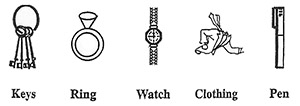
    I decided to change the targets from ESP colour symbols to pictures of black and white physical objects (see Figure 2, above). Hector continued with the same experimental protocol and I did not get a single hit. What was it about the ESP colour symbols that were easier for Hector to transmit telepathically? And why was I able to receive the ESP coloured symbols and not the black and white pictures of physical objects? Did it have to do with how he culturally perceived these symbols and objects as he telepathically transmitted them to me? Did it have to do with the fact that the black and white pictures were more detailed than the ESP coloured symbols? I was at a loss to explain these results. After a week and a half of nothing but misses, we decided to take four months off and then resume with the ESP colour symbols to see if there were any changes.

    We resumed the experiment for a four-week period and every day, throughout the day, I got hits. I soon discovered that when Hector sent the ESP symbols telepathically he focused mostly on the colour that made up the symbol. In the experiments it appeared the colour of the symbol was the salient factor for successful telepathic transmission. I realised Hector is a visual learner, so cognitively the colour of an object might carry more visual weight than black and white objects.

    Hector was amazed with our results but could not understand how it all worked. I tried to explain it the best I could by simplifying Dean Radin’s theoretical perspective, but fell short because of our language barrier. It became obvious we were now more than ever interested in continuing our research into entangled minds, but where would we go from here? Out of three previous attempts with three different people, Hector is the first experimental colleague to be able to telepathically send ESP symbols into my mind.
    Entering Dreamscapes

    With the success of our telepathic experiments we decided to take the next step into the world of dreams. I knew dream telepathy was true, lucid dreaming was true, shared dreaming was also true, but could Hector telepathically transmit his animated image into my dream stories? If so, how could it be done? Over the next few months I put together all I knew about dream research, especially lucid and shared dreaming, telepathy, remote viewing, clairvoyance, and various behavioural and Neuro-Linguistic Programming techniques to develop a sound experimental protocol. I also added a lucid dream supplement, galantamine, to enhance the lucidity and vividness of my dreams.

    I shared all the information accumulated with Hector and a protocol for how we would conduct the experiment. Since Hector was an excellent sender/agent and I was an excellent receiver/subject, we would keep that structure intact because of the positive results of our previous experiment. Not only that, but our minds were now significantly entangled.

    Since Hector is the manager of a restaurant, he is up late at night giving him the opportunity to telepathically send his image into my mind while I sleep. He sent his image into my mind between the hours of 12:30 a.m. and 6:00 a.m., and somewhere during this period I was dreaming. Without an EEG hook-up monitoring my sleep stages, his telepathic projections were hit or miss. In addition, before going to sleep, I took galantamine on alternate nights excluding weekends.

    Over the next several months Hector and I experimented to see if he could project his image into my dreams. Nothing happened for several weeks, but when I woke up to use the bathroom during one night the first image to pop into my mind was Hector. Slowly, over the next several weeks, this experience went through subtle changes. One significant change was when Hector’s image popped into my mind accompanied with intense feelings of his presence. Then, one night, I suddenly awoke almost in a startle and Hector’s presence was all around. I couldn’t see him, but it was as though he was in the room with me. Throughout the next day his presence remained, and I could feel him intensely. The following day I called him and he told me he and his lady-friend had a deep intense discussion about an article I had written on helping stuck souls go into the light.9 Their intense discussion about the article’s details telepathically transferred Hector’s spiritual energetic presence to me.

    Now that I could feel Hector’s presence, we decided to create a specific place in my dream world where he could project his image. This special place is called an egregore. According to Gaetan Delaforge10 egregores are “created when people consciously come together for a common purpose. Whenever people gather together to do something an egregore is formed….” Hector’s native tongue is Spanish, so he would be the one creating the egregore because it would be easier for him to describe to me where the dream would take place rather than for me to describe it to him in English. It took a week for Hector to come up with an egregore, which was a soccer field.

    Since I don’t play sports and have no idea what a soccer field looks like, I immediately went to the Internet, found several pictures and committed them to memory. Hector taught me how soccer is played and he telepathically met me in my dreams on the soccer field. Throughout the day I would focus on him and me meeting on the soccer field and playing the game. This focusing ritual that I performed throughout the day is called dream incubation. I also added two other components to the dream incubation ritual – a command statement and dream enhancing technique. The command statement, “Tonight, Hector will enter my dreams,” is an invitation for him to enter my dream stories.

    The dream enhancing technique was one I used years earlier in a psychotherapeutic setting to gain insights into my client’s issues, and it worked. In this technique I placed the signature of the client I desired to dream about under my pillow at night, which resulted in me dreaming about the client.11 However, for our experiment I augmented this technique. I placed under my pillow a signed photograph of Hector, placed in an envelope with the command statement written on the back of the envelope. Throughout the day I repeated the command statement while visualising me and Hector playing soccer. At night I placed the envelope under my pillow and recited the command statement repeatedly while going to sleep. Another valuable tool I used was a dream journal. With this experiment the journal became a valuable asset. After several weeks of preparation we were ready to execute the experiment.

    The first several weeks were all failures in the sense Hector did not appear in any of my dreams, nor was there a soccer field, but with galantamine my dreams were vivid and lucid. Although I dreamed, Hector was not in any of them, however when I awoke I felt his presence all around me. This continued for several weeks and then I had a dream of several Mexicans, none of them I knew. A few nights later I dreamed I was talking to a friend about Hector. Then it finally happened; I was dreaming and suddenly Hector was in the background watching the dream story – he said nothing, just stood and observed. This was the first breakthrough with him in my dreams.

    A few nights later, still taking galantamine, Hector was in my dream story. Rather than a soccer field, the egregore setting was a restaurant and Hector was gambling, an activity he doesn’t do. In the second part of the dream he went to another restaurant where a party was going on; I followed him and enjoyed the party. A few nights later he was in another dream with a different motif in which we were driving to another city talking about him opening a Mexican restaurant, but still no soccer field.

    Over the years I have experimented with a variety of lucid dream supplements, and found galantamine works. I also discovered another dream supplement, African Dream Root (Silene Capensis), which received many positive reviews regarding vividness in lucid dreaming. Based on these reviews, I decided African Dream Root might be a better supplement to allow Hector and me to create the soccer field egregore. I took three weeks off galantamine and substituted African Dream Root.

    After taking the supplement for a few days there were radical changes in my dreaming. African Dream Root did not do what I expected; my dreams were chaotic and violent, with poor dream recall. But Hector was in one dream in the background, observing the chaotic and violent dream story, and there was no soccer field egregore. I stopped taking African Dream Root and resumed taking galantamine.

    Over the next several dreams Hector was in the motifs and they were all in places where one eats, a restaurant and a kitchen. There was a dream in which I was talking about Hector’s restaurant to someone else. In another dream Hector served food and taught me how to drink Margaritas with salt. In a later dream we were at my house at the kitchen table talking and his mother was present in a pale blue dress. Hector and I were so close; I could smell his body fragrance which was a sweet subtle smell, not offensive at all. In studying my dreams throughout the years, this was the first time my olfactory (smell) sense was activated to this level of sensitivity.

    Conclusion

    In reviewing the details of the first part of our telepathy-dream experiment, there is a combination of factors contributing to Hector being a very good sender/agent. It is evident, since Hector has a visual learning style, that the colour ESP targets were more effective than the black and white targets. Also, his cultural background lends itself to the supernatural and his language issues allowed him to successfully telepathically transmit the colour targets to me. I, on the other hand, am a good subject/receiver because I have had many altered state of consciousness experiences throughout my life. These experiences have opened me up to receive information from a variety of spiritual or imaginal domains as well as the earlier experiments with telepathy and shared dreaming.

    The reason Hector could not transmit the soccer field egregore was because he manages a restaurant and that scene is ever-present in his mind. He works in this environment six days a week, absorbing all the details of the restaurant into his mind. In the restaurant money is the primary re-enforcer, creating a strong mental image of that environment. On the other hand, he plays soccer occasionally and the re-enforcer is having fun, which is not as strong as a monetary re-enforcer. Moreover, when he tried projecting the soccer field, the stronger re-enforcer associated with the eating environment is what was unconsciously transmitted. As a result, we decided an eating environment would be our dream egregore.

    The use of the lucid dream enhancer galantamine allowed my dreams to become more vivid and lucid. By being more vivid and lucid, I was more consciously aware in each dream motif. Within the lucid dream structure my intent was not to change the dream story but to become more aware of dream details.

    The use of the programmed command statement and the signed photo in the envelope as part of the incubation process allowed my protective barriers to become more relaxed and invited Hector’s visual presence to enter my dreams. Eventually Hector became an active part of the dream stories. Although one aspect of the incubation process did not materialise as planned – creating the soccer field egregore – but a more viable result occurred, the eating environments.

    This experiment has broad implications for how we understand and perceive our reality. The fact that Hector and I were able to connect telepathically indicates we broke down major psychic and protective barriers between us. The ESP component of this experiment allowed our minds to become entangled. This entanglement allowed Hector to project his image, essence or presence into my dream motifs.

    The Next Step

    With the success of this telepathy-dream experiment, which took a year and a half to unfold, Hector and I are moving on to the next phase. Over the next several months Hector will telepathically enter my dreams and he and I will attempt to change the dream story at will – he transmitting from the outside world and me within the dream world. As this experiment has unfolded there are broader implications for Hector and I. Hector can use his telepathic abilities to continue helping me explore the dream world, or he can explore other dimensions of the imaginal realm, or he can be taught how to refine and focus these sacred abilities to heal others. Whichever route he chooses, Hector will find great satisfaction in experiencing other realities or knowing he is helping others to heal.

    I, on the other hand, will continue exploring the phenomenon of entangled minds, the dream world, and other terrains of the vast imaginal realm. The results of this experiment are shifting my professional focus toward what is possible with human potential. Lastly, what we have accomplished in this experiment is far greater than I ever expected.

    [alert type=”general” dismiss=”no”]This article was published in New Dawn 149.[/alert]

    [alert type=”success” dismiss=”no”]If you appreciate this article, please consider subscribing to help maintain this website.[/alert]

    Footnotes

    1. Montague Ullman & Stanley Krippner, Dream Telepathy: Experiments in Nocturnal ESP, Penguin, 1974
    2. Ibid., 121
    3. Patricia L. Garfield, Creative Dreaming, Simon & Schuster, 1975 & 1995 (updated edition)
    4. Stephen LaBerge, Lucid Dreaming, Ballantine, 1985
    5. Ullman and Krippner, 1974, 212
    6. Israel Regardie, The Golden Dawn, Aries Press, 1937-40, 398
    7. Linda Lane Magallon, Mutual Dreaming, Pocket Books, 1997; Barbara Shor, ‘The Promise of Shared Dreaming’, Gnosis Magazine, Winter, 1992, 36-42
    8. Dean Radin, Entangled Minds: Extrasensory Experiences in a Quantum Reality, Paraview, 2006
    9. Gary W. Duncan, ‘Helping Stuck Souls Crossover’, New Dawn 143 (March-April 2014), 65-70.
    10. Gaetan Delaforge, ‘The Templar Tradition Yesterday and Today’, Gnosis Magazine, No. 6, Winter, 1988, 8-13
    11. Magallon, 1997; Robert Moss, Conscious Dreaming, Crown, 1996.

    © New Dawn Magazine and the respective author.
    For our reproduction notice, click here.

  • Robert Monroe & the Science of Astral Travel

    Robert Monroe & the Science of Astral Travel

    From New Dawn 145 (Jul-Aug 2014)

    For nearly half a century, Robert Monroe has been the “out-of-body” man, the man who took the subject of astral travel out of the realm of religious or occultist dogma and plopped it right in the middle of mainstream America, and eventually the world.

    His books describing his experiences were world-wide best-sellers. But his contribution ranged far beyond writing books. He perfected a technology that made it possible for others to learn to experience altered states at will; invented a stripped-down, de-mystified language to describe these states; and created an institute to conduct residential programs to give people practical experience.

    Nineteen years after his death, his influence continues to spread. Odd, then, how little attention people give to his later conclusions. It isn’t that he recanted, but that he reformulated. And that reformulation moves “out-of-body” from curiosity to entry-point.

    Bob Monroe

    Bob Monroe (1915–1995)

    Monroe’s capsule biography would read something like this: Born in 1915 into a middle-class, midwestern American family, he dropped out of college, moved to New York, began writing (and eventually selling) radio scripts, became a producer of successful radio shows, married a couple of times and had a daughter, and, by the time he turned 40, was living the life of the well-to-do businessman in suburban New York, a life that included sailing boats and flying airplanes. Then – as we’ll describe shortly – he began having inexplicable out-of-body experiences which grew in importance to him until they came to dominate the last third of his life.

    His first book, Journeys Out of the Body (1971), was his initial, relatively unemotional summary of his experiences. Shortly after the book’s publication, his experiences changed radically, as described in Far Journeys (1985). In the years between the appearance of his first and second books, he began creating ways to help others have the same kinds of experiences. He created Hemi-Sync®, The Monroe Institute, and what we might call Monroe-speak. His third book, his grand summing-up, Ultimate Journey, appeared in 1994, not long before he died on St. Patrick’s Day, 1995. An interesting, successful life. A life that started to become important to the world one Sunday afternoon in 1958, when he was 42 years old.

    Out-of-Body Experience

    As he describes it in his first book, Journeys Out of the Body, he had lain down for a nap when

    …a beam or ray seemed to come out of the sky to the north at about a 30-degree angle from the horizon. It was like being struck by a warm light.… I thought it was sunlight at first, although this was impossible on the north side of the house. The effect when the beam struck my entire body was to cause it to shake violently or ‘vibrate’. I was utterly powerless to move. It was as if I were being held in a vise.

    After a few seconds, he forced himself to move, and the vibrations slowly faded.

    (Oddly enough, few people who write about Monroe’s experiences seem to have noticed this beam that “seemed to come out of the sky.” We will come back to it.)

    That was not an out-of-body experience, but it was the beginning. Although the beam was a one-time thing, the vibrations and the temporary paralysis happened nine more times in the following six weeks. He had a physician friend examine him for physical or mental abnormalities, but the doctor merely suggested he had been working too hard, which was reassuring, but not helpful. If this phenomenon was not a symptom of something going wrong, what was it?

    Remember, this was the 1950s. The concept – the very terminology – of out-of-body travel was unknown to mainstream culture. As he put it in Far Journeys, his early investigations took him

    …beyond conventional scientific circles (total rejection), religions (‘It’s the work of the devil’), parapsychology (‘Interesting. Sorry, no data available’), and Eastern disciplines (‘Come study at our ashram in northern India for ten years’).

    He was on his own. So far as he knew, nobody else had ever experienced what he was going through. But he was stubborn, in his quiet way. As time went on and the experiences persisted, and then deepened, so did his desire to understand what it all meant. He said later that it took a full year and 40 trips out-of-body before he accepted the reality of out-of-body experience.

    So what was he going through?

    Monroe, in Far Journeys, defined an out-of-body experience as

    …a condition where you find yourself outside of your physical body, fully conscious and able to perceive and act as if you were functioning physically – with several exceptions. You can move through space (and time?) slowly or apparently beyond the speed of light. You can observe, participate in events, make wilful decisions based upon what you perceive and do. You can move through physical matter such as walls, steel plates, concrete, earth, oceans, air, even atomic radiation without effort or effect. You can go into an adjoining room without bothering to open the door. You can visit a friend three thousand miles away. You can explore the moon, the solar system, and the galaxy if these interest you. Or – you can enter other reality systems only dimly perceived and theorised by our time/space consciousness.

    But by the time he wrote that he had been doing it for many years. For a long time, all he knew was that he could somehow detach from his physical body, and roam around his bedroom, or around the house or even the neighbourhood. After a while he found that he could think himself elsewhere, apparently regardless of distance. He made some experiments to verify or disprove what he was perceiving, but, as he wrote, after a while such experiments became oddly boring.

    (By the way, it is a common assumption that out-of-body exploration naturally leads to voyeurism, but this mistakes the nature of the experience, which is less like watching a movie than like vivid imagination. The word “imagination” can be misleading: In this case it refers not to fantasy, but to what might be called imagination as a tool of perception.)

    Locale II

    In retrospect, until Journeys Out of the Body was published Monroe’s life had only begun moving into uncharted waters. So that first book’s descriptions are not his last word. For instance, he separated his experiences into Locale I, II, and III. Locale I was physical reality, as we experience it. The realm he called Locale III, I’m not going to discuss here, because I think he came to see this earlier idea as misleading, and the later books make no mention of it.

    Let’s concentrate on Locale II. He called it the natural home of the second body – the part of ourselves that could journey beyond the physical. That body, he said, was very responsive to Locale II, where apparently thought powers everything. He concluded that those who had once lived in the physical world had created what he experienced as solid matter in Locale II, either automatically (because they still thought that way) or deliberately (for pleasure or comfort). Such simulations, he concluded, were also created by higher beings for the benefit of those just emerging from the physical world.

    Locale II was inhabited “by entities with various degrees of intelligence with whom communication is possible.” Monroe said that, “In this vastness lie all of the aspects we attribute to heaven and hell.” And, during these early excursions, he began to learn how to contact the dead, a development that would grow to great importance.

    But if Locale II was real, where was it, and how was it that we could contact it? In Journeys Out of the Body he gave us the key: He said his theory depended on

    the wave-vibration concept, which presumes the existence of an infinity of worlds all operating at different frequencies, one of which is this physical world. Just as various wave frequencies in the electromagnetic spectrum can simultaneously occupy space, with a minimum of interaction, so might the world or worlds of Locale II be interspersed in our physical-matter world. Except for rare or unusual conditions, our ‘natural’ senses and our instruments which are extensions thereof are completely unable to perceive and report this potential. If we consider this premise, the ‘where’ is answered neatly. ‘Where’ is ‘here’.

    In other words, our experience is determined by what we tune into. If our receiver is set only to the here-and-now world, that’s all we will receive. If, accidentally or by training, we start picking up other wave-lengths, we are going to be living at least to some extent in a different world. Something shifted the knob on Monroe’s tuner, and he began to pick up other programs, and then he learned to shift the knob himself. That is the basis of all that followed.

    Meanwhile he was moving from being a lone explorer into an organiser of expeditions, on two fronts. First came the ‘Explorers’, then the ‘Gateway Voyages’ and other residential programs.

    Beyond the Personal

    Journeys Out of the Body, published in 1971, brought him thousands of letters, including “many hundreds” from people writing to thank him for assurance they weren’t crazy. By the time he published Far Journeys in 1985, he was no longer working on his own. He had begun to create what became The Monroe Institute (TMI), he had put together Explorer teams, he had invented the Hemi-Sync technique, and he had begun offering the Gateway program, teaching others to do what the culture at large still didn’t dream possible.

    I often say Monroe gave the world three gifts: a technology, a language, and an environment.

    The technology was hemispheric synchronisation, or Hemi-Sync. Simply put, this consisted of feeding sound of one frequency into one ear, and sound of a somewhat different frequency into the other ear. This forced the two halves of the brain to work together to make sense of the input; it also allowed him to input specific combinations of frequencies to facilitate desired brain states, and hence, it was hoped, mental states. Thousands of hours of experimentation discovered certain particularly useful combinations, which he noted and named.

    And that nomenclature was the second of his gifts, a value-neutral language to use to describe various mental states, so that they could be examined and employed with fewer emotional overtones. He numbered them as Focus 3, 10, 12, 15, and 21 through 27. This stripped-down language became a means of structuring and re-thinking the experience, and quickly became familiar not only to the explorers with whom he discovered and developed them, but to participants in the residential programs he developed.

    These residential programs, with the institute supporting them, are the third part of his legacy, a supportive environment combining individual experience of the various focus levels with group debriefings and interpersonal discussion. Taken together, the three tools helped thousands of people to carry on Monroe’s explorations in their own way, finding their own answers to their own questions. (“I don’t know,” he used to respond when asked to define things. “You go find out and come back and tell me and then we’ll both know.”) But before the residential programs came the Explorers.

    Explorers, Gateway & Beyond

    Before there was an institute, there was a group of unpaid volunteers, drawn by curiosity. Lying on a waterbed in a darkened, silenced room, wired to instruments that were monitored during the entire experience, they received Hemi-Sync signals and other communications from their monitor through headsets, and could speak to the monitor (and a tape recorder) through a microphone.

    In order to help them get into a borderland sleep state, Monroe employed the Frequency Following Response he had discovered. “We could tell easily from the instrument readout when they were and when they were not in Focus 10. It could not be imagined or faked…” Then he inserted higher-frequency beta signals to “enhance perceiving by means other than the five physical senses,” and the subjects began to experience light and colour patterns, voices and music, and “sometimes loud explosions that startled the subject completely out of Focus 10 – something that has still to be explained.”

    Monroe described in Far Journeys how one Explorer, having “developed a very close relationship with what appeared to be some four or five beings, one of whom acted as spokesman,” allowed them to experiment in using her body as a sort of “transmitting set between dimensions.” She let them experiment with talking through her vocal cords, which, after a lapse of about three and a half minutes, they did. And this was the beginning of acquisition of a vast amount of material, from her and from others. As he put it, “the Explorer Material is a combination of fascinating, baffling, awe-inspiring, thought-provoking, sometimes boring data that is certainly much in conflict with many of the belief systems that we have within our culture and civilisation.”

    The Gateway program, initially weekend programs held “at motels, conference centres, and special meeting facilities throughout the United States,” developed into a residential course given from Saturday afternoon to Friday morning at TMI, half an hour south of Charlottesville, Virginia. The program was carefully designed to lead people from normal C1 consciousness to other, less usual, states. It’s all done a little at a time, and the net effect is to dissolve what Monroe called the Fear Barrier and unleash the formidable power of individual curiosity. In Gateway, many people learn for the first time by personal experience that they are more than their physical body.

    Over the years, additional programs were developed, a process that continues today. By my rough count, the Institute currently offers nearly two dozen programs of one kind or another. All use Hemi-Sync or the newly developed Spatial Angle Modulation (SAM) technology, and, in all cases, the group energy is an important part of the process, as it combines irreplaceable first-hand experience with nearly equally valuable second-hand reports of other people’s experience of the same exercise at the same time.

    Later Views

    The biggest changes in Monroe’s life after publication of Journeys Out of the Body were in the nature of his journeys. In 1972 he told himself that rather than his conscious self, his ego, determining what to do while he was out-of-body, “the decision to do is to be made by my entire self.” As he put it, “The presumption I made was that my Greater Self (soul?) always knew what it was doing.” And this brought him from local traffic onto the Interstate – the open highway. From this point on his reports centre on the Second State, the reality beyond the world our senses report, which he had initially described as Locale II.

    In Ultimate Journey he says the Institute, “moved away from seeking materialistic explanations to look at the other end of the spectrum.” They discovered that much of what appeared to him to be out-of-body activity had been explained away as dream activity.

    Most important, the mind-consciousness present in the out-of-body state is significantly different from that in physical wakefulness. Initially, intellectual and analytical focus do not seem to be present, at least not in terms we understand. However, the insertion of physical consciousness changes this. Conversely, the emotional extremes of the symbolic right brain are often totally absent and are usually more difficult to activate.

    As always, Monroe defines a Belief – as opposed to a Known – as anything that cannot be fully understood or identified.

    So it must be said: the Different Overview you are beginning to consider can at most be a belief until you begin to test it for validity within your own ongoing experience during your life as an active Human Mind. As small beliefs convert to Knowns, perhaps larger Different Overview beliefs will follow the same path – until you are free.

    What Does it Mean?

    Monroe’s life is almost a textbook case of a man following where he was led, not dreaming that what seemed simply a personal preoccupation would broaden and meet response and lead his life in an entirely unanticipated direction. He let his total Self drive and open up his life unimaginably. His ideas changed. By the end of his life he was no longer talking about going “out-of-body”; instead he would talk of moving “out-of-phase.” Remember his description of many frequencies operating in the same space, overlapping but not interfering? Remember the analogy of changing the tuning on our radio receiver? By the end of his life, he had concluded that this is what he had been doing. He hadn’t gone “out-of-body” in the sense of leaving an empty shell behind; he had changed his focus of attention – had gone “out-of-phase” with the physical – and then had gotten back into phase to report, and carry on his life.

    Oh, and remember the beam that “seemed to come out of the sky,” which started it all? Years later, I asked my own guidance about it, and was told that right from the beginning Monroe was being put on notice that this was not a strictly material manifestation; that the beam was not necessary to produce the effects, but it did serve to loosen his mental bonds. Perhaps so. That still leaves more questions unanswered than answered, but that seems to be the nature of life.

    From “out-of-body” to “out-of-phase” is a long step, and a productive one. When you realise we are more than our physical bodies; that our consciousness inhabits many worlds at once; that it isn’t a question of leaving your body vacant but of redirecting your attention, you begin to understand that learning to go out-of-body is not the goal, but the doorway.

    [alert type=”general” dismiss=”no”]The Monroe Institute in the United States offers an extensive range of programs and products. Find out more by visiting their website www.monroeinstitute.org, email: info@monroeinstitute.org[/alert]

    [alert type=”general” dismiss=”no”]This article was published in New Dawn 145.[/alert]

    [alert type=”success” dismiss=”no”]If you appreciate this article, please consider subscribing to help maintain this website.[/alert]

    © New Dawn Magazine and the respective author.
    For our reproduction notice, click here.
  • Transformed by Lightning: Real Life Stories

    Transformed by Lightning: Real Life Stories

    There is little that’s positive about being struck by lightning. Generally, those unfortunate enough to be struck either die more or less instantly or, more likely, survive yet sustain much damage to their bodies. Most lightning strike survivors battle with depression and some commit suicide.

    Partly as a result of the changes in personality experienced by many lightning strike survivors, which can involve becoming grouchy, short-tempered, and irritable, it’s not uncommon for marriages to break down and for survivors to end up living in isolation. Yet it’s not all doom and gloom. Cases exist where people have been healed of medical conditions after being struck by lightning. Then there are cases where survivors have developed alleged psychic abilities. Some survivors insist they are better for the experience and even grateful they were struck.

    Harold Deal

    One survivor who views his ordeal in a remarkably positive light is Harold Deal, a former maintenance electrician in his 70s from Greenwood, Missouri. After being struck by lightning on 26 July 1969, while standing in the driveway of his home (in Lawson, Missouri), Deal developed severe memory problems, whereby occasionally he could no longer recall how to talk, walk, and perform other simple tasks. Strangely, he also lost his sense of smell and the ability to experience pain and cold. Because he doesn’t “notice the cold like most people,” some of his fellow townsfolk call him “Weird Harold.”1 He explains: “They call me this because I never wear a coat or long-sleeve shirt no matter what the weather is outside… I have worked outside in twenty-six degrees [F] below zero, plus I have worked in weather with a wind chill as low as fifty-six degrees below zero… I have also worked in twenty-three degrees below zero for up to seven hours at a time. A T-shirt and overalls is what I always wear… whether it is summer or winter.”2 Today a dedicated Christian and charity worker, Deal feels that, looking back on the accident, it made his life “so much richer and so much fuller.”3

    Betty Galvano

    Betty Galvano of Sebring, Florida, a former high-fashion model and widow of the late celebrity golfer Phil Galvano, is a remarkable example of someone who’s been healed by lightning. In 1993, Galvano fell off a seawall and broke her right leg. The accident necessitated an operation in which two 14-inch steel bars were permanently inserted in her leg. Although the operation enabled Galvano to walk again, it left her in pain and unable to use her leg to the extent she could before the accident. She explains: “[I] couldn’t jump or raise my leg. I couldn’t stand on one leg. I couldn’t walk without dipping. My leg always felt like a sandbag.”4

    On the afternoon of 11 June 1994, while cutting up broccoli in her son’s kitchen with the window open, Galvano heard “the most unbelievable tremendous blast of thunder.”5 The next thing she knew, she was slumped over the counter, the knife and broccoli having flown from her hands. The bolt of lightning that struck Galvano had entered via the open window. Her husband, who’d been sitting four feet away from her when the incident occurred, helped her to the couch so she could lay down.

    While lying on the couch, Galvano experienced a strange sensation in her crippled right leg, as though “a thousand needles had entered the toes and foot.”6 All of a sudden her leg felt “full of vitality.”7 She recalls: “I stood up and everything was fine. I could walk normally.”8 The pain had also vanished. Galvano claims that not only did the lightning strike “miraculously heal” her leg, but that she didn’t suffer any ill effects from it, not even the slightest amount of memory loss. The day after the incident she paid a visit to her doctor, who confirmed that her leg had indeed been healed.

    Although the effects of being struck by lightning vary from one individual to another, no one is ever the same as before they were struck. Some survivors undergo a kind of “spiritual awakening,” or at the very least acquire a deeper interest in spiritual matters. Something of this nature happened to Galvano. At the moment she was struck by lightning she saw “gold particles everywhere” and experienced “a beautiful, peaceful feeling that God loves us [and] that the only thing that’s worth anything is love.”9 She adds: “Lightning was a spiritual experience for me. It energised me, it made me feel better.”10 It also left her feeling “totally immersed in God,” so that now “He is with me all the time.”11

    According to Galvano, her unique relationship with lightning dates back to when she was a newborn infant in Atlanta, Georgia, in 1935. She claims that a tremendous thunderstorm occurred on the day her mother brought her home from the hospital. The storm caused an electrical cable outside the house to break, which then produced an electrical shortage inside the house and much electrical arcing. Later, when she was three months old, she developed blue baby syndrome and fell into a coma. There was a high chance she might die. As the infant Galvano lay ill in hospital, a raging thunderstorm took place outside. Galvano picks up the story: “My mother looked out the window, and on the lawn she saw a ball of lightning. It floated up, came through the window, and rested on top of me. At that moment a nurse came into the room and watched with her mouth wide open as I came out of the coma.”12

    As tempting as it is to dismiss Galvano’s ball lightning story as the product of an overactive imagination, it’s not unheard of for ball lightning to approach an individual and brush against their body without causing any harm. So it’s conceivable she had a ball lightning encounter as an infant where the object “rested on top of me.” Whether the object healed her, though, is another matter entirely.

    Robert Davidson

    The case I’m about to describe is hardly an example of someone being healed by lightning, though it involved a healing of sorts. In June 1980, Robert Davidson, then aged 38, was riding his motorbike down Interstate 74 on his way to Indianapolis when suddenly it started to rain. Seated behind him on the motorbike was his wife. The two decided to pull off the road to put on their wet weather gear. Davidson’s wife dismounted the motorbike first. Just as Davidson was dismounting, with his left foot on the ground and his right leg still on the seat, he was struck on the shoulder by a bolt of lightning. Davidson was sent flying through the air and landed on the ground without a pulse. A physician who happened to be driving by at the moment the accident occurred pulled over to assist Davidson, giving him CPR and calling an ambulance.

    Both the physician and the team of ambulance paramedics desperately tried to restore Davidson’s heartbeat, but with no luck. As their attempts continued without success, it began to look inevitable that Davidson wouldn’t make it. What happened next sounds like something out of a Stephen King novel. A woman carrying a Bible and wearing an old fashioned-style black dress suddenly arrived at the scene. “Let me touch him,” she yelled out, as she made her way toward Davidson.13 Given the hopeless nature of Davidson’s condition, the paramedics decided they had nothing to lose by letting the woman approach him. “She knelt down beside me,” Davidson said, “and placed the Bible and one hand on my chest and the other hand on the ground. She proceeded to lift the Bible to the sky and muttered something that no one understood.”14 The woman – who came to be known as the “woman in black” – then got up and walked away, and was never seen again. Moments later Davidson had a pulse.

    The identity of the woman in black remains a mystery to this day. She appeared in an instant and vanished in an instant. Although some of the witnesses and paramedics at the scene say they didn’t see the woman, others are adamant they saw her and that she indeed saved Davidson’s life. Paramedic Marylou Shafer belongs in the latter group. “There is no doubt in my mind,” she commented. “She was there.”15 Davidson was taken immediately to hospital, where he remained in a comatose state for seven weeks then spent several additional weeks relearning how to walk. The lightning strike damaged his vocal cords, and it was two years before he was able to talk again and nine years before he was well enough to return to his job at General Motors.

    Peculiar Aftereffects

    Davidson claims that for many years following the accident he was unable to wear a wristwatch without it malfunctioning within a matter of days. The only watch he could wear that didn’t malfunction (and in fact continued to keep perfect time) was the one he had on his wrist at the time of the accident. Actually, many lightning strike and electric shock survivors claim they exert an odd effect on wristwatches. Furthermore, the claims don’t apply exclusively to wristwatches but involve all manner of electrical gadgets – from computers to automatic garage doors to streetlamps.

    In June 1989, former storm chaser Steve Melvin of Ohio, now in his early-50s, happened to get struck by lightning at the precise moment he was taking a photo. The camera was partly melted by the lightning, yet the film inside was undamaged. Remarkably, the photo he took at the moment he was struck shows the ghostly outline of a human surrounded by lightning, even though neither he nor anyone else was situated in front of the lens at the time. Melvin commented: “Some say it was me having an out-of-body experience. Some say it was my grandmother coming down from heaven to push me out of the way of the lightning. Some say it was a glimpse of an entirely different dimension. I’ll never know.”16 Ever since the incident, Melvin has had to replace on a frequent basis the batteries inside the pager he carries on his person; they go flat within days yet are supposed to last for months.

    Could there be a mundane reason why the batteries in Melvin’s pager appear to mysteriously go flat? Perhaps the device is damaged in such a way that it uses more power than it should. Or perhaps, due to brain damage sustained during the accident, Melvin has difficulty remembering when he last put batteries in the device. The only reliable way to get to the bottom of the matter would be to carry out a series of experiments involving Melvin and his pager. This aside, the fact that many lightning strike and electric shock survivors make claims similar to Melvin’s means we’re faced with a genuine mystery.

    In a 2009 USA Today article titled “Florida Lightning Survivors Share Stories,” one of the stories featured is that of Ralph Weidner of Bonita Springs. Since being struck by lightning in 1968 during a camping trip in Colorado, Weidner has had “difficulty using electronic devices.”17 He elaborates: “Battery-operated watches last only a few months and cellphones are a problem as well. I have had my cellphone keypad fail to work, but when I hand it to someone else, it works just fine. This has happened several times.”18

    In Out of the Blue, Friedman presents a number of cases where “lightning survivors have claimed electrical or magnetic powers…”19 One of the cases presented is that of Gabrielle Blanstein. After being struck by a bolt of lightning that entered through the open window of her home in Haydenville, Massachusetts, in 1996, Blanstein became “supersensitive to electrical current.”20 She can tell when an electrical device is plugged in nearby because she can feel in the form of vibrations the EM field surrounding the device. Blanstein claims to have demagnetised by accident two bank cards and a credit card. Could it be that Blanstein suffers from electromagnetic hypersensitivity (EHS)? Her ability to sense EM fields certainly suggests as much.

    Another case presented by Friedman is that of Nina Lazzeroni, a dental assistant and part-time motorcycle safety instructor in her late-50s from Dover, Delaware. On the afternoon of 8 April 1995, Lazzeroni was struck by lightning while standing in a parking lot in Troy, Ohio, in front of a number of students to whom she was delivering a lesson on motorcycle safety. Her students witnessed the entire event. She said, “They told me I flew up like a rag doll and landed on my head.”21 Lazzeroni spent a week in hospital. The accident left her with a shattered left eardrum (which later healed but developed into tinnitus), an abnormal heart rhythm, permanent numbness in parts of both feet, memory issues, personality alterations, and difficulty reading and talking. Lazzeroni surmises that the lightning entered her brain and fried her pituitary gland and other parts of her endocrine system, because after the accident she began to experience “such drenching menstrual periods that I was forced to have a hysterectomy.”22

    Fortunately, Lazzeroni has made a dramatic recovery and now finds it much easier to read and talk. Of those symptoms that remain from the accident, one is extremely peculiar: Lights of all kinds, particularly ones in public places like streetlamps and billboard lights, have a tendency to switch off in her presence, though at unpredictable moments. She explains: “They come back on after I leave the area and turn off again if I return. It’s not uncommon to have three or four go out while I’m driving somewhere at night. I feel no electricity or any other sensation – I just find myself in the dark periodically.”23 The phenomenon described by Lazzeroni falls into the category of streetlamp interference (SLI). [For more on this, see Louis Proud’s article “Streetlamp Interference: A Modern Day Paranormal Mystery” in New Dawn Special Issue Vol.7 No.2.]

    Kurt Oppelt, who with Sissy Schwarz won a gold medal at the 1956 Winter Olympics in the pairs figure skating event, was struck by lightning in 1989 while standing in his bathroom. Doctors he consulted the following day could find nothing wrong with him. And yet, explains Oppelt, “audio receivers, cash registers, and computers broke when I touched them… A friend of mine gave me a laptop, but I can’t use it. I told my cardiologist that my ‘electrical system’ was disturbed, but the doctors say they have no scientific proof. I told another doctor what happens when I touch electrical gadgets, and he said, ‘So don’t touch them’.”24

    Psychic Abilities

    The alleged development of psychic abilities is not an uncommon feature among cases where people have survived a lightning strike. While looking through the many lightning strike “survivor stories” posted on the National Oceanic and Atmospheric Administration (NOAA) website, I came across two claims of psychic ability. The first claim concerns a woman named Missy. Missy was struck by lightning through a landline telephone while ordering pizza during a thunderstorm. At the moment the strike occurred, she heard a “loud explosion” and noticed at her feet “a bright white light… which was football shaped and had spikes.”25 (This is a perfect description of ball lightning, which can indeed emerge from telephone handsets and also assume a “spikey” appearance.)

    The explosion knocked Missy backwards, and for a moment she remained on the floor in an unconscious state. She then experienced a strange “numbing feeling” work its way up one side of her body. Missy was taken to the hospital emergency room, where doctors confirmed she’d been struck by lightning. After the accident, according to Missy, she developed as a “side effect” (her term) extrasensory perception (ESP). She explains: “There have been times where I speak someone’s name, someone that I haven’t heard from or seen in many years and all of a sudden they walk in the door… I’ve had eerie feelings about things just before they actually happen… Most people that know me are amazed. And so am I. This periodic thing only started after my lightning incident.”26

    The second claim of psychic ability on the NOAA website concerns a nurse in Nashville, Tennessee, named Thais. Thais was struck by lightning on two separate occasions. The first time, in May 1985, she had been standing next to an open window drawing blood from a patient seated on a chair when lightning entered the building through the window and struck both her and the patient. The event was witnessed by the patient’s wife, who described the bolt of lightning as orange in colour and added that it appeared to go around as well as pass through the bodies of both Thais and the patient.

    Thais’s encounter with lightning left her with few if any injuries. A couple of months after the incident, however, she noticed two strange aftereffects. First, she could no longer wear a watch without it “losing 10-20 minutes and becoming unreliable.”27 She adds: “At first I kept thinking I was buying watches that were too inexpensive. It took a couple [of] years to realise it wasn’t the watches but me that was the problem!”28 The second strange aftereffect is that her psychic abilities became heightened. She comments: “This [heightened psychic abilities] is not something I previously had interest in and definitely not something I was looking for. I have always been a very private person and didn’t want to know things about other people, but I found myself somehow knowing things about folks I didn’t know well.”29

    The second time Thais was struck by lightning was while talking on the telephone during a Thanksgiving weekend some six to eight years after the first strike. Since then, she says, the well pump at her home has been struck by lightning twice.

    Greta Alexander

    Greta Alexander (1932–1998) of Delevan, Illinois, was a famous psychic whose expertise included palmistry, numerology, “medical intuition,” and assisting police with missing persons cases. Born on a farm in Manito, Illinois, she spent the first part of her adult life as a regular mother and housewife. One night in April 1961, while pregnant with her fifth child, she was lying in bed watching a thunderstorm out the window when “a white light came at me through the window, and the next thing I knew the Venetian blinds were wrapped around me and there was a fire burning a hole in the bed.”30 Although the bolt of lightning damaged her bedroom window, knocked down the chimney, and set fire to her bed, it didn’t harm her or her unborn child in any apparent way.

    Shortly afterwards, she suffered an electric shock while plugging a second-hand refrigerator into a faulty electrical outlet. It was soon after the lightning strike and subsequent electric shock that Alexander’s psychic abilities were “awakened.” She found herself answering the telephone moments before it rang, and noticed she was able to “read” the minds of others. She eventually established herself as a professional psychic, being paid by clients to perform palm readings and the like.

    Her work assisting police with missing persons cases (for which she received no payment) began in 1974. Perhaps the best known case in which her psychic talents proved useful was the 1983 murder of Mary Cousett by her boyfriend Stanley Edward Holliday Jr. At the time Alexander was asked to assist in the case, Holliday had already been charged with Cousett’s murder, yet the whereabouts of Cousett’s body remained unknown. Thanks in part to Alexander’s help, the police located Cousett’s body on 29 October 1983. “She told us a lot of things that turned out to be true – 20-some points that fit,” commented Lt. Donald Sandidge, “like that the head and foot would be separated from the [victim’s] body, [and] that a man with a crippled hand would find her.”31 (The man who found her body, an auxiliary officer by the name of Stephen M. Trew, had a deformed left hand due to an injury he’d sustained in the past.)

    That Alexander was highly psychic is difficult to refute. However, the reason she deserves mention here is not to illustrate the fact that psychic abilities are genuine and can be used to help solve crimes but that both lightning strike and electric shock play an important role in the “awakening” or attainment of psychic abilities. Given that Alexander was struck by lightning then soon after sustained an electric shock, there’s no way to know which of the two incidents was responsible for her “psychic awakening.” Very likely both were.

    Lightning Shamans

    Had Alexander lived in a society where shamanism is practiced, it’s likely she would have been considered a shaman as opposed to a mere psychic. According to German ethnologist and psychologist Holger Kalweit, in shamanic traditions the world over, being struck by lightning is one of the ways by which people are initiated into shamanism. “The Greeks believed a person struck by lightning was in possession of magical powers,” he explains, “and in tribal cultures throughout the world lightning shamans are often venerated and feared as the mightiest of shamans.”32

    To be initiated into shamanism is to take up the shamanic path. Apparently, this happens not by personal choice but under the will of a higher power. During shamanic initiation, the initiate symbolically dies (undergoes dismemberment) and is reborn (put back together). They acquire as a result of this challenging and traumatic process mediumistic and other psychic abilities.

    There is a belief among the North American Indian tribes known collectively as the Sioux that when a person is struck by lightning or has visions featuring Wakinyah (“thunderbirds” or “thunder beings”) it can indicate they’ve been chosen to become a special type of medicine man called a Heyoka (“thunder dreamer.”) A Heyoka differs from a conventional medicine man in that he does everything in a contrary fashion. He is a sacred fool, whose clownish antics are a source of amusement to others. The powers with which Heyokas are gifted derive from the thunderbirds. A thunderbird is a spirit of lightning and thunder in the form of a huge Eagle-like bird. Lightning they produce from their beaks; thunder they produce through the beating of their wings. They are also responsible for the production of rain.

    The famous Sioux Indian warrior and holy man Black Elk (1863–1950) followed the path of Heyoka. At the age of nine he was taken deathly ill and confined to bed for approximately twelve days. During this period of illness, he experienced a great vision in which he was visited by the thunder beings and taken to see the “grandfathers.” The grandfathers taught him important lessons that contributed to his eventually becoming a shaman. “Only those who have had visions of the thunder beings of the west can act as heyokas,” he explains. “They have sacred power, and they share some of this with all the people, but they do it through funny actions.”33 These “funny actions” can include running around naked in the middle of winter and shivering and complaining of the “cold” in the middle of summer; answering “yes” when one actually means “no”; and wearing one’s clothing and boots back-to-front. (One is reminded of Harold Deal’s inability to feel the cold.)

    Since, in spiritual terms, lightning is sacred and powerful because it originates from heaven, to be struck by lightning and survive is to be rendered powerful and sacred. To be struck by lightning and die, on the other hand, is to be punished for having done something to challenge fate.

    [alert type=”general” dismiss=”no”]Reprinted, with permission of the publisher, from Strange Electromagnetic Dimensions: The Science of the Unexplainable, © 2015 Louis Proud. Published by New Page Books a division of Career Press, Pompton Plains, NJ, USA, 800-227-3371. All rights reserved.[/alert]

    [alert type=”general” dismiss=”no”]This article was published in New Dawn 148.[/alert]

    [alert type=”success” dismiss=”no”]If you appreciate this article, please consider subscribing to help maintain this website.[/alert]

    Footnotes

    1. John S. Friedman, Out of the Blue: A History of Lightning: Science, Superstition, and Amazing Stories of Survival, Random House, 2008, 183
    2. Ibid, 183
    3. Megan Varner, “We Are All Survivors of Some Sort,” Index-Journal, 10 May 2006, www.zoominfo.com/p/Harold-Deal/851209311 (accessed 31 December 2013)
    4. Friedman, Out of the Blue, 184
    5. Ibid, 184
    6. Friedman, Out of the Blue, 184
    7. Ibid, 184
    8. Ibid, 184
    9. Dayna Harpster, “Florida Lightning Survivors Share Stories,” USA Today, 1 July 2009, http://usatoday30.usatoday.com/weather/2009-07-01-lee_lightning_survivors_N.htm (accessed 31 December 2013)
    10. Mireya Navarro, “When Lightning Strikes, Lives Are Changed,” 1 September 1998, The New York Times, www.nytimes.com/1998/09/01/us/when-lightning-strikes-lives-are-changed.html (accessed 31 December 2013)
    11. Ibid, 201
    12. Ibid, 202
    13. Ibid, 219
    14. Ibid, 219
    15. Ibid, 219
    16. Chris Rodell, “Unlucky Strikes,” The Independent, 7 November 1999, www.independent.co.uk/arts-entertainment/unlucky-strikes-1124177.html (accessed 31 December 2013)
    17. Dayna Harpster, “Florida Lightning Survivors Share Stories.”
    18. Ibid
    19. Friedman, Out of the Blue, 186
    20. Ibid, 186
    21. “The Will to Live,” Prevention, November 2011, www.prevention.com/health/healthy-living/stories-medical-miracles?page=3 (accessed 31 December 2013)
    22. Ibid
    23. Friedman, Out of the Blue, 187
    24. Ibid, 187
    25. “Survivor Story: Missy: High Price for Pizza? Supernatural Side effect?,” NOAA, www.lightningsafety.noaa.gov/survivors/story_missy.htm (accessed 31 December 2013)
    26. Ibid
    27. “Survivor Story: Thais: Open Window Results in Strike,” NOAA, www.lightningsafety.noaa.gov/survivors/story_thais.htm (accessed 31 December 2013)
    28. Ibid
    29. Ibid
    30. Wes Smith, “Seeing Things: Downstate Psychic Greta Alexander Is Known Worldwide As A Woman of Visions,” Chicago Tribune, 9 June 1991, http://articles.chicagotribune.com/1991-06-09/features/9102210281_1_psychic-abilities-unsolved-murder-case (accessed 1 January 2014)
    31. “Psychic Key to Cops Finding Remains of Slain Woman,” The Evening News, 16 November 1983, http://news.google.com/newspapers?nid=1982&dat=19831116&id=2tBeAAAAIBAJ&sjid=t20NAAAAIBAJ&pg=2498,1826524 (accessed 1 January 2014)
    32. Holger Kalweit, Shamans, Healers, and Medicine Men, Shambhala Publications, Inc., US, 1992, 46
    33. John G. Neihardt, Black Elk Speaks: Being the Life Story of a Holy Man of the Oglala Sioux, State University of New York Press, US, 2008, 149

    © New Dawn Magazine and the respective author.
    For our reproduction notice, click here.
  • Divining the New Year

    Divining the New Year

    For years whenever I went to a party on New Year’s Eve, I brought my deck of tarot cards. There was usually a small group of a dozen or so close friends. Anyone who wanted a reading about the New Year could request one. It was rare for people to turn down my offer. As the Old Year winds down, the idea of a fresh beginning on 1 January is irresistible. How will things be different? What changes should we make? Are there successes and surprises to look forward to or difficulties and problems to be prepared for or to avoid?

    I asked each friend to spread the cards out on the floor, face down, just as if we were going to play the kids’ game “Go Fish!” “Smear ‘em around real good,” I said. “It’s important to have the tops and bottoms of the cards constantly changing in relation to each other so we’ll get both right-side-up and upside-down cards in the reading.” I like this method better than shuffling because it puts the recipient directly in touch with the forces represented by the cards.

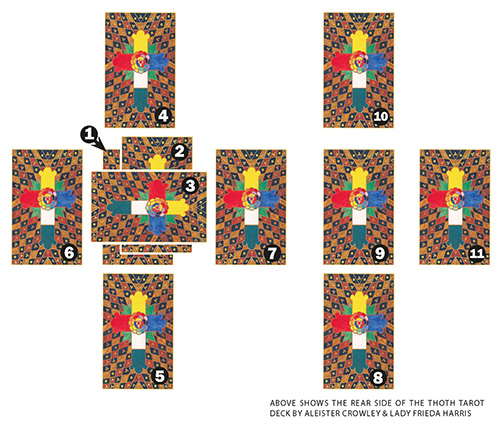
    I usually use the Celtic Cross method I learned years ago from Eden Gray’s The Complete Guide to the Tarot – but with some changes. The first card to be turned up is the centre of the reading – the theme. I don’t use court cards as many readers do. I ask recipients to find the card that feels right, and place it in front of them, still turned down, with one of the narrow sides facing towards them, then to flip the card over from left to right. That determines the card’s orientation, right-side-up or upside-down. I ask recipients to do the same with every card, after which I place it in position in the cross. The order is as follows:

    1. Theme of the New Year (centre)
    2. State of mind upon entering the New Year (covering the previous card)
    3. Blocks or obstacles from the Old Year (crossing both cards from left to right)
    4. Ideals to look up to or things hanging over your head as you enter the New Year (above the centre cards)
    5. Beliefs supporting or undermining you as you enter the New Year (below the centre cards)
    6. Things you’re leaving behind in the Old Year (left of the centre cards)
    7. Things you’re moving towards in the New Year (right of the centre cards)
    8. Attitudes to cultivate or clear as you enter the New Year (first stage of a column to the right of all the other cards, at the same level as the fifth card)
    9. Environmental influences that urge you forward or hold you back, such as work, partner, or family (second stage of the column, at the same level as the seventh card)
    10. Hopes and fears about the New Year (third stage of the column, at the same level as the fourth card)
    11. Possible outcome of all these forces in the New Year

    If the outcome card doesn’t seem positive or conclusive, I ask the recipient to draw two further cards, which I call Alpha and Omega. They can be placed anywhere on the reading surface. Their purpose is to sum up the lessons or issues revealed in the reading and possibly to point toward a more positive or conclusive conclusion.

    I think of a tarot card reading as an artificial dream. The images on the cards are like dream images and can be related to one another to create a dream story about the possibilities of the New Year. I learned the basic meanings of the cards from Gray’s book. Instead of reading them aloud, I notice which images on the cards draw my attention and weave them into the dream story. An upside-down card is never negative, it’s just a muted version of the card’s meaning (positive or negative) when it’s right-side-up.

    There are many tarot decks to choose from, depending on the reader’s temperament. I use the familiar Rider-Waite deck, but I know readers who make the choice of tarot deck a part of the reading. Having used the same deck since I was in college forty years ago, I find that it has developed a personality of its own, possibly under the influence of a helpful spirit that lives, as it were, within the astral version of the deck.

    Once, after a period of neglecting the cards for several years, I did a set of readings at a New Year’s party and was astounded at the number of negative and inverted cards that came up. The positive spirit had been replaced by an unpleasant trickster who enjoyed spreading doom and gloom through the cards. I got the deck to behave more positively by putting the cards back into the order they were in when they came from the factory, all right-side-up, and giving the deck a decisive whack on each of the four sides. After the next recipient smeared the cards around and began selecting them for a new reading, the results were more encouraging.

    I Ching

    After frequently reading the cards for myself in college, I discovered that I’d learned enough about their meanings that I couldn’t get clear messages. I couldn’t trust my interpretations of the positive cards because that might be wishful thinking and I couldn’t trust those of the negative or inverted cards because they might be the result of anxiety. Such problems didn’t occur when I read for others. I had to find another method of doing readings for myself. So I began experimenting with the I Ching, or Book of Changes, an ancient Chinese text on divination compiled 2,500 years ago.

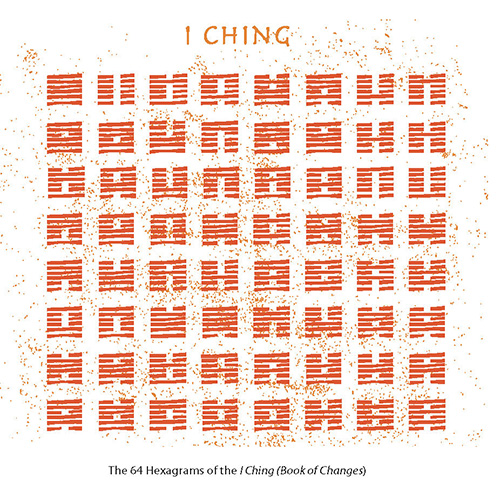
    One simple method of consulting the book is to throw three coins of the same denomination six times to build a six-line figure called a hexagram. One side of each coin is assigned a value of two and the other a value of three (it doesn’t matter which side is which as long as you’re consistent). Hexagrams are made up of four types of lines:

    • Stable yang (active) (3+2+2)
    • Stable yin (passive) (3+3+2)
    • Unstable (or changing) yang (3+3+3)
    • Unstable (or changing) yin (2+2+2)

    A chart helps you discover the name and number of the resulting hexagram, of which there are sixty-four. You then look up that hexagram and read the associated text, which describes the situation in which you presently find yourself. If there are unstable lines, you also read the text associated with them. An unstable yin line is said to change into a stable yang line and an unstable yang line into a stable yin line, thus yielding a second hexagram, which you also look up, but without reading the text associated with the lines – stable lines don’t count. The second hexagram represents the situation that develops from the first one.

    There are many translations and rearrangements of the ancient text for modern readers. I prefer the classic version translated from Chinese into German by Richard Wilhelm and from German into English by Carey F. Baynes (the so-called Wilhelm/Baynes version). The metaphorical language of this version of the Book of Changes substitutes for the imagery of the tarot deck and helps me interpret the situation I’m in as if it were one of my own dreams. Some newer versions are too literal and mundane for my taste; one older version, by James Legge, is so flowery as to be completely incomprehensible.

    A more traditional method of consulting the I Ching, too complicated to describe here, is to use fifty yarrow stalks. This method requires three operations to determine each line of a hexagram, thus eighteen in all. It’s described in some translations of the book, as well as online. I use six-inch long bamboo hibachi skewers, thin as toothpicks, having clipped off the pointed ends. Manipulating these ‘stalks’ places me in a meditative mood. I feel as if I were handling the forces that are creating the situation I am in, each force represented by a stalk. I recommend this method to anyone interested in ceremonial magic.

    As far as the New Year is concerned, the first hexagram could represent the Old Year, and the one that develops from the changing lines could represent the New Year.

    No matter how frequently I’ve consulted the Book of Changes, perhaps once a day in times of trouble, I’ve always gotten a useful answer – one that wishful thinking or anxiety couldn’t tamper with, as in the case of tarot cards. Once, after having just moved to Chicago, I consulted the book about my new life there. I received the hexagram Tui, the Joyful. Aside from the positive message, I was startled by a bizarre synchronicity. Supposedly, the tossing of coins or the manipulation of stalks provides a hexagram purely by chance. In this case, some higher power must have been teasing me – I got the Tui hexagram having moved into an apartment on Touhy Avenue.

    Runes

    When Ralph Blum’s The Book of Runes was first published in 1982, sold with a bag of ceramic ‘rune stones’, I began experimenting with this method of divination. Blum’s book provided a range of suggestions for using the runes, from magical and sacred ceremonial or meditative methods to daily divination on mundane matters. I quickly determined that mundane divination was subject to the same limitations as the over-frequent use of tarot cards for personal readings: wishful thinking versus anxiety.

    Because the Norse runes were/are a magical alphabet like Hebrew or Sanskrit, they might be better used for magical purposes. The figures are made up of lines that could represent forces interacting with each other, often creating closed or open spaces representing doorways or realms. With a basic understanding of what each rune means, you could do a New Year’s reading by spreading them face down before you and turning over three. The first would represent the realm you’re leaving, the Old Year; the second, the door you’re entering as you make the transition from Old to New Year; and the third, the realm you’re entering, the New Year itself.

    By meditating on these runes one at a time, you can attune yourself to these realms and doorways and perhaps receive inner guidance to amplify whatever an interpretive guidebook says about them. Then you could place the runes on your altar or by your bedside to remind you of what you’ve learned for a week or two, drawing three more runes when you’re ready for more information.

    In my experience, the runes are best used infrequently and only in connection with major periods of transition. Otherwise, they go flat, like soda water exposed to air too long.

    Astrology

    Though astrology could be used as a means of divining what a New Year might bring, I tend to think of it in terms of birthdays rather than 1 January. Everything in astrology begins with the natal chart, so each anniversary of the first day of our life is the truer, more personal New Year. Still, it can be useful to consult an astrologer or pull up your own birth chart to check transits of the coming year’s planets over the positions they hold in your natal chart.

    I’m not an astrologer myself. My views on the subject were formed by a professional I consulted several times when I was in college. For her, the natal progressed chart (how the natal chart evolves with each birthday), and transit charts were like meditation mandalas that opened up access to her own clairvoyance, from which she could pull out past-life information as well as information about present self and future developments. She did her calculations by hand (this was before the advent of computers) and limited herself to positions of planets and houses, north and south nodes of the moon, mid-heaven, and part of fortune, plus major aspects such as conjunctions, squares, and trines. She’d also studied Vedic astrology, which provided hints on reading past lives from a birth chart.

    Once, she shocked an astrologer friend of mine who went to her for a reading by doing A.M. instead of P.M. calculations, so the chart was twelve hours off. But the things she said about him were just as accurate as mine had been when she was using a correct chart.

    Despite this professional error, I’ve always felt she was a more trustworthy reader than astrologers who use computers to determine the influences of half-a-dozen minor planets or asteroids plus other ‘parts’ and dozens of esoteric ray affiliations and obscure aspects. If we consider the planets to exert a force that shapes our destiny, why shouldn’t an astrologer enter into a direct energetic experience of those lines of force as illustrated in a horoscope and read from them as from a roadmap where we were, where we are, and where we’re going from one year to the next?

    If you’re lucky enough to find an astrologer who works this way, you’ll learn something of value any day of the year when you can get an appointment, not just New Year’s or your birthday – and the results might last well beyond this year or the next.

    [alert type=”general” dismiss=”no”]This article was published in New Dawn 166.[/alert]

    [alert type=”success” dismiss=”no”]If you appreciate this article, please consider subscribing to help maintain this website.[/alert]

    © New Dawn Magazine and the respective author.
    For our reproduction notice, click here.

  • The Gnostic Theory of Alien Intrusion

    The Gnostic Theory of Alien Intrusion

    Since the explosion of the ET/UFO phenomena in 1947, speculation about alien intrusion on planet Earth has been rampant. Half a dozen theories dominate the debate, but there is one theory that has yet to be examined. It did not emerge after 1947, but approximately 1,600 years earlier. To be precise, the evidence of this theory came to light through a discovery in Egypt in December, 1945, although the significance of the find was not realised until – guess when? 1947.

    In that year, French scholar Jean Doresse identified the Egyptian find at Nag Hammadi as a cache of rare Gnostic texts. “Gnosticism” is the label scholars use for a body of teachings derived from the Mystery Schools of pre-Christian antiquity. Gnostics who protested against Christian doctrines such as divine retribution and Christ’s resurrection found themselves targeted as heretics and were brutally suppressed by early converts to the One True Faith. This is the untold story of how the Mysteries ended. Since that signal year, 1947, some of the lost Mystery School knowledge has been recovered.Since the explosion of the ET/UFO phenomena in 1947, speculation about alien intrusion on planet Earth has been rampant. Half a dozen theories dominate the debate, but there is one theory that has yet to be examined. It did not emerge after 1947, but approximately 1,600 years earlier. To be precise, the evidence of this theory came to light through a discovery in Egypt in December, 1945, although the significance of the find was not realised until – guess when? 1947.

    Gnosis (“inner knowing”) was a path of experimental mysticism in which the initiates of the Mystery Schools explored the psyche and the cosmos at large. Using psychoactive plants, yoga, and sex magic, these ancient seers experienced altered states and developed siddhis, occult skills such as clairaudience and remote viewing. Gnosis was a kind of yogic noetic science melded with parapsychology.

    In heightened perception, Gnostics developed a vast cosmological vision centred in a female deity, the Divine Sophia. The Gnostic creation myth is unique in that it includes a full-blown explanation of how inorganic alien beings came to be present in our solar system.

    The Nag Hammadi material contains reports of visionary experiences of the initiates, including first-hand encounters with inorganic beings called Archons. Gnostic teaching explains that these entities arose in the early stage of formation of the solar system, before the Earth was formed. Archons inhabit the solar system, the extraterrestrial realm as such, but they can intrude on Earth.

    Interestingly, this Gnostic insight accords closely with the view of Jacques Vallee, who maintains that ET/cyborgs probably belong to the local planetary realm. Vallee also proposes that the ET/UFO enigma is a “spiritual control system,” a phenomenon that “behaves like a conditioning process.” (Messengers of Deception). This is exactly what Gnostics said about the Archons: they can affect our minds by subliminal conditioning techniques. Their main tactics are mental error (intellectual virus, or false ideology, especially religious doctrines) and simulation. Archons are predatory, unlike a wide range of nonhuman and other-dimensional beings also known to the Gnostics, beings who are benevolent or neutral toward humanity.

    Physical descriptions of Archons occur in several Gnostic codices. Two types are clearly identified: a neonate or embryonic type, and a draconic or reptilian type. Obviously, these descriptions fit the Greys and Reptilians of contemporary reports to a T. Or I should say, to an ET.

    Delving into the Gnostic materials, it is quite a shock to discover that ancient seers detected and investigated the problem of alien intrusion during the first century CE, and certainly well before. (The Mysteries date from many centuries before the Christian Era.) What is amazing about the Gnostic theory of the Archons is not only the cosmological background (explaining the origin of these entities and the reason for their enmeshment with humanity), but the specificity of information on the alien m.o., describing how they operate and what they want from us.

    For one thing, Gnostics taught that these entities envy us and feed on our fear. Above all, they attempt to keep us from claiming and evolving our “inner light,” the gift of divine intelligence within. While I would not claim that Gnostic teachings on the Archons, or what remains of such teachings, have all the answers to the ET/UFO enigma, one thing is clear: they present a coherent and comprehensive analysis of alien intrusion, as well as specific practices for resisting it. They are far more complete and sophisticated than any theory in discussion today.

    In short, the ancient seers of the Mysteries in Europe and the Levant seem to have accomplished 2,000 years ago what many of us have been attempting to do since 1947: figure out who the ETs are, where they originate, how they relate to us, and most important of all, how we ought to relate to them.

    As far as I know, apart from myself only one writer on the ET/UFO issue has directly identified the Gnostic Archons with contemporary ETs. This is Nigel Kerner, whose book, The Song of the Greys, is a strange, singular and little-known contribution to the debate. Kerner cites the Nag Hammadi texts just in passing, and does not elaborate on Gnostic teachings about the Archons. He makes a strong case for alien interference with the human genome, but this claim does not stand up against Gnostic analysis.

    Gnostic texts use mythological language to describe actual events in prehistory as well as long-term developments in the human psyche. According to the ancient seers, Archons cannot access our genetic makeup but they can fake an intervention. Considering the confusion of humanity in modern times, a faked intervention would be as good as real. This typifies the Archon tactic of getting us to imagine and believe things that are not true, and to accept simulation for reality. In this way, Gnostics taught, these alien cousins can deviate the human species from its true and proper course of evolution.

    The unique emphasis on the Goddess Sophia is the high inspirational message of Gnosis. The ancient seers taught that, through a special link to the Goddess, our species can overcome the Archons and secure a human, and humane, future for the Earth.
    [alert type=”general” dismiss=”no”]This article was published in New Dawn Special Issue 12.[/alert]

    [alert type=”success” dismiss=”no”]If you appreciate this article, please consider a contribution to help maintain this website.[/alert]

    © New Dawn Magazine and the respective author.
    For our reproduction notice, click here.