New Dawn – World's Most Unusual Magazine

Category: Paranormal

  • The Power of Premonitions: An Interview with Larry Dossey, MD

    The Power of Premonitions: An Interview with Larry Dossey, MD

    When Larry Dossey was in his first year of medical practice, he experienced a week of premonitions about patients, all of which came true. He later became intrigued by patients who were blessed with “miracle cures,” remissions that clinical medicine could not scientifically explain.

    Searching for an understanding of the interaction between mind, body and spirit, Larry Dossey embarked on a life-long study of religion, philosophy, meditation, oriental literature, parapsychology and quantum physics.

    Today, he is a respected leader in bringing scientific understanding to spirituality and an internationally influential advocate of the role of spirituality in healthcare and wellness.

    During his distinguished career as a practitioner of integrative medicine, he helped establish the Dallas Diagnostic Association and served as Chief of Staff of Medical City Dallas Hospital. The author of eleven books, including the New York Times bestseller Healing Words, he is executive editor of Explore: The Journal of Science and Healing.

    Dr. Dossey has lectured all over world and at major medical schools and hospitals in the United States – Harvard, Johns Hopkins, Cornell, and the Mayo Clinic, among others. A native Texan, he lives in Santa Fe, New Mexico.

    In the following interview, Dr. Dossey introduces his latest book The Power of Premonitions: How Knowing the Future Can Shape Our Lives, taking readers through documented cases of premonitions, an examination of recent science, and practical techniques for inviting premonitions.


    What’s your book about?

    Larry Dossey (LD): Premonitions – knowing what’s about to happen.

    What’s a premonition?

    LD: “Premonition” literally means “forewarning.” Premonitions are a heads-up about something just around the corner, something that is usually unpleasant. It may be a health crisis, a death in the family, or a national disaster.

    But premonitions come in all flavours. Sometimes they provide information about positive, pleasant happenings that lie ahead – a job promotion, where the last remaining parking place is, or, in some instances, the winning lottery numbers.

    A favourite example of yours?

    LD: Amanda, a young mother in Washington State, was awakened one night by a horrible dream. She dreamed that the chandelier in the next room had fallen from the ceiling onto her sleeping infant’s crib and crushed the baby. In the dream she saw a clock in the baby’s room that read 4:35, and that wind and rain were hammering the windows. Extremely upset, she awakened her husband and told him her dream. He said it was silly and to go back to sleep. But the dream was so frightening that Amanda went into the baby’s room and brought it back to bed with her. Soon she was awakened by a loud crash in the baby’s room. She rushed in to see that the chandelier had fallen and crushed the crib – and that the clock in the room read 4:35, and that wind and rain were howling outside. Her dream premonition was camera-like in detail, including the specific event, the precise time, and even a change in the weather.

    Why are premonitions about unpleasant things? Why don’t we have premonitions about winning the lottery, the right stocks to pick, or when to bail out of the stock market?

    LD: Most researchers believe premonitions are trying to do us a favour. They are mainly about survival. If you know that something life-threatening is approaching, you have a chance to avoid it. This would increase your chance of staying alive and reproducing – our evolutionary imperative. That’s probably why premonitions are often about threats to our existence, why they have become built into our biology, and why probably everyone has a premonition sense to some degree.

    Why did you write this book?

    LD: I actually tried not to write it. I largely ignored this stuff for years, but this didn’t work very well. My own experiences of premonitions grabbed me and wouldn’t let go.

    During my first year in medical practice as an internist, I had a dream premonition that shook me up and made me realise the world worked differently than I had been taught.

    Briefly, I dreamed about a detailed event in the life of the young son of one of my physician colleagues. It turned out to be so accurate it scared me. There was no way I could have known about the event ahead of time.

    Then patients of mine began telling me about their own premonitions. Even my physician colleagues would occasionally open up and share their premonitions with me. So I decided this was a well-kept secret in medicine that needed telling.

    The time is right for this book because science has come onto the premonitions scene. There are now hundreds of experiments that confirm premonitions, which have been replicated by researchers all over the world.

    So there’s a new story to tell. It’s no longer only about people’s experiences, but it’s also about science. Many people still think this stuff is just mumbo-jumbo and that there’s no science to back it up. It’s the “everybody knows” argument – “everybody knows” you can’t see the future, so proof of premonitions cannot possibly exist.

    That’s wrong. We now know we can see the future, because that’s what careful scientific studies show.

    If people can see the future, why don’t they get rich playing the stockmarket?

    LD: Some do. Bill Gates says, “Sometimes, you have to rely on intuition.” Oprah Winfrey says, “My business skills have come from being guided by my inner self – my intuition.” Donald Trump says in The America We Deserve, “I’ve built a multibillion empire by using my intuition.”

    George Soros, the billionaire investor, has all sorts of theories to back up his decisions. But according to his son, “At least half of this is bull… [T]he reason he changes his position on the market or whatever is because his back starts killing him. He literally goes into a spasm, and it’s this early warning sign.”

    Researchers have tested CEOs of successful corporations for their ability to see the future, such as predicting a string of numbers they will be shown later. The CEOs who are good at this are usually those who are also highly successful in running their corporations. In other words, their precognitive ability correlates with their corporate success. CEOs who did not have this ability tend to have mediocre success rates in their corporations. So business success and premonition ability seem to go hand in hand.

    In one study, experimenters were able to predict in advance the most successful corporate balance sheets by how well the CEOs did on tests that measured their ability to predict the future, such as a string of numbers they’d be shown later.

    This ability was not dependent on reason or logic or inference. You can’t “reason” and “analyse” what a randomly chosen string of numbers is going to be.

    Interestingly, these CEOs were shy about owning their premonition sense. They didn’t call their abilities premonitions, but good “business sense.” The polite word for premonitions in business is “business intuition.” There’s a growth industry in teaching business intuition. Google “business intuition” and you’ll come up with nearly a half million hits.

    Do premonitions work for people in business who are not CEOs?

    LD: Yes. I discuss several experiments in which people used their premonitions to make large sums of money in the silver futures market. One of these experiments was featured on the front page of the Wall Street Journal.

    So what keeps people from getting rich?

    LD: The limiting factor seems to be greed. When the subjects focused on making modest sums of money, the experiments worked; when they got greedy and tried to break the bank, the experiments flopped.

    This reminds us of what happened on Wall Street beginning in the fall of 2008. Nearly all the pundits say the primary underlying reason for the crash was unbridled greed.

    You talk about “evidence” for premonitions. But isn’t the evidence just anecdotes and people’s stories?

    LD: This field used to be only about stories, but that’s changed. There’s now a science of premonitions. For the first time in history, we can now use “premonition” and “science” in the same sentence.

    Take the “presentiment” experiments that have been pioneered by consciousness researcher Dean Radin. Briefly, a person sits in front of a computer, which will make a random selection from a large collection of images that are of two types – calming or violent. Calming images may be a lovely scene from nature; violent images deal with death, carnage, grisly autopsies, and so on. The subject has some physiological function being measured, such as the electrical conductivity of the skin or the diameter of the pupil. The bodily function begins to change several seconds before the image is randomly selected by the computer and shown on the screen. Here’s the shocker: the physiological change occurs to a greater degree if the image to be shown is violent in nature. How is this possible? How does the body know which image is going to be shown in the future?

    Dozens of these studies have been done by various researchers. They show that we have a built-in, unconscious ability to know the future. Somehow the body knows before our awareness kicks in.

    There’s a charming quotation in the book The Secret Life of Bees that captures this. Fourteen-year-old Lilly says, “The body knows things a long time before the mind catches up to them.”

    Another type of experiment is called “remote viewing,” in which people can consciously know highly detailed information up to a week before it happens. These studies were pioneered at Stanford Research Institute and have been replicated at Princeton University and elsewhere.

    How can we know when to take a premonition seriously?

    LD: If the premonition is about your health or if it involves images of death, it’s wise to take it seriously. You might not get a second chance.

    A patient of mine had a dream premonition of “three little white spots” on her left ovary. She feared this meant she had ovarian cancer. We checked it out. Her sonogram showed she was accurate; she indeed had three little “white spots” on her left ovary, but they were benign ovarian cysts, not cancerous. She did the right thing; she had a health-related premonition, and she checked it out.

    If the premonition is extremely vivid – if it seems “realer than real” – take it seriously.

    A cardiologist I know had a vivid dream that a patient of his had a stroke while he was doing a cardiac catheterisation, which was scheduled for the next day. He wondered whether he should cancel the study, but he told himself that dreams mean nothing and pressed ahead. The next day, while actually doing the catheterisation, his patient had a stroke in precisely the same pattern he dreamed. It shook him up and completely shifted his attitude about premonitions. Now he takes them seriously.

    People can become very skilled in knowing when to take a premonition seriously. They develop a refined sense over time. Practice makes perfect.

    What do your colleagues in medicine think about your book?

    LD: Nearly all of them are supportive. I’ve discussed premonitions with hundreds of physicians in lectures at medical schools and hospitals all over the country. I was hesitant at first, thinking they’d all probably get up and walk out. The opposite happens. They open up and share their own stories.

    Following a lecture at a Harvard-sponsored conference, one female internist told me, “I see numbers in my dreams – the actual lab values of my patients’ tests – before I even order them.”

    Dr. Larry Kincheloe, an OB-GYN in Oklahoma City, knows ahead of time when his patients are going to deliver because he gets strange feelings in his chest when the time is near. It’s like an alarm goes off. This is so reliable that the OB nurses caring for his patients have learned to ask him how his chest feels, as a guide to when a patient will deliver.

    This is like the presentiment experiments, in which the body knows something is going to happen and starts reacting before awareness kicks in. It’s a premonition in the form of physical symptoms.

    Nurses have been very supportive of my ideas. They are more open to premonitions than just about anyone. They spend more time at the bedside than doctors do. Over the years, nurses often become very precognitive. Many of them say they “just know” when a stable patient is going to have trouble, such as a cardiac arrest.

    The subtitle of your book is “how knowing the future can shape our lives.” How can it?

    LD: Knowing the future can help you have a future. Premonitions are often about survival. They warn us of future dangers – health problems, impending accidents, disasters, and so on.

    For example, research shows that people often avoid riding on trains the day they crash, compared to normal days. On days of the crash, the vacancy rate on the train is unusually high.

    This type of premonition is usually unconscious. People don’t say, “The train is going to crash. I’m cancelling my reservation.” They usually report a vague sense that something is wrong or doesn’t feel right, and they find some reason to change their plans.

    People may avoid doomed planes as well. The vacancy rate on the four planes that crashed on 9-11 was 79 percent. This suggests that lots of people found some reason not to travel on those planes that day. (We don’t know for certain what this means, however, because the airlines won’t release vacancy rates for travel on the same flights for the preceding months, so there’s no way to know for sure how unusual these high vacancy rates actually were.)

    But perhaps the main way premonitions affect our lives is by giving us a different way of thinking about our own consciousness, our own mind.

    I discuss experiments in which consciousness can operate both into the future and into the past. This suggests that time does not limit what our consciousness can do.

    This raises the possibility that our consciousness is timeless. This opens up the possibility of immortality and the survival of some aspect of our consciousness following death.

    Can we learn to have premonitions? Can we cultivate them?

    LD: Yes. The main thing is not to try too hard. Premonitions usually come unbidden. They largely “do” us; we don’t “do” them. So the trick is to invite them, not compel them, into your life.

    First, simply realise that these experiences are extremely common, and that it’s likely that you will experience them.

    Second, keep a dream journal, because premonitions occur most frequently during dreams. Record your dreams as soon as possible on waking. Most people find that premonitions become more frequent when they do this.

    Third, learn to quiet your body and mind. Sit down, shut up, be quiet, and pay attention. Some people call this meditation; others simply call it “getting quiet.” Research shows that skilled meditators perform better on premonition experiments than just about anyone. Meditation opens a door to premonitions and helps us notice them when they occur.

    Fourth, read about premonitions. What are they like for other people? This will help you recognise your own premonitions, and when to take them seriously.

    You say that most premonitions are unconscious?

    LD: Yes. Most premonitions occur in dreams. Dreams by definition are unconscious. And many experiments show that people’s bodies react to future events even before they happen, without their being aware of it.

    But if premonitions are largely unconscious, how can we make use of them?

    LD: Premonitions don’t have to be a detailed snapshot of the future, of which we’re fully aware, to be helpful. They can be just a hunch or a gut feeling that we act on without consciously knowing why.

    Some researchers believe unconscious premonitions are the most valuable kind.

    If we unconsciously know something is going to happen, we can react without processing this information by thinking about it. Thinking takes time. In dangerous situations we need to act quickly, immediately, without wasting time through reason and intellectual analysis.

    As a battalion surgeon in Vietnam, I knew many soldiers who swore they had some sixth sense that kept them alive by alerting them to danger. They’d react instantly without thinking, as if “on automatic.” I suggest they were using premonitions.

    I discuss an event in which an entire group of church members were late for choir practice one weekday night at a little church in Beatrice, Nebraska. The church exploded, and would almost certainly have killed them had they been there. The odd thing is that none of them had any conscious premonition that the explosion would occur, but they stayed away nonetheless. Being late was an unconscious behaviour, and it saved their life.

    This sort of behaviour is very common among mothers. They often have “just a feeling” their baby is headed for trouble, and they act on this impression without knowing why. The term “mother wit,” once very common, captured this idea.

    Is there a downside to premonitions?

    LD: Yes. Anything can be taken to extremes. I’ve known a few individuals who won’t make major decisions without consulting a psychic. They become slaves to somebody else’s premonitions about the future.

    Premonitions can be false. The mind plays tricks – sometimes dirty tricks. Hallucinations happen. Just like we can have false memories of the past, we can have false impressions of the future.

    So how can we avoid being misled by premonitions?

    LD: It’s pretty simple. Premonitions are a single way of knowing the future, not the only way. Whenever possible – in non-emergencies – we should rely on multiple sources of information – logic, reason, and analysis, plus intuition, hunches, and premonitions. Multiple strands of information help guard against bad decisions. When we rely on only one source of knowing, we can get into trouble. This is common sense: Don’t put all your eggs in one basket.

    Skeptics say we can’t know the future. When we appear to do so, it’s just a chance happening. What about this?

    LD: The skeptics have a point. No doubt some premonitions that seem to come true are nothing more than chance happenings or lucky hits.

    But to say that all the billions of people throughout human history who have experienced premonitions that turned out to be valid are deluded seems highly unlikely.

    Skeptics often single out examples of premonitions that are silly or nutty, then generalise to condemn all premonitions. This is irrational. Or they say that people have selective memories. They only remember the premonitions that come true, and forget those that don’t. This is simply not true; people often recall premonitions that don’t pan out.

    But even if valid premonitions are statistically unlikely, as the skeptics claim, that doesn’t necessarily mean they are false. Many things that are rare are nonetheless real. It is extremely unlikely that any particular individual can run a four-minute mile. But a few people can. It’s unfair to use statistics to dismiss rare events.

    Most skeptics are poorly informed. They simply ignore the experiments showing that people can sense the future, because these studies create huge holes in their arguments. Many skeptics will not be persuaded that premonitions are real, no matter how compelling the evidence is. Personal experience is probably the best argument against the skeptics of premonitions.

    I give several examples in which a skeptical spouse profoundly disagreed about whether or not his or her partner’s premonition should be taken seriously. But when the premonition came true, the skeptical spouse came around to a different way of thinking. An example is Amanda’s precognitive dream that a falling chandelier would crush their baby in its crib. The husband dismissed it as silly. But when she removed the baby from the crib and the chandelier actually fell and demolished the crib, precisely as she had dreamed, her doubting husband changed his tune.

    Cases like this suggest that the best evidence for premonitions is not argument or even experimental evidence, but personal experience.

    OK, so there’s evidence that premonitions are real. It’s still mind-boggling. How could these things possibly happen?

    LD: I agree that premonitions seem impossible – but only if we hold onto our common-sense beliefs about how the world works.

    Most people believe that our minds are confined to the present and to the brain and body. To make a place for premonitions, we have to go beyond these core beliefs. True, it seems as if we’re locked into our individual brains and bodies and the present, but the evidence from hundreds of experiments shows that this is an illusion.

    Scientists don’t really know what time is. We assume it flows in one direction, which prohibits premonitions. But no experiment in the history of science has ever shown that time flows in one direction, or that it flows at all. Alternative views of time are downright cordial to premonitions.

    For example, physicists talk about “closed time-like loops” that can carry information from the future into the present. This is one way premonitions might work.

    Others suggest that the future is already present, already laid out, in what is called a “block universe.” During premonitions, we might gain access to this already-present information.

    Other researchers suggest that the mind is nonlocal, which is a fancy word for infinite. According to this idea, consciousness is present everywhere in space and time. This means that we have access to all the information that has ever existed or will exist – past, present, and future. This opens the door for premonitions.

    These are all hypotheses, of course. The main point is that our common-sense ideas about time, space, matter, and our own minds are flawed. The universe works differently than we supposed.

    In view of our ignorance, we need to stay open to the evidence for premonitions and not fall back into our prejudices, as when skeptics say, “Everybody knows premonitions are impossible.”

    Often in science and medicine we know that something happens before we understand how it happens. Explanations sometimes come much later. So it may be with premonitions.

    If I can see the future, doesn’t that mean it is already in place and is fixed? Don’t premonitions do away with free will and freedom of choice?

    LD: No. Just because you glimpse how the future is likely to unfold does not mean you can’t act to change it. When Amanda dreamed that the chandelier fell and crushed her sleeping infant, she removed the baby from the crib. The chandelier did fall, but the baby’s life was saved. She exercised her freedom of choice, and it made a life-and-death difference. There are thousands of similar examples.

    Philosophers often argue against premonitions because they say premonitions destroy freedom of choice. But people who have premonitions usually don’t see it that way. Like Amanda, their personal experiences with premonitions say they do have a choice. They can act, and they do, to change the future they’ve glimpsed.

    I agree with the idea that the future is probable, not fixed. According to this view, the future is fluid and subject to change. So a premonition is not inevitable.

    Probability varies, of course. This means that some futures may be easier to change than others. It was easier for Amanda to act on her premonition and remove her baby from danger than for an individual to prevent an earthquake she dreamed about. Some futures may be so probable they will happen; others, perhaps most, are malleable.

    What’s the Big Lesson from premonitions?

    LD: Premonitions are an incredible gift. Although they are an aid to our physical survival, their main contribution is in providing us with an expanded vision of who we are and what our destiny may be. They show that we’re more than a physical brain and body. Brains can’t operate outside the present or beyond the body. But our consciousness can, as premonitions show.

    Premonitions reveal that we’re not slaves to the body or to the present. We can operate outside of time; something about us is timeless. The implications are quite wonderful, because they imply immortality. Not a small contribution.

    Dr. Larry Dossey’s website is www.dosseydossey.com. The Power of Premonitions: How Knowing the Future Can Shape Our Lives is available from all good bookstores.
    [alert type=”general” dismiss=”no”]This article was published in New Dawn Special Issue 9.[/alert]

    [alert type=”success” dismiss=”no”]If you appreciate this article, please consider a contribution to help maintain this website.[/alert]

    © New Dawn Magazine and the respective author.
    For our reproduction notice, click here.

  • The Psychics Who Predicted Fatima

    The Psychics Who Predicted Fatima

    This article was published in New Dawn Special Issue 9 (Sept 2009)

    It is a little known fact that, prior to their occurrence, the Fatima apparitions were predicted on the pages of at least four of Portugal’s most prominent daily newspapers. In the Lisbon newspaper, Diario de Noticias (Daily News), they were predicted on March 10th, two months prior to the first apparition on May 13, 1917. In Porto’s most important newspaper of that time, O Primeiro de Janeiro (The First of January), a front-page story dated two days before the occurrence of the apparitions was published on May 13th. In addition, it has been confirmed that bulletins published on May 13th in two more Porto newspapers, Jornal de Noticias (News Journal) and Liberdade (Liberty), announced that something “big” would be happening on that date.

    There are those who have pronounced these peculiar press releases to be part of a massive hoax, one perpetrated by the very parties that would ultimately benefit from the apparitions, presumably the hierarchy of the Catholic Church and devout adherents to the faith. We find this conclusion to be as unsatisfactory as it is trite. It simply makes no sense that a mystification of this nature, and on such a scale, would be announced in such a manner, in several daily newspapers.

    The three child witnesses of the Fatima apparitions of May 13, 1917. From left, Jacinta Marto (age 7), Francisco (age 9), and Lucia Santos (age 10). Fatima, Portugal.

    An investigation into the origins and the content of these announcements suggests that they were what they appear to be, the work of two different self-described “spiritualist” groups of psychic individuals, located in the cities of Lisbon and Porto, both of which predicted that an event of historic significance would take place on that date. In one case, the prediction was made over three months before the events happened.

    Both groups felt so strongly about their premonitions that they decided to document them (so as to later prove their accuracy) by publishing their statements in the national news. There is no evidence linking these two groups of psychics with the events of the apparitions themselves. No connection has been found between these psychic groups, who were from the cities, and the rural child witnesses of the Fatima apparitions. Nor, for that matter, is there any trace of involvement by any other organised “cabal” in relation to the actual events witnessed by the three young shepherds.

    One of the only things absolutely clear about the mysterious apparitions of Fatima is that the unconventional, “psychic” methods by which these predictions about them were obtained are utterly offensive to conventional sensibilities. Atheists and devout Catholics alike disdain all things “psychic.” This stance lies at the heart of the confusion and controversy surrounding these curious news dispatches; it explains why the remarkable fact of the existence of these published predictions has languished in the twilight of neglect and obscurity for almost a century.

    We are talking about separate predictions of an “impressive event” that would occur on May 13, 1917, published in the national press of Portugal. The existence of these published announcements is not a matter of religious faith. Though relating to Scripture and interpretations thereof, the fact that these predictions appeared in print remains incontrovertible, however inconvenient and uncomfortable this may be for many people to accept. Whether or not one believes in the Fatima apparitions, the truth remains that these events were prognosticated in the newspapers, and can be easily verified today.

    The First Prediction

    I felt a heat throughout my arm, up to my shoulder… I had the impression that they were trying to get my attention. Without knowing why, I picked up a nearby pencil and piece of paper. My hand began to write in a script that was not my own.
    Madame Keech

    The description above refers to a particular extra-sensory or “psi” phenomenon, well known to devotees of the occult as “automatic writing.” But what is astonishing is that Madame Keech’s hand had achieved a truly remarkable feat that evening. She wrote the words of the message that she dictated from right to left and inverted, so that they could only be read by placing the note in front of a mirror. Wait a minute, when and with who did this happen?

    In his booklet A Ray of Light on Fatima, published in 1974, Filipe Furtado de Mendonça describes the scene of this extraordinary event. He writes that on February 7th, a group of “spiritualists” was engaged in one of its regular meetings. This group included Carlos Calderon, a trance medium famous in Lisbon at the time. According to the tract, on this particular evening, one of the members of the group received a “message” by way of “automatic writing.” In the transcript, reproduced by Furtado de Mendonça together with facsimiles of the original pages of backwards script, we read that “one of the assistants (presumably that of Carlos Calderon) asked for paper and pencil and wrote automatically, from right to left, a message that could not be read unless it was placed in front of a mirror or bright light so that it could be read through the page.”

    It was by this unconventional means that this group of psychics received three months’ notice that something transcendental, with far reaching implications, was to occur on the coming 13th of May. But the content and the concrete significance of this message were rather inscrutable. It read:

    Judge ye not. He who would judge you would not be pleased with your prejudice. Have ye faith and be ye patient. It is not our custom to predict the future. The mystery of the future is impenetrable, though at times God permits a corner of the veil to be lifted over that which it covers. Have ye confidence in our prophecy. The day of May 13th will be one of great happiness for the good souls of the world. Have ye faith and be ye good. Ego Sum Charitas (“I am Love”). Always at your side shall ye have your friends, who will guide your steps and who will assist ye in your work. Ego Sum Charitas. The brilliant light of the Morning Star will illuminate the path. – Stella Matutina

    As can be seen in the photocopy of the original script published by Furtado de Mendonça, most of the message was written by the same hand, from right to left, and backwards. The message is for the most part transcribed in Portuguese, except for two repeated expressions, “Ego Sum Charitas,” as well as the signature, “Stella Matutina,” both of which appear in Latin. The last phrase and the signature, however, appear to be written normally, requiring no need for a mirror in order to be read. In addition, it should be noted that apparently this last phrase was written in different handwriting.

    It is no leap of faith to accept that this “automatic writing” session was in some way connected to the apparition events at Fatima, which, as predicted by the script itself, began on May 13th of that year. There is no other event in the history of that time and place that could be considered relevant or extraordinary enough to be identified as the occurrence that the gathering of psychics’ “revelation” referred to.

    Furthermore, this group was motivated to put notices in the press about their experience, and well in advance of the events of May 13th. An examination of the script shows that this is not an anonymous message from an unidentified, disembodied “dead guy.” The signature, “Stella Matutina,” is actually quite pompous. Who is Stella Matutina? Over the centuries, the “Morning Star,” or “Stella Matutina” in Latin, has referred to Venus, as well as to the Virgin Mary.

    In his book, Fatima, Antero de Figueiredo, unfamiliar with the “automatic writing” message described above, referred to Our Lady as “the Morning Star.” The alchemist Fulcanelli affirms, “the Celestial Virgin is still called Stella Matutina, the morning star,” because “it is c1ear to see in Her the splendour of a divine signal.”

    For the millions of people around the world who believe that it was Our Lady, Mary, the mother of Jesus Christ, who physically appeared at Cova da Iria on May 13th, we cannot help but wonder how the undeniably miraculous existence of the published predictions of these historic apparitions has remained completely below radar. Why has there been no apologetic book, nor any ecclesiastical sermon, nor any Episcopal document, to take up an argument either for or against this circumstance? Is it because the hierarchy of the Catholic Church and the dominant culture characterise spiritism as a “pseudoreligious practice”? Would Our Lady use a means of communication refuted by the very religious hierarchy that venerates her? All of these questions are quite perplexing; they touch on so many suppositions that have been accepted during the almost nine decades since the Fatima incident occurred.

    According to Furtado de Mendonça, “in order for there to be no doubt as to the veracity of the occurrence,” the group of psychics determined to set it down in the minutes of the meeting. It was also decided that a small announcement about the event should be published in the Diario de Noticias. If one views a copy of this newspaper from March 10, 1917, the announcement appears on page 4, column 13, with the headline “135917,” which indicates “13 May 1917.” As we all now know, it would transpire on that day that an apparition of a “Lady,” reportedly about three-and-a-half feet in height and appearing to be 15 years of age, would initiate the most important series of Marian apparitions of the 20th century.

    The Message Received In Porto

    The Fatima apparitions of 1917 led to a whole ’industry’ devoted to the Virgin Mary that is still going strong today.

    The announcement in the March 19, 1917 edition of the Lisbon daily newspaper, Diario de Noticias, is by no means the only historic proof of a precognition of the phenomena that would visit Fatima. As it turns out, another group of psychics in Porto also received the same distinct foreknowledge that “something transcendental” was about to occur on the 13th day of May.

    In fact, this prediction was not revealed in unimportant newspapers with small circulations, but in the editions of the major dailies of that city and, indeed, throughout Portugal – including O Primeiro de Janeiro (which at that time had the largest circulation in Northern Portugal), the Jornal de Noticias, and Liberdade – on May 13, 1917. On that day, these three newspapers (perhaps there were others) published a text dated two days previously, signed by a psychic named Antonio, a resident of Porto. The essence of his prediction was: “On the 13th of this month, there will occur an event, with respect to the war, that will strongly impress all the world.”

    In the Jornal de Noticias, the treatment is that of a “Sensational Revelation,” written in bold black letters, with text relating the events of the world war to events occurring on the “Spiritual Plane.” In the other newspapers, the journalists make humorous commentaries. (As can be seen, psychic prophets were as unacceptable to the mainstream pundits of that era as they are to today’s professional skeptics).

    In the newspaper Liberdade, it was said, with a tone of mockery, that on the 13th of May, something important “with respect to the war, of great transcendence and great consequences, would occur. If this does not take place, then the psychics and their material incarnation will be discredited!” The unsuspecting journalist had inadvertently read more into the posting than he professed. In addition, he revealed himself to be a prophet, in his own right, by adding his own words, “great transcendence and great consequences” to the posting, which is, in actuality, what did come to pass in the apparitions of Fatima!

    A well-known journalist of the time, Guedes de Oliveira, who wrote for O Primeiro de Janeiro, commented in depth on the content of Antonio’s posting. In this newspaper, the revelation comes on the front page, under the headline, “Spiritualism.” It is an in-depth feature article, eerily commensurate with the magnitude of what eventually came to pass.

    Guedes de Oliveira (Henrique Antonio, 1865-1932) is a personage whose biography can be read in the Grande Enciclopédia Portuguesa e Brasileira (Great Encyclopedia of Portugal and Brazil). An anticlerical Republican during the time of the monarchy, he was a dramatic writer, an award-winning and internationally acclaimed photographer, and the Director of the School of Fine Arts in Porto. He had a degree in architecture, and a house that he built still stands, inhabited by his descendants, in the town of Rio Tinto, where both a street and an alley were named after him.

    After publishing the bulletin, as transcribed previously from the Jornal de Noticias, preceded by the words, “I have just received the sensational information,” the renowned journalist gave shape to the ideas that follow. We have taken an extract of his words and italicised certain portions, to highlight the strangeness of certain words, which appear to transcend the significance of the received message:

    Today is the 13th and I do not know if, as of yet, our readers have set their compassionate eyes upon the words of the spiritualist, Mr. Antonio. The predicted event will have taken place and all of us will be so deeply impressed, as if an abyss had opened up beneath our feet. The intervention by those who exist beyond matter, in that which over the crust of the Earth is now occurring, cannot be of no consequence to us, and it is with true alarm that I receive this information from a zealous promoter of the truth. I never thought that we could be in such close communication with beings from another world.

    Guedes de Oliveira confirms that he had received the magazine, Luz nas Trevas (Light in the Darkness), edited by a spiritualist group. Take note that the journalist never refers to the world war, as written in the news bulletin, but always to another event. He emphasises:

    But now with the letter from Mr. Antonio, I confess that all I lack is the announced event, in order to also create a light in the darkness of my soul. What mysterious forces would these be who act upon terrestrial things, with their inexplicable influence? How are they able, for example, to levitate a cast iron table, without any physical contact?

    Later on, in a postcard, Guedes de Oliveira expresses ideas, which are, at the very least, curious, and which we would judge improbable for someone with anti-clerical leanings to have written:

    Is it not an accepted truism that the end justifies the means? Who tells me that this principle, so German in nature, waited until the 13th, which is today to manifest, as announced by Antonio, in a manner that will strongly impress all the world? What kind of table will we see raising itself?

    Almost a century later, we see that the events of Fatima continue to “strongly impress all the world,” regardless of what belief or interpretation we project on them. “What kind of table will we see raising itself?” he asks. In the end, we did not see a table raise itself, although de Oliveira uses the term “table” in a figurative sense, preceded by the expression “kind of.” But on this day, in an obscure little village, we did, indeed, see an altar of world renown raise itself, “The Altar of the World,” as Fatima is popularly known.

    Could this web of circumstances be the product of mere chance? Independent from the conjectures about the origins of the phenomena – and of the supposed and implied “agents” involved – could one possibly consider that this chain of events corresponded to a logic, which was ultimately informed and programmed, down to the tiniest details, by non-human “beings,” distinct from cultural representations of “disincarnate spirits” or the Marian model of Catholic thought?

    We reflect on all of this – but always keep in mind our own “bias.” In any case, we feel comfortable conceding victory to the Lisbon psychics, who “channelled” a prediction of the events of May 13th. Their victory is of a kind that transcends simple acceptance or rejection, regardless of their subjective beliefs – and regardless of our feelings about their beliefs.

    Adapted from Chapter 1 of Celestial Secrets: The Hidden History of the Fatima Cover-up by Joaquim Fernandes and Fina d’Armada.

    [alert type=”success” dismiss=”no”]If you appreciate this article, please consider subscribing to help maintain this website.[/alert]

    © New Dawn Magazine and the respective author.
    For our reproduction notice, click here.

  • The Masters of Gary Renard

    The Masters of Gary Renard

    Around Christmas of 1992, a man named Gary Renard, living in the remote backwoods of Maine in the northeastern corner of the US, came out of a meditation to find two stylish, good-looking people, a man and a woman apparently in their thirties, sitting on his couch. He had never seen them before and had no idea of where they had come from.

    “There was nothing threatening about them,” Renard would later recall; “in fact, they looked extraordinary peaceful, which I found reassuring. Looking back on the event I would wonder why I had not been more fearful, given that these very solid-looking people had apparently manifested out of nowhere. Still, this first appearance by my soon-to-be friends was so surreal that fear somehow didn’t seem appropriate.”

    The man and woman called themselves Arten and Pursah. They said they were ascended masters who had come to teach Renard some lessons about life, the universe, and Jesus Christ.

    So began a strange series of episodes that would continue off and on for the next nine years and would culminate in Renard’s first book, The Disappearance of the Universe, published in 2003. The story would grow stranger. Arten and Pursah soon identified themselves as later incarnations of the two disciples of Jesus that we know as Thaddeus and Thomas respectively. They began to tell Renard about the true nature of the teaching of Jesus, whom they call ‘J.’

    The portrait of ‘J’ and his times as drawn by Arten and Pursah will be more or less familiar to readers who have some familiarity with the historical Jesus as unveiled by scholarship over the past 200 years. The Gospels were not written by Jesus’ disciples or indeed by anyone who knew him personally (the one exception, Arten and Pursah say, is Mark, who met the master as a small child). The Gospels, composed some forty to eighty years after Jesus’ time, contained some authentic sayings and deeds of his as well as many admixtures and alterations to suit the developing Christian theology. “Don’t you find it a little strange that not one complete original copy of J’s own words in his own language survived the rise of Christianity?” Pursah asks.1 “Do you really think that was an accident?”

    Pursah is of course right. There are traditions of early collections of Jesus’ sayings compiled in his native Aramaic, including Q (a lost source hypothetically used by Matthew and Luke), but none of these works have survived. The Gospels in the New Testament were all written in Greek. “Incredibly,” adds Pursah, “even the later Gospels were changed over the next few centuries. The ending of Mark was completely changed” – a fact that a reader can verify by looking in practically any contemporary version of the New Testament. The authentic text breaks off extremely abruptly at Mark 16:8. There are several alternate endings, none of which is believed to be authentic. The fact that Mark is regarded as the oldest and historically most reliable Gospel – and that this lost ending must have dealt with what Jesus did and said after his resurrection – makes this realisation all the more disturbing.

    What, then, of the famous Gospel that is attributed to Thomas himself – the cryptic collection of sayings that first surfaced in complete form in 1945 as part of the Nag Hammadi scriptures? “You haven’t really read it, have you?” Pursah chides Renard. “Except for that time you browsed it in a bookstore – when you spent half your time looking at that beautiful woman down the aisle.” (This kind of banter characterises the dialogue between Renard and the masters, the result, they tell him, of his own sardonic sense of humour. “When you don’t need it, then we’ll no longer need it in order to get through to you,” Pursah says at one point.) According to Pursah, the Gospel of Thomas as we have it today is authentic, although it was left unfinished by Thomas himself, who was martyred in India, and it was supplemented later on. “What I will affectionately refer to from now on as Thomas is a Jewish-Christian Sayings Gospel that predated Gnosticism,” Pursah adds.

    The reference to Gnosticism is significant because Thomas is generally regarded as a Gnostic Gospel, a text representing a movement of early Christians who believed that gnosis, or enlightenment, is the key to salvation. Thomas is not a Gnostic work, says Pursah. “Gnosticism was a combination of many earlier philosophies mixed in with some of the things J said or that people thought he said. Yes, you could certainly say that J had what might be described as Gnostic tendencies, but they were not all new. Some of them go back to archaic forms of Jewish mysticism.”

    God “Did Not Create the World”

    One of the chief points of similarity between J’s teaching as presented by Renard’s masters and that of the Gnostics is “that the world is very much like a dream and God did not create it…. God did not create duality and He did not create the world,” Pursah says. “If He did He would be the author of ‘a tale told by an idiot’, to borrow Shakespeare’s description of life.”

    This is an uncomfortable idea even for the comparatively enlightened. A few days before writing this article, I was at a conference chatting with a woman who is extremely (and deservedly) well-known and admired in New Age circles. I remarked that I didn’t find this world particularly engaging and didn’t want to come back to it after this lifetime. “Come on!” she said. “What about the beauty and complexity of the universe?”

    I said nothing, but Arten might have replied as he did to Renard: “As for the so-called beauty and complexity of the universe, it’s as though you painted a picture with a defective canvas and inferior paint, and then as soon as you were finished the painting started to crack and the images in it began to decay and fall apart. The human body appears to be an amazing accomplishment – until something goes wrong.”

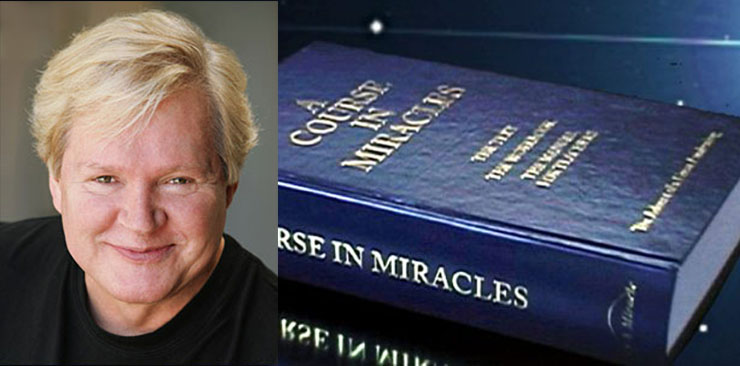
    The notion of a defective, unreal cosmos – what Pursah calls “psycho planet” – created by someone or something other than the true, good God, should be familiar to anyone who has explored Gnostic thought. But the ideas of Arten and Pursah also bear more than a faint resemblance to those in A Course in Miracles, and in fact the pair urge their pupil to obtain a copy of this work and study it seriously.

    A Course in Miracles

    A Course in Miracles, while familiar to many students of esotericism, remains a mysterious and elusive document. Its story is by now comparatively well-known. It was begun in 1965 when a New York psychologist named Helen Schucman heard an inner voice telling her it would dictate “a course in miracles” and that she should take notes. She complied (with some reluctance), and over the next several years took down material that would amount to some 1,200 printed pages, including a Text, a Workbook containing 365 daily lessons, and a Manual for Teachers.

    With the help of her colleague, Bill Thetford, and an editor named Kenneth Wapnick, Schucman prepared the Course for publication. It first appeared in 1975, and since then has sold more than a million and a half copies. Despite this grassroots success, the Course has been given short shrift by conventional theologians. But then the circumstances of its transmission make it unlikely that the Course would be accepted in conventional circles, since the voice that dictated the material to Helen Schucman claimed to be that of Jesus Christ, correcting 2,000 years of misrepresentation of his teaching. Arten and Pursah say that the Course is genuinely the work of Jesus, and most of The Disappearance of the Universe consists of their attempt to explain the central concepts and practices of the Course.

    To begin with, the Course asserts, the world is not real because it was not created by God: “There is no world! This is the central thought the course attempts to teach.” The world we see, the physical world of suffering and loss and change, is the result of a primordial separation from God – or rather, a belief that separation from God is possible. The Course says, “Into eternity, where all is one, there crept a tiny, mad idea, at which the Son of God remembered not to laugh. In his forgetting did the thought become a serious idea, and possible of both accomplishment and real effects.”

    Pursah expresses the same idea in this way: “For just an instant, for just one, inconsequential fraction of a nanosecond, a very small aspect of Christ appears to have an idea that is not shared by God. It’s kind of a ‘What if’ idea…. the question, if it could be put into words was, ‘What would it be like if I were to go off and play on my own?’ Like a naïve child playing with matches who burns down the house, you would have been much happier not to find out the answer to that question,” because it would mean that our primordial innocence would be “seemingly replaced by a state of fear and the erroneous, vicious defenses that this condition appears to require.”

    Here the Course diverges from classical Gnosticism. For the Gnostics, this world was fashioned by an inferior, arrogant pseudo-god whom they called the Demiurge (from the Greek word for ‘craftsman’ or ‘creator’). For the Course, the world began with a ‘tiny, mad idea’, which is the ego – the stance the fallen Son of God (which is each of us) takes in his deluded belief that he can exist apart from the Father. The apparently “real effects” include the physical world and the body itself, the “hero of the dream.”

    According to the Course, the world is not fashioned by a Demiurge or a second-rate creator God (sometimes identified with the God of the Old Testament) who exists ‘out there’ in the metaphysical stratosphere. It arises out of the ego, out of what is apparently the most intimate, personal aspect of the self. Some of the Gnostic texts characterise the Demiurge in a similar way. The Apocryphon of John says of him: “And he is impious in his madness which is in him. For he said, ‘I am God and there is no other God beside me’, for he is ignorant of his strength, the place from which he had come.”

    There is a curious and elusive crux here. Many investigators of Gnostic thought, including the psychologist C.G. Jung, have taken its mythology at face value: they have thought that the Gnostics believed their own myths. But it is possible that the Gnostics were not so naïve, that they were expressing truths about the human condition, but were doing so in mythological language. This would mean that the Gnostic texts are not to be taken at face value. They express certain spiritual and psychological insights that are not explicitly spelled out but which the Gnostic masters understood and explained to their pupils much as Arten and Pursah do with Gary Renard. This is a highly speculative conclusion, but we see a similar approach with contemporary Tibetan masters, who often teach by expounding highly compressed and cryptic texts to their hearers.

    In this case, the Demiurge is not merely an improbable conception of God but a sharp and accurate portrait of the principle of egotism in ourselves. The ego, like the Demiurge, says “I am God, and there is no other.” Paradoxically, this very assertion shows that it is “ignorant” of its strength, “the place from which it had come” – the divine reality.2 This interpretation would bring the import of the Gnostic texts far closer to the Course.

    If God did not create the meaningless world we see, if there is no ultimate reality to the ego or to its chief creation, the body, then the only appropriate response is to look past these illusions. It’s no coincidence that the Course speaks of laughing at the “tiny, mad idea” of separation.

    The Course also teaches that the only sane response to any form of madness in the world is to forgive it. The Course thus takes one of the chief precepts of the Gospels – forgiveness – and elevates it to a status that it does not have and cannot have in mainstream Christianity. If, as the latter teaches, the world does have a genuine ontological reality, then the evil in it is also real. Forgiveness then becomes a kind of favour bestowed upon the unworthy – an attitude that the Course calls “forgiveness-to-destroy.” By contrast, the Course teaches the undoing of the illusory phenomenal world by literally overlooking it, by seeing past its appearances to what the Course calls the “real world” underneath. This “real world” does not exist in some millennial future; it is present now, in the “holy instant.”

    This is the central idea that Arten and Pursah try to teach their pupil. Forgiveness undoes the ego by undercutting its foundation – the belief in this reality of separation and isolation. Renard’s masters stress that only what God has created is real. Since God did not create this world, it is not real. Nor, for that matter, is the body; it is utterly insignificant. The crucifixion and resurrection of Christ himself were originally intended to illustrate this very point. Consequently, everything from minor gaffes to the most apparently heinous atrocities are to be greeted with one response: forgiveness.

    Entwined with forgiveness is the need for a total and complete release from fear. Fear, according to the Course, is a delusion creation by the ego. Having imagined that it is separate from God (which is impossible in reality), it incurs an enormous sense of fear for having rejected God, and we identify with this fear. As Pursah expresses it:

    ‘Don’t you know what you’ve done?’ – the ego asks in our metaphysical story – ‘You’ve separated yourself from God! You’ve sinned against Him big time. You’re in for it now. You’ve taken paradise – everything He gave you – and thrown it right in His face and said, “Who the hell needs you?” You’ve attacked Him! You’re dead!’

    But since none of this happened in actuality, God is not angry at us and there is no reason to fear. Fortunately, the instant that the “tiny, mad idea” of separation occurred, God produced an answer: the Holy Spirit. The Holy Spirit is, in the Course’s theology, the aspect of God that is aware both of the divine reality and of the world of suffering and separation in which we think we live. To heal our minds, individually and collectively, we must turn them over to the Holy Spirit and let him guide them completely. One of the chief ways to do this is to apply forgiveness in any and all situations, not as a gesture of condescension or noblesse oblige, but as a result of a profound recognition that none of this ever really happened. Forgiveness is justified because there is no sin and no guilt and no reason to fear. We are like a child who is suffering a nightmare of horror although it remains safely in bed under the care of a loving parent. The fact that we can begin to hear the voice of the Holy Spirit – the call to forgiveness – is a sign we are awakening.

    This, at any rate, is a brief sketch of the Course as presented in The Disappearance of the Universe. It raises any number of questions, the most obvious being the nature of this strange revelation. Are we to take it at face value? Are we to believe that these beings, entities who were once disciples of Christ, materialised on someone’s couch somewhere in the Maine woods? The story becomes still harder to credit when we learn that Renard himself is both Thomas and Pursah: he was Thomas in a previous life (which he does not remember) and Pursah is his own last incarnation who will come in the future. Because time is part of the delusory fabric woven by the ego, it has no reality and can be elided or transcended.

    The most evident fact about these claims is that they are impossible for us to verify. There is no way of either proving or disproving that Gary Renard experienced such visitations from alternate realities. The skeptic may deny this possibility, but he could only do so on the basis of common-sense reality, and we know (even if we did not have the Course to remind us) that common-sense reality is a great deal less substantial and consistent than we like to pretend. Renard taped the sessions with Arten and Pursah, but he destroyed the tapes after writing the book. Even if he hadn’t, all we would have would be recordings of Renard conversing with a man and a woman, which would prove nothing to doubters.

    What, then, about the factual accuracy of what the masters say? Their conversations with Renard extend far beyond the Course. They claim, for example, that Mary Magdalene was the wife of Jesus. Arten points out: “By Jewish law at that time a person’s dead body could only be anointed by their family members, and if you look in your New Testament you’ll find that even though J’s body was no longer there, Mary Mag’dalene [sic] was allowed to go to the tomb in order to anoint it. What should that tell you?” We also learn that Edward de Vere, the Earl of Oxford, was the real author of Shakespeare’s works and that the world came close to nuclear holocaust on September 25, 1983, when Russian computers mistook the glints of light reflected off some clouds for attacking American missiles. A counterattack was launched and failed to occur only because an otherwise unknown officer named Colonel Petrov decided it was a mistake and called it off.

    Curiously, the only one of these particular claims that it’s possible to verify is the last. Lieutenant Colonel Stanislav Petrov was monitoring incoming satellite data on September 26, 1983 (not September 25, as Renard’s book has it) when he received signals indicating that the Americans were launching a nuclear attack. “I had a funny feeling in my gut,” Petrov later recalled. Correctly betting that the signal was a computer error, he made a historic decision not to inform his superiors. As The Daily Mail wrote, “Had Petrov cracked and triggered a response, Soviet missiles would have rained down on US cities. In turn, that would have brought a devastating response from the Pentagon.” Instead of treating Petrov as a hero, his superiors interrogated him relentlessly and retired him on a pension that later became almost worthless.3

    Other claims are far more tenuous. The Earl of Oxford has been put forward as the true author of Shakespeare’s works, but most scholars are not convinced. As for Mary Magdalene, various sources have claimed that she was Jesus’ wife, but again the evidence (despite The Da Vinci Code) is highly questionable. But if such assertions cannot be proved, they cannot exactly be refuted either.

    One thing, however, can be stated more or less conclusively. The ideas in The Disappearance of the Universe, whether they were generated by Gary Renard or by his masters or by someone else, reveal a profound and highly accurate knowledge of A Course in Miracles. Indeed this book was apparently intended as a correction for the many misinterpretations of the Course that have often been put forward even by its admirers.

    As a matter of fact, the Course has not been well served by its popularisers, who have tended to present it as a bland update of the American gospel of positive thinking rather than as a rigorous, difficult, but highly powerful means of spiritual development. This point, made mildly in The Disappearance of the Universe, is stressed much more sharply in its 2006 sequel, Your Immortal Reality, where Arten tells Renard, “Including yourself, you could count on two fingers the number of people who are out there on the road accurately teaching this message.” (The other is Kenneth Wapnick.) This rather harsh assessment has provoked a certain amount of hostility to Renard among a number of prominent American teachers of the Course – who are not always as pacific as one might imagine – but there is some truth in the claim.

    We then face the question of whether the Course itself is authentic. Whether or not Jesus dictated it to Helen Schucman is impossible to determine. How could we evaluate the origins of an inner voice inside the head of a woman who has been dead for over twenty-five years? (Schucman died in 1981.) Nor can we make much headway by comparing the Course to conventional Christianity or for that matter the Gospels. Even the most conscientious scholars have admitted that there is an immense chasm separating Christ from Christianity and that the Gospels themselves are highly questionable as historical sources.

    Despite these ambiguities, the Course remains a remarkably powerful and sophisticated (though not exactly flawless) tool for awakening the consciousness. As D. Patrick Miller, the publisher of the first edition of The Disappearance of the Universe, remarks, “The authenticity of the Course has been verified for me because it works, creating positive and dramatic change in my life and the lives of many others whom I’ve met and interviewed – but not because it purports to have a divine source.”

    In cases like these, I have found it helpful to remember an esoteric maxim: Neither accept nor reject. If we can free our minds even from the dichotomy of truth and falsehood, we may be able to open them to dimensions that surpass the yesses and nos of the world we know. This may be partly what Arten and Pursah mean when they tell us the reality of the universe is nondual.
    [alert type=”general” dismiss=”no”]This article was published in New Dawn 107.[/alert]
    [alert type=”success” dismiss=”no”]If you appreciate this article, please consider a contribution to help maintain this website.[/alert]

    Further Reading & Study

    The website for Gary Renard: http://www.garyrenard.com

    The Course in Miracles

    Forbidden Faith: The Secret History of Gnosticism by Richard Smoley

    Inner Christianity: A Guide to the Esoteric Tradition by Richard Smoley

    Secrets Of The Immortal: Advanced Teachings from A Course in Miracles by Gary Renard

    Footnotes

    1. Emphasis here and in other quotations is from the original.
    2. For further discussion of affinities between the Course and Gnosticism, see my book Forbidden Faith: The Secret History of Gnosticism.
    3. See David Hoffman, “I Had a Funny Feeling in My Gut,” The Washington Post, Feb. 10, 1999, www.washingtonpost.com/wp-srv/inatl/longterm/coldwar/shatter021099b.htm; Dec. 4, 2007. I am indebted to D. Patrick Miller for drawing my attention to this fact.


    Bibliography

    A Course in Miracles. Three volumes. Tiburon, Calif.: Foundation for Inner Peace, 1975.

    Gary R. Renard, The Disappearance of the Universe. Berkeley, Calif.: Fearless Books, 2003.

    Gary R. Renard, Your Immortal Reality: How to Break the Cycle of Birth and Death. Carlsbad, Calif.: Hay House, 2006.

    © New Dawn Magazine and the respective author.
    For our reproduction notice, click here.

  • The Evidence for Time Travel

    The Evidence for Time Travel

    This article was published in New Dawn 98 (Sept-Oct 2006)

    My first non-fiction book on time travel came about wholly by accident. I was interested in trying to discover whether or not there was much hard evidence for the sort of Ice Age civilisation mentioned by Plato in his account of Atlantis and also what level of technology such a civilisation might have achieved. I thought if there was something positive in this, it might make an interesting book.

    Since the postulate of an Ice Age civilisation is obviously linked to the evolutionary pattern of humanity, I began my research there – specifically attempting to find evidence of civilised activity prior to the establishment of the Sumarian state widely accepted as the starting point of modern culture. As civilisations take time to develop, I was also searching for evidence that humanity’s appearance on the planet might have been earlier than generally supposed.

    While conducting this research, I did indeed find archaeological evidence which suggested that Homo sapiens evolved earlier than the orthodox text books claim. At first these finds were manageable – they pushed back the appearance of humanity some tens of thousands of years. But then came the shock. There was a record of a find that suggested humanity was on the planet not thousands, but millions of years earlier than the time established by the orthodox scientific consensus.

    At first I thought this find might be a fake, or a misinterpretation. But as my research continued, it became clear the find was not unique. There were many, many archaeological discoveries that pointed to an early evolution of humanity. Individually, these seem to have been dismissed as oddities, or simply ignored, by the scientific establishment, but the sheer weight of evidence seemed to me to suggest the finds needed an explanation.

    At this point, I still thought I was looking at evidence for the early emergence of humanity. Then I came across records of discoveries that pointed to the appearance of humans at a ridiculously early period – contemporary with and even earlier than the dinosaurs. Since this was manifestly impossible (the mammalian line itself hadn’t evolved at this time) I suddenly realised the evidence had to point somewhere else. I considered the alternatives and the only half sensible explanation I could come up with was that the finds were litter left by time travellers.

    On the face of it, this seemed highly unlikely, but I was curious enough to want to know what modern physics said about the theoretical possibility of time travel. So I started research there and discovered that while Newtonian physics neither supported nor denied the possibility of time travel, both Relativity Theory and Quantum Mechanics seemed to say it was possible. One respected physicist had actually published plans for a (theoretical) time machine!

    At that point, I (temporarily) abandoned my book on the Ice Age civilisation and started seriously to move in a wholly different direction. Time Travel: A New Perspective was the result, a thorough study of the theme, published by Llewellyn in the United States. I returned to the theme in a second book aimed at a young adult audience and entitled simply Time Travel which has now been published in the UK by Faber and Faber as part of my Herbie Brennan’s Forbidden Truths series.

    So what was the evidence that started all this?

    The find that originally sparked my interest was the Transvaal spheres. Several hundred metal balls – some of them spookily like cricket balls – have been found by miners in the Western Transvaal, near the town of Ottosdal. They look manufactured and the metal seems to be toughened steel. But they’re still being unearthed from a Pre-Cambrian sediment, which means they have to be 2,800 million years old.

    Who dropped them? Not contemporary humans, that’s for sure. The earliest dinosaur hadn’t even appeared at that time. Manufactured objects in the Pre-Cambrian era are a glaring anachronism. And not the only one I came across.

    There was a polished concrete block wall found in the depths of an Oklahoma coal mine and estimated to be 286 million years old, a delicate gold chain of similar vintage found in Illinois, a carved stone found in Iowa that was dropped some 260 million years before humanity evolved on the planet, and many more, including a decorated metal vase from Massachusetts more than 600 million years old.

    There are very few possible explanations for finds of this type. One is that they are simply misdated – the dismissive ‘explanation’ put forward by orthodox archaeologists. But it’s difficult to see how you can misdate something like the Massachusetts vase that was actually discovered encased in solid rock.

    Another possibility is that the artifacts were dropped by visitors from space. The Ancient Astronauts Theory is no longer as popular as it once was, killed off by sensationalist claims and some blatant tweaking of the ‘evidence.’ All the same, most scientists are agreed that life must exist elsewhere in the universe and some of it may be intelligent. Which means that, long shot though it might be, the transport of some alien civilisation might have docked on Earth at the dawn of time and discharged metallic ballast in an area that eventually became the Transvaal.

    But even if the South African spheres turn out to be of alien manufacture (or some sort of weird natural phenomena, for that matter) several other anachronistic artifacts are undoubted human in origin. The carved stone from Iowa, for example, features multiple representations of an old man’s face. There was a fossilised human shoe print found in Utah shale some 500 million years old. A human footprint was discovered in Turkmenistan in Central Asia, next to that of a three-toed dinosaur.

    The dinosaurs disappeared from our planet, quite suddenly, some 65 million years ago. Until that happened, the most advanced mammal on the face of the globe was a little tree-dweller the size of a mouse. Humanity is supposed to have evolved in Africa some 100,000 years ago – and while there may be a case for adjusting this date backwards, nobody suggests we could have walked the Earth in the days of the dinosaurs.

    Finds like these got me thinking along the lines of time travel, but failed to convince me. At the time, I assumed modern scientific thought dismissed the possibility as nonsense. This assumption, however, turned out to be wrong.

    Surprisingly, Newtonian physics – the practical stuff that underlies almost every example of modern technology – doesn’t deny the possibility of time travel. Newton’s Second Law of motion states that ‘the time rate of change of the velocity or acceleration of a body is directly proportional to the force applied and inversely proportional to the mass of the body.’ In the mathematical expression of this Law, the value for time is squared. As you learned at school, if you multiply a negative number by another negative number, the result is always positive. This means that should you change ordinary time to negative time in Newton’s Second Law, it makes no difference to the outcome. In other words, time can flow backwards or forwards without influencing the outcome of the equations.

    Of course this only shows that, theoretically speaking, time travel does not contradict Newtonian physics. It gives no real clue as to whether time travel might actually happen. But Einstein’s Relativity Theory, on the other hand, clearly shows there are circumstances in which time travel can – indeed must – occur. Einstein spelled it out in his famous Twins Paradox.

    You begin with identical twins, one of whom joins the crew of a spaceship travelling close to the speed of light. The other twin stays home.

    Assume both twins were thirty years of age when they separated. Imagine the space voyage lasted five years. On the ship, the astronaut twin ages five years according to every measure he can apply.

    But if the spaceship is travelling at 99% the speed of light, Einstein’s Theory of Relativity shows that time is moving seven times slower on board than it is on the ground. That means the twin who stayed home has aged thirty-five years – he is now sixty-five years old.

    In other words, just because the astronaut raced at breakneck speed around the galaxy, he’s now thirty years younger than his twin brother. Or put another way, when he lands again, he discovers he has voyaged thirty years into the future so far as life on Earth is concerned. And that, by any reasonable criterion, is time travel.

    But it’s strictly a one-way trip.

    That was about as far as Einstein went with time travel, but the maverick American physicist Frank Tipler showed in 1974 that Relativity Theory allowed two-way time travel, back to the past and forward to the future. In fact he even published plans for a (theoretical) time machine in the prestigious Physical Review. They were contained in an article entitled ‘Rotating Cylinders and the Possibility of Global Causality Violation.’ Global causality violation was a weird a piece of geometry: a path that winds through space and turns around in time – something called a closed timelike line.

    Nobody is entirely sure whether closed timelike lines actually exist in nature, but Dr. Tipler’s basic idea was to create one by building a machine that would distort space and time. All that was needed, according to Relativity Theory, was a big enough rotating cylinder.

    But by big he meant really big– something far too large to build on Earth. It would also have to be very heavy, far more heavy than lead, for example, or any other substance used in current technology.

    What was needed was a super-dense material, the sort that has enormous mass, but takes up very little room. But this sort of matter actually exists – in neutron stars.

    Neutron stars are stars that collapse under their own weight, but don’t go all the way to becoming a Black Hole. The electrons inside their atoms are plunged into the nucleus where they fuse with protons to become neutrons (hence the name). The atoms themselves are fused together so that the whole star becomes one great atomic nucleus. It’s the densest substance in the universe. If you could extract enough to fill a teaspoon, it would weigh more than 1,000,000,000 tons.

    But even at that weight, a teaspoonful would be nothing like enough to create a Tipler cylinder. Physicist Fred Alan Wolf has estimated that such a cylinder would have to be about 40 kilometres across and more than 4,000 kilometres long. To make something that size, you would need about a hundred neutron stars.

    It’s clear that building a Tipler cylinder would be far beyond our present technology. But most scientists agree that if something is theoretically possible – which a Tipler Cylinder certainly is – technology will learn how to do it sooner or later.

    In the case of the Tipler Cylinder, we have only to imagine that some form of advanced technology will eventually be found, in a thousand years or ten thousand years, that will allow us to push a hundred neutron stars together. To work as planned, the cylinder needs to spin at about 10,000 revs per second. Fortunately most neutron stars are revolving in that range anyway. Put them together and you have a cylinder that, on its surface, is spinning at about three quarters the speed of light.

    Once the stars are in place, space and time will distort around them, in clearly defined zones. Immediately surrounding the cylinder would be a 20 kilometre wide zone where the fabric of space-time is changed in an almost unimaginable way. Physicists call this the ‘Deadly Zone’. There’s no way you could exist in such a zone. In fact, you probably couldn’t get into it in the first place – you would be repelled by the very nature of spacetime at its outer boundary.

    Surrounding the Deadly Zone is the Zone Of Time Reversal. This is the area of space in which time runs backwards. Get yourself into that zone and you’re a time traveller.

    The time travel zone is surrounded by a Null Time Zone where time stands still. This zone is surrounded by a Positive Time Zone – one, that is, where time runs in the familiar past-to-future direction. Get yourself a nice little space ship, head it for the zone of your choice, and you’re on your way through time.

    This sort of scientific speculation is fascinating, but it still falls short of hard evidence for time travel. Far more immediately exciting were the case studies that suggested time travel has actually happened, is actually happening now and might, potentially actually happen to you. I came across several cases of this type, of which the Kersey incident is a striking example.

    Kersey is a charming little English village, nestling in the Suffolk countryside. You can see the church tower for miles and the church itself – first built in Saxon times – is visible from just about everywhere in the village.

    When I visited the place, I found a well-made tarmacadam road running through the village and admired its picturesque stream – locals call it the Water-Splash – spanned by an ornamental footbridge (see photo on previous page). Several of the houses have been painted pink and, like so many English villages, many have well-kept gardens. There is a scattering of thatched cottages, a couple of pleasant pubs – the Bell and the White Horse – a pottery, a restaurant, a general store and a post office. It’s one of those places that changes very slowly and the way it looks today isn’t all that different to the way it looked in 1957 when three teenage cadets with HMS Ganges, a Royal Navy shore training establishment at Shotley, were sent off to survey it as part of an orienteering exercise.

    Kersey, an English village nestling in the Suffolk countryside, is the site of what was possibly a time-slip incident in 1957. In the photo’s foreground is the Water-Splash, and in the background the Church can be seen.

    But what I saw in Kersey was a far cry from what the boys experienced.

    The survival exercise was carried out over a cold weekend in October. The boys, Cadets William Lang, Michael Crowley and Ray Baker (all 15 years old) were assigned to find the village and report back on everything they saw.

    They followed a road for a time, then cut across some fields. Shortly afterwards, they came across a grey stone cottage surrounded by large oak trees. A farm labourer pointed them in the direction of Kersey. Ten minutes later, they came in sight of the village. From their vantage point, they could see the roofs of the houses and the high tower of Kersey Church. They also clearly heard the sound of church bells as they left the fields to take the laneway down into the village. But as they approached within a hundred yards of the church itself, the bells abruptly stopped.

    The church, which had been visible from the fields above the village, was now hidden behind trees growing on the mound on which the building stands. The boys walked in an eerie silence until, turning a corner of their laneway, they had their first sight of the village itself. What they saw was quite different to the Kersey of modern times.

    The stream was still there, running down the centre of the village, but the tarmacadam road was gone, as were most of the houses. In their place was a dirt track with two or three miserable-looking dwellings widely scattered on its left hand side. There were no houses or cottages at all on the right, just tall forest trees.

    The track ran down to the stream, then rose beyond it to the northern end of the village where there were a few more houses, all of them dirty, small and old. The stream was crossed by a bridge, but nothing like the bridge that’s there today: it was no more than two wooden planks with four posts and a handrail. The only living things in the place were some motionless ducks on the waters of the stream. There were no parked cars, no telephone lines, no radio aerials – nothing at all, in fact, to suggest a modern lifestyle.

    The boys felt uneasy and curiously depressed. The whole place had a horribly unpleasant feel about it, without wind, sounds or even shadows. But the flat and lifeless look wasn’t the only problem. The boys grew increasingly uneasy when they examined the trees. They were green with spring buds. Yet this was October – well into autumn.

    Both village pubs and all but one of Kersey’s shops had disappeared. The boys jumped the stream and went to examine the one shop remaining, a butcher’s in which skinned ox carcases were hanging. But the meat was green with age and the whole place covered in filthy cobwebs as if it had been left derelict for months. Other buildings were equally strange. Not one seemed to have furniture, or even curtains.

    The boys had the eerie feeling of being watched, although there was not so much as a dog on the street, and their unease increased. Their slow progress up the village street got faster and faster until suddenly they were running for their lives. They turned a corner at the top of the street and stopped, breathless, to look back. Suddenly the church bells chimed, the church itself was clearly visible, the village was repopulated. Normality had returned.

    The boys’ story was thoroughly investigated by the Vice President of the Society for Psychical Research, London, Andrew MacKenzie. He concluded that the three boys had somehow travelled back to medieval times when Kersey was hurriedly abandoned after an outbreak of the Black Death.

    Strange though it might seem, this was no isolated incident. There is sound evidence to suggest that many more people, including one scientist and a world-famous historian, have experienced time-slips of this type that took them physically into a distant past.

    [alert type=”success” dismiss=”no”]If you appreciate this article, please consider subscribing to help maintain this website.[/alert]

    © New Dawn Magazine and the respective author.
    For our reproduction notice, click here.

  • Awakening Your Psychic Powers: An Interview with Kurt Leland

    Awakening Your Psychic Powers: An Interview with Kurt Leland

    This article was published in New Dawn Special Issue Vol 10 No 3 (October 2016)

    Kurt Leland is one of today’s most intrepid explorers of the inner planes. A musician and author as well as a visionary, he has written books including Otherwhere: A Field Guide to Nonphysical Reality for the Out-of-Body Traveler and The Multidimensional Human. His latest work is Invisible Worlds: Annie Besant on Psychic and Spiritual Development (Quest Books, 2013). It is an anthology of writings by the Theosophist Annie Besant (1847–1933). Kurt’s website is www.KurtLeland.com.

    I met Kurt during his visit to the Theosophical Society’s American headquarters in Wheaton, Illinois, in the fall of 2011. I was immediately impressed with the depth of his knowledge of, and experience in, the astral and mental realms, which are for most people little more than vaguely understood concepts. He is one of the most lucid and intelligent writers on the inner planes working today. The following conversation was conducted by e-mail in April 2016.

    RICHARD SMOLEY (RS): A lot of people these days are interested in developing their psychic powers. What advice would you give them?

    KURT LELAND (KL): The mind tends to conceptualise a term such as psychic powers, thinking of them as something other than normal, from an unknown realm or level of being – something to be afraid of or acquired by force of will or perpetual practice. Typically such powers come under headings such as telepathy, precognition, clairvoyance (seeing auras), second sight (perceiving ghosts), remote viewing, astral travel, even magical influence over people and events. Some people want to prove to themselves and others that such things are possible and they can do them, not once only (spontaneously or by accident) but regularly (at will or on demand).

    However, I think of psychic powers as the natural concomitant of living within and evolving our subtle bodies:

    An etheric body, having to do with life force and health and offering us the ability to perceive such things as nature spirits, fairies, the recently dead, even angels, as well as to sense events hours or days before they occur;

    An astral body, having to do with desire and emotion, and allowing us to experience our dreams and visit the dead in the afterlife;

    A mental body, having to do with our thoughts and beliefs and allowing us to perceive and travel within a world of ideas and sometimes to contact and learn from them; worldviews of famous dead people;

    A causal or soul body, allowing us to know our past lives, meld minds with others, and perceive and alter the forces in play that create the events of our present life;

    And other bodies whose abilities are less easy to describe.

    My advice to people who want to develop so-called psychic powers is not to target specific name-brand abilities, but rather to develop the subtle bodies and see what shows up. The will- and proof-based approach often leads to frustration and feelings of failure. The approach of developing the special senses of subtle bodies can unfold naturally and organically and enrich our lives with a multitude of adventures in consciousness we may never have heard of before.

    For example, one of my first psychic experiences was sensing the fear of a tree in a wooded area in my neighbourhood after I’d climbed it. At seventeen, I didn’t know trees could feel fear, and I didn’t know this was a psychic experience – until I went back to climb the tree a few days later and it was no longer there, having been bulldozed down to clear the land for a new house. That was an etheric-body experience, not one that could be easily sought after or named or conceptualised. It just showed up, indicating a possible avenue to explore, and gradually developed into a more or less constant, wonderfully enriching awareness of the beingness and inner life of trees.

    RS: How did you develop your own abilities?

    KL: My grandfather on my mother’s side introduced me to the writings of the famous American psychic Edgar Cayce when I was ten or eleven years old. My grandfather knew how to read palms and had some predictive ability, but renounced palm reading when he accurately predicted the age of onset of a serious illness in one of my aunts. Though he taught me the mechanics of palm reading, I can’t say I had any notable psychic experiences when I was a child – yet, after reading about Cayce, I desperately wished for such experiences.

    It wasn’t until I met a woman in college who was a natural psychic from birth that I began regularly having experiences of my own. She had recurring dreams that came true, including dreams about meeting me before we both arrived on campus in the fall of 1976. She knew when people close to her had died, scolding her mother for withholding the information so as not to bother her at school. We developed a telepathic rapport that climaxed with my inventing a place in my imagination that she could see and describe back to me. Whenever I added anything to it, she could tell me what it was. Somehow in the process of hanging out with her, my own abilities began to develop. She had nothing to teach me, she knew nothing about how her abilities worked. Yet somehow my being near her opened up new possibilities for me. Now I understand she was awake and aware within, and could use the senses of a subtle body I had little or no access to – perhaps the etheric body – and that her being awake in that body somehow stimulated mine.

    Otherwise, I’ve never had a formal teacher. I learned much from books, especially the Seth material channelled by the American medium Jane Roberts. When I began to experiment with the Ouija board and automatic writing in the fall of 1980, there was no evidence that I had any talent for such things. Yet I was persistent. It was as if I never stopped knocking on the door, and finally someone let me in. I met my inner teacher by means of these experiments about six months later.

    It certainly seems that my college friend represented nature and I represented nurture. But using the Theosophical framework of subtle bodies, there may be another explanation that encompasses both the notion of being born psychic and that of developing psychic abilities. If we’ve developed any of our subtle bodies in a past life to the point of being able to use their inner senses for clairvoyant (seeing) or projective (travelling) abilities, then we can carry those capacities with us into a subsequent life. The real issue is how soon we recall and realise them – a process I call self-remembering. By this light, my friend self-remembered her use of the etheric body very early and therefore seemed to be a born psychic, whereas I self-remembered my use of this body much later and seemed to develop psychic abilities.

    To extrapolate from this, any spontaneous psychic experience may indicate the possibility of self-remembering the use of a particular body, as in my case with the fearful tree. The challenge is not so much developing psychic powers as finding a way to recall the proper use of one or more of our subtle bodies. Even so, there may be a leading edge of our growth – a body we haven’t mastered yet, which challenges us to develop new inner-sense abilities and the powers of awareness and action within that body.

    RS: Why would you say people today feel so distant from the unseen, subtle levels?

    KL: They’re locked in their mental bodies, a result of family and social conditioning along the lines of scientific materialism, rationality, scepticism, and agnosticism. An overdeveloped mental body is like an overdeveloped physical body – it’s muscle-bound; the focus on increasing size and strength (mathematical, linguistic, and reasoning abilities) has reduced its flexibility or receptivity. The result is alienation from the physical and emotional bodies on one side and from the soul or causal body on the other. The mental body becomes like a fearful teenager hiding in his or her bedroom, with thoughts speeded up through overstimulation by social media, electronic devices, and computer games, and dominated by what one spiritual teacher calls “the tyranny of likes and dislikes.” This results in anxiety, indecisiveness, and black-and-white thinking. To the mental body isolated in this way, the physical body seems bent on betraying us, there’s no soul to guide us, and the whole purpose of life seems to be managing our anxiety.

    The physical body needs quality sense experience – exercise, healthy food, beautiful surroundings, bare feet on the grass or beach, a tempered yet satisfying sex life. The emotional body needs authentic heart-to-heart connection with others. The mental body needs the experience of a community of others who share our beliefs and values. The causal body needs a sense of usefulness and purpose, usually along the line of service to humanity. When the subtle bodies are nurtured in these ways, the boundaries between them soften and we start using them for more than we normally do (acting, feeling, thinking, and serving). That’s when our spiritual powers begin to unfold. We start seeing with the eyes of each body, its inner senses, providing new ways of looking at the world we normally experience and glimpses of the invisible worlds beyond. Eventually we learn to travel in those worlds.

    [alert type=”info” dismiss=”no”]If you appreciate this article, please consider a subscription to New Dawn magazine.[/alert]

    RS: One major issue with psychic powers is self-delusion. You see something uncanny, either visually or with the mind. It seems real. But sometimes it isn’t. How does a person develop discrimination with such things?

    KL: There are many tests and challenges in developing accurate perception from the perspective of each subtle body. I’ve experienced them as a graded course set up by inner teachers and guides, unfolding in projections from the dream state over decades. One example would be learning to identify the same guide under different appearances. Another would be learning the difference in inner-sense impressions associated with a dream character, a deceased individual, a guide, a nonhuman entity, and so on.

    In Invisible Worlds, my anthology of Annie Besant’s Theosophical writings on psychic and spiritual development, she says that the more excited you are about what you’ve perceived, the less likely it is to be real – for example, seeming to receive a mission from some high being. A real experience of receiving such a mission would come with a sobering sense of responsibility and self-examination about what might be required and how to achieve it, not an orgy of self-congratulation over one’s putative spiritual status. 

    RS: Another area of interest is astral travel – the ability to go out of the body in a trance state. Could you start by telling us a bit about this?

    KL: I’m interested in your use of the phrase trance state. Some people may project in that way. My adventures along these lines generally begin from a dream.

    In its simplest form, astral projection is an out-of-body experience in which the etheric body separates from the physical body in a twilight state between waking and sleeping, often accompanied by so-called sleep paralysis (indicating that one’s consciousness is no longer primarily focused in the physical body and so can’t control its movements), a loud vibration during separation, and the ability to view the physical body from a vantage point several inches or feet away. Such experiences are often spontaneous rather than intentionally produced, as a trance state would be.

    Some people report that they can free up a higher body, such as the astral, mental, or causal body, through meditative states, and go travelling on the physical plane or some higher plane. I suppose an intentionally produced trance state, as by self-hypnosis, would be just as effective. But it seems to me that the actual mechanism of so-called astral travel is that we shift the focus of our consciousness from one layer of our energy field (aura) to another. Each layer is actually one of our subtle bodies. When such a shift is successful, we can perceive the plane associated with that body and perhaps travel on that plane. Thus the word astral in the term astral travel is used in a general way to describe any experience in a nonphysical body.

    For most people, the hope or aim is to travel in the astral body on the physical plane to distant places or people. A related ability is remote viewing, which places you on location without the sense of travel. I suppose the only difference between projection and travel is that the first term emphasises the act of leaving the location of the physical body and the other only the experience away from the physical body. Not everyone recalls the actual exit from or return to the physical body. In the case of shifting the focus of consciousness to a different layer of the energy field, there may be no sense of exit or travel from one plane or location to another. You’re just there, wherever it is. 

    RS: Is it a good idea to learn to do astral travel?

    KL: I believe astral travel to be an inevitable outcome of the process of developing our subtle bodies. First, we have what Besant calls a sheath. It allows us to act at the physical, feel in the emotional, think in the mental, and serve in the causal levels of being. Then we develop a body, which begins to perceive on the physical, astral, or mental planes. We all have a well-developed physical body in that sense. Our dreams indicate that we have an astral body capable of perceiving on the astral plane. Mental and causal body dreams are less common. Finally, we develop a vehicle of consciousness, capable not only of perceiving, but also of moving through every level of the physical, astral, mental, or some higher plane. Lucid dreamers and people who can project on the astral plane, knowing the difference between dream characters and locations and the actual scenes, dwellers, and phenomena of the astral plane, are developing the astral body as a vehicle of consciousness.

    My first projections took place when I was fourteen. They terrified me and I avoided them for several years. Subsequently, I learned to develop my etheric, astral, and mental bodies under the guidance of teachers encountered in such projections. Forty-five years later, I think it safe to say that I have fully functional vehicles of consciousness on the physical, astral, and mental planes.

    RS: Whom would you advise not to undergo psychic development?

    KL: Anyone who is anxious, depressed, or prone to exaggerated states of enthusiasm or elation or to obsessive or addictive behaviour. These indicate strains in the relationship between the bodies and the occupying consciousness that we call ourselves. Such strains need to be overcome (along the lines recommended in connection with what our bodies need) before psychic development can be pursued safely.

    The problem with anxieties and fears is that they attract what we’re afraid of, resulting in interactions with undesirable scenes, dwellers, and phenomena of the astral plane. Undesirable interactions may also occur with depression. The problem with enthusiasm or elation is that it makes everything we experience seem more glamorous than it really is, resulting in self-deception or deception by prankish or malevolent astral entities. Obsessive or addictive behaviour can result in our coming under the control of negative entities, as in possession.

    In the end, each of these situations is nothing more than a challenge to be overcome in the development of the bodies. We need to learn how to maintain a balanced, clear-headed perspective as we investigate the possibilities of these bodies. The real shame is when we do so prematurely and frighten ourselves off from further exploration because some passing mood has distorted our perception or attracted unpleasant experiences or made us seem foolish to ourselves or others.

    RS: Is there a connection between the astral level and the post-mortem state?

    KL: I like to think of the astral plane as comprising a number of realms or zones. One such realm is the astral Dream Zone, where our dreams ordinarily take place. Another is the astral Afterdeath Zone, where the initial stages of our journey through the afterlife take place. I’ve explored both realms for many years in projections from the dream state. They’re similar in that their primary function is dealing with emotions and desires. Dreams frequently allow us to satisfy our unfulfilled desires and experience our unexpressed emotions, such as fear, lust or anger. We purge such things through our dreams so we don’t have to act them out on the physical plane. In the astral stage of the afterlife, we perform similar purges of a lifelong accumulation of unfulfilled desires and unexpressed emotions, thus rising from darker to lighter experiences of this realm, as in the Catholic notion of purgatory.

    On the mental plane, there is also a Dream Zone and an Afterdeath Zone. These realms involve exploring our lives in terms of learning and growth – what we have or haven’t learned among the lessons our soul may have intended for us. They’re full of exciting opportunities for exposure to the world’s great minds and cultural achievements. For example, I once visited an area in which it was possible to experience any opera from the vantage point of each of its characters. In the mental Afterdeath Zone, we review our life on earth and fulfil the plans for learning and growth that we were blocked from implementing there, because of lack of courage or extenuating circumstances. This can be a joyful, even heavenly experience.

    RS: Can you contact dead people through psychic means?

    KL: I believe this is possible and I’ve experienced it, though not in the way most people expect. I don’t ordinarily perceive people who have passed on in the auras of others or as ghostly presences hanging about with a desire to give messages. Nor do I go into a trance state so that others can communicate through me with people who have died. When I channel, the being who works through me is almost exclusively the inner teacher I call Charles. I suppose he could be described as a dead person, since as far as I know he’s not currently embodied on the physical plane.

    But I think you mean dead relatives and friends. My interactions with the latter take place in astral projections, usually from the dream state. I visit them in situ, wherever they may be in their progression through the afterlife, from the death of the current body to their preparation for reincarnation. Usually these are people I have a close association with.

    For example, I tracked the afterlife progress of one of my uncles through several stages over a course of eight years – his orientation to the afterlife, the beginning and completion of his long and detailed life review, and his being informed of certain lessons to be learned in his next life just prior to rebirth. Though I observed my uncle without communicating with him, others among the dead have shared with me their thoughts and feelings about their earth life and post-mortem existence. One was a counselling client who died of a reaction between prescription and recreational drugs and was passing through a rehabilitation program on the Other Side because his death had been classified as an unpremeditated suicide.

    I’ve rarely gone looking for people whom I’ve never met at someone else’s request – though Charles has sometimes commented on the progress of a client’s deceased loved one through the afterlife. This is not my favourite kind of work, since some elements of the afterlife can seem distressing to people who think only in terms of happiness in heaven

    RS: Why is so much of society today dead set against believing in the existence of the psychic realms? 

    KL: Religious teachings in many cultures indicate that such things are at best distractions on the spiritual path and at worst the product of malevolent beings such as the Christian devil. Scientific materialism has persuaded us that psychic realms, spiritual paths, malevolent beings, and the devil are nothing but superstitions. Yet I believe such things are what the Buddha called views. The point isn’t to dismiss one view in favour of another, but to try each on for size, to meditate on it, and investigate and explore where it takes us, what it does for us.

    The scientific view that the physical body is a machine that gradually wears out and needs to be ‘fixed’ by an ever-expanding medicine chest of only partially effective remedies isn’t terribly hopeful or inspiring, though it provides the opportunity to explore the function and dysfunction of body parts in relation to each other, time, and illness. The metaphysical view that the body is a conscious entity that needs care, that it could be our friend, that we might have ways of learning from and dialoguing with it, is unprovable in scientific terms, but can yield favourable results when explored as a provisional belief or object of meditation, to be lived as if it were true to see where it takes us. Notions of an etheric, astral, mental, or causal body could be treated in the same way.

    RS: One of your books is called The Multidimensional Human. In what ways are we multidimensional?

    KL: I believe reality consists in as many descriptions of it (views) as we have tolerance for. Each view opens up new possibilities for exploration – new dimensions – and none absolutely excludes another. I’ve gotten the best results in my personal exploration of psychic and spiritual development by adopting the Theosophical view of multiple bodies, each fitted to a particular plane of existence by a specialised set of inner senses that carry us from sheath to body to vehicle of consciousness. The planes themselves are ranged along a continuum of human potential from lowest physical to highest spiritual, and each body and its corresponding level of being is an adventuresome dimension to be explored as we develop our multidimensional humanity – our ability to respond appropriately to each other and to other realms and beings for the mutual benefit of all.

    Kurt Leland’s Spiritual Orienteering website is www.KurtLeland.com, which lists his books and services.

    [alert type=”success” dismiss=”no”]If you appreciate this article, please consider subscribing to help maintain this website.[/alert]

    © New Dawn Magazine and the respective author.
    For our reproduction notice, click here.