New Dawn – World's Most Unusual Magazine

Category: Paranormal

  • Cleverman: The Paranormal Powers of the First Australians

    Cleverman: The Paranormal Powers of the First Australians

    From New Dawn 159 (Nov-Dec 2016)

    The Aboriginal people of Australia are the longest surviving culture on earth with over 60,000 years of stories known as The Dreaming. The Dreaming is the spiritual realm that binds the past, present and future together. It is inhabited by incredible creatures and spirits. At the head of this realm is the Cleverman, a powerful man who is the conduit between The Dreaming and the real world. 
    Introduction to the TV series Cleverman

    In June and July 2016 the Australian Broadcasting Service (ABC) premiered an original new drama series titled Cleverman. The title refers to the shamanic medicine man of Aboriginal culture who is the conduit between the material world in which we live and The Dreaming – or spirit world – which is the domain of supernatural creatures. 

    The television series is set in a dystopian future Australia where mythical beings from The Dreaming – known as Hairies* – reside alongside the human populace. They are a race of sub-humans who exhibit super-human strength and psychic abilities, however these skills are not enough to rescue them from a life of apartheid and an ever-dimming future in the internment camp known as The Zone. As events play out, we are introduced to Uncle Jimmy, a Cleverman, as he prepares to pass the mantle to a new, unwitting initiate named Koen. But will the new Cleverman be able to restore balance between the worlds and make things right again?

    * The Hairy – also known as Yowie (Yuri) – is generally accepted to be non-human but may share a common ancestral heritage to Aboriginal Australians as well as deep respect of, and connection to, the land. Some researchers link the Yowie and the Yeti, Sasquatch, etc., but tradition strongly suggests it normally resides in the spiritual realm of The Dreaming. Data from British researcher Mark Evans defends a new position: Yeti stories, passed down orally through generations, may in fact be based on narratives of factual, pre-historic, sub-human races (such as the Denisovans). Proof is the EPAS-1 gene – a high-altitude mutation attributed to the Denisovan race – passed down to some Himalayan human races by way of interbreeding thousands of years ago. This theory might also apply to the Yowies of Aboriginal mythology.

    The parallel between treatment of the Hairies and real life Aboriginal Australians is painfully obvious. TV series creator Ryan Griffen says this portrayal “is a way to teach people about… how we treat other people.”1 Their future depends on a special person – a super hero – to fight against the odds and bring both worlds into balance. Although he may be an unlikely hero, the Cleverman is a leader, a lawgiver, a healer and a magician who exists beyond the barriers of time and space and is, in many ways, immortal. However, to understand the people’s hero, first we need to look into the history of the First Australians and why the Cleverman is so important.
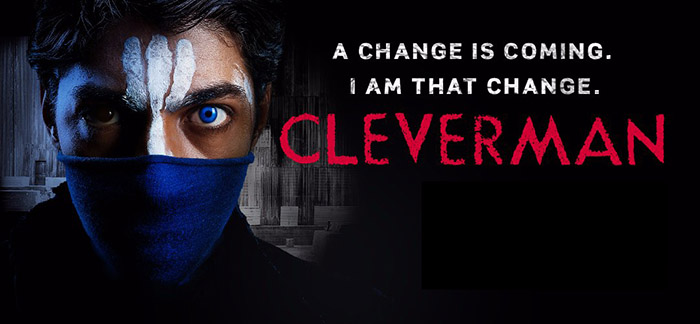
    Promotional graphic for the TV program Cleverman

    Sources of Ancient Occult Knowledge

    Early twentieth century anthropologists perpetuated the colonial view that the Aborigines were a dying race and Australia was “a museum of left-overs from the evolutionary past”2 which “comes from the whole notion of terra nullius… where the lore as much as the law did not matter.”3 According to Nevill Drury and Gregory Tillett in their influential 1980 book Other Temples, Other Gods: The Occult in Australia, researchers attempted to decipher the mysteries of Aboriginal spirituality, the “sources of ancient occult knowledge, preserved in their secret rituals and teachings.”4 

    These theorists, including the eminent Australian anthropologist Prof. A. P. Elkin, realised that two important principles underlie Aboriginal Dreaming mythology: (1) the shapes of things today are primarily due to their formulation during events in the Dream-Time, and (2) living man must “follow-up the Dreaming”5 by remembering “his communion with those original events by (demonstrating) acts which signify and symbolise what happened then and what continues to happens.”6 The importance of this definition cannot be over-emphasised: The Dreaming is eternal, ‘everywhen’, and represents a conjunction of past, present and future; it is separate from the physical realm and in the sense we understand and experience time. Aboriginal men are obliged to retain a link to the realm of The Dreaming – and the possibility of encountering its protean, shape-shifting supernatural beings. Out of this obligation grew the role of the Cleverman, or shaman, to bridge the gap between the spiritual and material worlds.

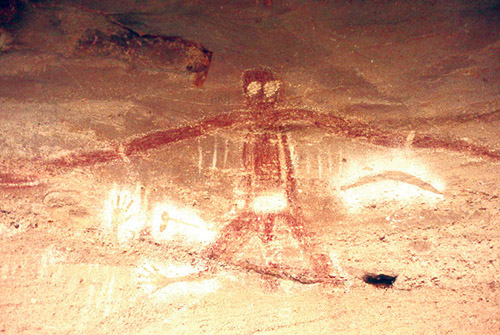
    It is vitally important we also consider the Wandjina* of Aboriginal creation myths. Often used as supporting evidence for the ‘Ancient Astronaut Theory’, the Wandjina are regarded as beings of a celestial nature, creators of the landscape and its inhabitants, also acknowledged as lawgivers and educators. They are white in appearance, often depicted with staring black eyes with no mouths. Tradition indicates they are connected to fertility rites and are characterised as contradictory or even spiteful in their actions. This description brings to mind images of grey alien beings or the old Celtic legends of the Faery Folk of Britain and Europe. As we will see, these beings fit into the intriguing story of the Cleverman.

    * Descriptions of Wandjina are strikingly similar to those of the mythical Kachina, a race of spirit-people who taught the Hopi and Zuni tribes of North America, and whose appearance is akin to classic images of Wandjina, particularly those with slit eyes, small triangular mouths and feathers radiating from their heads. These characteristics are reflected in the manufacture of Kachina Dolls – a Hopi tradition employed to ensure future generations would not be scared of the Kachinas when they return, as prophesied. 

    Who is the Cleverman?

    Before going any further behind the scenes to explore the role of the Cleverman, first we need to acknowledge that the protection of secrets is of paramount concern to the caretakers of this land. As with the social and cultural importance of the medicine man, there are other specially selected candidates with equally significant roles in Aboriginal communities, such as those who ‘protect’ the myriad stories, acting for the traditional ‘copyright’ owners.

    For Ryan Griffen to convey the storyline of his Cleverman series, he first needed permission to relate stories from The Dreaming because these stories belong to various storytellers. The stories were not Ryan’s to tell, even though he may have grown up with them. Without the required permissions there is every indication he could have been exiled from his ‘mob’ to become persona non grata to his elders, or worse. 

    Mistruth and misinformation is rife when researching the intricacies and power of the Australian shaman. By his very nature, the Cleverman is secretive – he preserves wisdom and powerful techniques that could be harmful in the wrong hands and minds. Strategies are in place to protect against Western superficialities, negative attitudes, cultural exploitation, pillage and plagiarism – which plagued great Aboriginal Australians like David Unaipon and Albert Namatjira. Therefore, it must be pointed out that this introduction to the Cleverman is not intended to take power away from the true owners of the Cleverman’s stories. Nobody questions the fact that the secrets of Freemasonry may be eluded to, but not fully disclosed, and it is not for us to question. While Griffen’s re-imagining of the Cleverman as a paranormal super hero allowed him to bypass some of the more secretive elements of the Cleverman – and there are many such secrets that cannot be discussed in public – there is much we can discuss outside the circle of initiates, and “men of high degree.” So, with great respect, we begin our look at the man and the magic of the Cleverman.7

    The Cleverman is the Original Australian medicine man (or shaman) and is a chosen maleinitiate. “He is a man to be respected,”8 who is “called” to his position. The calling can take one of a few forms, all of which are recognised as legitimate from the spiritual perspective. Firstly, he may exhibit the potential skills of the role from an early age – this might include demonstrating certain abilities, a stronger than normal connection to his elders, aptitude towards the shamanic arts or – particularly – acknowledgement as part of the continually reincarnating line of great Clevermen. Secondly, there may be inheritance of the position: normally the role is not fulfilled via nepotism but through spiritual destiny demonstrated by certain behaviour patterns. Finally, the aspirant may have an overwhelming inner desire, experience psychic or paranormal occurrences, or “hear the calling” in a way that can be confirmed by a medicine man in as much as the candidate may be deemed genuine and worthy of teaching.

    The mechanics behind the calling do not appear to be a function of our mundane world, and it also appears that the initiation process depends on having one proverbial foot planted firmly in The Dreaming.

    The Making of the Cleverman (Initiation)
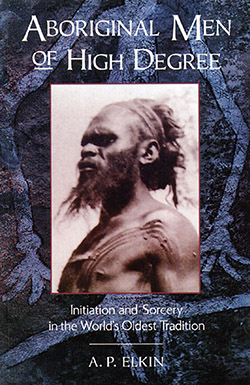
    A veil of secrecy hangs over the initiation rituals for a potential Cleverman. There are also regional differences in the performance of these rituals, dependent on the individual characteristics exhibited by the candidate. However, of significance to Aboriginal spirituality, according to anthropologist A.P. Elkin, was “pre-existence of the soul and of reincarnation.”9 It was believed spirits were created in the Dream-Time by the action of some Being, and waited in sacred places “until a suitable mother was found for them.”10 Many observers would draw comparisons with Indian and Tibetan occult teachings, citing a possible link in the remote past between Australia and Asia. One might expect that a spirit Being incarnating as a Cleverman would have no conscious knowledge of his real abilities until he started experiencing minor miracles or paranormal phenomena during his ‘amnesiac’ period.

    The process of ‘making’ a Cleverman resembles a spiritual-alchemical transmutation: an intriguing ritual in the initiation of the medicine man sees the ‘removal’ of his ‘insides’ and subsequent replacement with madan11 – quartz crystals, bones and spirit-snakes. This replacement of anatomical organs for magical talismans is said to be performed by the ghost of an outstanding (deceased) person, the spirit of a culture hero or agent of ‘The Great Spirit’. During the preliminary stages, the Cleverman-in-making might be required to sleep on the grave of a special individual whose ghost performs the surgical duties.

    The candidate must symbolically die and be reborn – echoing the rituals of esoteric and spiritual orders worldwide, including Masonry and Christianity – but in this case, upon rebirth, he awakens with psychic and supernatural powers. This process of reincarnation12 might be symbolic but, with his newly replaced innards, it’s a concept reminiscent of enlightened Buddhist monks who are purported to be able to produce rare gemstones from their bodies (and retrievable from the body after death). 

    The Abilities of the Cleverman

    The supernatural abilities attributed to an Aboriginal medicine man include clairvoyance, future divination, telepathy, the skill to send messages over long distances and to ascertain facts without prior knowledge at a distance (this process is termed telesthesia), and reading a person’s mind. He can appear at more than one place at any one time or disappear and re-appear in different locations. This skill of ‘omnipresence’ has been demonstrated on a number of occasions to non-Aboriginal researchers, producing dismayed reactions in the witnesses and provoking further, serious scientific enquiry.

    By use of these powers, the Cleverman creates illusions to trick enemy raiders and combatants into seeing things that are not really there, or cloaking people (or things) in a veil of invisibility – these are truly superhuman traits, in the comic book sense, and would be one source of inspiration for Ryan Griffen. This skill has been performed for thousands of years and, as mind-bending as it might seem, has been recorded on numerous occasions. 

    It must be remembered the Cleverman is a force of good for his community – not in the sense of which we are accustomed in the modern age with images of police enforcement for our own good or military personnel protecting civilians. He has the power to heal at will but the flipside is that he can also kill at will; his mastership in balancing the forces of light and darkness proves that absolute power does not need to corrupt absolutely.

    The act of harming another person – called ‘pointing the bone’ – is only used in extreme circumstances as punishment for unforgiveable acts. This kind of magic is not exclusive to the Australian shaman: it was once common in Europe, the Mediterranean, India, throughout Asia, and in territories that practice voodoo and black magic. In fact, this type of ‘malevolence’ exists universally wherever there is a tradition of magic. As with voodoo, it is often explained as a psychosomatic process whereby the magic power comes into effect once the recipient gains awareness of the hex or malediction placed upon them. In the case of the Aboriginal shaman, it needs to be clarified that ‘pointing the bone’ is not used for petty, personal gains because this invokes stronger paranormal forces against the user and is not the behaviour of a genuine Cleverman.

    Researchers have reported that ‘familiars’ – spiritual entities – seem to be involved in the act of placing curses. Familiars are also employed when a Cleverman needs to obtain information, however, to do this he must first be in the correct state of awareness to receive such information. This would be in the form of a trance-like state or a dream-sleep which enables him access to other worlds – a technique reminding us of modern day practices to journey out-of-body. 

    According to the Wiradjeri people, “he would have to ‘hum’ or ‘think’ his spirit out” of his body and onto the ethereal plane.13 As to whether this process refers to his spirit in the sense of an external entity symbiotically connected to his essence, or whether his own internal spirit is somehow manifested into an externalised existence by internal vibrational forces, is not defined. The ability of the shaman to “fly through space and see what is occurring elsewhere”14 demonstrates the spiritual power and skills of the Cleverman for out-of-body journeying. To differentiate between the different aspects of the shaman’s out-of-body experiences, Elkin points out that in some cases, “The spirit-familiar was an externalisation of the man’s spirit.”15

    As reported in The Sun newspaper in 1969,16 blood transfusions were part of the medicinal responsibilities of the Kimberley shaman, the barnmunji. The extraction process was allegedly made possible by use of a thin, hollow reed inserted into a vein of the middle or inner arm. Transfusions were performed only in extreme circumstances or to transfer the blood of the young to an elder who required revitalisation or sustenance. The knowledge to do this precludes an understanding of blood types and donor selection, direction and flow of blood, and an awareness of the functions of the various bodily organs, as well as hygiene. Research has shown that transference of blood could also occur orally. The general knowledge of transfusions in Aboriginal society pre-dated the 17th century Western discovery of transfusion by thousands of years!17

    As previously mentioned, the Wandjina appear to be involved in the Cleverman’s pursuits but it is unclear if they are merely available through metaphysical correspondence as sources of information or do they play a role in supernatural activities. As to whether the Wandjina – the spiritual agents of a greater power – take part in the actual mechanics of paranormal events or conform to roles as overseers or regulators, is a fact we may never know. However, it has been surmised the Cleverman does not work alone, that his partners reside in The Dreaming, and assist only those humans who are initiated and have attained the highest levels of spiritual awareness.

    The Future

    We have explored the role and abilities of the Cleverman but what of his future? 

    Australia today is a nation of unbalance with political chaos, divided loyalties, vocal extremism and cultural malaise. While steps are being made to officially recognise its Original peoples in the Constitution, it is high time Australia pauses to assess who we are as a nation of many different peoples. Recognising the rich cultural heritage of this land and its Original inhabitants is unifying for all Australians – and there is much for us to learn and experience that can bring us closer together. 

    The importance of the Cleverman remains undiminished in his community, and his enigma continues to spread by way of culture, spirituality and of course storytelling. He has survived the white man’s tyranny, and massive social and cultural upheaval. His survival is made possible because he performs his duties in plain sight, donning the costume of the everyman in the everywhen. He is non-descript, normal, with no banner, cape, brand or entourage to herald his arrival. 

    First and foremost, “he is a man to be respected,”18 and we should be proud of him and the fact that we are part of his people’s culture and traditions, if only we cared to open our eyes.

    The side articles that accompanying this article on the Cleverman’s tools and the inhabitants of the Dreaming can be read when you purchase the digital version of this magazine.

    [alert type=”general” dismiss=”no”]This article was published in New Dawn 159.[/alert]

    [alert type=”success” dismiss=”no”]If you appreciate this article, please consider subscribing to help maintain this website.[/alert]

    Footnotes

    1. Ryan Griffen, Cleverman TV series creator, interviewed on Moral Compass, ABC-TV, 19 June 2016
    2. Nevill Drury and Gregory Tillett, Other Temples, Other Gods: The Occult in Australia, Methuen Australia, 1980, 11-12
    3. Stan Grant, broadcaster and journalist, interviewed on Moral Compass, ABC-TV, 19June 2016
    4. Other Temples, Other Gods, 11-12
    5. Ibid.
    6. Ibid.
    7. The First Australians should not be categorised as one specific people. They are a number of different peoples (250 nations) sharing a common genetic background, with a similar system of beliefs. Names given to the Cleverman are region-specific and include: Kuldukke (south of the Murray River, Encounter Bay region), Karadji (coastal New South Wales), Walmera (west of New South Wales), Barnmunji (Kimberley region), to name but a few.
    8. Ryan Griffen, ABC-TV, 19 June 2016
    9. Other Temples, Other Gods, 11-12
    10. Ibid.
    11. The magical substance, madan, is also known under different regional names including maban, mabain, etc
    12. Reincarnation is a belief of many ancient cultures including (but not limited) to those of India, Tibet and (ancient) Egypt, and in the spiritual traditions of Buddhism, the Lebanese Druze, Sufis and Native North Americans.
    13. A.P. Elkin, Aboriginal Men of High Degree [1945], 1977, University of Queensland Press; published by Inner Traditions, 1993, 49
    14. Ibid., 48
    15. Ibid., 49
    16. Cited in Andrew Tomas, We Are Not The First, Souvenir Press, 1971, 70; original source: The Sun (Sydney), 9 Aug 1969
    17. Another intriguing concept is that of oral contraceptives used for hundreds – if not thousands – of years during periods of “impending drought or other calamity with the menace of food shortages,” and formulated by rolling plant resin into pills. (Cited by Andrew Tomas, We Are Not The First.)
    18. Ryan Griffen, ABC-TV, 19 June 2016
    19. A.P. Elkin, Aboriginal Men of High Degree, 94
    20. W. E. “Bill” Harney, Grief, Gaiety and Aborigines, Seal Books/Rigby Limited, 1961, 69
    21. Ibid.
    22. Ibid., 70
    23. Ibid.
    24. Ibid. 
    25. Ibid., 72

    © New Dawn Magazine and the respective author.
    For our reproduction notice, click here.
  • The Faeries: From Folklore to Metaphysical Reality

    The Faeries: From Folklore to Metaphysical Reality

    From New Dawn Special Issue Vol 12 No 5 (Oct 2018)

    What are the faeries? Where do they come from and where do they go when they’re not interacting with their human observers? Faeries have been an important part of the folkloric repertoire for hundreds (perhaps even thousands) of years, and while they are portrayed in the popular imagination through faerie-tales and have become disneyfied through the 20th century, their main presence is in the myriad of folktales and anecdotes from every part of the globe.1 

    They usually (though not always) take a humanoid form, and interact with human societies as ambivalent supernatural entities, appearing in our world to both co-operate with people and as general arbiters of mischief, while also living in their own Otherworld, sometimes accessible to humans either through accident or abduction. While the phenomenon is ancient, the belief in these metaphysical beings continues, and there are thousands of encounter reports from all over the world every year, as demonstrated in a recent survey by The Fairy Investigation Society.2

    Folklorists are usually ambivalent about the faeries; they are likely to keep their distance from them, so to speak. While happy to record and discuss the beliefs of people who tell stories and anecdotes about them, most folklorists speak the language (at least in official publications) of the reductionist, materialist worldview that has held sway in Western civilisation for the last few hundred years, and they’ll be nervous about assessing the potential actual reality of metaphysical beings. In the materialist’s world, faeries simply cannot exist. They must be reduced into a categorised cultural belief system, and any discussion of them will usually be couched in the accepted language of scientific rationalism. This creates a problem for any folklorist (or anybody else) who wants to look behind the stories and investigate the possibility that the faeries can be incorporated into our consensus reality as a genuine phenomenon.

    The scientific orthodoxy has been challenged recently by a range of philosophical hypotheses such as Idealism, backed up by quantum mechanical theory and experiment, which reinstates consciousness (not matter) as the primary mover and creator of reality.3 When this is done, entities such as faeries are allowed back into the universe as an authentic phenomenon, and if we start to look in the right places, we begin to find that they are indeed everywhere… we just need to know where to look, or more accurately, how to look.

    The Electromagnetic Spectrum, Dark Matter and Dark Energy

    Our normal waking consciousness experiences less than 1% of the entire electromagnetic spectrum. If we take into account the current (mainstream) scientific hypothesis that this electromagnetic spectrum itself composes less than 6% of the universe, with the mysterious Dark Matter and Dark Energy taking up the rest, then we are at a good starting point to understand that our version of reality is extremely compromised.4 

    We may have the technology to utilise the unseen wavelengths in the spectrum, but they are not accessible to our ordinary consciousness. Dark Matter and Dark Energy are entirely inaccessible to our technology, and remain for the moment nothing more than theory based on the by-product of mathematical equations. 

    We also have to take into account the recent theoretical mind-bender that the universe may actually be a Matrix-like virtual reality hologram, put in place by (depending on who you listen to) a supreme being, aliens or future versions of humans, the latter option coming from ex-NASA scientist Dr Rich Terrile.5 

    With this level of uncertainty about the reality we inhabit, and in order to gain an understanding of the world in which we live (and the unseen entities that may exist alongside us), we might be advised to fall back on the only known certainty allowed us: consciousness.

    The Origins of the Faeries in Altered States of Consciousness

    Our earliest known artistic portrayals of the world, and how human consciousness interacted with it, come in the form of cave paintings from all parts of the globe, starting c.35,000 BCE. Many of these cave paintings include humanoids and therianthropes, otherworldly entities that have been recorded alongside geometric imagery, stylised animals and landscapes. They are in effect our earliest known folklore. What state of mind were our Palaeolithic ancestors in when they were painting these strange entities in often difficult to access caves and shelters?

    The anthropologist David Lewis-Williams has made the convincing argument that these cave and rock-shelter paintings were produced by shamanic cultures to represent reality as perceived in an altered state of consciousness.6 Twenty years ago this idea was anathema to anthropologists, but since the work of Lewis-Williams, and many others, the theory has tipped over to become an accepted orthodoxy. There are hundreds of motifs in the cave paintings that correlate with the visionary states of people in an altered state of consciousness, brought about most especially by the ingestion of a psychotropic substance. The basic premise is that the shamans of these Palaeolithic cultures transported themselves into altered states of consciousness and then painted the results of their experiences on the walls of caves and rock shelters – experiences that frequently included therianthropic beings and supernatural humanoids that correlate in many ways with later faerie types. 

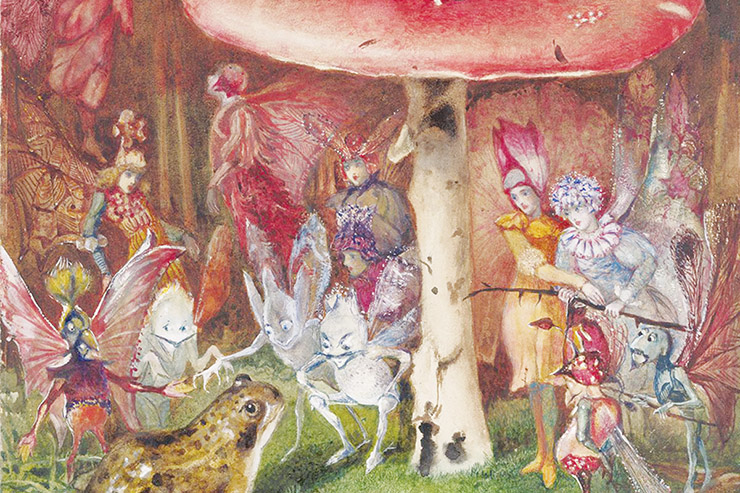
    In his 2005 book Supernatural, Graham Hancock vividly utilises Lewis-Williams’ work to discuss the continuity through time of entities experienced in altered states of consciousness, coming to the conclusion that the faeries of our historic period are one and the same as those portrayed in prehistoric caves.7 And writers such as Carlo Ginzburg and Emma Wilby have argued that there is a direct link between prehistoric shamanic storytelling and the folklore embodied in classical, medieval and later periods, that often incorporate entities such as nymphs and faeries; supernatural beings that interact with humanity when the conditions are right.8 Those conditions may well be reliant on the human participants undergoing an altered state of consciousness as a result of the ingestion of psychotropic compounds. There is certainly a preponderance of mushroom imagery associated to historical depictions of faeries, most especially the highly psychedelic red and white Amanita Muscaria (fly agaric) mushroom, and the psilocybin mushroom, both prevalent in Europe and Asia. If these historic folkloric manifestations of interactions with supernatural entities can be linked to the cave art of prehistory and preliterate societies, then we have a continuation of relationship with an alternative reality, accessed through altered states of consciousness, over a very long period of time.

    The highly psychedelic red and white Amanita Muscaria (fly agaric) mushroom, often associated with faerie depictions.

    Many of the European faerie motifs repeated in stories and anecdotes through the centuries to the present day were already in place during the medieval period. When folklorists began to collect these stories in earnest from the 19th century onwards, they found a belief in faeries amongst rural populations that was probably very close to the medieval belief and understanding of what faeries were and how they interacted with humanity. Many of the stories include situations where the protagonist interacts with the faeries in what seems an altered state of consciousness: Faerieland doesn’t comply to Newtonian physics, it is consistently inhabited by strange humanoids and therianthropes (the faeries), and there are lots of recurring story motifs that are highly suggestive of an autonomous reality being described. 

    This is not consensus reality – this is the folklore recording stories from people operating outside consensus reality. The folktales about faeries have been overlain with much allegorical storytelling, but at their root the realities they describe are of people in altered states of consciousness, perhaps not too far from the realities experienced by the Palaeolithic cave painters and our shamanic ancestors.

    WY Evans-Wentz, Rudolph Steiner & Metaphysical Nature Spirits

    When the folklorist WY Evans-Wentz travelled around the Celtic world at the beginning of the 20th century, collecting stories and anecdotal experiences about the faeries, it was clear that most of his interviewees rated clairvoyance as the best way of altering the conscious state to a position where it could interact with the faeries.9 Seership or second-sight was the method of entering, or at least viewing, an alternative reality inhabited by a relatively consistent cast of characters, usually recognised as the faeries. 

    He met one such (un-named) Irish clairvoyant in Rosses Point, County Sligo. This seer talked about various types of faeries that inhabited the landscape of Sligo, “making them sound like a cross between nature spirits and mystical visions.” But Evans-Wentz was just as interested in the mechanics of interacting with the faeries as he was with the stories themselves. How did the seer interface with them?

    I have always made a distinction between pictures seen in the memory of nature and visions of actual beings now existing in the inner world. We can make the same distinction in our world: I may close my eyes and see you as a vivid picture in memory, or I may look at you with my physical eyes and see your actual image. In seeing these beings of which I speak, the physical eyes may be open or closed: mystical beings in their own world and nature are never seen with the physical eyes.10

    The rural people interviewed by Evans-Wentz consistently affirmed that clairvoyant alteration of consciousness was the best sure-fire way to see the faeries. By the time Evans-Wentz visited these communities, there was a sense that the number of people gifted with second-sight was dwindling; cutting down on communication with the faeries. 

    Evocative image demonstrating the slightly perverse nature of traditional faeries – Arthur Rackham’s ‘Illustration from Christina Rossetti’s Goblin Market’ (1933).

    At the same time these rural communities were feeling the increasing pressures of modernism there was a reaction by organisations such as the Theosophical Society and the Anthroposophical Society to incorporate metaphysics into an understanding of reality. And their prime metaphysical technology was clairvoyance. The Austrian philosopher and esotericist Rudolf Steiner attempted to explain the mechanics of clairvoyance, when a person must transform their usually passive thought forms into something more dynamic. In normal consciousness, thoughts:

    …allow themselves to be connected and separated, to be formed and then dismissed. This life of thought must develop in the elemental world a step further. There a person is not in a position to deal with thoughts that are passive. If someone really succeeds in entering the world with his clairvoyant soul, it seems as though his thoughts were not things over which he has any command; they are living beings… You thrust your consciousness into a place, it seems, where you do not find thoughts that are like those in the physical world, but where they are living beings.11

    Steiner described the specific elemental animating forces at work in the natural world, when perceived clairvoyantly, in what he calls the Supersensible World. For Steiner the elementals in the Supersensible World existed as a range of beings, from devas, which are responsible for entire autonomous landscapes, through to the smaller nature spirits charged with the growth of vegetation. 

    Steiner (basing his epistemology on that originally developed by the 15th-century alchemist Paracelsus) divides these entities into four main types corresponding to earth (Gnomic), water (Undines), air (Sylphs) and heat/light (Salamanders). This is the faerie realm, existing as a non-material autonomous reality that crosses over with ours, and which can be accessed via a clairvoyant altered state of consciousness. Steiner thought everyone has this innate ability, but they had to be taught how to use it… it had somehow become almost forgotten amongst humanity.

    This idea finds common ground with the recent work of biochemist Rupert Sheldrake, who proposes that morphogenetic fields are the formative causation allowing life on earth.12 Sheldrake’s description of this organising principle behind the natural world is issued in the language of biochemistry, but what he postulates is basically the same as Steiner’s vision of nature spirits in action. There are invisible forces that are as essential in ordering life on earth as accepted non-material forces such as gravity. Sheldrake calls these morphogenetic fields “the memory of nature.” In effect, Steiner saw nature spirits as anthropogenic representations of these morphogenetic fields, imposed upon them through the thought forms of the observer, who perceives them clairvoyantly.

    The Faeries & DMT

    What allows this access to otherworldly realms and the entities that seem to exist there? The answer may lie with the substance called Dimethyltryptamine – DMT. This molecule is one of the main active ingredients in the Ayahuasca brew used by Amazonian shamans, but it is also produced endogenously in everyone’s brain, potentially (but not definitely) in the pineal gland. It’s usually safely dispersed around the brain and body for functional duties, but it seems that under certain circumstances it can be released in higher quantities, causing an altered state of consciousness. There is some evidence that this can happen during a frontal lobe epileptic seizure, as recorded in the well-documented 17th-century Cornish story of Anne Jefferies’ abduction by diminutive faeries when she suffered a ‘convulsion fit’ and was transported (at least in her mind) to a numinous world inhabited by the faeries.13 The author Eve LaPlante has used historical and contemporary examples to demonstrate that Temporal Lobe Epilepsy can provide access to an altered state of consciousness where the human mind participates in a reality several steps removed from the consensus material world. This often includes full immersion in alternative landscapes and contact with non-human intelligence.14

    The late and great Terence McKenna was an enthusiastic user of the synthesised form of DMT to access different realities and coined the term “self-transforming machine elves” for the creatures he regularly found there. As if to confirm Terence’s assertions, a research study conducted between 1990 and 1995 in the General Clinical Research Center of the University of New Mexico Hospital by Dr Rick Strassman found that volunteers in the study injected with varying amounts of DMT underwent profound alterations of consciousness.15 This involved immediate cessation of normal consciousness and transportation to a different realm of reality with divergent physical properties, and inhabited by a range of creatures described as elves, faeries, lizards, reptiles, insects, aliens, clowns (yes, clowns) and various therianthropic entities. One woman even describes a pulsating entity that she called ‘Tinkerbell-like’. The experiences, especially at higher doses, represented to the participants a parallel reality that was ‘super real’, not a hallucination, not a dream, but a substantial built reality with full sensory interaction plus telepathy.

    The experience reports from the study are irrational, absurd, frightening, illogical and surreal. There is no question of any of the volunteers physically leaving the hospital bed during their experiences, but for all of them (without exception) the DMT-world was every bit as real as the one their minds left behind. After the injections participants frequently talked about ‘blasting through’ or ‘breaking through a barrier’ after which they found themselves in a realm with its own laws of physical space and movement, and its own inhabitants.

    There are dozens of recorded experiences from the study, and the participants are all engaging in a non-physical reality directly with their consciousness, seemingly separated from their physical selfs. Some of the experiences agree in type to certain aspects of the faerie phenomenon. But what the research demonstrates is that under the right conditions, human consciousness can operate within a distinct and separate universe inhabited by a range of apparently autonomous entities [For more on this, see Peter Meyer’s article ‘An Ecology of Souls’ on page 23]. These entities may be one and the same as the metaphysical beings recorded in prehistoric cave art and historic folklore, by people who were describing the beings encountered during various types of altered states of consciousness, brought on either actively or passively. 

    The faeries may change superficially through time, adapting to the expectations of the culture they are part of, but if it is human consciousness they are interacting with, this is no surprise. Underneath the cultural masks, the faeries begin to reveal their true selfs.

    Art by Ylenia Viola, ‘A.I.R.’ www.fairytalesneverdie.com 

    Materialism vs Consciousness 

    There are many reasons why folklore about the faeries exists, and it certainly seems that interacting with them during an altered state of consciousness is one of them. Are they real experiences? They are subjectively real, but what is the objective reality? 

    A clairvoyant may suggest that we need to override our five senses with a dynamic type of consciousness that commands prominence over the material world. They would probably agree with Aldous Huxley’s description of a universal consciousness being “Mind at Large” and that the brain is a “reducing valve transceiver,” that can be retuned by a variety of methods. Huxley did this with Mescaline and LSD.16

    The brain certainly gives us a very limited view of what is actually going on around us. Altering the transmission to the brain seems to allow non-material consciousness more of a free rein. As in a dream, an altered consciousness is able to construct metaphysical realities. It can communicate with the entities it finds there, and bring back a report. The relative consistency of the inhabitants of this alternative reality may suggest that they live there all the time, non-physical, and only able to interact with our physical world when conditions are right for an individual’s consciousness. 

    This is the crux: does consciousness create physical reality, or is consciousness an epiphenomenon of the brain? If the former, then the realities experienced in altered states of consciousness can be accepted as true, with their own autonomous existence. If the latter, then while entities such as the faeries may be subjectively real, they do not exist objectively within the visible electromagnetic spectrum. This is the materialist/physicalist view. Although even physicalism has to adhere to its own rules and allow for the hypothesis that well over 90% of the universe consists of non-physical form: Dark Matter and Dark Energy. Maybe that’s where the faeries are, waiting to be found.

    [alert type=”general” dismiss=”no”]This article was published in New Dawn Special Issue Vol 12 No 5.[/alert]

    [alert type=”success” dismiss=”no”]If you appreciate this article, please consider subscribing to help maintain this website.[/alert]

    Footnotes

    1. The best introduction to faerie ontology is Katherine Briggs, An Encyclopaedia of Fairies (1976). There are dynamic illustrations (based on Briggs’ book) in Brian Froud and Alan Lee, Faeries (1978)

    2. www.fairyist.com/survey/

    3. https://blogs.scientificamerican.com/observations/coming-to-grips-with-the-implications-of-quantum-mechanics/

    4. https://science.nasa.gov/astrophysics/focus-areas/what-is-dark-energy

    5. https://in5d.com/we-are-living-in-a-hologram-designed-by-aliens-says-nasa-scientist/

    6. David Lewis Williams, The Mind in the Cave: Consciousness and the Origins of Art (2002)

    7. Graham Hancock, Supernatural (2005)

    8. Carlo Ginzburg, Ecstasies: Deciphering the Witches’ Sabbath (1991); Emma Wilby, Cunning Folk and Familiar Spirits: Shamanistic Visionary Traditions in Early Modern British Witchcraft and Magic (2005)

    9. WY Evans-Wentz, The Fairy-Faith in Celtic Countries (1911), www.sacred-texts.com/neu/celt/ffcc/

    10. Evans-Wentz, The Fairy-Faith, p. 60

    11. Rudolf Steiner, Nature Spirits: Selected Lectures (1995). ‘Perception of the Elemental World’ (1913), p.177-78

    12. Rupert Sheldrake, The Presence of the Past: Morphic Resonance and the Habits of Nature (1988)

    13. https://deadbutdreaming.wordpress.com/2017/09/23/the-faerie-abduction-of-anne-jefferies/

    14. Eve LaPlante, Seized: Temporal Lobe Epilepsy as a Medical, Historical, and Artistic Phenomenon (1993)

    15. Rick Strassman, DMT: The Spirit Molecule (2001)

    16. Aldous Huxley, The Doors of Perception (1954)

    © New Dawn Magazine and the respective author.
    For our reproduction notice, click here.

  • The Mysterious Connection Between Past-Life Recall, Near-Death Experiences, Alien Abductions & Multiple Personality Disorder

    The Mysterious Connection Between Past-Life Recall, Near-Death Experiences, Alien Abductions & Multiple Personality Disorder

    This article was originally published in New Dawn 131 (Mar-Apr 2012) and reprinted in New Dawn Special Issue Vol 13 No 2 (April 2019)

    On 2 January 1885, a mental patient named Louis Vivet, suffering from dédoublement (“double consciousness or “split personality”) escaped from the famous Bicêtre asylum in Paris. A month later he was rounded up and transferred to the military hospital in Rochefort, France.

    At Bicêtre, Vivet had suffered from having one alternate personality (or autre, “other”). In July 1885, his physicians at Rochefort reported that he now had eight personalities. In Rewriting the Soul: Multiple Personality and the Sciences of Memory (University of Princeton Press, 1995), Canadian philosopher Ian Hacking writes, “Our phrase ‘multiple personality’ appeared in print in England in a year, explicitly to describe Louis Vivet.”1 Multiple personality disorder (MPD) – today usually referred to as dissociate identity disorder (DID) – had entered history.

    At Bicêtre, Vivet had displayed all the appalling symptoms of what was called, in full, grande hysterie chez l’homme avec dédoublement de la personnalité [“major hysteria in a person, with split personality”]. At Rochefort, he presented all the same symptoms, but more so. Dr Hacking describes him as suffering from, “Every kind of pain, paralysis, anesthesia, contracture, muscular spasm, hyperesthesia, mutism, rash, bleeding, coughing, vomiting, convulsing; every kind of epileptic seizure, catatonia, somnambulism, Saint Vitus’ dance (chorea), arc de cercle (in which the patient lies horizontal, face up, with a totally arched back), language impairment, animalisation (the patient becomes a dog), machinisation (the patient becomes a steam locomotive)… constipation, anorexia, bulimia, alcoholism, debility”2 and much more.

    Multiple personality disorder entered history with the case of Frenchman Louis Vivet in the late 1800s.

    Vivet’s physicians believed, as we would today, that his condition stemmed from childhood abuse. Vivet was the son of an alcoholic prostitute who beat and neglected him. He ran away from home at eight, committed theft, and was put in prison. This pattern of crime and punishment was repeated again and again, accompanied by increasing physical and mental hysteria. At Rochefort, Vivet shifted easily and unexpectedly between his eight personalities which ranged from pious and docile to violent and convulsive. He slowly began to recover. In about 1890 he was released in reasonably stable condition. From then on he is lost to history.3

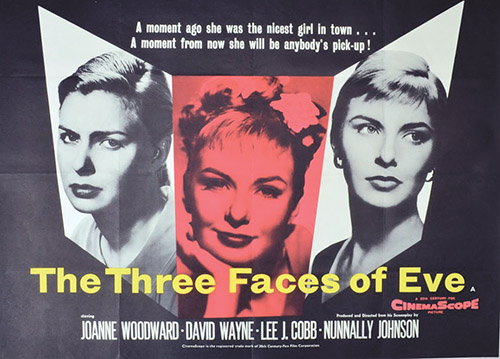
    Over the next seventy years, only a dozen or so cases of MPD were reported and treated, mostly in France. Then, in 1956, the release of the movie The Three Faces of Eve, supposedly based on a true story, starring Joanne Woodward as Eve and Lee J. Cobb as the psychiatrist, caused a mild stir with its depiction of a woman with three personalities. There was a flurry of cases of MPD. In 1976, the film Sybil, also ostensibly based on an autobiography – Sybil: The Classic True Story of a Woman Possessed by Sixteen Personalities – starring Sally Fields as Sybil and Joanne Woodward as the psychiatrist,created a sensation. In the twenty years between the two films, there had been growing public concern over child abuse. This set the stage for an enthusiastic reception for Sybil. Subsequently, therapists began to uncover dozens, even hundreds, of “alters” in their clients. The number of people suffering from MPD/DID rose exponentially until, in the mid-1990s, researchers could claim as many as 100,000 cases.

    This story of the abrupt proliferation of incidences of MPD, beginning toward the end of the last century and following on the heels of a trickle of such cases over the preceding seventy to eighty years, is a well-known one. What isn’t well-known is that the same brief window of time (estimated by Dr Hacking at 1874-1886) that saw the birth of multiple personality disorder also saw the birth of three other altered-state-of-consciousness phenomena: past life recall; recall of near-death experiences (NDEs); and UFO sightings (which came to include alien abductions). 

    Moreover, if we draw lines on a graph tracing the proliferation of incidences of the four phenomena over the next 100-120 years – until about 2000 – we observe that the four follow almost the same path. The four lines virtually pile up on top of each other. In other words, all four of the phenomena make their appearance in roughly 1874-1886, trail along with little more than a smattering of occurrences for the next 60-80 years, and then – usually sparked off by a highly dramatic public event such as the film Sybil in the case of MPD/DID – abruptly proliferate at an exponential rate, approaching, in the 1990s, figures as high as 100,000. 

    Does this mean that all four phenomena are just different facets of the same phenomenon?

    All four have one thing in common (and this is true of the alien abduction side of UFO sightings if it is not true of the sightings themselves): They are recalled experiences. They must be remembered to be brought into being. Our awareness of them is dependent on the existence of the faculty of memory – that is, memory as a storehouse. This seems obvious in the case of MPD/DID, where only one personality manifests at one time, and the rest must remain in storage, “in our memory.” But it’s also the case with past-life recall; a past life can only be recalled if it, too, is stored somewhere “in memory.” And near-death experiences can only be remembered – assuming, that is, that the experiencer can be resuscitated – if they’ve been stored, somehow, somewhere in our memory.

    The phenomena of “missing time” is common to alien abductions; abductees find they can’t account for hours, even days, of their time, until, at a certain point – usually when they’re undergoing therapy – they recall that during that missing time they were whisked away to a UFO. (The experience of seeing a UFO in real time doesn’t require “memory.”)

    Ian Hacking asserts in Rewriting the Soul that the concept of memory as a storehouse only came into being just after 1874, and was invented by the scientists, and their colleagues, who were treating Louis Rivet. The concept was invented because the science of that time had proven – or so it was thought – that the soul does not exist. Religion now had sole ownership of the concept of the soul. Only the church had the right to inquire into its nature. Scientists, finding themselves without an object they could examine as they had examined the soul, came up with an alternate concept, and this was memory as a storehouse. That was the real soul; its study would yield an equal portion of truth.

    As Dr Hacking writes, “Memory, already regarded as a criterion of personal identity, became a scientific key to the soul, so that by investigating memory (to find out its facts) one would conquer the spiritual domain of the soul and replace it by a surrogate, knowledge about memory.”4

    Should we infer from this that the phenomena of MPD/DID, past-life recall, recall of NDEs, and alien abductions into UFOs are merely made-up realities, figments of our imagination? Ian Hacking certainly believes this is true as regards the soaring growth of incidences of multiple personality disorder/dissociative personality disorder over the past 20-30 years.

    But, first: to try to follow the Canadian philosopher’s line of reasoning, let’s see if it’s true that all four of these phenomena really do trace out roughly the same growth curve, coming out of nowhere in 1874-1886, lying fallow for the next 60-80 years, and then, as the twentieth century comes to a close, bursting forth in a wild proliferation of incidences. 

    UFOs & Alien Abductions

    France’s Jacques Vallée, writing in Passport to Magonia: On UFOs, Folklore, and Parallel Worlds (1993; “Magonia” is a cloud realm in a French Medieval folk tale), is the most eminent of a school of UFO researchers who believe UFOs go back a very long way in our history. He holds that aliens have visited us for millennia as angels, succubi, fairies, leprechauns, and so forth, and that their trysts with us in the past often resembled the alien abduction encounters of today. There are those who believe, for example, that medieval tales of persons’ being flown to witches’ sabbaths where the Devil rapes them with an ice-cold cast-iron-like penis, are really early accounts of abductees’ being whirled away to UFOs where their orifices are violated by ice-cold metal probes wielded by alien researchers.

    Temple University History Professor Dr David Jacobs is a prominent member of the other, “modernist,” school of UFO research. He insists that the earliest reported UFO sightings took place between November 1886 and May 1887, in western and mid-western states of the US, when thousands of people claimed they saw dirigible-type cylindrical airships sailing through the skies. The dates place this sighting at the upper end of Dr Hacking’s “memory creation” window of 1874-1886; in fact, the sightings took place about the same time Louis Vivet was being examined by his physicians at Rochefort. From May 1887 on, nothing resembling a UFO (with the exception of “foo-fighters,” phantom disks said to pursue Allied fighter jets near the end of World War Two) was sighted until 24 June 1947, when aircraft pilot Kenneth Arnold reported observing nine saucer-like vehicles hurtling through the skies above Mt. Rainier, Washington. This headline-grabbing event, as powerful in impact as the release of the film Sybil which preceded the explosion of incidences of MPD, was the starting point for an equally explosive proliferation of UFO sightings, which by the end of the century were said to number in the millions.

    Artist’s impression of Kenneth Arnold’s 1947 sighting of nine saucer-like objects flying above Mt. Rainier, Washington. 

    In the 1970s, the phenomenon of “alien abductions” began to spin off from that of UFO sightings. Soon, almost as many alien abductions as UFO sightings were being reported. Whitley Strieber, author of Communion, and Anne Strieber, asserted in The Communion Letters (1997) that by the mid-1990s the number of alien abductions was probably as high as a quarter-of-a-million. In Abduction (1994), Pulitzer Prize-winning Harvard psychiatrist John E. Mack reported that “polls of the prevalence of the UFO abduction phenomenon in the United States, including a survey of nearly six thousand Americans conducted by the Roper organisation between July and September 1991, indicate that from several hundred thousand to several million Americans may have had abduction or abduction-related experiences.”6 Dr Jacobs, analysing the same Roper report, put the figure, conservatively in his view, at five million. 

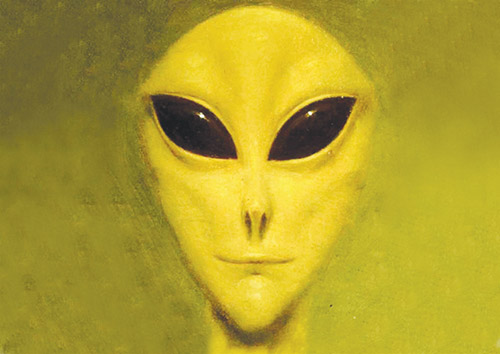
    On 26 December 1985, Whitley Strieber had an experience in which he believed he was abducted from his cabin in upstate New York by nonhuman beings. The above is a rendition of the ‘alien’ he encountered, this picture appearing on the front cover of his first nonfiction book, Communion (1987), which described the experience. The story was turned into the influential 1989 film of the same name. 

    Past Life Regression & NDEs

    The growth rate for the recall of near-death experiences (NDEs) kept pace with those traced out by incidences of MPD and alien abductions. Although in Otherworldly Journeys (1987), Harvard theologian Carol Zaleski compiled tales of ostensible NDEs from different cultures throughout history, many of these accounts probably describe quite different phenomena. The reporting of NDEs really only began when medical science had advanced to the point where people could be resuscitated after a significant length of time “among the dead.” It’s noteworthy that H.G. Wells published two short stories, “Under the Knife,” in 1896, and “The Door in the Wall,” in 1906 – the first only a decade, the second two decades, after Dr Hacking’s window for creation of the concept of memory – which eerily describe NDEs, the second with an exactness of detail usually found only in accounts of NDEs made possible by post-1970 resuscitation methods. Wells’s stories probably reflect unreported real events. From that point on, there are hardly any reports of NDEs until at least the early 1960s. By the late 1960s, the number of such reports was expanding exponentially, and the experience was becoming almost commonplace. According to Gallup polls, by 1991 the figure had risen to eight million. With continuing improvements in resuscitation technology, the figure would continue to rise. 

    The results of past-life regression therapy – hypnotising clients so they can recover their “past lives” – aren’t always reported, and sometimes the recollection of past lives is hidden in a thicket of broader psychological and psychiatric issues. Yet it’s possible to date the first recorded incidence of this fourth altered state of consciousness to just a few years after the close of Dr Hacking’s memory-as-storehouse-invention window. One of the earliest cases is that of the Swiss medium Hélène Smith, who, in 1895-1897, under the direction of philosopher-psychologist Théodore Flournoy, recalled past lives as Marie Antoinette and an East Indian princess. (These cases are usually regarded today as examples of MPD.) Smith was a medium; the “seances” were immortalised in Dr Flournoy’s From India to the Planet Mars (1899). In Les Vies Successives (1911), Colonel Albert de Rochas described turn-of-the-century experiments in Paris on nineteen persons whose consciousness was regressed back through birth to an existence as a discarnate spirit and then to one or two of their past lives.7 In The Belief in a Life after Death (1961), C.J. Ducasse chronicledsimilar experiments carried out at almost the same time by a group of physicians in New York City.8

    Then, for the next 60-70 years, travellers in search of reports of past-life recall will find themselves labouring across a vast, arid desert, with only one – though notable – oasis: Asa Ray Martin (1887-1949), a business school owner in Sharon, Ohio, who was the first American to regularly practice past-life regression therapy. In Researches in Reincarnation and Beyond (1942),Martin describes how over a period of twelve years he regressed 500 subjects, achieving remarkable results that included enabling a number of them to “talk, sing, and chant in languages of which they had no knowledge – Chinese, Arabic, German, for example – and their grammar and syntax would reflect their past personalities.”9 (It was at about this time that Edgar Cayce began his remarkable career in which past-life recall played a small, if vital, role.)

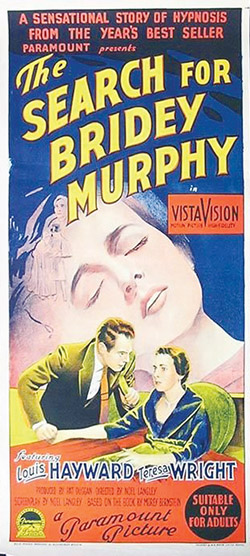
    The desert ends abruptly in 1956, with a towering, mountain-sized, past-life recall public event. This is the publication of The Search for Bridey Murphy by hypnotherapist Morey Bernstein. Bridey Murphy was a nineteenth-century Irishwoman who was a past lifetime of a Colorado housewife, Ruth Simmons, whom Bernstein had regressed hypnotically. Simmons convincingly recalled many details of Murphy’s life; historical research seemed to bear out these details. 

    The book and subsequent movie struck a nerve. People became intensely interested in reincarnation. Therapists became involved in past-life regression therapy. The curve for the number of past-life recalls shot upward at an exponential rate, until, in 1990, Hans TenDam could report in Exploring Reincarnation that “[therapist Joe] Fisher’s estimate that past-life therapy has since been responsible for healing hundreds of thousands of people… may be an overstatement, but the total number may be well towards 100,000.”10 By the late 1990s, the figure was probably approaching half-a-million: one Vancouver, B.C., therapist declared in 1994 that she had personally regressed 10,000 clients to past lives. Though past-life regression therapy has to some extent shifted away from the US, the figure, as we’ll see, remains high.

    These four phenomena, aping one another in distinctive growth patterns that first crawl slowly forward, then suddenly soar upward, constitute an extraordinary plenitude of altered-state-of-consciousness experiences. Would they never have come into existence had not a group of French physicians and their colleagues decided, late in the nineteenth century, to devise a way of understanding memory that would give them the means to gain knowledge of the soul?

    Dr Hacking makes it clear he doesn’t believe that men and women had, before 1874, no knowledge of the nature of memory. He writes: “I do not mean that we began to think about memory only in the late nineteenth century. The previous chapter [of Rewriting the Soul] dipped into the art of memory and listened to [eighteenth-century English philosopher John] Locke’s moving observation that episodes from the past ‘very often are roused and tumbled out of their dark cells into open daylight, by turbulent and tempestuous passions; our affections bringing ideas to our memories, which had otherwise lain quiet and unrewarded’. But there was little conception of a knowledge about memory before the nineteenth century…. [It was roughly in 1874-1886 that] the depth knowledge, the knowledge that there are facts about memory, came into being. Why did it come into being then? Because the sciences of memory could serve as a public forum for something of which science could not openly speak. There could be no science of the soul. So there came to be a science of memory.”11 This science of memory was based on the notion that memory is a storehouse, preserving in permanent form material as meaningful as that which the Church claimed to uncover in the soul. 

    Multiple Personality Disorder/DID

    Dr Hacking’s book focuses only on the birth, the painfully slow progress, and the sudden extraordinary flowering, of incidences of multiple personality disorder/dissociative identity disorder. He ignores the three other varieties of recall of altered states of consciousness that are the subject matter of this article. He makes it clear that he believes the rapid rise of cases of MPD/DID is a “copycat” phenomenon. The film Sybil didn’t give a name to the state of being possessed by “alters” that was already afflicting many; rather, the time was ripe for people to be so overpoweringly influenced by the film that they set about manufacturing a definition of themselves as afflicted by MPD. “Feedback” between therapist and client was a vital element in this process (as it had been a vital, “co-creative,” element in the relationship of Louis Vivet and his doctors); therapist and client together “co-created” the state of being called multiple personality disorder.

    Various cultural phenomena, particularly TV, were critical factors in the formation of MPD/DID. Dr Hacking writes: “Some really dysfunctional multiples going through a bad patch switch personalities very rapidly, each time assuming a new stock character. The effect is similar to that of switching TV channels by channel surfing. This impression is enhanced because patients with a great many alters often choose, for some of their personalities, the names of characters in sitcoms, soaps and crime series. It happens that TV remote controls became available in America just about the time that today’s florid multiples became abundant. I am not saying that multiples consciously act out television fantasies – or, at any rate, that they do so any more than the rest of us. We constantly mimic others.”12

    The Canadian philosopher goes so far as to imply it was no accident that, at the same time that as many as 100 channels became available on TV, sufferers from MPD appeared who claimed to harbour as many as 100 alters, that is, other personalities.

    Dr Hacking does not believe in the existence of an enduring soul. He seems to be, instead, a proponent of the modern-day theory of the social construction of reality. This theory holds that ‘reality’ does not exist. Physical ‘reality’, no less than social ‘reality’, is at bottom a social and linguistic construct. Scientific ‘knowledge’, far from being objective, reflects and encodes the dominant ideologies and power relations of the culture that produced it. 

    The Satanic Ritual Abuse Scare

    There is one major cultural event of the past few decades that, in retrospect, seems clearly to have been a social construction of reality, and to bear out Dr Hacking’s contentions. This is the phenomenon of, in the words of Ontario’s Religious Tolerance website, “Satanic Ritual Abuse (SRA), [which] can be defined as the psychological, sexual, and/or physical assault forced on an unwilling human victim, and committed by one or more Satanists according to a prescribed ritual, the primary aim of which is to fulfil their need to worship the Christian devil, Satan.

    “A ‘Satanic Panic’ swept the US and Canada, starting about 1980 and continuing until the late 1990s. It included beliefs that underground and sometimes inter-generational Satanic cults were murdering as many as 60,000 people per year. The panic died after 15 years because of lack of hard evidence that it ever existed as a significant problem. A survey by Redbook magazine in 1994 found that 70% of American adults believed in the existence of abusive Satanic cults. Thirty-two percent explained away the absence of hard evidence or other proof by believing that ‘the FBI and police ignore evidence because they don’t want to admit the cults exist’. There is a near consensus among investigators today that SRA is either nonexistent or occurs at an extremely low and undetectable level.”13

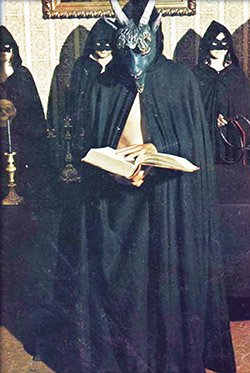
    ‘Satanic’ ritual from a 1970s movie. Hysteria over secret Satanic cults led to the ‘Satanic Panic’ that swept the US and Canada in the 80s and 90s.

    Past-life recall, NDE recall, and alien abduction came into being, endured, and burst into prominence in the same way and in the same time frame as MPD. Are these first three, then, merely different facets of the same altered-state-of-consciousness stream of reality that gave birth to the fourth? Are these three merely fabrications, products of the infinite suggestibility of humankind?

    Dr Hacking would probably say yes. He would likely argue that Kenneth Arnold’s encounter with nine UFOs over Mt. Rainier in Washington in 1947 did not open people’s eyes to see clearly what they had been seeing all along (still less would he say that the UFOs seen by Arnold were the first in a steadily mounting wave of visitors from outer space). Instead, he would say that Arnold’s sighting, for reasons having to do with where society was at, at the time, struck at the heart of the vast impressionability of humankind; that we began, aided and abetted by each other, by the media, and by the rulers of society, to increasingly “make up” UFOs – and, not long afterward, to make up alien abductions. Dr Hacking would probably regard the publication of The Search for Bridey Murphy not as some explosive event opening us up to deeper parts of our psyche; rather, he would see the book as no more nor less than an irresistible invitation to dream, to create, to invent, to make believe that we are far vaster (in that we possess many lives) than we’d thought we were – to, in effect, “socially create” that reality. 

    Let’s pause here. Surely this isn’t the whole truth. There is a real world; its properties are not merely social constructs and facts. Evidence does matter. Wise men and women, while not attributing to UFOs, to past lifetimes, to near-death experiences, an ultimate nuts-and-bolts reality, have nevertheless glimpsed archetypal forms – other, different, powerful realities – lying behind and within these phenomena, realities that ensure them a permanence beyond the flux of transient phenomena. 

    C.J. Jung is one. John White writes, in “What Are UFOs?”, in New Dawn Special Issue 17: “In his book Flying Saucers: A Modern Myth of Things Seen in the Sky, Jung proposed that UFOs are symbolic projections of deep human yearnings for wholeness and transformation in the collective psyche of humanity. Without denying their physical nature – because, of course, UFOs have been photographed and tracked on radar – Jung speculated that UFOs are either our own psychic projections perceived objectively in the sky or they are the appearance of real objects which afford humans an opportunity to project mythological symbols from deep in the collective psyche.”14 White lists other ways of understanding the phenomena of UFO sightings and alien abductions. It is likewise possible to list other ways of understanding past-life recall and NDEs – ways that give these phenomena a profound if ultimately unknowable objective reality while making allowance for the infinite number of forms they seem to take in the face of humankind’s infinite ways of seeing.

    Where are Memories Really Stored?

    Could the “social construction” that was the invention of memory as a storehouse really have moulded our faculties of perception in such a way that we were able to invent the (otherwise non-existent) phenomena of MPD, past-lives, NDEs and alien abductions? This seems unlikely; and, besides, it has become increasingly clear in our time that the notion of memory as a storehouse is a limited, maybe an erroneous, one. This notion came into existence, as Dr Hacking suggests, at the end of the nineteenth century, as a political tool – “memoro-politics” – enabling scientists to pursue their deepest investigations despite the co-optation of the soul by the church. Increasingly in our time the notion is being put forward that memory is not only not stored in the brain, but it might not even be localised in the body. In Transplant Memories, Dr Michael Grosso writes of anomalous memories associated with transplant operations. He tells the story of Claire Sylvia, who “reports that after her heart and lung transplant she suddenly had cravings for foods she never liked before such as beer, green peppers, and chicken nuggets. Later, when she met her organ donor’s family, she learnt that the young man who gave her a new heart was indeed fond of these foods, and was actually carrying a container of chicken nuggets when he died. Tim, the donor, was possessed by a constant craving for action during his life; Claire, after her transplant, became unaccountably restless, and felt urges to travel in a manner quite unlike her pre-transplant self. She also found herself having dreams of beautiful women and flirting with other women; prior to her operation, she had no homosexual leanings.”15

    Claire even dreamt of Tim, at a time when she didn’t know who her donor was and certainly not what he looked like. Dr Grosso asks: “What are we to make of these cognitive memories, which we can assume for the sake of argument to have been accurately reported? Transplant memories suggest that memory may occur apart from any coding, storage, and retrieval from the central nervous system. We haven’t the foggiest notion of how to make sense of this.”16 He cites further research that seems to indicate that no matter how much, or what parts, of the brain are removed, memory survives. Dr Grosso concludes with a wild speculation: “For all we know, the brain’s complete destruction will liberate, not annihilate, consciousness.”17

    In “Intermediate States: Charles Fort’s Degrees of Reality,” Colin Bennett continues in the same vein, providing examples to show us that not only is memory not localised in the brain, but many other so-called “brain” functions may not be localised in the brain either. Among a number of other cases, he cites that of Pacho Penaloza, of La Paz, Bolivia, who “blasted off a quarter of his brain and a third of his skull when mishandling a pistol in 1984. He was in a coma for three months, his right side was expected to be permanently paralysed, and he was also expected to be deprived of speech. A new skull-cover was reconstructed by Minnesota plastic surgeons Joseph Skow and Frank Pilney, using a section of bone taken from a rib and another part of Pacho’s skull, and a scalp-flip stitched into place. Apart from a clenched fist and a limp, Pacho made a complete recovery.”18

    It seems that (as Ian Hacking suggests) the conceptualisation by Vivet’s doctors of memory (which they were certain was contained in the brain) as a faculty of storage, was a more or less arbitrary one, chosen solely to give the doctors a path to knowledge of the soul. Increasingly, it seems that memory doesn’t need a physical container at all. Perhaps it abides as a kind of mist surrounding the body – or perhaps as a mist extending throughout the universe. The ancient concept of the Akashic files – a higher reality in which all human knowledge is stored – may not be so far-fetched after all. 

    Altered States of Consciousness Today

    What does our altered states-of-consciousness graph look like today? In the first decade of the twenty-first century, do our four phenomena continued to soar upward intermingled?

    Reported cases of MPD/DID tapered off considerably in the first decade of the twenty-first century, suggesting that many of them may have been, like cases of satanic ritual abuse, the product of a kind of psychic panic. 

    The status of past-life recall, as reflected in the estimated number of past-life regression sessions taking place over the past ten years, is quite different. Therapist Bob Holmes, of Toronto, Ontario, Canada, told me: “Conservatively I would guess at in excess of one hundred thousand past life sessions world-wide and maybe it is several times that number. This loose guesstimate doesn’t include past life readings by psychics.”19 [The late] Dr Roger Woolger, a leading past-life regressionist, added: “My guess is that in the US there must be a decline in this field. On the contrary, in countries like Turkey, Brazil, Portugal, India, Japan and the Netherlands there is a growing number of practitioners who engage in regression therapy.”20

    Hans TenDam of Amsterdam, the Netherlands, president of the European Association for Regression Therapy (EARTH) and author of Exploring Reincarnation (1990), told me the field of past-life regression therapy grew rapidly in 1978-1990, then stabilised. “Probably over the last five years [before 2011] things are picking up again,” he said. “It is spreading in South Asia and slowly gaining ground in Europe.” Given the large number of variables, he added, it’s difficult to arrive at an exact figure. But, taking a wild guess, he estimates, worldwide, “the total number of sessions per year at 350,000.” In the last twenty-five years about one to one-and-a-half million people will have experienced one or more past-life sessions – [though] of very divergent quality, effect and credibility.”21

    Regarding UFO sightings, Clifford Clift, International Director, Mutual UFO Network (MUFON), Greeley, Colorado, reports that: “We had approximately 6,000 sighting reports to MUFON in 2010. Worldwide, I would estimate 12,000, but don’t know for sure… The sighting numbers are up over the year 2000, but that may be due to people being more aware of MUFON. One other figure you need to be aware of is only one out of ten people will report their sighting to MUFON or others.”22

    Xavier Passot, of the Centre National d’Etudes Spatiales (CNES), in Toulouse, France, cautions: “It’s very difficult to announce a figure on worldwide UFO sightings… Moreover, any comparison of UFO sightings between 2000 and now would be skewed by many social parameters, e.g. the growing use of internet which makes UFO sightings reporting easy, and issues having to do with sci-fi films.”23

    Regarding alien abductions, Will Bueche, in Boulder, Colorado, representative of the John E Mack Institute, made the following, unexpected (in terms of the graphs we have been charting), statement:

    “Our impression, based on the experiencers who worked most closely with Dr Mack, who had recurrent experiences throughout their lives, is that alien encounters diminished markedly in the year 2000. Some people reported distinct communications conveying the message that the experiences would become rare, while others simply reported that they became infrequent without explanation. Though ‘one-off’ experiences continue to sometimes happen to these people on occasion, it is no longer the norm to have many experiences each year, with some ebb and flow, as was the case in the last decade of the preceding century.

    “A review of the literature suggests that the 1980s and the 1990s (all the way to 2000) was the period of most intense activity for these experiences.

    “The way in which the experiences seem to have stopped reinforces our impression that these are or were actual contact experiences of some kind, evidently on a schedule of its own – though as an organisation we maintain an uncertainty about what level of reality they occur in, given the lack of material evidence contrasted with the wealth of experiential evidence (the direct experiences by people of sound mind).

    “Another possibility could be that the experiences are continuing with another (younger) generation with whom the John E Mack Institute does not have contact, or, that the experiences may have changed from the seemingly physical and therefore difficult to dismiss (or dare we say, too terrifying to dismiss), to something more subtle (and pleasant) that may be more easily confused with dream states. But these alternative possibilities are only speculation.”24

    The incidences of NDEs continue to rise, the most recent Gallup Poll reporting that 20 million Americans claim to have had near-death experiences. 

    These altered-states-of-consciousness experiences continue to mystify us. The greatest mystery of all is why they resemble each other; why they seem to be facets of the same unknown reality. Perhaps only an in-depth comparative study of the four phenomena, which appeared at the end of the nineteenth century and today are as bewildering as ever, will begin to give us some answers. 

    [alert type=”general” dismiss=”no”]This article was originally published in New Dawn 131 (Mar-Apr 2012) and reprinted in New Dawn Special Issue Vol 13 No 2.[/alert]

    [alert type=”success” dismiss=”no”]If you appreciate this article, please consider subscribing to help maintain this website.[/alert]

    Sources

    Colin Bennett, “Intermediate States: Charles Fort’s Degrees of Reality,” The Anomalist 7 (Winter 1998/99), 79-157.

    John Chambers, “H.G. Wells (1866-1946): Did the Father of Science-Fiction Have a Near-Death Experience?” The Secret Life of Genius: How 24 Great Men and Women Were Touched by Spiritual Worlds,” Rochester, VT: Inner Traditions/Destiny Books, 2009, 179-186.

    Theodore Flournoy, From India to the Planet Mars: A Study of a Case of Somnambulism with Glossolalia, New Hyde Park, N.Y.: University Books, 1963. 

    Michael Grosso, “Transplant Memories,” The Anomalist 7 (Winter 1998/99), 71-78. 

    Ian Hacking, Rewriting the Soul: Multiple Personality and the Sciences of Memory, Princeton, N.J.: Princeton University Press, 1995.

    David M. Jacobs, Secret Life: Firsthand Accounts of UFO Abductions, New York: Simon & Schuster, 1992.

    C.G. Jung, “Flying Saucers: A Modern Myth of Things Seen in the Skies,” Civilization in Transition. Bollingen Series XX. Princeton: Princeton University Press, 1970, 307-432. 

    John E. Mack, Abduction: Human Encounters with Aliens, 2nd edition, New York: Ballantine Books, 1995.

    Personal Communication, Will Bueche, representative, John E Mack Institute, September 2011. 

    Personal Communication, Clifford Clift, MUFON, July 2011.

    Personal Communication, Bob Holmes, July 2011.

    Personal Communication, David Jones, Ph.D. July 1996.

    Personal Communication, Xavier Passot, CNES, July 2011.

    Personal Communication, Hans Ten Dam, July 2011.

    Personal Communication, Roger Woolger, July 2011.

    Religious Tolerance Website: www.religioustolerance.org/sraover.htm

    George Schwimmer, Ph.D., “A.R. Martin: Pioneer in Past-Life Regression,” The Journal of Regression Therapy, Vol. VII, No. 1 (December 1993), 16-28.

    Michael Shermer, Why People Believe Weird Things: Pseudoscience, Superstition, and Other Confusions of Our Time, New York: Saint Martin’s Griffin, 2002.

    Whitley Strieber and Anne Strieber, The Communion Letters, New York: HarperPrism, 1997.

    Hans TenDam, Exploring Reincarnation, London: Arkana, 1990.

    John White, “What Are UFOs?” New Dawn Special Issue 17 (Spring 2011), 3-9.

    Roger, J. Woolger, Ph.D., Other Lives, Other Selves: A Jungian Psychotherapist Discovers Past Lives, New York: Bantam, 1987.

    Carol Zaleski, Otherworld Journeys: Accounts of Near-Death Experience in Medieval and Modern Times, Oxford: Oxford University Press, 1987.

    Footnotes

    1. Hacking, 172

    2. Ibid, 174

    3. Ibid, 174-175

    4. Ibid, 198

    5. Personal Communication, David Jones, Ph.D.

    6. Mack, 85

    7. TenDam, 7-8

    8. Woolger, 87-88

    9. Schwimmer, 23-24

    10. TenDam, 8

    11. Hacking, 219

    12. Ibid, 32

    13. www.religioustolerance.org/sraover.htm

    14. White, 7

    15. Grosso, 71

    16. Ibid, 73

    17. Ibid, 77

    18. Bennett, 99-100

    19. Personal Communication, Bob Holmes

    20. Personal Communication, Roger Woolger

    21. Personal Communication, Hans Ten Dam

    22. Personal Communication, Clifford Clift

    23. Personal Communication, Xavier Passot

    24. Personal Communication, Will Bueche

    © New Dawn Magazine and the respective author.
    For our reproduction notice, click here.
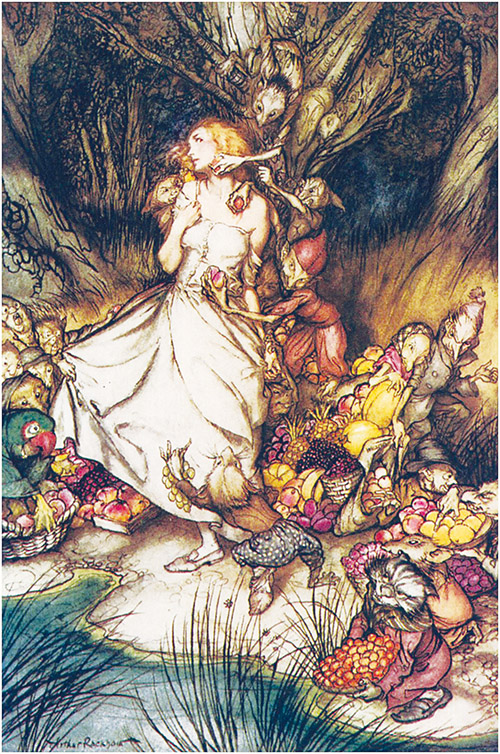
  • Supernatural Stories of the Original People: An Interview with Steven Strong

    Supernatural Stories of the Original People: An Interview with Steven Strong

    Steven Strong (and his co-researcher/author Evan Strong) are no strangers to New Dawn readers. They are best known for their articles, interviews and publications on the controversial theory that Australia was the cradle of civilisation – the home of an Original humanity that branched out into other parts of the world to seed culture and a more advanced way of being. 

    Steven’s knowledge is steeped in secret Aboriginal lore and rituals that for obvious reasons cannot be divulged to the general public. His – and Evan’s – mission is informing the wider Australian community on the forgotten heritage of the Original people and the metaphysical changes happening right now in this country. 

    Recently Steven was interviewed by Jeffery Pritchett & Wahabah Hadia Al Mu’id (WHAM) for their online radio show. The interview covered the Strong’s work about Australia as the cradle of civilisation but Steven also shed light on personal encounters with the mysterious and supernatural. He speaks of an Original way of being foreign to the vast majority of Australians, but lived and practiced by members of indigenous communities, especially the Clever Fellas and Elders. 

    The following is an edited extract from Steven’s spoken interview with Jeffery & WHAM in April.

    Jeffery Pritchett (JP): I’ve heard the Aboriginal people are connected in some way to the Pleiadians [ancient extraterrestrials from the star system of the Pleiades that have an interest in Earth]?

    Steven Strong (SS): Way back at the start when I was given a very strong ceremony by the Ramindjeri [Aboriginal people of Kangaroo Island, South Australia], I sat down at the finish and they told us about circumnavigating the world in a figure 8 in ancient times. And one of the elders turned to me and said, “You do realise in the old days, there were other ways we travelled this earth?” I knew what he was talking about, he was talking about moving through the air. 

    Steven Strong (left) & Evan Strong. Researcher, historian, author, and former high school teacher with a background in archaeology, Steven was involved in the formation of a Graduate Diploma of Aboriginal Education for the NSW Department of Education, writing units on Traditional Law and Contemporary History. He also co-authored the highly successful “Aboriginal Australia: A Language and Cultural Kit.” 

    They are absolutely obsessed with the Pleiadians. In fact, I’ve had elders who will finish their conversation by repeating the same thing time after time. They tell me the Pleiadians are their countrymen, they are part of them. Quite recently a genetic study has come out to confirm this. What we’ve now found is the Original people have a genetic strand that no one has ever seen before. And the scary part for the mainstream is they don’t know where it’s from. They cannot associate it with any hominid, semi-hominid, or other Homo sapiens on the planet. It’s only found in Australia with the Original people. 

    I know it’s the Pleiadian gene they’ve found. And the reason why they can’t find it anywhere on this planet is because they have their eyes permanently fixed down, they should be looking up. In fact, this is why we talk about this now, not because I had a chance but because I promised we would tell their story. I don’t meet an elder who will not talk about the Pleiadians. We are pushed into a story that I remember on one occasion I said we’d never touch. In fact our first three books, published by University Press in America, never mentioned it. We never mention this story. We’re coming into this story simply because we don’t have a choice. And the Original elders have made it clear, we must talk about this part of the story now. That’s what we’re doing, we’re only doing what we’re told. 

    JP: When it comes to the Pleiadians and the Aboriginals, what is the creation story?

    SS: I’ve got two rocks, two marked rocks, and the elders have told me the full story with those two rocks. And they’ve shown me the rocks and they’ve shown me how it’s put together. Those two rocks are called Ros’ rock 1 and 2. My main elder is a Clever Fella and can do things you shouldn’t be able to do in any science book today, and I’ve seen him do it. He told me one day, after knowing I had this rock [Ros rock 1] for a couple of years. (I’ve got to tell you something about Original elders – when you’re working with them, don’t ask them a question because they’ll never answer it. They’ll ask another question you can’t answer and they’ll answer that question a year later.) 

    Ros’ rock 1 and 2

    A year and a half passed when Karno told me the full story of that rock, and it’s basically the beginning. What he said was that way back in the Dreaming, at the very beginning, the Pleiadians came in the totem of the Goanna, which is the one that gives wisdom. When they came to this country (Australia), they asked permission. They didn’t barge in – they asked permission to come. They came here looking for the best that was on this planet and they found the Original people, but they said no. The story goes that the eagle and the crow fought against the Goanna, the Pleiadians. The eagle and the crow are the Original people. And they couldn’t come, they could not come. But one day, according to the elders, the crow saw the wisdom of the Pleiadians and changed sides. And then what happened was the fight continued and the crow and the Goanna defeated the eagle. And they came and landed on this country. Then what they did, because they’d won the battle, is the Goanna asked the eagle for some totem or memento of his victory, and he was given the claws of the eagle, and the laws of the Pleiadians were scratched into this rock we have now. The Original story is we were given this information from the Pleiadians, and the second rock talks about the Original people and their contribution. 

    They look upon this as a unification of two different species. The Pleiadians did not come to this planet to subjugate, or to mine, or anything like that. They came here to find a body to incarnate into. What we have according to these people is the best of both worlds. From this planet, the Original people, and from outside, the Pleiadians. Together they created a set of genes. I look upon something like the walkabout genes, where you go off and find your own salvation and your own wisdom. The Original people were told to spread around the world, and therefore every human on this planet has within them the Original and Pleiadian genes. And yes I know, some of us may have those Assyrian genes [a reference to the Anunnaki slave race creation], very much more compliant. 

    What we have today in our genetic bank is an absolute dog’s breakfast of genes from all over this planet. We’ve got Denisovan and Neanderthal genes within us, and genes from outside. The story goes that the day would come when each person would be demanded and asked to look for their Pleiadian genes and to strike out and find the truth. That’s why they seeded the whole of this planet with their genes – they had a long term plan. The story I’m told is it’s now time for every human being on this planet to access their Pleiadian-Original genes and find the wisdom and truth. Because if they rely on the other ones, they’ll end up on the wrong side of the equation when the cutoff line appears. 

    There is a long, long story about the Pleiadians being part of this particular continent. I can’t speak on behalf of Africa and places where other mobs came, that’s not our issue here. We just talk about what happened here. Now the Original people are telling us the time for the Pleiadian-Original genes to come to fruition, to give us wisdom and an alternative to what we have today, which is appalling, is now upon us. Original history and archaeology doesn’t run in a straight line – it runs in a circle. And the circle, ladies and gentlemen, has been completed. 

    JP: When it comes to the Dreamtime, I’m wondering your perception on it? When I was 17 I went through testicular cancer and chemo. And then a year later my dad died, and I started to attract UFO activity. Multiple witnesses have seen all kinds of stuff with me. And I’ve seen some different types of beings. I’ve seen beings made out of energy, what I call a luminous being or beings made out of light. And I’ve kind of come to the conclusion through talking to other shamans that they’re us without our bodies on some levels. I’m kind of curious, what is the Dreamtime? 

    SS: If I was to give a fairly reasonable description of the Dreaming it would probably finish in about three hours. But I think we’re going to have to go the 101 because it’s so difficult. Look, the Dreaming is about connecting with the Spirit and about connecting with our reality, but it’s a lot more than that. It’s not a religion. Original people don’t have churches, they don’t have steeples and they don’t have altars. How can I best put it? It runs something like this… 

    A young man or woman around 14 or 15 or 16, when it’s determined they become adults, goes through some very severe cuts and a lot of pain, because most Original learning comes through pain. What’ll happen is once the boy has been cut and he’s taken on site, he goes out into the bush on his own. Then the uncle will watch him from a distance, but won’t have a thing to do with him. He’ll be on his own for three or four months. During that period he makes his own connection with the Dreaming. Original people believe every human being has magic within them, they think it’s like breathing. Everyone of us has it. What that person then does is finds their own magic, finds their own way of communicating with the spirits. 

    You’ve got to remember, in our society the spirits are in the land, they’re in the trees, they’re in a blade of grass, they’re everywhere and they watch us eternally. I’ll give you a very good example of what happened to us when we offended the spirits and the Dreaming acted upon us. We went to a site. Our elder that takes us in, Auntie Beve [Darkinoong Elder], was unwell at the time and couldn’t smoke us, and we always get ceremonied before we go on site. I had another ceremony given to me by Uncle Jerry, six of us did it, and we walked into this place. It was full of orbs and we filmed them. As we came in a brown owl flew out and left a feather. We thought that was a good sign. Oh my god, it wasn’t. Anyways, we did our business for the day, filmed what we saw, and it was quite amazing. We did some work on the carvings and engravings and paintings there. 

    I went back that night to Gosford [New South Wales] and we sat around talking about what we saw that day, and I got a phone call from my elder. My elder lives in Kangaroo Island, that’s 3,500 kilometres away. We’d left that site five hours ago, and he rang me. I knew I was in trouble. Normally what happens is when the elder speaks, someone else rings you and tells you to ring them. They don’t approach you, you must approach them. This time he was approaching me. And I’ve had that a couple of times and it means I’m getting growled at. This time was huge. This is how the conversation went. He said, “You’ve been on country today.” I said, “Yes, but Karno it’s not your country.” He said, “I know that, but did you smoke yourself today?” I said, “Well no.” He said, “I have a red kangaroo here, and that red kangaroo is telling me the whole story of what happened. You did another ceremony, didn’t you?” I said, “Yes, I did.” He said, “Well that was just accepted but they’re not happy.” And he told me, “If you ever go on site again without smoking yourself, they will kill you. That is your last warning.” And then he hung up. 

    Now my question is, I never told him about this. How did he know 3,500 km away I was walking on country and had broken a law? That owl flew out and told someone else, who told another animal and went across and told Karno. I’ve figured that message travelled 700 kilometres per hour to get to him. How he got that message was through the animals. In the Dreaming, if you really are locked in with the Dreaming, you can communicate with animals, you can communicate with everything. 

    I’ll go to another story. This same guy [Karno], when [British author] Graham Hancock and I sat round a campfire, he disappeared completely. We all know that. He smiled as he did it, and then reappeared about three seconds later, about 50 metres behind someone else. We asked his wife how did he do this. She said, “I don’t know, I’ve never seen that one before.” He told me later, “The disappearing is nothing. I come from this place and we all do. The only difference is I know it and you’re not sure. Once you know it, everything is possible.” What is the Dreaming? It’s us finding our true powers, our true reality and our true purpose in life.

    JP: Do the Aboriginals ever say anything about Yowies or Sasquatch? 

    SS: Yes they speak about them. I’ve been to Yowie country, and I’ve met the keeper of the Yowies. I won’t write about it, because you get smashed. I get smashed enough as it is. I just can’t afford another punch in the face for that one. Do I know they exist? Absolutely. In fact, on one occasion we went into country, and the elders made it clear because they’d been finding all these kangaroos and wallabies with their heads ripped off, because the Yowie is incredibly powerful. They made it clear that if we went on to that country, we had to sing the song of the Yowies before we could get there. He said don’t go in there without that song or they will attack you. There were six of us, and we all sung. None of us questioned for one second what they told us. So yes, it is very much a part of Australia. 

    We also had big robust people with massive skulls, 1540 cc, and they stood about 6 foot 6, but they’re not Yowies. We had tiny people that were 3 foot high, I’ve got pictures of them, a whole tribe of 150 people smaller than pygmies. Then there are other groups they talk about. My understanding is there’s at least four different types of Original people in Australia still existing to this day. It’s a very common story about the Yowies. But finding them is bloody hard because these guys are masters of deception and camouflage, and they will show themselves when they want to be shown. That’s the only way you’ll see one. 

    JP: What other stories of the supernatural can you share?

    SS: Four days ago an elder rang me up, 4,000 km away. I’d been waiting four weeks for the phone call. I’d just set my 150 rocks into two formations. She rang me up and said, “Been waiting four weeks to ring you, I’m ringing you now because now’s the time to ring.” She said: “You’ve got those rocks in formation right now, haven’t you?” I said, “Yes.” She said, “You’ve got someone sitting inside there haven’t you?” I said, “Yes.” “He’s a good man, he can stay there, pass that on.” And then she hung the phone up. 4,000 km away. How did she know I just took the rocks out an hour before and put them in two circles and joined them up? That, ladies and gentlemen, is what we could do, all of us. I didn’t know that, I can’t do it, and I probably never will because I’m not as wise as they are. My job is to be pragmatic and try to convince people through logic and science it’s true. But I can tell you this now, I swear on a stack of bibles, what I’m telling you is true. That woman rang us up and said, “You’ve got your rocks in formation.” How did she know? She was 4,000 km away. This is what we could be. 

    Instead what we get is phones where we press buttons and play games. I remember recently I was in a train in Melbourne. I was with a friend and we were lost in the city and we didn’t know where we were going. There were about 80 people in four carriages and no one was talking, not one of them. All they were doing is sitting there pressing buttons, wasting their lives, and going to work and coming back the next day and then going back again. They don’t think they’re slaves, and they don’t think they’re trapped. They are, because they’ve been sucked into this system that’s wrong. 

    We’re trying to wake people up to the truth of what Original people know. Remember this, I’m not only talking about the Original people [in Australia], there are many people that have this story. We have to look to all our indigenous people because they are the only ones that can save us now. We go down this path [of materialism and technology obsession] and we are done for. We really are. And it’s time for the Original, and they are coming out, believe me, they are coming out. 

    Aboriginal painting of Baiame, a creator Spirit of the Dreaming, Baiame Cave, Milbrodale, New South Wales. CREDIT: en.wikipedia.org/Sardaka/CC BY-SA 3.0

    JP: When it comes to shamanism and the Aboriginals, is there a shaman? 

    SS: The best way to explain that, of course, is to go to the Original people but I’ll give an example of a study done by an American called Richard Gould in the mid-1960s. With all credit to him, he went and lived with the Original people for a year and a half, which is the best way to find out information. 

    He gave us a great story about the time that a young child was ready to walk. The grandmother worked that out, and everyone came around. They watched the child make three footsteps into the ground. Then, they picked the child up and spent the next hour discussing that’s child’s life, the whole of their life, what they were going to be, who they were going to be. This particular child had some magic in them, as they all do. 

    To say there’s one shaman is not correct. They are four or five different elders that will have skills in that area, because magic is one of the most important parts of the culture. It’s multi-dimensional. It runs in a lot of different areas. There will be a woman with wisdom about creation. There will be men who have wisdom about, unfortunately in some cases, using magic to harm others who are causing them issues, and other men who can heal. There’ll be different types. There won’t actually be one shaman because once you get into the real esoteric, it has got so many levels to it that you can’t be proficient in all of it. There would be different men and women. Remember this. There’ll be women too. 

    In fact, I do know up our way, where we are, we had what was called a Dhurangan, which is a female elder. She was the one who trained the male elders to become Clever Fellas. They would climb up to this cave, real high up about 1,500 metres. After four or five months, she’d initiate the male. She’d take him out to the ledge and make him step forward. Now, if he levitated, and he didn’t fall, he would become a Clever Fella, because he could levitate. But if he fell to the ground, it was about 600 metres down, he wasn’t a Clever Fella. But don’t worry, she was so strong, she’d catch him. Then, he’d go back to his tribe. There’s no shame in that. What we’ve got is a woman who can actually be in two places at once, and catch someone who’s falling, and a man who’s got to levitate, so that he’s got that magic. Then he can become a Clever Fella, but another person from their tribe could also go and do that job, too. 

    The difference here is it’s not one shaman, there could be four or five – there could be two apprentices and three that are at the top level in different areas. It is really basically the magic. Learning the magic and the esoteric is the most important thing you could do in Original society before [Captain] Cook came. That was what everything was about. That was the most important thing you could do. 

    The worst crime you could ever do, in Original society, was maybe go and desecrate a sacred cave, or break a sacred object. You know what punishment they would give you for that? Freedom. That would be the worst thing you could ever get because this is what they would do. They would say you’ve insulted the spirits, you’ve insulted the tribe. Leave our land, never come back, and spend the rest of your life elsewhere. The problem is that Original people believe that when you die, you go up into the air, to a black hole called Rock Cod Dreaming, and then you come back and incarnate back into your country. But if you die off country, your soul is in limbo for an eternity. That gives you an idea how much the spiritual was so ingrained into their culture. They would say, “Please kill me on country rather than let me go free.” 

    When you live a lifestyle, under those conditions, it’s nothing like we’re living today, where the magic is everywhere. There would be another elder that could read signs. Birds would come and talk to the elder and tell them information. So it really is multi-dimensional, once you get into the mystical side. All the different elders would take on different roles at different times.

    The Devils Marbles, south of Tennant Creek, Northern Territory, stand on ground sacred to the Warumungu, Kaytetye, Alyawarra and Warlpiri peoples.

    JP: When it comes to Earth changes and things coming up in the future, do the Aboriginals speak of that? 

    SS: You’ve got to remember I’m now in the deepest level, but in that level I’m just an initiate. I’ve got a long way to go. I was with an elder recently who gave me fourth level women’s magic, but didn’t get five, six, or seven. Was shocked to be able to give me even four. I’m still a long way to go, but having said that, I can put two and two together, and give you a bit of an idea of what the expectation is. I’m going to say this is the first time, where every other time I’ve been basically paraphrasing what the elders told me. In this case, I’m reading between the lines. I’m going to start with something that’s true. I know it happened because I spoke to the two people there, at the time. I’ve mentioned this many times because I’m allowed to. 

    This happened probably about five or six years ago in Darwin. That’s the top end of Australia. An elder, whose name I won’t give, turned up to the [TV] studio, stood in front of me and told me the story. One was a cameraman for ‘60 Minutes’, and the other guy doesn’t know how to lie. He still had trouble telling me the story anyway. The elder then said – and I’ve held one of these sticks when I’ve done ceremonial – I know what they’re like. They said, “It’s time to tune this magic stick up,” and he put it the ground in the park. Now, the story was there were about 90 odd people walking around in a park, at that time, and 88 collapsed. The guy that put the stick in, plus one of the two guys who was talking, they did not collapse, and everyone else fell down on the ground. They laid there for hours. Ambulances came, took them to hospitals. All of them, five hours later, woke up and said, “What are we doing here?” They said, “You collapsed.” “No, no, what am I doing here?” They were fine. 

    Now, the story is that the rocks I have, and others have, when I put them in formation, someone rang up 4,000 kilometres away [previously mentioned], so we know they work. Those rocks and those sticks lift elevations. When you put that one in the ground in the park, just a practise go, 88 fell, two stood. My understanding is I do know there’s a time, and we are part of this because we are putting these rocks in the ground and I know where but we can’t talk about that yet, we’re in the process of doing that. When all the rocks are in the right places, and the sticks in place in the ground, the Earth’s elevation will rise. That much, I know. I know they’re doing that. 

    The part I’m going to read between the lines is this. I believe when that happens, many people will fall. But this time, the ones who didn’t make the right decision will never wake again. What a beautiful way to cleanse the planet. Not through conflagration, not through warfare, not through some natural disaster. But each person makes their own judgment. This is why the elders keep saying hurry up and make up your mind. I believe when all the rocks and all the pyramids from around the world, when all the indigenous people put them in the right portals, the Earth’s elevation will lift up, vibration lifts massively, and many fall and never stand again. 

    Do they believe there’s a change coming? Absolutely. They’re obsessed by it. For me, personally, if there’s no change I’ll just carry on banging my head against a brick wall until I pass on. I’m comfortable either way. But for them, absolutely. I’ve heard things that have happened recently that make me believe, “Oh my God, it’s getting close.” I’ve heard a couple of events that took place that’s got my attention. I thought, “Gee, something’s coming. Something’s coming.” I can tell you there’s a quickening. There are things going on now, within our own country, that I never thought would happen. Now, people don’t know about it, because it’s coming through the grapevine to us, but there’s some stuff going on that makes me feel like, “Geez, it’s got to be less than a decade way. It’s got to be getting awful close now.” Yeah, this is the main reason I’m talking today, to let people know, from an Original viewpoint, there is a change coming.

    JP: When you talk about the Pleiadians and their state of being, is it like a total state of grace and positivity, a state of love?

    SS: It’s a state not so much of love, but a state of complete awareness. They understand. They fully understand the notion of what’s taking place and why things are. They know what is good, what is bad, but they’re still not perfect. They’re still looking for something else. 

    I have a rock that I was told in the beginning is creation. It goes like this. I’m holding the rock now. In the very, very beginning, the Pleiadians were one of the first beings that came into material form in the cosmos. They had the wisdom of the ages with them. The story is that way back in the very beginning, they sent a spear which was about four miles long, and aimed it at the Earth. It was a long spear with a cap, and it was coated with life, algae and bacteria and all the things that create life. It’s a bit like Hitchhiker’s Guide to the Galaxy. It was for seeding a planet. It sounds science fiction, but the beauty of it is this particular rock has got all the lines there, it’s got a very big impression in the middle. That is where the spear hit. Now, that place is called Uluru which is the middle of Australia. If you look at it, from underneath, there is a three-mile spear that tapers to a point. And it jammed into this planet and created the beginning of the whole of humanity here and this planet was known way back then as a special planet. 

    Yes, they are wise, and they’ve got incredible awareness that we will never have. They do things we can’t do. But the one thing we’ve got in abundance here is absolute love, and that’s the missing part of their wisdom. This is why the Earth and the Pleiadians are so intertwined, because my understanding is the salvation of the universe sits with those two planets. Our role in this – I know we don’t look like we’re performing well – is to be an equal of theirs. I do know two rocks I have that tell the story about the two together. The first rock has two and a half languages, and the second rock, which is the original rock of the people here, has four and a half. I tell people, “Do not dismiss the fact that, when they came here and they seeded this planet, they came back when they found something that was worthy of their presence.” Remember that. 

    We should not dismiss human beings. I know that we aren’t playing well in the sandpit at the moment. I get that. It looks pretty bad. Yes, our leaders have no idea what they’re doing anymore, and they don’t work for the right people. They work for the wrong beings both here and elsewhere. But within us, we have everything. We could do anything, and we are their equals. At the moment, there’s only one difference. They know we are their equals. We just don’t know it yet. Hopefully, now, we’re going to learn it.

    JP: Do you think that these light beings that I see are us without our bodies? Do the Aboriginals ever talk about light beings, or anything like that?

    SS: They do, and they have this belief. It’s a very important one. In fact, you will see it on every TV station when they put up a picture or a story about Original people. When someone’s passed on, you are not allowed by law to mention their name. In fact, I’ll give you an example of this. Say somebody’s name is Bundara, which means in a lot of places kangaroo. That would mean once that person dies, the language of the word kangaroo will now change for at least five years. Then, they can put it back. When we pass on we condense ourselves into energy form, but that energy form, as we’ve learned from quantum physics, is not way off in the distance. It is right next to us. If you call their names, they’ll come back straight away. Like my elders who’ve passed over, I can talk about Karno. I can talk about Auntie Beve, but I could never say both names. I’d be punished severely for that, and I never would. I can’t say two names of that person because we know as Original people, they’re right there. 

    I heard you mention before about little orbs and spirits. That’s exactly what we are. We are that. Karno is one who’s passed on. He’s given spirit messages to lots of people, and he’s an eagle form. I’ve had eagles sitting on top of my bedroom in the morning. I’ve had eagles flying so close I can see what’s in their claws. That’s Karno. He can come in spirit form, he can come in orb form, he can come in animal form, he can come in bird form, it doesn’t matter. 

    They understand death much better than we do. They look at death as the greatest ceremony a human can carry out in any life. He must die with dignity. Often, they know when they’re going to die, and they say, you’ve heard the Indians saying, “It’s a good day to die.” That is exactly what we talk about. When you die, it is a good day. They understand that. See, they understand we incarnate and come back. It’s part of their belief, and they believe the incarnation, very importantly, is an agreement between the woman and the spirit. The male has nothing to do with incarnation. He just chucks the sperm in, and they decide when it’s used. 

    What is death? I understand what it really is. It means that you’ll be back soon. You’ll be back, and they know when you come back. Often, they know who that person is, when they look at those three steps. They’re like, “Oh my gosh, it’s so and so. They’ve come back again. I was wondering who they’d be. I see this time they’re a male. They were a female last time.” They know it. For them, death is just part of a circle that leads on to rebirth, that leads on to trying to get it right, that leads on to death, that goes round and around and around. Finally, when you do get it right, they don’t come back in body form. They go to a site, and they guard it. Then, you have to call out. Whenever I go to a site, I have to call out. I have to go through ceremony to let them know, because that person I’m talking to was a person but was so evolved they didn’t need to come back in human form, and now guards a sacred site. That’s why you’ve got to be extra careful when you go on your sacred sites, because you’re not just dealing with any old person. You’re dealing with someone who’s 40,000 rungs above you, and can see through you like a piece of glass. You’ve got to be careful. 

    Conflict & War in the Deep Past

    SS: There are many, many dreaming stories about major conflict. I’ve been to a place I can’t mention, because it scares the crap out of me. I’ve been there twice, and I hate it. There’s not an insect. There’s not a bird. There’s nothing there. It’s dead. I’ve been to a place where you pick up rocks and crumble them in your hand. I’ve seen columns of 30 metres broken into pieces, rocks melted all over the place. There were explosions here. Something major took place, because the people in this country, this area, still had some technology, but it was wiped out. I believe it was wiped out either by an advanced civilisation, or maybe another alien group fighting the Pleiadians. I’m not sure which it is. I’m inclined to think it’s the second one, but I don’t know for sure, because they can overlap. In fact, I know Auntie Beve was guarding one such place, with a massive red explosion in the air painted on a cave. They tried to destroy it. [The Dept of] Main Roads [New South Wales] wanted to put a road through there, and she stopped them. But when she was in hospital, they blew the site up. They didn’t want that picture up. That was the story of this massive explosion. Graham King, who’s the elder and keeper of around Sydney, told me the story of that happening, too, of something coming through the sky and blowing things up. Yes, we know about that. There was a war here.

    The interview can be listened to in full at: https://ufoparanormalradio.podbean.com/e/com-steven-evan-strong-out-of-australia-aborigines-the-dreamtime-and-the-dawn-of-the-human-race/

    [alert type=”general” dismiss=”no”]This article was published in New Dawn Special Issue Vol 11 No 4.[/alert]

    [alert type=”success” dismiss=”no”]If you appreciate this article, please consider subscribing to help maintain this website.[/alert]

    © New Dawn Magazine and the respective author.
    For our reproduction notice, click here.
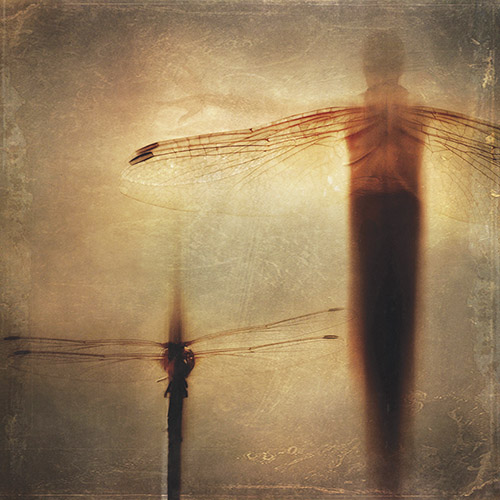
  • Dreams: Another Reality?

    Dreams: Another Reality?

    This article was published in New Dawn 135 (Nov-Dec 2012)

    For most of us, the dream world is the most immediate and pressing of all alternative realities. Its bizarreness, its sheer otherness, which presents itself to us every night, constantly reminds us that reality is multifaceted and malleable, and our experience of it very likely illusory. There seems to be nothing more solid and irrefutable than the fact that we see what we see and we hear what we hear. And yet each night we see and hear things – often vividly – that in waking life we take to have no reality whatsoever. Indeed some Hindu philosophers have said that the only reason that we believe waking life to be real and dream life to be illusory is that we spend more time in one than in the other.

    In the West, until the twentieth century dreams were regarded principally in two different ways. On the one hand, they were taken as continuations of everyday urges: a hungry man dreams of food, a thirsty man of drinking, a man with a full bladder of going to the bathroom. On the other hand, dreams were also taken as messages from the other world. If a dead mother or father appeared in a dream, that appearance was often regarded as a genuine contact with that person. Dreams were also seen as portents of the future. In one famous instance, Alexander the Great, besieging the city of Tyre in the fourth century BCE, dreamt that a satyr was dancing on his shield. The Greek seer Aristander interpreted the dream as a visual pun: satyros in Greek can be read as sa Tyros – “Tyre is yours” – in this case a prediction that came true.

    The most famous of dream interpreters in antiquity – Artemidorus of Ephesus, who lived in the second century CE – held that both perspectives were valid. The first type, those that are based on bodily needs and sensory stimuli, he called enhypnia; the second, oneiroi, which he held to be prophetic. He himself focused on the latter, and his interpretations of these were both complex and far-reaching; his treatise on the subject, the Oneirocritica (“Examination of Dreams”) covers the meanings of, for example, dreaming of being beheaded, writing with the left hand, and being sold into slavery. Even minor details were significant. In a prefiguration of Sigmund Freud’s Oedipus complex, Artemidorus wrote, “The case of [intercourse with] one’s mother is both complex and manifold and admits of many different interpretations – a thing not all dream interpreters have realised. The fact is that the mere act of intercourse by itself is not enough to show what is portended. Rather, the manner of the embraces and the various positions of the bodies indicate different outcomes.”

    Artemidorus’s dream manual – the only one to survive from classical antiquity – is not widely read today, but it is the forefather of all modern texts that discuss dreams as portents of the future. This has been a popular genre for generations, and I can remember a copy of a work entitled 10,000 Dreams Explained on my mother’s bookshelf, though I do not remember that she ever consulted it.

    By the end of the nineteenth century, no serious thinker would give any credence to interpretations of this kind, no matter how popular they remained among the masses. Instead some psychologists attempted to characterise all dreams as what Artemidorus called enhypnia – that is, as expressions of bodily needs and functions. The German psychologist W. Weigandt, for example, argued that all dream images “have their immediate cause in sensory stimuli.” Another psychologist of the era, Philippe Tissié, insisted that “dreams of an exclusively psychic [i.e., psychological] origin do not exist.”

    Freud’s Interpretation

    These quotations are cited in Sigmund Freud’s landmark work The Interpretation of Dreams, first published in 1900, which marked the definitive break with the reductionist notion that all dreams can be explained by sensory stimuli. Freud did not deny that some dreams were caused this way, but he took exception to the idea that all of them were. He went a step further and suggested that even dreams that could be explained by sensory stimuli had a deeper meaning: “There are no trivial initiators of dreams, and thus no innocuous dreams… The dream never wastes its time on trifles; we do not allow a mere nothing to disturb our sleep.”

    At the simplest level, Freud argued, the dream is a form of wish fulfilment. We dream of things of which we are deprived in waking life. He cited a case from his own experience. When he was young, he said, he had what he called “dreams of convenience” frequently. “Accustomed to working late into the night, I always found it difficult to wake betimes; then I used to dream that I was out of the bed and standing at the washstand.”

    Instances of this sort are easy enough to understand, but even wish fulfilment dreams have a way of disguising their content. At one point a friend of Freud’s told him, “My wife has asked me to tell you that yesterday she dreamed she had started her period. You will know what that means.” Freud commented, “Indeed I do; if the young woman has dreamed that she has had her period, then she is missing it. I can imagine she would have liked to enjoy her freedom a little longer before the difficulties of motherhood begin.”

    This relatively simple example points up a central fact about dreams: their content is not obvious. As Freud indicated, this is partly because the portion of the mind that dreams cannot express its own meaning in verbal discourse; that is, it cannot come out and say directly what it is trying to express; it speaks in symbols. But there is another consideration. As in the case of the young pregnant woman above, we often have desires that we cannot admit to ourselves. Thus the psyche chooses a roundabout way of expressing it. This is a way of getting around the inhibitions and taboos of our conditioning.

    Toward the end of The Interpretation of Dreams, Freud provides a preliminary summary of his findings:

    Dreams are fully paid-up psychical acts; their driving-force is a wish in need of fulfilment; their unrecognisability as wishes, and their many oddities and absurdities, derive from the influence of the psychical censorship which they have gone through in the course of their formation; as well as the compulsion to escape this censorship, the following factors have shared in forming them: the compulsion to condense the psychical material, regard for representability in visual or other sensory images, and – though not invariably – regard for a rational and intelligible appearance for the dream’s structure.

    Freud admitted that not every dream could be interpreted, and that there were many that made sense only in the context of many weeks of dreams that were interrelated, whether they appeared to be or not. Furthermore, he said, no interpretation of a given dream is exhaustive; there is always more that could be said and learned about it. But a central part of his theory was that the wishes that dreams attempted to fulfil arose out of the libido – the sex drive. This drive, constantly present and constantly frustrated in civilised humans, was the energy that gave life to dreams and indeed to the psyche as a whole. (Later in his career, in an enigmatic work entitled Beyond the Pleasure Principle, Freud would argue that another drive existed: the urge for an organism to return to its primordial inanimate state. This countervailing “death wish” existed alongside and in opposition to the drive toward reproduction.)

    Jung’s Interpretation

    Freud’s greatest student, the Swiss psychiatrist C.G. Jung, took exception to these views. To begin with, he questioned Freud’s idea that dreams were obscure because they concealed things that the conscious ego did not want to admit to itself. Jung wrote, “Some of the pioneers of psychology” – presumably including Freud – “came to the conclusion that dreams did not mean what they appeared to mean. The images or symbols that they presented were dismissed as bizarre forms in which repressed contents of the psyche appeared to the conscious mind. It thus came to be taken for granted that a dream meant something other than its obvious statement.

    “Why should they mean something different from their contents?” Jung countered. “Is there anything in nature that is other than it does not mean something it is not. The Talmud even says: ‘The dream is its own interpretation’. The confusion arises because the dream’s contents are symbolic and thus have more than one meaning. The symbols point in different directions from those we apprehend with the conscious mind; and therefore they relate to something either unconscious or at least not entirely conscious.”

    Jung also disagreed with Freud’s view that libido could be reduced to the sex drive. In an early work entitled Wandlungen and Symbole der Libido (“Transformations and Symbols of the Libido”; its English title is Symbols of Transformation), Jung wrote: “We know far too little about the nature of human instincts and their psychic dynamism to risk giving priority to any one instinct. We would be better advised, therefore, when speaking of libido, to understand it as an energy-value which is able to communicate itself to any field of activity whatsoever, be it power, hunger, hatred, sexuality, or religion.”

    From these two ideas – that dream symbolism had an intrinsic meaning of its own and that the libido could not be characterised only as the sex drive – sprang Jung’s mature theory of the psyche, which centred around what he called the archetypes: “The archetypes are the numinous structural elements of the psyche and possess a certain autonomy and specific energy which enables them to attract, out of the conscious mind, those contents which are best suited to themselves.” That is, the archetypes are centres of force within the psyche. We can never see them directly: they can only be approached through the symbols by which they manifest.

    Jung went further than this. The archetypes, he contended, do not only make use of symbols that they manage to unearth out of the conscious mind. They also produce symbols of their own that best express their nature. Since the structure of the human psyche is common to everyone, it thus follows that the same archetypes and symbols of the psyche would be discovered throughout the world. These symbols would also spontaneously appear in the dreams and fantasies of people who had never been exposed to them. And this, Jung argued, was in fact the case.

    In his late work Man and His Symbols, Jung describes the dreams of an eight-year-old girl that she wrote down and gave to her father as a Christmas present. The father, not knowing what to do with them, showed them to Jung. “They made up the weirdest series of dreams I have ever seen,” Jung wrote, “and I could well understand why her father was more than just puzzled by them.”

    In one of the dreams, for example, “‘the evil animal’, a snakelike monster with many horns, kills and devours all other animals. But God comes from the four corners, being in fact four separate gods, and gives rebirth to all the dead animals.” Jung observed that this dream resembled the motif of the apokatastasis, or restoration of all things, that appeared in early Christianity. Moreover, the four gods who come from the “four corners” form a fourfold figure that he called a “quaternity” – “a strange idea, but one that plays a great role in many religions and philosophies.” In the Bible, this quaternity appears in the chariot vision that opens the book of Ezekiel, with living creatures who have the faces of a man, an ox, a lion, and an eagle (Ezekiel 1:10). The Christians took up this motif and used it to represent the four evangelists, each of whom was symbolised by one of these animals. We see the same theme in the four sacred directions of Native American religion, and in the Tibetan mandala, which combines the motif of a circle with that of a square. But where could the little girl have learned of these images? “She had very little religious background,” Jung observed. “Her parents were Protestants in name; but in fact they knew the Bible only from hearsay.”

    Jung, with his compendious knowledge of the myths and symbols of the world, would have this experience often with his patients. Another case was that of a professor “who had had a sudden vision and thought he was insane. He came to see me in a state of complete panic. I simply took a 400-year-old book from the shelf and showed him an old woodcut depicting his very vision. ‘There’s no reason for you to believe that you’re insane’, I said to him. ‘They knew about your vision 400 years ago’. Whereupon he sat down entirely deflated, but normal.”

    What does this all come down to? For Freud, dream images of this kind were merely coping mechanisms, enabling men and women to function in some kind of way among “civilisation and its discontents” (the title of one of his works). But Jung believed that the psyche had a purpose and a direction of its own. Its ultimate drive was not toward sexual fulfilment, but toward its own wholeness and integration. The term he gave to this was individuation. The archetypes were the primordial forces that drove this process; the symbols of dreams and myths were their manifestation.

    Individuation consists of a long process in which certain archetypes in the psyche are confronted and (to a degree) made conscious. If this process continues long enough, eventually the archetype of the Self will appear in dreams. It can take the form of a wise old man or woman, a guru or guardian, a divine youth, a helpful animal, or even a stone. (The Bible alludes to this last motif when it says, “The stone which the builders refused is become the head stone of the corner”: Psalm 118:22). Jung’s associate Marie-Louise von Franz described the Self as “an inner guiding factor that is different from the conscious personality and that can be grasped only through the investigation of one’s own dreams. These show it to be the regulating centre that brings about a constant extension and maturing of the personality.” It is this “extension and maturing” that is the goal of Jungian analysis.

    [alert type=”success” dismiss=”no”]If you appreciate this article, please consider subscribing to help maintain this website.[/alert]

    Dreams & Neurology

    Although Freud and Jung remain the greatest dream interpreters of the twentieth century, their views are unfashionable in psychology today. This is in large part because neurology has made great strides in mapping mental states onto neural events. While this is useful work in its own right, it has led many modern researchers to conclude, with J. Allan Hobson of Harvard, that dreams are merely the result of random energy signals that reach the brain’s cortex during certain phases of sleep. The idea that there are hidden meanings to dreams are, Hobson says, nothing more than “the mystique of fortune cookie dream interpretation.”

    It seems that we have come full circle in our understanding of dreams. Modern researchers are telling us that, to use Artemidorus’s language, all dreams are enhypnia. They do not convey messages from the gods or from higher levels of reality; they do not even convey any meaningful messages from our own psyches. This is the state that psychology has reached in the early twenty-first century: we are back to a reductionism that is telling us that all mental activity can be reduced to the activity of the nervous system.

    Unfortunately, this approach is not only narrow but self-refuting. If all mental activity can be reduced to mere functions of our nerves – and hence can be dismissed as illusory or nonsensical – that would have to include waking experience as well, including the neural outputs that accompany scientific reasoning. We are left with no good reason to believe in a world “out there” beyond our own brains – certainly not in any world that has any genuine correlation to what we experience.

    The Dream World: Is It Real?

    This leads us back to the most difficult and most fascinating question about the dream world: is it real? If so, what sort of reality does it have? As I said at the beginning of this article, some Hindu philosophers have claimed that the only reason we take waking life to be real is that we spend more of our time in it than we do in dreams. To this we might add the consideration that there is an indefinable something in waking life that we call awareness, or perhaps clarity. But even this is not as decisive as we may think. We need point only to the existence of lucid dreams – that is, dreams in which the dreamer is aware that he is dreaming.

    Lucid dreaming has been studied at great length – notably by Stephen LaBerge of Stanford University – and, as with other types of dreams, it is associated with certain types of brain states, notably rapid-eye movements or REMs. LaBerge even trained his subjects to show that they were having lucid dreams by moving their eyes in certain directions. For the scientific materialist, this leads to the same inevitable conclusion: that lucid dreams are the products of certain brain states and nothing more. But I am not so sure.

    I myself had a lucid dream a number of years ago. I remember surveying the landscape of the dream and asked myself, “Is this really different from waking life? If so, how?” I concluded that there was a difference, but it was a difference in feeling-quality: the dream world simply felt different, in a way that I found difficult to characterise. But I did not have the sense that one world was “real” and the other “unreal”; each had its own independent reality.

    Among the world’s most proficient lucid dreamers are certain schools of Tibetan Buddhists, who practice a “dream yoga” that is meant to keep awareness unbroken between the waking and dream states. For them, it has a highly pragmatic function: to enable an individual to continue spiritual practice during sleep. The Tibetan lama Namkhai Norbu observes, “The night is very important for people because half our lives pass during it; but often we quietly sleep away all that time without any effort or commitment. There has to be real awareness that practice can occur at all times, even during sleep or eating, for example. If this does not happen, progress on the path is difficult to make.”

    In his book Dream Yoga and the Practice of Natural Light, Norbu describes the practices that are used to maintain awareness into the dream state. In essence, the practitioner visualises the Tibetan equivalent of the letter A in the centre of his body until he falls asleep. “If one is capable of falling asleep like this,” Norbu claims, “one would find the full presence of the state of natural light. One falls asleep, and one is asleep with virtually full awareness.” Even if you don’t succeed with this practice the first few times you try it, Norbu says, eventually you will be able to attain a state of lucid dreaming this way.

    The reason for doing this at all is, as I have said, highly practical: it enables the aspirant to continue spiritual work even while asleep. According to Norbu, certain texts claim that a spiritual practice is nine times more effective carried out in the dream state than it is in the waking state.

    As even this brief description suggests, the motive for Tibetan dream practice is completely different from the dream analysis practiced by either Freud or Jung. Tibetan Buddhist practitioner Michael Katz says, “Although there seem to be clear relative benefits from the extensive examination of dream material, it is quite possible that these benefits are only for the beginner. For the advanced practitioner, awareness itself may ultimately be far more valuable than the experience and content, no matter how creative. Great teachers have reported that dreams cease completely when awareness becomes absolute, to be replaced by luminous clarity of an indescribable nature.”

    As for the ontological reality of the dream world, the Tibetan Buddhists hold that it is ultimately no different from that of the waking world. In the words of the Mahayana Buddhist Heart Sutra, “Form is emptiness; emptiness is form.” Namkhai Norbu writes:

    In a real sense, all the visions that we see in our lifetime are like a big dream. If we examine them well, the big dream of life and the smaller dreams of one night are not very different. If we truly see the essential nature of both, we will see that there really is no difference between them. If we can finally liberate ourselves from the chains of emotions, attachments, and ego by this realisation, we have the possibility of ultimately becoming enlightened. 

    It would be possible, of course, to go much deeper into ideas and theories of dreams than the space of this article allows. But even the little we have been able to see tells us one important thing: our views of the dream state are inextricably linked with our views of reality as a whole. For materialistic researchers like J. Allan Hobson, dreams arise from the firings of neurons and nothing more. Freud and Jung held that dreams were the expression of primordial instincts – for Freud, the sex drive; for Jung, a more comprehensive urge within the psyche for wholeness. For Tibetan Buddhists, they serve to remind us that the phenomena that pass before the screen of the mind – whether seen in waking or in sleeping states – are devoid of an ultimate reality. Our own views of dreams will almost certainly reflect our own beliefs and preconceptions. The question that faces us then is, are these views expanding our knowledge of reality or limiting it?

    [alert type=”general” dismiss=”no”]This article was published in New Dawn 135.[/alert]

    [alert type=”success” dismiss=”no”]If you appreciate this article, please consider subscribing to help maintain this website.[/alert]

    Sources

    Sigmund Freud, The Interpretation of Dreams, Translated by Joyce Crick, Oxford: Oxford University Press, 1999
    C.G. Jung, Symbols of Transformation, Second edition, Translated by R.F.C. Hull, Princeton, N.J.: Princeton University Press, 1956
    C.G. Jung, et al., Man and His Symbols, Garden City, N.Y.: Doubleday, 1964
    Namkhai Norbu, Dream Yoga and the Practice of Natural Light, Edited by Michael Katz, Ithaca, N.Y.: Snow Lion, 1992

    © New Dawn Magazine and the respective author.
    For our reproduction notice, click here.