New Dawn – World's Most Unusual Magazine

Category: Secret History

  • Human Devolution: Ascended Apes or Fallen Angels?

    Human Devolution: Ascended Apes or Fallen Angels?

    “By next Friday evening they will all be convinced that they are monkeys,” wrote Thomas Henry Huxley to his wife Henrietta. The year was 1860, and on June 30, Huxley would confront Samuel Wilberforce, Bishop of Oxford, in one of history’s most famous debates. The topic was Charles Darwin’s theory of evolution.

    Samuel Wilberforce despised Darwin’s theory, published the previous year in The Origin of Species, and he was determined to demonstrate its shortcomings. Although a bishop of the Church of England, Wilberforce knew something of science. He was a lifelong student of natural history, and he served as a vice president of the British Association for the Advancement of Science. He had also been on the governing council of the Geological Society of London, and he knew well several leading scientists of his day, such as geologist Charles Lyell, one of Darwin’s chief supporters, and biologist Richard Owen, one of Darwin’s chief opponents.

    At the invitation of the editor of the influential Quarterly Review, Wilberforce had written a negative critique of The Origin of Species. It was not printed until after the Huxley-Wilberforce debate, but when it finally did appear, Darwin himself called it “uncommonly clever.”

    In his review, Wilberforce (1860) first attacked Darwin on scientific grounds. In The Origin of Species, Darwin had argued that living things tend to vary slightly in the course of reproduction. After giving examples from bird and animal breeding, Darwin contended that over vast periods of time, aided by natural selection, such variation could lead to the origin of new species. But Wilberforce noted that the variations obtained in breeding pigeons, dogs, and horses were not changes in the basic physical structure of these creatures, such as required for the production of new kinds of organisms. Pigeons remained pigeons, dogs remained dogs, and horses remained horses. Turning to metaphysics, Wilberforce argued that such human qualities as free will and reason were “equally and utterly irreconcilable with the degrading notion of the brute origin of him who was created in the image of God.”

    Huxley’s Triumph

    On June 30, at the British Association for the Advancement of Science meeting in Oxford, Dr. J. W. Draper of New York read a paper titled “Intellectual Development of Europe Considered with Reference to the Views of Mr. Darwin.” Expecting fireworks, seven hundred attentive hearers had packed the lecture hall. After Draper finished his talk, several persons offered comments. Finally, Wilberforce spoke, attacking Darwin’s theory. His confident words mirrored those that would later appear in his Quarterly Review article on The Origin of Species. Attempting to draw a laugh, he wondered “if any one were willing to trace his descent through an ape as his grandfather, would he be willing to trace his descent similarly on the side of his grandmother?”

    Huxley leaned toward one of his companions and said, “The Lord hath delivered him into my hands.” When he was called to speak, Huxley delivered his famous retort, quoted in many books about evolution. Declaring that he felt no shame in having an ape for an ancestor, he added, “If there were an ancestor whom I should feel shame in recalling, it would rather be a man – a man of restless and versatile intellect – who, not content with success in his own sphere of activity, plunges into scientific questions with which he has no real acquaintance, only to obscure them by an aimless rhetoric, and distract the attention of his hearers from the real point at issue by eloquent digressions and skilled appeals to religious prejudice.” The audience, won over by Huxley, broke into loud applause. In their opening skirmish, the apes had prevailed over the angels.

    On the Side of the Angels

    The angels, however, still had some highly placed advocates. On November 25, 1864, Benjamin Disraeli, then chancellor of the exchequer and soon to be prime minister, said at a speech at the Sheldon Theatre in Oxford: “The question is this – Is man an ape or an angel? My Lord, I am on the side of the angels. I repudiate with indignation and abhorrence the contrary view, which is, I believe, foreign to the conscience of humanity: more than that, even in the strictest intellectual point of view, I believe the severest metaphysical analysis is opposed to such a conclusion. But what does the Church teach us? What is its interpretation of the highest nature? It teaches us that man is made in the image of his Creator – a source of inspiration and of solace from which only can flow every right principle and every Divine truth… It is between these two contending interpretations of the nature of man [ape or angel], and their consequences, that society will have to decide.” But Oxford University had already decided. Disraeli’s remarks, especially the one about being on the side of the angels, met with loud disapproving laughter which today still echoes with increased volume in the halls of academia.

    Disraeli’s unsympathetic university audience had two components. First, there were theologians who had given up a literal reading of the Bible.
    Second, there were scientists who were also rejecting biblical literalism, from the standpoint of Darwinism. They both reacted with dislike to Disraeli’s talk of angels. Indeed, it was the unwitting alliance between these two groups that insured the relatively quick triumph of Darwinism over the Wilberforces and Disraelis of Victorian England. Within a few decades, most of the educated persons of England, and the world, whatever their religious or cultural heritages, would accept that human bodies were not direct creations of God in His image but were instead the modified bodies of apes. Disraeli’s statement that he was “on the side of the angels” is often inserted, as an amusement, into books on evolution, and so is a satirical Punch cartoon of Disraeli dressed as an angel.

    But what exactly did Disraeli mean when he spoke of being on the side of the angels? Was this merely a metaphor, pointing to some vague involvement of God in the origin of the human species? Given the intellectual climate of his times, one is tempted to answer the question positively. For most intellectuals, God had already retreated from the visible universe, taking the role of a detached clockmaker who set a strictly material machine in motion and left it running. But a deeper study of Disraeli’s writings lends support to a more literal reading of his remarks.

    In Lord George Bentinck: A Political Biography, Disraeli spoke fondly of “the early ages of the world, when the relations of the Creator with the created were more intimate than in these days, when angels visited the earth, and God Himself even spoke with man.”

    Similar passages can be found in Disraeli’s novels, which were fairly transparent vehicles for his own political, philosophical, and spiritual convictions. In Tancred, published in 1847, his visionary hero, a young Victorian aristocrat, has the following exchange with a bishop of the Church of England.

    “‘The Church represents God upon earth’, said the bishop.

    “‘But the Church no longer governs man’, replied Tancred.

    “‘There is a great spirit rising in the Church’, observed the bishop with thoughtful solemnity…. ‘We shall soon see a bishop at Manchester’.

    “‘But I want to see an angel at Manchester’.

    “‘An angel!’

    “‘Why not? Why should there not be heavenly messengers, when heavenly messages are most wanted?’”

    Tancred then proceeds on a spiritual quest to Jerusalem. While in Palestine, he ascends Mt. Sinai by night and is visited by an angel “vast as the surrounding hills.” After identifying himself as “the angel of Arabia,” the angel says, “The relations between Jehovah and his creatures can be neither too numerous nor too near. In the increased distance between God and man have grown up all those developments that have made life mournful.”

    Eventually, Tancred forms a plan to revitalise Europe by first restoring the spiritual purity of Asia. “When the East has resumed its indigenous intelligence, when angels and prophets shall again mingle with humanity, the sacred quarter of the globe will recover its primeval and divine supremacy; it will act upon the modern empires, and the faint-hearted faith of Europe, which is but the shadow of a shade, will become as vigorous as befits men who are in sustained communication with the Creator.” Disraeli’s vision of a Creator and his angels constantly interfering with the world is far less compatible with Darwinism than the vision of a Creator who keeps his angels in heaven and his hands off the world.

    Given his mystical tendency, it is not surprising that Disraeli disliked materialistic evolutionary theories. Tancred appeared before Darwin’s The Origin of Species, but in it Disraeli satirised Robert Chambers’s Vestiges of Creation, which also expressed evolutionary ideas.

    Before setting off to the East, Tancred developed a temporary affection for beautiful young Lady Constance, whom Tancred regarded as his spiritual guide. One evening Lady Constance spoke to him with effusive praise about a book titled, presciently, The Revelations of Chaos.

    “‘To judge from the title, the subject is rather obscure’, said Tancred.

    “‘No longer so’, said Lady Constance. ‘It is treated scientifically; everything is explained by geology and astronomy, and in that way. It shows you exactly how a star is formed; nothing can be so pretty! A cluster of vapour, the cream of the milky way, a sort of celestial cheese, churned into light, you must read it, ’tis charming’.

    “‘Nobody ever saw a star formed’, said Tancred.

    “‘Perhaps not. You must read the Revelations; it is all explained. But what is most interesting, is the way in which man has been developed. You know, all is development. The principle is perpetually going on. First, there was nothing, then there was something; then, I forget the next, I think there were shells, then fishes; then we came, let me see, did we come next? Never mind that; we came at last. And the next change there will be something very superior to us, something with wings. Ah! that’s it; we were fishes, and I believe we shall be crows. But you must read it’.

    “‘I do not believe I ever was a fish’, said Tancred.

    “‘Oh, but it is all proved; you must not argue on my rapid sketch; read the book. It is impossible to contradict anything in it. You understand, it is all science; it is not like those books in which one says one thing and another the contrary, and both may be wrong. Everything is proved: by geology, you know. You see exactly how everything is made; how many worlds there have been; how long they lasted; what went before, what comes next. We are a link in the chain, as inferior animals were that preceded us: we in turn shall be inferior; all that will remain of us will be some relics in a new red sandstone. This is development. We had fins; we may have wings…’

    “‘I was a fish, and I shall be a crow’, said Tancred to himself, when the hall door closed on him. ‘What a spiritual mistress! And yesterday, for a moment, I almost dreamed of kneeling with her at the Holy Sepulchre! I must get out of this city as quickly as possible.’”

    Lady Constance presents the perfect picture of someone barely hanging on to “the faint-hearted faith of Europe, which is but the shadow of a shade,” all too ready to be swept aside by the new prophets of evolution. The unfriendly reception Disraeli got from the dons at Sheldon Theatre in Oxford is proof of that. A world in which God, angels, and miracles have retreated beyond the most distant borders of material reality was ripe for rapid conquest by Huxley and Darwin.

    But while in Syria, Tancred encountered a lady whose faith was anything but insipid; indeed, she manifested a faith in things too intensely mystical for even himself. The lady was Astarte, Queen of the Ansareys. Astarte took Tancred into a secret sanctuary cut out of solid rock in an isolated ravine. There he saw an “elegant hierarchy” composed of “goddess and god, genius, and nymph, and faun.” Tancred thought them to be the gods of the Greeks, but Astarte called them the gods of her own people, who once ruled from ancient Antioch. The chief goddess was Astarte, her own namesake.

    “When all was over,” said the Queen, “when the people refused to sacrifice, and the gods, indignant quitted earth, I hope not for ever, the faithful few fled to these mountains with the sacred images, and we have cherished them.” She expressed a lofty hope that “mankind will return again to those gods who made the earth beautiful and happy; and that they, in their celestial mercy, may revisit that world which, without them, has become a howling wilderness.” If Disraeli’s vision of an active God and angels, voiced directly by himself and indirectly through characters like Tancred, is hostile to Darwinian evolution, how much more so the vision of Astarte.

    Yet Astarte’s vision of a cosmos permeated with gods and goddesses once ruled Europe. These gods and goddesses were intimately involved in a temporal process of bringing into being other creatures within the universe. The universe was like a living mystical factory filled with subtle machinery, operated by subtle beings, who cooperated in the production of plants, humans and animals. Then came Christianity. At first, Christianity simply replaced the pagan gods and goddesses with angels. But by gradually deemphasising the role of angels, Christianity depopulated the cosmos. The visible universe became a lifeless clocklike machine that a distant creator God mysteriously built and set in motion. As far as living things were concerned, they were also machines. Mechanistic science took the final step of removing the mystery of their manufacture. They were not the instantaneous ex nihilo creations of the distant clockmaker, but part of a temporal material process running within the machine of the universe itself. That temporal process was evolution, guided by natural selection. In the universal scheme of life, the great clockmaker became a barely tolerated supernumerary, useful only for maintaining social order and public morality.

    So man was ape, not angel. Nevertheless, there are still a great many people who take Disraeli’s side of the great question. For example, on July 13, 1994, Naomi Albright, author of several books about her contacts with angels, related to me this encounter: “I had entered into a state of consciousness that I call ‘living vision’. A living vision is not like something imagined. It is perfectly clear to you that you are there live and in person. In this state, an angelic being appeared before me. He said I should call him ‘Lighter than Light’, as his real name would be unpronounceable by me. After identifying himself as an angel, he told me that I should accept the fact that I had been one of them, an angel, since the Beginning, but that I had come down to the human form, and had been reincarnating on this level for a long time.” Experiences such as this point back to the cosmos of Disraeli, with its God and angels, its gods and goddesses, all somehow linked to human origins and destinies.

    Altered States of Consciousness

    Cultural anthropologists might call Albright’s “living vision” and angel encounter “an altered state of consciousness” (ASC). Such ASC reports are widespread. Anthropologist E. Bourguignon surveyed 488 world cultures and found that 90 percent of them have well-developed experiences of such altered states. These would include, for example, the experiences reported by shamans, who regularly contact spirit beings in their trances. Albright’s angel-contact testimony shows, however, that ASCs are not confined to tribal peoples. Modern accounts of contacts with alien beings in connection with UFO experiences provide another example of ASCs from advanced cultures.

    Many cultural anthropologists and clinical psychologists studying ASCs in non-Western cultures classify them as psychopathological – as neurotic or psychotic departures from normal consciousness, as defined by Western psychology. A more charitable approach dispenses with Western psychopathological interpretations and evaluates ASCs as normal or abnormal according to the standards of the culture in which the states occur.

    In modern civilised societies, persons claiming to be in contact with a spirit being, and acting as if this were so, would be labelled psychotic. But in many other societies such claims and behaviour would be considered normal, perhaps even prestigious. Nevertheless, most psychologists and anthropologists, although dispensing with negative descriptive language, would not normally regard contact with an angel, spirit, or UFO entity as real, in the sense of the human subject actually contacting another existing personality. At most, those taking a Jungian point of view would say that there is contact with a real archetype from the human subconscious.

    But some anthropologists are now considering a different approach. Katherine P. Ewing, a professor of cultural anthropology at Duke University, has raised the issue of positive belief as a valid stance for an anthropologist to take in relation to reports of paranormal phenomena. While engaged in researching Sufism in Pakistan, Ewing met a Sufi saint. This saint told her that he would come to her while she was sleeping. When this in fact occurred, in what Ewing took to be a dream, she felt someone touch her. The sensation was so real that, startled, she awoke sitting upright on her bed. In order to maintain her self-image as a professional anthropologist, she resisted what she called “the temptation to believe.” She found herself instinctively “placing the phenomenon immediately within a psychological interpretive scheme in which dreams come only from the dreamer’s internal states.” In other words, she convinced herself that the saint had not actually come to her in the dream. But she noted, “To rule out the possibility of belief in another’s reality is to encapsulate that reality and thus, to impose the hegemony of one’s own view of the world.” A better approach to experiences that challenge the worldview of Western science would be, she contends, to “take them seriously and allow them to play a role in shaping what are ultimate realities we share as participants in a global human community.”

    When this step is taken, we find ourselves confronted with a wealth of empirical evidence that tends to support the worldviews of traditional cultures. When this evidence is taken into account, it would appear that human beings are not modified apes who arose on this planet by a process of physical evolution. Instead we are fallen angels, beings who came to this planet by a process of devolution from spiritual forms that preexisted in another dimension of reality.

    As Lord Krishna says in the Bhagavad Gita (15.7), “The living entities in this conditioned world are My eternal fragmental parts. Due to conditioned life, they are struggling very hard with the six senses, which include the mind.” God is an eternally conscious person, and the living entities are also eternally conscious persons. In their original state, the deathless living entities exercise their free will to act in connection with God, in the pleasure-filled realm of pure spiritual energy. Some of the living entities, however, misuse their free will to act independently of God. Attracted by the material energy, they become covered by bodies composed of mind and matter. In this state, their natural freedom is constrained by the conditions imposed upon them by their bodies, with which they struggle to enjoy the material energy, in a cycle of repeated births and deaths. It is possible, however, for such living entities to regain their deathless and blissful spiritual state.

    Reprinted with permission from Michael Cremo’s book Human Devolution: A Vedic Alternative to Darwin’s Theory (Torchlight Publishing, 2003).
    [alert type=”general” dismiss=”no”]This article was published in New Dawn Special Issue 8.[/alert]

    [alert type=”success” dismiss=”no”]If you appreciate this article, please consider a contribution to help maintain this website.[/alert]

    © New Dawn Magazine and the respective author.
    For our reproduction notice, click here.
  • The Knights Templar: Yesterday & Today

    The Knights Templar: Yesterday & Today

    They came from the West to the Middle East, imposing themselves on the native population, and fending off insurgent attacks that were to last for generations. They were feared by many, hated by some, and lionised by others. No, I’m not speaking here of the US and coalition forces in Iraq, but of the twelfth century warrior-monks, the Order of Poor Knights of the Temple of Solomon, best known as the Knights Templar.

    Now, at a time when the West is once again waging a war in the Middle East, a new fascination with the Templars has been growing. At first glance this fascination would seem to be all out of proportion to the actual track record of the order, which could be considered equal parts failure and success. But verifiable history has never been the focus of the Templar phenomenon. As long ago as the early 1700s the Order had already passed into the same realm of heroic myth as inhabited by King Arthur and the Knights of the Round Table. Everyone loves a good heroic yarn, and the Templar myth has become one of the best.

    While many readers may have first heard of the Knights Templar through references to them in Dan Brown’s runaway best seller, The Da Vinci Code, a revived interest in the Templars has been percolating in the collective unconscious for over forty years. In the 1960s, French authors such as Louis Charpentier and Gerald de Sede, building upon earlier instalments of the myth, such as those of the nineteenth century occultist Eliphas Lévi, tied the Templars to the lost Ark of the Covenant, to alchemy, and to the construction of the gothic cathedrals.

    By 1972, Henry Lincoln was authoring documentaries for British television on Templar-related topics such as “The Lost Treasure of Jerusalem.” The Templars, along with every other secret society under the sun, made an appearance in Robert Shea and Robert Anton Wilson’s popular Illuminatus Trilogy, circa 1974, while 1981 saw the publication of Peter Partner’s The Murdered Magicians: The Templars and their Myth, an accessible history book that remains one of the better treatments of the order.

    The following year, Holy Blood, Holy Grail by Michael Baigent, Richard Leigh, and Henry Lincoln appeared, linking the Templars to the Holy Grail and the largely mythical Priory of Sion.1 A further book by Baigent and Leigh, The Temple and the Lodge, and John J. Robinson’s Born in Blood came out in 1989, both books alleging that some Templars escaped their suppression and may have been a key factor in the rise of Freemasonry. Bit by bit, and book by book, the myth has grown until now alternative history books about the Knights Templar practically constitute a burgeoning publishing genre all by themselves. Meanwhile, as this is being written, there are two mystery novels involving the Templars in the Top Ten of the New York Times fiction bestseller list.

    Clearly, the Knights Templar are the men of the hour, but before we discuss the significance of the Templar revival, we should briefly review what is most agreed upon by historians about the Knights.

    Who Were the Templars?

    The Knights Templar were first formed in Jerusalem in 1119 or so, in the wake of the First Crusade. A French noble, Hugh de Payens, had come to the Christian-held city along with somewhere between 9 to 30 men (accounts vary). The order’s ostensible purpose was to help guarantee the safety of European pilgrims making their way to the Holy Land, particularly along the dangerous road from the seaport of Jaffa to the inland Jerusalem. Baldwin II, the King of Jerusalem, offered quarters to the knights on Temple Mount near the spot traditionally ascribed to the Temple of Solomon.

    The concept of a monastic order of warrior-monks was something new and by 1128 seemed to require a more formal “rule” to bring it in line with other monastic orders. This rule was provided by Bernard of Clairvaux, founder of the Cistercian order. Under the rule, Templar knights took vows of poverty, chastity, and obedience, and committed themselves to a regular office of prayers and devotions. And perhaps most significantly, the order was recognised as an autonomous religious body answering only to the Pope.

    Over time, as the Knights Templar attracted support and donations, they increased in wealth and property, an ironic situation for men who had taken vows of poverty.

    The status of the various Crusader colonies was always touch and go, and by 1187 the Franks had been driven from Jerusalem by Saladin. With the fall of Acre in 1291, the Templars retreated to Cyprus and thence to their preceptories across Europe. Relieved of their task of protecting pilgrims and defending Crusader states, the Templars had already taken up the role of international bankers, lending money to Kings and protecting royal treasuries, collecting Papal taxes and disbursing funds for the Crusades, and enabling the movement of funds through letters of payment.

    However, power and wealth bring with them the temptations of corruption, as well as envious accusations from others. The Knights Templar ran afoul of the French King Philip the Fair, who pressured his captive Avignon Pope, Clement V, to unleash the Inquisition upon the order in 1307, extract confessions through torture, and make the knights stand trial.

    The Templars were accused of heresy, sodomy, desecration of the cross, and idolatrous worship of a head mysteriously named Baphomet, among other things. Just how many of these accusations had any basis in reality remains unclear as torture usually results in the torturers receiving the answers that they want to hear.

    Indeed, the final Templar Grand Master, Jacque DeMolay, initially confessed to certain crimes, but later recanted his confession. This led to the culmination of the war upon the Knights Templar: DeMolay’s burning at the stake in Paris in 1314.

    Dazzling Possibilities

    Most reputable historians would agree on the basic facts of the preceding summary. And even were we to leave it at that, the order’s rise and fall still constitute a colourful chapter in medieval history. However, the present fascination with the Templars derives not so much from such verifiable history as from the beguiling realm of legend and conjecture.

    Did the Templars find a treasure through excavating beneath the Temple site in Jerusalem? If so, what became of it? Were any of the Inquisition’s accusations about heresy and blasphemy true? If so, does this imply the Templars had a secret doctrine, perhaps linking them to Gnostic sects or Ismaili secret societies? Was there some direct link between the Templars and Freemasonry? If so, does that shed light upon the rise of “speculative” (philosophical) Freemasonry in the 1600s in the British isles?

    Most academic scholars wouldn’t even ask these questions in the first place, because there is no concrete evidence pointing in their direction. From the perspective of traditional scholarship, the questions are non sequiturs conjured out of thin air. One might as well be asking whether there was really a monster under your bed when you were a child. It was the premise of the film Monsters, Inc. that there really were such monsters – in fact, a whole organised strata of them. But Monsters, Inc. was an animated feature, not a documentary – a significant distinction.

    Of course one could argue that, in terms of the Templar myth, the verifiable facts are beside the point. A myth embodies an archetypal story from which people derive pleasure and inspiration. In this sense, the alternative historians and esoteric interpreters are more like storytellers around the campfire embellishing an age-old legend of bravery, hubris, martyrdom, and redemption.

    That said, I believe it can still be interesting to consider the different elements of the Templar myth and to tease out what makes them so meaningful in our present time. If the Templars are back in vogue, there must be a reason. Let us see what that might be.

    The Myth as Mystery

    The Templar Myth in its present form goes something like this: While stationed in Jerusalem on Temple Mount, the Knights excavated beneath the former site of King Solomon’s Temple and found something wondrous and invaluable. Perhaps the legendary lost Ark of the Covenant, perhaps the Holy Grail, perhaps some portion of Solomon’s riches, or some cache of secret scriptures or teachings. While in the Holy Land they also made contact with, and imbibed secret wisdom from, local non-Christian sources: maybe Sufis or Ismaili “Assassins” or Johannite followers of John the Baptist, or perhaps the secretive Druze. Or, then again, perhaps Gnostic upholders of the Divine Feminine. When forced to leave the region, they brought their treasure and their heretical doctrines with them back to Europe.

    The Order, having amassed immense wealth, in part from aristocratic members and patrons and in part from its resident alchemists, played a crucial role in the sudden spurt of gothic cathedral building. In this they may have been assisted by masons brought back from the Middle East. When the Order was suppressed by King Philip and Pope Clement V, some Templars escaped to Scotland which was then ruled by Robert the Bruce who had been excommunicated by the Pope. They assisted him at the battle of Bannockburn in 1314, and then took cover under the guise of Freemasons.

    Certain versions of the myth have the Templar fleet sailing to the New World a hundred years prior to Columbus, with William Sinclair giving clues to this through the sculpted décor at Rosslyn Chapel near Edinburgh. Another version has the Templar fleet transforming themselves into pirates plaguing the Mediterranean – quite a switch for an order of monks under vows.

    But in any event, most versions of the myth culminate in the Freemasons being the successors to the Templars, which helps explain the Masons’ fixation on Solomon’s Temple (and even treasures buried beneath it) within their degree rituals.

    It is possible to pick apart each and every component of this myth – something that Robert L.D. Cooper, Librarian and Curator of the Grand Lodge of Scotland has done at great length.2 But, for our purposes, we will view them as elements of a myth that has evolved and expanded over the course of the last three hundred years, with a particular spurt of growth over recent decades.

    Crusading We Will Go

    It is important to keep in mind that the Knights Templar’s original reason for being, and the focus of their most celebrated years, was their participation in the Crusades and the occupation of the Holy Land by European Christians. While it is possible to view the Crusades as a pious and moral enterprise triggered by oppression that Christians in the Levant were experiencing under Muslim rule, there is no question the Crusades were experienced by the majority of local residents as a geopolitical incursion and expansion of European power. Certainly the final eviction of the Crusaders from the Holy Land (circa 1291) was seen by Europe as a traumatic shrinkage of its sphere of influence.

    Hence, the root symbolism of the Templars, beneath all the later accretions and accusations, is that of a self-righteous European proto-imperialism knocking heads with a rival Muslim empire (or series of empires). But as tidy as it might be to see the current popularity of the Templars as a result of an unconscious wish to re-fight the Crusades all over again, I don’t think this is what is at work here. After all, most of the Templar fascination has much more to do with treasure hunting or concealed heretical and esoteric doctrines than it does with actual battles in the Holy Land. For many Templar buffs, the things most interesting are those that are most tangential to the Templars as actual fighting knights: the Templars beneath the earth (whether excavating a treasure beneath Temple Mount or concealing one beneath Rosslyn Chapel), the Templars at sea (whether sailing to the New World or taking up piracy), the Templars as powerful bankers, and the Templars as heretics (be they secret Gnostics or covert magicians). Perhaps the Templars have become so popular, it would seem, because as their myth has evolved, it has drawn together the threads of numerous hidden and esoteric traditions into a rich tapestry of romance and betrayal.

    Templars & Masons

    The evolution of the Templar myth is intertwined with the evolution of the Freemasonic myth, a circumstance that has provided researchers with a double opportunity for speculation. At first glance, the gap of four centuries between the Templars’ demise in 1314 and the rise of the first Masonic Grand Lodge in London in 1717 would seem to make any connection between the two organisations highly unlikely. And, in fact, there is no historical evidence linking the two groups. The Templars did employ stonemasons of course in building their preceptories and churches, but so did other monastic orders and Church bodies.

    To complicate matters even more, any actual linkage between the medieval stonemasons and the “speculative” Freemasons of 1717 and later is tenuous at best. The new breed of symbolic Masons crafted rituals, lectures, and legends in the eighteenth century that implied an unbroken tradition of Freemasonry dating all the way back to King Solomon (in fact even earlier to Adam himself!) But, as the saying goes, wishing don’t make it so.

    Nevertheless, it didn’t take certain Masons very long before they added the Knights Templar to the Masonic family tree. When speculative Freemasonry spread from the British Isles to the Continent in the decades after 1717, the French and German Masons set about improving upon the three basic “blue lodge” degrees of Masonry by inventing all sorts of ever grander “high degrees,” including a Knight Templar degree.

    Soon, orders conferring such degrees, such as the Rite of Strict Observance in Germany, were claiming the Templars had survived their abolishment by (pick one) either secreting themselves within Scottish Masons’ lodges or changing their name (to the Knights Elu, in one case) and later amalgamating themselves with continental Masons.

    Exactly why, one might ask, would some Masons wish to claim descent from the Templars if it were not actually so? Why link themselves to a disgraced and controversial chivalric order when it would have been both wiser and safer to never raise the issue in the first place? It is from this genuine puzzle that all the speculation on a Templar-Masonic link has arisen.

    Yet, interestingly enough, by the end of the 1700s, Masonic claims of Templar origins had largely subsided and the Masonic Templar orders that consolidated themselves for long-term survival (largely in the British Isles and North America) simply saw themselves as latter-day pious knights with hardly a whiff of heresy or revenge in the air.

    The Neo-Templar Revival

    However, claims of a Templar continuity didn’t die with the subsiding of Masonic pretensions. Such claims simply shifted to wider circles, the best known being an Order of the Temple led by the notorious French esotericist, Bernard Raymond Fabré-Palaprat, circa 1804, whose bona fides were supported by a curious parchment document known as the Larmenius Charter, supposedly dating from 1324, but apparently fabricated by a doctor named Ledru.

    The nineteenth and twentieth century saw scores of Neo-Templar orders founded and laid to rest. One of the most audacious was the Order of Oriental Templars established as early as 1906 but no later than 1912 in Germany by Theodor Reuss, a reputed police spy and fringe Mason.

    According to Reuss and his more famous compatriot, Aleister Crowley, the O.T.O. was the repository of the wisdom and knowledge of no less than 20 bodies, including the Gnostic Catholic Church, the Order of the Illuminati, the Order of the Temple (Knights Templar), the Order of the Knights of the Holy Sepulchre, the Hidden Church of the Holy Grail, the Rosicrucian Order, the Order of the Holy Royal Arch of Enoch, the Rite of Memphis (97 degrees), the Rite of Mizraim (90 degrees), the Ancient and Accepted Scottish Rite (33 degrees), the Order of Martinists, the Hermetic Brotherhood of Light, among others.3

    In contrast to other Neo-Templars who cast the Knights as slandered Martyrs, the O.T.O. embraced the accusations against the historical Templars, avowing that the celebrated secret of their heretical ancestors (indeed, of all esotericism) was that of a quasi-Tantric sex magic. This beat out all other Templar claimants for sheer audacity, but it is worth noting that none of the other Neo-Templar orders founded either before or after Reuss’s O.T.O. made any such claim. But perhaps they just weren’t invited to the right parties.

    The O.T.O. was but one of several Neo-Templar orders trawling for members in Germany at the time. Jorg Lanz von Liebenfels’ Order of the New Templars added a racist/Ayran twist to the trend. According to historian Nicholas Goodrick-Clarke, Lanz described his O.N.T. as “an Aryan mutual-aid association founded to foster racial consciousness through genealogical and heraldic research, beauty contests, and the foundation of racist utopias in the underdeveloped parts of the world.”4 While Lanz’s order probably never achieved more than 300 members, as Goodrick-Clarke notes, it was symptomatic of impulses bubbling beneath the German cultural surface that ultimately burst forth as the Nazi movement.

    This is not to say that all Neo-Templar impulses were inherently reactionary – a perspective put forth by Umberto Eco in his novel, Foucault’s Pendulum – but it is important to understand that the Templar myth is capable of sustaining both a leftist and rightist spin. For every New Age feminist arguing the Templars were champions of the Divine Feminine in their stated devotion to “Our Lady,” one can find a Neo-Templar heralding the order as a spiritual fighting legion battling the forces of Darkness.

    Templarism Today

    In recent decades Neo-Templar groups have proliferated like rabbits, with schisms and splits leading to ever more grouplets, with most of them claiming in some fashion to be the real inheritors of the Knights Templar. Objectively speaking, no present order can substantiate claims of direct descent from the original Templar order and the endless squabbles over legitimacy that some groups engage in are clearly a waste of time and energy.

    Yet, despite such petty disputes, ever more men and women are attracted to the image of the noble Christian knights and, in joining one Neo-Templar order or another, hope to emulate the Templar myth. The mission statement of one of the latter-day orders expresses their hope: “To draw upon the great knowledge, wisdom, faith and strong charitable and ethical values embodied within the Order, to guide and protect humanity on the pilgrimage to the future.”5

    These are admirable sentiments, but in closing it must be asked whether a revival of the Templars at this time is really in everyone’s best interests or not. When American President George W. Bush made his famous ill-considered statement likening his declared “War on Terror” to a “Crusade,” it only fanned the flames of resistance in the Islamic world.

    Author Gaetan Delaforge, in his 1987 book The Templar Tradition in the Age of Aquarius, suggested that one task of the Templars might be to facilitate a better understanding between Jews, Christians, and Muslims. But in the post-9/11 world, with Muslim militants sensitised to any incursion by Western powers into Islamic cultures, it is hard to imagine that tromping around in a white Crusader’s tunic with a red cross emblazoned upon it would gain anyone a fair hearing.

    The archetype of the warrior-monk or soldier of God is a potent one, but it is all too easy for it to simply mirror the jihadis’ militance back at them, with shadow warriors on both sides brandishing swords at each other. We already have such a closed loop of hostility at work between the Israelis and Palestinians, and it would be foolish for any present day Neo-Templars to think things could be made any better by injecting Christian “knights” into the centre of things.

    Nevertheless, as attractive as being dubbed a knight may be to some, most fans of the Templar myth are content to experience the order within the pages of speculative books offering sensational revelations. There’s little harm in this as long as one doesn’t confuse myth with verifiable history. Like their mythic cousins, the Knights of the Round Table and the Grail Knights, the Templars retain the power to inspire us across centuries, and that perhaps is the real Templar Treasure.
    [alert type=”general” dismiss=”no”]This article was published in New Dawn Special Issue 2.[/alert]
    [alert type=”success” dismiss=”no”]If you appreciate this article, please consider a contribution to help maintain this website.[/alert]

    Footnotes

    1. See Robert Richardson, “The Priory of Sion Hoax,” Gnosis Magazine No. 51, Spring 1999, pp. 49-55. (www.gnosismagazine.com)
    2. See his paper “The Knights Templar in Scotland: the Creation of a Myth,” in Robert L.D. Cooper, Freemasons, Templars & Gardeners, (2005), published by the Australian and New Zealand Masonic Research Council, P.O. Box 332, Williamstown, Victoria 3016, Australia.
    3. Ellic Howe and Helmut Möller, “Theodor Reuss: Irregular Freemasonry in Germany, 1900-23,” in Ars Quatuor Coronatorum, vol. 91, (QCCC, 1978), p. 39.
    4. Nicholas Goodrick-Clarke, The Occult Roots of Nazism (The Aquarian Press, 1985), p. 109.
    5. See “About the Order,” at www.austemplar.org, website of the Sovereign Military Order of the Temple of Jerusalem, the Knights Templar of Australia.
    © New Dawn Magazine and the respective author.
    For our reproduction notice, click here.
  • The Illusion of Control: The Priory of Sion & the Illuminati

    The Illusion of Control: The Priory of Sion & the Illuminati

    From New Dawn Special Issue 2 (May 2006)

    This whole secret society business is a slippery one. What is a secret society? How far back do they go? Human beings have been forming exclusive clubs ever since the first moment they developed enough intelligence to distinguish differences among their fellow human beings. Women had their own club, the warriors had another, and the priests still another.

    In ancient Egypt the simple act of reading was considered sacred knowledge, meant only for the priest caste. Not even the Pharaoh knew how to read. Imagine the leader of an entire country being dependent on a small sect lurking behind the scenes in order to enact even the simplest of proclamations. How would such a country ever survive?

    Perhaps this is what poet T.S. Eliot meant when he wrote in 1936, “You have to consider that any esoteric occult ritual is today socially acted out by the daily publishing and consuming of newspapers.” The simple act of reading would have been considered a magical ritual to the “uninitiated” of ancient Egypt. Therefore, merely by reading these words, you can consider yourself part of the original Inner Circle. How does it feel to be illuminated?

    It always serves the purpose of the Inner Circle to keep as much knowledge away from the profane as humanly possible. If you’re dependent on me to interpret the holiest of sacred texts, then my job security is quite higher than it would be otherwise, isn’t it? The job of any priest caste is to convince the underlings that God (i.e., the Mysteries) is accessible only through them.

    For example, Jesus was not officially made divine until the Council of Nicea voted on the issue in 325 CE.1 Amusingly, Jesus almost lost out on this, the Heavyweight Championship Title of the Cosmos, by only a few votes. It was necessary to transform Jesus into the Son of God because the Church wished to maintain control over the image of Godhood in the minds of the masses.

    If Jesus isn’t divine, why do people need to flock to our Church leaders who act as a direct conduit to Him? No one goes to Church every Sunday to talk to Gandhi, no matter how many great deeds he performed in his lifetime. Nobody ever sees Gandhi in a tortilla or on a billboard on the side of the freeway. Such devotion does not exist for kind-hearted philanthropists like Martin Luther King or Mother Teresa. No, the only game in town is divinity, and if you don’t have that you don’t have a Church, and if you don’t have a Church you don’t have parishioners, and if you don’t have parishioners you don’t have money flowing into the coffers of the Vatican on a daily basis. Simply put, the Council of Nicea had to trademark the image of God, and the only way to do it was to make Jesus “theirs,” to make him divine. Those who dared to remove the thin veil of divinity from Jesus, particularly in the fourteenth century, were burned at the stake.

    Unfortunately for the Church, the Gnostics and the Knights Templar were doing just that. Both organisations could be considered remnants of the Essenes, a hermetic secret society of Jews who flourished in Palestine from the second century BCE to the first century CE. Questioning the divinity of Jesus is one of the main reasons these “secret societies” were considered to be so dangerous. This is what forced them to go underground and develop secret signs and handshakes in order to pursue the rigours of genuine knowledge as opposed to the dogma of religious belief.

    The significance of the Essenes’ philosophy is a central teaching embedded in the Rose Croix degrees of Scottish Rite Freemasonry, particularly the 17th degree. In his encyclopedic book Morals and Dogma, which concerns itself with the esoteric roots of Freemasonry, Albert Pike writes extensively about the Essenes and their connection to Jesus. Pike believed that Jesus himself was an initiate of the Essenes.

    Thus, we see the need for secret societies emerge from two different impulses: one group feels the need to control, while the other feels the need to defend themselves against control. The Hegelian dialectic as warfare between opposing human impulses… between opposing secret societies. Fortunately, as William Burroughs once said, “Control is controlled by its need to control.”2 Some people need to feel as if they are in control every second of the day; this requires knowing what other people are doing at all times instead of tending to their own business. But if one is clever enough, it’s not difficult to control the controllers while allowing them to maintain the illusion they’re still calling the shots.

    Knowing the enemy is on your trail, it’s sometimes necessary to create false fronts – red herrings, as it were – to keep the controllers off-balance and confused. When a lizard knows it’s being pursued by a predator, it will often shed its tail in order to distract its would-be killer. The predator will waste time pouncing on the tail; meanwhile, the lizard is scurrying off into the underbrush, where it can recoup and wait to reemerge, far stronger than before.

    The same is true of secret societies. It’s sometimes necessary to create faux secret societies in order to capture the public’s attention, while the real important deeds are being performed in the shadows. What’s the use of a secret society even your mother is fully aware of?

    Most mainstream Americans – indeed, mainstream citizens of any country – would be amazed at how many obscure secret societies are operating under their noses at all times. Some of these societies are insignificant, others quite powerful. From their names alone, most people wouldn’t be able to separate the wheat from the chaff. For example, have you ever heard of The Royal Order of the Jesters? How about The Mystic Order of the Veiled Prophets of the Enchanted Realm? Or the Order of the Trapezoid? Or the Royal Order of Quetzalcoatl?

    By now, almost everybody has heard at least a whisper of such secret societies as the Priory of Sion and the Illuminati. They were real organisations, that much is certain, but in both cases their actual influence was very short-lived.

    The Priory of Sion

    As anybody who has read the best selling novel The Da Vinci Code already knows, the Priory of Sion is said to be an ancient secret society that has controlled world affairs for centuries. In truth, the man who started the Priory of Sion in 1956 was a rightwing confidence man named Pierre Plantard who was eventually imprisoned over allegations concerning fraud, embezzlement, and child corruption. His reputation as a charlatan was established early on. A French police report in 1941 states:

    Plantard, who boasts of being in contact with numerous men of politics, appears to be one of those illumines and pretentious young people, heads of more or less fictitious groups, wanting to give themselves importance and who take advantage of the current movement in favour of youth to attempt to get themselves taken into consideration by the government.3

    Plantard loved to weave tall tales about the Priory, boasting an impressive list of Grand Masters that stretched all the way back to the fourteenth century, perhaps even earlier. Alchemists like Nicolas Flamel and Robert Fludd, scientists like Leonardo da Vinci and Isaac Newton, and accomplished novelists like Victor Hugo and Jean Cocteau, were all High Muckety-Mucks at one point or another, according to the good Monsieur Plantard.

    Plantard even claimed the Priory of Sion linked back to the Knights Templar and the Crusades. The Priory, however, is actually far younger. Researchers Lynn Picknett and Clive Prince determined that although the Priory “was established in 1956, it draws almost exclusively on late-nineteenth-century material for its history and folklore, suggesting that whoever the shadowy figures were behind Plantard and the Priory, they belonged to that era.”4 After a great deal of detective work, Picknett and Prince determined that a group of French synarchists were the true architects of the Priory of Sion myth.

    The concept of synarchy was developed in the late nineteenth century by Joseph Alexandre Saint-Yves as a response to the anarchist movement so prevalent in Europe at that time:

    Saint-Yves’s concept of synarchy was essentially a reaction to the rise of anarchy and therefore its opposite – a highly ordered method of government based on what he believed were universal laws and principles. Everything and everybody has its place and purpose; harmony is achieved by keeping to that place and fulfilling that purpose, whereas any circumvention of those natural laws leads to disaster. Everyone has to remain in his or her allotted station in life. (Papus likened the individual’s relationship to a nation or race to the cells’ relationship to the body. As each was preordained to fulfil a specific function, attempting to do anything else would only cause problems for both the individual and the organism as a whole.)

    His works outlined an ambitious, visionary program for establishing synarchy in France and beyond. Each state must be highly organised at every level, with everyone in his or her own specific place; otherwise anarchy would triumph. Challenging one’s status would not be tolerated.5

    Picknett and Prince choose to believe the synarchist influence, and therefore the Priory influence, has been influential to this very day in forging a European Union.

    Though Picknett and Prince both admit the Priory story is a hoax, they suspect it is a hoax “in the same way that intelligence deceptions are hoaxes.”6 They believe the Priory is a mask the synarchists have worn over the years for various reasons. In 1956 the purpose was to act “as a front for groups plotting Charles de Gaulle’s return to power […]. Later, in the 1960s, it was revived with a new purpose, a misinformation exercise” that popularised the myth of an existing bloodline of Jesus Christ for the purpose of diverting “other esoteric groups from seeking out certain archives.”7

    The truth of Picknett and Prince’s theories is impossible to know; some simply do not wish to know. For many people, the truth does not matter. After all, the theories of Picknett and Prince were colourful enough to pique the imagination of Dan Brown, who based his novel The Da Vinci Code, in part, on their 1997 book The Templar Revelation: Secret Guardians of the True Identity of Christ.

    Dan Brown and Plantard are very similar in some ways. Brown, like Plantard, has a vivid imagination and a gift for telling an exciting tale. Plantard, like Brown, employed almost every significant historical figure and esoteric organisation, such as the Knights Templar, in order to make his myth seem palatable. But if Plantard was right, that the Priory links all the way back to the Knights Templar, the connection is a tenuous one. The two organisations are as much connected as a severed tail is to a panicked lizard.

    The Illuminati

    The same can be said of the Illuminati, a secret society formed in Germany by the dean of the faculty of law at Ingolstadt University on May 1, 1776. According to Masonic historian Manly P. Hall, Weishaupt’s secret society sprang out of the academic setting in which he worked every day: “There can be no doubt that Adam Weishaupt found himself in the midst of scholastic plotting and counterplotting. To him, the campus of the university was a microcosm of the world, and the conspiracies which flourished in the school symbolised the larger strife between reactionary and progressive factions.”8

    Anyone who has had the slightest contact with modern academia can sympathise with Weishaupt’s position. The struggle between conservative and progressive factions has never been more Machiavellian than now. In this context I am by no means using the traditional political terms of “conservative” and “progressive.” In fact, the conservative factions in academia are, for the most part, represented by people who would be considered “liberal” by the outside world; alas, their liberal views do not extend toward their students. They are authoritarians who wish to control the minds of their students with extreme regimentation and useless rules. It is this same type of authoritarianism that Weishaupt found himself up against in the 1700s.

    Two Freemasons named Baron Adolf von Knigge and Johann Joachim Christoph Bode helped Weishaupt form the Illuminati for the purpose of combating this authoritarian strain, not only in academia but in German society in general. The Illuminist Order never boasted more than two thousand members at a time, but these members were the brightest and most influential intellectuals of the day. However, their political goals did not constitute the entire purpose of the organisation; these goals were merely a natural outgrowth of their esoteric philosophies. As Hall states:

    Certainly there was an undercurrent of things esoteric, in the most mystical sense of that word, beneath the surface of Illuminism. In this respect, the Order followed exactly in the footsteps of the Knights Templar. The Templars returned to Europe after the Crusades, bringing with them a number of choice fragments of Oriental occult lore, some of which they had gathered from the Druses of Lebanon, and some from the disciples of Hasan Ibn-al-Sabbah, the old wizard of Mount Alamut.

    If there was a deep mystical current flowing beneath the surface of Illuminism, it is certain that Weishaupt was not the Castalian Spring […]. Weishaupt emerged as a faithful servant of a higher cause. Behind him moved the intricate machinery of the Secret Schools. As usual, they did not trust their full weight to any perishable institution. The physical history of the Bavarian Illuminati extended over a period of only twelve years. It is difficult to understand, therefore, the profound stir which this movement caused in the political life of Europe. We are forced to the realisation that this Bavarian group was only one fragment of a large and composite design […].

    The ideals of Illuminism, as they are found in the pagan Mysteries of antiquity, were old when Weishaupt was born, and it is unlikely that these long-cherished convictions perished with his Bavarian experiment. The work that was unfinished in 1785 remains unfinished in 1950.9

    Indeed, just as it remains unfinished today. Like a magician waving a handkerchief in order to distract his audience from the shenanigans occurring in the shadows, the Secret Schools sometimes find it necessary to feed bread and circuses to the profane in order to satiate their uncontrollable need to feel in control at all times.

    Bread and circuses can take many forms. Recently, they’ve taken the form of pulp best sellers and multi-million dollar movies. In the past, they took the form of sermons and impressive stained glass windows and bells ringing atop church steeples all across the countryside. The opium of the masses is constantly morphing and adapting to the times.

              Control is controlled by its need to control.  

    [alert type=”general” dismiss=”no”]This article was published in New Dawn Special Issue 2.[/alert]

    [alert type=”success” dismiss=”no”]If you appreciate this article, please consider subscribing to help maintain this website.[/alert]

    Footnotes

    1. Michael Baigent, Richard Leigh and Henry Lincoln, Holy Blood, Holy Grail, (Dell, 1983).
    2. William S. Burroughs, Dead City Radio (Island Records, 1990).
    3. Lynn Pickett and Clive Prince, The Sion Revelation (Simon & Schuster, 2006), p. 65.
    4. Lynn Pickett and Clive Prince, The Sion Revelation (Simon & Schuster, 2006), pp. 317-18.
    5. Ibid, pp. 338-39.
    6. Ibid, p. 429.
    7. Ibid, p. 430.
    8. Manly P. Hall, The Adepts In the Western Esoteric Tradition Vol. IV: Masonic Orders of Fraternity (Philosophical Research Society, 1950), pp. 76-77.
    9. Ibid, pp. 78-80.
    © New Dawn Magazine and the respective author.
    For our reproduction notice, click here.
  • A Hundred Thousand Year Old Civilisation?

    A Hundred Thousand Year Old Civilisation?

    From New Dawn 98 (Sept-Oct 2006)

    In 1999, I was engaged in pursuing an intriguing little problem. Charles Hapgood, best known as the author of Maps of the Ancient Sea Kings, had died as the result of a car accident that happened in December 1982. Two months earlier, he had written to a librarian named Rand Flem-Ath telling him that he had made “recent exciting discoveries” that had convinced him there had once been a hundred thousand year old civilisation with “advanced levels of science.” And since I had agreed to collaborate with Flem-Ath on a book about Atlantis, I set out to pursue Hapgood’s contacts to see if I could find out what he meant.

    Finally, through a tip-off from one of Hapgood’s acquaintances, I found myself in touch with an archaeologist and science writer from New England, who staggered me when he declared that it was he who had given Hapgood this information. What he had told him, he said, was (a) that the Greek measure of distances proved that they knew the exact size of the Earth a millennium or so before Eratosthenes discovered it (around 250 BCE), and (b) that Neanderthal man had a remarkable degree of culture, and was studying the stars by 100,000 BCE or earlier.

    Now I had already stumbled on the information about the Greeks in a book called Historical Metrology by A. E. Berriman (1953), to which the historical researcher Henry Lincoln had introduced me. And the second assertion had been made by my friend Stan Gooch in 1989, in a book called Cities of Dreams.

    Gooch was arguing that Neanderthal man had possessed a complex civilisation, but that it was not a civilisation of bricks and mortar, but of ‘dreams’. That hardly seemed to make sense. Surely civilisation is our defence against nature? Dreams are not much use against a hurricane or a sabre tooth tiger.

    Gooch launches his argument by comparing Neanderthal man with native Americans, pointing out that in spite of their complex culture, the latter had no written language and built no houses.

    What would have happened, Gooch asks, if they had been exterminated by disease or some catastrophe, and had simply vanished? Archaeologists would find their skeletons and dismiss them as ‘primitives’, just as we dismiss Neanderthals.

    Speaking of the Seven Sisters, Gooch remarks, “The Pleiades are the only constellation noted and named by every culture on Earth, past and present, from the most advanced to the most primitive.”

    He points out the similarity of the legends of Australian aborigines, Wyoming Indians and the ancient Greeks. In the Greek legend, Orion the Hunter pursues the six maidens and their mother through the forest, until Zeus takes pity on them, and changes them all (including Orion) into stars.

    In the Australian legend, the hunter is called Wurunna, and he captures two of the seven maidens; but these escape up trees that suddenly grow until they reach the sky, where all the maidens live forever. According to the Wyoming Indians, the seven sisters are pursued by a bear, and climb up a high rock, which grows until it reaches the sky.

    Gooch goes on to mention that the Seven Sisters play an equally important role in the legends of the Aztecs, the Incas, the Polynesians, the Chinese, the Masai, the Kikuyu, the Hindus and the ancient Egyptians. This worldwide interest in the Pleiades, he argues, surely indicates that it originated in some very early and once central culture.

    In Gooch’s view that culture was Neanderthal. We may doubt this, and prefer to believe that it was our own ancestor, Cro-Magnon. But Gooch certainly has accumulated some impressive evidence of the intellectual sophistication of Neanderthal man. He speaks, for example, of a find made at Drachenloch in the Swiss Alps, where a 75,000 year old bear altar was discovered in a cave. In a rectangular stone chest, whose lid was a massive stone slab, archaeologists found seven bear skulls, with their muzzles pointing towards the cave entrance. At the back of the cave, there were niches in the wall with six more bear skulls.

    Now seven is, of course, a number associated with shamanism. The Drachenloch cave was clearly a place of ritual – in effect, a church. Moreover, as Mircea Eliade tells us, there is a worldwide connection between the bear and the Moon. And this might have been guessed from the fact that the number of skulls in the cave was thirteen – the number of lunar months in the year. This, and many other clues, lead Gooch to infer that the religion of Neanderthal man was based on Moon worship, and Neanderthals were the first ‘star gazers’. He argues that, among much else, the knowledge of precession of the equinoxes noted by Giorgio de Santillana and Herta von Dechend in Hamlet’s Mill, probably originated with Neanderthal man.

    A ‘church’ implies a priest or shaman, so Neanderthal man must have had his shamans, ‘magicians’ who played an important part in the hunting rituals, as shamans do worldwide. Is it chance that the Moon goddess is Diana the Huntress? Is she perhaps also a legacy from Neanderthal man?

    Since Gooch’s book came out in 1989, new evidence has accumulated indicating that Neanderthal man also possessed his own technology. In 1996, it was announced that scientists from Tarragona’s Roviri i Virgili University had unearthed 15 furnaces near Capellades, north of Barcelona. Professor Eudald Carbonell stated that they prove Neanderthal man possessed a skill level far more advanced than anyone had supposed. Homo sapiens, he said, was not an “evolutionary leap” beyond Cro-Magnon man, but only a gentle step from Neanderthal. Each of the furnaces served a different function according to its size, some ovens, some hearths, some even blast furnaces. The team also discovered an “astonishing variety” of stone and bone tools, as well as the most extensive traces of wooden utensils (The Times, 3 September 1996).

    One of Gooch’s most amazing statements is that in South Africa, Neanderthal man was digging deep mines to obtain red ochre a hundred thousand years ago. “One of the largest sites evidenced the removal of a million kilos of ore.” Other mines were discovered dated 45,000, 40,000 and 35,000 years ago. In all cases, the site had been painstakingly filled in again, presumably because the Earth was regarded as sacred. Neanderthal man seems to have used the red ochre for ritualistic purposes, including burial.

    In 1950, Dr. Ralph Solecki, of the Smithsonian Institute, had excavated the Shanidar cave in Iraqi Kurdistan and discovered evidence of ritualistic burial by Neanderthals, in which the dead had been covered with a quilt of woven wild flowers. His book Shanidar (1971) is subtitled The Humanity of Neanderthal Man. He was the first of many anthropologists to conclude that Neanderthal man was far more than an ape.

    Gooch points out that red ochre has been in use since at least 100,000 years ago until today, when it is still used by Australian aborigines. He quotes one authority who calls it “the most spiritually rich and magical of all substances.”

    Now red ochre is the oxidised form of a mineral called magnetite, which, as the name suggests, is magnetic. If a small sliver of magnetite is floated on the surface tension of water, it swings around and points to magnetic north. And in 1,000 BCE the Olmecs were using it as a compass needle, floating on cork, a millennium before the Chinese invented the compass.

    Gooch points out that many creatures, including pigeons, have a cluster of magnetite in the brain, which is used for homing, and asks if it is not conceivable that Neanderthal man also had a magnetite cluster in the brain, which may have enabled him to detect haematite under the ground. This, of course, would be simply a variant of the power dowsers have to detect underground water.

    For whatever reason Neanderthal man sought red ochre, it seems clear that he must be credited with some kind of civilisation.

    In January 2002 it emerged that Neanderthal man made use of a variety of superglue. It was a kind of blackish-brown pitch discovered at a lignite mining pit in the Harz mountains, estimated to be 80,000 years old. One of the pieces bore the imprint of a finger and impressions of a flint stone tool and wood, suggesting that the pitch has served as a sort of glue to secure the wooden shaft to a flint stone blade. The pitch, from a birch tree, can only be produced at a temperature of 300-400 C. Professor Dietrich Mania of the Friedrich-Schiller University in Jena said: “This implies that Neanderthals did not come across these pitches by accident, but must have produced them with intent.”

    Now clearly, all this is revolutionary. We take it for granted that human culture began with Cro-Magnon man, homo sapiens. Our Cro-Magnon ancestors began making drawings in caves about 30,000 years ago, and so, we had always assumed, our civilisation had its first beginnings.

    But if the Pleiades were recognised 40,000 years ago, then Neanderthal man came first.

    Again, an 82,000 year old bone flute discovered by Dr. Ivan Turk, of the Slovenia Academy of Sciences in 1995, demonstrates that Neanderthal man had his own music. It begins to look more and more as if Gooch’s comparison of Neanderthal man to native Americans is valid. A 26,000 year old bone sewing needle, compete with a hole for thread, was discovered at another Neanderthal site.

    But perhaps the most staggering piece of evidence so far is the small carved statue known as the Berekhat Ram figurine, discovered in 1980 by the Israeli archaeologist Professor Naama Goren-Inbar. She found it on the Golan Heights, and its age was established because it was found – along with 7,500 scrapers – between two layers of basalt, known as tuff, that could be dated. And the date was between 250,000 and 280,000 years ago. It resembles the famous Venus of Willendorf, but is far more crude. And examination under an electron microscope revealed that it was not just some odd-shaped stone, but that it had been carved – by Neanderthal man. His flint tool had left powder in the grooves.

    So Neanderthal man was carving a tiny female figure, probably the Moon goddess, more than a quarter of a million years ago. The implication is that he had already developed the religion to which the bear skulls in the Drachenloch cave bear witness – but 200,000 years earlier.

    In Uriel’s Machine, Robert Lomas and Christopher Knight also turn their attention to Neanderthals, and point out that they had a larger brain than modern man, adding the startling information that they were around for 230,000 years before they vanished. Neanderthals therefore had plenty of time to acquire a high level of sophistication. They clearly believed in an afterlife, for they buried their dead with every sign of religious ritual, and with tools and meat to supply their needs in the beyond. They buried them in cloaks covered with ornate beads (with buttonholes), decorated caps, carved bracelets and pendants. They manufactured at least one perfectly circular chalk disc, which is almost certainly a Moon disc.

    And if Neanderthal man conducted religious rituals, played the flute, studied the heavens, and built blast furnaces, he must have had some form of language other than grunts.

    So Stan Gooch’s insights, which struck most people as crazy in 1989 (they certainly struck me as crazy when I first read Cities of Dreams) are slowly being justified.

    For Gooch, that time cannot come soon enough. He is now 72, and living on a caravan site in Wales on an old age pension [Editor’s note: Stan Gooch died in 2010]. For a long time now, his letters to me have revealed increasing cynicism and weariness, and friends who went to visit him recently – deeply impressed by the visionary scope of his books – were shocked to find him in an obvious state of indifference and discouragement. When tired of exchanging letters by ‘snail mail’, I offered to provide him with a computer, his reply was that he would never use it. It seems astonishing that this brilliant writer, author of more than a dozen books (some of them, like The Paranormal, classics in their field), should have been allowed to sink into the condition that the saints used to call accidia, but I suppose it has been the fate of many men of genius.

    [alert type=”general” dismiss=”no”]This article was published in New Dawn 98.[/alert]

    [alert type=”success” dismiss=”no”]If you appreciate this article, please consider subscribing to help maintain this website.[/alert]

    © New Dawn Magazine and the respective author.
    For our reproduction notice, click here.
  • The Man Who Conjured Hitler

    The Man Who Conjured Hitler

    From New Dawn Special Issue Vol 7 No 3 (June 2013)

    Follow Hitler. He will dance, but it is I who have written the music.… Don’t weep for me: I shall have had more influence on the course of history than any other German.
    – Dietrich Eckhart, on his deathbed, Christmas 1923

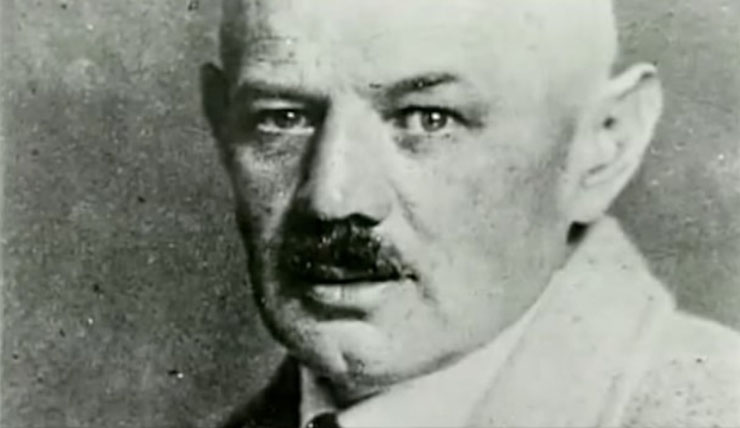
    Dietrich Eckart (1868-1923) was a prominent figure in Germany’s bohemian and occult subculture before World War I. A well-known playwright, poet and journalist, he was involved with the shadowy Baron Rudolf von Sebottendorff and the secretive Thule Society in Munich.

    After hearing Adolf Hitler speak at a political meeting in 1919, Eckart recognised Hitler’s talent as a demagogue and an organiser. He saw in Hitler someone who could translate the occult worldview of the Thule into action. He quickly took Adolf Hitler under his wing and made him his protégé.

    Eckart popularised a central tenet of the Thule Society, the belief in the coming of a “German Messiah” who would redeem the nation from its defeat in World War I. Eckart expressed his anticipation in a poem he wrote months before he first met Hitler. In the poem, Eckart refers to ‘the Great One’, ‘the Nameless One’, ‘Whom all can sense but no one saw’. When Eckart met Hitler, Eckart was convinced that he had encountered the prophesied saviour.

    Eckart introduced Hitler to Capt. Ernst Rohm, who had important links to senior officers in the German army. Rohm, an open homosexual later murdered on Hitler’s orders, headed up the Thule Society’s military wing. Other Thule initiates Eckart introduced to Hitler included Rudolf Hess (who would become Hitler’s deputy) and Alfred Rosenberg (later to play an important role in the Third Reich).

    Significantly, Eckart provided Hitler with funds and supported him in his rise within the German Workers’ Party (DAP), the Thule Society’s political front group. Eckart had been one of the founders of the party which Hitler quickly transformed into the National Socialist German Workers’ Party (NSDAP). He was the original publisher of the party tabloid, the Völkischer Beobachter, a Munich newspaper first bought by Rudolf von Sebottendorff in the name of the Thule Society. Eckart also wrote the lyrics of the quasi-mystical Nazi anthem “Germany Awake.”

    Historians agree that Eckart exerted considerable – and unequalled – influence on Hitler. Without his patronage the young Austrian veteran would never have become the leader of the party that came to completely dominate Germany in the 1930s.

    Under Eckart’s guidance Hitler was first made into a political Führer. His 1921 article was in fact the first to describe Hitler as the “Führer” of the German people. He put his library at Hitler’s disposal and taught him to express himself more articulately.

    Eckart is credited with helping Hitler develop his almost hypnotic power of oratory. As Professor Alan Bullock observed in Hitler: A Study in Tyranny: “Hitler’s power to bewitch an audience has been likened to the occult arts of the African medicine-man or to the Asiatic shaman; others have compared it to the sensitivity of a medium and the magnetism of a hypnotist.”

    So who was Dietrich Eckart?

    Eckart has been called “a seeker of other realities,” regarded by some as a mystic and a seer. No ordinary political journalist, one biographer noted:

    Dietrich Eckart was never a politician in the usual sense. As a politician he remained – as he did a poet – a seer of essentials, and from this standpoint he passed judgement on men and events. With the politics of everyday and their advancement, with practical Realpolitik and its hypocrisy and readiness to compromise, he had nothing to do. (Adolf Dresler, Dietrich Eckart, 1938)

    THE ‘MASTER-ADEPT’

    Addicted to morphine for much of his life and suffering from alcoholism in his later years, Eckart was described by the American journalist Edgar Ansel Mowrer as “a strange drunken genius.” His friend Alfred Rosenberg wrote of him: “Without the sweet poison [of morphine] he could not live… Eventually he was taking daily measures from which a normal man, not possessed of such bear-like strength, would have died.”

    An incurable romantic, Dietrich Eckart saw himself as following in the tradition of the great German thinkers Heinrich Heine, Arthur Schopenhauer and Angelus Silesius. He was also well acquainted with Buddhism and the lore of ancient India.

    However, according to James Webb, author of The Occult Establishment, “the basis of Eckart’s doctrine was Christian mysticism. Man must free himself from the world and deny the supremacy of matter, which is illusion. Only death will break the spell under which humanity labours.”

    The German historian Steigmann-Gall concludes that, “far from advocating a paganism or anti-Christian religion, Eckart held that, in Germany’s post-war tailspin, Christ was a leader to be emulated.”

    The British author Trevor Ravenscroft in his sensationalist best-selling book The Spear of Destiny describes Eckart as the “Master-Adept” responsible for Hitler’s rise from obscurity to absolute power. “Dietrich Eckart,” says Ravenscroft, “contrived to open the centres in the astral body of Adolf Hitler, giving him the possibility of vision into the macrocosm and a means of communication with the Powers.”

    The French writers Pauwels and Bergier in their Morning of the Magicians also single out Dietrich Eckart as Hitler’s occult master. They claim that Eckart’s role as an occult counsellor was related explicitly to invisible hierarchies.

    Thule was thought to have been the magic centre of a vanished civilisation. Eckardt [sic] and his friends believed that not all the secrets of Thule had perished. Beings intermediate between Man and other intelligent beings from Beyond, would place at the disposal of the Initiates [i.e. the members of the Thule Society] a reservoir of forces which could be drawn on to enable Germany to dominate the world … [its] leaders would be men who knew everything, deriving their strength from the very fountain-head of energy and guided by the Great Ones of the Ancient World.

    Researchers of the occult, as well as some spiritual teachers, have long concluded Adolf Hitler was a vehicle for other forces. Something or someone else was behind him. Was Dietrich Eckart the vital link between Hitler and those Powers? After Eckart’s death in 1923, Hitler deliberately attempted to conceal his immense debt to the Thule. Once in control of Germany, he ordered the ruthless suppression of all occult organisations and esoteric teachings.

    After a few years as pupil of the master Eckart, Hitler embarked on his own ‘independent’ path. From the mid-1920s, Adolf Hitler felt he had outgrown the occultist milieu, and was now solely dependent on “Providence” to guide him to victory. In Mein Kampf, Hitler’s contemptuous attack on ‘wandering scholars’ showed his disdain for the conspiratorial secret society approach of groups like the Thule Society.

    Eckart’s influence waned with Hitler’s growing renown and self-confidence. The original vision of the Thule was sacrificed in the brutal and bloody struggle for power and control. However, up to his death in 1945, Hitler continued to hold Dietrich Eckhart in high regard. He dedicated the second volume of Mein Kampf to his deceased mentor.

    Get the issue this article appears in

    The controversial Indian guru Osho (formerly known as Bhagwan Shree Rajneesh) declared “Hitler was used by an esoteric group” and “the entire concept of Hitler’s philosophy was given by some hidden schools.” Osho believed that once Hitler became ‘independent’ he began to go down. Osho claimed:

    Who was behind this? Some esoteric group was behind this, and that esoteric group was trying something. When Hitler became independent, he lost every power. In his last days, he was just ordinary. After this particular moment, when he lost contact, whatsoever he did went against him. Before this, whatsoever he did was always in his favour. (I Am The Gate)

    Historians have yet to fully uncover the complex underground of German secret societies and occult traditions from which the Nazi Party emerged early last century. When they do, Dietrich Eckart will surely be revealed as the occult mage who conjured Adolf Hitler.

    [alert type=”general” dismiss=”no”]This article was published in New Dawn Special Issue Vol 7 No 3.[/alert]

    [alert type=”success” dismiss=”no”]If you appreciate this article, please consider subscribing to help maintain this website.[/alert]

    © New Dawn Magazine and the respective author.
    For our reproduction notice, click here.