New Dawn – World's Most Unusual Magazine

Category: Secret History

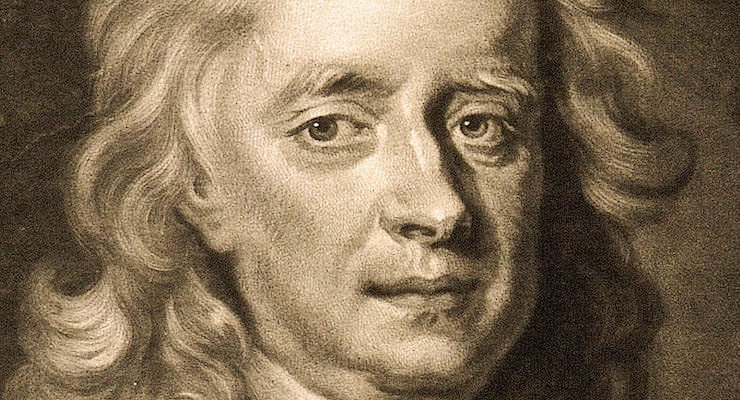
  • Sir Isaac Newton & the Land Where Time Began

    Sir Isaac Newton & the Land Where Time Began

    From New Dawn Special Issue Vol 7 No 3 (June 2013)

    The sixth-century BCE Greek philosopher-mystic Pythagoras was a man of spectacular achievement. Plutarch says that he taught an eagle to come at his command and stoop down to him in flight.1 He taught the doctrine of reincarnation and was thought to remember twenty-two of his past lives. He founded an order whose adherents strove to free themselves from the cycle of earthly incarnations through vegetarianism, silence, and contemplation of the ultimate reality of the universe.2

    Up through the seventeenth century CE, scholars believed Pythagoras journeyed to Sidon, in Phoenicia, where he met the descendants of a man named Moschus (or Mochus) who had lived five hundred years before. Moschus was the Phoenician name for Moses, and his descendants gave Pythagoras esoteric doctrines passed down to them from their illustrious ancestor.3

    Pythagoras returned to his home in the Greek colony of Crote in southern Italy to further develop his mystical philosophy which stated that the numerical relationships reflected in the relationships between musical chords are the bedrock of reality. Adding to this the secret doctrines of Moses, he discovered that the planets revolved around the sun. He also discovered the law of universal gravitation (including the inverse-square law of attraction), which he expressed allegorically as the divine music of the spheres holding the planets in thrall to the sun.

    But, wait a minute! Didn’t Sir Isaac Newton (1642-1727) discover the law of universal gravitation?

    Yes, he did. But Sir Isaac didn’t think his discoveries were original. He thought he was recovering parts of a body of primordial knowledge called the prisca sapientia (the “pristine wisdom”). Bits of this ancient knowledge had been transported through the Flood by Noah. It had caught the interest of the Egyptians, then the Jews, then the Phoenicians, until it emerged almost fully-blown in the philosophy of Pythagoras. It spread throughout the ancient world, meeting with resistance only when Aristotle insisted that the sun revolved around the earth and that many of the Pythagorean beliefs were irrational.

    Almost all this knowledge disappeared in the third and fourth centuries CE with the collapse of the Roman Empire. So complete was the loss that mathematician Alfred North Whitehead could say in 1970: “By the year 1500 Europe knew less than Archimedes, who died in 212 BCE.”4 The “sacred philosophy” did not re-emerge until after the fall of Constantinople in 1453, when it was rediscovered in ancient texts, many thought lost forever, many never known, by the seers of the Italian Renaissance.

    The French philosopher/mathematician René Descartes (1596-1650) believed in the existence of the prisca sapientia, declaring that when God created mankind, “certain primary seeds of truth [were] implanted by nature in our human minds.” By Descartes’s time the seeds had been “stifled [in us] owing to our reading and hearing, day by day, so many diverse errors.” Descartes regretted that the ancients had concealed these truths in symbols. He suspected their motives: “They have perhaps feared,” he remarked scornfully, “that their method being so very easy and simple, would if made public, diminish, not increase public esteem.”5

    Isaac Newton and his contemporaries believed that, in the pre-Flood world where truth and the bounty of God walked hand-in-hand, the places of worship resembled a combination of planetarium and cathedral. Astronomy flourished in this land of the perfect fusion of science and spirituality, especially since the antediluvian peoples lived for centuries (this was the time of Methuselah, who died at the age of 969). Richard Hinckley Allen writes:

    Following the opinion of [the first-century CE Jewish historian] Josephus, [the second-century CE Christian theologian] Origen said that the constellations were known long before the days of the patriarchs by Noah, Enoch, Seth, and Adam – indeed were mentioned in the Book of Enoch as ‘already named and divided;’ and he claimed that ancient longevity was a blessing specially bestowed to give opportunity for a long-continued period of observation and comparison of the heavenly bodies.6

    Josephus consulted the historical records of Tyre (which were lost not long after his death) and wrote enigmatically that this knowledge survived the Flood thanks to the preservation of one of the pillars upon which all knowledge had been inscribed.7

    William Stukeley, Newton’s contemporary, and the first archaeologist to truly understand Stonehenge, read multiple ancient sources and declared that the pre-Flood sages got along without a telescope because “in the beginning of the world… [people] lived 7, 8, or 900 years, [and] they had time in one man’s life to perfect the art of astronomy.” Both William Whiston and Newton believed the people of the land of the prisca sapientia understood the circulation of the blood and that white light contains within itself the spectrum of seven colours8 (William Harvey would “rediscover” the first, and Newton would rediscover the second).

    These ideas (which we will shortly examine at length, especially as regards Isaac Newton) began to fade in the mid-seventeenth century. They succumbed in the face of man’s widening exploration of the world, which contradicted the idea of a universal Flood; to the dawning of the Age of Reason, which brought with it a process of demythologising; and to Darwin’s discoveries of the age of the earth and the origin and evolution of species.

    The Sources of the “Pristine Wisdom”

    These ideas would fade – but they never quite faded away. In the early twentieth century, certain maverick artists and thinkers revived the notion of a pure science and a high civilisation that existed before our own. British novelist D.H. Lawrence (1885-1930), author of Sons and Lovers and Women in Love, wrote in Fantasia of the Unconscious in 1922:

    I honestly think that the great pagan world of which Egypt and Greece were the last living terms, the great pagan world which preceded our era, once had a vast and perhaps perfect science of its own, a science in terms of life. In our era this science crumbled into magic and charlatanry. But even wisdom crumbles.

    I believe that this great science previous to ours and quite different in constitution and nature from our science once was universal, established all over the existing globe. I believe it was esoteric, invested in a large priesthood. Just as mathematics and mechanics and physics are defined and expounded in the same way in the universities of China or Bolivia or London or Moscow today, so, it seems to me, in the great world previous to ours a great science and cosmology were taught esoterically in all countries of the globe, Asia, Polynesia, Atlantis, and Europe.

    …In that world men lived and taught and knew, and were in one complete correspondence over all the earth. Men wandered back and forth from Atlantis to the Polynesian Continent as men now sail from Europe to America. The interchange was complete, and knowledge, science was universal over the earth, cosmopolitan as it is today.

    Then came the melting of the glaciers, and the world flood. The refugees from the drowned continent fled to the high places of America, Europe, Asia, and the Pacific Isles. And some degenerated naturally into cave men, neolithic and palaeolithic creatures, and some retained their marvellous innate beauty and self-perfection, as the South Sea Islanders, and some wandered savage in Africa, and some, like Druids or Etruscans or Chaldeans or Amerindians or Chinese, refused to forget, but taught the old wisdom, only in its half-forgotten symbolic forms. More or less forgotten, as knowledge: remembered as ritual, gesture, and myth-story.9

    Maverick Armenian-Greek mystic/spiritual teacher G.I. Gurdjieff (1877?–1949) believed the Sufis were the spiritual heirs of “the old master magicians of Altai” who lived in an advanced civilisation in Central Asia that began 40,000 years ago. Gurdjieff’s disciple J.G. Bennett wrote that, according to his teacher:

    In that palaeolithic age art and religion were still one; secular and religious consciousness had not yet separated out, and spirit and matter were not yet in opposition; nor was evil an absolute force seeking the overthrow of good. All things and all attitudes to things were filled with the magnetic, synthesizing radiance of hypercosmic energy, which Gurdjieff called conscious energy. In such a unified world the great Initiates developed the unique type of spirituality that still distinguishes Sufism today, wherein the polarising activity of mind is submissive to the over-riding Spirit that ever seeks a return to the One. Only in the later more alienated religious systems, Gurdjieff believed, do we find the divisive seeds of philosophical dualism.10

    Newton’s Primordial Cathedral-Planetariums

    Sir Isaac Newton wouldn’t have accepted Gurdjieff’s idea of the antediluvian world, but he would have agreed with him that spirituality was on a par with science in that era. Newton never ceased striving to find out the nature of the prisca sapientia in its purest form. He had deduced the existence of the primordial cathedral-planetariums from the temples, which he called prytanea after the later Greek model, that had been erected not long after the Flood and whose structures contained echoes of the prisca sapientia. Historian Robert Markley contends that these prytanea embodied a timeless mathematical form; that they were “a kind of computational code by which true knowledge [of the prisca] could be demonstrated and transmitted without interruption, interference, or corruption.”11 Newton speculated that the shape of the prytaneum had been transported through the Flood in the shape of the Ark itself; he thought the “divine dimensions” of the prytanea and the Ark were later embedded in Solomon’s temple. The ancient prytaneum “framed,” or mirrored, the shape of the Solar System; this shape had been embodied in later temples. Noah’s Ark had transported sacred fires that had burned in the prytanea; Noah used this to prepare a burnt offering to the Lord once the Ark had made landfall. And, in these temples, Newton further deduced, the priests and priestesses had circled around the ever-burning flame in the central hearth in emulation and worship of the celestial bodies that revolved around the sun.

    A great deal of apocryphal literature surrounds the Noahic Flood story. From its mention in the Koran and the New Testament, Newton may have known the story of the ever-burning light that illuminated the inside of the Ark. Journalist Rene Noorbergen tells us that references in the Bible support the contention that

    …Electricity may have played a vital role in the operation of the ark. One reference is found in Genesis 8:6, where the Hebrew word challon or ‘opening’ is used, referring to the window through which Noah released the birds. The other reference, however, utilises a different word – tsohar – which is translated as ‘window‘ but does not mean window or opening at all! Where it is used (twenty-two times in the Old Testament), its meaning is given as ‘brightness, a brilliance, the light of the noonday sun’. Its cognates refer to something that ‘glistens, glitters or shines’. Many Jewish scholars of the traditional school identify tsohar as ‘a light which has its origins in a shining crystal’. For centuries Jewish tradition has described the tsohar as an enormous gem or pearl that Noah hung from the rafters of the ark, and which, by some power contained within itself, illuminated the entire vessel for the duration of the Flood voyage.12

    Newton may also have known the story, told by John Cassianus in about 428 CE, that Noah’s son Cham (or Ham) was “expert in all the arts and sciences of the antediluvian generations, and wished to save this accumulated natural knowledge of man.” His father forbade him to bring the “unholy” knowledge on board the Ark. Cham inscribed the knowledge on metal plates which he buried. After the Flood, Cham succeeded in finding these plates; thus, writes Cassianus, he “transmitted to his descendants a seedbed of profanity and perpetual sin.”13

    Did the descendants of Moses really pass knowledge to Pythagoras? Could Moses possibly have known anything about the philosophy of the pre-Flood world?

    Newton thought that the biblical description of Creation was written by the prophet Samuel, who had gotten his information from Moses. The description hardly sounds scientific to us today; but Newton insisted the Genesis account was accurate but couched in simplistic terms because the author wanted the common man to understand it. To the objection that the entire Creation could scarcely have happened in seven twenty-four-hour periods, Newton replied that God had started the world rotating on its axis only on the fourth or fifth day, and then slowly the Deity simply made the days long enough to accomplish all He had to accomplish.

    (We know now that the historians of the late Renaissance wanted to prove that Mosaic doctrines influenced Pythagoras because they could not bear to believe that some of the greatest ideas in the Western world had originated in pagan Greece. If these ideas didn’t originate in the Christian New Testament, then they were determined to prove that the ideas came from the Hebrew scriptures which formed the background to Christianity.)

    Frank Manuel explains in The Religion of Isaac Newton that: “Moses knew the whole of the scientific truth – of this Newton was certain – but he was speaking to ordinary Israelites, not delivering a paper to the Royal Society, and he popularised the narrative without falsifying it.”14 Rob Iliffe similarly explains that in the early post-Flood world the priesthood “concealed these [scientific] truths from the vulgar. At this time there was a ‘sacred’ philosophy – communicated only to the cognoscenti – and a ‘vulgar‘ version, promulgated openly to the common people.”15 Newton himself sounds almost as critical as Descartes when he remarks sardonically that, “The [ancient] philosophers loved so to mitigate their mystical beliefs that in the presence of the vulgar they foolishly propounded vulgar matters for the sake of ridicule, and hid the truth beneath discourses of this kind.”16
    Pythagoras & Newton: Same Theories, Different Time Period

    Can it possibly be that Newton’s scientific discoveries, which revolutionised the world, were known in every detail to Pythagoras and his followers in the sixth century BCE?

    Sometime in the 1690s, Newton confided to a disciple, the Scottish mathematician David Gregory, that he intended, in the forthcoming revised edition of the Principia, to, in Gregory’s words,

    spread himself in proving the agreement of his own findings with those of the ancients and ‘principally of Thales’, the legendary founder of Greek philosophy. He would demonstrate that what Epicurus and Lucretius had affirmed was true and valid, and that the charge of atheism laid on them was unjust. [Newton would assert that] Thoth, the Egyptian Hermes or Mercury, had been ‘a believer in the Copernican system’, while Pythagoras and Plato had ‘observed the gravitation of all bodies towards all’.17

    In 1692, at the instigation of Newton, his close friend the brilliant young Swiss mathematician Nicolas Fatio de Duillier told the eminent Dutch mathematician/astronomer Christiaan Huyghens in a letter that Newton had discovered that all the chief propositions of the Principia [Mathematica] had been known to ancients like Pythagoras and Plato, although those worthies had turned them into a “great mystery.” A startled Huyghens wrote back that the ancients may have known the solar system was heliocentric, but they could not possibly have known that the orbits of the planets were elliptical.18

    Newton begun very early to disseminate these ideas to those who were closest to him. In Book Two of the 1685 De Mundi, he describes the ancient philosophy and astronomy behind the work of Plato, Pythagoras, and the Roman King Numa Pompilius. Newton argued, as Newton Project Director Rob Iliffe explains, that

    the Ancients had believed in a heliocentric cosmos but that this had been perverted by misinterpretation. Whereas Pythagoras and others had correctly understood the true meaning of symbolic representations of a heliocentric cosmos, with a central Sun encircled by the concentric orbits of the planets, Greeks such as Aristotle assumed that the central object in such a scheme was the Earth…. Via Orpheus and Pythagoras, the Greeks had originally received their understanding of the natural world from the Egyptians.

    Not only did Thoth (the Egyptian Mercury) know that the planets went around the sun, but Moses had promulgated the theory that atoms are the fundamental building blocks of the universe.19

    David Gregory summarised the ancient beliefs that Newton believed anticipated the Principia:

    The moon was like another Earth, and itself like other celestial bodies; therefore, the planets and their satellites were heavy masses of the same substance as the Earth;

    Bodies in the solar system exercised a mutual gravitation that extended to all other systems (each fixed star being the centre of a gravitational system of planets), that force itself extending indefinitely in all directions;

    All matter was made of atoms, and they were hard, solid, and immutable; gravity accrued to both atoms and to the bodies they composed; gravity was proportional to the quantity of matter in every body;

    The proportion in which gravitational power decreased with distance was analogous to the law governing tension and pitch in a string instrument, and was concealed in the ancient concept of the “harmony of the spheres;”

    The cause of gravity was explained in the “mystical philosophy” of the ancients by their supreme divinity, Pan, playing on his pipe – that is, by the direct exercise of God’s divine power in all bodies whatsoever.20

    But what does it mean to say that “the harmony of the spheres” is the same as the inverse-square law of gravitational attraction? One of the clearest explanations comes from Newton’s time, from the hand of arguably Newton’s most brilliant disciple, the mathematician Colin MacLaurin. He wrote in 1750:

    A musical chord gives the same notes as one double in length, while the tension or force with which the latter is stretched is quadruple: and the gravity of a planet is quadruple of the gravity of a planet at a double distance. In general, that any musical chord may become unison to a lesser chord of the same kind, its tension must be increased in the same proportion as the square of its length is greater; and that the gravity of a planet may become equal to the gravity of another planet nearer to the sun, it must be increased in proportion as the square of its distance from the sun is greater. If therefore we should suppose musical chords extended from the sun to each planet, that all these chords might become unison, it would be requisite to increase or diminish their tensions in the same proportions as would be sufficient to render the gravities of the planets equal. And from the similitude of these proportions the celebrated doctrine of the harmony of the spheres is supposed to have been derived.21

    For some commentators, the question of the supposed similarity of Newton’s doctrines with those of Pythagoras takes second place to an even more beguiling question: If Newton hadn’t totally immersed himself in the philosophy of Pythagoras, would he ever have come up with the universal law of gravitation? Did Pythagoras’ tantalising notions of the music of the spheres and the pipes of Pan, insofar as they represented a true portrait of the dynamics of the universe – to push, prod, stretch, open up, redirect, inspire and bedevil Sir Isaac – that had it not been for them, he would never have conceived the idea of an all-controlling gravitation? (A secondary question, occasionally asked, is: Did the prolonged meditation of Pythagoras on the mystical number of seven provide Newton with an indispensable impetus pushing him to the discovery that light is composed of seven colours?)

    In a seminal article, “Newton and the Pipes of Pan,” J.E. McGuire and J.B. Rattansi tackle this question. They explain that Newton’s textual analyses of ancient natural philosophy

    …provide a pedigree for his own doctrines, to legitimate them for an audience which still widely accepted the idea of a prisca sapientia. He could use them as a direct defense for his own doctrines, as he does in the Opticks, and, on one occasion, during the controversy with Leibniz. Furthermore, the documents dealt with in this paper do not tell us whether his own adoption of the doctrines he ascribes to the ancients preceded his textual studies. Such basic problems as the existence of the void, the properties of matter, and the character of the divine agency lay beyond the experimental procedures they could deploy. Newton’s solutions to some of these problems are explained and defended by the analogical reasoning whose patterns he defined in the Regulae. But the possibility that the ancient texts might have provided clues, and guided his thoughts in one direction or another, can by no means be excluded.22 (author’s underlining)

    Beyond the question of whether Newton’s intense meditation on the philosophy of Pythagoras was indispensable to his discovery of the principle of universal gravitation, there lies an equally beguiling question (and one that could never have been raised in Newton’s time):

    After years of collaboration with analytical psychologist Carl Jung, Nobel Prize-winning Austrian physicist Wolfgang Pauli (1900-1958) came to the conclusion that the collective unconscious posited by Jung certainly existed. Pauli further decided that the archetypes theorised by Jung (and which he thought had a greater reality than physical reality) certainly existed, and that the fundamental components of science, the “background physics” of the universe, so to speak, derived their being without a doubt from those archetypes.23

    Did Sir Isaac Newton and Pythagoras, across the gulf of 2,300 years, tap into the very same cluster of archetypes of the collective unconscious – that same single cluster that gave its essential shape to both the principle of gravitation and the allegory of the music of the spheres?

    If this is so, perhaps René Descartes, with his notion of the prisca sapientia as comprised of seeds of truth planted in the mind of man, is closer to the truth than Sir Isaac Newton, who saw in the prisca sapientia the spiritual and scientific force that defined a pristine primordial land that still couldn’t save itself from God’s wrath in the form of the Flood.

    [alert type=”general” dismiss=”no”]This article was published in New Dawn Special Issue Vol 7 No 3.[/alert]

    [alert type=”success” dismiss=”no”]If you appreciate this article, please consider subscribing to help maintain this website.[/alert]

    Footnotes

    1. Plutarch, The Lives of the Ancient Greeks and Romans. Translation by John Dryden, The Modern Library, 1992, 80
    2. Eduard Zeller, Outlines of the History of Greek Philosophy, Meridian Books, 1955, 47-48
    3. J.E. McGuire & P.M. Rattansi, “Newton and the ‘Pipes of Pan’,” Notes and Records of the Royal Society of London, Vol. 21, No. 2 (Dec., 1966), 130
    4. Marcelo Gleiser, The Dancing Universe: From Creation Myths to the Big Bang, Dutton/Penguin Group, 1997, 70
    5. Quoted in Prisca Sapientia, MathPages, www.mathpages.com/home/kmath066/kmath066.htm
    6. Richard Hinckley Allen, Star Names: Their Lore and Meaning, Dover, 1963 (1899), 27-28
    7. Quoted in Jed Z. Buchwald & Mordecai Feingold, Newton and the Origin of Civilization, Princeton University Press, 2013. (Yahuda MS 16.2 fols. 47V, 52; Josephus, 1841)
    8. David Boyd Haycock, William Stukeley: Science, Religion and Archeology in Eighteenth-Century England, Boydell Press, 2002, 95 (The Newton Project) www.newtonproject.sussex.ac.uk/view/texts/normalized/OTHE00021
    9. D.H. Lawrence, Psychoanalysis and the Unconscious and Fantasia of the Unconscious, Mineola, 2005, 54-55
    10. Victoria LePage, “G.I. Gurdjieff & the Hidden History of the Sufis,” New Dawn 107 (March-April 2008), 67-72
    11. Robert Markley, “Newton, Corruption, and the Tradition of Universal History,” In Newton and Religion: Context, Nature, & Influence, James E. Force & Richard H. Popkin, eds. Dordrecht, Kluwer Academic Publishers, 1999, 136
    12. Rene Noorbergen, Secrets of the Lost Races: New Discoveries of Advanced Technology in Ancient Civilizations, Bobbs-Merrill, 1977, 45-46
    13. Joseph Needham, Science and Civilization in China, Volume 5, Chemistry and Chemical Technology, Part IV, Spagyrical Discovery and Invention: Apparatus, Theories and Gifts, Cambridge University Press, 1980, 346
    14. Frank E. Manuel, The Religion of Isaac Newton, The Fremantle Lectures 1973, Clarendon Press, 1974, 364-365
    15. Rob Iliffe, Newton: A Very Short Introduction, Oxford University Press, 2007, 96
    16. Sir Isaac Newton, The Original of Religions, (The Newton Project) www.newtonproject.sussex.ac.uk
    17. McGuire & Rattansi, 109-110
    18. Ibid., 110
    19. Iliffe, 96
    20. Rattansi, 187-188
    21. Quoted in McGuire & Rattansi, 117
    22. Ibid., 137
    23. John Chambers, “Physics and the Unconscious: The Discoveries of Wolfgang Pauli and Carl Jung,” Atlantis Rising 98 (March-April 2013), 39

    © New Dawn Magazine and the respective author.
    For our reproduction notice, click here.
  • A New Dawn of Fantastic Realism: ‘Nothing that is Strange is Foreign to us!’

    A New Dawn of Fantastic Realism: ‘Nothing that is Strange is Foreign to us!’

    From New Dawn 165 (Nov-Dec 2017)

    “The paths of Fantastic Realism… do not resemble the ordinary paths of knowledge.”
    – Louis Pauwels & Jacques Bergier, The Morning of the Magicians

    As Richard Smoley rightly pointed out, “a noted predecessor” of New Dawn magazine “was the French review Planète (‘Planet’), published by Louis Pauwels and Jacques Bergier as a follow-up to the sensational success of their book Morning of the Magicians.” Inspired directly by Pauwels’ and Bergier’s book and Planète journal, New Dawn continues a subversive tradition of delving into subjects as fascinating and wide-ranging as secret societies, ancient mysteries, conspiracies, arcane prophecies, vanished civilisations, UFOs, supernatural phenomena, the awakened state….

    Like the French Planète (published 1961–1972), New Dawn was founded on the premise that reality is far more fantastic than how we limit it under conventional scientific, political, historical and cultural models. “If New Dawn magazine,” wrote editor David Jones in the March-April 2014 issue, “has a guiding philosophy or general orientation,” it would be, “Fantastic Realism with its slogan ‘Nothing that is strange is foreign to us!’”

    Grounded in the worldview of Fantastic Realism, New Dawn magazine is dedicated to exploring what Jacques Bergier and Louis Pauwels identified in The Morning of the Magicians, namely:

    Trends of thought that escape the notice of the trained observer; writings and works to which the sociologist pays scant attention, together with social phenomena that he considers too insignificant or too odd to worry about, are perhaps a sure indication of events to come than facts that are there for all to see and the openly expressed opinions and general trend of thinking which cause him serious concern.

    What exactly is Fantastic Realism? The answer is clearly outlined in The Morning of the Magicians:

    We call our point of view fantastic realism. It has nothing to do with the bizarre, the exotic, the merely picturesque. There was no attempt on our part to escape the times in which we live. We were not interested in the ‘outer suburbs’ of reality: on the contrary we have tried to take up a position at its very hub. There alone, we believe the fantastic is to be discovered – and not a fantastic leading to escapism but rather to a deeper participation in life…. The fantastic is usually thought of as a violation of natural law, as a rising up of the impossible. That is not how we conceive it. It is rather a manifestation of natural law, an effect produced by contact with reality – reality perceived directly and not through a filter of habit, prejudice, conformism.

    Long before the ‘X-Files’, ‘Ancient Aliens’ and the contemporary fascination with conspiracies and cover-ups, Fantastic Realism raised questions like: Are we all in a collective conspiracy to hide the truth, and is science such a conspiracy? Do secret societies exist and have they influenced history? What special knowledge did the ancients possess that we may not possess now? What role did occult forces play in the origins and rise of Nazism? What does the future promise for our civilisation? Are there Mutants among us? Does extrasensory perception reveal that human consciousness has advanced beyond its currently accepted limits? What connects the ancient art of alchemy and modern atomic physics?

    Readers of New Dawn magazine will immediately realise they are on familiar territory. Some readers may even find themselves in agreement with author and esoteric scholar James Wasserman when he described Fantastic Realism as a look behind “the many masks of God.” Fantastic Realism, Wasserman noted, “declares that an objective appreciation of the material world is a means by which we may attain an awakened state of consciousness, the next step in human evolutionary destiny.”

    Implicit in the approach pioneered by Fantastic Realism is a rejection of all reductionism, conformity, as well as the false dichotomy of Either/Or, Black-White thinking. Presenting hypotheses, examining the ‘outer limits’ of the human experience, and highlighting modern scientific and social falsehoods, does not mean embracing crusading dogmas or sentimental simplistic answers. It does, however, require leaving behind the ‘accepted wisdom’ of the herd.

    “Real intelligence,” the French writer Aimé Michel said, “lies in being able to think further than is allowed.” Aimé Michel, a Fantastic Realist collaborator and influential UFO researcher, always focused on “all that goes beyond the human,” maintaining that his objective was not to be limited by any external constraint. “It’s time to discover that all systems of thought,” Michel asserted, “are actually systems to AVOID thinking!”

    The task then, as summed up in the slogan of the New Dawn masthead ‘Open Your Mind to New Ideas’, is to transcend the narrow confines and closed-minded thinking of consensus reality. But first, the reader must not be afraid to question conventional knowledge, put aside all prejudice and assumption, and consider a different method of interpreting reality. As Louis Pauwels urged his readers all those years ago, what is needed is to look at reality with new eyes or, more accurately, with “awakened eyes.”

    A former student of George Gurdjieff, Pauwels made a key component of Fantastic Realism Gurdjieff’s observation that Man is asleep and must be shocked into an awakened state in order to perceive true reality. With this in mind, the astute reader of New Dawn gains a deeper awareness and understanding of what this magazine is all about. New Dawn magazine is a magic portal to another way of seeing Man and the world, a doorway to a new consciousness, a new humanity, and a new era.

    “Reality is not only queerer than we suppose but queerer than we can suppose.”
    – J. B. S. Haldane (1892–1964), outstanding scientist and polymath

    [alert type=”general” dismiss=”no”]This article was published in New Dawn 165.[/alert]

    [alert type=”success” dismiss=”no”]If you appreciate this article, please consider subscribing to help maintain this website.[/alert]

    © New Dawn Magazine and the respective author.
    For our reproduction notice, click here.
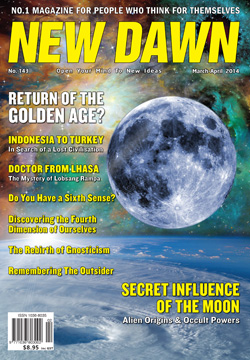
  • The Secret Influence of the Moon: Alien Origins & Occult Powers – An Interview with Louis Proud

    The Secret Influence of the Moon: Alien Origins & Occult Powers – An Interview with Louis Proud

    From New Dawn 143 (Mar-Apr 2014)

    Despite its proximity and influence on planet Earth, our understanding of the Moon – and the mechanism by which it formed – remains incomplete. The Moon is holding out on a number of mysteries that science hasn’t solved. In the past few years there has been a resurgence of interest in the Moon, perhaps due to the fact that we barely understand our cosmic neighbour.

    It is fortuitous and timely that long time New Dawn contributor Louis Proud recently completed his book The Secret Influence of the Moon: Alien Origins and Occult Powers.

    A writer and researcher specialising in paranormal and occult phenomena, Louis’ first book was Dark Intrusions: An Investigation into the Paranormal Nature of Sleep Paralysis Experiences.

    The mysteries of the Moon go far beyond the scientific. To bring us the full picture, Louis has ventured into territory of a more fantastic and metaphysical nature. He delves into the entire gamut of long held theories – popular, esoteric and occult – including alien and hostile forces on the Moon, and its vampiric powers.

    Louis Proud has been interviewed about his book by Jeffery Pritchett of the online radio show The Church of Mabus (www.churchofmabusradio.com), which covers high strangeness in the field of the paranormal.

    JEFFERY PRITCHETT (JP): What inspired you to write your new book, The Secret Influence of the Moon: Alien Origins and Occult Powers?

    LOUIS PROUD (LP): I’d been closely researching the Moon for a number of years, from both scientific and esoteric perspectives, and I wrote the book as an attempt to collate and compile this research. I’ve long been fascinated by the Moon and its mysteries. My interest in the Moon deepened significantly when, many years ago, I first became acquainted with the Spaceship Moon theory. The idea that the Moon is a part-natural, part-artificial world, as stated by this theory, piqued my imagination and made me question all of my preconceptions about the Moon. One of my objectives in writing the book was to see if the Spaceship Moon theory has validity in light of contemporary lunar discoveries. (The theory originated in 1970 and hasn’t been updated since that time.)

    JP: Would you go into why you think the Moon may have alien origins?

    LP: The Moon is an immensely strange object and highly unique within the solar system. Of the four terrestrial planets (Mercury, Venus, Earth, and Mars), Earth and Mars are the only two that possess moons. Mars has two moons: Phobos and Deimos. These, however, are extremely small, whereas Earth’s moon is extremely large. In fact, it’s the largest moon in the solar system relative to the size of its host (Earth). Because of its large size, in addition to other factors, some astronomers think of the Moon as Earth’s twin planet rather than Earth’s satellite. This would make the Earth and the Moon a double-planet system rather than a planet-satellite system. The former model is the one I subscribe to.

    Of course, just because the Moon is odd and unique doesn’t mean it has “alien origins.” In my book, I argue that the Moon has alien origins on account of its numerous artificial characteristics. There’s good evidence, for example, that the Moon is partially hollow. Since, to borrow a quote from Carl Sagan in relation to the moons of Mars, “a natural satellite cannot be a hollow object,” the only way to explain the Moon’s apparent hollowness is if some kind of alien intelligence modified it long ago, perhaps in order to transform it into a suitable habitat.

    JP: Personally do you really think the Moon is home to alien life forms who seek to control humanity?

    LP: Much compelling evidence suggests that the Moon is and has long been inhabited by an alien intelligence, one that is hostile, manipulative, and parasitic towards humanity. The precise nature of this intelligence remains unknown and perhaps unknowable. Whether it is physical, non-physical or somewhere in-between is difficult to say. Personally I believe we’re dealing with something that operates primarily on a non-physical level but can assume physical form when required.

    What led me to this conclusion? First, a small percentage of reports of transient lunar phenomena (TLP) – short-lived lights, colours, and changes in appearance on the lunar surface – exhibit qualities suggestive of intelligence. Certainly not all of these reports can be explained in terms of natural phenomena. (By “natural phenomena” I am referring to such things as lunar outgassing and clouds of dust suspended above the lunar surface by means of electrostatic activity.)

    Secondly, many lunar myths allude to the Moon being inhabited by an alien intelligence. For example, according to the Zulu shaman Credo Mutwa, Zulu lore states that the Moon is not only an artificially-hollowed out planetoid from outside the solar system, it is also the home of manipulative and meddling reptilian beings called the Chitauri (“children of the serpent”). The Chitauri are synonymous with the Nagas of Buddhist and Hindu mythology. The latter are described as a strong and handsome race of half-human, half-serpentine beings of semi-divine status. (Naga is Sanskrit for “serpent.”) Nagas are related to all things watery – lakes, rivers, seas, wells, and so forth. And indeed, there is an ancient and universal belief that the Moon is related to all things watery. (No doubt this belief originated in part from the simple recognition that the Moon governs the tides.)

    Lastly, a number of occult teachings speak of the Moon in purely negative terms and even refer to it as the domain of sinister non-human beings who control and exploit humanity.

    JP: What findings from NASA’s Apollo missions have they concealed?

    LP: It’s clear that much was concealed from the public by NASA regarding what was discovered on the Moon during the Apollo program (and other programs). However, I’m inclined to believe that these suppressed discoveries were primarily geological in nature and relate to the lunar interior more than anything else. Of course, there are compelling rumours that the Apollo astronauts encountered UFO activity both within the vicinity of the Moon and on the lunar surface. A related rumour states that NASA discovered an extraterrestrial base on the far side of the Moon (the side that remains turned away from Earth) during Apollo 8 in 1968. Furthermore, anyone who’s read the work of Mike Bara and Richard Hoagland would be familiar with the theory that the surface of the Moon is littered with spectacular ancient structures in the way of glass domes and so forth. It is claimed these structures were photographed by NASA but that the photographs were either “tampered with” to remove evidence of the structures or never released to the public.

    Let me explain what I mean by these suppressed discoveries being primarily geological in nature. During the Apollo program, the astronauts placed on the lunar surface a network of seismometers (devices that measure and record seismic activity), as part of an effort by NASA to better understand the Moon’s internal structure. By triggering artificial moonquakes – caused by dropping discarded lunar modules (LMs) and other heavy objects on the lunar surface – it was discovered the Moon “rings like a bell” for periods of over an hour. The Moon is, to quote one scientist, “an almost perfect medium for the propagation of seismic waves.” This discovery – plus additional evidence discussed in my book – suggests the Moon is partially hollow. Since the Moon’s apparent hollowness cannot be accounted for naturally, it must have been hollowed out artificially. NASA has long been interested in the Moon’s peculiar internal characteristics, yet has remained suspiciously quiet on these matters. (NASA claims that its entire lunar seismic network was shut down in late-1977, though this could well be untrue.)

    JP: What are some of the many holes in the “Giant Impact” theory about the Moon’s origins and the evidence for a hollow, artificial Moon?

    LP: By far the biggest mystery of the Moon is how it came into being. Prior to the Apollo program, there were three contending theories as to the origin of the Moon. Known as the three classic theories of lunar origin, they are the Fission theory, the Coaccretion theory, and the Capture theory. All three theories were well and truly disproven by the end of the Apollo program. This gave rise, in the mid-1970s, to the Giant Impact theory, which is the theory accepted by most scientists today. The theory states that around 4.5 billion years ago, when the Earth was very young, a Mars-sized planet struck the Earth, producing a cloud of debris that coalesced to form the Moon.

    The Giant Impact theory has a number of major flaws. According to this theory, the Moon is supposed to have formed from a mixture of impactor material and earth material, with the percentage of impactor material far exceeding the percentage of earth material. The Moon and Earth should therefore possess dissimilar oxygen isotope ratios. An object’s oxygen isotope ratio, or signature, gives an indication of where it formed in the solar system. For example, the oxygen isotope signature of Mars is very different to that of Earth. Yet the Moon and Earth have practically identical oxygen isotope signatures. This suggests the impactor shared a similar orbit to the Earth, occupied that orbit for a very long time, yet somehow ended up striking the Earth – a most improbable scenario. To quote British geologist Ted Nield: “[I]t would be extremely unlikely that a wandering impactor would just happen to possess the exact same oxygen isotope profile as the object it hit.”

    Another piece of evidence that puts the Giant Impact theory on very shaky ground is the recent discovery of traces of water in samples from the lunar interior. The samples were found to contain similar levels of water as the Earth’s upper mantle. And yet, according to the Giant Impact theory, the Moon formed at an extremely high temperature and thus ought to be completely deprived of volatiles such as water. How, then, do we explain the presence of water in lunar samples?

    Now for the evidence of a hollow, artificial Moon. That the Moon is a hollow, partly-artificial object was first suggested by scientists Mikhail Vasin and Alexander Shcherbakov, both members of the Soviet Academy of Scientists, in a paper published in July 1970 in the journal Sputnik titled “Is the Moon the Creation of Intelligence?” According to their Spaceship Moon theory, the Moon is a planetoid from outside the solar system that was transformed into a spaceship – hollowed out and fitted with machinery and given a strengthened “hull” – and then flown to Earth and “parked” in orbit.

    While it’s true that the Spaceship Moon theory has numerous merits and helps to explain why the Moon appears to be hollow (and hence not wholly natural), it falls short by failing to account for the near identical oxygen isotope signatures between the Earth and Moon. In my book, I suggest that the Moon formed naturally alongside the Earth (as per the Coaccretion theory) but was later “hijacked” and artificially modified. I refer to this as the Hybrid Double Planet theory – “hybrid” because the Moon is a part-artificial, part-natural world and a “double planet” for reasons already explained.

    JP: Could you go into some of your occult findings regarding the Moon?

    LP: In my book I look at the Moon as it’s dealt with in the Qabalah, and I found this to be an extremely rich area of investigation. The Qabalah is a complex mystical tradition of Jewish origin and is considered the cornerstone of Western esotericism. Central to the Qabalah is the Tree of Life, a glyph that consists of ten spheres, called Sephiroth. Each Sephirah on the Tree of Life is ruled by a particular planet. The Sephirah Malkuth, for example, which corresponds to the physical plane, is ruled by Earth. The Sephirah ruled by the Moon is called Yesod and this corresponds to both the lower astral plane as well as to the etheric plane.

    The etheric is a blueprinting for the physical world and is virtually synonymous with Rupert Sheldrake’s theory of morphic fields, whereas the astral is the realm of emotions, of dreams, of illusions, and of spirits, demons, angels and other entities. The astral knows no bounds. It can be a place of beauty or one’s worst nightmare. The lower astral plane is the lowermost portion of the astral – the part of the astral “closest” to the physical realm – and is said to be inhabited by entities of a truly unpleasant and vampiric disposition. Mediums call them “lower astral entities” or “hungry ghosts” and say they feed off the negative emotions generated by human beings. Although my interest in the Qabalah is purely academic and there is much about it I fail to understand, I find it symbolically interesting that the Moon is related to the lower astral plane as well as to the etheric plane. Whether there truly exists a lower astral plane populated by malevolent, vampiric entities is perhaps beside the point.

    JP: How do you interpret G.I. Gurdjieff’s teaching that “we are food for the Moon?”

    LP: George Ivanovich Gurdjieff (1866?–1949) was a Greek-Armenian mystic, philosopher, and guru who rose to prominence in the first half of the twentieth century. He was born in the Russian-Armenia town of Alexandropol (now Gyumri). His career as a spiritual teacher began in 1912, when he moved to Moscow and started recruiting students. He later moved to France where, at a large country estate, he established an esoteric community of sorts called the Institute for the Harmonious Development of Man. Gurdjieff was something of an enigma and many of his teachings were complex and highly obscure. His teaching that “humanity is food for the Moon” was probably his most obscure teaching of all. Not being a student of Gurdjieff’s “system,” called the Fourth Way, it would be wrong of me to claim that I possess a deep understanding of what he meant by humanity being “food for the Moon.” I have nonetheless tried my best to decipher its meaning. In fact, my book features an entire chapter on Gurdjieff.

    Gurdjieff taught that our so called normal waking consciousness is actually a form of hypnotic sleep, and that our lives are driven by external influences. We’re like boats cast adrift on the sea, being pushed around in whichever direction the wind happens to be blowing us. He actually referred to humans as machines. He said that humanity is controlled by “planetary influences,” of which the most immediate and dominant is the Moon. In accordance with the law “as above, so below,” planetary tension results in tension among people on Earth. Wars and similar events, then, are the result of planetary tension.

    Gurdjieff further taught that all of the planets, including the Moon, are living beings that grow and develop, and like all living beings require sustenance. Because the Moon “feeds” on “organic life on Earth” – of which humanity is a part – “humanity is food for the Moon.” On one level, the teaching refers to humanity being part of a cosmic food chain of sorts, within which the Moon occupies a higher position than humanity. Yet, according to Gurdjeiff, it’s possible to emerge from the state of sleep that dominates our existence and to cease being food for the Moon. This involves freeing ourselves from the Moon’s influence by creating a second Moon – a permanent centre of gravity – within ourselves.

    [alert type=”general” dismiss=”no”]This article was published in New Dawn 143.[/alert]

    [alert type=”success” dismiss=”no”]If you appreciate this article, please consider subscribing to help maintain this website.[/alert]

    © New Dawn Magazine and the respective author.
    For our reproduction notice, click here.
  • The Magus Was A Spy: Aleister Crowley and the Curious Connections Between Intelligence and the Occult

    The Magus Was A Spy: Aleister Crowley and the Curious Connections Between Intelligence and the Occult

    From New Dawn 105 (Nov-Dec 2007)

    In Magick Without Tears, Aleister Crowley observed a fundamental similarity between the “Secret Chiefs,” the invisible and inaccessible Masters to whom he professed obedience, and “Captain A. and Admiral B. of the Naval Intelligence Service.” Both, he noted, “keep in the dark for precisely the same reasons; and these qualities disappear instantaneously the moment They want to get hold of you.”1

    Crowley, arguably the most famous – or infamous – occultist of the last century, spoke from personal experience. Throughout his career, Mr. Crowley, aka “The Great Beast 666” and “the Wickedest Man in the World,” maintained some kind of connection with one or another aspect of British intelligence, most notably the Admiralty’s Naval Intelligence branch. His case is by no means exceptional. Many of his associates in the occult realm, among them Everard Feilding, Theodore Reuss, Hanns Heinz Ewers, and Maxwell Knight, also had links to one spy agency or another.

    The inter-connection of occultism and espionage goes back at least to the Elizabethan intrigues of Dr. John Dee, and certainly is much older than that. For Crowley, Dr. Dee was a role-model in more ways than one. Occult orders and spy agencies do share much in common. Both are focused on the acquisition and safeguarding of specialised knowledge and embrace secrecy as a cardinal virtue. They are selective in recruitment and members are bound by oaths of silence and loyalty. They operate, so much as possible, outside public view or even public awareness. The pursuit of occult knowledge provides an excellent training ground for espionage and kindred intrigue, and vice versa. As Crowley’s literary creation Sir Anthony Bowling put it, “investigation of spiritualism makes a capital training ground for secret service work, one soon gets up to all the tricks.”2

    What follows is a selective and inevitably brief survey of various persons who were involved in intelligence work and occult pursuits. The common denominator and main object of attention will be Crowley himself.

    Crowley makes scattered allusions to intelligence work in his autobiographical writings but never offers any details. Generally, friend and foe have dismissed such claims as flights of fancy. However, far from inventing or exaggerating his clandestine exploits, he deliberately downplayed them or avoided mentioning them at all. A case in point is Crowley’s reference in his Confessions to his involvement in a 1899 conspiracy to foment a rebellion in Spain with the aim of restoring Don Carlos II to the country’s throne.3 Crowley teasingly offered to someday reveal the full and true story of the incident, but he never did.

    There was much more involved in this affair than Crowley let on. The key figure in the British-based plot was Lord Betram Ashburnham. He was the leader of a small but determined cabal of British “Legitimists” whose aim was the replacement of Queen Victoria and her line with a restored Stuart dynasty. Ashburnham also reigned as grand master of a neo-Templar outfit dubbed the Order of St. Thomas of Acon. Another leading light among the Legitimists was S. L. MacGregor Mathers, who just happened to be the dominating figure of the Hermetic Order of the Golden Dawn (HOGD) and Crowley’s mentor and promoter in that esoteric organisation. The HOGD included a number of persons, among them William Butler Yeats, who were sympathetic to Irish nationalism and Celtic revivalism, ideas actively encouraged by the Legitimists.

    Such sentiments inevitably aroused the curiosity of the guardians of the realm. The Spanish plot fizzled when someone, odds are Crowley, betrayed it from within. The Golden Dawn soon splintered as the result of internal rivalries in no small part exacerbated by Crowley’s disruptive antics. This episode represents one of his first forays into clandestine work and reveals the primary roles he played later on: infiltrator, informer and provocateur.

    Crowley had good reason to stay mum about such things. First, there was the Official Secrets Act, a legal Sword of Damocles that threatened to come down on the head of anyone who revealed too much. Beyond that, Crowley’s services to the State bought him tolerance and even protection from the temporal powers-that-be. For all his outrageous behaviour, and despite public outcries that he be hanged or worse, the self-proclaimed Beast never ran into any serious legal difficulty in his homeland. Even his apparent treason during WWI was conveniently ignored.

    I first stumbled upon Crowley’s intelligence angle while researching British espionage activities in WWI New York. More out of curiosity than anything else, I retrieved a small file from the records of the US Army’s Military Intelligence Division (MID). What immediately jumped out was a September 1918 report from the MID officer at West Point, New York. In this, he noted that as a result of his investigation of a strange Englishman who had been camping out on nearby Esopus Island, he discovered that the subject, one Aleister Crowley, “was an employee of the British Government on official business of which the British Consul, New York City has full cognizance.”4 Moreover, “the British Government was fully aware of the fact that Crowley was connected with… German propaganda and had received money for writing anti-British articles.” Clearly, the Beast’s later claims were not just flights of fancy.

    The then British Consul in New York was Charles Clive Bayley, a career diplomat who had encountered Crowley in Russia a few years prior. The Beast’s 1913 visit to Moscow also seems to have included an intelligence dimension. However, the men at the New York Consulate most intimately involved with his clandestine activities were Captain (later Admiral) Guy R. Gaunt and Major Norman G. Thwaites. The first was the Australian-born naval attaché who ran British intelligence operations in New York early in the war. To all outward appearances, he was not the type to look kindly on Crowley or anything smacking of the occult. He cooperated with Crowley with evident reluctance and no doubt on the orders of higher-ups.

    Thwaites worked for MI1c, then the operative cover for the Secret Intelligence Service (SIS) later best known as MI6. As second-in-command to the station chief, Sir William Wiseman, Thwaites effectively ran the operation from 1917. Regarding things occultish, Thwaites was more open-minded. In his memoirs, Thwaites devotes an entire chapter to “Spiritism” and tells how in New York he used trance mediums and a Ouija board to expose a German plot.5 While he makes no overt mention of Crowley, it does not seem far-fetched to suppose that the Beast might have offered some sage advice.

    A better example of the intelligence-occult connection among Crowley’s associates is the man who recruited him for secret work in 1914, his long-time friend, the Right Honourable F. H. Everard Feilding. Feilding was for years the secretary of London’s Society for Psychical Research (SPR) and had much experience in the investigation of mediums and paranormal phenomena. Of course, some in the SPR might argue that their pursuits were scientific, not “occult.” Still, Feilding’s interests definitely veered in the latter direction. In addition to being a longtime chum of Crowley, he was a member of the Beast’s very exclusive and very occult A.’.A.’. order.6

    Soon after the outbreak of the war, Feilding nabbed a commission in the Royal Naval Volunteer Reserve (RNVR), a common accommodation for intelligence work, and started out serving Admiral Reginald “Blinker” Hall and the Naval Intelligence Division (NID). By 1915, Feilding was in Athens attached to the East Mediterranean Special Intelligence Bureau, another branch of MI6, and spent the rest of the war in intelligence-related posts in Egypt and Syria. Sir Compton Mackenzie, who served with Feilding in Greece, later wrote of him that “his approach to the whole question of intelligence was that of one investigating a house alleged to be haunted.”7

    Despite the great distance separating them, Crowley and Feilding kept in touch during the war. Indeed, Feilding received at least some of the Beast’s reports, intervened when Crowley ran into difficulty and overall acted as a kind of remote case officer.

    Back in the summer of 1914, Crowley had hoped to land a commission like Feilding’s, but the latter, or his boss Admiral Hall, had something different in mind: an “unofficial” undercover mission in America. Crowley’s secret service in wartime America is a surprisingly complex story, so for now it must suffice that his single greatest accomplishment was the infiltration of a German propaganda ring headed by the German-American writer George Sylvester Viereck. From this vantage, Crowley spun a web of influence among German diplomats and spies and garnered the secrets of propaganda, sabotage and Berlin’s support to Irish and Indian nationalists. According to George Langelaan, a future British intelligence officer who later befriended Crowley in Paris, the Beast believed that he had played an indirect part in the sinking of the Lusitania by helping to convince gullible Germans that such brazen and bloodcurdling tactics would frighten the Yankees into curtailing trade with the Allies.8 It was no coincidence that back in London Admiral Hall hoped to push the Germans in the same direction.

    The presumed source of Crowley’s influence with German schemers in the USA was his skill as a propagandist and his improbable profession of Irish nationalism (he not being in the least bit Irish). However, his reputation and connections as an occultist must have played some part as well. For instance, Viereck took at least an amateur interest in occultism and his penchant for orgiastic sex hints at an affinity for the sex-magic rites of the Ordo Templi Orientis (OTO), the esoteric body of which Crowley claimed to be the anointed head in America.

    A “magickal” connection is even stronger in another German Crowley cultivated in New York, Hanns Heinz Ewers, who had at least some acquaintance with the OTO. Ewers was a serious student of the occult and a writer whose works reflected a fascination with the supernatural and sexual perversion.9 He also was a veteran agent of the German secret service and after coming to the US in 1914, Ewers undertook a series of secret missions to Spain and Mexico.

    In the latter place, Ewers encountered another German mystic involved in clandestine affairs, Heinrich Arnold Krumm, better known as Dr. Arnoldo Krumm-Heller. Thanks in part to his masonic and Rosicrucian pedigrees, Krumm-Heller had finessed a position of influence near pro-German Mexican President Venustiano Carranza. In 1916, Krumm-Heller quietly passed through the New York area on his way back to Germany as a special emissary of Carranza. Unfortunately for him, someone tipped-off the British authorities, who pulled Krumm-Heller off the boat and sent him back to the States. Once again, that someone most likely was Crowley who could have pried the secret from a too trusting Ewers. In any case, someone kept Maj. Thwaites very well informed about Ewers’ contacts and activities.

    It may be significant that Ewers, Viereck and others in the German secret apparatus were members of a quasi-masonic fraternal order called Schlaraffia. Ewers, in fact, was one of the organisation’s top officers. Outwardly, the society was dedicated to fellowship and good times, which did not rule out some members taking a deeper interest in occult matters. American and British intelligence pegged Schlaraffia as a “Secret German Propaganda Society” tasked with doing Berlin’s work “in a silent, secret way.”10

    Crowley’s credibility among Germans like Ewers may have been enhanced by his association with a venerable member of both the German occult and intelligence milieus, Theodor Reuss. Reuss’ work for Berlin’s secret services dated back to the 1880s when he infiltrated the Socialist League in London. His chosen trade of journalist, as in so many other cases, provided a handy cover for intelligence-gathering of one sort or another. Reuss made London his home base for several years before 1914, where he probably acted as a talent-scout or recruiter for German intelligence.

    Reuss also had a passion for joining or forming occult secret societies. His most notable association was with the above-mentioned Ordo Templi Orientis. Reuss became head of the Order around 1905, and in 1910 he recruited Aleister Crowley into its ranks. Two years later, he proclaimed the Beast head of the London branch. One can only wonder as to whether Crowley’s enlistment in the OTO included an overt or covert effort to draw him into Germany’s service. Might Crowley’s association with Reuss have been encouraged by someone in Britain’s secret service? Perhaps the OTO link was one reason that Feilding and Hall picked him for the New York job.

    Crowley maintained contact with Reuss during the war. The latter, after a brief stint with German counter-intelligence (hunting English spies on the Dutch border), surfaced in neutral Switzerland where he schemed to entice expatriate radicals and other avant-garde types into the German net. His main such effort was the “Anational Lodge and Mystic Temple” which hosted a Congress at Monte Verita (a counter-culture haven in southern Switzerland) in the summer of 1917. Reuss featured Crowley’s Gnostic Mass in the ceremonies, but in New York Crowley quietly denounced Reuss’ efforts to the British and the Americans. For example, the Beast assured New York State Deputy Attorney General Alfred Becker that Reuss was an “out and out German” and a dangerous propagandist “whom he always thought might have some considerable official position in Germany.”11 He even hinted that Reuss had made a secret wartime visit to New York.

    One more German of occult stripe with whose name Crowley’s ended-up linked in intelligence reports was Rudolf Steiner. He is best known as the founder and guiding light of Anthroposophy, the spiritual movement he founded after splitting with Annie Besant’s brand of Theosophy. Steiner’s wartime connection to the Beast is alleged in reports attached to Crowley’s MID file. Crowley and two other men, George Winslow Plummer, head of the Societas Rosicruciana in America, and a British mystic, the Rev. Holden Sampson, reportedly belonged to an “occult German order, the head of which is Dr. Rudolf Steiner in Berlin.”12 More ominously, they were supposed to be able to communicate with Steiner “without using any cable or telegraph system in public use.”

    The precise “occult order” referred to was a mystery at the time and still is. Steiner was never head of the OTO, and the description does not fit Anthroposophy. The best that MID could determine was that it was some sort of Rosicrucian group. Of course, maybe it never existed at all, and Steiner’s followers could insist that their leader would never have sunk so low as to become involved in anything smacking of espionage.

    However, Steiner devotees might be more bothered by a 1923 report titled “Rudolf Steiner and the Anthroposophical Society” also found in the American MID files. The document appears to be of British origin and is an addendum or response to previous MI6 communiqués about Steiner. There is no indication of the author’s identity, although he or she was well-versed in Steiner’s business and other affairs. It is not out of the question that Crowley was involved in its concoction one way or another. The gist of the report states:

    “[Steiner’s] early training as a Jesuit, when he was probably initiated into occult secrets, of which this body makes a special study… and his friendship with Lenin in Switzerland in 1909; were all preparing him for a career of subtle, underground political intrigue, cleverly disguised under the cloak of religious illumination, which was to make him in future years such a dangerous power to Church and State.”13

    Naturally, such accusations are not proof, but the document is evidence that Steiner and his ventures were matters of curiosity and suspicion to both American and British intelligence.

    The above barely scratches the surface of Crowley’s 1914-19 escapades, but we need to look elsewhere to find further evidence of his and others’ involvement in espionage.

    In the wake of WWI, the Beast established a small spiritual community/mystical school, dubbed the Abbey of Thelema, in an abandoned farmhouse near Cefalu on the northern coast of Sicily. In 1922, Italian authorities expelled him from the country, allegedly because of the unorthodox sexual practices at the Abbey. Oddly, they made no effort to shut down the place or give the boot to anyone save him. In 1926, an apparently deranged British woman named Violet Gibson tried to assassinate Italy’s new dictator, Benito Mussolini. The Fascist police discovered a link between the would-be assassin, Theosophist circles, and the above-mentioned Annie Besant.14 This spurred Italian authorities to take another look at papers seized from Crowley’s residence at Cefalu. Among them, a subsequent report noted, were documents from the “special espionage service” of the British Government and reports to same concerning conditions in Italy.15 The Beast seems to have been up to his old tricks.

    Other materials linked Crowley to the British Consul in nearby Palermo. His name was Reginald Gambier MacBean and, as might be expected, he was a member of more than one occult organisation. First and foremost, he was a passionate follower of Besant and Theosophy. He held the allegiance as far back as 1917 which had once prompted an investigation by MI5. Shortly after Crowley set-up shop at Cefalu, MacBean assumed the title of Grand Master of a restored Memphis-Mizraim Masonic Lodge in Italy. According to Crowley, this esoteric branch of Freemasonry was aligned with the OTO. The question remains as to whether Theosophists, MacBean or Crowley had anything to do with the attempt on Mussolini, but there were more than enough tangled threads to make any sensible Fascist policeman suspicious.

    Next, in 1928, Crowley’s name surfaced in correspondence between the India and Foreign Offices regarding the Russian artist, Theosophist and suspected Soviet asset, Nikolai Roerich. Arthur Vivian Burbury, who recently had spent three years as an MI6 man inside Britain’s Moscow Embassy advised that:

    “As to possible sources about Roerich – his connection with Russia,  Thibet… Theosophists… and various ‘secret’ organisations… leads me to think that information as to him might be obtained from an (undesirable) Englishman who has curiously intimate knowledge of all such things. His real name is Aleister Crowley.”16

    Just how or when Burbury came to be acquainted with the Beast is another mystery, as are Crowley’s sources of information regarding Roerich. Nevertheless, it does demonstrate that however “undesirable” Crowley may have been in some circles, he still counted as a useful informant in others.

    This much is certain: whatever his personal involvement, Roerich’s Central Asian expeditions during 1925-28 were backed and infiltrated by Soviet intelligence. The Kremlin’s chief agent-on-the-spot was Yakov Blumkin, an adventurous trouble-shooter who was himself alleged to be a student of the occult. Behind Blumkin stood the sinister chekist Gleb Bokii and his “parapsychologist” ally Alexander Barchenko, both men steeped in occult lore and practice.17

    Around 1936-37, Crowley entered into a curious relationship with Maxwell Knight, head of the MI5 branch that handled “subversives” and their contacts with foreign agents. The basis of this relationship usually is presumed to be Knight’s keen interest in the occult, especially “black magic.” However, it seems probable that Knight also tapped the Beast’s vast reservoir of knowledge for more practical purposes. For example, in what arguably was Knight’s greatest counter-intelligence coup, the infiltration and breakup of a pro-Nazi ring during the early part of WWII, he employed at least one agent specifically chosen to exploit “interest in spiritualism, clairvoyance, astrology and anything to do with the occult.”18

    In truth, Knight’s interest in Crowley began years earlier. His onetime agent Joan Miller recalled a rumour around MI5 that Knight’s former wife had perished “in some sort of occult misadventure in which the notorious Aleister Crowley was involved.”19 The tale is apocryphal; the unfortunate Mrs. Knight died from an accidental (?) drug overdose. But that does not rule out she or her husband having had previous knowledge of the Beast. In the early ‘20s, Maxwell was the “director of intelligence” for the British Fascisti, and in that capacity he worked very closely with a certain George Makgill. Makgill was obsessed with uncovering nefarious cults and conspiracies, one of which he was convinced was headed by the horrid Mr. Crowley.

    Get the issue this article appears in

    Last but no means least, there is the vague if persistent tale that Crowley was involved in the affair of Rudolf Hess, the high-ranking Nazi who flew to Scotland in early 1941 on an ill-fated peace mission. The basic story comes from Ian Fleming, creator of James Bond, who at the time was an officer in British Naval Intelligence and right-hand-man to NID’s chief, Admiral John Godfrey. Fleming later confessed that one of his unfulfilled wartime schemes was to have Hess, a man strongly influenced by occult beliefs, interviewed by Aleister Crowley.20 According to Fleming, the Beast was more than willing, but the one who stepped forward to kill the idea was none other than Maxwell Knight.

    Interestingly, immediately after the war’s outbreak, Crowley had received a note from Fleming’s boss, Admiral Godfrey, extending his greetings and summoning Crowley to an interview at the NID offices.21 Godfrey directed the Beast to a Commander C. J. M. Lang. A veteran intelligence officer, Lang was then connected to the NID section dealing with the interrogation of POWs. Yet another story, though no more, claims that Crowley ultimately did encounter Hess at a hush-hush MI5 interrogation facility known as Camp 020 or Latchmere House.22 If so, did Max Knight quash Fleming’s plan because he had his own plans for Hess and Mr. Crowley?

    In conclusion, the preceding by no means exhausts the connections between Crowley, intelligence and the wider occult realm. The names of George Gurdjieff, Jack Parsons, Nikola Tesla and even Crowley’s “widow,” Patricia Deirdre Doherty, could be invoked along with many others.

    Hopefully, this brief article offers a glimpse into what was – and no doubt still is – a significant cross-pollination between the two spheres, a connection about which much remains to be learned.

    [alert type=”general” dismiss=”no”]This article was published in New Dawn 105.[/alert]

    [alert type=”success” dismiss=”no”]If you appreciate this article, please consider subscribing to help maintain this website.[/alert]

    Footnotes:

    1. A. Crowley, Magick Without Tears. New York: Ordo Templi Orientis, 1954, pp.61-62, or www.hermetic.com/crowley/mwt/mwt_09.html.
    2. Ibid., Moonchild. London: Mandrake Press, 1929, 308, or www.hermetic.com/crowley/moonchild/mc22.html. “Sir Anthony Bowling” was Crowley’s alias for Everard Feilding.
    3. Ibid., The Confessions of Aleister Crowley: An Autohagiography. London: Mandrake Press, 1930, p.120.
    4. US National Archives, Military Intelligence Division (MID), General Summary, Intelligence Officer, West Point, N.Y., 23 Sept. 1918, p.4.
    5. Thwaites, Velvet and Vinegar, London: Grayson & Grayson, 1932, pp.233-240.
    6. Commonly assumed to stand for Ordo Astrum Argentum or Argenteum Astrum (“Silver Star”) though the true meaning is known only to initiates.
    7. Compton Mackenzie, Greek Memories. London: Chatto & Windus, 1939, pp.29-34.
    8. George Langelaan, “L’agent secret, fauter de paix,” Janus (#2, Sept. 1964), pp.49-51.
    9. On Ewers’ career see Wilfried Kugel, Der Unverantwortliche: Das Leben des Hanns Heinz Ewers. Duesseldorf: Grupello Verlag, 2001.
    10. MID, 10516-474/31, “In Re: Hans [sic] Heinz Ewers,” 24 June 1918.
    11. US National Archives, Department of Justice, Bureau of Investigation, Old German Files, Case # 365,985, Report of Agent O’Donnell, 30 July 1919.
    12. MID, 9140-808, Office of Naval Intelligence, “German Suspects,” 10 July 1917, etc.
    13. MID 9140-808, 21 April 1923.
    14. These events are presented in novelised form in Claudio Mauri’s La Catena Invisibile: Il giallo del fascismo magico. Milan: Mursia, 2005.
    15. Marco Pasi, Aleister Crowley e la tentazione della politica. Milan: FrancoAngeli, 1999, pp.175-176, pp.196-199.
    16. Phil Tomaselli to author, 18 Dec. 2003, extracted from July 1926 correspondence between the India Office and the Foreign Office Library.
    17. On these people and connections see Aleksandr Andreev, Okkul’tist strany sovetov. Moscow: Eksmo, 2004, Oleg Shishkin, Bitva za Gimalei. Moscow: Eksmo, 2003, and Markus Osterrieder, “From Synarchy to Shambhala: The Role of Political Occultism and Social Messianism in the Activities of Nicholas Roerich,” paper presented at the international conference on “The Occult in 20th Century Russia,” Berlin, March 2007.
    18. Bryan Clough, State Secrets: The Kent-Wolkoff Affair. Hove: Hideaway Pub., 2005, p.31.
    19. Joan Miller, One Girl’s War: Personal Experiences in MI5’s Most Secret Section. Dingle, Eire: Brandon Books, 1986, p.45.
    20. John Pearson, The Life of Ian Fleming. London: Companion Books, 1966, pp.117-118.
    21. Martin Booth, A Magick Life: A Biography of Aleister Crowley. London: Hodder & Stoughton, 2000, p.395.
    22. P. R. Koenig, “Crowley Met Rudolf Hess,” www.groups.yahoo.com/thelema93-1/messsage/2733, 31 August 2000.

    © New Dawn Magazine and the respective author.
    For our reproduction notice, click here.
  • Living at the End of an Age

    Living at the End of an Age

    This article was published in New Dawn Special Issue Vol 11 No 3 (June 2017)

    Turning and turning in the widening gyre

    The falcon cannot hear the falconer;

    Things fall apart; the centre
    cannot hold;

    Mere anarchy is loosed upon the world,

    The blood-dimmed tide is loosed,
    and everywhere

    The ceremony of innocence is drowned;

    The best lack all conviction,
    while the worst

    Are full of passionate intensity 

    – W. B. Yeats, The Second Coming

    Apocalyptic literature and prophecies are found throughout history. But as the ‘world’ has not ‘ended’, our modern day smug intelligentsia – imbued with a belief in ‘progress’ and the Darwinian concept of history that sees a ‘march of humanity’ – scoffs at such notions. Dr. A. R. Wallace, a leading Darwinian scientist of the Victorian era, in a book optimistically entitled The Wonderful Century (1898), wrote of this as the best of all times:

    Not only is our century superior to any that have gone before it but… it may be best compared with the whole preceding historical period. It must therefore be held to constitute the beginning of a new era of human progress…1

    The philosopher-historian Oswald Spengler predicted the ‘decline of the West’ in the aftermath of World War I. The word most commonly used to describe him, even by his admirers, was that of a ‘pessimist’. Does one, however, become a ‘pessimist’ to acknowledge the mortality of organisms, and acknowledge they have life cycles that end in death? Such is life; such is history. Spengler explained:

    I see in place of that empty figment of ONE linear history… the drama of a number of mighty cultures, each having its own life; its own death… Each culture has its own new possibilities of self-expression which arise, ripen, decay and never return…. I see world history as a picture of endless formations and transformations, of the marvellous waxing and waning of organic forms… The professional historian on the other hand, sees it as a sort of tapeworm industriously adding to itself one epoch after another.2

    Entitling the first chapter of his treatise on alchemy ‘The Plurality & Duality of Civilisations’, Julius Evola – Spengler’s Italian translator – states:

    Recently in contrast to the notion of progress and the idea that history has been represented by more or less continuous upward evolution of collective humanity, the idea of a plurality of the forms of civilisation and of a relative incommunicability between them has been confirmed. According to this second and new vision of history, history breaks down into epochs and disconnected cycles.… A civilisation springs up, gradually reaches a culminating point, and falls into darkness and, more often than not, disappears. A cycle has ended….3

    Today’s liberal-democratic intelligentsia actually refer to our era as ‘the end of history’, the term used by Francis Fukuyama as the title of an essay and a subsequent book. Our liberal-democratic ideals, epitomised and imposed over the world by the USA, have supposedly reached such perfection there is nothing left other than to establish a liberal dispensation over the universe for all time, and nothing more need be done. Another name for it is ‘American millennialism’.

    Romans, Greeks, Chinese, Moors, Iranians, Assyrians, regarded their empires as eternal. They had their ‘prophets of doom’ who predicted the empire would fall if they forgot their traditions. These doomsayers arose at those very epochs where their civilisations were at the height of wealth and power, typically at the empire-state. Here stands the dilemma, the paradox. When a High Culture (Civilisation) has reached its external limits – as when a human organism reaches middle age – sudden or gradual disintegration is the only course possible. A slow decline may be largely imperceptible. It is what T. S. Eliot referred to when writing of the end of Western civilisation, “not with a bang but with a whimper.”

    Oswald Spengler stated that he could show the West is going through the same cycles as Greece and Rome in their epochs of decay. He revealed through studying analogous eras of the history of civilisations, that there is nothing unique about the West’s cycle. It is therefore nonsense to refer to something as ‘progress’ when it has appeared many times before over thousands of years. This is especially true of liberal and left-wing ideas implemented as ‘progressive’, such as the West’s birth control and high abortion rates. A sage from ancient Greece, Rome, India, Egypt, Israel, would say in regard to Western social doctrines called ‘progressive’: ‘been there, done that, and it does not end well’.

    Universality of Cyclic Outlook

    Traditional societies, that is, those societies that intuited and maintained a connection with divinity and saw their place in a cosmos, regarded cultures as living organisms that passed through cycles of birth, youth, maturity, old age, decay and death.

    The Greeks and Romans referred to four eras named after the four metals: gold, silver, bronze and iron. Between the Bronze and Iron cycles was an intervening Heroic cycle, where the Heroes resist encroaching Chaos. The Hindus have four cyclic divisions called yugas: Satya, Treta, Dvapara and Kali, a demon not to be confused with the goddess Kālī; the Kali Yuga being the Dark Age of decline and chaos. The Persians had four cycles named after gold, silver, steel and an iron compound. The Chaldean view was similar. The Mayans had solar cycles, with a fifth Heroic cycle in which giants are fought. Chinese tradition recounts ten former Ages called ‘kis’ that have passed in succession. The Chinese also have an historical perspective based on ‘dynastic cycles’. The Buddhists have ‘Seven Suns’ or epochal cycles.

    The Hopi of Arizona say there have been three prior ‘world cycles’ or ‘Suns’. According to Hopi lore, this cycle will end if people do not change their ways. The spirit of the world will become frustrated. A Hopi elder commented to author Graham Hancock that, “There are no values at all any more – none at all – and people live any way they want, without morals or laws. These are the signs that the time has come.” The elder stated that the only chance is “that the Hopi do not abandon their traditions,” and that the Hopi impart their Traditionalism to the rest of the world. He explained that all is fated according to divine law.4

    In the Old Testament ‘Daniel’ this rise and fall is represented by a statue of four civilisations symbolised by a head of gold, chest and arms of silver, stomach and thighs of brass, and the legs of iron and feet of iron and clay.5

    According to Islam, there is a succession of ‘prophetic cycles’, each ending with the corruption of that cycle and the nexus with the divinity restored by a new prophet.

    Warnings from the Past

    The whole cosmic order is under Me. By My will it is manifested again and again, and by My will it is annihilated at the end. 
    – Bhagavad Gita6

    A High Culture is maintained by its adherence to Tradition. This typically includes a symbolic axis, such as Mount Olympus or Fuji, or perhaps one that is imaginative such as Yggdrasil of the Norse. The ruler often is a god-king or at least a priest-king whose primary function is to maintain the balance between the terrestrial and divine order, such as the annual rituals performed by the Chinese Emperor at the temple of the Forbidden City. He is responsible for nothing less than the balance between Earth and Cosmos.

    If a culture reaches the civilisation stage, the focus is diverted from the internal to the external, from ethos to wealth, from spirit to matter. The degradation is manifested in every facet of society. Religions lose their inner meaning, and become Reformations for example; kings become at most figureheads in a democracy, the social classes reflect money rather than élan, aristocracy gives way to oligarchy and plutocracy in the name of ‘democracy’. This is all called ‘progress’, but has occurred many times before as the symptoms of decay. The process is analogous to a cancer that destroys the cells of an organism, the cells being the classes and institutions of the social organism. In this situation, to quote W. B. Yeats, “the centre does not hold,” ‘progress’ (chaos) destroys the axis around which a culture is maintained, and everything falls apart like spokes falling from a wheel whose axis has broken.

    During epochs of decay, those who maintained traditional beliefs are warned of impending culture-death. Religious texts also mention the cyclical character of the cosmos. The Norse referred to the final culture-cycle as the Wolf Age-Axe Age. The focus is on moral decay:

    Brothers shall battle and slay one another

    Blood ties of sisters’ sons shall be sundered.

    Harsh is the world. Fornication is rife,

    Luring to faithlessness spouses of others.7

    The Hindu text Visnu Purana describes the Kali Yuga in terms that could just as well have been written by a contemporary critic of modern Western society:

    Wealth (inner) and piety (following one’s dharma) will decrease day by day until the whole world will be entirely depraved. Then property alone will confer rank; material wealth will be the only source of devotion; passion will be the sole bond between the sexes; falsehood will be the only means of success in litigation… Earth will be venerated for its mineral treasures… He who gives away much money will be the master of men, and family descent will no longer be a title of supremacy… Men will fix their desires upon riches, even though dishonestly acquired.8

    The Greek poet Hesiod referred to successive ages, the final being the ‘Iron Age’, in which,

    men never rest from labour and sorrow by day, and from perishing by night; and the gods shall lay sore trouble upon them…. The father will not agree with his children, nor the children with their father, nor guest with his host, nor comrade with comrade; nor will brother be dear to brother as aforetime. Men will dishonour their parents as they grow quickly old, and will carp at them, chiding them with bitter words, hard-hearted they, not knowing the fear of the gods. They will not repay their aged parents the cost their nurture, for might shall be their right: and one man will sack another’s city. There will be no favour for the man who keeps his oath or for the just or for the good; but rather men will praise the evil-doer and his violent dealing. Strength will be right and reverence will cease to be; and the wicked will hurt the worthy man, speaking false words against him, and will swear an oath upon them. Envy, foul-mouthed, delighting in evil, with scowling face, will go along with wretched men one and all. And then Aidos and Nemesis, with their sweet forms wrapped in white robes, will go from the wide-pathed earth and forsake mankind to join the company of the deathless gods: and bitter sorrows will be left for mortal men, and there will be no help against evil.9

    Polybius (born circa. 200 BCE) observed this phenomenon in Hellenic Civilisation like Spengler did of ours, writing:

    In our time all Greece was visited by a dearth of children and generally a decay of population, owing to which the cities were denuded of inhabitants, and a failure of productiveness resulted, though there were no long-continued wars or serious pestilences among us. If, then, any one had advised our sending to ask the gods in regard to this, what we were to do or say in order to become more numerous and better fill our cities, – would he not have seemed a futile person, when the cause was manifest and the cure in our own hands? For this evil grew upon us rapidly, and without attracting attention, by our men becoming perverted to a passion for show and money and the pleasures of an idle life, and accordingly either not marrying at all, or, if they did marry, refusing to rear the children that were born, or at most one or two out of a great number, for the sake of leaving them well off or bringing them up in extravagant luxury.10

    The words were echoed by Roman historians centuries later, as Rome underwent the same cycle of decay. Tacitus remarked that regardless of state efforts to encourage the birth rate, “childlessness prevailed.”11 At the beginning of the second century, Pliny the Younger wrote that his was “an age when even one child is thought a burden preventing the rewards of childlessness.” Plutarch observed that the poor had lost the confidence to sire children.12 By the middle of the second century Hierocles stated that “most people” seemed to regard children as interfering with their lifestyle.13 Marriage was no longer regarded a crucial institution, even considered a burden to a hedonistic existence. As early as 131 BCE the Roman Censor Quintus Caecilius Metellus Macedonicus proposed to the Senate that marriage be made compulsory, as too many males were opting to remain unmarried. A century later Augustus Caesar quoted Quintus in proposing his own marriage laws, but met no more favour in the Senate than had the Censor. Prostitution was so widespread it became a substitute for marriage. Roman cities also abounded with male prostitutes as homosexuality and bisexuality had become common.14

    Rome, in its decay, sounds all very ‘modern’, very ‘Western’.

    In Egypt Nefer-rohu warned Pharaoh of the inversion of the social order that will destroy the cosmic nexus:

    The weak of arm is now the possessor of an arm. Men salute respectfully him whom formerly saluted. I show thee the undermost on top, turned about in proportion to the turning about of my belly. The top man will make wealth. It is the paupers who eat the offering bread, while the servants jubilate. The Heliopolitan Nome, the birthplace of every god, will no longer be on earth.15

    The predicament sounds like today’s ‘progressive’ theories of equality.

    Ibn Khaldun (1332–1406), a well-travelled sage, grappled with the same problems confronting Islamic Civilisation as those Spengler confronted in regard to the West. Like the Greeks, he referred to ‘progressively’ decaying ‘generations’, each further removed from the founding tradition of the culture:

    When a tribe has achieved a certain measure of superiority with the help of its group feeling, it gains control over a corresponding amount of wealth and comes to share prosperity and abundance with those who have been in possession of these things. It shares in them to the degree of its power and usefulness to the ruling dynasty. If the ruling dynasty is so strong that no-one thinks of depriving it of its power or of sharing with it, the tribe in question submits to its rule and is satisfied with whatever share in the dynasty’s wealth and tax revenue it is permitted to enjoy…. Members of the tribe are merely concerned with prosperity, gain and a life of abundance. (They are satisfied) to lead an easy, restful life in the shadow of the ruling dynasty, and to adopt royal habits in building and dress, a matter they stress and in which they take more and more pride, the more luxuries and plenty they acquire, as well as all the other things that go with luxury and plenty.

    As a result the toughness of desert life is lost. Group feeling and courage weaken. Members of the tribe revel in the well-being that God has given them. Their children and offspring grow up too proud to look after themselves or to attend to their own needs. They have disdain also for all the other things that are necessary in connection with group feeling…. Their group feeling and courage decrease in the next generations. Eventually group feeling is altogether destroyed…. It will be swallowed up by other nations.16

    Amidst the corrupt opulence of the eunuch-ridden Chinese court, while the Manchus approached, General Shih K’o-fa addressed his Emperor in Spring 1645:

    Whilst Your Majesty is banqueting on choice viands and quaffing wine from beakers of jade, it behoves you to remember your starving servants in the North. If, in spite of all his efforts, the late Emperor was unable to ward off disaster, how much more should you, inferior to him in ability, tremble as one who stands on the brink of a precipice. If you perform your duties with zeal and vigilance, it may be that your ancestors’ spirits in Heaven will intercede with the Almighty on your behalf, and that your heritage may be regained. But if you remain in idle dalliance in Nanking, lavishing favours on sycophants and forgetful of the welfare of your troops, if you proclaim our secret plans from the housetops and fail to distinguish between loyal devotion and treason, if you show yourself so lacking in dignity that the worthy men about you are constrained to retire from official life, and the brave hesitate to serve you, then assuredly your ancestors will regard you as unworthy of their aid, and destruction, inevitable and final, will come upon you.17

    China fell to the Manchu and another cycle of dynasties proceeded, until the Manchu also succumbed to decay.

    Get the issue this article appears in

    Seeing the Present in the Past

    While each High Culture and Civilisation is self-contained, the corresponding culture-epochs between each have been noted by present day historian-philosophers, most notably Spengler. The Traditionalists Julius Evola and Rene Guénon both stated that nothing can stem the tide of decay during the Kali Yuga/Iron Age/Axe Age. However, those with perception of what is taking place around them might, to use a biblical reference, ‘live in the world, but be not of it’. Evola used the Eastern phrase, ‘ride the tiger’, and Guénon explained:

    If the elect of which we spoke could be formed while there is still time, they could so prepare the change that it would take place in the most favourable conditions possible, and the disturbances that must inevitably accompany it would in this way be reduced to a minimum; but even if they cannot do this, they will still have before them another yet more important task, that of helping to preserve the elements which must survive from the present world to be used in building up the one that is to follow. Once one knows that a re-ascent must come, even though it may prove impossible to prevent the downward movement first ending in some cataclysm, there is clearly no reason for waiting until the descent has reached its nadir before preparing the way for the re-ascent. This means that whatever may happen the work done will not be wasted: it cannot be useless in so far as the benefit that the elect will draw from it for themselves is concerned, but neither will it be wasted in so far as concerns its later effects on mankind as a whole.18

    The writings of sages in Greece, Rome, Egypt, and India seem remarkably familiar, distinctly ‘modern’, as though their observations were warnings for our own time. Rome and Greece, in particular, were so very ‘modern’ in their dismissal of family and childrearing, as ‘burdens’ to hedonistic enjoyment. Today, ‘progressives’ congratulate themselves on how enlightened they are, and celebrate the demographic demise of Western societies, where aging populations are replenished by emigrants with alien manners and thinking, whose assimilation is based not on their adaption to the host cultures, vestiges of which are now few, but in a common pursuit of material gain. The Late West is barely sustained by a money nexus which replaced a spiritual nexus, and the resulting culture is one in which everything becomes a commodity, life is reduced to a banal consumer existence devoid of higher purpose.

    The West, existing in name only, proceeds as an infection upon the world, purveying its culture-pathogens on any remaining societies that are attempting to maintain some degree of tradition. When such societies resist Western pathogens, they are called ‘undemocratic’ and targeted for destruction. History does not ‘end’, however. Our epoch of decay is nothing unique, and has been seen many times before across time and place. As Spengler foresaw, with indications even in his own time, after the West something new arises: an era led by a people who maintain their vigour and hold high a torch of the next Civilisation.

    [alert type=”general” dismiss=”no”]This article was published in New Dawn Special Issue Vol 11 No 3.[/alert]

    [alert type=”success” dismiss=”no”]If you appreciate this article, please consider subscribing to help maintain this website.[/alert]

    Footnotes

    1. Quoted by Asa Briggs (ed.), The Nineteenth Century: The Contradictions of Progress, Bonanza Books, 1985, 29
    2. Oswald Spengler, The Decline of The West, Allen and Unwin, 1972, Vol. 1, 21-22
    3. Julius Evola, The Hermetic Tradition, Inner Traditions, 1995, 13
    4. Graham Hancock, Fingerprints of the Gods, 1995, 533
    5. Daniel 2
    6. Bhagavad-Gita, Ch.9:8
    7. Voluspa, v. 46
    8. Vishnu Purana, Elysium Press, 1896, 310
    9. Hesiod, Works and Days, ca. 700 BCE, translated by Hugh G. Evelyn-White, 1914
    10. Polybius, Histories, 37.9
    11. Tacitus, Annals of Imperial Rome, iii, 25
    12. Plutarch, Moralia, Book iv
    13. Stobaeus, iv, 24, 14
    14. Rodney Stark, The Rise of Christianity: A Sociologist Reconsiders History, Princeton University Press, 117
    15. ‘The Prophesy of Nefer-rohu’, translated by John A. Wilson, The Ancient Near East, Vol. I, Princeton University Press, 1973
    16. Muhammad Ibn Khalud, The Muqaddimah, Franz Rosenthal, ed., Dawood, Princeton, 1969, 107
    17. E. Backhouse and J. O. P. Bland, Annals and Memoirs of the Court of Peking, Houghton Mifflin, 1914
    18. R. Guénon, La crise du monde modern [Crisis of the Modern World], Paris, Bossard, 1927

    © New Dawn Magazine and the respective author.
    For our reproduction notice, click here.