New Dawn – World's Most Unusual Magazine

Category: Secret History

  • Michel de Nostradamus: Fraud or a True Prophetic Savant?

    Michel de Nostradamus: Fraud or a True Prophetic Savant?

    The 16th-century French doctor Michel de Nostradamus, and his obscure yet hypnotic prophecies, have cast their spell on the world over the last four-and-a-half centuries. He has become a wellspring for wisdom and waggishness for a broad range of diverse historical figures and colourful characters. He was a brunt of jokes by Jay Leno of NBC’s Tonight Show and the theatrical device of a cigar-waving Orson Welles, giving one of his better melodramatic performances as the host in a documentary, uttering facts, fables, and smoke rings as captivating and cloudy as Nostradamus’ own writings.

    Nostradamus has been the inspiration for something as benign and silly as the Nostra Doormouse of holiday cards, while others exploited his prophecies for deadlier purposes. Josef Goebbels used the prophecies of Nostradamus as a Nazi propaganda weapon during World War II, while Britain’s legendary prime minister Winston Churchill retaliated with his own platoon of interpreters, until even Louis B. Mayer, the movie mogul of MGM Studios, put Nostradamus on the silver screen in his film shorts to boost American morale.

    Today, many dismiss Nostradamus as a freak of urban legends and reject his interpreters and avid students as victims of another reconstituted alluvium of New Age sewage. Nonetheless, he has had (and still has) millions of admirers and defenders. Some of them were kings and queens of France, including such rulers as Henry IV, Louis XIII, Louis XIV, and Emperor Napoleon’s wife – the Empress Josephine. Respected literary giants such as Victor Hugo have tried to decipher him. World leaders have invoked his name to change destiny.

    Nostradamus and his prophecies just won’t go away. At the moment when it seems as if the tangle of biographical fact and myth about the man and the chaos of his cryptic prophecies should drive one away, lightning bolts of what appear to be prescient genius cut through his nebulous narrative of tomorrow.

    Was Nostradamus a fraud or a true prophetic savant?

    One thing is certain: it is safe to say that the man who launched the Nostradamian phenomenon has made good on at least one of his 1,500 or more predictions – that greater and lingering fame would come after his death. Indeed, after his passing in 1566, his ‘afterlife’ has made his name far more famous and enduring than when he was alive. It cannot be denied, even by his greatest debunkers, that Nostradamus is one of the best-known historical figures of the past millennium.

    When we, and the controversy of Nostradamus, entered a new millennium, many interpreters and dilettantes of Nostradamus mistakenly believed his prophecies foretold the end of the world – a strangely popular but patently unqualified myth, since Nostradamus had dated the end of the world 1,797 years ahead in the year 3797. Nevertheless, a peaceful turning of New Year’s Day 2000 exposed Nostradamus in the minds of many believers and sceptics as a prophetic failure and charlatan.

    Then on 11 September 2001, the debate about this man and myth came back before global scrutiny. No sooner had the twin towers of the World Trade Center collapsed into billowing, apocalyptic clouds of debris, than Reuters News Agency broadcast across the planet a prophecy attributed to Nostradamus about “hollow mountains” falling in the “City of York.” The lines of the purported prophecy – much like what we know about the man Nostradamus – were a blend of myth and fact. Fake lines like “the city of York” drew people in, yet these were sewn together with stolen lines of two actual Nostradamus prophecies – the same prophecies that for decades many interpreters, including this author, believed forecast a future nuclear or terrorist attack on New York’s lower Manhattan financial district.

    A prophetic hoax about an attack on the “City of York” rode on the back of these real quatrain (four-line) prophecies about what many believe is an attack on New York:

    At forty-five degrees latitude,
    the sky will burn,

    Fire approaches the great
    new city.

    Immediately a huge, scattered flame leaps up,

    When they want verification from the Normans [the French].


    Garden of the world near the
    new city,

    In the path of the hollow
    mountains:

    It will be seized and plunged
    into a boiling cauldron,

    Drinking by force the waters
    poisoned by sulfur.

    (Quatrain 97, Century 6 and Quatrain 49, Century 10, The Prophecies of M. Michel de Nostradamus)

    When you have two prescient-sounding yet general provocations that include images like “fire approaching” a “new city” at “forty-five degrees latitude” in the “path” of “hollow mountains” near a “garden of the word,” the hackles can rise – especially if you apply present-day facts to conveniently join together the dots of a 450-year-old prophetic rant to see what you want to see.

    Does one brush it all off as a coincidence that the city of “new” York is near latitude 45 degrees, or that the first Boeing 757 hijacked by terrorists cut into the North Tower of the World Trade Center in “a huge, scattered flame” at a 45-degree angle? Is it just the law of chance fooling a prophetically sympathetic mind when the second hijacked airliner passed over New Jersey (also known as the “Garden” state) and swerved at high speed toward the South Tower of the “world” Trade Center building exactly over the “Path” subway tunnel before slamming into the second man-made peak of “hollow mountains”? And when Nostradamus describes his vision of “hollow mountains” being “seized and plunged” into a “boiling cauldron,” are we conned yet again by a new generation of sycophants tagging events of their time on to cryptic ravings; or, is it more than a coincidence that each tower as it fell looked as if it were seized by the hand of an invisible force and plunged into the boiling cauldron of its own debris cloud? Are the “Normans” some retroactive allusion to the people of Normandy, or is this, as Nostradamian scholars believe, a code name for the French, whose intelligence agents on 10 September were indeed frantically warning their opposites in Washington D.C. that a terrorist attack on America was imminent?

    Do we have a 16th-century charlatan catching us in our projections when the multiple meanings of Renaissance French can satisfy what we want to see? The word Nostradamus uses for “cauldron” is cuue (spelled cuve in Modern French). It can mean a number of things beyond “cauldron” such as “tank” or “tub.” Is the sceptic right when he brushes off any application of this word to the fall of the twin towers? Is the sceptic right to suggest waggishly that we might as well say Nostradamus is predicting some future disaster in a jacuzzi; or, is it not a little disturbing to one’s flippant reason to discover that the World Trade Center was built on a huge, rectangular cement box of watertight floor and walls known as “the tub”?

    Welcome to the debate.

    It could be said that Nostradamus the man planted the seed of Nostradamus the Myth in April of 1554 (on Friday the Thirteenth, no less) when it is believed his secretary began transcribing his bizarre history of the future. The Myth was born 12 years later, in 1566, when family and friends lay his lifeless body behind the wall of his favourite chapel outside of town.

    Ever since that day, Nostradamus has enjoyed an afterlife.

    In life, he painstakingly manufactured a literary chaos that would turn the cloudy quatrains and half-page-long sentences of his prophetic prose narratives into a tabula rasa upon which each generation of interpreters could project their hopes, fears, and expectations. Moreover, for centuries now, biographers, blind believers, debunkers, and “prophegandists” have helped it along, with accurate and inaccurate dissemination of his prophetic legacy.

    In the process the man and his life has all but disappeared in the giant shadow cast by his own controversial prophecies.

    So just who was Nostradamus?

    The new millennium and the “9/11” attacks sparked the greatest debate yet about the efficacy of this man and his prophecies.

    [alert type=”general” dismiss=”no”]The above, reprinted with permission, is the Introduction to John Hogue’s book Nostradamus: A Life and Myth. The book is the first complete and full-bodied biography and historical reassessment of Nostradamus in over sixty years. Available as an ebook from Amazon, Nook, Kindle, iTunes, and print edition from Amazon.com. Copyright © 2013 by HogueProphecy Publishing, eTablet Edition. All rights reserved.[/alert]

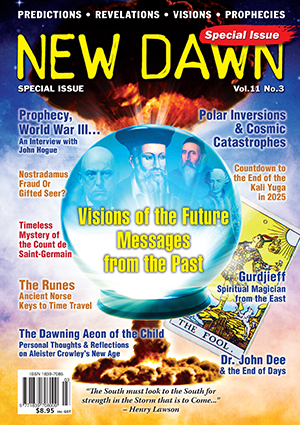
    [alert type=”general” dismiss=”no”]This article was published in New Dawn Special Issue Vol 11 No 3.[/alert]

    [alert type=”success” dismiss=”no”]If you appreciate this article, please consider subscribing to help maintain this website.[/alert]

    © New Dawn Magazine and the respective author.
    For our reproduction notice, click here.
  • Saint-Yves d’Alveydre & The Synarchy of Agarttha

    Saint-Yves d’Alveydre & The Synarchy of Agarttha

    From New Dawn 151 (Jul-Aug 2015)

    The French writer Alexandre Saint-Yves d’Alveydre (1842-1909) was an extraordinary figure, a strange mixture of occultist and political philosopher. Born into humble circumstances, he led an adventurous life before marrying the wealthy former Countess of Keller. After settling down in Paris he threw himself wholeheartedly into the study of ancient texts, languages and Eastern wisdom. Amassing an enormous library of rare books and manuscripts, Saint-Yves took lessons in Sanskrit, Hebrew and Arabic. His tutor was a mysterious Afghan who was known by the Muslim name Haji Sharif (or Hardjji Scharipf, 1838-?).1

    Professor Joscelyn Godwin says of Saint-Yves’ enigmatic teacher:

    His name may have been a pseudonym; he may have been an Afghan; some called him Prince… The manuscripts for which Hardjji [Haji] was responsible, now in the Library of the Sorbonne in Paris, show that he was a learned and punctilious teacher, and the source of two still unsolved enigmas: the holy land of Agarttha, and its sacred language of Vattanian.2

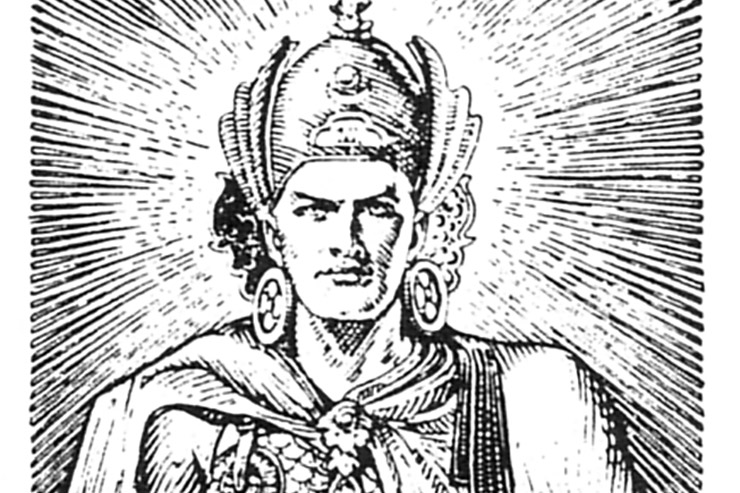
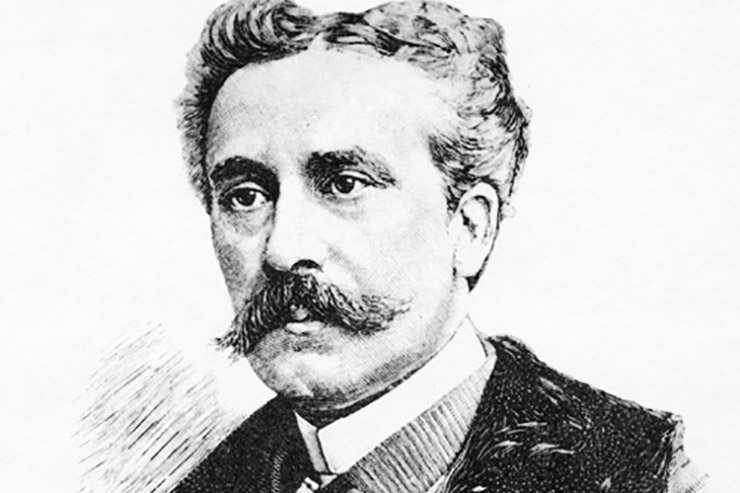
    Artist’s sketch of Alexandre Saint-Yves d’Alveydre (1842-1909) – who was called one of the last utopians of the nineteenth century.

    Haji Sharif, said Saint-Yves, was an “emissary” of “Agarttha” [Saint-Yves’ preferred spelling], the great initiatory centre in Central Asia presided over by a “Sovereign Pontiff” who “directs the entire life of the planet in a discreet and unseen way.” French researchers are convinced a shadowy group of Eastern initiates, who had been forced to flee their homeland for political reasons, contacted Saint-Yves in an effort to seed certain powerful ideas in the West. Saint-Yves also made an oblique reference to another Eastern guide, a “more serious” Guru who communicated to him the “secret teachings of the Brahmins.” Despite the ridicule heaped upon him by his numerous detractors, Saint-Yves steadfastly maintained that the highest officials of what he called the “Brahminical Church” had initiated him into the deep mysteries of Oriental wisdom.

    In Western Christendom Jerusalem and often Rome are referred to as ‘Holy Cities’, ancient centres permeated with religious significance. Due to the notions imparted to him by his mysterious Asian teachers, Saint-Yves would come to be regarded as the leading exponent of the idea, then starting to gain attention in nineteenth century Europe, that the primordial Holy Land was concealed below the surface of the Earth somewhere in Central Asia. Protected from inquisitive, avaricious Westerners, the spiritual powerhouse of the planet was, Saint-Yves declared, the subterranean realm of Agarttha. Originally on the surface, Agarttha was transferred underground and concealed from humanity at the onset of the Kali Yuga in around 3200 BCE.

    A focus on the regions of Central Asia as the ‘homeland’ of ancient wisdom was not in itself new. The Swedish savant Emmanuel Swedenborg asserted: “Henceforth it is among the sages of Tibet and Tartary that we must look for the Lost Word.” The Catholic mystic Anne-Catherine Emmerich had very clear visions of the “Mountain of the Prophets,” situated far beyond Tibet, where all true knowledge is preserved. The old legend of the “Wise Men from the East,” who were miraculously guided to the Christ child, may be a thinly disguised pointer to that Eastern spiritual centre from where emissaries are dispatched to the outer world. Saint-Yves assured his readers it is from Agarttha that such “divine envoys” as Orpheus, Moses, Jesus and many others have come “when humanity requires them.”

    Modern day commentators on Agarttha, “that underground realm placed at the centre of the Earth, where the Lord of the World reigns,” conclude it is more or less symbolic. Some say it is primarily metaphorical, since the name “Agarttha” is itself said to mean “inaccessible” or “inviolable.” Agarttha is of no one country, of no one nation, but universal; the mysterious hierarchy of enlightened masters, gnostic magi, yogis and perfected adepts – headed by the Lord of the World – maintain subtle links with their emissaries in the outer world. “Agarttha is a faithful image of the eternal Word throughout all Creation,” wrote Saint-Yves.

    The French journalist and eminent Orientalist Jean Marquès-Rivière explains:

    There is an even greater mystery, that which the Asian doctrines call THE MYSTERY OF REFLECTIONS. This is what the Wisdom of Egypt put on the Emerald tablet: ‘As above, so below’. There is a strange harmony between the different levels of manifestation. Man has a sign that is found both on earth and in heaven. The Centre of transhuman power has indeed a reflection on earth; it is a constant tradition in Asia and this Centre (earthly? I do not know to what extent) is called, in Central Asia, Agartha. It also has other names that there is no need to include here. This Centre has as its mission, as its ‘raison d’être’, to lead the Earth’s spiritual activities. To do this it uses every possible means3

    Synarchy

    Saint-Yves d’Alveydre also drew inspiration from the medieval Knights Templar, long held by occultists to have been Europe’s hidden rulers during the Middle Ages. He believed the Templars’ immense wealth and power came from their adherence to a socio-political system he termed Synarchy. For thousands of years Agarttha had “radiated” Synarchy to the upper world. Synarchy views society as a living organism like the human body. As Saint-Yves explained: “The first function corresponds to nutrition and that is economics. The second can be defined as the will, and that is legislation and politics. Finally, the third corresponds to the spirit and that includes science and religion.”

    Synarchy stood in total opposition to “government by brute force, that is, military conquest, political tyranny, sectarian intolerance, and colonial rapacity.” André Chaleil in Les Grands initiés de notre temps points out that:

    Synarchy, as Saint-Yves understands it, is the old dream of the meeting of left and right, of workers and capitalists, of scholars and priests, under the same banner and in the same spirit. It is already, in some way, the myth of the defence of the West against itself in face of the threat of Anarchy, or government without principles.

    To Saint-Yves the Knights Templar, as faithful adherents of Synarchy, stood for universal peace, friendship between peoples, and co-operative federalism. With the demise of the Templar Order early in the fourteenth century, Europe strayed far from the path of Synarchy, succumbing to the forces of chaos and dissolution. As long as Europeans persisted in their chaotic, unprincipled government systems, Agarttha would remain closed to them.

    While his enemies openly questioned his sanity, a small group of supporters hailed Saint-Yves as a gifted visionary. Jean Saunier remarked in his 1971 book La Synarchie:

    Saint-Yves d’Alveydre was not such a strange author as one might believe. On the contrary, might he not appear to have been one of the last of the utopians of the nineteenth century?

    Enter Eurasia

    The hugely influential French occultist and prolific author known as Papus (Dr. Gérard Encausse, 1865-1916) declared Saint-Yves d’Alveydre his “intellectual master.” Papus introduced the master’s books to members of the Russian Court and made his ideas well known in Russian mystical circles. But the master also had his own intimate connections with the Russian aristocracy through his wife’s family. In his book Mission de l’Inde, written in 1886, Saint-Yves noted approvingly:

    The deeply religious sentiment of the Russian masses, their instinctive occultism, their language, their legends, their prophecies, and the Hermetic interpretation that some sects keep of the sacred scriptures, are all so many ties indicative of an intellectual and social alliance with Asia.4

    He continued by urging Britain’s Queen Victoria to “craft an understanding between Your government and that of Russia.” With repeated references to benevolent Agarttha and the enlightened system of Synarchy, he criticised “the egotistical brutality that presides not only over the relations of Christian peoples with each other, but over the relations of their Colonial regime toward other continents and other communities of believers.” Saint-Yves saw Russia as the potential liberator of the Asian peoples from colonialism, writing in an open letter to the Russian Tsar:

    Sire, have caution when touching Afghanistan and do not advance into the territory of these amphictyons without pronouncing the ancient password of the Kingdom of God… Then, if, in the regions of India, England does not bring about its downfall by establishing Synarchy, Providence will put wind in your sails, because marching in the footsteps of Ram, Sire, You will only have fought in the name of Christ and Saint Michael, the Solar Archangel, to redeem the peoples after having freed them.5

    Expressing a thoroughly Eurasian outlook, Saint-Yves added: “The peoples of Central Asia feel great sympathy toward Russia and toward its sovereign.”

    A decade later, in 1896, echoing his intellectual master, Papus sent a message to Nicholas II calling on the Russian tsar to “immortalise his Empire by its total union with Divine Providence.” By 1899 Papus was warmly received by the imperial family and established a lodge of his Martinist Order at the Russian Court in St Petersburg. The Martinist Order, with its strong emphasis on Christian mysticism, set itself in opposition to what Papus saw as the growing atheism and secularism of Freemasonry. Central to the inner teachings of Papus’ Martinist Order were the legend of Agarttha and the visionary writings of Alexandre Saint-Yves d’Alveydre.

    Most secret societies and esoteric groups have, like the great world religions, a ‘founding myth’. A story imbued with sacred meaning, said to originate in the most ancient past and faithfully preserved down through the ages. In Freemasonry this is the legend of the building of King Solomon’s Temple. Today’s Rosicrucians claim a special connection to ancient Egypt. Many esoteric orders trace their origins to encounters with ‘other worldly’ entities. The Abrahamic faiths are full of seminal accounts of prophets instructed and empowered by heavenly emissaries and divine messengers. Asian secret societies also preserve detailed stories of their legendary heroic beginnings, usually connected to mysterious sacred centres. So it is no surprise that Agarttha, along with its complex socio-political system of Synarchy, became part of the mythos of certain powerful European secret societies.

    After his death in 1909 the “Friends of Saint-Yves” assembled the master’s papers and took on the task of disseminating his many books. Foremost among these was the posthumous publication in 1910 of Mission de l’Inde (Mission of India) with its incredible revelations of the secret subterranean kingdom. In the 1920s, René Guénon cited Saint-Yves approvingly in Le Roi du Monde (The King of the World) a study of symbolism and myth. Other notable followers included Victor Blanchard, Nizier Anthelme Philippe, René A. Schwaller de Lubicz and Émile Dantinne.

    Synarchy continued within the closed ranks of secret societies and esoteric study circles in France as well as abroad. Synarchy heavily influenced the development of Rudolf Steiner’s political thought and his ideas for social reform. Conspiracy researchers link Synarchy to a number of open political movements ranging from the 1930s leftist “X-Crise Club” to pro-Hitler Vichy France. Synarchy played a role in South American politics, particularly in Mexico. British writers Lynn Picknett and Clive Prince charge Synarchy with being the driving force behind the European Union.

    As recently as 2011, hundreds of people were arrested or detained in Turkey on suspicion of involvement in a national revolutionary secret society known as “Ergenekon/Agartha.” Turkish authorities claimed “Agartha” members were planning a coup with the help of senior leaders in the country’s military and security forces.6

    The fascinating Franco-Romanian novelist and esoteric researcher Jean Pârvulescu (1929-2010), who undertook a detailed study of the works of Saint-Yves d’Alveydre, suggested a secret brotherhood called “Agartha” existed in the Soviet Union’s special intelligence service, the GRU. According to Pârvulescu, the current Russian President Vladimir Putin is an envoy of this clandestine “Agartha” Order and is carrying forward their Eurasian plan.

    [alert type=”general” dismiss=”no”]In 2008 Inner Traditions published the first English language version of Saint-Yves d’Alveydre’s ‘Mission de l’Inde’ under the title The Kingdom of Agarttha: A Journey into the Hollow Earth (with an extensive Introduction by Prof. Joscelyn Godwin).[/alert]

    [alert type=”general” dismiss=”no”]This article was published in New Dawn 151.[/alert]

    [alert type=”success” dismiss=”no”]If you appreciate this article, please consider subscribing to help maintain this website.[/alert]

    Footnotes

    1. It is suggested by some conspiracy researchers that ‘Haji Sharif’ was in fact the renowned Islamic thinker and anti-colonial political activist Sayyid Jamal ad-Din al-Afghani (1838-1897). In 1885, the year Saint-Yves met ‘Haji Sharif’, Afghani was in Paris, where he began publishing an Arabic newspaper entitled “The Indissoluble Blond.” Among the members of Afghani’s anti-colonialist circle in Paris were Asians involved with the Theosophical Society as well as Christian and Jewish Middle Easterners. Regarded by his enemies as an inveterate intriguer and political chameleon, Jamal ad-Din al-Afghani is also believed to have been associated with Madame H.P. Blavatsky.
    2. Introduction by Prof. Joscelyn Godwin, The Kingdom of Agarttha: A Journey into the Hollow Earth (Inner Traditions, 2008)
    3. Introduction by Jean Marquès-Rivière, Asia Mysteriosa: The Oracle of Astral Force (Polair Publishing, 2012)
    4. Introduction by Prof. Joscelyn Godwin, The Kingdom of Agarttha: A Journey into the Hollow Earth (Inner Traditions, 2008)
    5. Ibid.
    6. In Turko-Mongol creation stories Ergenekon is a hidden land located in the inaccessible valleys of the Altay mountains.

    © New Dawn Magazine and the respective author.
    For our reproduction notice, click here.
  • A Prophecy for Our Time?

    A Prophecy for Our Time?

    From New Dawn Special Issue Vol 11 No 3 (June 2017)

    One of the world’s oldest legends tells of a vast underground network of tunnels and passageways connecting the great continents of the earth to a subterranean realm somewhere beneath the heart of Central Asia.

    “Among the Mongolian tribes of Inner Mongolia,” claimed the British journalist H. T. Wilkins, “there are traditions about tunnels and subterranean worlds which sound as fantastic as anything in modern novels. One legend – if it be that – says that the tunnels lead to a subterranean world of Antediluvian descent somewhere in a recess of Afghanistan, or in the region of the Hindu Kush. It is Shangri-La where science and the arts, never threatened by world wars, develop peacefully, among a race of vast knowledge. It is even given a name: Agharti.”

    In The Mysterious Unknown, the French writer Robert Charroux, drawing on the Ancient Wisdom, describes Agharti as “a mysterious subterranean kingdom that is said to lie under the Himalayas and where all the Great Initiators and the Masters of the World in the present cycle are still living. Agharti is an initiatory centre…”

    ‘Agharti’, also rendered ‘Agarttha’ and sometimes ‘Agartha’, owes its popularity to the 1920s best-selling book Beasts, Men and Gods. Written by the Polish academic and explorer Dr. Ferdinand Ossendowski (1876–1945), it is a chronicle of his adventures in Central Asia in the tumultuous years following the Russian Revolution.

    What makes Ossendowski’s account unique is his claim that everywhere he went in Central Asia he encountered the shadowy legend of “The King of the World” – reigning over the subterranean power-centre of Agharti – who “knows all the forces of the world and reads all the souls of humankind and the great book of their destiny.” This unseen ruler of the planet and his council of Masters wield telepathic influence over persons in our ‘outer’ world. Often visiting disciples in their dreams, they send forth messengers at fortuitous times to confer with their agents, scattered among the nations.

    Occasionally, the King of the World came out in person. He would visit some holy place, arriving and leaving mysteriously. He had done so at a temple in the Mongolian town of Narabanchi in the winter of 1890/91.

    A Prophecy for Today?

    In Beasts, Men and Gods, Ossendowski recounts a quite remarkable prophecy given by the King of the World. A Buddhist lama, the Hutuktu of Narabanchi, told Ossendowski in 1921 that the King of the World made the following pronouncement “thirty years ago,” which corresponds to winter 1890/91:

    “More and more the people will forget their souls and care about their bodies. The greatest sin and corruption will reign on this earth. People will become as ferocious animals, thirsting for the blood and death of their brothers. The ‘Crescent’ will grow dim and its followers will descend into beggary and ceaseless war. Its conquerors will be stricken by the sun but will not progress upward and twice they will be visited with the heaviest misfortune, which will end in insult before the eye of the other peoples. The crowns of kings, great and small, will fall… one, two, three, four, five, six, seven, eight… There will be a terrible battle among all the peoples. The seas will become red… the earth and the bottom of the seas will be strewn with bones… kingdoms will be scattered…whole peoples will die… hunger, disease, crimes unknown to the law, never before seen in the world.

    “The enemies of God and of the Divine Spirit in man will come. Those who take the hand of another shall also perish. The forgotten and pursued shall rise and hold the attention of the whole world. There will be fogs and storms. Bare mountains shall suddenly be covered with forests. Earthquakes will come… Millions will change the fetters of slavery and humiliation for hunger, disease and death. The ancient roads will be covered with crowds wandering from one place to another. The greatest and most beautiful cities shall perish in fire… one, two, three… Father shall rise against son, brother against brother and mother against daughter…. Vice, crime and the destruction of body and soul shall follow…. Families shall be scattered…. Truth and love shall disappear…. From ten thousand men one shall remain; he shall be nude and mad and without force and the knowledge to build him a house and find his food…. He will howl as the raging wolf, devour dead bodies, bite his own flesh and challenge God to fight…. All the earth will be emptied. God will turn away from it and over it there will be only night and death.

    “In the fiftieth year only three great kingdoms will appear, which will exist happily seventy-one years. Afterwards there will be eighteen years of war and destruction. Then the peoples of Agharti will come up from their subterranean caverns to the surface of the earth.”

    Immediately following this prophecy Ossendowski writes:

    “Afterwards, as I travelled farther through Eastern Mongolia and to Peking, I often thought: ‘And what if…? What if whole peoples of different colours, faiths and tribes should begin their migration toward the West?’”

    After again quoting the Buddhist lama, Ossendowski ends his book: “Karma may have opened a new page of history! And what if the King of the World be with them? But this greatest Mystery of Mysteries keeps its own deep silence.”

    The Year 2030

    If we accept that the mysterious King made this prediction in the winter of 1890/91, as Ossendowski was told, then the 50 years of strife and misery (marked by the First World War, the end of the European monarchies, revolutions, famine, disease, class/ethnic/religious conflicts, the financial chaos of the Great Depression) would take us through to the years of the Second World War. This followed by 71 years of happy stability under three great kingdoms (perhaps a reference to the East-West stand off at the end of 1945). Bringing us remarkably close to 2012, a year made famous by its association with the supposed end of the Mayan calendar. Then commences 18 years of war.

    Many modern day commentators believe we’re in the initial stage of a long ‘war’, with the Anglo-Americans and the Western alliance locked in a new kind of ‘asymmetric warfare’ with Russia, China and their allies in the global South. Others, notably American politicians, see an endless ‘War on Terror’ as currently underway between the West and radical Islam. The culmination of this 18-year period of global conflict brings us to the years 2029-2030. This is when the people of the “subterranean” realm will come “to the surface of the earth,” making their existence known to all.

    Leaving aside the esoteric and mystical symbolism implicit in the Agharti mythos, some further observations are worth making. As we approach the year 2029, the date prefigured in the King of the World’s prophecy delivered in 1890/91, we look back on a century of bloodshed and misery unprecedented in history. World wars, genocides, social and political upheavals, ecological crisis, economic instability, are only some of the terrible catastrophes to befall mankind in the last hundred years.

    Against this background, some contemporary visionaries see the wars in Iraq and Afghanistan, threats against Iran, even the destabilisation of the Chinese province of Xinjiang, as part of the working out of an ancient plan. Added to all this is the spectacular rise of the peoples of Asia. A great awakening is quietly underway in Central Asia, fuelled in large part by China’s grand scheme to re-establish the ancient Silk Road. Will we see the dawn of a powerful Great Eurasian confederation by 2029? Many expect so.

    As the mystic Baron Roman Ungern von Sternberg (1886–1921) told Ferdinand Ossendowski:

    “I shall die! But no matter, no matter… The cause has been launched and shall not die… The tribes of Jenghiz Khan’s successors are awakened… In Asia there will be a great state from the Pacific and Indian Oceans to the shores of the Volga… It will be the victory of the spirit.”

    Is this the ‘victory of the spirit’ for which certain Eastern mystics and their allies in the Eastern-orientated occult circles in the West have long been labouring in secret? For at least the last one hundred years a select few Western occultists have known that the rise of Asia was near and inevitable. Back in 1888, Madame H. P. Blavatsky, who spoke openly of being guided by ‘The Masters of the East’, predicted an inevitable show down between East and West:

    “Then, perhaps, there will be a new invasion of an Atilla from the far East. One day the millions of China and Mongolia, heathen and Mussulman, furnished with every murderous weapon invented by civilisation, and forced upon the Celestial of the East, by the infernal spirit of trade and love of lucre of the West, drilled, moreover, to perfection by Christian man-slayers – will pour into and invade decaying Europe like an irrepressible torrent.”

    Secretive mystic-politico groups, known to history by various and sundry names: the ‘Grand Lodge of Vril’, the ‘Order of the Green Dragon’, ‘Society of Green Men’, ‘Black Dragon Society’, ‘Han Temple of Buddha-Shakti’… Claiming a link with Agharti, these have all worked quietly in the shadows to lay the foundations for a sort of fraternal union between Eastern and Western occultists. In a document issued by one of these occult orders, we’re informed:

    The Master of the Three Worlds, whose initials are K.R.T.K.M, reigns over a community of Magi… The next Buddha will come from the North, and will be the Kalki-avatar of the Hindus, or Kundaliniavatar, who will wear on his finger the metal ring of Genghis Khan. His coming will mark the return of the Golden Age, and will precede the advent of the luminous race, contemporary with the resurrection of Mu or Tao-Land.

    It will be the end of the Kali Yuga, the casting out of the Jotün and the cacodamons from the governmental centres of the earth, and of 100,000 years of evil karma inherited from the darkness of Atlantis.

    Here we have hints of a link between the King of the World’s prophecy and the end of the Kali Yuga. A connection that did not escape the attention of French esotericist Rene Guenon (1886–1951) who wrote his own study of the King of the World, Le Roi du Monde, in 1927. Guenon was also interested in the work of scholar Gaston Georgel who claimed, based on his extensive research, that the end of the Kali Yuga would come in the northern hemisphere winter of 2029/2030.

    Time, as they say, will tell.

    [alert type=”general” dismiss=”no”]This article was published in New Dawn Special Issue Vol 11 No 3.[/alert]

    [alert type=”success” dismiss=”no”]If you appreciate this article, please consider subscribing to help maintain this website.[/alert]

    © New Dawn Magazine and the respective author.
    For our reproduction notice, click here.
  • Japanese Legends of a Forgotten World Empire

    Japanese Legends of a Forgotten World Empire

    This article was published in New Dawn Special Issue Vol 8 No 3 (June 2014)

    “In the world of Tradition,” writes Julius Evola, “the most important foundation of authority and of the right of kings and chiefs, and the reason why they were obeyed, feared, and venerated, was essentially their transcendent and nonhuman quality.”1What if a prestigious noble family possessed secret records of this world of Tradition millions of years ago? Would you want to read them? Most people would certainly call any such documents unbelievable, an obvious fraud. But, in fact, several documents that appeared in various parts of the world in the early 20thcentury attest to a shared knowledge of the “transcendent” ultra-ancient empire described by Evola, including a group of texts from Japan mostly unknown to the Western occult world, called the Takenouchi Documents.

    In 1921 a Polish professor named Ferdinand Ossendowski published a book called Beasts, Men, and Gods in which he described his dangerous escape from the Soviet Union, through Siberia, into the Buddhist kingdom of Mongolia and the legends he heard there of the King of the World (see “Mystery of Shambhala” by Jason Jeffrey, New Dawn 72.) Ossendowski’s book caused such an international stir that the French metaphysician René Guénon used it as the basis for his most controversial work, The King of the World. Guénon alleged there was a universal symbol across all the world’s great traditions of a past King of the World who had once ruled the world from a holy land, which has since been sealed off.

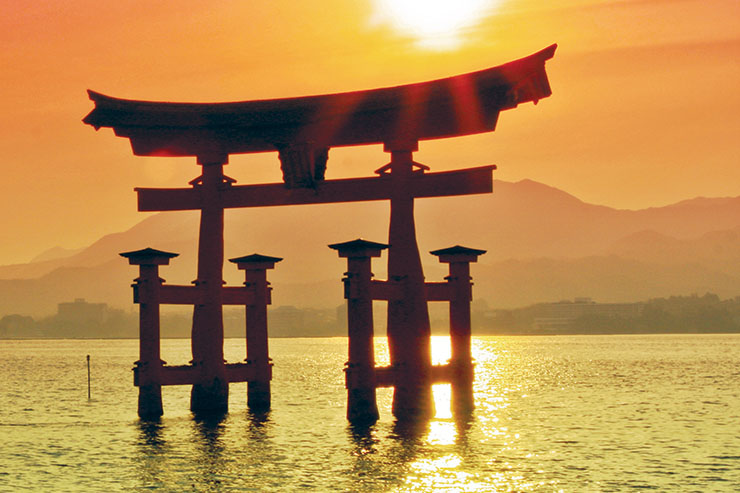
    A few years later, in the hinterlands of rural Japan, an uneducated, possibly illiterate shrine keeper named Kiyomaro Takeuchi called some researchers to his house. Born into a poor and undistinguished household, Takeuchi had long been an unemployed wanderer and sometime ascetic. As early as 1893 he was documented training at Kurama Temple, an esoteric temple in the mountains north of Kyoto. Kurama Temple was Buddhist at the time, but today it is an independent sect that worships a being said to have come from Venus 6.5 million years ago, identified by some with the theosophist Saint Kumara. Takeuchi returned to Kurama Temple many times before moving permanently to northern Japan.

    When historians arrived at his house, Takeuchi made a shocking announcement. He told them that his family was descended from Takenouchi no Sukune, a heroic minister recorded in the official histories of the nation as having lived for over 300 years around 50-400 CE. The minister Takenouchi had preserved ancient records of the origin of the nation in clay pots, and over the course of many generations these records had come to Takeuchi, who now revealed them for the first time. They consisted of hundreds of documents written in Classical Chinese and strange, unknown scripts. The majority of the records were destroyed in World War II, but we have a good variety of secondary sources that describe the story they contained.

    World-Emperors & The Five-Coloured Peoples

    Innumerable billions of years ago, the Takenouchi Documents tell us, the world was a sea of mud. After 22 billion years of formation out of All emerged the first God and Goddess, and the heavens and the Earth were separated and became a firmament. The Earth hardened and became a sphere. The God and Goddess gave birth to another couple, representing the Sun and Moon respectively, and in this way the Earth took form for six generations.

    The fifth generation God and Goddess gave birth to the Creator of the Nations and his wife who descended to Mt. Kurai in Japan and took on “shining bodies.” In the seventh generation various beings developed technologies for life on Earth such as transportation and writing. The seventh generation Sun God declared the beginning of the lineage of World-Emperors, called Sumera-Mikoto in ultra-ancient Japanese. He also set out the islands of Japan as distinct from the rest of the planet, naming Japan “the Land of Hidama” or the Sun-Sphere. Today Japan remains the only nation that fights under the flag of the rising sun, but in ancient times the scribes still spoke of the Egyptian king reigning from “the seat of Horus,” the Persian ruler “who rises in the company of the sun,” and the Roman sol invictus.

    The Sun God’s heir began the High Ancient Dynasty and after eight billion years dispatched his sons and daughters around the planet to found their own nations. He divided the world into sixteen sections, one for each new mittoson, a sort of king or vassal. These kings became the Five-Coloured Peoples – white, blue, red, yellow, and black – and were scattered across the continents in no particular pattern. The first king of the red-coloured race, for example, is called “Adameve,” and he is granted sovereignty over the Fertile Crescent. At almost the same time on the other side of the world Guénon was writing that “the literal meaning of the name Adam is ‘red’ and [we] can see in it one indication of the link of the Hebraic tradition to the Atlantean tradition, which was that of the red race.”2

    After the establishment of the sixteen nations, the World-Emperor’s role became to tour the world to ensure that the peace and rule of the Sun were being kept among the Five-Coloured Peoples. In high ancient times the World-Emperor was able to travel all over the world on a flying ship called Ame-no-Ukifune, literally, the “floating ship of heaven.” Using this ship he could visit all the mittoson in a matter of years rather than decades. Actually, the Ame-no-Ukifune was long known to Japanese historians before the Takenouchi Documents appeared. Early history books in Japan describe a flying ship called Ame-no-Iwafuneon which one of the nation’s ancestral clans descended to Earth. In the Takenouchi Documents this ship was used by the gods to descend to Earth, but thereafter became the exclusive property of the World-Emperor who lent it out only on rare occasions.

    When he arrived in a place the World-Emperor would be met with awe. Writes Wado Kōsaka: “It is easy to imagine the extreme anxiety of the Mittoson who had to receive the Sumera-Mikoto without prior notice. For the five-coloured peoples who were suffering from misgovernment, the world visits by the Sumera-Mikoto were opportunities for relief, and thus the Sumera-Mikoto was always welcomed with the highest honour and respect in very land.”The World-Emperor never had to use force but could replace a bad king simply through proclamation, echoing Evola’s assertion that Traditional rule “did not need physical strength to assert itself, and when it did, it was only sporadically. It imposed itself mainly and irresistibly through the spirit.”All people were taught about the origin and the authority of the Sumera-Mikoto so his judgment could resolve any dispute and ensure complete peace.

    While the Japanese of this era were Hibito, People of the Sun, and were given special duties to maintain the Imperial teachings, the World-Emperors themselves only lived in Japan and were not themselves Japanese. Rather, they were above all colours and married women of pure heart, called Kisakinomiya, from all over the world. When no male heirs were produced there would be a World-Empress who would marry a man of pure heart called Yosachio. The practice of selecting a spouse from among the Five-Coloured Peoples ended in the Fukiaezu dynasty, which seems associated with the decline of the World-Emperor’s power. From that point on the World-Emperor was forced more and more to limit his activities to Japan, and only the Hibito were dispatched around the world to continue education programs.

    ‘Holy Lands’ & Guénon’s ‘King of the World’

    In The King of the World, Guénon finds sufficient witnesses in “the concordant testimonies of all traditions” to conclude that “there is a ‘Holy Land’ par excellence, that it is the prototype for all other ‘Holy Lands’, and that it is the spiritual centre to which all others are subordinate. The ‘Holy Land’ is also the ‘Land of the Saints’, the ‘Land of the Blessed’, the ‘Land of the Living’, and the ‘Land of Immortality’.”We have found that Japan can be described in all of these terms in the Takenouchi Documents. Furthermore, the World-Emperor is very much a Guénonian King of the World.

    Guénon proceeds to say that this land was available to us only in past ages, hundreds of thousands of years ago, and that it is now “invisible and inaccessible.” Since Japan is very much visible and accessible today, does that count against the symbolic authority of the Takenouchi Documents? In fact, it counts for them, for just as the Holy Land was closed at the beginning of the Kali Yuga, the spiritual centre of Japan was sealed at the beginning of the present age, and will not be reopened until our age of material power ends.

    As the world took form it was also rocked by cataclysms, earthquakes, and floods, attested in texts all over the world. In the Takenouchi Documents there are not one but dozens of such events over the course of history, caused by an imbalance in the order of Heaven. These crises grew steadily more severe. In fact, two whole continents called Miyoi and Tamiara in the Pacific Ocean sank. The World-Emperor was forced to scale back his activities, and eventually ended them. Two different researchers of the Documents have offered different theories as to how this happened.

    Wado Kōsaka calls the Tenpenchii a result of disobedience: “While people were enjoying highly civilised society guided by the Sumera-Mikoto, arrogance took root in the heart of humanity. The kings of the five coloured peoples gained power over the Sumera-Mikoto, lost respect towards the Sumera-Mikoto and began to ignore and despise him.”As long as the people had faith in the World-Emperor, though, he could simply use his authority to replace any bad governor, so surely the great age of world-empire could not have been put to an end by rebellions alone.

    The aikido master Mikoto Nakazono offers a more subtle explanation: education, not only in obedience to the World-Emperor but also in basic principles of divinity and law, was becoming steadily more difficult as the world became more separated. Despite thousands of years of efforts by the World-Emperors and their delegates to raise the level of the Five-Coloured Peoples to enlightenment, writes Nakazono, the incarnated humans could not maintain a high level of consciousness:

    Ordinary people simply could not see the point. Why spend so much time and energy listening to teachers, why go through such discipline, why go hungry, sleep, meditate…

    In the end, the younger leaders came before their elders saying, “We have worked for forty thousand years to make a perfect society, and we have not succeeded because the people cannot understand us… How much longer must we go on? In the end, this will make a greater sacrifice than the development of a material situation ever could. Please, give us the permission to guide society in this direction. If we cannot bring them to understand the activity of their senses, they must explore it for themselves. If we guide them straight to the mark, it can be done so much more quickly.”

    The discussion went on for a long time. Finally, the elder god-men agreed. They gave their consent, asking only that the work be begun as far away from Hinomoto Kuni as possible.7

    Takenouchi researchers generally believe the work indeed began on the other side of the world, and the first group to be segregated from the universal rule of the Sumera-Mikoto was the ancient Middle Eastern civilisation of the Fertile Crescent, who out of love for their former leader named themselves the Sumerians.

    Nakazono interprets the Documents as saying that over many decades the teachings were slowly wound up and then disguised as myth, religion, and spiritual messages “in competition” with matter in order to allow a material society to develop and flourish. But the perennial tradition, which he calls the Kototama Principle, remains hidden underneath these various disguises to be unveiled after material civilisation reaches its natural conclusion. This is all in accordance with Guénon, who wrote “it is more true to say that the tradition is hidden rather than lost, or at least that it can be lost only to certain secondary spiritual centres that have ceased to remain a direct contact with the supreme centre.”8

    At this point, the symbolic world of the Takenouchi Documents becomes completely outrageous, but perhaps an outraged reaction is evidence that people are uncomfortable with the truth. So I will press on with my narrative, keeping in mind that Guénon, when trying to understand the difficult and hidden teachings of the King of the World, made use of accounts that he knew were faulty, incomplete, or even a “caricature” of the truth since the existence of such accounts symbolises deeper forces at work.

    The Takenouchi family preserved the Documents in urns lying in secret locations beneath the ground of Kōso Kōtai Jingū, awaiting the day when the world would be able to understand the history they revealed, making themselves available only to select foreign teachers – none of their students were Japanese, although the reason for this is not given.

    Jesus’ Visit to Japan

    The most notable teacher, both for us and for Takenouchi researchers, was Jesus. Occultists may be familiar with Nicholas Notovich’s claim that Jesus made a pilgrimage to India in his teens to study Buddhist philosophy, returning to Judea at the age of thirty to teach what he had learned. For the Takenouchi proponents, who clearly regard Japan as a sort of Shambhala with wisdom open only to a select few, Jesus’ journey took him past the classical centres of India to the true centre in Japan. After stopping in India, Jesus, a fully human son of Mary and Joseph whose real name was apparently Jesuchri Christmas, continued his journey to Kōso Kōtai Jingū, where the head priest, seeing his innate abilities, subjected him to what Wado Kōsaka calls “ninja training.”

    According to a woman who saw the Jesus document herself, Jesus “acquired the ability to perform approximately twenty divine arts out of fifty or so. Curing diseases is the preliminary stage of the divine art. The divine techniques include the skill to disappear, jumping up or down from a tall tree which is so tall that one cannot see the top, walking on the surface of the water with a bamboo rod that is thrown onto the sea or the river, walking in the air, purifying a room or the soil.” Jesus returned to Judea to demonstrate the great spiritual messages and ninja abilities of the divine principle, but he became a wanted man. His brother, Isukiri, met with the disciples and agreed to die in his place; it is this brother, not Jesus, who Judas handed over to the Romans.9

    Jesus himself returned to Japan to continue his study with fourteen new disciples from around the world, including men of Japanese, Ainu, Italian, German, Native American, Australian, Jewish, Roman, and African ancestry. He travelled around the world spreading teachings of peace and love, and died on 25 December 82 CE, at the respectable age of 118, after which he was buried in Japan. His tomb was rediscovered in 1934 and can still be visited today in Herai village in Aomori.

    The release of the Takenouchi Documents, including the histories summarised here and many others, caused a stir in Japan. The government moved to prosecute Kiyomaro Takeuchi and his circle immediately for telling false stories about the Imperial household. Some books about the Documents were banned, and in the late 1930s the government demolished Takeuchi’s shrine and seized many documents and artefacts, which were later destroyed in the firebombing of Tokyo. For the great majority of Japanese society, they were a rejected, suppressed, and forbidden history.

    Even so, the Documents had a subtle, underground impact on Japanese culture. They inspired fresh interest in the mysteries of the past, and in kotodama, the ancient practice of spiritual power in language. One student of the Documents, Norihiro Yasue, learned from them that the Jews and the Japanese shared a common ancestor, and he must have considered that knowledge during World War II when he helped tens of thousands of Jews escape from Germany into Manchuria. They have been revived and republished in the postwar period and continue to attract curious readers today.


    In Japan, there are many other “parahistories” like the Takenouchi Documents, attesting to a realm of being that is vastly different from the way we write history today. Like the ancient traditions that attracted Evola and Guénon, they present glimpses of an Eden known to all human beings, submerged in the fog and confusion of our modern condition. Despite the thorough debunkings they have received from sceptics, they continue to be popular today – perhaps indicating that they possess a more perennial value.

    You can read more on this little known ‘parahistory’ in Avery Morrow’s book The Sacred Science of Ancient Japan (Bear & Co., 2014). 

    [alert type=”general” dismiss=”no”]This article was published in New Dawn Special Issue Vol 8 No 3.[/alert]

    [alert type=”success” dismiss=”no”]If you appreciate this article, please consider subscribing to help maintain this website.[/alert]

    Footnotes

    1. Julius Evola, Revolt Against the Modern World, Inner Traditions, 1995, 22
    2. Rene Guénon, Traditional Forms & Cosmic Cycles,Sophia Perennis, 2003, 29
    3. Wadō Kōsaka, Takenouchi Documents I, 119. English translation available at http://takenouchi-documents.com/
    4. Evola, Revolt Against the Modern World, 8
    5. René Guénon, The King of the World,Sophia Perennis, 2001, 72
    6. Kōsaka,Takenouchi Documents I, 205.
    7. Mikoto Masahilo Nakazono, The Source of the Present Civilization, Kototama Books, 1990, 59-64
    8. Guénon, King of the World, 29
    9. Kōsaka, Takenouchi Documents I, 293-297

    © New Dawn Magazine and the respective author.
    For our reproduction notice, click here.
  • Basil Zaharoff: Man of Mystery

    Basil Zaharoff: Man of Mystery

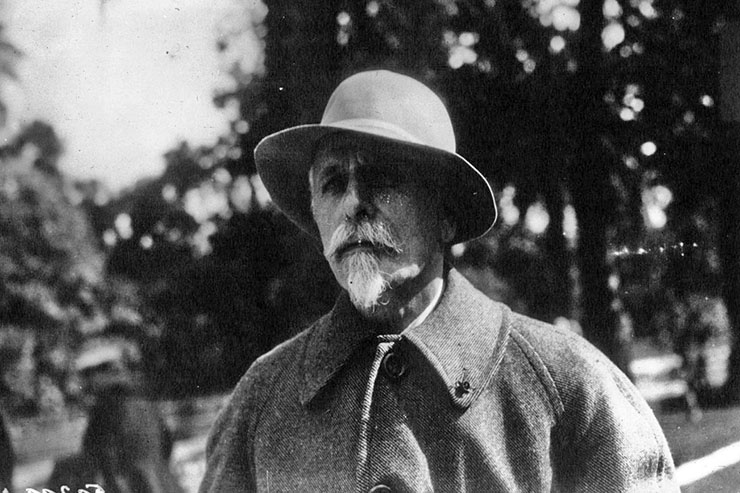
    If an Illuminati exists, then Basil Zaharoff was surely part of it, and if he wasn’t, he should have been. In the course of his long life (1849-1936), he garnered some 300 honours from thirty-one nations including two British knighthoods. But how many of those who bestowed the honours, or who despised him, really knew him?

    Best known as a premier arms merchant, and for decades a key figure in the Vickers cartel, he was many things to many people. To his detractors Zaharoff was the “Merchant of Death,” whose “monument is the graves of millions; his epitaph their dying groans.”1 To his friends and accomplices, who dubbed him “Zedzed” (ZZ), he was a veritable wizard. A British ambassador to Paris, Lord Bertie of Thame, boasted of his “great personal regard” for Zaharoff, his “very just… though hard” character, his immense wealth, and the fact that he was said to have “many of the leading French politicians in his pocket.”2 On the other hand, the Infanta Eulalia of Spain proclaimed him a manifestation of sinister “occult forces” dominating Europe.3

    French muckraker Roger Mennevee saw him as part of an “international oligarchy,” while his compatriot Jacques Bonzon believed Zaharoff to be an insidious agent of British imperialism. Another Frenchman, Rene Guenon, suspected Zaharoff of being nothing less than a secret master of the “counter-initiation,” while Church of Satan founder Anton Sandor LaVey praised him as an embodiment of Satanic virtue.4 Still others dismissed Zaharoff as a “mountebank who indulged in self-mystification and encouraged fabulous rumours.”5

    Fabulous or not, Zaharoff’s reputation has left its mark on popular culture. He crops up as an influence in two of Orson Welles’ creations, Citizen Kane, and the lesser known Mr. Arkadin.6 Tintin creator Herge (Georges Remi) thinly disguised Zaharoff as – what else? – an unscrupulous arms dealer named Bazil Bazaroff and Ezra Pound invoked him in the guise of Zenos Metevsky in two of his Cantos.7 And this author has described him as a model for Ian Fleming’s SPECTRE kingpin Ernst Stavro Blofeld.8

    Zaharoff was undoubtedly most of these things, perhaps all of them. He has been the subject of several biographies over the years, all of which leave questions unanswered.9 What follows makes no attempt to survey his whole, complex career. Rather it will try to illuminate some new or lesser known facts about the “Man of Mystery” and counter some common myths and misconceptions. Most importantly, it will explore his alleged role as an agent of British imperial interests.

    The Mystery of Zaharoff’s Birth Place

    The basic question about Zaharoff, and one that defies a definitive answer, is just who he really was. The usual answer, because it’s the only one supported by documentation, is that he was born a Greek subject of the Ottoman Empire in the Anatolian town of Mugla, on 6 October 1849. The problem is that said documentation consisted of the statement, more than forty years after the fact, by an aged cleric who never met Zaharoff and who may have been paid for his “recollection.” The family name, probably originally Zacharias or Zachariadis, supposedly changed to the Russianised Zacharoff/Zaharoff during a brief residence in Odessa. Yet other sources insist the original name was Zarapoulos or Zaharopoulos.10 The one consistent factor is that young Zacharias Basileos and his parents were Greeks.

    Zaharoff could never keep the story straight. He variously gave his birth year as 1849, 1850 or 1851, and swore at different times and places that he had been born in Mugla, or the poor Constantinople district of Tatavla, or the upscale Phanar section.11 Still other sources claimed Athens.12 He muddied the waters further by claiming a Polish father and Levantine mother, a Greek mother and Russian father, or a Romanian birth and Romanian mother. A real possibility, of course, is that even Zaharoff wasn’t sure. One biographer, Robert Neumann, summed up the situation thusly:

    “[Zaharoff] did everything he could to confuse the picture. You ask for his birth certificate. Alas! A fire destroyed the church registers. You search for a document concerning him in the archives of the Vienna War Office. The folder is there, but it is empty…. You obtain permission to inspect the papers of a law case. The papers are requested, but alas! no one in the office can find them.”13

    Zaharoff also had a penchant for conjuring up phony educations which included Rugby and Oxford. Rugby, in fact, was quite pleased to claim him as an alumnus even though they had no record of his attendance!14 This is evidence that with sufficient wealth and prestige, one can manufacture a past and get others to help you. Yet, as we’ll see, some sort of English education may not have been total fantasy.

    There were those who denied that Zaharoff was any sort of Greek at all, and with his fair hair and light blue eyes, he did not fit the stereotypical Hellenic profile. Rather, they insisted, he was an Armenian, or Albanian, or Bulgarian or Russian. In support of the latter, besides his name, biographer Donald McCormick claims that a Tsarist secret police dossier identified our man as a Russian deserter, while yet another biographer, Guiles Davenport, trots out the improbable tale that the future Sir Basil was a disgraced Russian Orthodox bishop cum jewel thief!15

    If not Greek, Zaharoff was most commonly alleged to be Jewish. This was a particularly attractive notion to anti-semites as it made perfect sense to them that anyone as rich and unscrupulous as Zaharoff just had to be a Jew.16 But there is more to the notion than that. In the early 1920s, the Soviets provided the Turks with documentation proving that Zaharoff was the scion of an Odessite Jewish family named Sahar.17 French writer Jacques Bonzon claimed much the same and even insisted there was a rabbinical certificate to prove it.18 The most insistent proponent of this idea was himself a Jew, Haim Sahar, a Russian immigrant living in Birmingham, England. In 1911, Sahar stepped forward to claim that the illustrious Mssr. Zaharoff was none other than his long-lost father, Manel Sahar, formerly of Wilkomir, Lithuania. Haim, who later changed his name to Hyman Barnett Zaharoff, had no evidence to back his claim and his purported daddy simply ignored him. It turns out, though, that a Manel Efroimovich Sahar had lived in Wilkomir and as of 1877 he was “absent.”19 That, of course, in no way proves that he and Basil Zaharoff were the same.

    Zaharoff surely had secrets to hide. For the first thirty odd years of his life, the future confidante of moguls, prime ministers and kings amassed a tawdry record of theft, embezzlement, bigamy, fraud and God only knows what else. As Orson Welles’ once opined, Zaharoff was “a shabby character,” at least early on.20 Yet he always managed to skate past potential ruin and resurface, phoenix-like, with a new name in a new place. It was almost as if he had a guardian angel – or some very influential friends.

    The British Connection

    The most persistent thread running through Zaharoff’s career is his connection to Britain and British interests. It begins with his father. He, also named Basileios, was said to “have seen a good bit of the world. On one occasion he had even come to England as a cloth merchant.”21 By all indications, Zaharoff pere was a man of some means and education, and with commercial connections that stretched not only to England, but also to Russia.22 He also lived in interesting times. The early decades of the 19th century saw ferment among the Greeks of the Ottoman Empire and the Diaspora, culminating in the War of Independence that re-established a free Greece. A key factor in this was Masonic lodges and Freemasonry-based secret societies like the Philike Hetairia, the hidden nexus that bound together Greeks and their cause all over the world. It seems logical to suppose that Basileios Zaharoff was acquainted with this nexus and that he would have passed on such connections to his son.

    The first hint of a British connection in Zaharoff’s life was when a wealthy family friend or relation, Iphestidi, offered to pay his tuition to an English school in Constantinople. However, biographer Anthony Allfrey wonders whether the school may not have been in England after all. Zaharoff once recommended to a friend that a good and affordable education could be secured for a boy in “plenty of English schools in & about London.”23 According to one of Zaharoff’s contemporaries, Stephanos Zinopoulos, “Zaharoff had even as a youth regarded Britain as the one nation which could give him the kind of career he wanted.”24 Whether in Constantinople or London, a British schooling afforded opportunity for someone to take notice of a bright, eager boy with a knack for numbers and languages. A young man like that might be useful and would be someone to watch, groom, and when necessary, protect.

    The first documented presence of Basil Zaharoff, or the man who would become him, is in London in 1872. Three significant things happened over late 1872 and early 1873: he would apply to change his name, he would get married, and he would be arrested. Records show that a Z. B. Zacharoff of 41 Threadneedle St., “merchant and interpreter,” applied to change his name to Zacharoff-Gortzacoff.25 On 16 October 1872, Zacharius Basilius Gortzacoff, “General de Kieff,” wed Emily Ann Burrows, a builder’s daughter, at the All Saints’ Church in Westminster.26 The Threadneedle St. office put Zacharoff in the heart of London’s City, the epicentre of the British Empire’s financial power. Not unimpressive for a twenty-three year old Greek immigrant. But what inspired him to restyle himself a Russian officer and nobleman? Was the point to impress his bride and her family, or was there someone else in mind?

    In any event, the marriage proved his undoing, since news of it reached far-off Constantinople where a certain Hephistidez (another version of the above Iphestidi), sometimes described as an “uncle,” recognised the groom as the man who had absconded with goods and money.27 Hephistidez raised a complaint which led to the culprit facing a judge in the Old Bailey. The case was duly covered in the press. A felony charge of larceny was dropped over a question of jurisdiction, but in January 1873, “Zacharia Basileus Zacharoff” pled guilty to a misdemeanour charge of “making consignment of goods entrusted to him.”28 He put up a £100 bond and was bound over for sentencing. That would never come, because he soon afterwards fled England.

    He next surfaced, later that year, in Cyprus, where he was “using a British passport in the name of Z. Z. Williamson” and making a living buying and selling whatever he could.29 One can only wonder how he, a foreigner and a fugitive, managed to obtain it. Years later, Zinopoulos offered this explanation:

    “In London [Zaharoff] had tried to ingratiate himself in intelligence circles, not without some success…. The trial had been a setback in one sense, but in another it had enabled him to invoke help from intelligence sources which, to some extent at least, caused him to be dealt with leniently…. Zaharoff needed a new alias; intelligence work on the British side provided it for him.”30

    He simultaneously was doing a thriving real estate business as Zacharias Vasilios Zachariades.31 In 1873, Cyprus was still a possession of the Ottoman Sultan, but given its proximity to Egypt and the new Suez Canal, British interest in the island increased. By the time he departed seven years later, Cyprus was firmly under London’s control. Did Zaharoff’s acquisition of property anticipate this, or even facilitate it?

    His most important associate in this period was a British “commercial merchant,” William Shaw.32 It seems fair to suppose that Shaw was more than a mere tradesman; his travels and contacts in the Near East mark him as an archetypal political and intelligence agent. Shaw had many acquaintances among the Greek expat community in Britain, so he likely knew all about the new arrival’s recent difficulties. Ignoring unsavoury stories circulating about Williamson/Zachariades, Shaw became the young Greek’s partner or, perhaps more to the point, his controller. In 1877, when Shaw stepped down as the local representative of the Swedish Nordenfelt Guns and Ammunition Co., Zaharoff stepped into his shoes. And thus, Sir Basil’s career as a merchant of death got its start. Not incidentally, to seal the deal with Nordenfelt, Zaharoff “let it drop that he had connections with British Intelligence.”33

    According to Xavier de Hauteclocque, Zaharoff had all the necessary qualities for a good British agent; he was “young, brave, physically attractive and a polyglot.”34 Plus, he had demonstrated a “large conscience.” Hauteclocque also speculated that Z belonged to “one of the Near Eastern Freemasonic lodges.” “The British Freemasons,” he added, were “their protectors” and had “helped these lodges win independence for the Balkan states….”

    Zaharoff’s Cyprus period includes a peculiar incident in which he “died.” Around 1875, an Athens newspaper described how one Zacharias Basileios Zaharoff had been shot dead while attempting to escape a local prison.35 Inquiries from Zaharoff’s family and friends led to an exhumation which determined that the body was not his but that of a Canadian seaman. Sir Basil later dismissed the episode as a dirty trick by enemies, but it seems fair to wonder if it wasn’t he who was trying to literally kill off his past. Could the corpse have been the real Zacharoff/Zachariadis born in Mugla, an identity that our man stole for his own purposes?

    In 1879, Zaharoff paid a brief return visit to England where he was received as an important man of affairs by the likes of Nathaniel Rothschild and Lord Salisbury.36 Again, surprising access for a young man widely seen as a crook back in Cyprus and Athens and convicted of being one in London. This may explain why he soon moved on to greener pastures. The next place he can be fixed with any certainty is Ft. Wayne, Indiana. On 13 July 1882, the Ft. Wayne paper noted that Z. Z. Zacharoff-Williamson, “a gentleman from London, England,” had checked into a local hotel.37 Zaharoff’s five years in the USA is a story in itself, but suffice it to say that it involved speculation in land, railroads and oil along with activities that can only be characterised as those of a con man.

    As in Cyprus, Zaharoff played front man buying up property and making investments for bigger, British clients. One of these was the 7th Earl of Aylesford, a close friend of the Prince of Wales.38 In New York, the Greek assumed the temporary guise of an Egyptian mystic, Zanat el-Zahan.39 But his most daring and successful imposture was that of “Count Zaharoff,” a flamboyant, fez-wearing Russian whose visiting card identified him as an officer of the imperial guard and an aide-de-camp to His Majesty the Emperor of Russia.40 He eventually landed a position as general secretary of the Mann Boudoir Car Co., a sleeping car concern catering to the lavish tastes of patrons like opera diva Adelina Patti. The story went that he was “a nobleman who had consented to accept an important executive position because of his disinclination to lead a life of idleness.”41

    “Count Zaharoff” Embroiled in Scandal

    For a time the bogus Count was the toast of San Francisco and Broadway, but once more, his undoing was matrimony. In August 1885, the suave Russian convinced an impressionable heiress, Jeanne Frances Billings, to be his bride. Her family was not pleased. Some digging unearthed his earlier life in London and his long-abandoned first wife. Zaharoff convinced his new spouse to flee with him to Holland where he hoped to dodge the scandal, but upon arrival in Rotterdam, he faced a swift-footed American detective and a very angry Emily Ann. The charade came crashing down, Jeanne slunk back home to file for divorce, and “Count Zacharoff” vanished. The whole tawdry tale was spread far and wide in the American press.

    A detail buried in American coverage of the scandal is that Zaharoff “was generally believed to be dead by his English acquaintances.”42 A story had circulated some years earlier that he had been killed trying to escape a Persian prison! Was this a muddled version of the Athens tale, or had Zaharoff planted a fresh rumour to cover his tracks before heading to America?

    However, back in May 1883, papers in the US had carried another story: Count Zaharoff, agent for the Allan Steamship Co, had been anonymously threatened with death if he did not leave Galway, Ireland, where he was recruiting factory girls for jobs in Boston. This peculiar incident may hint that Zaharoff’s comic-opera antics in the USA were more serious than they seemed. Zaharoff’s American interlude coincides with one of the strangest episodes in the long struggle between Irish nationalists and the British Empire. In 1881, not long before ZZ arrived, Irish-American inventor John Phillip Holland launched a submarine dubbed the “Fenian Ram.” The vessel had been commissioned by the Irish Republican Brotherhood, “Fenians,” who planned to use it to terrorise the Royal Navy. In the end, it came to naught; when the Fenians and Holland fell out over payment, the former stole the sub and carried it off to New England, where it sat, since no one knew how to operate it.

    Allfrey offhandedly mentions that the “possibility that Zaharoff was behind this coup has never been explored.”43 As Count Zaharoff was busy in Galway, Holland’s sub was undergoing sea trials in the waters around New York. Galway was Holland’s home town and it also was a prime spot for hiding or basing the Ram once it had been smuggled across the Atlantic. The Count’s soliciting of local girls, therefore, may have been a cover for spying on Fenian intrigues. Moreover, as a Russian he could pass as an agent of the Tsar and a potential friend and benefactor to Irish rebels. Might he have promised, and then withheld, money at the critical moment? Or was he simply spying on Holland and trying to bankrupt him through promoting bad deals with the Irish? The greatest naval power in the world was bound to be interested in what Holland was up to, and if the Admiralty didn’t have Zaharoff watching him, they had someone.

    It’s also curious that once back in Europe, Zaharoff was very, very interested in all things submarine. In 1886, now calling himself plain Basil Zaharoff, he showed up in Spain. While drumming up business for Nordenfelt, the Greek took keen interest in the sub design of Spanish engineer Isaac Peral. Although technically sound, Peral’s invention was plagued by sabotage and eventually killed by political opposition, all, it is alleged, masterminded by Zaharoff.44

    Not coincidentally, Nordenfelt, now based in England, was working on his own submarine. In 1886, Zaharoff had the privilege of selling a prototype to Greece and, a little while later, two more advanced designs to Turkey.45 For the time being, Britain, not America or Spain, had cornered the sub market.

    The Budding Merchant of Death

    1888 was a stellar year for the budding Merchant of Death. First, Nordenfelt merged with its chief rival, American Hiram Maxim (inventor of the Maxim Gun), and Zaharoff became lead salesman. Next, he took up residence in Paris at 54 rue de la Bienfaissance; the city would remain his headquarters for decades to come. The French government had recently recognised the private trade in arms and munitions, but his arrival also coincided with something else. The same year witnessed the first rumblings of the Panama Scandal, a financial debacle that would engulf the country. Caught up in this was another Parisian resident of uncertain background, Dr. Cornelius Herz. A wealthy entrepreneur and confidant of the rich and powerful, including the French Rothschilds, when the storm finally broke a few years later, Herz stood accused of being an agent for bribes and influence-peddling. He found refuge in England, and he remained there, despite frantic French efforts to extradite him, until his death in 1898.46 Among the many rumours was that Herz had been the resident agent of British intelligence in France which explained why London granted him sanctuary.47 Whether there was any truth to this, or whether is was just Gallic paranoia, remains uncertain.

    In years following, some believed that Zaharoff’s appearance just as Herz began to fall was no coincidence, and that the mysterious Greek had simply taken over as the eyes and ears of L’Intelligence Service in the upper echelons of French politics and finance.48 Jacques Bonzon later fingered Zaharoff a tool of the Intelligence Service and the “reincarnation” of Cornelius Herz.49 Even at the time, some thought it curious that the arms dealer became a habitué of the Café Anglais, an infamous gathering place for schemers and high-rollers, as well as spies.

    But 1888 is also notable for another development; in that year Vickers & Sons went into the weapons business. Ten years later it had absorbed Maxim-Nordenfelt to become Vickers-Maxim. Zaharoff became its “General Representative for business abroad” and within a few years was earning annual commissions in the range of £100,000.50 There were some who wondered if he hadn’t been working for Vickers all along and that its absorption of Maxim and Nordenfelt had been finessed by the wily Greek.

    The notion makes some sense if one considers who – or what – stood behind Vickers. Zaharoff’s two closest associates in the firm were its general manager, Commander Sir Trevor Dawson, and its financial chief, Vincent Caillard. Both were firmly connected to intelligence circles. Dawson spent almost twenty years in the Royal Navy and served as Vickers’, and Zaharoff’s, liaison to the Admiralty’s Naval Intelligence Division.51 Caillard had acted as a British agent in the Balkans and Middle East since the 1870s, and it’s likely that his and Zaharoff’s paths crossed early on. He served openly with the “Intelligence Department” in the 1880s, and his unofficial connection to such circles continued at least through WWI.52

    A third close associate of the Greek’s at Vickers was its chief naval architect, George Owens-Thurston. In January 1918, Thurston wrote a letter of recommendation for one Sidney George Reilly which helped him secure a job with the Secret Intelligence Service. Thurston mentioned that he had known Reilly since 1905, and that the subject had been involved in a great deal of “Russian business,” business connected with or beneficial to Vickers.53 Reilly, later famed (if undeservedly) as Britain’s “Ace of Spies” had been Zaharoff’s cat’s paw for years and would continue to be.

    Zaharoff did not, as sometimes claimed, own Vickers, or even control a large part of its shares, nor did he control the Monte Carlo Casino, though he sat on the board. His wealth and influence were not based on what he owned but on the diversity of his investments which included banks, oil, construction, shipping, salvage, railways, grain, and newspapers. He founded his first bank, in Paris, in 1891, a surprisingly audacious move for a then minor arms merchant. At its peak in the 1920s Roger Mennevee mapped Zaharoff’s empire embracing three spheres.54 The first was the “Vickers Group” which included banks and naval construction companies. Next was the “Anglo-Persian Group” based on oil, and third was the “Marconi Group” based around radio communications. Zaharoff, among other things, was one of the first media barons.

    The Secret of Zaharoff’s Scheming

    The soul of Zaharoff’s empire and the secret of his success was le Systeme. According to Jean Marie Moine, it rested on four “pillars.” The first was corruption: bribery, blackmail and insider trading. The second was the “double game”; backing and profiting from both sides in a conflict. Next was finance; if a client couldn’t afford Zedzed’s weapons, he would loan them the money. Finally, there was espionage, which provided the information to make everything else work. To handle this sensitive business, Zaharoff operated his own, far-reaching intelligence service, the “Reseau ZZ.”55

    The Greek endeavoured, with varying success, to exert political influence, even to the extent of playing kingmaker. He helped bankroll Greece’s successful campaigns in the 1911-13 Balkan Wars, as well as its disastrous effort to reclaim Anatolia in the early 1920s.56 In 1914, he stage-managed Prince Wilhelm of Wied’s placement on the Albanian throne, while he failed in a bid to place a Greek prince on the Portuguese one.57 He also plotted to put his longtime Spanish mistress (and briefly, wife), the Duchess of Villafranca, on the throne of Monaco.58

    In these and similar gambits, Zaharoff’s scheming was almost always in line with interests in London, if not directly sanctioned by them. During WWI, Zaharoff used his money and connections to unseat pro-German Greek King Constantine and secure the country’s adherence to the Allies. In 1918 he was the front man in British backdoor efforts to bribe the Ottomans out of the war. In late October of that year he put up £600,000 of his own money to persuade the Turks to accept an armistice, and by the end of the month they had.59 For such services, Zaharoff became a Knight Grand Cross of the British Empire in 1918 and a Knight Grand Cross of the Order of Bath a year later. Since he was a French citizen, these were honorary titles which meant he wasn’t really a “Sir.” He used it anyway, and no one made a fuss.

    Another Frenchman, de Hauteclocque, believed that Zaharoff was an important asset of British intelligence and suspected his hand in the questionable deaths of three prominent men. The first was Count Leon Radziwill, who succumbed to a mysterious “lethal injection” administered in Monte Carlo in March 1927. A year later, the second, Luxembourg steel magnate Emile Mayrisch, perished in a car accident. In July 1928, Belgian financier and industrialist Alfred Loewenstein inexplicably fell out of his own airplane over the English Channel. He and Radziwill had crossed swords with Zaharoff. But what really united the trio, besides untimely demises, was that led by Loewenstein they had conspired to create a continental steel cartel.60 This represented a serious challenge not only to Vickers, but also to the British economy as a whole.

    Zaharoff as Occult Adept

    It was yet another Frenchman, esotericist Rene Guenon, who conjured up the darkest suspicions about the “Man of Mystery.” He found reason to suspect that Zaharoff was not simply an important British agent, but more importantly an occult adept and a “hidden master” of the Theosophists (see sidebar on page 69). Guenon believed the Greek to be none other than the modern incarnation of “Master Rakoczi,” an earthly representative of the even spookier “Unknown Superiors.”61 Theosophists believed that “Master R.” had been earlier embodied by the infamous Count de St. Germain, and before that by the titular Count Rakoczi, as well as both Francis and Roger Bacon.62 It’s easy to argue that Guenon had no facts and a very active imagination. He even expressed some doubt when Sir Basil’s death was announced on 27 November 1936 and thought it somehow significant that it occurred just as the abdication crisis of King Edward VIII reached its climax.63

    In his last years, the Merchant of Death became a near recluse, shuttling between his residences in Monte Carlo, Paris and his Chateau de Balincourt. To the outside world, he had become little more than a morbid curiosity.64 When he finally shuffled off his mortal coil, he was laid to rest at Balincourt beside his beloved duchess. Whoever Zaharoff really was, whatever his wealth, whatever his connections to intelligence and the occult, the old man took most of his secrets to the grave. In the end, about the only thing that can be said with absolute certainty about Basil Zaharoff is that he existed. That’s probably just the way he wanted it.

    A sidebar titled ‘Zaharoff & the Dark Side’ appears alongside the above article and can be read by purchasing a digital version of New Dawn 134.

    [alert type=”general” dismiss=”no”]This article was published in New Dawn 134.[/alert]

    [alert type=”success” dismiss=”no”]If you appreciate this article, please consider a contribution to help maintain this website.[/alert]

    Footnotes

    1. E. C. Knuth, The Empire of the City: The Secret History of British Financial Power, San Diego: Book Tree (2006), 40. Originally printed 1944.
    2. Richard Davenport-Hines,” Zaharoff, Basil,” in Oxford Dictionary of National Biography. Online ed., May 2009. (Accessed 1 May 2012).
    3. Infanta Eulalia, Courts and Countries after the War, New York: Dodd, Mead (1925), 283.
    4. LaVey commends Zaharoff, alongside the likes of Rasputin and Cagliostro, in his Satanic Bible.
    5. Davenport-Hines, op. cit.
    6. Peter Bogdanovich, “Interview with Orson Welles”. In Naremore, James, Orson Welles’s Citizen Kane: A Casebook, Oxford University Press (2004), 48–49
    7. Robert Luongo, “Sir Basil and Ezra Pound” (22 Sept. 2010), http://robertluongo.blogspot.com/2010/09/sir-basil-and-ezra-pound_22.html. (Accessed 10 May 2012).
    8. Richard B. Spence, “Aleister Crowley, Sidney Reilly, Basil Zaharoff: Their Influence on the Creation of James Bond and His World,” in Jack Becker, Freedonia Paschall and Robert Weiner (eds.), James Bond and Popular Culture: The Films Are Not Enough, Cambridge Scholars Press, 2010.
    9. Some examples: Anthony Allfrey, Man of Arms: the Life and Legend of Sir Basil Zaharoff, London: Weidenfeld & Nicolson (1989); Dr. Richard Lewinsohn, The Mystery Man of Europe: Sir Basil Zaharoff, Philadelphia: J. B. Lippencott (1929); Donald McCormick, Peddler of Death: the Life and Times of Sir Basil Zaharoff, New York: Holt, Rinehart and Winston (1965); Robert Neumann, Zaharoff, New York: Knopf (1935).
    10. Tristan Gaston-Breton, “Basil Zaharoff,” Les Echos (29 July 2009), http://archives.lesechos.fr/archives/2009/lesechos.fr/07/29/300366299.htm.
    11. Jean Marie Moine, “Basil Zaharoff,” Ethnologie francaise, Vol. 36, #1 (2006), 141. And special thanks to Bina Tiferet.
    12. “Reputed Richest Man in the World,” Kansas City Star (31 May 1920), 13.
    13. Neumann, 9.
    14. “Sir Basil Zaharoff,” Augusta Chronicle (6 Nov. 1924), A3.
    15. McCormick, 70, Davenport, 59-60.
    16. Lindsay Nicholson, Zaharoff the Jew: Europe’s Greatest Enemy, Metairie, LA: Sons of Liberty (1972). Originally printed, 1937.
    17. Moine, 148, n.12.
    18. Jacques Bonzon, “La reincarnation de Cornelius Hertz, Sir Basil Zaharoff,” L’Activite francaise et etrangere, (July, Sept., Oct, Nov. 1922, and Feb. 1923).
    19. Kaunas Regional Archives, Tax rolls, I-49/1/12938, p. 247.
    20. “Orson Welles on ‘Mr. Arkadin’,” Cahiers du Cinema interview (1958), www.wellesnet.com/?p=35. (Accessed 10 May 2012).
    21. Lewinsohn, 19.
    22. Allfrey, 9.
    23. Allfrey, 4.
    24. McCormick, 38.
    25. W. P. W. Phillimore and E. A. Frye, An Index to Changes in Name, 1760-1901, London (1905).
    26. Marriage certificate, reproduced in McCormick, 48, facing.
    27. Lewinsohn, 23.
    28. UK, The National Archives (TNA), HO 27, Criminal Register, England and Wales, 1791-1892, file 165, pp. 170, 173. See also, The Times, 17 Jan. 1873, 10.
    29. McCormick, 33.
    30. McCormick, 38, citing a 1963 interview with Zinopoulos.
    31. Allfrey, 14.
    32. Biographical note, William Shaw Letters, Columbia University Library Archival Collections, www.columbia.edu/cu/lweb/archival/collections/ldpd_4079329/ (Accessed 10 May 2012).
    33. Allfrey, 17.
    34. Xavier de Hauteclocque, “Zaharoff: Merchant of Death,” The Living Age (May 1932), 206.
    35. See, for instance, Lewinsohn, 51-55 and Neumann, 57-59.
    36. Allfrey, 23.
    37. Ft. Wayne Daily Gazette (13 July 1882), 6.
    38. Allfrey, 31.
    39. “A Marriage of Local Interest,” Springfield Republican, (29 Aug. 1885), 8.
    40. Ibid.
    41. Ibid.
    42. “Adventurer Zacharoff,” San Francisco Bulletin (15 Oct 1885), 4.
    43. Allfrey, 41.
    44. Javier Sanmateo Isaac Peral, El Submarino Peral, La gran conjura, Cartagena: Divum y Mare (2009).
    45. Richard Compton-Hall, The First Submarines, Penzance: Periscope Publications (1983), 67-69.
    46. New York Times, 7 July 1898, 7.
    47. Charles Rochat-Cenise, Roi des Armes: La vie mysterieuse de Basile Zaharoff, Bienne: Editions du Chandelier (1943), 77, and New York Times, 21 Jan. 1893, 2.
    48. Rochat-Cenise, 77.
    49. Bonzon, op. cit.
    50. TNA, FO 371/10604, Caillard to Chamberlain, 23 April 1925.
    51. Matthew S. Seligmann, Spies in Uniform: British Military and Naval Intelligence on the Eve of the First World War, New York:OUP (2006), 257-258.
    52. UK, House of Lords Record Office, David Lloyd George Papers (LGP), F6/1/23, Caillard to Lloyd George 12 Oct. 1918.
    53. TNA, KV2/827, “Reilly, Sidney G.,” Thurston, 19 January 1918.
    54. Roger Mennevee, Sir Basil Zaharoff: L’homme mysterieux de l’Europe, Paris: Documents politiques (1928).
    55. Moine, 143.
    56. Ibid., 145.
    57. Louis de Maistre, L’Enigme René Guénon et les “Supérieurs Inconnus”: Contribution à l’étude de l’histoire mondiale “souterraine”, Milan: Arche (2004), 612, 615. And special thanks to Markus Osterrieder.
    58. Neumann, 259-265.
    59. LGP, F/30/2/52, Walter Long to Lloyd George, 22 Oct. 1918, an F/44/3/47, Unsigned note, 22 Jan. 1918.
    60. Hauteclocque, “L’Intelligence Service et ses mysteres,” Le Crapouillot, #11, 1931, 72-73, and “Radziwill and Loewenstein, The Living Age, May 1933, 203-211.
    61. De Maistre, 611-612, 619 and Jean Reyor, Quelques souvenirs sur René Guénon et les Études Traditionnelles” (Dossier confidentiel inédit), 9 Dec. 1996, 6.
    62. Aart Jurrianse, “Individual Masters,” www.esoteric-philosophy.net/mast-indiv.html.
    63. De Maistre, 623-624.
    64. “A Lonely, Old Man,” Canton Repository (11 Sept. 1933), 4.

    © New Dawn Magazine and the respective author.
    For our reproduction notice, click here.